
Flat Rock City Zoning Code
ARTICLE 6
00.- SITE DEVELOPMENT STANDARDS APPLICABLE TO SPECIFIC USES
Sec. 6.01 - Intent and scope of application.
Each use listed in this article, whether permitted by right or subject to approval as a special land use, shall be subject to the site development standards specified, in addition to applicable standards and requirements for the district in which the use is located. These minimum standards are intended to alleviate the impact from a use which is of a size or type, or which possesses characteristics which are unique or atypical in the district in which the use is located, such that the use requires special consideration to assure that the use will be compatible with surrounding uses and the orderly development of the district. Conformance with these standards shall be subject to site plan review.
Unless otherwise specified, each use listed in this article shall be subject to all applicable yard, bulk and other standards for the district in which the use is located.
(Ord. No. 128-B, § I, 9-20-10)
Sec. 6.02 - Site development standards for nonresidential uses.
A.
Adult book or supply stores, adult motion picture theaters, adult live stage performing theaters, adult outdoor motion picture theaters, group "A" cabarets, and massage parlors or massage establishments. In the development and execution of this ordinance and this section, it is recognized that there are certain uses which, because of their very nature, have serious objectionable characteristics, particularly when several of them are concentrated under certain circumstances, thereby having a deleterious effect upon the adjacent areas. Special regulation of these uses is necessary to insure that these adverse impacts will not contribute to the blighting or downgrading of the surrounding neighborhood. These special regulations are itemized in this section. The primary control or regulation is for the purpose of preventing a concentration of these uses in any one area, so as to prevent the blighting, deterioration, or downgrading of an area. The following requirements are intended to accomplish these purposes:
1.
The establishment of the types of adult regulated uses listed below shall be prohibited if the establishment of such uses will constitute the second such use within a 1,000-foot radius (i.e., not more than one such use within 1,000 feet of each). The distance between uses shall be measured horizontally between the nearest property lines.
a.
Adult book or supply stores.
b.
Adult motion picture theaters.
c.
Adult live stage performing theaters.
d.
Adult outdoor motion picture theaters.
e.
Group "A" cabarets.
f.
Massage parlors or massage establishments.
2.
It shall be unlawful to hereafter establish any adult regulated use if the proposed regulated use will be within a 1,000-foot radius of the following:
•
Any public, private or parochial nursery, primary, or secondary school; day care center; library; park, playground, or other recreational facility; or church, convent, monastery, synagogue, or similar religious institution.
•
Any residentially used or residentially zoned land.
The distance between uses shall be measured horizontally between the nearest property lines.
3.
The building and premises shall be designed and constructed so that material depicting, describing, or relating to "specified sexual activities" or "specified anatomical areas" (as defined in this ordinance) cannot be observed by pedestrians or from vehicles on any public right-of-way. This provision shall apply to any display, decoration, sign, show window, or other opening.
B.
Automobile filling stations, automobile or vehicle service stations, automobile repair garages. The following regulations shall apply to automobile filling stations and automobile or vehicle service stations:
1.
Minimum lot area: The minimum lot area required for such uses shall be as follows:
Automobile filling stations: 12,000 square feet.
Automobile or vehicle service stations: 15,000 square feet.
2.
Minimum lot width: The minimum lot width required for such uses shall be as follows:
Automobile filling stations: 100 feet.
Automobile or vehicle service stations: 120 feet.
3.
Minimum setbacks: Minimum setbacks required for such uses shall be as follows:
From any right-of-way line: 40 feet.
Side or rear setback abutting residentially zoned property: 25 feet.
4.
Ingress and egress: Ingress and egress drives shall be a minimum of 30 feet and a maximum of 40 feet in width. No more than one such drive or curb opening shall be permitted for every 75 feet of frontage (or fraction thereof) along any street. The nearest edge of any such drive shall be located at least 25 feet from the nearest point of any property zoned or used for residential purposes.
Curb openings for drives shall not be permitted where the drive would create a safety hazard or traffic nuisance because of its location in relation to other ingress and egress drives, it's location in relation to the traffic generated by other buildings or uses, its location near a vehicular or pedestrian entrances or crossing, or similar concerns.
5.
Curbs: A curb of at least six inches in height shall be installed to prevent vehicles from being driven onto or parked with any part of the vehicle extending within two feet of abutting landscaped areas, sidewalks, streets, buildings, or adjoining property.
6.
Surfacing: The entire lot, excluding areas occupied by landscaping and building, shall be hard-surfaced with concrete or plant-mixed bituminous material. The site shall be graded and drained so as to dispose of surface waters.
7.
Layout: All lubrication equipment, automobile was equipment, hoists, and pits shall be enclosed entirely within a building. All gasoline pumps shall be located not less than 15 feet from any lot line, and shall be arranged so that motor vehicles do not park on or extend over abutting landscaped areas, sidewalks, streets, buildings, or adjoining property while being served.
8.
Outside storage: In districts where outside storage is permitted, used tires, auto parts, and other material shall be enclosed with a masonry wall, not less than six feet in height. The enclosure shall be equipped with an opaque lockable gate that is the same height as the enclosure itself. Inoperable, wrecked or partially dismantled vehicles shall not be stored or parked outside for a period exceeding two days.
9.
Outdoor sales: The outdoor storage and sale of retail products (such as, but not limited to: windshield wiper fluid, oil, pop, firewood, or similar products) shall be prohibited.
10.
Vehicle sales and storage: The storage, sale, or rental of new or used cars, trucks, trailers, and any other vehicles on the premises is prohibited.
C.
Automobile wash or car wash establishment. The following regulations shall apply to automobile wash or car wash establishments:
1.
Minimum lot size: The minimum lot size required for automobile or car wash establishments shall be 10,000 square feet.
2.
Layout: All washing activities shall be carried on within a building. Vacuuming activities shall be permitted in the rear yard only, provided such activities are located at least 50 feet from adjacent residentially zoned or used property.
3.
Entrances and exits: Sufficient space shall be provided so that vehicles do not enter or exit the wash building directly from an adjacent street or alley. All maneuvering areas, stacking lanes, and exit aprons shall be located on the car wash parcel itself.
4.
Drying space: Sufficient space shall be provided for drying of the vehicle undercarriage during sub-freezing weather prior to existing onto the public thoroughfare.
D.
Child care centers and similar uses. The following regulations shall apply to child care centers, nursery schools, day nurseries, group day care homes, and pre-schools:
1.
Licensing: In accordance with applicable state laws, child care centers and similar uses shall be registered with or licensed by the department of social services and shall comply with the minimum standards outlines for such facilities.
2.
Location: The group day car home or childcare center shall not be located closer than 1,500 feet to any of the following:
•
Another licensed group day care home.
•
Another adult foster care small group home or large group home licensed under the Adult Foster Care Licensing Act.
•
A facility offering substance abuse treatment and rehabilitation service to seven or more people licensed under article 6 of the Public Health Code.
•
A community correction center, resident home, halfway house, or other similar facility which houses an inmate population under the jurisdiction of the department of corrections.
3.
Outdoor play area: A minimum of 3,000 square feet of usable outdoor play area shall be provided, equipped, and maintained on the premises.
Day nursery schools and similar facilities shall contain at least 600 square feet of outdoor play area (clean, safe, and hazard free), exclusive of buildings and front yard space, per each child enrolled or kept in said school. The required outdoor space shall be located within a reasonable walking distance (maximum 300 feet) of the entrance to the building and fenced in (minimum four feet high) with a lockable gate. A sketch plan shall be submitted showing the location of the outdoor play area, the distance from the building entrance, and details of the fencing, play equipment, safety ("fall zone") materials, etc.
An adequate and varied supply of outdoor play equipment, materials, and furniture, shall be provided that meets all of the following:
•
Appropriate to the developmental needs and interests of children.
•
Appropriate to the number of children.
•
Safe and in good repair.
•
Organized to separate active and quiet activities.
•
Provide a clean and unobstructed view of the whole play area.
•
Assure that there are safe distances ("fall zones") between equipment (and furnishings).
Children in care shall not be permitted to ride all-terrain vehicles, motor bikes, go-carts, recreational, and other motorized vehicles.
The care giver shall ensure that barriers exist to prevent children from gaining access to any swimming pool, drainage ditch, well, natural or constructed pond or other body of water located on or adjacent to the property.
The planning commission shall find, after public hearing, that the proposed location is not injurious to children, detrimental to adjacent properties, and not contrary to the spirit and purpose of the zoning ordinance.
The outdoor play area shall be suitably fenced and screened from abutting residentially zoned or used land by a greenbelt, which shall be landscaped in accordance with section 5.02D.
4.
Frontage: Child care centers and similar uses shall front onto a paved major and secondary thoroughfares.
5.
Setbacks: Child care centers and similar uses shall have a minimum side yard setback of at least 25 feet.
6.
Property: The property shall be maintained consistent with the visible characteristics of the neighborhood.
7.
Hours: A group day care home or child care facility shall not exceed 16 hours of operation during a 24-hour period.
8.
Parking: Off-street parking shall be provided for employees and shall meet the requirements of article 4.00 of this ordinance.
9.
Exception: A state licensed or registered family or group day care home that operated before March 30, 1989, is not required to comply with the above requirements.
E.
Coal, coke and fuel yards. Prior to establishment of a coal, coke or fuel yard, an environmental impact statement shall be prepared in accordance with section 7.04, and submitted to the planning commission for review.
F.
Cemeteries. The following regulations shall apply to the establishment of new cemeteries or expansion of existing cemeteries:
1.
Public need: Evidence shall be presented to indicate that a public need exists for such new or expanded cemetery.
2.
Master plan: Any crematorium, mausoleum, columbarium, or other building shall be designed and located in accordance with a cemetery master plan, which shall be subject to planning commission approval.
3.
Compatibility with surrounding uses: Any such use shall be compatible with the surrounding area.
4.
Setbacks: No building or structures containing bodies or remains, other than subterranean graves, shall be located closer than 200 feet to the boundary line of any residential or commercial district.
5.
Access: Entrances to cemeteries shall be off of a major or secondary thoroughfare, and shall be designed to minimize traffic congestion.
6.
Screening: Screening shall be provided along all property lines abutting a residential district or street in a residential district, in accordance with section 5.02, subsection E.
G.
Drive-in theaters. The following regulations shall apply to drive-in theaters:
1.
Lot size: The minimum lot size for a drive-in theater shall be 20 acres.
2.
Setbacks: The face of the theater screen shall not be closer than 500 feet to any public road or highway right-of-way, and shall be constructed so it is not visible from any road, highway, or residentially zoned district.
3.
Frontage and road access: Such uses shall front onto a paved major thoroughfare or state trunkline, and the main means of access to the theater shall be via the primary road or state trunkline. In no case shall access to a drive-in theater be off of a residential street. The nearest edge of any entrance or exit drive shall be located no closer than 250 feet from any street or road intersection (as measured from the nearest intersection right-of-way line).
4.
Access drive design: The access drive shall be designed with separate entrance and exit lanes which shall be separated by a landscaped median strip at least 20 feet in width. There shall be a minimum of four entrance and four exit lanes, and each lane shall be at least ten feet in width.
5.
Stacking space: A minimum of 50 stacking spaces shall be provided on the premises for vehicles waiting to enter the theater.
6.
Fencing: The entire drive-in theater site shall be screened with an eight-foot high fence, constructed according to the specifications in section 5.08, subsection A.6.
H.
Fast-food and drive-through restaurants. The following regulations shall apply to fast-food and drive-through restaurants:
1.
Lot size: The site shall have a minimum of 125 feet of frontage.
2.
Access: Ingress and egress points shall be located at least 60 feet from the intersection of any two streets. The use of secondary access drives in accordance with section 2.10 is encouraged.
3.
Noise: Devices for the transmission of voices shall be so directed or muffled as to prevent sound from being audible beyond the boundaries of the site.
I.
Golf courses and country clubs, par-3 golf courses. The following regulations shall apply to golf courses, country clubs, and par-3 golf courses:
1.
Lot size: Regulation length 18-hole golf courses shall have a minimum lot size of 110 acres. Nine-hole courses with regulation length fairways shall have a minimum lot size of 50 acres. Eighteen-hole par-3 courses shall have a minimum lot size of 50 acres.
2.
Setbacks: The principal and accessory buildings shall be set back at least 75 feet from all property lines. Fairways and driving ranges shall be oriented in such a manner and set back a sufficient distance to prevent golf balls from being hit outside the perimeter of the golf course.
3.
Access: Golf courses and country clubs shall have direct access onto a paved primary or secondary road.
4.
Shelter buildings: At least one shelter building with toilet facilities shall be provided. The shelter shall meet all requirements of the Wayne County Health Department and the city building code.
5.
Impact on water supply: Engineering data shall be submitted to document the impact of the golf course watering system on groundwater supply.
J.
Junk yards. The following regulations shall apply to junk yards:
1.
Lot size: The minimum lot size for junk yards shall be ten acres.
2.
Setbacks: A minimum setback of 250 feet shall be maintained between the front property line and the portion of the lot on which junk materials are placed or stored. All buildings, fencing, and junk materials shall be set back at least 250 feet from any road or highway right-of-way line. Junk yards shall not be located closer than 1,000 feet to any church, school, park, or boundary line of any residential district.
3.
Screening: The entire junk yard site shall be screened with an obscuring masonry wall, constructed in accordance with the section 5.08. The wall shall be uniformly painted and maintained in neat appearance, and shall not have any signs or symbols painted on it.
4.
Surfacing: All roads, driveways, parking lots, and loading and unloading areas shall be paved or treated in a manner approved by the building official so as to confine any wind-borne dust within the boundaries of the site.
5.
Height of stock piles: Stock piles shall not exceed eight feet in height or the height of the obscuring wall.
6.
Burning: No burning or incineration of vehicles shall be permitted unless the burning is carried out in a completely enclosed incinerator which has been inspected and approved by the department of buildings and safety and the fire chief.
7.
Rats and vermin: All material shall be stored in such a manner as to prevent the breeding or harboring of rats, insects, or other vermin. Where necessary, this shall be accomplished by enclosures in containers, raising of materials above ground, separation of types of materials, preventing the collection of stagnant water, extermination procedures, or other means.
K.
Kennels. The following regulations shall apply to kennels:
1.
Private kennels: Private kennels to house only the animals owned by the occupant of the dwelling unit shall be permitted subject to the following:
•
Lot size: The lots on which any such kennel is located shall be a minimum of two acres in size.
•
Number of animals: No more than six animals over the age of six months shall be housed in a private kennel.
•
Breeding: Breeding of animals shall be restricted to no more than two litters per year.
2.
Commercial kennels: Commercial kennels shall be permitted subject to the following:
•
Operation: Any such kennel shall be subject to all permit and operational requirements established by county and state regulatory agencies.
•
Lot size: The lot on which any such kennel is located shall be a minimum of two acres in size. If more than four animals are housed in the kennel, an additional one acre shall be required for every additional ten animals (or fraction thereof).
•
Setbacks: Buildings in which animals are kept, animal runs, and exercise areas shall not be located in any required front, side, or rear yard setback area, and shall be located at least 100 feet from any dwellings or buildings used by the public on adjacent property.
L.
Hospitals. The following regulations shall apply to hospitals:
1.
Lot area: The minimum lot size for hospitals shall be five acres.
2.
Frontage and access: Such uses shall front onto a paved major thoroughfare, and the main means of access to the hospital for patient, visitors, and employees shall be via the major thoroughfare. In no case shall access to a hospital be off of a residential street.
3.
Setbacks: The principal building and all accessory buildings shall be set back a minimum distance of 100 feet from all property lines.
4.
Screening: Ambulance and emergency entrance areas shall be screened from view from adjacent residences by the building design, landscaping, or by a masonry wall constructed in accordance with section 5.08.
5.
State and federal regulations: Hospitals shall be constructed, maintained, and operated in conformance with applicable state and federal laws, including provisions of the Michigan Hospital Survey and Construction Act, Public Act 299 of 1947, as amended.
M.
Mini-warehouses. The following regulations shall apply to mini-warehouses:
1.
Lot area: The minimum lot size for mini-warehouses shall be three acres.
2.
Permitted use: Mini-warehouse establishments shall provide for storage only, which must be contained within an enclosed building.
3.
Site enclosure: The entire site, exclusive of access drives, shall be enclosed with a six-foot high chain link fence or masonry wall, constructed in accordance with section 5.08.
4.
Greenbelt: A landscaped greenbelt with a minimum width of 20 feet shall be required adjacent to any street, in conformance with section 5.03.
5.
Exterior appearance: The exterior of any mini-warehouse shall be of finished quality and design, compatible with the design of structures on surrounding property. Paint schemes shall compliment the building materials and surrounding properties. The planning commission shall approve all materials and colors.
6.
Resident manager: A resident manager may be required on the site and shall be responsible for maintaining the operation of the facility in conformance with the conditions of the approval. The manager's residence shall conform with the requirements in section 2.04.
7.
On-site circulation and parking:
•
All one-way driveways shall be designed with one ten-foot wide loading/unloading lane and one ten-foot travel lane.
•
All two-way driveways shall be designed with one ten-foot wide loading/unloading lane and two ten-foot travel lane.
•
The parking lanes may be eliminated if the driveway does not serve storage units. Signs and painted lines shall be used to indicated parking and traffic direction throughout the site.
N.
Motel or motel court. The following regulations shall apply to motels and motel courts:
1.
Accessory facilities: A motel must include at least one of the following amenities:
•
An attached dining room with seating capacity for at least 20 occupants at the same time, serviced by a full service kitchen, or,
•
An unattached standard restaurant, as defined in this ordinance, with seating capacity for not less than 50 occupants, located on the same site as the motel or on a site contiguous with the motel and developed simultaneously or in advance of the motel site.
2.
Design: Each unit shall contain at least a bedroom and bath and a minimum gross floor area of 250 square feet.
3.
Services: Motels shall provide customary motel services, such as maid service, linen service, telephone and/or desk service, and the use of furniture.
4.
Screening: A masonry screen wall shall be provided along any property line where the adjacent property is zoned for residential use, in accordance with section 5.08.
O.
Nursing homes, convalescent homes, or rest homes. The following regulations shall apply to nursing homes, convalescent homes, and rest homes:
1.
Lot area: The minimum lot size for such facilities shall be three acres.
2.
Frontage and access: Such uses shall front onto a paved major thoroughfare or state trunkline, and the main means of access to the hospital for residents or patients, visitors, and employees shall be via the major thoroughfare or trunkline. In no case shall access to a nursing home, convalescent home, or rest home be off of a residential street.
3.
Setbacks: The principal building and all accessory buildings shall be set back a minimum distance of 75 feet from all property lines.
4.
Open space: Any such facility shall provide a minimum of 1,500 square feet of outdoor open space for every bed used or intended to be used. The open space shall be landscaped and shall include places for walking and sitting. Off-street parking areas, driveways, and accessory uses or areas shall not be counted as required open space.
5.
State and federal regulations: Nursing homes, convalescent homes, and rest homes shall be constructed, maintained, and operated in conformance with applicable state and federal laws.
P.
Open-air businesses. The following regulations shall apply to open-air businesses:
1.
Lot area: The minimum lot size for open-air businesses shall be 10,000 square feet.
2.
Setbacks: Any building shall be set back at least 75 feet from any public road or highway right-of-way.
3.
Access: The nearest edge of any entrance or exit drive shall be located no closer than 75 feet from any street or road intersection (as measured from the nearest intersection right-of-way line).
4.
Lot width: The minimum lot width for open-air businesses shall be 100 feet.
5.
Loading and parking: All loading and parking areas for open-air business shall be confined within the boundaries of the site, and shall not be permitted to spillover onto adjacent roads.
6.
Screening: A masonry screen wall shall be provided along any property line where the adjacent property is zoned for residential use, in accordance with section 5.08, except where the open-air business is a temporary Christmas tree sales lot.
7.
Outdoor display of vehicles: The outdoor display of new or used automobiles, boats, mobile homes, recreational vehicles, trailers, trucks, or tractors which are for sale, rent, or lease shall comply with the following:
•
All areas subject to vehicular use shall be paved in accordance with section 4.01D.4 (surfacing and drainage), section 4.01D.5 (curbs and wheel chocks), and section 4.01D.6 (lighting).
•
No repair or refinishing work shall be done on the lot, unless such work is performed within a building in accordance with an approved site plan.
•
The portion of any parcel used for an open air business shall be located no closer than 250 feet from any other parcel that is zoned or used for residential purposes.
•
Devices for the transmission or broadcasting of voice or music shall be prohibited outside of any building.
•
No vehicle shall be parked or displayed within 40 feet of a public right-of-way.
•
Where permitted, all outside storage of used tires, auto parts, and other material shall be enclosed with a masonry wall, not less than six feet in height or at least one foot above the height of the screened material, whichever is taller. The enclosure shall be equipped with an opaque lockable gate that is the same height as the enclosure itself. Inoperable, wrecked or partially dismantled vehicles shall not be stored or parked outside for a period exceeding two days.
•
Display areas, adjacent to street rights-of-way shall be screened with ornamental fencing, landscaping, or combination of both, subject to approval by the planning commission.
8.
Plant material nursery: Nurseries which deal with plant materials shall comply with the following:
•
Plant storage and display areas shall comply with the minimum setback requirements for the district in which the nursery is located.
•
The storage of soil, fertilizer, and similar loosely packaged materials shall be contained and covered to prevent it from blowing onto adjacent properties.
9.
Christmas tree sales: Seasonal sales of Christmas trees shall comply with the following:
•
Unless Christmas trees sales are accessory to the principal use of the site, a permit shall be obtained from the building official to allow temporary use of the site for such sales.
•
Christmas tree sales shall not be permitted in residentially-zoned districts.
•
All Christmas trees, as well as poles, lights, wires, or other items incidental to the sale of trees shall be removed from the premises by December 31 of the subject Christmas season.
•
Christmas trees on display for sale shall comply with the minimum setback requirements for the district in which the sales lot is located.
•
Christmas trees sales lot shall have adequate parking and a safe means of ingress and egress.
Q.
Outdoor eating areas and open front restaurant (i.e., window service). The director of building and safety may approve the establishment of an outdoor eating area and open front restaurants upon payment of the approved permit fees, and subject to the conditions provided in this ordinance.
Conditions for approval. The following regulations shall apply to outdoor cafes, outdoor eating areas, and open front restaurants:
A.
Any outdoor eating area shall not exceed 15 percent of the gross floor area of the principal building; and shall not be located in any required front, side or rear setback area; except for outdoor sidewalk cafes which may be established in a C-2 district. Outdoor eating areas and outdoor cafes must be contiguous to the principal building used as a restaurant.
B.
Outdoor eating areas (with the exception of sidewalk cafes) shall be located no closer than 15 feet from any street right-of-way or any vehicular parking or maneuvering areas. Such eating areas shall be separated from all vehicular and maneuvering areas by means of a greenbelt, wall, or architectural feature.
C.
The outdoor eating area shall not be located within 50 feet of any properties used or zoned for residential purposes. The area shall be completely screened from view from all residential properties by an obscuring wall or greenbelt, in compliance with this ordinance.
D.
The outdoor café area shall be kept clean and void of litter at all times. Fences or landscaping shall be provided to control blowing debris.
E.
All vending machines and arcades shad be located within a completely enclosed building.
F.
Outdoor sidewalk cafes shall be subject to the following standards:
1.
To allow for pedestrian circulation, a minimum of five feet of sidewalk along the curb and leading to the entrance to the establishment shall be maintained free of tables and other encumbrances. If the sidewalk is not wide enough to allow for a five-foot wide clearance for circulation, the café shall not be permitted. Planters, posts with ropes, or other removable enclosures shall be encouraged and should be used to define the area occupied by the outdoor seating.
2.
Pedestrian circulation and access to store entrances shall not be impaired. Thus, a boundary (maximum encroachment width and length) into the public sidewalk shall be established, with an accessible aisle being maintained between this line and the curb, in accordance with the provisions of the national Americans with Disabilities Act (ADA) and Michigan barrier-free requirements.
3.
The operators of the outdoor café shall be responsible for a clean, litter free, and well-kept appearance within and immediately adjacent to the area of the tables and chairs. Additional outdoor trash receptacles should be required. Written procedures for cleaning and trash containment and removal responsibilities of the café must be noted on the revised plan to the satisfaction of the city.
4.
Tables, chairs, planters, trash receptacles, and other elements of street furniture shall be compatible with the architectural character of the adjacent buildings. If table umbrellas will be used, they shall complement building colors.
5.
Additional signs shall not be permitted, beyond what is permitted for the existing restaurant.
6.
The hours of operation for the outdoor seating area shall be established and noted on the application, but shall not exceed the hours of 7:00 a.m. to 11:30 p.m.
7.
Preparation of food and beverages shall be prohibited in this outdoor area. The sale and consumption of alcohol are governed by the Michigan Liquor Control Act and local ordinance.
8.
The operator shall at all times maintain a policy of liability insurance in the minimum amount of $500,000.00 for personal injuries, and $100,000.00 for property damage arising cut of the permitted operation. Evidence of insurance coverage must be provided before any permit is issued. The policy shall directly protect the City of Flat Rock, its officers and employees and agents as named insured, and shall provide that the insurance be primary insurance and that no other insurance purchased by the city will be called on to contribute to a loss covered by said policy. The policy shall further provide 30 days' notice of cancellation or material change to the city's designated agent. Prior approval of the city attorney is required. Each operator and owner of the real estate upon which the restaurant is located shall further agree to hold the city harmless for any liability or claim arising out of his or her operation that is not covered by the required insurance.
9.
All furnishings including, but not limited to, tables, chairs and decorative accessories shall be readily moveable. The outdoor sidewalk café must be installed in such a way as to allow its complete removal within one day, in a condition satisfactory to the city. Any furnishings not removed within one day at the end of its use or the season, will be removed by the city, with the costs of said removal and site restoration or clean up being charged to the property owner.
10.
No part of the café shall be permanently attached to public property.
G.
Time period of license. The café season shall extend from April 1 through October 31 of each year. Approval given under this ordinance shall expire on October 31 of each year unless revoked earlier by the city or surrendered by the applicants. The permit granted under this ordinance may be revoked at any time by the director of building and safety in the event of a violation of this ordinance.
H.
A permit fee shall be paid by all applicants prior to the establishment of the outdoor café, outdoor eating area and open front restaurants in the amount to be determined annually by the city council.
I.
The grant of approval for an outdoor sidewalk café shall be subject to the requirements of any other governmental agency having jurisdiction over the public right-of-way.
R.
Outdoor recreation facilities. The following regulations shall apply to outdoor recreation facilities:
1.
Accessory retail facilities: Accessory retail or commercial facilities, such as food and beverage facilities or equipment shops, shall be designed to serve only the patrons of the outdoor recreation facility, unless otherwise listed as a permitted use in the district in which the facility is located.
2.
Screening: Protective screening shall be required wherever an outdoor recreation facility abuts directly upon land zoned for residential or agricultural use, in accordance with section 5.03, subsection A.2.
3.
Lighting: Lighting shall be located, focused, and/or screened to minimize impact off of the site, in accordance with section 2.14.
S.
Radio and television towers (commercial and public). The following regulations shall apply to commercial and public radio and television towers:
1.
Setbacks: Each tower shall be set back from all property lines a minimum distance equal to the height of the tower.
2.
Fencing: An open weave black vinyl coated, six-foot high chain link fence shall be constructed around the entire perimeter, in accordance with the city fence ordinance, chapter 99 of the city Code.
3.
State and federal regulations: Radio and television towers shall be constructed, maintained, and operated in conformance with the applicable state and federal laws.
4.
Landscape screening: Landscaping and screening shall be provided subject to the planning commission.
T.
Religious institutions. The following regulations shall apply to all religious institutions, including churches, synagogues, temples, and so forth:
1.
Lot width: The minimum lot width for religious institutions shall be 150 feet.
2.
Lot area: The minimum lot area for religious institutions shall be two acres.
3.
Parking setback: Off-street parking shall be prohibited in the front setback area specified for the district in which the institution is located and within 15 feet of the rear or side property line.
4.
Building setback: Religious institutions shall comply with the following building setback requirements:
Front yard: 50 feet.
Side yards: 25 feet.
Rear yard: 50 feet.
5.
Frontage and access: Religious institutions shall be located on streets which have a right-of-way of at least 86 feet.
6.
Landscaping: Religious institutions shall comply with the landscaping requirements set forth for nonresidential uses in a residential district, section 503, subsection D.
U.
Roadside stands. The following regulations shall apply to all roadside stands which sell agricultural products (see definition, article 1.00):
1.
Building size: Any building containing a roadside stand shall be at least 50 square feet but not greater than 250 square feet in size.
2.
Trash containers: Suitable trash containers shall be placed on the premises for public use.
3.
Building setbacks: Any building containing a roadside stand shall be located no closer than 25 feet to the nearest edge of the paved surface of any paved public road, and no closer than 25 feet to the improved gravel surface of any unpaved public road.
4.
Parking: Off-street parking may be provided in the required front yard setback area. Parking shall conform to the regulations in article 4.00, except that hard-surfacing shall not be required.
V.
Sewage disposal plants and landfills. The following regulations shall apply to sewage disposal plants and landfills:
1.
Design and operation standards: Any such use shall conform to current standards established by the U.S. Environmental Protection Agency, the U.S. Department of Agriculture, the Michigan Department of Natural Resources, and other regulatory agencies, as well as requirements set forth in the soil removal and landfill ordinance, chapter 54 of the city Code.
2.
Environmental impact statement: An environmental impact statement shall be prepared in accordance with federal and state requirements and section 7.04, and submitted to the planning commission for review.
W.
Stables, public and private. The following regulations shall apply to all stables:
1.
General requirements: Animals shall be provided with a covered and enclosed shelter and outdoor fenced area of adequate size to accommodate all animals kept on the premises. All stables, public and private, shall be constructed and maintained so that odor, dust, noise and drainage shall not create a nuisance or hazard to adjoining properties. All manure shall be stored at least 70 feet from any property line and shall be removed from the premises at least once per week.
2.
Private stables: Private stables, as defined in section 1.03 of this ordinance, are intended for the keeping of horses or other large domestic animals for the non-commercial use of the residents of the principal residential use on the site. Private stables shall comply with the following:
•
Setback: All buildings in which animals are kept shall be located a minimum of 60 feet from any occupied dwelling and any other building used by the public. The paddock or fenced area shall be designed so that the animals cannot approach any closer than 50 feet from any dwelling or other building used by the public.
•
Lot size: Private stables shall have a minimum of one acre.
•
Maximum number of animals: The maximum number of animals permitted shall be related to lot size as follows:
3.
Public stables: Public stables, as defined in this ordinance, and riding academies shall comply with the following:
•
Lot size: Public stables and riding academies shall have a minimum of two acres per animal, but in no event shall there be less than ten acres.
•
Setback: All buildings in which animals are kept shall be located a minimum of 60 feet from any occupied dwelling and any other building used by the public. The paddock or fenced area shall be designed so that the animals cannot approach any closer than 50 feet from any dwelling or other building used by the public.
X.
Stamping plants, punch presses, press brakes, and other machines. The following regulations shall apply to stamping machines, punch presses, and press brakes:
1.
General requirements: Stamping machines, punch presses, and press brakes shall be placed on shock absorbing mountings and on a suitable reinforced concrete footing. No machine shall be loaded beyond the capacity prescribed by the manufacturer.
2.
Automatic screw machines: Automatic screw machines shall be equipped with noise silencers, and shall not be located closer than 300 feet from any property zoned for residential use.
3.
Maximum capacity: Punch and stamp presses, other than hydraulic presses shall comply with the following capacity standards:
4.
Press brakes: Press brakes shall be set back at least 300 feet from any property zoned for residential use.
Y.
Swimming pool clubs. The following regulations shall apply to all swimming pool clubs:
1.
Nonprofit status: Swimming pool clubs in residential districts shall be incorporated as nonprofit organizations, and shall be maintained and operated for the exclusive use of members and their guests. Membership shall be limited by subdivision or another clearly defined geographic area as specified in the club's articles of incorporation.
2.
Setbacks: Front, side and rear yards shall be a minimum of 60 feet. There shall be no parking or structures permitted in these yards, except for entrance drives and walls or fences used to enclose and screen the use. The yards shall be landscaped in accordance with section 5.02.
3.
Building height: Buildings erected on the premises shall not exceed one story in height.
4.
Fence requirements: An open weave black vinyl coated, six-foot high chain link fence shall be constructed around the pool area, in accordance with the city fence ordinance, chapter 99 of the city Code. Entry shall be provided by means of a controlled gate. In addition, a masonry screen wall shall be provided along any property line where the adjacent property is zoned for residential use, in accordance with section 5.08.
Z.
Landscaping contractor yards. Landscaping Contractor Yards may be permitted where the nature of the business will not negatively impact adjacent nonagricultural uses and does not pose an environmental hazard. Landscaping Contractor Yards include operations necessary to install and maintain plant materials off-site and build outdoor living and activity spaces, including storing vehicles to transport plants, soils, and other outdoor construction materials.
The following regulations shall apply to all Landscaping Contractor Yards:
•
Screening: A masonry screen wall must be provided along any property line where the adjacent property is zoned for residential use, in accordance with Section 5.08;
•
Greenbelt: A landscaped greenbelt with a minimum width of twenty (20') feet is required adjacent to any street, in accordance with Section 5.03;
•
Display Areas: Landscaping Contractor Yards may be open to the public for office uses and for example display areas. Publicly accessible outdoor display areas must be paved;
•
Building: Buildings must be permanently constructed. Temporary construction trailers are not permitted;
•
Bulk Materials: Soil, mulch, fertilizer, and similar loosely packaged or bulk material storage must be contained and covered to prevent materials from blowing onto adjacent properties. Bins for the materials storage must meet the same setback regulations as the principal building;
•
Outdoor Storage: Outdoor storage must be strictly and clearly accessory to the contractor's principal office use of the property. Only products, materials and equipment owned and operated by the principal use are permitted for storage;
•
Composting: Composting is not permitted within Landscaping Contractor Yards;
•
Site Enclosure: The entire site, exclusive of access drives, must be enclosed with a six-foot high chain link fence or masonry wall, constructed in accordance with Section 5.08;
•
Off Street Parking and Loading: All areas subject to vehicular use shall be paved in accordance with Section 4.01.D.4. (surfacing and drainage) unless the Planning Commission allows compacted asphalt millings because of heavy/tracked equipment operation. Section 4.01.D.5 (curbs and wheel chocks), and Section 4.01.D.6. (lighting) apply to off-street parking and loading areas for this use;
•
Fuel Storage: Temporary and permanent fuel tanks are prohibited; and
•
Vehicle Maintenance: Maintenance performed on vehicles associated with the contractor operation must be conducted entirely within an enclosed building. No recreation, inoperable, or junk vehicles may be stored on-site.
(Ord. No. 128-B, § I, 9-20-10)
Sec. 6.03 - Site development standards for residential uses.
A.
Multiple-family and attached housing requirements. The following site development standards shall apply to attached housing developments in the multiple-family districts, including single-family attached and townhouse dwelling units (as defined in section 1.03):
1.
Building length: Multiple-family buildings shall not exceed 150 feet in overall length, measured along the front line of connecting units, inclusive of any architectural features which are attached to or connect the parts of the building together (see illustration).
2.
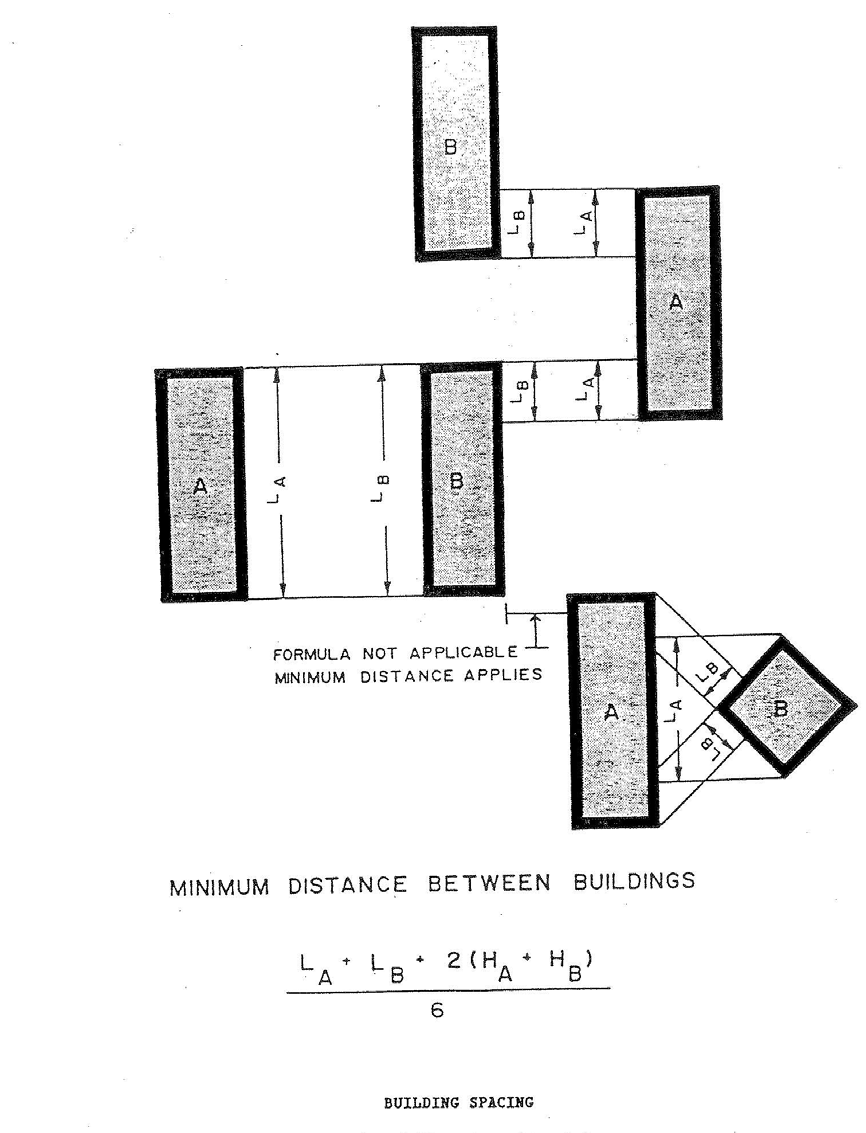
Building spacing: The minimum distance between any two buildings shall be based on the length and height of the buildings, in accordance with the following formula and illustration, provided that the distance between two buildings shall not be less than 30 feet, unless there is a corner-to-corner relationship between the buildings, in which case the minimum distance shall be 15 feet. The building spacing formula is as follows:
S = Length A + Length B + 2(Height A + Height B) / 6
S = Required minimum horizontal distance between any wall or vertical surface of building A and any wall or vertical surface of building B.
Length A = Length of building A.
Length B = Length of building B.
For the purpose of this formula, the total length of a building shall be equal to the total length of that portion or portions of walls from which, if viewed directly from above, lines drawn perpendicular to the walls will intersect any wall of an adjacent building.
Height A = Height of building A.
Height B = Height of building B.
Building height shall be measured in accordance with the definition set forth in article 1.00.
3.
Street address: The address of each dwelling unit must be clearly posted so that the unit can be readily identified from the roadway or adjacent parking area.
4.
Access and circulation: Multiple-family developments shall comply with the following requirements for access and circulation (see illustration):
(a)
Access to roads: Multiple-family developments shall only have access to an existing or planned road with a right-of-way greater than 66 feet; however, alternate means of access may be permitted by the planning commission upon finding that, due to special circumstances, substantial improvements in traffic safety could be achieved by reducing the number of driveways. Furthermore, an alternate means of access shall be permitted only if one or more of the following conditions exists:
•
The property directly across the street from the development under consideration is zoned for multiple-family or nonresidential use, or
•
The property directly across the street is developed with permanent uses other than single-family residences, or
•
The proposed development is in an area which, based on study by the planning commission, will eventually be used for purposes other than single-family use.
(b)
Emergency access: All dwelling units, including those under construction shall be readily accessible by fire and emergency vehicles from a paved public street, paved private access road, or other approved paved area. Private roadways dedicated as fire lanes shall be posted with signs indicating "Fire Lane, No Parking." To facilitate emergency vehicle access, the following guidelines shall be complied with:
•
All roadways shall be paved and bi-directional, allowing for both ingress and egress. A boulevard may be utilized to provide bi-directional traffic movement, provided that the median strip is a minimum of 25 feet in width, and the width of each paved moving lane in each direction is at least 15 feet.
•
Streets with no outlet shall be terminated with a cul-de-sac, designed in accordance with standards established and periodically updated by the city engineer and kept on file in the department of building and safety. Streets with no outlet shall not exceed 300 feet in length.
•
Gatehouse and/or barricades at entrances to private roadways shall be designed so as not to impede fire and emergency vehicle access.
(c)
Street dimensions: On-site streets and drives shall have a minimum width as follows:
Boulevard with median: 15-foot moving lane in each direction.
Undivided two-way street or drive, without parking: 24 feet.
Undivided two-way street or drive with parking: See section 4.01D.2, requirements for parallel parking.
5.
Sidewalks/pathways: Sidewalks or pathways shall be provided within the development to provide convenient access to community buildings and between parking areas and dwelling units. The sidewalks shall be designed and constructed in accordance with section 2.19. All interior sidewalks shall connect to the public sidewalk system. Where required, a ten-foot wide asphalt pathway shall be installed in accordance with the city's non-motorized pathway master plan.
6.
Parking: In addition to the requirements set forth in article 4.00, multiple family developments shall comply with the following requirements:
•
Location: Required parking shall be located in parking lots or individual driveways, and not in streets or access drives. Parking may be permitted in required side and rear yard setback areas provided that parking lots and access drives shall be located a minimum of ten feet from any property line or public right-of-way. Parking lots and access drives shall not be located closer than 25 feet to a wall of any residential structure which contains windows or doors, nor closer than seven feet to a wall of any residential structure which does not contain openings.
•
Distance from dwelling units: Parking shall be located within 150 feet of the dwelling units the parking is intended to serve, measured along the sidewalk leading to the parking lot.
•
Parking for community buildings: Parking shall be provided for community buildings, in accordance with section 4.01C.6.
7.
Lighting: All parking areas, building entrances, sidewalks, and ramps shall be illuminated to ensure the security of property and the safety of persons using such areas, in accordance with the requirements set forth in section 2.14.
8.
Landscaping: Multiple-family developments shall be landscaped in accordance with section 5.03, subsection C.
9.
Open space: Open space shall be provided in any multiple family development containing eight or more units. The open space shall comply with the following requirements:
(a)
Size: Total open space required shall be based on the number and size of units, as indicated in the following chart, provided that each development shall contain a minimum of 10,000 square feet of open space.
(b)
Location: Open space shall be located conveniently in relation to the majority of dwelling units intended to be served. Swamp areas, marshy areas, detention ponds, and similar limited-use areas shall not be included in the required open space.
(c)
Use of open space: Uses permitted within the required open space include picnic and sitting areas, pathways, playground and park space, play equipment, tennis courts, shuffleboard courts, and similar outdoor recreation facilities.
(d)
Maintenance of open space: Continued maintenance of all open space and recreational areas shall be the responsibility of all property owners of the multiple-family development. The applicant shall provide evidence of a maintenance plan and agreement, specifying maintenance schedules, work items, and financing.
(e)
Phasing: Open space improvements shall be completed in proportion to the number of units constructed in each phase.
(f)
Pathways: Paved pathways may be required by the planning commission.
10.
Garages: Garages shall be permitted for each unit, in accordance with the provisions for accessory uses in section 2.03.
11.
Antenna: Each multiple family building shall be permitted to erect one antenna.
12.
Building materials: The entire exterior wall surface (100 percent) of all multifamily buildings shall be furnished with a brick or stone material approved by the planning commission. Concrete block or other types of concrete masonry units may not be approved as meeting the requirement for brick unless approved by the planning commission.
B.
Multiple family design option. The planning commission may permit limited flexibility of design in multiple family districts, in accordance with the following criteria and subject to special land use approval:
1.
Intent: The intent of the multiple-family design option is to provide flexibility in the regulation of multiple family development; achieve efficiency in the use of land, natural resources, energy, and the provision of public services and utilities; encourage the provision of useful open space; and generally provide a better living environment. Accordingly, the multiple-family design option regulations provide for limited flexibility in the placement and inter-relationship of buildings and uses, subject to planning commission review and approval, and provided that the overall intensity of land use, density of population, amount of light, air, and open space, and requirements for access as specified elsewhere in this ordinance shall be maintained.
2.
Permitted modifications: Subject to review and approval procedures and standards which follow, modification of the requirements related to building setbacks and building spacing may be granted, but only upon determination that such modification will:
•
Result in a more efficient use of the land,
•
Will not be injurious to surrounding land and to the public as a whole, and
•
Will not result in a higher overall dwelling unit density than specified for the district in which the development is located.
3.
Procedures: The overall site plan and all regulatory modifications shall be subject to the special land use review procedures and standards set forth in section 24.03. The application and data requirements shall be the same as specified in section 24.02 for site plan review, plus any other data which may be required by the planning commission or the planning, building, or engineering officials, to make the determination require health.
The site plan shall clearly indicate every regulatory modification being requested in accordance with this section.
C.
Manufactured home park requirements. All mobile manufactured home parks shall comply with the requirements of the manufactured housing commission rules, and any other lawfully adopted ordinance of the City of Flat Rock. Regulations established by state law (Michigan Public Act 96 of 1987, as amended) and the manufactured housing commission rules govern all manufactured housing parks.
1.
Location: Manufactured homes shall be located only in those zoning districts in which manufactured home land use is permitted by right or subject to special approval. All mobile homes in an R-M, manufactured home park district shall be located on an approved site in an approved mobile home park. Emergency or temporary parking of a manufactured home on any street, alley or highway may be permitted for a period not exceeding two hours, subject to any other limitations imposed by traffic or parking regulations or ordinances for that street, alley or highway.
2.
Setbacks in the R-M district: Manufactured homes shall comply with the minimum distances specified in Michigan Public Act 96 of 1987, as amended.
•
No manufactured home unit shall be located within 50 feet greenbelt of the right-of-way of a public thoroughfare, or within ten feet of a manufactured home park property line.
•
No manufactured home unit exterior wall surface shall be located with 20 feet of any other mobile home unit's exterior wall surface.
3.
Permit: It shall be unlawful for any person to operate a manufactured home park unless that individual obtains a license for such operation in compliance with the requirements of, Michigan Public Act 96 of 1987, as amended. The building official shall communicate his recommendations regarding the issuance of such licenses to the director of the manufactured housing and land development division, Michigan Department of Consumer and Industry Services. Additionally, no manufactured housing dwelling shall be placed on a site in an approved manufactured housing park until a building permit has been obtained to approve the manufactured housing dwelling setup on the lot.
4.
Violations: Whenever, upon inspection of any manufactured home park, the building official finds that conditions or practices exist which violate provisions of this ordinance or other regulations referenced herein, the building official shall give notice in writing by certified mail to the director of the manufactured housing and land development division, Michigan Department of Consumer and Industry Services including the specific nature of the alleged violations and a description of possible remedial action necessary to effect compliance with the ordinance or other regulations. The notification shall include such other information as is appropriate in order to fully describe the violations and potential hazards to the public health, safety and welfare resulting from the violation. A copy of such notification shall be sent by certified mail to the last known address of the park owner or agent.
5.
Inspections: The building official or other authorized city agent is granted the authority, as specified in Michigan Public Act 96 of 1987, as amended, to enter upon the premises of any manufactured home park for the purpose of determining compliance with the provisions of this ordinance or other regulations referenced herein or other applicable city ordinances. No manufactured dwelling shall be occupied until a certificate of occupancy for that dwelling is obtained from the building official.
6.
Park site development standards:
(a)
Park size: Manufactured home parks shall be at least 20 acres in size.
(b)
Access: All manufactured home parks shall have paved access to a paved county primary road or state trunkline.
(c)
Interior roadways: All interior roadways and driveways shall be hard-surfaced and provided with curbs and gutters. Roadway drainage shall be appropriately designed such that stormwater from the roadway will not drain onto the manufactured home lots.
Main access drives shall be no less than 24 feet wide. Parking shall not be permitted on main access drives.
Secondary access drive shall be no less than 22 feet in width. Parking shall not be permitted on 22-foot wide drives.
(d)
Sidewalks: Sidewalks shall meet the design and construction standards as set forth in Michigan Public Act 96 of 1987, as amended.
(e)
Water and sewer service: All manufactured home parks shall be served by approved central water and sewage systems, which shall meet the requirements of the Wayne County Health Department and the Michigan Department of Health. The plumbing connections to each manufactured home site shall be constructed so that all lines are protected from freezing, accidental bumping, or from creating any nuisance or health hazard.
(f)
Storm drainage: All developed portions of the manufactured home park shall be served by adequate storm drainage facilities designed and constructed in accordance with applicable local, county, and state regulations.
(g)
Telephone and electric service: All electric, telephone, and other lines within the park shall be underground. Electric service shall be three wire, balanced 115 to 120 volt supply.
(h)
Fuel oil and gas: Any fuel oil and gas storage shall be centrally located in underground tanks, at a safe distance from all manufactured home sites. All fuel lines leading to manufactured home sites shall be underground and designed in conformance with the Michigan Administrative Code and other applicable local, county and state regulations.
(i)
Television antennas/satellite dishes: Individual exterior television antennas shall not be placed on any manufactured home unit or lot. The manufactured home park may provide a master exterior television antenna(s) for connection to individual units, or an underground cable television system may be installed. Satellite dishes must conform to the regulations outlined herein.
7.
Skirting: Each mobile home must be skirted within 90 days after establishment in a manufactured home park. In the event that skirting cannot be installed in a timely manner due to inclement weather, the building official may permit extension of the time period. All skirting shall conform to the installation and materials standards specified in Michigan Manufactured Housing Commission Rule 604.
8.
Canopies and awnings: Canopies and awnings may be attached to any manufactured home, and shall comply with setback and distance requirements set forth herein.
A building permit shall be required for construction or erection of canopies or awnings, or for construction of any area enclosed by glass, screens, or other material, such that the enclosed area will be used for more than casual warm weather leisure.
9.
Travel/recreational vehicles: Travel trailers, recreational vehicles or those similar in nature, shall not be occupied as a permanent living quarters in a manufactured housing park.
10.
Landscaping: Manufactured home parks shall be landscaped in accordance with section 5.03B.
11.
Patio: An outdoor patio area of not less than 48 square feet shall be conveniently located near the entrance of each mobile home, in proximity to open areas of the lot and other facilities. The patio shall consist of four-inch thick concrete, so as to provide a solid foundation for access to the dwelling's exterior access door. The building official may waive the requirement for a patio if the proposed mobile home dwelling is of such a size or shape that the patio would be covered by the dwelling. The building official may allow the patio to be constructed of materials other than concrete if such materials are of equal or superior quality.
12.
Open space: Every manufactured home park shall be provided with at least one conveniently located open space area. A minimum of two percent of the manufactured home park's gross acreage shall be dedicated for open space use, provided that the park shall have not less than 25,000 square feet of open space area.
13.
Garbage and refuse collection: Garbage and refuse collection areas shall be screened in accordance with section 2.13.
14.
Lighting: Street and yard lights shall be provided in sufficient number and intensity for the safe movement of vehicles and pedestrians. Lighting shall comply with the standards in section 2.14.
15.
Towing mechanisms: Towing mechanisms shall be removed from all manufactured housing dwellings at the time of installation and stored as to not to be visible from the exterior of the community. Towing mechanisms, including axles, may by stored under manufactured housing dwellings within the community.
16.
Sale of manufactured housing: The business of selling new or used manufactured housing as a commercial operation shall not be permitted after complete occupancy of a new or expanded manufactured housing park has been achieved. Thereafter, new or used manufactured housing dwellings located on sites within the manufactured housing park to be used and occupied on that site may be sold by a licensed dealer or broker. This section shall not prohibit the sale of a used manufactured housing dwelling by a resident of the manufactured housing park provided the park's regulations permit such sale.
17.
School bus stops. School bus stops shall be located in an area that is acceptable to the school district and the manufactured housing park developer.
18.
Mailbox clusters. The United States Postal Service may require that manufactured housing parks be served by clusters of mailboxes serving several sites rather than individual mailboxes serving individual sites. If mail box clusters are required, they shall be located at least 200 feet from any intersection of a manufactured housing park road with a public road.
D.
Bed and breakfast establishments.
1.
Sufficient off-street parking shall be provided at the rate of two parking spaces plus one space per double occupied room.
2.
No retail or other sales shall be permitted unless they are clearly incidental and directly related to the conduct of the bed and breakfast, including, but not limited to, the sale of goods directly related to the history of the city or locally produced items.
3.
One non-illuminated wall sign may be erected on the property, not to exceed six square feet in size. The sign shall compliment the nature of the use; i.e. historic structures should have an historic style sign.
4.
No alteration to the exterior of the residential dwelling, accessory building, or yard that alters the residential character of the premises is permissible.
5.
No vehicle used in the conduct of the bed and breakfast may be parked, kept, or otherwise be present at the premises, other than such as are normally suitable for use for domestic or household purposes.
6.
Rooms utilized for sleeping shall be part of the primary residential structure and shall not have been specifically constructed for rental purposes.
7.
Rooms utilized for sleeping shall have no direct access to the outside.
8.
Not more than four sleeping rooms may be used for such purposes.
9.
The owner, proprietor, or manager is required to occupy the property.
10.
There shall be no separate or additional kitchen facility for the guests.
11.
Bed and Breakfast facilities are intended as short-term accommodations. Long-term occupancy of more than two weeks is prohibited.
12.
Meals shall be served only to residents and overnight guests.
13.
No exterior lighting, except as normally permitted for a typical single family use, shall be permitted.
14.
A city business license is required.
15.
A bed and breakfast must comply with all other provisions of the zoning district in which it is located and must comply with all other ordinances of the city. Additionally, a bed and breakfast is subject to all other applicable local, county, state and federal regulations.
16.
Any permit issued is nontransferable.
17.
Any other conditions deemed essential and reasonable by the planning commission to protect the public health, safety and welfare, in accordance with the standards set forth in section 24.03.
18.
(a)
A permit shall be obtained from the building official, or his or her designee. Such permit shall be revoked should the bed and breakfast at any time not meet the above conditions. Any permit to allow a bed and breakfast shall be issued for a period not to exceed two years. Further, any permit shall become null and void after one year from the date such permit is granted unless the bed and breakfast has been established and is operating.
(b)
The use is subject to review at any time and may be revoked for cause by the building official. The term "cause" shall include, but not be limited to, operating the bed and breakfast in an unlawful manner or in such a manner as to constitute the maintenance of a nuisance upon or in connection with the bed and breakfast. For purposes of this section, "nuisance" shall be given the normal and customary meaning, and shall include, but not be limited to, the following:
(i)
Existing violations of building, electrical, mechanical, plumbing, zoning, health, fire or other applicable regulatory codes.
(ii)
A pattern or practice of patron conduct which is in violation of the law and/or interferes with the health, safety and welfare of other persons in the area.
(iii)
Failure after receiving notice from the city to maintain the grounds and exterior of the bed and breakfast, including frequent litter, debris or refuse blowing or being deposited upon adjoining properties.
(iv)
Failure by the owner and/or operator to permit the reasonable inspection of the bed and breakfast by the city's employees or agents in connection with the enforcement of this section.
(c)
Upon receipt of evidence of possible violation, the building official shall make a determination whether there is reasonable cause to suspect the operation or use is in violation. The building official may initiate an official investigation in order to make such a determination.
19.
If, after appropriate investigation, the building official determines that a violation does exist, the building official shall take or cause to be taken lawful action as provided by the zoning ordinance to eliminate such violation. The owners or operators of the facility deemed responsible shall be given written notice of the violation. The building official shall take appropriate action in accordance with the owner or operator's response to the notice of violation. Appropriate action includes the following:
(a)
Correction of violation within time limit. If the alleged violation is corrected within the specified time limit, even if there is no reply to the notice, the building official shall note "violation corrected" on the city's copy of the notice, and the notice shall be retained on file. If necessary, the building official may take other action as may be warranted by the circumstances of the case, pursuant to the regulations in this and other ordinances.
(b)
Violation not corrected and no reply from owner or operator. If there is no reply from the owner or operator within the specified time limits, and the alleged violation is not corrected in accordance with the regulations set forth in this ordinance, then the building official shall take such action as may be warranted to correct the violation.
(c)
Reply requesting extension of time. If a reply is received within the specified time limit indicating that an alleged violation will be corrected in accordance with the regulations set forth in the zoning ordinance, but that more time is required than was granted by the original notice, the building official may grant an extension if:
(i)
The building official deems that such extension is warranted because of the circumstances in the case, and
(ii)
The building official determines that such extension will not cause imminent peril to life, health, or property.
20.
Continued violation. If, after the conclusion of the time period granted for compliance, the building official finds that the violation still exists, the permit previously issued shall be void and the city shall initiate appropriate legal action, including the possible pursuing of remedies in an appropriate court of law.
21.
Appeals. Action taken by the building official pursuant to the procedures outlined in this subsection may be appealed to the zoning board of appeals within 30 days following said action. In the absence of such appeal, the building official's determination shall be final.
(Ord. No. 128-B, § I, 9-20-10; Ord. No. 418, § V, 1-3-12)
Sec. 6.04 - Site development standards for mixed uses.
A.
Mid-rise and high-rise developments. The following site development standards shall apply to mid- and high-rise developments where the principal buildings are four or more stories in height:
1.
Frontage and access: Mid- and high-rise developments shall front onto a paved county primary road or state trunkline, and the main means of access to the development shall be via the primary road or state trunkline.
2.
Landscaping and screening: Mid- and high-rise developments shall comply with the landscaping requirements for multiple-family districts (section 5.03, subsection C), except for the following:
(a)
Berm requirements: In addition to the requirements in section 5.03, subsection C, a berm may be required along all sides of any off-street parking or vehicle use area, where said parking or vehicle use are is located within 25 feet of any side or rear property line. The berm shall be a minimum of three feet in height, and shall be planted in accordance with the following standards:
A minimum of one deciduous or evergreen tree shall be planted for each 40 lineal feet or portion thereof of berm length, plus a minimum of one ornamental tree shall be planted for each 100 lineal feet or portion thereof of berm length, plus a minimum of eight shrubs shall be planted for each 40 lineal feet or portion thereof of berm length.
In lieu of a berm, the planning commission may permit brick piers and decorative fence, landscaping, or combination of the two.
(b)
Screening adjacent to a residential district: When a high-rise development abuts a residentially-zoned district, a six-foot masonry wall shall be constructed along the lot line abutting said district. In addition, a greenbelt shall be planted along the masonry wall on the interior of the proposed high rise development, in accordance with section 5.02C.
(c)
Landscaping adjacent to a highway or freeway: Where a mid- and high-rise development abuts a highway or freeway, a landscaped buffer shall be provided to screen freeway noise and views. In mid- and high-rise developments the buffer shall consist of the following landscaping:
A minimum of one deciduous or evergreen tree shall be planted for every 40 lineal feet or portion thereof of freeway frontage, plus a minimum of one ornamental tree shall be planted for each 100 lineal feet or portion thereof of freeway frontage, plus a minimum of eight shrubs shall be planted for each 40 lineal feet or portion thereof of freeway frontage. Trees and shrubs may be planted at uniform intervals, at random, or in groupings.
(d)
Blockage of sunlight: The types and location of trees and shrubs should not unreasonably or totally block access to sunlight on adjoining property zoned for residential purposes.
3.
Maximum density: Where a HR, high rise district is used for residential purposes, the maximum density of 25 dwelling units per acre shall be permitted.
4.
Open space: Open space shall be provided for residential uses in accordance with the requirements for multiple-family and attached housing, section 6.03, subsection A, except that private patios and balconies may be used to reduce the amount of required open space by up to 40 percent.
5.
Protection of solar access: Building placement should provide maximum solar access to adjoining residentially-zoned property, so as to conserve energy resources and provide adjacent property owners with the opportunity to use existing and future technology in the use of solar energy for heating, cooling, and ventilation. Accordingly, the following standards shall apply:
(a)
Orientation: The lengthwise axis of buildings shall be oriented southerly, southeasterly, or southwesterly to maximize solar gain.
(b)
Setback: The planning commission may require mid- and high-rise buildings to be set back a greater distance than specified for the district in which the building is located to prevent the shadows cast by the building from obstructing the solar access of adjoining residentially zoned properties. In determining appropriate setbacks so as to minimize shadow obstruction, the following formula shall be used:
Required Setback = [Building height (in feet) x 2.2] - [Required yard setback of adjacent residential zone]
Note: The 2.2 factor is based on the solar azimuth on December 21, and the latitude of the City of Flat Rock, 42 20'.
B.
Condominium requirements. The following regulations shall apply to all condominium projects within the township:
1.
Definitions: For the purposes of this ordinance, the following words or terms shall have the meaning ascribed to them. Condominium terms shall also have the meaning ascribed to them in the Condominium Act in addition to any meaning set forth herein:
(a)
Condominium Act: Michigan Public Act 59 or 1978, as amended.
(b)
Condominium lot: That portion of a site condominium project designed and intended to function similar to a platted subdivision lot for the purposes of determining minimum yard setback requirements and other requirements set forth in article 23.00.
(c)
Condominium unit: That portion of the condominium project designed and intended for separate ownership and use, as described in the master deed for the project.
(d)
Site condominium: A condominium project in which the land is the conveyable unit. A residential site condominium project typically is designed to function in a similar manner as, or as an alternative to, a platted subdivision. A site condominium shall be considered as equivalent to a platted subdivision for the purposes of regulation in this ordinance, and may be referred to as a "condominium subdivision".
2.
Regulatory intent: All condominium projects shall conform to the requirements of this section and all other applicable regulations. Site condominium projects shall be considered as equivalent to platted subdivisions, subject to the same regulations that apply to a subdivision plat, except that the review procedures of this ordinance shall apply. Site condominiums shall comply with the requirements for streets, sidewalks, utilities, storm drainage, and subdivision layout and design as set forth in the Subdivision Control Act, Michigan Public Act 288 of 1967, as amended, and the City of Flat Rock Subdivision Control Ordinance, chapter 52 of the city Code.
3.
Initial information required: An applicant intending to develop a condominium project shall submit the following information to the building official concurrently with the notice required to be given to the township pursuant to Section 71 of Public Act 59 of 1978, as amended:
•
The name, address and telephone number of all persons with an ownership interest in the land on which the condominium project will be located, together with a description of the nature of each entities interest (for example, fee owner, optionee, leasee, or land contract vendee).
•
The name, address and telephone number of all engineers, attorneys, architects or registered land surveyors associated with the project.
•
The name, address and telephone number of the developer or proprietor of the condominium project.
•
The legal description of the land on which the condominium project will be developed together with appropriate tax identification numbers.
•
The acreage area of the land on which the condominium project will be developed.
•
The purpose of the project (for example, residential, commercial, industrial, etc.).
•
Approximate number of condominium units to be developed on the subject parcel.
•
Anticipated method of providing the project with water and sanitary sewer service.
4.
Updating of information: All information required to be furnished under this section shall be kept updated until a certificate of occupancy has been issued.
5.
Site plan review: Prior to recording of the master deed required by Section 72 of Michigan Public Act 59 of 1978, as amended, the condominium project shall undergo site plan review and approval pursuant to section 24.02 of this ordinance. Expansion of a project to include additional land in a new phase shall also require site plan review.
Review and approval of all local, state, and federal agencies having jurisdiction over such development or the particular site shall be required prior to final site plan approval. Accordingly, review and approval of the following agencies may be required: Michigan Department of Transportation (if located on a state road), Wayne County Office of Public Services, Wayne County Health Department, Michigan Department of Natural Resources, and public utilities companies serving the site. The planning commission shall consider any comments made by these agencies prior to final site plan review.
The planning commission is authorized to grant approval, grant approval subject to conditions, or reject a site plan subject to section 24.02, subsection C.
6.
Temporary occupancy: The building official may allow occupancy of the condominium project before all improvements required by this ordinance have been completed, provided that a performance guarantee is deposited with the city in accordance with section 2.17 to insure faithful completion of the improvements prior to expiration of the temporary occupancy permit.
7.
Standards for single-family detached condominiums: Single-family detached condominiums shall be subject to all requirements and standards of the applicable R-1A, R-1B, or R-1C districts, including minimum floor area requirements, but not including minimum lot size. Building envelopes shall be depicted on the site plan to assure that the minimum requirements set forth in article 23 for front, rear, and side yards can be met.
8.
Standards for single-family site condominiums: Single-family site condominiums shall be subject to all requirements and standards of the applicable R-1A, R-1B, or R-1C districts, including minimum lot requirements which shall be applied by requiring the site condominium unit and a surrounding limited common element to be equal in size to the minimum lot size and width. The site condominium unit shall be equivalent to the area of the lot where a principal building can be constructed. There shall be a limited common element associated with each site condominium unit which shall be at least equivalent to the minimum yard area requirements.
9.
Street and road requirements: All streets and roads in a single-family detached or a single-family site condominium project shall, at a minimum, conform to the standards and specifications established by the Wayne County Office of Public Services for a typical residential road in single-family residential subdivisions.
10.
Final site plan: After submittal of the condominium plan and by-laws as part of the master deed, the project developer or proprietor shall furnish the city with a copy of the site plan of a Mylar sheet of at least 13 inches x 16 inches with an image not to exceed 10½ inches x 14 inches. In addition, the project developer or proprietor shall furnish the building official with the following: One copy of the recorded Master Deed, one copy of all restrictive covenants, and two copies of an "as built survey". The "as built survey" shall be reviewed by the city engineer and building official to determine compliance with city ordinances.
11.
Monuments required: All condominium projects shall be marked with monuments as required by the condominium rules promulgated by the Michigan Department of Commerce, Corporation and Securities Bureau.
(Ord. No. 128-B, § I, 9-20-10)

