
Flint Township City Zoning Code
ARTICLE 1
- IN GENERAL
Sec. 14.1-1.- Purpose.
(a)
It is the purpose of this chapter to:
(1)
Promote the public health, safety, and general welfare of the public;
(2)
Encourage the use of lands and natural resources in accordance with their character and adaptability, and suitability for particular purposes;
(3)
Limit the improper use of lands;
(4)
Enhance social and economic stability;
(5)
Enhance the aesthetic desirability of the environment;
(6)
Avoid overcrowding of population,
(7)
Provide adequate light and air;
(8)
Lessen congestion on the public roads and streets;
(9)
Reduce hazards to life and property;
(10)
Facilitate adequate provision for a system of transportation; sewage disposal; safe and adequate water supply, storm drainage, education, recreation, and other public requirements; and
(11)
Conserve the expenditure of funds for public improvements and services to conform with the most advantageous use of land, resources and properties, to designate zoning districts within which the location, sizes, and uses of buildings and minimum open spaces shall be regulated; to limit the maximum number of families to be housed in certain areas; and to impose certain safety and sanitary measures and to provide for petitions and public hearings.
(b)
In order to effectively meet this purpose, the township is divided into districts and the regulations specified for each district established by this chapter have been developed in accordance with a plan for the physical development of the township.
(Ord. of 7-18-2022)
Sec. 14.1-2. - Relationship to land use plan.
It is the intention of the township that this chapter implement the planning policies and strategies adopted by the planning commission, as reflected in the master plan and other township planning documents.
(Ord. of 7-18-2022)
Sec. 14.1-3. - Scope.
(a)
Where any condition imposed by any provision of this chapter upon the use of any lot, building, or structure is either more restrictive or less restrictive than any comparable condition imposed by any other provision of this chapter or by the provision of any ordinance adopted under any other law, the provisions which is more restrictive or which imposes the higher standard requirement shall govern.
(b)
This chapter is not intended to abrogate or annul any easement, covenant or other private agreement, provided that where any provision of this chapter is more restrictive or imposes a higher standard or requirement than such easement, covenant or other private agreement, the provision of this chapter shall govern.
(c)
Except as may otherwise be provided in this chapter, every building and structure erected, every use of any lot, every structural alteration or relocation of an existing building or structure, and every enlargement of, or addition to, an existing use, building or structure occurring after the effective date of the ordinance form which this chapter is derived shall be subject to all regulations of this chapter which are applicable in the zoning district in which such use, building or structure is located.
(d)
No setback area or lot existing at the time of adoption of this chapter shall be reduced in dimensions or area below the minimum requirements set forth herein. Yards or lots created after the effective date of the ordinance from which this chapter is derived shall meet at least the minimum requirements established herein.
(e)
The regulations herein established shall be the minimum regulations for promoting and protecting the public health, safety and welfare.
(Ord. of 7-18-2022)
Sec. 14.1-4. - Authority.
This chapter is enacted in accordance with Public Act No. 110 of 2006 (MCL 125.3101 et seq.).
(Ord. of 7-18-2022)
Sec. 14.1-5. - Validity and severability.
If any court of competent jurisdiction shall declare any part of this chapter to be invalid, such ruling shall not affect any other provisions of this chapter not specifically included in said ruling. Further, if any court of competent jurisdiction shall declare invalid the application of any provisions of this chapter to a particular parcel, lot, use, building or structure, such ruling shall not affect the application of said provisions to any other parcel, lot, use, building or structure not specifically included in said ruling.
(Ord. of 7-18-2022)
Sec. 14.1-6. - Construction of language.
(a)
For the purpose of this chapter, certain terms or words used herein shall be interpreted as follows:
(1)
The terms "used" or "occupied" include the terms "intended," "designed," or "arranged to be used or occupied";
(2)
The term "building" includes the term "structure";
(3)
The term, "dwelling" includes the term "residence"; and
(4)
The term "lot" includes the terms "plot" or "parcel."
(b)
Terms not herein defined shall have the meaning customarily assigned to them.
(Ord. of 7-18-2022)
Sec. 14.1-7. - Definitions.
Abutting (lot or parcel) means a lot or parcel which shares a common border with the subject lot or parcel.
Access management (access control) means a technique to improve traffic operations along major roadways, including control of driveway locations and design, consideration of the relationship of traffic activity for properties adjacent to, and across from one another, and the promotion of alternatives to direct access.
Access to property means a property owner's legal right to access a public road right-of-way. Reasonable access to property may be indirect or certain turning movements prohibited for improved safety and traffic operations.
Accessory building means a building or portion of a building subordinate to a main building on the same lot occupied by or devoted exclusively to an accessory use.
Accessory use means a use naturally and normally incidental and subordinate to, and devoted exclusively to the main use of the premises.
Adequate lateral support means the control of soil movement on a site as determined by accepted engineering standards.
Adult foster care facility means a governmental or nongovernmental establishment that provides foster care to adults. Subject to MCL 400.726a, the term "adult foster care facility" includes facilities and foster care family homes for adults who are aged, mentally ill, developmentally disabled, or physically disabled who require supervision on an ongoing basis but who do not require continuous nursing care. Adult foster care facility does not include any of the following:
(1)
A nursing home licensed under article 17 of the public health code, Public Act No. 368 of 1978 (MCL 333.20101 et seq.).
(2)
A home for the aged licensed under article 17 of the public health code, Public Act No. 368 of 1978 (MCL 333.20101 et seq.).
(3)
A hospital licensed under article 17 of the public health code, Public Act No. 368 of 1978 (MCL 333.20101 et seq.).
(4)
A hospital for the mentally ill or a facility for the developmentally disabled operated by the department of community health under the mental health code, Public Act No. 258 of 1974 (MCL 330.1001 et seq.).
(5)
A county infirmary operated by a county department of social services or family independence agency under section 55 of the social welfare act, Public Act No. 280 of 1939 (MCL 400.55).
(6)
A child caring institution, children's camp, foster family home, or foster family group home licensed or approved under Public Act No. 116 of 1973 (MCL 722.111 et seq.), if the number of residents who become 18 years of age while residing in the institution, camp, or home does not exceed the following:
a.
Two, if the total number of residents is ten or fewer.
b.
Three, if the total number of residents is not less than 11 and not more than 14.
c.
Four, if the total number of residents is not less than 15 and not more than 20.
d.
Five, if the total number of residents is 21 or more.
(7)
A foster family home licensed or approved under Public Act No. 116 of 1973 (MCL 722.111 et seq.), that has a person who is 18 years of age or older placed in the foster family home under section 5(7) of Public Act No. 116 of 1973 (MCL 722.115(7)).
(8)
An establishment commonly described as an alcohol or a substance abuse rehabilitation center, a residential facility for persons released from or assigned to adult correctional institutions, a maternity home, or a hotel or rooming house that does not provide or offer to provide foster care.
(9)
A facility created by Public Act No. 152 of 1885 (MCL 36.1 et seq.).
Adult foster care family home means a private residence that is licensed by the state pursuant to Public Act 218 of 1979 and with an approved capacity of not more than six to be provided supervision, personal care, and protection in addition to room and board, for 24 hours a day, five or more days a week, and for two or more consecutive weeks for compensation. The adult foster care family home licensee must be a member of the household and an occupant of the residence.
Adult foster care small group home (1—6) means a structure constructed for residential purposes that is licensed by the state pursuant to Public Act 218 of 1979 and with an approved capacity to receive not more than six adults to be provided supervision, personal care, and protection in addition to room and board, for 24 hours a day, five or more days a week, and for two or more consecutive weeks for compensation.
Adult foster care small group home (7—12) means a structure constructed for residential purposes that is licensed by the state pursuant to Public Act 218 of 1979 and with an approved capacity to receive not less than seven or more than 12 adults to be provided supervision, personal care, and protection in addition to room and board, for 24 hours a day, five or more days a week, and for two or more consecutive weeks for compensation.
Adult foster care large group homes (13—20) means a structure constructed for residential purposes that is licensed by the State of Michigan pursuant to Public Act 218 of 1979 and with an approved capacity to receive at least 13 but not more than 20 adults to be provided supervision, personal care, and protection in addition to room and board, for 24 hours a day, five or more days a week, and for two or more consecutive weeks for compensation.
Airport authority means Bishop International Airport and its board of directors.
Airport hazard means any structure or appurtenances thereof or use of land which obstructs the air space required for the safe use of land which obstructs the air space required for the safe flight of aircraft landing or taking off at an airport or that is otherwise hazardous or creates hazards to safe landing or taking off of aircraft.
Airport hazard area means any areas of land or water, or both, upon which an airport hazard might be established, if not prevented, including any such area which has been declared to be an airport hazard area by the state aeronautics commission in connection with any airport approach plan adopted by said commission or by the Federal Aviation Administration.
Alley means a public way which affords only a secondary means of access to abutting property and not intended for general traffic circulation.
Alterations means any change, addition or modification in construction or type of occupancy; any change in the structural members of a building, such as walls, partitions, columns, beams, girders, or any change which may be referred to herein as "altered" or "reconstructed."
Amended soil means soil that has had material added to it to improve physical aeration, structure, and drainage properties, including water retention and permeability.
Architectural features mean architectural features of a building shall include cornices, eaves, gutters, belt courses, sills, lintels, bay windows, chimneys and decorative ornaments.
Automobile and body repair station provides a service for the general repair of engines, engine rebuilding, or reconditioning of motor vehicles collision service such as body, frame, or fender; overall painting and undercoating of vehicles.
Automobile repair station provides a service where light automotive maintenance and repair is conducted such as muffler shops, quick oil change and lubrication shops, tire stores, transmission shops and brake shops.
Automobile service station means a building or structure designed or used for the retail sale of fuel stored in tanks, lubricants, air, water and other operating commodities for motor vehicles, aircraft or boats, and including the customary space and facilities for the installation of such commodities on or in such vehicles, and including space for facilities for the storage, minor repair, or servicing, but not including bumping, painting, refinishing, major repairs and overhauling, steam cleaning, rust-proofing, where the primary use of the premises is such, or high speed washing thereof.
Automobile fuel station, also a convenience store with the sale of gasoline, means an establishment where gasoline and motor fuels are dispensed into vehicles, and the sale of retail and convenience items which occupy 50 square feet or greater of the sales area in conjunction with the gasoline sales.
Automobile wash establishment provides facilities for washing and cleaning motor vehicles. This can be machine or hand-operated facilities and may employ some hand labor.
Basement or cellar means a portion of a building having more than 50 percent of its perimeter six feet below grade.
Bed and breakfast inn means a use which is subordinate to the principal use of a dwelling unit as a single-family dwelling unit and a use in which transient guests are provided a sleeping room and board in return for payment.
Berm means a mound of earth graded, shaped and improved with landscaping in such a fashion as to be used for visual and/or audible screening.
Bioretention area and rain garden means a vegetated area of depression that provides for stormwater filtration before discharging into an aquifer or constructed drainage system.
Bioswale means a vegetated area of depression within parking lots or between the road and sidewalk of a right-of-way that provides for stormwater filtration before discharging into an aquifer or constructed drainage system.
Block means the property, abutting one side of a street and lying between the two nearest intersection streets, or between one intersecting street and railroad right-of-way, unsubdivided acreage, river or live stream; or between any of the foregoing and any other barrier to the continuity of development.
Board of appeals means the zoning board of appeals for the township.
Buffer area means a strip of land required between certain land uses reserved or planting material, berms, walls for fencing.
Building means a structure, either temporary or permanent, having a roof supported by columns, or walls for the shelter, support or enclosure of persons, animals, or chattels, is a building. This shall include tents, awnings, or vehicles situated on private property and used for purposes for a building. When any portion thereof is completely separated from every other part thereof by division walls from the ground up, and without openings, each portion of such building shall be deemed a separate building.
Building area means the buildable area of a lot is the space remaining after the minimum open space requirements of this chapter have been complied with.
Building department means the township building department head or his qualified designee.
Building height means the building height is the vertical distance measured from the average finished grade to the highest point of flat roof; to the deck of mansard roofs; and to the average height level between eaves and ridge of gable, hip and gambrel roofs. For measurement of height of accessory buildings see section 14.1-8.
Building line means a line established, parallel to the front street line between which no part of a building shall project, except as otherwise provided by the chapter.
Building, principal, means a building in which is conducted the principal use of the lot on which it is situated.
Building permit means the written authority issued by the building inspector permitting the construction, removal, moving, alteration or use of a building in conformity with the provisions of this chapter.
Child care center means a facility, other than a private residence, receiving one or more preschool or school-age children for care for periods of less than 24 hours a day, where the parents or guardians are not immediately available to the child. Child care center or day care center includes a facility that provides care for not less than two consecutive weeks, regardless of the number of hours of care per day. The facility is generally described as a child care center, day care center, day nursery, nursery school, parent cooperative preschool, play group, before- or after-school program, or drop-in center. Child care center or day care center does not include any of the following:
(1)
A Sunday school, a vacation bible school, or a religious instructional class that is conducted by a religious organization where children are attending for not more than three hours per day for an indefinite period or for not more than eight hours per day for a period not to exceed four weeks during a 12-month period.
(2)
A facility operated by a religious organization where children are in the religious organization's care for not more than three hours while persons responsible for the children are attending religious services.
(3)
A program that is primarily supervised, school-age-child-focused training in a specific subject, including, but not limited to, dancing, drama, music, or religion. This exclusion applies only to the time a child is involved in supervised, school-age-child-focused training.
(4)
A program that is primarily an incident of group athletic or social activities for school-age children sponsored by or under the supervision of an organized club or hobby group, including, but not limited to, youth clubs, scouting, and school-age recreational or supplementary education programs. This exclusion applies only to the time the school-age child is engaged in the group athletic or social activities and if the school-age child can come and go at will.
Church means a building where the primary use is for the regular assembly of persons for religious worship or services, together with accessory uses.
Club means an organization of persons for special purposes or for the promulgation of agriculture, sports, arts, science, literature, politics or the like, but not for profit.
Cluster development means a design technique that concentrates building in specific areas to allow remaining land to be used for recreation, common open space, and preservation of environmentally sensitive area.
Condominium Act refers to Public Act No. 59 of 1978 (MCL 559.101 et seq.).
Condominium conversion means a condominium project containing condominium units, some or all of which were occupied before the establishment of the condominium project.
Condominium master deed means the condominium document recording the condominium project as approved by the zoning administrator to which is attached as exhibits and incorporated by reference the approved bylaws for the project and the approved condominium subdivision plan for the project.
Condominium project is equivalent to the term "subdivision" as used in subdivision regulations.
Condominium project, mobile home, means a condominium project in which mobile homes are intended to be located upon separate sites which constitute individual condominium units.
Condominium setbacks. Condominium setbacks shall be measured as follows:
(1)
Front yard setback. The distance between the street centerline right-of-way line closest to the unit and the unit site.
(2)
Side yard setback. The distance between the limits of the development and the side of a unit or the distance between the sides of any adjacent units.
(3)
Rear yard setback. The distance between the limit of the development and the rear of the unit or the distance between the rear of any two adjacent units.
Condominium subdivision plan means the site, survey and utility plans, and sections showing the existing and proposed structures and improvements including the location thereof on the land. The plan shall follow and show all aspects as required under the Condominium Act.
Condominium unit means the portion of the condominium project designed and intended for separate ownership as described in the master deed, regardless of whether it is intended for residential, office, industrial, business, recreational, use as a time-share unit, or any other type of use.
Condominium unit site means the area designating the perimeter within which the condominium unit must be built. After construction of the condominium unit, the balance of the condominium unit site shall become a limited common element. The term "condominium unit site" shall be equivalent to the term "lot," for the purposes of determining compliance of a site condominium subdivision with provisions of the section pertaining to minimum lot size, minimum lot width, maximum lot coverage and maximum floor area ratio.
Congregate housing means a residential facility for four or more elderly persons (age 55 years or older) within which are provided living and sleeping facilities, meal preparation, laundry services, and room cleaning. Such facilities may also provide other services, such as transportation for routine social and medical appointments and counseling.
Cul-de-sac means a dead end public or private street, generally short in distance, which terminates in a circular or semi-circular section of street which allow for vehicle turnaround.
Detention facility means a facility designated for holding stormwater runoff for a short period of time and then releasing it to an approved watercourse where it returns to the hydrologic cycle.
Development means any manmade change to improved or unimproved real estate, including, but not limited to, buildings or other structures, mining, dredging, filling, grading, paving, excavation, or drilling operations.
Domestic animal means any dog, other than a vicious dog, cat or a species customarily used as an ordinary household pet, excluding farm animals (including but not limited to cattle, horses, mules, sheep, swine, goats and chickens).
Drainageways and streams are existing permanent or intermittent watercourses.
Drive-in means a business establishment so developed that its retail or service character is dependent on providing a driveway approach or parking spaces for motor vehicles so as to serve patrons while in the motor vehicle rather than within a building or structure, including customer communication facilities for banks or other uses. A drive-in restaurant is distinct from a drive-through restaurant in the majority of drive-in patrons consume food and beverages while in the vehicle and parked on the premises.
Drive-through means a business establishment in which all or at least ten percent of the business consists of serving foods and beverages in a ready-to-consume state from a drive-through window to patrons in motor vehicles. A drive-through restaurant may or may not also have indoor seating.
Dwelling, efficiency, means a dwelling unit of not more than one room in addition to a kitchen and a bathroom.
Dwelling, multiple-family, means a building designed exclusively for, and containing, three or more dwelling units.
Dwelling, single-family, means a detached building designed exclusively for, and containing, one dwelling unit only.
Dwelling, two-family, means a detached building designed exclusively for, and containing, two dwelling units only.
Dwelling unit means a building, or enclosed portion thereof, designed for occupancy by one family for residential purposes and having independent living, eating, sleeping, cooking, and sanitary facilities. A dwelling unit shall include both manufactured units (mobile homes and modular homes) and site built units.
Dwelling unit, attached, means a dwelling unit attached to one or more dwelling units by common major structural elements.
Dwelling unit, detached, means a dwelling unit which is not attached to any other dwelling unit by any means.
Easement means a grant of one or more of the property rights by the owners to or for the use by the public, a corporation or another person or entity.
Erected includes built, constructed, reconstructed, moved upon, or any physical operations on the premises required for the building. Excavations, fill, drainage, and the like shall be considered a part of erection.
Essential public services means the erection, construction, alteration, or maintenance by public utilities or government agencies of underground, surface, or overhead gas, electrical, steam, or water transmission or distribution systems, collection, communication, supply or disposal systems, including mains, drains, sewers, pipes, conduits, wires, cables, hydrants, traffic signals, hydrants, towers, poles, and other similar equipment, and accessories in connection therewith reasonably for the furnishing of adequate service by such public utilities or government agencies or for the public health or general welfare, but not including buildings or storage yards.
Essential public service building means a building or structure principal to an essential public service, such as a drop-off stations for residential recycles, vehicle garages, telephone exchange buildings, electricity transformer stations or substations, gas regulator stations, radio and television towers, and cellular phone antennas.
Essential public service building storage yard means an outdoor storage area principal or accessory to an essential public service.
FAA means the Federal Aviation Administration and/or any successor agency to the Federal Aviation Administration.
Facade means the exterior wall of a building exposed to the public view or that wall viewed by persons not within the building.
Family means one or more persons living together and interrelated by bonds of consanguinity, marriage, or legal adoption, and occupying the whole or part of a dwelling unit as a single nonprofit housekeeping unit as distinguished from a group occupying a hotel, club, boardinghouse, fraternity or sorority house. A family shall be deemed to include domestic servants, gratuitous guests, and not more than three boarded children.
Family day care home means a child care facility that provides licensed day care in private homes for six or fewer unrelated minor children under the age of 18. Children receive care and supervision for periods of less than 24 hours a day unattended by a parent or legal guardian for more than four weeks during a calendar year.
Farm means the land, plants, animals, buildings, structures, including ponds used for agricultural or aquacultural activities, machinery, equipment, and other appurtenances used in the commercial production of farm products.
Fence means accessory structure intended for use as a barrier to property, ingress or egress, a screen from objectionable noise and or decorative use.
Filling means the depositing or dumping of any matter onto, or into the ground, except common household gardening.
Floor area, gross, means the sum of the gross horizontal areas of the floors of the building measured from the exterior faces of the exterior walls or from the centerline of walls separating two buildings. The "floor area" of a building shall include the basement floor area when more than one-half of the basement height is above the established curb level, or finished lot grade, whichever is higher (see basement). The term "floor area" shall not include elevator shafts and stairwells at each floor, space used for mechanical equipment (except equipment, open or enclosed, located on the roof), attic space having headroom of seven feet, ten inches or more, interior balconies and mezzanines. any space devoted to off-street parking or loading shall not be included in "floor area." Area of basements, utility rooms breezeways, porches or attached garages are not included.
Floor area, usable, is used for computing parking requirements as that area.
Foster family home means a private home in which one, but not more than four, minor children, who are not related to an adult member of the household by blood, marriage, or adoption, are given care and supervision for 24 hours a day, for four or more days a week, for two or more consecutive weeks, unattended by a parent or legal guardian.
Foster family group home means a private home in which at least five, but not more than six, minor children, who are not related to an adult member of the household by blood, marriage, or adoption, are given care and supervision for 24 hours a day, for four or more days a week, for two or more consecutive weeks, unattended by a parent or legal guardian.
Frontage means the length of any one property of a premises which property line abuts a legally accessible street right-of-way.
Garage, commercial, means any premises except those described as a private, community or storage garage, available to the public, used principally for the storage of automobiles or motor-driven vehicles, for remuneration, hire or sale, where any such vehicle or engine may also be equipped for operation, repaired, rebuilt or reconstructed, and where vehicles may be greased, washed or serviced. (Not an auto service station.)
Garage, community, means a garage used for the storage of vehicles of residents of dwelling units on the same or adjacent block or blocks, and providing only incidental services to such vehicles as are stored therein.
Garage, private, means a building used primarily for the storage of self-propelled vehicles for the use of the occupants of a lot on which such building is located and with a capacity of not more than three motor driven vehicles. The foregoing definition shall be construed to permit the storage of any one lot, for the occupants thereof, of not more than one commercial vehicle not exceeding a rated capacity of three-fourths ton.
Garage, storage, means any premises except those herein defined as private garage, used exclusively for the storage of self-propelled vehicles, and where such vehicles are not repaired.
Grade means the established grade of the street or sidewalk shall be the elevation of the curb at the midpoint of the front of the lot. The elevation is established by the township building department.
Greenbelt means a landscaped area along a street between the curb or road shoulder and the front yard building or parking setback line, this area is also referred to as the front yard parking lot setback area. Landscaping requirements for greenbelts are provided in article 8 of this chapter.
Green infrastructure means stormwater management infrastructure that primarily uses vegetation as natural filtration. Examples include bioswales, bioretention areas, amended soil areas, pocket or modular wetlands, stormwater trees. These and similar practices are specifically designed to treat pollutants carried by stormwater runoff, promote evapotranspiration, and allow for more natural infiltration into the nearest aquifers or similar groundwater-holding substrates.
Group day care home means a child care facility that provides licensed day care in private homes for not less than seven or no more than 12 unrelated minor children under the age of 18. Children receive care and supervision for periods of less than 24 hours a day unattended by a parent or legal guardian for more than four weeks during a calendar year. Facilities that provide licensed day care to 13 or more minor children constitute a commercial day care center.
Hazardous substances mean any substances or materials that, by reason of their toxic, caustic, corrosive, abrasive, or otherwise injurious properties, may be detrimental or deleterious to the health of any person handling or otherwise coming into contact with such material or substance.
Health/recreation facility means an indoor facility including uses such as game courts, exercise equipment, locker rooms, jacuzzi, and/or sauna and pro shop.
Health club means a gymnasium (except public), private clubs (athletic, health, or recreational), reducing salons, and weight control establishments, but not limited to these.
Height of building means the vertical distance from the established grade of the center of the front of the building to the highest point of the roof surface of a flat roof, to the deck line for a mansard roof, to the mean height level between the eves and ridge for hip, gabled and gambrel roofs.
Home occupation means an accessory use of a dwelling that constitutes either entirely or partly, the livelihood of a person living in the dwelling, said use shall be conducted entirely within the dwelling and carried on by the inhabitants therein and having no external effects.
Hospital means an institution providing health services, primarily for inpatients and medical or surgical care of the sick or injured, including as an integral part of the institution, such related facilities as laboratories, outpatient departments, training facilities, center service facilities and staff offices that are an integral part of the facilities.
Hotel means a building occupied or used as a more or less temporary abiding place of individuals or groups of individuals with or without meals, and in which there are more than five sleeping rooms, and in which no provision is made for cooking in any individual room.
Housing for the elderly includes:
(1)
Independent living is housing where low level congregate care is provided. Also known as senior independent units.
(2)
Intermediate level congregate service is housing where one or two common meals, housekeeping, linen, and similar services are provided. Also known as senior interim care, intermediate care units, and home for the aged.
(3)
Convalescent housing units is housing where high-level, 24-hour nursing care is provided. Also known as convalescent homes, nursing home units, sanitariums, and rest homes.
Indoor recreation establishment means a privately owned facility designed and equipped for the conduct of sports, amusement or leisure time activities and other customary recreational activities indoors (within an enclosed building) and operated as a business and open for use by the public for a fee, such as fitness centers, bowling alleys, indoor softball, and racquetball and tennis clubs.
Industrial park means a coordinated environment for a variety of industrial and related activities. The project is developed or controlled by one proprietary interest. It has an enforceable master plan and/or covenants, conditions, and restrictions. The development may be on one parcel, may be subsidized, may have condominium ownerships, or a combination of these types.
Junk means any motor vehicles, machinery, appliance, product, or merchandise with parts missing or scrap metals or other scrap materials that are damaged, deteriorated, or are in a condition which cannot be used for the purpose for which the product was manufactured.
Junkyard includes automobile wrecking yards and salvage areas and 200 square feet for the storage, keeping or abandonment of junk, including scrap metals, other scrap materials or reclaimed materials, or for the dismantling, demolition, or abandonment of automobiles or other vehicles or machinery or parts thereof, but does not include uses established entirely within enclosed buildings.
Kennel means any lot or premises on which three or more dogs, four months or more old, are kept, for the purpose of breeding, permanently or temporarily boarded, or for sale.
Laboratory means a place devoted to experimental, routine study or basic study such as testing and analytical operations and in which manufacturing of product or products, except prototypes, is not performed.
Landfill means a disposal site employing an engineering method of disposing of solid wastes in a manner that minimizes environmental hazards by spreading, compacting to the smallest volume, and applying cover material over all exposed waste at the end of each operating day.
Liquor store means any business selling general alcoholic beverages, also known as sale of distilled spirits or hard liquor, for off-premises consumption. Liquor store does not include a business selling only beer and/or wine for off-premises consumption. Convenience stores may or may not include a liquor store.
Loading space means an off-street space on the same lot with a building or group of buildings, for temporary parking for a commercial vehicle while loading and unloading merchandise or materials.
Lot means a parcel of land separated from other parcels of land by description on a recorded plat or by metes and bounds description, including a condominium unit site in a site condominium subdivision; having frontage upon a public or private street and having sufficient size to comply with the requirements of this chapter for: minimum area, setbacks, coverage, and open space.
Lot area means the total horizontal area within the lot lines of a lot including street right-of-way.
Lot, corner, means a lot abutting on and at the intersection of two or more streets.
Lot coverage means the part or percent of the lot occupied by buildings or structures, including accessory buildings or structures.
Lot depth means the mean horizontal distance from the front street line to the rear lot line.
Lot, double frontage, means a lot other than a corner lot having frontage on two more or less parallel streets. In the case of a row of double frontage lots, one street will be designated as the front street for all lots in the plat and in the request for a zoning compliance permit. If there are existing structures in the same block fronting on one or both of the streets the required front yard setback shall be observed on those streets where such structures presently front.
Lot, interior, means a lot other than a corner.
Lot lines means the property lines bounding the lot or condominium unit site. For an illustration of lot lines see section 14.1-8.
(1)
Front lot line. In the case of an interior lot, it is that line separating such lot from the street right-of-way. In the case of a corner lot the front lot line may be on either street as long as it is in compliance with setbacks.
(2)
Rear lot line. Ordinarily, that lot line which is opposite and most distant from the front lot line of the lot. In the case of an irregular, triangular, or gore shaped lot, a line ten feet in length entirely within the lot parallel to and at the maximum distance from the front lot line of the lot shall be considered to be the rear lot line for the purpose of determining depth of rear yard. In cases where none of these definitions are applicable, the planning commission shall designate the rear lot line.
(3)
Side lot line. Any lot line not a front lot line or a rear lot line. A side lot line separating a lot from street is a side street lot line. A side lot line separating a lot from another lot or lots is an interior side lot line.
(4)
Street or alley lot line. A lot line separating the lot from the right-of-way of a street or an alley.
Lot of record means a lot which actually exists in a subdivision plat as shown on the records of the county register of deeds, or a lot or parcel described by metes and bounds, the description of which has been so recorded. Or a lot or parcel approved through the provisions within the land division ordinance of the township.
Lot width means the horizontal distance between the side lot lines, measured at the two points where the building line, or setback, intersects the side lot lines. The minimum lot width at the Right-of-way shall be sufficient to accommodate a driveway and turning radius consistent with the county road commission driveway permit standards.
Manufactured home or mobile home means a dwelling unit which is designed for residential use and is wholly or substantially constructed at an off-site location. Manufactured homes include mobile home and modular home units.
Manufactured home/mobile home park means a parcel or tract of land under the control of a person, group or firm upon which three or more homes are located on a continual nonrecreational basis and which is offered to the public for that purpose regardless, of whether a charge is made, together with any building, structure, enclosure, street, equipment or facility used or intended for use incident to the occupancy of a home and which is not intended for use as a temporary trailer park.
Medical clinic means an establishment where human patients are admitted for examination and treatment by a group of physicians, dentists or similar professionals on an out-patient basis. A clinic may incorporate customary laboratories and pharmacies incidental or necessary to its operation.
Mezzanine means an intermediate floor in any room occupying not to exceed one-third of the floor area of such story.
Minimum obstruction clearance altitude means the lowest FAA published altitude that assures acceptable navigational signal coverage and that is in effect between radio fixes on a low altitude run airway, on an off-airway route, or, provided the altitude meets obstacle clearance requirements for the entire route segment, on a route segment.
Ministorage facility or self-storage facility means a building or group of buildings in a controlled-access and fenced compound that contains varying sizes of individual, compartmentalized, and controlled-access stalls or lockers for the storage of customer's goods or wares.
Mobile home means a structure, transportable in one or more sections, which is built on a chassis and designed to be used with or without a permanent foundation as a dwelling when connected to the required utilities, and includes the plumbing, heating, air-conditioning, and electrical systems contained in the structure. A mobile home shall not include modular homes, motor homes, or travel trailers.
Modular home means a dwelling which consists of prefabricated units transported to the site on a removable undercarriage or flat-bed and assembled for permanent location on the lot.
Motel means a series of attached, semidetached, detached rental units containing bedroom, bathroom, and closet space where in each unit has a separate individual entrance. No kitchen or cooking facilities are to be provided, with the exception of units for use of the manager and/or caretaker.
Nonconforming building means a building or portion thereof lawfully existing at the effective date of the ordinance from which this chapter is derived, or amendments thereto, and which does not conform to the provisions of this chapter in the zoning district in which it is located.
Nonconforming use means a use which lawfully occupies a building or land at the effective date of the ordinance from which this chapter is derived or amendments thereto.
Occupied includes arranged, designed, built, altered, converted to, rented or leased, or intended to be occupied.
Offset means the distance between the centerline of driveways or streets, across the street from one another.
Off-street parking lot means a facility providing vehicular parking spaces along with adequate drives and aisles for maneuvering so as to provide access for more than two automobiles.
Open air business means a retail sales establishment operated substantially in the open air, including:
(1)
Bicycle, utility truck or trailer, boats, or home equipment sales, repair or rental services.
(2)
Outdoor display area and sale of boats, garages, recreational vehicles, mobile homes, snowmobiles, swimming pools, and similar activities, but not including farm implements or commercial construction equipment.
Open storage means the keeping, in an unroofed area, of any goods, junk, material, merchandise, or vehicles in the same place for more than 24 hours.
Outdoor recreation establishment means a privately owned facility designed and equipped for the conduct of sports, amusement or leisure time activities and other customary recreational activities outdoors, outside of an enclosed building, and operated as a business and open for use by the public for a fee such as tennis courts, archery ranges, golf courses, miniature golf courses, golf driving ranges, and children's amusement parks.
Parcel means a lot described by metes and bounds or described in a recorded plat.
Parking space means an area of definite length and width, said area shall be exclusive of drives, aisles or entrances giving access thereto, and shall be fully accessible for the parking of permitted vehicles.
Pet means only such animals as may be commonly housed within domestic living quarters.
Planned unit development means a form of land development comprehensively planned as an entity via a unitary site plan which permits flexibility in building, sitting, usable open spaces, and the preservation of significant natural features. Such a development may contain a mix of housing types and nonresidential uses.
Porch, enclosed, means a covered entrance to a building or structure which is totally enclosed, and projects out from the main wall of said building or structure and has a separate roof or an integral roof with the principal building or structure to which it is attached.
Porch, open, means a covered entrance to a building or structure which is unenclosed except for columns supporting the porch roof, and projects out from the main wall of said building or structure and has a separate roof or an integral roof with the principal building or structure to which it is attached.
Principal use means a main use to which the premises are devoted and the principal purpose for which the premises exist.
Principal use, permitted, means a use permitted in each zoning district by right.
Private club means an organization of persons for special purposes or for the promulgation of sports, arts, sciences, literature, cultural, politics, or the like, but not operated for profit.
Private road means any road or thoroughfare for vehicular traffic which is privately owned and maintained and which provides the principal means of access to abutting properties.
Public and semi-public institutional buildings, structures, and uses means buildings, structures, and uses of governmental agencies and nonprofit organizations including but not limited to office buildings, post offices, libraries, and community centers.
Public park means any developed park, playground, beach, outdoor swimming pool, intended for active recreational pursuits, within the jurisdiction and control of a governmental agency.
Public open space means any primarily undeveloped land, intended for passive recreational pursuits, within the jurisdiction and control of a governmental agency.
Public street means a public thoroughfare which has been accepted for ownership by the county road commission.
Public utility means any person, municipal department, board or planning commission duly authorized to furnish and furnishing under state or municipal regulations to the public: gas, steam, electricity, sewage disposal, communication, telegraph, transportation or water.
Quarry excavation means by breaking of the ground to hollow out by cutting or digging or removing any soil or rock matter to a depth greater than 12 inches from the surface.
Recreational vehicle means a vehicle intended and designed primarily for recreational use, such as motor homes, camper trailers, boats, snowmobiles, off-road and all-terrain vehicles, and similar vehicles or trailers. The term "recreational vehicle" shall not include motorcycles or motorbikes or other similar means of transportation intended primarily for daily on-street use.
Refreshment stand means any place or premises used for sale, dispensing or serving of food, refreshments, or beverages in automobiles, including those establishments where customers may serve themselves and may eat or drink the food, refreshments or beverages on the premises.
Restaurant means an establishment that serves food and beverages primarily to persons seated within the building.
Right-of-way (ROW) means a street, alley or other thoroughfare or easement permanently established for passage of persons or vehicles.
Rooming house means a building or part thereof, other than a hotel or motel, where sleeping accommodations are provided for hire and where meals may be regularly furnished.
Salvage means a material to be used for further use, recycling, or sale.
Salvage yard means any principal or accessory use where salvage or its component parts are bought and sold, exchanged, stored, baled, packed, disassembled, separated, or handled, including but not limited to: scrap iron and other metals, paper, rags, rubber tires and bottles. A "salvage yard" includes automobile wrecking yards and includes any area of more than 200 square feet for storage, keeping or abandonment of junk, but does not include uses established entirely within enclosed buildings. The term "salvage yard" does not include drop off stations for residential recycles.
Service drive means a drive which generally parallels the public right-of-way but may run along the back of a land use which fronts on the public street. A service drive may provide access to properties on both sides, and vary in width and design.
Setback parking lot means the minimum horizontal distance between the street right-of-way or property line and the near edge of a parking lot, excluding necessary and/or approved driveways, frontage roads and landscaping areas.
Setback required means the required minimum horizontal distance between a front, rear, or side lot line and a building line. Separate definitions for condominium projects are listed under "condominium setbacks."
Site plan means a scaled drawing illustrating existing conditions and containing the elements herein as applicable to the proposed development to ensure compliance with zoning provisions.
Special land use means a use of land which is permitted within a particular zoning district only if the applicable standards have been met. A special land use requires that a special use permit be obtained.
State-licensed residential facility means a structure constructed for residential purposes that is licensed by the state under the adult foster care facility licensing act, Public Act No. 218 of 1979 (MCL 400.701 et seq.), or Public Act No. 116 of 1973 (MCL 722.111 et seq.), and provides residential services for six or fewer individuals under 24-hour supervision or care.
Story means the portion of a building, other than a cellar or mezzanine, included between the surface of any floor and the floor next above it, or if there is no floor above it, then the space between the floor and the ceiling next above it.
(1)
A "mezzanine" shall be deemed a full story when it covers more than 33 percent of the area of the story underneath said mezzanine, or, if the vertical distance from the floor next below it to the floor next above it is 24 feet or more.
(2)
For the purposes of this chapter, a basement or cellar shall be counted as a story if over 50 percent of its height is above the level from which the height of the building is measured, or, if it is used for business purposes, or, if it is used for dwelling purposes by other than a janitor or domestic servants employed in the same building, including the family of the same.
Story, half, means the part of a building between a pitched roof and the uppermost full story, said part having a floor area which does not exceed one-half the floor area of said full story.
Street means the public thoroughfare which affords traffic circulation and principal means of access to abutting property, including avenue, place, way, drive, land, boulevard, highway, road, and/or another thoroughfare, except an alley.
Structure means anything constructed or erected which requires permanent location on the ground or attachment to something having such location.
Structure alteration means any change in the supporting members of a building or structure, such as bearing walls, or partitions, columns, beams or girders, or any change in the width or number of exits, or any substantial change in the roof.
Substantial improvement means any repair, reconstruction, or improvement of a structure, the cost of which equals or exceeds 50 percent of the market value of the structure either:
(1)
Before the improvement or repair is started; or
(2)
If the structure has been damaged and is being restored, before the damage occurred.
Temporary building and use mean a structure or use permitted by the building department to exist during periods of construction of the main use or for special events, not to exceed six months.
Tents means a shelter of canvas or the like supported by polls and fastened by cords or pegs driven into the ground and shall not include those types of tents used solely for children's recreational purposes.
Travel trailer means a vehicular, portable structure built on a chassis, designed to be used as a temporary dwelling for travel and recreational purposes, having a body not exceeding eight feet in width or 28 feet in length.
Usable floor area, for the purposes of computing parking, means net floor area used for or intended to be used for the sale of merchandise or services or for use to serve patrons, clients, or customers. Such floor area which is used or intended to be used principally for the storage of merchandise, or for utilities shall be excluded from this computation of "usable floor area." Measurement of gross floor area shall be the sum of gross horizontal areas of the several floors of the building, measured from the interior faces of the exterior walls.
Use means the purpose for which land or premises of a building thereon is designed, arranged, or intended, or for which it is occupied, or maintained, let, or lease.
Yard means an open space of prescribed width or depth on the same land with a building or group of buildings, which open space lies between the building or group of buildings, and the nearest lot line and is unoccupied and unobstructed from the ground upward, except as otherwise provided herein. This regulation shall not exclude eaves provided that an eight foot height clearance is provided above the adjacent ground level.
Yard, front, means a yard extending the full width of the lot, the depth of which is minimum horizontal distance between the front lot line and the nearest line of the main building.
Yard, rear, means a yard extending across the full width of the lot, the depth of which is the minimum horizontal distance between the rear lot line and the nearest line of the main building.
Yard, side, means a yard between a main building and the side lot line, extending from the front yard to the rear yard. The width of the required side yard shall be measured horizontally from the nearest point of the side lot line to the nearest point of the main building.
Zero lot line means the location of a building on a lot in such a manner that one or more of the building's sides rest directly on a lot line, incorporating a party wall.
Zoning administrator means the person designated by the township board to administer and enforce the zoning ordinance.
Zoning district means a portion of the township within which, on a uniform basis, certain uses of land and buildings are permitted and within which certain yards, open spaces, lot areas, and other requirements are established by this chapter.
(Ord. of 7-18-2022)
Sec. 14.1-8. - Illustrations.
Figure A Building Heights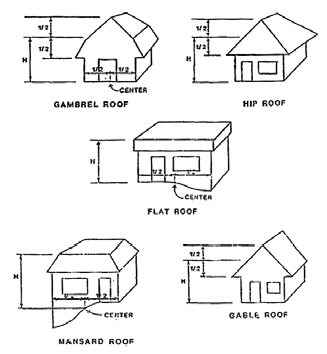
Figure B Lot Lines and Yards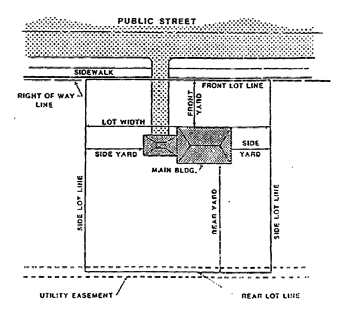
(Ord. of 7-18-2022)

