
Fort Pierce City Zoning Code
ARTICLE III
ESTABLISHMENT OF ZONES
Sec. 125-156.- Designation of zoning districts.
Basic zoning districts. All areas within the city are included within one of the following basic zoning districts, each of which is intended to appropriately regulate the use of property within the district in accordance with the comprehensive plan and the purposes of this chapter.
(Code 1983, § 22-15; Ord. No. H-186, § 30-15, 6-15-1981; Ord. No. J-05, 2-15-1992)
Sec. 125-157. - Designation of overlay districts.
The city's overlay zoning districts stipulate special provisions that, along with the provisions of the basic zoning district and other ordinance regulations, govern the use of property within the city limits.
(1)
South Beach Overlay District.
a.
Applicability and purpose. The purpose of the South Beach Overlay District is to promote good planning and site design that produces quality development that is functional, an asset to the community and in keeping with the general character of South Hutchinson Island. By way of this overlay district, the city seeks to preserve, protect and enhance the unique barrier island environment through regulation of development and redevelopment of lots within the district.
SOUTH BEACH OVERLAY DISTRICT
1.
The standards allow for and promote design integration of the manmade improvements to the land with the natural elements of the land. All new development and changes to existing development in the district that require site plan or building permit approval are subject to the overlay district requirements in addition to other applicable regulations in this Code.
2.
Due to ever-accumulating knowledge about the dynamics of a barrier island community, and new and better information about site design, the city's land development regulations will be monitored and reviewed on an ongoing basis in order to assess their reasonability and effectiveness in promoting these purposes.
b.
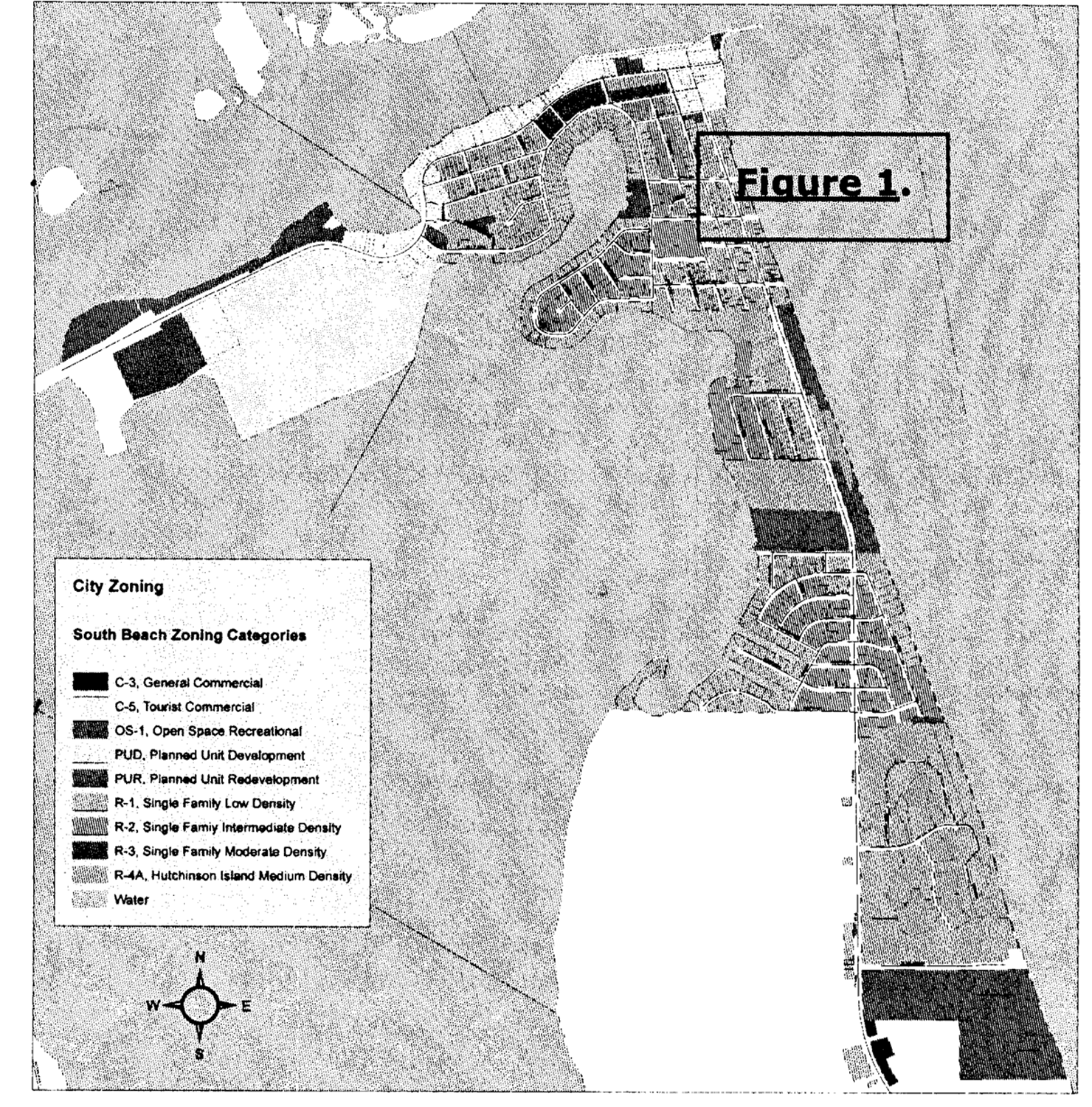
Delineation of the district. The South Beach Overlay District includes all parcels designated in the shaded area as indicated in Figure 1. The boundary of the South Beach Overlay District shall be deemed to automatically adjust pursuant to any annexation approval on South Hutchinson Island.
c.
District regulations.
1.
Density.
(i)
Residential. Residential density shall be based on the requirements of the underlying zoning district except that in no instance shall residential density in the South Beach Overlay District exceed eight units per acre.
(ii)
Non-residential. Non-residential density shall be based on the requirements of the underlying zoning district.
(iii)
Mixed use. The residential component of a mixed use development shall not exceed eight units per acre. The nonresidential component of a mixed use development shall be based on the requirements of the underlying zoning district while factoring the affect and impacts of the residential component on the site.
2.
Height.
3.
Calculation of height.
(i)
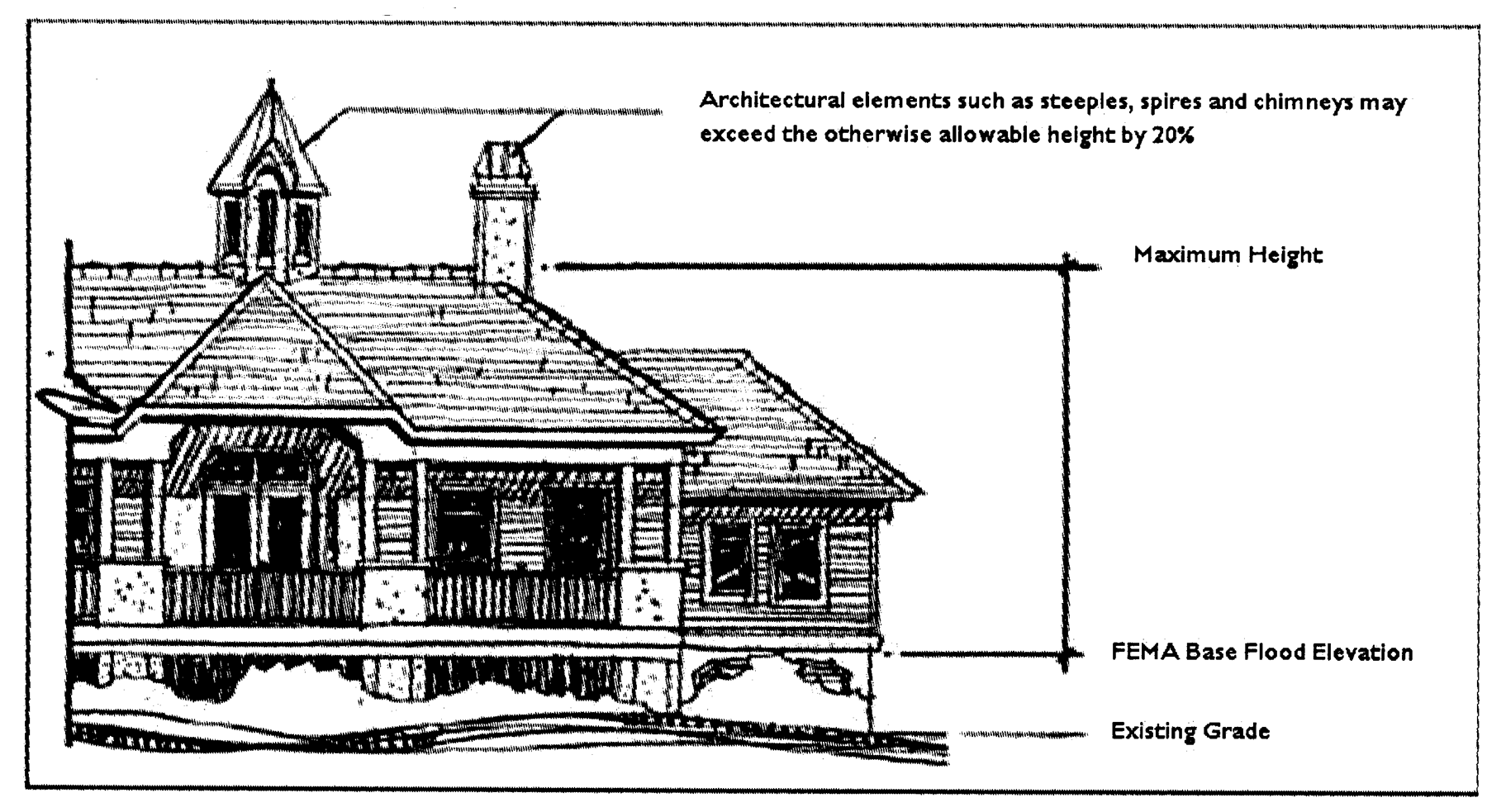
Maximum structure height shall be calculated from the established FEMA base flood elevation to the highest point of the roof excluding non-habitable architectural design elements of the structure.
MAXIMUM STRUCTURE HEIGHT
(ii)
The height of fences shall be measured from preconstruction grade.
4.
Height in excess of maximum.
(i)
Equipment, including, but not limited to, satellite dishes and heating and air conditioning equipment may be installed on top of buildings provided that the equipment is screened from horizontal view.
(ii)
Non-habitable architectural elements that contribute stylistically to the building, including, but not limited to, bulkheads, parapet walls, false fronts, cupolas, steeples, spires, and chimneys may exceed the maximum height requirement by 20 percent.
5.
Design standards.
6.
Nonconforming situations. Nonconforming uses and structures that have been damaged or destroyed by natural disaster or other catastrophic event, i.e., fire or other calamity, may be replaced or reconstructed provided that:
(i)
The significance of the property owner's hardship is more compelling than, and reasonably overbalances, the public benefit resulting from not allowing the use or structure to be re-established;
(ii)
Replacement or reconstruction of the use or structure is compatible with the character of the neighborhood and will not jeopardize future development of the area in compliance with the provisions and intent of the city's land development regulations;
(iii)
The value of properties in the vicinity of the replacement or reconstruction will not be adversely affected;
(iv)
No expansion of gross floor area occurs;
(v)
The degree of nonconformity is not increased;
(vi)
The replacement structure is in compliance with the city's adopted building code, Coastal Construction Control Line and FEMA regulations; and
(vii)
A building permit is issued within 24 months after the date of destruction and the construction is diligently pursued to completion.
7.
Supplemental use regulations.
(i)
Condominium hotels.
A.
General requirements.
i.
Condo-hotel facilities shall be created, sold and maintained under documentation, including condominium declaration, bylaws, sales brochures, and pre-construction agreements, with form and content approved by the city attorney, which adequately disclose and ensure that the condo-hotel facility will, in all respects, be permanently and exclusively operated as a transient accommodations facility and will not be occupied as a multifamily dwelling.
ii.
Condo-hotel facilities must be permanently dedicated in their entirety to the complete control and management of a single hotel or resort hotel operator for operation as a transient accommodations facility.
iii.
Condo-hotel facilities shall contain no dwelling units. Only individual sleeping units that are permanently dedicated for rental to the general public for transient occupancy for periods of less than 28 days on a full-time basis by the hotel or resort hotel operator shall be permitted; provided, however, that an owner of an individual sleeping unit in a condo-hotel may be permitted to occupy the owned sleeping unit without rental charge for up to 28 days in any calendar year.
iv.
Condo-hotel sleeping units shall not be used for homesteading purposes or home occupational licensing, time share or fractional interests.
v.
Condo-hotel facilities shall be licensed by all applicable state and local agencies that license traditional motels, hotels and/or resort hotels prior to the issuance of any certificate of occupancy. All required licenses must be kept current.
vi.
Rental of condo-hotel sleeping units shall be subject to all applicable state and local tourist tax collections.
vii.
Condo-hotel facilities shall be served by singly metered utility services and with a central telephone system and central cable television system installed in all individual sleeping units.
viii.
Individual sleeping units shall not contain any lockable storage closet or cabinet unless access to such closet or cabinet is automatically and uniformly provided to each member of the public who rents the sleeping unit.
ix.
Condo-hotel facilities shall provide an internally-oriented lobby/front desk area.
x.
Condo-hotel facilities shall utilize a uniform key entry system managed by the hotel or resort hotel operator to receive and disburse keys for each condo-hotel sleeping unit.
xi.
All condo-hotel facilities shall offer daily maid service, concierge as well as other customary hospitality services.
xii.
The city may require affidavits of compliance with the criteria from the developer, management entity, and/or each condo-hotel sleeping unit purchaser/owner concurrent with annual renewal of any required occupational license.
B.
Conditions of approval. The city commission may impose limitations on condo-hotel facilities, including, but not limited to, the size and number of sleeping units and sleeping areas as well as the types of utility fixtures to ensure the viability of hospitality and transient accommodations and to limit impacts on local services including transportation, potable water, sanitary sewer and hurricane evacuation.
(2)
Overlay District.
a.
Purpose. The purpose of the Downtown Business and Entertainment Overlay District is to:
1.
Recognize the unique urban character of the downtown;
2.
Recognize the unique orientation to the waterfront;
3.
Recognize its historic urban design typified by its pedestrian-oriented design and its human-scale development; in order to
(i)
Build on this unique character by encouraging redevelopment in keeping with these recognized values; and
(ii)
Further the downtown's desirability as a place to work, play and live through encouraging a broad variety of urban-scale uses.
b.
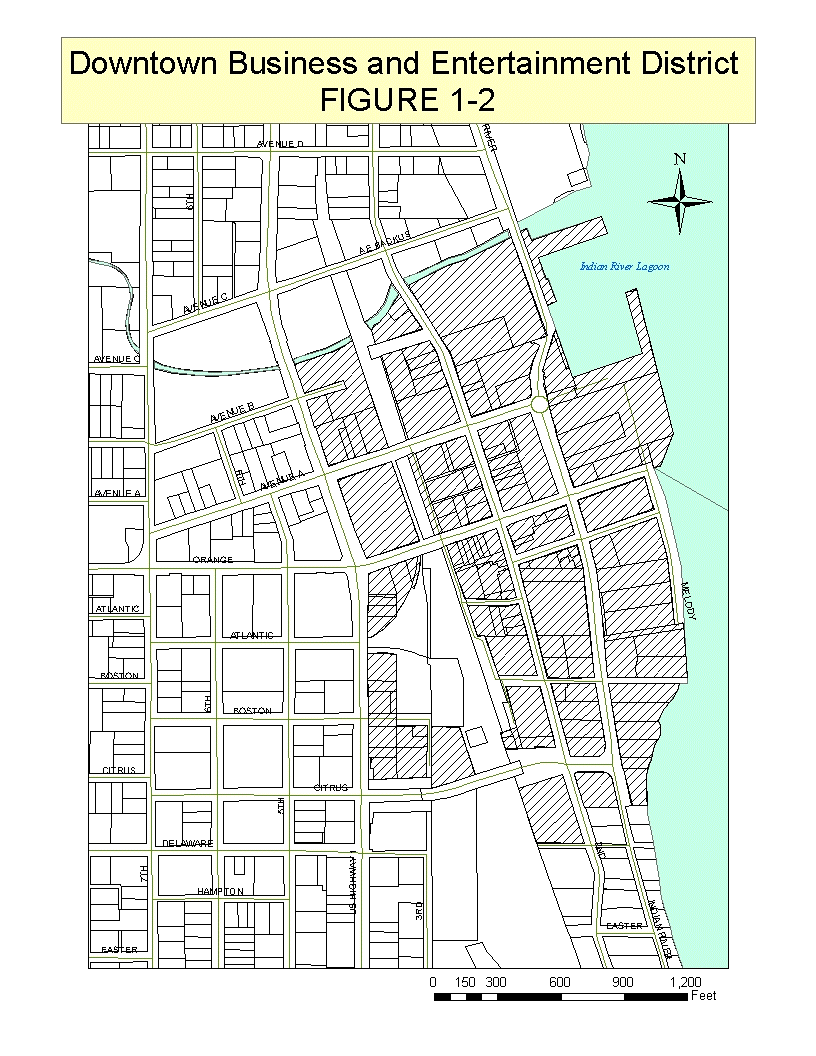
Delineation of district. The Downtown Business and Entertainment Overlay District includes all parcels in the shaded area as indicated in figure 1-2.
c.
District regulations.
1.
Permitted uses. The following uses are allowed within the boundaries of the overlay district in addition to the uses permitted by the underlying zoning districts, subject to compliance with any use standards identified herein:
(i)
Wine and/or cigar bars. Use standards:
A.
Less than 2,000 square feet of floor area.
B.
No drive-through facilities.
C.
Live music shall be unamplified acoustic only.
D.
Shall be fitted with filtration system so as to not allow odors to leave the premises and infiltrate to surrounding or attached business or residences.
E.
Sidewalk cafe permit may only be issued with a condition that smoking is prohibited in the sidewalk cafe area.
(ii)
Residences. Use standards:
Residential uses shall be located within mixed use structures which shall offer commercial retail, service or office uses along the full frontage of the first floor abutting the pedestrian right-of-way. No portion of any residential use shall be permitted along any portion of the frontage of the first floor abutting the pedestrian right-of-way. A rear service alley is not considered a pedestrian right-of-way.
(iii)
Pedicabs.
A.
Definition. The term "pedicab" means any vehicle with three or more wheels propelled solely by human power which is used for transporting passengers for consideration.
B.
Use standards.
(1)
Operation.
(a)
Operator shall embark/disembark passengers out of the flow of traffic;
(b)
Operator shall not drive pedicab on sidewalk;
(c)
Parking pedicab in any public on- or off-street parking is prohibited;
(d)
Music is prohibited;
(e)
Open containers of alcohol are prohibited in pedicab, including cab;
(f)
Loud solicitation of service is prohibited;
(g)
Signage is permitted on the pedicab, totaling no more than three square feet for all sides, and no more than 1½ square feet on each side of the cab. Signage shall be simple in design, and may include the name of the company, phone number and website. Signage shall be professionally designed and shall be subject to the city's design review criteria for signage.
(2)
Vehicle safety requirements. Pedicabs shall not be operated within the city except in compliance with all laws of the state.
(a)
Pedicabs shall be subject to F.S. ch. 316, as amended.
(b)
Any law enforcement officer of the city shall have the right to inspect or cause to be inspected any pedicab operating on any street in the city as often as may be necessary for the purposes of ascertaining and causing to be corrected any unsafe or unsanitary considerations or any violations of this article.
(c)
No pedicab driver may operate a pedicab on any street unless the pedicab meets the following equipment safety standards:
1.
Tires. Tires shall be of a size appropriate for the pedicab with no mismatched tires. There shall be no cuts to the tire or localized worn spots that expose the ply. No tire is permitted to be used when the tire has tread wear indicators that are visible.
2.
Operational horn. The pedicab shall be equipped with a fully operational horn or bell.
3.
Brakes. Each pedicab shall be equipped with an operational brake or brakes which enable the pedicab driver to stop the pedicab within 15 feet from a speed of ten miles per hour on dry, level, clean pavement. The brake systems shall demonstrate a reasonable total braking force when tested, using the quick stop method.
4.
Headlights, tail lights, mirrors, turn signals, and other requirements. Every pedicab shall be equipped with the following operational equipment set forth in the subsections below:
a.
A headlight capable of projecting a beam of white light for a distance at a minimum of 500 feet, which shall be clearly visible during darkness and which must be illuminated at all times during operation;
b.
A red tail light affixed to the rear of the passenger compartment, which shall be clearly visible during darkness from a distance of at least 600 feet to the rear of the pedicab which must be illuminated at all times during operation;
c.
A side-mounted mirror affixed to the pedicab to reflect to the pedicab driver a view of the street for a distance of at least 200 feet from the rear of the pedicab;
d.
A slow moving vehicle triangle on the rear of the pedicab or reflective tape which outlines the rear of the pedicab from edge to edge;
e.
Turn signal lamps which indicators must be visible for a distance of at least 500 feet from the rear of the pedicab indicating right and left turns which must be utilized when turning;
f.
The company or trade name, individual or fictitious name of the pedicab owner shall be displayed on the exterior of each pedicab. This will not be considered advertising;
g.
No more than one trailer or sidecar may be attached to any pedicab. Any such trailer or sidecar must be attached in a manner that meets the requirements of F.S. § 316.530(2), as amended.
(3)
Advertising. Advertising may be permitted on pedicabs for an additional annual fee which shall compensate for the cost of reviewing and enforcing such advertising regulations.
(a)
Size. No more than six square feet total on all sides of, and no more than three square feet on any one side of cab.
(b)
Content and design. All advertising design and content shall be approved by the planning department. Advertising is prohibited for the following: tobacco, adult entertainment, arcades and alcohol. Advertising shall be professionally designed and shall be subject to the city's design review criteria for signage.
(iv)
Licensing; process and requirements. No person shall operate, or permit the operation of, a pedicab without first securing from the city clerk a current license, which shall be laminated and affixed to the pedicab at all times.
A.
(1)
Application for pedicab license shall be made on a form available in the office of the city clerk, accompanied by the following:
(a)
Valid driver's license.
(b)
Manufacturer authorized specifications setting forth the characteristics of the pedicab, including its serial number, dimensions, weight, and passenger capacity.
(c)
Color photographs of all four sides of pedicab.
(d)
Advertising copy, size and rendering, if applying for a license which includes advertising.
(e)
Certificate of safety, available from the city clerk, to be completed by a qualified bicycle mechanic indicating that the pedicab is in safe operating condition.
(f)
Insurance and indemnification. Proof of insurance shall be submitted showing conformity to the following: the pedicab owner shall maintain a commercial general liability policy in place with limits of at least $300,000.00 per occurrence, $500,000.00 aggregate with respect to bodily injury, including death, and property damage liability affording coverage for premises and operations liability, personal and advertising injury liability, and contractual and contingent liability exposures. The certificate of insurance must also include coverage for statutory workers' compensation coverage, if applicable, and shall further list the city as an additional insured with respect to general liability, and include 30 days on the cancellation provision, except for ten days' notice for nonpayment of premium. Carriers providing this coverage must be authorized to transact business in the state and must possess a financial rating of at least (A-) with a financial strength of (V) or better in accordance to A.M. Best guidelines. Such certificate must be provided to the city risk management division/risk manager, or designee for approval prior to issuance or renewal of any decal. All certificates of insurance shall be kept in full force and effect at all times while any pedicab is operated within the city and must cover a period of not less than 12 months. Proof of this insurance (e.g. a declarations page or certificate of insurance) must be maintained with the pedicab at all times it is operated within the city. The pedicab owner will indemnify, defend, and hold harmless the city, its officials, employees and agents (collectively referred to as indemnitees) and each of them from and against all losses, costs, claims, penalties, fines, expenses (including attorney fees), liabilities (collectively referred to as liabilities) by reason of any bodily injury to or death of any person or damage to or destruction or loss of any property arising out of, or resulting from, or in connection with this permit. The pedicab owner further agrees to indemnify, defend and hold harmless the indemnitees from and against liability which may be asserted by an employee or former employee of the pedicab owner, or any of its subcontractors, for which liability to such employee or former employee would otherwise be limited to payments under workers' compensation or similar laws.
(2)
Fees; application and renewal. The city commission shall adopt and amend fees for this use via resolution. Fees shall include: application fee, annual renewal fee, optional advertising fee.
B.
Violations.
(1)
The city police department shall enforce these regulations.
(2)
Repeated violations of traffic laws or this section shall result in the revocation of a licensee's permit, as determined by the city manager.
(v)
Overnight accommodations and bed and breakfast.
A.
Overnight accommodations, bed and breakfast. Overnight accommodations, serving breakfast, and located in an owner-occupied residential structure, offering up to eight guest rooms.
B.
Overnight accommodations, boutique hotel. Overnight accommodations which include an amenity such as a restaurant or spa, offering up to 18 rooms and located within a structure of residential building typology.
C.
Overnight accommodations, vacation rental. A detached dwelling or apartment within a building of residential building typology which is rented out for the purposes of providing accommodations for less than six months to tourists.
D.
Use standards.
1.
A separate entrance shall be provided for each unit to the exterior or to an interior, secure common area.
2.
A business license shall be required for each vacation rental unit.
3.
Such units shall be managed by either a state-licensed property management agent or the owner-occupant residing in another unit, and shall collect and pay all applicable taxes.
4.
Current contact information for the management agency or owner-occupant shall be displayed in an accessible location outside the vacation rental.
2.
Prohibited uses.
(i)
Arcades (games of chance)
3.
Design and performance standards.
(i)
Off-street parking. All parcels within the district are exempt from off-street parking requirements, as referenced in section 125-315.
(ii)
Landscaping. All parcels within the district are exempt from landscaping requirements, as referenced in section 123-37.
(iii)
Waiver of distance requirements for the consumption of alcoholic beverages. All parcels within the district are exempt from waiver of distance requirements for establishments selling alcohol for consumption on or off premises, as referenced in section 4-6.
(Code 1983, § 22-16; Ord. No. K-441, § 1, 1-16-2007; Ord. No. L-215, § 1, 7-5-2011; Ord. No. L-291, § 1, 6-17-2013)
Sec. 125-158. - Location of zoning districts.
(a)
General. The boundaries for the zoning districts listed in this article are indicated in the city zoning atlas. The boundaries shall be modified in accordance with the zoning atlas amendments which shall be adopted by reference.
(b)
Aquatic zones. The A-1 zone and the A-2 zone only include areas defined as aquatic areas in section 125-3. Therefore, when an A-1 or an A-2 zone abuts a nonaquatic area in another zone, the boundary is the mean high tide line in tidal areas and the ordinary high water line in nontidal areas.
(c)
Various specific boundaries. Unless otherwise specified, zoning district boundaries indicated as approximately following the city limits, section lines, subdivision lines, lot lines, centerlines of street or alley rights-of-way, centerlines of railroad rights-of-way, centerlines of canals or such lines extended will be construed as following such lines.
(Code 1983, § 22-17; Ord. No. H-186, § 30-16, 6-15-1981; Ord. No. I-28, § 4, 8-15-1983; Ord. No. K-441, § 4, 1-16-2007)
Sec. 125-159. - Zoning atlas generally.
(a)
General. The city zoning atlas, each map of which is attested by the city clerk, is by this reference made a part of this chapter. This atlas shall be maintained on file at the offices of the planning department.
(b)
Updates. Whenever sufficient authorized changes to maps in the zoning atlas have accumulated, the city commission shall have prepared a revised zoning atlas depicting all changes authorized since the previous atlas revision.
(Code 1983, § 22-18; Ord. No. H-186, §§ 30-16, 30-17, 6-15-1981; Ord. No. K-441, § 4, 1-16-2007)

