
Fort Pierce City Zoning Code
ARTICLE VII
SUPPLEMENTARY REGULATIONS
Sec. 125-307. - Purpose.
Regulations in this article are set forth in order to appropriately supplement the provisions in other parts of this chapter. These regulations generally affect more than one district and are intended to achieve compatibility among uses, protect the environment, meet transportation needs or carry out other local objectives.
(Code 1983, § 22-52; Ord. No. H-186, § 30-52, 6-15-1981)
Sec. 125-308. - Clear vision areas.
(a)
A clear vision area shall be maintained on the corner of all property adjacent to the intersection of two streets or of a street and a railroad, or a street and a driveway, except in a C-4 zone. A clear vision area shall contain no planting, fence or temporary or permanent obstruction exceeding 24 inches in height measured from the top of the curb or, where no curb exists, from the established centerline grade, except that the following may be permitted:
(1)
Trees whose branches and foliage are removed to a height of eight feet above grade; and
(2)
Necessary retaining walls.
(b)
A clear vision area shall consist of a triangular area, two sides of which are right-of-way lines or, in the case of an intersection of a street with a driveway, the street right-of-way and the edge of the driveway. The third side is a line across the corner of the property which connects the ends of the other two sides. The size of the clear vision area is determined by the distance from the point of intersection of the two right-of-way lines to the third side or, in the case of an intersection of a street with a driveway, the distance from the point of intersection of the right-of-way line with the driveway edge to the third side, measured along the right-of-way line or driveway edge. This distance shall be 20 feet where a street intersects with another street or a railroad. The distance shall be ten feet where a street intersects with a driveway.
(c)
A clear vision area shall not preclude the installation of a chainlink fence up to 48 inches in height, provided that no obstruction, such as slates or vegetation, be installed that would obstruct vision within the defined area.
(Code 1983, § 22-53; Ord. No. H-186, § 30-53, 6-15-1981; Ord. No. J-75, § 1, 1-18-1994)
Sec. 125-309. - Authorization for utility lines, railroad rights-of-way, streets, wells, drainage ways and related facilities.
Even though utility lines, railroad rights-of-way, streets, wells, drainage ways and related facilities are not listed in zoning districts as semi-restricted uses or conditional uses, they will be permitted unless they:
(1)
Are major utilities, land transportation facilities or water reservoirs and control structures located in a zoning district which classifies them as conditional uses and have not received approval as conditional uses; or
(2)
Would violate other provisions in this chapter or in other city laws.
(Code 1983, § 22-54; Ord. No. H-186, § 30-54, 6-15-1981)
Sec. 125-310. - Signs.
All signs shall comply with the provisions in chapter 117.
(Code 1983, § 22-55; Ord. No. H-186, § 30-55, 6-15-1981)
Sec. 125-311. - Environmental performance standards.
(a)
Purpose. The environmental performance standards set forth in this section are intended to help prevent nuisances due to a variety of causes, including noise, electromagnetic interference, smoke, humidity, heat, radiation, fire, explosives or toxic or noxious matter.
(b)
State and federal regulations. All uses will comply with applicable state and federal regulations related to environmental protection, including those pertaining to air or water pollution and those pertaining to the state coastal construction setback line.
(c)
Noise. No use shall exceed the applicable standards for noise.
(d)
Electromagnetic interference. No use shall be conducted in a manner which produces electromagnetic interference with normal radio or television reception at any point at or beyond the lot line of the use.
(e)
Smoke.
(1)
Method of measurement. For the purpose of grading the density of emission of smoke, the Ringelmann Chart, published and used by the United States Bureau of Mines, shall be employed. The Ringelmann density reading shall be made at least once every minute during a period of at least one hour.
(2)
Standards for I-2 zones. In the I-2 zone, the emission of smoke from any chimney, stack, vent, opening or combustion process shall not exceed a density of Ringelmann No. 2, except that smoke in excess of Ringelmann No. 2 but not exceeding No. 3 is permitted for a total of eight minutes during any one-hour period.
(3)
Standards for other zones. In all zones, except the I-2 zone, the emission of smoke from any chimney, stack, vent, opening or combustion process shall not exceed a density of Ringelmann No. 1.
(f)
Humidity and heat.
(1)
Standards for I-2 zones. No use in an I-2 zone producing humidity in the form of steam or moist air or producing heat shall be carried on in such a manner that the steam, moist air or heat is perceptible to normal senses at any I-2 zone boundary line.
(2)
Standards for other zones. No use, except in an I-2 zone, producing humidity in the form of steam or moist air or producing heat shall be carried on in such a manner that the steam, moist air or heat is perceptible to normal senses at any point at or beyond the lot line of the use.
(g)
Radiation, fire and explosive hazards. No use shall violate applicable standards for radiation, fire or explosive hazards in chapter 18.
(h)
Toxic or noxious matter. The emission of toxic or noxious matter beyond any lot line is prohibited.
(i)
Administration. The environmental performance standards specified in this section shall be administered in accordance with section 125-33.
(Code 1983, § 22-56; Ord. No. H-186, § 30-56, 6-15-1981)
Sec. 125-312. - Protection of archeological sites.
State and federal laws which restrict construction affecting known or newly discovered archeological sites will be complied with in every zoning district.
(Code 1983, § 22-57; Ord. No. H-186, § 30-57, 6-15-1981)
Sec. 125-313. - Major and minor site plan application.
(a)
Major site plans.
(1)
General. A major site plan is one which is:
a.
A residential project which exceeds 50 total dwelling units; or
b.
A nonresidential or mixed-use development over 10,000 square feet in area.
(2)
Pre-application conference required. Prior to filing for major site plan review, the developer and/or consultant shall meet with the city planning department, and any other relevant departments, to discuss the development review. No person may rely upon any comment concerning a proposed development, or any expression of any nature about the proposal made by any participant at the pre-application conference as a representation or implication that the proposal will be ultimately approved or rejected in any form.
(3)
Submittal requirements.
a.
Application. Application forms for any site plan review shall be available from the city planning department. A completed application shall be signed by all owners, or their agent, of the property subject to the proposal, and notarized. Signatures by other parties will be accepted only with notarized proof of authorization by the owners. In a case of corporate ownership, the authorized signature shall be accompanied by a notation of the signer's office in the corporation. The completed application form shall be accompanied by appropriate review fees, a vicinity map, a site plan, and by any other information required by the city planning department.
b.
Vicinity map. The vicinity map shall indicate the general location of the site, abutting streets, existing utilities, complete legal description of the property in question, and all adjacent land uses.
c.
Site plan. A site plan shall include, at minimum, the following items. The planning director shall have the discretion to request additional information, studies, or plans dependent on the nature of the development being proposed.
1.
Name, location, owner, and designer/consultant of the proposed development.
2.
Present zoning for subject site.
3.
Location of the site in relation to surrounding properties, including the means of ingress and egress to such properties and any screening or buffers on such properties as well as access and traffic flow for both vehicular and pedestrian traffic.
4.
Date, north arrow, and graphic scale not less than one inch equal to 50 feet.
5.
Area, dimensions, and boundaries of the site.
6.
Location of all property lines, existing right-of-way approaches, sidewalks, curbs, gutters, and streets.
7.
Location of existing telephone and power poles and access to utilities and points of utility hookups.
8.
Location and dimensions of all existing and proposed parking areas and loading areas, along with a lighting plan which shows illumination of all parking areas, as well as interior and immediately adjoining streets, at levels consistent with this Code.
9.
Location, size, and design of proposed landscaped areas (including existing trees and required landscaped buffer areas).
10.
Location and size of any lakes, ponds, canals, or other waters and waterways along with watercourses, easements, mean high tide lines, ordinary high water lines and section lines.
11.
Structures and major features fully dimensioned including setbacks, distances between structures, floor area, width of driveways, parking spaces, property or lot lines, and percent of property covered by structures.
12.
Location of dumpsters with details of any enclosures.
13.
Locations, general dimensions, and uses of all buildings and structures, including overhangs, porches, balconies and building heights.
14.
A storm drainage plan which indicates the techniques used to control drainage. The plan shall include:
(i)
Location and elevations of all existing and proposed drainage facilities within the site plan area and adjacent vicinity for 100 feet in all directions;
(ii)
Retention areas and exfiltration systems;
(iii)
Length, width, depth, and direction of flow for all canals and ditches;
(iv)
Storm sewers and appurtenances;
(v)
Contour lines at one-foot intervals; and
(vi)
A note indicating that all storm drainage facilities shall conform to chapters 32 and 121 and the Standard Specifications adopted by the city commission on February 13, 1973, as amended.
15.
A plan providing, where applicable, for the protection of the beach and dune system. The plan shall include these requirements:
(i)
Demonstration of compliance with the coastal construction control line established pursuant to F.S. ch. 161;
(ii)
All beach access points are to be provided as beach/dune walkovers in accordance with the requirements of the state department of natural resources;
(iii)
No construction which threatens the stability of the primary dune or beach itself shall be permitted;
(iv)
No rigid shore protection structures shall be permitted except when used as part of a comprehensive plan for beach restoration and when nonstructural alternatives are unavailable;
(v)
Demonstration of dune restoration measures conforming to the requirements of the state department of natural resources.
16.
A design review plan which meets the requirements of section 125-314.
17.
For residential, hotel, motel, bed and breakfast, mobile home park, or other comparable use site plans:
(i)
Tabulation of gross acreage.
(ii)
Tabulation of density.
(iii)
Number of dwelling units proposed.
(iv)
Location and percent of total open space and recreation areas.
(v)
Percent of lot covered by buildings.
(vi)
Floor area of dwelling units.
(vii)
Number of proposed parking spaces.
(viii)
Street layout.
(ix)
Layout of mobile home stands (for mobile home parks only).
(x)
Stormwater management plan.
(xi)
Recreation facility locations.
(4)
Technical review committee. Once review has been completed, the city planning department shall then route the application to each reviewing department and other agencies that are part of the technical review committee or are determined necessary for intergovernmental review. Each reviewer shall then submit written comments to the city planning department by the technical review committee's meeting date. The technical review committee shall be held on the third Thursday of each month where comments from reviewing departments and other agencies shall be used to determine whether the application complies with the requirements of this Code or if revisions or additional information is needed in order to proceed.
(5)
Planning board. Once the city planning department has determined the application is ready to proceed, the department will prepare a staff report and recommendation for consideration by the city planning board. Notice of the public hearing shall be consistent with section 125-37.
(6)
City commission. The city planning department will prepare a staff report and recommendation for consideration by the planning board. The planning board may choose to approve, with or without conditions, deny, or table the item. In no case, however, may a major site plan proceed to city commission without action from the planning board. Notice of the public hearing shall be consistent with section 125-37.
(7)
City commission public hearing.
a.
At the public hearing, the city commission shall hear from all interested parties regarding whether the major site plan application complies with the requirements of this Code. The city commission shall consider the application, the written comments of each responding department and agency, the compliance recommendation of the city planning department, and the comments presented to the planning board and city commission.
b.
The city commission may choose to approve the major site plan, with or without conditions, deny the site plan, withdraw the site plan, or continue the public hearing.
c.
During the public hearing, the city commission may decide that additional information is necessary to complete its review and may continue the public hearing for this purpose. A continuance shall be to a time certain and shall be announced at the public hearing. Not more than one continuance shall be granted for this purpose.
(b)
Minor site plan.
(1)
General. A minor site plan is one which is:
a.
A single-family, duplex, triplex, townhouse, multi-dwelling building, manufactured home, or multifamily residential project of between two and 50 units, inclusive; or
b.
A nonresidential or mixed-use development under 10,000 square feet in area.
(2)
Pre-application conference. Prior to filing for minor site plan review, the developer and/or consultant shall meet with the city planning department, and any other relevant departments, to discuss the development review. No person may rely upon any comment concerning a proposed development, or any expression of any nature about the proposal made by any participant at the pre-application conference as a representation or implication that the proposal will be ultimately approved or rejected in any form. The planning director may have the option to waive the pre-application conference for any minor site plan application.
(3)
Submittal requirements. Application forms for a minor site plan review shall be available from the city planning department. A completed application shall be signed by all owners, or their agent, of the property subject to the proposal, and notarized. Signatures by other parties will be accepted only with notarized proof of authorization by the owners. In a case of corporate ownership, the authorized signature shall be accompanied by a notation of the signer's office in the corporation. The completed application form shall be accompanied by appropriate review fees, a vicinity map, a site plan, and by any other information required by the city planning department. The vicinity map and site plan shall be submitted in compliance with subsection (a)(3) of this section.
(4)
Technical review committee. Once review has been completed, the city planning department shall then route the application to each reviewing department and other agencies that are part of the technical review committee or are determined necessary for intergovernmental review. The minor site plan application shall be reviewed consistent with subsection (a)(4) of this section.
(5)
Action on minor site plan. The city planning department shall determine if the minor site plan is either in compliance or not in compliance with this Code and ready to proceed.
a.
If in compliance, and there are no outstanding documents, actions, or information needed, the minor site plan shall be deemed approved.
b.
If not in compliance, the planning director shall specify the reasons therefor, how the application may be brought into compliance, and convey this information to the applicant. Within 180 days of said conveyance the applicant may submit documents, actions, or information to comply with the requirements. In this event, the compliance review recommendation of the department shall be amended accordingly. If an application does not achieve compliance within the 180 days referenced above, the entire application shall be void.
(Code 1983, § 22-58; Ord. No. 19-016, § 14, 5-20-2019; Ord. No. 24-008, § 1, 4-15-2024)
Sec. 125-314. - Design review.
(a)
Applicability. All development requiring site plan approval, which submits application for development subsequent to the enactment of the ordinance from which this section is derived, shall be subject to the city's design review process. In addition, all city-sponsored development projects not subject to site plan review shall require administrative review and approval according to the architectural design standards, which shall be adopted by resolution by the city commission. The city's planning board shall function as the design review board and shall be responsible for such design review, which shall be completed as part of the development review process. Applications for design review approval must satisfy the application submission requirements and shall be submitted to the planning department. Design review related to any changes to historic structures, or any new construction on an historic site or in an historic district shall be reviewed by the historic preservation board in lieu of the design review board in accordance with chapter 111. Use of obligatory verbs in this section such as "shall" and "must" are imperatives applicable as binding directives of the ordinance. Discretionary language such as "should," "may," "might," and "is encouraged" are applicable as general guidance for design choices. Design choices based on discretionary language will be subject to the assessment and recommendation of the planning director and the design review board.
(b)
Purpose. The quality and compatibility of all proposed development in the city is of critical public concern for all building and/or site improvements. The city's architectural design standards require buildings to contribute to the existing and developing character of the city. The intent of the city's design review process is not to stifle innovative architecture but rather to ensure respect for and reduce incompatible and adverse impacts on the visual experience throughout the city. This shall be accomplished through respectful interpretation of vernacular building typologies and styles in proposed development. Proposed designs shall take cues from traditional proportioning systems and be synonymous with a chosen style. The architectural design standards serve to encourage quality site and architectural design and construction compatible with the scale and character of the city's mix of existing buildings and land uses. Consideration of quality and compatibility shall be based on the massing, form and articulation of building walls, and order, rhythm and proportion of doors and windows rather than gratuitous decoration and ornamentation.
(c)
Submission requirements. Applications for design review approval shall be submitted on a supplemental application form as published by the planning department along with the appropriate fee as required by section 125-36. All presentation materials shall include a graphic scale and may include scale figures of pedestrians, vehicles and other common elements found in the public environment. The following materials must be submitted with an application, unless waived by city administrative staff as not necessary, before an application shall be considered complete and accepted for review:
(1)
Required application documents.
a.
A survey (one-inch equals 30 feet minimum scale) of property lines, existing topography and the location of trees meeting the tree protection regulations of section 123-66, location of bordering streets and, if applicable, wetlands and beaches.
b.
A site analysis study to include a discussion of specimen trees and other natural vegetation, access, significant topography, wetlands, buffers, setbacks, views, orientation, the surrounding built environment, and other site features that may influence design elements.
c.
A written narrative describing the design intent of the project, its goals, and objectives and how it reflects the site analysis study results.
d.
Context photographs of neighboring uses and architectural styles.
e.
Photographs and/or drawings of architectural buildings or objects that serve as a precedent for the proposed building design. Models should be taken from local exemplary buildings, either existing or demolished.
f.
Photographs of all existing structures located on the property. If existing structures on the property are more than 50 years of age, documentation of these structures with data from the Florida Master Site File form is also required.
g.
Site plan (to scale) showing proposed location of all buildings, structures, parking areas, signs, and landscaping.
h.
Landscape plan, at the same scale as the site plan. The planning director or designee may request enlarged plans of detailed planting areas. Planting schedule with sizes of proposed plantings must be included.
i.
Accurate color rendering of proposed signs showing dimensions, type of lettering, materials, and actual color samples that demonstrate cohesiveness with the project design.
j.
Exterior elevations showing architectural character, external architectural features, and streetscape of the proposed development, including materials, colors, shadow lines, and landscaping. The street elevation shall encompass the entire proposed project and generally identify the major elements of the adjacent two properties on either side of the site. If the adjacent properties are vacant or underutilized, a diagram shall be provided that identifies the mass and form that is allowable under current zoning. If the street elevation must be drawn at such a scale as to render architectural details of the building unreadable, drawings of individual buildings at a larger scale should be provided as well.
k.
A color board (11 inch by 17 inch, maximum) containing actual color samples of all exterior finishes, keyed to the elevations, and indicating the manufacturer's name and color designation.
(d)
Procedure for approval. When site plan approval is required pursuant to section 125-313, the following procedure relating to design review shall take place concurrently:
(1)
The application for design review approval shall be submitted to the planning department when the application for site plan approval is made. The planning department shall review the application for sufficiency to ensure that it conforms with the submittal requirements of this section. If additional information is required, then the applicant shall be advised and provided with a timeline to make the application whole. If the application remains incomplete, then the submittal shall be deemed withdrawn, and the applicant advised of such. If the application is sufficient and conforms with the submittal requirements, it shall be processed as indicated in this section for a major or minor site plan.
(e)
Major site plan. The design review shall be considered by the design review board concurrently with the major site plan review. The planning department shall forward the design review application to the design review board with a written report of the application's conformity with the architectural design standards, as adopted.
(1)
The design review board shall review the application and make a recommendation to the commission for approval or disapproval. If the board recommends disapproval, the reasons shall be stated. The board shall consider the following standards:
a.
The design, including landscape features, is architecturally compatible with surrounding structures so as to be reasonably harmonious in landscaping, style, and color;
b.
If the property is located within a historic preservation district, the design features are reasonably consistent with the historic character of the predominant architectural style within the district;
c.
The design features will enhance or preserve the quality of the surrounding area so as not to detract from existing property values or impact adversely on existing scenic, natural, or historic beauty;
d.
The design avoids undue monotony in structural design features.
The board may condition recommendation for approval upon an applicant obtaining of a suitable variance pursuant to division 3 of article II of this chapter.
(2)
The city commission shall hold a hearing on the application for design review approval at the same time it conducts a hearing on the major site plan. It shall not approve the application for design review approval if:
a.
The application does not meet all applicable provisions of this Code;
b.
The health, safety, and general welfare of the public are not properly provided for.
(f)
Minor site plan. The design review shall be considered administratively by the planning department. The planning department shall approve such minor application for design review approval if it meets the requirements of the architectural design standards, as adopted.
(g)
Amendment, change or modification of an approved design. Any change or modification in an approved application for design review shall be approved in the same manner as required for original approval except that the planning department may itself authorize a change or modification if such change or modification is minor and does not substantially alter the design characteristics or features previously approved. A proposed change or modification shall not be considered until a completed application form and filing fee are received by the planning department. If design review approval was originally part of a major site plan approval, and the planning department determines that a proposed change or modification is minor, the planning department shall advise the city commission of its intent to approve a minor change or modification and the change or modification shall then become effective unless the city commission finds that the proposed change or modification is substantial, not minor, whereupon the request for change or modification shall be reviewed by the same procedure required for original approval.
(h)
Expiration of approval.
(1)
Expiration of approval shall coincide with expiration of the associated site plan.
(2)
Where site plan approval is not required, the applicant shall have one year to complete the approved activity.
(i)
Renovations, alterations and/or additions.
(1)
Renovations, alterations and/or additions to existing structures shall be reviewed as minor applications.
(2)
Such alterations shall be compatible with the city's existing and developing character regarding scale, massing, materials, and architectural design referenced in the above sections. Primary elevations of the facade shall be reconstructed, as appropriate, according to the design review guidelines for new development.
(3)
Renovation projects shall encompass, where appropriate, the entire site.
(Code 1983, § 22-59; Ord. No. K-497, § 1, 7-16-2007; Ord. No. 19-043, §§ 2, 3, 11-4-2019; Ord. No. 19-044, § 3, 11-4-2019; Ord. No. 24-043, § 1, 12-2-2024)
Sec. 125-315. - Off-street parking and loading.
(a)
General provisions. Off-street parking and loading spaces shall be provided in all districts in accordance with the following provisions and other requirements of this section at the time when a use, characteristic of a use, or building is changed in a way which creates a need for additional parking or loading spaces according to this section:
(1)
Property owner's responsibility. The provisions and maintenance of off-street parking and loading spaces are continuing obligations of the property owner. No certificate of zoning compliance shall be issued until plans are presented that show property that is and will remain available for exclusive use as off-street parking and loading space required by this chapter.
(2)
Elimination of spaces. If parking or loading space has been provided in connection with an existing use, or is added to an existing use, the parking or loading space shall not be eliminated if it would result in less parking space than is required by this chapter.
(3)
Unlisted uses.
a.
Upon receiving a development application for a use not specifically listed in an off-street parking schedule, the planning director is authorized to apply the off-street parking ratio specified for the listed use that is deemed most similar to the proposed use or establish a minimum off-street parking requirement for the proposed use in accordance with this subsection.
b.
Upon receipt of an application of a use for which no parking ratio is established, the planning director is authorized to apply the parking ration that applies to the most similar use or establish a different minimum parking requirement on the basis of parking data provided by the applicant and the planning department.
c.
Parking data and studies must include estimates of parking demand based on reliable data collected from comparable uses or on external data from credible research organizations. Comparability will be determined by density, scale, bulk, area, type of activity and location. Parking studies must document the source of all data used to develop recommended requirements.
(4)
Exemptions and special area standards.
a.
Small businesses. No off-street parking is required for nonresidential uses in commercial districts unless such uses exceed 1,200 square feet of gross floor area, in which case off-street parking must be provided for the nonresidential floor area in excess of 1,200 square feet. On lots or parcels occupied by two or more uses, this 1,200 square-foot exemption may only be applied once.
b.
No off-street motor vehicle parking is required in the Downtown Business and Entertainment District.
c.
In addition to the small business exemption provided in subsection a. of this section, off-street motor vehicle parking required in the Peacock Arts District is reduced as follows:
1.
A 50 percent additional reduction in the required off-street parking requirements of section 125-315(d) is granted for the adaptive re-use, or expansion, of a structure existing on the effective date of the ordinance from which this section is derived.
2.
A 25 percent additional reduction in the required off-street parking requirements of section 125-315(d) is provided for new development or construction of new buildings after the effective date of the ordinance from which this section is derived.
(5)
Payments in-lieu.
a.
Rather than providing required off-street parking spaces in accordance with motor vehicle parking requirements of subsection (4) of this section, property owners may meet all or a portion of the requirements by means of a payment to the city's multimodal fund. This option may not be used to satisfy off-street parking requirements for single-family homes or duplexes.
b.
Payments must be based on an on-time fee per required parking space, as established from time to time by resolution of the city commission.
c.
Any off-street parking requirements satisfied in this matter run with the land, and any subsequent change in use that requires more off-street parking requires subsequent action to satisfy any additional parking requirements. No refund may be made when there is a change of use to require less parking.
d.
Payments must be made to the city in one lump sum within ten days of development order approval.
e.
Payments to the parking fund do not guarantee the availability of parking for the fee-paying development. Funds derived from payments will be deposited by the city in a special fund and may be used only for enhancing the transportation network.
(6)
If several uses occupy a single structure or parcel of land, the total requirements for off-street parking and loading shall be the sum of the requirements of the separate uses computed separately except that, as to the churches and related structures on the same parcel of property, the parking shall be based upon the size of the largest assembly area plus 15 percent of such area.
(7)
Owners of two or more uses, structures or parcels of land may agree to utilize jointly the same parking and loading spaces when the hours of operation do not overlap, provided that satisfactory legal evidence is presented to the city commission in the form of deeds, leases or contracts to establish the joint use.
(8)
When square feet are specified in subsection (d) of this section, the area measured shall be the gross floor area of the building but shall exclude any space within a building devoted to off-street parking or loading.
(9)
Fractional space requirements shall be counted as the next highest whole space.
(10)
Required parking spaces shall be available for the parking of passenger automobiles or residents, customers, patrons and employees only, and shall not be used for storage of vehicles or materials or for the parking of trucks used in conducting the business or use.
(11)
At no time shall the vehicles involved in loading or unloading process be permitted to interfere with the normal operation of adjacent property, nor shall any loading or unloading operation unduly interfere with pedestrian or vehicular traffic movements.
(b)
Off-lot parking. Off-street parking required in connection with a use may be provided off the lot if the following requirements are met and if the use is not a single-family dwelling or duplex:
(1)
The off-lot spaces shall be provided on other property located within 300 feet of the main entrance of the principal structure.
(2)
Such parking space shall be associated with the principal use and shall not be thereafter reduced or encroached upon by any other use.
(3)
These distances shall be measured along routes generally available to the pedestrians involved.
(4)
The parking lot shall not be located in an OS-1, OS-2, A-1 or A-2 zone and can only be located in an R-1, R-2, R-3 or R-4 zone for residential use or during religious services.
(5)
The off-lot parking area shall be:
a.
Held in the same ownership as the use requiring the off-street parking space; or
b.
Under lease, rental or other form of agreement which the building inspector believes will ensure continuing availability for required off-street parking for the use.
(6)
The area provided for parking for churches and other related structures on the same lot may be covered with grass, rather than pavement, in an amount not exceeding 50 percent of such area. But parking, when approved for church use in an off-the-lot location in E-1, R-1, R-2, R-3, R-4 or R-5 zones, shall consist entirely of stabilized turf (grass) and shall otherwise be landscaped in accordance with section 125-314.
(c)
Design standards.
(1)
Off-street parking space size. Each off-street parking space shall be at least 9½ feet wide (except required spaces for persons with a disability shall be at least 12 feet wide and 19 feet deep and have a minimum vertical clearance of at least nine feet). All parallel parking spaces shall also have a four-foot or larger maneuvering space for each two parking spaces. These areas are exclusive of the area required for aisles or driveways. Where a parking space abuts a landscaped area, a maximum of one foot of the landscaped area may be part of the required depth of the parking space if the bumper rail is properly placed and if the landscaping will not be damaged.
(2)
Off-street loading space size. Each off-street loading space shall be at least 12 feet wide and 35 feet deep and have a minimum vertical clearance of at least 14 feet.
(3)
Amount and location of required spaces for persons with a disability. Required off-street parking spaces for persons with a disability shall be located near the front entrance of the main building for the use or if the use has no buildings, as close as practical to the center of the area where the principal activity associated with the use takes place. They shall also be located so that persons with a disability shall have accessibility to a curb ramp or curb cut to allow direct access to the main building, if there are buildings, and so that the users will not be compelled to wheel behind parked vehicles. Each use, other than a single-family dwelling or duplex, shall have the following amount of off-street parking spaces set aside for persons with a disability:
Required Parking Spaces for Persons with Disability
(4)
Access. Each parking or loading space shall be directly accessible from a street or alley or other public right-of-way or from an adequate access aisle or drive leading to or from a street or alley. Except for single-family dwellings and duplexes, all off-street parking and loading facilities shall be so arranged that no automobile shall have to back into any street.
(5)
Combined aisle and stall width. All off-street parking areas shall be constructed with the following minimum dimensions based upon the angle of the parking stall:
Parking Dimensions
When an aisle serves parking stalls at angles not indicated in the table, the width required for the next largest angle will be used.
(6)
Surface material.
a.
Required parking spaces, access drives, and loading areas must be paved and maintained with concrete, asphalt or similar material of sufficient thickness and consistency to support anticipated traffic volumes and weights.
b.
Alternative paving materials or parking surfaces (including pervious surfaces) may be approved by the city engineer if such materials or surfaces are demonstrated to exhibit equivalent wear resistance and load bearing characteristics as concrete or asphalt.
c.
The following are not required to be paved:
1.
Parking facilities used on an irregular basis for churches, fraternal organizations or other similar nonprofit organizations;
2.
Parking areas for agricultural uses; and
3.
Parking areas for tracked heavy construction equipment, skid-mounted equipment, and similar equipment, provided they are constructed with gravel or other comparable all-weather surface.
d.
Access drives must be paved and maintained from the curbline to a point at least ten feet beyond the public right-of-way line for all parking and loading facilities, whether paved or unpaved.
(7)
Bumper rails. All off-street parking and loading spaces, except those for single-family dwellings and duplexes, must be equipped with bumper rails located in such a manner as to prevent vehicles from striking landscaping, fences, buildings or walls or from overhanging their spaces in a manner which might obstruct driveways, aisles or bike paths. However, the bumper rails may be located such that the front of a vehicle may encroach a maximum of one foot upon the landscaped area if the landscaping will not be damaged. Where the parking area abuts a sidewalk the sidewalk may be used in lieu of the bumper rails provided that the sidewalk is at least six inches high.
(8)
Markings and signing. All aisles and off-street parking and loading spaces, except those for single-family dwellings and duplexes, shall be clearly and permanently marked and defined through the use of bumper rails, fences, buildings, walls, painting or other appropriate markers. All painted lines used to mark aisles and off-street parking and loading spaces shall be at least four inches wide. Signs or painting on the pavement will be provided which clearly identifies any parking spaces set aside for persons with a disability.
(d)
Number of required off-street parking spaces. Off-street parking spaces shall be required in the following proportions, except that where alternative standards apply to a use, the greater requirement will be used:
Off-Street Parking Spaces
(e)
Number of off-street loading spaces. Off-street loading spaces shall be required in the following proportions, except that where alternative standards apply to a use, the greater requirement will be used:
(f)
Bicycle parking. This section establishes requirements for short-term bicycle parking and incentives for long-term bicycle parking and storage facilities.
(1)
Short-term bicycle parking. Short-term bicycle parking is generally intended to serve the needs of cyclists who park their bicycles for short time periods, including customers, clients, students and other short-term visitors.
a.
Spaces required. Short-term bicycle parking is required in accordance with the following minimum ratios. These requirements apply regardless of any motor vehicle parking exemptions or reductions:
b.
Design. Required short-term bicycle parking spaces must:
1.
Consist of bike racks or lockers that are anchored so that they cannot be easily removed:
2.
Be of solid construction, resistant to rust, corrosion, hammers, and saws;
3.
Allow both the bicycle frame and the wheels to be locked with the bicycle in an upright position using a standard U-lock;
4.
Be designed so as not to cause damage to the bicycle;
5.
Facilitate easy locking without interference from or to adjacent bicycles; and
6.
Be in highly visible, active, well-illuminated areas that do not interfere with pedestrian movements.
c.
Location. At least 50 percent of required bicycle parking spaces must be located within 50 feet of a customer entrance, and the remainder must be located within 100 feet of any entrance. If required short-term bicycle parking spaces are not visible from the abutting street or the main customer entrance, signs must be posted indicating their location.
d.
Size. All required short-term bicycle parking spaces must have minimum dimensions of two feet in width by six feet in length, with a minimum overhead vertical clearance of seven feet.
(2)
Long-term bicycle parking. Long-term bicycle parking is generally intended to serve the needs of cyclists who park their bicycles for long time periods, including employees and residents.
a.
Incentive. Off-street motor vehicle parking space requirements may be reduced by one space for every ten long-term bicycle parking spaces provided up to a total maximum reduction of five motor vehicle parking spaces.
b.
Design. In order to receive credit, long-term bicycle parking spaces must:
1.
Have minimum dimensions of two feet in width by six feet in length, with a minimum overhead vertical clearance of seven feet (bicycle lockers are exempt from overhead clearance requirements);
2.
Be protected from weather and access by unauthorized persons;
3.
Consist of bike racks or lockers anchored so that they cannot be easily removed;
4.
Be of solid construction, resistant to rust, corrosion, hammers, and saws;
5.
Allow both the bicycle frame and the wheels to be locked with the bicycle in an upright position using a standard U-lock;
6.
Be designed so as to not cause damage to the bicycle; and
7.
Facilitate easy locking without interference from or to adjacent bicycles.
c.
Location. In order to receive credit, long-term bicycle parking must be provided in at least one of the following locations:
1.
In covered stationary racks or lockers that comply with the short-term bicycle parking location requirements of subsection (f)(1)c of this section;
2.
In a locked room;
3.
In a covered, locked area that is enclosed by a fence or wall with a minimum height of seven feet;
4.
In a private garage or private storage space serving an individual dwelling unit within a multi-dwelling (residential) building;
5.
In a covered area within clear view of an attendant or security personnel;
6.
In a covered area continuously monitored by security cameras; or
7.
In a covered area that is visible from employee work areas.
(g)
Bicycle facility improvement program (BFIP). New development or redevelopment projects that participate in the city's BFIP program and incorporate fix-it repair stations, covered bike parking stations, and or mobility commuter tracking stations can further reduce the number of off-street parking requirements by the following amounts:
(1)
Fix-it repair station: two parking spaces;
(2)
Covered bike station with racks: four parking spaces;
(3)
Mobility commuter tracking station: four parking spaces.
(h)
Motorcycle parking. For each four motorcycle parking spaces provided, the required number of automobile parking spaces may be reduced by one.
(1)
Design. Each motorcycle space must have minimum dimensions of four feet by eight feet. This provision applies to existing and proposed parking lots.
(i)
Parking in residential neighborhoods.
(1)
Definitions.
Commercial vehicle means every vehicle designed, used or maintained primarily for the transportation of property, with a gross vehicle weight of 10,000 pounds or more. It shall also mean any bus, van, or truck with either a gross vehicle weight in excess of 10,000 pounds, or which is designed, used or maintained primarily for the transportation of unrelated persons for hire, or in connection with any commercial enterprise including transportation for employment and business related activities.
Industrial equipment means farm tractors, implements, bulldozers, draglines, cranes, derricks, heavy earthmoving equipment normally used in farming excavation and/or heavy construction activities.
Semitrailer means a semitrailer which is used or designed primarily for carrying commercial loads.
(2)
Commercial vehicles and semitrailers prohibited or restricted in residential districts.
a.
It shall be unlawful for any owner, agent, operator or person in charge of any commercial vehicle, or semitrailer, to park, stop, store or keep same on any public street, avenue, alley or other thoroughfare, or any right-of-way therewith, within any residential district in the city for a period exceeding one hour in any 24-hour period, each such period commencing at the time of the first stopping in the city.
b.
It shall be unlawful for any owner or lessee of real property in any residential district in the city to park on, cause to be parked on, or allow to be parked on his residential property, any commercial vehicle or semitrailer for the period exceeding one hour in any 24-hour period, unless same is in an enclosed garage. Each such period shall commence at the time of first stopping or parking unless a permit is first obtained from the police department of the city, and as may be otherwise provided in this section. This restriction shall also apply to the owner, agent, operator or person in charge of any such vehicle in the event said person is not the owner or lessee of said real property.
(3)
Delivery and construction vehicles; emergency repairs.
a.
The restrictions of subsection (f)(2) of this section shall not apply to the temporary parking of such vehicles on private property in residential districts whereon construction is underway, for which a current and valid building permit has been issued by the city, and said permit is properly displayed on the premises.
b.
The restrictions of subsection (f)(2) of this section of one hour in residential districts shall not apply to routine deliveries by tradesmen, or the use of trucks in making service calls, provided that such time in excess of one hour is actually in the course of business deliveries or servicing as the case may be.
c.
The restrictions of subsection (f)(2) of this section shall not apply to a situation where such vehicle becomes disabled, and as a result of such emergency is required to be parked within a residential district for longer than one hour. However, any such vehicle shall be removed from the residential district within 24 hours, by wrecker towing if necessary, regardless of the nature of the emergency.
(4)
Industrial equipment prohibited or restricted in residential districts.
a.
It shall be unlawful for any owner, agent, operator or person in charge of any industrial equipment to park, stop, store or keep such equipment on any public street, avenue, alley or other thoroughfare, or any right-of-way therewith, within any residential district in the city, any time, unless moving directly to or from, or actually located at, any excavation or construction site whereon construction, clearing, removal of debris or other building and/or excavation activities are either currently under way or will commence within the next 24 hours and for which a current and valid permit has been issued by the city, and said permit is properly displayed on the premises. Industrial equipment used in lot clearing, tree trimming or removal, lawncare and related services, is also included, although a specific building permit may not be required; and, nothing in this section is intended to require a building permit where not otherwise required.
b.
It shall be unlawful for any owner of property in any residential district of the city to park on, cause to be parked on, or allow to be parked on his residential property any industrial equipment, as previously defined in this section, at any time unless such equipment is used on property wherein construction, clearing, removal of debris and/or industrial equipment is used on property wherein construction, clearing, removal of debris and/or other similar activities are currently under way or will commence within the next 24 hours and for which a current and valid permit has been issued by the city, and said permit is properly displayed on the premises. Heavy equipment used in lot clearing, tree trimming or removal, lawncare and related services is also included herein, although a specific building permit may not be required; and, nothing in this section is intended to require a building permit where not otherwise required. However, mowers, clippers, edgers, drills, saws, sanders and other normal tools and implements of home, lawn and garden maintenance and repair, whether motorized or not, are not considered to be industrial equipment.
c.
Exempt from the foregoing provisions are items of industrial equipment in actual use or moving directly to or from the location of actual use:
1.
Owned or leased by the city or the county for the accomplishment of a governmental purpose such as tree trimming, road repair or construction, water or sewerage system repair or construction, maintenance of street and traffic lights and/or similar activities;
2.
Owned or leased by a contractor or subcontractor under agreement with the city or county to accomplish a municipal purpose as provided above;
3.
Owned or leased by a recognized public utility operating within the city, or by a contractor or subcontractor under agreement with such public utility for the accomplishment of some installation, maintenance, adjustment and/or repair to such public utility.
(5)
Permits. The chief of police of the city his duly authorized designee may issue upon proper application therefor by the owner or his authorized representative to the police department, a permit extending the parking time limits set forth in subsection (f)(2) of this section up to, but not exceeding, 24 hours, upon establishing that such permit is requested in good faith for a reasonable cause shown or demonstrated to the chief of police or his designee and not for the purpose of avoiding the intent or objectives of this section.
(6)
Application of superseding city ordinances and state laws. This subsection is primarily for the purpose of protecting residential zoning. Therefore, any ordinances of this city or laws of this state providing for the regulation of motor vehicles are in addition to this subsection, and wherever any provision of some other ordinance or applicable statute, whether primarily for the regulation of motor vehicles or for the purposes of zoning, imposes more stringent requirements, regulations, restrictions or limitations than are imposed or required by the provisions of this subsection, then more stringent requirements, regulations, restrictions or limitations shall apply.
(7)
Exceptions. The provisions of this section shall not apply to recreational vehicles used exclusively for recreational purposes.
(8)
Nonconforming use. The nonconforming use provisions of this chapter shall not apply to those sections.
(9)
Conformity with existing ordinances. This section shall not be construed as authorizing trucks to utilize any street or other public thoroughfare of the city over which such vehicular traffic is now or hereafter prohibited by ordinance, or lawful order of the police department.
(j)
Lighting.
(1)
Off-street parking shall be proved with lighting as follows:
a.
For commercial, industrial and governmental uses, a minimum average of two footcandles;
b.
For multistructure residential complexes, educational facilities, churches or other uses other than as set forth in the other immediately preceding subsection, a minimum average of one footcandle;
c.
In a multilevel parking structure a minimum average of five footcandles except that the top level, if open to the sky, shall be the same as for an open parking lot;
d.
For a use involving on premises consumption of alcoholic beverages, as provided in section 4-6, a minimum of three footcandles.
(2)
The uniformity ration for all lighting classifications is to have an average/minimum ratio of four to one.
(3)
The lighting provided for by this section shall have a footcandle intensity as set forth above from dusk until 30 minutes after the termination of use of, or business at, the premises, but thereafter such lighting intensity may be reduced to 50 percent of the required minimum.
(4)
Outdoor lighting required by this section shall be designed so that any over spill of lighting onto adjacent properties shall not exceed 0.5 footcandle illumination, vertically and horizontally.
(5)
Outdoor lighting installations required by this section for any use involving site plan approval in accordance with section 125-313 shall not be placed in permanent use until there is furnished a letter of compliance from a registered engineer or architect, or duly authorized representative of such engineer or architect, stating that the installation has been field checked and meets the requirements as set forth above. This letter shall be subject to approval by the city engineer. Upon installation of the lighting, a certificate shall then be filed with the city engineer by a registered engineer or architect of design showing that such installation meets with requirements imposed by this section. Such letter and certification are not required for lighting involved with uses where site plan approval under section 125-313 is unnecessary through such lighting is otherwise subject to the requirements of this section.
(Code 1983, § 22-60; Ord. No. H-186, § 30-60, 6-15-1981; Ord. No. H-227, § 1, 10-4-1982; Ord. No. I-63, §§ 1—4, 5-7-1984; Ord. No. I-71, § 1, 7-2-1984; Ord. No. I-205, §§ 2—5, 2-17-1987; Ord. No. I-339, § 1, 8-7-1989; Ord. No. I-347, § 1, 10-2-1989; Ord. No. I-457, § 1, 3-4-1991; Ord. No. J-24, § 1, 10-5-1992; Ord. No. J-127, § 1, 12-19-1994; Ord. No. K-441, § 3, 1-16-2007; Ord. No. L-02, §§ 1A, 1B, 2-19-2008; Ord. No. L-71, § 1B, 1-5-2009; Ord. No. L-215, § 2, 7-5-2011; Ord. No. L-230, §§ 1—6, 1-3-2012; Ord. No. 17-002, § 1, 2-21-2017)
Sec. 125-316. - Access control.
(a)
General provisions. Driveways in all districts for all uses, except single-family dwellings and duplexes, will comply with the provisions in this section in order to promote the safety of the motorist and pedestrian and to minimize traffic congestion.
(b)
Design standards.
(1)
Number of access points.
a.
Not more than one two-way driveway or two one-way driveways will be permitted on any arterial street for the first 200 feet of street frontage under one ownership. Where such ownership includes over 200 feet of street frontage, additional driveways may be permitted if adequate justification is presented and approval is given by the city engineer.
b.
Not more than one two-way driveway will be permitted on any collector street for the first 100 feet of frontage under one ownership. Where such ownership includes over 100 feet of street frontage, additional driveways may be permitted if adequate justification is presented and approval is given by the city engineer.
c.
Driveways with design standards which ensure reasonable driveway design and construction for the protection of the user will be permitted on all local streets.
(2)
Location of access points. The location of access points or driveways on streets of the various roadway classes will conform to the distance requirements measured from curbline to curbline (or edge of pavement where no curb exists) for corner clearance, driveway spacing and property clearance. Where these distance requirements described in the following paragraphs cannot be satisfied, consolidation of access for adjacent properties will be considered prior to issuance of any administrative variations based upon engineering judgment.
a.
Distance to intersections (corner clearance). All driveways will conform to the following minimum distance requirements by roadway class for corner clearance as follows:
b.
Distance between driveways (driveway spacing). Two way driveways on the same side of the street will conform to the minimum distance requirements for driveway spacing by roadway class as follows:
Two one-way driveways on the same side of the street can have a spacing one-half the distances shown above, provided that any spacing which results in a distance of less than 40 feet is increased to 40 feet.
c.
Distance to property lines (property clearance). Distance to property lines from driveways will be one-half the distances of two-way driveway spacing by roadway class included under subsection (2)b of this section.
(3)
Driveway widths. The following driveway widths will be utilized on all roadway classes:
Wider driveways may be required for mobile home parks and recreational vehicle parks and may otherwise be permitted (12 feet for each additional lane), if adequate justification is presented and approval is given by the city engineer.
(4)
Angle of intersection with streets. The angle of intersection of a driveway with a street must be 90 degrees for two-way driveways.
(5)
Construction and maintenance. Driveways shall be constructed in accordance with chapter 121 of this Code of Ordinances and will be maintained in good condition at all times by the owner or owners of the property being served by the driveway.
(Code 1983, § 22-61; Ord. No. H-186, § 30-61, 6-15-1981)
Sec. 125-317. - Sidewalks.
(a)
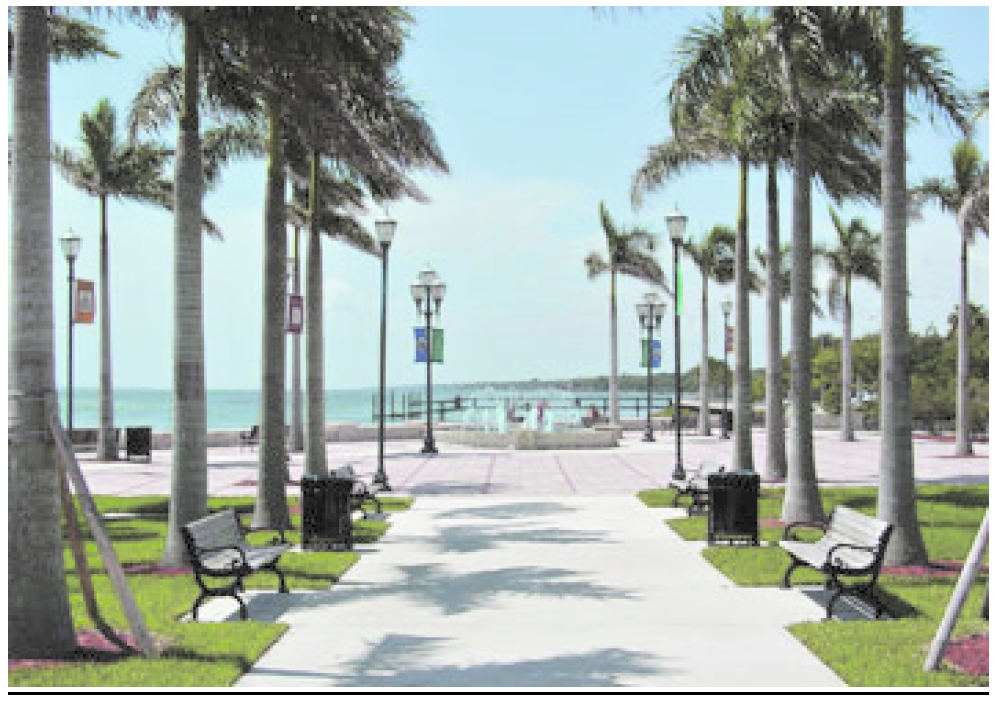
Intent. It is the intent that the standards and specifications herein shall apply to the development of public and private sidewalks constructed and reconstructed in the city.
(b)
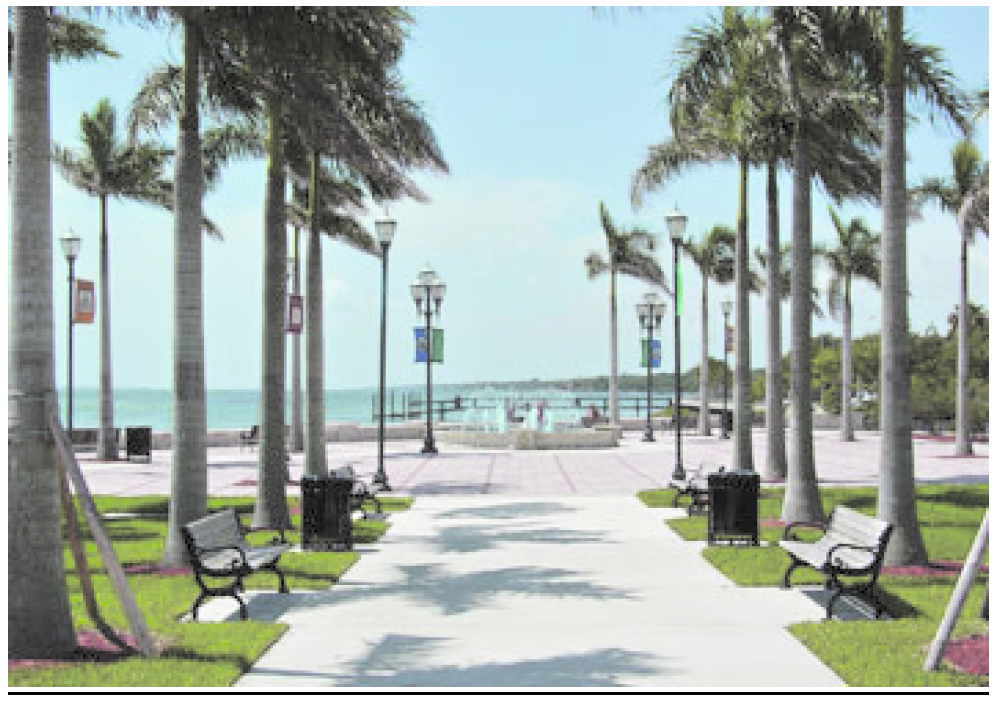
Applicability. In order to provide continual access for pedestrians, sidewalks and sidewalk linkages shall be required to be provided by the property owner or permit applicant when one of the following events occur:
(1)
Whenever a permit is issued for the construction of a new duplex, multifamily, commercial, or office structure or use;
(2)
When the valuation of a building permit for construction, additions, and renovations to structures or uses are more than $35,000.00;
(3)
Any expansion of an existing structure or use which results in an expansion of that structure or use in excess of 25 percent of the existing square footage of structure area on a parcel;
(4)
Plans submitted for site plan, conditional use, PUD/PUR, and subdivision review. Plans shall reflect all proposed sidewalk improvements.
(5)
Any substantial change in use on the property.
(c)
Exemptions. Sidewalk requirements shall not be required for the following:
(1)
Single family homes (including conditional use reviews);
(2)
Properties that abut a canal right-of-way.
(d)
Where required. Sidewalks and sidewalk linkages shall be installed in the following areas:
(1)
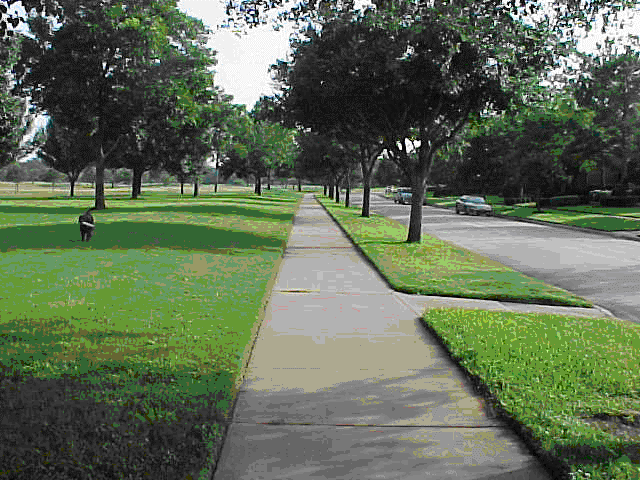
In the public or private right-of-way the full length of any and all streets abutting a parcel of property and parallel to the street.
Example of sidewalks along property boundaries
(2)
Safe and efficient sidewalk linkages shall be provided between building entrances and parking areas, and adjacent portions of the development, and adjacent rights-of-way. At least one accessible route in accordance with the state accessibility code shall connect buildings to parking areas and adjacent rights-of-way.
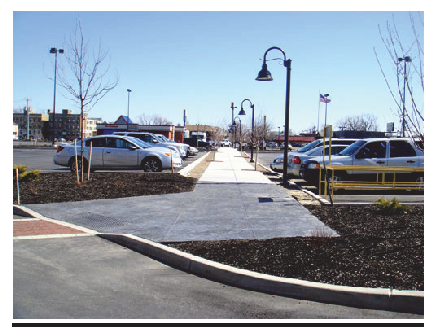 | 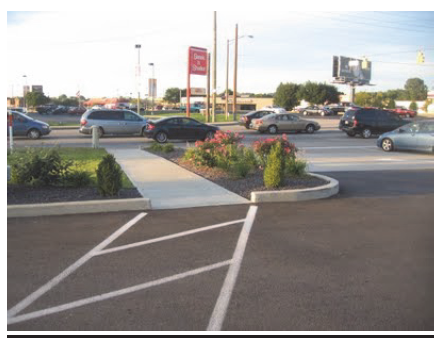 | 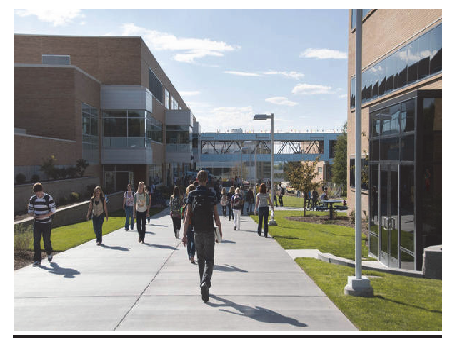 |
| Example of connectivity to parking lot | Example of connectivity to the street | Example of connectivity between buildings |
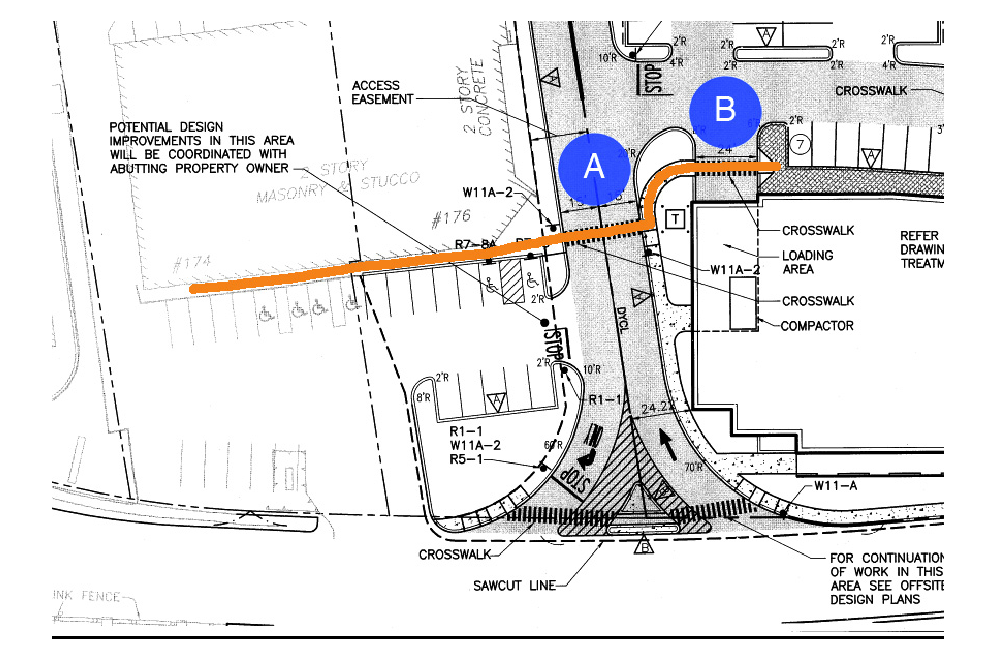
(3)
In addition to the requirements of subsection (d)(2) of this section, internal sidewalk interconnection between adjacent properties shall be provided for properties that front on arterial roads.
Example of internal sidewalk connecting from property A to property B
(4)
New developments adjacent to school properties shall be required to provide a right-of-way and a direct safe access path for pedestrian travel to existing and planned school sites and public parks, and shall connect to the neighborhood's existing pedestrian network.
(e)
Design. The minimum width for sidewalks shall be five feet. Sidewalks shall be constructed of poured concrete unless other material is approved by the city engineer. Where a sidewalk crosses a driveway or internal access road, the crosswalk area shall be marked with paint and shall be provided with stop signs for vehicular traffic at the discretion of the director of planning.
(f)
Payment in lieu. If a sidewalk is required under section 125-322(b), but the construction of the sidewalk is determined to be not practical (as determined pursuant to subsection (g) of this section), then the property owner or permit applicant shall make a contribution to the applicable city sidewalk fund in lieu of constructing the required sidewalk.
(g)
The decision of whether the construction of a sidewalk on a parcel is not practical shall be made by the planning director based on the following criteria:
(1)
The location of the sidewalk would likely create a significant safety hazard;
(2)
Construction of the sidewalk has already been scheduled by its inclusion in the approved transportation improvement plan, the approved capital improvement plan, a state- or federally-funded project, or a development agreement executed pursuant to the Florida Local Government Development Agreement Act (F.S. § 163.3220 et seq.);
(3)
The construction of sidewalks is not warranted at the time of development due the presence of safety hazard or environmental limitations off-site that would likely preclude the extension of sidewalks to the affected development site;
(4)
Whether there is no existing sidewalk to which the proposed sidewalk can connect and it is unlikely that there will be additional development nearby which will require the construction of additional sidewalk (if the parcel terminates at a street intersection and a sidewalk is located across the street, then a sidewalk will be required to connect with the sidewalk located across the street);
(5)
Whether a sidewalk cannot be constructed without removing a protected tree;
(6)
Whether a stormwater drainage ditch or similar public utility facility prevents the construction of a sidewalk and neither the facility nor the proposed sidewalk can be reasonably relocated or altered to accommodate both the facility and the sidewalk; or
(7)
Whether or not other unique or peculiar circumstances exist on a given parcel or development.
(h)
Formula for payment in lieu. The amount of the contribution shall be determined by multiplying the linear feet of that parcel's street frontage (minus the width of any paved driveway and/or driveway apron) times the per linear foot contribution fee established by resolution by the city commission.
(i)
City sidewalk fund. The city shall create a separate interest bearing account. This account shall be known as the city sidewalk fund.
(j)
Expenditure of funds. Expenditures from the city sidewalk fund account shall only be utilized for the construction of new sidewalks, to expand the existing sidewalk network, or to upgrade and improve existing sidewalks to current design/construction standards (including ADA upgrades). These funds shall not be utilized for routine maintenance.
(1)
Prior to funds being expended, the planning board shall consider the list of priority sidewalk improvements listed on the capital improvement schedule and make a recommendation to the city commission on which projects should be funded.
(2)
The city commission shall consider the request to use payment in lieu of funds after the planning board has provided its recommendation on the use of said funds.
(k)
Payment into the city sidewalk fund. Payment into the city sidewalk fund shall constitute the agreement by the developer/property owner that the expenditure of the sidewalk funds to expand and improve the existing city sidewalk system provides a direct benefit to the city and the subject property. Payment into this fund shall satisfy the sidewalk construction requirements for the subject property or properties.
(l)
Variance. The board of adjustment is authorized to consider a variance request from the strict compliance of the sidewalk regulations if said regulations would create an undue and unnecessary hardship on the subject property owner.
(Code 1983, § 22-62; Ord. No. H-186, § 30-62, 6-15-1981; Ord. No. I-243, § 1, 10-19-1987; Ord. No. L-260, § 1, 6-18-2012)
Sec. 125-318. - Home occupations.
(a)
Purpose. This section attempts to recognize the need for people to conduct appropriate small-scale business activities at home. Provisions for home occupations in the section are also intended to achieve compatibility with other permitted uses and the residential character of the neighborhood and ensure that the home occupation is only an accessory use of the property.
(b)
Standards. All home occupations shall comply with the following standards and shall be evaluated in the issuance of occupational licenses:
(1)
No person other than a person who resides in the dwelling unit shall be engaged in the home occupation.
(2)
The home occupation shall be an accessory use conducted only within the enclosed living area of the dwelling unit or the garage.
(3)
The exterior appearance of the residential dwelling in which the home occupation is located shall not be altered in a manner which would cause the premises to differ from their residential character by the use of colors, materials, construction or lighting.
(4)
The home occupation premises shall not be advertised by the use of any signs on the lot on which the occupation takes place which are readily visible from the street.
(5)
There shall be no outside storage of any kind related to the home occupation.
(6)
The home occupation shall not generate traffic (vehicular or pedestrian), noise, vibration, glare, fumes, odors or electrical interference beyond what normally occurs in the applicable zoning district.
(7)
The home occupation will not involve the use of commercial vehicles for delivery of materials to or from the premises except for normal home delivery services.
(8)
Parking generated by the conduct of a home occupation shall occur off the street and somewhere other than in a required front yard.
(9)
No home occupation shall cause an increase in the use of water, sewer or garbage services so that the combined total use for dwelling and home occupation purposes exceeds the average for residences in the neighborhood.
(10)
The home occupation shall not use raw materials for the manufacture of a finished product by special tools and devices that would not normally be found in a home and considered as purely a domestic implement.
(11)
No home occupation shall display stock for trade on the premises and no article may be sold or offered for sale except as may be produced on the premises or utilized in conjunction with the home occupation, the main purpose of which is to provide a service.
(12)
A home occupation may not be utilized to meet the mixed-use requirements set forth in the central business district future land use designation of the comprehensive plan.
(c)
Compliance. Home occupations existing at the time this section is adopted will comply substantially with the standards of this section on or before January 1, 1982.
(Code 1983, § 22-63; Ord. No. H-186, § 30-63, 6-15-1981; Ord. No. K-154, § 1, 7-1-2002; Ord. No. 20-009, § 2, 8-17-2020)
Sec. 125-319. - Mobile home standards.
When a mobile home is installed it shall comply with state installation standards. A mobile home shall comply with the following additional provisions:
(1)
Mobile homes shall be tied down with devices that meet state standards for tie-down devices.
(2)
The mobile home shall have continuous skirting which shall be maintained so as not to provide a harborage for rodents or create a fire hazard.
(3)
Except for a structure which conforms to the definition of a mobile home accessory structure, no extension shall be attached to a mobile home.
(4)
A storage building of at least 75 square feet shall be provided, unless a similar amount of space is provided in a common storage facility. This building shall be located on the back two-thirds of the lot or mobile home space. The building shall be completed within 30 days of placement of the mobile home.
(5)
No roof shall be constructed over a mobile home independent of the structure. Cabanas or awnings are permissible.
(6)
If the mobile home is not located in a mobile home park the owner of the lot shall agree that if the mobile home is removed from its foundation, the owner shall within 30 days either replace the mobile home with another approved mobile home or remove the foundation and mobile home accessory structure. If the owner fails to perform the work, the city may remove the structures and bill the owner for the cost of the work performed.
(Code 1983, § 22-64; Ord. No. H-186, § 30-64, 6-15-1981; Ord. No. I-28, § 15, 8-15-1983; Ord. No. I-208, § 4, 3-2-1987)
Sec. 125-320. - Temporary uses.
(a)
Generally. This section provides for the orderly and effective management of temporary uses which may or may not be specifically allowed in a zoning district. Temporary uses are often found to be necessary and desirable for limited periods of time, although they might not be in keeping with the intent and purpose of the zoning district if allowed on a long-term basis. This section provides for a thorough administrative review of these special types of land uses while minimizing adverse impact upon the public health and welfare as well as adverse impacts to public facilities. Conditions may be placed on the approval of a temporary use permit to ensure adverse impacts to neighboring land uses and public facilities are mitigated.
(b)
Types of temporary uses. A temporary use activity may include, but is not limited to, the following:
(1)
A temporary building or yard for construction offices, material or equipment, provided such use is on or adjacent to the construction site and is adequately equipped with sanitary facilities.
(2)
A real estate sales office used for the sale of lots or housing units in a development, provided such office is in or adjacent to the development and is adequately equipped with sanitary facilities.
(3)
Temporary housing, including mobile homes, for households displaced from their residences due to fires, floods or other disasters, provided the temporary housing is adequately equipped with sanitary facilities.
(4)
Tents erected of a size larger than 12 feet by 12 feet under which people gather for a common purpose. Such a use may be for a seasonal commercial use or other use, such as church-related, carnival or special event on private property.
a.
Standards for review. The impact on surrounding land uses and on public facilities determines the review and approval process. Application shall be approved when all standards for review are met, per Table 1, and when all other applicable requirements of the section are satisfied. The director of planning may impose conditions on the approval to mitigate adverse impacts to public health and welfare, to neighboring land uses, and to public facilities when any standard is not met under the proposal. The application shall be denied when conditions cannot be imposed to mitigate adverse impacts.
Table 1. Standards for Tents
(c)
Compatibility standards. No temporary use will be allowed unless:
(1)
Any nuisance or hazardous features of the use are suitably separated from adjacent uses;
(2)
The use will not generate excessive traffic congestion on nearby streets; and
(3)
A vehicular parking problem will not be created.
(d)
Period allowed. Unless otherwise specified in this section, temporary use permits shall expire after one year.
(e)
Security. Security for performance of the applicant's obligations, including removal of any structures, equipment and materials, shall be posted when determined necessary by the director of planning. The security may be a performance bond, cash, time certificate of deposit payable to the city and/or other negotiable instrument, including title.
(f)
Application for a temporary use. A property owner or his designated representative may initiate a request for a temporary use by filing an application with the director of planning using forms prescribed by the city. The application will also be accompanied by plans, with information specified in section 125-36. The director of the department of development may request other drawings or information necessary for an understanding of the request.
(Code 1983, § 22-65; Ord. No. H-186, § 30-65, 6-15-1981; Ord. No. H-218, § 2, 8-2-1982; Ord. No. K-11, § 1, 5-15-2000; Ord. No. L-269, § 1, 10-1-2012)
Sec. 125-321. - Reserved.
Editor's note— Ord. No. 21-027, § 1, adopted September 7, 2021, repealed § 125-321, which pertained to the coastal construction control line and derived from the Code of 1983; and Ord. No. H-186, adopted June 15, 1981.
Sec. 125-322. - Fences, walls, and hedges; installation, replacement, and maintenance.
(a)
Purpose. It is the purpose and intent of this section to establish the requirements for the installation, replacement, and maintenance of fences, walls, and hedges, in order to protect and preserve the health, safety, welfare, appearance and general wellbeing of the citizens of the city.
(b)
General requirements. The following requirements apply to all fences, walls, and hedges in any zoning district, except as herein specified:
(1)
Placement. All permitted fences, walls, and hedges shall be located on the property of the applicant and not within any public right-of-way. No fence, wall or hedge shall be permitted to be located within, or so as to enclose, a drainage easement, except upon the written authorization of the city engineer. Fences, walls and hedges may be permitted within utility easements, subject to the right of the city, utilities authority, or franchised utility company to remove, without cost or obligation to replace or restore, any such fence or wall and landscaping as may be necessary to maintain the utilities located in a utility easement. A suitable gate to provide access will be provided when utility meters are located within a fenced enclosure.
(2)
Clear vision areas. All fences, walls and hedges shall conform to the clear vision provisions of section 125-308.
(3)
Finish. All fences and walls shall be constructed so that the side of the fence or wall facing or viewable from the public rights-of-way or an adjoining property shall be the finished side of the fence or wall, in terms of materials and their treatment. Fences shall have all support posts and stringers placed facing inward toward the applicant's property. All exterior faces of block walls shall be finished and of professional quality, such as stucco, prefinished block, stacked block with struck joints, shadow blocks, painted or similar, installed in a workmanlike manner.
(4)
Construction. All walls shall be erected in accordance with the requirements of the state building code, as adopted or amended by the city.
(5)
Permit. All new or substantially altered fences and walls shall require a construction permit issued by the building department. The application for permit shall accurately establish the location of the fence or wall on the property, and the applicant shall be responsible therefor.
(6)
Conditional uses. The maximum height for walls, fences, and hedges of a conditional use shall not exceed the maximum allowed in the zoning district, unless a greater height is approved in accordance with the requirements of section 125-313.
(7)
Trellises, arbors, pergolas, etc. Trellises, arbors, pergolas and similar garden structures, if erected along the property line or within the required yard, shall conform to the height requirements of this section; if they are not erected within the required yard, then this section is inapplicable.
(c)
Requirements by zoning districts. The following maximum fence, wall and hedge heights are allowed by zoning district, as follows:
(1)
Single-Family Zoning Districts (E-1, R-1, R-2, R-3). Fences or walls may be erected or maintained along property lines or within the required yards, to a maximum height of six feet above finished grade of the abutting parcel, except as follows:
a.
Front yards. The maximum height for fences, walls or hedges in the required front yard shall be four feet.
b.
Waterfront lots. The maximum height for fences, walls or hedges in the required building setback distance from the water shall be four feet.
c.
Double frontage lots. The maximum height for walls, fences or hedges in the required rear yard, as defined by the basic use standards, shall be four feet.
(2)
Medium and High-Density Residential Zoning Districts and Office, Neighborhood and Tourist Commercial Zoning Districts (R-4, R-4A, R-5, C-1, C-2, C-5). Fences or walls may be maintained along property lines or within the required yards, to a maximum height of six feet above finished grade of the abutting parcel, except the maximum height for walls, fences and hedges in the required setback distance from the yard shall be four feet and providing, further, that the maximum height for fences, walls or hedges in the front yards of single-family or duplex residences located in R-4, R-4A or R-5 districts shall be four feet.
(3)
General and Central Commercial, Industrial and Open Space Zoning Districts (C-3, C-4, I-1, I-2, OS-1, OS-2). Fences and walls in the C-3, C-4, OS-1, and OS-2 Zoning Districts may be maintained along property lines or within the required yard, to a maximum height of eight feet above finished grade of the abutting parcel, except vehicular access suitable for emergency vehicles shall be provided. Fences and walls in the I-1 and I-2 zoning districts may be maintained along property lines or within the required yard, to the maximum heights specified in subsection (e)(5) of this section finished grade of the abutting parcel, except vehicular access suitable for emergency vehicles shall be provided.
(4)
Planned Unit Development and Redevelopment Zoning Districts (PUD and PUR). Fences or walls may be maintained along property lines or within the required yards, to a maximum height of six feet above finished grade of the abutting parcel, when consistent with the purpose and intent of the approved development or redevelopment plan.
(5)
Unless otherwise prohibited by overlay district requirements, properties abutting a railway line or railroad right-of-way may erect a fence of up to eight feet in height along the rear property line only. The maximum height for fences within the side and front yard setbacks shall remain as provided within this section.
(d)
Special requirements. In addition to the general requirements of section 125-322(b) and specific height requirements by zoning district of section 125-322(c), the following requirements are applicable as indicated:
(1)
Landscaping. All fences and walls constructed generally parallel to the public right-of-way and having a length of 100 feet or more shall be landscaped along not less than 50 percent of the linear distance. This landscaping shall consist of shrubs and not less than one tree for each 50 feet of fence or wall so landscaped. All landscaping shall conform to the standards of section 125-314(b). Fences and walls enclosing single-family or duplex uses are exempt from the landscape requirement.
(2)
Security fences. Security fences designed to preclude entry into hazardous locations or facilities or to protect the exterior storage of materials or equipment from vandalism or theft may not be erected, except that upon application to the director of planning a security fence may be permitted upon determination that such fence is necessary in the interest of public safety or the protection of public or private property and does not have a negative impact on the general appearance of the area. If permitted, such a fence shall not provide more than three strands of barbed wire above a fence not exceeding six feet in height. Barbed wire fences, otherwise allowed under this section, are not permitted in residential neighborhoods, downtown or in areas of the city which have been targeted for redevelopment.
(3)
Retaining walls. Retaining walls shall be approved by the city engineer.
(4)
Construction fences. Temporary fences may be permitted by the director of building and code enforcement to enclose construction sites as necessary in the interest of public safety or the protection of public or private property. Such fences shall not exceed eight feet in height.
(5)
Chain link fences. On lots fronting Delaware Avenue, Orange Avenue, Avenue D and U.S. 1, or on lots determined by the director of planning to be in the downtown area or in an area targeted for redevelopment, chain-link fences are permitted only if located no closer than 25 feet to any public right-of-way, are painted or coated, and screened from the public right-of-way with shrubs and no less than one tree for each 50 linear feet.
(e)
Required fences, walls, or hedges.
(1)
Junkyards. Junkyards shall comply with the requirements of section 22-327(d).
(2)
Swimming pools. Swimming pools shall comply with all applicable requirements of the state building code.
(3)
Parking lots. Parking lots shall comply with the requirements of section 125-315.
(4)
Residential buffers. Buffers between residential or open space areas and commercial or industrial areas shall conform with the requirements of section 125-314(c)(4).
(5)
Commercial and industrial buffers. Outside storage of materials for commercial and industrial uses shall be screened with a sight-obscuring fence or wall which is not less than six feet to a height equal to the height of the material being stored, whichever is greater, except the storage of materials may not exceed a height of 15 feet. Outside storage of cargo containers shall be screened with site-obscuring fence or wall at least eight feet in height or with a landscape strip at least ten feet in width. The top of the highest stored or stacked cargo container may not exceed a height of 30 feet. Such limitation on the storage or stacking of cargo containers is effective as of October 16, 2007, notwithstanding any other provision in the Code of Ordinances, whether any such contrary provision relates to nonconformity or not. For all fences and walls constructed generally parallel to the public right-of-way or parallel to a lot that is not zoned I-1 or I-2, there shall be a hedge planted along the outside of such barrier to form a 36-inch or higher continuous, unbroken solid screen and one tree planted for an average of every 20 feet along the outside of such barrier. Such fence, wall, landscape strip, and/or landscaping required by this section also shall meet the requirements of article I of chapter 123 and section 125-314(g)(7) and (8).
(f)
Prohibited fences, walls, hedges, or characteristics of fences, walls or hedges.
(1)
Electric fences. Electric fences shall not be permitted.
(2)
Concertina wire. Barbed wire fences using concertina-type wire shall not be permitted, except within the interior of a prison or jail compound area.
(g)
Exceptions.
(1)
Fences and walls located on publicly owned property shall be exempt from the requirements of section 125-322(c), pertaining to height, and section 125-322(4)(b), pertaining to security fences.
(2)
Height of hedges or other vegetative screening shall be limited only by health and safety factors, unless specifically limited herein.
(3)
Fences and walls used for recreational purposes such as around a tennis court are exempt from the maximum height requirements of section 125-322(c).
(Code 1983, § 22-67; Ord. No. I-04, § 1, 4-4-1983; Ord. No. I-241, § 1, 9-22-1987; Ord. No. J-83, § 1, 3-7-1994; Ord. No. J-180, § 1, 2-20-1996; Ord. No. J-305, § 1, 4-21-1997; Ord. No. J-306, § 1, 4-21-1997; Ord. No. K-516, §§ 1A, 1B, 10-15-2007; Ord. No. L-72, § 1, 1-5-2009; Ord. No. 24-006, § 1, 4-15-2024)
Sec. 125-323. - Satellite signal receiving and transmitting devices; installation, placement and maintenance.
(a)
Purpose. It is the purpose and intent of this section to establish the requirements for the installation, placement and maintenance of satellite signal receiving and transmitting devices, in order to protect and preserve the health, safety and welfare of the citizens of the city.
(b)
General requirements. The following requirements apply to all satellite signal receiving and transmitting devices in any zoning district:
(1)
Placement. All permitted satellite signal receiving and transmitting devices shall be located on the property of the applicant and not within any public right-of-way.
(2)
Construction. All satellite signal receiving and transmitting devices shall be erected in accordance with the requirements of the state building code, as adopted and amended by the city.
(3)
Permit. All satellite signal receiving and transmitting devices shall require a construction permit issued by the department of building and code enforcement.
(c)
Requirements by development type. Satellite signal receiving and transmitting devices are allowed as follows:
(1)
Single-family and duplex development. When constructed on the same property as single-family or duplex residential development, such device:
a.
May be constructed with the base of such device being a minimum of four feet from a required yard.
b.
Shall not be constructed in a front yard.
c.
Shall not exceed 12 feet in diameter.
d.
Shall not exceed 15 feet in height as measured from the lowest point of the base.
(2)
Multifamily development. When constructed on the same property as multifamily residential development, such device:
a.
May project out to a maximum of 30 inches into a required yard.
b.
When constructed in a side or front yard, shall be screened by a fence or hedge of a minimum of two feet in height.
(3)
Nonresidential development. When constructed on the same property as nonresidential development, such device:
a.
May project out to a maximum of 30 inches into any required yard.
b.
When constructed in a side or front yard, shall be screened by a fence or hedge of a minimum two feet in height unless used as a sign, in which case the structure must comply with chapter 117.
(4)
Temporary uses.
a.
A temporary satellite signal receiving and transmitting device may be allowed by the planning director if he determines that the provisions of this section have been satisfied.
b.
Period allowed. The period for which a temporary satellite signal receiving and transmitting device will be allowed will be specified by the planning director.
(Code 1983, § 22-69; Ord. No. I-149, § 1, 2-3-1986)
Sec. 125-324. - Backflow restrictors.
(a)
Purpose. It is the purpose and intent of this section to establish requirements for siting and landscaping of backflow restrictors in order to protect and preserve the health, safety, welfare, appearance and general welfare of the citizens of the city.
(b)
Responsibility. It shall be the responsibility of the developer to landscape and screen backflow restrictors.
(c)
Siting. Backflow restrictors shall be placed on private property.
(d)
Screening. Backflow restrictors shall be fenced at least as high as the mechanism itself and such fence shall be separated from it by a distance of not less than two feet in all directions around the restrictor. Additionally, a landscaped hedge shall be planted against the outside of the fence. Shrubs used to meet the requirements of this section shall be a minimum of two feet in height when planted. The hedge shall be planted and maintained so as to form a two-foot or higher continuous, unbroken, solid, visual screen within a maximum of one year after the time of planting.
(Code 1983, § 22-70; Ord. No. I-159, § 1, 4-7-1986)
Sec. 125-325. - Amusement arcades and arcade amusement centers.
Amusement arcades and arcade amusement centers shall comply with the following regulations:
(1)
General operating standards.
a.
No amusement arcade or arcade amusement centers shall operate after the hour of 12:00 midnight and before the hour of 8:00 a.m. on weekdays, and between 2:00 a.m. and 8:00 a.m. on weekends.
b.
No game shall be played by persons who are under 18 years of age.
c.
No arcade amusement center shall be located within 1,250 feet of another arcade amusement center. Such distance shall be measured from closest property line to closest property line.
d.
No amusement arcade or arcade amusement centers shall be permitted within the Downtown Business and Entertainment Overlay District.
e.
No amusement arcade or arcade amusement centers shall be located within 250 feet of the Downtown Business and Entertainment Overlay District boundaries.
f.
Alcohol sales or consumption shall be prohibited in amusement arcades and arcade amusement centers.
g.
Amusement arcades or arcade amusement centers shall not exceed 9,000 square feet.
h.
Amusement arcades or arcade amusement centers shall operate in full compliance with all state and federal law.
(2)
Design standards.
a.
No sign, display, or merchandise, shall be placed on or adjacent to any window if such placement would interfere with the clear and unobstructed view of the entire interior of the establishment from ground level through exterior windows.
b.
Placement of game machines along front windows are prohibited.
c.
Window tinting, mirrored windows, or other obscuring elements are prohibited.
d.
All entrances shall be adequately lighted.
e.
All amusement arcades or arcade amusement centers must post at least two conspicuous signs within the premises, and one conspicuous sign at the entrance, stating the following:
1.
Minimum age requirements as described above.
2.
School hours use restrictions as described above.
3.
No smoking.
4.
No drugs.
5.
No alcohol.
f.
Amusement arcades or arcade amusement centers shall provide bicycle racks within enough stalls to accommodate one bicycle for each five game machines located within the premises. Bicycle racks shall be located as close as practical to the entrance of the facility and shall not be located in a manner that obstructs any entrances, exits, sidewalks, driveways, or parking areas.
g.
All amusement arcades or arcade amusement centers must provide public restrooms in accordance with applicable country health department requirements.
h.
Lighting for parking lots must satisfy lighting requirements of section 125-315(g)(1) prior to the issuance of a business tax receipt.
i.
Landscaping must comply with requirements of the city's landscaping ordinance prior to the issuance of a business tax receipt.
j.
Sidewalks shall be installed along all public rights-of-way for properties that have arcade uses and shall be installed prior to the issuance of a business tax receipt. No location shall be exempt from sidewalk provisions contained in section 125-317.
k.
Any proposed exterior change to a building used for arcade uses will be subject to city design review guidelines pursuant to section 125-314. This shall not apply to buildings located in historic districts or buildings that are individually designated.
l.
Parking shall be provided at a rate of three-fourths parking spaces per machine (or three spaces for every four machines).
(3)
Permitting requirements.
a.
All amusement arcades or arcade amusement centers shall pay a fee per machine annually in conjunction with the business tax receipt. The fee shall be established by resolution by the city commission. The fee shall apply to all operating and nonoperating machines located on premises.
b.
All amusement arcades or arcade amusement centers shall pay a fee per machine annually in connection with the business tax receipt. The fee shall be established by resolution by the city commission. The fee shall apply to all operating and non-operating machines located on premises.
c.
An applicant for a permit to operate an amusement arcade or arcade amusement center shall submit the following information to the police department:
1.
All applications shall include a list of all current owners and employees of the arcade.
2.
If the city determines that any applicant lacks good moral character, it shall deny the license application. For purposes of this section, an applicant will be deemed to have good moral character if the applicant, its owners, and its employees meet the level two standards of screening set forth in F.S. § 435.04.
3.
The applicant shall pay a fee established by resolution by the city commission to cover the cost of police department background checks.
4.
Whenever an amusement arcade or arcade amusement center hires a new employee or changes its ownership composition, the police department shall inspect the new employee's or owner's background to ensure that the employee or owner has not been convicted of any of the crimes described in subsection (b)(2) of this section. Any failure by an amusement arcade to provide the police department with the information necessary for the officer to conduct such an inspection shall constitute a willful violation of this chapter.
5.
The city may deny an application for a permit to operate an amusement arcade or arcade amusement center or may revoke a permit issued pursuant to this chapter if the applicant fails to meet any of the requirements of this section. If the city denies an application, the city shall provide reasons for the denial in writing within five days of receipt of the completed application. If the city revokes a permit issued pursuant to this chapter, the city shall provide reasons for the revocation in writing.
d.
Provide an operating plan consisting of an interior layout plan drawn to scale showing the location of all machines, devices, equipment and access ways, and such other information as may be reasonably requested.
e.
Amusement arcades or arcade amusement centers that serve food or provide catering services on premises must be licensed by the department of health, department of business professional regulation, or department of agriculture and consumer services.
(4)
Machine registration requirements.
a.
The permittee is required to maintain its premises a complete inventory, along with serial numbers or equivalent identification, as set forth in subsections (d) and (e) of this section, the amusement devices in operation on the premises of the amusement arcade at all times. The initial application for permit shall include a certificate of inspection by the planning department of the inventory, along with serial numbers or equivalent of identification, as set forth in subsections (d) and (e) of this section, of the machines that the permittee intents to put into operation when the amusement arcade begins its business activities.
b.
Each renewal permit application shall contain a certificate of inspection of updated inventory, along with serial numbers or equivalent identification, as set forth in subsections (d) and (e) of this section, of the amusement device that the permittee intends to put into operation when the amusement arcade begins its business activities under the renewal license.
c.
Before a new amusement device is put into operation at the amusement arcade or arcade amusement center, the permittee shall notify the planning department of the addition of the device to the inventory and update its inventory accordingly.
d.
Upon review of the inventory of devices under subsections (1), (2) and (3) of this section, the planning department shall enter each amusement device into a registry that the license administrator shall create. For each amusement device registered, the permit administrator shall cause to be issued and delivered to permittee for each amusement device within seven days of the notification required under subsection (c) of this section a numbered metal or plastic decal. The registration decal of each amusement device shall be affixed to the upper left front of the game in a prominent position where easily viewed by zoning inspectors, code enforcement inspectors and police. Registration decals are not transferable. The failure of any amusement device to display a current registration decal shall be a violation of this section and subject to enforcement action by the city.
e.
The inventory of devices under subsections (1), (2) and (3) of this section shall provide the following information: the manufacturer serial number; common name, type or description of the game played on the machine. The registration decal shall contain the inventory number of the amusement device.
f.
Each inventory of amusement devices submitted under subsections (a), (b), and (c) of this section shall be accompanied by a certificate issued by an independent testing laboratory licensed by the state pursuant to F.S. ch. 551, certifying that the game played by the skill-based amusement devices identified in the inventory meet the application of skill requirement contained in F.S. §§ 551.104(d), 551.105 and 551.107.
(5)
Waiver of distance.
a.
The city commission shall determine if the health, safety, or general welfare have been provided for with any waiver request and may impose any condition which it finds to be necessary to protect the best interest of the surrounding property of the city.
b.
The city commission may not waive distance restrictions imposed by subsections (a)(4) and (a)(5) of this section.
c.
The city commission shall consider the following for any waiver request:
1.
The actual location and distance of the proposed establishment with respect to other places of business licensed to sell intoxicating beverages, whether on or off the premises;
2.
The type and size of the establishment, including the number of machines, seating capacity, and whether, in view of such type or size, the proposed establishment is likely to create a public nuisance or traffic impediment by drawing crowds or persons milling about outside the building;
3.
Whether adequate parking and landscaping for the facility is provided so as to meet the requirements set forth in sections 123-37 and 125-316;
4.
Whether the facility is physically separated or well-buffered from all adjacent residentially zoned areas;
5.
Whether traffic generated by patrons or pickup/delivery vehicles will pass through low or moderate density residentially zoned neighborhood;
6.
The number of police calls to the proposed location and/or adjacent properties within the past year.
(6)
Preexisting amusement arcades or arcade amusement centers.
a.
Preexisting amusement arcades or arcade amusement centers will be required to immediately comply with all procedural requirements such as permitting, licensing, general operating standards, fees, and nonhardscape design standards. Hardscape design standards such as parking lots, exterior lighting, landscaping, sidewalks, etc., will be subject to a 24-month time for compliance.
(7)
Florida law compliance. It is not the intent of this section to allow amusement arcades or arcade amusement centers that:
a.
Mimic the look and feel of gambling venues which are prohibited by law.
b.
Include any game, machine or device that violates any provision of state and federal law, including, but not limited to, F.S. ch. 849.
c.
All amusement arcades or arcade amusement centers shall operate in full compliance with all state statute requirements and other applicable laws.
(Code 1983, § 22-71; Ord. No. L-217, § 4, 12-5-2011)
Sec. 125-326. - Density bonuses.
(a)
Purpose. To encourage infill and redevelopment in certain areas of the city through density bonus provisions in order to maximize existing infrastructure, protect natural resources, lower the cost of public services and promote a more sustainable community.
(b)
General requirements.
(1)
Property located within the coastal high hazard area (CHHA), as defined by the adopted city comprehensive plan and the state statutes, is not eligible for density bonus provisions;
(2)
A maximum of five dwelling units per acre density bonus is permitted for development located within one-fourth mile radius of a rail station, multimodal transit center or transit stop;
(3)
The rail station, multimodal transit center or transit stop must be serviced by the regulating transit authority of the particular transportation facility at the time that the density bonus is awarded;
(4)
Development is eligible for density bonus provisions if it is located within the one-fourth-mile radius by any measure; and
(5)
The director of planning may make the determination that a development is eligible for density bonus provisions if it is located outside the one-fourth-mile radius but within an enclave surrounded on all sides by several density bonus boundary limits.
(c)
Tiered density bonus provisions.
(1)
Development located within the community redevelopment area (CRA) that is not located within the CHHA is eligible for a maximum density bonus of five units-per-acre;
(2)
Development located outside the CRA boundary and not in an R-1 zoning district shall be eligible for a maximum density bonus of three units-per-acre; and
(3)
Development located on property in the R-1 zoning district and that is outside the CRA boundary shall be eligible for a maximum density bonus of one unit-per-acre.
(d)
General standards.
(1)
The density bonus is measured from the maximum density permitted on site before the density bonus provisions are applied; and
(2)
All development receiving a density bonus shall require site plan approval through the planning department.
(3)
Compatibility review.
a.
A determination shall be made as to whether the density bonus provisions will result in a significantly greater negative impact on the surrounding property. The determination shall be based upon a comparison between the development impacts of the site before and after applying the density bonus provisions to the surrounding property and shall address:
1.
Whether the increase in density will decrease visual access to the surrounding vista by existing development, especially with regard to historic sites, waterfront or open space areas by more than 25 percent;
2.
Whether buffer landscaping provides sufficient screening between sites;
3.
Whether the orientation of buildings, doors or windows allow for sufficient sight-line separation between building sites; and
4.
Whether the increase in density will result in the decrease the level of service for public facilities.
b.
Such negative impacts shall be mitigated as a condition of approval by related development standards as required by the director of planning, such as:
1.
Increased building setbacks;
2.
Increased side yard setback;
3.
Increased planting and screening requirements;
4.
Orientation of buildings away from adjacent development;
5.
Location of open space toward surrounding development; and
6.
Any material improvement necessary to maintain the level of service of public facilities.
c.
Development requiring mitigation for one or more significant negative impacts will not be eligible for the flexible development identified in this section.
(e)
Flexible development standards.
(1)
Administrative relief may be provided by the director of planning with regard to the following:
a.
Setback requirements may be reduced up to the required landscaped area;
b.
Lot size requirements may be reduced up to ten percent;
c.
Parking requirements may be reduced; and/or
d.
The required 25 percent open space requirement for all development may be provided off-site, or may be reduced, if the development is connected by a continuous sidewalk to an existing public park that is located within one-fourth mile of the site.
(Code 1983, § 22-72; Ord. No. L-263, § 1, 8-20-2012)
Sec. 125-327. - Fueling stations.
(a)
Purpose. It is the purpose of this section is to protect the public safety and welfare, and enhance the city's beauty and protect property values by regulating the location of filling stations and design of new or remodeled stations.
(b)
Applicability. This article shall apply to any building, structure or land used for the dispensing, sale or offering for sale at retail of any automobile fuels, oils or accessories incident thereto, including lubrication of automobiles and replacement or installation of minor parts and accessories, but not including major repair work, such as motor replacement, body and fender repair or spray painting. This shall also include the terms "fueling station," "filling station," "gasoline station," "service station," and "gasoline service station." This section shall not apply to fueling operations accessory to marinas or industrial uses which do not offer retail sale to the general public.
(c)
General requirements. Fueling stations shall comply with the following regulations:
(1)
Enclosed structure. All tire repairing, battery charging, lubricating or washing of automobiles, and/or storage of merchandise or supplies, must be accommodated or conducted wholly within the main structure or an enclosed structure of any new, remodeled, relocated or existing filling station.
(2)
The design of each new station, or remodeling of an existing station, shall be in compliance with the design review guidelines as contained in section 125-314. Renovations, alterations and/or additions to existing structures shall be reviewed as minor applications pursuant to section 125-314.
(Code 1983, § 22-73; Ord. No. 16-002, § 2, 3-21-2016)
Sec. 125-328. - Boardinghouses and roominghouses.
(a)
Purpose. To establish and enforce standards for boardinghouses and roominghouses in the city in a manner which protects and preserves the health, safety, appearance, and general welfare of the citizens of the city.
(b)
Minimum maintenance standards. The owner of a boardinghouse or roominghouse shall not occupy nor let to another for occupancy, a boardinghouse unit or roominghouse unit that is not clean, sanitary, safe, and fit for human habitation as required by the standards established hereunder, and other codes of the City of Fort Pierce, St. Lucie County, and the State of Florida. The owner of a boardinghouse or roominghouse shall:
(1)
Maintain the premises, both interior and exterior including landscape elements, in a manner consistent with these ordinances and the International Property Maintenance Code as may be amended from time to time; and
(2)
Unless each unit is provided with its own utility connections, ensure utilities are provided to the premises; and
(3)
Every unit must have an operable window or secondary means of emergency egress. Such windows shall be provided with shades, draperies, or other devices or materials to cover all windows so as to afford privacy to occupants; and
(4)
Not permit cooking in any boardinghouse unit or roominghouse unit; and
(5)
Ensure one trash and one recycling container per four occupants or a dumpster for use by all occupants is provided and is maintained in compliance with chapter 30 of this Code; and
(6)
Not permit the use of any cellar, garage, carport, shed, basement space, or similar accessory structure as a habitable room; and
(7)
Maintain the exterior premises so as to prevent the accumulation of stagnant water thereon; and
(8)
All animals or pets must be licensed with the city and be kept in a manner consistent with the provisions of this Code.
(9)
Provide fire and smoke protection features and systems as required in this Code and the International Property Maintenance Code.
(c)
Minimum space requirements. Every room occupied for sleeping purposes shall:
(1)
Have a gross floor area of not less than 70 square feet and, when occupied by more than one occupant it shall have a gross floor area calculated on the basis of total habitable room area of not less than 50 square feet for each occupant; and
(2)
Have a minimum width of eight feet; and
(3)
Comply with the requirements of the current adopted International Property Maintenance Code. Any portion of a room having a ceiling height less than the minimum specified in the International Property Maintenance Code shall not be included in computing the total floor area of such room.
(d)
Parking requirements.
(1)
Minimum parking standards for boardinghouses are defined within the off-street parking standards of this Code. Roominghouses shall be subject to the same requirements.
(2)
Parking standards for boardinghouse or roominghouse establishments may be reduced by up to 50 percent if public transportation stops are located within one-quarter mile of the boardinghouse or roominghouse.
(e)
Pre-existing or proposed boardinghouses or roominghouses (in R-5 and C-2 zoning districts).
(1)
Shall comply with all provisions of this section, to include, but not limited to, minimum maintenance standards, space requirements, and parking requirements.
(2)
Shall comply with the Florida Building Code (FBC) and with the fire code in effect at the time a certificate of occupancy is issued.
(3)
Pre-existing boardinghouses and roominghouses in the R-5 and C-2 zoning districts will be allowed 24 months from the date of adoption of the ordinance from which this section is derived to obtain a conditional use permit from the planning department to continue their use.
(f)
Illegal and new boardinghouses and roominghouses (located outside of the R-5 or C-2 zoning districts) shall be required, from the date of adoption of the ordinance from which this section is derived, to apply for a conditional use permit from the planning department for their use, and shall be subject to, and comply with, all applicable:
(1)
Florida Building Codes. The application of which will depend upon the Florida Building Code classification of use and whether the use is related to transient or non-transient purposes and the number of occupants. Such boardinghouses and roominghouses may also require a change of use and certificate of occupancy under the provisions of the FBC, made through the city's building department.
(2)
Fire codes. The classification under the applicable fire codes. The fire protection requirements are driven by the classification and could include either NFPA 13, 13R or 13D requirements. Other standards may also become applicable
(g)
Enforcement.
(1)
The police department's officers, code enforcement officers, and any other city employees designated by the city manager shall enforce this article; complaints may be filed with the city using all available and acceptable methods.
(2)
Provisions of this chapter may be enforced by the city as a civil violation pursuant to chapter 1, article II.
(Ord. No. 25-016, § 1, 5-5-2025)
Sec. 125-358. - Definitions.
The following words, terms and phrases when used in this article shall have the meanings ascribed to them in this section except where the context clearly indicates a different meaning:
Accessory equipment building means any building, cabinet, or equipment enclosure constructed for the primary purpose of housing the electronics, backup power, power generators and other free standing equipment associated with the operation of antennas.
Alternative site means one or more separate locations within the search ring at which a provider could place its antenna to serve substantially all of the area intended to be served by the site requiring a special exception. Alternative sites must be available to the provider on commercially reasonable terms.
Antenna support structure means a facility that is constructed and designed primarily for the support of antennas, which include the following types:
Camouflaged structure means a structure designed to support antenna and designed to blend into the existing surroundings. Privately owned amateur radio and citizens band antennas support structures shall be exempt from this article.
Antennas means any apparatus designed for the transmitting and/or receiving of electromagnetic waves which includes but is not limited to telephonic, radio or television communications. Types of antennas include, but are not limited to, whip antennas, panel antennas, dish antennas. As used herein the term antenna includes all antennas integrated and used as a single unit, such as an antenna array. For purposes of this article, the following shall not be considered antennas and shall not be regulated by this article; privately owned amateur radio and citizens band antennas, irrespective of height and diameter; and antennas with a total diameter or width, including all parts of the antenna arrays, of two meters or less in commercial or industrial areas, or one meter or less in all areas if mounted no greater than ten feet above the roofline.
Collocation means when more than one FCC licensed provider uses an antenna support structure to attach antennas.
Existing structures means any lawfully constructed manmade structure, including, but not limited to, antenna support structures, buildings, utility structures, light poles, clock towers, bell towers, steeples, water towers and the like, which allow for the attachment of antennas.
FAA means the Federal Aviation Administration.
FCC means the Federal Communications Commission.
Guyed tower means a tower that is supported in whole or in part by guy wires and ground anchors or other means of support in addition to the superstructure of the tower itself;
Lattice tower means a tower that consists of vertical and horizontal supports and crossed metal braces, which is usually triangular or square in a cross section;
Monopole means a tower of a single pole design; and
Provider means an FCC licensed communications company.
Search ring means a geographic area in which a provider's antenna is intended to be located to serve the provider's coverage area.
Temporary antenna support facility means a facility that is designed and constructed to serve, on temporary basis, as a means of supporting antennas and is used typically to provide emergency wireless communications service or to provide wireless communications service to special events.
(Code 1983, § 22-157; Ord. No. J-452, § 1, 9-21-1998)
Sec. 125-359. - Intent.
The regulations and requirements of this article are intended to:
(1)
Promote the health, safety and general welfare of the citizens by regulating the siting of wireless communication facilities;
(2)
Accommodate the growing need and demand for wireless communication services;
(3)
Provide for the appropriate location and development of wireless communication facilities within the city;
(4)
Recognize that the provisions of wireless services may be an essential service within such land use categories as may be provided for under the comprehensive plan, subject to the limitations set forth in this article;
(5)
Minimize adverse visual effects of wireless communication facilities through careful design, siting, landscape screening and innovative camouflaging techniques;
(6)
Encourage the location and collocation of antennas on existing structures thereby minimizing new visual impacts and reducing the need for additional antenna support structures; and
(7)
Further the balance between the need to provide for certainty to the communications industry in the placement of wireless communication facilities and the need to provide certainty to the residents and citizens of the city that the aesthetic integrity of the city will be protected from the proliferation of unnecessary antenna support structures.
(Code 1983, § 22-156; Ord. No. J-452, § 1, 9-21-1998)
Sec. 125-360. - Antennas.
(a)
Where permitted. Antennas attached to existing structures shall be permitted in all zoning districts subject to the requirements of this section.
(b)
Requirements. All antenna installations shall meet the following requirements:
(1)
Antennas may be located on existing structures with a height of 30 feet or greater, so long as the antennas do not extend more than 15 feet above the highest point of the existing structure, and as limited by subsection (b)(3) of this section;
(2)
Antennas may be located on existing structures with a height of less than 30 feet, so long as the antennas do not extend more than five feet above the highest point of the existing structure, and as limited by subsection (b)(3) of this section;
(3)
Notwithstanding subsections (b)(1) and (2) of this section, antennas, as defined in section 125-358, shall not be located on single family structures;
(4)
Antennas to be located on existing structures in public road rights-of-way may only be located in collector, arterial or limited access road rights-of-way;
(5)
No advertising shall be allowed on an antenna;
(6)
No signals, lights or illumination shall be permitted on an antenna, unless required by any applicable federal, state or local rule, regulation or law;
(7)
Antennas shall comply with all applicable Federal Communications Commission emission standards;
(8)
Design, construction, and installation of antennas shall comply with all ordinance provisions of this Code and such other local building codes as may be applicable;
(9)
Accessory equipment buildings used in conjunction with antennas, if located on the ground, shall comply with the minimum accessory building setback requirements of the zoning district in which they are located.
(c)
Approvals. All antenna support structures shall require a site plan conforming to section 125-313(d), to be approved administratively by the planning director.
(d)
Nonconforming antennas. All antennas legally installed at the time of initial installation may be repaired, replaced and/or relocated at an equal or lower height on the existing structure, if otherwise not in conformity with this article.
(Code 1983, § 22-158; Ord. No. J-452, § 1, 9-21-1998)
Sec. 125-361. - Antenna support structure.
(a)
Preapplication conference for approval process. Construction of any antenna support structure shall require a permit, to be issued upon approval following completion of procedures provided by this section. Any applicant or agent thereof seeking to construct an antenna support structure shall schedule a courtesy review with the department of planning prior to the submission of the permit application, in order to review the requirements of this section. The applicant shall bring to the conference the legal description of the proposed antenna support structure site and zoning lot, a conceptual plan of the antenna support structure, and an elevation drawing of the antenna support structure site improvements.
(b)
Submission requirements. All applications for an antenna support structure permit shall contain the following items:
(1)
The applicant shall be the antenna support structure owner or authorized agent. The application shall be signed and notarized by the owner of the property upon which the antenna support structure is being built, with the property owners acknowledgment of the requirements relating to abandonment of antenna support structures, as provided in section 125-365. Documentation shall be submitted as to telecommunication carrier utilizing the antenna support structure.
(2)
Site and landscape plan drawn to scale, legal description of the antenna support structure site and zoning lot, north arrow and demonstration of compliance with applicable land development regulations.
(3)
An elevation, drawn to scale, of the zoning lots view from city right-of-way and any abutting residential use or property.
(4)
Documentation of compliance with FAA and any applicable local aviation authority regulations.
(5)
Documentation to ensure that any antennas to be placed on the antenna support structure meet all relevant FCC regulations and radio frequency emission standards.
(6)
Copies of any relevant easements.
(7)
The applicant must include in the application an affidavit of good faith intent to allow the co-location of wireless communication antennas by other telecommunication carriers at a reasonable market rate.
(8)
The applicant shall provide a notice of the proposed location to other telecommunication carriers with potential interest in co-location by satisfactory evidence of actual notice. Copies of any such notices must be submitted with the application. Notice shall direct the carriers interested in collocation to contact the planning department. If a potential user requests co-location in writing to the planning department, the burden shall be on the applicant to demonstrate that co-location cannot be accommodated pursuant to subsection (b)(10) of this section.
(9)
The applicant shall provide the applicable propagation models and/or search ring maps for the telecommunication carrier which has demonstrated an intent to locate a wireless communication antenna on the proposed antenna support structure and shall identify all existing structures within the telecommunication carrier's search ring of equal or greater height than the proposed antenna support structure.
(10)
The applicant must demonstrate by provision of an affidavit from a registered professional engineer with expertise in the telecommunications industry that the wireless telecommunication antenna to be attached to the antenna support structure cannot be accommodated on the identified existing structures or on a commercial communication tower within the telecommunication carrier search ring due to one or more of the following reasons:
a.
Both the owner/operator of the existing antenna support structure and the applicant have verified that an additional antenna array would exceed the structural capacity of the existing support structure, and the existing antenna support structure cannot reasonably be replaced with a new tower at its current location.
b.
Documentation from a registered professional engineer with expertise in the telecommunication industry that the wireless telecommunication antennae would cause RF or other type of interference to be interfered with by the operation of existing or proposed wireless telecommunication antennas, located on or near the existing structure.
c.
The existing antenna support structure does not have the space or availability at the required height, or adequate area upon which to locate and operate the necessary equipment effectively and reasonably.
d.
The lease terms on an existing tower are not economically reasonable or are substantially higher than current market rates.
(11)
Documentation establishing the structural integrity for the antenna support structures proposed use.
(12)
An affidavit from the property owner or applicant acknowledging acceptance of the requirements of section 125-365.
(13)
A lease agreement demonstrating that one or more telecommunication carriers intend to locate wireless communication antenna on the proposed antenna support structure.
(14)
An affidavit from the applicant documenting the specific number of antennas the proposed antenna support structure is designed to carry.
(15)
Prior to issuance of a certificate of completion, the applicant shall document liability coverage in an amount satisfactory to the department as reasonably commensurate with the nature of the structure.
(c)
Action on application. The following procedures and requirements shall apply to any application for construction of an antenna support structure:
(1)
The planning department will review the completed application to ensure conformity with this article. Such review shall be completed within a period of 30 days. If there are no violations, the department shall forward such completed application to the city planning board with a written report.
(2)
The city planning board shall review the proposed application and make a recommendation to the city commission. If the board recommends disapproval, the reason shall be stated.
(3)
The city commission shall hold a hearing and approve or disapprove the proposed application. In so doing, it shall adopt written findings, based upon competent substantial evidence. The application may not be approved in the event public health, safety and general welfare are not properly provided for.
(d)
Standards for review. It is the intent of this section to provide reasonable opportunities for siting of telecommunications towers and other wireless facilities consistent with federal and state guidelines while also providing for protection of the public welfare through the city's exercise of its police powers. The city shall consider and weigh the aesthetic impact and compatibility issues of the proposed antenna support structure with the public benefit derived from having an efficient and reliable wireless communications system when determining whether or not to approve the application. Consideration shall be based upon these factors:
(1)
Height of the proposed antenna support structure.
(2)
Proximity of the antenna support structure to residential structures and residential district boundaries.
(3)
Nature of uses on adjacent and nearby properties.
(4)
Surrounding topography.
(5)
Surrounding tree coverage and foliage.
(6)
Design of the antenna support structure, with particular attention to design characteristics which have the effect of reducing or eliminating visual obtrusiveness, to the extent reasonably possible.
(7)
Proposed ingress and egress.
(8)
Availability of suitable existing antenna support structures and other structures. No new antenna support structure may be permitted unless the applicant demonstrates to the city's reasonable satisfaction that no existing antenna support structure or other suitable structure can accommodate the applicant's proposed antenna. Evidence submitted to demonstrate that no existing antenna support structure or other structure can accommodate the applicant's proposed antenna may consist of any of the following:
a.
No existing antenna support structures or other suitable structures are located within the geographic area required to meet the applicant's engineering requirements;
b.
Existing antenna support structures or other suitable structures are not of sufficient height to meet the applicant's engineering requirements;
c.
Existing antenna support structures or other suitable structures do not have sufficient structural strength to support the applicant's proposed antenna and related equipment;
d.
The applicant's proposed antenna would cause electromagnetic interference with the antenna on the existing antenna support structure or other suitable structure, or the antenna on the existing antenna support structure would cause interference with the applicant's proposed antenna;
e.
The fees, costs or contractual provisions required by the applicant in order to share an existing antenna support structure or other structure or to adapt such structure for sharing are unreasonable. Costs exceeding a new antenna support structure are presumed to be unreasonable.
f.
The applicant demonstrates that there are other limiting factors that render existing antenna support structures or other structures unsuitable.
(Code 1983, § 22-159; Ord. No. J-452, § 1, 9-21-1998; Ord. No. K-128, §§ 1, 2, 1-22-2002)
Sec. 125-362. - General requirements for all antenna support structures.
(a)
Antenna support structures shall be constructed in compliance with all applicable construction building codes, which shall include Electronic and Technological Industry Association standards, as amended.
(b)
An antenna support structure may be located on a zoning lot containing other principal uses and may be located within an area smaller than the minimum lot size of the applicable zoning district if the zoning lot within which the antenna support structure is located complies with the applicable minimal lot size for the existing principal use or is a legal nonconforming or grandfathered lot.
(c)
Unless another section of this article indicates otherwise, the area within which the antenna support structure is located shall be the area subject to the requirements of this section, rather than the entire zoning lot.
(d)
Antenna support. Structures shall comply with the minimum setback requirements of the underlying zoning district, except that additional setbacks due to height shall not be required. Ground anchors for guyed towers shall meet the minimum setbacks for accessory structures in the underlying zoning district.
(e)
Prior to the issuance of a building permit, the applicant shall provide evidence that the antenna support structure is in compliance with regulatory standards imposed by the FAA.
(f)
No advertising shall be allowed on the antenna support structure.
(g)
No signals, lights, or illumination shall be permitted on the antenna support structure unless required by any federal, state or local agency, or where such lighting or illumination is part of the design of a camouflaged structure.
(h)
The antenna support structure site (exclusive of guyed anchors where applicable) shall be enclosed within a metal or wood fence or a wall not to exceed eight feet in height. Barbed wire may not be used. This requirement shall not apply to camouflaged structures and may be waived by the administrator for other antenna support structures if the structure is made unclimbable up to a height in excess of 20 feet.
(i)
Landscaping shall be provided between an antenna support structure or accessory equipment building and public streets or residential parcels, in accordance with section 125-314 and as additionally required by the following:
(1)
If the antenna support structure or accessory equipment building abuts the public right-of-way or residentially developed or zoned property, the antenna support structure or accessory equipment building shall be screened from such abutting use by placing the landscaping along the security fence or wall.
(2)
If the antenna support structure or accessory equipment building is not immediately abutting a public right-of-way or residentially developed or zoned property, the landscaping shall be provided along the boundaries of the zoning lot between the antenna support structure or accessory equipment building and the public right-of-way or residentially developed or zoned property.
(3)
A hedge at least six feet high shall be maintained along the entire length of the perimeter, with a tree placed every 30 linear feet, with the width of the landscaping strip not to exceed ten feet. Existing landscaping, vegetation or intervening buildings or permanent structures may be substituted in place of the landscaping otherwise required for new approval, providing there is a determination that the screening is equivalent.
(j)
The only signage which may be permanently attached to any fence or wall required by this article shall be for the purpose of identifying the party responsible for the operation and maintenance of the facility, its address and telephone number, and security or safety signs.
(k)
Mobile or immobile equipment not used in direct support of the wireless facility shall not be stored or parked on the site, unless repairs to the antennas and related equipment and/or to the antenna support structure are being made.
(l)
A temporary antenna support facility may be used by a provider in any zoning district for the purpose of providing temporary wireless service for special short-term events such as political events, sporting events, or entertainment events; to allow for modification, replacement and/or repairs to an existing facility; or as necessary to aid in disaster relief efforts.
(Code 1983, § 22-160; Ord. No. J-452, § 1, 9-21-1998)
Sec. 125-363. - Accessory equipment building.
Accessory equipment buildings used in conjunction with the operation and maintenance of antennas shall be permitted subject to the following requirements:
(1)
Shall not exceed 750 square feet of gross floor area per provider;
(2)
If ground constructed or mounted, shall not exceed 20 feet in height;
(3)
Shall be located within close proximity, as is reasonably possible, to the structure upon which the antennas are attached;
(4)
If ground constructed or mounted, shall meet the underlying zoning district setback requirements for accessory structures;
(5)
Shall be designed, constructed and installed in compliance with all codes and ordinances of the city. If prefabricated, the building shall be certified by the state under all applicable state laws;
(6)
Shall be of a material and/or color which matches the exterior of the existing structure, if any, where the antennas are located; and
(7)
If ground constructed or mounted shall meet the landscaping requirements of this article and section 125-314.
(Code 1983, § 22-161; Ord. No. J-452, § 1, 9-21-1998)
Sec. 125-364. - Collocation.
To encourage a reduction in the number of antenna support structures that may be required to site antenna in order to meet the community's increasing demand for wireless service, antenna support structures shall be structurally designed to accommodate the collocation of antenna as follows:
(1)
All antenna support structures, except camouflaged structures, over 80 feet and up to and including 150 feet in height shall be structurally designed to accommodate at least two providers;
(2)
All antenna support structures, except camouflaged structures, exceeding 150 feet in height shall be structurally designed to accommodate at least three providers.
(Code 1983, § 22-162; Ord. No. J-452, § 1, 9-21-1998)
Sec. 125-365. - Removal of abandoned antenna support structures.
(a)
At time of building permit the applicant shall enter into a contractually enforceable agreement with the city which requires the applicant or the owner of the antenna support structure to remove the antenna support structure upon its abandonment.
(b)
Prior to issuance of any permit in accordance with this article, the property owner or tower operator shall submit a bond, surety or other financial guaranty for the use and benefit of the city, to ensure the removal of abandoned communication towers. The form of surety shall be subject to approval by the director of planning and the city attorney. The required surety shall be irrevocable, unless released by the city. The surety shall be utilized to cover the costs of removal and disposal of abandoned towers and shall consist of the following:
(1)
Submittals of an estimate from a certified structural engineer indicating the costs to remove and dispose of the tower;
(2)
A surety equivalent to 100 percent of the estimated costs to remove and dispose of the tower.
The planning director, subject to review by the city attorney, may accept documentation from a tower operator or property owner that adequate resources or irrevocable contract obligations are available to remove obsolete or abandoned communication towers.
(c)
In the event all legally approved use of any antenna support structure has been discontinued for a period of 180 consecutive days, the antenna support structure shall be deemed abandoned. Determination of the date of abandonment shall be made by the code compliance division, which may request suitable documentation from the owner of the antenna support structure regarding any matter relating to whether the antenna support structure is currently being used or not.
(d)
At such time as the code compliance division determines that an antenna support structure is abandoned, it shall provide the antenna support structure owner with written notice of an abandonment determination by certified mail. Failure or refusal by the owner to respond within 60 days of receipt of such notice, shall constitute prima facie evidence that the antenna support structure has been abandoned.
(e)
If the owner of the antenna support structure fails to respond or fails to demonstrate that the antenna support structure is not abandoned, the antenna support structure shall be considered abandoned and the owner of the antenna support structure shall have an additional 120 days within which to:
(1)
Reactivate the use of the antenna support structure or transfer the antenna support structure to another owner who makes actual use of the antenna support structure within the 120 day period; or
(2)
Dismantle and remove the antenna support structure. At the earlier of 121 days from the date of abandonment without reactivation or upon completion of dismantling and removal, any special exception approval for the antenna support structure shall automatically expire.
(Code 1983, § 22-163; Ord. No. J-452, § 1, 9-21-1998)
Sec. 125-366. - Nonconforming antenna support structures, replacements and modifications of existing structures.
To encourage the use of sites which already have an existing structure which creates a visual or height impact, modifications to or replacement of such facilities may occur subject to the following conditions:
(1)
Nonconforming antenna support structure. All antenna support structures legally installed at the time of initial construction but which do not meet requirements of this article, shall be considered legally permitted nonconforming uses. Such facilities may be used or repaired and, may be replaced or modified in accordance with this section;
(2)
Modification or replacement of existing structures to accommodate collocation.
a.
Modification or replacement of existing antenna support structures. An existing antenna support structure may be modified or replaced to accommodate the collocation of antenna as follows:
1.
Antenna support structures which, when modified or replaced, will conform to the requirements of the Code, may be modified or relocated on the same zoning lot up to the requirements of the Code;
2.
Antenna support structures which, when modified or replaced, will not conform to the requirements of the Code, may be increased in height, one time, up to 40 feet above the approved height and/or may be relocated on the same zoning lot, one time, within 75 feet of the existing location, with administrative review and without conformance with any other setbacks, or height-related requirements;
3.
After the antenna support structure is replaced, as provided herein, the existing antenna support structure shall be removed within 90 days;
4.
An antenna support structure which is modified or replaced to accommodate the collocation of additional antenna shall be either of the same type as the existing antenna support structure or a monopole.
b.
Utilization of existing structures, other than antenna support structures. An existing structure, other than an antenna support structure, may be modified or replaced to accommodate both its prior function and antenna as follows:
1.
Such existing structure which, when modified or replaced, will conform to the requirements of this article for antenna support structures and may be modified or relocated on the same zoning lot up to the requirements of the Code;
2.
Such existing structure which, when modified or replaced, will not conform to the requirements of this article for antenna support structures, may be:
(i)
Increased in height, one time:
A.
If a distance greater than 110 percent of the height of the modified existing structure from any single-family residential structure, up to 50 percent of the height of the existing structure or 40 feet, whichever is less; or
B.
If the distance is less than 110 percent of the height of the modified existing structure from any single-family residential structure, up to 25 percent of the height of the existing structure or 40 feet, whichever is less.
(ii)
Relocated on the same zoning lot, one time, within 50 feet of the existing location, with administrative review and without requirement that it conform with any other setbacks, separations, or height-related requirements.
3.
The modified or relocated pole-type structure shall comply with all applicable FCC and FAA regulations and applicable codes of the city.
(Code 1983, § 22-164; Ord. No. J-452, § 1, 9-21-1998)
Sec. 125-391. - Definitions.
The following words, terms and phrases, when used in this division, shall have the meanings ascribed to them in this section, except where the context clearly indicates a different meaning:
Permittee means the holder of a valid sidewalk cafe permit under the terms and provisions of this article.
Sidewalk means that portion of a public street right-of-way between the back of the curb if the sidewalk abuts an existing curb or the edge of the sidewalk closest to the roadway if the sidewalk does not abut a curb and the adjacent property lines which is improved for use by pedestrians.
Sidewalk cafe means a use located on a sidewalk which is associated with a business establishment which serves or sells food including beverage products and is located in the abutting building. To serve alcoholic beverages in a sidewalk cafe the business establishment shall have a valid license from the state to sell alcoholic beverages for consumption on premises in connection with a restaurant use. Sidewalk cafes characterized by tables and chairs may be shaded by awnings, canopies or umbrellas.
Sidewalk cafe area means the area calculated by multiplying the frontage of that portion of the property or building containing the business establishment times the width of the sidewalk less such area as is reserved for the unobstructed pedestrian walkway or such other area as is approved by the city for use as a sidewalk cafe.
(Code 1983, § 22-301; Ord. No. K-492, § 1, 6-4-2007)
Sec. 125-392. - Permit required.
It shall be unlawful for any person to operate a sidewalk cafe on any sidewalk or public right-of-way without a permit as provided by this article. Sidewalk cafes shall be permitted only within the C-2, C-3, C-4, C-5 and C-6 zoning district. A sidewalk cafe permit shall be a license to use the sidewalk and shall not grant nor shall it be construed or considered to grant any person any property right or interest in the sidewalk.
(Code 1983, § 22-301; Ord. No. K-492, § 1, 6-4-2007)
Sec. 125-393. - Sidewalk cafe permit and fee.
(a)
Each permit shall be effective for one year from October 1 until September 30, and must be annually renewed with the approval of the city.
(b)
The annual permit fee for establishing or maintaining a sidewalk cafe shall be established by the city commission by resolution.
(c)
The permit fee shall be paid on or before October 1 and shall cover the time period from October 1 through September 30 of the following calendar year. For a permit issued after October 1 and before September 30, the permit fee will be prorated on a per month basis. Any portion of a month shall be considered a full month for the purposes of calculating the prorated permit fee.
(Code 1983, § 22-302; Ord. No. K-492, § 1, 6-4-2007; Ord. No. L-86, § 9, 7-20-2009)
Sec. 125-394. - Sidewalk cafe permit application.
(a)
Application for a sidewalk cafe permit shall be made to the planning department. Such application shall include, but not be limited to, the following information:
(1)
Name, address and telephone number of the applicant;
(2)
Name and address of the abutting, permitted business establishment;
(3)
A copy of a valid city business tax receipt to operate the business establishment abutting the sidewalk cafe which is the subject of the application;
(4)
Written approval from the owner of the building abutting the proposed sidewalk cafe;
(5)
A copy of current certificate of insurance in the amounts and categories required by this article;
(6)
A drawing (drawn to scale) showing the layout and dimensions of the sidewalk, sidewalk cafe area and adjacent private property, proposed location, size and number of tables, chairs, steps, umbrellas, awnings, canopies, location of doorways, trees, parking meters, bus shelters, sidewalk benches, trash receptacles, railings, decorative chains and any other fixture, structure or obstruction either existing or proposed within the sidewalk cafe;
(7)
Photographs, drawings or manufacturers' brochures fully describing the appearance of all proposed tables, chairs; umbrellas, awnings, canopies or other fixtures related to the sidewalk cafe;
(8)
If any table, railing, awning, canopy or any other fixture is to be permanently anchored, such information must be shown on the drawing.
(b)
The application shall be accompanied by a nonrefundable application fee which shall be credited toward the first year permit fee if the application is approved.
(c)
Applications must be reviewed by the engineering department and any departments deemed appropriate by the planning department.
(Code 1983, § 22-304; Ord. No. K-492, § 1, 6-4-2007)
Sec. 125-395. - Standards and criteria for application review.
The following standards and criteria shall be used in reviewing the application;
(1)
Permits shall be issued only to persons who hold a valid business tax receipt for a business establishment and who wish to provide tables and chairs on the sidewalk abutting such establishment for use by the general public.
(2)
Sidewalk cafes are restricted to the sidewalk frontage of the abutting business establishment to which a permit has been issued.
(3)
Sidewalk cafe areas shall be located on sidewalks which are at least eight feet in width. Variances to this requirement shall not be granted.
(4)
Sidewalk cafes shall be located in a manner that promotes efficient and direct pedestrian movement. A minimum of one unobstructed pedestrian path at least five feet wide shall be maintained at all times. In areas of congested pedestrian activity, the planning department may require a wider pedestrian path. In the event the applicant can meet the minimum space and sidewalk clearance requirements otherwise imposed by this section, but for city-owned obstructions considered by the city in its discretion to be minor, such as planters, garbage cans or benches, the city shall move, rearrange or eliminate such minor obstructions if the public health, safety or general welfare are not unreasonably affected. Any cost incurred therewith shall be paid by the applicant.
(5)
The perimeter around the sidewalk cafe area may be delineated using nonpermanent fixtures such as railings, potted plants, decorative chains, or other approved fixtures. As described in the application, the planning department may require that any fixture not permanently anchored shall be removed from the sidewalk cafe area during any time when the sidewalk cafe or abutting business establishments is not open for business.
(6)
The permanent anchoring of tables, chairs, umbrellas, awnings, canopies, columns, railings or other fixtures may be approved by the building department provided such anchoring meets all applicable building codes, ordinances and laws and the permittee provides adequate assurances that the sidewalk will be repaired in a manner consistent with city requirements concerning sidewalk repair in the event any permanently anchored fixture is removed.
(7)
Posts, columns, pilasters, and other features may be located in public right-of-way, public property, or public sidewalks provided they are allowed by the applicable governing authority having jurisdiction. All encroachments, if granted, must comply with all applicable state building and ADA code requirements. In addition, compliance with Index No. 700 as listed within the Florida Department of Transportation Design Standards, latest edition, is required.
(8)
Tables, chairs, umbrellas, canopies, awnings and any other fixtures shall be of uniform design and shall be made of quality materials and workmanship to ensure the safety and convenience of users and to enhance the visual quality of the urban environment. Design, materials and colors must be compatible with the abutting building for locations in the C-4 zoning district, and the downtown historical district and must be approved for compatibility by the planning department prior to the issuance and renewal of the permit.
(9)
No part of the sidewalk cafe area is permitted within the clear vision area as defined in section 125-308. or defined within Index No. 700 of the Roadway Design Standards as issued by the Florida Department of Transportation, latest edition.
(10)
The permit applies only to the sidewalk cafe areas; related uses on private property are governed by other regulations.
(Code 1983, § 22-305; Ord. No. K-492, § 1, 6-4-2007)
Sec. 125-396. - Liability and insurance.
(a)
By use of any permit granted hereunder, the permittee agrees to indemnify, defend, save and hold harmless the city, its officers, agents and employees from any and all claims, liability, lawsuits, damages and causes of action which may arise out of this permit or the permittee's activity regarding the sidewalk cafe. The permittee shall enter into a written agreement with the city to evidence this indemnification. Such agreement must be on form approved by the city.
(b)
The permittee shall acquire and keep in full force and effect, at its own expense, the following insurance requirements for the entire permit period:
(1)
Commercial general liability insurance in the amount of $500,000.00 per occurrence for bodily injury and property damage. The city must be named as an additional ensured on this policy and an endorsement must be issued as part of the policy evidencing compliance with this requirement.
(2)
Workers' compensation and employers liability as required by the state.
(3)
All policies must be issued by companies authorized to do business in the state and rated B+; VI or better per Best's Key Rating Guide, latest edition.
(4)
The city shall receive at least 30 days written notice prior to any cancellation, nonrenewal or material change in the coverage provided.
(5)
The permittee must provide and have approved by the city's risk manager an original certificate of insurance as evidence that the above requirements have been met prior to the permit becoming effective. Failure to comply with these requirements shall cause a suspension or revocation of this permit.
(c)
The insurance requirements described in this article shall be in effect from October 1 until September 30 of the following calendar year.
(Code 1983, § 22-306; Ord. No. K-492, § 1, 6-4-2007)
Sec. 125-397. - Conditions of sidewalk cafe permit.
Sidewalk cafes permitted under this article shall be subject to the following conditions:
(1)
The permit issued shall be personal to the permittee and shall be transferable only with the prior written approval of the planning department.
(2)
The planning department may require the temporary removal of sidewalk cafes by the permittee when street, sidewalk, or utility repairs necessitate such action or when it is necessary to clear sidewalks for a parade permit issued by the police department. The permittee shall be responsible for removing all sidewalk cafe fixtures at least two days prior to the date identified in writing by the city. If such temporary removal exceeds 15 days during any the calendar year, the city shall apply a credit toward the following year's permit fee for each additional day the sidewalk cafe is removed. The permittee shall not be entitled to any refund for such removal. The city shall not be responsible for any costs associated with the removal or the return and installation of any sidewalk cafe fixtures.
(3)
The city may cause the immediate removal or relocation of all or any part of the sidewalk cafe or its fixtures in emergency situations. The city, its officers, agents and employees shall not be responsible for any damages or loss of sidewalk cafe fixtures relocated during emergency situations and shall not be responsible for any costs associated with the removal or the return and installation of any sidewalk cafe fixtures.
(4)
The sidewalk cafe, shall be specifically limited to the sidewalk cafe area shown in the permit.
(5)
The permittee shall ensure that the sidewalk cafe does not interfere with or limit the free unobstructed passage of sidewalk users in the approved pedestrian path.
(6)
The sidewalk cafe shall be open for use by the general public and such use may be restricted to patrons of the permittee only during the hours of operation of the sidewalk cafe.
(7)
Tables, chairs, umbrellas, canopies, awnings and any other fixtures used in connection with a sidewalk cafe shall be maintained with a clean and attractive appearance and shall be in good repair at all times.
(8)
Tables, chairs, awnings, canopies, umbrellas and any other decorative material shall be fire-retardant or manufactured of fire resistant material.
(9)
No tables, chairs or any other fixtures used in connection with a sidewalk cafe shall be attached, chained, or in any manner affixed to any tree, post, sign or other fixture.
(10)
The sidewalk cafe area including the area extending from the sidewalk cafe area to the street and five feet beyond either end, shall be maintained in a neat and orderly appearance at all times and shall be cleared of all debris on a periodic basis during the day and at the close of each business day.
(11)
No additional outdoor seating authorized herein shall be used for calculating seating requirements pertaining to the location of, applications for, or issuance of a liquor license for any establishment nor shall the additional seats be used to claim any exemption from any other requirements of any city, county or state codes, ordinances and/or laws.
(12)
The opening and closing hours of sidewalk cafes shall not extend beyond the hours of operation for the abutting business establishment holding the sidewalk cafe permit. The city may restrict the hours of operation for sidewalk cafes abutting residential uses.
(13)
No food preparation shall be allowed on the sidewalk. There shall be no cooking, storage, cooling or refrigeration or other equipment located in the sidewalk cafe area.
(14)
The permittee is responsible for repair of any damage to the sidewalk caused by the sidewalk cafe.
(15)
Tables or chairs shall not be placed within four feet of bus stops, taxi stands, telephone booths, fire hydrants, or counter service windows nor within two feet of any building entrances and/or exits.
(16)
Tables and chairs must maintain a minimum setback of three feet from the edge of pavement or curbs.
(17)
No signs shall be permitted outside the sidewalk cafe area.
(18)
Not more than one menuboard shall be allowed for each sidewalk cafe. The menuboard shall not exceed four square feet. The menuboard shall be attached to the abutting building or other location approved by the planning department and must be in compliance with city codes. All signage, including the menuboard and signage on awnings, canopies and umbrellas and other fixtures, must be in compliance with city codes regulating signage.
(19)
The permittee shall be required to maintain routine maintenance of the horizontal surfaces (i.e., concrete sidewalks or brick pavers, etc.) after each meal or other use period with more intensive pressure cleaning performed on a monthly basis.
(20)
Permittee shall meet all other city, county and state regulations, laws or ordinances.
(Code 1983, § 22-307; Ord. No. K-492, § 1, 6-4-2007)
Sec. 125-398. - Supplemental sidewalk guidelines for all public sidewalks if not a sidewalk cafe.
(a)
It is unlawful for a person to erect or maintain any awning over any sidewalk unless all parts of the awning are elevated at least nine feet above the surface of the sidewalk and the roof or covering is made of duck, canvas or other suitable material supported by iron frames or brackets securely fastened to the building, without any posts or other device that will obstruct the sidewalk or hinder or interfere with the free passage of pedestrians.
(b)
It is unlawful for a person to place upon or above any sidewalk, any goods or merchandise for sale or for display, except in the event the city commission has approved a special event application.
(c)
It is unlawful for a person to erect or keep any vending machine or stand for the sale of fruit, vegetables or other substances or commodities on any sidewalk, except in the event the city commission has approved a special event application.
(d)
Posts, columns, pilasters, and other features may be located in public rights-of-way, public property, or public sidewalks provided they are allowed by the applicable governing authority having jurisdiction. All encroachments, if granted, must comply with all applicable Florida Building and ADA code requirements. In addition, compliance with Index No. 700 as listed within the state Department of Transportation Design Standards, latest edition, is required.
(Code 1983, § 22-308; Ord. No. K-492, § 1, 6-4-2007)
Sec. 125-399. - Denial, revocation or suspension of permit; removal and storage fees; penalties.
(a)
The planning department may deny, revoke or suspend a permit if it is found that:
(1)
Any required business or health permit or occupational license for the sidewalk cafe or the abutting business establishment has expired or been suspended, revoked, or canceled.
(2)
The permittee does not have insurance in effect which complies with the minimum amounts and requirements described in this article.
(3)
Changing conditions of pedestrian or vehicular traffic cause congestion. Such decision shall be based upon findings of the planning department that the minimum five-foot pedestrian path is insufficient under existing circumstances and represents a danger to the health, safety, or general welfare of pedestrians or vehicular traffic.
(4)
The permittee has failed to correct violations of this Code or conditions of the permit or other applicable laws or regulations within three days of receipt of the city's notice of same delivered in writing to the permittee.
(b)
Upon denial suspension or revocation of the permit, the planning department shall give notice of such action to the permittee in writing. In the event the denial, suspension or revocation is based upon subsections (b)(2) or (3) of this section, the action shall be effective immediately upon receipt of such notice by the permittee. Otherwise, such notice shall become effective 15 days from the date of such notice. Any revocation or suspension shall entitle the permittee to a refund of the annual permit fee prorated on a per month basis from the date of the notice of such action.
(c)
In the event the permittee fails to remove any tables, chairs, canopies, awnings or other fixtures or objects related to the sidewalk cafe before the date set forth in the city's notice of denial, revocation or suspension, the planning department may have ordered the removal of such fixtures or objects. The permittee shall be responsible for all expenses incurred by the city for the removal and storage of such fixtures or objects.
(Code 1983, § 22-309; Ord. No. K-492, § 1, 6-4-2007)
Sec. 125-400. - Appeals and variances.
(a)
The decision of the planning department to grant, deny, revoke or suspend a permit may be appealed to the board of adjust and appeals by following the provisions in section 125-35.
(b)
Variances to the requirements of this article, unless otherwise prohibited, may be granted by the board of adjustment if the request meets the criteria for obtaining a variance from the board.
(Code 1983, § 22-310; Ord. No. K-492, § 1, 6-4-2007)
Sec. 125-401. - Areas for sale of alcoholic beverages—Designated.
Except as otherwise provided by law, it shall be unlawful for any person to sell, manufacture or distribute any intoxicating or alcoholic beverages, as defined in section 4-1, by retail for consumption on the premises or in sealed containers for consumption off the premises within the city, except in the following zone areas, where consistent with the applicable provisions of this chapter:
(1)
Areas zoned R-4, Medium Density Residential.
(2)
Areas zoned R-5, High Density Residential.
(3)
Areas zoned C-1, Office Commercial.
(4)
Areas zoned C-2, Neighborhood Commercial.
(5)
Areas zoned C-3, General Commercial.
(6)
Areas zoned C-4, Central Commercial.
(7)
Areas zoned C-5, Tourist Commercial.
(8)
Areas zoned C-6, Marine Commercial.
(9)
Areas zoned I-1, Light Industrial.
(10)
Areas zoned I-2, Marine Industrial.
(11)
Areas zoned OS-1, General And Recreational Open Space. (City commission approval required for alcohol consumption in parks. See chapter 28.)
(12)
Areas zoned PUD, Planned Unit Development.
(13)
Areas zoned PUR, Planned Unit Redevelopment.
(Code 1960, § 3-2; Code 1983, § 3-6; Ord. No. L-216, § 4, 7-5-2011; Ord. No. 21-007, § 2, 4-5-2021)
State Law reference— Off-premises sales of malt beverages not subject to municipal zoning, F.S. § 563.02.

