
Fort Walton Beach City Zoning Code
CHAPTER 6
STANDARDS FOR TRANSPORTATION, ACCESS, PARKING, AND LOADING
6.00.01 - Purpose.
This chapter is provided to establish standards and requirements for the entire transportation system, including access, streets, bicycle ways, sidewalks, off-street parking, on-street parking, loading areas, stacking lanes for drive-thru situations, and transit.
6.00.02 - Applicability.
All development and redevelopment shall be designed, constructed, and established in compliance with the standards set forth in this chapter.
6.01.01 - Purpose.
The purpose of this section is to ensure a safe and efficient traffic circulation system, manage access, establish right-of-way widths for future transportation facilities, and prohibit encroachment of structures into existing rights-of-way.
6.01.02 - Right-of-Way Requirements.
Minimum right-of-way widths for new roadways are provided in Table 6.01.02.
Table 6.01.02. Required Minimum Right-of-Way Widths.
6.01.03 - Use of Rights-of-Way.
A.
Construction, maintenance, or use of a public right-of-way requires a local development permit issued as set forth in the procedures of Chapter 9.
B.
Encroachment shall not unreasonably restrict the public use of the right-of-way.
C.
No person shall willfully obstruct any portion of the right-of-way for a new roadway.
D.
Roadside stands are prohibited within or on any portion of the right-of-way of any public road.
E.
The following uses of a public road are specifically permissible and are not a violation of this section:
1.
Improvement of a public road by the owner of property adjacent to the public road with landscaping, shrubbery, or grass consistent with the use of the public road for road purposes.
2.
Parking motor vehicles on that portion of the public road not used as traffic lanes if not otherwise prohibited.
3.
The replacement or maintenance of existing utility facilities, such as telephone poles.
F.
No person shall remove grass, earth, or sand from, or dig up, any street, or deposit material of any kind on any street or right-of-way, without City authorization.
6.01.04 - Access Management.
Street arrangement and layout shall meet the following standards.
A.
The arrangement, character, extent, width, grade, and location of all streets shall be consistent with the existing street network.
B.
The arrangements of streets shall either:
1.
Provide for the continuation or appropriate projection of existing planned or platted streets in surrounding areas; or
2.
Conform to a plan for the neighborhood approved or adopted by the City to meet a particular situation where topographical or other conditions make continuance or conformance to existing streets impracticable.
C.
When a project site abuts two (2) or more City streets, access shall be from the City street with the lower functional classification. Where the City determines that other access standards preclude placement of a drive on the street with the lower functional classification, an alternate design may be approved.
D.
The separation between access points on State-maintained roads shall be in accordance with Florida Department of Transportation (FDOT) rules. On roads that are not maintained by the State, the separation between access points onto arterial and collector roadways, or between an access point and an intersection of an arterial or collector with another road, shall be as shown in Table 6.01.04.
Table 6.01.04. Separation of Access Points.
E.
The distance between access points shall be measured from the centerline of the proposed driveway or roadway to the centerline of the nearest adjacent roadway or driveway.
6.01.05 - Street Access and Driveway Design Requirements.
All ingress and egress driveways onto a City street shall be located to allow the greatest degree of safety to both pedestrian and vehicular traffic on a City street. All proposed development shall meet these standards for vehicular access and circulation:
A.
Access points shall be able to accommodate all vehicles entering the site, including delivery vehicles.
B.
Access design shall ensure that an entering standard passenger vehicle will not encroach upon the exit lane of a two-way driveway.
C.
Access design shall ensure that a right-turning exiting vehicle shall be able to use only the first through traffic lane available without encroaching into the adjacent through lane.
D.
There shall be sufficient onsite storage to accommodate queued vehicles waiting to park or exit without using any portion of the street right-of-way or in any other way interfering with street traffic.
E.
Number, location and separation requirements for driveways. Driveways shall be designed to adequately accommodate the volume and normal character of vehicles anticipated to be attracted to the development.
1.
The number of driveways shall be determined by existing site conditions and ensuring safe and efficient access and use for both pedestrian and vehicular traffic on the City street.
2.
Minimum distance of driveway to a street intersection.
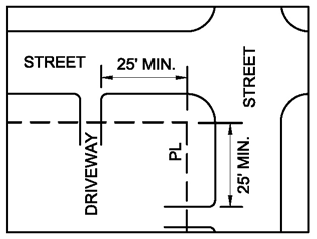
Figure 6.01.05 (E-2).
Minimum driveway intersection distances
a.
The edge of a driveway for all uses other than a single-family residential dwelling shall be located a minimum of seventy-five (75) feet from the proposed right-of-way line of a street intersection. If lot width does not permit, the distance can be modified, but shall be not less than fifty (50) percent of the lot width and, regardless of lot width, shall not be less than twenty-five (25) feet.
b.
The edge of a driveway for a single-family residential dwelling shall be located a minimum of twenty-five (25) feet from the proposed right-of-way line of a street intersection.
3.
Other than one-, two-, or three-family residential dwellings, where two (2) or more driveways connect a single development site to any one (1) City street, a minimum clear distance of fifty (50) feet, measured along the curb line of the tangents of the proposed driveway curb radii, shall be provided.
4.
The edge of a driveway for uses other than one-, two-, or three-family residential dwellings shall be located a minimum of ten (10) feet from any property line adjacent to one-, two-, or three-family residential dwellings. Where a property line is the same as the right-of-way line referenced in Section 6.01.05.E(2)(a), the minimum distance shall be the standard in Section 6.01.05.E(2)(a).
5.
Opposing driveway intersections.
a.
Opposing driveway intersections for uses other than a single-family dwelling shall be located directly across from each other along City streets.
b.
If conditions prohibit locating a proposed driveway intersection directly opposite an existing or proposed driveway intersection along a City street, the offsets between the existing and proposed intersections shall be a minimum of one hundred fifty (150) feet.
6.
Driveways shall be located and designed to ensure that vehicles do not back onto the City right-of-way, except for driveways serving a single-family dwelling in single-family developments and residential zoning districts.
F.
Driveway design.
1.
Depressed curbing may be required across driveway openings, in order to promote the continual flow of street stormwater runoff.
2.
Driveways shall intersect the City street at an angle as near ninety (90) degrees as site conditions permit, and in no case shall be less than seventy-five (75) degrees.
3.
All driveway aprons shall be paved from the existing or proposed edge of pavement back to the existing or proposed right-of-way line. Paving within this area shall comply with the City's paving specifications as set forth in the Engineering Standards Manual for Fort Walton Beach. Additional paving or a reinforced concrete driveway may be required, depending upon the type and amount of expected vehicular traffic.
4.
All driveways shall be fully maintained by the property owners served by the driveways.
G.
Driveways located within a State or County right-of-way shall be designed in accordance with State or County standards.
(Ord. No. 2028, § 2, 6-23-20; Ord. No. 2133, § 2, 1-23-24)
6.01.06 - Mobility Requirements for Developments in the Transportation Concurrency Exemption Area (TCEA).
A.
Development within the TCEA shall mitigate trips generated by the development by providing certain mobility improvements consistent with this section. Table 6.01.05 outlines the number of points which must be obtained based on the number of trips generated by the development.
Table 6.01.06.A. Trip Generation Performance Criteria in the TCEA.
B.
Table 6.01.06.B provides a list of acceptable improvements and their point value. The development shall provide a combination of improvements that have a total point value corresponding to the development's Net Average Daily Trip Generation as provided in Table 6.01.06.A. Acceptable strategies are provided in two categories - Physical Infrastructure Improvements and Transportation Demand Management (TDM) strategies.
Table 6.01.06.B. Acceptable Trip Generation Mitigation Strategies.
6.02.01 - Generally.
Bicycle and pedestrian ways shall be considered during the planning and development of on-site and off-site transportation facilities, including the connection and extension of existing bicycle and pedestrian ways on or serving State, regional, and local transportation systems.
6.02.02 - Bicycle Way Access and Connectivity.
A.
Bicycle lanes, paths, and other ways shall connect traffic generators and shall be located along a direct line, convenient for users.
B.
Bicyclists shall have equal access to all streets whenever possible and feasible.
C.
Within a neighborhood, links shall be considered through cul-de-sacs, making use of greenways, utility rights-of-way, and other open ways.
D.
Bicycle ways shall be designed and constructed in compliance with the standards set forth in the Engineering Standards Manual for Fort Walton Beach.
6.02.03 - Sidewalks.
A.
The purpose of this section is to require sidewalks to be constructed in conjunction with all new development and redevelopment.
B.
Sidewalks are required along the street frontage of all lots where new development, redevelopment, subdivisions, or change of use is proposed.
C.
Where a sidewalk is already provided, but the sidewalk is in disrepair and/or does not meet current standards for sidewalk location, width, and construction, such sidewalk shall be brought up to current standards as part of the development or redevelopment of the lot.
D.
Where no sidewalks exist, the developer will be required to include the addition of sidewalks as part of the proposed development, redevelopment, subdivision, or change of use.
E.
Sidewalks shall be designed and constructed in compliance with the standards set forth in the Engineering Standards Manual for Fort Walton Beach.
F.
Sidewalks located within a State or County right-of-way shall be designed in accordance with State or County standards.
G.
Sidewalk width requirements are set forth in Table 6.02.03.
Table 6.02.03. Minimum Sidewalk Widths.
H.
Location. All sidewalks shall be constructed along the width of yards fronting upon a street right-of-way. Corner lots at street intersections shall have sidewalks constructed to, extended to, and ramped to the street pavement in compliance with Federal and State ADA requirements. Sidewalks shall be constructed in the street right-of-way with the rear edge on the front property line, and shall be constructed in compliance with the standards set forth in the Engineering Standards Manual for Fort Walton Beach.
I.
Internal sidewalks: Nonresidential and multifamily residential developments shall be responsible for providing an internal (on-site) sidewalk network. The internal sidewalk network shall connect buildings, parking areas and common open spaces to public sidewalks. Internal sidewalks shall be at least four (4) feet in width and may be located within landscape buffer areas to achieve connectivity.
J.
Maintenance of sidewalks. It shall be the duty of all owners of real property in the City that abuts any constructed public sidewalks to keep and maintain those sidewalks in good repair at all times, including the proper maintenance of vegetative materials such as trees, grass, hedges and shrubs, to keep such materials from encroaching on the sidewalks. The City may require reconstruction or implement special assessments to ensure that sidewalks are maintained in good condition.
K.
Waiver: Sidewalk construction may be waived at the discretion of the Development Administrator or their designee, based upon the review and approval recommendation of the Development Review Team if it determined that the waiver request meets at least one (1) of the following criteria:
1.
There are physical constraints which would make the construction of a sidewalk impossible or impractical. Such constraints shall include, but not be limited to, insufficient right-of-way, extreme grade problems, and when construction would have a significant negative impact on the natural environment.
2.
There are roadway improvements scheduled within the upcoming year of the City's capital improvement plan which would result in construction activities that would destroy a significant portion of the sidewalk constructed by the developer.
(Ord. No. 2028, § 3, 6-23-20)
6.03.01 - Purpose.
The purpose of this section is to ensure clear sight areas for driveways and intersections.
6.03.02 - Clear Visibility for Driveways.
On each side of the driveway that intersects with a City street, a minimum of a fifteen (15) foot by 100-foot driveway sight triangle shall be provided. The minimum dimensioning of the driveway sight triangle is shown in Figure 6.03.02. The clear driveway sight area is to be maintained and kept clear by the property owner.
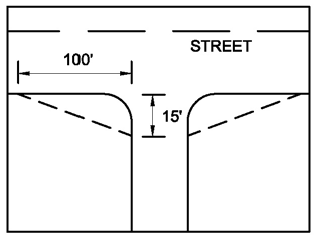
Figure 6.03.02. Driveway
triangle
6.03.03 - Clear Visibility for Intersecting Streets.
For intersecting streets, the clear sight triangle shall be determined as required by the AASHTO Green Book and other Federal, State, or local regulations.
6.04.01 - Generally.
A.
All development and redevelopment shall provide off-street parking in compliance with the standards set forth in this section.
1.
Within the MX-1, MX-2 and MX-3 zoning districts, parking facilities shall be provided and shared by all uses within a mixed-use development site. Standards are set forth in Section 6.04.06.H.
2.
On-street parking spaces, spaces in municipal parking lots, and spaces in off-site private parking lots may be counted toward meeting the parking requirement for a development site. Standards for counting on-street, municipal, and private parking lot spaces are set forth in Section 6.04.05.
3.
In situations not addressed by Section 6.04.01.A(1) and (2), developments shall provide off-street parking as set forth in Section 6.04.02.
B.
Limitations on use of parking facilities. Required off-street parking spaces, access driveways, and aisles shall not be used for any purpose other than vehicular parking. This prohibition applies to:
1.
Storage of goods and equipment;
2.
Location of dumpsters and other refuse containers;
3.
Location of goods and materials offered for sale;
4.
Storage of inoperable vehicles and equipment;
5.
Repair activities;
6.
Special events; and
7.
Any other activity that occupies the required spaces, drives, and aisles on a temporary or permanent basis.
C.
Calculating the number of parking spaces
1.
The gross floor area of a building shall be used to calculate parking requirements.
2.
When the calculation results in a fraction, the result shall be rounded up to one (1) parking space.
3.
For places of assembly with open seating, such as benches or pews, the calculation of parking spaces shall be based on the occupancy as rated by the fire marshal.
4.
When a site is occupied by two (2) or more separate and individual uses, the parking spaces required shall be determined by a parking study according to the requirements for such study set forth in Section 6.04.06.
(Ord. No. 2149, § 2, 3-11-25)
6.04.02 - Standards for Parking.
A.
The minimum number of vehicular parking spaces and bicycle parking spaces are provided in Table 6.04.02.
B.
The City shall not approve a parking lot with more than 110 percent of the parking spaces required according to Table 6.04.02.
C.
Parking spaces to meet Federal and State ADA requirements shall be provided in addition to the parking requirements set forth in Table 6.04.02.
D.
Up to five (5) percent of the required parking spaces may be designed and allocated to accommodate motorcycles.
Table 6.04.02. Required Parking Spaces for Vehicles and Bicycles.
(Ord. No. 2074, § 5, 8-24-21)
6.04.03 - Standards for Parking Lot Design.
A.
All off-street parking lots, other than single-family and duplex dwellings, shall be designed to meet the following standards:
1.
Parking and loading areas, access aisles, pedestrian walkways, landscaping, and open space shall be designed as integral parts of an overall development plan and shall properly relate to existing and proposed buildings.
2.
For uses that involve the sale, repair, rental, or storage of vehicles, required off-street parking spaces shall be identified for customers and distinguished from spaces used for the vehicles that are an integral part of the business activity onsite.
3.
The parking lot circulation system shall be contained on-site. Access from one section of the parking lot to another section of the parking shall be entirely on-site.
4.
When dead-end parking bays are included, adequate and safe areas shall be provided for backing and turning around.
5.
Driveways and access aisles shall be interconnected with all existing driveways and access aisles on abutting commercial properties. Where the abutting commercial property is not developed, driveways and access aisles shall be extended to the common property line, so that future interconnection is possible. Each party to the interconnection shall be entitled to a ten (10) percent reduction in the parking requirement. A cross-access easement agreement shall be provided and determined to be acceptable to the City. Upon approval, the easement agreement shall be recorded.
6.
A parking lot shall be designed to prevent backing onto a public right-of-way, other than an alley.
7.
Access to each parking space shall be directly from an access aisle or driveway; all required parking spaces shall be designed to permit entry and exit without moving any other vehicle. No spaces shall be located directly in aisles or driveways.
8.
All parking and loading spaces shall be striped or otherwise marked to indicate their location and area.
9.
No parking space shall be located so as to block emergency access.
10.
Fire lanes shall be posted with appropriate signage, approved by the fire marshal.
11.
All parking spaces shall be delineated by bumper strips or painted curbs.
B.
Parking lot design
1.
The design and construction of a parking lot shall comply with the standards set forth in the Engineering Standards Manual for Fort Walton Beach.
2.
The dimensions of parking spaces and access aisles shall comply with the standards set forth in the Engineering Standards Manual for Fort Walton Beach.
3.
Required design standards for required bicycle parking spaces and facilities are set forth in the Engineering Standards Manual for Fort Walton Beach.
6.04.04. - Standards for Loading Spaces.
The required number of off-street loading spaces is shown in Table 6.04.04. The design and construction of off-street loading spaces shall comply with the standards set forth in the Engineering Standards Manual for Fort Walton Beach.
Table 6.04.04. Required Off-Street Loading Spaces.
6.04.05 - Standards for Parking Off the Development Site.
A.
Development may count parking spaces located off the development site in the following circumstances:
1.
The development parcel is located in the CG, MX-1, MX-2, or MX-3 zoning district.
a.
On-street parking is available within three hundred (300) feet of the principal entrance of the building(s) to be served by parking. Distance shall be measured along the most direct walking route from the entrance to the parking.
OR
b.
An available municipal parking lot is located within four hundred (400) feet of the principal entrance of the building(s) to be served by parking. Distance shall be measured along the most direct walking route from the building entrance to the nearest entrance to the municipal parking lot. A municipal parking lot is available when it provides parking to the general area and is not intended to provide off-street parking to support a public or civic structure or use.
OR
c.
A private off-site parking lot is available within four hundred (400) feet of the principal entrance of the building(s) to be served by parking. The parcel containing the private off-site parking lot shall be located on land zoned CG, MX-1, MX-2 or MX-3. The off-site parking lot shall be provided by the owner of the development parcel to exclusively serve the development parcel.
OR
d.
A private off-site parking lot is available within four hundred (400) feet of the principal entrance of the building(s) to be served by parking. The parcel containing the private off-site parking lot shall be located on land zoned CG, MX-1, MX-2 or MX-3. The owner of the development parcel and the owner of the parking lot shall enter into an agreement guaranteeing the availability of the parking spaces to be counted to meet parking needs of the development parcel. The agreement shall be a recordable instrument in a form acceptable to the City Attorney. The City shall be a party to the agreement and shall retain enforcement authority. The agreement shall contain covenants running with the lands of both the development parcel and the parcel containing the parking lot.
2.
The development parcel is located in the CF or OS zoning district. One (1) of the following situations shall provide parking to meet needs on the development parcel:
a.
An available municipal parking lot is located within four hundred (400) feet of the principal entrance of the building(s) or uses to be served by parking. Distance shall be measured along the most direct walking route from the building entrance to the nearest entrance to the municipal parking lot.
b.
On-street parking is available within four hundred (400) feet of the principal entrance of the building(s) or use to be served by parking. Distance shall be measured along the most direct walking route from the entrance to the parking.
B.
Valet parking
1.
A portion of the required off-street parking in CG, MX-1, MX-2, and MX-3 zoning districts may be provided off of the development site and accessed through a valet service. The property owner shall ensure the availability of the number of spaces required in Table 6.04.02 through provision of a recordable legal instrument acceptable to the City. The agreement shall guarantee the number and location of the off-site parking spaces and the availability of the spaces to the property owner.
2.
In addition, the property owner shall ensure the availability of a valet service through provision of contractual agreements with a valet service that demonstrates the availability of valets to transfer cars from the business location to the off-site parking. Handicapped parking in compliance with ADA requirements shall be provided on-site and is not subject to the valet agreement.
(Ord. No. 2149, § 2, 3-11-25)
6.04.06 - Parking Studies.
A.
The required number of parking spaces may be reduced based on the results of a parking study prepared in compliance with the standards of this section. The parking study shall be prepared by a traffic engineer, certified transportation planner, or other professional with expertise in parking.
B.
Parking spaces may be shared by two (2) or more adjacent uses when a parking study prepared in compliance with the standards of this section demonstrates that adequate parking will be available to meet all parking needs.
C.
Development located in the MX-1, MX-2, or MX-3 zoning districts shall share parking. A parking study shall be prepared in compliance with the standards of this section to demonstrate the amount of parking required.
D.
The Development Administrator may require a parking study when the characteristics of the proposed development is believed to require a greater or lesser number of parking and/or loading spaces than established by the standards in Sections 6.04.02 and 6.04.04.
E.
A parking study shall include estimates of parking requirements based on one (1) of the following sources:
1.
Urban Land Institute;
2.
Institute of Traffic Engineers;
3.
American Planning Association;
4.
Traffic Institute; or
5.
A study of parking requirements prepared by a Traffic Engineer based on data collected demonstrating the actual parking needs of comparable uses. Uses shall be considered comparable based on type of use, density, or intensity of development, scale, bulk, and location. The study shall clearly document the location of parking counts, and the time of the counts (week days, weekends, peak use periods, and season).
F.
The parking study shall also include an analysis of the extent to which a transportation system management program and use of alternative forms of transportation lessen the parking requirement. The following factors shall be considered:
1.
Public transportation satisfies transportation demands for a portion of the users of the facility that corresponds to the amount of proposed parking reduction.
2.
The availability and estimated use of private and public ride sharing, such as car pools and van pools.
3.
The availability of subscription bus service.
4.
Parking charges.
5.
The guaranteed provision of annual employee or customer bus passes by the development occupying the development site.
6.
The implementation of guaranteed flexible work hour scheduling.
7.
The establishment of a transportation coordinator position to implement a car pool, van pool, and/or other transit programs.
8.
The reduction in parking spaces corresponds to the percentage of residents, employees, and customers who regularly walk, use bicycles and other non-motorized forms of transportation, or use mass transportation to travel to the facility. Documentation of the source of this data shall be provided.
G.
The parking study may demonstrate a deferral of the provision of otherwise required parking spaces provided that the following standards are met:
1.
A parking plan is provided to demonstrate that sufficient space is available to meet the parking requirements set forth in Section 6.04.02.
2.
A parking plan is provided that illustrates the layout for the required number of spaces, designating the spaces to be deferred.
3.
Spaces proposed for deferral shall not be used for required landscaping, required buffers, required setbacks, or stormwater management.
4.
A parking plan shall demonstrate full compliance with all design requirements of this LDC, except for the design and construction of deferred spaces.
5.
The parking plan shall include a written agreement, in the form of a recordable instrument approved by the City Attorney, guaranteeing conversion of the deferred spaces to paved spaces in full compliance with the standards of this LDC, based upon the City's determination that the deferred spaces are necessary for the safety and welfare of the public. The City shall be a party to the agreement. The agreement shall include a requirement that the property owner shall be responsible for any expenses of a traffic and/or parking study to address the need for the deferred spaces.
6.
The property owner may at any time request approval of a revised development plan to allow converting the deferred spaces to operable parking spaces.
H.
A parking study to support shared parking requirements shall meet the following standards:
1.
The parking spaces for joint use shall be located within 300 feet of the respective uses they are intended to serve.
2.
The study shall include sufficient data to demonstrate that the hours of maximum demand for parking at the respective uses do not normally overlap.
3.
The study shall contain sufficient information to demonstrate that the joint use of parking and subsequent reduction in the total number of otherwise required parking spaces will not have a negative impact on adjacent properties.
4.
The owner of parcels proposing to share parking shall enter into an agreement guaranteeing the joint access and use of the parking spaces to meet parking needs of all properties represented in the agreement. The agreement shall be a recordable instrument in a form acceptable to the City Attorney. The City shall be a party to the agreement and shall retain enforcement authority. The agreement shall contain covenants running with the lands of all parcels relying on the shared parking arrangement. The agreement shall include provisions for maintenance of the shared parking facility. The agreement shall also include provisions that address discontinuance of one (1) or more uses and a change in one (1) or more uses resulting in an increased parking need. The agreement shall contain covenants running with the lands of all development parcels relying on the shared parking arrangement.
(Ord. No. 2149, § 2, 3-11-25)
6.05.01 - Stacking Space Requirements.
All facilities providing drive-up or drive-through service shall provide on-site stacking lanes in accordance with the following standards:
A.
The amount of stacking space required is set forth in Table 6.05.01. Where a use that is not listed in this table is proposed to include drive-up or drive-through service, the Development Administrator shall determine the stacking requirement. Determination shall be based on the requirements for a substantially comparable use, considering traffic generation, intensity of development, scale of development, and hours of operation.
Table 6.05.01. Stacking Space Requirements for Drive-up and Drive-Through Services.
6.05.02 - Design Requirements for Stacking Lanes.
A.
Stacking lane distance shall be measured from the service window to the property line bordering the furthest street providing access to the facility. Stacking distance shall be computed at eighteen (18) feet per vehicle.
B.
The facilities and stacking lanes shall be located and designed to minimize turning movements in relation to the driveway access to streets and intersections.
C.
On-site parking lots, pedestrian areas, and drive-through lanes shall be designed to avoid pedestrians crossing drive-through lanes.
D.
Vehicular traffic from stacking lanes shall not encroach on the public right-of-way.
E.
A separate bypass lane around the drive-through facility shall be provided.
F.
Stacking lanes shall not be located within a designated delivery area or area designated for loading spaces.
6.06.01 - Definitions.
The following words, terms and phrases, when used in this chapter, shall have the meanings ascribed to them in this section, except where the context clearly indicates a different meaning:
Charter bus service: A charter bus service is a type of service where buses are rented by individuals or organizations for exclusive private use. Unlike an Intercity Common Carrier Bus Service, which follows specific routes with set schedules, a charter bus service is hired for specific trips.
Charter bus stop: A charter bus stop is an ephemeral location where a charter bus may park to pick up or drop off passengers at the direction of the group renting the bus. Unlike public, commercial, or school bus stops, charter bus stops do not have permanent signage or designated infrastructure. They are chosen based on the convenience and preferences of the group renting the bus and can vary from trip to trip. These stops are typically coordinated with the bus company and can be temporarily located anywhere so long as the location does not violate any other laws.
Commercial bus stop: A commercial bus stop is a designated location where Intercity Common Carrier Bus Service buses operating on commercial routes pause to pick up and drop off passengers.
Commercial transit stop: See Commercial bus stop.
Intercity Common Carrier Bus Service: An Intercity Common Carrier Bus Service is owned and operated by a private party and utilizes a ticketing system, typically charging passengers a fare based on the length of their journey. Intercity Common Carrier Bus Services provide fixed scheduled routes between different cities and regions and provide services over much greater distances than public bus services.
Public bus service: A public bus service is a form of transportation operated or funded by a local government or regional transit authority, designed to provide mass transit services exclusively to areas within Okaloosa County, Florida. Public bus service buses run on specific routes according to a set schedule, facilitating daily commutes and travel within a limited geographical area.
Public bus stop: A public bus stop is a designated point along a bus route operated by a public bus service, where buses stop to pick up and drop off passengers.
School bus: A school bus is a bus used to transport students to and from: (1) a school, or (2) a school related extracurricular activity, or (3) school related athletic activity.
School bus stop: A school bus stop is a designated place where students are picked up and dropped off by a school bus.
(Ord. No. 2153, § 3, 9-10-24)
6.06.02 - Commercial Bus Stops Prohibited within City Limits.
A.
Existing Commercial Bus Stops. Any existing commercial bus stop land uses within the City shall be prohibited and discontinued after an amortization period of one (1) year ending on September 10, 2025. If the commercial bus stop land use is not discontinued within ten (10) days of the end of the amortization period, then the property where the commercial bus stop is located, along with the owner of the subject property, shall be in violation of the Land Development Code, declared a nuisance, subject to code enforcement under Section 9.10 of this Land Development Code, and subject to any legal, equitable or statutory remedy available to the City.
B.
Immediate Prohibition. No additional commercial bus stops may be located within City limits after September 10, 2024.
C.
Petition for Extraordinary Extension of Amortization Period for Discontinuation of Commercial Bus Stops. Any person whose legally protected economic interests are adversely affected by the discontinuance of commercial bus stop land uses mandated by this law, and who believes that the amortization period specified in Section 6.06.02 A., of the Land Development Code is inadequate to recover their investment shall be entitled to petition the City for an extraordinary extension of time as provided in this section.
1.
Time of Petition — The petition must be filed with the City Clerk on or before the close of business on or before December 10, 2024 (Three (3) months after passage of ordinance).
2.
Contents of Petition — The petition must state:
a)
Identification: The petitioner's name, mailing address, e-mail address, if any, and telephone number of the party making the request and the name, address, and telephone number of the party's counsel if the party is represented by counsel;
b)
Standing: A detailed description of the petitioner's legally protected interest adversely affected by the mandated discontinuance of commercial bus stops;
c)
Requested Extension: The length of the extraordinary extension;
d)
A statement of the specific facts and grounds for relief petitioner contends warrant the extraordinary extension demanded. The specific grounds for relief under this section, the specific relief sought including the exact amount of time requested;
e)
All documents, including a list of all witnesses, or other evidence in support of the petition; and
f)
Any other matters petitioner deems relevant.
3.
Grounds for Extension: In considering whether to grant all or any portion of the extension demanded, the City shall examine:
a)
Whether the petition is complete;
b)
Whether the petitioner has standing;
c)
Whether the petitioner has demonstrated by a preponderance of the evidence circumstances unique to the petitioner which prevent the petitioner from recouping its investment in the property affected by the discontinuance within the amortization period;
d)
The amount of the petitioner's investment in the commercial bus stop use business through the effective date of this section;
e)
Whether unique circumstances exist which will prevent the petitioner from recouping the amount of such investment that has been or will have been unrealized at the conclusion of the one-year amortization period;
f)
The life expectancy of the existing property associated with the non-conforming use;
g)
The diminished value, if any, of any real property owned by the petitioner as a result of the mandatory discontinuance of the existing commercial bus stop on the property; and
h)
The diminished value, if any, of a leasehold held by the petitioner as a result of the mandatory discontinuance of the existing commercial bus stop land use on the property, as well as any contingency clauses therein permitting termination of such lease.
4.
Procedure: Within ten (10) days of receipt, the City Clerk shall (1) forward a timely filed petition and supporting documents to the City Manager and a copy to the City Attorney, and (2) schedule a Quasi-Judicial Hearing before the City Council, which shall be held within ninety (90) days of receipt of the Petition.
a)
No later than ten (10) days before the scheduled hearing, the City Manager shall file and serve upon the petitioner a response to the petition together with copies of any documents and a witness list.
b)
The petitioner shall bear the burden of proof to prove entitlement to the extraordinary extension demanded by a preponderance of evidence.
c)
At the hearing, evidence, including written or oral testimony and documentary evidence, of a type commonly relied upon by reasonably prudent persons in the conduct of their affairs shall be admissible, whether or not such evidence would be admissible in a trial in the courts of Florida. Any witness shall be subject to cross examination when testimony is taken or documents are made part of the record. No pleadings, motions, or other papers may be submitted nor any discovery conducted other than that allowed under this section shall be permitted. Each party shall be entitled to a brief opening and closing argument, unless waived. The petitioner shall give opening and closing argument first and shall be afforded an additional rebuttal to the City's closing argument.
5.
Recommended Order of City Council. Unless the time period is waived or extended with the consent of all parties, the City Council shall issue a recommended order in writing and include findings of fact, if any, conclusions of law separately stated, and any recommended extraordinary extension. The City Council's recommended order must be rendered to the parties and the City Council within ninety (90) days after the hearing.
6.
Appeal. A petitioner aggrieved by a decision of the City Council may seek review by certiorari in the Circuit Court, First Judicial Circuit, Okaloosa County, Florida, which shall be the exclusive remedy to challenge the decision or authority of the City Council.
(Ord. No. 2153, § 3, 9-10-24)

