


Fountain Inn City Zoning Code
ARTICLE 5
- DISTRICT REGULATIONS
The following regulations pertain to the districts established by this Ordinance. These regulations are supplemented and qualified by additional general regulations appearing in Article 7, the special regulations appearing in Article 8, and the Land Development Regulations.
(Ord. No. 2007-25, § 2, 9-13-07)
Section 5:1.- R-15, R-12, R-10, R-7.5, and R-6 Residential Districts.
These residential districts are established as areas in which the principal use of land is for single-family dwellings and for related recreational, religious, and educational facilities normally required to provide an orderly and attractive residential area. The regulations for these districts are intended to discourage any use which, because of its characteristics, would interfere with the development of or be detrimental to the residential nature of the area included in the districts.
5:1.1 is amended to read: Uses Permitted in R-15, R-12, R-10, R-7.5, and R-6 Residential Districts.
Detached single-family dwelling
Golf course
Home occupation, subject to requirements in Article 8
Library
Manufactured home used as a school classroom
Public park and playground
Signs, subject to the provisions in Article 6.
Temporary building, incidental to the construction of buildings permitted in this district, which shall be removed when work is completed
Transportation and utility easement and rights-of-way (Uses and structures customarily accessory to the permitted uses)
5:1.2. Uses Permitted by Special Exception. The following uses may be permitted by Special Exception by the Board of Zoning Appeals in accordance with the provisions of Article 9.
Child care home
Church
Day care center
Fire station
School, public, and parochial
Livestock
Private recreation area
Public utility building and use
5:1.3. Accessory Building Setback. Accessory buildings may be located in the rear yard; provided that they are set back not less than four feet from any lot line and occupy not more than 20 percent of the rear yard.
5:1.4. Off-Street Parking. Off-street parking shall be provided in accordance with the provisions set forth in Article 7, Section 9.
5:1-5. Reserved.
5:1-6. Reserved.
5:1.7 Minimum Requirements—Nonresidential Lots.
No. 1 The minimum depth of a front yard measured from the street right-of-way line shall be 30 feet on a residential service street, 40 feet on a collector street, and 50 feet on an arterial street. When a lot has double frontage, the front yard requirements shall be complied with on both streets.
No. 2The minimum width of any residential side yard shall be twelve feet, measured from the property line. The minimum width of any nonresidential side yard shall be fifteen feet, measured from the property line. For residences, nonresidential uses, and accessory buildings on corner lots the minimum side yard width measured from the street right-of-way line shall be 20 feet on a residential service street, 30 feet on a collector street, and 40 feet on an arterial street.
No. 3 The minimum width of a residential side yard shall be 10 percent of the total lot width. For residences, accessory buildings, and nonresidential uses located on corner lots the minimum side yard width measured from the street right-of-way line shall be 25 feet on a residential service street, 30 feet on a collector street, and 40 feet on an arterial street.
No. 4 The minimum depth of a front yard measured from the street right-of-way line shall be 20 feet on a residential service street, 30 feet on a collector street, and 50 feet on an arterial street. When a lot has double frontage, the front yard requirements shall be complied with on both streets.
(Ord. of 11-13-06, § 1; Ord. No. 2011-001, § 1, 5-12-11; Ord. No. ZTEXT-2013-003, § 1(1.3, 1.4), 6-20-13; Ord. No. 2023-7, §§ 1(a)(i), (ii) 7-13-23)
Editor's note—
Ord. No. ZTEXT-2013-003, § 1(1.1), adopted June 20, 2013, retitled § 5:1 from "R-15,
R-12, R-10, R-7.5 Residential Districts" to "R-15, R-12, R-10, R-7.5, and R-6 Residential
Districts."
Prior to this amendment, the title of section 5:1, and subsections 5:1.1 and 5:1.7
were amended at the discretion of the editor to reflect changes instituted by an Ordinance
of November 13, 2006, §§ 1 and 2.
Section 5:2. - R-M Residential, Multifamily District.
This Residential District is established to provide for medium and high population density. The principal use of land is for two-family and multiple-family dwellings, and the recreational, religious, and educational facilities normally required to provide an orderly and attractive residential area are included. The regulations for this district are intended to discourage any use which, because of its character, would interfere with the development of or be detrimental to the residential nature of the area included in the district.
5:2.1. Uses Permitted.
Attached single-family dwelling
Attached single-family dwelling, three or more units
Child care home
Detached single-family dwelling
Dwelling, multifamily
Dwelling, two-family
Home occupation, subject to requirements in Article 8
Library
Manufactured home used as a temporary school classroom
Public park and playground
Signs, subject to the provisions in Article 6.
Temporary building, incidental to the construction or buildings permitted in this district, and which shall be removed when work is completed; or temporary sales office used exclusively for the sale of properties or dwelling units located within the same development or subdivision and contained either within a building which will be completely removed immediately after all sales are completed, or within a building which will be sold or used as a residential dwelling unit immediately after all sales are completed.
Transportation and utility easement and rights-of-way
Uses and structures customarily accessory to the permitted uses
5:2.2. Uses Permitted by Special Exception. The following uses may be permitted by Special Exception by the Board of Zoning Appeals in accordance with the provisions of Article 9.
Child care center
Church
Family care home
Fire station
Private recreation area
Professional offices
Public utility use and building
School, public and parochial
5:2.3. Height Limitation. No structure shall exceed a height of 45 feet, except as provided in Article 7, Section 7.
5:2.4. Dimensional Requirements.
5:2.4-1. Lot Area. The minimum lot area for a single-family detached dwelling unit shall be 7,500 square feet.
The minimum lot area for a two-family dwelling unit shall be 9,000 square feet.
The minimum lot area for two single-family attached dwelling units on adjoining individual lots shall be 4,500 square feet per lot. Density requirements for a multiple family dwelling or group of dwellings containing three or more dwelling units, or for a group of three or more single-family attached dwelling units, shall be based on 9,000 square feet for the first unit, and 3,000 square feet for each succeeding dwelling unit (14.5 units per acre). No minimum lot area is required.
For nonresidential buildings the lot area shall be adequate to provide the yard area required by this Section and the off-street parking and loading areas required in Article 7, Sections 9 and 10.
5:2.4-2. Reserved.
5:2.4-3. Reserved.
5:2.4-4. Reserved.
5:2.4-5. Reserved.
5:2.5. Accessory Building Setback. Accessory buildings may be located in the rear yard, provided they are set back not less than four feet from any lot line and occupy not more than 20 percent of the rear yard.
5:2.6. Off-Street Parking. Off-street parking shall be provided in accordance with the provisions set forth in Article 7, Section 9.
(Ord. No. 2011-001, § 1, 5-12-2011; Ord. No. 2023-7, §§ 1(a)(iii)—(vi) 7-13-23)
Section 5:3. - R-MHP, Residential Manufactured Home Park District.
The manufactured home park district is established to allow mobile home parks provided certain locational criteria are met, and the request is approved by City Council. Approval of this district shall be in accordance with Article 12 of this Ordinance.
The requirements of this district are set forth to ensure that mobile home parks may coexist with existing and future residential development. The following criteria should be used in zoning property R-MHP.
A.
Proposed site ensures adequate access to public street systems and does not cause undue congestion or place excessive traffic on local streets.
B.
The proposed development should be located where public facilities and services are either existing or planned.
C.
Approval of the application should not result in an over concentration of housing types that would alter the basic character of the area.
D.
The proposed development should be compatible with adjoining and nearby properties.
5:3.1. Uses Permitted.
Manufactured multi-section homes, single-section homes or modular homes
Caretakers or managers - home or office
Service buildings to house services for occupants of the mobile home park including storage, vending machines, washing and drying machines for domestic laundry, recreation facilities and similar uses
Manufactured multi-section home, single-section home or modular home sales offices
Storage buildings
5:3.2. Uses Permitted by Special Exception by the Board of Zoning Appeals.
Church
Educational institution
Exhibition buildings
Fire station
Funeral home
Library
Post office
5:3.3. Site Plan Approval. Prior to construction or enlargement of a mobile home park existing at the time of adoption of this Ordinance, a development plan approved by the Greenville County Board of Health shall be submitted to the Zoning Administrator.
The Zoning Administrator shall review the proposed development for conformance with all applicable regulations. Once the development has been determined to be in conformance, the Zoning Administrator shall then request that the Greenville County Planning Commission staff review the plat for the purpose of determining if it satisfies the requirements set forth in this section.
The staff shall return its findings to the Zoning Administrator within five days.
5:3.4. Site Plan Requirements. The plan shall be drawn by a registered engineer/surveyor of the state of South Carolina to scale of not less than 100 feet to 1 inch and shall contain the following information:
A.
The location of the proposed park and the type of surrounding land uses.
B.
The location and dimensions of streets, rights-of-way, drives, and parking spaces.
C.
The location and size of manufactured multi-section home, single-section home or modular home sites.
D.
The location and size of service buildings and recreation areas.
E.
The location and type of screening, fences, or hedges.
F.
The names and addresses of abutting property owners and of developers. Any manufactured multi-section home, single-section home or modular home, service building, or recreation area located in any mobile home park shall be placed in accordance with an approved development plan.
G.
Existing and finished contours at intervals not more than 2 feet.
H.
The location of fire hydrants if applicable.
I.
Storage areas.
J.
Dumpsters if applicable.
5:3.5. Design Standards.
5:3.5-1. Park Size. The minimum area for a manufactured home park shall be two acres.
5:3.5-2. Site Size. Each manufactured multi-section home, single-section home or modular home shall be on a site not less than 4,500 square feet in area. The maximum number of manufactured multi-section homes, single-section homes or modular homes shall not exceed nine dwelling units per acre.
5:3.5-3. Reserved.
5:3.5-4. Off-Street Parking. Off-street vehicular parking shall be as follows: two spaces for each manufactured multi-section home, single-section home or modular home. One space for each employee shall be provided at each service or recreation area.
5:3.5-5. Access. No manufactured multi-section home, single-section home or modular home shall have direct access to a public street or highway. All manufactured multi-section home, single-section home or modular home sites shall have access to an all weather interior roadway which is not less than 30 feet in width having a paved surface not less than 20 feet in width. Roads with parallel parking on one side shall have a paved surface of 28 feet with a five-foot right-of-way on each side.
5:3.5-6. Screening. Where any property line of a mobile home park abuts land zoned for or occupied by another residential use, there shall be provided and maintained along the property line of the mobile home park a continuous visual screen not less than six feet in height. The screen shall be a wall, fence, compact evergreen hedge or other type of evergreen foliage, or a combination of fence and shrubbery. Natural plant materials must be capable of reaching six feet in height after a three year growing period.
5:3.5-7. Utility Requirements. Within the area zoned, each manufactured multi-section home, single-section home or modular home in a mobile home park shall be provided with approved water and sewer service which is connected to the municipal water and sewerage systems or other systems meeting the approval of the State and County Health Departments.
5:3.5-8. Recreation Areas. Recreation space of not less than 200 square feet of usable land for each manufactured multi-section home, single-section home or modular home shall be provided in the mobile home park. For purposes of this section, "Usable Open Space" shall be construed to mean parks, open space, and recreation amenities such as clubhouse, swimming pool, or similar improvements. When the anticipated population shall include children, a play area shall be provided of no less than 400 square feet.
5:3.5-9. Operating Requirements. The operator of each mobile home park shall comply with all State and County Health Department rules and regulations governing the sanitation and operation of mobile home parks.
5:3.5-10. Garbage Disposal. Garbage containers with tight fitting covers shall be required for each site to permit the disposal of all garbage and rubbish. Collection will be on a regular basis to ensure the containers shall not overflow. In lieu of individual containers, a 20-cubic-yard dumpster for every 20 manufactured multi-section homes, single-section homes or modular homes may be provided. Refuse shall not be disposed of within the park.
5:3.5-11. Anchor. Each home shall be anchored according to the HUD regulation of the National Manufactured Housing Construction and Safety Standards Act as required of each manufacture specification.
5:3.5-12. Dead-End Roads. Closed ends of dead-end roads shall be provided with a cul-de-sac paved to a minimum of a 35-foot radius.
5:3.5-13. Occupancy. There shall be no less than ten mobile home spaces available at first occupancy.
5:3.5-14. Foundation Wall. Foundation enclosures shall be required around the perimeter of each manufactured multi-section home, single-section home or modular home from the base of the home to the ground. Development owners shall advise each homeowner of this requirement to ensure the safety of residents from animals and other infestations. Residents shall comply within a six-month period and it shall be the responsibility of the land owner to advise each home owner of the required time period to complete the enclosure.
5:3.5-15. Street Lighting. All streets within the park shall be lighted at night. The lighting system shall be in accordance with standards recognized by Duke Power and the National Electric Codes.
5:3.5-16. Storage Area. On each manufactured multi-section home, single-section home or modular home site, a space shall be designated for a storage building if provided.
5:3.5-17. Drainage Plan. A Drainage Plan and a Sedimentation and Erosion Control Plan shall be submitted and approved prior to final approval being granted by the Zoning Administrator.
5:3.5-18. Street Names. Permanent street names approved by the Planning Commission shall be assigned to each road within the development.
5:3.6. Preexisting Mobile Home Parks. Mobile home parks or subdivisions which were lawfully in existence and operating on March 8, 1990, under valid permits issued by Fountain Inn City Council but which do not conform to requirements set forth in this section shall be considered a nonconforming use. However, nonconforming parks may be expanded if in accordance with prior approvals.
(Ord. No. 2023-7, § 1(a)(vii) 7-13-23)
Section 5:4 - O-D, Office District.
This district is established to provide for office development to serve the needs of the community. The uses permitted in this district are limited to office uses and shall not include any use engaged in retail sales or the stocking and storage of goods or merchandise. This district can serve as a transition between commercial uses and residential uses. No use shall be permitted in this district which will be detrimental to the office uses located in the district or any adjacent residential development.
5:4.1. Uses Permitted.
Accountant
Advertising agency
Bank
Broadcasting studio
Brokerage house
Employment agency center
Insurance agency
Offices
Professional offices
Real estate office
Research facility
Savings & loan
Sign-identification (Subject to provisions of Section 6:10)
Accessory buildings and uses customarily incidental to the above uses
Other uses which are considered to be compatible with the aforementioned uses
5:4.2. Uses Permitted by Special Exception. The following uses may be permitted by Special Exception by the Board of Zoning Appeals in accordance with the provisions of Article 9.
Accessory dwelling (Also subject to provisions of Section 9:8)
Church
Child care center
Educational institution
Exhibition buildings
Fire station
Hospital
Library
Medical clinic
Nursing care facility
Outpatient hospital
Post office
5:4.2-1. Accessory Retail Uses Permitted by Special Exception. Certain retail sales establishments which are customarily accessory and clearly incidental and subordinate to permitted principal office uses such as, but limited to, the following:
Apothecary
Barber shop
Beauty shop
Cafeteria
Florist shop
Newsstand
Optician
Restaurant
Sale or rental of medical supplies and prosthetic devices
Sandwich shop
Similar retail uses which are designed primarily to serve the convenience of persons working or receiving services in the building in which the accessory use is located, provided that such accessory use is clearly incidental and subordinate to the principal permitted office uses.
5:4.3. Reserved.
5:4.4. Reserved.
5:4.5. Screening. A wall, fence, or compact evergreen hedge or other type of evergreen foliage, or a combination of fence and shrubbery at least six feet in height, shall be provided along the side and rear lot lines where any nonresidential use in this district is adjacent to a residential district.
5:4.6. Off-Street Parking. Off-street parking shall be provided in accordance with the provisions set forth in Section 7:9.
(Ord. No. 2011-001, § 1, 5-12-2011; Ord. No. 2023-7, §§ 1(a)(viii), (ix), 7-13-23)
Section 5:5. - C-1, Central Business District.
The Central Business District is a concentrated area for the principal office buildings, service establishments, and retail stores serving the city and region. The standards herein recognize the need for a compact central business district favoring pedestrians, with parking facilities for downtown shoppers and employees in economical and efficient locations, not necessarily to be provided on the same lot with each business or governmental use.
5:5.1. Uses Permitted. All uses permitted in the R-15, R-12, R-10, and R-7.5 Single-Family Residential, and R-M, Multifamily Residential Districts.
Amusement, recreational, and entertainment establishments
Auction house
Automobile service station
Business service establishments
Commercial printing and job printing
Community service structures and uses such as community service centers, libraries, fire stations, civic, cultural or recreational uses, provided such uses are in keeping with the general character of the district
Dwelling units when located in the same structure as a principal use permitted in this district
Financial institutions
Hospitals
Hotels and motels
Laboratories and establishments for fitting, repair, or production of eyeglasses, hearing aids, or prosthetic devices
Offices
Parking lots and parking garages
Parks, playgrounds, play fields
Personal service establishments
Radio and television stations
Rehabilitation centers
Restaurants
Retail stores, sales and display rooms
Sales and service of new and used automobiles
Sales and service of new and used lawn and garden equipment
Signs, subject to the provisions of Article 6
Studios
Tire sales and service
Wholesaling not involving storage of goods to be wholesaled in excess of 2,000 square feet of gross floor space
Other uses which are considered to be compatible with the aforementioned uses.
5:5.2. Uses Permitted by Special Exception. The following uses may be permitted by Special Exception by the Board of Zoning Appeals in accordance with the provisions of Article 9.
Business schools and vocational schools not involving uses of an industrial nature which would not otherwise be permitted in this district
Churches and other places of worship, including educational buildings related thereto
Clubs, lodges, civic and fraternal organizations
Educational institution, private school, elementary school, high school, etc.
Exhibition buildings
Family care home
Fire station
Funeral home
Library
Post office
5:5.3. Reserved.
5:5.4. Central Business District Guidelines.
Applicability. The Central Business District Guidelines as directed herein shall include all properties within the Central Business Zoning District.
The Central Business District Guidelines shall apply to all new construction and all new or improved signage within the district following the adoption of the Ordinance. And upkeep and maintenance is required for all buildings within the Central Business District. The Guidelines shall apply to the renovation of any existing buildings within the Central Business District if the construction cost of the renovations total more than ½ of the assessed value of the property according to the previous year's property tax statement for that property.
Site Guidelines.
5:5.4-1. Building Placement.
5:5.4-1.1. Within the Central Business District, buildings facades should be placed at the back of sidewalk and should be consistent with existing streetscape. Upon reconfiguration of Main Street building facades should be no greater than 18 feet from the back of curb unless utilizing a landscape buffer or providing a pedestrian-oriented amenity as described below.
5:5.4-1.2. Buildings may be setback up to 24 feet from the back of curb provided that a landscape building yard is developed.
5:5.4-1.3. Buildings may be setback up to 24 feet from the back of curb provided that the setback
is pedestrian-oriented and contributes to the quality and character of the streetscape.
Examples would be outdoor dining. The fountain inn planning commission may allow additional
setbacks for expanded sidewalk areas, or plazas where conditions permit.
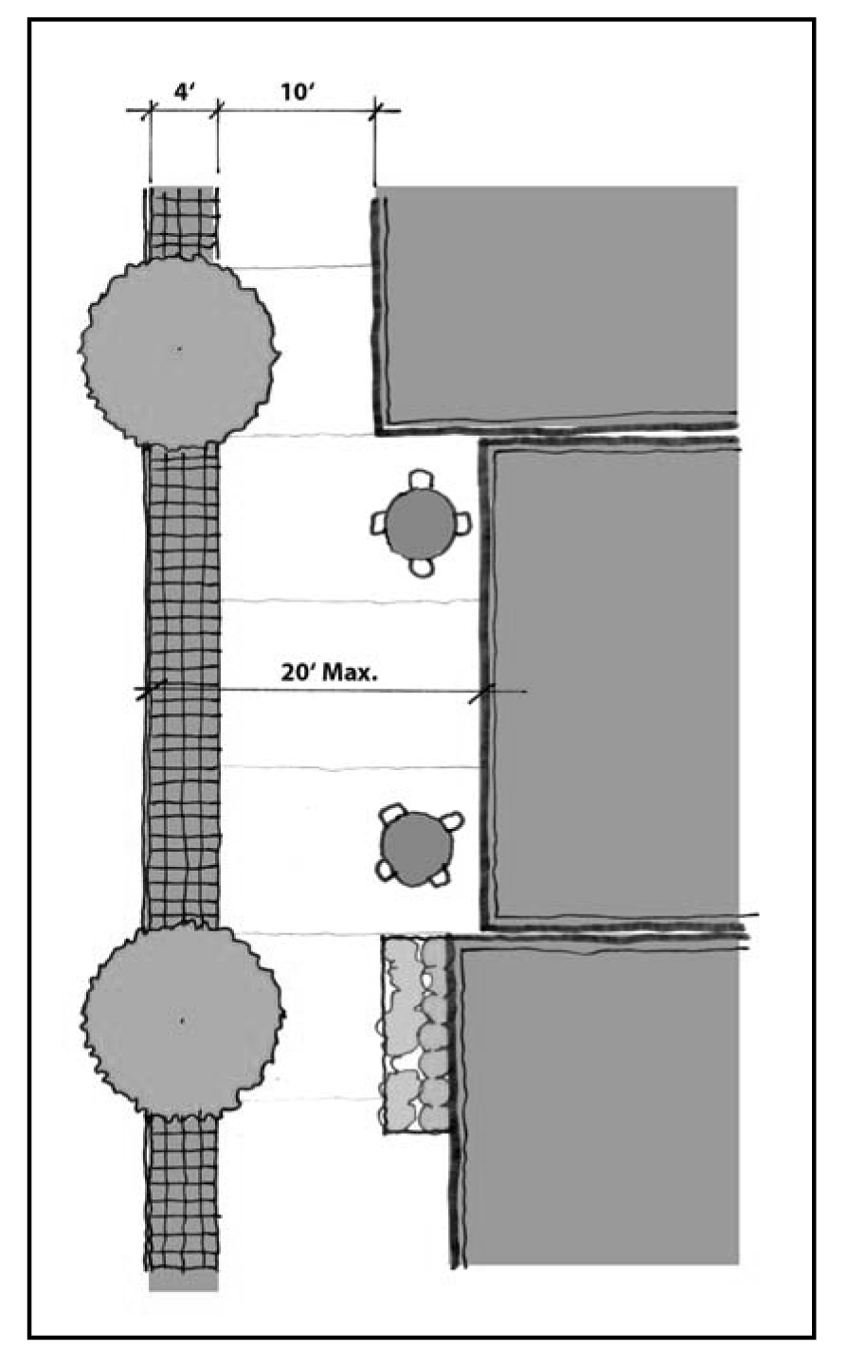
Setbacks
5:5.4-1.4 A building more than 50 feet in width should be divided into increments of no more than 30 feet through articulation of the facade. This can be achieved through combinations of the following techniques:
5:5.4-1.4.1. Divisions or breaks in materials
5:5.4-1.4.2. Window bays
5:5.4-1.4.3. Separate entrances and entry treatments
5:5.4-1.4.4. Variation in roof lines
5:5.4-1.4.5. Building setbacks
5:5.4-1.4.6. Color Change
5:5.4-1.4.7. Texture Change
5:5.4-1.4.8. Material Change
5:5.4-1.4.9. Wall projections or recesses at least two (2) feet in depth
5:5.4-1.5. Buildings should address the street with highly visible customer entryways oriented
toward primary streets providing direct access from the public sidewalk into ground
floor retail, office, and commercial establishments.
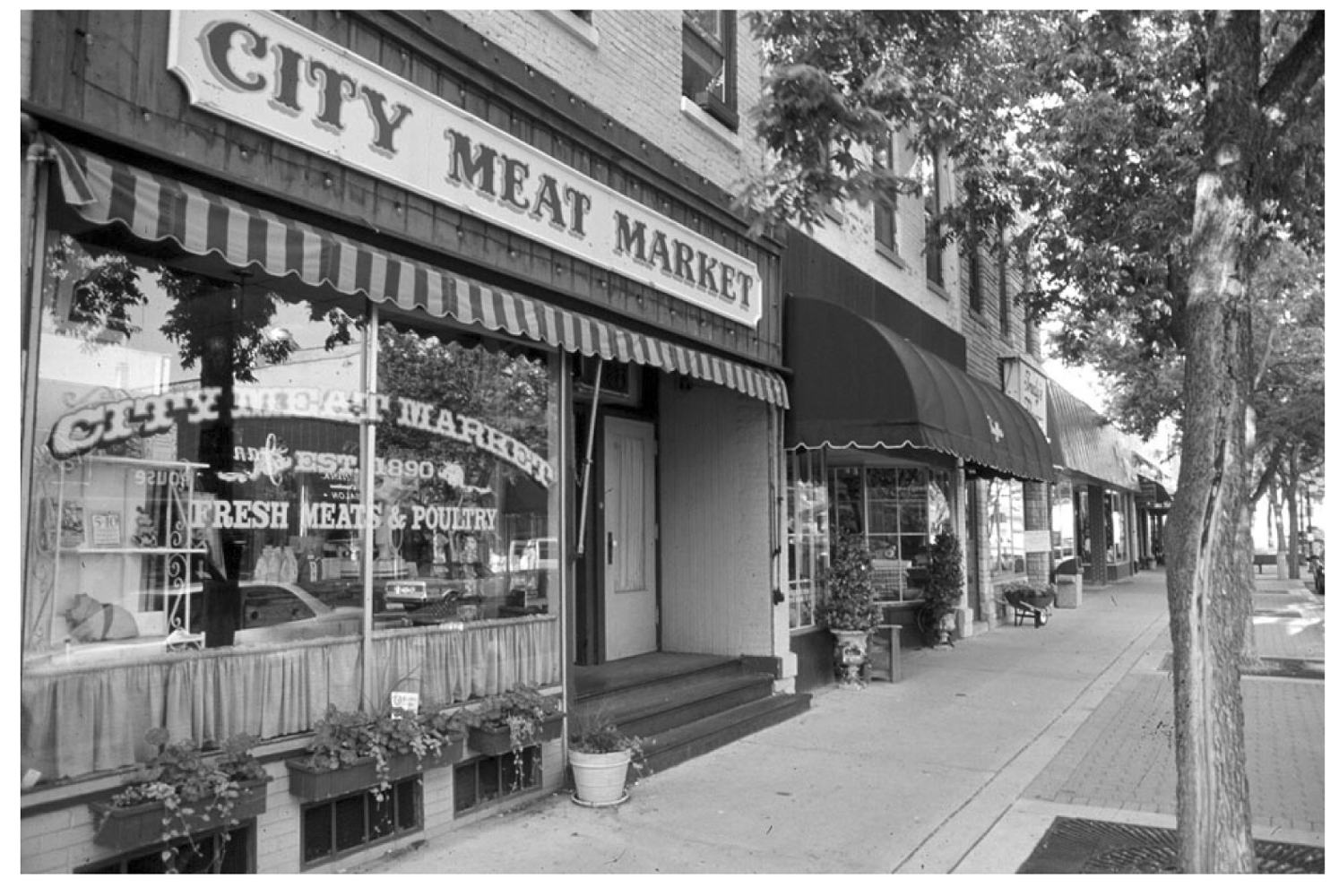
Customer Entryways
5:5.4-1.6. Refuse containers, dumpsters, loading docks and other delivery/service areas should be located to the rear of side of structures and should be hidden from view from any primary street.
5:5.4-1.7. Placement of air conditioning units, satellite dishes and other building amenities or services should be accomplished without detracting from the integrity of the building or site. Generally, these items should be positioned to the rear of a building or on a view-obstructed side. Rooftop equipment shall be obstructed from view from any primary street.
5:5.4-1.8. Exterior service and/or storage facilities and ancillary buildings for service or storage purposes, if allowed, shall also be placed at the rear of the site and out of view from the public right-of-way. The use of vegetation and landscaping to buffer service/storage areas and items from the public right-of-way is encouraged.
5:5.4-1.9. Every effort should be made to reduce overhead utility lines on Main Street. New construction should consider tying into utilities on the side or rear of the building.
5:5.4-2. Parking.
5:5.4-2.1. Parking will only be allowed on the side and rear of buildings within the Central Business District or on the street in parallel parking spaces allowed by the City; excepting cases where the principal use of the property is a gas station or parking lot (in which case the property must meet the standards of the City of Fountain Inn off-street parking and landscape/tree Ordinances).
5:5.4-2.2. If surface parking areas are located to the side of the building and/or can be seen from the public right-of-way then a six-foot landscape buffer should be placed between the roadway and the parking area
5:5.4-2.3. Landscaping should be provided within parking lots in the Central Business District consist with the City's off-street parking Ordinance.
5:5.4-3. Sidewalks.
5:5.4-3.1. Sidewalks should be ten feet in width within the Central Business District and separated from the curb by a minimum of four-foot landscape buffer along Main Street, Fairview Street and Knight/McCarter Street. Where feasible an eight-foot landscape buffer should be used for large trees. Sidewalks should be concrete in general; however, brick pavers may be accepted.
5:5.4-3.2. Sidewalks should be adjacent to the curb on secondary streets within the Central
Business District and be ten feet in width, where possible. Sidewalks should be concrete.
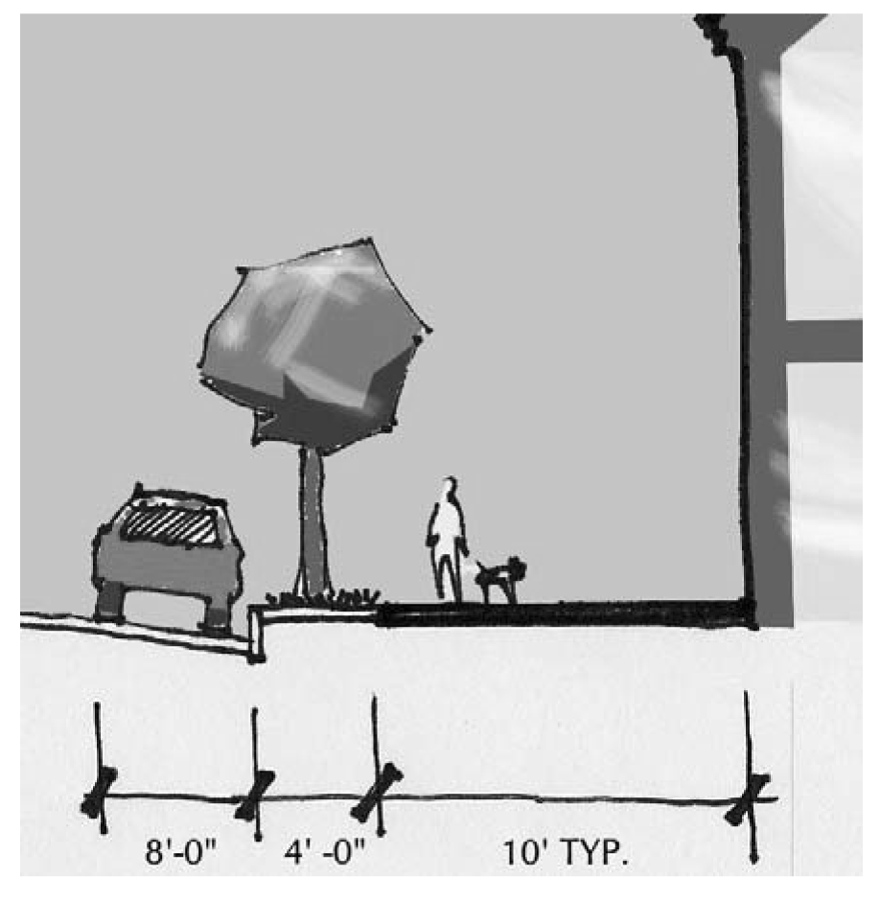
Sidewalks
5:5.4-4. Landscape Buffers.
5:5.4-4.1. A minimum of four-foot landscape buffer should be implemented between the back of curb and the front edge of the sidewalk along Main Street, Fairview Street and Knight/McCarter Street. The landscape buffer should be planted with easily maintainable materials. Where feasible an eight-foot landscape buffer should be used for large trees. The planters should be bordered by a curb. See preferred plant list.
5:5.4-4.2. In areas where on-street parallel parking is present, brick pavers may be utilized in lieu of a landscape strip. The landscape strip should measure four feet in width and no less than eight feet in length. Where feasible an eight-foot landscape strip should be used for large trees. Tree and lighting requirements and spacing as detailed in this article shall remain in effect if brick pavers are used in lieu of a landscape strip.
5:5.4-4.3. Street trees should be planted within the landscape at no greater than 40 feet on
center. See preferred plant list. New street trees shall be no less than two inches
in caliper.
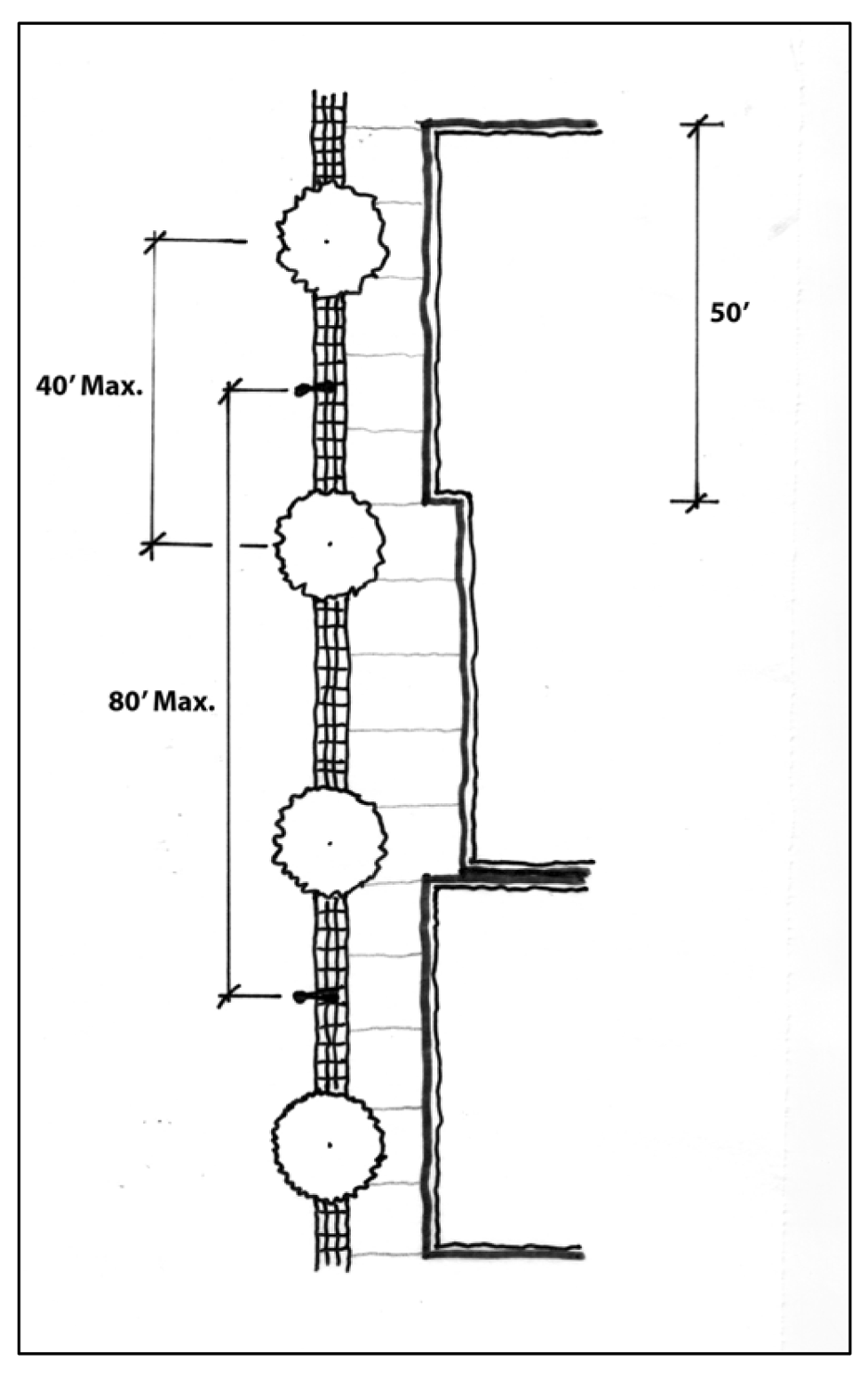
Street Trees
5:5.4-4.4. Street lighting consistent with existing downtown street lights should also be positioned within the landscape buffer between the curb and sidewalk. Street lights should be no greater than 80 feet on center and should be centered between street trees as possible. The maximum height of decorative or period street lighting should be no greater than 16 feet in height.
5:5.4-4.5. Landscape buffers, up to six feet in width, may also be utilized between the back of sidewalk and the front facade of buildings. Landscape buffers against buildings should use a variety of dense planting material including, but not limited to seasonal flowers, small shrubs and small trees (e.g. crepe myrtle). See preferred plan list. Landscape buffer maintenance is the responsibility of the adjacent property owner and should be well maintained and manicured.
5:5.4-4.6. Additional street and sidewalk amenities that serve the general public may be placed within the landscape buffer including bicycle racks, benches, and trash receptacles. Newspaper boxes, "containers" and other materials for sale or which offer items for sale are not allowed as permanent fixtures within the landscape buffer.
5:5.4-4.7. Planting List. Suggestions for Street Trees/Sidewalk plantings
Suggested street trees. Trees to be considered should not be so large as to block storefronts. One of the trees listed below may be suitable. Other trees may be possible.
Quercus phellos "QPSTA" Hightower Willow Oak, 40'—60' tall, 35' spread
Quercus phellos "wynstar" Wynstar Willow Oak, 60'—70' tall, 40'—50' spread
Acer rubrum "Bowhall" Bowhall Red Maple, 50' tall, 25' spread
Ulmus parvifolia "UPMTF" Bosque Lacebark Elm, 50'—60' tall, 35'—40' wide
Zelkova serrata "Village Green" Village Green Zelkova, 50'—60' tall, 50'—60' spread
Zelkova serrata "Green Vase" Greene Vase Zelkova, 70' tall, 50'-60' spread
Zelkova serrata "ZFSKF Myimar" Myrimar Zelkova, 50'—60' tall, 40'-45'
Acer barbatum Florida Maple, 40'—50' tall, 25'—40' spread
Adopted from the South Carolina Forestry Commission "Tree Selection Guide for South Carolina." The original document can be found on the South Carolina Forestry Commission Urban Forestry web page. The address is as follows: http://www.state.sc.us/forest/urban.htm Click on the "Tree Selection Guide for South Carolina."
Architectural Guidelines
5:5.4-5. Building Materials.
5:5.4-5.1. Building facades within the Central Business District must be constructed with brick, stone and/or, if approved by the City, wood or a synthetic material closely resembling brick, stone, or wood. Stucco or synthetic stucco surfaces including EIFS, smooth-faced concrete block, tilt-up concrete panels, prefabricated steel panels and metal siding are prohibited on new construction within the CBD.
5:5.4-5.2. Building colors should be compatible with the historic character of the Central Business District and surrounding structures.
5:5.4-6. Building Heights.
5:5.4-6.1. Multistory buildings (2-3 stories) are strongly encouraged within the Central Business District. Ideally buildings will include retail, office and/or commercial uses on the ground floor and residential or office uses on upper floors.
5:5.4-6.2. If single story buildings are constructed within the CBD, the front facade should be no less than 16 feet in height and no more than 45 feet in height (except as provided in Article 7, Section 7).
5:5.4-6.3. Facades facing any primary street should be architecturally compatible with historic
Main Street buildings including an articulated base measuring 16 to 24 inches in height,
a cornice line across the top of the building measuring 8 to 24 inches in height and
a clear articulation and/or marking where the ground floor transitions to upper floors.
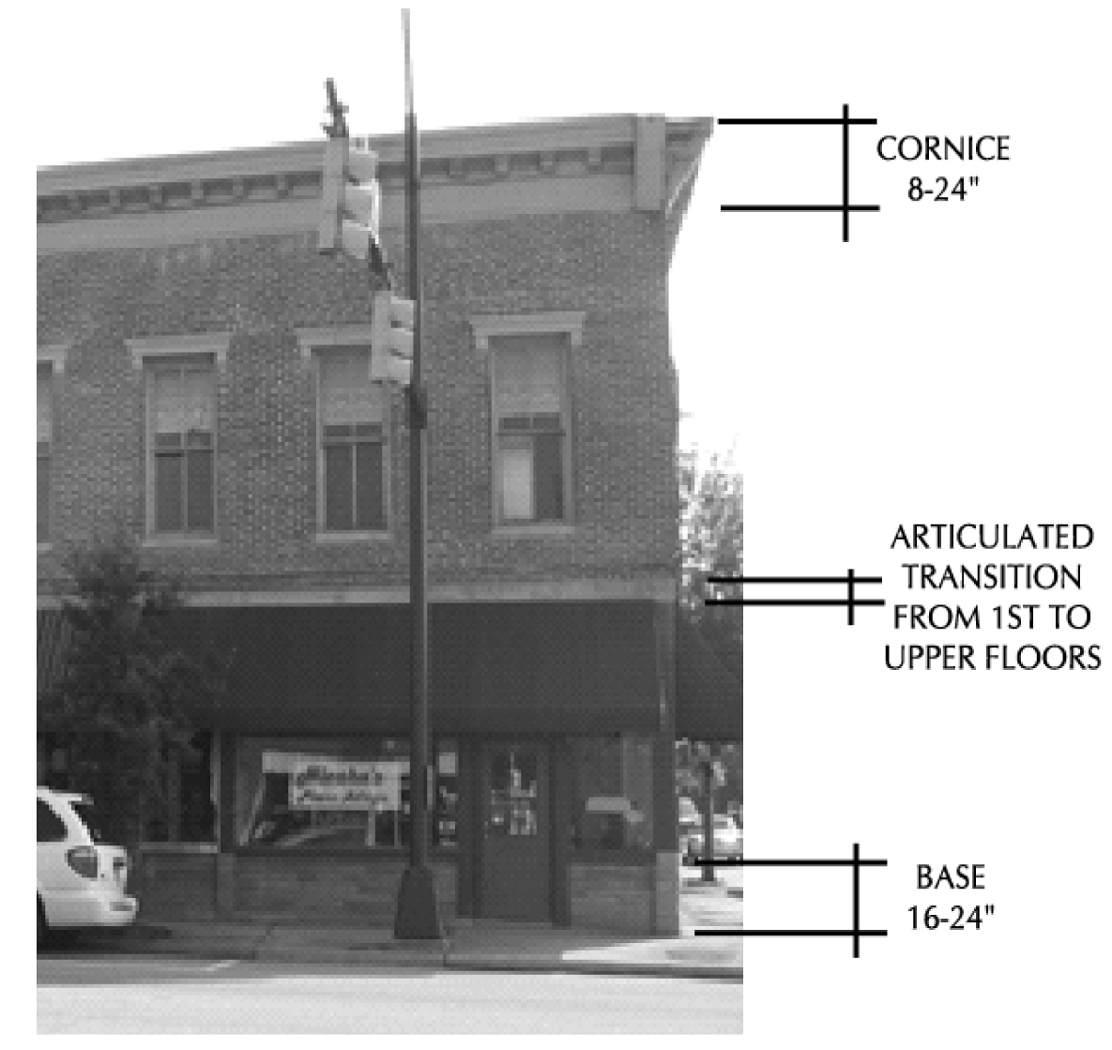
Compatible Facades
5:5.4-7. Building Features.
5:5.4-7.1. Facades facing primary streets should be comprised of no less than 60 percent storefront windows. The bottom edge of storefront windows should be no higher than 30 inches above the finished level of the sidewalk.
5:5.4-7.2. If storefront windows are not appropriate based upon the building use or if the City determines the application of storefront windows would be a detriment to the character of the Central Business District and pedestrian environment, reliefs of brick or stone mimicking historically appropriate openings constructed of materials matching those of the building exterior may be considered.
5:5.4-7.3. Storefront windows are to display merchandising and maintain visual interest along the street. Windows shall not be covered or painted except when a storefront is vacant or under construction/renovation.
5:5.4-7.4. Buildings should address primary streets with highly visible customer entryways oriented toward the street providing direct access from the public sidewalk into ground floor retail, office, and commercial establishments and should follow provisions set forth in Section 7.13.4-1 Entryways.
5:5.4-7.5. Awnings/Canopies are encouraged on storefronts facing Main Street. Awnings and canopies
should be of a single, solid color and may not include signage of any type. Awnings
and canopies should be hung from building facades at the top of the first floor and
should hand no lower than eight feet from the public sidewalk and no higher than 12
feet above the public sidewalk.
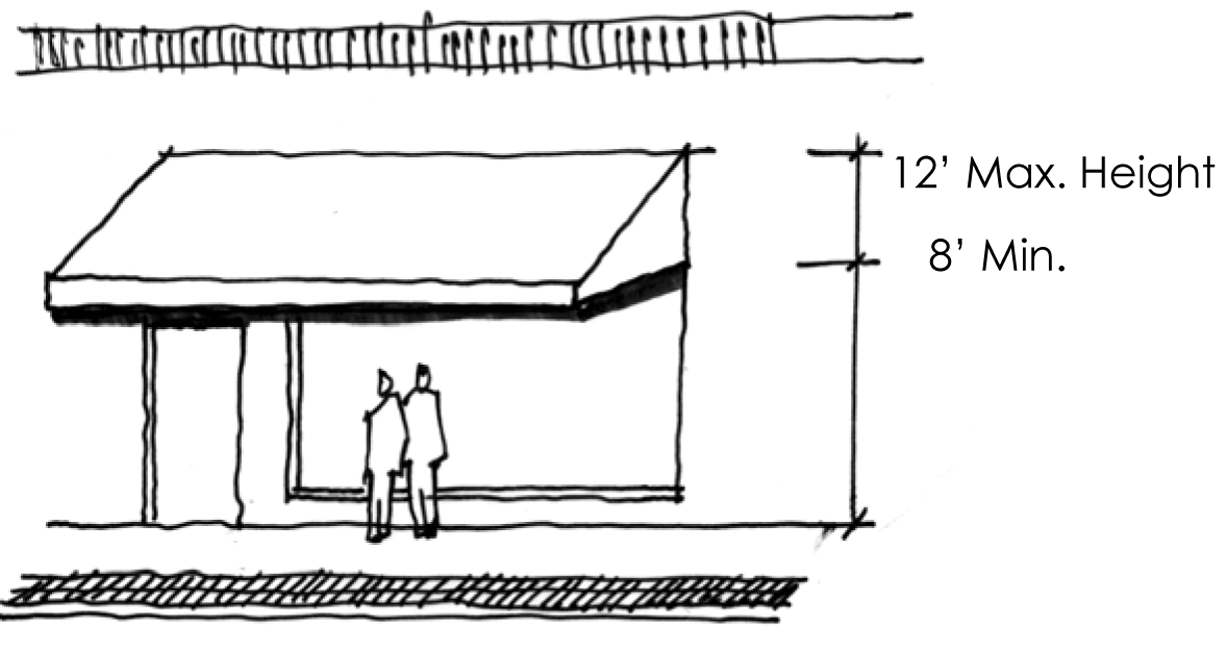
Awnings/Canopies
5:5.4-7.6. Awnings may not extend across multiple storefronts and/or multiple buildings. Awnings must be constructed of durable, protective, and water repellant material, however, plastic or fiberglass awnings are not allowed. Backlighting or illuminating awnings is not allowed. Awnings must project a minimum of 30 inches from the building and no greater than six feet from the building line.
5:5.4-7.7. All CBD storefront windows must be kept clean of obvious dirt, grime, graffiti, or bird droppings. No trash, debris, crates, cardboard boxes or other packing materials may be stacked or stored in the window of any storefront windows. The storefront windows of any vacant CBD building must be covered with a neutral color to completely obscure public view of the interior of the building. Material may consist of plywood or a smooth finish washable window used on the surface area of the window. As an alternative, the owner of any vacant CBD building may cover the storefront window with decorative art. All window coverings must be kept in good repair and shall not be torn, damaged or otherwise left in a state of disrepair. All awnings on CBD buildings, whether occupied or vacant, must be kept clean and in good repair and shall not be defective, torn, badly faded, broken, damaged, or otherwise in a state of disrepair. The exterior of building should be maintained in accordance to the International Property Maintenance Code.
Signage Guidelines.
5:5.4-8. Building Signage. Each business within the Central Business District shall be allowed a combination of wall signs and ground signs subject to the following provisions:
5:5.4-8.1. Signage shall complement the architectural details of the building, and shall not violate or otherwise obscure the architecture of the building to which it is attached. Signs, lettering or boxed graphics shall not cut across columns, cornices, windowsills, arches or balconies, nor extend above the roofline of any building to which it is attached.
5:5.4-8.2. No single business shall be permitted more than two permanent signs per business, one temporary sign. See Article 6 TABLE 1 DISTRICT REQUIREMENTS FOR PERMANENT SIGNS, except for single businesses with double frontage lots (lots facing more than one primary street - Main, Fairview and/or Knight/McCarter), which shall be allowed one additional wall or window sign. A monument sign may be permitted for a site with off-street parking lots that are 20 or more spaces. One monument sign may be substituted for wall sign, 35 feet maximum allowable square feet per sign allowed.
5:5.4-8.3. The combination of all signs for any single building shall be no greater than ten percent of the building face projection, subject to sign limitations below.
5:5.4-8.4. The calculation for total allowable signage area for single businesses with double frontage shall be based upon the facade with the primary entrance and/or architectural features of the building. If two facades are equal in terms of primary entrance and architectural features, the roadway with the highest capacity shall determine the primary facade.
5:5.4-8.5. Permanent signs within the Central Business District shall display no more than the following items: the owner or business name, product/service, street address, telephone number, e-mail and business slogan, not to exceed six lines of text and/or symbols.
5:5.4-8.6. Letters can be painted or mounted directly on a signboard, storefront, wall or window, but should be in proportion to the storefront. Acceptable lettering materials include wood, stone, synthetic stone, dimensional plastic, or acrylic.
5:5.4-8.7. Signs may be constructed of concrete, brick, wood, stone, metal, glass or synthetic
materials closely resembling the aforementioned materials. All materials shall be
compatible with the building's architecture.
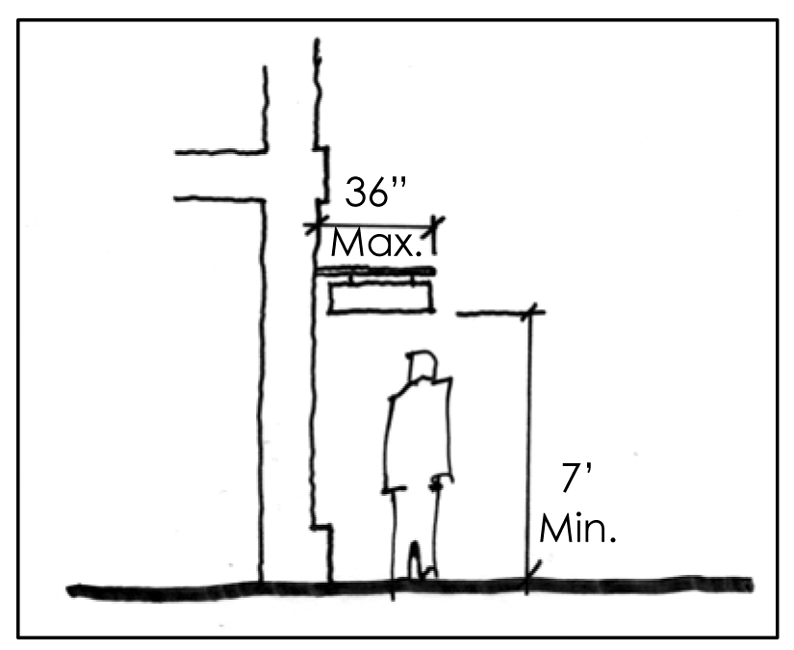
Hanging Signs
5:5.4-8.8. Hanging, suspended, or projecting signs are permitted in the CBD and shall clear public sidewalks by no less than seven feet in height and project no more than 36 inches from the building face. Hanging or suspended signs should project from the wall at a 90-degree angle. Hanging or suspended signs over driveways, alleys, or parking areas is prohibited. Signs shall be located to complement the architectural features of a building such as above the building entrance, storefront opening, or other similar features.
5:5.4-8.9. Menu signs used to indicate a restaurant, bakery and/or available/cost of specific food items at a food purveyor, may be displayed on the inside of windows, or inside a wall mounted display box. Maximum size shall be four square feet and only one menu sign or display box is permitted per entrance and shall not be calculated as part of the total signage allowed under section 5:5.4-8.3.
5:5.4-8.10. Sandwich board, A-frame, and movable menu board signs may be used by restaurants and businesses in the CBD, but no more than one sign per business is allowed. Sandwich boards signs shall have a maximum height of four feet and a maximum area of eight square feet per side. Sandwich signs may be placed on a temporary basis within the landscape buffer, but shall not be permitted within the sidewalk area where they could potentially hinder pedestrian traffic. Sandwich signs may not be permanently installed or affixed to any object and must be removed when the business is closed.
5:5.4-8.11. Window signs shall not exceed one-fourth (25 percent) of the total window area.
5:5.4-8.12. Under no circumstance should any wall or window sign exceed 150 square feet.
5:5.4-8.13. Ground signs in the Central Business District shall be no greater than 35 square feet. The calculation for sign size shall include one face of the sign and sign supports, unless such supports are of a brick or stone material similar to the building facade, in which case supports shall not be counted as part of the sign area. Subject to the provisions in 8.2.
5:5.4-8.14. A decorative directional sign may be used for points of interest within the pedestrian zones, subject to Fountain Inn Planning Commission approval.
5:5.4-8.15. No portion of any ground sign shall be higher than six feet in height.
5:5.4-8.16. Signs should be lit by external lighting sources shining onto the sign face. Internally illuminated signs are strongly discouraged.
5:5.4-8.17. Neon signs are permitted on the interior of the building and in display windows, if not covering more than one-fourth of the window surface area and shall not flash or blink.
5:5.4-8.18. The following signs and advertising devices are prohibited within the Central Business District:
5:5.4-8.18.1. Bench signs (except for honoree / donor placards approved by the Fountain Inn Planning Commission),
5:5.4-8.18.2. Flashing, blinking, and traveling signs,
5:5.4-8.18.3. Portable, mobile or trailer signs,
5:5.4-8.18.4. Roof signs.
5:5.4-8.19. The applicant shall submit a sign plan that meets the aforementioned guidelines and the provisions set forth in article 6, signs. The zoning administrator shall review and approve the plans in accordance to said guidelines and provisions. Requests for variances will be reviewed by the board of zoning appeals as set forth in section 11:5.2.
(Ord. of 11-13-06; Ord. of 12-14-06, § 1 ; Ord. No. 2011-001, § 1, 5-12-2011; Ord. No. 2023-7, § 1(a)(x), 7-13-23)
Editor's note— Subsection 5:5.1 has been amended at the discretion of the editor to reflect changes instituted by an Ordinance of November 13, 2006, §§ 1 and 2.
Section 5:6. - C-2, Commercial District.
This district is established to provide goods and services for the convenience of local residents.
5:6.1. Uses Permitted.
Accountant
Air conditioning equipment, sales, and service
Airline or transportation ticket office
Ambulance service
Amusements, commercial
Animal shelters
Antique shop
Apparel store
Appliance sales and repair
Art school
Art shop
Auction house or store
Automobile garage
Automobile parts or accessories
Automobile repairing, excluding body work
Automobile sales area
Automobile service station
Bakery
Bank or savings and loan
Bar
Barber shop
Battery store or shop
Beauty shop
Bicycle repair shop
Billiard hall
Blueprinting or photostatting
Boats, sales or rental
Book store
Bowling alley
Broadcasting studio, radio or TV
Building and loan company
Burglar alarm business
Cafe
Cafeteria
Car wash
Catering establishment
Child care center
Child care home
Clothing store
Cocktail lounge
Collection agency
Dairy products store
Dance studio
Dancing school
Day nursery
Decoration store
Delicatessen
Dental clinic
Department store
Diaper supply service
Dressmaker
Drive-in business (Theaters, refreshment stands, restaurants, etc.)
Drug store
Electric appliance sales
Employment agency or bureau
Engravers
Farm machinery sales
Feed and seed store
Fireworks sales in a permanent structure
Fireworks stands
Florist
Furniture cleaning
Furniture store
Garden supply store
Gift shop
Golf, driving range, miniature, or pitch and putt
Greenhouse
Grocery store
Gunsmith store
Hardware store
Hobby shop
Home occupation, subject to requirements in Article 8
Ice skating rink
Interior decorating store
Jewelry store
Laundry or cleaning establishment
Leather goods store
Library
Linen or towel supply business
Liquor store
Loan company
Locksmith store
Mattress shop
Medical clinic or laboratory
Mission, rescue
Monument and tombstone sales
Motel
Motion picture theater
Motorcycle or motor scooter sales and service
Music school or studio
Music store
Newspaper establishment
Newsstand
Nightclub
Novelty store
Nursery, flower, plant, or tree
Office supply store
Office, business or professional
Optical goods sales
Optician
Paint store
Pawn shop
Pest or insect control business
Pet shop
Photo developing and finishing store
Photography studio
Planned shopping center, according to all conditions outlined in Section 5:6.8
Plumbing shop
Pottery and ceramic store
Printing establishment
Public park and playground
Radio broadcasting studio
Radio or television repair shop
Record recording studio
Recreation building
Restaurant
Roller skating rink
Sandwich shop
Self-service laundry and cleaning
Shoe store
Signs (Subject to provisions of Article 6)
Sporting goods sales
Station, bus or railway
Stationery shop
Swimming pool, commercial
Tailor shop
Television broadcasting studio
Theater (Indoor)
Tire shop (Including retreading or recapping)
Toy store
Used car lot
Utility easement or right-of-way
Veterinary clinic
Veterinary office
Accessory buildings and uses customarily incidental to the above uses
Other uses which are considered to be compatible with the aforementioned uses.
5:6.2. Uses Permitted by Special Exception. The following uses may be permitted by Special Exception by the Board of Zoning Appeals in accordance with the provisions of Article 9.
Attached single-family dwelling
Attached single-family dwelling, three or more units
Armory
Auditorium
Baseball park
Church
Detached single-family dwelling
Dwelling, multi-family
Dwelling, two-family
Educational institution, including private school
Exhibition buildings
Fairgrounds, public
Family care home
Fire station
Funeral Home
Gymnasium
Home for aged persons
Hospital
Library
Museum
Police station
Stadium or ball park
Veterinary hospital
5:6.3. Reserved.
5:6.4. Reserved.
5:6.5. Screening. A wall, fence, or compact evergreen hedge or other type of evergreen foliage, or a combination of fence and shrubbery at least 6 feet in height, shall be provided along the side and rear lot lines where any commercial use is adjacent to a residential district.
5:6.6. Off-Street Parking. Off-street parking shall be provided in accordance with the provisions set forth in Article 7, Section 9.
5:6.7. Off-Street Loading. Off-street loading shall be provided in accordance with the provisions set forth in Article 7, Section 10.
5:6.8. Requirements for Planned Shopping Centers. Each application for a Zoning Certificate/Building Permit for a planned shopping center shall be approved by the Zoning Administrator except in cases where the shopping center will be in an area zoned for a Planned Development. The application shall be accompanied by the following:
A.
A development plan of the proposed development at a scale of not less than one inch equals 100 feet showing:
1.
The location and size of the site;
2.
The dimensions of the property;
3.
The location and proposed use of buildings, and their general exterior dimensions;
4.
A traffic, parking, and circulation plan showing proposed locations, arrangements, and dimensions of parking spaces, loading areas, and drives, and ingress and egress to and from adjacent streets;
5.
The proposed location and materials to be used for screening;
6.
A title, showing the names of the developers, the date, scale of the plan, and the name of the individual or firm preparing the plan.
B.
A statement, to be filed with the Building Inspector, indicating readiness to proceed with construction of the proposed development within one year from the date the proposal is approved.
C.
A plan showing drainage of the site.
5:6.8-1. Building Permit. No building permit shall be issued for any building in a shopping center until a Final Development Plan shall have been approved by the Fountain Inn Planning Commission.
(Ord. of 11-13-06; Ord. No. 2011-001, § 1, 5-12-2011; Ord. No. TX 2021-1, § 1(Att. 1), 6-10-21; Ord. No. TX 2021-3, §§ 1, 2(Att. 1), 12-9-21; Ord. No. 2023-7, §§ 1(a)(xi), (xii), 7-13-23)
Section 5:7. - S-1, Services District.
This district is established to provide a transition between commercial and industrial districts by allowing: (1) commercial uses which are service-related; (2) service-related commercial uses which sell merchandise related directly to the service performed; (3) commercial uses which sell merchandise which requires storage in warehouses or outdoor areas; and (4) light industries which in their normal operations would have a minimal effect on adjoining properties.
Section 5:7.1. Uses Permitted. Any uses permitted in the C-2, Commercial District.
Amusement, recreational, and entertainment establishments
Automobile painting
Automobile storage garage
Automobile upholstering
Building materials
Business service establishments
Commercial printing and job printing
Financial institutions
Hotels and motels
Household appliance repair
Kennel
Laboratories and establishments for fitting, repair, or production of eyeglasses, hearing aids, or prosthetic devices
Light manufacturing and processing
Lumber yard
Manufactured home sales
Mini warehouses
Offices, studios
Outdoor storage lots and yards, except automobile junk yards, scrap yards, salvage yards, or yards used in whole or in part for scrap or salvage operations or for processing, storage, display, or sale of junk, scrap, or salvaged materials
Parking lots and parking garages
Parks, playgrounds, play fields
Personal service establishments
Radio and television stations
Rehabilitation centers
Restaurants and bars, except drive-in establishments
Retail establishments, sales, and display
Service and repair establishments including automobile service stations and repair garages
Sheet metal shop
Sign painting shop
Signs, subject to the provisions of Article 6
Truck terminals, freight terminals, passenger terminals
Utilities substations and other similar public service uses
Veterinary establishments
Wholesaling, warehousing, storage, supply, and distribution
Other uses which are considered to be compatible with the aforementioned uses.
Section 5:7.2. Uses Permitted by Special Exception. The following uses may be permitted by Special Exception by the Board of Zoning Appeals in accordance with the provisions of Article 9.
Business schools and vocational schools not involving uses of an industrial nature which would not otherwise be permitted in this district
Church
Clubs, lodges, civic and fraternal organizations
Educational institution
Fairgrounds, public
Family care home
Fire station
Library
Police station
Post office
Stadium or ball park
Tattoo parlor
5:7.3. Reserved.
5:7.4. Reserved.
5:7.5. Screening. A wall, fence, compact evergreen hedge or other type of evergreen foliage, or a combination of fence and shrubbery at least six feet in height shall be provided along with the side or rear lot lines where any use is adjacent to a residential district for the purpose of screening commercial activities from view.
5:7.6. Off-Street Parking. Off-street parking shall be provided in accordance with the provisions set forth in Article 7, Section 9.
5:7.7. Off-Street Loading. Off-street loading shall be provided in accordance with the provisions set forth in Article 7, Section 10.
(Ord. of 7-13-06, § 1; Ord. No. 2011-001, § 1, 5-12-2011; Ord. No. TX 2021-1, § 1(Att. 2), 6-10-21; Ord. No. 2023-7, §§ 1(a)(xiii), (xiv), 7-13-23)
Section 5:8. - I-1, Industrial District.
The Industrial District is established as a district for manufacturing plants, assembly plants, and warehouses.
5:8.1. Permitted Uses. All of the uses permitted in this district shall be conducted in such a manner that no noxious odor, fumes, smoke, or dust will be emitted beyond the property line of the lot on which the use is located.
5:8.2. Uses Permitted.
Apparel manufacturing
Automobile and truck repair and rebuilding shop
Bottling plant
Building contractor and related activities
Building materials, sales, and storage
Chemicals and allied products manufacturing
Electrical components manufacturing
Fabricated metal products manufacturing
Farm implement and machinery sales and storage
Feed and seed sales and storage
Food processing
Household and industrial cleaning products manufacturing
Laundry and cleaning plant
Lumber yard
Milk processing
Paper and allied products manufacturing
Petroleum refining and related industries
Plastic products manufacturing
Primary metal industries
Printing and allied industries
Signs, subject to the provisions of Article 6
Stone, clay, and glass products manufacturing
Temporary building which is incidental to the construction of buildings permitted in the district and which shall be removed when work is completed
Textile mill
Tire recapping and retreading plant
Truck terminal
Wholesale and warehousing
Other uses which are considered to be compatible with the aforementioned uses
5:8.3. Uses Permitted by Special Exception. The following uses may be permitted by Special Exception by the Board of Zoning Appeals in accordance with the provisions of Article 9.
Auditorium
Auto wrecking facilities, junkyards, recycling collection and processing centers, salvage yards and scrap processors.
Bulk storage and sale of liquid propane
Church
Correctional institution
Exhibition buildings
Fairgrounds
Fire station
Hospital
Police station
Stadium or ball park
Station, bus or railway
5:8.4. Reserved.
5:8.5. Reserved.
5:8.6. Screening. A wall, fence, compact evergreen hedge or other type of evergreen foliage, or a combination of fence and shrubbery at least six feet in height shall be provided along the side or rear lot lines where any industrial use is adjacent to a residential district.
5:8.7. Off-Street Parking. Off-street parking shall be provided in accordance with the provisions set forth in Article 7, Section 9.
5:8.8. Off-Street Loading. Off-street loading shall be provided in accordance with the provisions set forth in Article 7, Section 10.
(Ord. No. 2011-001, § 1, 5-12-2011; Ord. No. ZTEXT-2013-002, § 1a., b., 7-11-13; Ord. No. 2023-7, §§ 1(a)(xv), (xvi), 7-13-23)
Section 5:9.1. - Planned development district.
5:9.1.1. PD Intent. The PD district is established to encourage innovative and creative design of residential and/or commercial developments and to permit a greater amount of flexibility to a developer by removing some of the restrictions of conventional zoning. Ideally, the development should be large scale and incorporate a variety of land uses or land use types. The district is also intended to encourage Developments which provide a full range of residential types to serve the residents of the district.
The regulations should provide a mechanism to evaluate each application on its own merit. It is recognized that some concepts will be more appropriate than others and the approval of an application in one location does not necessarily indicate the development will be applicable in other locations. It should also be emphasized that these provisions are not to be used to circumvent the intent or use of conventional zoning classifications as set forth in this Ordinance.
5:9.1.2. Minimum Site Size. The minimum site size for any Planned Development is two (2) acres.
5:9.1.3. Minimum Lot Area. No minimum lot area is required for any specific structure within a Planned Development.
5:9.1.4. Minimum Lot Width, Minimum Yard Requirements, Maximum Lot Coverage, Maximum Height of Structures. No structure shall be erected within 25 feet from any external lot line of any planned development. Minimum lot width, minimum yard sizes, maximum lot coverage, and maximum height are not otherwise regulated within PD districts provided, however, that the Planning Commission and City Council shall ascertain that the characteristics of building siting shall be appropriate as related to structures within the planned development and otherwise fulfill the intent of this Ordinance.
5:9.1.5. PD Application and Preliminary Development Plan Approval.
A.
Prior to submitting a PD application, the applicant is encouraged to meet with the Planning Commission staff for a pre-application conference to avoid undue delay in the review process after the application is submitted.
B.
Applications for a Planned Development district shall include the following:
1.
Preliminary Development Plan - The applicant shall submit a reproducible vellum of the proposed Planned Development which shall include the following:
a.
A boundary survey with vicinity map, title block, scale, and north arrow.
b.
Total number of acres of overall site.
c.
Location and number of acres of various areas by type of use (e.g., single-family detached, recreation, office, commercial, etc.).
d.
Number of units and density of various residential types, such number to represent the maximum number of units.
e.
Approximate square footage of nonresidential use and approximate number of bedrooms in each residential unit.
f.
Primary traffic circulation pattern, including major points of ingress and egress.
g.
Approximate number of parking spaces per use.
h.
An indication that an acceptable drainage system can be designed for the proposed project.
i.
Any such information or descriptions as may be deemed reasonably appropriate for review.
2.
Statement of Intent - The applicant shall submit three copies of a report setting forth the characteristics of the proposed Planned Development including the following:
a.
A description of the procedures of any proposed homeowners association or other group maintenance agreement.
b.
A statement setting forth the proposed development schedule.
c.
A statement of the public improvements both on- and off-site that are proposed for dedication and/or construction and an estimate of the timing for providing such improvements.
d.
A statement of impact on public facilities including water, sewer collection and treatment, fire protection, etc., and letters from the appropriate agencies or districts verifying that such facilities or services are available and adequate to serve the proposed Planned Development.
e.
A statement concerning the appearance, landscaping, screening, and maintenance of any proposed pond, lake, or retention pond contained in the development.
f.
Any such information or descriptions as may be deemed reasonably appropriate for review.
C.
A public hearing shall be held before the Planning Commission.
D.
The Planning Commission, at its next meeting following the public hearing, and the Planning Commission staff shall make a recommendation upon the proposed Planned Development which shall be advisory to City Council.
E.
The City Council may, after fulfilling all applicable requirements of this section and all applicable requirements of Article 10, act to either approve, approve with modification, or disapprove the application for a Planned Development.
F.
Following approval of a PD district, the Official Zoning Map shall be amended to reflect such approval. Approval of a Planned Development district shall constitute authority for the applicant to submit a Final Development Plan to the Planning Commission for approval in accordance with the provisions of Section 5:9.1.7, 5:9.1.14, and 5:9.1.16.
5:9.1.6. Subdivision Plats. Approval of a Concept Plan and Statement of Intent shall constitute authority for the applicant to prepare subdivision plats if applicable in accordance with procedures set forth in the Fountain Inn Subdivision Regulations. No building permit or certificate of occupancy shall be issued until the Planning Commission or designated staff has approved a final subdivision plat.
5:9.1.7. Final Development Plan. All final development plans in the Planned Development District will require a site plan review and approval by the Fountain Inn Planning Commission. Site plan requirements and procedures for the Planned Development District are outlined in Section 3 of the Fountain Inn Land Development Regulations.
5:9.1.8. Changes to Planned Development Districts. Changes to a proposed Planned Development district or to an approved Planned Development district may be permitted in accordance with one of the following procedures as determined by the Zoning Administrator:
A.
MAJOR CHANGES - Changes to a Planned Development district which would alter the basic concept and general characteristics of the Planned Development district may be approved by City Council in accordance with the procedures established by Section 5:9.1.7. After approval of a major change by City Council, approval of a final development plan showing such changes must be submitted to the Planning Commission in accordance with Section 5:9.1.9. Examples of major changes may include, but are not limited to the following:
- boundary changes
- decrease in open space
- increase or decrease in number of access points
- changes to more intensive land uses, e.g. residential to commercial
- any change which the Zoning Administrator determines would significantly alter the character of the PD or be expected to have an adverse impact upon neighboring property owners
B.
MINOR CHANGES - Changes to a Planned Development district which are of a design nature and which do not alter the original concept or use characteristics of the Planned Development district may be approved by the Zoning Administrator provided that no minor change may be approved by the Zoning Administrator which is in conflict with specific conceptual considerations previously approved by City Council. Examples of Minor Changes may include, but are not limited to the following:
- reductions in:
density
signage
square footage
- increases in:
landscaping
open space
setbacks
- Minor changes to:
landscaping
lighting
location of land uses
parking
signage
site plan
- Minor changes to allow:
reorientation of structures
realignment of approved access
more restrictive land uses, e.g. commercial to residential
shift in approved density from one area of PD to another
5:9.1.9. Planned Development Status Report. One year after final approval and each year thereafter, the Zoning Administrator shall present to City Council a status report on the progress of the approved development.
5:9.1.10. Minimum Off-Street Parking and Loading. The Planning Commission shall not approve a PD site plan until the County Traffic Engineer has reviewed and approved a parking scheme for the development.
5:9.1.11. Signs. Signs are permitted in PD Districts only in accordance with Article 6, "Sign Regulations."
5:9.1.12. PD Application and Preliminary Development Plan Approval.
A.
An applicant shall communicate his intentions to establish a Planned Development District and the proposed characteristics thereof to the Zoning Administrator prior to initiating an application for amendment to the Zoning Map in order to avoid undue delay in the review process after initiating such application.
B.
Applications for a Planned Development District shall be by amendment to the Official Zoning Map in accordance with the provisions of Article 12 and shall include the following:
1.
Preliminary Development Plan - The applicant shall submit two copies of the proposed Planned Development which shall include the following:
a.
Vicinity map, title block, scale, north arrow, and property line survey.
b.
Total number of acres of overall site.
c.
Location and number of acres of various areas by type of use (e.g., single-family detached, recreation, office, commercial, etc.).
d.
Number of units and density of various residential types, such number to represent the maximum number of units.
e.
Approximate square footage of non-residential use and approximate number of bedrooms in each residential unit.
f.
Primary traffic circulation pattern, including major points of ingress and egress.
g.
Approximate number of parking spaces per use.
h.
An indication that an acceptable drainage system can be designed for the proposed project.
i.
Any such information or descriptions as may be deemed reasonably appropriate for review.
2.
Statement of Intent - The applicant shall submit three copies of a descriptive statement setting forth the characteristics of the proposed Planned Development including the following:
a.
A description of the procedures of any proposed homeowner's association or other group maintenance agreement.
b.
A statement setting forth the proposed development schedule.
c.
A statement of the public improvements, both on and off-site, that are proposed for dedication and/or construction, an estimate of the timing for providing such improvements.
d.
A statement of impact on public facilities, including water, sewer collection and treatment, schools, garbage collection, fire protection, etc. Letters from the appropriate agencies of districts verifying that such facilities or services are available and adequate to serve the proposed Planned Development.
e.
A statement concerning the appearance, landscaping, screening, and maintenance of any proposed pond, lake, or retention pond contained in the development.
f.
Any such information or descriptions as may be deemed reasonably appropriate for review.
C.
A public hearing shall be held in accordance with procedures set forth in Article 12, except that such hearing shall be a joint hearing before the Planning Commission and City Council simultaneously.
D.
The Planning Commission shall make a recommendation upon the proposed Planned Development which shall be advisory to City Council.
E.
The City Council may, after fulfilling all applicable requirements of this Section and all applicable requirements of Article 12, act to either approve, approve with modifications, or disapprove the application for a Planned Development.
F.
Following approval of a PD District, the Official Zoning Map shall be amended to reflect such approval. Approval of a Planned Development District shall constitute authority for the applicant to submit a Final Development Plan to the Planning Commission for approval in accordance with the provisions of Section 5:9.1.14 (see below).
5:9.1.13. Failure to Submit a Final Development Plan. Approval of a PD District granted by City Council shall be valid for one year, at the end of which time a Final Development Plan must be submitted. Prior to the expiration of the approval, the Zoning Administrator shall submit a progress report to Council on the status of the development. One year extensions may be granted by City Council. If an extension(s) is not granted, City Council may rezone the property to its original classifications in accordance with Article 12.
5:9.1.14. Final Development Plan. No building permit or certificate of occupancy shall be issued in a PD District until the Planning Commission, acting upon the recommendation of the Zoning Administrator has approved and there is recorded a Final Development Plan meeting the requirements of this section. Three copies of the Final Development Plan setting forth specific design characteristics of the Planned Development in accordance with the approved Preliminary Development Plan shall be submitted on paper plats no larger than 22 x 27 inches to the Planning Commission office and shall include but not be limited to the following information:
A.
Vicinity map, title block, scale, north arrow, and property line survey.
B.
Location arrangement and proposed use of all buildings or structures within the Planned Unit Development.
C.
Names of boundary streets.
D.
Number of residential dwelling units by type and number of bedroom units in each.
E.
Sketches of typical proposed structures, design standards, outdoor lighting fixtures, signs, and landscaping.
F.
Location of any utility easements.
G.
Total floor area for all nonresidential uses by type.
H.
Open space areas, specifying the proposed treatment or improvements of all such areas and delineating those areas proposed for specific types of developed recreational facilities.
I.
All off-street parking and loading areas and structures and the total number of spaces.
J.
Traffic and pedestrian circulation systems, including the location and width of all streets, driveways, service areas, dumpster pads, entrances to parking areas, walkways, bicycle paths, etc.
K.
Yard dimensions from the development boundaries and adjacent streets.
L.
A letter from the County Engineer stating that a detailed drainage plan has been submitted and approved.
M.
Other such information or descriptions as may be deemed reasonably appropriate for Planning Commission review.
5:9.1.15. Planning Commission Action. The Planning Commission, acting upon the recommendation of the Greenville County Planning staff, may approve or disapprove the Final Development Plan submitted by the applicant. In reviewing the Final Development Plan, the Planning Commission may require any such design modifications as will assure compliance with the approved Preliminary Development Plan. In the event that the Planning Commission finds the Final Development Plan not in accordance with the approved Preliminary Development Plan, it shall disapprove the Final Plan.
5:9.1.16. Recording of Final Development Plan and Statement of Intent. Following approval of the Final Development Plan by the Planning Commission, one copy of the Final Development Plan and Statement of Intent shall be recorded in Register of Mesne Conveyances of Greenville County. One copy of both documents shall be filed with the Zoning Administrator and one copy of both documents shall be filed with the Greenville County Planning Commission.
5:9.1.17. Site Plans and Subdivision Plats. Approval of a Final Development Plan shall constitute authority for the applicant to prepare subdivision plats if applicable in accordance with procedures set forth in the Greenville County Subdivision Regulations.
5:9.1.18. Changes to Planned Development Districts. Changes to a proposed Planned Development District or to an approved Planned Development District may be permitted in accordance with one of the following procedures as determined by the Zoning Administrator.
A.
Minor Changes - Changes to a Planned Development District which are of a design nature and which do not alter the original concept or use characteristics of the Planned Development District may be approved by the Planning Commission in accordance with the procedures established by Section 5:9.1.14 (see above) provided that no minor change may be approved by the Planning Commission which is in conflict with specific conceptual considerations previously contained in City Council's preliminary approval.
B.
Major Changes - Changes to a Planned Development District which would alter the basic concept and general characteristics of the Planned Development District may be approved by City Council in accordance with the procedures established by Section 5:9.1.12 (see above). Examples of major changes include, but are not limited to the following: boundary changes, changes in the maximum number of structures or residential units, increased density, substantial changes to residential housing type, use changes, access changes, etc. Approval of a major change by City Council must be followed by final approval of a detailed Design Plan showing such changes by the Planning Commission in accordance with Section 5:9.1.14 (see above).
5:9.1.19. Failure to Begin, Failure to Complete, or Failure to Make Adequate Progress. One year after final approval and each year thereafter the Zoning Administrator shall present to City Council a status report on the progress of the approved development. If there is failure to begin, failure to complete, or failure to make adequate progress as set forth in the Statement of Intent, City Council may change the district classification of the Planned Development in accordance with provisions of Article 12.
(Ord. No. TX 2016-001, § 1(Att. 1), 8-11-16)
Section 5:9.2. - POD, planned office district.
5:9.2.1. POD, Planned office district, Intent. This district is established to accommodate office development that is found to be compatible with surrounding physical development. Uses permitted in this district are limited to office and research facilities, and shall not include any use engaged in retail sales or the stocking and storage of merchandise.
5:9.2.2. Criteria to consider when rezoning property POD:
A.
Approval of the POD zoning classification must not alter the existing development patterns within the area;
B.
It should be determined that POD district is the appropriate office district compatible with surrounding physical development;
C.
The POD use must not put any undue burden on existing streets or utilities;
D.
Wherever possible, group development should be encouraged at intersections in an effort to concentrate POD uses and discourage sprawl and strip development;
E.
The POD zone shall be located on a collector or an arterial street.
5:9.2.3. POD, Planned Office Development, permitted uses.
Banks or similar financial institutions
Business incubator centers
Care facilities
Child/adult care centers
Day care centers
Day care centers in a church
Nursing care facility
Dwelling
Accessory, temporary
Multiple family
Single-family detached
Zero lot line
Gunsmith
Medical clinic
Offices
Business
Medical
Charitable
5:9.2.4. Uses permitted by special exception for POD districts.
Governmental facilities and operations
Civic facilities
Home occupation
Post office
Recreation—Community area, public or private
5:9.2.5. Prohibited uses. Mini storage units, taverns, drive-in restaurants, sexually oriented businesses, night clubs, video poker, tattoo parlors, body piercing, and package liquor stores are prohibited uses.
5:9.2.6. Reserved.
5:9.2.7. Reserved.
5:9.2.8. Relationship of buildings to lots. One or more principal structures may be permitted on a single lot.
5:9.2.9. Off-street parking. No parking area to be located along frontage, or otherwise between building and road. Pedestrian access points will connect adjacent parking lots with pedestrian walkways and in accordance with the standards in [Section] 5:9.8.4, Pedestrian Flows.
Off-street parking requirements shall be provided in accordance with Section 19:9, Off-Street Parking.
5:9.2.10. Off-street loading. Off-street loading shall be provided in accordance with the provisions set forth in Section 19:11, Off-Street Loading located below.
5:9.2.11. Signs. Identification signs and business signs are allowed subject to review by the Planning Commission and provisions set forth in Article 6. No signs shall have flashing lights or movable display parts. The sign appearance should blend in with the residential character of the surrounding neighborhood.
Freestanding signs for single tenant commercial, office and residential uses shall meet the following requirements:
A.
Sign shall not exceed six (6) feet in height as measured above grade.
B.
Maximum sign face dimension shall be thirty-five (35) square feet.
C.
Maximum height for a group sign is twelve (12) feet and a maximum sign face dimension shall be eighty (80) square feet.
D.
Facade mounted signs shall not exceed 10 percent of the area of the facade upon which they are placed, with the maximum size of any one sign limited to fifty (50) square feet.
5:9.2.12. Screening and landscaping. Screening and landscaping are subject to the provisions in Section 5:11 - Landscaping Buffer Yards and Detention Ponds, Section 19:10 - Landscaping of Parking Area, and Section 7:13 - Commercial Design Standards.
A screening and landscaping plan shall be approved by the city planning commission. Screening shall be provided along the side and rear property lines. Landscaping shall be provided along street frontages. Natural landscaping may be counted toward this requirement.
5:9.2.13. Lighting standards. In addition to the provisions set forth in the Commercial Design Standards Section 7:13, lighting of horizontal tasks such as roadways, sidewalks, entrances and parking areas, fixtures shall meet IESNA "full-cutoff" (no light output above 90 degrees at any lateral angle around the fixture). Fixtures shall not be mounted in excess of sixteen (16) feet above finished grade. All other outdoor lighting such as floodlights and spotlights shall be aimed, located, designed, fitted and maintained so as not to present a hazard to drivers or pedestrians by impairing their ability to safely traverse and so as not to create a nuisance by projecting or reflecting objectionable light skyward, onto a neighboring property or onto a public roadway. Flashing lights are prohibited.
5:9.2.14. Pedestrian access. In addition to the provisions set forth in the Commercial Design Standards Section 7:13, pedestrian sidewalks and/or pathways must be provided on the site and shall provide safe, all weather, efficient, and aesthetically pleasing means of on-site movement and shall be an integral part of the overall site design concept. Pedestrian pathway connections to parking areas, buildings, other amenities, residential areas, commercial areas, and between on-site and perimeter pedestrian systems shall be planned and installed wherever feasible. All pathways and sidewalks shall be a minimum of five (5) feet in width, and paved. Sidewalks are required along all roadways and road rights-of-way.
5:9.2.15. Off-street parking. Off-street parking requirements are subject to the provisions in Section 19:9 (see below). In addition parking shall be provided at the time of the erection of any building, or at the time any principal building is enlarged or increased in capacity by adding dwelling units, guest rooms, seats, or floor area; or before conversion from one type of use of occupancy to another, permanent off-street parking space in the amount specified by this section. Such parking space may be provided in a parking garage or properly graded and improved open space. All portions of the required space, which are paved, shall be marked in accordance with the standards contained herein. Lines shall be visibly marked with paint.
5:9.2.15-1. Design of parking areas. Parking shall be located solely in the side or rear yard areas and excluded from the area between the public right-of-way and the front face of the building. The planning commission may permit parking between the public right-of-way line and the front face of buildings when it can be demonstrated that no other alternative exists.
5:9.2.15-2. Landscaping of parking lots. Off-street parking lot landscaping shall be provided in accordance with the provisions set forth in [Section] 19:10, Landscaping of Parking Area (see below).
5:9.2.16. Design standards and architectural features. Non-residential building design in POD districts must follow the provisions set forth in Article 7:13, Commercial Design Standards.
5:9.2.17. Requirements for POD, office districts development and site plan review. This section lists the criteria by which POD, Planned Office Districts, are reviewed. Permitted uses must be in conformance with the zoning district requirements.
A site plan meeting the requirements of this section shall be reviewed and approved by the county planning commission staff prior to the issuing of permits (i.e., grading, encroachment, etc.). All site plan review approvals are valid for one year, whereupon if no permit has been issued, a new site plan review will be required. Provided, however, approved site plans for the zoning districts covered under this Section, POD, is subject to the provisions of the city's Vested Rights Ordinance.
5:9.2.17-1. Application for site plan review. All applications for development in POD, Planned Office Districts, shall be made to the office of the county planning commission. The application fee of $75.00 shall accompany the application. The county planning commission staff shall provide the applicant or his designated representative with an adequate number of public notice plan review signs to allow the applicant or his designated representative to properly post and maintain on the property a notice of public hearing at least 15 days prior to the date of the city planning commission hearing. The city planning commission may authorize the planning staff to review and approve site plans. At the discretion of the planning staff or in the case of an appeal of the decision of the planning staff, the city planning commission will act on the application. In this case, the county planning commission staff shall submit a written review and recommendation of the application to the city planning commission. The city planning commission will evaluate the staff's recommendation in its consideration of the application. The city planning commission may impose additional or more restrictive requirements if it is determined that it is within the best public interest.
Before the planning staff makes a recommendation to the planning commission, it shall determine the following:
A.
That the spirit of the zoning district shall not be violated.
B.
That the proposed development will be in harmony with existing developments.
C.
That the proposed development will be a desirable addition to the physical pattern of the neighborhood.
D.
That the design be such that additional traffic will not be a burden on existing streets.
E.
That no adverse environmental impacts will be created by the proposed development.
F.
That the visual appearance of the development will be in harmony with the existing development.
G.
That the architectural character blends with the surrounding area.
5:9.2.17-2. Site plan submittal requirements. Two reproducible copies of the site plan meeting the requirements of this section must be submitted to the planning commission office. No building permit shall be issued until site plans have been reviewed and approved by the planning commission following the process outlined in this section.
In order to ensure proper and expeditious review, the site plan must meet the following criteria:
A.
The site plan must be drawn to a scale of not less than 100 feet to 1 inch by a registered engineer/surveyor of the state of South Carolina;
B.
A vicinity map, title block, scale, north arrow, site size, and property line survey;
C.
The location of any utility easements;
D.
The land use for every part of the site and the number of acres devoted to each use;
E.
The site's traffic circulation plan, including the location of curb cuts and points of ingress/egress, and also including the location and width of all streets, drives, medians, service areas, dumpster pads, entrances to parking areas, etc.;
F.
The site's parking plan, including all off-street parking, loading/unloading areas, and structures, and also including all parking spaces and their dimensions;
G.
Storm water management and sedimentation and erosion control plans, which must be submitted to the county soil and water conservation district;
H.
The site's sign plan, which includes all exterior signage of the development;
I.
The site's lighting plan, including the location, height, and type of all exterior light fixtures;
J.
If applicable, the location of all proposed nonresidential buildings or structures, their general exterior dimensions, and gross square footage;
K.
If applicable, the location of all proposed residential structures, their general exterior dimensions, the number of residential dwelling units by type, and the number of the bedrooms in each unit;
L.
If applicable, the site's pedestrian circulation plan, including the location of all sidewalks, paths, trails, etc., and the dimensions thereof;
M.
The screening and landscape plan for the site; including the location, size, and type of plant material;
N.
Specifications indicating the proposed treatment or improvements to all open space areas and the delineation of those areas proposed for specific types of developed recreational activities;
O.
Elevations of proposed development; and
P.
Perspective sketch indicating colors and materials of all structures and screening.
The applicant shall submit a report setting forth the characteristics of the proposed Neighborhood Commercial and Planned Office Districts including the following:
1.
A statement addressing plans for all existing structures on the subject property, including but not limited to planned exterior renovations or demolition.
2.
A statement addressing the architectural style of existing and proposed buildings.
3.
A statement concerning the appearance, landscaping, screening, and maintenance of any proposed pond, lake, or retention pond contained in the development.
4.
Any such information or descriptions as may be deemed reasonably appropriate for review.
5:9.2.18. Residential uses. Residential uses are permitted subject to the provisions in Section 5.1 and 5.2, residential districts and the following requirements:
A.
Residential dwelling units may be located in the same building as an office or commercial use permitted in the district;
B.
Maximum residential density is 10 units per acre based on the total project area.
5:9.2.19. Building and occupancy permit. No permits shall be issued for any building or occupancy until a development plan has been approved by the city planning commission.
5:9.2.20. Annual review. After a period of one year from the date of the POD application, the zoning administrator shall review and report the status of the approved POD development to the city council. If significant progress is not demonstrated at that time, the zoning administrator shall advise the city council of his findings.
(Ord. No. TX 2016-001, § 1(Att. 1), 8-11-16; Ord. No. 2023-7, §§ 1(a)(xvii), (xviii), 7-13-23)
Section 5:9.3. - NC, neighborhood commercial district.
5:9.3.1. NC, Intent. The intent of the NC district is to provide for convenient shopping areas and professional offices that meet the daily needs of the surrounding neighborhood. The requirements of this district are designed to ensure that the NC commercial development is aesthetically compatible with neighboring residential properties, and will not create a nuisance due to noise, traffic generation, lighting, or appearance. This district typically is located at the intersection of two collector streets or a collector street and arterial street in close proximity to developed residential neighborhoods.
5:9.3.2. Criteria to Consider When Rezoning Property NC.
A.
Approval of the NC zoning classification must not alter the existing development patterns within the area.
B.
It should be determined that NC district is the appropriate commercial district to provide for the convenience shopping needs of the neighborhood(s).
C.
The NC use must not put any undue burden on existing streets or utilities.
D.
Wherever possible, group development should be encouraged at intersections in an effort to concentrate NC uses and discourage sprawl and strip development.
E.
The NC zone shall be located on a collector or an arterial street.
5:9.3.3. Uses Permitted.
Offices, including financial institutions
Personal services establishments
Automatic Teller Machines
Bank, Saving, and Loan Association, or Similar Financial Intuition
Barbershops and/or Beauty shops
Bed and Breakfast
Dressmaking and/or Clothing Alteration
Landscape Business
Dry cleaning and laundry pickup stations
Office - Business and/or Medical
Services carried out as home occupations
Recycling Drop Box
Shoe repair shops
Recycling Trailer
Tailoring
Residential Uses
Private day care centers - child/adult
Public and semipublic uses
Retail establishments
Bakery goods stores
Candy stores
Confectionery stores
Dairy products stores
Drugstores
Florists
Food stores
Gift shops
Hardware stores
Hobby shops
Newsstands
Novelty shops
Stationery shops
Restaurants
5:9.3.4. Uses permitted by special exception for NC districts.
Governmental facilities and operations
Civic facilities
Home occupation
Post office
Recreation—Community area, public or private
5:9.3.5. Prohibited uses. Mini storage units, taverns, drive-in restaurants, sexually oriented businesses, night clubs, video poker, tattoo parlors, body piercing, and package liquor stores are prohibited uses.
5:9.3.6. Reserved.
5:9.3.7. Reserved.
5:9.3.8. Relationship of buildings to lots. One or more principal structures may be permitted on a single lot.
5:9.3.9. Off-street parking. No parking area to be located along frontage, or otherwise between building and road. Pedestrian access points will connect adjacent parking lots with pedestrian walkways and in accordance with the Section 5:9.8.4, Pedestrian Flows.
Off-street parking requirements shall be provided in accordance with Section 19:9 (see below).
5:9.3.10. Off-street loading. Off-street loading shall be provided in accordance with the provisions set forth in Section 19:11 (see below).
5:9.3.11. Signs. Identification signs and business signs are allowed subject to review by the Planning Commission and provisions set forth in Article 6. No signs shall have flashing lights or movable display parts. The area dimensions of signs in the NC district shall not exceed those set forth for the NC district. The sign appearance should blend in with the residential character of the surrounding neighborhood.
Freestanding signs for single tenant commercial, office and residential uses shall meet the following requirements:
A.
Sign shall not exceed six (6) feet in height as measured above grade.
B.
Maximum sign face dimension shall be thirty-five (35) square feet.
C.
Maximum height for a group sign is twelve (12) feet and a maximum sign face dimension shall be eighty (80) square feet.
D.
Facade mounted signs shall not exceed 10 percent of the area of the facade upon which they are placed, with the maximum size of any one sign limited to fifty (50) square feet.
5:9.3.12. Screening and landscaping. Screening and landscaping are subject to the provisions in Section 5:11 - Landscaping Buffer Yards and Detention Ponds, Section 19:10 - Landscaping of Parking Area, and Section 7:13 - Commercial Design Standards.
A screening and landscaping plan shall be approved by the city planning commission. Screening shall be provided along the side and rear property lines. Landscaping shall be provided along street frontages. Natural landscaping may be counted toward this requirement.
5:9.3.13. Lighting standards. In addition to the provisions set forth in the Commercial Design Standards Section 7:13, lighting of horizontal tasks such as roadways, sidewalks, entrances and parking areas, fixtures shall meet IESNA "full-cutoff" (no light output above 90 degrees at any lateral angle around the fixture). Fixtures shall not be mounted in excess of sixteen (16) feet above finished grade. All other outdoor lighting such as floodlights and spotlights shall be aimed, located, designed, fitted and maintained so as not to present a hazard to drivers or pedestrians by impairing their ability to safely traverse and so as not to create a nuisance by projecting or reflecting objectionable light skyward, onto a neighboring property or onto a public roadway. Flashing lights are prohibited.
5:9.3.14. Pedestrian access. In addition to the provisions set forth in the Commercial Design Standards Section 7:13, pedestrian sidewalks and/or pathways must be provided on the site and shall provide safe, all weather, efficient, and aesthetically pleasing means of on-site movement and shall be an integral part of the overall site design concept. Pedestrian pathway connections to parking areas, buildings, other amenities, residential areas, commercial areas, and between on-site and perimeter pedestrian systems shall be planned and installed wherever feasible. All pathways and sidewalks shall be a minimum of five (5) feet in width, and paved. Sidewalks are required along all roadways and road right-of-ways.
5:9.3.15. Off-street parking. Off-street parking requirements are subject to the provisions in Section 19:9 (see below). In addition parking shall be provided at the time of the erection of any building, or at the time any principal building is enlarged or increased in capacity by adding dwelling units, guest rooms, seats, or floor area; or before conversion from one type of use of occupancy to another, permanent off-street parking space in the amount specified by this section. Such parking space may be provided in a parking garage or properly graded and improved open space. All portions of the required space, which are paved, shall be marked in accordance with the standards contained herein. Lines shall be visibly marked with paint.
5:9.3.15-1. Design of parking areas. Parking shall be located solely in the side or rear yard areas and excluded from the area between the public right-of-way and the front face of the building. The planning commission may permit parking between the public right-of-way line and the front face of buildings when it can be demonstrated that no other alternative exists.
5:9.3.15-2. Landscaping of parking lots. Off-street parking lot landscaping shall be provided in accordance with the provisions set forth in [Section] 19:10, Landscaping of Parking Area (see below).
5:9.3.16. Design standards and architectural features. Non-residential building design in the NC and POD districts must follow the provisions set forth in Article 7:13, Commercial Design Standards.
5:9.3.17. Requirements for NC districts development and site plan review. This section lists the criteria by which NC, Neighborhood Commercial Districts are reviewed. Permitted uses must be in conformance with the zoning district requirements.
A site plan meeting the requirements of this section shall be reviewed and approved by the county planning commission staff prior to the issuing of permits (i.e., grading, encroachment, etc.). All site plan review approvals are valid for one year, whereupon if no permit has been issued, a new site plan review will be required. Provided, however, approved site plans for the zoning districts covered under this Section, NC is subject to the provisions of the city's Vested Rights Ordinance.
5:9.3.17-1. Application for site plan review. All applications for development in NC, Neighborhood Commercial Districts, shall be made to the office of the county planning commission. The application fee of $75.00 shall accompany the application. The county planning commission staff shall provide the applicant or his designated representative with an adequate number of public notice plan review signs to allow the applicant or his designated representative to properly post and maintain on the property a notice of public hearing at least 15 days prior to the date of the city planning commission hearing. The city planning commission may authorize the planning staff to review and approve site plans. At the discretion of the planning staff or in the case of an appeal of the decision of the planning staff, the city planning commission will act on the application. In this case, the county planning commission staff shall submit a written review and recommendation of the application to the city planning commission. The city planning commission will evaluate the staff's recommendation in its consideration of the application. The city planning commission may impose additional or more restrictive requirements if it is determined that it is within the best public interest.
Before the planning staff makes a recommendation to the planning commission, it shall determine the following:
A.
That the spirit of the zoning district shall not be violated.
B.
That the proposed development will be in harmony with existing developments.
C.
That the proposed development will be a desirable addition to the physical pattern of the neighborhood.
D.
That the design be such that additional traffic will not be a burden on existing streets.
E.
That no adverse environmental impacts will be created by the proposed development.
F.
That the visual appearance of the development will be in harmony with the existing development.
G.
That the architectural character blends with the surrounding area.
5:9.3.17-2. Site plan submittal requirements. Two reproducible copies of the site plan meeting the requirements of this section must be submitted to the planning commission office. No building permit shall be issued until site plans have been reviewed and approved by the planning commission following the process outlined in this section. In order to ensure proper and expeditious review, the site plan must meet the following criteria:
A.
The site plan must be drawn to a scale of not less than 100 feet to 1 inch by a registered engineer/surveyor of the state of South Carolina;
B.
A vicinity map, title block, scale, north arrow, site size, and property line survey;
C.
The location of any utility easements;
D.
The land use for every part of the site and the number of acres devoted to each use;
E.
The site's traffic circulation plan, including the location of curb cuts and points of ingress/egress, and also including the location and width of all streets, drives, medians, service areas, dumpster pads, entrances to parking areas, etc.;
F.
The site's parking plan, including all off-street parking, loading/unloading areas, and structures, and also including all parking spaces and their dimensions;
G.
Storm water management and sedimentation and erosion control plans, which must be submitted to the county soil and water conservation district;
H.
The site's sign plan, which includes all exterior signage of the development;
I.
The site's lighting plan, including the location, height, and type of all exterior light fixtures;
J.
If applicable, the location of all proposed nonresidential buildings or structures, their general exterior dimensions, and gross square footage;
K.
If applicable, the location of all proposed residential structures, their general exterior dimensions, the number of residential dwelling units by type, and the number of the bedrooms in each unit;
L.
If applicable, the site's pedestrian circulation plan, including the location of all sidewalks, paths, trails, etc., and the dimensions thereof;
M.
The screening and landscape plan for the site; including the location, size, and type of plant material;
N.
Specifications indicating the proposed treatment or improvements to all open space areas and the delineation of those areas proposed for specific types of developed recreational activities;
O.
Elevations of proposed development; and
P.
Perspective sketch indicating colors and materials of all structures and screening.
The applicant shall submit a report setting forth the characteristics of the proposed Neighborhood Commercial and Planned Office Districts including the following:
1.
A statement addressing plans for all existing structures on the subject property, including but not limited to planned exterior renovations or demolition.
2.
A statement addressing the architectural style of existing and proposed buildings.
3.
A statement concerning the appearance, landscaping, screening, and maintenance of any proposed pond, lake, or retention pond contained in the development.
4.
Any such information or descriptions as may be deemed reasonably appropriate for review.
5:9.3.18. Non-residential uses. Commercial and office uses may be permitted in NC, Neighborhood Commercial districts subject to the following requirements.
Non-residential uses including group commercial establishments and offices may not exceed a total of 10,000 square feet for NC, Neighborhood Commercial Districts.
5:9.3.19. Residential uses. Residential uses are permitted subject to the provisions in Section 5.1 and 5.2, residential districts below and the following requirements:
A.
Residential dwelling units may be located in the same building as an office or commercial use permitted in the district;
B.
Maximum residential density is 10 units per acre based on the total project area.
5:9.3.20. Building and occupancy permit. No permits shall be issued for any building or occupancy until a development plan has been approved by the City Planning Commission.
5:9.3.21. Annual review. After a period of one year from the date of the NC application, the zoning administrator shall review and report the status of the approved NC and development to the city council. If significant progress is not demonstrated at that time, the zoning administrator shall advise the City Council of his findings.
(Ord. No. TX 2016-001, § 1(Att. 1), 8-11-16; Ord. No. 2023-7, §§ 1(a)(xviv), (xvv), 7-13-23)
Section 5:9.4. - FRD, flexible review district.
5:9.4.1. Intent. The intent of the FRD district is to provide a way for inventive design to be accomplished and to permit development that cannot be achieved through conventional zoning districts due to the parameters required therein.
It is recognized that some concepts will be more appropriate than others and the approval of an application in one location does not necessarily indicate the development will be applicable in other locations.
5:9.4.2. Minimum Site Size. There is no minimum site size for the FRD district.
5:9.4.3. General Requirements. The provisions of the zoning ordinance regulating minimum lot area, parking, landscaping, and lighting shall serve as a general guide. However, variations to these standards included in the approved Statement of Intent or Final Development Plan shall supersede the other provisions of this article. The cost for a rezoning application from any district to a Flexible Review District is $750.
5:9.4.4. Minimum Lot Width, Minimum Yard Requirements, Maximum Lot Coverage, Maximum Height of Structures. No structure shall be erected within 25 feet from any external lot line of any FRD district with the following exceptions:
A.
Where the property to be rezoned FRD is between 2 and 5 acres, no structure shall be erected within 12.5 feet from any external lot line.
B.
Where the property is less than 2 acres, no structure shall be erected within 5' from any external lot line.
C.
Where land uses within the FRD district are the same as uses permitted in the adjoining properties outside the FRD district, a lesser setback that is consistent with the uses or zoning on the adjoining properties may be permitted.
Minimum lot width, minimum yard sizes, maximum lot coverage, and maximum height are not otherwise regulated within the FRD district provided, however, that the Planning Commission and City Council shall ascertain that the characteristics of building location shall be appropriate as related to structures within the district and otherwise fulfill the intent of this article.
5:9.4.5. Development Standards. The standards set forth in Section 19:8, Development Standards for PD, POD, NC and FRD Districts, may serve as a guide for the FRD district. However, variations are permitted. Applicants for the FRD district shall discuss variations with City of Fountain Inn Planning Staff prior to submitting their rezoning application.
5:9.4.6. FRD Application Process and Preliminary Development Plans.
A.
Prior to submitting a FRD district application, the applicant is required to meet with the Planning Staff for a pre-application conference to avoid undue delay in the review process after the application is submitted.
B.
Applications for the FRD district shall include the following:
1.
Preliminary Development Plan - The applicant shall submit one printed site plan and one electronic site plan, which shall include the following:
a)
A boundary survey with vicinity map, title block, scale, and north arrow.
b)
Total number of acres of overall site.
c)
Location and orientation of existing and proposed buildings, including square footage.
d)
Primary traffic circulation pattern, including external and internal points of ingress and egress.
e)
Location of parking areas and approximate number of parking spaces per use.
f)
Any such information or descriptions as may be deemed reasonably appropriate for review.
2.
Natural Resources Inventory - The primary objective of the natural resources inventory is to provide better information about the type of land cover, topography, and significant natural, historical and cultural features on sites proposed for development. The applicant shall submit a natural resources inventory at the same scale as the preliminary development plan including the following:
a)
Land cover type (i.e., wooded, pasture, wetland, etc.) indicating the wood line or boundary line between wooded and non-wooded areas of the site.
b)
Topographic contour lines at 4-foot intervals.
c)
Stream and Floodplain information.
3.
Statement of Intent - The applicant shall submit one paper copy and one electronic copy of a report setting forth the characteristics of the proposed FRD district including the following:
a)
A description of the procedures of any proposed homeowners association or other group maintenance agreement.
b)
A statement setting forth the proposed development schedule.
c)
A statement of the public improvements both on- and off-site that are proposed for dedication and/or construction and an estimate of the timing for providing such improvements.
d)
A statement of impact on public facilities including water, sewer collection and treatment, fire protection, etc., and letters from the appropriate agencies or districts verifying that such facilities or services are available and adequate to serve the proposed development.
e)
A statement describing or renderings or photographs of the architectural style, appearance and orientation of proposed buildings.
f)
A statement describing the landscaping and screening of proposed project.
g)
A statement describing the maintenance and screening of any proposed pond, lake, or storm water management facility contained in the development.
h)
A statement describing pedestrian access and circulation throughout the project.
i)
Any such information or descriptions as may be deemed reasonably appropriate for review.
5:9.4.7. Final Development Plan. Approval of a Concept Plan shall constitute authority for the applicant to prepare a Final Development Plan. All Final Development Plans in the FRD district will require a site plan review and approval by the Fountain Inn Planning Commission in accordance with Section 3 of the Fountain Inn Land Development Regulations.
5:9.4.8. Subdivision Plats. Approval of a Final Development Plan shall constitute authority for the applicant to prepare subdivision plats if applicable in accordance with procedures set forth in the City of Fountain Inn Land Development Regulations. No building permit or certificate of occupancy shall be issued until the Planning Commission has approved a final subdivision plat.
5:9.4.9. Changes to FRD Districts. Changes to an approved FRD district may be permitted. The Zoning Administrator shall determine whether any proposed change is major or minor using the criteria below. The Zoning Administrator's determination shall be a part of the FRD records.
A.
MAJOR CHANGES - Changes to an approved FRD district that would significantly alter the basic concept and general characteristics of the district shall be approved by City Council in accordance with the amendment procedures established in Article 12 of this ordinance. After approval of a major change by City Council, approval of a final development plan showing such changes must be submitted to the Planning Commission for site plan review in accordance with Section 3 of the Fountain Inn Land Development Regulations. Examples of major changes may include, but are not limited to the following:
1.
Boundary changes
2.
Decrease in open space
3.
Increase or decrease in number of ingress and egress points
4.
Changes to less restrictive land uses, e.g., residential to commercial
5.
Any change which the Zoning Administrator determines would significantly alter the basic concept and general characteristics of the FRD district
B.
MINOR CHANGES - Changes to an approved FRD district that do not significantly alter the basic concept and general characteristics of the district may be approved by the Planning Staff provided that no minor change may be approved by the Planning Staff which is in conflict with specific conceptual considerations previously approved by City Council. Examples of [minor changes] may include, but are not limited to the following:
1.
Reductions in density, signage, or square footage
2.
Increases in landscaping, open space, or setbacks
3.
Minor changes to landscaping, lighting, parking, or signage
4.
Minor changes may allow reorientation of structures, realignment of approved ingress and egress, changes to more restrictive land uses, or shifts in approved density from one area of FRD to another.
(Ord. No. TX 2016-001, § 1(Att. 1), 8-11-16)
Section 5:9.5. - General provisions.
The general provisions of this section apply to all development applications and procedures under this article unless otherwise stated.
5:9.5.1. Application Completeness. Applications required under this Ordinance shall be considered complete only if they are submitted in the required format, include all mandatory information and are accompanied by the establishment fee. Any application that is determined to be incomplete shall, within 10 days of its submittal, be returned to the applicant along with an explanation of the application's deficiencies. Fees shall not be refunded. No further processing of the application shall occur until the deficiencies are corrected. Once the deficiencies are corrected, the application may be resubmitted without the payment of additional fees, provided that it is resubmitted by the application deadline date within 2 months of the date that the application was returned to the applicant.
5:9.5.2. Filing Fees. Applications shall be accompanied by the fee amount that has been established by the City Council for the respective type of application. Fees shall not be required for applications initiated by authorized Review or Decision-Making Bodies.
(Ord. No. TX 2016-001, § 1 (Att. 1), 8-11-16)
Section 5:9.6. - Zoning ordinance text and map amendments.
The regulations, restrictions, and boundaries set forth in this Zoning Ordinance may from time to time be amended, supplemented, changed, or repealed by the City Council. Prior to final action by City Council under this article, the Planning Commission shall review the amendment and offer any comments or recommendations as appropriate. All actions taken under this article shall be done in accordance with the procedures outlined below.
5:9.6.1. Application. An application for any change or amendment to the text or map of this Ordinance shall contain a description and/or statement of the present and proposed zoning regulation or district boundary to be changed and the names and addresses of the owner or owners of the property. Such application shall be filed with the City of Fountain Inn Planning Commission staff in accordance with the published schedule of rezoning deadline and meeting dates. In order for an application to be processed by Planning Commission staff, all required information and forms must be completed. Planning Commission staff may return any incomplete forms to the applicant.
5:9.6.2. Action by the Applicant. Action shall be taken by applicants for amendments to the ordinance text or any map adopted hereunder in accordance with the provisions of this article.
5:9.6.3. Initiation of Amendments. City Council, Planning Commission, Board of Zoning Appeals, and the Zoning Administrator, may each initiate proposed changes or amendments to the ordinance text. In addition, petitions for text changes or amendments may be made by any interested property owner or resident of the City of Fountain Inn.
5:9.6.4. Public Hearing. Upon receipt of a completed application from the Planning Commission staff for an amendment to the Zoning Ordinance text or map, the request shall be placed on the agenda for the next scheduled public hearing. No amendment to the Zoning Ordinance text or map shall be eligible for reading by City Council until after a public notice and hearing by City Council.
The Planning Department staff shall present the facts regarding the request for the amendment at the public hearing. This presentation shall be made a part of the hearing record.
5:9.6.5. Notice of Hearing. Notice of a public hearing shall be in accordance with state law. The Planning Department staff shall provide the applicant or his designated representative with an adequate number of Notice of Hearing signs to allow the applicant or his designated representative to properly post and maintain on the property a County Notice sign at least 15 days prior to the date of the public hearing. Only such signs as provided by the Planning Department staff shall be used and such signs shall be placed in a conspicuous place or places on the affected premises. The posting of the subject property is the responsibility of the applicant. Failure to keep the subject property posted will result in removal of the rezoning application from the zoning hearing docket and forfeiture of the application fees. In the event the signs are removed, the applicant may submit a new rezoning application and fees for the following month. All Notice of Zoning Hearing signs must be removed within 5 days after the public hearing.
5:9.6.6. Action by the Planning Staff and Planning Commission. The Planning staff shall, upon receipt of a request for an amendment to the Zoning Ordinance text or map, review and make written recommendations to the Greenville County Planning Commission concerning the request. The Planning Commission shall have 30 days within which to submit its report and recommendation to County Council. The Planning Commission may allow additional public comment on a zoning docket at its regularly scheduled meeting. If the Planning Commission fails to submit a report within the prescribed time period, it is deemed to have approved the change or departure from the text or map.
5:9.6.7. Action by City Council. City Council shall consider information presented at the public hearing and the staff review and recommendation received from the Fountain Inn Planning Commission before making a decision. In its recommendation, the Planning Commission may request an additional comment session. The Planning and Development Committee may return the zoning docket to the Planning Commission and require an additional public comment session on the zoning docket based on the Committee's determination or based on the request by the Planning Commission. Should the docket be returned to the Planning Commission for comment purposes, the public comment session shall be held at the next regularly scheduled meeting of the Planning Commission.
Before City Council approves any map amendment, the Planning Commission and City Council shall be informed of the relation of the application to the provisions of the city's approved Master/Comprehensive/Consolidated Plan or, in the absence of such information, that 1 or more of the following should be considered:
A.
That the original zoning classification given the property was improper or inappropriate.
B.
That there have been major changes of an economic, physical, or social nature within the area involved which were not anticipated in the county's comprehensive plan and which have substantially altered the basic character of such area.
If the Planning Commission recommends denial of the request for an amendment, City Council may reject the recommendation of the Planning Commission by a favorable vote of 2/3 of the members of the Council.
Fountain Inn City Council shall have the option to defer action on any rezoning request in order to gain additional facts or to seek the resolution of any disputes surrounding the rezoning case.
5:9.6.8. Reconsideration of Request for Amendment. When City Council shall have denied a request for an amendment, it shall not consider the same or a less restrictive reclassification for an amendment affecting the same property until 1 year from the date of the previous denial. A more restrictive classification is not subject to the 1-year period. Furthermore, when an application for an amendment is withdrawn at the request of the applicant after such time as the application has been legally advertised for public hearing, it shall not be considered for an amendment affecting the same property for 6 months from the date of withdrawal.
5:9.6.9. Effective Date of Changes in Zoning or Map Ordinances. Any ordinance affecting a change in the text of the Zoning Ordinance or zoning maps shall not become effective until the day following third reading by City Council.
5:9.6.10. Rezoning Fees. When a proposed amendment to the ordinance text or map is initiated by individuals or parties other than City Council, Planning Commission, or Board of Zoning Appeals, a fee shall be paid for each application for administrative and advertising expenses as set forth in the following table.
(Ord. No. TX 2016-001, § 1(Att. 1), 8-11-16; Ord. No. 2023-9, § 1, 7-13-23)
Section 5:9.7. - Site plan review for PD, NC, POD, and FRD.
This section lists the criteria by which PD, Planned Development districts, NC, Neighborhood Commercial districts, POD, Planned Office Development districts, and FRD, Flexible Review district, are reviewed. Permitted uses must be in conformance with the zoning district requirements.
A site plan meeting the requirements of this section shall be reviewed and approved by the Planning Commission staff prior to the issuing of permits (i.e., grading, encroachment). All site plan review approvals are valid for 1 year, whereupon if no permit has been issued, a new site plan review will be required. Provided, however, approved site plans for the zoning districts covered under this Section, PD, POD, NC, and FRD, are subject to the provisions of the City's Vested Rights Ordinance.
5:9.7.1. Application for Site Plan Review. All applications for development in the PD, Planned Development district, NC, Neighborhood Commercial district, POD, Planned Office District, and FRD, Flexible Review district shall be made to the office of the Planning Commission. The application fee of $75 shall accompany the application. The Planning Commission staff shall provide the applicant or his designated representative with an adequate number of Public Notice Plan Review signs to allow the applicant or his designated representative to properly post and maintain on the property a notice of public hearing at least 15 days prior to the date of the Planning Commission hearing. The Planning Commission may authorize the planning staff to review and approve site plans. At the discretion of the planning staff or in the case of an appeal of the decision of the planning staff, the Planning Commission will act on the application. In this case, the Planning Commission staff shall submit a written review and recommendation of the application to the Planning Commission. The Planning Commission will evaluate the staff's recommendation in its consideration of the application. The Planning Commission may impose additional or more restrictive requirements if it is determined that it is within the best public interest.
Before the planning staff makes a recommendation to the Planning Commission, it shall determine the following:
A.
That the spirit of the zoning district shall not be violated.
B.
That the proposed development will harmonize with existing developments.
C.
That the proposed development will be a desirable addition to the physical pattern of the neighborhood.
D.
That the design be such that additional traffic will not be a burden on existing streets.
E.
That no adverse environmental impacts will be created by the proposed development.
F.
That the visual appearance of the development will harmonize with the existing development.
G.
That the architectural character blends with the surrounding area.
5:9.7.2. Site Plan Submittal Requirements. Two reproducible copies of the site plan meeting the requirements of this section must be submitted to the Planning Commission office. No building permit shall be issued until site plans have been reviewed and approved by the Planning Commission following the process outlined in Section 3 of the Fountain Inn Land Development Regulations.
In order to ensure proper and expeditious review, the site plan must meet the following criteria:
A.
The site plan must be drawn to a scale of not less than 100 feet to 1 inch by a registered engineer/surveyor of the State of South Carolina;
B.
A vicinity map, title block, scale, north arrow, site size, and property line survey;
C.
The location of any utility easements;
D.
The land use for every part of the site and the number of acres devoted to each use;
E.
The site's traffic circulation plan, including the location of curb cuts and points of ingress/egress, and also including the location and width of all streets, drives, medians, service areas, dumpster pads, entrances to parking areas, etc.;
F.
The site's parking plan, including all off-street parking, loading/unloading areas, and structures, and also including all parking spaces and their dimensions;
G.
Storm Water Management and Sedimentation and Erosion Control Plans, which must be submitted to the County Soil and Water Conservation District;
H.
The site's sign plan, which includes all exterior signage of the development;
I.
The site's lighting plan, including the location, height, and type of all exterior light fixtures;
J.
If applicable, the location of all proposed nonresidential buildings or structures, their general exterior dimensions, and gross square footage;
K.
If applicable, the location of all proposed residential structures, their general exterior dimensions, the number of residential dwelling units by type, and the number of the bedrooms in each unit;
L.
If applicable, the site's pedestrian circulation plan, including the location of all sidewalks, paths, trails, etc., and the dimensions thereof;
M.
The screening and landscape plan for the site; including the location, size, and type of plant material;
N.
Specifications indicating the proposed treatment or improvements to all open space areas and the delineation of those areas proposed for specific types of developed recreational activities;
O.
Elevations of proposed development;
P.
Perspective sketch indicating colors and materials of all structures and screening.
(Ord. No. TX 2016-001, § 1(Att. 1), 8-11-16)
Section 5:9.8. - Development standards for PD, POD, NC, and FRD districts.
All uses and structures in the PD, POD, NC, and FRD Districts shall meet the following requirements may exceed the standards specified in this section and Section 7:13 - Commercial Design Standards.
5:9.8.1. Lighting. Intent: To increase aesthetic values and safety for the development and application of effective, energy efficient lighting practices that minimize night sky glow, glare, and light pollution.
5:9.8.1-1. General Standards for Outdoor Lighting. The maximum light level permissible at a residential property line shall not exceed 0.5 foot-candles where non-residential uses abut residential uses, and shall not exceed two foot-candles at the road right-of-way or at a non-residential property line.
5:9.8.1-2. Flood Lighting. All flood lights shall be installed with the fixture aimed downward at least 45 degrees below horizontal. Flood lights shall be orientated or shielded so that the source of the light is not visible from the road right-of-way or from any residential use.
5:9.8.1-3. Wall Packs, Ground Mounted Lighting, and Sign Lighting. All wall packs shall be cutoff type fixtures. All external lighting fixtures on a sign or ground mounted luminaries lighting building facades, steeples, trees, billboards, monument signs, flags, and other like items shall not exceed 175 watts. Such lighting fixtures shall be oriented or shielded so that the source of the light is not visible from the road right-of-way or from any residential use. The light output from an internally illuminated sign shall not exceed the limits of Section 7:13.6-1 herein.
5:9.8.1-4. Parking Lots and Outdoor Merchandise Display Areas. All parking lot and merchandise display area lighting fixtures, other than floodlights permitted under Section 7:13.6-2 herein, shall be cutoff fixtures and shall be mounted at a height not greater than 32 feet above finished grade. Lighting levels in a parking lot shall not exceed 20 foot-candles, and merchandise display area lighting shall not exceed 30 foot-candles, initial level.
5:9.8.1-5. Vehicular Canopy Lighting. Lighting fixtures under a vehicular canopy shall be cutoff fixtures or fixtures fully recessed into the canopy. Lighting levels under the canopy shall not exceed 30 foot-candles, and the source of the light shall not be visible from the road right-of-way or from any residential property.
5:9.8.1-6. Outdoor Playing Field or Performance Area Lighting. All outdoor playing field or performance area lighting fixtures shall be equipped with louvers, shields, or other devices to control glare and to direct lighting at the playing field or performance area. Lighting fixtures shall be mounted at a height not greater than 80 feet above the playing field or performance area. Lighting of the playing field or performance area shall be extinguished no later than one hour after the event.
5:9.8.1-7. Permits. A Lighting Plan shall be included with all building permit applications for new construction. Such plan shall include specifications of the lighting fixtures to be used, a detailed Site Plan which shows the location of all existing and proposed improvements, the location of the lighting fixtures, and a point-by-point foot-candle array. The Zoning Administrator may waive any or all of the above permit requirements, and accept a certification by a qualified design professional that the Lighting Plan complies with all of the requirements contained herein. These same plan requirements shall apply when new lighting fixtures are being erected on an existing developed property.
5:9.8.2. Signage Standards. In addition to the provisions set forth in the Fountain Inn Sign Ordinance (Article 6, Appendix A), freestanding signs for single tenant commercial, office and residential uses shall meet the following requirements:
A.
Sign shall not exceed 8 feet in height as measured above grade.
B.
Maximum sign face dimension shall be 80 square feet.
C.
Maximum height for a group sign is 16 feet.
D.
Facade mounted signs shall not exceed 10% of the area of the facade upon which they are placed, with the maximum size of any 1 sign limited to 40 square feet.
5:9.8.3. Screening and buffering requirements. Screening must be provided along side and rear exterior lot lines, where any non-residential use is adjacent to a residential use and/or district, for the purpose of screening non-residential activities from view. Unless otherwise required, the following landscaping and screening provisions will apply.
A 6-foot wall, fence, berm, evergreen screening plant material, or a combination of wall, fence, berm or evergreen screening plant material with a combined minimum height of 6 feet above grade, shall be used for the purposes of screening. If evergreen plant material is used, it must be at least 4 feet in height at the time of planting, and capable of forming a continuous opaque screen at least 6 feet in height, with individual plantings spaced not more than 5 feet apart. Berms shall have a side slope no greater than a ratio of 3:1.
Additionally, where any non-residential use is adjacent to a residential district, a 25-foot buffer shall be required. Screening requirements as set forth in this section can be provided within the buffer, and shall be the only permitted activity within the buffer area established by this section.
This requirement shall not apply to any property 2 acres or less in size. For any property more than 2 acres in size but less than 5 acres in size, a 5-foot buffer shall be required. For any property 5 acres or more in size but less than 10 acres in size, a 12.5-foot buffer shall be required.
This buffer requirement shall not apply to any property in a Planned Development or Neighborhood Commercial District.
Utilities are allowed in the buffer.
5:9.8.4. Pedestrian Flows. (From Commercial Design Standards) Intent: Pedestrian accessibility opens auto-oriented developments to the neighborhood, thereby reducing traffic impacts and enabling the development to project a friendlier, more inviting image. This section sets forth standards for public sidewalks and internal pedestrian circulation systems that can provide user-friendly pedestrian access as well as pedestrian safety, shelter, and convenience within the site.
Standards: Sidewalks at least five feet in width shall be provided along all sides of the lot that abut a public or private right-of-way. The Fountain Inn Planning Commission may waive this requirement as part of the development plan if it finds that the sidewalks will likely not be used (subject to the provisions in Section 2, 9.4 "Sidewalks" of the Land Development Regulations).
Customer entrances to all buildings shall be easily and safely accessible to pedestrians from the public sidewalk through internal sidewalks, pedestrian walkways, or painted crosswalks, no less than five feet in width. At a minimum, walkways shall connect focal points of pedestrian activity such as, but not limited to, transit stops, street crossings, building and store entry points, and shall feature adjoining landscaped areas that include trees, shrubs, benches, flower beds, ground covers, or other such as arcades or entryways are part of the exterior wall.
Pedestrian walkways or sidewalks, no less than five feet in width, shall be provided along the full length of the building along any exterior wall featuring a customer entrance, and along any exterior wall abutting public parking areas. Such pedestrian walkways or sidewalks shall be located at least five feet from the exterior wall of the building to provide planting beds for foundation landscaping except where features, such as arcades or entryways, are part of the exterior wall.
Pedestrian walkways shall be distinguished from driving surfaces through the use of durable, low maintenance surface materials, such as pavers, bricks, or scored concrete, to enhance pedestrian safety and comfort as well as the attractiveness of the walkways.
(Ord. No. TX 2016-001, § 1(Att. 1), 8-11-16)
Section 5:9.9. - Off-street parking.
There shall be provided at the time of the erection of any building, or at the time any principal building is enlarged or increased in capacity by adding dwelling units, guest rooms, seats, or floor area; or before conversion from one type of use of occupancy to another, permanent off-street parking space in the amount specified by this section. Such parking space may be provided in a parking garage or properly graded and improved open space. All portions of the required space which are paved shall be marked in accordance with the standards contained herein. Lines shall be marked with an approved paint.
5:9.9.1. Certification of Minimum Parking Requirements. Each application for a Building Permit or Certificate of Occupancy submitted to the Zoning Administrator, as provided for in Article 10, shall include a plan showing the required space reserved for off-street parking and loading space and the means of ingress and egress to such space. This information shall be the responsibility of the owner/developer and shall be sufficient to enable the Zoning Administrator to determine whether or not the requirements of this section are met.
5:9.9.2. Combination of Required Parking Space. The required parking space for any number of separate uses may be combined in one lot, but the required space assigned to one use may not be assigned to another use, except that one-half of the parking space required for churches, theatres, or other uses whose peak attendance will be at night or on Sundays may be assigned to a use which will be closed at night or on Sundays.
5:9.9.3. Remote Parking Space. If the off-street parking space required by this Ordinance cannot be reasonably provided on the same lot on which the principal use is located, such space may be provided on any land within 400 feet of the principal use. Such space shall be deemed required space associated with the permitted use and shall not hereafter be reduced or encroached upon in any manner. It is further provided that the Zoning Administrator may require a plat, deed, or other documentation necessary to show that remote parking space is controlled by and available to the applicant prior to the granting of a Zoning Certificate.
5:9.9.4. Design of Parking Area. All off-street parking except off-street parking for single-family detached dwelling units, single-family attached dwelling units on adjoining individual lots, or two-family dwellings located on a residential service street, shall be designed so that vehicles can turn around within the area and enter the street, road, or highway in such a manner as to completely eliminate the necessity of backing into the street, road, or highway. Off-street parking for single-family detached dwelling units, single-family attached dwelling units on adjoining individual lots, or two-family dwelling units, which requires backing into a residential service street shall be permitted provided that such movement can be made with reasonable safety and without interfering with other traffic. Curbing shall be required along the edge of pavement and landscape islands of the parking area, except for the purpose of bioretention cells and rain gardens, which may be approved by the Zoning Administrator and City Engineer.
5:9.9.5. Size of Off-Street Parking Space. The size of a parking space for one vehicle shall consist of a rectangular area having dimensions of not less than 9 feet by 20 feet, plus adequate area for ingress and egress. The Zoning Administrator may approve compact car parking spaces up to 10% of a parking area, meeting current ANSI specifications. The spaces must be signed or stenciled appropriately, and should incorporate a deterrent for larger vehicles to use the spaces.
5:9.9.5-1. Off-Street Parking Space Design Standard.
(See Diagram)
* Minimum driveway widths shall be maintained to the point of intersection with the adjoining public or private right-of-way.
** At least one fire access lane must be provided and approved by the local fire district.
*** In 90-degree parking stalls, the depth of the stall may be reduced to 18' where a grassed or landscaped median, with a minimum 2' width per row of parking stalls, has been provided for automobile overhang. Wheel-stops or curbing shall be provided to protect and delineate the median from the parking stalls.
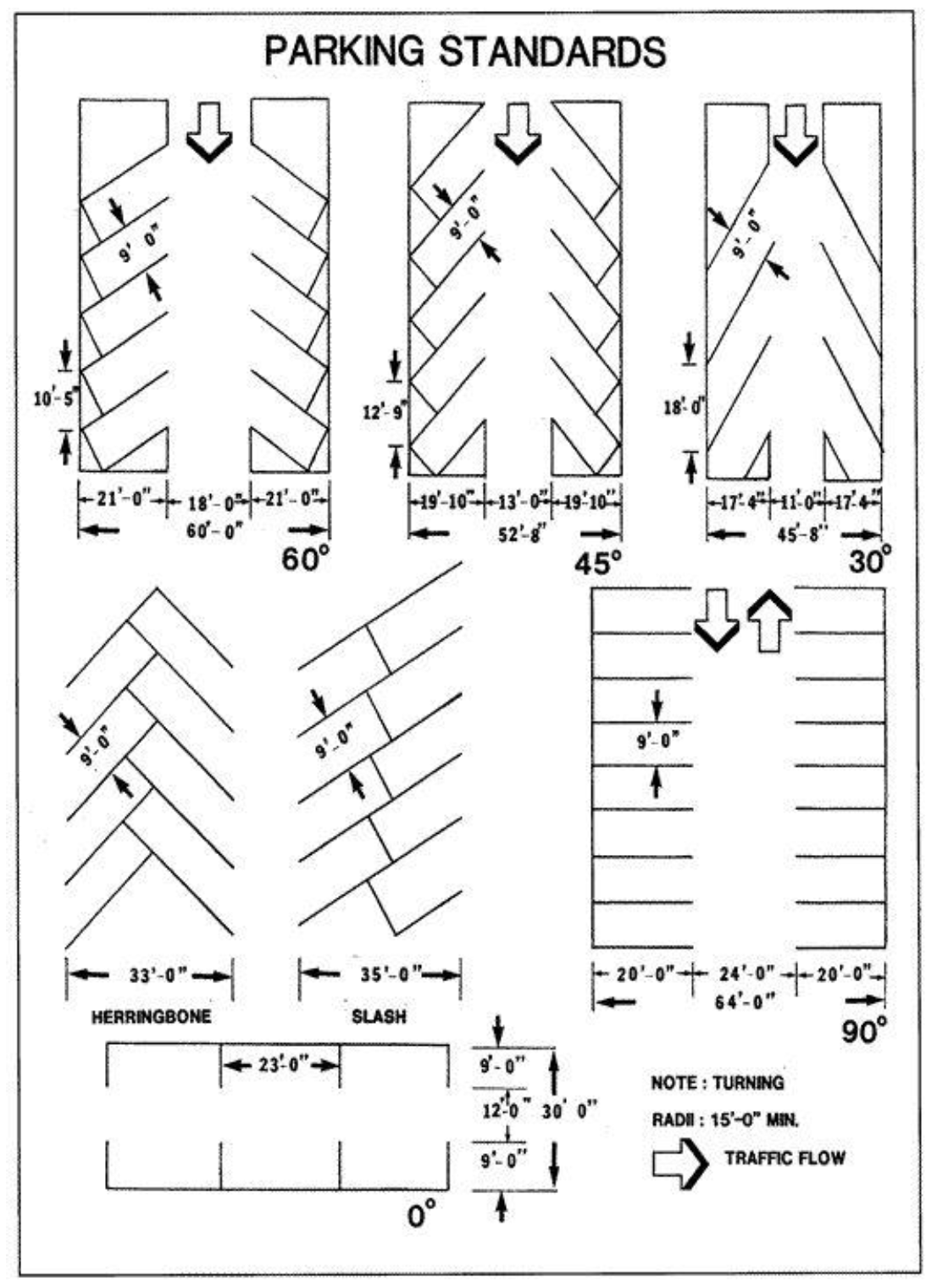
Parking Standards
5:9.9.6. Parking Requirements. Wherever off-street parking is required in district regulations, a minimum of two spaces per 1,000 square feet of gross floor area and not to exceed a maximum of three spaces per 1,000 square feet of gross floor area shall be provided on the same lot with the principal use, except as provided in section 5:9.9.3 (See above).
PARKING RATIOS - SEE TABLE BELOW
If the parking spaces are constructed of a pervious material the Zoning Administrator may authorize an increase up to 125% above the allowable parking space maximum.
The zoning administrator may authorize a 50% reduction from the minimum number of parking spaces required if it is demonstrated that fewer spaces are needed. The zoning administrator may waive the minimum requirement in the Central Business District for new developments or re-developments provided the parking ratios (see below table) include existing parking. The resulting on-street parking must [be] consistent with the Central Business District guidelines, Section 7:13.
5:9.9.7. Lighting. All parking lot and merchandise display area lighting fixtures, other than floodlights permitted under [Section] 5:9.9.8 (see below) herein, shall be cutoff fixtures and shall be mounted at a height not greater than 32 feet above finished grade. Lighting levels in a parking lot shall not exceed 20 foot-candles, and merchandise display area lighting shall not exceed 30 foot-candles, initial level.
5:9.9.8. Flood Lighting. All flood lights shall be installed with the fixture aimed downward at least 45 degrees below horizontal. Flood lights shall be orientated or shielded so that the source of the light is not visible from the road right-of-way or from any residential use.
5:9.9.9. Alternative parking surfaces. Up to 125 percent of the required parking areas for office and commercial buildings may be constructed using grass over supporting plastic or concrete grids, or any other pervious surface as approved by the City of Fountain Inn to help reduce the amount of impervious surface on the site. The alternative parking surface should be installed according to the manufacturer's installation instructions.
5:9.9.10. Vehicular Access. Vehicular access shall be provided internally between all uses, drives and parking areas.
(Ord. No. TX 2016-001, § 1(Att. 1), 8-11-16)
Section 5:9.10. - Landscaping of parking area.
Intent: This section is established to reduce the adverse visual, environmental, and aesthetic effects of parking lots, drives, and loading areas by the use of trees and other plant materials. Landscaping will enhance the appearance of the development, provide shade to reduce heat and glare from paved surfaces, reduce storm water runoff, filter pollutants and reduce the formation of ozone and evaporation of nitrous oxides into the air, and reduce the glare of headlights and noise on surrounding properties.
5:9.10.1. Plan Submittal Requirements.
Landscaping plan required contents: Prior to the issuance of an occupancy permit for any development, a specific landscape plan, at a scale of not less than one inch equals 50 feet, shall be submitted to the building and zoning division for approval and shall contain existing and proposed landscaping, including:
• The location, botanical name and common name, size in diameter one-half foot above grade, and height of new trees to be planted, which must comply with this code.
• The location, botanical name and common name, size in diameter 4½ feet above grade, and estimated height of existing trees, which are to be maintained or preserved for credit as per the requirements of this code.
• The location and dimensions of parking lot buffer areas and other planting areas.
• The size, botanical name and common name and spacing of plant materials.
• The location and design of any fence, wall, or earthen berm indicating size, dimensions and materials.
• The location and description of any barriers required to be erected to protect any existing vegetation from damage as required in section 5:9.10.5 (see below).
• Provisions for watering and other long-term maintenance to assure serviceability, soil stabilization, and plant protection.
5:9.10.2. Roadside Buffers. All new off-street parking lots, regardless of size, located adjacent to existing public right(s)-of-way shall establish roadside buffers. Roadside buffers shall be located outside of the rights-of-way of existing roads and shall be located outside the future rights-of-way of all roads in the GPATS Long Range Plan.
A.
The minimum roadside buffer width shall have an average planting width of eight feet, with the minimum width for any buffer yard being (5) feet. Buffers shall contain the following plant materials:
An average of one medium or large shade tree for every 40 feet of linear road frontage. Trees shall be spaced so that there is a minimum of one tree for every 200 linear feet of road frontage. Shrubs spaced to provide a continuous evergreen screen within three years of installation.
B.
Within the buffer yard fences, walls, earthen berms, or any combination thereof may be used to meet the requirements of this section, so long as they are a minimum of 30 inches in height and provide a continuous opaque visual screen. Berms shall have a side slope no greater than 2:1.
C.
Where existing overhead power utility lines preclude sufficient space for a shade tree to grow, then two small trees shall be substituted for each required shade tree.
5:9.10.3. Interior Plantings. In addition to all other landscaping requirements, all new off-street parking lots with 20 or more spaces shall provide and maintain landscaped planting areas within the interior of, and adjacent to, the parking lot:
A.
Interior planting islands for medium shade trees shall have a minimum planting area of eight feet wide by 18 feet long.
B.
Interior planting islands for large shade trees shall have a minimum planting area of 16 feet wide by 18 feet long.
C.
In addition to the required trees and shrubs interior-planting areas shall be grassed or covered with mulch.
D.
All planting areas shall be protected from vehicular intrusion by the installation of curbing, and/or wheel stops.
E.
Perimeter and interior plantings must be planted with a minimum of one medium shade tree and two shrubs or small trees for every 2,000 square feet of vehicular use area, which includes parking spaces, aisles, driveways, and loading areas; or
F.
Perimeter and interior plantings must be planted with one large shade tree and two shrubs, medium shade trees, or small trees for every 4,000 square feet of vehicular use area, which includes parking spaces, aisles, driveways, and loading areas.
G.
Interior planting areas shall be designed within or adjacent to the parking area(s) as:
• Islands, located at the end of parking bays;
• Islands, located between parallel rows of cars;
• Driveway medians a minimum of eight feet in width;
• Intermediate islands; or
• A combination of the above
H.
Trees and shrubs must be planted within 20 feet of the vehicular use area to satisfy the interior planting requirements.
I.
The design size and shape of the interior planting areas shall be at the discretion of the owner; however, no parking space shall be:
• Located farther than 60 feet from the trunk of a shade tree;
• Separated from a shade tree by a building or other structure.
J.
Parking structures are excluded from interior landscape areas.
5:9.10.4. Planting Material Specifications.
A.
Large shade trees shall have a minimum planting size of two inches caliper.
B.
Small trees and multi-stem trees shall have a minimum planting height of six feet tall.
C.
Evergreen shrubs shall have a minimum installed height of 12 inches and a minimum height of 30 inches within three years of installation. All shrubs inside the sight triangle at points of ingress and egress shall not exceed 36 inches in height.
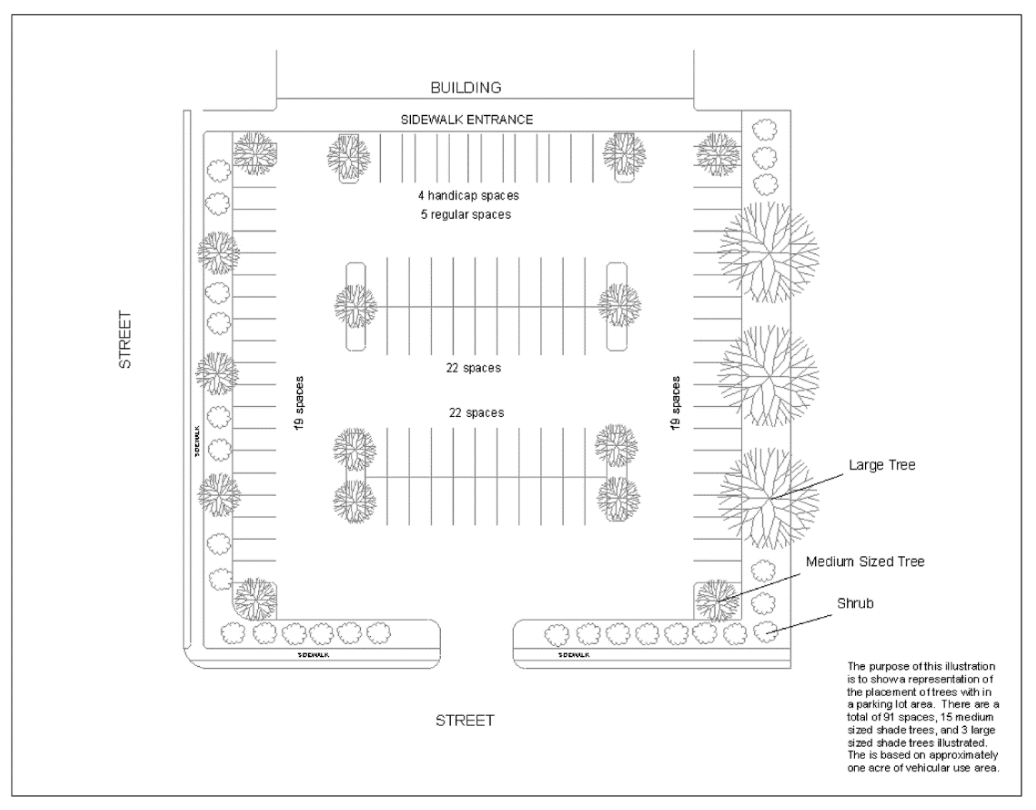
Figure 1. Interior Landscaping
5:9.10.5. Existing Trees. It is encouraged to use existing trees to meet the requirements of this section. If existing trees are preserved to meet the roadside buffer or interior planting requirements, a reduction in the new planting requirements will be given. Existing trees will be credited towards meeting the requirements of this section as follows:
Protection of Existing Trees. Any trees preserved on a development tract to receive credit shall meet the following protection standards. A root protection zone shall be established around all trees to be preserved. The root protection zone shall be clearly shown on all grading and site plans.
A.
Root Protection Zone - The land area around the base of a tree in which disturbances are prohibited in order to protect the roots of the tree and aid the tree's survival. The root protection zone shall be equal to one foot radius for every inch of tree diameter measured at a point 4½ feet above ground. Root protection zone measurements shall be rounded off to the nearest foot.
B.
Protective Barrier - A protective barrier shall be installed at the start of grading, and be located at the outer edge of the root protection zone. Protective barriers shall be posted as a "Tree Save Area". This procedure shall be incorporated as a note on the grading and erosion control plans. Protective barriers shall be constructed of a material resistant to degradation by sun, wind, and moisture and shall remain in place until all construction is complete.
C.
No storage of materials, dumping of waste materials, trenching, grading, fill, or parking of equipment shall be allowed within the root protection zone and no trespassing shall be allowed within the boundary of the root protection zone. Utility easements are not permitted, unless the Zoning Administrator deems that there is no alternative method.
5:9.10.6. Landscaping for Preexisting Parking Lots.
A.
Purpose and intent of section. The city recognizes the need to include in this article minimum landscaping requirements for preexisting parking lots. The city also recognizes that failing to bring nonconforming parking lots into conformance with this article not only jeopardizes the physical revitalization of the city, but also fails to equally provide the environmental benefits associated with living trees to all regions of the city. The practical effect of this section is to bring these preexisting areas into conformity with the regulations for the installation of trees and other plant materials in new developments.
B.
Preferred design standards. Although not required by this section, the preferred design of buffers and/or other planting areas for preexisting parking lot areas would be to install the required minimum number of trees and other plant materials, spaced evenly, in a buffer between the vehicular surface area and the public right-of-way. The plant materials used in the buffer yards should be designed to assure visibility and safety of pedestrians on the public street, as well as those within the parking lot.
C.
Application of section. Any preexisting parking lot area to which an expansion or addition is made shall be landscaped to meet the buffer yard and interior planting requirements of this section.
D.
Landscape requirements.
(1)
In order to achieve the desired results of this section, the minimum number of off-street parking spaces previously required by the City Code may be reduced by a maximum of 25 percent. No reduction in the required number of parking spaces shall occur without the prior approval of the zoning administrator, who shall first determine if the proposed reductions would cause or increase on-street parking congestion.
(2)
Expansions or additions to existing parking lots shall be subject to:
a.
Preexisting parking lots that occupy a corner lot, to which any expansions and/or additions are made and preexisting parking lots, to which expansions or additions of more than 25 percent are made, shall meet 100 percent of the buffer yard landscaping requirements for new development.
b.
All other preexisting parking lots, to which expansions or additions of 25 percent or less are made, shall be subject to 50 percent of the buffer yard landscaping requirements for new development.
(3)
Landscaped planting areas.
a.
All preexisting parking lots shall be required to provide and maintain landscaped planting areas within the interior of, and/or adjacent to, all portions of the parking lot. Each landscaped planting area shall contain a minimum area adequate to accommodate the most growth of the plant material used.
b.
Existing planting areas containing a minimum of 144 square feet and existing trees with a minimum caliper of one inch measured at a 4½ feet above grade may be used to meet the requirements provided that, should these existing trees become diseased, unhealthy, or die, they shall be replaced within one year with approved shade trees.
c.
All areas used for required buffer yards shall be located on the property. In unusual or extraordinary circumstances, as determined by the zoning administrator, public property or public right-of-way may be used to meet the requirements of this section, provided the property owner obtains permission from the city public works department and/or SCDOT. Maintenance remains the responsibility of the private property owner.
(4)
Interior planting areas shall be designed within or adjacent to the parking area as:
a.
Islands located at the end of parking bays;
b.
Islands located between parallel rows of cars, used to visually separate parking areas;
c.
Part of a continuous street yard planting;
d.
Driveway medians, which shall have a minimum width of four feet for medians with shrubs, six feet for medians with shrubs and intermediate trees and nine feet for medians with major deciduous or evergreen trees;
e.
Foundation plantings; or
f.
A combination of the items set forth in subsection (4)a—e.
g.
Provide drainage for planting areas, "Shade" trees can be used if adequate rooting medium Cornell Structural Soil, 'CU-Soil' is used.
(5)
Each interior planting area shall contain locally adapted trees and shrubs at the following rates:
a.
Trees shall be required at the minimum rate of one (1) medium shade tree for every 2,000 square feet, or portion thereof, of total preexisting parking lot or;
b.
One (1) large shade tree for every 4,000 square feet, or portion thereof, of total preexisting parking lot.
c.
Shrubs shall be required at the minimum rate of one shrub per 1,000 square feet, or a portion thereof, of total preexisting parking lot.
(6)
All planting areas shall be protected from vehicle damage by the installation of curbing, wheel stops, extra width in the buffer area or other method approved by the zoning administrator.
(7)
Shrubs in buffer yards shall be no less than 18 inches in height when installed and shall attain a minimum height of 30 inches as measured from either the adjacent right-of-way or the paved parking lot, whichever is higher in elevation. No more than 25 percent of the required shrubs may be deciduous.
(8)
Earthen berms may also be incorporated into the design of any required planting area. Any berm installed shall have a minimum side slope of no greater than two to one. Berms shall be planted with locally adapted species of shrubs, ground covers and/or other plant materials. However, shrubs planted on berms may have a lesser height, provided that the combined height of the berm and the plantings after three years is at least 30 inches high.
5:9.10.7. Landscaping for Loading, Outdoor Storage and Utility Service.
A.
In general, all loading, outdoor storage, and utility service areas established after the adoption of the Ordinance from which this section is derived and not screened by an intervening building or other screening shall be screened from view from public street rights-of-way(s) for their entire length, except for necessary access. The plant materials used for the screening of these facilities should be designed to assure visibility and safety of pedestrians on the public street, as well as those within the parking lot. The required screening in this section is in addition to any other screening required by this article.
B.
Loading areas, including garbage dumpsters and material storage areas. Screening for loading areas may be accomplished by:
(1)
A solid (opaque) fence or wall which is at least six feet high and is made of the same or compatible material as the material of the principal building. Additional plant materials shall be provided so that no more than two-thirds of the surface area of the fence or wall is visible from the street within three years of erection of the structure; and
(2)
Evergreen plant material, which can be expected to reach a minimum height of six feet within three years of planting. Any plant materials used to fulfill these requirements shall be a minimum of three feet in height when planted, and be spaced at intervals that guarantee complete visual screening within five years.
C.
Outdoor storage area. Screening for outdoor storage may be accomplished with the use of plant material, solid (opaque) fences, walls or earthen berms, or any combination thereof. Screening shall be in accordance with SCDOT sight-triangle requirements and/or those requirements in other sections of this chapter, to ensure public safety at all drive entrances and exits.
(1)
Screening shall be exclusive of driveways and sight triangles for safe automobile ingress and egress.
(2)
When fences and walls are used, they shall be of the same or compatible material as the material of the principal building. Additional planting materials shall be provided so that no more than two-thirds of the surface area of the fence or wall is visible from the street within three years of erection of the structure. Twenty-five percent of this plant material may be deciduous.
(3)
Any berms installed shall have a side slope of no greater than two to one, and shall be planted and covered with live vegetation.
(4)
All shrubs installed to satisfy the requirements of this section shall be locally adapted species expected to reach a minimum height of six feet within three years of planting. All shrubs shall be a minimum height of six feet within three years of planting. All shrubs shall be a minimum of 18 inches when planted. Vegetation planted on berms may have a reduced minimum mature height, provided that the combined height of the berm and the plantings shall be a minimum of six feet in height after three years. Twenty-five percent of all shrubs may be deciduous.
(5)
Screening for utility service areas may be accomplished by locally adapted evergreen plant materials, fences, walls, or a combination thereof.
(6)
Plant materials shall be a minimum of 18 inches in height when planted and are expected to reach a minimum height of six feet within five years.
5:9.10.8. Exceptions.
A.
Any lot used for the express purpose of automobile sales and storage is exempt from the landscaping requirements for interior plantings.
B.
Parking Structures (multi-level).
5:9.10.9. Owner Responsibilities and Maintenance. The owner, his successors, or assigns, are responsible for maintaining all required plant material in good health. Any planted trees which die or become unhealthy and are used to meet the provisions of this section must be replaced within one year with vegetation which conforms to the initial planting standards of section 7:10.
5:9.10.10. Prohibited Plant Material. Bradford pears, Pryrus calleryana, are prohibited as a plant medium for landscaping as it applies to this Ordinance. These trees have limbs that are easily damaged in the presence of high winds, heavy rains, and/or snowstorms. For this reason Bradford Pear trees are subject to premature replacement, and they are not a suitable tree for long term landscaping or buffering.
5:9.10.11. Suggested Plant Material List. This list is not intended to be all-inclusive, but does include common trees and shrubs suitable for use in this region. Professional expertise should be sought to determine the appropriate plant materials for any particular site when considering individual site, soil, moisture, and microclimate conditions.
Large Shade Trees
American Sycamore, Platanus occidentalis
Bald cypress, Taxodium distichum
Chinese Elm, Ulmus parvifolia
Cryptomeria, Cryptomeria japonica
Dawn Redwood, Metasequoia
Deodar Cedar, Cedrus deodara
Japanese Pagoda, Sophora japonica
Japanese Zelkova, Zelkova serrata
Laurel Oak, Quercus laurifolia
Littleleaf Linden, Tillia cordata
London planetree, Platanus x acerifolia
Schumard Oak, Quercus schumardi
Southern Magnolia, Magnolia grandiflora
Sweet Gum, Liquidambar styraciflua
Water Oak, Quercus nigra
White Ash, Fraxinus americana
White Oak, Quercus alba
Willow Oak, Quercus phellos
Medium Shade Trees
American Holly, Ilex opaca
American Hophornbeam, Ostrya virginiana
Amur Maple, Acer ginnala
Chinese Elm, Ulmus parvifolia
Chinese Pistache, Pistacia chinensis
Foster's Holly, Ilex x attenuata
Golden Raintree, Koelreuteria paniculata
Hedge Maple, Acer campestre
Japanese Crape Myrtle, (larger varieties) Lagerstroemia fauriei
Japanese Lighstrum, Ligustrum japonicum
Lacebark Elm, Ulmus parvifolia
Littleleaf Linden, Tillia cordata
Red Maple, Acer rubrum
River Birch, Betula nigra
Savannah Holly, Ilex x attenuate
Trident Maple, Acer buergerianum
Small Trees
American Holly, Ilex opaca
Amur Maple, Acer ginnala
Carolina Silverbell, Halesia Carolina
Chastetree, Vitex agnus-castus
Crabapple, Malus baccata
Crape-Myrtle, Lagerstroemia indica
Eastern Redbud, Cercis canadensis
Flowering Dogwood, Cornus florida
Golden Raintree, Koelreuteria paniculata
Japanese Maple, Acer palmatum
Kousa Dogwood, Cornus kousa
Kwanzan Cherry, Prunus serrucata
Pissard Plum, Prunus cerasifera
Saucer Magnolia, Magnolia soulangiana
Serviceberry, Amelanchier arborea
Yoshino Cherry, Prunus x yedoensis
Evergreen Shrubs
Azalea, Azalea obtusum
Carissa Holly, Ilex cornuta
Curlyleaf Ligustrum, Ligustrum japoninca
Dwarf Boxwood, Boxus sempervirens
Dwarf Buford Holly, Ilex cornuta
Dwarf Nandina, Nandina domestica
Dwarf Yaupon Holly, Ilex vomitoria
Harland Boxwood, Boxus harlandii
Hawthorn, Raphiolepis indica
Inkberry Holly, Ilex glabra
Japanese Holly, Ilex crenata
Otto Laurel, Prunus laurocerasus
Parsons Juniper, Juniperus davurica
Tamarix Juniper, Juniperus sabina
Schipka Laurel, Prunus laurocerasus
5:9.10.12. Variances. The Board of Zoning Appeals, pursuant to site hardships, may grant a variance. Adequate engineering, landscaping, and arborist plans and specifications are required.
(Ord. No. TX 2016-001, § 1(Att. 1), 8-11-16)
Section 5:9.11. - Off-street loading.
5:9.11.1. Requirements for Industrial and Wholesale Buildings. Every industrial and wholesale building hereafter erected shall provide space as indicated herein for loading and unloading of vehicles. The number of off-street loading berths required by this section shall be considered as the absolute minimum, and the developer shall evaluate his own needs to determine if they are greater than the minimum specified by this section. For purposes of this section, an off-street loading berth shall have minimum plan dimensions of 12 feet by 60 feet and 14 feet overhead clearance with adequate means for ingress and egress.
5:9.11.2. Design of Loading Spaces. Off-street loading spaces shall be designed so that vehicles can maneuver for loading and unloading entirely within the property lines of the premises.
5:9.11.3. Requirements for Commercial Uses. All retail uses and office buildings with a total floor area of 20,000 square feet shall have one off-street loading berth for each 20,000 square feet.
(Ord. No. TX 2016-001, § 1(Att. 1), 8-11-16)
Section 5:9.12. - Public access to property.
Every building hereafter erected or moved shall be located on a lot adjacent to and have access to a public street, highway, road, or other public way.
(Ord. No. TX 2016-001, § 1(Att. 1), 8-11-16)
Section 5:9.13. - Relationship of buildings to lots.
There shall be not more than one principal residential building and its accessory buildings on one lot, except as provided in Article 5.
(Ord. No. TX 2016-001, § 1(Att. 1), 8-11-16)
Section 5:9.14. - Projections into public streets and street rights-of-way.
No commercial signs or other structures shall project beyond any right-of-way line of any street. No shrubbery shall project into any public street right-of-way.
(Ord. No. TX 2016-001, § 1(Att. 1), 8-11-16)
Section 5:9.15. - Visibility at intersections.
On any corner lot on which a front and side yard are required, nothing shall be erected, placed, planted, or allowed to grow which obstructs sight lines between a height of 2½ feet above the crown of the adjacent roadway and ten feet in a triangular area formed by measuring from the point of intersection of the front and exterior side lot lines a distance of 25 feet along the front and side lot lines and connecting the points so established to form a triangle on the area of the lot adjacent to the street intersection.
(Ord. No. TX 2016-001, § 1(Att. 1), 8-11-16)
Section 5:9.16. - Height.
The following provisions qualify and supplement the specific height regulations set forth in Article 5.
5:9.16.1. Public and Semipublic Buildings. Hospitals, schools, churches, and other public and semipublic buildings may exceed the height limitations of the district if the minimum depth of rear yards and the minimum width of side yards required in the district regulations are increased one foot for each two feet by which the height of such public or semipublic building exceeds the prescribed height limit.
5:9.16.2. Other Structures. Chimneys elevators, poles, spires, tanks, towers, and other projections not used for human occupancy may exceed the district height limit.
(Ord. No. TX 2016-001, § 1(Att. 1), 8-11-16)
Section 5:10. - NC, Neighborhood Commercial District, and POD, Planned Office District.
5:10.1. NC, Intent. The intent of the NC district is to provide for convenient shopping areas and professional offices that meet the daily needs of the surrounding neighborhood. The requirements of this district are designed to ensure that the NC commercial development is aesthetically compatible with neighboring residential properties, and will not create a nuisance due to noise, traffic generation, lighting, or appearance. This district typically is located at the intersection of two collector streets or a collector street and arterial street in close proximity to developed residential neighborhoods.
5:10.2. Criteria to Consider When Rezoning Property NC.
A.
Approval of the NC zoning classification must not alter the existing development patterns within the area.
B.
It should be determined that NC district is the appropriate commercial district to provide for the convenience shopping needs of the neighborhood(s).
C.
The NC use must not put any undue burden on existing streets or utilities.
D.
Wherever possible, group development should be encouraged at intersections in an effort to concentrate NC uses and discourage sprawl and strip development.
E.
The NC zone shall be located on a collector or an arterial street.
5:10.3. Uses Permitted.
Offices, including financial institutions
Personal services establishments
Automatic Teller Machines
Bank, Saving, and Loan Association, or Similar Financial Intuitional
Barbershops and/or Beauty shops
Bed and Breakfast
Dressmaking and/or Clothing Alteration
Landscape Business
Dry cleaning and laundry pickup stations
Office - Business and/or Medical
Services carried out as home occupations
Recycling Drop Box
Shoe repair shops
Recycling Trailer
Tailoring
Residential Uses
Private day care centers - child/adult
Public and semipublic uses
Retail establishments
Bakery goods stores
Candy stores
Confectionery stores
Dairy products stores
Drugstores
Florists
Food stores
Gift shops
Hardware stores
Hobby shops
Newsstands
Novelty shops
Stationery shops
Restaurants
5:10.4. POD, Planned office district, Intent. This district is established to accommodate office development that is found to be compatible with surrounding physical development. Uses permitted in this district are limited to office and research facilities, and shall not include any use engaged in retail sales or the stocking and storage of merchandise.
5:10.5. Criteria to consider when rezoning property POD:
A.
Approval of the POD zoning classification must not alter the existing development patterns within the area;
B.
It should be determined that POD district is the appropriate office district compatible with surrounding physical development;
C.
The POD use must not put any undue burden on existing streets or utilities;
D.
Wherever possible, group development should be encouraged at intersections in an effort to concentrate POD uses and discourage sprawl and strip development;
E.
The POD zone shall be located on a collector or an arterial street;
5:10.6. POD, Planned Office Development, permitted uses.
Banks or similar financial institutions
Business incubator centers
Care facilities
Child/adult care centers
Day care centers
Day care centers in a church
Nursing care facility
Dwelling
Accessory, temporary
Multiple family
Single-family detached
Zero lot line
Gunsmith
Medical clinic
Offices
Business
Medical
Charitable
5:10.7. Uses permitted by special exception for NC and POD districts.
Governmental facilities and operations
Civic facilities
Home occupation
Post office
Recreation—Community area, public or private
5:10.8. Prohibited uses Mini storage units, taverns, drive-in restaurants, sexually oriented businesses, night clubs, video poker, tattoo parlors, body piercing, and package liquor stores are prohibited uses.
5:10.9. Height limitation No structure shall exceed a height of 35 feet, but no more than 30% higher than average building height for adjacent buildings.
5:10.10. Dimension requirements.
5:10.10-1. Front setback. All buildings and structures shall be set back from all street right-of-ways not less than 15 feet.
5:10.10-2. Side setback. No building shall be located closer than ten feet to a side lot line.
5:10.10-3. Rear setback. No building shall be located closer than 20 feet to a rear lot line.
5:10.11. Relationship of buildings to lots. One or more principal structures may be permitted on a single lot.
5:10.12. Off-street parking. No parking area to be located along frontage, or otherwise between building and road. Pedestrian access points will connect adjacent parking lots with pedestrian walkways and in accordance with the Commercial Design Standards, Article 7.13.4-2(D), Site Design and Relationship to the Surrounding Community.
Off-street parking requirements shall be provided in accordance with Article 7, Section 9.
5:10.13. Off-street loading. Off-street loading shall be provided in accordance with the provisions set forth in Article 7, Section 10.
5:10.14. Signs. Identification signs and business signs are allowed subject to review by the Planning Commission and provisions set forth in Article 6. No signs shall have flashing lights or movable display parts. The area dimensions of signs in the NC district shall not exceed those set forth for the NC district. The sign appearance should blend in with the residential character of the surrounding neighborhood.
Freestanding signs for single tenant commercial, office and residential uses shall meet the following requirements:
A.
Sign shall not exceed six (6) feet in height as measured above grade.
B.
Maximum sign face dimension shall be thirty-five (35) square feet.
C.
Maximum height for a group sign is twelve (12) feet and a maximum sign face dimension shall be eighty (80) square feet.
D.
Facade mounted signs shall not exceed 10 percent of the area of the facade upon which they are placed, with the maximum size of any one sign limited to fifty (50) square feet.
5:10.15. Screening and landscaping. Screening and landscaping are subject to the provisions in Section 5:1a, Sections 7:9.10, and 7:13.
A screening and landscaping plan shall be approved by the city planning commission. Screening shall be provided along the side and rear property lines. Landscaping shall be provided along street frontages. Natural landscaping may be counted toward this requirement.
5:10.16. Lighting standards. In addition to the provisions set forth in the Commercial Design Standards Section 7:13, lighting of horizontal tasks such as roadways, sidewalks, entrances and parking areas, fixtures shall meet IESNA "full-cutoff" (no light output above 90 degrees at any lateral angle around the fixture). Fixtures shall not be mounted in excess of sixteen (16) feet above finished grade. All other outdoor lighting such as floodlights and spotlights shall be aimed, located, designed, fitted and maintained so as not to present a hazard to drivers or pedestrians by impairing their ability to safely traverse and so as not to create a nuisance by projecting or reflecting objectionable light skyward, onto a neighboring property or onto a public roadway. Flashing lights are prohibited.
5:10.17. Pedestrian access. In addition to the provisions set forth in the Commercial Design Standards Section 7:13, pedestrian sidewalks and/or pathways must be provided on the site and shall provide safe, all weather, efficient, and aesthetically pleasing means of on-site movement and shall be an integral part of the overall site design concept. Pedestrian pathway connections to parking areas, buildings, other amenities, residential areas, commercial areas, and between on-site and perimeter pedestrian systems shall be planned and installed wherever feasible. All pathways and sidewalks shall be a minimum of five (5) feet in width, and paved. Sidewalks are required along all roadways and road right-of-ways.
5:10.18. Off-street parking. Off-street parking requirements are subject to the provisions in Section 7:9. In addition parking shall be provided at the time of the erection of any building, or at the time any principal building is enlarged or increased in capacity by adding dwelling units, guest rooms, seats, or floor area; or before conversion from one type of use of occupancy to another, permanent off-street parking space in the amount specified by this section. Such parking space may be provided in a parking garage or properly graded and improved open space. All portions of the required space, which are paved, shall be marked in accordance with the standards contained herein. Lines shall be visibly marked with paint.
5:10.18-1. Design of parking areas. Parking shall be located solely in the side or rear yard areas and excluded from the area between the public right-of-way and the front face of the building. The planning commission may permit parking between the public right-of-way line and the front face of buildings when it can be demonstrated that no other alternative exists.
5:10.18-2. Landscaping of parking lots. Off-street parking lot landscaping shall be provided in accordance with the provisions set forth in 7:9.10 Landscaping of Parking Area.
5:10.19. Design standards and architectural features. Non-residential building design in the NC and POD, districts must follow the provisions set forth in Article 7:13 Commercial Design Standards.
5:10.20. Requirements for NC and POD, office districts development and site plan review. This section lists the criteria by which NC, Neighborhood Commercial and POD, Planned Office Districts, are reviewed. Permitted uses must be in conformance with the zoning district requirements.
A site plan meeting the requirements of this section shall be reviewed and approved by the county planning commission staff prior to the issuing of permits (i.e. grading, encroachment, etc.). All site plan review approvals are valid for one year, whereupon if no permit has been issued, a new site plan review will be required. Provided, however, approved site plans for the zoning districts covered under this Section; NC and POD, are subject to the provisions of the city's Vested Rights Ordinance.
5:10.20-1. Application for site plan review. All applications for development in the NC, Neighborhood Commercial and POD, Planned Office Districts, shall be made to the office of the county planning commission. The application fee of $75.00 shall accompany the application. The county planning commission staff shall provide the applicant or his designated representative with an adequate number of public notice plan review signs to allow the applicant or his designated representative to properly post and maintain on the property a notice of public hearing at least 15 days prior to the date of the city planning commission hearing. The city planning commission may authorize the planning staff to review and approve site plans. At the discretion of the planning staff or in the case of an appeal of the decision of the planning staff, the city planning commission will act on the application. In this case, the county planning commission staff shall submit a written review and recommendation of the application to the city planning commission. The city planning commission will evaluate the staff's recommendation in its consideration of the application. The city planning commission may impose additional or more restrictive requirements if it is determined that it is within the best public interest.
Before the planning staff makes a recommendation to the planning commission, it shall determine the following:
A.
That the spirit of the zoning district shall not be violated.
B.
That the proposed development will be in harmony with existing developments.
C.
That the proposed development will be a desirable addition to the physical pattern of the neighborhood.
D.
That the design be such that additional traffic will not be a burden on existing streets.
E.
That no adverse environmental impacts will be created by the proposed development.
F.
That the visual appearance of the development will be in harmony with the existing development.
G.
That the architectural character blends with the surrounding area.
5:10.20-2. Site plan submittal requirements. Two reproducible copies of the site plan meeting the requirements of this section must be submitted to the planning commission office. No building permit shall be issued until site plans have been reviewed and approved by the planning commission following the process outlined in Section 5:10.
In order to ensure proper and expeditious review, the site plan must meet the following criteria:
A.
The site plan must be drawn to a scale of not less than 100 feet to 1 inch by a registered engineer/surveyor of the state of South Carolina;
B.
A vicinity map, title block, scale, north arrow, site size, and property line survey;
C.
The location of any utility easements;
D.
The land use for every part of the site and the number of acres devoted to each use;
E.
The site's traffic circulation plan, including the location of curb cuts and points of ingress/egress, and also including the location and width of all streets, drives, medians, service areas, dumpster pads, entrances to parking areas, etc.;
F.
The site's parking plan, including all off-street parking, loading/unloading areas, and structures, and also including all parking spaces and their dimensions;
G.
Storm water management and sedimentation and erosion control plans, which must be submitted to the county soil and water conservation district;
H.
The site's sign plan, which includes all exterior signage of the development;
I.
The site's lighting plan, including the location, height, and type of all exterior light fixtures;
J.
If applicable, the location of all proposed nonresidential buildings or structures, their general exterior dimensions, and gross square footage;
K.
If applicable, the location of all proposed residential structures, their general exterior dimensions, the number of residential dwelling units by type, and the number of the bedrooms in each unit;
L.
If applicable, the site's pedestrian circulation plan, including the location of all sidewalks, paths, trails, etc., and the dimensions thereof;
M.
The screening and landscape plan for the site; including the location, size, and type of plant material;
N.
Specifications indicating the proposed treatment or improvements to all open space areas and the delineation of those areas proposed for specific types of developed recreational activities;
O.
Elevations of proposed development; and
P.
Perspective sketch indicating colors and materials of all structures and screening.
The applicant shall submit a report setting forth the characteristics of the proposed Neighborhood Commercial and Planned Office Districts including the following:
1.
A statement addressing plans for all existing structures on the subject property, including but not limited to planned exterior renovations or demolition.
2.
A statement addressing the architectural style of existing and proposed buildings.
3.
A statement concerning the appearance, landscaping, screening, and maintenance of any proposed pond, lake, or retention pond contained in the development.
4.
Any such information or descriptions as may be deemed reasonably appropriate for review.
5:10.21. Non-residential uses. Commercial and office uses may be permitted in the NC, Neighborhood Commercial and POD, Planned Office districts subject to the following requirements.
Non-residential uses including group commercial establishments and offices may not exceed a total of 10,000 square feet for NC, Neighborhood Commercial Districts.
5:10.22 Residential uses. Residential uses are permitted subject to the provisions in Section 5.1 and 5.2 residential districts, and the following requirements:
A.
Residential dwelling units may be located in the same building as an office or commercial use permitted in the district;
B.
Maximum residential density is 10 units per acre based on the total project area.
5:10.23. Building and occupancy permit. No permits shall be issued for any building or occupancy until a development plan has been approved by the city planning commission.
5:10.24. Annual review. After a period of one year from the date of the NC and POD application, the zoning administrator shall review and report the status of the approved NC and POD development to the city council. If significant progress is not demonstrated at that time, the zoning administrator shall advise the city council of his findings.
(Ord. of 9-14-06; Ord. of 7-10-2008)
Section 5:11. - Landscaping Buffer Yards and Detention Ponds.
Buffer Transition Yards. The buffer transition yard is a landscaped area designed to provide separation and screening between land uses of different impacts.
5:11.1. Determination of buffer transition yard requirements. To determine the buffer transition yard required between two adjacent land uses; the following procedure shall be followed:
a.
Identify the proposed new or expanding land use and each existing adjacent land use. Identify the land use impact of each of these identified uses as set forth in Table 1 below. A proposed land use is considered existing on an adjacent property when a building permit is issued for the use. If adjacent property is vacant, and no building permit has been issued for its use, its use shall be determined by assigning it the highest level of impact in its zoning classification.
b.
Determine the type of buffer transition yard required on each boundary (or segment thereof) of the subject parcel by referring to Table 2 below. The letter designations in the table refer to the type of buffer yard required.
c.
Identify the buffer transition yard width and planting requirements for the required yard type as set forth in Table 3 below.
This process must be applied to each property line, except where the requirements of Section 7.9.10 concerning landscaping of a parking area apply.
5:11.2. Location.
a.
General. Buffer transition yards shall be located on the property of the proposed or changing land use that is to be screened. Such transition yards shall be located between the property line and any vehicle use areas, buildings, storage, service areas, or other areas of a activity on the property to be screened and shall extend along the entire property line abutting the less intensive land use. Roadside Buffers are subject to the requirements set forth in Section 7:9.10 Landscaping of Parking Area. Ornamental entry columns and gates, flagpoles, lamp or address posts, mailboxes, approved driveway openings, public utility wires and poles, fences, retaining walls, or similar structures are permitted in required buffer transition yards, provided that the general separation of land uses is achieved and that the total number of required plantings is still met. Plantings shall not obstruct the view of motorists using any road, driveway, or parking aisle.
b.
Planting/screening in easements. No vegetative screening or fencing that is required by this section shall be planted inside utility and/or drainage easements, excluding overhead easements, without the consent of the easement holder. If plantings or fences inside utility and/or drainage easement areas are allowed, these plantings and fences shall be maintained in accordance with the terms of consent and any applicable maintenance provisions. Any tree planted within the right-of-way of overhead utility lines shall be a small-maturing tree. Required buffers including plant material that contain a utility easement must be reviewed and approved by the Fountain Inn Planning Commission.
c.
Buffer transition yards and required yards (setbacks). Where front, side, or rear yards (setbacks) are required by this chapter, buffer transition yards may be established with such setbacks. If the setback requirement is less than the buffer transition yard requirement, the buffer transition yard width requirement shall prevail.
5:11.3. Land Use Impact Table 1.
*
Denotes required buffer for the outer perimeter of the entire contiguous site abutting any public right-of-way.
5:11.4. Buffer transition yard types.
BUFFER TRANSITION YARD TYPES REQUIRED - TABLE 2
5:11.5. Buffer transition yard description table. All proposed material planted to meet the descriptions set forth in the table below may be equally spaced in a staggered formation along the length of the required landscape buffer or placed so as to create 100 percent opacity at plant material maturity.
BUFFER TRANSITION YARD STANDARDS - TABLE 3
All existing healthy trees retained in buffer areas, can be credited toward meeting the buffer yard requirements
All buffer widths greater than fifteen (15) feet must be rounded up to the next whole number.
5:11.6. Buffer Yard Reductions. Below are listed ways by which the width of a required buffer transition yard may be reduced. Notwithstanding any of the provisions set forth in this section, no property on which a buffer transition yard is required shall have such a yard that is less than ten feet in width. The Fountain Inn Planning Commission may reduce the width of the buffer if it prevents the applicant from meeting the dimensional requirements of the zoning Ordinance.
a.
Fences. The addition of a closed wooden fence in the required transition yard allows reduction of the required width of the applicable buffer transition yard by 50 percent if said fence meets the following standards:
1.
Height and Arrangement. The fence must be a minimum of eight feet in height, measured on the side facing away from the property to be screened. Such fence must also have its finished side facing away from the property to be screened the fence shall be solid and opaque, and shall include provision for access to all landscape materials.
2.
Materials. Rot-resistant wood is the acceptable material. Chain link fencing does not meet buffer yard standards. Materials used should be consistent with materials, other than chain link fencing, commonly used in surrounding neighborhoods.
3.
Required Plantings. The number of required trees and shrubs is reduced by 50 percent in a buffer yard in which a fence is installed. At least one-half of the required plantings shall be installed and maintained on the side facing the less intensive use.
4.
Construction. The buffer fence installation shall be incorporated as early as possible in the sequence of construction.
b.
Masonry Walls. The addition of a masonry wall along the length of the required buffer yard allows reduction of the required width of the yard by 50 percent and the amount of required plantings by 50 percent, if said wall meets the following standards:
1.
Height: The wall must be a minimum of six feet in height measured on the side of the wall facing away from the property to be screened.
2.
Materials. Materials shall be brick, stone, stucco, or textured block. The exterior surface of the wall shall not be of cinder block.
3.
Required Plantings. If a masonry wall that meets the above standards is installed, the planting of shrubs shall be optional and not mandatory, and small-maturing trees may replace one-half of the required shade trees. The requirement that one-half of the buffer yard's trees shall be evergreen still applies.
5:11.7. Buffer Material Specifications.
1.
Large shade trees shall have a minimum planting size of two inches caliper.
2.
Small trees and multi-stem trees shall have a minimum planting height of six feet tall.
3.
Evergreen shrubs shall have a minimum installed height of 24 inches and a minimum height of 36 inches within three years of installation. All shrubs inside the sight triangle at points of ingress and egress shall not exceed 36 inches in height.
a.
Trees.
1.
Size. Except as provided above under subsection 5:11.6, trees planted in a buffer transition yard shall be large shade trees unless within 15 feet of an overhead power line, in which case small maturing trees that will not exceed 15—20 feet in height at maturity shall be used.
2.
Species. One-half of the required trees shall be locally adapted evergreen species.
3.
Distribution. Trees shall be distributed throughout the yard so as to minimize gaps between them. Trees counted to meet the required number shall be spaced at least eight feet apart.
b.
Shrubs. All shrubs are to be evergreen and shall have a minimum installed height of 12 inches and a minimum height of 30 inches within three years of installation.
Detention and Retention Area Buffer Requirements. Detention and retention areas shall be screened to make them aesthetically attractive. In addition to fencing requirements set forth by DHEC, fencing shall be black ornamental fencing where visible from any public or private right-of-way or a residence. Alternative fencing may be approved by the Fountain Inn Planning Commission as long as it meets the intent and spirit of the Ordinance. Detention and retention areas shall be screened by an evergreen vegetative hedge capable of forming a continuous opaque screen, with individual plantings spaced not more than five feet apart. This screening is to be maintained by the owner of record. In all cases, screening must not restrict access for maintenance and emergency vehicle purposes.
Maintenance responsibility for buffers and screening. In order for any buffers or screening to fulfill the purpose for which it was established it must be properly maintained. The owner of the property where buffers or screening is required will be responsible for the maintenance of all buffers and screening materials. Any required plant materials such as shrubs and trees which may die must be replaced in compliance with the minimum standards of this section and fences or walls should be repaired. The zoning administrator may reduce or waive the requirement that plant materials be replaced if the buffer or screening which remains effectively buffers or screens the site. All buffers, screening and landscaping areas must be protected from damage by motor vehicles or pedestrians which could reduce the effectiveness of the screening.
The aforementioned landscaping buffer yard and detention pond requirements shall be in accordance with Chapter 20 Trees and Shrubs, Fountain Inn Code.
(Ord. of 8-17-06)
Section 5:12. - GCO, Gateway Corridor Overlay District.
Purpose and intent: The Gateway Corridor Overlay District has been created to encourage well planned, attractive development along Fountain Inn's Highway 418 gateway corridor that promotes safety for all modes of transportation, enhances the historical nature of the community, strengthens and stabilizes property values, creates and upholds a distinctive gateway character, and accommodates future expected growth in a way that is consistent with the SC 418 Corridor Plan and the City's comprehensive plan.
5:12.1. Location and Applicability: The Gateway Corridor Overlay District is a special public interest district encompassing a particular geographic area that does not coincide with the boundaries of its underlying zoning districts and is identified on Fountain Inn's Official Zoning Map. It includes all properties contiguous to SC Highway 418 lying between the intersection of Interstate 385 and Highway 418 and continuing to Walker Street. The boundaries of the overlay district shall be measured from the edge of the right-of-way to a depth of three hundred (300) linear feet. Unless otherwise noted, the requirements of the Gateway Corridor Overlay District apply to all commercial, service, office, multi-family, and mixed-use development and are in addition to the requirements of the underlying zoning district. Where the requirements of the underlying zoning district and the overlay district are in conflict, the more restrictive requirements will apply.
5:12.2. Uses Permitted: The overlay district provisions apply to any underlying zoning district (but not including single-family residential) set forth in this Ordinance that exists within the overlay district. All uses permitted by right in the underlying zoning district shall be permitted by right in the Overlay District, subject to the requirements listed below.
5:12.2-1. The following land uses shall not be located within 2,000 linear feet of any existing land use of the same designation:
A.
Automobile service station.
B.
Billiard hall.
C.
Car wash.
D.
Dollar store.
E.
Liquor store.
F.
Mini warehouses.
G.
Nightclub.
H.
Pawn shop.
I.
Truck terminals, freight terminals, passenger terminals.
J.
Used car lot.
The required separation distance shall be measured in a strait [straight] line from the nearest point on the lot line of the property occupied by an existing use to the nearest point on the lot line of the subject property.
5:12.3. Uses Permitted by Special Exception: The overlay district provisions apply to any underlying zoning district (but not including single-family residential and industrial districts). Uses permitted by special exception in the underlying zoning district shall be permitted by special exception in the Overlay District.
5:12.4. Nonconforming Uses of Land and Structures: Land uses or structures located in the Gateway Corridor Overlay District that were legally in existence prior to the adoption of this ordinance may be maintained unchanged but are deemed to be nonconforming. Legal nonconforming uses shall conform to Article 7, Section 2 of this Ordinance.
5:12.5. Dimensional Requirements: Dimensions of lots and placement of buildings should promote visual continuity, encourage pedestrian activity and provide safe access. Buildings should face the street and be arranged so that they create and maintain a consistent uniform streetscape. Step-backs shall be used to permit sunlight and air access to lower-level buildings.
5:12.5-1. Front Setback. Front setbacks shall be a minimum of 10 feet and shall not exceed 20 feet.
5:12.5-2. Side Setback. Side setbacks shall be a minimum of 5 feet and shall exceed 12 feet on one side.
5:12.5-3. Rear Setback. Rear setbacks shall not be required except where property abuts a residential use. Then rear setback shall be a minimum of 10 feet and shall be increased by 1 foot per 3 feet of building height above 12 feet.
5:12.5-4. Lot Width. Lot width shall be 50 feet at a minimum.
5:12.5-5. Height Limitation. Building heights shall not exceed 4 stories or 45 feet except as provided in Article 7, Section 7.
5:12.5-1.1 Additional height exception. Hotels and motels may be erected to a height exceeding 45 feet, provided that the use is permitted in the underlying district and the required side and rear yards are increased by at least one foot for each one foot of additional building height above 45 feet. This regulation supersedes the regulation governing the number of stories in the particular underlying zoning district regulations.
5:12.5-1.2 Step-backs. Floors above the second floor shall be stepped back a minimum of 5 feet for the third floor (see Figure 1 below), and an additional 5 feet for floors above the third. The maximum step-back under this method shall not exceed 10 feet.
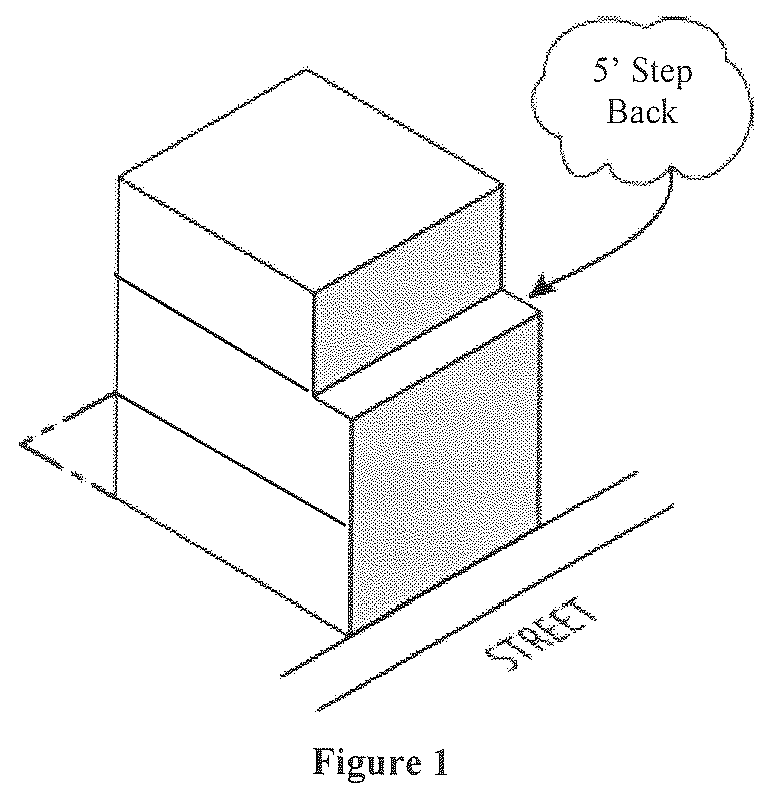
5:12.6. Parking: No parking area shall be located along frontage, or otherwise between building and road. Side and rear parking lots should be used when possible to promote pedestrian safety and accessibility and aesthetic continuity. Shared parking is encouraged to promote connectivity.
5:12.6-1. Off-Street Parking. Off-street parking shall be provided in accordance with the provisions set forth in Article 7, Section 9 in addition to the following:
5:12.6-1.1 Buildings located on corner lots shall not locate parking between the building and the road (see Figure 2 below).
5:12.6-1.2 Buildings located on corner lots shall not locate drive through lanes between the building and the road (see Figure 3 below).
5:12.6-1.3 A maximum of 20% of required parking or one double row, whichever is greater, may be located in one side yard (see Figure 2 below).
5:12.6-2. Roadside Buffer. A buffer yard shall be provided between all parking areas and the public right of way in accordance with Article 7, Section 9.12.
5:12.6-3. Shared Parking. Shared use of parking may occur when two or more uses on the same or separate sites face parking demands at different times. If two or more properties share parking, the Zoning Administrator may authorize a 25 percent reduction from the minimum number of parking spaces required for each property if there is a written agreement between adjoining landowners for shared parking as specified herein.
5:12.6-4. Accessibility. Parking shall be provided according to current standards required by the Americans with Disabilities Act.
5:12.6-5. Pedestrian Safety. Parking lots shall be designed to allow pedestrians to safely walk from their vehicles to building entrances and to any common areas by providing clearly defined and appropriately placed sidewalks, walkways, or pathways and marked cross walks.
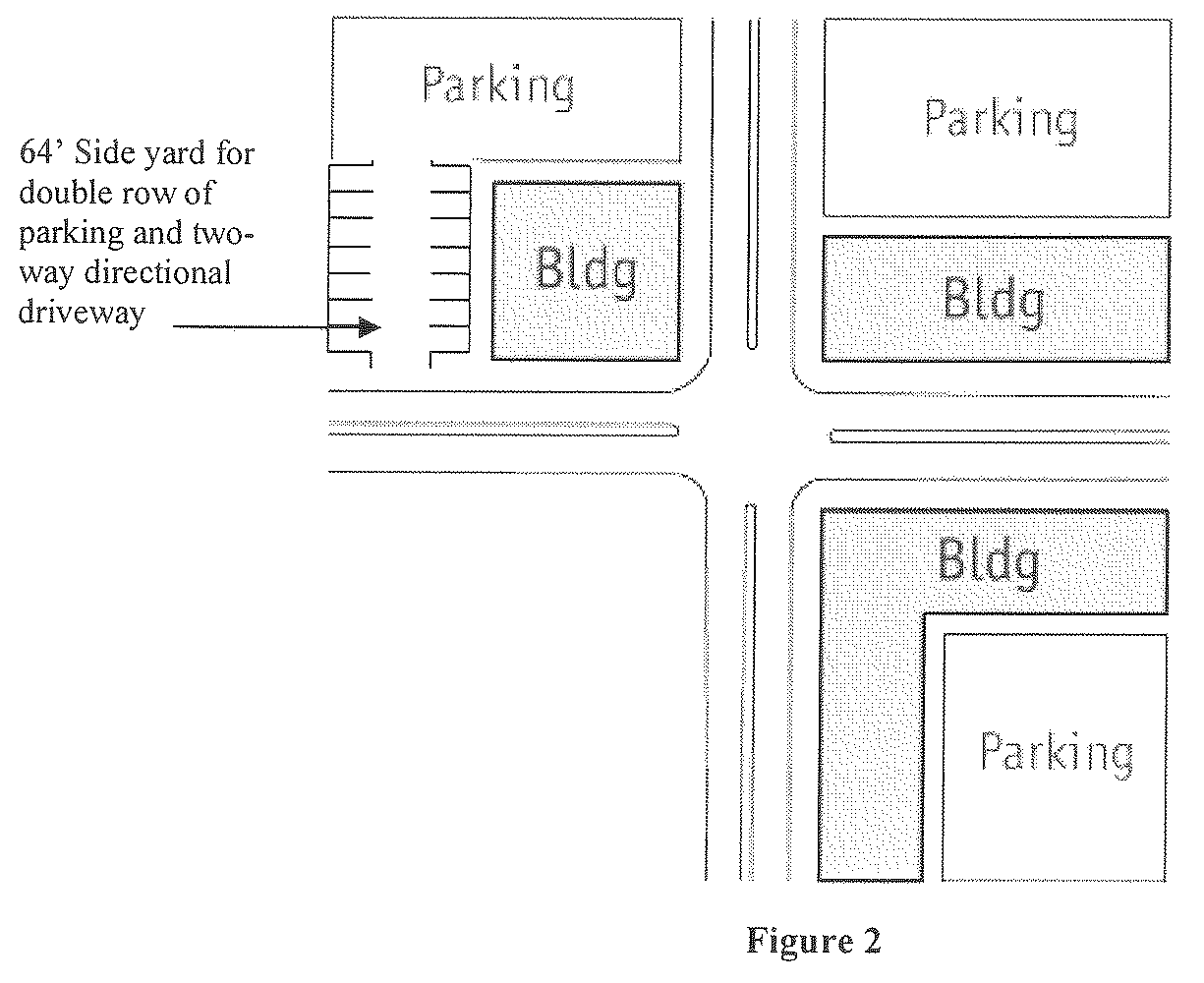
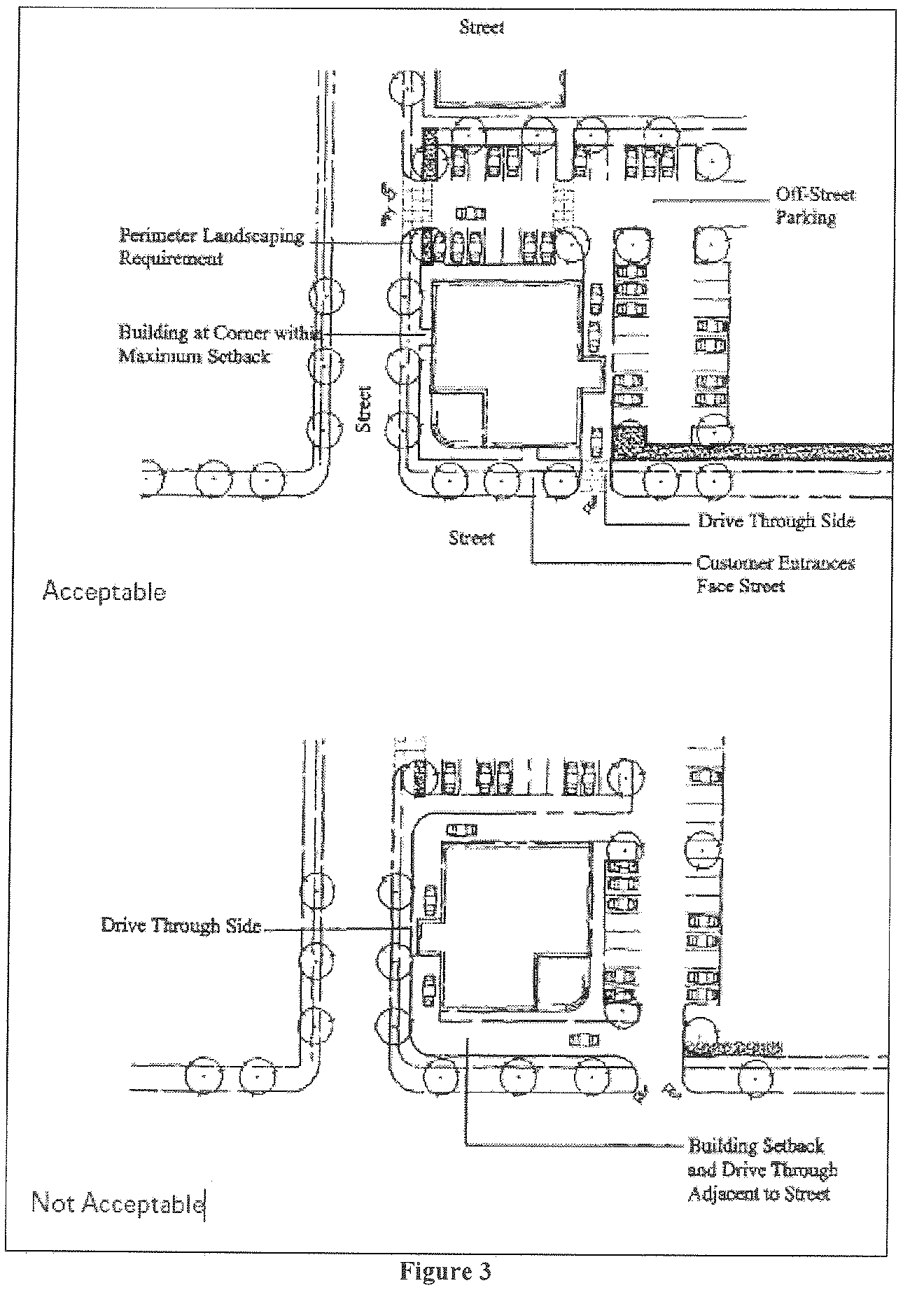
5:12.7. Landscaping: Parking lots are frequently used public spaces that should be treated as such by providing adequate shade and aesthetic dimension to promote users' safety and enjoyment. Landscaping as a screening device limits the negative impacts experienced by adjacent residential lots. Additionally, parking lot landscaping serves to minimize the storm water runoff created by large concentrated areas of asphalt.
5:12.7-1. Parking Lots. All developments with parking lots exceeding 10 spaces shall provide o of this Ordinance.
5:12.7-2. Rear and Side Screening. All non-residential lots abutting residential lots shall provide a buffer transition yard in accordance with Article 5, Section 11 of this Ordinance (see Figure 4 below).
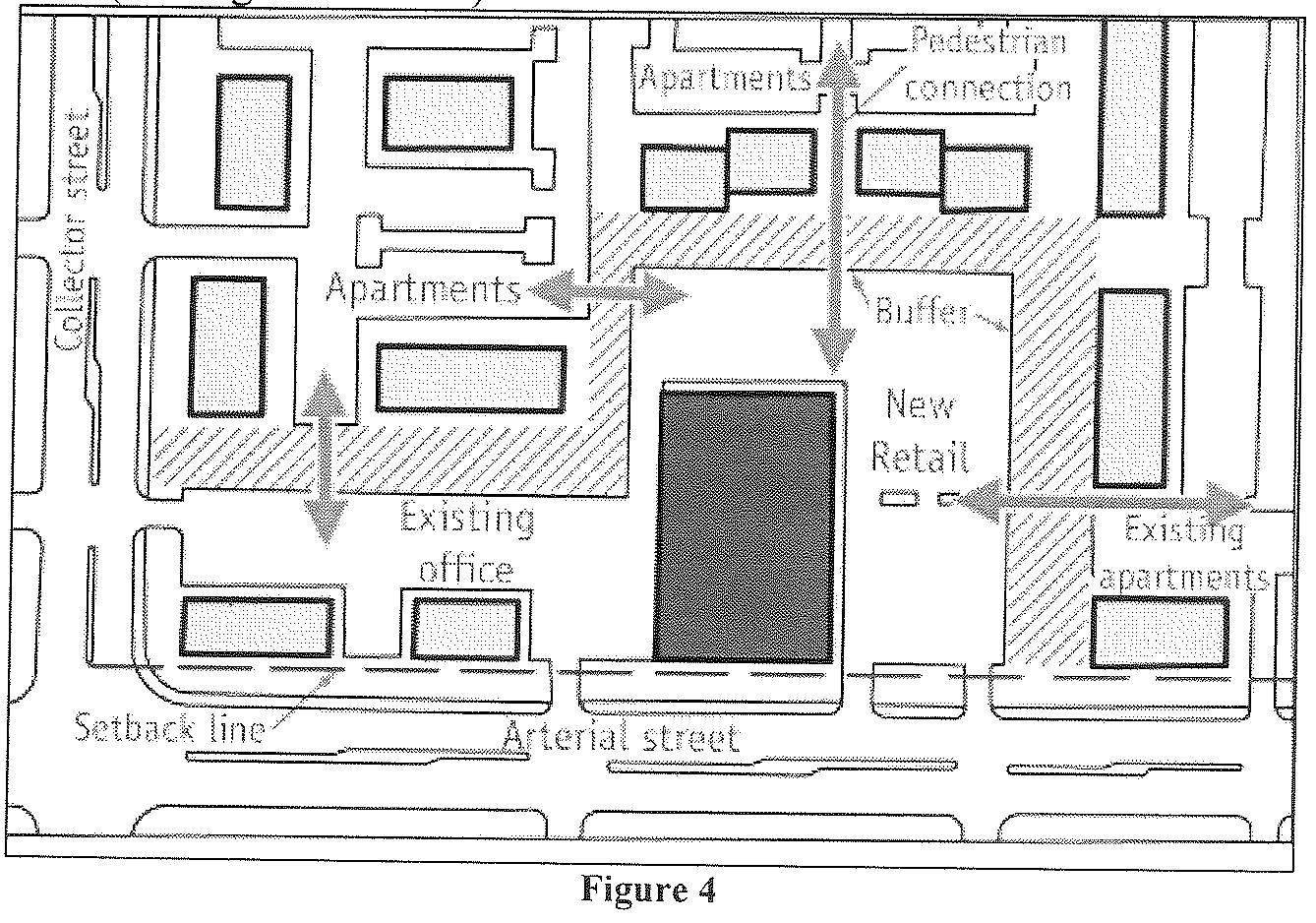
5:12.8 Vehicular and Pedestrian Connections between Sites: Well designed commercial corridors include vehicular and pedestrian connectivity between sites to create safe and comfortable access for users, reduce traffic congestion, improve safety, and to encourage the cohesive development of properties along the corridor.
5:12.8.1 All sites and developments shall be designed to provide private drive or public road connections to existing private drives or public roads on adjacent sites, or stub-outs to abutting properties if connections are not feasible.
5:12.8.2 Sidewalks shall be provided along both sides of internal public roads and private drives.
5:12.8.3 Sidewalks shall be provided to connect existing public roads and private drives to customer entrances.
5:12.9. Open Space: Open space is encouraged. However, in an effort to limit spacing between buildings and promote a walkable environment, the open space requirement for new developments is relatively low.
5:12.9-1. 10 percent of each property shall be preserved as open space (includes buffer yards, landscaped islands, accessible roof gardens, and detention areas).
5:12.10. Signage: To create a cohesive, aesthetically pleasing façade, permitted signage will be restricted to two signs per business: one wall sign or canopy sign, and one freestanding sign or decorative post sign. The use of these signage forms will help promote an inviting, pedestrian-friendly environment, while still allowing businesses to express individuality and creativity with their designs.
5:12.10-1. Materials. Sign materials shall be consistent with and integrated into the overall design of the structure(s).
5:12.10-2. Two of the following permanent signs per business shall be permitted:
5:12.10-3. Illumination. Indirect light sources must be shielded from the view of persons viewing the sign and be further shielded and directed so that the light shines only on the sign and that illumination beyond the copy area is minimized. Neon lighting and electronic message signs are exclusively prohibited.
5:12.10-4. Temporary Signage. Temporary signage shall not be posted for more than 30 consecutive days and shall not account for more than 10 percent of a building's façade.
5:12.11. Lighting: Standards will encourage adequate lighting to promote safety while limiting light pollution and minimizing glare. Light sources shall be used to promote true, "white lighting". Photometric plans shall be required for any newly proposed development to determine if the following standards have been met.
5:12.11-1. Height. Parking areas shall be lit to provide safety for the patrons utilizing the lot. Lighting shall be no greater than 20 feet in height and shall be directed to ensure no spillover lighting occurs on adjacent properties or public rights-of-way.
5:12.11-2. Type. Each outdoor luminaire shall be a recessed or a full cutoff fixture.
5:12.11-3. Canopy Lighting. Canopy lighting shall be recessed within the structure allowing the canopy edge to protrude below the surface area. Outdoor lighting installed on canopies or drive-thru facilities are permitted an average foot candle reading of 20 foot candles under any area that is illuminated.
5:12.11-4. Prohibited Lighting. The following lighting fixtures are prohibited: neon lighting, searchlights, laser source lights, flood lights, wall packs, or any similar high-intensity light, except in emergencies by police and fire personnel.
5:12.12. Architectural Features: Materials used shall be consistent with existing structures along the corridor as well as those fronting Main Street. The feel of the newly designed corridor should mimic the majority of existing commercial buildings that consist of quality materials, and pedestrian-focused features such as first-level transparency and embellishment, awnings, and overhangs.
5:12.12-1. No street-level building wall shall be blank; building facades facing public streets shall include a minimum of 40 percent embellishment of interest-creating features such as doors, display windows, murals, etc.
5:12.12-2. Materials. Exterior finish materials shall be limited to brick, natural stone, stucco, and/or, if approved by the City, wood or a synthetic material closely resembling outright approved materials. No aluminum or steel siding, non-architectural sheet metal, non-textured concrete block, vinyl, or EIFS shall constitute any portion of a building except trim.
5:12.12-2.1 The acceptable exterior finish materials shall also cover a minimum of two feet around the corners of the façade to achieve a fully finished edge (see Figure 5 below).
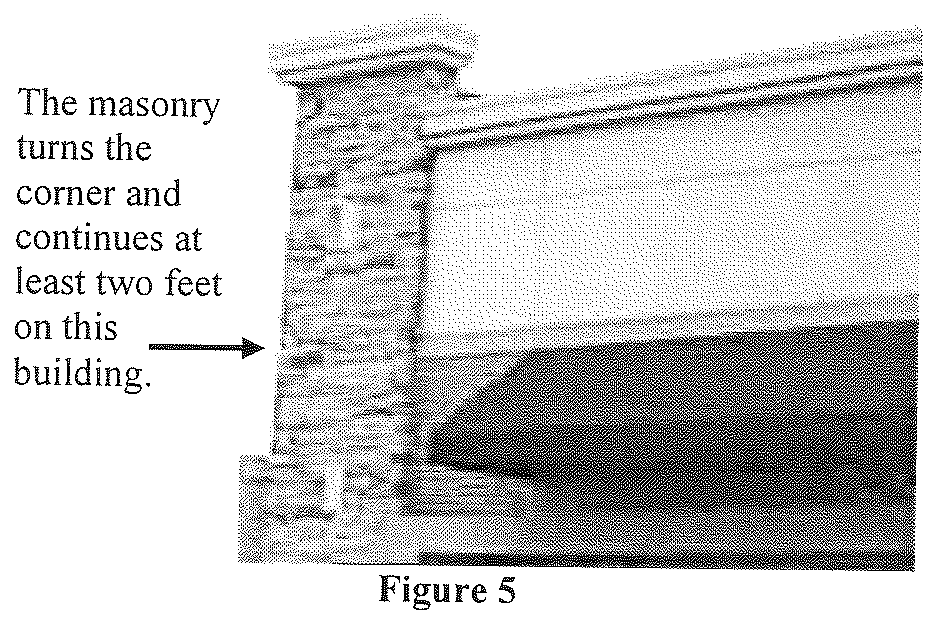
(Ord. No. ZTXT-2013-001, § 1(Exh. A), 5-9-13; Ord. No. TX 2021-2, § 1(Att. 1), 10-10-21)