
Franklin City Zoning Code
CHAPTER 1103
Definitions
1103.01 Definitions
Interpretation:
- For the purposes of this UDO, the following terms, phrases, words and their derivations shall be interpreted as follows:
- Words used in the singular shall include the plural, and the plural the singular;
- Words used in the present tense shall include the future tense;
- Words in the masculine gender shall include the feminine;
- The words “shall” and “will” are mandatory and not discretionary;
- The word “may” is permissive;
- “Person” includes a firm, association, organization, partnership, trust, company or corporation as well as an individual;
- “Used” or “occupied” includes “intended,” “designed” or “arranged to be used or occupied;”
- “Building” includes “structure” and “structure” includes “building;”
- “Dwelling” includes “residence” and “residence” includes “dwelling;” and
- “Lot,” “plot” and “parcel” are interchangeable.
- In case of any difference in meaning or implication between the text of this UDO and any caption or illustration, the text shall control.
- Terms not herein defined shall have the meaning customarily assigned to them.
In addition, as used in this UDO, the following definitions apply unless otherwise indicated:
“Acceptance of Application.” An application is not accepted by the City until all the information required for submittal is provided and verified by the Applicant.
“Acceptance of Public Way or Right-of-Way or Utility.” No public way, right-of-way, street, or utility (including, but not limited to, water and sewer) shall be considered accepted by the City until such improvements have been constructed, inspected by the City Engineer or his designee, and formally accepted, by ordinance, by Council.
“Accessory Facilities.” These uses are permitted in the Office-Research Park District. Such uses include facilities for custodial, gardening, maintenance and caretaker services for the buildings, structures, and grounds on the site. Such uses also include conference centers with temporary lodging, communication centers, training facilities, maintenance shops and machine shops.
"Accessory Structure." A subordinate and incidental structure detached from the principal building (such as detached garage or storage structure), located on the same lot. An accessory structure does not share a common wall or foundation with the principal building.
"Accessory Use." A use located on the same lot with a prinicpal use, which is subordinate and related to the principal use.
“Activity Space.” Floor space provided in a child-care facility that is designed, intended for use, or primarily used for open play or general care area.
“Adjacent Property.” For the purposes of this UDO, a subject property is adjacent to another property or a zoning district when it is contiguous to the other property, across the street from the other property, or across a railroad right-of-way from the other property.
“ADT.” Average daily traffic volumes of vehicles on a street.
“Adult Arcade.” Any place to which the public is permitted or invited where either or both:
- Motion picture machines, projectors, video or laser disc players; or
- Other video or image-producing devices are available, run via coin, token, or any form of consideration, to show images to five or fewer individuals at one time; and where the images shown and/or live entertainment presented are characterized by the depiction or description of specified sexual activities or specified anatomical areas.
“Adult Bookstore” or “Adult Media (Video) Store” or “Adult Novelty Store.” A commercial establishment that has 40 percent or more of its stock-in trade or inventory in, derives 40 percent or more of its revenues from, devotes 40 percent or more of its interior business or advertising to, or maintains 40 percent of its sales or display space for the sale or rental, for any form of consideration, of adult entertainment, adult media, or sexually oriented novelties or toys. The existence of other principal business purposes that do not involve the offering for sale, rental or viewing of materials exhibiting or describing adult entertainment, adult media, or sexually oriented novelties or toys and still be categorized as an Adult Bookstore, Adult Media Store or Adult Novelty Store so long as one of its principal business purposes is offering for sale or rental, for some form of consideration, such materials.
“Adult Cabaret.” A nightclub, bar, juice bar, restaurant, bottle club, or similar commercial establishment, whether or not alcoholic beverages are served, that regularly features any of the following:
- Persons who appear in a state of nudity or state of semi-nudity; or
- Live entertainment characterized by the depiction or description of specified anatomical areas or specified sexual activities; or
- Live entertainment of an erotic nature including exotic dancers, strippers, male or female impersonators, or similar entertainment; or
- Exhibiting films, motion pictures, video cassettes, video discs, DVDs, CDs, slides or other photographic or electronic reproductions, whether analog or digital, which are characterized by the depiction or description of specified sexual activities or specified anatomical areas.
“Adult Entertainment.” The sale, rental, or exhibition, for any form of consideration, of books, films, video cassettes, DVDs, CDs or other photographic or electronic reproductions, magazines, periodicals, or live performances that are characterized by an emphasis on the exposure or display of specified anatomical areas or specified sexual acitivity.
“Adult Entertainment Establishment.” An adult arcade, adult bookstore, adult novelty store, adult media (video) store, adult cabaret, adult motion picture theater, adult theater, nude or semi-nude modeal studio or sexual encounter establishment. An establishment in which a medical practitioner, psychologist, psychiatrist or similar profession licensed by the State of Ohio engages in medically approved and recognized therapy including, but not limited to, massage therapy, as regulated pursuant to ORC 4731.15, is not an Adult Entertainment Establishment.
“Adult Media.” Books, magazines, periodicals or other printed matter, or photographs, films, motion pictures, video cassettes or video reproductions, slides, DVDs and CDs, slides or other visual representations that are distinguished or characterized by an emphasis on the depiction or description of specified sexual activities or specified anatomical areas.
“Adult Motel.” A hotel/motel or similar commercial establishment that:
- Offers accommodations to the public for any form of consideration; and provides patrons with closed circuit television transmissions, films, motion pictures, video cassettes, slides, or other photographic reproductions which are characterized by the depiction or description of specified sexual activities or specified anatomical areas; and has a SIGN visible from the public right-of-way which advertises the availability of this sex oriented type of photographic reproductions; or
- Offers a sleeping room for rent for a period of time that is less than 10 hours; or
- Allows a tenant or occupant of a sleeping room to sub-rent the room for a period of time that is less than 10 hours.
“Adult Motion Picture Theater.” A commercial establishment where, for any form of consideration, films, motion pictures, videocassettes, slides, or similar photographic reproductions are regularly shown that are characterized by the depiction or description of specified sexual activities or specified anatomical areas.
“Adult Theater.” A theater, concert hall, auditorium, or similar commercial establishment that regularly features:
- Persons who appear in a state of nudity or semi-nudity;
- Live performances which are characterized by the depiction or description of specified anatomical areas, specified sexual activities, or
- Live entertainment of an erotic nature including exotic dancers, strippers, male or female impersonators, or similar entertainment.
“Agriculture.” Agriculture means farming; ranching; aquaculture; apiculture; horticulture; viticulture; animal husbandry, including, but not limited to, the care and raising of livestock, equine, and fur-bearing animals; poultry husbandry and the production of poultry and poultry products; dairy production; the production of field crops, tobacco, fruits, vegetables, nursery stock, ornamental shrubs; ornamental trees, flowers, sod or mushrooms; timber, pasturage; any combination of the foregoing; the processing, drying, storage and marketing of agricultural products when those activities are conducted in conjunction with, but are secondary to, such husbandry or production. Agriculture shall not be permitted in any residential zoning district with the following exceptions:
- The raising of fruit or vegetables for private use; and
- Limited agricultural uses permitted as-of-right in the R-1A, Estate Residential Districts for lots of two acres or more (see Section 1107.06(a)).
“Alcohol and Drug Addiction Treatment Facilities.” A licensed facility that provides inpatient treatment, including room and board, to individuals addicted to substances of abuse, including alcohol, legal drugs and/or illicit drugs, which treatment may include counseling, psychology, social work, psychiatry, internal medicine and the administration of medications for treatment purposes.
"Alcohol Production and Sales, Large.” A licensed building or property that produces more than 15,000 barrels per year whose primary purpose is to produce and sell alcoholic beverages for distribution and may include accessory commercial facilities such as a tasting room, restaurant, and event facilities.
"Alcohol Production and Sales, Small.” A licensed building or property that produces less than 15,000 barrels per year whose primary purpose is to produce and sell alcoholic beverages for distribution and may include accessory commercial facilities such as a tasting room, restaurant, and event facilities.
“Alteration.” Any change, addition or modification in construction or type of occupancy; or any change in the structural members of a BUILDING, such as walls or partitions, columns, beams or girders, the consummated act of which may be referred to herein as “altered” or “reconstructed.”
“Antenna.” Any exterior transmitting or receiving device mounted on a tower, building, or structure and used in communications that radiates or captures electromagnetic waves, digital signals, analog signals, radio frequencies (excluding radar signals), wireless telecommunications signals or other communication signals.
“Antenna Support Structure.” Any building or other structure, other than a tower, that can be used for location of wireless telecommunications facilities
“Appeal.” A request for review of the interpretation of any provisions of these regulations or request a variance.
“Appeals Board.” The quasi-judicial board, appointed in accordance with the City Charter, which hears and decides variance applications, hears and decides appeals of any administrative zoning decision by any CITY official, and reviews and resolves disputes over the interpretation of this UDO, all as outlined in this UDO (Also known as the “Board of Zoning, Building and Housing Appeals”).
“Applicant (or owner).” The owner(s) of the property, or their designated representative(s), who applies for a certificate of zoning compliance, zoning amendment, subdivision, conditional use, variance, or other approval pursuant to this UDO.
“Application.” The process by which an applicant submits a request and indicates a desire to be granted approval under the provisions of this UDO. An application includes all written documentation, verbal statements and representations, in whatever form or forum, made by an applicant to the City concerning such a request.
“Approval Authority.” An official, organization, group, board or other authority designated to review and approve/disapprove applications.
“Aquifer.” A geologic formation, group of geologic formations, or part of a geologic formation that contains enough saturated permeable material to yield significant quantities of water.
“Architect.” A person registered to engage in the practice of architecture under the provisions of ORC 4703.
"Artist Studio and Gallery.” A commercial establishment that provides, as its primary activity, goods produced on the premises for retail sale to the general public on the premises. Such use is completely enclosed in a building and does not use equipment that would cause noxious effects, such as smoke, odor or noise that would be deterred on surrounding properties. Such uses include but are not limited to art studios and pottery shops.
“Assembly Space.” Floor space provided in a building that is designed, intended for use, or used primarily for group assembly, including space with both fixed and movable seating.
“Assisted Living and Skilled Nursing Care.” A residential facility, other than a single-family home, for the aged or infirm, or any other reasonably independent individual in need of limited care, that provides health monitoring services and assistance with daily activities (such as taking medicine, meals, dressing, grooming, and bathing) and may provide other services (such as recreational, social, educational and cultural activities, transportation and financial services) and which is not equipped for surgical care or for treatment of acute disease or serious injury, and is not primarily designed for patients being treated for mental illness or alcohol or drug addiction.
“Authorized Agent.” An official, organization, or group designated to provide technical guidance in the development and implementation of site development plans and/or stormwater pollution prevention plans and to review and approve/disapprove such plans as authorized.
“Automobile.” See Automobile Fueling/Charging Station, Motor Vehicle, and Vehicle.
"Automobile Fueling/Charging Stations.” An establishment where liquids used as motor fuels or alternative fuel, power or energy is sold at retail to the public and deliveries are made directly into or onto automobiles. The sale of fuel, power, or energy shall be the primary use of the property. Retail grocery or convenience store sales are permitted. Such use does not include facilities designed for the fueling of semi-trailer trucks.
"Automobile Sales/Rental.” The use of any building, or part thereof, land area or other premises for the display and/or retail sale, lease or rental of new or used vehicles including motor vehicles, motorcycles, recreational vehicles, boats and farm implements. Secondary supporting uses may also exist upon the same site, such as maintenance/repair service areas, parts storage areas, and financial services areas, which activities shall be conducted within a completely enclosed area. Such use shall not include vehicle wrecking or junk business. Automobile sales/rental shall not include accessory self-service storage facilities or mini-warehouses.
"Automobile Service/Repair, Heavy.” An establishment where repair of construction equipment, commercial trucks, automobiles, and similar heavy equipment, including major engine and transmission repairs are conducted.
"Automobile Service/Repair, Light.” An establishment engaged in the minor repairs to any vehicle, including repairs and replacement of cooling, electrical, fuel, and exhaust systems, brake adjustments, relining and repairs, wheel alignment and balancing, and repair and replacement of shock absorbers.
“Automobile Washing Facility.” A facility for washing, cleaning, drying, and waxing of passenger vehicles, recreational vehicles, or other light duty equipment. An automotive washing facility may be self-service or full service.
“Awning.” A hood or cover that projects from the wall of a building and which can be retracted, folded, or collapsed against the face of the supporting building.
“Bar, Lounge, or Tavern.” A commercial establishment that provides, as its primary activity, the sale of alcoholic beverages for consumption on the premises inside of a building.
“Base Flood.” The flood having a one percent chance of being equaled or exceeded in in any given year. The base flood may also be referred to as the one percent chance annual flood or the 100 year flood.
“Base (100-year) Flood Elevation (BFE).” The water surface elevation of the base flood in relation to a specified datum, usually the National Geodetic Vertical Datum of 1929 or the North American Vertical Datum of 1988, and usually expressed in feet mean sea level (MSL). In Zone AO areas, the base flood elevation is the lowest adjacent natural grade elevation plus the depth number (from one to three feet).
“Basement.” Any area of the building having its floor subgrade below ground level on all sides.
“Bed and Breakfast.” An existing single-family residence that provides one to five rooms (limited to two individuals or one family per unit/room) for occasional paying guests on an overnight basis, for periods not to exceed seven consecutive days, with breakfast being available on premises at no additional cost.
“Block.” An area of land within a subdivision that is entirely bounded by streets or highways (except alleys) or a combination of streets, highways or ways and/or rivers, streams, railroad rights-of-way or other exterior boundaries of the subdivision.
“BMP.” Best Management Practices for stormwater, as defined by this UDO and the Ohio EPA.
“Boarding House.” A residential facility that provides sleeping rooms for rent. Boarding houses are not permitted in any zoning district.
“Buffer.” A designated transition area around water resources or wetlands that is left in a natural, usually vegetated, state so as to protect the water resources or wetlands from runoff pollution. Construction activities in this area are restricted or prohibited (see Greenbelt).
“Buffer Lot.” A lot on a plat across the end of a street proposed to be extended by future platting, or a lot along the length of a street where only part of the width has been dedicated, retained by the owner but conditionally dedicated on the plat for street purposes when the street is extended or widened.
“Buffer Yard.” Landscape areas adjoining or surrounding a land use and unoccupied in its entirety by any building or structure.
“Building.” Any structure designed or intended for the support, enclosure, shelter or protection of persons, animals, chattels or property. When separated by a firewall, each portion of such building so separated shall be deemed as a separate building.
“Building Frontage.” The wall of the building that determines where signs may be placed and the total allowable area of such signs. Only walls that face a street, driveway or parking areas that serves the use shall be considered as building frontage, as determined by the zoning official. Building frontage shall be measured for the length of the building occupied by the use or tenant(s), and shall be computed as near to ground level as computation of horizontal distance permits. In cases where this test is indeterminate or cannot be applied, as for instance where there is a diagonal corner entrance, the zoning official, in their sole discretion, shall select building frontage on the basis of interior layout of the building, traffic on adjacent streets or other indicators.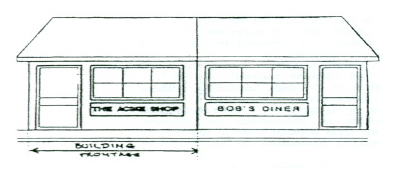
“Building Height.” The vertical distance measured from the established grade to the highest point of the roof surface for flat roofs; to the deck line of mansard roofs; and to the average height between eaves and ridge for gable, hip and gambrel roofs. Where a building is located on sloping terrain, the height may be measured from the average ground level of the grade at the building wall.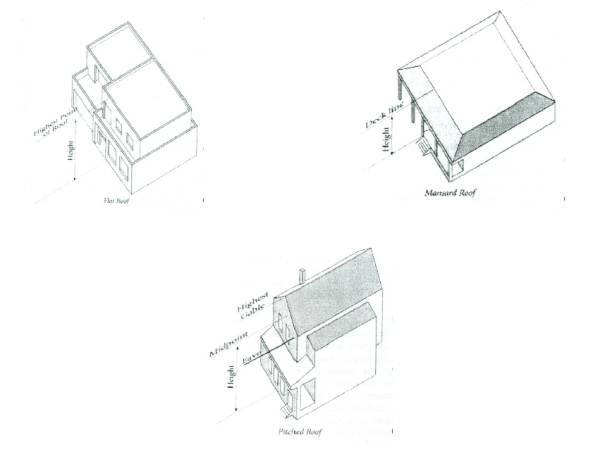
“Building Line.” A line established on a parcel which is parallel to a street right-of-way line for the purpose of prohibiting construction of a building between such line and an easement, right-of-way, or public area.
"Business Incubator." An organization that helps startup companies and individual entrepreneurs to develop their businesses by providing full-scale range of services including management training, office space, and financing.
“Business, Retail.” A commercial establishment that provides, as its primary activity, sales of goods to other commercial establishments. Examples of such uses include, but are not limited to, office furniture stores and office supply stores.
"Business, Service.” A commercial establishment that provides, as its primary activity, sales of services to other commercial establishments. Examples of such uses include, but are not limited to, uniform and linen services.
"Campground." A publicly or privately owned parcel of land designed, designated, maintained, intended, or used for the purpose of supplying a location for seasonal, recreational, and temporary living purposes in tents, trailers, travel trailers, motor home, cabins or similar facilities, whether or not a fee or charge is paid for the rental thereof, but does not include a mobile home or a mobile home park. Campgrounds are prohibited under this UDO.
“Canopy.” A projection from a building made from any material, which is cantilevered, suspended or supported on columns intended only for shelter or ornamentation.
“Cemeteries.” Land used or intended to be used for the burial of the human or animal dead and dedicated for cemetery purposes, including crematories, mausoleums and MORTUARIES, if operated in connection with and within the boundaries of such cemetery.
“Check-Cashing Business.” Any business that is licensed, or is required to be licensed, under ORC 1351.21 through 1351.30 to cash checks. Check-cashing business does not include any bank, savings and loan, credit union or similar financial institution doing business under authority granted by the Ohio Superintendent of Financial Institutions or by the equivalent regulatory authority of another state of the United States. Check-cashing businesses are not permitted under this UDO.
“City.” The incorporated municipality of Franklin, Ohio. For the purposes of this UDO, the term “City” shall also include Franklin City Council, Planning Commission, Appeals Board, Technical Review Committee, and/or City administrative staff or employees.
“City Engineer.” The person holding the title of City Engineer of the City of Franklin, or their designee.
"City Manager.” The person holding the title of City Manager of the City of Franklin, or their designee.
“Clear Sight Triangle.” The triangular area formed by a diagonal line connecting two points located on intersecting lines of a RIGHT-OF-WAY, EASEMENT of access, or pavement edge of an access drive, each point being 20 feet from the intersecting lines and extending vertically from a height of three feet above grade to 10 above grade.
“Co-location.” The use of a wireless telecommunications facility by more than a single wireless telecommunications provider.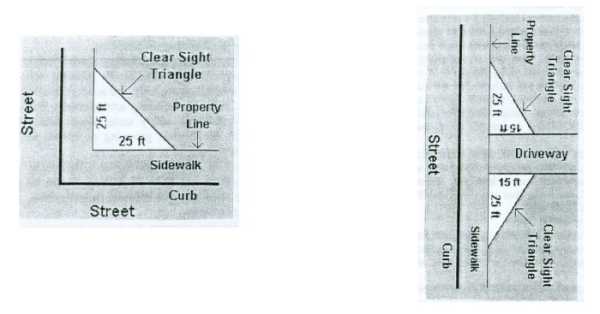
"Club, Private or Membership." Organizations that generally have some meaningful conditions for membership, with operations often controlled by the membership, and whose facilities and activities are only open to members and their guests.
“Commercial Entertainment.” A commercial establishment that provides, as its PRIMARY ACTIVITY, space for various types of sporting and/or leisure activities. Examples of such uses include, but are not limited to, skating rinks, bowling alleys, indoor playgrounds and movie theaters.
"Commercial Event Center.” Any private land at least 20 contiguous acres in size available and developed for educational purposes through recreational, spiritual, cultural and/or aesthetic uses, which use(s) are privately owned and privately operated with or without the intention of earning a profit in furtherance of such use. A combination of related uses may be incorporated, such as temporary and permanent lodging, indoor and outdoor recreation, camp offices, gymnasiums, auditoriums, cafeterias and additional similar uses and ancillary uses related thereto. Campgrounds are prohibited under this UDO, however a temporary site for tents or similar non-permanent shelters for outdoor lodging shall be a permitted ancillary use.
“Commercial Recreation/Fitness, Indoor and Outdoor.” Facilities for sports, recreational, and entertainment activities that may be conducted outdoor or indoor such as soccer, bowling, skating, swimming, sports courts, golf courses, driving ranges, and similar indoor activities taking place inside an enclosed building
“Commercial Training.” A commercial establishment (excluding any Educational Facilities (pre-K through 12th grade) or Secondary Education/Colleges/Universities) that provides, as its primary activity, any type of training, vocational, self-help or special interest to the general public for a fee. Examples of such uses include, but are not limited to, dance studios, beauty schools, and martial arts studios.
“Common Open Space.” Squares, greens, neighborhood parks, and linear environmental corridors, which may be owned and maintained by the City, a Homeowners' Association, Condominium Owners' Association or Developer.
“Comprehensive Development Plan or Comprehensive Land Use Plan.” The plan, which may consist of several maps, data and other descriptive matter, for the physical development of the City and which has been adopted by the Planning Commission and Council to indicate the general locations for proposed planning areas, major streets, parks, schools, public building sites and other similar information.
“Conditional Use.” A use that may be permitted within a zoning district (other than a principally permitted use), which is required to fulfill additional requirements because of its potential impact on the surrounding community. Such a use requires application for a conditional use and approval by the Planning Commission.
“Condominium.” A form of real property ownership in which a declaration has been filed submitting the property to the condominium form of ownership pursuant to ORC 5311. and under which each owner has an individual ownership interest in a unit with the right to exclusive possession of that unit and an undivided ownership interest with the other unit owners in the common elements of the condominium property.
“Condominium Owners' Association.” The organization that administers condominium property and that consists of all the owners of units in a condominium property.
“Conservation Development (or Planned Residential Conservation Overlay District).” A contiguous area of land to be planned and developed as a single entity, in which housing units are accommodated with more flexible standards, such as building arrangements and setbacks, than those that would normally apply under single-family residential zoning district regulations, allowing for the flexible grouping of houses in order to conserve open space and existing natural resources.
"Construction.” For the purposes of this UDO, construction is deemed to begin when all necessary excavation and piers or footing of one or more principal buildings, or the installation of required infrastructure, has been completed or substantially begun.
"Construction Trailer." A mobile structure that is used to accommodate temporary offices, facilities, or storage of materials during an active construction project.
“Corner Lot.” See Lot.
“Council.” The Council of the City of Franklin, Ohio.
“Covering.” Any clothing or wearing apparel, including pasties, but not including any substance that can be washed off the skin, such as paint or make up, or any substance designed to simulate the appearance of the anatomical area beneath it.
“Credit Service Organization.” Any business that is registered, or is required to be registered, under ORC 4712.01 to 4712.14 to provide credit services as defined in ORC 4712.01(C). Credit service organization does not include any bank, savings and loan, credit union or similar financial institution doing business under authority granted by the Ohio Superintendent of Financial Institutions or by the equivalent regulatory authority of another state of the United States. Credit service organizations are not permitted under this UDO.
“Critical Storm.” A storm that is calculated by means of the percentage increase in volume of runoff by a proposed earth disturbing activity or development area. The critical storm is used to calculate the maximum allowable storm water discharge rate from a site.
“Crosswalk.” A right-of-way, dedicated to public use, which crosses a block to facilitate pedestrian access to adjacent streets and adjacent properties.
“Crown.” The upper mass or head of a tree.
“Cultivar.” A cultivated variety of plant material grown for its special form and characteristics.
“Cul-de-sac.” A short street having one open end and being permanently terminated by a vehicular turn-around.
“Curb Radius.” The curved edge of streets at an intersection measured at the outer edge or face of the street curb or of the parking lane.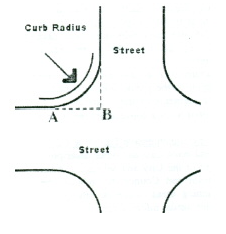
“Cut.” An excavation; the difference between a point on the original grade and a designated point of lower elevation on the final grade.
“Day Care Center, Adult.” Any place where adult day care services are provided, with or without compensation, for a daily average of five or more adults, excluding relatives of the owner or administrator of the center.
“Day Care Center, Child.” Any place where child day care and/or learning experiences are provided, with or without compensation, for a daily average of five or more infants, preschool children or school-age children (outside of school hours), excluding children of the owner or administrator of the center.
Day Care Home, Type A." The permanent residence of the administrator in which childcare is provided for seven to 12 children at one time or a permanent residence of the administrator in which childcare is provided for four to 12 children at one time if four or more children at one time are under two years of age. In counting children for the purpose of this definition, any children under six years of age who are related to the administrator or any employee on the premises shall be counted.
“Day Care Home, Type B.” The permanent residence of the administrator in which childcare is provided for one to six children at any one time and in which no more than three children are under two years of age at one time. In counting children for the purposes of this division, any children under six years of age who are related to the administrator or any employee on the premises shall be counted.
“Deciduous.” Plant material that normally sheds its foliage at the end of the growing season.
“Deck.” A platform, without a roof, that is either:
- Freestanding or directly adjacent to a principal building; or
- Attached to the building.
“Dedication.” The granting, by the property owner, of land by fee simple, or an easement therein, for the use of the public and accepted by council for such use by, or on behalf of, the public.
“Detention Basin.” A normally dry bottom impoundment area created by constructing an embankment, excavating a pit, or both, for the purpose of temporarily storing stormwater and gradually releasing the stored water at a controlled rate.
“Detention Facility.” A detention basin or alternative structure designed to temporarily store stormwater runoff and gradually release the stored water at a controlled rate.
“Developer.” Any person, corporation, association, partnership or other entity who creates or proposes to create a residential, commercial, industrial, or mixed use development, all or a portion of which will be located within the City.
"Development .” Any man-made change to improved or unimproved real estate including, but not limited to, buildings or other structures, mining, dredging, filling, grading, paving, excavation, or drilling operations or storage of equipment and materials.
“Development Area.” Any contiguous area owned by one person or operated as one development unit included within the scope of the regulations of this UDO, upon which earth-disturbing activities are planned or underway.
“Development Plan.” A plan submitted with an application for a Planned Unit Development Overlay District, in accordance with the requirements of Section 1109.05 of this UDO, or a Planned Residential Conservation Overlay District (see Conservation Development), in accordance with the requirements of Section 1109.06 of this UDO.
“Direct Recharge Area.” That portion of a drainage basin in which water infiltrating vertically from the surface will intercept the water table.
"Distribution Center." A facility used for receiving, temporarily storing, and distributing of goods according to orders as they are received. Distribution centers serve as a bridge between manufacturers and suppliers by receiving pallet pack and bulk products and redistributing and shipping it to wholesale or retail customers. There is no customer-direct pick-up or access to these facilities.
“District.” See Zoning District.
“DNR.” The Ohio Department of Natural Resources.
"Drive-Through Facility.” Any operation by a business establishment where the transfer of goods and services to the customers is accomplished through an opening in the building while the customer remains in their vehicle.
“Dwelling or Dwelling Unit.” Any building or portion thereof designed, intended or used primarily for residential purposes (i.e., human habitation), including cooking and sanitary facilities. The term does not include a tent, cabin, trailer, mobile home, boarding house, or hotel. For the purposes of this UDO, dwellings shall be defined as the following types:
- Dwelling, Accessory Unit: A secondary dwelling unit established in conjunction with, and clearly subordinate to, a primary dwelling unit, which is only occupied by a member(s) of the family of the dwelling's owner(s), who is related to the owner(s) by blood, marriage or adoption.
- Dwelling, Four Family: A building or portion thereof designed, intended or used primarily for residential purposes to be occupied by more than four families living independently of one another.
- Dwelling, Live-Work: A live/work dwelling is a single unit that consists of both a commercial or office use and a residential component that is occupied by the same occupant. The live/work unit shall be the primary dwelling of the occupant, and no portion of the live/work unit may be rented or sold separately.
- Dwelling, Multi-family: A building or portion thereof designed, intended or used primarily for residential purposes to be occupied by more than five families living independently of one other.
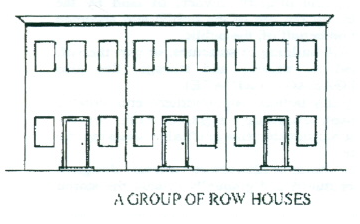
- Dwelling, Row House: A building or portion thereof designed, intended or used primarily for residential purposes. Row house dwellings are situated so that their sidewalls are shared with other like structures, all having their own separate entrances and being separate lots of record.
- Dwelling, Single-Family:A building designed, intended or used primarily for residential purposes to be occupied by one family.
- Dwelling, Three-Family: A building or portion thereof designed, intended or used primarily for residential purposes to be occupied by not more than three families living independently of one another.
- Dwelling, Two-Family: A building or portion thereof designed, intended or used primarily for residential purposes to be occupied by two families living independently of one another.
- Dwelling, Upper Floor: A single unit or multiple units above ground level of an existing structure providing complete, independent living facilities for one or more individuals and including the permanent provision for living, sleeping, eating, cooking and sanitation.
“Earth-Disturbing Activity.” Any grading, excavation, filling,or other alteration of the earth's surface where natural or man-made ground cover is destroyed.
“Easement.” A right-of-use over or in the property of another, granted by the owner for specific public or semi- public purposes and accepted by Council for such use by, or on behalf of, the public.
"Educational Facilities (Pre-K through 12th Grade).” Any institution organized and operated under the laws of Ohio to provide regular courses of instruction for students in kindergarten through grade 12 by the Ohio Department of Education or by an accrediting association recognized by the United States Office of Education.
“Efficiency or Efficiency Unit.” Efficiencies shall be regulated by the Ohio Building Code, and those provisions of the Building Code regulating efficiencies shall take precedence over the provisions of this UDO.
“Elderly Housing.” An age-restricted residential development in any housing form that qualifies for an exemption as “housing for older persons” under the Federal Fair Housing Amendments Act of 1988, 42 USC 3607(b), and any amendments thereto.
"Electric Vehicle (EV) Charging Station.” Equipment that connects an electric vehicle (EV) to a source of electricity to recharge electric vehicles.
“Electric Vehicle (EV) Charging Station, Level 1.” A slow speed charging station that typically operates on a 15- or 20-amp breaker on a 120-volt Alternating Current (AC) circuit.
“Electric Vehicle (EV) Charging Station, Level 2.” A medium speed charging station that typically operates on a 40- to 100-amp breaker on a 208- or 240-volt Alternating Current (AC) circuit.
“Electric Vehicle (EV) Charging Station, Level 3.” A high speed charging station that operates on a high voltage circuit.
"Emergency.” A reasonably unforeseen occurrence with a potential to endanger personal safety or health, or cause substantial damage to property, which calls for immediate action.
“Enclosure Below the Lowest Floor.” See “Lowest Floor.”
“Engineer.” A person licensed by the State of Ohio and registered as a professional engineer under ORC 4733.
"Event Venue, Indoor or Outdoor.” A building, structure, or open air facility which is rented by individuals or groups to accommodate events including, but not limited to, banquets, weddings, birthday parties, anniversaries, and receptions.
“Environmental Sciences.” These uses are permitted in the Office-Research Park District and include, but are not limited to, the following uses: laboratories engaged in testing and research, pharmaceutical laboratories, and bionomic laboratories. All operations are carried on in a completely enclosed building.
“EPA.” The Ohio Environmental Protection Agency.
“Equipment Shelter and/or Cabinet.” The structure in which the electronic receiving and relay equipment for a Wireless Telecommunications Facility is housed.
“Essential Services.” The erection, construction, alteration or maintenance by public utilities or by governmental entities of underground, surface or overhead gas, electrical, telephone, telegraph, steam, fuel or water transmission or distribution systems, collection, communication, supply or disposal systems, including towers, poles, wires, mains, drains, sewers, pipes, conduits, cables, fire alarm and police call boxes, traffic signals, hydrants and similar accessories in connection therewith (but not including buildings) that are necessary for the furnishing of adequate service by such utilities or governmental entities for the general health, safety or welfare.
"Essential Services and Utilities, City Owned." The erection, construction, alteration, or maintenance, by the City of Franklin of gas, electrical, steam, or water generation, transmission or distribution systems, collection, supply, or disposal systems, on land owned by the City of Franklin as a means of supporting a governmental facility. City owned essential services and utilities shall be permitted as authorized and regulated by law and other ordinances of the City, it being the intention hereof to exempt such essential services and utilities from the application of this code.
“Evergreen.” Plant material that has foliage that remains green throughout the year.
“Excavation.” Any breaking of ground except common household gardening and ground care.
“Executive Order 11988 (Floodplain Management).” This order was issued by President Carter in 1977, and requires that no federally-assisted activities be conducted in, or have the potential to, affect identified SPECIAL FLOOD HAZARD AREAS unless there is no practicable alternative.
“FAA.” The Federal Aviation Administration, and any legally appointed, designated or elected agent or successor.
“FCC.” The Federal Communications Commission and any legally appointed, designated, or elected agent or successor.
“Family.” One or more individuals occupying a single dwelling unit, provided that unless all individuals are related by blood, marriage or adoption, no family shall contain over five individuals but further provided that a family related by blood, marriage or adoption may have a total of two non-related individuals living with it.
“Farm Market.” The offering for sale of fresh agricultural products directly to the consumer in an open-air market.
“Federal Emergency Management Agency (FEMA).” The agency with the overall responsibility for administering the National Flood Insurance Program.
“Festivals and Circuses.” A temporary civic, recreational, fund-raising, or promotional activity or event that typically has a specific focus with its own social activities, food, music, or ceremonies. Such use typically takes place in a specified location and on a specific day or days.
“Fill or Filling.” Any act by which earth, sand, gravel, rock or any other material is placed, pushed, dumped, pulled, transported or moved to a new location above the natural surface of the ground or on top of the stripped surface and shall include the resulting grade conditions; the difference in elevation between a point on the original ground and a designated point of higher elevation on the final grade.
“Final Plat.” A final map of all or part of the subdivision prepared and certified by an registered engineer or surveyor in accordance with the requirements and regulations of this UDO, which is submitted to the City for final approval before recording at the office of the Warren County Recorder.
“Five-Year Capture Area.” The area around protected public water supply/well fields delineated by the five-year travel time contour.
“Flag.” Any fabric, banner or bunting containing distinctive colors, patterns or symbols, used as a symbol of domestic government, political subdivision or other governmental agency, and attached to or designed to be flown from a flagpole or similar device.
“Flag, International.” Any fabric, banner or bunting containing distinctive colors, patterns or symbols, used as a symbol of a foreign country or government, and attached to or designed to be flown from a flagpole or similar device.
“Flashing.” A sign or graphic which in any manner, as a whole or in part, physically changes in light intensity or gives the appearance of such change.
"Fleet Vehicle." A vehicle that is owned or operated by the person, company, or business on the premises, and which is used for purposes of delivery, pick-up, or service to patrons of the primary use. A fleet vehicle may also be a commercial vehicle, but does not include semi-tractor, semi-trailer, any non-recreational trailer used for commercial purposes, or any heavy construction equipment.
“Flood or Flooding.” A general or temporary condition of partial or complete inundation of normally dry land areas from:
- The overflow of inland or tidal waters, and/or
- The unusual and rapid accumulation or runoff of surface waters from any source.
“Flood Hazard Boundary Map (FHBM).” Usually the initial map, produced by the Federal Emergency Management Agency, or U.S. Department of Housing and Urban Development, for a community depicting approximate special flood hazard areas.
“Flood Insurance Rate Map (FIRM).” An official map on which the Federal Emergency Management Agency or the U.S. Department of Housing and Urban Development has delineated the areas of special flood hazard.
“Flood Insurance Risk Zones.” Zone designations on FHBMs and FIRMs that indicate the magnitude of the flood hazard in specific areas of a community. Following are the zone definitions:
- Zone A: Special flood hazard areas inundated by the 100-year flood; in any given year base flood elevations are not determined.
- Zones A1-30 and Zone AE: Special flood hazard areas inundated by the 100-year flood in any given year; base flood elevations are determined.
- Zone AO: Special flood hazard areas inundated by the 100-year flood; with flood depths of one to three feet (usually sheet flow on sloping terrain); average depths are determined.
- Zone AH: Special flood hazard areas inundated by the 100-year flood in any given year; flood depths of one to three feet (usually areas of ponding); base flood elevations are determined.
- Zone A99: Special flood hazard areas inundated by the 100-year flood to be protected from the 100-year flood by a Federal flood protection system under construction; no base flood elevations are determined.
- Zone B and Zone X (shaded): Areas of 500-year flood; areas subject to the 100-year flood with average depths of less than one foot or with contributing drainage area less than one square mile; and areas protected by levees from the base flood .
- Zone C and Zone X (unshaded): Areas determined to be outside the 500-year floodplain.
“Flood Insurance Study (FIS).” The official report in which the Federal Emergency Management Agency or the U.S. Department of Housing and Urban Development has provided flood profiles, floodway boundaries (sometimes shown on flood boundary and floodways maps), and the water surface elevations of the base flood.
“Floodplain.” Special flood areas that are subject to periodic inundation. Construction and development within the Floodplain requires a Floodplain Development Permit.
“Floodplain Overlay Map or Flood Boundary Map (FHBM).” Usually the initial map, produced by FEMA or the U.S. Department of Housing and Urban Development (HUD) for a community depicting approximate special flood hazard areas; the City's Floodplain Overlay District Map, as included in the UDO.
“Flood Protection Elevation.” The Flood Protection Elevation, or FPE, is the base flood elevation plus one foot of freeboard. In areas where no base flood elevations exist from any authoritative source, the flood protection elevation can be historical flood elevations, or base flood elevations determined and/or approved by the Floodplain Administrator.
“Floodproofing.” Any combination of structural and non-structural additions, changes, or adjustments to structures which reduce or eliminate flood damage to real estate or improved real property, water and sanitary facilities, structure and their contents.
“Floodway.” A floodway is the channel of a river or other watercourse and the adjacent land areas that have been reserved in order to pass the base flood discharge. A floodway is typically determined through a hydraulic and hydrologic engineering analysis such that the cumulative increase in the water surface elevation of the base flood discharge is no more than a designated height. In no case shall the designated height be more than one foot at any point within the community. The floodway is an extremely hazardous area, and is usually characterized by any of the following: moderate to high velocity flood waters, high potential for debris and projectile impacts, and moderate to high erosion forces.
"Floor Area.” The sum of the horizontal areas of each floor of a building, measured from the exterior faces of the exterior walls or from the centerline of walls separating two buildings. The gross floor area measurement is exclusive of areas of unfinished basements, unfinished cellars, unfinished attics, attached garages, space used for off-street parking and loading, breezeways, porches and decks, and accessory structures. Unfinished basements, unfinished cellars, and unfinished attics shall be counted as storage space for purposes of determining required parking spaces.
“Floor Area, Seating Capacity.” Floor area that is used or intended for use to serve patrons, clients or customers and all that area devoted to employee workspace. Such floor area as is used or intended to be used principally for the storage or merchandise, hallways, elevator or stair bulkheads or for utilities or sanitary facilities shall be excluded from the computation of floor area. Measurement of useable floor area shall be the horizontal areas of the several floors of the buildings, measured from the exterior faces to the exterior walls.
"Food Service/Catering.” Establishments that prepare, as their primary economic function, meals, snacks, and beverages for immediate consumption that are transported to an off-premises site or at banquet halls with catering staff. Examples of events catered by these establishments include weddings, trade shows, parties and luncheons.
“Freeboard.” A factor of safety usually expressed in feet above a flood level for the purposes of floodplain management. Freeboard tends to compensate for the many unknown factors that could contribute to flood heights greater than the height calculated for a selected size flood and floodway conditions, such as wave action, obstructed bridge openings, debris and ice jams, and the hydrologic effect of urbanization in a watershed.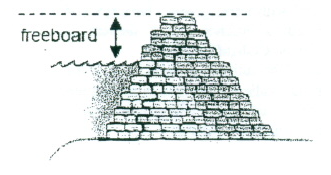
“Front Lot Line.” See Lot.
“Front Yard. See Yard.
"Fulfillment Center." A third-party logistics warehouse that receives products and goods from suppliers, processes orders from e-commerce retailers, and ships products directly to individual consumers.
“Garages and Carports, Detached.” A building or structure, or part thereof, used or designed to be used for parking and storage.
"Government Facility." Any buildings, structure, or use, or portion thereof, used by a governmental agency for administrative or service purposes, but not including buildings devoted solely to the storage and maintenance of equipment and materials.
“Grade (ground level).” The average of the finished ground level at the center of all walls of a BUILDING. In case walls are parallel to and within five feet of a sidewalk, the above ground level shall be measured at the sidewalk, unless otherwise defined within this UDO.
“Greenbelts.” A strip or parcel of land, privately restricted or publicly dedicated as open space, located between a residential development and other incompatible uses, for the purpose of protecting and enhancing the residential environment (See also buffer).
“Ground Satellite Station.” Any antenna or earth station designed, constructed or modified to bring in or receive satellite television signals.
“Half-Street.” A street having a lesser right-of-way width than required for a street of full width.
“Hard Surface.” A bituminous surface, Portland cement concrete, brick pavers or other surface as approved by the City Engineer. “Hard Surface” does not include gravel.
“Historic structure.” Any structure that is:
- Listed individually in the National Register of Historic Places (a listing maintained by the U.S. Department of Interior) or preliminarily determined by the Secretary of the Interior as meeting the requirements for individual listings on the National Register;
- Certified or preliminarily determined by the Secretary of the Interior as contributing to the historical significance of a registered historic district or a district preliminarily determined by the Secretary to qualify as a registered historic district; or
- Individually listed on the State of Ohio's inventory of historic places maintained by the Ohio Historic Preservation Office.
- Individually listed on the inventory of historic places maintained by the City of Franklin’s historic preservation program, which program is certified by the Ohio Historic Preservation Office.
“Health Commissioner.” The Warren County Commissioner of Health or his authorized representative.
“Height, or Above Ground Level (AGL).” When referring to a tower or other structure, the distance measured from the finished grade at the base of the toweror structure to the highest point on the tower or other structure, including the base pad and any antenna.
“Home Occupation Type-A.” This type of home occupation has little or no impact on the surrounding residential area and requires no permit. In general, a Home Occupation Type A is located and conducted so that the average neighbor, under normal circumstances, would not be aware of its existence.
“Home Occupation Type-B.” This type of Home Occupation has the potential for greater impact on the surrounding residential area and therefore requires a Conditional Use Permit.
“Homeowners' Association.” A private, nonprofit corporation of homeowners established by a developer or group of developers, with local government approval, whose purpose is to own, operate and maintain various common properties, including, but not limited to, common open space, private streets and recreation facilities. The association/corporation holds title to common property.
“Hospitals.” An establishment for the medical, surgical or psychiatric care of bed patients for a continuous period longer than 24 hours, which is open to the general public 24 hours each day for emergency care, has a minimum of 10 patient beds, an average of 2,000 patient days per annum, and has on duty a registered nurse 24 hours each day.
“Hotel.” A building occupied as the more-or- less temporary abiding place of individuals who are lodged with or without meals in which there are 10 or more sleeping rooms and no provision made for cooking in any individual room or apartment, and no individual room or apartment is accessible from the exterior of the building. A hotel may include restaurants or cocktail lounges, public banquet halls, ballrooms or meeting rooms.
“Hydrologic and Hydraulic Engineering Analysis.” An analysis performed by a professional engineer, registered in the State of Ohio, in accordance with standard engineering practices as accepted by FEMA, used to determine flood elevations and/or floodway boundaries.
“Incorporated Territory.” Land included within the boundaries of the City.
“Industrial, Artisan.” An establishment or business where an artist, artisan, or craftsperson teaches, makes, or fabricates crafts or products by hand or with minimal automation, and which may include direct sales to consumers. This definition includes uses such as small-scale fabrication, manufacturing, and other industrial uses and processes such as small-scale welding and sculpting. This use includes fabrication implements that are more industrial than that of an art studio and includes coopering, and crafting of cabinetry, furniture, and other similar small-scale manufacturing.
"Industrial, Heavy." An industrial establishment that provides, as its primary activity, space for the assembly, manufacturing, processing or warehousing of goods or products, and which typically involve external impacts such as noise, dust, smoke, fumes, odors, heavy truck and/or rail traffic or other objectionable characteristics. Such use may have outdoor storage and/or operation space. Examples of such uses include goods produced by factory assembly, paper mills, fabrication and assembly of metal products. General Industry does not include junkyards, recycling centers, recycling plants, salvage/scrap yards, scrap metal processing facilities, and uses of similar intensity.
"Industrial, Light." A commercial or industrial establishment that provides, as its primary activity, space for the assembling or processing of goods for sale, or service industries, that do not produce any noise, dust, odor, fumes, vapors, smoke, vibrations, glare, heat, noise, odor, heavy truck or rail traffic, or other objectionable effects on the outside of the building. All operations are carried on in a completely enclosed building. Examples of such uses include food processing, beverage bottling, upholstering, carpets and rugs, business machines, dry cleaning and dyeing, and construction machinery.
“Information Technology/Data Center.” These uses are permitted in the Office-Research Park District and include, but are not limited to, the following uses: telecommunications, data processing and computing centers, computer electronic parts, equipment and electronics manufacturing, computer programming and software development, and internet-related businesses. All operations are carried on in a completely enclosed building.
"Integral." Something that is essential, necessary, or fundamental to a whole.
“Interior Lot.” See Lot.
"Junk." Old or scrap copper, brass, rope, rags, batteries, paper, rubber, trash waste, iron, steel and other old or scrap ferrous or nonferrous materials.
"Junkyard." An establishment or place of business, other than an establishment having facilities for processing iron, steel or nonferrous scrap and whose principal product is scrap iron and steel or nonferrous scrap for sale for remelting purposes, which is maintained or operated for the purpose of storing, keeping, buying or selling junk, and includes garbage dumps and sanitary landfills. The term "junk yard" shall also include scrap metal processing facilities which are located within 1,000 feet of the nearest edge of the right-of-way of a highway in the interstate or primary system.
"Kentucky Board Fencing." A wooden fence that typically includes three or four horizontal boards that are attached to wooden posts and which are spaced to allow air flow between each board. Such fences may or may not include welded wire between the boards.
“Landfill.” The burial of non-hazardous and non-medical farm, residential, institutional, commercial or industrial waste.
“Landing Field.” A specific area designated for the take-off and landing of aircraft.
"Landscaping.” The use of natural plant materials including, but not limited to, groundcovers, shrubs, and trees (deciduous and evergreen). Landscaping also involves the placement, preservation and maintenance of said plant materials and includes such elements as fences, walls, lighting and earth mounding.
"Large Equipment." movable or transportable vehicle or other apparatus commonly use in commercial, industrial, or construction enterprises, such as but not limited to trucks, trailers, bulldozers, cranes, backhoes, rollers, loaders, and lifts having a gross weight of 2.5 tons or more.
“Large Equipment Retail, Rental, and Repair.” An establishment for the sale, rental, and repair of large equipment as defined in this UDO.
"Letter of Map Change (LOMC).” A Letter of Map Change is an official FEMA determination, by letter, to amend or revise effective flood insurance rate maps, flood boundary and floodway maps, and flood insurance studies. LOMC's are broken down into the following categories:
- Letter of Map Amendment (LOMA): A revision based on technical data showing that a property was incorrectly included in a designated special flood hazard area. A LOMA amends the current effective flood insurance rate map and establishes that a specific property is not located in a special flood hazard area.
- Letter of Map Revision (LOMR): A revision based on technical data that, usually due to manmade changes, shows changes to flood zones, flood elevations, floodplain and floodway delineations, and planimetric features. One common type of LOMR, a LOMR-F, is a determination concerning whether a structure or parcel has been elevated by fill above the base flood elevation and is, therefore, excluded from a special flood hazard area.
- Conditional Letter of Map Revision (CLOMR): A comment by FEMA regarding a proposed project that would, upon construction, affect the hydrologic or hydraulic characteristics of a flooding source and thus result in the modification of the existing regulatory floodway, the effective base flood elevations, or the special flood hazard area. A CLOMR does not amend or revise effective flood insurance rate maps, flood boundary and floodway maps, or flood insurance studies.
“Life Sciences.” These uses are permitted in the Office-Research Park District and include, but are not limited to, the following uses: biotechnology, biopharmaceutical, biomedical, pharmaceuticals, and/or laboratories engaged in testing and research, and the manufacture of medical instruments, appliances, apparatus or filters. All operations are carried on in a completely enclosed building.
“Live Viewing Booth.” Any private or semi private booth, or any viewing room of less than 150 square feet of floor space, to which the public may gain admittance, wherein a live performance is presented to five or fewer individuals at any one time.
“Loading Space.” An off-street space on the same lot with a building or group of buildings for the temporary parking of a commercial vehicle while loading and unloading merchandise or materials.
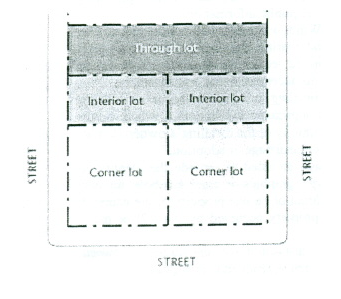
“Lot.” The basic development unit; a parcel of land with fixed boundaries occupied, or to be occupied by, a main building, or a group of such buildings and accessory structures, or used for the principal use and uses accessory thereto, together with such open spaces as are required under the provisions of this UDO. Every lot shall abut upon and have permanent access to a public street and have a minimum frontage of 40 feet thereon.
- Corner Lot: A lot that has at least two contiguous sides abutting upon a street for its full length.
- Interior Lot: A lot other than a corner or through lot.
- Through Lot: Any lot having frontages on two or more streets as distinguished from a corner lot. In the case of a row of double frontage lots, all sides of such lots adjacent to streets shall be considered frontage, and front yards shall be provided as required.
“Lot Area.” The total horizontal area within the lot lines of a lot.
“Lot Coverage.” The part or percent of a lot occupied by buildings, including accessory structures buildings.
“Lot Depth.” A distance measured in the mean direction of the side lot lines from the mid-point of the front lot lines to the mid-point of the rear lot line.
“Lot Line.” The lines bounding a lot or, in some instances, the right-of-way line or public easement line on a lot.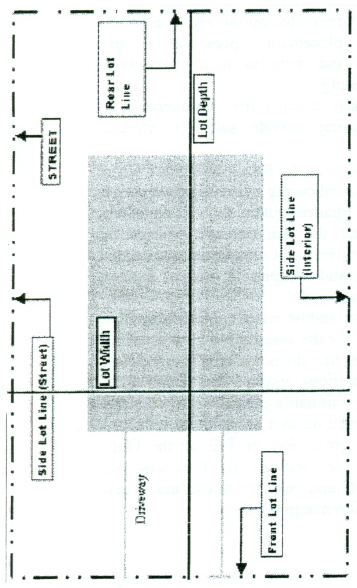
“Lot Line, Front.” The line separating a lot from the street. In the case of a corner lot or double frontage lot, the front lot line means the line separating such lot from both streets.
“Lot Line, Rear.” The lot line opposite the front lot line. In the case of a lot pointed at the rear, the rear lot line shall be an imaginary line parallel to the front lot line, not less than 10 feet long, lying farthest from the front lot line and wholly within the lot. In the case of a corner lot, the rear lot line is opposite the front lot line of least dimension.
“Lot Line, Side.” Any lot line other than the front lot line or rear lot line. A side lot line separating a lot from a street is a street lot line. A side lot line separating a lot from another lot or lots is an interior side lot line.
“Lot of Record.” - A parcel of land, the dimensions of which are shown on a document or map on file with the Warren County Recorder's Office or in common use by City or Warren County officials, and which actually exists as so shown, or any part of such parcel held in a record ownership separate from that of the remainder thereof.
“Lot Width.” The horizontal distance between the side lot lines, measured at the two points where the building line or setback line intersects the side lot lines.
“Lowest Floor.” The lowest floor of the lowest enclosed area (including basement) of a structure. This definition excludes an “enclosure below the lowest floor” which is an unfinished or flood resistant enclosure usable solely for parking of vehicles, building access or storage, in an area other than a basement area, provided that such enclosure is built in accordance with the applicable design requirements specified in these regulations for enclosures below the lowest floor.
“Main Building.” A building in which is conducted the principal use of the lot upon which it is situated.
“Main Use.” The principal use to which the premises are devoted and the principal purpose for which the premises exist.
“Major Subdivision.”
- The division of any parcel of land shown as a unit or as contiguous units on the last preceding tax roll, into three or more lots, sites or parcelsPARCELS, any one of which is less than five acres for the purpose, whether immediate or future, of transfer of ownership; or the division of any parcel of land into two or more lots, sites or parcels of any size that involves the creation of any new streets, public rights-of-way or easements of access; provided, however, that the division or partition of land into parcels of more than five acres not involving any new streets, public rights-of-way or easements of access, and the sale or exchange of parcels between adjoining lot owners, where such sale does not create additional building sites, shall be exempt from the platting procedures of this UDO but shall not be exempt from the improvement, development or redevelopment standards of this UDO.
- The improvement of one or more parcels of land for residential, commercial or industrial structures or groups of structures involving the division or allocation of land for the opening, widening or extension of any street or streets, except private streets serving industrial structures; and/or the division or allocation of land as common open space for common use by owners, occupants or lease holders or as easements for the extension and maintenance of public sewer, water, storm drainage or other public facilities. (See also minor subdivision; subdivision, major; and subdivision, minor).
“Major Tree.” A living tree with a trunk diameter of at least 15 inches , measured two feet above ground level.
“Manufactured Home.” A building unit or assembly of closed construction that is fabricated in an off-site facility and constructed in conformance with the federal construction and safety standards established by the secretary of housing and urban development pursuant to the Manufactured Housing Construction and Safety Standards Act of 1974, 88 Stat. 700, 42 USCA 5401, 5403, and that has a permanent label or tag affixed to it, as specified in 42 USCA 5415, certifying compliance with all applicable federal construction and safety standards. (PER FEMA: A structure, transportable in one or more sections, which is built on a permanent chassis and is designed for use with or without a permanent foundation when connected to the required utilities. The term "manufactured home" does not include a "recreational vehicle". For the purposes of these regulations, a manufactured home includes manufactured homes and mobile homes as defined in Chapter 4781 of the Ohio Revised Code.)
“Manufactured or Mobile Home Park.” As specified in the Ohio Administrative Code 4781-12-01, a manufactured or mobile home park means any tract of land upon which three or more manufactured homes or mobile homes, used for habitation are parked, either free of charge or for revenue purposes, and includes any roadway, building, structure, vehicle, or enclosure used or intended for use as part of the facilities of the park. A tract of land that is subdivided and the individual lots are not for rent or rented, but are for sale or sold for the purpose of installation of manufactured homes on the lots, is not a manufactured home park, even though three or more manufactured homes are parked thereon, if the roadways are dedicated to the local government authority. Manufactured home park does not include any tract of land solely for the storage or display for sale of manufactured homes. Manufactured Home Parks and Mobile Home Parks are not permitted under this UDO.
"Makerspace." A communal public workshop in which makers can work on small personal projects. Makerspace may be a principal use or an accessory use to an office , school, library, or other similar use.
“Marquee.” A permanent roofed structure attached to and supported by the building and projecting beyond the building line or over public property.
“Material Sciences.” These uses are permitted in the Office-Research Park District and include, but are not limited to, the following uses: plastics/polymer research and engineering, laser technology and application, robotic research, and the manufacturing, processing and/or packaging of medical, optical, scientific, electronic or electromagnetic devises, equipment, systems or supplies. All operations are carried on in a completely enclosed building.
“Mean sea level” For purposes of the National Flood Insurance Program, the National Geodetic Vertical Datum (NGVD) of 1929 or other datum, to which base flood elevations shown on a community's Flood Insurance Rate Map are referenced.
“Medical Center/Clinic.” A commercial or noncommercial establishment that provides, as its primary activity, health-related services to the general public on an outpatient basis. Such use shall not provide space for overnight treatment and may be set up with emergency vehicle receiving areas and trauma treatment facilities. . Examples of such uses include clinics and emergency clinics.
“Medical Office.” A commercial or noncommercial establishment that provides, as its primary activity, health-related services to the general public on an outpatient basis. Such use shall not provide space for overnight treatment. Examples of such uses include doctors' offices and dentists' offices.
“Microcell.” The lines that connect a provider's towers/cell sites to one or more cellular telephone switching offices, and/or long distance providers, or the public switched telephone network.
“Mining and Extraction.” All or any part of the process involved in the mining of minerals and raw materials by removing overburden and mining directly from the deposits, open- pit mining or minerals naturally exposed, mining by auger method, dredging and quarrying, or underground mining and surface work incidental to an underground mine. Such uses are not permitted in the City under this UDO.
“Minor Subdivision.” The division of any parcel of land shown as a unit or as contiguous units on the last preceding tax roll along an existing and improved public street, into not more than two lots or parcels, any one of which is less than five acres; or the division of any parcel of land into two or more lots of more than five acres not involving any new streets, public rights-of-way or easements of access; or the sale or exchange of parcels between adjoining lot owners, where such sale does not create additional building sites; or the combination or replatting of two or more lots or parcels into a single lot when such lots or parcels are under the ownership of the same owner and the combination or replatting does not involve any new streets, public rights-of-way or easements of access (See also major subdivision; subdivision, major; subdivision, minor).
"Mixed Use." A building, lot, or development that contains a mixture of uses including residential, commercial, office, institutional, or other similar uses. Such uses may be mixed within one building (either horizontally or vertically) or within an overall development.
"Mobile Home.” Means a building unit or assembly of closed construction that is fabricated in an off-site facility, is more than 35 feet in length or, when erected on site, is 320or more square feet , is built on a permanent chassis, is transportable in one or more sections, and does not qualify as a manufactured home or as an industrialized unit as defined in ORC 3781.06(C).
"Mobile Uses." A large, wheeled vehicle that is used for a specific purpose such as to cook, prepare, and/or serve food and/or beverages in individual portions in a ready to consume state; to conduct a specific medical procedure such as blood donations, immunizations, or medical evaluations; or to sell retail goods.
“Model Home.” A dwelling unit constructed within an approved residential subdivision or development that is temporarily used for the purpose of demonstrating building techniques, floor plans, interior finishes, or design features, and that may also serve as a temporary sales or leasing office for the sale or lease of lots or dwelling units. A model home is not intended as a permanent commercial use and shall be converted to a conforming residential use upon completion of sales activity.
"Monopole.” A support structure constructed of a single, self- supporting hollow metal tube securely anchored to a foundation.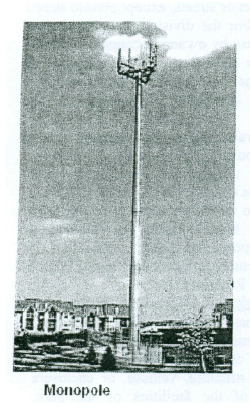
“Mortuaries.” An establishment providing services such as preparing the human dead for burial and/or cremation and arranging and managing funerals, hospitality and reception areas in connection therewith and which may include limited caretaker facilities. This definition includes crematoriums and columbariums.
“Motor Vehicle.” Any vehicle, including mobile homes and recreational vehicles, which is propelled or drawn by power other than muscular power or power collected from overhead electric trolley wires. Motor vehicle does not include motorized bicycles, equipment used in construction work and not designed for or employed in general highway transportation, well-drilling machinery, ditch-digging machinery, farm machinery, trailers that are used to transport agricultural produce or agricultural production materials between a local place of storage or supply and the farm when drawn or towed on a public road or highway at the speed of 25 miles per hour or less, threshing machinery, hay-baling machinery, corn sheller, hammermill and agricultural tractors, machinery used in the production of horticultural, agricultural, and vegetable products, and trailers that are designed and used exclusively to transport a boat between a place of storage and a marina, or in and around a marina, when drawn or towed on a public road or highway for a distance of no more than 10 miles and at a speed of 25 miles per hour or less (See also vehicle).
“Motor Vehicle, Collector's.” Any motor vehicle or agricultural tractor or traction engine that is of special interest, that has a fair market value of one hundred dollars or more, whether operable or not, and that is owned, operated, collected, preserved, restored, maintained, or used essentially as a collector's item, leisure pursuit, or investment, but not as the owner's principal means of transportation, and that displays current, valid license tags issued under ORC 4503.45, or a similar type of motor vehicle that displays current, valid license tags issued under substantially equivalent provisions in the laws of other states.
“Motor Vehicle, Commercial.” Any motor vehicle designed or used to transport persons or property that meets any of the following qualifications:
- Any combination of vehicles with a gross vehicle weight or combined gross vehicle weight rating of 26,001 pounds or more; provided the gross vehicle weight or gross vehicle weight rating of the vehicle or vehicles being towed in excess of 10,000 pounds;
- Any single vehicle with a gross vehicle weight or gross vehicle weight rating of 26,001 pounds or more;
- Any single vehicle or combination of vehicles that is not a class A or class B vehicle, but is designed to transport 16 or more passengers including the driver;
- Any school bus with a gross vehicle weight or gross vehicle weight rating of less than 26,001 pounds that is designed to transport fewer than 16 passengers including the driver;
- Is transporting hazardous materials for which placarding is required under subpart F of 49 CFR part 172, as amended; or
- Any single vehicle or combination of vehicles that is designed to be operated and to travel on a public street or highway and is considered by the federal Motor Carrier Safety Administration to be a commercial motor vehicle including, but not limited to, a motorized crane, a vehicle whose function is to pump cement, a rig for drilling wells, and a portable crane.
“Motor Vehicle, Noncommercial.” Any motor vehicle, including a farm truck as defined by ORC 4503.04, that is designed by the manufacturer to carry a load of no more than one ton and is used exclusively for purposes other than engaging in business for profit.
“Multi-Use Tower.” A self-supporting lattice, guyed or monopole structure, constructed from grade that supports more than one Wireless Telecommunications Facility.
“National Flood Insurance Program (NFIP).” The NFIP is a Federal program enabling property owners in participating communities to purchase insurance protection against losses from flooding. This insurance is designed to provide an insurance alternative to disaster assistance to meet the escalating costs of repairing damage to buildings and their contents caused by floods. Participation in the NFIP is based on an agreement between local communities and the Federal government that states if a community will adopt and enforce floodplain management regulations to reduce future flood risks to all development in special flood hazard areas, the Federal government will make flood insurance available within the community as a financial protection against flood loss.
“New Construction.” STRUCTURES for which the "START OF CONSTRUCTION" commenced on or after the effective date of a floodplain regulation adopted by City of Franklin and includes any subsequent improvements to such structures.
For the purposes of determining insurance rates, structures for which the “start of construction'' commenced on or after the effective date of an initial FIRM November 5, 1980 or after December 31, 1974, whichever is later, and includes any subsequent improvements to such structures.
“Nonconforming Building.” A building, or portion thereof, lawfully existing on the effective date of this UDO, or amendments thereto, and that does not conform to the lot, dimensional, height, yard, are or lot coverage regulations of the district in which it is located.
“Non-Routine Maintenance.” Activities necessary not more frequently than every 24 months to keep structures and equipment in good repair.
“Non-Structural Controls.” Stormwater runoff control and treatment techniques that use natural measures to control runoff and/or reduce pollution levels, and do not require extensive construction efforts and/or do promote runoff control and/or pollutant reduction by eliminating the runoff and/or pollutant source. Examples include minimizing impervious area, buffer strips along streams, and preserving natural vegetation.
“Nude or Semi-Nude Modeling Studio.” Any place where a individual who appears semi-nude or who displays specified anatomical areas is provided to be observed, sketched, drawn, painted, sculptured, photographed, or similarly depicted by other persons who pay money or any form of consideration. Nude Model Studio shall not include:
- A proprietary school licensed by the State of Ohio, or a college, junior college or university supported entirely or in part by public taxation;
- A private college or university that offers educational programs in which credits are transferable to a college, junior college, or university supported entirely or partly by taxation; or
- An establishment holding classes in a structure that has no sign visible from the exterior of the structure and no other advertising that indicates a semi-nude person is available for viewing; where in order to participate in a class a student must enroll at least three days in advance of the class; and where no more than one semi-nude model is on the premises at any one time.
“Nudity, State of Nudity or Nude.” Exposing to view the genitals, pubic area, vulva, perineum, anus, anal cleft or cleavage, or pubic hair with less than a fully opaque covering exposing to view any portion of the areola of the female breast with less than a fully opaque covering; exposing to view male genitals in a discernibly turgid state, even if entirely covered by an opaque covering; or exposing to view any device, costume, or covering that gives the appearance of or simulates any of these anatomical areas.
“Nursing Home.” See skilled nursing facility. A hospital shall not be construed to be a nursing home.
“ODOT.” The Ohio Department of Transportation.
"Office." A commercial establishment that provides, as its primary activity, space for any professional and/or business operation where the product is a person's knowledge or skill and not a commodity. Such use shall be completely contained within a building. "Office" does not include health-related services. Examples of such uses include, but are not limited to, law offices, real estate offices and corporate headquarters.
“Office, Co-Working.” A facility that is designed to accommodate people from different companies who come to do work. Such uses are characterized by shared facilities, services, and tools.
“Ohio Building Code (OBC).” Wherever the term “Ohio Building Code” or “Building Code” appears in this UDO, it shall mean the Ohio Building Code, for commercial and industrial uses, or Residential Code of Ohio, for residential uses, as determined applicable by the zoning official.
“Opacity.” The degree to which a structure, use or view is screened from adjacent properties.
“Open Sided Structure.” Freestanding, unheated structures, which are unenclosed except for a structural system supporting a roof and may have screen panels which are used to enclose the open spaces between structural elements. Open sided structures include but are not limited to gazebos, trellises, and picnic shelters.
“Open Space.” An area substantially open to the sky, which may be on the same lot with a building. The area may include, along with the natural environmental features, water areas, swimming pools, tennis courts or any other recreational facilities; streets, structures and the like shall not be included.
“ORC.” Ohio Revised Code, including any subsequent amendments thereto.
"Outdoor Dining." Designated outdoor areas (either on public or private land) which are used for outdoor dining or seating where patrons may be served food and beverage for on-site consumption.
"Outdoor Retail/Display." Any unenclosed area exhibiting merchandise or goods for sale that is incidental to an adjacent indoor retail use.
“Overlay District.” A district described on the City's zoning map within which, through super-imposition of a special designation, certain regulations and requirements apply, in addition to those of the underlying zoning district.
“Parcel.” A lot, or contiguous group of lots in single ownership or under single control, and usually considered a unit for the purposes of development.
“Park.” Any public or private land available for recreational, educational, cultural or aesthetic use.
“Parking (Area).” Any part of a site used by vehicles not totally enclosed within a structure. This includes parking space and aisles, drives, loading areas and vehicle storage areas, driveways and permitted off-street parking spaces for single- and two-family residential uses.
"Parking Garage." A structure built that may be above grade, below grade, or a combination thereof, that provides off-street parking for motor vehicles.
“Parking Space.” An off-street space, either within a structure or in the open, available for the parking of one motor vehicle and having an area of not less than 170 square feet, exclusive of passageways, driveways and maneuvering space.
“Passive Space.” Open space provided in a park or other development that does not contain any active recreational equipment, game courts, or playing fields. Passive space may include benches, picnic areas and tot lots.
“Peak Rate of Runoff.” The maximum rate of runoff for any 24 hour storm of a given frequency.
“Pennant.” A triangular shaped banner.
“Person.” Any person, firm, partnership, association, corporation, company, or other legal entity, private or public, whether for profit or not-for-profit, including State and local governments and agencies. An agency is further defined in the Ohio Rev. Code §111.15(A)(2) as any governmental entity of the State and includes, but is not limited to, any board, department, division, commission, bureau, society, council, institution, State college or university, community college district, technical college district, or State community college. Agency does not include the Ohio General Assembly, the State Controlling Board, the Adjutant General's Department or any court .
“Personal Service.” A business whose primary activity is the provision of services to the public or it members for the provision of personal care services or health maintenance services, and may include the sale of goods as a secondary activity. Examples of such uses include spas, salons, exercise facilities, and weight management centers.
“Planning Commission.” The administrative board and quasi-judicial board, appointed in accordance with the City Charter, which hears and decides conditional use applications, makes recommendations to Council on all legislative zoning matters, and reviews planning-related issues, all as outlined in this UDO.
“Plat.” A subdivision of land legally approved and recorded.
“Playground.” A private or publicly owned area for recreational use primarily by children.
“Playground Equipment.” Freestanding structures located in a playground area that areas for the recreational use of children. This definition does not include equipment erected on the same lot as a single-family dwelling for private use.
“Potable Water.” Water that is satisfactory for drinking, culinary and domestic purposes meeting current drinking water standards.
“Porch.” An unheated, open-air platform, enclosed with a roof that is either:
- Freestanding and directly adjacent to a principal building; or
- Attached to the building, that has railings or walls on the sides not exceeding 38 inches in height from the platform.
The area between the roof and the railings or walls may be covered with screening or netting material only, and cannot be enclosed with windows or detachable glass sash.
“Pre-Development Conditions.” Site conditions, as they existed prior to manmade alterations and/or earth disturbing activities.
“Pre-existing Towers and Pre-existing Antennas.” Any tower or antenna for which a building permit or special use permit has been properly issued prior to the effective date of this UDO, including permitted towers or antennas that have not yet been constructed, so long as such approval is current and not expired.
“Preliminary Plat.” A preliminary map showing the proposed layout of a subdivision in sufficient detail to allow review by the Planning Commission.
“Primary Activity.” An activity that comprises more than 50 percent of the total floor area of a building.
"Principal Building." A building in which the principal use on the property is conducted.
"Principal Structure." see principal building.
"Principal Use." The primary use of land that clearly carries out the land use intents and purposes of a particular zoning district, and which is permitted in the zoning district in which the use is located.
“Private Swimming Pools.” A swimming pool exclusively used, without paying an additional charge for admission, by the residents and guests of a single household, a multi-family development, or a community, the members and guests of a club, or the patrons of a hotel; an accessory use.
“Property Line.” A legally recorded boundary of a lot, tract, or other parcel of land.
“Protected Public Water Supply.” A public water system which services at least 15 service connections used by year-round residents, or regularly serves at least 25 year-round residents and having a five year capture area defined through appropriate hydrologic studies.
"Public Eating Areas." An outdoor space that provides eating and dining options for the public. This could include specified areas for the parking of mobile uses.
“Public Parks, Open Spaces, Recreation, and Preserves.” A parcel of land owned and operated by a non-profit or governmental entity that is available to the public for passive or active recreation.
"Public Plazas." An open space that is accessible to the public at all times, predominately open to the sky.
“Public Recreation and Event Space, Indoor.” A place designed and equipped for the conduct of sports and leisure-time activities that is owned or operated by a non-profit or governmental entity.“Public Utility.” Any person, firm, or corporation, municipal department or board of commission duly authorized to furnish to the public, under State or Municipal regulations, gas, steam, electricity, sewage disposal, communication, telegraph, telephone, transportation or water service.
“Rear Lot Line.” see Lot Line, Rear.
“Rear Yard.” see Yard.
“Recreation, Public.” Includes all uses that are commonly provided for the public at parks, playground, community centers, and other sites owned and operated by a unit of government for the purpose of providing recreation.
“Recreational Vehicle.” A vehicle which is:
- Built on a single chassis;
- 400 square feet or less when measured at the largest horizontal projection;
- Designed to be self- propelled or permanently towable by a light duty truck; and
- Designed primarily not for use as a permanent dwelling but as temporary living quarters for recreational, camping, travel, or seasonal use.
“Registered Professional Architect.” A person registered to engage in the practice of architecture pursuant to Ohio Rev. Code §4703.01 and 4703.19.
“Registered Professional Engineer.” A person registered as a professional engineer pursuant to Ohio Rev. Code Chapter 4733.
“Registered Professional Surveyor.” A person registered as a professional surveyor pursuant to Ohio Rev. Code Chapter 4733.
“Regulated Substances.” Chemicals and mixtures of chemicals that are health hazards. Materials packaged for personal or household use as food or drink for man or other animals are not Regulated Substances. Regulated Substances include:
- Chemicals for which there is scientific evidence that acute or chronic health effects may result from exposure including carcinogens, toxic and highly toxic agents, reproductive toxins, irritants, corrosives, sensitizers, hepatotoxins, nephrotoxins, neurotoxins, agents which act on the hematopoietic system, and agents which damage the lungs, skin, eyes or mucous membranes.
- Mixtures of chemicals that have been tested as a whole and have been determined to be a health hazard.
- Mixtures of chemicals which have not been tested as a whole but which contain any chemical which has been determined to be a health hazard and which comprises one percent (1.0%) or greater of the composition on a weight per unit weight basis, and mixtures of chemicals which include a carcinogen if the concentration of the carcinogen in the mixture is one tenth of one percent (0.1%) or greater of the composition on a weight per unit weight basis.
- Ingredients of mixtures prepared within the Well Field Protection Overlay District in cases where such ingredients are health hazards but comprise less than one tenth of one percent (0.1%) of the mixture on a weight per unit weight basis if carcinogenic, or less than one percent (1.0%) of the mixture on a weight per unit weight basis if non-carcinogenic.
- Petroleum and non-solid petroleum derivatives (except non-PCB dielectric fluids).
"Religious and Cultural Facilities." An institution that a congregation of people regularly attends to participate in or hold religious services, meetings, and other activities, including buildings in which the religious services of any denomination are held. Nurseries, day care, educational facilities (pre-k through grade 12), and similar uses are considered accessory uses to a religious and cultural facility.
"Replacement Cost.” The cost of replacing a structure or building at current costs at the time of the loss, identical to the one that was destroyed, without application of depreciation.
“Research and Development Facility.” A commercial establishment that provides, as its primary activity, space for the development of information and/or products that are used by business and industry. Such use shall be completely contained in a building, does not produce goods or services for direct retail sale. Examples of such uses include, but are not limited to, biological testing labs, corporate research and development facilities.
"Residential Development Identification Sign." A sign at the entrance of a residential neighborhood identifying the neighborhood.
“Residential Area.” The districts outlined for residential development under this UDO.
“Residential Facility.” A residential dwelling or facility that falls into one of the following categories:
- Provides accommodations, supervision, personal care services, and mental health services for one or more unrelated adults with mental illness or one or more unrelated children or adolescents with severe emotional disturbances.
- Provides accommodations, supervision, and personal care services to any of the following:
(1) One or two unrelated persons with mental illness.
(2) One or two unrelated adults who are receiving payments under the residential state supplement program.
(3) Three to 16 adults. - Provides room and board for five or more unrelated adults with mental illness.
“Residential Facility, Large.” A residential facility that is designed for and occupied by more than 16 residents living together.
“Residential Facility, Medium.” A residential facility that is designed for and occupied by between six and 16 residents living together.
“Residential Facility, Small.” A residential facility that is designed for and occupied by five or less residents living together.
“Residential Sales.” A residential sale consists of house, apartment, garage, and yard sales and are permitted for any residential use, but only when limited to the personal possessions of the owner or occupant of the dwelling at which sale is being conducted.
"Residential Treatment Facility." A residential dwelling or facility where persons are living together, with or without staff, as a single housekeeping unit providing care, supervision, or treatment to reduce dependence or maintain independence of opioid drugs. A “residential treatment facility” is subject to the protections of the federal Fair Housing Act Amendments of 1988, as defined in that Act and interpreted by the courts, as they apply to citizens in drug addiction treatment programs, and by any similar legislation of the State of Ohio.
“Residential Treatment Facility, Large.” A residential treatment facility that is designed for and occupied by more than 16 residents living together.
“Residential Treatment Facility, Medium.” A residential treatment facility that is designed for and occupied by between six and 16 residents living together.
“Residential Treatment Facility, Small.” A residential treatment facility that is designed for and occupied by five or less residents living together.
“Restaurant.” A commercial establishment that provides, as its primary activity, prepared food for consumption on the premises inside of a building.
"Restaurant, Quick Service." An establishment whose principal business is the sale of food and/or beverages in a ready-to-consume state of consumption within the restaurant building, within a motor vehicle parked on the premises, or off the premises as a carry-out order, and whose principal method of operation includes the following characteristics: food and/or beverages are usually served in edible containers or in paper, plastic or other disposal containers. Examples of such uses include drive through restaurants that prepare and/or dispense food or beverages and do not provide a place for all its customers to eat inside the building, or which serve food or beverages for carry out, or drive-in eating and drinking places, establishments where customers may serve themselves and may eat or drink the food or beverages on the premises.
“Retail, Convenience." Small-scale retail stores used for the sale of goods used on an everyday basis by consumers including, but not limited to, pre-packaged food and drink products, household items, newspapers, and magazines; and which are typically associated with an automotive fueling or charging establishment.
“Retail, Food and Beverage Related.” Establishments that sell food and beverage merchandise from fixed point-of-sale locations and that have special equipment (e.g., freezers, refrigerated display cases and refrigerators) for displaying food and beverage goods. Such establishments typically do not include cooking facilities or the preparation of food.
"Retail, General." A facility or establishment which engages in selling goods or merchandise to the general public for personal or household consumption and rendering services incidental to the sale of such goods. General retail does not include variety stores (or point price retailers).
"Retail, Large-Format." A business that exceeds 50,000 square feet, excluding outside sales or storage, restrooms and other non-public areas.
“Retail, Secondhand.” Any person, partnership, corporation or other entity that engages in the purchase, sale, receiving or exchange of secondhand articles or precious metals, as the same are defined in Chapter 723 of the Codified Ordinances. Retail, secondhand is not permitted under this UDO.
“Retail, Services.” An establishment that provides, as its primary activity, off-site services to the real property of individuals or corporations and which may include limited, on-site retail sales. Examples of such uses include but are not limited to companies that perform construction, landscaping, HVAC services, electrical services, plumbing services, and concrete and/or asphalt work.
“Right-of-Way.” A strip of land dedicated for use as a public way. In addition to the roadway, it normally incorporates the curbs, lawn strips, sidewalks, lighting and drainage facilities, and may include special features (required by the topography or treatment) such as grade separation, landscaped areas, viaducts and bridges.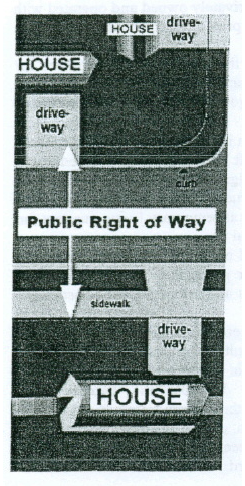
“Riparian.” Of, on, or relating to, the bank of a natural course of water.
“Riparian Buffer.” Riparian buffers are the areas of vegetation directly separating land from water and immediately adjacent land that is frequently inundated (the floodways of streams). Vegetation in riparian buffers typically consists of plants that either are emergent aquatic plants, or herbs, trees and shrubs that thrive in close proximity to water.
“Roof Line.” The lowest point of a roof that is closest to the ground.
"Salvage Material." Clean packing materials such as, but not limited to, cardboard boxes and paper, newspaper, plastic, rags, tires, scrap iron and other metals, glass, and similar materials, motor vehicles or parts thereof, used lumber, household garbage, inoperable machinery or appliances, and similar materials, which can be rejuvenated or returned for reconstitution. "Salvage/Scrap Yard." A facility, but not including a junkyard, recycling center, recycling plant, or scrap metal processing facility licensed under authority of ORC 4737.05 to 4737.12 or regulated under authority of the City, as defined by Section 713.01 of the City of Franklin Codified Ordinances, and not including motor vehicle salvage as defined by Section 715.01 of the City of Franklin Codified Ordinances, where salvage materials are bought, sold, exchanged, collected, salvaged, stored, baled, packed, disassembled, or handled.
“Satellite Parking.” Parking spaces located off-site of the building that it is designed to serve.
"Scrap Metal Processing Facility." An establishment having facilities for processing iron, steel, or nonferrous scrap and whose principal product is scrap iron and steel or nonferrous scrap for sale for remelting purposes.
“Sediment Basin.” A barrier, dam or other facility built to reduce the velocity of water in order to settle and retain sediment.
"Self-Service Storage Facility or Mini-Warehouse.” A facility consisting of a building or group of buildings, usually in a controlled-access compound, that may contain varying sizes of individual, self-contained, enclosed, compartmentalized and controlled-access stalls or lockers for the dead storage of customers' residential goods or wares, that are owned, leased or rented. Self-service storage facilities or miniwarehouses shall not include accessory automobiles rental or sales. Self-service storage facilities or miniwarehouses are not permitted under this UDO.
“Semi-Nudity, State of Semi-Nudity, Semi-Nude Condition or Semi-Nude.” Exposing to view, with less than a fully opaque covering, any portion of the female breast below the top of the areola or any portion of the buttocks. This definition shall include the entire lower portion of the female breast, but shall not include any portion of the cleavage of the female breast exhibited by a dress, blouse, shirt, leotard, bathing suit, or other clothing, provided that the areola is not exposed in whole or in part.
“Setback or Setback Line. ” The minimum distance that a building may be constructed from a lot line.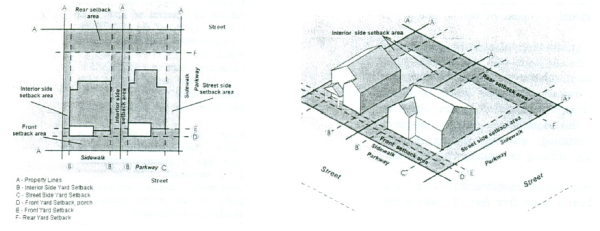
“Sex Store.” A business offering goods for sale or rent and that meet any of the following tests:
- More than 10 percent of the stock-in trade or inventory, or more than 10 percent of the gross public floor area of the business, consists of sexually-oriented novelties or toys; or
- It offers for sale items from any two of the following categories: adult entertainment, adult media, sexually-oriented novelties or toys, , lingerie, or apparel or other items marketed or presented in a context to suggest their use for sadomasochistic practices, and the combination of such items constitutes more than 15 percent of the stock-in-trade or inventory of the business or occupies more than 15 percent of the gross public floor area; or
- Which advertises or holds itself out in any forum as a sexually-oriented business by use of such terms as “sex toys, “marital aids,” “X-rated,” “XXX,” “adult,” “sex,” “nude,” or otherwise advertises or holds itself out as a sexually-oriented business.
- Sex Store shall not include any establishment which, as a substantial portion of its business, offers for sale or rental to individuals employed in the medical, legal or education professions anatomical models, including representations of human genital organs or female breasts, or other models, displays, and exhibits produced and marketed primarily for use in the practice of medicine or law or for use by an educational institution.
“Sexual Encounter Establishment.” A business or commercial enterprise that, as one of its principal business purposes, offers for any form of consideration:
- Physical contact in the form of wrestling or tumbling between persons of the opposite sex when one or more of the persons is nude or semi-nude; or
- Activities between male and female persons and/or persons of the same sex when one or more of the persons is nude or semi-nude; or
- A place where two or more persons may congregate, associate or consort for the purpose of engaging in specified sexual activities; or
- A place where two or more persons appear nude or semi-nude for the purpose of displaying their nude or semi-nude bodies for the their receipt of consideration or compensation in any type or form.
An establishment where a medical practitioner, psychologist, psychiatrist or similar professional person licensed by the State of Ohio engages in medically approved and recognized therapy including, but not limited to, massage therapy, as regulated pursuant to ORC 4731.15, is not a Sexual Encounter Establishment.
“Sexually-Oriented Business.” An adult arcade, adult bookstore, adult cabaret, adult entertainment establishment, adult media (video) store, adult motion picture theater, adult novelty store, adult theater, nude or semi-nude model studio, sex store, or sexual encounter establishment. “Sexually Oriented Business” does not include an adult motel, as defined above.
“Sexually-Oriented Novelties or Toys.” Instruments, devices or paraphernalia either designed as representations of human genital organs or female breasts, or designed or marketed primarily for use to stimulate or arouse human genital organs or female breasts or for sadomasochistic use or abuse of self or others.
“Short-Term Loan Lender.” Any business that is licensed, or is required to be licensed, under ORC 1321.35 to 1321.48 to make short-time loans. Short-term loan lender does not include any bank, savings and loan, credit union or similar financial institution doing business under authority granted by the Ohio Superintendent of Financial Institutions or by the equivalent regulatory authority of another state of the United States. Short-term load lenders are not permitted under this UDO.
“Side Lot Line.” See lot line, side.
“Side Yard.” See yard.
“Sight Distance.” The minimum extent of an unobstructed vision (on a horizontal plane) along a street from a point five feet above the centerline of a street.
“Sign.” Any display, figure, painting, drawing, placard, poster or other device placed on the ground or on any tree, wall, bush, rock, post, fence, building, structure or thing whatsoever, which is designed, intended or used to convey a message, advertise, inform or direct attention to a person, institution, organization, activity place, object or product. “Placed,” as used in this definition, includes erecting, constructing, posting, painting, printing, tracking, nailing, gluing, sticking, carving or other fastening, affixing or making visible in any manner whatsoever.
“Sign, Awning.” A sign that is mounted on or painted on an awning. “Sign, Banner.” A sign on a lightweight fabric, or similar non-rigid material that is attached by at least two corners of such sign, to a building or structure. Flags of any country, state, unit of local government, institution of higher learning, or similar institution area not considered to be banners. “Sign, Bench.” Any sign painted on, located on, or attached to any part of a surface of a bench, seat, or chair placed on or adjacent to a public roadway. “Sign, Billboard.” An off-premise, outdoor sign exceeding 50 square feet in area. Billboards are prohibited under this UDO. “Sign, Canopy.” A sign that is mounted on or painted on an attached canopy. “Sign, Construction.” A sign that is located on a lot that has active construction. “Sign, Direction.” A sign intending to direct the safe flow of vehicular and pedestrian traffic, including, but not limited to, “enter”, “exit”, “one way”, and “narrow signs.” “Sign, Electronic Message Center.” A sign that is capable of displaying words, symbols, figures, or images that can be electronically changed by remote or automatic means. May also be known as a variable message sign or a LED sign. “Sign, Flutter Flag.” A tall, narrow vertical flag that is designed to flutter in the wind and attract attention. “Sign, Governmental Flag.” Flags of any country, state, or unit of local government. “Sign, Ground.” A sign supported by one or more uprights, posts, or bases, in or upon the ground and not attached to any part of a building. "Sign, Human." A sign that is worn (including costumes) or held by a human for temporary commercial advertising or other promotional purposes. “Sign, Identification.” A sign indicating the identity or name, whether through logo, type, graphics or other symbols, address and activity occupying the building, store, service, or establishment. “Sign, Inflatable.” Any sign or device that is capable of being expanded. “Sign, Manual Changeable Copy.” A sign, or portion thereof, on which characters, letters, or illustrations are changed manually in the field without altering the face or surface of the sign, including without limitation, a reader board with changeable letters. “Sign, Marquee.” A sign attached to or constructed in a marquee. "Sign, Memorial." A sign designed, intended or used to preserve the memory of a person, place or event, including landmark plaques and historical plaques. “Sign, Menu Board.” Any signage pertaining to items, goods, or services offered by a drive-through business. “Sign, Mobile or Portable.” Any sign which is not permanently affixed to the ground or a building in accordance with the provisions of the building code of the city or any sign which is intended to be moveable or capable of being moved from place to place, whether or not wheels or other special supports are provided. Mobile or portable signs include but are not limited to “A” or “T” frame signs, swinger message board signs, windblown signs, trailer signs or any other type of sign which can be moved from one location to another. “Sign, Mural.” Any mosaic, painting, or graphic art or combination thereof which is professionally applied to a building. “Sign, Organizational Flag.” A flag for private or non-profit organizations. “Sign, Permanent.” A sign designed or intended to be used indefinitely, or used indefinitely without change in the same state or place, and includes canopy/marquee/awning signs, directional signs, electronic message centers, ground signs, manual changeable copy signs, menu boards, murals, projecting signs, residential development identification signs, wall signs, and window signs. “Sign, Pole.” A sign supported by one or more poles, posts or braces permanently mounted on or in the ground that exceeds six feet in height. Pole signs are not permitted under this UDO, except when approved in the Highway Sign Overlay District. “Sign, Public.” Signs required or authorized for a public purpose by any law, statute or ordinance, such signs to include traffic control devices provided that such signs contain no supplementary advertising, and any identification of display of any official court or public office notices thereof, or any flag, emblem, or insignia of a nation, political unit, school or religious group. “Sign, Projecting.” A sign affixed to any part of a building or structure which extends beyond the building or structure by no more than four feet. “Sign, Real Estate.” A sign announcing the sale, rental or lease of the lot where the sign is displayed, or announcing the sale, rental or lease of one or more structures, or a portion thereof, located on such lot, and indicating the owner, realty agent, telephone number or “open house” information. “Sign, Residential Development Identification.” A sign at the entrance of a residential neighborhood identifying the neighborhood. “Sign, Revolving.” A sign which in its entirety or in part moves in a revolving manner. “Sign, Roof.” A sign erected upon or above a roof or parapet wall of a building, which sign is wholly or partially supported by such building. Roof signs are prohibited under this UDO. “Sign, Snipe.” A sign that is posted, tacked, nailed, pasted, glued, or otherwise attached to trees, utility poles or structures, street lights fences, or any other object on public property or within the public right-of-way. “Sign, Streamer.” Any lightweight plastic, fabric or other material, whether or not containing a message of any kind, suspended from a rope, wire, string or cord, usually in series, designed to move in the wind. A streamer may have pennants and/or banners attached.
"Sign Structure." Any structure that supports, or is capable of supporting, any sign as defined in this UDO. A sign structure may be a single pole, or may or may not be an integral part of the building.
“Sign, Temporary.” A sign that is neither permanently anchored to the ground, nor permanently affixed to a structure, or mounted on a chassis, and/or is intended for a limited period of display.
“Sign, Vehicle.” A sign that is attached to or painted on a vehicle that is parked on or adjacent to any property, the principal purpose of which is to attract attention to a product sold or business located on the property.
“Sign, Wall.” A sign attached to a building face, with the exposed face thereof in a plane parallel to the plane of the wall. Wall signs include painted murals, messages, graphics and other designs painted along with any letters or numerals mounted on buildings and any extensions thereon.
“Sign, Window.” A sign, graphic, poster, symbol or other identification or information about the use or premises which is physically affixed to or painted on the glass or other structural component of the window or a sign, graphic, poster, symbols, or other identification or information about the use or premises erected on the inside of the building within two feet of the window and intended to be viewed through the window from the exterior of the premises.
“Site Development Plan.” The written document or set of plans that meet the requirements of this UDO, provide information on the location of the area proposed for development and the site in relation to its general surroundings, and existing characteristics of the site, including limits of earth disturbing activities.
“Site Plan.” A plan showing uses and structures proposed for a parcel of land, as required by the regulations involved. Includes lot lines, streets, building sites, reserved open space, buildings, major landscape features - both natural and man-made - and, depending on the requirements, the location of proposed utility lines.
“Sketch Plan.” An informal plan or sketch showing the existing features of a site and its surroundings and the general layout of a proposed minor subdivision.
“Sleeping Area.” Floor space provided in a building designed, intended or used primarily as a place to sleep. “Sleeping area” includes all bedroom space and all other areas where beds are permanently kept.
“Small Loan Lender.” Any business that is licensed, or is required to be licensed, under ORC 1321.01 to 1321.19 to make small loans. Small Loan Lender does not include any bank, savings and loan, credit union or similar financial institution doing business under authority granted by the Ohio Superintendent of Financial Institutions or by the equivalent regulatory authority of another state of the United States. Small loan lenders are not permitted under this UDO.
“Small Loan Operations.” Small Loan Operations shall include alternative finance service providers, check-cashing businesses, credit service organizations, mortgage loan lenders, short-term loan lenders, and small loan lenders. Small Loan Operations shall not include any bank, savings and loan, credit union or similar financial institution doing business under authority granted by the Ohio Superintendent of Financial Institutions or by the equivalent regulatory authority of another state of the United States. Small loan operations are not permitted under this UDO.
"Smoking and Hookah Bars." An establishment in which tobacco products are sold for use or consumption on the premises to persons that are over 18 years old as provided by state law. This use includes but is not limited to establishments referred to as smoking, cigar, hookah, or tobacco bars or lounges. Smoking and hookah bars are not permitted under this UDO.
"Solar Panels, Roof-Mounted." Panels installed on the roof of a building to allow for the conversion of solar energy to electrical current.
"Special Event." A gathering of human beings, lasting for a designated period of time, designed to celebrate, honor, discuss, sell, teach, encourage, observe, or influence human endeavors. Examples include, but is not limited to, parades, markets, festivals, or car shows.
“Special Flood Hazard Area.” Also known as “Areas of Special Flood Hazard,” it is the land in the floodplain subject to a one percent or greater chance of FLOODING in any given year. Special flood hazard areas are designated by the Federal Emergency Management Agency on flood insurance rate maps, flood insurance studies and flood boundary and floodway maps as Zones A, AE, AH, AO, A1 30, and A99. Special flood hazard areas may also refer to areas that are flood prone and designated from other federal state or local sources of data including but not limited to historical flood information reflecting high water marks, previous flood inundation areas, and flood prone soils associated with a watercourse.
“Specified Anatomical Areas.” This term is used to describe:
- The human male genitals in a discernibly turgid state, even if completely and opaquely covered; or
- Less than completely and opaquely covered human genitals, pubic region, buttocks, including the cleft, anus, or female breast below a point immediately above the top of the areola.
“Specified Criminal Activity.” Any of the following offenses: Prostitution or promoting prostitution; soliciting; loitering to engage in solicitation; sexual performance by a child; public lewdness; indecent exposure; indecency with a child; sexual assault; molestation of a child; or any similar offenses to those described above under the criminal or penal laws of any local jurisdiction, state, or country for which less than two years have elapsed since the date of conviction or the date of release from confinement imposed for the conviction, whichever is the later date, if the conviction is of a misdemeanor offense; or less than five years have elapsed since the date of conviction or the date of release from confinement for the conviction, whichever is the later date, if the conviction is of a felony offense. The fact that a conviction is being appealed shall not prevent such conviction from constituting a specified criminal activity as defined in this section.
“Specified Sexual Activities.” Means any of the following:
- The fondling or other erotic touching of human genitals, pubic region, buttocks, anus, or female breasts;
- Sex acts, normal or perverted, actual or simulated, including intercourse, oral copulation, masturbation, or sodomy; or
- Excretory functions as a part of or in connection with any of the activities set forth in (a) or (b), above.
“Start of Construction.” The date the building permit was issued, provided the actual start of construction, repair, reconstruction, rehabilitation, addition, placement, or other improvement was within 180 days of the permit date. The actual start means either the first placement of permanent construction of a structure on a site, such as the pouring of slab or footings, the installation of piles, the construction of columns, or any work beyond the stage of excavation; or the placement of a manufactured home on a foundation. Permanent construction does not include land preparation, such as clearing, grading, and filling; nor does it include the installation of STREETS and/or walkways; nor does it include excavation for a basement, footings, piers, or foundations or the erection of temporary forms; nor does it include the installation on the property of accessory structures, such as detached garages or sheds not occupied as dwelling units or not part of the main structure. For a substantial improvement, the actual start of construction means the first alteration of any wall, ceiling, floor, or other structural part of a building, whether or not that alteration affects the external dimensions of a building.
“Stock-In Trade or Inventory.” The individual items offered for sale or rental in the area of an establishment open to the public.
“Stop-Work Order.” An order issued that requires that all work on the site must cease, except work associated with bringing the site into compliance with the approved SWP3, site development plan or construction plans.
"Storage Shed." See Storage Structure.
"Storage Structure." An accessory structure that is not classified for human habitation or occupancy and is intended to be used to store personal property.
“Story.” The part of the building included between the surface of one floor and the surface of the next floor, or if there is no floor above, then the ceiling next above. If the floor level directly above a basement is more than six feet above grade, such basement shall be considered a story.
“Story, Half.” An uppermost story lying under a sloping roof having an area of at least 200 square feet with a clear height of seven feet, six inches. For the purposes of this UDO, the usable floor area is only that area having at least four feet of clearance height between the floor and the ceiling.
“Storm Frequency.” The average period of time, in years, within which a storm of a given duration and intensity can be expected to be equaled or exceeded.
“Stormwater Management Plan (SMP).” The written document meeting the requirements of this UDO regulation that sets forth the plans and practices to be used to minimize storm water runoff from a site and to safely convey or temporarily store and release post-development storm water runoff at an allowable rate to minimize flooding and erosion.
“Storm Water Pollution Prevention Plan (SWP3).” The document required by the Ohio EPA for compliance with its NPDES Construction Activity General Permit #OHC000002. The requirements of the SWP3 are required as part of the local jurisdiction's Stormwater Management Plan, as described above, and in this UDO.
“Street.” An improved public way or right-of-way dedicated to public use, which provides for vehicular and pedestrian access to abutting properties.
- Alley: Any dedicated public way affording a secondary means of access to abutting property, either to the back or side of properties abutting on another street, and not intended for general traffic circulation.
- Collector Street: A street, whether within a residential, industrial, commercial or other type of development, which primarily carries traffic from minor/local streets to major streets.
- Expressways: A thoroughfare that possesses extra-wide rights-of-way carrying high traffic volumes of unobstructed, limited access vehicular movement.
- Major Street: An arterial street intended for large volumes of through traffic and to carry cross-town traffic from several neighborhoods, thereby servicing collector streets. Such streets are intended for carrying heavy loads and large volumes of traffic, for both the immediate City area and the region beyond. Any street with a width, existing or proposed, of 80 feet shall be considered a major thoroughfare.
- Marginal Access Street: A minor street that is parallel and adjacent to a major street or thoroughfare, and which provides access to abutting properties and protection from major or collector streets.
- Minor Street: A local street that primarily provides access to residential or other abutting property.
“Street Line.” The edge of the pavement along the front of the property.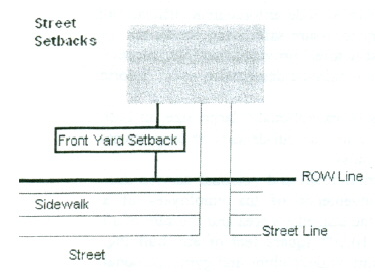
“Street Setback Measurements.” All buildings and structures shall hereafter be constructed in accordance with the required front yard setbacks in the district in which it is to be located, measured from the dedicated right-of-way line or the street line, whichever is greater, on expressways, major streets, collector streets, marginal access streets, minor streets and alleys.
“Structural Controls.” Any human-made facility, structure, or device that is constructed to provide temporary storage and/or treatment of storm water runoff. Examples include retention and detention basins, rock-check dams, swales, and constructed wetlands.
“Structure.” Anything constructed or erected. Its use requires location on the ground or attachment to something having location on the ground including, but not limited to a walled or roofed building, manufactured home, or gas or liquid storage tank that is principally above ground.
“Subdivider.” Any person, partnership, corporation, association or other legal entity that creates or proposes to create a subdivision, all or a portion of which will be located within the City (See also developer).
“Subdivision, Major.” A platting of land for the purposes of development and transfer of ownership. A major subdivision is any subdivision that does not meet the requirements of a minor subdivision. It requires approval of a preliminary plat by the Planning Commission, approval of a final plat by the Planning Commission, acceptance by Council, and recording of the final plat prior to the transfer of land (See also major subdivision).
“Subdivision, Minor.” A division of a parcel of land that is approved by the City Engineer and does not require a plat or the combination or replatting of two or more parcels into a single lot that is approved by the City Engineer (See minor subdivision).
“Subdivision Regulations.” Chapter 1111, including any amendments thereto, contained in this UDO.
“Substantial Damage.” Damage, of any origin, sustained by a structure whereby the cost of restoring the structure to its “before-damaged” condition would equal or exceed 50 percent of the market value of the structure before the damage occurred.
“Substantial Improvement.” Any reconstruction, rehabilitation, addition, or other improvement of a structure, the cost of which equals or exceeds 50 percent of the market value of the structure before the start of construction of the improvement. This term includes structures, which have incurred substantial damage, regardless of the actual repair work performed. The term does not, however, include:
- Any project for improvement of a structure to correct existing violations of state or local health, sanitary, or safety code specifications which have been identified by the local code enforcement official and which are the minimum necessary to assure safe living conditions; or
- Any alteration of a historic structure, provided that the alteration would not preclude the structure's continued designation as a historic structure.
“Superblock.” A residential block of exceptionally large size, in both dimensions, with access to interior lots by culs-de-sac or loop streets and providing one or more common open spaces.
“Support Commercial Uses.” Support retail and personal service uses conducted primarily for the convenience of the employees of a permitted use, if such use serves the immediate area and the sum of all such uses occupy no more than 10,000 square feet of any building. Examples of such uses include retail, athletic clubs and gyms, personal service shops (barber, dry cleaner, salon, etc.), business services (printing, photocopying, mailing and packaging, etc.), child care center, cafeteria or restaurant, financial institution, medical clinic.
“Surveyor.” A person licensed by the State of Ohio and registered as a professional surveyor under ORC 4733.
“Swale.” A low-lying stretch of vegetated land that gathers and carries surface water.
"Taproom." A place in which alcoholic drinks are available and are generally served on tap.
"Tattoo Parlor/Body-Piercing Studio." An establishment whose principal business activity is the practice of placing designs, letters, figures, symbols, or other marks upon or under the skin of any person, using ink or other substances that result in the permanent coloration of the skin by means of the use of needles or other instruments designed to contact or puncture the skin or the creation of an opening in the body of a person for the purpose of inserting jewelry or other decoration. Tattoo Parlors/Body-Piercing Studios are not permitted under this UDO.
"Temporary Structure." A structure without any foundation or footing and removed when the designated time period, activity, or use for which the temporary structure was erected has ceased.
“Temporary Vegetation.” Short-term vegetative cover such as oats, rye, or wheat, used to stabilize the soil surface until final grading and installation of permanent vegetation.
“Tent.” Any structure used for living or sleeping purposes, or for sheltering a public gathering, constructed wholly or in part from canvas, tarpaulin or other similar materials. It includes shelter provided for circuses, carnivals, sideshows, revival meetings, camp meetings and all similar meetings or exhibitions in temporary structures.
“Time and Temperature Display.” A cabinet containing illuminated numerals flashing alternately to show the time and temperature.
“Through Lot.” See Lot.
“Total Area of a Sign.” “Sign area” shall be measured as outlined in Section 1111.08(e) of this UDO.
“Tower.” Any structure that is designed and constructed primarily for the purpose of supporting one or more antennas for telephone, radio and similar communication purposes, including self-supporting lattice, towers, guyed-towers, or monopoles; the term includes radio and television transmission towers, microwave towers, common-carrier towers, wireless telecommunications towers, alternative tower structures, and the like; the term includes the structure and any support thereto.
“Transportation or Communication Utility.” A structure or facility used by a public utility or quasi-public utility to store, distribute or generate electricity, gas or telecommunications and related equipment, or to pump or chemically treat water. This use does not include storage or treatment of sewage, solid waste or hazardous waste.
“Travel-Time Contour.” A locus of points from which water takes an equal amount of time to reach a given destination such as a well or well field.
“Treatment Space.” Floor space provided in a building that is designed, intended or used primarily for the treatment of human and/or animal illness.
“Truck Stop/Truck Service or Gasoline Center.” A business that provides the sale and storage of fuel, overnight or hourly parking, and/or other special services catering to commercial motor vehicles, specifically Semi-Trucks and Semi- Trailers. Truck Stops/Truck Service or Gasoline Centers are prohibited under this UDO.
"Truck Terminal.” Any lot or part thereof, any part of land, or any structure which is used for the temporary parking of trucks during loading or unloading between trips; for purposes of servicing or repairing such trucks within enclosed structures; and for necessary warehouse space for storage of transitory freight; and upon which the storage of freight is incidental to the primary function of motor freight shipment.
“UDO.” See Unified Development Ordinance.
“Underground Storage Tank.” Underground storage tank shall have the same meaning as in ORC 3737.87.
“Unified Development Ordinance.” The combining of development regulations and procedures, including zoning and subdivision regulations, sign and floodplain regulations, administrative and hearing procedures, etc. into one unified code and ordinance in the City of Franklin Unified Development Ordinance.
“Use.” The purpose for which land or a building is arranged, designed or intended, or for which land or a building is or may be occupied.
"Vape, Tobacco, or Hookah Stores." Any store, stand, booth, or concession that devotes 30 percent or more of its display floor area to tobacco products, or to the display and sale of tobacco, vapor products, or electronic smoking devices to purchases for consumption or use. This classification of use does not include medical marijuana uses which are prohibited in the City of Franklin per the City of Franklin Ordinance Section 513.16.
“Variance.” A grant of relief from the standards of these regulations.
“Variety Store (or Point Price Retailer)” A commercial establishment that sells a wide range of inexpensive household goods, often selling or advertising all goods at a single price, which is reflected in the name of the establishment. Variety Stores (or Point Price Retailers) are not permitted under this UDO.
“Vehicle (Motor-Driven).” Any automobile, truck, motorcycle, trailer, truck camper, recreational vehicle, bus or boat (See also Motor Vehicle).
“Vehicle, Inoperable.” Any motor vehicle that does not have a current registration and/or cannot move under its own power.
“Vehicle Impound Lot.” A business that engages in impounding or storing, usually temporarily, of legally impounded vehicles, whether publicly or privately impounded, or abandoned vehicles.Vehicle Wrecking.” The dismantling or wrecking of used vehicles or trailers, or the storage, sale or dumping of dismantled, partially dismantled, obsolete, wrecked or inoperable vehicles or their parts; excepting that vehicle impound lots are not included in this definition. Vehicle Wrecking is not permitted under this UDO.
“Veterinary Services.” A place used for grooming and/or for the care, diagnosis and treatment of sick, ailing, infirm or injured animals and those that are in need of medical or surgical attention, and may include overnight accommodations on the premises for the treatment, observation or recuperation of such animals. Such use may also include boarding that is incidental to the primary activity. Such uses include animal hospitals/clinics, veterinarian offices and grooming services.
“Video Booth.” Any private or semi private booth or any viewing room of less than 150 square feet of floor space or area to which the public may gain admittance, wherein a still or motion picture machine, projector, video monitor, or similar equipment is available for the purpose of showing still or motion pictures, videos, or similar images or photographic reproductions to five or fewer individuals at any one time.
“Viewing Booth.” Live Viewing Booth or Video Booth.
“Viewshed.” The area surrounding a wireless telecommunications facility or antenna support structure, within which the facility or structure is visible from off-site.
“Violation.” The failure of a structure or other development to be fully compliant with the regulations contained in this UDO.
"Warehouse, Primary Use." Storage of raw materials, parts, or finished manufactured goods associated before their export or distribution for sale. The warehouse is staffed, and goods leave and enter the warehouse at a minimum on a weekly basis.
"Warehouse, Secondary Use." A secondary use to an industrial or commercial use where raw materials, parts, or finished manufactured goods may be stored before their export or distribution for sale. Such storage must be within a building.
“Watercourse.” Any natural or artificial waterway (including, but not limited to, streams, rivers, creeks, ditches, channels, canals, conduits, culverts, drains, waterways, gullies, ravines, or washes) in which waters flow in a definite direction or course either continuously or intermittently and including any area adjacent thereto which is subject to inundation by reason of overflow of flood water.
“Watershed.” A locus of points from which water takes an equal amount of time to reach a given destination such as a well or well field.
“Well Field.” Means a tract of land that contains a number of wells for supplying water.
“Wireless Telecommunications Facilities.” Any cables, wires, lines, wave guides, antennas, microwave dishes and any other equipment or facilities associated with the transmission or reception of communications as authorized by the FCC which a PERSON seeks to locate or has installed upon a tower or antenna support structure; however, the term Wireless Telecommunications Facilities shall not include:
- Any satellite earth station antenna two meters in diameter or less which are located in an area zoned industrial or commercial;
- Any satellite earth station antenna one meter or less in diameter, regardless of zoning category; or
- Antennas used by amateur radio operators.
“Yard.” The open space on the same lot with a main building unoccupied and unobstructed from the ground upward except as otherwise provided in this UDO, and a defined herein:
- Front yard: An open space extending the full width of the LOT, the depth of which is the minimum horizontal distance between the front lot line and the nearest point of the main building. There shall be a front yard on each street side of a corner lot.
- Rear yard: An open space extending the full width of the lot, the depth of which is the minimum horizontal distance between the rear lot line and the nearest point of the main building. In the case of a corner lot, the rear yard shall be opposite of the front of the building.
- Side yard: An open space between a main building and the side lot line, extending from the front yard to the rear yard, the width of which is the horizontal distance from the nearest point of the side lot line to the nearest point of the main building.
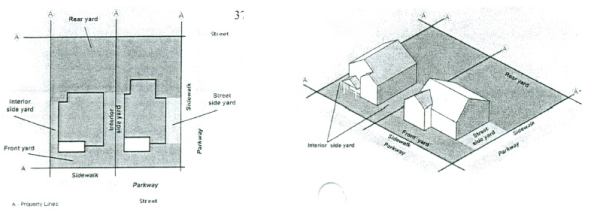
“Zoning District.” A portion of the incorporated area of the City within which certain regulations and requirements, or various combinations thereof, apply under the provisions of this UDO.
“Zoning Map.” The official map showing the zoning district within the incorporated areas of the City and which is a part of the UDO.
“Zoning Official.” The person holding the title of Zoning Official of the City of Franklin, or his designee.
(Ord. 2009-11. Passed 7-6-09; Ord. 2011-06. Passed 4-4-11; Ord. 2011-07. Passed 4-4-11; Ord. 2012-26. Passed 12-3-12; Ord. 2013-09. Passed 6-17-13; Ord. 2014-01. Passed 3-17-14; Ord. 2014-17. Passed 1-5-15; Ord. 2015-11. Passed 7-6-15; Ord. 2015-15. Passed 11-2-15; Ord. 2017-01. Passed 2-6-17.)
Amended by Ord. 2018-08 on 5/21/2018
Amended by Ord. 2018-19 on 11/5/2018
Amended by Ord. 2021-04 on 4/5/2021
Amended by Ord. 2021-06 on 5/3/2021
Amended by Ord. 2021-29 on 12/6/2021
Amended by Ord. 2022-12 on 5/2/2022
Amended by Ord. 2023-01 on 3/7/2023
Amended by Ord. 2023-20 on 10/9/2023
Amended by Ord. 24-02 on 3/18/2024
Amended by Ord. 2024-34 on 1/7/2025
Amended by Ord. 2025-03 on 2/3/2025
Amended by Ord. 2025-07 on 3/17/2025
Amended by Ord. 2025-13 on 6/16/2025
Amended by Ord. 2025-26 on 11/10/2025

