
Franklin City Zoning Code
CHAPTER 1107
Districts And Land Use Standards
1107.01 Zoning Districts Established
- Zoning Districts Established: The City is divided into the following zoning districts, which shall be governed by all the use and area requirements of this Ordinance. The following table lists each district along with its appropriate symbol:
TABLE 1107.01-1: Zoning DistrictsAbbreviation District Name Section Agricultural District A-1 Agricultural District 1107.01(b)(1)(A) Parks and Recreation District PAR Parks and Recreation District 1107.01(b)(2)(A) Residential Districts R-1 One-Family Residential District 1107.01(b)(3)(A) R-2 Metropolitan Residential District 1107.01(b)(3)(B) R-3 Central Residential District 1107.01(b)(3)(C) R-4 Multi-Family Residential District 1107.01(b)(3)(D) Commercial Districts C-1 General Commercial Districts 1107.01(b)(4)(A) C-2 Community Commercial District 1107.01(b)(4)(B) Downtown Districts DC-1 Downtown Core District 1107.01(b)(5)(A) MU-1 Mixed Use District 1107.01(b)(5)(B) RMU Riverfront Mixed Use District 1107.01(b)(5)(C) CV-1 Civic District 1107.01(b)(5)(D) TN-1 Transitional Neighborhood District 1107.01(b)(5)(E) TN-2 Transitional Mixed Use District 1107.01(b)(5)(F) Office Districts O-1 Office and Institutional District 1107.01(b)(6)(A) O-RP Research Park District 1107.01(b)(6)(B) O-S Office Service District 1107.01(b)(6)(C) Industrial Districts I-1 Light Industrial District 1107.1(b)(7)(A) I-2 General Industrial District 1107.1(b)(7)(B) Overlay Districts TOD Telecommunications Overlay District 1107.1(b)(8)(A) FOD Floodplain Overlay District 1107.1(b)(8)(B) WFP Well Field Protection Overlay District 1107.1(b)(8)(C) PUD Planned Unit Development Overlay District 1107.1(b)(8)(D) PRCDP Planned Residential Conservation Overlay District 1107.1(b)(8)(E) HSOD Highway Sign Overlay District 1107.1(b)(8)(F) - Zoning District Purpose Statements
- Agricultural District: The agricultural district within the UDO is the (A-1) Agricultural District. The agricultural zoning district and its regulations are hereby established to achieve, among others, the following purposes:
- A-1 Agricultural District: The intent of the A-1 Agricultural District is to provide space in the City for agriculture and related uses and to allow for undeveloped open space. Land best suited for this district includes those sections of the City that are prime farmland in outlying areas and/or land that has significant natural features, such as wetlands, forest, hillsides, and other open space that should be preserved.
- Parks and Recreation District: The parks and recreation district within the UDO is the (PAR) Parks and Recreation District. The parks and recreation district and its regulations are hereby established to achieve, among others, the following purposes:
- PAR Parks and Recreation District: The Parks and Recreation District is a special purpose zoning district intended to designate and protect lands dedicated to the public or open to the public use for no fee or for private parks and event centers. The purpose of this District is to preserve and enhance such major open space and public and private recreational, educational cultural, and aesthetic areas by protecting the natural amenities they possess.
- Residential Districts: The residential districts within the UDO include the (R-1) One-Family Residential District, (R-2) Metropolitan Residential District, (R-3) Central Residential District, and (R-4) Multi-Family Residential District. The residential districts and their regulations are hereby established to achieve, among others, the following purposes:
- R-1 One-Family Residential District: The intent of the One-Family Residential District is to provide space in the City for low-density, single-family residential uses, and to provide for additional uses that serve the residential neighborhood as conditional uses. The R-1 District is further divided into two subcategories:
- R-1A: Estate Residential District: The intent of the Estate Residential District is to provide spaces for the lowest density, single-family residential uses, with an average density of three dwelling units or less for every one acre of land.
- R-1B: Suburban Residential District: The intent of the Suburban Residential District is to provide space for low density, single-family residential uses, with an average density of four dwelling units or less for every one acre of land.
- R-2 Metropolitan Residential District: The intent of the Metropolitan Residential District is to provide space in the City for moderate-density, single-family residential uses in urban areas with complete municipal services, and to provide for additional uses that serve the residential neighborhood as conditional uses.
- R-3 Central Residential District: The intent of the Central Residential District is to recognize the existence of older residential areas of the City where homes have been built on small lots and where conservation of the existing housing stock should be encouraged. The R-3 Central Residential District allows for existing moderate-density housing and new single-family development.
- R-4 Multi-Family Residential District: The intent of the Multi-Family Residential District is to provide for mixed housing types at medium to high density in urban areas with complete municipal services. The R-4 District should generally be located to provide a smooth transition between residential areas and more intense uses.
- R-1 One-Family Residential District: The intent of the One-Family Residential District is to provide space in the City for low-density, single-family residential uses, and to provide for additional uses that serve the residential neighborhood as conditional uses. The R-1 District is further divided into two subcategories:
- Commercial Districts: The commercial districts within the UDO include the (C-1) General Commercial District and the (C-2) Community Commercial District. The commercial districts and their regulations are hereby established to achieve, among others, the following purposes:
- C-1 General Commercial District: The intent of the General Commercial District is to provide for general commercial activity, including a wide range of goods and services that will serve the region. This district is intended to be concentrated around transportation notes (such as the intersections of primary arterial streets).
- C-2 Community Commercial District: The intent of the Community Commercial District is to provide for low-intensity retail uses providing primarily goods and personal services for residential areas with good access to primary and secondary arterial streets.
- Downtown Districts: The downtown districts within the UDO include the (DC-1) Downtown Core District, (MU-1) Mixed Use District, (RMU) Riverfront Mixed Use District, (CV-1) Civic District, (TN-1) Transitional Neighborhood District, and (TN-2) Transitional Mixed Use District. The downtown districts and their regulations are hereby established to achieve, among others, the following purposes:
- DC-1 Downtown Core: The intent of the Downtown Core District is to promote a mixed use traditional downtown center that is a destination within the region for culture, dining, shopping, and gathering.
- MU-1 Mixed Use District: The intent of the Mixed Use District is to identify areas within Downtown Franklin for key mixed-use developments that include a diverse mix of uses at an intensity to catalyze development throughout Downtown Franklin.
- RMU Riverfront Mixed Use District: The intent of the Riverfront Mixed Use District is to establish a multi-use destination along the Great Miami River, that attracts people for commercial, recreation, or leisure experiences.
- CV-1 Civic District: The intent of the Civic District is to identify areas within Downtown Franklin for civic destinations that provide a variety of key services to Franklin residents and the region.
- TN-1 Transitional Neighborhood District: The intent of the Transitional Neighborhood District is to provide a variety of residential development types, styles, and price points that cater to existing Franklin residents, while also attracting new residents into the City.
- TN-2 Transitional Mixed Use District: The intent of the Transitional Mixed use District is to provide a variety of residential development types, styles, and price points while also encouraging the development or redevelopment of neighborhood scale commercial uses that provide goods and personal services to the surrounding area.
- Office Districts: The office districts within the UDO include the (O-1) Office and Institutional District, (O-RP) Research Park District, and (O-S) Office Service District. The office districts and their regulations are hereby established to achieve, among others, the following purposes:
- O-1 Office and Institutional District: The intent of the Office and Institutional District is to encourage the orderly development of office and institutional uses within the same district with consideration of the similar characteristics these uses share, including location, parking requirements, traffic, and accessibility. Development standards of this district are intended to provide compatibility with and protection to surrounding residential properties.
- O-RP Research Park District: The intent of the Research Park District is to provide for and encourage the orderly development of a variety of light manufacturing, technology-based industries, research and development and office uses that are established in a campus-like setting, with landscaping and architectural amenities that create a sense of place and esthetically attractive urban development. It is intended that this District will provide for the grouping and clustering of professional offices, non-hazardous industrial uses, research and development uses, and high technology manufacturing that interact together in terms of functions, location, activities and appearance. Development standards for this District are intended to provide compatibility with and protection to surrounding residential and commercial properties, as well as assuring that such facilities are developed in a clustered campus or park-like setting that emphasizes natural characteristics, landscaping and pedestrian access.
- O-S Office Service District: The intent of the Office Service District is to provide for business and professional offices/buildings and related commercial uses and services that will serve the employees and clients of such businesses, as well as the surrounding area. This District is intended to be concentrated around transportation nodes, such as highway interchanges and major intersections.
- Industrial Districts: The industrial districts within the UDO include the (I-1) Light Industrial District and the (I-2) General Industrial District. pose: The industrial districts and their regulations are hereby established to achieve, among others, the following purposes:
- I-1 Light Industrial District: The intent of the 1-1 Light Industrial District is to provide for industrial and office uses that are not of an intensity to produce objectionable impacts on adjacent development. This District should be located within areas of the City with suitable access to transportation routes and necessary utilities.
- I-2 General Industrial District: The intent of the 1-2 General Industrial District is to provide for all industrial uses, including those high-intensity uses that create noticeable impacts on the surrounding area. All uses, however, will be required to operate without causing a risk to the health and welfare of the inhabitants of the City. This District is intended to be located within areas of the City that have suitable access to transportation routes and necessary utilities and that are away from residential uses.
- Overlay Districts. The overlay districts within the UDO include the (TOD) Telecommunications Overlay District, (FOP) Floodplain Overlay District, (WFP) Well Field Protection Overlay District, (PUD) Planned Unit Development Overlay District, (PRCD) Planned Residential Conservation Overlay District, and (HSOD) Highway Sign Overlay District. The overlay districts and their regulations are hereby established to achieve, among others, the following purposes:
- TOD Telecommunications Overlay District: The purpose of this Overlay District is to regulate the placement, construction and modification of Towers and Wireless Telecommunications Facilities in order to protect the health, safety and welfare of the public, while at the same time not unreasonably interfering with the development of the competitive wireless telecommunications marketplace in the City. The Telecommunications Overlay District is outlined in Chapter 1109.
- FOP Floodplain Overlay District: The Floodplain Overlay District is composed of lands that are subject to periodic flooding. It is intended to preserve the existing flood plains, so as to allow the waterways a place to overflow at high water levels and thus assist in protecting other areas not now subject to flooding. In this District, only those uses that are temporary or seasonal in nature or that would not be extensively damaged by flooding are permitted. The Floodplain Overlay District is outlined in Chapter 1109.
- WFP Well Field Protection Overlay District: It is the intent of the Well Field Protection Overlay District to safeguard the health, safety and welfare of the customers of protected public water supplies and to protect the community's potable water supply against contamination by regulating land use and the storage, handling, use and/or production of regulated substances as defined below. The land within the overlay district is that land in the City of Franklin that lies within a one (1) year travel time contour adjacent to existing and proposed public wells of a protected public water supply. The Well Field Protection Overlay District is outlined in Chapter 1109.
- PUD Planned Unit Development Overlay District: This District is intended to encourage and coordinate planned development, with benefits for both the Developer and the Community. The Planned Unit Development Overlay District is outlined in Chapter 1109.
- PRCD Planned Residential Conservation District: It is the intent of the Planned Residential Conservation District to allow residential development while protecting the community's natural resources and real quality. The Planned Residential Conservation District is outlined in Chapter 1109.
- HSOD Highway Sign Overlay District: The primary objective of the Highway Sign Overlay District (HSOD) is to recognize that there exist special circumstances for businesses which border Interstate 75 whereby signage and placement of signage that would not normally be permitted in the underlying zoning district should be permitted in this Overlay District. The Highway Sign Overlay District is outlined in Chapter 1109.
(Ord. 2009-12. Passed 7-6-09; Ord. 2010-05. Passed 3-1-10; Ord. 2014-01. Passed 3-17-14.) - Agricultural District: The agricultural district within the UDO is the (A-1) Agricultural District. The agricultural zoning district and its regulations are hereby established to achieve, among others, the following purposes:
1107.02 Official Zoning Map
- Official Zoning Map Adopted: All land in the municipality is placed into zoning districts as shown on the Official Zoning Map that is hereby adopted and declared to be part of the UDO. Said Map was approved by Ordinance 2010-09, adopted on April 5, 2010, and became effective on May 5, 2010, and as subsequently amended.
- Final Authority: The Official Zoning Map, as amended from time to time, shall complement appropriate legislation as the final authority for the current zoning district status of land under the jurisdiction of the UDO.
- Land Not Otherwise Designated: All land under the UDO and not designated or otherwise included within another zoning district map shall be included in the R-I One-Family Residential District.
- Identification of the Official Zoning District Map: The Official Zoning Map, with any amendments made thereon, shall be identified by the signatures of the Mayor and all members of Council under the following words: Official Zoning District Map, Franklin, Ohio. Adopted by the City Council, Franklin, Ohio.
(Ord. 2009-12. Passed 7-6-09; Ord. 2013-18. Passed 11-4-13; Ord. 2014-1. Passed 3-17-14.)
Official Zoning Map Adopted: All land in the municipality is placed into zoning districts as shown on the Official Zoning Map that is hereby adopted and declared to be part of the UDO. Said Map was approved by Ordinance 2010-09, adopted on April 5, 2010, and became effective on May 5, 2010, and subsequently amended.
1107.03 Interpretation Of District Boundaries
- Legend and Use of Color or Patterns: There shall be provided on the Official Zoning Map a legend, which shall list the name and symbol for each zoning district. In lieu of a symbol, a color or black and white pattern may be used on the Official Zoning Map to identify each zoning district as indicated in the legend.
- Interpretation of Zoning District Boundaries: The boundaries of the zoning districts are shown upon the Official Zoning Map. The Official Zoning Map and all notations, references, and other information are a part of the UDO. A certified copy of the Official Zoning Map shall be kept on file with the City's Zoning and Building Department.
- Rules for Determination: When uncertainty exists with respect to the boundaries of zoning districts as shown on the Official Zoning Map, the following rules shall apply:
- Along a Street or Other Right-of-Way: Where zoning district boundary lines are indicated as approximately following a center line of a street or highway, alley, railroad easement, or other right-of-way, or a river, creek, or other watercourse, such centerline shall be the zoning district boundary.
- Along a Property Line: Where zoning district boundary lines are indicated as approximately following a lot line, such lot line shall be the zoning district boundary.
- Parallel to Right-of-Way or Property Line: Where zoning district boundary lines are indicated as approximately being parallel to a centerline or a property line and, in the absence of a specified dimension on the Official Zoning Map.
- Actual Conflict with Map: When the actual street or lot layout existing on the ground is in conflict with that shown on the Official Zoning Map, the party alleging that such conflict exists shall furnish an actual survey for interpretation by the Zoning Official.
- Right-of-Way Vacation: Whenever any street, alley or other public way is vacated by official action of Council, the zoning district adjoining each side of such street, alley or public way shall be automatically extended to the center of such vacation, and all area included in the right-of way.
(Ord. 2009-12. Passed 7-6-09; Ord. 2010-05. Passed 3-1-10; Ord. 2011-06. Passed 4-4-11; Ord. 2011-07. Passed 4-4-11; Ord. 2013-09. Passed 6-17-13; Ord. 2013-18. Passed 11-4-13; Ord. 2014-01, Passed 3-17-14; Ord. 2014-17. Passed 1-5-15.)
1107.04 Permitted Use Table
- Regulation of the Use and Development of Land and Structures: These regulations are established and adopted governing the use and physical development of land and/or structures.
- Rules of Application: These regulations shall be interpreted and enforced according to the following rules:
- Identification of Uses: Listed uses are to be defined by their customary name or identification, except where they are specially defined or limited in this UDO.
- Permitted Uses: Only a use designated as a permitted use shall be allowed as a matter of right in a zoning district and any use not so designated shall be prohibited except, when in character with the zoning district, such other additional uses may be added to the permitted uses of the zoning district by an amendment to this UDO.
- Conditional Uses: A use designated as a conditional use may be allowed in a zoning district when such conditional use, its location, extent and method of development will not substantially alter the character of the vicinity or unduly interfere with the use of adjacent lots in the manner prescribed tor the zoning district. To this end the Planning Commission may, in addition to the development standards for the zoning district, set forth such additional requirements as will, in its judgment, render the conditional use compatible with the existing and future use of adjacent lots and the vicinity.
- Accessory Uses: A use designated as an accessory use shall be permitted in a zoning district when such use is subordinate in area, extent, and purpose to the principal use and is located on the same lot and in the same zoning district as the principal use.
- Prohibited Uses: If a use is not listed on Table 1107.04-1 or Table 1107.04-2, then it shall also be considered prohibited, unless approved specifically through the similar use determination as established in section 1115.09(f): Determination of Similar Uses.
- Additional Standards: The section reference contained in the "REF" column on Table 1107.04-1 and Table 1107.04-2 are references to additional standards are requirements that apply to uses listed in the respective row. Standards referenced in the table apply to all the zoning districts in which the use is permitted or conditionally permitted, unless otherwise expressly stated. In the table a "PS" represents a permitted use that has additional standards, and a "CS" represents a conditional use that has additional standards.
- Development Standards: The development standards shall be the minimum required for development in a zoning district unless otherwise stated. If the development standards are in conflict with the requirements of any other lawfully adopted rules, regulations or laws, the more restrictive or higher standards shall govern.
TABLE 1107.04-1: Agricultural, Residential, and Parks and Recreation Districts Use TableAgricultural Uses A-1 PAR R-1 R-2 R-3 R-4 REF Agriculture P PS 1107.06(a) Residential Uses A-1 PAR R-1 R-2 R-3 R-4 REF Dwelling, Four Family P Dwelling, Live/Work CS 1107.07(a) Dwelling, Multi-Family 5+ Units P Dwelling, Row House CS 1107.07(b) Dwelling, Single-Family P P P P P Dwelling, Three Family P P Dwelling, Two Family C P P Elderly Housing CS CS 1107.07(d) Residential Living Facility, Large CS 1107.07(e) Residential Living Facility, Medium CS CS 1107.07(e) Residential Living Facility, Small PS PS PS PS PS 1107.07(e) Residential Treatment Facility, Large CS 1107.07(e) Residential Treatment Facility, Medium CS CS 1107.07(e) Residential Treatment Facility, Small PS PS PS PS PS 1107.07(e) Public/Institutional Uses A-1 PAR R-1 R-2 R-3 R-4 REF Cemeteries, Mortuaries CS 1107.08(b) Educational Facilities (Pre-K thru 12th Grade) CS CS 1107.08(c) Essential Services PS PS PS PS PS PS 1107.08(d) Government Facility P P P P P P Public Parks, Open Spaces, Recreation, and Preserves, Outdoor PS PS PS PS PS PS 1107.08(e) Religious and Cultural Facilities CS CS CS CS CS 1107.08(g) Secondary Education, Colleges, and Universities CS CS 1107.08(c) Commercial Uses A-1 PAR R-1 R-2 R-3 R-4 REF Assisted Living and Skilled Nursing Care CS 1107.09(b) Retreat Center P Bed and Breakfast CS CS CS CS CS 1107.09(h) Commercial Recreation/Fitness, Indoor CS PS CS CS CS CS 1107.09(k) Commercial Recreation/Fitness, Outdoor CS PS CS CS CS CS 1107.09(k) Farm Market P Landing Field CS 1107.09(o) Accessory Uses A-1 PAR R-1 R-2 R-3 R-4 REF Accessory Structures PS PS PS PS PS PS 1107.11 Accessory Uses PS PS PS PS PS PS 1107.11 Antennas and Towers PS PS PS PS PS 1107.11(b) Day Care Home, Type A CS CS CS CS CS 1107.11(d) Day Care Home, Type B PS PS PS PS PS 1107.11(e) Decks, Patios, Porches, and Balconies PS PS PS PS PS PS 1107.11(f) Dwelling, Accessory Unit CS CS CS CS CS 1107.11(h) Electric Vehicle (EV) Charging Stations, Accessory PS PS PS PS PS PS 1107.11(i) Fences and Walls PS PS PS PS PS PS 1107.11(j) Garages and Carports, Detached PS PS PS PS PS PS 1107.11(k) Home Occupation, Type A PS PS PS PS PS 1107.11(l) Home Occupation, Type B CS CS CS CS CS 1107.11(l) Open-Sided Structure PS PS PS PS PS PS 1107.11(m) Parking Area, Accessory P P P P P P Parking of Recreational Vehicles and Watercraft PS PS PS PS PS 1107.11(s) Playground Equipment PS PS PS PS PS PS 1107.11(u) Solar Panels, Roof Mounted PS PS PS PS PS PS 1107.11(v) Storage Structure PS PS PS PS PS PS 1107.11(w) Swimming Pools and Hot Tubs, Private PS PS PS PS PS PS 1107.11(x) Temporary Uses A-1 PAR R-1 R-2 R-3 R-4 REF Construction Trailer PS PS PS PS PS PS 1107.12(a) Farm Market, Temporary P Festivals and Circuses PS PS PS PS PS PS 1107.12(b) Mobile Uses PS PS 1107.12(c) Model Home PS PS PS PS 1107.12(d) Residential Sales PS PS PS PS PS 1107.12(e) Residential Storage Units (PODs) PS PS PS PS PS 1107.12(f) Seasonal Sales PS 1107.12(g) Temporary Structures P P P P P P P= Permitted Use, PS= Permitted Use with Use Specific Standards, C= Conditional Use, CS= Conditional Use with Specific Standards
TABLE 1107.04-2: Nonresidential Districts Use TableResidential Uses C-1 C-2 DC-1 MU-1 RMU CV-1 TN-1 TN-2 O-1 O-RP O-S I-1 I-2 REF Dwelling, Four Family CS P P Dwelling, Live/Work CS CS PS PS PS 1107.07(a) Dwelling, Multi-Family 5+ Units C C C C C Dwelling, Row House CS CS CS CS PS PS 1107.07(b) Dwelling, Single Family P P Dwelling, Three Family C P P Dwelling, Two Family P P Dwelling, Upper Floor CS CS PS PS PS PS PS 1107.07(c) Elderly Housing CS CS 1107.07(d) Residential Treatment Facility, Medium CS CS 1107.07(e) Residential Treatment Facility, Small PS PS 1107.07(e) Residential Treatment Facility, Medium CS CS 1107.07(e) Residential Treatment Facility, Small PS PS 1107.07(e) Public/Institutional Uses C-1 C-2 DC-1 MU-1 RMU CV-1 TN-1 TN-2 O-1 O-RP O-S I-1 I-2 REF Alcohol and Drug Addiction Treatment Facilities CS CS 1107.08(a) Cemeteries and Mortuaries PS 1107.08(b) Educational Facilities (Pre-K thru 12th Grade) CS CS CS CS 1107.08(c) Essential Services PS PS PS PS PS PS PS PS PS PS PS PS PS 1107.08(d) Government Facility P P P P P P P P P P P P P Public Parks, Open Spaces, Recreation, and Preserves, Outdoor PS PS PS PS PS PS PS CS CS 1107.08(e) Public Plazas, Gathering, and Eating Areas P P P P P P Public Recreation and Event Space, Indoor CS PS PS 1107.08(f) Religious and Cultural Facilities CS CS CS CS CS CS CS CS CS 1107.08(g) Secondary Education, Colleges, and Universities CS CS CS CS CS 1107.08(c) Transportation or Communication Utility P P Commercial Uses C-1 C-2 DC-1 MU-1 RMU CV-1 TN-1 TN-2 O-1 O-RP O-S I-1 I-2 REF Alcohol Production and Sales, Large PS CS 1107.09(a) Alcohol Production and Sales, Small PS PS PS PS PS 1107.09(a) Artist Studio and Gallery P P P P P P Assisted Living and Skilled Nursing Care PS PS CS 1107.09(b) Automobile Fueling/ Charging Stations CS CS 1107.09(c) Automobile Sales/Rental CS 1107.09(d) Automobile Service/Repair, Heavy CS 1107.09(e) Automobile Service/Repair, Light CS 1107.09(f) Automobile Washing Facility C Bar, Lounge, Tavern PS PS PS PS PS 1107.09(g) Bed and Breakfast CS CS CS CS CS 1107.09(h) Business Retail PS PS CS CS PS 1107.09(u) Business Service CS CS PS PS 1107.09(i) Clubs, Private or Membership P P Commercial Entertainment PS CS CS CS CS CS 1107.09(j) Commercial Recreation/ Fitness, Indoor CS CS CS CS CS CS 1107.09(k) Commercial Recreation/ Fitness, Outdoor CS CS CS CS CS 1107.09(k) Commercial Training P P C C C Day Care Center CS CS CS CS CS CS CS CS 1107.09(l) Event Venue, Indoor or Outdoor CS CS CS 1107.09(m) Financial Institution, General P P Food Service/Catering P P Hospitals P Hotels PS CS CS CS CS CS CS PS 1107.09(n) Information Technology/Data Center P P Makerspace P C P P P P P Medical Center/Clinic PS PS CS CS CS PS 1107.09(p) Medical Office P P C P C C C C Mixed Use PS PS PS PS PS PS PS 1107.09(q) Office P P P P P P C C P P P Office, Campus P C P P Office, Co-Working P C P C C Personal Service PS PS CS CS PS 1107.09(r) Restaurant, Quick Service PS CS 1107.09(s) Restaurant, Standard PS PS PS PS PS PS PS 1107.09(t) Retail, Convenience PS CS 1107.09(u) Retail, Food/Beverage Related PS PS PS PS PS PS 1107.09(u) Retail, General PS PS PS PS PS PS 1107.09(u) Retail, Large Format CS Retail, Services C P Sexually Oriented Businesses CS 1107.09(w) Veterinary Services CS CS 1107.09(x) Industrial Uses C-1 C-2 DC-1 MU-1 RMU CV-1 TN-1 TN-2 O-1 O-RP O-S I-1 I-2 REF Distribution Center CS PS 1107.10(c) Environmental Sciences P P P Fulfillment Center PS PS 1107.10(d) Industrial, Artisan P C P P Industrial, Heavy P Industrial, Light P P Large Equipment and Truck Retail, Rental, and Repair P P Material Sciences P P P Research and Development Facility P P P Warehouse, Primary Use CS 1107.10(e) Warehouse, Secondary Use PS PS 1107.10(f) Accessory Uses C-1 C-2 DC-1 MU-1 RMU CV-1 TN-1 TN-2 O-1 O-RP O-S I-1 I-2 REF Accessory Structures PS PS PS PS PS PS PS PS PS PS PS PS PS 1107.11 Accessory Uses PS PS PS PS PS PS PS PS PS PS PS PS PS 1107.11 Antennas and Towers PS PS PS PS PS PS PS 1107.11(b) Automated Teller Machine (ATM), Outdoor PS PS 1107.11(c) Day Care Home, Type A CS CS CS CS CS 1107.11(d) Day Care Home, Type B PS PS PS PS PS 1107.11(e) Decks, Patios, Porches, and Balconies PS PS PS PS PS PS PS PS 1107.11(f) Drive-Thru for Retail or Restaurant Use PS CS 1107.11(g) Dwelling, Accessory Unit CS CS 1107.11(h) Electric Vehicle (EV) Charging Stations PS PS PS PS PS PS PS PS PS PS PS PS PS 1107.11(i) Fences and Walls PS PS PS PS PS PS PS PS PS PS PS PS PS 1107.11(j) Garages and Carports, Detached PS PS 1107.11(k) Home Occupation, Type A PS PS PS PS PS 1107.11(l) Home Occupation, Type B CS CS CS CS CS 1107.11(l) Open-Sided Structures PS PS PS PS PS 1107.11(m) Outdoor Dining PS PS PS PS PS PS 1107.11(n) Outdoor Retail and Display PS PS PS PS PS PS 1107.11(o) Outdoor Storage PS PS PS PS 1107.11(p) Parking Area P P PS PS PS PS PS PS P P P P P 1107.11(q) Parking Garage P P PS PS PS PS PS PS P P 1107.11(q) Parking of Recreational Vehicles and Watercraft PS PS 1107.11(s) Pick-Up Window for Retail or Restaurant Use PS PS PS PS PS PS 1107.11(t) Playground Equipment PS PS 1107.11(u) Solar Panels, Roof-Mounted PS PS PS PS PS PS PS PS PS PS PS PS PS 1107.11(v) Storage Structure PS PS PS PS PS PS PS PS PS PS PS PS PS 1107.11(w) Swimming Pools and Hot Tubs, Private PS PS PS 1107.11(x) Temporary Uses C-1 C-2 DC-1 MU-1 RMU CV-1 TN-1 TN-2 O-1 O-RP O-S I-1 I-2 REF Construction Trailer PS PS PS PS PS PS PS PS PS PS PS PS PS 1107.12(a) Farm Market P P P P Festivals and Circuses PS PS PS PS PS PS PS PS PS PS PS PS PS 1107.12(b) Mobile Uses PS PS PS PS PS PS PS PS PS PS PS PS
PS1107.12(c) Model Home PS PS PS PS 1107.12 (d) Residential Sales PS PS PS PS 1107.12(e) Residential Storage Units (PODs) PS PS PS PS 1107.12(f) Seasonal Sales PS PS PS PS PS PS 1107.12(g) Special Event PS PS PS PS PS PS 1107.12(h) Temporary Structure P P P P P P P P P P P P P P= Permitted Use, PS= Permitted Use with Use Specific Standards, C= Conditional Use, CS= Conditional Use with Specific Standards
1107.05 General Use Standards
- External Effects: No land, building or structure in any district shall be used or occupied in any manner so as to create any dangerous, injurious, noxious or otherwise objectionable fire, explosion or other hazard; noise, brilliant light or vibration; smoke, dust, fumes, odor or other form of air pollution; heat, cold or dampness; electrical or electronic disturbances; nuclear radiation; or any other condition, substance or element which is dangerous, injurious, noxious or otherwise objectionable to any person or property outside of the premises on which such building, structure or use is located. Such uses, when lawfully permitted under the provisions of this UDO, shall be operated in a manner so as to ensure that the property rights of all other parcels of land will not be adversely affected to the extent of reducing the enjoyment of property rights thereon.
- Removal of Soil, Sand, or Other Materials: The use of land for the removal of topsoil, sand and other materials from the land, other than materials from basement excavations, is not permitted in any district, except under a temporary permit from the Appeals Board. This permit may be denied or issued in appropriate cases after the filing of an application accompanied by a suitable agreement or bond that such removal will not cause stagnant water to collect and will not leave the surface of the land, at the expiration of such permit, in an unstable condition or unfit for the growing of turf or for other land uses permitted in the district in which such removal occurs.
1107.06 Agricultural Use Standards
- Agriculture: Agricultural uses in the R-1A Estate Residential District are subject to the following regulations:
- Purpose: It is recognized that the R-1A Estate Residential District, due to its larger lot size and location of the district, by provide adequate area for some limited agricultural uses. This use shall be for the purpose of allowing limited agricultural uses in the R-1A, Estate Residential District on lots of two acres or more.
- Agricultural uses shall be limited to:
- The raising for private use or sale of fruit, vegetables, or nursery stock;
- The keeping of sheep, goats, hogs, or other small farm animals;
- The keeping of poultry/domestic fowl, such as chickens, turkeys, ducks, and geese; and
- The keeping of bovine and/or equine animals.
- Standards for the Raising for Sale of Fruit, Vegetables, or Nursery Stock: The raising of produce or nursery stock for the purposes of sale shall require 10 acres.
- Standards for the Keeping of Sheep, Goats, Hogs, or Other Small Farm Animals:
- One sheep, goat, hog or other small farm animal may be kept per 1.5 acres of land, but in no case shall the total number of animals exceed four such animals regardless of the size of the lot.
- The structure containing the farm animal shall be located not less than 100 feet from any residence on an adjoining parcel.
- No storage of manure or odor or dust-producing substance shall be permitted.
- Land shall be fenced so as to securely confine such animals. Such fencing shall not be located closer to any public right-of-way or private street than the minimum setback in the district and shall not be located closer than 15 feet from any other residential property line.
- No farm animals shall be kept on a vacant lot unless the owner of such vacant lot lives on a lot contiguous to said vacant lot.
- The use shall comply in all respects with any and all applicable state and federal regulations.
- Standards for the Keeping of Poultry/Domestic Fowl:
- Roosters shall be limited to one per five acres.
- Chickens, turkeys, ducks and/or geese shall be limited to five per acre.
- Regardless of acreage, in no case shall the total number of poultry/domestic fowl exceed 12 such animals. Land acreage shall be measured exclusive of road or street right-of-way.
- The structure containing the poultry/domestic fowl shall be located not less than 100 feet from any residence on an adjoining parcel.
- No storage of droppings or odor or dust-producing substances shall be permitted.
- The animals shall be securely confined by fencing, which shall not be located closer to any public right-of-way or private street than the minimum setback in the district and shall not be located closer than 15 feet from any other residential property line.
- No poultry/domestic fowl shall be kept on a vacant lot unless the owner of such vacant lot lives on a lot contiguous to said vacant lot.
- The use shall comply in all respects with any and all applicable state and federal regulations.
- Standards for the Keeping of Bovine and/or Equine Animals:
- The minimum area of any lot on which bovine and/or equine animals may be kept shall be five acres, exclusive of road or street right-of-way; but in no case shall the total number of animals exceed three such animals over six months of age and three foals up to six months in age, regardless of the size of the lot.
- The structure containing the animal shall be located not less than 100 feet from any residence on an adjoining parcel.
- No storage of manure or odor or dust-producing substance shall be permitted.
- Land shall be fenced so as to securely confine such animals. Such fencing shall not be located closer to any public right-of-way or private street than the minimum setback in the district and shall not be located closer than 15 feet from any other residential property line.
- No such animals shall be kept on a vacant lot unless the owner of such vacant lot lives on a lot contiguous to said vacant lot.
- The use shall comply in all respects with any and all applicable state and federal regulations.
1107.07 Residential Use Standards
- Dwelling, Live/Work: Live/work dwellings shall have a ground floor utilized by a permitted non-residential use in addition to the review standards in Section 1113.01.
- Dwelling, Row House: Row Houses are subject to the following regulations in addition to the review standards in Section 1113.01:
- If the row house dwellings have front garage access, then such development shall have a minimum front yard setback of 20 feet from the property line. Row house dwellings are encouraged to be set close to the street with rear parking and garage access.
- Row house dwellings may be built to the side property line when there is a shared wall along the property line. The ends of each grouping of row house dwellings shall meet the required side yard setback in the district in which they are located, and a minimum of 10 feet shall be maintained between each separated group of row houses.
- For districts in which row houses are a conditional use, the following standards shall apply:
- The exterior of the proposed use shall be compatible with the residential character of the neighborhood.
- If patios are to be provided, they shall be shown on the construction plans and may be enclosed with a solid wall or fence. The space between patio fences or walls shall not be less than five feet, unless otherwise approved by the Planning Commission.
- Dwelling, Upper Floor: Upper floor dwellings are subject to the following regulations. Upper floor dwellings that require conditional use approval shall also be subject to the review standards in Section 1113.01:
- Dwelling units may not be located on the ground floor of the building.
- Separate direct access to a ground floor entrance must be provided.
- The proposed dwelling units must meet local fire safety requirements for the proposed use and level of occupancy.
- All upper floor dwelling units shall be provided parking spaces in accordance with the multi-family parking requirements contained in Section 1111.07; excepting that parking may be provided by a satellite parking lot located within 500 feet of the property.
- Elderly Housing: Elderly housing is subject to the following regulations in addition to the review standards in Section 1113.01:
- The minimum floor area for dwelling units shall be 800 square feet.
- The proposed use shall be appropriately located and shall be in convenient walking distance of shopping and community facilities wherever possible.
- Each dwelling unit shall be occupied in accordance with the “housing for older persons” exemption under the federal Fair Housing Amendments Act. The applicant shall submit documentation showing that the proposed development will be restricted to elderly housing, in the form of deed restrictions on each lot, or in the case of a condominium development, by the articles of incorporation and the Homeowner's Association bylaws.
- No dwelling unit in the development shall include more than two bedrooms.
- Planning Commission may modify the dimensional requirements of the underlying zoning district for the proposed use, where it finds such modification to be in the best interest of allowing an appropriate Elderly Housing Development that will be harmonious with the surrounding neighborhood.
- If patios are to be provided, they shall be shown on the construction plans, and may be enclosed with a solid wall or fence. The space between patio fences or walls shall not be less than five feet unless otherwise approved by Planning Commission.
- Residential Living Facilities and Residential Treatment Facilities: Residential facilities and residential treatment facilities shall be subject to the following regulations:
- Residential living facilities shall provide a minimum of 200 square feet of space for each occupant.
- For districts in which residential living and treatment facilities are a conditional use, the following standards shall apply in addition to the review standards in Section 1113.01:
- The proposed facility must meet all federal and/or state certification, licensing or approval requirements.
- The proposed facility must meet local fire safety requirements and Ohio Building Code requirements for the proposed use and level of occupancy.
- The proposed use shall not generate an unreasonable increase in traffic volume.
- Such facilities shall not be located within 600 feet, including a public or private right-of-way, of an existing residential facility or residential treatment facility.
- The exterior of the facility shall be compatible with the residential character of the neighborhood.
- The facility shall be reasonably accessible, by virtue of its location or transportation provided by the applicant, to medical, recreational and retail services required by its residents, and to employment opportunities, if applicable.
- The applicant shall provide a plan indicating the manner in which the facility will maintain contact with neighborhood residents and will include a structured procedure whereby any neighbor grievances may be filed and resolved.
- The applicant will provide documentation indicating the need for the facility, the specific clientele it will serve, and the location and type of similar facilities operated by the applicant.
1107.08 Public And Institutional Use Standards
- Alcohol and Drug Addiction Treatment Facilities: Alcohol and drug addiction treatment facilities are subject to the following regulations in addition to the review standards in Section 1113.01:
- The proposed use shall meet all applicable Federal, State and/or local licensing requirements, certification requirements and/or business regulations.
- The proposed facility must meet local fire safety requirements and Ohio Building Code requirements for the proposed use and level of occupancy.
- The applicant shall submit a traffic plan indicating safe traffic ingress and egress, traffic circulation, and on-site parking, which plan shall be subject to approval by Planning Commission to assure reduced congestion and promote safety.
- For new buildings, when adjacent to Residential Districts, all buildings shall be set back an additional one foot over the usual yard requirements for each one foot of the building that exceeds 35 feet in height.
- A solid wood fence, masonry wall, or hedge six feet high shall be required along any property line adjacent to a residential use or Residential District.
- The applicant will provide documentation indicating the need for the facility, the specific clientele it will serve, and the location and type of similar facilities operated by the applicant.
- Cemeteries and Mortuaries: Cemeteries and mortuaries are subject to the following regulations:
- The site shall have direct access to a major thoroughfare, which the Zoning Official or Planning Commission, as applicable, determines is adequate to serve the size of the facility proposed.
- All buildings including, but not limited to crematories, mausoleums and mortuaries, shall not be located within 100 feet of a property line.
- All graves or burial lots shall be setback not less than 50 feet from any property line.
- Educational Facilities (Pre-K through 12th Grade), Secondary Education, College, and Universities: Educational facilities, secondary education, college, and universities are subject to the following regulations in addition to the review standards in Section 1113.01:
- In residential districts, all buildings shall be set back an additional one foot over the usual yard requirements for each one foot of the building that exceeds 35 feet in height.
- An opaque wood fence, masonry wall, or hedge six feet in height shall be required along any property line adjacent to a residential use or residential district.
- The applicant shall submit a plan that addresses safe traffic ingress and egress, traffic circulation, student parking, teacher parking, guest parking, student pick-up and drop-off circulation patterns, bus pick-up and drop-off areas, bus parking, bicycle parking, and other similar elements. The plan shall be subject to approval by Planning Commission to assure reduced congestion, promote safety, and reduction in the impact on the residential character of the neighborhood, as applicable.
- Essential Services: Buildings required in conjunction with an essential service may be permitted in any district when approved by the Planning Commission. In granting such permission, the Planning Commission shall take into consideration the location, size, use, and effect such building will have on adjacent land.
- Public Parks, Open Spaces, Recreation, and Preserves, Outdoor: Playground equipment must be set back from all adjacent residential uses a minimum of 25 feet.
- Public Recreation and Event Space, Indoor: Indoor public recreation and event spaces are subject to the following regulations. Indoor public recreation and event space uses that require conditional use approval shall also be subject to the review standards in Section 1113.01:
- In residential districts, all buildings shall be set back an additional one foot over the usual yard requirements for each one foot of the building that exceeds 35 feet in height.
- The applicant shall submit a plan indicating safe traffic ingress and egress, traffic circulation, and on-site parking, which plan shall be subject to approval by Planning Commission to assure reduced congestion, promote safety, and reduction in the impact on the residential character of the neighborhood, as applicable.
- Religious and Cultural Facilities: Religious and cultural facilities are subject to the following regulations in addition to the review standards in Section 1113.01:
- The minimum lot size for religious and cultural facilities in agriculture and residential districts shall be two acres.
- For district in which religious and cultural facilities are a conditional use, the following standards shall apply:
- The facility shall be used only for the purposes of the local congregation or organization and shall not be operated as or in connection with any commercial use, except that the renting of rooms for community service purposes is permitted.
- In residential districts, all buildings shall be set back an additional one foot over the usual yard requirements for each one foot of the building that exceeds 35 feet in height.
- A cemetery associated with a church shall require a separate Conditional Use Permit.
- Nursery, kindergarten, day care and compulsory (grades 1 through 12) schools shall be permitted accessory uses to a church; however, any outdoor playgrounds, tot lots, exercise areas, etc., shall be enclosed or otherwise protected from traffic or other hazards. The area shall be enclosed by a fence or wall a minimum of five feet in height, except when the recreational area abuts a residential property, in which case it shall be enclosed by a solid wood fence or masonry wall six feet high along the property line.
1107.09 Commercial Use Standards
- Alcohol Production and Sales: Alcohol production and sales, including both large scale and small-scale facilities, are subject to the following regulations. Alcohol production and sale uses that require conditional use approval shall also be subject to the review standards in Section 1113.01:
- Each use shall manufacture and sell alcoholic beverages in accordance with the provisions of, and shall maintain current licenses as required by, The Ohio Division of Liquor Control and all other appropriate state agencies.
- No outdoor storage is permitted.
- All production shall be within completely enclosed structures.
- For large-scale facilities, all structures or areas associated with production or public use (including, but not limited to, outdoor dining or activity areas, tap rooms, production/bottling facilities, etc.) shall be set back a minimum of 200 feet from any side or rear property line.
- Such facilities may include a taproom or tasting room for the public, which may or may not serve food.
- Exterior storage structures that hold materials or products associated with the brewing, distilling, or storing process must be located in the side or rear yard. Such facilities shall be subject to the maximum height restrictions of the zoning district where they are located.
- Assisted Living and Skilled Nursing Care: Assisted living and skilled nursing care facilities are subject to the following regulations. Assisted living and skilled nursing care uses that require conditional use approval shall also be subject to the review standards in Section 1113.01:
- Single-family homes may not be used for such facilities.
- The facility shall not be equipped for surgical care or for treatment of acute disease or serious injury, and shall not be primarily designed for patients being treated for mental illness or alcohol or drug addiction.
- The proposed facility must meet all federal and/or state certification, licensing or approval requirements.
- The proposed facility must meet local fire safety and Ohio Building Code requirements for the proposed use and level of occupancy.
- The proposed use shall not generate an unreasonable increase in traffic volume or require special off-street parking, and may not use on-street parking to meet the parking requirements applicable to it.
- The exterior of the facility shall be compatible with the residential character of the neighborhood.
- The applicant will provide documentation indicating the need for the facility, the specific clientele it will serve, and the location and type of similar facilities operated by the applicant.
- Automobile Fueling/Charging Stations: Automobile fueling/charging stations shall be subject to the following regulations in addition to the review standards in Section 1113.01:
- All outdoor storage, if permitted by Planning Commission, must be completely screened from view from adjacent properties and the street.
- All outdoor display areas, gasoline pumps, canopies, and any buildings used for service shall be located at least 50 feet from any adjacent residential property or district.
- A solid wood fence, masonry wall, or hedge six feet high shall be required along any property line adjacent to a residential use or district.
- The minimum distance of driveways from intersections shall be as approved by the City Engineer.
- Access shall be from an arterial street or collector or shall be provided in a manner that does not cause heavy impact on residential streets. Access drives shall be as approved by the City Engineer.
- The circulation areas shall provide smooth, continuous flow with efficient, non-conflicting movement throughout the site. Major vehicular circulation movements shall not conflict with major pedestrian movements. Interconnecting circulation aisles between parcels shall be provided.
- Every parking and loading space shall have sufficient access and maneuvering area. All maneuvering areas shall be on the same lot as the use the area is intended to serve.
- Automobile fueling/charging stations are subject to the vehicle stacking requirements of Table 1111.07-2: Required Number of Stacking Spaces.
- All areas not paved or covered by the building shall be landscaped and all landscaped areas shall be separated from all paved areas by six inch high curbing.
- The proposed use shall comply with all federal, state and/or local underground storage facilities requirements, licensing requirements and/or business regulations.
- The fuel canopy shall be constructed of the same materials used on the principal building.
- Automobile Sales/Rental: Automobile sales/rental uses shall be subject to the following regulations in addition to the review standards in Section 1113.01:
- There shall be no parking or display of any vehicles within any right-of-way. The side/rear yard minimum dimensions shall be 20 feet.
- All outdoor display, storage, and sales facilities and areas shall be maintained in a neat and orderly condition.
- The outdoor display of goods for sale shall not be located in areas intended for traffic circulation according to the site plan.
- Access shall be from an arterial street or collector or shall be provided in a manner that does not cause heavy impact on residential streets. Access drives shall be as approved by the City Engineer.
- Loudspeaker systems shall be located a minimum of 200 feet from a residential zoning district or use.
- All outdoor display, storage, and sales facilities shall be limited to those shown on the approved site plan.
- Automobile Service/Repair, Heavy: Heavy automobile service/repair uses are subject to the following regulations in addition to the review standards in Section 1113.01:
- All activities, including, but not limited to, repair, restoration, cleaning, washing and drying operations, shall be performed entirely within an enclosed structure. During the time work is performed on a vehicle, the vehicle shall be entirely within the building.
- There shall be no outside display of merchandise.
- All hydraulic hoists, oil pits and all lubricants, greasing and repair equipment shall be enclosed entirely within a building. Any areas of outdoor storage must be completely screened from view from adjacent properties and the street.
- No unlicensed and/or inoperable vehicle shall be permitted on the property outside of the principal structure for more than 48 hours.
- Where the proposed use includes body and fender repair or painting, there will be not emissions of odors, dust, smoke, gas or fumes from the premises on which the use is proposed to be located.
- A solid wood fence, masonry wall, or hedge six feet in height shall be required along any property line adjacent to a residential use or residential district.
- Automobile Service/Repair, Light: Light automobile service/repair uses are subject to the following regulations in addition to the review standards in Section 1113.01:
- All activities, including, but not limited to, repair, restoration, cleaning, washing and drying operations, shall be performed entirely within an enclosed structure. During the time work is performed on a vehicle, the vehicle shall be entirely within the building.
- There shall be no outside display of merchandise.
- All hydraulic hoists, oil pits and all lubricants, greasing and repair equipment shall be enclosed entirely within a building. No outdoor assembly, storage, or repair of motor vehicles shall be permitted.
- No portion of the structure or its appurtenances, including ancillary, associated, or auxiliary equipment shall be located in front of the established building line.
- A solid wood fence, masonry wall, or hedge six feet high shall be required along any property line adjacent to a residential use or district.
- The minimum distance of driveways from intersections shall be as approved by the City Engineer. Access shall be from an arterial street or collector or shall be provided in a manner that does not cause heavy impact on residential streets. Access drives shall be as approved by the City Engineer.
- The circulation areas shall provide smooth, continuous flow with efficient, non-conflicting movement throughout the site. Major vehicular circulation movements shall not conflict with major pedestrian movements. Interconnecting circulation aisles between parcels shall be provided.
- Every parking and loading space shall have sufficient access and maneuvering area. All maneuvering areas shall be on the same lot as the use the area is intended to serve.
- All areas not paved or covered by the building shall be landscaped and all landscaped areas shall be separated from all paved areas by six-inch-high curbing.
- Bar, Lounge, and Tavern: Bars, lounges, and taverns are subject to the following regulations:
- Such establishments shall be located at least 250 feet from a residential district, churches and schools.
- All activities shall take place in a fully enclosed sound-resistant building.
- The site shall be kept free of litter and debris. The use of bars, lounges or taverns shall be no later than 2:30 a.m.
- Bed and Breakfast: Bed and breakfast establishments are subject to the following regulations:
- The facility shall be compatible with surrounding uses and shall be of sufficient site area to accommodate existing and future needs.
- Accessory structures and garages used by one or more of the allowed guests shall not contain cooking facilities.
- Breakfast shall be served on the premises only for the guests of the facility, and no other meals shall be provided.
- The owner shall maintain a record of the stays of all guests. The same guest or group of registrants shall not stay at the facility for a period of more than seven consecutive days or more than 21 total days within a given calendar year.
- The operator of the bed and breakfast facility must be the owner of record of the building and hold no less than a 50 percent interest in the property. The owner must occupy the property.
- Driveways may be used as off-street parking areas, except for that portion of a driveway located between the property line and the curb. For parking, setbacks shall be not less than 10 feet from any rear or side yard lot line.
- Business Service: Business service uses shall be subject to the following regulations. Business service uses that require conditional use approval shall also be subject to the review standards in Section 1113.01:
- If located in a commercial zoning district, the services must be completed offsite.
- No trailer, camper, manufactured housing unit, modular office trailer or industrialized units shall be placed on the property for any purpose without Planning Commission approval, except related to construction work that requires an active building permit.
- Fleet vehicle parking shall be to the side or rear of the property on a striped asphalt or concrete paved surface.
- Fleet vehicle parking areas shall be screened by landscaping and or fencing along all sides visible from the public right of way and from adjoining residential property.
- No junk, inoperative, or unlicensed automobiles, or parts, shall be permitted on the property.
- No outdoor storage of any material or waste shall be permitted on site
- Commercial Entertainment: Commercial entertainment uses are subject to the following regulations. Commercial entertainment uses that require conditional use approval shall also be subject to the review standards in Section 1113.01:
- A six-foot-high solid wood fence, masonry wall, or hedge shall be required along any property line adjacent to a residential use or residential district.
- The minimum distance of driveways from intersections shall be as approved by the City Engineer.
- Access shall be from an arterial street or collector or shall be provided in a manner that does not cause heavy impact on residential streets. Access drives shall be as approved by the City Engineer. Interconnecting circulation aisles between parcels shall be provided.
- The circulation areas shall provide smooth, continuous flow with efficient, non-conflicting movement throughout the site. Major vehicular circulation movements shall not conflict with major pedestrian movements. Access to an arterial or collector street is required.
- Every parking and loading space shall have sufficient access and maneuvering area. All maneuvering areas shall be on the same lot as the use the area is intended to serve.
- The applicant shall submit a plan indicating safe traffic ingress and egress, traffic circulation, and on-site parking, which plan shall be subject to approval by Planning Commission to assure reduced congestion and to promote safety.
- When adjacent to a residential district, all buildings shall be set back an additional one foot over the usual yard requirements for each one foot of the building that exceeds 35 feet in height.
- If adjacent to a residential use or residential district, such use shall not create excess noise, dust, odors or other nuisances.
- The Planning Commission may limit the hours of operation of such use to assure compatibility with adjacent uses.
- Commercial Recreation/Fitness, Indoor and Outdoor: Indoor and outdoor commercial recreation/fitness uses are subject to the following regulations in addition to the review standards in Section 1113.01:
- A solid wood fence, masonry wall, or hedge six feet high shall be required along any property line adjacent to a residential use or district.
- The minimum distance of driveways from intersections shall be as approved by the City Engineer.
- Access shall be from an arterial street or collector or shall be provided in a manner that does not cause heavy impact on residential streets. Access drives shall be as approved by the City Engineer.
- The circulation areas shall provide smooth, continuous flow with efficient, non-conflicting movement throughout the site. Major vehicular circulation movements shall not conflict with major pedestrian movements. Interconnecting circulation aisles between parcels shall be provided.
- The applicant shall submit a plan indicating safe traffic ingress and egress, traffic circulation, and on-site parking, which plan shall be subject to approval by Planning Commission to assure reduced congestion, promote safety, and reduction in the impact on the residential character of the neighborhood, as applicable.
- The exterior of any buildings shall be compatible with the residential character of the neighborhood.
- In residential districts, all buildings shall be set back an additional one foot over the usual yard requirements for each one foot of the building that exceeds 35 feet in height.
- If adjacent to a residential use or residential district, such use shall not create excess noise, dust, odors or other nuisances.
- The Planning Commission may limit the hours of operation of such use to assure compatibility with adjacent uses.
- This use may be permitted where the applicant can demonstrate that the use is distributed and properly integrated into the site plan to avoid congestion, to minimize conflict points between auto traffic and pedestrians, to reduce the number of curb cuts and to prevent strip type development.
- Day Care Center: Day care centers are subject to the following regulations in addition to the review standards in Section 1113.01:
- The proposed facility must meet State certification, licensing or approval requirements.
- The proposed facility must meet local fire safety requirements for the proposed use and level of occupancy.
- The exterior of the facility shall be compatible with the residential character of the neighborhood.
- Day care centers are subject to the vehicle stacking requirements of Table 1111.07-2: Required Number of Stacking Spaces.
- The proposed use shall not generate an unreasonable increase in traffic volume and access to an arterial or collector street is required, or access shall be provided in a manner that does not cause heavy traffic on residential streets.
- There shall be on the site a safe outdoor play space or recreation area, which is enclosed or otherwise protected from traffic or other hazards. The space shall contain no less than 60 square feet per client and shall provide an opportunity for supervised outdoor play or recreation each day in suitable weather. The area shall be enclosed by a fence or wall a minimum of five feet in height, except when the recreational area abuts a residential property, in which case it shall be enclosed by a solid wood fence or masonry wall six feet high along the property.
- The City may require additional fencing, screening, or other measures necessary to protect the health, safety, and welfare of clients using day care centers in commercial, industrial, or other high hazard areas. It may also deny a request to locate a facility in such areas based on these considerations.
- Use of outdoor recreational areas shall be limited to between the hours of 7:30 a.m. and 8:00 p.m.
- All day care centers shall provide evidence of comprehensive liability insurance insuring against damage to property or physical injury, in combined single limit form, in an amount of $25,000 per person authorized to be cared for.
- The applicant will provide documentation indicating the need for the facility, the specific clientele it will serve, and the location and type of similar facilities operated by the applicant.
- Event Venue, Indoor or Outdoor: Indoor and outdoor event venues are subject to the following regulations. Indoor or outdoor event venues shall also be subject to the review standards in Section 1113.01:
- As part of the conditional use approval, the Planning Commission may place upon an event venue a maximum number of events per year, the maximum number of guests, increased setback or buffering standards based on proximity of residential uses, or other reasons as determined by the Planning Commission.
- Hotels: Hotels are subject to the following regulations. Hotels that require conditional use approval shall also be subject to the review standards in Section 1113.01:
- Parking and service areas shall be completely screened from view by a six-foot solid fence, wall or evergreen hedge when adjacent to a residential use or district.
- Access to an arterial or collector street is required. Sufficient area shall be provided to accommodate vehicular loading, unloading and drop-off without conflicting with parking and drive-aisles.
- The applicant shall submit a plan indicating safe traffic ingress and egress, traffic circulation, and on-site parking, which plan shall be subject to approval by Planning Commission to assure reduced congestion, promote safety, and reduction in the impact on the residential character of the neighborhood, as applicable.
- Landing Field: Landing fields are subject to the following regulations in addition to the review standards in Section 1113.01:
- The applicant must provide documentation that the proposed use meets all FAA requirements.
- Medical Center/Clinic: Medical centers/clinics are subject to the following regulations. Medical centers and clinics that require conditional use approval shall also be subject to the review standards in Section 1113.01:
- The applicant shall submit a plan indicating safe traffic ingress and egress, traffic circulation, and on-site parking, which plan shall be subject to approval by Planning Commission to assure reduced congestion and promote safety.
- When adjacent to residential districts, all buildings shall be set back an additional one foot over the usual yard requirements for each one foot of the building that exceeds 35 feet in height.
- A solid wood fence, masonry wall, or hedge six feet high shall be required along any property line adjacent to a residential use or residential district.
- The minimum distance of driveways from intersections shall be as approved by the City Engineer.
- Access shall be from an arterial street or collector or shall be provided in a manner that does not cause heavy impact on residential streets. Access drives shall be as approved by the City Engineer.
- The circulation areas shall provide smooth, continuous flow with efficient, non-conflicting movement throughout the site. Major vehicular circulation movements shall not conflict with major pedestrian movements. Interconnecting circulation aisles between parcels shall be provided.
- Every parking and loading space shall have sufficient access and maneuvering area. All maneuvering areas shall be on the same lot as the use the area is intended to serve.
- The applicant will provide documentation indicating the need for the facility, the specific clientele it will serve, and the location and type of similar facilities operated by the applicant.
- Mixed Use: Mixed uses are subject to the following regulations:
- All uses within the building or development are permitted in the zoning district in which the building or development is located.
- To be considered mixed use, there shall be at least two uses integrated within the same building or lot.
- Personal Service: Personal service uses are subject to the following regulations. Personal service uses that require conditional use approval shall also be subject to the review standards in Section 1113.01:
- If adjacent to a residential use or residential district, such use shall not create excess noise, dust, odors or other nuisances.
- Planning Commission may limit the hours of operation of such use to assure compatibility with adjacent uses.
- The minimum distance of driveways from intersections shall be as approved by the City Engineer.
- Access shall be from an arterial street or collector or shall be provided in a manner that does not cause heavy impact on residential streets. Access drives shall be as approved by the City Engineer.
- The circulation areas shall provide smooth, continuous flow with efficient, non-conflicting movement throughout the site. Major vehicular circulation movements shall not conflict with major pedestrian movements. Interconnecting circulation aisles between parcels shall be provided.
- Every parking and loading space shall have sufficient access and maneuvering area. All maneuvering areas shall be on the same lot as the use the area is intended to serve.
- The applicant shall submit a plan indicating safe traffic ingress and egress, traffic circulation, and on-site parking, which plan shall be subject to approval by Planning Commission to assure reduced congestion, promote safety, and reduction in the impact on the residential character of the neighborhood, as applicable.
- This use may be permitted where the applicant can demonstrate that the use is distributed and properly integrated into the site plan to avoid congestion, to minimize conflict points between auto traffic and pedestrians, to reduce the number of curb cuts and to prevent strip type development.
- Restaurant, Quick Service: Quick service restaurants are subject to the following regulations. Quick service restaurants that require conditional use approval shall also be subject to the review standards in Section 1113.01:
- A solid wood fence, masonry wall, or hedge six feet in height shall be required along the property line on any side of the site adjacent to a residential property.
- Hours of operation may be regulated by the Zoning Official or the Planning Commission, as applicable.
- Quick service restaurants that have drive-throughs are subject to the regulations in Section 1107.19(g).
- Quick service restaurants that have outdoor dining areas are subject to the regulations in Section 1107.19(n).
- Restaurant, Standard: Standard restaurants are subject to the following regulations:
- A solid wood fence, masonry wall, or hedge six feet in height shall be required along any property line adjacent to a residential use or district.
- Restaurants that have outdoor dining areas are subject to the regulations in Section 1107.19(n).
- Retail: Retail uses including, Business Retail, Convenience Retail, Food/Beverage Related Retail, and General Retail are subject to the following regulations:
- All outdoor retail and display areas, canopies, and any buildings used for service shall be located at least 50 feet from any adjacent residential property or district and are subject to the regulations in Section 1107.19(o).
- When adjacent to residential districts, all buildings shall be set back an additional one foot over the usual yard requirements for each one foot of the building that exceeds thirty-five 35 feet in height.
- A solid wood fence, masonry wall, or hedge six feet in height shall be required along any property line adjacent to a residential use or residential district.
- If adjacent to a residential use or residential district, such use shall not create excess noise, dust, odors or other nuisances.
- The Zoning Official or Planning Commission, as applicable, may limit the hours of operation of such use to assure compatibility with adjacent uses.
- The minimum distance of driveways from intersections shall be as approved by the City Engineer.
- Access shall be from an arterial street or collector or shall be provided in a manner that does not cause heavy impact on residential streets. Access drives shall be as approved by the City Engineer.
- The circulation areas shall provide smooth, continuous flow with efficient, non-conflicting movement throughout the site. Major vehicular circulation movements shall not conflict with major pedestrian movements. Interconnecting circulation aisles between parcels shall be provided.
- Every parking and loading space shall have sufficient access and maneuvering area. All maneuvering areas shall be on the same lot as the use the area is intended to serve.
- The applicant shall submit a plan indicating safe traffic ingress and egress, traffic circulation, and on-site parking, which plan shall be subject to approval by Planning Commission to assure reduced congestion, promote safety, and reduction in the impact on the residential character of the neighborhood, as applicable.
- Such use may be permitted where the applicant can demonstrate that the use is distributed and properly integrated into the site plan to avoid congestion, to minimize conflict points between auto traffic and pedestrians, to reduce the number of curb cuts and to prevent strip type development.
- Retail, Large Format: Large Format Retail uses shall be subject to the following regulations in addition to the review standards in Section 1113.01:
- All facades of a building that are visible from adjoining properties and/or public streets shall contribute to the pleasing-scale features of the building and encourage community integration by featuring characteristics similar to a front facade.
- All sides of a principal building that directly face an abutting public street shall feature at least one customer entrance. Where a principal building directly faces more than two abutting public streets, this requirement shall apply only to two sides of the building, including the side of the building facing the primary street, and another side of the building facing a secondary street.
- Facades greater than 100 feet in length shall incorporate recesses and projections a minimum of three feet in depth and a minimum of 20 contiguous feet within each 100 feet of facade length. Windows, awnings, entry areas, and arcades shall total at least 60 percent of the facade length facing a public street.
- Smaller retail spaces that are part of a larger principal retail building shall be transparent between the height of three feet and eight feet above the walkway grade for no less than sixty 60 percent of the horizontal length of the building facade. Windows shall be recessed and should include visually prominent sills, shutters, or other such forms of framing. Smaller retail spaces shall have separate outside entrances.
- Building facades shall include a repeating pattern that shall include no less than three of the following elements: color change, texture change, material module change, or expression of architectural or structural bay through a change in plane no less than 12 inches in width, such as an offset, reveal, or projecting rib. At least one of these elements shall repeat horizontally. All elements shall repeat at intervals of no more than 30 feet, either horizontally or vertically.
- Rooflines shall provide variations to reduce the massive scale of these structures and to add visual interest. Rooflines shall have a change in height every 100 linear feet in the building length. Parapets, mansard roofs, gable roofs, hip roofs, or dormers shall be used to conceal flat roofs and rooftop mechanical equipment from public view. Alternating lengths and designs may be acceptable and can be addressed during the Development Plan.
- Predominant exterior building materials shall be of high quality. These include brick, wood, limestone, other native stone, and tinted/textured concrete masonry units. Smooth-faced concrete block, tilt-up concrete panels, or pre-fabricated steel panels are prohibited as exterior building materials.
- Facade colors shall be of low reflectance, subtle, neutral or earth tone colors. The use of high intensity colors, metallic colors, black or fluorescent colors is prohibited.
- Building trim may feature brighter colors than facade colors, but neon tubing is prohibited.
- Each principal building or tenant space shall have a clearly defined, highly visible customer entrance with a minimum of three of the following features: canopies, porticos, overhangs, recesses/projections, arcades, raised cornice parapets over the door, peaked roof forms, arches, outdoor patios, display windows, architectural details such as tile work and moldings which are integrated into the building structure and design, integral planters or wing walls that incorporate landscaped areas and/or places for sitting.
- Loading docks, trash collection, outdoor storage and similar facilities and functions, as provided for by the Ohio Building Code, shall be incorporated into the overall design of the building and the landscaping so that the visual and acoustic impacts of these functions are fully contained and out of view from adjacent properties and public streets. Use of screening materials that are different from or inferior to the principal materials of the building and landscape is prohibited. No areas for outdoor storage, trash collection or compaction, loading or other such uses shall be located within 20 feet of any public or private street, public sidewalk or access easement, or internal pedestrian way. No delivery, loading, trash removal, or similar operations are permitted between the hours of 10:00 p.m. and 7:00 a.m., except in special circumstances and where steps are taken to reduce noise impacts.
- Each retail development shall contribute to the establishment or enhancement of the community and public spaces by providing at least two community amenities such as a patio/seating area, pedestrian plaza with benches, outdoor play area, kiosk area, water feature, clock tower, steeple, or other such deliberately shaped area and/or a focal feature or amenity that adequately enhances such community and public spaces. Any such areas shall have direct access to the public sidewalk network and such features shall not be constructed of materials that are inferior to the principal materials of the building and landscape.
- A continuous internal pedestrian walkway shall be provided from the perimeter public sidewalk to the principal customer entrance. This internal walkway must feature landscaping, benches, and other such materials/facilities for no less than 50 percent of its length.
- Sidewalks shall be provided along the full length of the building along any facade featuring a customer entrance and along any facade abutting public parking areas. Such sidewalks shall be located at least six feet from the facade of the building to provide planting beds for foundation landscaping.
- Internal pedestrian walkways shall provide a weather protection feature such as an awning within 30 feet of all customer entrances.
- The internal pedestrian walkways shall be distinguished from driving surfaces through the use of special pavers, bricks, or scored concrete to enhance pedestrian safety and the attractiveness of the walkways.
- The proposed use shall comply with the City's Parking Regulations, contained in Section 1111.07, and no more than 60 percent of the off-street parking area for the entire property shall be located between the front facade of the principal building and the primary abutting street, unless the principal building and/or parking lots are screened from view by out-lot development and additional tree plantings and/or earth berms.
- Where building facades face adjacent residential uses, an earthen berm shall be installed, no less than six feet in height, containing at a minimum, a double row of evergreen or deciduous trees planted at intervals of 15 feet on center. Additional landscaping may be required to effectively buffer adjacent land use as deemed appropriate.
- Primary tenant spaces that exceed 7,500 gross square feet in area shall be structurally designed to be easily divided into smaller tenant spaces.
- Standing seam metal roofs are strongly preferred.
- In its discretion, the Planning Commission may waive or modify any of these requirements as they apply to a particular use.
- Sexually Oriented Businesses: Sexually oriented businesses are subject to the following regulations in addition to the review standards in Section 1113.01:
- Purpose: It is the purpose of this Section to regulate Sexually Oriented Businesses in order to promote the health, safety, morals, and general welfare of the citizens of the City of Franklin, and to establish reasonable and uniform regulations to prevent the deleterious location and concentration of Sexually Oriented Businesses within the City of Franklin. The provisions of this Section do not have the purpose or effect of imposing a limitation or restriction on the content of any communicative materials, including sexually oriented materials. Further, it is not the intent of this Section to restrict or deny access by adults to sexually oriented materials protected by the First Amendment, or to deny access by the distributors and exhibitors of sexually oriented entertainment to their intended market. Neither is it the intent nor effect of this Section to condone or legitimize the distribution of obscene material.
- Findings: The City Council has received substantial evidence concerning the adverse secondary effects of adult uses on the community in findings incorporated in the cases of City of Renton v. Playtime Theatres, Inc., 475 U.S. 41 (1986), Young v. American Mini Theatres, 426 U.S. 50 (1976), and Barnes v. Glen Theatre, Inc., 501 U.S. 560 (1991), and on studies in other communities including, but not limited to: Austin, Texas; Denver, Colorado; Fort Worth, Texas; Indianapolis, Indiana; Islip, New York; Kansas City, Missouri; Los Angeles, California; Newport News, Virginia; New York, New York; Phoenix, Arizona; Seattle, Washington; St. Paul, Minnesota; Tucson, Arizona; and Whittier, California; along with Manatee County, Florida; New Hanover County, North Carolina; and the State of Minnesota.
- Definitions: See Chapter 1103.
- Classification: Businesses subject to Sexually Oriented Business licensing are classified as follows:
- Adult arcades;
- Adult bookstores or adult media (video) stores or adult novelty stores;
- Adult cabarets;
- Adult entertainment establishments;
- Adult motion picture theaters;
- Adult theaters;
- Nude or semi-nude model studios;
- Sex stores;
- Sexual encounter establishments; or
- Any combination of classifications set forth in paragraphs (A) through (I), above.
- Establishment and Location of Sexually Oriented Businesses: A Sexually Oriented Business may be located only in accordance with the restrictions contained in (A) through (G) below.
- A Sexually Oriented Business may be located only in the I-2 General Industrial Zoning District.
- No Sexually Oriented Business may be established within 500 feet of:
- A church, synagogue, mosque, temple or building which is used primarily for religious worship and related religious activities:
- A public or private educational facility including child day care facilities, nursery schools, preschools, kindergartens, elementary schools, private schools, intermediate schools, junior high schools, middle schools, high schools, vocational schools, secondary schools, continuation schools, special education schools, junior colleges, and universities. School includes the school grounds, but does not include facilities used primarily for another purpose and only incidentally as a school;
- A boundary of a residential district as shown on the Zoning Map; or
- A public park or recreational area which has been designated for park or recreational activities including a park, playground, nature trails, swimming pool, reservoir, athletic field, basketball or tennis courts, pedestrian/bicycle paths, wilderness areas, or other similar public land within the City which is under the control, operation, or management of either the City or which is operated or managed by another public entity.
- No Sexually Oriented Business may be established within five hundred 500 feet of the property line of a lot regulated as a lawful non-conforming residential use as defined in this UDO.
- No Sexually Oriented Business may be established, operated or enlarged within five hundred 500 feet of another Sexually Oriented Business or any Sexually Oriented Business as defined in this UDO.
- Not more than one Sexually Oriented Business shall be established or operated in the same building, structure, or portion thereof, and the floor area of any Sexually Oriented Business in any building, structure, or portion thereof containing another Sexually Oriented Business may not be increased.
- For the purpose of subsections (B) & (C) of this Section, measurement shall be made in a straight line, without regard to the intervening structures or objects, from the nearest portion of the principal building or structure or tenant space if located in a multi-tenant building used as the part of the premises where a Sexually Oriented Business is operated, to the nearest property line of the premises of a use listed in subsection (B) & (C).
- For purposes of subsection (D) of this Section, the distance between any two Sexually Oriented Businesses or a Sexually Oriented Business and any Sexually Oriented Business shall be measured in a straight line, without regard to the intervening structures or objects, from the closest exterior wall of the structure or tenant space if located in a multi-tenant building in which each business is located.
- No Sexually Oriented Business that was in compliance with the above locational restrictions at the time that it received a license will be subsequently found not to be in compliance if, subsequent to the receipt of the license, a use listed in subsection (B) is newly established or expands so as to be within 500 feet of the Sexually Oriented Business.
- Additional Regulations Concerning Lot, Yard, Height. Parking. Building And Site Design Standards. and Site Development Plan Requirements:
- Parking requirements for Sexually Oriented Businesses are those specified in Section 1111.07 of this UDO.
- Sign Regulations for Sexually Oriented Businesses:
- All signs shall be “wall signs” as defined in Chapter 1103 and regulated in Section 1111.08 of this UDO, but in no event shall the maximum allowable sign area exceed 40 square feet.
- Review and approval procedures for a sign permit for a Sexually Oriented Business shall be in accordance with this UDO.
- No merchandise or pictures of the products or entertainment on the premises shall be displayed in window areas or any area where they can be viewed from the sidewalk or street in front of the building.
- Window areas shall not be covered or made opaque in any way. No signs shall be placed in any window. A one-square-foot sign may be placed on the door to state hours of operation and admittance to adults only.
- Severability and Effect of Partial Invalidity: If any paragraph, subsection or clause of this Section shall be deemed to be unconstitutional or otherwise invalid, the validity of the remaining sections, subsections, and clauses shall not be affected.\
- Veterinary Services: Veterinary services shall be subject to the following regulations in addition to the review standards in Section 1113.01:
- The proposed use shall not be in any structure housing a residential use.
- There shall be no burial or incineration of animals on the premises.
- All activities shall be conducted within a totally enclosed and air-conditioned building.
1107.10 Industrial Use Standards
- General I-1 Industrial Use Requirements: The following regulations shall apply to all uses within the I-1 zoning district.
- Lighting: Exterior lighting shall be shaded wherever necessary to avoid casting direct light off-site.
- Noise: Industrial uses shall not produce either continuous or intermittent noise at a level, at the property line, which causes harm or annoyance to adjacent property owners.
- Odor: Industrial uses shall not emit odors or odor-causing substances that can be detected at the property line.
- Vibrations: Industrial uses shall not produce vibrations that can be detected at the property line.
- Air Pollution, Smoke and Dust: Industrial uses shall keep air pollution and smoke at an acceptable minimum, as determined by the Ohio Environmental Protection Agency, and shall keep dust and other particulate matter borne by air from leaving the lot by landscaping, paving, or other appropriate means.
- Heat and Glare: Industrial uses that produce intense heat or glare shall only be conducted in a totally enclosed building.
- Toxic Material: Industrial uses shall not emit toxic or noxious matter that is injurious to human health or comfort. Where such emission could be produced as a result of an accident or equipment malfunction, adequate safeguards considered suitable for the industry involved shall be taken.
- Explosive Material: Industrial uses shall not store, utilize or manufacture pyrophoric and explosive powders and dusts, or materials or products that decompose by detonation.
- General I-2 Industrial Use Requirements: The following regulations shall apply to all uses within the I-2 zoning district.
- Lighting: Exterior lighting shall be shaded wherever necessary to avoid casting direct light off-site.
- Air Pollution, Smoke and Dust: Industrial uses shall keep air pollution and smoke at an acceptable minimum, as determined by the Ohio Environmental Protection Agency, and shall keep dust and other particulate matter borne by air from leaving the lot by landscaping, paving, or other appropriate means.
- Heat and Glare: Industrial uses that produce intense heat or glare shall only be conducted in a totally enclosed building.
- Toxic Material: Industrial uses shall not emit toxic or noxious matter that is injurious to human health or comfort. Where such emission could be produced as a result of an accident or equipment malfunction, adequate safeguards considered suitable for the industry involved shall be taken.
- Explosive Material: Industrial uses shall not store, utilize or manufacture pyrophoric and explosive powders and dusts, or materials or products that decompose by detonation.
- Distribution Center: Distribution centers shall be subject to the following regulations. Distribution centers that require conditional use approval shall also be subject to the review standards in Section 1113.01:
- No trailer, camper, manufactured housing unit, modular office trailer or industrialized units shall be placed on the property for any purpose without Planning Commission approval, except related to construction work that requires an active building permit.
- Fleet vehicle parking shall be to the side or rear of the property on a striped asphalt or concrete paved surface.
- Fleet vehicle parking areas shall be screened by landscaping and or fencing along all sides visible from the public right of way and from adjoining residential property.
- No junk, inoperative, or unlicensed automobiles, or parts, shall be permitted on the property.
- No outdoor storage of any material or waste shall be permitted on site.
- Fulfillment Center: Fulfillment centers shall be subject to the following regulations:
- Warehousing is not permitted on a previously undeveloped property. This includes subdividing an existing property to create a new buildable lot and demolishing an existing building in order to construct a new warehouse as a primary use.
- No trailer, camper, manufactured housing unit, modular office trailer or industrialized units shall be placed on the property for any purpose without Planning Commission approval, except related to construction work that requires an active building permit.
- No outdoor storage of any material or waste shall be permitted on site.
- Warehousing, Primary Use: Warehousing as a primary use shall be subject to the following regulations in addition to the review standards in Section 1113.01:
- Warehousing is not permitted on a previously undeveloped property. This includes subdividing an existing property to create a new buildable lot and demolishing an existing building in order to construct a new warehouse as a primary use.
- No trailer, camper, manufactured housing unit, modular office trailer or industrialized units shall be placed on the property for any purpose without Planning Commission approval, except related to construction work that requires an active building permit.
- No outdoor storage of any material or waste shall be permitted on site.
- Warehousing, Secondary Use: Warehousing as a secondary use shall be subject to the following regulations:
- Warehousing0is allowed as a secondary use to retail, manufacturing, or industrial uses on the same property.
- Secondary warehousing shall not exceed 35 percent of the total building area, unless specifically approved by the Planning Commission.
- No trailer, camper, manufactured housing unit, modular office trailer or industrialized units shall be used on the property for any purpose without Planning Commission approval, except related to construction work that requires an active building permit.
The following regulations shall apply to all uses within the I-1 zoning district.
1107.11 Accessory Use Standards
- General Accessory Use Requirements
- Permit Required: A permit is required to be issued before an accessory structure is constructed or installed, or before an accessory use may occur on a parcel or lot.
- Permit Process:
- The Zoning Official may issue an Accessory Use Permit to the owner of the property on which the proposed accessory structure use is to be located. The Zoning Official will base his decision upon a site plan submitted by the applicant and on the extent to which the plan demonstrates that the accessory structure or use is in conformance with the General Standards and the Specific Standards of this Section. If the Zoning Official denies an Accessory Use Permit, the applicant may file an appeal within 20 days with the Appeals Board, in accordance with Section 1115.10.
- The applicant shall submit with his application the fee prescribed by the City’s official fee schedule.
- Location:
- No accessory structure shall be located in a platted easement;
- No accessory structure shall be erected in any front yard or court, unless specifically permitted herein; and
- Mechanical devices or units incidental to the operation or use of the principal building, as described, shall not be located nearer to any street than the nearest wall of the principal building in question, or nearer to any side or rear property line than three feet.
- Number of Accessory Structures and Lot Coverage: The number of accessory structures allowed shall be limited to a maximum coverage of 35 percent of the rear yard.
- Height:
- No storage accessory structure shall exceed 15 feet in height, unless specifically permitted herein.
- No recreational accessory structure shall exceed 15 feet in height.
- No pet structure shall exceed six feet in height.
- Mechanical devices or units shall not exceed 80 inches in height.
- Subdividing: Lots containing a principal structure and accessory structure may not be subdivided in order to create separate lots for the principal structure and accessory structure, unless the accessory structure is improved to be considered a principal structure. To be considered a principal structure, the proposed use, structure, and lot would need to be in conformance with the applicable provisions of this zoning code including providing adequate access, parking, landscaping and buffering, restroom facilities, accessibility features, and other applicable regulations for the use which is proposed and per the approval of the Zoning Official.
- Demolition of Principal Structure: On a lot that contains a principal structure and accessory structure, if the principal structure is demolished the accessory structure shall not be deemed a principal structure, unless the accessory structure is improved to be considered a principal structure per subsection (6) above.
- Antennas and Towers: Antennas and towers are subject to the following regulations:
- Location:
- No antenna tower or tower mast shall be located in or occupy any part of a front or side yard, and in a rear yard, must be at least five feet from the rear property line.
- Antenna, antenna towers, including foundation guys and other components thereof, shall not project over any property line.
- An Antenna tower or tower mast may be mounted on the roof of a building in non-residential zoning districts.
- Size:
- In residential districts, no antenna tower or tower mast shall extend more than 15 feet above the ground site on which it is located.
- In non-residential districts, no antenna tower or tower mast shall extend more than 60 feet above the ground site on which it is located.
- An antenna tower or tower mast mounted on the roof of a building shall not extend more than 20 feet above the highest ridge of the roof.
- Number: Not more than one antenna tower with antennae shall be erected on any lot or parcel of land, whether the same is freestanding, attached to a building wall, or mounted on a building roof.
- Location:
- Automated Teller Machine (ATM), Outdoor: Outdoor ATMs are subject to the following regulations:
- The ATM shall be located on the same lot as the principal use.
- An ATM may be located in any yard.
- Day Care Home, Type A: Type A home day cares, as defined by this UDO and regulated by the Ohio Revised Code, are conditionally permitted as an accessory use to a principally permitted residential use subject to the approval of a Conditional Use Permit.
- Day Care Home, Type B: Type B home day cares, as defined by this UDO and regulated by the Ohio Revised Code, are permitted as an accessory use to a principally permitted residential use.
- Decks, Patios, Porches, and Balconies: Decks, patios, porches, and balconies are subject to the following regulations:
- Location:
- All decks, patios, porches and balconies shall be attached or contiguous to the principal structure or principal building.
- Decks, patios, and porches may be located in an interior side yard or rear yard, as long as they are at least five feet from the side and rear property lines and do not occupy any part of a platted easement.
- Decks, patios, and porches may be located in any yard and area not subject to front, side, or rear yard setbacks as long as the structure is completely located on private property and does not interfere with the public sidewalk or walkway.
- Front porches shall have a minimum front yard setback of 10 feet (see 1107.27(e)(1)(B)).
- Balconies shall be located completely within the buildable area.
- Encroachments: The following requirements apply only to decks and patios and porches that encroach into required yards, and shall not apply to decks, patios or porches that are located entirely within the buildable area:
- Decks and Patios:
- The deck platform or patio shall meet all requirements of the City's Building Code.
- The deck or patio shall have no solid walls or roof planes of any kind, except a guardrail, which may be up to 38 inches in height above the top of the deck or patio.
- Porches:
- The porch shall be freestanding and directly adjacent to the principal building, or attached to the principal building.
- The porch shall have railings or walls on the sides not exceeding 38 inches in height from the platform.
- Decks and Patios:
- Location:
- Drive-Thru for Retail or Restaurant Use: Drive-thru's for retail or restaurant uses are subject to the following regulations:
- All structures, including drive-in or drive-through windows and lanes, shall be set back at least 100 feet from any adjacent residential property.
- Audible electronic devices such as loudspeakers and similar instruments shall be set back a minimum of 75 feet from any residential district and shall not be audible beyond the property line.
- Drive-throughs for retail or restaurant uses are subject to the vehicle stacking requirements of Table 1111.07-2: Required Number of Stacking Spaces.
- Customer and employee parking shall be separated from drive-in and drive-through activities and customer parking shall be located in the area with highest accessibility to dining or sales areas. A bypass lane shall be provided adjacent to the drive though lanes, which shall be separate from space used for maneuvering.
- The circulation system shall provide smooth, continuous traffic flow with efficient, non-conflicting movement throughout the site. Major pedestrian movements shall not conflict with major vehicular circulation movements.
- Dwelling, Accessory Unit: Accessory dwelling units are subject to the following regulations in addition to the review standards in Section 1113.01:
- Accessory dwelling units must be located in the principal structure, which includes attached garages or areas over attached garages, and shall only include basements when such basements have their own, separate ingress and egress.
- The Maximum size of the in-law suite shall not exceed 816 square feet.
- The structure must maintain a single-family residential appearance that blends with the principal structure and the neighborhood. An architectural rendering and floor plan must be provided and approved by Planning Commission. Said plans shall include a landscape plan, which will be followed as approved.
- The accessory dwelling unit may be located on the first or second floor.
- All accessory dwelling units in-law suites must meet the current edition of the Ohio Building Code.
- The property owner must live on site, and the accessory dwelling unit in-law suite must be subservient to the principal use of the property as a dwelling.
- The accessory dwelling unit shall be occupied only by a member of the family of the owner of the principal residence, who is related to the owner by blood, marriage, or adoption.
- Electric Vehicle (EV) Charging Stations: Electric Vehicle (RV) charging stations are subject to the following regulations:
- Level 1 and Level 2 EV charging stations are allowed as an accessory use to any permitted principal use in any district. Level 3 EV charging stations are allowed as an accessory use to any multi-family residential use or any non-residential use.
- Charging stations shall be reserved and designated for the charging of electric motor vehicles only. Information regarding amperage and voltage levels, time limits, cost, towaway provisions, and contact information shall be posted in the spaces.
- Where permitted, EV charging stations may be located in any yard, but shall be set back a minimum of five feet from any adjoining public right-of-way.
- EV charging stations shall not interfere with vehicle, bicycle, or pedestrian access and circulation, or with required landscaping.
- Fences and Walls:
- General Requirements:
- Barbed-Wire Fences:
- Fences or walls having wire or metal prongs or spikes or cutting points or edges of any kind shall be prohibited in any residential district and in the Downtown Districts, unless the use is a governmental or institutional function.
- Barbed-wire fences may be permitted in the Industrial Districts, the Agricultural District, and the Parks and Recreation District only where a need for security is proven.
- The use of barbed-wire shall be limited to three strands, shall be at least six feet from the ground, and shall be attached to the top of a fence.
- Electric Fences: Fences or walls which are charged with an electrical current shall be prohibited in all Districts, excepting:
- Electric fences installed pursuant to an Electric Fence Conditional Use Permit issued in accordance with this UDO; and
- Electric fences used to contain livestock in the Agricultural District installed pursuant to a fence permit issued in accordance with this UDO.
- Picket Fences: Picket fences shall have points blunted.
- Construction on Mound: Where a fence/wall, ornamental feature or hedge is constructed on a mound, or where the ground under same has been raised to a higher level than the surrounding surface, the permissible height of the fence/wall, ornamental feature or hedge shall be reduced by the height of such mound or raised surface.
- Safety: No person shall install or cause to be installed along or adjacent to the boundary line of the front yard of any lot or parcel of ground in this City, any barrier composed of one or more strands of wire, rope, cord, plastic or other type of line, stretched between stakes, poles, trees or other supports, located as above described. However, a temporary barrier of such type, so constructed or marked as to be readily visible, may be installed to prevent damage to a newly planted lawn, or other new planting or new driveway/sidewalk. The temporary barrier is to be maintained only for such length of time as is reasonably necessary.
- Intersection Clearance: On a corner lot, the “intersection clearance zone” is an area between the curb line or edge of pavement of the two intersecting streets and a diagonal line connecting the curb or edge of pavement of intersecting streets at a point 30 feet from their point of intersection. In this intersection clearance zone, no fence/wall, ornamental feature, snow fence, mound or hedge shall exceed 32 inches in height above the grade of the edges of the pavement or street gutter; however, in an intersection clearance zone, a plant or tree not exceeding two feet in diameter at a point 32 inches above the grade of the edges of the pavement or street gutter and whose foliage is kept trimmed to such diameter up to at least seven feet above the grade, shall be permitted.
- Downtown Districts: Fences in the Downtown Districts, when associated with a public gathering area, eating area, open space, or similar use, may be erected without a principal structure on the site.
- Variance: Variances to the requirement of this Chapter shall be made in accordance with section 1115.10, except that no variance may be granted to allow an electric fence or a barbed-wire fence in a prohibited District, nor to allow the use of razor wire in any District.
- Fence Design and Materials:
- Permitted fence or wall materials include wood, ornamental iron, aluminum, vinyl, stone, block, or other similar material as approved by the Zoning Official or their designee.
- Prohibited fence or wall materials include plywood, particle board, doors, fiberglass, corrugated or sheet metal panels, shipping crates, pallets, or skids, and other nontraditional fence materials.
- Permitted fence or wall materials include wood, ornamental iron, aluminum, vinyl, stone, block, or other similar material as approved by the Zoning Official or their designee.
- Enforcement and Penalties: The Zoning Official shall follow Section 1105.12 in enforcing this Section of the UDO.
- Barbed-Wire Fences:
- Lot Requirements:
- Interior Lots:
- Front Yards:
- Fences and walls located in any front yard shall be a maximum height of four feet and contain a minimum of 40 percent transparency, unless specifically authorized herein.
- Fences may be permitted in the front yard of the Downtown Districts if it is ornamental in nature and for the purpose of enclosing outdoor dining or sitting areas. Such fences shall be limited in height to four feet and shall be designed with at least 50 percent opacity. Chain link, untreated/unpainted wood, and vinyl fences are not permitted in the front yard.
- Fences shall not be permitted in the public right-of-way, unless specifically permitted by the city manager or their designee.
- Chain link fences, construction fences, wire fencing (not including Kentucky Board fencing), and pallets are not permitted in a front yard.
- A non-residential property may be permitted to have a fence or wall in the front yard that is opaque and a maximum height of six feet in height for the purpose of satisfying a buffering requirement per Section 1111.06(i), if approved by the Planning Commission.
- Side and Rear Yards: A fence or wall may be located in a rear or side yard if the fence does not exceed at any point, six feet in height above the elevation of the surface of the ground at such point.
- Front Yards:
- Corner Lots and Through Lots: For corner lots and through lots, there are two or more sides of the property that are adjacent to a street or right-of-way. Fences and walls on such lots are treated as follows:
- For the purpose of this section, the frontage that is aligned with the primary entrance to the structure, as determined by the Zoning Official or their designee, shall be considered the front yard. The other yard(s) that front a street or right-of-way, but do not include the primary entrance shall be considered secondary frontages.
- For corner lots, fences located in the secondary front yard (between the secondary front property line and the side building line of the structure) may be up to six feet in height and opaque if the fence is set back from the secondary front property line a minimum distance that is equal to the required front yard setback or one-half the distance between the secondary front property line and the side building line, whichever is less.
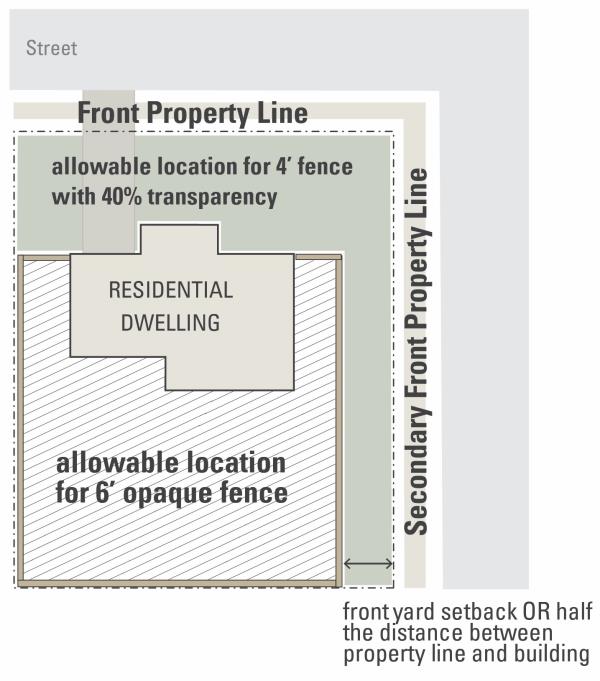
- For through lots, fences in the secondary front yard (between the secondary front property line and the rear building line of the structure) may be up to six feet in height and opaque if the fence is set back from the secondary front property line a minimum distance that is equal to the required front yard setback or one-half the distance between the secondary front property line and the rear building line, whichever is less.
- Fences located between the front property line and the primary entrance of the house are subject to the regulations in Section 1107.19(j)(2). Additionally, fences in the secondary front yard that are located between secondary front property line and the halfway point between the property line and the building line are subject to the regulations in Section 1107.19(j)(2).
- Interior Lots:
- Fence Construction: Fences and walls shall be constructed so all supporting cross-elements, exposed posts, or other similar features shall face the interior of the property. This provision shall not apply if the adjacent property owner(s) consent in writing to allow the supporting cross-elements or exposed posts to face outward towards the exterior of the property. Fences shall be erected so that no exposed posts or supporting cross-elements face public property. This provision shall not apply if the fence is the same on both sides such as split rail fences or board and batten fences.
- Double Fences: No fence or fences shall be constructed so that there are two more-or-less parallel fences in the same yard, unless there be a distance of at least five feet between the fences or their appurtenances.
- Snow Fences: Temporary snow fences, 42 inches or less in height, may be erected during the months of November through March each year. Such fences are to be used only to control the drifting of snow on walks, driveways, streets, or alleys.
- Mounds:
- No mound exceeding 32 inches in height.
- No mound shall be erected in the intersection clearance zone, as defined in Section 1107.19(j)(1), on corner lots.
- The grading and drainage of mounds shall follow the requirements set forth by the City Engineer.
- Retaining Walls, Dry-Stacked Stone Decorative Walls, and Entry Features: May be located in front yards, side yards, and rear yards as follows:
- Shall not exceed height of 36 inches if located in a front yard;
- Shall not be erected in the intersection clearance zone, as defined in Section 1107.19(j)(1)(F), on corner lots.
- General Requirements:
- Garages and Carports, Detached: Detached garages and carports are subject to the following regulations:
- Setbacks: No detached garage or carport shall be permitted nearer to any front lot line than 60 feet, provided that in the case of a corner lot, where the choice by the owner of the longer street lot line is approved, this requirement shall apply only to the distance of such building from the shorter street lot line. A detached garage or carport shall be distant at least 10 feet from any dwelling situated on the same lot, and at least three feet from any lot lines of adjoining lots and shall not occupy any easement.
- Timing of Construction: detached garage or carport shall be erected or constructed prior to the erection or construction of the principal or main building, except in conjunction with the same.
- Quantity: There shall be no more than one detached garage or carport per dwelling unit.
- Height: No detached garage or carport shall exceed the following height limitations, unless specifically permitted under separate City Ordinance; or, if converted to habitable use, shall exceed the rear yard height plane limits required for principal structures. A detached garage or carport roof shall not exceed the height dimensions allowed for the principal use, excepting that the Appeals Board may approve increased height to meet unusual circumstances as a variance if such a variance will not be detrimental to the adjacent property. The top plate wall height supporting all sloping roofs shall not exceed nine feet above the parking floor elevation of the garage, and the maximum height to coping or parapet for all flat and sloping roofs with pitches less than four feet of vertical rise in 12 feet of length shall not exceed 15 feet at any point above the parking floor elevation of the garage.
- Area Limits: The maximum area of a detached garage is 600 square feet. In no case shall the floor area of a detached garage or carport exceed 60 percent of the area of the dwelling unit.
- Home Occupations: The purpose of the provisions in this Section is to protect the character of residential neighborhoods while recognizing that advances in technology and telecommunications and changes in the job market have diminished the importance of traditional workplaces. These regulations are intended to recognize this shift and to allow in residential structures, where appropriately limited, nonresidential activities that are clearly subordinate and incidental to the residential use of the property and which are compatible with the residential character of the neighborhood.
- Home Occupation, Type A: This type of home occupation has little or no impact on the surrounding residential area and requires no permit. In general, a Home Occupation Type A is located and conducted so that the average neighbor, under normal circumstances, would not be aware of its existence. A Home Occupation Type A shall be a permitted accessory use in any residential district only if all of the following regulations are met:
- General:
- The use is compatible with the residential use of the property and the surrounding residential uses.
- Retail sales of merchandise, products or goods shall be prohibited, provided, however, that orders previously made by telephone, internet, or at a sales party or meeting may be filled on the premises. That is, direct retail sales of products or goods off display shelves or racks is not permitted, but client/customer may pick up an order placed earlier, as described above.
- Employees: The use is owned or conducted by one or more residents of the dwelling and only employs residents of the dwelling unit in which it is located.
- Area:
- The use is conducted wholly within the dwelling, and any space used for sales, service or production does not occupy more than 20 percent of the ground floor area of the dwelling unit.
- The use, including any storage of materials or equipment related thereto, shall be carried on entirely within the dwelling or unit and not in an accessory structures; however, part of the floor area of an attached garage may be used if the use does not occupy parking spaces required for the dwelling use by the parking regulations of this UDO, outlined in section 1111.07.
- The use shall not constitute primary or incidental storage facilities for a business, industrial or agricultural activity conducted on the premises.
- Exterior Appearance:
- The exterior appearance of any structure on the premises shall not be altered nor shall there be any structural modifications of the residence or garage, such as a separate business entrance. The use within the principal structure shall not be conducted in a manner that would cause the premises to differ from its residential character or which is inconsistent or incompatible with the normal scale, orientation or appearance of neighboring dwellings. No activity, materials, goods or equipment indicative of the use shall be visible from any public way or adjacent property.
- There shall be no outside appearance of the use, including, but not limited to, parking, signs or lights, excepting that one nameplate sign, attached flush to the dwelling and not exceeding two square feet in area shall be permitted. Neither freestanding nor illuminated signs shall be permitted.
- Hours of Operation:
- In no case shall the home occupation be open to on-site clients or customers earlier than 7:00 a.m., nor later than 7:00 p.m., excepting parties and meetings held for the purpose of selling merchandise or taking orders. Other motor vehicle traffic relating to the conduct of the use shall be prohibited between the hours of 10:00 p.m. and 6:00 a.m.
- Parties or meetings within the dwelling, held for the purpose of selling merchandise or taking orders, shall not be held more than four times each month.
- Parking/Traffic:
- On-site clients or customers shall not exceed six per day.
- The use does not necessitate the parking of more automobiles than can be accommodated in the dwelling or unit's driveway.
- The use shall not generate a significantly greater volume of traffic than would normally be expected in a residential area. The number of deliveries, pick-ups, origin, or destination trips relating to the use shall not exceed three per day.
- There shall be no merchandise or goods sold, or services rendered that require receipt or delivery of merchandise, goods or equipment other than by passenger motor vehicle, parcel delivery service, or U.S. mail service. No deliveries by tractor/trailer are permitted.
- Environmental Impact:
- No equipment or process shall be used which creates noise, vibration, glare, fumes, odors or electrical or electronic interference, including visible or audible interference with radio and television reception or which cause fluctuation in line voltage off the premises.
- The use shall not generate any solid waste or sewage discharge, in volume or in type, which is not normally associated with residential use in the neighborhood.
- No highly explosive, toxic or combustible material shall be used or stored on the premises.
- Other Applicable Laws or Regulations: The use may not involve any illegal activity; it shall be the homeowner's responsibility to ensure compliance with all applicable state and federal regulations.
- General:
- Home Occupation, Type B: This type of Home Occupation has the potential for greater impact on the surrounding residential area and therefore requires a Conditional Use Permit. All persons conducting home occupations that classify as Type B, and which are planned, presently existing, or which are established, changed or enlarged after this chapter is in effect, shall be required to obtain a Conditional Use Permit. Initial application for a Conditional Use Permit for a Home Occupation Type B shall require a public hearing.
- Application: The application process shall be the same as for other Conditional Uses under this Zoning Code.
- Regulations: A Conditional Use Permit for a Home Occupation Type B in any residential district may be granted if all of the following regulations are met:
- General:
- The use is compatible with the residential use of the property and the surrounding residential uses.
- The retail sales of products or goods, particularly products or goods produced on the premises, may be permitted by the Planning Commission provided that such merchandise or goods are specified and approved as a part of the application for the Permit, and provided that the Planning Commission determines that such retail sales will not become a detriment to or have an adverse impact on the existing residential character of the lot or neighborhood.
- Employees: The use is owned or conducted by residents of the dwelling unit in which it is located and employs not more than two employees who are not residents of the dwelling or unit.
- Area:
- The use is conducted within the dwelling, and any space used for sales, service or production does not occupy more than 25 percent of the ground floor area of the dwelling unit.
- Accessory structures may be used for storage of materials and equipment related to the use, provided that such buildings comply with setback and other requirements for accessory structures as contained in this UDO.
- The use shall not constitute primary or incidental storage facilities for a business, industrial or agricultural activity conducted off the premises.
- Exterior Appearance:
- Alterations to the exterior appearance of any structure in connection with the use may be permitted by the Planning Commission provided that such alteration is specified and approved as a part of the application for the Permit, and provided that the Planning Commission determines that such alteration will not cause the premises to differ from its residential character, nor be inconsistent or incompatible with the normal scale, orientation or appearance of neighboring dwellings. No activity, materials, goods or equipment indicative of the use shall be visible from any public way or adjacent property.
- Any signage shall be of the type and size permitted in the zoning district under the City's sign regulations, outlined in section 1111.08, and shall be approved by Planning Commission as a part of the Conditional Use Permit.
- Hours of Operation:
- Depending upon the foreseeable impact the intensity of a particular use may have on the surrounding neighborhood, it is within the discretion of the Planning Commission to limit the operations of a particular use to certain operating hours as a condition of granting a Permit. Should Planning Commission tail to establish operating hours for the use, in no case shall the home occupation be open to on-site clients or customers earlier than 7:00 a.m., nor later than 7:00 p.m., excepting parties and meetings held for the purpose of selling merchandise or taking orders.
- Parties or meetings within the dwelling for the purpose of selling merchandise or taking orders shall not be held more than four times each month.
- Parking and Traffic:
- Clients or customers shall not exceed 12 per day on average.
- At least two off-street parking spaces shall be provided, unless this requirement is waived by the Planning Commission. No required parking shall be provided in any front yard, except for the driveway, which may be used to fulfill this requirement. There shall be no paving or modification of the front yard for parking purposes other than the customary space used for the driveway.
- The use shall not generate a significantly greater volume of traffic than would normally be expected in a residential area. The number of deliveries, pick-ups, origin, or destination trips relating to the use shall not exceed five per day.
- There shall be no merchandise or goods sold, or services rendered that require receipt or delivery of merchandise, goods or equipment other than by passenger motor vehicle, parcel delivery service, or U.S. mail service. No deliveries by tractor/trailer are permitted.
- Environmental:
- No equipment or process shall be used which creates noise, vibration, glare, fumes, odors or electrical or electronic interference, including visible or audible interference with radio and television reception or which cause fluctuation in line voltage off the premises.
- The use shall not generate any solid waste or sewage discharge, in volume or in type, which is not normally associated with residential use in the neighborhood.
- No highly explosive, toxic or combustible material shall be used or stored on the premises.
- Other Applicable Laws or Regulations: The use may not involve any illegal activity; it shall be the homeowner's responsibility to ensure compliance with all applicable state and federal regulations.
- General:
- Validity: The Conditional Use Permit for the Home Occupation Type B may be issued for an initial period of one year and renewed for three year periods thereafter. Conditional Use Permits shall be specific to the owner of the Home Occupation and the dwelling or unit for which the Home Occupation is approved; they shall not be transferable to a subsequent owner of the designated dwelling or unit, nor shall they transfer with the owner to another location. A Home Occupation Type B shall terminate upon the dwelling no longer being used for such Home Occupation or upon the sale or change of ownership of such dwelling or land, or upon violation of any provisions of this Section.
- Renewals: The owner of the Home Occupation Type B is responsible for applying for renewals of the Conditional Use Permit. Upon application for renewal, the Zoning Inspector shall inspect the premises for conformance with the original Permit and shall review the record regarding the Permit and shall make a recommendation to the Planning Commission. If the Planning Commission finds no cause to disallow renewal of the application or cause for review of the application, the Planning Commission may authorize the Zoning Official to administratively approve the renewal application. If the Planning Commission determines the use has been the subject of unresolved complaints or violations of conditions or for other good cause, the Planning Commission may cause the application to come before the Planning Commission for a public hearing, may review the application as if it were a new application, and may renew the Permit as is, may renew the Permit with added conditions as the Planning Commission finds appropriate, or may deny and/or revoke the Permit.
- Revocations: The following shall be considered as grounds for the revocation of a Home Occupation Conditional Use Permit at any time during the term of the Permit:
- Any change in use or any change in extent of use, area of dwelling or unit being used, or mechanical or electrical equipment being used that is different from that specified as permitted in the granted Permit, which is not first approved by the Zoning Official.
- Any change in use or any change in extent of use, area of dwelling or unit being used, or mechanical or electrical equipment that results in a violation of these regulations.
- Failure to allow periodic inspections by the Zoning Official or his designee at any reasonable time when an adult member of the family is present.
- Miscellaneous:
- In the case of a dwelling or unit that is part of a common interest ownership community (a community in which at least some of the property is owned in common by all of the residents) the provisions of this Section shall not be deemed to supersede any deed restrictions, covenants, agreements, master deeds, by-laws or other documents that prohibit Home Occupations within dwellings or units in the community.
- The provisions of this Section shall not be construed as limiting in any manner the powers or authority of the City of Franklin to protect the health, safety and welfare of its residents, including the investigation and elimination of nuisances.
- Home Occupation, Type A: This type of home occupation has little or no impact on the surrounding residential area and requires no permit. In general, a Home Occupation Type A is located and conducted so that the average neighbor, under normal circumstances, would not be aware of its existence. A Home Occupation Type A shall be a permitted accessory use in any residential district only if all of the following regulations are met:
- Open-Sided Structures: Open-sided structures are subject to the following regulations:
- Height:
- All open-sided structures shall be limited to one story.
- The height to the top of the highest roof ridge beam, or to the highest point of any other roof form, from the finished floor may not exceed 15 feet.
- If the structure is built on a mound, deck, or other elevated surface, the height of this elevated surface at its highest point above grade shall be added to the height of the structure to determine the overall height of the structure being measured.
- Area: The area of an open-sided structure may not exceed 200 square feet.
- Materials: All finished roof surfaces, except for flat roofs, shall be metal, seal-tab asphalt shingles, clay tile, slate or wood shingles. All other finish surfaces shall be either wood, brick, stone, screen or any combination thereof.
- Location: All such structures shall be located at least five feet from any lot lines of adjoining lots, and shall not occupy any easement.
- Illumination: Illumination of the structure exterior is prohibited. Illumination within the structure shall not exceed 70 foot candles measured at a horizontal plane three feet above the finished floor.
- Height:
- Outdoor Dining: Outdoor dining areas may be permitted as an accessory use to a restaurant or similar use in the Downtown Districts, as approved by the city manager or their designee. The location of the outdoor dining area shall not interfere with pedestrian movement on any sidewalk or walkway by providing a clear sidewalk or walkway of at least four feet in width (considering the location of chairs when being used). Outdoor dining areas may be covered with a roof, trellis, or pergola; or may be closed permanently or temporarily to protect against the weather if approved by the city manager or their designee.
- Outdoor Retail and Display: Outdoor retail and/or display areas may be permitted as an accessory use to a retail store or similar use as approved by the city manager or their designee. The placement of merchandise shall not interfere with pedestrian movement on any sidewalk or walkway by providing a clear sidewalk or walkway of at least four feet in width. The placement of merchandise shall also not interfere with vehicular circulation or be located on any landscaped area.
- Outdoor Storage: Outdoor storage is subject to the following regulations:
- Commercial Districts: Outdoor storage areas shall be paved with a hard durable surface, be located only in the rear yard, and shall be screened on all sides with an opaque fence or wall that is six feet in height.
- Industrial Districts:
- Industrial uses that are allowed outdoor storage shall not have any material stored above a height of 20 feet. No storage shall be allowed within the front yard. All outdoor storage shall be enclosed by a fence not less than six feet and not more than 10 feet in height. Within areas of open storage, fire lanes shall be provided as required by the Fire Chief.
- No highly flammable or explosive liquids, solids or gases shall be stored in bulk above ground except in a light or heavy industrial district. Tanks or drums of fuel directly connected with heating devices or appliances located on the same lot as the tanks or drums of fuel are excluded from this provision.
- All outdoor storage of raw materials shall be contained by an enclosure, fence or wall in a manner to prevent transfer from the lot of said materials by wind, flood or natural causes or forces.
- When adjacent to a residential zoning district or a residential use, all outdoor storage facilities for fuel, raw materials and products shall be enclosed by a fence, wall or planting to conceal such facilities.
- No garbage shall be deposited upon a lot in such form or manner that it may be transferred from the lot by wind, flood or natural causes or forces. All garbage that might cause fumes or dust, constitute a fire hazard or be edible or attractive to rodents or insects, shall be stored outdoors only in closed containers constructed of impervious material.
- Parking Area: A parking area may be permitted as a principally permitted use or an accessory use in the Downtown Districts. The purpose of the parking area shall be to serve the property on which it is located, adjacent parcels, and/or to provide parking for the entire downtown Franklin area.
- Parking Garage: A parking garage may be permitted as a principally permitted use or an accessory use in the Downtown Districts. The purpose of the parking garage shall be to serve the property on which it is located, adjacent parcels, and/or to provide parking for the entire Downtown Franklin area.
- Parking of Recreational Vehicles and Watercraft: Parking of recreational vehicles and watercraft is subject to the following regulations:
- Long-Term Parking:
- Subject to the other provisions of this Section, all recreational vehicles, watercraft and recreational trailers located on a residential lot for longer than 24 hours in any 30 day period must be parked within a fully enclosed permanent structure.
- No more than one recreational vehicle, watercraft and/or recreational trailer may be located at one time on a single residential lot outside of an enclosed structure for longer than 24 hours in any 30 day period.
- Recreational vehicles, watercraft and recreational trailers parked outside of an enclosed structure for longer than 24 hours in any 30 day period must be located in the rear yard of the property, with all wheels situated on a paved parking surface, and screened from public view with opaque fencing which is a minimum of six feet tall.
- Short-Term Parking: Recreational vehicles, watercraft and recreational trailers may be parked for a maximum of 24 hours in any 30 day period on a paved driveway or street abutting the front yard of a residential lot, with the residential property owner’s permission (provided such street parking complies with all other applicable parking regulations and does not create a hazard for vehicular or pedestrian traffic).
- Improvements: No recreational vehicle, watercraft or recreational trailer shall be parked in any manner on a residential lot which is not improved with a principal building.
- Habitation/Guest Occupancy: A recreational vehicle, watercraft or recreational trailer may not be used for overnight sleeping or living while parked in a residential zoning district, unless the recreational vehicle, watercraft or recreational trailer is parked on a residential lot in compliance with Section 1345.10(c), with the permission of the owner or occupant in charge of the residential real property, and such use of the recreational vehicle, watercraft or recreational trailer does not exceed, 72 hours in any 30 day period.
- Storage: No parked recreational vehicle, watercraft or recreational trailer shall be used as a means of permanent storage for any materials the (excepting items customarily used in connection with the use of a recreational vehicle, watercraft or recreational trailer, including but not limited to dishes, linens, and other items used in the course of recreational travel).
- Registration: All recreational vehicles and recreational trailers shall be operable and have borne valid registration and licenses within the most recent 12 month period. All watercraft shall be operable and have been registered within the most recent 12 month period. Operable in the case of a powered vehicle means a vehicle capable of being started and driven from the location in question. Operable in the case of a non-powered or waterborne vehicle means a vehicle capable of being safely towed from the location in question.
- Maintenance/Condition: All recreational vehicles, watercraft or recreational trailers parked in a residential zoning district shall be maintained in good condition and repair. An inadequately maintained recreational vehicle, watercraft or recreational trailer which is not parked in a fully enclosed structure may be removed from residential premises by the City, when the vehicle, watercraft or trailer is in a state of disrepair and apparently inoperable; provided, the City has first given written notice to the owner of the associated residential real property of the inadequate condition of the vehicle, watercraft or trailer and a reasonable opportunity to remove the vehicle, watercraft or trailer from the premises.
- Safety: No recreational vehicle, watercraft or recreational trailer shall be parked in any manner which is unsafe or otherwise poses a hazard to the safety of real or personal property. Recreational vehicles, watercraft and recreational trailers parked in a manner which poses a safety concern or hazard may be immediately removed by the City with or without prior notice to the owner of residential real property on which, or abutting the area where, the vehicle, watercraft or trailer is parked.
- Long-Term Parking:
- Pick-Up Window for Retail or Restaurant Use: Pick-up windows for retail or restaurant uses are subject to the following regulations:
- Allpick-up areas, including but not limited to stacking lanes, trash receptacles, window openings, and other objects associated with the pick-up window shall be located in the side or rear yard of the property, and shall not cross, interfere with, or impede any public right-of-way.
- Audible electronic devices such as loudspeakers and similar instruments shall not be permitted.
- Pick-up windows for retail or restaurant uses are subject to the vehicle stacking requirements of Table 1111.07-2: Required Number of Stacking Spaces.
- Playground Equipment: Playground equipment must be set back from all adjacent residential properties a minimum of 25 feet.
- Solar Panels, Roof-Mounted: Roof-mounted solar panels are subject to the following regulations:
- Roof-mounted solar panels are permitted on the roof of any principally permitted structure and are permitted on the roof of any accessory structure over 100 square feet in area.
- Roof-mounted solar panels, on pitched roofs, shall be flush-mounted to the roof and shall not extend higher than the top ridgeline of the roof in which they are located.
- Roof-mounted solar panels on flat roofs shall not project more than six feet above the rooftop structure, and shall not exceed the maximum height allowance in the zoning district in which they are located.
- Roof-mounted solar panels shall be placed so that concentrated solar radiation or glare shall not be directed onto other properties or roadways in the vicinity.
- Storage Structure: Storage structures are subject to the following regulations:
- Residential and Agricultural Uses:
- Storage structures shall be located in the rear yard only and shall be set back a minimum of three feet from the side and rear property lines.
- Maximum height is 15 feet, except for lots over two acres where the maximum height is 20 feet. In no case shall a storage structure exceed the maximum height of the principal building.
- A maximum of two storage structures are permitted per lot.
- The cumulative size of the storage structures shall not exceed 20 percent of the footprint of the square footage of the principal building. For lots over two acres, the cumulative size of the storage structures shall not exceed the square footage of the footprint of the principal building.
- Commercial and Industrial Uses:
- Storage structures shall be located in the rear yard only and shall be set back a minimum of three feet from all side and rear property lines.
- Maximum height is 20 feet. In no case shall a storage structure exceed the maximum height of the principal building.
- A maximum of two storage structures are permitted per lot.
- The cumulative size of all storage structures on a property shall not exceed 35 percent of the square footage of the footprint of the principal building.
- Public and Institutional Uses:
- Storage structures shall not be located in the front yard setback and shall be set back a minimum of three feet from all side and rear property lines.
- Maximum height is 15 feet.
- A principal building is not required in this district to construct a storage structure when the structure is to be used in conjunction with a recreation, parks, open space, or other similar use that may not require a principal building.
- Residential and Agricultural Uses:
- Swimming Pools and Hot Tubs, Private: Private swimming pools and hot tubs shall be subject to the following regulations:
- Location, Area, and Height:
- All hot tubs shall be located within the buildable area. In the event a proposed hot tub has more than 150 square feet of area on the water surface when filled to capacity, all regulations for swimming pools shall apply.
- All swimming pools or parts thereof shall be located in the rear yard, shall be at least ten 10 feet (10') from the side or rear line of the lot or parcel upon which it is situated, and shall be at a distance 10 feet greater than the building setback line as fixed by the UDO from any street on which such lot or parcel abuts. The area of the swimming pool proper, including decks, walks and other appurtenances, shall not exceed the percentage of lot area specified in Section 1107.19(a)(4).
- Swimming pool accessories are limited to diving boards, slides and lights designed to illuminate the pool and the immediate surrounding area. None of these accessories may exceed 10 feet in height, such height to include rails, supports and other safety devices, and may not cover a ground surface area in excess of 30 square feet.
- Fences or Barriers:
- Every swimming pool shall be completely enclosed by a fence or barrier of sturdy construction not less than 48 inches in height, measured from the level of the ground where located, which shall be of such design and construction as to effectually prevent a child from crawling or otherwise passing though or under such fence. Each gate in such fence or barrier shall be provided with a self-latching gate. Where the top of the pool structure is above grade, such as an aboveground pool, the barrier shall be permitted to be at ground level, such as the pool structure, or mounted on top of the pool structure. No part of any fence shall be located between the building setback line and the street on which the lot or parcel abuts.
- A variance may be requested to make exceptions to, or modifications of, the requirements of this paragraph for fences in cases in which, in Appeals Board's opinion, such requirements are not essential to safety and the enforcement thereof would place undue hardships on the owners.
- Lights: All
lights used for illuminating a swimming pool, hot tub or the surrounding areas shall be so designed, located and installed as to confine the direct beams thereof to the lot or parcel on which the pool or hot tub is located, and so as not to constitute a nuisance or undue annoyance to occupants of abutting property. - Drainage: Provisions shall be made for drainage of the swimming pool into a public storm sewer where possible or sanitary sewer, in which case drainage may be into such ditch or watercourse. Permission must be obtained from the Zoning Official before the swimming pool is drained in whole or in any substantial amount, in order to prevent overloading the sewer or ditch in times of heavy rain. In no case shall the swimming pool be drained, directly or indirectly, into any street or onto any neighboring property which is not owned by the pool owner.
- Location, Area, and Height:
1107.12 Temporary Use Standards
- Construction Trailers: Construction trailers are subject to the following regulations:
- A construction trailer and offices, with fixed connections to utilities such as electric and telephone, may be used for temporary office and storage use during the duration of construction on a site. Such uses are required to get the approval of the Zoning Official prior to locating on a site.
- The storing of construction materials and equipment, both incidental and necessary for construction, is permitted during the period of construction and development for a maximum of 18 months.
- Festivals and Circuses: Festivals and circuses are subject to the following regulations:
- Festivals and circuses, which are sponsored by a governmental, educational, or religious entity, are exempt from the requirements of this section.
- The operator, if not the owner of the property, shall provide a written agreement from the property owner to the City of Franklin stating the owner’s permission for the proposed use of the property.
- Festivals, circuses, and other similar special events are permitted for a maximum of 14 days.
- No activities shall take place in the public right-of-way.
- Mobile Uses: Mobile uses (such as food trucks, blood drive trucks, or pop-up clothing shops) are subject to the following regulations:
- Mobile uses may be located on private property if the property owner has granted permission. Such mobile food uses shall be located in a designated spot and for a length of time as determined by the property owner and approved by the city manager or their designee.
- Mobile uses may locate in the public right-of-way if the right-of-way is closed for a special event or if the mobile use is located in a designated parking spot for mobile uses and the location and duration is approved by the city manager or their designee.
- Mobile uses may be allowed at events on public property with the approval of the city manager or their designee.
- Waste shall be contained and disposed of in a manner required by law.
- The applicant shall be responsible for obtaining all permits and approvals that may be necessary for the mobile food use including, but not limited to, health, fire, police, and zoning department approvals.
- Model Home: Model homes are subject to the following regulations
- Model homes, with or without a sales/leasing center may be used during the duration of construction for the residential development.
- The model home shall either be removed or converted into a permanent residence upon the construction of the final dwelling in the development.
- Any signage on the model home property must comply with the regulations in Section 1111.08.
- A maximum of one model home is permitted per phase of development.
- Model homes, with or without a sales/leasing center may be used during the duration of construction for the residential development.
- Residential Sales: Residential sales are subject to the following regulations:
- Prohibitions
- No person shall sell, or offer for sale, at such home sale any merchandise that has been purchased, consigned or otherwise acquired for purposes of resale. The offering of new merchandise for sale shall be evidence that such merchandise was acquired by the resident for purpose of resale. No person shall sell, or offer for sale, at such home sale any personal property except such as has been owned and maintained by such person or members of his family on or in connection with the premises on which such sale is held.
- This prohibition shall not apply to not-for-profit corporations, churches, temples, schools, fraternities, sororities, associations, clubs or lodges. Such organizations may conduct sales of personal property donated to them on real estate owned or occupied by such organizations.
- Frequency and Duration of Sales: Only one such sale may be conducted on any parcel of real estate in any two month period, which sale shall be limited to not more than four consecutive days or two consecutive weekends of two days each. No sale may commence before the hour of 8:00 a.m. or extend later than 8:00 p.m.
- Other Conditions of Sales: No sign advertising a home sale may be displayed at any place except on the premises on which the sale is held. Only one such sign may be displayed, and its display shall be limited to the dates and hours during which the sale is held. Such sign shall not be larger than four square feet in area, shall not be illuminated or animated, and shall not contain any advertising material unrelated to the conduct of the sale.
- Exemptions: Except as provided in (3) above, these provisions shall not apply to a sale of property publicized solely by classified advertising by newspaper or internet, which describes or identifies the specific property offered for sale and does not designate the date, hours or location of the sale other than by stating the name, address or telephone number of the seller.
- Prohibitions
- Residential Storage Units (PODs): Residential storage units are subject to the following:
- Residential storage units shall be permitted as a temporary use for a period not to exceed 30 days within any one year period.
- Residential storage units shall be located on a hard, durable paved surface and out of the public right-of-way.
- If the portable storage unit is being used to store personal property as a result of a major calamity at the residence (e.g., fire, flood, or other event where there is significant property damage), the Zoning Official may extend the time period up to one year at their discretion.
- Residential storage units shall not exceed a size of 1,200 cubic feet on the interior. All residential storage units in excess of 1,200 cubic feet are prohibited in residential areas.
- Seasonal Sales: The seasonal sale of items pertaining to a holiday, event, or season such as the sale of Christmas trees or pumpkins is subject to the following:
- Seasonal sales, which are sponsored by a governmental entity, are exempt from the requirements of this section.
- The operator, if not the owner of the property, shall provide a written agreement from the property owner to the City of Franklin stating the owner’s permission for the proposed use of the property.
- A seasonal sale is limited to a maximum of 60 cumulative days per calendar year.
- Special Event: Special events that are not classified as a festival, circus, or farm market may be permitted in the Downtown Districts subject to the approval of the City. Such events may take place on private or public property for a duration that is specified in the approval.
1107.13 A-1 And PAR Dimensional Standards
- Dimensional Standards: The dimensional standards table in this section identifies the specific dimensional standards that apply to the (A-1) Agricultural Zoning District and the (PAR) Parks and Recreation Zoning District.
- Multiple Buildings: More than one main/primary/prinicpal building is permitted per lot in the (PAR) Parks and Recreation District, if approved by the Planning Commission on a Major Site Plan.
TABLE 1107.13-1: A-1 and PAR Dimensional StandardsA-1 PAR Minimum Lot Area 1 acre N/A Minimum Lot Frontage 100 feet 40 feet Minimum Front Yard Setback 25 feet 25 feet Minimum Side Yard Setback (one side/total) 10/25 feet 10/25 feet Minimum Rear Yard Setback 40 feet 40 feet Minimum Parking Lot/Driveway Setback1 20 feet - front P/L
10 feet - side P/L
10 feet - rear P/L20 feet - front P/L
10 feet - side P/L
10 feet - rear P/LMinimum Height 35 feet 35 feet Maximum Accessory Structure Height Per Section 1107.19 Per Section 1107.19 Maximum Impervious Coverage 30% 25%
Terminology: N/A = Not Applicable, P/L = Property Line
1The side yard setback for driveways shall not apply when there is a shared driveway that is located on or adjacent to the property line and serves multiple properties, uses, or structures. The setback from the front property line does not apply to access drives/driveways or at a roadway intersection.
1107.14 Residential Districts Dimensional Standards
- Dimensional Standards: The dimensional standards table in this section identifies the specific dimensional standards that apply to each residential zoning district.
- Multiple Buildings: More than one main/primary/principal building is permitted per lot in the (R-4) Multi-Family Residential District, if approved by the Planning Commission on a Major Site Plan.
TABLE 1107.14-1: Residential Districts Dimensional Standards
| R-1A | R-1B | R-2 | R-3 | R-4 | |
| Minimum Lot Area | 15,000 sq. ft. | 10,000 sq. ft. | 6,000 sq. ft. | 4,000 sq. ft. | 10,000 sq. ft. |
| Minimum Lot Frontage | 100 feet | 80 feet | 60 feet | 40 feet | 100 feet |
| Minimum Front Yard Setback | 25 feet | 25 feet | 25 feet | 15 feet | 25 feet |
| Minimum Side Yard Setback (one side/total) | 10/25 feet | 10/25 feet | 6/15 feet | 4/10 feet | 10/25 feet |
| Minimum Rear Yard Setback | 40 feet | 40 feet | 30 feet | 20 feet | 40 feet |
| Minimum Floor Area | 1,800 sq. ft. | 1,500 sq. ft. | 1,000 sq. ft. | 800 sq. ft. | 800 sq. ft. |
| Minimum Parking Lot/Driveway Setback1 | 3 feet from side property line | 3 feet from side property line | 3 feet from side property line | 3 feet from side property line | 20 feet - front P/L 10 feet - side P/L 10 feet - rear P/L |
| Maximum Height | 35 feet | 35 feet | 35 feet | 35 feet | 55 feet |
| Maximum Accessory Structure Height | Per Section 1107.19 | Per Section 1107.19 | Per Section 1107.19 | Per Section 1107.19 | Per Section 1107.19 |
| Maximum Impervious Coverage | 40% | 40% | 50% | 70% | 70% |
Terminology: N/A = Not Applicable, P/L = Property Line, Sq. Ft. = Square Feet
1The side yard setback for driveways shall not apply when there is a shared driveway that is located on or adjacent to the property line and serves multiple properties, uses, or structures. The setback from the front property line does not apply to access drives/driveways or at a roadway intersection.
1107.15 Commercial District Dimensional Standards
- Dimensional Standards: The dimensional standards table in this section identifies the specific dimensional standards that apply to each commercial zoning district.
TABLE 1107.15-1: Commercial Districts Dimensional StandardsC-1 C-2 Minimum Lot Area N/A N/A Minimum Lot Frontage 40 feet 40 feet Minimum Front Yard Setback 35 feet 0 feet Minimum Side Yard Setback 0/10 feet1 10/25 feet Minimum Rear Yard Setback 0/30 feet1 40 feet Minimum Parking Lot/Driveway Setback2 20 feet - front P/L
10 feet - side P/L
10 feet - rear P/L20 feet - front P/L
10 feet - side P/L
10 feet - rear P/LParking Location Front/Side/Rear Side/Rear Maximum Height3 35 feet and 50 feet for vertically mixed use buildings 35 feet and 50 feet for vertically mixed use buildings Maximum Accessory Structure Height Per Section 1107.19 Per Section 1107.19 Maximum Impervious Coverage N/A N/A
Terminology: N/A = Not Applicable, P/L = Property Line 1The greater setback number is required when adjacent to a residential use or district.
2The side yard setback for driveways shall not apply when there is a shared driveway that is located on or adjacent to the property line and serves multiple properties, uses, or structures. The setback from the front property line does not apply to access drives/driveways or at a roadway intersection.
3When a building is more than 35 feet in height, an additional foot of rear yard is required for each additional two feet in height. Any building that exceed maximum height shall only be allowed as a conditional use.
1107.16 Downtown Districts Dimensional And Design Standards
- Dimensional Standards: The dimensional standards table in this section identifies the specific dimensional standards that apply to each of the downtown zoning districts.
Table 1107.16-1: Downtown Districts Dimensional StandardsDC-1 MU-1 RMU CV-1 TN-1 TN-2 Minimum Lot Area N/A N/A N/A N/A 4,000 sq. ft. 4,000 sq. ft. Minimum Lot Frontage 40 feet 40 feet 40 feet 40 feet 40 feet 40 feet Minimum Front Yard Setback 0 feet 0 feet 0 feet 0 feet 25 feet 25 feet Maximum Front Yard Setback 20 feet N/A N/A N/A N/A N/A Minimum Side Yard Setback (one side/total) 0 feet 0 feet 0 feet 0 feet 4/10 feet 4/10 feet Minimum Rear Yard Setback 0 feet 0 feet 0 feet 0 feet 20 feet 20 feet Minimum Floor Area (residential uses) N/A N/A N/A N/A 800 sq. ft. 800 sq. ft. Minimum Parking Lot/Driveway Setback1 N/A N/A N/A N/A 3 feet from side property line 3 feet from side property line Parking Location Side/Rear Side/Rear Side/Rear Front/Side/Rear Front/Side/Rear Front/Side/Rear Maximum Height 50 feet 75 feet 50 feet 40 feet 40 feet 40 feet Maximum Accessory Structure Height Per Section 1107.19 Per Section 1107.19 Per Section 1107.19 Per Section 1107.19 Per Section 1107.19 Per Section 1107.19 Maximum Impervious Coverage N/A N/A N/A 70% 70% 70%
Terminology: N/A = Not Applicable, P/L = Property Line, Sq. Ft. = Square Feet
1The side yard setback for driveways shall not apply when there is a shared driveway that is located on or adjacent to the property line and serves multiple properties, uses, or structures. The setback from the front property line does not apply to access drives/driveways or at a roadway intersection. - Downtown Design Standards:
- Character:
- New development and redevelopment projects within Downtown Franklin shall conform to the recommendations in the Downtown Franklin Master Plan and be complementary to the existing character of the area.
- Creativity in design is encouraged, though, and this section is not intended to limit unique or iconic designs.
- Each project will be evaluated by the Planning Commission on its size, scale, design, materials, mass, location, and compatibility with adjacent uses.
- Materials:
- A minimum of three building materials shall be used on every building façade (transparent glass may count as one of the building materials. Roofing materials, awnings, canopies, balconies, or other similar items do not count as one of the required materials).
- Permitted building materials shall be high quality, durable materials including but not limited to stone, manufactured stone, brick, wood and composite wood siding, glass, architectural metal panels, and fiber cement siding.
- EIFS (Exterior Insulation and Finish System) and stucco may be used as accent materials on the building facades but may not account for more than 15 percent of each building façade. Vinyl siding is prohibited.
- Other equivalent building materials may be approved by the Planning Commission
- Form/Massing:
- All building elevations shall consist of a tripartite configuration consisting of a base or foundation; a middle or modulated wall; and a top portion formed by an articulated roof. The minimum height of the base or foundation shall be 18 inches in height and shall be faced with an articulated masonry, cement, or similar manufactured material. Smooth concrete does not meet this requirement.
- All building elevations shall be articulated in a manner to avoid an uninterrupted appearance through the use of windows, doors, offsets, or a change in materials. Building facades that face a public right-of-way, and that are over 40 feet in length shall implement at least one of the following at least every 20 lineal feet along the frontage:
- Recesses or projections in the wall that are at least one foot in depth. Balconies or decks can be used to meet this requirement.
- Façade material or color changes. Windows can be used to break up the façade to meet this requirement.
- Pilasters, columns, or other similar architectural details that are a minimum of one foot wide.
- Other similar articulation methods may be approved by the Planning Commission.
- Buildings shall be designed for the pedestrian and should promote an active street frontage and high-quality streetscape design, on all frontages that face a public right-of-way. The primary building entrance shall be clearly identified and shall be oriented to a public street or public gathering area.
- Window Openings: First floor elevations, for non-residential uses that are visible from the public right-of-way, shall maximize window openings as appropriate for the interior use. The first 10 feet of the building, as measured from building grade up, shall provide a minimum of 60 percent transparency with the use of clear, glass windows. Glass block, opaque, mirrored glass, or darkly tinted glass does not meet this standard.
- Lighting: LED, neon tubing, and string lights that are being used as building accent lighting or window trimming are prohibited in the Downtown Districts. String lights may be used as decoration around outdoor eating and drinking areas, parks, public spaces, or gathering areas.
- Mechanical Equipment Screening: All roof and ground mounted mechanical equipment shall be screened from view from all adjacent properties and rights-of-way using durable, compatible, opaque materials.
- Waivers: The Planning Commission may alter or waive the requirements of this section if the commission deems that the applicant meets the intent of this section.
- Landscaping:
- Bufferyards: Bufferyard landscaping requirements as established in Section 1111.06(g), shall not apply to lots within the Downtown Districts.
- Parking Lot Landscaping: Parking lot perimeter screening and interior parking area landscaping, as established in Section 1111.06(j), shall apply only to parking lots within the Downtown Districts that are visible from the public right-of-way. Parking garages or parking decks shall not be required to provide interior parking area landscaping.
- Lot Interior Landscaping: Where feasible, lots within the Downtown Districts shall meet the interior landscaping requirement as established in Section 1111.06(k)(1).
- Building Foundation Plantings: Where feasible, building foundation plantings shall be required, as established in Section 1111.06(k)(2). Building foundation plantings are not required for buildings that are located within 15 feet of the front property line and where a streetscape or patio treatment is provided between the front building facade and the right-of-way.
- Modifications: The Planning Commission may waive any of the landscaping requirements that apply to lots within the Downtown Districts if the landscaping requirement is not feasible due to the size, configuration, or location of such lot.
- Signage:
- Signage Requirements: Signs in the Downtown Districts shall conform to the applicable regulations in Section 1111.08 unless specially exempted or regulated within this section.
- Residential Signage Requirements: Single family and two family residential uses shall conform to the applicable residential sign regulations.
- Parking:
- Parking Requirements: Off-street parking within the Downtown Districts should be reviewed and considered on a district-wide basis and per the recommendations of the Downtown Franklin Master Plan. Due to the configuration, size, and location, of many of the lots within this area, individual parcels cannot provide the off-street parking spaces that would typically be required. Where feasible, new and redevelopment projects within the Downtown Districts shall conform to the regulations in Section 1111.07, unless otherwise exempted or regulated within this section.
- Downtown Core, Mixed Use, and Riverfront Mixed Use District Requirements: The Downtown Core, Mixed Use, and Riverfront Mixed Use Districts are exempt from the off-street parking requirements of Section 1111.07.
- Civic and Transitional Neighborhood District Requirements: Lots within the Civic and Transitional Neighborhood Districts shall conform to the applicable regulations in Section 1111.07.
- Modification: The Planning Commission may waive any of the off-street parking requirements that apply to lots within the Downtown Districts if the requirements are not feasible due to the size, configuration, or location of such lot. Considerations will be taken for available on-street parking, joint parking areas, cross-parking agreements, and destinations lots that serve the district.
- Character:
1107.17 Office Districts Dimensional Standards
- Dimensional Standards: The dimensional standards table in this section identifies the specific dimensional standards that apply to each office zoning district.
TABLE 1107.17-1: Office District Dimensional StandardsO-1 O-RP O-S Minimum Lot Area N/A 10 acres1 N/A Minimum Lot Frontage 40 feet 40 feet 40 feet Minimum Front Yard Setback 35 feet 50 feet 35 feet Minimum Side Yard Setback22 0/30 feet 0/30 feet 0/30 feet Minimum Rear Yard Setback 0/30 feet 0/30 feet 0/30 feet Minimum Parking Lot/Driveway Setback3 20 feet - front P/L
10 feet - side P/L
10 feet - rear P/L20 feet - front P/L 10 feet - side P/L 10 feet - rear P/L 20 feet - front P/L 10 feet - side P/L 10 feet - rear P/L Parking Location Front/Side/Rear Front/Side/Rear Front/Side/Rear Maximum Height4 35 feet 35 feet 35 feet Maximum Accessory Structure Height Per Section 1107.19 Per Section 1107.19 Per Section 1107.19 Maximum Impervious Coverage 70% 70% 70%
Terminology: N/A = Not Applicable, P/L = Property Line
1Unless otherwise approved by the Planning Commission.
2The greater setback number is required when adjacent to a residential use or district.
3The side yard yard setback for driveways shall not apply when there is a shared driveway that is located on or adjacent to the property line and serves multiple properties, uses, or structures. The setback from the front property line does not apply to access drives/driveways or at a roadway intersection.
4When a building is more than 35 feet in height, an additional foot of rear yard is required for each additional two feet in height. Any building that exceed maximum height shall only be allowed as a conditional use.
1107.18 Industrial Districts Dimensional Standards
- Dimensional Standards: The dimensional standards table in this section identifies the specific dimensional standards that apply to each industrial zoning district.
TABLE 1107.18-1: Industrial Districts Dimensional StandardsI-1 I-2 Minimum Lot Area N/A N/A Minimum Lot Frontage 200 feet 200 feet Minimum Front Yard Setback1 35/50 feet 25/50 feet Minimum Side Yard Setback1 15/50 feet 15/100 feet Minimum Rear Yard Setback1 15/50 feet 15/50 feet Minimum Parking Lot/Driveway Setback2 20 feet - front P/L
10 feet - side P/L
10 feet - rear P/L20 feet - front P/L 10 feet - side P/L 10 feet - rear P/L Parking Location Front/Side/Rear Front/Side/Rear Maximum Height3 75 feet 75 feet Maximum Accessory Structure Height Per Section 1107.19 Per Section 1107.19 Maximum Impervious Coverage 80% 80%
Terminology: N/A = Not Applicable, P/L = Property Line
1When adjacent to a residential use or district.
2The side yard setback for driveways shall not apply when there is a shared driveway that is located on or adjacent to the property line and serves multiple properties, uses, or structures. The setback from the front property line does not apply to access drives/driveways or at a roadway intersection.
3When a building is more than 35 feet in height, an additional foot of rear yard is required for each additional two feet in height. Any building that exceed maximum height shall only be allowed as a conditional use.
1107.19 Measurements, Computations, And Exceptions
- Percentages and Fractions: When a measurement results in a fractional number or percentage, and fraction or percentage of less than 0.5 shall be rounded down to the next lower whole number, and any fraction equal to or more than 0.5 shall be rounded up to the next higher whole number.
- Distances: When a minimum distance between buildings or uses is specified, such distance shall be measured in a straight line without regard to intervening structures or objects, between the closest lot lines of the properties in question.
- Structure Height:
- The vertical distance measured from the established grade to the:
- Highest point of the roof surface for flat roofs;
- Deck line of mansard roofs; and
- Average height between eaves and ridge for sloped, gable, hip, and gambrel roofs.
- Where a structure is located on a sloping terrain, the height may be measured from the average ground level of the grade at the building wall.
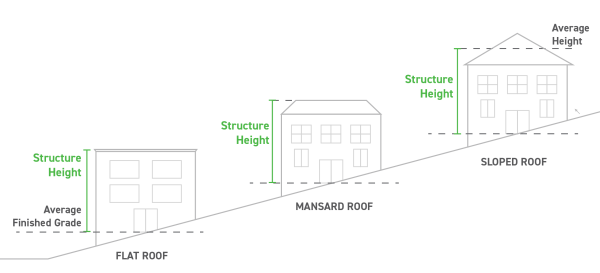
- The vertical distance measured from the established grade to the:
- Exceptions to Height Limitations:
- Chimneys, domes, spires, and necessary mechanical appurtenances and radio and television towers may exceed height limitations.
- Public, semipublic or public service buildings, hospitals, institutions or schools, where permitted, may be erected to a height not exceeding 90 feet when the required side and rear yards are each increased by one foot for each foot of additional building height above the height regulations for the district in which the building is located.
- Radio and television towers for residential uses shall be located centrally on a contiguous parcel having a dimension at least equal to the height of the tower measured from the center of the base of the tower to all points on each property line.
- Setbacks and Yards:
- Yard Projections:
- Chimneys, flues, sills, pilasters, cornices, eaves, gutters and other similar features may project into a side yard setback a maximum of 12 inches.
- Porches and steps may project into the front yard setback of a dwelling unit, but shall have a setback of ten 10 feet (10'), and no other structural projections will be permitted.
- Clear Sight Triangle: No fence, wall, sign, structure, vehicle, or planting shall be erected or maintained on any corner lot within the clear sight triangle. The sight triangle shall be formed by measuring 20 feet out in each direction of the street intersection.
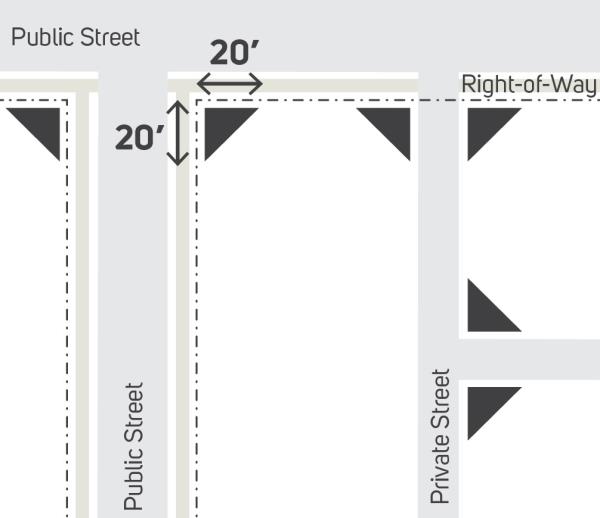
- Yard Projections:
- Lot Requirements:
- Interior Lots:
- The required minimum front yard setback shall be measured from the property line.
- The rear yard setback shall be measured from the line located directly behind the structure and the rear lot.
- In cases where the rear lot line is not parallel with the front property line or the side lines are not perpendicular to the front property line, average dimensions may be used to determined setback requirements.
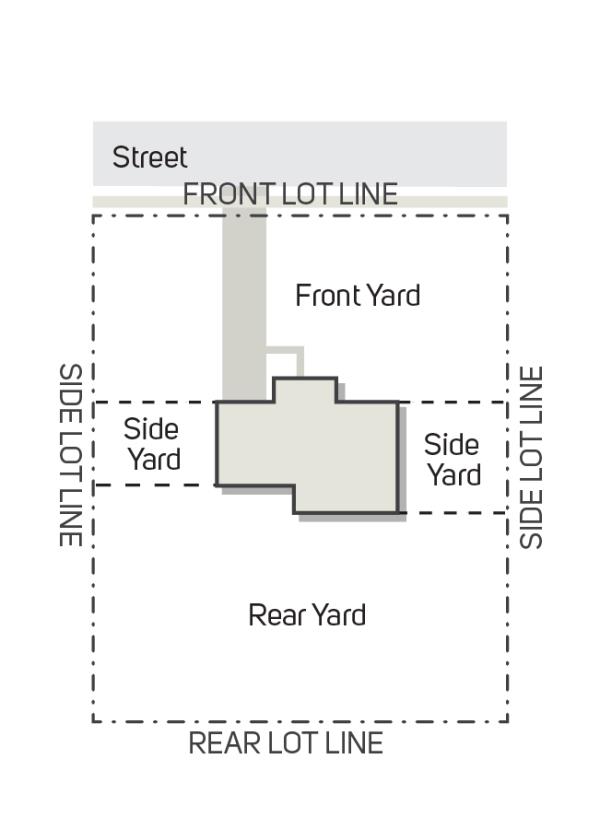
- Corner Lots:
- In any district, the side yard of a corner lot that abuts the side street shall have the same setback requirements as the front yard. The Zoning Official shall determine which is the front yard and which is the street side yard.
- A rear yard shall be provided parallel and opposite from the front yard.
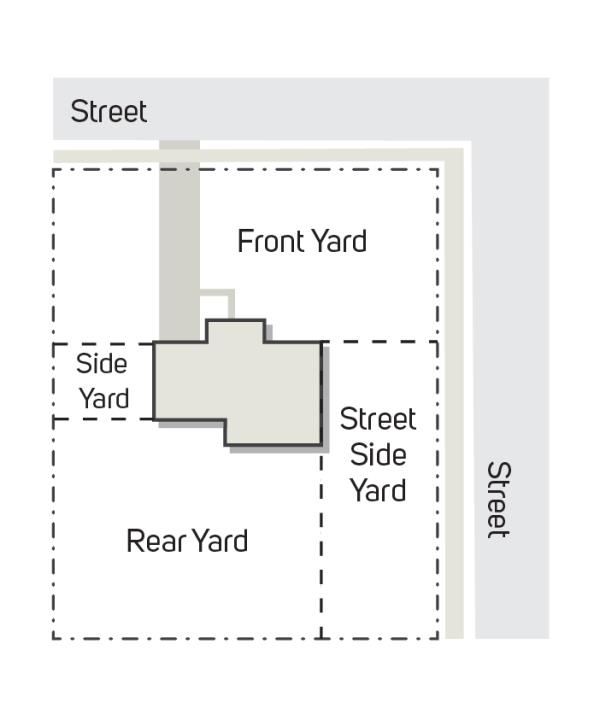
- Culs-de-sac or Curved Lots:
- For a cul-de-sac lot or a lot abutting a curved street, the front yard setback shall follow the curve of the front property line.
- Lots on a culs-de-sac shall be required to have a minimum lot width of 40 feet as measured from the front property line.
- Through Lots:
- The required minimum front yard setback shall apply for each side of the lot that has frontage on a street.
- The remaining lot lines shall be considered side lot lines, and the side yard setbacks shall be applied to those lot lines.
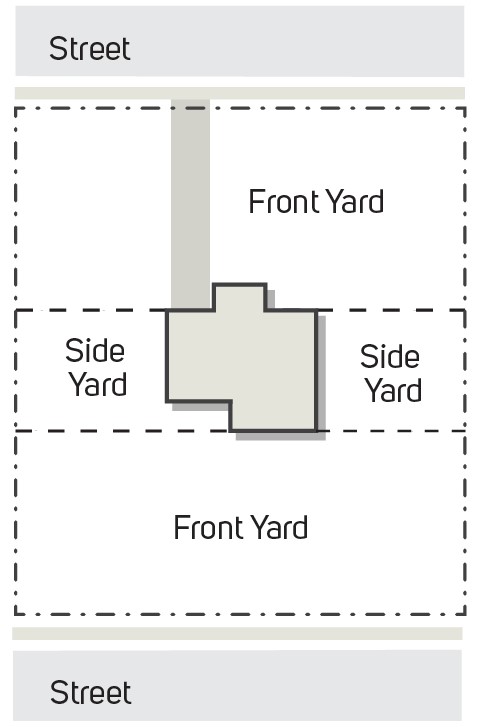
- Flag Lots: Flag lots are lots that utilize a narrow strip of land or stem to provide access to a public street. Flag lots are subject to the following:
- The minimum width of the flag lot stem is 40 feet.
- The stem of the flag lot is not considered a building site, nor is the area of such included in the calculation of lot area.
- The front yard setback is not measured from the frontage at the public street, but along the front lot line of the buildable area.
- Lots Abutting Alleys: In calculating the area of a lot that adjoins an alley for the purpose of applying lot area requirements of this UDO, one-half the width of such alley abutting the lot shall be considered as part of such lot.
- Interior Lots:

