
Frostburg City Zoning Code
PART 6
- GENERAL PROVISIONS & PARKING
Sec. 6.1. - Lot requirements.
A.
Definitions. See the definitions for the different types of lot measurements under the terms "Lot" and "Yard" in the definitions, Section 2.1.
B.
Lot Requirements. Except as otherwise provided by this Ordinance, every building or group of related buildings shall be located on a lot, as hereby defined having at least the area, width, lot area per family, and yards herein prescribed for the district in which such building or buildings are located.
C.
Lot Area Requirement Modification. In any district, where both public water service and public sanitary sewage service will not be provided prior to occupancy of any principal building, the otherwise specified lot area and lot width requirements, where less than the following, shall be increased to a minimum lot area of thirty thousand (30,000) square feet and a minimum lot width of one hundred (100) feet, except:
(1)
Where either public water service or public sanitary sewage service will be provided, these requirements shall be fifteen thousand (15,000) square feet and one hundred (100) feet respectively.
D.
Required Yard Cannot Be Reduced. No lot shall be reduced in area so as to make any yard or another open space less than the minimum required for this Ordinance. If a yard or another required open space is already less than the minimum required, said yard or open space shall not be future reduced, except by approval of the Board of Zoning Appeals in accordance with provisions of Section 1.18 hereof. No part of a yard or open space provided on a lot shall be considered as part of a yard or open space required under this Ordinance for another lot.
E.
Front Yard Depth - How Measured. Every front yard depth required by this Ordinance shall be measured as the shortest distance between any point on the front yard line as defined herein and any point in the building, structure or uses subject to such yard requirements.
F.
Front Yard Depth Required for All Public Street. Where a lot abuts more than one (1) public street, road, or highway (but not an alley as defined herein), the required district front yard depth shall be required along each such street, road, or highway. Where a lot abuts an alley, the rear yard requirement shall apply.
G.
Rear Yard Depth - How Measured. Every rear yard depth required by this Ordinance shall be measured as the shortest distance between any point on the rear lot line as defined herein and any point on the building, structure, or use subject to such yard requirements.
H.
Side Yard Depth - How Measured. Every side yard depth required by this Ordinance shall be measured as the shortest distance between any point on the side lot line as defined herein and any point on the building, structure, or use subject to such yard requirements.
I.
Lot Width - How Measured. Lot width at the front lot line shall be measured as the shortest distance between the two (2) points where the side lot lines intersect the front lot line.
(1)
Lot width at the front building line shall be measured as the shortest distance along a straight line which passes through a point on each side lot line and the point on the building, structure, or use, subject to such regulation, nearest to the front lot line.
J.
Front Yard Modifications. In any district, where the depth of at least two (2) existing front yards on lots within one hundred (100) feet of the lot in question and within the same block front are less than the least front yard depth prescribed for the district, the required depth of the front yard on such lot may be reduced.
(1)
In such case, the reduction shall be not less than the average of said existing front yard on the two (2) lots immediately adjoining, or in the case of a corner lot, the depth of the front yard on the lot immediately adjoining, provided, however, that the depth of a front yard on any lot shall not be reduced more than one-half the required front yard depth prescribed for the district.
(2)
The following architectural features may project into any required front yard or rear yard setback as hereinafter set forth:
(a)
Cornices, eaves or other architectural features, not a wall may project a distance not exceeding two (2) feet.
(b)
Fire escapes may project a distance not exceeding six (6) feet.
(c)
An uncovered stair and necessary landing may project a distance not to exceed six (6) feet.
(d)
Bay windows, balconies and chimneys may project a distance not to exceed three (3) feet, provided that such features do not occupy, in the aggregate, more than one-third (⅓) of the length of the wall on which they are located.
(e)
Signs specifically permitted to project into a yard or right-of-way by Part 7 of this Ordinance.
(3)
Subject to the conditions specified above, the above-named features may project into any required side yard adjoining an interior side lot line a distance not to exceed one-fifth (⅕) of the width of such side yard, but not to exceed six (6) feet in any case.
Sec. 6.2. - Height requirements.
A.
Measurement of Height. The maximum height shall be measured as the vertical distance from the average finished grade at the front of the building line to the highest point of the coping of a flat roof or to the deck line of a mansard roof, or to the average height level between eaves and ridge for gable, hip, and gambrel roofs.
B.
Structures Permitted Above Height Limit. The height limitation of this Ordinance shall not apply to:
(1)
Agricultural buildings and structures, but not including dwellings.
(2)
Fire or parapet walls, cupolas, steeples, clock towers, flag poles, silos smoke stacks, water tanks, or other roof superstructures.
(3)
Monitors, scenery lofts, or roof structures for housing elevators, stairways, tanks, skylights, ventilating fans, or similar equipment required to operate and maintain the building, providing that all such structures above the height otherwise permitted in the district shall not occupy more than twenty-five percent (25%) of the ground area of the building.
(4)
Towers, monuments, fire, hose, or cooling towers, grain elevators, gas holders, or other structures where the manufacturing process requires a greater height, and essential services defined herein, provided that they shall be setback a minimum of fifty (50) feet from every lot line.
C.
Wind Energy Systems. Notwithstanding permissive language for manufacturing processes included in Section 6.2, height limits for Wind Energy Systems as defined herein shall be governed by regulations found in Section 8.7 of this ordinance; shall in no case exceed seventy-five (75) feet in height unless a variance is granted pursuant to Section 1.18 of this ordinance; and shall be governed by setbacks as set forth in said Section 8.7.
Sec. 6.3. - Fences, walls, and hedges.
A.
Fences, walls, and hedges may be located in required yards subject to the following:
(1)
Safe sight distances shall not be obstructed.
(2)
Fences and walls not exceeding four (4) feet in height above the elevation of the ground may be located in any yard. Any fence in the required minimum front yard shall include a ratio of 1:1 of open to structural features of the fence (such as a picket, wrought iron or split rail fence).
(3)
Fence and walls not exceeding six (6) feet height above the elevation of the ground are permitted provided they are outside of a required minimum front yard.
(4)
Fences higher than six (6) feet in a required yard may be permitted by the Community Development Director if the applicant sufficiently demonstrates that such height and location is necessary to help protect against a safety hazard.
Sec. 6.4. - Accessory structures.
A.
Location of Accessory Structures. An accessory structure shall not be located within the required minimum front yard and also shall be subject to the regulations provided herein:
(1)
Accessory structures shall be setback at least three (3) feet from alley rights-of-way and from lot lines, except:
(a)
The setback shall be six (6) feet in the R-1 district for structures of over one hundred (100) square feet of floor area,
(b)
A setback is not required along the same lot line along which buildings (such as townhouses) are attached, and
(c)
An animal shelter shall meet the principal building setbacks for the district, unless a more restrictive provision is stated elsewhere in this Ordinance.
(d)
If a structure is to be located five (5) feet or less from the property line and adjacent to another property, fire rated construction must be used on the side of the building for all material, including siding, roofing, soffit, fascia, etc.
(2)
Corner Lots. If a lot is adjacent to two (2) streets, any accessory structure shall meet the minimum side yard requirements for a principal building along the street that is not the front lot line.
(3)
Patio. Ground level residential patios are not required to be setback from lot lines.
(4)
Satellite Dish Antenna. A freestanding satellite dish antenna with a dish diameter of one (1) foot or greater shall not:
(a)
be located within the required minimum front yard setback, nor
(b)
be located within the required setback for an accessory structure.
B.
Recreational Vehicles and Watercraft. In any district, it shall be permissible to store outdoors not more than one (1) recreational vehicle, or one (1) recreational trailer or one (1) watercraft per dwelling unit on a lot as an accessory use to the residential structure. Such vehicle or trailer may be parked on the lot for storage only and shall not be occupied.
(1)
Such vehicle, trailer or watercraft shall be placed in the rear or side yards only and shall be located at least six (6) feet from all property lines.
(2)
This Section 6.4B shall not apply: a) to such items within permitted completely enclosed buildings, b) to a recreational vehicle or watercraft less than sixteen (16) feet in length, or c) to a recreational vehicle or watercraft being actively prepared for imminent use.
C.
Swimming Pools and Hot Tubs.
(1)
The water surface of a private swimming pool shall be set back at least six (6) feet from the lot line of any abutting dwelling.
(2)
All pools, spas, and hot tubs shall be subject to the enclosure requirements specified in the Property Maintenance Code.
D.
Accessory Structures Not Permitted Prior to Principal Structures: No accessory structure shall be on a lot.
(1)
Unless the principal use or structure is in existence previously, or
(2)
Until construction has begun on the principal structure and construction of the principal structure is diligently pursued.
E.
Chicken Coops and Enclosures.
(1)
Subsection A of this section 6.4 shall not apply to chicken coops and enclosures.
(2)
Coops may not be placed in the front yard.
(3)
Coops and enclosures must be situated at least fifteen (15) feet from side yard lot line and twenty (20) feet from rear yard lot line.
(4)
For a corner lot or other property where no rear yard exists, a coop or enclosure shall not be located any closer to a public street than the primary residence.
Sec. 6.5. - Accessory uses.
A.
Accessory Use. A permitted accessory use shall comply with the district provisions set forth in Part 3 of this Ordinance. All such uses must comply with all other sections of this ordinance. A use not listed as a permitted use shall be prohibited unless the use is approved by Board of Zoning Appeals in accordance with Section 1.18C(3).
B.
Accessory Uses Not Permitted Prior to Principal Structures. No accessory use shall be on a lot:
(1)
Unless the principal use or structure is in existence previously, or
(2)
Until construction has begun on the principal structure and unless construction of the principal structure is diligently pursued.
C.
Keeping of Chickens for Noncommercial Purposes.
(1)
Subject to the regulations set forth in the City Code, the keeping of chickens is permitted as an accessory use to single-family detached dwelling, twin dwellings, and primary dwellings with accessory apartments in all areas of the City.
(2)
Chickens may only be kept on properties where the resident owns or rents the land and the residential structure referenced in subsection (1) above.
(3)
A tenant may not keep chickens at a property without the property owners' written permission to do so.
(4)
Coops are not permitted in the interior of any of the structures identified in subsection (1) above.
(5)
No more than four (4) chickens may be kept on any lot which is ten thousand (10,000) square feet in area or less. No more than (6) chickens may be kept on any lot which is more than ten thousand (10,000) square feet in area.
Sec. 6.6. - Temporary structures.
A.
Temporary Construction Structures. Temporary buildings and structures, including mobile construction trailers, may be erected or placed on sites in all districts if such buildings or structures are incidental to and necessary for construction work actively occurring on the premises. Such temporary buildings or structures shall be placed on a construction site only after the Community Development Director has issued a building permit for the proposed on-site construction.
(1)
When such construction work is completed or abandoned, when the building permit expires or is revoked, or in one (1) year from the date of placement on the site, whichever comes first, such building or structure shall be removed, unless the Community Development Director grants an extension
B.
Emergency Housing. If an occupied detached single-family dwelling burns, is flooded, or be otherwise damaged or destroyed, by any cause, to a degree so as to make it unsafe or unhealthy for human occupancy, the occupant may place a mobile home on the premises for the purpose of providing emergency housing for the displaced occupants, providing the mobile home shall be removed from the site when the damaged dwelling is restored, or within six (6) months, whichever occurs sooner, unless the Community Development Director grants a maximum of one (1) six (6)-month extension.
C.
Other Temporary Structures. Temporary structures such as portable moving containers or roll off dumpsters may be permitted in all districts if such a structure is directly incidental to the activity occurring on the site. Such temporary structures shall be removed from the premises immediately following the conclusion of said activity.
(a)
Sea containers or other large shipping containers may be permitted by the Community Development Director for a temporary period determined by the Community Development Director. Under no circumstances shall such containers be used on a permanent basis for storage.
Sec. 6.7. - Outdoor storage.
A.
Outdoor Storage shall comply with the provisions set forth herein:
(1)
All storage must be screened from view of adjacent residential properties and primary public rights-of-way.
(2)
The Planning Commission must approve all material utilized for screening.
(3)
The material, textures, colors and design of fences, walls and screening shall be compatible with on-site development, adjacent properties and the neighborhood.
(4)
When solid walls are required, a planting strip five (5) feet wide, shall also be provided. Such planting shall include trees or shrubs at least two (2) feet tall at time of planting which may be expected to form a year-round screen within three (3) years.
(5)
Outside display of merchandise during actual business hours is permitted.
Sec. 6.8. - Dumpster screening.
A.
The provisions set forth herein shall apply to the following:
(1)
a solid waste dumpster to serve a new principal building;
(2)
a pre-existing solid waste dumpster that is located within ten (10) feet of a street (not including an alley) or within thirty (30) feet of a primarily residential use on another lot, in which case the property owner shall cause the property to conform to Section 6.8B within twelve (12) months of the adoption date of this Ordinance.
B.
A solid waste dumpster subject to Section 6.8 shall meet each of the following requirements:
(1)
The dumpster shall be located, within reason, to minimize conflicts with nearby dwellings;
(2)
The dumpster shall be screened on three (3) or four (4) sides as needed to screen views from public streets or dwellings on abutting lots, with such screening composed of an attractive weather-resistant mostly solid wood fence, decorative masonry wall, evergreen plants or structure designed to be architecturally compatible with the principal building;
(3)
The dumpster shall be located more than ten (10) feet from any street (not including an alley) and shall not be placed within the right-of-way of any street;
(4)
The dumpster shall not obstruct safe sight distances for traffic and pedestrians;
(5)
The dumpster shall not obstruct view of traffic signs or street signs and shall not be located on a sidewalk; and,
(6)
The dumpster shall not be located within fifteen (15) feet of a window or door of dwelling on another lot.
Sec. 6.9. - Access to lots.
A.
Access to Lots. Hereafter, every building constructed, located, enlarged, converted or altered shall be on a lot adjacent to a public street as defined herein, and all structures shall be so located as to provide safe and convenient access and egress for fire protection equipment.
Sec. 6.10. - Traffic visibility.
A.
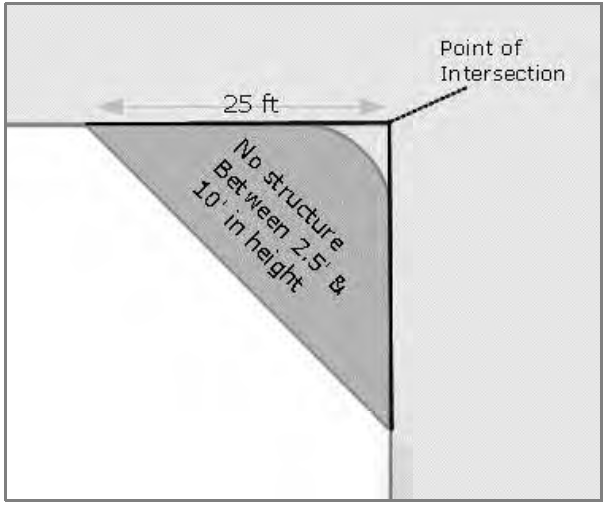
Traffic Visibility. On a corner lot in any district, except the C3 Town Center District, nothing shall be erected, placed, planted, or allowed to grow in such a manner as to impede vision between a height of two and a half (2.5) and ten (10) feet above the center line grades of the intersecting street, in the area bounded by the street rights-of-way of such corner lots and a line joining points along said street lines twenty-five (25) feet from the point of intersection as depicted in the figure below. A distance of fifteen (15) feet shall apply to an intersection between a street and an alley. In instances where the intersection is with a Maryland State Highway Route, the requirements of the Maryland State Highway Administration shall supersede the provisions of this Ordinance.
Sec. 6.11. - Exterior lighting.
A.
Exterior lighting shall not adversely affect adjacent, surrounding or nearby properties, as determined by the following:
(1)
Direct or directly reflected light is confined to the property in which it is used.
(2)
All light sources and light lenses shall be shielded to focus light, including glare or reflection, away from adjoining or facing residential premises and from public streets.
(3)
Applicant shall submit the specifications for the lights, poles fixtures and light sources to the City for approval prior to installation.
(4)
The height of the light poles shall not exceed twenty-five (25) feet as measured from the grade at placement unless approved by the City officials and the Planning Commission.
(5)
Reflective type, blinking, flashing, fluttering, strobe lights or lights with changing intensity, brightness or color are prohibited.
(6)
Any light or combination of lights that casts light on a public street shall not exceed one (1) footcandle (meter reading) as measured from the centerline of such street. Any light or combination of lights that casts light on land zoned or used for residential purposes shall not exceed 0.4 footcandles (meter reading) as measured no more than three (3) feet inside the lot line.
(7)
The City shall conduct an inspection to ensure the above regulations are met after the installation of exterior lighting.
Sec. 6.12. - Off-street parking requirements.
A.
Numbers of Parking Spaces. There shall be provided at the time of change of use, erection or enlargement of any principal building or structure, the following minimum off-street parking spaces, with adequate provision for ingress and egress:
(1)
The City recognizes that the uses listed for parking requirements may not be comprehensive. In instances not specifically listed herein, the parking requirement of the most similar use, as determined by the Community Development Director, shall apply. No building or occupancy permit shall be issued for any new use until the required parking has been evaluated and the requirements satisfied.
B.
Town Center Parking Requirements.
(1)
Town Center. In the C3 Town Center district, additional numbers of off-street parking spaces are not required to be provided unless:
(a)
A new principal building or building expansion of over five thousand (5,000) square feet of total floor area is constructed or
(b)
The number of dwelling units or rooming house units on the lot would be increased.
(i)
Required off-street parking shall be provided to accommodate only the newly added square footage or dwelling units.
C.
University Corridor Parking Requirements.
(1)
University Corridor.
(a)
Commercial Uses. In the C1 University Corridor district, required off-street parking spaces for commercial uses may be reduced by up to fifty percent (50%) of the requirements specified in Section 6.12A.
(b)
Residential Uses. In the C1 University Corridor district, required off-street parking spaces for residential uses shall meet the requirements as set forth in Section 6.12A.
D.
Front Yard Requirements. All new vehicle parking spaces shall be located outside of the minimum required front yard. On a corner lot, such restriction shall only apply the front yard adjacent to the street more frequently traveled, as determined by the Community Development Director.
E.
Location of Parking. Required off-street parking spaces shall be located on the same lot where the principal buildings or structures are located, except as provided for herein:
(1)
Off-Site Parking. In situations where on-site parking cannot be accommodated due to landscape limitations, the parking requirements may be met through provision of off-site parking on nearby land owned by the property owner or through a lease effective throughout the duration of the use.
(a)
Prior to issuance of an occupancy permit or acceptance of a rental housing registration, a copy of the lease must be provided to the Community Development Department.
(b)
Off-site parking areas shall be subject to the following restrictions:
(i)
Required parking spaces serving residential uses may be placed up to two hundred (200) feet from the lot containing the residential uses;
(ii)
Required parking spaces serving nonresidential uses may be placed up to four hundred (400) feet from the lot containing such uses; and
(iii)
Required parking spaces serving nonresidential uses in the C3 Town Center District may be located up to eight hundred (800) feet from the lot containing such uses.
(c)
Revocation of permits. Failure to maintain a lease of the required parking as specified in this subsection shall constitute a violation of this Code and may be cause for revocation of a certificate of occupancy.
(2)
Shared Parking. At the request of the developer(s) and owner(s), shared parking facilities may be permitted by the Community Development Director the following structures constructed after the effective date of this Ordinance: buildings housing multiple uses, mixed-use developments, shopping centers, and/or accessory structures relative to the foregoing.. A parking impact study shall be provided by the developer(s) or owner(s) establishing that the estimated peak demand for parking required by the users will be satisfied due to differing hours of peak demand. A shared parking plan approved by the Community Development Director shall be enforced through a written covenant.
(a)
Covenant for shared parking plan. A notarized copy of the written covenant made by the owner(s) of record shall be submitted to the Community Development Director, who shall forward a copy to the City Attorney for review. Proof of recordation of the covenant shall be presented to the Community Development Director prior to issuance of a certificate of occupancy. The agreement shall:
(i)
List the name(s) and ownership interest of all parties to the agreement and contain the signatures of those parties;
(ii)
Provide a legal description of the land;
(iii)
Include a site plan showing the area of the parking lot;
(iv)
Describe the area of the parking lot and designate and reserve it for shared parking unencumbered by any conditions which would interfere with its use;
(v)
Ensure the continued availability of the spaces for joint use and provide assurance that all spaces will be usable to all participating uses;
(vi)
Describe the obligations of each party, including the maintenance responsibility for the parking area and any open space.
(vii)
Incorporate the parking impact study by reference; and
(viii)
Describe the method by which the covenant shall, if necessary, be revised or terminated contingent upon approval from the Community Development Director.
(b)
Change in use. Should any of the shared parking uses be changed, or should the Community Development Director find that any of the conditions described in the approved parking impact study or agreement no longer exist, the owner shall have the option of submitting a revised parking impact study and an amended shared parking covenant in accordance with the standards of this subsection, or if necessary, provide the number of spaces required for each use as if computed separately.
(c)
Revocation of permits. Failure to comply with the shared parking provisions of this subsection shall constitute a violation of this Code and may be cause for revocation of a certificate of occupancy.
F.
Parking Lot Design and Construction.
(1)
Any parking lot consisting of six (6) or more parking spaces that is to be constructed shall be subject to the City of Frostburg Subdivision and Land Development Regulations in addition to the regulations set forth herein.
(2)
All parking areas and driveways shall be surfaced with a dustless and durable material and shall be graded to prevent the accumulation of surface water. If there are six (6) or more parking spaces on a lot, all of the parking spaces shall be paved in asphalt, concrete or paving block.
(3)
The first ten (10) feet of length of a driveway measured from the edge of paved roadway shall be paved in asphalt or concrete. Asphalt shall not be placed over a concrete sidewalk.
(4)
Required parking spaces shall be arranged to allow each vehicle to be moved onto a street or alley without requiring the movement of any other vehicle. This requirement shall not apply to a lot with a single dwelling unit in Zoning Districts where occupancy is limited to two (2) unrelated persons.
(5)
No more than two (2) spaces on a lot shall be configured in a manner that will cause a vehicle to back onto a street. No more than three (3) spaces on a lot shall be configured in a manner that will cause a vehicle to back on to an alley.
G.
Parking Space and Aisle Sizes.
(1)
Each required off-street parking space shall consist of a minimum rectangle of nine (9) by eighteen (18) feet. However, within the C3 Town Center, a maximum of thirty percent (30%) of the required parking spaces may each be a minimum rectangle of eight and a half (8.5) by sixteen (16) feet, provided they are clearly marked as being for "Compact Cars Only."
(2)
In configurations in which drive aisles will be created between parking spaces, the parking area drive aisle widths shall conform to the following table, which varies the width requirement according to the angle of parking.
(3)
Drive aisles providing access to parking lots shall be not less than ten (10) feet or exceed fifteen (15) feet in width for one-way traffic and less than eighteen (18) feet or exceed thirty (30) feet in width for two-way traffic, except that ten (10)-feet-wide driveways are permissible for two-way-traffic when a.) the drive aisle is not longer than fifty (50) feet, and b.) it provides access to not more than six (6) commercial, or ten (10) residential spaces, and c.) sufficient turning space is provided so the vehicles need not back onto a public street.
H.
Handicapped Parking. Handicap Parking spaces shall be provided in accordance with the Maryland Accessibility Code Regulations; COMAR 05.02.02.
I.
Bicycle Parking. Any new use required to provide six (6) or more new off-street parking spaces shall include a suitable area for the parking of bicycles, at a quantity equal to ten percent (10%) of the parking space count or two (2) bicycle spaces, whichever is greater. Such area should allow for locking of bicycles to a secure feature, but shall not result in obstructions to fire exits or handicapped access.
J.
Off-street Loading.
(1)
All permitted uses requiring truck loading and unloading space for normal operations shall provide adequate loading space so that no vehicle being loaded or unloaded in connection with the normal operations shall stand in or project into any public street.
(2)
Size. The minimum loading space size should be twelve (12) feet by thirty (30) feet.
(3)
Number. The standards for minimum required off-street loading spaces are as follows:
(a)
For assisted living centers; nursing homes; colleges, trade, or hobby schools; community centers; hospices; hospitals; primary and secondary schools; auction houses; building/lumber yards sales and storage; general retail; supermarkets and grocery stores; all industrial/technology uses; and other similar uses.
(b)
For bars, lounges, and taverns; clubs and lodges, dance halls, and nightclubs; country clubs; restaurants; theatres; cleaners, Laundromats; contractor offices; medical laboratories; motels and hotels; and other similar uses:
(c)
The number of off-street loading spaces are standardized requirements. The applicant may provide evidence acceptable to the Community Development Director that the standard number of required off-street loading spaces exceeds the requirements of the proposed use, and that the proposed number of spaces will be sufficient for the proposed use.
(d)
A reduction in the required off-street loading spaces in the C3, Town Center District, may be made by the Community Development Director, provided the applicant offers evidence that the space(s) are unnecessary or loading/unloading can otherwise be accommodated.
K.
Parking Lot Landscaping.
(1)
Any parking lot that will include six (6) or more parking spaces, or as otherwise specified by this Ordinance, shall be required to provide shade trees within or adjacent to paved areas.
(2)
One deciduous tree shall be required for every six (6) required off-street parking spaces.
(3)
Trees required by this section shall meet the following standards:
(a)
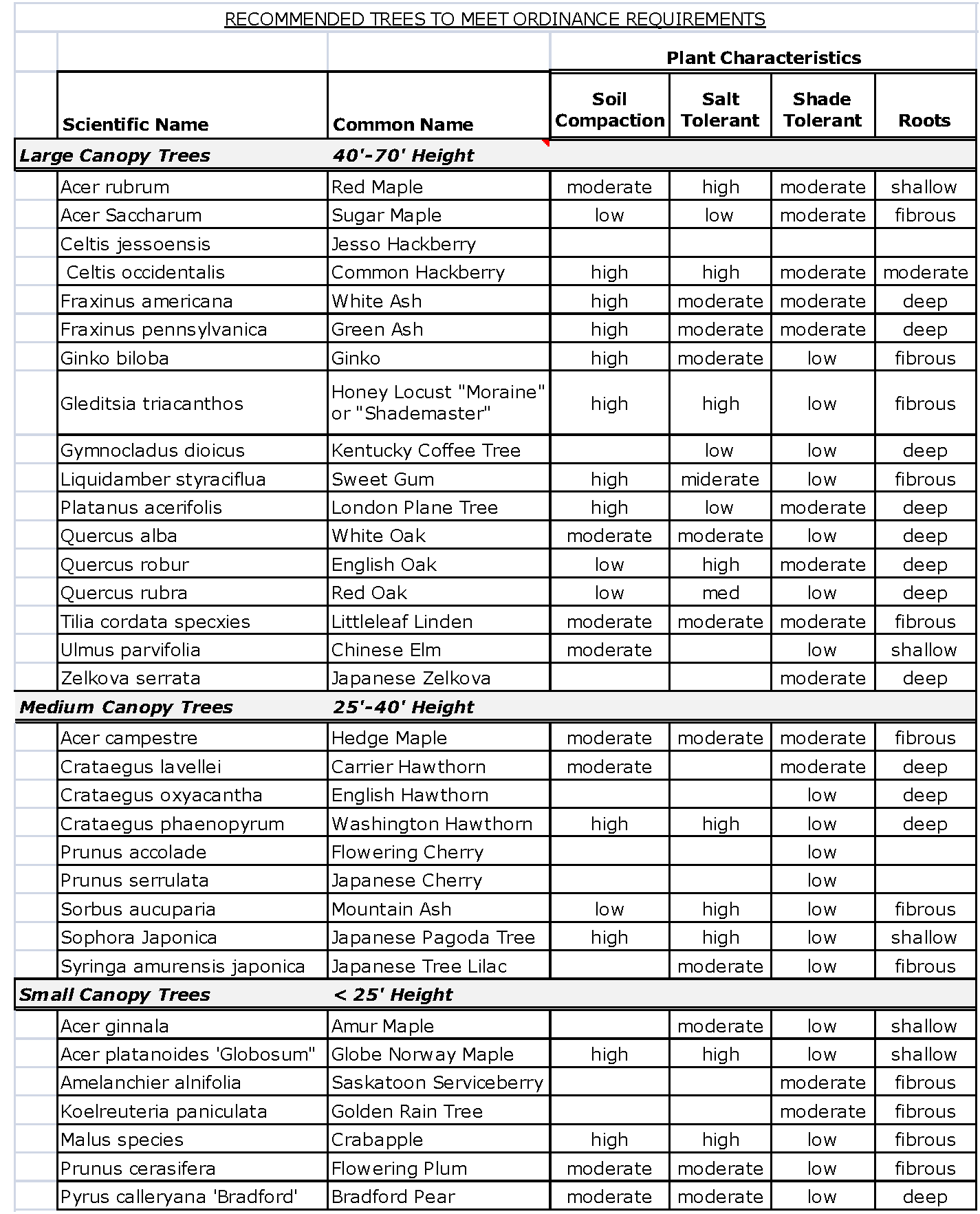
Type of Trees Permitted. Required trees shall be chosen from the list of approved street trees shown on the following page.
(i)
A tree not listed on the approved street tree list may be planted if the applicant demonstrates to the Community Development Director or Planning Commission that another type of tree is native, would shade paved areas, be resistant to disease, road salt and air pollution and be attractive.
(b)
Quality of Trees. Required trees shall be of symmetrical growth and free of insect pests and disease.
(c)
Minimum Size. The trunk shall be a minimum of one (1) inch DBH (diameter at breast height). Note- This section only regulates the species of trees that are used to meet requirements of the Parking Regulations per the City's Zoning Ordinance.
(d)
Planting and Maintenance. Required trees shall be:
(i)
Selected based on minimum tree lawn (the area between the curb and the sidewalk) requirement:
•
Three (3)-foot lawn - small trees.
•
Three (3)- to six (6)-foot lawn - medium trees.
•
Six (6)- to eight (8)-foot lawn - large trees.
(ii)
Planted in conformance with good landscaping practices, with adequate unpaved surface around each for water and air,
(iii)
Properly protected by raised curbs, distance or other devices from damage from vehicles, and
(iv)
Surrounded by a minimum of sixteen (16) square feet of pervious ground that is properly maintained for plant growth.
(e)
Where there are overhead wires, trees expected to reach a maximum height of less than twenty-five (25')-thirty (30') in height, should be used. Larger trees can be planted on lots with overhead wires if space is available between buildings and the sidewalk or street. Planting near underground power lines should be avoided.
(f)
Trees should not obstruct the vision of drivers at intersections (the setback depends on the size, shape, and growth pattern of the tree.).
(g)
A required tree(s) shall not be removed without being replaced within eight (8) months by the current landowner by another tree(s) that meets the requirements of this section.
L.
Buffering of Parking and Loading Areas.
(1)
Buffering of Parking: Any new or expanded parking lot consisting of six (6) or more new parking spaces, shall be buffered from view from any primarily residential use on an immediately abutting lot with a row of evergreen plants. Such plants shall be of a species that can reasonably be expected to reach a height of six (6) feet within four (4) years.
(2)
Where insufficient room exists for such plants or upon the written request of the adjoining property owners, the Community Development Director may allow the installation of an attractive mostly solid weather-resistant wood fence or decorative masonry wall in place of the plants.
M.
Parking as a Principal Use. In instances where parking will be the primary principal use of a lot comprised of six (6) or more new parking spaces, the parking lot shall also be buffered from view from the street. The selected plant species should be able to reach a height of six (6) feet within four (4) years. The plants may be placed in the required front yard subject to visibility requirements.
N.
Main Street. If any new or expanded parking lot results in the development of six (6) or more spaces adjacent to and visible from Main Street, it shall be buffered from Main Street by an attractive planting strip or a decorative masonry wall.
O.
Loading Areas. If any new or expanded loading or unloading area routinely involves the parking of two (2) or more tractor-trailer trucks, such area shall be buffered from view from any primarily residential use on an adjacent lot or across the street by a row of attractive evergreen plants. Such plants shall be of a species that can reasonably be expected to reach a height of six (6) feet within four (4) years.
P.
Where insufficient room exists for such plants, the Community Development Director may allow the installation of an attractive mostly solid weather-resistant wood fence or attractive masonry wall in place of the plants.
Sec. 6.13. - Environmental considerations.
A.
Stream Buffers.
(1)
Setback. No new principal building, off-street parking, off-street loading space, or commercial or industrial outdoor storage area shall be located:
(a)
Within fifty (50) feet of the centerline of a perennial waterway, and
(b)
Within twenty-five (25) feet of the centerline of an intermittent waterway.
(2)
Crossings. Within fifty (50) feet of the centerline of a perennial waterway, streets and driveways shall be limited to those approximately perpendicular crossings that are absolutely necessary for public safety or to provide reasonable use of adjacent properties.
(3)
Existing Vegetation. Within the areas specified in Section 6.13, existing natural vegetation shall be preserved to the maximum extent possible. An applicant for a permit for activity within such area shall: a) specify on the plan those trees or areas of trees and other vegetation intended to be preserved, removed or replaced by new trees and vegetation, and b) be accompanied by a detailed soil erosion and sedimentation control plan, which shall be carried out in full.
(4)
New Trees and Vegetation. If existing trees do not exist along a perennial waterway, and if a new principal building and/or vehicle parking area is proposed adjacent to such waterway, then the applicant shall: 1) plant an average of one (1) native deciduous shade tree along such waterway for each fifty (50) feet of distance along the waterway, and b) plant new grass, shrubs or similar vegetation along the bank of the waterway if such does not already exist.
B.
Steep Slopes (> 25%).
(1)
New Slopes. If any new slope will be created of greater than 4:1, the applicant shall provide a written description of the measures that will be used to stabilize such slope, together with a legally binding timetable for the implementation of such measures.
(2)
Over twenty-five percent (25%) Slopes. Any construction of a new principal building or a new parking lot on land with an existing natural slope of over twenty-five percent (25%) shall require a construction plan for the project, regardless of type of use or structure. The plans shall meet the requirements set forth in Section 1.16G.
(3)
Slopes on Proposed Lots.
(a)
This Section 6.13 shall only apply to a lot submitted for subdivision approval after the adoption of this Ordinance and which includes over five hundred (500) square feet of natural slopes of over 25%.
(b)
As part of the subdivision plan, the applicant shall designate a "buildable area." The buildable area shall be the proposed maximum extent of portions of the lot where construction of a principal building shall be permitted. The applicant may voluntarily propose a smaller buildable area than is permitted by this Ordinance.
(c)
If the subdivision plan shows a buildable area that includes natural slopes over twenty-five percent (25%), then the minimum lot area for that lot shall be increased to twice the size that would otherwise be required.

