
Frostburg City Zoning Code
PART 7
- SIGNS
Sec. 7.1. - Meaning of terms.
Abandoned Sign: A sign which for a period of at least sixty (60) consecutive days no longer advertises or identifies an ongoing business establishment, product or activity.
Alteration: Any change in copy, color, size or shape, which changes appearance of a sign, or a change in position, location, construction or supporting structure of a sign, except that a copy change on a sign is not an alteration.
Animated Sign: A sign which has any visible moving part, flashing or osculating lights, visible mechanical movement of any description, or other apparent visible movement achieved by any means that move, change, flash, osculate or visibly alters in appearance in a manner that is not permitted by these regulations.
Area of Sign: Refer to measurement standards in Section 7.3A.
Attraction or Reader Board: Any sign having changeable copy for the purpose of advertising events, sales, services or products provided on the site.
Awning: A shelter extending from the exterior wall of a building and composed of non-rigid materials except for the supporting framework.
Awning Sign: Any sign painted on or attached to or supported by an awning.
Balloon Sign: A lighter-than-air gas-filled balloon, tethered in a fixed location that has a sign with a message on its surface or attached in any manner to the balloon.
Banner Sign: A temporary, lightweight sign that contains a message which is attached or imprinted on a flexible surface that deforms under light pressure and that is typically constricted of non-durable materials, including, but not limited to, cardboard, cloth and/or plastic.
Billboard or Poster Panel: An off-premises sign.
Building Identification Sign: Any sign containing the name or address of a building and may include hours of operation and emergency information, such sign being located on the same site as the structure.
Canopy: A freestanding permanent roof-like shelter not attached to or requiring support from an adjacent structure.
Canopy Sign: Any permanent sign attached to or constructed underneath a canopy. These signs are below a projecting structure which extends over the pedestrian walkway which effectively prevents the wall signs for being visible to the pedestrian walking under the canopy. See Also Projecting Sign.
Changeable Copy Sign: A sign or portion thereof on which the copy or symbols change either automatically through electrical or electronic means (for example, time and temperature units), or manually through placement of letters or symbols on a panel mounted in or on a track system.
Comprehensive Sign Plan (CSP): A coordinated program of all signs, including exempt and temporary signs for a business, or businesses if applicable, located on a development site. The sign program shall include, but not be limited to, indications of the locations, dimensions, colors, letter styles and sign types of all signs to be installed on a site.
Construction Sign: A nonpermanent sign identifying the persons, firms or business directly connected with a construction project.
Directional Sign: A permanent instructional sign located on private property at or near the public right-of-way, directing or guiding vehicular traffic onto the property and/or toward parking or other identified locations on the property.
Footcandle: A measure of illumination on a surface that is one (1) foot from a uniform source of light of one (1) candle and equal to one (1) lumen per square foot.
Freestanding Sign: Any sign which is permanently affixed in or upon the ground, supported by one (1) or more structural members, with air space between the ground and the sign face.
Governmental Sign: A sign erected and maintained pursuant to and in discharge of any governmental functions, or required by law, ordinance or other governmental regulation.
Grade: The level of the site at the property line located at the closest distance to the sign.
Height of Sign: Refer to measurement standards in Section 7.3B.
Holiday Decorations: Signs or displays including lighting, which are a nonpermanent installation celebrating national, state, and local holidays or holiday seasons.
Illegal Sign: Any sign placed without proper approval or permits as required by this Code at the time of sign placement. Illegal sign shall also mean any sign placed contrary to the terms or time limits of any permit and any non-conforming sign which has not been brought into compliance with any applicable provisions of this Code.
Illuminated Sign: Any sign for which an artificial source of light is used in order to make readable the sign's message, including internally and externally lighted signs and reflectorized, glowing or radiating signs.
Instructional Signs: A sign clearly intended for instructional purposes, as determined by the Zoning Enforcement Officer, shall not be included in the permitted sum of the sign area of identification wall signs, provided such sign is not larger than necessary to serve the intended instructional purpose, and such sign is not in a location, nor includes design characteristics, that constitute or serve the purposes of an identification sign.
Length of Frontage:
1.
For measurement purposes, the length of any primary or secondary frontage as defined in Section 2.1, shall be the sum of all wall lengths parallel, or nearly parallel, to such frontage, excluding any such wall length determined by the Zoning Enforcement Officer or Planning Commission as clearly unrelated to the frontage criteria.
2.
For buildings with two (2) or more frontages, the length and allowable sign area shall be calculated separately for each such frontage.
3.
The building frontage for a building unit shall be measured from the centerline of the party walls defining the building unit.
Logo, Logogram, or Logotype: An emblem, letter, character, pictograph, trademark, or symbol used to represent any firm, organization, entity, or product.
Marquee: A permanent roof-like shelter extending from part or all of a building face and constructed of some durable material which may or may not project over a public right-of-way.
Marquee Sign: Any sign painted on or attached to or supported by a marquee. (Note: Not sure the term is used)
Mural: A picture on an exterior surface of a structure. A mural is a sign only if it is related by language, logo, or pictorial depiction to the advertisement of any product or service or the identification of any business.
Neon Sign: A sign with tubing that is internally illuminated by neon or other electrically charged gas. (Note: Not sure term is needed)
Non-conforming Sign: A sign which was legally installed under laws or ordinances in effect at the time of its installation, but which is in conflict with the current provisions of this Code.
Off-Premises Advertising Sign: Any sign normally used for promoting an interest other than that of a business, individual, products, or service available on the premises where the sign is located, but does not include directional signs or other instructional signs.
On-Premises Sign: Any sign used for promoting a business, individual, product or service available on the premises where the sign is located.
Political and Noncommercial Signs: Any sign designed for the purpose of supporting or opposing a candidate, proposition or other measure at an election or for any other noncommercial expression not related to the advertisement of any product or service or the identification of any business.
Portable Sign: Any movable sign not permanently attached to the ground or a building and easily removable using ordinary hand tools.
Primary and Secondary Frontage: The frontage of any building or site shall include the elevation(s) facing a public street, facing a primary parking area for the building or tenants, or containing the public entrance(s) to the building or building units.
1.
For multi-tenant buildings, the portion of such building that is owned, or leased by a single tenant, shall be considered a building unit.
2.
The primary frontage shall be considered the portion of any frontage containing the primary public entrance(s) to the building or building units.
3.
The secondary frontage shall include frontages containing secondary public entrances to the building or building units, and all walls facing a public street or primary parking area not designated as the primary frontage by the definition above.
Projecting Sign: A sign which projects from and is supported by a wall or parapet of a building with the display surface of the sign in a plane perpendicular to or approximately perpendicular to the wall. See also Canopy sign.
Real Estate Sign: Any nonpermanent sign pertaining to the sale, exchange, lease, rental, or availability of land, buildings, condominium and similar units, or apartments. Such signs may include building name and address, price and amenities, identity of seller or broker, and similar information.
Revolving or Rotating Sign: An animated sign.
Roof Sign: Any sign erected upon a roof, parapet, or roof- mounted equipment structure and extending above a roof, parapet, or roof-mounted equipment structure of a building or structure.
Sign: Any name, figure, character, outline, display, announcement, or device, or structure supporting the same, or any other device of similar nature designed to attract attention outdoors, and shall include all parts, portions, units, and materials composing the same, together with the frame, background, and supports or anchoring thereof. A sign shall not include any architectural or landscape features that may also attract attention.
Sign Face: An exterior display surface of a sign including nonstructural trim exclusive of the supporting structure.
Site: All the contiguous ground area legally assembled into one (1) development location which is a zoning lot. A zoning lot is defined as a permanent parcel (lot of record), multiple lots of record, or a portion of a lot of record.
Special Event Sign: Any temporary or non-permanent sign advertising or pertaining to any civic, patriotic or special event of general public interest.
Super Graphic: A painted design which covers all or a major portion of a wall, building or structure. A super graphic is a sign only if it is related by language, logo, or pictorial depiction to the advertisement of any product or service or the identification of any business.
Temporary Sign: Any sign which is installed for a period not to exceed thirty (30) days.
Vehicle Sign: Any sign permanently or temporarily attached to or placed on a vehicle or trailer.
Wall Sign: Any sign attached to or painted on the wall of a building or structure in a plane parallel or approximately parallel to the plane of said wall.
Window, Area of: The area of a single window includes all of the window panes in an area that is separated by mullions, muntins, or other dividers which are less than four (4) inches wide.
Window Sign: Any sign viewable through and/or affixed in any manner to a window or exterior glass door such that it is intended to be viewable from the exterior (beyond the sidewalk immediately adjacent to the window), including signs located inside a building but visible primarily from the outside of the building.
(Ord. No. 2018-02, § 1, 5-17-2018)
Sec. 7.2. - Purpose of sign regulations.
A.
To promote the creation of an attractive visual environment that promotes a healthy economy by:
(1)
Permitting businesses to inform, identify, and communicate effectively; and
(2)
Directing the general public through the use of signs while maintaining attractive and harmonious application of signs on the buildings and sites.
B.
To protect and enhance the physical appearance of the community in a lawful manner that recognizes the rights of property owners by:
(1)
Encouraging the appropriate design, scale, and placement of signs;
(2)
Encouraging the orderly placement of signs on buildings while avoiding regulations that are so rigid and inflexible that all signs in a series are monotonously uniform; and
(3)
Assuring that the visual information displayed on signs is clearly visible, conspicuous, legible and readable so that they achieve their intended purposes.
C.
To foster public safety along streets within the City by assuring that all signs are in safe and appropriate locations.
D.
To have administrative review procedures that are the minimum necessary to:
(1)
Balance the City's objectives and regulatory requirements with the reasonable advertising and way finding needs of businesses;
(2)
Allow for consistent enforcement of Part 7 of the Zoning Ordinance;
(3)
Minimize the time required to review a sign application; and
(4)
Provide flexibility as to the number and placement of signs so the regulations are able to balance responsiveness to the needs of businesses with the maintenance of community aesthetic standards.
Sec. 7.3. - Measurement standards.
A.
Determining Sign Area and Dimensions.
(1)
For a wall sign which is framed, outlined, painted, or otherwise prepared and intended to provide a background for a sign display, the area and dimensions shall include the entire portion within such background or frame.
(2)
For a wall sign comprised of individual letters, figures, or elements on a wall or similar surface of the building or structure, the area and dimensions of the sign shall encompass a regular geometric shape (rectangle, circle, trapezoid, triangle, etc.), or a combination of regular geometric shapes which form or approximate the perimeter of all elements in the display, frame, and any applied background that is not part of the architecture of the building. When separate elements are organized to form a single sign but are separated by open space, the sign area dimensions shall be calculated by determining the geometric form or combination of forms which comprise all of the display areas, including the space between different elements. Minor appendages to a particular regular shape, as determining by the Community Development Director, shall not be included in the total area of the sign. An illustration of this calculation is provided below:
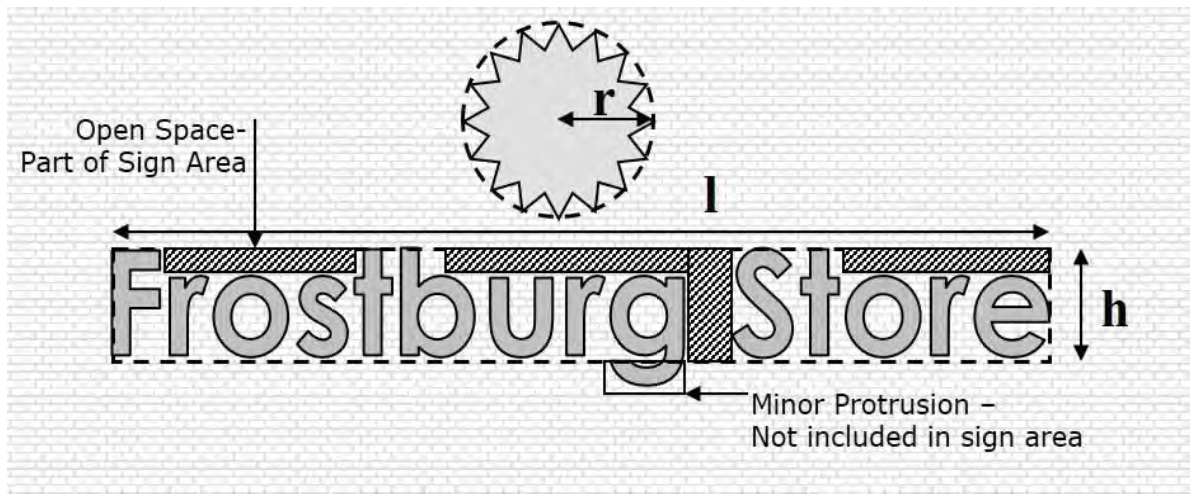
Sign Area = (πr 2 ) + (l × h)
(3)
For a freestanding sign, the sign area shall include the frame, if any, but shall not include:
(a)
A pole or other structural support unless such pole or structural support is internally illuminated or otherwise so designed to constitute a display device, or part of a display device.
(b)
Architectural features that are either part of the building or part of a freestanding structure, and not an integral part of the sign, and which may consist of landscaping, building, or structural forms complementing the site in general.
(4)
When two (2) identical sign faces are placed back-to-back so that both faces cannot be viewed from any point at the same time and are part of the same sign structure, the sign area shall be computed as the measurement of one (1) of the two (2) faces. When the sign has more than two (2) display surfaces, the area of the sign shall be the area of largest display surfaces that are visible from any single direction.
B.
Determining Sign Height.
(1)
The height of a freestanding sign shall be measured from the base of the sign or supportive structure at its point of attachment to the ground to the highest point of the sign. A freestanding sign on a manmade base, including a graded earth mound, shall be measured from the grade of the nearest pavement or top of any pavement curb.
(2)
Clearance for freestanding and projecting signs shall be measured as the smallest vertical distance between finished grade and the lowest point of the sign including any framework or other embellishments.
C.
Determining Building Frontages and Frontage Lengths.
(1)
Building Unit. The building unit is equivalent to the tenant space. The frontage of the tenant space on the first floor shall be the basis for determining permissible sign area for wall signs.
(2)
Primary and Secondary Frontage. The frontage of any building unit shall include the elevation(s) facing a public street, facing a primary parking area for the building or tenants, or containing the public entrance(s) to the building or building units.
(a)
The primary frontage shall be considered the portion on any frontage containing the primary public entrance(s) to the building or building units.
(b)
The secondary frontage shall include those frontages containing secondary public entrances to the building or building units, and all building walls facing a public street or primary parking area that are not designated as the primary building frontage by Section 7.3C(2)(a) above.
D.
Length of Building Frontage.
(1)
The length of any primary or secondary building frontage as defined in Section 2.1, shall be the sum of all wall lengths parallel, to such frontage.
(2)
For buildings with two (2) or more frontages, the length of the wall and allowable sign area shall be calculated separately for each such building frontage.
(3)
The building frontage for a building unit shall be measured from the centerline of the party walls defining the building unit.
Sec. 7.4. - Signs permitted.
The signs permitted in each zoning district are those indicated in the table below:
Key:
● The sign would be generally permitted.
○ These signs could be permitted depending in the design characteristics & whether adequate space is available.
♦ These signs could be permitted if special exception business use is permitted by Board of Zoning Appeals.
* In multiple tenant centers, each business may not be entitled to its own freestanding sign.
(Ord. No. 2018-02, § 5, 5-17-2018)
Sec. 7.5. - Development standards.
A.
Wall Signs.
(1)
The basic allowance for wall signs shall be limited to the following sign area:
C1, C3, and all R districts:
- 1.75 square feet per linear foot of building frontage
C2, C4, and T-LI districts:
- 2.5 square feet per linear foot of building frontage
(2)
Each tenant may have multiple wall signs as long as the total wall area does not exceed the allowances established for wall signs set forth herein subsection 1.
(3)
The wall sign or signs, shall not be greater than eighty percent (80%) of the length of the tenant space or the length of the building frontage for single tenants
(4)
The area of any wall sign may be increased by twenty-five percent (25%) when the building is set back at least one hundred (100) feet from the public right-of-way and may be further increased an additional twenty-five percent (25%) for each additional one hundred (100) feet of setback, or fraction thereof, up to a maximum increase of one hundred percent (100%).
(5)
Additional wall sign area is permitted for a secondary frontage which shall be equal to one hundred percent (100%) of the primary sign area allowance based on sign area allowances specified in Section 7.5A(1).
(6)
Other Wall Signs. The following additional wall signs may be permitted:
(a)
Projection signs are permitted, in addition to the allowances for wall signs when designed and placed for the purpose of identifying the business for a pedestrian walking along the same side of the street as the business they seek or under a continuous rain canopy projecting from the building. Projection signs shall have a maximum area of five (5) square feet; the bottom of the sign shall be a minimum of eight (8) feet above the sidewalk; the sign shall not project more than three (3) feet from the wall of the building in which the sign is placed; and adjacent projecting signs shall not be closer than fifteen (15) feet.
(7)
Additional Wall Signs for Multiple Story Buildings. An additional building sign is permitted on each of the building's primary and secondary frontages according to the following:
(a)
For a building with two (2) floors the additional permitted sign area is twenty-five (25) square feet for each eligible wall.
(b)
This additional permitted sign area may be increased by fifteen (15) square feet for each additional building floor.
(c)
The sign must be placed at the height for which the bonus has been granted.
B.
Freestanding Signs.
(1)
The area of a freestanding sign shall be limited to the following sign area for the building, mixed-use development, or shopping center:
C1 and R districts (if permitted): 48 square feet
C2 district adjacent to Main Street: 48 square feet
C2 not adjacent to Main Street and T-LI districts: 120 square feet
C3 district (if permitted): 48 square feet
C4 district: 180 square feet
(2)
There shall be a maximum height of freestanding signs for each property with the standard established for each district as follows:
C1 and R districts (if permitted): eight (8) feet
C2 district adjacent to Main Street: 15 feet
C2 not adjacent to Main Street and T-LI districts: 25 feet
C4 district: 80 feet
(3)
The sign height shall be sufficient to assure that the sign is visible above parked and moving vehicles and any other obstructions.
(4)
Permission shall be granted by the right-of-way owner for a free-standing sign to be located in, or project over, a public right-of-way.
(5)
Additional freestanding signs shall be permitted for every two hundred (200) feet of site frontage, in excess of two hundred (200) feet of lot frontage and for corner lots. Additional freestanding signs shall not obstruct the view of adjacent freestanding signs.
(6)
The permitted sign area may be aggregated into fewer and larger signs, at the election of the property owner/business, provided that the size of any single sign does not exceed the area pursuant to subsection 1 or 2 above by more than fifty percent (50%).
C.
Electronic Message/Changeable Copy Signs.
(1)
Changeable copy by non-electronic means may be utilized on any permitted sign.
(2)
Only one (1) electronic message center (EMC) is permitted on a lot.
(3)
The EMCs shall comply with the provisions set forth in the following table:
(4)
All EMCs are required to have automatic dimming capabilities that adjusts the brightness to the ambient light at all times of day and night.
D.
Reserved.
E.
Home Occupation Signs.
(1)
A maximum of one (1) non-illuminated sign is permitted for a permitted home occupation.
(2)
The sign shall not exceed two and a half (2.5) square feet in size.
(3)
The sign shall be flush mounted to the dwelling unit or may project from the dwelling unit no further than eighteen (18) inches. The sign shall be located no higher than eight (8) feet above grade. Alternatively, the sign may be installed on a small decorative post not to exceed five (5) feet in height. The sign cannot infringe upon the public way nor shall it interfere with the lines of sight required for traffic visibility as described in Section 6.10.
F.
Window Signs.
(1)
Permanent window signs shall not exceed twenty-five percent (25%) of the area of a window and the total area of all window signs, including both temporary and permanent, shall not exceed fifty percent (50%) of the window area.
G.
Rental Property Signs for Residential and Commercial Use.
(1)
Signs advertising "For Rent", the Property Owner, or the Owner's Agent of a rental property shall be limited to one (1) non-illuminated sign per property.
(2)
The sign shall be mounted flush to the building or porch railing or within a window.
(3)
The sign shall be placed on a basement or first floor wall, at a maximum height of twelve (12) feet above grade.
(4)
The sign shall not exceed three (3) square feet in size.
(5)
Other sign types may be permitted for new multifamily residential developments with submittal of a sign application by developer or owner.
H.
Temporary Signs.
(1)
Special Events. Signs advertising a special event shall be permitted on a temporary basis and shall be subject to the following provisions:
(a)
Signs may be posted up to thirty (30) days prior to the event and shall be removed no more than five (5) days following the event.
(b)
Permitted advertising devices shall include only signs, yard signs, banners, and tethered balloons.
(c)
No more than two (2) advertising devices shall be placed in one (1) lot at the same time.
(d)
Signs shall be located outside of the right-of-way, with the exception that banners may be displayed over City Streets with City approval.
(2)
Real Estate and Construction Signs. Real estate and construction signs are permitted in all districts at all times. Signs shall be removed after completion of construction or sale transaction(s) are complete.
(a)
Signs shall be limited to six (6) square feet of sign area per side.
(b)
Construction projects or Real Estate for sale exceeding $1,000,000.00 in value, or a recorded subdivision with five (5) or more lots for sale may have a sign not to exceed fifty (50) square feet per side.
(3)
Political Signs. Political signs are permitted in all districts at all times. A political sign shall not be placed within any public right-of-way or any property owned by the City of Frostburg.
(4)
Sandwich Board Signs. In addition to signs permitted by the provisions of Part 7 of this Ordinance, a maximum of one (1) sandwich board sign shall be permitted per lot in the commercial districts. Such sign shall only be used to advertise a lawful business on the premises. The sign shall be subject to the following provisions:
(a)
Maximum sign size of six (6) square feet per side with a maximum of two (2) sides.
(b)
Sign may be placed on a public sidewalk; however, the business owner shall be responsible to ensure that the sign is located to avoid obstruction pedestrian traffic or obstructing the sight distances of vehicular traffic.
(c)
The sign shall only be displaced during the hours when the business is open to the public.
(Ord. No. 2018-02, § 5, 5-17-2018)
Sec. 7.6. - Non-conforming signs.
A.
General Provisions.
(1)
Non-conforming signs shall be maintained in good condition pursuant to Section 7.8B.
(2)
A non-conforming sign shall not be altered, modified, or reconstructed except
(a)
When such alteration, modification or reconstruction would bring such sign into conformity with these regulations;
(b)
When the existing use has new ownership which results in a change in the name or logo of the use or business on the property, and such change complies with subsection d below;
(c)
When the space is reoccupied by a similar use and the new occupant requires no external building or site renovation, and such change complies with subsection d below;
(d)
Any alteration, modification, or reconstruction permitted in this section shall be limited to the replacement of a sign panel, replacing individual letters and logos within the same area, or repainting a sign face, and does not permit changes to the structure, framing, erection, or relocation of a sign unless such changes conform to subsection a above.
B.
Limitations for Non-Conforming Signs.
(1)
A non-conforming sign shall be removed upon verification that the use to which such non-conforming sign refers has been abandoned for more than one hundred eighty (180) consecutive days.
Sec. 7.7. - Sign permits and review procedures.
A.
Permit Requirements.
(1)
Prior to the erection, enlargement, or alteration of any sign, the owner or developer shall obtain a permit issued by the Community Development Director, except permits are not required for the following signs, however, these signs must meet the subject requirements referenced herein:
(a)
Rental Property Signs for Residential and Commercial Use, Section 7.5G;
(b)
Temporary Signs, Section 7.5H;
(c)
Window signs, Section 7.5F; and
(2)
Each application shall be accompanied by drawings to scale and written material showing the area and general appearance of the sign, the method of illumination, the exact location of the proposed sign, and the method of construction and/or attachment of such sign to the building or structure.
B.
Review Procedure.
(1)
Time Limits. All sign applications shall be reviewed for compliance with these regulations within ten (10) business days from the time a completed application has been accepted by the Community Development Director.
(2)
All appeals and variances regarding the terms of this Part of the Zoning Ordinance shall be heard by the Board of Zoning Appeals.
(3)
A Comprehensive Sign Plan (CSP) may be submitted that permits consideration of unique conditions, flexibility and creativity. Such CSP is subject to approval by the Planning Commission. The application of such a plan cannot be viewed as imposing more restrictive requirements than permitted by the basic standards, but rather, may permit additional signs and/or sign area based on the applicant's demonstration of unique characteristics of the design, building, and/or site and appropriate landscaping associated with freestanding signs. Once a CSP has been approved subsequent applications for specific signs shall be approved administratively when the proposed sign is in compliance with the approved CSP.
(4)
If proposed signs do not comply with the provisions of Section 7.8A, the applicant may submit an application to the Planning Commission to determine the adjustments, if any, that are appropriate to satisfy the requirements of Section 7.8A.
(Ord. No. 2018-02, § 1, 5-17-2018)
Sec. 7.8. - Supplemental considerations.
A.
Construction Standards. The construction, erection, safety and maintenance of all signs shall comply with the building codes in effect at the time of construction. As of the adoption date of this Ordinance, the effective code is the 2012 International Building Code.
(1)
Signs shall be structurally sound and located so as to pose no reasonable threat to pedestrian or vehicular traffic.
(2)
All permanent freestanding signs shall have self-supporting structures erected on, or permanently attached to, concrete foundations.
(3)
If possible, signs should not be locations that obscure architectural features such a pilasters, arches, windows, cornices, etc.
(4)
The signs should not be in locations that interfere with safe vehicular and pedestrian circulation or public safety signals and signs.
(5)
No signs shall be erected, constructed, or maintained so as to obstruct any fire escape, required exit, window, or door opening used as a means of egress.
(6)
Signs shall be structurally designed in compliance with ANSI and ASCI standards.
(7)
Signs may be illuminated - by external or internal means - provided that:
(a)
The brightness and intensity shall not be greater than necessary to meet reasonable needs of the business or use served;
(b)
Light sources shall be shielded from all adjacent buildings and streets; and,
(c)
The lighting shall not create excessive glare to pedestrians and/or motorists, and will not obstruct traffic control or any other public informational signs.
B.
Maintenance. All signs shall be maintained in accordance with the following:
(1)
The property owner shall maintain the sign; in a condition appropriate to the intended use; to all City standards; and has a continuing obligation to comply with all building code requirements.
(2)
If the sign is deemed by the Community Development Director to be in an unsafe condition, the owner of the business shall be immediately notified in writing, and within 48 hours of receipt of such notification, respond to the City with a plan to correct the unsafe condition, remove the unsafe sign, or cause it to be removed. If after twenty-eight (28) days, the unsafe condition has not been corrected through repair or removal, the Zoning Enforcement Officer may cause the repair or removal of such sign, at the expense of the property owner or lessee. If the total costs are not paid in full with sixty (60) days of the repairs or removal, the amount owed shall be certified as an assessment against the property of the sign owner and a lien upon that property.
(3)
In cases of emergency, the Community Development Director may cause the immediate removal of a dangerous or defective sign without notice.
(4)
Whenever any sign, either conforming or non-conforming to these regulations, is required to be removed for the purpose of repair, relettering or repainting, the same may be done without a permit or without any payment of fees provided that all of the following conditions are met:
(a)
There is no alteration or remodeling to the structure or the mounting of the sign itself;
(b)
There is no enlargement or increase in any of the dimensions of the sign or its structure;
(c)
The sign is accessory to a legally permitted or non-conforming use.
C.
Signs Exempt from the Regulations. The following signs shall be exempt from regulation under this Zoning Ordinance.
(1)
Any public purpose/safety sign and any other notice or warning required by a valid an applicable federal, state or local law, regulation or resolution.
(2)
Works of art that do not include a commercial message.
(3)
Religious or other holiday lights and decorations containing no commercial message, and displayed only during the appropriate time of the year.
(4)
Flags of the United States, the state, foreign nations having diplomatic relations with the United States, and any other flag adopted or sanctioned by an elected legislative body of competent jurisdiction. These flags must be flown in accordance with protocol established by the Congress of the United States for the Stars and Stripes. Any flags not meeting these conditions shall be considered a sign and shall be subject to regulations as such.
(5)
Building Markers.
D.
Prohibited Signs. The following signs are prohibited in the City:
(1)
Abandoned signs, as defined in Section 7.1.
(2)
Animated, flashing, rotating signs and festoons as defined in Section 7.1, inflatable signs, tethered balloons, pennants, search lights, streamers, exposed light bulbs, strings of light not permanently mounted to a rigid background, and any clearly similar features, except those specifically exempt from regulation in Section 7.8C, special event signs or banners permitted in Section 7.5H or electronic message centers as permitted in Section 7.5C.
(3)
Signs on vehicles when the vehicle is placed in a location not normally expected for such vehicles, and the location apparently has the primary purpose of attracting attention or providing advertising.
(4)
Signs containing any words or symbols that would cause confusion because of their resemblance to highway traffic control or direction signals.
(5)
Off-premises signs.
(6)
Merchandise, equipment, products or vehicles or other items which are not available for purchase, but are intended to attract attention, or for identification or advertising purposes.
(7)
Signs located on trees, utility poles, public benches or any other form of public property or within any public right-of-way unless explicitly permitted.
(8)
Other signs or attention-getting devices that raise concerns substantially similar to those listed above.

