
Frostburg City Zoning Code
PART 8
- SPECIAL REGULATIONS
Sec. 8.1. - Home occupations.
A.
The City recognizes the desire and/or need of some citizens to use their residences for business activities in order to reduce travel and provide another economic development tool, but also recognizes the need to protect the surrounding areas from adverse impacts generated by these business activities. The standards in this section are intended to ensure that the home occupation use remains subordinate to the residential use, and that the residential character of the dwelling unit is maintained. The standards recognize that many types of jobs can performed in a home with little or no effect on the surrounding neighborhood.
B.
There are two (2) types of home occupations, Type A and Type B. Uses are allowed as a home occupation only if they comply with all of the requirements of this Section. If necessary, determination of whether a use complies with the parameters of a Type A or B, home occupation shall be made by the Community Development Director.
(1)
Type A. A Type A home occupation is one wherein the residents use their home as a place of work; where, except on rare occasions, no employees other than the residents or customers come to the site.
(2)
Type B. A Type B home occupation is one where the residents use their home to conduct business in which there may be one (1) employee other than the residents in addition to customers/clients. Examples include a counselor, tutor, architect, family childcare homes or art classes.
C.
Home Occupations are permitted by type, by district, as specified in the table below.
Key:
♦ Permitted by right, no permit required
○ Zoning Occupancy Permit for Home Occupation Required
¥ Special Exception by Board of Zoning Appeals Required and Zoning Occupancy Permit for Home Occupation Required
D.
Permitted Home Occupations. Examples of permitted home occupations include, but are not necessarily limited to, the following:
(1)
Offices for such professionals as but not limited to, architects, brokers, counselors, clergy, doctors, draftspersons and cartographers, engineers, land planners, insurance agents, lawyers, real estate agents, accountants, editors, publishers, journalists, physiologists, contract management, graphic design, construction contractors, landscape design, cleaning services, salespersons, manufacturer's representatives, and travel agents.
(2)
Instructional services, including music, dance, art, and craft classes.
(3)
Studios for artists, sculptors, photographers, and authors.
(4)
Workroom for tailors, dressmakers, milliners, and craft persons, including weaving, jewelry making, cabinetry, and woodworking.
(5)
Home salon for services providing hair cutting, massage, or other cosmetology services.
(6)
Family childcare homes.
E.
Standards. Home Occupations shall comply with the standards listed below:
(1)
Operational Standards.
(a)
A home occupation shall have no more than one (1) nonresident employee on the premises at any one time. The number of nonresident employees working at locations other than the site of the home occupation is not limited.
(b)
The home occupation shall be limited to the parking/storage of one (1) commercial vehicle on the premises, not exceeding a fifteen thousand (15,000)-pound gross vehicle weight.
(c)
The use shall not include on-premises retail sales.
(d)
Type A home occupations are not required to provide any additional parking beyond what is required for the residential use. Type B home occupations shall provide one (1) additional off-street parking space.
(e)
The equipment used by the home occupation and the operation of the home occupation shall not create any vibration, heat, glare, dust, odor, or smoke discernible at the property lines, generate noise exceeding those permitted by State Code and the City Code, create electrical, magnetic, or other interference off the premises, consume utility quantities that negatively impact the delivery of those utilities to surrounding properties, or use or store hazardous materials in excess of the quantities permitted in a residential structure.
(2)
Site Related Standards.
(a)
Outdoor activities.
(i)
All activities must be contained within completely enclosed structures.
(ii)
Exterior storage or display of goods or equipment is prohibited.
(b)
Appearance of structure and site. The dwelling and site must remain residential in appearance and characteristics. With the exception of signage which complies with Part 7 of the Zoning Ordinance or changes which are expressly contemplated under the terms of this Part, external changes to the dwelling where the home occupation is conducted which make it appear less residential in nature or function are prohibited.
(i)
The use shall not include the display visible from outside of the dwelling of any goods, stock in trade, or other commodities.
(3)
The use shall involve no more than twenty-five percent (25%) of the total floor area of the dwelling unit in which the home occupation is located. If the home occupation is located in an accessory structure, the use shall involve no more than twenty-five percent (25%) of the combined total floor area of the dwelling unit and accessory structure. Notwithstanding the foregoing, in no instance shall a home occupation occupy a total of more than five hundred (500) square feet of gross floor area.
(4)
Hours. A home occupation shall not operate between the hours of 9:00 p.m. and 7:00 a.m. in such a manner as is discernible from other dwellings.
Sec. 8.2. - Artisan/small-scale manufacturing.
A.
The City recognizes manufacturing that produces goods to serve the immediate community and/or custom goods regardless of sale location, which are small by nature, are important for its economic development. The standards in this section are intended to provide opportunities for artisans' and artists' workshops, studios and similar facilities as well as small-scale manufacturing within the City while at the same time protecting the community from negative impacts that could be associated with the conduct of such uses. It is the City's goal to:
(1)
To accommodate mixed uses in commercial zones.
(2)
To allow flexibility for smaller businesses that have not yet grown to need the floor space that could be provided within a larger commercial building or facility.
(3)
To create opportunities for local and regional artists and artisans to have galleries, studios, workshops and similar facilities that would allow them to perform their work and present exhibitions and shows that can take advantage of local and state incentives and programs that exist in the City's Arts and Entertainment District, if located therein.
(4)
To attract entrepreneurial businesses that have the potential to grow with time and to create employment opportunities within the City and the immediately surrounding area.
B.
General Standards.
(1)
Small-scale manufacturing uses must be small in nature and shall not include any type of manufacturing that involves assembly line production. Rather, such uses shall provide the opportunity for producers to create custom or unique valued-added products.
(2)
Artisan/small-scale manufacturing shall not include artist studios and other uses permitted in Residential Districts as home occupations under Section 8.1 of this Ordinance.
(3)
An artisan/small-scale manufacturing use may be the principal use or accessory use of a property.
C.
Examples of artisan/small-scale manufacturing include, but are not limited to:
(1)
Commercial woodworking, metalworking, blacksmithing.
(2)
Commercial 3-D printing and computerized numerical control machining.
(3)
Commercial pottery/ceramics.
(4)
Indoor agriculture (excluding greenhouses) for local/regional distribution only.
(5)
Taxidermy.
(6)
Beer, wine, and spirit manufacturing.
(7)
Artisan textile, leather, glass and similar goods manufacturing.
(8)
Value-added food production.
(9)
Custom printing and publishing.
(10)
Space for exhibitions and galleries.
(11)
Custom or artisan furniture production.
(12)
Similar uses as determined by the Development Coordinator.
D.
Site-Related Standards.
(1)
Artisan/small-scale manufacturing will have limited deliveries and shipments and truck traffic shall not adversely affect the surrounding neighborhood, including volume, frequency, and time of deliveries.
(2)
No loading docks are permitted. Garage bays used for shipments and deliveries are permitted.
(3)
Noise associated with any manufacturing process shall not be audible at adjacent properties.
(4)
Odors, fumes, dust, or similar pollutants shall not encroach upon neighboring properties.
(5)
Sale of product or goods produced on site is permitted, subject to any other City, county or state laws, ordinances or regulations which may apply.
(Ord. No. 2019-04, § 2, 5-16-2019)
Sec. 8.3. - Townhouses.
A.
See Part 2 for definitions.
B.
A townhouse development may consist of one or more group(s) of townhouses in which each group is limited to no more than six (6) attached dwelling units.
C.
Lot Area. No townhouse lot shall contain an area of less than one thousand, six hundred (1,600) square feet and a minimum lot and building width as specified by the zoning district requirements. The building setbacks shall conform to the requirements of the zoning district. The remaining lot area that would normally be required in the zoning district, per dwelling unit, shall be incorporated into usable and accessible open space, in which up to no more than thirty percent (30%) of the open space may be used as private or common vehicular access or parking area for the townhouse project site.
D.
Open space shall be surveyed and legally described as a separate parcel or parcels.
E.
The open space parcel(s) shall be contiguous with at least one of the townhome parcels.
F.
Open space must be restricted from further development by a conservation easement. The conservation easement shall be presented as part of the preliminary plan to the Planning Commission.
(1)
The conservation easement may be held by one (1) or more of the following ownership structures:
(a)
A common ownership association, individual members of which own non-open space within the development and in which membership in the association by all property owners in the development shall be mandatory;
(b)
Any individual who will use the land in accordance with the terms of the conservation easement.
(2)
The conservation easement must specify:
(a)
What entity will maintain the designated open space;
(b)
The purposes of the conservation easement and the conservation values of the property;
(c)
The legal description if the land under the easement;
(d)
The restriction of the use of the land;
(e)
To what standards the open space will be maintained; and,
(f)
Who will have access to the open space.
(3)
The owner(s) of the land underlying the conservation easement shall be responsible for the payment of taxes and assessments of any designated open space parcel.
(Ord. No. 2019-04, § 2, 5-16-2019)
Editor's note— Sec. 2 of Ord. No. 2019-04, renumbered §§ 8.2—8.8 as §§ 8.3—8.9 to accommodate new provisions adopted as § 8.2.
Sec. 8.4. - Bed and breakfasts and Short-Term Vacation Rentals.
A.
Definitions.
Bed and Breakfast: A private owner-occupied, single-family detached residential dwelling containing as the primary use, an aggregate of lodging rooms offered for rent with breakfast service to transient guests within a setting reflecting a residential rather than commercial character.
Short-Term Vacation Rental: A furnished dwelling unit in which the entire unit or separate portions thereof is available for rent for periods of less than forty-five (45) consecutive days to transient guests. A Short-Term Vacation Rental shall conform to all applicable requirements set forth in the Short-Term Vacation Rental regulations proposed in Section 8.4 of the Zoning Ordinance.
B.
General Provisions.
(1)
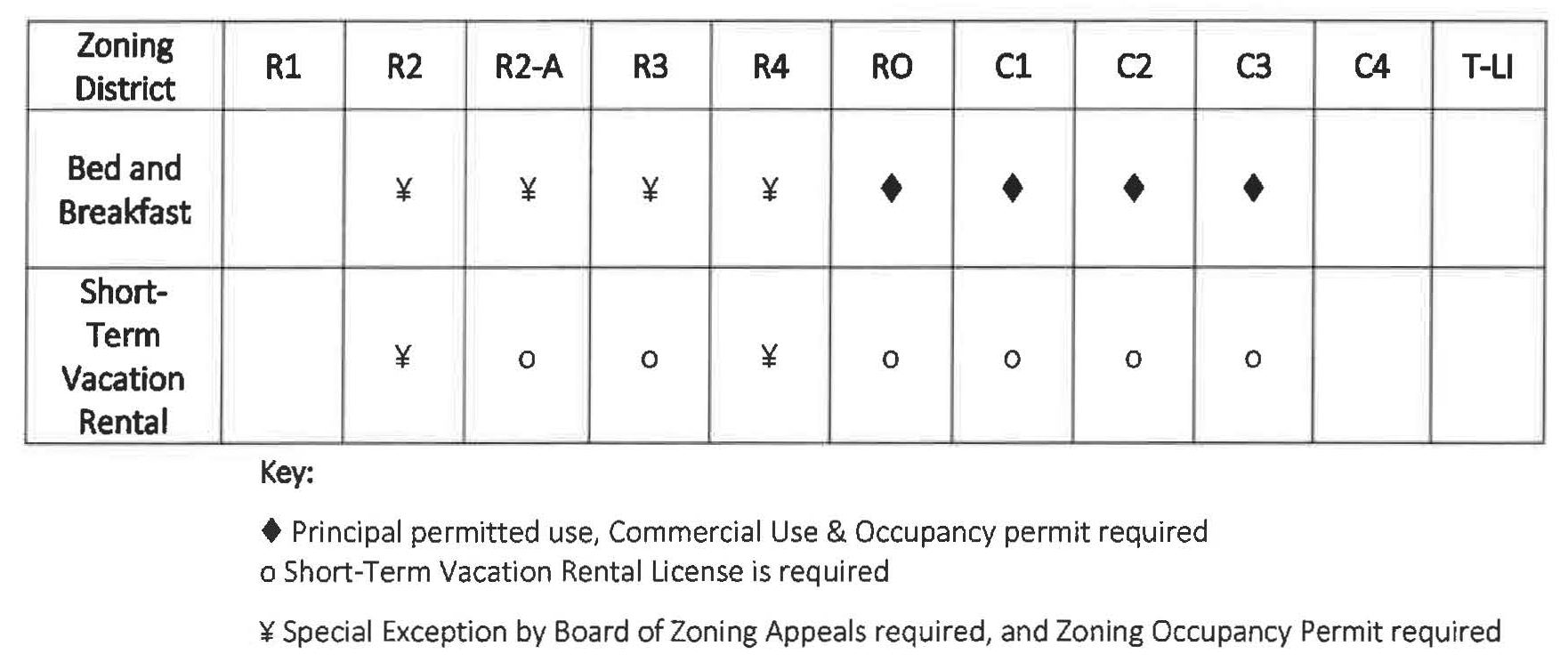
Bed and Breakfasts are permitted by type and by district, as specified in the table below:
(2)
Property owners who rent their property, or part of their property, for bed and breakfast or Short-Term Vacation Rental lodging are responsible for collecting and remitting Lodging Tax to the Allegany County Finance Office, in accordance with the Annotated Code of Maryland, Division IV. Local Finance, Title 20, Taxes and Development Impact Fees, Subtitle 4, Hotel Rental Taxes, Part I. County Hotel Rental Taxes.
(3)
No bed and breakfast or Short-Term Vacation Rental shall contain more than five (5) sleeping rooms.
(4)
Only designated rooms shall be used for sleeping.
(5)
No more than four (4) adult persons shall simultaneously occupy any one (1) guestroom.
(6)
Property owners who rent their property, or part of their property, for bed and breakfast or Short-Term Vacation Rental lodging must provide one (1) off-street parking space per bedroom, plus one (1), in accordance with Section 6.12.A.
C.
[Bed and Breakfast Standards.] Bed and breakfasts shall meet the following standards:
(1)
A minimum of one (1) full lavatory, toilet and shower or tub or combination thereof shall be available for every two (2) guestrooms as well as one (1) for the owner occupant.
(2)
No guestroom shall contain more than two (2) beds.
(3)
No cooking facilities shall be permitted in any guestroom.
(4)
Upon conversion of an existing dwelling to a bed and breakfast, no additional entrance shall be permitted in the front facade.
(5)
No guest shall be permitted to stay in a bed and breakfast for more than fourteen (14) consecutive nights.
(6)
An owner or full-time manager must live in the bed and breakfast.
(7)
There shall be no more than two (2) nonresident employees in or about the bed and breakfast.
(8)
Signs shall comply with the regulations applicable to home occupation signs. See Section 7.5.E.
(9)
Meal service shall be limited to overnight guests.
(10)
The bed and breakfast shall not be used as a gathering place, meeting hall or dining facility.
D.
Short-Term Vacation Rentals.
(1)
Short-Term Vacation Rental License Required.
(a)
Short-Term Vacation Rentals must be licensed as such. These licenses are issued by the Community Development Director and/or their designees pursuant to the requirements set forth in this chapter and any applicable requirements set forth in the Rental Housing Ordinance. As part of this license, a Short-Term Vacation Rental host must:
1.
Provide documentation and a signed declaration of compliance attesting to compliance with subsections (2) through (8);
2.
Comply with all applicable City, State, and federal laws;
3.
Ensure that all dwelling units have approved working smoke alarms and carbon monoxide alarms in every bedroom and/or on every level of the dwelling unit as required by the Rental Housing Ordinance;
4.
Post the following information in a conspicuous place within each dwelling unit or part thereof used as a Short-Term Vacation Rental:
a.
Emergency contact information;
b.
Contact information for the Short-Term Vacation Rental host and/or designated Owner's Agent;
c.
Street address;
d.
Floor plan indicating fire exits and escape routes;
e.
The owner rules and regulations;
f.
Community Development Department contact information; and
g.
City of Frostburg rules regarding parking,noise, and trash;
5.
Maintain and keep readily available for inspection, a guest registry that includes, at a minimum:
a.
The name of each renter/guest;
b.
Check in/out dates; and
c.
Rent paid.
6.
Post valid license number on all listings advertising the Short-Term Vacation Rental;
7.
Remit all local taxes and required fees; and
8.
Submit proof of notification to all neighboring property owners sharing a property line of the intent to apply for a Short-Term Vacation Rental license.
(b)
Upon receipt of a properly completed application and the associated license fee, the Community Development Director and/or their designee(s) shall issue a rental housing or Short-Term Vacation Rental license and shall cause an inspection to be made of the premises described in the application. The license shall be posted in a conspicuous place on the premises or maintained in the custody of the property owner and/or Owner's Agent.
(2)
Short-term vacation rentals must comply with all provisions detailed in the City's Rental Housing Ordinance, as well as all applicable property maintenance, electrical, plumbing, and building codes.
(3)
Properties hosting a Short-Term Vacation Rental must have no outstanding taxes or liens, and the property must remain free from violations of the City Code, Zoning Ordinance, and Rental Housing Ordinance.
(4)
Short-term vacation rentals shall be inspected annually.
(5)
No guest shall be permitted to stay in a Short-Term Vacation Rental for more than forty-five (45) consecutive nights.
(6)
Hourly rentals or rentals for less than one (1) overnight stay are prohibited.
(7)
Once a Short-Term Vacation Rental license has been obtained, property owners are required to post their license number on AirBnb or other short-term rental websites along with their listing to rent their home or a room in their home.
(8)
The Owner's Agent must reside within twenty-five (25) miles of the unit and be accessible for the entirety of any contract where the property owner is not present.
(9)
The Owner's Agent is responsible for responding within one (1) hour to complaints regarding the condition, operation, or conduct of occupants of the Short-Term Vacation Rental and taking remedial action to resolve any such complaints.
(10)
No outdoor advertising signs related to the Short-Term Vacation Rental shall be allowed on the property.
(Ord. No. 2019-04, § 2, 5-16-2019; Ord. No. 2022-02, § 1(Exh. A), 2-27-2022)
Editor's note— See editor's note following § 8.3.
Sec. 8.5. - Group homes and treatment centers.
A.
See definitions in Section 2.1. See also provisions in Section 1.18 concerning special exceptions to comply with Federal law.
B.
Group Homes and Treatment Centers. Group homes and treatment centers are subject to the following requirements:
(1)
Certification. The use shall receive all applicable governmental licenses and certifications as a condition of City approval. Copies of such licenses and certifications shall be filed with the Community Development Director. The Community Development Director shall be notified in writing within seven (7) days if such licenses or certifications expire, are suspended and/or are withdrawn, or if the type of clients served by the use should change.
(2)
Registration. The use shall register its location, general type of treatment/care, maximum number of residents and sponsoring agency/company with the Community Development Director.
(3)
Counseling. Any on-site medical or counseling services shall be limited to residents and a maximum of three (3) nonresidents per day.
(4)
Parking. One (1) off-street parking space shall be provided for each employee on duty during peak shifts, plus one (1) space for every two (2) residents with a valid driver's license.
C.
Group Homes. In addition to the requirements set forth in Section 8.4B, a Group Home shall be subject to the following requirements:
(1)
A group home shall not meet the definition of a treatment center.
(2)
A group home shall not house persons who can reasonably be considered to be a physical threat to others.
(3)
If a group home is within a residential district: a) it shall be maintained and/or constructed to be closely similar in exterior appearance and condition to other dwellings in the area, and b) no exterior signs shall identify the nature of the use.
(4)
Residents.
(a)
To provide a "reasonable accommodation" under Federal law, the maximum number of residents in a group home shall not include and shall not limit the number of bona fide employees who are needed to supervise and care for residents.
(b)
A group home shall be permitted within any lawful dwelling unit provided that the number of residents meets the restrictions on the number of unrelated persons that apply to any other dwelling unit through the definition of "family" and the applicable district regulations, except as provided by "c" below.
(c)
To further provide a "reasonable accommodation" under Federal law, the number of unrelated residents in a lawful group home may be increased as follows:
(i)
Single-family detached dwelling with a minimum lot area of ten thousand (10,000) square feet in a district other than R1: eight (8) unrelated persons.
(ii)
Group home within a lawful dwelling unit in a C1, C2 or T-LI district: ten (10) unrelated persons.
D.
Treatment Centers. In addition to the requirements set forth in Section 8.5C, a treatment center shall be subject to the following requirements:
(1)
The applicant shall provide a written description of the type of residents the use is intended to include over the life of the certification (See Section 8.5B(1)). Any future additions or modifications to the list shall require separate Board of Zoning Appeals approval as a special exception.
(2)
The applicant shall prove to the satisfaction of the Board of Zoning Appeals that the use will involve adequate supervision and security measures to protect the public.
(3)
The Board of Zoning Appeals shall place conditions on the use as necessary to protect public safety, including conditions on the type of residents and security measures.
(4)
A treatment center shall only be permitted in the C/LI district.
(Ord. No. 2019-04, § 2, 5-16-2019)
Editor's note— See editor's note following § 8.3.
Sec. 8.6. - Individual mobile homes and parks.
A.
Mobile Homes. The following standards shall apply to any mobile home placed within the City of Frostburg after the adoption of this Ordinance.
(1)
Any mobile home used as a dwelling shall comply with all requirements of the State of Maryland and the City of Frostburg as to water supply and waste water disposal.
(2)
Each mobile home shall have not less than six hundred (600) square feet of total indoor habitable floor area.
(3)
Each mobile home shall be securely anchored to substantial concrete piers, concrete footings, a concrete pad or other City-approved construction in a manner intended to significantly reduce the potential for wind damage. Each mobile home shall be provided with skirts of a suitable durable material as approved by the Community Development Director.
(4)
A mobile home park, where permitted, shall comply with all of the same zoning requirements as a subdivision or site-built single-family detached dwellings, such as off-street parking provisions of Section 6.12 for dwellings, in addition to the requirements of this Section 8.5, unless specifically stated otherwise.
(5)
Individual mobile homes. A mobile home shall only be permitted within a City-designated mobile home park.
(6)
Safety standards. Any mobile home placed within the City of Frostburg after the adoption of this Ordinance shall have been constructed in accordance with the 1976 or later safety and construction standards of the U.S. Department of Urban and Housing Development, or its successor agency.
B.
Mobile Home Parks. Mobile home parks shall comply with the following provisions:
(1)
A mobile home park shall comply with all of the improvement standards of the City Subdivision and Land Development Regulations.
(2)
Each mobile home park shall have a minimum lot area of four (4) acres.
(3)
In any mobile home park, mobile homes shall be located not less than fifty (50) feet from all property lines and public street rights-of-way. Such setback areas shall be attractively landscaped with trees and shrubs to serve as a buffer.
(4)
Each mobile home site within a park shall contain not less than six thousand (6,000) square feet. The maximum overall density of a mobile home park shall not exceed five (5) dwelling units per acre. No mobile home shall be located within twenty (20) feet of any other mobile home or building in the park, except structures attached to and incidental to said mobile home.
(5)
In any mobile home park, the mobile homes, together with other buildings on the lot, shall not occupy in the aggregate more than forty percent (40%) of the total lot area.
(6)
No mobile home park shall include any business or merchandising other than what is purely incidental and accessory to the operation of the park and is intended primarily to serve its occupants.
(7)
In the granting of special exceptions for mobile home parks, the Board of Zoning Appeals may require reasonable conditions to be met, such as additional setback requirements, landscaping and traffic control provisions in order to protect public health and safety and ensure compatibility with adjacent uses.
(Ord. No. 2019-04, § 2, 5-16-2019)
Editor's note— See editor's note following § 8.3.
Sec. 8.7. - Adult uses and gambling.
A.
Adult Uses. Adult uses shall be subject to the following provisions:
(1)
See definition in Section 2.1.
(2)
No adult use shall be permitted within the following areas:
(a)
Within a one thousand-foot radius from the lot line of any library, public park, or other public recreation area, or residential district;
(b)
Within a one thousand, five hundred-foot radius from the lot line of any primary or secondary school, college or university, childcare center, church or similar place of worship, or existing dwelling unit; or
(c)
Within a five hundred-foot radius from the lot line of any other adult use.
(3)
Only one (1) adult use is permitted per lot.
(4)
A thirty-foot wide buffer shall be provided along the side and rear lot lines, within a full screen of evergreen trees if woodland is not pre-existing within the buffer area.
(5)
No materials that are adult use in nature shall be visible from the outside of the establishment, including, but not limited to, signs.
(6)
In accordance with Section 1.15B, an application for an occupancy permit shall be filed in which the application shall list full legal name and home address of the following individuals:
(a)
All persons who will have any ownership interest in the use or any ownership interest in any corporation or other entity that controls the use; and
(b)
The on-site manager who shall be personally responsible, in addition to the owners, to ensure that this Ordinance is complied with at all times.
(i)
Any changes to the information above shall be reported to the Community Development Director in writing within seven (7) days of said change.
B.
Gambling Establishments. Gambling establishments shall be subject to the following provisions:
(1)
See definition, Section 2.1.
(2)
No gambling establishment shall be located within any of the following, regardless of municipal limits:
(a)
One thousand (1,000) linear feet of the lot line of a library, public park or other public recreational area, college or university, or residential district;
(b)
One thousand, five hundred (1,500) linear feet of the lot line of a primary or secondary school, child day care center, church or similar place of worship, or existing dwelling unit;
(c)
Any district other than T-LI.
(3)
A thirty-foot wide buffer shall be provided along the side and rear lot lines, within a full screen of evergreen trees if woodland is not pre-existing within the buffer area.
(4)
A minimum lot area of two (2) acres shall be required.
(5)
Any application for a gambling establishment shall include the full legal name and home address of all persons who will or have any ownership interest in the use or any ownership interest in any corporation or other business entity that controls the use.
(Ord. No. 2019-04, § 2, 5-16-2019)
Editor's note— See editor's note following § 8.3.
Sec. 8.8. - Solar energy access and wind energy systems.
A.
Definition of Solar Energy Building. A solar energy building is an existing principal building which depends upon an existing substantial solar energy system for a significant portion of its heating, hot water and/or air conditioning needs. To be eligible for protection under this Section, the owner of such a building shall provide a written statement in advance to the Community Development Director stating that a substantial solar energy system has been installed and is being used.
(1)
Prior to a City permit being issued for the construction of any portion of a proposed building that would have a height taller than twenty-five (25) feet (other than chimneys, antenna and similar narrow vertical projections) or an accessory building that would have a height taller than fifteen (15) feet within twenty-five (25) feet of an existing solar energy building, the applicant for such proposed building shall provide an independent analysis to the Community Development Director concerning the effects of such construction upon the solar energy system of the existing solar energy building.
(a)
Such analysis shall consider the peak hours of 9:00 a.m. to 4:00 p.m. during the period between September 21 to March 21.
(b)
If such analysis shows that such building would have significant adverse impacts upon the effectiveness of the solar energy system, then the Community Development Director shall limit the maximum heights of proposed buildings, as necessary, to protect against such adverse impacts. The area in which the Community Development Director may limit the height of the proposed building is restricted to the minimum building setback plus a distance greater than fifteen (15) feet from the property line of the adjacent solar energy building.
(c)
In no case shall this section require a principal building to have a height less than twenty-five (25) feet or an accessory building to have a height less than fifteen (15) feet.
(d)
No tree with a mature height of greater than forty (40) feet shall be planted in a location on private property that would significantly adversely affect solar access of a solar energy building on an adjacent lot.
(2)
Variance. The Board of Zoning Appeals shall not grant a variance to the dimensional requirements of this Ordinance that would adversely affect the solar energy system of a solar energy building.
(3)
Exception. Portions of structures that exist solely for the purposes of collecting and storing solar energy and related mounting equipment shall be exempt from the height requirements of this Ordinance.
(4)
Easements. Where a proposed subdivision includes two (2) or more adjacent proposed lots that are intended to include buildings using solar energy systems, the applicant is encouraged to establish suitable "solar access easements" on such lots to make sure that adequate solar access is available over time.
B.
Wind Energy Systems.
(1)
Wind Energy Systems ('WES') as defined herein shall be reviewed as a special exception use in all zoning districts subject to a limitation that no more than one (1) WES is to be permitted on any lot of record and subject to compliance with all of the following:
(a)
A minimum setback measured from the center point of the base of the WES structure shall be required to all lot lines whether to a public right-of-way or to any private parcel owned by a party other than the property owner making application for an WES to be the number of linear feet that is determined by multiplying 1.1 times the height in feet of the WES structure as measured from the ground to the highest point of the fixed tower structure plus in addition the length of one (1) rotor blade. This setback may be modified only by documentation of the express written consent of a private property owner or owners that would agree to allow the required setback to extend closer to or onto the adjoining owner's property. In the case of a setback radius extending across a lot line and onto an adjoining owner's property, permission must be set forth in an easement to be recorded in the Land Records of Allegany County and incorporated in an amended deed to the adjoining property prior to issuance of any City building or grading permit for any WES, said easement to be written so as to clearly prohibit construction of any principal or accessory building or structure within the area covered by the easement on the neighboring property as long as the subject WES is physically present. In the case of a setback radius extending across a lot line and onto a public right-of-way, permission must be obtained prior to permit approval by review and approval of the City of Frostburg's Director of Public Works.
(b)
The maximum height permitted shall be seventy-five (75) feet, measured from the ground to the highest point of the fixed tower structure plus in addition the length of one (1) rotor blade. The Board of Zoning Appeals may consider a variance to height restrictions in this part only when 1) the fall radius setback is maintained or an affected owner has agreed to prepare a permissive easement as set forth above; and 2) findings can be made to support the variance pursuant to Section 1.18C(4).
(c)
Any WES shall be designed so that the lowest point of the area to be swept by the rotor blades shall have a clearance of not less than fifteen (15) feet above the base of the structure. The supporting tower shall not be climbable below a point on the WES that is twelve (12) feet above the base of the structure. All proposed access doors shall be secured by safety locks.
(d)
Guy wires as may support any WES shall be set back at least five (5) feet from all lot lines and shall be secured to stationary anchors properly and securely attached to the ground and may not be attached to a tree or a structure. Reflective material shall be placed on all guy wires within ten (10) feet of the ground in sufficient quantity and spacing to make the wires visible.
(e)
The WES shall be designed with braking, governing, or feathering systems to prevent uncontrolled rotation, over-speeding, and excessive pressure on the components. This standard may be met by providing evidence of review and approval of the proposed WES by the Small Wind Certification Council (SWCC) or any other WES certification program recognized by the State of Maryland.
(f)
Any and all exterior electric wiring required to connect the WES to the electric power grid must be placed in underground conduit.
(g)
The WES shall not include lighting or illumination of any kind unless required by Federal Aviation Administration (FAA) regulations.
(h)
No WES shall contain any lettering, advertisement, or signage of any kind except one (1) manufacturer's label bonded to or painted upon the structure and standard warning signage placed by the manufacturer.
(i)
The WES shall be designed so that noise levels shall not exceed fifty-five (55) dBA at the closest point from the WES structure to any point on a property line of the lot on which the WES is proposed as evidenced by a Manufacturer's noise rating provided with the application.
(j)
The WES shall contain a surface coating of non-reflective paint and shall not alter the Manufacturer's default color.
(k)
A site plan and drawings must accompany any permit application for a WES that includes the following:
(i)
Signature of a licensed engineer indicating compliance with all applicable Federal, State, and local government requirements, including FAA regulations.
(ii)
An engineer's certification that the WES has been designed to be in compliance with all applicable structural and electrical codes, and that the installation as shown on the site plan will not compromise the structural integrity of the tower or other WES components.
(l)
The property owner's certification affirming that the WES shall:
(i)
Be constructed in accordance with the design specifications;
(ii)
Be maintained in good operating condition in compliance with manufacturer's recommended maintenance specifications and applicable government regulations for structural, electrical, and mechanical components and maintenance of the fifty-five (55) dBA maximum noise standard; and
(iii)
Be deconstructed and removed if and when the WES becomes inoperable for a period of at least six (6) consecutive months.
(m)
Any WES to be connected to the electric power grid must contain a certification signed by the property owner agreeing to comply with all applicable utility notification requirements as contained in the State of Maryland's net metering regulations and with the Small Generator Interconnection Rule as promulgated by the Maryland Public Service Commission.
(Ord. No. 2019-04, § 2, 5-16-2019)
Editor's note— See editor's note following § 8.3.
Sec. 8.9. - Self-Storage Facilities.
A.
Any new or expanded self-storage facility shall be required to adhere to the site plan and approval process specified in the Land Development Ordinance. The site plan review shall include, but not be limited to, consideration of lighting, fencing, and screening of the facility.
a.
Any new or expanded self-storage facility shall be required to be buffered from view from any state route or any primarily residential use with a row of evergreen plants. Such plants shall be of a species that can reasonably be expected to reach a height of six (6) feet within four (4) years and spaced accordingly to create a visual screen within four (4) years, or alternatively an attractive, mostly solid weather resistant fence, or decorative masonry wall.
B.
A self-storage facility comprised of individual and discrete structures for storage shall constitute a principal use of the lot and therefore each individual structure must meet the lot setback requirements for a principal use within the respective zoning district.
(Ord. No. 2018-02, § 2, 5-17-2018; Ord. No. 2019-04, § 2, 5-16-2019)
Editor's note— See editor's note following § 8.3.

