
Fulton County Unincorporated
City Zoning Code
City Zoning Code
ARTICLE XIIK
SOUTH FULTON PARKWAY OVERLAY DISTRICT Added 9/3/03
A RESOLUTION TO ADD ARTICLE XII-K TO THE ZONING RESOLUTION OF FULTON COUNTY, GEORGIA; TO DELINEATE THE SOUTH FULTON PARKWAY OVERLAY DISTRICT IN UNINCORPORATED FULTON COUNTY; TO ESTABLISH DEVELOPMENT STANDARDS; AND FOR OTHER PURPOSES.
BE IT RESOLVED BY THE BOARD OF COMMISSIONERS OF FULTON COUNTY, GEORGIA.
12K.1.- Purpose and intent.
The Board of Commissioners of Fulton County, Georgia hereby declares it to be the purpose and intent of this Resolution to establish a uniform procedure for providing for the protection, enhancement, preservation, unity of design, and use of places, sites, buildings, structures, streets, neighborhoods, and landscape features in the South Fulton Parkway District in accordance with the provisions herein.
This Resolution is adopted as part of a strategy designed to promote the health, safety, order, prosperity, and general welfare of the citizens of Fulton County through the regulation of design, aesthetics, location, bulk, size of buildings and structures, and the density and distribution of population.
This Resolution also seeks to reduce congestion on the streets; to provide safety from fire, flood and other dangers; provide adequate light and open space; protect the natural environment and address other public requirements, in order to provide sustainable development that involves the simultaneous pursuit of economic prosperity, environmental protection and social quality.
This Resolution also seeks, among other things, to promote accepted design principles in areas of new development and redevelopment, to raise the level of community understanding and expectation for quality in the built environment, to protect and enhance local aesthetic and functional qualities, and to stimulate business and promote economic development.
In consideration of the character of the South Fulton Parkway District, these regulations are to monitor the suitability for certain uses, construction and design, prevent functional and visual disunity, promote desirable conditions for community and commerce and protect property against blight and depreciation.
12K.2. - South Fulton Parkway Overlay District regulations. (Amended 12/03/03).
Except as noted in Section 12.K.4.A.1., the South Fulton Parkway Overlay District applies to all properties zoned or developed for nonresidential and residential uses (except single family detached dwelling units), within 2,640 feet of the centerline of the South Fulton Parkway from its easterly origin beginning at Wolf Creek to Cascade-Palmetto Highway (SR 154). If any portion of a parcel and/or development is located in the defined boundary area, the entire parcel and/or development shall comply with the standards herein. Within the South Fulton Parkway Overlay District, land and structures shall be used in accordance with the standards of the underlying district.
Whenever provisions of this Article conflict with any other Article in the Zoning Resolution of Fulton County or any other Fulton County ordinances, regulations, or resolutions, these standards shall prevail.
12K.3. - Architectural review process.
Prior to the issuance of a land disturbance permit (LDP) or a building permit, the applicant shall submit details of exterior materials, colors, landscape strips, buffers, signage, lighting, parking, streets and paths, entrances, design and architectural features of the proposed site and building which demonstrate compliance with the design standards set forth herein.
Prior to the issuance of an LDP or building permit, the community will be allowed ten working days to review the application. An application which otherwise conforms to applicable codes and regulations shall not be delayed issuance of an LDP or building permit for more than 10 working days due to this review and comment process.
Fulton County staff will review all applications for land disturbance permits, building permits and sign permits for compliance with the standards of this Overlay District and upon determination of compliance will provide a Certificate of Endorsement (CoE) in the form of signing the formally submitted plans and drawings.
(Res. No. 12-0079, 2-1-12)
12K.4. - Development standards.
12K.4.A. Buffers and landscaping.
1.
All developments to include single family detached residential subdivisions shall provide a minimum 100-foot wide natural, undisturbed buffer (except for approved access and utility crossings, improvements, and replantings where sparsely vegetated subject to the approval of the Fulton County Arborist), with an additional ten-foot setback interior to the buffer, along the South Fulton Parkway and along the rights-of-way of public roads which intersect the Parkway for a distance of 300 feet measured from the intersection with the South Fulton Parkway.
2.
A minimum 15-foot wide landscape strip along all public and private streets, except as noted in 12K.4.A.1., when Article 4 of the Zoning Resolution otherwise specifies a smaller landscape strip.
3.
Subject to the approval of the director, street trees may be placed in public rights-of-way.
4.
A minimum ten-foot wide landscape strip along any interior property line adjacent to a nonresidential zoning and/or use.
5.
Hardwood shade trees, e.g., maples and oaks, a minimum of 2½" caliper, shall be planted in all landscape strips and minimally spaced as specified by the Tree Preservation Ordinance.
12K.4.B. Screening.
1.
Refuse areas and receptacles shall be placed in the least visible location from public streets and shall be enclosed on 3 sides with opaque walls. The 4th side shall be a self-closing gate made from non-combustible materials. Opaque walls shall be a minimum of 12 inches higher than the receptacle. Wall materials shall be non-combustible brick, stone, or split concrete masonry block. Refuse receptacles shall not be placed within 50 feet of an existing residential or AG-1 (Agricultural) zoning district.
2.
Accessory site features located on the ground shall be screened from view from any public right-of-way and/or any residence, residential zoning category, or AG-1 zoning category by one of the following: placement behind the building, 100 percent opaque fencing, berm or vegetative screen planted to buffer standards.
3.
Accessory structures on a roof shall be located to the rear of the roof and shall be screened by a parapet or other architectural feature as approved by the director.
4.
Loading docks and bay doors fronting the South Fulton Parkway are prohibited.
5.
Loading docks shall be screened by a continuous hedge of evergreen shrubs. Shrubbery shall be a minimum height of five feet at time of planting.
6.
Vending machines shall be located inside a building or screened from the view of all public streets and residentially or AG-1 (Agricultural) zoned or developed properties.
7.
Retaining walls shall be faced with or constructed of stone, brick, or decorative concrete modular block only.
12K.4.C. Pedestrian paths.
1.
Sidewalks are required along all public and private road frontages.
2.
Pedestrian paths shall be illustrated on the site plan submitted at the time of application for a Land Disturbance Permit.
3.
Except in truck loading and parking areas of industrial and warehouse-distribution uses, internal walkways (paths) are required from the public sidewalk to the main entrance of the principle use of the property and to adjacent buildings within the same development.
4.
All sidewalks and pedestrian walkways (paths) shall meet applicable Americans with Disabilities Act (ADA) standards.
5.
Pedestrian paths may be constructed of either colored/textured materials or conventional sidewalk materials and shall be clearly identified.
6.
Paths shall be designed to minimize direct auto-pedestrian interaction by such means as sidewalks, striping, and signs..
7.
Paths shall be connected to crosswalks at intersections where applicable.
8.
Street furniture shall be located outside the specified width of any pedestrian path.
9.
Paths and sidewalks shall be connected to green space and open space and connectivity shall be illustrated on the site plan submitted at the time of application for a Land Disturbance Permit.
10.
Pedestrian paths shall be a minimum width of five feet.
11.
Multi-use paths for bicycles and pedestrians may be substituted for the required sidewalks as approved by the Director and the Transportation Administrator when the path is part of the Fulton County Bicycle and Pedestrian Plan.
12.
Multi-use paths designed for use by bicyclists and pedestrians shall be 12 feet wide.
13.
Multi-use paths designed with separate paths for bicyclists and pedestrians shall be 15 feet wide, ten feet for bicycles and five feet for pedestrians.
14.
Paths should be direct and convenient routes between points of origin (such as a bus stop) and destination (such as a shop, bank, etc).
15.
Paths not visible from a public street shall be illuminated.
12K.4.D. Lighting.
1.
A photometric plan for open parking lots and paths shall be submitted at the time of application for a Land Disturbance Permit.
2.
Any lighting fixture shall be a cutoff luminary whose source is completely concealed with an opaque housing. Fixtures shall be recessed in the opaque housing. Drop dish refractors are prohibited. The wattage shall not exceed 420 watts/480 V per light fixture. This provision includes lights on mounted poles as well as architectural display and decorative lighting visible from a street or highway. Wall pack lighting shall be cut-off down directional a maximum of 250 watts. Canopy lighting shall be cut-off down directional a maximum of 250 watts. Canopy lighting shall be cut-off luminaries with a maximum lamp wattage of 400 watts.
3.
Light sources (lamps) shall be incandescent, fluorescent, metal halide, mercury vapor, natural gas, or color corrected high-pressure sodium (CRI of 60 or better). The same type must be used for the same or similar type of lighting on any one site.
4.
Mounting fixtures must be modified in such a manner that the cone of the light is not directed at any property line. The minimum mounting height for a pole is 12 feet. The maximum mounting for a pole is 28 feet. Any fixture and pole located within 20 feet of a residential zoning shall be a type four or forward throw distribution.
5.
All site lighting shall be designed so that the illumination as measured in foot-candles at any one point meets the following standards: Minimum and maximum levels are measured at any one point. Average level is not to exceed the calculated value and is derived using only the area of the site included to receive illumination. Points of measure shall not include the area of the building or areas which do not lend themselves to pedestrian traffic. Also, if the major portion of the lighting design is to be in the front of a building, the average level should not be affected by adding a light or two in the back of the same building, which would raise the average of the intended area for lighting.
6.
Future renovations, upgrades, or additions to existing facilities prior to the effective date of this ordinance shall not exceed existing illumination levels below. The entire site must be bought into conformance with this article should a renovation, upgrade, or addition occur that would require a land disturbance permit.
7.
Blue-white colors of florescent, mercury vapor lamps, metal halide, high-pressure sodium with CRI of less than 60 are prohibited.
8.
Ground level, low wattage/voltage up-lights to accent features in landscape strips are permitted.
9.
Low intensity, downward shielded lighting along pedestrian paths and in parking lots is required.
10.
All site lighting shall be architecturally compatible with the buildings on a site. Lights shall be architecturally decorative with a historical style (includes shepherds crooks, pole top, and bollard).
11.
Exterior wall-mounted lights shall be directed downward fully shielded to prevent spillage. The bottom of wall-mounted light fixtures shall be no higher than seven feet above grade.
12.
Soffit mounted light fixtures shall be recessed into the soffit or otherwise fully shielded.
13.
Ground mounted or other upward directional lighting is allowed to accent architectural features.
14.
Unshielded floodlights, wall packs, NEMA head style fixtures, sag/convex lens mounted on shoebox fixtures, cobra, neon and dome lights are prohibited.
12K.4.E. Building materials and architectural treatments.
1.
Developments shall include architecture elements such as columns, arcades, covered entry-walkways, arches, facade offsets, windows, balconies, offset walls, clock towers, cupolas and/or courtyards.
2.
The exterior wall materials of all nonresidential buildings shall consist of a minimum of 60 percent (per vertical wall plane) of the following: brick, precast concrete, natural or precast stone, or tinted glass (or an equivalent alternative treatment approved by the Director of Environment and Community Development).
3.
The exterior wall materials of all residential buildings shall consist of a minimum of 60 percent (per vertical wall plane) of the following: brick, stone, stucco, Hardi-plank siding, solid plank, or cementitious plank (or an equivalent alternative treatment approved by the Director of Environment and Community Development).
4.
Accent wall materials on residential and nonresidential buildings shall not exceed 40 percent per vertical wall plane.
5.
Prohibited exterior finishes (except on mechanical penthouses and roof screens) are highly reflective, shiny, or mirror-like materials, exposed unfinished foundations, exposed plywood or particle board, unplastered, corrugated steel, exposed standard concrete masonry block, vinyl and aluminum siding.
6.
To the extent the rear and/or side of a building is visible from a public street or an adjacent agriculturally or residentially zoned or developed property, architectural treatments shall continue through the rear and sides of the building.
7.
The principle entry area of a building shall be articulated and express greater architectural detail than other portions of the building.
8.
Outparcel buildings shall have architectural features consistent with the principal buildings.
9.
Permitted colors for exterior walls, building components, sign structures, accent and decorative elements shall be as specified by Table 12K or as approved by the director.
Table 12K
Permitted Colors for Exterior Walls, Building Components, Sign Structure,
Accent and Decorative Elements
The following numbers refer to the Pantone Matching System, an international color
matching system
10.
Flat roofs and roof-mounted equipment shall be screened by a parapet or other architectural feature as approved by the director from the view of public and private streets and adjacent agriculturally and residentially zoned and/or developed properties.
11.
Sloped roofs shall be standing seam, metal, slate and concrete roof tiles and composition shingles.
12.
Building components such as burglar bars, steel gates, metal awnings and steel roll-down curtains are prohibited if visible from a public street.
13.
Vending machines, paper stands, and other similar devices must be located inside a building.
12K.4.F. Streetscape features.
1.
Benches, trash receptacles, drinking fountains, and other street furniture shall be compatible in material, color, finish and architectural style of the development.
2.
Marketing signage in streetscape features is prohibited.
12K.4.G. Parking.
1.
All off-street parking for townhouses and multi-family buildings shall be located to the side, rear or enclosed.
2.
A minimum of 50 percent of the required surface parking for out-parcels shall be located at the rear of the building.
3.
The required number of off-street parking spaces may be reduced as approved by the director.
4.
Shared parking shall be permitted as approved by the director.
5.
Non-residential developments shall provide parking for bicycles.
6.
Loading areas shall be located in the rear or side yards.
12K.4.H. Miscellaneous provisions. (Amended 03/03/04)
1.
Except as provided for in Article 19, the storage and/or sale of goods is prohibited in parking lots and other areas outside of the interior or permanently sheltered portions of a building.
2.
Storage of shopping carts is allowed without a permit.
(Amd. No. 11-0478, 6-1-11)
12K.5. - Signs.
See Article 33.
(Res. No. 08-0493, 6-4-08)
12K.6. - Telecommunications, cell towers and water towers.
1.
Telecommunications switchboards, power generators, and other telecommunication relay equipment rooms or floors housing such uses are limited to the following areas of a building: (a) subterranean levels, (b) first and second floors which are set back a minimum of 50 feet from the street, or (c) third and fourth floors.
2.
Stealth design is required for all cell towers.
3.
Height of towers shall not exceed 199 feet.
4.
A wireless communications facility shall be disassembled and removed from the site within 90 days of the date its use for wireless telecommunications is discontinued.
5.
Water towers shall be painted to blend with the landscape.
6.
Except for safety purposes, water tower lighting shall be allowed only during maintenance periods. Each outdoor light that is not required for safety shall be fully shielded. The safety lighting shall use a type of shielding with a ten degree cut-off to provide lighting downward.
12K.7. - Utilities.
All utilities shall be underground or as approved by the director.
12K.8. - Severability.
In the event that any section, subsection, sentence, clause or phrase of this article shall be declared or adjudged invalid or unconstitutional, such adjudication shall in no manner affect the other sections, subsections, sentences, clauses or phrases of this article, which shall remain in full force and effect, as if the section, subsection, sentence, clause, or phrase so declared or adjudged invalid or unconstitutional were not originally a part thereof.
12K.9. - Appeals.
Any persons aggrieved by a final decision of the Department of Environment and Community Development relating to this article may appeal such final decision to the Board of Zoning Appeals by filing in writing setting forth plainly, fully and distinctly why the final decision is contrary to law per the Fulton County Zoning Resolution. Such appeal shall be filed within 30 days after the final decision of the department is rendered.
12K.10. - Adoption and effective date.
NOW, THEREFORE BE IT RESOLVED, the Fulton County Board of Commissioners does hereby
ordain, resolve and enact the foregoing Article XIIK to the Zoning Resolution of Fulton
County, Georgia.
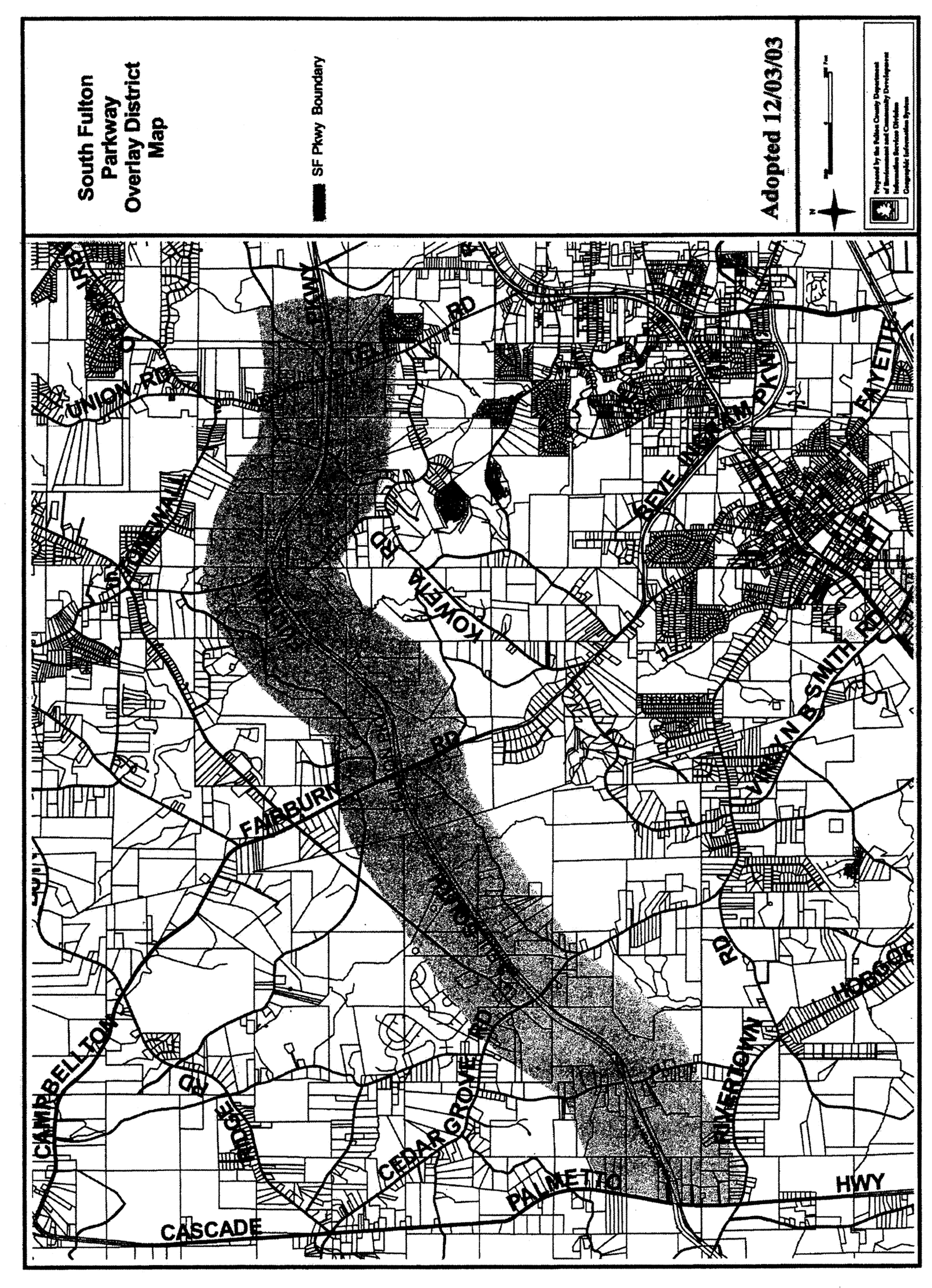
South Fulton Parkway Overlay District Map
ARTICLE XIIK
Design Guidelines for the South Fulton Parkway
The purpose of these design guidelines is to help preserve the buffers along the South Fulton Parkway, the night sky, green space, vistas, the "Parkway" feel, and open space. These guidelines are encouraged but are not standards. Therefore, noncompliance does not necessitate variances.
Site design:
All design strategies shall minimize changes to the existing topography and loss of mature vegetation and water features.
Minimize level grading. New developments should step with landforms and maximize preservation of existing vegetation and trees. Level grading of entire lots is to be avoided.
Transitions at property lines should seem natural for the surrounding terrain. Where the existing terrain is generally level, avoid newly graded slopes greater than 1:3 at property lines.
Cut and fill slopes should be rounded where they meet natural grade to blend with natural slope.
Natural contouring and re-vegetation are encouraged. Retaining walls should be faced with indigenous rock, brick and/or constructed to blend with adjacent surroundings.
Storm water retention for multiple sites should be combined into a lake as opposed to individual drainage ponds.
Permanent conservation easements should be established to protect water sheds, view sheds, and rare habitats.
Buildings, courtyards:
Buildings should be oriented to avoid summer overheating.
Locate courtyards for optimum southern exposure in winter and provide for shading in the summer.
Locate buildings such that solar heat is naturally reduced on hot summer days by landscape strips and trees.
Coordinate corner buildings with adjacent developments. Generally, the primary mass of a building on a corner should not be placed at an angle to the corner. Angled or sculpted building corners and open plazas should not be precluded from corners.
Vertical focal points to visually anchor corners are encouraged.
Street standards:
Parking:
On-street parking (parallel, diagonal, and head-in) is encouraged.
All developments shall provide connectivity to adjacent developments to link buildings and open spaces together to minimize vehicular traffic and other impacts.
Courtyards should include such features as sculptures or fountains as focal points, moveable seating and tables, sunny and shaded areas, several entrances into courtyards, variety of textures and colors for visual interest, landscaping, covered and uncovered outdoor passageways.
Architectural features/enhancements:
Trim to include eaves, corner boards, gable and eave boards, pediments, friezes, lintels, sills, quoins, belt courses, balustrades;
Gables, dormers, pillars, posts, porches, recessed windows and doors, cupolas, bay windows;
Half-rounded or quarter-rounded roof gutters and down spouts integrated with trim;
Glass storefronts, transom windows, building wall offsets, projections, recesses, floor level changes, roof-line offsets;
Architectural treatments of front facades shall continue major features around all visibly exposed sides of a building.
Restaurants with outdoor seating should allow for ease of pedestrian circulation, adequate shade through the use of extended awnings, canopies, or large umbrellas, provide outdoor trash receptacles, and maintain clean and litter-free premises.
View sheds:
All development proposals should arrange buildings to preserve views from adjacent properties and streets.
Locate courtyards, surface parking, and open spaces to align with view sheds from adjacent properties.
Locate drives, parking, and open spaces on high points. Avoid placing buildings except churches or public buildings of high architectural quality on ridge lines.
All new developments will be reviewed with respect to topography and existing landforms, existing vegetation and trees, soil properties and bed rock depth, existing watercourses, floodway and flood plain areas, drainage patterns, climatic factors, view sheds.
All new developments will be reviewed for land use and site organization in relation to building form, character, and scale of existing and proposed development, sensitivity and nature of adjoining land uses, location of adjacent roads, rights-of-way, driveways, offstreet vehicular connections, pedestrian ways, access points, and easements, existing structures and other built improvements, prehistoric and historic sites, structures and routes, and any other features that may be impacted or impact the proposed new development.

