
Fulton County Unincorporated
City Zoning Code
City Zoning Code
ARTICLE IV
GENERAL PROVISIONS3
Editor's note— Adopted by the board of commissioners, October 5, 1988 with subsequent amendments.
4.1 - Scope and intent.
This article includes a variety of regulations that apply to uses and structures allowed in more than one use district or to uses and structures allowed in all use districts except when specifically excluded by provisions contained elsewhere in this resolution.
4.1.1 Other laws apply. Compliance with this resolution shall not substitute for compliance with federal and state laws nor for other Fulton County ordinances and resolutions.
4.1.2 Judicial and quasi-judicial actions. Zoning-related legal proceedings or appeals to boards designated within this resolution shall stay deadlines and expiration dates which are designated in this resolution. Appeals from decisions of the Board of Commissioners and the Board of Zoning Appeals shall be brought within 30 days. Appeals from the application, interpretation and administration of this resolution shall be to the Board of Zoning Appeals unless otherwise specifically provided for in the various sections of this resolution.
4.1.3 Administrative approval. The action on a request brought under a provision of the Zoning Resolution which requires approval by at least one Fulton County official, accompanied or followed by an interoffice memorandum which shall be addressed to, and included in, the appropriate zoning file or alternate file if there is no zoning file. A courtesy copy of the authorization memo shall be sent to the Director of the Department of Public Works, and the Department of Environment and Community Development. (Added 7/5/89, Amended 11/3/93, 2/7/01)
4.2 - Lot, structure and use regulations.
4.2.1 Use, permitted use, change of use. Properties shall be used and structures or parts thereof shall be erected, constructed, reconstructed, modified, moved, enlarged, or altered in conformity with the regulations contained in this resolution and any conditions of zoning. (Amended 11/3/93)
A.
Permitted uses. If either a specific use or a class of use is not listed as a permitted use in compliance with the zoning district standards and any zoning conditions, such specific use or class of use shall be prohibited in that district.
B.
Change of use. Any change of use, including a change of a single use within a multiple use structure, shall comply with the requirements of this resolution and any condition of zoning.
C.
Single family district limitations. Single family dwelling districts shall be restricted to no more than one main or principal structure per lot.
4.2.2 Lots. Structures shall be erected and uses shall be established only upon a single lot which meets or exceeds the requirements of this resolution or conditions of zoning, whichever is more restrictive. Regardless of the minimum requirements of individual zoning districts, a plat shall not be approved until the buildable area (including the buildable area(s) within the 50 percent of a minimum lot size which must be outside a flood plain) of every lot is determined to be sufficient to accommodate a square configured from the minimum building area required by the zoning district.
Lots created within a development project to accommodate detention and retention facilities which are incidental, related, appropriate, and clearly subordinate to the main use in the project are exempt from the minimum lot size requirements in all zoning districts. No other construction/building shall be permitted on such lots. A 10-foot access easement is required in accordance with established standards. (Added 6-4-03)
4.2.3 Reduction of lot area. When a lot or property is reduced in size, all resulting divisions and all structures shall meet the minimum requirements of the applicable provisions of this resolution; except that if a lot or property is reduced in area to less than the district minimum lot size as a result of government action, the lot shall be deemed nonconforming.
4.2.4 Division of conditionally-zoned parcels. All lots of a proposed subdivision must be in keeping with unit and density allocations, and other conditions of zoning as well as the Subdivision Regulations and this resolution. If each proposed parcel does not conform to such conditions, the proposed division shall require a rezoning to accomplish the desired modification of conditions. (Amended 7-5-89)
4.2.5 Uses and structures permitted in yards, and outside storage.
A.
Uses and structures permitted in yards. In addition to uses which may be provided for, conditioned or excluded from yards by other sections of this resolution, yards may be used for driveways, signs, at-grade parking, loading areas, fountains, flag poles, yard ornaments not to exceed four feet in height, walls, fences, walkways, lawns, buffers, landscape areas, underground utilities, well houses, storm water management facilities and tree preservation areas. No part of any yard or use made thereof shall serve the requirements for any other lot or structure. (Amended 7-5-89, 3-6-91, 5-6-92)
B.
Limitations on the location of outside storage and accessory displays. Outside storage and accessory displays are permitted as indicated below for the various use districts.
1.
Outside storage associated with residential uses or districts including AG-1 used for residential purposes only. Such storage is permitted in side and rear yards only, and must be screened from adjoining residential uses and from streets with an opaque fence or a vegetative screen which complies with Appendix G of the Tree Preservation Ordinance [See Code ch. 26, art. VI]. Any storage not normally associated with residential use shall be prohibited.
2.
Outside storage associated with industrial uses or districts. Outside storage is permitted in rear and side yards only in the M1-A District and in all yards in the M-2 District. Outside storage shall be located at least 25 feet from any residential property line. Such storage must be screened, in accordance with Appendix G of the Tree Preservation Ordinance [See Code ch. 26, art. VI], from neighboring residential uses in all industrial districts and from streets in the M-1A and M-1 Districts.
3.
Outside storage associated with institutional, office and/or commercial uses or districts. Outside storage is permitted only within rear yards, and shall be located at least 25 feet from any residential property line. Such storage must be screened from neighboring residential uses and streets with an opaque fence or a vegetative screen which complies with Appendix G of the Tree Preservation Ordinance [See Code ch. 26, art. VI].
4.
Outside accessory display associated with commercial and/or industrial uses or districts. Accessory displays for merchandise which is being offered for sale on-premises shall be permitted in the commercial and industrial districts only. Such displays may be located in any yard as long as it is not located in a minimum yard. Vehicle and similar displays may be located in minimum front yards, but may not encroach upon minimum landscape areas.
4.2.6 Maintenance of vegetation. Pervious surfaces including yards shall be permanently maintained and shall be landscaped with grass, trees, shrubs, hedges and/or other landscaping materials approved by the county arborist. (Amended 3-6-91)
4.2.7 Lots with well and/or septic tank. Any lot upon which both an individual well and septic tank/drain field are utilized shall be governed by regulations of the Fulton County Board of Health. Lots utilizing both a well and a septic tank shall be not less than one acre in size. Any lot proposed to be served by either a well or a septic tank/drain field shall comply with the larger of the minimum lot area required by the health code or the minimum required for the district in which the lot is located.
4.2.8 Multiple zoning. Whenever a lot is zoned for more than one single family dwelling district or zoned a single family district(s) and AG-1, the district which comprises the largest area shall control the development standards for that lot. (Added 3-7-90, Amended 4-5-06)
4.2.9 Building separations. All building separations shall be as specified by the Standard Building Code. (Added 6-4-03; Amended 3-3-04)
(Ord. No. 18-0340, Att. A, 5-16-18)
4.3 - Exceptions.
This resolution shall apply to every lot, parcel, property, use and structure in Fulton County except as excluded in this section. Furthermore, the provisions herein shall not apply to properties and structures owned, operated and/or leased for use by Fulton County for public purposes. The use of said property for a nonconforming use does not establish a precedent for other nonpublic (governmental) uses. Should the public use cease to exist, the provisions herein shall apply. (Amended 4-7-93)
4.3.1 Nonconforming lots, uses and structures. Within the zoning districts established by this resolution there may exist lots, structures, and uses of both land and structures which were lawful before this resolution was adopted or subsequently amended, but which would be prohibited, regulated, or restricted under the terms of this resolution as adopted or subsequently amended. Nonconforming lots, uses and structures may continue in their nonconforming status with the following limitations and/or requirements. (Added 4-5-89)
A.
Nonconforming lot. A single, lawful lot-of-record which does not meet the requirements of this resolution for area or dimensions, or both, may be used for the buildings and accessory buildings necessary to carry out permitted uses subject to the following provisions:
1.
Parking space requirements as provided for in article XVIII are met; and
2.
Such lot does not adjoin another vacant lot(s) or portion of a lot in the same ownership.
3.
If two or more adjoining lots or portions of lots in single ownership do not meet the requirements established for lot width, frontage or area, the property involved shall be treated as one lot, and no portion of said lot shall be used or sold in a manner which diminishes compliance with this resolution. This paragraph shall not apply to nonconforming lots when 50 percent or more of adjoining lots on the same street are the same size or smaller.
B.
Nonconforming uses of land. When a use of land is nonconforming pursuant to the provisions of this resolution, such use may continue as long as it remains otherwise lawful and complies with the following provisions:
1.
No nonconforming use shall be enlarged, increased or extended to occupy a greater area of land than that which was occupied at the time use became nonconforming;
2.
No nonconforming use shall be moved in whole or in part to any other portion of the lot not occupied by such use at the time the use became nonconforming; and
3.
If any nonconforming use of land ceases for a period of more than one year, any subsequent use of such land shall comply with this resolution.
C.
Nonconforming use of structures. If a lawful use of structure, or of a structure and lot in combination, exists at the effective date of adoption of this resolution or its subsequent amendment that would not be allowed under provisions of this resolution as adopted or amended, the use may be continued so long as it complies with other regulations, subject to the following conditions:
1.
No existing structure devoted to a use not permitted by this resolution shall be enlarged, extended, constructed, reconstructed, moved, or structurally altered except in changing the use of the structure to a permitted use;
2.
Any nonconforming use may be extended throughout any part of a building which was arranged or designed for such use at the time the use became nonconforming, but no such use shall be extended to occupy any land outside such building;
3.
If no structural alterations are made, any nonconforming use of a structure or structure and land may be changed to another nonconforming use of the same or more restrictive nature;
4.
When a nonconforming use of a structure or a structure and land in combination is replaced with a conforming use, such structure or land may not later revert to a nonconforming use;
5.
When a nonconforming use of a structure or structure and land in combination is discontinued or abandoned for one year, the structure or structure and land in combination shall not thereafter be used except in conformance with the regulations of the district in which it is located; and
6.
A nonconforming use of a structure and/or a nonconforming use of land shall not be extended or enlarged by attachment to a building or land of additional signs which can be seen from off the land or by the addition of other uses of a nature which would be prohibited generally in the district.
D.
Nonconforming structures. When a structure exists on the effective date of adoption of this resolution or its amendments that could not be built under the terms of this resolution because of restrictions on building area, lot coverage, height, yards, or other characteristics of the structure or its location on the lot, such structure may remain as long as it complies with all other zoning regulations, subject to the following conditions:
1.
No structure may be enlarged or altered in a way which increases its nonconformity;
2.
Destruction, by any means, of more than sixty percent of the gross square footage of a structure shall require that the structure be reconstructed in conformity with the provisions of this resolution; (Amended 03/03/04)
3.
Any structure which is moved, for any reason and for any distance whatever, shall conform to the regulations for the district in which it is located.
4.
Telecommunications Facilities. (Added 05/17/06)
a.
All telecommunication facilities existing on the effective date of this ordinance shall be allowed to continue to be used as they presently exist.
b.
Routine maintenance (including modifications to accommodate the co-location of an additional user or users) shall be permitted on existing telecommunication facilities.
c.
Replacement of antennas on a structure with different antennas shall be considered routine maintenance so long as the replacement antenna(s) does not increase the height of any existing structure.
E.
Rezoning Which Results in Nonconforming Structures. (Amended 3/6/91, 04/05/06)
When a property containing lawful structures is rezoned, the following shall apply:
1.
The approval of the rezoning by the Board of Commissioners shall automatically adjust minimum/maximum yards to the extent necessary for existing structures to comply.
2.
All new construction, expansions or additions shall comply with the minimum yard requirements of the new district.
3.
Buffers and landscape areas shall be established by conditions of zoning which shall have precedence over the district standards contained in section 4.23.
4.
Destruction or removal of buildings which preexisted rezoning shall reinstate the development standards of the then applicable district provisions of this Zoning Resolution.
F.
Exemptions due to state or county action. Whenever a lot becomes nonconforming as a result of land acquisition by the county or state, building permits shall be granted for new construction provided the proposed structure complies with all but lot area requirements, and setback requirements shall be reduced without requirement for a variance to the extent of the width of the acquired property.
Whenever a structure becomes nonconforming as a result of county or state action other than an amendment to this resolution, the use of the structure may continue and the structure may be replaced as though no nonconformity exists if, subsequent to such action, the structure is destroyed. (Amended 3/6/91)
4.3.2 Model homes. Dwelling units may be utilized for sales offices and/or model homes as long as two or more lots and/or dwelling units in the development have not undergone an initial sale or lease by the builder. (Amended 7/5/89)
4.3.3 Height limits. The zoning districts' maximum height limitations for structures shall not apply to the following:
A.
Church spires and belfries.
B.
Water storage tanks.
C.
Cooling towers.
D.
Chimneys.
E.
Mechanical penthouses located on roofs.
F.
Smokestacks.
G.
Flag poles.
H.
Silos and grain elevators.
I.
Fire towers.
Public and semi-public buildings (except as exempt in section 4.3), hospitals and schools may be erected to 60 feet in height, and churches and temples may be erected to 75 feet in height. For each foot that said buildings exceed the height regulations of the district in which located, an additional foot of side and rear yard setbacks shall be required.
4.3.4 Minimum building lines. The minimum yards (setbacks) in each district shall establish minimum building lines for all structures except those named in section 4.2.5 entitled Uses and Structures Permitted in Yards, and Outside Storage. (Amended 3/4/92)
A.
Multiple frontage lots. Lots adjoining more than one public street shall provide a minimum front yard along each right-of-way except corner lots. The setbacks for the street-adjoining side yards of corner lots shall be as specified in the district regulations.
B.
Permitted encroachments into yards. The following encroachments shall be allowed to the extent specified below:
1.
Nonresidential. Canopies shall be allowed over walkways or driveways to within 12 feet of the street right-of-way or the right-of-way based on the street's functional classification, whichever is farther from the street's centerline. Fuel pumps and pump islands, when permitted, shall be set back as stated in this paragraph for canopies.
2.
Single-family Residential and Townhouses used for single family on individual lots of record. (Amended 12/4/91, 03/03/04, 04/05/06)
Porches, decks or patios attached to the main dwelling may extend no more than 10 feet into a minimum front or rear yard.
Outdoor fireplaces and outdoor uncovered kitchens, whether stand-alone or constructed as a part of a patio, retaining wall or other structure, may only be located in the rear yard and may extend no more than 10 feet into the minimum rear yard. In no case shall an outdoor fireplace be located closer than 10 feet to a property line.
Awnings may project to within 5 feet of a side lot line.
3.
All zoning districts. (Amended 04/05/06) Architectural features such as cornices, eaves, steps, gutters, fire chases, chimneys which are a part of an exterior wall of the primary structure, and fire escapes may not encroach or project over more than 36 inches into any minimum yard.
4.
Adjoining railroads. For those uses which utilize a rail siding for loading and unloading, there shall be no minimum rear yard requirement adjoining the siding.
C.
Flag lots. Minimum yards shall not be identified within the stem portion of a flag lot unless such portion, independent of the flag portion, can meet the requirements of 4.2.2. Measurements for a front yard setback shall begin at the point of intersection of the stem and the flag portion of a flag lot running along the property line the most perpendicular to the stem. A flag lot stem shall not be less than 15 feet in width. (Added 7/5/89, Amended 2/7/96)
4.3.5 Encroachment on public rights-of-way. No privately owned structures other than driveways, access walkways, and mailboxes shall be permitted within a publicly owned right-of-way. Mailbox support structures shall also be permitted within the county owned right-of-way provided that the mailbox support structure or appurtenance conforms to the following conditions.
1.
Mailbox support structures or appurtenances shall not be constructed of masonry, concrete or stone unless the support design has been shown to be safe by crash tests and is approved by the director of the department of environment and community development.
2.
With the exceptions noted in subsection 1. above, the mailbox support structure shall be a single four-inch × four-inch or four-inch circumference wooden or metal post with strength no greater than a two-inch diameter standard steel hollow pipe and embedded not more than 24 inches in to the ground.
3.
A mailbox support structure containing a metal post shall not be fitted with an anchor plate, but it may have an anti-twist device that extends no more than ten inches below the ground surface.
Mailbox structures along roadways with posted speed limits of 35 miles per hour or less within platted subdivisions of the county shall be exempt from this provision. Landscaping shall be allowed within the public right-of-way with permission of the Georgia Department of Transportation or the director of the department of environment and community development, or as specified in the tree preservation ordinance, as applicable. Signs and other structures belonging to the State of Georgia, Fulton County, or a railroad or utility are exempt from this provision.
(Ord. No. 97-0328, 3-5-97; Amd. No. 09-1008, 10-7-09)
4.4. - Large Scale retail/service commercial structures and developments 75,000 square feet or greater. (Added 04/05/06)
4.4.1. Purpose and Intent. "Large-scale retail" refers to any individual retail establishment that is 75,000 square feet or greater. This size threshold refers to an individual establishment and its associated areas used for display and storage.
The purpose of establishing requirements for large-scale retail establishments is to apply design standards and additional conditions to large developments proposed in unincorporated Fulton County in order to ensure the development of appropriate, functional, well-planned, aesthetically pleasing retail/service commercial developments that stimulate economic and social growth, are integrated with surrounding areas, positively contribute to the changing community character, with facilities that have functional reuse potential in the future.
As such, these regulations intend to promote high quality materials and design, promote pedestrian-friendly environments, encourage infrastructure concurrency, encourage responsible storm-water management practices, and promote environmental planning policies.
The regulations are to be used in conjunction with the development criteria of the Fulton County Zoning Resolution and all other adopted development standards and criteria, including overlay district standards.
4.4.2. Number, Size and Location Criteria. Large scale retail establishments or developments cannot be accessed solely via collector or local roads, as defined by Fulton County guidelines and depicted on the Georgia DOT Road Functional Classification maps. They are solely permitted on sites with at least one frontage on an arterial road. However, the Director may waive the road classification criteria if the developer can demonstrate that the proposed road improvements, with identified funding sources, will accommodate projected traffic volume to be generated by the proposed development to the degree that the current LOS or better is maintained for the affected road segment.
No more than four large scale retail establishments, as defined in this ordinance, are allowed in a single development. Developments may include additional smaller retail structures as part of the overall development; however the number of retail establishments 75,000 square feet or larger is limited to four, and such developments are subject to the regulations outlined in this ordinance.
Developments are encouraged to create a cluster effect in order to achieve a village and/or town center effect. The ordinance promotes an appropriate mix of large and small scale retail with smaller retail buildings located closer to streets in order to reduce the visual scale of the development, encourage pedestrian traffic, and promote the use of architectural details.
The ordinance also recognizes the varied types of developments in Fulton County and promotes the use of screening and buffers in areas with a more rural aesthetic.
4.4.3. Site Design Guidelines and Requirements.
A.
General Site Guidelines.
1.
To the extent feasible, on site creeks should be integrated into the site as amenities.
2.
New construction shall conform to the existing topography as much as possible subject to approval by the Director of the Department of Environment and Community Development.
3.
Buildings shall be discouraged on sites with existing slopes greater than 33%. This condition may be amended as approved by the Director.
4.
Where retaining walls are required, they must be faced with stone, brick or decorative concrete modular block. Use of landscape timber as exterior treatment in retaining walls is prohibited. Retaining walls above 5 feet shall have evergreen plantings in front or as approved by the Director.
5.
Detention facilities are encouraged to be designed pursuant to the Alternative Design Standards described in the Fulton County 2003 Subdivision Regulations.
6.
To the greatest extent practicable, design of a traditional detention facility shall follow the natural landforms around the perimeter of the basin.
B.
Open Space.
1.
A minimum of ten percent (10%) of the site shall be landscaped open space.
2.
Each retail development shall contribute to the establishment or enhancement of the community and public spaces by providing at least two community amenities such as patio/seating area, water feature, clock tower, and pedestrian plazas or benches. Such features shall be constructed of materials that are the same or similar to those used for the principal buildings and landscape.
3.
Square footage of community areas can be counted towards the minimum open space requirement.
C.
Screening and Fencing.
1.
Landscaping and fencing materials should be used to minimize visual and noise impact of parking, loading areas and accessory site features.
2.
All loading areas shall be located to the rear or side of the building. Location should be restricted, however, to whichever location does not abut a residentially zoned property, if applicable. Loading areas shall be screened from view of any public street by a 5-foot berm, a continuous row of evergreen hedges 5 foot in height at the time of planting, or architectural treatment.
3.
Refuse areas and receptacles shall be placed in the least visible location from public streets and shall be enclosed on 3 sides with opaque walls. The 4th side shall be a self-closing gate with an architectural finish. Opaque walls shall be a minimum of twelve inches higher than the receptacle. Wall materials shall be noncombustible brick, stone, or split-faced concrete masonry.
4.
Accessory site features, as defined in each zoning district of the Zoning Resolution, shall be placed in the least visible location from public streets, and shall be screened from view of any right-of-way and/or any property zoned, used, or developed for residential uses, including the AG-1 zoning district, by one of the following means: (1) placement behind the building, (2) 100% opaque fencing which must be constructed of the same type of exterior material used for the building, or (3) by a berm or vegetative screening. The screening shall consist of evergreen shrubs, be 3½ to 4 feet at time of planting, and reach a height of 6 feet within 2 years or planting.
5.
Fencing materials along public streets and side yards are restricted to brick, stone, iron, decorative wrought iron, and treated wood, and or combinations of the above not resulting in an opaque fence.
6.
Fences adjacent to a public street shall not exceed 55 inches from finished grade.
7.
Chain link fencing, except as required along detention/retention ponds, is prohibited from public view. All chain link fencing shall be black vinyl clad.
8.
Suburban Developments: All parking areas shall be screened from view of any public street by: (1) a 25 foot-wide landscape strip planted to buffer standards or (2) a berm planted with a continuous hedge or evergreen shrubs. Plants shall be a minimum height of 3 1 / 2 to 4 feet at time of planting, and such plants (or in the case of option 2 above, the berm and the planting combined) shall be capable of reaching a height of six feet within two years of planting.
D.
Outdoor Storage and Display.
1.
Display or sale of goods outside the permanent portions of a building is prohibited. Garden centers, and other similar areas, with permanent walls/fencing on the outside are considered permanent structures. Exceptions: Seasonal holiday trees, pumpkins, and open air fairs, provided an administrative permit is obtained, pursuant to Article 19.
2.
Vending machines, paper stands and other similar devices must be located interior to the building structure.
E.
Buffer Standards.
1.
Suburban Developments:
a.
All developments shall provide a minimum 25-foot wide landscape strip along all public streets, if buildings within the development do not front the street.
b.
A minimum 100-foot wide natural, undisturbed buffer with a 10-foot improvement setback shall be provided along any interior property line adjacent to a residential zoning and/or use. This buffer shall be augmented with plantings if it does not achieve the intended visual screening.
c.
To ensure that a visual buffer is achieved (for developments adjacent to a residential zoning and/or use), the County may require the installation of a four-foot high earthen berm with plantings per the County Buffer Standards. The County Arborist will make the determination of a berm requirement based upon a review of the Landscape Plan and existing topography and vegetation.
d.
A minimum 15-foot wide landscape strip shall be provided along any interior property line adjacent to a nonresidential zoning and/or use.
2.
Infill/Urban Developments:
a.
Developments are encouraged to place small retail storefronts on the public street.
b.
If buildings do not front a public street, all properties shall provide a minimum 15 foot-wide landscape strip along all public streets. The fifteen (15) foot-wide strip shall be planted with minimum 2" caliper hardwood over-story trees every 30' feet.
c.
A minimum 10-foot wide landscape strip shall be provided along any interior property line adjacent to a nonresidential zoning and/or use. This provision does not apply to individual lots within an overall development.
d.
A minimum 25-foot wide natural, undisturbed buffer with a 10-foot improvement setback shall be provided along any interior property line adjacent to a residential zoning and/or use. This buffer shall be augmented with plantings if it does not achieve the intended visual screening.
F.
Landscaping.
1.
Specimen trees should be preserved to the extent possible.
2.
Large overstory street trees in the landscape strips shall be planted in asymmetrical groupings at a minimum density of one tree per 30 feet of street frontage.
3.
Street trees shall be a minimum of 2" caliper.
4.
Street trees shall be selected from the list provided in Appendix E of the Fulton County Tree Preservation Ordinance and Administrative Guidelines or as may be approved by the Fulton County Arborist.
5.
Street trees may be counted towards the required tree density for a site as approved by the Fulton County Arborist.
G.
Parking Lot Landscaping Islands.
1.
Parking lot landscaping shall follow the standards within the Fulton County Zoning Resolution.
H.
Landscape Installation and Maintenance.
1.
Landscaping must be installed, or a landscape installation guaranty must be provided prior to the release of Certificate of Occupancy (CO), unless appropriate provisions are made to guarantee the installation of landscaping after such certificate is issued, such as approval by the Department of a bond for landscaping. The guaranty shall be stamped and signed by a registered landscape architect certifying that landscaping meets the standards of the Fulton County Tree Ordinance. Landscape plantings must be replaced if damaged or dead.
I.
Sidewalks and Pedestrian Circulation.
1.
Sidewalks or pedestrian paths are required along all public and private road frontages and may meander around existing trees subject to the approval of the Fulton County Arborist.
2.
Pedestrian paths may be installed instead of sidewalks as approved by the E&CD Director.
3.
Sidewalks shall be a minimum width of five feet.
4.
Pedestrian paths shall be a minimum of 5 feet wide. They shall be made out of a hard surface material such as concrete, brick or pavers. Paths may be gravel or gravel dust as approved by the E&CD Director.
5.
Sidewalks for all new projects should connect with existing walks, where applicable.
6.
Pedestrian access should be provided to all entrances including access from rear parking areas.
7.
Inter-parcel connectivity shall be required for multiuse, pedestrian paths and sidewalks.
8.
All internal pedestrian walkways shall be distinguished from driving surfaces through the use of color and durable, low maintenance surface materials such as pavers, bricks, or scored concrete to enhance pedestrian safety and comfort, as well as the attractiveness of the walkways.
J.
Parking.
1.
Parking lots should be distributed around large buildings along not less than two facades (front, rear or sides) in order to shorten the distance to other buildings and public sidewalks.
2.
A minimum of 50% of the required surface parking for out-parcels shall be located at the rear of the out-parcel building, interior to the overall development or facing the large retail parking lot.
3.
No parking or loading area shall be used for the sale, repair, dismantling or servicing or storing of any vehicle, equipment, materials or supplies.
4.
All developments must provide space for parking bicycles. This area may be within the parking lot or courtyard. A bike rack, permanently attached to the ground accommodating a bicycle lock or chain
5.
Suburban Developments: Where feasible, no more than fifty (50) percent of the off-street parking area for the lot, tract or area of land devoted to the large retail establishment should be located along the property fronting a public road and between the front facade and the road.
6.
Urban Developments: On-street parking is allowed subject to the approval of the Director.
K.
Architectural Standards.
1.
The design and lay out of a development should build upon and complement the design of the surrounding community. The size, orientation, setback and scale of buildings are integral elements of communities. A building's orientation and placement should complement and relate to adjacent buildings, structures and properties.
2.
The location of a building should take into consideration its surrounding and take advantage of opportunities to maintain open views and spaces. Buildings should be in proportion, in scale and characteristic to their natural setting. The building design and material should contribute to the style and surrounding areas. Building design that is based on a standardized formula associated with a business or franchise shall be modified to meet the provisions of this section.
3.
Buildings shall include architecture elements such as columns, arcades, covered entry-walkways, arches, facade offsets, windows, balconies, recesses/projections, clock towers, cupolas and/or courtyards.
L.
Orientation.
1.
All buildings shall be oriented to a public street. An entrance to a building should be located on the side of the building facing a public street.
2.
Small retail stores as part of an overall development should be oriented to a public street; with the larger retail buildings in the rear.
3.
Principal buildings should have articulated building entryways with greater architectural details, to include a minimum of two of the following elements:
a.
Decorative columns or posts
b.
Pediments
c.
Arches
d.
Brackets
e.
Transoms over doorways
f.
Sidelights
g.
Porticos
M.
Height.
1.
There shall be a maximum height limit of two stories with the maximum height 35 feet from average-finished grade to the bottom of the roof eave.
2.
Urban/Infill Developments: Three story buildings with a height limit of 50 feet from average-finished grade to the bottom of the roof eave are permitted.
N.
Scale.
1.
For every one hundred feet of building length on a single face, visible from the public street, there shall be variation in the exterior. This exterior variation shall be accomplished through the following means:
a.
For each one hundred feet of building exterior wall, the building exterior and roof shall be offset.
b.
For each one hundred feet of building exterior wall, there shall be a change in details, or patterns or materials.
O.
Building Material:
1.
The exterior wall materials of all buildings shall consist of a minimum of 60% (per vertical wall plane) of the following: brick, stone, stucco, EIFS, solid plank, cementatious plank, or horizontal clapboard siding.
2.
Accent wall materials on buildings shall consist of glass, architecturally treated concrete masonry, stone, EIFS, or stucco and shall not exceed 40% per vertical wall plane.
3.
Prohibited exterior building facade materials are: metal panel systems, precast, smooth concrete masonry or plain, reinforced concrete slabs, aluminum or vinyl siding, plywood, mirrored glass, press-wood or corrugated steel (exceptions: mechanical penthouses & roof screens).
4.
To the extent any rear or side of any building is adjacent to a public street or single family residence, architectural treatment shall continue through the rear or side.
P.
Colors.
1.
Permitted colors for exterior walls, building components, sign structures, accent and decorative elements shall be a specified by the appropriate overlay district.
2.
If large scale retail establishment or development is not located in an overlay district, all aspects of a development should use colors common in the area and in nature. Earth-toned, subtle and muted colors provide for a development that incorporates sensitivity to its natural surrounding. High intensity colors shall be avoided.
Q.
Roof.
1.
Permissible roofs types are flat, gable, pyramidal, and hip. Shed roofs are permitted over porches, additions, and accessory structures.
2.
Roof pitches shall be in the range of 4 over 12 to 12 over 12.
3.
Roof pitch material shall be made out of the following materials: asphalt shingle, wood shingle, wood shake, standing seam metal, or materials designed to give the appearance of the above mentioned materials.
4.
A decorative parapet or cornice shall be constructed along all roof lines with a lower pitch than specified in above.
5.
Flat roofs and roof-mounted equipment shall be screened from the view of public and private streets by a parapet. No parapet shall be required to be greater than 4 feet above roof.
R.
Additional Requirements.
1.
Burglar bars, steel gates, metal awnings and steel roll-down curtains are prohibited on the exterior and interior of the structure except at the structure's rear. Steel roll down curtains may be located in other areas if not visible from the front of a building or from a public street.
2.
Neon lights outlining and/or detailing building features are prohibited.
3.
Where additional stores will be located in a large retail establishment, each such store that is 5,000 square feet and greater shall have at least one (1) exterior customer entrance, which shall conform to the above requirements.
4.4.4. Adaptive Reuse of Properties And Store Closure. If an establishment remains empty for a period of 12 consecutive months the owner and/or lessee must work with Fulton County Economic Development Department to create a plan for the removal or adaptive reuse of the principal structure.
4.4.5. Vacancy Maintenance Requirements.
1.
Owner shall provide security patrols on the site to deter vandalism or other illegal activities on the property.
2.
Retail establishments that have been closed should be maintained at the standard of the occupied store, prior to store closure, this includes all parking lot surfaces and landscaping.
3.
Building fenestration, including doors and windows cannot be boarded up.
Previous provision, parking in residential districts, (superseded by 18.3.1, Adopted 4/5/89)
4.5 - Accessory uses and structures.
4.5.1 Construction of accessories. Accessory structures shall be constructed concurrently with or subsequent to a principal structure.
4.5.2 Regulations applicable to selected accessory uses and structures. The following accessory uses and structures shall be restricted as stated herein:
A greenhouse accessory to a residential use shall be limited in size to one-third of the floor area of the principal dwelling.
4.5.3 Antennas. This provision shall apply to all antennas and towers except those that exceed the maximum height of the district in which they are located (19.3.1 and 19.4.3). Antennas and towers are accessory structures when erected on a residential lot in association with a residential use and must meet all accessory structure requirements for the district in which the antenna is located except that principal structure height requirements shall control. Antennas which are located on roofs shall be located only on that portion of the roof most closely associated with yard(s) for which accessory structures are allowed. In addition, an antenna shall be designed such that the entire structure will remain on the property or within a fall easement if it should fall. (Amended 3/6/91)
4.6 - Refuse areas.
Refuse areas shall be identified on site plans for lots improved with structures other than single family dwellings, and such areas shall be screened to 100 percent opacity with fences or walls, or a vegetative screen which complies with the screening requirements of the Tree Protection Ordinance [See Code ch. 26, art. VI]. The refuse containers located therein shall not be visible from streets or adjoining properties. Vegetative screens must comply with the provisions of section 4.23. Refuse areas shall not be located in required landscape areas, required buffers, required parking areas, or required loading areas.
4.8 - Animals.
This section shall apply to animals other than animals associated with farming as a principal or accessory use.
4.8.1 Horses (See AG-1 District for standards therein. One horse or other member of the horse (equine) family per fenced acre shall be allowed in association with a single family dwelling or in single family dwelling districts. All structures for the shelter of horses in all districts except the AG-1 District shall be:
A.
At least 100 feet from the lot line of any residentially zoned or used property.
B.
Located within the rear yard.
4.9 - Night sky ordinance.
(Added 02/01/06)
4.9.1. Purpose and Intent. The purpose and intent of this ordinance is to provide a regulatory strategy for outdoor lighting that will permit reasonable uses of outdoor lighting for nighttime safety, utility, security, productivity, enjoyment and commerce; curtail and reverse the degradation of the nighttime visual environment and the night sky; preserve the dark night sky for astronomy; minimize glare, obtrusive light and artificial sky glow by limiting outdoor lighting that is misdirected, excessive or unnecessary; conserve energy and resources to the greatest extent possible; and help to protect the natural environment from the damaging effects of night lighting from man-made sources.
4.9.2. Conformance With Applicable Codes. All outdoor illuminating devices shall be installed in conformance with the provisions of this ordinance, the Building Code and the Electrical Code as applicable and under appropriate permit and inspection. Where there is conflict between the provisions of this ordinance and other regulations, the most restrictive provision shall prevail.
4.9.3. Applicability. For all land uses, developments and buildings that require a permit, all outdoor lighting fixtures shall meet the requirements of this ordinance. All building additions or modifications of twenty-five (25) percent or more in terms of additional dwelling units, gross floor area, or parking spaces, either with a single addition or with cumulative additions subsequent to the effective date of this provision, shall invoke the requirements of this ordinance for the entire property, including previously installed and any new outdoor lighting. Cumulative modification or replacement of outdoor lighting constituting sixty (60) percent or more of the permitted lumens for the parcel, no matter the actual amount of lighting already on a non-conforming site, shall constitute a major addition for purposes of this section.
A.
Minor Additions. Additions or modifications of less than twenty-five (25) percent to existing uses, as defined in Section (a) above, and that require a permit, shall require the submission of a complete inventory and site plan detailing all existing and any proposed new outdoor lighting. Any new lighting on the site shall meet the requirements of this ordinance with regard to shielding and lamp type.
B.
Exempt Lighting. The following luminaries and lighting systems are exempt from these requirements:
1.
Lighting for pools used at night.
2.
Underwater lighting used for the illumination of swimming pools and fountains;
3.
Temporary holiday lighting;
4.
Lighting required and regulated by the Federal Aviation Administration, or other federal, state or local agency;
5.
Emergency lighting used by police, fire, or medical personnel, or at their direction;
6.
All outdoor light fixtures producing light directly from the combustion of fossil fuels, such as kerosene and gasoline;
7.
Security lighting controlled and activated by a motion sensor device for a duration of 10 minutes or less.
C.
Prohibited Lighting. The following lighting systems are prohibited:
1.
Aerial lasers;
2.
Searchlight style lights;
3.
Other very intense lighting, defined as having a light source exceeding 200,000 lumens or intensity in any direction of 2 million candelas or more;
4.
Mercury vapor lamps;
5.
Neon lighting.
4.9.4. Outdoor Lighting Standards. All nonexempt outdoor lighting fixtures shall meet the following criteria:
A.
Shall be full cutoff placed so as to allow no light above the horizontal as measured at the luminaire, except as herein noted in this ordinance (as in the case of period fixtures, cutoff fixtures may be used).
B.
Shall be located, aimed or shielded so as to minimize glare and stray light trespassing across property boundaries and into the public right of way in accordance with the following standards:
C.
Flood or spot lamps must be positioned no higher than 45 degrees above straight down (half-way between the vertical and the horizontal) when the source is visible from any off-site residential property or public roadway.
D.
All light fixtures that are required to be shielded shall be installed and maintained in such a manner that the shielding is effective as described herein for fully shielded fixtures.
E.
Multi use development lighting must conform to the standards of its respective use.
F.
Illumination levels are measured from any height and orientation of the measuring device at any location along the property line, except the lighting of parking lots shall be measured at grade with the meter sensor held horizontally on the surface.
4.9.5. Special Uses. All lighting not directly associated with the special use areas designated below shall conform to the lighting standards described in this ordinance.
A.
Outdoor Sports, Recreation Fields, or Performance Areas. Lighting of outdoor recreational facilities (public or private), such as, but not limited to, outdoor athletic fields, courts, tracks, special event or show areas shall meet the following requirements:
1.
Facilities designed for municipal leagues, elementary to high school levels of play and training fields for recreational or social levels of play, college play, semi-professional, professional or national levels of play shall utilize luminaries with minimal uplight consistent with the illumination constraints of the design. Where fully shielded fixtures are not utilized, acceptable luminaries shall include those which:
a.
Are provided with internal and/or external glare control louvers or lenses, and are installed so as to minimize uplight and offsite light trespass and glare; and
b.
Are installed and maintained so as to avoid aiming no more than 2.5 times the mounting height.
2.
Illuminance. All lighting installations shall be designed to achieve the illuminance levels for the activity as recommended by the Illuminating Engineering Society of North America (IESNA RP-6).
3.
Off Site Spill. The installation shall also limit off-site spill (off the parcel containing the sports facility) to the maximum extent possible consistent with the illumination constraints of the design. For all recreational or social levels of play and training fields, as well as, performance areas, illumination levels shall not exceed 1.5 foot-candles at any location along any non-residential property line, and 0.5 foot-candles at any location along any residential property line.
4.
Curfew. All events shall be scheduled so as to complete all activity no later than 10:30 p.m. Illumination of the playing field, court or track shall be permitted after the curfew only to conclude a scheduled event that was unable to conclude before the curfew due to unusual circumstances. Field lighting for these facilities shall be turned off within 30 minutes after the last event of the night.
5.
Setback. All light poles shall be set back the greater of fifty feet or one foot for every foot in height from any residential property line or right-of-way.
6.
This Section 4.9.5 shall not be construed to overrule any standards established in any Overlay Improvement District or as established in Section 19.4.
B.
Service Station Canopies and Parking Structures.
1.
All luminaries mounted on or recessed into the lower surface of service station canopies and parking structures shall be fully shielded and utilize flat lenses.
2.
The total light output of luminaries mounted on the lower surface, or recessed into the lower surface of the canopy, and any lighting within signage or illuminated panels over the pumps, shall not exceed 50 foot-candles.
3.
The total light output of illuminated areas of a service station other than as detailed in 2. above shall not exceed 15 foot-candles.
4.
Illuminance levels for the interior of parking structures, where interior lighting is visible from outside the structure, shall conform to the IESNA recommendation (RP-20).
5.
Lights shall not be mounted on the top or sides of a canopy and the sides of a canopy shall not be illuminated.
C.
Security Lighting.
1.
Security lighting shall be directed toward the targeted area.
2.
Sensor activated lighting must be located in such a manner as to prevent direct glare and lighting into properties of others or into a public right-of-way, and the light shall not be triggered by activity off the property.
D.
Pedestrian Path Lighting.
1.
Lighting post shall not exceed 16 feet from the finished grade.
E.
Architectural Accent Lighting.
1.
Fixtures used to accent architectural features, materials, colors, style of buildings, landscaping, or art shall be located, aimed and shielded so that light is directed only on those features. Such fixtures shall be aimed or shielded to minimize light spill into the dark night sky in conformance with the luminaire standards.
2.
Lighting fixtures shall not generate glare, or direct light beyond the facade onto a neighboring property, streets or into the night sky.
F.
Temporary Lighting Permits.
1.
Permits for temporary lighting will be granted by the Department if the total output from the luminaries does not exceed 50 foot-candles and the following conditions apply:
a.
The purpose for which the lighting is proposed can be completed within thirty (30) days, except that the permit for a major construction project may extend to completion.
b.
The proposed lighting is designed in such a manner as to minimize light trespass and glare.
c.
Permits issued for temporary recreational lighting shall be extinguished by 10:30 p.m.
2.
The application for the Temporary Lighting Permit shall include, but not be limited to, the following information:
a.
Name and address of applicant and property owner;
b.
Location of proposed luminaire(s);
c.
Date and times for the lighting;
d.
Type, wattage and lumen output of lamp(s);
e.
Type and shielding of proposed luminairies;
f.
Intended use of the lighting;
g.
Duration of time for requested exemption;
h.
The nature of the exemption; and
i.
The means to minimize light trespass and glare.
G.
Commercial Parking Areas.
1.
All lighting fixtures servicing parking lots, except floodlights, shall be cutoff fixtures, directed downward and not toward buildings or other areas.
2.
The minimum illumination level for a parking lot shall be 0.4 foot-candles at grade level and the ratio of the average illumination to the minimum illumination shall not exceed 4:1.
3.
Floodlights should be aimed or shielded to minimize uplight.
4.
Light poles used in parking lots shall not exceed 35 feet in height.
H.
Street lights.
1.
All street light fixtures new, repaired (outside of normal maintenance) or replaced fixtures shall be cutoff.
4.9.6. Variances.
A.
Any person may submit an application to the Board of Zoning Appeals for a variance from the provisions of this ordinance. The application should include, but not be limited to, evidence about the following:
1.
How the proposed design and appearance of the luminaire are superior;
2.
How light trespass and glare will be limited;
3.
How the proposed solution will provide a benefit without negative impact on the health, safety, or welfare of the community.
B.
The application may include the recommended practices of the Illuminating Engineering Society of North America, a professional engineer, or other authority on outdoor lighting.
4.9.7. Submission of Plans and Evidence of Compliance. The applicant for any permit required by any provision of the laws of Fulton County in connection with proposed work involving outdoor lighting fixtures shall submit, as part of the application for permit, evidence that the proposed work will comply with this ordinance. Even should no other such permit be required, the installation or modification, except for routine servicing and same-type lamp replacement of any exterior lighting, shall require submission of the information described below. The submission shall contain but shall not necessarily be limited to the following, all or part of which may be part or in addition to the information required elsewhere in the laws of Fulton County upon application for the required permit:
A.
Plans indicating the location on the premises of each illuminating device, both proposed and any already existing on the site.
B.
Description of all illuminating devices, fixtures, lamps, supports, reflectors, both proposed and existing. The description may include, but is not limited to catalog cuts and illustrations by manufacturers.
C.
Photometric data, such as that furnished by manufacturers or similar, showing the angle of cut off of light emissions.
Additional Submission. The above required plans, descriptions and data shall be sufficiently complete to enable the Department to readily determine whether compliance with the requirements of this ordinance will be secured. If such plans, descriptions and data cannot enable this ready determination, the applicant shall additionally submit as evidence of compliance to enable such determination such certified reports of tests as will do so provided that these tests shall have been performed and certified by a recognized testing laboratory.
Subdivision Plats. All new subdivided properties shall submit information as described herein for installed street lights and other common or public area outdoor lighting.
Certification. For all projects, certification that the lighting as installed, conforms to the approved plans shall be provided by an illumination engineer/professional before the Certificate of Occupancy is issued. Until this certification is submitted, approval for use by the issuance of the Certificate of Occupancy shall not be issued.
4.10 - Architectural treatment of common aggregate block.
Whenever visible from a public street in all except the AG-1 and industrial districts, and whenever adjoining a residential zoning district in all districts, the exterior of all common aggregate blocks shall be provided with an architectural treatment such as stucco, stone, brick, wood or an alternate treatment approved by the Director of the Department of Environment and Community Development. Split rib and marble aggregate block shall not be deemed to be common aggregate block. (Amended 11/3/93, 2/7/01)
4.11 - Fences and walls.
Fences and walls which conform to the provisions stated herein shall be permitted by the Department of Environment and Community Development. Fences erected for agricultural purposes in the AG-1 District shall be exempt from permit requirements. (Amended 11/3/93, 2/7/01)
A.
Visibility triangle. Fences, walls and vegetative materials used in association therewith must not obstruct the minimum sight distance requirements which are specified in Fulton County Subdivision Regulations administered by the Director of the Department of Environment and Community Development. (Amended 2/7/01)
B.
Gates. No part of a gate shall be located within 20 feet of a public right-of-way, nor shall any gate or vehicle in any way obstruct a public right-of-way or the minimum sight distance specified in the Subdivision Regulations regardless of whether open, closed or in an intermediate position.
C.
Maintenance of required landscape areas. Landscape areas or strips required pursuant to this section shall be maintained in accordance with the requirements of the Tree Preservation Ordinance [See Code ch. 26, art. VI].
D.
Fence and wall materials. Where the Zoning Resolution or zoning conditions require fences and walls to be solid/opaque, the visual density of the fence shall be such that it can not be seen through. The following standards shall apply to fences and walls. (Amended 4/7/93, 11/3/93, 4/5/95)
1.
Adjoining right-of-way. In all zoning districts except AG-1, M-1, M-1A, and M-2, wire and plastic fencing materials, including chain-link fencing with plastic or wooden inserts shall not be used adjoining a street right-of-way. The architectural treatment of poured concrete, common aggregate block or concrete block walls shall be approved by the Director of the Department of Environment and Community Development. This provision shall not preclude the use of chain link fencing as a security fence around storm water facilities. (Amended 2/7/01)
2.
Fences along all property lines. Walls and fences constructed along all property lines shall be constructed with a finished side toward the neighboring property. (Amended 4/5/95)
3.
Barbed wire—Agricultural. Barbed wire may be used in the AG-1 District as long as its use is associated with a legitimate agricultural pursuit. Barbed wire use shall meet the following:
a.
Barbed wire shall not be allowed on any single-family dwelling lots including such lots which are located in the AG-1 District;
b.
Barbed wire use adjacent to the public right-of-way shall be installed in a straight strand manner, coiled/concertina style installation shall be prohibited; and
c.
Razor wire is prohibited.
4.
Barbed wire, razor wire, chain link—Commercial and industrial. Barbed wire/razor wire/chain link may be used in all Commercial and Industrial Districts as follows:
a.
All chain link fence shall be green or black vinyl coated;
b.
All chain link fences shall be constructed with a top rail to ensure fence stability;
c.
Barbed wire/razor wire use adjacent to the public right-of-way shall be installed in a straight strand manner, coiled/concertina style installation shall be prohibited.
5.
Use of fabric as fence or screen. The use of fabric as a fence or screen is prohibited except as a windscreen around recreational courts.
6.
Minimum landscape requirements. A minimum three-foot landscape strip shall be provided between a fence or wall and a public right-of-way.
E.
Height. Fences and walls shall not exceed a height of eight feet from grade in residential districts. Column and ornament heights are permitted to exceed the maximum fence/wall height up to three feet. (Amended 4/5/95)
F.
Setback. Fences and walls shall be set back a minimum of three feet from a public right-of-way. (Added 11/03/04)
G.
Retaining Walls. Retaining walls that are monolithically placed and structurally tied to a house or building foundation wall do not require a separate wall permit if said walls are shown on the plans for which a building permit was issued. All other retaining walls over 4 feet high require a permit if they were not shown and permitted on a Land Disturbance Permit. Walls 4 feet to 6 feet high can be permitted upon execution of an Owner Certification/Indemnification form for Retaining Walls 4 feet to 6 feet high. All walls over 6 feet high and any walls 4 feet to 6 feet high for which an owner is not prepared to execute the Owner Certification/Indemnification form shall require execution of the an Engineer Certification/Indemnification form for Retaining Walls permit. Please note that the latter form requires both an engineer's certification and an Owner's Certification/Indemnification. A Checklist for Retaining Wall Permit Drawing shall be completed by the applicant to verify the adequacy of the submittal for issuance of the permit. A separate permit form and fee is required for each wall.
(Amd. No. 11-0478, 6-1-11; Res. No. 12-0356, pt. 3, 5-16-12)
4.12 - Home occupation. (Added 12/4/91)
A home occupation is permitted as an accessory use of a dwelling unit in any zoning district and its operation and employees are limited to members of the resident family only. The following are limitations on home occupations:
A.
The smaller of 25 percent or 750 square feet of the gross floor area of a dwelling unit may be used for activities devoted to the home occupation.
B.
Accessory buildings and structures may not be used for the home occupation.
C.
There shall be no signs identifying the home occupation, nor shall there be any storage, display or activity associated with the home occupation visible outside the structure. (Amended 03/03/04)
D.
Said uses are excluded: auto repair or similar operations, restaurants, keeping of animals, funeral homes, retail or wholesale shops, motel type establishments, taxi services, or any other occupation found incompatible with the intent of this resolution. (Amended 03/03/04)
E.
Resident participants in a home occupation must have the appropriate occupational licensing, including business licenses.
F.
No home occupation shall generate traffic, sound, smell, vibration, light, or dust that is offensive.
G.
No more than two clients or patrons are allowed on the premises at the same time in conjunction with the home occupation (except for persons in care at a family day care homes, where no more than six clients are allowed).
H.
Vehicles kept on site in association with the home occupation shall be used by residents only.
I.
The transporting of goods by truck is prohibited. Incoming vehicles related to the home occupation shall be parked off-street within the confines of the residential driveway or other on-site permitted parking.
J.
Home occupations must exclude the use of instruments, machinery or equipment that emit sounds (i.e. musical instruments, sewing machines, saws, drills) that are detectable beyond the unit.
K.
Family day care homes are prohibited within multifamily dwelling units.
L.
Family day care homes shall provide outdoor play areas as required by Georgia law, but such areas shall be limited to side or rear yards outside the minimum yard area, and shall not occupy any yard adjoining a street.
M.
Family day care home shall be located at least 1,000 feet in all directions from any other such use operated as a home occupation.
N.
Family day care home hours of operation shall be limited to Monday through Saturday from 6:00 a.m. to 7:00 p.m.
O.
Family day care home operators shall have a current, certified copy of the operator's State of Georgia Family Day Care Home registration which shall be filed with the business license application and renewals.
P.
No home occupation shall be operated so as to create or cause a nuisance.
4.13 - Outparcel development. (Added 12/4/91)
Outparcel development permitted as a condition of zoning approval and identified on a site plan shall comply with the following standards.
A.
The total floor area for outparcels shall be included in the total floor area allowed for the larger parcel.
B.
Access for outparcels shall be from internal drives with no direct access to public roads.
C.
Each outparcel abutting a public right-of-way shall have a minimum of 200 feet of frontage on that public right-of-way.
D.
Internal entrance drives shall be located at least 100 feet from any publicly dedicated right-of-way.
4.15. - Noise.
The Fulton County Site Acceptability Noise Standards shall apply to all new proposed residential and special uses described herein. (Added 04/05/06)
1.
New residential development proposed within 5 miles of the Hartsfield-Jackson International Airport boundary shall be in compliance with the Fulton County Site Acceptability Noise Standards.
2.
No residential dwelling shall be occupied if the interior day-night average sound level is 50 dBA or higher.
3.
Any existing legal residential lot of record that does not change use or zoning classification is exempt from the requirements of this Section.
4.16. - Landfills, transfer stations, quarries and/or surface mining sites.
(Added 04/05/06)
1.
No portion of a new proposed residentially zoned or used property shall be located within a one (1) mile radius of the property lines of an existing active landfill.
2.
No portion of a new proposed residentially zoned or used property shall be located within a one (1) mile radius of the property lines of an existing active transfer station.
3.
No portion of a new proposed residentially zoned or used property shall be located within a 1.5 mile radius of the property lines of an existing active quarry.
4.
No portion of a new proposed residentially zoned or used property shall be located within a 500 foot radius of the property lines of an existing active surface mining site. Surface mining is defined as specified in O.C.G.A 12-4-72.
5.
Any existing legal residential lot of record located within the radius requirements of Sections 4.16.1, 4.16.2, 14.16.3 and 14.16.4 that does not change use or zoning classification is exempt from the requirements of this Section.
6.
Reference maps titled "2005Z-0108 Environmental Standards for Unincorporated North Fulton" and "2005Z-0108 Environmental Standards for Unincorporated South Fulton" located online in the Fulton County GIS Map Catalog for locations of active landfills, transfer stations, quarries and surface mining sites.
7.
Any owner of property located within a one (1) mile radius of the property lines of an existing active landfill or existing active transfer station or within a 1.5 mile radius of the property line of an existing active quarry, shall, prior to the sale or transfer of said property, notify and disclose in writing the existence of the landfill, transfer station, or quarry to the potential owner or transferee.
4.17. - Endangered species.
1.
Areas of confirmed, Georgia Department of Natural Resources listed, endangered plant and animal species throughout Fulton County shall comply with the Federal Endangered Species Act of 1973. (Added 04/05/06)
4.18 - Environmentally adverse uses.
4.18.1. Acceptable separation distance.
A.
If a property is the subject of a rezoning, use permit or land disturbance permit (limited to only those land disturbance permits tied to a new business location) which involves the development of an Environmentally Adverse Use as listed in Section 4.18.3 and any portion of such property is located within a ½ mile of an Environmentally Stressed Community, the acceptable separation distance referenced in that Section shall be required.
B.
If a property is the subject of a rezoning, use permit or land disturbance permit (limited to only those land disturbance permits tied to a new business location) which involves the development of an Environmentally Adverse Use that is not specifically listed in Section 4.18.3 and any portion of such property is located within a ½ mile of an Environmentally Stressed Community, an acceptable separation distance may be required after completion of an Acceptable Separation Distance Review by the Fulton County Department of Planning and Community Services, in collaboration with the Fulton County Board of Health.
4.18.2. Determination of the acceptable separation distance for environmentally adverse uses not listed in 4.18.3. When determining whether an identified Environmentally Adverse Use not listed in 4.18.3 should be subject to an acceptable separation distance or other regulation by Fulton County, the Department of Planning and Community Services, in its discretion, may consult those Environmental Protection Agency documents referenced in the definition of Environmentally Adverse Use as well as the following:
(1)
The Environmental Protection Agency (Technology Transfer Network, Health Research, Air and Radiation, and National-Scale Air Toxic Assessment);
(2)
Agency for Toxic Substances and Disease Registry (Minimal Risk Levels List and the Division of Toxicology and Environmental Medicine, Scientific Assessments and Consultations documents); and
(3)
The U.S. Department of Housing and Urban Development's Acceptable Separation Distance Guidebook, Office of Planning and Development Environmental Planning Division.
Findings of the Acceptable Separation Distance Review shall designate a prescribed acceptable separation distance from Environmentally Stressed Communities based on the data utilized in determining the uses' adverse status and otherwise identified herein.
If a proposed use is subject to the Acceptable Separation Distance Review process, the County's response and the results of the Acceptable Separation Distance Review will be provided to the applicant within ten (10) business days of the County's acceptance of a complete Acceptable Separation Distance Review submission. The Office of Planning and Community Services in collaboration with the Fulton County Board of Health shall determine when such submissions are deemed complete.
4.18.3. Minimum acceptable separation distance requirements between environmentally adverse uses and the nearest environmentally stressed community. The uses listed in the following chart are hereby declared to be Environmentally Adverse Uses for purposes of this Article. If a proposed Environmentally Adverse Use is not specifically listed in the following chart, the determination of whether that use should be subject to an acceptable separation distance or other regulation by Fulton County will be made through an Acceptable Separation Distance Review as referenced in Article 4.18.2.
(Amd. No. 13-0175, 7-17-13; Ord. No. 18-0340, Att. A, 5-16-18)
_____
4.23 - Tree preservation ordinance and administrative guidelines. (Amended 12/6/89; 4/3/02)
Standards for tree preservation are as set forth by the Fulton County Tree Preservation Ordinance and Administrative Guidelines, adopted by the Board of Commissioners on December 1, 1999 and effective on January 1, 2000. (Amended 4/3/02)
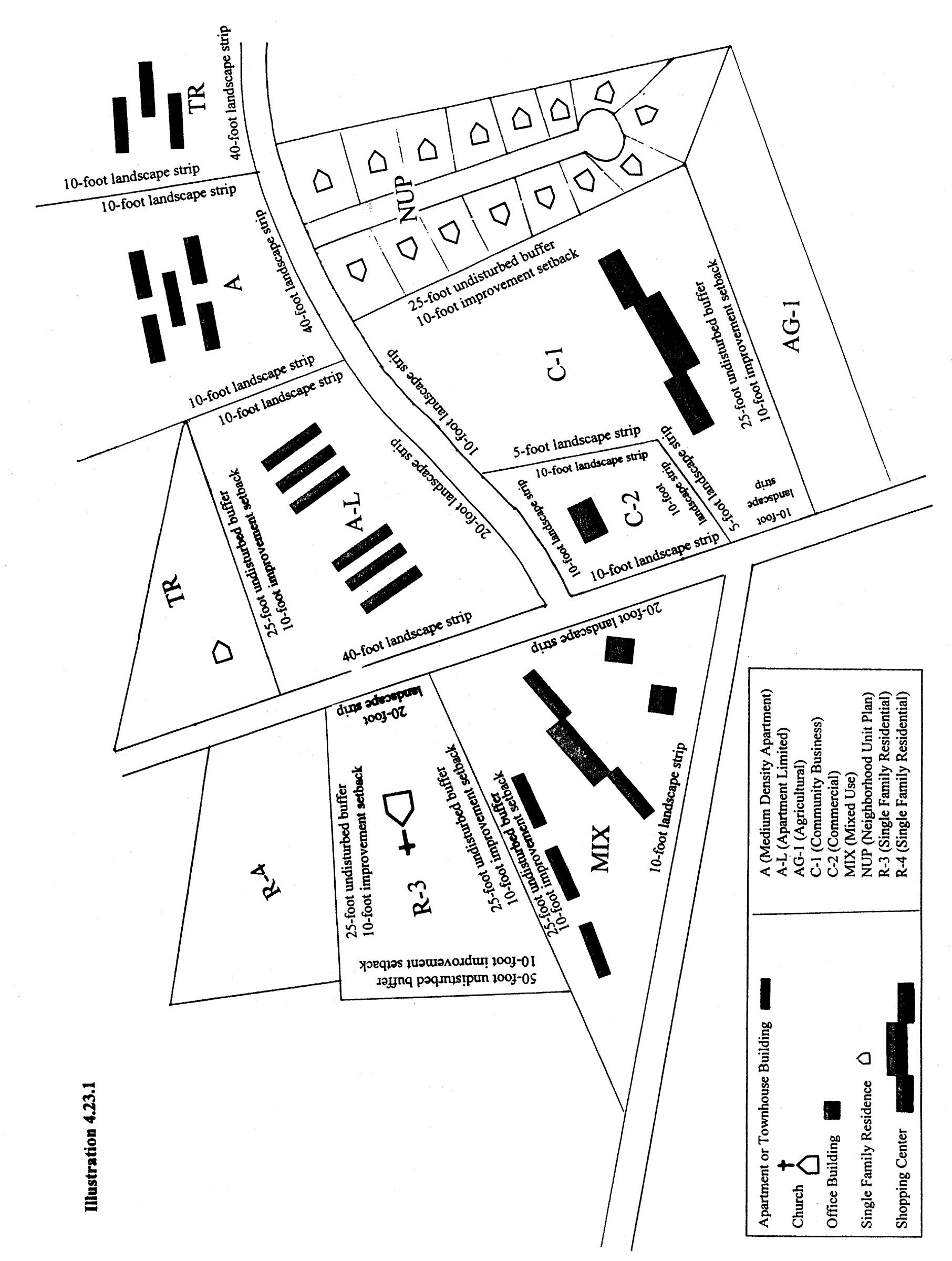
4.23.1 Minimum landscape strips and buffers. (Amended 4/3/02)
A.
Landscape strips shall be provided along all lot lines, as specified in Table 4.23.1, except when zoning buffers are required.
B.
Zoning buffers shall be provided along all lot lines, as specified in Table 4.23.1. adjacent to properties zoned AG-1, R-1, R-2, R-2A, R-3, R-3A, R-4, R-4A, R-5, R-5A, R-6, TR, A, A-L, NUP, CUP and MIX with residential components, and adjacent to all single family residential uses in all zoning districts. (See Illustration 4.23.1.) (Amended 10/2/02)
C.
TR, A and A-L zoned districts shall provide landscape areas adjacent to TR, A, and A-L zoned districts, as specified in Table 4.23.1, unless adjacent properties are developed with single-family residential uses. If adjacent properties are developed with single-family residential uses, zoning buffers are required as specified in Table 4.23.1. (See Illustration 4.23.1)
D.
Zoning buffers shall be undisturbed except for approved access and utility crossings and replantings as required by the Fulton County Arborist.
E.
An additional setback of ten feet for all improvements shall be interior to all zoning buffers as specified in Table 4.23.1. No reduction of the ten-foot improvement setback is allowed nor shall any grading or land disturbance or tree clearing be allowed within this improvement setback unless permission is obtained from the Director of the Department of Environment and Community Development through an Administrative Variance pursuant to section 22.4. Said approval shall include a site visit report and recommendation by the Fulton County Arborist.
F.
Fences and/or walls shall be located interior to any required buffers and/or improvement setbacks except that when zoning buffers are required between properties zoned for single family residences or developed with single family residences, fences may be constructed along side and rear lot lines. (Amended 03/03/04)
Unless otherwise specified, lots developed with single-family detached dwelling units are not required to provide landscape areas or zoning buffers.
When minimum landscape areas or zoning buffers for uses in existing structures do not meet the requirements herein, conditions of zoning shall apply.
Whenever deemed necessary to protect adjoining or nearby properties or to otherwise promote the public health, safety or welfare, the Board of Commissioners may specify conditions which require increased landscape strips and/or buffers, setbacks, berms, or other treatments to protect surrounding and nearby properties.
TABLE 4.23.1
*Nonresidential uses only.
**The second number applies when a lot line adjoins a less intense non-residential
(except AG-1) district.
Minimum Landscape Strips and Buffers
4.23.2. Parking lot landscaping. At-grade, non-single-family parking lots shall provide landscape islands with a minimum of 200 square feet of contiguous soil space. These islands shall be located at both ends of a parking bay, and also after every five parking spaces. A parking bay is a module consisting of one row of parking spaces and the aisle from which motor vehicles enter and leave the spaces. Such landscape islands shall include minimum two-inch caliper shade trees from Fulton County's list of recommended shade trees for parking lots. No parking space shall be more than 40 feet from a tree. Refer to the Fulton County Tree Preservation Ordinance, Appendix J. Landscaping in these islands should preserve and maintain adequate sight lines from the minor lane to the major lane. Alternate methods of landscaping parking lots may be approved whenever the Director of Environment and Community Development or his/her designee determines that the alternate method equals or exceeds this standard. (Amended 4/3/02)
(Amd. No. 11-0478, 6-1-11)
4.24 - Floodplain management.
4.24.1 Purpose. It is the purpose of this section to minimize public and private losses due to flood conditions in specific areas by provisions designed to promote the public health, safety and general welfare and to:
A.
Restrict or prohibit uses which are dangerous to health, safety and property due to water or erosion hazards, or which result in damaging increases in erosion or in flood heights or velocities;
B.
Require that uses vulnerable to floods, including facilities which serve such uses, be protected against flood damage at the time of initial construction;
C.
Control the alteration of natural floodplains, stream channels, and natural protective barriers which are involved in the accommodation of flood waters;
D.
Control filling, grading, dredging and other development which may increase erosion or flood damage;
E.
Prevent or regulate the construction of flood barriers which will unnaturally divert flood waters or which may increase flood hazards to other lands; and
F.
Adopt and comply with the requirements of the Flood Disaster Protection Act of 1973 (Pub. L. 93-234, December 31, 1979) and section 60.2 (h), 60.3 (d) and 65.5 of the National Flood Insurance Program (24 CFR 1909, etc.) thereby assuring that the unincorporated areas of Fulton County and its citizens shall continue to participate in the benefits of the program and not be subject to the prohibitions contained in section 202 (a) of the 1973 act as amended.
4.24.2 Objectives. The objectives of this section are:
A.
To protect human life and health;
B.
To minimize expenditure of public money for costly flood control projects;
C.
To minimize the need for rescue and relief efforts associated with flooding, generally undertaken at the expense of the general public;
D.
To minimize prolonged business interruptions;
E.
To minimize damage to public facilities and utilities such as water and gas mains, electric, telephone and sewer lines, street and bridges located in floodplains;
F.
To help maintain a stable tax base by providing for the sound use and development of flood prone areas in such a manner as to minimize flood blight areas; and
G.
To ensure that potential home buyers are notified that property is in a flood area.
4.24.3 Jurisdiction. This section shall apply to all the unincorporated areas of Fulton County which contain special flood hazard or flood prone areas.
4.24.4 Flood areas established.
A.
Special flood hazard area shall be designated on the "floodway boundary and floodway maps" (FBFM), the "flood insurance rate maps" (FIRM), and the "flood insurance study" (FIS) prepared and revised by the Federal Emergency Management Agency (FEMA) effective June 22, 1998. As defined by FEMA, special flood hazard areas (SFHA) are classified as numbered or unnumbered zones A, AE, (formerly A1-A30), AO, and AH which are available for review on maps in the Department of Environment and Community Development or the Department of Public Works. The accompanying maps and other supporting data and any revision are hereby adopted by reference, declared to be a part of this resolution, and shall have the same force and effect as if fully set forth in this resolution. SFHA shall be identified as follows: (Amended 2/7/01)
1.
Fifty lots or five acres space or more. When FEMA has not produced water surface elevations data and the proposed development is more than 50 lots or five acres, whichever is the lesser, base flood elevation data determined in studies by the U.S. Corps of Engineers or other reputable reports based on competent engineering studies prepared by a current state-registered professional engineer and accepted by the department of public works shall be adopted by reference and declared to be a part of this section.
2.
Fewer than 50 lots or five acres. When FEMA has not produced water surface elevation data and the proposed development is not fewer than 50 lots or five acres, whichever is the lesser, then the base flood elevation data may be determined by the best information available.
B.
Regulatory floodway area shall be designated on the "flood boundary and floodway map" and the "flood insurance study" as revised by FEMA from time to time. It is the channel of a river or other watercourse and the adjacent land areas that must be reserved in order to discharge the base flood without cumulatively increasing the water surface elevation more than one foot.
C.
Flood prone area shall be designated on the "flood insurance rate map." Flood prone areas shall be those areas classified as areas of moderate and minimal flood hazards, shown thereon as "Zone X" (formerly Zone B). (Amended 6/3/98)
4.24.5 Use regulations. (Amended 04/05/06) Notwithstanding the uses permitted by the zoning district applying to the property, the following shall be prohibited in the Special Flood Hazard Area (100 year IRF): buildings and structures; filling; and compensatory flood storage for placement of either fill or for construction of a structure in the floodplain with exception to exempted uses as specified in Section 4.24.5.A. 1-8:
Floodplain designation shall be based on data generated by FEMA, Fulton County flood studies, or data from engineering flood studies prepared by a state-registered professional engineer and accepted by Fulton County (whichever is most representative of the current floodplain). Flood studies shall be approved contingent upon acceptance by FEMA.
Construction (which is consistent with the exemption provisions of this resolution) shall be allowed within floodways only if it is directed towards improving the capacity or flow characteristics of the flood waters or crossing, relocating or altering the floodway channel itself. All such construction must be in conformance with the provisions of the Fulton County Zoning Resolution and the national Flood Insurance Program.
A.
Special Flood Hazard-Flood Prone Permitted Uses. The following uses are permitted in Special Flood Hazard and Flood Prone Areas.
1.
Agricultural, including forestry and livestock raising, requiring no structure. Agriculture and forestry access roads are permitted provided they are constructed in conformance with the development standards of the regulations.
2.
Dams, provided that they are constructed in accordance with the requirement of this section, the Department of Public Works, the U.S.D.A. Soil and Conservation Service and when applicable, meet the specifications of The U.S. Army Corps of Engineers and/or the Georgia Department of Natural Resources.
3.
Fences having sufficient open area to permit the free flow of water and/or debris.
4.
Identification, regulatory and warning signs.
5.
Public and private parks and recreational areas including boat ramps and docks and other functionally dependent uses not including any temporary or permanent buildings, provided; such use is approved by the Department of Environment and Community Development, if applicable, the U.S. Army Corps of Engineers.
6.
Parking.
7.
Utility lines, pipelines, sewers, roads and stream crossings (if no other means of access is available), and similar facilities, provided they are constructed in such a manner as to permit the free flow of flood waters.
4.24.6 Permit required. A land disturbance permit or grading permit shall be required prior to the commencement of any improvement, including grading and filling, within the special flood hazard or flood prone areas. (Amended 11/3/93)
A.
Activities on lots within existing development. In developments that require only a building permit on a developed lot, portions of which are subject to flooding, the Director of the Department of Environment and Community Development shall review the application and issue the permit as part of the building permit. The flood elevation study as required by paragraph 4(a)(1) above may be waived by the Department of Public Works provided: (Amended 2/7/01)
1.
A licensed surveyor submits base flood elevation data based on the best information available.
2.
That the base flood elevation data is to be used only to establish the lowest floor elevation of a structure.
B.
Activities requiring land disturbance permit. In developments that require a land disturbance permit as provided in the "Erosion and Sedimentation Ordinance of 1978" [See Code ch. 26, art. II], the Department of Environment and Community Development shall review the application and issue the permit as part of the land disturbance permit. (Amended 11/3/93, 2/7/01)
C.
Other activities. In all other developments that involve change, modification, or alteration to a flood area, except such activities as plowing, tilling, seeding, planting, or any other agricultural or landscaping pursuit which does not result in change to the cross sectional area of the floodplain nor a significant or hazardous change in the flow characteristics, the developer shall be required to obtain the applicable permit prior to the commencement of any construction within the floodplain.
4.24.7 Permit procedure. (Amended 11/3/93)
A.
Application. Application for a permit shall be made to the Department of Environment and Community Development as indicated under permit required above. If the proposed development requires a land disturbance permit or is of such a nature as to require review and approval by the Department of Environment and Community Development, or any other appropriate agencies, the applicant shall be so advised. Such review may require additional data and/or plans to be furnished by the applicant to assure compliance with all applicable regulations. (Amended 2/7/01)
B.
Certification. The Director of the Department of Environment and Community Development shall inform an applicant of the requirements that "as-built" lowest floor elevation certificates be obtained prior to approval of a certificate of occupancy for any structure built in or immediately adjacent to a special flood hazard area. Certificates of elevation:
1.
Shall be prepared by a professional engineer or surveyor licensed by the State of Georgia.
2.
Shall be maintained in a file in the offices of the Department of Environment and Community Development and the Department of Public Works. (Amended 2/7/01)
4.24.8 Plans and studies required. Wherever it is necessary to determine that the proposed use conforms to the requirements of this section, the Department of Environment and Community Development shall require the applicant to furnish complete and sufficient plans, specifications, hydrological and engineering studies or data. Depending on the size or nature of the proposed use, any or all of the following may be required: (Amended 11/3/93, 6/3/98, 2/7/01)
A.
Grading, replanting and drainage plans;
B.
Proposed temporary and permanent drainage and sedimentation control structures and facilities;
C.
Complete hydrologic and hydraulic analysis, prepared by a professional engineer registered in the State of Georgia, establishing the 100-year base flood elevations and horizontal flood plain limits.
D.
A determination of the channel cross-section area required to carry the affected stream during the base flood;
E.
Complete hydrologic studies to evaluate the total effects a development under review may have upon affected drainage facilities and systems;
F.
The Department of Environment and Community Development may require the applicant to furnish a written agreement to limit use and development in accord with the approved plan and specifications. (Amended 2/7/01)
4.24.9 General development provisions and standards. (Amended 11/3/93)
A.
Relocation and realignment. Within a special flood hazard or flood prone area any relocation or realignment of river and stream channels shall be prohibited if it would reduce the floodway capacity with respect to the base flood elevation, or significantly alter water flow characteristics so as to create a hazard.
B.
Nonconforming uses. Except as restricted or exempted below, existing nonconforming uses within a special flood hazard or flood prone area may be maintained or repaired; modified, altered or repaired to incorporate floodproofing measures; improved to comply with existing state or local health, sanitary or safety code specifications which are solely necessary to assure safe living conditions.
1.
Restrictions.
a.
The cost of such improvement shall not equal or exceed 50 percent of the market value of the structure either, (i) before the improvement is started or (ii) if the structure has been damaged, and is being restored, before the damage occurred.
b.
Such nonconforming use shall not be expanded.
2.
Exemption. Any alteration of a structure listed on the National Register of Historic Places or a state inventory of historic places.
C.
Structures elevated above flood hazard or flood prone areas. No new structure shall be approved or constructed so as to extend over a special flood hazard or flood prone area, whether it be a cantilever design or supported by structural elements located within the floodplain.
D.
Structures adjacent to flood hazard or flood prone areas. For any proposed new structure adjacent to a special flood hazard or flood prone area the ground surface shall be at least three feet above the base flood elevation. Further, when a filled building site is required, the ground surface at the face of the wall shall be at least ten feet distant from the base floodplain. See paragraph 65.5 of the National Flood Insurance Program as amended.
E.
The lowest minimum floor elevation. The lowest floor elevation, as described in FEMA's elevation certificate on page 5 and 6, shall be at least three feet above the base flood elevation and meet the requirements of 4.24.9.G. (Amended 4/5/95)
F.
Removing flood hazard or flood prone areas. Lands may be removed from a special flood hazard area or flood prone area by raising the elevation of such land above the base flood elevation, provided the raising of such land is accomplished in accordance with the requirements of this resolution. Refer to FEMA National Flood Insurance Program Regulation 44 CFR 65 for procedures to amend the FIRM, FHBM, or FIS. The developer/property owner shall prepare all plans and engineering studies and pay any fees necessary to obtain a letter of map revision for their development. (Added 4/5/95)
G.
Residential lots. In districts which permit residential use, development is prohibited in special flood hazard areas. Fulton County may allow such development provided: (Amended 4/5/95)
1.
Not less than 70 percent of the buildable land area lies above the base flood elevation, a minimum of one foot, and/or
2.
Not less than 50 percent of the minimum lot area, as established by the applicable zoning district, shall be above the base flood elevation.
H.
Utilities. The location, design, elevation, and construction of all public utilities and facilities, such as sewer, gas, electrical, on-site waste disposal systems, water systems and streets shall be in such a manner as to minimize or eliminate damage by flooding.
I.
Drainage structures. All drainage structures and facilities located within special flood hazard or flood prone areas shall be constructed in accordance with Fulton County Standards and Specifications. They shall be maintained by the owner in a sanitary, fully functional and operable state so that the flood carrying capacity of the watercourse is preserved.
J.
Erosion and sediment control. Provision shall be made for the adequate control of erosion and sedimentation.
K.
Riverine considerations. Fulton County shall notify, in riverine situations, adjacent communities and the Georgia State Coordinating Office prior to any alteration or relocation of a watercourse.
L.
Watercourse alteration or relocation. Fulton County, prior to approval of a permit to alter or relocate a portion of any watercourse shall require an agreement indemnifying Fulton County from all liability arising from the construction pursuant to said permit and providing for the continued maintenance to assure the flood carrying capacity within the altered or relocated water course.
4.24.10 Development within flood prone areas.
A.
Development limitations. Within flood prone areas, no construction including grading and filling shall be allowed that would:
1.
Raise the base flood elevation beyond the boundaries of the ownership of the property being developed. Submittal of this certification and the supporting studies by a professional engineer are required.
2.
Reduce the flood storage capacity. Fill placed within the floodplain must be compensated. All cut areas must drain by gravity to the main watercourse. Certification by a professional engineer and an "as-built" topographical map superimposed on the original topography are required.
3.
Impede the movement of flood waters. Applies to any obstruction placed within the floodplain, i.e., fill, but in particular, roads, driveways, bridges and culverts. All such encroachments shall be designed and submitted by a professional engineer and shall provide:
a.
That there shall be no reduction in the flood carrying capacity of the watercourse.
b.
A certification together with supportive data.
c.
Sufficient opening provided for the passage of the flood waters so as to prevent or greatly reduce the hazard of debris or trash blocking the flood's flow.
4.
Changes the flow characteristics of the flood waters as they pass the boundaries of the developed property. Requires certification by a professional engineer along with all supportive studies.
5.
Create hazardous or erosion producing velocities. Requires certification by a professional engineer along with supportive studies.
B.
Stormwater management structures. Detention ponds, lakes and similar impoundment structures may be constructed within a flood prone area provided they do not violate the restrictions enumerated under paragraph 10(a) above. Provided further that any such detention pond, lake or similar impoundment structure shall provide adequate discharge control and sufficient storage capacity to assure that the rate of runoff calculated for the proposed development including that drainage increased or diverted by reason of the development shall not exceed that calculated for the property in its natural state in the event of the 100-year storm.
C.
Studies and plans required. A hydrologic analysis shall be required to be submitted to the Department of Environment and Community Development with each application for a land disturbance permit for property containing a flood prone area. Any or all of the other plans or studies referred to in paragraph 4.24.8 above may be required. Such studies shall take cognizance of existing conditions which affect the flow of water on adjacent properties and also such future conditions as can reasonably be expected to occur in the drainage basin. Such reports shall meet the requirements of the Department of Environment and Community Development. (Amended 11/3/93, 6/3/98, 2/7/01)
D.
Revision criteria. Each application for a land disturbance permit for property containing a flood prone area shall also submit therewith documented results of hydrology and hydraulic analysis prepared by a registered professional engineer demonstrating that any area defined on the FIRM or FBFM as moderate or minimal flood hazard (Zone X) is not actually a SHFA. Such results and analysis shall demonstrate that none of the following criteria is met in any flood prone area(s) on the site: (Added 6/3/98)
(1)
The flood prone area(s) is subject to a one percent (1%) annual chance of flooding with average channel depths greater than one foot or;
(2)
The flood prone area(s) has a contributing drainage area greater than one square mile or;
(3)
The flood prone area(s) has hazardous velocities in the channel and/or overbank areas greater than 3.5 feet per second. (The county may accept velocities of up to 5 feet per second depending upon the results of a soil study by the engineer).
In the event that any of the above criteria is met, the applicant shall submit to the Department of Environment and Community Development the relevant data for a Letter of Map Revision and the appropriate fees required by FEMA. The Fulton County Department of Public Works shall then submit the relevant data, letter of map revision and accompanying fees to FEMA for a determination of whether a map revision is warranted. In the event of such a map revision reclassifying an area as an SHFA, development within the affected area(s) shall comply with section 4.24.12 of this article. (Amended 2/7/01)
4.24.11 Development with unstudied special flood hazard areas. Development and revisions criteria in the unstudied special hazard areas shall be the same as in the flood prone areas, subsection 4.24.10. (Amended 6/3/98)
4.24.12 Development within studied special flood hazard areas.
A.
Development limitations. No construction shall be allowed within the studied special flood hazard areas that would:
1.
Raise the base flood elevation. Submittal of this certification and the supporting studies by a professional engineer are required.
2.
Reduce the flood storage capacity. Fill placed within the floodplain must be compensated. All cut areas must drain by gravity to the main watercourse. Certification by a professional engineer and an "as-built" topography map superimposed on the original topography are required.
3.
Impede the movement of flood waters. Applies to any obstruction placed within the floodplain but in particular, roads, bridges, driveways and culverts. All such encroachments shall be designed by a professional engineer and shall provide:
a.
That there shall be no reduction in the flood carrying capacity of the watercourse.
b.
A certification together with supportive data.
c.
Sufficient opening provided for the passage of the flood waters so as to prevent or greatly reduce the hazard of debris or trash blocking the flow of the flood.
4.
Change the flow characteristics of the flood waters. Requires certification by a professional engineer along with all supportive studies.
5.
Create hazardous or erosion producing velocities. Requires certification by a professional engineer along with supportive studies.
B.
Increase base flood elevation. The department of public works may from time to time, request a review and determination from the floodplain management administrator to permit an increase in the base flood elevation. Such increased elevation shall not exceed that depth shown in the Flood Insurance Study, Table 2, Base Flood Water Surface Elevation with Floodway Column. (Amended 4/5/95)
1.
This increase may be granted when:
a.
The development is a proposed public road, bridge and/or culvert, public utility poles, towers, pipelines, sewers and similar facilities.
b.
The development is a private lot, bridge/culvert, private utility poles, towers, pipelines, sewers or other similar facilities.
2.
A professional engineer must submit a certification along with supportive documentation that the increase does not extend beyond the boundaries of the property upon which the improvement is proposed and shall not cause any appreciable expansion of flooding, siltation, erosion or inundation hazards. (Amended 11/3/93)
3.
A developer shall apply to the Floodplain Management Administrator of Fulton County for review and approval of an application for a letter of map revision to FEMA. (Added 4/5/95)
4.
The floodplain management administrator may apply for a conditional FIRM revision to FEMA prior to permitting encroachment into a special flood hazard area. Refer to the National Flood Insurance Program Regulations 44 CFR, Part 65.12 for FEMA requirements. (Added 4/5/95)
4.24.13 Floodway alteration.
A.
Construction within regulatory floodway. When construction is proposed within the regulatory floodway such as flood control projects, stream channelization, stream relocation, construction of new dams, reservoirs, artificial canals, private levees or flood protection systems which would result in a change in the base flood elevations as shown on the flood insurance rate maps (FIRM), the following shall be required:
1.
Complete plans, data, studies and documentation for the proposed construction shall be submitted to the Department of Public Works.
2.
If the Department of Public Works determines that the project is feasible and acceptable, then the department shall submit the project to FEMA in compliance with the provisions of the National Flood Insurance Program, paragraph 65.5 as amended from time to time.
Note: Fulton County may require a fee for review of such proposals.
4.24.14 Mobile homes. All mobile homes located within the 100-year floodplain must adhere to all applicable regulations stated elsewhere in this resolution as well as the following:
A.
Anchoring. All mobile homes should be anchored to resist flotation, collapse or lateral movement, by providing over-the-top and frame ties to ground anchors. Specific requirements shall be that:
1.
Over-the-top ties be provided at each of the four corners of the mobile home, with two additional ties per side at intermediate locations. Mobile homes which are less than 50 feet long must have one additional tie per side;
2.
Frame ties be provided at each corner of the home with five additional ties per side at intermediate points. Mobile homes which are less than 50 feet long require four additional ties per side;
3.
All components of the anchoring system must be capable of carrying a force of 4,800 pounds; and
4.
Any additions to the mobile home must be similarly anchored.
B.
General requirements. All mobile homes are required to have:
1.
Lots that are elevated on compacted fill in accordance with paragraph 4.24.9(D).
2.
Adequate surface drainage and access for a hauler.
4.24.15 Subdivision plats. Hereinafter, proposed preliminary and final subdivision plats for property located contiguous to or within flood prone or special flood hazard areas shall not be approved except in accordance with the following requirements: (Amended 4/5/95)
A.
Each plat shall contain a notation clearly stating the water surface elevation of the base flood in relation to mean sea level as approved and accepted by the Department of Public Works. Any lands below this elevation shall be designated on the plat by a heavy line, depicting the base flood elevation at that point.
B.
No lot shall be approved which has less than the minimum lot area as established by the applicable zoning district regulations and 4.24.9.G above the base flood elevation.
C.
Preliminary and final subdivision plats that were approved prior to the enactment of this section are exempt from the requirements of 4.24.9.D and 4.24.15.B above, and building permits shall be issued accordingly.
D.
No final subdivision plat shall be approved by the county where development has altered the special flood hazard area unless the county has first received a letter of map amendment, letter of map revision or notice of conditional FIRM revision from FEMA as stipulated in the National Flood Insurance Program Regulations 44 CFR 65. (Added 4/5/95)
4.24.16 Abrogation and greater restrictions. This section is not intended to repeal, abrogate, or impair any existing easements, covenants, or deed restrictions. Where this section and another section of this resolution conflict or overlap, however, whichever imposes the more stringent restrictions shall prevail.
4.24.17 Interpretation. In the interpretation and application of this section, all provisions shall be:
A.
Considered as minimum requirements;
B.
Liberally construed in favor of the governing body;
C.
Deemed neither to limit nor repeal any other powers granted under state statutes.
4.24.18 Warning and disclaimer of liability. The degree of flood protection required by this section is considered reasonable for regulatory purposes and is based on scientific and engineering considerations. Larger floods can and will occur on rare occasions.
Flood heights may be increased by manmade or natural causes. This section shall not create liability on the part of Fulton County or by any official or employee thereof for any flood damages that result from reliance on this ordinance or any administrative decision lawfully made thereunder.
4.24.19 Compliance. No structure or land shall hereafter be located, extended, converted, or structurally altered without full compliance with the terms of this section and other applicable regulations.
4.24.20 Appeal. (Deleted 3/4/92, See article XXII)
4.25 - Property number/street address.
Property numbers issued by the Fulton County Department of Environment and Community Development shall be posted so as to be clearly visible from the street for which the property number was assigned. (Amended 11/3/93, 2/7/01)
4.26. - Inclusionary housing zoning.
(Added 04/05/06)
4.26.1. Purpose and Intent. This section of the Fulton County Zoning Ordinance is intended to provide that residential projects in Fulton County contain a defined percentage of housing affordable to very low, low, and moderate income households; to provide for a program of incentives and local public subsidy to assist in this effort; and to implement the mixed income and housing policies of the Housing and Implementation Elements of Fulton County's Comprehensive Plan. Participation in the Inclusionary Housing Zoning Program shall be voluntary for a twenty-four month period after which it will sunset until the Board of Commissioners can assess the effectiveness of the program and determine the conditions for its future implementation.
The Ordinance seeks to:
(a)
Provide for a full range of housing choices, conveniently located in a suitable living environment, for all incomes, ages and family sizes;
(b)
Provide housing to meet the existing and anticipated future needs of very low, low and moderate-income households;
(c)
Assure that affordable housing units are dispersed throughout the County by providing such units in all residential developments, except as otherwise may be provided for in this Article;
(d)
Encourage the construction of affordable housing by allowing increases in density to offset land and development costs;
(e)
Ensure that developers incur no loss or penalty and have reasonable prospects of realizing a profit on affordable housing units by virtue of the density bonus and other incentive provisions herein.
4.26.2. Definitions.
Affordable. Rented at an Affordable Rent or sold at an Affordable Housing Price.
Affordable Housing Price. A sales price, at which Low, Very Low, or Moderate Income Households, as provided in this Section, can qualify for the purchase of for-sale Inclusionary Units, based on designated income standards. For purposes of this calculation, housing expenses shall include mortgage principal and interest, taxes, insurance, and assessments.
Affordable Rent. (1) for a unit whose occupancy is restricted to a Low Income Household that the monthly rent consists of a maximum of one-twelfth of thirty percent (30%) of eighty percent (80%) of the median income applicable to Fulton County; and (2) for a unit whose occupancy is restricted to a Very Low Income Household that the monthly rent consists of a maximum of one-twelfth of thirty percent (30%) of fifty percent (50%) of the median income applicable to Fulton County. In each case, the median income applicable to Fulton County is as determined annually by the United States Department of Housing and Urban Development, adjusted for household size, less a reasonable allowance for utilities and in compliance with the Low Income Housing Tax Credit Program administered by the Georgia Department of Community Affairs.
Affordable Rental Agreement. Legal restrictions by which the rents for rental Inclusionary Units will be controlled to ensure that rents remain Affordable for a period of thirty (30) years or longer.
Bond Financed Projects. Affordable housing developments financed with tax-exempt bonds and therefore eligible for 4% federal credits.
Density Bonus. A minimum density increase of at least twenty percent (20%) over the otherwise maximum residential density as permitted by the Fulton County Zoning Ordinance and the Comprehensive Land Use Plan at the time of application.
Developer. Any person, firm, partnership, association, joint venture, corporation, or any entity or combination of entities which seeks Fulton County's approvals for all or part of a Development Project. Developer includes Owner.
Development Agreement. An agreement entered into between Fulton County and a Developer.
Development Project. Any real-estate development project that includes Market Rate Units and is required to provide an Inclusionary Housing Component pursuant to the provisions of this Section. Projects at One Location undertaken in phases, stages or otherwise developed in distinct sections shall be considered a single Development Project for purposes of this Section.
Dwelling Unit. A residential unit within a Development Project.
External Subsidy. Any source of funds that is not Local Public Funding, including Federal or state grants, loans, bond funds, tax credits or other tax-based subsidy.
First-time Home buyer. An individual purchaser or spouse who has not owned a home during the past three years, or that the purchaser meets at least one of the following criteria:
A.
The purchaser is a displaced homemaker, defined as a person who has not worked full-time for a number of years, worked primarily without remuneration to care for the home and family, is unemployed or underemployed, is experiencing difficulty in obtaining or upgrading employment, and, while a homemaker, owned a home with a previous spouse;
B.
The purchaser is single (unmarried or legally separated), has one or more minor children of whom purchaser has custody, and, while previously married, owned a home with a previous spouse; or
C.
The purchaser owns or owned as a principal residence during the past three years, a dwelling unit which structure is not permanently affixed to a permanent foundation in accordance with the Fulton County's Zoning Ordinance, or is not and cannot be brought into compliance with Fulton County's Zoning Resolution for less than the cost of replacing the structure.
Fulton County Government. Fulton County, Georgia.
Household. One person living alone or two or more persons sharing residency whose income is considered for housing payments.
Household Income. The combined adjusted gross income for all adult persons residing in a living unit.
Household, Low Income. A household whose annual income does not exceed eighty (80) percent of the area median income, adjusted for family size as published and annually updated by the United States Department of Housing and Urban Development.
Household, Moderate Income. A household whose annual income does not exceed one hundred and twenty (120) percent of the area median income, adjusted for family size as published and annually updated by the United States Department of Housing and Urban Development.
Household, Very Low Income. A household whose income does not exceed fifty (50) percent of the area median income, adjusted for family size as published and annually updated by the United States Department of Housing and Urban Development.
Housing Trust Fund. The fund created by Fulton County and administered by the Fulton County Office of Housing (FCOH).
Inclusionary Housing Agreement or Agreement. The agreement between a Developer and the County setting forth the manner in which the Inclusionary Housing Component will be met in the Development Project.
Inclusionary Housing Plan. A plan required at the time of concept review for a land disturbance permit or building permit that provides the details of proposed inclusionary units.
Inclusionary Housing Component. The provision of the Inclusionary Housing Units in a Development Project.
Inclusionary Housing Unit or Inclusionary Unit. An ownership or rental dwelling unit developed as a part of the Inclusionary Housing Component of a Development Project as provided in this Section.
Inclusionary Housing Development. A development containing a building with more than eight (8) units for multi-family or for all residential developments of 20 units or more in which 10 percent of the total units must be inclusionary units restricted for occupancy by very low, low, or moderate income households except as otherwise provided for herein.
Inclusionary Incentives. The fee waivers or reductions, planning and building standards waivers or reductions, regulatory incentives or concessions, and Federal, State, and Local Public Funding provided by Fulton County to a Development Project to assist in the provision of the Inclusionary Housing Component.
Income, Area Median. The annual median family income of a geographic area of the state, as annually estimated by the United States Department of Housing and Urban Development pursuant to Section 8 of the Housing Act of 1937.
Initial Owner. The first person or persons to purchase a new for-sale Inclusionary Unit for his, her or their primary residence.
Legislative Entitlement. Means and includes general and community plan designations and redesignations, zonings and rezonings, and planned unit development site plans and revised site plans.
Local Public Funding. Loans and grants from the Housing Trust Fund, federal Home Investment Partnership Program ("HOME" funds), and redevelopment area tax increment housing set-aside funds, and other funds originating from or administered by Fulton County.
Low Income Housing Tax Credits. Federal and State financing in which federal housing tax credits are awarded to developers to raise capital for the development of affordable multi-family rental units.
Market Rate. Rates not restricted to an Affordable Housing Price or Affordable Rent.
Multi-family Residential. Residential units planned, approved, or built on land planned or zoned for other than Single Family Residential in which Housing Tax Credits have been awarded for the purpose of developing affordable multi-family rental units.
Off-Site Unit. An Inclusionary Unit that is built separately or at a different location than the main development.
On-Site Unit. An Inclusionary Unit that will be built as apart of the main development.
One Location. All adjacent land owned or controlled by the same Owner or a Related Owner, the property lines of which are contiguous at any point, or the property lines of which are separated only by a public or private street, road, or other public or private right of way.
Owner. Includes the person, persons, partnership, joint venture, association, corporation, or public or private entity having sufficient proprietary interest in real property to commence, maintain, and operate a Development Project.
Percent. A one hundredth part. In applying percentages referred to in this Section, any portion of a Percent less than one half (0.5%) shall be disregarded and any portion of a Percent one half (0.5%) or greater shall be rounded up to the next whole number.
Project, For Sale. A residential project, or portion thereof, which is intended to be sold to owner-occupants upon completion.
Project Level Approval. Includes a concept plan, a Special Permit, or other administrative or adjudicatory approval or determination in connection with a Development Project.
Related Owner. A person or entity, including but not limited to, partnerships, limited partnerships, and corporations, which has any of the following relationships with an Owner: (1) they share the majority of members of their governing boards; (2) they share two or more officers: (3) they are owned or controlled by the same majority shareholder(s) or general partner(s); (4) they are in a parent-subsidiary relationship; or (5) the person is a sibling, offspring or parent of an individual Owner. For purposes of this subsection, a controlling interest means fifty percent (50%) or more of the voting power of a corporation, and a parent-subsidiary relationship exists when one corporation owns, directly or indirectly, fifty percent (50%) or more of the voting power of another corporation. For purposes of this section, a person and any general partnership in which the person is a general partner, or a person and any corporation in which the person owns a controlling interest, shall be treated as one and the same.
Residential Project. The entirety of Market Rate residential development in a Development Project subject to the requirement to provide an Inclusionary Housing Component as specified in this Section.
Single-family Residential. A development planned, approved, or built on land planned or zoned solely for a permitted residential density of one unit per parcel. Where such a planning or zoning single-family designation also allows as a conditional use duplexes or similar uses, the designation is nonetheless considered Single-family Residential for purposes of the Inclusionary Housing Component and the other provisions of this Section.
Fulton County Zoning Ordinance. The Fulton County Zoning Ordinance as it may be amended from time to time.
4.26.3. Standard Inclusionary Housing Component.
A.
Number and Affordability of Inclusionary Units. For all residential developments of 20 units or more, the Inclusionary Housing Component shall consist of Inclusionary Units developed for, offered to, and leased or sold to Very Low, Low, and Moderate Income Households as follows: at least 5 percent of the units must be restricted to occupancy of moderate income households and 5 percent of the units must be restricted to occupancy of low and/or very low income households. For the purposes of calculating the number of inclusionary units, any decimal fraction of 0.5 or more shall be rounded up to the nearest whole number.
B.
Location of Inclusionary Units. Except as provided in this Section, Inclusionary Units shall be built on the site of the Development Project and must be dispersed throughout a Residential Development.
C.
Timing of Development. The Inclusionary Housing Plan and Inclusionary Housing Agreement shall include a phasing plan, which provides for the timely development of the Inclusionary Units as the Residential Project is built out. The phasing plan shall provide for development of the Inclusionary Units concurrently with the Market Rate Units; provided however, that the phasing plan will be adjusted by the Director of Environment & Community Development (E&CD) away from strict concurrency where necessary in order to account for the different financing and funding environments, economies of scale, and infrastructure needs applicable to development of the Market Rate and the Inclusionary Units. Multi-family development shall
D.
Design. Inclusionary units for single-family shall be comparable in infrastructure (including sewer, water and other utilities), construction quality, and exterior design to the market rate units. Inclusionary units may be smaller in aggregate size and have different interior finishes and features than market rate units so long as the interior features are durable, of good quality and consistent with contemporary standards for new housing. Inclusionary single-family units must be a minimum of 1,600 square feet for moderate-income households, 1,250 square feet for low-income households, and 1,000 square feet for very low-income households. The number of bedrooms in the inclusionary units should be comparable in number to those in the market rate units. The ratio of bathrooms per bedroom should be equal to the ratio of bathrooms per bedroom in market rate units. Multi-family design standards shall be consistent with the proposed development.
E.
Unit Size. The Inclusionary Housing Component shall accommodate diverse family sizes by including a mix of studio, one, two and three-bedroom units as determined by the Director of E&CD, upon recommendation by the Director of the Office of Housing.
F.
Exterior Appearance. Inclusionary Units shall be visually compatible with the Market Rate Units. External building materials and finishes shall be the same type and quality for Inclusionary Units as for Market Rate Units. Interior materials finishes may vary.
G.
Development Standards. Except as provided in the Inclusionary Housing Agreement pursuant to this Section, Inclusionary Units shall comply with all applicable Development Standards.
4.26.4. Incentives, Assistance and Subsidies. The Developer of a Development Project subject to the Inclusionary Housing provisions may request that Fulton County provide Inclusionary Incentives as set forth in this Section. The goal of these Inclusionary Incentives is to apply available incentives to qualifying projects in a manner that, to the extent feasible, offsets the cost of providing the Inclusionary Housing Component. The Director of E&CD shall respond to that request at the time and in the manner specified in this Section, and shall make a determination as to a package of Inclusionary Incentives for the Inclusionary Units as provided in this Section.
A.
Fee Waivers or Deferrals. Upon application, Fulton County shall make available to a Residential Project Developer a program of waiver, reduction or deferral of development fees, Impact Fee Waiver, administrative and financing fees for Inclusionary Units. Such a program may include application, on behalf of a Developer, to other government entities for fee waiver and deferral program for waiver and/or deferral of other impact or development fees.
B.
Modification of Development Standards. Upon application, Fulton County may modify for Inclusionary Units, to the extent feasible in light of the uses, design, and infrastructure needs of the Development Project, as determined by the Director of E&CD and the Office of Housing Director, development standards, including but not limited to, road widths, curb and gutter, parking, and housing types.
C.
Interior Finish Reductions. Upon application, Fulton County may, to the maximum extent appropriate in light of project design elements as determined by the Director of E&CD, allow builders to finish out the interior of Inclusionary Units with less expensive finishes and appliances.
D.
Streamlining and Priority Processing. The Director of E&CD shall expedite development Permits for Residential Projects that include an Inclusionary Housing Component. Fulton County shall develop further procedures for streamlining and priority processing which relieve Inclusionary Units of permit processing requirements to the maximum extent feasible consistent with the public health, safety and welfare.
E.
Density Bonus. Fulton County shall make available to the Residential Project a Density Bonus as provided in this Section. The number of units allowed may be increased by 20 percent provided, however, that the affordability requirements to qualify for a Density Bonus shall be those stated in this Section.
F.
Local Public Funding. The Developer may apply to the Office of Housing for Local Public Funding to assist in the financing and development of the Inclusionary Housing Component. Local Public Funding may serve to facilitate state allocation of tax credits, mortgage revenue bond funds, or state or federal assistance to the Project ("External Subsidy"); provided that the provision of such Local Public Funding requires that Developer diligently pursue such External Subsidy and is not intended to substitute for such External Subsidy. A Developer seeking Local Public Funding shall apply to the Office of Housing Director for such funding pursuant to this Section. The Office of Housing Director shall submit the proposed Local Public Funding assistance package to the Director of E&CD for inclusion in the Fulton County's Inclusionary Incentives for the project.
The Office of Housing Director, as to the feasible elements of Local Public Funding and in making the determination as to inclusion of Local Public Funding in the Inclusionary Incentives, shall consider: (1) the number, percentage, and tenure of the Units for Very Low Income or Low Income Households in the Inclusionary Housing Component; (2) the financial structure and financing needs of the Inclusionary Housing Component; (3) the cost-efficiency of the solution to the Inclusionary Housing Component, (4) the Developer's initiatives in applying for grants and other funds external to Local Public Funding; (5) the availability of funds given the funding priorities of Office of Housing and other funding agencies at the time, and other development of housing for Very Low or Low Income Households under way, proposed or anticipated; and (6) other factors necessary to the evaluation. Office of Housing shall adopt and provide to Developers and other interested parties criteria for evaluation of applicants for Local Public Funding. These criteria may be contained in the Guidelines as outlined by the Office of Housing.
4.26.5. Construction of the Inclusionary Housing Component to Avoid over Concentration. The following principles shall apply to the development of the Inclusionary Housing Component:
A.
The Inclusionary Housing Plan shall provide for the dispersal of buildings containing Inclusionary Units to the maximum extent feasible taking into account the funding and financing environments applicable to Inclusionary housing development.
B.
Multi-family buildings may contain any proportion of inclusionary units, but no Inclusionary Housing Development may be located adjacent to another Inclusionary Housing Development. For purposes of this Section, Inclusionary Housing Development means a development containing a building with more than eight (8) units for multi-family or for all residential developments of 20 units or more, in which 10 percent of the total units must be inclusionary units restricted for occupancy by very low, low, or moderate income households except as otherwise provided for herein. The Director of E&CD may allow for variation from these principles, but only the extent necessary, if he or she determines that an alternative configuration of Inclusionary Units is required by funding or financing considerations associated with the development of the Inclusionary Units or by the applicable residential land use designations within and adjacent to the Residential Project.
C.
Proposed Inclusionary Single-family Housing Developments that are located within a census track(s) in which 95% of the existing units are below 80% AMI, must submit a Housing Development Plan that includes the following mixed housing price points for sale:
i.
20% not to exceed $150,000
ii.
60% between $150,000 and $216,000
iii.
20% Market
4.26.6. Alternatives to the Standard Inclusionary Housing Component. Subject to the approval of the Board of Commissioners (BOC), in lieu of constructing affordable housing units on site, a developer may dedicate land or pay in-lieu housing fees. At the time of concept plan review, the developer shall be required to provide a report to the E&CD Director identifying the reasons the construction of the required number of affordable housing units within the development is not feasible. The report shall include sufficient independent data, including appropriate financial information, which supports the developer's claim that it is not feasible to construct the required affordable units and a detailed analysis of why the density bonus cannot mitigate the conditions that prevent the developer from constructing the affordable units. The Director shall review all such requests and prepare a recommendation to the Board of Commissioners. Such requests shall be considered on a case-by-case basis by the BOC and may be approved at the BOC's sole discretion. The monetary value of an alternative equivalent must be equal to or exceed the cost to produce the required number of affordable housing units on site.
A.
Land Dedication and Off-Site Compliance Options. Upon a determination by the Director of E&CD that the criteria outlined in number 4 below have been met, a Residential Project may provide all or part of its Inclusionary Housing Component by means of the following options:
(1)
Dedication of land to Fulton County at no cost. Under this option, a developer may donate to the County a site on which all or a portion of the mandated inclusionary units can be built. The dedicated site must be located in the same planning area (as defined by the Comprehensive Plan) in unincorporated Fulton County and must be physically suitable for development at the time of conveyance. It must be of sufficient size and properly zoned to accommodate the requisite number of units. It must already have access to water and sewer and public services (police, fire, etc.). The property should not have physical constraints that cause delay or increase construction costs (e.g., grading) or be unsuitable for residential development (e.g., contain toxins). The developer shall provide an appraisal of the land and its appraised value shall be confirmed by the County's Land Division of the General Services Department.
(2)
Development of Inclusionary Units Off-site. Inclusionary units may be constructed outside the Development Project within an Area ("Off-Site") for a Residential Project that is single-family or multi-family.
(3)
A combination of options (1) and (2).
(4)
Standard for Approval. The Director of E&CD may approve the proposal only if it provides a more cost-efficient solution to the Inclusionary Housing Component than the standard approach set forth in this Section, or if the location of Off-Site development would be superior to on-site development from the perspective of access to transportation or other applicable residential planning policies in the Fulton County Comprehensive Plan.
(5)
Number of Inclusionary Units Credited to the Dedication or Off-Site Location. The number of Inclusionary Units credited to the dedication or Off-Site location will consist of the number of Inclusionary Units which can with reasonable degree of certainty be developed on the land, given (a) the mix of Inclusionary Unit sizes and type of structure in the Inclusionary Housing Plan; (b) densities permitted by applicable planning and zoning designations; and (c) site, infrastructure, environmental and other physical and planning constraints.
(6)
Site Suitability. The land proposed for dedication or for Off-Site location must be suitable from the perspective of size, configuration, physical characteristics, physical and environmental constraints, access, location, adjacent use, and other relevant planning criteria. The site must allow development of Inclusionary Units in a manner that complies with this Section including the over-concentration provisions set forth in Section 4.26.4.
(7)
Site Identification and Regulatory Status. The Developer must identify the proposed dedicated site or Off-Site location and the number of proposed Units to be credited thereby as part of the Inclusionary Housing Plan required in this Section. At the same time or before the Development Project receives its Inclusionary Incentives, the dedicated or Off-Site land shall have received all the Inclusionary Incentives necessary for development of the Inclusionary Units on such land. Unless the phasing plan requires otherwise, at the same time or before a Residential Project receives its first Project specific Entitlements, the dedicated or Off-Site land shall have received all the necessary Project-Level Approvals necessary for development of the Inclusionary Units on such land, and prior to the issuance of any Certificate of Occupancy for a Residential Project, the dedicated land or Off-Site land shall be fully served with the infrastructure necessary for residential development.
(8)
Director of E&CD Action. The Director of E&CD may recommend conditional approval or denial of the proposed land dedication or Off-Site development proposal. In reviewing the proposal, the Director of E&CD will consult with the Director of the Office of Housing. If the land dedication or the Off-Site proposal is accepted or accepted as modified, the relevant elements of the Inclusionary Housing Plan shall be included in the applicable Legislative Approvals for both the Residential Development generating the requirement for the Inclusionary Housing Component and, if applicable, the dedicated site or Off-Site Development Project where all or part of that requirement is proposed to be met. If the dedication or Off-Site proposal is rejected, the Inclusionary Housing Component shall be provided as set forth in this Section within the Development Project.
(9)
Implementation. As early as possible in the regulatory process, and in no case later than the negotiation of the Inclusionary Housing Agreement as provided in this Section, the Owner of the Residential Project must: (1) in the case of land dedication, provide an irrevocable offer of dedication for the dedicated site at no cost to Fulton County; and (2) in the case of Off-Site land, demonstrate to the Director of E&CD and the Office of Housing Director that the Off-Site location is and will remain committed to the timely development of the Inclusionary Units as provided in the Inclusionary Housing Plan. This commitment may be demonstrated through ownership of the Off-site location, or through adequate control of the use of the Off-site location through joint ownership, joint venture or other contractual means. If necessary to ensure that Inclusionary Housing Units are developed contemporaneously with the Market Rate Units, the Director of E&CD may require the offer of dedication or evidence of Off-Site control as early as the first Legislative Entitlement. With respect to an Off-site location, the Director of E&CD may also condition development or occupancy of the Residential Project on development or occupancy of the Off-Site Inclusionary Units, and the Inclusionary Housing Agreement must apply to and be recorded against both the Residential Project and the Off-Site land. With respect to dedicated land, Fulton County, upon acceptance of the offer of dedication, shall publish a request for proposal for development of the site(s), which will result in the production of the number of Inclusionary Units credited to the site(s).
B.
In-Lieu Housing Fees. For Residential Developments of 20 or more units, including Inclusionary Units, the requirements of this Section may be satisfied by paying an in-lieu fee to the Affordable Housing Trust Fund.
(1)
Under this option, the developer may pay an amount equivalent to the cost of constructing the mandated units at the required affordability levels. Fees shall be calculated for the construction of affordable housing units for moderate and low and very low income households and shall be adjusted annually based upon the estimated average construction cost per square foot of floor area for single-family (not including the value of the improved lot) as estimated for the region (south) by the National Association of Home Builders or the American Apartment Association for multi-family development.
(2)
The County Manager shall establish an affordable Housing Trust Fund for the receipt and management of in-lieu housing fees. Monies received into the fund shall be utilized solely for the construction or purchase and maintenance of affordable housing and for the costs of administering programs consistent with the purposes of the section. In all cases, the required number of housing units at the required levels of affordability shall be provided for by this fund.
(3)
Fees must be paid within ten calendar days of issuance of a building permit for the Development or the permit will be null and void. For phased Developments, payments may be made for each portion of the Development within ten calendar days of the issuance of a Building Permit for that phase. When payment is delayed, in the event of default, or for any other reason, the amount of the in-lieu fee payable under this Section will be based upon the fee schedule in effect at the time the fee is paid.
(4)
No final inspection for occupancy will be completed for any corresponding Market-rate Unit in a Residential Development unless fees required under this Section have been paid in full to the Department of E&CD.
C.
Combined Dedication of Land and In-Lieu Housing Fees. Under this option, the developer may dedicate land and pay in-lieu housing fees equivalent to the cost of producing the mandated units at the required affordability levels. The developer shall provide an appraisal of the land and its appraised value shall be confirmed by the County's Land Division of the General Services Department.
4.26.7. Exclusions. The requirements of this Article do not apply to:
(a)
Housing developments of fewer than 20 lots;
(b)
Structures that have been destroyed by fire, flood, earthquake or other act of nature provided that the reconstructed site does not increase the number of residential units;
(c)
Developments that already have more units that qualify as affordable to moderate, low and very low income households than this Article requires;
(d)
Housing constructed by other government agencies.
4.26.8. Duration of Affordability.
A.
Rental Inclusionary Units. Units shall remain Affordable for a period of no less than thirty (30) years from the recordation of the Affordable Rental Agreement.
B.
For Sale Single Family Unit. Units shall remain Affordable for a period of no less than fifteen (15) years from the recordation of the Affordable Housing Agreement;
4.26.9. Affordability and Resale of For-Sale Units (Sustainability Policy). Each affordable unit created in accordance with this Section shall have limitations governing its resale. The purpose of these limitations is to preserve the long-term affordability of the unit and to ensure its continued availability for affordable income households. The resale controls shall be established through a restriction on the property and shall be in force for a period of fifteen (15) years concurrent with an equity-sharing program between the County and the homeowner.
A.
Initial Sale. To ensure that only eligible households purchase affordable housing units, the purchaser of an affordable unit shall be required to submit copies of the last three years' federal and state income tax returns and certify, in writing and prior to the transfer of title, to the developer of the housing units or his/her agent, and within thirty (30) days following transfer of title, to the local housing trust, community development corporation, housing authority or other agency as established by the County, that household's annual income level does not exceed the maximum level as established by the Office of Housing, and as may be revised from time to time.
B.
Maximum Cost. The maximum housing cost for affordable units created under this bylaw is as established by the Office of Housing and the Local Initiative Program or as revised by the County.
C.
Resale to an Income Eligible Person Exception. The Owner of a Residential project shall sell Inclusionary Housing Units to an income-eligible Initial Owner at an Affordable Price. Thereafter for a period of fifteen (15) years from the recordation of the note or other document as provided below, the Initial Owner and any subsequent owner shall notify the Office of Housing in writing of their intent to sell the Inclusionary Unit. The Homeowner or its assignee shall have ninety (90) days from receipt of the notification to (1) identify, qualify, and refer to the seller an income-eligible purchaser or request an extension. The Initial Owner and any subsequent owner shall sell the unit to the referred purchaser at the resale price established by the Office of Housing as provided in this section. In the event that the Homeowner or its assignee does not complete the purchase of the unit within the time frames specified above, an extension for the sale of the Inclusionary Unit must be obtained from the Office of Housing.
D.
Recordation of Note—Agreement or Covenant and Recapture Upon Sale. At the time of the initial sale and any subsequent sale to an income-eligible purchaser, the Office of Housing shall record an interest-bearing note, secured by a deed of trust, and/or regulatory agreement or covenant to recapture the difference between the Inclusionary Unit's market value, as determined by an appraiser approved by Office of Housing, and its Affordable Housing Price at the time of sale or resale. The Office of Housing shall also record a deed of trust encumbering any other monetary Inclusionary Incentives. The deed of trust, regulatory agreement, or covenant shall require that for a period of no less than 15 years, the unit may be resold to an income eligible purchaser. The full principal amount and interest will be due on sale to any non income eligible purchaser; due on change of use from an owner-occupied residential unit to any other use or if the Inclusionary Unit is rented; and due on any refinance of the Inclusionary Unit without the Office of Housing approval. The Office of Housing shall apply all recaptured funds to subsidize other for sale Inclusionary Housing Units.
E.
Resale Price. Sales beyond the initial sale to a qualified affordable income purchaser shall include the initial discount rate between the sale price and the unit's appraised value at the time of resale. This percentage shall be recorded as part of the restriction on the property noted in this Section. For example, if a unit appraised for $100,000 is sold for $75,000 as a result of this bylaw, it has sold for 75 percent of its appraised value. If, several years later, the appraised value of the unit at the time of proposed resale is $150,000, the unit may be sold for no more than $112,500—75 percent of the appraised value of $150,000.
Right of first refusal to purchase: The purchaser of an affordable housing unit developed as a result of this Resolution shall agree to execute a deed rider prepared by their attorney, consistent with model riders prepared by the Office of Housing, granting, among other things, the County's right of first refusal to purchase the property in the event that a subsequent qualified purchaser cannot be located.
The Office of Housing shall require, as a condition for permitting under this Section, that the applicant comply with the mandatory set-asides and accompanying restrictions on affordability, including the execution of the deed rider noted in this Section. E&CD shall not issue an occupancy permit for any affordable unit until the deed restriction is recorded.
F.
Equity Sharing Program. A homeowner is entitled to a share of the equity for each year of ownership pursuant to policies established by the Office of Housing. After the expiration of the 15 year affordability period, the homeowner must pay one half of the excess of the total resale price over the sum of: prior maximum sales price; a percentage of the affordable unit's prior purchase price with the cost of living increase since last sold; the fair market value documented capital improvements; and a reasonable sales and commission. If the amount remaining is less than $20,000, the amount due to the special revenue fund will be adjusted so the seller receives $10,000. If the amount is less than $10,000, the seller will receive the entire amount.
G.
The Office of Housing Guidelines. The County Manager's Office of Housing shall adopt guidelines for the administration of this program. The guidelines may provide for a graduated increase in the rate of increase of market value over the time of ownership of a for-sale Inclusionary Unit by one Owner or for forgiveness of all or a portion of the note(s) when (1) the resale value of the Inclusionary Unit falls below the market value of the unit at its last sale; or (2) the income-eligible owner occupies the unit for a substantial period of time.
4.26.10. Occupancy Requirement.
A.
Rental Units. Any person who occupies a rental Inclusionary Unit shall occupy that Unit as his or her principal residence.
B.
For-Sale Units. An Individual who purchases a for-sale Inclusionary Unit shall occupy that unit as his or her principal residence, and shall certify to the Developer of the Unit or the Office of Housing that he or she is income eligible.
4.26.11. Administration of the Inclusionary Housing Component. The Inclusionary Housing Program shall be administered by two County agencies: E&CD and the County Manager's Office of Housing. Environment and Community Development shall oversee the zoning and permitting process. The Director of the Office of Housing shall be responsible for determining targeted rental and ownership affordability, resident qualifications, and monitoring the program. The Office of Housing shall conduct a study within eighteen (18) months of the 24-month voluntary period, to determine the success of the Resolution to determine whether the Program should remain voluntary or mandatory.
A.
Proposed Inclusionary Housing Plan. At the time of and as part of the application for the Inclusionary Zoning, the Developer of a Development Project shall present to E&CD and the Office of Housing a draft Inclusionary Housing Plan, which shall contain, at a level of detail appropriate to the request, the number, unit mix, location, structure type, affordability, and phasing of Inclusionary Units. If land dedication or an Off-Site location is proposed, the draft Plan shall include information necessary to establish site location, suitability, development constraints, and the number of Inclusionary Units assigned.
B.
Action on Inclusionary Housing Plan. E&CD and the Office of Housing shall review the proposed Inclusionary Housing. No Zoning designation shall be granted without an adequate Inclusionary Housing Plan. The elements of the Inclusionary Housing Plan shall be incorporated into the terms and conditions of the applicable Project-specific Approvals.
C.
Inclusionary Housing Agreement.
1.
Requirement. No Development Agreement or Project-specific Approval may be issued by Fulton County without an executed Inclusionary Housing Agreement executed by the Owner, the Developer (if not Owner), and the Director of the Office of Housing acting with the advice of the E&CD Director. Recordation of the Agreement shall be a condition of approval of any Development Agreement, Disposition and Development Agreement or Project-level Approval.
2.
Timing. The Inclusionary Housing Agreement shall be negotiated concurrently with the processing of an application for the earlier of a Development Agreement or the first Project-specific Approval. At the request of the Developer, and if Developer makes the project development and financing details set forth below in subparagraphs 3 and 4 available, the Inclusionary Housing Agreement may be negotiated earlier in connection with the issuance of a Legislative Entitlement.
3.
Contents. The Agreement shall be consistent with the Inclusionary Housing Plan, and shall indicate: ownership or rental project, the number and size of Moderate, Very Low and Low income Units, the developer of the Inclusionary Units, the phasing and construction scheduling of the Units, commitments for Inclusionary Incentives, including Office of Housing commitments for Local Public Subsidy, and any other information required by the Office of Housing relative to the Inclusionary Housing Component. In the case of land dedication or Off-Site Inclusionary Housing, the Agreement shall also contain the information required in this Section.
4.
Information Required from Developer. The Developer of the Development Project shall present to E&CD and the Office of Housing: (1) plans, schematics, and details of phasing of the Residential Project as a whole including the Inclusionary Housing Component; (2) financial pro-forma for the Inclusionary Housing Component with sufficient economic information to allow for evaluation of feasibility, financing and equity sources and requirements, and rates of return; (3) the name and address of the entity which will develop the Inclusionary Housing Component if not Developer; (4) in the case of land dedication, an executed irrevocable offer of dedication at no cost; (5) in the case of Off-Site location, the evidence of site control required in this Section, and (6) any other information reasonably required by the Office of Housing in connection with the Agreement.
5.
Local Public Subsidy. The Developer of the Development Project may apply to the Office of Housing for Local Public Subsidy. Such an application shall contain the planning and financial information necessary to evaluate the eligibility and suitability of the project for Local Public Funding and shall include timetables or copies of proposals for External Subsidy. The application will be considered pursuant to the Office of Housing Multi Family Lending Guidelines, Office of Housing Single Family Ownership Housing Financing Guidelines, and any Guidelines developed pursuant to this Section. The Office of Housing shall determine the Inclusionary Incentives it will make available in connection with the Residential Project as provided in this Section. The Inclusionary Housing Agreement shall specify the nature and amount of Local Public Funding. If Fulton County fails to make available the Inclusionary Incentives set forth in an executed and recorded Inclusionary Housing Agreement, the Residential Project shall be relieved of the portion of the Inclusionary Obligation that represents the percentage of local public funding committed in the Agreement but not provided. At Fulton County's option, the Agreement may provide that if the Local Public Funding component of the Inclusionary Incentives is delayed beyond the time provided for in the Agreement, the construction of Inclusionary Units may be deferred until funding availability, or that during the period of delay, the Owner may offer the Inclusionary Units as rental units at Market Rate until such time as the Local Public Funding indicated in the Agreement becomes available, at which time such rental units, upon being voluntarily vacated by existing market rate tenants, would be offered as Inclusionary Units.
6.
Incorporation into Project-level Approvals and Recordation. The Developer's obligations and the Inclusionary Incentives in the Agreement shall be incorporated into the Project-specific Approvals. The executed Agreement shall be recorded as a covenant running with the land against the real property of the Residential Project and, in the case of Off-Site Inclusionary Units, against the real property on which such Units are to be located.
D.
Administration of Affordability for Rental Inclusionary Housing. The Owner of rental Inclusionary Units shall be responsible for certifying the income of tenant to the Office of Housing at the time of initial rental and annually thereafter. The Owner of rental Inclusionary Units shall apply the same rental terms and conditions (except rent levels, deposits and income requirements) to tenants of Inclusionary Units as are applied to all other tenants, except as otherwise required to comply with government subsidy programs. Discrimination based on subsidies received by the prospective tenant is prohibited. The Fulton County Office of Housing shall keep confidential the personal identifying information of the household members occupying an Inclusionary Unit.
E.
Guidelines. The Office of Housing Multi-family Development Financing Guidelines and the Office of Housing Single Family Ownership Housing Financing Guidelines shall apply to Inclusionary Housing developed under this Section. The Director of E&CD and Office of Housing Director may jointly develop, and either of them may adopt, additional guidelines as necessary for the implementation of this Section consistent with the terms contained herein.
4.26.12. Administrative Fees. The Fulton County Board of Commissioners may by resolution establish reasonable fees and deposits for the administration of this Section.
4.26.13. Participation. Participation in the Inclusionary Housing Zoning Program shall be voluntary for a twenty-four month period after which it will sunset until the Board of Commissioners determines the effectiveness of the program and the conditions for its future implementation.
4.26.14. Enforcement and Penalties.
A.
No Inclusionary Incentives shall be issued or valid without an Inclusionary Housing Plan as required by this Section.
B.
No Project-specific Approval nor Development Agreement shall be issued for any Development Project unless an Inclusionary Housing Agreement has been approved and executed, and no building permit or certificate of occupancy shall issue until the Inclusionary Housing Agreement has been recorded as required by this Section.
C.
If the developer violates this ordinance in any way, including not constructing the required affordable units, the County may deny, suspend, or revoke any and all building or occupancy permits. The County can also withhold any additional building permits until the affordable units are built.
D.
If the ordinance is violated by the sale of an affordable unit, the County can enjoin or void any transfer of the affordable unit and require the owner to sell the unit to an eligible income individual.
E.
Fulton County may bring such civil and criminal enforcement actions as are provided for in the Fulton County Code.
4.26.15. Severability. The Fulton County Board of Commissioners hereby declares that every section, paragraph, clause and phrase of this Ordinance is severable. If, for any reason, any provision of the ordinance is held to be invalid, such invalidity shall not affect the validity of the remaining provisions.
4.26.16. Appeals. Any persons aggrieved by a final decision of the Department of Environment and Community Development relating to this article may appeal such final decision to the Board of Zoning Appeals by filing in writing setting forth plainly, fully and distinctly why the final decision is contrary to law per the Fulton County Zoning Resolution. Such appeal shall be filed within 30 days after the final decision of the department is rendered.
4.26.17. Effective Date. The effective date of this Zoning Amendment shall be January 1, 2007.
4.30 - Zoning text, district classifications and boundaries.
In order to regulate the location of structures, the height and bulk of structures, the use and intensity of use of lots and structures, and to regulate open spaces and aesthetics, unincorporated Fulton County is divided into zoning districts which are individually described in this resolution. Those districts are set forth below from lowest to highest intensity. Within the listing are individual zoning districts which are no longer active but which continue to apply to properties zoned in those classifications. Those inactive zoning districts are contained in Appendix A, Inactive Zoning Districts, at the end of this resolution. Appendix A includes the inactive A-1, A-O, old TR and Suburban A, B and C Districts. Zoning districts as of the date of adoption of this resolution of amendment are: (Amended 3/6/91, 11/1/95)
4.30.1 Boundaries. The boundaries of the several zoning districts are shown on the Fulton County zoning maps. Street rights-of-way shall serve as district boundaries adjoining property lines, and all such rights-of-way shall not be zoned. Inconsistencies between legal boundary descriptions submitted at the time of rezoning and lot lines identified from more recent surveys shall be interpreted to attach the zoning to the legal lot.
4.30.2 Zoning text. The official text of the Fulton County Zoning Resolution shall be kept on file by the clerk to the Board of Commissioners. The Department of Environment and Community Development shall provide all county departments with copies of amendments within 15 days of approval by the Board of Commissioners, and shall provide a subscription and update service for the public. (Amended 11/3/93, 2/7/01)
4.30.3 Zoning maps. The Fulton County zoning maps and all information contained thereon are part of this resolution and have the same force and effect as if fully set forth and/or described herein. The zoning maps are on file with the Department of Environment and Community Development. (Amended 11/3/93, 2/7/01)
4.30.4 Territory added. All unincorporated territory which may be annexed to Fulton County or which may be unincorporated from a municipality within the County shall be classified in the R-1, Single Family Dwelling District until, as applicable, the territory may be more appropriately zoned by the Board of Commissioners based upon a Staff recommendation with consideration given to the suggestion of the Comprehensive Plan Land Use Map and/or zonings of adjacent properties in Fulton County. (Amended 03/03/04)
4.30.5 Abandonment. Whenever any street, alley, or other public way is abandoned by Fulton County or by the State of Georgia, the zoning district adjoining such street, alley or public way shall be extended to the center of such public way.

