
Fulton County Unincorporated
City Zoning Code
City Zoning Code
ARTICLE XIIL
CLIFTONDALE OVERLAY DISTRICT Added 04/07/0423
Editor's note— Adopted by the board of commissioners on April 7, 2004
12L.1.- Purpose and intent.
The Board of Commissioners of Fulton County, Georgia hereby declares it to be the purpose and intent of this Resolution to establish a uniform procedure for providing for the protection, enhancement, preservation, unity of design, and use of sites, buildings, structures, streets, neighborhoods, and landscape features in the Cliftondale Overlay District (District) in accordance with the provisions herein.
This Resolution is adopted as part of a strategy designed to promote the health, safety, order, prosperity, and general welfare of the citizens of Fulton County through the regulation of design, aesthetics, location, bulk, size of buildings and structures, and the density and distribution of population.
This Resolution seeks to reduce congestion on the streets; to provide safety from fire, flood and other dangers; provide adequate light and open space; protect the natural environment and address other public requirements, in order to provide sustainable development that involves the simultaneous pursuit of economic prosperity, environmental protection and social quality.
This Resolution also seeks to promote accepted design principles in areas of new development and redevelopment, to raise the level of community understanding and expectation for quality in the built environment, to protect and enhance local aesthetic and functional qualities, to stimulate business and promote economic development.
In consideration of the character of the District, these regulations are to monitor the suitability for certain uses, construction and design, prevent functional and visual disunity, promote desirable conditions for community and commerce and protect property against blight and depreciation.
12L.2. - Cliftondale overlay district use regulations.
The District applies to all properties zoned or developed for nonresidential and residential
uses (except single family detached dwelling units) and structures within the area
illustrated on the following map. If any portion of a parcel and/or development is
located in the defined boundary area, the entire parcel and/or development shall comply
with the standards herein. The District also recognizes the Cliftondale Crossroads
as designated on the 2015 South Fulton Land Use Map.
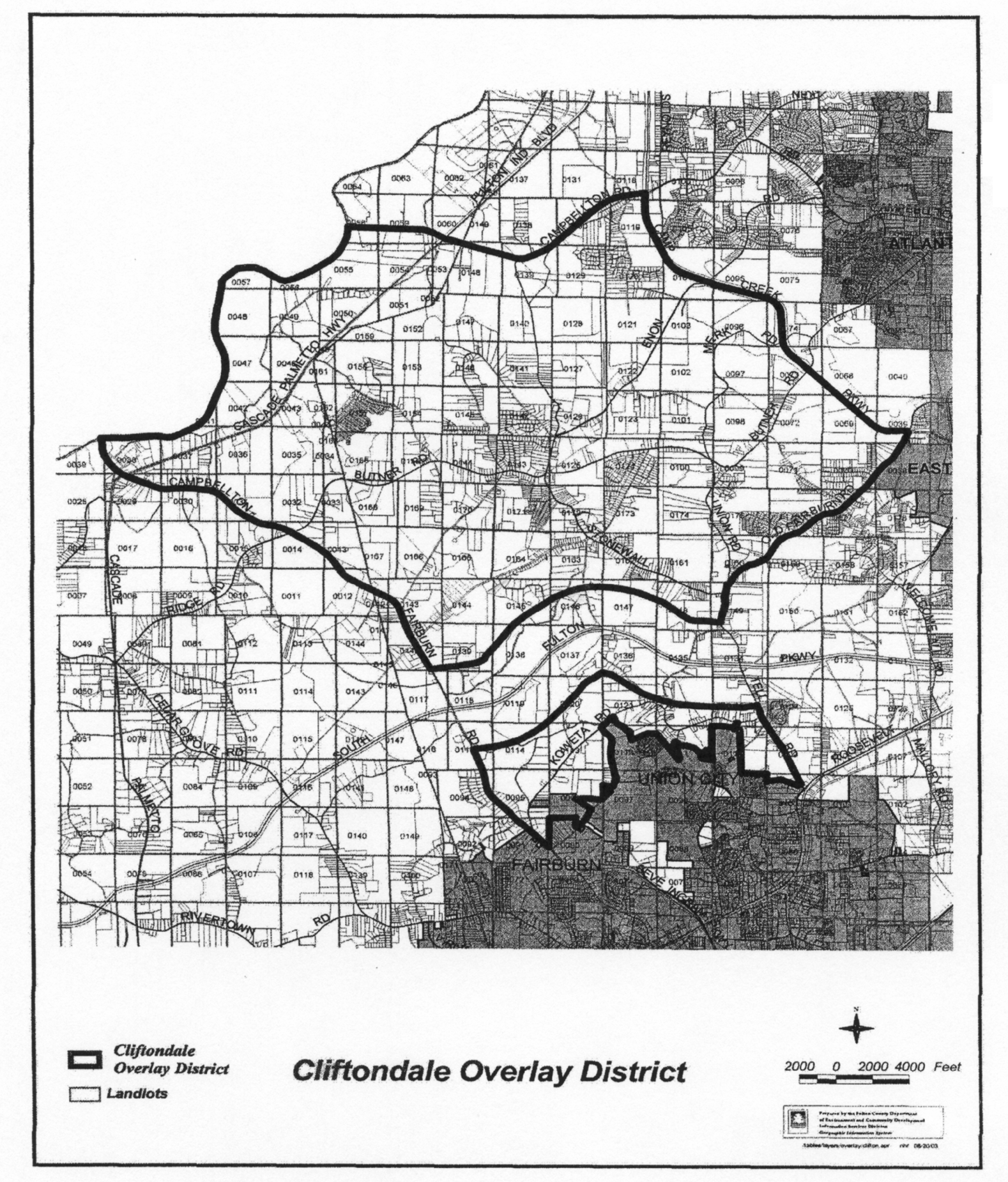
Cliftondale Overlay District
Whenever provisions of this Article conflict with any other Article in the Zoning Resolution of Fulton County or any other Fulton County ordinances, regulations, or resolutions, these standards shall prevail.
12L.3. - Architectural review process.
Prior to issuance of a building permit, the applicant shall submit details of exterior materials, colors, design and architectural features of the proposed building which demonstrate compliance with the design standards set forth in this ordinance.
Fulton County staff will review all applications for land disturbance permits, building permits and sign permits for compliance with the standards of this overlay district and upon determination of compliance will provide a Certificate of Endorsement (COE) in the form of signing the formally submitted plans and drawings.
Prior to the issuance of a building permit, the community will be allowed ten working days to review and comment. An application which otherwise conforms to applicable codes and regulations shall not be delayed issuance of a building permit for more than ten working days due to this review and comment process.
12L.4. - Development standards.
12L.4.A. Landscaping, Buffers and Street Trees.
1.
All AG-1 and residentially zoned developments shall provide a minimum 50-foot wide natural, undisturbed buffer with a ten-foot improvement setback along all public streets.
2.
All nonresidentially (except AG-1) zoned developments shall provide a minimum 50-foot wide landscape strip along all public streets.
3.
A minimum 50-foot wide natural, undisturbed buffer with a ten-foot improvement setback shall be provided along any interior property line adjacent to a residential zoning and/or use.
4.
A minimum 15-foot wide landscape strip shall be provided along any interior property line adjacent to a nonresidential zoning and/or use.
5.
Large, overstory trees shall be planted 40 to 60 feet on center and are allowed along residential and commercial streets.
6.
Small, understory trees shall be planted ten to 30 feet on center along residential streets.
7.
Street trees shall be a minimum of three inches caliper.
8.
Street trees shall be selected from Appendix E of the Fulton County Tree Preservation Ordinance and Administrative Guidelines or as may be approved by the Fulton County Arborist.
12L.4.B. Screening.
1.
Refuse areas and receptacles shall be placed in the least visible location from public streets and shall be enclosed on three sides with opaque walls. The 4th side shall be a self-closing gate made from noncombustible materials. Opaque walls shall be a minimum of 12 inches higher than the receptacle. Wall materials shall be noncombustible brick, stone, or split-faced concrete masonry block. Refuse receptacles shall not be placed within 50 feet of an existing residential or AG-1 (Agricultural) zoning district.
2.
Accessory site features are prohibited in the front yard of any property.
3.
Accessory site features located on the ground shall be screened from view from any public right-of-way, any residential use, or any residential or AG-1 zoning category by one of the following: placement behind the building, 100% opaque fencing, berm or vegetative screen planted to buffer standards.
4.
Accessory site features on a roof shall be screened by a parapet or other architectural feature or as approved by the director.
5.
Opaque fences are prohibited adjacent to public streets.
6.
Fencing materials along public streets and side yards, golf courses, play fields and other recreational areas are restricted to decorative stone, iron, wrought iron, treated wood, white picket, and/or minimum three-rail horse fencing with posts.
7.
When required, fencing material around detention/retention facilities shall be constructed in accordance with the Fulton County Subdivision Regulations or as approved by the Director. Vegetation shall be planted in accordance with Article 34 of the Fulton County Zoning Resolution.
8.
Retaining walls shall be faced with or constructed of stone, brick, or decorative concrete modular block only.
9.
All parking and loading areas shall be screened from public streets by either a minimum four-foot high berm and/or a continuous hedge of evergreen shrubs.
12L.4.C. Sidewalks/Pedestrian Paths.
1.
Sidewalks are required along all public and private road frontages (except alleys) and shall meet all applicable Americans with Disabilities Act (ADA) standards.
2.
Sidewalks and other paths (multi-purpose or pedestrian) shall be illustrated on the site plan submitted at the time of application for a Land Disturbance Permit.
3.
Meandering sidewalks are permissible upon approval by the director.
4.
Pedestrian paths shall be a minimum width of five feet.
5.
Pedestrian paths may be constructed of either colored/textured materials or conventional sidewalk materials and shall be clearly identified.
6.
Multi-use paths for bicycles and pedestrians may be substituted for the required sidewalks as approved by the director when the path is part of the Fulton County Bicycle and Pedestrian Plan.
7.
Multi-use paths designed for use by bicyclists and pedestrians shall be a minimum of 15 feet wide; five feet for the pedestrian sidewalk and ten feet for the bicyclists.
8.
Street furniture shall be located outside the specified width of any path.
9.
Paths shall be connected to signalized crosswalks where applicable.
10.
Paths shall be designed to minimize direct auto-pedestrian interaction.
11.
Paths should be direct and convenient routes between points of origin (such as a bus stop) and destination (such as a shop, bank, etc).
12.
Pedestrian access should be provided to all entrances including access from rear parking areas.
12L.4.D. Lighting.
1.
A lighting plan for open parking lots and pedestrian paths shall be submitted for approval prior to the issuance of a Land Disturbance Permit.
2.
Open parking lots and walkways providing access thereto shall be provided with a maintained minimum two foot candles (a measure of illumination) of light measured at grade level.
3.
The maximum to minimum foot candle level shall not exceed a twelve to one (12:1) ratio.
4.
Shoe box, cobra lighting fixtures and neon lighting are prohibited.
5.
Any luminaire with a lamp or lamps rated at a total of MORE than 1,800 lumens, and all flood or spot luminaires with a lamp or lamps rated at a total of MORE than 900 lumens, shall not emit any direct light above a horizontal plane through the lowest direct-light-emitting part of the luminaire.
6.
Any luminaire with a lamp or lamps rate at a total of MORE than 1,800 lumens, and all flood or spot luminaires with a lamp or lamps rated at a total of MORE than 900 lumens, shall be mounted at a height equal to or less than the value 3 + (D/3), where D is the distance in feet to the nearest property boundary. The maximum height of the luminaire may not exceed 25 feet.
7.
Any luminaire with a lamp or lamps rated at a total of 1800 lumens or LESS, and all flood or spot luminaires with a lamp or lamps rated at 900 lumens or LESS, may be used without restriction to light distribution or mounting height, except that if any spot of flood luminaire rated 900 lumens or LESS is aimed, directed, or focused such as to cause direct light from the luminaire to be directed toward residential buildings on adjacent or nearby land, or to create glare perceptible to persons operating motor vehicles on public ways, the luminaire shall be redirected or its light output controlled as necessary to eliminate such conditions.
8.
Luminaires used for public-roadway illumination may be installed at a maximum height of 25 feet and may be positioned at that height up to the edge of any bordering property.
9.
All temporary emergency lighting needed by the police or fire departments or other emergency services, as well as all vehicular luminaires, shall be exempt from the requirements of this article.
10.
All hazard warning luminaires required by Federal regulatory agencies are exempt from the requirements of this article, except that all luminaries used must be red and must be shown to be as close as possible to the Federally required minimum lumen output requirement for the specific task.
11.
Luminaires used primarily for sign illumination may be mounted at any height to a maximum of 25 feet, regardless of lumen rating.
12.
Top Mounted Fixtures Required: Lighting fixtures used to illuminate an outdoor advertising sign shall be mounted on the top of the sign structure. All such fixtures shall comply with the shielding requirements of Section 1.10.3(A). Bottom-mounted outdoor advertising-sign lighting shall not be used.
13.
Compliance Limit: Existing outdoor advertising structures shall be brought into conformance with this Code within ten years from the date of adoption of this provision.
14.
The use of laser source light or any similar high intensity light for outdoor advertising or entertainment, searchlights, permanent mounted exterior neon lights and back-lit awnings and roof mounted lights are prohibited.
12L.4.E. Building Design.
1.
Buildings shall include architecture elements such as columns, arcades, covered entry-walkways, arches, facade offsets, windows, balconies, offset walls, clock towers, cupolas and/or courtyards.
2.
All buildings shall be oriented to face a street or a courtyard.
3.
The principle entry area of a building shall be articulated and express greater architectural detail than other portions of the building.
4.
All primary entrances shall face the street or courtyard.
5.
All primary entrances which face a street shall be at street level.
6.
Buildings are limited to 35 feet in height.
7.
The exterior wall materials of all nonresidential buildings shall consist of a minimum of 60 percent (per vertical wall plane) of the following: brick, stone, or clapboard (or an equivalent alternative treatment approved by the Director of Environment and Community Development).
8.
The exterior wall materials of all residential buildings shall consist of a minimum of 60 percent (per vertical wall plane) of the following: brick, stone, stucco, solid plank, cementitious plank, or horizontal clapboard siding (or an equivalent alternative treatment approved by the Director of Environment and Community Development).
9.
Any nonresidential building facade shall have a minimum of 25 percent fenestration or as may be approved by the director. Black glass and/or tinted glass is prohibited.
10.
Accent wall materials on residential and nonresidential buildings shall consist of glass, architecturally treated concrete masonry, precast stone, or stucco (or an equivalent alternative treatment approved by the Director of Environment and Community Development) and shall not exceed 40 percent per vertical wall plane.
11.
To the extent any rear or side of any building is visible from any public street or single family residence, architectural treatment shall continue through the rear or side.
12.
Exterior finishes for accessory structures shall be consistent with the principle structure.
13.
Permitted colors for exterior walls, building components, sign structures, accent and decorative elements shall be a specified by Table 12L or as approved by the director.
Table 12L
Allowable Accent/Trim Colors for the Cliftondale Overlay District
(Reference Pantone Color Formula Guide)
14.
Fuel pumps, canopies and associated gasoline station service areas should be located at the rear of the structure, not between the building and the street, to allow the building to be the spatial edge of the streetscape.
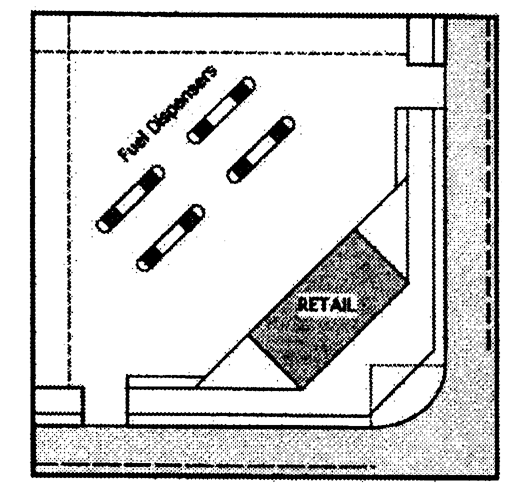
Spatial edge of streetscape
15.
For large commercial/retail buildings, variations in facade, roofline and depth should be provided to lend the appearance of multi-tenant occupancy.
16.
All building plans submitted as an application for a building permit should clearly indicate all of the proposed building materials and colors for each facade as described herein. The plans should clearly show the location and calculate the amount/percentages of all building materials per facade.
12L.4.F. Roofs.
1.
Allowable roof materials for pitched roofs are asphalt shingles, composition shingles, wood shingles, wood shake, slate, terra cotta or as may be approved by the Director.
2.
Roof colors shall be black, gray, brown, or green. Reflective and metallic colors are prohibited.
3.
Permissible roofs are gable, pyramidal, and hip. Shed roofs are permitted over porches, additions, and accessory structures. Roof pitches shall be 5/12 to 12/12.
4.
Roof mounted flagpoles are prohibited.
12L.4.G. Parking.
1.
Off-street parking shall be located to the rear or side of the building.
2.
Parallel and angle-in on-street parking is allowed subject to the approval of the Director.
3.
For commercial and multi-family uses only, no more than 50 percent of the required parking spaces shall be located in the front and side of a building.
4.
Shared parking within a multi-tenant development is required and shall be in accordance with the provisions of Article 18 of the Zoning Resolution.
5.
No parking or loading area shall be used for the sale, repair, dismantling or servicing or storing of any vehicle, equipment, materials or supplies.
6.
Bicycle parking areas shall be provided for each nonresidential development.
12L.4.H. Miscellaneous Provisions.
1.
Utilities shall be installed underground.
2.
Retention/detention shall comply with the requirements of the Fulton County Subdivision Regulations.
3.
Stealth design is required for all cell towers.
4.
Height of cell towers shall not exceed 199 feet.
5.
Wireless communications facilities shall be disassembled and removed from the site within 90 days of the date its use for wireless telecommunications is discontinued.
6.
Vending machines, paper stands, and other similar devices must be located inside a building.
(Amd. No. 11-0478, 6-1-11)
12L.5. - Signs.
1.
The architectural color standards shall apply to the sign structure and not the sign face.
2.
Sign structures and faces constructed of wood or canvas materials are prohibited.
3.
Window signs are prohibited.
(Res. No. 08-0493, 6-4-08)
12L.6. - Severability.
In the event that any section, subsection, sentence, clause or phrase of this Article shall be declared or adjudged invalid or unconstitutional, such adjudication shall in no manner affect the other sections, subsections, sentences, clauses or phrases of this Article, which shall remain in full force and effect, as if the section, subsection, sentence, clause, or phrase so declared or adjudged invalid or unconstitutional were not originally a part thereof.
12L.7. - Appeals.
Any persons aggrieved by a final decision of the Department of Environment and Community Development relating to this article may appeal such final decision to the Board of Zoning Appeals by filing in writing setting forth plainly, fully and distinctly why the final decision is contrary to law per the Fulton County Zoning Resolution. Such appeal shall be filed within 30 days after the final decision of the department is rendered.
12L.8. - Adoption and effective date.
NOW, THEREFORE BE IT RESOLVED, the Fulton County Board of Commissioners does hereby ordain, resolve and enact the foregoing Article XII-L to the Zoning Resolution of Fulton County, Georgia.

