
Galveston City Zoning Code
ARTICLE 9
- LANDSCAPING
SEC. 9.101 - PURPOSE
A.
Generally. The requirements and standards set out in this Article are minimum standards and are intended to:
1.
Protect and preserve the appearance and character of the community in accordance with the City of Galveston 2011 Comprehensive Plan and any adopted neighborhood or special area plans;
2.
Increase the compatibility of adjacent uses;
3.
Mitigate the effects of noise, dust, debris, artificial light intrusions, and other externalities created by the use of land;
4.
Promote the preservation of its healthy mature tree canopy; and
5.
Conserve water and promote the long-term viability of development landscaping by promoting the planting and maintenance of native Texas tree species and other types that are salt- and drought-resistant and resilient in a coastal environment.
(Ord. No. 18-037, § 2, 6-21-18)
SEC. 9.102 - APPLICABILITY
A.
Applicability. Unless otherwise indicated in this Article, this Article applies in the municipal boundaries to all new development, redevelopment, or as defined by Article 11.301, Non-Conformity. This Article also applies to existing trees and landscaping where specifically indicated.
B.
Supplemental Standards. Additional landscaping requirements may apply to properties located within overlay zones or other designated areas as provided in Article 10, Historic, NCD, HDDZ.
C.
Exceptions. The application of the requirements and standards in this Article shall be excepted in the following instances:
1.
When the City is enforcing watering restrictions, the installation of new or replacement of previously installed landscaping shall not be required until the expiration of watering restrictions.
2.
Following the declaration of a natural disaster event in the City, the Development Services Director may waive the requirements in this Article for installation of new landscaping for up to twelve months in the area(s) of the declared disaster.
(Ord. No. 18-037, § 2, 6-21-18)
SEC. 9.201 - GENERAL REQUIREMENTS
A.
Generally. Landscaping shall consist of a combination of such material as grasses, ground covers, shrubs, vines, hedges, trees or palms.
B.
Visibility Clearance. Vegetation and related on-site improvements installed to comply with the requirements of this Article shall also conform to the requirements of Section 34-6, Intersection Visibility, in the City Code of Ordinances.
C.
Planting within City Right-of-Ways. In addition to the requirements of this Article, installation of landscaping within the City's right-of-ways shall meet the standards of Section 32-5(e)(2) in the City Code of Ordinances and any other applicable Department of Public Works standards to protect underground and overhead utilities, street/sidewalk and drainage improvements, street lighting, and be sized to maximize reduction, through shading, of the heat island effect.
D.
Appropriateness and Quality of Plantings. All plantings shall involve species included on a City approved plant list and also comply with the following standards:
1.
Undesirable Species. No proposed landscape material shall appear on the Invasive and Noxious Weeds list for the State of Texas promulgated by the United States Department of Agriculture or on the Texas Noxious and Invasive Plants list promulgated by the Texas Department of Agriculture.
2.
Viable Material. All plant material to be installed shall have a habit of growth that is normal for the species and, when planted, shall be of sound health, vigorous growth, and free from insect pests, diseases, and injuries.
3.
Required Planting of Locally Appropriate Species. At least 50 percent of the proposed plantings of shrubs, hedges, and trees shall be native Texas species and other types that are salt- and drought-resistant and resilient in a coastal environment.
(Ord. No. 18-037, § 2, 6-21-18)
SEC. 9.301 - PARKING LOT LANDSCAPING
A.
Applicability. The provisions of this Section shall apply to parking lot areas providing unenclosed, off-street parking, and loading spaces for 10 or more vehicles for residential uses; two or more vehicles for nonresidential uses and mixed-use developments; and for all vehicle washes, fueling stations, and all drive-in or drive-through establishments.
1.
Excluded Areas. All parking or loading areas (not including Parking Lots, Commercial Surface Parking Areas) located within Light Industrial (LI) or Heavy Industrial (HI) Districts, which are not, in whole or in part, within 600 feet of the rights-of-way of Seawolf Parkway, Broadway Boulevard, Harborside Drive, or FM 3005 or within 300 feet of the property line of a residential use, a mixed-use development that includes residential use, or a residential zoning district boundary, measured as a radius from such a parking or loading area, shall not be required to install interior parking lot landscaping.
B.
Rights-of-Way Screening. Visual screening, adequate to screen parked vehicles, shall be provided between any parking or loading areas and any street rights-of-way abutting the site. Rights-of-way screening shall consist of:
1.
Minimum width. 4 feet.
2.
Required Elements. Shrubs, hedges and trees. See Table 9.302 for size and spacing requirements.
3.
Fence location. Any fencing shall be installed on the interior edge of the rights-of-way screening.
4.
Planter Boxes. The use of planter boxes shall constitute compliance with the Article only in cases of the provision of rights-of-way screening for existing parking lots.
C.
Interior Landscaping. The following interior landscaping is required for all parking lots with 10,000 square feet or more of surface area, and commercial surface parking lots not incidental to main use, irrespective of size:
1.
Landscape Islands. Interior parking lot landscaping shall be designed so that no parking space is located more than five spaces away from a landscape island that consists of:
a.
Minimum width: 8 feet.
b.
Minimum square footage: 200 square feet at a depth of 3 feet = 600 cubic feet.
c.
Required Elements: Permeable surface of ground cover or grasses and minimum of one tree in accordance with SEC 9.201.
2.
Parking "Rooms." Any parking lot with more than 50 spaces shall be designed to create parking "rooms" separated by a landscaped median that consists of:
a.
Minimum width: 8 feet
b.
Minimum spaces per room: 10 spaces
c.
Required Elements: Permeable surface of ground cover or grasses and trees. See Table 9.302 for size and spacing requirements.
3.
Exemptions. Display areas for vehicles being offered for sale within passenger motor vehicle sales lots are exempt from the interior landscaping requirements denoted in this Section.
D.
Visual Screening from Residential Uses or Districts. When any non-residential lot, tract, or parcel of land is located adjacent to an area used or zoned for residential purposes, visual screening shall be installed and maintained between the parking or loading areas and driveways, and the residential use or zoning district. The visual screening landscape strip shall consist of:
1.
Visual Screening Landscape Strip.
a.
Minimum width: 4 feet.
b.
Required Elements: Solid fencing or hedges with a minimum fence height of 5 feet with hedges reaching the same height and providing a year-round visual obstruction within two years of planting.
E.
Protection of Landscaping Areas. All landscaping areas shall be protected from vehicular encroachment by the use of curbing or wheel stops.
1.
Alternative Design for Drainage. Curb lines may be interrupted to allow for storm water flows into biological treatment areas pursuant to an approved drainage plan, provided that the curb openings do not interfere with the curb's protective function.
(Ord. No. 18-037, § 2, 6-21-18; Ord. No. 25-033, § 3, 7-24-25)
SEC. 9.302 - PLANTING STANDARDS
A.
Planting Standards. All plantings in satisfaction of this Article shall comply with the standards in Table 9.302, Planting Standards, and with the requirements of Section 9.403, Continuing Care, Maintenance and Nonconforming Landscapes.
(Ord. No. 18-037, § 2, 6-21-18)
SEC. 9.303 - CREDITS
A.
Rights-of-Way Landscaping: With approval of the Director of Public Works, landscaping that satisfies the rights-of-way screening requirement for parking areas may be installed in the rights-of-way. Up to 50 percent of the minimum landscaping area requirement shall be allowed within the right-of-way. However, for planting to occur in the right-of-way, the portion of rights-of-way outside the paved street shall be at least 10 feet wide and provide a sidewalk with a minimum width of 5 feet. The Director of Public Works must determine that the condition of the existing sidewalk is acceptable. If determined to be unacceptable, the sidewalk must be repaired prior to the installation of landscaping.
B.
Mature Tree Preservation. Healthy, mature trees that are preserved on-site shall count as more than one tree for the purposes of landscaping requirements, as set out in Table 9.303, Mature Tree Preservation Standards.
1.
Quality of Existing Trees. Existing mature trees that may qualify for protection and generate landscaping credit shall:
a.
Appear on the City approved plant list; or
b.
Be established for at least five years; and
c.
Not be:
i.
Over mature;
ii.
Diseased;
iii.
Poor in form; or
iv.
Unstable or leaning significantly.
2.
Certification of Requirements. The requirements of Section 9.303.B and Table 9.303 shall be certified by an International Society of Arboriculture certified Arborist or degreed Forester.
C.
Transplanting Existing Mature Trees. Credit shall be given for mature trees that are transplanted from one part of the parcel proposed for development to another if:
1.
The trees are transplanted according to the American National Standards Institute (ANSI) standard for tree planting, ANSI A300 Part 6.
2.
A surety bond is provided that will ensure replacement of the transplanted tree with the number of new trees for which credit was given according to Table 9.303. The surety bond shall be effective for a period of two years from the date the tree is installed in its new location.
3.
The tree preservation credit is applied toward the requirements for the area of the parcel proposed for development in which the existing tree is planted. If there are no requirements for that area, the credit shall apply first to other areas of the parcel, and then to parking lot landscaping requirements, as applicable.
(Ord. No. 18-037, § 2, 6-21-18)
SEC. 9.304 - TREE PROTECTION DURING CONSTRUCTION
A.
Generally. Existing trees that qualify to generate credit against landscaping requirements, as provided in this Article, shall be protected during on-site development and construction activities according to the requirements of this Section.
B.
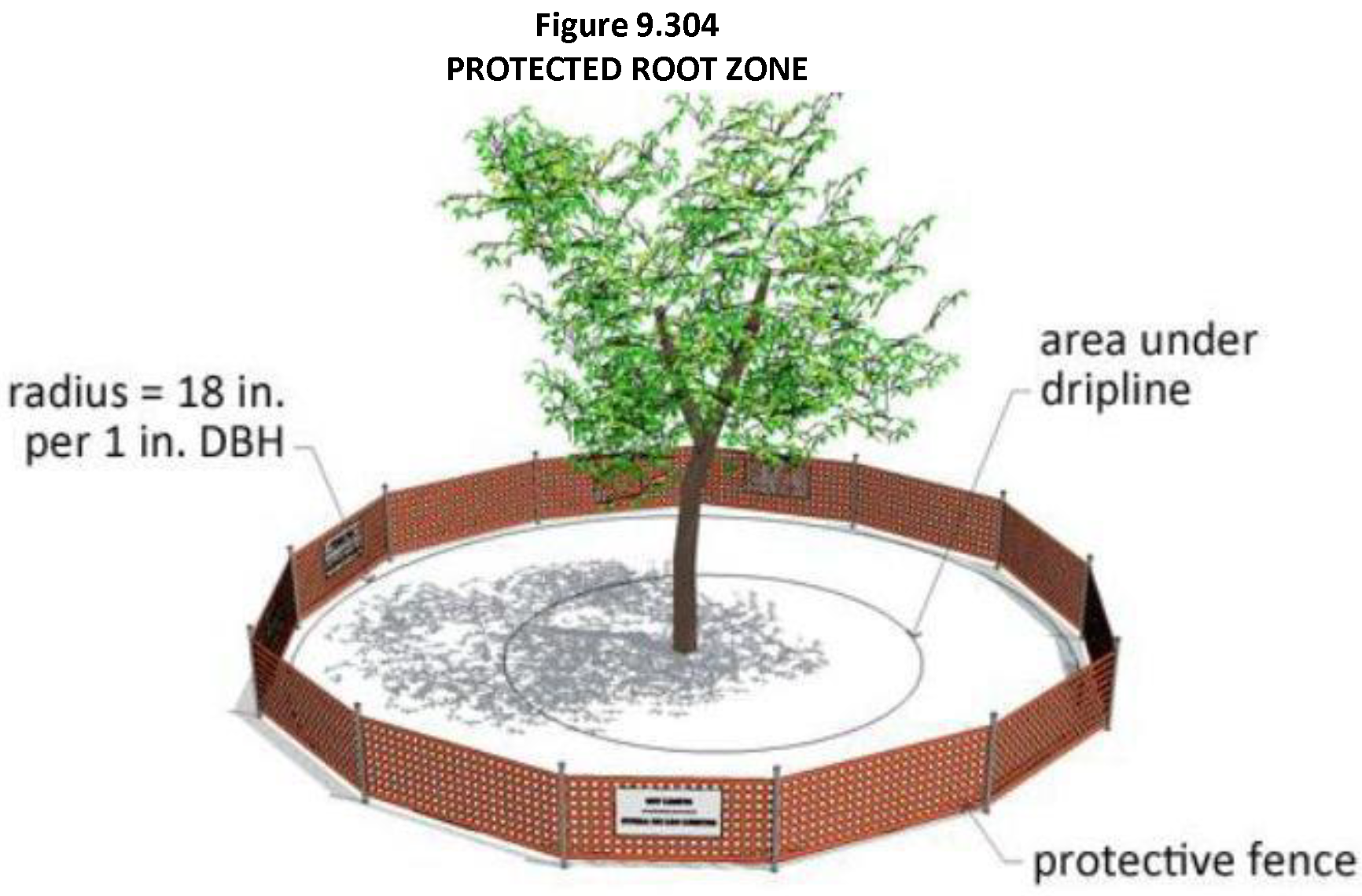
Identification of Protected Root Zone. The protected root zone is the larger of:
1.
The area under the drip line of the tree; or
2.
A radius that extends from the center of the trunk 18 inches per each 1 inch of diameter at breast height (DBH) of the protected tree. See Figure 9.304, Protected Root Zone.
C.
Restrictions within Protected Root Zone.
1.
Each protected root zone shall be barricaded during construction to prevent damage to the tree and its roots by construction equipment or soil compaction. The barricades shall be posted "Off Limits/Fuera de los Límites." A contiguous fenced area may enclose multiple protected root zones.
2.
No cutting, filling, or storage of building materials or debris or disposal of wastes shall take place within a protected root zone.
3.
No impervious paving shall be placed within a protected root zone.
D.
Tree Care during Construction. Protected trees shall be cared for regularly during construction as follows:
1.
Regular watering if rainfall is inadequate;
2.
Pruning of branches that are dead, diseased, hazardous or detrimental to natural form; and
3.
Fertilizing if nutrient stress is apparent.
(Ord. No. 18-037, § 2, 6-21-18)
SEC. 9.401 - LANDSCAPE APPROVAL
A.
Generally. The proposed landscape installation plan shall be submitted with the building permit application.
1.
Parking Area Improvements. All proposed parking area improvements, including resurfacing and restriping, shall be reviewed by the Development Services Director or designee to confirm if any applicable requirements of this Article will be satisfied and so that a certificate of zoning compliance may be issued to the applicant.
B.
Landscape Detail. The proposed landscape installation shall address the elements set out in this Section that are applicable to the type of development approval sought or the conditions of the site. The Development Services Director may specify additional information as needed to verify compliance with these regulations. The Development Services Director may also specify that certain information items are not relevant or necessary for a particular case.
1.
Minimum Required Landscape Detail. Shall include a plan view drawing prepared at a standard scale that ensures clarity of the proposal which shall indicate:
a.
Dimensions and surface area for each planting area including parking lot landscaping areas;
b.
The location and quantity of trees and shrubs to be installed which shall be drawn at three-fourths of mature size and annotated with genus, species, common name, salt and drought tolerance and size at planting;
c.
The location, quality, caliper, and protected root zone of trees that are to be preserved on the site;
d.
The location and extent of areas of groundcover; the groundcovers, turf, seed or inorganic materials to be installed or planted; and the type of underlayment proposed to be used, if any; and
e.
Dimensions and locations of sight distance triangles.
(Ord. No. 18-037, § 2, 6-21-18)
SEC. 9.402 - INSTALLATION
A.
Installation. The owner, tenant, and agent, if any, shall be jointly and severally responsible for installing landscaping according to accepted commercial planting procedures with the quality of plant materials as hereinafter described. All elements of landscaping shall be installed to meet all applicable ordinances and code requirements of the City.
B.
Time Extension. A time extension of up to six months from the date of the certificate of occupancy shall be available for the installation of landscaping required by this Article. In such cases, a temporary certificate of occupancy shall be issued and the applicant shall provide a letter of credit, with a minimum two-year duration, in the amount of 150 percent of the bid for installation of all required landscaping. Failure to complete the installation within the time extension granted shall result in cashing of the letter of credit and shall also constitute a violation of these regulations. The funds from the letter of credit will be deposited in an account dedicated to landscaping and trees for the Parks and Recreation Department.
1.
Phased Development. Installation of landscaping with each phase of a multi-phase development shall be permitted provided that all landscaping required for each phase is installed concurrently with each phase, subject to potential time extensions granted under subsection 9.402.B, above. The City Attorney may require execution of a development agreement with the City to clarify phasing plans and timing, and to provide surety.
(Ord. No. 18-037, § 2, 6-21-18)
SEC. 9.403 - CONTINUING CARE, MAINTENANCE AND NONCONFORMING LANDSCAPING
A.
Maintenance Responsibility. The owner of the lot or parcel, any tenant, or the manager or agent which may be a mandatory property owners' association if such is provided in the association's governing documents, shall be jointly and severally responsible for the maintenance of all landscape areas including abutting landscaped portions of public street right-of-ways, in compliance with all applicable ordinances and as approved at the time of the issuance of the certificate of occupancy, to maintain them in a healthy, growing, neat, and orderly condition at all times.
B.
Maintenance Standards.
1.
All landscape areas shall be kept free from refuse and debris.
2.
All landscape areas shall be watered as needed to ensure continuous healthy growth and development.
3.
Landscape areas including landscaped portions of abutting public right-of-ways shall be pruned as needed to present a healthy, neat, and orderly appearance at all times. Topping, lion tailing, tipping, bark ripping, flush cutting, and stub cutting are prohibited for trees that are installed and maintained within a public street rights-of-way or were planted or preserved on private property pursuant to an approved landscape plan.
4.
Maintenance shall include the removal and replacement of dead, dying, or diseased plant material.
C.
Replacement. Replacement of required landscaping that is dead or otherwise no longer meets the standards of this Article shall occur following notification by the City. A planting plan and schedule shall be submitted within 45 days from the notification by the City. Failure to replace according to the approved planting plan and schedule shall constitute a violation of these regulations.
D.
Utility Effects. Nothing in this Section shall require any application or permit from any public utility provider, or any City permit to such provider, prior to removing a tree whenever the utility provider has determined the tree poses a hazard or interferes with restoration or continuation of utility services.
E.
Nonconforming Landscaping
1.
Nonconforming Parking or Loading Areas. Any parking or loading area that does not conform with the landscaping requirements of Article 9, Landscaping, shall be made to conform upon:
a.
New construction involving 100 percent structural construction if the subject parcel had no existing buildings at the effective date of these regulations;
b.
Tear-down and 100 percent reconstruction of a building on the subject parcel;
c.
Improvements, the cost of which are greater than 33 percent of the market value of the property; or
d.
For commercial complexes that provide more than 75 parking spaces to serve the overall development, improvements, the cost of which equals or exceeds 10 percent of the market value of the land on the current tax role. All improvements shall be cumulative within a 24-month timeframe. For commercial complexes that consist of multiple parcels, the required landscaping shall be installed on all parcels.
(Ord. No. 18-037, § 2, 6-21-18)
SEC. 9.501 - PROTECTION OF EXISTING SIGNIFICANT TREES
A.
Generally. Sites shall be designed to preserve existing trees and tree stands that are considered "significant" as provided in this Section. Although not included in this Section, small trees provide benefits to the community as well. Species such as Yaupon, Possumhaw, Flameleaf Sumac, Wax Myrtle, and Redbud are native to the Island and Texas and highly adapted to the coastal environment. Small trees such as these with a 3 inch diameter at breast height (DBH) of the largest stem are encouraged to be preserved and are eligible for planting credits in Table 9.303, Mature Tree Preservation Standards.
For the purposes of this Division:
1.
A significant tree has a diameter at breast height (DBH) of 10 inches or greater; and
2.
A significant tree stand is a group of trees with interconnected canopies that cover a total of at least 10,000 square feet of ground area.
B.
Removal of Significant Trees and Stands of Trees. The City Manager or City Arborist, if applicable, may approve the removal of a significant tree or tree stand if it is demonstrated that:
1.
No reasonable alternative site design at the same development intensity could be approved that:
a.
Would preserve the tree(s);
b.
If large-scale preservation is not possible, would preserve the largest of the trees; or
c.
If protection of the largest tree(s) is not possible, would preserve a greater number of trees than the proposed development design.
2.
It is located within 10 feet of an approved building footprint of new construction or addition;
3.
It is located within 6 feet of a utility easement and would interfere with the use of the easement as determined by the City Engineer;
4.
It is located within 8 feet of an approved outdoor recreation area that by its nature requires the removal of the trees, such as ball fields;
5.
It is ordered removed by the City Manager for other emergency reasons;
6.
It is being grown and removed for agricultural purposes; or
7.
It is certified to the City by an International Society of Arboriculture Certified Arborist or degreed Forester as having one or more of the following conditions:
a.
Unhealthy or structurally unsound;
b.
Damaged by natural causes beyond the point of recovery;
c.
Diseased beyond the point of recovery;
d.
Poses a threat to the public and must be removed as a safety measure; or
e.
No longer living.
C.
Removal of Tree Stands. Tree stands may be located across multiple parcels. In the event of an approved removal of a portion of a tree stand, the owner is encouraged to coordinate with adjacent property owners in order to reduce negative effects to the overall tree stand.
D.
Exempted Trees. Trees of any size that appear on the Invasive and Noxious Weeds list for the State of Texas promulgated by the United States Department of Agriculture or on the Texas Noxious and Invasive Plants list promulgated by the Texas Department of Agriculture are exempted from this Section and may be removed. Identification by an International Society of Arboriculture Certified Arborist and/or degreed Forester is recommended.
E.
Permit Required. A permit shall be obtained by the property owner prior to authorizing or subjecting a significant tree to removal.
(Ord. No. 18-037, § 2, 6-21-18; Ord. No. 18-047, § 2(Att. B), 7-26-18; Ord. No. 20-015, § 2, 2-27-20)
SEC. 9.502 - TREE REPLACEMENT
A.
Generally. The removal of significant trees or tree stands must be mitigated. All requests for the removal of significant trees or tree stands shall be accompanied by a tree mitigation plan. Mitigation shall be achieved by the planting of the same number of caliper inches removed, payment to the tree mitigation fund, or combination thereof.
B.
Tree Replacement Required. Significant trees or tree stands that are approved for removal shall be replaced based on one caliper inch of tree planted for one caliper inch of tree removed. All replacement shall occur on the property on which the removal occurred. All new tree species shall be from among tree species on a City approved plant list.
Trees planted as a requirement of this Section shall be inspected by the City Arborist, if applicable, for viability two years after planting. If the replacement trees are found to be dead or dying, they must be replaced following notification by the City. A planting plan and schedule shall be submitted within 45 days from the notification by the City. Failure to replace according to the approved planting plan and schedule shall constitute a violation of these regulations. The tree replacement chart, below, shall be used to determine the total number and size of trees that shall be planted as replacement trees for all trees permitted to be removed. The replacement trees are based on the diameter in inches (DBH) of the trees to be removed. To determine the required replacement trees, calculate the total sum in inches of the diameters of all trees to be removed. This sum will result in one (1) single number in inches that represents the combined total of the diameters of all trees to be removed. Diameter measurement shall be rounded up to the nearest inch.
Up to 30 percent of the two-inch DBH replacement tree requirement may be met by native species with a minimum height of eight feet and a minimum DBH of one inch at time of planting.
C.
Tree Mitigation Fund. In lieu of the tree replacement requirements, mitigation may be achieved through the contribution to an account dedicated to landscaping and trees for the City. The mitigation amount shall be established by the City Council as part of the annual budget process:
1.
$125.00 per caliper inch of tree removed for 10 inch DBH to 12 inch DBH caliper trees.
2.
$200.00 per caliper inch of tree removed for over 12 inch DBH caliper trees.
D.
Combination. Mitigation may be achieved through a combination of tree replacement and payment to the tree mitigation fund provided that the total of caliper inches approved for removal are mitigated.
E.
Exempted Trees. Trees that are being grown and removed for agricultural purposes; or trees that are certified to the City by an International Society of Arboriculture Certified Arborist or degreed Forester as having one or more of the following conditions are exempted from the tree replacement requirements of this section:
a.
Unhealthy or structurally unsound;
b.
Damaged by natural causes beyond the point of recovery;
c.
Diseased beyond the point of recovery;
d.
Poses a threat to the public and must be removed as a safety measure; or
e.
No longer living.
(Ord. No. 18-037, § 2, 6-21-18; Ord. No. 18-047, § 2(Att. B), 7-26-18)
SEC. 9.503 - OFFENSE
A.
It is a violation of this section to perform activities that may result in the decline in health and/or death of a significant tree, including but not limited to pruning of large limbs, tree topping, destruction of bark; leading to scarring on trunk, and/or detrimental activities (such as construction and/or soil compaction) within the critical root zone.
(Ord. No. 20-015, § 2, 2-27-20)

