
Gardendale City Zoning Code
ARTICLE X
- SIGN REGULATIONS
Sec. 111-310.- Purpose and intent.
The purpose of this article is to encourage the effective use of signs as a means of communication in the city; to lessen the hazards to pedestrians and vehicular traffic; to promote the economic viability of the business community while protecting the city and its citizens from a proliferation of signs of a type, size, location and character that would adversely impact the aesthetics of the community and threaten the health, safety and welfare of the community; and to enable the fair and consistent enforcement of this article.
(Ord. No. 2013-02, § 10.1, 3-4-2013)
Sec. 111-311. - Definitions applicable to this sign ordinance.
The following words, terms and phrases, when used in this article, shall have the meanings ascribed to them in this section, except where the context clearly indicates a different meaning:
Abandoned sign means a sign that no longer correctly directs or exhorts any person, advertises a bona fide business, tenant, owner, activity conducted or product available on the premises where the sign is displayed.
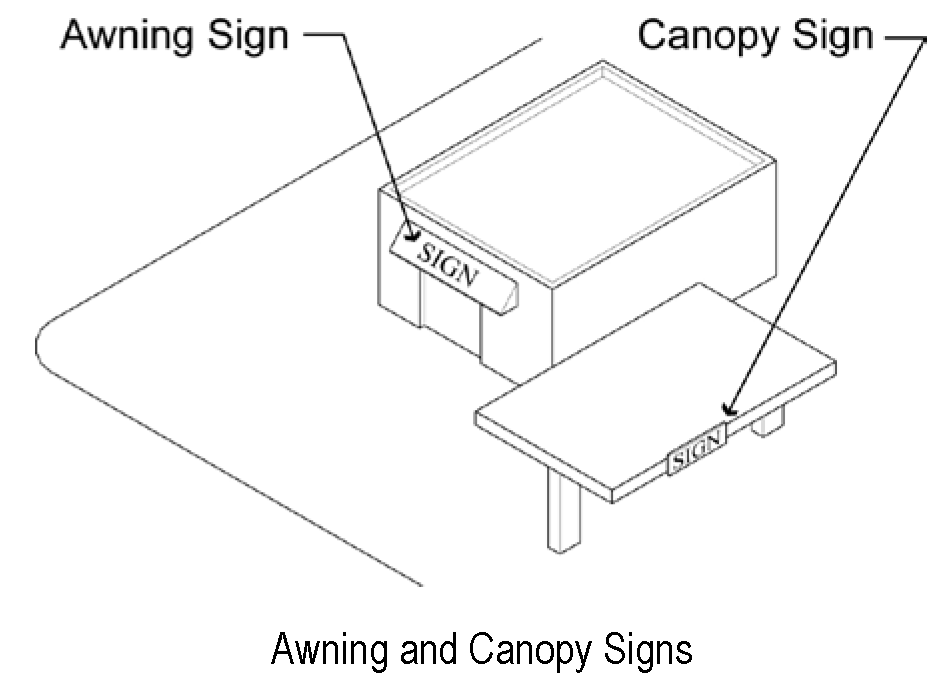
Awning sign means a sign painted on, affixed to, or attached to an awning.
Banner means a temporary sign of light-weight fabric or vinyl or similar material mounted to a pole or a building. National flags, state and municipal flags or the official flag of any institution or business are not considered banners. (See also Temporary sign, window sign.)
Canopy means a multisided overhead structure or architectural projection that is:
(1)
Supported by attachments to a building on one or more sides and either cantilevered from such building or supported by columns at additional points; or
(2)
Supported by columns, but not attached to or enclosed by walls.
Canopy sign means a sign painted on, affixed to, or attached to a canopy.
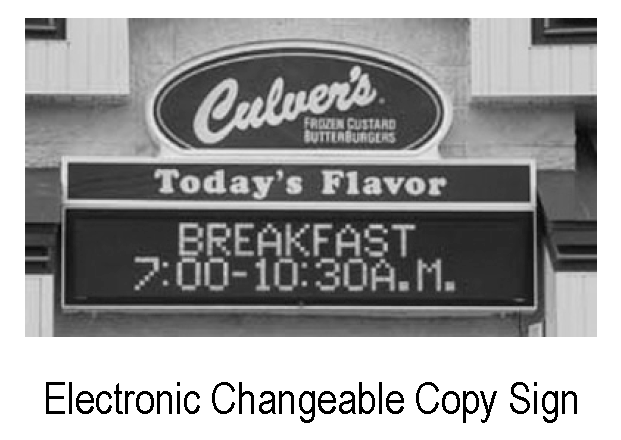
Changeable copy sign, electronic, means a sign designed so that characters, letters or illustrations can be electronically changed or re-arranged. Electronic signage includes, but is not limited to, light emitting diode (LED) and liquid crystal display (LCD) technology.
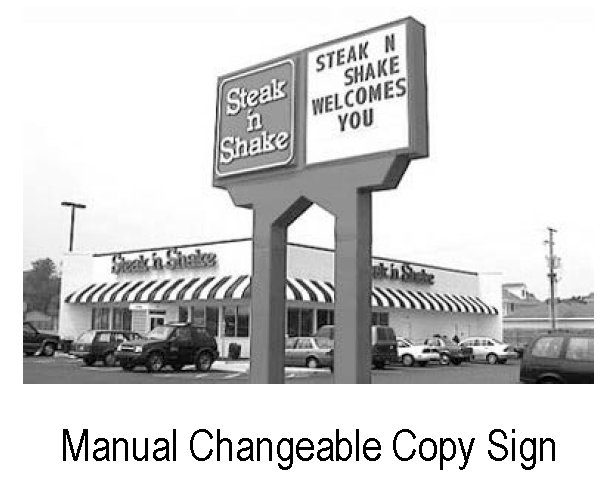
Changeable copy sign, manual, means a sign designed so that characters, letters or illustrations can be manually changed or re-arranged without permanently altering the sign.
Commercial message means words, symbols, logos, pictures, or any combination thereof, that identify or direct attention to a business, commodity, service or entertainment sold or offered for sale or a fee.
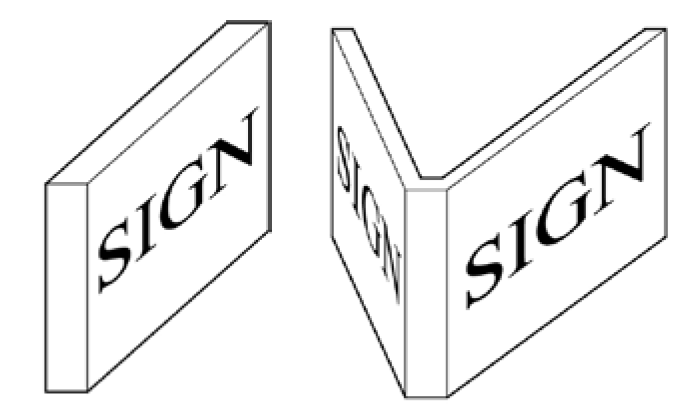
Double-faced sign means a sign constructed to display its message on the outer surfaces of two opposite planes. When only one face may be viewed from any vantage point along the street, the area of one side (the larger, if applicable) is counted toward allowable sign area. If both faces may be viewed from the same vantage point, the area of both sides is counted.
Erect means to build, construct, attach, hang, place, mount, suspend or affix, including the painting of wall signs upon the exterior of buildings or structures.
Facade means all wall/window area of that building elevation facing a public street. Where a building contains multiple tenant spaces, each with individual entrances and wall/window area along the building facade, such as in a shopping center, the facade area for each use is calculated based on the width of each tenant space along the building front.
Flashing sign means a sign, the illumination of which is not kept constant in intensity at all times when in use, and which exhibits marked changes in lighting effects. This includes signs containing animated, blinking, flashing, intermittent, traveling, and fluctuating lights, or which may utilize light emitting diode (LED) technology or liquid crystal display (LCD), plasma, video or similar display, including arrangements that spell messages, simulate motion or form various symbols or images. However, a sign that changes its message no more frequently than one time per eight seconds is considered an electronic changeable copy sign not a flashing sign.
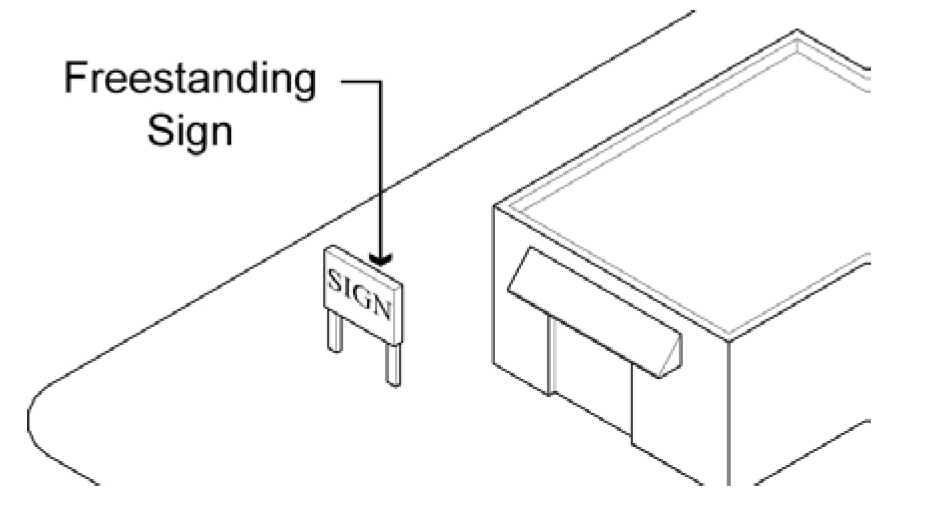
Freestanding sign means a sign supported by structures or supports that are placed on or anchored in the ground and that are independent from any building or other structure.
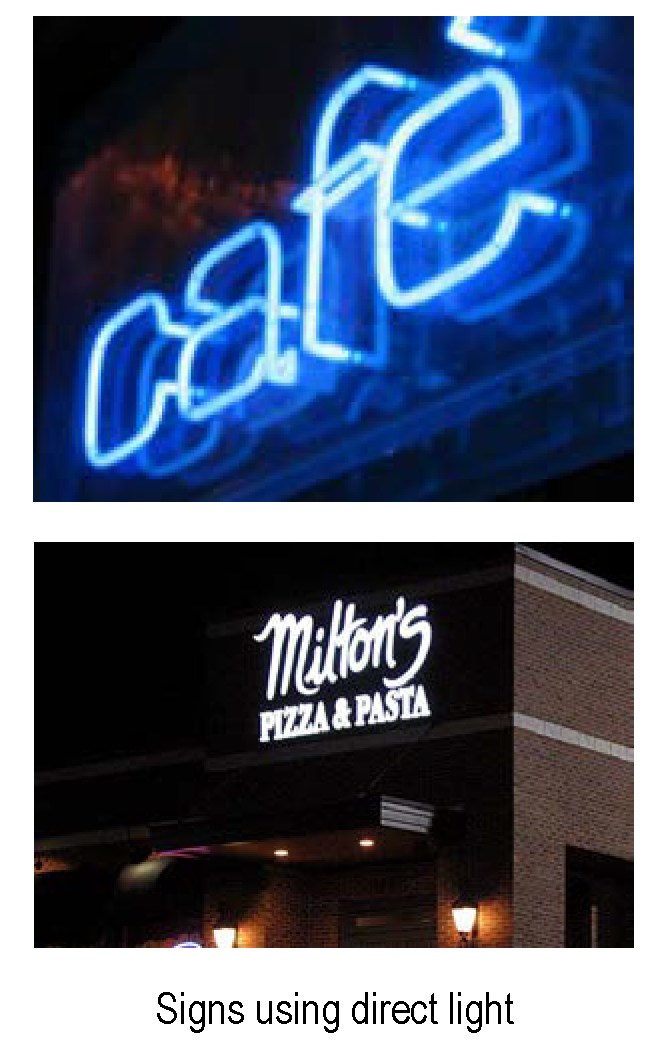
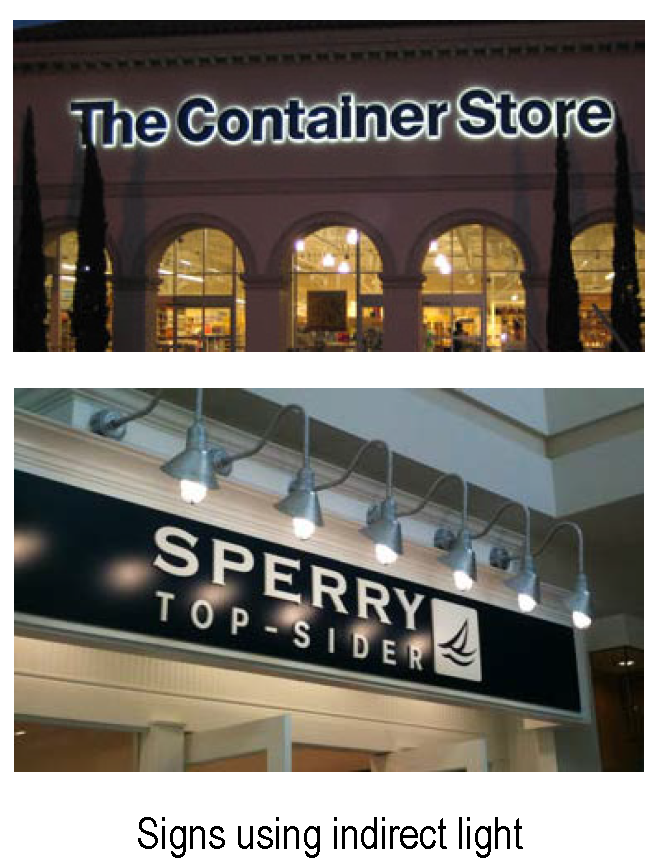
Illuminated sign means a sign lighted by or exposed to artificial lighting either by lights on or inside the sign face or directed toward the sign, including the following types of illumination:
Direct light means one emitting light from a source within or affixed to the sign face and beaming outward from it.
Indirect light means one reflecting light from a separate outside source aimed toward it, including silhouettes on a background or reflected light.
Intermittent light. See Flashing sign.
Incidental sign means a noncommercial sign, other than an official sign, providing information or direction for the convenience and necessity of the public.
Integrated business center means a group of commercial or industrial establishments on one or more parcels of land having shared access and/or shared parking.
Legible means able to be read and/or understood from a public right-of-way or from adjacent property by a viewer with the eyesight required for receipt of a state driver's license, including wearing any corrective lenses required by such license.
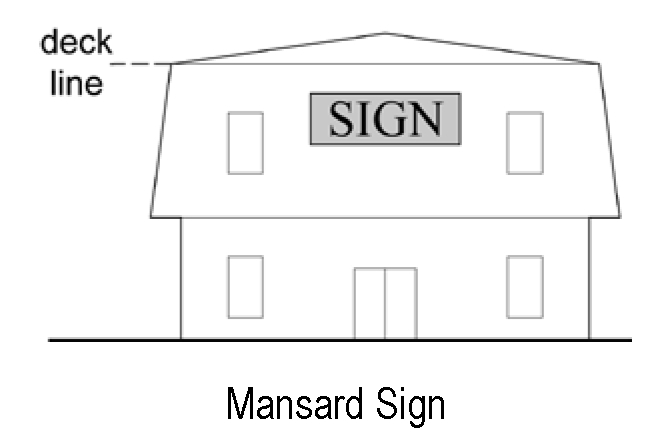
Mansard sign means a sign integrated into a portion of a mansard roof or a mansard roof-like structure at the top of a wall and that does not extend above the deck line. For the purposes of these regulations, mansard signs are treated as attached signs and are not considered roof signs, unless the sign extends above the deck line.
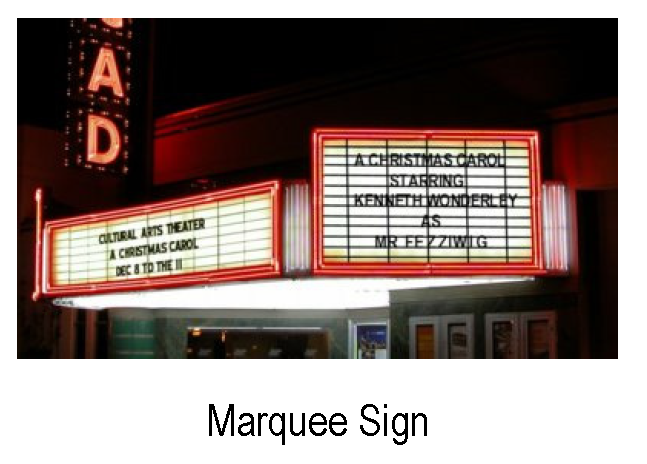
Marquee sign means a changeable message sign mounted on a marquee on the front of a building.
Noncommercial message means any wording or other displays other than a commercial message. Noncommercial messages are considered to be on-premises messages.
Nonconforming sign means a sign that is not in conformance with the provisions of this article or amendments heretofore or hereafter enacted, where such sign lawfully existed prior to the effective date of the ordinance from which this article is derived or amendment thereto.
Off-premises sign means a sign that, at any time, directs attention to a business, commodity, service, entertainment or activity conducted, sold, produced, manufactured, available or furnished at a location other than the premises upon which the sign is located.
Official sign means any sign, illuminated or not, erected on public property and maintained by the city, state or federal government for dissemination of general information and matters of public interest.
On-premises sign means a sign other than an off-premises sign.
Permanent sign means a sign structure which is, or was, originally designed, constructed, modified or intended to be permanently affixed to a building, structure, or to the ground.
Portable sign means any sign that is designed to be transported, including, but not limited to, such signs:
(1)
With wheels removed;
(2)
With chassis or support constructed without wheels;
(3)
Converted to an A- or T-frame sign;
(4)
Attached temporarily to the ground, structure, or other signs; or
(5)
Mounted on a vehicle for advertising purposes, parked and visible from the public right-of-way, except signs identifying the related business when the vehicle is being used in the normal day-to-day operations of that business.
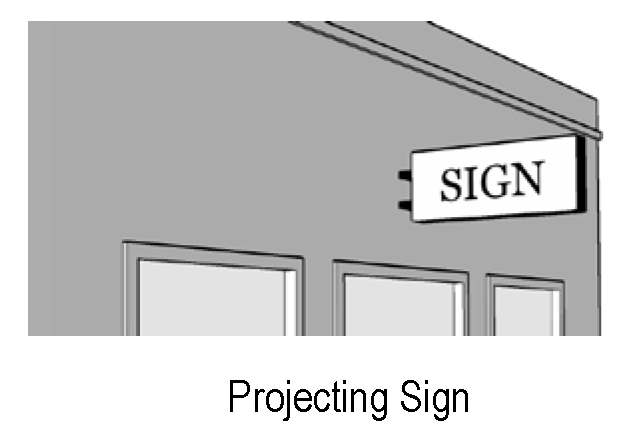
Projecting sign means any attached sign permanently affixed at more or less a right angle to the building facade to which it is attached.
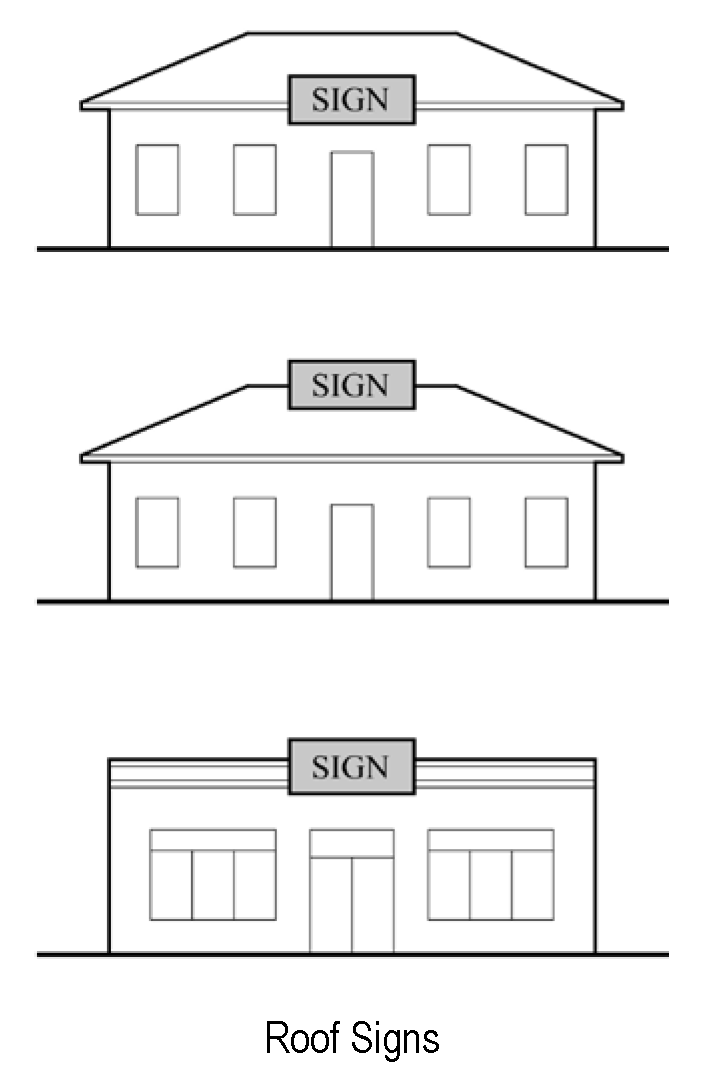
Roof sign means a sign that is mounted on the roof of a building or that is wholly dependent upon a building for support and which projects above the highest point of a building with a flat roof or the eave line of a building with a gambrel, gable or hip roof; or the deck line of a building with a mansard roof.
Sign means a name, identification, image, description, display or illustration which is affixed to, painted on, or represented directly or indirectly upon a building, structure or piece of land and which directs attention to an object, product, place, activity, facility, service, event, attraction, person, institution, organization or business and which is visible from any street, right-of-way, sidewalk, alley, park or other public property, together with any and all structural supports and ornamental attachments. Customary displays of merchandise or objects and material without lettering placed behind a store window are not considered signs or parts of signs.
Sign face means the entire area of the surface used for the display of a sign message as seen from only one direction.
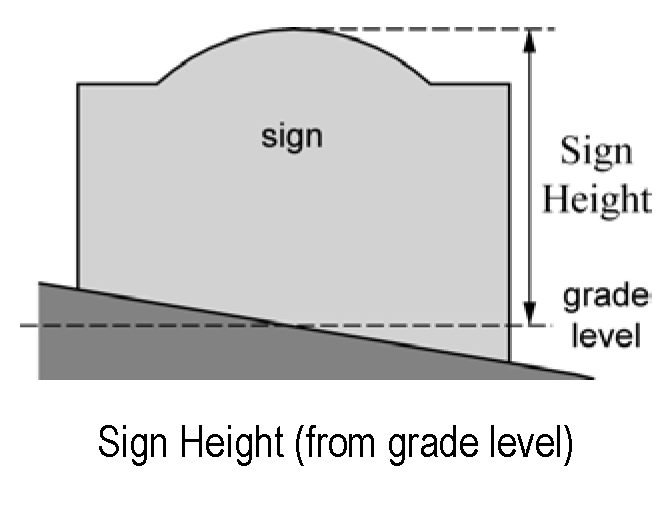
Sign height means the vertical distance measured from the adjacent street, grade level at the sign or upper surface of the nearest curb other than an elevated roadway, whichever permits the greatest height, to the highest point of said sign.
Snipe sign means a sign made of any material when tacked, nailed, posted, pasted, glued, or otherwise temporarily attached, or attached, without the permission of the property owner, to trees, poles, stakes, rocks, fences or other object visible from the public right-of-way; trees, light or utility poles, park benches, bus shelters, waste receptacles, street markers, traffic control devices, guard rails, or similar objects located on public property or right-of-way. Historical markers and official signs identifying a natural feature are not considered snipe signs.
Spacing of signs means the distance between signs as measured along the nearest edge of pavement of the street to which said signs are directed.
Streamers means fringe, strips, or flags commonly attached to a cord and strung between two or more points.
Subdivision sign means a freestanding sign located at a principal entrance to a planned residential subdivision or a city-designated neighborhood.
Temporary sign means any sign not originally designed, constructed or intended to be permanently affixed to any building, structure or the ground.
Temporary subdivision sign means a temporary sign advertising the sale of property in an approved subdivision within the city.
Unlawful sign means a sign erected after the effective date of the ordinance from which this article is derived, or amendment thereof, that is not in conformance with these regulations; a sign that the building official declares to be a danger to public safety by reason of dilapidation or abandonment; or a nonconforming sign for which a permit required under any previous regulations was not obtained.
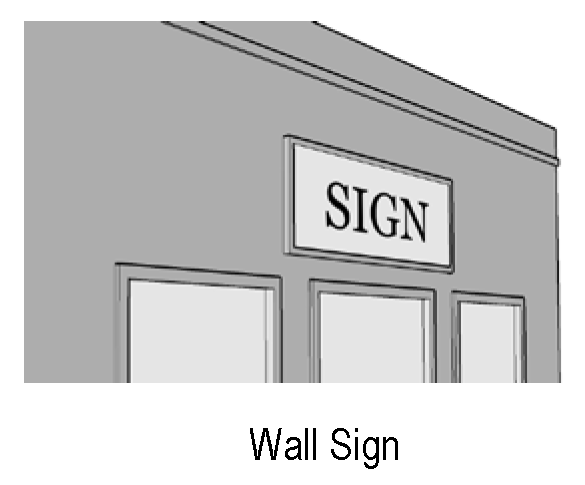
Wall sign means any sign painted on or attached to and erected parallel to the face of, or erected and confined within the limits of, the outside wall of any building and supported by such wall or building not otherwise defined in these regulations.
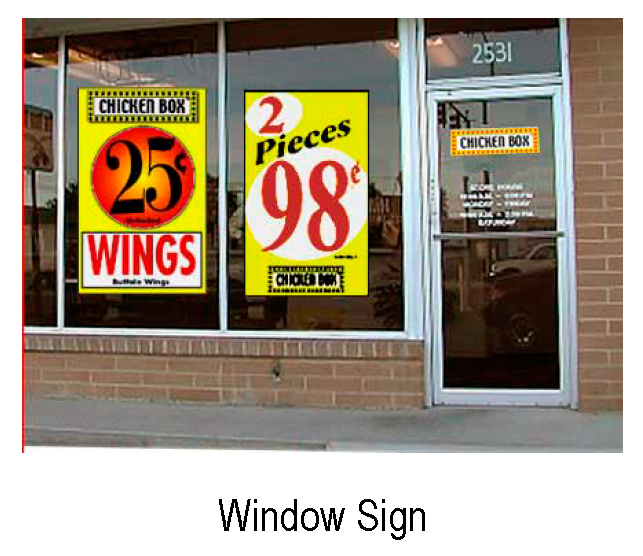
Window sign means any sign, picture, symbol or combination thereof placed inside a window or upon the window pane, door or glass and is visible from the exterior of the building. A sign hung inside a window is considered a window sign though it may otherwise be similar in design and material to a banner.
(Ord. No. 2013-02, § 10.2, 3-4-2013)
Sec. 111-312. - General regulations.
In any zoning district within the city, the following regulations shall apply:
(1)
General standards. The following standards shall apply to signs in all zoning districts:
a.
Except as provided in section 111-313(d), no sign or portion of a sign shall be located closer than two feet to a public right-of-way.
b.
No sign shall be placed in or interfere in any way with motorist visibility at the intersection of a street with another street, alley or driveway. See section 111-196(d).
c.
No illuminated sign, other than a permanent subdivision identification sign, shall be permitted within 50 feet of any residential district.
d.
No sign shall occupy any portion of a parking space or aisle.
e.
All signs shall conform with the city building code. Signs that, by reason of size, materials, design or location, are not governed by the city building code under its terms shall not be affected by this standard.
f.
The area around all signs shall be kept clean and free of trash and of vegetation that is not part of the landscaping associated with the sign. Sign landscaping shall be well maintained.
g.
All signs and all components thereof, including structural supports, shall be kept in a state of good repair. The sign owner/lessor or property owner shall maintain all signs in a safe and proper operating manner at all times. Any sign that exhibits one or more of the following conditions shall be considered in violation of this article subject to remedies in section 111-320:
1.
Peeling or flaking paint or surface material on the sign face.
2.
Missing portions of the message, display or of the sign face.
3.
The sign face is cracked, damaged, or faded such that the message or display is not legible.
4.
The message or display is incomplete or illegible due to electronic or lighting failure or for any other reason.
h.
No person may, for the purpose of increasing or enhancing the visibility of any sign, damage, trim, destroy or remove any trees, shrubs or other vegetation within any right-of-way (unless express written authorization is obtained from the agency having jurisdiction over the right-of-way) or on any area where landscaping is required by city regulations.
(2)
Prohibited signs
a.
It shall be unlawful to erect, cause to be erected, maintain or cause to be maintained, any sign not expressly authorized by, or exempted from, this article. The following signs shall be prohibited in all zoning districts:
1.
Any sign that, by reason of its position, working, illumination, shape, symbol, color, form or character, may obstruct, impair, obscure or interfere with the view of, or may be confused with any authorized traffic sign, signal or device or interfere with, mislead, confuse or disrupt traffic flow or traffic safety.
2.
Signs that emit audible sound, odor, or visible matter, such as smoke or steam.
3.
Signs or sign structures that interfere in any way with free use of any fire escape, emergency exit, or standpipes, or that obstruct any window to such an extent that light or ventilation is reduced to a point below that required by any provision of this article, the city building code or other applicable regulation.
4.
Any sign having flashing, traveling, or animated illumination except as otherwise permitted under section 111-316(4).
5.
Any sign or support thereof placed in, or that interferes with, a public street right-of-way except as otherwise permitted under section 111-313(d).
6.
Snipe signs, except where expressly permitted by these regulations or by another city ordinance.
7.
Inflatable signs, tethered balloon signs, and twirling signs, except as permitted under section 111-313(e).
8.
Any sign attached to or painted onto a vehicle or trailer parked on a public right-of-way or on private property, such that the advertising is legible from the public right-of-way and such vehicle is not otherwise being used in the regular conduct of the business.
9.
Portable and temporary signs are prohibited in all zoning districts, except as otherwise provided for in section 111-313.
b.
Nothing in this article shall prohibit or limit the outdoor display of products where such displays are allowed under this chapter. This article shall, however, apply to any sign, banner, pennant, or other attention-attracting device affixed to a product displayed outdoors.
(3)
Measuring copy area.
a.
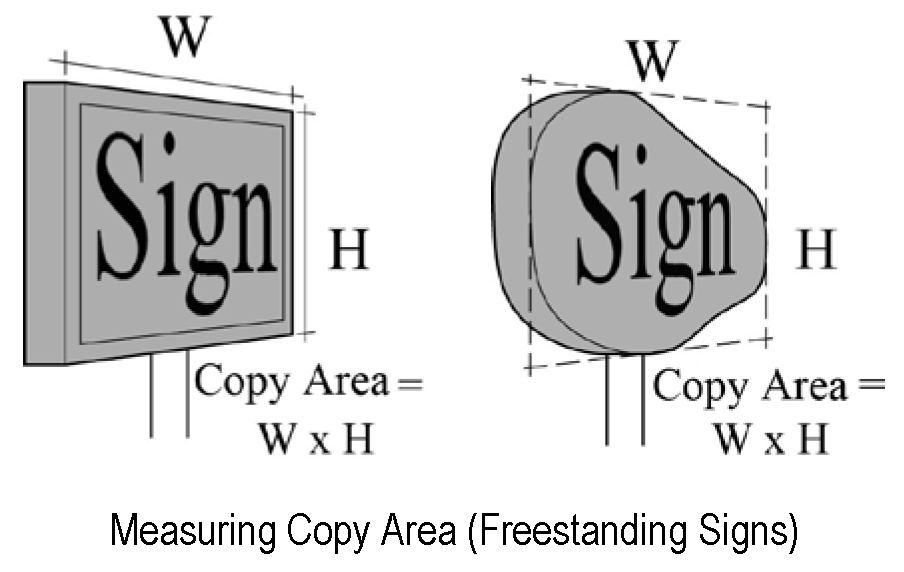
The copy area of freestanding and projecting signs shall be measured as the area within a single rectangle that encompasses the extreme limits of each and every sign face, including all advertising surfaces, background, framing and ornamentation, but excluding structural frames and members not forming an integral part of the display. If both faces of a double-faced sign may be viewed simultaneously from any vantage point along the street to which it is displayed, the area of each face shall be counted. Otherwise, the area of only one face, the larger (if applicable), shall be counted.
b.
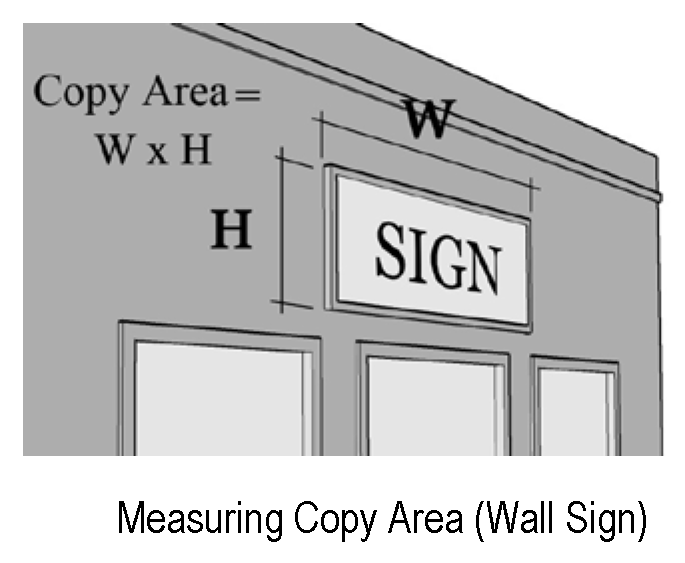
The copy area of all other signs shall be measured as the area within a single rectangle that encompasses all letters, words, symbols or other graphic elements, together with any frame or other material or color forming an integral part of the display or used to differentiate such sign from the background against which it is placed.
(Ord. No. 2013-02, § 10.3, 3-4-2013)
Sec. 111-313. - Exemptions.
(a)
Actions not requiring a permit. The actions related to signs shall be exempt from the permit requirements of this article but shall be subject to all other standards of this article. Certain temporary signs are subject to temporary permits, see subsection (e) of this section.
(1)
Routine sign maintenance, including painting, repainting, cleaning and repair not involving structural changes. This does not include painting or repainting of the entire sign face.
(2)
The changing of copy on changeable copy signs, provided there are no structural changes, and provided there is no change in the primary light source used (such as a change to electronic/LED/LCD technology).
(3)
Installation of signs permitted in all districts (subsection (b) of this section); signs exempt from these regulations (subsection (c) of this section); and signs subject to other standards (subsection (d) of this section).
(4)
Installation and changing of window signs located in nonresidential districts that collectively cover 20 percent or less of the window glass surface area.
(b)
Signs permitted in all districts. The following signs are exempt from sign permit requirements and are not to be included in determination of the allowable number, type or area of a sign that requires a sign permit. Such signs, however, are subject to the requirements herein and provisions of the city building code, where applicable.
(1)
Address signs. Signs not exceeding three square feet in area bearing the E-911 address of the premises. Occupant name may also be included but no commercial message shall otherwise be included.
(2)
Incidental signs. Incidental signs, whether freestanding or attached, that are smaller than four square feet and less than four feet in height.
(3)
Memorial signs. Signs or tablets, names of buildings and date of erection, when cut into any masonry surface or inlaid so as to be part of the building, provided that no such sign shall exceed six square feet in area and shall not be separately illuminated.
(4)
Noncommercial flags. Flags, banners or insignias of a governmental, religious, charitable or fraternal organization that include no commercial message, subject to established city policy and protocols of the applicable government or non-government organization. No premises shall contain more than four such flags.
(5)
Noncommercial signs. In addition to any other permanent or temporary signage otherwise provided for in this article, each occupied lot shall be permitted an aggregate sign area of 15 square feet for noncommercial speech, which shall not be illuminated, shall not exceed 6.5 square feet in area per sign and shall not exceed five feet in height.
(6)
Property management signs.
a.
Signage that identifies the entity responsible for the management or leasing of property is permitted in all districts provided it is:
1.
Incorporated into a permitted permanent sign; or
2.
is incorporated into or meets the criteria for an exempt sign pursuant to subsection (c) of this section.
b.
In no case shall additional permanent sign area or an additional permanent sign be permitted for conveying property management information.
(c)
Signs exempt from these regulations. The following signs are exempt from sign permit requirements and from the provisions of this article, except as provided herein. However, all such signs shall comply with the city building code and all other applicable regulations.
(1)
Any sign, other than a window sign, located inside a building, structure or enclosed space and not legible from the public right-of-way or from private or public property other than the property on which it is located.
(2)
Any sign with a sign area of less than four square feet and less than four feet in height (if freestanding), that is not separately lighted and that is not legible from the public right-of-way or from private or public property other than the property on which it is located.
(3)
Official signs.
(4)
Stadium signs. Scoreboards and incidental advertising signs intended to be viewed from within a stadium.
(5)
Temporary holiday decorations containing no commercial message, subject to applicable provisions of the city building code.
(6)
Signs erected by or authorized by the city for citywide events.
(d)
Signs subject to other standards. The following signs shall be exempt from the permit requirements of this article; but shall, to the maximum extent allowed by law, be subject to the other standards of this chapter. Where a sign is erected pursuant to a statute or a court order, the sign may exceed the size and/or locational standards of this article (including placement within public rights-of-way) or otherwise deviate from the standards set forth in this article to the extent that the statute or court order expressly required the larger size or other deviation. In all other respects, such signs shall conform to the standards of this article.
(1)
Signs conforming to the manual of uniform traffic control devices and bearing no commercial message.
(2)
Official signs.
(3)
Signs required by a state or federal statute.
(4)
Signs required by an order of a court of competent jurisdiction.
(5)
Signs installed by public utilities in their rights-of-way or on their facilities and bearing no commercial message other than such messages necessary to identify the use.
(6)
Signs installed by a transit company with a franchise or other right to operate in the city, where such signs are installed along its routes and relate to schedules or other information about the transit route.
(e)
Temporary sign regulations. Temporary signs shall be permitted in nonresidential districts as follows:
(1)
Applicability. This subsection (e) shall apply to the following zoning districts: A-1, C-P, C-1, C-2, C-3, Inst-1, Inst-2, Inst-3, I-1, 1-2 and I-3-S.
(2)
General provisions. The following shall apply to all temporary signs in nonresidential districts:
a.
A temporary sign may be an attached sign or a freestanding sign, but shall not be permitted in a public right-of-way.
b.
Duration of display. The display of temporary signage shall be limited to a maximum aggregate display period of 30 days in a calendar year except as otherwise provided in subsection (e)(4) of this section.
c.
Except as provided in subsection (e)(4) of this section, there shall be no more than one temporary sign per address at any one time.
d.
A temporary sign permit shall be required prior to the installation of any temporary sign authorized in this subsection (e).
(3)
Content. Any sign allowed under this section may contain any noncommercial message or a commercial message pertaining to goods, services or other commercial transactions available on the premises or that will be available on the premises when construction is complete. Signs seeking employees for a business shall be considered to pertain to commercial transactions available on the premises and shall be allowed.
(4)
Rules for types of temporary signs.
a.
Temporary sign where permanent sign not installed. For any premises which is occupied or for which a building permit has been issued, and for which the permanent sign allowed has not been installed, one temporary sign shall be allowed from the date of occupancy or the date of issuance of the building permit, whichever comes first, until the date of installation of the permanent sign, not to exceed 60 days. The temporary sign shall not exceed the size allowed for the permanent sign or 32 square feet, whichever is smaller, and, if freestanding, shall not exceed eight feet in height.
b.
Grand opening banners. Each new nonresidential use may have one banner per frontage announcing the opening of the establishment. Such banners shall be limited to an aggregate area of 32 square feet per establishment and, if freestanding, shall not exceed eight feet in height. Newly established integrated business centers shall be permitted an aggregate area of 40 square feet but shall be limited to one banner per frontage of such center regardless of the number of new uses.
c.
Other temporary signs. Other temporary signs shall not exceed 24 square feet in area and, if detached, shall not exceed six feet in height.
d.
Temporary signs for nonprofit organizations and events. Temporary signs for nonprofit 501(c)3 organizations and noncommercial community events, such as for charitable fundraising events, shall be permitted as follows:
1.
The location and number of the signs shall be as approved by the building official subject to city policy.
2.
Such signs may be permitted for up to two weeks and shall be removed within 48 hours following the event.
(Ord. No. 2013-02, § 10.4, 3-4-2013)
Sec. 111-314. - Signs permitted in the A-1 Agriculture District.
The following types of signs are permitted in the agricultural district:
(1)
Those signs permitted under section 111-314.
(2)
Signs customarily associated with uses permitted in the agricultural district.
(Ord. No. 2013-02, § 10.5, 3-4-2013)
Sec. 111-315. - Signs permitted in residential districts.
(a)
The types of signs in this section are permitted in the E-1, R-1, R-2, R-3A, R-3B, R-4, RT-4, and RG districts, subject to specified requirements.
(b)
The following signs shall be allowed for each residential premises:
(1)
One address sign, per section 111-313(b), permitted in all districts. Such sign shall not be illuminated.
(2)
Each occupied lot shall be permitted no more than two temporary signs at one time that contain a commercial message, which shall not be illuminated, shall not exceed five feet in height and shall not exceed a total of 6.5 square feet for all such signs. The only commercial messages permitted on such signs are messages related to commercial activity lawfully and temporarily conducted on the premises, including home occupations, bed and breakfasts, boardinghouses, the lawful, occasional sale of personal property (such as through a garage sale or a yard sale), or the sale, rental or lease of the premises. Signs related to the sale of personal property shall be removed within 24 hours after the end of the sale. Signs related to the sale, lease or rental of the premises shall be removed no later than 24 hours from the date on which the deed, lease or other document representing the transaction is completed.
(c)
Residential identification signs. The following shall be permitted for each residential development:
(1)
Permanent residential identification signs shall be permitted in accordance with the following:
a.
A principal entrance shall be considered to be that place where property included within the development abuts an external public street.
b.
There shall not be more than one principal entrance for each 50 dwelling units, provided that each development shall be entitled to at least one such sign.
c.
Residential identification signs shall be located on private property, either commonly or individually owned, and shall be no closer than 15 feet to a right-of-way line.
d.
Residential identification signs shall bear no commercial message.
e.
Residential identification signs may be indirectly lit but shall not otherwise be illuminated.
f.
One freestanding residential identification sign shall be permitted at each principal entrance to a residential development of single-family or duplex dwellings. The sign shall not exceed 48 square feet of copy area. If there are walls on both sides of the entrance, then one wall sign per side is permitted in lieu of a freestanding sign, each not to exceed 24 square feet in copy area.
g.
One freestanding residential identification sign shall be permitted at each principal entrance to a multifamily development. The sign shall not exceed 12 square feet of copy area for each 50 dwelling units in the development, or 48 square feet, whichever is less. If there are walls on both sides of the entrance, then one wall sign per side is permitted, each not to 50 percent of the maximum allowable copy area.
(2)
Temporary residential identification signs. As a temporary use accessory to the permitted activity of lawful residential development, one temporary residential identification sign shall be permitted at each principal entrance, as described in subsection (c)(1) of this section, in accordance with the following:
a.
There shall in no case be more than one such sign for a subdivision or development with 50 or fewer lots included in the subdivision or development and no more than two such signs for any other subdivision or development.
b.
Such sign shall not be illuminated and shall not exceed 32 square feet in area.
c.
Such sign shall be removed upon the installation of a permanent residential identification sign.
(d)
Signs permitted in planned residential districts shall be determined during the site plan review process.
(Ord. No. 2013-02, § 10.6, 3-4-2013)
Sec. 111-316. - Signs permitted in nonresidential districts.
Permanent freestanding and attached signs shall be permitted in nonresidential districts in accordance with Table 1 of this section and the following:
(1)
Freestanding signs. Nonresidential uses, not located in an integrated business center, shall be allowed freestanding signage as provided in Table 1 of this section. Nonresidential uses in integrated business centers shall be allowed freestanding signage as provided in Table 2 of this section. The following standards shall apply to all freestanding signs, except where otherwise specified:
a.
Freestanding signs may be illuminated or non-illuminated and may include manual or electronic changeable copy subject to subsection (4) of this section.
b.
Freestanding signs shall be no closer than 15 feet to the edge of pavement of any street and no closer than 50 feet from a sign on an abutting property.
c.
Freestanding signs used for integrated business centers shall be consistent in design, materials, and colors.
d.
Allowable sign height is based on the classification of the street along which it is located as provided in Table 1 of this section. Different height limits shall apply on corner lots when the abutting streets are classified differently.
(2)
Attached signs. Each establishment shall be allowed attached signage on each facade. No more than one wall sign or one projecting sign shall be permitted on any one facade. One awning, canopy or marquee sign per facade is allowed in addition to the wall or projecting sign. Nonresidential uses, whether in an integrated business center or not, shall be allowed attached signage as provided in Table 2 of this section subject to the following:
a.
Attached signs, except where specifically prohibited herein, may be directly or indirectly illuminated.
b.
Wall signs shall not extend out from the face of the building more than 12 inches. Wall signs may include manual or electronic changeable copy subject to subsection (4) of this section.
c.
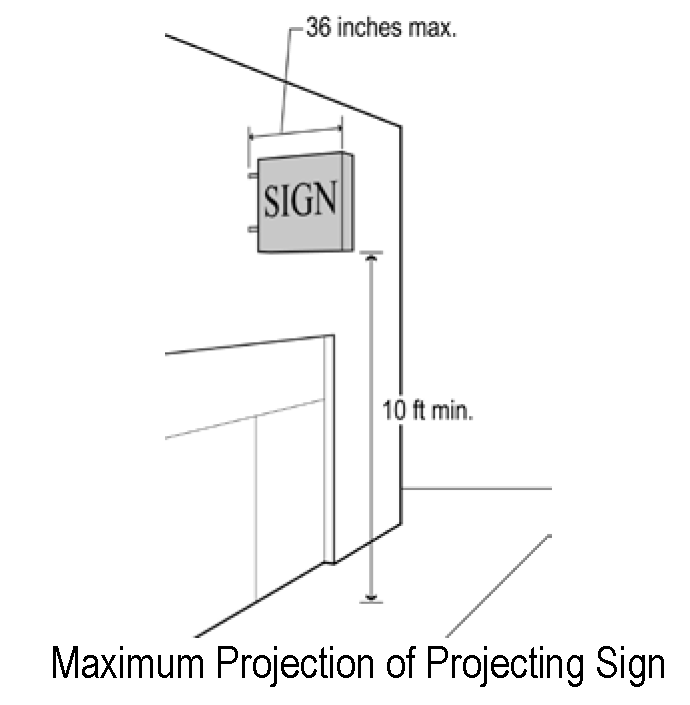
Projecting signs shall not project outward more than 36 inches from the building face and shall have a minimum clearance of ten feet from the surface below to the lowest point on the sign. Projecting signs shall not project into public rights-of-way nor exceed 16 square feet in sign area.
d.
Awning, canopy and marquee signs.
1.
Awning and canopy signs shall be flat against the surface of the awning or canopy, which shall extend no closer than two feet horizontally to the curbline of any public street nor eight feet vertically from the finished surface directly below.
2.
Awning signs shall not be internally illuminated; however, canopy, mansard and marquee signs may be illuminated.
3.
The permanently affixed copy area of canopy or marquee signs shall not exceed an area equal to 25 percent of the surface area of the canopy, marquee or architectural projection upon which such sign is affixed or applied, which surface area shall not be counted toward allowable sign area.
(3)
Window signs. Window signs shall be permitted, provided they do not collectively cover more than 20 percent of the window area.
(4)
Electronic changeable copy signs. Electronic changeable copy signs, where permitted, shall be subject to the following standards:
a.
Sign display technology shall be programmed so that the message or image on the sign changes no more often than every eight seconds.
b.
There shall be no effects of movement, flashing, scintillation, or similar effects in the individual images.
c.
Changes of image shall be substantially instantaneous as seen by the human eye and shall not use fading, rolling, window shading, dissolving or similar effects as part of the change.
d.
Automatic level controls shall be used to reduce light levels at night and under cloudy or other darkened conditions, in accordance with the following standards. All electronic or digital display units shall have installed ambient light monitors, and shall at all times allow such monitors to automatically adjust the brightness level of the message based on ambient light conditions. Maximum brightness levels shall not exceed 5,000 nits when measured from the sign's face at its maximum brightness, during daylight hours and 500 nits when measured from the sign face at its maximum brightness between dusk and dawn, i.e., the time of day between sunrise and sunset.
e.
Any sign using video technology which malfunctions, fails, or ceases to operate in its usual or normal programmed manner causing therein motion, movement, flashing or any other similar effects, shall be repaired or disconnected within 24 hours by the owner or operator of such sign.
f.
The message area shall not exceed the permitted copy area for the applicable sign type in the district, or 200 square feet, whichever is less.
g.
The following limitations shall apply to the location of signs using video technology:
1.
A sign on which the video technology includes 100 square feet or more of sign area shall not be erected within 500 feet of a residential district.
2.
A sign on which the video technology includes 20 square feet or more of sign area but less than 100 square feet of sign area shall not be erected within 200 feet of a residential district.
3.
A sign on which the video technology includes less than 20 square feet of sign area shall not be erected within 100 feet of a residential district.
(Ord. No. 2013-02, § 10.7, 3-4-2013)
Sec. 111-317. - Off-premises sign regulations.
Off-premises signs, where permitted, shall comply with the following.
(1)
No off-premises sign shall be permitted on any lot which has two or more on-premises signs.
(2)
No billboard shall be erected closer than 100 feet to any residential district.
(3)
Any illumination of a billboard shall be of an indirect type, and the beam of light shall be directed toward the sign face and away from adjacent areas and rights-of-way.
(4)
No flashing, traveling, animated or intermittent illumination of off-premises signs shall be permitted. There shall be no electronic moving messages, which includes, but is not limited to, light emitting diode (LED) and/or liquid crystal displays (LCD).
(5)
All off-premises signs shall comply with the area and dimensional regulations in the table below.
(Ord. No. 2013-02, § 10.8, 3-4-2013)
Sec. 111-318. - Permitting, construction and maintenance of signs.
(a)
Permits required.
(1)
Except where this article explicitly exempts a sign, all signs erected or altered shall require a sign permit issued by the building official. As part of this process, approval by the design review board may be required.
(2)
Whether a sign is exempt or not, an electrical permit shall be required for all illuminated signs. Application for an electrical permit shall be made by the electrical contractor whenever such work is performed on any sign.
(3)
All outdoor advertising signs to be located within 660 feet of the nearest edge of the right-of-way of a highway on the interstate or federal-aid primary highway system shall file an application for a permit with the Alabama Department of Transportation (ALDOT) as required by the Highway Beautification Act - Outdoor Advertising.
(b)
Application for permit. Application shall be made to the building official, together with a permit fee, on a form provided by that office and shall be accompanied by such information as may be required to ensure compliance with this article and all other applicable laws and regulations, including, but not limited to:
(1)
Scaled, clear and legible drawings with description showing the exact location of the proposed sign and any existing signs on the site.
(2)
Drawings showing the sign specifications, including dimensions, construction supports, size, electrical wiring, and component materials of the sign and method of attachment.
(c)
Denial of permit.
(1)
When a permit is denied by the building official, he shall give written notice to the applicant of the denial with a written statement of the reason for such denial. A copy of said statement shall be made as an attachment to the permit application.
(2)
Appeals of permit denial. Appeal may be taken to the ZBA upon denial by the building official to issue a sign permit, subject to all procedures outlined in section 111-90. Application for the appeal shall be submitted within 30 days after denial of the sign permit, after which time the applicant/owner is deemed to have waived the right of appeal. If, as part of the permit process, a recommendation regarding the sign was made by the design review board, said recommendation shall be made part of the information provided to the ZBA.
(d)
Inspection of signs. The person erecting, altering, relocating, enlarging or converting any sign shall notify the building official upon completion of the work for which permits are required and issued. (See section 111-313.) All freestanding signs shall be subject to a footing inspection, and all illuminated signs shall be subject to an electrical inspection by the building official.
(Ord. No. 2013-02, § 10.9, 3-4-2013)
Sec. 111-319. - Nonconforming signs.
All signs constructed or altered after adoption of the ordinance from which this article is derived shall conform in all respects to the requirements and provisions contained herein. If there exist signs that were lawful before the ordinance from which this article is derived was passed or amended, but that do not conform to the terms of the article, it is the intent of this article to permit these nonconforming signs to remain until they are removed, discontinued or altered, but not to encourage their survival.
(1)
Nonconforming on-premises signs.
a.
Nonconforming signs that are structurally altered shall, upon completion of the alteration, conform in all respects to the provisions of this article.
b.
Nonconforming signs shall be maintained as required in section 111-312(1). If a structural alteration is required to accomplish maintenance, the sign shall be made to conform, upon completion of the alteration, to the provisions of this article.
c.
The copy area of an internally illuminated nonconforming sign may be removed from the sign structure without jeopardizing the legal nonconforming status of the sign, provided the sign message is not changed.
(2)
Restoration after damages. A nonconforming sign that is damaged by fire, wind, or other causes, to the extent that repair of the sign requires structural alteration, shall, upon completion of the alteration, conform in all respects to the provisions of this article.
(Ord. No. 2013-02, § 10.10, 3-4-2013)
Sec. 111-320. - Unlawful signs.
(a)
Confiscation of signs located in public right-of-way. Any sign installed or placed on public right-of-way, except in conformance with the requirements of this article, shall be forfeited to the public and subject to confiscation. In addition to other remedies provided for under this article, the city shall have the right to recover from the owner or person placing the sign the full costs of removal and disposal.
(b)
Abandoned signs. Except as may otherwise be provided for in this article, any sign that is located on property which becomes vacant and is unoccupied for a time period of four months or more, or any sign which no longer advertises a bona fide business, institution, person, event, location, product or service for a continuous period of 60 days or more, shall be deemed to have been abandoned and shall be altered or removed to conform in all respects to the provisions of this article. Permanent signs applicable to a business temporarily suspended because of a change in ownership or management of such business shall not be deemed abandoned unless the property remains vacant for a period of nine months or more. An abandoned sign is prohibited and shall be removed by the owner of the sign or owner of the premises. Removal by the city shall be at the expense of the property owner and/or sign owner.
(c)
Notification. All notices mailed by the building official shall be sent by certified mail. Any time periods provided in this section shall be deemed to commence on the date of the receipt of the certified mail. The notice shall be mailed to the owner of the property on which the sign is located as shown on the latest available tax maps, as well as the occupant which the sign serves. Any persons having an interest in the sign or the property may appeal the determination of the building official ordering removal or measures necessary to bring the sign into compliance with the provisions of the ordinance by filing a written notice of appeal with the ZBA within 30 days of receipt of the notice.
(d)
Removal and/or repair of signs by the city.
(1)
Any sign erected without a permit or that has deteriorated due to lack of maintenance and, in the opinion of the building official, needs to be repainted, refinished or reworked in order to restore it to a safe and lawful condition, shall be found to be in violation of this article.
(2)
The building official shall cause to be removed any sign erected without a permit or any sign which becomes a safety hazard or which is not kept in good general condition and good state of repair, as specified in section 111-312(1). A written notice shall be made by certified mail to the owner of the premises and/or the sign owner describing the nature of the violations. Any repair, painting, alteration, relocation or removal shall be at the sign owner's or property owner's expense. If corrections/repairs have not been made within 60 days of receipt of said letter, the sign shall be declared a nuisance and may be removed, obliterated or otherwise abated by the building official.
(3)
Any sign which, in the opinion of the building official, constitutes an immediate or imminent danger to life or property may be caused to be removed or put in a safe condition immediately.
(4)
In the case of any of the situations described above in subsection (d)(1), (2) or (3), any costs incurred by the city for removal/repair of the sign shall be charged to the owner of the premises, and that portion that remains unpaid shall constitute a lien against the property.
(Ord. No. 2013-02, § 10.11, 3-4-2013)

