
Gardendale City Zoning Code
ARTICLE IX
OFF-STREET PARKING AND LOADING REQUIREMENTS
Sec. 111-280.- Purpose.
The primary purpose of this article is to reduce traffic congestion on public streets by requiring certain minimum parking and loading areas be provided off-street. Further, this article ensures safe and convenient access to and from each site, as well as safe and efficient on-site traffic circulation, and encourage the design of attractive, efficient and harmonious facilities.
(Ord. No. 2013-02, § 9.1, 3-4-2013)
Sec. 111-281. - Definitions.
The following words, terms and phrases, when used in this article, shall have the meanings ascribed to them in this section, except where the context clearly indicates a different meaning:
Access boundary means that portion of the parking area that consists of a travel lane bounded on either side by an area that is not part of the parking area.
Gross leasable area (GLA) means the total floor area of a building designed for both tenant occupancy and exclusive use. GLA includes both owned and leased areas but does not include shared or common areas among tenants. Where the total floor area of a building is occupied or where a building has no shared or common area, GLA is the gross floor area measured by taking the outside dimensions of the building at each floor level intended for occupancy or storage.
Impervious surfaces means constructed surfaces, such as rooftops, sidewalks, roads and parking lots, covered by impenetrable materials, such as asphalt, concrete, brick, stone and other materials, which seal surfaces, repel water and prevent percolation of runoff into the ground.
Loading area means that area used to satisfy the requirements of this article for loading and unloading of commercial vehicles.
Loading space means an off-street space or berth used for the unloading or loading of commercial vehicles.
Lodging room (LR) means that portion of a hotel, motel, boarding room, bed and breakfast or similar facility intended for guest occupancy.
Occupancy load means the maximum number of persons that may be accommodated by the use as determined by its design or by fire code standards.
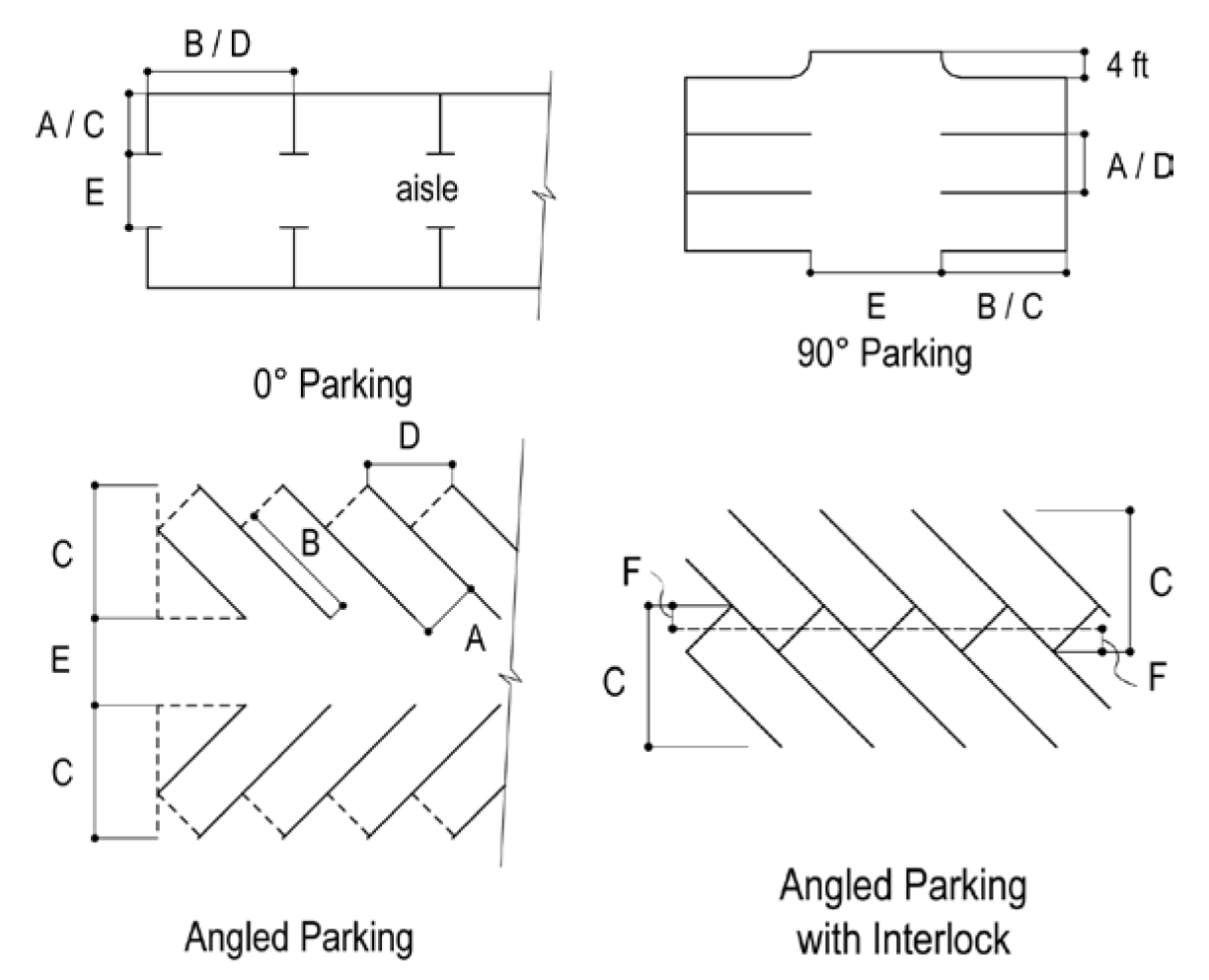
Parking aisle means that portion of the parking area providing vehicular access to parking spaces.
Parking area means an improved area on a lot exclusively used or designed for use as a temporary storage area for motor vehicles, containing access driveways, parking aisles and parking spaces.
Parking space means that portion of the parking area, enclosed or unenclosed, set aside for the parking of one vehicle.
Pervious surfaces means a range of materials and techniques for paving roads, parking lots and walkways that allow the movement of water and air around and through the paving material, thus allowing water runoff to infiltrate the soil below. Examples are pervious concrete, porous asphalt, porous turf, single-sized aggregate, and paving stones or bricks.
Stacking space means an off-street space for the temporary stacking of vehicles with an aisle intended to serve a drive-in teller window, take-out food window, dry cleaning/laundry pick-up or similar facility.
Vehicle, abandoned.
(1)
The term "abandoned vehicle," on public right-of-way, means any motor vehicle which is partially dismantled, inoperative, wrecked or junked, which is left on a public street or public right-of-way for a period of at least 48 consecutive hours.
(2)
The term "abandoned vehicle," on private property, means any unlicensed and/or inoperative motor vehicle left in a location visible from, but not on public right-of-way, for a period of 60 consecutive days or greater.
Vehicle, inoperative, means a motor vehicle that cannot be driven on any public streets for reasons, including, but not limited to, being unlicensed, wrecked, abandoned, in a state of disrepair or incapable of being moved under its own power.
(Ord. No. 2013-02, § 9.2, 3-4-2013)
Sec. 111-282. - Required off-street parking spaces.
Unless otherwise provided for, all uses shall conform to the minimum parking space requirements in Table 1 of this section. Where the required number of parking spaces is not readily determinable from the table, the building official shall determine the parking space requirements using the table as a guide. Where fractional spaces apply, the parking spaces required shall be construed to be the next highest whole number. Where a requirement is based on the number of employees, it shall be calculated using the number of employees during the largest shift.
(1)
Shared parking for mixed uses. Subject to approval by the commission, minimum parking requirements for a mixed-use development may be reduced by calculation of shared parking requirements for the development using the shared parking demand information in Table 2 of this section.
(2)
Joint parking. A joint parking area may contain required parking spaces for more than one use, provided the combined number of spaces complies with the parking for all uses. If, however, the applicant desires to make use of the same spaces for different businesses at different times, the same spaces may be credited to each separate use. The applicant for a combined use facility must present documentation of a combined parking agreement, and, if sharing the same spaces, a time schedule for allocation of such spaces.
(3)
Principal and accessory uses. The parking requirements for an establishment that involves one or more principal and accessory uses shall be determined by the building official using the table as a guide, which may include calculating the requirements for each use, based on their individual floor areas (or other factor in Table 1 of this section) and adding the individual requirements together.
* Different parking demands may be used than the typical shown here if documented in a parking demand study.
(Ord. No. 2013-02, § 9.3, 3-4-2013)
Sec. 111-283. - Off-street parking design standards.
(a)
General standards. In addition to the parking space dimensions in the table below, the following standards shall apply:
(1)
In large parking areas of 20 or more parking spaces, up to 20 percent of the parking spaces may be reserved for compact cars. Such spaces shall contain a minimum rectangular area of eight feet in width and 16 feet in length. These spaces shall be conspicuously marked for compact cars only.
(2)
Stacking spaces shall contain a minimum rectangular area of ten feet in width and 20 feet in length and be separated from parking aisles and spaces.
(3)
Handicapped parking spaces shall be provided and designed in accordance with the applicable provisions of federal, state and local law.
(b)
Design standards.
(1)
Parking areas shall be designed so that vehicles may exit such areas without backing onto a public street. This requirement does not apply to parking areas of single-family and duplex dwellings. However, backing into arterial streets shall be prohibited in all cases.
(2)
For all developments involving off-street parking areas in excess of 20 spaces, adequate lighting shall be provided and a lighting plan, in accordance with the following standards, shall be submitted as part of the required site plan:
a.
Lighting fixtures used to illuminate parking areas shall not exceed a height of 25 feet above grade level on residential premises and 30 feet above grade level in nonresidential premises.
b.
All lighting fixtures shall be designed, shielded, aimed, located and maintained to prevent light trespass and glare onto adjacent properties or roadways.
c.
The lighting plan shall be prepared by a registered engineer, design or lighting professional and shall include the information listed in the appendix of the ordinance from which this article is derived.
(3)
Parking areas for all developments shall be so designed that sanitation, emergency and other public service vehicles can adequately and safely serve such developments without the necessity of backing unreasonable distances or making other dangerous maneuvers. Fire lanes may be required by the fire code.
(4)
All parking areas shall be surfaced with dust-free materials, such as concrete or asphalt. When approved by the building official and the city engineer, pervious surface materials may be used, provided they meet the manufacturer's specifications and are properly installed and maintained. This requirement shall apply only to parking areas regularly and permanently intended for such use and shall not apply, in the case of dwellings, to portions of yards used temporarily and only on occasion for visitor parking, such as for parties.
(5)
Parking spaces, except those serving single-family and duplex dwellings, shall be demarcated with painted lines or other markings.
(6)
All parking areas shall be maintained in good condition (i.e., free of pot holes, weeds, trash, refuse, etc.).
(7)
Drainage in parking areas shall direct stormwater back into the site from adjacent properties toward adequate drainage channels. Large parking areas of 20 or more spaces shall provide on-site stormwater detention to retard the sudden discharge of high volumes of stormwater into the public drainage system. The quantity and rate of runoff after development shall not exceed the quantity and rate of runoff before development, with calculations based on a 100-year rain event, 24-hour storm. The site plan shall be prepared, stamped and signed by a professional engineer, and drainage plans shall be subject to the approval of the commission and/or the city engineer.
(8)
All off-street parking spaces for other than single-family and duplex dwellings shall be separated from adjacent sidewalks by concrete curb, planting strip or other barrier or buffer as required by the approving authority.
(c)
Location of required parking. All required parking spaces shall be located on the same lot as the use served by the parking, except as follows:
(1)
Required parking within planned residential, multifamily and attached single-family developments may be provided in common parking areas.
(2)
If the number of required parking spaces cannot reasonably be provided on the same lot as the served use, satellite parking may be provided on an adjacent lot, provided the parking requirements of the served use are met. The satellite parking spaces shall be located within 400 feet of the nearest public entrance to the building housing the principal use. If the use is not housed within a building, satellite parking spaces shall be located within 400 feet of the lot. A satellite parking exception shall be subject to approval by the building official and requires written legal documentation from the adjacent property owner that the user of such satellite spaces has the right to such spaces.
(3)
Any available on-street or other public parking, which correlates with the applicable site or development, shall be counted towards the overall parking and loading requirements subject to approval by the building official. These parking spaces must be provided within 400 feet of the nearest public entrance to the building housing the principal use. If available public parking is located within a joint parking area, refer to § 9.3.2 joint parking.
(Ord. No. 2013-02, § 9.4, 3-4-2013; Ord. No. 2017-11, § 1, 9-5-2017)
Sec. 111-284. - Parking prohibitions.
(a)
The keeping of an inoperative motor vehicle shall be screened from view from all public or private street rights-of-way by virtue of storage within an enclosed building or being screened by privacy fence, topography and/or vegetation. Moreover, no inoperative motor vehicle shall be parked on any public street or public right-of-way.
(b)
No vehicle exceeding 7,500 pounds gross weight and no boats, trailers, recreational vehicles, campers and/or similar equipment, regardless of weight, shall be kept within a residential district, unless such vehicle is parked in accordance with the regulations of this article. In no instance shall a camper or recreational vehicle be connected to power, water, or sanitary facilities or used as a dwelling in a residential district.
(c)
The use of off-street parking in all residential districts for nonresidential purposes is prohibited.
(d)
The use of any required parking space for the storage of any motor vehicle for sale, or for any purpose other than the parking of a motor vehicle for employees or visitors, is prohibited.
(Ord. No. 2013-02, § 9.5, 3-4-2013; Ord. No. 2023-009, § 1, 10-16-2023)
Sec. 111-285. - Access management.
The following regulations shall govern ingress and egress to all lots:
(1)
Proposed access points shall be reviewed by the building official, public works director and city engineer. The proposed location, width, drainage structure, traffic conditions, sight distances and surfacing shall be addressed in the request for approval.
(2)
Entrances shall be held to a minimum and be located at points affording maximum sight distances, minimum grades and maximum separation in accordance with the table below. Combined or shared driveways and entrances or marginal access streets may be required along major and minor arterials.
(3)
Corner lots may be allowed entrances on each frontage in accordance with the table below.
(4)
Entrances shall be located so that the curb openings are a minimum of five feet from the nearest edge of a street drainage inlet.
(5)
Installation of turn lanes, pavement widening, or other appropriate modifications at approaches to entrances may be required if deemed necessary by the inspection services department, public works department and city engineer.
(6)
Each parking area shall be physically separated from an adjoining street right-of-way by a curb or equivalent barrier to control vehicular access to and from the lot. Such barrier shall be located at or along the front lot line, unless suitable barriers are located within the street right-of-way. Except for permitted accessways, such barriers shall be continuous.
1 Where the lot frontage of an existing lot is less than the required distance, a driveway may nonetheless be approved by the building official, provided it is as far as practicable from the intersection.
(Ord. No. 2013-02, § 9.6, 3-4-2013)
Sec. 111-286. - Required off-street loading spaces.
(a)
Any use with a gross leasable area (GLA) of 6,000 square feet or more, which requires deliveries and shipments, must provide off-street loading spaces in accordance with the table below. In situations where the required number of loading spaces is not readily determinable by the table, the building official is authorized to determine the loading space requirement, using the table as a guide.
(b)
Every public assembly use, auditorium, convention hall, exhibition hall, stadium, office building, funeral home, multifamily building of 20 or more units, restaurant and hotel of 30,000 square feet or more shall provide off-street loading spaces, as required in the table below.
(Ord. No. 2013-02, § 9.7, 3-4-2013)
Sec. 111-287. - Off-street loading design standards.
(a)
Each loading space shall have a minimum rectangular area of 12 feet in width and 55 feet in length, exclusive of driver and maneuvering space. Each space shall allow vertical clearance of 14 feet.
(b)
No loading space shall be located within the front yard or within five feet of any property line.
(c)
No loading space shall be used to meet the parking space requirement, interfere with the on-site circulation of traffic, nor allow a truck to extend into any right-of-way or over any property line.
(d)
All lighting fixtures used to illuminate loading areas shall not direct light on adjacent streets or properties and shall not exceed a height of 30 feet above grade level.
(e)
All required loading spaces shall be located on the same lot as the principal use served by the spaces, unless a satellite or joint use loading facility is secured equivalent to satellite or joint parking facilities, as provided by section 111-283(c), and/or section 111-282(2).
(Ord. No. 2013-02, § 9.8, 3-4-2013)
Sec. 111-288. - Change in parking and loading requirements.
Whenever there is an alteration of a structure, an expansion of a use, or a change in use, which increases the parking and loading requirements, the use shall conform with the off-street parking and loading standards of this article to the furthest practicable extent.
(Ord. No. 2013-02, § 9.9, 3-4-2013)

