
Gardendale City Zoning Code
ARTICLE VII
SUPPLEMENTAL REGULATIONS
Sec. 111-196.- General yard requirements.
(a)
Generally. Every part of a required yard shall be open to the sky, unobstructed by any structure or part thereof, and unoccupied for storage, servicing or similar uses, except as provided for herein.
(b)
Front yard modifications.
(1)
Where 40 percent or more of the properties on the same block frontage is presently developed or may hereafter be developed with buildings that have (with a variation of five feet or less) a front yard greater or lesser in depth than herein required, new buildings shall not be erected closer to the street than the average front yard so established by the existing dwelling.
(2)
Where 40 percent or more of the properties on the same block frontage is presently developed or may hereafter be developed with buildings that do not have a front yard as described below, the following shall apply:
a.
Where a building is to be erected on a parcel that is within 100 feet of existing buildings on both sides, the minimum front yard setback shall be a line drawn between the closest front corners of the adjacent buildings; or
b.
Where a building is to be erected on a parcel that is within 100 feet of an existing building on one side only, such building may be erected as close to the street as the existing building.
(3)
Double frontage lots shall provide the required front yard on both sides.
(4)
In residential districts, dual frontage corner lots shall provide a front yard along each street frontage. However, single frontage corner lots shall only be required to provide a secondary front yard on the longer of the frontages.
(c)
Rear yard modifications. Where a lot abuts a dedicated alley, one-half of the alley width may be considered as part of the required rear yard.
(d)
Sight distance at intersections. To provide a clear view at intersections, there shall be an unobstructed triangular area at the intersection of any two streets or a street with a driveway, alley or railroad. The size of this triangular area shall be determined in accordance with the table below. Such distance shall be measured from the position of a car stopped at the intersection to the centerline of the intersecting street. Within this triangular area, no structure, sign or planting shall be permitted that obstructs the motorist's view between a height of 2.5 feet and eight feet above grade level at the intersection.
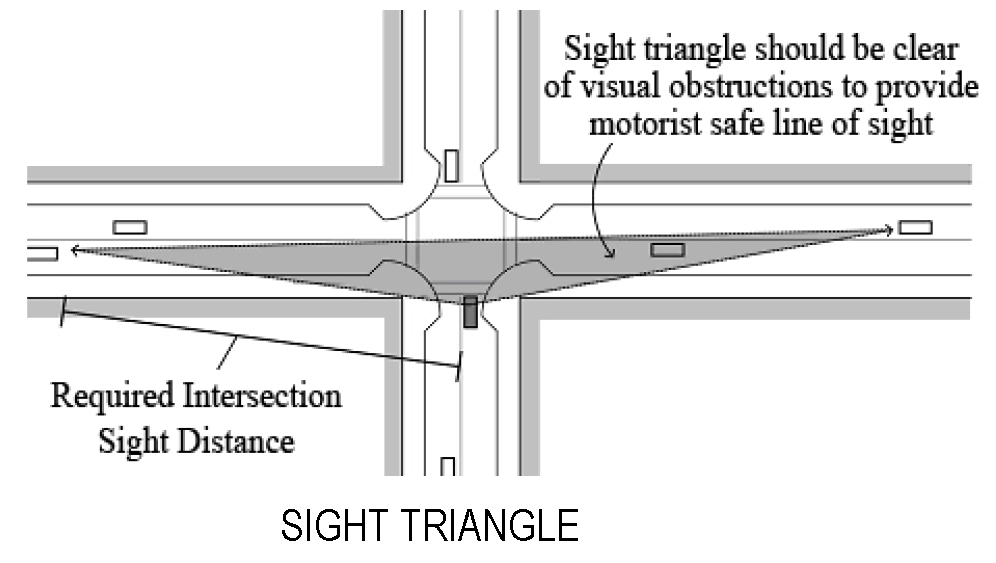
1 Distances are intended as a minimum guideline. Site conditions, such as grades, traffic volumes, signalization types, etc., may warrant increases in desired sight distances.
(Ord. No. 2013-02, § 7.1, 3-4-2013)
Sec. 111-197. - Height modifications.
(a)
Any limitation on the number of stories shall not apply to buildings used exclusively for storage purposes, provided such buildings do not exceed the maximum height in feet of the applicable district.
(b)
Chimneys, cooling towers, elevators, bulkheads, fire towers, gas tanks, steeples, penthouses, stacks, stage towers or scenery lofts, tanks, water towers, ornamental towers and spires, wireless television or radio towers or necessary mechanical appurtenances (where permitted) may be erected to any height not in conflict with existing or hereafter adopted ordinances of the city, except that, where permitted in connection with residential uses, such structures shall be limited to a height of 25 feet above the average height of structures permitted in that district.
(Ord. No. 2013-02, § 7.2, 3-4-2013)
Sec. 111-198. - Fences and walls.
(a)
Permit required. No person, firm or corporation shall construct or cause to be constructed or erected within the city any fence without first making an application for and securing a building permit. However, installation of underground electric fences designed for control of domestic animals does not require issuance of a permit.
(b)
Fence location.
(1)
For nonresidential districts, fence construction shall be subject to site plan approval with no setback restrictions except those deemed necessary and reasonable by the commission, or the building official when no review by the commission is required, unless otherwise stipulated elsewhere in this chapter.
(2)
No fence of any material shall be of a height or be located so as to obstruct sight distance at the intersection of a street with a driveway, alley or another street.
(3)
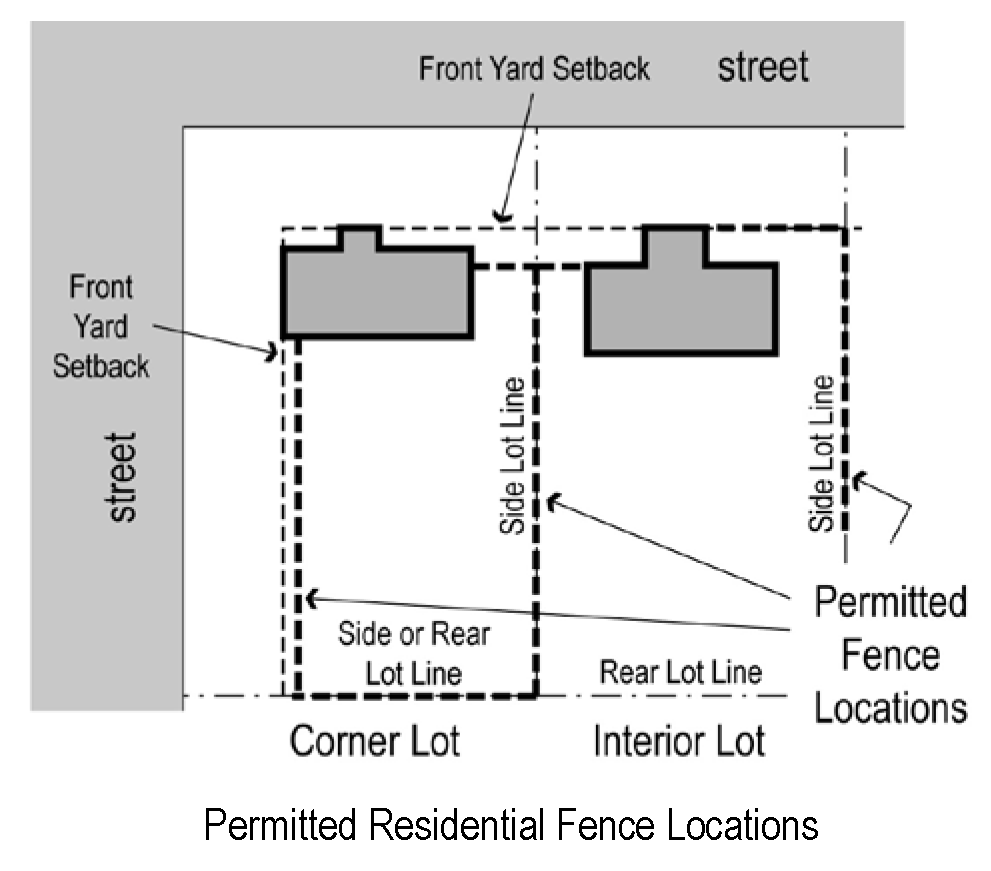
Fences may be permitted within or along side and rear yards on interior lots in residential districts. Fences shall conform to all applicable front yard setbacks, but, in no instance, shall be placed forward of the front building line. (See illustration.)
(4)
A fence may be permitted on an undeveloped residential lot; however, the fence may not extend beyond the front building line of the dwellings on either side of the lot. In no instance shall the fence extend into any required front yard setback or public rights-of-way.
(5)
No fence or any type of planting shall be placed or constructed in any location that would hinder access to fire hydrants.
(c)
Height standards.
(1)
Fences in a residential district shall not exceed a height of 6.5 feet as measured from the top most point of the fence to the ground or surface along the centerline of the fence (except for tennis courts, which may have a maximum height of ten feet). Unless otherwise permitted by the commission, fences in industrial districts shall not exceed eight feet in height nor 6.5 feet in all other nonresidential districts.
(2)
If a fence, wall or hedge is constructed on top of a wall or berm, the combined height of the fence, wall or hedge and the wall or berm shall not exceed the maximum height that would apply to the fence, wall or hedge alone.
(3)
Fences used for guard railing, around depressed ramps, tops of retaining walls along driveways and adjacent to residential sidewalks shall not exceed 42 inches in height.
(d)
Design standards.
(1)
The finished side of a fence shall face abutting property and public rights-of-way.
(2)
The following types of fences are permitted in all districts: masonry walls, ornamental iron, woven wire (chainlink), wood, vinyl, aluminum, and other composite materials designed specifically for use as fencing; and hedges. Note: wooden fences may not be used as part of a required buffer unless otherwise specifically approved by the commission (see section 111-200).
(3)
Fences and walls visible from public rights-of-way or abutting property shall be of a uniform style to provide an orderly appearance but may provide visual interest through the use of regularly spaced columns or a combination of fence materials or undulation of the fence line.
(e)
Prohibited types of fences. The following types of fences are prohibited: any fence carrying electrical current or utilizing spikes, nails, barbed wire or other security fencing with pointed materials in its construction. However, when warranted and upon review by the building official (or other approving authority, as applicable), such fence may be permitted in the A-1, I-1 and I-2 districts.
(f)
Maintenance.
(1)
Every fence shall be maintained in a condition of reasonable repair and shall not be allowed to become and remain in a condition of disrepair. Any fence that poses a threat to the public safety, health or welfare, shall be considered a public nuisance, and the city may commence proceedings for the abatement thereof.
(2)
The requirement to set back a fence or hedge from lot lines does not relieve the property owner of maintenance responsibilities for that portion of the private property lying outside of the fence or hedge.
(g)
Nonconforming fences. It is the intent of this chapter to allow the continuation of nonconforming fences until they are discontinued but not to encourage their survival. No nonconforming fence shall be enlarged, extended, reconstructed or structurally altered unless such fence is made to conform with this section. Ordinary maintenance of a nonconforming fence is permitted, provided such does not expand or intensify the nonconformity.
(Ord. No. 2013-02, § 7.3, 3-4-2013)
Sec. 111-199. - Porches, terraces, balconies, cornices and eaves.
(a)
Sills or ornamental features of a structure may project into any required setback not to exceed six inches, unless otherwise provided for in this chapter.
(b)
Cornices or eaves may project into any required yard setback by no more than 18 inches.
(c)
Unless otherwise provided for in this chapter, terraces, unenclosed open porches, decks, underground storm shelters or ornamental features of single-family and duplex dwellings may project into a required yard, but shall not extend closer than ten feet to the side lot line, 30 feet to the front lot line, and 25 feet to the rear lot line.
(d)
For multifamily residential developments, an unenclosed balcony, porch, deck or fire escape may project into a required rear yard up to 12 feet, and into a required front or side yard up to eight feet.
(e)
In no instance shall there be any encroachment into required buffer areas or easements.
(Ord. No. 2013-02, § 7.4, 3-4-2013)
Sec. 111-200. - Accessory uses and structures.
All accessory uses and structures shall conform to all applicable requirements of this chapter and shall directly serve the principal use or structure; be customarily accessory and clearly incidental to the principal use; be owned or operated by the same entity owning the principal use or structure; and be located on the same lot as the principal use or structure.
(1)
General regulations for accessory structures.
a.
No accessory structure shall be built prior to construction of the principal structure, nor shall such be used for purposes that are not normally incidental to principal use.
b.
In accordance with the city building code, accessory structures shall be set back 25 feet or more from the principal building unless a fire wall is provided, in which case the minimum setback may be reduced to 15 feet.
c.
Unless otherwise provided for in this chapter, accessory structures shall be permitted in the rear yard only and shall not be located in a required buffer or easement.
d.
Accessory structures shall not exceed the maximum building height of the applicable district. Detached accessory structures up to 12 feet in height shall be permitted no closer than five feet of any side or rear lot line. Accessory structures above 12 feet in height shall be set back one additional foot for each four feet in height above 12 feet up to the maximum building height of the district.
(2)
Accessory structures on residential premises. Residential accessory structures shall meet the following requirements:
a.
Small accessory structures that are not to be placed on a permanent foundation, such as utility sheds, but excluding carports, shall not require a building permit but shall require zoning approval by the building official to ensure all applicable regulations are met.
b.
Accessory structures shall not occupy, in total, more than 45 percent of the required rear yard or 864 square feet, whichever is smaller; except that where the lot is two acres or larger, the 864 square feet limit shall not apply.
c.
Accessory structures may be no closer than five feet to the side or rear lot lines.
d.
Where permitted, noncommercial transmission towers, including amateur radio antennae, may extend an additional 25 feet above the maximum allowable building height of a principal building.
e.
Accessory structures shall be constructed of materials which are compatible with other buildings in the district to ensure that the aesthetic value and appearance of the neighborhood is retained. Carports that are completely open on all sides and that are placed in the rear yard only may be aluminum or metal.
f.
All electrical power service to accessory structures shall originate from the main power service at the main building and not a separate metered service. However, upon a determination by the zoning official that the proposed use of an accessory structure does not constitute an accessory dwelling or any use not expressly authorized by these regulations, an accessory structure in an A-1 or E-1 district may have separate electrical service from the main building and may be separately metered. In such cases and prior to installation of separate electrical service to an accessory structure in an A-1 or E-1 district, the owner shall first receive written authorization from the building official. Failure to receive such authorization shall be considered a violation of this section.
g.
A detached carport may be permitted in the side yard subject to the following:
1.
The carport shall be set back at least five feet from the side lot line and shall not extend forward of the front building line.
2.
If the carport exceeds 15 feet in height, it shall be set back no less than ten feet from the side lot line.
3.
The carport shall not be enclosed on more than three sides.
4.
The design and materials of the carport, including roof pitch and form, shall be consistent with that of the principal dwelling. Metal/aluminum exteriors shall be prohibited.
5.
When not paved, the driveway to, and the foundation of, the carport shall be constructed of pervious materials approved by the building official.
h.
Attached carports and garages are considered part of the principal structure and must conform to the same setbacks.
i.
Satellite dish antennae. Small detached, ground-mounted satellite dish antennas may be erected in the side or rear yard only and at least five feet from any lot line and shall be neutral in color and, to the greatest extent practicable, compatible with the appearance and character of the neighborhood. Where placement restrictions prevent satisfactory reception or other problems of a unique nature, relief by the ZBA may be requested.
j.
Temporary storage containers shall not be permanently established as an accessory structure. See also section 111-201(4).
(Ord. No. 2013-02, § 7.5, 3-4-2013; Ord. No. 2015-002, § 1, 1-5-2015)
Sec. 111-201. - Temporary uses and structures.
Certain temporary uses may be established provided that such uses are discontinued upon the expiration of the approved time period. Temporary uses shall not involve the construction or alteration of any permanent structure or sign. The building official shall give due consideration to the proposed use and the surrounding area and shall determine if the proposed temporary use may be permitted in accordance with the intent of this section.
(1)
Revocation of temporary use permit. The building official may revoke a temporary use permit at any time subsequent to the failure of the owner or operator to maintain and/or conduct the temporary use in accordance with the conditions of its approval. Upon receipt of notice of revocation of the approval, the owner or operator of such activity shall cease operation of the activity immediately. Such provision shall not preclude the use of any other remedy prescribed by law with respect to violations of the provisions of this chapter.
(2)
Construction trailers.
a.
The building official may grant a temporary use permit for the location of an office trailer at a construction site in any zoning district for not more than one year. A site plan/survey may be required, and all appropriate permits and business licenses shall be issued before placement of the temporary trailer and/or use. Such temporary uses shall not begin prior to approval of a site plan or subdivision plat and shall terminate upon expiration of the permit unless an extension is approved.
b.
The temporary structure may not be placed in any right-of-way, and the temporary use shall not be detrimental to property or improvements in the surrounding area or to the public health, safety or general welfare.
c.
Within 15 days of placement, trailers shall have temporary underpinning from the body of the trailer to the ground and temporary landscaping, both of which shall be subject to approval by the building official.
d.
Said temporary use shall occur only on the premises of the construction project and shall not be considered an approved use related to off-site properties or projects.
e.
Extension of time. Any request for an extension, prior to expiration of the permit, of the approved time period shall be for good cause and in writing to the building official, who will determine if the extension may be granted. The building official shall have the authority to refer the extension request to the council for approval.
f.
Removal of temporary structure. The temporary structure must be removed within 30 days after expiration of the temporary use permit, or upon issuance of the final certificate of occupancy. (For single-family residential subdivisions, this would be upon issuance of the final certificate of occupancy for buildable, approved lots in the development.)
g.
Abandonment of temporary structure. Notwithstanding subsection (2)e of this section, if the temporary structure is abandoned and has not been removed 60 days after expiration of the last permitted date, and following notification to the property owner, the city council may have the structure removed and place the incurred expenses of such removal as a lien against the property.
(3)
Temporary real estate offices. A temporary use permit may also be approved for the temporary use of a permanent on-site structure, such as a model home, as a pre-sales/leasing office.
(4)
Temporary storage containers. Temporary storage containers may be located outside of a principal building provided all the following criteria are met, a business license is obtained by the container provider, and a temporary use permit is secured from the building official:
a.
Agricultural and residential districts.
1.
The floor area of a container shall not exceed 200 square feet.
2.
Containers shall be placed in the driveway, or, if impracticable, in a location approved by the building official, provided there is sufficient space for required parking, public safety access, and the location does not pose a health or safety hazard. In all cases, containers shall be set back a minimum of ten feet from the front lot line.
3.
No container shall remain on any site in excess of 30 consecutive days or 30 cumulative days in a calendar year. In the event of a hardship, emergency conditions, or other extenuating circumstances, an extension may be approved upon request to the building official.
b.
Commercial districts.
1.
Containers may not be stored on site for the purpose of rental, leasing and/or sale, including on the premises of mini-warehouse facilities.
2.
Temporary usage may be approved provided off-street parking is not reduced below that required by this chapter, there is adequate public safety access, and the location does not pose a health or safety hazard.
c.
Industrial districts. The operator or other person in charge of any site on which a container is placed shall be responsible to ensure that all containers are in good condition and free from evidence of deterioration, weathering, discoloration, rust, ripping, tearing, or other holes or breaks. Said person shall also be responsible to ensure that no hazardous or illegal substances are stored or kept within any such container. When not in use, containers shall be kept locked.
(5)
Roll-off dumpsters on residential premises. A property owner or tenant may rent and use a roll-off dumpster on a residential premises in accordance with all applicable provisions of this section and when the following conditions are met:
a.
The inspection services department shall be notified at least one business day prior to placing the unit on the site.
b.
The unit shall be placed on the site for no more than 60 consecutive days.
c.
The unit shall have a maximum capacity of 30 cubic yards, or be no larger than eight feet in height, eight feet in width and 16 feet in length.
d.
The unit shall not be placed on streets or other rights-of-way, common areas or required buffers or other landscaped areas. Placement shall not obstruct safe and convenient access to fire hydrants or other public safety access, required parking spaces, driveways and pedestrian pathways.
e.
The unit shall be used only for disposal of acceptable waste. Examples of waste that are not acceptable include refrigerators, air conditioning units, tires, batteries, car parts, hazardous waste or toxic materials, gas and propane tanks.
(Ord. No. 2013-02, § 7.6, 3-4-2013)
Sec. 111-202. - Outdoor storage of recreational vehicles, construction equipment.
The outdoor storage or parking of any airplane, vehicle, boat, trailer, motor home, recreational vehicle and similar vehicles shall be prohibited for a period greater than 48 hours in any residential district, except where expressly permitted by other provisions of this chapter, and unless the following conditions are met:
(1)
Recreational vehicles.
a.
When possible, all such vehicles or equipment shall be placed within a completely enclosed building or shall be located behind the front building line and parked no closer than three feet to any side or rear lot line.
b.
Recreational vehicles shall be placed, at a minimum, on an all-weather surface, paved or constructed of pervious materials approved by the building official.
c.
Parking shall be limited to a premises upon which there is an inhabited dwelling, and the vehicle is owned by the occupant thereof, unless otherwise provided for in this chapter.
d.
In the case of multifamily dwellings, all such vehicles shall be stored in one or more consolidated locations and be screened, if not in an enclosed building, by a fence, wall or vegetation adequate to conceal the vehicle from public view off the premises. For attached dwellings, refer to section 111-159.
e.
No recreational vehicle, while parked or stored in a residential area, shall be occupied as a dwelling or be connected to sanitary sewer facilities or have a fixed connection to electricity, water or gas.
(2)
Construction equipment. The outdoor storage of construction equipment on a premises in any residential district is prohibited. However, this shall not apply when the construction equipment being stored is being used for construction work on the site upon which it is being stored. The equipment shall be removed immediately upon completion of the work.
(Ord. No. 2013-02, § 7.7, 3-4-2013)
Sec. 111-203. - Swimming pools.
Where permitted, swimming pools shall comply with the following:
(1)
Standards for all pools.
a.
Swimming pools shall be subject to the requirements of the city building code.
b.
Before approval of a permit to install the swimming pool, all applicable regulations and requirements in effect for stormwater and erosion control shall be met. Information and permit applications may be secured from the inspection services department.
c.
Pools, decks, pool houses and related structures that are detached from the principal building shall be in accordance with section 111-200.
d.
Swimming pools, including mechanical appurtenances, shall not be located closer than ten feet to any property line and shall not be located in any required buffer or easement area.
e.
The method of discharge of water shall be done in a manner that will not create a nuisance to any adjoining property.
f.
The use of megaphones, loudspeakers and public address systems shall be prohibited, and use of any sound-producing or -reproducing device, including the human voice, shall comply with the provisions of the city's noise ordinance.
g.
All exterior lighting fixtures shall be constructed to direct the beam of light below the horizontal plane of the fixture, reflecting away from any adjacent property. Said fixtures shall not extend higher than 25 feet above ground level.
h.
All outdoor pools shall be completely enclosed at the time of construction by a permanent fence of not less than four feet in height above the level of all surface or ground lying within three feet of such fence and shall have no horizontal gaps or openings in excess of four inches in width. Gates or doors may constitute a part of such enclosure; and all such gates or doors, except the door of a dwelling which forms a part of such enclosure, shall be equipped with a self-closing and self-latching device for keeping the gate or door securely closed at all times when not in actual use.
(2)
Standards for single-family dwellings.
a.
Aboveground pools. Permanent swimming pools that are wholly or partially above ground level shall be located no closer than 25 feet to any property line.
b.
Electrical power service shall originate from the main power source at the principal building and not a separate metered service.
c.
Private swimming pools shall be permitted in the RT-4 district only in an approved common open space meeting the minimum requirements hereinabove.
(3)
Standards for multifamily and nonresidential premises. Swimming pools for multifamily and nonresidential uses shall meet minimum standards deemed appropriate by the inspection services department and city engineer upon review of each specific proposal.
(Ord. No. 2013-02, § 7.8, 3-4-2013)
Sec. 111-204. - Tennis courts.
Where permitted, private tennis courts shall comply with the following requirements:
(1)
All tennis courts constructed in single-family residential districts shall meet the following minimum standards:
a.
The tennis court shall be located in the rear yard.
b.
The tennis court shall be set back at least 25 feet from any property line or dwelling.
c.
Fences shall meet the requirements of section 111-198.
(2)
Tennis courts for multifamily and nonresidential uses shall meet the standards deemed appropriate by the commission during site plan review.
(3)
If lighted, all exterior lighting fixtures shall direct the beam of light toward the facility itself and away from any adjacent areas. Said fixtures shall not exceed 30 feet in height.
(Ord. No. 2013-02, § 7.9, 3-4-2013)
Sec. 111-205. - Pre-engineered, all metal buildings.
Pre-engineered, all metal buildings shall be permitted only in the I-1, I-2, I-3-S districts and shall be subject to the following requirements:
(1)
All primary structures are to be covered (no exposed structure).
(2)
All exterior walls are to be painted. No galvanized materials will be permitted.
(3)
Sufficient parking retainers shall be used where a parking area is at the building wall.
(4)
Steel pipe or concrete guards are to be used at all overhead doors.
(5)
All overhead door frames shall be painted with a finished coat of paint. No primed frames will be permitted.
(6)
All buildings shall have factory standard steel building gutters and gable trim. No house gutters or economy trim shall be permitted.
(7)
Sixty percent of the wall area on the front or entrance wall is to be of acceptable material other than steel panels, such as glass, masonry, EIFS, hardi plank, wood shingle or porcelain panels.
(8)
The front or entrance wall shall have either a mansard system, gable overhang, eave canopy or aluminum marquee.
(9)
All overhang, extensions, open bays, fascia or mansard systems or any condition that leaves roof sheets or frames exposed shall have soffit panels or soffit trim.
(10)
All buildings shall comply with the city building code.
(11)
In certain cases, where all-metal buildings are deemed to be incompatible with surrounding development (either in construction or appearance), the developer may be required to cover either all or part of the exterior of the building with materials as deemed appropriate by the design review board.
(Ord. No. 2013-02, § 7.10, 3-4-2013)
Sec. 111-206. - Modular homes.
The regulations and requirements in this section are designed to ensure protection of health, safety and welfare of the residents of modular homes and of the neighborhood. The following requirements shall be met:
(1)
No modular home shall be occupied for dwelling purposes unless expressly permitted in the applicable zoning district. A set of house plans shall be presented as part of the permit application process.
(2)
A modular home shall not be permitted unless and until it meets and complies with all requirements applicable to a single-family dwelling and possesses all necessary permits and other certifications as required by state, county and city codes. Those laws or regulations that are more stringent, either pursuant to, or adopted after the effective date of the ordinance from which this chapter is derived shall apply.
(3)
Modular homes shall be at least 20 feet in width and shall meet the minimum square footage requirements of any restriction of plats, deeds, or private contract if such is greater than the provisions of this chapter.
(4)
Modular homes shall be placed on a permanent foundation constructed with material customarily used in conventional type residential developments and shall be attached and/or anchored thereto in compliance with all applicable state, county or city codes, standard regulations or laws, and with manufacturer installation specifications.
(5)
The minimum distance from the top of the foundation to the eaves of the dwelling shall be eight feet as measured at the highest elevation of the foundation to the lowest elevation of the eaves.
(6)
Modular homes shall have a pitched roof composed of a material customarily used on conventional dwellings, including fiberglass, shake, asphalt, metal or tile.
(Ord. No. 2013-02, § 7.11, 3-4-2013)
Sec. 111-207. - Ownership and maintenance of common open spaces and facilities.
For all proposals involving the creation of open spaces or facilities to be owned and maintained by a homeowner, property owner, or condominium association, the following shall apply:
(1)
Owner's association. An association representing the owners shall own the common open space or facility in perpetuity. Membership in the association shall be mandatory and automatic for all owners of the subdivision or condominium and their successors. The association shall have lien authority to ensure the collection of dues from all members. The responsibility for maintaining the common open space and/or facilities located thereon shall be borne by the association.
(2)
Management plan. The applicant shall submit a plan for management of open space and/or common facilities that:
a.
Allocates responsibility and guidelines for the maintenance and operation of the common open space/facilities, including provisions for ongoing maintenance and for long-term capital improvements;
b.
Estimates the costs and staffing requirements needed for maintenance and operation of, and insurance for, the common open space/facilities and outlines the means by which such funding will be obtained or provided;
c.
Provides that any changes to the plan be approved by the commission; and
d.
Provides for enforcement of the plan
(3)
Failure to maintain. In the event the party responsible for maintenance of the common open space fails to maintain all or any portion in reasonable order and condition, the city may assume responsibility for its maintenance and may enter the premises and take corrective action, including the provision of extended maintenance. The costs of such maintenance may be charged to the association, or to the individual owners that make up the association, and may include administrative costs and penalties. Such costs shall become a lien on all involved properties.
(Ord. No. 2013-02, § 7.12, 3-4-2013)
Sec. 111-208. - Hen coup.
(a)
General conditions for the keeping of hen coup. Location and requirements for hen coups and enclosures:
(1)
The maximum size of the coop and pen area shall be (100 square feet, which is to be included in the maximum total square footage of accessory structures in the rear yard, as described in section 111-200, accessory uses and structures (Zoning Ordinance No. 2013-02, § 7.5).
(2)
The maximum height of a coop and the pen fence around the coop shall be six feet, as measured from the existing grade to the highest part of the coop or fence.
(3)
The coop and pen area shall meet the setbacks as required in Section 111-200, accessory uses and structures (Zoning Ordinance No. 2013-02, § 7.5).
(4)
A coop or pen must be built within a rear yard that is surrounded by an opaque wall or fence that is at least six feet in height. A chain-link fence, chain-link fence with slats, or similar fence shall not constitute an opaque wall or fence. Nothing in this section shall prevent construction of a coop and pen to abut the side of an applicant's house, so long as it otherwise meets the requirements of the Code of Ordinances.
(5)
Hen coops shall be covered and ventilated, and a fenced pen enclosure/run is required. The coop and pen must be constructed in a way that establishes a clean safe and pleasant environment free of odor, vermin, noise, and disease.
(6)
All enclosures for the keeping of hens shall be so constructed and maintained as to prevent rodents or other pests from being harbored underneath, within, or within the walls of the enclosure.
(7)
Hen coops must be impermeable to rodents, wild birds, predators, and weather, including all openings, ventilation holes, doors, and gates. Enclosures shall be kept in neat condition, including provision of clean, dry bedding materials and regular removal of waste materials, so not to create an odor.
(8)
The space per hen in the coup shall not be less than three square feet.
(9)
All hen feed shall be kept in a secured and covered metal or plastic container, or otherwise protected to prevent rodents and other pests from gaining access to it.
(b)
Any person keeping hens as an accessory to an occupied dwelling shall be subject to the following restrictions:
(1)
Up to four hens may be kept at an occupied single-family residence.
(2)
Ducks, geese, turkeys, peafowl, male chickens/roosters, pigeons, or any other poultry or fowl are not allowed.
(3)
Hens are not allowed on duplex, triplex, townhomes, multifamily properties, community gardens, or any other uses.
(4)
Hens must be secured within a covered hen coup, hen tractor, or fenced pen/run area all the time and are not allowed to run at large upon any public properties or off the premises of the owner. Hens must have access to food and water all the time. The coop and pen/run area must be completely secured from predators with hardware cloth or similar material. Chicken wire shall not be used.
(5)
The coop and pen/run area must be cleaned regularly and kept free of insects and rodents. Odors from hens, hen manure, or other items associated with the keeping of hens must not be perceptible at the property boundaries. Hens must not be permitted to create a nuisance consisting of noise or pests or contribute to any other nuisance condition.
(6)
No manure may be allowed to accumulate on the floor of the coop or ground. All feed and other items associated with the keeping of hens that are likely to attract or to become infested with rodents or other pests shall be kept in a rodent and pest-proof container.
(7)
Composting of hen manure is allowed in an enclosed bin. The composting bin shall be kept at least 20 feet away from all property lines. Waste materials (feed, manure, and litter) not composted must be bagged and disposed of in the trash.
(8)
Hens must be kept for personal use only. Selling hen, eggs, feathers, or hen manure, or the breeding of hens is prohibited.
(9)
Hens may not be slaughtered on premises.
(10)
Any person who violates any provision of the article will, upon conviction, be punished as provided in this Code. Additionally, the building official has the sole discretion to require that the hens be removed within ten days if he or she determines that the owner is in violation of the requirements of the Code.
(11)
Violation of this ordinance shall be punishable as provided in section 1-8 of the City Code.
(Ord. No. 2022-010, § 4, 7-21-2022)

