
Geneva City Zoning Code
ARTICLE 7
- USE-SPECIFIC REGULATIONS
Sec. 7.01.- Telecommunication Towers.
1.
Required Approvals. Construction of a tower and installation of an antenna or equipment requires approval of a Special Exception from the Board of Adjustment.
2.
Applicability. All towers, antennas and equipment constructed or installed, whether on a new or existing tower compound, after the effective date of this Ordinance and any changes or additions to any tower or antenna in existence before the effective date of this Ordinance are subject to this Section. A tower proposed to be built on a co-location site is subject to the same requirements and conditions as all other towers. This does not include routine maintenance of, and repairs to, the communication facilities.
3.
Public hearing. The Board will hold a public hearing on an application for the construction of a tower and/or the installation of the equipment to be used in connection with the first antenna to be placed on the tower. The installation of any additional antenna on the same tower, and the equipment used in connection with such additional antenna, requires the approval of the mayor and does not require approval of the Board unless:
a)
The tower compound is to be enlarged or there is a change in the size or location of the existing tower; or
b)
The mayor considers it appropriate that an application be referred to the Board for review and consideration.
4.
Co-location. A new tower may not be constructed if space is available, on an economically reasonable basis, on an existing tower structurally and technically able to support the proposed antenna. An affidavit (as required by § 7.01.10.g) that reasonable effort has been made to locate the proposed antenna on an existing tower must be submitted with the application for new tower construction. New towers must be designed to accommodate additional antennas to the extent practicable.
5.
Review Criteria. In considering an application, the Board will consider the following criteria:
a)
Structural safety of towers: Towers must comply with wind-load and other structural standards contained in applicable building and technical codes of the City, and the electronic industries associations code, so as not to endanger the health and safety of people in the event of the structural failure. The Zoning Official determines compliance with these requirements.
b)
Appearance of tower compounds: Towers and tower compounds must be designed to be compatible with surrounding land uses through buffers and/or screening as approved by the Board.
6.
Development Criteria. The Zoning Official reviews all applications for compliance with this Section. By a vote of a majority of the Board present at the public hearing, it may waive any one or more of the following requirements if the circumstances justify such waiver and provided the reasons for such waiver:
a)
All towers must be monopoles.
b)
New towers must be capable of accommodating at least one additional antenna.
c)
The centerline of a tower may not be located closer than 100 ft from the boundary line of any residential property. If the land on which a tower compound is located, and all land which abuts the tower compound, is in a nonresidential district (including land in a Planned Development District used for nonresidential purposes) the centerline of the tower may not be closer than 50 ft from the boundary line of such property. The Board may reduce these requirements in cases where, due to unusual topographic conditions, the setback requirements would result in unnecessary hardship; provided that the reduced setback is not less than the minimum setback required in the district.
d)
No off-premise messages, may be attached to, or depicted on, a tower or antenna.
e)
Towers may not be illuminated except lights for security and maintenance purposes. Such light must be pointed downward from a height of not more than 10 ft and may not exceed a maximum of 150 watts. Lights must be located, directed and/or shielded so that they do not shine or reflect onto or toward any residential property.
f)
Tower compounds must be surrounded and fully secured by a dark colored, vinyl-coated or galvanized steel security fence or masonry wall or combination thereof, at least eight ft in height.
g)
All tower compounds must be surrounded by a landscaped screen at least eight ft in height to screen the compound from adjacent public ways and residential property. The screening, which may be located within the required setback area, must consist of a landscaped strip, at least four ft in depth, located outside of the fence. The landscaped strip must be planted with a combination of trees, shrubs, and/or ground covers attaining, at maturity, a height as high as the security fence. For tower compounds located within 1,000 ft of residential property or areas of special aesthetic concerns, such as schools, the Board may require wider landscaped areas and other items, such as decay-resistant, solid wood fences or masonry walls. All fences, walls and landscaping must be kept in good condition and repair.
In the application, the applicant must include the name and address of the party responsible for maintenance and repair of the facilities and any fences, walls and screening. If a different person becomes responsible for maintenance and repair, the owner must give the Zoning Official the person's name and address.
h)
In isolated nonresidential areas, alternative landscaping methods may be permitted on the condition that if the areas surrounding such tower compounds become developed, the Commission will have the right to require the owner to comply with the requirements of § 7.01.7.f-g above.
i)
Existing mature trees and natural land forms should be preserved to the maximum extent practicable. In some cases, preservation of a substantial amount of existing trees around the perimeter of the tower compound may be an acceptable substitute for required screening.
j)
A parking area and driveway with all-weather surfaces must be provided for maintenance and emergency access. Subject to the approval of the Board and to an appropriate agreement with the owner, access may be by means of, and parking may be provided on, an adjoining property. Subject to the approval of the Board, one or more public streets adjoining the tower compound may serve as the parking area.
7.
Removal of Unused Towers. Any tower no longer in use for its permitted purpose must be removed at the owner's expense. Within 10 working days of sending notice to the FCC of the intent to cease use of the tower, the owner must provide the City Clerk with a copy of the notice. The owner must remove the tower and all communication facilities within 90 calendar days from the day the tower ceases to be used or by an earlier date if required by the FCC. If the owner does not remove the tower within this period, the owner of the property on which the tower is located, if different from the owner of the tower, must remove it within 90 calendar days of receiving written notice from the City. If the tower is not removed within the time prescribed, the city may, but is not obligated to, remove the tower. If the city removes the tower it is entitled to recover costs from the owner(s). Notwithstanding the foregoing, a tower used by more than one party may continue to be used for telecommunication purposes as long as the tower is used for such purposes by at least one party. Any party who ceases to use a tower used by more than one party must remove its antenna and equipment within 90 calendar days after it ceases to use the tower, or within a shorter period if prescribed by the FCC, so that the tower and compound will be available for use by another party. If the tower is located on property owned by the City of Geneva, it has the right to purchase the tower for $100.00 when it ceases to be used for telecommunication purposes by all parties who have an antenna located on the tower. The right to purchase must be exercised within 60 calendar days of the date the City receives notice that the owner intends to cease use of the tower.
8.
Receiving Antennas. A building permit is required for receiving antennas over 18 inches in diameter. A receiving antenna in a residential district is considered an accessory structure. A receiving antenna in a nonresidential district must be screened on four sides if it is located at ground level.
9.
Application. Applications for a permit to construct a new tower or to locate an antenna or additional equipment on an existing tower compound, must include the following:
a)
A list of the names and addresses of all owners of property located within 500 ft of the tower compound. The application must be accompanied by certification by the applicant, a surveyor or an attorney that the list of property owners was obtained from the tax assessor and that the list contains the names and addresses of all owners of property within 500 ft of the compound.
b)
Statement of impact on health, safety, and welfare: A brief written statement concerning the steps the applicant has taken to comply with all applicable rules, regulations, and requirements concerning health and safety matters related to the proposed communication facilities.
c)
Site plans: A site plan, prepared by a surveyor, scaled to not less than one inch equals 50 ft, showing the location and dimensions of the subject property, as well as the location of setback lines, driveways, parking areas, fencing, landscaping, and generators and the location, size and type of any fuel tanks. The site plan must also show:
1)
All parcels within 500 ft of the tower compound.
2)
Zoning classification of the property and of all parcels within 500 of the compound.
3)
The latitude, longitude, section, township, range, tax parcel identification number, street address and the site identification number of the proposed tower compound.
4)
Other information that may be required by the Board to determine compliance with this Ordinance. If the proposed tower is to be located on a portion of a larger property, its location with respect to the boundary lines of the property must be shown on the site plan.
d)
Elevation views: a silhouette and elevation view of the proposed or existing tower, as applicable, all other communication facilities, and the tower compound, describing colors and materials to be used for the communication facilities and any fencing or walls. The configuration of proposed antenna arrays must be shown on the silhouette. The proposed location of future, additional antenna arrays must be shown on the silhouette by dashed lines.
e)
The frequency band and maximum wattage of proposed communication facilities.
f)
The estimated life of the tower, the antenna and the equipment.
g)
Affidavit: An affidavit of the applicant stating that: 1) there is no existing tower from which the area to be served from the proposed new tower can be served; or 2) the applicant has made good faith efforts to have its antenna installed on an existing or proposed tower and has been unable to do so and describing the efforts made by the applicant to use such existing or proposed tower.
h)
Certification of Shared Use Design. If the tower already includes one or more antennas, the application must be accompanied by certification from a qualified engineer stating that the tower is able to accommodate the proposed antenna, as well as the antennas already located on the tower.
To help defray the costs of processing applications, reviews and otherwise administering the provisions of this Section, the applicant must submit a non-refundable application fee of $250 as well as any costs incurred by the City for public notice.
10.
Foundation Survey, As-Built Certification. After the foundation for a tower is poured, a foundation survey, prepared by a surveyor, must be furnished to the Zoning Official, and no further construction work may be done until the Zoning Official has approved, in writing, the foundation. Upon the completion of construction and/or installation, the tower and antenna or the antenna may not be put into operation until a qualified engineer furnishes the City written certification that the construction and/or installation was performed in accordance with the plans submitted to the city.
(Ord. No. 12-2017-05, § 7.01, 12-18-2017)
Sec. 7.02. - Conservation Development.
1.
Intent.
a)
To provide flexibility to achieve the most effective development on lands constrained by natural hazards that may limit the amount or type of development;
b)
To promote the creation of accessible green space;
c)
To protect sensitive, environmental land features and promote the public health and safety;
d)
To reduce erosion, sedimentation, land disturbance, and removal of vegetation;
e)
To promote development of walking and bicycling facilities and greenways within new developments that can be connected to adjacent neighborhoods and activity centers; and
f)
To reduce perceived density by providing access to and views of open space.
2.
Applicability. The Conservation Development option is available, upon approval by the Commission, for single-family detached residential development of at least three acres in the R-1, R-2 and R-3 Districts. The applicant must comply with all other applicable regulations, except as modified by this Section.
3.
Ownership of Development Site. If held in multiple ownership, the site must be developed according to a single plan with common authority and common maintenance responsibility.
4.
Density Determination. The maximum number of lots is determined by dividing the total area of the proposed subdivision by the most restrictive of the following: minimum lot size of the applicable district or by regulations of the City and/or County Health Department for septic tank use. In calculating tract area, the following must be excluded:
a)
Designated floodway.
b)
Bodies of open water over 5,000 sf of contiguous area.
c)
Wetlands, as defined by the Army Corps of Engineers.
The total area for front, rear and side yards for each dwelling must be 2.5 times the ground floor area of the dwelling. A minimum 15 ft of space between residential buildings must be provided.
5.
Application Requirements.
a)
Site Analysis Map. The applicant must submit a site analysis map concurrently with the preliminary plat. For submittal requirements, refer to Appendix A-3.
b)
Subdivision Plan. The developer must submit a Subdivision Plan, which yields no more lots than allowed under this Section, identifies open spaces to be protected, and includes an open space plan (see §7.02.6). The Development Plan must be approved prior to any grading.
c)
Instrument of Permanent Protection. An instrument of permanent protection, as described in §7.02.7, must be placed on designated open spaces at the time of approval.
6.
Open Space Plan. For the purposes of this Section, "open space" is defined as the portion of a Conservation Development set aside for permanent protection. Activities within the open space are restricted in perpetuity through the use of a legal instrument approved by the City Attorney.
a)
Standards.
1)
The minimum open space must comprise at least 25% of the gross tract area.
2)
The following Priority Conservation Areas, if present, must be included within the open space(s) to be protected:
(i)
The 100-year floodplain;
(ii)
Riparian zones of at least 75 ft width along all perennial and intermittent streams;
(iii)
Slopes above 25% of at least 10,000 sf contiguous area;
(iv)
Wetlands, as defined by the Corps of Engineers;
(v)
Archaeological sites, cemeteries and burial grounds.
3)
The following areas should be included within the open space to the extent feasible:
(i)
Important historic sites;
(ii)
Existing healthy, native forests of at least one-acre contiguous area;
(iii)
Individual existing healthy trees greater than eight inches caliper; and
(iv)
Other significant natural features and scenic viewsheds.
4)
Utility rights-of-way and small areas of impervious surface may be included within the protected open space but cannot be counted towards the 25% area requirement (exception: historic structures may be counted). Parking and loading areas are not permitted in the open space.
5)
At least 25% of the total protected open space must be suitable for passive recreational use.
6)
At least 50% of the open space must be contiguous, although it may be crossed by a local street. The layout of open space should allow connection to open spaces adjoining the site.
7)
The open space should be directly accessible to the largest practicable number of lots or buildings on the site. Lots and buildings further from the open space should be connected to the open space through sidewalks or off-street walkways.
b)
Permitted Uses of Protected Open Space.
1)
Conservation of natural, archeological or historical resources;
2)
Meadows, woodlands, wetlands, wildlife corridors, game preserves, or similar conservation-oriented areas;
3)
Passive recreation areas, such as open fields, walking or bicycle trails;
4)
Active recreation areas, provided they do not take up more than 20% of the total open space and are not located within priority conservation areas. Active recreation areas may include impervious surfaces. Active recreation areas in excess of this limit must be located outside of the protected open space.
5)
Landscaped stormwater management facilities, community and individual wastewater disposal systems with adequate soils. These facilities may not be located in Primary Conservation Areas.
6)
Easements for drainage, access, and underground utility lines.
7)
Other conservation-oriented uses compatible with the purposes of this Section.
c)
Prohibited Uses of Protected Open Space:
1)
Golf courses
2)
Streets, parking lots and similar impervious surfaces, except as specifically authorized in the previous subsections
3)
Impoundments
4)
Other activities as determined by the applicant and recorded on the legal instrument for permanent protection.
d)
Ownership and Management of Open Space. See §3.11.
7.
Legal Instrument for Protection of Open Space. The open space must be protected in perpetuity by a binding legal instrument recorded with the deed. The instrument for permanent protection must include clear restrictions on use of the open space, including all restrictions contained in this Subsection and any restrictions the applicant chooses to place on the open space. The instrument must be one of the following:
a)
A permanent conservation easement in favor of either:
1)
A land trust or similar conservation-oriented nonprofit organization with legal authority to accept such easements. The organization must be bona fide and in perpetual existence and the conveyance instruments must contain an appropriate provision for retransfer in the event the organization becomes unable to carry out its functions; or
2)
A governmental entity with an interest in pursuing goals compatible with the purposes of this Subsection, and if the entity accepting the easement is not the City, then a third right of enforcement favoring the City must be included in the easement.
b)
A permanent restrictive covenant for conservation purposes in favor of a governmental entity.
c)
An equivalent legal tool that provides permanent protection, as approved by the City Attorney.
8.
Tax Assessment of Open Space. Once a legal instrument for permanent protection has been placed upon the open space, the County Tax Assessor may be requested to reassess the open space at a lower value to reflect its limited use.
(Ord. No. 12-2017-05, § 7.02, 12-18-2017)
Sec. 7.03. - Home Occupations.
In agricultural, residential and manufactured home districts, home occupations may be permitted only in single-family residences and duplexes subject to the following:
1.
There may be no change in the outside appearance of the building or premises, or other visible evidence of the conduct of the home occupation. Signage identifying the home occupation is prohibited.
2.
The Home Occupation must be clearly incidental and subordinate to the residential use. Not more than 25% of the floor area of the dwelling unit may be devoted to the home occupation. A home occupation may not be conducted in an accessory structure without approval of a Special Exception by the Board.
3.
Only members of the family residing on the premises may be engaged in the home occupation.
4.
No traffic may be generated by the home occupation in greater volumes than would normally be expected in a residential neighborhood, and any need for parking generated by the home occupation must be provided off-street and may not be located in the required front yard.
5.
The home occupation must not create a disturbance (noise, vibration, glare, fumes, odors, electrical interference, etc.) or blight or nuisance of any nature.
The above restrictions do not apply to home occupations in a B-1, B-2 or B-3 District.
(Ord. No. 12-2017-05, § 7.03, 12-18-2017)
Sec. 7.04. - Mini-warehouses.
1.
Storage of volatile, toxic or explosive materials is prohibited.
2.
Storage spaces may not be used for residential occupancy or for commercial activities other than periodic auctions to dispose of items that have been abandoned and/or for which the lease time has expired.
3.
Landscaping or screening around the perimeter of the site may be required as part of any required Conditional Use approval. Outdoor storage must be screened as required in §10.02.
(Ord. No. 12-2017-05, § 7.04, 12-18-2017)
Sec. 7.05. - Wrecking and Junk Yards.
1.
No automobile wrecking yard, salvage yard or junkyard may be established closer than 300 ft to a residential district.
2.
All outdoor storage of salvage and wrecking operations must be completely contained within a fence or wall of not less than six nor more than 10 ft in height and designed in accordance with §10.04.
3.
Wrecked automobile, junk, or salvaged materials may not exceed the height of the screen fence or wall.
(Ord. No. 12-2017-05, § 7.05, 12-18-2017)
Sec. 7.06. - Accessory Dwellings.
1.
Accessory dwellings are permitted only as an accessory use to a permitted single-family detached dwelling.
2.
Area and Dimensional Requirements.
a)
The accessory dwelling may not exceed 50% of the floor area of the principal dwelling. Detached accessory dwellings are also subject to §3.10 Accessory Structures.
b)
Setbacks. If detached from the principal dwelling, accessory dwellings must be to the rear of the principal dwelling or within the upper floor of a detached garage or similar permitted accessory structure.
3.
Additional Requirements.
a)
One parking space, in addition to that required for the principal dwelling, must be provided.
b)
Detached accessory dwellings must maintain the appearance of the principal dwelling, including colors, materials, and style.
c)
Separate driveway entrances are not permitted.
d)
Accessory dwellings may not be separately metered, including electricity, water and gas, unless required by the utility company.
(Ord. No. 12-2017-05, § 7.06, 12-18-2017)
Sec. 7.07. - Bed and Breakfasts.
Bed and breakfasts may only be permitted in single-family detached dwellings, may only be operated by the owner and resident of the dwelling, and must comply with the following provisions:
1.
All guest rooms must be located in the principal structure. Individual guest rooms may not contain cooking equipment.
2.
One parking space must be provided for each guest room in addition to the spaces required for the residence. Guest parking must be screened from adjacent properties. Recreational vehicle parking is permitted on lots one acre or larger only.
(Ord. No. 12-2017-05, § 7.07, 12-18-2017)
Sec. 7.08. - Multifamily Dwellings.
Multifamily dwellings are subject to the following requirements. Where there is any conflict between the provisions herein and the provisions of §4.04 R-3 Residential District, the more restrictive requirements govern.
1.
Dimensional Requirements. In addition to the requirements set forth in Table 4-2, the lot area must be at least 9,000 sf plus an additional 2,000 sf for each additional dwelling after the first two. The lot must be at least 60 ft wide plus an additional five ft for each additional dwelling after the first two.
2.
Stormwater Management. Stormwater facilities should be integrated in the design of parking areas and common open spaces as landscape amenities, where practicable.
3.
Access. Driveway cuts along a public street must be minimized. On corner lots, driveway access must be located along the lesser street, when practicable, and located away from the street intersection.
4.
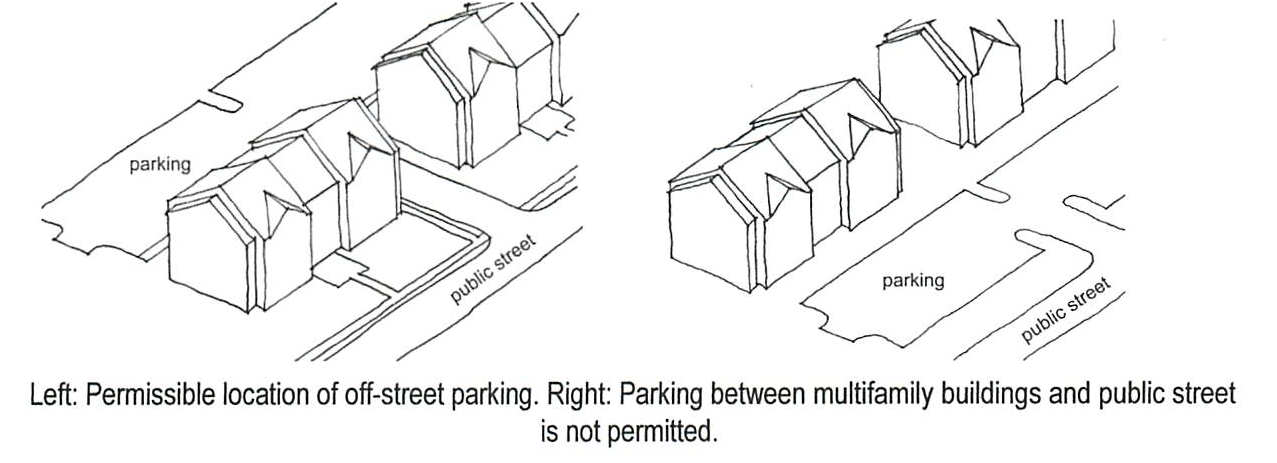
Parking. Parking lots must be located to the side or rear of buildings, and may not be forward of the front building line.
5.
Waste Collection. Adequate facilities for waste collection must be provided and located behind the front building line and away from public views. Each such area must be paved and the containers screened. See §10.02 Screening.
6.
Storage Units. Dedicated storage space of at least 280 cubic feet must be provided per dwelling unit.
7.
Fire Protection. Multifamily developments must be equipped at all times with fire hydrant equipment in good working order. The type, size, number and location of hydrants must be approved by the Geneva Fire Department. All buildings must be within 500 ft of a fire hydrant.
8.
Open Space. At least 20% of the site must be reserved as open space. At least 50% of the reserved open space must be improved for recreational use. All common open spaces and recreational areas must be well maintained in a safe and orderly condition. Children's playground area must be provided in the amount of 50 sf per unit. The minimum size of any playground is 3,000 sf. This does not apply to age-restricted developments, such as senior housing.
9.
Architectural Guidelines. Buildings should reflect consistent design, textures, colors, and features. Building facades facing streets or open spaces should be articulated to provide visual interest.
a)
Building exteriors must have a coordinated color scheme, with a limited number of complementary colors used throughout. Developments with multiple buildings may alternate primary facade colors provided trim colors, materials and/or other design features visually tie the individual buildings together. Neutral or earth tone colors are recommended. Fluorescent and metallic paints are prohibited.
b)
Accessory structures must be consistent in design, materials and finish as multifamily buildings.
(Ord. No. 12-2017-05, § 7.08, 12-18-2017)
Sec. 7.09. - Boarding Houses.
1.
The owner or lessee must reside within the dwelling used as a boarding house with the structure serving clearly as that person's permanent residence.
2.
The living quarters of the permanent residents and boarders must be in the principal dwelling and no separate structure on the premises may be used for dwelling purposes.
3.
No more than two parking spaces may be permitted forward of the front building line.
(Ord. No. 12-2017-05, § 7.09, 12-18-2017)
Sec. 7.10. - Townhouses.
1.
Development Criteria.
a)
Townhouse development sites must contain at least 2.5 acres and must be served by municipal water and sewer.
b)
Each dwelling must be located on its own platted lot unless developed in a condominium arrangement.
c)
Townhouse buildings must contain no less than three and no more than 12 attached dwelling units. A minimum spacing of 40 ft must be provided between the front façade of a townhouse building and any other building façade, or between the rear facades of opposing townhouse buildings.
d)
Area and dimensional requirements.
1)
Individual townhouse lots must be at least 18 ft in width.
2)
A side yard of at least 10 ft in width is required at the unattached end of a row of townhouses.
3)
Each townhouse must have its own yard of at least 400 sf, exclusive of parking space.
e)
Townhouse developments must be equipped with fire hydrants. The type, size, number and location of hydrants must be approved by the Geneva Fire Department. Each dwelling unit must be within 500 ft of a fire hydrant.
f)
Common trash collection areas located away from public views are encouraged.
g)
Sidewalks not less than five ft in width must be installed along the street frontage.
2.
Parking. See Article 8 Parking. Off-street parking may be on and to the rear of the individual lots or in a common parking area in the interior of the development. Individual driveways are not permitted forward of the front building line.
3.
Review and Approval. Townhouse developments must be approved in accordance with the City Subdivision Regulations. The Commission will consider the following criteria and may attach corresponding conditions to approval:
a)
Consistency of the proposed development with the Comprehensive Plan.
b)
Access, circulation and other traffic impacts of the proposed development on adjoining public streets.
c)
Extent to which the layout and design of the development will retain or disrupt natural features.
d)
Extent to which design features will complement architectural styles present in the surrounding neighborhood.
e)
Extent to which open space or recreational amenities are included.
(Ord. No. 12-2017-05, § 7.10, 12-18-2017)

