
Geneva City Zoning Code
ARTICLE 8
- PARKING
Sec. 8.01.- Off-street Parking and Loading Terms.
Terms used in this Article have the following meanings:
1.
Employee. The maximum number of persons employed at the facility regardless of the time period during which this occurs or whether the persons are full-time employees. The major shift may be a particular day of the week or a lunch or dinner period in the case of a restaurant.
2.
Gross Leasable Area (GLA). The total floor area of a building designed for both tenant occupancy and exclusive use. GLA includes both owned and leased areas but does not include shared or common areas among tenants. Where the total floor area of a building is occupied or where a building has no shared or common area, GLA is the gross floor area measured by taking the outside dimensions of the building at each floor level intended for occupancy or storage.
3.
Loading Area. That area used to satisfy the requirements of this Ordinance for truck loading and unloading.
4.
Loading Space. An off-street space or berth used for the unloading or loading of commercial vehicles.
5.
Occupancy Load. The maximum number of persons, which may be accommodated by the use as determined by its design or by fire code standards.
6.
Parking Aisle. That portion of the parking area consisting of lanes providing access to parking spaces.
7.
Parking Area. An improved area on a lot exclusively used or designed for use as a temporary storage area for motor vehicles, containing access driveways, parking aisles and parking spaces.
8.
Parking Space. That portion of the parking area set aside for the parking of one vehicle.
9.
Stacking Space. An off-street space for the temporary stacking of vehicles with an aisle intended to serve a drive-in teller window, take-out food window, dry cleaning/laundry pick-up or similar type activity station.
(Ord. No. 12-2017-05, § 8.01, 12-18-2017)
Sec. 8.02. - Required Off-street Parking Spaces.
Unless otherwise provided for, all uses must provide parking in the amount prescribed in Table 8-1. When the requirement is not readily determinable by Table 8-1, the Zoning Official will determine parking requirements using the table as a guide.
1.
Shared and joint parking. A joint parking area may contain required parking spaces for more than one use, provided the combined number of spaces complies with the parking for all uses. If the combined uses will use the same spaces at different times, the spaces may be credited to each separate use. The applicant must present a joint parking agreement; and, if sharing the same spaces, a time schedule for allocation of such spaces. Where appropriate, parking for multiple uses on the same premises may be reduced by calculation of shared parking requirements using Table 8-2.
2.
Location of Required Parking. All required parking spaces must be on the same lot as the use served by the parking, except where otherwise permitted in this Ordinance. If required parking spaces cannot reasonably be provided on the same lot or premises as the use, remote parking may be permitted by a Special Exception if within 500 ft of premises. Written legal documentation must show that the applicant has the right to the spaces.
3.
Restrictions in Residential Districts. Parking in a residential district for a nonresidential use not located on the same lot may only be permitted as a Special Exception.
4.
Design Requirements.
a)
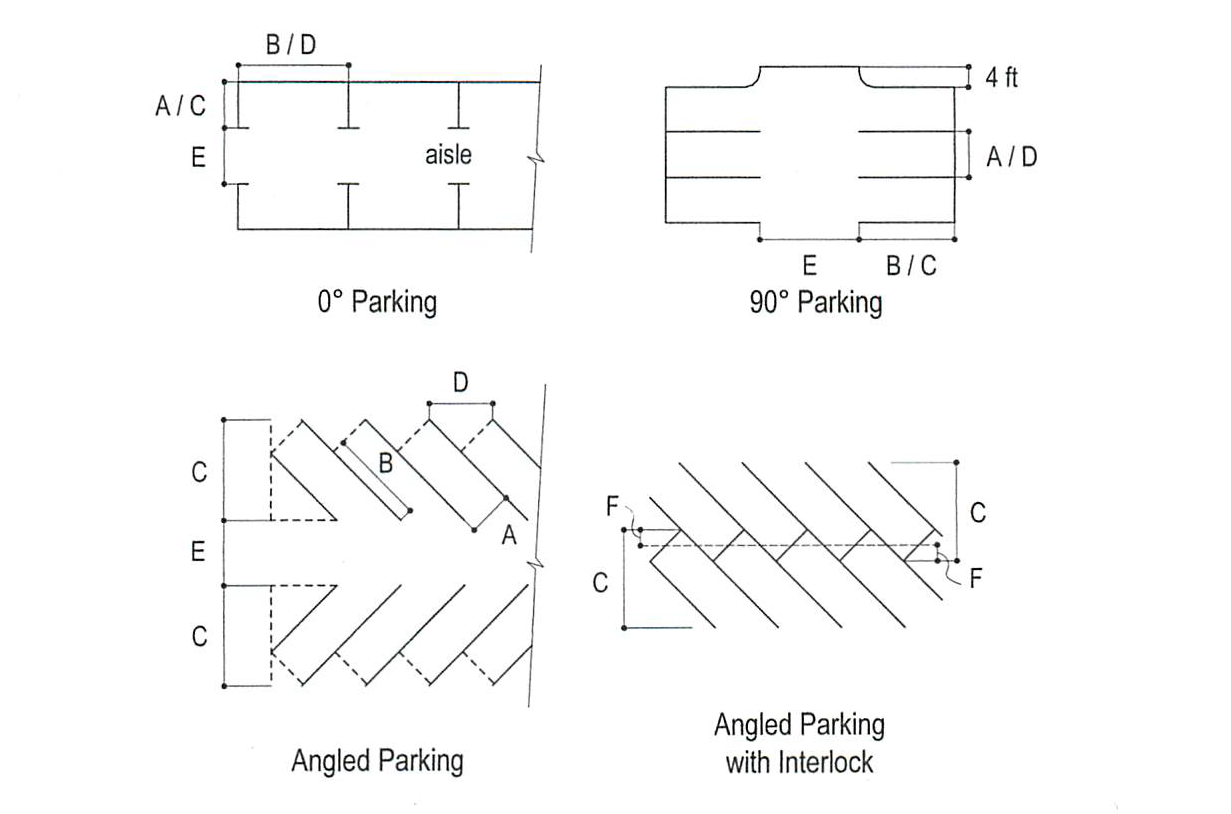
Parking space dimensions must comply with the requirements in Table 8-3.
b)
Stacking space must be 10 ft in width and 20 ft in length and be separate from parking aisles and spaces.
c)
Parking areas must be designed so that vehicles may exit the premises without backing onto a public street, excluding parking areas that serve single-family or duplex lots.
d)
Installation of off-street parking may not cause the destruction of any public right-of-way or easement, sidewalks, or trees located on any public right-of-way except for approved driveways.
e)
Parking areas must be surfaced with dust-free materials resistant to erosion, such as concrete, asphalt or pavers. The Zoning Administrator or other reviewing authority may permit an alternate surface in the AG-1, M-1 and M-2 Districts and in the 100-year floodplain. Parking spaces must be demarcated with painted lines or other markings except for those serving single-family or duplex dwelling units and where a parking surface has been approved that does not allow marking.
f)
Off-street parking must be maintained in good condition, i.e. free of pot holes, weeds, and trash.
g)
Driveways with more than two parking spaces must provide adequate turn-around space on the lot.
h)
Parking lots must be designed so that storm water is directed back into the site toward adequate drainage channels. Parking areas of 20 or more spaces may be required to provide on-site storm water detention. In such cases, drainage plans must be stamped by a registered engineer.
(Ord. No. 12-2017-05, § 8.02, 12-18-2017)
Sec. 8.03. - Access Controls.
1.
Access points to public streets must be approved by the Street Superintendent. The proposed location, width, drainage structure, traffic conditions, sight distances and resurfacing must be provided with request for approval.
2.
Driveways must be located as far from street intersections as practicable and the number of driveways serving any one premises must be kept to the minimum necessary.
3.
The width of driveways within a public right-of-way must be kept to a minimum.
4.
Driveways must be at least five ft from the nearest edge of a street drainage inlet.
(Ord. No. 12-2017-05, § 8.03, 12-18-2017)
Sec. 8.04. - Off-Street Loading.
1.
Required Off-Street Loading Spaces. Nonresidential uses must provide off-street space for the loading and unloading of materials or goods without encroaching upon or interfering with the use of adjoining properties, public streets, alleys and sidewalks. See Table 8-4 for loading requirements.
2.
Off-street Loading Design Standards.
a)
Each loading space must have a minimum rectangular area of 12 ft in width and 55 ft in length, exclusive of driver and maneuvering space. Minimum vertical clearance is 14 ft.
b)
Loading space for two or more buildings on the same lot may be shared as long as the amount of space meets the combined requirements of the several buildings to be served.
c)
Loading spaces may not be located in a required front yard or within five ft of any property line.
d)
Loading spaces may not be located or designed in a manner that interferes with the circulation of traffic, nor result in a vehicle encroaching into a street right-of-way during loading or unloading.
(Ord. No. 12-2017-05, § 8.04, 12-18-2017)
Sec. 8.05. - Change in Parking and Loading Requirements.
Whenever there is an alteration of a structure, an expansion of a use or a change in use, which increases the parking and loading requirements, the use must conform with the off-street parking and loading standards of this Ordinance to the furthest practicable extent.
(Ord. No. 12-2017-05, § 8.05, 12-18-2017)

