
Glades County Unincorporated
City Zoning Code
City Zoning Code
ARTICLE II
ADMINISTRATION AND ENFORCEMENT
Sec. 125-37. - Enforcement officer.
(a)
An administrative official appointed by the board of county commissioners and provided with such assistance as the planning commission may direct, shall be responsible for the administration and enforcement of this chapter.
(b)
The administrative official shall diligently enforce this chapter, making necessary inspections to this end and investigating promptly all complaints, reporting his findings and actions to complainants and using his best endeavors to prevent violations and to detect and secure the correction of violations.
(c)
If he shall find that any of the provisions of this chapter are being violated, he shall in writing notify the person responsible for such violation, indicating the nature of the violation and ordering the action necessary to correct it. He shall order discontinuance of illegal use of land or structures; removal of illegal structures or of illegal additions, alterations or structural changes; discontinuance of any illegal working being done, and shall take or cause to be taken any other action authorized by this chapter or other laws of the county or the state to insure compliance with, and prevent violations of, the provisions of this chapter.
(d)
The administrator shall maintain records of all official actions of his office with regard to administration, and of all complaints and actions taken with regard thereto, and of all violations discovered by whatever means, with remedial action taken and disposition of cases.
(Ord. No. 75-3, § 8.1, 8-25-1975)
Sec. 125-38. - Procedure for amendment of land development regulations.
(a)
Initiation of amendment. A request for an amendment to the official zoning map series may be initiated at any time by the board of county commissioners, by the local planning agency, or by the land owner (including his duly authorized agent) of the land for which the change is requested. Where there are multiple property owners, owners of 51 percent of the parcels, or owners of 51 percent of the interest in the total parcel must be represented as formal applicants.
(b)
Procedure for amendment. Any proposed amendment to this chapter, including a proposal to amend the official zoning map series shall be processed as provided by applicable law.
(c)
Effective date of amendment. An ordinance enacted by the board of county commissioners to amend this chapter or the official zoning map series shall be filed with the department of state and the effective date shall be as provided by law.
(d)
Update of the text and/or map. Immediately following the enactment of an ordinance amending the text of this chapter or the official zoning map series, a copy of said ordinance shall be filed in the office of the county manager and/or his designee for use in the administration and enforcement of the this chapter. Within 30 days following the date said ordinance becomes effective, the county manager and/or his designee shall make appropriate changes to incorporate said ordinance into the text of this chapter or onto the official zoning map series maintained in the office of the county clerk, and shall similarly incorporate said ordinance into all copies of said regulations or map utilized for zoning administration and distribution to the public.
(Ord. No. 99-1, § 1(chs. 1-16-1—1-16-4), 3-10-1999)
Sec. 125-39. - Maintenance of copies.
The original of this chapter shall be maintained in the office of the clerk of the circuit court. Copies of this chapter, including all current amendments, shall be maintained at the county planning and development department and shall be available for public inspection.
(Ord. No. 99-1, § 1(ch. 1-14), 3-10-1999)
Sec. 125-40. - Schedule of fees, charges, and expenses.
The board of county commissioners may establish a schedule of fees, charges and expenses and a collection procedure for building permits, amendments, certificates of zoning compliance, appeals, and other matters pertaining to this chapter. The schedule of fees shall be posted in the office of the administrative official, and may be altered or amended only by the board of county commissioners. Until all applicable fees, charges, and expenses have been paid in full no action shall be taken on any application or appeal.
(Ord. No. 75-3, § 13, 8-25-1975)
Sec. 125-41. - Special exceptions; planning commission action on special exception.
(a)
The planning commission/board of adjustment or the board of county commissioners shall hear and decide only such special exception petitions as the planning commission/board of adjustment or the board of county commissioners is specifically authorized to decide by the terms of this chapter. The planning commission/board of adjustment or the board of county commissioners shall decide such questions as are involved in determining whether a special exception petition should be granted. The planning commission/board of adjustment or the board of county commissioners shall grant special exceptions with such conditions and safeguards as are appropriate under this chapter, or, in the alternative, the planning commission/board of adjustment or the board of county commissioners shall deny special exception petitions. The planning commission/board of adjustment shall hear and decide all special exception petitions except for special exception petitions related to power plants, public utilities, prison/correctional facilities, utility plants, and any other special exception petition that the planning commission/board of adjustment elects to refer to the board of county commissioners for final decision making at a public hearing before the board of county commissioners.
(b)
A special exception shall not be granted by the planning commission unless and until:
(1)
A written petition/application for a special exceptions is submitted in a form that is approved by the county indicating the section of this chapter under which the special exception is sought and stating the ground on which it is requested.
(2)
The planning commission/board of adjustment or the board of county commissioners shall also make a finding of whether the granting of this special exception will or will not adversely affect the public interest.
(3)
A public hearing has been be held after due public notice has been given as defined and required by this chapter. Any party may appear in person, or by agent or attorney at the hearing.
(c)
Before any special exception shall issue, the planning commission/board of adjustment or the board of county commissioners shall make a written findings that it is empowered under the section of this chapter described in the special exception application/petition to grant the special exception and that the granting of the special exception will not adversely affect the public interest, and that there is compliance with the special rules governing individual special exceptions of the type involved as described in this chapter, and that the proposed development, with conditions and safeguards as required by the planning commission/board of adjustment or the board of county commissioners, will be generally compatible with adjacent properties and other property in the district, and a satisfactory provision and arrangement has been made concerning the following:
(1)
Ingress and egress to the property and structures, with particular reference to automotive and pedestrian safety and convenience, traffic flow, and access in case of fire or catastrophe;
(2)
Off-street parking and loading areas, refuse and service areas, with particular attention to subsection (c)(1) and to effects on surrounding property;
(3)
Utilities, including the location, availability and compatibility thereof;
(4)
Screening and buffering, including the type, dimensions and location thereof;
(5)
Signs, if any, and proposed lighting;
(6)
Required yards and other open space.
(d)
Among other conditions and safeguards, the planning commission/board of adjustments or board of county commissioners may establish a time duration for each special exception including the specific date upon which the special exception shall automatically cease and terminate, and may also prescribe reasonable time limits within which the applicant must commence and complete a project. Violation of any of the conditions or safeguards when made part of the terms under which the special exceptions is granted shall be unlawful and a violation of this chapter.
(e)
Whenever the planning commission/board of adjustment or the board of county commissioners has taken a final action on a petition or a request for a special exception, the planning commission or the board of county commissioners shall not then consider any petition or request for substantially the same action for a period of six months from the effective date of previous action on the petition or request for a special exception.
(Ord. No. 75-3, § 11.1, 8-25-1975; Ord. No. 92-9, 12-8-1992; Ord. No. 2008-20, § 2(C), 7-28-2008)
Sec. 125-42. - Building permits.
(a)
No building or other structure shall be erected, moved, added to, or structurally altered without a permit therefor, issued by the administrative official. No building permit shall be issued by the administrative official except in conformity with the provisions of this chapter, unless the administrative official receives a written order from the land use and construction oversight commission in the form of an administrative review, special exception, or variance as provided by this chapter or unless he shall receive a written order from a court of competent jurisdiction
(b)
All applications for building permits shall be accompanied by plans in duplicate drawn to scale, showing the actual dimensions and shape of the lot to be built upon; the exact sizes and locations of the lot of buildings already existing, if any; and the location and dimensions of the proposed building or alteration and the permanent point of access. This information shall be prepared by or shall be taken from information prepared by a registered land surveyor. A copy of an existing survey document may be used if it accurately describes the proposed additions and access and is legible and includes a signed surveyor's stamp. The application shall include such other information as lawfully may be required by the administrative official, including existing or proposed building or alterations; existing or proposed uses of the building and land; the number of families, house keeping units, or rental units the building is designed to accommodate; conditions existing on the lot; and such other matters as may be necessary to determine conformance with, and provide for the enforcement of, this chapter.
(1)
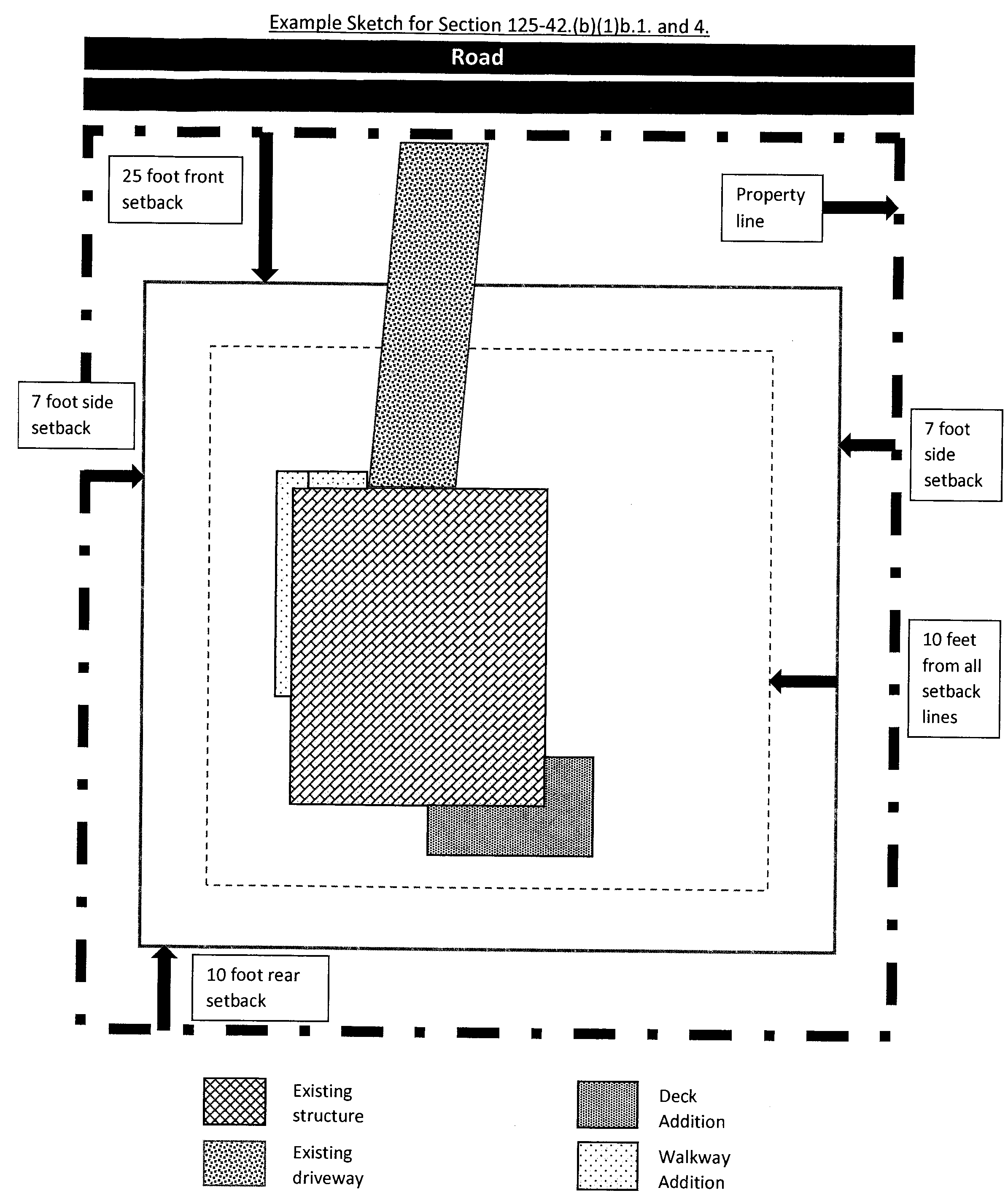
The following permit applications are not required to provide a boundary line survey as described above: (an example sketch of section 125-42.(b)(1)b.1. and 4. exceptions is attached):
a.
A boundary line survey is not required for a permit application in mobile home parks or RV parks where the lots are not individually owned.
b.
Where the structure is at least ten feet away from all setback lines and one of the following situations occurs, a boundary line survey is not required:
1.
Residential deck additions or alterations.
2.
Parcels over five acres in size and the proposed structure is a minimum of 75 feet from all property lines.
3.
Enclosure of existing covered patios/balconies/porches with screening.
4.
Concrete slabs outside of the building (other than screened patios and pool slabs); items such as, but not limited to, open patios, walkways or garbage containers.
5.
When authorized by the building official to waive or modify the requirements for a boundary line survey where the application for a permit is for alteration or repair of an existing improvement or otherwise warranted, pursuant to Section [A] 107.2,5 Site Plan, Florida Building Code.
(2)
A boundary line survey as described above is not required for accessory structures such as sheds and carports when being anchored to the soil or an existing concrete slab.
(3)
In the event a boundary line survey is not required per section 125-42, at a minimum, a site plan indicating the boundary, the location of the improvement, existing structures, setbacks, and an aerial, is to be submitted with a permit application with signature by the owner and dated affirming the site plan to be true and accurate to the best of the owner's knowledge.
(c)
One copy of the plans shall he returned to the applicant by the administrative official, after the administrative official shall have marked such copy either as approved or disapproved and attested to same by his signature on such copy. The original copy of the plans, similarly marked, shall be retained by the administrative official.
(d)
In all residential, industrial, and commercial districts, the application shall be accompanied by a certification that all property stakes on the lot are in place, and all property stakes shall be in place at the time of application. In agricultural districts, the administrative official may require a similar certification where the presence of property stakes is necessary to determine compliance with any one or all of these regulations.
(e)
If the work described in any building permit has not begun within six months from the date of issuance thereof, said permit shall expire; it shall be canceled by the administrative official; and written notice thereof shall be given to the persons affected. If the work described in any building permit has not been substantially completed within one year of the date of issuance thereof, said permit shall expire and be canceled by the administrative official, and written notice that further work as described in the canceled permit shall not proceed unless and until a new building permit has been obtained; provided, however, that the administrative official may authorize extension of such term on due cause shown.
(Ord. No. 75-3, §§ 8.2—8.4, 8-25-1975; Ord. No. 2020-9, § 2, 4-14-2020)
Sec. 125-43. - Standards for due public notice and hearings.
There are a number of provisions in this chapter and in state land development legislation requiring that due public notice be given of the time, date, place, purpose and outcome of the hearing being held before a governmental commission or board to review and take action on a particular matter concerning land development. It is the purpose of this section to collect in one place for easy reference a number of the provisions for such notice applicable to various land development issues governed by this chapter. Accordingly, when the phrase "due public notice" is used in this chapter in connection with the requirement for a public hearing on the matters listed below, it shall have the meaning set forth in the following subsections:
(1)
Notice of rezoning. In cases in which a proposed ordinance or resolution changes the actual zoning map designation for a parcel or parcels of land involving less than ten contiguous acres, the board of county commissioners, shall direct its county clerk to notify by mail each real property owner whose land is within 300 feet of the subject property that the governmental agency will redesignate by enactment of the ordinance or resolution and whose address is known by reference to the latest ad valorem tax records. The notice shall state the substance of the proposed ordinance or resolution as it affects that property owner and shall set a time, date, and place for one or more public hearings on such ordinance or resolution. Such notice shall be given at least 30 days prior to the date set for the public hearing, and a copy of such notice shall be kept available for public inspection during the regular business hours of the office of the clerk of the board of county commissioners. The board of county commissioners shall hold a public hearing on the proposed ordinance or resolution and may upon the conclusion of the hearing, immediately adopt the ordinance or resolution.
(2)
Small-scale comprehensive plan amendment (less than ten acres). In cases in which a proposed small-scale comprehensive plan amendment changes the actual land use designation for a parcel or parcels of land involving less than ten contiguous acres; a small-scale development amendment may be adopted only under the following conditions:
a.
The proposed amendment involves a use of ten acres or fewer and:
1.
The cumulative effect of the acreage for all small-scale development amendments adopted by the local government shall not exceed 80 total acres annually.
2.
The proposed amendment does not involve the same property more than once a year.
3.
The proposed amendment does not involve the same owner's property within 200 feet of property granted a change within the prior 12 months.
4.
The proposed amendment does not involve a text change to the goals, policies, and objectives of the local government's comprehensive plan, but only proposes a land use change to the future land use map for a site-specific small-scale development activity.
5.
The proposed amendment is not located within an area of critical state concern.
6.
If the proposed amendment involves a residential land use, the residential land use has a density of ten units or less per acre.
b.
Small-scale development amendments adopted require only one public hearing before the government board, which shall be an adoption hearing.
(3)
Comprehensive plan amendments (more than ten acres). In cases in which the proposed ordinance or resolution changes in the actual list of permitted, conditional, or prohibited uses within a zoning category, or changes the actual zoning map designation of a parcel or parcels of land involving ten contiguous acres or more, the board of county commissioners shall provide for public notice and hearings as follows:
a.
Board of county commissioners hearings.
1.
Requirements for hearings. The board of county commissioners shall hold two advertised public hearings on the proposed ordinance or resolution. At least one hearing shall be held after 5:00 p.m. on a weekday, unless the board of county commissioners, by a majority plus one vote, elects to conduct that hearing at another time of day. The first public hearing shall be held at least seven days after the day that the first advertisement is published. The second hearing shall be held at least ten days after the first hearing and shall be advertised at least five days prior to the public hearing.
2.
Advertisement standards. The required advertisements shall be no less than two columns wide by ten inches long in a standard size or a tabloid size newspaper, and the headline in the advertisement shall be in a type no smaller than 18-point. The advertisement shall not be placed in that portion of the newspaper where legal notices and classified advertisements appear. The advertisement shall be placed in a newspaper of general paid circulation in the county and of general interest and readership in the community pursuant to F.S. ch. 50, not one of limited subject matter. The advertisement shall be in substantially the following form:
Notice of (type of) change.
i.
The (name of local government unit) proposes to adopt the following ordinance or resolution: (title of ordinance or resolution).
ii.
A public hearing on the ordinance or resolution will be held on (date and time) at (meeting place).
iii.
Except for amendments which change the actual list of permitted, conditional, or prohibited uses within a zoning category, the advertisement shall contain a geographic location map which clearly indicates the area within the local government covered by the proposed ordinance or resolution. The map shall include major street names as a means of identification of the general area.
3.
Mailed notices in lieu of advertisements. In lieu of publishing the advertisements set out in subsection (3)a.2, the board of county commissioners may mail a notice to each person owning real property within the area covered by the ordinance or resolution. Such notice shall clearly explain the proposed ordinance or resolution and shall notify the person of the time, place, and location of both public hearings on the proposed ordinance or resolution.
4.
Adherence to provisions of this subsection. Five years after the adoption of any ordinance or resolution adopted after the effective date of the ordinance from which this section is derived, no cause of action shall be commenced as to the validity of an ordinance or resolution based on the failure to strictly adhere to the provisions contained in this subsection (3)a. After five years, substantial compliance with the provisions contained in this subsection (3)a. shall be a defense to an action to invalidate an ordinance or resolution for failure to comply with the provisions contained in this subsection (3)a. Without limitation, the common law doctrines of laches and waiver are valid defenses to any action challenging the validity of an ordinance or resolution based on failure to strictly adhere to the provisions contained in this subsection (3)a. Standing to initiate a challenge to the adoption of an ordinance or resolution based on a failure to strictly adhere to the provisions contained in this subsection (3)a. shall be limited to a person who was entitled to actual or constructive notice at the time the ordinance or resolution was adopted. Nothing herein shall be construed to affect the standing requirements under F. S. ch. 163, pt. II (F.S. § 163.2511 et seq.).
b.
Procedure for adoption of comprehensive plan or plan amendments. The procedure for transmittal of a complete proposed comprehensive plan or plan amendment for adoption of a comprehensive plan or plan amendment shall be by affirmative vote of not less than a majority of the members of the governing body present at the hearing. The adoption of a comprehensive plan or plan amendment shall be by ordinance. For the purpose of transmitting or adopting a comprehensive plan or plan amendment, the local government body shall hold at least two advertised public hearings on the proposed comprehensive plan or plan amendment as follows:
1.
The first public hearing shall be held at the transmittal stage. It shall be held on a weekday at least seven days after the day that the first advertisement is published.
2.
The second public hearing shall be held at the adoption stage. It shall be held on a weekday at least five days after the day that the second advertisement is published.
3.
If the proposed comprehensive plan or plan amendment changes the actual list of permitted, conditional, or prohibited uses within a future land use category or changes the actual future land use map designation of a parcel or parcels of land, the required advertisements shall be in the format prescribed by F.S. § 125.66(4)(b)2.
(4)
Notice of site plan application. After the planning commission has received for its review an application for approval of a major residential, except for a single family or a duplex as described in section 125-215 site plan, or of a major commercial, industrial or institutional site plan (or of a minor site plan that has been referred to the planning commission by the community development director as described in section 125-215), the planning commission shall hold one advertised public hearing on the proposal according to general standards for due public notice of a public hearing, which shall mean advertising the time, date, place and purpose of such hearing in a newspaper of general circulation in the county as required by Florida Statutes.
(5)
Notice of subdivision plan and preliminary plat application. After the land use and construction oversight commission has received for its review an application for approval of a preliminary plat and subdivision plan, the land use and construction oversight commission and the board of county commissioners shall each hold at least one advertised public hearing on the proposal. Due public notice of the hearings shall be published as follows:
a.
The county clerk shall advertise the time, date, place and purpose of such hearing at least once in a newspaper of general circulation in the county of with the first publication to be at least 30 days prior to the public hearing by the board of county commissioners, and at least 15 days prior to the public hearing by the land use and construction oversight commission. The advertisement shall describe the property by reference to major streets or roads or other significant landmarks and by township, range and section numbers, and shall state the current and proposed zoning classification of the property.
b.
In addition, at least 15 days prior to the date set for the public hearings, the community development department shall mail a notice setting forth the time, date, place and purpose of such hearings to the applicant.
c.
Notices containing the information published in the newspaper advertisement shall also be maintained at the community development department, the county attorney's office and office of the clerk, and posted in a conspicuous place or places in the county administration center.
d.
Written notice of the land use and construction oversight commission's action on the plan and preliminary plat shall be mailed to the applicant and shall include any reasons for disapproval of the plan and plat or any conditions attached to conditional approval of same.
e.
If a subdivision plan and preliminary plat are approved with conditions, after those conditions have been satisfied, the land use and construction oversight commission shall hold another public hearing on the amended subdivision plan and preliminary plat and publish notice of the hearing, and transmit the action taken at that hearing to the owner, in accordance with the provisions above for original consideration of the plan and plat.
(6)
Notice of application for approval of final plat. After the community development department has received for its review an application for approval of a final subdivision plat, the land use and construction oversight commission and the board of county commissioners shall each hold at least one advertised public hearing on the proposal. Due public notice of the hearings shall be published as follows:
a.
Land use and construction oversight commission hearing. The land use and construction oversight commission shall hold at least one public hearing on the application.
1.
The county clerk shall advertise the time, date, place and purpose of such hearing at least once in a newspaper of general circulation in the county with publication to be at least 15 days prior to the public hearing by the land use and construction oversight commission. The advertisement shall describe the property by reference to major streets or roads or other significant landmarks and by township, range and section numbers and shall describe the size of the proposed subdivision, the proposed use of the lots, and the total number of lots involved, and the residential density.
2.
In addition, at least 15 days prior to the date set for the public hearing, the community development department shall mail a notice setting forth the time, date, place and purpose of such hearing to the applicant.
3.
Notices containing the information published in the newspaper advertisement shall also be maintained at the community development department, offices of the clerk, and the county attorney and posted in a conspicuous place in the county courthouse.
b.
Board of county commissioners. Notice of the board of county commissioner's consideration of the final plat need not be advertised. However, notice of the time, date and place of the meeting where the final plat will be reviewed and of the board of county commissioner's final action on same shall be mailed to the applicant by the community development department.
(7)
Notice of application for administrative appeal from a zoning or land development regulations ruling. After any application for an administrative appeal has been received by the land use and construction oversight commission, the board shall hold at least one public hearing with notice thereof published as follows:
a.
The county clerk shall advertise the time, date, place and purpose of such hearing at least once in a newspaper of general circulation in the county at least 15 days prior to the date of the hearing. The notice shall describe the property which is the subject of the application by reference to major streets or other landmarks and by township, range and section number and describing the zoning classification of the property and the nature of the application to be considered by the board, including the specific relief requested.
b.
In addition, at least 15 days prior to the public hearing, the community development department shall mail a notice of the time, date, place and purpose of such hearing to the applicant.
c.
Notices containing the published information shall also be maintained at the community development department, county attorney's office and office of the clerk, and posted in a conspicuous place or places in the county administration center.
(8)
Proof of notice. Proof by affidavit of the required publication, mailing and posting of the notices required in this section shall be presented at the public hearing prior to the taking of any action on the application in question.
(9)
Effect of failure to receive notice. Where notice of a hearing or matter is sent to a person by mail, that person's failure to receive the notice shall not affect the validity of any action taken at a public hearing, so long as the procedures for mailing the notice were followed.
(10)
Notice and hearings on other matters. The notice standards for public hearings on issues not mentioned in this section may be found in the particular provisions of this chapter governing such issues.
(11)
General standard for due public notice. Unless otherwise provided, due public notice of a public hearing concerning any matter shall mean advertising the time, date, place and purpose of such hearing in a newspaper of general circulation in the county as required by Florida Statutes.
(Ord. No. 99-2, § 1(ch. 3-1), 3-10-1999; Ord. No. 2006-26, § 5, 6-28-2006; Ord. No. 2021-2, § 3, 2-9-2021)
Sec. 125-44. - Notice by mail.
In addition to other notice required by law, whenever any action to grant a variance, a special exception, or an amendment to this chapter affecting a specific parcel or parcels of land shall be considered by the LPA or the board of county commissioners, notice by mail shall be sent to each real property owner whose land lies within 300 feet (excluding street rights-of-way) of the perimeter of the subject property and whose address is known by reference to the latest ad valorem tax records. The mailed notice shall state the substance of the proposed action as it affects that property owner and shall set forth the time and place for all public hearings on such matter. Failure to receive the notice shall not affect any action or proceedings taken hereunder. In addition to required notices as heretofore set forth, a notice shall be posted on the subject property in a conspicuous place and shall set forth the time, place and purpose of the hearing related to the property being posted. The county manager or his designee is hereby authorized to post any said notice upon property proposed for the action, and it shall be unlawful for any person to remove or tamper with said notice during the time period as may be established for the maintenance of said notice. There shall be no posting requirement or the mailing of notices for an amendment to the text for zoning or land development regulations.
(Ord. No. 99-1, § 1(ch. 1-17), 3-10-1999)
Sec. 125-45. - Conduct of hearings.
Any interested persons shall have the right to submit oral or written testimony at hearings before the LPA or the board of county commissioners. All testimonies and exhibits submitted at the hearing, including the application, shall be incorporated into the application file and shall be considered a part of the record on the application. Evidence which is immaterial, irrelevant, or unduly repetitious may be excluded. The hearings may be adjourned from time to time to dates established by public announcement at said hearings and shall be the earliest practical date for resumption of the hearings.
(Ord. No. 99-1, § 1(ch. 1-18), 3-10-1999)
Sec. 125-61. - Commission procedures.
Copies of each application and appeal, notice of public hearing, and resolution of the land use and construction oversight commission shall be forwarded to each member of the board of county commissioners and planning commission.
(Ord. No. 75-3, §§ 9, 9.1, 8-25-1975)
Sec. 125-62. - Time limits on multiple applications.
Whenever the land use and construction oversight commission has taken a final action on a petition or request for administrative review or variance, the land use and construction oversight commission shall not then consider any petition or request for substantially the same action for a period of one year from the effective date of previous action on the petition or request.
(Ord. No. 75-3, § 10.3, 8-25-1975)
Sec. 125-63. - Votes required to reverse decision of administrative official or to decide in favor of applicant.
The concurring vote of four members of the land use and construction oversight commission shall be necessary to reverse any order, requirement, decision or determination of the administrative official or to decide in favor of the applicant in any matter upon which it is required to pass under this chapter, or to effect any variation in the application of this chapter.
(Ord. No. 75-3, § 10.4, 8-25-1975)
Sec. 125-64. - Appeals to land use and construction oversight commission.
(a)
The land use and construction oversight commission shall hear and decide appeals where it is alleged there is error in any order, requirement, decision, or determination made by the administrative official in the enforcement of this chapter. Appeals of this class may be taken by any person aggrieved or by any officer or bureau of the county government affected.
(b)
Such appeals shall be taken within 30 days of the order, requirements, decision or determination appealed from, by filing with the administrative official from whom the appeal is taken and with the land use and construction oversight commission written notice of appeal specifying the grounds thereof. The appeal shall be in such form as prescribed by the rules of the land use and construction oversight commission. The administrative official from whom the appeal is taken shall, upon notification of the filing of the appeal, forthwith transmit to the land use and construction oversight commission all materials constituting the record upon which the action appealed from was taken.
(c)
The land use and construction oversight commission shall fix a reasonable time for a hearing, give due public notice thereof, and decide the same within a reasonable time. At the hearing, any party may appear in person, or by agent or attorney.
(d)
Such appeals stay all work on the premises and proceedings, in furtherance of the action appealed from, unless the administrative official from whom the appeal is taken certifies to the land use and construction oversight commission that, by reason of facts stated in the certificate, a stay would cause imminent peril to life and property. In such case proceedings or work shall not be stayed other than by a restraining order which may be granted by the land use and construction oversight commission or by a court of record on application, on notice to the administrative official from whom the appeal is taken and on due cause shown.
(e)
In exercising the powers provided in this section, the land use and construction oversight commission may, so long as such action is in conformity with the terms of this division, reverse or affirm, wholly or partly, or may modify the order, requirement, decision, or determination appealed from and may make such order, requirement, decision, or determination as ought to be made, and to that end shall have the powers of the administrative official from whom the appeal is taken.
(Ord. No. 75-3, § 10.1, 8-25-1975)
Sec. 125-65. - Variances.
(a)
The land use and construction oversight commission shall authorize upon appeal in specific case such variance from the terms of this chapter as will not be contrary to the public interest where, owing to special conditions, a literal enforcement of the provisions of this chapter would result in unnecessary and undue hardship. A variance from the terms of this chapter shall not be granted by the land use and construction oversight commission unless and until a written petition for a variance is submitted demonstrating that:
(1)
Special conditions and circumstances exist which are peculiar to the land, structure, or building involved and which are not applicable to other lands, structures, or buildings in the same district;
(2)
The special conditions and circumstances do not result from the actions of the applicant;
(3)
Granting the variance requested will not confer on the applicant any special privilege that is denied by this chapter to other lands, buildings or structures in the same district;
(4)
Literal interpretation of the provisions of this chapter would deprive the applicant of rights commonly enjoyed by other properties in the same district under the terms of this chapter and would work unnecessary and undue hardship on the applicant.
(b)
Conforming use of neighboring lands, structures, or buildings in the same districts, and permitted or nonconforming use of lands, structures, or buildings in other districts shall not be considered grounds for the issuance of a variance.
(c)
A public hearing after due notice thereof shall be held on a variance application. Any party may appear in person, or by agent or by attorney.
(d)
A variance shall not be granted unless the land use and construction oversight commission shall make findings that the requirements of subsection (a) of this section have been met by the applicant for a variance.
(e)
A variance shall not be granted unless the land use and construction oversight commission shall further make a finding that the reasons set forth in the application justify the granting of the variance, and that the variance is the minimum variance that will make possible the reasonable use of the land, building, or structure.
(f)
A variance shall not be granted unless the land use and construction oversight commission shall further make a finding that the granting of the variance will be in harmony with the general purpose and intent of this chapter, and will not be injurious to the neighborhood, or otherwise detrimental to the public welfare.
(g)
In granting any variance, the land use and construction oversight commission my prescribe appropriate conditions and safeguards in conformity with this chapter including time limits for beginning and for completion of any action involved. Violation of such conditions and safeguards, when made a part of the terms under which the variance is granted, shall be unlawful and a violation of this chapter.
(h)
Under no circumstances shall the land use and construction oversight commission grant a variance to allow a use not permissible under the terms of this chapter in the district involved, or any use expressly or by implication prohibited by the terms of this chapter in such district.
(Ord. No. 75-3, § 10.2, 8-25-1975)
Sec. 125-66. - Appeals from decisions of planning commission or land use and construction oversight commission.
(a)
Any person aggrieved by any final decision made by the planning commission/board of adjustment or by the board of county commissioners on special exceptions, may apply to the circuit court for judicial relief within 30 days after the rendition of a decision by the planning commission/land use and construction oversight commission or the board of county commissioners as described herein above in the form of an application for a writ of certiorari and for appropriate injunctive relief.
(b)
It is the intent of this chapter that all questions of interpretation except for rules of interpretation of district boundaries (section 125-129) and enforcement shall be first presented to the administrative official, and that such questions shall be presented to the land use and construction oversight commission only on appeal from the decision of the administrative official, and that recourse from the decisions of the land use and construction oversight commission shall be to the courts as provided by law. It is further the intent of this chapter that the duties of the board of county commissioners in connection with this chapter shall not include hearing and deciding questions of interpretation and enforcement that may arise.
(c)
Until all applicable fees, charges, and expenses have been paid in full no action shall be taken on any application or appeal.
(Ord. No. 75-3, § 12, 8-25-1975 ; Ord. No. 2008-20, § 2(D), 7-28-2008))
Sec. 125-81. - Purpose.
(a)
Existing lots, structures, uses of land or water, and characteristics of use, which were lawful before this Code was adopted or amended, but which would be prohibited, or restricted under the terms of this chapter, are deemed nonconforming. It is the intent of the county land development regulations to permit these nonconformities to continue in their present condition until they are removed, but not to encourage their continuation. It is further the intent of the county land development regulations that nonconformities shall not be enlarged upon, expanded, intensified, or extended, nor be used as grounds for adding additional structures or uses prohibited elsewhere within the same district. Nonconforming uses and structures are declared by the county land development regulations to be incompatible with permitted uses in the districts involved.
(b)
Lots, structures, uses of land or water, and characteristics of use, which were created after the county land development regulations were adopted and do not conform to the regulations, are deemed nonconforming. It is the intent of the county land development regulations to permit these nonconformities to continue until they are removed, however permits for the following shall not be issued:
(1)
Development on these nonconforming lots;
(2)
The repair, replacement, remodeling or enlargement of any nonconforming structures;
(3)
Housing a nonconforming use; or
(4)
Approving a conforming use in a nonconforming structure.
(Ord. No. 2006-14, § 1(exh. 1, § 1), 5-9-2006)
Sec. 125-82. - Nonconforming lots of record.
In any district, principal permitted structures and customary accessory buildings may be erected on any legally nonconforming lot of record, subject to the following provisions:
(1)
Ownership. The lot shall be in separate ownership and shall not be contiguous to other lots in the same or substantially same ownership. This provision shall apply even though such lot fails to meet the requirements of the county land development regulations for the area, width, depth and frontage or any combination thereof, provided that yard dimensions and requirements other than those applying to the area, width, depth or frontage shall conform to requirements of the county land development regulations. If a nonconforming lot of record is contiguous to another lot in the same or substantially the same ownership, such lots shall be considered to be an undivided parcel for the purposes of this division.
(2)
Dimensional requirements. The maximum residential density, maximum lot coverage, and yard requirements shall be as for the most similar district to which such lot of record most closely conforms in area.
(3)
Variance of yard dimensions. Variance of yard dimension requirements shall be obtained only through action of the land use and construction oversight commission.
(4)
Frontage and access. If the nonconforming lot of record has no frontage, then proof of recorded legal ingress and egress acceptable to the county attorney must be provided before a development order may be issued.
(5)
Recording of new dwellings built on nonconforming lots. All new dwellings to be built upon nonconforming lots of record shall be placed upon such lots in accordance with the following requirements when adjacent dwelling have existed and have been listed on the tax rolls on or before July 1, 2006.
a.
In subdivisions where dwellings have been placed on two lots, the new dwellings can also be built on two or more lots. Similarly, where dwellings have been placed on single lots, the new dwellings can be placed on single lots.
b.
New dwellings shall be placed so as to conform to the front setbacks of existing dwellings on the same street.
c.
The side setbacks for new dwellings shall be ten percent of the width of the lot, except that no side setbacks shall be less than five feet.
d.
For pie shaped (wedge) lots, the side setbacks shall be ten percent of the figure reached by adding the width of the front and the back together and dividing by two, except that no such side setback shall be less than five feet.
(Ord. No. 2006-14, § 1(exh. 1, § 2(A)), 5-9-2006)
Sec. 125-83. - Nonconforming uses of land or water.
Where, at the effective date of adoption of the ordinance from which this chapter is derived, lawful use of lands or waters exists which would not be permitted under this chapter, the use may be continued, provided:
(1)
Enlargement, intensification, or alteration. No nonconforming use shall be enlarged, intensified, or extended or occupy a greater area of land or water than was occupied at the effective date of adoption or relevant amendment to the county land development regulations.
(2)
Change in use. A nonconforming use shall not be changed to any other use unless such use conforms to the provisions of this chapter. A change in use shall mean a substantial change in character involving activities that result in different external impacts. A change only in the items offered for sale or manufactured or a change in the business name shall not constitute a change in use.
(3)
Movement. No nonconforming use shall be moved in whole or in part to any portion of the lot or parcel other than that occupied by such use at the effective date of adoption, or relevant amendment, to the ordinance from which this chapter is derived.
(4)
Discontinuance. If any nonconforming use ceases for any reason (except when governmental action impedes access to the premises) for a period of more than 90 consecutive days, any subsequent use of land shall conform to the regulations specified by the county land development regulations for the district in which such land is located.
(5)
Uses under special exception/conditional use provisions. Any use that is permitted as a special exception/conditional use in a district under the terms of the county land development regulations shall not be deemed a nonconforming use in such district, but shall without further action be deemed a conforming use in such district.
(Ord. No. 2006-14, § 1(exh. 1, § 2(B)), 5-9-2006)
Sec. 125-84. - Nonconforming structures and site improvements.
Where an existing structure and/or associated on-site improvements could not be built under the county land development regulations by reason of restrictions on lot area, lot coverage, height, yards, location on the lot, or requirements other than use concerning the structure, such structure or improvements may be continued, subject to the following provisions:
(1)
Enlargement or alteration. Nonconforming structures and/or improvements may not be enlarged or altered in a way that increases their nonconformity, but may be altered to decrease their nonconformity.
(2)
Change to conforming use. Any structure, or structure and premises in combination, in or on which a nonconforming use is superseded by a permitted use shall thereafter conform to the regulations for the district in which such structure is located, and the nonconforming use shall not thereafter be resumed nor shall any other nonconforming use be permitted.
(3)
Discontinuance. If any nonconforming use of a structure, or structure and premises in combination, is abandoned, discontinued, or ceases for any reason (except when governmental action impedes access to the premises) for a period of six consecutive months, the structure, or structure and premises in combination, shall not thereafter be used except in conformity with the regulations of the district in which it is located.
(4)
Destruction. Where 50 percent or more of the floor area of a nonconforming structure is damaged or destroyed, said structure shall not be restored unless in conformance with the provisions of this chapter.
(5)
Residential structure exception. Any existing single-family residential structure, including mobile homes and manufactured homes, considered nonconforming and permitted prior to the adoption of this county land development regulations may be allowed to restore damaged or destroyed buildings, not to exceed the existing footprint or pad (prior to the damage or destruction), unless a variance is approved for the expanded footprint or pad.
(6)
Nonconforming structures unsafe because of lack of maintenance. If a nonconforming structure or portion of a structure, or any structure containing a nonconforming use, becomes physically unsafe or unlawful due to lack of repairs or maintenance, and is declared by the duly authorized official of the county to be unsafe or unlawful by reason of physical condition, it shall not thereafter be restored, repaired, or rebuilt except in conformity with the regulations of the district in which it is located.
(7)
Special provisions for specific nonconforming site improvements.
a.
Stormwater management. An existing development that does not comply with the stormwater management requirements of the county land development regulations must be brought into full compliance when the use of the development is intensified, resulting in an increase in stormwater runoff or added concentration of pollution in the runoff.
b.
Parking and loading. Full compliance with the parking and loading requirements of the county land development regulations shall be required where the seating capacity or other factor controlling the number of parking or loading spaces required by this chapter is increased by ten percent or more.
c.
Vehicle use areas. For the purpose of this section, a vehicle use area is any portion of a development site used for circulation, parking, and/or display of motorized vehicles, except junk or automobile salvage yards. An existing vehicle use area that does not comply with the requirements of this chapter must be brought into full compliance as follows:
1.
Replacement. When 25 percent or more of the paving of the vehicle use area is replaced.
2.
Expansion. When the square footage of a vehicle use area is increased, compliance with the county land development regulations is required as follows:
(i)
Expansion by ten percent or less. When a vehicle use area is expanded by ten percent or less, only the expansion area must be brought into compliance with the county land development regulations.
(ii)
Expansion by more than ten percent. When a vehicle use area is expanded by more than ten percent, the entire vehicle use area shall be brought into compliance with the county land development regulations.
(iii)
Repeated expansions. Repeated expansions, or resurfacing or replacement of paving, of a vehicle use area over a period of time commencing with the effective date of the ordinance from which this chapter is derived shall be combined in determining whether the above threshold has been reached.
3.
Excess parking area. Any vehicle use area in existence on the date of enactment of the ordinance from which this chapter is derived which must be brought into conformity with the county land development regulations, and which has more than the number of parking spaces required by the county land development regulations, shall be treated as follows:
(i)
The area shall be reconfigured to comply with requirements in this chapter.
(ii)
If, after the reconfiguration, a paved area or areas that are not needed to comply with the requirements of the county land development regulations remain, the developer may do any one or combination of the following:
A.
Conform the area to comply with the county land development regulations and continue to use them for parking;
B.
Remove the paving and use as grassed overflow parking, as additional landscaped transitional one, or for any other purpose consistent with the land use plan and approved by the development director.
(Ord. No. 2006-14, § 1(exh. 1, § 2(C)), 5-9-2006)
Sec. 125-85. - Nonconforming signs.
(a)
Defined. Any legally existing sign which conforms to all requirements of this division except that it exceeds the permitted sign height by up to ten percent shall be deemed to be in conformity with the county land development regulations.
(b)
Amortization.
(1)
All nonconforming signs with a replacement cost of less than $100.00, and all signs prohibited by section 133-8, shall be removed or made to conform within 18 months of the enactment of the county land development regulations.
(2)
All other nonconforming signs shall be removed or altered to be conforming within seven years of the effective date of the ordinance from which this division is derived, unless an earlier removal is required by section 125-84.
(c)
Continuation of nonconforming signs. Subject to the limitation imposed by the amortization schedule in subsection (b) of this section, and subject to the restrictions in this subsection, a nonconforming sign may be continued and shall be maintained in good condition as required by the county land development regulations, but it shall not be:
(1)
Structurally changed to another nonconforming sign, but its pictorial content may be changed.
(2)
Altered in any manner that increases the degree of nonconformity.
(3)
Expanded.
(4)
Reestablished after damage or destruction if the estimated cost of reconstruction exceeds 50 percent of the appraised replacement cost as determined by the development director.
(5)
Continued in use when a conforming sign or sign structure shall be erected on the same parcel or unit.
(6)
Continued in use when the structure housing the occupancy is demolished or requires renovations the cost of which exceeds 50 percent of the assessed value of the structure.
(7)
Continued in use after the structure housing the occupancy has been vacant for six months or longer.
(Ord. No. 2006-14, § 1(exh. 1, § 2(D)), 5-9-2006)
Sec. 125-86. - Incentives to dissolve nonconformities.
Grossly incompatible, nonresidential land uses within recognized, established neighborhoods that are not in conformance with the comprehensive plan and the county land development regulations may be provided development incentives, at the board of county commissioners' discretion, to adaptively reuse or replace structures with uses that are compatible with the residential area. This may be provided through the following three mechanisms.
(1)
Density credit. The county may at its discretion (development director) provide up to a 25 percent increased density bonus, not to exceed the maximum density permitted by the comprehensive plan to specific projects on a case by case basis that reduces or phases out nonconformities as described in this section.
(2)
Alternate nonconforming use. The county may at its discretion, allow a grossly incompatible nonconforming use to be replaced with another nonconforming use, provided the latter nonconforming use is more compatible than the previous nonconforming use.
(3)
Transfer of development rights. The county may at its discretion, allow the property owner of a nonconforming structure or property to transfer the current nonconforming use including associated current densities and intensities, to another more appropriate site. This transfer would be predicated by the property owner and the county entering into an agreement which outlines the nonconforming property and use to be abandoned, subsequent development or reuse of the previously nonconforming parcel shall be consistent and in accordance with the current comprehensive plan and county land development regulations, identifies new subject parcel to be used and the allowable development rights.
(Ord. No. 2006-14, § 1(exh. 1, § 3), 5-9-2006)

