
Glades County Unincorporated
City Zoning Code
City Zoning Code
ARTICLE V
- SUPPLEMENTAL REGULATIONS
Sec. 125-201. - Visibility at intersections.
Visibility triangles, within which nothing shall be erected, placed, parked, planted or allowed to grow in such a manner as to materially impede vision between a height of 2½ and ten feet above the centerlines of intersecting thoroughfares, shall be provided as follows: (see also the diagrams below)
(1)
Street intersections. Beginning at the intersection of street right-of-way, projected where rounded, thence in each direction along adjoining property for a distance of 25 feet, and thence in a straight line across the property.
(2)
Intersections of driveways with streets. Beginning at the intersection of the driveway edge with the street right-of-way, projected where rounded, thence along the street right-of-way, for a distance of 25 feet, thence in a straight line across the property to a point on the edge of the driveway 25 feet from the point beginning, and thence to the point of beginning. Where driveways are curved or intersect with the street at other than right angles, a visibility triangle shall be provided giving equivalent visibility to drivers of cars on and entering the street.
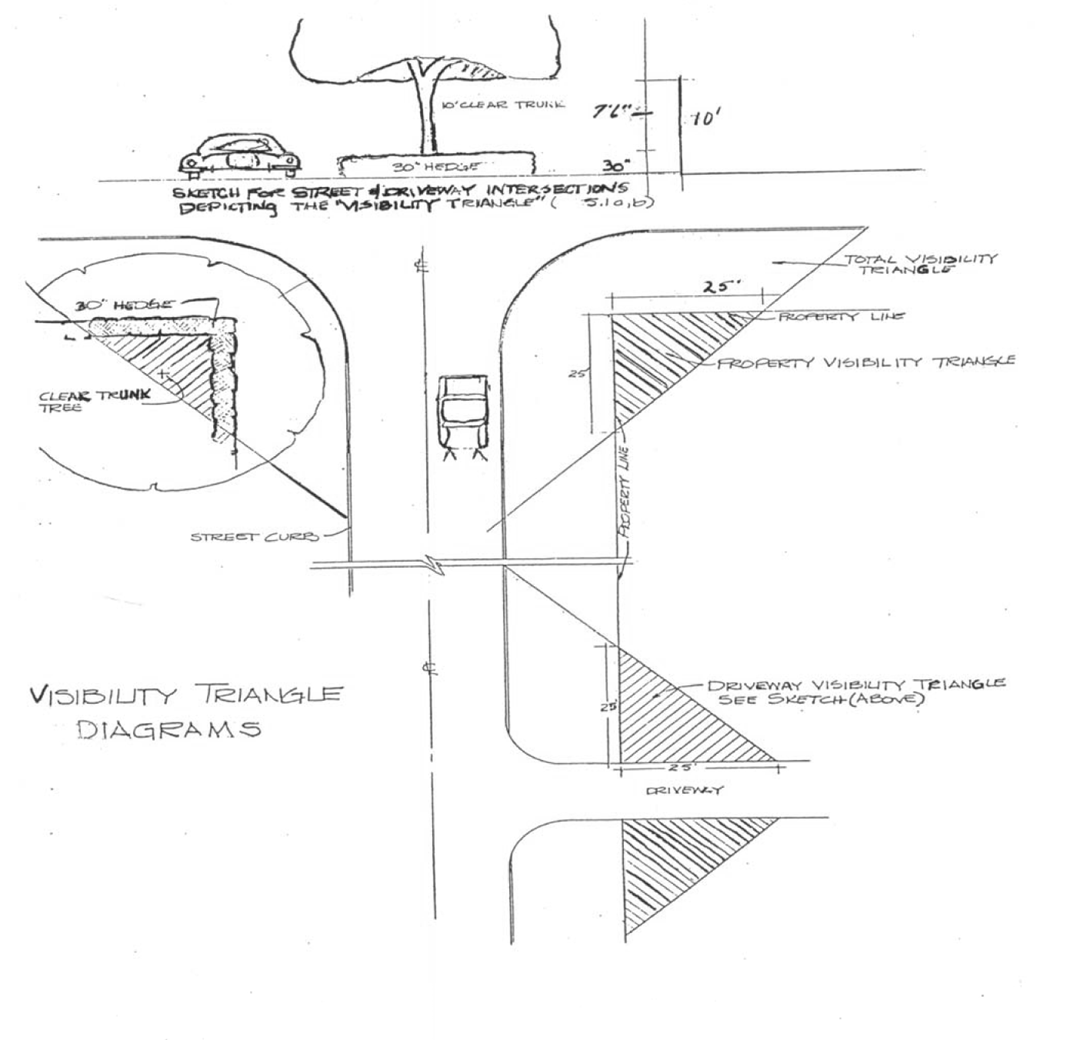
(Ord. No. 75-3, § 5.7, 8-25-1975)
Sec. 125-202. - Yard encroachments.
The following uses and structures shall be permitted in required yards, subject to the limitations established:
(1)
Except as required for maintenance of visibility at street intersections, or at intersections of driveways with streets, fences, walls and hedges shall be permitted in any required yards.
(2)
Covered entry porches, enclosed or unenclosed, may project into any required yard, provided that no such porch shall project more than three feet into such yards, where the required yard is eight feet or more in width.
(3)
Architectural features, eaves, chimneys, fireplaces, balconies and the like may project into required front, side or rear yards not more than three feet where the required yard is eight feet or more in width.
(4)
In residential districts accessory structures and uses shall not be located in required front or side yards but may be located in rear yards but not within five feet of the rear lot line; provided, however, that accessory structures for the housing of persons, such as guest houses and garage apartments, shall not be located in any required yard. On double frontage lots in residential districts, accessory uses and structures shall not be located in either of the required front yards, but may be located in side yards. In all districts no separate accessory building shall be located within five feet of any other building.
(Ord. No. 75-3, § 5.2, 8-25-1975)
Sec. 125-203. - Temporary structures.
Temporary structures in connection with land development or construction projects may be erected, for occupancy other than as dwelling or lodging units, in any district, but shall require a permit from the administrative official. Such permit shall specify location, type of construction, maintenance requirements, and period for which such structure may be erected, provided however that no such permit shall be for a period of more than six months, subject to renewal upon approval of the administrative official. Failure to obtain such permit, or violation of conditions specified therein, shall be unlawful and a violation of this chapter.
(Ord. No. 75-3, § 5.7, 8-25-1975)
Sec. 125-204. - Arrangement and location of structures.
All buildings and other structures shall be so located and arranged on lots as to provide safe and convenient access for fire protection, servicing, and off-street parking located on the premises.
(Ord. No. 75-3, § 5.3, 8-25-1975)
Sec. 125-205. - Automotive service stations.
The following regulations shall apply to the location, design, construction, operation, and maintenance of all automotive service stations, including all petroleum base fuels and systems and any other types, petroleum or otherwise to be devised and established for similar and related service activities:
(1)
An automotive service station lot shall be of adequate width and depth to meet all district setback requirements, but in no-case shall the width of a lot be less than 150 feet and contain less than a minimum area of 20,000 square feet. Except for existing automotive service stations, the land use and construction oversight commission shall have no power to grant variances below minimum lot requirements for automotive service stations.
(2)
All lights and lighting on an automotive service station and lot shall be so designed and arranged that the light source shall not be directly visible from a residential district. No part of any light structure shall protrude beyond property lines.
(3)
No automotive service station building or gasoline pumps shall be located within 25 feet of any property that is residentially zoned.
(4)
Where a lot to be used for a service station abuts on any property which is residentially zoned there shall be a wall designed and installed on all property lines other than street lines which will prevent auto lights, smoke, fumes, dust and other obnoxious materials (from ground level to the required fence height) from penetrating into the residential district. The wall shall be at least five feet high.
(5)
No gasoline pump shall be located within 15 feet of any street right-of-way line; where a street setback line has been established, no gasoline pump shall be located within 15 feet of such setback line. Where conditions of traffic safety, due to street intersections, lack of visibility at a street crown or other peculiar circumstance prevail, additional setbacks may be required but in no case shall they be required to exceed 25 feet.
(6)
The number of curb breaks for an automotive service station shall not exceed two for each 150 feet of street frontage, each having a width of not more than 40 feet and located not closer than 15 feet to the right-of-way lines of any intersection. Such curb breaks shall not be closer than 15 feet to any other private property line and there shall be a minimum distance of 15 feet between such curb breaks. Clearance for curb breaks shall be obtained from the State Department of Transportation for any proposed station located on a street under department of transportation jurisdiction.
(Ord. No. 75-3, § 5.9, 8-25-1975)
Sec. 125-206. - Essential services.
Essential services, herewith defined as services authorized and regulated by state or national public utility commissions or services owned or franchised by the county may be located within any zoning district after review and recommendation by the planning commission to the board of county commissioners. This provision comprehends both structures and uses and includes gas, water, electric, sewerage, and telephone facilities. However, this provision shall not be deemed to permit the location in a district of such establishments as electric or gas generating plants, sewage treatment plants. water pumping facilities or aeration facilities, liquid petroleum gas storage facilities above or below ground from which they would be otherwise barred, and provided further, that this provision shall not be deemed to include the establishment of structures for commercial activities such as sales or the collection of bills in districts from which such activities would be otherwise barred. Under this provision, where structures are involved, such structures shall conform insofar as possible to the character of the district as to architecture and landscaping and shall meet all yard, area and similar requirements as provided for in the district in which they are to be located.
(Ord. No. 75-3, § 5.10, 8-25-1975)
Sec. 125-207. - Public buildings and uses.
The planning commission may recommend the location in any zoning district of any public buildings erected by, or any use of, municipal, county, state, or federal government, to the board of county commissioners for their action, provided all yard, area and similar requirements as provided for in the district in which they are to be located are met.
(Ord. No. 75-3, § 5.11, 8-25-1975)
Sec. 125-208. - Houses displayed for advertising purposes.
Construction of a house displayed for advertising purposes, not intended to be sold or occupied as a dwelling, whether in connection with a residential development or otherwise, shall not commence until a performance bond adequate to insure the removal of the structure has been posted with the administrative official and approved by the county attorney.
(Ord. No. 75-3, § 5.12, 8-25-1975)
Sec. 125-209. - Off-street parking.
(a)
Generally.
(1)
Off-street parking facilities shall be provided as required by this chapter. For purposes of this chapter, an off-street parking space shall consist of a space adequate for parking a standard sized automobile with room for opening doors on both sides, together with properly related access to a street or alley and adequate maneuvering room. Required off-street parking areas for three or more automobiles shall have individual spaces marked, except as provided below, and shall be so designed, maintained, and regulated that no parking or maneuvering incidental to parking shall be on any public street, walk, or alley, and so that any automobile may be parked and unparked without moving another. For purposes of rough: computation, an off-street parking space and necessary access and maneuvering room shall be estimated at 400 square feet with the minimum width being ten feet, but off-street parking requirements will be considered to be met only where actual spaces meeting the requirements above are provided and maintained, improved in the manner required by this article and in accordance with all other ordinances and regulations of the county.
(2)
Except as otherwise provided, all off-street parking spaces, loading areas, and related access areas shall be graded, surfaced with impervious materials, and maintained in a manner permitting safe and convenient use, and so as to avoid adverse effects on neighboring property as a result of dust or drainage.
(3)
Driveways, access aisles, and parking spaces for public and private schools offering academic courses may be surfaced with turf in areas involving only occasional use.
(b)
Existing buildings or uses.
(1)
Buildings existing as of the effective date of Ordinance No. 75-3 may be modernized, altered, or repaired without providing additional off-street parking or off-street loading facilities, provided there is no increase in floor area or capacity.
(2)
Where a building or use existed as of the effective date of Ordinance No. 75-3 and such building or use is enlarged in floor area, volume, capacity, or space occupied, off-street parking and off-street loading as herein specified shall be provided for the additional floor area, volume, capacity, or space so created or used.
(3)
Where change in use of a building or land required additional parking or loading spaces, such spaces shall be provided in addition to the number existing for the prior use. Where the change in use decreases requirements, only the number required for the new use need be maintained.
(c)
Location. The required off-street parking facilities shall be located on the same lot or parcel of land they are intended to serve, provided, however, that the planning commission may recommend the establishment of such off-street parking facilities within 400 feet of the premises they are intended to serve when:
(1)
Practical difficulties prevent the placing of the facilities on the same lot as the premises they are designed to serve;
(2)
The owner of the said parking area shall enter into a written agreement with the county with enforcement running to the county providing that the land comprising the parking area shall never be disposed of except in conjunction with the sale of the building which the parking area serves so long as the facilities are required; and
(3)
The owner agrees to bear the expense of recording the agreement and agrees that the agreement shall bind his heirs, successors, and assigns. The written agreement shall be released by the county if equivalent off-street parking facilities are provided in accord with this chapter.
(d)
Plans for off-street parking required. Except for single-family detached dwellings on individual lots, a plan shall be submitted with every application for a building permit for any building or use that is required to provide off-street parking. The plan shall accurately designate the required parking spaces, access aisles, and driveways, and the relation of the off-street parking facilities to the uses or structures such facilities are designed to serve.
(e)
Combined off-street parking.
(1)
Two or more owners or operators of buildings or uses requiring off-street parking facilities may make collective provision for such facilities, provided that the total of such parking spaces when combined or used together shall not be less than the sum of the requirements computed separately.
(2)
No part of an off-street parking area required for any building or use shall be included as a part of an off-street parking area similarly required for another building or use unless the planning commission shall find that the type of use indicates that the period of usage will not overlap or be concurrent with each other.
(f)
Employee parking. Where off-street parking facilities are specified on the basis of number of employees, such parking shall be clearly marked and reserved for use of such employees. Where a use is required to provide and reserve a certain number of spaces for employees and the number of employees increases after the building is occupied, then the amount of off-street parking provided shall be increased in ratio to the increase of the number of employees. Plans submitted shall make provision for anticipated full employment.
(g)
Nonconforming use. Where major repairs, alterations, or extensions of use are to be made in a building occupied by a nonconforming use, no such repairs, alterations, or extensions shall be permitted unless and until the off-street parking requirements for a conforming use of the type involved in the district in which such use is first permitted are applied to the existing use and full provision for off-street parking facilities is made.
(h)
Minimum requirement. Regardless of other requirements of this article each and every separate individual store, office, or other business shall be provided with at least one off-street parking space, unless specific provision to the contrary is made herein.
(Ord. No. 75-3, § 5.13(a)—(h), 8-25-1975)
Sec. 125-210. - Off-street loading.
(a)
Generally.
(1)
When the use of a structure or land or any part thereof is changed to a use requiring off-street loading facilities, the full amount of off-street loading space required shall be supplied and maintained. When any structure is enlarged or any use extended so that the size of the resulting occupancy required off-street loading space, the full amount of such space shall be supplied and maintained for the structure or use in its enlarged or extended size.
(2)
Each off-street loading space shall be directly accessible from a street or alley without crossing or entering any other required off-street loading space. Such loading space shall be accessible from the interior of the building it serves and shall be arranged for convenient and safe ingress and egress by motor truck and/or trailer combination or service vehicle.
(b)
Combined off-street loading. Collective, joint, or combined provisions for off-street loading facilities for two or more buildings or uses may be made, provided that such off-street loading facilities are equal in size and capacity to the combined requirements of the several buildings or uses and are designed, located, and-arranged to be usable thereby.
(c)
Plans for off-street loading required. A plan shall be submitted with every application for a building permit for any use or structure required to provide off-street loading facilities. The plan shall accurately designate the required off-street loading spaces, access thereto, dimensions; and clearance.
(d)
Off-street loading requirements. Off-street loading spaces shall be provided and maintained as follows:
(1)
Each retail store, storage warehouse, wholesale establishment, industrial plant, factory, freight terminal, market, restaurant, mortuary, laundry, dry cleaning establishment, or similar use, based on an aggregate floor area as follows:
a.
Over 5,000 square feet, but not over 25,000 square feet, one space.
b.
Over 25,000 square feet, but not over 40,000 square feet, two spaces.
c.
Over 40,000 square feet, but not over 100,000 square feet, three spaces.
d.
Over 100,000 square feet, but not over 200,000 square feet, four spaces.
e.
Over 200,000 but not over 290,000 square feet, five spaces.
f.
Plus one additional off-street loading space for each additional 90,000 square feet over 290,000 square feet or major fraction thereof.
(2)
For each multiple dwelling, motel, or hotel having:
a.
At least 20 dwelling but not over 50 dwelling units, two spaces.
b.
Over 50 dwelling units, two spaces, plus one space for each additional 50 dwelling units, or major fraction thereof.
(3)
For each auditorium, exhibition hall, museum, office building, sports arena, stadium, hospital, sanitarium, welfare institution, or similar use which has an aggregate floor area of:
a.
Over 10,000 square feet, but not over 40,000 square feet, one space; plus
b.
For each additional 60,000 square feet over 40,000 square feet or major fraction thereof, one space.
(4)
For any use not specifically mentioned, the requirements for off-street loading facilities for a use which is so mentioned and to which the unmentioned use is similar shall apply.
(5)
An off-street loading space shall have minimum dimensions as follows:
a.
Length: 40 feet;
b.
Width: 12 feet;
c.
Height or clearance: 14 feet.
(Ord. No. 75-3, § 5.13(i)—(l), 8-25-1975)
Sec. 125-211. - Parking, storage, or use of major recreational equipment.
For purposes of these section major recreational equipment is defined as including boats and boat trailers, houseboats, travel trailers, pick-up campers or coaches (designed to be mounted on automotive vehicles), motorized dwellings, tent trailers, and the like, and cases or boxes used for transporting recreational equipment, whether occupied by such equipment or not. No such equipment shall be used for living, sleeping, or housekeeping purposes when parked or stored on a residential lot, or in any location not approved for such use.
(Ord. No. 75-3, § 5.14, 8-25-1975)
Sec. 125-212. - Parking of certain vehicles in residential districts.
(a)
Except for boat and boat trailers and utility trailers, automotive vehicles, mobile homes or trailers of any kind or type without current licenses plates shall not be parked or stored on any residentially zoned property other than in a completely enclosed building; provided, this requirement shall not prohibit the parking of a mobile home in current use for dwelling purposes in a district where such use is permitted or permissible.
(b)
Commercial vehicles or equipment shall not be parked or stored in any residential district unless engaged in a construction service operation on the site, or, unless parked within an enclosed structure sufficient to screen it from view from an adjacent property. No maintenance or repair of commercial vehicles parked within an enclosed structure as permitted by this subsection shall be allowed. Operation of commercial vehicles parked within an enclosed structure as permitted by subsection (a) of this section shall not operate in a manner to cause a nuisance.
(c)
Automotive vehicles and RV or utility trailers without a current license and in inoperative condition shall not be parked or stored in any residential district unless screened from view from any adjacent property.
(d)
Automobiles, vans, and pickup trucks having a rated load capacity of one ton or less shall not be considered commercial vehicles for purposes of this section.
(Ord. No. 75-3, § 5.15, 8-25-1975; Ord. No. 2006-26, § 3, 8-28-2008)
Sec. 125-213. - Junkyards and automotive wrecking yards.
(a)
The following provisions shall apply to all automotive wrecking yards or junkyards created after the effective date of Ordinance No. 75-3 and subsections (a)(2) and (a)(3) of this section shall apply to automotive wrecking yards and junk yards existing on the effective date of Ordinance No. 75-3, whether such automotive wrecking yards or junk yards are in conforming or nonconforming status at such effective date:
(1)
The area of land to be used shall not be less than two acres nor more than ten acres.
(2)
No automotive vehicle not in condition to be operated on the roads of the state. No machinery or other junk or scrap shall be located for storage or dismantling within 300 feet of any residential district, within 50 feet of the front street line, or within 30 feet of any side street line or other property line of the plot to be so used.
(3)
The entire area occupied by a junk yard shall be surrounded by a substantial, continuous masonry, wooden, or metal fence or wall eight feet in height without openings of any type except for entrance or exit; gates at entrance or exit shall be unpierced. The required fence shall be constructed of the same type of material throughout the entire fence. The fence shall be constructed on the basis of the setback requirements set out in subsection (a)(2) of this section and no storage or dismantling shall be permitted outside the required fence.
(b)
In the case of existing automotive wrecking yards or junk yards, the requirement of subsection (a)(2) and (a)(3) of this section shall be met not less than one year after the effective date of Ordinance No. 75-3.
(Ord. No. 75-3, § 5.16, 8-25-1975)
Sec. 125-214. - Base building line requirements.
(a)
In order to accomplish the intent and purposes of the comprehensive land development and major street plans, base building line requirements have been established for streets and the proposed extensions thereof within the unincorporated area of the county as set our in this subsection. All yards required by this chapter shall be measured from such base building lines. Where no yard requirements are set out for a zoning district, no building or structure or any part thereof, sign, canopy or parking area shall extend street ward beyond the base building line, except as specifically set out in this chapter. In case of conflict between these minimum requirements and other requirements contained herein or other county codes and ordinances, the most restrictive regulations shall apply.
(b)
In all commercial and industrial districts no building or other structure shall be erected within 35 feet of the centerline of any street where a greater setback has not been established as set out below.
(c)
On the following streets, setback lines are determined by dividing by two the rights-of-way indicated and measured from the centerline of the street rights-of-way:
(1)
U.S. 27, 300 feet.
(2)
State Road 29, 100 feet.
(3)
State Road 80, 100 feet.
(4)
State Road 78, 100 feet.
(5)
State Road 74 in west half of county, 80 feet.
(6)
Secondary Road 721, 80 feet.
(7)
Secondary Road 720 in eastern half of county, 80 feet.
(8)
Secondary Road 720 in western half of county, 60 feet.
(9)
Secondary Road 731, 60 feet.
(10)
State Road 72 in eastern half of county, 60 feet.
(11)
Ortona Road, 60 feet.
(12)
Goodno Road, 60 feet.
(Ord. No. 75-3, § 5.19, 8-25-1975)
Sec. 125-215. - General requirements for commercial development.
(a)
Applicability. The provisions of this section shall apply to all site developments except single family and duplex residential construction (one principal structure per lot/site).
(1)
All residential, except for single family and duplexes as described above, and all commercial, industrial and instructional development shall be hereafter referred to as "development."
(2)
All residential, except for single family and duplexes as described above, and all commercial, industrial and institutional site plans shall be hereafter referred to as "site plan."
(b)
Site plan approval required. All new development within the unincorporated area of the county, shall be subject to site plan review and approval. Site plan approval shall be required prior to the issuance of any building permit.
Generally, all site plans shall indicate proposed uses and structures, site improvements, driveways and parking areas, yards, buffering, a schedule for initiation and completion of development, and such other details as may be requested by the reviewing department/legislative body. If approved, such plan shall be binding upon the petitioner and any successors in title, and no substantial change to such plan shall be permitted without the prior written approval of the community development director or the planning commission, as appropriate under these regulations.
(c)
Site plan review. Depending on the size and scope of the proposed project, a site plan will be reviewed using one of two processes: major or minor review. The community development director will determine the review process to be used based upon the criteria below.
(1)
Minor review. A site plan that authorizes a minor site plan review process is a plan or proposal for development that is a single use building within a single lot that requires site plan review and which may involve site improvements, clearing, grading, excavation, fill, paving, or construction. However, the plan or proposal cannot involve a planned development or any new street or extension of any off-tract improvement or propose the creation, continuation or expansion of a prohibited use or structure (or any combination of prohibited uses or structures) or a request for variance relief.
a.
The plan or proposal will be reviewed administratively by the community development director.
b.
No public hearing is required for minor site plan review.
c.
If the community development director determines the plan or proposal has critical issues, which may include but are not be limited to, site access and circulation, including fire department access, grading, drainage, utility services, or any site specific encumbrances such as easements/ dedications, the community development director can, in their sole discretion, refer the minor site plan to the planning commission for review and action in a public hearing process that is the same as a major site plan review.
d.
The community development director, at their discretion, can request additional documentation to be submitted prior to making a decision on the site plan application.
(2)
Major review. All site plan applications which are not classified as minor site plan review applications will be classified as applications for "major" site plan approval.
a.
All major site plans shall be reviewed first by county staff and then presented to the planning commission for review and action in a public hearing which may result in either approval, approval with conditions, or denial of the site plan application.
b.
The community development director, at their discretion, can request additional documentation to be submitted prior to making a decision on the site plan application.
(d)
Limitations on vehicular access. Except for utility and service vehicles, there shall be no vehicular access allowed to the subject property through property in a residential land use district.
(e)
Site planning; limitations on operations. Site planning, design and location of site improvements and structures and open spaces, and management of operations shall be such that orientation of buildings and related site improvements and activities is toward the frontage on the street. There shall be no sales, service, storage or display of goods or materials and no off-street loading operations, garbage or trash storage, or collection or disposal facilities visible in any part of the subject property from any portion of any abutting property in a residential district. Signs on the subject property shall be oriented away from any abutting property in a residential district. Lighting of structures and premises on the subject property shall be so directed and shielded as to protect abutting residential uses and abutting property, especially in a residential district from nuisance effects.
(f)
Yard requirements; buffering. Yards and structural buffering shall be provided to minimize the impact of the development on any abutting property, especially in a residential district. The following minimum requirements shall apply to all site plans and may be increased to achieve a stated public purpose, but shall not be diminished:
(1)
Yards adjacent to streets shall be a minimum of 25 feet in depth without any site improvements or structures.
(2)
Yards adjoining lot lines in any residential district shall be a minimum of 15 feet in depth without any site improvements or structures.
(3)
All yards provided which abut any property in a residential district shall be landscaped and maintained appropriate to the residential surrounds. No portion of any required yard abutting property in a residential district shall be used for off-street parking.
(4)
Where necessary to protect abutting property, especially in a residential district, from lights, noise, undesirable views, or other adverse impacts, appropriate fences or walls may be required to be constructed and maintained as required in this chapter.
(5)
Notwithstanding anything else herein to the contrary, in all circumstances, all regulatory compliance requirements that are applicable to the subject property shall be satisfied by the property owner and the approval of a site plan application shall not constitute a variance, or a special exception or any other modification of any law, rule or regulation that applies to the subject property.
(g)
Additional requirements. After examination of the site plan, the community development director and/or the planning commission may impose additional requirements which are determined to be necessary for stated public purposes as a condition for approval, and may attach additional conditions and safeguards, including limitations on hours and manner of operation, beginning and conclusion of construction or other matters. The community development director and/or planning commission, shall not reduce the above-stated conditions and safeguards in granting approval.
(h)
Application requirements. An application for site plan review shall be made on forms provided by the community development department and shall include the following information and documentation, at a minimum:
(1)
Completed site plan application and application fee.
(2)
The name of the proposed development, if applicable.
(3)
The location of the site by street address and parcel identification number.
(4)
The name and signature of the legal owner of the development site, the nature or type of property ownership, and proof of ownership.
(5)
The name and signature of the agent acting on behalf of the legal owner and a written power of attorney granted to the agent regarding the development application, if applicable.
(6)
The size of the parcel in acres and square feet.
(7)
The specific nature of the intended uses of the development site.
(8)
The square footage of all existing and proposed uses on the development site individually and in aggregate.
(9)
The gross intensity in floor area ratio (FAR).
(10)
The zoning classification and future land use designation of the site.
(11)
The maximum amount of lot coverage permitted versus the amount of lot coverage proposed.
(12)
The minimum amount of landscaped area required versus the amount of landscaped area proposed.
(13)
The minimum number of parking spaces required versus the number of parking spaces proposed on-site and/or off-site.
(14)
A statement on the water facilities and sewer facilities for the site.
(15)
A development schedule for all phases, if applicable.
(16)
A location map, which delineates the project boundaries.
(17)
An aerial photograph of the site.
(18)
The FIRM panel number, flood zone and BFE, if applicable.
(19)
A boundary and topographic survey with legal description prepared, signed, and sealed by a registered Florida Land Surveyor.
(20)
A statement that the proposed development complies with the county's land development regulations and comprehensive plan requirements.
(21)
A statement that all pertinent permits are concurrently being sought from the applicable county, state and federal agencies. Such permits shall be obtained prior to commencement of development.
(22)
Stormwater drainage calculations and design (to be approved by the county engineer).
(23)
A minor site plan drawing on a sheet size of at least 24 inches × 36 inches and at a scale no smaller than 1" = 50', which shall include, at a minimum:
a.
A boundary survey of the property, including easements, the dimensions of the property, railways, water bodies, parcel number(s), street names, adjacent properties and other landmarks.
b.
The location, size, height, floors and use of all proposed and existing buildings and structures.
c.
The location, dimension and type of all parking spaces, loading areas, sidewalks, lighting, and other site improvements.
d.
The location and dimension of all yard requirements and setback.
e.
A landscaping plan that meets the land development regulation requirements.
f.
The height, location, type lighting, square footage and setback of all existing and proposed sign(s).
g.
The location, type and height of all existing or new fences and walls.
h.
The location of potable water facilities.
j.
The location of sanitary sewer facilities or on-site sewage system.
k.
The location and dimensions of all drainage retention areas.
l.
The location and size of any trash disposal facilities.
m.
Building footprint with ingress and egress shown.
n.
Building elevation.
o.
The location, type and size of all entrances to the site and of all rights-of-way located on or adjacent to the site.
(24)
A major site plan drawing shall, at a minimum, include all of the requirements for a minor site plan provided in section 125-215(c)(1) in addition to all of the following requirements on a sheet size of at least 24 inches × 36 inches and at a scale no smaller than 1" = 50'. (For large projects a smaller scale generalized plot plan may be submitted as a cover sheet; however, detail sheets will be required):
a.
Boundaries depicting phases, if applicable. If the development is to occur in phases, those phases shall be clearly delineated on the site plan and identified in the plans and requirements. Each development phase shall be subject to site plan review.
b.
The location of all utility lines.
c.
The location of any conservation easements, dedicated open space, recreational facilities or similar areas.
d.
The location of all internal transportation improvements, including road right of ways, sidewalks, and bike paths.
e.
The location of all external rights-of-way, adjacent or nearby roadways and uses of adjacent property.
f.
The location and type of any structure or site improvement, including paved areas within 50 feet of the outside property boundaries.
g.
The location of major drainage improvements.
h.
A traffic study.
i.
Any other information deemed necessary by the director of community development and/or planning commission for the reasonable review of the proposed development.
(i)
Certification required. All items listed in this section requiring preparation of architectural or engineering drawings shall be prepared and certified by an engineer or architect registered in this state.
(j)
Approval of site plans.
(1)
Minor site plan approval: The community development director has the authority to approve or reject the minor site plan or issue site plan approval with conditions. The rejection shall either be a redlined site plan or a letter outlining the deficiencies in the site plan. The applicant at their discretion, may choose to resubmit a revised site plan, or appeal the decision of the community development director to the planning commission. Any such appeal must be filed within 30 days of the decision to approve, reject, or approve with conditions.
(2)
Major site plan approval: The planning commission has the authority to approve or reject the site plan or issue site plan approval with conditions. The rejection shall either be a redlined site plan or a letter outlining the deficiencies in the site plan. Any appeal of the decision of the planning commission shall be appealed to the board of county commissioners. Any such appeal must be filed within 30 days of the decision to approve, reject, or approve with conditions.
(Ord. No. 75-3, § 5.19, 8-25-1975; Ord. No. 2021-2, § 3, 2-9-2021)
Sec. 125-216. - Travel trailer parks and campgrounds.
(a)
Definition. In this section the term "recreational vehicle" includes a camper, motor home, fifth wheel, truck camper, foldout camper, mini-home, and park model. Recreational vehicles, as addressed herein, shall be defined in two subcategories as follows. Requirements may vary by category.
(1)
Travel trailer recreational vehicle, which means any regular recreational vehicle of no more than eight feet in width when secured for highway transport, not requiring conventional blocking and tie-down systems, factory equipped with either sanitary holding tanks or multiple power source appliances, and not requiring permitting or installation inspections.
(2)
Park recreational vehicle, which means any registered recreational vehicle of eight or more feet in width. Any recreational vehicle by manufactured design that requires conventional blocking and tie-down systems, is not factory designed with sanitary holding tanks or multiple power source appliances, and requiring installation permitting and inspection prior to occupancy. A mini-home or park model shall have a recreational vehicle sticker for identification.
(b)
Additions.
(1)
Additions and alterations to recreational vehicles such as cabanas, screen rooms, carports, storage buildings, skirting, and wheel covers are allowed. All construction shall comply with applicable building codes and ordinances, as amended. Plans must be approved and a construction permit issued by the building department. The plot plan must be approved by the zoning department. The construction plans shall include the type and quality of materials and the exterior appearance of the addition. The plot plan shall include the location of the addition and the recreational vehicle on the lot, the respective dimensions and lot line setbacks, and such other details as may be required to ascertain compliance with applicable ordinances.
(2)
Cabanas, screen rooms, and open carports may be attached to the recreational vehicle or be constructed as a free-standing structure. Cabanas and screen rooms shall have a floor system and shall be constructed on a solid foundation. The addition may be constructed of aluminum or wood where compatibly designed and installed to building code standards. Storage buildings of similar design and construction standards are permitted. The size of the storage building is limited to 48 square feet of floor area.
(3)
Cabanas, screen rooms, carports, and storage buildings shall meet the setback requirements as set forth herein.
(4)
Skirting and wheel covers shall be of high quality aluminum, fiberglass, canvas, or wood/lattice.
(c)
Recreational vehicle parks and recreational vehicle park condominiums.
(1)
Definitions. The following definitions apply to this subsection:
Recreational vehicle park and campground means a parcel of land under unified ownership or management which has been planned, designed, and constructed for the placement of recreational vehicles as defined by this section, for short-term occupancy as rented spaces, including any land, buildings, structures, or facility used by recreational vehicle occupants on such premises.
Recreational vehicle park condominium means that form of ownership of real property created pursuant to F.S. ch. 718. A recreational vehicle park condominium is permitted in the same zoning districts as prescribed for recreational vehicle parks. Minimum standards and design requirements are the same as for recreational vehicle parks.
(2)
Design requirements. The following minimum standards and design requirements shall apply in any district where recreational vehicle parks and recreational vehicle park condominiums are permitted.
a.
No recreational vehicle park shall be permitted unless the owners provide direct access to a dedicated public thoroughfare of the county. Both the access road and the interior streets shall conform to the specifications of the Glades County Comprehensive and Major Street Plan, as amended, as to arrangement, character, extent, width, grade, base, driving surface and location. Consideration shall be given to the topographical conditions, public convenience, safety, and the existing and planned uses in the park. Recognizing that the magnitude and impact of a recreational vehicle park may not be the same as conventional housing subdivision, the planning commission and the board of county commissioners shall have the authority to grant such variances from the specifications of the Glades County Comprehensive and Major Street Plan as may be necessary or appropriate under the circumstances.
b.
The right-of-way for the access road shall be a minimum of 20 feet wide and the driving surface shall be a minimum of 18 feet wide, consisting of a minimum road base of ten inches of shell or lime rock. The road shall not be dedicated to the public or dedicated to the county and the county shall not be required to accept maintenance thereof. The turn radius shall be designed so as to accommodate installation or removal of the largest units allowed. The planning commission shall have the authority to require a wider right-of-way or road if deemed necessary for the circumstances.
c.
A minimum number of off-street parking spaces equal to the number of units multiplied by a factor of 1.5 with each unit having at least one off-street parking space at the unit site.
d.
Minimum lot size shall be 30 feet wide and 50 feet long.
e.
A minimum of eight percent of the land area shall be reserved and utilized for recreational purposes.
f.
The side, front and rear yard setbacks shall be a minimum of five feet from each lot line.
g.
The sanitary facility shall be permitted and approved by the department of health, in addition to meeting all other state and local laws and ordinances.
(d)
Review of plans. The developer shall furnish five sets of plans to the planning department for review. Such plans shall be approved and signed by the county health department and the chairman of the planning commission. The developer shall furnish letters of exemption or permits from necessary state agencies. In addition to any other fees, a permitting fee of $300.00 plus a fee of $10.00 per space shall be paid to the board of county commissioners. The planning commission shall review and approve recreational vehicle park and recreational vehicle park condominium plans for safety, drainage, width and composition of roads and rights-of-way, size of lots and setbacks, and other compliance with this chapter.
(Ord. No. 89-2, §§ 1—4, 5-8-1989; Ord. No. 97-3, § 1, 6-10-1997)
Sec. 125-217. - General buffer requirements.
(a)
These buffer requirements will apply for approved development that requires a development order.
(b)
The existing use of the abutting property will determine the type of buffering area required. Where the adjacent properties are vacant, the existing use will be deemed as agricultural, unless future development is approved via a local development order.
(c)
Use categories. In interpreting and applying the provisions of this section, development is classified into the following use categories:
(d)
Buffer requirements. The following table provides the required buffer type when a proposed use is abutting an existing use or, in the absence of an existing use, an approved or pending development order application that authorizes development of the property.
(e)
Buffer types. The following table provides five different. buffer types. Each buffer type, identified by a letter, provides the minimum number of trees and shrubs per 100 linear foot segment of buffering area and indicates whether or not a wall or hedge is required.
(1) Trees within a ROW buffer must be appropriately sized in their mature form so that conflicts with overhead utilities, lighting and signs are avoided.
(2) Where a wall is required in the chart above, the wall can be a solid wall, berm, or wall and berm combination, not less than eight feet In height measured from the adjacent grade. All trees and shrubs required In the buffer must be placed on the exterior side of the wall. Walls must be constructed to ensure that historic flow patterns are accommodated, and all stormwater from the site is directed to on-site detention/retention areas in accordance with SFWMD requirements.
(3) Hedges must be planted in double staggered rows and be maintained so as to form a 36-inch high continuous visual screen within one year after time of planting. Type E buffers must be 48 inches at installation and must be maintained at 60 inches high to form a continuous visual screen within one year after time of planting.
(f)
Uses or activities that generate noise, dust, odor, heat, glare or other similar impacts, must provide either a Type C or E buffer, as determined by the community development department director based upon the impact that the proposed development will have on adjacent property.
(g)
Walls, berms and buffer plantings must not be placed so they interfere with vehicle visibility.
(h)
All freestanding parking areas, whether commercial, public or private, not associated with other development must provide a Type D buffer along all perimeters that abut rights-of-way, and a Type C buffer along all perimeters that abut single-family or multiple-family residential uses or zoning.
(i)
Use of buffer areas. Required buffers may be used for open space and passive recreation such as pedestrian, bike, or equestrian trails, provided that:
(1)
No required trees or shrubs are eliminated;
(2)
Not more than 20 percent of the width of the buffer is impervious surface;
(3)
The total width of the buffer area is maintained; and
(4)
All other requirements of this section are met.
(j)
Rights-of-way and utilities. All trees of species whose roots are known to cause damage to public roadways, sidewalks and other public works/utilities shall be planted so as to be no closer than 20 feet to the public works/utilities. Utility or drainage easements may overlap required buffers; however, no buffer trees or shrubs may be located in any utility drainage or street easement or right-of-way. To avoid conflicts with overhead utility lines, only trees less than 20 feet in height at maturity may be used directly adjacent to an overhead line. No required buffers can be located in public or private road rights-of-way. No required buffers or landscaping can be located in utility easements without the written approval of the utility.
(k)
Plant material standards.
(1)
Quality. Plant materials used to meet the requirements of this division must meet the standards for Florida No. 1 or better, as set out in Grades and Standards for Nursery Plants, Parts I and II, Department of Agricultural, State of Florida (as amended).
(2)
Native plantings. At least 75 percent of the trees and shrubs used to fulfill these requirements must be native Florida species (South Florida Water Management District xeriscape approved trees and shrubs qualify).
(3)
Other buffer plantings requirements.
a.
Buffer plantings must be a minimum of 24 inches in height at time of planting. Type E Buffer plantings must be 48 inches in height at the time of planting.
b.
Buffer plantings must be a minimum three-gallon container size and be spaced 18 to 36 inches on center.
c.
Buffer plantings must be at least 36 inches in height within one year of the time of planting and maintained in perpetuity at a height of no less than 36 inches above the final grade level or the adjacent pavement required to be buffered or screened, whichever is higher, except for visibility at intersections and where pedestrian access is provided.
d.
Type E buffer plantings must be at least 60 inches in height within one year of the time of planting and maintained at 60 inches for perpetuity above the final grade level or the adjacent pavement required to be buffered or screened, whichever is higher, except for visibility at intersections and where pedestrian access is provided.
e.
Required hedges must be planted in double staggered rows and maintained so as to form a continuous, unbroken, solid visual screen within one year after time of planting.
(4)
Mulch requirements. A two-inch minimum layer, after watering-in, of mulch, rock or other recycled materials must be placed and maintained around all newly installed trees, shrubs, and ground cover plantings. Each tree must have a ring of mulch no less than 24 inches beyond its trunk in all directions. The use of cypress mulch is strongly discouraged.
(5)
Ground cover plantings are encouraged as a supplement to the other buffer requirements described herein.
(l)
Timing of installation. Required plantings must be installed prior to the issuance of a certificate of occupancy within the project.
(m)
Installation requirements. Plant materials must be installed in soil conditions that are conducive to the proper growth of the plant material. Soils unsuitable for plantings must be replaced with growing quality soil before planting. A plant's growth habit must be considered in advance of conflicts that might be created (e.g. views, signage, overhead power lines, lighting, and circulation). Trees may not be placed where they interfere with site drainage, subsurface utilities, or overhead utility lines, or where they will require frequent pruning in order to avoid interference with overhead power lines. All landscape materials must be installed in a recognized horticultural correct manner. At a minimum, the following installation requirements must be met:
(1)
All landscape areas must be mulched unless vegetative cover is already established.
(2)
Trees and shrubs used in buffers must be planted in a minimum width area equal to one-half the required width of the buffer however, in no case may the planting area be less than five feet in width.
(3)
Required plants used in buffers and landscaping must, to the maximum extent possible, be installed using xeriscape principles. Xeriscape principles include water conservation through drought-tolerant landscaping, the use of appropriate plant material, ground cover, mulching, and the reduction of turf areas. Landscaping must have sufficient establishment of water to survive.
(4)
Safe sight distance triangles at intersections and vehicle connections must be maintained.
(n)
Maintenance requirements. Owner is responsible for maintaining the required landscaping in a healthy condition at all times. Landscaping and buffers shall be maintained as follows:
(1)
Dead or diseased vegetation/trees shall be removed and replaced with healthy vegetation or trees immediately.
(2)
Debris (trash, etc.) shall be removed as needed to avoid any accumulation.
(3)
Tree and palm staking must be removed within 12 months after installation.
(4)
Ongoing maintenance to prohibit the establishment of prohibited invasive exotic species is mandatory.
(Ord. No. 2012-6, § 1(Exh. A), 10-22-2012)
Sec. 125-218. - Gates, fences, and walls.
(a)
Permit required. No gate, fence or wall shall be erected until a building permit is obtained. A sketch or design of the proposed gate, fence or wall, including a description of materials to be used, specification of height, and a survey depicting the desired location shall be submitted with the application for a permit. A copy of an existing survey document may be used if it accurately describes the proposed gate, fence and wall and is legible and includes a signed surveyors stamp. In no case, however, shall a gate, fence or wall be erected beyond the boundaries of the parcel as identified in the survey.
(b)
Generally.
(1)
No gate, fence, or wall shall be installed on any public or private right-of-way used as a street, road, highway, or easement for ingress and/or egress. However, as part of a development entrance feature, a gate, fence, or wall may be installed on a private right-of-way exclusively owned by a home owners association, property owner or some other qualifier of ownership. Access gates shall be set back a minimum of 20 feet from the property line. Properties that are less than one-half acre in size are exempt from the minimum set back of 20 feet from the property line for gates. Properties that are one-half acres or larger in size with existing single family dwellings and are not able to meet the 20 feet footprint can apply for an administrative waiver to the director of community development. If an administrative waiver request is denied and the property owner alleges there is an error in the decision made by the community development director, the property owner may appeal the decision to the Glades County Land Use and Oversight Commission, pursuant to section 125-64.
(2)
Each gate, fence, or wall erected shall be of uniform construction and appearance, and shall be erected and maintained in good repair so as to not pose a hazard or eyesore.
(3)
Allowable materials. Fences and walls shall consist of, but shall not be limited to, the following conventional and traditional materials: Wood, concrete, brick, stucco, picket, basket weave, split rail, plank, panels, woven saplings, castor wrought iron, chain link and coated chain link, PVC, or vinyl, net wire or welded wire, excluding barbwire. A combination of these conventional and traditional materials may be permitted. Non-traditional materials, including but not limited to tires, wood pallets, plywood, hubcaps, etc., are prohibited.
(4)
No gate, fence, or wall shall be erected so as to interfere with visibility at street intersections and intersections of driveways with streets pursuant to Glades County Code, Section 125-201.
(5)
The height of all gates, fences, or walls shall be measured from the finished grade of the site where the measurement is taken, excluding berms. Support poles, columns, and decorative lights may exceed the height limitations by not more than one foot. Gates may exceed the height limitations by not more than two feet. Entry features are excluded from the two foot height limitation.
(6)
Gates, fences, and walls shall be constructed in such a manner so as not to interfere with drainage and utilities. If it is necessary for the county or utility companies to perform maintenance in an easement where a fence is located, the owner will be responsible to remove the fence and to erect the fence upon completion of the maintenance.
(7)
If the property abuts a waterbody, no fence or wall greater than four feet in height shall be permitted closer than ten feet to the mean high water line, seawall, or the property line, whichever is more restrictive.
(8)
Subdivision or resort perimeter walls may be approved through the site plan review process without maintaining the minimum setback requirements set forth in each zoning district.
(c)
Exemptions.
(1)
Gates, fences, and walls which are owned or erected by utility companies or owned or erected by Glades County or any state or federal governmental agency.
(2)
Farm fences qualifying for the exemption from regulation in F.S. § 604.50 shall not be subject to the requirements and limitations set forth herein.
(d)
Residential requirements.
(1)
On corner lots and double frontage lots, gates, fences, or walls shall not exceed four feet in height in that front yard that is parallel to the principal building line of the residence where the front door is located, or in front of the dwelling unit. In the other front yard, a six foot fence may be permitted, provided it meets the required front setback for the district in which it is located.
(2)
In side or rear yards, gates, fences, or walls, shall not exceed six feet in height.
(3)
The finished side of the gate, fence, or wall shall face the adjoining lot and/or right-of-way.
(4)
Gates, fences, and walls that are electrified or constructed of corrugated metal, sheet aluminum, barbed wire, or similar materials are prohibited. Barbed wire fencing shall be allowed in agricultural zoning only, pursuant to section 125-218(c)(2) above.
(e)
Nonresidential requirements. Gates, fences, and walls shall be subject to the following requirements in nonresidential districts or nonresidential developments.
(1)
Gates, fences, or walls shall not exceed eight feet in height in any yard. All fencing shall comply with section 125-218(b)(4) for visibility.
(2)
Temporary perimeter security fencing for construction sites is permitted. Fences should be at least six feet high and locked when construction personnel are not on site. Fence material can be chain link, solid barriers and barricades made of wood or plastic.
(3)
Finished side of the gate, fence, or wall shall face the adjoining lot right-of-way.
(4)
For industrial zoned parcels, coated chain link fences shall be allowed.
(5)
Fabric sheets or nets, or plastic, metal or vinyl sheets may be used as part of the fence in commercial and industrial zoning districts for the purpose of temporary screening related to a temporary permitted only and shall be maintained in good condition.
(f)
Nonconforming fences.
(1)
In the event 50 percent, or more, of a nonconforming gate, fence, or wall is damaged, destroyed, or removed, whether by natural causes or otherwise, then the nonconforming structure shall be removed and any replacement gate, fence, or wall shall be erected in compliance with the requirements of this section.
(2)
When improvements on a property require a building permit, nonconforming fences must comply with the current code.
(Ord. No. 2025-09, § 2, 8-12-2025)
Sec. 125-304. - Purpose and intent.
To regulate the location, erection, construction and modification of transmission towers, antennas and associated support facilities in unincorporated areas of the county so as to protect the public health, safety and welfare while accommodating the growing need for wireless telecommunication services.
(Ord. No. 2001-2, § 1(4-17-23), 1-9-2001; Ord. No. 2025-08, § 2, 8-12-2025)
Sec. 125-305. - Findings.
(a)
Pursuant to F.S. § 125.01 and constitutionally granted home rule powers, the county is authorized to establish, coordinate and enforce such regulations as are necessary to protect the public and to adopt ordinances necessary to exercise its powers and to prescribe fines and penalties for the violation of such ordinances in accordance with the law.
(b)
Section 704 of the Telecommunications Act of 1996 (the 1996 Act), relating to federal, state and local government oversight of siting of wireless communication facilities, preserves the authority of local government to regulate the location, erection, construction and modification of wireless communication facilities, such as transmission towers, antennas and associated support facilities.
(c)
Section 704(a) of the 1996 Act provides that local governments may not unreasonably discriminate among providers of functionally equivalent services and shall not prohibit or have the effect of prohibiting the provision of personal wireless services.
(d)
Changes in wireless telecommunications technology, and the granting of additional licenses by the Federal Communications Commission (FCC) have resulted in an increased demand for the construction of wireless communication facilities in unincorporated areas of the county.
(e)
The residents of the county have expressed significant concern in relation to the location, erection, construction and modification of transmission towers, antennas and associated support facilities with respect to the preservation of community aesthetics, land use compatibility, the safety of transmission towers in the event of hurricane, tornado, severe thunderstorm or other events, and the potential impact that transmission towers, antennas and associated support facilities will have on property values.
(f)
Careful design and siting of wireless communication facilities including the use of landscape screening and alternative tower structures, is necessary to minimize the adverse aesthetic impacts, minimize land use incompatibility and minimize any negative impact on property values by the siting of wireless communication facilities.
(g)
Wireless communication facilities are to be designed and constructed so as to have a minimal impact on community aesthetics, land use compatibility or property values without prohibiting or having the effect of prohibiting the provision of wireless communication services.
(h)
The implementation of minimum setback requirements and construction standards is necessary to minimize the risk of damage to surrounding personal and real property in the event of structural failure of transmission towers and/or antennas.
(i)
Regulation of the location, erection, construction and modification of wireless communication facilities is necessary to preserve and protect the ecosystem, environmentally sensitive lands and threatened and endangered species in the county.
(j)
It is in the best interests of the citizens of the county to promote wireless communication facility sitings on suitable property, collocation, and the use of existing structures and buildings as antenna mounts to minimize the need to construct new transmission towers; to use alternative tower structures and camouflaged antennas to minimize the aesthetic impact of such facilities.
(k)
It is essential to the health, safety and welfare of the citizens of the county that abandoned, unused or unsafe wireless communication facilities be removed in an expeditious manner.
(l)
The board finds that such regulation is consistent with the county comprehensive plan, and would protect the health, safety and welfare of the residents of the county.
(Ord. No. 2001-2, § 1(4-17-23.1), 1-9-2001; Ord. No. 2025-08, § 2, 8-12-2025)
Sec. 125-306. - Wireless communication facilities for all districts.
Wireless communications facilities (WCF) or transmission tower or towers, including lattice towers, guyed towers, monopole towers, ground-mounted towers and alternative tower structure or other similar wireless communications facilities shall be limited to height as per Table 1 in section 125-308.
(Ord. No. 2001-2, § 1(4-17-23.2), 1-9-2001; Ord. No. 2025-08, § 2, 8-12-2025)
Sec. 125-307. - Antennas and towers as accessory uses.
The following antennas and towers shall be allowed as permitted accessory uses:
(1)
Any antenna not more than one meter in diameter, which is not attached to a transmission tower, shall be a permitted accessory use to any structure of at least two stories in height other than single-family or two-family dwellings provided:
a.
The antenna, its antenna mount and any associated support facilities do not extend more than 20 feet above the highest point of the structure, or the maximum height for permitted accessory use in Table 1 of section 125-308, whichever is less, and the antenna and its mount are not directly attached to the ground;
b.
The antenna complies with all applicable federal and state regulations;
c.
The antenna complies with all applicable building codes;
d.
The antenna complies with the requirements of subsections 125-308(e), (j) and (k).
e.
A structure mounted antenna may be mounted to the exterior of the structure, including, but not limited to, the roof of the structure. If the antenna is mounted on the structure roof, the structure-mounted facility may include the antenna supports and/or associated support facilities. Structures to which antennas may be attached include, but are not limited to, commercial, institutional, office and industrial buildings, multifamily residential buildings, water tanks, utility and light poles located in public rights-of-way or easements, poles at publicly owned athletic facilities or other structures not originally designed as antenna mounts. A building permit application is required for antennas attached to structures and permitted as an accessory use.
(2)
A noncommercial receive-only antenna and any tower to support the antenna shall be a permitted accessory use to any single-family or two-family dwelling.
(3)
Noncommercial receive-only antennas which receive direct broadcast satellite service video programming services via multipoint distribution services shall be a permitted accessory use if one meter or less in diameter in residential use zoning districts and three meters or less in diameter in all other zoning districts.
(4)
Any amateur radio antenna and any tower to support the antenna that is owned and operated by a federally licensed amateur radio station operator and used exclusively for noncommercial purposes shall be a permitted accessory use in all zoning districts.
(5)
Any antenna and any tower to support the antenna that is owned and operated or licensed by the Federal Aviation Administration and used exclusively for aircraft navigation (NAVAIDS) shall be a permitted accessory use in the ID-1, ID-2 and OUA zoning district.
(6)
Any antenna and any tower to support the antenna, not greater than 50 feet in height and used exclusively as an accessory use to an existing principal use or an existing use allowed by special exception shall be a permitted accessory use in any zoning district subject to the requirements of section 125-308 and this section.
(Ord. No. 2001-2, § 1(4-17-23.3), 1-9-2001; Ord. No. 2025-08, § 2, 8-12-2025)
Sec. 125-308. - Conditions for wireless communication facilities (WCF).
(a)
Intent and applicability. This section shall regulate the location, erection, construction and modification of all wireless communication facilities in the unincorporated areas of the county. Except as provided in subsection (b) of this section, every wireless communications facility allowed by special exception or otherwise shall, at a minimum, satisfy the requirements of this section.
(b)
Exceptions. The requirements of this section do not apply to:
(1)
Noncommercial freestanding and structure-mounted receive-only antennas which receive direct broadcast satellite service video programming services via multipoint distribution services which are one meter or less in diameter in residential zones and three meters or less in diameter in nonresidential zones. The antennas shall meet all other requirements of the zoning district as set forth in this chapter.
(2)
Amateur radio antennas and any tower to support the antenna that is owned and operated by a federally licensed amateur radio station operator used exclusively for noncommercial purposes.
(3)
Any antenna and any tower to support the antenna, owned and operated or licensed by the Federal Aviation Administration, and used exclusively for aircraft navigation (NAVAIDS).
(4)
Any antenna and any tower to support the antenna, not greater than the height shown in Table 1 of this section, and used exclusively as an accessory use.
(c)
Height limitations. The height of antennas and towers shall be determined pursuant to this section.
(1)
The special exception shall specify the height pursuant to Table 1 of this subsection (c), based on standards of approval in this section.
(2)
Measurement of transmission tower height shall include antenna, base pad, and other appurtenances and equipment attached to the tower. Height shall be measured from the ground surface which existed prior to actual erection or construction immediately outside the construction site boundaries of the wireless communication facility.
(3)
Structure-attached antenna mounts may extend a maximum of 20 feet above the roofline or top of the structure.
(4)
Pole-attached antenna mounts may extend a maximum of 20 feet above the top of the pole.
(5)
In all zoning districts other than those listed in Table 1 of this subsection (c), every antenna shall be incorporated in a camouflaged antenna facility, which is a structure-mounted facility or an alternative tower structure and shall not extend more than 20 feet above the roofline of the structure.
(6)
The permitted, maximum, and special exception heights for ground-mounted towers and alternative tower structures are set forth in Table 1 in this subsection as follows:
TABLE 1—NONRESIDENTIAL HEIGHT REQUIREMENTS
*Subject to the exception in section 125-305(g).
(d)
Collocation requirements for ground-mounted towers and alternative tower structures. Groundmounted towers and alternative tower structures over the maximum height for special exception without collocation capability shall be designed and constructed to accommodate one collocation for each additional 50 feet in tower height proposed or any increment thereof, towers less than 50 feet in height shall be exempt from this provision.
(e)
Camouflage. Camouflage may be required for facilities if determined by the land use and construction oversight commission that camouflage is appropriate for a specific site to minimize the aesthetic impact of the facility.
(f)
Separation distances between towers. The separation distances established in Table 2 of this subsection shall be required unless reduced by special exception as specified in this subsection.
(1)
Ground-mounted towers shall comply with the horizontal separation measured between bases of the transmission towers as specified in Table 2, irrespective of jurisdictional boundaries.
(2)
Minimum separation between pole-mounted facilities shall be determined by the location of the existing utility poles or structures. The separation distances between towers shall be measured by drawing or following a straight line between the base of the constructed or approved tower and the proposed base. All measurements shall be certified by a professional land surveyor.
(3)
Separation distances are as follows:
TABLE 2—SEPARATION DISTANCE BETWEEN TOWERS
(4)
A request by an applicant for a ground-mounted tower for a reduction of the separation distance specified in Table 2 of this subsection (f) may be granted, in whole or in part, by the land use and construction oversight commission if it finds, based upon the record at the public hearing, that the following standards, where applicable, have been met:
a.
The reduction will not be contrary to the public interest;
b.
The reduction will promote collocation;
c.
The reduction will not create significant incompatibilities with the adjacent zoning district or designation specified in subsection (g) of this section;
d.
Locating the tower in compliance with the separation requirements set forth in Table 2 of this section (f) would create a greater aesthetic impact than would be caused by allowing a reduction;
e.
The tower will be substantially screened or concealed from public view in the adjacent protected zoning district or designation by intervening buildings, mature trees, landscaping, structures or similar screening;
f.
The reduction is needed to provide adequate service;
g.
If the separation is reduced, the reduced separation shall not be less than the setbacks specified in this section;
h.
The reduction is made necessary by the unreasonable cost of available collocation; and
i.
Existing facilities are not structurally capable of supporting collocation.
(g)
Separation distances from adjacent zoning. The special exception may require ground-mounted towers (monopole, lattice and guyed tower) to have a horizontal separation of 110 percent of the tower height when the tower is adjacent or in proximity to residential zoning districts RF-1, RS, RG & RM on the comprehensive plan future land use map. Alternative towers require no separation other than the setbacks required by this section.
(h)
General setbacks and fall zone setbacks. All ground-mounted towers and alternative tower structures and their associated support facilities shall conform with the following setback standards:
(1)
Guy anchors and accessory structures shall meet the minimum setback requirements of the zoning district in which they are located.
(2)
Alternative tower structures or ground mounted towers not located in rights-of-way shall be set back from the property line a distance equal to the fall zone radius of the tower as designed and certified by a professional engineer licensed in the state or the minimum zoning district setback, whichever is greater.
(3)
Ground-mounted towers and alternative tower structures located in rights-of-way or easements shall meet the requirements of the right-of-way use permit issued by the permitting authority for the right-of-way.
(4)
The ground-mounted tower or alternative tower structure may be located on a lot containing other permitted principal uses and must meet specified setbacks, and the lot shall comply with the applicable minimum lot size for the zoning district or be a legal nonconforming lot.
(5)
The engineered fall zone shall be entirely within the property of the owner of the wireless communication facility or tower unless the owners of all property within the fall zone grant easements to the owner of the wireless communication facility or tower allowing the fall zone to encroach upon their property. Unless specifically authorized in writing by the property owner owning land within the fall zone upon which the building will be located, no buildings other than wireless facility support facilities shall be allowed within the fall zones.
(i)
Secure facility design. Wireless communication facilities shall be designed, constructed, and maintained to satisfy the following requirements:
(1)
All parts of the wireless communication facilities shall maintain a minimum horizontal separation of ten feet from any overhead utility lines. This requirement does not preclude a greater separation if required by federal, state, or local laws or regulations or the utility company.
(2)
Each ground-mounted facility (including guy wire anchors) and all support facilities shall be surrounded with a chain link fence not less than six feet in height from finished grade (measured from the highest point within ten feet of the fence).
(3)
Each transmission tower climbing device shall have a removable or retractable section, ten feet in length, at the bottom of the climbing device or otherwise designed to prevent unauthorized persons from climbing the tower.
(4)
Structure-mounted facilities shall be located and designed to be accessible to authorized personnel only.
(5)
Support facilities shall be of vandal-resistant design.
(j)
Landscaping. Landscaping may be required as a condition of the special exception depending upon the specific circumstances of each site.
(k)
Signage. The wireless communications facility shall have signage to identify the facility as a no trespassing area and to provide a current emergency contact, telephone number, site address and other information as may be required by applicable federal, state, or local laws or regulations. No other signage shall be allowed on any wireless communication facility.
(l)
Illumination. Wireless communication facilities shall not be artificially lighted except as required by federal, state, or local laws or regulations.
(m)
Finished color. Noncamouflaged ground-mounted towers shall be painted or have a nonreflecting and noncontrasting finish selected to minimize visibility of the facility from public view, except where contrasting color is required by federal, state, or local laws or regulations.
(n)
Structural design.
(1)
Ground-mounted towers and alternative tower structures shall be constructed to the EIA/TIA 222-F standards, as may be amended, as published by the Electronic Industries Association, which may be amended from time to time, and all applicable county ordinances, rules and regulations.
(2)
Any modifications to existing ground-mounted towers and alternative tower structures shall require prior submission to the county building department of plans and certifications prepared by a professional engineer (structural) which demonstrate compliance with the EIA/TIA 222-F standards, as may be amended.
(o)
Interference with or degradation of the quality of existing broadcast telecommunications. A wireless communication facility shall not create interference with or degrade the quality of existing broadcast telecommunications, including, but not limited to, emergency services and essential services communications, cable television, and other wireless communication systems.
(1)
Applications for new wireless communication facilities shall include a letter pursuant to section 125-309(a)(8).
(2)
Any interference and/or obstruction pursuant to this subsection shall be corrected by the applicant or wireless communication facility owner at no cost to the county, within the following time frames:
a.
Interference with emergency services or essential services communications, 24 hours.
b.
Interference with cable television and other wireless communication systems, 45 calendar days.
(p)
Modification of existing transmission towers for collocation.
(1)
To promote collocation and to minimize the adverse aesthetic impacts associated with the proliferation of ground-mounted towers, the collocation of communication antennas by more than one carrier on existing ground-mounted towers or alternative tower structures shall require application and approval of a building permit and shall be considered a permitted use, provided that the modified tower is:
a.
In compliance with all the standards of this article except as modified in this section; and
b.
Does not exceed 40 feet over the height of the existing tower unless additional height is approved by special exception.
(2)
Transmission towers which have been modified to accommodate collocation in accordance with this section shall not be deemed to be in violation of zoning district setbacks, the tower to adjacent zoning district/designation separation requirements specified in subsection (g) of this section, or the tower-to-tower separation requirements specified in subsection (f) of this section or Table 2 of subsection (f) of this section.
(3)
The height added through modification and replacement shall not exceed a total of 40 feet unless otherwise approved by special exception. In no case shall the height exceed the maximum height under its zoning category provided in Table 1.
(4)
Modifications of an existing tower under this subsection will not require landscaping.
(q)
Replacement of existing transmission towers for collocation.
(1)
To promote collocation and to minimize the adverse aesthetic impacts associated with the proliferation of ground-mounted towers, the replacement of existing ground-mounted towers or alternative tower structures to accommodate the collocation of additional antennas shall require application and approval of a site plan, building permit, and shall be considered a permitted use in the zoning districts listed in Table 1 of subsection (c) of this section provided that the replacement tower is:
a.
In compliance with all the standards of this article except as modified in this section;
b.
Located no more than 50 feet from the existing tower;
c.
The same tower type as the existing tower or a monopole tower or guyed tower replacing an existing lattice tower, or an alternative tower structure replacing a ground-mounted tower;
d.
Does not exceed 40 feet over the height of the existing tower unless additional height is approved by special exception. In no case shall the height exceed the maximum height under its zoning category provided in Table 1; and
e.
The only transmission tower remaining on the site. The transmission tower which is being replaced must be removed from the site within 30 days of activation of the replacement tower or 180 days, whichever is less.
(2)
An existing ground-mounted tower shall not be replaced more than one time without a special exception for the replacement.
(3)
Replacement transmission towers which have been constructed to accommodate collocation in accordance with this section shall not be deemed to be in violation of zoning district setbacks, the tower to adjacent zoning district/designation separation requirements specified in subsection (g) of this section, or the tower-to-tower separation requirements specified in subsection (f) of this section or Table 2 in subsection (f) of this section.
(4)
The height added through modification and replacement shall not exceed a total of 40 feet unless otherwise approved by special exception.
(r)
Certification of compliance with FCC nonionizing electromagnetic radiation (NIER) standards. Prior to issuance of a certificate of occupancy by the county, the applicant for a new commercial wireless communication facility shall submit to the FCC, with a copy to the county manager, a certification prepared by a professional engineer, certifying that the facility is operating within the radiation emission limits established by the FCC for nonionizing electromagnetic radiation.
(s)
Abandonment.
(1)
In the event the use of any wireless communication facility is discontinued for a period of 180 consecutive days, the facility shall be deemed to be abandoned. Determination of the date of abandonment shall be made by the county manager who shall have the right to request documentation and/or affidavits from the transmission tower owner/operator regarding the issue of tower usage. Except where the county has determined the nonuse constitutes an unsafe condition and a shorter response period is specified in the county's notice of abandonment, the transmission tower owner/operator shall respond within 60 calendar days to the above notice of abandonment.
(2)
Failure or refusal by the transmission tower owner/operator to respond for any reason shall constitute prima facie evidence that the transmission tower has been abandoned.
(3)
Upon a determination of abandonment and notice thereof to the property owner and to the transmission tower actual owner/operator, the tower actual owner/operator or property owner shall have an additional 90 calendar days within which to:
a.
Activate the use of the facility or transfer the tower to another tower owner/operator who makes actual use of the tower within the 90 calendar day period; or
b.
At no cost to the county, dismantle and remove the wireless communication facility.
(4)
Actual owner/operator of tower agrees to provide space for governmental agencies, provided the tower structure will support additional equipment.
(5)
At the earlier of 90 calendar days from the date of abandonment without reactivation or upon completion of dismantling and removal, any previous special exception and/or variance approval for the facility shall automatically expire.
(6)
The land use and construction oversight commission shall have the latitude to waive the requirements of this section for sufficient reason.
(t)
Fines and penalties. Any person or company who violates the provisions of this article, specifically including the owner of the wireless communication facility and the property owner of the land upon which the facility is located, shall be subject to a noncriminal fine not to exceed $500.00 per day. The county code enforcement office shall have the authority to enforce the provisions of this article, to assess the fine, and to reduce or waive the fine during any period during which the owner has made a substantial bona fide effort toward compliance.
(Ord. No. 2001-2, § 1(4-17-23.4), 1-9-2001; Ord. No. 2025-08, § 2, 8-12-2025)
Sec. 125-309. - Special exception application requirements.
(a)
Special exception application requirements. Applications for special exceptions for wireless communication facilities shall be processed in accordance with this article and shall include the following documentation:
(1)
Copies of the following letters and all responses shall be provided to the county manager for verification: applicant's letters to other entities owning or using transmission towers in the county and extending to a point one mile outside of the county, as identified on a list maintained by the county planning department, sent registered mail, return receipt requested inquiring whether said entities have a need to collocate antennas or have tower space available for collocation of antennas.
(2)
A statement by the applicant as to whether construction of the transmission tower will accommodate collocation of additional antennas for future wireless service provider's users, including the collocation capacity.
(3)
A statement by the applicant demonstrating, to the satisfaction of the county, that no existing transmission tower, alternative tower structure, building or other structure within the applicant's geographic search area:
a.
Meets the applicant's engineering requirements for the proposed facility;
b.
Is of sufficient height to meet the applicant's engineering requirement;
c.
Has sufficient strength to support the applicant's proposed antenna;
d.
Has sufficient vertical space to accommodate the applicant's antenna; or
e.
Is available for lease under a reasonable leasing agreement, as determined by the industry standards for the geographic area.
(4)
A letter of intent, committing the tower owner and his successors and assigns to allow the shared use and collocation of the tower, if additional users agree in writing to meet reasonable terms and conditions for such shared uses.
(5)
Site plan for any ground-mounted towers.
(6)
A copy of the FAA response to the applicant's notice of proposed construction of alteration, or its replacement.
(7)
At the time of initial application, an inventory of all communication facilities (wireless and backhaul) which are under the applicant's control and/or are being used or planned by the applicant, located within the incorporated and unincorporated areas of the county and within one mile outside the county. Information on each transmission tower listed shall include:
a.
The type of tower or supporting structure;
b.
The height of the tower including antennas;
c.
Latitude and longitude and state plane coordinate location;
d.
Street and mailing address of the owner and site address of the facility;
e.
FCC and applicable FAA permit numbers for each transmission tower and antenna facility;
f.
Ability of transmission tower or structure, associated support facilities and site to accommodate additional antennas, including the wireless service signal capacity; and
g.
Indication whether the site is collocated and if so, the names of the collocated service providers/owners.
(8)
Applications for new wireless communication facilities shall include a letter from the applicant's engineer stating that the transmission tower and associated support facilities will not interfere or obstruct public safety telecommunications.
(9)
The applicant shall provide updated information with subsequent applications.
(b)
Time for submittal. The application and documentation required by subsection (a) of this section shall be delivered to the county zoning department not less than 30 days prior to the public hearing on the application for a special exception.
(Ord. No. 2001-2, § 1(4-17-23.5), 1-9-2001; Ord. No. 2025-08, § 2, 8-12-2025)
Sec. 125-310. - Building permit application requirements for ground-mounted towers and alternative tower structures.
Applications for a building permit for ground-mounted towers and alternative tower structures shall include all the following required supporting documentation:
(1)
Survey prepared by a state land surveyor;
(2)
A site plan showing the placement of the proposed new buildings and structures, the height of the tower including collocation increases, the required minimum setbacks, the required separation from adjacent zoning, the required separation distances between other towers, the fall zone, the required landscaping, the required signage, camouflage treatment if required, illumination if required, and the required security fencing providing access to only authorized personnel;
(3)
Construction documents, including engineering calculations prepared by a professional engineer licensed in the state which demonstrate compliance with the EIA/TIA 222-F standards, as may be amended, as published by the Telecommunications Industry Association in association with the Electronic Industries Association, and all applicable county ordinances, rules and regulations;
(4)
A sworn certification from a professional engineer licensed in the state stating the tower will comply with all EIA/TIA 222-F standards, as may be amended, and all applicable county codes, and that in the event of catastrophic failure, fall or collapse of the tower, the tower will fall or collapse within the fall zones specified herein;
(5)
A copy of the FAA response to the applicant's notice of proposed construction of alteration, or its replacement;
(6)
An agreement for the removal of an abandoned or dilapidated tower between the owner of the tower and either the property owner or the county in the discretion of the land use and construction oversight commission with the concurrence of its attorney.
a.
The agreement shall be filed in the public records of the county.
b.
The agreement shall provide for the removal of the tower within 180 days of abandonment.
c.
The agreement will describe the amount and type of security provided to ensure removal of the tower pursuant to the provisions of these regulations and the project engineer's cost estimate of the tower removal.
d.
The security shall be in the amount of 110 percent of the estimated cost of removing the tower.
e.
Security requirements may be satisfied by a performance bond, cashier's check, cash, interest bearing certificate of deposit, irrevocable letter of credit or surety bond.
f.
The security must be for the duration of the life of the tower or the length of the permit, whichever is greater. The security must be in a form acceptable to the board. The security will have to be renewed, as required by the board. At the time of renewal, the amount of the security will be adjusted for increases in removal costs. A security required by other governmental agencies for the purpose of fulfilling the requirement for removal of an abandoned tower may be accepted partially by the board.
g.
The security shall be in favor of the property owner or the county in the discretion of the land use and construction oversight commission with the concurrence of its attorney.
(7)
Easements from all other property owners within the fall zone.
(Ord. No. 2001-2, § 1(4-17-23.6), 1-9-2001; Ord. No. 2025-08, § 2, 8-12-2025)
Sec. 125-311. - Building permit application requirements for certain antennas.
Applications for a building permit for antennas as permitted accessory uses, collocated antennas, and structure-mounted antennas where there is no new freestanding transmission tower shall include all required supporting documentation, as follows:
(1)
A survey prepared by a state land surveyor showing the existing buildings and structures on the property;
(2)
A site plan approved by the county engineer showing the placement of the proposed antenna on the existing buildings and structures, the height of the building, the height of the tower or structure to which the antenna is to be attached, height of antenna, the fall zone, the required landscaping, the required signage, camouflage treatment if required, illumination if required, and required security measures providing access to only authorized personnel;
(3)
Construction documents, including engineering calculations prepared by a professional engineer licensed in the state which demonstrate compliance with all applicable county ordinances, rules and regulations;
(4)
FCC and applicable FAA permit numbers for the antenna; and
(5)
A copy of the FAA response to the applicant's notice of proposed construction of alteration.
(Ord. No. 2001-2, § 1(4-17-23.7), 1-9-2001; Ord. No. 2025-08, § 2, 8-12-2025)
Sec. 125-326. - Farming—Livestock use in residential zoning.
(a)
Purpose. To ensure that the keeping of domestic farm animals is not incompatible with adjacent uses by addressing issues such as animal waste management, noise, health risks, odors, animals escaping and running-at-large, vectors of disease, water pollution, treatment and housing of the livestock, lighting for the animals, and fencing.
(b)
Applicability.
(1)
The provisions of this section shall apply to the keeping of farm animals in residential zoning. The ARS, agricultural residential single-family zoning district, and the AR, agricultural residential zoning district, are not considered residential zoning for purposes of this section, section 125-326.
(2)
Existing farm animal use in residential zoning that does not have a special exception approval may continue with the same number and size category of farm animals as of the effective date of this ordinance. An existing farm animal may be replaced with another farm animal from the same size category or smaller. If a property where existing farm animals are kept receives two notices of code violations, the grandfathered use will expire and the farm animals shall be removed from the property. If the property owner wishes to keep farm animals after their removal from the property and the code violations have been corrected, they shall be required to acquire a special exception under this section.
(3)
Farm animals under this section are categorized as large farm animals, medium farm animals, and small farm animals. The keeping of chickens in residential zoning shall be in accordance with the requirements of section 125-327 of this Code.
a.
Large farm animals are defined as horses, hogs, mules, and cattle; however, bison will not be allowed under this section, section 125-326.
b.
Medium farm animals are defined as goats, sheep, ostriches, emus, cassowary, rheas, and donkeys.
c.
Small farm animals are defined as rabbits, turkeys, ducks and geese.
(c)
General requirements. In a residential zoning district, this use of the keeping of domestic farm animals, except for a 4H or Future Farmers of America (FFA) member's use as described in this section, shall only be permitted by Special Exception approval, and only as an accessory to a residential use. Commercial use of the special exception is prohibited unless an animal is being raised by a 4H or FFA member.
(d)
Permit requirements.
(1)
When applying for the special exception, the applicant shall supply the following information in addition to standard special exception application form information:
a.
Type and number of farm animals to be kept on the property.
b.
A site plan, with an accurate depiction of existing structures and size and distance measurements, showing:
i.
The location of the barn, shed, or structure that the farm animals will be sheltered in.
ii.
The location of where farm animal waste will be stored.
iii.
Any area to be fenced in and used by the animals.
iv.
The location of any external lighting.
v.
The location of any on-site sewage disposal system.
vi.
The location of any well for potable water.
vii.
The location of water courses, water bodies and wetlands.
c.
A signed and notarized, detailed agreement that defines the property owner's responsibilities to:
i.
Secure the animals on the property.
ii.
Maintain the animals in a healthy and sanitary condition.
iii.
Keep the property where the animal is kept in good condition/repair and visually appealing including the structures.
iv.
Remove animal waste, with a description on how, where, and how frequently that waste will be removed.
v.
Ensure that no slaughtering of animals will occur on the property.
vi.
Reduce and remove nuisance issues when complaints are validated by the county or other qualified personnel, regarding noise, odor, waste storage, mistreatment of the animals, animals not being properly secured, and structures not being maintained.
This agreement shall be recorded with the Glades County Clerk of the Circuit Court by the applicant upon approval of the special exception and a certified copy will be supplied to the community development department.
(2)
Accessory buildings or structures associated with this use shall not be considered agricultural buildings and are not exempt from the Florida Building Codes. Any construction, electrical, and mechanical work required for this use, except the installation of fencing, coops and pens, shall require a building permit.
(3)
This special exception shall run with the property owner not with the land, and shall expire with the sale or transfer of the land. When the special exception expires, any structures such as coops, pens, feeding troughs, and such similar items shall be removed from the land within three months of the sale or transfer unless a new special exception is approved within that time. Structures such as barns, closed or open, that can be reused for household storage may remain but shall not be used by or for farm animals unless a new special exception for such use is approved.
(e)
Property standards.
(1)
Property size requirements. The combining of platted subdivision lots to obtain the acreage required to keep a farm animal is prohibited. As used herein, an "acre" means one acre of undeveloped, useable land area for keeping farm animals and does not include the area serving the primary residential structure. Wetlands cannot be counted towards the required acreage of land. The minimum lot size for the zoning district in which the use is proposed must be met in addition to the following:
a.
Large farm animals. A minimum of two acres of land must be provided for the keeping of the first large farm animal that is to be kept on the lot. One additional acre of land shall be provided for the keeping of each additional large farm animal.
b.
Medium farm animals. A minimum of one and one-half acres of land must be provided for the keeping of the first medium farm animal that is to be kept on the lot. An additional one half acre of land shall be provided for the keeping of each additional medium farm animal.
c.
Small farm animals. A minimum of one-quarter of an acre must be provided for the keeping of each of the small farm animals that are to be kept on the lot. Rabbits shall be excluded from the one-quarter acreage requirement.
d.
Combined farm animals. In order to combine the keeping of farm animals from multiple categories, the largest farm animal shall meet the first animal property size requirement. Each additional farm animal shall comply with its category's additional acreage of land.
(2)
Setback requirements for all farm animal categories.
a.
All buildings and structures housing farm animals, and any buildings or structures used to store feed or other materials used for this use shall be located a minimum of 35 feet from all property lines.
b.
Any outside area or open structure that is used for storing animal wastes shall be setback a minimum of 100 feet from all property lines, wetlands and waterways. If the property is less than 200 feet wide, this setback may be reduced by up to 15 percent. Any fully enclosed structure (four sides, a floor, and a roof) used for storing animal wastes may be located at the setback allowed in (e)(2)a., above.
(3)
Fencing requirements. All animals shall be kept within a fenced enclosure at all times when said animals are not leashed, haltered, or bridled and under the direct control of the owner or an authorized agent of the owner of the animals. Fencing shall meet the requirements of Chapter 588, Florida Statutes.
(4)
Accessory buildings and structures. Approval of this use does not constitute a right to increase impervious surface area beyond what is allowed by the zoning district.
(5)
Notwithstanding the acreage available for the use, no more than eight individual animals shall be permitted, regardless of size, weight, or species. This limit includes unweaned animals.
(f)
Modification of (e)(2)a., property standards. When an application is submitted with the intent to make an existing animal use that is non-compliant with the Glades County Code of Laws and Ordinances as of January 22, 2018, to become compliant by approval of the special exception application, the setback requirement for buildings and structures housing the farm animals can be reduced if there are pre-existing structures that would not meet the 35 foot setback requirement. Any structures built after January 22, 2018 shall not be granted this modification.
(g)
4H and FFA members. Notwithstanding anything else contained in section 125-326, there is no special exception approval required to allow a child, or children, who are members of 4H or FFA to raise/keep farm animals. The child shall register their animal with the extension agent office within the county. The extension agent office shall periodically provide an updated farm animal registration list to the community development director. If the property owner wishes to continue the use after the child is no longer a 4H or FFA member, they shall be required to submit a special exception application. If a property where a 4H or FFA member is keeping a farm animal receives two notices of code violations related to the keeping of a farm animal by the 4H or FFA member, the exemption shall expire and a special exception approval shall be required.
(h)
Enforcement. If a property has received two notices of code violations for any violation, or, if the property has been found to be in violation by any other regulatory agency with authority over the property related to this use, the special exception approval will be nullified and rescinded by the county.
(i)
Modifications to the approved special exception. Modifications deemed substantial by the county manager or their designee, including, but not limited to, any increase in the number of livestock, change in the type of livestock, or relocation of barns, sheds or related structures, shall require submittal of a new special exception application.
(Ord. No. 2018-1, § 2, 1-22-2018; Ord. No. 2024-2, § 2, 1-22-2024)
Sec. 125-327. - Chickens in residential zoning.
(a)
Purpose. The purpose of this section to is allow chickens within residential zoning while limiting the intensity and potential impact on neighboring properties.
(b)
Applicability. The provisions of this section shall apply to the keeping of chickens in residential zoning. The ARS, agricultural residential single-family zoning district and the AR, agricultural residential zoning district are not considered residential zoning for purposes of this section. The keeping of chickens shall only be allowed under this section as an accessory to the principal use of the parcel. No other fowl shall be kept under this regulation.
(1)
Existing uses of chickens in residential zoning may continue with the same number of chickens as of the effective date of this ordinance. An existing chicken may be replaced with another chicken. In no case shall the number of chickens increase.
(2)
Notwithstanding anything else contained in section 125-327, the provisions of this section shall not apply to a child who is a member of 4H or Future Farmers of America (FFA). The child shall register their chickens with the extension agent office within the county. The extension agent office will periodically provide an updated registration list to the community development director. if the property owner wishes to continue the use after the child is no longer a 4H or FFA member, they shall be required to follow the requirements of section 125-327. If a property where a 4H or FFA member is keeping chickens receives two notices of code violations, the exemption shall expire and the child shall be required to comply with the requirements of section 125-327.
(c)
Standards.
(1)
Conditions for the keeping of chickens in residential zoning.
a.
For the purposes of this section of the Code, the term "chicken" refers to female chickens only (i.e., hens only and no roosters).
b.
The residential zoned property must be the minimum lot size for the zoning district in which the use is proposed or a lot of record.
c.
Up to six chickens may be kept within an occupied single-family property located in residential zoning districts. Chickens may be kept within manufactured home subdivisions, but not on duplex, triplex or multifamily properties, or within mobile home/manufactured home parks.
d.
Chickens must be kept within a coop, including a rolling coop, and in a fence enclosure.
e.
Ducks, geese, turkeys, peafowl, adult male chickens/roosters, or any other poultry or fowl are not allowed under the provisions of this section of the Code.
f.
Chickens shall be kept for personal use only. Selling chickens, eggs, or chicken manure, or the breeding of chickens for commercial purposes is prohibited.
g.
Chickens shall not be slaughtered on premises.
(2)
Location and requirements for chicken coops and enclosures in residential zoning.
a.
Any chicken coop and fenced enclosure may be located in any part of the fenced yard.
b.
The coop and enclosure shall comply with the district setback standards.
c.
The coop shall be covered and ventilated, and a fenced enclosure/run is required. The coop and enclosure must be completely secured from predators, including all openings, ventilation holes, doors and gates (fencing or roofing is required over the enclosure in addition to the coop, in order to protect the chickens from predators).
d.
All stored feed must be kept in a rodent and predator-proof container.
e.
The coop shall provide a minimum of three square feet per chicken and be of sufficient size to permit free movement of the chickens. The coop may not be taller than six feet, measured from the natural grade, and must be easily accessible for cleaning and maintenance.
(3)
Health, sanitation and nuisance as applied to the keeping of chickens in residential zoning.
a.
Chickens shall be kept within a coop and enclosure. No person shall release or set any chicken free from such coop or enclosure.
b.
Chicken coops and enclosures shall be maintained in a clean and sanitary condition at all times. Chickens shall not be permitted to create a nuisance consisting of odor, noise or pests, or contribute to any other nuisance condition.
(4)
Enforcement.
a.
In a public health emergency declared by the governor, the board, or the director of the Glades County Health Department, including but not limited to an outbreak of Avian Flu or West Nile virus, the county may require immediate emergency or corrective action in accordance with applicable government or public health regulations and procedures up to and including immediate removal of all chickens.
b.
No person convicted as a repeat violater of this section may be permitted to keep, or continue to keep, chickens on their premises. No parcel upon which a repeat violation has occurred will be permitted to keep chickens on the parcel.
(Ord. No. 2024-2, § 2, 1-22-2024)
Sec. 125-328. - Agriculture in nonagricultural zoning.
Whenever property is rezoned by this chapter or any amendment hereto, agricultural uses existing on the property at the time of rezoning will be deemed a legal nonconforming use after the rezoning, subject to the provisions and requirements of section 125-83.
(Ord. No. 2024-2, § 2, 1-22-2024)
Sec. 125-329. - Mining—Mineral extraction and processing.
(a)
Purpose. To ensure that a mineral extraction and processing ("mining") operation is not adversely affecting the best interests of the county and is not adversely affecting or creating incompatibilities with adjacent property uses by addressing issues such as, but not limited to, truck traffic, road conditions, noise, hours of operation of the mine, buffering, setbacks, landscaping, and reclamation.
(b)
Definitions. The following words, terms and phrases, when used in this division, shall have the meanings ascribed to them in this section, except where the context clearly indicates a different meaning:
Control elevation is defined as the lowest elevation, which may be determined by the seasonal high water elevation, at which water can be released through a control device.
Major collector road for purposes of this Code section is defined as streets having the primary purpose of collecting traffic from intersecting local and minor collector streets and distributing this volume to the nearest arterial. A secondary purpose is to carry moderate volumes of through traffic. Access to abutting land uses is a secondary function.
Mining activity oroperation means the excavation and extraction of solid minerals from the ground, including, but not limited to, phosphate, rock, lime rock, coral stone, limestone, sand, gravel and shell, for use of the minerals off of the site from which the minerals are mined. The definition of mining does not include the excavation or extraction of minerals from the ground for offsite agricultural activities/purposes unless the excavated area exceeds two acres in size as to its surface area. A special exception approval and a mining activity and operation permit must be acquired from the county prior to any mining activity or operation occurring. Nothing herein modifies a property owner's (hereinafter "property owner's) obligation to acquire all necessary permitting from other government agencies such as the South Florida Water Management District ("SFWMD") or the Florida Department of Environmental Protection for any excavation or extraction of minerals and all applicable permits must be acquired by a landowner before any activities can occur on the property.
Natural resources means land, air, surface water, groundwater, drinking water supplies, fish and their habitats, wildlife and their habitats, biota, and other such resources.
Property means the parcel or parcels of land where the mining activities and operations are permitted to occur. The part of the property where the mining activities and operations will occur is sometimes referred to as the "site" or the "mining site".
Reclamation means the reasonable rehabilitation of land where mining has occurred.
Substantial deviation means any proposed change to mining activities and operations that creates a reasonable likelihood of additional individual and cumulative impacts not previously reviewed and approved by the county. This includes, but is not limited to, an expansion or new area being mined, excavated or filled, or a change in the character or nature of the mining activities and operations that is reasonably expected to affect the county's best interests and the adjacent property and uses, by impacting traffic, road conditions, noise, lighting, dust or other off-site impacts.
(c)
General requirements. Mining activities and operations can only occur in the open use flood plain district, open use agricultural district, light industrial district and heavy industrial district. Mining activities and operations shall only be permitted by a special exception approval and the issuance of a separate mining activity and operation permit ("mining permit").
(d)
Special exception requirements. All mining activities and operations conducted under the authority of a special exception issued in accordance with the provisions of this Code shall be subject to the following restrictions, regulations, and conditions. Special exception applications for mining operations shall be finally decided by the board of county commissioners and not by the planning and zoning board. The standard application review and public hearing process for a special exception application shall be used, except that, at the conclusion of the public hearing before the planning and zoning board, the planning and zoning board will provide the board of county commissioners with non-binding recommendations and the final decision making public hearing will be before the board of county commissioners so that the board of county commissioners will make the final county decision on the approval of a special mining exception and so that the board of county commissioners will make the final county decision on the approval of any requirements and conditions related to the mining special exception. If a mining special exception expires for any reason, including a revocation of the mining special exception by the county, a new special exception application and approval will be required before any new mining activities can occur.
(e)
Special exception application requirements. When applying for the special exception, the property owner or their designee, (sometimes hereinafter referred to as the "applicant") shall supply the following information in addition to standard special exception application information:
(1)
A comprehensive site plan prepared by a licensed engineer registered in the State of Florida which accurately depicts all of the site design elements necessary for the satisfaction of all of the minimum criteria, standards and conditions for the granting of a special exception under the Code. In particular, the comprehensive site plan, at a minimum, must include the following information:
a.
The location and dimensions of the proposed area for the mining activity and operation and all site improvements.
b.
Internal access routes ("haul roads"), including cross sections, from the mining activity and operation to the public roadway.
c.
The location and dimensions of staging areas for mining trucks.
d.
The location of scale houses and other structures on the site.
e.
The location and dimensions of all other structures and improvements to be located on the site.
f.
The location of existing structures.
g.
The location and boundaries of any water bodies, wetlands, and other protected areas on the site.
(2)
A landscape plan for the required vegetative landscape buffer as further described herein.
(3)
A reclamation plan as further described herein.
(f)
Minimum criteria, standards and conditions.
(1)
Access and hauling requirements. Each mining operation must be serviced by roads of adequate capacity and strength to accommodate the traffic volume and/or impacts of the mining activity and operations. The following are minimum access and hauling requirements:
a.
Ingress and egress must be directly from a public paved road classified as a major collector road or greater. Ingress and egress from the mining property shall be from a roadway that meets the Florida Department of Transportation (FDOT) stability factor for a major collector road (FDOT stability factor). If the roadway does not meet FDOT's stability factor, the property owner shall bring that portion of the roadway up to FDOT stability factor until it intersects with a road that meets FDOT stability factor. The property owner shall continuously maintain the roadway in compliance with the requirements of the FDOT stability factor for as long as the mining operation is occurring.
b.
Access and truck routes to and from the site are prohibited through active recorded subdivisions filed with the clerk of the court.
c.
The property owner where the mining operation is located shall ensure that neither public nor private property is damaged by the hauling of material, and that hazardous traffic conditions will not be created. In the event hazardous traffic conditions occur at any time, the county may, in addition to any other legal remedies (such as a code enforcement action) that are available to the county, terminate and prohibit the hauling of material through a revocation of the special exception and the mining permit where the revocation is rendered in a public hearing process before the board of county commissioners instead of the planning and zoning board or where the revocation is rendered in a nuisance abatement public hearing process that is heard by the board of county commissioners instead of the nuisance abatement board.
d.
Ingress and egress from the driveway connection point with the connecting roadway into the mining property for a minimum distance of 250 feet is required to be paved or constructed of other durable and appropriate material as approved by the county for the purpose of reducing the tracking of dust, soil and/or rock onto the public roadway. Geometry of the connection shall be in accordance with Florida Department of Transportation specifications or as required by the county based on characteristics of the connecting roadway and the proposed mining operation. A truck wheel washing station located on the Property may be required by the county to reduce the impacts of the mining operation on the public roadways.
e.
Advanced warning signs shall be installed on the connecting roadway to alert users to the ingress and egress points for the mining operation. At a minimum, the advanced warning shall be a "Truck Entering Highway" sign that is placed for both directions of traffic in the road right-of-way at least 500 linear feet away from the driveway connection point with the roadway. A county sign permit will be required. Flashing lights or other devices may be required by the county based on the conditions at the driveway connection point with the roadway. A stop sign shall be installed to require all trucks to stop before they enter onto a public road at the ingress/egress point from the mining site.
f.
Internal roads for the mining operation shall be identified and described with sufficient detail, including cross sections, to verify that their location and construction shall have the least adverse impact on surrounding property and uses and public infrastructure.
g.
Any anticipated adverse impacts on the offsite roadways or safety concerns related to the mining operation must be addressed. Any adverse impacts on the roadways or safety during the mining operation must be resolved as required by the county, in the county's sole discretion, at the expense of the property owner. The county, in the county's sole discretion, may require improvements to offsite roadways that are impacted by the mining operation and the county may also require maintenance and reconstruction of any offsite roadways by the property owner that are impacted.
h.
No staging of any vehicles will be allowed offsite and especially not on any public rights-of-way and the staging of any vehicles on any public right-of-way shall constitute an automatic hazardous traffic condition.
(2)
Dimensions. The mine or excavation, as shown on the mining plan, shall comply with the following minimal dimensional requirements:
a.
Side slopes:
1.
From the bottom of the excavation to a point four feet below the "control elevation", side slopes shall be limited to a maximum of one and one-half feet horizontal to one foot vertical.
2.
From a point four feet below the "control elevation" to natural ground surface or the top of the berm, the side slopes shall be limited to a maximum of four feet horizontal to one foot vertical.
b.
Stockpiles: Stockpiles shall be limited to a maximum height of 75 feet and structures shall be limited to a maximum height of 45 feet.
c.
Berm and swale:
1.
A berm shall be constructed extending around the entire perimeter of the excavation, which berm shall be two feet above natural ground, have a top three feet wide, and have maximum front and back slopes of four feet horizontal to one foot vertical.
2.
A swale shall be constructed extending around the entire perimeter of the excavation or berm, which shall satisfy state permitting requirements.
(3)
Setback requirements.
a.
All areas of development/improvement and accessory structures of a mining operation must be set back a minimum of 150 feet from adjoining property lines under separate ownership and a minimum of 250 feet from public road rights-of-way.
(4)
Buffering. Each property owner shall provide a vegetative landscape buffer (landscape buffer). The landscape buffer shall be sufficient, as determined by the county, in the county's sole discretion, to shield a mining activity from adjacent property and the offsite roads. The minimum requirements for the landscape buffer are as follows:
a.
A purpose of the landscape buffer is to create a continuous sight proof and dust proof vegetative hedge between the aggregate extraction and processing operations on the property and the surrounding property and offsite roads.
b.
A 75-foot wide landscape buffer shall be constructed/installed within the 250-foot setback adjacent to a public road right-of-way. The landscape buffer shall be immediately adjacent to the public road right-of-way in the 250-foot setback area.
c.
The landscape buffer, per each 100 linear foot segment shall be constructed to include a minimum of eight screening trees of which 50 percent shall be oak trees and the remainder shall include trees from the SFWMD Xeriscape Guide described as a screening vegetative tree and with a minimum three inch caliper.
d.
The trees shall be planted so that they are no more than 20 feet apart. In addition, the landscape buffer shall include other native plants to create a natural landscape such as cabbage trees and native grasses which could be Bahia which should be planted in a manner to resemble a natural setting.
e.
All required landscaping shall be continuously maintained at a minimum of 80 percent survivability at all times.
f.
If at the time of the mining permit approval, or at any time thereafter during the mining operation, any non-agricultural uses are developed adjacent to a mining operation, the same vegetative/landscape buffer required and approved for the area adjacent to a public road right-of-way shall be constructed within the first 75 feet of the entire length of the property line adjacent to the non-agricultural uses.
g.
A vegetative/landscape buffer plan must be submitted by the applicant to the county community development director, or their designee, in writing, as a prerequisite to the installation of the vegetative/landscape buffer for approval by the county community development director, or their designee, in their sole discretion.
h.
The vegetative/landscape buffer must be permitted and installed prior to the performance of any mining activities or uses approved by a special exception.
(5)
Environmental impacts. The mining operations shall not adversely impact: surface waters, including springs, rivers, or tributaries, in quantity or quality; aquifers in quantity or quality; existing dumpsites, landfills, effluent disposal areas; or public water supply wellheads.
(6)
Nuisance or hazardous conditions. The mining operations shall not create noise, odor, dust, vibration, off-site glare, traffic, or other conditions that adversely impact adjacent property or cause hazardous conditions.
(7)
Other governmental approvals/permits. The special exception approval shall be subject to and conditioned upon the property owner's, or their designees', receipt of all other required applicable governmental permits and approvals, and no construction of improvements or uses authorized by the special exception may commence until all required/applicable governmental permits and approvals have been obtained for the development and use of the property. Copies of all required permits and approvals from all other agencies, together with supporting application material, shall be provided to the community development director, or their designee, prior to the construction of any improvements or the use of the property for any of the use approvals granted by a special exception. The county may require amendments to the special exception based on information and conditions contained in the other agency permits and supporting application material. All required permits shall be maintained during the life of the mining operation and all operations shall be in compliance with all of the permits.
(8)
Hours of operation. General operations at the site shall be restricted to daylight hours (sunrise to sunset) Monday through Saturday, unless further restricted or further authorized in the special exception approved by the county for the county's best interests and to minimize impacts on surrounding property and uses. Maintenance work or emergency operations may be undertaken at such hours as is necessary to address immediate safety or welfare issues.
(9)
Mining impact assessment report. The property owner, or their designee, shall provide a mining impact assessment report to the community development director prior to the issuance of the mining permit. The mining impact assessment report shall be prepared by a licensed engineer registered in the State of Florida or other qualified expert that is approved by the county community development director. The report shall identify all individual impacts resulting from the mining operation and all cumulative impacts from similar activities within 20 miles of the site. The report shall address the following:
a.
Compatibility. This section of the report shall address the impact of all activities proposed at the site on the surrounding area within ten miles of the site including uses, environmental, cultural and historical resources. This assessment shall include vibration, sound, light, and dust at a minimum. The report shall identify all design and buffering improvements proposed to mitigate the impacts to the surrounding area identified in the report.
b.
Transportation system. This section of the report shall address the impact of the proposed activities on the roadway system throughout the county. A traffic analysis shall be provided that identifies the existing background traffic, the proposed traffic generation throughout the life of the mining operation, the existing and projected level of service of the roadway system, the structural strength of the existing roadway and the required strength to support the projected traffic, the sight distances at the connecting driveway with the public road, and the recommendation as to whether accessory lanes are needed at the connection point. An impact analysis on the existing roadway system shall be provided which includes recommendations for any upgrades deemed necessary to prevent damage and the method of repair to damage caused by and/or mitigation of impacts to the roadway system. This analysis shall include a cost estimate to accomplish the remediation, repair, or mitigation.
c.
Water use. This section of the report shall address the impact that the mining activity will have on the groundwater and surface waters including jurisdictional wetlands within 200 feet of the mining site. Proposed mines within two miles of a listed spring shall identify potential impacts on the spring due to the proposed mining operation. All uses of water within the site shall be identified and quantified. This shall include the effects of changes in use and topography along with any other changes that might affect the groundwater and/or surface waters in and within 200 feet of the site boundary. The aquifers under the site shall be identified along with the expected high water level as identified by onsite geotechnical investigation. The report shall indicate how groundwater quality will be protected.
d.
Stormwater management. This section of the report shall address the impact of the proposed mining activity on stormwater runoff into and from the site.
e.
Grading. This section of the report shall provide information related to the proposed excavation and fill activities. This shall include: a topographic survey of the property and extend a minimum of 100 feet outside of the property; proposed grades after completion of mining and reclamation; typical sections showing perimeter and interior slopes; erosion and sedimentation controls; and phasing of activities at the site including initial construction, mining blocks, and reclamation at a minimum. Any flood prone areas within the site shall be identified and reasonable assurance provided that the capacity of the flood zone will not be diminished.
f.
Operation. This section of the report shall provide information related to the day to day operations proposed at the site. At a minimum, this shall include: expected activities on the site; hours of operation; internal access routes, staging areas for traffic; methods of excavation; methods of processing fill material; types of materials located onsite; storage methods; methods to control dust, noise, light, and vibration at acceptable levels; and the lifespan (timeframe) of the mining operation. Additional information may be needed based on the activities proposed.
g.
Reclamation. This section of the report shall provide information on how the mining site will be reclaimed after the mining activity is completed. This shall include: a timeframe for the completion of the reclamation; the anticipated future use of the site; and any other reclamation information. A cost estimate shall be provided for the approved reclamation plan.
(10)
Building permits. Building permits are required for all structures and improvements to the property to the extent building permits are required pursuant to the Glades County Code of Ordinances or Florida law.
(11)
Reclamation plan. A separate proposed reclamation plan will be prepared and provided by the applicant for approval by the county community development director, in their sole discretion. At a minimum, the proposed reclamation plan shall contain the following elements:
a.
Timeframe for completion of the reclamation activities.
b.
Revegetation plan elements.
c.
Survivability rates which shall never be less than 80 percent survivability for at least five years.
d.
The proposed plan to maintain the county approved groundwater quality and available groundwater quantity in the surrounding area during the reclamation activities and thereafter.
e.
The proposed plan to maintain the surface water quality so that it is not degraded during the reclamation activities or thereafter.
The reclamation plan activities shall begin no later than 30 days after the earlier of the cessation of the mining operations or the expiration of the special exception and mining permit. In reviewing and approving the proposed reclamation plan, the county shall evaluate the proposed reclamation plan and require reclamation plan conditions as may be necessary to assure that the site is reclaimed in a manner that will minimize future negative impacts on the county and its residents and property owners.
(12)
Haul route. A proposed haul route plan from the mining site to the county line shall be prepared by a licensed engineer registered in the State of Florida which describes the adverse impacts on the road improvements and the traffic using the proposed haul route. The proposed haul route plan shall be submitted to the county simultaneously with the special exception application. The proposed haul route plan shall be subject to approval by the board of county commissioners, in their sole discretion. If any use of county roads is proposed for the haul route, additional performance (financial) security shall be required in an amount determined by the board of county commissioners to be sufficient to maintain and repair any county roads that are affected by the mining activities. No other haul routes except for the haul route approved by the board of county commissioners can be used for the hauling of mined material or for any other purposes related to the mining activities, except that, once a haul route is initially approved by the board of county commissioners, the property owner can submit a written request to the community development department for an alternate haul route for mined material to an end use location in the county and the community development director, in their sole discretion, can either approve, approve with conditions, or deny the request or, in the alternative, the community development director can refer the request for the alternate haul route to the board of county commissioners for the board of county commissioners to make a decision on whether to approve, approve with conditions, or deny the request, in the board of county commissioners' sole discretion.
(13)
Performance (financial) security: Prior to receiving a mining permit, the property owner, or their designee, shall provide a performance bond or other financial security to the county, approved as to form and legal sufficiency by the county attorney, to assure compliance with the requirements of the special exception and the mining permit and the requirements of the law, including the Code.
a.
Amount: The bond or other financial security amount shall be set by the board of county commissioners upon recommendation of the county staff, including the county's community development director, in an amount of 125 percent of the costs reasonably related to the maintenance and repair of any offsite roads and public infrastructure that may be affected or damaged by the mining activities and also in an amount of 12 percent of the costs reasonably related to the performance of any other government approvals and obligations, including buffering and reclamation activities, associated with the development and use of the mining project. For the purposes of establishing and setting the amount of the bond or other financial security, the applicant's engineer shall prepare and submit a financial security report for the mining project which shall include a description of: reasonable/anticipated maintenance, repairs, and replacements of onsite buffering; performance of all government approvals and obligations; satisfaction of reclamation requirements; and reasonable/anticipated impacts, maintenance, repairs, and replacements of all offsite infrastructure and public improvements, including roadway improvements, that may be caused by/related to the mining project, together with reasonable estimates of costs of same (opinion of probable costs). The county's engineer shall review the report and submittals from the applicant's engineer and the county's engineer shall provide their own report and cost estimate to the county community development director, or their designee, for the county community development director's use in proposing the amount of financial security to be approved by the board of county commissioners that shall be initially required for the mining project. The financial security required by the board of county commissioners shall be provided to the county as a condition precedent of the county's issuance of a mining permit. The financial security put into place for the mining project shall contain a requirement for a future adjustment in the amount of the financial security to cover the future changes in the anticipated costs and impacts of the mining project which are secured by the financial security. Every five years after the effective date of the first financial security report, the property owner, or their designee, shall, through a Florida licensed engineer, provide an update on the financial security report to the county community development director that will include an update on any changes in any anticipated impacts, maintenance, repairs and replacements of any items related to the mining project together with a new estimated current cost estimate (opinion of probable costs) for said impacts, maintenance, repairs and replacements. Thereafter, the county community development director, or their designee, can request an update to the county's engineer's prior report of the financial security reguirements for the mining project. As with the original setting of the financial security amount, the board of county commissioners will be authorized to make reasonable adjustments to the amount of the required financial security for the mining project for the purpose of reasonably protecting the county and providing satisfactory financial security to protect the best interests of the county as determined by the board of county commissioners, in their discretion. The financial security provided to the county shall be available to also pay the county's costs, including legal fees and engineering fees, that are incurred by the county in relation to the issuance of the mining special exception, or in relation to the issuance of the mining permit, or in relation to the mining operation, or in relation to the enforcement of the county's rights and remedies related thereto.
b.
The property owner is liable to the county for the costs of the county that are related to the issuance of the mining special exception and the mining permit and for the damages and costs of the county, including costs of enforcement, that are the result of any violation of any obligations related to the mining operation, including any damages and costs of the county that remain after the payment/use of the financial security.
c.
Release: The bond or other security shall be released by the county community development director, or their designee, but only upon the satisfaction of all of the conditions, requirements and obligations of the special exception and the mining permit.
(14)
Boundary markers: Prior to commencing operations, the property owner, or their designee, shall have all boundary lines and corners of the mining area marked with poles no less than three feet in height and painted red, spaced no greater than 200 feet apart or such other spacing as recommended and approved by the county community development director, or their designee, and the markers shall be set in the ground such that the top of each pole can be clearly seen with the naked eye from the next marker.
(15)
Notice of commencement or cessation: No later than five days after commencement, the property owner, or their designee, shall notify the county community development director, or their designee, that mining operations have commenced. No later than ten days after mining operations have ceased or been interrupted, the property owner, or their designee, shall notify the county community development director, or their designee, of such cessation or interruption.
(16)
Inspection: The community development director, or their designee, shall have authority to conduct inspections related to mining operation complaints. By seeking and obtaining a special exception, the property owner, or their designee, and the mining operator shall be deemed to have granted an irrevocable license to the county to enter the property and to have consented to such inspections at any reasonable time upon presentation of proper identification by the county staff to complete any inspections deemed necessary to assure compliance with a special exception requirement or a mining permit requirement, and/or to complete any necessary work to bring about compliance with a special exception requirement or a permit requirement in the event the mining operation fails to do so. The property owner and the mining operator shall also have consented to the county's revocation of the mining special exception and permit if the mining operation is resulting in or is causing any violation of any condition or requirement of the special exception or the mining permit.
(17)
Dewatering: In the event of any dewatering activities, the property owner, or their designee, shall present evidence that no reduction in quality or quantity of well water available to properties within one-fourth mile of the permitted activity will occur. A SFWMD permit is acceptable evidence of compliance.
(18)
Erosion/revegetation: During the mining operations, all disturbed upland areas shall be seeded promptly and mulched with grass mixtures, at a rate of application in accordance with Florida Department of Transportation specifications, to establish capable cover during the growing season for which they are applied. The property owner, and the mining operator shall be responsible for any erosion that occurs during the first year following reclamation.
(19)
Blasting: No blasting shall occur as a part of any mining activity or operations without proper state permitting and permission from the board of county commissioners as a condition of the blasting.
(20)
Conditions: The county shall attach any condition, limitation, requirement, or special authorization to a mining special exception that is appropriate, in the county's sole discretion, to protect the best interests of the county, its residents and landowners including adjacent landowners, from adverse impacts of the proposed mining activities and to effectuate the purposes and to carry out the spirit of this Code. Such conditions, which may include regulations either in addition to or more restrictive than those otherwise set forth in this Code, shall be set forth in the mining special exception approval issued by the community development department. The violation of a condition, limitation or requirement of a mining special exception approval or of a mining permit will, in addition to any other legal remedies (such as a code enforcement action) that are available to the county, authorize the county community development director to immediately suspend the mining operation on a temporary basis and to initiate a revocation of the mining special exception and the mining permit through a public hearing process that is heard by the board of county commissioners instead of the planning and zoning board or through a nuisance abatement public hearing process that is heard by the board of county commissioners instead of the nuisance abatement board.
(21)
Environmentally sensitive areas: Mining shall not be permitted in environmentally sensitive areas as follows:
a.
Within any jurisdictional wetland or within 25 feet of any jurisdictional wetland except that mining may occur within an isolated jurisdictional wetland that has been determined by the SFWMD as being either "poor" or fair", and only if the isolated wetland is entirely surrounded by uplands and only if the mining activities have received appropriate environmental resource permits issued in accordance Florida law; and
b.
Within 200 feet of any area designated for conservation, preservation or other form of resource protection through the execution of a conservation easement or similar dedication in favor of Glades County, the SFWMD, or other lawful entity recognized by Glades County.
(g)
Mining permit. A mining permit shall be required and will have to be issued by the county community development director, or their designee, prior to any mining activities or operations occurring on the property. A mining permit will not be issued until a special exception is approved for the property and all of the other necessary government approvals are acquired and all of the conditions of the special exception are satisfied, including the satisfaction of the performance (financial) security requirements, which must be satisfied as a prerequisite to any mining activities or operations occurring on the property.
(Ord. No. 2024-22, § 2, 8-26-2024)

