
Glen Ellyn City Zoning Code
CHAPTER 5
SUPPLEMENTARY REGULATIONS
10-5-1. - Purpose.
The purpose of supplementary district regulations is to set specific conditions for various uses, classification of uses, or areas where problems are frequently encountered.
(Ord. 3617, 5-8-1989, eff. 6-1-1989)
10-5-2. - Home occupations.
The following regulations shall apply to all home occupations:
(A)
No person other than members of the family residing on the premises shall be engaged in such occupation;
(B)
The use of the dwelling unit for the home occupation shall be clearly incidental and subordinate to its use for residential purposes by its occupants, and not more than 25 percent of floor area of the dwelling unit shall be used in the conduct of the home occupation;
(C)
There shall be no change in the outside appearance of the building or premises, or other visible evidence of the conduct of such home occupation other than one sign, not exceeding two square feet in area, nonilluminated and mounted flat against the wall of the principal building;
(D)
No home occupation shall be conducted in any accessory building;
(E)
No traffic shall be generated by such home occupation in greater volume than would normally be expected in a residential neighborhood, and any need for parking generated by the conduct of such home occupation shall meet the off street parking requirements as specified in this title, and shall not be located in a required front yard; and
(F)
No equipment or process shall be used in such home occupation which creates noise, vibration, glare, fumes, odors, or electrical interference detectable to the normal senses off the lot, if the occupation is conducted in a single-family residence, or outside of the dwelling unit if conducted in other than a single-family residence. There shall be no storage of hazardous or toxic materials. In the case of electrical interference, no equipment or process shall be used which creates visual or audible interference in any radio or television receivers off the premises, or causes fluctuations in line voltage off the premises.
(Ord. 3617, 5-8-1989, eff. 6-1-1989; amd. Ord. 3953, 9-28-1992)
10-5-3. - Public swimming pools.
Public swimming pools may be allowed as special uses in all districts, with the exception of the residential estate district, but shall comply with applicable Village regulations. The pool and accessory structures thereto, including the areas used by the bathers, shall not be closer than 50 feet to any property line.
(Ord. 5543, 1-22-2007)
10-5-4. - Accessory structures and uses.
(A)
Accessory structure (or building):
1.
Location: Accessory structures in required yard setbacks shall be subject to the provisions of subsection 10-5-5(B), "Permitted Obstructions In Required Yard Setbacks", of this chapter.
2.
Area:
(a)
The total combined area of all freestanding accessory structures on a zoning lot shall be limited to 1,000 square feet, but no more than 30 percent of a required rear yard, whichever is less. For all corner lots, the size of the rear yard shall be the area bounded by the side lot line, rear lot line, corner side lot line, and rear setback line. See Figure 15 in Section 10-11-2.
(b)
Single-family residences constructed in the R0, R1, R2 and R3 zoning districts shall be granted an allowance of up to 100 square feet for the construction of one accessory structure with the exception of a detached garage, notwithstanding the existing lot coverage ratio provided that the total lot coverage ratio shall be no more than 25 percent for a single-family dwelling of more than one story or 35 percent for a single-family dwelling of one story. Said single accessory structure shall have a peaked roof with a ridge height of nine feet or less and be constructed so that no wall of the structure is more than 12 feet in length.
3.
Number: The total number of accessory buildings on a zoning lot shall be limited to three, and no more than one of each type unless authorized by a special use permit.
4.
Setbacks:
(a)
Location to front property line: Accessory structures shall be located no closer to the front property line than the principal structure on the lot. On reversed corner lots, accessory structures shall observe the same setbacks as the principal structure on the zoning lot. Accessory structures located on corner lots shall be located no less than 20 feet from the corner side lot line, except in the residential estate district where all accessory structures shall be located no closer to the front or corner side yard property line than the principal structure on the lot.
(b)
Structures less than ten feet from principal structure: Accessory structures less than ten feet from a principal structure shall observe the same required setbacks as the principal structure on the zoning lot.
(c)
Structures greater than ten feet from principal structure: Accessory structures greater than ten feet from the principal structure shall maintain a distance equal to five percent of the lot width (and no less than three feet) from the side and rear property lines, and no less than 20 feet from a corner side property line.
(d)
Distance between buildings: Accessory buildings must be separated from each other by a minimum of five feet measured from wall to wall.
(B)
Accessory use:
1.
Garage sale:
(a)
Limited to no more than two per year for each dwelling unit.
(b)
Shall comply with all pertinent Village laws and regulations.
(c)
Shall be limited to a period of no more than three consecutive days.
(C)
Trash containers and dumpsters: All trash containers and dumpsters on lots associated with commercial, nonresidential and multi-family uses must be enclosed in accordance with the provisions in subsection 10-5-5(B)4 of this chapter for "Wall, screen (including refuse and recycling, loading dock, and mechanical equipment)."
(Ord. 3617, 5-8-1989, eff. 6-1-1989; amd. Ord. 4673, 12-14-1998, eff. 3-1-1999; Ord. 5035, 1-14-2002, eff. 3-1-2002; Ord. 5123, 12-16-2002, eff. 1-1-2003; Ord. 5271, 6-14-2004; Ord. 5365, 6-13-2005; Ord. 5543, 1-22-2007; Ord. 6144, 6-24-2013; Ord. 6601, 5-14-2018; Ord. 6742, 12-9-2019)
10-5-5. - Yards.
(A)
Minimum yard space: The minimum yard space required for one structure shall not again be considered as yard space for another structure;
(B)
Permitted obstructions in required yard setbacks:
1.
Walls, fences, signs, landscape plant material (excluding grass, ground cover, or other approved ground stabilizing material), and other obstructions shall be prohibited in those portions of a lot:
(a)
Where the vision of drivers of motor vehicles and bicycles, and the safety of pedestrians walking along the sidewalk or street is unreasonably obstructed or interfered with;
(b)
Encumbered by a detention, drainage, or access easement.
2.
Landscape plant materials and trees shall be further restricted in the visibility triangle on corner lots. Shrubs shall be maintained to a maximum height of 36 inches and tree branches shall be eight feet or higher. Heights shall be measured above the average grade at the centerline of the adjacent street pavement.
3.
The eaves of all accessory structures shall not exceed 12 feet above the structure's grade.
4.
The following table outlines obstructions that are permitted in required setbacks. The regulations column applies to all accessory structures, regardless of whether they are located in a required yard. Roofed over structures shall be located a distance equal to five percent of the lot width and no less than three feet from the rear and side property lines and 20 feet from the corner side property line or as further restricted or allowed in this section and table 10-5-5(B)4 of this section.
TABLE 10-5-5(B)4
PERMITTED OBSTRUCTIONS AND ACCESSORY STRUCTURES IN REQUIRED SETBACKS
(C)
Impervious surfaces setback:
1.
New construction, class II and III alterations, class III additions:
2.
All other property: The expansion of an existing impervious surface and new impervious surfaces on improved lots shall not be permitted unless the proposed surface is in conformance with the percentages outlined above. The location of an existing impervious surface which does not conform to the provisions of this section may be maintained in the same location provided the property owner can either present an accurate plat of survey dated prior to March 1, 1999, indicating the location of the impervious surface or demonstrate they have owned the property prior to March 1, 1999.
3.
Exceptions:
(a)
Structures used for primarily commercial purposes in the C5A and C5B zoning districts shall be exempt from this regulation.
(b)
Driveways and pedestrian walkways that traverse a property line at generally a 90-degree angle and which are intended to provide a connection between the adjacent street or sidewalk and a principal or accessory use or structure on a lot provided the width of the surface is equal at each side of the lot line.
(c)
A single-family detached residential driveway located on a lot with a lot width greater than 100 feet need not be located further than five feet from a property line.
(d)
Existing, primary shared residential driveways between two homes shall be exempt from this regulation, provided that all other requirements of the Zoning Code are met.
(Ord. 3617, 5-8- 1989, eff. 6-1-1989; amd. Ord. 5035, 1-14-2002, eff. 3-1-2002; Ord. 5271, 6-14- 2004; Ord. 5365, 6-13-2005; Ord. 5543, 1-22-2007; Ord. 6015, 3-26-2012; Ord. 6208, 1-13-2014; Ord. 6601, 5-14-2018; Ord. 6607, 6-4-2018; Ord. 6674, 2-25-2019; Ord. 6684, 3-11-2019; Ord. 6742, 12-9-2019; Ord. 6960, 5-23-2022)
10-5-6. - Buildings.
(A)
Temporary structures and materials: The provisions of this section shall be considered in conjunction with an approved site development (tree preservation) plan and are not intended to require a developer to secure off site storage during construction.
1.
Temporary construction storage and activities: Temporary storage and construction activities shall include mechanical equipment and machinery, construction material and debris, litter, refuse and refuse containers, stockpile, spoil, backfill, vehicles, material staging and preparation areas, open and contained burning, propane and other similar heating devices, and portable toilets.
2.
Duration: Temporary storage and construction activities, buildings, construction and sales trailers, portable toilets, equipment, and materials used in conjunction with construction work only are permitted in any district during the period construction work is in progress and being actually pursued, but such temporary facilities shall be removed upon completion of the construction.
3.
Location: Temporary storage and construction activities shall be located or conducted a minimum distance equal to the side yard setback from all side and rear property lines and so as not to create a nuisance or safety hazard to any adjacent property. Portable toilets must also be located no less than ten feet from front and corner side lot lines.
(Ord. 3617, 5-8-1989, eff. 6-1-1989; amd. Ord. 4673, 12-14-1998, eff. 3-1-1999; Ord. 5365, 6-13-2005)
10-5-7. - Parking and storage of certain vehicles.
(A)
Unless parked within an enclosed building no more than one recreational vehicle, trailer or boat of any kind or type may be parked in the open, and then only behind the front building line and not in a required side yard;
(B)
The storage of semitrailers is prohibited in all districts at all times;
(C)
Commercial vehicles may not be parked overnight in any residential district, other than in completely enclosed buildings or garages, except when the vehicle is present for the purpose of providing a required service to the residence where parked, except in the residential estate district where no recreational vehicle, trailer or boat of any kind or type may be parked in the open for no more than 30 consecutive days.
(Ord. 3617, 5-8-1989, eff. 6-1-1989; amd. Ord. 5271, 6-14-2004)
10-5-8. - Off street parking regulations.
(A)
Parking for the handicapped: Within all parking lots or garages, parking spaces shall be reserved for the handicapped as required by the State of Illinois Capital Development Board, as contained within the Illinois Accessibility Code;
(B)
Location of required parking spaces:
1.
The parking spaces required for residential buildings or uses shall be hard surfaced and shall be located on the same zoning lot with the building or use served. Any parking spaces for residential buildings or uses that are located in a required front yard or in a required side yard which abuts a street must be located either on an approved driveway or on an approved off street parking space accessible from an approved driveway;
2.
The parking spaces required for any other building or use may be located on an area within 300 feet of said building and two or more owners of buildings may join together in providing the required parking spaces. Where the required parking spaces are not located on the same zoning lot with the building or use serviced, the usage of the lot or tract upon which said parking spaces are provided shall be restricted by an instrument of record describing the premises for which said parking is provided and assuring the retention of such parking so long as required by this title. In no event may such parking spaces be eliminated or terminated if such would cause the building or use served to become a nonconforming use. The provisions of this subsection (B)2. shall be applicable only where the lots or parts thereof which are used to provide required parking spaces are located in the same zoning district as is the principal use;
3.
Prior to the excavation, forming, pouring of cement, asphalt, sand bituminous mix, gravel or any other material, and/or prior to any construction of any required parking space, approved driveway or approved parking space as herein defined, a building permit must first be secured from the Building and Zoning Department of the Village;
4.
As a condition precedent to the issuance of the building permit required under subsection (B)3. of this section, the owner of the land and the contractor must certify in writing:
(a)
That the drainage of surface waters will not be changed from approved, existing drainage grades, as the Village may determine theretofore from time to time, by the construction of any such required parking space, approved driveway or approved parking space, or any part thereof; or if changed from any such approved existing drainage grade, such owner and contractor must certify in writing that such surface waters will not be deposited on the property of any adjoining landowners; and
(b)
That not more than 50 percent of the required front yard in zoning districts R1, R2, and R3, or not more than 35 percent of the front yard in zoning district R4 shall be impermeable as a consequence of any construction of any required parking space, approved driveway, or approved parking space;
(C)
Use of off street spaces: Except as may otherwise be provided for the parking of trucks, or for special uses, or the provisions of section 10-5-15 (Outdoor Dining) of the Village Code, required off street parking facilities required as accessory to uses listed herein, shall be solely for the parking of passenger automobiles of patrons, occupants, or employees;
(D)
Repair and service work prohibited: No motor vehicle repair or service work of any kind shall be permitted in any open parking spaces;
(E)
Rules for computing parking spaces: In computing the number of required off street parking spaces, the following rules shall apply:
1.
Floor area shall mean the gross floor area of the specific use, excluding any floor or portion thereof used for parking as herein defined;
2.
Where a fractional space results, a full parking space shall be provided in lieu thereof;
3.
In the case of mixed uses, the parking spaces required shall equal the sum of the requirements of the various uses computed separately;
4.
Whenever a building or use constructed or established after the effective date hereof is changed or enlarged in floor area, number of dwelling units, seating capacity, classrooms or otherwise, additional parking spaces shall be provided on the basis of the enlargement or change. Whenever a building or use existing prior to the effective date hereof is reconstructed or enlarged to the extent of 20 percent or more in floor area, said building or use in its entirety shall then and thereafter comply with all the parking requirements set forth herein. However, any enlargement or change in use of less than 20 percent of the gross floor area shall be provided with increased parking based solely on the enlargement or change; and
5.
Electric vehicle charging station parking spaces may be counted toward the minimum off street parking space requirements.
(F)
Minimum size: A required off street parking space shall be at least nine feet in width and at least 19 feet in length, exclusive of access drives, aisles, ramps, columns and office or work area. Such space shall have vertical clearance of at least seven feet. For parallel parking, the length of the parking space shall be increased to a minimum of 24 feet. All other requirements as to size shall be as set forth in the off street parking chart;
(G)
Minimum improvements and maintenance standards for parking lots and garages: All new parking lots and garages, any parking lot where the number of parking spaces is expanded by ten percent or more or any project site where a building is expanded or a new building constructed shall conform with the following improvement and maintenance standards:
1.
All parking lots shall be curbed around the perimeter of the lot and around all islands located within the lot unless the Village Engineer and Community Development Director determine that a waiver from this requirement will provide for significantly improved stormwater management;
2.
Parking lots shall be surfaced either with concrete not less than six inches in thickness or with bituminous surface of not less than two inches in depth on top of a compacted, crushed stone base not less than six inches in depth, or with any surface equal or superior to either of these types. Such surfacing requirements shall be applied to all existing unsurfaced parking lots at the time of change or enlargement of the nonconforming use;
3.
Adequate provision shall be made for the disposal of stormwater to ensure that such water shall not flow onto adjoining property or public way in a quantity or manner that would be detrimental to the normal use thereof;
4.
A structurally sound wall or other abutment to ensure safety shall be installed around each side of the parking lot wherever such lot adjoins a public way. Wherever necessary to prevent the washing of soil to and from adjoining property, an adequate retaining wall shall be provided;
5.
All open vehicle parking areas containing more than four parking spaces shall be effectively screened on each side adjoining or fronting on property situated in a residence district or any institutional premises by a wall, fence or densely planted compact hedge not less than four feet in height;
6.
The entrances and exits to and from the lot or garage shall be of such number, location and width as to avoid traffic congestion and interference;
7.
The location of each parking space and the direction of movement along the driveways thereof shall be indicated by painting upon the surface, raised directional signs, or markers placed on the surfacing;
8.
Parking lots or garages used during darkness shall have a system of floor lighting to provide an adequate standard of illumination over the entire parking areas. All floodlights shall be shielded so that glare will not extend to neighboring properties. However, in no case shall such lighting exceed three foot-candles measured at the lot line;
9.
The parking lot or garage shall be maintained in a manner to keep it as free as practical from dust, paper and other loose particles, and snow and ice shall be promptly removed by the operator. All adjacent sidewalks shall be kept free from dirt, ice, sleet and snow and in a safe condition for use by pedestrians. All signs, markers or any other methods used to indicate direction of traffic movement and location of parking spaces shall be maintained in a neat and legible condition. Likewise, any walls, trees and shrubbery, as well as surfacing of the parking lot or garage, shall be maintained in good condition throughout its use for parking purposes;
(H)
Landscape islands: A landscaped island shall be provided at the end of every row of parking stalls and at least one intermediate landscaped island shall be provided for every 20 parking spaces located in the same consecutive row of parking. Such landscape islands shall have a minimum width and length equal to the size of the parking spaces in the subject lot.
(I)
Off street parking chart: All off street parking spaces required by this title, except those required for single-family and two-family dwellings, shall be designed in accordance with the off street parking chart. Upon review and recommendation of the Director of the Community Development Department and the Village Engineer, or the approval of the Plan Commission, the provisions of an approved parking plan may be modified, so long as the general intent of the design standards is maintained. The Village may require the submittal of a traffic engineering study.
OFF STREET PARKING CHART
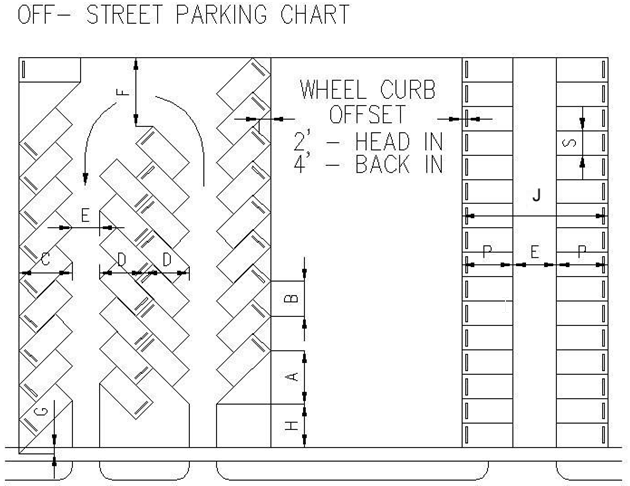
Upon review and recommendation of the Director of the Community Development Department and the Village Engineer, or the approval of the Plan Commission, the provisions of an approved parking plan may be modified, so long as the general intent of the design standards are maintained. The Village may require the submittal of a traffic engineering study.
TABLE OF DIMENSIONS
(In Feet)
Legend:
Note:
1.
Except that on residential lots, all aisles or driveways shall be at least 12 feet in width.
(Ord. 3617, 5-8-1989, eff. 6-1-1989; amd. Ord. 3953, 9-28-1992; Ord. 5365, 6-13-2005; Ord. 5543, 1-22-2007; Ord. 6674, 2-25-2019; Ord. 6960, 5-23-2022; Ord. No. 7105, 5-13-2024)
10-5-9. - Off street loading requirements.
In connection with any building or structure which is to be erected or altered, and which requires the receipt or distribution of materials or merchandise by trucks or similar vehicles, there shall be provided off street loading space not less than the minimum requirements specified in this section.
(A)
Location of required loading space: All required loading space shall be located on the same zoning lot as the use to be served and no portion of the vehicles thereon shall project into a street, alley or sidewalk. No loading space shall be located within 25 feet of the nearest point of intersection of any two streets, nor shall it be located in a required front yard. It may be located in a side or rear yard adjoining property in a residential district provided such yard is screened as required in subsection 10-5-13(L) of this chapter;
(B)
Minimum size: A required off street loading space shall be at least 12 feet in width by at least 50 feet in length, exclusive of aisle and maneuvering space, and shall have vertical clearance of at least 14 feet;
(C)
Access: Each required off street loading space shall be designed with appropriate means of vehicular access to a street or alley in a manner which will least interfere with traffic movements;
(D)
Surfacing: All open off street loading spaces shall be improved with a Portland cement concrete pavement not less than nine inches thick or a compacted crushed stone or gravel base not less than nine inches thick surface with not less than two inches of asphalt concrete;
(E)
Repair and service work prohibited: No storage of any kind nor motor vehicle repair work or service of any kind shall be permitted within any loading space;
(F)
Space allowed: Space allowed to any off street loading space while so allocated shall not be used to satisfy the space requirements for any off street parking facilities or portions thereof;
(G)
Screening: All off street loading space shall be so located and/or screened by a landscape or architectural feature as not to be visible from any public right-of-way or adjoining property in a residential district;
(H)
Required loading spaces: For the uses herein listed, loading spaces shall be provided as specified:
1.
Auditoriums; banks; business and professional offices; public administration buildings; bowling alleys; hospitals, schools, colleges, sanatoriums, and other similar institutional uses; hotels or private clubs and lodges: For such a building containing 10,000 to 100,000 square feet of floor area or fraction thereof in such a building, one loading space. For each additional 100,000 square feet of floor area or fraction thereof in such a building, one additional loading space;
2.
Warehousing; storing; cleaning; servicing; testing; and repairing establishments: For such a building containing 5,000 to 40,000 square feet of floor area, one loading space. For such a building containing 40,000 to 100,000 square feet of floor area, two loading spaces plus one additional loading space for each additional 100,000 square feet of floor area or fraction thereof;
3.
Establishments engaged in retail or wholesale trade and establishments handling the sale and consumption of food on the premises: Loading spaces in accordance with the following schedule:
For each additional 100,000 square feet of floor area or fraction thereof in such a building, one additional loading berth. The sum of all retail floor area in a unified development shall be counted in determining the number of loading spaces even if none of the individual tenant areas exceed 5,000 square feet;
4.
Other uses: Off street loading spaces shall be provided in accordance with requirements determined by the Board of Trustees based upon requirements heretofore set forth for the most similar cases.
(Ord. 3617, 5-8-1989, eff. 6-1-1989; amd. Ord. 3815, 2-25-1991)
10-5-10. - Stacking spaces for drive-through facilities.
(A)
Drive-through establishments such as fast food restaurants, car washes, banks and other establishments shall provide a minimum of five stacking spaces per drive- through lane. Such stacking spaces shall be provided in addition to the required number of parking spaces for the use.
(B)
Stacking spaces must be provided entirely on the private property occupied by the drive- through establishment.
(C)
Each stacking space shall be at least eight feet wide and 18 feet long exclusive of access drives and parking aisles and shall not interfere with parking circulation.
(D)
A maximum number of four drive-through lanes shall be permitted per establishment.
(Ord. 3617, 5-8-1989, eff. 6-1-1989; amd. Ord. 5365, 6-13-2005; Ord. 5543, 1-22-2007)
10-5-11. - Driveway and access regulations.
Each zoning lot shall have direct access to a public or private street or roadway in accordance with the following regulations:
(A)
General:
1.
The access control standards contained in this section are intended to promote safe and efficient operation of driveway approaches and to minimize vehicular delays and accidents. The policies and standards for land use and urban design relating to access control as stated in the Glen Ellyn Comprehensive Plan and in the arterial highway development policies and standards for DuPage County shall apply;
2.
Each required off street parking space shall open directly upon an all weather, hard surfaced aisle or driveway of such width and design as to provide safe and efficient means of vehicular access to such parking space. Such driveway and driveway approach must be maintained as an all weather hard surface material;
3.
The Village Engineer is authorized to waive the geometric design requirements when the DuPage County or Illinois department of transportation has provided written approval of plans prepared by a professional engineer.
(B)
Maximum number of driveway approaches: With the exceptions listed below, one driveway approach is permitted per zoning lot. If a use is a listed special use in a district, then additional driveway approaches may be considered during the review of the special use permit provided documentation of a traffic study is supplied. Otherwise, requests for additional driveway approaches shall be considered as variations.
The following exceptions may have additional driveway approaches:
1.
Attached single-family dwellings may have one driveway approach per dwelling unit;
2.
Through lots may have one driveway approach on each parallel street;
3.
Detached single-family dwellings may have two driveway approaches only where the lot width equals or exceeds 132 feet.
(C)
Corner clearance:
1.
Minimum separation of a driveway approach from an adjacent intersecting street shall be 40 feet from the centerline of the driveway approach to the nearest right-of-way line of the intersecting street;
2.
With the exception of detached single-family and two-family uses, the minimum separation of a driveway approach from an adjacent intersection of a major arterial street with another arterial or collector street shall be the greater of:
(a)
Two hundred feet; or
(b)
Length of full left turn storage on the arterial; or
(c)
Length of full left turn storage and taper for a major driveway approach.
(D)
Property line clearance: Driveway approaches shall be located so that the required curb return lies entirely within the interior side property lines (as if they were extended from the zoning lot served by the driveway approach), unless the driveway is being shared with the adjacent zoning lot or an exception is granted by the Public Works Director.
(E)
Curb return radius and flares:
1.
CR, R0, R1, R2, R3 districts: A return radius shall not be required; and between the sidewalk lines (six feet from lot line) and the pavement edge of the street there may be provided a four-foot flare;
2.
R4, R5, C2, C3, C4, C6 districts:
(a)
Two-way drives: The minimum curb return radius shall be 25 feet. The basis for design shall include the truck design vehicle for that drive;
(b)
One-way drives: 25-foot outside radius;
3.
C5 district: Between the sidewalk line (six feet from the property line) and the pavement edge of the street, there shall be a ten-foot flare, except that the angle between the back of curb and the edge of the driveway approach shall not exceed 45 degrees.
(F)
Driveway approach width: Driveway approach width shall be measured at right angles to the driveway curb or edge of pavement at the property line exclusive of the curb return radius. This includes consolidated or shared driveways:
1.
Maximum permitted driveway approach width:
(a)
Twenty-four-foot width is permitted on all categories of streets;
(b)
Thirty-six-foot (undivided three lanes), major arterial streets only;
(c)
Forty-eight-foot maximum (divided—two 24-foot drives excluding median), major arterial streets only.
2.
Minimum permitted driveway approach width:
(a)
One-way drives:
(1)
Nine feet for all drives intended to provide access for cars only.
(2)
Twelve feet for all drives intended to provide access for trucks.
(b)
Two-way drives:
(1)
Nineteen feet for all drives intended to provide access for cars only.
(2)
Twenty-four feet for all drives intended to accommodate truck traffic.
3.
Private driveway width: The width of any private driveway at the property line shall not be wider than the driveway approach where the two connect.
(G)
Curbs and gutters: Either the street curb shall extend across the entire driveway approach or a depressed gutter shall be installed across the driveway approach. On streets without curb and gutter, provision shall be made for street side drainage.
(H)
Limited turn driveway approaches:
1.
Driveway approaches which are designed to prohibit left turns in and out shall have a channelizing island and the following minimum dimensions:
2.
Minimum signage shall include a "stop" sign and "no left turn" sign at the exit lane, and a "no left turn" sign on the road right-of-way opposite the driveway approach, visible to oncoming traffic.
(I)
Angle of intersection:
1.
Two-way drive: 70 degrees minimum;
2.
One-way drive (right-in or right-out): 60 degrees minimum.
(J)
Driveway approach separation on arterials:
1.
Two-way drives:
(a)
One hundred eighty five feet minimum. Separation is based on speed limit as determined in the table below:
DRIVEWAY APPROACH SEPARATION TABLE
Note:
1.
Centerline to centerline of drives.
(b)
Three hundred feet minimum where, in the opinion of the appropriate Village authority, weaving movement between driveway approaches is or will be significant;
2.
The Village Engineer shall increase the minimum separation for high volume generators such as shopping centers, office or industrial parks, etc., in order to prevent overlapping of left turn lanes or other driveway approach interference;
3.
Where driveway approaches cannot meet minimum separation requirements, the appropriate highway authority will determine spacing based on the location, design and traffic volumes of adjacent driveway approaches;
4.
One-way drives: 80-foot minimum between a one-way driveway pair serving the same land use.
(K)
Driveway median:
1.
Minimum of: Four feet wide; 25 feet long; and five feet offset from the nearest edge of an arterial through lane, right turn lane, or paved shoulder.
2.
Use of medians on two or three lane driveways shall be permitted only after the appropriate highway authority determines that the median will not interfere with vehicle turning paths.
(L)
Minimum driveway width: A minimum driveway width of nine feet shall be required for all attached single-family, detached single-family and two-family developments.
(M)
Driveway material: All driveways shall be surfaced with asphalt, concrete, brick, paver stone or another similar hard surface material. All existing driveways that are either enlarged or expanded and any property on which the principal structure or garage is expanded must be brought into compliance with this standard.
(Ord. 3617, 5-8-1989, eff. 6-1-1989; amd. Ord. 3815, 2-25-1991; Ord. 5035, 1-14-2002, eff. 3-1-2002; Ord. 5365, 6-13-2005; Ord. 5543, 1-22-2007)
10-5-12. - Utility lines.
All new secondary utility lines for class II and III alterations and all new and existing utility secondary lines for class III additions and new construction shall be placed underground. The Village Board may waive this requirement provided the applicant pays a fee to cover all costs of future placement of the wires underground in a comprehensive manner by the Village. The fee shall be based on an itemized cost estimate prepared by the applicant and approved by the Village Engineer, and shall be paid prior to any permits being issued.
(Ord. 5543, 1-22-2007)
10-5-13. - Performance standards and other requirements for industrial uses, commercial uses, planned unit developments, special uses, and non-residential uses in residential zoning districts.
The following standards shall apply to industrial uses, commercial uses, planned unit developments, special uses (excluding single-family residences) and nonresidential uses in residential zoning districts. The property owner shall be responsible for submitting documentation prepared by a professional in the applicable area of expertise upon written request of the Village to verify that any standard has been satisfied.
(A)
Noise:
1.
At no point on or beyond the boundary of any commercial zoning lot shall the sound pressure level resulting from any use or activity not hereafter specifically exempted, whether open or enclosed, exceed the maximum permitted decibel levels for the designated octave band as set forth in the following tables;
2.
Sound levels shall be measured with a sound level meter and associated octave band analyzer manufactured according to standards prescribed by the American Standards Association. The flat network "slow" meter response of the sound level meter shall be used. Impulsive type noises shall be measured with an impact noise analyzer, and the peak values so measured shall not exceed the maximum permitted sound pressure levels by more than three decibels. The reference level for the decibel is 0.0002 microbar:
3.
The following uses and activities shall be exempt from the noise level regulations:
(a)
Noises not directly under the control of the property user;
(b)
Between the hours of 7:00 a.m. and sunset, noises customarily resulting from construction and the maintenance of grounds;
(c)
The noises of safety signals, warning devices, aircraft and railroads, snowplowing, and mosquito abatement; and
(d)
Church bells, chimes and carillons;
(B)
Vibration:
1.
Earthborne vibrations from any industrial or commercial operation, equipment, or process shall not constitute a nuisance nor exceed the limits set forth herein. Vibrations shall be expressed as displacement in inches and shall be measured with a three component measuring system;
2.
No industrial or commercial activity shall be responsible for the transmission of earthborne vibrations across any property line in excess of the displacement limits established through use of the following formula:
D = 0.003
f
Where D = The maximum allowable displacement in inches
Where f = The vibration frequency in cycles per second
(C)
Smoke and particulate matter: The emission, from all sources within any commercial zoning lot, of particulate matter containing more than five percent by weight, of particles having a particle diameter larger than 44 microns is prohibited. The rate of emission of particulate matter from all sources within the boundaries of any lot shall not exceed a net figure of one-half pound per acre of lot size during any one hour. Dust and other types of air pollution borne by the wind from such sources as storage areas, yards and roads within the boundaries of any lot shall be kept to a minimum by appropriate landscaping, paving, oiling, wetting or other acceptable means. The emission of smoke or particulate matter of a density greater than no. 1 on the Ringelmann chart, as published by the U.S. bureau of mines, is prohibited, except that Ringelmann no. 2 will be permitted for five minutes or Ringelmann no. 3 for three minutes during any eight-hour period, for the purpose of building fires or soot blowing;
(D)
Odor: The emission of odorous matter in such quantity as to be offensive at a point along or outside any lot line shall not be permitted. In determining such quantities of offensive odors, table III (odor thresholds) in chapter 5 of the "Air Pollution Abatement Manual" (copyright 1951), by Manufacturing Chemists Association, Inc., Washington D.C., shall be used as a guide;
(E)
Toxic and noxious matter: No emission which would be demonstrably injurious to human health, animals or plant life common to the region, on the ground at or beyond any lot line, will be permitted. Where such emission could be produced as a result of accident or equipment malfunction, adequate safeguards considered standard for safe operation in the industry involved shall be taken. This shall not be construed to prohibit lawful spraying of pesticides on public or private property;
(F)
Radiation hazards: The handling of radioactive materials, the discharge of such materials into air and water and the disposal of radioactive wastes shall be in conformance with:
1.
The applicable regulations of the United States environmental protection agency and the United States department of energy; and
2.
The applicable regulations of the Illinois environmental protection agency and the Illinois department of energy and natural resources;
(G)
Fire and explosive hazards:
1.
The storage, utilization or manufacture of solid materials or products with the potential for free or active burning to intense burning (excluding household items in quantities customarily found in the home) is prohibited unless storage, utilization and manufacture takes place within completely enclosed buildings having incombustible exterior walls. All such buildings shall be set back at least 40 feet from all lot lines or, in lieu thereof, shall be protected throughout by an automatic fire extinguishing system installed in accordance with the standards and regulations of the Village of Glen Ellyn and the National Fire Protection Association;
2.
Activities involving the transportation, storage or utilization of materials or products which decompose by detonation are prohibited unless specifically licensed by the Village of Glen Ellyn. Such materials shall include, but not be limited to: all primary explosives such as lead azide, lead styphnate, fulminates, and tetracene; all high explosives such as TNT, RDX, HMX, PETN and picric acid; propellants and components thereof such as nitrocellulose, black powder, boron hydrides, hydrozine and its derivatives, pyrotechnics and fireworks such as magnesium powder, potassium chloride and potassium nitrate; blasting explosives such as dynamite and nitroglycerin; unstable organic compounds such as acetylides, tetrazoles and ozonides; strong oxidizing agents such as liquid oxygen, perchloric acid, perchlorates, and hydrogen peroxide in concentrations greater than 35 percent; and nuclear fuels, fissionable materials and products and reactor elements such as uranium 235 and plutonium 239;
3.
The storage or utilization of flammable liquids or materials which produce flammable or explosive vapors shall be permitted in accordance with the following limitation—Exclusive of storage in underground tanks and exclusive of storage of finished products in original sealed containers:
(a)
Solid materials or products shall be stored or utilized within completely enclosed buildings or structures having incombustible exterior walls and handled in accordance with the standards and regulations of the Village of Glen Ellyn and the National Fire Protection Association;
(b)
All such buildings shall be set back at least 40 feet from all lot lines or in lieu thereof, shall be protected throughout by an automatic fire extinguishing system installed in accordance with the standards and regulations of the Village of Glen Ellyn and the National Fire Protection Association;
(c)
The capacity of flammable liquids in excess of the following quantities shall not be permitted:
(H)
Heat: Every use and activity shall be so operated that it does not raise the ambient temperature at or beyond the boundary of any lot line;
(I)
Glare: Any operation producing intense glare shall be conducted so that direct and indirect illumination from the source of light shall not cause illumination beyond the boundary of any lot line;
(J)
Electromagnetic interference: There shall be no electromagnetic interference that:
1.
Adversely affects at any point the operation of any equipment other than that belonging to the creator of such interference; or that
2.
Is not in conformance with the regulations of the federal communications commission;
(K)
Storage: All storage shall be enclosed within a building, or within a concrete or masonry wall of sufficient height to screen such storage unless a special use permit has been issued for the subject property. No premises shall be used for auto wrecking, junkyards and similar storage or salvage, or for bulk storage of oils, petroleum, or similar flammable liquids and chemicals;
(L)
Landscaping:
1.
All portions of the building site, exclusive of structures, parking and storage areas, driveways and walkways shall be landscaped and maintained with viable lawn areas, standard trees, and standard shrubs as outlined below unless otherwise recommended by the Village Forester.
(a)
Trees:
(1)
Quantity: A minimum of 24 trees per acre of green space on a site shall be provided.
(2)
Distribution: The required quantity of trees on a site shall be in the distribution below (all portions thereof shall be rounded up to the nearest whole number). Larger trees may be substituted for smaller trees in the same "type" category identified below.
(3)
Spacing: Ornamental and evergreen trees may be used as individual specimens at building or site entrances or shall be in a group of three minimum trees at a spacing not to exceed 14 feet on center.
(b)
Shrubs: Shrubs with a mature height three feet and less shall be planted four feet on center. Shrubs with a mature height greater than three feet shall be planted six feet on center. Shrubs shall be planted in groups of three minimum.
2.
All such landscaping shall conform to the standards contained within the Glen Ellyn "Appearance Guide And Criteria";
3.
All properties which have been granted final planned unit development plan approval, final planned unit development amendment approval, special use permit approval, or an exterior appearance approval by Village ordinance that include a landscape plan, shall install all plant materials shown on the approved landscape plan prior to the issuance of a Certificate of Occupancy. Following the issuance of the Certificate of Occupancy, ongoing maintenance of all landscape materials in accordance with the approved landscape plan shall be required.
4.
An opaque screen shall be installed and maintained along all lot lines, other than streets, abutting areas zoned for residential use. Except as otherwise provided, it shall have a total height of not less than six feet nor more than seven feet. Where there is a difference in elevation on opposite sides of the screen, the height shall be measured from the highest elevation. A screen shall consist of one or more of the following types:
(a)
Walls: A wall shall consist of concrete, stone, brick, tile or similar type of masonry material a minimum of eight inches thick;
(b)
Berms: A berm may be banked on both sides, or with one side banked toward the lot line with a retaining wall. A berm shall not be less than 20 feet wide at the base and shall have an undulating contour and shall be sloped for ease of maintenance. It shall be constructed of earthen materials and shall be landscaped;
(c)
Planting: Plant materials, when used as a screen, shall consist of a mixture of standard shrubs, compact evergreen plants and taller deciduous plants. They shall be of a kind, and used in such a manner, so as to provide screening having a minimum width of three feet, within 18 months after initial installation. Plant materials shall not be limited to a maximum height. A wall or berm as described in subsections (L)3.(a) and (L)3.(b) of this section will be required, if after 18 months after installation, plant materials have not formed an opaque screen, or if an opaque screen is not maintained;
(d)
Fence: The exposed structural elements of a fence, when visible only from one side, shall face toward the property on which the fence is constructed (see section 10-2-2, "Terms Defined", of this title);
5.
(a)
Visibility on all lots: No wall, fence, sign, landscape plant material, tree, or other obstruction shall be erected, planted or maintained in any yard which unreasonably obstructs or interferes with the vision of the drivers of motor vehicles and bicycles or which endangers the safety of pedestrians walking along the sidewalk or street.
(b)
Visibility triangle on corner lots: No landscaping except trees on a corner lot shall exceed three feet in height, and tree branches shall not be lower than eight feet above the average grade of the centerline of the adjacent street pavement when such trees or shrubs are located within 30 feet of the lot corner formed by the intersection of any two street lines;
(M)
Exterior illumination standards:
1.
General requirements: All applications for development review or building permits which include exterior site or building lighting shall be required to submit the following information for review:
(a)
Photometric plan: Prepared by a professional lighting consultant. Said plan shall accurately indicate the level of illumination at all property lines and five feet beyond based on all proposed light fixtures.
(b)
Cut sheet of each proposed light style: All styles (ground, sign, wall, pole, recessed can, bollard) of lights proposed on the building and site must be identified.
(c)
Shielding: The type of refractor, louver, or side shield to cut off direct light to adjacent properties must also be provided. On all nonresidential and multi-family uses, said shield shall cover the top and sides to completely block passage of light and shall extend downward vertically below the lowest point of the illumination source.
(d)
Lamp type: Incandescent, quartz-halogen, fluorescent, low pressure sodium, mercury vapor, metal halide, or approved equal.
(e)
Lamp wattage: Lamp wattage.
(f)
Pole height: Pole height.
(g)
Site plan: Indicating the location of each proposed light by style.
2.
Specific requirements:
(a)
Intensity of light (at lot line as measured at ground level):
(1)
Adjacent to a residential use: one-half foot-candle.
(2)
Adjacent to a nonresidential use: three foot-candles.
(3)
Lighting levels which exceed the above standards may be requested as a part of a special use permit for athletic fields, special events, and other nontraditional uses.
(b)
Location: Light poles shall be located where they are not susceptible to collision strikes and shall not create hazards for pedestrians or vehicles.
(c)
Height: The height of a light pole shall not exceed 20 feet in residentially zoned districts. In all other zoning districts light poles shall not exceed 25 feet. There shall be no restriction on light pole heights in public or private rights-of-way.
3.
Exceptions:
(a)
Emergency lighting: All temporary lighting needed by the police, fire department or any other public safety or utility emergency services shall be exempt from the illumination standards.
(b)
Safety and security: A higher intensity of illumination in a safety or security problem area as defined by the chief of police may be authorized.
(c)
Public rights-of-way: The standard streetlights installed and maintained by the Village in the public rights-of-way shall be permitted.
(d)
Temporary holiday lighting: Traditional holiday lighting is exempt from the provisions of the general requirements section of this Code, provided said lighting is reasonable and shall not constitute a public safety hazard or nuisance;
(N)
General requirements: All business, service, storage, merchandise, display and where permitted, repair and processing, shall be conducted wholly within an enclosed building, except as otherwise expressly permitted herein, or as otherwise provided in the ordinances of the Village;
(O)
Developer donations: Any development that increases the number of dwelling units within the Village shall be required to make land or cash contributions to the school, library, fire, and park districts within which the dwelling units are located;
(P)
Recycling and refuse area: Adequate space shall be provided for refuse and recycling on a site for all class II and III alterations, class III additions, and new construction or redevelopment. Exterior screens shall be constructed of the same primary material used in the principal building on the site or per a landscaping plan approved by the Community Development Department;
(Q)
Emergency warning sirens: Emergency warning sirens, operated by an authorized emergency service and disaster agency, not exceeding 75 feet in mounted height, shall be a permitted use in every zoning district.
(Ord. 3617, 5-8-1989, eff. 6-1- 1989; amd. Ord. 3815, 2-25-1991; Ord. 3953, 9-28-1992; Ord. 4673, 12-14-1998, eff. 3-1-1999; Ord. 5035, 1-14-2002, eff. 3-1-2002; Ord. 5365, 6-13-2005; Ord. 5543, 1-22-2007; Ord. 6207, 1-13-2014; Ord. 6601, 5-14-2018; Ord. 6674, 2-25-2019; Ord. 6742, 12-9-2019)
10-5-14. - Live entertainment.
Live entertainment is permitted in businesses and restaurants in the C2, C3, C4, C5A, C5B and C6 zoning districts, provided that a permit is first obtained from the Village. No person shall conduct any live entertainment activity prior to the approval of a permit by the Village. The fee for the permit shall be as set forth in section 4-1-4 of this Code, as amended, and the permit shall be posted in a conspicuous location on the property where the live entertainment will occur.
An application for a live entertainment permit shall be made by a property owner or the property owner shall give written permission for application to be made by another party on the property owner's behalf. A permit for indoor live entertainment shall be valid for a period of three years unless the permit is revoked in accordance with subsection (D) of this section. A permit for outdoor live entertainment shall be valid from March 31 to November 1 and shall not automatically renew. A separate application must be submitted on an annual basis for an outdoor live entertainment permit. A live entertainment permit is not valid if it is revoked at any time in accordance with subsection (D) of this section.
(A)
All live entertainment must comply with the following provisions:
1.
The live entertainment activity shall be clearly incidental and accessory to either a permitted or approved special use that is commercial in nature.
2.
No toxic, explosive, flammable or other hazardous materials as defined in the most recent version of the Building Code as adopted by the Village of Glen Ellyn shall be used for any live entertainment purposes.
3.
A live entertainment applicant shall ensure that the premises to be used for live entertainment comply with all applicable health, fire and Building Codes.
4.
The form of live entertainment provided shall not be obscene nor appeal to prurient interests.
5.
All live entertainment activities shall fully comply with all other provisions of this Code, including all regulations related to noise and vibration set forth in subsections 10-5-13(A) and (B) of this chapter, as amended.
6.
All live entertainment activities shall fully comply with the Village's Sign Code.
(B)
Indoor live entertainment: All indoor live entertainment must comply with the following provisions:
1.
All applications for indoor live entertainment must be submitted to Village staff for review and an applicant must pay the required permit fee.
2.
All indoor live entertainment shall be located indoors and no means of amplification outside of a building is permitted.
3.
Live entertainment shall only be provided between the following hours:
(C)
Outdoor live entertainment: All outdoor live entertainment must comply with the following provisions:
1.
All applications for outdoor live entertainment must be submitted to Village staff for review and an applicant shall pay the required permit fee.
2.
The outdoor live entertainment shall not be audible from 200 feet away from the property line of the property hosting the outdoor live entertainment.
3.
Outdoor live entertainment performances shall only take place within an approved outdoor dining area. An establishment that seeks to host outdoor live entertainment at a dining establishment that does not have an outdoor dining area allowed by right or approved by permit must apply for a special events permit.
4.
Outdoor live entertainment shall not be amplified if located on the public right of way.
5.
All establishments hosting outdoor live entertainment must take proper and reasonable steps to ensure the safety of performers, customers, and surrounding traffic. This may include the use of barricades, appropriate signage, and notice to surrounding businesses of the live entertainment dates. Village staff shall review site plans for safety measures including but not limited to:
(a)
Any outdoor entertainment activity and all related fixtures, equipment, and other appurtenances shall be located within an approved outdoor dining area.
(b)
All items used for the operation of the outdoor entertainment activity shall not present an obstruction of the way of customers, pedestrians, or vehicles and must account for health and safety access.
(c)
Any fixtures, equipment, furniture, or other appurtenances for the purpose of outdoor entertainment shall be removed or secured outside of times of performance.
(d)
Occupancy shall be reasonably limited to ensure health and safety of customers, performers, and staff.
1.
Live outdoor entertainment shall only be provided between the following hours:
2.
Outdoor live entertainment shall be limited to three times a week.
3.
As required by section 10-5-13 (M) of the Village Code, any additional lighting for the purpose of the outdoor entertainment activity must have a maximum intensity of light (at lot line as measured at ground level) no greater than 3-foot-candles if adjacent to a nonresidential use, and 0.5 foot-candles if adjacent to a residential use.
(D)
A previously issued permit for live entertainment may be revoked by the action of the Village President, which shall be delivered to the permit holder. In the case of a public safety concern, a stay of any live entertainment may be issued by the Police Chief until the matter can be considered by the Village President. The Village President shall have the right to revoke a previously issued permit for live entertainment if:
1.
The applicant or any person making a representation on behalf of the applicant makes a misrepresentation of any fact in the application or in any testimony before the Village Board.
2.
Any criteria on which the permit is approved is not complied with.
3.
After the criteria is initially complied with, compliance with such criteria is not maintained at any time.
4.
Prior to the issuance of the permit, the applicant transfers interest in the property or business to another party or if the property owner makes an attempt to transfer the nontransferable permit.
5.
Revocation is recommended by the Police Chief for reasons related to public safety.
6.
Exterior areas of the business providing live entertainment have not been maintained in a clean and orderly manner.
7.
The property is not maintained in conformance with all applicable health, fire, and Building Codes.
A written order of the Village President to revoke a permit shall take effect five days after its service. If, within those five days, the permit holder files an appeal to the Village Board, the permit shall continue in effect until the Village Board shall have met and had an opportunity to review the President's decision. The Village Board shall hear from the applicant, and it shall review the reasons why the permit was revoked, including the reasons stated by the Village President. The Village Board shall issue a written opinion to either affirm or overrule the decision of the Village President. The Village President may also, stating the reasons for doing so, suspend a permit for a period of up to ten days. A permit may not be suspended for more than two ten-day periods during the term of the permit.
(Ord. 5886, 9-13-2010; Ord. No. 7105, 5-13-2024)
Editor's note— Ord. No. 7105, § 2(Exh. B), adopted May 13, 2024, amended the title of § 10-5-14 to read as herein set out. The former § 10-5-14 title pertained to indoor live entertainment.
10-5-15. - Outdoor seating for restaurants.
(A)
General outdoor dining requirements.
1.
If outdoor seating is located on or adjacent to a sidewalk, a five-foot wide area clear of obstructions, hazards or other objects must be maintained for pedestrian use and accessibility.
2.
All outdoor seating must be located on an asphalt, concrete, brick, wood, or other similar surface as approved by the zoning officer.
3.
Outdoor seating shall not be located in a required landscape area such as a parking lot landscape island.
4.
No food may be stored, cooked, or otherwise prepared in an outdoor dining area.
5.
An applicant for an outdoor dining area must submit a plan which complies with total restaurant capacity limits as set forth in the Village's building and fire codes.
6.
The operation of an outdoor dining area shall comply with all applicable provisions of federal, state or county law in addition to the Village Code. These regulations include but are not limited to those of the DuPage County Health Department, the Illinois Accessibility Code, and the Americans with Disabilities Act (ADA).
7.
The operation of an outdoor dining area shall not create a nuisance in violation of this Code and shall not be detrimental to the health, safety, or general welfare of persons residing or working nearby. Outdoor dining area platforms shall be visually screened by fencing, landscaping, or other appropriate structures that can serve as a buffer to minimize the trespass of noise and light onto the street and/or adjacent properties.
8.
The service or consumption of alcoholic beverages within an outdoor dining area is prohibited unless the operator of an outdoor dining area maintains a valid Village liquor license pursuant to title 3 (Business Regulations), chapter 19 (Liquor Control Code) of this Code.
9.
Smoking within an outdoor dining area is prohibited.
10.
The amplification of sound is permitted at a level which does not cause a disturbance or a nuisance to adjacent properties or the public.
11.
The maximum intensity of light at a lot line as measured at ground level shall be no greater than 3-foot-candles if adjacent to a nonresidential use, and 0.5-foot-candles if adjacent to a residential use pursuant to section 10-5-13(M), as amended, of the Village Code. Lighting for an outdoor dining area located in the Village's Central Business District shall be consistent in intensity, color, and temperature with the surrounding streetscape lighting.
12.
Building permits and license agreements for outdoor dining areas shall be subject to review and approval by the Village and such permits and agreements may be revoked or suspended by action of the Village Board at any time with 30 days' notice. Building permits and license agreements shall be subject to immediate revocation or suspension by the Village Manager, Community Development Director, Public Works Director, or Chief of Police due to a threat to the public health, safety or welfare.
13.
Maintenance and upkeep.
(a)
Maintenance of the public right-of-way and any private property associated with the operation of an outdoor dining area shall be the sole responsibility of the outdoor dining area permit holder. Maintenance includes cleanup of tables, chairs, trash, litter, and washing of sidewalks and the repair or replacement of damaged public or private property.
(b)
A permit holder shall provide and maintain in a clean and orderly manner at least one covered trash receptacle within an outdoor dining area. Any covered trash receptacle must be emptied once full, and also, each day upon closing of the outdoor dining area.
(c)
Materials and finishes for all furniture, fencing, planters, and other appurtenances shall be selected for their sturdiness and durability as well as for their appearance. Lightweight materials for furniture, such as plastic, are discouraged to avoid furniture from being a hazard during inclement weather events. Proper measures shall be taken by a permit holder to remedy any damage or wear and tear of the items set forth herein due to weather conditions, neglect, or abuse.
14.
All outdoor seating must comply with provisions in section 3-1-11 of this code.
(B)
Outdoor seating on private property.
Restaurants shall be permitted to have outdoor seating on private property provided that such seating complies with the following provisions:
1.
Outdoor dining areas on private property shall only require a Village permit if the underlying zoning district requires a special use permit for an outdoor dining area, or the outdoor dining area is subject to other permit requirements such as a permit for outdoor live entertainment or a special event permit.
2.
If the restaurant is located in a shopping center, such seating shall only be permitted in front or on the side of the subject establishment unless otherwise approved as part of a special use permit, planned unit development or variation.
3.
Outdoor seating shall not be located in such close proximity to parking or drive aisles as to create a safety hazard.
(C)
Outdoor seating on public property.
1.
Restaurants shall be permitted to have outdoor seating on the public right-of-way provided that the operator of the associated restaurant has entered into a license agreement with the Village to allow outdoor seating on public property, and that such seating complies with the following provisions:
2.
Outdoor dining areas such as sidewalk cafes are allowed as a temporary use on the public right-of-way in the C2, C3, C5A, C5B and C6 zoning districts. Outdoor dining areas on a road surface, such as dining platforms, are permitted as a temporary use on public property in the C5A and C5B zoning districts.
(a)
To operate outdoor seating as a sidewalk café on the public right-of-way, a restaurant owner shall enter into a license agreement with the Village and provide a site plan for Village review and approval.
(b)
To operate outdoor seating as a dining platform on the public right-of-way, a restaurant owner shall enter into a license agreement with the Village and provide a site plan for Village review and approval, in addition to any required Village building permit. An architectural plan prepared and sealed by a licensed architect may also be required as determined by the Village's Building Official. Dining platforms shall be designed and constructed in a safe manner and in accordance with industry wide practice. Proof of authorization from a private property owner, if different from the restaurant owner, to enter into an applicable license agreement and apply for a permit shall be provided to the Community Development Director as part of a permit application.
3.
An applicant for a dining platform shall enter into a license agreement with the Village. This agreement shall include:
(a)
Indemnification and hold-harmless provisions.
(b)
A certificate of liability insurance requirement. The required certificate shall include a provision that the Village and its elected and appointed officials, employees, agents, attorneys, engineers, and volunteers are named as additional insureds with primary and non-contributory coverage.
(c)
An applicant shall maintain minimum general liability insurance coverage of $2,000,000.00 per occurrence and minimum excess umbrella coverage of $5,000,000.00.
4.
An initial application for outdoor dining on Village public right-of-way shall be approved by the Village Board. Following Village Board approval of an initial application, a subsequent consecutive application from the same applicant may be approved administratively by the Community Development Director or the Director's designee.
5.
A renewal application for building permits and/or license agreements (provided no or minimal changes are requested) shall be approved by the Community Development Director, unless the previous operation of the outdoor dining area constituted a nuisance, or the operator otherwise refused to comply with the applicable Village Code provisions. In the event the Community Development Director decides that the previously approved operating rules, location, or layout requires changes or alterations to meet the health, safety or general welfare criteria set forth in this Code, the application for building permit or license agreement renewal is subject to approval by the Village Board.
6.
All items placed in the public right-of-way for the operation of an outdoor dining area shall comply with the follow conditions:
(a)
A clear path of at least five contiguous feet is provided and maintained for pedestrian use and accessible access.
(b)
Any items placed in the public right-of-way for the operation of the outdoor dining area cannot be located in pedestrian crosswalk access aisles.
(c)
Portable outdoor gas-fired heating appliances are permitted on dining platforms, subject to compliance with all applicable Village building and life safety regulations. Portable outdoor gas fired heating appliances shall not be allowed on sidewalks.
(d)
Umbrellas may be permitted per review.
(e)
Awnings, wind guards, and other fabric ornamentation, embellishments or trimmings require further review and are to be considered during application approval. Awnings, wind guards, and other fabric ornamentation, embellishment or trimmings are not permitted on dining platforms.
(f)
Tables, chairs, umbrellas, and barriers are permitted to remain on the public right-of-way overnight during the active license agreement year, April 1 through October 31, unless otherwise extended by the Village. Umbrellas must be closed during non-operating hours. No items shall be secured to public property overnight unless permitted as part of the license agreement.
(g)
Any outdoor dining site may not expand beyond the building frontage of the associated restaurant unless express written permission is received from the adjacent property owner.
(h)
All tables, chairs and other appurtenances shall be removed during the period between November 1st and March 31st each year, or if required by the Village at any other time. This period may be extended on a case-by-case basis by the Village Manager or Community Development Director, who shall consider extenuating factors such as unseasonable weather. It is the permit and/or license holder's responsibility to be aware of severe weather, to provide evacuation directions if necessary, and to secure all items in the outdoor dining area.
(i)
Building permits and license agreements for outdoor dining on public property, unless otherwise noted in an existing license agreement, will expire at the conclusion of the calendar year. License holders will have right-of-first refusal for permit and license renewal. Renewal must be confirmed by March 1st of the subsequent year.(j) The Village reserves the right to impose, as part of approval of the license agreement, such other regulations on the operation of an outdoor dining area as are deemed necessary and appropriate under the circumstances.
(D)
Dining platform design requirements.
1.
Area dedicated to dining platforms and barriers shall be no larger than two (2) parallel or three (3) diagonal parking spaces in size, based on parking space dimensions of the proposed location, and shall not remove more than two (2) parallel or three (3) parking spaces from use respectively. Dining platforms, including safety barriers, shall not encroach into designated vehicle travel lanes.
2.
Dining platforms shall be separated from any intersection by at least one parking space, or at least 20 feet from the intersection road if no lined parking spot is adjacent to the proposed dining platform location.
3.
Dining platforms may not be 200 linear feet or closer from another dining platform.
4.
A dining platform may not expand beyond the building frontage of the associated restaurant unless express permission is received from the adjacent property owner.
5.
One dining platform shall be permitted per block face.
6.
Platform shall have ground cover—decking either in a finished wood or metal—with an elevation flush with the adjacent sidewalk.
7.
Street drainage shall be maintained.
8.
Barriers and fencing shall be at least 36 inches in height but shall not exceed 48 inches in height. Vegetation in planters cannot exceed a maximum 60 inches in height. Barriers shall be continuous except for at a curbside access point.
9.
The following materials are prohibited from use as fencing or barriers for dining platforms:
a.
Fabric inserts.
b.
Chain link, cyclone, chicken wire, or similar materials.
c.
Rope and chain barriers.
d.
Any other materials that are not specifically designed as fencing including buckets, flag poles, newspaper stands and waste receptacles.
10.
Awnings, wind guards, and other fabric ornamentation, embellishment or trimmings are not permitted on dining platforms.
11.
Corners of fencing and barriers shall be fitted with reflecting materials.
12.
An extra protective barrier shall be placed four feet or less along all sides of the dining platform facing the direction of traffic on both one-way and two-way streets. These additional barriers shall be approved by the Village and capable of withstanding impacts of horizontal force akin to a Jersey Barrier, Jersey Wall, K-Rail etc.
13.
No signs, banners or similar means of messaging are allowed on any fencing, planters, barriers, or other structural components of the dining platform.
14.
The restaurant owner is solely responsible for the deconstruction and storage of all structural components of dining platform, safety barriers, furniture, and other appurtenances prior to November 1 of the applicable License Agreement year.
15.
A dining platform shall not negatively impact accessible-parking spots.
(E)
Submittal requirements.
1.
An applicant must submit an application on a form provided by the Village with the Community Development Department.
2.
An applicant must pay the applicable review fee. If the application includes a dining platform, the applicant must pay an additional fee per parking space removed due to the removal of an applicable space.
3.
An applicant must provide a narrative statement describing the layout and operation of the outdoor dining seating area. If a dining platform is part of the application, the applicant must demonstrate a need for encroachment into the public right-of-way on the road surface shall be demonstrated.
4.
Proof of insurance listing the Village and its affiliates as additional insureds. Minimum coverage shall be $2,000,000.00 per occurrence for general liability insurance.
5.
A signed license agreement for outdoor dining areas on the public property, prepared by the Village Attorney.
6.
If applying for a dining platform, a restaurant owner shall be approved for a building permit in addition to a license agreement.
7.
A site plan drawn to scale, including:
a.
Location of the outdoor dining area in relation to the building.
b.
Distances to the property lines.
c.
Dimensions and square footage of the outdoor dining area.
d.
Number and locations of tables and chairs.
e.
A lighting plan, if applicable. All light fixtures within the outdoor dining area shall be depicted on the plans.
f.
If the outdoor dining area is proposed to be located on the public right-of-way, the drawings shall also include the location of existing public improvements, including fire hydrants, freestanding signs, streetlights, traffic signals, mailboxes, trash cans, benches, trees and shrubs, planters, or any other street furniture.
g.
Site plans for dining platforms must include elevations of decking, barriers, fencing, wheel stops and the distances of these structures from the associated restaurant and where the platform is positioned relative to parking spaces on the road surface and other relevant street furniture.
8.
Cut sheets of any lighting fixtures, planters, fencing, borders, awnings, and furniture and other appurtenances to be located within the outdoor dining area.
(Ord. 5543, 1-22-2007; amd. Ord. 6208, 1-13-2014; Ord. 6601, 5-14-2018; Ord. 6674, 2-25-2019; Ord. No. 7105, 5-13-2024)
10-5-16. - Outdoor beautification displays.
Outdoor beautification displays shall be permitted in the C5A and C5B zoning districts provided that the following provisions are met:
(A)
An annual permit must be obtained from the Village for the outdoor display of statues, sculptures or similar works of art. A permit shall not be required for the outdoor display of live or imitation plant materials and any associated containers or support structures. The fee for the permit shall be as set forth in this Code and the permit shall be posted in a conspicuous location inside the building.
(B)
No more than a total of two outdoor beautification display areas shall be permitted for each property and the total outdoor beautification display area shall not exceed ten square feet. A greater number of display areas and/or a greater total display area shall be permitted with the approval of a special use permit.
(C)
If the outdoor beautification display is located on a sidewalk, a continuous five-foot wide area must be maintained free from any obstruction for pedestrian use and handicapped access.
(D)
All outdoor beautification displays shall be located adjacent to the first floor storefront of the business requesting the annual permit and shall not be permitted in a parking lot.
(E)
The outdoor beautification display area shall be maintained clean and free from refuse and clutter at all times and the display must be maintained in a good and attractive condition.
(F)
Outdoor beautification displays shall not be permitted in locations that obstruct the vision of pedestrians or motorists, restrict access or otherwise create a dangerous situation.
(G)
If any statue, sculpture or other similar work of art is located on the public right-of-way (e.g., sidewalk), the following provisions must also be met:
1.
A signed indemnification statement provided by the Village must be executed by the business seeking the annual permit.
2.
The applicant shall submit to the Village a certificate of insurance in the amount of $1,000,000.00 listing the Village as an additional insured and including a statement that the policy shall not be changed or canceled without 30 days' notice to the Village. If any provision of the insurance policy is changed contrary to these requirements, the annual permit may be immediately revoked by the Village.
(Ord. 5591, 7-23-2007)
10-5-17. - Landscape and illumination standards for other developments.
The provisions of subsections 10-5-13(L) and (M) of this chapter shall apply to all planned unit developments, special uses, and multi-family and single-family attached residential developments.
(Ord. 4673, 12-14-1998, eff. 3-1-1999; amd. Ord. 5365, 6-13-2005)
10-5-18. - Vacant ground floor storefront windows.
(A)
Treatment of storefront windows during vacancy: Any ground floor space located within the Village's C5A or C5B central business district zoning districts that is vacant or becomes vacant shall within 30 calendar days of the date of a letter from the Village notifying the property owner of their responsibility, contain a decorative storefront window display. Said display shall be in place until the commercial space is no longer vacant. Property owners are encouraged to partner with a local government or community service organization to create a decorative display. The window display shall be in accordance with the provisions of this section.
1.
A decorative storefront window display shall be placed in any vacant storefront window visible from the public sidewalk or right-of-way. The purpose of the window display is to make the business areas more attractive, to encourage shopping in other stores even if there are vacancies in the C5A or C5B zoning districts, and to deter vandalism. Among the window displays which would satisfy with the obligation established in this section are the following: paintings, photos, sculptures, art, student projects (i.e., elementary, middle or high school projects for art, social studies, language arts, etc.), merchandise from local businesses (i.e., merchandise from area stores to help advertise those businesses), current religious holiday displays (i.e., displays commemorating Christmas, Chanukah, Easter, etc.), current secular holiday displays (i.e., displays commemorating Independence Day, Labor Day, Memorial Day, Halloween, etc.), live or artificial plants, community organization projects (i.e., projects completed by the Boy Scouts, Girl Scouts, Glen Ellyn Historical Society, Jaycees, etc.), seasonal displays (i.e., displays depicting fall, summer, winter or spring), announcements for local events and other similar items or products. These items may be displayed inside the window or painted or affixed to the glass in storefront windows. An informational sign up to one square foot in total sign area, identifying the name and contact information for each exhibit shall be permitted.
2.
Visibility into the space shall be maintained in a manner that allows public safety officials the ability to view the interior of the space.
3.
Window or other signage shall be permitted in accordance with title 4, chapter 5, "Sign Code", of this Code.
(B)
Prohibited window display content:
1.
Covering vacant display windows with plain paper, butcher paper, newspaper, soap, tarp, plastic sheets or unpainted plywood is prohibited. The previously mentioned items may be acceptable if they are used as a backdrop or background to a decorative display.
2.
Lewd or obscene words or images shall not be allowed in any window display.
3.
No trash, debris, crates, cardboard boxes or other packing materials may be stacked or stored in any vacant storefront windows.
(C)
Vacant ground floor storefront maintenance: The storefront window of any vacant ground floor space in the Village's C5A or C5B central business district zoning districts shall be maintained in good condition and kept neat, clean and attractive.
(D)
Responsibility for compliance: Any person owning, leasing, maintaining, in possession of, or control of, any vacant ground floor space located within the C5A or C5B central business district zoning districts shall be responsible for adherence to the provisions of this section.
(Ord. 5885, 11-22-2010)
10-5-19. - Medical cannabis dispensaries.
Medical cannabis dispensaries shall be subject to the following regulations:
(A)
Sales shall occur only between the hours of 8:00 a.m. and 6:00 p.m.
(B)
All medical cannabis dispensaries shall be at least 1,000 feet away from all other medical cannabis dispensaries, measured from the parcel boundaries.
(C)
Drive-through and carryout lanes, as well as window sales, are prohibited.
(Ord. 6228, 4-14-2014)
10-5-20. - Food trucks.
(A)
Food trucks shall be permitted to operate on private property in the CR, CC, C1, C2, C3, C4, C5, C5A, C5B, and C6 zoning districts with the exception of properties owned by governmental bodies or the public right-of-way, in accordance with the regulations set forth below, unless as part of a special event approved by the Village. Food trucks shall operate in accordance with the following provisions:
1.
The operator must obtain permission from the property owner of record prior to establishing a location for the food truck. The property owner or tenant of record must submit the required application in accordance with the regulations set forth below. In all cases, the property owner must provide written authorization for use.
2.
Food trucks shall only be used for the sale of food and beverages. The sale of other merchandise or goods from a food truck shall not be permitted. The sale of alcohol is prohibited, unless expressly permitted as part of a special event approved by the Village.
3.
Food truck operators must be at least 18 years of age and neither the owner nor any of his/her employees shall be a registered sex offender as defined by the sex offender license act.
4.
Food trucks shall be operated in compliance with all requirements of the DuPage County Health Department. A copy of a valid permit issued by the DuPage County Health Department shall be available on site at all times and furnished to the Village upon request.
5.
Food trucks must be operated in compliance with all Village codes and ordinances as well as all applicable county, state, and federal regulations.
6.
A trash receptacle adequate in size for containing the waste produced by the truck and its patrons must be provided by the operator, and the area immediately surrounding the food truck shall be maintained free of any garbage or debris and any garbage or debris disposed of. The operator shall be responsible for any additional cleanup costs associated with the operation of the truck.
7.
The use of sound amplification equipment in association with the operation of a food truck shall be prohibited.
8.
Food trucks shall not be located in such close proximity to a vehicular access drive, sidewalk, or the railroad tracks so as to create a safety hazard as determined by the Village.
9.
Food trucks must be self-contained. If power is drawn from an external source, the food truck owner or operator must obtain the permission of the property owner in advance.
10.
Food trucks shall be attended by the licensed operator or his/her employees when on site.
11.
No flags, balloons or other attention getting devices shall be permitted in association with a food truck and all signage must be affixed to the truck.
12.
The food truck must be stored off site when not in operation.
13.
Food truck operators must have a valid peddler's license as required by this Code, which, among other things, requires the submittal of a fingerprint-based background check to the Glen Ellyn Police Department.
14.
Food truck hours of operation shall be limited to no more than eight hours per day and no more than three days in any seven day period.
15.
License Fees:
(a)
Applicants must obtain an annual license at a cost of $300.00.
(b)
All license issued pursuant to this chapter shall expire on December 31st of each year.
16.
Food trucks must be parked only on improved surfaces as approved by the Village.
17.
Dumping of grease into storm or sanitary sewers, or in any other location within the Village, in connection with the operation of a food truck is prohibited.
18.
Food trucks are prohibited from idling while located in their approved location.
(Ord. 6303, 3-9-2015; Ord. 7033, 5-8-2023)
10-5-21. - Cannabis business establishments prohibited.
The following adult-use cannabis business establishments are prohibited in the Village of Glen Ellyn. No person shall locate, operate, own, suffer, allow to be operated or aide, abet or assist in the operation within the Village of Glen Ellyn of any of the following:
Adult-Use Cannabis Seller/Dispensary/Business that Allows on Site Consumption
Adult-Use Cannabis Craft Grower
Adult-Use Cannabis Cultivation Center
Adult-Use Cannabis Dispensing Organization
Adult-Use Cannabis Infuser Organization or Infuser
Adult-Use Cannabis Processing Organization or Processor
Adult-Use Cannabis Transporting Organization or Transporter
(Ord. 6903, 9-13-2-2021)
10-5-22. - Electric vehicle charging stations.
(A)
Accessibility: Charging station equipment must be designed and located so as to not impede pedestrian, bicycle or wheelchair movement or create safety hazards on sidewalks. Equipment is subject to the lot and building regulations of the subject zoning district unless otherwise expressly stated.
(B)
Accessible electric vehicle charging station: Accessible charging stations shall be maintained in compliance with the Americans with Disability Acts of 1990, 42 U.S.C. § 12101 and all applicable state and federal laws.
(C)
Location: Electric vehicle charging station equipment is encouraged in landscaped areas. When located within a parking lot, electric vehicle charging station equipment shall be located between parking spaces and parking space dimensions shall remain in compliance with the regulations of this Code.
(D)
Protection: Adequate charging station equipment protection, such as barrier curbing, concrete filled steel bollards, or similar equipment shall be used.
(E)
Pavement marking: Any and all pavement markings shall be the color white or yellow and shall match the color used for all other parking stalls. Such markings shall be limited to parking lot striping and no additional stencil will be permitted.
(F)
Design: The design should be appropriate to the location and use. Electric vehicle charging stations should be able to be readily identified by electric vehicle users but blend into the surrounding landscape/architecture for compatibility with the character and use of the site.
(G)
Electric vehicles may park in any space designated for public parking, subject to the same restrictions that apply to non-electric vehicles.
(H)
Electric vehicle parking spaces shall be posted with signage indicating the space is to be used exclusively for electric vehicle charging purposes and that violators are subject to a fine and tow of the offending vehicle.
(I)
All electric vehicle charging stations shall comply with the Village sign regulations set forth in Title 4, Chapter 5 of the Glen Ellyn Village Code Section 4-5-16 (Electric Vehicle Charging Stations) and the Village's Codes that regulate constructions.
(J)
Landscaping: A landscape plan shall be submitted with the building permit application. Such plan shall indicate screening of the proposed equipment from view with approved deciduous and coniferous planting materials. The owner of the equipment shall be responsible to maintain all landscaping in accordance with the approved landscape plan for the duration that the electric vehicle charging station is in place. Depending upon site location, additional landscaping elements may be required or could be waived at the discretion of the Community Development Director.
(K)
Permitting: Installation of charging stations shall be subject to building permit approval. All necessary building permits must be obtained prior to the installation of any charging station. In addition, issuance of a permit shall be subject to an agreement signed by the property owner, stating they will be responsible to provide warranty and service for the charging stations and infrastructure for the duration of their useful life; to provide a phone number or other contact information on the charging station equipment for reporting purposes when the equipment is not functioning; and to remove or repair the equipment at their own expense in the event the equipment is out of service or abandoned.
(L)
The provisions of this section pertaining to the electric vehicle charging stations shall not apply to the charging stations located within enclosed buildings for single-family residential uses.
(Ord. 6960, 5-23-2022)

