
Glendale City Zoning Code
ARTICLE 3
- SUPPLEMENTAL USE PROVISIONS
35.3.300 - TEMPORARY USES
This Section allows for the establishment of temporary uses and/or activities which often do not meet the typical development or use standards of the applicable zoning district, but may be considered acceptable solely due to their temporary nature. These activities are regulated to protect and preserve the basic health, safety, and public welfare of the community, while also ensuring compatibility is maintained between the proposed activity and surrounding areas.
35.3.001 - Intent.
It is the intent of this section to identify those land uses and to provide specific criterion and conditions to ensure that, if permitted, they will contribute to the health, safety, and general welfare of the City and its residents. The requirements specified herein are in addition to those specified in the corresponding zoning district. In the event of conflict between these standards and the underlying zoning district standards, the provisions of this section shall apply.
35.3.002 - General Applicability and Regulation.
The regulations contained within this Article shall apply to the associated permitted and conditional uses as stated in Article 2, Zoning Districts.
35.3.101 - Agricultural.
This Section contains specific use conditions and regulations for permitted uses within the Agricultural use category as provided in Article 2, Zoning Districts.
A.
Agriculture, Stables
1.
Minimum parcel size three (3) acres
B.
Agritainment
1.
Minimum acreage: Ten (10) acres
2.
Activities are secondary to and/or in conjunction with the principal agricultural use.
3.
The Agritainment use shall only be operated by the owner or leasee of the property on which it is located.
4.
Overnight accommodations shall not be allowed as part of the Agritainment use.
5.
An event or activity occurring one (1) time per year, not exceeding five (5) days in duration, shall not be considered Agritainment and shall be required to obtain a temporary use permit prior to holding the event or initiating the activity.
35.3.102 - Residential.
This Section contains specific use conditions and regulations for permitted uses within the Residential use category as provided in Article 2, Zoning Districts.
A.
Dwelling, Single-Family Detached
1.
Within the R-2, R-3, and R-4 Districts, any parcel of land having an area or average width less than that required by the development standards of the zoning district in which said parcel is located, and which parcel was legally established at the time it came under the provisions of this chapter, shall be permitted to place a single-family detached dwelling, provided, however, that all development shall adhere to the development standards of the most comparable zoning district to the lot size of the subject parcel (i.e. if a parcel in the R-2 zoning district is four thousand (4,000) SF in area, a single family dwelling on said parcel would need to adhere to the development standards of the R1-4 zoning district).
B.
Dwelling, Live/Work
1.
All work activities and spaces shall adhere to Section 35.3.204(G), Home Occupations.
C.
Dwelling, For Rent Community
1.
Permitted Density range: 10-14 du/ac.
2.
Design Standards. Unless modified within the information below, development of this use type shall comply with the provisions of general applicability to that of a Multiple Residence development.
a.
Residences within For-Rent-Communities shall be predominately grouped around pedestrian-oriented landscaped pathways and courtyards to create a sense of place, and connectivity within the greater development.
b.
Each For-Rent-Community shall provide a minimum of three (3) architectural styles for the residences that are genuinely distinct from another and provide varying rooflines. A minimum of three (3) color schemes shall also be used for each architectural style to add variety and visual interest to the overall development.
c.
Each residence shall feature four-sided detailing including but not limited to masonry, shutters, corbels, column details, and gable end detailing, appropriate for the architectural styles of the overall development.
d.
The massing of buildings within the development shall include articulated facades and varying roof forms.
e.
Common open space areas shall be distributed throughout the development in convenient and accessible locations for residents to use and enjoy.
f.
All residences shall include a private yard enclosed by a 6-foot fence or wall.
g.
Minimum common active open space shall be provided at a ratio of one hundred twenty-five (125) SF per bedroom of the overall development. Minimum private yard space shall consist of two hundred (200) SF for one (1) bd units and three hundred (300) SF for two (2) bed units and above. The minimum depth of private yards shall be eight (8) feet.
h.
Individual buildings shall be clustered and oriented toward pedestrian and open space pathways, and they shall comply with all applicable building code requirements. Between the buildings, will be laid out with sidewalks, landscaping, shading, and a pattern of shared common area spaces. The minimum unobstructed sidewalk width shall be five (5) feet in width.
i.
Primary entrances into each For-Rent-Community shall incorporate enhanced landscaping features and alternative paving materials to create a distinct entry feature.
j.
Perimeter walls, constructed of masonry, will be of a design complementing the existing surrounding area while using materials and colors that are consistent with the on-site architecture. Walls shall undulate or use pilasters to break up long linear expanses along street frontages.
D.
Dwelling, Modular Home
1.
Design Standards. Unless modified within the information below, development of this use type shall comply with the provisions of general applicability to that of a Single Residence development.
a.
Garage and Carports
i.
Garages or carports shall be set back at least five (5) feet behind the front wall of the house or front edge of an unenclosed porch.
ii.
Garages placed flush with the front wall of the house shall incorporate at least one of the design/detail features below:
(a)
A decorative trellis over the entire garage.
(b)
A balcony that extends out over the garage and includes columns.
(c)
Two (2) separate doors for two-car garages instead of one large door.
(d)
Decorative windows on the garage door.
(e)
Decorative details on the garage door. Standard squares on a garage door will not qualify as a decorative detail.
(f)
A garage door color (other than white) that matches or complements the color of the house.
(g)
Other design techniques that effectively deemphasize the garage, as determined by the Development Services Director or designee.
iii.
The garage face shall occupy no more than fifty percent (50%) of the ground-level facade facing the street.
b.
Building Facades
i.
Building facades visible from a public street shall employ techniques to recess or project individual windows from the facade or incorporate window trim that features color that contrasts with the base building color. Exceptions will be considered where buildings employ other distinctive window or facade treatment that adds depth and visual interest to the building.
c.
Architectural Details
i.
Provide for architectural details that add visual interest to the neighborhood and are well proportioned to achieve good human scale. Specifically, incorporate at least three (3) of the following detail elements into the facade of the house:
(a)
Decorative entry.
(b)
Decorative porch design, including decorative columns or railings.
(c)
Bay windows or balconies.
(d)
Decorative door design including transom and/or side lights or other distinctive feature.
(e)
Decorative roofline elements including brackets, multiple dormers, and chimneys.
(f)
Decorative building materials, including decorative masonry, shingle, brick, tile, stone, or other materials with decorative or textural qualities.
(g)
Landscaped trellises or other decorative elements that incorporate landscaping near the building entry.
(h)
Distinctive paint schemes.
(i)
Exceptions: Other decorative facade elements or details that meet the intent and standards as determined by the Development Services Director or designee.
E.
Mixed Use Residential
1.
Mixed-use residential uses shall be located in the same building and shall include residential uses in conjunction with retail sales or retail services or office uses, as described in provision 9 below.
2.
Mixed use residential development shall only be permitted on parcels abutting arterial or collector roadways.
3.
Non-residential uses shall be limited to the floor(s) of the building below the residential use, or adjacent to ground floor residential uses.
4.
At least fifty percent (50%) of the gross floor area of the mixed-use residential building shall be for residential uses.
5.
The maximum residential density shall be the same as applies in the zoning district where the development is located.
6.
Ground-floor residential uses fronting a public street or walkway, where present, shall be separated from the street by landscaping, steps, porches, grade changes, and/or low ornamental fences or walls in order to create a private yard area between the sidewalk and the front door.
7.
The aggregate of the non-residential use or uses shall be no greater than fifteen thousand (15,000) square feet in gross floor area.
8.
The total number of required off-street parking spaces for a mixed-use residential development shall be equal to the sum of the required parking for each use as if provided separately, unless modified per Section 35.4.000.
9.
The residential and non-residential uses permitted within a mixed-use residential development are as provided by the zoning district where the mixed-use development is located, with the following additions:
a.
Coffee Shop, Café or Bakery
b.
Financial Institution
c.
Office, Business or Professional
d.
Personal Services
e.
Retail, General
f.
Any other non-residential use listed under the General Commercial and Professional Office Use Category in Table 2.500-1 shall require a Conditional Use Permit.
F.
Group Homes. To permit the establishment of group homes in residential neighborhoods, while preserving the residential character of the community.
1.
Definitions.
Residential Care Home: A residential home suitable for accommodating six (6) to ten (10) adults or minor children with disabilities or who are minors without disabilities. This definition shall include those residences that are licensed by the State of Arizona, including but not limited to assisted living homes and sober living homes or awarded an Oxford House Charter, but shall not include any group living arrangement for unrelated individuals who are not disabled, including but not limited to halfway/correctional/sex offender transitional facilities or shelter care facilities for people at risk.
Residential Care Center: A facility suitable for accommodating eleven (11) or more adults or minor children with disabilities or who are minors without disabilities. This definition shall include those residences that are licensed by the State of Arizona, including but not limited to assisted living homes and sober living homes or awarded an Oxford House Charter, but shall not include any group living arrangement for unrelated individuals who are not disabled, including but not limited to halfway/correctional/sex offender transitional facilities or shelter care facilities for people at risk.
Group Care Facility: A residential home for two (2) or more unrelated individuals under supervised care and/or treatment (including but not limited to those that have been adjudicated (i.e. placed by court-order), beyond that which would be provided in the confines of a traditional residential setting, who do not qualify as a Residential Care Home or Residential Care Center, in which living facilities and sleeping rooms are provided; and which may provide select services, such as, but not limited to, meals, services to promote emotional support, life skills development and/or employment training. This shall include halfway/correctional/sex offender transitional facilities or shelter care facilities for people at risk.
2.
Notwithstanding the definition of "Family" in Section 35.8.004 of this Code, homes of six (6) or fewer persons receiving special care on a 24-hour-per-day basis for physical, mental, or developmental disabilities shall be considered a single-family residence for the purposes of this title. The limitation of six (6) or fewer persons does not include the operator or members of the operator's family or staff.
3.
Residential Care Homes shall be permitted without conditions in the SR, R1, R-2, R-O, and MH Zoning Districts, subject to issuance of a business license showing compliance with the requirements of this subsection.
4.
Residential Care Centers shall be permitted without conditions in the R-3, R-4, R-5, C-1, and C-2 Zoning Districts, subject to issuance of a business license showing compliance with the requirements of this subsection.
5.
Group Care Facility may be permitted in the R-3, R-4, R-5 and C-3 zoning districts subject to obtaining a Conditional Use Permit and showing compliance with the requirements of this subsection.
6.
Requirements:
a.
All establishments must obtain a business license as well as a certificate of occupancy as required by City building codes.
b.
If State licensing is required, proof of such licensure shall be provided to the Planning Division within the Development Services Department.
c.
No such home or center shall be located on a lot with a property line within one thousand two hundred (1,200) feet of another such residential care home, residential care center or group care facility.
d.
The establishment must meet the minimum off-street parking requirements as set forth in Section 35.4.000.
e.
An individual required to register as a sex offender and classified as a Level II or Level III community risk (intermediate to high risk) is not permitted to live in a residential care home or residential care center.
f.
An administrative record of each Residential Care Home, Residential Care Center or Group Care Facility shall be maintained with the Planning Division within the Development Services Department.
g.
The City reserves the right to revoke authorization to operate.
7.
Disability accommodation.
i.
A disability accommodation from a development standard or separation requirement in association with a Residential Care Home or Facility shall not be authorized unless the Board of Adjustment shall find upon sufficient evidence all of the following:
(a)
The requested accommodation is requested by or on the behalf of one (1) or more individuals with a disability protected under Federal and Arizona Fair Housing Laws (42 U.S.C. § 3600 et seq. and A.R.S. § 41-1491 et seq.);
(b)
The requested accommodation is necessary to afford an individual with a disability equal opportunity to use and enjoy a dwelling;
(c)
The standard or requirement unduly restricts the opportunity for a person with a disability from finding adequate housing within the City of Glendale;
(d)
The requested accommodation does not fundamentally alter the nature and purpose of the UDC of the City of Glendale;
(e)
The requested accommodation will not impose an undue financial or administrative burden on the city, as "undue financial or administrative burden" is defined in Federal or Arizona fair housing laws (42 U.S.C. § 3600 et seq. and A.R.S. § 41-1491 et seq.) and interpretive case law;
ii.
The profitability or financial hardship of the owner/service provider of a facility shall not be considered in determining whether to grant a disability accommodation.
iii.
The requested accommodation must comply with all applicable building and fire codes.
iv.
The requested accommodation must not, under the specific facts of the application, result in a direct threat to the health or safety of other individuals or substantial physical damage to the property of others.
v.
The requested accommodation shall be made in any form, however, upon receipt, the City may require the requestor to comply with the procedures ordinarily followed, including the submittal of an application, including the required fee, as published in the fee schedule, and comply with all public notification requirements.
8.
Where legally required, the Residential Care Home or Facility is licensed by, certified by, approved by, registered with, or under contract with a Federal, State, or local government and evidence of such is provided to the Planning Department within sixty (60) days of approval of the Planning Department;
9.
No exterior change which would alter its residential character shall be made to the exterior of the building(s) and the grounds;
10.
The location of the Residential Care Home or Facility has been approved by the Planning Department; and
11.
An administrative record of each Residential Care Home or Facility shall be maintained with the Planning Department.
G.
Model Home Complex
1.
The complex shall be subject to administrative approval.
2.
The complex shall only be used to market homes being built in the subdivision in which it is located. Off-site home sales may be permitted subject to approval of a Conditional Use Permit.
3.
A model home complex plan is required which contains information as required by the Development Services Director or designee. The Development Services Director or designee shall review and approve the plan prior to the issuance of building permits for models.
4.
A single temporary flagpole may be erected on the model home complex. The maximum flagpole height shall be sixty (60) feet. The flagpole will be permitted for a maximum of three (3) years from the date of approval of the model home complex. The flag on this flagpole shall not have a flag length which is more than twenty-five percent (25%) of the flagpole height.
5.
Prior to occupancy as a single-family residence, all model homes shall conform to all provisions of this ordinance and any temporary parking, office, lighting, fencing, flagpole, or other similar improvements shall be removed.
35.3.103 - General Commercial and Professional Office.
This Section contains specific use conditions and regulations for permitted uses within the General Commercial, Entertainment, and Professional Office use category as provided in Article 2—Zoning Districts.
A.
Adult Businesses
1.
Findings, Purpose and Intent:
a.
Sexually oriented (adult) businesses cause secondary effects on the community which are detrimental to the public health, safety and welfare, including unlawful and unhealthy activities; unlawful sexual activities, including public sexual indecency and prostitution; sexual encounters of a casual nature; and risk of spread of sexually transmitted and possibly fatal diseases.
b.
Areas of the community surrounding adult businesses are beset by higher incidences of sexually related crimes, street crime, and property crimes; greater demand on police resources; lower property values; litter from sexual devices, materials and packaging; and other problems.
c.
Incidents are reported of lack of strict age verification procedures and of admission of underaged juveniles as patrons into an adult entertainment establishment.
d.
Adult businesses require reasonable locational restrictions and spacing requirements to protect residential areas and other uses which are frequented by children from the documented negative secondary effects which occur with these businesses and to protect and preserve the public health, safety and welfare.
e.
Preventing concentration of adult businesses in proximity to each other and on the same site or in the same building is a reasonable means to prevent intensification of negative secondary effects from these businesses in the immediately surrounding area and on the community generally.
f.
Establishing regulations on the location of adult businesses will disperse any secondary effects; allow more effective utilization of police resources; allow more effective law enforcement monitoring of the adult businesses and prevention of illegal negative secondary effects of adult businesses; and will facilitate enforcement of the provisions of this UDC and other state and local laws, thereby furthering the substantial governmental interest in protecting the public health, safety and welfare.
g.
It is the intent of this section to regulate the location of adult business establishments so as to protect and promote the health, safety, and general welfare of the citizens of the city and its visitors, and to establish reasonable and uniform regulations to prevent the concentration of adult businesses and their secondary effects.
h.
This section has neither the purpose, nor effect of imposing a limitation or restriction on the content of any communications or communicative materials, including sexually oriented business.
i.
It is not the purpose or intent of this section either to restrict or deny lawful access by adults to sexually oriented materials or to deny accesses by the distributors of sexually oriented materials to their intended market.
j.
It is not the purpose or intent of this section to impose judgment on the content or merits of any constitutionally protected form of speech or expression.
2.
Prohibited locations of any type of adult use or sexually oriented business:
a.
An operator of a sexually oriented business is in violation of this ordinance if the business is operated in a zoning district, which does not expressly permit that type of adult use in said zoning district.
b.
In addition to being located in a proper zoning district, an operator commits a violation if the adult business is operated within one thousand (1,000) feet of an existing:
i.
Church;
ii.
Public or private school;
iii.
Public park;
iv.
Agricultural or residentially zoned property;
v.
Child care center;
vi.
Designated historic district; or
vii.
Other adult business.
c.
The measurement of the one thousand (1,000) foot distance for the purposes of subparagraph b. above, shall be made in a straight line, without regard to intervening structures or objects, from the nearest portion of the property line of an existing church, school, child care center, or adult business, or from the boundary line of a public park, agricultural or residentially zoned property or designated historic district, to the nearest property line of the property sought to be used as a sexually oriented business.
d.
The measurement of the one thousand (1,000) foot distance for the purposes of subparagraph b. above shall also include churches, schools, childcare centers, agricultural or residentially zoned properties, public parks, or other adult uses which are located in an adjoining city or county which are within the one thousand (1,000) foot distance of the nearest property line of the property sought to be used for an adult use or sexually oriented business within the City of Glendale.
e.
A person commits a violation if they cause or permit the establishment or operation of more than one (1) adult use or sexually oriented business in the same building or structure, or on any portion of the site.
3.
Submittal or application for adult use or sexually oriented business:
a.
Application for adult business shall be submitted to the planning department for review. The application shall include a narrative statement describing the nature of the business for determination of conformity with a listed adult business use. The application shall also include a site plan and Maricopa County assessor parcel map clearly identifying surrounding properties with depiction of the required distances from the uses detailed in paragraph b. of this section. This application shall state the distance from each of the uses identified in paragraph b. of this section.
b.
Review of site application for completeness of information shall be completed within ten (10) days of the submission of the application. The applicant will be notified by first class mail if the application is complete or requires additional information.
4.
Provisions for existing nonconforming uses:
a.
An adult business otherwise lawfully operating prior to the adoption of this ordinance, that was lawfully established and maintained under prior UDC provisions within the one thousand (1,000) foot distance regulation of subsection b. above, shall be deemed a legal nonconforming use. Such nonconforming use shall not be increased, enlarged, extended or altered except the use may be voluntarily changed by the operator to a conforming use within the property's zoning district which meets all other applicable requirements of city.
b.
If two (2) or more adult businesses are located within one thousand (1,000) feet of one another and otherwise lawfully operating, the adult business which was first established and continually operating is deemed the conforming use and the later established adult business is deemed the nonconforming use. Whether the later established adult business is entitled to be established or maintained as a legal, nonconforming use shall be determined under the requirements of 4.a. above, Section 35.7.100, Legal Non-Conformity, and state law.
B.
Animal Pet Facilities
1.
Animal Supply and Feed Store:
a.
In the C-2 District, animal supply and feed stores shall be limited to indoor sales only.
2.
Animal Pet Day Care Facility:
a.
When located adjacent to a residential or agricultural district, every building shall be set back at least fifty (50) feet from the closest residential or agricultural lot line. The space shall be designed so the average sound level emitted from the interior of the facility shall not exceed forty-five (45) decibels at any point fifty (50) feet from the exterior walls and roof of the facility. Building plans submitted for a pet day care facility shall include a certified statement from registered architect or engineer that a building will meet the forty-five (45) decibel requirement.
b.
The facility shall be constructed so that direct unaccompanied access by animals to outside areas of the building is not allowed.
c.
Animals must be accompanied by a facility employee or pet owner at all times when outside the building.
d.
Use of the facility for overnight boarding shall require a CUP.
e.
All outdoor recreation and/or boarding areas shall require a CUP.
C.
Automotive and Recreational Vehicle Rentals
1.
When ancillary to a Permitted principal use, six (6) or fewer vehicles may be made available for rent; for-rent vehicles shall not occupy required parking spaces.
2.
On-site storage, maintenance, and washing of rental vehicles shall occur no closer than one hundred fifty (150) feet from a residential use and shall not be conducted between any adjacent street and the front of the principal building.
D.
Automotive and Recreational Vehicle Sales
1.
Such use shall be located no less than one hundred fifty (150) feet away from a single-family residential use.
2.
Such use may be located less than one hundred fifty (150) feet away from a single-family residential use with a Conditional Use Permit.
3.
All repairs, testing and tuning activities shall occur indoors.
4.
Outdoor sound systems, including PA systems, shall be prohibited.
5.
Automotive rental facilities associated with a dealer shall be considered an allowed accessory use.
E.
Automotive, Commercial Parking Lot
1.
Overnight parking is not permitted unless a conditional use permit is secured and the lot is completely enclosed, locked and limited to passenger vehicles only
F.
Automotive Refueling Station
1.
There shall be no outdoor service or repair operations, other than the dispensing or installation of gasoline, vehicle charging or other minor services, such as tire inflation, for customers as related to such dispensing, installation or charging;
2.
There shall be no sale, rental, display, long-term parking, or storage of vehicles, boats, trailers, machinery or other similar equipment; or
3.
There shall be no outdoor storage or display of vehicle components and parts, supplies or equipment, except within an area defined on the project approved site plan and which extends no more than ten (10) feet beyond the principal building.
4.
All fuel pumps and/or pump islands shall be covered by a canopy that matches or complements the design of the main structure.
5.
Electric charging stations may count towards required parking spaces.
6.
The placement of more than two (2) such facilities per intersection of arterial or collector roadways is discouraged.
7.
Facilities located on the same side of a street shall be no less than five hundred (500) feet from a similar facility.
8.
Refueling pumps and associated equipment shall be no less than one hundred fifty (150) feet from a single-family residential use.
9.
Canopy lights shall be flush mounted, and the light source shall not be visible from any property line.
10.
A use may combine a refueling station with a convenience store, restaurant, drive-through facility, car wash and/or automotive repair, minor only if said uses are permitted or conditionally permitted and approved in that district.
G.
Automotive Repair and Service, Major
1.
Outdoor repair areas shall be paved with concrete, asphalt, pavers, or gravel as approved by the Transportation Department.
2.
Service bays shall be oriented away from public view and shall be no closer than one hundred fifty (150) feet from a residential property.
3.
Vehicle and equipment storage shall be within a building or fully screened within a solid, permanent enclosure.
4.
Outdoor service or repair of vehicles shall be prohibited except in areas fully screened from public view and no closer than one hundred fifty (150) feet from a residential property.
5.
Accessory uses may include assembly and repair buildings, machine shops, paint facilities, fueling and supply facilities, parking areas, and incidental retail sales associated with the principal uses.
6.
A major automotive repair use may be combined with automotive sales, outside storage or service stations only if these uses are permitted or conditionally permitted and approved in that district.
H.
Automotive Service and Repair, Minor
1.
All services shall be conducted within an enclosed building.
2.
Service bays shall be oriented away from public view and shall be no closer than one hundred fifty (150) feet from a residential property.
3.
A use may combine an automotive repair, minor use with a refueling station, convenience store, restaurant-limited service, drive through and/or car wash only if these uses are permitted or conditionally permitted and approved in that district.
I.
Bar or Cocktail Lounge
1.
Use shall be located no closer than one thousand (1,000) feet from a state-designated local alcohol reception center.
2.
Use shall be located no closer than one hundred (100) feet from a property zoned for single-family residential use, excluding rights-of-way.
3.
Outdoor seating and patio spaces shall be no closer than two hundred (200) feet from a property zoned for residential use, excluding rights-of-way.
J.
Shopping Center, Community
1.
Performance Standards
a.
Design review for the entire site must be approved prior to issuance of building permits for any portion of the site.
b.
A project may be built in phases, but the first phase must include at least one of the major anchors for the center and a percentage of the total gross floor area for the center as determined at the time of Master Development Plan approval. Pad sites shall not be developed prior to development of the first major anchor.
c.
The shopping center must include plazas containing a total of at least one thousand (1,000) square feet per net acre of the site. The plazas shall include shade trees, seating areas, tables, and trash receptacles. At least fifty percent (50%) of the area of plazas required shall be constructed in the first phase of development.
d.
Outdoor sales and displays are prohibited, except when the following conditions are present:
i.
Products and services displayed outdoors are customary, accessory, and incidental to those sold and displayed in a primary business being conducted in the permanent building on the property.
ii.
Outdoor sales and displays do not interfere with pedestrian access ways, fire lanes, required parking spaces, driveways, landscape area, or traffic visibility at driveway entries and street intersections.
e.
All retail and service activities shall be within an enclosed building. No outside storage of equipment or materials is permitted.
f.
Prior to certificate of occupancy of any building on the site, the developer shall provide certification that the noise level from mechanical equipment does not exceed 55 dBA (normal speaking voice) at the property line.
g.
The frontages and corner setback area shall include a minimum of twenty-five (25) feet of landscaping, broken only by necessary driveways and screen walls. No parking shall be permitted within this area.
h.
Where a development abuts a residential street (that is, where there are residences across a street from the center), a fifty (50) foot landscape buffer is required.
i.
Where a development is immediately adjacent to a residential district with no intervening street, a twenty (20) foot landscape buffer is required.
j.
All perimeter on-site improvements including landscape buffers, sidewalks, perimeter walls and parking lot screen walls must be constructed in the first phase of development.
2.
Master Development Plan
a.
All Shopping Center, Community developments shall include a Master Development Plan for the area. The plan, at a minimum, will address:
i.
The location of all proposed buildings, plazas, and pedestrian walkways.
ii.
The location of all drive aisles, parking, loading and service areas.
iii.
The location of all landscaping, retention areas, entry features and perimeter walls.
iv.
The location of all required public street improvements.
v.
A design theme for the center showing the architecture, materials and colors that will be used.
vi.
The location of all proposed free-standing identification signs.
vii.
On-site lighting performance measures.
viii.
The location, type and size of individual uses planned for the center.
b.
The Master Development Plan shall be reviewed through the design review process. Consideration shall be given to the conformance of the proposed plan with the General Plan, the commercial design expectations, and the stated purpose of the Shopping Center, Community development.
c.
The procedure for amending an approved Master Development Plan shall be the same as prescribed for the original approval.
K.
Convenience Store
1.
The maximum total square footage of the building shall be seven thousand five hundred (7,500) square feet, unless modified through the CUP process.
2.
A use may combine a convenience store with a refueling station, restaurant-limited service, drive through, car wash and/or automotive repair, minor only if these uses are permitted or conditionally permitted and approved in that district.
L.
Deferred Presentment Companies
1.
The use shall be a minimum of three hundred (300) feet from any agricultural or residentially-zoned property located in the City of Glendale or in an adjoining city or county, measured from property lines.
2.
The use shall be a minimum of one thousand three hundred twenty (1,320) feet from any other deferred presentment company located in the City of Glendale or in an adjoining city or county, measured from the property lines.
M.
Donation Centers
1.
All donated items shall be stored in an enclosed building.
N.
Drive-Through. This section shall apply to all principal uses that include a drive-through facility.
1.
Proposed drive throughs that are located within five hundred (500) feet of any zoned single family residential property shall require a Conditional Use Permit.
2.
Menu boards shall not be placed facing the primary street. In addition, every effort shall be made to avoid placing payment and/or pick-up windows adjacent to public streets.
3.
Drive through aisles that face or are adjacent to public streets shall be screened from public view by a minimum three (3) foot tall masonry wall that matches the primary structure.
4.
No drive-through aisles shall exit directly onto a public right-of-way.
5.
Drive through queuing length shall be approved in accordance with Section 35.4.013 of this Ordinance.
6.
Clearly marked pedestrian crosswalks shall be provided for each walk-in customer access point to the facility that is located adjacent to a drive-through lane(s).
O.
Financial Institution
1.
In the PR District, financial institutions shall not exceed seven thousand five hundred (7,500) square feet.
2.
In the C-1, PR, C-O, and G-O Districts, drive through services shall require a Conditional Use Permit.
3.
All drive-through services shall adhere to Section 35.3.103(N) and Section 35.4.013.
P.
Health and Fitness Center
1.
Use includes both indoor and outdoor activities.
2.
Outdoor activities shall be no closer than one hundred fifty (150) feet from a residential use.
Q.
Hotels and Motels
1.
Shall require a Conditional Use Permit in the C-3 and B-P Districts when use includes conference and convention facilities.
R.
Household Appliance, Furniture, and Small Equipment Rentals
1.
No outside display or storage is allowed
2.
Any use with seventy-five thousand (75,000) square feet or greater of gross floor area shall be considered Retail, Large.
S.
Medical Offices and Clinics
1.
In the C-O District, medical and dental laboratories shall not exceed five thousand (5,000) square feet.
T.
Marijuana Facilities
1.
Purpose. The purpose of this section is to implement Arizona Revised Statutes, Title 36, Chapter 28.1; entitled "Arizona Medical Marijuana Act" and Chapter 28.2; entitled "Responsible Adult Use of Marijuana".
2.
Marijuana Establishment. Marijuana Establishment shall be permitted only in the General Office (G-O), General Commercial (C-2), and Heavy Commercial (C-3) zoning districts, subject to the following conditions and limitations:
a.
Applicant shall provide:
i.
Name(s) and location(s) of the affiliated offsite marijuana establishment associated with the cultivation operation.
ii.
A copy of the operating procedures adopted in compliance with A.R.S. § 36-2854.
iii.
A survey sealed by a registrant of the State of Arizona showing the location of the nearest marijuana dispensary or cultivation location if within ten thousand five hundred sixty (10,560) feet.
iv.
Site plan, floor plan, building permits for occupancy change, and a security plan.
v.
If the application is by an agent for the owner of the property, the owner's authorization must include an explicit acknowledgement from the owner that the owner knows that the proposed use of the property is as a marijuana offsite cultivation location.
b.
Shall be located in a permanent building and may not be located in a trailer, cargo container or motor vehicle.
c.
Shall not permit on-premise consumption.
d.
Shall not be located within five thousand two hundred eighty (5,280) feet of any other Marijuana Dispensary, Marijuana Dispensary Offsite Cultivation Location, Marijuana Establishment, Marijuana Manufacturing Facility, or Marijuana Designated Caregiver Cultivation Location. This distance shall be measured from the exterior walls of the building or portion thereof in which the businesses are conducted or proposed to be conducted.
e.
Shall not be located within one thousand three hundred twenty (1,320) feet of a residentially zoned property. This distance shall be measured in a straight line from the exterior walls of the building or portion thereof in which the business is conducted or proposed to be conducted to the zoning boundary line of the residentially zoned property.
f.
Shall not be located within one thousand three hundred twenty (1,320) feet of an elementary, secondary or high school. This distance shall be measured in a straight line from the exterior walls of the building or portion thereof in which the business is conducted or proposed to be conducted to the property line of the protected use.
g.
Shall not share a common wall with a Child Care Center.
h.
Shall provide for proper disposal of marijuana remnants or by-products, and not to be placed within the facility's exterior refuse containers.
i.
There shall be no emission of dust, fumes, vapors, or odors into the environment from the facility.
j.
There shall be no retail sales at the facility.
k.
The offsite cultivation location must comply with the security requirements of A.R.S. Title 36, Chapter 28.1 and 28.2.
l.
Shall be a maximum twenty-five thousand (25,000) gross square feet.
3.
Marijuana Testing Facility. To the fullest extent allowable by law, the operation of a marijuana testing facility is prohibited in Glendale.
4.
Marijuana Dispensary Offsite Cultivation Location. A Marijuana Dispensary Offsite Cultivation Location shall be permitted only in the Light Industrial (M-1) and Heavy Industrial (M-2) zoning districts, subject to the following conditions and limitations:
a.
Applicant shall provide:
i.
Name(s) and location(s) of the affiliated offsite marijuana dispensary associated with the cultivation operation.
ii.
A copy of the operating procedures adopted in compliance with A.R.S. § 36-2804(B)(1)(c).
iii.
A survey sealed by a registrant of the State of Arizona showing the location of the nearest marijuana dispensary or cultivation location if within ten thousand five hundred sixty (10,560) feet.
iv.
Site plan, floor plan, building permits for occupancy change, and a security plan.
v.
If the application is by an agent for the owner of the property, the owner's authorization must include an explicit acknowledgement from the owner that the owner knows that the proposed use of the property is as a marijuana offsite cultivation location.
b.
Shall be located in a permanent building and may not be located in a trailer, cargo container or motor vehicle.
c.
Shall not permit on-premise consumption.
d.
Shall not be located within five thousand two hundred eighty (5,280) feet of any other Marijuana Dispensary, Marijuana Dispensary Offsite Cultivation Location, Marijuana Establishment, Marijuana Manufacturing Facility, or Marijuana Designated Caregiver Cultivation Location. This distance shall be measured from the exterior walls of the building or portion thereof in which the businesses are conducted or proposed to be conducted.
e.
Shall not be located within one thousand three hundred twenty (1,320) feet of a residentially zoned property. This distance shall be measured in a straight line from the exterior walls of the building or portion thereof in which the business is conducted or proposed to be conducted to the zoning boundary line of the residentially zoned property.
f.
Shall not be located within one thousand three hundred twenty (1,320) feet of an elementary, secondary or high school. This distance shall be measured in a straight line from the exterior walls of the building or portion thereof in which the business is conducted or proposed to be conducted to the property line of the protected use.
g.
Shall not share a common wall with a Child Care Center.
h.
Shall provide for proper disposal of marijuana remnants or by-products, and not to be placed within the facility's exterior refuse containers.
i.
There shall be no emission of dust, fumes, vapors, or odors into the environment from the facility.
j.
There shall be no retail sales at the facility.
k.
The offsite cultivation location must comply with the security requirements of A.R.S. Title 36, Chapter 28.1.
l.
Shall be a maximum twenty-five thousand (25,000) gross square feet.
5.
Marijuana Dispensary. Marijuana Dispensary shall be permitted only in the General Office (G-O), General Commercial (C-2), and Heavy Commercial (C-3) zoning districts, subject to the following conditions and limitations:
a.
Applicant shall provide:
i.
Name and location of the offsite cultivation location, if applicable.
ii.
A copy of the operating procedures adopted in compliance with A.R.S. § 36-2804(B)(1)(c).
iii.
A survey sealed by a registrant of the State of Arizona showing the location of the nearest marijuana dispensary or cultivation location if within ten thousand five hundred sixty (10,560) feet.
iv.
Site plan, floor plan, building permits for occupancy change, and a security plan.
v.
If the application is by an agent for the owner of the property the owner's authorization must include an explicit acknowledgement from the owner that the owner knows that the proposed use of the property is as a marijuana dispensary.
b.
Shall be located in a permanent building and may not be located in a trailer, cargo container or motor vehicle.
c.
Shall not provide outdoor seating.
d.
Shall not permit on-premise consumption.
e.
Shall be a maximum six thousand (6,000) gross square feet.
f.
Shall not be located within five thousand two hundred eighty (5,280) feet of any other Marijuana Dispensary, Marijuana Dispensary Offsite Cultivation Location, Marijuana Manufacturing Facility, or Marijuana Designated Caregiver Cultivation Location. This distance shall be measured from the exterior walls of the building or portion thereof in which the businesses are conducted or proposed to be conducted.
g.
Shall not be located within five hundred (500) feet of a residentially zoned property. This distance shall be measured in a straight line from the exterior walls of the building or portion thereof in which the business is conducted or proposed to be conducted to the zoning boundary line of the residentially zoned property.
h.
Shall not be located within one thousand three hundred twenty (1,320) feet of an elementary, secondary or high school. This distance shall be measured in a straight line from the exterior walls of the building or portion thereof in which the business is conducted or proposed to be conducted to the property line of the protected use.
i.
Shall not share a common wall with a Child Care Center.
j.
Shall have operating hours not earlier than 8:00 a.m. and not later than 10:00 p.m.
k.
Off-site delivery is permissible only if the dispensary maintains and accurately practices procedures and policies that fully comply with A.R.S. Title 36, Chapter 28.1 and Arizona Administrative Code Title 9, Chapter 17, or their successor statutes and rules, if any.
l.
Drive-through services are prohibited.
m.
Shall provide for proper disposal of marijuana remnants or by-products, and not to be placed within the dispensary's exterior refuse containers.
n.
There shall be no emission of dust, fumes, vapors, or odors into the environment from the dispensary.
o.
The dispensary must comply with the security requirements of A.R.S. Title 36, Chapter 28.1.
p.
A prominent and permitted sign stating "NO LOITERING IS ALLOWED ON OR IN FRONT OF THESE PREMISES" shall be located in a place that is clearly visible to patrons of the dispensary. As depicted by the signage, no loitering is allowed on or in front of the premises of the Marijuana Dispensary.
q.
Additionally, a security plan shall be submitted by the applicant in conjunction with design review approval. The security plan shall include provisions for the following:
i.
An alarm system with a redundant power supply and circuitry to prevent deactivation.
ii.
A video surveillance system that at all times records all interior areas and the exterior perimeter.
iii.
A lighting system that at all times illuminates the interior areas and the exterior perimeter.
iv.
A plan for the reprogramming of all security codes and keys in the event an employee resigns or is terminated.
6.
Marijuana Manufacturing Facility. Marijuana Manufacturing Facility shall be permitted only in the Light Industrial (M-1) and Heavy Industrial (M-2) zoning districts, subject to the following conditions and limitations:
a.
Applicant shall provide:
i.
Name(s) and location(s) of the affiliated offsite Marijuana Dispensary associated with the infusion (or manufacturing) facility.
ii.
A copy of the operating procedures adopted in compliance with A.R.S. § 36-2804(B)(1)(c).
iii.
A survey sealed by a registrant of the State of Arizona showing the location of the nearest Marijuana Dispensary, Marijuana Dispensary (No Cultivation), Marijuana Dispensary Offsite Cultivation Location, or Marijuana Manufacturing Facility if within ten thousand five hundred sixty (10,560) feet.
iv.
Site plan, floor plan, building permits for occupancy change, and a security plan.
v.
If the application is by an agent for the owner of the property, the owner's authorization must include an explicit acknowledgement from the owner that the owner knows that the proposed use of the property is for a marijuana manufacturing facility.
b.
The Facility shall be located in a permanent building and may not be located in a trailer, cargo container or motor vehicle.
c.
The Facility shall not be located within five thousand two hundred eighty (5,280) feet of any other Marijuana Cultivation, Marijuana Dispensary, Marijuana Dispensary Offsite Cultivation Location, Marijuana Infusion (or Manufacturing) Facility, or Marijuana Designated Caregiver Cultivation Location. This distance shall be measured from the exterior walls of the building or portion thereof in which the businesses are conducted or proposed to be conducted.
d.
The facility shall not be located within one thousand three hundred twenty (1,320) feet of a residentially zoned property. This distance shall be measured in a straight line from the exterior walls of the building or portion thereof in which the businesses are conducted or proposed to be conducted to the zoning boundary line of the residentially zoned property.
e.
The Facility shall not be located within one thousand three hundred twenty (1,320) feet of an elementary, secondary or high school. This distance shall be measured in a straight line from the exterior walls of the building or portion thereof in which the business is conducted or proposed to be conducted to the property line of the protected use.
f.
Shall not share a common wall with a Child Care Center.
g.
The Facility shall provide for proper disposal of marijuana remnants or by-products, and not to be placed within the facility's exterior refuse containers.
h.
There shall be no emission of dust, fumes, vapors, or odors into the environment from the facility.
i.
There shall be no retail sales at the facility.
j.
Shall not permit on-premise consumption.
k.
The Facility must comply with the security requirements of A.R.S. Title 36, Chapter 28.1.
l.
Shall be a maximum ten thousand (10,000) gross square feet.
7.
Marijuana Designated Caregiver Cultivation Location. Marijuana Designated Caregiver Cultivation location shall be permitted only in the Light Industrial (M-1) and Heavy Industrial (M-2) zoning districts, subject to all rules adopted by the Arizona Department of Health Services and the following conditions and limitations:
a.
Shall be located in a permanent building and may not be located in a trailer, cargo container or motor vehicle.
b.
Shall not permit on-premise consumption.
c.
The location shall provide for proper disposal of marijuana remnants or by-products, and not placed within the location's exterior refuse containers.
d.
There shall be no emission of dust, fumes, vapors, or odors into the environment from the location.
e.
There shall be no retail sales at the location.
f.
More than one designated caregiver may co-locate cultivation locations as long as the total cultivation area does not exceed two hundred fifty (250) square feet.
g.
The designated caregiver location must comply with the security requirements of A.R.S. Title 36, Chapter 28.1.
h.
If the application is by an agent for the owner of the property, the owner's authorization must include an explicit acknowledgement from the owner that the owner knows that the proposed use of the property is for a marijuana designated caregiver cultivation location.
U.
Microbrewery, Craft Distillery or Tasting Room
1.
Use shall be determined by Arizona State Liquor License type.
2.
Building shall be located no closer than one thousand (1,000) feet from a state-designated local alcohol reception center.
3.
Outdoor dining and patio spaces shall be no closer than two hundred (200) feet from a property zoned for residential use, including rights-of-way.
V.
Shopping Center, Neighborhood
1.
Performance Standards
a.
No single retail use shall be larger than seventy-five thousand (75,000) square feet of gross floor area.
b.
Design review for the entire site must be approved prior to issuance of building permits for any portion of the site.
c.
A project may be built in phases, but the first phase must include the major anchor for the center as determined by the Master Development Plan. Pad sites shall not be developed prior to the development of the major anchor.
d.
The shopping center must include a plaza or plazas containing at least one thousand (1,000) square feet per net acre of the site. The plaza shall include shade trees, seating areas, tables, and trash receptacles. At least fifty percent (50%) of the area of plaza(s) required shall be constructed in the first phase of development.
e.
Outdoor sales and displays are prohibited, except when the following conditions are present:
i.
Products and services displayed outdoors are customary, accessory, and incidental to those sold and displayed in a primary business being conducted in the permanent building on the property.
ii.
Outdoor sales and displays do not interfere with pedestrian access ways, fire lanes, required parking spaces, driveways, landscape area, or traffic visibility at driveway entries and street intersections.
f.
All retail and service activities shall be within an enclosed building. No outside storage of equipment or materials is permitted.
g.
Prior to certificate of occupancy of any building on the site, the developer shall provide certification that the noise level from mechanical equipment does not exceed fifty-five (55) dBA (normal speaking voice) at the property line.
h.
The frontages and corner setback area shall include a minimum of twenty-five (25) feet of landscaping, broken only by necessary driveways and screen walls. No parking shall be permitted within this area.
i.
All perimeter on-site improvements including landscape buffers, sidewalks, perimeter walls and parking lot screen walls must be constructed in the first phase of development.
2.
Master Development Plan.
a.
All applications for Shopping Center, Neighborhood developments shall include a Master Development Plan for the area of the rezoning request. The plan, at a minimum, will address:
i.
The location of all proposed buildings, plazas, and pedestrian walkways.
ii.
The locations of all drive aisles, parking, loading and service areas.
iii.
The location of all landscaping, retention areas, entry features and perimeter walls.
iv.
The location of all required public street improvements.
v.
A design theme for the center showing the architecture, materials and colors that will be used.
vi.
The location of all proposed freestanding identification signs.
vii.
On-site lighting performance measures.
viii.
The location, type and size of individual uses planned for the center.
b.
The Master Development Plan shall be reviewed through the design review process. Consideration shall be given to the conformance of the proposed plan with the General Plan, the commercial design expectations, and the stated purpose of the Neighborhood Shopping Center district.
c.
The procedure for amending an approved Master Development Plan shall be the same as prescribed for the original approval.
W.
Nightclub and Live Entertainment
1.
Such facilities can be approved through administrative review, if the entrances and exits to the building are located more than three hundred (300) feet from any residential use. The dance floor may not exceed one-eighth (⅛) of the total floor area. No adult entertainment uses permitted. The closing time of the dance floor shall be simultaneous with the closing of the bar or cocktail lounge.
2.
In the C-2 District, the area devoted to patron dancing shall not exceed seven and one-half percent (7½%) of the total gross floor area.
3.
Facilities where exits and entrances to the structure are less than three hundred (300) feet from any existing or planned residential use shall require a Conditional Use Permit.
X.
Pawn Shops
1.
The use shall be a minimum of three hundred (300) feet from any agricultural or residentially-zoned property located in the City of Glendale or in an adjoining city or county, measured from property lines.
2.
The use shall be a minimum of one thousand three hundred twenty (1,320) feet from any other pawn shop located in the City of Glendale or in an adjoining city or county, measured from the property lines.
Y.
Personal Services
1.
Maximum of one thousand (1,000) square feet of floor area to be occupied by or devoted to machinery to be used for laundry, cleaning, dyeing, and finishing work;
2.
Retail service to individual customers only and no wholesaling of any commodity or service shall be permitted;
3.
Shall require a Conditional Use Permit in the PR District.
4.
All drive-through services shall adhere to Section 35.3.103(N) and Section 35.4.013 and require a Conditional Use Permit.
Z.
Recreation, Indoor
1.
Indoor Recreational facilities larger than four thousand (4,000) square feet of gross floor area shall require a Conditional Use Permit
AA.
Retail, General
1.
No outside storage is allowed
2.
In the G-O District, retail stores integrated into office building shall not exceed five thousand (5,000) square feet.
3.
In the C-1 and PR District, retail grocery or hardware stores shall not exceed seven thousand five hundred (7,500) square feet.
4.
In the PR District, retail printing businesses shall obtain a Conditional Use Permit.
BB.
Retail, Large
1.
Facades and Exterior Walls.
a.
Facades greater than one hundred (100) feet in length, measured horizontally, shall incorporate wall plane projections or recesses having a depth of at least three percent (3%) of the length of the facade and extending at least twenty percent (20%) of the length of the facade. No uninterrupted length of any facade shall exceed one hundred (100) horizontal feet.
b.
Ground floor facades that face public streets shall have arcades, display windows, entry areas, awnings, or other such features along no less than sixty percent (60%) of their horizontal length.
c.
Building facades must include:
i.
A repeating pattern that includes no less than three (3) of the following typical elements:
(a)
Color change;
(b)
Texture change;
(c)
Material module change;
(d)
An expression of architectural or structural bays through a change in plane no less than twelve (12) inches in width, such as an offset, reveal or projecting rib;
(e)
A specific architectural element proposed by the applicant's architect that is acceptable to the designated approving authority.
2.
Roofs.
a.
Roofs shall have no less than two (2) of the following features:
i.
Parapets concealing flat roofs and rooftop equipment, such as HVAC units, from public view. The average height of such parapets shall not exceed fifteen percent (15%) of the height of the supporting wall and such parapets shall not at any point exceed one-third (⅓) of the height of the supporting wall. Such parapets shall feature three (3) dimensional cornice treatment;
ii.
Overhanging eaves, extending no less than three (3) feet past the supporting walls;
iii.
Sloping roofs that do not exceed the average height of the supporting walls, with an average slope greater than or equal to one (1) foot of vertical rise for every three (3) feet of horizontal run and less than or equal to one (1) foot of vertical rise for every one (1) foot of horizontal run;
iv.
Three (3) or more roof slope planes;
v.
A specific architectural element proposed by the applicant's architect that is acceptable to the Design Review process.
3.
Materials and Colors.
a.
Predominant exterior building materials shall be of high-quality material, including, but not limited to, brick, sandstone, other native stone, and tinted/textured concrete masonry units.
b.
Facade colors shall be low reflectance, subtle, neutral, or earth tone colors. The use of high intensity colors, metallic colors, black or fluorescent colors shall be prohibited.
c.
Building trim and accent areas may feature brighter colors, including primary colors, but neon tubing shall not be an acceptable feature for building trim or accent areas.
d.
Exterior building materials shall not include smooth-faced concrete block, tilt-up concrete panels, or prefabricated steel panels.
4.
Entryways.
a.
Each large retail establishment on a site shall have clearly defined, highly visible customer entrances featuring no less than five (5) of the following:
i.
Canopies or porticos;
ii.
Overhangs;
iii.
Recesses/projections;
iv.
Arcades;
v.
Raised corniced parapets over the door;
vi.
Peaked roof forms;
vii.
Arches;
viii.
Outdoor patios;
ix.
Display windows:
x.
Architectural details such as tile work and moldings which are integrated into the building structure and design;
xi.
Integral planters or wing walls that incorporate landscaped areas and/or places for sitting;
xii.
A specific architectural element proposed by the applicant's architect that is acceptable as part of the design review process;
5.
Vehicular, Pedestrian, and Bicycle Connectivity.
a.
The site design must provide direct connections and safe street crossings to adjacent land uses and existing and proposed public transportation facilities and bikeways.
6.
Central Features and Community Space.
a.
Each retail establishment subject to these standards shall contribute to the establishment or enhancement of community and public spaces by providing at least two (2) of the following: patio/seating area, pedestrian plaza with benches, window shopping walkway, outdoor playground area, kiosk area or other such deliberately shaped area and/or a focal feature or amenity that, in the judgment of the design review process, adequately enhances such community and public spaces. Any such areas shall have direct access to the public sidewalk network and such features shall not be constructed of materials that are inferior to the principal materials of the building and landscape.
CC.
Tattoo and Piercing Studio
1.
Use shall not be located within one thousand (1,000) feet of another Tattoo or Piercing Studio, a Pawn Shop or Non-Chartered/Non-Traditional Financial Institution, Liquor Store, or Adult Business.
DD.
Thrift Stores
1.
A storage area must be provided for all discarded items. All storage areas for individual items, including collection receptacles, shall be entirely enclosed or screened and not visible from the public right-of-way or from adjacent residential areas.
2.
All collection receptacles shall be secure from public access during non-business hours.
3.
No material, goods, or merchandise may be stored outside of an approved collection receptacle unless it is within an approved screened area.
EE.
Veterinary Clinic
1.
Noise attenuation walls shall be installed between suites to prevent noise transmission above 45dB.
2.
Odor control and air filtration measures shall be taken to contain all odors within the subject suite.
3.
Outdoor uses shall be prohibited unless otherwise stated below.
4.
If veterinarian clinic has a kennel or animal training associated with it, then it shall comply with Section 35.3.104(A) Animal Kennel/Animal Shelter and/or Section 35.3.104(B) Animal Training, Outdoor and the following standards:
a.
In the C-2, C-3 and C-O zoning districts, outdoor boarding or training facilities are not permitted.
b.
In the M-1 zoning district, outdoor boarding or training facilities shall require a conditional use permit.
FF.
Veterinary Hospital, Emergency
1.
Noise attenuation walls shall be installed between suites to prevent noise transmission above 45dB.
2.
Odor control and air filtration measures shall be taken to contain all odors within the subject suite.
3.
Outdoor uses shall be no less than one hundred (100) feet to any residential use.
35.3.104 - Industrial.
This Section contains specific use conditions and regulations for permitted uses within the Industrial use category as provided in Article 2—Zoning Districts.
A.
Animal Kennel/Animal Shelter
1.
All animals must be kept indoors, and no outside runs are permitted unless otherwise stated below.
2.
The kennel structure must not be any closer than one hundred (100) feet to any residential or agricultural zone.
3.
The kennel structure shall be designed, constructed, and maintained so that sound emitted to exterior walls and roofs shall not exceed forty-five (45) decibels. Building plans submitted for a kennel/shelter shall include a certified statement from a registered architect or engineer that the building will meet the forty-five (45) decibel requirement.
4.
If the kennel offers outdoor boarding or animal training, then it shall comply with Section 35.3.104(B) Animal Training, Outdoor and the following standards:
a.
In the C-3 and M-1 zoning district, outdoor boarding or training shall require a Conditional Use Permit.
B.
Animal Training, Outdoor
1.
Outdoor uses shall be no less than one hundred (100) feet from any residential use and shall not be in use between 9:00 p.m. and 7:00 a.m., unless amended through the Conditional Use Permit process.
2.
Special events such as shows, exhibitions, and contests shall only be permitted when a temporary use permit has been secured.
C.
Broadcast Studios
1.
The use and placement of transmitter dishes or towers shall require a Conditional Use Permit.
D.
Commercial Aviation Business
1.
Crew sleeping quarters and rest facilities may be conditionally permitted as an accessory use only to a commercial aviation business and can only be located in a terminal or hanger.
2.
Crew sleeping quarters and rest facilities for pilots and/or crew personnel that support an aircraft's operation. The quarters may provide any of the following amenities: bunks or beds, bathrooms with shower facilities, a kitchenette and a small lounge area. The quarters shall not be used as long-term housing or rented out to the general public. Only personnel that are part of the aircraft operations can utilize the quarters.
E.
Manufacturing and Assembly, Major
1.
Outdoor activity shall be no closer than three hundred (300) feet from any residential use.
2.
Outdoor activity and storage shall be screened from public rights-of-way by a solid wall or fence of no less than ten (10) feet in height.
3.
Retail sale of merchandise shall be prohibited.
4.
Vehicle, equipment, and material storage shall occur on improved dustproof surfaces.
5.
Manufacturing of flammable, hazardous, or explosive materials such as pyrotechnics, rubber products, and chemicals or allied products shall be prohibited in the M-1 zoning district.
6.
In the M-2 zoning districts, manufacturing of flammable, hazardous, or explosive materials such as pyrotechnics, rubber products, and chemicals or allied products shall require a conditional use permit.
F.
Manufacturing and Assembly, Minor
1.
Outdoor storage shall occur on paved surfaces and be screened from public rights-of-way by a solid wall or fence of no less than ten (10) feet in height.
G.
Product Processing
1.
Use shall be located on a property that is no closer than five hundred (500) feet from any residential use or 250 feet from any retail commercial use.
2.
In the M-1 District, processing of meat, poultry, and seafood canning, curing, and by-product processing; rendering or refining of fats and oils; and dyeing and finishing of textile products shall be prohibited.
3.
In the M-2 District, rendering or refining of fats and oils or dyeing and finishing of textile products shall require a Conditional Use Permit.
H.
Storage, Recreational Vehicles
1.
Excludes services such as mechanical maintenance, washing, and detailing.
2.
Outdoor recreational vehicle storage facilities shall be screened from the view of adjacent streets by a solid wall or fence of no less than ten (10) feet in height and landscaping.
I.
Storage, Self-Service
1.
All storage shall be within an enclosed building, except that boats, trailers and motor vehicles may be placed in outdoor storage areas which are separate from the buildings and screened from the view of adjacent streets by a solid wall or fence of no less than ten (10) feet in height and landscaping.
2.
Outside storage shall not exceed ten percent (10%) of the gross site area and shall not count towards meeting parking requirements.
3.
All storage warehouse facilities are to be used for storage purposes only.
35.3.105 - Public and Semi-Public.
This Section contains specific use conditions and regulations for permitted uses within the Public and Semi-Public use category as provided in Article 2, Zoning Districts.
A.
Place of Worship
1.
All vehicular access to the facility shall be onto an arterial or collector road.
2.
Wherever an off-street parking area is adjacent to a residential use, a continuous obscuring wall, fence and/or landscaped area at least six (6) feet in height shall be provided.
B.
Private Schools, Colleges, and Universities; with or without Dormitories
1.
Located at the intersection of two (2) collector streets or fronting or siding on an arterial street.
C.
Social Club or Lodge
1.
Entrances and exits to the building shall be located no less than three hundred (300) feet from any residential use. Any entrance or exit less than three hundred (300) feet from any residential use shall obtain a Conditional Use Permit.
D.
Wireless Communication Facility (Including Tower and Supporting Facilities). The intent of the following development standards is to improve the design and placement of new wireless communication facilities (WCF) in order to reduce the impact on the visual and aesthetic character of the community. The standards are designed to: Encourage the use of concealment technology; minimize the construction of new towers through the promotion of co-location on existing WCF, buildings or other structures; ensure continuous maintenance of WCF and enforce the timely removal of any unused or outdated facilities; and regulate the use of temporary WCF. A WCF may be concealed, disguised or visible. As described below, each type of WCF has specific development standards, approval processes, and design guidelines based upon whether they are new structures or being co-located.
1.
Concealed Wireless Communication Facilities. Concealed WCF used by a governmental agency for public safety purposes may be permitted in all zoning districts and are not regulated by these provisions of the UDC. Other Concealed WCF are permitted in all zoning districts, subject to the following standards:
a.
Concealed WCF on non-residentially zoned properties adjacent to residentially zoned properties:
i.
Concealed WCF are permitted on non-residentially zoned property that is adjacent to residentially zoned properties, except if a concealed WCF does not uphold the criteria specified in Section 35.3.105(D)(11)a. through f. below, as determine by the Community Development Director or their designee, said facility shall be subject to obtaining a conditional use permit).
b.
Concealed WCF on residentially zoned properties:
i.
Public/semi-public spaces—Concealed WCF are permitted on residentially zoned property that is designated or used for public or semi-public spaces such as, but not limited to, schools, churches, golf courses, parks or government facilities. If a concealed WCF does not uphold the criteria specified in Section 35.3.105(D)(11)a. through f. below, as determine by the Community Development Director or their designee, said facility shall be subject to obtaining a conditional use permit.
ii.
Open space residential tracts—Concealed WCF are permitted in tracts within residential subdivisions that are zoned or platted for open space or retention areas, subject to obtaining a conditional use permit.
c.
Bulk requirements. The standards governing the building height, lot coverage, building and perimeter setbacks are regulated by the underlying zoning district. When there is more than one underlying zoning district, the more restrictive regulations shall apply.
d.
Design guidelines. A site plan must be approved by the Planning Department demonstrating that the proposed WCF meets the definition of "concealed." Site plans for concealed WCF must demonstrate the following in order to be approved:
i.
The antenna is fully enclosed, screened or obscured so that it is not visible at all or, if visible, it is not recognizable as a WCF to a casual observer; and
ii.
The antenna does not extend more than twelve (12) inches from the building or structure to which it is attached; and
iii.
The underlying zoning district must allow the structure being utilized to support the antenna and the support structure; and
iv.
The concealed WCF and its support structure shall comply with the setback requirements of the underlying zoning district; and
v.
The support equipment is located entirely within an equipment enclosure that is architecturally compatible with the surrounding area and completely screened from view; and
vi.
A WCF concealed as a flagpole shall be required to fly a flag in compliance with the accepted protocol for the type of flag flown. The flag and pole shall be visible from the building entrances used by the public. The diameter of the pole structure must not exceed twenty-four (24) inches; and
vii.
The installation of a concealed WCF should be done in a manner that minimizes the removal of mature vegetation or the disturbance of natural desert vegetation.
2.
Disguised Wireless Communication Facilities. Disguised WCF used by a governmental agency for public safety purposes are permitted in all zoning districts and are not regulated by these provisions of the UDC. Other disguised WCF are permitted in all zoning districts, subject to the following standards:
a.
Disguised WCF on City Owned Property adjacent to residentially zoned properties:
i.
Disguised WCF on City Owned Property adjacent to residentially zoned properties shall be subject to obtaining a conditional use permit.
b.
Bulk requirements. The standards governing lot coverage and perimeter setbacks are regulated by the underlying zoning district. When there is more than one underlying zoning district, the more restrictive regulations shall apply. In addition, disguised WCF must comply with the following:
i.
Maximum height—Sixty-five (65) feet in height from natural grade to the highest point of the pole or support structure for all disguised WCF except for monocactus, which shall be limited to forty-five (45) feet in height to the top of the structure. A co-located disguised WCF shall be limited to eighty (80) feet in height.
ii.
Required setbacks—The following minimum setbacks are required for disguised WCF:
(a)
From an adjoining property zoned for residential purposes:
(i)
Disguised WCF—Except as described below, a minimum one hundred fifty (150) foot setback is required from an adjoining property zoned for residential purposes. For purposes of this standard, land uses that are permitted in residential zoning districts, including those that are designated for public spaces such as, but not limited to, schools, churches, golf courses, parks or government facilities are considered "residential purposes." The setback may be reduced to fifty (50) feet from a property that is zoned for residential purposes subject to obtaining a conditional use permit pursuant to Section 35.6.208 of the UDC. For City owned property, exclusive of rights-of-way or public utility easements, a minimum three hundred (300) foot setback is required from any adjoining property zoned for residential purposes. This setback shall be increased by twenty (20) feet for every five (5) foot increase in height above sixty-five (65) feet up to the maximum allowed height as stated in Section 35.3.105(D)(2)a.i above.
(ii)
WCF co-locating on public utilities (not located on City owned property)—Except as described below, a minimum one hundred fifty (150) foot setback is required from another property zoned or used for residential purposes. The setback from a property that is zoned for residential purposes may be reduced to a lesser distance or eliminated subject to administrative review and pursuant to Arizona Revised Statutes, Title 11, Chapter 13, Wireless Structures and Facilities, or its successor statutes, if any.
(b)
From an adjoining property that is zoned for commercial or industrial purposes: No setback required except for any required perimeter landscape setback standards.
(c)
Streets: A minimum setback of twenty-five (25) feet from all public and private rights-of-way or accessways, unless being located on a previously existing public utility pole or if a greater setback is required by the underlying zoning.
(d)
Support structures or signs: The setbacks for any structure that is supporting a disguised WCF must comply with the setback requirements of the underlying zoning district.
iii.
Restrictions on development in residential zoning districts—Disguised WCF are permitted on residentially zoned properties subject to compliance with the above noted bulk requirements and as follows:
(a)
Public/semi-public spaces—Disguised WCF are permitted on residentially zoned property that are designated for public or semi-public spaces such as, but not limited to, schools, churches, golf courses, parks or government facilities, If a Disguised WCF does not uphold the criteria specified in Section 35.3.105(D)(11)a. through f. below, as determine by the Community Development Director or their designee, said facility shall be subject to obtaining a conditional use permit).
(b)
Open space residential tracts—Disguised WCF are permitted in tracts within residential subdivisions that are zoned or platted for open space or retention areas, subject to obtaining a conditional use permit pursuant to Section 35.6.208 of the UDC.
c.
Design guidelines. A site plan must be approved by the Development Services Department demonstrating that the proposed WCF meets the definition of "disguised." The following minimum specifications shall apply to these types of disguised WCF:
i.
Monopalms: A monopalm must meet the following design guidelines:
(a)
All monopalms must be anatomically correct and contain a minimum of fifty-five (55) palm fronds.
(b)
The antenna array shall not extend more than thirty (30) inches from the structure to which it is attached.
(c)
The entire length of the antenna must be disguised by the palm fronds.
(d)
The pole structure must be built of steel or fiberglass and clad with faux bark. The faux bark shall start at the base of the pole and continue to the height of the first palm frond attachment. The balance of the pole structure and the attachments must be painted to blend with the palm fronds.
(e)
The diameter of the pole structure must not exceed twenty-six (26) inches at its widest point.
(f)
All cables must be concealed within the pole structure.
(g)
Microwave dishes shall be limited to one (1) square foot in size and must be concealed within the trimmed leaf cluster (often referred to as the "pineapple") of the monopalm or within the palm fronds.
(h)
The trimmed leaf cluster shall be mounted directly below the palm fronds and shall be painted to blend with the pole structure.
(i)
No more than two (2) microwave dishes are permitted on each monopalm.
(j)
No climbing pegs are permitted on the pole structure.
(k)
The installation of a monopalm should be done in a manner that minimizes the removal of mature vegetation.
ii.
Monocactus: A monocactus must meet the following design guidelines:
(a)
The structure must be built of steel or fiberglass and clad with faux finish that starts at the base of the pole and continues to the top of the structure.
(b)
The diameter of the pole structure must not exceed thirty (30) inches at its widest point.
(c)
All antenna and cables must be concealed within the pole structure.
(d)
The number and size of any "arms" must be sized to be proportional to the height of the monocactus.
(e)
No microwave dishes are permitted.
(f)
No climbing pegs are permitted on the pole structure.
(g)
The installation of a monocactus should be done in a manner that minimizes the removal of mature vegetation or the disturbance of natural desert vegetation. To ensure compliance, the following shall be done:
(h)
If required by the Planning Department, a plant inventory of the monocactus and equipment enclosure or shelter site (if no enclosure is used) and a re-vegetation/salvage plan shall be submitted and approved at the time of site plan review; and
(i)
Any trenching or site disturbance shall be re-vegetated to match the existing or natural vegetation, and
(j)
No protected plant species shall be disturbed during construction unless re-vegetated as part of an approved salvage plan.
iii.
Monopine or Broadleaf tree: A monopine or broadleaf tree must meet the following design guidelines:
(a)
The pole structure must be built of steel or fiberglass and clad with faux bark. The faux bark shall start at the base of the pole and continue to the height of the first branch attachment. The balance of the pole structure and the attachments must be painted to blend with the branches.
(b)
The diameter of the pole structure must not exceed thirty-six (36) inches at the base and shall taper to no greater than twenty-eight (28) inches at the top of the pole structure.
(c)
All cables must be concealed within the pole structure.
(d)
The branches must:
(i)
Be constructed to a density of 2.5 branches for each one vertical foot of pole, and
(ii)
Start attachment at no greater than fifteen (15) feet above finished grade and continue to the top of the pole, and
(iii)
Be a minimum of eight (8) feet long around the circumference of the lower level and shall taper appropriately as the branches progress upwards.
(e)
The entire length of all antenna and their attaching apparatus shall be disguised by the branches and the antenna array shall not extend more than thirty (30) inches from the structure to which it is attached.
(f)
Microwave dishes shall be limited to one (1) square foot in size and must be painted the same shade of green as the branches. The attaching apparatus must also be painted the same shade of green as the branches.
(g)
No more than four (4) microwave dishes are permitted on each Monopine or Broadleaf tree.
(h)
No climbing pegs are permitted on the pole structure.
(i)
The installation of a monopine or broadleaf tree should be done in a manner that minimizes the removal of mature vegetation.
iv.
Ball field light poles: WCF may be added to legally existing or proposed ball field light poles in compliance with the following design guidelines:
(a)
The maximum allowable width of an antenna array is four (4) feet.
(b)
The antenna array shall not extend more than thirty (30) inches from the structure to which it is attached.
(c)
The maximum allowable length of each antenna is ten (10) feet.
(d)
The diameter of the pole structure must not exceed thirty-six (36) inches.
(e)
The addition of a WCF to a ball field light must not increase the height of the light structure by more than ten (10) feet.
(f)
All cables must be concealed within the pole structure.
(g)
Microwave dishes shall be limited to two (2) square feet in size.
(h)
No more than two (2) microwave dishes are permitted on each ball field light pole.
(i)
All microwave dishes, antennas, and attaching apparatus must be painted to match the ball field light pole.
(j)
The installation of ball field light poles should be done in a manner that minimizes the removal of mature vegetation.
v.
Water towers/tanks: WCF incorporated into water towers or water tanks must meet the following design guidelines:
(a)
The maximum allowable width of an antenna array is four (4) feet.
(b)
The antenna shall not extend more than eighteen (18) inches from the structure to which it is attached.
(c)
The maximum allowable length of each antenna array is ten (10) feet.
(d)
The addition of a WCF must not increase the height of the water tower/tank structure.
(e)
All cables must be concealed within the support structure or fully enclosed within a cable shroud.
(f)
Microwave dishes shall be limited to two (2) square feet in size.
(g)
No more than two (2) microwave dishes are permitted on each water tower or water tank.
(h)
All microwave dishes, antennas, cable shrouds and attaching apparatus must be painted to match the water tower or water tank.
(i)
The installation of a water tower or water tank should be done in a manner that minimizes the removal of mature vegetation.
vi.
Existing public utility poles: It is encouraged that WCF be added to existing public utility poles, subject to the following design guidelines:
(a)
Twelve kilovolt (12 kv) utility poles:
(i)
The antenna shall not extend more than twelve (12) inches from the structure to which it is attached.
(ii)
The maximum allowable length of all antenna added to a twelve kilovolt (12 kv) utility pole is ten (10) feet.
(iii)
The addition of a WCF to an existing public utility pole must not increase the height of the public utility pole by more than ten (10) feet.
(iv)
All cables must be concealed within the public utility pole or a cable shroud.
(v)
Microwave dishes shall be limited to two (2) square feet in size.
(vi)
No more than two (2) microwave dishes are permitted on each public utility pole.
(vii)
All microwave dishes, antennas, cable shrouds and attaching apparatus must be painted to match the public utility pole.
(b)
Sixty-nine kilovolts (69 kv) or larger utility poles or lattice-type tower structures:
(i)
The maximum allowable width of an antenna array is four (4) feet.
(ii)
The antenna array shall not extend more than thirty (30) inches from the structure to which it is attached.
(iii)
The maximum allowable length of each antenna is ten (10) feet.
(iv)
The addition of a WCF to an existing public utility pole must not increase the height of the public utility pole by more than ten (10) feet.
(v)
All cables must be concealed within the public utility pole or a cable shroud.
(vi)
Microwave dishes shall be limited to two (2) square feet in size.
(vii)
No more than two (2) microwave dishes are permitted on each public utility pole.
(viii)
All microwave dishes, antennas, cable shrouds and attaching apparatus must be painted to match the public utility pole.
3.
Visible Wireless Communication Facilities. Visible WCF used by a governmental agency for public safety purposes are permitted in all zoning districts and are not regulated by these provisions of the UDC. All other visible WCF are permitted in the Commercial and Industrial Zoning Districts, except for the C-1 and C-2 Zoning Districts, and must comply with the following standards:
a.
Bulk requirements. The standards governing lot coverage and perimeter setbacks are regulated by the underlying zoning district. When there is more than one underlying zoning district, the more restrictive regulations shall apply. In addition, visible WCF must comply with the following:
i.
Maximum height—Eighty-five (85) feet from natural grade to the highest point of pole or fifteen (15) feet higher than the height of the top of the building to which it is mounted.
ii.
Required setbacks—The following setbacks are required:
(a)
From another property zoned for residential purposes: A minimum of three hundred (300) feet setback is required. For purposes of this standard, land uses that are permitted in those residential zoning districts, including those that are designated for public spaces such as, but not limited to, schools, churches, golf courses, parks or government facilities shall be considered "residential purposes." For City owned property, exclusive of rights-of-way or public utility easements, a minimum three hundred (300) foot setback is required from any adjoining property zoned for residential purposes. This setback shall be increased by twenty (20) feet for every five (5) foot increase in height above sixty-five (65) feet up to the maximum allowed height as stated in section 35.3.105(D)(3)a.i above.
(b)
From an adjoining property that is zoned for commercial or industrial purposes: No setback required except for any required perimeter landscape setback standards.
(c)
Streets: A minimum setback of seventy-five (75) feet from all public and private rights-of-way or accessways, unless a greater setback is required by the underlying zoning.
b.
Design guidelines. A site plan must be approved by the Planning Department demonstrating that the proposed visible WCF meets the following minimum specifications:
i.
The maximum allowable width of an antenna array is four (4) feet.
ii.
The antenna array shall not extend more than thirty (30) inches from the structure to which it is attached.
iii.
The maximum allowable length of each antenna array is ten (10) feet.
iv.
The diameter of the pole structure must not exceed forty (40) inches.
v.
All antenna cables must be concealed within the pole structure or a cable shroud.
vi.
Microwave dishes shall be limited to two (2) square feet in size and must be painted the same color as the Visible WCF.
vii.
No more than two (2) microwave dishes are permitted on each visible WCF pole.
viii.
All microwave dishes, antennas, cable shrouds and attaching apparatus must be painted to match the visible WCF.
ix.
Antennae mounted on the side of a building shall be permitted subject to the following provisions:
(a)
The antenna must not extend above the existing profile of the building or project more than twelve (12) inches from the building face.
(b)
The antenna shall be integrated into the building design in a manner that respects the architectural style and coloring of the structure, considers the context and placement of the antenna on the structure, and minimizes its visual impact.
(c)
Requests to exceed the established building profile shall be subject to securing a conditional use permit pursuant to Section 35.6.208 when demonstrated that the architectural element to which the antennae are attached is integrated with and in proportion to the building design.
x.
The installation of a visible WCF should be done in a manner that minimizes the removal of mature vegetation or the disturbance of natural desert vegetation. To ensure compliance, the following shall be done:
(a)
If required by the Planning Department, a plant inventory of the WCF and equipment enclosure or shelter site (if no enclosure used) and a re-vegetation/salvage plan shall be submitted and approved at the time of site plan review; and
(b)
Any trenching or site disturbance shall be re-vegetated to match the existing or natural vegetation, and
(c)
No protected plant species shall be disturbed during construction unless re-vegetated as part of an approved salvage plan.
4.
Equipment enclosures, support equipment and structures. WCF include different types and sizes of support equipment and accessory structures needed to accommodate each antenna. No site plan for a WCF shall be approved unless the following standards can be met:
a.
Not permitted—An equipment enclosure and all support equipment must not be located within the required perimeter landscape setback(s) of a development.
b.
Equipment enclosure—The following standards apply to equipment enclosures:
i.
Maximum area shall not exceed six hundred (600) square feet.
ii.
Shall be screened primarily by an eight (8) foot decorative solid block or masonry perimeter wall. Less than five percent (5%) of each wall facade may be constructed of alternative materials, including see through materials, as approved by the Planning Department when deemed to be appropriate for security purposes.
iii.
All entry gates visible from public streets or accessways shall be constructed of sight-obscuring material approved by the Planning Department.
c.
Equipment shelter—The following standards apply to equipment shelters:
i.
Maximum area shall not exceed three hundred sixty (360) square feet.
ii.
Maximum height permitted is twelve (12) feet, to be measured from finished grade or roof-top elevation of a supporting structure. Below grade shelters are permitted.
iii.
No perimeter screening is required for equipment shelters not serving antennae attached to public utility poles if all equipment and wiring is fully enclosed within the shelter.
iv.
Equipment shelters serving antennae attached to public utility poles must be enclosed within the perimeter walls of a utility substation.
v.
An equipment shelter shall not be located closer to an abutting street than the principal building on the lot or parcel.
d.
Ground-mounted cabinets—Ground-mounted cabinets shall comply with the following:
i.
Maximum area shall not exceed three hundred (300) square feet for a single wireless communication provider or six hundred (600) square feet for multiple wireless communication providers.
ii.
Maximum height permitted is eight (8) feet, to be measured from finished grade elevation.
iii.
Ground-mounted cabinets that are visible from a public street or accessway must be located within an equipment enclosure, equipment shelter or enclosed building.
iv.
Ground-mounted cabinets are not permitted to be constructed within the front yard setback of a residential zoning district.
e.
Other screening allowances—If the support equipment is screened from view from a public street or accessway, alley, or adjacent property by a permanent perimeter or interior wall, fence or structure that is permanent, no separate wall is needed around the equipment enclosure.
f.
Illumination—Equipment enclosures or shelters shall not be externally illuminated unless required by Federal regulations.
g.
Noise level—The average noise level of the support equipment, measured at any property line that is zoned or used for residential purposes, must not exceed fifty-five dB (Ldn) when measured on an "a weighted" sound level meter and according to the procedures of the Environmental Protection Agency.
5.
Co-location. The co-location of WCF on a site or structure is encouraged. Before building permits can be issued for co-location, the following must be submitted to or approved by the Planning Department:
a.
Written authorization from the owner of the structure for the telecommunication service provider to attach additional antennas, and
b.
The site plan approved for the original WCF must be amended to reflect any additional antennae, change in support structure or expanded area for support equipment before the issuance of permits.
When a change to the original WCF or a co-location on an existing WCF results in the structure no longer being able to comply with either the concealed or disguised designation, the entire WCF must meet the development standards for the more intensive use.
The Development Services Director or designee shall make a determination as to whether a facility under review, including proposed co-locations, would result in a change in its designation in the event of a dispute. An appeal of the determination made by the Development Services Director or designee can be filed for consideration by the Board of Adjustment pursuant to the provisions contained in Section 35.6.209 of the UDC.
6.
Standards for the use of "cell on wheels" (COWs) apparatus. There are instances in which portable self-contained cell sites, called COWs, are needed on a temporary or emergency basis. The following minimum standards shall apply to the use of COWs:
a.
A temporary use permit shall be approved by the Development Services Director or designee for the use of COWs in any zoning district.
b.
COWs shall be located no closer than fifty (50) feet from the property line of a property that is zoned or used for residential purposes.
c.
COWs are permitted on tandem axel utility trailers with a maximum width of ten (10) feet and length of twenty-four (24) feet.
d.
Permitted power sources.
i.
A whisper quiet generator or other utility source shall be used that emits an average noise level, measured at any property line that is zoned or used for residential purposes, that does not exceed fifty-five (55) dB (Ldn) when measured on an "a weighted" sound level meter, according to the procedures of the Environmental Protection Agency, unless otherwise approved by the Development Services Director or designee.
ii.
Use of on-site utility services must be approved by the Planning Department.
e.
No space or spaces needed to meet the required parking standards for a development site shall be taken by the placement of COWs.
f.
Special events—A temporary use permit issued for the use of COWs for a special event shall comply with the standards contained in Section 35.3.105(D)(6)a. through e. above and the following:
i.
The approval shall not exceed a length of fifteen (15) consecutive days (excluding installation and removal).
ii.
There shall be no more than four (4) temporary use permits for COWs per carrier issued per event per calendar year.
iii.
No primary use needs to be existing on a site in order for a temporary use permit to be issued for COWs serving a special event.
g.
WCF installation/repairs—A temporary use permit issued for the use of COWs during the installation of a new WCF or while repairs are being done on an existing WCF shall comply with the standards contained in Section 35.3.105(D)(6)a. through e. above and with the following:
i.
The approval shall not exceed a length of sixty (60) consecutive days (excluding installation and removal).
ii.
There shall be no more than one temporary use permit issued for the use of COWS for other than special events per site each calendar year.
iii.
A one-time extension of the original temporary use permit of up to sixty (60) consecutive days (excluding installation and removal) may be approved by the Development Services Director or designee upon a showing that the proposed installation or repairs are actively progressing.
7.
Fiber Installation. See City of Glendale Engineering Design Standards for fiber design and construction requirements.
8.
Plan review. A plan must be approved or amended by the Planning Department to reflect any additional antennae, microwave dishes, or attaching apparatus or a change in support structure or expanded area for support equipment. A site plan amendment is not needed to make changes to equipment that is fully enclosed within an equipment shelter that was included on a previous site plan approval. No site plan for a new or amended WCF shall be approved unless the support equipment is located entirely within an equipment enclosure or equipment shelter that is architecturally compatible with the surrounding area.
9.
Standards for replacement of existing wireless communication facilities. Replacement of all or parts of a legally existing WCF (concealed, disguised, or visible) shall be permitted as a matter of right when the new WCF is in compliance with the previous zoning or conditional use permit approval or the above listed standards. For purposes of this provision "existing" shall mean that the pole or structure was taken down not more than ninety (90) days prior to the issuance of permits for the replacement monopole or new antennae. To minimize ground disturbance, antennae structures would be considered replacements if they are located within a ten (10) foot radius of the original antennae structure. A new antennae structure being built beyond the ten (10) foot radius from an existing WCF would be permitted only upon obtaining all of the necessary approvals described in Section 35.6.208 of the UDC.
10.
Discontinuation of use. The use of any part of a WCF, including, but not limited to, a communication monopole, antennae, or support equipment, that has been discontinued for a period of ninety (90) calendar days shall be removed from the site unless a conditional use permit is secured pursuant to Section 35.6.208 of the UDC.
11.
Conditional use permit approval standards. Requests for conditional use permits, when needed, shall be reviewed in accordance with the provisions of Section 35.6.208 of the UDC. Consideration shall also be given to each of the following:
a.
The consistency of the request with the context of the surrounding area;
b.
The design of a disguised WCF must be compatible with the architectural character and natural features of the site or development;
c.
The placement of the WCF on the lot or parcel and its potential effect on expanding existing or developing future land uses;
d.
The measures taken to reduce the visual impact, bulk or clutter on the surrounding area;
e.
The cumulative effect that existing WCF in the vicinity of the site may have on the request;
f.
Consistency with the wireless communication facilities design guidelines of Section 35.3.105; and
g.
The following information shall be submitted upon application for a conditional use permit for a WCF:
i.
A site plan identifying the proposed location and height of the WCF;
ii.
Elevations of the proposed WCF including details on the monopole or structure and attached antennae and equipment, accessory buildings, ground-mounted cabinets and equipment, and screening structures or materials;
iii.
A statement on the capacity of the proposed WCF to allow collocation with other wireless communication providers; and
iv.
The location and height of all WCF located within a one-half (½) mile radius of the site.
h.
Required parking. None. If an existing parking space for another use is used by one or more wireless communication providers for maintaining an on-site WCF, it is considered a dual use parking space.
i.
Site access. Vehicular or pedestrian access that is used exclusively for the periodic maintenance of a WCF does not need to be improved with asphalt or concrete paving or improved to meet the dust-proof alternative standards contained in the UDC.
35.3.201 - Purpose.
The purpose of this section is to identify and regulate accessory buildings, structures and uses in all zoning districts that are incidental and customarily subordinate to principal uses.
35.3.202 - Accessory Uses.
A.
Unless specifically expressed herein, accessory uses shall adhere to the following:
1.
All principal uses allowed in a zoning district shall be deemed to include those accessory uses and activities typically associated with the use as described in the principal uses definition provided in Article 8, Definitions, unless otherwise specified, or specifically prohibited, within this Section.
2.
No accessory use shall occur or be permitted on any lot or parcel until the principal building or use has been established or erected; unless both principal and accessory buildings and uses are conditional uses being established simultaneously.
3.
Unless otherwise expressly stated, accessory uses are subject to the same lot, building, and development regulations as apply to principal uses and buildings.
4.
Accessory uses must be operated and maintained under the same ownership and located on the same lot as the principal use to which they are accessory, unless otherwise expressly stated.
5.
Accessory uses shall not produce noise, dust, light, odor, or vibration in excess of that produced by the principal use.
6.
If the principal building or use is destroyed, removed or ceases to exist, the utilization of the accessory use shall no longer be allowed.
35.3.203 - Accessory Building and Structures.
A.
Unless specifically expressed herein, accessory buildings and structures shall adhere to the following:
1.
All principal uses allowed in a zoning district shall be deemed to include those accessory buildings, structures, and activities typically associated with the use as described in the principal uses definition provided in Article 8, Definitions, unless otherwise specified, or specifically prohibited, within this Section.
2.
No accessory building or structure shall occur or be permitted on any lot or parcel until the principal building or use has been established or erected; unless both principal and accessory buildings and uses are conditional uses being established simultaneously.
3.
Unless otherwise expressly stated, accessory buildings and structures are subject to the same lot, building, and development regulations as apply to principal uses and buildings.
4.
Accessory buildings and structures must be operated and maintained under the same ownership and located on the same lot as the principal use to which they are accessory, unless otherwise expressly stated.
5.
Accessory buildings and structures, except for accessory dwelling units as stated herein, shall not be used for living or sleeping quarters.
6.
If the principal building or use is destroyed, removed or ceases to exist, the utilization of the accessory building, structure, or use shall no longer be allowed.
7.
In the case of a conflict between the accessory building or structure standards of this Section and any other requirement of this Code, the more restrictive standards shall control.
B.
Location standards for Accessory Buildings and Structures are as follows:
1.
All detached buildings and structures must be located behind the nearest front plane of the principal building.
2.
Accessory buildings and structures shall not be erected in any right-of-way or easement.
3.
No accessory building (e.g. freestanding garage, pool house, etc.) shall be located within six (6) feet if fire rated and ten (10) feet if not fire rated of the site's principal building. If attached by any part of a common wall or covered roof to the principal building, said building shall be deemed a part of the principal building and shall conform to the development standards of the principal building.
4.
Accessory structures (e.g. fence, deck, trellis, sun shade, etc.) may be attached or detached from the principal building. All required separation for applicable building and fire codes shall also be met.
5.
Accessory buildings or structures up to seven (7) feet in height, unless otherwise specified herein, shall maintain a minimum setback of three (3) feet to the side and rear property lines.
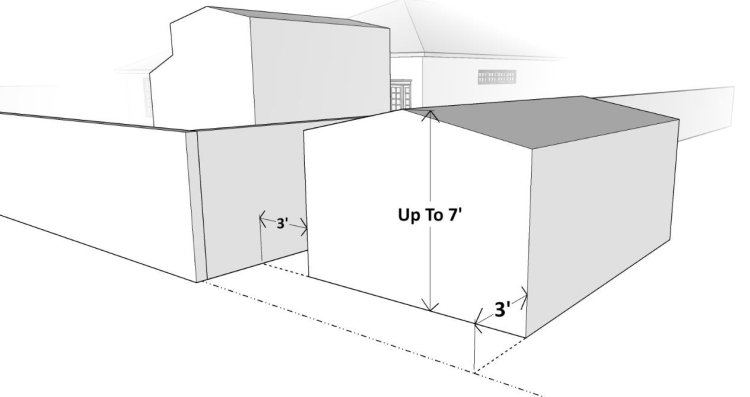
6.
For each foot over seven (7) feet in height, the side and rear setbacks for accessory buildings and structures shall be increased by two (2) feet, up to a maximum of the principal building setback requirements. For example, a thirteen (13) foot tall accessory building shall require a minimum side or rear setback of fifteen (15) feet, ((13'-7') × 2') + 3'=15').
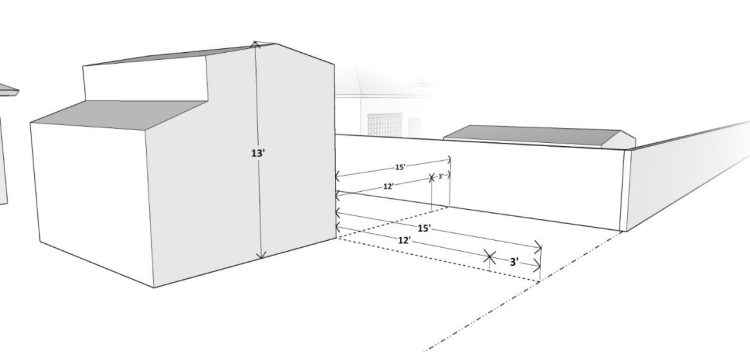
7.
Exceptions
a.
Movable and/or manufactured structures such as children's play equipment, trash enclosures, tool/storage sheds, and pet shelters smaller than one hundred twenty (120) square feet in area and less than six (6) feet in height may be placed within a required rear or side yard setback, but not in a required landscape setback as specified in Section 35.4.100, and behind a property screen wall or behind the nearest front plane of the principal building where such a wall does not exist. In no event shall the roof of said structures be designed to allow water to drain onto adjacent property.
b.
Rear yard setbacks for accessory buildings and structures in residential zoning districts shall be zero when an alley is present at the rear yard adjacent to another residential property. This shall be applicable to properties located within conventional subdivisions as well as to those within planned projects (i.e. PRD or PAD).
c.
For any non-single-family residential use or non-residential use in any zoning district, accessory buildings and structures may be located in the side or rear yard subject to Section 35.4.310(A) and Section 35.4.310(B), but shall adhere to any required landscape setbacks as specified in Section 35.4.100.
d.
In the A-1 zoning district or for any non-single-family residential use or non-residential use in any district, accessory buildings and structures may be located in the front yard, but shall adhere to the required front setback.
C.
Size standards for Accessory Buildings and Structures are as follows:
1.
Maximum height of accessory buildings and structures in the R1, RR and SR zoning districts is sixteen (16) feet. Accessory buildings and structures in the A-1 zoning district shall have a maximum building height of twenty (20) feet. In all other districts, accessory buildings and structures shall not exceed the height of the principal building.
2.
Maximum height of an amateur radio tower is seventy-five (75) feet.
3.
The maximum gross floor area of any accessory building or structure shall not exceed fifty percent (50%) of the building footprint of the principal building.
a.
Exception. This provision shall not apply to the following zoning districts: A-1, RR-45, C-3, B-P, M-1, and M-2.
4.
Accessory buildings and structures, including tool/storage sheds, shall be included in lot coverage calculations for all zoning districts.
D.
Appearance for Accessory Buildings and Structures are as follows:
1.
Accessory buildings and structures shall be constructed of materials that have a visual appearance that is similar or complimentary to the principal structure in treatment and color. Common movable and/or manufactured structures such as children's play equipment, trash enclosures, tool/storage sheds, and pet shelters are exempt from this requirement.
35.3.204 - Accessory Use Conditions.
A.
Accessory Dwelling Unit (ADU)
1.
An accessory dwelling unit as defined in section 35.8.004 as an ancillary or secondary living unit to a single-family detached dwelling unit that has a kitchenette or kitchen, bathroom, and sleeping area, and is independently accessed from and located on the same lot as a single-family detached dwelling unit, either within the same building as the single-family dwelling unit or in a detached building. For purposes of determining maximum density, an accessory dwelling unit shall not count as a dwelling unit. A kitchenette is defined in section 35.8.004 as an area used or designed for the preparation of food and containing a sink, refrigerator, and an electrical outlet which may be used for a microwave oven but no 220v outlet for a range or oven may be provided.
2.
An accessory dwelling unit shall be subject to zoning clearance as required in section 35.6.210.
3.
An accessory dwelling unit is a permitted use where the zoning allows for a single-family dwelling and the lot or parcel contains a primary dwelling.
4.
An accessory dwelling unit is not permitted on the same lot or parcel as a duplex or other multiple family development regardless of zoning district.
5.
No accessory dwelling unit shall be constructed prior to the construction of the single-family dwelling unit to which it is accessory. The accessory dwelling unit shall be secondary in size and function to the primary dwelling on the same lot or parcel.
6.
A mobile home, recreational vehicle, or other movable habitable space shall not be used as an accessory dwelling unit.
7.
Any living unit that is licensed as a travel vehicle by the state or any other state shall be considered nonpermanent housing and shall be allowed for uses similar to recreational vehicles as specified in this code.
8.
Accessory dwelling units shall not be sold or otherwise conveyed separately from the primary dwelling on the same lot or parcel.
9.
No more than one attached accessory dwelling unit and one detached accessory dwelling unit shall be permitted per single-family dwelling lot or parcel.
10.
No more than one attached accessory dwelling unit and two detached accessory dwelling units shall be permitted if the single-family dwelling lot is one acre or more, and only if at least one of the accessory dwelling units is recorded as a restricted-affordable dwelling unit.
11.
The accessory dwelling unit is subject to the same setback requirements that apply to a single-family dwelling on the same lot or parcel except that:
a.
The rear setback for the accessory dwelling unit shall be no less than five (5) feet from the property line.
b.
The side setbacks for the accessory dwelling unit shall be no less than five (5) feet from the property line.
c.
The front setback for the accessory dwelling unit shall be no less than the front yard setback established by the zoning district for the lot or parcel.
12.
Accessory dwelling units shall adhere to allowable building frontage, maximum lot coverage, and maximum height as established by the zoning district for the lot or parcel.
13.
Any accessory dwelling unit that is constructed off-site is considered semi-permanent and must be placed on an approved foundation system.
14.
Accessory dwelling units shall have at a minimum, a kitchenette as described in section 35.8.004, specific definitions.
15.
The design of accessory dwelling units are encouraged to be constructed of similar materials, colors, and architectural style to the existing single family dwelling unit.
16.
Accessory dwelling units may be constructed to equal the gross floor area of the existing single family dwelling unit; but in no case shall the unit exceed one thousand (1,000) square feet.
17.
A single-family residence that does not meet current setback requirements and is legally non-conforming may construct an accessory dwelling unit that complies with all accessory dwelling unit requirements.
18.
A non-conforming or permitted accessory building or structure converted to an accessory dwelling unit shall meet all requirements for an accessory dwelling unit.
19.
The accessory dwelling unit shall not encroach upon an existing or planned public utility easement unless the property owner obtains written consent from each easement holder and each affected utility.
20.
No additional parking space or in lieu parking fee shall be required to accommodate the accessory dwelling unit. An accessory dwelling unit shall have no separate driveway or parking area from that of the principal dwelling as described in section 35.4.006, residential off-street parking.
21.
An accessory dwelling unit shall have a separate address from the principal dwelling.
22.
Accessory dwelling units shall comply with all applicable residential building codes, fire codes, and public health and safety regulations.
23.
Accessory dwelling units shall be provided with adequate electricity, water supply, and sewage disposal.
24.
All accessory dwelling units shall have separate utility meters, to include a separate city water meter from the primary single-family dwelling unit.
25.
If presented for short-term rent (short-term means any period that is less than thirty (30) consecutive days), the property owner, which shall include title holders and contract purchasers, must occupy either the main dwelling or the accessory dwelling unit as their principal residence. The main dwelling or accessory dwelling unit that is not occupied by the property owner may then be rented for individual periods of less than thirty consecutive days .
26.
The owner-occupancy requirement does not apply to property owners who obtained a certificate of occupancy to build an accessory dwelling unit on their lot or parcel on or before September 14, 2024, unless the three-year statute of limitations in A.R.S. § 12-1134(g) has expired.
27.
A lot or parcel containing an accessory dwelling unit shall not be subdivided or split into two or more lots or parcels unless each lot or parcel complies with all city codes and ordinances as such the entire accessory dwelling unit shall remain on one lot only. For an existing accessory dwelling unit to remain on the new lot or parcel created by subdivision, the property owner must modify the primary dwelling and the accessory dwelling unit of the subdivided lots to comply with city codes and ordinances, including providing separate utility connections to each dwelling unit and obtaining a new certification of occupancy for each dwelling unit as required by the building official prior to the recording the subdivision or lot split of the property. The accessory dwelling unit that remains on the new lot or parcel shall be considered and recorded as the primary dwelling, unless a new primary dwelling unit is constructed on the new lot or parcel.
28.
Regulations for restricted affordable accessory dwelling unit
a.
Deed restriction
i.
The owner of a proposed restricted-affordable dwelling unit that is subject to this section shall execute and deliver an original recorded copy of a development agreement with the city or a copy of the standard form of deed restriction with Maricopa County Assessor Office to the city prior to issuance of a building permit for the construction of the proposed restricted-affordable dwelling unit on the lot or parcel.
ii.
The deed restriction shall be recorded by the owner of the lot burdened thereby in the property records of Maricopa County Recorder's Office and remain a covenant and restriction running with the property for a minimum period of thirty (30) years.
b.
Affordability. The rent of the restricted-affordable dwelling unit shall not exceed the maximum rents established according to households earning up to eighty percent of AMI (area median income). The restricted affordable dwelling unit shall not be rented to any entity.
c.
Occupancy requirement.
i.
When the restricted-affordable dwelling unit becomes vacant, the owner shall promptly make it available and actively market said unit for lease to another qualified occupant in accordance with the deed restriction or development agreement and any rental guidelines adopted by the city.
ii.
In the event the income status of the occupant of the restricted-affordable dwelling unit is altered so as to no longer meet the qualifications of this section, said occupant shall be permitted to reside in the unit under the same terms and conditions of the unit lease, except that no extension of the lease term shall be granted.
iii.
Rental shall be in compliance with all fair housing regulations.
d.
Reporting requirement. The owner of the restricted-affordable dwelling unit shall provide an annual report and proof to the city to demonstrate compliance with the rental requirements set forth in this section. The annual report shall be submitted to the Director of Community Services or designee between January 15 and January 30 of each year and shall cover the entire twelve (12) month period of the preceding calendar year. Said report shall contain, at a minimum;
i.
The period(s) the restricted-affordable dwelling unit was rented and the status by which its occupant(s) qualified under the deed restriction;
ii.
The monthly rental price; and
iii.
The taxes, special assessments, and homeowners' association and management fees, and any other fees or charges, including common utilities, assessed to each unit.
B.
Agricultural Stand
1.
Limited to structures of less than five hundred (500) square feet.
2.
Stands shall not be located within any public right-of-way and shall be kept free of litter and debris.
3.
Stands may be subject to specific ingress and egress requirements as determined by the Development Services Director or designee.
C.
Amateur Radio Tower
1.
Maximum height of an amateur radio tower is seventy-five (75) feet.
D.
Automatic Teller Machine
1.
Permitted accessory use in all non-residential and multiple residence zoning districts or when associated with permitted non-residential uses in single residence districts.
2.
Walk-up (outdoor) only.
3.
Walk-up (indoor) permitted by right if ancillary to a Principal use.
4.
See Section 35.3.103(N) and Section 35.4.013 for drive-through applications.
E.
Automotive Charging Station
1.
Permitted accessory use in all non-residential and multiple residence zoning districts or when associated with permitted non-residential uses in single residence districts.
F.
Cargo Containers
1.
Cargo Containers shall be allowed in the A-1 zoning district and as an accessory use with any non-residential use allowed in all other zoning districts.
2.
Containers that are designed to be used for storage and appear to be Cargo Containers, yet do not meet the specifications for commercial shipping, packing, or transportation of freight, shall comply with the requirements of this section.
3.
A permit shall be obtained at the Development Services Department prior to placing a Cargo Container on a property.
a.
Exception. Licensed building contractors may use Cargo Containers in any zoning district for temporary storage of equipment and/or material at a construction site that has a valid building permit.
4.
Cargo Containers shall be located on the side or rear of the principal building and must meet all development standards including setbacks, lot coverage and height regulations for the zoning district in which it lies and must also meet Fire Code requirements for placards as is necessary. Cargo Containers placed on the side of a principal building shall not extend beyond any portion of the principal building's front façade.
5.
Cargo Containers shall not occupy any required off-street parking spaces with the exception of temporary use during construction activities authorized by a building permit.
6.
Cargo Containers shall not be stacked, except when used for cargo purposes in the M-1 and M-2 zoning districts.
7.
Cargo Containers shall not be connected to any utilities.
8.
Cargo Containers shall be painted an earth tone color, shall not be used for advertisement, and shall be screened from public view with landscaping or an opaque screen wall/fence.
G.
Child Care, Home
1.
Use shall be licensed, certified or approved by the State of Arizona.
2.
Vehicles belonging to employees and residents are required to park onsite, in the garage or on an approved paved driveway.
3.
No signage for advertising or notification of use shall be permitted on or off the site.
4.
A minimum of six hundred (600) square feet of open space shall be provided for an outdoor play area, none of which shall be located in the required front setback.
5.
All outdoor recreation areas shall be completely screened and enclosed by a six-foot high solid masonry wall or wood fence with solid self-closing and self-latching gates.
H.
Home Occupations
1.
Home Occupations (Class I) are accessory uses in all residential districts. An occupation or profession is considered a home occupation when it:
a.
Is conducted entirely from within the principal residence with no activity or storage in the garage or other accessory buildings, or in other outdoor areas, except as allowed below;
b.
Is conducted only by a resident or residents of the dwelling unit (no employees other than the family), no outside employees visit the site;
c.
Does not have any customer traffic or more than one (1) commercial delivery vehicle a day coming to the residence related to the home occupation;
d.
Produces no offensive noise, vibration, smoke, dust, odors, heat, or glare beyond the boundaries of the property;
e.
Is clearly incidental and secondary to the use of the dwelling unit for residential purposes with storage for the use limited to a maximum of five percent (5%) of the total floor area and a maximum of ten percent (10%) of the collective floor area of the garage or accessory building;
f.
Has no signs or other exterior evidence of its existence;
g.
A valid City sales tax and business license is maintained for business purposes;
h.
Activity shall be limited to the hours between 7:00 a.m. and 10:00 p.m.; and
i.
Any parking incidental to the home occupation shall be provided on site.
2.
Home Occupations (Class II) are subject to conditional use permit in all residential districts. It is required when any of the following standards cannot be met by the proposed home occupation:
a.
Is conducted entirely from within the principal residence with no activity or storage in the garage or other accessory buildings, or in other outdoor areas;
b.
Is conducted only by a resident or residents of the dwelling unit (no employees other than the family), no outside employees visit the site;
c.
Does not have any customer traffic or more than one (1) commercial delivery vehicle a day coming to the residence related to the home occupation.
3.
Except as may be provided by conditional use permit approval in conjunction with a Home Occupation (Class II), no accessory use shall include outdoor display or storage of any of the following listed items, when such items are visible or emit odor, dust, gas, noise, vibration, smoke, heat, or glare, beyond any boundary of the lot on which such items are displayed or stored:
a.
Any building or landscaping materials.
b.
Any machinery, construction trailers, parts, or appliances.
c.
Vehicles which are unlicensed, inoperable, or registered to or owned by persons not residing on, or the guests of persons residing on the premises.
d.
Any other chattel used for or intended for a commercial purpose or ultimate use other than to subject premises.
I.
Livestock, Non-Commercial
1.
No Commercial breeding is permitted. Boarding of livestock is permitted subject to the maximum number of livestock allowed per lot.
2.
In A-1 and RR Districts the following shall apply:
a.
Raising and grazing of livestock is permitted for a maximum of one (1) livestock animal per five thousand (5,000) square feet of open space. Two (2) swine shall be allowed per lot. The raising of poultry is permitted provided they are contained within a fence, coop or cage. Male fowl shall not be permitted within five hundred (500) feet of any residence or living space, including pool or patio, on an adjacent suburban residential, urban residential, or multiple residential zoned lot.
3.
In SR Districts the following shall apply:
a.
Raising and grazing of livestock, excluding swine, is permitted for a maximum of one (1) animal per ten thousand (10,000) square feet of open space. The raising of poultry with the exception of male fowl, is permitted provided they are contained within a fence, coop or cage.
4.
All livestock must be contained in a stock type fence and/or corral. No setback shall be required between such fence or corral when adjacent to property zoned A-1 or RR, or non-residential zoned lots. However, such fence or corral shall not be closer than one hundred (100) feet from any residence or living space, including pool or patio, on an adjacent SR, R1 or MR zoned lot.
5.
Accessory buildings used specifically for permitted animals shall be subject to Section 35.3.203.
J.
Outdoor Display and Sales
1.
Outdoor display and/or sale of merchandise may be allowed as an accessory use for all commercial and industrial uses, provided that the display meets the following guidelines and regulations:
a.
Outdoor display and/or sale area shall be clearly defined on a site plan and approved by the Development Services Director or designee and may be subject to appropriate conditions by the Director or designee to ensure compliance with the provisions of this subsection.
i.
Exceptions: A permanent outdoor retail display area which is an integral part of a business, including but not limited to, Garden Centers and Auto, Boat, and RV Dealership display lots shall obtain site plan approval with all applicable development/improvements.
2.
Shall be a fixed location that does not disrupt the normal function of the site or its circulation, and does not encroach upon required driveways, landscaped areas, parking lots, sidewalks, loading zones, or fire lanes. Displays shall not obstruct any entrance to a building or traffic safety sight areas or otherwise create hazards for pedestrian or vehicle traffic.
3.
Display/sale of goods shall not be in any public right-of-way.
4.
Shall directly relate to a business occupying a permanent structure on the same site, and shall display only goods of the primary business on the same site, unless associated with a non-profit organization.
5.
Shall be limited to the hours of operation of the business and portable and removed from public view at the close of each business day, unless otherwise permitted through the site plan or development review process.
6.
No merchandise shall be affixed to the exterior of a building or displayed so as to impede or interfere with the reasonable use of the store front windows for display purposes.
7.
Shall be managed so that display structures and goods are maintained at all times in a clean and neat condition, and in good repair.
8.
All signage shall adhere to Section 35.4.300, Signs.
K.
Outdoor Storage
1.
Outdoor storage associated with principal use is permitted subject to the following conditions; however, the provisions of this paragraph shall not apply to outdoor storage associated with industrial or agricultural zoning districts:
a.
Storage areas must be fully screened from view by an opaque fence or concrete/masonry block wall that is no less than six (6) feet, but no more than eight (8) feet in height. A landscaped earthen berm may be used instead of or in combination with a required fence or wall.
b.
The storage area screen fence/wall shall incorporate exterior colors and/or finishes to match the primary building.
c.
Stored materials shall not exceed the height of the lowest screen fence/wall, except as provided elsewhere in this ordinance.
d.
Storage area gates must be opaque.
e.
Storage areas shall be paved with concrete, asphalt, pavers, or gravel as approved by the Transportation Department.
f.
Storage areas shall not be located within a required off-street parking or loading area.
g.
No storage of any items may occur within the front setback area or within the street side yard building setback.
L.
Watchman's Quarters
1.
Permitted accessory use in all non-residential zoning districts when associated with permitted non-residential uses.
2.
The watchman's quarters must clearly be accessory to the principal use.
3.
Only one watchman's quarters per lot shall be permitted.
4.
Watchman's quarters shall be an integral part of the principal building and shall not exceed forty percent (40%) of building floor area, with a maximum quarter's size of one thousand (1,000) square feet.
5.
A watchman's quarters shall consist of sleeping, kitchen, and bathroom facilities, and for the purposes of this Section shall not be considered an accessory dwelling unit.
6.
There shall be no payment of rent by the occupant of the quarters;
7.
The watchman's quarters and the principal building or use shall share utilities. Separate utility meters shall be prohibited.
8.
At least one off-street parking space shall be provided for a watchman's quarters.
9.
If the principal building or use is destroyed, removed, or ceases to exist, the utilization of the watchman's quarters shall no longer be allowed.
(Ord. No. O24-51, § 1, 12-10-24; Ord. No. O25-45, § 1, 11-25-25)
35.3.301 - Temporary Use Approval.
All allowed temporary uses shall obtain a Temporary Use permit, (unless otherwise stated in Section 35.3.302 or exempt as identified in subsection 35.3.303), pursuant to Section 35.6.213 Temporary Use Permit, of this Ordinance and provided that the temporary use complies with the standards and/or conditions specified in subsection 35.3.302 below.
35.3.302 - Temporary Use Conditions.
A.
Carnivals, Circuses, Concerts, Revivals, Rodeos and Similar Activities
1.
A Temporary Use Permit (private property) shall be obtained or a Special Event Permit when the event is on City property.
2.
Staff shall ensure that health and fire safety is considered and shall solicit the comments of the County Health Department and Fire Chief/Marshall as necessary.
3.
Staff shall ensure that land area is adequate for the proposed use's parking; and shall ensure that traffic safety is considered.
4.
Staff shall require measures to adequately protect surrounding property.
5.
Permanent structures shall not be allowed.
6.
A Special Events Permit or a Temporary Use Permit shall pertain to the allowable activity permitted during the time limit of the permit. A change in ownership or sponsor applicant for the same activity during the time limit of the permit shall not constitute grounds for extending the time granted for the activity in the original permit.
B.
Corn Maze
1.
A temporary corn maze may be established subject to the following:
a.
The activity is based on corn growing on the subject property.
b.
A site plan to define access, parking dust control, temporary structures, signs and related improvements is approved by the planning department.
c.
Authorization by property owner and identification of responsible parties.
d.
Definition of the days and hours of operation.
e.
The facility shall not operate more than forty (40) business days within any eight (8) week calendar period.
f.
Any goods or services proposed for display or sales on the site shall be accessory to the special agricultural entertainment event.
g.
The facility meets all fire and public safety requirements for a temporary event.
h.
The area of the corn maze shall be a minimum of five (5) acres but not exceed twelve (12) acres.
i.
Any temporary structures must be removed at the end of the operations.
C.
Donation/Recycling Drop-Off Boxes
1.
Donation/Recycling Drop-Off Boxes are subject to the approval of a Temporary Use Permit (TUP) as well as the submission of a signed affidavit from the person requesting the TUP stating that the requestor has complied with Arizona state law regarding Donation/Recycling Drop-off Boxes and has the permission of the property owner to place the Donation/Recycling Drop-Off Box on the relevant property.
2.
Donation/Recycling Drop-Off Boxes may be permitted as an accessory use to all permitted non-residential uses within a residential zoning district pursuant to this article.
3.
Donation/Recycling Drop-Off Boxes shall be located on a paved surface.
4.
Donation/Recycling Drop-Off Boxes shall not be located within the front or side yard setbacks, required landscaped areas or within required parking spaces.
5.
Donation/Recycling Drop-Off Boxes shall not obstruct pedestrian or vehicular circulation, or be located within the public right-of-way, drive aisles, fire lanes, loading zones, or any other location that may cause hazardous conditions, or constitute a threat to the public health, safety, and welfare.
6.
There shall be no more than one (1) Donation/Recycling Drop-Off Box on lots or parcels or shopping complexes/centers less than one (1) acre in size, no more than two (2) Donation/Recycling Drop-Off Boxes on lots or shopping complexes/centers of one (1) to three (3) acres in size, and no more than four (4) Donation/Recycling Drop-Off Boxes on lots or complexes/centers greater than three (3) acres in size. No more than two (2) donation boxes shall be clustered together in any one location.
Donation Box Allotment Example:
a.
Property or Premises/Complex Size up to 1 acre = 1 Box.
b.
1—3 Acres = 2 Boxes*.
c.
3+ Acres = 4 Boxes*
*No more than two (2) Donation Boxes shall be clustered together in any one location.
7.
Each Donation/Recycling Drop-Off Box shall have a firmly closing and locking lid, shall be clearly marked to identify the specific items and materials to be collected for donation, and shall be clearly marked to identify the City of Glendale Temporary Use Permit number. The numbers shall be a minimum of two (2) inches high and located on the deposit face of the box. The mark shall identify if the entity is a non-profit or for-profit organization.
8.
The name and local telephone number of the entity obtaining the TUP shall be affixed to the box on an area no larger than one foot by one foot.
9.
Donation/Recycling Drop-Off Boxes shall have a capacity no greater than six (6) cubic yards.
10.
All donated items must be collected and stored in the Donation/Recycling Drop-Off Box and all contents cleared no less than once a week. Any items or materials left outside of the Donation/Recycling Drop-Off Boxes shall be removed within twenty-four (24) hours of discovery or notification, whichever occurs first. If a container is damaged or vandalized, it must be repaired or removed within five (5) business days of discovery or notification. If there is a public health, safety or welfare concern pursuant to the authority granted to the City, the container must then be removed within twenty-four (24) hours of discovery or notification.
11.
It is the joint responsibility of the property owner or authorized agent and the entity obtaining the TUP to keep the area around the Donation/Recycling Drop-Off Boxes free of litter and debris, and remove any graffiti within twenty-four (24) hours of discovery or notification, whichever occurs first.
12.
It is the responsibility of the entity obtaining the TUP to maintain the Donation/Recycling Drop-Off Box in good condition that is rust and dent free.
13.
Donation/Recycling Drop-Off Boxes not located or maintained in compliance with this Article may be subject to revocation of the Temporary Use Permit (TUP).
14.
The City may consider prior permit revocations, prior notices of violation, and fraudulent application information when granting or denying new Temporary Use Permits for Donation/Recycling Drop-Off Boxes.
15.
Any Donation/Recycling Drop-Off Box (including its contents) which is determined to be unauthorized, unpermitted, or is otherwise in violation of this ordinance shall be deemed a public nuisance and may be removed pursuant to those provisions.
16.
The property owner shall control the Temporary Use Permit. The permittee or drop box operator does not control the Temporary Use Permit unless he/she is also the property owner. As such, the property owner or authorized agent may rescind his/her authorization for the Donation/Recycling Drop-Off box at any time and the permit shall be revoked. Property owners may remove a Donation/Recycling Drop-Off box in accordance with Arizona state law.
17.
Arizona state law governing drop boxes applies to Donation/Recycling Drop-Off Boxes.
D.
Farmer's market, temporary
1.
Limited to not more than two (2) days of operation per seven (7) day period.
E.
Mobile Food Vending. The purpose of this subsection is to protect the health, safety and welfare of the community of the City of Glendale by enacting reasonable regulation for mobile food vendors, their employees, agents, lessees or independent contractors by requiring compliance with minimum standards for safety and security.
1.
Generally
a.
The mobile food unit and its customers shall not obstruct the movement of pedestrians or other vehicles using the sidewalk, street, alley, or other public right-of-way.
b.
All associated activities shall occur on a dustproof surface, except for mobile food vendors serving active construction sites.
c.
Hours of operation shall exclude the hours between 10:00 p.m. and 6:00 a.m. unless a Special Event permit has been issued and specifically expands the hours of operation.
d.
Mobile food vendors shall comply with all applicable City of Glendale sign regulations.
e.
A mobile food unit shall have adequate lighting to ensure customer safety in the vending area. Lighting shall be directed downwards and away from rights-of-way and adjacent properties.
f.
The mobile food unit and the surrounding vending area shall be maintained in a safe and clean manner at all times.
g.
The site shall be kept free of refuse, trash, and litter, which shall be removed from the site daily.
h.
Temporary restrooms shall be prohibited.
i.
Permanent modifications to the site shall be prohibited.
2.
Compliance with State Licensing Requirements. It shall be unlawful for any person to operate a mobile food unit or act as a mobile food vendor without having first obtained a valid license from the State of Arizona Department of Health Services pursuant to A.R.S. § 36-1761.
3.
Compliance with City Licensing Requirements. A mobile food vendor shall be required to maintain a current City of Glendale business license.
4.
Location:
a.
Private property.
i.
A mobile food vendor shall obtain written permission to use any private property where a mobile food unit is operating and shall provide proof of such written permission on demand by the City.
ii.
Notwithstanding the permission of a person owning or having lawful control of private real property, a mobile food unit shall not remain in one location on private property for longer than ninety-six (96) consecutive hours, unless the City grants permission for a permitted event greater than four (4) days. "One location" within this subsection means a location within a parcel of land and includes movements from different parked positions within the same parcel.
b.
Public Property
i.
A mobile food vendor shall only operate in a legal parking space. If the mobile food vendor desires to operate on City property other than a legal parking space in a right-of-way, the mobile food vendor shall obtain from the City: (1) a separate licensing for use, services contract, or similar agreement, which will be entered into at the City's sole discretion and applicable law; or (2) a Special Event permit or similar permission in accordance with the City Code.
c.
Residentially Zoned Property. A mobile food vendor shall not operate in an area zoned for residential use or within two hundred fifty (250) feet of an area zoned for residential use, except:
i.
A mobile food vendor selling only ice cream or similar confections intended to be sold in a manner that requires limited-duration stops may operate on public rights-of-way in areas zoned for residential use; or
ii.
Subject to applicable laws and the City Code a mobile food vendor may operate on private property in a residential area if the mobile food vendor obtains a separate agreement with the property owner to operate a mobile food unit for a maximum of six (6) hours within a twenty-four (24) hour period on the private property.
iii.
Mobile food vendors serving active construction sites shall be permitted to operate a mobile food unit for a maximum of three (3) hours within a twenty-four (24) hour period on the private property.
5.
Parking. A mobile food unit shall comply with this subsection and applicable law as it pertains to parking, unless parking is governed by a separate subsection in this article.
a.
A mobile food unit shall only operate in legal parking spaces.
b.
A mobile food unit, including any semi-permanent structure used or associated with the mobile food unit, may use no more than one (1) legal parking space, unless the mobile food vendor has a separate agreement with the City to use additional legal parking spaces or parking spaces on City property other than right-of-way.
c.
No mobile food unit exceeding twenty-four (24) feet may park diagonally in a diagonal parking space or park in any manner that occupies more than one (1) diagonal parking space.
d.
No mobile food unit shall operate with the serving window facing street traffic.
e.
A mobile food unit shall abide by all parking regulations, including posted time limits. If there are no other time restrictions on the use of a legal parking space, a mobile food unit shall not occupy a legal parking space for more than six (6) hours in a twenty-four (24) hour period. "Occupy" within this subsection means within one hundred (100) feet of the place in which the mobile food unit was initially parked.
f.
A mobile food unit shall not occupy a legal parking space with insufficient parking capacity as prescribed by City Code and applicable law, and includes occupying a legal parking space that reduces the number of available parking spaces surrounding the area which is required for the principal use or uses of the property associated with the parking spaces as set forth in A.R.S. Title 9, Chapter 4, Article 7.2.
g.
A mobile food vendor shall not claim or attempt to establish any exclusive right to park at a particular street location, unless the parking space is part of a permitted event.
6.
Noise.
a.
A mobile food vendor shall not use, play, or caused to be used or played any loudspeaker, microphone, amplified music, or other amplified instrument or device used for the production of sound in a vending area when the motor vehicle or mobile food unit from which mobile food vendor is vending is stationary or mobile upon any right-of-way, park or other public place. For the purposes of this subsection, the factors for determining whether a sound is amplified include, but are not limited to, the following:
i.
The proximity of the sound to sleeping facilities, whether residential or commercial;
ii.
The land use, nature, and zoning of the area from which the sound emanates and the area where it is received or perceived;
iii.
The time of day or night when the sound occurs; it shall be presumed that any amplified noise between 10:00 p.m. and 6:00 a.m. is reasonably disturbing;
iv.
The duration of the sound; and
v.
Whether the sound is recurrent, intermittent, or constant.
F.
Mobile Outdoor Vendors
1.
A mobile outdoor vendor shall not be required to obtain a Temporary Use Permit, however, shall be required to obtain a business license from the City.
2.
The provisions of this subsection shall not apply to any event located on City owned property or authorized by any other permit issued by the City, such as a farmer's market; an authorized festival; or recreational event if the mobile vendor is in partnership with the organization conducting the event and is located on the site of the event.
3.
A mobile outdoor vendor shall only be permitted to operate on city owned property or on private property with the written permission of the owner and shall provide proof of such written permission on demand by City officials or law enforcement officers.
4.
A mobile outdoor vendor is only permitted on properties that have been established with principal uses. Mobile Outdoor Vendors shall be prohibited from operating on vacant or unoccupied parcels.
5.
Mobile Outdoor Vendors shall be restricted from operating within the public right-of-way or any Residentially Zoned District.
6.
A mobile outdoor vendor shall not operate at the same site or center for more than six (6) consecutive hours within a 24-hour period. This period includes time needed for setup, operation and takedown.
7.
No more than one mobile outdoor vendor shall operate at the same time at the same site or center, unless a Temporary Use Permit has been obtained.
8.
All licenses/permits shall display in a visible and conspicuous location at all times during the operation of vending.
9.
One (1) A-Frame or Sandwich sign shall be allowed per vending operation.
10.
Vending operations are subject to all City noise regulations.
11.
Vending operations shall be taken down when not in use.
12.
Vending operations shall provide the City a Certificate of Insurance evidencing general and product liability coverage and naming the City as an additional insured.
13.
Mobile Outdoor Vendors shall not:
a.
Be left unattended
b.
Be parked or placed in any area that might impede or inconvenience the public.
c.
Be parked within the sight visibility triangle. See City of Glendale Engineering Design Standards for specific sight visibility triangle requirements.
G.
Seasonal Sales and Special Events
1.
Temporary sales or display of goods or special events are allowed only if they are related to a particular seasonal, cultural, traditional, or community activity or event for a period not to exceed thirty (30) calendar days, as determined by the Development Services Director or designee. In making a determination, the Development Services Director or designee shall consider the following criteria:
a.
The nature, scope, location, and manner of operation of the activity or event does not constitute a health or safety hazard to the public.
b.
The goods or services displayed are customarily and traditionally related to a widely celebrated or observed seasonal or other activity, event, or holiday.
c.
The goods and services are displayed in connection with fund raising or other activities by a school, church, social agency, or other community or nonprofit organization.
d.
The activity or event is consistent with other uses permitted in the zone district.
e.
The use does not interfere with pedestrian access-ways, fire lanes, driveways, landscape areas, or traffic visibility at driveway entries and street intersections.
f.
Parking on the property is adequate to serve any existing permanent uses and the seasonal sale or special event use.
g.
Fireworks Displays
i.
Fireworks sales may only be located on commercially zoned properties and on residentially zoned properties with permitted non-residential land uses.
ii.
Outdoor fireworks displays, sales, and tents are to be located on an improved surface.
iii.
Only one fireworks vendor shall be allowed to locate on each property.
iv.
A maximum tent or canopy size of eight hundred (800) square feet is permitted.
v.
Property owner authorization is required
h.
Short Term Special Events
i.
Short term special events that are part of a promotional event shall be regulated as follows:
(a)
Short term typically last for one (1) day or a weekend but can be approved for up to ten (10) consecutive calendar days. Short term special events are allowed up to four (4) times per calendar year, with a thirty (30) day waiting period between events.
H.
Temporary Office or Construction Trailers
1.
Temporary office trailers are allowed only after building permits have been issued for the permanent building(s) to occupy the site.
2.
May be authorized for use exclusively as a temporary office or construction shed incidental to a construction project for a period of twelve (12) months. The Development Services Director or designee may authorize extensions of additional six (6) month increments where construction within the project site is proceeding in a timely fashion.
3.
May be authorized for use as a home sales office when building permits have been issued for a subdivision model home complex. The permit is not to exceed six (6) months. A development plan is required to be approved by the Development Services Director or designee.
35.3.303 - Exempt Temporary Uses.
The following temporary uses and events are exempt from the requirement for a Temporary Use Permit, but may require other City approval to ensure public health, safety, and welfare.
A.
Garage/Yard Sales are permitted for no more than three (3) events of forty-eight (48) hours or less within a twelve (12) month period at the same residence or street address.
B.
Events which occur in meeting halls, theaters, or other permanent indoor or outdoor public assembly facilities subject to all applicable regulations of this Code.
C.
Promotional activities related to the primary product lines of a retail business, and similar activities (e.g. book readings and signings at book stores, opening receptions at art galleries).
D.
Emergency public health and safety activities.
E.
Temporary nonprofit or fundraising car washes are permitted in non-residential districts.
F.
City sponsored events.
G.
Events held on City owned property shall obtain a Special Event Permit.

