
Glendale City Zoning Code
ARTICLE 4
- GENERAL DEVELOPMENT REGULATIONS
This Article establishes general development criteria for property within the City, including regulations for off-street parking, landscaping and screening, signage, and lighting.
35.4.000 - OFF-STREET PARKING
This Section establishes the off-street parking and driveway requirements for all new development and changes in use or intensity of use for existing development. These requirements include the number of required spaces and their sizes, parking area and driveway design, bicycle parking requirements, and loading and unloading standards.
35.4.400 - OUTDOOR LIGHTING
This Section establishes the requirements for artificial outdoor lighting and light sources. These requirements include the installation, materials, and shielding standards.
35.4.001 - Purpose.
It is the primary purpose of this Section to ensure the adequate provision of automobile and bicycle parking, loading, and maneuvering for each specified land use or land use category. The intent of the regulations set forth in this section are to further minimize excess, and often unused, parking areas, alleviate on-site traffic congestion, and minimize vehicular-pedestrian conflicts. This Section also seeks to mitigate the visual and urban design impacts of parking lots by reducing the scale of parking areas through proper landscape and site design standards.
35.4.002 - General Applicability.
A.
This section shall apply to off-street parking for all new development and changes in use or intensity of use for existing development in all zoning districts. Every building and use, including a change or expansion of a building or use shall provide accessory parking and loading areas as set forth below.
1.
New Buildings and Land Uses: Off-street parking and loading shall be provided as required by this Section at the time any new building or structure is erected, or any new land use is established.
2.
Expansion of Existing Nonresidential Buildings: When the floor area of an existing building is increased, additional off-street parking and loading shall be provided as required by this Section for the additional floor area only, provided that the existing parking was legally established and has not been reduced. If the number of existing parking and loading spaces is greater than the requirements for such use, the number of spaces in excess of the prescribed minimum may be counted toward meeting the parking and loading requirements for the addition or enlargement.
3.
Addition of Use to Existing Nonresidential Buildings: When a new use locates on a parcel with an existing use, all off-street parking shall be provided to meet the total number of spaces required for the existing use and the new use, unless the uses meet the requirements of alternative guidelines that are expressly allowed by other provisions of this Code.
4.
Change in Use of Existing Nonresidential Buildings: When a change in use requires more off-street parking than the previous use, additional parking and loading spaces shall be provided equivalent to the difference between the number of spaces required by this Section for the immediately previous use and the total number of spaces required by the new use. A change in occupancy is not considered a change in use unless the new occupant is in a different use classification than the former occupant.
5.
Alterations That Increase the Number of Dwelling Units: The creation of additional dwelling units through the alteration of an existing building or construction of an additional structure or structures requires added off-street parking, as required by this Section, to serve the new dwelling units. This requirement does not apply when sufficient off-street parking exists to provide the number of spaces required for the existing and new dwelling units.
6.
Reduction in Parking Area: It shall be unlawful for an owner of any building or use affected by this section to discontinue, change or dispense with, or to cause the discontinuance or change of the required parking or loading space without first having established other parking spaces which meet all requirements of this Section to replace those being lost or except after proof that, by reason of reduction in floor area, seating area or other factors, the proposed reduced area for off-street parking or loading will conform to the requirements of this Section.
7.
When Required: Off-street parking and loading facilities required by this Section shall be constructed or installed prior to the issuance of a certificate of occupancy for the uses that they serve.
35.4.003 - General Parking Regulations.
A.
All parking spaces and driveway areas serving such parking spaces shall be surfaced with concrete, asphalt, or paving blocks.
B.
Required parking shall be provided on-site or on contiguous lots subject to a shared parking agreement unless otherwise stated herein.
C.
Off-street parking areas shall not encroach into a front setback or any required landscape buffer or landscape setback unless otherwise stated herein.
D.
In determining the required parking for a use based on its building square footage, square feet shall mean the gross floor area of the building or suite occupied by that use unless otherwise stated herein.
E.
All parked vehicles must comply with unobstructed view easement and sight distance requirements as identified in the City of Glendale Engineering Design Standards.
F.
Continuous curbing at least six (6) inches high and six (6) inches wide shall be provided around the perimeter of all parking and drive aisle areas. Curbing located adjacent to stormwater facilities may contain curb cuts to allow for necessary drainage.
G.
Landscaping and screening of parking lots shall be in accordance with Sections 35.4.100—Landscaping and 35.4.200—Screening, Walls & Fences of the Glendale Unified Development Code.
H.
Parking lots shall be designed in groupings no larger than two hundred (200) spaces. Larger lots shall be divided by buildings, plazas, or landscaped areas.
I.
Parking areas shall provide reasonable connectivity to adjacent parking areas, when requested by the City to promote convenience, safety and efficient circulation. A cross access agreement guaranteeing the continued availability of shared access between properties and running with the land shall be recorded by the owners of the abutting properties.
J.
All off-street parking areas shall be designed so as to provide ingress and egress from a public street by the forward motion of the vehicle. Required off-street parking spaces shall be accessible without backing into or otherwise reentering a public right-of-way.
K.
All parking spaces, excluding single residence homes, shall be permanently marked with four-inch (4") wide painted lines. Circulation aisles, approach lanes, and turning areas shall be clearly marked with directional arrows and lines to ensure safe traffic movement.
L.
It shall be the joint and separate responsibility of the owner and/or lessee of the principal use, uses or building to maintain in a neat and adequate manner, the parking space, access ways, striping, landscaping, and required fences or screening.
M.
Off-street parking spaces shall not be used for storage, sale or rental of goods, parking or placement of shipping container(s), or storage of inoperable vehicles, unless otherwise stated herein or permitted as a Special Event.
N.
Parking lots shall be illuminated from sunset to sunrise. Lighting fixtures shall be no taller than twenty-five (25) feet, except where the property being illuminated is adjacent to single family residential uses, in which case, any lighting fixtures within one hundred (100) feet from the residential property line shall be no taller than sixteen (16) feet. All lighting fixtures shall be directed downward and shielded to prevent light spillage onto adjacent properties.
O.
Parking shade canopies are encouraged for non-residential and multiple-family residential uses. Parking canopies shall adhere to the following location and development standards:
1.
Setbacks shall be measured from the property line to the nearest face or component of the canopy.
2.
Canopies shall not encroach into a front setback or any required landscape buffer or landscape setback.
3.
Canopies located in accordance with zoning district setbacks shall not exceed fifteen (15) feet in height.
4.
Canopies shall not exceed ten (10) feet in overall height when located within ten (10) feet of any single residence property line.
5.
Canopies shall not be placed in a manner that reduces the minimum width or vertical clearance of any required drive aisle.
6.
Canopies shall be constructed of steel or aluminum or a combination thereof and shall be subject to Design Review and approval. Staff shall review the structure for height, placement, and color to ensure proper height and setbacks are maintained and colors are consistent with the primary building or design theme. Fabric may be used for the cover portion of the canopy provided it is free of text or signage, kept in good repair, and complementary to the approved color palette of the primary building or design theme.
35.4.004 - Parking Space Dimensions.
All vehicular parking areas shall comply with the minimum dimension requirements as set forth below:
NOTES:
(1)
Parking spaces may include a 1.5-foot overhang into landscape or pedestrian areas provided that these areas maintain a minimum 5-foot, unobstructed clear space for their intended respective purposes. No part of any parked vehicle may be within five (5) feet of a street curb where no sidewalk exists. Parking curbs/stops shall be used to prevent excess encroachment.
(2)
ADA spaces shall comply with the City of Glendale Engineering Design Standards.
(3)
Vehicle compact parking spaces shall, at minimum, measure eight (8) feet in width by sixteen (16) feet in length.
(4)
Width may be increased where required by the Fire Department.
(5)
The minimum parking width and length for standard off-street parking spaces shall apply to parking on residential lots and covered spaces, unless otherwise stated herein.
(6)
Low turnover uses may utilize a minimum parking space width of nine (9) feet and length of eighteen (18) feet.
35.4.005 - Required Parking Ratios.
A.
Any building or use hereafter erected, converted, or enlarged shall be provided with not less than the minimum spaces as set forth below, which spaces shall be readily accessible to the uses served thereby. Fractional numbers of parking spaces shall be increased to the next whole number.
B.
Multiple Uses. Unless otherwise specified, lots containing more than one use shall provide parking and loading in an amount equal to the total of the requirements for all activities.
C.
Shell Buildings. Where buildings are constructed without uses specified (i.e. shell buildings), the use with the highest parking requirement among all uses specified for the zoning district where the site is located shall be used to calculate off-street parking requirements.
D.
Unspecified Uses or Parking Ratios. Parking for land uses or parking ratios not specifically listed in Table 4.000-2 shall be determined by the Development Services Director or designee, based upon the requirements for the most similar and comparable use, the particular characteristics of the proposed use, and any other relevant data regarding parking demand. Alternatively, the Development Services Director or designee may require the applicant to submit a Parking Justification Study as specified in Section 35.4.005(E) or other information, at the applicant's cost.
E.
Parking Justification Study.
1.
For uses with considerable variation in scale, operational characteristics, and parking demand that benefit from a case-by-case analysis, applicants may submit a Parking Justification Study.
2.
A Parking Justification Study shall be prepared by a professional with expertise in traffic and parking analyses, unless the City determines that a professional analysis is not necessary and include the following:
a.
Estimates of proposed parking demand and spaces based on recommendations of the Institute of Transportation Engineers (ITE) Parking Generation Manual that includes existing and proposed onsite buildings or uses, including hours of operation and peak use time and demand for each proposed building or use. This analysis may also include other reliable data sources or collected from uses or combinations of uses that are the same as or comparable with the proposed use.
b.
The number and location of proposed onsite standard, compact, and ADA accessible parking spaces.
c.
All existing and anticipated available parking within the proposed development and within 660 feet of the proposed use.
d.
If parking demand is proposed to include offsite parking, copies of any shared parking agreement or other evidence of a right to park in that location shall be included.
e.
The proximity of the proposed parking to existing residential neighborhoods and an explanation of how uses will not place a parking burden on residential streets. Off-site parking may be restricted on narrow streets or streets that have or will have bike lanes.
f.
Availability of and proximity to transit or other modes of transportation.
g.
Bicycle parking demand and provisions.
h.
Demand for commercial ride sharing and on-site drop-off/pick-up areas.
i.
Off-street loading requirements and impacts on surrounding uses and properties.
j.
Any other information deemed appropriate by the Development Services Director, Design and Transportation Director, or designee. Such information may include a traffic study.
3.
Any study that requests a reduction in parking requirements by twenty-five percent (25%) or more shall further prepare a Transportation Management Plan (TMP) which shall be approved by the City and recorded with Maricopa County. The amount of parking reduction shall be discretionary to be determined by the City, and depends on the type and extent of strategies in the TMP, which may include:
a.
Transit passes or equivalent alternative transportation mode subsidies for tenants
b.
Alternative transportation information center located in the building
c.
Resident Carpool and/or Ridematch Program
d.
Enhanced shuttle service (or contributions to extend or enhance existing shuttle service or to create new shared or public shuttle service)
e.
Subsidized membership in a private car-share company
f.
Resident Car Share Program (residents share their privately owned cars with other residents)
g.
On-site bicycle share program for residents or the general public
h.
Limitation of "assigned" parking to one space per residential unit
i.
Provision of priority parking spaces for carpools/vanpools
j.
Bike-repair/workshop space in the building
k.
Lease provisions and monitoring requirements for the property owner to ensure that tenants are not parking off site
l.
Presence of basic daily uses within ¼-mile, such as grocery/corner store, drug store, or child care; and/or weekly uses such as bank, convenience store, restaurant, or theater
m.
Designation of a Transportation Coordinator to manage the TMP, actively monitor, pursue and report mode shift goals, and be a point of contact for the City. Where monitoring reports indicate that performance measures are not met, the City may require further program modifications.
n.
Other approaches accepted by the City that reduce parking demand.
4.
Criteria for evaluation of a Parking Justification Study shall include, but is not limited to:
a.
Impacts to abutting properties or rights-of-way, dedicated tracts, or easements
b.
Compatibility with the character of the surrounding properties and their parking facilities
c.
Equivalence to the intent and purpose of the original parking requirements
d.
Impacts to safety and public services
5.
The parking justification analysis process:
a.
Submission to the Development Services Director, Transportation Director, City Engineer, or designees.
b.
Approval or rejection with written explanation.
c.
Revision or appeal to Board of Adjustment.
35.4.006 - Residential Off-Street Parking.
A.
All residential lots shall provide a dustproof driveway between a public street or private drive and all required parking spaces. If access to a public street is provided via an alley, the alley and driveway shall be a dustproof surface.
B.
For lots less than eight thousand (8,000) square feet in area, all of the following shall apply:
1.
No more than fifty percent (50%) of the front yard area portion of a property that is located on the street side of an approved solid wall, fence, or gate may be improved with a dustproof driveway, parking, or maneuvering area. Where such screening does not exist, the identified front yard shall serve as the basis for calculating the allowed driveway, parking, or maneuvering area.
2.
For corner lots, the identified front yard shall also be used to calculate the maximum, permitted dustproof driveway, parking, and maneuvering area, however, the calculated maximum dustproof area may be allocated across both front and street side yards.
3.
The maximum, continuous width of any driveway, parking, or maneuvering area shall not exceed thirty (30) feet or fifty percent (50%) of the lot width as measured at the front setback, whichever is less, however, this width may be expanded to accommodate side entry garages.
4.
All driveway, parking or maneuvering areas within the front yard shall be prohibited from being located in front of any living space of a dwelling, except to provide direct access to a permitted garage or carport or to allow for the placement of a circular drive.
C.
For lots eight thousand (8,000) square feet or more in area, all of the following shall apply:
1.
No more than forty percent (40%) of the front yard area portion of a property that is located on the street side of an approved solid wall, fence, or gate may be improved with a dustproof driveway, parking, or maneuvering area. Where such screening does not exist, the identified front yard shall serve as the basis for calculating the allowed driveway, parking, or maneuvering area.
2.
For corner lots, the identified front yard shall also be used to calculate the maximum, permitted dustproof driveway, parking, and maneuvering area, however, the calculated maximum dustproof area may be allocated across both front and street side yards.
3.
The maximum, continuous width of any driveway, parking, or maneuvering area shall not exceed forty (40) feet or fifty percent (50%) of the lot width as measured at the front setback line, whichever is less, however, this width may be expanded to accommodate side entry garages.
4.
All driveway, parking or maneuvering areas within the front yard shall be prohibited from being located in front of any living space of a dwelling, except to provide direct access to a permitted garage or carport or to allow for the placement of a circular drive.
D.
All vehicles shall be parked, stored or maneuvered on a dustproof surface such as concrete, pavers, asphalt, or crushed rock or aggregate that is a minimum of three (3) inches thick. All crushed rock or aggregate shall be distinctly different than any adjacent landscaping groundcover through material type and/or color and shall be contained by a permanent border. Permanent borders for asphalt surfaces are recommended. All dustproof surfaces shall be maintained and kept free from weeds, grass, or other vegetative growth.
E.
Circular driveways and similar circulation areas shall be allowed within the front yard so long as:
1.
The circular driveway or similar circulation area was:
a.
constructed at the same time the primary structure was constructed under the then-existing zoning classification, or
b.
constructed prior to the adoption of this section of the Glendale Municipal Code and in compliance with the zoning code in effect at the time of construction, or
c.
constructed in accordance with a permit or zoning clearance letter issued by the City of Glendale Planning Department
2.
The circular driveways and similar circulation areas are in compliance with Section 24-68 of the Glendale Municipal Code.
F.
For regulations regarding vehicle parking or storage on residentials lots, See Chapter 24 Motor Vehicles and Traffic, Section 24-68 Parking on Residential Lots.
Figure 4.1. Residential Parking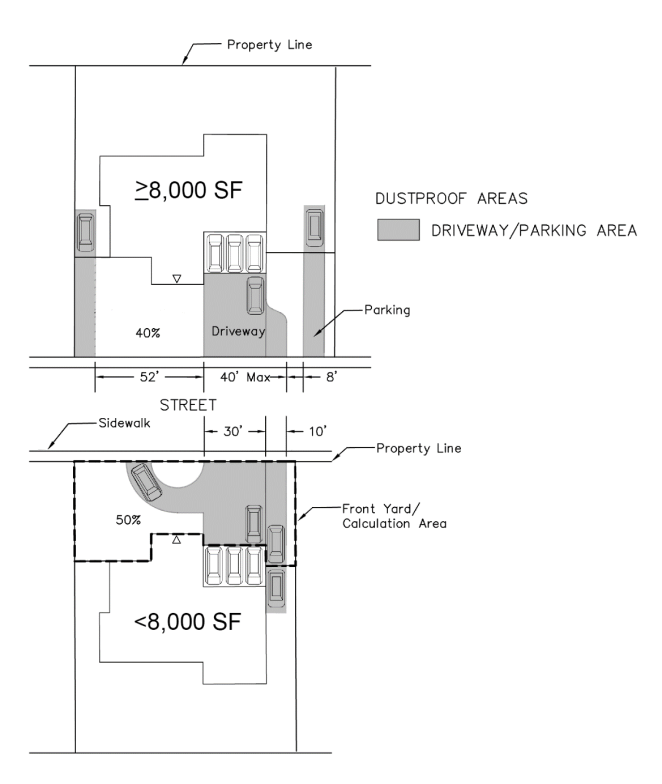
35.4.007 - Professional Office District Parking.
A.
Residential Office (RO) District
1.
Access to parking for all nonresidential uses shall be provided from arterial or collector street.
2.
No parking space shall be located closer than ten (10) feet to a side or rear property line.
3.
No vehicle maneuvering or parking area shall be in the front yard of the development except for ingress and egress to allowable parking areas.
B.
General Office (GO) District
1.
Access to parking shall be from arterial or collector street.
35.4.008 - PR District Off-Street Parking.
A.
The parking requirements of the Pedestrian Retail (PR) district differ from those in other areas of the city. The parking requirements for new uses shall be determined by the Development Services Director Transportation Director, or designee, in conjunction with the design review process prescribed in Section 35.6.212. Review and findings shall be based on existing on-street parking, parking for existing uses, and other available parking in the district.
B.
Off-Street Parking Facilities.
1.
All required off-street parking spaces shall be located on the same lot or a contiguous lot or lots under the same ownership as the building or use for which the parking is accessory. Parking spaces shall be located in the rear of structures to avoid visibility from public streets, and should be accessed, when possible, from alleys.
2.
Except where provided by the City or an improvement district, required parking on a site separate from the use served shall meet one (1) of the following conditions:
a.
Same ownership. A legal instrument satisfactory to the City Attorney shall be recorded requiring maintenance of the required number of spaces on the site.
b.
Leasehold. The minimum lease term shall be five (5) years. A legal instrument satisfactory to the City Attorney shall be recorded requiring cessation of a use served if access to the leased parking is terminated without substitution of parking meeting the requirements of this section.
3.
Except where provided by the City or an improvement district, required parking spaces for customers shall be within two hundred (200) feet and for employees within four hundred (400) feet of the entrance of the served use via the shortest public pedestrian route.
C.
Bicycle Parking.
1.
Bicycle parking facilities may be substituted for automobile parking spaces at a ratio of eight (8) bicycle parking spaces for one (1) required vehicle parking space, up to a maximum of two percent (2%) of the vehicle spaces required.
2.
Bicycle parking facilities shall include provision for locking of bicycles, either in lockers or in secure racks in which the bicycle frame and wheels may be locked by the user. Bicycle spaces shall be at least as convenient as the most convenient automobile spaces and shall be protected from damage by automobiles.
D.
Parking Structures.
1.
Parking garages may be above the ground floor, provided the parking garage is architecturally concealed and enclosed. Parking garages shall apply decorative treatments to upper-level facades, panels, and railings. The overall architectural design of parking facilities shall be the same as buildings with occupied floor space. The following considerations shall be included in the parking garage design:
a.
Exterior facades of all parking garages fronting on public streets shall be designed as to achieve an architectural unity with adjacent buildings and other buildings in the vicinity of the garage.
b.
Provide adequate screening of vehicles from the street view. Open metal railings or panels which do not adequately screen the vehicles from view shall be avoided;
c.
Incorporate stepped-back design of upper floors if above the street wall level;
d.
Provide landscape planters to soften the visual impact.
2.
Ground floor retail may be provided, subject to Zoning District requirements, along garage frontage on public streets. Ground level landscaping is required when it is not in conflict with retail entry and windows.
35.4.009 - Joint Use Parking.
A.
Parking spaces required under this Section may be provided cooperatively for multiple uses within a consolidated development or for multiple unrelated individual uses, subject to the following requirements:
1.
Joint use parking arrangements shall only be allowed for nonresidential uses with different hours of operation or different peak business periods;
2.
Up to fifty percent (50%) of the parking spaces required by this Section may be supplied by the off-street parking facilities of uses with opposite hours of operation. For example, a place of worship with primarily weekend hours may, with written and recorded permission, use the parking facilities of a nearby business office park to satisfy up to fifty percent (50%) of the uses required parking. Requests for such an accommodation shall be submitted in writing to the Development Services Director or designee for review at the time of Design Review or Building Permit Review, whichever is applicable or occurs first;
3.
The use for which a request is being made to implement the joint use parking allowance shall be located within three hundred (300) feet of the joint use parking facilities. A safe and direct pedestrian pathway must be provided from the parking area to the primary building entrance. These pathways must be ADA compliant, shall not require crossing arterial classified streets, and either be completely separated from vehicular traffic or clearly designated, such as an attached or detached paved sidewalk;
4.
The applicant shall document the operating hours of all involved uses and document that no substantial peak parking demand conflict exists to ensure the long-term success of the joint use parking agreement;
5.
A properly drawn legal instrument, executed by the parties concerned for joint use off-street parking facilities, approved by the City Attorney shall be filed with the City Clerk and recorded with the County Recorder.
35.4.010 - Off-Site Parking.
A.
Off-site parking on a separate lot from the lot on which the principal use is located may be used to satisfy the parking requirements of this Section provided adherence to the following criteria is maintained:
1.
Off-site parking shall be developed and maintained in compliance with this Section;
2.
The site used for off-site parking shall be under the same ownership as the principal use being served, under public ownership and authorized by the City for use, or shall have guaranteed permanent use by way of a perpetual lease filed with the City Clerk and County Recorder;
3.
Reasonable and lawful vehicular and pedestrian access from off-site parking facilities to the use being served shall be guaranteed. A safe and direct pedestrian pathway must be provided from the parking area to the primary building entrance. These pathways must be ADA compliant, shall not require crossing arterial classified streets (except within the Centerline Overlay District), and either be completely separated from vehicular traffic or clearly designated, such as an attached or detached paved sidewalk.
4.
Off-site parking for multiple-family dwellings shall not be located more than two hundred (200) feet from the nearest point of a parking area to a commonly used site access of the use being served.
5.
Off-site parking for non-residential uses shall not be located more than three hundred (300) feet from the nearest point of a parking area to a commonly used access of the use being served.
35.4.011 - Bicycle Parking.
A.
All non-residential uses over five thousand (5,000) square feet gross floor area shall provide one bicycle space per twenty-five (25) vehicle parking spaces, with a maximum of twenty-five (25) bicycle spaces.
B.
Bicycle parking may be provided through designated spaces or bicycle storage racks. Racks and other similar fixtures must be securely affixed to the ground and allow for the bicycle to be secured in place. The design and placement of bicycle racks and fixtures shall be included on site all site plans and construction documents to be reviewed and approved by the City.
C.
To the extent feasible, bicycle racks shall be complementary to the architectural theme of the primary building or center.
D.
Where bicycle spaces are required by this article, the spaces may be indoors or outdoors and shall be located within fifty (50) feet of the primary entrance and shall not interfere with vehicular or pedestrian circulation.
E.
Development that accommodates long-term bicycle parking, for more than four (4) hours, shall be designed to provide secure bicycle storage options (i.e. bike lockers, bike cages, etc.) for residents and employees.
35.4.012 - Loading and Unloading General Provisions.
A.
Material Loading Areas: Accommodations for loading and unloading are required for all non-residential uses and are subject to the following criteria:
1.
Required material loading spaces shall not be part of the spaces used to satisfy off-street parking requirements specified in Table 4.000-2.
2.
Loading shall be restricted to the hours of 6:00 a.m. to 9:00 p.m. when located within two hundred (200) feet of any residential use.
3.
Off-street truck loading areas shall be located on the same lot on which the building for which they are servicing is located, unless they are under a cooperative arrangement, in which case they may be located on another parcel not more than two hundred (200) feet from the structure for which they are provided.
4.
Material loading areas shall be located within rear or side yards only. Loading areas shall be screened from adjacent residential uses and from public view.
5.
Loading areas shall be properly graded for drainage, surfaced with concrete or asphalt, and maintained in good condition free of weeds and debris.
6.
Lighting facilities shall be placed in such a manner that they neither unreasonably disturb occupants of adjacent residential properties nor interfere with traffic.
7.
Loading areas shall be served by entrances and exits so located as to minimize traffic congestion. Such areas shall be accessible from a street, alley or drive aisle connecting with a street or alley, but in no case shall access be shared by residential uses.
8.
Required loading space dimensions shall be determined based upon the size of delivery vehicles serving the site. Minimum sizes are as follows:
a.
Standard freight loading spaces shall be at least sixty-five (65) feet in length and at least twelve (12) feet in width with not less than fifteen (15) feet in vertical clearance, exclusive of drive aisle or similar maneuvering areas.
b.
Single-unit trucks serving general retail, office uses, and other similar uses associated with incidental loading and unloading needs, alternative loading spaces shall be at least thirty (30) feet in length and at least ten (10) feet in width with not less than fourteen (14) feet in vertical clearance, exclusive of drive aisle or similar maneuvering areas.
9.
The minimum number of material loading spaces shall be provided as follows:
10.
Exceptions
a.
The provisions of this subsubsection shall not apply to uses located in the PR zoning district.
b.
Exceptions may be granted when a traffic or parking study demonstrates the need for lower loading requirements.
B.
Passenger Loading Areas: A passenger loading space is the area a vehicle occupies while loading or unloading passengers.
1.
The number of spaces needed to satisfy off-street parking requirements specified in Table 4.000-2 may be reduced by five percent (5%) for each passenger loading zone space provided in accordance with Table 4.000-4 up to a maximum of twenty percent (20%).
2.
Passenger loading spaces exceeding the number of spaces identified herein shall not be eligible for a ten percent (10%) parking reduction.
3.
To ensure any parking reductions will not result in a shortage of parking spaces needed to support the principal use, the Development Services Director or designee may require the applicant to submit a Parking Justification Study or other information, at the applicant's cost.
4.
Vehicular ingress and egress to and from passenger loading spaces shall be by forward motion and consist of a vehicle turnout area so as to not interfere with the circulation of vehicles, pedestrians or bicycles within parking areas.
5.
Passenger loading spaces shall be located within fifty (50) feet of the primary entrance to a stand-alone use. In multiple use developments, a centralized passenger loading area may be used that is greater than fifty (50) feet from the primary entrance to a single tenant, provided the area serves multiple tenants and maintains safe pedestrian access to all tenants of the development.
6.
A passenger loading space shall be a minimum of twelve (12) feet in width and twenty-five (25) feet in length and shall comply with accessibility requirements.
35.4.013 - Drive-Through Requirements.
A.
Notwithstanding any other provision of this section, additional vehicle storage spaces shall be provided for all uses having vehicle pick-up windows as follows:
1.
A drive-through lane with a minimum of two hundred forty (240) linear feet for queuing, measured from drive-through entrance to the point of service, shall be provided for all drive-through uses except pharmacies and financial institutions shall provide a minimum of eighty (80) feet of queuing per drive-through lane, measured from drive-through entrance to point of service. A combined total of at least four (4) stacking spaces from the drive through entry to the first stop (i.e. menu/order board) shall be provided in one (1) or more drive-through lanes and a combined total of at least eight (8) stacking spaces from the menu board to the point of service (i.e. pick-up window) shall be provided. Where warranted, the Transportation Director may require a queuing memorandum or study be prepared to establish the required drive-through queuing length.
2.
Drive-through queuing shall not encroach upon or block driveways or parking spaces.
3.
Drive through lanes shall also be required to adhere to Section 35.3.103(N) of this Code.
35.4.101 - Purpose.
The purpose of this section is to provide standards and requirements for the installation of landscaping for all new and expanded development within the City in order to promote the general welfare of the community; to effectuate attractive and logical development; to aid in the enhancement of property values; to create an attractive appearance along City streets; to compliment the visual effect of buildings; to provide appropriate buffers between incompatible land uses and protection from intense activities; and to aid in conserving water by encouraging the use of varieties of plants, trees and shrubs indigenous to arid regions which are characterized by low-water consumption and drought tolerant. The standards and regulations of this chapter shall be held to be the minimum requirements necessary for the promotion of the foregoing objectives of this chapter. In those instances where the minimum standards and requirements are not sufficient to achieve the purpose and objectives of this chapter, the director may impose such other reasonable requirements as may be deemed appropriate.
The intent of this Section is to mitigate the negative effects of an area affected by development and to improve the human environment. These effects often include increases in air and surface temperatures, wildlife displacement, and accelerated erosion and sedimentation due to stormwater runoff. Additionally, landscaping provides benefits by providing shade in an otherwise harsh desert climate, but also by offering visual relief by contrasting the built environment with the natural environment.
The regulations found in this Section were adopted to accomplish the following:
1.
To provide a buffer between land uses of differing character and intensity;
2.
To enhance the appearance of the City;
3.
To protect the character and stability of residential and non-residential areas;
4.
To contribute to the preservation of property values; and,
5.
To conserve energy and resources through proper landscape design and placement.
6.
To improve the human environment by providing shade and relief from the sun.
35.4.102 - Applicability.
The provisions of this chapter shall apply to all new development or construction, all exterior building remodeling, alterations, additions, or expansions and their accessories, as well as to all changes of occupancy in the use or development of land which requires the approval of a development site plan or subdivision plat by the City. Agricultural uses and single-family and two-family residences and their accessories shall be exempt from the requirements of this chapter, unless otherwise stated herein.
35.4.103 - General Landscaping Standards.
A.
Landscape areas. All portions of the subject property that are not occupied by buildings, parking areas, pedestrian or vehicular accessways, or storage shall be landscaped in accordance with this Section. Future building pads within a phased development shall be treated for dustproofing and maintained weed and dust free until such time as development occurs.
B.
Single Residence Landscaping. The front yard of residential development in the SR and R-1 zoning districts shall be landscaped with vegetation and/or landscape topping material.
C.
Street Right-of-Way Landscaping. The landscaping of all street rights-of-way contiguous with a proposed development site not used for street pavement, curbs, gutters, sidewalks, or driveways shall be required in addition to the on-site landscaped areas required herein.
D.
Landscape area along street frontage. Landscaped areas along street frontages shall be contoured or bermed to provide variations in grade, visual relief, parking lot screening, and a more pleasing aesthetic value.
E.
Screening of parking areas. All on-site parking areas shall be screened from street view by a landscaped berm or decorative wall not less than four (4) feet in height. The required height of the berm or wall shall be measured from the highest finished grade of the adjacent on-site parking area or adjacent finished grade of the street, whichever is greater.
F.
Use of Landscape Areas. No part of any landscape area shall be used for any other use such as parking or event space; except for required on-site retention areas, sign placement or when such use is shown on the approved final landscape plan.
G.
Landscape topping material. All landscaped areas shall be finished with a natural topping material which may include, but is not limited to, the following: vegetative ground cover, decomposed granite or similar gravel material, river rock, bark, or organic compost (to be replenished annually).
H.
Pre-emergent application. A pre-emergent herbicide shall be applied to the ground prior to and after the placement of natural surface materials (decomposed granite, river run rock, etc.) in any landscaped area to prevent weed growth.
I.
Encroachment of vegetation within right-of-way. It is unlawful for any owner or occupier of property to permit any tree, shrub, hedge or other plant located on the property, or installed on the property, to interfere with the function of any traffic sign, signal or lighting, or the flow of drainage water on any street, roadway, easement or other public right-of-way, or the passage of traffic, pedestrian or vehicular, on any street, sidewalk, roadway or other public right-of-way.
J.
Height of hedges, shrubs, etc., at intersections. Within thirty (30) feet of the corner of any lot, which corner is at the point of intersection of two (2) or more streets, all hedges, shrubs or other plants, except trees, shall be cut and trimmed to no more than thirty (30) inches in height from the level of the adjacent street and thereafter shall not be allowed to grow above such height.
K.
Trees at intersections to be trimmed. Within thirty (30) feet of the corner of any lot, which corner is at the point of intersection two (2) or more streets, all trees shall be trimmed and kept trimmed so that there shall be no limbs, leaves, needles or other foliage above thirty (30) inches or below eighty-four (84) inches from the level of the nearest adjacent street.
L.
Certain trees prohibited at intersections. Within thirty (30) feet of the corner of any lot, which corner is at the point of intersection of two (2) or more streets, trees shall not be planted, or trees heretofore planted shall, not be allowed to remain, which are so numerous or so close together that the trunks thereof obstruct more than twenty percent (20%) of the view of operators of vehicles on an adjacent street over the area to the crossing street.
M.
Limitation on location of plants. It is unlawful for the owner or occupier of property to permit any tree, shrub, hedge, or other plant to grow within two (2) feet of the face of any curb or within one (1) foot of any sidewalk located on public right-of-way, except that tree canopies over eighty-four (84) inches in height and plants under one (1) foot in height are exempted from this provision.
N.
Application to Open Space requirements. All landscaped areas, except landscape islands located internal to a parking area may be used to satisfy the on-site open space requirement set forth in Article 2.
35.4.104 - Landscape Area and Planting Requirements.
The following requirements shall be considered the baseline criteria for the placement of landscape areas and planting for all applicable conditions as specified per zoning districts, unless otherwise stated herein.
Figure 4.2. Street Landscaping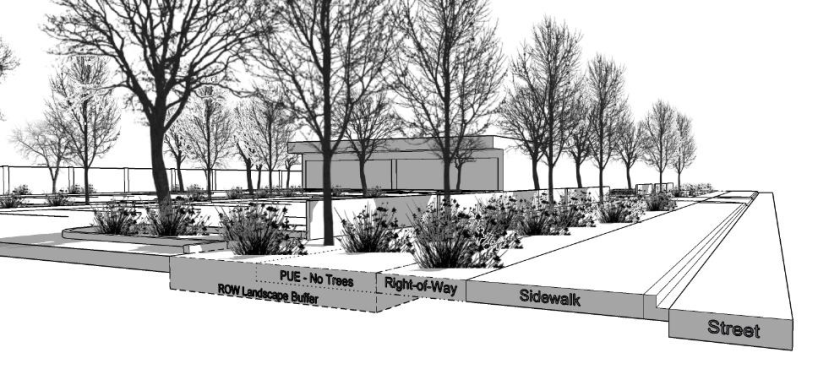
Figure 4.3. Use Buffer Landscaping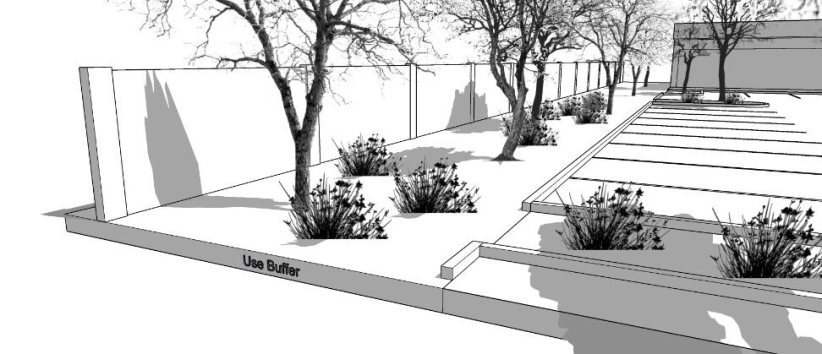
Figure 4.4. Parking Landscape Islands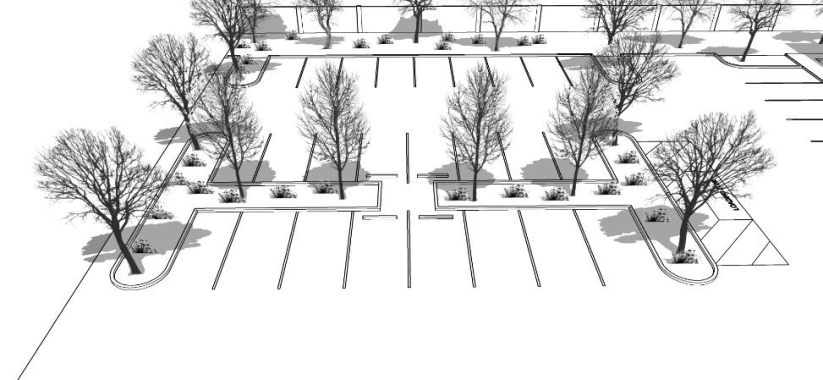
35.4.105 - Landscape Material Requirements.
A.
Plant materials must be included on the most recent edition of the Phoenix Active Management Area Low Water Using Plant List and shall be installed in accordance with the Arizona Nursery Association Container Grown Tree Guide, unless otherwise specified herein.
B.
With the exception of synthetic turf, no artificial plant materials may be used to satisfy the requirements of this Section.
C.
Table 4.100-5 Landscape Materials provides additional information regarding acceptable landscape palette materials.
35.4.106 - Urban Forestry.
A.
Findings. Trees provide a benefit to the community by assisting in the abatement of particulates and other air pollutants, enhancing the visual image of the community and abating noise pollution.
B.
Purpose. This article is intended to promote and protect the public health, safety and general welfare by providing guidelines for the protection, maintenance and management of tree resources within the City of Glendale.
C.
Administration. This article shall be administered by the deputy city manager of public works with the assistance and advice of the city's interdepartmental urban forestry committee.
D.
Applicability. This article provides authority for the maintenance of trees located within the rights-of-way, parks, and public places of the city, and trees located on private property which constitute a hazard or threat as described herein.
E.
Definitions. The following words, terms and phrases, when used in this article, shall have the meanings ascribed to them in this section, except where the context clearly indicates a different meaning:
Administrator: The deputy city manager for public works of the City of Glendale.
Committee: The City of Glendale interdepartmental urban forestry committee which shall be comprised of city staff members appointed by the city manager.
Drought Tolerant Plant: Any plant species with the ability to maintain its biomass (cellular tissue) production during arid or drought conditions; the ability of a plant to have low water requirements.
Palm Tree: Any plant species belonging to the Family Arecaceae.
Park trees: Trees in public parks, or areas to which the public has free access as a park, and all other areas owned by the city other than right-of-way.
Perennial Plant: Any plant species with a lifespan of two (2) years or greater.
Street trees: Trees on public lands lying within the rights-of-way of all streets, avenues, boulevards, roads or ways within the city.
Urban forestry plan: The City of Glendale community urban forestry plan adopted by the city council.
Waterwise: A practical landscaping practice by which plant selections are made for their arid and drought tolerant qualities.
Woody Plant: Any plant species that produces wood as its structural tissue and thus has a hard stem.
F.
Urban forestry plan. The committee shall develop and submit to the administrator an urban forestry plan. The administrator shall forward the urban forestry plan to the city council for review and adoption by resolution. The urban forestry plan shall not conflict, or be inconsistent, with other ordinances of the city and shall contain the following:
1.
International Society of Arboriculture specifications for street trees and park trees.
2.
The type and kind of trees which may be planted within city rights-of-way and parks.
3.
Requirements for the care, preservation, pruning, planting, replanting, removal or disposition of street trees and park trees.
4.
Guidelines for the location and spacing of street trees and park trees.
5.
A plan for fostering community support for the urban forestry plan and encourage good tree management on privately-owned property.
G.
Maintenance—Street trees and park trees. The city shall have the right to plant, prune, replace and maintain all street trees and park trees as may be necessary to ensure public safety or to preserve or enhance the symmetry and beauty of public grounds. The administrator may remove or order to be removed, on city-owned property, any tree or part thereof which is in an unsafe condition, or which is injurious to sewers, sidewalks, electric power lines, gas lines, water lines, or other public improvements, or is infected with any injurious insect, pest or disease.
H.
Planting, removing or cutting trees on public property.
1.
No person shall plant, remove, cut above the ground, or disturb any tree within any city right-of-way, park or other public place without first obtaining a permit from the administrator. The person obtaining the permit shall abide by the standards set forth in this article.
2.
All eligible live trees (regardless of type, condition, or age) that are impacted by any proposed construction/maintenance activities or development required improvements are covered under this section. A live tree is defined as a living growth form of any woody perennial plant, typically having a single stem or trunk growing to a considerable height and can bear lateral branches at some distance from the ground (several botanical plant families have species that fall into the category.)
3.
All live trees with any caliper diameter or trunk height shall be considered eligible trees. Tree trunk caliper diameters are measured at four and one-half (4.5) feet above the ground. Eligible trees will fall into one of five (5) categories according to the following size and replacement ratios:
a.
Unestablished Trees*—Are defined as trees with a caliper diameter of less than four (4) inches. Unestablished Trees shall be replaced on a 1:2 ratio.
b.
Mature Trees*—Are defined as trees with a caliper diameter of at least four (4) inches to less than 12-inches. Mature Trees shall be replaced on a 1:4 ratio.
c.
Legacy Trees*—Are defined as trees with a caliper diameter of 12-inches or greater. Legacy Trees shall be replaced on a 1:8 ratio.
d.
Immature Palm Trees—Are defined as having a trunk height measured from the base of the trunk to the base of the fronds of five (5) feet or less. Immature Palm Trees shall be replaced on a 1:3 ratio.
e.
Mature Palm Trees—Are defined as having a trunk height measured from the base of the trunk to the base of the fronds of greater than five (5) feet. Mature Palm Trees shall be replaced on a 1:6 ratio.
*These trees constitute non-palm tree species (the majority of trees along the City ROW.) Where an eligible tree has multiple trunks, only the largest caliper diameter (or tallest in the case of a palm tree) trunk will be considered.
4.
The minimum replacement size shall be a 24-inch box container tree and shall be replaced on-site depending on existing site conditions or relocated to a location designated by the City. If planted on-site, these trees shall conform to G-1008 of the 2015 Engineering Standard Details.
5.
Replaced trees selection should adhere to the "Tree Selection for City of Glendale ROW and Medians AND Tree Removal Policy Program". This "preferred" and "acceptable" tree list consists of twenty-nine (29) species that grow well and are easily maintained within the City ROW and are of a drought tolerant/waterwise nature and as such are characterized by low-water consumption.
6.
All surrounding irrigation lines and associated irrigation components; including other landscape features (such as shrubs, hardscape) that are impacted by the proposed development shall be restored by the impacting entity as required by the City and any associated costs shall be regarded as incidental to the project and adhere to current irrigation City standards.
7.
Inspection and Acceptance: ROW staff will need to be informed a minimum of three (3) weeks prior to any tree removal, disturbing any existing irrigation lines, or disturbing other landscape features. The trees to be removed shall be inspected by ROW staff and marked. Henceforth, only marked trees will be allowed to be removed. Replacement trees shall be provided to the City in hand prior to removal of marked trees marked for removal. Upon removing the marked trees, ROW staff shall be notified immediately to inspect the work site to ensure trees were removed properly and any disturbed irrigation lines are capped or restored etc.
I.
Posting of signs, letters, reflectors or other items. It shall be unlawful for any person to nail, or affix by stapling, gluing, or any other manner, any sign, letter, reflector, number or other item to, or on, any street tree or park tree within the city limits.
J.
Pruning of trees on private property. Every owner of any tree overhanging any street or right-of-way within the city shall prune the branches so that such tree shall not obstruct the view of any street intersection or interfere with persons utilizing the sidewalk or street. Said owners shall remove all dead, diseased or dangerous trees or broken or decaying limbs which the administrator determines constitutes a hazard or danger to the safety of the public. If the owner fails to remove such trees or limbs within the time period provided in the notice by the city, or if an immediate hazard exists by virtue of such tree or limbs, the city shall have the right, at the expense of the property owner, to prune or remove any tree or shrub upon private property when it interferes with the proper spread of light along the street from a street light, interferes with the visibility of any traffic control device or sign, or otherwise poses a threat to the public safety as determined by the administrator. The costs of pruning or removing such hazardous tree or limbs from the public property or right-of-way shall be assessed against the property owner and shall constitute a lien on the property until paid.
K.
Penalties. Any person found guilty of violating any provision of this article shall be guilty of a misdemeanor and, upon conviction, shall be punishable by a fine and/or imprisonment not to exceed the maximum set for class one misdemeanors by the Arizona Legislators in Title 13 of the Arizona Revised Statutes.
L.
Severability. If any section, subsection, sentence, clause, phrase or portion of this article or any part of the Code adopted herein by reference is for any reason held to be invalid or unconstitutional by the decision of any court of competent jurisdiction, such decision shall not affect the validity of the remaining portions thereof.
35.4.107 - Maintenance and City Acceptance.
A.
With respect to every lot, parcel, or tract of land within the City containing a use for which the provisions of this Section apply, every owner, lessee, homeowners' association, or any other person having the lawful right to possession and control of such premise shall:
1.
Maintain all landscape materials and landscaped areas in accordance with the approved landscape plan, including right-of-way landscaping unless otherwise stated herein. Such landscaped areas shall be kept free of trash, debris, weeds, and dead plant material, and shall in all respects be maintained in a neat and clean fashion.
2.
Replace all dead or removed plants with plants of the same variety, and in the size and quality as those removed.
B.
The City may accept responsibility for the maintenance and operation of all landscaping and appurtenances installed in accordance with requirements for reverse street frontage landscaping or any landscaping and appurtenances installed within street rights-of-way, including but not limited to the following categories:
1.
Arterial and/or secondary street rights-of-way adjacent to single-family residential areas that back onto the arterial and/or secondary street, and have a screening wall constructed on the rear property line.
2.
Arterial street rights-of-way adjacent to single-family residential areas that side onto the arterial street, and which have a screening wall constructed on the side property line.
3.
Bridle trails, bicycle paths and multi-use recreational facilities within City limits.
4.
Median islands on arterial and secondary public streets within the City.
5.
All alleys within City limits.
6.
Street rights-of-way abutting municipal public facilities.
7.
Street landscaping within districts specially approved or created by City Council.
8.
Flood control facilities which have been accepted for operation and maintenance by the City.
C.
Prior to the City accepting for maintenance any reverse street frontage landscaping or other street right-of-way landscaping described in the foregoing subparagraph (B), the following conditions shall have been satisfied:
1.
The landscaping shall be inspected and approved by the City for compliance with the approved landscape plan.
2.
The subsequent completion of a sixty-day maintenance period wherein the developer shall be responsible for all watering, weeding, and replacement of all dead or dying plant materials.
3.
A final inspection called by the developer or his representative at the completion of the sixty-day maintenance period resulting in final approval and acceptance by the City.
4.
The approved plat shall stipulate any accepted maintenance responsibilities.
D.
Obstructions and Vegetative Screening
1.
All landscaping materials near a driveway or street intersection shall be installed and maintained in accordance with the City's sight visibility triangle requirements. All landscaping materials in established parking areas shall be maintained to limit interference with vehicular and pedestrian circulation.
2.
All plant materials shall be planted so that at maturity the edge of the plant will be no closer than three (3) feet to any fire hydrant or fire suppression device.
3.
Protection of Landscaping from Vehicular Damage. Permanent barriers, such as curbing, shall be installed and properly secured to prevent the destruction of landscape materials by vehicles. All trees and shrubs shall be installed a minimum of two and one-half (2.5) feet from back of curb.
E.
Irrigation.
1.
All landscaped areas shall be supported by an automatic irrigation system. A backflow prevention device and protective cage shall be required as part of the irrigation systems. Irrigation systems shall be constructed and maintained to promote water conservation and shall prevent water overflow onto streets, sidewalks, or parking areas.
2.
A separate water meter shall be installed for landscape irrigation systems placed in the right-of-way. Meters shall be installed within the right-of-way and maintained by the City. For developments in which the property owner is required to maintain landscaping located within the right-of-way, the associated irrigation system shall be isolated from the on-site irrigation system.
F.
Parking landscape islands
1.
No shrubs within a landscape island of an off-site parking area shall be maintained to a height in excess of three (3) feet, and all trees within such planters shall maintain a minimum clearance of five (5) feet from the lowest branch to the adjacent grade elevation.
G.
Pruning of trees on private property.
1.
Every owner of any tree overhanging any street or right-of-way within the City shall prune the branches so that such tree shall not obstruct the view of any street intersection or interfere with persons utilizing the sidewalk or street or interfere with City of Glendale maintenance. Said owners shall remove all dead, diseased or dangerous trees or broken or decaying limbs which the administrator determines constitutes a hazard or danger to the safety of the public. All tree trimmings shall be disposed of properly, discarding trimmed branches onto the right-of-way is prohibited. If the owner fails to remove such trees or limbs within the time period provided in the notice by the City, or if an immediate hazard exists by virtue of such tree or limbs, the City shall be authorized, at the expense of the property owner, to prune or remove any tree or shrub upon private property when it interferes with the proper spread of light along the street from a street light, interferes with the visibility of any traffic control device or sign, or otherwise poses a threat to the public safety as determined by the City. The costs of pruning and removing such hazardous tree or limbs from the public property or right-of-way shall be assessed against the property owner and shall constitute a lien on the property until paid.
2.
Palm trees shall be properly and regularly maintained to help minimize pest populations and improve community appearance. Proper maintenance shall support the health of the tree and shall include the pruning and removal of dead palm fronds, seeds, and other similar debris.
H.
Planting, removing or cutting trees on public property.
1.
No person shall plant, remove, cut above the ground, or disturb any tree within any City right-of-way, park or other public place without first obtaining a permit from the City. The person obtaining the permit shall abide by the standards set forth in this Section.
2.
The City shall have the right to plant, prune, replace and maintain all street trees and park trees as may be necessary to ensure public safety or to preserve or enhance the symmetry and beauty of public grounds. The zoning administrator may remove or order to be removed, on City-owned property, any tree or part thereof which is in an unsafe condition or which is injurious to sewers, sidewalks, electric power lines, gas lines, water lines, or other public improvements, or is infected with any injurious insect, pest or disease.
35.4.108 - Exemptions.
Due to the unique circumstances often associated with certain development types, the following uses shall be exempt or subject to the reduced landscape requirements as described herein.
A.
Playground and sports facilities associated with schools or places of worship
B.
Wireless Communication Facilities shall be exempt from landscaping requirements for areas located within any ground-mounted equipment enclosure. An 8-foot-wide perimeter landscaping tract, maintained by the owner or authorized designee and located outside of the enclosure, shall be provided and shall include one (1) non-invasive shrub or cacti for every eight (8) linear feet of tract. Thorny shrubs and cacti shall not be placed adjacent to pedestrian areas and walkways.
C.
Public and Semi-Public Utilities shall be exempt from landscaping requirements for areas located within any equipment enclosure. An 8-foot-wide perimeter landscaping tract, maintained by the owner or authorized agent and located outside of the enclosure, shall be provided and shall include two (2) non-invasive shrubs or cacti for every eight (8) linear feet of tract. Thorny shrubs and cacti shall not be placed adjacent to pedestrian areas and walkways.
D.
Covered Parking Canopies are encouraged, therefore, when implemented the affected parking areas shall be exempt from parking area tree requirements for landscape islands and medians. Shrub and groundcover requirements shall remain in effect.
35.4.109 - Preliminary and Final Landscape Plans.
A.
General Requirements
1.
A landscape plan consisting of a preliminary plan and a final plan shall be prepared, submitted, and approved for all applicable development projects in accordance with the procedures and requirements set forth in this Section.
2.
All changes in landscape plans before, during, or after preliminary or final landscape plan approval shall be approved by the Development Services Director or designee prior to the installation of any such landscape change.
3.
All changes in the landscaping of a site before, during or after final landscape plan approval and landscape installation shall be approved by the Development Services Director or designee as set forth in this article and as specified within the Glendale Engineering Design & Construction Standards.
B.
Preliminary Landscape Plan
1.
A preliminary landscape plan shall be submitted along with the required development Site Plan for review. The preliminary landscape plan may be shown on the development Site Plan drawings. The preliminary landscape plan shall be a conceptual plan and shall include the following information in generalized form:
a.
The location and identification of all proposed landscape area (on-site, street right-of-way, parking area, use buffers, etc.)
b.
Preliminary data pertaining to the amount of gross and net site area, the ground floor areas of all proposed industrial buildings, the number of required and proposed parking spaces, and the amount of all required and proposed landscaped areas.
c.
The approximate location of all proposed trees, shrubs, and other landscape materials.
d.
Notes or graphical representations adequately showing the intent of the proposed plans and materials and indicating how those plans will comply with this Section.
e.
The location, height, type, and general design and finish of all proposed screening walls.
f.
The location of all proposed stormwater retention areas.
C.
Submittals shall be made in accordance with the development Design Review process guide and application checklist provided by the Development Services Department.
D.
The preliminary landscape plan shall be reviewed and approved by the Development Services Director or designee as part of the development Site Plan review and by the Transportation Director or designee for plantings within the right-of-way, and may be approved with stipulated changes or additions.
E.
Final Landscape Plan
1.
A final landscape plan shall be submitted along with all other required site improvement and building plans at the time of application for a building permit. The final landscape plan shall contain the final calculations, data, and specific details and information of all proposed landscaped areas, landscape materials, screening walls, irrigation system, and other items that were required and identified in conceptual form on the preliminary landscape plan. The final landscape plan shall contain a specific schedule of all trees and shrubs identified by common and botanical name, and shall clearly indicate the quantity and size of each tree and shrub to be installed.
2.
The final landscape plan shall be sealed by a registered Arizona Architect, Civil Engineer, or Landscape Architect, except for single residence lots or where specifically restricted herein.
3.
The final landscape plan shall be in conformance with the approved preliminary plan and any stipulated changes or additions and shall be approved by the Development Services Director or designee and the Transportation Director or designee for plantings within the right-of-way prior to the issuance of a building permit.
4.
The final landscape plan shall clearly stipulate maintenance responsibilities.
F.
Final Landscape Inspection
1.
All landscaping shall be subject to inspection to verify adherence to the approved Final Landscape Plan. It shall be the responsibility of the applicant or authorized designee to request a visual inspection and provide, in writing, certification that all landscape materials and irrigation have been accounted for and installed per plan. Such certification shall be sealed by an Arizona registered Landscape Architect, Architect, or Civil Engineer. Final approval and/or Certificate of Occupancy shall not be issued until all inspections have been completed and the project approved unless specifically authorized by the Development Services Director or designee.
2.
The city shall have the right to refuse to pass any project not meeting the provisions of this chapter. The city shall also have the right to reject landscape materials as being substandard as to size, condition or appearance including a pre-inspection of materials at the supplier if deemed necessary.
35.4.110 - Compliance and Enforcement.
A.
Installation, General.
1.
All landscape improvements (landscape materials, irrigation system, screening walls, et.) shall be installed by the developer on the site in accordance with the approved final landscape plan prior to the issuance of a certificate of occupancy for the building or use. When considered advisable, upon presentation of a cash bond, cash deposit, or assured letter of credit in an amount sufficient to guarantee installation of the landscaping and irrigation system, the director may approve a delay in the immediate installation of the required landscape improvements for a period of time not to exceed six (6) months. In those instances where the director approves a delay in the installation of the required landscape improvements, a temporary certificate of occupancy shall be issued for the building or use conditioned upon the satisfactory installation of the required landscape improvements within the time period approved by the director.
2.
For multi-phased developments, all required right-of-way and use buffer landscaping shall be installed during the first phase of development unless specifically exempted herein or by the Development Services Director or designee during the rezoning process. Phased landscaping for large projects, such as master planned communities, shall be reviewed and approved on a case-by-case basis due to the differences in phasing and associated infrastructure expansion.
B.
Enforcement, General.
1.
This chapter shall be enforced by the director or his duly authorized representative. The director shall have the authority to enter upon the premises, or any part thereof, at any and all reasonable times, for the purposes of performing his official duties. It is unlawful to refuse the director entry upon such premises. When any condition which would constitute a violation of the provisions of this ordinance comes to the director's attention, he shall cause a notice thereof to be served upon the owner, lessee or other person in control of the premises. The notice shall specify the nature of the violation and shall order the responsible party to correct the violation within thirty (30) days.
C.
Penalties
1.
Any person in control of any premises who fails to correct a violation of this chapter within thirty (30) days after notice thereof by the director shall be liable to the city for a civil fine in the amount of one thousand dollars ($1,000.00) for each and every day beyond such thirty-day period for which the violation remains uncorrected. The city attorney shall collect such fines by complaint filed in the city court pursuant to the procedures prescribed in the city charter.
35.4.201 - Intent.
The intent of this Section is to establish practical standards for screening between dissimilar uses and methods for screening these uses and associated activities from adjacent properties and the public in general. Proper screening methods help manage use compatibility and community stability, which in turn, will support increased property values and improve the overall health and safety of the City's residents.
35.4.202 - Applicability.
A.
When the following conditions are present, a permanent solid wall or gate shall be used to provide reasonable screening between dissimilar uses.
1.
Single or Multiple Residence uses adjacent, or separated only by an alley, from non-residential uses
2.
Single Residence uses adjacent, or separated only by an alley, from Multiple Residence uses
3.
Multiple Residence, Commercial, or Industrial uses when adjacent, or separated only by an alley, from residential development or a undeveloped parcel in a residential zoning district. No such screen wall shall be required for multiple-family residential contiguous with other multiple-residence development or a multiple-residence zoning district.
4.
Varying intensities of select non-residential uses located adjacent, or separated only by an alley, from each other (i.e. commercial retail adjacent to industrial uses)
B.
When the following conditions are present, a permanent solid wall or gate shall be used to provide reasonable screening of site features or elements.
1.
Off-street parking areas adjacent to public right-of-way
2.
Residential or non-residential side and rear yards which are visible from public rights-of-way
3.
On-site refuse and recycling containers
4.
Permitted outdoor storage
5.
Designated delivery and loading bays
6.
Ground and roof-mounted mechanical equipment
35.4.203 - Screening Exemptions.
A.
The following uses shall be exempt from perimeter screening requirements.
1.
Public elementary and secondary and similar private educational facilities
2.
Municipal and private parks and open space
35.4.204 - General Screening Requirements.
A.
Screening between dissimilar uses shall consist of a solid wall located on the shared property line(s) and outside of any sight visibility triangles unless otherwise stated herein.
B.
The preferred screening material shall be decorative masonry block; however, alternative materials may be considered through the Design Review process provided the proposed material is typically associated with, and intended for, wall construction. Materials shall be of high quality and integrated to the extent possible with the architectural theme of the development and/or surrounding area.
C.
To break up the lineal expanse of required screening, design elements such as a staggered centerline, pilasters, integrated planters, varying wall heights, the installation of extra plant materials, or varying the landscaped area contours shall be used.
D.
Walls exceeding six (6) feet in height, measured from the inside finished grade, shall require the submittal and approval of structural calculations prepared by a licensed structural engineer, unless specified otherwise in this Ordinance. Non-retaining concrete block walls shall adhere to the City adopted building codes.
E.
For the purpose of this Section, any wall retaining a minimum of eighteen (18) inches of earth or soil shall be considered a retaining wall and shall be subject to review by the City Engineer or authorized agent. Terraced walls shall be required when retaining needs exceed four (4) feet in height. Terraced walls shall be separated by an average of four (4) feet with no point being separated by less than two (2) feet. Terraces shall be landscaped with low-maintenance shrubs, cacti, and vegetative groundcovers. Terraced walls shall include weep holes for drainage and sleeves for irrigation.
F.
Where two (2) lots abut one another, but have differing finish grades, the wall height shall be limited to six (6) feet on the high side and eight (8) feet on the low side. Modifications of these requirements shall require written request and approval of the Development Services Department.
G.
In conditions where a proposed wall will be immediately adjacent to and/or adjoining an existing wall, one wall shall be removed or the proposed wall shall be designed and constructed to cap together the sides and top of both walls.
35.4.205 - Screening Requirements.
A.
Screening Required by Zoning District
1.
Residential development in the SR, R-1, R-2, R-3, R-4 and R-5 districts must provide a wall with a minimum height of six (6) feet along abutting property lines. Residential development in the A-1 and RR districts may require a wall based on determination by the Development Services Department.
2.
Property in C-1, C-2, C-3, B-P, M-1, or M-2 districts which abuts any residential use must provide a wall with a minimum height of eight (8) feet along the abutting property line.
3.
Property in R-O, C-O, or G-O districts, or of any nonresidential use in any residential district which abuts any residential district, must provide a wall with a minimum height of six (6) feet along the abutting property line.
4.
Property in the R-2, R-3, R-4, or R-5 districts which abut any A-1, RR, SR, or R-1 districts must provide a wall with a minimum height of six (6) feet along the abutting property line.
5.
When abutting an arterial street, property in the A-1, SR, RR, or R-1 districts shall provide a wall with a minimum height of eight (8) feet.
B.
Screening Required for Select Uses
1.
Parking Area Screens. All off-street parking areas adjacent to any street shall be screened from street views according to the provisions as set forth below. This standard can be met through the use of the following screening methods, which may be used individually or in combination:
a.
See regulation 35.4.103.E.
b.
Walls shall be designed to undulate and avoid straight segments longer than one hundred (100) feet
c.
Open areas or portals for natural surveillance and pedestrian access to the site shall be provided as required by the Development Services Department.
2.
Refuse Area Screens. All trash, rubbish or garbage, including recyclable materials in common storage areas, shall be completely enclosed via a solid six (6) foot wall and view obstructing gate and located on a concrete surface. Refuse collection areas shall be readily accessible to collection vehicles, without substantially encumbering adjacent parking and vehicular access. For multi-family dwellings, the enclosure shall be softened with landscaping on any side visible from a public or private street.
3.
Loading Area Screens. All non-passenger loading, delivery and service bays shall be screened from public view by a building, a decorative screen wall a minimum eight (8) feet in height, a solid opaque evergreen landscape screen or any combination thereof.
4.
Mechanical Equipment Screens. All mechanical equipment, either ground-mounted or located on a rooftop, shall be screened from the view of a person standing on the property line on the far side of an adjacent public street. Individual screening of rooftop mechanical equipment is discouraged. Rooftop units should either be grouped together and screened or screened with a parapet wall the entire length of the building. Such a parapet wall shall be designed to be integral to the overall architecture of the building.
Figure 4.5. Non-Residential Parking Screen Wall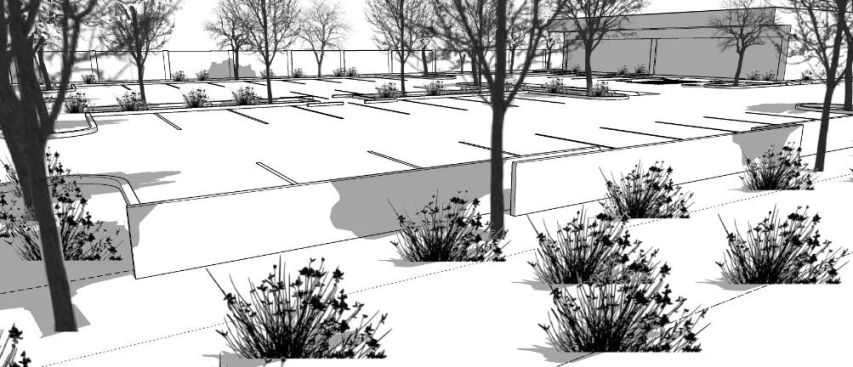
Figure 4.6. Sample Wall Sections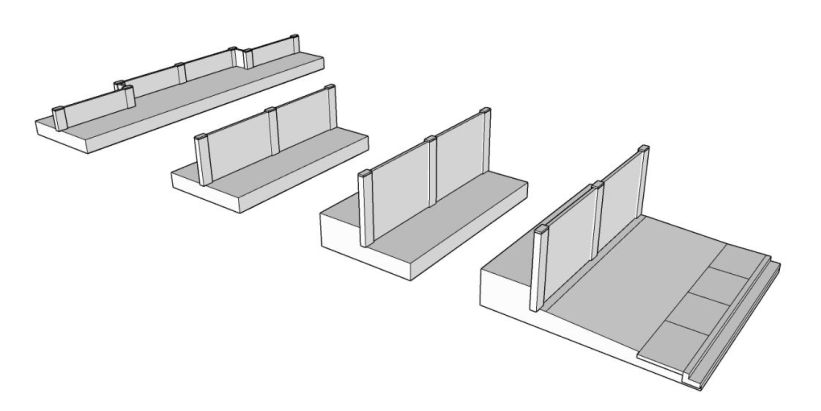
Figure 4.7. Wall Scenarios—Even Lots, Uneven Lots, Lot at Higher Elevation than Street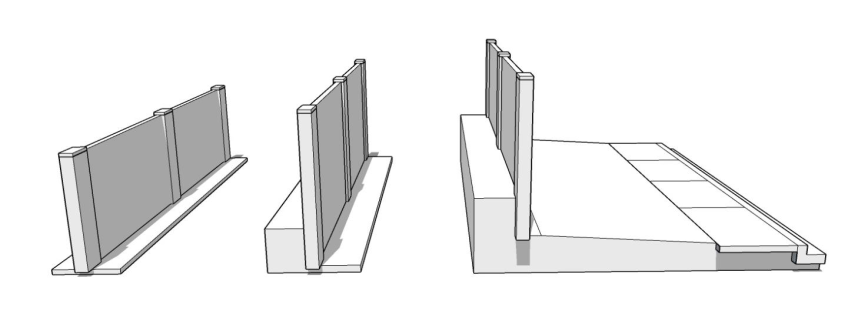
35.4.206 - Wall Placement and Height Limitations.
A.
No fence or wall shall be built, repaired, remodeled or replaced within thirty (30) feet (for arterial to arterial intersections the distance shall be forty (40) feet) of the corner of any lot, which corner is at the point of intersection of two (2) or more streets and which prevents a clear view by the operators of vehicles on the streets of traffic proceeding on the crossing street or streets. Within the area above defined, no fence which obstructs more than ten percent (10%) of the view shall be built, repaired, remodeled or replaced to a height of more than thirty (30) inches from the level of the adjacent street.
B.
No fence or wall shall be built, repaired, remodeled or replaced within ten (10) feet of any driveway within the City which obstructs the clear view of the operators of vehicles proceeding out of the driveway of pedestrians and vehicles on the adjacent sidewalk or street or roadway right-of-way. Within the area above defined, no fence which obstructs more than twenty-five percent (25%) of the view shall be built, repaired, remodeled or replaced to a height of more than thirty (30) inches from the level of the adjacent street.
C.
No fence or wall within the side or rear yard in all zoning districts shall exceed a height of six (6) feet unless otherwise stated herein.
D.
No fence or wall within the front yard in all zoning districts shall exceed a height of three (3) feet. Decorative columns may be permitted at a height of four (4) feet and spaced no closer than six (6) feet on-center. Arched or framed entries are permitted provided they do not exceed seven (7) feet in height and are limited to one (1) per property.
1.
The following uses are exempt from the three (3) foot height restriction for walls within the front yard, as set forth in this Section.
a.
Woven wire field fence shall have a maximum height of five (5) feet for residential uses in the A-1and RR Districts.
b.
Agriculture uses regardless of zoning district
c.
Temporary construction sites and yards
d.
Elementary and secondary schools
E.
Fences or walls within the front yard shall be located outside the public right-of-way or public utility easements. Where neither exist, no wall shall interfere any utility meter. Crossings of utilities should be minimized provided that required maintenance or service could result in removal to all or a portion of the wall with no requirement for the utility owner to restore the wall to its original condition.
35.4.207 - Maintenance.
A.
Every fence or wall shall be maintained in a condition of reasonable repair. Any fence or wall which has become unsightly or dangerous to the public safety, health or welfare shall be deemed a public nuisance and accordingly, the City shall commence proceedings for abatement. Any wall, or a portion thereof, that has been removed or damaged by any means, shall be restored to its original or improved condition.
35.4.208 - Special Provisions.
A.
Barbed-wire and Electrical Fences
1.
Barbed wire fences shall be prohibited in all zoning districts except in the C-3, B-P, M-1, M-2, A-1, RR, or SR Districts and for temporary construction sites, provided that the barbed wire is located six (6) feet or more above grade. Temporary barbed wire fencing located on construction sites shall be removed from the site at the time of final inspection, or a certificate of occupancy will not be issued.
2.
No fence with strands of barbed-wire below the height of six (6) feet shall be constructed, or allowed to remain if heretofore constructed, within ten (10) feet of a street, sidewalk or roadway right-of-way in the City.
3.
No electrical charged fence, other than one which is approved by the Underwriter's Laboratory (UL®) and unmodified, or other fence which is, or may be, dangerous to persons, children or animals shall be constructed, or allowed to remain if heretofore constructed, in the City.
a.
Electrical fences shall not be located within required street side setbacks.
b.
The electrical charge produced by the fence upon contact shall not exceed energizer characteristics set forth in the International Electrotechnical Commission (IEC) Standard.
c.
The energy source for electrical fences must be provided by a storage battery no greater than 12 volts DC.
d.
Electrical fences shall be clearly identified with warning signs that read "Warning—Electrical Fence" at intervals no less than thirty (30) feet. Signs shall also contain proper imagery, symbols, and/or the international sign for electricity that allow all individuals to understand that the fence is electrically charged.
e.
Electrical fences shall contain an approved access and key switch capable of disconnecting the electrical fence from all power sources. Such access and switch shall be clearly marked and accessible for emergency and enforcement personnel.
f.
The installation of electrical fences is subject to the issuance and approval of building permit obtained through the Development Services Department.
B.
Sound Walls
1.
Sound walls shall be required for developments abutting arterial roads, railroad corridors, and freeways. Such walls shall adhere to the City's standard detail for sound or noise attenuation walls, which at a minimum prescribes a wall that measures six (6) feet in height and at least six (6) inches thick. A noise study shall be conducted to verify attenuation needs and the wall(s) shall be designed and constructed accordingly.
C.
Temporary Fencing
1.
Temporary fencing as defined in Article 8 shall be permitted only with the issuance of a temporary fence permit, except for those sites for which an approved building permit, civil permit, special event permit or City-initiated abatement is active from the Development Services Department.
2.
A temporary fence permit issued pursuant to this article shall be valid for a period of either:
a.
One hundred eighty (180) days from the date of issuance in accordance with currently adopted building codes; or
b.
From the date of issuance to a date specified in the permit by the City.
3.
Temporary fences shall be removed prior to permit expiration, unless the permit is extended to a specified time by the Development Services Director or designee. Applications for temporary fence permit time extensions must demonstrate one or more of the following conditions:
a.
Additional time is necessary because of ongoing environmental remediation activities on the site, or
b.
Existing safety hazards on the site are being addressed and warrant continued fencing of the site, or
c.
The site is being actively developed as demonstrated through recent inspection reports, or
d.
Additional time is necessary because of other extenuating circumstances as determined by the Development Services Director or designee.
4.
Temporary fencing shall conform to the following criteria:
a.
The approved permit and contact information for the responsible party shall be prominently posted and maintained on the fence at all times.
b.
A sign denoting the location of emergency vehicle access shall be prominently posted and maintained on the fence at all times.
c.
Temporary fencing shall not exceed a maximum height of eight (8) feet above grade.
d.
Temporary fencing shall conform to the sight visibility at street intersection requirements as set forth in the Zoning Ordinance and Section 30-70 of the City Code.
e.
The use of barbed wire, razor wire or equivalent fence topping is prohibited.
f.
Canvas, mesh fabric or other screening material may be required as a condition of approval in instances of visual blight, or in the likelihood that visual blight may develop when viewed from public right-of-way, as determined by the Development Services Director or designee.
g.
Temporary fencing screening material may consist of canvas, mesh fabric, or other similar material, subject to the following conditions:
i.
Screening material must be securely affixed to the temporary fence at all times, must be uniform in color and material and must be maintained in a condition free from rips or tears, graffiti or other vandalism.
ii.
When associated with an approved building permit, civil permit, or special event permit, screening material may include graphics depicting project elevations and information, or contact information for developers, contractors, or individuals associated with the permit activity. Such graphics must be associated with activity occurring at the property for which the temporary fencing or building permit is issued and may not include off-site advertisements or signage.
5.
Failure to comply with the conditions, stipulations, or terms of the approval of a temporary fence permit is a violation of this ordinance and will be enforced as such.
35.4.209 - Wall Waivers.
A.
Where unique topographical conditions exist, a property owner or authorized agent may request a waiver from the wall requirements found in this Section. Waivers are to be granted by the Development Services Director or designee if the applicant for the waiver has demonstrated the challenges with the subject property and how such a waiver would not be detrimental to present or future surrounding property owners. The applicant shall submit a detailed wall plan, with topography, and a narrative for review by the City. Approval may be granted upon finding that the issue is not a result of the property owner's actions, that the approval will not be detrimental to surrounding property owners, and the City Engineer supports the waiver request.
B.
Applicants who have received a waiver denial may submit an application for a Variance in accordance with Section 35.6.209 of the Unified Development Code.
35.4.301 - Intent.
The purpose of this Section is to promote a variety of messaging opportunities in a manner that does not diminish the City's visual well-being or result in an abundance of visual clutter. The regulations provided in this Section are intended to achieve the following community objectives:
A.
Economic Development. Allow adequate signage for business identification.
B.
Public Safety. Protect pedestrians and motorists from injury and property damage resulting from improperly constructed or poorly maintained signs.
C.
General Aesthetics. Promote the use of signs which are well designed, of appropriate scale, and integrated with surrounding buildings, landscape, scenic corridors, and public spaces.
D.
Context Appropriateness. Promote context-specific signage for defined areas where unique sign allowances and/or restrictions would be appropriate.
E.
Protect Residential Areas. Establish sign standards that minimize impacts such as light intrusion and visual blight on residential communities.
F.
Enforcement. Provide fair and consistent enforcement of the sign regulations contained herein and ensure compliance with local, county, state, and federal law.
35.4.302 - Applicability.
All signs erected, installed, or modified after the effective date of this Ordinance, shall conform to the regulations within this Section. Instances where an approved Planned Area Development (PAD), Zoning Overlay, or stipulation prescribes unique sign criteria not contained within this Section, such criteria shall remain in effect. However, where such criteria refers to standards that are not 'content neutral', that is, sign allowances based on sign content, such criteria shall be considered null and void. Similarly, references made to Section 35.4.300 Signage, in its entirety or in part, in lieu of establishing unique sign criteria for the subject PAD, Zoning Overlay, or stipulation, shall be considered null and void.
The regulations, requirements, and provisions set forth in this Section shall apply to all signs erected, placed, modified, or constructed within the City. While signs may be generally categorized into commercial and non-commercial speech, it is not the intent of this Section to regulate signs based on content or content based on sign type; exclusions for vulgarity and decency may apply.
35.4.303 - Non-Conforming Signs.
For the purposes of this Article, signs which are not in conformance with this Section shall be deemed non-conforming. Existing signs which were permitted and constructed prior to the adoption of the current Sign Code but have fallen out of conformance due to changes to the sign Code, are deemed legal non-conforming. Non-conforming signs that have not been deemed legal non-conforming, shall be brought into compliance with this Sign Code.
A.
Non-conforming signs shall not be enlarged, altered or modified in a way that increases its non-conformity, unless such change is a reasonable alteration, repair, or maintenance as determined by the Zoning Administrator.
B.
Reasonable repairs and maintenance, including LED conversions and retrofitting but not conversions from static signs to electronic reader panels, may be performed on legal non-conforming signs without requiring said sign to be brought into compliance with this Section; however, legal non-conforming signs shall be removed or brought into compliance when the sign has been:
1.
damaged to where the repair cost exceeds fifty percent (50%) of the reproduction cost; or
2.
destroyed beyond repair; or
3.
relocated on the property or building; or
4.
abandoned or otherwise unused for a period of one hundred eighty (180) days or more (the Development Services Director or designee may extend this period for properties subject to foreclosure, bankruptcy, probate and/or judicial action); or
5.
altered in terms of color, size, shape, or orientation on the property (excluding changes to sign content or replaceable message panels).
C.
Legal non-conforming signs requiring temporary removal during site or building construction, which has not been initiated by the sign owner, may be replaced without being brought into compliance with this Section.
D.
Vintage Signs. The restoration and retention of legal non-conforming and historically significant signs that have been removed from their original locations and are to be reused is encouraged. Allowing those signs to move to other locations within the community is necessary to ensure preservation. Once recognized as a vintage sign, the sign is deemed conforming.
1.
Recognition Criteria. The Development Services Director or designee, may recognize an existing sign as a vintage sign if it meets the following criteria:
a.
The sign shall be at least twenty (20) years old.
b.
The sign shall meet three (3) or more of the following:
i.
The sign exhibits unique or rare characteristics that will enhance the streetscape or identity of a neighborhood in which it will be placed.
ii.
The sign contributes to the historic or cultural identity of the community.
iii.
The sign represents a remarkable example of the sign maker's art due to craftsmanship, use of materials, or design.
iv.
Retains its original design character, or that character will be reestablished or restored, based on historic evidence such as drawings or photographs.
v.
The sign complies with, or can be discretely modified to comply with, the applicable provisions of the City of Glendale building codes. Permitting requirements shall apply.
vi.
The sign is structurally safe or is capable of being made so without substantially altering its appearance.
vii.
Relocation. When a Vintage Sign is being relocated off-premise, such sign be relocated a location within the City of Glendale. The receiving site shall be located within a non-residential zoning district.
35.4.304 - Exemptions.
The following signs shall be considered permitted by right and shall not require City review, permitting, or other authorization to post or install unless specifically excepted herein.
A.
Traffic control and street identification signs, barricades, utility signs, or other similar signs erected or maintained by a governmental entity, utility provider, or railroad shall be exempt from this Article.
B.
Signs not visible or not intended to be legible beyond the boundaries of the property upon which they are located shall be exempt from the provisions of this Article, except those public safety provisions contained in Section 35.4.306(I).
C.
Signs or monuments protected by state or federal statute.
D.
Government Signs, including, but not limited to the following:
1.
Public emergency, hazard, or legally mandated warning signs. Where a federal, state or local law requires a property owner to post a sign on the owner's property to warn of a danger or to prohibit access to the property either generally or specifically, the owner must comply with the federal, state or local law to exercise that authority by posting a sign on the property.
E.
Federal, state, or municipal flags may be displayed to serve a compelling governmental interest.
F.
Traffic control and road identification signs.
G.
Official public notices as required by any public or court officer to satisfy official duties or responsibilities. All such signs shall be removed by the property owner within fourteen (14) days after their purpose has been met.
H.
Address Identification Numbers.
I.
Grave markers, headstones, or similar monuments.
J.
Private Holiday and Seasonal Decorations. Decorations shall be displayed for a maximum of thirty (30) days prior to and thirty (30) days following the event or holiday. All decorations shall be maintained in good condition and shall not be displayed in a manner that could result in a hazard to pedestrians or vehicular traffic.
K.
Interior signs not intended to be viewed from outside a building or enclosure.
L.
Memorials, public monuments, or historical identification signs installed in accordance with all applicable regulations.
M.
Public Art, specifically publicly commissioned sculptures, murals, or other art forms, which contain no advertising, commercial messages, or logos; and/or that are not displayed in conjunction with a commercial enterprise which may obtain commercial gain from the display.
N.
Signs associated with local vending, kiosks, ATMs, accepted credit cards, or similar uses.
O.
Signs for public and quasi-public uses including, but not limited to, public parks and recreation facilities, libraries, government buildings, public utility facilities, hospital emergency rooms, and other similar uses.
35.4.305 - Prohibited Sign Types.
The following signs shall be prohibited unless specifically identified as permissible elsewhere in this Article or in an approved Planned Area Development, Temporary Use/Special Event Permit, Comprehensive Sign Program, or Council-approved stipulation:
A.
Signs located within, on, or projecting over any public street, right-of-way, or other public property, except where specifically permitted in this Article.
B.
Signs emitting sound. This shall not apply to signs associated with drive-through or drive-up services.
C.
Signs with flashing illumination such as strobe or rotating lights and sequenced or similar animated lighting, except Digital Billboard Signs and Electronic Reader Signs where hold or cycle times have been established.
D.
Signs mounted, attached, or painted on trailers, boats, or motor vehicles when parked, stored, or displayed in a manner intended to attract the attention of the public.
E.
Pennants, banners, balloons, flags, and similar displays except as provided in Section 35.4.312 and Section 35.4.313.
F.
Temporary signs except as permitted in Section 35.4.312 and Section 35.4.313.
G.
Billboard Signs and Digital Billboard Signs are prohibited on property located within the Loop 101 Scenic Corridor.
City of Glendale Loop 101 Scenic Corridor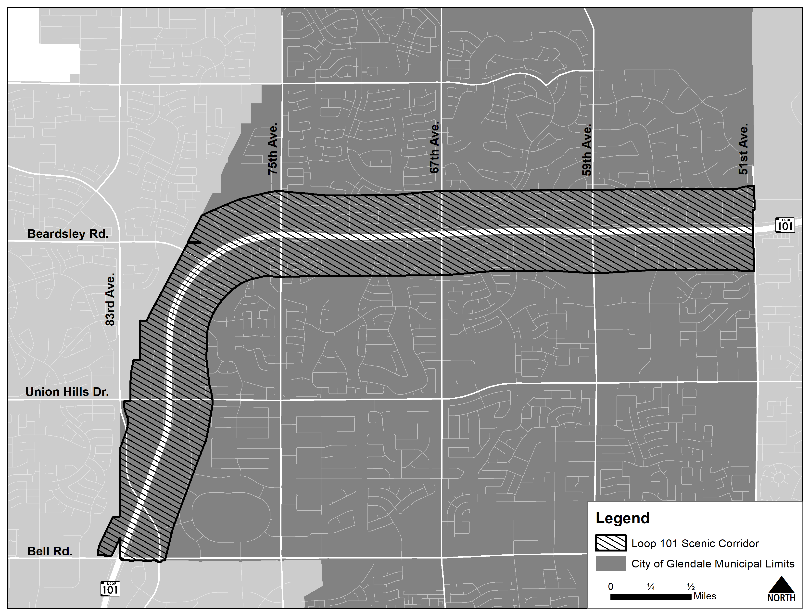
35.4.306 - General Provisions for all Signs.
The following general provisions for signs shall apply to this Section and to all lawful conforming and non-conforming signs, unless otherwise indicated in this Section.
A.
Content Neutrality.
1.
No sign or sign structure shall be regulated solely based upon its content or viewpoint contained on such sign.
2.
It shall be the policy of the City to regulate signs in a manner that does not favor commercial speech over non-commercial speech and shall not regulate protected non-commercial speech.
3.
In this Section, any distinction made between onsite and offsite signs shall apply only to commercial messages.
B.
Administrative Interpretation and Discretionary Approval.
1.
Interpretations of this Section shall be performed in a manner that is consistent with the intent set forth herein.
C.
Whenever a sign permit or other approval is subject to discretion, such discretion shall be limited to structural, size, and location factors, including:
1.
Location and placement of the sign for motorist or pedestrian safety;
2.
Preservation of historical or architecturally significance structures and buildings;
3.
Minimization of obscured views of adjacent buildings and site elements;
4.
Protection against negative visual impacts on public open spaces, facilities, and plazas;
D.
Consent of Property Owner or Agent. Except as required by state law, no sign may be displayed without the consent of the legal owner or authorized agent of the property on which the sign is mounted or displayed.
E.
Applicable Building Codes. All signs shall be structurally designed, constructed, erected, and maintained in accordance with all applicable provisions and requirements of the City of Glendale Building Codes.
F.
Materials. Exterior signs shall be constructed of durable materials designed to withstand the extreme desert heat and exposure to direct sunlight. Signs shall be kept free of rust, distortion, warping, peeling, fading, or other similar defects.
G.
Signs Located on Public Property, Including Rights-of-Way. Except as required by state law or otherwise permitted by this Section, signs installed or placed on public property shall be deemed illegal and shall be subject to confiscation. The City shall maintain the right to recover from the property or sign owner any costs associated with sign removal and disposal. All signs placed within the right-of-way shall be approved by the Transportation Department.
H.
General Maintenance. All signs and sign structures, conforming and legally non-conforming, shall be maintained in good order, repair, and appearance at all times so as not to constitute a danger or hazard to the public safety or contribute to visual blight. If the Development Services Director or designee, determines any sign or sign structure to be in an unsafe or unsightly condition, the owner of such sign shall be immediately notified in writing and instructed to correct such condition within sixty (60) days. If the correction has not been made within sixty (60) days, the Development Services Director or designee may have the sign removed if it creates a danger to the public safety or welfare, or have any necessary repairs or maintenance performed at the expense of the sign owner, or owner or lessee of the property upon which the sign is located.
I.
Hazardous Signs and Public Safety. Hazardous conditions caused by signs shall be mitigated within forty-eight (48) hours. Mitigation measures include, but may not be limited to barricading, disconnection of electricity, bracing, removal, or repair. If the mitigation has not been made within forty-eight (48) hours, the Development Services Director or designee may order the sign removed if it creates an immediate danger to the public safety or welfare, or have any necessary repairs or maintenance performed at the expense of the sign owner, or owner or lessee of the property upon which the sign is located.
J.
Placement of Signs.
1.
Permanent Signs shall not encroach into any public right-of-way without proper authorization and permitting by the City;
2.
No portion of any sign shall extend below eight (8) feet above finished grade when installed above a sidewalk or similar pedestrian way.
3.
No portion of any sign shall extend below fourteen (14) feet above finished grade when installed above a driveway, drive aisle, or similar vehicular accessway.
4.
Any sign placed on a sidewalk or in a public right-of-way shall not impede pedestrian access and shall comply with the minimum access width requirements as prescribed by the Americans with Disability Act (ADA) and if placed on a post, the bottom of the sign shall be no less than seven (7) feet above the ground plane.
5.
Only permitted traffic control signage may be placed in the sight visibility triangle.
6.
Signs shall not interfere with utilities or drainage facilities.
K.
Replacement of a sign panel of the same size, and style as the originally approved sign structure with removable panels shall not require a permit. Unused signs cabinets shall be removed or made blank within thirty (30) days of tenant suite vacancy.
L.
Where a tenant has vacated a suite and a wall-mounted sign or signs have been removed, the fascia shall be repaired to its surrounding texture and color within thirty (30) days of the sign being removed.
M.
Bus Shelter Signage. Notwithstanding the provisions of this Section, signs in conjunction with bus shelter facilities approved by the City or other governmental agencies shall be permitted.
N.
Signs may be illuminated or non-illuminated, unless otherwise restricted in this Section or applicable condition of approval. The source of the sign's illumination shall not be visible from any street, sidewalk, or adjacent property. The use of shielded or exposed neon (or similar gas) lighting shall be subject to Section 35.4.400.
35.4.307 - Sign Calculations and Measurements.
A.
Sign area calculations shall be as follows:
1.
Sign copy mounted or painted on a background panel or area distinctively painted, textured, or constructed as a background for the sign copy shall be measured as that area contained within the sum of the smallest rectangles that will enclose both the sign copy and the background.
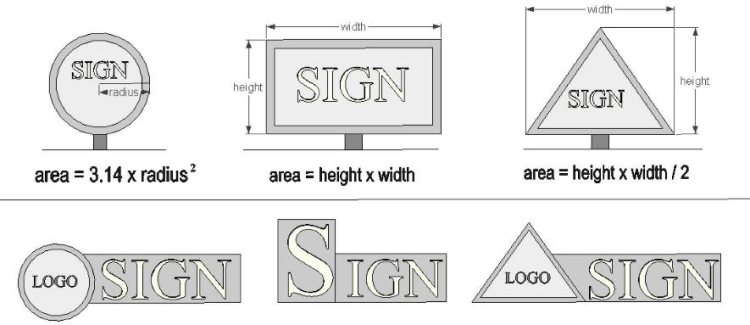
2.
Sign copy mounted as individual letters or graphics against a wall, fascia, mansard, or parapet of a building or other structure that has not been painted, textured, or otherwise altered to provide a distinctive background for the sign copy shall be measured as a sum of the smallest standard geometric shape that will enclose each word and each graphic in the total sign.
3.
The area of window signs shall include the window area as a continuous surface until divided by an architectural or structural element, excluding mullions. Window signage area is calculated in the same manner as described in Section 35.4.307(A) above.
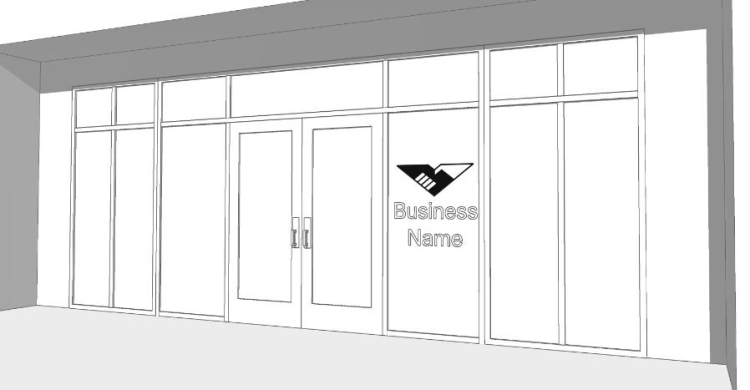
4.
Perforated window graphics/window clings, that is, those elements which serve as an exterior window sign while still allowing visibility through the window shall be counted as a window sign.
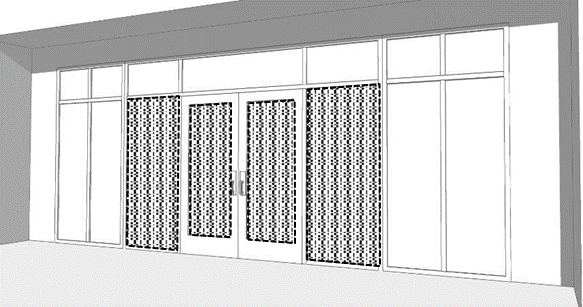
B.
Measurement of Sign Height
1.
Sign height is measured from the base of the sign at the ground to the highest point of the sign or surrounding structure/architectural element. Where a sign is installed in a location where its contact with the ground is below the surface of a public sidewalk in conjunction with a public right-of-way, the sign height may be taken from the top of sidewalk.
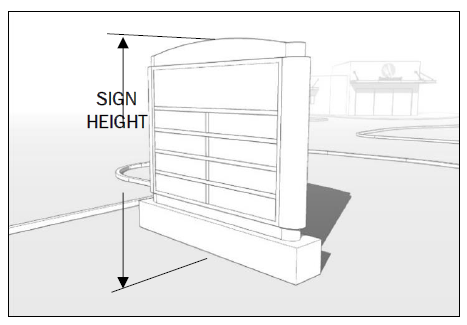
C.
Measurement of Vertical Clearance
1.
Where prescribed in this Section, the vertical clearance is measured as the vertical distance measured from the ground directly below the sign to the lowest point of the sign or surrounding structure/architectural elements associated with the sign.
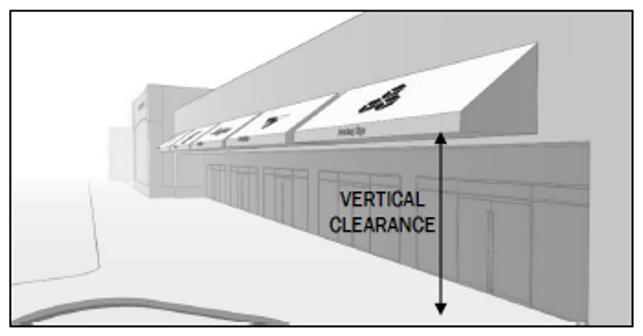
D.
Multi-face signs shall be measured as follows:
1.
Two (2) face signs: If the interior angle between the two (2) sign faces is sixty (60) degrees or less, the area shall be of one (1) face only. If the angle between the two (2) sign faces is greater than sixty (60) degrees, the sign area will be the sum of the areas of the two (2) faces.
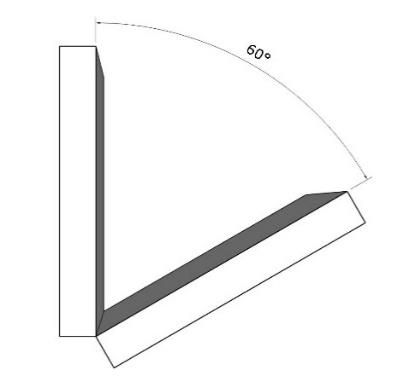
2.
Three (3) face signs: If the interior angle between the center sign and each outer sign is one hundred fifty (150) degrees or less, the area shall be fifty percent (50%) of the sum of the areas of all faces. If the angle between the center sign and either outer sign is greater than one hundred fifty (150) degrees, the sign area shall be the sum of the areas of all faces.
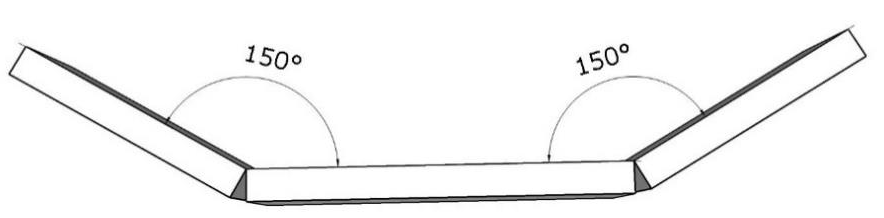
3.
Signs comprised of more than three (3) faces: Sign area shall be calculated as the total of all sign faces.
4.
Free-form and other non-planar signs. The area of a spherical, free-form or other non-planar sign is fifty percent (50%) of the sum of the areas, using only the four (4) vertical sides of the smallest four-sided polyhedron which will completely enclose the entire sign structure.
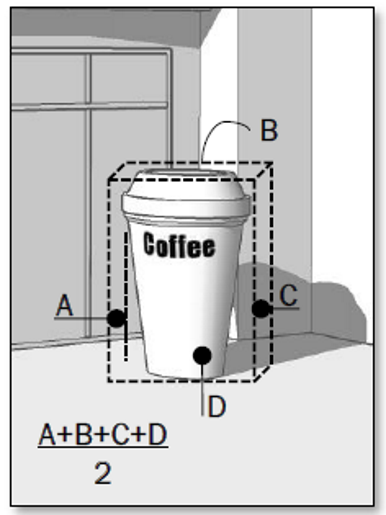
35.4.308 - Permitting and Fees.
All required permits shall be obtained prior to erecting, placing, constructing, altering, or changing the copy on any sign within the City except as specifically identified in this Section.
A.
It shall be unlawful for any person to erect, place, construct, alter, or maintain any sign, except those exempt signs listed in herein, when all required permits have not been issued for that sign.
B.
The permit fees shall be in the amount established by City Council resolution or pursuant to Glendale City Code section 2-3.
C.
Applications for all required permits must be made in writing on forms provided by the Development Services Department. Information including, but not limited to the following will be required:
1.
Address of the property.
2.
Business name.
3.
Business owner's contact information.
4.
Sign contractor's contact information.
5.
Glendale sales tax number and contractor's license number.
6.
Valuation of the sign(s).
7.
Inventory of all existing signs on the property showing the type, dimensions, and location of each sign.
8.
Dimensioned plans and elevations showing the dimensions, design copy, and location of each proposed sign.
9.
Plans indicating the scope and structural detail of the work to be done; including details of all connections, supports, footings, and materials to be used.
10.
Required information for an electrical permit for all electric signs.
11.
Color, material, and letter samples when the sign is subject to design review.
35.4.309 - Permitted Signs by Use.
35.4.310 - Site Signs.
This Section is comprised of permitted Site Signs and their respective regulations. Signs not appearing in this Section shall be considered prohibited.
A.
Billboards, Static
1.
Permit required.
2.
Static billboards shall be prohibited in the designated Loop 101 Scenic Corridor.
a.
No static billboard shall be erected within six hundred sixty (660) feet of the planned or existing freeway, expressway, parkway, right-of-way, or planned corridor, as officially designated by the Arizona Department of Transportation or the City of Glendale.
3.
No new static billboards may be constructed within the city unless the person desiring to construct such a static billboard submits evidence to the City that the person has removed an existing static billboard from within the municipal limits of the City of Glendale. If evidence is submitted that a static billboard has been removed after the effective date of this ordinance, the City shall issue building and sign permits for one (1) new static billboard not to exceed the area of the sign which was removed or three hundred (300) square feet, whichever is less. However, if a person submits evidence that in excess of three hundred (300) square feet of static billboard area has been removed, by the removal of four (4) or more static billboards with an area of seventy-five (75) square feet or less, the City shall issue building permits for one (1) new static billboard with a maximum area of three hundred (300) square feet. Any new static billboard shall be erected, constructed, or placed within six (6) months after removal of the static billboard(s) it is replacing.
4.
All static billboards erected, placed, or altered within the city shall comply with the following requirements:
a.
The space between the newly erected, placed, constructed, or altered static billboard and any existing static billboard shall not be less than six hundred (600) feet.
b.
All static billboards shall have landscaping around the base at a rate of fifteen (15) square feet per linear foot of sign.
c.
Off-site improvements or appropriate financial assurance as approved by the City shall be required along any abutting street for the full frontage of the property where the static billboard is to be located.
d.
No part of such sign structures shall be erected closer to a street than the front line of the nearest building which is within one hundred (100) feet of the sign and which fronts on that street; provided, however, that when a sign is erected between two (2) buildings which both front on the same street and which are both within one hundred (100) feet of the sign, then the sign shall not be erected closer to that street than a line drawn from the nearest front corner of each building.
e.
If no building is located within one hundred (100) feet of the static billboard, the sign structure shall be set back in accordance with the setback requirements of the zoning district in which located, but shall not be less than ten (10) feet behind a front property line.
f.
Notwithstanding any other provision in this section, no static billboards shall be erected, placed, constructed, or altered within the city which have an area exceeding three hundred (300) square feet or a height exceeding twenty-five (25) feet.
g.
The static billboard's structure, not including the sign copy, shall be compatible with the color, reflectivity, and other qualities of its surrounding environment.
h.
No static billboard shall have more than one (1) support column.
i.
Access ladders to maintenance platforms shall be constructed or maintained in such a position as not to project beyond a visual envelope established by structural elements or projections of the sign face and trim to the ground as viewed from a place parallel to the face of the sign.
j.
Other than support columns, maintenance walkways, embellishments, ends, cross bracings, tops or bottoms, parallel or V-shaped signs, no back braces, torque arms, stringers, panel attachments, or similar structural elements or accessories shall be exposed. If such elements or accessories are not covered by a sign face, screening of such elements or accessories shall be colored similarly to the remaining portions of the sign back.
B.
Billboards, Digital (Electronic)
1.
Permit required.
2.
Digital billboards shall be prohibited in the designated Loop 101 Scenic Corridor.
3.
Placing a digital billboard sign requires that the zoning of the lot on which the digital billboard sign is located must be Planned Area Development (PAD).
4.
All digital billboards erected, placed, or altered within the city shall comply with the following requirements:
a.
Placing a digital billboard sign requires the approved Planned Area Development (PAD) to be located in Township 2 North, Range 1 East, Gila and Salt River Base and Meridian, Township 2 North, Range 2 West, Gila and Salt River Base and Meridian, or Township 3 North, Range 2 West, Gila and Salt River Base and Meridian, and to have a minimum of:
i.
One thousand (1,000) feet of lineal frontage adjacent to Loop 101 (Agua Fria Freeway) or one thousand (1,000) feet of lineal frontage adjacent to Loop 303 (Estrella Freeway), or
ii.
Regardless of lineal frontage, any PAD adjacent to the Loop 303 that was approved prior to December 31, 2023, is allowed a minimum of one digital billboard sign per approved PAD. The placement of any additional digital billboards beyond this minimum shall be in compliance with all other applicable regulations and standards of this code.
iii.
Planned Area Developments approved within the boundaries of an existing approved Planned Area Development shall not be granted additional digital billboards, beyond the maximum number allowed by this ordinance, within the original approved Planned Area Development.
b.
The digital billboard sign must be located within three hundred (300) feet of the freeway right-of-way.
c.
There shall be a minimum distance of one thousand seven hundred sixty (1,760) feet between all digital billboard signs on any single Planned Area Development.
d.
All digital billboard signs must be set back a minimum of three hundred thirty (330) feet from the property line of any adjacent property not a part of the same approved Planned Area Development having frontage on Loop 101 (Agua Fria Freeway) or Loop 303 (Estrella Freeway). This setback is not applicable to the property line, which is adjacent to the freeway right-of-way. Any PAD adjacent to the Loop 303 that was approved prior to December 31, 2023, and has less than six hundred and sixty (660) feet of lineal freeway frontage, may request relief from this requirement through the Administrative Review process.
e.
Maximum sign height, including any supporting structures, for a digital billboard sign must be no more than sixty (60) feet.
f.
Maximum digital billboard sign width must be no more than fifty (50) feet.
g.
Maximum digital billboard sign area must not exceed six hundred seventy-five (675) square feet.
h.
The message or image of the digital billboard sign may be static or change at specific or programmed time intervals. The change in message or images shall occur no more frequently than once every eight (8) seconds and shall not have fade or dissolve transitions, or full animation or video, or similar subtle transitions or frame effects that have the appearance of moving text or images. A default black display shall be required in the event of a malfunction.
i.
Message sequencing, the use of multiple digital billboards in a row to convey a message, shall be prohibited.
j.
Advertisements shall be limited to single frames.
k.
Provisions in this section supplement and do not supersede provisions of any PAD in existence before the effective date of this ordinance.
l.
Design Review approval is required to allow any digital billboard sign.
m.
No digital billboard shall be located within one thousand (1000) feet of any single residence zoning district including RR-90, RR-45, SR-30, SR-17, SR-12, R1-10, R1- 8, R1-7, R1-6, R1-4, R-2, R-3, or property within unincorporated Maricopa County for which a plat was filed and recorded prior to January 1, 2000.
n.
Only one digital billboard sign shall be erected prior to the first phase of development on a PAD. All additional digital billboard signs shall be integrated into the PAD and have a relationship to the development, including common design elements such as styles and materials, and a functional relationship to the structures, parking, and open spaces in the development. The height, location, materials, color, texture, setbacks, and mass of the additional digital billboard signs must be appropriate to the development, the neighborhood, and the community. The architectural character of the proposed additional digital billboard sign shall be in harmony with, and compatible to, structures in the neighboring environment and the architectural character desired for the city, avoiding excessive variety or monotonous repetition. All additional digital billboard signs shall be reviewed only as part of the review of the Master Development Plan of the property and integrated with surrounding buildings and landscaping. Additional digital billboard signs will be permitted only as part of a comprehensive sign package for the entire PAD, which includes common design elements. Digital billboards must be fully integrated into this comprehensive sign package.
o.
Digital billboard sign illumination must be extinguished between 11:00 p.m. and sunrise. The only exception to this will be for amber alerts and other governmental emergencies.
p.
All illuminated digital billboard signs shall have unlimited daytime surface luminosity and shall be limited to 310 foot-candles during nighttime hours.
q.
All digital billboard signs shall provide for automatic dimming based upon ambient lighting conditions, including evening and overcast weather.
r.
It shall be unlawful for any digital billboard sign to have an illuminance greater than 1.0-foot candle at the property line of any adjacent property.
s.
Any approved digital billboard sign shall adhere to new safety requirements if conclusive research findings develop.
t.
All digital billboard signs shall receive all required licenses prior to approval.
C.
Directional
1.
No permit required, excluding building permits.
2.
Directional signs when required to assist the flow of traffic shall not exceed six (6) square feet in area or a height of three (3) feet.
Directional Sign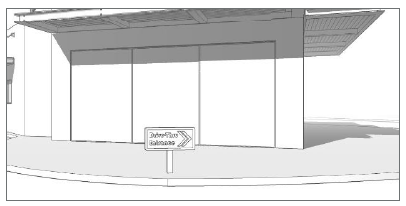
D.
Directory
1.
Permit required when sign is legible and intended to be legible from the public right-of-way.
2.
Directory signs when required for multiple residence developments or other permitted facilities containing multiple tenants or building groups shall comply with the following requirements:
a.
The sign shall not exceed a height of eight (8) feet.
b.
The maximum sign area for each sign face is thirty (30) square feet.
c.
Each directory shall be illuminated with a maximum area of eighteen (18) square feet for each sign face and a maximum height of six (6) feet.
d.
The number and location of the signs must comply with fire department requirements.
Directory Sign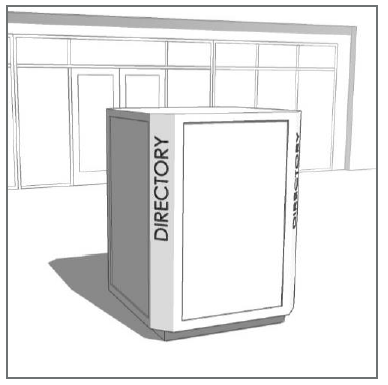
E.
Drive-up/Drive-through
1.
Permit required.
2.
The following standards apply to drive-through signs:
a.
Drive-through signs are limited to two (2) per drive-through lane.
b.
Drive-through signs are limited to sixty-four (64) square feet in total sign area and six (6) feet in height. The drive-through sign may be designed as separate ground or wall mounted signs grouped together or may include the use of one preview board installed prior to one point of order board, however the total area of all signs shall not exceed sixty-four (64) square feet.
c.
In addition, drive-through signs are permitted ten (10) square feet of sign area for temporary signs attached to the top or sides of the drive-through sign.
d.
Drive-through signs shall be located a minimum of one hundred (100) feet from any residential use. This is measured from the sign face to the nearest edge of any residential zoning district.
e.
Drive-through signs shall be internally illuminated. Drive-through signs may also contain an electronic or video display screen and audio component for interaction with the customer. External illumination of drive-through signs may be permitted, provided lighting is shielded and directed on the sign face only.
Drive-up/Drive-through Sign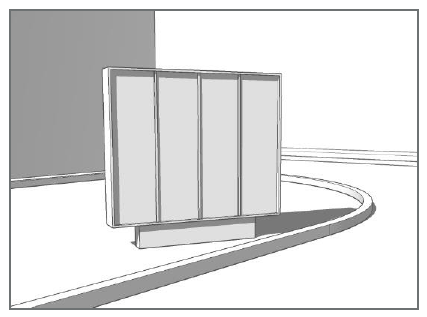
F.
Electronic Reader Panel
1.
Permit required.
2.
Commercial, civic, and institutional uses may have one (1) freestanding reader panel sign not to exceed thirty-two (32) square feet in area and fourteen (14) feet in height per street frontage.
3.
Commercial, civic, and institutional uses may use up to one-half (½) of the allowed freestanding sign area for a reader panel.
4.
The following uses in any district are permitted an electronic sign: cultural facility, educational facility—primary or secondary, educational facility—university or college, government office/facility, park/playground, place of worship.
5.
Reader panel signs shall be no closer than one hundred fifty (150) lineal feet from a single-family residential use.
6.
Only one electronic sign per street frontage is permitted.
7.
Each message or image displayed on an electronic sign shall be static for a minimum of eight (8) seconds. Electronic signs shall display static text messages only, with no animation or effects simulating animation or video.
8.
Scrolling, flashing, animation, or movement of the message or any component of the sign is prohibited. Any message change sequence shall be accomplished immediately by changing from one screen to another without transition effect. Message displays shall not change more than once every eight (8) seconds.
9.
Electronic reader panel displays shall have an automatic dimmer control to allow for automatic dimming of the intensity of the sign illumination and accommodate varying light conditions
10.
Electronic reader panel displays shall not increase the brightness level by more than 0.3 foot-candles over ambient brightness levels at the property line as measured by foot candle meter.
G.
Entry Wall Monument
1.
Residential Uses
a.
Permit required.
b.
Two (2) signs per main access point to the development or subdivision.
c.
Maximum height of six (6) feet or the height of wall on which it will be installed, whichever is less.
d.
Maximum sign area of thirty-two (32) square feet. Sign area shall not exceed thirty percent (30%) of the wall area on which it is installed.
2.
Non-Residential Uses
a.
Permit required.
b.
One (1) sign per main access point to the development or subdivision.
c.
Maximum height of four (4) feet or the height of the parking screen wall, whichever is less.
d.
Maximum sign area of thirty-six (36) square feet. Sign area shall not exceed forty percent (40%) of the wall area on which it is installed.
3.
Illumination shall be limited to backlighting of individual pan-channel style letters or external projected lighting provided light source is shielded from view from the public right-of-way and residential uses.
4.
No portion of the sign shall extend more than twelve (12) inches from the face of the wall on which the sign is installed.
5.
Signs shall incorporate key design elements of the development to which it belongs such as colors, materials, and proportion.
H.
Freestanding Monument
1.
Permit required.
2.
One (1) freestanding monument sign shall be permitted per two hundred (200) linear feet of street frontage. Properties with less than two hundred (200) linear feet of street frontage shall be limited to one (1) freestanding monument sign.
3.
Freestanding signs shall not exceed the following heights, except where modified herein:
a.
Placed along Major Arterial Roads and Parkways (including Bell Road and Grand Avenue): Fourteen (14) feet.
b.
Placed along Arterial Roads (excluding Glendale Avenue between 54th Ave and 59th Ave): Ten (10) feet.
c.
Placed along All other roads (including Glendale Avenue between 54th Ave and 59th Ave): Eight (8) feet.
4.
Freestanding Monument signs shall not exceed the following areas, except where modified herein:
a.
Placed along Major Arterial Roads and Parkways (including Bell Road and Grand Avenue): Eighty (80) square feet or one hundred ten (110) square feet for parcels over twenty (20) acres.
b.
Placed along Arterial Roads (excluding Glendale Avenue between 54th Ave and 59th Ave): Sixty (60) square feet or eighty (80) square feet for parcels over twenty (20) acres.
c.
Placed along All Other Roads (including Glendale Avenue between 54th Ave and 59th Ave): Thirty-two (32) square feet or sixty (60) square feet for parcels over twenty (20) acres.
5.
The base shall have an aggregate width of at least fifty percent (50%) of the width of the sign.
6.
C-O and G-O Zoning Districts:
a.
The sign shall not exceed a height of eight (8) feet and forty-eight (48) square feet in area when the project includes a building of ten thousand (10,000) square feet or more and the site has a minimum of three hundred thirty (330) lineal feet of continuous frontage on an arterial street.
b.
The maximum sign area is twenty-four (24) square feet on parcels up to two (2) acres and thirty-six (36) square feet for parcels over two (2) acres.
7.
R-O Zoning District: The maximum sign area is twelve (12) square feet.
a.
The base of any freestanding sign shall have an aggregate width of at least fifty percent (50%) of the width of the sign.
b.
The sign must include the number of the street address, but the area of these numerals shall not be included in calculating the allowed sign area.
Freestanding Monument Sign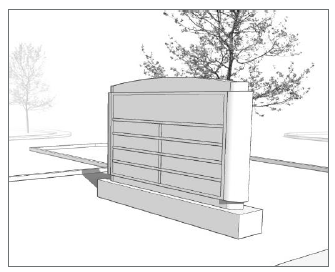
I.
Pylon
1.
Permit required.
2.
Permitted along Loop 101, Loop 303, Northern Parkway, and Grand Avenue only.
3.
Maximum height:
a.
Loop 101 and Loop 303: Sixty (60) feet.
b.
Grand Avenue and Northern Parkway: Twenty (20) feet.
4.
Maximum area:
a.
Loop 101 and Loop 303: Two hundred fifty (250) square feet.
b.
Grand Avenue and Northern Parkway: One hundred twenty-five (125) square feet.
5.
Minimum street frontage required: Six hundred (600) feet.
6.
One Pylon Sign permitted per six hundred (600) feet of street frontage,
7.
Maximum of three (3) Pylon Signs per development along the Loop 101 and Loop 303
8.
Maximum of two (2) Pylon Signs per development along Grand Avenue and Northern Parkway.
9.
Pylon signs shall incorporate complementary design elements from the development associated with the sign.
10.
Illumination shall be limited to internal illumination only.
11.
The base shall have an aggregate width of at least fifty percent (50%) of the width of the sign.
Pylon Sign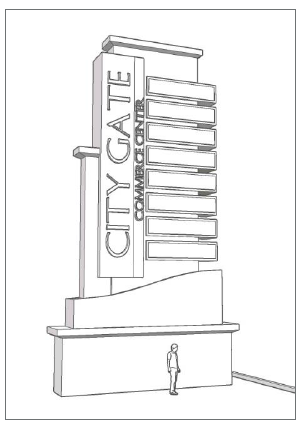
(Ord. No. O25-42, § 1, 9-23-25)
35.4.311 - Building Signs.
This Section is comprised of permitted Building Signs and their respective regulations. Signs not appearing in this Section shall be considered prohibited.
| Table 4.300-5: Total Building Sign Area | |
|---|---|
| Maximum Total Sign Area Allowed |
The maximum total sign area allowed per business having an external business entrance
is limited by the size and frontage of the building on which the sign(s) will be placed.
The table below shall be consulted to determine the permitted total business signage
area by use category or special condition.*
Business frontage is determined by the measurement of the portion of the business facing the street or public access driveway or public alley. Multi-story building lineal footage is limited to the ground floor lineal footage measurement except as modified by the subsections below. The individual area of each building sign placed on a building shall be counted towards the total permitted Building Sign area allowance, unless otherwise noted herein. |
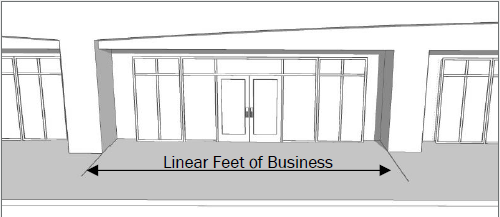 | |
| Use | Total Square Feet of Building Signage Allowed |
| Single Residence | N/A |
| Multiple Residence | 1.25 square feet per 1 linear foot of leasing office space frontage or 50 square feet, whichever is greater, but in no case more than 60 square feet per multiple residence development. |
| Professional Office |
1.5 square feet per 1 linear foot of business frontage or 50 square feet, whichever
is greater.
Maximum square feet based on business square footage: 60 sf maximum signage for businesses <5,000 sf; 150 sf maximum signage for businesses 5,000 sf to 20,000 sf; 250 sf maximum signage for businesses 20,000 sf to 40,000 sf; 450 sf maximum signage for businesses >40,000 sf |
| General Commercial and Public/Semi-Public |
2 square feet per 1 linear foot of business frontage or 50 square feet, whichever
is greater.**
Maximum square feet based on business square footage: 150 sf maximum signage for businesses <20,000 sf; 250 sf maximum signage for businesses 20,000 sf to 40,000 sf; 450 sf maximum signage for businesses >40,000 sf |
| Business/Industrial |
1.75 square feet per 1 linear foot of business frontage or 50 square feet, whichever
is greater.**
Maximum square feet based on business square footage: 200 sf maximum signage for businesses <40,000 sf; 350 sf maximum signage for businesses 40,000 sf to 80,000 sf; 500 sf maximum signage for businesses >80,000 sf |
|
*Non-residential uses having only an internal business entrance and no external wall
facing a public street or public access driveway or public alley shall be limited
to business identification signage on a multi-tenant building wall mounted sign as
set forth in subsection 35.4.311(G)(9)
**Multi-tenant building, wall mounted signs shall adhere to subsection 35.4.311(G)(9) | |
A.
Awning
1.
Permit required.
2.
Maximum of twenty-five percent (25%) of each surface area of an awning may be used for signage. A valance is considered a separate surface area.
3.
Awning signs shall be mounted within the first story of the structure.
4.
Awning signs shall maintain a minimum vertical clearance of nine (9) feet.
5.
Awning signs may encroach over a public or private sidewalk, but shall be no closer than four (4) feet from the back of curb. If encroaching over an abutting City right-of-way line, a revocable City encroachment permit or other City granted authorization shall be required.
6.
A structural awning is permitted a sign face area attached to and located above the top of the canopy to a maximum height of twenty-four (24) inches.
7.
Structural awnings shall be made of metal or material of similar durability and structural integrity.
8.
Awning and canopy signs may be illuminated but lighting shall be installed as external downlighting or backlighting. Only the face area of the letters or graphics may be illuminated.
Awning Sign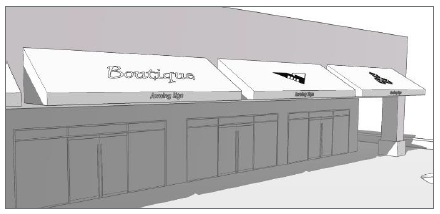
B.
Electronic Reader Panel
1.
Permit required.
2.
Reader panel signs shall be no closer than one hundred fifty (150) lineal feet from a single-family residential use.
3.
Commercial, civic, and institutional uses may have one (1) reader panel sign per building not to exceed thirty-two (32) square feet in area.
4.
No reader panel sign affixed to a building, including sign support structure, shall project beyond the ends or top of the wall or higher than the roofline of the structure to which it is attached.
5.
The following uses in any district are permitted an electronic sign: cultural facility, educational facility—primary or secondary, educational facility—university or college, government office/facility, park/playground, place of worship.
6.
Each message or image displayed on an electronic sign shall be static for a minimum of eight (8) seconds. Electronic signs shall display static text messages only, with no animation or effects simulating animation or video.
7.
Scrolling, flashing, animation, or movement of the message or any component of the sign is prohibited. Any message change sequence shall be accomplished immediately by changing from one screen to another without transition effect.
C.
Marquee
1.
Permit required.
2.
Each marquee sign face shall be limited to thirty-two (32) square feet in area.
3.
Marquee signs shall be supported solely by the building to which they are attached. No exterior columns or posts are permitted as supports.
4.
Marquee signs shall be erected over a building entrance. The width of a marquee sign is limited to the width of the building entrance with an additional two-foot extension of the marquee sign allowed on each side of the building entrance.
5.
All marquee signs shall maintain a minimum vertical clearance of nine (9) feet.
6.
Marquee signs may encroach over a public or private sidewalk, but shall be no closer than four (4) feet from the back of curb. If encroaching over an abutting City right-of-way line, a revocable City encroachment permit or other City granted authorization shall be required.
7.
Marquees may be internally or externally illuminated.
D.
Mural
1.
Permit required.
2.
No person shall place artwork, mural, graffiti, write, paint or draw any inscription, figure, or mark of any type on any property unless the express permission of the owner or operator of the property has been obtained and a design review waiver and formal approval by the City has been issued.
3.
It shall be the responsibility of the owner or operator of property upon which a mural is placed to maintain the appearance of the mural. A mural that is permitted to remain in a condition of disrepair shall constitute a public nuisance.
4.
Murals or similar graphic elements which advertise, either directly or implied, the business or services or products sold at the location of the mural shall be deemed signage and shall be regulated accordingly.
5.
All murals or other similar forms of visual art shall be placed or painted on the side or rear walls of the building, and not on its primary facade, above its roof line, or on any of its decorative elements.
6.
Murals or other strong graphic elements shall be prohibited on privacy or screen walls when visible from the public right-of-way or adjacent property.
7.
The installation of a mural should complement and enhance the building or wall and be incorporated architecturally into the character of the area.
8.
The location of a mural on a building should not cover or detract from significant or character-defining architectural features.
9.
Paint utilized should be intended for exterior use and which will not compromise the integrity of the material to which it is applied. Reflective neon and fluorescent paint should not be used.
E.
Place Marker
1.
Permit required.
2.
Shall not exceed an aggregate area of three (3) square feet and shall be affixed directly to the building generally within ten (10) feet from any entrance.
3.
Residence signs: one (1) or more wall signs not to exceed a total aggregate area of three (3) square feet shall be permitted. The sign may include only the name of the residence, the name of the occupant, and the street address.
4.
Agriculture signs: One (1) or more wall signs not to exceed a total aggregate area of eight (8) square feet shall be permitted. The sign may include only the name of the farm or ranch and a street address.
F.
Skyline
1.
Permit required.
2.
Skyline signs are permitted only for non-residential structures and multi-family dwellings of 40 feet or more in height in PR and C-3 zoning districts.
3.
The maximum area of a skyline sign shall be determined by Table 4.300-5.
4.
Skyline signs shall be placed within the top twelve (12) feet of the structure and cannot cover any fenestration or architectural features.
5.
Skyline signs may project up to three (3) feet above the roofline or parapet of buildings less than forty (40) feet in height and five (5) feet above the roofline or parapet of buildings forty (40) feet in height or taller. Skyline signs shall be designed to mount to a wall and shall not be primarily supported by structures installed on the roof.
6.
If a skyline sign is placed on a building, all other wall signs are prohibited.
7.
One skyline sign is permitted per building.
8.
Skyline signs shall only be internally illuminated.
Skyline Sign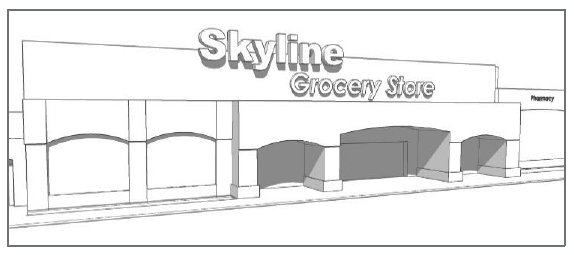
G.
Wall, Mounted
1.
Permit required.
2.
Wall signs are permitted on each facade of a structure. On a site consisting of multiple structures, each structure is permitted wall signs per the size and location regulations of this Section.
3.
Wall signs may be internally or externally illuminated. If externally illuminated, all light shall be directed onto the sign face and shall be shielded from the public right-of-way and adjacent residential uses.
4.
Wall signs shall be safely and securely attached to the building wall.
5.
Wall signs shall not project more than fourteen (14) inches from a building wall.
6.
No wall sign affixed to a building, including sign support structure, shall project beyond the ends or top of the wall or higher than the roofline of the structure to which it is attached.
7.
Parapets added to existing buildings for the purpose of attaching signs shall match the architecture of the rest of the building, be of the same thickness, and on the same plane as the wall to which it is added, and no more four (4) feet above the roofline. Additions to a parapet for the purpose of signage cannot be braced back to the roof.
8.
Wall signs cannot cover any window, windowsill, transom sill, or architectural feature, such as cornices, of the structure.
9.
Multi-tenant building wall mounted identification signs are permitted in the Professional Office, Commercial and Business/Industrial Zoning Districts, subject to the conditions identified below:
a.
The use of a multi-tenant building wall mounted identification sign shall take the place of single business wall mounted signs and shall be counted as a portion of the total allowed building sign area.
b.
The maximum number of multi-tenant signs for each building shall be limited to one (1) sign per street frontage.
c.
The maximum area of the multi-tenant sign shall not exceed the greater of sixty (60) square feet or one and one-half (1.5) square feet per lineal foot of combined building frontage for each business, but in no case more than three hundred (300) square feet per multi-tenant sign.
10.
In the R-O, C-O, and G-O zoning districts:
a.
These signs shall not exceed a height of fifteen (15) feet.
b.
The maximum sign area permitted per building shall be twenty-four (24) square feet in the R-O and C-O districts and forty-eight (48) square feet in the G-O district. Except, the maximum sign area permitted per building shall be one hundred (100) square feet in the C-O and G-O districts for any office building which exceeds ten thousand (10,000) square feet or more and is located on a site with three hundred thirty (330) lineal feet or more of continuous frontage on an arterial street, and the sign face cannot be seen from residential districts. The maximum sign area per tenant shall not exceed forty (40) square feet on any building elevation.
c.
Such sign may identify the individual businesses, building complex, or center, by name, or street address. Such sign shall not include advertising copy.
Mounted Wall Sign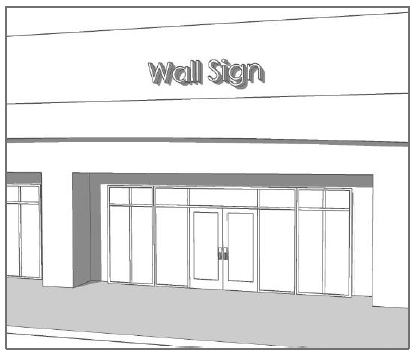
H.
Wall, Painted
1.
Permit required.
2.
Signs are permitted for all non-residential uses in any district.
3.
Signs are permitted on each facade of a structure.
4.
Painted wall signs shall be painted directly on the building's façade.
5.
Signs shall not be painted on or obscure architectural features such as windows, doors, pilasters, or cornices.
6.
Painted signs shall be applied utilizing exterior weather resistant paint.
7.
Signs may be externally illuminated provided all light sources are directed onto the sign face and shall face in a downward direction.
8.
Signs shall not project more than 0.25 inches from a building wall.
9.
Nothing in this section shall prevent an installer from incorporating their name or other identifying information as part of the painted wall sign.
10.
The property owner, or their authorized representative such as the business owner, is responsible for ensuring that a permitted painted wall sign is maintained in good condition and is repaired in the case of vandalism or accidental damage.
Painted Wall Sign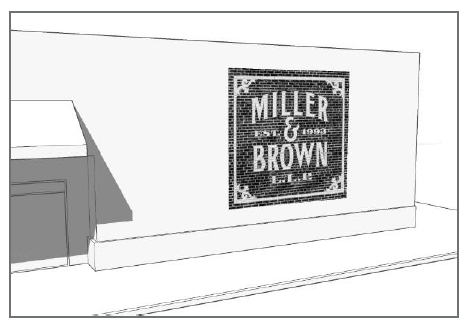
I.
Wall, Projected
1.
Permit required.
2.
Signs are permitted for all non-residential uses in any district.
3.
Signs must remain static and cannot flash, rotate, or move.
4.
No projected wall sign can project an electronic video.
5.
Signs shall not glare onto adjacent properties.
6.
Signs shall not project past the wall onto which it is projected.
7.
Signs shall not be projected over any other sign type.
J.
Wall, Projecting
1.
Permit required.
2.
Projecting signs shall maintain a minimum vertical clearance of nine (9) feet. No projecting sign affixed to a building shall project higher than the building height, including the sign support structure.
3.
Projecting signs are limited to a maximum sign area of five (5) square feet.
4.
Projecting signs may be internally or externally illuminated.
5.
Allowed only on the exterior elevation of the space occupied by the business.
6.
No more than one (1) projecting sign per business per street or alley frontage. For a corner lot, one projecting sign is permitted for each street frontage.
7.
Minimum separation between the sign and the face of the building: Three (3) inches.
8.
Maximum sign projection from the face of the building: Five (5) feet.
9.
Minimum horizontal distance from projecting edge of sign and back of curb, existing or future: Four (4) feet.
10.
For one-story buildings:
a.
The top of the sign and supporting framework shall not be higher than the top of the cornice line.
11.
For multiple story buildings:
a.
The top of the sign and supporting framework shall not be higher than the top of the second-story windowsills.
12.
The sign shall be perpendicular to the building and attached to the bracket on which it is hung so that it will not swing.
Projecting Wall Sign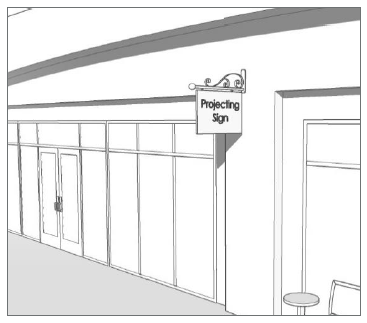
K.
Window
1.
No permit required.
2.
The area covered by window signs shall not exceed thirty percent (30%) of the exterior window area. Window area is counted as a continuous surface until divided by an architectural or structural element. Mullions shall not be considered such an element.
3.
Window signs on required doors shall not exceed thirty percent (30%) of the glass area of the door.
4.
Window signs printed on perforated, semi-opaque material shall be counted in the same manner as non-perforated, fully-opaque materials, including paint.
5.
Window signs are permitted for all multi-family and non-residential uses and shall be permitted on the ground floor only. Such signs shall not be permitted on individual multi-family tenant windows.
6.
Window signs affixed directly to a window shall not be illuminated.
7.
Signs placed within a building a manner that the intent of the placement is to be viewable from the public right-of-way shall be considered a window sign and shall be subject to the regulations of this Section.
Window Sign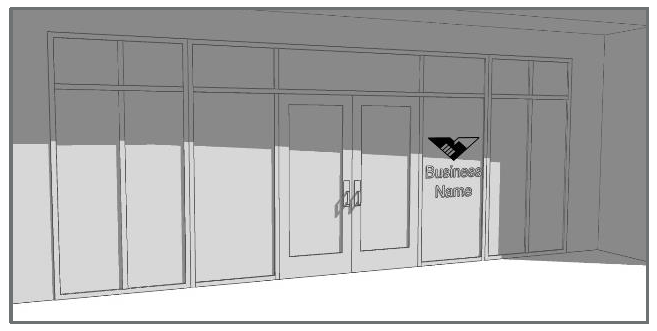
35.4.312 - Temporary Signs.
A.
A-Frame
1.
No permit or registration required.
2.
One (1) sign per business or tenant shall be allowed.
3.
A-frame signs are limited to six (6) square feet in area per side and three and one-half (3.5) feet in height.
4.
Signs shall be located within ten (10) feet of the entrance to the individual building or tenant space for which they advertise, but shall not be located in front of an adjacent business or business within the same complex or within 40-feet of the face of curb at a signalized intersection or within 30-feet of an unsignalized intersection or driveway sight visibility triangle.
5.
Signs may be placed within the right-of-way in the Centerline Overlay District only, but shall not be located within a roadway median or traffic circle, Unless it is part of an approved comprehensive sign program.
6.
Signs shall not interfere with vehicular or pedestrian traffic movement or violate standards of accessibility as required by the Americans with Disabilities Act (ADA) or other accessibility codes. A minimum five-foot clearance for all sidewalks or similar pedestrian passageways shall be maintained.
7.
A-frame signs shall not be placed in or on vehicles.
8.
The placement of A-frame signs outdoors is limited to business hours only and shall be stored indoors during non-business hours.
9.
Illumination of A-frame signs is prohibited.
10.
Signs shall be kept in good condition and shall not be hand-painted nor made of non-durable materials which succumb to the effects of the desert climate.
A-Frame Sign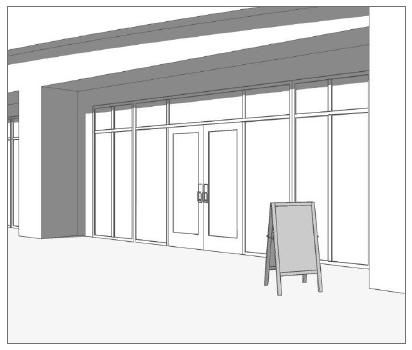
B.
Banners
1.
In single and multiple residence districts, banners are not permitted on sites with individual dwelling units. Banners for holidays and special family events are excepted.
2.
All banners are limited to a maximum display period of fourteen (14) consecutive days per occurrence and limited to six (6) events per calendar year. There shall be a minimum of ten days between display periods. All banners shall be removed within three (3) days of the occurrence. The maximum display period may be extended for temporary businesses or to supplement permanent signs under repair or replacement.
3.
Registration with the City shall be required for each occurrence. Registration shall include business name, address, responsible party, start and end date for display, and date of display removal.
4.
One (1) banner per establishment shall be permitted. For multi-tenant developments, one (1) banner for each tenant shall be permitted.
5.
Banners shall be limited to thirty-two (32) square feet in area and shall not extend above a second-floor roofline or parapet. Under no circumstance shall a banner be placed thirty (30) feet above grade.
6.
Banners shall be securely attached to a building wall and shall not be attached to light poles or landscape materials.
7.
Banners for public/semi-public uses in all districts where allowed may also be ground-mounted between two (2) or more posts, and shall not be located closer than ten (10) feet from the edge of the pavement of any roadway or alley, or within any public rights-of-way.
8.
Banners shall be made of canvas, canvas-like material, nylon, vinyl-coated fabric, or similar weatherproof type materials.
Banners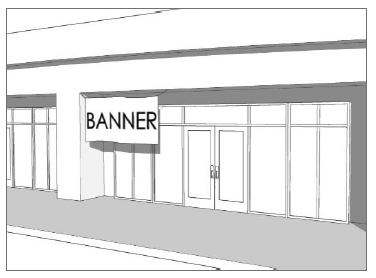
C.
Downtown Promotional Banners
1.
No permit or registration required.
2.
Banners may be used only to identify city-authorized special events within the downtown. They shall not be used to identify or advertise individual businesses, sales, products, or services.
3.
There shall be one banner permitted for each business. The banner shall be mounted on the building or within a display window.
4.
The banner may be displayed from a pole located perpendicular to the building. The minimum clearance between the bottom of the pole and the nearest grade or sidewalk shall be seven (7) feet, six (6) inches.
5.
The banners shall be made of cloth, nylon, or similar material.
6.
The banner shall not exceed six (6) square feet in size.
7.
The banners shall be allowed for a maximum of forty-five (45) consecutive days, no more than four (4) times per year.
8.
There shall be a minimum of fifteen (15) days between each special event.
9.
Downtown promotional banners shall be limited to the area described as follows: starting at the southeast corner of Myrtle Avenue extending south along 59th Avenue to Grand Avenue, then southeast along Grand Avenue to Lamar Road, then east along Lamar Road to 56th Avenue, then north along 56th Avenue to Palmaire Avenue, then west to the alley between 56th Avenue and 55th Avenue, then north to Myrtle Avenue, and then west to the southeast corner of 59th Avenue and Myrtle Avenue.
D.
Feather/Swooper Flags
1.
All feather/swooper flags are limited to a maximum display period of fourteen (14) consecutive days per occurrence, limited to six (6) occurrences per calendar year. There shall be a minimum of ten (10) days between display periods. All banners shall be removed within three (3) days of the occurrence.
2.
Registration with the City shall be required for each occurrence. Registration shall include business name, address, responsible party, start and end date for display, and date of display removal.
3.
Limit one (1) per thirty (30) linear feet of street frontage or a maximum of six (6) per development, whichever is less.
4.
Maximum flag area: Thirty-two (32) square feet.
5.
Maximum flag height: Twelve (12) feet.
6.
Flags shall be placed no closer than eight (8) feet from the back of curb and shall not overhang a public sidewalk.
7.
Flags shall not be placed in the public right-of-way, public access easement, driveway, or drive aisle.
Feather and Swooper Flags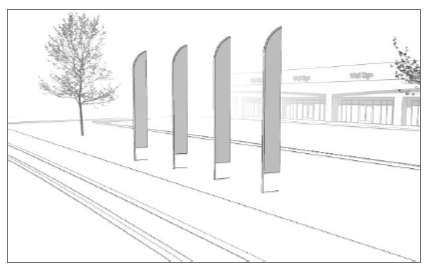
E.
Inflatables
1.
Inflatable structures are limited to a maximum display period of fourteen (14) consecutive days per occurrence, limited to six (6) occurrences per calendar year. There shall be a minimum of ten (10) days between display periods. All inflatables shall be removed within three (3) days of the occurrence.
2.
Registration with the City shall be required for each occurrence. Registration shall include business name, address, responsible party, start and end date for display, and date of display removal.
3.
Inflatable shall be placed no closer than the height of the inflatable from the back of curb and shall not overhang a public sidewalk or roadway.
4.
Inflatables shall not be placed in the public right-of-way, public access easement, driveway, or drive aisle unless specifically approved through a Special Event Permit.
5.
Inflatables shall be secured to the ground or a building. Tethering to landscape materials, light poles, or vehicles shall be prohibited.
F.
Political Signs
1.
No permit or registration required.
2.
Signs shall not be located within 40-feet of the face of curb at a signalized intersection or within 30-feet of an unsignalized intersection or driveway sight visibility triangle.
3.
One (1) sign for each candidate or measure shall be permitted for each street frontage.
4.
Within the agricultural and residence districts, the maximum sign area shall be sixteen (16) square feet, and the maximum height shall be five (5) feet.
5.
Within the office, commercial, and industrial districts, the maximum sign area shall be thirty-two (32) square feet, and the maximum height shall be eight (8) feet.
6.
The person, party, or organization responsible for the erection or distribution of such signs shall remove them within fifteen (15) days after the specific election to which they refer.
7.
Such signs shall be placed only with the property owner's permission.
8.
Such signs may be placed in the public right-of-way; however, no such signs shall block any portion of a sidewalk or similar pedestrian accessway or be placed within the center medians that divide portions of paved roadways.
9.
For additional regulations related to political signs please refer to Arizona Revised Statutes § 16-1019 and § 33-1808.
G.
Sign Walker
1.
No permit or registration required.
2.
If within a right-of-way, a sign walker shall be positioned behind the curb and on a sidewalk if present or, if no curb or sidewalk is present, ten (10) feet behind the edge of the pavement.
3.
Sign walkers shall not erect or place tents, temporary structures, umbrellas, chairs, or stools within the public right-of-way or adjacent property.
4.
Sign walkers shall not be positioned to obstruct vehicle sight lines.
5.
Sign walkers shall not obstruct the free movement of pedestrians on sidewalks.
6.
Sign walkers shall not stand in the medians or traffic circles of public streets.
7.
The sign worn, held, or balanced by a sign walker shall be a maximum of five (5) square feet in size and may be double sided.
H.
Pennants
1.
No permit or registration required.
2.
Pennants shall be displayed for up to a 15-day period, four (4) times per calendar year.
3.
Pennants shall be placed no closer than eight (8) feet from the back of curb and shall not overhang a public sidewalk.
4.
Pennants shall not be placed in the public right-of-way or public access easement.
5.
Pennants shall be secured to the ground, a building, or on-site light poles. Tethering to landscape materials or vehicles shall be prohibited.
35.4.313 - Miscellaneous Signs.
A.
Flag, Commercial
1.
Permit required.
2.
Maximum flagpole height: Sixty (60) feet.
3.
Maximum duration: Up to three (3) years for temporary flagpoles within model home complexes.
4.
One commercial flag is permitted per development.
5.
Commercial flags are limited to a maximum area of 12 square feet in area.
6.
Commercial flags shall only be mounted by a mast arm flagpole that extends at an angle from a building. Such flags shall not extend into the right-of-way measured when the flag is fully extended perpendicular to the post.
7.
Commercial flags shall not be illuminated.
B.
Flag, Non-Commercial
1.
No permit required.
2.
Maximum flagpole height: Sixty (60) feet.
3.
Maximum duration:
4.
Up to three (3) years for temporary flagpoles within model home complexes.
5.
Non-commercial flags shall not affect visibility or create any safety hazards or concerns.
6.
Permanent ground-mounted flagpoles shall be installed with proper underground footings and support elements.
7.
Display of non-commercial flags shall be in accordance with all applicable State and Federal regulations and codes.
8.
The maximum area of non-commercial flags shall be as follows:
9.
There shall be no more than three (3) flagpoles allowed per street frontage.
10.
Flags may be flown individually or on separate flagpoles.
11.
Building-Mounted Flagpoles: For single-residence uses, up to three (3) non-commercial flags may displayed from building-mounted flagpoles provided no flag exceeds eighteen (18) square feet in area and no flagpole exceeds eight (8) feet in length.
12.
For the purposes of this code, products such as pleated fans or similar items resembling a common non-commercial flag shall not be considered a flag and shall be regulated as signage.
C.
Subdivision Advertising and Directional
1.
Permit required.
2.
A master sign package for each development including the type, number, size, location, materials, and colors of the various signs shall be approved by the Planning Department prior to the issuance of a permit for any sign authorized under this subsection.
3.
On-Site Signs
a.
One (1) sign shall be permitted at each major entry with a maximum of four (4) signs per subdivision.
b.
The maximum aggregate area of all signs shall be one hundred sixty (160) square feet.
c.
The maximum height shall be fifteen (15) feet.
d.
The edges of the sign shall be boxed.
e.
No sign permits shall be issued until a preliminary plat has been approved by the City.
f.
Upon expiration of a preliminary plat, if no final plat is approved, all signs must be removed within ten (10) days.
g.
Such signs may be maintained until ninety-five percent (95%) of the lots in the subdivision are sold or the sales office closes, whichever occurs first.
h.
Such signs shall not be located within fifty (50) feet of any property line of an existing residence.
4.
Subdivision Flags
a.
A maximum of fifteen (15) flags per subdivision are allowed.
b.
The area of each flag shall not exceed six (6) square feet.
c.
The maximum height of any flag shall be twenty-five (25) feet.
d.
There shall be a minimum distance of twenty (20) feet between flags.
e.
All flags shall be placed within the boundaries of the subdivision with the permission of the property owner, if this is other than the developer.
f.
The flags may be maintained until ninety-five percent (95%) of the lots in the subdivision are sold or the sales office closes, whichever occurs first.
5.
Off-Site New Subdivision Signs
a.
Such sign must be located within one (1) mile of the subdivision, on vacant property, with the written permission of the property owner.
b.
A maximum of two (2) signs are permitted for each subdivision located on an arterial street. Each sign shall have a maximum area of thirty-two (32) square feet and a maximum height of eight (8) feet.
c.
Such signs may be maintained until ninety-five percent (95%) of the lots in the subdivision are sold or the sales office closes, whichever occurs first.
6.
Off-Site New Subdivision Lead-In Signs
a.
Sign permits are established for each subdivision on an annual basis. The applicant must submit a site plan showing all locations of proposed signs. Any changes to the location of the signs must be approved by the City.
b.
A maximum of eight (8) signs per subdivision.
c.
Signs shall not exceed a maximum sign area of four (4) square feet.
d.
Signs may not be installed before 4:00 p.m. on Friday, and must be removed before 8:00 a.m. on the following Monday, except when a legal holiday occurs on a Monday, signs must be removed by 8:00 a.m. on the following Tuesday.
e.
Signs will have the name and telephone number of the sign company, or if no sign company is designated by the builder/developer to distribute the signs, the builder/ developer's, name shall be placed on the back side of the sign with a contact and telephone number.
f.
No sign shall be allowed in any public right-of-way.
g.
No sign shall be located within fifty (50) feet of another sign.
h.
No sign shall be attached to any roadway or natural feature including light, signal poles, street or regulatory signs, bridges, trees, or other existing facilities.
i.
Signs shall not exceed a vertical height of three (3) feet.
j.
Signs must be limited to not more than one (1) mile from the subdivision identified.
k.
Signs shall not be installed on private property unless written authorization of such installation is provided to the city at the time of permit application.
D.
Construction and Development
1.
Permit required.
2.
Temporary ground signs are permitted for lots currently under construction in all districts.
3.
Shall not be placed in a public right-of-way.
4.
Signs located on single-family detached or duplex construction lots are limited to six (6) square feet in area. An additional rider sign not exceeding a total of two (2) square feet in sign area is allowed.
5.
Signs for all other types of construction lots cannot exceed sixty-four (64) square feet in sign area.
6.
Signs shall be located on the construction lot.
7.
One sign is permitted per street frontage.
8.
Signs shall be removed within seven (7) days after expiration of the building permit.
9.
One (1) non-illuminated sign is allowed on the construction site with a maximum area of thirty-two (32) square feet and a maximum height of eight (8) feet.
10.
If building permits have not been issued within six (6) months after issuance of the sign permit, the sign shall be removed and any new construction and development sign for substantially the same project at the same location will be approved only after a building permit for the project has been issued by the City.
11.
Such sign shall be removed prior to the issuance of a Certificate of Occupancy for the site.
E.
Light Pole Banner
1.
Light poles located entirely on private property are permitted to mount banners in all districts. Light pole banners shall not be used as a temporary off-premise advertising sign.
2.
Light pole banners are limited to a maximum area of fifteen (15) square feet.
3.
Light pole banners shall maintain a minimum vertical clearance of twelve (12) feet from grade to the bottom of the banner.
F.
Weekend Directional Sign
1.
No permit required.
2.
Each sign shall have a maximum area of three (3) square feet and a maximum height of three (3) feet.
3.
Such signs shall not be allowed for more than nine (9) hours per day.
4.
Such signs may be placed in the public right-of-way; however, no such signs shall block any portion of a sidewalk or similar pedestrian accessway or be placed within the center medians that divide portions of paved roadways.
5.
No painting or stencils advertising an event on a paved roadway will be permitted.
G.
Yard Signs
1.
No permit required.
2.
Shall not be placed in a public right-of-way.
3.
One (1) non-illuminated sign pertaining only to the property on which it is located shall be permitted for each street frontage. However, properties having a continuous frontage of eight hundred fifty (850) linear feet or more shall be allowed an additional sign so long as such sign is no closer than eight hundred fifty (850) feet from another sign on the property.
4.
A maximum of two (2) signs shall be permitted per parcel, except as allowed in subparagraph (2) above.
5.
Agricultural and Residence Districts.
a.
Vacant Land:
i.
Less than five (5) acres: Each sign shall have a maximum area of six (6) square feet and a maximum height of five (5) feet.
ii.
Five (5) acres or more: Each sign shall have a maximum area of thirty-two (32) square feet and a maximum height of eight (8) feet.
b.
Developed Land:
i.
Each sign shall have a maximum area of twelve (12) square feet and a maximum height of six (6) square feet.
ii.
Signs located on individual single-family detached and duplex lots under three (3) acres in size, or individual units within attached housing are limited to six (6) square feet. Additional rider signage not exceeding a total of two (2) square feet in sign area is allowed.
6.
Office, Commercial, and Industrial Districts.
a.
Vacant Land:
i.
Each sign shall have a maximum area of thirty-two (32) square feet and a maximum height of eight (8) feet.
b.
Developed Land:
i.
Each sign shall have a maximum area of twelve (12) square feet and a maximum height of six (6) feet.
7.
Signs for other lots or structures for sale, lease, or rent cannot exceed sixty-four (64) square feet in sign area.
8.
Signs shall be removed within seven (7) days after an event concludes or sale is closed or rent or lease transaction is finalized.
35.4.314 - Comprehensive Sign Program.
The purpose of a Comprehensive Sign Program (CSP) is to provide flexibility for all signs to be placed within a development. Signs within a CSP must be consistent in the project's design theme, overall scale, color and materials palette, and have placement controls within the development.
A.
Application Procedures and Requirements. Comprehensive Sign Programs shall be submitted to the Development Services Department for administrative review. City staff will forward a recommendation to the Planning Commission for consideration. The Planning Commission may approve, approve with conditions, or deny the request. Decisions made by the Planning Commission shall be considered final. Public notice for Planning Commission hearings associated with Comprehensive Sign Programs is required as stated in Article 6 Administration and Procedures of the City of Glendale Unified Development Code.
A Comprehensive Sign Program shall specify the sign types, locations, quantities, and sizes of all signs to be used on the property. The materials, methods of illumination, and graphic standards must also be defined. Parameters for deviations from standard Building, Site, and Temporary sign requirements are provided in the table below. Deviations from signs within the Miscellaneous sign category are not permitted through a Comprehensive Sign Program.
A Comprehensive Sign Program shall include deviations from requirements for five (5) or more standard sign types in order to be considered comprehensive. Applicants seeking deviations from fewer than five (5) sign type regulations may do so through the Variance process as defined in Section 35.6.209 of the Unified Development Code.
An approved Comprehensive Sign Program shall determine the physical limits for which the sign program is approved and shall define all design and procedural standards that shall apply within that boundary. All permits for any sign applied for within that boundary shall conform to the CSP as approved, or as subsequently amended. Where a CSP is silent on a given topic, the City's current sign code regulations shall apply.
B.
Required Findings. The Planning Commission shall make the following findings before approving a CSP:
1.
The proposal will result in improved identification of tenants within the center.
2.
The proposal minimizes, to the greatest extent possible, the requested non-conformity from existing sign standards while improving the design quality of the signage for the project.
3.
The height, location, materials, color, texture, area, setbacks, and mass of the signs will enhance the character of the development.
4.
The design and scale of the comprehensive sign package will not have any adverse effect on adjacent properties or the surrounding neighborhood.
C.
Comprehensive Sign Program Amendments
1.
Minor Amendment.
a.
A minor amendment to an approved Comprehensive Sign Program (CSP), may be approved by the Development Services Director or designee. Minor amendments are considered to represent modifications which do not alter the overall characteristics of the existing CSP and which create no adverse impacts on adjacent uses, infrastructure, or public safety. Examples of minor amendments include, but may not be limited to the following:
i.
Changes in the location of a sign or signs.
ii.
Reduction in the number of signs or overall sign square footage.
iii.
Increases in the total number of signs, provided the aggregate square footage of the CSP remains unchanged.
iv.
Redistribution of sign square footage provided the aggregate square footage of the CSP remains unchanged.
v.
Modifications to the approved colors or materials of signs provided they are not beyond the character, theme, or palette of the overall development.
vi.
Applications for CSP minor amendments shall be filed, in writing, with the Development Services Department, using official Department forms and shall be accompanied by applicable fees and supporting documents.
vii.
The Development Services Director or designee may approve the request if it is determined that the proposed amendment is, in fact, minor as defined Section 35.4.314(A)(1)a. above.
2.
Major Amendment.
a.
A major amendment to an approved Comprehensive Sign Program (CSP), shall be approved by the Planning Commission. Major amendments are considered to represent modifications which alter the overall characteristics of the existing CSP, including new or increased adverse impacts on adjacent uses or public infrastructure. Examples of major amendments include, but may not be limited to the following:
i.
Increases in the aggregate square footage of sign allowances.
ii.
Introduction of new sign types regardless of changes to the number of signs or aggregate square footage of signs.
iii.
Increases in permitted sign height.
iv.
Decreased separation between illuminated signs and nearby residential uses or increased visibility of signage from nearby residential uses.
v.
Changes in the colors or materials of signs which alter the overall character of the CSP or that are beyond the character, theme, or palette of the overall project.
vi.
Applications for CSP major amendments shall be filed, in writing, with the Development Services Department, using official Department forms and shall be accompanied by applicable fees and supporting documents. The subject property shall be posted and surrounding property owners shall be notified in accordance with the public notice requirements for Planning Commission hearings associated with Comprehensive Sign Programs as stated in Article 6 Administration of the City of Glendale Unified Development Code.
vii.
The Development Services Director or designee, shall review the major amendment request, prepare a written recommendation, and forward that recommendation to the Planning Commission for consideration. The Planning Commission may approve, approve with conditions, or deny the request. Decisions made by the Planning Commission shall be considered final.
35.4.315 - Sign Enforcement.
A.
Inspections and Investigations
1.
The Development Services Director or designee may periodically inspect signs in order to determine whether there are any violations of this Ordinance.
2.
The Development Services Director or designee has the power to conduct such investigations as it may reasonably deem necessary to carry out its duties as prescribed in these regulations, and for this purpose to enter at reasonable times upon any property, public or private, for the purpose of investigating and inspecting signs. No person shall refuse entry or access to the Zoning Administrator or their designee who requests entry for purposes of inspection, and who presents appropriate credentials, nor shall any person obstruct, hamper, or interfere with any such representative while in the process of carrying out his official duties.
3.
The Development Services Director or designee may require written statements, or the filing of reports with respect to pertinent questions relating to signs.
B.
Citations
1.
If, through inspection, it is determined that a person has failed to comply with the provisions of these regulations, the Development Services Director or designee shall issue a warning citation to the violator. Violations shall be corrected within ten (10) days of the issuance of such citation. If the violation is not corrected within the specified time period, the violator is subject to Section 35.7.000 of this Ordinance.
35.4.401 - Intent.
This Section is intended to restrict the permitted use of outdoor artificial illuminating devices, control light trespass, minimize the detrimental effect artificial outdoor lighting has on astronomical observations and encourage good lighting practices such that lighting systems are designed to conserve energy and costs, while providing for nighttime safety, utility, security and productivity.
35.4.402 - Applicability.
A.
Outdoor lighting fixtures, in any district, shall be located and shielded to prevent light from shining or reflecting onto adjacent properties. In cases of interpretations of compliance with this provision, such lighting shall be located, shielded or adjusted in intensity to be in conformance with this Section.
B.
All artificial outdoor illuminating devices shall be installed in conformance with the provisions of this Section and any building code in effect at the time of permitting and installation.
C.
If any provision of this Section conflicts with any other Section of this Code or any other ordinance of the City, the provisions of this Section shall govern.
35.4.403 - Approved Materials, Installation; New Technology.
A.
The provisions of this Section shall not prevent the use of any alternate material or method of installation not specified in this Section, or new lighting technology. The alternate must be approved by the City Engineer prior to its use within the city.
B.
The City Engineer may approve an alternate material or method of installation or new lighting technology provided such material, method or technology:
1.
Provides approximate equivalence to those specific requirements of this Section; or
2.
Satisfactorily complies with the intent of this Section.
35.4.404 - General Requirements.
A.
All outdoor illuminating devices, except those exempt from this Section (Section 35.4.406 Exceptions), shall be shielded as set forth below:
1.
High pressure sodium, metal halide, fluorescent, tungsten, halogen, incandescent and mercury vapor type lamp fixtures shall be fully shielded.
2.
Fluorescent type lamp fixtures used to illuminate outdoor advertising signs shall be mounted at the top of the sign structure and shall be partially shielded.
a.
A filter shall be used for all metal halide, fluorescent and mercury vapor type lamp fixtures.
b.
Other types of lamp fixtures not specified in this Section, and not specifically exempt from this Section (Section 35.4.406 Exceptions) shall be shielded and/or filtered as determined by the City Engineer.
3.
Parking lots and other similar portions of a property shall be illuminated to promote a safe pedestrian and vehicular circulation and protection of property. Parking lot light poles shall be limited to twenty-five (25) feet in height and fifteen (15) feet in height when closer than thirty (30) from a single-family residential use.
4.
All lights, parking lot or building-mounted, shall be shielded when within thirty (30) feet of a single-family residential use.
5.
Building entrances and outside seating areas shall be illuminated with LED lighting not to exceed one hundred twenty (120) lumens.
6.
Up-lighting for landscaping, building façades further than one-hundred feet from a residential use, and other similar site elements may be up-lighted with LED light sources not to exceed eighty (80) lumens.
7.
Federal and state flags may be up-lighted using LED light sources that are adequate for illuminating a flag after sundown. The light source shall not to exceed five hundred (500) lumens. If five hundred (500) lumens does not adequately illuminate the subject flag, the light source may be located on the flagpole, but shall be screened to prevent visual access to the light source.
8.
Non-residential properties shall not exceed 1.0 foot-candles of illumination at the property line.
9.
Residential properties shall not exceed 0.5 foot-candles of illumination at the property line.
10.
Sport court lighting in all residential districts shall be limited to fifteen (15) feet in height, shielded, and shall meet all principal building setbacks. Arenas or other similar uses in the Agricultural and Rural Residential districts shall be limited to twenty (20) feet in height, shielded, and shall meet all principal building setbacks.
11.
For the purposes of this Code, outdoor lighting is for the safety of persons and property first, then for architectural theming and enhancement of the urban form. Lighting for the purpose of, or for the effect of, attracting attention, shall be prohibited.
35.4.405 - Specific Outdoor Light Fixtures.
A.
Except for emergency purposes, no person shall operate a search light within the City without obtaining a permit to do so from the City. No search light shall be operated between the hours of 11:00 p.m. and sunrise.
B.
No shielded fixture, fully or partially, shall be directed upward toward the sky.
C.
No outdoor recreational facility, public or private, shall be illuminated after 11:00 p.m. by lighting fixtures which do not comply with the provisions of this Section, except to conclude a recreational or sporting event or other activity in progress prior to 11:00 p.m.
D.
Low wattage, unshielded lighting devices shall not be installed in a manner which will direct light into adjacent properties. Flood and spot lights shall be aimed so the high beam of the light does not exceed a point on the ground adjacent to the structure supporting the flood or spot light, the distance of said point from the structure being equal to the height of the flood or spot light above the ground.
35.4.406 - Exemptions.
The shielding and filtration requirements set forth in Section 35.4.404 shall not apply to the following:
A.
Low pressure sodium fixtures.
B.
Outdoor lighting fixtures installed prior to the effective date of this chapter [January 1, 1987]. However, such fixtures, when exempted, shall be extinguished, either automatically or manually, between 11:00 p.m. and sunrise. Street lights and parking lot lights installed prior to the effective date of this chapter are not required to be extinguished between 11:00 p.m. and sunrise.
C.
Fossil fuel light, produced directly or indirectly by the combustion of natural gas or other utility-type fossil fuels.
D.
Incandescent fixtures of one hundred fifty (150) watts or less, and other sources of seventy (70) watts or less. Tungsten halogen lamps are not considered an incandescent light source for purposes of this exemption.
E.
Airport navigational lighting systems.
F.
Outdoor advertising signs of the type constructed of translucent material and wholly illuminated from within.
G.
Temporary outdoor seasonal holiday lights not exceeding two hundred (200) lumens.
H.
Thematic lighting for special districts, such as the Centerline Overlay District.
35.4.407 - Procedures for Compliance with this Chapter.
A.
Applications. Any individual applying for an electrical, building or use permit and intending to install outdoor lighting fixtures shall, as a part of said application, submit evidence to the city engineer that the proposed work will comply with the provisions of this chapter.
B.
Contents of application or submission. The submission shall contain, but shall not necessarily be limited to the following (all or part of which may be part of or in addition to the information required elsewhere in the zoning regulations upon application for the required permit):
1.
Plans indicating the location of the outdoor lighting fixture(s) on the premises and the type of illuminating devices, fixtures, lamps, supports, and other devices intended to be used.
2.
Description of the illuminating devices, fixtures, lamps, supports and other devices, etc. This description shall include, but is not limited to, manufacturers' catalog cuts and/or drawings (including sections where required) and shall include detailed photometric data.
3.
These plans and descriptions shall be sufficiently complete to enable the city engineer to determine whether compliance with the requirements of this chapter will be secured. If the city engineer is unable to make such a determination from the plans and descriptions, he may request the applicant to submit evidence of compliance by certified test reports as performed by a recognized testing laboratory. All test reports shall comply with procedures established by the American National Standards Institute (ANSI) and the Illuminating Engineering Society of North America (IES) for testing of luminaries.
35.4.408 - Violations.
A.
A violation of this Section shall be a civil infraction and a fine of three hundred dollars ($300.00) a day shall be imposed for each day the violation exists after expiration of the abatement period provided for in this Section.
B.
When a violation of this Section is discovered by the City, a notice of violation shall be served upon, or sent by certified mail to, the owner, lessee or other person in control of the premises. The notice shall specify the nature of the violation and shall order the responsible party to abate the violation within thirty (30) days after receipt of the notice.
35.4.409 - Effective Date; Application; Non-Conforming Devices.
A.
The provisions of this Section shall become effective on January 1, 1987.
B.
Outdoor light fixtures installed prior to January 1, 1987, shall not be altered, replaced, relocated or recreated unless brought into compliance with this Section. This provision shall not apply to reasonable and normal repairs and maintenance to the fixtures which are necessitated by ordinary wear, weather or accident. In addition, no change in use, replacement, structural alteration or restoration shall be permitted for any fixture which has not been used for a period of twelve (12) consecutive months, unless it is brought into compliance with this Section.

