
Glendale City Zoning Code
ARTICLE 8
- DEFINITIONS
35.8.001 - Rules of Construction.
For the purpose of carrying out the intent of this UDC, certain terms or words used herein shall be interpreted or defined as follows:
A.
Words used in the present tense include the future, words used in singular include the plural and words in the plural include the singular.
B.
The word "shall" is mandatory.
C.
The word "person" includes an individual, firm, co-partnership, joint venture, association, social club, fraternal organization, corporation, estate, trust, receiver, syndicate, or any other group or combination acting as a singular entity, including the federal and state government, another City, county, or school district, except as exempt by law.
D.
The following words or terms when applied in this ordinance may be used interchangeably unless contrary to the circumstances: lot, plat, parcel or premises; "used" or "occupied" as applied to any land or building shall be construed to include the words, "intended, arranged or designed to be used or occupied"; and "building" applies to the word "structure."
E.
Illustrations and photographs are included in this UDC for illustrative purposes only. In case of any difference of meaning or implication between the text of this UDC and any illustration or photograph, the text shall control.
F.
Whenever reference is made to a resolution, ordinance, statute, regulation, or document, it shall be construed as a reference to the most recent edition of such regulation, resolution, ordinance, statute, regulation, or document, unless otherwise specifically stated.
35.8.002 - Commonly Abbreviated Terms.
The term "City" shall mean the City of Glendale; "Council" shall mean the Council of the City of Glendale; "Commission" shall mean the Planning Commission; and "Board" shall mean the Board of Adjustments.
35.8.003 - Use Standard Definitions.
A.
Agriculture Use Category
Agriculture, General: The use of land for agricultural purposes, where growing and harvesting activities associated with horticulture, floriculture, viticulture, and associated apiaries and grazing of livestock uses along with necessary accessory uses (such as greenhouses/nurseries, incidental raising of agricultural animals, or the storage of agricultural related equipment used on the premises and temporary storage of agricultural products used and/or produced on the premise) takes place; provided, however, that the operation of any such accessory use shall be secondary to that of the normal agricultural activities. General Agriculture uses may or may not be owner-occupied and may utilize employees who are not owners or family of the owners. This use includes supporting office uses and wholesale of produce and plants, but does not include on-site retail sales of produce or plants. This use does not include agriculture, intensive operations such as dairies, commercial animal breeding, concentrated animal feeding operations (CAFO), slaughter and meat packing plants, or fertilizer yards.
Agriculture, Intensive Operation: A lot or building or combination of contiguous lots or buildings, designed and intended for the confined feeding, breeding, raising, or holding of animals (including commercial feedlot, hog operations, dairies, and raising and marketing of chickens/eggs or turkeys). Feed is brought to the animals rather than the animals grazing or otherwise seeking feed in pastures, fields, or on rangeland and vegetative cover is not maintained within the enclosure. The facilities are specifically designed as a confinement area where manure may accumulate and the concentration of animals is such that vegetative cover is not maintained within the enclosure. Use also includes fertilizer yards.
Agriculture, Stables: The use of lands, buildings, or structures for the purpose of commercial boarding of horses, rental of horses to the general public for riding purposes, and/or training of horses or riders, but does not include equestrian events, horse racing, or the overnight accommodation of patrons. For the purposes of this section, equestrian events shall mean equine related events that are juried, provide instruction or demonstration by exhibitors, and/or where the general public will be invited.
Agritainment: Ongoing or seasonal events and/or activities, whether for remuneration or not, of an agricultural nature that are offered to the public for the purpose of recreation, entertainment, and/or education.
Urban Agriculture, Noncommercial: The cultivation of food and/or horticultural crops. Such use may include the production and sale of food products from food grown on the premises. Noncommercial urban agriculture may be divided into separate plots for cultivation by one or more individuals or may be farmed collectively by members of the group and may include common areas maintained and used by group members. This definition includes gardens, container gardens, edible landscapes, residential greenhouses, herb gardens, vegetable gardens and other similar activities. Urban agriculture uses shall not include the raising of animals.
B.
Residential Use Category
Bed & Breakfast: A single-family detached dwelling, which is occupied by a resident manager or owner, and transient lodging and meals are provided for compensation that does not meet the definition of a "Hotel or Motel" or "Short-Term Rental".
Dwelling, Duplex: Two (2) dwelling units on the same parcel or lot in attached, detached, or semi-detached arrangements that are designed for residential occupancy by not more than two (2) households living independently from each other.
Dwelling, Live/Work: An integrated dwelling unit and working space, occupied and utilized by a single housekeeping unit in either a detached single-family structure located behind the principal workplace or a unified structure that has been designed or structurally modified to accommodate joint residential occupancy and work activity, and which is in compliance with all applicable building codes; and the working space is reserved for and regularly used by one or more occupants of the unit.
Dwelling, Manufactured Home: A building built on or after June 15, 1976, in accordance with the National Manufactured Home Construction and Safety Standards Act of 1974 and Title VI of the Housing and Community Development Act of 1974. Manufactured homes are typically built on permanent chassis and designed to be used with or without a permanent foundation when attached to the required utilities. The term includes park models, but does not include a mobile home, modular home, or a recreational vehicle.
Dwelling, Mobile Home: A structure, transportable in one or more sections, that is at least eight (8) feet in width and thirty-two (32) feet in length and that is built on a permanent chassis and designed to be used as a dwelling unit, with or without a permanent foundation, when connected to on-site utilities, and that was not constructed in accordance with the National Manufactured Home Construction and Safety Standards Act of 1974 and Title VI of the Housing and Community Development Act of 1974. A modular or prefabricated house shall not be considered a mobile home.
Dwelling, Modular Home: A prefabricated, factory-built dwelling unit, excluding mobile homes and manufactured homes defined herein. Such housing is certified as meeting the state and local building codes as applicable to modular housing and shall be considered equivalent to a site-built building and which requires substantial assembly on site. Also referred to as ""factory built"" in Department of Building, Fire and Safety Rules, State of Arizona.
Dwelling, Multi-Family: A single building or buildings containing three (3) or more dwelling units on an individual lot for occupancy by a housekeeping unit living independently of each other. Within apartments, the building and land are under single ownership and dwelling units are rented or leased. Within a condominium, ownership consists of the airspace within a unit and the building(s) and all land within the development is under common ownership.
Dwelling, Single-Family Attached: A dwelling unit designed for or used by one housekeeping unit, located on an individual lot, and having any portion of one or more walls in common with adjoining dwelling units. Each dwelling unit has its own external entrance.
Dwelling, Single-Family Detached: A dwelling unit designed for or used by one housekeeping unit, located on an individual lot, and having no walls in common with adjoining dwellings.
Dwelling, For Rent Community: A professionally managed residential community comprised of multiple detached or attached single-family dwellings that are designed for and used by one housekeeping unit, where all dwellings are collectively located on a single lot and are presented for rent only.
Group Care Facility: See Section 35.3.102(F).
Manufactured Home Park: Any lot, tract or parcel of land licensed and used or offered for use in whole or in part, with or without charge, for the parking of occupied manufactured/mobile homes and travel trailers and used solely for living or sleeping purposes.
Manufactured Home Subdivision: A subdivision for residential use by mobile homes, manufactured homes or single-family homes as otherwise permitted in the zoning district.
Mixed-Use Residential: A single building that contains a mixture of residential dwelling units and commercial retail sales, service or office uses.
Model Home Complex: The area in an approved subdivision that is used by a home builder as the location of the homes to be used as models for the home builder's development.
Residential Care Center: See Section 35.3.102(F).
Residential Care Home: See Section 35.3.102(F).
Senior Care, Assisted Living, and Memory Care Facilities: Establishment with individual rooms that provides 24-hour medical, convalescent or chronic care for the housing of and caring for the ambulatory, aged or infirm; other than a group home or hospital; licensed by the Arizona State Department of Health services for more than eleven (11) persons. Care givers are present at all times, and may (or may not) reside at the site. Facilities typically include common kitchen and dining areas, but may contain individual kitchenettes for residents.
Short-Term or Vacation Rental: As defined by Arizona Revised Statutes § 9-500.39. Any rental use that is not considered "transient" as defined by A.R.S. § 42-5070 shall not be considered a short-term or vacation rental.
C.
General Commercial and Professional Office Use Category
Adult Business or Sexually Oriented Business: Any adult arcade, adult bookstore, or novelty store, adult cabaret, adult motel, adult theater, nude model studio, semi-nude business, or topless bar.
Alcoholic Beverages, Retail Sales: A retail establishment, such as a liquor store, licensed to sell alcoholic beverages such as beer, wine, and liquor. No on-site consumption is allowed.
Animal Supply and Feed Store: A retail establishment that provide sales of pet supplies including feed and grain. This use does not include the sale of any animals generally considered to be household pets.
Animal Pet Day Care Facility: A retail establishment in which household pets are kept regularly for the primary purpose of day care for the benefit of persons who do not reside on the premises. Facilities may provide shelter, feeding, grooming and retail sales. This shall not include breeding or raising of household pets or animals or facilities for which the primary use is overnight pet boarding.
Animal Pet Store: A retail establishment devoted or partly devoted to the commercial trade of selling live animals for use as pets.
Antique Shop: A retail business specializing in the sale of merchandise made in, or typical of, a previous era. Typical merchandise includes, but is not limited to, furniture, silverware, glassware, and other collectibles. Items shall not be donated for resale, but may be displayed on consignment.
Art Gallery/Studio: A facility or area that is open to the public and is intended for the display, appraisal, purchase, sale, loan, of art books, paintings, sculpture, or other works of original art that have architectural, artistic, cultural, literary, historical, or scientific value. Accessory uses can include working production studio, meeting rooms, or cafes.
Automotive Commercial Parking Lot: An open paved area at ground level used for the sole purpose of parking motor vehicles with or without a parking fee. This use does not include parking structures or parking lots that are ancillary to a permitted principal use.
Automotive, Parking Structure: A structure or portion of a structure composed of one or more levels or floors used exclusively for the parking or storage of motor vehicles. A parking structure may be totally below grade (as in an underground parking garage) or either partially or totally above grade, with those levels being either open or enclosed. This use does include parking structures that are ancillary to a permitted principal use, but does not include a primary use commercial parking lot.
Automotive and Recreational Vehicle Rentals: Rental of automobiles, recreational vehicles or boats, including storage and incidental maintenance.
Automotive and Recreational Vehicle Sales: Sales or leasing of automobiles, motorcycles, trucks, recreational vehicles and boats, including storage and incidental maintenance.
Automotive Refueling Station: A facility limited to retail sales to the public of gasoline, biodiesel, electricity, ethanol fuel blends, hydrogen, natural gas or other fuels for motor vehicles, as well as motor oil, lubricants, travel aides, tire inflation, and minor automobile accessories.
Automotive Repair and Service, Major: Repair of automobiles, boats, trucks, motorcycles, and recreational vehicles, including the sale, installation, and servicing of related equipment and parts, generally on an overnight basis. This classification includes engine repair shops; body, and fender shops, transmission shops, restoration, refurbishing, but excludes dismantling or salvaging and tire re-treading or recapping.
Automotive Repair and Service, Minor: The service and repair of automobiles, boats, light-duty trucks, and motorcycles, including the sale, installation, and servicing of related equipment and parts. This classification includes quick-service oil, tune-up, wheel and brake shops, muffler shops, auto glass services, battery replacement and tire sales and installation, where repairs are made or service provided in enclosed bays and no vehicles under service are stored outside overnight. This classification excludes establishments providing engine repair, body, and fender work, vehicle painting, or towing; repair of heavy trucks, construction vehicles, or boats that exceed nine (9) feet in width by thirty (30) feet in length; and also repair shops that are part of an automotive sales facility on the same site.
Bar or Cocktail Lounge: An establishment where the primary use is to serve spirituous liquors to be consumed on the premises. Food may be served as a secondary use.
Car Wash: A facility for washing, cleaning, drying and waxing of passenger vehicles, recreational vehicles, or other light duty equipment. A car wash may be self-service or full service.
Coffee Shop, Cafe or Bakery: Establishments that primarily serve nonalcoholic beverages, such as coffee, juices, or sodas for consumption on or near the premises, or a specialty snack, such as ice cream, frozen yogurt, cookies or popcorn. This also includes retail bakeries such as a donut shop, pastry shop, cake shop, and similar types of businesses.
Commercial Entertainment, Indoor: A use providing entertainment, diversion, or pleasure that comes from watching a performer, sports competition, etc. whether public or private, conducted indoors as a business, including concert halls, performance theatres, stadiums, and uses analogous to these uses that typically have assigned seating. Accessory uses may include restaurants, bars, concessions, parking, and maintenance facilities.
Commercial Entertainment, Outdoor: A large open or partially enclosed space most often used for the viewing of games or major events, and partly or completely surrounded by tiers of seats for spectators. Accessory uses may include restaurants, bars, concessions, parking, and maintenance facilities.
Convenience Store: Retail establishments that sell a limited line of groceries, prepackaged food items, tobacco, magazines, and other household goods, primarily for off-premises consumption and typically found in establishments with long or late hours of operation and a relatively small building of less than seven thousand five hundred (7,500) square feet.
Deferred Presentment Companies: Any person(s) or establishment engaged in the business of cashing checks or accepting deferred deposits for a fee, service charge, or other consideration. This includes payday or check-cashing facilities and bail bond services. Such uses are not licensed banks, trust companies, savings and loan associations, credit unions, development corporations, mortgage brokers, thrift companies, pawn brokers, or insurance companies.
Donation Center: A center operated by an organization that collects donated clothing and household items. A center which sells donated items shall be considered a Thrift Store.
Drive-Through: A facility where food or other products may be purchased, or where services may be obtained by motorists without leaving their vehicles. Examples of drive-through facilities include fast-food, coffee, dairy product, pharmacies, bank teller windows, dry cleaners, etc., but do not include automated teller machines (ATMs), refueling stations or other automotive services, which are separately defined.
Financial Institutions: An establishment that provides banking services, lending, or similar financial services to individuals and businesses. This definition includes those institutions engaged in the on-site circulation of cash money and check-cashing facilities, but shall not include deferred presentment companies.
Health and Fitness Centers: A facility primarily featuring equipment for exercise and other active physical fitness and/or recreational sports activities, such as swimming, racquet sports, aerobic dance, gymnasium facilities, yoga, and other kinds of sports and fitness facilities.
Hotel/Motel: A building which provides six (6) or more guest rooms for the lodging of travelers and other temporary residents, and may include customarily incidental uses such as meeting rooms, restaurants, and cocktail lounges.
Hotels, Resort: An establishment that is a self-contained development providing visitor-oriented lodging and accommodations with developed recreational facilities in a setting with high natural or man-made amenities.
Household Appliance, Furniture, and Small Equipment Sales Rentals: An establishment that provides household appliances such as washers, dryers, refrigerators; furniture such as sofas, beds and dining sets; or small equipment such as TV's for a limited period of time or on a rent to own basis, mainly to individual consumers. This use is not Heavy equipment sales or rental facility.
Laundry, Commercial: A service establishment engaged primarily in high volume laundry and garment services, including: carpet and upholstery cleaners; dry cleaning and garment pressing; commercial laundries; linen supply. These facilities may include accessory customer pick-up facilities. These facilities do not include coin-operated laundries or dry cleaning pick-up stores without dry cleaning equipment; see "Personal Services."
Massage/Spa Establishment: Any establishment or business which provides the services of massage and body manipulation, including exercises, heat and light treatments of the body, and all forms of physiotherapy, unless operated by a medical practitioner, chiropractor, or professional physical therapist licensed by the State of Arizona. This definition shall include stand alone day-spas. This definition does not include an athletic club, hotel, resort or similar establishment where massage or similar manipulation of the human body is offered as an identical or accessory service. A massage establishment may not include any aspects of adult entertainment or an adult-oriented establishment, as either are elsewhere defined and regulated in this Ordinance.
Marijuana Facilities:
Chemical Extraction means the process of removing a particular component of a mixture from others present, including removing resinous tetrahydrocannabinol from marijuana.
Chemical Synthesis means production of a new particular molecule by adding to, subtracting from, or changing the structure of a precursor molecule.
Consume, consuming and consumption means the act of ingesting, inhaling, or otherwise introducing marijuana into the human body.
Consumer means an individual who is at least twenty-one (21) years of age and who purchases marijuana or marijuana products.
Cultivate and cultivation means to propagate, breed, grow, prepare, and package marijuana.
Deliver and Delivery mean the transportation, transfer or provision of marijuana or marijuana products to a consumer at a location other than the designated retail location of a marijuana establishment.
Department means the State of Arizona Department of Health Services or its successor agency.
Dual Licensee means an entity that holds both a nonprofit medical marijuana dispensary registration and a marijuana establishment license.
Enclosed Area means a building, greenhouse, or other structure that has:
(1)
A complete roof enclosure supported by connecting walls that are constructed of solid material extending from the ground to the roof;
(2)
Is secure against unauthorized entry;
(3)
Has a foundation, slab or equivalent base to which the floor is securely attached; and
(4)
Meets performance standards ensuring that cultivation and processing activities cannot be and are not perceptible from the structure in terms of not being visible from public view without using binoculars, aircraft or other optical aids and is equipped with a lock or other security device that prevents access by minors.
Extract and extraction means the process of extracting or separating resin from marijuana to produce or process any form of marijuana concentrates using water, lipids, gases, solvents, or other chemicals or chemical processes.
Manufacture and manufacturing means to compound, blend, extract, infuse, or otherwise make or prepare a marijuana product.
Marijuana:
(1)
Means all parts of the genus cannabis, whether growing or not, as well as the seeds from the plant, the resin extracted from any part of the plant, and every compound, manufacture, salt, derivative, mixture, or preparation of the plant or its seeds or resin.
(2)
Includes cannabis as defined in state law.
(3)
Does not include industrial hemp, the fiber produced from the stalks of the plant of the genus cannabis, oil, or cake made from the seeds of the plant, sterilized seeds of the plant that are incapable of germination, or the weight of any other ingredient combined with marijuana to prepare topical or oral administrations, food, drink, or other products.
Marijuana concentrate
(1)
Means resin extracted from any part of a plant of the genus cannabis and every compound, manufacture, salt, derivative, mixture, or preparation of that resin or tetrahydrocannabinol.
(2)
Does not include industrial hemp or the weight of any other ingredient combined with cannabis to prepare topical or oral administrations, food, drink, or other products.
Marijuana Designated Caregiver Cultivation Location means an enclosed, locked facility such as a closet, room, greenhouse or other building that does not exceed two hundred fifty (250) square feet of cultivation space where a designated caregiver, as defined by A.R.S. § 36-2801(5), cultivates marijuana. There shall be no identification of the location as a Marijuana Designated Caregiver Cultivation Location. Marijuana Cultivation must not be detectable from the exterior of the building in which the cultivation takes place.
Marijuana Dispensary means a nonprofit medical marijuana entity as defined in A.R.S. § 36-2801(12) or a "Dual Licensee" as defined herein. A Marijuana Dispensary does not include a "Marijuana Establishment". A Marijuana Dispensary shall have a single secure entrance and shall implement appropriate security measures to deter and prevent the theft of Marijuana and unauthorized entrance into areas containing marijuana.
Marijuana Dispensary Offsite Cultivation Location means the additional location where marijuana is cultivated by a Marijuana Dispensary as referenced in A.R.S. § 36-2804(B)(1)(b)(ii).
Marijuana Establishment means an entity licensed by the Department to operate a single retail location at which the licensee may sell marijuana to adults who are at least twenty-one (21) years of age.
Marijuana Manufacturing Facility means a facility that incorporates marijuana (cannabis) by the means of cooking, blending, or incorporation into consumable/edible goods.
Marijuana Products means marijuana concentrate and products that are composed of marijuana and other ingredients and that are intended for use or consumption, including edible products, ointments, and tinctures.
Marijuana Qualifying Patient means a person who has been diagnosed by a physician as having a debilitating medical condition as defined in A.R.S. § 36-2801(13).
Marijuana Qualifying Patient Cultivation Location means an enclosed, locked facility such as a closet, room, greenhouse, or other building that does not exceed fifty (50) square feet of cultivation space where a qualifying patient, as defined by A.R.S. § 36-2801(13), cultivates marijuana. The qualifying patient cultivation location must be accessory to the qualifying patient's primary residence. Marijuana Cultivation as an accessory use to the qualifying patient's primary residence must not be detectable from the exterior of the building in which the cultivation takes place. Marijuana Cultivation as an accessory use to the qualifying patient's primary residence shall only be permitted if the residence is located at least twenty-five (25) miles distant from a Marijuana Dispensary.
Marijuana Testing Facility means the Department or another entity that is licensed by the Department to analyze the potency of marijuana and test marijuana for harmful contaminants.
Open space means a public park, public sidewalk, public walkway, public trail, preserve, public pedestrian thoroughfare, or public rights-of-way, to include but limited to: a public roadway, highway, street, public sidewalk, alley, waterway, or utility easement in which the City of Glendale has an interest.
Person means an individual, partnership, corporation, association, or any other entity of whatever kind or nature.
Process and Processing means to harvest, dry, cure, trim or separate parts of the marijuana plant.
Public place has the same meaning prescribed in state law, pursuant to the Smoke Free Arizona Act.
Smoke means to inhale, exhale, burn, carry, vape, or possess any lighted marijuana or lighted marijuana products, whether natural or synthetic.
Medical Offices and Clinics: A public or private facility primarily engaged in furnishing, on an outpatient basis, chiropractic, dental, medical, surgical, medical imaging, or other services to individuals, including the offices of chiropractors, physicians, dentists, drug therapists, rehabilitation therapists and other health practitioners, medical and dental laboratories, outpatient care and outpatient care facilities. Patients are not kept overnight except under emergency conditions.
Medical, Hospitals: A public or private facility, which can include multiple buildings, for the accommodation of sick, injured, or infirm persons, and for the provision of related outpatient services. Services regularly include the keeping of patients overnight. Accessory uses include heliports and related facilities, and parking.
Medical, Urgent Care: A facility other than a hospital, where medical, mental health, surgical and other personal health services are provided exclusively on an outpatient basis by a group of physicians working in cooperation and sharing the same facilities. Typically operates beyond standard medical office hours and may provide emergency treatment. May include educational aspects such as medical instruction and/or training as well as house a lab, radiology, pharmacy, rehabilitation, and other similar services as accessory uses. Does not include hospitals. Counseling services by other than medical doctors or psychiatrists are included under "Offices—Professional."
Microbrewery or Craft Distillery: A facility for the brewing of beer or distilling of alcohol for onsite consumption as well as wholesale and retail sale, subject to State licensing requirements. Food and/or other alcoholic beverages may also be served.
Nightclub and Live Entertainment: A commercial establishment dispensing alcoholic beverages for consumption on the premises and in which dancing and live or pre-recorded entertainments are permitted, examples of which include live music, DJ performed music, comedy, etc.
Office, Business or Professional: An establishment that provides executive, management, administrative, or professional services, but not involving the sale of goods and merchandise except as directly related to the principal use, and not including a medical office or clinic. Typical examples include real estate, insurance, property management, investment, employment, travel, advertising, law, architecture, design, engineering, accounting, broadcasting, call centers, and similar offices.
Pawn Shops: An establishment where money is loaned on the security of personal property pledged in the keeping of the owners (pawnbroker).
Personal Services: Establishments primarily engaged in providing services involving the care of a person or of the care or repair of his or her personal goods or apparel. Personal services usually includes but is not limited to: laundry, including cleaning and pressing service or coin-operated, beauty shops, nail salon, barbershops, small appliance repair, shoe repair, personal copying/shipping services, health spas, photographic studios, tailor/seamstress shop, tanning salon, and similar uses. This definition does not include "Laundry, Commercial."
Recreation, Indoor: An establishment offering recreation, game playing, rides, or similar amusements to the public within an enclosed building. This shall include movie theaters, arcades, bowling alleys, billiard parlors, bingo parlors, and laser tag parlors. This use excludes adult business or sexually oriented businesses and gambling.
Recreation, Outdoor: Intensely developed recreational uses where the general public typically participates, lighted or unlighted, such as amusement parks, miniature golf courses, batting cages, motocross courses, water parks or slides, courses for paramilitary games, outdoor concert venues, and archery facilities.
Restaurant: A retail business selling ready-to-eat food and/or beverages for on- or off-premises consumption. These include:
•
Counter Ordering. An establishment where customers are served from a walk-up ordering counter for either on- or off-premises consumption;
•
Table Service. An establishment where customers are served food at their tables for on-premises consumption, which may also provide food for take-out;
•
Outdoor Dining. An establishment with either counter ordering or table service that provides a defined outdoor area for eating;
•
Serving Alcohol. Any of the above restaurants, which serve beer, wine or distilled spirits with the meal.
•
A restaurant may include ancillary catering services
For restaurants with drive throughs, see "Drive-Through" for further definition and regulation.
Retail, General: Establishments engaged in selling goods or merchandise to the general public for personal or household consumption and rendering services incidental to the sale of such goods. Any such uses shall include pharmacies, wearing apparel, home furnishings, hardware stores, jewelry stores, variety stores, gift shop, retail printing, bookstores, florists and similar uses. This use does not include any form of retail sales or other use specifically listed under another use classification within Table 2.500-1.
Retail, Large: A single retail establishment that provides goods directly to the consumer, where such goods are available for immediate purchase and removal from the premises by the consumer, and which occupies more than seventy-five thousand (75,000) square feet of gross floor area. Any such uses shall include grocery stores, apparel shops, appliance stores, electronic stores, department stores, home improvement stores, furniture stores, membership based wholesale retail stores, factory outlet stores, and similar uses. This use does not include any form of retail sales or other use specifically listed under another use classification within Table 2.500-1.
Retail, Smoke/ Vape Shop: A cigar shop, hookah lounge, head shop, electronic cigarette or other retail establishment where the primary activity is the sale of tobacco and smoking related goods/paraphernalia. Smoke shops do not include any individual business establishments that contain tobacco departments/sections that are ancillary to their principal use.
Shooting Range, Indoor: a totally enclosed facility designed to offer a controlled shooting environment that includes impenetrable walls, floor and ceiling, adequate ventilation and lighting systems, and acoustical treatment for sound attenuation suitable for the range's approved use.
Shopping Center, Community: A planned commercial development intended to meet the consumer demands of large segments of the community by accommodating multiple retailers in a large-scale shopping environment. These centers are designed to serve residents of an entire community and attract regional shoppers as well. Uses include everything from small shops to the biggest of the big box retailers, as well as entertainment and restaurants. Community shopping centers are to be planned, developed and operated as single entities, with shared access and parking and common architecture, landscaping, and signage.
Shopping Center, Neighborhood: A planned commercial development intended to meet the consumer demands of surrounding neighborhoods. Uses focus on satisfying daily commercial and service business needs, but are compatible with adjoining residential neighborhoods. Large, community-scale uses are not permitted. Neighborhood shopping centers are to be planned, developed and operated as single entities, with shared access and parking and common architecture, landscaping, and signage.
Tasting Room: A facility for alcoholic beverage tasting and retail sales of related merchandise to customers who are physically present at the tasting room, subject to State licensing requirements.
Tattoo and Piercing Studio: An establishment that produces an indelible mark or figure on the human body by scarring or inserting pigment under the skin using needles, scalpels, or other related equipment.
Thrift Store: A profit or nonprofit business or organization that engages in or specializes in the sale or resale of previously owned or used goods and merchandise from an area greater than twenty-five percent (25%) of the total floor area devoted to retail sales and whose merchandise is donated or principally donated. A specialty retail store which sells used merchandise not donated for sale including, but not limited to, used record stores, used book stores, used furniture stores, and sports trading card stores, shall not be considered a thrift store for the purpose of this ordinance.
Veterinarian Clinic: A facility used by one or more licensed veterinarians to provide medical services to household pets (e.g., dogs, cats, rabbits, iguanas, etc.) and/or a facility where pets are provided general hygienic and similar care using non-prescriptive over-the-counter supplies. Does not include overnight boarding of animals that are not under medical care.
Veterinary Hospital: Any establishment operated by a veterinarian licensed to practice in the state that provides clinical facilities and houses animals or birds for dental, medical or surgical treatment typically on a walk-in basis, 24-hours per day, 7-days per week. A veterinary hospital may have adjacent to it or in conjunction with it or as an integral part of it, pens, stalls, cages or kennels for quarantine, observation or boarding. Does not include overnight boarding of animals that are not under medical care.
D.
Industrial Use Category
Animal Kennel/Shelter: A place where four (4) or more dogs over the age of three (3) months are boarded, bred, or offered for sale. A facility that accepts and/or seizes domestic animals for the purpose of boarding them overnight, caring for them, placing them through adoption, or carrying out law enforcement. A zoo, pet store, pet day care, veterinary clinic, animal hospital, and animal husbandry are not considered a kennel.
Animal Training, Outdoor: An outdoor facility that specializes in the training of household pets.
Automotive Wrecking and Salvage Yard: A facility, whether inside or outside, where waste or scrap materials are bought, sold, exchanged, collected, salvaged, stored, baled, packed, disassembled, or handled, including, but not limited to, motor vehicles or parts thereof, used lumber, inoperable machinery or appliances, scrap metal and other metals. Where such materials are a by-product of a permitted use, such activity shall be considered "outdoor storage." Where similar materials such as paper, glass, plastics and metal cans are processed for recycling, such activity shall be considered a "recycling center."
Broadcast Studios: An indoor facility that provides spaces to produce motion pictures, television and internet based shows, or radio broadcasts.
Broadcast Tower: means a tower designed and constructed for the principal purpose of supporting one or more radio and/or television antenna, but also allowing for other secondary purposes.
Building Material Sales: An establishment for the sale of materials, hardware, and lumber customarily used in the construction of buildings and other structures on a retail or wholesale basis. Display and sale of materials typically occurs inside a principal building, but storage of material occurs outside. Examples include lumber yards, stone slab suppliers, masonry suppliers, and artificial turf suppliers. This use is not a retail home improvement or hardware store, but may include the sale of material commonly found within such establishments.
Commercial Aviation Business: Facilities that include the design, development, production and operation of aircraft; this includes activities such as air operations; aircraft sales, aircraft repair, aircraft storage hangars and accessory uses; flying clubs; rental excursions of aircraft and air charter or cargo services.
Community Correctional Facility: A facility that provides lodging, meals, counseling, treatment, and rehabilitation to adjudicated delinquents, parolees, and individuals in pre-release (transitional) or diversionary programs from, or in lieu of confinement in, correctional institutions. The facility may also provide educational instruction or training.
Data Center: A facility whose primary service is data processing and is used to house computer systems and associated components, such as telecommunications and storage systems, including but not limited to web hosting organizations and internet service organizations. A server farm, telecom hotel, carrier hotel, telco hotel, telehouse co-location center, or any other term applicable to facilities which are used for these specified purposes shall be deemed to be a data center.
Distribution Center, Indoor: A building whose primary purpose is facilitating the receiving, storage, sorting, transfer to larger or smaller vehicles, consolidation into larger quantities or breaking down into smaller quantities of goods and materials for reshipment to other locations typically for other businesses. Uses are not involved in manufacturing or production and include no outdoor storage of goods or materials.
Distribution Yard, Outdoor: An open site, completely enclosed by an opaque wall, whose primary purpose is facilitating the receiving, storage, sorting, transfer to larger or smaller vehicles, consolidation into larger quantities or breaking down into smaller quantities of goods and materials for reshipment to other locations typically for other businesses.
Heavy Equipment Sales and Rental: An establishment engaged in the display, sale, and rental of equipment, tools, supplies, machinery or other equipment used for commercial, industrial, or construction enterprises, such as, but not limited to, trucks, trailers, semi-tractor trailers, farm equipment, bulldozers, cranes, backhoes, rollers, loaders, lifts, power generation or hand-held tools. This use includes the sale of farm-specific vehicles such as tractors, tillers, farm trailers, back hoes, graders, boom lifts, and front-end loaders, but not including "Automotive Sales or Rental." Uses typically include outdoor display and storage.
Heliport: Any helistop which also includes all necessary passenger and cargo facilities; helicopter maintenance and overhaul, fueling service, storage, tiedown areas, hangars, and other necessary buildings and open spaces. Heliports include any of the uses of helistops.
Helistop: A designated landing area used for the landing and taking off of helicopters for the purpose of picking up or discharging passengers or cargo. No fueling or service facilities are permitted.
Manufacturing and Assembly, Major: The assembly, fabrication, or processing of goods and materials using processes that ordinarily have greater than minimal impacts on the environment, or that ordinarily have significant impacts on the use and enjoyment of adjacent property in terms of truck traffic, railroad activities, noise, smoke, fumes, visual impact, odors, glare, or health and safety hazards, or that otherwise do not meet the definition of ""Minor Manufacturing."" This use may include outdoor activities and outdoor storage. Heavy manufacturing generally includes processing and fabrication of products made from extracted or raw materials or products involving flammable, hazardous, or explosive materials and processes, uses involving the fabrication, use, or repair of heavy special purpose equipment. Examples of this use include beverage bottling plants, tool and die shops, motor vehicle or heavy machinery assembly, carpet or furniture manufacturing, metal fabrication, and stonecutting. "Major Manufacturing" shall not include any use that is otherwise listed specifically in Table 2.700-1.
Manufacturing and Assembly, Minor: The assembly, fabrication, or processing of goods and materials using processes that ordinarily do not involve significant truck traffic or railroad operations and do not create material amounts of noise, smoke, fumes, odors, glare, or health or safety hazards outside of the building or lot where such assembly, fabrication, or processing takes place, and where such processes are housed entirely within an enclosed building, except as may be authorized in this code. Minor manufacturing generally includes processing and fabrication of finished products predominantly from previously prepared materials along with incidental storage, sales, and distribution of such products. Examples of activities include but are not limited to fabrication of sporting goods or wearing apparel, small medical or specialty equipment, or musical instruments; commercial digital printing operations; finished wood products; fabricated metal products; and assembly of small appliances or electrical equipment. The term "Minor Manufacturing" shall not include any use that is otherwise listed specifically in Table 2.700-1.
Nursery, Retail: A full service retail sales establishment which sells plants that are purchased wholesale from off site. Accessory items can include packaged fertilizer, seed, mulch, and topsoil, as well as other garden or packaged items commonly associated with a retail nursery.
Product Processing: A facility that produces or processes materials and food for human consumption or use. This use includes but is not limited to commercial bakeries; dairy products processing; fats and oil product processing; fruit and vegetable canning, preserving, and related processing; grain mill products and by-products; meat, poultry, and seafood canning, curing, and by-product processing; miscellaneous food preparation from raw products; and dyeing and finishing of textile products including bulk laundry and dry cleaning services that are independent from food stores or restaurants.
Recycling Center: A facility in which recoverable resources such as newspapers, glassware, plastics, and metal cans are recycled, reprocessed, and treated to return such products to a condition in which they can again be used for production, and in which some of the operations or storage take place outside of an enclosed building. This facility is not a wrecking or salvage yard.
Research Laboratory: A facility for conducting medical or scientific research, investigation, testing, or experimentation; however, this does not include facilities for the manufacture or sale of products, except as incidental to the main purpose of the laboratory. This definition includes electronic and telecommunications laboratories, including assembly, but does not include manufacturing of products.
Resource Extraction and Processing: The on-site extraction of surface or subsurface mineral products or other natural resources, including but not limited to quarries, borrow pits, sand and gravel operations, oil and gas extraction, and mining operations. Such uses shall also include resource processing and bulk sale of material originating from on-site or off-site such as central mixing plants for cement or concrete, construction/landscape aggregate, asphalt processing and petroleum refining.
Storage, Recreational Vehicle: A facility where boats, trailers and/or recreational vehicles are stored inside or outside in covered or uncovered spaces that are leased to individuals, organizations, or businesses for self-service.
Storage, Self-Service: A building or group of buildings consisting of individual, self-contained units that are leased to individuals, organizations, or businesses for self-service storage of personal property.
Towing Business, with Impound Yard: Establishment that includes a lot or part of a lot used only for the temporary storage of damaged, abandoned or impounded motor vehicles, excluding salvage and sales. This use does not include "Automotive wrecking and salvage yards," except where separately permitted.
Travel Plaza/ Truck Stop: A facility whose primary purpose is to provide service and maintenance to commercial trucks and tractor-trailers, including bays for truck washing and fuel dispensing, but excluding the overhaul of large commercial trucks or engines. A travel plaza may also include overnight accommodations and restaurant facilities primarily for the use of truck crews. Other facilities may also be present, such as convenience markets and restaurants.
Waste Facility, Landfill: A planned and approved method or system of waste disposal in which the waste is disposed or buried in layers, compacted by earth or other approved methods, also known as sanitary landfill.
Waste Facility, Transfer Station: A facility or site where solid waste from households, businesses, and industries is transferred from one type of collection vehicle or container to another. Transfer activities are entirely within covered structures. A transfer station is an intermediary point between the locations of waste generation and the sites of ultimate processing or disposal. Does not include liquid waste transfer, hazardous or toxic waste disposal, solid waste disposal, or liquid waste recycling or refining activities.
Wholesale, Warehouse: An establishment primarily engaged in the sale, trade or distribution of finished goods and materials in large quantity to retailers or other businesses for resale to the general public or business customers, and limited retail uses when directly associated with the wholesale use. This use shall not include heavy manufacturing, agriculture intensive operations, food processing, bulk storage of hazardous or explosive materials, or scrap or salvage operations. Wholesale uses that sale to the general public, including membership-based uses, shall be considered retail, large.
E.
Public and Semi-Public Use Category
Business or Trade School: A specialized instructional establishment that provides on-site training of business, artistic, or commercial skills, or a trade school that prepares students for jobs in a trade (e.g., carpentry). Examples include, but are not limited to, fine arts schools, computer instructional services, and driving schools.
Cemetery or Mausoleum: Property used for interment of deceased persons. Cemeteries may include associated mausoleums, columbaria and chapels. The term does not include "mortuary" or "crematory," except where separately permitted, and does not include a pet cemetery.
Child Care, Center: Any facility licensed by the Arizona State Department of Health Services in which care and supervision for five (5) or more persons is regularly provided for compensation for periods of less than 24-hours per day. This classification includes nursery schools, preschools, day care for children or adults, and any other non-residential day care facility licensed by the State of Arizona.
Child/Adult Care Home: A state certified facility, the primary use of which is a residence, in which child care for not less than five (5) children and not more than ten (10) children through the age of twelve (12) or adult day care for at least five (5) and not more than ten (10) adults is regularly provided for compensation for periods of less than 24-hours per day. The following uses are not a Child Care, Home; Residential Care Home, Residential Care Center, Group Care Home, or Day Care, Home Occupation.
Community Recreation Center: A building, together with accessory structures and uses, used for recreational, social, and educational activities by and for the benefit of community groups and individuals, that is accessible to the general public, and that is not operated for profit.
Community Playfields and Parks: A tract of land owned by a public entity and available to the general public for recreational purposes. This definition includes indoor recreational facilities, swimming pools, playgrounds, and lighted and unlighted athletic fields.
Conference or Convention Center: A facility containing over twenty thousand (20,000) square feet of gross floor area and designed to accommodate and support meetings or conferences. The facility may be either freestanding or incorporated into a hotel or office facility and may include eating and drinking facilities.
Country Club: A membership club catering primarily to its membership and invited guests, providing one or more of the following recreational and social activities: golf, swimming, riding, outdoor recreation, clubhouse and locker rooms. A county club may also include incidental retail sales such as a pro shop and may include dining and catering facilities.
Cultural Facility or Museum: A facility or area that is open to the public and is intended for the display, appraisal, purchase, sale, loan, of books, paintings, sculpture, or other works of original art that have architectural, artistic, cultural, literary, historical, or scientific value. Accessory uses can include meeting rooms or cafes.
Dormitory: A building used as group living quarters for a student body, a religious order, or other group as an associated use to a college, university, boarding school, orphanage, convent, monastery, or other similar use. Dormitories do not include kitchen facilities, except a group kitchen facility to serve all residents.
Funeral Home or Crematorium: An establishment where the deceased are physically prepared for final interment. This may include an apparatus intended for use in the act of cremation of deceased persons.
Golf Course: A tract of land laid out with a course having nine (9) or more holes for playing the game of golf, including any accessory clubhouse, driving range, office, restaurant, concession stand, picnic tables, pro shop, maintenance building, restroom facility, or similar accessory use or structure. This term shall not include miniature golf courses as a principal or accessory use, nor shall it include driving ranges that are not accessory to a golf course, nor shall it include lighted golf courses.
Government Offices and Civic Buildings: A facility owned, operated, or occupied by any level of government to provide a governmental service, but not including offices for the provision of governmental services or facilities for any government operation separately defined in this UDC.
Place of Worship: A facility used primarily to provide assembly and meeting areas for religious activities. Accessory uses include cultural events, parking, caretaker's housing, buildings ancillary to a religious function, pastor's housing, and group living facilities such as convents.
Private Schools, Colleges, and Universities: A private institution that offers instruction in any of the branches of learning and study, including pre-school, pre-kindergarten, kindergarten, elementary school, junior and senior high schools, and college or university. This use does not include "Public Schools," "Charter Schools, " or "Business or Trade School."
Small Wireless Facility: A wireless facility that meets both of the following qualifications:
•
Each antenna is located inside an enclosure of not more than six (6) cubic feet in volume or, in the case of an antenna that has exposed elements, the antenna and all of the antenna's exposed elements could fit within an imaginary enclosure of not more than six (6) cubic feet in volume.
•
All other wireless equipment associated with the facility is cumulatively not more than twenty-eight (28) cubic feet in volume. The following types of associated ancillary equipment are not included in the calculation of equipment volume pursuant to this subdivision:
◦
An electric meter.
◦
Concealment elements.
◦
A telecommunications demarcation box.
◦
Ground-based enclosures.
◦
Grounding equipment.
◦
A power transfer switch.
◦
A cut-off switch.
◦
Vertical cable runs for the connection of power and other services.
Social Club or Lodge: A nonprofit membership organization that holds regular meetings, whose members pay annual dues, that is organized for a common interest, usually cultural, civic, religious, or social, and that has formal written membership requirements. A "club or lodge" may, subject to other regulations controlling such uses, maintain dining facilities, serve alcohol, or engage in professional entertainment for the enjoyment of members and their guests. There are no sleeping facilities.
Social Service Facility: Facilities providing a variety of supportive services for individuals and/or targeted groups on a day or short-term (less than thirty (30) days) transient basis. Examples of services provided are temporary lodging, counseling, meal programs, personal storage lockers, showers, instructional programs, television rooms, and meeting spaces. This classification is distinguished from a hospital, nursing home, day care center, group care home, treatment facility, health clinic.
Utility Facility and Service Yard, Major: A service of a regional nature that normally entails the periodic construction/expansion of buildings or structures, and that typically has employees on the site on an ongoing basis. Examples include, but are not limited to: wastewater treatment plants, water treatment plants, reservoirs, power plants, and accessory maintenance yards.
Utility Facility, Minor: A service that is necessary to support development within the immediate vicinity and that involves only minor structures. Employees typically are not located at the site on an ongoing basis. Examples include, but are not limited to: electric transformer stations; gas regulator stations; telephone exchange buildings; well, water, and sewer pumping stations; water storage tanks; and water pressure regulating stations.
Wireless Facility: Wireless facilities transmit analog or digital voice or communications information between or among points using electromagnetic signals via antennas, microwave dishes, and similar structures. Supporting equipment includes buildings, shelters, cabinets, towers, electrical equipment, parking areas, and other accessory development. Specific use types include, but are not limited to:
•
Tower (Including any facility with a tower): A structure in a fixed location used as an antenna or to support antennas for the primary purpose of transmitting and/or receiving electronic signals. This use includes wireless communication facilities with towers. This definition also includes non-residential broadcast, communication, transmission, and similar towers, either freestanding or attached to an adjacent broadcasting or transmitting facility.
•
Broadcasting or recording studio (no tower): A building or portion of a building used as a place for radio or television broadcasting or recording but without a transmission tower.
•
Satellite earth station: A telecommunication facility that transmits to and/or receives signals from an orbiting satellite.
•
Transmitting station (no tower): Any facility utilized for the transmission of broadcast information but without a transmission tower. This use includes wireless communication facilities without towers.
•
Small Wireless Facilities: See "Small Wireless Facility"
(Ord. No. O25-46, § 1, 11-25-25)
35.8.004 - Specific Definitions.
For the purpose of this ordinance the following words and phrases shall have the following meanings:
Abandoned: Any building, structure or real property that is vacant or occupied by a person without a legal right of occupancy, and/or subject to a current notice of default and/or notice of trustee's sale, pending tax assessor's lien sale and/or any real property conveyed via a foreclosure sale resulting in the acquisition of title by an interested beneficiary of a deed of trust, and/or any real property conveyed via a deed in lieu of foreclosure/sale.
Access: A way or means of approach to provide vehicular or pedestrian physical entrance to a property.
Abut, Abutting: To share, border or physically touch a common boundary, property line or right-of-way.
Accessory Building: A detached building whose use is customarily incidental to that of a principal use of the main building or premises.
Accessory Dwelling Unit: An ancillary or secondary living unit to a single-family detached dwelling unit that has a kitchenette or kitchen, bathroom, and sleeping area, and is independently accessed from and located on the same lot as a single-family detached dwelling unit, either within the same building as the single-family dwelling unit or in a detached building. For purposes of determining maximum density, an accessory dwelling unit shall not count as a dwelling unit.
Accessory Structure: A subordinate structure to that of a main building, which may be served with utilities, but does not enable human habitation.
Accessory Use: A use which is customarily incidental and subordinate to the principal use, located on the same lot with this principal building, structure, or use, and viewed as having minimal, if any, impact on surrounding properties.
Acreage, Gross: The acreage within the perimeter of a development tract, plus one-half (½) the right-of-way of all adjoining streets and alleys.
Addition: An extension or increase in floor area or height of a building or structure.
Adjacent: The condition of being near to or close to but not necessarily having a common dividing line. Two (2) properties which are separated by only a street or alley shall be considered as adjacent to one another.
Adjoining: The condition of being near to or close to but not necessarily having a common dividing line. Two (2) properties which are separated by only a street or alley shall be considered as adjoining one another.
Adult Arcade: Any place to which the public is permitted wherein money-operated, token-operated or credit-operated, or electronically, electrically or mechanically controlled still or motion picture machines, projectors or other image-producing devices are maintained to show images to five (5) or fewer persons per machine in any viewing room of one hundred fifty (150) square feet or less at any one (1) time, and where the images so displayed are distinguished or characterized by the depicting or describing of specified sexual activities or specified anatomical areas.
Adult Bookstore or Novelty Store: Any commercial establishment:
A.
Which as one (1) of its principal business uses offers for sale or rental, for any consideration, any of the following:
1.
Books, magazines, periodicals or other printed materials, which depict or describe specified sexual activities or specified anatomical areas; or
2.
Films, video cassettes or other video reproductions depicting specified sexual activities or specified anatomical areas; or
3.
Instruments, devices or paraphernalia which are designed for use in connection with specified sexual activities, excluding condoms and other birth control and disease prevention products; and
B.
Which regularly excludes all minors from the premises because of the sexually explicit nature of the items sold, rented or displayed therein.
C.
For purposes of this definition, twenty-five percent (25%) or more of the establishment's merchandise constitutes a principal business use.
Adult Cabaret: Any nightclub, bar, restaurant or other commercial establishment which features live performances or activities on the business premises that are characterized by the exposure of specified anatomical areas or by specified sexual activities; provided that a nude model studio is not an adult cabaret, the term "adult cabaret" is intended to apply to businesses which emphasize and seek, through the conduct of any employee or performer, to arouse or excite any patron's sexual desires. Nothing in this definition shall be construed to apply to the presentation or performance of any play, drama or ballet in any theater, concert hall, fine arts academy, school, institution of higher education or similar establishment as a form of expression of opinion or communication of ideas or information, as differentiated from the promotion or exploitation of nudity for the purpose of advancing the economic welfare of a commercial or business enterprise.
Adult Motel: Any hotel, motel or similar commercial establishment which:
A.
Offers accommodations to the public for any consideration; provides patrons with closed-circuit television transmissions, films, motion pictures, video cassettes, slides or other photographic reproductions which are characterized by the depiction or description of specified sexual activities or specified anatomical areas; and has a sign visible from the public right-of-way which advertises the availability of such photographic reproductions; or
B.
Offers a sleeping room for rent for a period of time that is less than ten (10) hours; or
C.
Allows a tenant or occupant of a sleeping room to rent the room for a period of time that is less than ten (10) hours.
Adult Theater: Any business establishment, other than an adult arcade or adult motel, used regularly for the business of exhibiting films, video cassettes or other video reproductions depicting specified sexual activities or specified anatomical areas, and from which all minors are regularly excluded because of the sexually explicit nature of such films, cassettes or reproductions.
Adverse Impact: A negative consequence for the physical, social, or economic environment resulting from an action, use, or development.
Agricultural Stand: A structure for the display and commercial sale of agricultural and horticultural products raised on the premises.
Airport Impact Overlay Area One (AIO-1): The area between the sixty-five (65) ldn and seventy (70) ldn noise contour lines developed by the application of day/night average sound level methodology of sound measurement (ldn).
Airport Impact Overlay Area Two (AIO-2): The area between the seventy (70) ldn and seventy-five (75) ldn noise contour lines developed by the application of day/night average sound level methodology of sound management (ldn).
Airport Impact Overlay Area Three (AIO-3): The area of seventy-five (75) ldn and greater noise levels as developed by the application of day/night average sound level methodology of sound measurement (ldn).
Alley: A (public or private) thoroughfare other than a street which affords a secondary means of vehicular access to abutting property; typically to the back or side of said property.
Allowed Use: A use of land identified by Article 2 as a permitted or conditional use, subject to compliance with all applicable provisions of this Code.
Alteration: Any architectural, mechanical, or structural change to a building which requires a permit under the Building Code of the City.
Amateur Radio Tower: A free-standing or building-mounted structure, including any base, tower or pole, antenna and appurtenances, intended for airway communication purposes by a person holding a valid amateur radio (HAM) license issued by the Federal Communications Commission.
Amendment: A change in the wording, context or substance, or the addition of text to this Ordinance; an addition, deletion or change in the district boundaries or classifications on the Zoning Map.
Applicant: Any person applying for any permit, approval or decision governed or required by this Ordinance.
Archaeological Resources: Any material remains of past human life, activities, or habitation which are of historic or prehistoric significance. Such material includes, but is not limited, to pottery, basketry, bottles, weapon projectiles, tools, structures or portions of structures, pit houses, rock paintings, rock carvings, intaglios, graves, skeletal remains, personal items and clothing, household or business refuse, printed matter, manufactured items, or any piece of the foregoing items.
Architectural Feature: The design and/or construction technique and elements or combination of elements that are the character-defining features of a structure.
Area, Gross: The land area (acres) within the perimeter of a parcel or lot, including all non-dedicated streets, alleys, private roadways and/or alley easements, and canal and/or irrigation easements.
Area, Net: The land area (acres) within the perimeter of a parcel or lot, excluding all dedicated arterial and collector street rights-of-way.
ARS: The abbreviation for the Arizona Revised Statutes.
Articulation: The visible expression of architectural elements through form, structure or materials that break up the scale of building planes to achieve visual variation.
Attached Building: A building which has any part of its exterior or bearing wall in common with another building or which is structurally integrated with the main building.
Automotive Charging Facility: A facility in which electric vehicle charging services are made available to the public or to members for a fee, including structures, machinery, and equipment necessary and integral to support an electric vehicle, including battery charging stations, rapid charging stations, and battery exchange stations.
Balloon: A bag, measuring not more than eighteen (18) inches in diameter, made of thin rubber or other light material, usually brightly colored, inflated with air or with some lighter-than-air gas and used with flags and/or banners to attract attention for an event.
Berm: A mound or embankment of earth.
Block: That property abutting one side of a street and lying between the two nearest intersections or intercepting streets on subdivided land.
Boat: Any vessel or motorized device used for traveling in or on water, including, but not limited to, an unpowered vessel; a vessel powered by oars, paddles, sail, or motor; and a raft, whether ridged, supported by pontoons, or inflatable.
Buffer: A landscaped area intended to separate and partially obstruct the view of two adjacent land uses or properties from one another.
Building: A permanently located structure having a roof supported by columns or walls.
Building Codes: The various codes of the City which regulate construction and require building permits, electrical permits, mechanical permits, plumbing permits, and other permits to do work regulated by chapter 9 of the City Code pertaining to building and building regulation.
Building Coverage: That portion of a lot or building site which is occupied by any building or structure, regardless of whether such building or structure is intended for human occupancy.
Building Height: The vertical distances measured from the finished grade level to the highest level of the building.
Building Permit: An authorization to construct a structure as issued by the Building Safety Department and authorized by the Development Services Director or designee.
Building, Principal: A building which houses the principal use of the lot.
Caliper: The diameter of the trunk measured six (6) inches above ground level up to and including four-inch caliper size, and measured twelve (12) inches above ground level if the measurement taken at six (6) inches above ground level exceeds four (4) inches. If a tree is of a multi-trunk variety, the caliper of the tree is the average caliper of all of its trunks.
Canopy: A structure made of cloth, metal or other materials with frames affixed to a building or carried by a framework which is supported by the ground.
Cargo Containers: A metal structure specifically constructed for the shipment of goods by ship, rail or truck that is later sold as a place to store goods and materials.
Carport: A permanent roofed structure with not more than two (2) enclosed sides used or intended to be used for vehicle shelter and parking. A carport may either be free standing or attached to the primary building.
Central Business District: An area or series of areas designated by a municipality that are primarily nonindustrial and that attract community activity, including area as designated by resolution number R19-07 and associated map (see exhibit A below) adopted January 22, 2019:
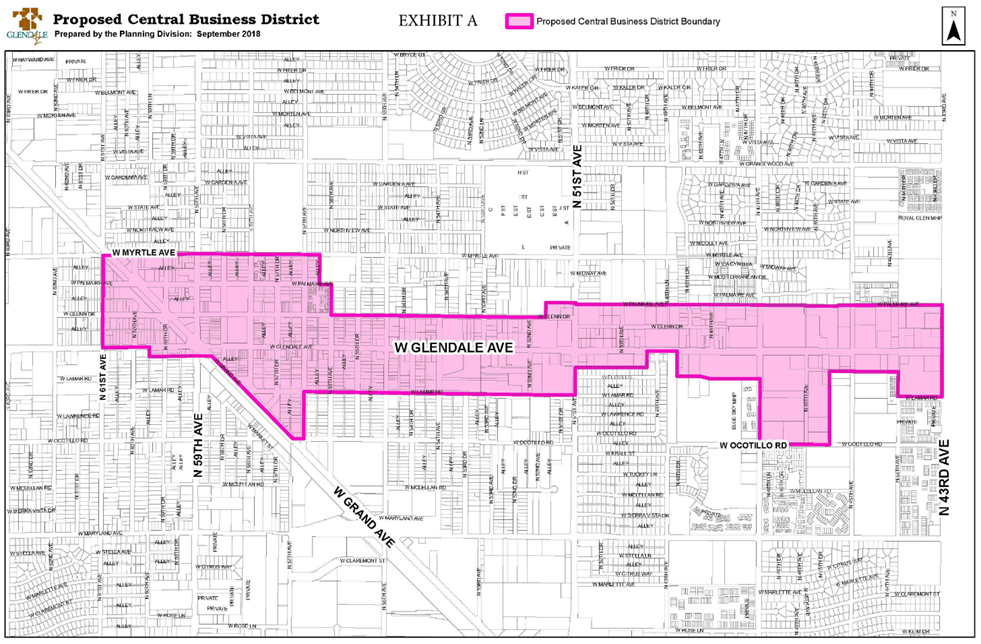
Change of Use: Any use which differs from the previous use of a building or land.
Child: Any person through the age of fourteen (14) years.
Child Care: The care, supervision and guidance of a child or children, unaccompanied by parent, guardian or custodian, on a regular basis, for periods of less than twenty-four (24) hours per day, in a place other than the child's or children's own home or homes.
Circular Drive: Horseshoe or similar shaped drive that has two (2) points of access, where ingress and egress is achieved in one continuous motion and the inside edge of the arc of the driveway is at least five (5) feet from the property lot line.
Common Lot: The original site or lot in which permitted buildings/dwelling, multi-family uses are placed, or in which all subsequent permitted individual lots/dwelling, single-family uses are placed.
Complex/Center: A commercial and/or office development defined by shared facilities, including but not limited to, circulation, parking, utilities, storm water retention and landscaping that service the shopping complex/center.
Commercial Vehicle: Any vehicle currently registered as such with the state Department of Motor Vehicles or equivalent out-of-state or federal agency and is used primarily in the conduct of a business as opposed to private family or individual use.
Common Area: Land in a residential development held in common and/or single ownership and not reserved for the exclusive use or benefit of an individual tenant or owner.
Common Ownership: Ownership by one (1) or more individuals in any form of ownership.
Compatible: The use of land or a structure that is capable of existing together in harmony with other structures or uses of land adjacent or in proximity to the land use or structure in question.
Consistent: Means harmony, regularity of steady continuity.
Contiguous: In contact with one or more sides.
Continuous: Means an uninterrupted extension in space, time or sequence.
Day/Night Sound Level (Ldn): A cumulative aircraft noise index that estimates the exposure in decibels of noise by a weighted sound-level meter for a certain geographic area during a twenty-four (24) hour period.
Decibel: A unit for expressing the relative intensity of sounds from zero (0), average least perceptible to one hundred thirty (130), average pain level.
Deck: A projecting non-enclosed portion of a house located at a height of less than eight (8) feet above the ground.
Dedication: The designation of land by its owner for any general or public use.
Demolition: Any act or process which requires a building permit under the Building Code of the City which destroys in part or in whole a house, building, or other structure.
Density, Gross: Gross acreage divided into the number of dwelling units, lots, or spaces.
Density, Net: Net acreage, excluding streets, alleys, and other rights-of-way divided into the number of dwelling units, lots, or spaces.
Developer: A person, firm, partnership, joint venture, trust, syndicate, association, corporation, limited liability company, or other legal entity who desires to improve or otherwise engage in any development of property within the City.
Development: Any manmade change to improved or unimproved real estate, including but not limited the construction, reconstruction, conversion, structural alteration, relocation, or enlargement of any structure; any mining, excavation, landfill or land disturbance.
Disabled: A person who (1) Has a physical or mental impairment that substantially limits one or more of such person's major life activities so that the person is incapable of living independently; (2) Has a record of having such an impairment; or (3) Is regarded with having such an impairment. However, disabled shall not include current illegal use of or addiction to controlled substances (as defined in Section 102 of the Controlled Substances Act [21 U.S.C. § 802].
Donation/Recycling Drop-Off Box: Any container, storage unit or structure, other than a primary building, accessory building or shed, that is used for the collection of charitable or for-profit donated items by the general public, including but not limited to clothing, household goods, toys, books, and newspapers.
Dustproof: A surface such as concrete, asphalt, pavers, crushed rock or aggregate that is a minimum of three (3) inches thick or alternative material that does not generate dust and is shown to be durable as concrete.
Dwelling Unit: A room or group of rooms within a building containing cooking accommodations and designed to be occupied exclusively by a single housekeeping unit.
Easement: Is a right to use a portion of the land of another for a special purpose or public use such as, by way of example, vehicular or transportation access, drainage, or public utilities.
Effective Date: The date on which a permit or other approval becomes enforceable or otherwise takes effect, rather than the date it was signed or circulated.
Egress: An exit.
Elevation: The vertical distance above or below a fixed reference level or a flat scale drawing of the front, rear or side of a building or structure.
Emergency: A sudden unexpected occurrence demanding immediate action to prevent or mitigate loss or damage to life, health, property or essential public services.
Encroachment: A right of access or entry that has been agreed upon by the property owner or mandated by the City, State or Federal Government.
Enlargement: An increase in the size of an existing structure.
Erected: Built, constructed, altered, reconstructed, moved upon; any physical operations on premises which required construction, excavation, fill, drainage and the like, shall be considered part of an erection.
Excavation: Removal or recovery by any means whatsoever of soil, rocks, minerals, mineral substances or organic substances other than vegetation from water or land from beneath the land surface whether exposed or submerged.
Existing Grade or Elevation: The vertical location of the ground surface prior to excavating or filling.
Existing Use: The use of a lot or structure at the time of enactment of this Code.
Expansion: The process of becoming greater in size, number, or amount.
Exterior Display: Materials and items for sale in conjunction with a retail business that are displayed outside or underneath a canopy for more than twenty-four (24) hours and which are not stored within a building. This does not include outside vending machines or architectural props or decorations.
Exterior Wall: Any wall that defines the exterior boundaries of a building or structure.
Fabrication: Means to construct or assemble from diverse and usually standardized parts.
Family: (1) An individual or any number of persons related by blood, marriage, domestic partnership, adoption or guardianship, and usual domestic help, living together as a single housekeeping unit in a dwelling unit, or (2) A group of not more than five (5) persons, who need not be related, living together as a single housekeeping unit in a dwelling unit.
Facade: The entire building front including the parapet.
Fence: An artificially constructed barrier of any material or combination of materials erected to enclose or screen areas of land.
Fence Height: Fence or wall height shall be measured as follows:
A.
Where a fence faces a public street, highway or alley, height shall be measured from the top of the curb, or where no curb exists, the center line of the street, highway, or alley. (See Figure D-1).
B.
Where a fence or wall is between two (2) properties, the height shall be the average measured from each side of the base of the fence as established at the time of final grading. (See Figure D-2).
C.
A retaining wall will be counted as part of the total wall or fence height where the retaining wall is no greater than two (2) feet horizontal distance from the wall or fence. Where a retaining wall is greater than two (2) feet distance from the fence or wall, the fence or wall height shall be measured from the base of the fence or wall. (See Figure D-3).
Figure D-1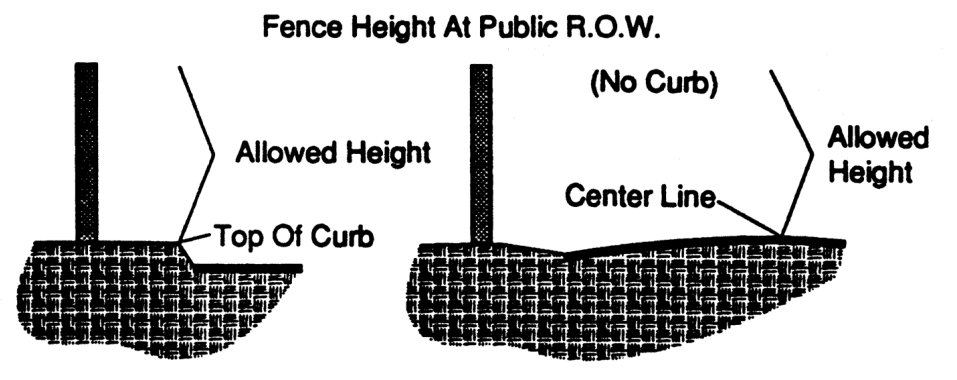
Figure D-2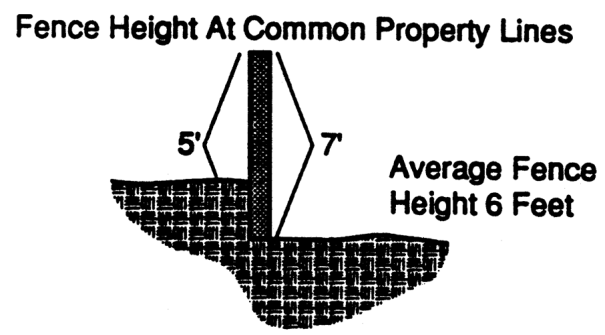
Figure D-3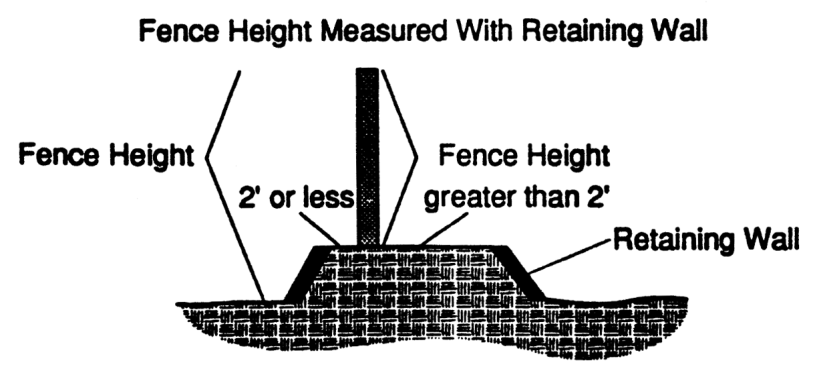
Filtered: The use of an outer lens which services to control the spectral distribution from a light source. The outer lens shall be glass, acrylic or some other translucent enclosure. Quartz glass does not comply with this requirement.
Finished Grade: The final grade and elevation of the ground surface after grading is completed and in conformance with the approved grading plans.
Flag: A fabric sheet of square or rectangular or triangular shape which is mounted on a pole. This includes flags of the United States, State of Arizona, registered corporations and other registered entities, foreign nations, as well as decorative flags, and flags supporting activities of the City or other public facility land use.
Floor Area, Gross: The combined area of the floor(s) within the exterior walls of a building. The following are excluded from the floor area:
A.
Accessory parking lots and structures.
B.
Attic area with head room less than seven (7) feet.
C.
Enclosed exterior stairways.
Floor Area Ratio: The ratio of gross floor area to the total net area of the parcel expressed as a percent or decimal. Any area included within a basement where the floor level is at least five (5) feet below the adjoining finished grade shall be subtracted prior to calculation of the floor area ratio. Where rounding of numbers is necessary to determine floor area ratio, the nearest one hundredth (.00) shall be used. (See Figure D-4).
Figure D-4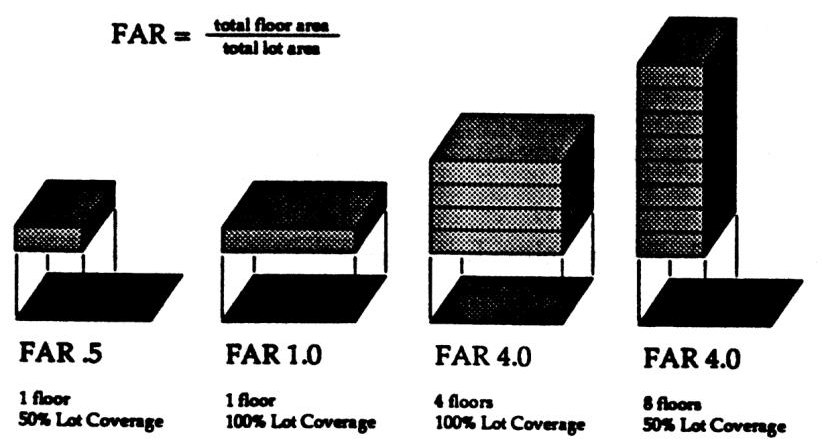
Fourplex: Four (4) dwelling units on the same parcel or lot in attached, detached, or semi-detached arrangements that are designed for residential occupancy by not more than four households living independently from each other.
Frontage: The length of a lot which fronts directly on a public street or other public area.
Garage Sale: A sale of household items conducted on a residential site and incidental to the principal dwelling.
Garage, Private. An enclosed structure, either attached or detached to a principal structure, devoted partially or wholly to the parking or storage of a vehicle owned by the occupants in the structure to which such garage is accessory.
Garage, Side Entry. A garage that does not directly face the street and the entrance is roughly parallel, rather than perpendicular, to the side property line.
Guest: Any person hiring and occupying a room on a temporary basis for sleeping purposes.
Handicapped: (See "Disabled").
Hardscape: Landscaping details such as stone or concrete walkways, courtyards, patios, retaining walls, potting containers, and other landscaping design elements that use stone, pavers, brick, tile, wood, sand, pebbles, brick, metal, and other similar materials. Hardscape shall not include areas dedicated to driveways or vehicle parking, storage or maneuvering.
Home Occupation: Any occupation or profession conducted from a principal residence in a residential zoned district, as an accessory use.
Household Pets: Small animals which are customarily kept as household pets or which are generally trainable and readily adaptable to urban residences. Household pets may include small domestic animals as well as other nontraditional pets and exotic animals.
Housekeeping Unit: One (1) or more individuals living, sleeping, and cooking in a single dwelling unit who share housekeeping tasks and responsibilities as an interdependent unit.
Impervious Surface: Any material that substantially reduces or prevents the infiltration of stormwater into previously undeveloped land. Impervious surface shall include graveled driveways and parking areas.
Individual: Any private individual, tenant, lessee, owner, or any commercial entity including, but not limited to, companies, partnerships, joint ventures or corporations.
Inoperable Vehicle: See "Vehicle, Inoperable"
Individual: Any private individual, tenant, lessee, owner, or any commercial entity, including but not limited to companies, partnerships, joint ventures or corporations.
Ingress: Access or entry.
Installed: The initial installation of outdoor light fixtures defined herein.
Irrigation System: The combination of elements such as automatic controllers, meters, pressure vacuum breakers, pipes, valves, emitters, bubblers, spray heads, tubing and other materials designed for the purpose of transporting water to landscaping.
Kitchenette: An area used or designed for the preparation of food and containing a sink, refrigerator and an electrical outlet, which may be used for a microwave oven. No 220V outlet for a range or oven may be provided.
Landscaping: The combination of elements such as trees, shrubs, ground cover, vines, and other organic and inorganic materials for the express purpose of creating an attractive and pleasing environment. Public art, water features, plazas, patios, decorative courtyards and lighting may also be considered landscape elements.
Living Space: Any fully enclosed space within a dwelling that is not the garage.
Ldn Contour: A line linking together a series of points of equal cumulative noise exposure based on the day/night sound level (Ldn) metric. Such contours are developed based on aircraft flight patterns, number of daily aircraft operations by type of aircraft and time of day, noise characteristics of each aircraft, and typical runway usage patterns.
Living Area: The occupied portion of a residence occupied, including interior areas and exterior porches, not including a garage or carport.
Loading Space: An off-street space or berth on the same lot with a building, or contiguous to a group of buildings, for the temporary parking of a commercial vehicle while loading or unloading merchandise or materials.
Lot: A parcel of land, or contiguous parcels under one (1) ownership with frontage or access to a public street, occupied or designed to be occupied as a unit and which has been established by plat, subdivision, or otherwise lawfully permitted.
Lot Area: The total area in square feet within the boundary lines of a lot.
Lot, Corner: A parcel of land located at the intersection of two (2) or more streets.
Lot Coverage: The horizontal surface area of a lot that, if looking down from above, would be covered by any building, accessory building, roof or protection.
Lot Depth: The shortest distance between the midpoint of the front lot line and the midpoint of the rear lot line. (See Figure D-5).
Figure D-5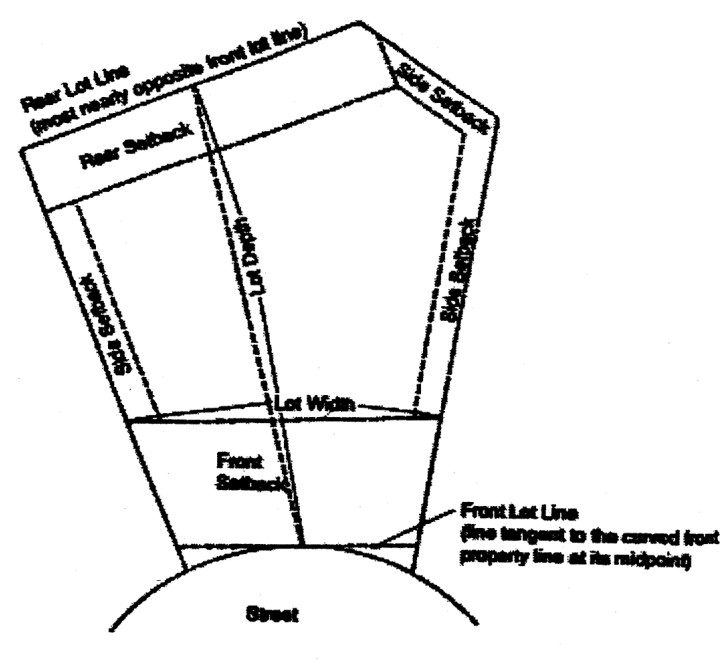
Lot, Flag: An interior lot in which the buildable area is located to the rear of a lot abutting a street, and which has access to the same street by means of a narrow driveway.
Lot, Interior: A lot other than a corner lot.
Lot Line:
A.
Front. That boundary of a lot that abuts a public street, private street, or approved access easement, except as follows:
On corner lots, the front lot line shall be the shorter line abutting a public street, private street, or approved access easement. The other street frontage shall be the corner side lot line. Alternatively, a property owner may elect that the front lot line shall be the line separating the longer street frontage of the lot from a street. This election shall be in writing and shall be approved by the Development Services Director or designee and shall be recorded with the Maricopa County Recorder's Office;
On through or double frontage lot. The lot line which is obviously the front by reason of the prevailing custom of the other buildings on the block. The other street frontage shall be a rear lot line. Where such frontage property line is not obviously evident, the Development Services Director or designee shall determine the front property line.
B.
Rear. The lot line most nearly opposite to the front property line. In the event that the front property line is a curved line, then the rear property line shall be the lot line most nearly opposite a line used to determine front setback line tangent to the front property line at its midpoint. If the rear lot-line is less than ten (10) feet long or the lot comes to a point at the rear, said rear lot-line is assumed to be a line not less than ten (10) feet long, lying wholly within the lot, approximately parallel to the front lot line.
C.
Side. Those other lot lines not defined as a front or rear lot line.
Lot, Through or Double Frontage: A lot which abuts upon two (2) parallel or approximately parallel streets or which abuts upon two (2) streets which do not intersect at the boundaries of the lot.
Lot Width: If the side property lines are parallel, the shortest distance between these side lines. If the side property lines are not parallel, the width of the lot shall be the width of the lot at its front setback line.
Maintenance: The repair, painting, trimming, pruning, watering and other on-going activities which are associated with providing an attractive site appearance and safe buildings and structures.
Minor Work: Any change, modifying, restoring, rehabilitating, renovating, surfacing, or resurfacing of the features of historic property which does not materially change the historic characteristics of the property.
Mobile Home Space: A plot of ground within a mobile home park designed for the accommodation of one (1) mobile home.
Modification (or Alteration): Any addition or modification that changes the exterior architectural appearance or materials of a structure or object. Alteration includes changes in exterior surfaces, changes in materials, additions, remodels, demolitions, and relocation of buildings or structures, but excludes ordinary maintenance and repairs.
Natural Grade: The undisturbed natural surface of the land, including washes.
Nude, Nudity or State of Nudity: The appearance of the cleft of the buttocks, anus, genitals or areola of the female breast; or a state of dress which fails to opaquely cover the cleft of the buttocks, anus, genitals or areola of the female breast.
Nude Model Studio: Any place where a person appears nude or semi-nude, and is provided to be observed, sketched, drawn, painted, sculptured, photographed or similarly depicted by other persons for any consideration, the term "nude model studio" does not include a proprietary school that is licensed by this state; a college, community college or university that is supported entirely or in part by taxation; a private college or university that maintains and operates educational programs in which credits are transferable to a college, community college or university that is supported entirely or in part by taxation; or a structure to which all of the following apply:
A.
A sign is not visible from the exterior of the structure and no other advertising appears on the premises indicating that a nude or semi-nude person is available for viewing;
B.
The business does not otherwise advertise itself as an adult business;
C.
Where in order to participate in a class, a student must enroll at least three (3) days in advance of the class; and
D.
Where no more than one (1) nude, or semi-nude model is on the premises at any one (1) time.
Occupancy, Certificate of: A document issued by the Chief Building Official and/or Zoning Administrator allowing the occupancy or use of a building and certifying that the structure or use has been constructed or will be used in compliance with all the applicable codes of the City of Glendale.
Occupancy, Change in: The discontinuance of an existing use and the substitution therefore of a use of a different kind or class.
Occupant: The person occupying or having custody of a structure or premises as a lessee or other.
Off-Site: Not located within the area of the property to be developed.
Off-Street: Land which is not within the right-of-way of any street or alley.
Open Space: An area that is intended to provide light and air and is designed for either environmental, scenic, or recreational purposes. Open space may include, but is not limited to lawns, decorative planting, walkways, active and passive recreation areas, playgrounds, fountains, swimming pools, wooded areas, and water courses.
Open Space, Common: Open space, other than private yard or outdoor living space intended for use by all occupants of a development.
On-Site: Located on the lot that is the subject of discussion.
Opaque: Opaque means that the material shall not transmit visible light.
Outdoor light fixtures: Outdoor artificial illuminating devices, lamps and other devices, permanent or portable, used for illumination or advertisement. Such devices shall include, but shall not be limited to, search, spot or flood lights for buildings and structures, recreational areas, parking lot lighting, landscape lighting, billboards and other signage and street lighting.
Outdoor Display: The placement of goods, equipment, merchandise or exhibits at a location visible to the public view, other than within a building.
Outdoor Sales: The display of products or services which are intended for retail or wholesale purchase not within a completely enclosed building.
Outdoor Storage: The keeping in an unroofed area, of any goods, junk, material, merchandise or vehicles in the same place for more than twenty-four (24) hours.
Owner: A person recorded as such on the records of the County Assessor, or a person who has been granted written authorization by the owner to act on his behalf.
Parapet: The extension of a false front or wall above a roofline.
Parking Aisles: That portion of the parking area consisting of the driving lanes providing access to the individual parking spaces.
Parking Area: That portion of a lot that is used by vehicles for access, circulation, parking and loading and unloading. It comprises the total of circulation areas, loading and unloading areas, and parking areas (spaces and aisles).
Parking Lot: An area not within a building where motor vehicles may be stored for the purposes of temporary, daily, or overnight off-street parking.
Parking, Off-Street: Marked or unmarked parking located within a parcel and outside a private or public right-of-way.
Parking, On-Street: Marked or unmarked parking located within a private or public right-of-way.
Parking, Shared: The development and use of parking areas on two (2) or more separate properties for joint use by the businesses on those properties.
Paved: An artificial covering on a street, road, parking lot, driveway, walkway, patio, or other natural surface of the ground composed of a material as specified by the City of Glendale Engineering Standards or as approved by the City Engineer unless otherwise stated herein.
Permitted Use: Any use allowed in a Zoning District and subject to any restrictions applicable to that Zoning District.
Person: Any person, firm, partnership, association, social or fraternal organization, corporation, estates, trust, receiver, syndicated, branch or government or any other group or combination of groups acting as a unit.
Principal Use: The main or primary use on any lot or parcel which establishes the basic land use characteristics of the property, as opposed to an accessory use. In some instances, a property may have more than one (1) principal use.
Project: One (1) or more uses, buildings, or tenant spaces designed to function as an integral unit through shared parking and driveways, even though there may be separate ownerships and parcels.
Prohibited Use: A use which is not specifically permitted or analogous to those specifically permitted.
Recreational Vehicle: A vehicular type of unit forty (40) feet or less in length and eight (8) feet or less in width, primarily designed for temporary living quarters, recreation, camping, or travel use, which either:
A.
Contains its own motive power as in the case of motor homes, minimotor homes, or recreational vans;
B.
Is drawn by another vehicle as in the case of travel trailers, tent trailers, camper trailers, or watercraft on boat trailers; or
C.
Is mounted on another vehicle as in the case of truck campers.
Recycling Container: A collection container that serves as a neighborhood drop-off point for temporary storage of recoverable resources. This facility would generally be located in a shopping center parking lot or in other public/quasi-public areas such as churches, parks, and schools. It is intended for household or consumer use.
Redevelopment: Any modification, alteration, remodeling, or new construction to an existing site or structure which requires a permit under the Building Code of the City of Glendale.
Residential Use: Long term occupancy of residential structures including single residence and multiple residence dwellings, dormitories, and mobile homes.
Satellite Earth Station: A device consisting of an antenna and reflector, having any dimension of more than one and one-half (1½) meters, and is a solid or open mesh configured structure used for reception or transmission of radio energy to or from an earth orbit satellite or celestial body.
Scenic Corridor: is the required landscape setback and land abutting the Agua Fria Freeway (Loop 101) between 51st Avenue and Bell Road. The Scenic Corridor extends ¼ -mile on both sides of the freeway. This distance is measured from the freeway right-of-way.
Screening: A wall, fence, hedge, informal planting, or berm, provided for the purpose of buffering a building or activity from neighboring areas or from the street.
School: A place of general instruction including colleges, but not including business colleges, child care centers, dancing schools, riding academies, or specialized trade or vocational schools.
Semi-Nude or Semi-Nudity: A state of dress which shows the female breast below a horizontal line across the top of the areola at its highest point, or which shows the male or female buttocks. This definition shall not include any portion of the cleavage of the female breast exhibited by a dress, blouse, leotard, bathing suit or other wearing apparel, provided that the areola is not exposed in whole or in part.
Semi-Nude Business: Any commercial establishment, other than an adult cabaret, nude model studio or topless bar, which features employees who appear semi-nude before customers on the business premises. The term "semi-nude business" is intended to apply to businesses which emphasize and seek, through the conduct of any employee or performer, to arouse or excite any patron's sexual desires. Nothing in this definition shall be construed to apply to the presentation or performance of any play, drama or ballet in any theater, concert hall, fine arts academy, school, institution of higher education or similar establishment as a form of expression of opinion or communication of ideas or information, as differentiated from the promotion of exploitation of semi-nudity for the purpose of advancing the economic welfare of a commercial or business enterprise.
Setback: The required minimum horizontal distance between the building line and the related front side, or rear property line.
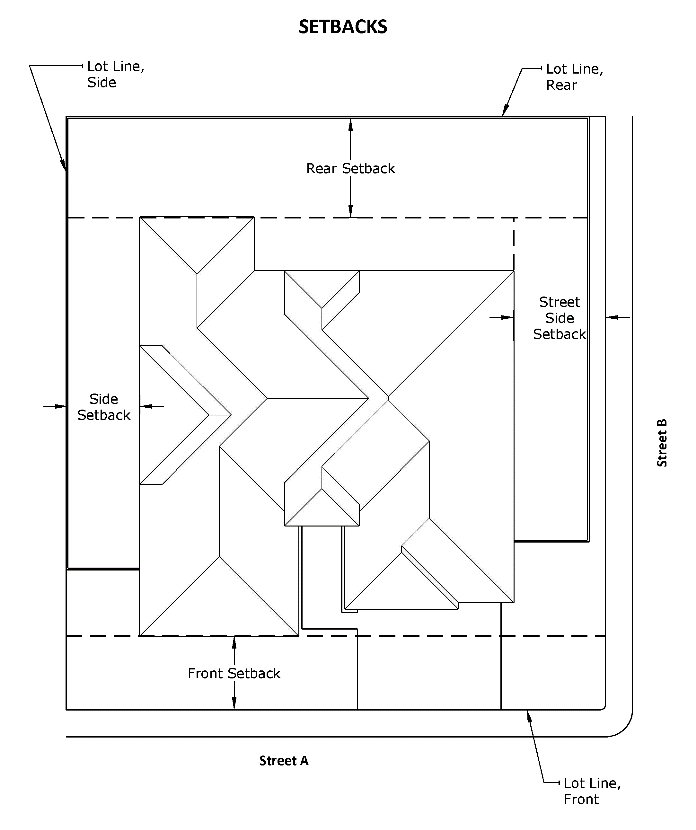
Screening: A wall, fence, hedge, informal planting, or berm, provided for the purpose of buffering a building or activity from neighboring areas or from the street.
Screening Device: Any structure intended to conceal, fully or partially, an activity or mechanical element from the public view, adjacent uses, properties and/or streets.
Section: A section of this Code, unless some other Code or statute is mentioned.
Shielded, fully (fixtures): Fixtures that are shielded in such a manner that light rays emitted by the fixture, either directly from the lamp or indirectly from the fixture, are projected below a horizontal plane running through the lowest point on the fixture where light is emitted.
Shielded, partially (fixtures): Fixtures that are shielded in such a manner that the bottom edge of the shield is below the plane of the center line of the lamp reducing light above the horizontal.
Sight Visibility Triangle: The area of visibility on a street corner to allow for safe operations of vehicles, pedestrians, and cyclists in the proximity of intersecting streets, rail lines, sidewalks, and bicycle paths.
Sign: Any device (including, but not limited to, letters, words, numerals, figures, emblems, pictures, or any part or combination) used for visual communication which is intended to attract the attention of the public and is visible from the public rights-of-way or other properties. The term "sign" shall not include any flag, badge or insignia of any governmental unit nor shall it include any item of merchandise normally displayed within a show window of a business.
Sign, A-Frame: A temporary sign, normally supported by its own frame and not affixed to a structure or permanently ground mounted. It is positioned upright in a manner that forms an "A" when in use; also referred to as a "sandwich" or "tent" sign.
Sign, Awning: Signs which are placed on or integrated into fabric or other material canopies which are mounted on the exterior of a building.
Sign, Banner: A temporary sign made of fabric, plastic, or other pliable material without a rigid structural support or internal illumination on which advertising copy or graphics may be displayed.
Sign, Billboard (Static): A sign which is intended to advertise a business, commodity, service, entertainment, product, or attraction sold, offered, or existing elsewhere than on the property where the sign is located.
Sign, Billboard (Digital/Electronic): An identification sign or a sign which is intended to advertise a business, commodity, service, entertainment, product, or attraction sold, offered, or existing on or elsewhere than on the property where the sign is located and intended to be viewed primarily from SR 101 or SR 303. An Electronic Billboard shall be internally illuminated, and not capable of movement.
Sign, Construction or Development: A temporary sign providing information about future development or current construction on a site, and the parties involved in the project.
Sign, Directional: An on-premises sign that includes information assisting in the flow of pedestrian or vehicular traffic such as enter, exit, and one-way.
Sign, Directory: A sign, other than an identification sign, listing the names, uses, or locations of the various businesses or activities conducted within a building or group of buildings which is centrally located and intended to provide on-site directions.
Sign, Drive Up/Drive Through: A permanently mounted sign displaying the bill of fare for a drive thru restaurant.
Sign, Entry Wall Monument: Signs that identify a residential or non-residential development, and are attached to a screen wall or landscape planter adjacent to the adjacent public street, and are designed and sited in a manner consistent with the architectural style and landscape theming of the development.
Sign Face: The area or display surface used for the message.
Sign, Feather/Swooper: A banner type sign that is attached to a aluminum or fiberglass rod which is inserted directly into the ground or into a sleeve embedded in the ground or portable base. The flag portion of the sign is attached on one side, permitting the unattached side to move freely in the wind.
Sign, Freestanding Monument: A sign which is erected on its own self-supporting permanent structure, detached from any supporting elements of a building.
Sign, Identification: A sign that is designed and intended to identify only the business, place, organization, building, street address, or person on the property on which it is located.
Sign, Illuminated: A sign whose surface is artificially lighted internally or externally.
Sign, Inflatables: A non-porous flexible inflated device, utilizing inert gas, used as advertising matter.
Sign, Marquee: A permanent sign attached to, supported by and projecting from a building, especially a theater or hotel.
Sign, Mural: Graphic art painted directly on an exterior wall with no commercial text, logo, brand, or message with the exception of an artist or sponsor signature.
Sign, Noncommercial: A sign which does not contain information or advertising for any business, commodity, service, entertainment, product, or other attraction.
Sign, Nonconforming: A sign lawfully erected and maintained prior to the adoption of this ordinance which does not conform with the requirements of this ordinance.
Sign, Off-Site/Off-Premise: Any permanent or temporary sign that may display a message, whether commercial or noncommercial, that may not necessarily relate to the premises upon which the sign is located.
Sign, On-Site/On-Premise: Any permanent or temporary sign which pertains to the business operated, activity conducted or products sold or manufactured on the premises upon which the sign is located; or which displays a noncommercial message installed or caused to be installed only by the property owner and/or lessee of the property upon which the sign is located.
Sign, Painted: See Sign, Wall.
Sign, Place Marker: A sign that identifies a culturally significant event, date or recognition of a building or property.
Sign, Political: A sign which supports any candidate for public office or urges action for or against any other matter on the ballot of primary, general, or special elections.
Sign, Portable: Any sign not affixed to a structure or ground mounted on a site. Sign, Projected: A sign that is digitally projected onto a building surface.
Sign, Projecting: A sign attached to a building or other structure and extending in whole or in part more than fourteen (14) inches beyond the building.
Sign, Pylon: A sign hung, supported or cantilevered from one or more supports constructed of structural steel, pipe, or other materials.
Sign, Reader Panel: A sign designed to permit immediate change of copy either manually or electronically.
Sign, Skyline: A sign permanently affixed to a wall or surface not more than twenty (20) degrees from vertical at the upper edge of a building and extending parallel with the mansard roof line or parapet upon which the sign is attached.
Sign, Structure: The supports and framework of the sign.
Sign, Temporary: A sign not intended or designed for permanent display.
Sign, Wall: A sign mounted flat against and projecting less than fourteen (14) inches from, or painted on the wall of a building or structure with the exposed face of the sign in a plane parallel to the face of the wall. This does not include window signs.
Sign, Walker: A person, who wears, holds or balances a portable sign.
Sign, Weekend Directional: A temporary sign typically placed on weekends within the right-of-way that is designed for providing direction and/or orientation for pedestrian or vehicular traffic.
Sign, Window: A sign affixed to the interior or exterior of a window, or placed immediately behind a window pane so as to attract the attention of persons outside the building.
Sign, Yard: Small placard-type signs that are typically associated with, but not limited to, the advertisement of real estate, political campaigns, and meeting or event announcements.
Site: The building area leased or owned by or on behalf of any business together with its adjacent privately-owned walkway or parking area.
Site Built: A structure or dwelling constructed on the site by craftsmen utilizing materials delivered to the site. Said structure shall consist of footings and foundations poured in place, permanently attached to the walls. Roofing materials, interior and exterior finishes shall be applied on the site. All construction shall be in conformance with all uniform codes in force at the time of construction. This definition does not include relocated site built homes.
Site Plan: A plan, prepared to scale, showing accurately and with complete dimension, the boundaries of a site and the location of all buildings, structures uses, principal site development features, or any other information required by this Ordinance, which is proposed for a specific parcel of land.
Solid: Not able to be seen through; not transparent.
Specified Anatomical Areas: Human genitals in a state of sexual arousal; the appearance of the cleft of the buttocks, anus, genitals or areola of the female breast; or a state of dress which fails to opaquely cover the cleft of the buttocks, anus, genitals or areola of the female breast.
Specified Sexual Activities: Activities that depict, describe, or relate to any of the following activities:
A.
The fondling or other erotic touching of human genitals, pubic region, buttocks, anus or female breasts;
B.
Sex acts, normal or perverted, actual or simulated, including intercourse, oral copulation or sodomy;
C.
Masturbation, actual or simulated; or
D.
Excretory functions as part of or in connection with any activities set forth in subsections A through C.
Storage Shed: One (1) story, detached accessory building used for tools and storage, playhouse, or similar use with a projected roof area of less than one hundred twenty (120) square feet.
Story: A space in a building between the surface of any floor and the surface of the next floor above, or if there be no floor above; then the space between such floor and the ceiling or roof above; provided, however, that where the floor level of the first story is at least five (5) feet below the adjoining finished grade, the space shall be considered a basement and not counted as a story.
Street: A public thoroughfare, including road, highway, drive, lane, avenue, place, boulevard, and any other thoroughfare which affords the principal means of access to abutting property, but not including alleys or driveways.
Street, Private: An area intended for vehicular traffic, owned and maintained by a private corporation, individual, or group of individuals.
Structural Alteration: Any change in the supporting members of a building, such as bearing walls, columns, beams, or girders.
Structure: Anything constructed or erected, which requires location on the ground or attached to something having location on the ground.
Temporary Fence: Structure used to enclose an outdoor activity or use for a period as set forth in Section 35.4.208(C) that is contained fully above ground and includes no permanently implanted or affixed footings.
Temporary Office or Construction Trailer: A temporary portable unit for office use which is designed to be transported, after fabrication, on its own wheels, or on a flatbed, other trailer, or have detachable wheels.
Temporary Use or Building: A use or structure permitted under this Code to exist for a limited period of time.
Topless Bar: Any establishment which is required to hold a liquor license under Arizona law and which offers semi-nude performers as entertainment.
Translucent: Admitting and diffusing light so that objects and the light source beyond cannot be clearly perceived.
Triplex: Three (3) dwelling units on the same parcel or lot in attached, detached, or semi-detached arrangements that are designed for residential occupancy by not more than three (3) households living independently from each other.
Use: The purpose for which land or a building thereof is designed, arranged, or intended, or for which it is occupied or maintained, let or leased.
Use, Accessory: A use of a building or lot which is customarily incidental and subordinate to the principal use of the main building or lot.
Use, Conditional: Any use which may be established in the particular zoning district in which it is allowed only upon meeting the conditions and limitations as prescribed by this Ordinance.
Use, Permitted: A use which is lawfully established in a particular district and which conforms with specified development standards
Utility trailer: Any wheeled vehicle without motor power, which is designed to be drawn by a motor vehicle and which is generally and commonly used to carry and transport personal effects, trash and rubbish, equipment, or automobiles.
Vehicle: Any vehicle designed to carry one or more persons, which is propelled or drawn by mechanical power, such as automobiles, trucks, and motorcycles.
Vehicle, Commercial: Any vehicle or trailer typically used for business, industrial, office or institutional purposes or having painted thereon or affixed thereto a sign identifying a business, industry office of institution or a principal product or service of such. Agricultural equipment used as part of a permitted agricultural principal use shall not be considered a commercial vehicle.
Vehicle, Inoperable: A vehicle not currently registered or licensed in this state or another state, or any vehicle that is unable to operate or move under its own power. It shall also mean any motor vehicle that is in an abandoned, wrecked, dismantled, scrapped, junked or partially dismantled condition that includes having no wheels, or lacking other parts necessary for the normal operation of the vehicle. It shall also mean any vehicle that because of mechanical defects, a wrecked or partially wrecked frame or body or dismantled parts, cannot be operated in a normal, and safe manner.
Vehicle, Maneuvering Area: That portion of a lot that is an improved dustproof surface used by vehicles for access, circulation, loading and unloading, but is not used for vehicle parking or storage.
Vehicle, Parking: A dustproof surface used for the placement of vehicles for limited periods of time. Vehicle, Personal: A passenger vehicle that is owned or leased by an individual.
Vehicle, Storage: For the purposes of this ordinance, references to vehicle storage shall not be determined based solely on duration, but rather on the negative effects commonly associated with prolonged parking and/or abandonment. A vehicle shall be deemed stored if any of the following effects exist: after five (5) consecutive days the vehicle has not been moved a minimum of twenty (20) feet, accumulation of spiderwebs, dirt and debris, flat tires, damaged or missing body parts, or broken or unusable windows. Vehicles placed on blocks or similar devices where all or part of the vehicle is not touching the ground shall be considered inoperable.
Visible: Capable of being seen (whether or not legible) by a person of normal height and visual acuity walking or driving on a public road.
Wall: An artificially constructed barrier of solid stucco, masonry, rock or concrete material erected to enclose or screen areas of land.
Wall, Building: means any exterior surface of a building or any part thereof, including windows.
Watchman's Quarters: A single dwelling unit that is accessory to an allowed non-residential use and that is occupied solely by an individual who is responsible for maintenance or security in association with the principal use of the property.
Wireless Communication Facility (WCF): A facility that sends and/or receives wireless communication signals, including, but not limited to, antennas, microwave dishes, antenna structures, towers, equipment enclosures and the land upon which they are all situated. Wireless communication facilities can be concealed, disguised or visible.
Wireless Communications Facility, Antenna: Any structure or device used to transmit and/or receive wireless signals for the provision of cellular, paging, personal communications services and microwave communications. Such structures and devices include, but are not limited to, directional antennas, such as panel antennas, microwave dishes and satellite dishes, and omni-directional (WHIP) antennas.
Wireless Communications Facility, Antenna Structure: An antenna and its associated structure, such as a monopole or tower and co-axial cables.
Wireless Communications Facility, Cell On Wheels (COW): A portable self-contained cell site that can be moved to a location and set up to provide personal wireless services on a temporary or emergency basis. A COW is normally vehicle-mounted and contains a telescoping boom as the antenna support structure.
Wireless Communications Facility, Co-Location: The act of siting multiple wireless communications providers in the same location and on the same support structure. Collocation also means locating one or more additional wireless communication facilities on a structure designed for a different purpose such as, but not limited to, buildings, water tanks, towers, flagpole or utility poles without the need to construct a new support structure.
Wireless Communication Facility, Co-Located: A facility owned by one or more wireless communication service providers that is attached to a facility or site owned by a different wireless communication service provider.
Wireless Communication Facility, Concealed: A facility designed to be architecturally integrated into a building so that the antenna, support structures, cabling and equipment are completely encased or hidden or designed in a manner that blends into the environment so the antenna structure cannot be seen or, if seen, cannot be recognized as wireless communication facilities. Concealed wireless communication facilities include, but are not limited to, architecturally screened roof-mounted facilities such as elevator or stairway penthouses, chimneys, flues, vents and roof-top equipment storage areas. Artwork or architectural design features such as church spires, clock towers and signs or flag poles may also be considered concealed wireless communication facilities if they encase or hide the wireless communication facility.
Wireless Communication Facility, Disguised: A facility designed and sited so that the antenna structure is minimally obtrusive and appears to be part of the physical surroundings. Disguised wireless communication facilities include, but are not limited to, a monopalm, a monocactus, or monopine. The location of a wireless communication facility on athletic field light poles, water towers, street lights, traffic light or utility poles, walls and fences, and suspended wire antennas would also be considered disguised if the antennas, cabling and related equipment and structures are not commonly recognized as a wireless communication facility.
Wireless Communication Facility, Equipment Enclosure: A tract or area of land enclosed by a solid wall that contains one or more wireless communication facility antennas, their associated equipment shelters and other equipment associated with and ancillary to wireless communication.
Wireless Communication Facility, Equipment Shelter: A fully enclosed structure, cabinet or vault located at the base of or near a wireless communication facility that is used to house and protect the electronic and supporting equipment necessary for processing wireless communication signals. An equipment shelter often has, among other things, batteries, generators, electrical equipment, one or more air conditioning units, a power meter and disconnect located on the outside.
Wireless Communication Facility, Monocactus: A single, freestanding and unguyed three-dimensional structure in the shape of a saguaro or similar cactus erected on the ground that houses one or more antenna. The structure must be anatomically correct in its color, texture and design to give the appearance of a cactus. For purposes of this chapter, a monocactus is not a tower.
Wireless Communication Facility, Monopalm: A single, freestanding and unguyed structure in the shape of a palm tree erected on the ground that supports one or two disguised antenna. The structure must be anatomically correct in its color, texture and design to give the appearance of a palm tree. For purposes of this chapter, a monopalm is not a tower.
Wireless Communication Facility, Monopine: A single, freestanding and unguyed structure in the shape of a pine tree erected on the ground that supports one or more antenna. The structure must be anatomically correct in its color, texture and design to give the appearance of a pine tree. For purposes of this chapter, a monopine is not a tower.
Wireless Communication Facility, Monopole: A single, freestanding and unguyed pole-type structure erected on the ground that supports one or more antenna. For purposes of this chapter, a monopole is not a tower.
Wireless Communication Facility, Support Equipment: Any equipment serving or being used in conjunction with a wireless communication facility or support structure. This equipment includes, but is not limited to, utility or transmission equipment, power supplies, generators, batteries, cables, equipment buildings, cabinets and storage sheds, shelters or other structures.
Wireless Communication Facility, Support Structure: A structure that supports a wireless communication facility including, but not limited to, monopoles, towers, utility poles and other freestanding self-supporting structures.
Wireless Communication Facility, Tower: A lattice-type structure, guyed or freestanding, that supports, holds or contains equipment that sends and/or receives wireless communication signals, including, but not limited to, antennas.
Wireless Communication Facility, Visible: A facility that is clearly recognized and not concealed or disguised.
Wireless Communication Service Provider: The entity that is responsible for providing wireless communication to the general public, private sector, or governmental or quasi-governmental agency that owns or operates and maintains a wireless communication facility.
Yard: Open space on the same lot with a building or group of buildings, lying between the building (or outer building of a group) and the nearest lot line and unoccupied and unobstructed from the ground upward.
Yard, Front: An open space extending the full width of the lot between the front lot line and the front planes of the building and any front-facing privacy walls. Where such privacy walls do not exist, the front yard shall be the area between the front lot line and the front planes of the building projected to the side lot lines.
Yard, Rear: An open space extending the full width of the lot between the rear lot line and the rear planes of the building projected to the side lot lines, or, for corner lots where a privacy wall or fence exists between the building and the side lot line, projected to the privacy wall or fence.
Yard, Side: An open space between the side lot line, and the side planes of the building and extending from the front yard to the rear yard.
Yard, Street Side: Where a privacy wall or fence exists between the building and a street side lot line, the side yard shall include the open space area between the street side lot line and the privacy wall or fence, extending from the front plane of said wall to the rear lot line.
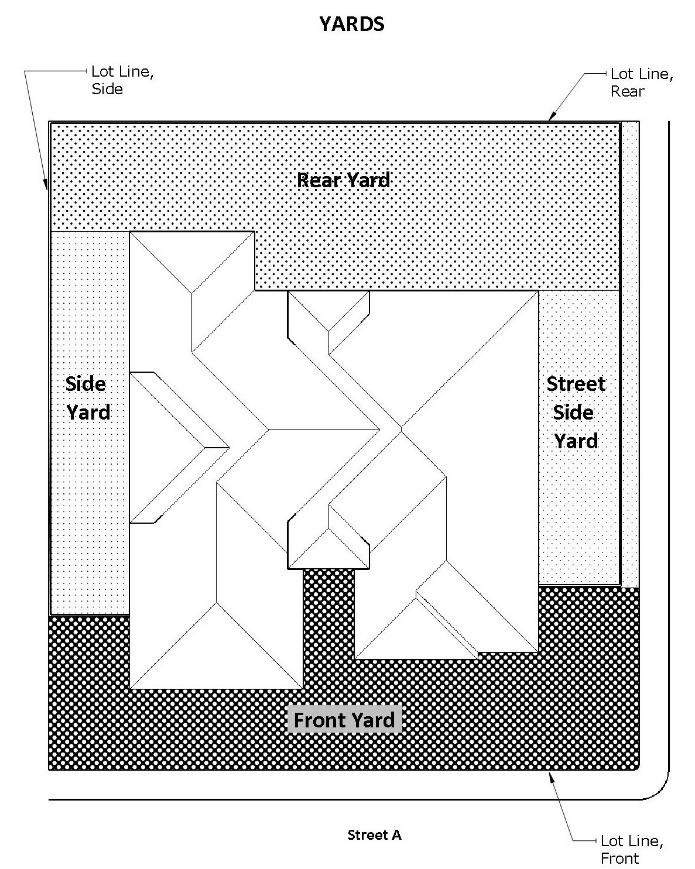
Zoning Administrator: The city employee responsible for the enforcement and interpretation of the zoning ordinance. Also known as the Development Services Director or designee.
Zone: An area within which certain uses of land and buildings are permitted and certain others are prohibited; yards and other open spaces are required; lot areas, building height limits, and other requirements are established; all of the foregoing being identical for the zone in which they apply.
Zoning District: A designated area in which the same zoning regulations apply through the geographic area.
(Ord. No. O24-51, § 2, 12-10-24; Ord. No. O25-46, § 1, 11-25-25)

