
Goodrich City Zoning Code
ARTICLE I
- IN GENERAL
Sec. 36-1.- Short title.
This chapter shall be known and may be cited as the "Village of Goodrich Zoning Ordinance," and may be referred to as "this chapter."
(Ord. No. 82, § 1.1, eff. 6-25-1991)
Sec. 36-2. - Authority of chapter provisions.
This chapter is enacted in accordance with, and under the authority of, Public Act No. 207 of 1921 (MCL 125.581 et seq.), known as the "City and Village Zoning Act."
(Ord. No. 82, § 1.2, eff. 6-25-1991)
Sec. 36-3. - Purpose of chapter.
This zoning chapter is based on the adopted village master plan and is intended to regulate the use of land, buildings and structures to promote the public health, safety and general welfare by accomplishing the following:
(1)
Establishment of zoning districts and uniform regulations applicable to each district governing the use of the land, and dimensions for building and site development with such minimum regulations as are deemed necessary to carry out the provisions of this chapter.
(2)
Accommodate and promote land uses which are compatible with the village's character and conserve the property values and longterm stability of neighborhoods.
(3)
Encourage use of the lands and natural resources in accordance with their character and capability, thus preserving the sensitive and important environmental features in the village, such as wetlands, the Mill Pond, topography, open space, mature vegetation and wildlife habitat.
(4)
Limit or prohibit improper use of land.
(5)
Reduce hazards to life and property.
(6)
Promote safe conditions for motorists, pedestrians and bicyclists by maintaining an acceptable level of service along streets and at driveways within the village.
(7)
Provide property owners with reasonable, though not always direct, access to their property.
(8)
Facilitate an adequate and cost effective systems for transportation, sewage disposal, safe and adequate water supply, education and recreational facilities; and protect the public investment in existing infrastructure and services.
(9)
Establish controls over potential conflicting land uses, and uses which may need special regulations as conditional uses in order to be compatible with surrounding development.
(10)
Encourage the maintenance, improvement and adaptive reuse, where necessary, of existing properties in the village which conform to the zoning standards.
(11)
Promote the gradual elimination of uses, buildings and structures which do not conform with the regulations and standards of this chapter.
(12)
Provide for administering this chapter, including resolving conflicts with other ordinances, collection of fees, procedures for petitions, hearings and appeals; and to provide for any other matters authorized by the City and Village Zoning Act.
(13)
Balance the community's right to compatible and quality development with the property owners' right to a reasonable rate of return on investment.
(14)
Allow the establishment of any legal land use within the village in the presence of demonstrated and documented need for that land use within either the village or surrounding township, unless there is no suitable location in the village based on the village master plan, surrounding land uses, and/or potential harm to natural features.
(Ord. No. 82, § 1.3, eff. 6-25-1991)
Sec. 36-4. - Scope of chapter and conflicting regulations.
(a)
Where any provision of this chapter imposes either greater or lesser restrictions, limitations, conditions, standards or requirements upon the use of buildings, structures or land; the height of buildings or structures; lot coverage; lot areas; yards, wetlands, woodlands or other open spaces; or any other use or activity which is regulated by this chapter, the provision or standard which is more restrictive or limiting shall govern.
(b)
The provisions of this chapter shall be considered as minimum, and such conflicting laws of a more restrictive nature shall supersede any provisions of this chapter.
(c)
This chapter shall not abrogate or annul any easement, bylaw, master deed, restriction, covenant or private agreement, except that the regulations or provisions of this chapter shall govern if determined by the village council to be more restrictive or impose a higher standard.
(d)
Every building, structure or use, or part thereof, which is erected, moved, placed, reconstructed, extended, enlarged or altered shall be regulated by this chapter.
(e)
No setback area or lot existing on the effective date of the ordinance from which this chapter was derived shall be reduced in dimension or area below the minimum requirements set forth herein. Yards or lots created following such date shall meet at least the minimum requirements specified in this chapter.
(f)
The regulations established in this chapter shall be the minimum regulations for promoting and protecting the public health, safety and welfare.
(Ord. No. 82, § 1.4, eff. 6-25-1991)
Sec. 36-5. - Approvals and construction prior to effective date.
Nothing in this chapter shall be deemed to require any change in the plans, construction or designated use of any building upon which received site plan approval within one year of the adoption of this chapter, provided that actual construction of building foundations approved by the village was begun prior to or within six months following the adoption of this chapter, provided that the construction is being diligently carried on and is completed within one year of adoption of this chapter, unless an extension is approved by the planning commission as outlined in the site plan review standards.
(Ord. No. 82, § 1.5, eff. 6-25-1991)
Sec. 36-6. - Validity and severability clause.
This chapter and the various components, articles, sections, subsections, sentences and phrases are hereby declared to be severable. If any court of competent jurisdiction shall declare any part of this chapter to be unconstitutional or invalid, such ruling shall not affect any other provisions of this chapter not specifically included in such ruling. Further, if any court of competent jurisdiction shall declare unconstitutional or invalid the application of any provision of this chapter to a particular parcel, lot, use, building or structure, such ruling shall not affect the application of such provision to any other parcel, lot, use, building or structure not specifically included in such ruling.
(Ord. No. 82, § 1.6, eff. 6-25-1991)
Sec. 36-7. - General rules of construction of chapter.
The following rules of construction shall apply regarding the use and interpretation of certain terms or words used is this chapter:
(1)
The term "person" includes an individual firm, association, organization, partnership, trust, company corporation or any similar entity.
(2)
The term "shall" is always mandatory and not discretionary; the term "may" is permissive.
(3)
The term "used" includes the terms "intended", "maintained", "designed," "arranged" or "occupied."
(4)
The term "building" or "structure" includes any part thereof.
(5)
The terms "used" or "occupied," as applied to any land, building or structure, shall be interpreted to include the phrases "intended to be" or "designed to be" used or occupied.
(6)
The present tense includes the future tense; the singular number includes the plural; and the plural number includes the singular.
(7)
Unless the context clearly indicates the contrary, where a regulation involves two or more items, conditions, provisions, or events connected by the conjunction "and," "or," "either…or," the conjunction shall be interpreted as follows:
a.
"And" indicates that all the connected items, conditions, provisions, or events shall apply.
b.
"Or" indicates the connected items, conditions, provisions or events may apply singly or in any combination.
c.
"Either…or" indicates that the connected items, conditions, provisions, or events shall apply singly, but not in combination.
(8)
Terms not defined in this section and section 36-8 shall have the meaning customarily assigned to them.
(Ord. No. 82, § 2.1, eff. 6-25-1991)
Sec. 36-8. - Definitions.
The following words, terms and phrases, when used in this chapter, shall have the meanings ascribed to them in this section, except where the context clearly indicates a different meaning:
Abutting (lot or parcel) means a lot or parcel which shares a common border, excluding road right-of-way, with the subject lot or parcel.
Accessory structure means a detached structure on the same lot with, and/or a nature customarily incidental and subordinate to, a principal structure.
Area, gross floor, (i.e. total floor area) means the total floor area occupied by a use and measured to include all space used primarily or incidentally for such use.
Area, sales or gross leasable, means the total floor area occupied by a commercial use customarily open to the public, excluding areas such as storage, maintenance or utility rooms and bathrooms. Where calculations are not provided, the gross floor area shall be assumed to be 80 percent of the total floor area.
Apartments means a residential structure or group of structures, each of which contain more than four attached one-family dwelling units and share common front and/or rear yards.
Apartments, accessory (i.e. "mother-in-law apartment), means a single apartment unit contained within a single-family home, intended as a temporary unit for a family member.
Automobile body repair station means buildings and premises where, along with the sale of engine fuels, the following services may be carried out: general repair, engine rebuilding, rebuilding or reconditioning of motor vehicles; collision service, such as body, frame or fender straightening and repair; overall painting and undercoating of automobiles.
Automobile service station means buildings and premises for the primary purpose of the retail sales of gasoline (stored only in underground tanks), oil, grease, batteries, tires and other operational fluids and accessories for the automobile, and the installation of such commodities, and for other minor automobile repair not to include: auto refinishing, body work, dismantling of automobiles for the purpose of reuse or resale of parts, or storage of automobiles other than those in for immediate repair or service. Sales of convenience items shall be considered an accessory use when occupying no more than 25 percent of the gross floor area.
Automobile wash means any building or structure or portion thereof containing facilities for washing motor vehicles using production line methods with a conveyor, blower, steam cleaning device or other mechanical washing devices; and shall also include coin and attendant operated drive-through, automatic self-serve, track-mounted units and similar high volume washing establishments, but shall not include hand washing operations in an automobile service station.
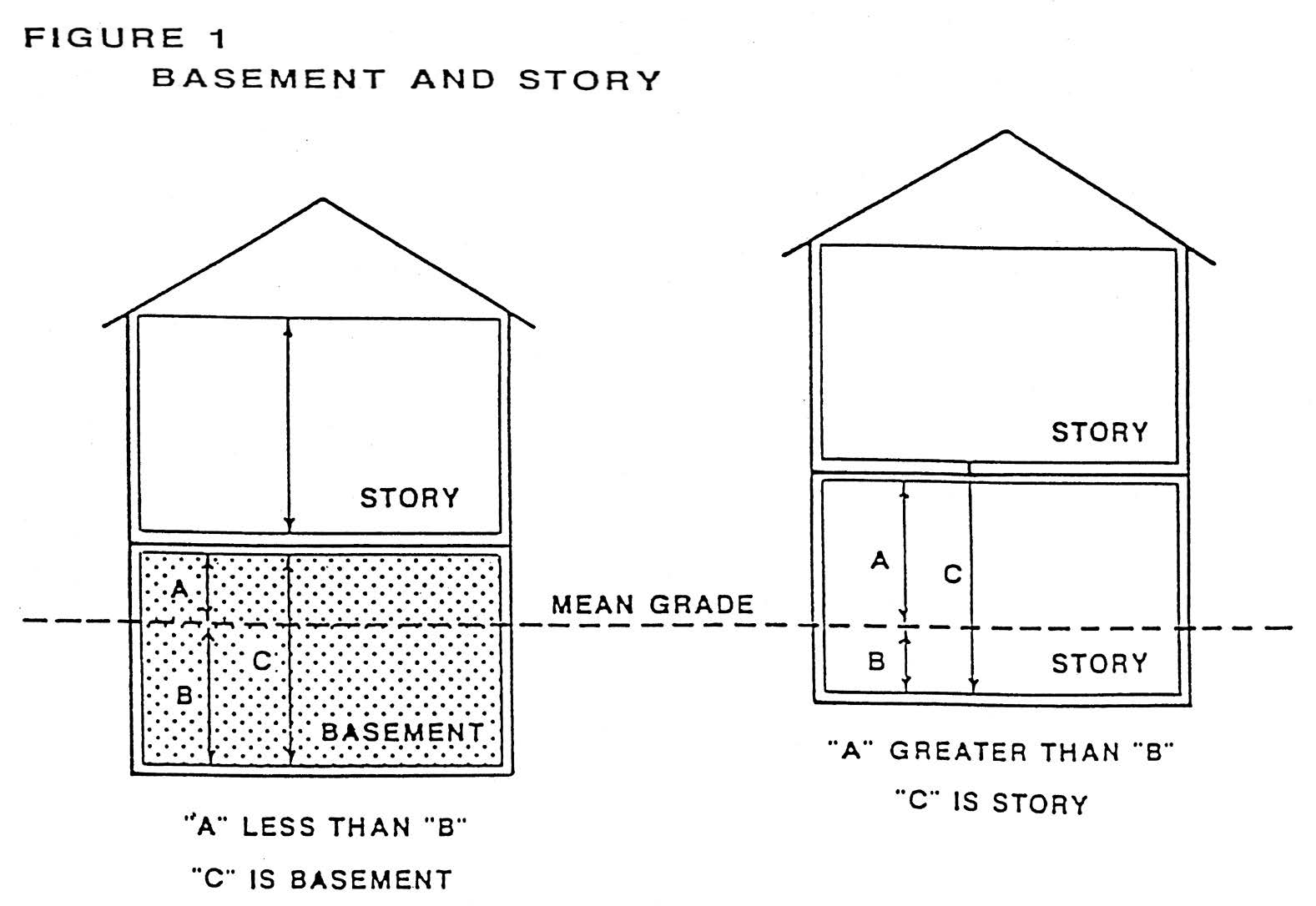
Basement means the portion of a building which is partially or wholly below grade but so located that the vertical distance from the mean grade to the floor is greater than the vertical distance from the mean grade to the ceiling (see Figure 1).
Berm means a mound of earth graded, shaped and improved with grass and other types of landscaping typically used for visual screening and to reduce noise.
Block face means defined as and consists of those properties fronting along an existing right-of-way and located between the intersections of existing streets, or between intersections and dividers such as rivers, railroads, and other similar natural or manmade features.
Bed and breakfast inn means any dwelling in which overnight accommodations are provided or offered for transient guests for compensation, including provision for a morning meal only for the overnight guest only. A bed and breakfast is distinguished from a motel in that a bed and breakfast establishment shall have only one set of kitchen facilities, employ only those living in the house or up to one additional employee, and have facade style consistent with surrounding homes.
Board of appeals, zoning, means the board of appeals as provided under provisions of the City and Village Zoning Act, with powers and duties as defined in those statutes, except as modified in this chapter.
Buffer (yard) means a strip of land often required between certain zoning districts reserved for plant material, berms, walls, or fencing to serve as a visual barrier.
Building means any structure (excluding fences) having a roof or walls and built, for or capable of, the shelter or enclosure of persons, animals, chattels, or property of any kind. This definition includes mobile homes, manufactured housing, tents, storage, sheds, garages, greenhouses pole barns and other accessing structures.
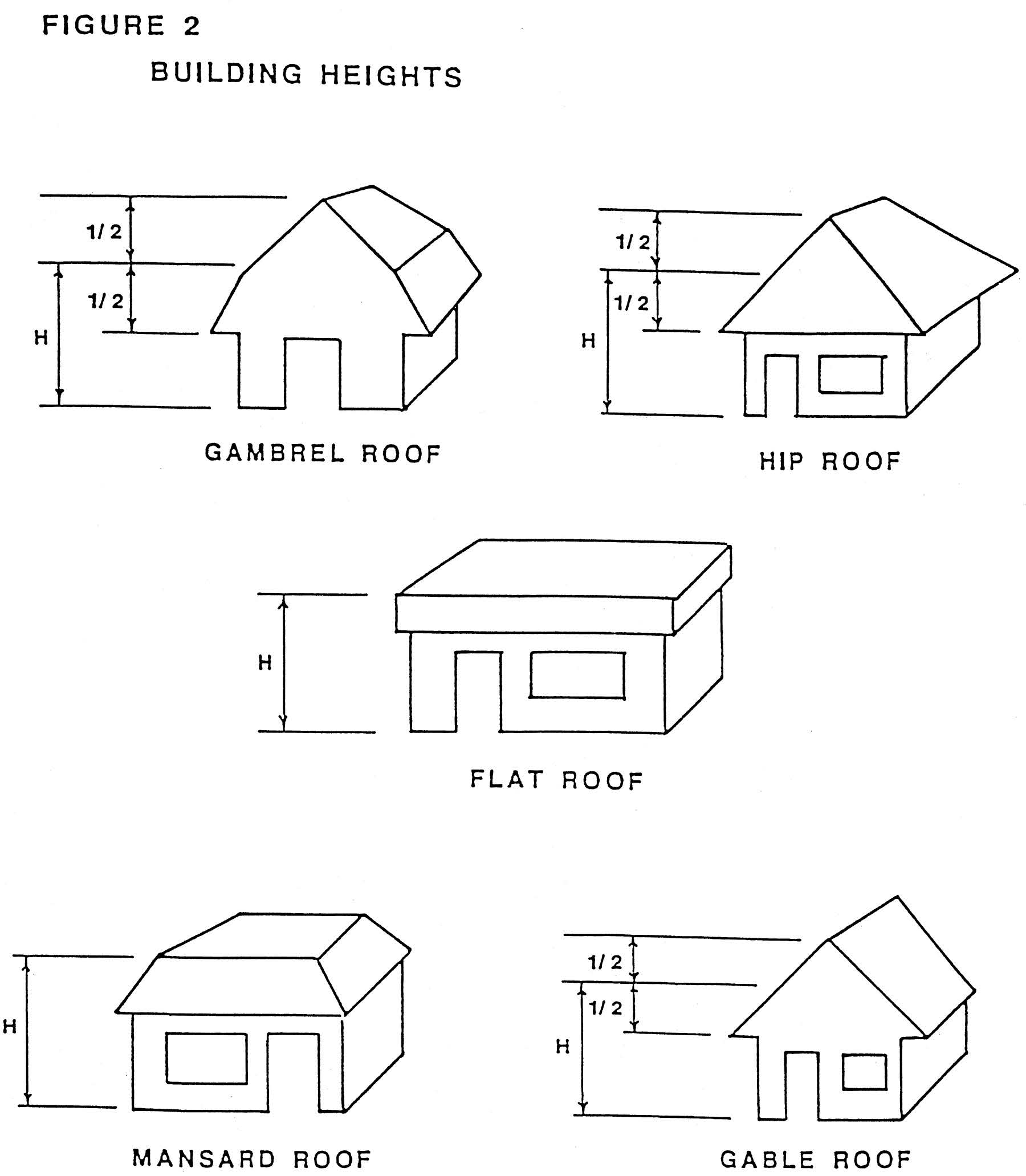
Building, height of, means the vertical distance from the grade at the center of the front of the building to the highest point of the roof surface in a flat roof, to the deck line for mansard roofs, and to the beam height level between eaves and ridge for gable, hip and gambrel roofs (see Figure 2).
Building line means a horizontal line generally parallel to a front, side or rear lot line which is located at the point of principal building foundation nearest the front, side or rear lot line.
Building permit means an authorization issued by the village building inspector to move, erect or alter a structure within the village.
Building, principal, means a building which houses the main uses of the lot on which such building is located.
Chimney means a vertical structure enclosing a flue or flues that carry off smoke or exhaust from an outdoor furnace, including that part of the structure extending above a roof.
Concrete plant means a plant for storing and mixing concrete, sand and/or gravel. The term shall include the plant, trucks associated with the plant, and all storage, stockpiles, accessory buildings, structures and uses associated with the plant. Concrete plants may include sales of other building materials as an accessory use. Concrete plants shall not include asphalt plants or crushing machinery.
Conditional use means a use of land for an activity which, under usual circumstances, could be detrimental to other land uses permitted within the same district but which may be permitted because of circumstances unique to the location of the particular use and which use can be conditionally permitted without jeopardy to use permitted within such district. Such uses are defined as "special land uses" in the zoning act.
Conditional use permit means an authorization approved by the village planning commission allowing use of land and/or building for a conditional use listed within the particular zoning district.
Condominium act means Public Act No. 59 of 1978 (MCL 559.101 et seq.).
Condominium, contractible, means a condominium project from which any portion of the submitted land or building may be withdrawn in pursuant to express provisions in the condominium documents and in accordance with this Code and the condominium act.
Condominium, general common elements, means the common elements other than the limited common elements.
Condominium, limited common element, means a portion of the common elements reserved in the master deed for the exclusive use of less than all of the co-owners.
Condominium, master deed, means the condominium document recording the condominium project as approved by the zoning administrator to which is attached as exhibits and incorporated by reference the approved bylaws for the project and the approved condominium subdivision plan for the project.
Condominium setbacks means and shall be measured as follows:
(1)
Front yard setback. The distance between the public street right-of-way or private road easement line and the foundation of the unit site. Where there is not public right-of-way or access easement, the front yard setback shall be measured from the nearest pavement edge to the foundation of the unit site.
(2)
Side yard setback. The distance between the limits of the development and the side of a unit or the distance between the sides of any adjacent units.
(3)
Rear yard setback. The distance between the limit of the development and the rear of the unit or the distance between the rear of any two adjacent units.
Condominium unit means the portion of the condominium project designed and intended for separate ownership as described in the master deed, regardless of whether it is intended for residential, office, industrial, business, recreational, use as a time-share unit, or any other type of use.
Condominium unit site means the area designating the perimeter within which the condominium unit must be built. After construction of the condominium unit, the balance of the condominium unit site shall become a limited common element. The term "condominium unit site" shall be equivalent to the term "lot," for purposes of determining compliance of a site condominium subdivision with provisions of this chapter pertaining to minimum lot size, minimum lot width, maximum lot coverage and maximum floor area ratio.
Day means a calendar day unless otherwise stated.
Day care center, commercial, means a commercial building where the primary use is to provide day care to children.
Day care home, family, means a single-family dwelling in which the operator permanently resides as a member of the household, licensed by the state family independence agency in which one, but less than seven, adults are provided care and supervision for periods of less than 24 hours per day. A family day care home may also be an occupied single-family home in which one but less than seven minor children are provided care and supervision for periods of less than 24 hours per day, unattended by a parent or legal guardian, except children related by blood, marriage or adoption to an adult member of the family occupying the single-family dwelling.
Day care home, group, means a single-family dwelling in which the operator permanently resides as a member of the household, licensed by the state family independence agency, in which more than six, but less than 12, adults are provided care and supervision for periods of less than 24 hours per day. A family day care home may also be an occupied single-family home in which more than six, but less than 12, minor children are provided care and supervision for periods of less than 24 hours per day, unattended by a parent or legal guardian, except children related by blood, marriage or adoption to an adult member of the family occupying the single-family dwelling.
Density means the number of dwelling units situated on or to be developed per net or gross acre of land. For purposes of calculating maximum density, only 25 percent of the acreage comprised of open water, land within the 100-year floodplain elevation, and/or wetlands protected by part 303 of Public Act No. 451 of 1994 (MCL 324.30301 et seq.) shall be calculated toward the total site acreage.
Drive-in business means a business establishment so developed that its retail or service character is dependent on providing a driveway approach or parking spaces for motor vehicles so as to serve patrons while in the motor vehicle rather than within a building or structure, including customer communication facilities for banks or other uses. A drive-in restaurant is distinct from a drive-through restaurant in that the majority of drive-in patrons consume food and beverages while in the vehicle and parked on the premises.
Drive-through business means a business establishment so developed that its retail or service character is wholly or partly dependent on providing a driveway approach and service windows or facilities for vehicles in order to serve patrons food and beverages in a ready-to-consume state from a drive-through window to patrons in motor vehicles. A drive-through restaurant may or may not also have indoor seating.
Dwelling, multiple-family, means a building designed exclusively for, and containing three or more dwelling units.
Dwelling, two-family, means a building containing two dwelling units, designed for exclusive use and occupancy by two families.
Dwelling unit means a building, or part thereof, providing complete living facilities, including provisions for sleeping, cooking, eating and sanitation, for exclusive use by one family, with no ingress or egress through any other dwelling unit, except an approved accessory apartment.
Dwelling unit, single-family, means a residential dwelling unit, designed for and occupied by one family only. Such dwelling unit may be specified as either attached or detached.
Essential public service means the erection, construction, alteration, or maintenance by public utilities or any governmental department or commission of underground or overhead gas, electrical, steam, or water transmission or communication, supply or disposal systems, including poles, wires, drains, sewers, pipes, conduits, cables, fire alarm boxes, police callboxes, railroad rights-of-way, traffic signals, hydrants, and other similar equipment and accessories in connection with, but not including, buildings. Nongovernmental towers, radio and television towers, and cellular phone antennas are not considered to be essential public services.
Essential public service building means a building or structure principal to an essential public service, such as a dropoff stations for residential recyclables, vehicle garages, telephone exchange buildings, electricity transformer stations or substations, gas regulator stations, and cellular phone antennas.
Excavation means any breaking of ground, except common household gardening and ground care.
Family means a single individual or a number of individuals domiciled together whose relationship is of a continuing, nontransient, domestic character, and who are preparing meals and living together, and intending to continue living together for the foreseeable future, as a single, nonprofit, housekeeping unit. The definition of family shall not apply to any society, club, fraternity, sorority, association, lodge, organization or group of students or other individuals whose relationship is of a transitory or seasonal nature or for anticipated limited duration of school terms or other similar determinable period.
Firewood means trunks and branches of trees and bushes, but does not include leaves, needles, vines or brush smaller than three inches in diameter.
Flood insurance rate map (FIRM) means the official map of the village upon which the Federal Insurance Administration has delineated both the areas of special flood hazards and the risk premium zones applicable to the village.
Floodplain means lands which are subject to periodic flooding and have been defined by the Soil Conservation Service of the U.S. Department of Agriculture to have allured soil deposits, indicating that such flooding has taken place, or as defined by a technically qualified engineer and accepted by the village council as such a floodplain.
Floor area. See Area.
Foster care family home, adult, means a single-family dwelling in which the operator permanently resides as a member of the household, licensed by the state family independence agency, with the approved capacity to receive six or fewer adults to be provided with foster care for five or more days of a week and for two or more consecutive weeks.
Foster family home means a single-family dwelling in which the operator permanently resides as a member of the household, licensed by the state family independence agency, in which at least one, but not more than four, minor children, who are not related to an adult member of the family occupying the single-family dwelling by blood, marriage or adoption, are given care and supervision for 24 hours per day, unattended by a parent or legal guardian.
Foster family group home means a single-family dwelling in which the operator permanently resides as a member of the household, licensed by the state family independence agency, in which more than four, but fewer than seven, minor children, who are not related to an adult member of the family occupying the single-family dwelling by blood, marriage or adoption, are given care and supervision for 24 hours per day, unattended by a parent or legal guardian.
Garage means part of a principal building or an accessory building or structure used primarily for the parking or storage of vehicles in connection with a permitted use of the principal building, where there is no vehicle serving or storage for compensation.
Garden center means an establishment with retail sales of trees, fruits, vegetables, shrubbery, plants, landscaping supplies, lawn furniture, playground equipment and other home garden supplies and equipment.
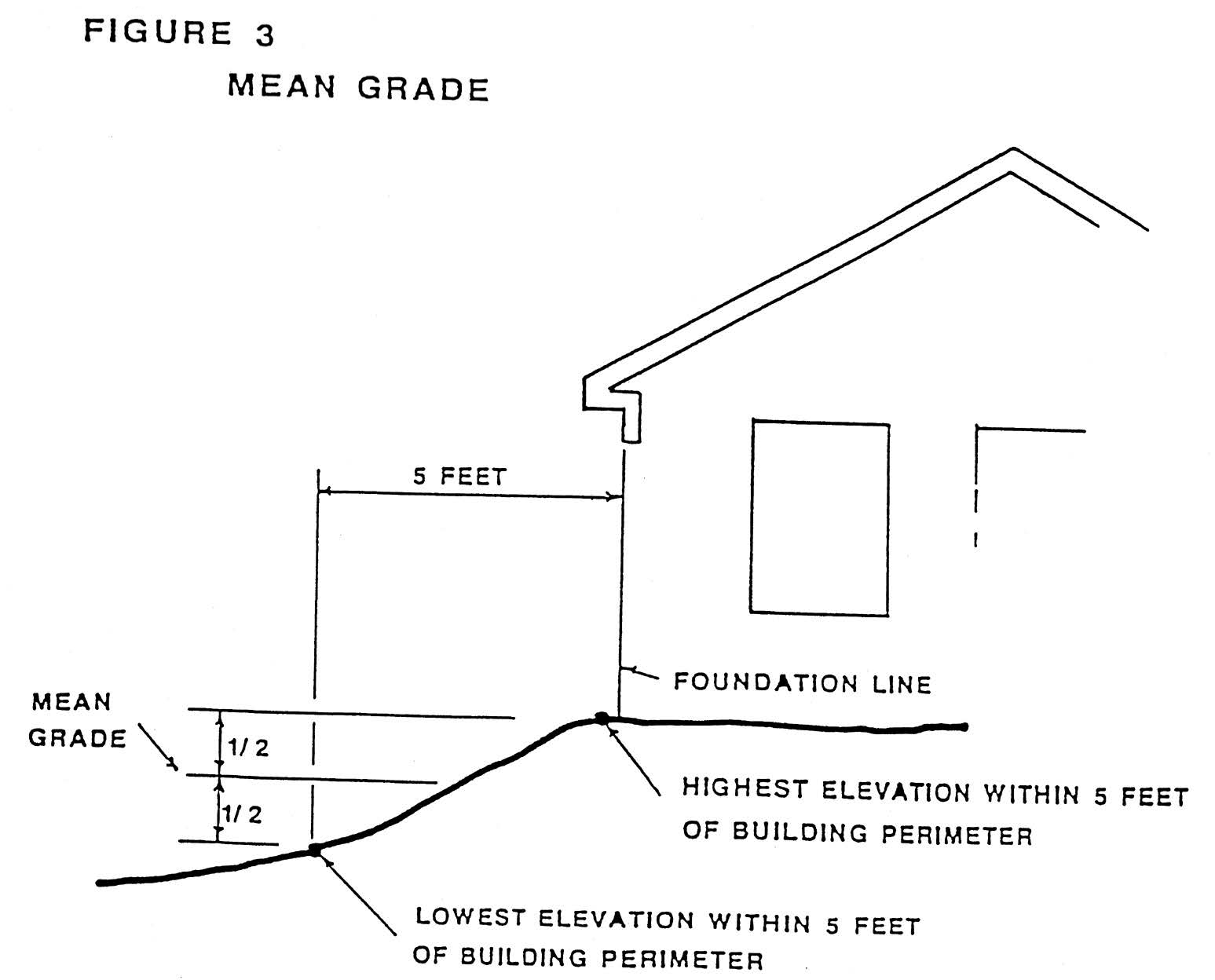
Grade, mean, means the arithmetic average of the lowest and highest grade elevations in an area within five feet of the foundation line of a building or structure, or in the area between the foundation line and the lot line, where the foundation line is less than five feet from the lot line. (See Figure 3.)
Greenbelt means a landscaped area along a street between the curb or road shoulder and the front yard building or parking setback line, this area is also referred to as the front yard parking lot setback area. Landscaping requirements for greenbelts are listed in the Table of Dimensional Standards in division 1, article III of this chapter.
Hobby farm means a noncommercial farm on a parcel of land under one ownership which is used for raising crops and/or livestock, but where such activity is not the primary source of income for the family.
Home occupation means a gainful occupation traditionally and historically conducted in a dwelling unit as an activity clearly incidental and secondary to the principal use of the building or structure.
Hospital means a facility offering primarily inpatient care, and services for observation, diagnosis, and active treatment of patients with a medical, surgical, obstetric, chronic, or rehabilitative condition requiring the daily care and supervision of a physician and medical support staff. A hospital may or may not also have a clinic offering outpatient services.
Kennel means any land, building or structure where four animals over six months of age are either permanently or temporarily boarded, housed, bred or sold.
Livestock means animals such as horses, cattle, sheep, goats, and swine.
Loading space, off-street, means space logically and conveniently located for bulk pickups and deliveries, designed to accommodate the maneuvering area needed by expected sizes of delivery vehicles when all off-street parking spaces are filled.
Lot means an undivided portion of land of at least sufficient size to meet minimum zoning requirements for use, buildings, structures, lot coverage, yards, and other open spaces as may be present or required under provisions of this chapter. Such lot shall have frontage on an improved public street, or on an approved private road, and may consist of: a single lot of record, a portion of a lot of record, a combination of contiguous lots of record, or a parcel of land described by metes and bounds.
Lot area means the total horizontal area within the lot lines of a lot. For purposes of calculation of minimum lot area, easements for overhead utilities and private access easements shall be excluded; areas within the 100 year floodplain elevation or determined to be state department of environmental quality regulated wetlands shall be included, except as noted under the definition of the term "density."
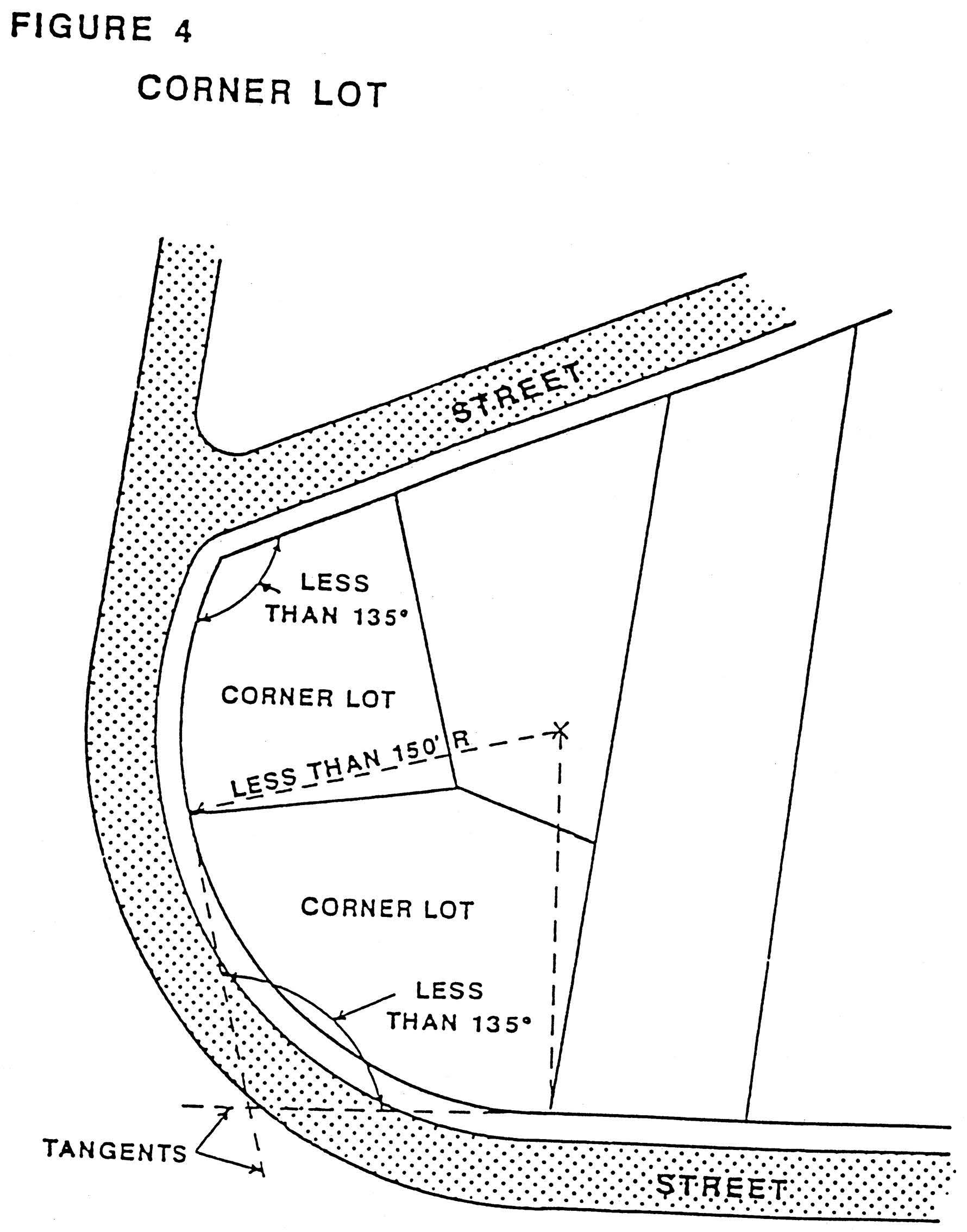
Lot, corner, means a lot where the interior angle of two adjacent sides at the intersection of two streets is less than 135 degrees. A lot abutting upon a curved street or streets shall be considered a corner lot is the curve is of less radius than 150 feet, and the tangents to the curve, at the two points where the side lot lines meet the curve, form an interior angle of less than 135 degrees. (See Figure 4.)
Lot coverage means the part or percent of a lot occupied by buildings, structures and accessory buildings.
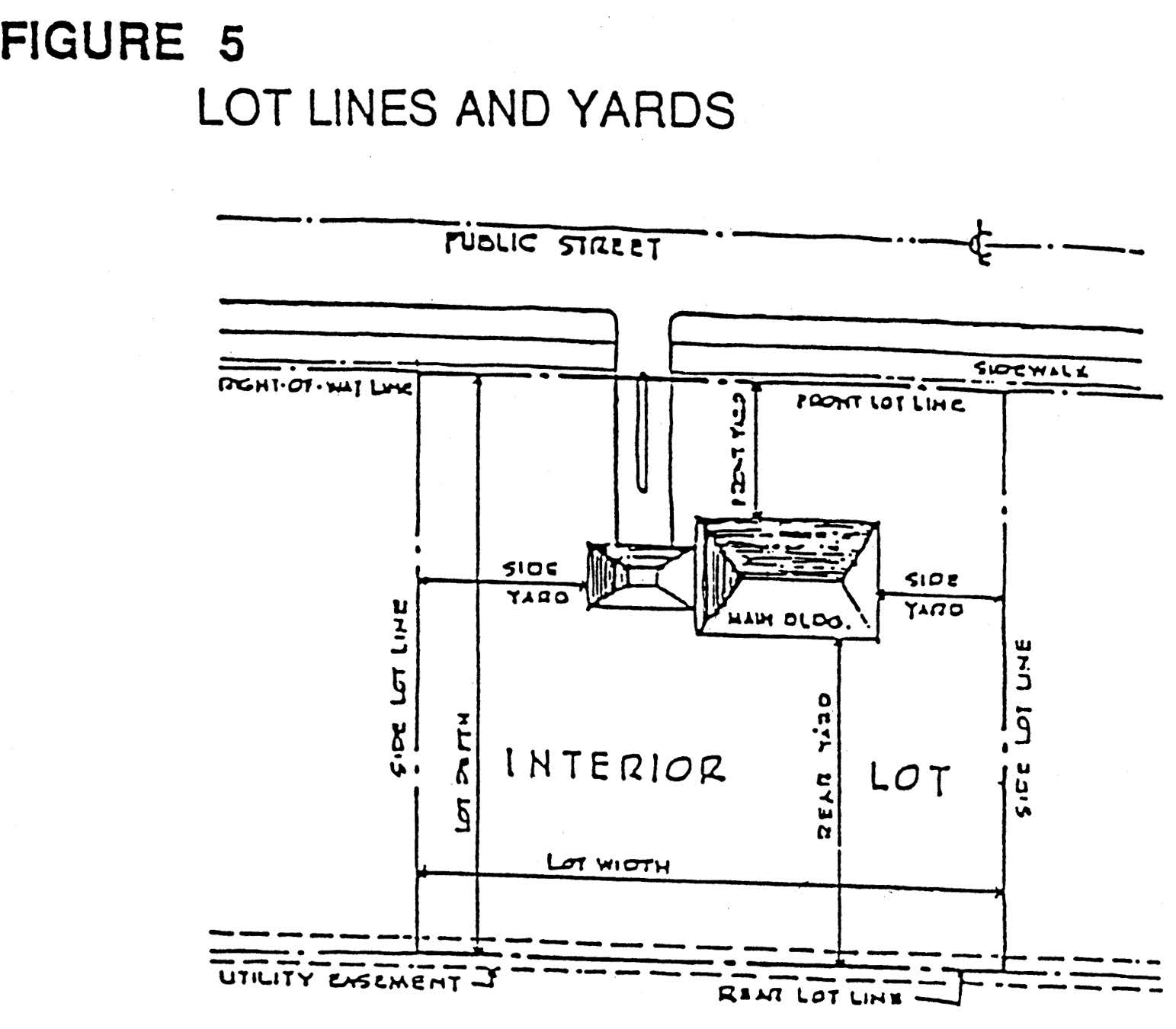
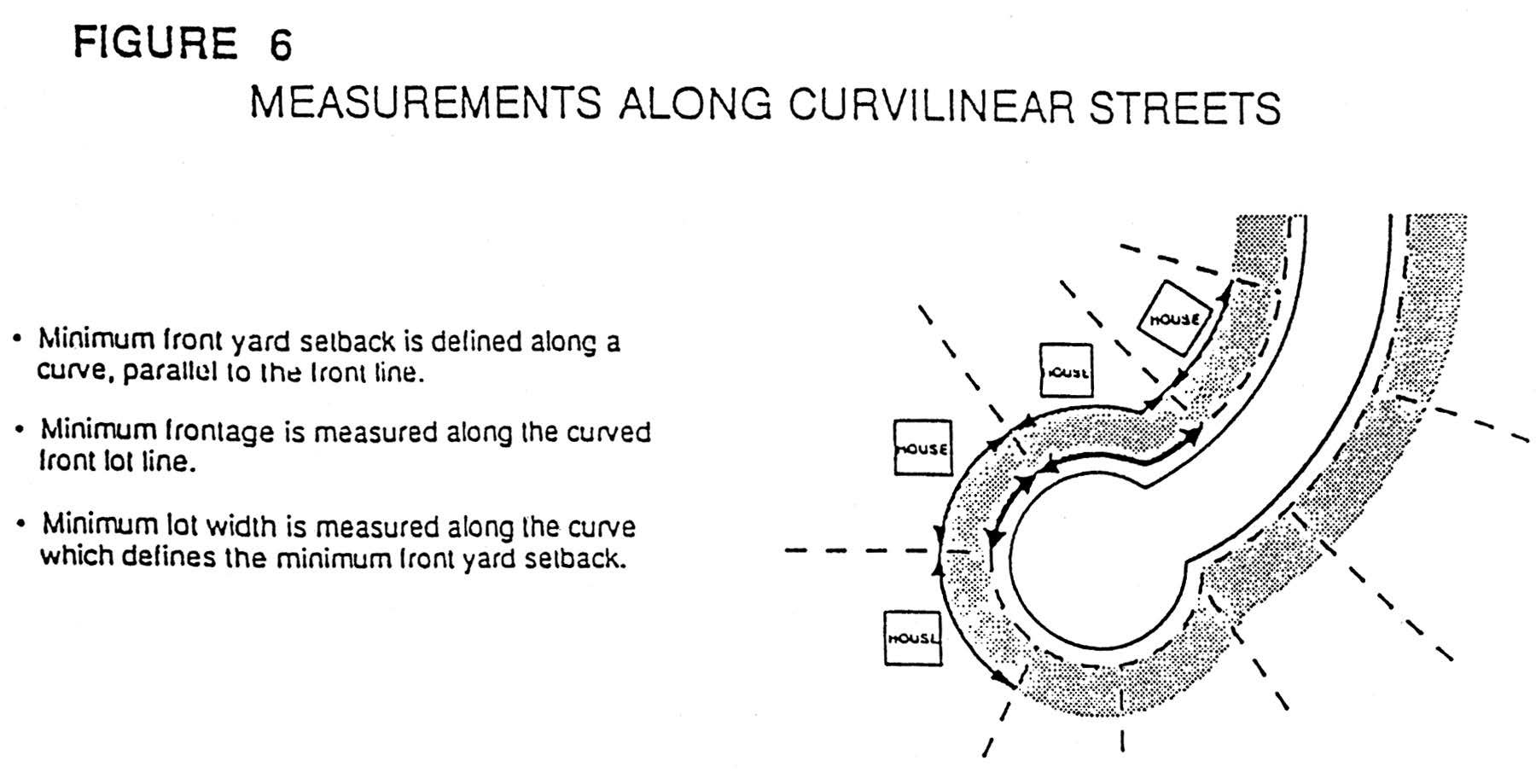
Lot line means the lines bounding a lot or parcel and listed below and illustrated on Figures 5 and 6.
(1)
Front lot line (i.e., lot frontage): The lot lines abutting a public street right-of-way or private road access easement that separates the lot from such right-of-way or easement. Corner lots or through lots are considered to have two front lot lines and shall provide the minimum required front yard setback at both front lot lines.
(2)
Rear lot line: The lot line opposite and most distant from the front lot line. For an irregular or triangular shaped lot, a line at least ten feet in length, entirely within the lot, and generally parallel to and most distance from the front lot line.
(3)
Side lot line: Any lot line not a front or rear lot line.
In the case where the above definitions are not sufficient to designate lot lines, the zoning administrator shall designate the front, rear and side lot lines in consideration of the orientation of the buildings on the lot, the address of the lot, the orientation of other buildings along the block, and natural features affecting site design.
Lot of record means a lot which has a legal description recorded in the office of the county register of deeds, as part of a subdivision or plat, or by metes and bounds.
Lot, through (i.e., a double frontage lot), means an interior lot having frontage on two more or less parallel streets.
Lot, width, means the horizontal distance between side lot lines measured parallel to the front lot line at the minimum required front setback. Figure 6 illustrates calculation of minimum lot width for lots along curvilinear streets.
Manufactured home means a dwelling unit which is designed for longterm residential use and is wholly or substantially constructed at an off-site location.
Master plan means the master plan for the village, adopted by the planning commission.
Miniwarehouse or self-storage warehouse means a building or group of buildings in a controlled-access and fenced compound that contains varying sizes of individual, compartmentalized, and controlled-access stalls or lockers for the storage of customer's goods or wares.
Mobile home means a structure, transportable in one or more sections, which is built on a chassis and designed to be used as a dwelling with or without permanent foundation, when connected to the required utilities, and includes the plumbing, heating, air conditioning, and electrical systems contained in the structure.
Mobile home park (manufactured housing park) means a parcel or tract of land under the control of a person, group or firm upon which three or more mobile homes are located on a continual nonrecreational basis and which is offered to the public for that purpose regardless of compensation, including any building, structure, enclosure, street, drive, equipment or facility used or intended for use incidental to the occupancy. Mobile home parks are licensed and regulated by the state mobile home commission.
Motel (hotel) means an establishment in which individual cabins, courts, rooms, suites or similar units or separate structures, are rented to transients for sleeping accommodations. The definition of motel does not include bed and breakfast establishments or multiple-family dwelling units.
Nonconforming building or structure means a building or structure lawfully in existence on the effective date of the ordinance from which this chapter was derived, or amendments thereto, which no longer meets the regulations of the district in which it is located.
Nonconforming lot means a lot of record, lawfully in existence on the effective date of the ordinance from which this chapter was derived and any amendments thereto, which no longer meets the dimensional requirements of this chapter for the district in which it is located.
•Minimum front yard setback is defined along a curve, parallel to the front line.
•Minimum frontage is measured along the curved front lot line.
•Minimum lot width is measured along the curve which defines the minimum front yard setback.
Nonconforming use means a use which lawfully occupied a building or land at the effective date of this chapter (6-25-1991), as amended, and that does not conform to the use regulations of the district in which it is located.
Outdoor wood burning furnace means any equipment, device or apparatus, or any part thereof, which is installed, affixed or situated outdoors for the primary purpose of combustion of fuel to produce heat or energy used as a component of a heating system providing heat for any interior space.
Planned unit development means an integrated and coordinated development of various residential land uses, and in some cases nonresidential uses, comprehensively planned and approved as an entity via a unitary site plan which permits additional flexibility in building sitting, usable open spaces and preservation of natural features meeting the intent of the planned unit development section of this chapter.
Principal building, structure or use means the main building, structure or use to which the premises are devoted and the principal purpose for which the premises exist.
Recreational vehicle means a vehicle intended and designed primarily for recreational use, such as motor homes, camper trailers, boats, snowmobiles, off-road and all-terrain vehicles, and similar vehicles or trailers. The term "recreational vehicle" shall not include pickup trucks, vans, motorcycles or motorbikes or other similar means of transportation intended primarily for daily on-street use.
Recycling center means a facility in which used material, such as paper, glass, plastic or motor oil, is separated and processed prior to shipment to others who will use those materials to manufacture new products. This is distinct from a junkyard or salvage yard.
Satellite dish antenna means a device incorporating a reflective surface that is solid, open mesh, or bar configured, and is in the shape of a shallow dish, parabola, cone or horn. Such a device shall be used to transmit and/or receive television, radio or other electromagnetic communication signals between terrestrially and/or extraterrestrial-based sources. This definition includes, but is not limited to, what are commonly referred to as "satellite earth stations," "TVRO's Television Reception Only satellite antennas," and "satellite microwave antennas."
Setback, required, means the minimum horizontal distance between a front, rear or side lot line and the building line. Procedures for measuring setbacks for site condominium projects are listed under the definition of condominium setback. (See also definition for Yards).
Shopping center means a grouping of two or more business establishments developed in accordance to an overall plan and designed and built as an interrelated project. Buildings constructed on outlots shall not be considered part of the shopping center unless access and parking easements are provided.
Shoreline means the line between upland and bottomland which persists through excessive changes in water levels, below which the presence and action of the water is so common or recurrent that the character of the land is marked distinctly from the upland and is apparent in the soil, the configuration of the soil surface and the vegetation.
Sign. Definitions for signs are listed separately in article VIII of this chapter.
Stable, private, means an accessory building incidental to an existing residential use, that shelters horses for the exclusive use of the occupants of the premises and their guests, without remuneration, hire or sale.
Story means that part of a building included between the surface of any floor and the surface of the floor, or roof, next above. When the distance from the average established grade to the ceiling of a story partly below such grade exceeds five feet, then the basement or cellar constituting the story partially below grade shall be counted as a story.
Story, half, means a story which is situated within a sloping roof, the area of which at a height four feet above the floor does not exceed two-thirds of the floor area directly below.
Structure means anything constructed or erected with a fixed location on the ground, or attached to something having a fixed location on the ground including, but not limited to: buildings; accessory buildings; mobile homes; walls; radio, television and cellular phone towers; fences; signs; and billboards.
Swimming pool means any artificially constructed portable or nonportable pool; capable of being used for swimming or bathing, having a depth of two feet or more at any point and having a surface area of 250 square feet or more.
Townhouse means a residential structure, or group or structures, each of which contains more than four attached one- family dwelling units with individual rear yards or front yards designed as an integral part of each one-family dwelling unit.
Untreated lumber means dry wood that has been milled and dried but which has not been treated or combined with any petroleum product, chemical, preservative, glue, adhesive, stain, paint or other substance.
Use. See definition of Principal use.
Variance means an authorization by the zoning board of appeals permitting modification to the regulations and standards of this chapter in situations where the literal enforcement would result in undue and unnecessary hardship not present on other properties typical of the zoning district.
Vehicle means any device in, upon, or by which any person or property is or may be transported or drawn upon any street or highway, excepting devices exclusively moved by human power or used exclusively upon stationary rails or tracks.
Waste receptacle (dumpster) means any accessory exterior container used for the temporary storage of rubbish, pending collection, have capacity of at least one cubic yard. Recycling stations and exterior compactors shall be considered to be waste receptacles.
Yard means a space open to the sky and unoccupied or unobstructed, except by encroachments specifically permitted by this chapter, on the same lot with a building or structure. A required yard is measured between the applicable lot line and the nearest foundation line of the building or structure.
(1)
Front yard. A yard extending across the full width of the lot, the depth being the distance between the front lot line and front foundation line of a building or structure. In the case of a lot along the Mill Pond, lake, river, or creek, the yard on the street side shall be the front yard for zoning purposes. In the case of through lots, only one front yard shall be established for zoning purposes and shall be based on the orientation of the structure on the site and surrounding properties. Corner lots shall be considered to have two front yards.
(2)
Rear yard. A yard extending across the full width of the lot, the depth being the distance between the rear lot line and rear foundation line of the a building or structure.
(3)
Side yard. A yard between the foundation line of the principal building or structure and the side lot line extending from front yard to the rear yard, or, in the absence of any clearly defined rear lot line, to the point on the lot farthest from the intersection of the lot line involved with the public street.
Zero lot line means the location of a building on a lot in such a manner that one or more of the buildings sides rests directly on a lot line.
Zoning act means The City and Village Zoning Act, Public Act No. 207 of 1921 (MCL 125.581 et seq.).
(Ord. No. 82, § 2.2, eff. 6-25-1991; Ord. No. 85, § 1, 3-19-1993; Ord. No. 107, eff. 3-24-2000; Ord. No. 116, eff. 5-25-2002; Ord. No. 130, 9-13-2004; Ord. No. 144, 12-13-2010)
Cross reference— Definitions generally, § 1-2.

