Gordon County Unincorporated
City Zoning Code
City Zoning Code
CHAPTER 6
INFRASTRUCTURE IMPROVEMENTS
Engineering Technical Standards
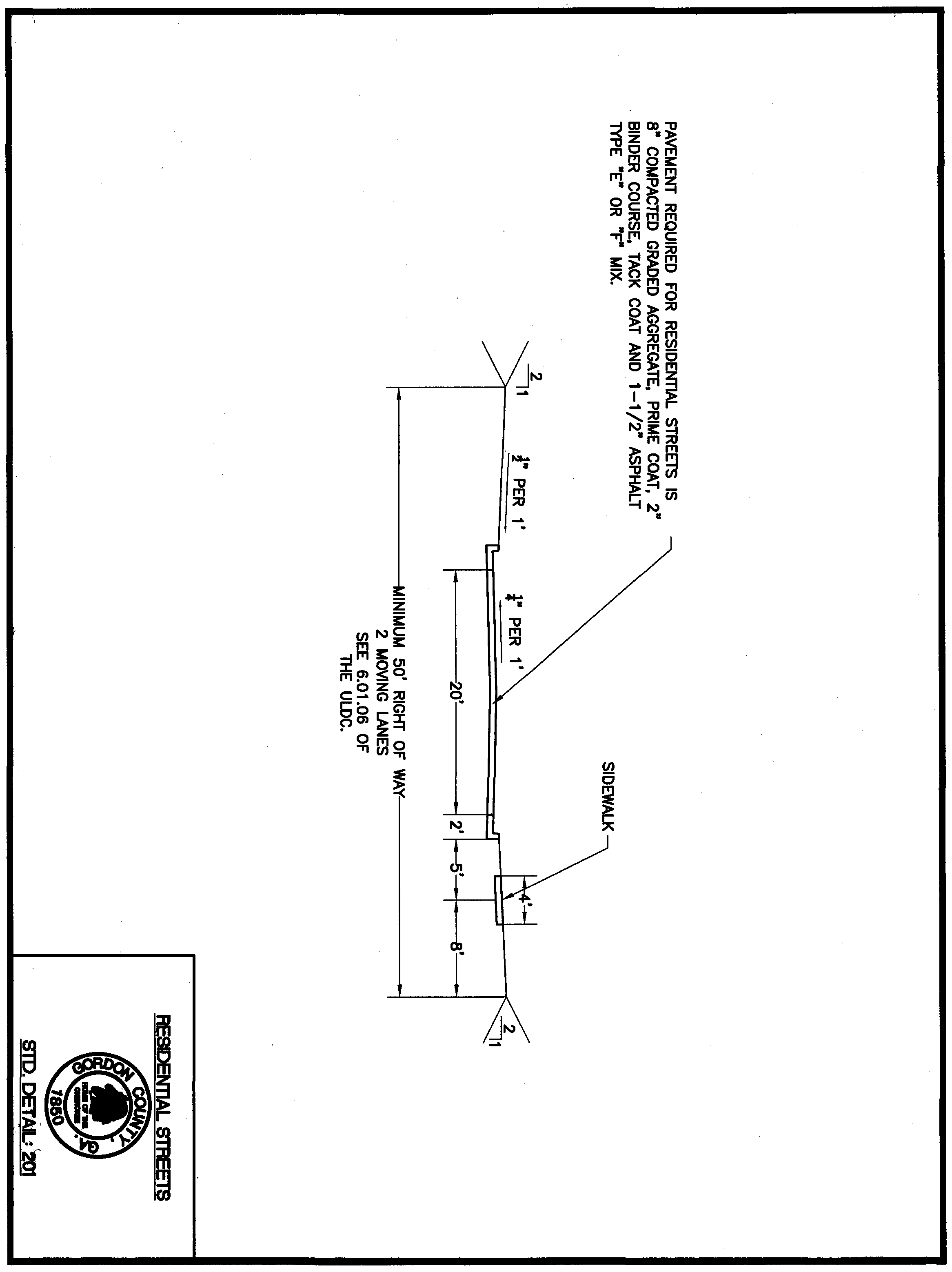
Standard Detail 201: Residential Streets
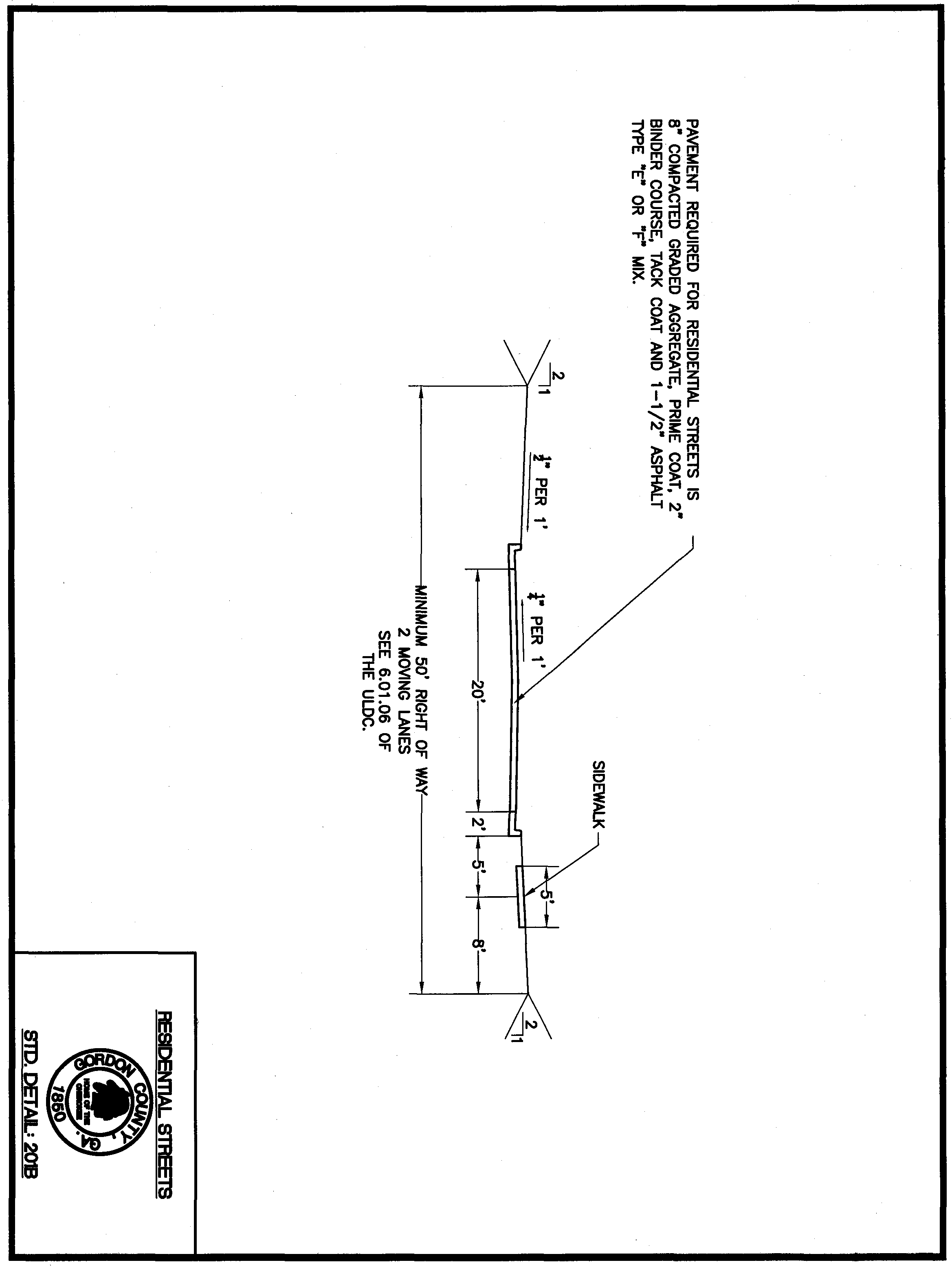
Standard Detail 201B: Residential Stsreets
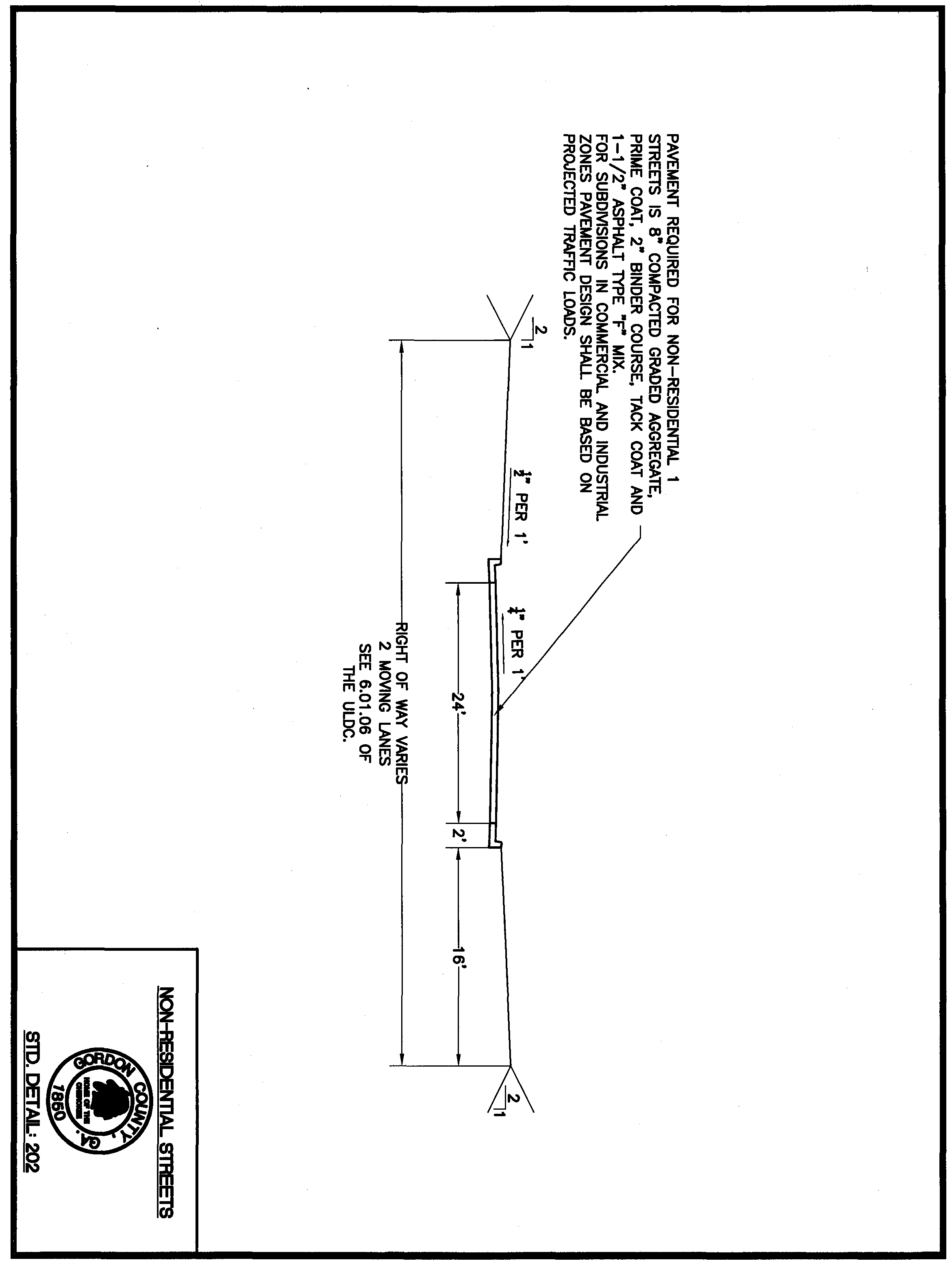
Standard Detail 202: Nonresidential Streets
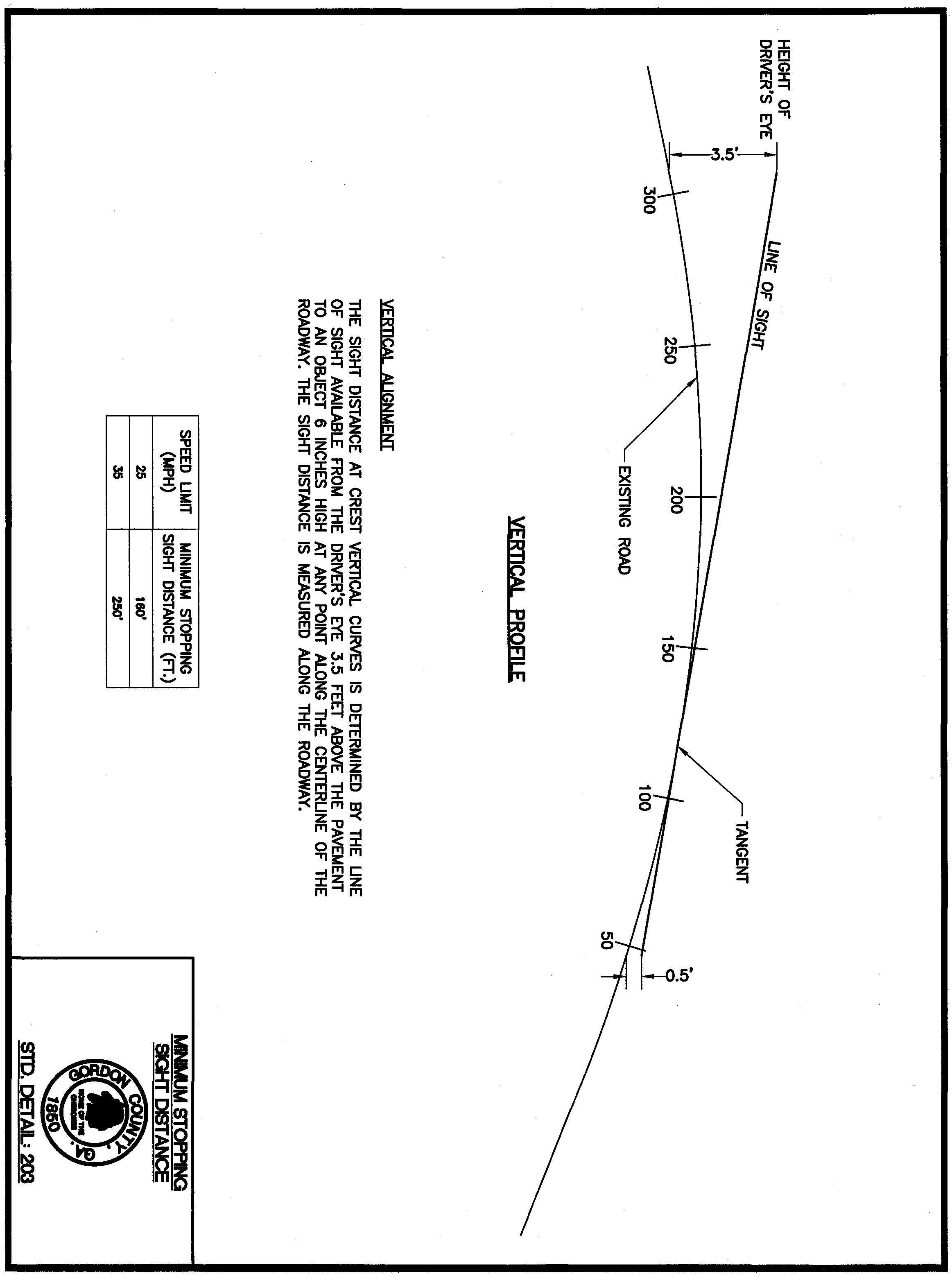
Standard Detail 203: Minimum Stopping Sight Distance
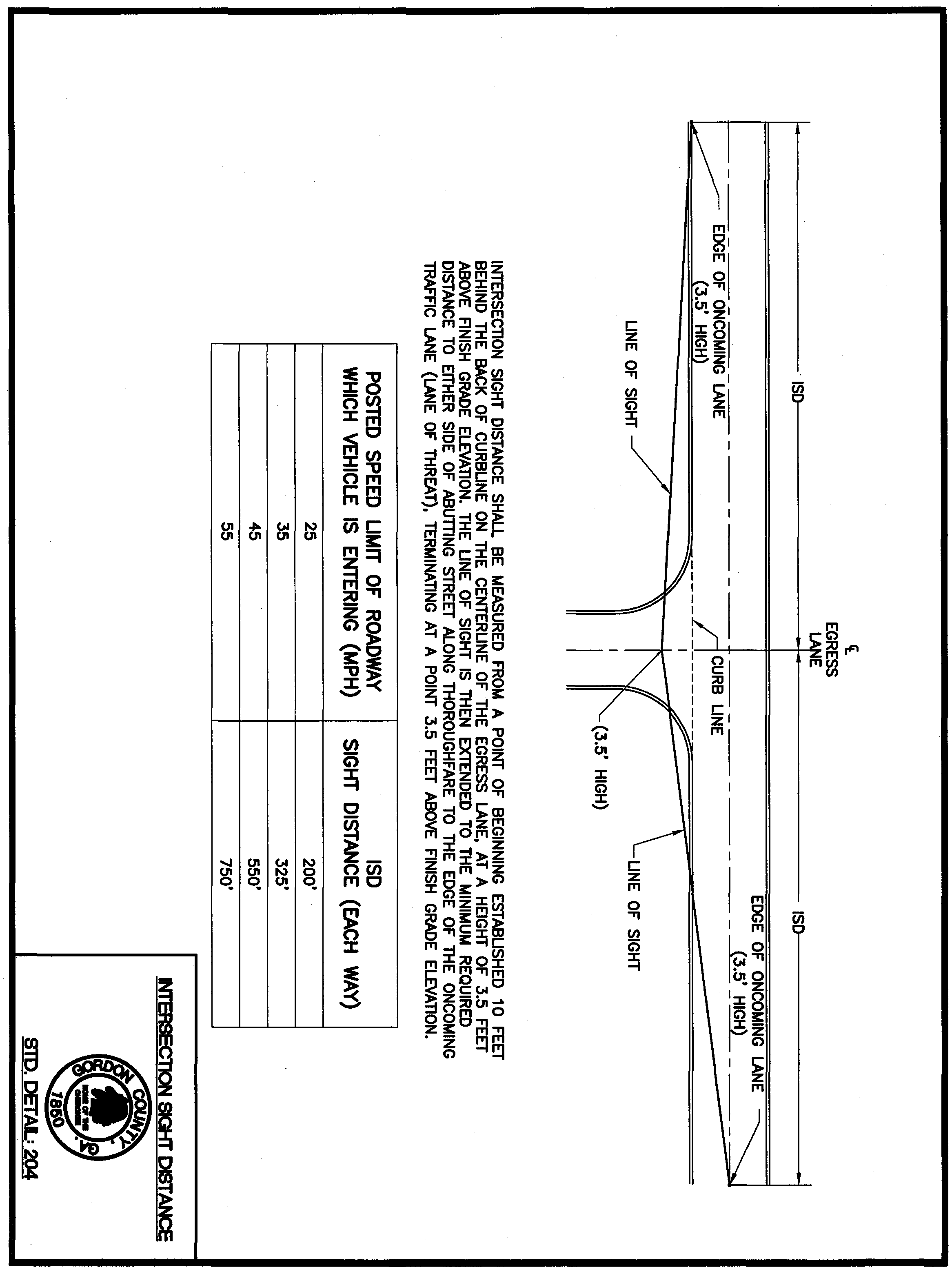
Standard Detail 204: Intersection Sight Distance
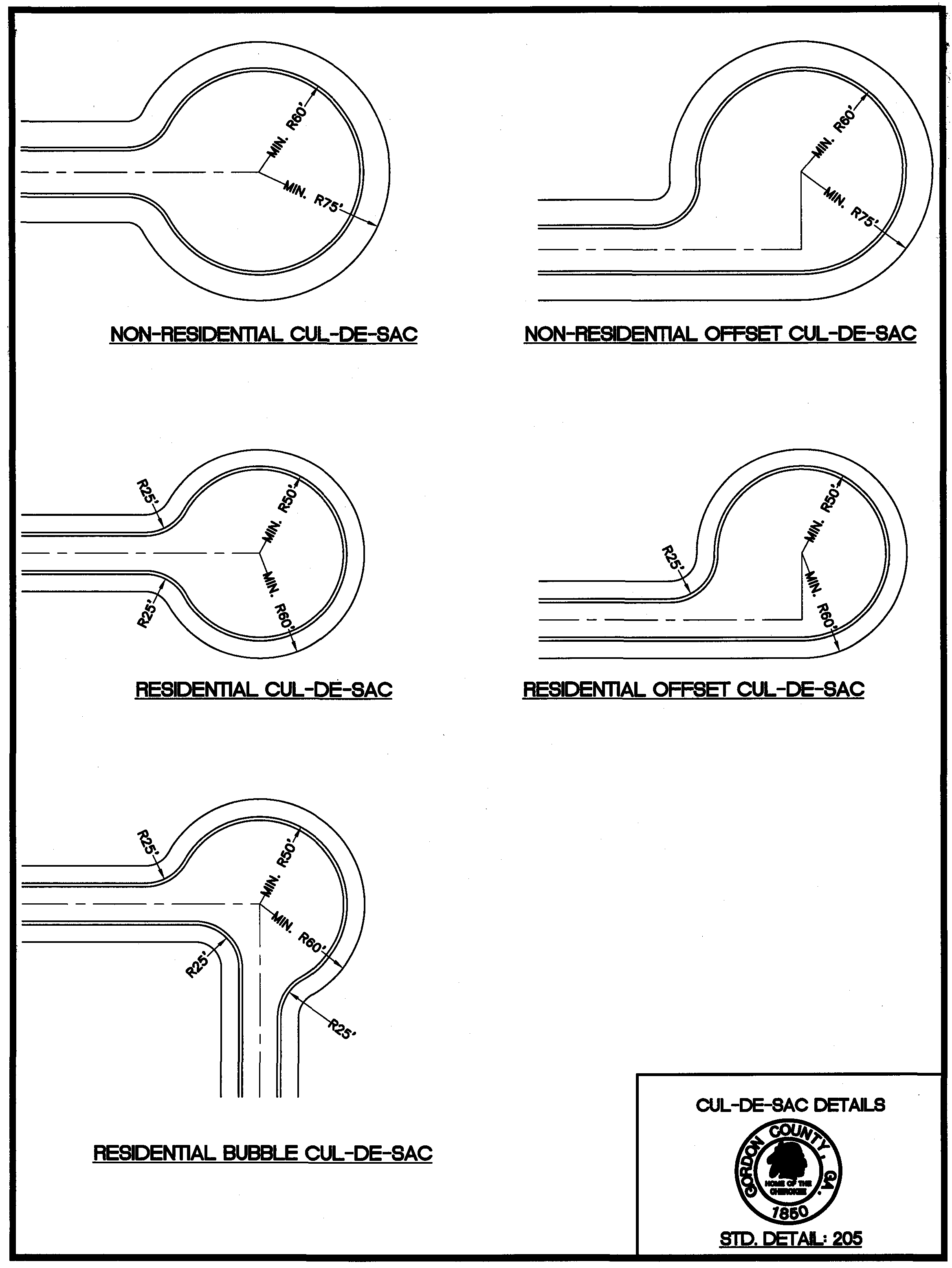
Standard Detail 205: Cul-de-Sac Details
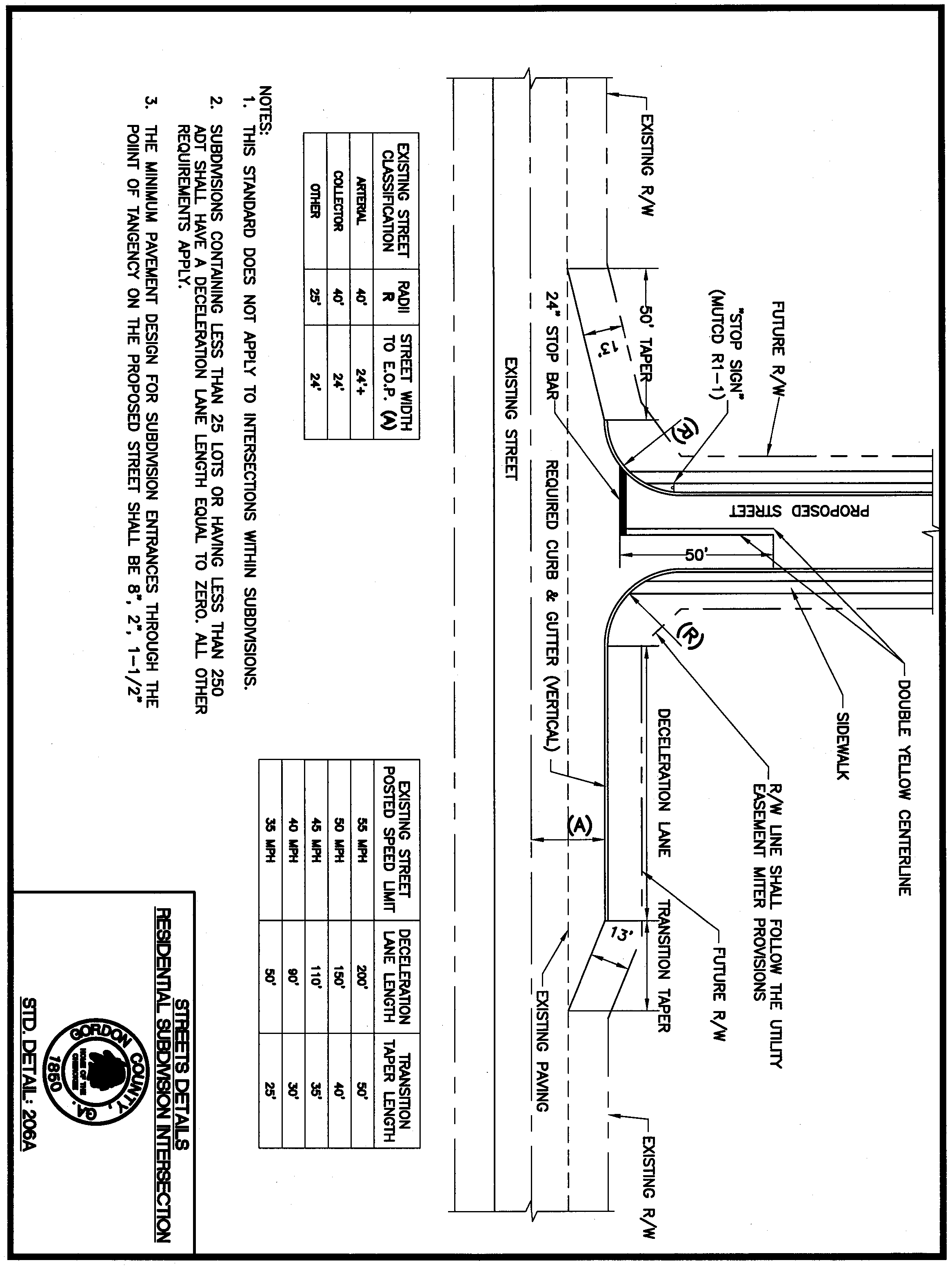
Standard Detail 206A: Streets Details, Residential Subdivision Intersection
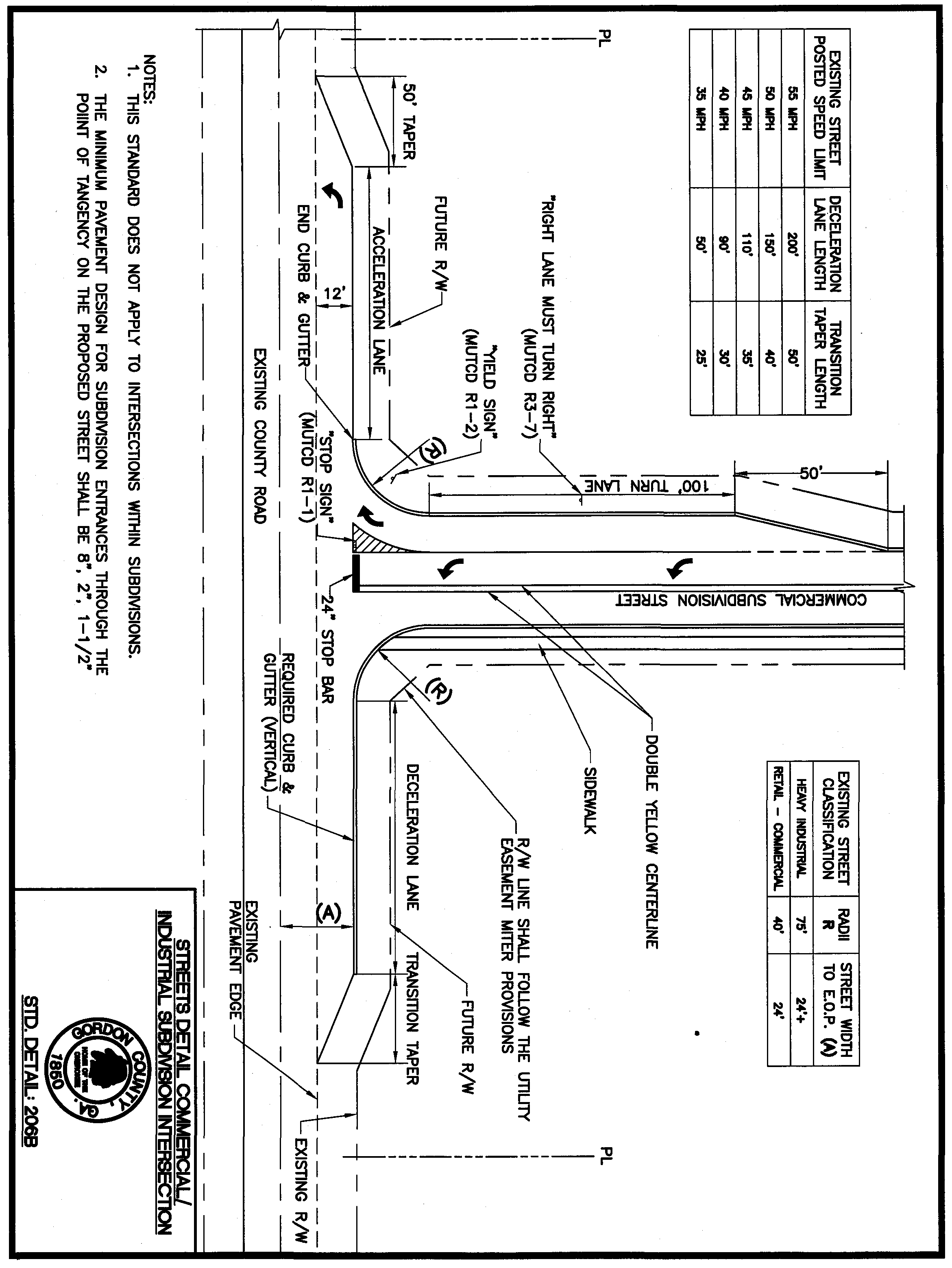
Standard Detail 206B: Streets Detail, Commercial/Industrial Subdivision Intersection
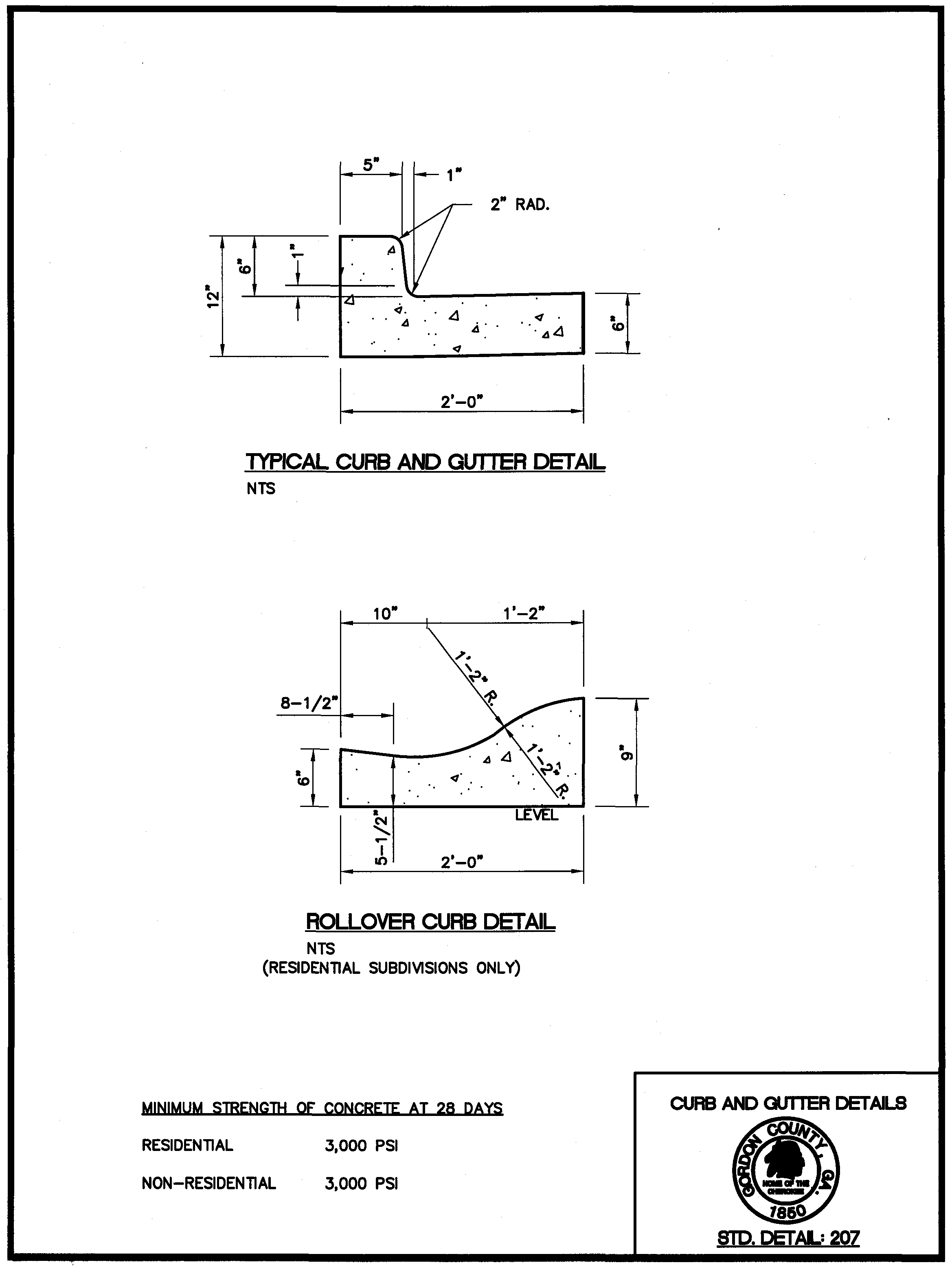
Standard Detail 207: Curb and Gutter Details
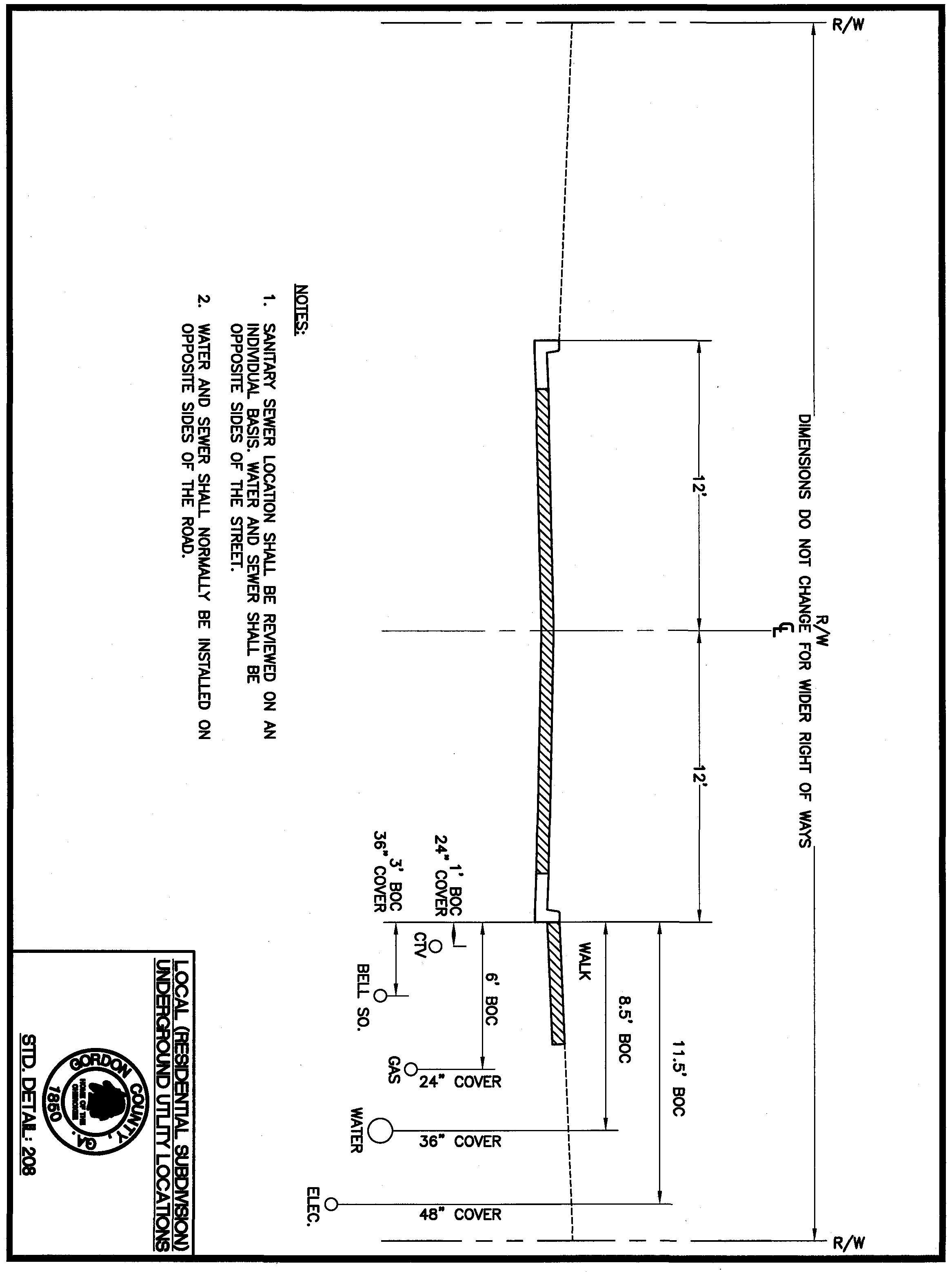
Standard Detail 208: Local (Residential Subdivision) Underground Utility Locations
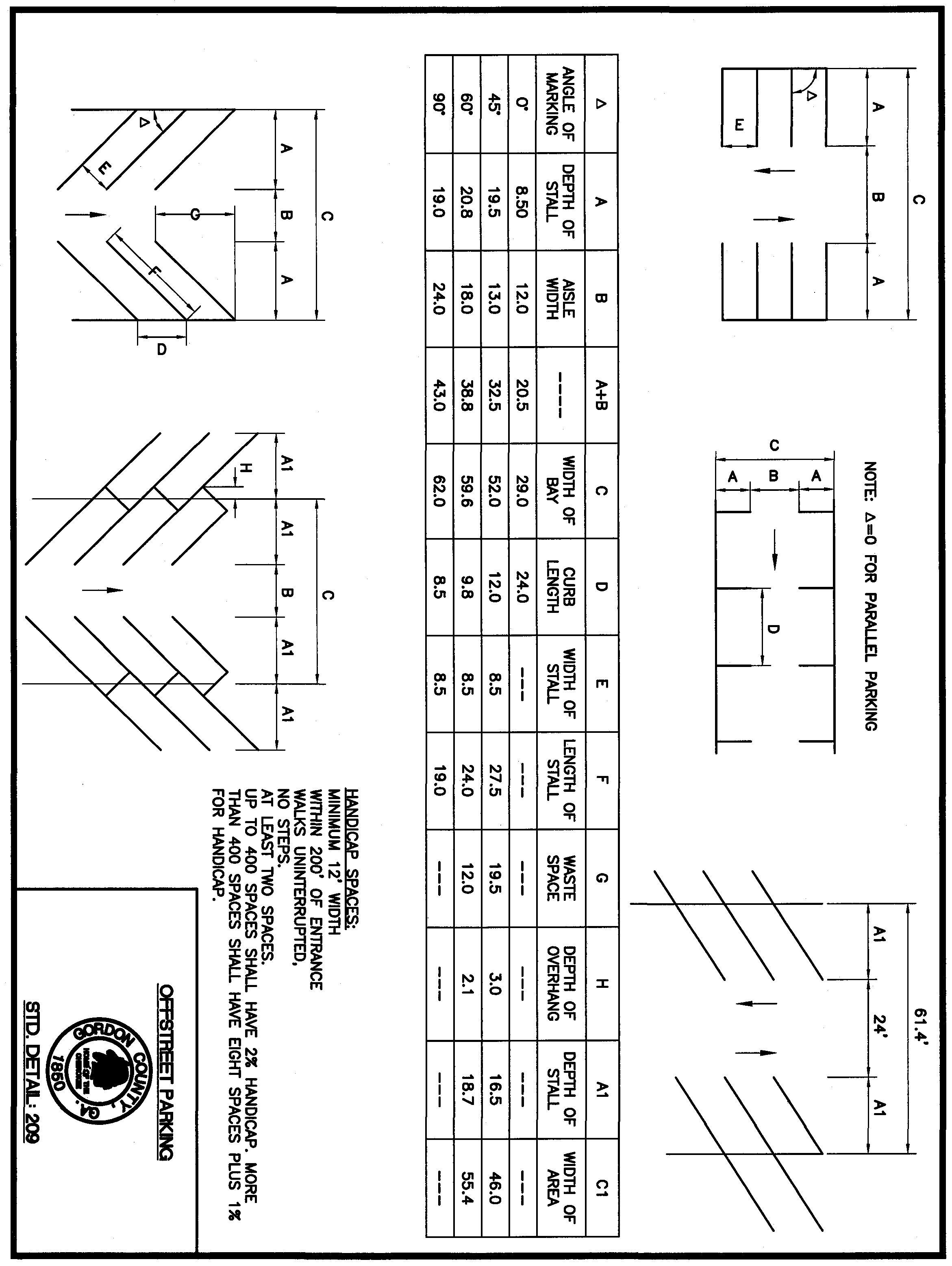
Standard Detail 209: Off Street Parking
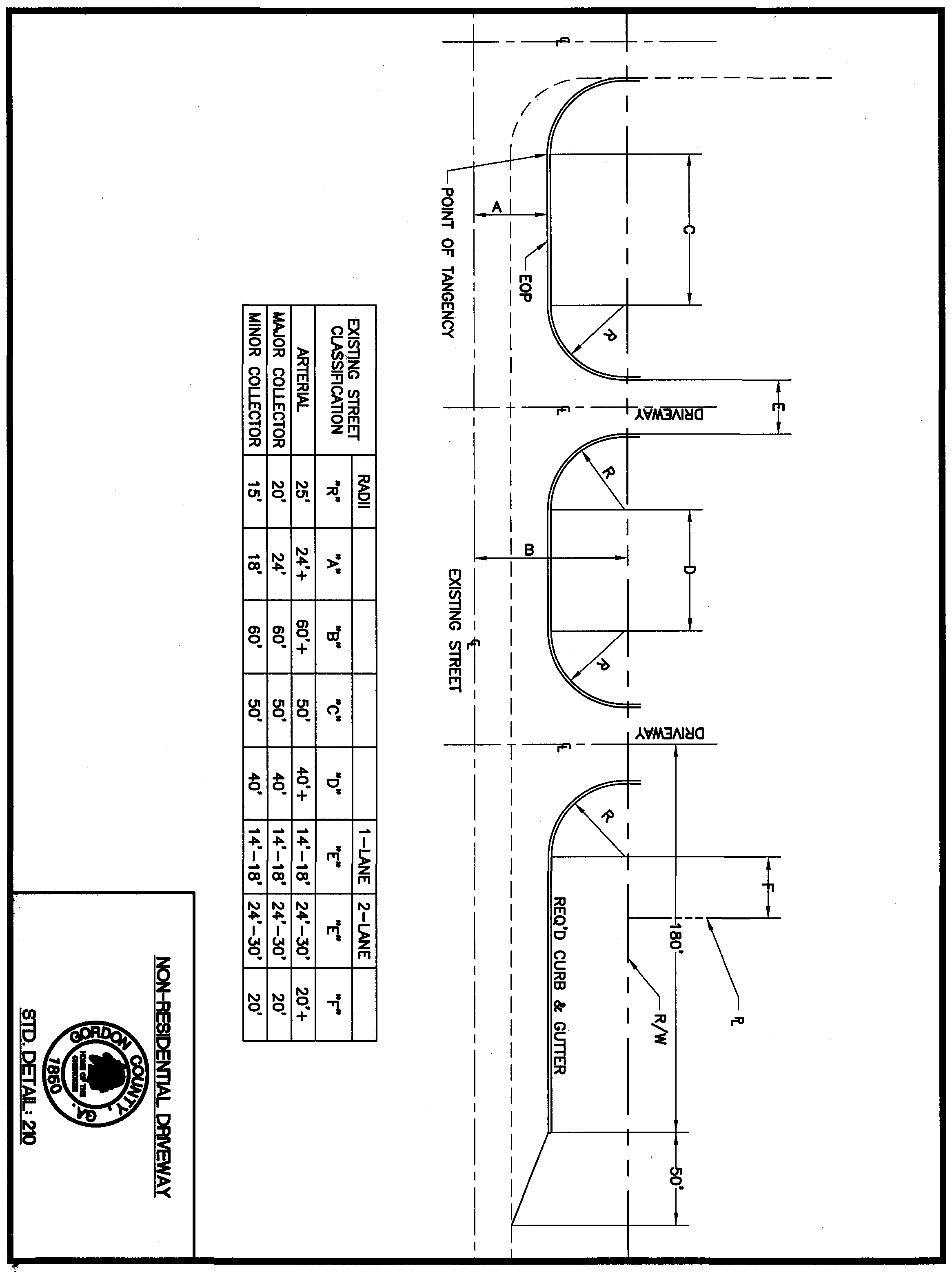
Standard Detail 210: Nonresidential Driveway
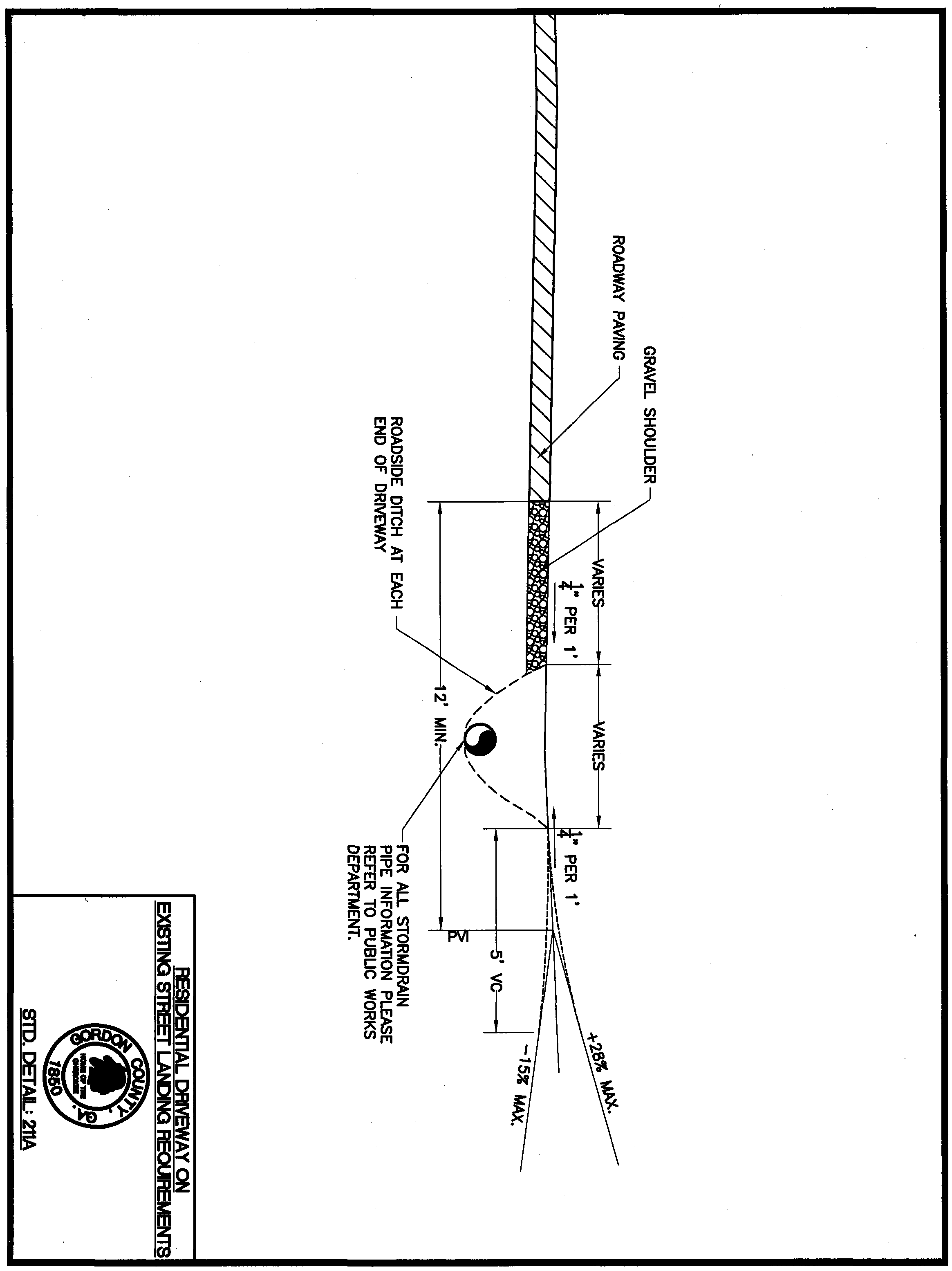
Standard Detail 211A: Residential Driveway on Existing Street Landing Requirements
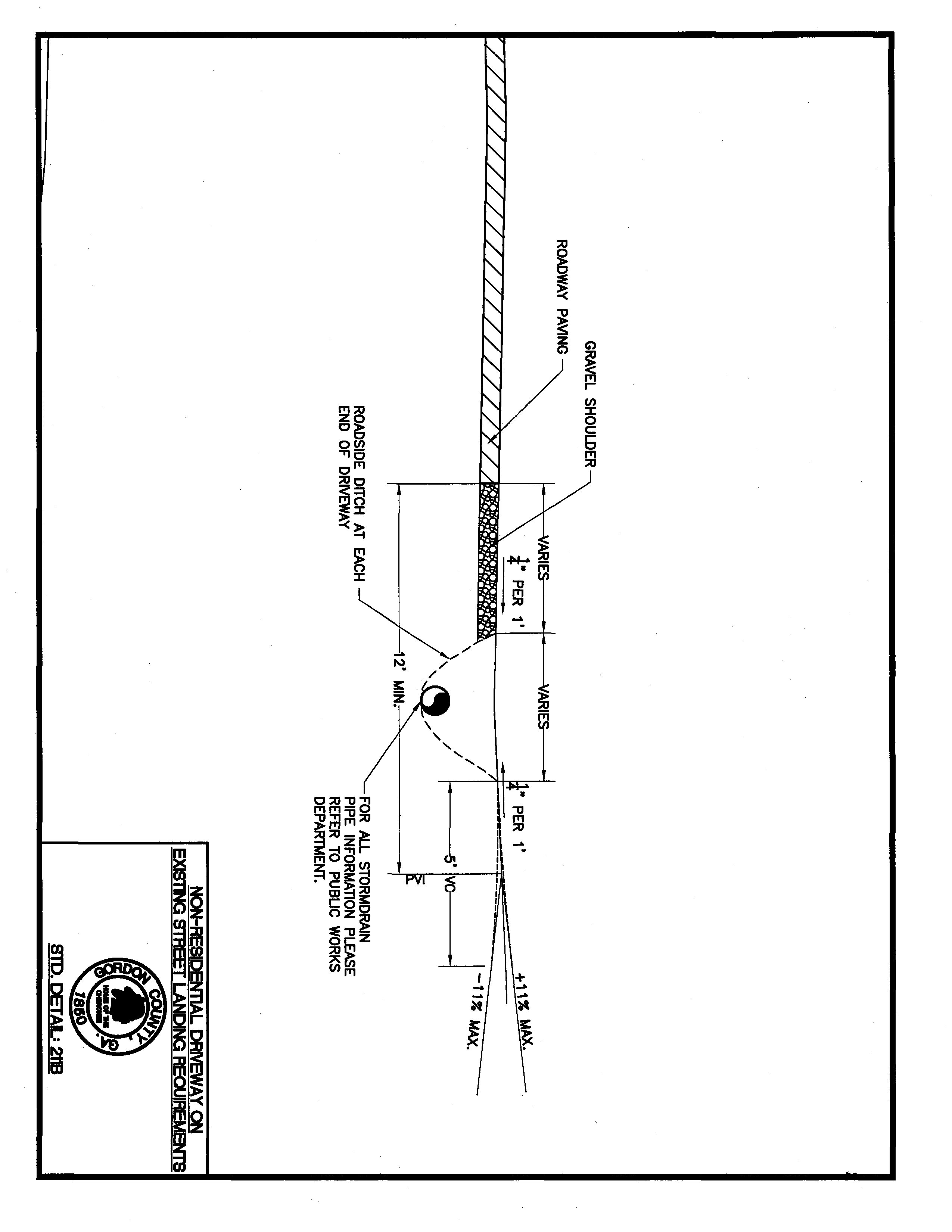
Standard Detail 211B: Nonresidential Driveway on Existing Street Landing Requirements
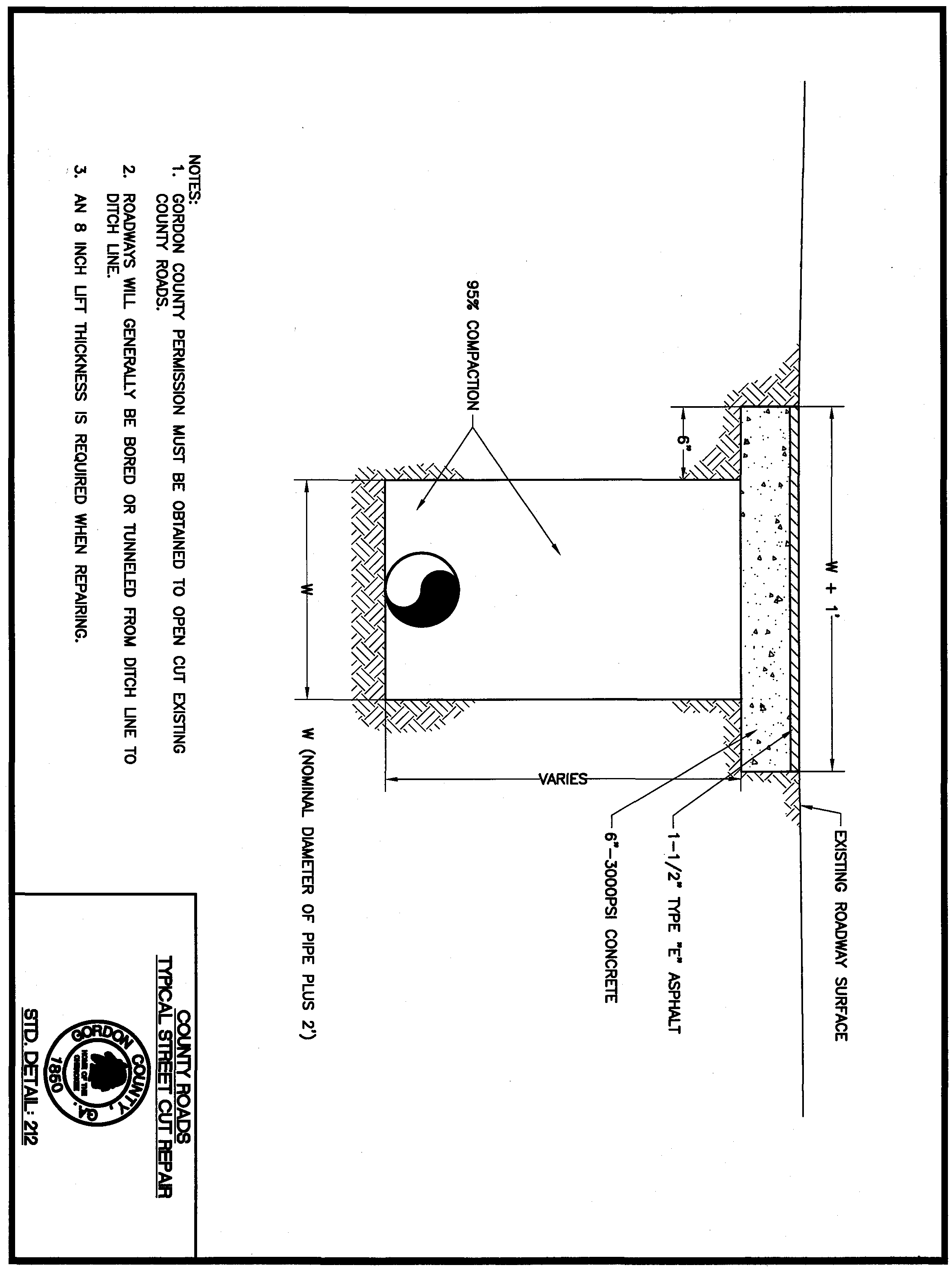
Standard Detail 212: County Roads Typical Street Cut Repair
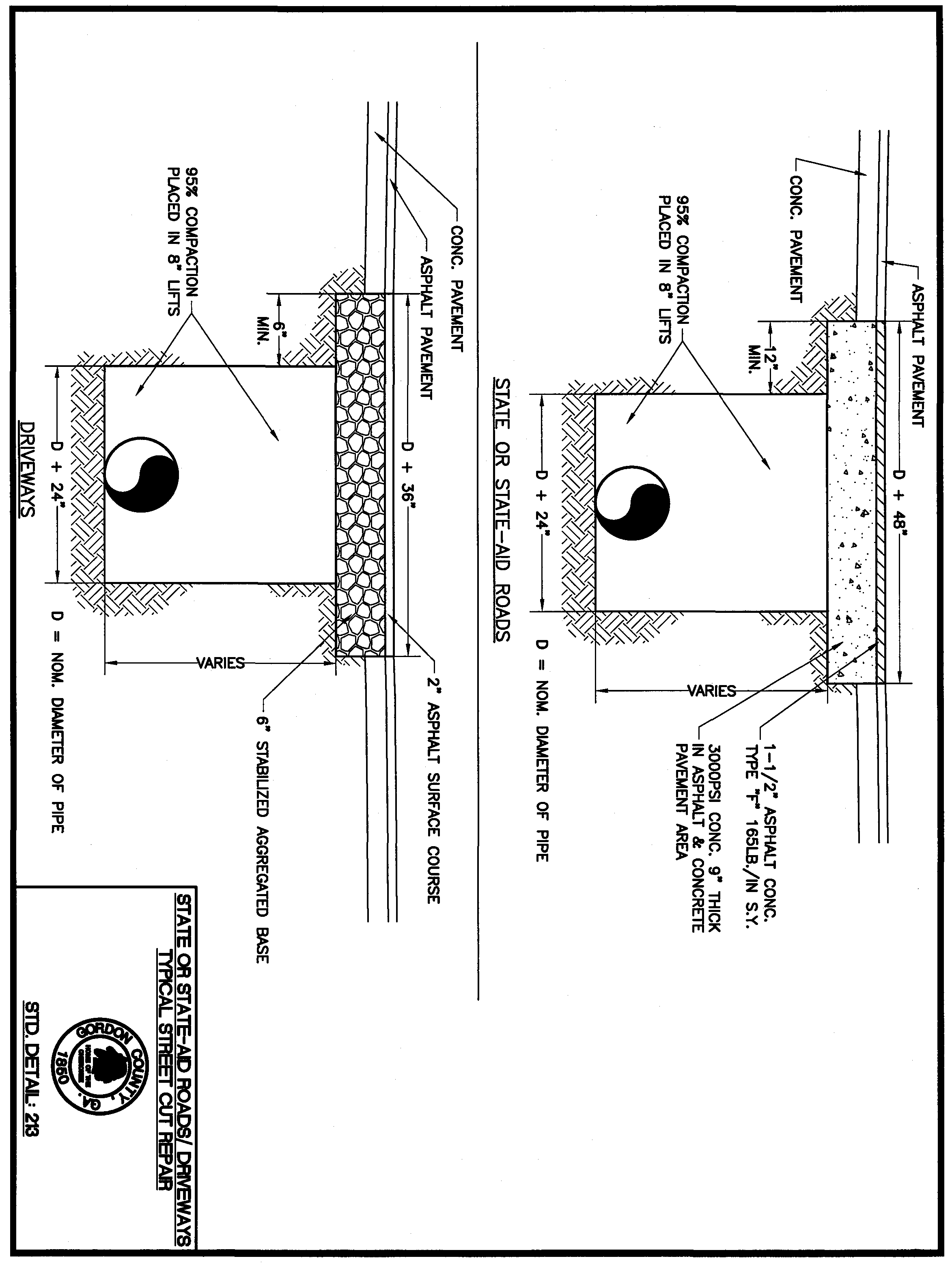
Standard Detail 213: State or State-Aid Roads/Driveways Typical Street Cut Repair
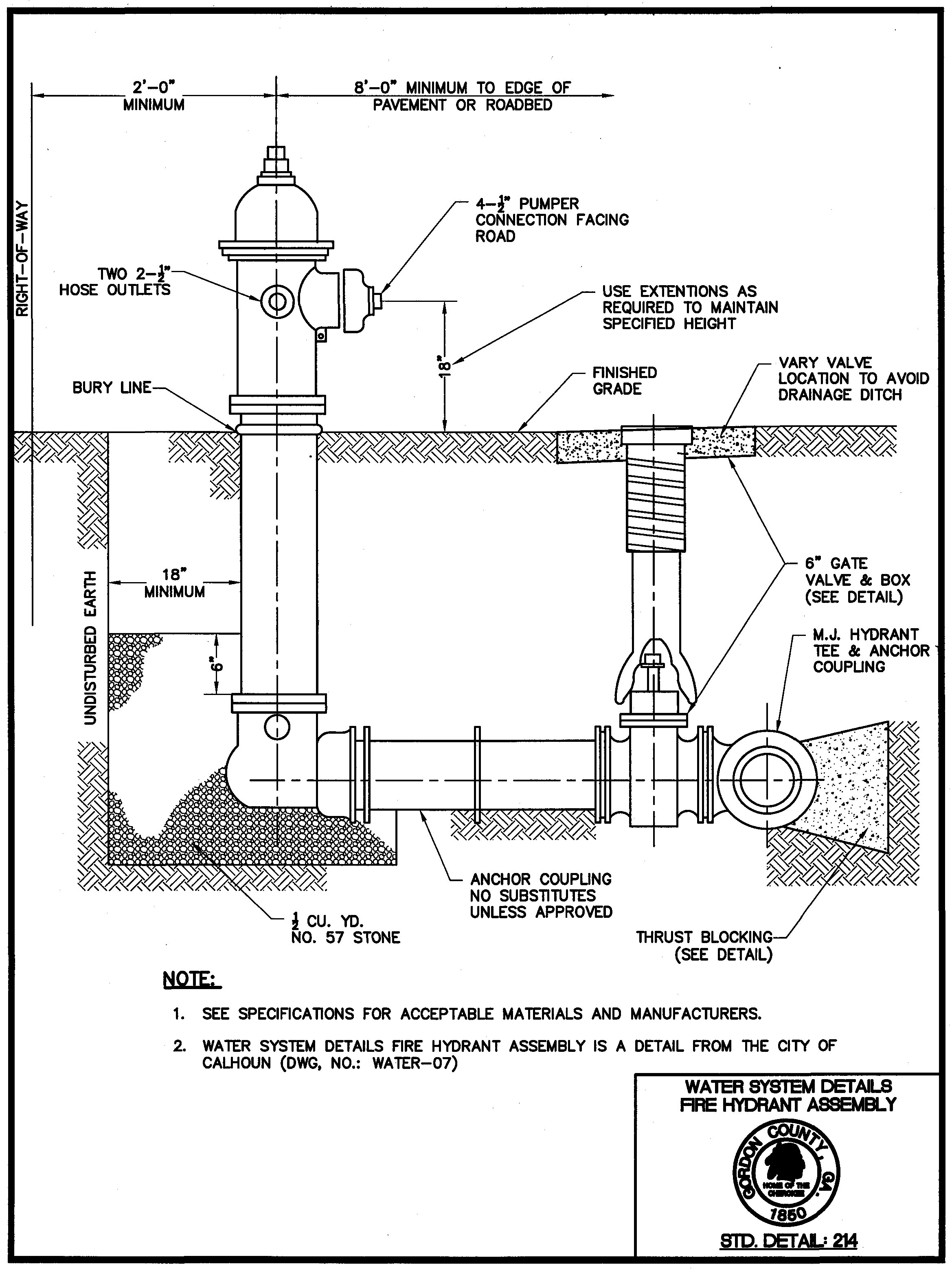
Standard Detail 214: Water System Details, Fire Hydrant Assembly
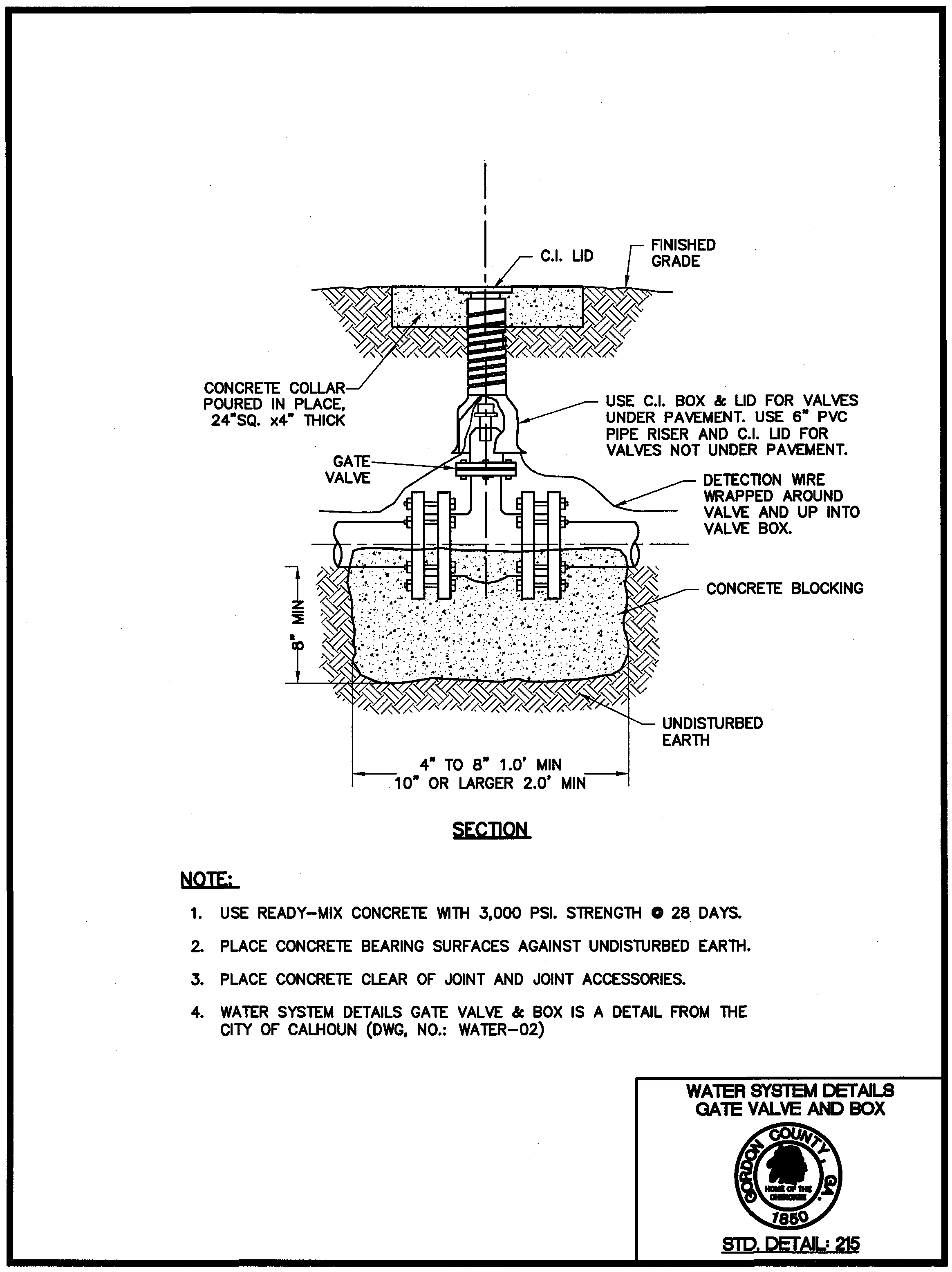
Standard Detail 215: Water System Details, Gate Valve and Box
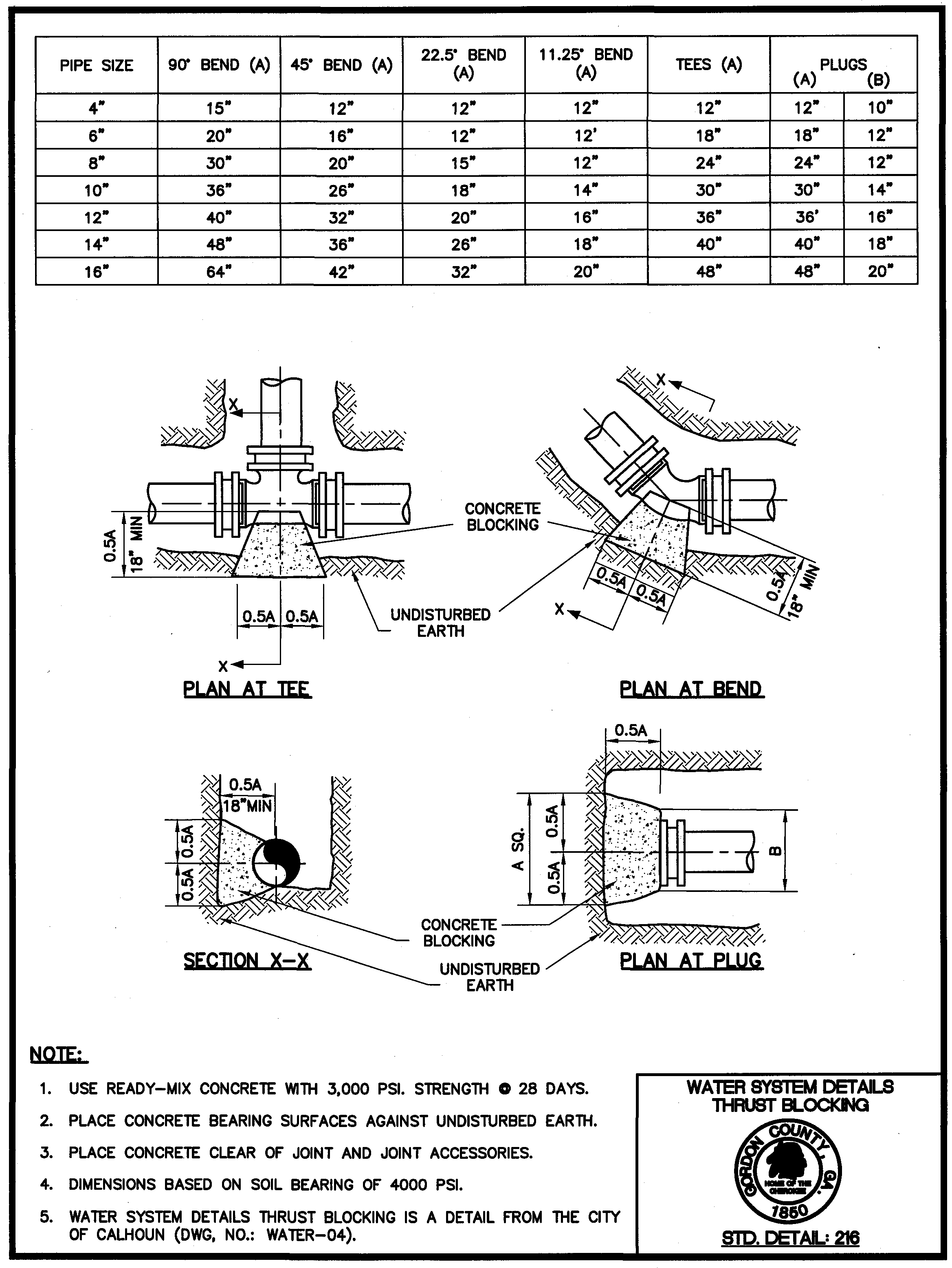
Standard Detail 216: Water System Details, Thrust Blocking
6.00.00 - GENERALLY
The purpose of this chapter is to establish standards and requirements for the provision of infrastructure by all development. This chapter contains requirements for the transportation system, set forth in Section 6.01.00, including placement of underground utilities, access, streets, off-street parking and clear visibility at intersections. Gordon County Board of Health requirements are set forth in Section 6.02.00. Requirements for utilities are set forth in Section 6.03.00, including potable water and sanitary sewer. Requirements for drainage and stormwater management are set forth in Section 6.04.00.
6.01.00 - TRANSPORTATION AND PARKING FACILITIES
6.01.01 Generally
A.
Acceptance of official county road map. The "Official Gordon County Functional Classification System Map", as now or hereafter amended, kept in the County Administrator's office in the County Administration Building, is hereby accepted.
B.
Off-system roads, guidelines for acceptance. Prior to any off-system road being accepted for ownership and maintenance by Gordon County, the following criteria must be met:
1.
A minimum fifty (50) feet wide right-of-way will be required for acceptance;
2.
The fifty (50) feet wide right-of-way must be deeded to the County by the property owner(s) involved;
3.
Clear title and right-of-way must be furnished, including title opinion, with all research and associated costs to be borne by the property owner(s);
4.
All costs of rights-of-way, surveys, engineering, and attorneys' fees will be the responsibility of the property owner(s);
5.
The road in question must have been in existence prior to May 15, 1984, with sufficient documentation presented to the Board of Commissioners to substantiate such claim;
6.
A minimum of five (5) separate residences, with an average of two (2) residences per mile, must live on the road in question;
7.
Any dead-end road must provide a cul-de-sac as required in Section 6.01.06(E)(2);
8.
A prepared roadbed must be present and adequate for the existing and/or proposed traffic using the road, with suitable base material and drainage structures as determined by the road superintendent;
9.
All fill on the prepared roadbed will be good cherty material placed in a lift not less than four (4) inches and will be compacted by sheep's foot, roller, or other mechanical means, to a minimum standard density of ninety-five (95) or until approved by the road superintendent;
10.
The minimum finished prepared roadbed shall not exceed a maximum grade of fifteen (15) percent.
C.
Road criteria, previously maintained roads
1.
The purpose of these criteria is to provide a means for accepting and maintaining roads that at one time were maintained by the County. For whatever reason the road was deleted from the Official Gordon County Road Map, May 15, 1984, but continues to serve as a means for residents to access their homes.
2.
To be considered the road must have been a County road at one time. A 1958 county road map, located in the administrator's office, will be used to determine if the road is to be considered.
3.
A resident who is living on the road must request the County to maintain the road. The resident must be living on the road as of November 21, 1989.
4.
Any other acceptance factors not covered in the above criteria will be determined by the Board of Commissioners.
D.
Installation of underground public utility lines. The following minimum specifications shall govern the installation of underground public utility lines on County road rights-of-way. They are the minimum specifications for installation of underground utilities including lines for electricity, water, natural gas, telephone, cable television, and street lights on County road rights-of-way:
1.
All of the above shall be located a minimum of two (2) feet from the edge of the pavement and shall be located a minimum of two (2) feet below the existing grade.
2.
Public utility lines shall be located underground along all new roads, and, at the discretion of the Public Works Director, on all existing roads when serving new construction, excluding single-lot residential development.
3.
Where practical, paved roads shall be bored rather than cut for the location of utilities.
4.
The cutting of all paved County roads shall be cleared through the road superintendent prior to the cut being made except in the case of extreme emergency.
5.
Any paved road which is cut to a width of more than twelve (12) inches shall be filled with a compacted base material to within eight (8) inches of the riding surface and with concrete to within two (2) inches of the riding surface. The remaining two (2) inches shall be filled with asphaltic concrete to allow for a smooth riding surface.
6.
Any paved road which is cut to a width of twelve (12) inches or less shall be filled with a compacted base material to within two (2) inches of the riding surface. The remaining two (2) inches shall be filled with asphaltic concrete to allow for a smooth riding surface.
7.
Any dirt road which is cut shall be filled with a compacted base material.
E.
Private roads (Reserved)
6.01.02 Naming of Public Roads
A.
Existing roads. All County roads existing on May 5, 1987, shall bear the name as commonly used for the ten (10) years immediately preceding such date by those who live in the area and community through which the County road traverses. In the event of uncertainty or dispute regarding the name of a County road existing as of such date, the procedure established in subsection (C) shall be followed except that the County shall bear the costs of all legal advertising required.
B.
New roads. Any road accepted as a part of the road system of the County after May 5, 1987, shall bear the name as determined by the person or entity conveying title of the road to the County and shall comply with the following:
1.
Road names shall require the approval of the Gordon County EMA;
2.
Roads that are obviously in alignment with roads within the same subdivision development shall be given the same name; and
3.
The names of new roads shall not duplicate or closely approximate those of existing roads in the County.
4.
It shall be the responsibility of Gordon County EMA to notify appropriate departments of new roads.
C.
Name changes. Before the name of any County road may be changed from the official name as established pursuant to this section, the following procedure will be followed:
1.
The request for change of name shall be presented to the County Administrator.
2.
A notice shall be published in the legal organ of the County once a week for three (3) weeks stating the name of the road to be changed, the general location of the road, the proposed new name and the date, time and location of the hearing provided for below. The cost of the advertising shall be paid by the proponents of the name change.
3.
At the date, time and location set forth in the notice a hearing shall be held by the Public Works Director, Building Inspector and the EMA Director (hearing committee) for determination of the issue of change of road name. The hearing committee shall hear evidence at the scheduled hearing. This hearing shall be a meeting open to the public. The decisions of the committee shall be final.
4.
If the change is denied, no new request for a name change for the same road or any part thereof shall be considered for two (2) years from the date of the initial request for name change.
6.01.03 Utility Facilities and Equipment
A.
Purpose. This section is enacted to more efficiently provide for the safety of persons and vehicles traveling on the County roads of Gordon County, as allowed under O.C.G.A. § 32-4-42(6).
B.
Basis for ordering removal, relocation of facilities; failure to comply, removal by County
1.
When the Board of Commissioners reasonably determines that any pipe, main, conduit, cable, wire, pole, tower or other signal and equipment, facilities or appliances of any utility in, on, along, over or under the public roads of the County should be removed or relocated because it has become an obstruction or interference with the use and safe operation of a County road, or will become an obstruction or interference with the use and safe operation of a contemplated County road, a written notice shall be directed to the utility company, giving at least sixty (60) days' notice in which to make such change as is necessary for removal or relocation as may be necessary.
2.
If the utility does not thereafter begin removal within a reasonable time sufficient to allow for engineering and other procedures reasonably necessary to the removal and relocation of the utility facility, the Board of Commissioners may give the utility a final notice directing that such removal shall commence not later than ten (10) days from receipt of such final notice.
3.
If such removal has not begun, or if such removal has begun and the relocation has not been completed within a reasonable time, the County may remove or relocate the same with its own employees, or by contracted labor, tools, equipment, supervision or other necessary services or materials and whatever else is necessary to accomplish the removal or relocation, and the expense thereof shall be charged to the utility.
4.
Such expense shall be certified to the County Attorney, who shall have the authority to proceed with suit against the utility for same if payment or arrangements to make payment are not made within sixty (60) days.
C.
Compensation of utility upon relocation. Nothing in this section shall be construed so as to deprive any utility, relocated from a location in which it owned a property interest, of compensation for such property interest.
6.01.04 Right-of-Way Protection
A.
Purpose and intent. The purpose of this section is to provide procedures, rules and regulations governing persons, firms, businesses, companies, municipalities, utilities and corporations engaged in any activity involving the utilization of County road rights-of-way in Gordon County and to provide for the issuance of permits to protect the citizens, the environment, County infrastructure, and to assure the public's safety.
B.
Permits. No person shall engage in any activity upon, across, or through the rights-of-way of roads in Gordon County without first securing a permit to conduct such operations in Gordon County.
1.
Exception. The placement of mailboxes for the delivery of items from the U.S. Postal Service shall be exempt from the requirement for a permit, subject to the following standards:
a.
Said mailboxes shall be constructed or designed in such a way that the design allows for the unit to break away upon impact.
b.
It shall be the responsibility of the owner of the mailbox to maintain and repair those portions of the public rights-of-way impacted or damaged through the delivery of mail by vehicular traffic.
2.
Any person seeking a permit shall apply in person or through an authorized agent at the Gordon County Public Works Department and shall provide the following information for each permit requested in subsections (a) and (b) below.
a.
Timber operations
1.
No timber operation shall commence in Gordon County, whether or not over, upon, across, or through County rights-of-way, without first having obtained Georgia Department of Revenue form PT 283T, completing sections A, B, C, and G of said form, and submitting "Sellers Copy for Tax Assessor" to the Gordon County Public Works Department as an accompaniment to the permit application.
2.
Timber operations that do not access or utilize County roads or rights-of-way shall be exempt from the requirements of subsection (a)(10) of this section only. All other provisions of this section shall be applicable.
3.
The name and address of the owner of the property on which the timber operator will engage in timber operations.
4.
The location of the property on which the timber operator will engage in timber operations.
5.
The roads in Gordon County upon which timber trucks will travel.
6.
The date cutting operations are expected to commence and end.
7.
The name and address of all persons in a supervisory capacity engaged in the timber operation at the location for which the permit is requested.
8.
If the timber operator intends to engage independent contractors to haul the timber, then the name, address SSN or E.I.N. of each independent contractor.
9.
If the timber operator is engaged in hauling only, then the name, address SSN or E.I.N. of the timber operator for whom he will be hauling.
10.
A surety bond made payable to Gordon County indemnifying the County for any damage caused by the timber operator from its timber operations in Gordon County.
11.
In addition to the provisions of this section, the applicant for a permit will comply with all state and federal regulations pertaining to timber operations.
12.
Timber operations occurring on two (2) acres or less and being done primarily for the purpose of building construction or lot maintenance may be exempted from the requirements of subsections (a)(1) and (10) upon the inspection and approval of the road superintendent.
b.
Utility providers
1.
The location of the property on which the utility provider will engage in operations.
2.
The date utility operations are expected to commence and end.
3.
The name and address of all persons in a supervisory capacity engaged in the utility operation at the location for which the permit is requested.
4.
If the utility provider intends to engage independent contractors, then the name, SSN or E.I.N. of each independent contractor.
5.
A surety bond made payable to Gordon County indemnifying the County for any damage caused by the utility provider from its operations in Gordon County.
6.
In addition to the provisions of this section, the applicant for a permit will comply with all state and federal regulations pertaining to utility operations.
C.
Issuance of permit
1.
A permit will be issued to the applicant without charge when all required information and surety bond as required for the issuance of the permit has been provided.
2.
Permits will not be issued for signage, advertisements, or notices of any kind upon the rights-of-way of County roads, and the unauthorized placement of such shall be unlawful. Any unauthorized items placed upon the rights-of-way in Gordon County shall be considered littering and Gordon County, its officers and employees shall be empowered to remove and destroy such items.
3.
All permits shall be conspicuously posted, clearly visible, and located upon the public right-of-way abutting the property upon which the permitted activity is taking place.
D.
Public nuisance
1.
No person shall allow dirt, mud, gravel or other debris from adjoining land or resulting from any activity to accumulate upon the rights-of-way of any public road to such an extent that it becomes a nuisance or a hazard to persons traveling upon said roads, or that it creates an unsightly condition upon the public rights-of-way.
2.
No person shall allow dirt, mud or other debris resulting from any activity to accumulate in ditches and drainage areas on public rights-of-way to such an extent that the usual flow of water or run-off is stopped, disturbed, changed or interrupted.
3.
No person shall create any other type of public nuisance that interferes with or in any way damages the public rights-of-way in Gordon County.
4.
No person shall park or leave unattended a truck or other motor vehicle or trailer upon the rights-of-way of any County road.
5.
No activity, whether permitted by this section or any other section, shall commence operation or continue to operate without first installing and maintaining, when necessary, a temporary drive cut and culvert to access property and installing and maintaining soil erosion and sedimentation controls sufficient to prevent dirt, mud, gravel or other debris from accumulating in the County drainage ditches or on County roads.
6.
No timber operator shall commence timber operations until he has first posted or caused to be posted along the public road onto which the timber operator will enter from his timber operations, at least the following signs: one (1) sign in each direction located five hundred (500) feet from the entrance which states "Slow trucks entering highway", one (1) sign in each direction located one thousand (1,000) feet from the entrance stating "Warning: Logging Operation Ahead." Each such sign shall be not less than thirty-six (36) inches by thirty-six (36) inches, orange in color and posted at least three (3) feet from the edge of the surface of said road.
7.
No permitted activity shall continue in operation if the permittee fails to keep County roads free from dirt, mud, gravel or other debris resulting from the activity being performed.
8.
Immediately upon the completion of the permitted activity, an inspection shall take place by the road superintendent to insure that all County rights-of-way have been restored to its original condition. Failure to insure restoration shall result in the forfeiture of the surety bond.
9.
In addition to any other penalty provided for under the provisions of this section, or under the provisions of any state or federal law, any person in violation of this section shall reimburse the County for any and all costs and expenses incurred in abating said nuisance.
E.
Violations
1.
Any person who shall fail to comply with this section as adopted, or as hereafter amended, shall be guilty of a misdemeanor, subject to the jurisdiction of the Magistrate Court of Gordon County and upon conviction, shall be punished by a fine not to exceed one thousand dollars ($1,000.00).
2.
Each day the violation continues shall constitute a separate offense.
F.
Remedies. In the event any provision of this section has been violated or is being violated, in addition to other remedies, the County may institute injunction, mandamus, or other appropriate action or proceeding to prevent or abate such violation.
6.01.05 Access
A.
Access to every subdivision shall be provided over a public street.
B.
All subdivisions resulting in the creation of two hundred (200) or more lots shall be provided with a minimum of two (2) entrances. Where the property configuration prohibits or makes impractical the installation of two (2) entrances, this provision may be waived by the County.
C.
Where access to a subdivision is on a state route, the Georgia DOT shall approve all access and egress locations and designs.
D.
Interparcel access. New development in commercial, office, institutional and mixed use zoning districts that contains or is intended to contain more than one (1) building or use on-site shall provide access so that automobile trips between and among such buildings or uses can be accomplished without using the highway or major street. New developments and substantial improvements to existing developments shall provide for pedestrian and automobile access connections between adjacent properties under different ownership when the uses of the properties are of such compatibility that patrons may frequent both buildings or uses in the same vehicle trip, unless the Director of Planning and Development determines otherwise.
6.01.06 Street Design Requirements
A.
General street design requirements
1.
The arrangement of streets shall conform to the official county road map, or, for streets not shown on this plan, shall provide for an appropriate extension of the existing pattern of streets. Roads are classified as follows:
a.
Arterial: Minimum pavement width as required and a minimum right-of-way width of one hundred (100) feet;
b.
Industrial: Minimum pavement width of twenty-four (24) feet and a minimum right-of-way width of sixty (60) feet;
c.
Major Collector: Minimum pavement width of twenty-two (22) feet and a minimum right-of-way width of eighty (80) feet;
d.
Minor Collector: Minimum pavement width of twenty-two (22) feet and a minimum right-of-way width of sixty (60) feet;
e.
Local: Minimum pavement width of twenty (20) feet and a minimum right-of-way width of fifty (50) feet; and
f.
Alley: Minimum pavement width of twelve (12) feet and a minimum right-of-way width of twenty (20) feet.
2.
Where a subdivision fronts on one (1) side of an existing road which does not meet the minimum requirements contained in these regulations, the developer shall provide one-half (½) of the required right-of-way necessary to upgrade the road. Should the subdivision front both sides of the existing road, the developer shall provide all necessary right-of-way required to bring the road into conformity with these regulations.
3.
Where a subdivision or any development located outside the jurisdictional limits of Gordon County fronts an existing County road, the developer shall meet the criteria established in this ULDC. An exception may be granted only by the Gordon County Public Works Director.
4.
The minimum right-of-way as required by this section must be shown on the final plat and shall be dedicated to and accepted by the County if the proposed development meets the criteria established by this section and other development regulations of the County. Such road or street must be inspected by the County Public Works Department for compliance with this section. All building setback requirements shall be measured from this established right-of-way line.
5.
Traffic studies shall be required for all residential subdivisions containing more than four hundred (400) lots, and on nonresidential subdivisions generating more than four thousand (4,000) ADT. Such studies will, at a minimum, address the level of traffic generated by the proposed development and its distribution on the existing road network; and the need for acceleration lanes, deceleration lanes, left turn lanes, other additional lanes and traffic signals on all existing and proposed roadways.
6.
All streets with curb and gutter shall be constructed with a minimum thirteen-foot shoulder behind both curbs. See Standard Detail 201, "Residential Streets" and Standard Detail 202, "Nonresidential Streets."
7.
All streets shall have a minimum centerline grade of at least 0.5 percent except for cul-de-sacs and intersections, which shall have a minimum centerline grade of at least 1.0 percent.
8.
Super-elevated curves shall be provided as per Georgia Department of Transportation design guidelines for arterial streets.
9.
Where a deflection angle of more than ten (10) degrees occurs, a horizontal curve of reasonably long radius shall be introduced.
10.
The minimum length of crest vertical curves shall be one hundred (100) feet. Longer lengths may be required based on required stopping sight distance. The sight distance for crest vertical curves shall be measured along the roadway from three and one-half (3½) feet above the pavement to an object six (6) inches high, as discussed in the current AASHTO policy on design. Vertical curves may be designed to extend past the end of a cul-de-sac provided stopping sight distance is met. See Standard Detail 203,"Minimum Stopping Sight Distance."
11.
The minimum length of sag vertical curves shall be one hundred (100) feet. Vertical curves may be designed to extend past the end of a cul-de-sac provided stopping sight distance is met.
12.
Sight distances at intersections shall be determined by the posted speed limit of the street (existing County road or state highway) onto which a vehicle must turn. Such distances shall be measured beginning from a point established ten (10) feet behind the back of the curbline on the centerline of the egress lane at a height of three and one-half (3½) feet above the finish grade elevation. The line of sight is then extended the minimum required distance to either side of the abutting street along the thoroughfare to the edge of the oncoming traffic lane, terminating at a point three and one-half (3½) feet above the finish grade elevation. See Standard Detail 204, "Intersection Sight Distance."
13.
Roads may be constructed across an existing or proposed dam. The appropriate state approved professional shall provide a report certifying that the existing or proposed dam is structurally capable of supporting the road. Any road across a dam shall be a service road. Ingress and egress easements, not right-of-way, shall be granted. A second point of access to the subdivision across a public must be provided. The section of road across the dam, and the dam itself, shall be maintained by the developer, his heirs, executors, administrators, or assigns, or a mandatory homeowners' association established for maintenance and other purposes.
B.
Residential street design requirements (local streets)
1.
All local streets, excluding such streets in A-1 and RA-1 zoning districts, shall be constructed with curb and gutter. Residential subdivision curb and gutter may be either vertical faced or rollover.
2.
Apartment and condominium development streets shall be designed and constructed to the same standards as other residential streets.
3.
The following residential street design standards shown in Table 6.01.06(A) shall apply to all streets in residential subdivisions. See Standard Detail 201, "Residential Streets." Design requirements for arterial and collector streets in residential subdivisions shall be based on AASHTO and Georgia DOT standards, and approved by the County. An alley street is allowed in residential zoning districts and in the MU district to provide rear access to a primary dwelling and shall have a minimum right-of-way width of twenty (20) feet and a minimum pavement width of twelve (12) feet.
Table 6.01.06(A)
Residential Street Design Requirements
C.
Nonresidential street design requirements
1.
Nonresidential streets shall be classified into a street hierarchy for design and construction purposes. Street design standards in nonresidential subdivisions shall be based on road function and the average daily traffic (ADT) the street will accommodate, as determined in the current edition of ITE's Trip Generation manual. Nonresidential street classes and their corresponding ADT thresholds are: Nonresidential: 1-10,000 ADT.
2.
Arterial or collector streets shall be required when ADT generated by the development will exceed ten thousand (10,000) daily trips. Street design requirements for arterial and collector streets shall be based on AASHTO and Georgia DOT standards, and approved by the County.
3.
Nonresidential street classifications and design standards may be changed at intersections on any street to reflect the lot size and dwelling unit thresholds. Jogs in the centerline, pavement or right-of-way shall not be permitted.
4.
The applicant shall demonstrate to the County that the distribution of traffic to the proposed street system shall not exceed the ADT thresholds for any of the proposed street classifications.
5.
All nonresidential streets shall be constructed with curb and gutter, except for those nonresidential streets serving developments where the minimum lot size is five (5) acres or larger. Nonresidential subdivision curb and gutter may be either vertical faced or rollover.
6.
The following nonresidential street design standards shown in Table 6.01.06(B) shall apply to all public and private streets constructed in nonresidential subdivisions. See Standard Detail 202, "Nonresidential Streets." The minimum standard for nonresidential subdivision street design and construction shall be a nonresidential street.
Table 6.01.06(B)
Nonresidential Street Design Requirements
D.
Intersections
1.
Street intersections shall be as nearly at right angles as possible, but in no case shall a street intersection be at an angle of less than seventy (70) degrees. The one hundred ten (110) degree angle of the intersection should be directed towards the approach with the highest volume of traffic.
2.
Interior street jogs or intersections shall have centerline offsets of a minimum of one hundred twenty-five (125) feet. Exterior street jogs or intersections shall have centerline offsets of a minimum of two hundred fifty (250) feet.
3.
Islands at intersections shall meet sight distance requirements established by AASHTO and shall be subject to individual approval by the County. Anything extending more than three (3) feet above the top of the curb within the right-of-way of the intersecting streets shall require approval by the road superintendent.
4.
A utility easement shall be provided at all street intersections. This easement shall form a triangle with two (2) twenty (20) foot legs of the triangle leading away from the street right-of-way intersection. This easement miter shall be graded a minimum of thirteen (13) feet back from the intersecting right-of-way lines to provide for utility line placement (twenty-five (25) feet for overhead utilities).
E.
Cul-de-sacs
1.
All permanent dead-end streets shall be constructed as cul-de-sacs with a turnaround provided at the closed end.
2.
Residential cul-de-sacs shall have a right-of-way radius of at least sixty (60) feet, and pavement radius of at least forty-five (45) feet, as measured to the back of the curb or edge of pavement if not curbed. See Standard Detail 205, "Cul-de-sac Details."
3.
Nonresidential cul-de-sacs shall have a right-of-way radius of at least seventy-five (75) feet, and a pavement radius of at least sixty (60) feet, as measured to the back of the curb. See Standard Detail 205, "Cul-de-sac Details."
4.
If a street is planned to be terminated as a cul-de-sac the subdivider may not utilize a vacant lot to extend the street to an adjacent property without proper notification to affected property owners. Such a change in the construction plans shall be considered a variance and must be submitted to the Board of Zoning Appeals for review and approval.
5.
Streets that terminate in a cul-de-sac shall be a maximum of one thousand two hundred (1,200) feet in length.
6.
Cul-de-sacs may have central landscaped islands with a minimum pavement radius of fifty (50) feet and a minimum twenty (20) feet wide paved area in the radius.
F.
Reserved
G.
Development entrances
1.
All proposed subdivision developments, both residential and nonresidential, where a new entrance is provided from an existing County road, shall construct such entrance subject to the requirements as provided for in Standard Detail 206A for residential subdivision intersections and as provided for in Standard Detail 206B for commercial/industrial subdivision intersections.
2.
Any residential subdivision accessed by a County road shall conform to Standard Detail 206A "Street Details: Residential Subdivision Intersection".
3.
Any nonresidential subdivision containing businesses which will generate more than 500 ADT, as determined by the current edition of ITE's Trip Generation manual, shall install a full deceleration lane, offset radii and tapers. Nonresidential subdivisions with 500 ADT or less shall construct an entrance as noted in Standard Detail 206B for commercial/industrial subdivision intersections.
4.
Access onto a state road shall meet existing Georgia DOT requirements. A copy of the Georgia DOT permit shall be submitted to the County before the plans can be approved.
5.
Deceleration lane and taper length shall be based on the main roadway posted speed limit as shown in Table 6.01.06(C) below. The County shall require residential subdivisions exceeding two hundred (200) lots to install longer deceleration lanes and/or a center turn lane.
Table 6.01.06(C)
Deceleration Lane and Taper Requirements
6.
The minimum pavement width of a deceleration lane shall be twelve (12) feet, and the minimum turning radius shall be twenty-five (25) feet. The County may require a lane width greater then twelve (12) feet if the existing County road has insufficient pavement width to meet current requirements. The minimum pavement design for subdivision entrances through the point of tangency on the proposed street shall be eight and one-half (8½) inches.
7.
Additional street right-of-way necessary for deceleration lanes shall be dedicated as needed, and as illustrated in Standard Details 206A and 206B.
8.
The cross slope of any deceleration lane shall follow the crown or super elevation of the existing street.
9.
In cases involving rock cuts, deep fills or cuts, proximity to a floodplain, or other constraints to construction, the requirements for pavement widening for a full deceleration lane may be waived by the County.
10.
Vertical faced curb and gutter are required through the radius, excluding the tapers.
11.
The developer shall be responsible for the costs of any utility relocation or catch basins which must be constructed.
H.
Temporary turnarounds
1.
Stub-out streets shall not be allowed, except at phase lines or by the approval of the Director of the Gordon County Public Works Department, for the purpose of allowing connectivity between developments. A temporary turnaround is required when the street length exceeds the minimum width of one (1) lot permitted under the applicable zoning district.
2.
A temporary turnaround shall be maintained for a period not to exceed twenty-four (24) months. All such turnarounds shall, at a minimum, be constructed with six (6) inches of graded aggregate base, and have a minimum driving radius of thirty (30) feet.
3.
Where temporary turnarounds are permitted, the County shall require a performance guarantee for completion of a cul-de-sac. The County shall also require that the final plat record sufficient right-of-way to construct a permanent cul-de-sac. Such right-of-way will revert to typical street right-of-way when the street is extended.
I.
Traffic control devices
1.
All required street name signs, traffic control signs and other traffic control devices shall be installed at the developer's expense, meet County specifications for such devices, and may be installed by the County. If the developer elects to have the County provide and install such devices, in no event shall the cost be less than the actual cost incurred by the County.
2.
The design and placement of all traffic control devices shall meet the requirements of the Manual on Uniform Traffic Control Devices published by AASHTO. The design professional shall show the placement of all required street markers.
3.
If nonstandard markers are installed, the developer, or homeowners' association established by the developer, shall be responsible for the perpetual maintenance of these markers. All nonstandard markers shall be approved by the County prior to installation.
4.
Fire hydrant location devices shall be installed at the expense of the developer, and shall meet appropriate water department standards and fire department standards.
J.
Sidewalks
1.
Sidewalks shall be required in all new developments within a mixed use zoning district and any commercial, office, and institutional zoning district. Sidewalks shall also be required on all existing vacant lots, parcels, or tracts of land within any commercial, office, and institutional zoning district upon their development; and on any existing developed lot, parcel, or tract of land involving the renovation of or addition to an existing building which the cost thereof exceeds fifty (50) percent of the ad valorem tax value as established by the current digest at the time the proposed renovations and/or building additions begin or are contemplated.
2.
Sidewalks are permissible, but not required, in residential zoning districts. Installation shall be in accordance with the provisions of this section.
3.
Sidewalks shall be placed, at a minimum, on one side of the street on the interior of a development and along the entire perimeter of a development that fronts a public street. Sidewalks that are located on only one side of the street on the interior of a development shall be located where there are fewer utility conflicts.
4.
Sidewalks located in the interior of a development within commercial, office, institutional and mixed use zoning districts are required along the perimeter of the front facade of a building and along any facade that has a public entrance. Corner entrances require sidewalks along each intersecting facade.
5.
Sidewalk construction shall follow a logical design approved by the County. The design shall be in accordance with the American Association of State Highway and Transportation Officials (AASHTO) "A Policy on Geometric Design of Highways and Streets," Georgia Department of Transportation (GDOT) specifications, and with design and location standards required herein.
6.
Sidewalks shall be a minimum width of five (5) feet.
7.
Access ramps are to be placed at all drives, intersections, and all curb encroachments; all ramps and be constructed/installed in compliance with the Americans with Disabilities Act (ADA).
8.
Maintenance of sidewalks shall be the responsibility of the developer or property owner.
K.
Blocks
1.
The length, width and shape of blocks shall be appropriate for the environment and the type of development proposed.
2.
In long blocks, the County may require the reservation of an easement through the block to accommodate utilities, drainage facilities, or pedestrian traffic.
6.01.07 Parking Standards and Design
A.
Off street parking. Off-street automobile parking or storage space shall be provided on every lot on which any of the following uses are hereafter established.
1.
The number, design and location of parking spaces provided to ensure handicapped access shall comply with the Americans with Disabilities Act (ADA) standards for accessible design.
2.
Such automobile parking or storage space shall be provided with vehicular access to a street or alley and shall be equal in area to at least the minimum requirements for the specific use as set forth in Table 6.01.07(A).
3.
Each off-street parking space shall be at least nine (9) feet wide and eighteen (18) feet deep from the edge of the drive.
4.
If the required automobile parking or storage space cannot be provided on the same lot on which the principal use is located, such space may be provided on other off-street property, provided such space is within five hundred (500) feet of such principal use. Such space shall be associated with the permitted use and shall not thereafter be reduced or encroached upon in any manner.
5.
All off-street automobile parking and storage space in residential districts shall be so arranged that vehicles will not be required to back onto a street, road, or highway when leaving the premises.
6.
All off-street parking and turnarounds shall be clearly defined by the use of concrete or paving materials, and shall have a vehicular turnaround. Single-family residential uses shall be exempt from the turnaround requirement.
7.
Outdoor storage yards and less traveled interior drives in commercial and industrial areas may be surfaced with gravel.
8.
Access driveways for off-street parking in all rural zoning districts and residential zoning districts shall be allowed to use a gravel surface material with the exception that when gravel is used, a concrete or asphalt paved area shall be required to meet the road being accessed. Said paved area shall have a minimum length of five (5) feet and a minimum width of twelve (12) feet and of sufficient depth to accommodate conventional vehicular traffic.
9.
All off-street parking, loading, and service areas shall be separated from sidewalks and landscaped areas by concrete curbing or bumper blocks.
10.
Off-street parking spaces for all non-single-family uses shall be clearly marked and directional arrows or signs shall be provided where necessary.
11.
Uses not specifically mentioned in Table 6.01.07(A) shall meet the requirements of the most similar use listed in said table as determined by the Director of Planning and Development.
12.
Any decrease in the number of required parking spaces must be approved by the Gordon County Planning Commission under the variance procedures set forth in this ULDC.
13.
Off-street parking requirements for additions to existing uses shall be based upon the new addition even if the existing use is deficient.
14.
Outdoor lighting of off-street parking areas shall be directed away and shielded from abutting residential districts and all rights-of-way. All freestanding outdoor lighting fixtures erected on private property having a nonresidential use shall have a maximum height of forty-five (45) feet. All freestanding outdoor lighting fixtures erected on private property having a residential use shall have a maximum height of thirty-five (35) feet.
Table 6.01.07(A)
Parking Space Requirements
B.
Loading spaces
1.
Every building or structure used for business, trade, or industry shall provide space as indicated herein for the loading and unloading of vehicles off the right-of-way of the street or public alley.
2.
Such space shall have access to an alley or, if there is no alley, to a street. Such space shall have at least fourteen (14) feet of vertical clearance.
3.
Such space shall be so arranged that no vehicle is required to back onto a public street, road, or highway in order to leave the premises.
4.
Retail business: One (1) space, ten (10) feet by twenty-five (25) feet, for each three thousand (3,000) square feet of floor area or any part thereof.
5.
Wholesale and industry: One (1) space, ten (10) feet by fifty (50) feet, for each ten thousand (10,000) square feet of floor area or any part thereof.
6.
Bus and truck terminals: Sufficient space to accommodate the maximum number of buses or trucks to be stored or to be loading or unloading at the terminal at any one time.
C.
Specific parking requirements in residential districts
1.
Business vehicles of four (4) tons or greater empty weight or having a carrying capacity of more than two (2) tons, includes tractor trailer trucks, shall not be stored or parked in any residential zoning district overnight or on weekends with the exception that twenty-four-hour on-call emergency tow trucks may be allowed if parked in a side or rear yard, on an all-weather surface, and the tow truck does not have a vehicle in tow while parked, and the presence of the vehicle does not create a nuisance to neighboring properties.
2.
The parking of construction vehicles or equipment is prohibited on any lot not currently issued a building permit for construction activities in any residential zoning district. Construction vehicles or equipment shall include, but not be limited to, loaders, backhoes, dump trucks, tandem trailers loaded with grading or excavation equipment, or similar equipment.
3.
The parking of recreational vehicles, including but not limited to, an RV, boat, or camper trailer, shall be allowed in a carport or garage or, if parked outdoors, shall be in a side or rear yard and parked on an all-weather surface material.
6.01.08 Drive-thru Facilities and Stacking Lanes
A.
All uses and facilities providing drive-up or drive-thru service shall provide stacking lanes in compliance with the standards of this section.
B.
Restaurants with drive-up or drive-thru facilities shall provide a minimum stacking space to accommodate eight (8) vehicles. A by-pass lane shall be required.
C.
Banks and financial institutions shall provide stacking spaces according to Table 6.01.08(A). A by-pass lane shall be provided.
Table 6.01.08(A)
Stacking Lane Requirements for Banks and Financial Institutions
D.
Stacking lanes shall not be located within a designated delivery area or area designated for loading spaces.
E.
Areas adjacent to a building providing a drive-thru facility and stacking lanes shall be exempt from Section 4.07.04(B)(5).
6.01.09 Visibility at Intersections
A.
In order to provide a clear view of intersecting rights-of-way and/or private driveways, there shall be a triangular area of clear visibility formed by the two (2) intersecting rights-of-way, driveways, or combination thereof.
B.
The horizontal dimensions of sight areas are defined as triangular areas formed by the intersecting right-of-way lines and a straight line joining the right-of-way lines twenty (20) feet from the point of intersection of the right-of-way lines.
C.
The vertical dimensions of sight areas are defined as that vertical space between the heights of three (3) feet and twelve (12) feet in elevation above the nearest edge of the street pavement of a paved street or above the nearest edge of the riding surface of an unpaved street.
6.02.00 - BOARD OF HEALTH REQUIREMENTS
6.02.01 General
Reserved.
6.02.02 On-Site Sewage Management Systems
A.
The rules and regulations of the state Department of Community Health entitled and published as Chapter 290-5-26 Onsite Sewage Management Systems are hereby adopted as written in revised form of April 1, 2007 and as amended.
B.
Upon information being made known to the District Health Director or his designee, he shall cause a citation to be issued requiring the violator to appear before the judge of the magistrate court on a day and time certain, then and there to stand trial for violation of this section.
1.
Citations issued hereunder shall be pursuant to O.C.G.A. § 15-10-63 and shall be personally served upon the person accused. Each citation shall state the time and place at which the accused is to appear for trial.
2.
The County Attorney is hereby authorized and directed to act as legal counsel for the Board of Health in any appeals from magistrate court to the superior court of the County regarding any violation of this section.
C.
Any person convicted of violating the terms of this section or rules and regulations promulgated pursuant thereto shall be punished as provided in this ULDC.
D.
In addition to all other provisions of this section, any violation of this section is hereby deemed to be a continuing hazard and may be abated by an application for injunction in the superior court of the County or other court of competent jurisdiction.
(Res. of 12-20-11)
6.02.03 Additional Requirements for On-Site Sewage Management Systems
A.
No building permit shall be issued by the Building Inspector without the approval of the Gordon County Board of Health for a proposed private septic tank or on-site sewage disposal system.
B.
Community or shared sewage disposal systems may be approved at the discretion of the County Administrator and by the Board of Health.
C.
In addition to Section 6.02.03(B) above, community or shared sewage disposal systems with a capacity greater than ten thousand (10,000) gallons per day shall require approval of Georgia EPD.
6.03.00 - REQUIREMENTS REGARDING SANITARY SEWER, POTABLE WATER, FIRE PROTECTION AND OTHER UTILITIES
6.03.01 Sanitary Sewer
A.
The developer shall be responsible for installing adequate public sanitary sewer facilities when such sewerage lines are available for connection to serve all existing and proposed buildings in the subdivision.
B.
Any residential dwelling, commercial establishment or industrial establishment shall be connected to public sewer when sewerage lines are available within two hundred (200) feet for connection. Connection shall be at the cost of the property owner and in accordance with the policies and procedures of the applicable water and sewer utility provider.
C.
Where public sanitary sewer systems are not available, on-site sewage disposal systems (i.e., septic tank) shall be installed, subject to approval by the Board of Health and provided that the lots conform to all requirements of this ULDC.
6.03.02 Potable Water
A.
Domestic water supply shall be provided in accordance with the rules and regulations of the state Department of Community Health, Environmental Health Division.
B.
All public water facilities shall be installed subject to the policies and procedures of the applicable water and sewer utility provider.
C.
No building permit shall be issued by the Building Inspector without the approval of EPD for a proposed private well, if applicable.
(Res. of 12-20-11)
6.03.03 Fire Protection
A.
Fire protection. The placement of fire hydrants within a subdivision or parcel of land deemed necessary for the protection of buildings, homes, facilities, or other property types shall be required, with hydrant placement at locations such that each structure is not further than five hundred (500) feet from such hydrant. When six-inch public water lines are available within one thousand (1,000) feet from any portion of the subdivision, the developer/property owner shall assume all costs of extending such lines to the subdivision such that no structure within the subdivision is more than five hundred (500) feet from a hydrant. Refer to the current edition of the International Fire Code, Appendix B, for minimum fire-flow requirements.
B.
Location of hydrants.
1.
Subdivisions. All fire hydrants will be placed within five hundred (500) feet of each structure, as determined by the fire inspector, at the time of plan review for the construction plat.
2.
Industry and business. The location, number and distribution of fire hydrants will be determined by the fire inspector, referencing the current edition of the International Fire Code, Appendix.
C.
Water line size. All fire hydrants will be installed on water lines no less than six (6) inches in diameter, unless approved by the fire chief. Fire-flow requirements will dictate the actual water line to be installed.
D.
Fire hydrant type. All fire hydrants shall be Mueller brand, Super-Centurion 250, Number A-423, 3-way hydrants. All shall include two and one-half-inch hose outlets and one (1) five-inch Storz Connection.
E.
Inspection. Notification shall be made by the developer to the fire inspector after installation of fire hydrants has been completed. All installations shall meet N.F.P.A. 24 and 25 requirements, with completed inspection and test reports provided to the fire inspector before the final plat is submitted. The fire inspector will inspect the hydrants to ensure proper bury depth, location, and usability.
(Ord. of 2-25-20(1))
6.03.04 Street Lights
A.
Street lighting shall be required on all new County streets, excluding said streets in rural zoning districts and residential zoning districts, and shall meet the specifications as required by the Director of the Public Works Department and identified in this ULDC.
B.
Street lighting shall be permissible, but not required, in residential zoning districts. Installation and maintenance shall be in accordance with this section.
C.
Street lights are intended to provide illumination on public streets to a level that provides a reasonably safe and secure operating environment for pedestrian and vehicular traffic within the public right-of-way. Generally, street lights are installed along public streets, at major intersections, and at defined hazardous locations.
D.
The County does not budget or fund the installation of utility poles or any types of decorative poles for street lighting. The developer is solely responsible for funding said installations and for coordinating said installations with the appropriate power company.
E.
The fixture must be installed on a pole that is accepted for maintenance by the appropriate power company.
F.
The location and number of required street lights shall be determined by the Public Works Director. The American Standard Practice for Roadway Lighting, as sponsored by the Illuminating Engineering Society and approved by the American Standards Association shall be used as references.
G.
In all cases, the design will utilize existing poles as much as possible. Where there are no existing poles, placement of street lights shall follow the standards described herein. In residential areas, poles are normally placed at every other property line, and lights will generally be placed on every other pole. The spacing between lights will typically vary between two hundred fifty (250) feet and four hundred (400) feet, depending upon conditions including but not limited to terrain, existing poles, lot size, type of locality, and street condition. Every effort shall be made to achieve consistent spacing of lights in each particular area. Lights will not be installed within two hundred (200) feet of any existing light.
H.
Usage and maintenance costs are the responsibility of the property owner(s).
(Res. of 12-20-11)
6.04.00 - REQUIREMENTS REGARDING DRAINAGE AND STORMWATER MANAGEMENT
6.04.01 Generally
A.
Stormwater management structures shall be provided by the developer as required in the County floodplain regulations and soil erosion sedimentation ordinance.
B.
All proposed stormwater management structures shall be designed and certified by an appropriate state approved professional, and shall be subject to the approval of the County.
C.
Stormwater management structures shall be designed based on a 25-year storm event. The drainage formula used in design of all drainage structures shall be determined by the developer's appropriate state approved professional and based on sound engineering practice.
D.
All cross drain pipes under streets carrying live streams and all bridges shall be designed for a 100-year storm event.
E.
If a new or existing lake is proposed for inclusion in the subdivision, the developer shall submit a breach analysis and show a dam breach zone on the plat.
F.
Subdrainage structures shall be installed as necessary to control surplus groundwater by intercepting sidehill seepage or lowering or regulating the groundwater level.
G.
Energy dissipation devices shall be installed at all discharge points of storm drains in compliance with the approved soil erosion and sediment control plan. At a minimum, an area of rip rap six (6) times the pipe diameter in length and two (2) times the pipe diameter in width shall be provided. If the exit velocity from the pipe will exceed ten (10) fps, rip rap set in concrete, stilling basins, baffle wall basins, impact blocks or other energy dissipation devices approved by the County shall be required.
6.04.02 Catch Basins
A.
The costs of any catch basins or drop inlets shall be the responsibility of the developer. These facilities shall be designed by the developer's appropriate state approved professional to Georgia Department of Transportation standards and shall be approved by the County. Catch basins shall be located outside of the intersection radii.
B.
The spacing of catch basins shall be as follows:
1.
Grades up to seven (7) percent: five hundred (500) feet.
2.
Grades from seven (7) percent to ten (10) percent: four hundred (400) feet.
3.
Grades over ten (10) percent: two hundred fifty (250) feet.
4.
These spacing requirements can be altered if justified by sound engineering practice.
C.
Cul-de-sacs on downhill street centerline grades shall have six (6) inch vertical curb and gutter along the circumference, beginning at the twenty-five (25) feet transition radius and ending at the second twenty-five (25) feet transition radius. A catch basin throat design detail shall be submitted for downhill street centerline grade cul-de-sacs.
D.
A hooded grate may be used in an intersection radius on approval of the County.
6.04.03 Piping
A.
Storm drainage piping shall be sloped so as to maintain a velocity of three (3) fps to prevent the collection of sediment.
B.
All pipes in a County right-of-way shall be a minimum of eighteen (18) inches in diameter. No storm drain pipe parallel to any existing or proposed County roads shall be placed beneath a proposed deceleration lane without the approval of the County.
C.
The inlet and outlet of all storm drain pipes shall have concrete head walls or a metal flared-end section meeting the standards of the Georgia Department of Transportation.
D.
On only the downstream side of a roadway, storm drain pipes thirty-six (36) inches in diameter or smaller shall extend a minimum of twenty (20) feet past the rear of any building for all zoning districts except A-1 (Agriculture) districts. Storm drain pipes larger than thirty-six (36) inches in diameter at a minimum shall extend from edge of right-of-way to edge of right-of-way. The drainage ditch on each end of the pipe shall be designed to limit runoff velocity to less than five (5) fps, or the ditch must be lined to prevent erosion. Storm drain pipes shall be installed no later than the construction of the foundation of the structure which is permitted.
E.
The maximum continuous length for pipes shall be three hundred (300) feet for pipes less than forty-two (42) inches. Junction boxes providing pipe access shall be constructed to current Georgia Department of Transportation standards. Junction box covers shall not be made of plastic.
F.
All manmade stormwater drainage ditches shall be designed by an appropriate state approved professional. The ditch profile and typical cross sections, including the velocity of flow, shall be shown on the plans. Maximum velocity for unlined ditches shall be five (5) fps design flow.
6.04.04 Materials
A.
The class or gauge of pipe under fill shall be determined using current Georgia Department of Transportation standards.
B.
Concrete pipe located within a right-of-way shall be reinforced.
C.
Metal pipe shall be fully coated with bituminous, galvanized or other material approved by the County. Storm drain pipe which carries a live stream shall be fully coated with paved inverts or reinforced concrete.
6.04.05 Driveway Culverts
A.
Each site shall be analyzed for stormwater runoff flow patterns.
B.
Where a wet weather stream exists between a proposed road and the building line on a lot, the design professional shall size the driveway culvert as if the driveway was at the lowest point on the lot.
C.
The construction plans and the final plat shall show the minimum driveway pipe size required.
D.
Driveway culvert material shall conform to Section 6.04.04 above.
6.04.06 Detention and Retention
A.
When determined as necessary by an independent state approved professional, developments shall be required to submit a certified hydrology study which shall discuss the effects of drainage on any affected lots and any resulting effects of drainage on off-site locations. The study shall show that drainage from this development will not adversely affect downstream property owners.
B.
If hydrologic studies and examinations show that the proposed development will increase stormwater runoff by more than seven (7) cfs for a 100-year storm, then the proposed development may be required to include storage and release mechanisms such that rainwater from impervious areas will leave the site at the same rate, over the same period, as was characteristic of the unmodified site. No building permit shall be granted unless storage and release is provided for the water volume generated by a 100-year storm.
C.
The following criteria shall be used in determining the needs for detention ponds:
1.
If the amount of increase runoff due to the development is no more than seven (7.0) cfs for a 100-year storm, detention facilities are not required if downstream street culverts are adequately sized to pass the 100-year storm without overtopping the road.
2.
If the development abuts and drains into a studied stream, detention facilities are not required, provided that existing street culverts are adequately sized to pass the 100-year storm without overtopping the road and the property immediately upstream of the culvert is undeveloped. The County may determine that the detention facilities requirement can be waived if the developer upgrades the street culvert.
3.
If there are adequately sized street culverts downstream of the proposed development that will pass the 100-year storm without overtopping the road and the runoff can be adequately conveyed to a studied stream, then no detention facilities are required.
4.
If the downstream system is inadequate to pass the 100-year storm, the developer is required to detain the increased runoff (provided the runoff increase is greater than seven (7.0) cfs for a 100-year storm), and only release that amount of runoff produced by the property prior to development. The hydrology study necessary to design retention and detention facilities must be certified by an appropriate state approved professional.
D.
Detention facilities shall be designed for the two (2), five (5), ten (10), 25-year, 50-year and 100-year storm events. The reservoir routing method or an equivalent method shall be used in sizing the detention facility. The bowstring method is not allowed.
E.
The emergency outflow device for the detention facility shall be designed to pass the one hundred (100) year developed inflow without overtopping the dam.
F.
Detention facility discharge locations shall be defined drainage ditches. The developer's appropriate state approved professional shall include in the hydrology study a discussion of existing conditions downstream of the detention pond and show that downstream property owners will not be adversely affected by the concentrated runoff.
G.
Adequate access shall be provided for maintenance of all detention facilities.
H.
It is the responsibility of the owner/developer, future owners, and successors and assigns to maintain detention/retention facilities.
I.
On a detention pond the steepest fill slopes shall be 2:1, and the steepest cut slopes shall be 2:1.
J.
Fences a minimum of five (5) feet in height with a minimum ten (10) feet wide gate will be required on all detention ponds where the sides of the pond have a slope of two (2) horizontal to one (1) vertical or greater and the depth of water in the pond is greater than two (2) feet at one (1) hour after the duration of the storm event, and shall be deeded to the County. Normally dry headwater pools are exempt from the fencing requirement. Said fences shall be constructed of chain-link and be brown or black in color within all zoning districts excluding industrial.