
Green Cove Springs City Zoning Code
CHAPTER 101
GENERAL PROVISIONS AND ADMINISTRATION
Sec. 101-1. - Title.
This subpart B shall be the "City of Green Cove Springs land development code" and may be referred to in this subpart as the land development code.
(Code 2001, § 86-1; Ord. No. O-01-2000, § 1.00.00, 6-6-2000; Ord. No. O-08-2011, § 2, 12-6-2011)
Sec. 101-2. - Applicability of chapter 1.
The provisions of chapter 1 of this Code apply to this subpart.
Sec. 101-3. - Status.
Subpart B of this part is a codification of ordinances pertaining to land development. Subpart A of this part is a codification of other ordinances. Failure to include an ordinance in this subpart that relates to land development does not excuse noncompliance with such ordinance. Inclusion of an ordinance in this subpart that does not pertain to land development does not excuse noncompliance with such ordinance. Inclusion of an ordinance in subpart A of this part that pertains to land development does not excuse noncompliance with such ordinance.
Sec. 101-4. - Authority.
The land development code is enacted pursuant to the requirements and authority of F.S. § 163.3202 (part of the Local Government Comprehensive Planning and Land Development Regulation Act) and the general powers in F.S. ch. 166 (city government).
(Code 2001, § 86-2; Ord. No. O-01-2000, § 1.01.00, 6-6-2000; Ord. No. O-08-2011, § 2, 12-6-2011)
Sec. 101-5. - Definitions.
The following words, terms and phrases, when used in this subpart, shall have the meanings ascribed to them in this section, except where the context clearly indicates a different meaning:
A-weighted sound level means the sound pressure level in decibels as measured on a sound level meter using the A-weighting network. The level so read is designated dB(A).
Abandoned motor vehicle means a motor vehicle that is in a visible state of disrepair and incapable of being moved under its own power and which does not have a current vehicle registration certificate and license plate. This definition does not apply to a vehicle that is not visible from public or private streets.
Abandoned sign means a sign on which a business advertised on that sign is no longer licensed, no longer has a certificate of occupancy or is no longer an ongoing business at that location for a period of six months.
Abandoned sign face means the area of a sign on which graphics, letters, figures, symbols, trademark or written copy is placed advertising a business that is no longer licensed, no longer has a certificate of occupancy or is no longer an ongoing business at that location for a period of six months.
Abandonment means the intentional and willful termination, relinquishment or cessation of an existing use or occupation of property. Any termination, relinquishment or cessation for a six-month period shall be considered an intentional and willful abandonment.
Abut means to physically touch or border upon, or to share a common property line.
Abutting or adjacent property means property that is immediately contiguous to the property being considered under these land development regulations. Adjacent property may be contiguous, across a right-of-way, or close enough to be directly impacted by a use or proposed use on the property being considered under these land development regulations meaning the distance for adjacency varies with the degree of impact.
Access way means a paved area intended to provide ingress and egress of vehicular traffic from a public right-of-way to an off-street parking area or loading area.
Accessory sign means a permanent ground or building sign permitted under this subpart as incidental to an existing or proposed use of land, identifying or advertising a business, person, activity, goods, product, commodity, service or entertainment located on the premises where the sign is installed and maintained.
Accessory use or structure means any use or attached or detached structure clearly incidental, subordinate and related to the principal use or structure and located on the same lot with such principal use or structure not to exceed 50 percent of the principal use. Examples of accessory uses in a single-family residential zoning district include, but are not limited to, storage buildings and detached garages; provided, however, a recreational vehicle; motor vehicle; mobile home; trailer or semi-trailer; railroad car; bus, truck or automobile body, or other similar unit shall not be used as an accessory structure or converted into an accessory structure even when altered, stripped, or otherwise rebuilt.
Addition means an extension or increase in floor area or height of a building or structure.
Administrator means the planning and zoning director designated by the city manager for the administration and enforcement of land development regulations.
Adult arcade amusement center means a business that is located on the premises of a facility that is licensed by the state pursuant to F.S. ch. 550, and operates an adult arcade amusement machine that complies with F.S. § 849.161(1)(a)1 and is also defined in the county Ordinance Number 2012-02.
Adult arcade amusement machine means an electronic, mechanical, computer or other device which operates by the insertion of coin and may also operate by the use or insertion of other type of monetary consideration or requires the payment of monetary consideration, ticket, token, or card that activates the play of a game or multiple games which, by application of skill, may entitle the person operating the machine to receive points representing a unit of game play on the machine or coupons which may be exchanged for merchandise available for sale to the general public on the premises of the adult arcade amusement center or via catalogs or kiosks produced by an adult arcade amusement center, other than alcoholic beverages and cash, provided the value of the merchandise does not exceed the amount set forth in F.S. § 849.161(1)(a)1. The presence of a device as described herein that requires the payment of monetary consideration for its operation shall result in the presumption that such machine is an adult arcade amusement machine as defined herein.
Adult day care means any building, or part of a building, whether operated for profit or not, in which is provided through its ownership or management, for a part of a day, basic services to three or more persons who are 18 years of age or older, who are not related to the owner or operator, and who require such services. The adult day care center must maintain the required licensing from the state agency for health care administration and shall comply with the requirements of F.S. ch. 400, pt. V. The approval for this type of care shall be by special exception within each residential zoning category.
Adult living facility (ALF) means a type of residential care facility, as provided for in F.S. ch. 429, pt. I (F.S. § 429.01 et seq.).
Adversely affected person means any person who is suffering or will suffer an adverse effect to an interest protected or furthered by the local government comprehensive plan, including, but not limited to, interests related to health and safety; police and fire protection services; densities or intensities of development; transportation facilities; recreational facilities; educational facilities; health care facilities, equipment, or services; and environmental or natural resources. The alleged adverse effect may be shared in common with other members of the community at large, but it must exceed in degree the general interest in community good shared by all persons.
Adverse effect includes, but is not necessarily limited to, increases in flood elevations on adjacent properties attributed to physical changes in the characteristics of the official 100-year flood area due to development.
Advertising means sign copy intended to directly or indirectly promote the sale or use of a product, service, commodity, entertainment, or real or personal property.
Agent means a representative of an owner who performs any services for the owner with respect to the real estate of the owner.
Alley or service drive means a roadway dedicated to public use that affords only a secondary means of access to abutting property and is not intended for general traffic circulation.
Alter or alteration of a stormwater management system means any change or modification in work done other than that necessary to maintain the system's original design and function.
Alteration means any change in size, shape, occupancy, character or use of a building or structure.
Antenna means an arrangement of wires or metal rods used in transmitting or receiving electromagnetic waves.
Applicant means the record owner, or his authorized representative, of a tract of land which is the subject of a request for a change in zoning classification, an exception, a variance or an appeal.
Aquifer or aquifer system means a geologic formation, group of formations, or part thereof that contains sufficient saturated permeable material to yield significant quantities of water to wells and springs.
Area of shallow flooding means a designated AO zone on the city's flood insurance rate map (FIRM)with base flood depths from one to three feet where a clearly defined channel does not exist, where the path of flooding is unpredictable and indeterminate, and where velocity flow may be evident.
Area of special flood hazard means the area designated within the V zones on the FEMA (Federal Emergency Management Agency) maps.
Arterial streets means streets (roads) which conduct large volumes of traffic over long distances and are functionally classified as such on the state department of transportation current highway functional classification and systems map for the city, as amended, and in the city's comprehensive plan.
Attic means the space between the top story and a pitched roof.
Auditorium means the room, hall, building or part of a building used for public gatherings.
Automobile service station means an establishment whose principal business is the dispensing at retail of alternative fuels, diesel fuel, electric and gasoline and oil and where grease, batteries, tires and automobile accessories may be supplied and dispensed at retail, principally for automobiles and not for trucks (or in connection with a private operation where the general public is excluded from the use of the facilities), and where, in addition, the following services may be rendered and sales made, and no other:
(1)
Sales and servicing of spark plugs, batteries and distributors and distributor parts;
(2)
Tire servicing and repair, but not recapping or regrooving;
(3)
Replacement of water hoses, fan belts, brake fluid, light bulbs, fuses, floor mats, seat covers, windshield wipers and wiper blades, grease retainers, wheel bearings, mirrors, and the like;
(4)
Radiator cleaning and flushing; provision of water, antifreeze and the like;
(5)
Washing and polishing and sale of automotive washing and polishing materials;
(6)
Providing and repairing fuel pumps and lines;
(7)
Minor servicing and repair of carburetors;
(8)
Emergency wiring repairs;
(9)
Adjusting and emergency repair of brakes;
(10)
Minor motor adjustments not involving removal of the head or crankcase;
(11)
Greasing and lubrication;
(12)
Sales of cold drinks, package foods, tobacco and similar convenience goods for service station customers, but only as accessory and incidental to the principal business operation;
(13)
Provision of road maps and other informational material to customers; provision of restroom facilities;
(14)
Uses permissible at a service station do not include major mechanical and body work, straightening of frames or body parts, steam cleaning, painting, welding, storage of automobiles not in operating condition, operation of a commercial parking lot or commercial garage as an accessory use, or other work involving undue noise, glare, fumes, smoke or other characteristics to an extent greater than normally found in service stations;
(15)
A service station is not a repair garage, a body shop, or a truck stop;
(16)
Rental of luggage or utility trailers, trucks, but not rental of automobiles. All such allowed servicing shall be done in an enclosed building; however, minor adjustments and replacements of minor parts, e.g., replacing a windshield wiper blade, shall be permitted while a vehicle is being serviced at a pump island;
(17)
Work bays of up to three spaces are allowed.
Automobile wrecking or storage yard means the dismantling or disassembling of used motor vehicles or trailers, or the storage, sale or dumping of dismantled, partially dismantled, obsolete or wrecked motor vehicles, trailers or their parts.
Awning means an architectural projection that provides weather protection, identity or decoration and is wholly supported by the building to which it is attached and may also be retractable. An awning is comprised of a lightweight, rigid skeleton structure over which a rigid covering is attached.
Awning sign or canopy sign means any shelter, supported partially or entirely from the exterior wall of a building, which is used for advertising. Such sign may be constructed of canvas, plastic, metal, or other similar material.
Balcony means an exterior platform that projects from or into the facade of a building and is surrounded by a railing, handrail, or parapet.
Banner sign means any sign composed of lightweight material either enclosed or not enclosed in a rigid frame, secured or mounted so as to allow movement of the sign caused by movement of the atmosphere, possessing characters, letters, illustrations, or ornamentations applied to paper, flexible plastic, or fabric of any kind. National flags and flags of political subdivisions shall not be considered banners for the purpose of this Code.
Barbershop or beauty shop or salon means an establishment whose sole business is a combination of shaving or trimming the beards, cutting or dressing hair of the heads, or cosmetology services and manicuring the nails of its customers.
Bar, cocktail lounge, saloon, or tavern means any establishment devoted primarily to the retailing and on-premises drinking of malt, vinous, or other alcoholic beverages. All establishments requiring an SRX license shall conform to F.S. § 561.20(2)(a)(4) which requires that 51 percent of monthly receipts come from the sale of food and nonalcoholic beverages.
Base flood elevation means the elevation designated by FEMA (Federal Emergency Management Agency) as the level above the 100-year flood zone (see definition for "area of special flood hazard").
Basement means that portion of a building between floor and ceiling, which is partly below and partly above grade, but so located that vertical distance from grade to the floor below is less than the vertical distance from grade to ceiling; provided, however, that the distance from grade to ceiling shall be at least four feet, six inches.
Bed and breakfast means a limited occupancy visitor accommodation facility consisting of a residential building or group of residential buildings containing a total of not less than four and not greater than ten guest rooms and a manager's residence, where visitor occupancy is limited to a maximum of seven consecutive days, where such lodging and daily meals are provided for compensation, and said meals are served only to resident guests of the inn. Bed and breakfast inns are limited to the adaptive conversion and reuse of, or reproductions of, historically or architecturally unique residential structures, which are compatible with the surrounding neighborhood.
Bicycle and pedestrian ways means any road, path or way which is open to bicycle travel and traffic a foot and from which motor vehicles are excluded.
Billboard means a sign structure, including a building, for any sign advertising an establishment, merchandise, service or entertainment, which is sold, produced, manufactured and/or furnished at a place other than on the property on which such sign is located.
Blight, blighting influence or blighting factor means either that which endangers life or property by fire or other causes that which substantially impairs or arrests property values or the sound growth of the city and is a menace to the public health, safety, morals, or welfare in its present condition and use.
Block includes tier or group means a group of lots existing with well-defined and fixed boundaries, usually being an area surrounded by streets or other physical barriers and having an assigned number, letter, or other name through which it may be identified.
Boardinghouse means an establishment with lodging for four or more persons, where meals are regularly prepared and served for compensation and where food is placed upon the table family-style, without service or ordering of individual portions from a menu.
Boat slips at marinas means an accessory structure designed solely for the parking or storage of watercraft. Such slip can be no smaller than eight feet by 20 feet. Boat slips must be transient in nature and cannot have electrical or water hookups.
Body shop means any enclosed structure used for the alteration, repairs, restoration and refinishing of the body parts or appurtenances of a motor vehicle body.
Borrow pit means an excavation from which natural materials are removed for use elsewhere, leaving a hole (pit).
Boutique means any retail establishment selling clothing, specialty food goods, gifts, coffees and antiques, located in a freestanding building not more than two stories in height and not containing more than 2,000 square feet on either floor.
Breakaway wall means a wall that is not part of the structural support of the building and is intended through its design and construction to collapse under specific lateral loading forces without causing damage to the elevated portion of the building or to the supporting foundation system.
Breakpoint means the location on a communication tower of a designed feature which, in the event of a tower failure, would result in the tower falling entirely within the boundaries of the property on which it is located.
Brewpub means an establishment where food and beer are duly licensed to be made on the premises and where 50 percent or more of the beer produced on site is sold and/or consumed on site. This use is primarily a retail commercial use with a secondary light manufacturing component. While these uses are generally appropriate in zones that allow commercial uses, the industrial components are regulated to ensure compatibility with neighboring uses.
Buildable area means the portion of developable land within a lot remaining after required yards, parking and landscaping areas have been provided. Buildings may be placed in any part of the buildable area, but limitations on percent of the lot which may be covered by buildings may require open space within the buildable area.
Building means any structure, either temporary or permanent, having a roof impervious to weather and used or built for the shelter or enclosure of persons, animals, chattels or property of any kind. This definition shall include tents, awnings, cabanas or vehicles such as manufactured or mobile homes situated on private property and serving, in any way, the function of a building, but does not include recreational vehicles such as campers, motor homes or pop-up trailers and screened enclosures not having a roof impervious to weather (recreational vehicles shall not be allowed for permanent habitable use).
Building arcade means a covered walkway attached to a building and supported on the sides but not attached to the building by columns.
Building front yard setback line means the rear edge of a required front yard as specified within these land development regulations.
Building height means the vertical distance from grade to the highest finished roof surface. The height of a building in stories does not include basements and cellars, except as specifically provided otherwise, and does not exceed 35 feet.
Building line means a line across a parcel of land that is the distance a structure must be set back from a lot boundary line, street center line or right-of-way, as defined in chapter 117, for the zoning district in which the parcel is located.
Building permit means, for purposes of this subpart, a development permit is that official city document which authorizes the commencement of construction or land alteration without need for further application or approval. Development permits include all types of construction permits (plumbing, electrical, foundation, mechanical, and so forth, in addition to the building permit itself), grading and clearing permits, septic tank permits, tree removal permits, sign permits, etc.
Building sign means a sign displayed upon or attached to any part of the exterior of a building, including walls, windows, doors, parapets, marquees and roof slopes.
Building story height means the vertical distance from top to top of two successive finished floor surfaces.
Bulkhead means the part of a storefront that forms a base for one or more display windows.
Business day means every working day of the official workweek, as designated by the city council, and does not include public holidays and weekends.
Cafe means a small informal restaurant, generally consisting of a seating capacity of 30 or less where food items, drinks and snacks are sold.
Capital budget means the portion of the city's annual budget which reflects capital improvements scheduled for a fiscal year.
Capital improvements means physical assets constructed or purchased to provide, improve or replace a public facility and which are large-scale and high in cost. The cost of a capital improvement is generally nonrecurring and may require multi-year financing. For purposes of these land development regulations, physical assets which have been identified as existing or projected needs in the individual comprehensive plan elements are considered capital improvements.
Canopy means a permanent roof-like shelter extending from part or all of a building face and constructed in conformity with the standard building code, as adopted by the city council and as amended from time to time.
Car wash means a facility where vehicles are cleaned, washed, waxed, vacuumed, or otherwise detailed. This includes, but is not limited to, a coin-operated, self-service, full-service, or an automatic carwash. A car wash can be freestanding or part of a service station. Car washes are restricted to use by vehicles of size and weight no greater than 22 feet long by 12 feet high and 8,000 pounds (gross weight), respectively.
Carport means an accessory structure or portion of a principal structure, consisting of a roof and supporting members such as columns or beams, unenclosed from the ground to the roof on at least one side, and designed or used for the storage of motor driven vehicles owned and used by occupants of the building to which it is accessory.
Certificate of completion means a written document required prior to occupancy, issued for a use upon a developer's compliance with the provisions of this Code and any applicable development agreement.
Certificate of compliance means a statement signed by an administrative officer, setting forth that a building, structure, or use complies with the zoning ordinance and building codes and that the same maybe used for the purposes stated on the permit.
Certificate of occupancy means a document issued by the proper authority allowing occupancy or use of a building and certifying that the structure or use has been constructed or will be used in compliance with all applicable municipal codes and ordinances.
Change of occupancy means discontinuance of an existing use and the substitution of a different kind or class of use.
Child care center means a facility holding a license with the state, as per F.S. § 402.302, as amended, for the care, protection, and supervision of a child, for a period of less than 24 hours a day on are gular basis, which supplements parental care, enrichment, and health supervision for the child, in accordance with his individual needs, and for which a payment, fee, or grant is made for care.
Church means all houses of worship.
Cigar and smoke shops means a retail sales or wholesale establishment primarily engaged in selling tobacco and/or tobacco products. A retail sales or wholesale establishment which maintains 20 percent or more of the floor area is dedicated to tobacco and/or tobacco products shall be considered a cigar and smoke shop for the purposes of this chapter.
City engineer means the individual designated as such by the city council or city manager.
Clinic/office/lab, medical or dental, means an establishment where patients, who are not lodged overnight, are admitted for examination and treatment by one person or a group of persons practicing any form of the healing arts, whether such persons be medical doctors, chiropractors, osteopaths, chiropodists, naturopaths, optometrists, dentists, or any such profession, the practice of which is regulated by the state.
Club, night, means a restaurant, dining room, or other facility serving alcoholic beverages where in paid floor shows or other forms of paid entertainment are provided for customers as a part of the commercial enterprise.
Club, private, means an organization, whether incorporated or not, which is the owner, lessee, or occupant of a building or portion thereof used for club purposes, which is operated solely for a social, educational, recreational, patriotic, benevolent, athletic or fraternal purpose, but not for pecuniary gain, and if food and alcoholic beverages are sold, such sale is incidental to its operation. The affairs and management of the organization are conducted by a board of directors, executive committee, or similar body chosen by the members at an annual meeting. The organization has established bylaws and/or a constitution to govern its activities. The organization has been granted an exemption from the payment of federal income tax as a club under 26 USC 501. The term "private club" also includes the term "lodge."
Club, tennis, means any associated, chartered or incorporated club owning or leasing and maintaining any bona fide tennis club or four-wall indoor racquetball club consisting of not less than ten regulation size four-wall indoor racquetball courts, or ten of any combination of such courts, with clubhouse facilities, pro shop, locker rooms and attendant facilities, all located on a contiguous tract of land owned or leased by such club.
Collector street, major, means a major collector street carries medium volumes of traffic collected primarily from minor collector streets and delivering the traffic to arterial streets.
Collector street, minor, means a minor collector street carries relatively light volumes of traffic primarily from minor streets to major collector streets.
Combined use building means a use which contains a mixture of one or more residential units and commercial business uses within the same building.
Commercial vehicle means any motor vehicle licensed by the state as a commercial vehicle or any vehicle designed for a commercial or industrial function.
Communication antenna means an antenna designed to transmit or receive communications as authorized by the Federal Communications Commission. The term "communication antenna" shall not include CB, marine band, or class C commercial antennas less than 20 feet in height or direct broad cast antennas less than 12 feet and less than 39 inches in diameter.
Communication tower means a tower greater than 35 feet in height (including antenna) which supports communication (transmission or receiving) equipment. The term "communication tower" shall not include amateur radio operators' equipment, as licensed by the Federal Communications Commission (FCC). No tower shall exceed 200 feet in height (including antenna) when freestanding, or 20 feet over the building height, when placed on top of buildings.
Community residential home means a dwelling unit licensed to serve clients of the state department of health and rehabilitative services, and which provides a living environment for seven to 14 unrelated residents who operate as the functional equivalent of a family, including such supervision and care by supportive staff as may be necessary to meet the physical, emotional, and social needs of the residents.
Community theaters means a profit or nonprofit organization to produce live onstage performances for the cultural benefit of the city.
Completely enclosed building means a building separated on all sides from adjacent open space, or from other buildings or other structures, by a permanent roof and by solid exterior walls or solid party walls which are pierced only by windows and normal entrance or exit doors.
Comprehensive plan means the local government comprehensive plan, which was adopted by codes consistent with F.S. § 163.3161, as amended, and serves as the legal guideline for the future development of the local government.
Concurrency means a condition in which specified facilities and services have or will have the necessary capacity to meet the adopted level of service standard at the time of impact of the development project.
Condominium means a type of ownership in which buildings are divided into separate, individual units, such as apartments or office suites, which may be sold and owned separately, while common areas and some outdoor areas may be owned in common.
Cone of influence means an area around one or more major water wells, the boundary of which is determined by the city based on groundwater travel or drawdown depth.
Construction, actual or start, means and includes substantial improvement, and means the date the building permit was issued, provided the actual start of construction, repair, reconstruction, or improvement was within 180 days of the permit date. The actual start means the first placement of permanent construction of a structure (including a manufactured home) on a site, such as the pouring of slabs or footings, installation of piles, construction of columns, or any work beyond the stage of excavation or the placement of a manufactured home on a foundation. Permanent construction does not include land preparation, such as clearing, grading and filling, nor does it include the installation of streets and/or walkways, nor does it include excavation for a basement, footings, piers or foundations or the erection of temporary forms, nor does it include the installation on the property of accessory buildings, such as garages or sheds not occupied as dwelling units or not part of the main structure.
Contiguous means a sharing of a common border at more than a single point of intersection.
Convenience store means a retail, self-service store, usually open extended hours, that typically sells limited lines of food items, household goods, and snacks oriented to daily convenience, including fueling stations.
County health department means the health department of the county.
Court means an area open to the sky or having a glass roof and mostly or entirely surrounded by buildings, walls or other improvement of a similar nature.
Crown means the main mass of branching of a plant above the ground.
Cul-de-sac means a local street of relatively short length with one end open and the other end terminating in a vehicular turnaround.
Curb break means a driveway or other opening for vehicles entering a public street.
Curb level means the elevation of the street curb established by the city.
Decay-resistant woods means those woods that are known to be resistant to moisture and insect damage because of their natural properties, such as cypress, redwood and preservative-treated lumber.
Decibel (dB) means a unit describing the amplitude of sound, equal to 20 times the logarithm to the base ten of the ratio of the pressure of the sound measured to the reference pressure, which is 20 micro new tons per square meter.
Deck means a paved or wooden horizontal platform without a roof or covering of any description, and attached or unattached to a building.
Density or gross density means the total number of dwelling units divided by the total site area, exclusive of dedicated public rights-of-way, holding ponds, canals, drainage ditches, lakes and rivers except in previously platted subdivisions. Alleys are included in density calculations.
Department means the building, code enforcement, planning, and zoning department.
Detention means the collection and storage of surface water for subsequent gradual discharge.
Developable land means all of a parcel of land except:
(1)
Lands lying within proposed public rights-of-way;
(2)
Marshlands, swamps, floodplains or other environmentally sensitive lands where local, state or federal regulations otherwise prohibit development;
(3)
Bodies of water such as ponds, lakes and reservoirs, either natural or manmade; and
(4)
Alleyways, easements, streets, public rights-of-way and trails.
Developed area means that portion of a plot or parcel upon which a building, structure, paved ground surface area, gravel landscaping or other improvements have been placed.
Developer means any person, including a governmental agency, undertaking development as defined in F.S. ch. 163, part II and F.S. § 380.031, as amended, who engages in or proposes to engage in a development activity either as the owner or as the agent of an owner of property.
Development or development activity means any of the following activities:
(1)
Construction, clearing, filling, excavating, grading, paving, dredging, mining, drilling or otherwise significantly disturbing the soil of a site.
(2)
Building, installing, enlarging, replacing or substantially restoring a structure, impervious surface, or water management system, and including the long-term storage of materials.
(3)
Subdividing land into two or more parcels.
(4)
A tree removal for which authorization is required under this subpart.
(5)
Erection of a permanent sign unless expressly exempted by chapter 125.
(6)
Alteration of a historic property for which authorization is required under this subpart.
(7)
Changing the use of a site so that the need for parking is increased.
(8)
Construction, elimination, or alteration of a driveway onto a public street.
Developer's agreement means a legislatively approved agreement or contract between the city and a developer that clearly establishes the developer's responsibility regarding project phasing, the provision of public and private facilities, and improvements and any other mutually agreed to conditions, requirements and terms that are in the best interests of the city and will promote the public interest and welfare of the city.
Development order means an order granting, denying, or granting with conditions an application for a development permit and includes any building permit, subdivision approval, rezoning, certification or designation, special exception, variance, special or temporary permit, or other official action of the appropriate city approval body or land development regulation administrator having the effect of permitting the development of land.
Diameter at breast height (DBH) means the average diameter of tree measured four and one-half feet above ground level.
District means a section or sections of the city for which the zoning regulations governing the use of buildings and premises, the height of buildings, the size of yards, and the intensity of use are uniform.
Dock means a structure built on pilings over the water which is designed or used to provide anchorage for and access to one or more boats at anchorage. Necessary services such as water and other utilities are considered a part of a dock.
Drainage basin means the area defined by topographic boundaries which contributes stormwater to a drainage system, estuarine waters, or oceanic waters, including all areas artificially added to the basin.
Drainage detention structure means a structure which collects and temporarily stores stormwater for its gradual release. The stormwater may receive prior purpose treatment through physical, chemical, or biological processes with subsequent gradual release of the stormwater.
Drainage facilities means a system of manmade structures designed to collect, convey, hold, divert or discharge stormwater and includes stormwater sewers, canals, detention structures, and retention structures.
Drainage retention structure means a structure designed to collect and prevent the release of a given volume of stormwater by complete onsite storage.
Drive-in restaurant or refreshment stand means any place or premises where provision is made on the premises for the selling, dispensing or serving of food, refreshments or beverages to persons in automobiles and/or in other than a completely enclosed building on the premises, including those establishments where customers may serve themselves and may eat or drink the food, refreshments, or beverages in automobiles on the premises. A restaurant that provides drive-in facilities of any kind in connection with regular restaurant activities shall be deemed a drive-in restaurant. A barbecue stand or pit having the characteristics noted in this definition shall be deemed a drive-in restaurant. A drive-in restaurant, as defined herein, is not a restaurant.
Driveways means access ways that connect streets to drives or parking areas on individual parcels.
Drugs or drug sales means those substances that can affect a human's or animal's biological or neurological state and are sold by a pharmacy with a physician's prescription. This definition shall include medical marijuana being lawfully sold by an approved medical marijuana treatment center dispensing facility (MMTC).
Dwelling means a building or portion thereof designed or used exclusively for residential occupancy but not including campers, hotels, motels, motor homes (also referred to as trailer coaches), motor lodges, boarding houses and lodging houses, tents, tourist courts, tourist homes, dormitories, fraternity or sorority houses, hospitals, nursing homes or portable building.
Dwelling, mobile home, means a structure including the plumbing, heating, air conditioning, and electrical components contained therein, built on an integral chassis, transportable in one or more sections which structure is eight feet (two and four-tenths meters) or more in width and over 40 feet in length, or which, when erected onsite, is 320 or more square feet designed to be used as a dwelling unit with or without a permanent foundation when connected the required utilities. If fabricated after June 15, 1976, each section should bear a HUD label certifying that it is built in compliance with the Federal Manufactured Home Construction and Safety Standards, 42 USC 5401 and 24 CFR 3282 and 3283. This use does not include manufactured buildings meeting the criteria contained in the definition of the term "single-family dwelling." This use includes manufactured single-family units certified by the state department of community affairs to be in compliance with the Florida Manufactured Building Act of 1979, F.S. ch. 553, pt. IV. This definition does not include recreational vehicle, manufactured home or modular home.
Dwelling, multiple-family, for the purposes of these LDRs, means a dwelling containing two or more individual dwelling units for families living independently of each other, within individual dwelling units, with separate cooking and toilet facilities within the units, often stacked one above the other in a vertical configuration, sharing common vertical walls and/or horizontal floors and ceilings. Each individual unit being two stories or more with independent entrances. The term "multiple-family dwelling" includes apartments, condominiums, group homes, row houses, town homes and housing for the aged (which does not provide for routine nursing and/or medical care).
Dwelling, single-family, attached, means two dwelling units, each owned in fee and located on individual lots but joined along a single lot line, each of which is totally separated from the other by an un-pierced wall extending from ground to roof.
Dwelling, single-family, detached, means a residential building containing not more than one dwelling unit to be occupied by one family, not physically attached to any other principal structure. For regulatory purposes, the term "single-family detached dwelling" does not include mobile homes, recreational vehicles or other forms of temporary or portable housing. Manufactured buildings constructed for use as single-family dwelling units (manufactured home dwellings) are treated similarly to single-family detached dwellings.
Dwelling, townhouse, means a type of multifamily dwelling, in which five or more individual dwelling units are attached by one or more vertical party walls, with the habitable spaces of different dwelling units arranged on a side-by-side, rather than a stacked, configuration, and each individual unit being two stories or more. Each individual townhouse dwelling unit has its own front and rear access to the outside.
Dwelling unit (D.U.) means a single housing unit providing complete, independent living facilities for one housekeeping unit, including permanent provisions for living, sleeping, eating, cooking and sanitation.
Easement means the right to use the land of another for a limited purpose, all other rights and title remaining in the owner.
Electronic equipment means any electronic or mechanical device intended and used for a single player at a time provided by or on behalf of an operator of an electronic game promotion that is used or adapted for use to conduct and/or reveal the results of a game promotion or sweepstakes or drawing by chance conducted in connection with the sale of a consumer product or service that displays results by simulating a game or games ordinarily played on a slot machine.
Electronic game promotion center means any place or premises where an electronic game promotion is conducted and is permitted.
Electronic game promotion means a sweepstakes or other game promotion which utilizes electronic equipment and a drawing by chance conducted in connection with the sale of a consumer product or service which utilizes electronic equipment.
Elevation means height in feet above mean sea level as established by the National Geodetic Vertical Datum (NGVD) of 1929 and or NAVD 88.
Elevated building means a non-cellar building built to have the lowest floor elevated above the ground level by means of fill, solid foundation perimeter walls, pilings, columns (posts and piers), shear walls, or breakaway walls.
Emergency shelter means a facility providing short-term housing not to exceed 90 consecutive days per person within a year, for one or more individuals who are otherwise homeless. Facility will be prohibited from housing individuals convicted of violent crimes. Ancillary activities may include:
• Onsite counseling services;
• Onsite career and life skills training;
• Onsite benefits application assistance (social security, food stamps, Medicare etc.).
Emergency work means any work performed for the purpose of preventing or alleviating physical trauma or property damage threatened or caused by an existing or imminent peril.
EMF means electromagnetic field.
Engineer means a professional engineer registered to practice engineering by the state and who is in good standing with the state board of professional engineers.
Encroachment means a protrusion into a vehicular access way, pedestrian way, or landscaped area.
Environmentally sensitive lands means areas designated on the future land use map as conservation.
Erected means and includes built, constructed, reconstructed, moved upon, or any physical operation on the premises required for building; or excavations, fill, drainage, demolition of an existing structure, in conjunction with erection.
Essential services means public utility facilities either underground or overhead and related to the transmission or distribution systems of water, sanitary or storm sewerage, telephone, gas, electricity, solid waste disposal, cable or community television and public safety, including poles, wires, mains, hydrants, drains, pipes, conduits, police or fire call boxes, traffic signals and other similar equipment necessary for the furnishing of adequate service, but not including buildings, provided that:
(1)
This section shall be deemed to permit the location in a district of such major installations as electrical or gas generating plants, sewage treatment plants, water pumping or aeration facilities and other similar major installation, unless such facilities were constructed, or construction was started prior to the adoption of this zoning ordinance; that:
(2)
This section shall not be deemed to permit the erection of structures for commercial activities such as sales of related merchandise or collection of bills in districts from which such activities would otherwise be prohibited. Construction of appropriate buildings with appropriate screening and/or landscaping shall be compatible with surrounding neighborhood.
Existing means the condition immediately before development or redevelopment commences.
Exterior walls. Exterior walls of a principal structure shall be constructed of finished materials such as stuccos, natural brick or stone, finished concrete, wood or other similar material on all sides.
Facility means a building, appurtenant structures, surrounding land area, the system or location used by a single business private entity or governmental unit or sub-unit to provide for the collection, treatment or disposal of solid waste, potable water, drainage and sewage.
Family means one person or a group of two or more persons living together and interrelated by bonds of consanguinity, marriage, civil union, or legal adoption, or a group of persons not more than three in number who are not so interrelated, occupying the whole or part of a dwelling as a separate housekeeping unit with a single set of culinary facilities. An unrelated roomer, boarder, or tenant is not a member of a family.
Fence means any barrier, defined herein, as something which hinders and/or restricts that is naturally grown or constructed.
Fenestration means the placement of window openings in a building wall, one of the important elements in controlling the exterior appearance of a building.
Fill means any materials deposited for the purpose of raising the level of natural land surface.
Flammable liquids means liquids having a flash point below 200 degrees Fahrenheit, closed cup tester. Class 1 flammable liquids (e.g., gasoline) have a flash point of 25 to 69 plus degrees Fahrenheit.
Flashing sign means any illuminated sign on which the artificial source of light is not maintained stationary or constant in intensity and color at all times when such sign is illuminated. Illuminated signs which indicate the time and/or temperature shall not be considered flashing signs, provided that the total area of the sign so used shall not exceed ten square feet in size. For the purposes of this definition, any moving illuminated sign affected by intermittent lighting shall be deemed a flashing sign.
Flat or wall sign means any sign erected parallel to the face or the outside wall of any building that is supported throughout its length by the wall of the building.
Flood means the unusual and rapid accumulation or runoff of surface water of any source.
Flood elevation of record means the maximum flood elevation for which historical records exist.
Flood insurance rate map (FIRM) means an official map of a community issued by FEMA (the Federal Emergency Management Agency), on which the Federal Insurance Administration has delineated both the areas of special flood hazard and the risk premium zones applicable to the community.
Flood insurance study means a study provided by FEMA (the Federal Emergency Management Agency) containing flood profiles as well as the flood boundary floodway map and the water surface elevation of the base flood, and is the official such report for the city.
Flood protection elevation means the elevation of the base flood plus two feet in the V zones as defined by FEMA (the Federal Emergency Management Agency).
Flood zones means areas where there is wetland vegetation, the areas of transition between wetland vegetation and upland areas, and those areas outlined in the federal insurance flood prone maps.
Floodplain means land which will be inundated by floods known to have occurred or reasonably characteristic of what can be expected to occur (during a 100-year flood event) from the overflow of inland or tidal waters and the accumulation of runoff of surface waters from rainfall or identified by FEMA (the Federal Emergency Management Agency) as an A zone on flood insurance rate maps or flood hazard boundary maps.
Floodway means the channel of a river or other watercourse and the adjacent land areas that must be reserved in order to discharge the base flood without cumulatively increasing the water surface elevation more than one foot.
Floor area, except as may be otherwise specifically indicated in relation to particular districts and uses, shall be construed as the sum of the gross horizontal areas of the several floors of a building measured from the exterior faces of the exterior walls or from the centerline of walls separating two buildings, excluding attic areas with a headroom of less than seven feet, unenclosed stairs or fire escapes, elevator structures, cooling towers, areas devoted to air conditioning, ventilating or heating or other building machinery and equipment, parking structures, and basement space where the ceiling is not more than an average of 48 inches above the general finished and graded level of the lot.
Floridan aquifer system means the thick carbonate sequence which includes all or part of the Paleocene to early Miocene Series and functions regionally as a water-yielding hydraulic unit. Where overlaid by either the intermediate aquifer system or the intermediate confining unit, the Floridan contains water under confined conditions. Where overlaid directly by the surficial aquifer system, the Floridan may or may not contain water under confined conditions, depending on the extent of low permeability materials in the surficial aquifer system.
Where the carbonate rocks crop out, the Floridan generally contains water under unconfined conditions near the top of the aquifer system, but, because of vertical variations in permeability, deeper zones may contain water under confined conditions. The Floridan aquifer is the deepest part of the active groundwater flow system. The top of the aquifer system generally coincides with the absence of significant thicknesses of plastics from the section and with the top of the vertically persistent permeable carbonate section. For the most part, the top of the aquifer system coincides with the top of the Suwannee Limestone, where present, or the top of the Ocala Group. Where these are missing, the Avon Park Limestone or permeable carbonate beds of the Hawthorn Formation form the top of the aquifer system. The base of the aquifer system coincides with the appearance of a regionally persistent sequence of anhydride beds that lie near the top of the Cedar Keys Limestone.
Food and grocery stores means stores primarily engaged in retailing a general line of food items, such as canned and frozen foods, fresh fruits and vegetables, and fresh and prepared meats, fish, and poultry. Included in this industry are delicatessen-type establishments primarily engaged in retailing a general line of food and which typically also offer other home care and personal care products and which are substantially larger and carry a broader range of merchandise than convenience stores.
Foster home means any establishment that provides care for children unrelated to the operator in adherence to current regulations established by the state department of children and families and which receives a payment, fee or grant for any of the children receiving care, wherever operated and whether or not operated for a profit.
Foundation systems means those structural members of a building consisting of piers, sills, girders, joists, concrete slabs or any other members designed and used to support a building upon, in or under the ground.
Freestanding sign means a sign supported by a sign structure secured in the ground and which is essentially structurally independent of any building, structure or vehicle, excluding a monument sign.
Frontage means the linear length of a property line of any one premises abutting a street or public right-of-way and parallel to and along each public right-of-way it borders.
Frontage, street, means all the property on one side of a street between two streets, which intersects such street (crossing or termination), measured along the line of the street, or if the street is dead ended, then all of the property abutting on one side between a street, which intersects such street and the dead end of the street.
Functionally dependent facility means a facility which cannot be used for its intended purpose unless it is located or carried out in close proximity to water such as a docking facility necessary for the loading or unloading of cargo or passengers, boat building, boat repair, or fishery processing facilities. The term "functionally dependent facility" does not include long term storage, manufacture, sales or service facilities.
Garage apartment means a single dwelling unit located over a private detached garage and containing square footage no greater than that of the garage.
Garage, parking, means a building or portion thereof designed or used for temporary parking of motor vehicles.
Garage, private, means a structure designed or used for inside private parking of private passenger vehicles by the occupants of the main building. A private garage attached to or a part of the main structure is considered part of the main building. An unattached private garage is considered an accessory building.
Garage, public, means a building, or portion thereof, other than a private garage, designed or used for equipment servicing, repairing, hiring, selling or storing of motor-driven vehicles, but not including the storage of wrecked or junked vehicles.
Garage, repair means a building or portion thereof, other than a private residential garage, designed or used for repairing, equipping or servicing of motor vehicles.
Garage, storage, means a building or portion thereof designed and used exclusively for the storage of motor vehicles, and within which temporary parking may also be permitted.
Garbage means every refuse accumulation of animal, fruit or vegetable matter that attends the preparation, use in cooking and dealing in or storage of meats, fish, fowl, fruit or vegetables; any matter of any nature whatsoever which is subject to decay and the generation of noxious or offensive gases or odors, or which, during or after decay, may serve as breeding or feeding material for flies, or other germ-carrying insects; and any bottles, cans or other containers, utilized in normal household use which, due to their facility to retain water, may serve as breeding places for mosquitoes or other insects.
Grade, average, means the elevation determined by averaging the highest and lowest elevations of a parcel, building site or other defined area of land.
Grade, finish, means the ground elevation at any point after final grading immediately adjacent to a building or structure.
Grading means the filling, excavation or other movement of earth for any purpose.
Grandfathered means or describes the status accorded certain properties, use, and activities that are legally existing prior to the date of adoption of the zoning ordinance or provisions of the zoning ordinance that is allowed to remain, as long as it is continuously used and not expanded.
Gross floor area means the sum of the gross horizontal areas of the several floors of a building measured from the exterior face of exterior walls, or from the centerline of a wall separating two buildings, but not including interior parking spaces, loading space for motor vehicles, or any space where the floor-to-ceiling height is less than six feet.
Gross vehicle weight rating (GVWR) means the value specified by the manufacturer as the recommended maximum loaded weight of a single motor vehicle. In cases where trailers and tractors are separable, the gross combination weight rating (GCWR), which is the value specified by the manufacturer as the recommended maximum loaded weight of the combination vehicle, shall be used.
Ground cover means low growing plants planted in such a manner as to form a continuous cover over the ground, such as Liriope, English Ivy, or like material.
Ground sign means a sign that is movable or permanently erected on a freestanding frame, mast, or pole and not attached to any building with a surface area of less than 100 square feet per side, exclusive of base, but including ornamentation.
Groundwater means water in saturated zones or stratum beneath the surface of land or water, whether or not it is relatively stationary or flowing through channels.
Group living facility means an establishment where lodging is provided:
(1)
For four or more persons who are not a family or for three or more roomers or boarders;
(2)
For residents rather than transients;
(3)
On a weekly or longer basis; and
(4)
In which residents may share common sleeping or kitchen facilities.
The term "group living facility" includes dormitories, fraternities, sororities, rooming houses or boardinghouses, convents or monasteries, orphanages, and housing for other institutional groups. For purposes of these land development regulations, community residential homes and one-, two-, or multiple-family dwellings which constitute separate housekeeping establishments for individual families are not considered group living facilities.
Group ownership (condominium) means any type of property ownership where common land is held by some other person, association, or corporation other than the dwelling unit owner.
Guest house or guest cottage means a dwelling unit in a building separate from and in addition to the main residential building on a lot, intended for intermittent or temporary occupancy by a nonpaying guest; provided, however, that such quarters shall have separate utility meters.
Guyed tower means a communication tower that is supported, in whole or in part, by guy wires and ground anchors.
Habitable room means a space in a structure for living, sleeping, eating or cooking. Bathrooms, toilet compartments, closets, halls, storage or utility spaces and similar areas are not considered habitable spaces.
Habitable story means any story used or to be used for living purposes which includes working, sleeping, eating, cooking, recreation, or a combination thereof. A story used only for storage purposes and having only non-load-bearing walls (e.g., breakaway lattice-work, wall, or screen) is not a habitable story.
Handicap requirements means providing provisions for any person who has anatomical or physiological deficiency restricting or preventing movement without the aid of a mechanical device, wheelchair, walker, cane or canes, crutch, invalid tricycle or any similar device. Any person unable to climb stairs, any blind person and any other person with any physical handicap interfering with the person's ability to walk or travel on a surface other than a level surface.
Hazardous waste means solid waste, or a combination of solid wastes which, because of its quantity, concentration, or physical, chemical, or infectious characteristics, may cause, or significantly contribute to, an increase in mortality or an increase in serious irreversible or incapacitating reversible illness or may pose a substantial present or potential hazard to human health or the environment when improperly transported, disposed of, stored, treated or otherwise managed.
Home for the aged means a facility for the care of the aged with routine nursing or medical care provided known as a nursing home as defined by F.S. ch. 400.
Home improvement center means an establishment whose principal business is the retail sale of merchandise customary to the repair, maintenance and improvement of residential and business structures, including repairs, maintenance and improvements of the properties on which these structures are located. For the purpose of this zoning ordinance, a home improvement center shall not be deemed a business which sells merchandise in large quantities to builders and/or contractors. All materials shall be stored in a completely enclosed structure.
Home occupation means any occupation performed in a dwelling unit in which there is no stock kept or sold on the premises. No person is employed unless he is a member of the immediate family residing upon the premises. No mechanical equipment is used except as is necessary for purely domestic or household purposes. There is no sign other than an unlighted name plate not more than one foot square in area, or a display that will indicate from the exterior of the building that it is being used for any purpose other than a dwelling.
Hospital means a building or group of buildings having facilities for overnight care of one or more human patients, providing services to in-patients and medical care to the sick and injured, and which may include as related facilities: laboratories, out-patient services, sanitarium, sanatorium, preventorium, clinic, rest home, nursing home, convalescent home and any other place for the diagnosis, treatment or other care of ailments, and shall be deemed to be limited to places for the diagnosis, treatment or other care of ailments training facilities, central service facilities, and staff facilities; provided, however, that any related facility shall be incidental and subordinate to principal hospital use and operation. Only those buildings licensed as a hospital under the laws of the state shall be included within this definition.
Hospital, general medical and surgical only, means a hospital other than for mental patients, contagious or infectious diseases, or liquor or drug addicts.
Hotel/motel/motor lodge means a structure or group of attached or detached buildings containing individual sleeping units, with automobile storage or parking spaces provided. It is kept, used, maintained, advertised as or held out to the public to be a place where sleeping accommodations are supplied for pay to guests or tenants. Sleeping accommodations and any dining room, restaurant or cafe is in the same building or in an accessory building.
Housing for the elderly means a facility defined as an adult congregate living facility or an adult daycare center under F.S. ch. 400 in the nature of multiple-family housing, with no provision for routine nursing or medical care. Where this zoning ordinance permits housing for the elderly, such housing shall be used only for this purpose; if housing for the elderly is changed to multiple-family use, then the provisions of this subpart shall be met before such multiple-family use is permitted.
Illuminated sign means a sign which contains a source of light or which is designed or arranged to reflect light from an artificial source including indirect lighting, neon, incandescent lights, backlighting, and shall also include signs with reflectors that depend upon automobile headlights for an image.
Impervious surface means a surface that has been compacted or covered with a layer of material so that it is highly resistant to infiltration by water. The term "impervious surface" includes, but is not limited to, semi-impervious surfaces such as compacted clay, as well as most conventionally surfaced streets, driveways, roofs, sidewalks, parking lots and other similar surfaces.
Improvement means any manmade, immovable item which becomes part of, is placed upon, or is affixed to real estate.
Infestation means the presence within or around a dwelling of any insects, rodents or other pests.
Junk yard means a place, structure or lot where junk, waste, discarded, salvaged or similar materials such as old metals, wood, slush, lumber, glass, paper, rags, cloth, bagging, cordage, barrels, containers, etc., are brought, bought, sold, exchanged, baled, packed, disassembled, sorted or handled, including used lumber and building material yards, house wrecking yards, heavy equipment wrecking yards, and yards or places for the storage, sale or handling of salvaged house wrecking or structural steel materials. This definition shall not include automobile wrecking and automobile storage yards, or pawnshops and establishments for the sale, purchase or storage of secondhand cars, clothing, salvaged machinery, furniture, radios, stoves, refrigerators or similar household goods and appliances, all of which shall be usable, nor shall it apply to the processing of used, discarded or salvaged materials incident to manufacturing activity. However, establishments for the sale, purchase or storage of secondhand refrigerators, stoves, plumbing fixtures and similar merchandise shall be considered a junk yard for the sole purpose of requiring that such establishments display their merchandise behind a visual barrier as required for junk yards by this zoning ordinance.
Kennel means any place or premises where four or more household pets over four months of age are kept for pay or for sale. This definition shall not apply to veterinarians operating under license from the state who board household pets on the same premises in conjunction with their practice incidental to observation and treatment.
Landscape development means trees, shrubs, ground cover, vines, or grass installed in planting areas for the purpose of fulfilling the requirements of this subpart.
Landscape dividing strip means a landscape area containing ground cover, shrubs and trees, or other landscaping used to partition parking areas into individual bays.
Laundry, self-service, means a business that renders a retail service by renting to the individual customer equipment for the washing, drying, and otherwise processing laundry, with the equipment serviced by and its use and operation supervised by an attendant.
Linear park means linear open spaces that can follow canals, rivers, shorelines, power transmission line rights-of-way, streets and highways or even bicycle paths. Names frequently given to this concept include parkways, boulevards or greenbelts. Regardless of the form they take, linear parks are intended to make movement from one part for the city to another more pleasant. Because of linear form, they are particularly conducive to recreational activities such as hiking, bicycling, horseback riding or driving for pleasure.
Loading space, off-street, means an on-the-property space, logically and conveniently located for pickups or deliveries or for loading and unloading of vehicles scaled to delivery vehicles expected to be used, and accessible to such vehicles when required off-street parking spaces are filled. Such space shall measure not less than 12 feet by 25 feet excluding surfaced area necessary for access and maneuvering.
Long-term rental means any residential rental that is rented for a period of six months or longer.
Lot means any discrete piece, parcel, plot, or tract of land shown on a recorded plat or any piece of land specifically described in a deed appearing in the public records occupied. For the purpose of this chapter, the term "lot" shall be taken to mean any number of contiguous lots or portions thereof, upon which one or more main structures for a single use are erected or are to be erected or which has the potential for occupancy by a building together with its accessory buildings, including the open space required under this chapter and includes the following:
(1)
Corner lot. Any lot situated at the junction of and abutting on two or more intersecting streets, roads, or highways, unless the angle of intersection is more than 135 degrees.
(2)
Double frontage. An interior lot having frontage on two parallel or approximately parallel streets, roads, or other thoroughfares streets, other than a corner lot.
(3)
Interior lot. A lot other than a corner lot having frontage on one street.
Lot coverage means the number determined by dividing that area of a lot which is occupied or covered by the total horizontal projected surface of all buildings, including covered porches, and accessory buildings, driveways, and paved, bricked, or wooden walkways, pool decks and patios, by the lot area.
Lot depth means the distance measured in the mean direction of the side lines of the lot from the midpoint of the front line to the midpoint of the opposite rear line of the lot.
Lot, flag means a parcel of land that is situated generally behind a lot or lots fronting on the street; does not meet the required lot width requirements at the required front yard setback as per the density control regulations as set forth for each specified zoning district in chapter 117 of the city Code but does maintain a narrow street frontage along the width of the access strip.
Lot lines mean the lines bounding a lot, dividing one lot from another.
Lot line, front means that property line that abuts a public street. If a lot abuts on two or more streets, the front lot line shall be that property line abutting a street that has been so designated by the owner at the time of an application for a building permit, provided such lot is not thereby made nonconforming.
Lot line, side means any property line which is not a front lot line or a rear lot line. A side lot line separating a lot from another lot or lots is an interior side lot line.
Lot line, rear means that property line that is most distant from and is, or is most nearly, parallel to the front lot line.
Lot of record means a lot whose existence, location and dimensions have been legally recorded as part of a subdivision or registered in a deed or on a plat which has been legally recorded in the office of the clerk of the circuit court of the county prior to the effective date of this zoning ordinance. If a portion of a lot or parcel has been conveyed at the time of the adoption of the land development code, the remaining portion of said lot or parcel shall be considered a lot of record.
Lot width means the horizontal distance between the side lot lines of a lot at the depth of the required front yard setback where the lot abuts a street, or at the front lot line where no front yard setback is required.
Lowest floor means the lowest enclosed floor of a structure, including a basement, but not including the floor of an area enclosed only with insect screening or wood lattice as permitted by the flood damage prevention regulations in this subpart.
Maintenance means that action taken to restore or preserve the original design and function.
Major thoroughfare means a multi-lane divided roadway with more than one lane in each direction.
Manufactured housing means it is mass-produced in a factory and is designed and constructed for transportation to a site. It is installed onsite and available for use as a dwelling when connected to required utilities. It can be constructed either as an independent, individual building or as a module for combination with other elements to form a building on the site.
Marina means a waterfront facility providing one or more of the following:
(1)
Docking and/or wet or dry storage of boats for a fee;
(2)
Sales of marine supplies, parts and fuel;
(3)
Boat sales, rental and/or charter;
(4)
Boat service and repair.
Marina accessory uses means uses normally ancillary and subordinate to a marina, including, but not limited to, live aboard facilities, if permitted, restaurants, gift shops, offices, self-service laundries, water taxi dockage and other commercial activities such as the ship's store, which shall be designed and situated within the marina facility to serve the boating community.
Marquee sign means a roof-like structure, often bearing a signboard, projecting over an entrance, as to a theater or hotel.
Massing means the overall bulk, size, physical volume, or magnitude of a structure or project.
Maximum lot/site coverage means the highest allowed percentage of a lot to be covered by structures.
Medical marijuana treatment center dispensing facility (MMTC) means a retail facility established by a licensed medical marijuana treatment center that sells or dispenses medical marijuana, products containing marijuana, or related supplies, but does not engage in any other activity related to the preparation, wholesale storage, distribution, transfer, cultivation, or processing of any form of marijuana, marijuana products, or related supplies.
Mini-warehouses means and includes personal property storage establishments in which storage space for personal property is provided and offered to the public for monetary compensation. Storage of goods shall be limited to personal property or business with no retail sales, repairs or manufacturing service establishments, offices, and apartments (no commercial distribution, assembly of finished goods or warehousing allowed).
Minor replat means the subdivision of a single lot or parcel of land into two lots or parcels, or the subdivision of a parcel into two or more lots solely for the purpose of increasing the area of two or more adjacent lots or parcels of land, where there are no roadway, drainage or other required improvements, and where the resultant lots comply with the standards of this subpart.
Mixed-use building means a building where two or more uses are layered vertically and are physically and functionally integrated within a single building. Land uses, which when combined constitute a mixed-use development, exclude parks, schools, and public facilities (fire stations, utility substations, etc.) but include residential (a minimum of five dwelling units), commercial, office, and industrial uses. For a development to qualify as a "mixed-use," the secondary use may not be reserved for use only by the principal user (for example, a residents-only gym, an employee cafeteria, or the leasing office of a residential development).
Mobile home park means a parcel of land set aside and rented by any person for the parking and accommodation of mobile homes which are to be occupied for sleeping or eating in exchange for a consideration or benefit to the owner of the mobile home park. This includes all land, buildings, structures or facilities used by occupants of mobile homes on such premises.
Modular home means any single-family residential dwelling unit constructed in a controlled factory environment in accordance with the provisions of the state minimum building, plumbing, electrical, fire, accessibility and energy codes, and which has building plans. A modular home can be shipped as a vehicle with wheels or may be delivered on a truck and may or may not be required to be constructed on an integral chassis. Modular homes are governed by F.S. §§ 553.35 through 553.41, regulated by the state department of community affairs and bear such an insignia over the electrical panel cover.
Modular office buildings/manufactured building means a closed structure, building assembly, or system of assemblies, which may include structural, electrical, plumbing, heating, ventilating, or other service systems manufactured in manufacturing facilities for installation or erection, with or without specified components, as a finished building or part of a finished building, which shall include, but not be limited to, residential, commercial, institutional, storage, or industrial structures. Manufactured building may also mean, at the option of the manufacturer, any building of open construction made or assembled in manufacturing facilities away from the building site for installation, or assembly and installation, on the building site.
Monopole tower means a communication tower consisting of a single pole, constructed without guy wires and ground anchors.
Motor vehicle means any vehicle which is propelled or drawn on land by a motor, such as, but not limited to, passenger cars, trucks, truck-trailers, semi-trailers, campers, go-carts, amphibious craft on land, dune buggies, or racing vehicles, but not including motorcycles.
Natural systems means systems which predominantly consist of or are used by those communities of plants, animals, bacteria and other flora and fauna which occur endogenously on the land, in the soil or in the water.
New construction means structures or substantial improvements for which the start of construction occurred on or after the effective date of the ordinance from which this subpart is derived, and any alteration, repair, reconstruction or improvements to a structure which is in compliance with these flood damage prevention regulations.
Noise control officer (NCO) means the chief of police, or person designated by the chief of police, shall be the noise control officer.
Noise sensitive zone means those zones that are created from time to time by resolution of the city council upon a finding that the subject area contains a land use which is sensitive to or subject to adverse reactions from noise.
Nonconforming development means development that does not conform to the land use regulations in chapter 117 and/or the development design and improvement standards in chapter 113.
Nonconforming sign means any sign or structure related thereto within the city which was lawfully erected and maintained prior to the effective date of the ordinance from which this subpart is derived which is prohibited by or fails to conform to all applicable regulations, requirements, and restrictions of this subpart; except that signs that are within ten percent of the height and size limitations of this Code, and that in all other respects conform to the requirements of this subpart, shall be deemed to be in conformity with this subpart.
Nonconforming use of building means use of a building or portion thereof, or land or portion thereof, which does not conform with the land use regulations of the district in which the building is located, the use of which was legally established and existed prior to the effective date of such use regulation.
Nursing home means a public or private home, institution, building, residence or other place, profit or nonprofit, which undertakes through its ownership or management to provide for a period exceeding 24 hours, maintenance, personal care, or nursing for three or more persons not related by blood or marriage to the operator, who by reason of illness or physical infirmity or advanced age are unable to care for themselves; provided that this definition includes homes offering services for less than three persons when the homes are held out to the public to be establishments which regularly provide nursing and custodial services. Only those homes, buildings or places licensed under F.S. ch. 400, pts. I, II and IV, as nursing homes, adult congregate living facilities, and adult day care centers, respectively, shall be included within this definition.
Nuisance trees means trees that are exempted from the tree protection requirements of this subpart as defined in chapter 113.
100 percent clear zone means the requirement that in the event of a tower failure, the entire height of the tower would fall completely within the boundaries of the property on which it is located.
Occupied means arranged, designed, built, altered, converted to, or intended to be used or occupied.
Office, business or professional, means an office for such operations as accounting services, auditing and bookkeeping services, employment service agencies (permanent job placement), insurance offices, manufacturer's representative, mortgage broker, real estate offices, stockbroker's office, telephone answering and referral service, travel agency, and the like; or an office for the use of persons generally classified as professionals such as architects, attorneys, clinics, chiropractors, dentists, doctors, engineers (including surveyors), interior designers, land planners, licensed masseurs, medical and dental laboratories, ophthalmologists, osteopaths, psychiatrists, psychologists and other mental health services, veterinarians (but not including treatment or boarding of animals on the premises), and the like.
Open patio means an outdoor area or structure that, for the purposes of this subpart, adjoins or is adjacent to a restaurant, saloon, tavern, bar, cafe, cocktail lounge, delicatessen, food service type establishment or the like.
Open space means areas defined as undeveloped lands suitable for passive recreation without structures or buildings either in its natural state or landscaped with vegetation and/or grasses.
Operator means any person who has charge, care or control of a building or part thereof, in which dwelling units or rooming units are let.
Outdoor advertising display means any letter, figure, character, mark, plane, point, marquee sign, design, poster, pictorial, picture, stroke, stripe, line, trademark, reading matter or illuminated service, which shall be so constructed, placed, attached, painted, erected, fastened or manufactured in any manner whatsoever, so that the display shall be used for the attraction of the public to any place, subject, person, firm, corporation, public performance, article, machine or merchandise, whatsoever, which are displayed in any manner whatsoever out-of-doors.
Outdoor entertainment means the provision of onsite amplified or non-amplified music, song, and/or spoken word for the enjoyment of patrons associated with a permitted business use or activity. Outdoor entertainment may be permanent or restricted.
Outdoor seating means secondary seating solely to serve patrons with food/beverage, stored and/or prepared in the adjacent establishment.
Outdoor storage means the storage, keeping, maintaining or allowing the existence of merchandise, building materials, wood, junk, trash, debris or other similar items outside of a completely enclosed building.
Owner means a person who, or entity which, alone, jointly or severally with others, or in a representative capacity (including, without limitation, an authorized agent, attorney, executor, personal representative or trustee) has legal or equitable title to any property in question, or a tenant, if the tenancy is chargeable under his lease for the maintenance of the property.
Package store/liquor store means a place where alcoholic beverages with an alcoholic content in excess of 14 percent are dispensed or sold in containers for consumption off the premises.
Parcel means a unit of land within legally established property lines. If, however, the property lines are such as to defeat the purposes of this subpart or lead to absurd results, a parcel may be as designated for a particular site by the building official.
Parking area means a paved ground surface area used for the temporary parking and maneuvering of vehicles by employees or customers, either for compensation, or to provide an accessory service to a commercial, industrial, institutional or residential use.
Parking bays means a parking area subdivided into uninterrupted rows of parking spaces which are generally separated by only single or double painted lines.
Parking lot means an area or plot of land used exclusively for the storage or parking of motor vehicles, but no vehicles are equipped, repaired, rented or sold.
Parking space means a ground surface area used for the temporary storage of a single vehicle to serve a primary use. Groups of spaces and abutting access ways are called parking bays.
Parking space, off-street, means marked or unmarked parking located within a parcel and outside a private or public right-of-way supportive of needs of adjacent facility or facilities, adequate for parking a standard size motor vehicle with room for opening doors on both sides. Such space shall also be surfaced with erosion-resistant material in accordance with city specifications.
Parking space, on-street, means marked or unmarked parking located within a private or public right-of-way and outside of a parcel adequate for parking a standard size motor vehicle.
Parkway means the portion of a public street right-of-way lying between the curb and sidewalk.
Patio home means a single-family attached/detached home; this style may be one- or two-story with windows facing protected enclosed spaces, the court or enclosed patio provides additional living space incomplete privacy. Front and rear yard setbacks give the opportunity for additional fenced or walled private patio.
Paved ground surface area means any paved ground surface area (excepting public rights-of-way) constructed from concrete, asphalt, brick pavers, millings, or other surface material intended to withstand vehicular traffic without erosion and which does not include grass, dirt, wood chips, lime rock and the like used for the purpose of driving, parking, storing or display of vehicles, boats, trailers and mobile homes, including new and used car lots and other open-lot uses. Parking structures, covered drive-in parking areas to the drip line of the covering or garages, shall not be considered as paved ground surface areas.
Any off-street parking or loading space required under this subpart shall be considered as paved ground surface area for purposes of this subpart whether or not the off-street parking or loading space is paved.
Pawn shops means a business that lends money at high interest rates in exchange for collateral such as jewelry, electronic items, or anything else that is judged to have a resale value. The pawn shop keeps the collateral, and if the loan is repaid, the item is returned. If the money is not repaid, the item is sold and the pawn shop keeps the proceeds.
Pergola means an arbor or a passageway of columns supporting a roof of trelliswork on which climbing plants are trained to grow. Pergolas are usually a separate structure from the main building.
Permanent means designed, constructed and intended for more than short-term use.
Person means any individual, association, partnership or corporation, and includes any officer, employee, department, agency, or instrumentality of the United States, the state, or any political subdivision thereof.
Pet, household, means any domestic live creature normally owned or kept as a pet, including cats, dogs, rabbits, reptiles, various small animals (such as hamsters and white mice) and birds, but excluding livestock and any breed of animals, such as, but not limited to, horses, cattle, swine, sheep, goats, chickens, geese, and ducks. Outdoor pens, cages, yards, etc., shall not exceed accommodations for more than a total of four.
Planning and architectural review board means the city planning advisory board as legally constituted for the city when so designated by the city council.
Planning and zoning director means the official designated by the city manager as the individual responsible for the administration of the city planning and zoning regulation matters.
Planned unit development means the development of land under unified control that is planned and developed as a whole in a single or programmed series of operations with uses and structures substantially related to the character of the entire development. A planned unit development must also include a program for the provision, maintenance and operation of all areas, improvements, facilities and necessary services for the common use of all occupants thereof.
Planting area means any area designed for landscape planting having a minimum of ten square feet of actual plan table area and a minimum inside dimension of 18 inches on any side.
Porch, enclosed and open, means an enclosed porch is a roofed space attached to the outside of the outer wall of the building, open on one or more sides, which has railings or screened enclosures. An open or unenclosed porch is a roofed space attached to an outer wall of a building open on one or more sides without railing, glass, canvas, screen or similar materials on the open sides.
Portable sign means any sign which is not permanently affixed to a building, structure or the ground, or which is attached to a vehicle or, whether on its own trailer, wheels, or otherwise, is designed or intended to be transported from one place to another. It is characteristic of a portable sign that the space provided for advertising messages may be changed at will by the replacement of lettering or symbols.
Portable storage unit means any container designed for the storage of personal property which is typically rented to owners or occupants of property for their temporary use and which is delivered and removed by truck or other means of conveyance.
Post, pedestal or column sign, means every sign mounted on a post, pedestal or column, with surface area of less than 140 square feet per side, exclusive of post, pedestal or column.
Poultry means any chickens, turkeys, ducks, geese, guineas or other fowl.
Premises means an improved area of land, a lot, plot or parcel of land with its appurtenances and buildings which, because of its unity of current use, may be regarded as the smallest conveyable unit of real estate, exclusive of easements where the premises is the dominant parcel.
Primary front facade means the facade of a building fronting onto a public or private street or pedestrian access way.
Professional office and services means a business that offers any type of personal service to the public in an approved zoning classification and building which requires as a condition precedent to the rendering of such service by obtaining of a license or other legal authorization. By way of example, and without limiting the generality of this definition, professional services includes services rendered by certified public accountants, public accountants, engineers, chiropractors, dentists, osteopaths, chiropodists, architects, veterinarians, attorneys at law, physical therapists and life insurance agents.
Projection sign means any sign affixed to the wall of any building or structure and extending beyond the building wall, structure, building line or property line more than 12 inches, and a surface area of less than six square feet.
Protected tree means any tree that has a diameter at breast height of more than eight inches, and which is not otherwise exempted from this subpart. For the purpose of this subpart, all mangroves are hereby declared to be protected trees. In addition, all palms with at least four and one-half feet of clear trunk between the ground level and the lowest branch are declared to be protected trees.
Public administrative and service facilities means any publicly-owned property and structures necessary to provide services to the surrounding area such as fire and police protection or other normal community service.
Rate means volume per unit of time.
Real estate sign means any temporary sign erected by the owner, or his exclusive agent, advertising that the real property upon which the sign is located, or any portion thereof, is for sale or for rent and not located within the public right-of-way.
Reconstruction means rehabilitation or replacement of a structure or structures which either have been removed or damaged, or altered to an extent of 70 percent or more of the assessed valuation of such structure or structures or 70 percent of the combined assessed valuation of such structure and land as shown on the most recent tax roll of the county.
Recreational facility means a place designed and equipped for the conduct of sports, exercise, dance, gymnastics, and/or leisure time activities.
Recreational vehicle means a vehicular portable structure built on a chassis with its own wheels, either self-propelled or towed by another vehicle designed to be used as a temporary dwelling for travel, vacation, camping or recreational purposes and including travel trailers, camping trailers, pickup campers, converted buses, motor homes, tent trailers, pop-up trailers, boats and boat trailers, and similar devices being more specifically described as:
(1)
Camping trailer means a canvas, folding structure, mounted on wheels and designed for travel, recreation and vacation uses.
(2)
Motorized home means a portable dwelling designed and constructed as an integral part of a self-propelled vehicle.
(3)
Pickup coach means a structure designed primarily to be mounted on a pickup or truck chassis and with sufficient equipment to render it suitable for use as a temporary dwelling for travel, recreational and vacation uses.
(4)
Self-contained travel trailer means a travel trailer which may operate independently of connections to electricity, water and sewers for a period of from one to seven days. Such a travel trailer has its own battery and/or LP gas to operate lights, refrigerator, stove, and heater; a large water tank with pressure systems; and a holding tank with a toilet.
(5)
Travel trailer means a vehicular, portable structure built on a chassis, standing on wheels, whether self-propelled or requiring a separate vehicle for power designed to be used for temporary or recreational living or sleeping purposes for travel, recreational, and vacation uses, permanently identified as travel trailer by the manufacturer on the trailer and, when factory equipped for the road, having body width not exceeding eight feet, and provided its gross weight does not exceed 4,500 pounds, or its body length does not exceed 29 feet.
Remove means to relocate, cut down, damage, poison, or in any other manner destroy, or cause to be destroyed, a tree.
Resort condominium means any unit or group of units in a condominium, cooperative, or timeshare plan which is rented less than six months or rented more than three times in a calendar year for periods of less than 30 days or one calendar month, whichever is less, or which is advertised or held out to the public as a place regularly rented for periods of less than 30 days or one calendar month, whichever is less.
Resort dwelling means any single-family dwelling that is rented less than six months or rented more than three times in a calendar year for periods of less than 30 days or which is advertised or held out to the public as a place regularly rented to guests.
Restaurant means an establishment where food is generally ordered from a menu, prepared, and served for pay, primarily for consumption on the premises in a completely enclosed room, under the roof of the main structure, or with secondary seating typically in an adjacent patio or open patio area. All establishments requiring an SRX license shall conform to F.S. § 561.20(2)(a)(4) which requires 51 percent of monthly receipts come from the sale of food and nonalcoholic beverages.
Roof line means a horizontal line intersecting the highest point or points of a roof.
Roof sign means a sign erected over or on, and wholly or partially dependent upon, the roof of any building for support, or attached to the roof in any way.
Rubbish means combustible and noncombustible waste materials, except garbage including the residue from the burning of wood, coal, coke or other combustible material, paper, rags, cartons, boxes, wood, excelsior, rubber, leather, tree branches, yard trimmings, tin cans, metal mineral matter, glassware, and scrap lumber or other building debris.
Runoff coefficient means ratio of the amount of rain which runs off a surface to that which falls on it; a factor from which runoff can be calculated.
School means an institution for the teaching of children or adults, including primary and secondary schools, colleges, professional schools, dance schools, business schools, trade schools, art schools, and similar facilities.
Screen enclosure means a structural network of metal or wood members with open mesh panels for both walls and roof.
Sediment means the mineral or organic particulate material that is in suspension or has settled in surface waters or ground waters.
Self-support tower means a communication tower that is constructed without guy wires and ground anchors including lattice towers.
Service station, with major mechanical repairs, means a building or lot which, in addition to providing the sale of gasoline, diesel or other alternative fuels and normal accessories, provides in an enclosed structure major mechanical and body work, straightening of frames or body parts, steam cleaning, painting, minor welding and storage of automobiles not in operating condition.
Service station, without major mechanical repairs, means a building or lot that has as its primary purpose the sale of gasoline, diesel or other alternative fuels and normal accessories for passenger vehicles, and which may also provide not more than three work bays for minor repairs and maintenance to automobiles.
Setback means the required minimum distance between buildings and structures and the related front, side or rear lot line over which no part of any building or structure may extend, except as otherwise provided.
Shared parking means parking that is utilized by two or more uses taking into account the variable peak demand times of each use; the uses can be located on more than one parcel.
Shingle sign means a projection or wall sign with a surface area of less than six square feet, constructed of metal or other noncombustible material attached securely to a building.
Ship's store means a facility that may provide bait, tackle, nautical supplies, snacks, soft drinks, beer and a variety of sundry items.
Shopping center, mall, or urban center means a group of retail stores or service establishments planned and developed as a unit by one operator, owner, organization, or corporation for sale or for lease on the site upon which they are built.
Sign means any letter, number, symbol, figure, character, mark, plane, point, design, stroke, strike, line, illuminated surface, light, string of lights, graphic, picture, mural, or any random or ordered variation of colors or dimensional textures, which shall be so constructed, placed, attached, painted, erected, or fastened in any manner whatsoever so that the same shall be used or intended to either convey information or attract the attention of the public to any place, item or idea, and which is visible by a pedestrian at ground level on any street, or water's edge of the St. Johns River, Governors Creek, or any adjoining premises; provided, however, that nothing in this definition shall be construed to make unlawful:
(1)
One or more dimensional architectural components or dimensional architectural details constructed as an integral part of a building and not used or intended to convey any information or depict any item or idea; or
(2)
Any such dimensional architectural component or dimensional architectural detail being consistently colored a color that is different from the color of such building or the color of another such component or detail (for example: roof versus fascia, fascia versus soffit, soffit versus wall, wall versus trim, trim versus window, window versus door).
Signs consisting of a group of detached letters, or two or more panels on the same support presented as a single advertisement, shall be considered as one sign.
Sign face area means the area of any regular geometric shape which contains the entire surface area of a sign upon which alphabetic or pictorial symbols or representations may be placed.
Site means generally, any tract, lot or parcel of land or combination of tracts, lots, or parcels of land that are in one ownership, or in diverse ownership but contiguous, and which are to be developed as a single unit, subdivision, or project.
Site plan means a scaled plan of the property to be developed, showing the locations of all structures and buildings, required yards, required parking, surface drive areas, loading spaces, stacking spaces, planting areas (both buffer yards and interior), dumpsters, exterior mechanical equipment, storm drainage retention areas, and all trees three inches or larger DBH, by species and DBH (both to be removed and to be retained), and any other necessary details required for review. Site plan shall comply with the requirements of article II of this chapter; this includes compliance with the checklist of requirements for submittal and approval of a site plan.
Sound level means the A-weighted sound pressure level obtained by the use of a sound level meter and frequency weighting network, such as A, B or C as specified in American National Standards Institute specification for sound level meters (ANSI S1.4-1971, Type 2 or the latest approved version thereof). If the frequency weighting employed is not indicated, the A-weighting shall apply.
Sound level meter means an instrument which includes a microphone, amplifier, RMS detector, response dampening circuit, output meter, and A-weighting network used to measure sound pressure levels.
Sound pressure level means 20 times the logarithm to the base ten of the ratio of the RMS sound pressure to the reference of 20 micro new tons per square meter. RMS sound pressure means the square root of the time averaged square of the sound pressure.
Soundproofed means sound baffled sufficiently to render all noise within the structure inaudible from adjoining properties and public rights-of-way.
Special exception means a use that would not be appropriate generally or without restriction throughout the zoning division or district, but which, if controlled as to number, area, location, or relation to the neighborhood, would promote the public health, safety, welfare, morals, order, comfort, convenience, appearance, prosperity or general welfare. Such uses may be permitted in such zoning division or district as exceptions, subject to the provisions of this chapter and in accordance with the procedures as set forth in section 101-352.
Start of construction means the first placement of permanent construction of a building (including a manufactured home) on a site, such as the pouring of slabs or footings, installation of piles, construction of columns, or any work beyond the stage of excavation or the placement of a manufactured homed on a foundation.
Stormwater means the flow of water which results from, and that occurs immediately following, a rainfall.
Stormwater management system means the system, or combination of systems, designed to treat stormwater, or collect, convey, channel, hold, inhibit, or divert the movement of stormwater on, through and from a site.
Stormwater runoff means that portion of the stormwater that flows from the land surface of a site either naturally, in manmade ditches, or in a closed conduit system.
Story means that portion of a building included between the surface of any floor and the surface of the next floor above it, then the space between such floor and the ceiling next above it or roof next above.
Story, half. means a story under a gabled, hipped or gambrel roof, the wall plates of which on at least two opposite exterior walls are not more than three feet above the finished floor of the story.
Story height means the vertical distance from top to top of two successive finished floor surfaces.
Street means a public thoroughfare that affords principal means of access to abutting property.
Street line means the line between the street and abutting property. The term "street line" also is referred to as right-of-way line.
Structural alterations means any change, except for repair or replacement, in the supporting members of a building, such as bearing walls, columns, beams or girders, floor joists or roof joists.
Structure means anything which is built, constructed or erected, the use of which requires permanent location in or upon the ground, an edifice of any kind, or any piece of work artificially built up or composed of parts joined together in some definite manner, or attachment to something having permanent location on the land. The term "structure" shall be construed as if followed by the words "or part thereof and includes a building and any tents, lunch wagons, diners, camp cars or trailers on wheels or other supports, intended for business use or for use as living quarters.
Structural alterations means any change, except the repair or replacement, in the supporting members of a building, such as bearing walls, columns, beams or girders or the rearrangement of any interior partitions affecting more than five percent of the floor area of the building.
Subdivision means a division of a lot, tract or parcel of land or water into more than two lots, plats, sites or other subdivisions of land or water for the purpose, whether immediate or future, of sale, rent, lease, building development, anchorage, right-of-way dedication, or other use.
Substantial improvement means expansion of a building by more than 25 percent or more than 4,000 square feet, whichever is less (refers to section 101-158(d)(1)a).
Supplied means paid for, furnished or provided by or under control of the owner or operator.
Surface water means water above the surface of the ground whether or not flowing through definite channels. This includes any natural or artificial pond, lake, reservoir, or other area which ordinarily or intermittently contains water and which has a discernible shoreline; or any natural or artificial stream, river, creek, channel, ditch, canal, conduit, culvert, drain, waterway, gully, ravine, street, roadway, swale or wash in which water flows in a definite direction, either continuously or intermittently, and which has a definite channel, bed or banks. All wetlands are classified as surface water.
Swimming pool means a structure of concrete, masonry or other approved material and finish, located either indoors or outdoors, used or designed to be used for bathing or swimming purposes, having a water holding capacity of more than two feet deep, and filled with a controlled water supply, together with buildings, appurtenances and equipment used in connection therewith.
Temporary housing means tents, plastic or tar paper lean-to and similar structures of a temporary nature not meeting any of the requirements of this subpart.
Tree protection zone means a circular zone around each protected tree. If the drip line is less than six feet from the trunk of the tree, the zone shall be that area within a radius of six feet around the tree. If the drip line is more than six feet from the trunk of the tree, but less than 20 feet, the zone shall be that area within a radius of the full drip line around the tree. If the drip line is 20 feet or more from the trunk of the tree, the zone shall be that area within a radius of 20 feet around the tree.
Use means the purpose for which land or water or a structure thereon or therein is designated, arranged or intended to be occupied or utilized or for which it is occupied or maintained.
Use of land means use of land, water, water surface, and land under water to the extent covered by zoning districts, and over which the city has jurisdiction.
Vacant land means any lot or parcel of land which is completely open, has no use associated with or upon it and is not utilized as the required yard area for any adjoining uses.
Vape shop/electronic cigarette store means a business establishment for which more than 20 percent of the floor area is dedicated to the storage, mixing, display, on-site consumption, and/or retail sale of electronic cigarette devices, nicotine-enriched solutions, and/or liquid products that are manufactured for use with e-cigarettes.
Variance means a modification or relaxation from the literal interpretation of the provisions or terms of the zoning ordinance where such variance will not be contrary to the public interest and where owing to conditions peculiar to the property and not the result of the actions of the applicant, a literal enforcement of the ordinance would result in unnecessary and undue hardship. As used in this subpart, a variance is authorized for height, area and size of structure, size of lot, yards and open spaces, establishment or expansion of a use within an approved zoning district. A variance shall not be granted because of the presence of nonconformities within a zoning district or uses in an adjoining zoning district.
Vehicle means a form of transportation, including motorized and non-motorized vehicles designed and required to be licensed for use upon a highway in the state.
Vehicle use area means an area used for circulation, parking, and/or display of motorized vehicles, except junk or automobile salvage yards.
Vine means any of a group of woody or herbaceous plants that may climb by twining, by means of aerial rootlets or by means of tendrils, or which may simply sprawl over the ground or other plants.
Visual barrier means any manmade or natural structure, including, but not limited to, a fence, wall, bush, tree or other item which prevents or restricts visual access, passage, interchange or freedom of movement.
Wall height means the vertical distance to the top, measured from the foundation wall or from a girder or other intermediate support of such wall.
Wetland is as defined in F.S. ch. 373.
Yard means a required open space other than a court on the same lot with a building, unoccupied and unobstructed from the ground upward, except by trees, or shrubbery, driveways, parking areas and related curbing or signage, or as otherwise allowed in this subpart; provided, however, that fences, walls, poles, posts, and other customary yard accessories, ornaments, and furniture may be allowed in any yard subject to height limitations and requirements limiting obstruction of visibility.
Yard, front, means an open unoccupied space across the full width of the lot extending from the front building line (front building line includes open porches) to the front line of the lot. On corner lots, the front yard is the lesser of the width/depth dimension.
Yard, rear, means an open unoccupied space extending across the full width of the lot and measured between the rear line of the lot and the rear building line of the main building.
Yard, side, means an open unoccupied space on the same lot with a building between the building line and the side line of the lot extending through from the front building to the rear yard or to the rear line of the lot where no rear yard is required. Width of a required side yard shall be measured in such a manner that the yard established is a strip of the minimum width required by district regulations with its inner edge parallel with the side lot line.
Yard, waterfront, means a lot where any of its boundary lines abut or are contiguous to any body of water, natural or artificial, not including a swimming pool. The waterfront yard shall be measured from the portion of said lot which borders the water, regardless of how any structure is situated on the lot.
Zero lot line means the location of a building on a lot in such a manner that one or more of the building's sides rest directly on a side lot line.
(Code 2001, § 86-3; Ord. No. O-01-2000, art. II, 6-6-2000; Ord. No. O-08-2003, § 1, 6-3-2003; Ord. No. O-09-2003, § 1, 6-3-2003; Ord. No. O-08-2011, § 2, 12-6-2011; Ord. No. O-02-2012, § 3, 4-3-2012; Ord. No. O-06-2016, § 1, 6-7-2016; Ord. No. O-03-2018, §§ 1, 2, 5-15-2018; Ord. No. O-09-2020, § 1, 8-25-2020; Ord. No. O-16-2020, § 1, 2-16-2021; Ord, No O-01-2022, § 1, 3-1-2022; Ord. No. O-13-2024, § 8, 5-21-2024)
Sec. 101-6. - Rules of interpretation.
(a)
Responsibility for interpretation. If any question arises concerning the application of regulations, performance standards, definitions, development criteria, or any other provision of this subpart, the development services department shall be responsible for interpretation and refer to the city comprehensive plan for guidance. Responsibility for interpretation by the development services department shall be limited to standards, regulations and requirements of this subpart, but shall not be construed to include interpretation of any technical codes adopted by reference in this subpart, nor be construed as overriding the responsibilities given to any commission, board or official named in other sections or articles of this subpart.
(b)
Gender. Words importing the masculine gender shall be construed to include the feminine and neuter.
(c)
Boundaries. Interpretations regarding boundaries of land use districts shall be made in accordance with the following:
(1)
Boundaries shown as following any street shall be construed as following the centerline of the street.
(2)
Boundaries shown as following any platted lot line or other property line shall be construed as following such line.
(3)
Boundaries shown as following section lines, half-section lines, or quarter-section lines shall be construed as following such lines.
(4)
Boundaries shown as following natural features shall be construed as following such features.
(5)
Where a district boundary line divided a lot, parcel or tract of land, the use classification of the larger portion may be extended to the remainder by the city council without recourse to the amendment procedure.
(Code 2001, § 86-4; Ord. No. O-01-2000, § 1.07.00, 6-6-2000; Ord. No. O-08-2011, § 2, 12-6-2011)
Sec. 101-7. - Applicability.
(a)
Generally. Except as specifically provided below, the provisions of this subpart shall apply to all development in the city, and no development shall be undertaken without prior authorization pursuant to this subpart.
(b)
Exceptions.
(1)
Previously issued development permits. The provisions of this subpart and any amendments thereto shall not affect the validity of any lawfully issued and effective development permit if:
a.
The development activity authorized by the permit has been commenced prior to the effective date of the ordinance from which the land development code is derived or any amendment thereto, or will be commenced after the effective date of the ordinance from which the land development code is derived but within six months of issuance of the building permit; and
b.
The development activity continues without interruption (except because of war or natural disaster) until the development is complete. If the development permit expires, any further development on that site shall occur only in conformance with the requirements of this subpart or amendment thereto.
(2)
Previously approved site plans. Projects with site plans that have not expired at the time the land development code or an amendment thereto is adopted, and on which development activity has commenced or does commence, and proceeds according to the time limits in the regulations under which the development was originally approved, must meet only the requirements of the regulations in effect when the development plan was approved. If the site plan expires or is otherwise invalidated, any further development on that site shall occur only in conformance with the requirements of this subpart or amendment thereto.
(3)
Pending applications. The provisions of this subpart and any amendments thereto shall not apply to any permit applied for by the effective date of the ordinance from which the land development code is derived if:
a.
All applicable federal, state, regional and county permits have been obtained prior to the effective date of the ordinance from which the land development code is derived.
b.
The development services department certifies prior to the effective date of the ordinance from which the land development code is derived that the permit application is complete.
c.
The permit is issued within six months of the effective date of the ordinance from which the land development code is derived and development commences within six months of the date of the permit.
d.
If all these conditions are not met, the development must be in conformance with this subpart.
(4)
Consistency with comprehensive plan. Nothing in this section shall be construed to authorize development that is inconsistent with the city comprehensive plan.
(c)
Description of development review procedures. The development review process is that process by which the design of the development is reviewed to determine whether it complies with the requirements of this subpart. Development plan review is required for most development activity, except the construction of a single-family dwelling on a lot of record and other very minor development activity such as the installation of a sign or the removal of a protected tree. There are three steps in the development plan review process: land development code compliance, site plan approval, and issuance of construction (building) permits.
(Code 2001, § 86-5; Ord. No. O-01-2000, § 1.02.00, 6-6-2000; Ord. No. O-08-2011, § 2, 12-6-2011)
Sec. 101-8. - Findings.
(a)
Statutory requirement. F.S. ch. 163 requires each state and local government to enact a single land development code which implements and is consistent with the local comprehensive plan, and which contains all land development regulations for the city.
(b)
General public need. Controlling the location, design and construction of development within the city is necessary to maintain and improve the quality of life in the city as more fully described in section 101-9.
(Code 2001, § 86-6; Ord. No. O-01-2000, § 1.03.00, 6-6-2000; Ord. No. O-08-2011, § 2, 12-6-2011)
Sec. 101-9. - Intent.
(a)
General intent. With regard to this subpart in general, its provisions shall be construed and implemented to achieve the following intentions and purposes of the city council:
(1)
To establish the regulations, procedures and standards for review and approval of all proposed development in the city.
(2)
To foster and preserve public health, safety, comfort and welfare, and to aid in the harmonious, orderly, aesthetically pleasing and socially beneficial development of the city in accordance with the comprehensive plan.
(3)
To adopt a development review process that is:
a.
Efficient, in terms of time and expense;
b.
Effective, in terms of addressing the natural resource and public facility implications of proposed development; and
c.
Equitable, in terms of consistency with established regulations and procedures, respect for the rights of property owners, and consideration of the interests of the citizens of the city.
(4)
To implement the city comprehensive plan as required by the Local Government Comprehensive Planning and Land Development Regulation Act.
(5)
To provide specific procedures to ensure that development orders and permits are conditioned on the availability of public facilities and services that meet level of service requirements (concurrency).
(6)
To promote economic development.
(b)
Specific intent relating to the various subject areas of this Code. The provisions of this subpart dealing with the following specific subject areas are subject to state requirements and shall be construed and implemented to achieve the following intentions and purposes of the city council:
(1)
Administration and enforcement.
a.
To ensure that all development proposals are thoroughly and efficiently reviewed for compliance with the requirements of this subpart, the city comprehensive plan, and other applicable city regulations.
b.
To promote efficiency, predictability and citizen participation.
c.
To ensure compliance with approved development orders and the provisions of this subpart through rigorous but fair enforcement actions.
(2)
Signs.
a.
To create a comprehensive and balanced system of sign control that accommodates both the need for a well-maintained, safe and attractive community, and the need for effective business identification, advertising and communication.
b.
To permit signs that are:
1.
Compatible with their surroundings.
2.
Designed, constructed, installed and maintained in a manner which does not endanger public safety or unduly distract motorists.
3.
Appropriate to the type of activity to which they pertain.
4.
Large enough to convey information about the owner or occupants of a particular property, the products or services available on the property, or the activities conducted on the property and small enough to satisfy the needs for regulation.
5.
Reflective of the identity and creativity of individual occupants.
c.
To promote the economic health of the community through increased property values.
(3)
Landscaping and tree protection.
a.
To enhance the attractiveness of the community;
b.
To conserve energy through the cooling and shading effects of trees;
c.
To abate nuisances such as noise, glare, heat, air pollution and stormwater runoff;
d.
To mitigate conflicts between adjoining land uses;
e.
To preserve environmental and ecological benefits of existing native trees and vegetation;
f.
To promote safe and efficient use of off-street parking facilities and other vehicular use areas by:
1.
Clearly delineating and buffering the bounds of vehicular use areas, particularly where they abut public rights-of-way, so that movement, noise, and glare in one area do not adversely distract activity in another area;
2.
Limiting physical site access to established points of ingress and egress; and
3.
Limiting the internal movement of vehicles and pedestrians to designated traffic configurations;
g.
To preserve the community's irreplaceable natural heritage for existing and future generations.
(4)
Parking and loading. To ensure that all developments provide for adequate and safe storage and movement of vehicles in a manner consistent with community standards and good engineering and site design principles.
(5)
Stormwater management.
a.
To protect and maintain the chemical, physical and biological integrity of groundwaters and surface waters.
b.
To prevent activities which adversely affect groundwaters and surface waters.
c.
To encourage the construction of stormwater management systems that aesthetically and functionally approximates natural systems.
d.
To protect natural drainage systems.
e.
To minimize runoff pollution of groundwaters and surface waters.
f.
To maintain and restore groundwater levels.
g.
To protect and maintain natural salinity levels in estuarine areas.
h.
To minimize erosion and sedimentation.
i.
To prevent damage to wetlands.
j.
To protect, maintain, and restore the habitat of fish and wildlife.
k.
To prevent activities which adversely affect downstream or upstream stakeholders.
l.
To prevent activities which adversely impact city infrastructure.
(6)
Floodplain protection.
a.
To protect human life and health.
b.
To minimize expenditure of public money for costly flood control projects.
c.
To minimize the need for rescue and relief efforts associated with flooding and generally undertaken at public expense.
d.
To minimize prolonged business interruptions and damage to public facilities and utilities caused by flooding.
e.
To maintain a stable tax base by providing for the sound use and development of floodprone areas.
f.
To ensure that uses and facilities vulnerable to floods are designed and constructed to resist flood damage.
g.
To preserve natural floodplains, stream channels, and natural protective barriers to accommodate floodwaters.
h.
To limit filling, grading, dredging and other development which may increase erosion, sedimentation, or flood damage.
i.
To prevent unnatural diversion of floodwater to lands that are normally flood free.
j.
To maintain the normal movement of surface waters, the optimum storage capacity of watersheds, desirable groundwater levels, water quality, and the natural hydrological and ecological functions of wetlands and other floodprone lands.
k.
To avoid the need of costly and environmentally disruptive flood management structures.
l.
To encourage the use of floodprone lands as open space.
m.
To continue to make the city eligible for participation in the National Flood Insurance Program.
(7)
Protection of environmentally sensitive lands.
a.
To protect environmentally sensitive lands and their beneficial functions while also protecting the rights of property owners.
b.
To protect, maintain, and restore the chemical, physical, and biological integrity of groundwaters and surface waters and natural habitats.
c.
To prevent activities which adversely affect groundwaters and surface waters, natural habitats, and native flora and fauna.
d.
To maintain recharge for groundwater aquifers.
e.
To prohibit certain uses that are detrimental to environmentally sensitive areas.
f.
To protect the recreation opportunities of environmentally sensitive lands for fishing, boating, hiking, nature observation, photography, camping, and other uses.
g.
To protect aesthetic and property values.
(8)
Protection of cultural resources.
a.
To identify, protect, and enhance sites, buildings, structures, objects, and areas that are reminders of past eras, events, and persons important in local, state or national history, or which provide this and future generations examples of the physical surroundings in which past generations lived.
b.
To enrich human life in its educational and cultural dimensions by fostering knowledge of the community's heritage.
(Code 2001, § 86-7; Ord. No. O-01-2000, § 1.04.00, 6-6-2000; Ord. No. O-08-2011, § 2, 12-6-2011)
Sec. 101-10. - Relationship to comprehensive plan.
The adoption of a unified land development code implements the goals, policies and objectives of the city comprehensive plan.
(Code 2001, § 86-8; Ord. No. O-01-2000, § 1.05.00, 6-6-2000; Ord. No. O-08-2011, § 2, 12-6-2011)
Sec. 101-11. - Abrogation.
This subpart is not intended to repeal, abrogate or interfere with any existing easements, covenants, or deed restrictions duly recorded in the public records of the county.
(Ord. No. O-01-2000, § 1.08.00, 6-6-2000; Ord. No. O-08-2011, § 2, 12-6-2011)
Sec. 101-12. - Incorporation by reference.
The following are incorporated in this subpart by reference:
(1)
Building and design codes. The state building code, as amended, and city design codes, as may be designated and amended.
(2)
Maps. All maps included in the city comprehensive plan, as amended.
(Code 2001, § 86-12; Ord. No. O-01-2000, § 1.06.00, 6-6-2000; Ord. No. O-08-2011, § 2, 12-6-2011)
Sec. 101-157. - Purpose.
The purpose of this division is to provide mechanisms for obtaining relief from the provisions of this subpart where hardship would otherwise occur. The hardships include ones that would be caused if nonconforming development was required to immediately come into compliance with this subpart; that may be caused in particular cases by the imposition of this subpart's development design standards; or that addresses the hardship that may be caused in particular cases by this subpart's resource protection standards.
(Code 2001, § 90-101; Ord. No. O-01-2000, § 10.00.00, 6-6-2000; Ord. No. O-08-2011, § 3, 12-6-2011)
Sec. 101-158. - Existing nonconforming land use.
(a)
Pre-existing lots of record. Where a lot of record exists which was platted and recorded in the office of the clerk of the circuit court of the county prior to the adoption of the ordinance from which the land development code is derived, and such lots do not conform to the lot area or lot width requirements for the district in which it is located, such lot may be used for any use permitted in the district, provided all other density control requirements are met.
(b)
Continuation of a nonconforming land use. Subject to the provisions of subsection (c) of this section for terminating nonconforming development, such development may, if otherwise lawful and in existence on the date of enactment of the ordinance from which the land development code is derived, remain in use in its nonconforming state.
(c)
Discontinuance of nonconforming land use.
(1)
A nonconforming use of a building, structure, sign, or land, or portion thereof, shall be considered discontinued under the provisions of this subpart if any one of the following conditions is met:
a.
Such building, structure, or land, or portion thereof, has been idle or unused for a period of six consecutive months;
b.
The nonconforming use has been discontinued for a period of six consecutive months;
c.
Electrical, water, or sewer service furnished by a public or private utility serving the building has been disconnected for a period of six consecutive months; or
d.
In the case of a business, a business tax receipt has not been issued by the city for the nonconforming use.
(2)
Each condition listed shall be considered to be met whether or not any furniture, fixtures, equipment or signs have been removed.
(3)
Notwithstanding the foregoing to the contrary, multifamily residential structures in the R-1, residential low density zoning district which have been in existence since December 2, 2008, may continue in existence provided the following criteria are met:
a.
Each dwelling unit shall have separate utility accounts with the city or other utility company whether they are separate meters or not;
b.
Each dwelling unit must pay all applicable governmental assessments which are legally assessed on each dwelling unit within the city;
c.
Each dwelling unit shall have separate entrances;
d.
Each dwelling unit shall have separate street addresses which must be approved and clearly displayed on the unit;
e.
Each dwelling unit shall have separate kitchens and bathrooms; and
f.
The property is not used as a boardinghouse.
(d)
Termination of nonconforming structures.
(1)
Structures. Nonconforming structures must be brought into full compliance with the use regulations in chapter 117, and the development design and improvement standards in chapter 113, in conjunction with the following activities:
a.
The gross floor area of the structure is expanded by more than 25 percent, or more than 4,000 square feet, whichever is less. Repeated expansions of a structure, constructed over any period of time commencing with the effective date of the ordinance from which the land development code is derived, shall be combined in determining whether this threshold has been reached.
b.
Reconstruction of the principal structure after the structure has been substantially destroyed by fire or other calamity. A structure is substantially destroyed if the cost of reconstruction is 60 percent or more of the assessed value of the structure before the calamity. If there are multiple principal structures on a site, the cost of reconstruction shall be compared to the combined assessed value of all the structures.
(2)
Repairs and maintenance. Nothing in this regulation shall be deemed to prevent the strengthening or restoring to a safe condition of any building or part thereof.
(Code 2001, § 90-102; Ord. No. O-01-2000, § 10.01.00, 6-6-2000; Ord. No. O-22-2008, § 1, 12-2-2008; Ord. No. O-08-2011, § 3, 12-6-2011)
Sec. 101-159. - Variances.
(a)
Hearing by the planning and zoning board; appeals to the city council. The planning and zoning board shall hear all requests for variance from the strict application of any provision of this subpart, except for permitted uses in chapter 117, articles I through VIII, and chapter 105 that are not contrary to the public interest and will not adversely affect other property in the vicinity. The planning and zoning board may grant the variance after a recommendation is made by the development services department. Appeals of a decision made by the planning and zoning board are heard by the city council.
(b)
Variances to be considered as part of site plan review.
(1)
Any person desiring to undertake a development activity not in conformance with this subpart may apply for a variance in conjunction with the application for site plan review. The variance shall be granted or denied in conjunction with the approval for site plan review.
(2)
All applications for a variance to this subpart shall be in writing and in such form as may be determined by the development services department. Applications shall state fully upon what grounds of hardship the request is made. The planning and zoning board may grant a variance varying terms of this subpart, providing such conditions and circumstances are:
a.
Peculiar to the specific land, structure or building;
b.
Do not apply generally to neighboring properties;
c.
That the strict application of the provisions of this subpart would deprive the applicant of the reasonable use of such land, structure or building;
d.
The peculiar conditions and circumstances are not the result of the actions of the applicant.
(3)
Any variance granted will be the minimum variance that will make possible the reasonable use of such land, structure or building.
(4)
A nonconforming use of neighboring lands, structures or buildings, legal or illegal, in the same district, or a permitted use in adjacent districts shall not be considered as grounds for issuance of a variance permitting any use not otherwise allowed in the district.
(c)
Limitations on granting variances.
(1)
Initial determination. The planning and zoning board shall first determine whether the need for the proposed variance arises out of the physical surroundings, shape, topographical condition, or other physical or environmental conditions that are unique to the specific property involved. If so, the planning and zoning board may grant the variance, based on the required findings, for that site alone. If, however, the condition is common to numerous sites so that requests for similar variances are likely to be received, the planning and zoning board shall make the required findings, based on the cumulative effect of granting the variance, to all who may apply.
(2)
Required findings. The planning and zoning board shall not grant the variance varying the requirements of any provision of this subpart unless it makes a positive finding, based on substantial competent evidence, on each of the following:
a.
There are no reasonable uses of the property because of the practical or economic difficulties in carrying out the strict letter of the regulation and the hardship is not the result of the applicant's own actions.
b.
If the applicant complies strictly with the provisions of this subpart, he is deprived of any rights that others in the district are allowed.
c.
The hardship is suffered only by the applicant rather than by neighbors or the general public.
d.
The hardship relates to the land, rather than personal circumstances.
e.
The variance requested is the minimum variance that will make reasonable use of the land, building or structure and will not result in the creation or extension of a nonconforming use or structure.
f.
The proposed variance will not substantially increase congestion on surrounding public streets, the danger of fire, or other hazard to the public.
g.
The proposed variance will not substantially diminish property values in, nor alter the essential character of, the area surrounding the site.
(3)
Imposition of conditions. In granting the variance, the planning and zoning board shall prescribe any conditions and safeguards it deems necessary or desirable, and violation of such variance, when made a part of the terms under which a variance is granted, shall be deemed a violation of this subpart.
(Code 2001, § 90-103; Ord. No. O-01-2000, § 10.02.00, 6-6-2000; Ord. No. O-08-2011, § 3, 12-6-2011)
Sec. 101-160. - Flag lots.
(a)
In any district where residential dwellings are permitted, one residential single-family detached dwelling unit may be erected on a flag lot, meeting the definition set forth in section 101-5 of the City Code on any lot in existence prior to the date of the ordinance from which this section is derived; under the following conditions:
(1)
The owner of the lot on the effective date specified in section 101-160(a) above, and all successive property owners including the current property owner, did not own any adjoining property.
(2)
The lot shall abut for at least 25 feet on a street with no potential alternative access points.
(3)
Limitation on number. A flag lot shall only be permitted for one residential single-family detached dwelling unit.
(4)
Compliance with all required density controls specified in the underlying zoning district as set forth in chapter 117 (except for lot width) of the City Code is required.
(5)
Calculation of lot area. The lot area occupied by the flag driveway shall not be counted as part of the required minimum lot area (see illustration below).
(6)
Driveway length. No flag driveway shall be longer than 150 feet.
(7)
Addressing. All addresses for residential lots utilizing a flag lot design must be displayed at their closest point of access to a public street for emergency responders.
(8)
Plan review. A utility plan and driveway plan shall be submitted for review and approval with the building permit application.
(9)
The underlying zoning district must allow a flag lot as a special exception.
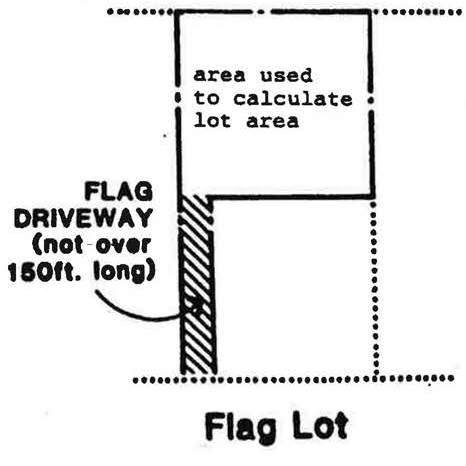
(b)
Lots not meeting the requirements set forth in section 101-160(a) shall meet the lot width requirements as set forth in the underlying zoning district.
(Ord. No. O-16-2020, § 2, 2-16-2021)
Sec. 101-187. - State law controlling.
The procedures in this article shall be followed in amending this subpart and the comprehensive plan. This article supplements the mandatory requirements of state law, which must be adhered to in all respects.
(Code 2001, § 90-131; Ord. No. O-01-2000, § 12.05.01, 6-6-2000; Ord. No. O-08-2011, § 3, 12-6-2011)
Sec. 101-188. - Application.
Any person, board or agency may apply to the department to amend this subpart or the comprehensive plan in compliance with procedures prescribed by the department.
(Code 2001, § 90-132; Ord. No. O-01-2000, § 12.05.02, 6-6-2000; Ord. No. O-08-2011, § 3, 12-6-2011)
Sec. 101-189. - Amending this subpart.
The development services department shall refer applications to amend this subpart to the planning and zoning board for comment. The development services department shall set the application for hearing before the planning and zoning board at the next regularly scheduled meeting.
(Code 2001, § 90-133; Ord. No. O-01-2000, § 12.05.03, 6-6-2000; Ord. No. O-08-2011, § 3, 12-6-2011)
Sec. 101-190. - Amending the comprehensive plan.
Applications to amend the comprehensive plan shall be set for hearing before the planning and zoning board.
(Code 2001, § 90-134; Ord. No. O-01-2000, § 12.05.04, 6-6-2000; Ord. No. O-08-2011, § 3, 12-6-2011)
Sec. 101-191. - Recommendation of the planning and zoning board.
The planning and zoning board shall hold a public hearing on each application to amend this subpart or the comprehensive plan and thereafter submit to the city council a written recommendation which:
(1)
Identifies any provisions of this subpart, comprehensive plan, or other law relating to the proposed change and describes how the proposal relates to them.
(2)
States factual and policy considerations pertaining to the recommendation.
(3)
In the case of proposed amendments to this subpart, includes the written comments, if any, received by the planning and zoning board.
(Code 2001, § 90-135; Ord. No. O-01-2000, § 12.05.05, 6-6-2000; Ord. No. O-08-2011, § 3, 12-6-2011)
Sec. 101-192. - Decision by city council.
The city council shall hold public hearings on the proposed amendment and may enact or reject the proposal, or enact a modified proposal that is within the scope of matters considered in the hearing.
(Code 2001, § 90-136; Ord. No. O-01-2000, § 12.05.06, 6-6-2000; Ord. No. O-08-2011, § 3, 12-6-2011)
Sec. 101-193. - Public hearing.
Each public hearing shall conform to the following requirements:
(1)
Notice. Notice that complies with the requirements of state law shall be given.
(2)
Hearing. The public hearing shall as a minimum:
a.
Comply with the requirements of state law.
b.
Permit any person to submit written recommendations and comments before or during the hearing.
c.
Permit a reasonable opportunity for interested persons to make oral statements.
(Code 2001, § 90-137; Ord. No. O-01-2000, § 12.05.07, 6-6-2000; Ord. No. O-08-2011, § 3, 12-6-2011)

