
Green Cove Springs City Zoning Code
CHAPTER 113
DEVELOPMENT STANDARDS
Sec. 113-1. - Purpose.
The purpose of this chapter is to provide development design and improvement standards applicable to all development activity within the municipal limits of the city.
(Code 2001, § 98-1; Ord. No. O-01-2000, § 6.00.01, 6-6-2000; Ord. No. O-08-2011, § 5, 12-6-2011)
Sec. 113-2. - Responsibility for improvements.
All improvements required by this chapter shall be designed, installed, and paid for by the developer, owner, or successors in title.
(Code 2001, § 98-2; Ord. No. O-01-2000, § 6.00.02, 6-6-2000; Ord. No. O-08-2011, § 5, 12-6-2011)
Sec. 113-3. - Principles of development design.
The provisions of this chapter are intended to ensure functional and attractive development. Development design shall first take into account the protection of natural resources as prescribed in chapter 121. All development shall be designed to avoid unnecessary impervious surface cover; to provide adequate access to lots and sites; and to avoid adverse effects of shadow, glare, noise, odor, traffic, drainage, and utilities on surrounding properties.
(Code 2001, § 98-3; Ord. No. O-01-2000, § 6.00.03, 6-6-2000; Ord. No. O-08-2011, § 5, 12-6-2011)
Sec. 113-4. - Impervious surface coverage.
(a)
Generally. Impervious surface on a development site shall not exceed the ratios provided in the table in subsection (d) of this section.
(b)
Ratio calculation. The impervious surface ratio is calculated by dividing the total impervious surface by the gross site area.
(c)
Alternative paving materials. If porous paving materials are used in accordance with the construction manual, then the area covered with porous paving materials shall not be counted as impervious surface.
(d)
Table of impervious surface ratios.
(Code 2001, § 98-4; Ord. No. O-01-2000, § 6.01.02, 6-6-2000; Ord. No. O-08-2011, § 5, 12-6-2011; Ord. No. O-13-2024, § 10, 5-21-2024)
Sec. 113-156. - Generally.
(a)
Applicability. Off-street parking facilities shall be provided for all development within the city pursuant to the requirements of this subpart. The facilities shall be maintained as long as the use exists that the facilities were designed to serve. All off-street parking spaces shall be paved for all uses except for single-family dwelling units.
(b)
Computation.
(1)
When determination of the number of off-street spaces required by this subpart results in a fractional space, a fraction of one-half or less may be disregarded, and a fraction in excess of one-half shall be counted as one parking space.
(2)
In churches and other places of assembly in which those in attendance occupy benches, pews or other similar seating facilities, and/or which contains an open assembly area, the occupancy shall be based on the maximum occupancy rating given the building by the fire department.
(3)
Gross floor area shall be the sum of the gross horizontal area of all floors of a building measured from the exterior faces of the exterior walls.
(c)
Parking of heavy vehicles in residential districts. Heavy vehicles which are in excess of 8,000 pounds net vehicle weight, and are registered on the basis of gross vehicle weight in accordance with F.S. § 320.01(10) through (12), shall not be parked or stored in any residential district except as may be required for normal loading or unloading of such vehicles and during the time normally required for service at dwellings, or at structures or activities allowable or permissible in such residential districts by the terms of this Code. Prohibited vehicles shall include dump trucks, semitrailers, truck tractors and similar vehicles as defined by F.S. § 320.01(10) through (12). In addition, the parking of a school bus, except for the normal loading or unloading during the time normally required for service, shall be prohibited in residential districts.
(d)
Permitted parking in residential districts. There may be parked in any residential district or other zoning district which allows residential dwelling units, on a plot improved with a permitted structure, any combination of the following motor vehicle or trailers:
(1)
Any light van, pickup truck, jeep, automobile or similar type of motor vehicle, including a motorcycle.
(2)
Any recreational vehicle, boat or boat trailer, provided that:
a.
The recreational vehicle, boat or boat trailer is parked on the plot in the minimum rear yard, or in the minimum side yard to the rear of the extension of the front roofline, or placed completely within a garage or carport if the item is covered while in the carport as set forth below.
b.
The recreational vehicle, boat or boat trailer is substantially screened from off-premises view by a fence, wall or hedge, or substantially hidden from off-premises view by a form-fitted cover. The term "form-fitted cover" shall not include tarps and similar covers which are usually of a square or rectangle shape and not custom-made for the boat and trailer or recreational vehicle. Such form-fitted covers must be securely attached to the recreational vehicle, boat or boat trailer with adequate tie-downs. Notwithstanding the foregoing, any screening hereunder shall be limited to and in compliance with the requirements for a fence, wall or hedge as set forth in section 117-788.
c.
At least three feet of separation shall be provided between the building and the recreational vehicle, boat or boat trailer. For this purpose, the roof overhang shall not be deemed part of the building.
(3)
There shall be no parking of any trucks, vans, vehicles, motorcycles and the like in the front yard except on paved areas/surfaces.
(Code 2001, § 98-141; Ord. No. O-01-2000, § 6.03.01, 6-6-2000; Ord. No. O-08-2011, § 5, 12-6-2011)
Sec. 113-157. - Number of parking spaces required.
(a)
Requirements in matrix. The matrix in subsection (d) of this section specifies the required minimum number of off-street automobile parking spaces, the percentage of automobile spaces that must be allotted for compact vehicles, and, in the notes, any special requirements that may apply.
(b)
Uses not specifically listed in matrix. The number of parking spaces required for uses not specifically listed in the matrix shall be determined by the city. The city shall consider requirements for similar uses and appropriate traffic engineering and planning data, and shall establish a minimum number of parking spaces based upon the principles of this subpart.
(c)
Treatment of mixed uses. Where a combination of uses is developed, parking shall be provided for each of the uses as prescribed by the matrix, unless a reduction is granted pursuant to section 113-159.
(d)
Matrix.
_____
OFF-STREET PARKING REQUIREMENTS
(e)
Special parking spaces.
(1)
Any parking area to be used by the general public shall provide suitable, marked parking spaces for persons with disabilities. The number, design, and location of these spaces shall be consistent with the requirements of F.S. § 553.5041 or succeeding provisions. No parking space required for persons with disabilities shall be counted as a parking space in determining compliance with subsection (a) of this section, but optional spaces for persons with disabilities shall be counted. All spaces for persons with disabilities shall be paved.
(2)
A portion of the parking spaces required by this subpart may be designated as exclusively for motorcycle parking if the following conditions are met:
a.
The development services department recommends that the spaces be so designated, based upon projected demand for them and lessened demand for automobile spaces.
b.
The planning and zoning board approves the recommendation and the designated spaces are shown on the site plan.
c.
The designated spaces are paved as defined in section 101-5 and suitably marked.
d.
The designation does not reduce the overall area devoted to parking so that, if the motorcycle spaces are converted to automobile spaces, the minimum requirements for automobile spaces will be met. The approval may later be withdrawn and the spaces returned to car spaces, if the building official finds that the purposes of this subpart would be better served thereby, based upon actual demand for motorcycle and automobile parking.
(f)
Reduction for mixed or joint use of parking spaces. The planning and zoning board shall authorize a reduction in the total number of required parking spaces for two or more uses jointly providing off-street parking when their respective hours of need of maximum parking do not normally overlap. Reduction of parking requirements because of joint use shall be approved if the following conditions are met:
(1)
The developer submits sufficient data to demonstrate that hours of maximum demand for parking at the respective uses do not normally overlap.
(2)
The developer submits a legal agreement approved by the city attorney guaranteeing the joint use of the off-street parking spaces as long as the uses requiring parking are in existence or until the required parking is provided elsewhere in accordance with the provisions of this subpart.
(g)
Reduction for low percentage of leasable space. The requirements of subsection (a) of this section assume an average percentage of gross leasable building to total gross building area (approximately 85 percent). If a use has a much lower percentage of leasable space because of cafeterias, athletic facilities, covered patios, multiple stairways and elevator shafts or atriums, or for other reasons, the planning and zoning board may reduce the parking requirements if the following conditions are met:
(1)
The developer submits a detailed floor plan describing how all of the floor area in the building will be used.
(2)
The developer agrees in writing that the usage of the square footage identified as not leasable shall remain as identified, unless and until additional parking is provided to conform fully with this subpart.
(Code 2001, § 98-142; Ord. No. O-01-2000, § 6.03.02, 6-6-2000; Ord. No. O-08-2011, § 5, 12-6-2011)
Sec. 113-158. - Off-street loading.
(a)
Generally. Spaces to accommodate off-street loading or business vehicles shall be provided as required below. Developments with buildings of less than 10,000 square feet are exempt from the requirement of providing an off-street loading space as long as all loading occurs onsite.
(b)
Spaces required.
(1)
Nursing homes and other similar institutional uses shall provide one loading space for the first 100,000 square feet of gross floor area or fraction thereof, and one space for each additional 100,000 square feet or fraction thereof.
(2)
Theaters, and other buildings for public assembly shall provide one loading space for the first 20,000 square feet of gross floor area or fraction thereof, and one space for each additional 100,000 square feet.
(3)
Offices and financial institutions shall provide one loading space for the first 75,000 square feet of gross floor area or fraction thereof, and one space for each additional 25,000 square feet.
(4)
Retail commercial, service, service and commercial entertainment uses shall provide one loading space for the first 10,000 square feet of gross floor area, and one space for each additional 20,000 square feet.
(5)
Industrial, manufacturing, research/development or warehouse uses shall provide one loading space for the first 15,000 square feet of gross floor area, two spaces for up to 40,000 square feet, and three spaces for over 40,000 square feet.
(Code 2001, § 98-143; Ord. No. O-01-2000, § 6.03.03, 6-6-2000; Ord. No. O-08-2011, § 5, 12-6-2011)
Sec. 113-159. - Alteration of conforming development.
(a)
Decreased demand for parking or loading. The number of off-street parking or loading spaces may be reduced if the development services department finds that a decrease in floor area, seating capacity, or other factor controlling the number of parking or loading spaces would permit the site to remain in conformity with this subpart after the reduction.
(b)
Increased demand for parking or loading. The number of off-street parking or loading spaces must be increased to meet the requirements of this subpart if the development services department finds that an increase in floor area, seating capacity, or other factor controlling the number of parking or loading spaces required by this subpart causes the site not to conform with this subpart.
(Code 2001, § 98-144; Ord. No. O-01-2000, § 6.03.04, 6-6-2000; Ord. No. O-08-2011, § 5, 12-6-2011)
Sec. 113-160. - Design standards for off-street parking and loading areas.
(a)
Location.
(1)
Except as provided in this section, all required off-street parking spaces and the use they are intended to serve shall be located on the same parcel.
(2)
The planning and zoning board may approve offsite parking facilities as part of the parking required by this subpart if:
a.
The location of the offsite parking spaces will adequately serve the use for which it is intended. The following factors shall be considered:
1.
Proximity of the offsite spaces to the use that they will serve.
2.
Ease of pedestrian access to the offsite parking spaces.
3.
Whether or not offsite parking spaces are compatible with the use intended to be served, e.g., offsite parking is not ordinarily compatible with high turnover uses such as retail commercial.
b.
The location of the offsite parking spaces will not create unreasonable:
1.
Hazards to pedestrians.
2.
Hazards to vehicular traffic.
3.
Traffic congestion.
4.
Interference with access to other parking spaces in the vicinity.
5.
Detriment to any nearby use.
c.
The developer supplies a written agreement, approved by the city attorney, assuring the continued availability of the offsite parking facilities for the use they are intended to serve.
(3)
All parking spaces required by this subpart for residential uses should be located no further than the following distances from the units they serve:
a.
Resident parking: 200 feet.
b.
Visitor parking: 350 feet.
Distances shall be measured from a dwelling unit's entry to the parking space. Where a stairway or elevator provides access to dwelling units, the stairway or elevator shall be considered to be the entrance to the dwelling unit. For purposes of measuring these distances, each required parking space shall be assigned to a specific unit on the development plan, whether or not the developer will actually assign spaces for the exclusive use of the specific unit.
(b)
Size.
(1)
Standard and angle parking spaces shall be ten feet wide by 18 feet long.
(2)
Parallel parking spaces shall be a minimum of eight feet wide by 20 feet long. If a parallel space abuts no more than one other parallel space, and adequate access room is available, then the length may be reduced to ten feet.
(3)
Tandem parking spaces must be a minimum of nine feet wide by 20 feet long.
(4)
A standard motorcycle parking space shall be 4¼ feet wide and 9¼ feet long.
(5)
Parking spaces for persons with disabilities shall be the size specified in F.S. § 553.5041, as amended.
(6)
The standard off-street loading space shall be 12 feet wide, 50 feet long, provide vertical clearance of 14½ feet, and provide adequate area for maneuvering, ingress and egress. The length of one or more of the loading spaces may be increased up to 55 feet if full-length tractor-trailers must be accommodated. Developers may install spaces that are larger than the standard, but the number of spaces shall not be reduced on that account.
(7)
The planning and zoning board may modify these requirements where necessary to promote a substantial public interest relating to environmental protection, heritage conservation, aesthetics, tree protection, or drainage.
(8)
Notwithstanding the foregoing, assigned, enclosed parking spaces for multifamily dwellings may be nine feet wide by 18 feet long.
(c)
Layout.
(1)
Pedestrian circulation facilities, roadways, driveways, and off-street parking and loading areas shall be designed to be safe and convenient.
(2)
Parking and loading areas, aisles, pedestrian walks, landscaping, and open spaces shall be designed as integral parts of an overall development plan and shall be properly related to existing and proposed buildings.
(3)
Buildings, parking and loading areas, landscaping and open spaces shall be designed so that pedestrians moving from parking areas to buildings and between buildings are not unreasonably exposed to vehicular traffic.
(4)
Landscaped, paved, and gradually inclined or flat pedestrian walks shall be provided along the lines of the most intense use, particularly from building entrances to streets, parking areas, and adjacent buildings. Pedestrian walks should be designed to discourage incursions into landscaped areas except at designated crossings.
(5)
Each off-street parking space shall open directly onto an aisle or driveway that, except for single-family and two-family residences, is not a public street.
(6)
Aisles and driveways shall not be used for parking vehicles, except that the driveway of a single-family or two-family residence shall be counted as a parking space for the dwelling unit.
(7)
The design shall be based on a definite and logical system of drive lanes to serve the parking and loading spaces. A physical separation or barrier, such as vertical curbs, shall be required to separate parking spaces from travel lanes.
(8)
Parking spaces for all uses, except single-family and two-family residences, shall be designed to permit entry and exit without moving any other motor vehicle.
(9)
No parking space shall be located so as to block access by emergency vehicles.
(10)
The storage, sale or repair of merchandise or vehicles is not permitted in off-street parking areas.
(11)
The display of signs or advertising devices on vehicles, structures or land is not permitted in off-street parking areas.
(12)
No remote parking facilities shall be located more than 450 feet by legal pedestrian route from the use or structure they are intended to serve.
(13)
Off-street parking facilities, including parking spaces and access ways, shall be properly drained so as not to cause a nuisance to other properties.
(14)
Traffic control signs and other pavement markings shall be used as necessary to ensure safe and efficient circulation within off-street parking areas.
(15)
Wheel stops or curbs shall be placed two feet from the front of each parking space, except in parallel spaces. Wheel stops shall be at least six feet in width and secured to the extent that they cannot be moved by normal contact with a vehicle or pedestrian.
(16)
All lighting shall be shaded or screened and positioned in such a manner as to minimize offensiveness to any neighboring property.
(17)
Access to all off-street parking spaces shall be by means of paved concrete, asphalt, brick or tile access driveways located entirely upon the property. The connecting driveway between the city right-of-way and the access way to such off-street parking shall be paved by the owner in the same manner and materials as the off-street parking spaces.
(18)
All off-street parking areas shall be designated so that no vehicle is required to back into a public right-of-way, exclusive of alleys, except:
a.
Single-family dwellings.
b.
Two-family dwellings.
c.
Designated municipal parking spaces that are approved by the city council.
(d)
Lighting.
(1)
Open parking facilities shall provide an average illumination of one footcandle equal to one lumen per square foot, and shall be well-distributed on the pavement areas; at no point shall illumination be less than one-fourth footcandle.
(2)
Enclosed parking facilities shall provide an average illumination intensity of 50 footcandles at the entrance, ten footcandles in traffic lanes and five footcandles in vehicle storage areas.
(3)
The current edition of the Illumination Engineers Society Lighting Handbook or amendments thereto as published by the Illumination Engineers Society shall be used as a standard for the design and testing of parking facility lighting.
(4)
All site development plans shall include a parking facility lighting plan. Plans for lots containing over 30 spaces shall be certified by a registered architect or registered engineer as providing illumination in accordance with the applicable minimum standards set forth in subsection (d)(1) of this section. Subsequent construction must comply with the lighting plan.
(5)
All required illumination will be controlled by automatic devices.
(6)
Any parking facility that serves business uses must maintain the required illumination for at least 30 minutes after the latest closing time of the establishments served by the parking facility.
(7)
Any parking facility that serves a residential use must maintain the required illumination through the use of natural or artificial light 24 hours a day.
(8)
All lighting shall be shaded or screened and positioned in such a manner as to minimize offensiveness to any neighboring property.
(9)
All property owners and lessees shall be responsible for the replacement or repair of any light that becomes nonfunctional and reduces the illumination below the required standard. The following diagrams shall apply to this article:
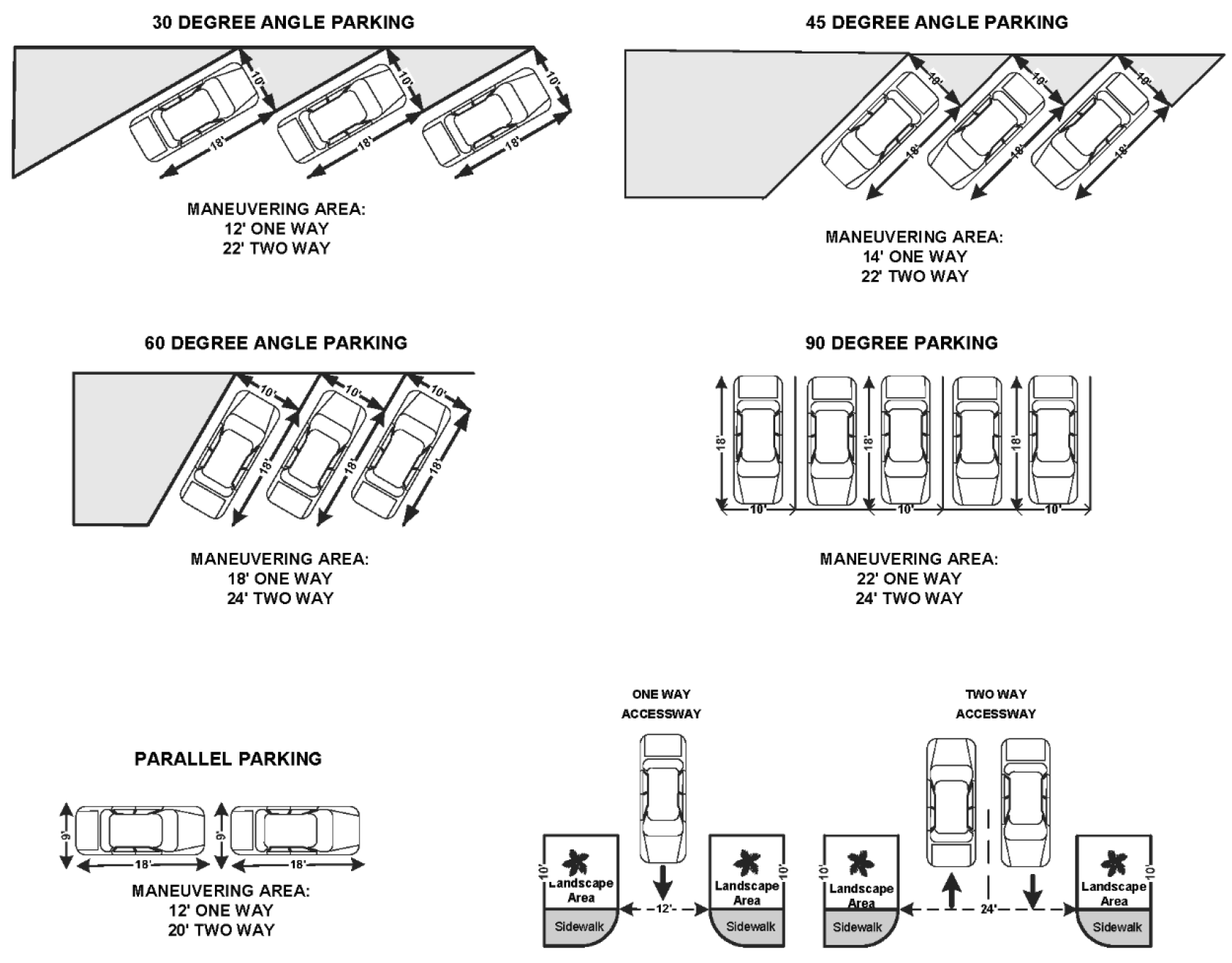
Figure 113-160-1
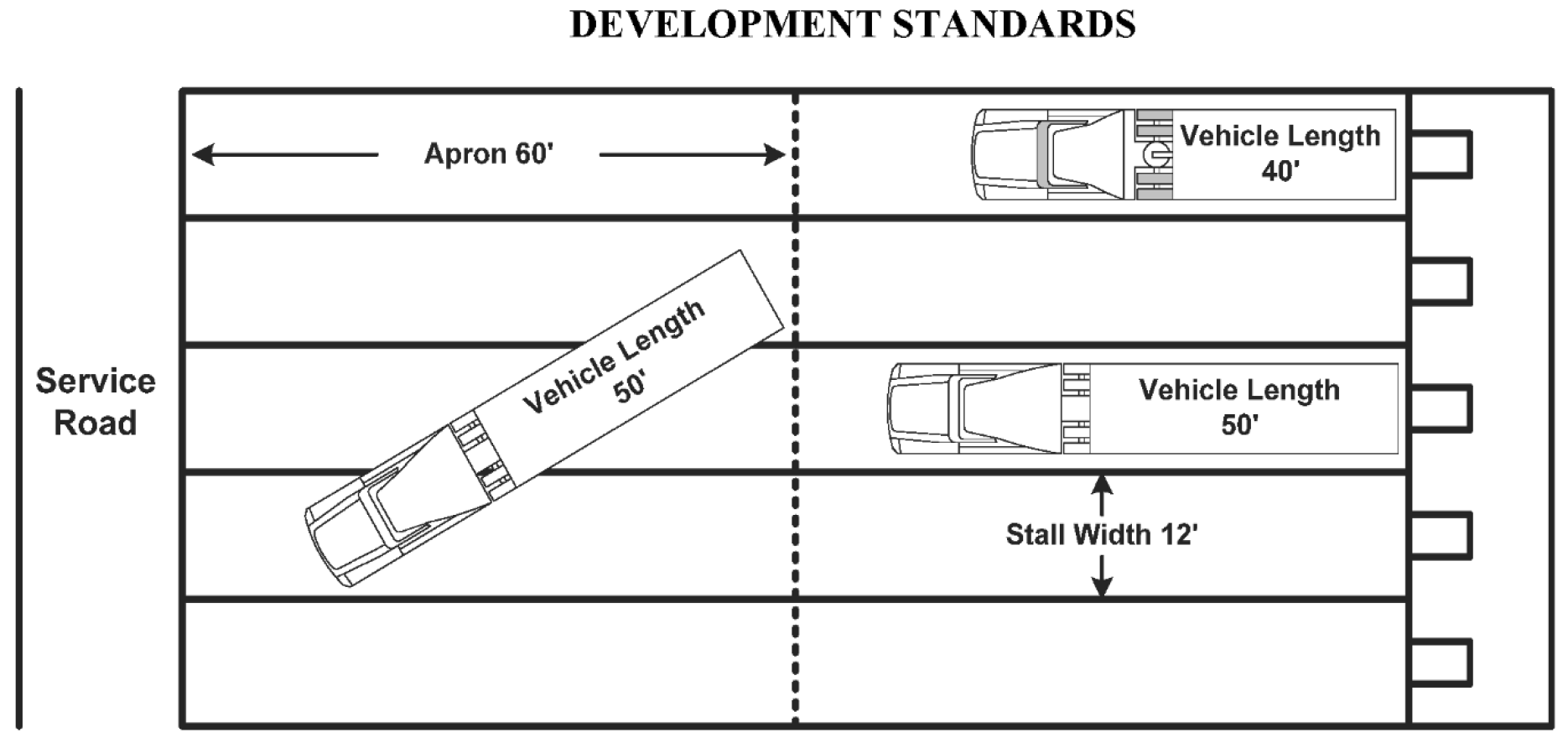
Figure 113-160-2
(Code 2001, § 98-145; Ord. No. O-01-2000, § 6.03.05, 6-6-2000; Ord. No. O-37-2007, § 1, 12-18-2007; Ord. No. O-08-2011, § 5, 12-6-2011)
Sec. 113-189. - Requirements for all developments.
(a)
Generally. The following basic utilities are required for all developments subject to the criteria listed in this article.
(b)
Electricity. Every principal use and every lot within a subdivision shall have available to it a source of electric power adequate to accommodate the reasonable needs of such use and every lot within such subdivision.
(c)
Telephone. Every principal use and every lot within a subdivision shall have available a telephone service cable adequate to accommodate the reasonable needs of such use and every lot within such subdivision.
(d)
Water and sewer. Every principal use and every lot within a subdivision shall have central potable water and wastewater hookup whenever required by the city comprehensive plan.
(e)
Illumination. All streets, driveways, sidewalks, bikeways, parking lots and other common areas and facilities in developments shall provide illumination meeting the standards approved by the city council.
(f)
Fire hydrants. All developments served by a central water system shall include a system of fire hydrants consistent with the standards approved by the city council.
(Code 2001, § 98-171; Ord. No. O-01-2000, § 6.04.01, 6-6-2000; Ord. No. O-08-2011, § 5, 12-6-2011)
Sec. 113-190. - Design standards.
(a)
Compliance with standards approved by the city council. All utilities required by this subpart shall meet or exceed the minimum standards approved by the city council.
(b)
Placement of utilities underground.
(1)
All electric, telephone, cable television, and other communication lines (exclusive of transformers or enclosures containing electrical equipment, including, but not limited to, switches, meters, or capacitors which may be pad mounted), and gas distribution lines shall be placed underground within easements or dedicated public rights-of-way.
(2)
Lots abutting existing easements or public rights-of-way where overhead electric, telephone, or cable television distribution supply lines and service connections have previously been installed may be supplied with such services from the utilities' overhead facilities, provided the service connection to the site or lot are placed underground.
(3)
Screening of any utility apparatus placed above ground shall be required.
(Code 2001, § 98-172; Ord. No. O-01-2000, § 6.04.02, 6-6-2000; Ord. No. O-08-2011, § 5, 12-6-2011)
Sec. 113-191. - Utility easements.
When a developer installs or causes the installation of water, sewer, electrical power, telephone, or cable television facilities and intends that such facilities shall be owned, operated, or maintained by a public utility or any entity other than the developer, the developer shall transfer to such utility or entity the necessary ownership or easement rights to enable the utility or entity to operate and maintain such facilities.
(Code 2001, § 98-173; Ord. No. O-01-2000, § 6.04.03, 6-6-2000; Ord. No. O-08-2011, § 5, 12-6-2011)
Sec. 113-221. - Relationship to other stormwater management requirements.
In addition to meeting the requirements of this land development code, the design and performance of all stormwater management systems shall comply with applicable state regulations (F.A.C. ch. 62-25) or rules of the St. John's River Water Management District. In all cases, the strictest of the applicable standards shall apply.
(Code 2001, § 98-201; Ord. No. O-01-2000, § 6.05.01, 6-6-2000; Ord. No. O-08-2011, § 5, 12-6-2011)
Sec. 113-222. - Exemptions.
The following development activities are exempt from the stormwater management requirements in this article, except that the following steps to control erosion and sedimentation must be taken for all development:
(1)
The construction of a single-family or duplex residential dwelling unit and accessory structures on a single parcel of land.
(2)
Any development within a subdivision if each of the following conditions have been met:
a.
Stormwater management provisions for the subdivision were previously approved and remain valid as part of a final plat; and
b.
The development is conducted in accordance with the stormwater management provisions submitted with the final plat.
(3)
Maintenance activity that does not change or affect the quality, rate, volume or location of stormwater flows on the site or of stormwater runoff.
(4)
Action taken under emergency conditions to prevent imminent harm or danger to persons, or to protect property from imminent fire, violent storms, hurricanes or other hazards.
(Code 2001, § 98-202; Ord. No. O-01-2000, § 6.05.02, 6-6-2000; Ord. No. O-08-2011, § 5, 12-6-2011)
Sec. 113-223. - Stormwater management requirements.
(a)
Performance standards. All developments must be designed, constructed and maintained to meet the requirements of the following:
(1)
While development activity is underway and after it is completed, the characteristics of stormwater runoff shall meet the requirements of the St. John's River Water Management District.
(2)
The proposed development and development activity shall not violate the water quality standards as set forth in F.A.C. ch. 62-3.
(b)
Design standards. To comply with the foregoing performance standards, the proposed stormwater management system shall conform to the following design standards:
(1)
Detention and retention systems shall be designed to comply with F.A.C. ch. 62-3.
(2)
To the maximum extent practicable, natural systems shall be used to accommodate stormwater.
(3)
The proposed stormwater management system shall be designed to accommodate the stormwater that originates within the development, stormwater that legally flows onto or across the development from adjacent lands, and allow a positive outfall at which a proposed stormwater system may legally be allowed to discharge from the site.
(4)
Attenuation requirements shall meet the following standards:
a.
If a legal positive outfall is available, the project shall be designed to attenuate pre-development vs. post-development peak flow rate for the design storm. Some sites do not have a legal outfall. A legal outfall must be to a publicly maintained conveyance or to an area in which the right to discharge is guaranteed by a legal instrument or by riparian law.
b.
If a positive outfall is available, but there is no legal document ensuring the right to use the positive outfall, the project shall be designed to attenuate the predevelopment vs. post-development volume for the design storm, in addition to the requirements of subsection (a) of this section. The discharge shall match the flow characteristics and location of the pre-development flow.
c.
If an adequate positive outfall is not available, offsite improvements shall be required to provide one, or the project shall be designed as a landlocked basin.
(5)
The proposed stormwater management system shall be designed to function properly for a minimum 50-year life.
(6)
The design and construction of the proposed stormwater management system shall be certified as meeting the requirements of this subpart by a professional engineer registered in the state.
(7)
Dredging, clearing of vegetation, deepening, widening, straightening, stabilizing or otherwise altering natural surface waters shall be minimized.
(8)
Natural surface waters shall not be used as sediment traps during or after development.
(9)
Water reuse and conservation shall, to the maximum extent practicable, be achieved by incorporating the stormwater management system into irrigation systems serving the development.
(10)
Vegetated buffers of sufficient width to prevent erosion shall be retained or created along the shores, banks or edges of all natural or manmade surface waters.
(11)
All detention and retention basins, except natural water bodies used for this purpose, shall be accessible for maintenance from streets or public rights-of-way.
(12)
A six-foot chain-link fence shall be installed around the perimeter of stormwater retention ponds for public health and safety; wooden privacy fences are not acceptable for enclosure of a stormwater retention pond.
(Code 2001, § 98-203; Ord. No. O-01-2000, § 6.05.03, 6-6-2000; Ord. No. O-08-2011, § 5, 12-6-2011)
Sec. 113-224. - Dedication or maintenance of stormwater management systems.
(a)
Dedication. If a stormwater management system approved under this subpart will function as an integral part of the city-maintained system, as determined by the city, the facilities should be dedicated to the city.
(b)
Maintenance by an acceptable entity.
(1)
All stormwater management systems that are not dedicated to the city shall be operated and maintained by one of the following entities:
a.
A local governmental unit including the county, a municipal service taxing unit, special district or other governmental unit.
b.
An active water control district created pursuant to F.S. ch. 298 or drainage district created by special act, or community development district created pursuant to F.S. ch. 190, or special assessment district created pursuant to F.S. ch. 170.
c.
A state or federal agency.
d.
An officially franchised, licensed or approved communication, water, sewer, electrical or other public utility.
e.
The property owner or developer if:
1.
Written proof is submitted in the appropriate form, by either letter or resolution, that a governmental entity or such other acceptable entity, as set forth in subsections (b)(1)a through d of this section, will accept the operation and maintenance of the stormwater management and discharge facility at a time certain in the future.
2.
A bond or other assurance of continued financial capacity to operate and maintain the system is submitted.
f.
For-profit or nonprofit corporations, including homeowners associations, property owners associations, condominium owners associations or master associations, if:
1.
The owner or developer submits documents constituting legal capacity and a binding legal obligation between the entity and the city council affirmatively taking responsibility for the operation and maintenance of the stormwater management facility.
2.
The association has sufficient powers reflected in its organizational or operational documents to:
(i)
Operate and maintain the stormwater management system as permitted by the city council.
(ii)
Establish rules and regulations.
(iii)
Assess members.
(iv)
Contract for services.
(v)
Exist perpetually, with the articles of incorporation, providing that if the association is dissolved, the stormwater management system will be maintained by an acceptable entity as described in subsections (b)(1)a through d of this section.
(2)
If a project is to be constructed in phases, and subsequent phases will use the same stormwater management facilities as the initial phases, the operation/maintenance entity shall have the ability to accept responsibility for the operation and maintenance of the stormwater management systems of future phases of the project.
(3)
In phased developments that have an integrated stormwater management system, but employ independent operation/maintenance entities for different phases, the operation/maintenance entities, either separately or collectively, shall have the responsibility and authority to operate and maintain the stormwater management system for the entire project. That authority shall include cross easements for stormwater management and the authority and ability of each entity to enter and maintain all facilities, should any entity fail to maintain a portion of the stormwater management system within the project.
(4)
The applicant shall be an acceptable entity and shall be responsible for the operation and maintenance of the stormwater management system from the time construction begins until the stormwater management system is dedicated to and accepted by another acceptable entity.
(Code 2001, § 98-204; Ord. No. O-01-2000, § 6.05.05, 6-6-2000; Ord. No. O-08-2011, § 5, 12-6-2011)
Sec. 113-242. - Purpose and intent.
(a)
Landscape, landscaped areas, buffers, and tree protection shall be provided and/or accomplished for all premises in the manner set forth in this article. Required landscaped areas shall be located at or above grade unless otherwise prescribed in these land development regulations. The minimum provision of required landscape, landscaped areas, buffers, and trees may be exceeded. Unless otherwise prescribed, the most stringent provision of this schedule shall prevail.
(b)
Landscape, buffer, and tree protection requirements serve many purposes in the built-up environment. Landscape provides visual and climatic relief from buildings, structures, and broad expanses of pavement; landscape buffers pedestrian and vehicular traffic; and trees provide shade, scenic beauty, and natural habitat.
(c)
In general, landscaping and buffers shall be designed to:
(1)
Enhance the urban development by blending natural and manmade environments.
(2)
Provide shade for paved surfaces.
(3)
Separate vehicular and non-vehicular use areas.
(4)
Define vehicular access ways and access points.
(5)
Screen vehicular movement, noise, and glare.
(6)
Provide visual and physical separation of potentially incompatible land uses.
(7)
Incorporate water conservation features such as drought tolerant landscaping and reclaimed water usage as required herein.
(8)
Provide a protective buffer to mitigate the impact of climate change and enhance urban biodiversity.
(d)
As recommended by F.S. tit. XXVIII, ch. 373, plant selection for development projects withing the city of Green Cove Springs shall be in compliance with Florida Friendly Landscaping as provided for Zip Code 32043 on the Institute of Food and Agricultural Sciences (IFAS), University of Florida web site; https://ffl.ifas.ufl.edu/apps/plants/.
(Code 2001, § 98-231; Ord. No. O-08-2011, § 5, 12-6-2011; Ord. No. O-03-2017, exh. A(98-231), 1-24-2017; Ord. No. O-23-2023, § 1, 9-5-2023)
Sec. 113-243. - Definitions.
The following words, terms, and phrases, when used in this article, shall have the meanings ascribed to them in this section, except where the context clearly indicates a different meaning:
Berm means manmade earth contoured to form a mound above the general elevation of the adjacent ground or surface and designed to provide visual interest, screen undesirable view and/or decrease noise.
Buffer means a combination of physical space and vertical elements such as plants, berms, fences, or walls, whose purpose is to separate and screen incompatible land uses from one another.
Caliper means the diameter of a tree measured at breast height (DBH) which is approximately four and one-half feet above the ground.
Canopy or shade tree means any tree grown specifically for its shade. The term "canopy or shade tree" usually applies to large trees with spreading canopies. Canopy trees normally grow to a minimum overall height of 30 feet and an average mature crown spread of 25 feet. Oaks, maples, ashes, lindens, and elms are examples canopy/shade trees. Canopy trees shall be a minimum of 2.5 inches caliper DBH. Listed in IFAS as "Trees—Large" (https://ffl.ifas.ufl.edu/apps/plants/).
Clear trunk means the distance between the top of the root ball and the point of the trunk where lateral branching begins.
Commercial means all uses in RPO, FBC, GCN, GCC, C-1, and C-2 zoning districts and commercial development in a PUD zoning district.
Common area means that area which will be maintained by a homeowner's association, city service area, or other form of cooperative organization.
Dangerous tree means any tree of any species which poses an immediate threat to persons or property due to disease, age, or mechanical injury. This can include damage from storms or other environmental factors.
Decorative turf means turf used purely for ornamental purposes having no use other than aesthetics.
Drip line means the vertical line running through the outermost portion of the tree crown projected vertically to the ground.
Florida Friendly Landscaping means quality landscapes that conserve water, protect the environment, are adaptable to local conditions, and are drought tolerant. The principles of such landscaping are the right plant in the right place, efficient watering, appropriate fertilization, mulching, attracting wildlife, responsible management of yard pests, recycling yard waste, reduction of storm runoff, and waterfront protection. Additional components include practices such as landscape planning and design, soil analysis, the appropriate use of solid waste compost, minimizing the use of irrigation, and proper maintenance.
Fully shielded lighting means lighting constructed in such a manner that all light emitted by the fixture, either directly from the lamp or a diffusing element, or indirectly by reflection or refraction from any part of the luminaire, is projected below the horizontal. Such fixtures usually have a flat, horizontally oriented lens and opaque (usually metal) sides. They are often described as shoebox luminaries if the luminaire has a predominantly rectangular form. Fixtures that either have reflecting surfaces or lenses (clear or prismatic) located below the lamp and visible from the side or above and fixtures that can be mounted such that the shielding is ineffective are not considered fully shielded lighting.
Grasses listed in IFAS, (https://ffl.ifas.ufl.edu/apps/plants/) as "Turfgrasses."
Groundcover means a low-growing plant, including turf grass, that, by the nature of its growth characteristics, completely covers the ground and does not usually exceed two feet in height. Groundcovers are listed in IFAS as "groundcovers."
Hat racking or topping means pruning a tree in such a way that the majority of limbs are removed and the tree is left with only a trunk and the stumps of a few primary limbs, with little or no foliage or other trimming or pruning that has the effect of preventing a tree from attaining its natural height and/or shape.
Hedge means a row of evenly spaced shrubs planted to form a continuous unbroken visual screen.
Immediate danger of collapse means that the tree may already be leaning, with the surrounding soil heaving, and/or there is a significant likelihood that the tree will topple or otherwise fail and cause damage before a tree removal permit could be obtained through the non-emergency process. "Immediate danger of collapse" does not include hazardous conditions that can be alleviated by pruning or treatment.
Industrial means all uses in M-1 and M-2 zoning districts and all industrial uses in a PUD zoning district.
Invasive species means plants, animals, and other living organisms (e.g., microbes), non-native (or alien) to the ecosystem under consideration and, whose introduction causes or is likely to cause economic or environmental harm or harm to human health.
Landscape means vegetative and inert materials, including, but not limited to, grass, sod, shrubs, vines, hedges, trees, flowers, berms, and complementary structural landscape architectural features such as rocks, fountains, sculpture, decorative walls and tree wells or other hardscape features.
Landscaped area means land area to be provided with landscape.
Landscaped strip or landscaped island means required landscaped areas containing ground cover, shrubs, trees and/or other landscape used to divide parking areas into individual bays. Large ornamental listed in IFAS (https://ffl.ifas.ufl.edu/apps/plants/) as "Palms and Palm Like Plants."
Mitigation means the action used by an individual, company or agency to identify and minimize the risks from a proposed action that will reduce its impacts on people, property, and the environment and will restore and retain the biodiversity of the site.
Moisture sensors which means a device which has the ability to shut off an automatic irrigation controller after receiving a determined amount of rainfall.
Mulch means nonliving organic materials such as wood chips that is customarily placed around the base of trees, shrubs, and groundcovers for the purpose of retaining moisture and retarding weed infestation and soil erosion. Also, mulch is used in pathways and play areas.
Native or naturalizing plant species means plant species native to the region or introduced which once established are capable of sustaining growth and reproduction under local climatic conditions, without supplemental watering and enhance habitat for native wildlife.
Nonresidential means, pursuant to land use category headings reflected in Schedule B, Permitted Uses, in these land development regulations, all commercial, transient lodging and entertainment, automotive, miscellaneous business and services, industrial and public/semi-public uses. Ornamental landscape trees, listed in IFAS (https://ffl.ifas.ufl.edu/apps/plants/) as "Trees—Medium."
Parking area means a paved ground surface area used for the temporary parking and maneuvering of vehicles by employees or customers, either for compensation or to provide an accessory service to a commercial, industrial, institutional or residential use.
Paved ground surface area. See section 101-5.
Poodle cut means stripping off the lower branches of a tree and rounding or shearing the ends of the greenery to create an unnatural shape.
Protected area means an existing natural area that has been determined by the City of Green Cove Springs, to be of significant aesthetic, environmental, or monetary value or which affords collective protection for the city from extreme weather events, and has been designated as protected by the city council.
Protected tree means a particularly fine or unusual example of any tree due to its age, size, rarity, environmental or historical value or exceptional aesthetic quality. A tree may also be designated a specimen due to its association with historic events or persons. A specimen tree cannot be of a non-native species, is approved or denied. Designation will be annotated on the title to the property. Reversal of this determination will require action by the city council.
Required landscaped area means any landscaped area required in this Code.
Residential means all uses in R-1, R-2, R-3, and PUD zoning districts; one-family, two-family and multiple-family dwellings.
Shrub means a self-supporting woody species of plant characterized by persistent stems and branches springing from the base. Shrubs and requirements for visual screens listed in IFAS (https://ffl.ifas.ufl.edu/apps/plants/) as "Shrubs—Large" spaced on center per guidance under "appearance."
Tree means a self-supporting woody plant of a species that normally grows to a minimum overall height of 15 feet and has an average mature crown spread greater than 15 feet within the city.
Turf means upper layer of soil bound by grass and plant roots into a thick mat.
Understory, sub-canopy trees means trees which normally grow to a maximum overall height of 15 feet and an average mature crown spread of 15 feet. Understory trees listed in IFAS (https://ffl.ifas.ufl.edu/apps/plants/) as "Trees—Small"
Vehicular circulation area means streets, rights-of-way, access ways, parking spaces, parking, loading, and unloading, and other similar or related functions.
Viable tree is a tree that is in compliance with Florida Friendly Landscaping as provided for zip code 32043 on the Institute of Food and Agricultural Sciences, University of Florida web site, which is capable of growing and developing in its natural form upon completion of development of a site. Trees that are dead, dying, or have their root systems or crowns severely altered during construction or are dangerous because of their growth habits are not a viable tree.
(Code 2001, § 98-232; Ord. No. O-08-2011, § 5, 12-6-2011; Ord. No. O-03-2017, exh. A(98-232), 1-24-2017; Ord. No. O-23-2023, § 1I; Ord. No. O-13-2024, § 2, 5-21-2024)
Sec. 113-244. - Required landscaping.
(a)
Landscape requirements for one-family dwellings and two-family dwellings shall be as follows:
(1)
At least one canopy tree, 2.5 inches DBH, shall be located in the required front yard of each dwelling unit.
(2)
The lot shall be sodded, seeded, or appropriate ground cover for erosion control.
(b)
Landscape requirements for nonresidential uses, including multifamily structures with three or more dwelling units, shall be as follows:
(1)
Perimeter landscaping. At a minimum, each site developed for multifamily, institutional, commercial, or industrial uses will contain one shade or canopy tree for each 50 linear feet of the perimeter of the site.
(2)
Interior landscaping. There will be one tree per every 1,500 square feet of the first 10,500 square feet of the project site, then one tree for every 4,000 square feet of the remainder of the project site. The trees shall be an equal proportion of shade (canopy) and understory trees. At a minimum, 15 percent of the site shall be landscaped.
(c)
Landscape adjacent to streets and parcels.
(1)
A landscaped strip shall be provided along all parcel lines and abutting street right-of-way lines.
(2)
The depth of the required landscaped strip shall be measured and provided parallel to the parcel line or abutting street right-of-way in question.
(3)
Landscaped strips shall be considered required landscaped area.
(4)
A landscaped strip may be included in satisfying buffer requirements.
(d)
Landscaped strips shall be provided in the following manner:
(1)
Ten-feet landscaped strip along all rights-of-way.
(2)
Alternative design for properties fronting on all roads classified as arterials, including, but not limited to, U.S. 17 (Orange Avenue), S.R. 16 East (Leonard C. Taylor Parkway) and S.R. 16 West (Ferris Street and Idlewild Avenue), shall comply with the following standards: The developer/property owner shall be responsible for providing a landscape buffer in the area abutting the designated roadway right-of-way lines by meeting on of the following conditions:
a.
The roadway shall be separated from the back of curb by a six-feet landscaped strip, a six-feet pedestrian walkway, then a six-feet landscaped strip.
b.
Building setback shall be calculated from the back of curb or ten-feet landscaped strip along all rights-of-way.
c.
Alternative designs. Where natural features or spacing of existing driveways and roadways cause the access requirements of this section affecting placement or planting of landscaped buffers or trees to be physically infeasible, alternate designs may be approved as part of the issuance of the final development order.
(3)
The landscape buffer area shall be planted in the following manner:
a.
Canopy trees.
1.
One row of canopy trees, 2.5 inches DBH at planting. For 50 percent of the canopy trees, two sub-canopy/understory trees may be substituted for each canopy tree.
2.
The trees shall be planted every 50 feet and staggered so as to be midway between each other, and equal distance between each row and right-of-way and/or parcel line. Trees shall be evenly spaced. The tree spacing may be altered with approval of the development services, provided the total number of trees is provided.
b.
Sub-canopy/understory trees. A minimum of four sub-canopy/understory trees per 100 feet of frontage shall be planted in and about each access point and intersection.
c.
Hedges. When off-street parking, loading, unloading and vehicular circulation areas are to be located adjacent to the street right-of-way, a dense hedge of evergreen-type shrubs shall be provided in the following manner:
1.
At initial planting and installation, shrubs shall be at least 24 inches in height and shall be planted at least 36 inches or less on center.
2.
The hedge shall be planted four feet or more from the tree trunks.
3.
Within two years of initial planting and installation, shrubs shall have attained and be maintained at a minimum height of three feet and shall provide an opaque vegetative screen between the street and the use of the premises.
4.
In lieu of a vegetative hedge, the use of vegetated berms or other appropriate landscape materials in a manner that results in the visual separation of street right-of-way can be approved by the development services director.
d.
Shrubs.
1.
Buffer areas, not adjacent to a street right-of-way, shall include nine shrubs for every 100 linear feet of the parcel line
2.
Shrubs shall be at least 24 inches in height at the time of planting.
(e)
Groundcover. The buffer area shall be planted with groundcover minimum of 18 inches on center or solid grass sod, unless natural area to remain.
(f)
Landscape buffer between incompatible uses.
(1)
General requirements. Wherever a higher intensity property adjoins or abuts a lower intensity zoning district, a landscaped buffer area will be required along the total length of that adjoining or abutting property boundary to provide an attractive land use transition and reduce sight, glare, light and noise intrusion excluding properties located in the CRA (community redevelopment area). This landscaped buffer area as set out in this section will be reviewed and approved during the site plan process.
(2)
Where a business or industrial use is separated by a two-lane street from a residential district, then any plot in such nonresidential district adjacent to the separating street shall be provided with a yard at least 20 feet in depth along such separating street.
(3)
A heavy industrial use abutting a residential district shall have a 40-feet-deep landscaped buffer area or a 25-feet-deep landscaped buffer area combined with a six-feet high brick, stone or concrete block wall. Alternatives to the wall requirement such as wood or vinyl fencing can be approved by the site development committee.
(4)
A light or medium industrial or general commercial use abutting a less intensive district shall have a 25-feet-deep landscaped buffer area or a ten-feet-deep landscaped buffer area combined with a brick, stone or concrete block wall. Alternatives to the wall requirement such as wood or vinyl fencing can be approved by the site development committee.
(5)
A neighborhood business, institutional or office use or district abutting a less intensive use or district shall have a ten-feet-deep landscaped buffer area or a four-feet-deep landscaped buffer area combined with a stone, brick or concrete block wall. Alternatives to the wall requirement such as wood or vinyl fencing can be approved by the site development committee.
(6)
Multifamily and mobile home use abutting a less intensive use or district shall have a ten-feet-deep landscaped buffer area or a four-feet-deep landscaped area combined with a brick, stone or concrete block wall. Alternatives to the wall requirement such as wood or vinyl fencing can be approved by the site development committee.
(7)
A six-feet-high landscaped berm can be substituted for the wall requirement. The berm must be constructed as a 3:1 slope or less. The berms shall be landscaped with a combination of ground cover, sod, shrubs and medium trees (as defined in this section), as provided for in this section. Large trees can be substituted for ornamental trees, provided that the shade trees can meet the specifications set forth in section 113-244(d)(3)(a).
(8)
Landscape specifications.
a.
Acceptable plant material; irrigation; landscape plan. When a landscaped buffer area is required under this section, continuous hedging and small trees will be required. Hedge material shall reach a height of three feet in two years and six feet in four years, and should be accepted as cold hardy in this planting zone. All open areas in the buffer area shall be sodded. All landscaped areas shall have a properly installed irrigation system to give 100 percent coverage of the landscaped area, or use proper planting, maintenance and water conservation measures such as native or drought-tolerant vegetation to ensure the healthy survival of all sod, ground cover, shrubs and trees. A landscape plan shall be submitted with every site plan showing the irrigation system or the alternate use of native or drought-tolerant vegetation.
b.
Spacing, size and quality of hedge material. Shrub material to be planted shall be a maximum of three feet on center. Plants shall be 18 inches to 24 inches minimum height at the time they are installed, in three-gallon containers.
c.
Spacing size of small trees. Trees shall meet the definition of ornamental landscape trees as set forth in section 113-243. There shall be an average of one tree for every 25 linear feet of buffer area. Trees shall be a minimum of six feet to eight feet in height when installed.
d.
All vegetation shall be Florida Grade No. 1 or better.
(Code 2001, § 98-233; Ord. No. O-01-2000, § 6.06.02, 6-6-2000; Ord. No. O-08-2011, § 5, 12-6-2011; Ord. No. O-03-2017, exh. A(98-233), 1-24-2017; Ord. No. O-23-2023, § III, 9-5-2023)
Sec. 113-245. - Exemptions and exceptions to landscape requirements.
Interior landscaping for parking garages or other vehicle use areas contained entirely with a roofed and walled structure. Landscaping shall be provided around the perimeter of the structures.
(Code 2001, § 98-234; Ord. No. O-01-2000, § 6.06.01, 6-6-2000; Ord. No. O-08-2011, § 5, 12-6-2011; Ord. No. O-03-2017, exh. A(98-234), 1-24-2017)
Sec. 113-246. - Parking area landscaping.
The requirements of this section apply to all development, unless exempted:
(1)
Internal landscape area.
a.
Minimum required land area for required landscaped areas not in a parking area. Each required landscaped area shall contain a minimum land area of 200 square feet.
b.
The minimum required internal landscaped area for parking areas shall cover ten percent of the parking area.
c.
Required landscaped area for rows of parking spaces.
1.
A landscaped area shall be provided at each end of all rows of parking.
2.
In addition, at least one landscaped area shall be provided between every ten parking spaces.
3.
Each required landscaped area shall be five feet wide inside the curb or paving line running the entire length of the parking space.
4.
At least one canopy tree shall be provided at each island.
5.
A five-feet turning radius shall be accommodated at the end of parking rows.
d.
Parking space reduction to protect existing trees. The development services director shall have the authority to reduce the required number of off-street parking spaces when such reduction would result in the preservation of existing trees.
1.
Trees to be preserved must be a minimum of 12 inches in diameter measured at breast height above the ground.
2.
The reduction in the number of required parking spaces shall result in a reduction in an amount of required parking of less than five percent of the total number of required off-street parking spaces.
(2)
Required trees.
a.
At least one canopy tree shall be provided in each required landscaped area.
b.
One canopy trees or two sub canopy trees shall be provided for each required landscaped area for the rows of parking. A minimum of 50 percent of the trees used shall be canopy trees.
(3)
Location of landscaped areas for interior landscaping.
a.
A landscaped area or buffer shall be provided between all parking areas and principal structures or any sidewalks and street or rights-of-way.
b.
This landscape area or buffer must contain at least one canopy tree per 50 feet linear perimeter of the parcel.
c.
Every effort will be made to retain native vegetation and trees.
d.
Minimum width of the landscape area:
1.
Ten feet when abutting a public right-of-way.
2.
Five feet when abutting alleys or the rear or side property lines.
e.
Each landscaped area shall have five shrubs per each tree required.
f.
All landscaped areas shall be covered in groundcover or turf.
(4)
Maintenance of planted areas.
a.
Irrigation shall be provided for all new planting. Hose bibs maybe installed as an alternative, one hose bib within 75 feet of all landscaped areas.
b.
Maintenance shall be the responsibility of the developer and/or landowner.
c.
Failure to maintain landscaped areas shall be considered a violation of this subpart and subject to code enforcement.
(5)
Street trees for subdivisions.
a.
The developer shall plant, within ten feet of the right-of-way of each street within a residential development meeting the subdivision requirements of this Code, one canopy tree for every 50 linear feet of right-of-way.
b.
Except where property on one side of the right-of-way is not owned by the developer, the trees shall be planted alternately on either side of the street.
c.
Existing trees and native tree species that need less water and maintenance are required.
d.
Coordination with the city utility departments is required prior to planting the street trees.
e.
Street trees planted shall have a minimum overall height of 2.5-inch DBH at time of planting.
(6)
Certain functional uses not permitted. No accessory structures, garbage or trash collection points or receptacles, parking, or any other functional use shall be permitted in the minimum required landscape area and/or buffer zone. Combining of compatible functions such as landscaping and drainage facilities are permitted.
(7)
Concealing and location of dumpsters.
a.
Dumpsters must be concealed in opaque concrete, brick, or chain-link fence with screening slats of enough height consistent with the size of the container to shield the container from view from all sides.
b.
The front of screen must be accessible for service of the container.
c.
The dumpster must be located on a paved surface of asphalt or concrete.
(8)
Clear line of sight. An unobstructed cross visibility shall be required with in a triangle area formed by the intersection of two rights-of-way or access ways, as referenced in section 113-76.
(Code 2001, § 98-235; Ord. No. O-01-2000, § 6.06.03, 6-6-2000; Ord. No. O-08-2011, § 5, 12-6-2011; Ord. No. O-03-2017, exh. A(98-235), 1-24-2017; Ord. No. O-23-2023, § IV, 9-5-2023)
Sec. 113-247. - Landscape design and materials.
(a)
Design principles. All landscaped areas required shall conform to the following general design principles:
(1)
Florida Friendly Landscaping principles shall be incorporated into all projects.
(2)
Landscaping should integrate the proposed development into existing site features through consideration of existing topography, hydrology, soils, and vegetation.
(3)
The functional elements of the development plan, particularly the drainage systems and internal circulation systems for vehicles and pedestrians, should be integrated into the landscaping plan.
(4)
Landscaping should be used to minimize potential erosion through the use of ground covers or any other type of landscape material that aids in soil stabilization.
(5)
Existing native vegetation should be preserved and used to meet landscaping requirements.
(6)
Landscaping should enhance the visual environment through the use of materials that achieve variety with respect to seasonal changes, species of living material selected, textures, colors and size at maturity.
(7)
Landscaping design should consider the aesthetic and functional aspects of vegetation, both when initially installed and when the vegetation has reached maturity. Newly installed plants should be placed at intervals appropriate to the size of the plant at maturity, and the design should use short-term and long-term elements to satisfy the general design principles of this section over time.
(8)
Landscaping should enhance public safety and minimize nuisances.
(9)
All landscaping and plant material shall be planted in a manner which shall not be intrusive or interfere, at or before maturity, with pavement surfaces, power, cable television, or telephone lines, sewer, or water pipes, or any other existing or proposed overhead or underground utility services.
(10)
Landscaping should maximize the shading of streets and vehicle use areas.
(11)
Architectural planters.
a.
Planters can be used to meet landscaping requirements.
b.
Planters shall be a minimum often square feet and shall have minimum depth of 15 inches.
c.
Planters shall be maintained and replanted if necessary.
d.
Planters cannot be located within the city right-of-way without prior consent from the development services director.
(b)
Installation of required landscape and trees.
(1)
General. All required trees and landscaping shall be installed according to generally accepted commercial planting procedures. Soil, free of lime rock, rocks, and other construction debris, shall be provided. All landscaped areas shall be protected from pedestrian and vehicular encroachment by raised planting surfaces, depressed walks, curbs, edges, wheel stops and the like.
(2)
Florida No. 1 quality.
a.
All required plant materials, including, but not limited to, trees and shrubs, shall equal or exceed the standards for Florida No. 1 as established and revised by the state department of agriculture and consumer services in the current Florida Grades and Standards for Nursery Plants.
b.
Grass sod shall be healthy and reasonably free of weeds, pests and disease.
(3)
Proper planting and anchoring.
a.
All plant material shall be mulched to a depth of two inches over the root zone. Do not apply mulch against the trunk.
b.
Trees shall be installed with anchoring for a period of at least one year, in order to provide sufficient time for their roots to become established.
1.
Trees with trunks under four inches in diameter should be staked with one to three stakes.
2.
Trees with a diameter of 2.5 inches or more DBH should be guyed with three to four guy wires.
(4)
Irrigation.
a.
All landscaped areas shall be watered with an underground irrigation system or a drip irrigation system or hose bibs designed to allow differential operation schedules for high and low water requirement areas. To avoid operation of the system during periods of increased rainfall, an operational moisture sensor switch shall be required on all irrigation systems equipped with automatic controls that will override the irrigation cycle of the sprinkler system when adequate rainfall has occurred.
b.
The use of reclaimed water as a water supply source for irrigation shall be required when such source is available or anticipated to be available within 100 feet of an existing or proposed city reclaimed water line. In areas where food is served or consumed, such as outdoor eating areas of restaurants, a dual supply source distribution system shall be installed whereby potable water shall serve as the source for the food serving and/or consumption areas and reclaimed water shall serve as the supply source in all other landscaped areas.
c.
If a landscaped area contains primarily species native to the immediate region, or plants acceptable for xeriscape landscaping, the development services director may waive the requirement for installation of an irrigation system. Consideration of a waiver of the irrigation requirement shall include, in addition to the area covered by native vegetation, such local conditions as sun or shade, use of fill soil, and depth to water table.
d.
The development services director may require or otherwise approve water supply provisions for unusual landscape conditions provided, however, that a readily available water source shall be located within 100 feet of any required landscaping plant material.
(5)
Berm. When a berm is used to form a required visual screen in lieu of, or in conjunction with, a required hedge or wall, such berm shall not exceed a slope of 30 degrees and shall be completely covered with shrubs, trees, or other living ground cover.
(6)
Grass.
a.
Grass shall be seeded, plugged, or sodded.
b.
On swales, berms or other areas that are subject to erosion, grass shall be completely sodded.
(7)
Ground cover. Ground cover shall be installed and maintained for all improved parcels, in order to prevent erosion and dust. Ground cover used in lieu of grass shall be planted in such a manner so as to present a finished appearance and reasonably complete coverage within three months after planting.
(8)
Nonliving materials. Mulch shall be a minimum depth of two inches.
(c)
Recommended plant list is available on the IFAS FFL Website at https://ffl.ifas.ufl.edu/apps/plants/ for Zip Code 32043.
(d)
Unacceptable plant species. All invasive species should be removed.
(e)
Maintenance and replacement of landscape plants. All plant material shall be maintained according to the following standards:
(1)
All required trees, shrubs and landscaped areas shall be maintained in good and healthy condition for as long as the use continues to exist.
(2)
Maintenance shall consist of mowing, removing of litter and dead plant material, necessary pruning, pest control, water, and fertilizing.
(3)
Maintenance also includes, but is not limited to, the replacement of plants damaged by insects, disease, vehicular traffic, acts of God and vandalism.
(4)
Necessary replacements shall be made within a time period not to exceed 30 days after notification by the city of the violation.
(5)
In order to increase the tree canopy within the city, give shade to paved surfaces, buffer pedestrian and vehicular traffic and provide scenic beauty and natural habitat, as well as prevent decay, sunburn and hazards to trees, all landscape material shall be pruned to maintain the natural shape of the plant.
(6)
No topping, hat racking, poodle cutting, excess pruning or excess crown reduction shall be performed on trees within the right-of-way.
(7)
The city shall encourage the standards of the International Society of Arboriculture and the Tree Care Industry Association for tree care operations, plant maintenance and proper pruning methods.
(Code 2001, § 98-236; Ord. No. O-01-2000, § 6.06.04, 6-6-2000; Ord. No. O-08-2011, § 5, 12-6-2011; Ord. No. O-03-2017, exh. A(98-236), 1-24-2017; Ord. No. O-23-2023, § V, 9-5-2023)
Sec. 113-248. - Tree preservation during development and construction.
(a)
Protective barriers.
(1)
During construction, protective barriers shall be placed, as necessary and/or as directed by the development services director, to prevent the destruction or damaging of trees.
(2)
Trees destroyed or receiving major damage must be replaced before occupancy or use unless approval for their removal has been granted during the site plan approval process
(3)
All trees not designated for removal may be required to be protected by barrier zones erected prior to construction of any structures, roads, utility service, or other improvements,
(b)
The protective barrier shall be constructed to the following standards:
(1)
The protective barrier shall be constructed outside the drip line of the tree, when possible (see Figure A). The protective barrier shall have a minimum of a six-inch radius, plus one inch for each one inch of caliper.
(2)
The protective barrier shall be a minimum of three feet high.
(3)
Protective barrier posts shall be two inches by four inches or larger and shall be no more than six feet apart.
(4)
The barrier shall have two one-by-four-inch horizontal railings affixed securely to the posts.
(5)
The entire protective zone shall be wrapped in orange safety fencing material, a minimum of three feet in height.
(6)
The protective barriers shall be inspected by the development services department prior to the commencement of construction.
(c)
No grade changes shall be made within the protective barrier zones without prior approval of the city development services director.
(d)
Where roots greater than one-inch diameter are exposed, they shall be cut cleanly.
(e)
Protective barrier zones shall remain in place and intact until such time as landscape operations begin or construction is complete, whichever occurs first.
(f)
The development services director may conduct periodic inspections of the site before work begins and during clearing, construction, and post-construction phases of development in order to ensure compliance.
(g)
No building materials, machinery or temporary soil deposits shall be placed within protective barrier zones defined above.
(h)
No attachments or wires other than those of a protective or non-damaging nature shall be attached to any tree.
(i)
A site survey of existing trees must be completed within two years by the developer and certified as accurate by the planning department as part of the submission process, including a mitigation plan, before a building permit is issued.
(j)
Protected areas and protected trees must be preserved unless that designation is changed by vote of the City Council.
Figure A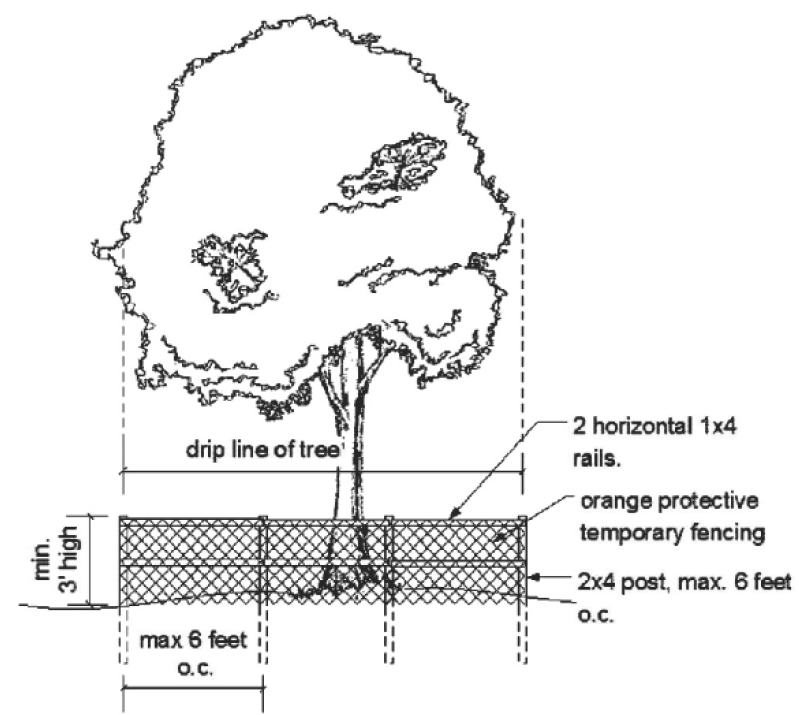
(Code 2001, § 98-237; Ord. No. O-08-2011, § 5, 12-6-2011; Ord. No. O-03-2017, exh. A(98-237), 1-24-2017; Ord. No. O-23-2023, § VI, 9-5-2023)
Sec. 113-274. - Protected trees.
(a)
Protected trees as defined in section 113-243 shall be designated pursuant to the following requirements:
(1)
Submittal application by the property owner.
(2)
Location and type and size of tree.
(3)
A protected tree cannot be of a non-native species as set forth in section 113-276 referenced in list of exempt trees in this Code. Status is obtained by submission for protection.
(4)
Certification by a certified arborist that the tree complies with the definition of protected tree as set forth in section 113-243.
(5)
Additional relevant historical documentation, if applicable.
(6)
Annotation of the legal description of the property by a certified surveyor.
(7)
Public notice requirements shall include:
a.
Mail copy of notice by regular mail to property owners within 300 feet no less than ten days before planning and zoning commission meeting.
b.
Post sign on property no less than ten prior to planning and zoning commission meeting. a hearing shall be held by the planning and zoning commission after which a formal determination is approved or denied.
c.
Formal determination may be appealed to city council.
(8)
If approved, a lien shall be placed on the property and the lien shall be recorded within 30 days in the official county records at the property owners expense.
(9)
Reversal of this determination shall require action by the planning and zoning commission which can be appealed to city council.
(b)
Protected area as defined in section 113-243 shall be designated pursuant to the following requirements:
(1)
Submittal application by the property owner.
(2)
Location and type and size of tree.
(3)
Relevant information identifying significant aesthetic, environmental, or monetary value or which affords collective protection.
(4)
Additional relevant historical documentation, if applicable.
(5)
Annotation of the legal description of the property by a certified surveyor.
(6)
Public notice requirements shall include:
a.
Mail copy of notice by regular mail to property owners within 300 feet no less than ten days before the planning and zoning commission meeting.
b.
Post sign on property no less than ten prior to planning and zoning commission meeting, a hearing shall be held by the planning and zoning commission after which a formal determination is approved or denied.
c.
Formal determination may be appealed to city council.
(7)
A lien shall be placed on the property and the lien shall be recorded within 30 days in the official county records at the property owners expense.
(8)
Reversal of this determination shall require action by the planning and zoning commission which can be appealed to city council.
(c)
Protection of canopy roads.
(1)
In order to provide additional protection of aesthetic resources within the city, the following roadways are hereby designated as canopy roads:
a.
St Johns Avenue from Forest Street to Clay Street.
(2)
All property within 20 feet of the outside right-of-way line of the roadways designated in subsection (a) of this section shall be known as the canopy tree protection zone.
(3)
No person or agency shall remove any tree located within the canopy tree protection zone without obtaining a tree removal permit from the development services department.
(4)
All tree pruning and construction activity shall comply with the ANSI (American National Standards Institute) A300 Standards for the care and maintenance of trees.
(5)
The tree removal permit will be reviewed by the development services department and placed on the next available planning and zoning commission agenda for final action pursuant to the public notice requirements set forth in section 113-274(a)(7). this action may be appealed to the city council.
(Ord. No. O-23-2023, § VII, 9-5-2023)
Sec. 113-275. - Removal of trees.
(a)
Removal of a tree includes any act which will cause a tree to die, such as damage inflicted upon the root system by heavy machinery, changing the natural grade above the root system or round the trunk, damage, including fire damage, inflicted on the tree permitting infection or pest infestation.
(b)
It shall be unlawful for any person, organization, society, association or corporation or any agent or representative thereof, directly, or indirectly, to cut down, destroy, remove, move, or effectively destroy through damaging any tree located on any property without obtaining a permit.
(c)
No authorization for the removal of a viable tree shall be granted unless the developer demonstrates the reason for removal of the trees.
(Code 2001, § 98-261; Ord. No. O-01-2000, § 6.07.01, 6-6-2000; Ord. No. O-08-2011, § 5, 12-6-2011; Ord. No. O-03-2017, exh. B(98-261), 1-24-2017; Ord. No. O-23-2023, § VIII, 9-5-2023)
Sec. 113-276. - Exceptions and exemptions.
The following are exempt from the requirements of section 113-275.
(1)
Utility and public works projects undertaken by the city, including in the case of emergencies such as hurricane, windstorm, flood, freeze, or other disasters.
(2)
One- and two-family dwelling units.
(3)
Dangerous trees.
a.
In the event that any tree endangers health or safety and requires immediate removal, verbal authorization may be given by the development services director.
b.
The tree may be removed without obtaining a written permit provided a certified arborist has made such a determination. The verbal authorization shall later be confirmed in writing by the development services director.
c.
In the event of a natural disaster, environmental or other emergency situation where immediate action is required, any recognized civil authority can authorize immediate removal, to include utility crews, law enforcement officers, and fire and rescue crews.
(4)
Exempt trees. Nonnative trees as defined by IFAS, Florida Friendly Landscaping, Zip Code, 32043.
(Code 2001, § 98-262; Ord. No. O-01-2000, § 6.07.02, 6-6-2000; Ord. No. O-08-2011, § 5, 12-6-2011; Ord. No. O-03-2017, exh. B(98-262), 1-24-2017; Ord. No. O-23-2023, § IX, 9-5-2023)
Sec. 113-277. - Drought-tolerant plant standards applicable to required landscaping.
Drought-tolerant plants which shall be used in required landscaping are native, noninvasive plants which will survive and flourish with comparatively little supplemental irrigation. Industrial, commercial, civic, and multifamily residential buildings or structures and common areas of single-family or multifamily residential developments shall incorporate drought tolerant trees, shrubs, and groundcovers in landscape plans as a water conservation measure. A list of plants which require minimal water are included in the St. Johns River Water Management District's publication Water Wise, Florida Landscapes. In addition, mulches and drought tolerant groundcovers shall replace narrow turf areas where irrigation is impractical. Interior remodels or minor modifications to the exterior of a structure are not subject to this requirement.
(Code 2001, § 98-263; Ord. No. O-08-2011, § 5, 12-6-2011; Ord. No. O-03-2017, exh. B(98-263), 1-24-2017)
Sec. 113-278. - Conditions for tree removal.
The development services director shall issue the permit for removal of a tree if one of the following reasons for removal is found to be present:
(1)
The condition of the tree with respect to disease, insect attack, age or other damage creates a danger of falling, or otherwise causes the tree to have an adverse impact on the urban or natural environment as determined by a certified arborist.
(2)
Removal of the tree is necessary to construct proposed improvements in order to make use of the property. Provided the improvements are in compliance with the protected tree requirements set forth in section 113-274.
(3)
To avoid interference with utility services; or
(4)
Removal of a tree in compliance with a state-approved timber management plan.
(Code 2001, § 98-264; Ord. No. O-01-2000, § 6.07.03, 6-6-2000; Ord. No. O-08-2011, § 5, 12-6-2011; Ord. No. O-03-2017, exh. B(98-264), 1-24-2017; Ord. No. O-23-2023, § X, 9-5-2023)
Sec. 113-279. - Replacement.
(a)
Generally. In respect to removal of trees to allow construction of improvements on property, and as a condition to the granting of a permit, replacement shall be required.
(1)
Trees removed.
a.
Live oaks, Bald Cypress, and Mature Southern Magnolia.
1.
All efforts shall be made to maintain all live oak trees, Bald Cypress, and Mature Southern Magnolia on the site.
2.
Replacement of live oak trees Bald Cypress, and Mature Southern Magnolia shall be with live oak trees, Bald Cypress, and Southern Magnolia and the total caliper inches of replacement trees shall equal the total caliper inches of live oak trees removed.
b.
All other trees.
1.
Trees removed over 12 inches DBH on the site shall be replaced.
2.
The replacement for all trees over 12 inches in caliper at DBH on the site shall equal one-third of the total caliper at DBH of the trees removed.
(2)
Tree replacement or payment to city. In lieu of replacement of trees on the site, the development services director may approve a plan for replacement of trees offsite or payment to the city tree mitigation fund. The value will be based on the average cost of other municipalities in northeast Florida.
(b)
Credit for trees. Trees which are preserved shall receive credit against the landscape requirements according to the following schedule:
(1)
Trees 12 to 18 inches: Live oaks, Bald Cypress, and Southern Magnolia one-inch credit; all others, 50 percent-inch credit.
(2)
Trees 19 to 30 inches: Live oaks, Bald Cypress, and Southern Magnolia 1.25-inch credit; all others, 75 percent-inch tree credit.
(3)
Trees over 30 inches: Live oaks, Bald Cypress, and Southern Magnolia 1.5-inch credit; all others, 100 percent-inch credit.
(4)
A minimum of one-fourth of the replacement credit shall consist of and same tree species removes and have a minimum caliper diameter of four inches per replacement tree.
(Code 2001, § 98-265; Ord. No. O-01-2000, § 6.07.04, 6-6-2000; Ord. No. O-08-2011, § 5, 12-6-2011; Ord. No. O-03-2017, exh. B(98-265), 1-24-2017; Ord. No. O-23-2023, § X1, 9-5-2023)
Sec. 113-280. - List of plants recommended for the city.
List of plants recommended for the city can be obtained by the IFAS FFL website at https://ffl.ifas.ufl.edu/apps/plants/ for Zip Code 32043.
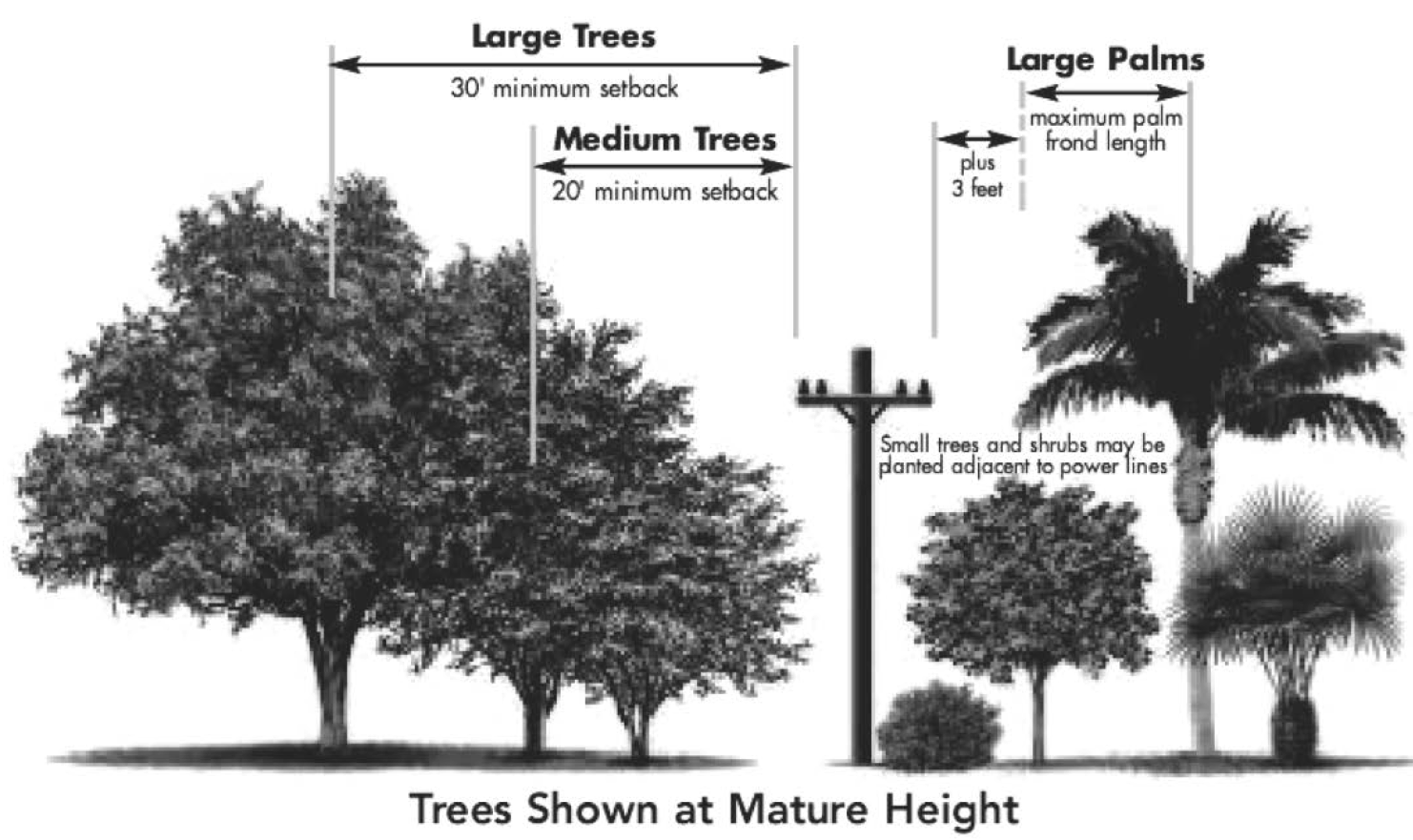
Figure 2
Large, Medium and Small Trees and Shrubs
(Code 2001, § 98-265; Ord. No. O-08-2011, § 5, 12-6-2011; Ord. No. O-23-2023, § XI1, 9-5-2023)
Sec. 113-309. - Applicability; exemptions; existing towers; Federal Aviation Administration (FAA) compliance.
(a)
All new communication towers in the city shall be subject to these regulations and all other applicable building and construction codes. In the event of any conflict between these regulations and other regulations contained in this Code, the provisions of this article shall apply and supersede other regulations, unless specifically stated in this article.
(b)
The provisions of this article shall not apply to communication towers and antennas located on property, rights-of-way or easements owned by the city, except that such towers shall not be located closer than 250 feet to any residential zoned district, designated historic area, downtown redevelopment area, or Martin Luther King, Jr. Boulevard redevelopment area, unless it is determined by the city council that the tower is necessary for the provision of essential services by a public entity.
(c)
All existing communication towers shall be allowed to continue to be used as they are presently. Routine and regular maintenance and co-location of new or additional users shall be permitted on such existing towers. All new construction on the existing tower site and such tower, including additional construction to accommodate co-location or additional users requires compliance with this article.
(d)
No rezoning, zoning special exception, variance or site development plan approval is required to locate a communication antenna on an existing nonresidential structure, provided the antenna does not extend 20 feet above the existing structure. Such structures shall include, but not be limited to, existing communication towers, clock towers, bell towers, steeples, light poles, water towers, other public entity structures and similar structures. Such antenna shall require a permit, prior to its placement. Documentation to accompany a permit shall include a plan that depicts the antenna addition and shall be signed and verified by a state-registered professional engineer for compliance with EIA/TIA 222-E Standards.
(e)
All towers constructed within the city shall comply with Federal Aviation Administration (FAA) regulations. In the event of a conflict between this article and Federal Aviation Administration requirements, Federal Aviation Administration requirements shall apply.
(Code 2001, § 98-291; Ord. No. O-01-2000, § 6.08.01, 6-6-2000; Ord. No. O-08-2011, § 5, 12-6-2011)
Sec. 113-310. - Location.
(a)
Communication towers may be located in the following zoning districts: M-1 zoning district, the INS, zoning district by right and the C-1 and C-2 zoning districts by special exception.
(b)
Communication towers may be located, on an existing conforming lot that is used for other principal uses, on a parcel smaller than the minimum lot size required in the zoning district. This site shall be considered the tower site. The tower site, but not the entire lot, shall be subject to this subpart. The tower site shall contain accessory buildings, guy wires, fencing, landscaping, lighting and other related structures associated with the tower. All accessory buildings, structures and guy wires associated with the tower shall comply with the established zoning district setbacks in which the tower is sited.
(c)
Communication towers shall not be located in any designated historic area, downtown redevelopment area or Martin Luther King, Jr. Boulevard redevelopment area and shall be sited no closer than 250 feet of such districts.
(d)
Communication towers shall not be located in residential zoned districts and, in the M-1, INS zoning districts, shall not be located any closer than 250 feet to any residential zoned district. Towers located in the C-1 and C-2 zoning districts shall be located no closer than the distance of the height of the tower but not less than 35 feet when abutting a residentially zoned district and 35 feet from any street right-of-way.
(e)
Communication towers shall not be located closer than 150 feet from the nearest public right-of-way, as measured to the closest edge of the right-of-way from the base of the tower, regardless of the zoning district in which the tower is located.
(f)
Collocation (sharing space) on existing towers is encouraged. Collocation on and with alternative tower structures is encouraged where the design is compatible with the surrounding area. If the applicant is not collocating on an existing communication tower, the applicant must provide evidence that a diligent effort was made to collocate and it was unsuccessful.
(g)
Communication towers providers are encouraged to locate on government/public property. If the applicant is not constructing the tower on government/publicly owned property, the applicant must provide evidence that a diligent effort was made to locate on such property and it was unsuccessful.
(h)
All accessory buildings and structures to a communication tower shall conform to the setback requirements for the applicable zoning district in which they are located.
(i)
Separation distances between communication towers shall be applicable for and measured between the proposed tower and those towers that are existing and/or have received a building permit after the effective date of the ordinance from which this section is derived. The separation distances shall be measured by drawing or following a straight line between the base of the existing tower and the proposed base pursuant to a site plan of the proposed tower. No communication tower shall be closer than 2,000 feet to the adjacent tower.
(Code 2001, § 98-292; Ord. No. O-01-2000, § 6.08.02, 6-6-2000; Ord. No. O-08-2011, § 5, 12-6-2011)
Sec. 113-311. - Density, design and site development requirements.
(a)
Maximum height. Communication towers shall comply with the following maximum height criteria:
(1)
If constructed for a single user, the maximum height shall be 150 feet; unless in the C-1 and C-2 zoning district where the maximum height shall be 70 feet.
(2)
If constructed for two users, the maximum height shall be 200 feet.
(3)
If constructed for three or more users, the maximum height shall be 250 feet.
(4)
No communication tower shall exceed 250 feet, unless it is determined by the city council that the tower is necessary for the provision of essential services by a public entity.
(b)
Minimum yard requirements. Towers shall conform to the setbacks as established in this article and the minimum yard requirements for the zoning district in which the tower is located.
(c)
Illumination. Communication towers shall not be artificially lighted except to ensure public health, safety and welfare or as required by the Federal Aviation Administration. If lighting is required, the applicant shall provide the city with the proposed lighting scheme for review to ensure the least disturbance to surrounding properties.
(d)
Finished color. Communication towers not requiring Federal Aviation Administration colors/painting/marking shall be painted either with a galvanized finish or painted dull blue, gray or black.
(e)
Structural design. Communication towers shall be designed and constructed to ensure that structural failure or collapse of the tower will not create a safety hazard, according to EIA/TIA 222-E Standards, to adjoining properties. Towers shall be constructed to EIA/TIA 222-E Standards, as published by the Electronic Industries Association, and which may be amended from time to time and all applicable state and local building codes. All plans for construction of towers shall be sealed by a state-registered professional engineer. Further, any improvements and/or additions (antenna, satellite dishes, etc.) that extend greater than 20 feet above the existing structure shall require submission of site development plans sealed and verified by a professional engineer which demonstrates compliance with the EIA/TIA 222-E Standards in effect at the time of such improvements or addition. Such plans shall be reviewed by the development services department at the time a permit is requested.
(f)
Advertising. Communication towers, tower sites, or communication antennas shall not be used for advertising purposes and shall not contain any signs for the purpose of advertising.
(g)
Fencing. A minimum six-foot finished masonry or brick wall, wood privacy fence or chain-link fence, with not less than 85 percent opacity, shall be required around all communication towers. Access to towers shall be through a locked gate. Towers shall be secure.
(h)
Landscaping. The visual impacts of communication towers shall be mitigated through landscaping or other screening materials at the base of the tower and ancillary structures, as follows:
(1)
A ten-foot landscape buffer is required around the perimeter of the tower site.
(2)
A landscape buffer shall be planted with a row of approved trees and shall be a minimum two inches diameter breast height (DBH) and shall be ten to 12 feet in height at planting. Trees shall be planted at a space to allow proper and healthy growth of the tree and provide opacity to the tower. Hedge bushes, ground cover and flowers may also be planted, as appropriate within the ten-foot perimeter buffer. Hedges shall be a minimum 15-inch diameter and be a minimum of 24 inches in height and be planted to allow proper and healthy growth and provide opacity and visual aesthetics.
(3)
All required landscape plants shall be of a species that are drought tolerant and be irrigated and properly maintained to ensure good health and vitality of the plants.
(4)
All required landscaping shall be planted outside the perimeter fence or wall.
(5)
Existing vegetation shall be preserved to the extent possible and may be used as a credit to the landscape requirements. Applicants are encouraged to retain native vegetation.
(6)
All landscaping must be installed prior to a final inspection of the site or issuance of a certificate of occupancy, if applicable. Tower sites shall be accessed by a stabilized driveway surface. If access to the tower is connecting to a public right-of-way, the driveway connection shall be paved with a similar material as the right-of-way surface and shall have a minimum width of 25 feet. Towers or antennas located in the C-1 and C-2 zoning districts are not required to provide access directly to the tower or antenna since the tower or antenna will only be an ancillary function to the business located on the site.
(Code 2001, § 98-293; Ord. No. O-01-2000, § 6.08.03, 6-6-2000; Ord. No. O-08-2011, § 5, 12-6-2011)
Sec. 113-312. - Nonconforming communication towers.
To the extent set forth in this section, the restrictions on nonconforming uses and structures contained in chapter 101, article II are modified and supplemented by this article. Bona fide nonconforming communication towers or antennas that are damaged or destroyed may be rebuilt and all such towers or antennas may be modified or replaced without meeting the distance requirements specified in this article. The type, height and location of the tower on the site shall have no greater impact on the adjacent property than the original facility. Building permits to rebuild the tower shall comply with the applicable city codes and shall be obtained within 180 days from the date the tower was destroyed or damaged. If no permit is obtained or applied for, or if such permit expires, the tower shall be deemed abandoned.
(Code 2001, § 98-294; Ord. No. O-01-2000, § 6.08.04, 6-6-2000; Ord. No. O-08-2011, § 5, 12-6-2011)
Sec. 113-313. - Abandonment.
If the use of any communication tower is discontinued for a period of 180 consecutive days, the tower shall be deemed to be abandoned. Determination of the abandonment shall be made by the development services department, based on documentation and/or affidavits from the communication tower/operator regarding the issue of tower usage. Upon the development services department's determination of such abandonment, the owner/operator of the tower shall have an additional 180 days within which to reactivate the use of the tower, transfer the tower to another owner/operator who makes actual use of the tower, or to dismantle and remove the tower. Should the tower be abandoned, with no additional action by the owner/operator, any other zoning and site development plan approval shall automatically expire. The city reserves the right to require that the tower owner/operator remove an abandoned tower. The city further reserves the right to remove an abandoned tower at a cost assessed to the tower owner/operator or subsequent designees. The city may also lien the subject property for this cost, if not paid by the tower owner/operator or subsequent designee.
(Code 2001, § 98-295; Ord. No. O-01-2000, § 6.08.05, 6-6-2000; Ord. No. O-08-2011, § 5, 12-6-2011)
Sec. 113-314. - Certification of compliance with Federal Communications Commission (FCC).
Prior to receiving final inspection, the applicant shall certify in writing submitted to the development services department that the communication tower complies with all current Federal Communications Commission regulations for nonionizing electromagnetic radiation (NIER). The development services department shall indicate on the site development plan that this certificate was received.
(Code 2001, § 98-296; Ord. No. O-01-2000, § 6.08.06, 6-6-2000; Ord. No. O-08-2011, § 5, 12-6-2011)
Sec. 113-315. - Land use compliance.
No communication tower shall be permitted that is inconsistent with the comprehensive plan.
(Code 2001, § 98-297; Ord. No. O-01-2000, § 6.08.07, 6-6-2000; Ord. No. O-08-2011, § 5, 12-6-2011)
Sec. 113-316. - Site development plan approval.
Unless exempted in this article, all communication towers shall require site development plan approval by the city council after a recommendation from the planning and zoning board. The following information shall be included with all site development plan applications; the applicant may use a combination of site plans, surveys, maps, technical reports or written narratives to convey the following information:
(1)
A scaled site plan clearly indicating the tower site, type and height of the proposed tower, the location of accessory buildings, onsite land uses and zoning, adjacent land uses and zoning, adjacent roads and streets, proposed access to the tower site, distances from the property lines, elevation drawings of proposed tower and any other structures.
(2)
A legal description of the parent tract and the tower site, if applicable.
(3)
If the proposed tower meets the required distance from residentially zoned property, approximate distance between the proposed tower and the nearest residential dwelling, platted or unplatted residential lot. If the proposed tower does not meet the minimum distance requirements, the applicant shall provide exact distances, locations and identifications of such properties.
(4)
A landscape plan showing specific landscape buffers, layout and plant materials.
(5)
The proposed method of fencing, finished color, if applicable, the method of aesthetic mitigation and illumination.
(6)
If the applicant is not collocating on an existing communication tower, he shall provide evidence that a diligent effort was made to collocate and was unsuccessful.
(7)
If the applicant is not constructing the tower on government/public owned property, he shall provide evidence that a diligent effort was made to locate on such property and was unsuccessful.
(8)
The written consent by the applicant that any such deviations from standards in this article shall be conditioned upon requiring the applicant to:
a.
Construct the proposed communication tower as to provide sufficient excess capacity over the initial loading.
b.
Permit at least one other comparable communication provider to use the proposed tower where feasible and subject to reasonable terms. The term "where feasible," as it applies to collocation, means that utilization of a tower by another party would at the time of such utilization, comply with sound engineering principles, would not materially degrade or impair the communication tower's utilization by existing users, would not unduly burden the tower structurally and would not otherwise materially and adversely impact existing users. Terms for use of a communication tower that may be imposed by the owner include a requirement for rent or fees, taking into consideration the capitalized cost of the communication tower and land, the incremental cost of designing and constructing the tower so as to accommodate additional users, increases in maintenance expenses relating to the tower and a return on investment, provided such amount is also consistent with rates paid by other collectors at comparable tower sites.
c.
With respect to deviations only, certification by the applicant that the proposed communication tower is reasonably necessary to serve an adjacent or nearby residential area.
(Code 2001, § 98-298; Ord. No. O-01-2000, § 6.08.08, 6-6-2000; Ord. No. O-08-2011, § 5, 12-6-2011)
Sec. 113-317. - Fees.
(a)
The following fee schedule shall apply to the review of communication towers and tower sites. The applicant shall pay all fees at the time of site development plan submittal.
(b)
In addition to the payment of the above fees, the applicant shall pay all consultant fees, including, but not limited to, engineering, legal, surveying and other professional fees that the city may incur or require during the review of the proposed tower site development plan. The applicant shall make application upon a form provided by the city. The application must be complete in each of the above before accepted for filing.
(Code 2001, § 98-299; Ord. No. O-01-2000, § 6.08.09, 6-6-2000; Ord. No. O-08-2011, § 5, 12-6-2011)
Sec. 113-318. - Criteria for deviations from standards in this article for communication towers.
Variances to this article shall comply with the variance procedures provided in this subpart. In rendering a decision on a variance related to a communication tower, planning and zoning board shall grant a variance only if it finds a preponderance of evidence that the variance meets the following standards and criteria:
(1)
The variance will not be detrimental to the public good or to surrounding properties.
(2)
The location of existing uses, structures or other features on or adjacent to the property create a need for the variance.
(3)
The variance sought is the minimum necessary to address the need for the variance, subsequent to exploring all reasonable siting alternatives.
(4)
The location of the proposed communication tower in relation to existing structures and the other visual buffers shall minimize, to the greatest extent reasonably practicable under the circumstances, any impacts on affected residentially zoned property.
(5)
The location of the communication tower will not have a significant detrimental impact on adjacent property values.
(6)
The communication tower will be compatible with the existing contiguous uses or zoning and compatible with the general character and aesthetics of the area, considering the design and height of the communication tower, the mitigating effect of any existing or proposed landscaping, fencing or other structure in the area, the proximity of the communication tower to existing and proposed building or structures and similar factors.
(7)
The strict application of the requirements of this article will constitute a substantial hardship to the applicant which is not self-created or self-imposed.
(8)
The granting of the variance is consistent with the intent and purpose of this subpart and the comprehensive plan of the city.
(Code 2001, § 98-300; Ord. No. O-01-2000, § 6.08.10, 6-6-2000; Ord. No. O-08-2011, § 5, 12-6-2011)
Sec. 113-27. - Purpose.
This article establishes minimum requirements applicable to the development transportation system, including public and private streets, bikeways, pedestrian ways, parking and loading areas, and access control to and from public streets. The standards in this article are intended to minimize the traffic impacts of development, to ensure that all developments adequately and safely provide for the storage and movement of vehicles consistent with good engineering and development design practices.
(Code 2001, § 98-31; Ord. No. O-01-2000, § 6.02.01(A), 6-6-2000; Ord. No. O-08-2011, § 5, 12-6-2011)
Sec. 113-28. - Compliance with the adopted construction standards.
All required elements of the transportation system shall be provided in compliance with the engineering design and construction standards adopted by the state department of transportation and the city council.
(Code 2001, § 98-32; Ord. No. O-01-2000, § 6.02.01(B), 6-6-2000; Ord. No. O-08-2011, § 5, 12-6-2011)
Sec. 113-60. - Street classification system established.
(a)
Streets in the city are classified and mapped according to function served in order to allow for regulation of access, road and right-of-way widths, circulation patterns, design speed, and construction standards.
(b)
Private streets and streets that are to be dedicated to the city are classified in a street hierarchy system with design tailored to function. The street hierarchy system shall be defined by road function and average daily traffic (ADT), calculated by trip generation rates prepared by the Institute of Transportation Engineers. Trip generation rates from other sources may be used if the developer demonstrates the alternative source better reflects local conditions.
(c)
When a street continues an existing street that previously terminated outside the subdivision, or is a street that will be continued beyond the subdivision or development at some future time, the classification of the street will be based upon the street in its entirety, both within and outside of the subdivision or development.
(d)
The following street hierarchy is established as per the city's comprehensive plan: Principal arterial, minor arterial, collector and local road. Each street type is divided into subcategories. All development proposals containing new streets or taking access from existing streets shall conform to the standards and criteria contained in this section.
(Code 2001, § 98-51; Ord. No. O-01-2000, § 6.02.02(A), 6-6-2000; Ord. No. O-08-2011, § 5, 12-6-2011)
Sec. 113-61. - Minor streets (local roads).
(a)
Minor streets (local roads) are primarily suited to providing direct access to residential development, but may give access to limited nonresidential uses, provided average daily traffic volume generated by the nonresidential use does not exceed applicable standards for the affected streets. All minor streets (local roads) should be designed to minimize unnecessary and/or speeding traffic. Each residential street shall be classified and designed for its entire length to meet the minimum standards.
(b)
This is the lowest order street in the hierarchy. A residential street is a frontage street which provides direct access to abutting properties and is designed to carry no more traffic than is generated on the street itself. Minor streets may take access from any higher order street type. Both ends of a residential loop street must take access from a single higher order street. The design speed for minor streets is 25 miles per hour. Residential access streets shall have a maximum average daily traffic of 500. Cul-de-sacs shall have a maximum average daily traffic of 200. Loop streets shall have a maximum average daily traffic of 400.
(Code 2001, § 98-52; Ord. No. O-01-2000, § 6.02.02(B), 6-6-2000; Ord. No. O-08-2011, § 5, 12-6-2011)
Sec. 113-62. - Collector roads.
Collector roads provide access to nonresidential uses and connect lower order streets to arterial streets. Design speeds and average daily traffic volumes will be higher than for lower order streets. Local collector streets give direct access to commercial and residential projects, but not to individual dwelling units. Collectors may take access from other collector streets or arterials. Collectors may give access to any residential street type. Collectors shall have a design speed of 30 miles per hour. Collectors shall have a maximum average daily traffic of 3,000.
(Code 2001, § 98-53; Ord. No. O-01-2000, § 6.02.02(C), 6-6-2000; Ord. No. O-08-2011, § 5, 12-6-2011)
Sec. 113-63. - Principal and minor arterial roads.
(a)
Principal arterial roads provide links between communities and are designed for speeds up to 45 miles per hour. No parking is allowed on any major arterials. These roads link communities to regional or state highways. These roads may also give direct access to regionally significant land uses. These roads may take access from other major arterials or freeways and may give access to any lower order nonresidential street type. Major arterials shall have a design speed of 45 miles per hour.
(b)
The minor arterial street system should interconnect with and augment the urban principal arterial system and provide service to trips of moderate length at a somewhat lower level of travel mobility than principal arterials. This system also distributes travel to geographic areas smaller than those identified with the higher system.
(c)
The minor arterial street system includes all arterials not classified as a principal and contains facilities that place more emphasis on land access than the higher system and offer a lower level of traffic mobility. Such facilities may carry local bus routes and provide intra-community continuity, but ideally should not penetrate identifiable neighborhoods. This system should include urban connections to rural collector roads where such connections have not been classified as urban principal arterials.
(Code 2001, § 98-54; Ord. No. O-01-2000, § 6.02.02(D), 6-6-2000; Ord. No. O-08-2011, § 5, 12-6-2011)
Sec. 113-64. - Special purpose streets.
Under special circumstances, a new local street may be classified and designed as one of the following:
(1)
Alley. An alley is a special type of street which provides a secondary means of access to lots. It will normally be on the same level in the hierarchy as a residential access street, although different design standards will apply.
(2)
Marginal access street. A marginal access street is a street parallel and adjacent to a collector or higher level street which provides access to abutting properties and separation from through traffic. It may be designed at the level of a residential access street or a residential sub collector as anticipated traffic volumes will dictate.
(3)
Divided streets. For the purpose of protecting environmental features or avoiding excessive grading, the municipality may require that the street be divided. In such a case, the design standards shall be applied to the aggregate dimensions of the two street segments.
(Code 2001, § 98-55; Ord. No. O-01-2000, § 6.02.02(E), 6-6-2000; Ord. No. O-08-2011, § 5, 12-6-2011)
Sec. 113-65. - Future transportation element map.
The future transportation element map, and any amendments thereto, adopted by the city as a part of the comprehensive plan, is hereby made a part of this subpart. All existing roadways within the jurisdiction of the city shall be designated on this map according to the foregoing classification scheme. Any street abutting or affecting the design of a subdivision or land development which is not already classified on the future transportation element map shall be classified according to its function, design, and use by the city at the request of the applicant or during plan review. The map shall be the basis for all decisions regarding required road improvements, reservation or dedication of rights-of-way for required road improvements, or access of proposed uses to existing or proposed roadways.
(Code 2001, § 98-56; Ord. No. O-01-2000, § 6.02.02(F), 6-6-2000; Ord. No. O-08-2011, § 5, 12-6-2011)
Sec. 113-66. - Street classification standards.
The following table specifies the number of lanes, pavement and right-of-way widths for residential, collector, and arterial streets. These requirements should be read in conjunction with the foregoing street type descriptions.
(Code 2001, § 98-57; Ord. No. O-01-2000, § 6.02.02(G), 6-6-2000; Ord. No. O-08-2011, § 5, 12-6-2011)
_____
Sec. 113-67. - Right-of-way.
(a)
Right-of-way widths. Right-of-way requirements for road construction shall be as specified in the table in section 113-66. The right-of-way shall be measured from lot line to lot line.
(b)
Protection and use of rights-of-way.
(1)
No encroachment shall be permitted into existing rights-of-way, except for temporary use authorized by the city.
(2)
Use of the right-of-way for public or private utilities, including, but not limited to, sanitary sewer, potable water, telephone wires, cable television wires, gas lines, or electricity transmission, shall be allowed, subject to the placement specifications established by the city and other applicable city regulations.
(3)
Sidewalks and bikeways shall be placed within the right-of-way.
(c)
Vacation of rights-of-way. Applications to vacate a right-of-way shall be approved by the city council upon a finding that all of the following requirements are met:
(1)
The requested vacation is consistent with the transportation element of the city comprehensive plan.
(2)
The right-of-way does not provide the sole access to any property. Remaining access shall not be by easement.
(3)
The vacation would not jeopardize the current or future location of any utility.
(4)
The proposed vacation is not detrimental to the public interest, and provides a positive benefit to the city.
(Code 2001, § 98-58; Ord. No. O-01-2000, § 6.02.03, 6-6-2000; Ord. No. O-08-2011, § 5, 12-6-2011)
Sec. 113-68. - Hearing on petition to open or close street.
(a)
All petitions either to open or to close and vacate municipal streets shall be heard by the city planning and zoning board.
(b)
The planning and zoning board shall make its recommendations to the city council.
(Code 1983, § 20-2; Code 2001, § 62-1)
Sec. 113-69. - Street design standards.
(a)
All streets in a new development shall be designed and constructed pursuant to the standards approved by the state department of transportation and city council. Streets shall be dedicated to the city upon completion, inspection, and acceptance by the city.
(b)
The street system of the proposed development shall conform to the natural topography of the site, preserving existing hydrological and vegetative patterns, and minimizing erosion potential, runoff, and the need for site alteration.
(c)
Streets shall be laid out to avoid environmentally sensitive areas.
(d)
Private streets may be allowed within developments that will remain under common ownership, provided they are designed and constructed pursuant to the standards in construction standards approved by the city council.
(e)
The street layout in all new developments shall be coordinated with and connected to the street system of the surrounding area.
(f)
Streets in proposed subdivisions shall be connected to rights-of-way in adjacent areas to allow for proper inter-neighborhood traffic flow. If adjacent lands are unplatted, stub outs in the new development shall be provided for future connection to the adjacent unplatted land.
(g)
Streets shall intersect as nearly as possible at right angles, and in no case shall they be less than 75 degrees.
(h)
New intersections along one side of an existing street shall, where possible, coincide with existing intersections. Where an offset (jog) is necessary at an intersection, the distance between centerlines of the intersecting streets shall be no less than 150 feet.
(i)
No two streets may intersect with any other street on the same side at a distance of less than 400 feet measured from centerline to centerline of the intersecting street. When the intersected street is an arterial, the distance between intersecting streets shall be no less than 1,000 feet.
(Code 2001, § 98-59; Ord. No. O-01-2000, § 6.02.04(A), 6-6-2000; Ord. No. O-08-2011, § 5, 12-6-2011)
Sec. 113-70. - Paving widths.
Paving widths for each street classification shall be as provided in the table in section 113-66.
(Code 2001, § 98-60; Ord. No. O-01-2000, § 6.02.04(B), 6-6-2000; Ord. No. O-08-2011, § 5, 12-6-2011)
Sec. 113-71. - Curbing requirement.
(a)
Curbing shall be required for the purposes of drainage, safety, and delineation and protection of pavement edge along streets in the following cases:
(1)
Along designated parking lanes.
(2)
Where the surface drainage plan requires curbing to channel stormwater.
(3)
Where narrow lots averaging less than 40 feet in width take direct access from a street upon which no on-street parking is allowed.
(b)
All curbing shall conform to the construction standards approved by the city council.
(Code 2001, § 98-61; Ord. No. O-01-2000, § 6.02.04(C), 6-6-2000; Ord. No. O-08-2011, § 5, 12-6-2011)
Sec. 113-72. - Shoulders.
Shoulders, where required, shall measure at least four feet in width and shall be required on each side of streets and shall be located within the right-of-way. Shoulders shall consist of stabilized turf or other material permitted by construction standards approved by the city council. Shoulders and/or drainage swales are required as follows:
(1)
Shoulders are required on residential access and residential collector streets only where necessary for stormwater management or road stabilization.
(2)
All residential collector streets shall provide two four-foot-wide shoulders. Shoulders should be grassed.
(3)
Where shoulders are required by the state department of transportation.
(4)
Collector streets where curbing is not required.
(5)
Arterial streets where curbing is not required.
(Code 2001, § 98-62; Ord. No. O-01-2000, § 6.02.04(D), 6-6-2000; Ord. No. O-08-2011, § 5, 12-6-2011)
Sec. 113-73. - Acceleration, deceleration, and turning lanes.
(a)
Deceleration or turning lanes will be required by the city along existing and proposed streets based on traffic design standard in the state department of transportation manual, as amended.
(b)
Deceleration lanes shall be designed to the following standards:
(1)
The lane width shall be the same as the required width of the roadway moving lanes.
(2)
The minimum lane length shall be as per current FDOT standards as may be amended:
(c)
Acceleration lanes shall be required when indicated as needed by traffic. The design shall be as per the recommendation of the city, the county, and the state department of transportation. Where needed, a paved taper shall be provided for right-hand turns.
(Code 2001, § 98-63; Ord. No. O-01-2000, § 6.02.04(E), 6-6-2000; Ord. No. O-08-2011, § 5, 12-6-2011)
Sec. 113-74. - Cul-de-sacs/turnarounds.
An unobstructed 12-foot-wide moving lane with a minimum outside turning radius of 65 feet shall be provided at the terminus of every permanent cul-de-sac.
(Code 2001, § 98-64; Ord. No. O-01-2000, § 6.02.04(F), 6-6-2000; Ord. No. O-08-2011, § 5, 12-6-2011)
Sec. 113-75. - Stub streets.
(a)
Residential access and sub-collector stub streets may be permitted only within subsections of a phased development for which the proposed street in its entirety has received final site plan approval.
(b)
Residential collector and higher order stub streets may be permitted or required by the city council provided that the future extension of the street is deemed desirable by the city.
(c)
Temporary turnarounds shall be provided for all stub streets providing access to five or more lots or housing units. Where four or fewer units or lots are being served, a sign indicating a dead-end street shall be posted.
(Code 2001, § 98-65; Ord. No. O-01-2000, § 6.02.04(G), 6-6-2000; Ord. No. O-08-2011, § 5, 12-6-2011)
Sec. 113-76. - Clear sight line (FDOT standard).
In order to provide a clear view of intersecting streets to the motorist, there shall be a triangular area of clear visibility formed by the edge of pavement of two streets or the edge of pavement of a driveway and a street. The following standards shall be met:
(1)
Nothing shall be erected, placed, parked, planted, or allowed to grow in such a manner as to materially impede vision for a distance of 25 feet from the edge of pavement.
(2)
Nothing shall be erected, placed, parked, planted, or allowed to grow in such a manner as to materially impede vision between a height of two feet and ten feet above the grade, measured at the centerline of the intersection for a distance of 26 feet to 50 feet from the edge of the pavement.
(3)
The clear visibility triangle shall be formed by connecting a point on each street at the edge of pavement, the edge of pavement of the street indicated in the following diagram, and a third line connecting the two points.
Example of Clear Sight Line (FDOT Standard)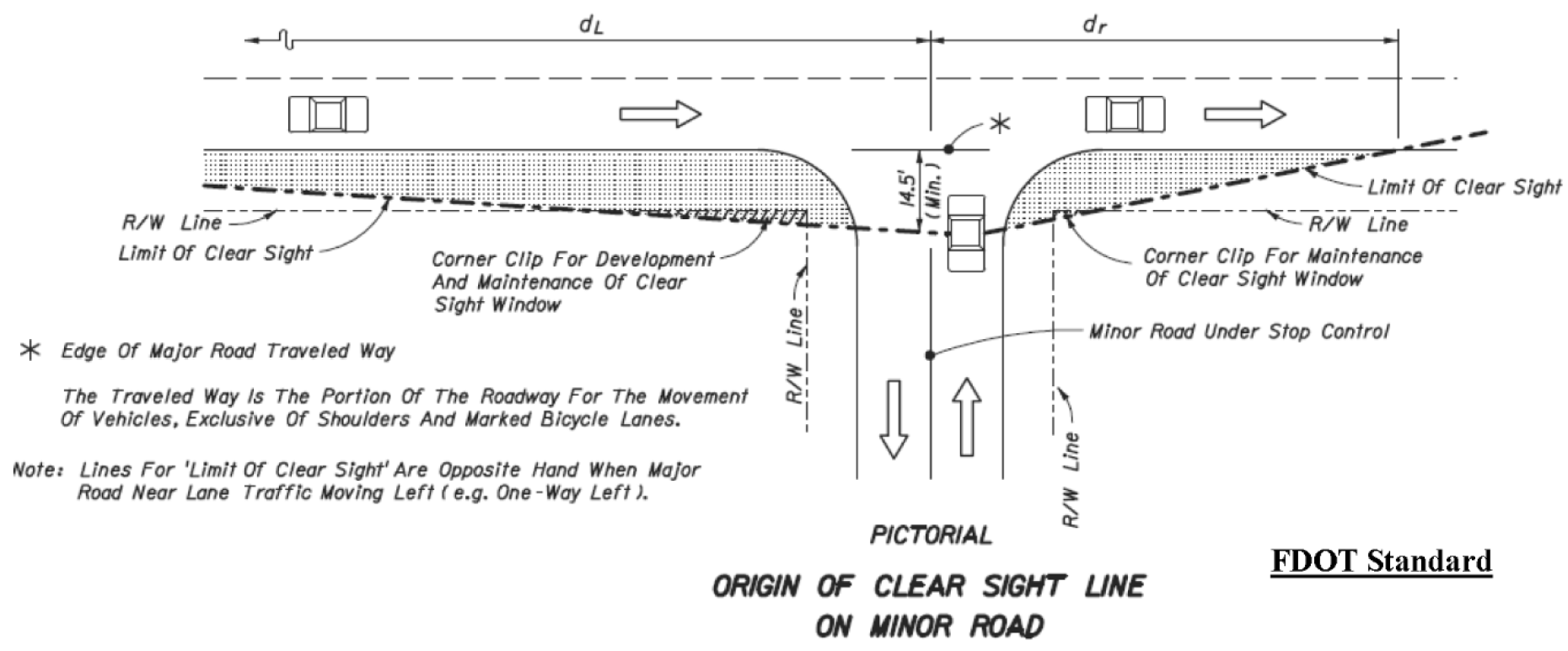
(Code 2001, § 98-66; Ord. No. O-01-2000, § 6.02.04(H), 6-6-2000; Ord. No. O-08-2011, § 5, 12-6-2011)
Sec. 113-77. - Street trees.
Street trees shall be provided in accordance with the standards established in section 113-244(c). The city can, but is not required to, plant trees within rights-of-way.
(Code 2001, § 98-67; Ord. No. O-01-2000, § 6.02.04(I), 6-6-2000; Ord. No. O-08-2011, § 5, 12-6-2011)
Sec. 113-78. - Blocks.
(a)
Where a tract of land is bounded by streets forming a block, such block shall have sufficient width to provide for two tiers of lots of appropriate depths.
(b)
The lengths, widths, and shapes of blocks shall be consistent with adjacent areas. In no case shall block lengths in residential areas exceed 2,200 feet nor be less than 400 feet in length.
(c)
Trails shall be six to 12 feet wide with a surface construction of either asphalt, asphalt millings, concrete, or gravel designed and used for multi-purpose activities such as bicycling, jogging, walking or wheelchairing between connected recreational areas.
(Code 2001, § 98-68; Ord. No. O-01-2000, § 6.02.04(J), 6-6-2000; Ord. No. O-08-2011, § 5, 12-6-2011)
Sec. 113-100. - When required.
(a)
Projects abutting collector or arterial facilities shall provide sidewalks adjacent to the collector or arterial roadway. Location of sidewalks shall be consistent with planned roadway improvements.
(b)
Sidewalks shall be provided on at least one side of all minor streets.
(c)
Where a proposed development includes improvements or new construction of collector facilities, facility designs shall include provision for sidewalks and bikeways within the right-of-way, and, in areas determined with heavy traffic volume, sidewalks shall be on both sides of collector streets.
(d)
Residential projects adjacent to or in the immediate vicinity of an activity center comprised of commercial, office, service, or recreation activities shall provide pedestrian and bicycle access from the development to the activity center.
(e)
Pedestrian ways or crosswalks, not less than ten feet wide with a sidewalk meeting the requirements of this subpart, may be required to be placed in the center of blocks more than 800 feet long where deemed necessary to provide circulation or access to playgrounds, shopping centers, and other community facilities.
(f)
Commercial/industrial developments shall provide six-foot-wide sidewalks as per A.D.A. standards on one side of a street fronting public rights-of-way.
(Code 2001, § 98-86; Ord. No. O-01-2000, § 6.02.06(A), 6-6-2000; Ord. No. O-08-2011, § 5, 12-6-2011)
Sec. 113-101. - Design and construction standards.
Design and construction of sidewalks, bikeways, footpaths, or trails shall conform to the requirements of the construction standards approved by the city council including provisions for access by physically handicapped persons and shall be at least six feet wide with a hard surface.
(Code 2001, § 98-87; Ord. No. O-01-2000, § 6.02.06(B), 6-6-2000; Ord. No. O-08-2011, § 5, 12-6-2011)
Sec. 113-131. - Access, generally.
All proposed developments shall meet the development standards for vehicular access and circulation in this division and all other requirements as set forth in the City's Land Development Code.
(Code 2001, § 98-106; Ord. No. O-01-2000, § 6.02.07, 6-6-2000; Ord. No. O-08-2011, § 5, 12-6-2011; Ord. No. O-16-2020, § 3, 2-16-2021)
Sec. 113-132. - Number of access points.
(a)
All developments shall have access to a public right-of-way. Development shall meet the density control requirements for the underlying zoning district as set forth in chapter 117, Land Use Regulations of the City Code.
(b)
Notwithstanding the provisions in subsection (a) of this section, a nonresidential development or a multifamily residential development on a corner lot may be allowed two points of access. However, no more than one access shall be onto an arterial.
(c)
Commercial and industrial lots shall have one access point for the first 100 feet of frontage or portion thereof and shall be entitled to one access point for every additional 100 feet of frontage.
(d)
The maximum width for an access point shall be 36 feet for commercial and 60 feet for industrial.
(Code 2001, § 98-107; Ord. No. O-01-2000, § 6.02.07(A), 6-6-2000; Ord. No. O-08-2011, § 5, 12-6-2011; Ord. No. O-16-2020, § 3, 2-16-2021)
Sec. 113-133. - Separation of access points.
(a)
The separation between access points onto arterial and collector roadways, or between an access point and an intersection of an arterial or collector with another road, shall be:
(b)
The distance between access points shall be measured from the centerline of the proposed driveway or roadway to the centerline of the nearest adjacent roadway or driveway.
(c)
There shall be a minimum of ten feet of separation between access points.
(Code 2001, § 98-108; Ord. No. O-01-2000, § 6.02.07(B), 6-6-2000; Ord. No. O-08-2011, § 5, 12-6-2011)
Sec. 113-134. - Alternative designs.
Where natural features or spacing of existing driveways and roadways cause the access requirements of this division to be physically infeasible, alternate designs may be approved as a part of issuing the final development order.
(Code 2001, § 98-109; Ord. No. O-01-2000, § 6.02.07(C), 6-6-2000; Ord. No. O-08-2011, § 5, 12-6-2011)
Sec. 113-135. - Access to residential lots.
(a)
Access to nonresidential uses shall not be through an area designed, approved, or developed for residential use.
(b)
All lots shall have frontage on and access from an existing street meeting the requirements of this subpart.
(Code 2001, § 98-110; Ord. No. O-01-2000, § 6.02.07(D), 6-6-2000; Ord. No. O-08-2011, § 5, 12-6-2011)
Sec. 113-136. - Standards for drive-up facilities.
(a)
Generally. All facilities providing drive-up or drive-through service shall provide onsite stacking lanes in accordance with the standards in subsection (b) of this section.
(b)
Standards.
(1)
The facilities and stacking lanes shall be located and designed to minimize turning movements in relation to the driveway access to streets and intersection.
(2)
The facilities and stacking lanes shall be located and designed to minimize or avoid conflicts between vehicular traffic and pedestrian areas such as sidewalks, crosswalks, or other pedestrian access ways.
(3)
A bypass lane shall be provided.
(4)
Stacking lane distance shall be measured from the service window to the property line bordering the furthest street providing access to the facility.
(5)
Minimum stacking lane distance shall be as follows:
a.
Financial institutions shall have a minimum distance of 200 feet. Two or more stacking lanes may be provided which together total 200 feet.
b.
All other uses shall have a minimum distance of 120 feet.
(6)
Alleys or driveways in or abutting areas designed, approved, or developed for residential use shall not be used for circulation of traffic for drive-up facilities.
(7)
Where turns are required in the exit lane, the minimum distance from any drive-up station to the beginning point of the curve shall be 34 feet. The minimum inside turning radius shall be 25 feet.
(8)
Construction of stacking lanes shall conform to the specifications in the construction standards approved by the city council.
(Code 2001, § 98-111; Ord. No. O-01-2000, § 6.02.08, 6-6-2000; Ord. No. O-08-2011, § 5, 12-6-2011)

