
Gulf Stream City Zoning Code
ARTICLE I
- IN GENERAL
Sec. 66-1.- Definitions.
The following words, terms and phrases, when used in this chapter, shall have the meanings ascribed to them in this section, except where the context clearly indicates a different meaning:
Abutting shall mean having a common border with, or being separated from such common border by, an alley or easement.
Access shall mean the principal means of ingress and egress to property from a publicly dedicated right-of-way.
Accessory building, structure or use shall mean a building, structure or use on the same lot with, and of a nature customarily incidental and subordinate to, the principal building, structure or use.
Acre, net. See Net acre/net land area.
Addition (to an existing building) shall mean any walled and roofed expansion to the perimeter of a building in which the addition is connected by a common load-bearing wall other than a firewall. Any walled and roofed addition which is connected by a firewall or is separated by independent perimeter load-bearing walls is new construction.
Adjacent shall mean that which lies near or close to, not widely separated or necessarily touching.
Adjoining shall mean that which is joined or united, actually touching.
Alley shall mean a dedicated public right-of-way other than a street which provides only a secondary means of access to abutting property, is not over 20 feet in width and is not intended for general traffic circulation.
Alterations, as applied to a building or structure, a change or rearrangement in the structural parts of the existing facilities, or an enlargement, whether by extending on a side, or by increasing the height, or the moving from one location or position to another.
Antenna shall mean a device for radiating and/or receiving television or radio signals.
Antenna structure shall mean an antenna consisting of two or more radiating elements, generally similar which are arranged in such a manner as to obtain direction radiation patterns. It includes any structural members which are necessary to maintain the proper electrical relationships between the radiating elements, including the mast or other structure used to support the array as a whole, but does not include the transmission line which supplies energy to or receives energy from the array as a whole.
Apartment. See Dwelling, multiple-family.
Appeal shall mean a means for obtaining review of a decision, determination, order, or failure to act pursuant to the terms of this chapter.
Area of shallow flooding shall mean a designated AO or VO Zone on a community's flood insurance rate map (FIRM) with base flood depths from one to three feet where a clearly defined channel does not exist, where the path of flooding is unpredictable and indeterminate, and where velocity flow may be evident.
Area of special flood hazard shall mean the land in the floodplain within a community subject to a one percent or greater chance of flooding in any given year.
Awning shall mean any movable roof like structure cantilevered or otherwise entirely supported from a building, so constructed and erected as to permit its being readily moved within a few minutes time to close an opening, or rolled or folded back to a position flat against the building or a cantilevered projection thereof, or which is detachable.
Base flood shall mean the flood having a one percent chance of being equaled or exceeded in any given year.
Base flood elevation shall mean the height above mean sea level expected to be reached by the 100-year flood.
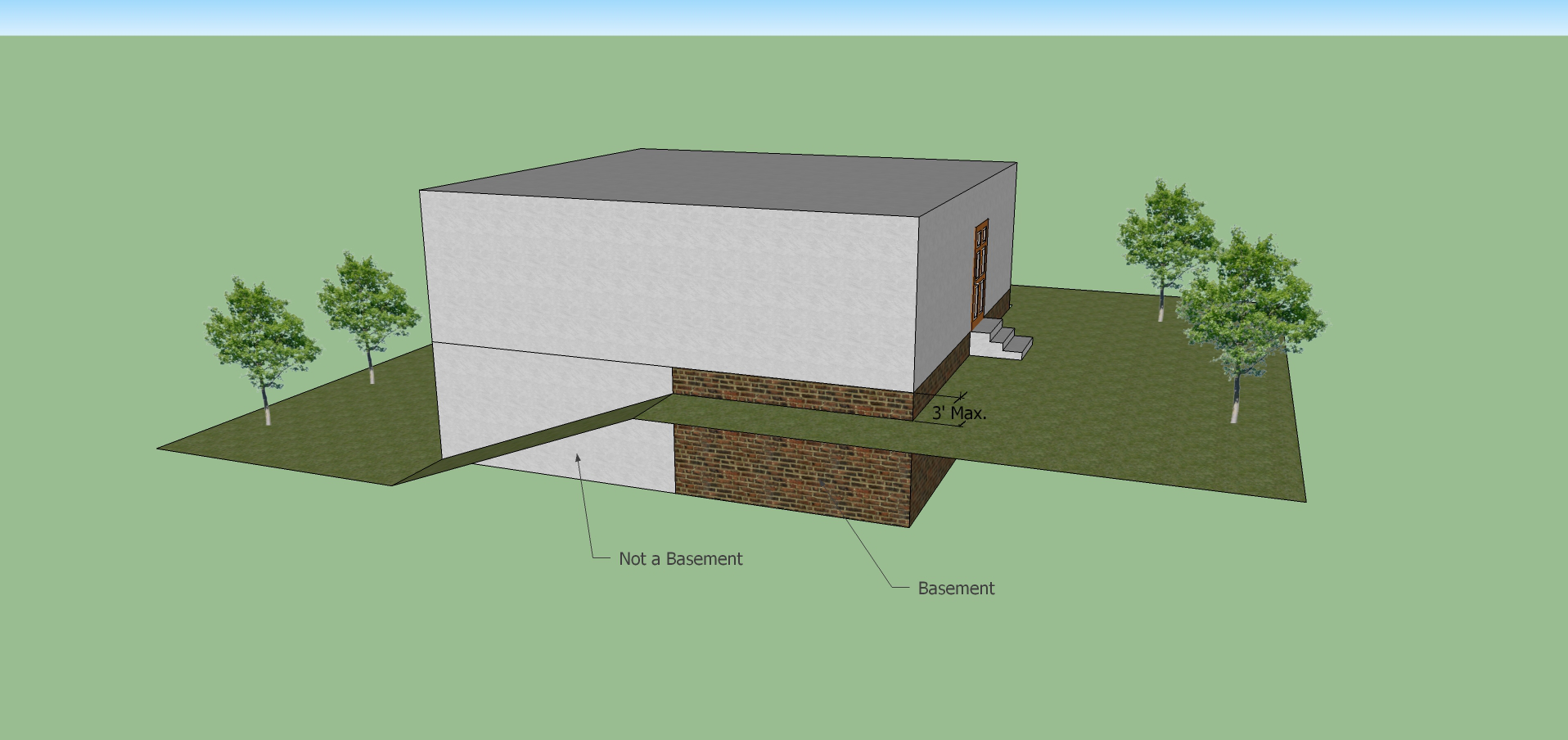
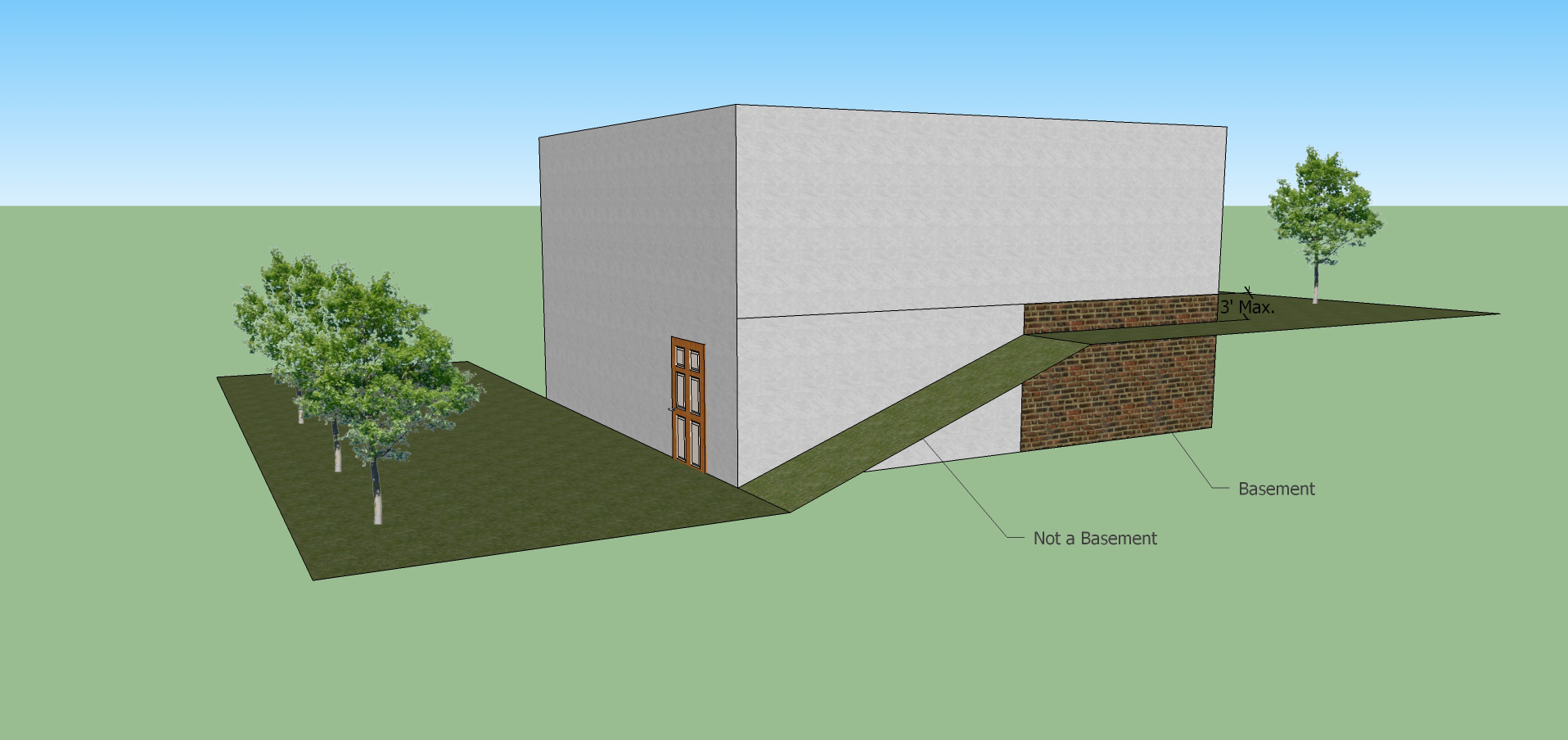
Basement shall mean that portion of the building which is below the finished floor elevation of the building and is located within the footprint of the first floor. A basement is not considered a story with regards to the height measurement of a building, unless the ceiling of the basement is greater than three feet above grade. The area of a basement completely under the first floor footprint and having no outside entrance shall be included as 75 percent of the building's floor area ratio calculations. The area of a basement with an outside entrance shall be included as 100 percent of the building's floor area ratio calculations. Basements shall conform to all setback regulations for structures. There shall be no entrances to such basement on the street side and the exterior appearance of such basement shall conform to the general architecture of the building.
Bedroom shall mean a room other than a kitchen, dining room, living room, bathroom or closet which is marketed, designed or otherwise likely to function primarily for sleeping.
Block shall mean a tract of land bounded by streets, or by a combination of streets and public parks, cemeteries, railroad rights-of-way, bulkhead lines, or shorelines of waterways, or corporate boundary lines of the town.
Breakaway wall shall mean a wall that is not part of the structural support of the building and is intended through its design and construction to collapse under specific lateral loading forces without causing damage to the elevated portion of the building or the supporting foundation system.
Breezeway shall mean a roofed, open-sided passageway connecting two separate structures, or two separate portions of the same structure.
Broadcast receiving antenna shall mean an outside antenna used for the reception of signals transmitted by stations licensed by the Federal Communications Commission in the radio broadcast services, including AM, FM and TV.
Building area shall mean the portion of a lot remaining after required setbacks have been provided.
Building shall mean any structure built for the shelter, support or enclosure of persons, animals, chattels or movable property of any kind; and, when separated by division walls without opening from the ground up, each portion of such structure shall be deemed a separate building, and for the purpose of this chapter, all porches, projections, cornices and eaves shall be deemed and considered a part of a building. The word "building" shall include the word "structure."
Building, detached, shall mean a building having no party walls in common with another building.
Building front shall mean that exterior wall of a building which faces a front lot line of the lot.
Building height shall mean the vertical distance measured from the point of first floor base flood elevation of the building site to the highest finished roof structure including any rooftop superstructure or appurtenance.
Building line shall mean a line on a lot, generally parallel to a lot line or road right-of-way line, located a sufficient distance therefrom to provide the minimum yards required by this chapter. The building line delimits the area in which buildings are permitted subject to all applicable provisions of this chapter.
Building official shall mean that person who is designated by the town commission and is charged with the responsibility of enforcing and administering the various land and building regulations of the town.
Building permit shall mean the document or certificate issued by the town building official or other designated official which verifies adherence to all applicable development regulations and gives permission to the permit applicant to proceed with the actions for which the permit was requested.
Building, principal, shall mean a building in which is conducted, or in which is intended to be conducted, the main or principal use of the lot on which it is located.
Building site shall mean a portion or parcel of land considered as a unit, devoted to a certain use or occupied by a building or group of buildings that are united by a common interest or use, and the customary accessories and open spaces belonging to the same.
Bulk shall mean the term used to describe the size of buildings or other structures, and their relationships to each other and to open areas and lot lines.
Carport shall mean a freestanding covered area or a roofed area open on one, two or three sides and attached to a building, either of which is designed for the storage of one or more vehicles or boats.
Certificate of occupancy shall mean official certification that a premises conforms to provisions of this chapter (and building code) and may be used or occupied. Such a certificate is granted for new construction or for alteration or additions to existing structures. Unless such a certificate is issued, a structure cannot be occupied.
Charter shall mean the document issued to the town and established pursuant to the applicable state laws creating the town as a public corporation and defining its privileges, purposes, powers and duties.
Church shall mean a building, together with its accessory buildings and uses, where persons regularly assemble for religious worship, and which building, together with its accessory buildings and uses, is maintained and controlled by a religious body organized to sustain public worship.
Club shall mean an organization, which is privately owned and operated by its members and not operated for profit, which maintains recreational and/or athletic facilities for the exclusive use of its members and their guests and uses accessory or incidental thereto.
Coastal high hazard area shall mean the area subject to high velocity waters caused by, but not limited to, hurricane wave wash. The area is designated on a FIRM as Zone V1-30, VE or V.
Coastal sand dune preservation shall mean the preservation of coastal beach and its vegetation line through the protection of beach sand dunes from removal, alteration or disturbance in any manner whatsoever. This is accomplished in the town by "Palm Beach County Coastal Construction and Excavation Setback Ordinance No. 72-12," and the construction control line established by the state bureau of beaches and shores, which ordinance or its successor shall prevail in the absence of a conflicting town ordinance.
Commercial vehicle shall mean any vehicle of any nature which is used for hire or for profit.
Common area shall mean the total area not designed for rental to or ownership by tenants and which is available for common use by all tenants or groups of tenants and their invitees, including such areas as parking lots and their appurtenances, malls, sidewalks, landscaped areas, public restrooms, truck and service facilities, etc.
Communications antenna shall mean an outside antenna used for the transmission of signals by stations licensed by the Federal Communications Commission in the several radio services other than the radio broadcast services, and/or for the reception of signals transmitted by such stations.
Comprehensive development plan shall mean the composite of the town comprehensive development plan, all accompanying maps, charts and explanatory material adopted by the town commission, and all amendments thereto, all in accordance with the Local Government Comprehensive Planning Act.
Corner lot. See Lot, corner.
Cornice shall mean the horizontal projecting part of the roof crowning the wall of a building. The juncture which connects a vertical wall to the horizontal portion of the roof at the roof line.
Court shall mean an open, unoccupied space on the same lot, and fully enclosed on at least three adjacent sides by walls of the buildings. An outer court is any court facing for its full required width on a street, or on any other required open space not a court. An inner court is any other required court.
Coverage, ground. See Lot coverage.
Curb cut shall mean an indentation or depression through or into a raised curb forming a driveway or walkway.
Curb level shall mean the level of the established curb in front of such building measured at the center of such front. Where no curb elevation has been established, the mean elevation of the finished lot grade immediately adjacent to a building shall be considered the "curb level."
Dedication shall mean the transfer of property interests from private to public ownership for a public purpose. The transfer may be of fee-simple interest or of a less than fee interest, including an easement.
Density shall mean the relationship between the number of existing or proposed amount of dwelling units on a specific land area, expressed in terms of the ratio of the number of units in relation to the net land area included within the building site.
Development shall mean any manmade change to improved or unimproved real estate, including, but not limited to, buildings or other structures, mining, dredging, filling, grading, paving, excavating, drilling operations or permanent storage of materials.
District shall mean a contiguous area of land for which there are uniform regulations governing the use of buildings and premises, density of development, yard requirements, and height limitations (see also Zone).
Dock shall mean an accessory structure built on pilings over water, no part of which floats on water, and which is designed or used primarily to provide dockage for and access to one or more boats or water vessels for private use.
Docking zone shall mean the area a dock/boat may occupy, established by designated water frontage, setbacks and 25-foot dolphin control line.
Dolphin shall mean a freestanding post, pillar, piling, stake or groups thereof banded together used for the purpose of berthing boats or water vessels.
Dolphin control line shall mean a continuous line extending a maximum 25 feet off of the seawall in which dolphin pilings may be installed.
Drainage shall mean the removal of surface water or groundwater from land by drains, grading or other means. Drainage includes the control of runoff to minimize erosion and sedimentation during and after development and includes the means necessary for water-supply preservation or prevention or alleviation of flooding.
Driveway shall mean that space specifically designated and reserved on the site for the movement of vehicles from one site to another or from a site to a public street.
Dual front shall mean a building designed or constructed so as to present the appearance of having two fronts.
Duplex shall mean a building designed to accommodate two families living independently of each other. The building will have two addresses, kitchens, electric and water meters.
Dwelling shall mean any building or structure designed exclusively for residential occupancy. It shall be deemed and construed to include both the main portion of such structure and all projections therefrom, such as windows, bays, exterior chimneys, covered porches or porticoes, including any garages incorporated within or forming a part thereof, but shall not include the eaves of such structures, nor any open patio, nor any uncovered porch, stoop or steps. A dwelling may be designed and built for the use of one family, or multiple- family occupancy, but it does not include a hotel, club, motel, boarding or lodging house, automobile, mobile home or any recreational vehicle whether such trailer or vehicle is mobile or located in a stationary fashion on blocks or other foundation.
Dwelling, attached, shall mean one which is joined to another dwelling at one or more sides by a party wall or walls.
Dwelling, detached, shall mean one which is entirely surrounded by open space on the same lot.
Dwelling, multiple-family, shall mean a building or portion thereof used for occupancy by three or more families living independently of each other, and doing their own cooking in the building.
Dwelling, single-family, shall mean a building designed for or occupied exclusively by one family. A single-family dwelling is limited to one kitchen unit.
Dwelling, two-family. See Duplex.
Dwelling unit shall mean one or more rooms in a residential building or residential portion of a building, which are arranged, designed, used or intended for family purposes and which include lawful cooking space and lawful sanitary facilities reserved for the use of the single-family occupants thereof.
Easement shall mean authorization by a property owner of the use by another and for a specified purpose of any designated part of his property.
Elevated building shall mean a nonbasement building built to have the lowest floor elevated above the ground level by means of fill, solid foundation perimeter walls, pilings, columns (posts and piers), shear walls or breakaway walls.
Entablature shall mean, in the classical orders, the horizontal elements supported by columns. Common components of the entablature include, though are not limited to, the architrave, the frieze and cornice.
Erect shall mean to build, construct, attach, hang, place, suspend or affix, and shall also include the attachment of wall signs.
Family shall mean one or more persons related by blood, marriage, adoption, or guardianship, or not more than three persons not so related, occupying a dwelling unit and living as a single housekeeping unit in a dwelling.
Flood or flooding shall mean a general and temporary condition of partial or complete inundation of normally dry land areas from:
(1)
The overflow of inland or tidal waters; or
(2)
The unusual and rapid accumulation or runoff of surface waters from any source.
Flood hazard boundary map (FHBP) shall mean an official map of a community, issued by the Federal Insurance Administration, where the boundaries of the areas of special flood hazard have been designated as Zone A.
Flood insurance rate map (FIRM) shall mean an official map of a community, on which the Federal Insurance Administration has delineated both the areas of special flood hazard and the risk premium zones applicable to the community.
Flood insurance study shall mean the official report provided by the Federal Insurance Administration. The report contains flood profiles, as well as the flood hazard boundary-floodway map and the water surface elevation of the base floor.
Floor shall mean the top surface of an enclosed area in a building (including basement), i.e., top of slab in concrete slab construction or top of wood flooring in wood frame construction. The term does not include the floor of a garage used solely for parking vehicles.
Floor area, minimum, shall mean the area of the floor measured from the outside of the exterior walls to the centerline of dividing walls; not to include garages, carports, open porches, open breezeways, storerooms, screened-in porches, or basements.
Floor area ratio (FAR) shall mean a measure of land use intensity, expressing the mathematical relationship between the floor area of a building and the unit of land. It is arrived at by dividing the gross floor area of all buildings (exterior dimensions) on a lot by the gross area of that lot. The gross floor area shall be measured by using the exterior dimensions used for purposes of computing lot coverage as applicable in the relevant zoning district.
Frontage shall mean all the property on one side of a street or place between two intersecting streets or places measured along the line of the street or place, or if the street or place is dead ended, then all of the property abutting on one side between an intersecting street or place and the dead end of the street or place.
Garage shall mean a building or space used as an accessory to or a part of a main building permitted in any residence district, and providing for the storage of motor vehicles and in which no business, occupation or service for profit is in any way conducted.
Grade shall mean:
(1)
For buildings adjoining one street, the elevations of the sidewalk at the center of the wall adjoining the street.
(2)
For buildings adjoining more than one street, the average of the elevations of the sidewalk at the centers of all walls adjoining streets.
(3)
For buildings having no wall adjoining the street, the average level of the finished surface of the ground adjacent to the exterior walls of the building.
Ground coverage. See Lot coverage.
Guesthouse shall mean an accessory building used exclusively for housing members of the family occupying the principal dwelling or their nonpaying guests. The guest house shall not occupy more than 1/20 of the lot (but not to exceed 700 square feet of land area) on which it is situated, and shall comply with the zoning district regulations applicable for the principal building.
Habitable floor shall mean any floor usable for living purposes, which includes working, sleeping, eating, cooking or recreation, or a combination thereof. A floor used only for storage purposes is not a "habitable floor."
Hardscape shall mean the nonliving or man-made elements within the outdoor area of the lot. Examples of hardscape include pavement, driveways, walls, sidewalks, pavers, brick, patios and pools. Up to 50 percent of a lot's pervious stone area, such as Chattahoochee stones, may be counted as open space with the remaining area considered hardscape. Stone areas with a solid or concrete base shall be considered as 100 percent hardscape.
Height of building. See Building height.
Height of structure. See Structure height.
Highest adjacent grade shall mean the highest natural elevation of the ground surface, prior to construction, next to the proposed walls of a structure.
Improvement shall mean any building, structure, place, work of art or other object constituting a physical betterment of real property, or any part of such betterment.
Incompatible use shall mean a use which is incapable of existing in harmony with other uses situated in its immediate vicinity.
Landscaped open space shall mean open space which is covered and maintained with vegetation in a permeable soil.
Lot shall mean a parcel of land, vacant or occupied. For the purpose of this chapter, the word "lot" shall be taken to mean any number of contiguous lots of record, or unplatted parcels of land, or portions thereof not separated by street or public way, upon which one or more principal structures for a single use are erected or are to be erected. When the lot is situated immediately adjacent to the ocean front, for the purpose of this chapter, the east lot line shall be the mean high water line. When the lot is situated immediately adjacent to the waters of the Intracoastal Waterway, the rear and side lot lines adjacent to the waterway, canal or cove shall be the mean high water line.
Lot, corner, shall mean a lot located at the intersection of two or more streets.
Lot coverage shall mean that portion of the area of a lot, plot, or building site, expressed as a percentage, occupied by all buildings or structures which are roofed or are otherwise covered, exclusive of its eaves, and any portion of such building covered by a roof which qualifies as open space or any covered terrace, balcony, breezeway or porch or portion thereof not included in the floor area of a building shall be included in lot coverage. For example, a lot containing 20,000 square feet has principal and accessory buildings, planned or existing, whose area is 5,000 square feet; thus lot coverage is 25 percent. Unscreened patios or swimming pools shall not be considered in computing lot coverage. Screened-in pools or patios shall be considered in computing lot coverage, but shall be computed as only 50 percent of their actual coverage. For lots of less than 20,000 square feet, see definition of lot coverage under this chapter.
Lot depth shall mean the distance measured in the mean direction of the side lines of the lot from the midpoint of the front lot line to the midpoint of the opposite main rear line of the lot.
Lot, double frontage, shall mean a lot other than a corner lot having frontage on two nonintersecting streets.
Lot, interior, shall mean a lot other than a corner lot with frontage on one street only.
Lot of record shall mean a lot which is part of a subdivision recorded in the office of the clerk of the circuit court of the county.
Lot, reversed frontage, shall mean a lot on which the frontage is at right angles, or approximately right angles (interior angle less than 135 degrees), to the general pattern in the area. A reversed frontage lot may also be a corner lot, an interior lot or a through lot.
Lot, through, shall mean a lot other than a corner lot with frontage on more than one street. Through lots are also referred to as double frontage lots. _____
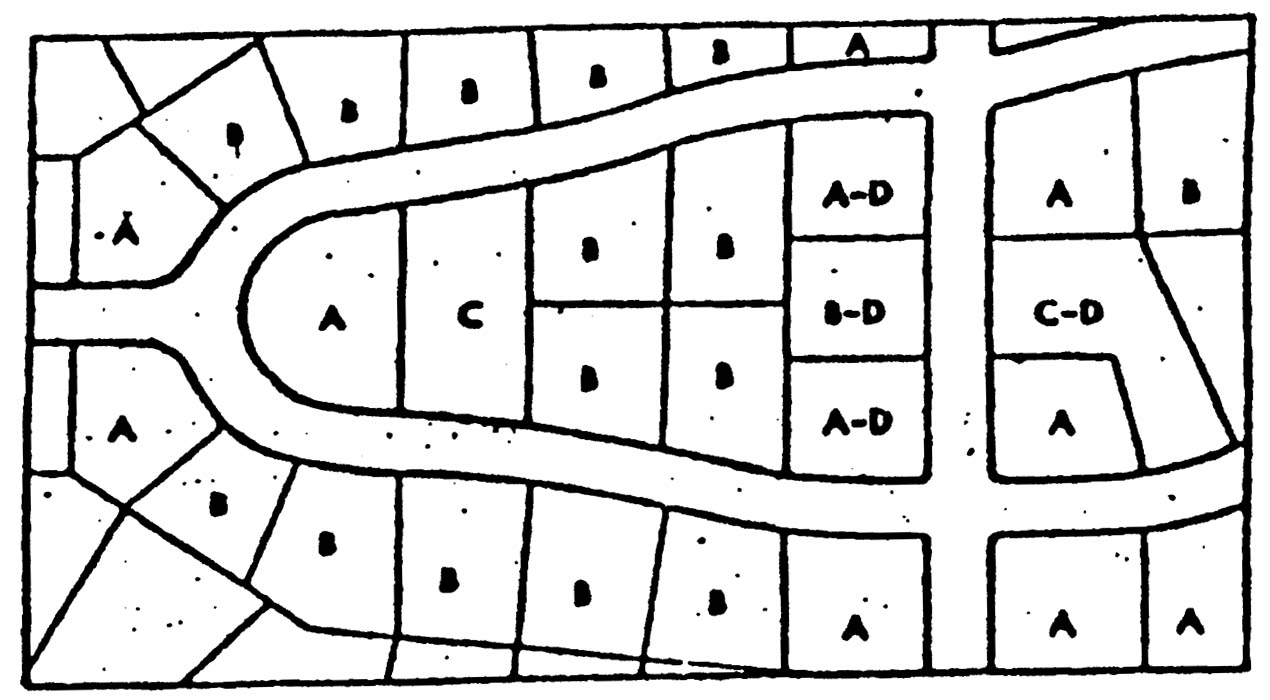
Lot types shall mean the diagram which follows illustrates terminology used in this chapter with reference to corner lots, double frontage lots, interior lots, reversed frontage lots, and through lots:
(1)
"A" is a corner lot.
(2)
"B" is an interior lot.
(3)
"C" is a through lot.
(4)
"D" is a reversed frontage lot. A reversed frontage lot may also be a corner lot (A—D), an interior lot (B—D), or a through lot (C—D).
_____
Lot width shall mean the mean horizontal distance between the side lines of the lot measured at right angles to the depth.
Main building. See Building, principal.
Mangrove stand shall mean an assemblage of mangrove trees which is mostly low trees noted for a copious development of interlacing adventitious roots above the ground and which contain one or more of the following species: black mangrove (Avicennia Nitida), red mangrove (Rhizophora Mangle), white mangrove (Languncularia Racemosa) and buttonwood (Conocarpus Erecta).
Manufactured home shall mean a structure, transportable in one or more sections, which is built on a permanent chassis and designed to be used with or without a permanent foundation when connected to the required utilities. The term also includes park trailers, travel trailers, and similar transportable structures placed on a site for 180 consecutive days or longer and intended to be improved property.
Map or official zoning map shall mean the graphic document bearing the official seal and signature of the town, which depicts the geographic location of zoning districts, is formally adopted as a part of this chapter, and is referred to as the "Town of Gulf Stream Official Zoning Map."
Mast shall mean a pole or tower used to support a broadcast receiving antenna or a communications antenna and maintain it at the proper elevation.
Mean sea level shall mean the average height of the sea for all stages of the tide. It is used as a reference for establishing various elevations within the floodplain. For purposes of this chapter, the term is synonymous with National Geodetic Vertical Datum (NGVD).
Multiple-family dwelling. See Dwelling, multiple.
National Geodetic Vertical Datum (NGVD), as corrected in 1929, shall mean a vertical control used as a reference for establishing varying elevations within the floodplain.
Net acre or net land area shall mean the total land area of a building site, exclusive of all public rights-of-way, easements, submerged lands or any lands deemed by a government agency as unsuitable or inappropriate for development.
New construction shall mean structures for which the "start of construction" commenced on or after the effective date of the ordinance from which this chapter was derived.
Nonconforming use shall mean a use that does not conform with the regulations of the use district in which it is situated.
Occupancy pertains to and shall mean the purpose for which a building is used or intended to be used. A change of occupancy is not intended to include a change of tenants or proprietors.
Occupied shall include the words "arranged," "designed" or "intended to be occupied."
Off-street parking shall mean the minimum off-street, on-site parking of vehicles which shall be provided under the appropriate terms of this chapter.
On-site shall mean located on the lot in question, except in the context of on-site detention, when the term means within the boundaries of the development site as a whole.
Open front lawns shall mean an unobstructed view vista of the front lawn of at least 75 percent of the front property line without landscape planting exceeding a mature height of three feet. The landscaped vista view plantings over three feet shall be no more than 25 percent of the front property line.
Open space shall mean an exterior open area clear from the ground upward which is devoid of any principal building, accessory structures, and impervious areas, except however those buildings and structures used exclusively for recreational purposes.
Open space, common, shall mean any open spaces under common ownership and control.
Parking area shall mean the total area devoted to the parking and maneuvering of vehicles.
Parking lot shall mean an open area which is used for the parking or storage of automobiles.
Parking space shall mean a surfaced area, enclosed or unenclosed, which is sufficient in size to park one automobile, together with a driveway connecting the parking space with a street or alley and permitting ingress and egress of an automobile.
Plat shall mean a map depicting the division or subdivision of land into lots, blocks, parcels, tracts or other portions thereof which are prepared in accordance with this chapter and other applicable ordinances.
Plot shall mean a parcel of ground containing more than one lot upon which a building and its accessory buildings have been or may be erected.
Porch, open, shall mean a roofed open structure projecting from the outside wall of a building without window sash or any other form of permanent enclosure.
Premises shall mean land and all buildings and structures thereon.
Principal building. See Building, principal.
Principal use. See Use, principal.
Public agency shall mean any government or governmental agency, board, commission, authority or public body of the town, county, state, United States Government or any legally constituted district.
Public building shall mean any building held, used, or controlled exclusively for public purposes by any department or branch of government, state, county or municipality, without reference to the ownership of the building or of the reality upon which it is situated.
Public improvement shall mean any improvement, facility, or service, together with customary improvements and appurtenances thereto, necessary to provide for public needs as: vehicular and pedestrian circulation systems, storm sewers, flood control improvements, water supply and distribution facilities, sanitary sewage disposal and treatment, public utility and energy services.
Public use shall mean the use of any land, water or building by a public agency for the general public.
Public utility shall mean any publicly or privately owned utility such as, but not limited to, storm drainage, sanitary sewers, electric power, water service, gas service, telephone lines, whether underground or overhead.
Record lot. See Lot of record.
Recreational vehicle shall mean a vehicular type unit primarily designed for recreational, camping or travel use, which either has its own motive power or is mounted on or drawn by another vehicle. The basic entities are: travel trailer, camping trailer, truck camper, and motor home, boat, all-terrain vehicle (ATV's).
Residence. See Dwelling.
Residential use shall mean use of land or structures thereon, or portion thereof, for residential occupancy of a permanent or semipermanent nature; but not including occupancy of a transient nature such as in hotels or time-sharing uses.
Restrictive, more (less), shall mean a regulation imposed by this chapter is more (less) restrictive than another if it prohibits or limits development to a greater (lesser) extent or by means of more (less) detailed specifications.
Right-of-way shall mean a street, alley or other thoroughfare or easement, whether physically accessible or not, which has been permanently established or dedicated for the passage of persons or vehicles. Title to this land remains with the public until the need no longer exists and is thereby abandoned.
Sand dunes shall mean naturally occurring accumulations of sand in ridges or mounds landward of the beach.
Satellite television antenna system shall mean a system of equipment designed to receive satellite television and radio signals for distribution to private residences including both single-family dwellings and multifamily dwellings. Satellite television antenna system does not apply to cable television systems which are governed by separate franchise and federal regulations.
Screening (concealing) shall mean a structure of metal, masonry, wood, landscape planting or other suitable opaque material, for the purpose of totally concealing from view those areas so screened.
Setback shall mean the horizontal distance between the front line, side line or rear line of the building site to the front, side or rear of the building or structure respectfully. Setbacks shall be measured perpendicular to and parallel with property or right-of-way lines. For purposes of calculating setback distances, the beginning point of measurement shall be the wall of the building or structure unless the bay window, bow window, fireplace, chimney or eave extends greater than 2½ feet from the wall of the building or structure, in which case the edge of the bay window, bow window, fireplace, chimney or eave minus 2½ feet shall constitute the beginning point of measurement. For purposes of this chapter, bay and bow windows are limited to one-third of the length of the wall of the building or structure.
Setback centerline shall mean the line established by striking a line that is the shortest distance from the corner of the lot to the 25-foot dolphin control line. Setbacks are to be offset from this line.
Sign shall mean any advertisement, announcement, direction, or communication produced in whole or in part by the construction, erection, affixing, or placing of a structure on any land or water or on any other structure, or produced by attaching on or posting or placing any printed, lettered, pictured, figured, or colored material on any building, structure or surface. Signs placed or erected by governmental agencies or nonprofit civic associations for a public purpose in the public interest shall not be included herein, nor shall this include signs which are a part of the architectural design of a building. Every sign, ground sign, wall sign, roof sign, illuminated sign, projecting sign, temporary sign and street clock shall include any announcement, declaration, demonstration, display, illustration or insignia used to advertise or promote the interests of any person when the same is placed in view of the general public are included in this definition.
Single-family dwelling. See Dwelling, single-family.
Site or development plan shall mean a graphic and informative representation of a specific design solution for an entire project or development phase thereof, which meets the requirements and conditions of the applicable sections of this chapter.
Special exception shall mean a use that would not be appropriate generally or without restriction throughout the zoning district, but which, if controlled as to number, area, location, or relation to the neighborhood, would promote the public health, safety, welfare, morals, order, comfort, convenience, appearance, prosperity or the general welfare of the district and the community. Such uses may be permitted in such zoning district as special exceptions, only if specific provision for such special exceptions is made in the chapter.
Start of construction shall mean the first placement of permanent construction of a structure on a site, such as the pouring of slabs or footings or any work beyond the stage of excavation, including the relocation of a structure. Permanent construction does not include the installation of streets and/or walkways; nor does it include excavation for a basement, footings, piers or foundations or the erection of temporary forms; nor does it include the installation on the property of accessory buildings, such as garages or sheds not occupied as dwelling units or not as part of the main structure. For a structure without a basement or poured footings, the "start of construction" includes the first permanent framing or assembly of the structure or any part thereof on its piling or foundation.
Story shall mean that portion of a building included between the surface of any floor and the surface of the next floor above it, or if there be no floor above it, then the space between such floor and the ceiling next above it. In computing the height of buildings, the height of basements shall not be included.
Story, half, shall mean a story under a gabled, hipped or gambrel roof the wall plates of which on at least two opposite exterior walls are not more than three feet above the finished floor of such story.
Street shall mean any public or private thoroughfare which affords the principal means of access to abutting property. It may be designated on the map as a street, avenue, boulevard, drive, place, court, road, terrace, way, circle, lane, walk, path or otherwise.
Street centerline shall mean the line midway between the street right-of-way lines of the surveyed and platted centerline of a street which may or may not be the line midway between the existing right-of-way lines or pavement.
Street centerline setback shall mean the minimum distance measured from the street centerline required for the preservation of existing right-of-way and future right-of-way expansion.
Street line shall mean the line between the street and abutting property also referred to as right-of-way line.
Structural alteration shall mean any change in the supporting members of a building, such as bearing walls, or partitions, columns, beams or girders, or any substantial change in the roof or in the exterior walls, excepting such repairs or replacements as may be required for the safety of the building.
Structural trim shall mean the molding, battens, cappings, nailing strips, latticing and platforms which are attached to the structure.
Structure shall mean that which is built or constructed, an edifice or building of any kind, or any piece of work artificially built up or composed of parts joined together in some definite manner. The term "structure" shall be construed as if followed by the words "or part of."
Structure, accessory. See Accessory structure.
Structure height shall mean the vertical distance measured from the point of base flood elevation to the highest point of a structure unless otherwise specified in this Code. For a rooftop superstructure, height shall be measured from the highest point of the roof to the highest point of such structure.
Subdivision shall mean the division or separation of a parcel of land into two or more lots or parcels by means of mapping, platting, conveyance, change or rearrangement of boundaries. All subdivisions are also developments and shall be in conformance with chapter 62 of this Code.
Submerged lands shall mean lands lying in or below the public waters of the state waterward of the mean high-water line. For the purpose of this definition, the mean high-water line shall be the intersection of the shore with the tidal plane of the average height of the high waters over a 19-year period, or for shorter periods of observation, the average height of the high waters after corrections are applied to eliminate known variations and to produce the result of the equivalent of a mean 19-year value. Alternatively, mean high water may mean the average height of the high waters as established and accepted by the U.S. Army Corps of Engineers.
Substantial improvement shall mean for a structure built prior to the enactment of this article, any repair, reconstruction, or improvement of a structure, the cost of which equals or exceeds 50 percent of the market value of the structure either:
(1)
Before the improvement or repair is started; or
(2)
If the structure has been damaged and is being restored, before the damage occurred.
For the purpose of this definition "substantial improvement" is considered to occur when the first alteration of any wall, ceiling, floor or other structural part of the building commences, whether or not that alteration affects the external dimensions of the structure. The term does not, however, include either:
(1)
Any project for improvement of a structure to comply with existing state or local health, sanitary or safety code specifications which are solely necessary to assure safe living conditions; or
(2)
Any alteration of a structure listed on the National Register of Historic Places or a state inventory of historic places.
Swimming pool shall mean any structure designed for swimming, wading or other aquatic recreational purposes, capable of containing a body of water 18 inches or more in depth and 40 square feet or more of water surface area, and the top edge of the pool not to exceed two feet above average finished grade.
Temporary use. See Use, temporary.
Time sharing shall mean the use of any unit under which the exclusive right of use, occupancy or possession of the unit circulates among various occupants in accordance with a fixed time schedule on a periodically occurring basis for a period of time established by such schedule.
Two-family dwelling. See Duplex.
Unity of title shall mean a document recorded in the office of the clerk of the circuit court of the county, stipulating that a lot, lots or parcels of land shall be held under single ownership, shall not be eligible for further subdivision, and shall not be transferred, conveyed, sold or divided in any unit other than in its entirety.
Use, accessory, shall mean an accessory use which:
(1)
Is subordinate to and serves a principal structure or a principal use;
(2)
Is subordinate in area, extent, and purpose to the principal structure or use served;
(3)
Is located on the same lot as the principal structure or use served except as otherwise expressly authorized by provisions of this chapter; and
(4)
Is customarily incidental to the principal structure or use.
Use, principal, shall mean the specific primary purpose or function for which land is used.
Use, residential. See Residential use.
Use, temporary, shall mean a use which is established for a fixed period of time with the intent to discontinue such use upon the expiration of such time. Such uses do not involve the construction or alteration of any permanent structure.
Used shall include the term "arranged," "designed" or "intended to be used."
Variance shall mean a deviation from the district requirements of this chapter, which is granted by the town commission sitting as the zoning board of adjustment; where such variance will not be contrary to the public interest and where, owing to conditions peculiar to the physical characteristics of that particular property and not the result of the actions of the owner, agent, or applicant, a literal enforcement of this chapter would result in unnecessary and undue hardship.
Vehicle shall mean any self-propelled conveyance designed for and used for the purpose of transporting or moving persons, animals, freight, merchandise or any substance, and shall include passenger cars, trucks, buses, motorcycles, scooters and recreational vehicles.
Water frontage shall mean the linear distance between the setback centerlines at the seawall.
Waterway shall mean any permanent body of water including the Intracoastal Waterway, Atlantic Ocean, canals, coves and basins.
Yards shall mean the unoccupied and unobstructed open spaces on the same lot with the main building which extend from the ground upward.
(1)
Front yard shall mean the open space extending the full width of the lot, the depth of which is the minimum horizontal distance between the front lot line and the nearest line of the principal building.
(2)
Rear yard shall mean the open space extending the full width of the lot, the depth of which is the minimum horizontal distance between the rear lot line and the nearest line of the principal building.
(3)
Side yard shall mean the open space between the main building and the side lot line, extending from the front yard to the rear yard, the width of which is the horizontal distance from the nearest point of the side lot line to the nearest point of the principal building.
Zone shall mean the area within which certain uses of land and buildings are permitted and certain others are prohibited, yards and other open spaces are required, lot areas, building height limits and other requirements are established, all of the foregoing being identical for the zone in which they apply (see also, District).
(Ord. No. 83-1, § 2(IV), 4-8-83; Ord. No. 84-7, § 1, 12-14-84; Ord. No. 87-3, § 1, 5-15-87; Ord. No. 90-1, § 1, 1-21-91; Ord. No. 91-23, § 1, 10-21-91; Ord. No. 91-24, § 1, 10-21-91; Ord. No. 00-1, § 9, 3-10-00; Ord. No. 04-9, § 1, 2-11-05; Ord. No. 08-4, § 1, 9-5-08; Ord. No. 12-4, § 2, 7-13-12; Ord. No. 15/4, § 1, 8-14-15; Ord. No. 16/02, § 5, 5-13-16)
Cross reference— Definitions and rules of construction generally, § 1-2.
Sec. 66-2. - Jurisdiction.
The rules, regulations and requirements contained in this chapter shall apply to all properties and lands within the corporate limits of the town as they now exist or as they may be legally altered.
(Ord. No. 83-1, § 2(III), 4-8-83)
Sec. 66-3. - Purpose, authority.
(a)
The purpose of this chapter is to implement the town comprehensive development plan adopted in 1990 in conformance with the Local Government Comprehensive Planning Act of 1985; to specifically divide the town into districts in accordance with the comprehensive development plan; to lessen congestion in the streets; to secure safety from fire, panic, and other dangers; to provide adequate light and air; to prevent the overcrowding of land; to avoid undue concentration of population; to facilitate the adequate provision of transportation, water, sewerage, schools, parks and other public requirements; and to generally promote the health, safety and welfare of present and future residents of the town by:
(1)
Giving effect to the goals, objectives and recommendations of the town comprehensive development plan.
(2)
Dividing the town into districts according to the use of land, buildings and the intensity of such use (including lot coverage and height) and surrounding open space.
(3)
Establishing regulations which protect and promote the public health, safety and general welfare of the people by providing standards to control the amount of open space and impervious surfaces within a development; to control the intensity of development in areas of sensitive natural resources or natural features in order to reduce or eliminate adverse environmental impacts.
(4)
Controlling and regulating the growth of the town concentrating development in areas where adequate community facilities can be provided, and limiting development in areas where these facilities are not and should not be provided.
(5)
Regulating and restricting the location and use of buildings, structures and land for residential and other uses.
(6)
Lessening the danger and congestion of traffic on the streets and highways.
(7)
Securing safety from fire, panic, flood and other dangers.
(8)
Providing adequate privacy, light and air.
(9)
Protecting the tax base by facilitating cost and value effective development and the most appropriate use of land within the town.
(10)
Conserving the values of property throughout the town.
(11)
Preventing the overcrowding of land, and protecting landowners from adverse impacts on adjoining developments.
(b)
The town charter provides that the town commission shall have the authority to adopt such ordinances as are deemed necessary or advisable for good government and general welfare of the town.
(Ord. No. 83-1, § 2(II), 4-8-83)
Sec. 66-4. - Interpretation.
In interpreting and applying the provisions of this chapter, they shall be held to be the minimum requirements for the promotion of the public health, safety, morals and general welfare of the community. It is not intended by this chapter to interfere with or abrogate or annul any easements, covenants or other agreements between parties; provided, however, that where this chapter imposes a greater restriction upon the use of buildings or premises, or upon the height of buildings, or requires larger open spaces than are imposed or required by other ordinances, rules, regulations or by easements, covenants, or agreements, the provisions of this chapter shall control. If, because of error or omission in the zoning map, any property in the town is not shown as being in a zoning district, the classification of such property shall be "RS" residential single-family district unless changed by amendment to this chapter.
(Ord. No. 83-1, § 2(XIX, A), 4-8-83)
Sec. 66-5. - Purpose and conflict.
This chapter is adopted for the purpose of revising, amending and bringing to date the zoning laws and ordinances of the town in existence since the enactment of the zoning ordinance on May 17, 1952; and it is hereby expressly declared and determined that it is the intention of the town commission that this chapter shall supersede only such parts of the existing zoning laws and ordinances of the town as are in direct conflict with and not reconcilable to the provisions of this chapter. It is expressly declared and determined that if for any reason this chapter or any section hereof should be found by any court of competent jurisdiction to be invalid or unenforceable, the provisions of this chapter in force and effect as of the date hereof shall continue to be in full force and effect, it being the intention of the town commission that there shall exist no period of time in which the town shall not be comprehensively zoned.
(Ord. No. 83-1, § 2(XIX, B), 4-8-83)
Sec. 66-6. - Changes and amendments.
(a)
The town commission may from time to time on its initiative or by petition amend, supplement, change, modify or repeal the regulations, restrictions or district boundaries herein established. Any proposed amendment, supplement, change, modification or repeal shall first be submitted to the architectural review and planning board for its recommendation and report to the town commission. All such changes and amendments shall be made pursuant to all applicable state laws. If a proposed zoning amendment is denied, after a public hearing as provided herein, the town commission shall not reconsider such amendment or request for an amendment for a period of six months after denial, unless the town commission determines that the public interest requires it.
(b)
Upon filing a petition or a request for rezoning within the town, the petitioner shall pay to the town fee of $200.00 plus any additional costs incurred by the town of processing the application or hearing and deciding upon the request. The additional costs shall be paid to the town by the applicant prior to the issuance of a certificate of occupancy for any development on the property which was rezoned if the rezoning request was approved. If the rezoning request is denied, all costs shall become due and payable immediately. Nonpayment of such costs shall result in the town placing a lien against the property for which the rezoning was requested for the amount of the costs, plus any and all costs incurred in the filing of the lien.
(Ord. No. 83-1, § 2(XVII), 4-8-83)
Sec. 66-7. - Enforcement.
(a)
This chapter shall be enforced by the town planning and building administrator and/or the town commission.
(b)
The planning and building administrator is hereby authorized to cause any building, structure, place or premises to be inspected or examined, and to order in writing upon reasonable notice the remedying of any condition found to exist therein or thereat, in violation of any of the provisions of this chapter. Such order shall be served by actual delivery to the owner or agent or by mailing a copy thereof to the owner by registered mail, or if his residence is unknown, by publishing such notice one time in some newspaper published and printed in the town, or if no newspaper is published or printed in the town by posting a copy thereof on the building so affected, and at the door of the town hall.
(c)
The owner or agent of a building or premises where a violation of this chapter has been committed or shall exist, or the lessee or tenant of an entire building or entire premises where such violation has been committed or shall exist, or the general agent, architect, contractor, building agent, builder or any other person who commits, takes part in or assists in any such violation or who maintains any building or premises or any part thereof in which any violation shall exist shall be punished as provided in section 1-15.
(d)
Any such person who, having been served with an order to remove any such violation, shall fail to comply with such order within ten days after such service is completed, or shall continue to violate any provision of this chapter, in the respect named in this chapter, shall be punished as provided in section 1-15.
(e)
In addition to the foregoing remedies, the town may, through its town commission, mayor, planning and building administrator or other designated officer, maintain and prosecute, in any court of competent jurisdiction, an action or injunction, or otherwise, to restrain any violation of this chapter.
(f)
In addition to all the above, any person violating any of the provisions hereof shall be subject to arrest and trial in the court of proper jurisdiction of the town for any violation actually committed.
(Ord. No. 83-1, § 2(XVIII, A), 4-8-83)
Sec. 66-8. - Violations and penalties.
(a)
Any person found guilty of violating any of the provisions of this chapter relating to the use and occupancy of property shall, upon conviction, be punished pursuant to section 1-15.
(b)
Any tenant or lessee who shall knowingly violate or be a party to the violation of any provision of this chapter, or shall continue the violation of any provision of this chapter after being notified to cease and desist, shall be punished as provided in subsection (a) of this section.
(Ord. No. 83-1, § 2(XVIII, B, 1, 2), 4-8-83)
Sec. 66-9. - Tampering with signs, notices.
It shall be unlawful for any person to destroy, move, remove, deface or obscure any sign or notice erected or posted pursuant to the requirements of this chapter.
(Ord. No. 83-1, § 2(XVIII, B, 3), 4-8-83)
Sec. 66-10. - Civil remedies.
Nothing contained in this chapter shall prevent the town or any aggrieved or interested person from taking any other lawful action necessary to prevent or remedy any violation. The town or any aggrieved or interested person shall have the right to apply to the circuit court of the county to enjoin and retain any person violating the provision of this chapter. The court, upon proof of same, shall have the duty to issue forthwith such temporary and permanent injunctions as are necessary to prevent the violation.
(Ord. No. 83-1, § 2(XVIII, B, 4), 4-8-83)
Sec. 66-11. - Reasonable accommodation procedures.
(a)
This section implements the policy of the town for processing of requests for reasonable accommodation to its ordinances, rules, policies, and procedures for persons with disabilities as provided by the federal Fair Housing Amendments Act (42 U.S.C. 3601, et seq.) ("FHA") and Title II of the Americans with Disabilities Act (42 U.S.C. Section 12131 et seq.) ("ADA"). For purposes of this section, a "disabled" individual or person is an individual that qualifies as disabled and/or handicapped under the FHA and/or ADA. Any person who is disabled (or qualifying entities) may request a reasonable accommodation with respect to the town's land use or zoning laws, rules, policies, practices and/or procedures as provided by the FHA and the ADA pursuant to the procedures set out in this section.
(b)
A request by an applicant for reasonable accommodation under this section shall be made in writing by completion of a reasonable accommodation request form, which form is maintained by (and shall be submitted to) the town clerk. The reasonable accommodation form shall contain such questions and requests for information as are necessary for processing the reasonable accommodation request. The reasonable accommodation request form shall be substantially in the form set forth in subsection (j) below.
(c)
Should the information provided by the disabled individual to the town include medical information or records, including records indicating the medical condition, diagnosis or medical history of the disabled individual, such individual may, at the time of submitting such medical information, request that the town, to the extent allowed by law, treat such medical information as confidential information of the disabled individual. The town shall thereafter endeavor to provide written notice to the disabled individual, and/or their representative, of any request received by the town for disclosure of the medical information or documentation which the disabled individual has previously requested be treated as confidential by the town. The town will cooperate with the disabled individual, to the extent allowed by law, in actions initiated by such individual to oppose the disclosure of such medical information or documentation, but the town shall have no obligation to initiate, prosecute or pursue any such action, or to incur any legal or other expenses (whether by retention of outside counsel or allocation of internal resources) in connection therewith, and may comply with any judicial order without prior notice to the disabled individual.
(d)
The town manager, or his/her designee, shall have the authority to consider and act on requests for reasonable accommodation, after notice and public hearing to receive comments, input and information from the public (provided, however, the town manager or designee shall not be required to render their decision at said public hearing). When a reasonable accommodation request form has been completed and submitted to the town clerk it will be referred to the town manager, or designee, for review and consideration. The town manager, or designee, shall issue a written determination within 45 days of the date of receipt of a completed application and may, in accordance with federal law: (a) grant the accommodation request; (b) grant a portion of the request and deny a portion of the request, and/or impose conditions upon the grant of the request; or (c) deny the request, in accordance with federal law. Any such denial shall be in writing and shall state the grounds therefor. All written determinations shall give notice of the right to appeal. The notice of determination shall be sent to the requesting party (i.e. the disabled individual or his/her representative) by certified mail, return receipt requested. If reasonably necessary to reach a determination on the request for reasonable accommodation, the town manager, or designee, may, prior to the end of said 45-day period, request additional information from the requesting party, specifying in sufficient detail what information is required. The requesting party shall have 15 days after the date of the request for additional information to provide the requested information. In the event a request for additional information is made, the 45-day period to issue a written determination shall no longer be applicable, and the town manager, or designee, shall issue a written determination within 30 days after receipt of the additional information. If the requesting party fails to provide the requested additional information within said 15-day period, the town manager, or designee, shall issue a written notice advising that the requesting party had failed to timely submit the additional information, and therefore the request for reasonable accommodation shall be deemed abandoned and/or withdrawn and no further action by the town with regard to said reasonable accommodation request shall be required.
(e)
In determining whether the reasonable accommodation request shall be granted or denied, the requesting party shall be required to establish that they are protected under the FHA and/or ADA by demonstrating that they, or the party they represent, are handicapped or disabled, as defined in the FHA and/or ADA. Although the definition of disability is subject to judicial interpretation, for purposes of this section the disabled individual must show: (i) a physical or mental impairment which substantially limits one or more major life activities; (ii) a record of having such impairment; or (iii) that they are regarded as having such impairment. Next, the requesting party will have to demonstrate that the proposed accommodations being sought are reasonable and necessary to afford handicapped/disabled persons equal opportunity to use and enjoy housing. The foregoing (as interpreted by the courts) shall be the basis for a decision upon a reasonable accommodation request made by the town manager, or designee, or by the town commission in the event of an appeal.
(f)
Within 30 days after the town manager's, or designee's, determination on a reasonable accommodation request is mailed to the requesting party, such applicant may appeal the decision. All appeals shall contain a statement containing sufficient detail of the grounds for the appeal. Appeals shall be to the town commission who shall, after public notice and a public hearing, render a determination as soon as reasonably practicable, but in no event later than 60 days after an appeal has been filed.
(g)
There shall be no fee imposed by the town in connection with a request for reasonable accommodation under this section or an appeal of a determination on such request to the town commission, and the town shall have no obligation to pay a requesting party's (or an appealing party's, as applicable) attorneys' fees or costs in connection with the request, or an appeal.
(h)
While an application for reasonable accommodation, or appeal of a determination of same, is pending before the town, the town will not enforce the subject zoning ordinance, rules, policies, and procedures against the applicant.
(i)
The following general provisions shall be applicable:
(1)
The town shall display a notice in the town's public notice bulletin board (and shall maintain copies available for review in the town clerk's office), advising the public disabled individuals (and qualifying entities) may request reasonable accommodation as provided herein.
(2)
A disabled individual may apply for a reasonable accommodation on his/her own behalf or may be represented at all stages of the reasonable accommodation process by a person designated by the disabled individual.
(3)
The town shall provide such assistance and accommodation as is required pursuant to FHA and ADA in connection with a disabled person's request for reasonable accommodation, including, without limitation, assistance with reading application questions, responding to questions, completing the form, filing an appeal, and appearing at a hearing, etc., to ensure the process is accessible.
(j)
Reasonable accommodation request form:
(1)
Name of applicant:
(2)
Telephone number:
(3)
Address:
(4)
Address of housing or other location at which accommodation is requested:
(5)
Describe qualifying disability or handicap:
(6)
Describe the accommodation and the specific regulation(s) and or procedure(s) from which accommodation is sought:
(7)
Reasons the reasonable accommodation may be necessary for the individual with disabilities to use and enjoy the housing or other service:
(8)
Name address and telephone number of representative if applicable:
(9)
Other information:
(10)
Signature of disabled individual or representative, if applicable, or qualifying entity:
_______ Date: _____
(Ord. No. 14/2, § 1, 7-1-14)

