
Gulf Stream City Zoning Code
ARTICLE VIII
SUPPLEMENTARY DISTRICT REGULATIONS9
Cross reference— Coastal construction code, § 42-51 et seq.; marine facilities, structures and places, ch. 52.
DIVISION 3. - CARPORTS, GARAGES, STORAGE FACILITIES[10]
Cross reference— Parking of recreational equipment or commercial vehicles, § 30-36 et seq.
DIVISION 4. - LANDSCAPING[11]
Cross reference— Landscape irrigation regulations, § 34-76 et seq.
DIVISION 5. - PARKING[12]
Cross reference— Parking of recreational equipment or commercial vehicles, § 30-36 et seq.; motor vehicle traffic prohibited on beaches, § 38-26.
Sec. 66-351. - Unity of title declaration.
(a)
Where it reasonably appears that a certain proposed use of property, as set forth in an application for a building permit, may subsequently be changed by the sale or transfer of a portion of such property and that such change would negate the application of zoning requirements relating to the proposed use, the town may require the property owner(s) to execute a unity of title declaration as a condition precedent to the issuance of a building permit for the proposed use. The unity of title declaration shall apply to all the property necessary for the proposed use, and shall declare that no portion of said property shall be sold or transferred by the owner or successors in interest apart from the whole.
(b)
If there is a sale or transfer in contravention of a unity of title declaration, no building permit will be issued for any portion of the property contained in the unity of title declaration. Declaration shall remain in effect until a release of the unity of title declaration is executed by the town.
(c)
The unity of title declaration shall be filed at the expense of the owner in the public records of the county. Proof of such filing shall precede the issuance of a building permit.
(Ord. No. 83-1, § 2(X, K), 4-8-83)
Sec. 66-352. - Nuisances.
No use shall be made of any property within any district that shall in any way be offensive or noxious by reason of the emission of any discharge, odor, gas, dust, smoke, vibration or noise; nor shall any vehicle be parked or used in any way that would constitute a nuisance; nor shall anything be constructed or maintained that would in any way constitute a nuisance to adjacent property owners, residents or to the community. Each use shall be operated so as to lessen the damage from fire and explosion.
(Ord. No. 83-1, § 2(X, J), 4-8-83)
Cross reference— Nuisances, ch. 22.
Sec. 66-366. - Antennas and antenna systems/structures.
(a)
Broadcast receiving antennas or communication antennas may be permitted in any zoning district upon site plan review and approval by the town commission and upon issuance of a building permit by the town.
(b)
Broadcast receiving antennas or communication antennas shall be attached to the main building or structure and shall not extend more than five feet above the highest portion of the roof.
(c)
Satellite television antenna systems may be permitted in any zoning district upon site plan review and approval by the town commission and the issuance of a building permit by the town.
(d)
Satellite television antenna systems shall not exceed 12 feet in diameter or width.
(e)
Satellite television antenna systems shall be considered as accessory structures and shall be subject to the applicable site plan review requirements and regulations of this chapter.
(f)
Unless specific approval is granted by the town commission, satellite television antenna systems shall be ground mounted and located in such areas as to be screened or buffered from view from adjacent properties, rights-of-way, the Intracoastal Waterway and/or the Atlantic Ocean.
(g)
There shall not be more than one satellite television antenna system, broadcast receiving antenna or communication antenna per residential building or condominium association on any platted lot or parcel.
(h)
Upon receipt of site plan approval and prior to the issuance of a building permit for satellite television antenna, the town commission shall review the installation plans, which plans must be signed and sealed by a professional engineer registered in the state who shall certify that the proposed satellite television antenna system is wind resistant with an ability to withstand winds up to 140 miles per hour. The calculations and such certification by the engineer shall be submitted along with the plans.
(Ord. No. 83-1, § 2(X, H), 4-8-83; Ord. No. 84-7, § 2, 12-14-84)
Sec. 66-367. - Swimming pools.
(a)
No swimming pool shall be located, designed, operated or maintained so as to interfere unduly with the enjoyment of the property rights by owners of property adjoining the swimming pool.
(b)
Lights used to illuminate any swimming pool shall be so arranged and shadowed as to reflect away from adjoining premises.
(c)
A pool may be located within an enclosed courtyard, patio, etc., provided it is to the rear of the required front yard setback line.
(d)
All enclosed swimming pools shall be in conformity with the setbacks required by the zoning district in which it is located.
(e)
Unless otherwise specified elsewhere in this Code, unenclosed or open swimming pools in the "RS" single-family residential district shall be located a minimum of 25 feet from front property lines; provided, however, that any swimming pool located on property fronting on SR A1A shall be subject to the established 78-foot centerline setback.
(f)
Swimming pools shall be located on the same lot or parcel of land as that of the main building. In the event of contiguous lots or parcels, a unity of title shall be recorded prior to issuance of a building permit for either a main building or an accessory structure which would cross lot lines.
(g)
All pools shall be enclosed by a self-locking, child resistant fence, wall or equivalent barrier at least four feet high, except as provided elsewhere in this Code, and in no event shall a pool be exposed to open view from any public roadway.
(h)
No aboveground pools of any nature shall be permitted in any zoning district. An aboveground pool shall be considered a pool constructed or assembled of any material and whose top edge exceeds two feet in height above the average finished grade of the lot or site.
(i)
All pools shall be landscaped so as to prevent exposure to off-premises view from any public roadway, any public or private right-of-way, and the ground level of any adjoining property. However, this subparagraph shall not be construed so as to prevent the exposure of pools to open view from public or private waterways.
(j)
Waterfalls, minor accessory structures, shall not exceed 4 feet in height as measured from average finished grade of property.
(k)
No grotto shall be permitted within any zoning district. A grotto shall be considered an artificial structure or excavation made to look like a cave or cavern.
(Ord. No. 83-1, § 2(X, I, 1), 4-8-83; Ord. No. 92-5, § 1, 9-28-92; Ord. No. 00-1, §§ 18, 19, 3-10-00; Ord. No. 12-4, § 8, 7-13-12)
Sec. 66-368. - Tennis courts.
(a)
No tennis court shall be located, designed, operated or maintained so as to interfere unduly with the enjoyment of the property rights by owners of property adjoining the tennis court.
(b)
No lights shall be used in any manner so as to illuminate any tennis court.
(c)
All tennis courts shall be in conformity with the setbacks required by the zoning district in which it is located. Any tennis court located on property fronting on SR A1A shall be subject to the established 78-foot centerline setback.
(d)
Tennis courts shall be located on the same lot or parcel of land as that of the main building. In the event of contiguous lots or parcels, a unity of title shall be recorded prior to issuance of a building permit for either a main building or an accessory structure which would cross lot lines.
(e)
All tennis courts shall be enclosed by a fence, open wall or equivalent barrier and in no event shall a tennis court be exposed to open view from any public roadway.
(Ord. No. 83-1, § 2(X, I, 2), 4-8-83)
Sec. 66-369. - Docks.
In the single-family residential district, one dock per lot of record shall be permitted in accordance with the following:
(1)
Site plan review required. All new docks and significant alterations to existing docks shall require site plan review and approval.
(2)
Permitted as accessory use. Docks shall be permitted only as an accessory use to single-family dwellings for the exclusive use of the dwelling's occupants (residents and nonresident members of the occupant's family and resident guests at the dwelling). Docks shall not be permitted on vacant lots unless the vacant lot is adjacent to a developed lot under the same ownership and a unity of title has been recorded.
(3)
Prohibited uses. Dockage of commercial vessels or rental of dock space exclusive of the dwelling and property shall be prohibited.
(4)
Docking parallel to seawall only. Docking of vessels shall be permitted in a manner so that the vessel is docked parallel to the seawall. Docking in any other manner is prohibited.
(5)
Ancillary structures permitted. Ancillary structures including handrails, steps, swim ladders and up to a maximum of four dolphins, a boat lift as described in paragraph (6) below, two water hookups, two electrical outlets in excess of 115 volts, two lights, and one dock box shall be permitted in accordance with the provisions of this chapter. Boathouses, fixed covers, fixed benches, fixed fish cleaning apparatus, fixed maintenance apparatus, fuel pumps, sewage pump-outs, flagpoles and diving platforms/boards shall be prohibited.
(6)
Location and dimensions.
a.
There shall be one dock and/or boat lift per lot. For purposes of this section, a boat lift shall include any device fixed to the ground, seawall, post, piling or a dock designed to lift watercraft clear of the water. Boat lifts may include and shall be limited to the following:
1.
Low profile piling boat lifts provided the lifting equipment does not exceed a maximum height of five feet above the seawall. Vessels lifted thereon shall not exceed 34 feet in full length.
2.
Any boat lift, other than the four post lift described in subparagraph (6)a.1. above, shall be attached only to the seawall or platform landward of the seawall.
3.
A maximum of one boat lift with up to 500 pounds lifting capacity shall be permitted to be attached to a dock.
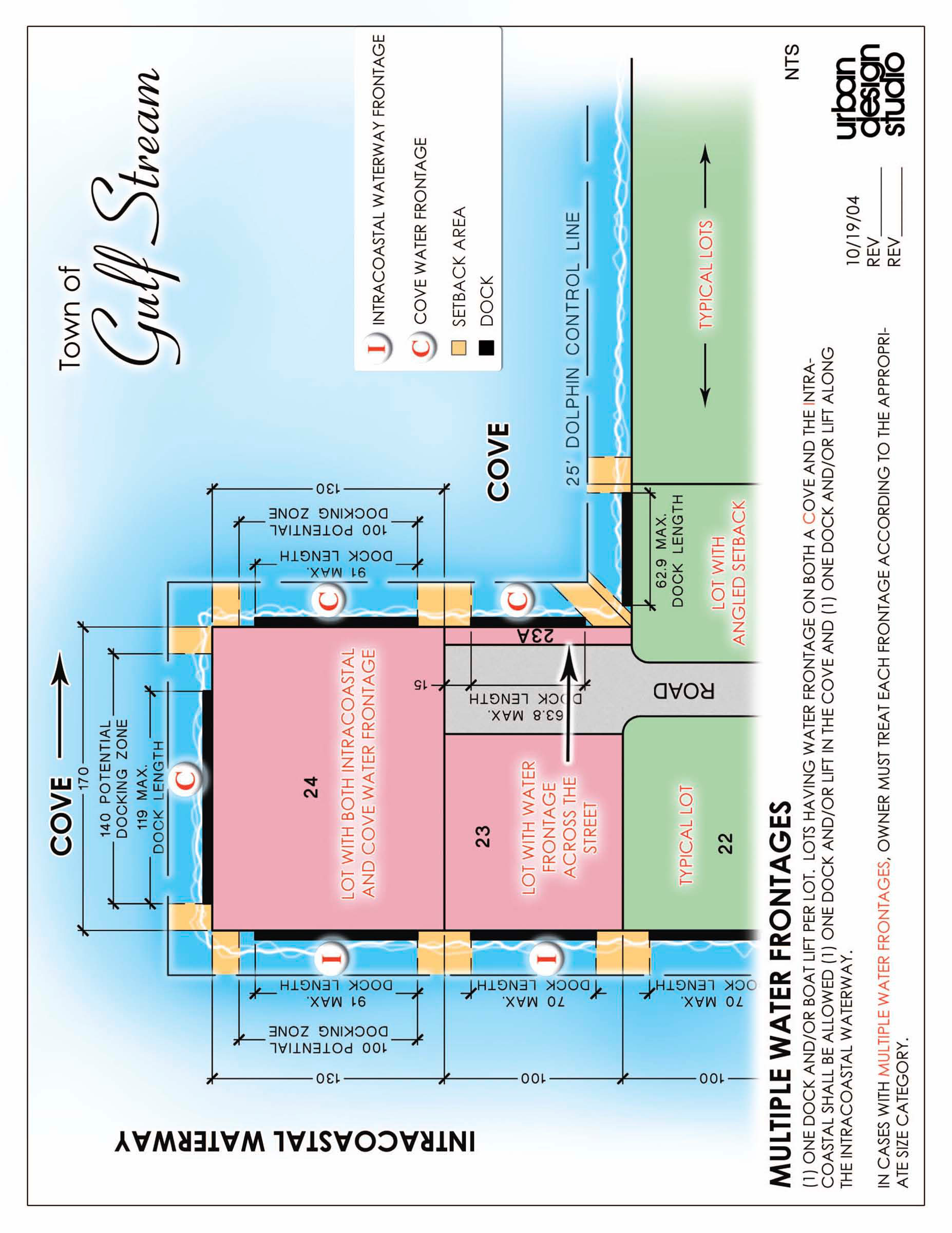
Lots having water frontage on both a cove and the Intracoastal shall be allowed one dock and/or boat lift in the cove and one dock and/or boat lift along the Intracoastal Waterway. Nothing in this section shall preclude the installation of one additional boat lift installed on the seawall or platforms landward of the seawall used for the purpose of storing or hoisting small watercraft into and out of the water. Said boat lift shall be limited to a single arm and a 1,500 pound lifting capacity. No watercraft shall be stored on the dock or on the land in view of abutting neighbors. All vessels lifted on any type of lift shall have no flying bridge, tuna tower or marlin tower and no portion of the vessel shall exceed ten feet above the seawall (excluding antenna or radar) when lifted.
b.
No dock shall exceed five feet in width.
c.
Boats, docks and lifts shall be parallel to the seawall.
d.
Docks shall be no higher than any abutting seawall or five and one-half feet above mean sea level, whichever is greater. Ancillary handrails, steps and lights shall not project more than four feet above the dock.
e.
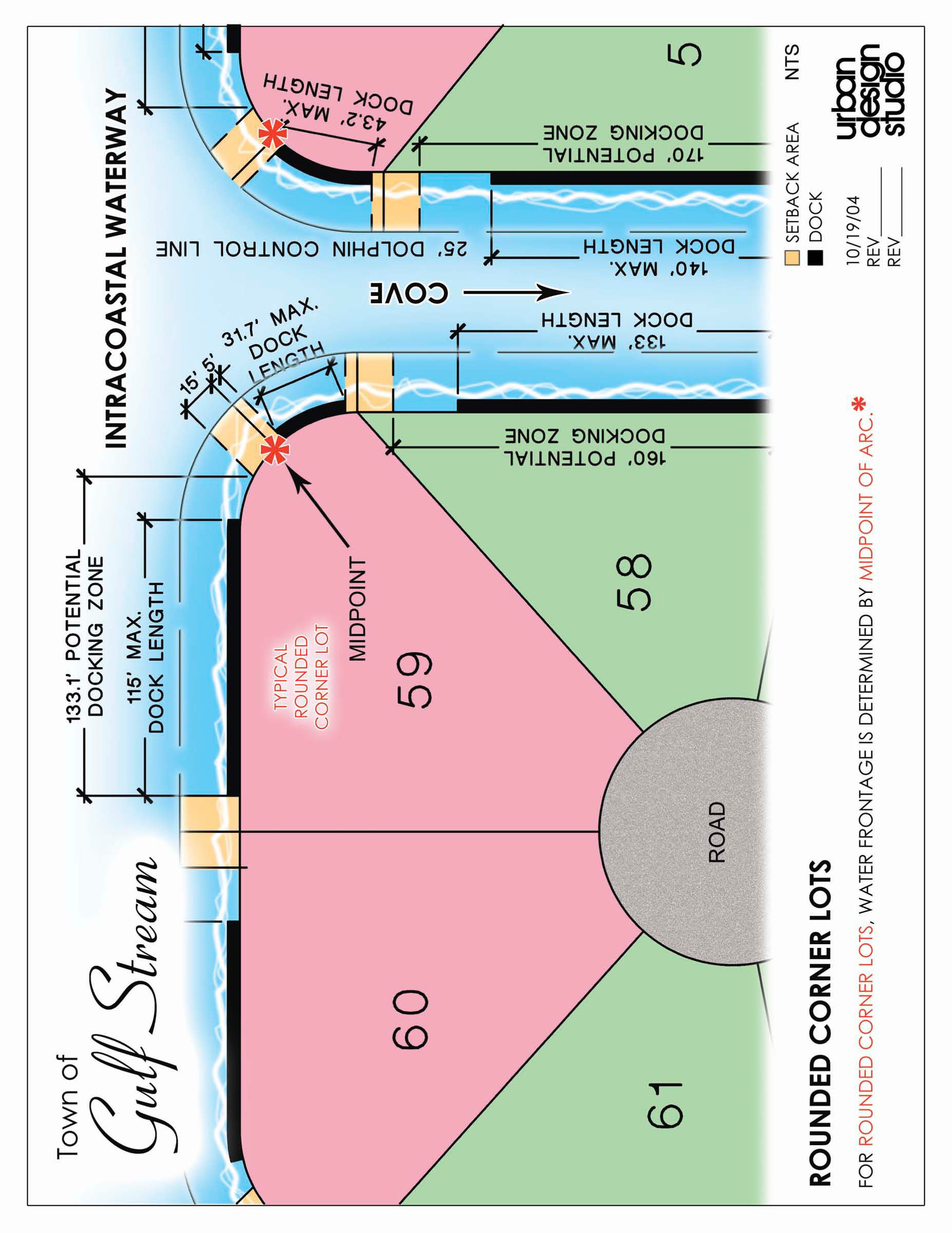
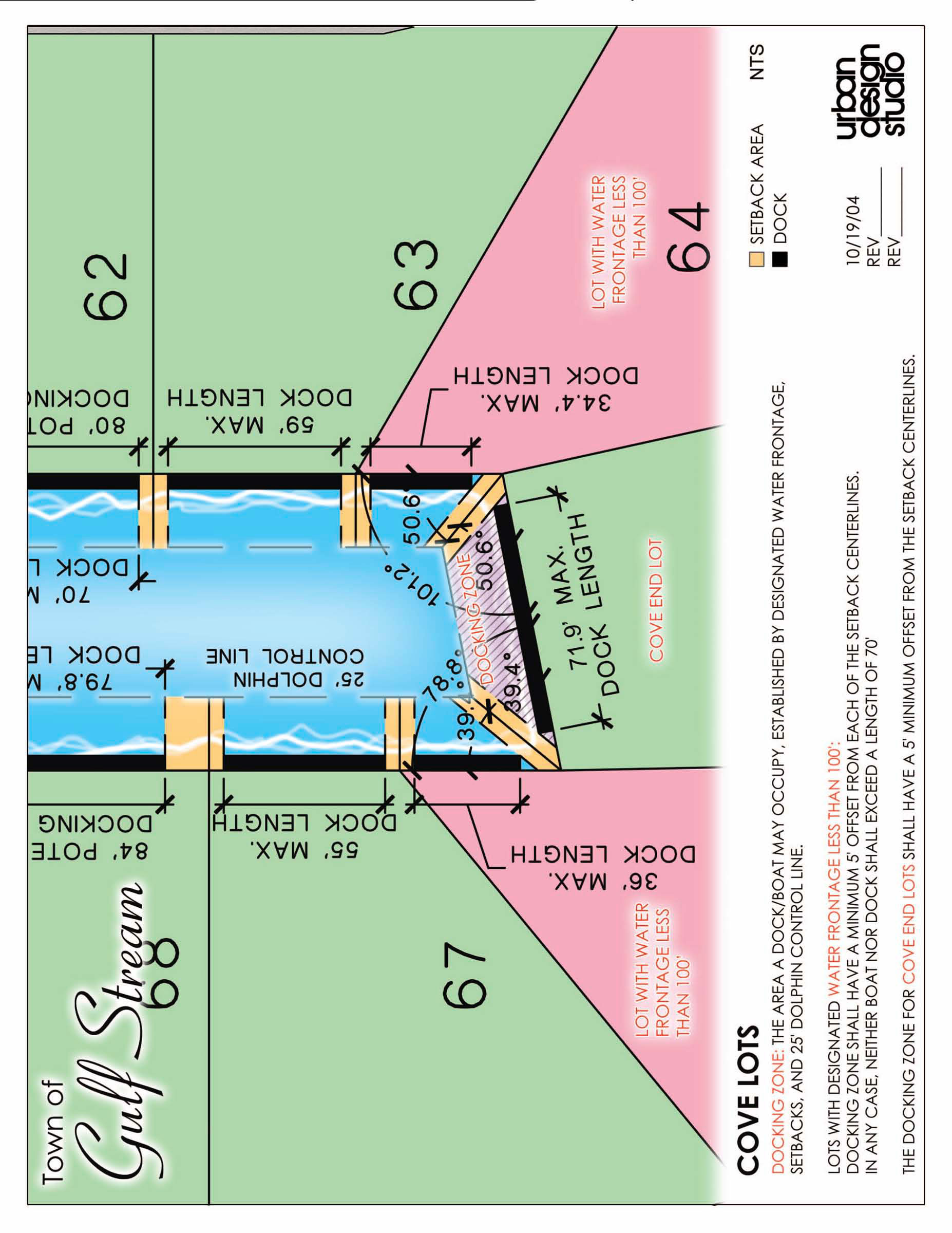
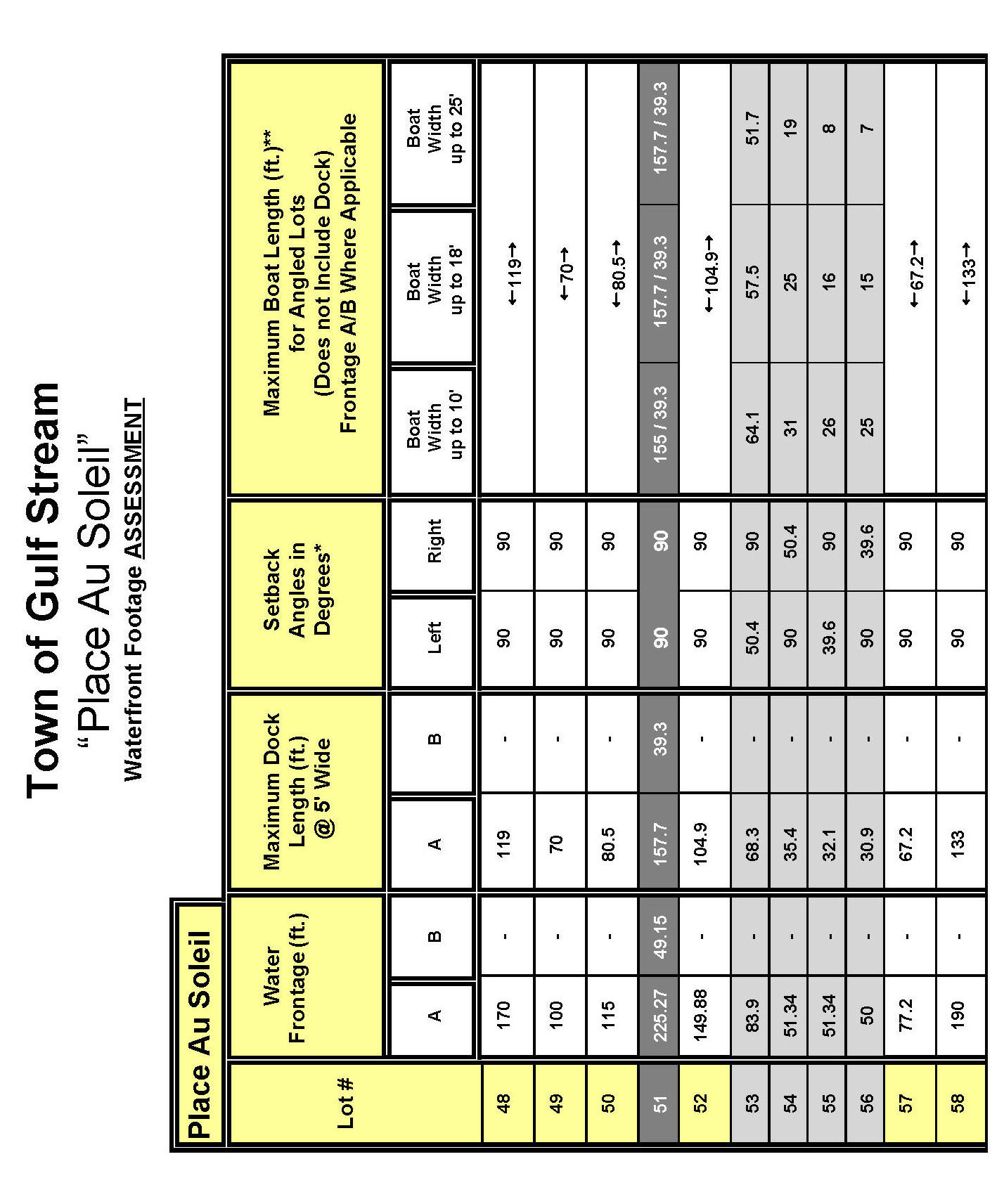
There shall be a docking zone as designated on the illustrations incorporated herein and attached hereto as Exhibit "A". [See the end of this section.] Neither the dock, boat lift, nor any portion or accessory of the boat, dock or boat lift may exceed past the docking zone. For lots with designated water frontage greater than or equal to 100 feet, the docking zone shall have a 15-foot minimum offset from the setback centerlines on each side with the total setback distance being a minimum of 30 percent of the designated water frontage. The docking zone for cove end lots shall have a five-foot minimum offset from the setback centerlines. For lots with designated water frontage less than 100 feet the docking zone shall have a minimum five-foot offset from each of the setback centerlines. In the case of cove end lots and lots with a water frontage of 100 feet or less, neither boat nor dock shall exceed a length of 70 feet. For rounded corner lots, water frontage is determined by the midpoint of the arc. For purposes of determining designated water frontage, dock widths, setbacks and maximum boat lengths for each waterfront lot within the town, the figures contained within Exhibit "B" attached hereto and incorporated herein shall apply. [See the end of this section.] In cases with multiple water frontages, owner must treat each frontage according to the appropriate size category.
In the case of low profile piling boat lifts, the lift shall be located in the following manner. The first piling shall be placed a minimum of 20 feet (towards center of the lot) from the setback line with the pilings extending into the docking zone no farther than 20 feet from the seawall. For lots with setbacks of more than 15 feet on either side, the 20-foot measurement for the first piling shall be measured from the setback on the side with the largest setback.
f.
A maximum of one dock box shall be permitted which shall be no higher than 30 inches and no larger than 24 cubic feet.
g.
Light fixtures shall be installed in a manner that provides safe pedestrian circulation using low voltage lighting with a maximum 600 lumens mounted no higher than three feet above the dock at a minimum spacing of ten feet on center. Lights are to be step, path or marine type fixtures. Fixtures must project downward at a minimum 45-degree angle from the horizontal plan tangent to the top of the light source fixture and allow no light spillage onto adjacent properties. No fixture shall be mounted to the seawall.
h.
Subject to level one site plan approval, a maximum of one floating platform may be permitted in lieu of a boat lift for the purpose of storing small watercrafts. The floating platform shall be constructed of nonferrous material, be black in color and may not rise more than 12 inches out of the water. No more than two watercrafts of a maximum length of 14 feet shall be stored on the floating platform. The platform dimensions shall not exceed eight feet in width or 16 feet in length. All watercrafts shall be stored parallel to the seawall. A floating platform must be removed after three months of disuse.
(7)
Materials and colors. Materials and colors of docks and ancillary structures shall be considered as part of architectural review and planning board consideration and shall be maintained as approved. All docks shall be made of wood. No concrete docks are permitted.
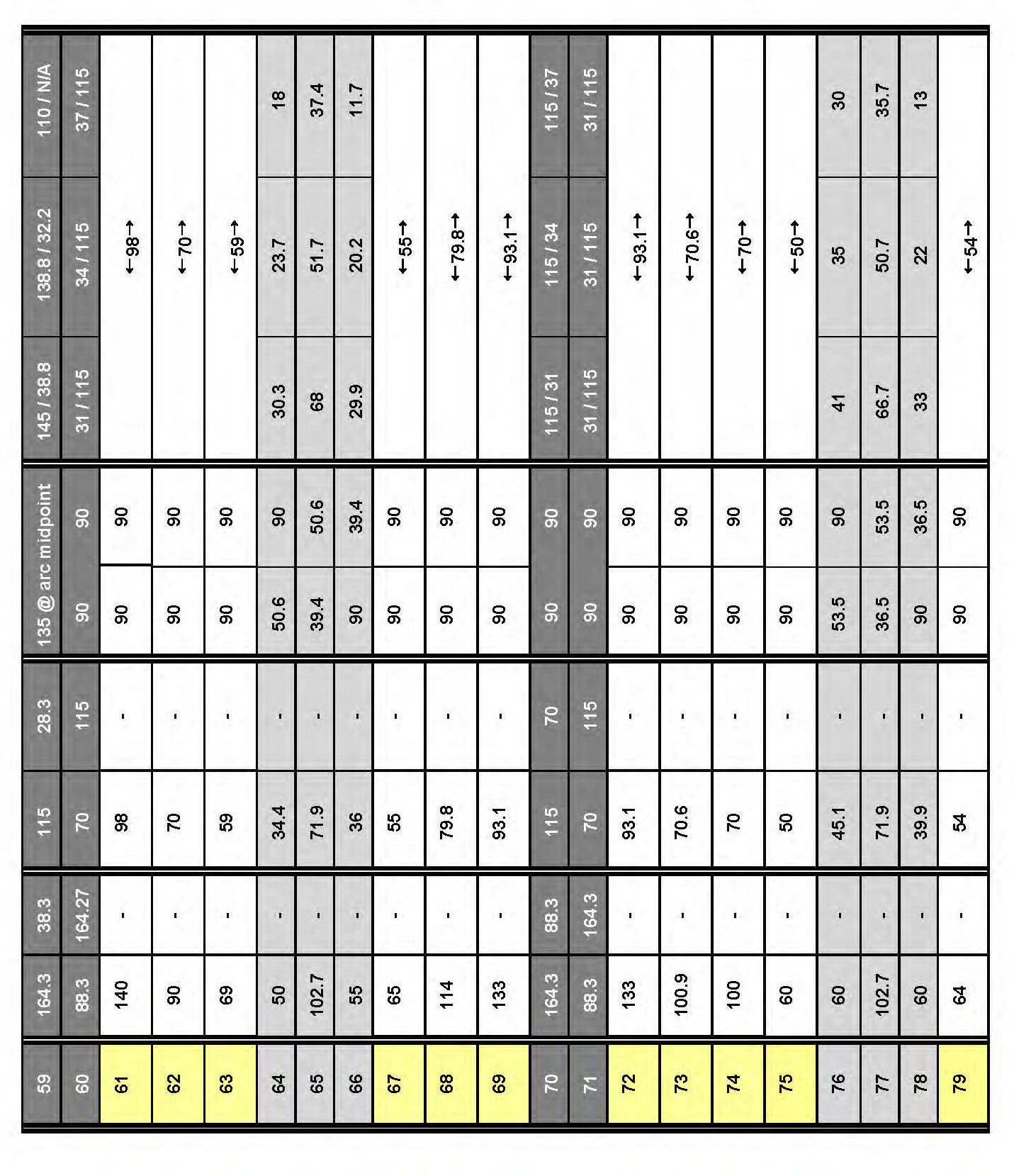
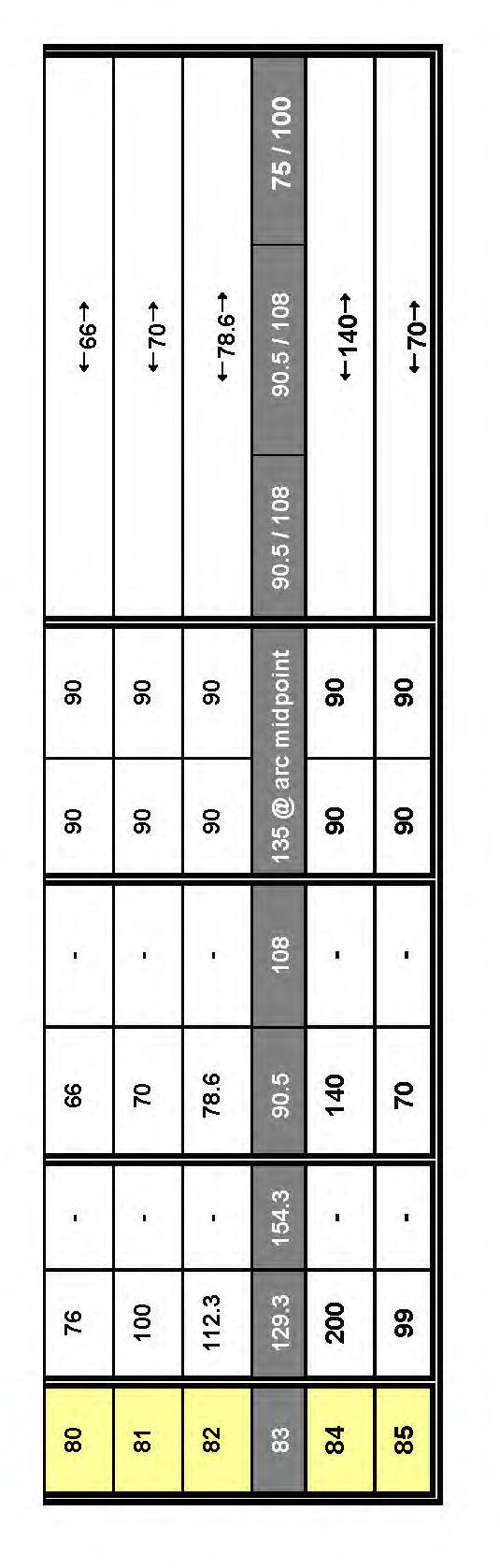
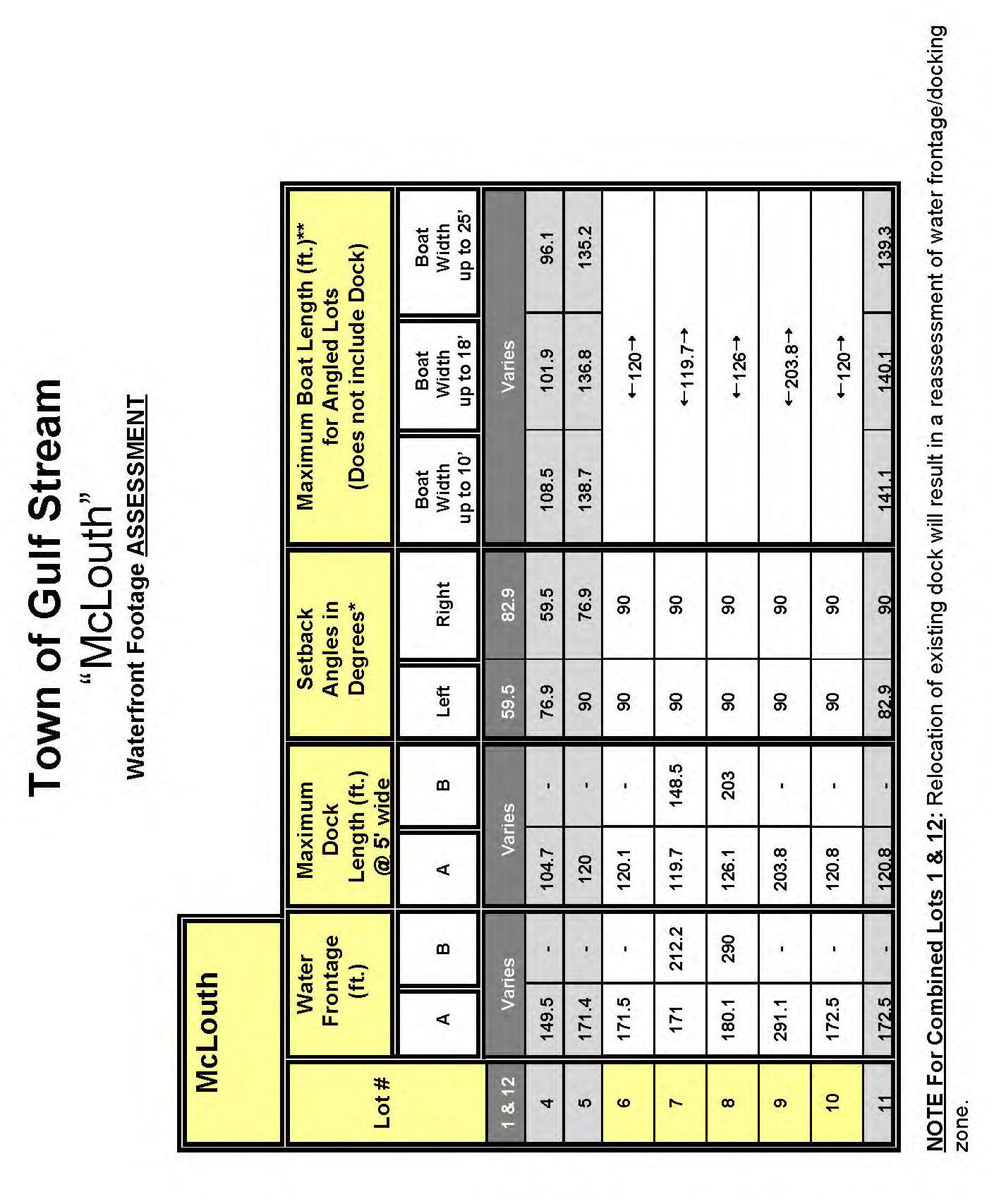
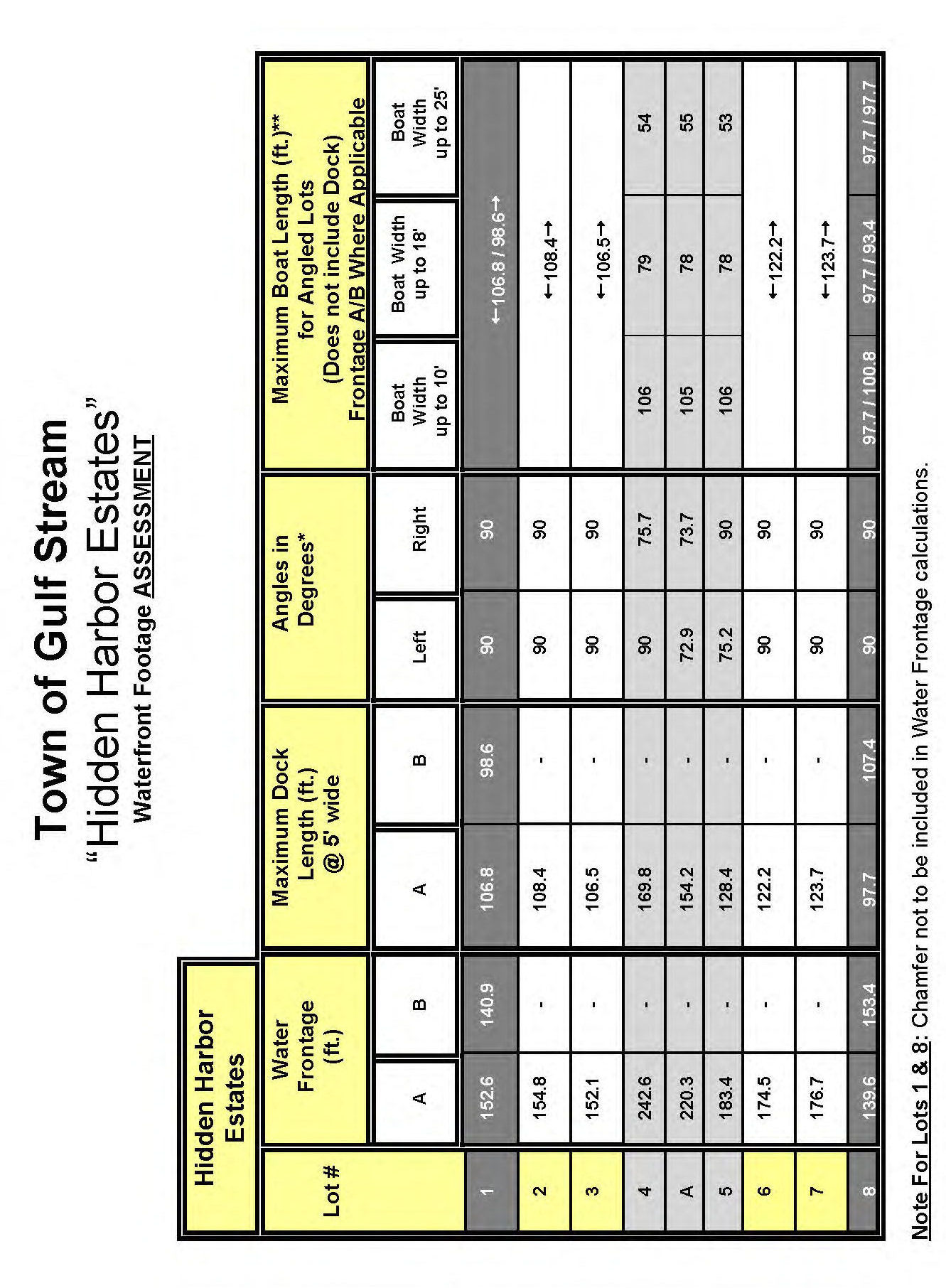
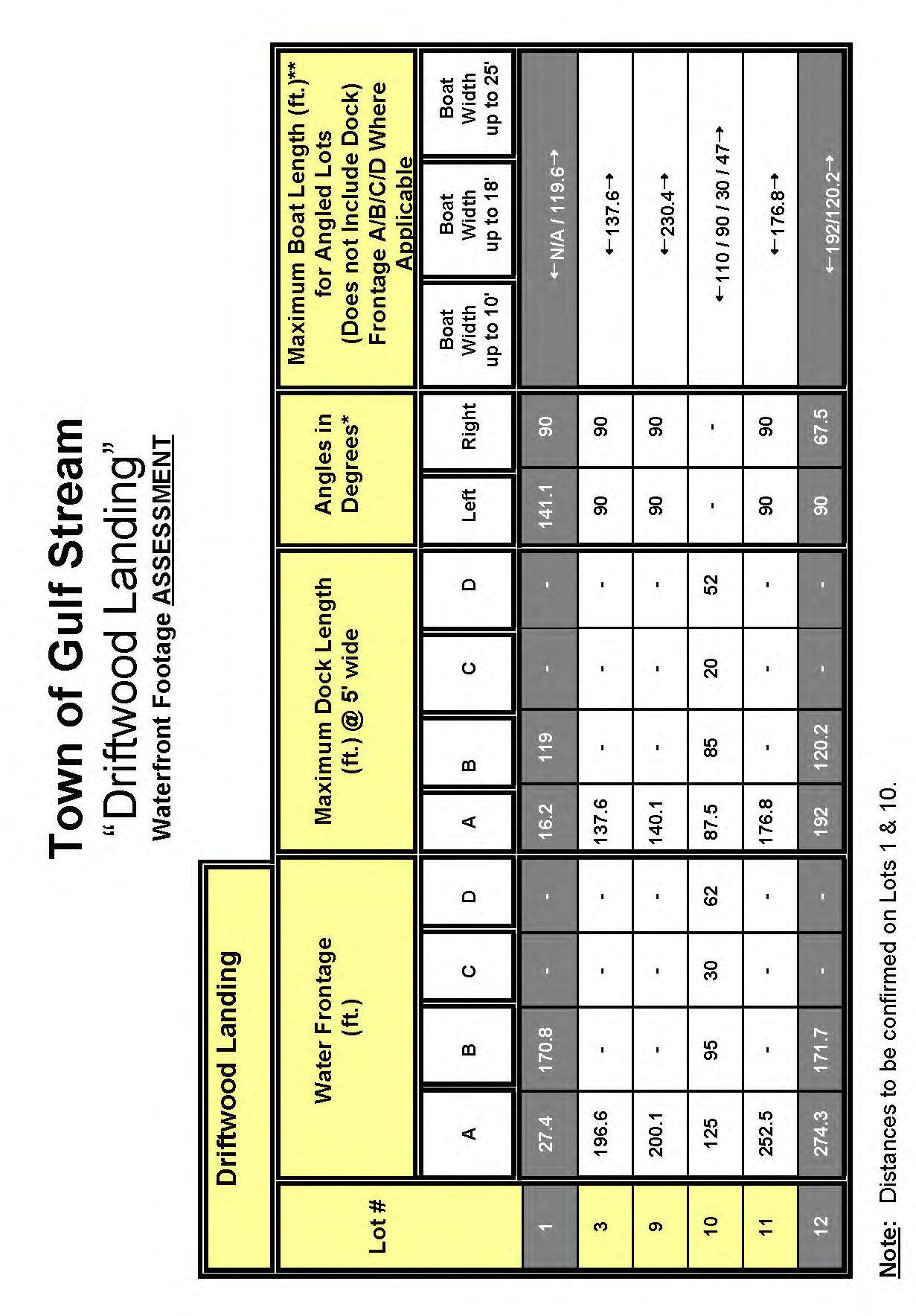
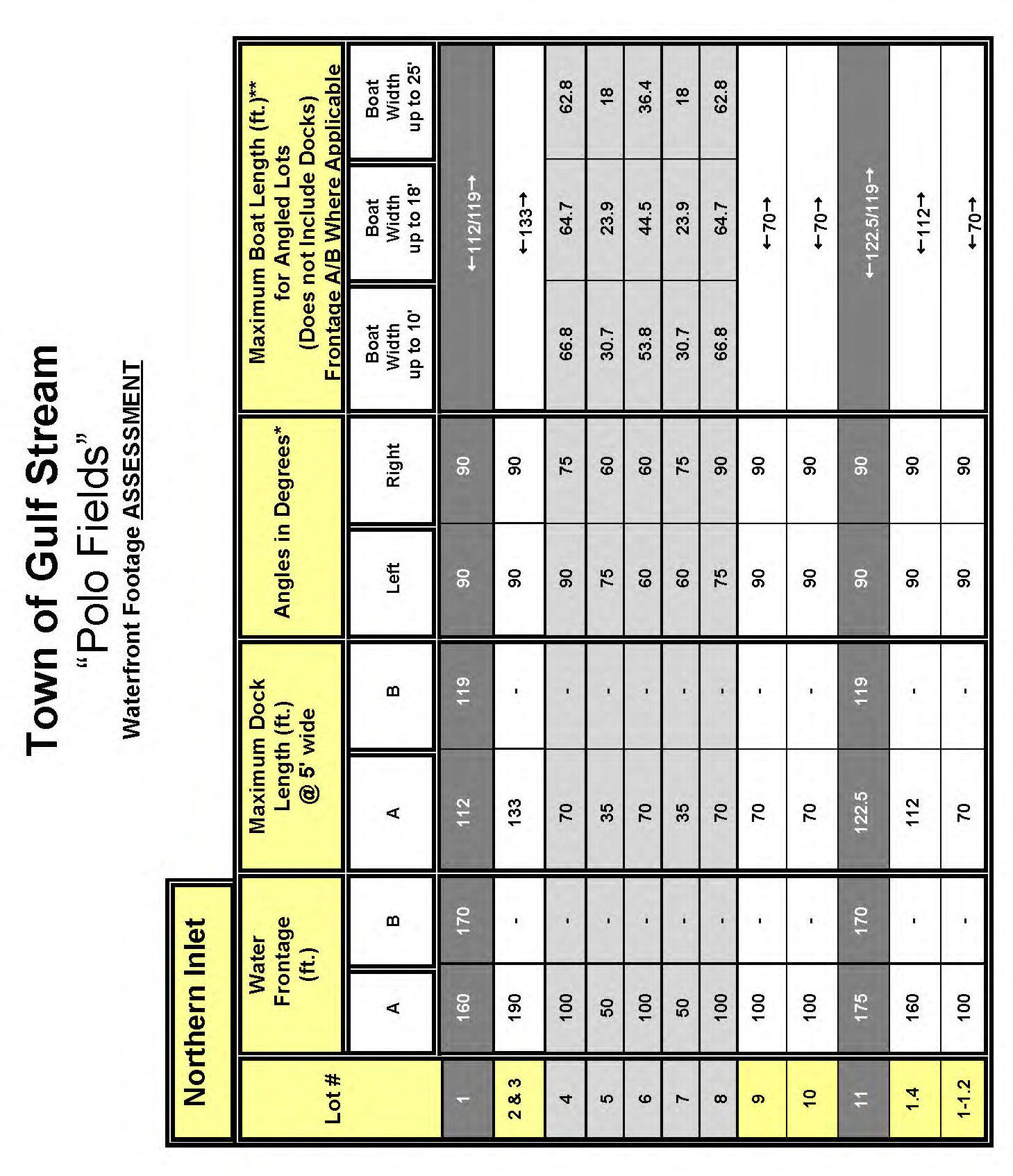
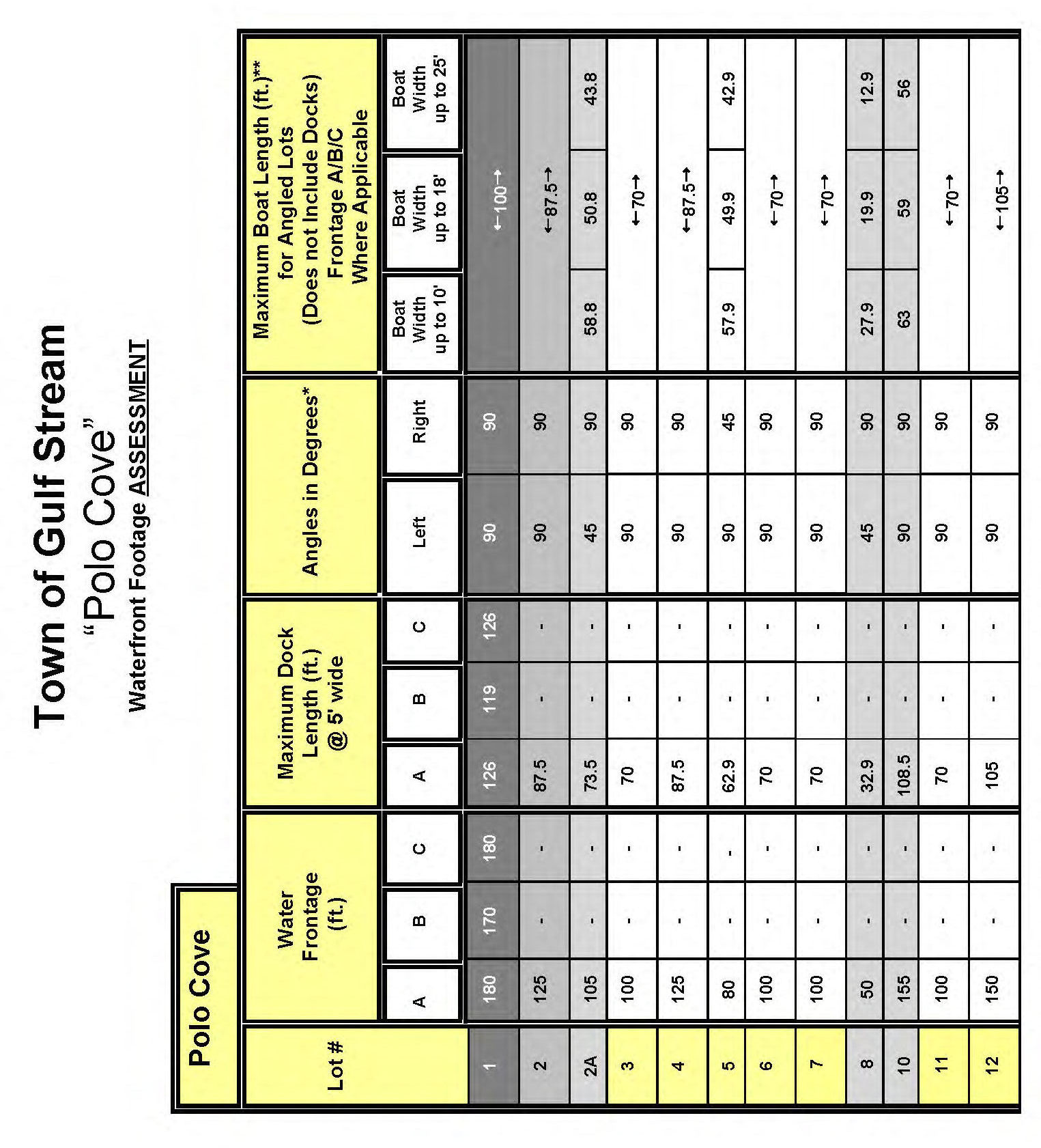
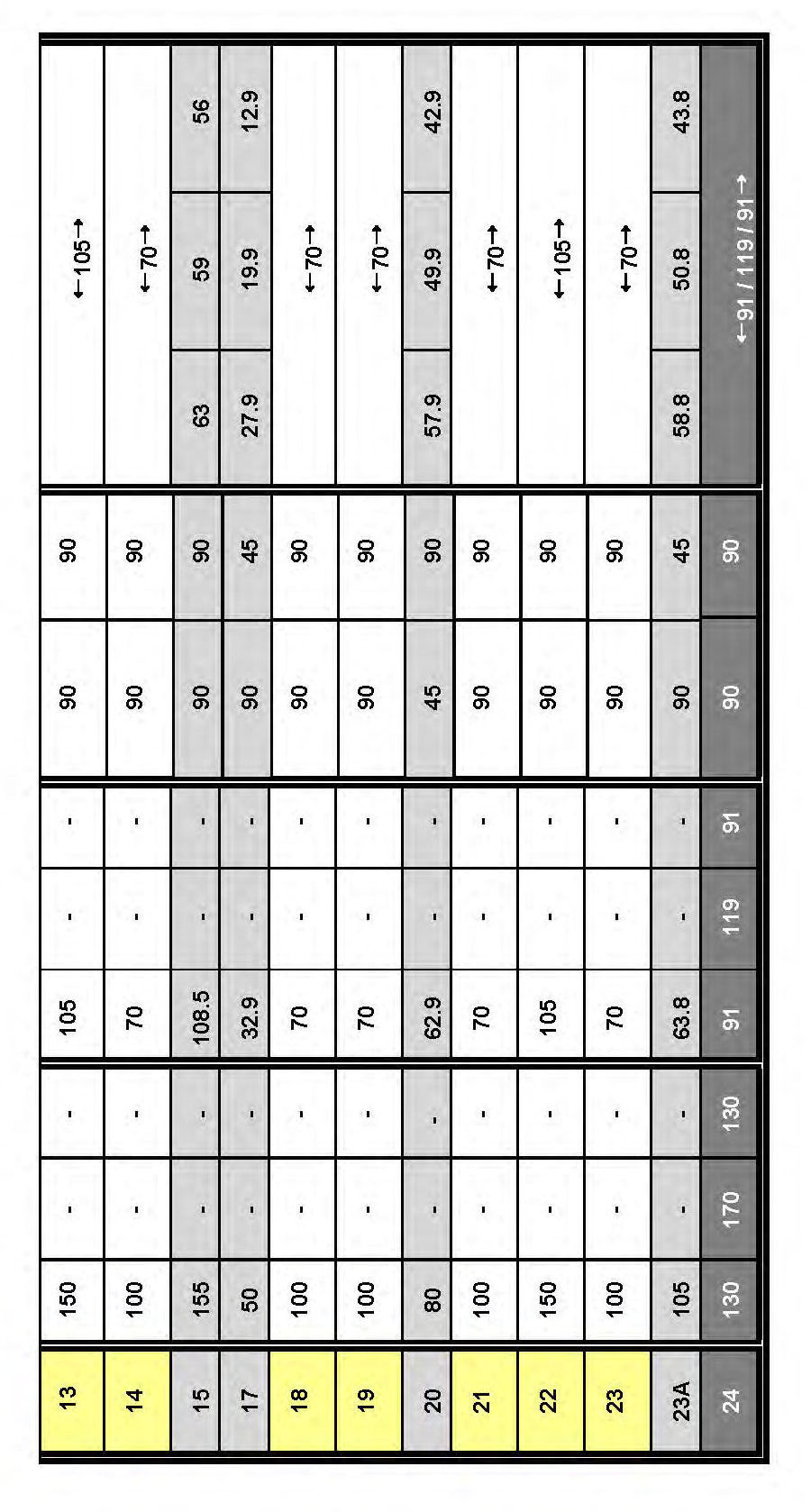
Town of Gulf Stream
"Gulfstream Cove"
Waterfront Footage ASSESSMENT
*Left and Right determined as viewed from house.
**While these provisions will account for the majority of boats, any variations will require owner to submit documentation proving compliance with code.
(Ord. No. 83-1, § 2(X, I, 3), 4-8-83; Ord. No. 91-24, § 3, 10-21-91; Ord. No. 00-1, §§ 20, 21, 3-10-00; Ord. No. 04-9, § 2, 2-11-05; Ord. No. 05-2, §§ 1—6, 9-9-05; Ord. No. 08-4, § 4, 9-5-08; Ord. No. 12-4, § 9, 7-13-12; Ord. No. 20-3, § 1(Att. 1), 8-14-20; Ord. No. 22-4, § 1, 4-8-22)
Sec. 66-370. - Approval of other residential recreational facilities.
Any other residential recreational facilities shall not be located on any property zoned for residential purposes without the express approval of the architectural review and planning board and town commission.
(Ord. No. 83-1, § 2(X, I, 4), 4-8-83; Ord. No. 91-12, § 2, 1-21-91)
Sec. 66-381. - Carports prohibited.
No carport shall be erected or permitted within any zoning district in the town.
(Ord. No. 83-1, § 2(X, E), 4-8-83)
Sec. 66-382. - Garages, storage facilities, etc.—Materials restricted.
Any garage, storage room or other similar detached facility shall be conventional construction of wood frame or CBS. No metal buildings or structures shall be permitted. No mobile home, manufactured home or trailer is permitted within any zoning category within the town.
(Ord. No. 83-1, § 2(X, F, 1), 4-8-83)
Sec. 66-383. - Same—Setbacks.
All approved garage, storage or similar facilities shall meet all yard requirement setbacks of the district in which the property is located and shall be located in such a manner so as not to face any public street or roadway, or shall be adequately screened or buffered so as not to be visible from any public street or roadway. However, for lots of less than 20,000 square feet, garages shall be permitted to face the street without screening.
(Ord. No. 83-1, § 2(X, F, 2), 4-8-83; Ord. No. 91-23, § 3, 10-21-91)
Sec. 66-384. - Temporary storage units.
The above provisions are not applicable to temporary roll off storage units such as portable on demand storage units or temporary storage units. Said units are permitted on a property for a maximum period of 48 hours without the necessity of a permit. Temporary storage units which are located on a property for a period of time longer than 48 hours shall require a permit from the town and shall be entitled to remain on a property for a maximum period of seven cumulative days during any 12-month period. The permit fees for the placement of said units shall be $150.00 per storage unit.
(Ord. No. 09-5, § 1, 11-13-09)
Sec. 66-396. - Required.
Landscaping shall be provided in all zoning districts in the town according to the following regulations:
(Ord. No. 83-1, § 2(X, L), 4-8-83)
Sec. 66-397. - Open land uses and buffers.
(a)
Open land uses shall mean open air parking lots, private or public. Any open land use area which abuts any public street right-of-way or abuts or is across an alley from any land used for residential use shall be required to provide a planting strip inside the property line. Such planting strip on the front property line shall be not less than three feet in width and shall be provided with a hedge of not less than one foot or more than three feet in height to form a continuous screen between the open land use and the public street right-of-way.
(b)
In the planting strip on land used for multiple-family residential which is abutting and/or immediately adjacent to single-family residential there shall be erected a living hedge not more than seven feet from the residential property line. Such hedge must be planted within 30 days after occupancy or use of the property, must be planted not more than three feet apart, and must be maintained at a height of not less than seven feet.
(c)
The area of the required planting strip not occupied by a fence or hedge shall be provided with grass or other plant ground cover material. In addition, one tree shall be provided for each 40 lineal feet of such landscaped area. Such trees shall be not less than eight to ten feet high at time of planting and be of such variety that at maturity they will have a crown spread not less than 15 feet.
(d)
For new construction or renovations of a second floor of a single-family house within the Gulf Stream Core, North/South and Place Au Soleil zoning districts, trees shall be planted in a manner so as to provide a buffer of the full second story and in no event less than 40 linear feet along the side yards adjacent to the second story portion of the house. The subject trees shall be not less than ten to 12 feet in height at the time of planting and be of such variety that at maturity they will have a crown spread of not less than 20 feet. Existing trees that meet these minimum height and crown spread standards may be used to meet this requirement.
(Ord. No. 83-1, § 2(X, L, 1—3), 4-8-83; Ord. No. 16/01, § 1, 2-12-16)
Sec. 66-398. - Accessways.
Necessary accessways from public rights-of-way through all required landscaped areas shall be permitted to service the open land use.
(Ord. No. 83-1, § 2(X, L, 4), 4-8-83)
Sec. 66-399. - Irrigation.
All landscaped areas and plantings shall be provided with facilities for irrigation, automatic or at least one hose connection within 100 feet of every landscaped area sufficient to reach every portion of the landscaping.
(Ord. No. 83-1, § 2(X, L, 5), 4-8-83)
Sec. 66-400. - Parking areas.
(a)
In open parking areas there shall be one minimum five-foot by five-foot tree planting area for each 20 parking spaces. Trees of the species designated by the town shall be planted in each planting area and meet the landscaping requirements of the town.
(b)
In parking areas where an off-street parking area adjoins or abuts property under different ownership or use, a landscaped planting strip not less than five feet wide maintained in good condition with a hedge at a minimum height of three feet shall be required.
(Ord. No. 83-1, § 2(X, L, 6, 7), 4-8-83)
Sec. 66-401. - Use of native vegetation.
The town shall require the use of native vegetation, wherever possible, in landscaped areas.
(Ord. No. 83-1, § 2(X, L, 8), 4-8-83)
Sec. 66-402. - Existing trees.
Existing trees shall be conserved and integrated into the landscaping design plan wherever practical.
(Ord. No. 83-1, § 2(X, L, 9), 4-8-83)
Sec. 66-416. - Parking of recreational equipment or commercial vehicles—On property.
(a)
Panel trucks, pickup trucks, vans or similar types of trucks and commercial vehicles of not over three-quarter-ton rated capacity and recreational, boating and camping equipment in the form of travel and camping trailers, boats on trailers and truck trailers designed and used as temporary living quarters for recreation, boating, camping or travel use may be parked on a lot containing a single-family residence in the residential districts subject to the following conditions:
(1)
The equipment must be owned by and used primarily by a resident of the premises; provided however, that a guest of the resident of the premises may park such equipment in the front yard for not more than three days in any 14-day period. For the purpose of this division, any part of a 24-hour period measured from 12:00 midnight to 12:00 midnight shall be considered as one day.
(2)
The location for such parked equipment shall be in the rear yard or in the side yard to the rear of a line established by the front building line adjacent to the side yard where the equipment is located; provided, however, that on corner lots such equipment shall not be parked on the side yard which faces a public street, and also provided that such parked equipment shall not exceed eight feet in height and shall not exceed eight feet in height and shall be fully screened from off-premises view.
(3)
Such equipment and the area of parking shall be maintained in a clean, neat and presentable manner and the equipment shall be in a usable condition at all times.
(4)
Such equipment shall at all times have attached a current vehicle registration license plate and if required a current inspection sticker.
(5)
No major repair or overhaul work on such equipment which constitutes either a public or private nuisance shall be made or performed on the site.
(6)
When parked on the site such equipment shall not be used for living or sleeping quarters or for housekeeping or storage purposes and shall not have attached thereto any service connection lines except as may periodically be required to maintain the equipment and appliances.
(7)
None of the vehicles or equipment described in this section may be parked in the area between the street plot line and the structure; however one of the vehicles described herein may be parked in the front yard driveway for a period not exceeding four hours in any one 24-hour period. Recreational equipment may be parked in this area for not more than four days in any 14-day period for the purpose of loading or unloading the contents.
(8)
None of the vehicles or equipment described in this section may be parked on a vacant lot within the town; however, such equipment may be parked on a lot adjacent to a lot containing a single-family residence subject to a unity of title being executed by the owner thereto and recorded in the public records of the county, such unity of title tying thereto the vacant lot and the adjacent property containing the single-family residence. Any of the equipment described in this section which is parked on the vacant lot shall comply with all provisions of this section.
(b)
This section shall not apply to the parking of vans and similar types of vehicles used primarily for personal transportation rather than commercial purposes.
(Ord. No. 83-1, § 2(X, L, 1), 4-8-83; Ord. No. 92-4, § 2, 9-28-92; Ord. No. 00-1, § 22, 3-10-00; Ord. No. 03-7, § 1, 10-10-03)
Sec. 66-417. - Same—On public property; exceptions.
(a)
No commercial vehicle or truck over three-quarter-ton rated capacity, may be parked on any property or right-of-way within the town.
(b)
This restriction shall not apply to:
(1)
The temporary parking of such vehicles on private property in residential areas whereon construction is underway for which a current and valid building permit has been issued by the town and such permit is properly displayed on the premises.
(2)
Routine deliveries by tradesmen or the use of trucks in making service calls, providing that such time period is actually in the course of business deliveries or servicing, as the case may be.
(3)
The parking of emergency vehicles, providing that the time parked is actually necessary for the emergency.
(4)
A situation where such vehicle becomes disabled and, as a result of such emergency, is required to be parked within a residential district for longer than the time allowed herein. However, any such vehicles shall be removed from the residential district within 24 hours by wrecker towing, if necessary, regardless of the nature of the emergency; and the cost of such towing shall be at the expense of the owner of the vehicle.
(Ord. No. 83-1, § 2(X, L, 2), 4-8-83)
Sec. 66-431. - State Road A1A.
(a)
There is hereby fixed the setback distance for the construction and erection of buildings and improvements along the right-of-way of State Road A1A through the town at 78 feet from the centerline of the road unless otherwise specified in the Code.
(b)
No building permit shall be granted by the town for the construction of buildings or other improvements within 78 feet of the centerline of State Road A1A.
(c)
Any buildings, improvements or facilities now existing which are located within a distance of less than 78 feet from the centerline of State Road A1A are classified as nonconforming uses, but such uses shall not be extended and all future changes or alterations shall conform to the setback line.
(Ord. No. 83-1, § 2(X, D, 1—3), 4-8-83; Ord. No. 00-1, § 23, 3-10-00)
Sec. 66-432. - Coastal areas.
Construction in coastal areas of the town must comply with all of the provisions of the "Palm Beach County Coastal Construction and Excavation Setback Ordinance No. 72-12" and the construction control line established by the state bureau of beaches and shores, which ordinance or its successor shall prevail in the absence of a conflicting town ordinance.
(Ord. No. 83-1, § 2(X, D, 2), 4-8-83)
Sec. 66-446. - Legislative purpose and intent.
(a)
The purpose and intent of the regulations in this division is to establish content neutral graphic controls through the promotion of identification; to facilitate clear communication through signs; to reduce traffic and structural hazards; and to advance a visual and aesthetically pleasing environment for the town's residents and visitors. More specifically, the town commission is adopting these regulations to achieve the following goals and objectives:
(1)
Preserve, protect, and promote the public health, safety, and general welfare;
(2)
Preserve and enhance the aesthetics and physical appearance of the town;
(3)
Protect and preserve the image, character, style and quality of life the town desires to promote;
(4)
Minimize visual distractions to motorists using the town streets;
(5)
Safeguard the public use and nature of the town's streets, sidewalks, and public property;
(6)
Allow the proper placement of legible and effective signs while avoiding the over concentration and excessive height, bulk, density and area of signs placed in the town;
(7)
Preserve the value of private property by assuring the compatibility of signs with nearby land uses;
(8)
Provide signs that are legible in the circumstances and context in which they are presented;
(9)
Control visual clutter and encourage high professional standards in sign display and design.
(b)
Applicability, substitution and severability.
(1)
Applicability. All signs shall be erected, placed, established, created, or maintained in the town only in conformance with the standards, procedures, exemptions, and other requirements of this division. All signs are subject to the Florida Building Code and Fire Prevention Code. Signs that are not specifically permitted by this division are prohibited.
(2)
Substitution of noncommercial for commercial speech. Notwithstanding any provision in this division to the contrary, to the extent that any permitted sign could be construed as a sign containing commercial copy, it shall permit a noncommercial sign to the same extent. The noncommercial message may occupy the entire sign area or any portion thereof, and may substitute for or be combined with any commercial message. The sign message may be changed as frequently as desired by the sign's owner, provided it is not a prohibited sign and continues to comply with the requirements of this division.
(3)
Severability. It is declared to be the intent of the commission that, if any section, subsection, paragraph, subparagraph, sentence, clause, phrase, or word of this division is declared to be, or for any reason held, invalid or declared unconstitutional by any court of competent jurisdiction, this declaration of unconstitutionality or invalidity shall be deemed separate, distinct, and independent, and shall not affect the validity of any other part, section, subsection, sentence, phrase, clause term, or word. This subsection shall not be interpreted to limit the effect of any other severability provisions contained herein or in any other ordinances. The commission specifically intends that severability shall be applied to the sign regulations in this division even if the result would be to allow less speech in the town, whether by subjecting currently exempt signs to permitting or by some other means. This subsection shall not be interpreted to limit the effect of the severability provision of this section or any other town ordinance. The commission specifically intends that severability shall be applied so that any prohibited sign shall continue to be prohibited irrespective of whether another sign prohibition is declared invalid or unconstitutional.
(Ord. No. 15/1, § 3, 1-26-15)
Editor's note— Ord. No. 15/1, § 3, adopted Jan. 26, 2015, repealed §§ 66-446—66-448, which pertained to restriction, specifications for permitted signs, and approval required, respectively, and derived from Ord. No. 83-1, § 2(X, C), adopted April 8, 1983; Ord. No. 92-3, § 1, adopted Sept. 28, 1992; Ord. No. 03-5, § 1, adopted Oct. 10, 2003; and Ord. No. 08-4, § 5, adopted Sept. 5, 2008.
Sec. 66-447. - Signs generally.
(a)
Definitions.
(1)
Sign means any commercial or non-commercial wording or reading matter, illustration, logo, insignia, sculpture, molding, casting, object, bunting, symbol, letter, figure, character, mark, plane, point, design, poster, pictorial picture, stroke, stripe, line, trademark, and all parts composing the same, together with the actual sign face, frame, background, structure or anything supporting the same which shall be so constructed, placed, attached, painted, erected, fastened or manufactured in any manner whatsoever, so that the same shall be used for attracting the attention of the public to any place, subject, information, person, firm, corporation, public performance, article, machine or merchandise. Sign does not include numerals.
(2)
Numeral means a figure expressing a number or series of numbers solely for purposes of identifying a property's address or location.
(3)
Sign area means the square foot area enclosed by the perimeter of the sign structure.
(4)
Sign face means that part of a sign that is or can be used to identify, advertise or communicate information or for visual representation, which attracts the attention of the public for any purpose. It includes any background material, panel, trim, color, and internal or external illumination used that differentiates the sign from the building, structure, backdrop surface or object upon or against which the sign is placed.
(5)
Government sign means any sign on public property or within state, county, or town rights-of-way which are either required by law or necessary and incidental to the performance of governmental activities and responsibilities. This includes directional signs erected or placed by a governmental agency denoting the name of streets, public buildings, parks and recreational facilities, and those which regulate traffic or provide information to vehicular and pedestrian traffic.
(Ord. No. 15/1, § 3, 1-26-15)
Note— See editor's note at § 66-446.
Sec. 66-448. - Time, place and manner regulations pertaining to signs.
(a)
No sign shall exceed four feet in height, including any supporting pole, structure or base as measured from the ground up.
(b)
The sign face of any sign shall not exceed four square feet.
(c)
Each property in the town shall be permitted to have a maximum of 12 square feet of sign face whether the sign is one-sided or double-faced.
(d)
All signs on properties shall be set back ten feet from any property line on the property on which the sign is placed.
(e)
No sign shall be erected or placed such that it blocks the views of any government sign or the sight lines of traffic, street signs, or traffic signals.
(f)
No signs, other than government signs, are permitted on public property or within the rights-of-way.
(g)
No sign may be attached to, affixed to, painted on, or otherwise placed upon any dwelling or other building associated with a dwelling, including but not limited to, sheds, carports, garages, and pool houses.
(h)
Government signs are not subject to the restrictions in subsections (a)—(g) above.
(Ord. No. 15/1, § 3, 1-26-15)
Note— See editor's note at § 66-446.
Sec. 66-449. - Time, place and manner regulations pertaining to numerals.
(a)
Any numeral shall not exceed two square feet.
(b)
Each property in the town shall be permitted to have a maximum of four square feet of numerals.
(c)
No numeral shall be erected or placed such that it blocks the views of any government sign or the sight lines of traffic, street signs, or traffic signals.
(d)
No numerals are permitted within the rights-of-way. Mailboxes regulated by federal laws are exempt from this provision.
(Ord. No. 15/1, § 3, 1-26-15)
Sec. 66-450. - Undergrounding of utilities.
All utility service lines shall be placed underground.
(Ord. No. 03-9, § 1, 10-10-03; Ord. No. 15/1, § 3, 1-26-15)
Editor's note— Ord. No. 15/1, § 3, adopted January 26, 2015 renumbered the former § 66-449 as § 66-450. The historical notation has been preserved for reference purposes.
Sec. 66-456. - Wireless communications towers and antennas.
The Town of Gulf Stream finds that it is in the public interest to limit the siting of wireless communications towers and antennas within the municipal boundaries of the town. The following conditions shall apply:
(1)
A tower to support wireless communications antennas, designed primarily for the purpose of serving residents of the town, may be permitted within the town-owned property subject, however, to the tower being available for use jointly to provide public safety communications and further subject to a license or lease authorizing the use of said tower having been approved by the town commission.
a.
Any lease of the tower referenced herein shall be subject to terms and conditions satisfactory to and approved by the town commission.
(2)
Wireless communications antennas shall be permitted on towers as provided for in subsection (1) or lightpole structures located in rights-of-way or easements within the town subject to the following conditions:
a.
The height of the antenna cannot exceed two feet above the existing lightpole structure.
b.
All lightpole-mounted antennas shall be of a stealth design so that they are architecturally designed or camouflaged to be compatible with surrounding land uses, except that such antennas located in residential zoned areas must be screened from the view of residents and pedestrians.
c.
Equipment cabinets associated with lightpole-mounted antennas shall be of a scale that makes them no more visually obtrusive than other types of utility equipment boxes normally located within the rights-of-way within the town; and architecturally designed or camouflaged to be compatible with surrounding land uses, except that such equipment cabinets located in residential zoned areas must be screened from the view of residents and pedestrians.
d.
The town must approve the noise level and location of any generators or other equipment.
(3)
Applicants may request a permit to site a wireless communications antenna upon the following conditions:
a.
Payment of a non-refundable application fee of $1,000.00.
b.
Provide to the town's building official an inventory of the applicant's existing towers, antennas, or sites approved for towers or antennas that provide service or coverage within the town, including specific information about the location, height, and design of each tower, antenna or site.
c.
All costs relating to the installation of the antenna or any ancillary equipment relating thereto shall be borne by the applicant.
d.
Space availability shall be on a first come-first served basis.
(4)
No tower or antenna shall be permitted in the town, except pursuant to subsections (1), (2), and (3) above, unless the applicant demonstrates to the reasonable satisfaction of the town commission that no reasonable alternative exists that can accommodate the applicant's proposed telecommunications service. An applicant shall submit information requested by the town commission relating to the availability of suitable existing towers, other structures or alternative technology. Evidence to demonstrate that no existing tower, structure or alternative technology can accommodate the applicant's proposed service may consist of any of the following:
a.
No existing towers or structures located within the relevant geographic area accommodate antennas adequate to provide the applicant's service within the town.
b.
The applicant demonstrates to the satisfaction of the town commission that there are other limiting factors that render existing towers and structures unsuitable.
c.
The applicant demonstrates that an alternative technology, such as a cable microcell network using multiple low-powered transmitters/receivers attached to a wire line system, is unsuitable.
(5)
Special exceptions. If the town commission determines that no reasonable alternative exists that can accommodate the applicant's proposed telecommunications service, a special exception may be considered by the board of adjustment. Special Exceptions may be granted for the location of towers or antennas in the town subject, however, to the following conditions:
a.
Information required. All applications for a special exception for a tower/antenna shall include the following:
1.
Scaled site plan clearly indicating the location, type and height of the proposed tower/antenna, onsite land uses and zoning, adjacent land uses and zoning (including when adjacent to other municipalities), comprehensive plan future land use designation of the site, proposed means of access, setbacks from property lines, elevation drawings of the proposed tower/antenna and any other structures, topography, parking, and other information deemed by the building official to be necessary to assess compliance with this division.
2.
Legal description of the property tract and leased parcel (if applicable).
3.
The setback distance between the proposed tower/antenna and the nearest residential unit, platted residentially zoned properties, and unplatted residentially zoned properties.
4.
The separation distance from other towers/antennas described in the inventory of existing sites submitted pursuant to subsection (4) shall be shown on an updated site plan or map. The applicant shall also identify the type of construction of the existing tower(s)/antenna(s) and the owner/operator of the existing tower(s), if known.
5.
A landscape plan showing specific landscape materials and the parties responsible for maintenance.
6.
A description and diagram of the design for the proposed site, tower(s)/antenna(s) and related structures. The design of the site, tower(s)/antenna(s) and related structures shall be of a stealth design, meaning that, to the maximum extent possible, the design shall use materials, colors, textures, screening, and landscaping that will blend the tower/antenna site and structures into the natural setting and surrounding buildings. All designs shall require approval by the town. The town may direct revisions in the proposed design as necessary to protect the public interest.
7.
Method of providing a security enclosure and stealth design for the enclosure and, if applicable, illumination including photometrics.
8.
A description of compliance with all applicable federal, state or local laws including all provisions within this zoning ordinance.
9.
A notarized statement by the applicant's engineer as to whether construction of the proposed tower will accommodate collocation of additional antennas for future users including number, largest size and type.
10.
Identification of the entities providing the backhaul network for the tower(s)/antenna(s) described in the application and other cellular sites owned or operated by the applicant in the town and adjacent areas.
11.
A description of the suitability of the use of existing towers, other structures or alternative technology not requiring the use of towers or structures to provide the services to be provided through the use of the proposed new tower.
12.
The structure is designed to accommodate colocations of equipment and attachments with a minimum wind load rated at 130 mph.
13.
That the applicant posts a bond for performance in favor of the town.
b.
Factors considered in granting special exception approval for towers and/or antennas. In addition to any standards for consideration of special exception applications specified in section 66-164 of this Code, the board of adjustment shall consider the following factors in determining whether to approve a special exception:
1.
Height of the proposed tower/antenna;
2.
Proximity of the tower/antenna to residential structures and residential district boundaries;
3.
Nature of uses on adjacent and nearby properties;
4.
Surrounding topography;
5.
Surrounding tree coverage and foliage;
6.
Stealth design of the tower/antenna site and structures, with particular reference to design characteristics that have the effect of reducing or eliminating visual obtrusiveness;
7.
Proposed ingress and egress;
8.
Availability of suitable existing towers, antennas, other structures or alternative technologies not requiring the use of towers or structures;
9.
Set-back distance for a proposed tower equal to at least 110 percent of the height of the tower from any adjoining recreational zoned property lot line and at least 130 percent of the height of the tower from any adjoining residentially zoned property lot line;
10.
Guys and accessory buildings satisfy the minimum zoning district setback requirements;
11.
Existing mature tree growth and natural landforms on the site preserved to the maximum extent possible and additional landscaping to the extent determined reasonably necessary by the board of adjustment to screen the tower from view from residential properties.
c.
All tower and wireless communications antenna owners must comply with the following requirements:
1.
All towers and antennas must meet or exceed current standards and regulations of the Federal Aviation Administration (FAA), the Federal Communications Commission (FCC), and any other agency of the state or federal government with the authority to regulate towers and antennas. If such standards and regulations are changed, then the owners of the towers and antennas governed by this ordinance shall bring such towers and antennas into compliance with such revised standards and regulations within six months of the effective date of such standards and regulations. Failure to bring towers and antennas into compliance with such revised standards and regulations shall constitute grounds for the removal of the tower or antenna at the owner's expense.
2.
The owner of a tower shall ensure the structural integrity of towers and related structures. The tower and structures must be maintained in compliance with standards contained in applicable state or local building codes and the applicable standards for towers that are published by the Electronic Industries Association, as amended from time to time. If, upon inspection, the Building official or his/her designee concludes that the tower or a related structure fails to comply with such codes or standards and constitutes a danger to persons or property, then the owner shall bring such tower or structure into compliance with such codes or standards within 30 days of receiving written notice from the town. Failure to bring such tower or structure into compliance within said 30 days shall constitute grounds for removal of the tower and attached antenna(s) or related structure at the owner's expense.
3.
No signs, other than those required by law and preapproved by the town, shall be allowed on a tower, antenna or related structure or enclosure, including fences.
4.
Any tower or antenna that is not operated for a continuous period of two years shall be considered abandoned, and the owner of such tower or antenna shall remove same, along with any related structures, with 90 days of receipt of written notice from the town notifying the owner of such abandonment. Failure to remove an abandoned tower or antenna within said 90 days shall be grounds for the town to remove the tower or antenna and any related structures at the owner's expense.
(6)
The term "wireless communications antenna" means any exterior device used in communications that radiates or captures electromagnetic waves, digital signals, analog signals, radio frequencies (excluding radar signals), wireless telecommunications signals or other communications signals. This term does not include over-the-air reception devices which deliver or receive broadcast signals, direct broadcast signals, direct broadcast satellite services or multichannel multipoint distribution services, as defined and regulated by 47 C.F.R. § 1.4000, as amended.
(Ord. No. 04-2, § 1, 8-13-04; Ord. No. 08-4, § 6, 9-5-08)

