
Gulfport City Zoning Code
ARTICLE XVII
SIGNS AND ADVERTISING
Sec. 22-17.01.- Purpose and intent.
The purpose and intent of this article is to establish regulations for the uniform control of signs and advertising displays within the City of Gulfport. These regulations are designed to protect and promote the general health, safety and welfare of the public in a manner consistent with the following objectives:
(1)
To foster an aesthetic environment that enhances the city's potential for attracting sources of economic redevelopment and growth;
(2)
To improve safe movement of vehicular and pedestrian traffic;
(3)
To minimize the possible adverse effect of signs on nearby public and private property; and
(4)
To enable the fair and consistent enforcement of these regulations.
(Ord. No. 91-5, § 3, 4-16-91)
Sec. 22-17.02. - Applicability effect.
Any and all signs erected, placed, established, displayed, painted, created, altered, or maintained in the city shall be in compliance with the standards, procedures, exemptions, and other requirements of this article. The effect of this article, as more specifically set forth herein, is:
(1)
To establish a permit system to allow a variety of types of signs in commercial districts and a limited variety of signs in other districts subject to the standards and the permit procedures of this article;
(2)
To allow certain signs that are small, unobtrusive, and incidental to the principal use of the respective lots on which they are located, subject to the substantive requirements of this article, but without a requirement for permits;
(3)
To provide for temporary signs without commercial messages in limited circumstances in the public right-of-way;
(4)
To prohibit all signs not specifically allowed by this article; and
(5)
To provide for the enforcement of the provisions of this article.
(Ord. No. 91-5, § 3, 4-16-91)
Sec. 22-17.03. - Building/electrical codes maintenance.
These sign regulations are intended to complement the requirements of the building and electrical codes adopted by the city and Pinellas County. Wherever there is inconsistency between these regulations and the building or electrical codes, the more stringent requirement shall apply. All signs, including their supports, braces, guys and anchors, electrical parts and lighting fixtures, and all painted and display areas, shall be maintained in accordance with the building, electrical and other codes adopted by the city, and shall present a neat and clean appearance. Any sign, or any portion or part thereof, which constitutes a health, safety or fire hazard shall be prohibited.
(Ord. No. 91-5, § 3, 4-16-91)
Sec. 22-17.04. - Definitions.
Words and phrases used in this article shall have the meanings set forth herein. Words and phrases not defined in this article, but defined elsewhere in this chapter, shall be given the meanings provided. All other words and phrases shall be given their common, ordinary meaning, unless the context clearly requires otherwise. As used herein, the following terms are defined as provided:
Abandoned sign. A sign which advertises an activity or business which has not been conducted on the premises on which the sign is located for a period in excess of one hundred eighty (180) days.
Advertising. Sign copy intended to directly or indirectly promote the sale or use of a product, service, commodity, entertainment, or real or personal property.
Animated sign. Any sign that uses movement or change of lighting to depict action or create a special effect or scene, or any sign on which the message changes more than eight (8) times per day. Any portion or part of a sign on which the only copy that changes is an electronic or mechanical indication of time or temperature shall not be considered animated, for the purpose of this definition.
Banner. Any sign of lightweight fabric or similar material that is mounted by a frame to a pole or building.
Beacon (searchlight). Any light with one (1) or more beams directed into the atmosphere or directed at one (1) or more points not on the same zone lot as the light source; also, any light with one (1) or more beams that rotate or move.
Building sign. Any sign attached to any part of a building, as contrasted to a freestanding sign.
Commercial message. Any sign wording, logo, or other representation that, directly or indirectly, names, advertises, or calls attention to a business, product, service, or other commercial activity.
Copy. The linguistic or graphic content of a sign.
Flag. Any fabric, banner, or bunting, containing distinctive colors, patterns, or symbols, used as a symbol of a governmental, political, religious, civic or other entity.
Freestanding sign. Any sign supported by structures or supports that are placed on, or anchored in the ground and that are independent from any building or other structure.
Frontage. The length of the property line of any one (1) parcel along a street on which it borders.
Illuminated sign. A sign which contains a source of light, or which is designed or arranged to reflect light from an artificial source, including indirect, neon, incandescent, and back lighting, and shall also include signs with reflectors that depend upon automobile headlights for an image.
Institutional direction sign. An off-site sign, located on a public right-of-way, that provides direction to an institutional use, as set forth in article V of this chapter.
Lot. Any piece or parcel of land or a portion of a subdivision, the boundaries of which have been established by a legal instrument of record, that is recognized and intended as a unit for the purpose of transfer of ownership.
Marquee. Any permanent roof-like structure projecting beyond a building or extending along and projecting beyond the wall of the building, generally designed and constructed to provide protection from the weather.
Marquee sign. Any building sign attached to, or made a part of, a marquee, in any manner.
Memorial sign. Any sign indicating the name of a building, and the date and incidental information about its construction, which sign is cut into a masonry surface or made of bronze or other permanent, incombustible material.
Nonconforming sign. Any sign that does not conform to the requirements of this article that was lawfully erected within the city prior to the effective date of this article.
Off-site sign. Any sign, the subject matter of which relates to premises other than the premises on which the sign is located or to merchandise, services, activities, or entertainment not sold, produced, manufactured, furnished or conducted on the premises on which the sign is located.
Open flag sign. A flag sign displaying only the word "open" on both sides, that does not exceed six (6) square feet in size.
Open house sign. Any off-site sign of no more than four (4) square feet in area, containing nothing other than the word "open", the word "house", a directional arrow, the identification of the real estate agent conducting the open house to which the sign pertains, and the identification of the real estate broker conducting the open house to which the sign pertains.
Pennant. Any lightweight plastic, fabric, or other material, whether or not containing a message of any kind, suspended from a rope, wire, or string, usually in series, designed to move in the wind.
Permanent sign. Any sign other than a temporary sign, as defined herein.
Portable sign. Any sign not permanently attached to the ground or other permanent structure, or a sign designed to be transported, including, but not limited to, signs designed to be transported by means of wheels; signs converted to "A" or "T" frames; menu and sandwich board signs; balloons used as signs; umbrellas used for advertising; and signs attached to or painted on vehicles parked and visible from the public right-of-way.
Principal building. The building in which is conducted the principal use of the zone lot on which it is located. Zone lots with multiple principal uses may have multiple principal buildings, but storage buildings, garages, and other clearly accessory uses shall not be considered principal buildings.
Projecting sign. Any sign affixed to a building or wall in such a manner that its leading edge extends more than twelve (12) inches beyond the surface of such building or wall.
Real estate sign. Any sign intended for temporary use to advertise that an owner, either personally or through an agent, is actively attempting to sell, rent or lease the real property or portion of the real property on which the sign is located.
Roof sign. Any sign erected and constructed wholly on and over the roof of a building, and supported by the roof structure.
Roof sign, integral ("Integral Roof Sign"). A sign erected upon or against the side of a roof, architecturally integrated with the building and roof by a dormer or similar feature, and such that no part of the sign extends vertically above the highest portion of the roof.
Sandwich board signs. A type of portable sign of A-frame construction designed for placement in front of the place of business being advertised. Sandwich board signs are generally two-sided.
Setback. The distance from the property line to the nearest part of the applicable building, structure, or sign, measured perpendicularly to the property line.
Side property line. The property line between two (2) adjoining properties or lots.
Sign. Any device, fixture, placard, or structure that uses any color, form, graphic, illumination, symbol, or writing to advertise, announce or identify the purpose of a person or entity, or to communicate information of any kind to the public.
Temporary sign. Any sign, that is designed for short-term use or is not permanently mounted.
Wall sign. Any sign attached parallel to, but within twelve (12) inches of, a wall, painted on the wall surface of, or erected and confined within the limits of, an outside wall of any building or structure, which is supported by such wall or building, and which displays only one (1) sign surface.
(Ord. No. 91-5, § 3, 4-16-91; Ord. No. 92-6, § 1, 7-21-92; Ord. No. 97-23, § 1, 12-2-97; Ord. No. 2000-2, § 1, 2-1-00; Ord. No. 2006-05, § 2, 3-21-06; Ord. No. 2007-05, § 1, 6-5-07; Ord. No. 2012-07, § 1, 2-21-12)
Sec. 22-17.05. - Computations of area and height.
(a)
The area of a sign with only one (1) face (including the sign area of a wall sign) shall be computed by means of the smallest square, circle, rectangle, triangle, or combination thereof that will encompass the extreme limits of the writing, representation, emblem, or other display, together with any material or color forming an integral part of the background of the display or used to differentiate the sign from the backdrop or structure against which it is placed, but not including any supporting framework, bracing, or decorative fence or wall when such fence or wall otherwise meets zoning regulations and is clearly incidental to the display itself.
(b)
The sign area for a sign with more than one (1) face shall be computed by adding together the area of all sign faces visible from any one (1) point. When two (2) identical sign faces are placed back to back, so that both faces cannot be viewed from any point at the same time, and when such sign faces are part of the same sign structure and are not more than thirty-six (36) inches apart, the sign area shall be computed by the measurement of one (1) of the faces and the sign structure shall be regarded as one (1) sign.
(c)
The height of a sign shall be computed as the distance from the base of the sign at normal grade to the top of the highest attached component of the sign. Normal grade shall be construed to be the lower of existing grade prior to construction or the newly established grade after construction, exclusive of any filling, berming, mounding, or excavating, solely for the purpose of locating the sign. In cases in which the normal grade cannot reasonably be determined, sign height shall be computed on the assumption that the elevation of the normal grade at the base of the sign is equal to the elevation of the nearest point of the crown of a public street or the grade of the land at the principal entrance to the principal structure on the zone lot, whichever is lower.
(Ord. No. 91-5, § 3, 4-16-91; Ord. No. 2000-2, § 2, 2-1-00)
Sec. 22-17.06. - Permits and fees.
(a)
No person shall erect, alter or relocate, within the City of Gulfport, any sign, as defined in this article, unless exempted under section 22-17.07 hereof, without first obtaining a sign permit from the building official.
(b)
A permit application shall be submitted to the building official and shall set forth the location of the sign structure, the name and address of the sign owner and of the sign erector, a drawing showing the design and location of the sign, and such other pertinent information as such official may require to ensure compliance with the ordinances of the city.
(c)
Fees for sign permits shall be fixed from time to time by city council, as provided in section 7-2 of the City Code. The permit fee shall be trebled for any sign erected or constructed, after the effective date of this article, without a permit, where a permit is required hereby.
(d)
A sign permit shall become null and void if the work for which the permit was issued has not been completed within a period of six (6) months after the date of the permit. If the sign is an integral part of a new building structure, then the permit shall be valid until completion of the building.
(Ord. No. 91-5, § 3, 4-16-91; Ord. No. 92-6, § 2, 7-21-92)
Sec. 22-17.07. - Signs exempt from permit requirements.
The exemptions set forth herein shall apply to the requirement for sign permit only and shall not be construed as providing relief from the responsibility of complying with applicable provisions of this article. No sign permit shall be required for the erection, alteration, repair or relocation of the following signs:
(1)
Any public notice or warning required by a valid and applicable federal, state, or local law, regulation, or ordinance;
(2)
Traffic control signs on private property, such as "Stop", "Yield" or similar signs, which meet department of transportation standards and contain no commercial message of any kind;
(3)
Signs that are not designed or located so as to be visible from any street or adjoining property;
(4)
Signs of four (4) square feet or less and signs that include no letters, symbols, logos or designs in excess of two (2) inches in vertical or horizontal dimension, provided that such signs, or combination of such signs, do not constitute a sign prohibited by this article;
(5)
Decorative flags and bunting for a celebration, convention, or commemoration of significance to the entire community, when authorized by city council for a prescribed period of time;
(6)
Memorial signs, as defined herein;
(7)
Signs incorporated into machinery or equipment by a manufacturer or distributor, which identify or advertise only the product or service dispensed by the machine or equipment, such as signs customarily affixed to vending machines, newspaper racks, telephone booths, and gasoline pumps;
(8)
Signs on vehicles which are regularly and customarily used to transport persons or property for the business;
(9)
Temporary political election signs that comply with the provisions of this article;
(10)
Real estate signs that comply with the provisions of this article;
(11)
Identification signs installed by the city;
(12)
The American flag; and
(13)
Each business within a commercial zoning district, excluding the waterfront redevelopment district, may display one open flag sign during the operating hours of the business. The open flag sign must be displayed on the private property where the business is located and must be maintained in good condition.
(Ord. No. 91-5, § 3, 4-16-91; Ord. No. 97-23, § 2, 12-2-97; Ord. No. 2007-05, § 2, 6-5-07)
Sec. 22-17.08. - Prohibited signs.
All signs not specifically allowed by this article are prohibited in the city. Such signs include, but are not limited to, the signs described in this section.
(a)
The following prohibited signs, displayed within the city as of the effective date of this article, shall be removed when the exempt status of such signs terminates, as provided in section 22-17.13 hereof:
(1)
Signs with visible moving, revolving, or rotating parts or visible mechanical movement of any description, or other apparent visible movement achieved by electrical, electronic, or mechanical means, except for traditional barber poles;
(2)
Signs with the optical illusion of movement by means of a design that presents a pattern capable of giving the illusion of motion or changing of copy;
(3)
Signs with lights or illuminations that flash, move, rotate, scintillate, blink, flicker, or vary in intensity or color, except for signs which only display time and temperature;
(4)
Signs that emit audible sound, odor, or visible matter such as smoke or steam;
(5)
All roof signs, other than integral roof signs, as defined in this article;
(6)
Off-site signs, as defined in this article, except institutional direction signs, as defined in this article, for which a permit has been issued pursuant to this article.
(b)
The following prohibited signs are subject to immediate removal, notwithstanding other provisions of this article to the contrary:
(1)
Signs, commonly referred to as wind signs, consisting of one (1) or more banners, flags, pennants, ribbons, spinners, streamers, captive balloons, or similar objects or material fastened in such a manner as to move upon being subjected to wind pressure, other than official flags, or other wind signs, of governmental, religious, charitable, fraternal, civic or nonprofit organizations, and open flag signs, as defined in this article;
(2)
Signs that obstruct the vision of pedestrians, cyclists, or motorists traveling on or entering public streets;
(3)
Signs that are of such intensity or brilliance as to cause glare or impair the vision of any motorist, cyclist, or pedestrian using or entering a public way, or that are a hazard or a nuisance to occupants of any property because of glare or other characteristics;
(4)
Portable signs, as defined in this article, except sandwich board signs as regulated elsewhere in this article, and signs made of flexible magnetic material attached to, or signs painted on, the side or rear of vehicles, which are used in the normal day-to-day operations of the business for some business purpose other than advertising, or otherwise specifically allowed in this article;
(5)
Beacons (searchlights) used to advertise or promote a business or to attract customers to a property;
(6)
Signs that are painted, pasted, or printed on any curbstone, flagstone, pavement, or any portion of any sidewalk or street, except house numbers and traffic control signs;
(7)
Signs that are in violation of the building or electrical codes adopted by the city;
(8)
Signs or sign structures that interfere in any way with free use of any fire escape, emergency exit, or standpipe, or that obstruct any window to such an extent that ventilation is reduced to a point below that required by any provision of this Code or other ordinance of the City of Gulfport or Pinellas County;
(9)
Signs that resemble any official sign or marker erected by any governmental agency, or that by reason of position, shape or color, would conflict with the proper functioning of any traffic sign or signal, or be of a size, location, movement, content, color, or illumination that may be reasonably confused with or construed as, or conceal, a traffic-control device;
(10)
Signs erected on, over or across public property, including public rights-of-way, other than signs erected by a governmental entity, institutional direction signs for which a permit has been issued pursuant to this article, or temporary signs which announce public, charitable, educational or religious events or functions, and which are authorized by city council, consistent with the provisions of this article;
(11)
Abandoned signs, as defined in this article.
(Ord. No. 91-5, § 3, 4-16-91; Ord. No. 92-6, § 3, 7-21-92; Ord. No. 2000-2, § 3, 2-1-00; Ord. No. 2007-05, § 3, 6-5-07; Ord. No. 2012-07, § 2, 2-21-12)
Sec. 22-17.09. - Temporary signs.
(a)
Allowed temporary signs. The following temporary signs are allowed, notwithstanding other provisions of this article to the contrary:
(1)
Real estate signs, as defined in this article. All real estate signs shall not exceed four (4) square feet in area;
(2)
Signs which indicate the grand opening of a business or other activity. Such signs may be displayed for a period not exceeding fourteen (14) consecutive days within the first ninety (90) days that the enterprise is open for business;
(3)
Signs which identify construction in progress, which shall not be displayed more than one hundred twenty (120) days prior to the beginning of actual construction, and shall be removed when construction is completed. If a sign is displayed pursuant to this provision, but construction is not initiated within one hundred twenty (120) days after the sign is displayed, or if construction is discontinued for such a period of time, the sign shall be removed until the initiation or continuation of construction;
(4)
Signs which indicate the existence of a new business, or a business in a new location, if such business has no permanent signs. Such sign may be displayed for a period of not more than one hundred twenty (120) days or until installation of permanent signs, whichever shall first occur;
(5)
Signs which announce or advertise temporary public, charitable, educational or religious events or functions. Such signs shall be removed within ten (10) days after such event or function;
(6)
Signs which identify political campaigns, candidates or issues in which city residents are eligible to vote and other information pertinent thereto (hereinafter referred to as "political signs"). Political signs shall be confined within private property, and shall be removed within seven (7) days after the election to which they pertain. The property on which the same are located shall remove all political signs. No more than one (1) political sign per ballot issue, candidate, and position shall be allowed on any property. The provisions of subsection (c) hereof shall not be applied to limit the number of allowed political signs, nor shall the number of political signs allowed pursuant to this paragraph limit the number of other temporary signs allowed under subsection (c); and
(7)
Open house signs, as defined in this article, displayed only on private property.
(b)
Removal of unauthorized temporary signs. Any temporary sign which does not comply with the requirements of this article is prohibited, and shall be subject to immediate removal and disposal, by the city manager or his designee, without notice or compensation, notwithstanding provisions of this article for nonconforming signs, as set forth in section 22-17.13 hereof.
(c)
Number, size and height of temporary signs. The following restrictions apply to temporary signs:
(1)
Single-family and duplex residences. A lot on which is located a single-family or duplex residence may display not more than two (2) temporary signs with a total sign area of not more than ten (10) square feet. A single sign shall not exceed six (6) square feet in area, nor exceed six (6) feet in height.
(2)
Three- and four-family residences. A lot on which is located a single three-family or four-family residence may display not more than four (4) temporary signs with an aggregate sign area of not more than sixteen (16) square feet. No individual sign shall exceed six (6) square feet in area, nor exceed six (6) feet in height.
(3)
All other lots. All other lots may display one (1) square foot of temporary signage per ten (10) feet of frontage, up to a maximum of one hundred (100) square feet. No individual sign shall exceed sixty (60) square feet in area, nor exceed six (6) feet in height. All signs must be spaced at least one hundred (100) feet apart.
(d)
Location of temporary signs. All temporary signs shall be located a minimum of ten (10) feet from any roadway, and three (3) feet from any public sidewalk away from the adjacent roadway.
(Ord. No. 91-5, § 3, 4-16-91; Ord. No. 96-4, § 0, 3-5-96; Ord. No. 2000-2, § 4, 2-1-00; Ord. No. 2006-05, § 2, 3-21-06; Ord. No. 2012-21, § 1, 12-18-12)
Sec. 22-17.10. - Permanent signs number, size, height, spacing.
(a)
Freestanding signs. The maximum allowed height of any permanent freestanding sign is fifteen (15) feet in the CL-1 and CL-2 zoning districts, and twenty (20) feet in all other commercial areas of the city. The permitted number, size, and spacing of permanent freestanding signs, for each frontage on any public right-of-way, shall be in accordance with the following table:
Notwithstanding the foregoing, for lots bounded on two (2) or more sides by two (2) or more intersecting public rights-of-way, there shall be no minimum distance for the placement of a freestanding sign from each side property line adjacent to said intersecting public rights-of-way.
(b)
Building signs. The following restrictions apply to building signs:
(1)
Height. The highest point of any building sign shall not extend above the soffit of the building to which such sign is attached; and
(2)
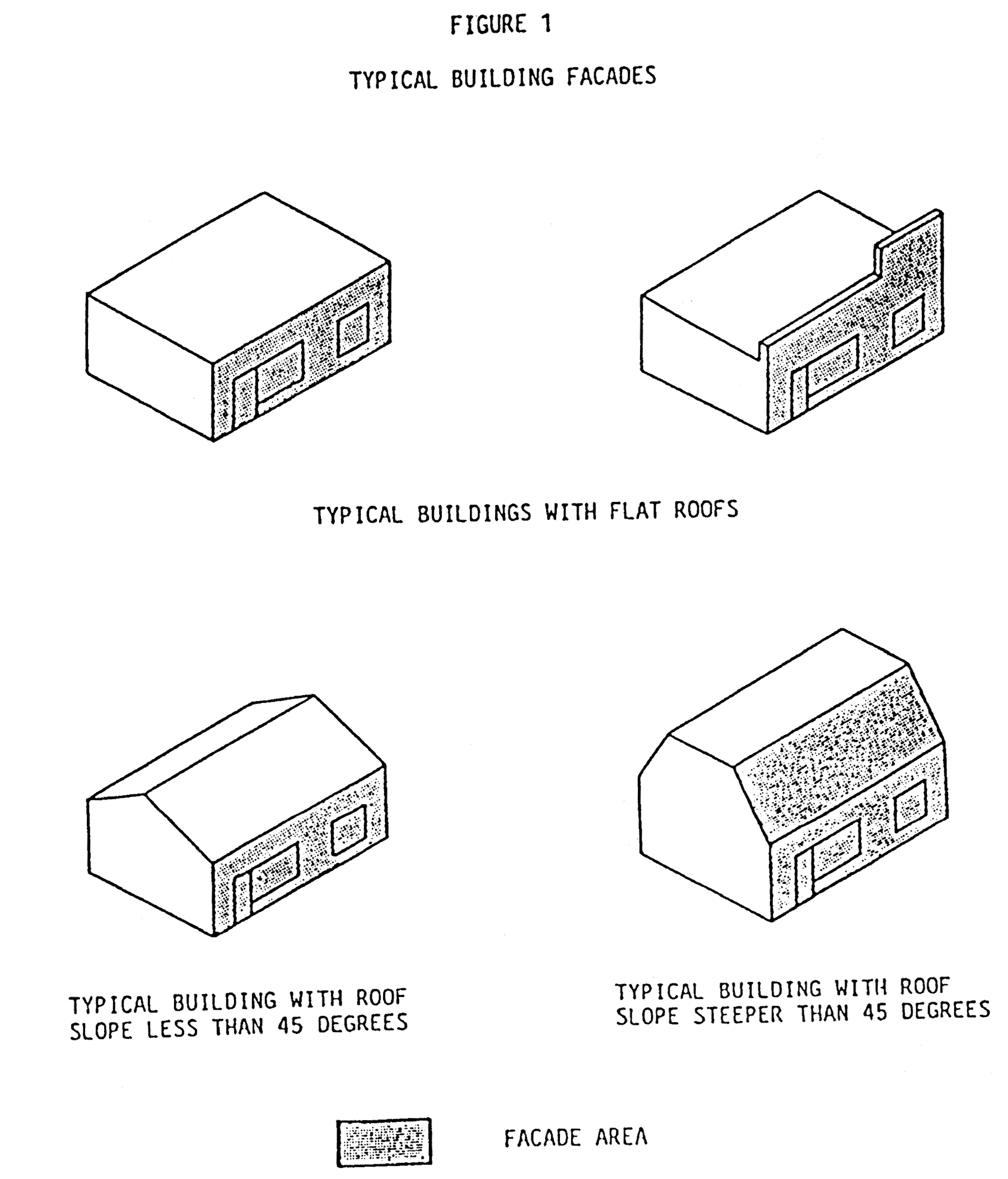
Size. For each building facade, the total combined area of all building signs shall not exceed fifteen (15) percent of the facade area of the building on which such signs are located, or two hundred (200) square feet, whichever is less. When calculating the permitted sign area of a building sign, the facade area of any portion of a roof with a slope of greater than forty-five (45) degrees, facing in the same direction as the building facade area being calculated, shall be included in the total building facade area.
(Ord. No. 91-5, § 3, 4-16-91; Ord. No. 92-6, § 4, 7-21-92; Ord. No. 97-23, § 3, 12-2-97; Ord. No. 2002-15, § 3, 10-1-02)
Sec. 22-17.11. - Special restrictions for specific signs.
In addition to the other restrictions provided in this article, the following special restrictions apply to the signs set forth in this section:
(a)
Marquee signs.
(1)
Marquee signs shall not be larger than eighty (80) percent of the marquee sign face area; and
(2)
Marquee signs may be on the vertical faces of marquees and may project below the lower edge of the marquee not more than twelve (12) inches. The bottom of marquee signs shall be no less than eight (8) feet above the sidewalk or grade at any point. No part of the sign shall project above the vertical marquee face, or beyond the marquee itself.
(b)
Projecting signs.
(1)
The maximum aggregate sign area for projecting signs on any building shall not exceed four (4) percent of the ground floor area under roof, as determined by the exterior building dimensions provided.
(2)
The sign face of double-faced projecting signs is calculated by measuring one (1) face of the sign only.
(3)
The bottom of a projecting sign shall be a minimum of eight (8) feet above grade.
(c)
Subdivision and multifamily development identification signs.
(1)
Two (2) on-premises signs, not exceeding a total of ninety-six (96) square feet in area, are allowed in each subdivision or multifamily development for the purpose of identifying the subdivision or development.
(2)
When a residential development has three (3) or more points of access into the development, a third on-premises sign, not exceeding ninety-six (96) square feet in area, may be allowed.
(3)
The developer of a subdivision or multifamily development shall make provision for the establishment of a homeowner's association, or other provision for maintenance of the signs after the developer has sold the last lot or dwelling unit.
(4)
If no homeowner's association exists or is willing to accept maintenance responsibilities for subdivision or multifamily development identification signs, or if no other provision for maintenance of such signs has been made by the developer at the time of issuance of the development permit by the city the signs shall be removed by the developer following the sale of the last lot or dwelling unit.
(d)
Time and temperature signs. Signs, or portions or parts thereof, which display time and temperature, shall be counted as part of an occupancy's allowable sign area.
(e)
Directional signs. Directional signs, limited in area to four (4) square feet, and which only provide directions to motorists regarding the location of parking areas and access drives, shall be permitted as permanent signs on all parcels and shall not be counted as part of an occupancy's allowable sign area.
(f)
Flags. In any commercially zoned area of the city, no more than three (3) permanent flags may be displayed on any one (1) parcel of land. Any flag displayed at any time on three (3) consecutive days shall be considered permanent, for the purpose hereof. The maximum distance from top to bottom of any such flag shall be twenty (20) percent of the total height of the flag pole, or in the absence of a flag pole, twenty (20) percent of the distance from the top of the flag to the ground.
(g)
Utility signs. Public utility signs that identify the location of underground utility lines and facilities, high voltage lines and facilities, and other utility facilities and appurtenances are permitted so long as they do not exceed three (3) feet in height, and so long as the sign face does not exceed one half square foot.
(h)
Institutional signs. Freestanding signs, not exceeding a total of forty (40) square feet cumulatively in area, are permitted for each lot having an institutional use, as set forth in article V of this chapter, for the purpose of identifying such institution. Building signs shall be permitted for each building facade up to fifteen (15) percent of the facade area of the building, or two hundred (200) square feet, whichever is less. Each institution shall be allowed no more than three (3) off-site institutional direction signs, as defined herein. The area of each off-site institutional direction sign shall not exceed two (2) square feet, and the location of each such sign shall be subject to approval by the city manager or his/her designee.
(i)
R-2 and R-3 conditional use signs. One (1) sign, not exceeding twenty-four (24) square feet in area and six (6) feet in height, is permitted for each lot having a conditional use in the R-2 or R-3 zoning districts, as set forth in article V of this chapter, for the purpose of identification of the property. On each lot having multiple buildings, one (1) sign shall be permitted for each building, provided the aggregate of all such signs does not exceed twenty-four (24) square feet in area.
(j)
Offsite freestanding signs on adjoining properties. Notwithstanding the restrictions on off-site signs provided in this article, the city council may authorize, for up to an initial two-year period, subject to renewal for any term deemed appropriate, one (1) additional freestanding sign, per business, on each lot used for commercial purposes in the CG (commercial general) zoning district, for any business that does not have its primary business building entrance door within seventy-five (75) feet, but no more than 300 feet, of Tangerine Avenue, as measured along a straight line from the edge of the road right-of-way to the primary business building entrance door of the business, pursuant to the following criteria:
1.
The sign shall be located entirely on private property;
2.
The sign shall be located on parcels of land abutting the lot on which the primary business occurs, provided all parcels are in the same ownership. For the purposes of this subsection, abutting parcel shall mean two (2) lots sharing at least one (1) property line, or where such property lines are separated either by a public right-of-way or private property no more than twenty (20) feet in width;
3.
The sign shall be located on property within the CG (commercial general) zoning district, or which is used for a valid, legally permitted non-conforming commercial use;
4.
Each business sign shall be limited to six (6) square feet in area and six (6) feet in height;
5.
The sign application shall include a graphic representation of the proposed sign, including all copy to be located thereon;
6.
The sign shall be a removable sign with a fixed permanent mounting at grade;
7.
The sign shall only be displayed between the hours of 8:00 a.m. and 12:00 a.m.;
8.
The sign shall be harmonious with the surrounding properties and maintain the integrity of the neighborhood;
9.
The sign shall not be in violation of the provisions of Article XVII of this Code, pertaining to signs; and
10.
The city council determines that no alternative sign will adequately provide the subject business with exposure to pedestrian and automobile traffic.
(k)
Sandwich board signs.
(1)
Sandwich board signs shall be freestanding and moveable.
(2)
A maximum of one (1) sandwich board sign per licensed business is allowed.
(3)
All sandwich board signs shall be located on private property adjacent to the business. Properties with no private property available to locate a sandwich board sign may place their sign within the public right-of-way. Signs within the public right-of-way and/or public sidewalks shall allow a minimum width for pedestrian access of no less than four feet. No sandwich board sign shall be placed within three (3) feet of the nearest edge of any vehicular travel lane or parking area, or within any cross visibility triangle. Any such sign which intrudes upon pedestrian or vehicular movement or safety is prohibited and shall be removed immediately upon request of the city.
(4)
Sandwich board signs shall not exceed an overall height of forty-two (42) inches above ground level or an overall width of thirty (30) inches. Sandwich board signs may be single-or double-sided.
(5)
No sandwich board sign shall be illuminated.
(6)
The placement of sandwich board signs outside the business shall be limited to the hours of operation of the activity or business utilizing the sign.
(7)
No sandwich board sign subject to the provisions hereof shall interfere with utility poles, street trees, landscaping, streetlights, or other structures.
(8)
All sandwich board signs shall be subject to the public's use of the said public right-of-way. The city manager or his/her designee may require the immediate removal, on a temporary or permanent basis and without compensation, of any sandwich board sign from the public right-of-way when such removal is determined to be reasonably necessary to protect the public health, safety or welfare or to permit other lawful and proper uses of such right-of-way.
(9)
All sandwich board signs which do not comply with the requirements of this article are prohibited, and shall be subject to immediate removal and disposal.
(Ord. No. 91-5, § 3, 4-16-91; Ord. No. 92-6, § 5, 7-21-92; Ord. No. 97-23, § 4, 12-2-97; Ord. No. 2002-02, § 1, 4-2-02; Ord. No. 2002-09, § 1, 7-2-02; Ord. No. 2002-15, § 2, 10-1-02; Ord. No. 2012-07, § 3, 2-21-12)
Sec. 22-17.12. - Design, construction, and location standards.
All permanent signs must comply with the design, construction and location standards set forth in this section.
(a)
Building and electrical codes. All permanent signs, and the illumination thereof, shall be designed, constructed and maintained in conformity with applicable provisions of the building and electrical codes adopted by the city.
(b)
Illumination standards.
(1)
Sign lighting may not be designed or located to cause confusion with traffic lights.
(2)
Illumination by floodlights or spotlights is permissible so long as none of the light emitted shines directly onto an adjoining property or into the eyes of motorists or pedestrians using or entering public streets.
(c)
Location standards.
(1)
Signs in excess of two (2) feet in height and located within a clear visibility triangle must conform to the following:
a.
The bottom of the sign must be at least eight (8) feet above the highest crown of any adjacent street; and
b.
The sign must be supported by a single structure that does not exceed eight (8) inches in diameter.
(2)
Supports for signs or sign structures shall not be placed in or upon a public right-of-way or public easement, except as otherwise provided in this article.
(3)
No freestanding sign shall project over a public right-of-way.
(d)
Clearance standards.
(1)
All signs over pedestrian ways shall provide a minimum clearance of eight (8) feet.
(2)
All signs over vehicular ways shall provide a minimum clearance of thirteen (13) feet six (6) inches.
(e)
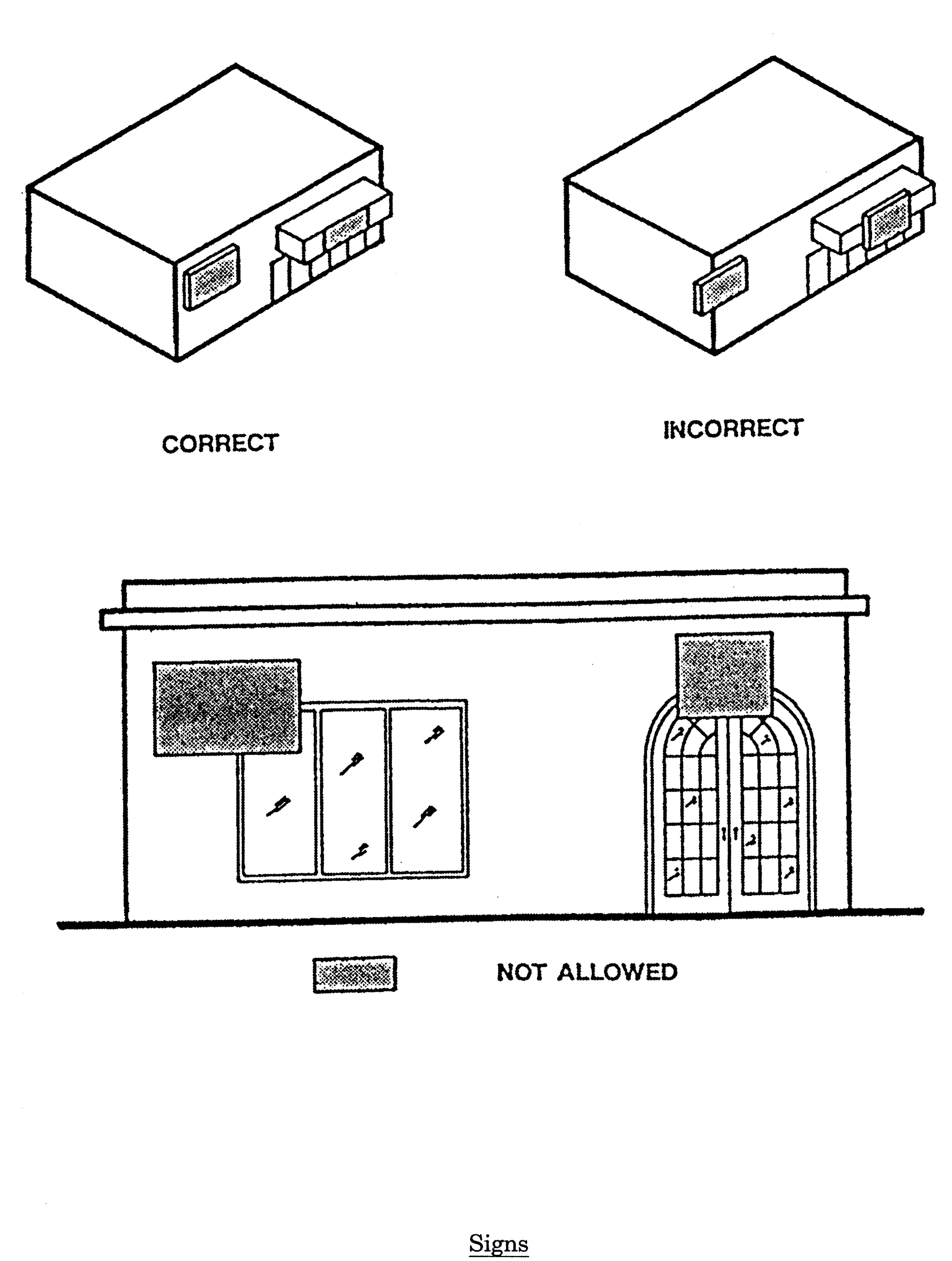
Relationship to building features. A building sign shall not extend beyond any edge of the surface to which it is attached, nor disrupt a significant architectural feature of the building. (See following figures)
(f)
Maximum window coverage. The combined area of signs placed on or behind windows shall not exceed fifty (50) percent of the total window area at the same floor level on the side of the building or unit upon which the signs are displayed.
(Ord. No. 91-5, § 3, 4-16-91; Ord. No. 92-6, § 6, 7-21-92)
Sec. 22-17.13. - Nonconforming signs.
Except as otherwise specifically provided for in this article, nonconforming signs, erected, placed or displayed within the city as of the effective date of this article, shall be removed or shall be altered to conform to the provisions of this article:
(1)
When any such sign is changed or modified in shape or size; or
(2)
On or before January 1, 2002, whichever shall first occur.
(Ord. No. 91-5, § 3, 4-16-91)
Sec. 22-17.14. - Enforcement.
(a)
Enforcement generally. This article shall be enforced as otherwise provided herein, as provided by other ordinances of the city, as amended from time to time, or as otherwise provided by law, for the enforcement of ordinances of the city. Upon presentation of proper credentials, any city official may enter at reasonable times any building, structure or premises in the city to perform any duty imposed by this or any other ordinance.
(b)
Inspection. All signs may be inspected periodically by the city manager, or his/her designee, to ensure compliance with this article and other applicable codes of the city.
(c)
Removal of signs. The city manager, or his/her designee, may order the removal of any sign erected or maintained in violation of this article or other applicable ordinances or regulations. Thirty (30) days' notice in writing shall be provided to the owner of such sign, at the address reflected on the application for the sign permit, or if no address is available for any reason, to the owner of the building, structure or premises on which such sign is located, to remove the sign or bring it into compliance. The city manager, or his/her designee, may order removal of a sign immediately and without notice if the condition of the sign is such as to present an immediate threat to the health, safety or welfare of the public. If any sign is not removed within the time provided herein, the city may remove said sign at the expense of the owner of the sign, or the real property on which the sign is located, and place a lien against said real property for the cost thereof, together with an administrative fee of one hundred dollars ($100.00).
(Ord. No. 91-5, § 3, 4-16-91; Ord. No. 92-6, §§ 7, 8, 7-21-92)
Sec. 22-17.15. - Appeal of administrative decisions.
Any person aggrieved by a decision or order of the city manager or his designee may appeal said decision as otherwise provided in the City Code.
(Ord. No. 91-5, § 3, 4-16-91)
Sec. 22-17.16. - Limitation period on challenges to article.
Any challenge to the validity of the provisions of this article, on its face or as applied to any particular sign, shall be filed within two (2) years of the effective date hereof, or such challenge shall be forever barred.
(Ord. No. 91-5, § 3, 4-16-91)

