
Gulfport City Zoning Code
ARTICLE VI
SUPPLEMENTARY REGULATIONS FOR ALL DISTRICTS
Sec. 22-6.01.- General provisions.
(a)
Division of lots. It shall be prohibited to divide any lot which would result in any portion of said lot failing to meet the requirements herein established for the zoning district in which said lot is located.
(b)
Base building line requirements. In order to provide for necessary street improvements and extensions to streets, certain base building lines may be established from time to time as part of the comprehensive plan. Where any base building line has been so established, all required setbacks shall be measured from said line, and in no case shall any part of a building, structure, parking area, or other site improvement of a permanent nature be constructed or extended streetward beyond said line.
(c)
Setback required from natural or man-made body of water. The full extent of all required yards and setback areas shall be maintained landward from the mean high-water line of any natural or man-made body of water, irrespective of whether the parcel ownership involved may include all or part of said body of water; provided, that an exception may be applied as part of a marina or marina-associated structure. This requirement shall not preclude the construction of a seawall on any property in conformity with all applicable requirements of law.
(d)
Special yard requirement for a corner lot. The narrow width of a corner lot shall determine its front for purposes of meeting the requirements of front and side yards. In case of reversed frontages, the determination of front and side yard depths may be made by the board of adjustment. The side yard setback on the secondary street shall be twelve (12) feet.
(e)
Special yard requirement for a double lot. On a double frontage lot, the full front yard depth requirement shall also apply to the yard facing the secondary street wherever said yard adjoins or faces a lot having its principal frontage upon said secondary street; provided, however, that no setback shall be required along a secondary street which exceeds the established setback of a building upon said adjoining or facing lot.
(f)
Visibility at intersections in all zoning districts. No fence, wall, hedge, shrub planting and/or other obstruction which obstructs sight lines and elevations between two (2) feet and eight (8) feet above the roadways shall be placed or permitted to remain on any corner lot in any zoning district within the triangular area formed by the existing front street line and a line connecting it at a point twenty-five (25) feet from the intersection of the opposite side street line; provided however, that if the existing street or streets are widened then the property owner will be required to relocate the existing fence, wall, hedge, shrub planting and/or other obstruction to be in compliance with the relocated twenty-five-foot intersection lines at owner expense. The same sight line limitations shall apply on any lots within ten (10) feet from the edge of a driveway or alley. No tree shall be permitted to remain within the above-described limits of intersections unless the foliage line is maintained at or above six (6) feet above the roadway intersection elevation to prevent obstruction of sight lines.
(g)
Buildings, structures, and uses to have access. Every building, structure, or use hereafter erected, moved, or established shall be on a lot adjacent to a public street or with access to a public street by means of an approved private street, and all buildings, structures, and uses shall be so located on lots as to provide safe and convenient access for servicing, fire protection, and required off-street parking and loading. No building, structure, or use shall be erected on, moved onto, or established upon a lot which does not abut on at least one (1) public street or approved private street for a distance of at least forty (40) feet; except that an approved cul-de-sac lot may be twenty-five (25) feet as measured along the property line of the cul-de-sac.
(h)
Driveways and curb cuts. No driveway or curb cut shall be located closer than fifteen (15) feet to a street intersection, measured by use of the intersection point of the extensions of the right-of-way lines. The number of curb cuts for any land use establishment shall not exceed two (2) for each one hundred (100) feet of street frontage, each having a width of not more than thirty (30) feet.
(i)
Access prohibited through residential district. No lot which is residentially zoned shall be used for driveway, walkway, or access purpose to any lot which is nonresidentially zoned, or used for any purpose not permitted within the applicable residential zoning district.
(j)
Use of adjacent right-of-way for business purpose prohibited. All portions of a use or activity, including all related buildings and structures, shall be so located and arranged upon a lot to permit the conducting of said use or activity totally upon the lot in full compliance with all applicable requirements of this chapter, and the use of any portion of an adjacent public right-of-way for the conducting of said use or activity is expressly prohibited.
(k)
Temporary buildings, structures, and trailers. Temporary buildings, structures, and trailers, used in connection with land development, sales, or construction projects, may be erected or placed within any zoning district for occupancy other than as dwelling or lodging units, provided that any said temporary building, structure, or trailer shall be located only upon the actual site of development, sales or construction. Any such building, structure, or trailer shall require a permit from the chief building official, such permit to specify location, type of construction, maintenance requirements, and time period of utilization of said building, structure, or trailer. Failure to obtain a permit, or violation of any condition or requirement specified therein, shall be a violation of this chapter.
(l)
Storage and/or accumulation of materials, refuse, and waste materials prohibited. Except as may be expressly permitted within this chapter, no materials, refuse, and waste materials (including inoperative equipment and vehicles) shall be stored or accumulated outside of a fully-enclosed building within any zoning district longer than a period of six (6) months subsequent to the issuance of a building permit.
(m)
Elevation and height of structures. All structures built for human habitation shall be elevated to a minimum of eighteen (18) inches above the crown of the adjacent road or roads, or a minimum of twelve (12) inches above grade, whichever is higher. Residential structures located in a "V" or "A" flood zone, as determined by the Federal Emergency Management Agency as indicated on the current flood insurance rate map, shall be elevated to the elevation indicated on said map. Residential lots having any portion thereof within a "V" or "A" flood zone shall be permitted the an additional five (5) feet of building height above maximum building heights set forth in article V of this chapter.
(Ord. No. 85-8, § 2, 5-21-85; Ord. No. 87-8, §§ 7—11, 7-21-87; Ord. No. 2000-20, § 19, 10-3-00)
Sec. 22-6.02. - Permitted yard encroachments and height exclusions.
(a)
Yard encroachments. Every part of a required yard shall be open and unobstructed from the ground to the sky except as hereinafter provided or as otherwise permitted by this chapter:
(1)
Sills or belt courses may project not over twelve (12) inches into a required yard;
(2)
Cornices, eaves, gutters, or movable awnings may project not over four (4) feet into a required yard;
(3)
Chimneys, fireplaces, or pilasters may project not over two (2) feet into a required yard;
(4)
Hoods, canopies, or marquees may project not over three (3) feet into a required yard, but shall not extend closer than one (1) foot to any lot line;
(5)
For residential uses, open front porches may extend into the required front yard setback by no more than twenty-five (25) percent of the required yard setback, without a variance. For purposes of this paragraph, an open porch shall be an unenclosed area which may have a pitched roof tied into the main structure;
(6)
Unless otherwise provided for in this or other sections of the zoning code, no encroachment shall be allowed outside of the property line.
(b)
Exclusions from height limits. Utility penthouses, scenery lofts, cupolas, steeples and domes, not exceeding in gross area, measured at the maximum horizontal section thereof, thirty (30) percent of the roof area, and flag poles, airplane beacons, home antennas, as defined in Article XXII of this chapter, chimneys, stacks, tanks and roof structures used only for ornamental or mechanical purposes, may exceed the permissible height limit in any district by not more than twenty-five (25) percent. Parapet walls may extend not more than five (5) feet above the allowable height of a building. The height of telecommunication towers and antennas, other than home antennas, shall be governed by Article XXII of this chapter.
(Ord. No. 85-8, § 2, 5-21-85; Ord. No. 97-9, § 6, 6-3-97; Ord. No. 2021-05, § 1, 10-19-21)
Sec. 22-6.03. - Accessory uses and structures.
(a)
General provisions. In conjunction with a principal use, building or structure provided in this chapter, accessory uses, buildings or structures, as herein defined, may be located upon any lot, provided there is full compliance with all setback, height, building coverage, and off-street parking and loading requirements. No accessory building or structure, except commercial satellite dishes, as defined in Article XXII of this chapter, shall be located closer than twelve (12) feet to a principal building or structure, and no accessory building or structure shall be located closer than six (6) feet to any other accessory building or structure on the same lot. Home satellite dishes, as defined in Article XXII of this chapter, shall be exempt from the provisions of this section. Accessory uses, buildings, or structures may also be located within required yards, subject to the following limitations:
(1)
No accessory use, building, or structure shall be located within the lot's front yard or within that portion of any side or rear yard subject to a special yard setback requirement. Accessory uses, buildings, and structures shall be located in rear or interior side yards. These shall not occupy any area subject to setback requirements. All other applicable regulations, such as but not limited to height restrictions, shall be complied with.
(2)
A swimming pool including patio and/or screen enclosure, shall be located a minimum distance of seven (7) feet from a rear property line, six (6) feet from a side property line on an interior lot, and twelve (12) feet from a side property line on a street side of a corner lot; provided however, that if the minimum setbacks are measured to the water's edge of the pool then a screen enclosure will not be allowed; and that a swimming pool shall be located a minimum distance of fifteen (15) feet from a seawall to the water's edge of the pool and a patio and/or screen enclosure shall be located a minimum distance of seven (7) feet from a seawall.
(3)
Other accessory buildings and structures shall be located a minimum distance of fifteen (15) feet from a rear property line, six (6) feet from a side property line on an interior lot, and twelve (12) feet from a side property line on the street side of a corner lot.
(4)
One (1) storage building, properly anchored and not exceeding eighty (80) square feet in area or eight (8) feet in height, may be located within a required rear or side yard of a residential lot; provided that a minimum distance of three (3) feet is maintained from a rear property line or a side property line on an interior lot, and a minimum distance of twelve (12) feet is maintained from a side property line on the street side of a corner lot.
(5)
Except as provided in subsection (1) above, no accessory structure shall be located upon a lot within fifteen (15) feet of any seawall; provided, however, that a dock, with or without hoist facility, may be constructed along a canal or waterway when authorized by law. A permit for any such dock shall be issued by the city only after approval has been obtained from all county, state, and federal agencies having jurisdiction.
(b)
Attached accessory structure considered part of principal building. Whenever an accessory structure is attached in any manner to a principal building or structure, it shall cease to be considered an accessory structure for purposes of this chapter and shall be considered as a part of the principal building or structure. It shall be unlawful to attach an accessory structure to a principal building or structure which does not comply in all respects with the requirements of this chapter applicable to the principal building or structure.
(c)
Parking or storage of a commercial vehicle in a residential district. No person, firm, corporation, or other entity, or any agent thereof, shall cause or permit a commercial vehicle, as herein defined, to be parked, stored, or maintained within a residential zoning district. It is not the intent of this section to prohibit a commercial vehicle from being within a residential district when actually utilized in a business activity requiring its location within said district for a temporary time and for a specific purpose (e.g. deliveries, lot mowing, resident relocation, construction, etc.).
(d)
Home occupations. Home occupations, as defined in this chapter, may be approved by the city manager, or his/her designee, in any residential district, when all of the criteria of this subsection have been met by the applicant. Each applicant for a home occupation license shall pay a nonrefundable application fee as set forth in chapter 25 of the Code of Ordinances, upon the filing of said applicant's initial application for a home occupation license. No application fee shall be required for the renewal of a license if there are no changes of any kind with respect to the home occupation. An annual license fee shall be paid for each home occupation license, as provided in chapter 13 of the Code, based on the appropriate occupation. Each home occupation license shall expire at the end of the fiscal year in which said license was issued, and may be renewed, annually, upon payment of the appropriate license fee and satisfaction of all criteria provided herein.
(1)
No more than twenty-five (25) percent of the floor area of the dwelling shall be used for the home occupation. The home occupation shall be conducted wholly within the dwelling or accessory structure.
(2)
No display of goods, or outside storage of equipment, including trailers, or materials used in the home occupation shall be permitted.
(3)
No community [commodity] shall be sold or supplied on the premises where the home occupation is conducted.
(4)
No evidence of the conduct of a home occupation shall be detectable from the outside of the dwelling or accessory structure.
(5)
No person shall be employed on the premises where the home occupation is conducted, other than members of the family residing on said premises.
(6)
No traffic exceeding the Pinellas County Metropolitan Planning Organization Traffic Generation Standard for Single-Family Residential Use, as amended from time-to-time, shall be generated by any home occupation, and no additional off-street parking spaces shall be required.
(7)
No customer, client, employee, contractor or agent of the home occupation shall be permitted on the premises where such occupation is conducted, at any time.
(8)
No home occupation shall cause an increase in the use of any public utilities above the average of all residences in the immediate vicinity of the premises in which the home occupation is conducted.
(9)
No more than one (1) vehicle used in a home occupation shall be permitted on or near the premises where any home occupation is conducted. No commercial vehicle, as defined in section 22-2.02 of this Code, shall be parked, stored or kept on the premises where any home occupation is conducted, or on any adjacent right-of-way.
(10)
No motors, other than electrically operated motors of one (1) horsepower or less, shall be used in connection with any home occupation.
(11)
No equipment or process, which causes fluctuations in line voltage, or visual or audible electrical interference in any radio or television receiver, off the premises where the home occupation is conducted, shall be used in connection with any home occupation.
(12)
A home occupation may be approved for the sole purpose of making and receiving phone calls, sending and receiving mail, or keeping and generating business records, in connection with any profession or occupation, notwithstanding the provisions of paragraph (13) hereof to the contrary.
(13)
The following, and all similar uses, shall not be permitted as home occupations:
a.
Auto repair;
b.
Engine, machine, tools, electronic equipment or appliance repair;
c.
Personal services, including massage, hair styling or cutting, grooming and cosmetology;
d.
Tea rooms;
e.
Food sales, service or processing;
f.
Animal sales, grooming or boarding;
g.
Construction contracting;
h.
Medical office;
i.
Real estate office;
j.
Law office;
k.
Painting of vehicles, trailers or boats;
l.
Photography;
m.
Education or instruction in any subject;
n.
Furniture construction, repair or refinishing;
o.
Boat building or repair;
p.
Metal fabrication or cutting;
q.
Welding or using cutting torches; and
r.
Upholstering.
(14)
All existing home occupation licenses shall expire on the last day of the fiscal year in which this article becomes effective. Any home occupation license properly issued prior to the effective date of this article may be renewed, notwithstanding any nonconformance with this subsection, provided that there are no changes in the nature of the home occupation. Such nonconforming home occupations shall not be approved if the license for such home occupation is not renewed prior to the expiration of said license in any fiscal year.
(15)
The city manager, or his/her designee, shall revoke any home occupational license at any time the holder thereof fails to meet the requirements of this section.
(Ord. No. 85-8, § 2, 5-21-85; Ord. No. 87-7, § 1, 7-21-87; Ord. No. 87-8, §§ 12—14, 7-21-87; Ord. No. 88-9, § 3, 9-6-88; Ord. No. 92-3, § 2, 5-5-92; Ord. No. 97-9, § 7, 6-3-97; Ord. No. 2000-1, § 2, 2-1-00; Ord. No. 2005-02, § 2, 2-15-05)
Cross reference— Garage sales, permits and regulations, § 13-35.
Sec. 22-6.04. - Townhouse development requirements.
(a)
Each townhouse dwelling shall have a minimum lot area of one thousand eight hundred (1,800) square feet of usable land and a minimum width of twenty (20) feet.
(b)
Each townhouse dwelling shall have a front yard with a minimum depth of twenty-five (25) feet and a rear yard with a minimum depth of twenty (20) feet.
(c)
No less than four (4) townhouse dwellings and no more than twelve (12) townhouse dwellings shall be contiguous. No more than two (2) contiguous townhouse dwellings shall be built in a row with a common front building line, and the minimum difference in building line setback to provide variation shall be two (2) feet. No contiguous group of dwellings shall exceed two hundred forty (240) feet in length.
(d)
No portion of a townhouse or accessory structure in or related to one group of contiguous townhouses shall be closer than twenty (20) feet to any portion of a townhouse or accessory structure related to another group, or shall be closer than thirty (30) feet to a property line adjoining the side yard of an adjacent lot not included within the townhouse development. A side yard having a minimum depth of twenty (20) feet shall be provided between the side of any townhouse dwelling and a public street or right-of-way.
(e)
Townhouse developments shall have a common open area suitably developed for recreation purposes equal to one thousand five hundred (1,500) square feet of open area per dwelling unit. Satisfactory provision for the development and perpetual maintenance of said open area shall be submitted to and approved by the city council.
(f)
A site plan showing all proposed development shall be submitted to the site plan review committee in accordance with the provisions of Article VII.
(g)
Before the chief building official shall be authorized to issue a building permit for construction, a subdivision plat complying with all requirements of this chapter and all appropriate requirements of the subdivision regulations of the city shall have been approved by the city council and recorded within the records of Pinellas County.
(h)
Unless otherwise specifically provided in the above subsections, all provisions and development standards of this chapter for the applicable zoning district shall apply to townhouse development.
(Ord. No. 85-8, § 2, 5-21-85)
Sec. 22-6.05. - Special requirements for mobile home parks.
(a)
Application requirements. Any person or organization proposing the development and operation of a mobile home park shall be required to submit a site plan of the proposed development for review in accordance with the provisions of Article VII. Said site plan shall be submitted in such number of copies as may be required by the city and shall contain the following information:
(1)
The legal description and boundary data of the entire area for which approval is sought;
(2)
A scaled design drawing of the entire park as proposed, showing the location, size, and configuration of all proposed mobile home sites, including the size and configuration of all concrete slabs, vehicular parking spaces, utility connections, and such other improvements as may be proposed for individual sites; the driveway or road system showing access to all mobile home sites and activity areas within the proposed park; the type and location of all proposed community facilities and/or services proposed; the location and proposed development of all recreation and open space areas proposed; the location, type, and extent of all proposed buffering and landscaping; the location and type of all other buildings, and/or structures proposed, such as owner's residence, office and storage buildings; the location and nature of facilities for the collection and removal of garbage and trash from the park; and the location and nature of any special facilities or improvements which may be required, such as drainage retention areas, water treatment and distribution facilities, and sewage disposal facilities;
(3)
The name, address, and telephone number of the owner and/or his agent, who may be contacted concerning information relative to the proposed application and operation of the mobile home park.
(b)
Minimum site requirements.
(1)
Each mobile home park shall be located upon a lot having an area of not less than fifteen (15) acres;
(2)
All entrance and exit roadways serving a mobile home park shall be spaced a minimum distance of fifty (50) feet apart, as measured between center lines of said roadways, and no said roadway shall be nearer than one hundred twenty-five (125) feet to the intersection of two (2) public streets or highways, as measured between the center lines of the roadway and the intersecting street or highway;
(3)
Each mobile home site shall have a minimum area of five thousand (5,000) square feet and a minimum width of fifty (50) feet;
(4)
Each mobile home site shall contain a designated area for the parking of one (1) automobile;
(5)
Each mobile home site shall have proper connection for water, sewerage, and electrical service;
(6)
All mobile home sites shall be directly served by paved or compacted roadway acceptable to the City of Gulfport having a minimum width of twenty (20) feet. The city may permit or require variations from this width requirement, based upon the particular design and means of vehicular circulation proposed. An additional vehicular parking area shall be required and provided for guest parking at a convenient location within the park, providing parking facilities at a ratio of one (1) parking space for each two (2) mobile home sites to be developed;
(7)
A minimum of one (1) acre or six (6) percent, whichever is greater, of the gross land area of the park shall be developed for recreation purposes. No mobile home site, required buffer strip, or utility easement shall be counted as recreation area in meeting this requirement. Recreation areas and facilities shall be properly maintained and operated by the park management;
(8)
Where appropriate, a utility easement shall be provided along the rear of each mobile home site. Such easement shall not be less than ten (10) feet in width. No permanent structures other than pedestrian walks, benches, recreation facilities, picnic areas, and lighting systems shall be located in such utility easement, and permitted structures shall be located so as not to impede maintenance of underground utility facilities. All utilities shall be located within such easements, if provided, or in easements adjacent to roadway pavements or in buffer areas;
(9)
Each mobile home park shall be provided with central facilities for washing and drying of clothes, unless otherwise required by the city;
(10)
A landscape buffer not less than twenty (20) feet in depth shall be provided along public streets or highways and along all boundaries of a mobile home park. Said buffer strip may be used for drainage structures and utility easements, but shall not be used for any other purpose.
(c)
Sanitation requirements. Each mobile home site shall be provided with at least one (1) garbage container of not less than twenty-gallon capacity, so located as to be obstructed from view from the roadways within and without the park. Park management shall be strictly responsible for internal trash and garbage collection. Central park collection points shall be completely screened from public view from within the park.
(d)
Park design. Designers of mobile home parks shall utilize contemporary design practices and shall avoid monotonous and obsolete rectilinear or herringbone design for layout of mobile home sites.
(e)
Procedure for development and operation. Upon receiving final approval of the site plan, the applicant or owner may proceed with development of the mobile home park subject to all permit requirements of the city and other governmental units having jurisdiction. After all required improvements have been completed for a park, or an approved construction unit of a park, the chief building official shall conduct a final inspection and confirm in writing that the said improvements have been completed. He shall then approve the mobile home park for occupancy and issue an appropriate occupancy permit to the owner or operator. Until a park has received an occupancy permit, no mobile home shall be placed therein.
(f)
Installation and occupancy of mobile homes. No mobile home shall be installed or occupied within a mobile home park until and unless there has been full compliance with the provisions of all applicable ordinances and regulations of the City of Gulfport.
(g)
Compliance with requirements of other jurisdictions. In addition to the requirements of this chapter, mobile home parks shall meet the requirements of all other jurisdictions having control over park development and operation, including but not limited to the Division of Health of the Florida Department of Health and Rehabilitative Services and the Florida Division of Motor Vehicles. To the fullest extent possible, the review of mobile home park proposals under this chapter will be coordinated with similar review of other jurisdictions, but it shall remain the responsibility of the applicants to obtain all necessary approvals and permits from said jurisdictions.
(Ord. No. 85-8, § 2, 5-21-85)
Sec. 22-6.06. - Off-street parking.
(a)
General requirements. Each building, use, or structure instituted or erected after the effective date of this chapter shall be provided with off-street parking and service facilities in accordance with the provisions set forth herein for use of occupants, employees, visitors, or patrons. Such off-street parking and service facilities shall be maintained and continued as an accessory use as long as the principal use is continued.
Where a building or use existed at the effective date of this chapter, said building may be modernized, altered, or repaired without providing additional off-street parking or service facilities, provided there is no increase in floor area or capacity and there is no change in use which results in the need for additional parking.
Where a building or use which existed at the effective date of this chapter is enlarged in floor area, volume, capacity, or space occupied, off-street parking and service facilities shall be provided to meet the requirements for the total and combined floor area, volume, capacity, or space resulting from said enlargement.
It shall be unlawful for any owner or operator of any building, structure, or use regulated by this chapter to discontinue, change or dispense with or to cause the discontinuance of or reduction of the required parking and service facilities, other than through a corresponding discontinuance or reduction in size of building, structure, or use, without establishing alternative parking or service facilities which meet the requirements of this chapter. It shall be unlawful for any person, firm or corporation thereafter to utilize such building, structure, or use without providing the off-street parking and service facilities to meet the requirements of this chapter.
(b)
Design and use requirements. Wherever, in any zoning district, off-street facilities are required, as provided in subsection (c) hereof, for the parking of any and all types of vehicles, boats, or heavy construction equipment, whether such vehicles, boats or equipment are self-propelled or not, and wherever land is utilized for the parking of vehicles as the primary use of said land, such off-street facilities and land shall conform to the following design and use requirements:
(1)
Each required parking space for standard size cars shall have a minimum width of nine (9) feet and a minimum length of eighteen (18) feet. Each parking space designated for compact cars shall have a minimum width of eight (8) feet and a minimum length of sixteen (16) feet. Compact car spaces shall not exceed twenty (20) percent of the required number of off-street parking spaces and shall be clearly marked for compact cars only.
(2)
All off-street facilities shall be designed so as to have adequate access to a public street or alley and, in the case of parking facilities, adequate access to interior maneuvering areas. Except for parking serving single-family residences, parking facilities shall be arranged so that no vehicle shall be required to back from such facilities directly onto public streets. Wherever vehicular entrances and exits are involved, the number, size, curbcuts, distance apart, and general design of any said entrances and exits shall comply with the established standards and requirements of the state department of transportation where a state or federal highway is affected. In the case of other streets and roadways, the design of said entrances and exits shall be as required by the city engineer or as otherwise approved by the city manager. In no case shall a variance be granted which would allow vehicles to be required to back from any commercial establishment onto a four-laned collector street.
(3)
Where off-street parking is required, such parking areas shall be used for vehicular parking only with no sales, dead storage, repair work, dismantling or servicing of any kind, and the required areas in the various zoning districts shall be in addition to the loading and service spaces normally required for the business or office served.
(4)
Where off-street parking is required, such parking shall be provided on the same lot or premises with the business or office which is being serviced, or upon an adjacent lot.
(5)
Within any commercial zoning district, no vehicular parking required by this chapter shall be provided or permitted within any public right-of-way. In addition, no parking shall be provided or permitted which creates a safety hazard upon adjacent streets or which obstructs visibility at intersections, driveways, or alleys within the applicable areas described in section 22-6.01(f).
(6)
Within residential zoning districts, parking for a single-family or duplex dwelling may be permitted within a required front or rear yard. Parking for multi-family dwellings may be permitted within a required rear yard if properly screened from adjacent property, but shall not be permitted within a required front or side yard.
(7)
Where artificial lighting is provided, it shall be designed and arranged so that no source of such lighting will be a visible nuisance to adjoining property used or zoned for a residential purpose. In addition, such lighting shall be designed and arranged so as to shield public streets and highways and all adjacent properties from direct glare or hazardous interference of any kind.
(8)
The provisions of subsection (b) shall apply to all new off-street parking or other vehicular use areas. At such time as existing off-street parking or other vehicular use areas are enlarged, expanded, or modified, such provisions shall apply to the previous existing areas as well as the new areas.
(9)
When units or measurements determining the number of off-street parking spaces result in the requirement of a fractional space, any such fractional space equal to or greater than one-half shall require a full off-street parking space.
(10)
In the case where two (2) or more uses occupy or are proposed to occupy a land parcel, the total requirements for off-street parking shall be the same as the requirements of the individual uses computed separately, and off-street parking space for one (1) such use shall not be considered as providing the required off-street parking space for any other use. However, credit may be given by the chief building official for a portion of the required combined parking where it can be demonstrated that the peak parking demands for the individual uses involved occur at different time periods.
(11)
Upon city council approval, the required parking may be reduced by up to ten (10) percent where necessary to protect existing trees as defined in Chapter 23.5 of this Code.
(c)
Amount of off-street parking required. Off-street parking shall be provided and maintained on the basis of the following minimum requirements:
(1)
Animal hospital or veterinarian clinic: One (1) space for each five hundred (500) square feet of gross floor area, plus one (1) space for each doctor and employee.
(2)
Care home or convalescent home: One (1) space for each patient bed.
(3)
Church or other place of worship: One (1) space for each three (3) seats in auditorium or chapel area, not including Sunday school classrooms.
(4)
Club or recreation facility: One (1) space for each one hundred twenty (120) square feet of assembly hall and auditorium, or one (1) space for each two hundred (200) square feet of gross floor area, whichever requirement may be greater.
(5)
Dwelling, duplex: Two (2) spaces per dwelling unit, including carport and garage.
(6)
Dwelling, multiple-family: Two (2) spaces per dwelling unit, including carports and garages.
(7)
Dwelling, single-family: Two (2) spaces per dwelling unit, including carport and garage.
(8)
Dwelling, townhouse: Two (2) spaces per dwelling unit, including carport and garage.
(9)
Financial institution: One (1) space for each two hundred (200) square feet of gross floor area.
(10)
Food store: One (1) space for each one hundred fifty (150) square feet of retail floor area.
(11)
Furniture or appliance store: One (1) space for each four hundred (400) square feet of retail floor space.
(12)
Hotel or motel: One (1) space for each guest room or rental unit, plus one (1) additional space for each five (5) units or portion thereof.
(13)
Manufacturing and industrial activities: One (1) space for each two (2) employees on the largest shift.
(14)
Clinics: One (1) space for each one hundred fifty (150) square feet of gross floor area.
(15)
Physician offices: One (1) space per two hundred (200) square feet of gross floor area.
(16)
Mobile home: Two (2) spaces per mobile home.
(17)
Office (business or professional): One (1) space for each three hundred (300) square feet of gross floor area.
(18)
Place of public assembly, including assembly hall, exhibition hall, convention hall, entertainment center, community center, library, and museum: One (1) space for each five (5) seats, or one (1) space for each two hundred (200) square feet of gross floor area, whichever requirement be greater.
(19)
Restaurant: One (1) space for each four (4) seats, plus one (1) space for each two (2) employees.
(20)
Retail store or shop, personal service establishment, household repair or equipment shop: One (1) space for each two hundred (200) square feet of gross floor area.
(21)
School, elementary (public, private or parochial): One (1) space for each classroom or office room, plus one (1) space for each one hundred fifty (150) square feet of seating area, including aisles, in any auditorium or gymnasium or cafetorium intended to be used as an auditorium.
(22)
School, junior or senior high school or college (public, private or parochial): Four (4) spaces for each classroom or office room, plus one (1) space for each one hundred fifty (150) square feet of seating area, including aisles, in any auditorium or gymnasium or cafetorium intended to be used as an auditorium.
(23)
Theater or other place of assembly having fixed seating: One (1) space for each four (4) seats, plus one (1) space for each two (2) employees.
(24)
Warehousing or wholesaling establishment: One (1) space for each one thousand (1,000) square feet of gross floor area up to ten thousand (10,000) square feet, and one (1) additional space for each additional two thousand (2,000) square feet.
(25)
Telecommunication tower: One (1) space for each site.
(26)
Use not specifically mentioned: The requirements for off-street parking for any use not specifically mentioned within this subsection (c) shall be the same as provided within this subsection for the use most similar in nature, it being the intent to require all uses to provide off-street parking.
(d)
Determination of requirements involving multiple seating facilities. For uses having multiple seating facilities such as pews, booths, benches, and the like, the term "seat" shall be considered as comprising each twenty-four (24) linear inches of seating space, or major fraction thereof.
(e)
Combined off-street parking. Nothing in this subsection shall be construed to prevent collective provision for, or joint use of, off-street parking facilities for two (2) or more buildings or uses by two (2) or more owners or operators, provided that the total of such parking spaces when combined or used together shall not be less than the sum of the requirement for the several individual uses computed separately in accordance with the requirements of this subsection. However, credit may be given by the chief building official for a portion of the combined required parking where it can be demonstrated that the peak parking demands for the individual buildings or uses occur at different time periods and where a cooperative agreement satisfactory to the city is executed by the owners of all said buildings.
(f)
Use of required off-street parking for another building or use. No part of an off-street parking area required for any building or use shall be included as a part of an off-street parking area similarly required for another building or use, unless the type of use indicates that the periods of usage will not overlap or be concurrent with each other, as determined and approved by the chief building official.
(g)
Off-street loading and service facilities. Off-street loading and service facilities shall be provided in accordance with the following standards and specifications:
(1)
On the same lot with every structure or use hereinafter erected or created, there shall be provided and maintained adequate space for loading and unloading of materials, goods or things and for delivery and shipping so that vehicles for the service may use this space without encroaching on or interfering with the public use of sidewalks, streets, and alleys by pedestrians and vehicles.
(2)
Where any structure is enlarged or any use is extended so that the size of the resultant occupancy comes within the scope of this subsection (g), the full amount of off-street loading space shall be supplied and maintained for the structure or use in its enlarged or extended size. Where the use of a structure or land or any part thereof is changed to a use requiring off-street loading space under this subsection, the full amount of off-street loading space shall be supplied and maintained to comply with this subsection.
(3)
For the purposes of this subsection, an off-street loading space shall be an area at the grade level at least ten (10) feet wide, twenty-five (25) feet long, and having fourteen (14) feet of vertical clearance. Each off-street loading space shall be accessible from a public street or alley without crossing or entering any other required off-street loading space, and shall be arranged for convenient and safe ingress and egress by motor truck and/or trailer combinations. Such loading space shall be accessible from the interior of any building it is intended to serve.
(4)
Off-street loading spaces shall be provided and maintained in accordance with the following schedule:
a.
For each store, market, restaurant, laundry, dry cleaning establishment, or similar use which has an aggregate gross floor area of:
Over 5,000 square feet but not over 25,000 square feet—One (1) space;
Over 25,000 square feet but not over 60,000 square feet—Two (2) spaces;
Over 60,000 square feet but not over 120,000 square feet—Three (3) spaces;
Over 120,000 square feet but not over 200,000 square feet—Four (4) spaces;
Over 200,000 square feet—One (1) space for each 50,000 square feet or major fraction thereof.
b.
For each auditorium, exhibition hall, museum, hotel or motel, office building, or similar use, which has an aggregate gross floor area of over 10,000 square feet but not over 40,000 square feet—One (1) space, plus one (1) space for each additional 60,000 square feet over 40,000 square feet, or major fraction thereof.
c.
For any use not specifically mentioned within this subsection (4), the requirements for off-street loading for a use which is mentioned and to which the unmentioned use is similar shall apply. Where there is any question as to the off-street loading requirements as determined by the chief building official, said requirements shall be determined and fixed by the planning and zoning board of appeals.
(5)
No parking area or parking facilities shall be utilized for or be deemed to meet the requirements of this subsection for off-street loading facilities.
(6)
Nothing in this section shall prevent the collective, joint, or combined provision of off-street loading facilities for two (2) or more buildings or uses, provided that such off-street loading facilities are equal in size and capacity to the combined requirements of the several buildings or uses and are so located and arranged as to be usable thereby. Where it can be demonstrated that the use demand for the individual buildings or uses will occur at different time periods, credit for a portion of the required facilities may be given by the chief building official upon the execution of a cooperative agreement by the parties involved, which agreement is satisfactory to the city.
(7)
Plans for buildings or uses requiring off-street loading facilities under the provisions of this subsection shall clearly indicate the location, dimensions, and access of all such required off-street loading facilities.
(h)
Off-street parking overlay. Off-street parking lots are allowed in connection with a contiguous commercial use or mixed use where the R-2 or R-3 zoning districts adjoin the CL-1 zoning district, the CG zoning district, the mixed use district within the community redevelopment district, or that portion of C-1 lying between 51st Street South and 53rd Street South, except that portion platted as Sander's Subdivision listed in Plat Book 22, Page 60 of the public records of Pinellas County. Off-street parking lot districts are identified in the map attached to and made a part of Ordinance No. 88-6. Parking lots may be permitted between the aforementioned districts and the nearest street in the residential district (with or without an intervening alley), so long as the following requirements are met:
(1)
The applicant for such parking lot shall submit a site plan for review by the planning and zoning board and approval by the city council.
(2)
Such parking lots shall be joined to the adjacent commercial use by appropriate lease, ownership or other legal instrument. If the commercial use ceases for any reason, subsequent use of the parking lot shall revert to the regulations of the district in which such use is located. Freestanding parking lots are expressly prohibited.
(3)
No alley between commercial properties and off-street parking lot shall be vacated for the purpose of providing additional parking or access to the adjacent commercial property.
(4)
Surfacing.
a.
Permanent surface. Except as otherwise permitted in subsection (d)(2), all parking areas, vehicular accessways and driveways shall be improved with permanent all-weather material which is graded to drain storm water.
b.
Parking areas that are not provided with the type of surface specified in subsection (d)(1) shall be graded and surfaced with suitable materials to provide a surface that is stable and will resist erosion. The perimeter of such parking areas shall be defined by easily identifiable marking such as brick, stones, railroad ties, or other similar devices. Turf block or other grass parking surface consistent with the terms hereof may be utilized only in parking spaces, not on the aisles which give access to the spaces.
(5)
Lighting shall be provided and shall be arranged and installed to deflect, shade and focus light away from adjacent properties. The height, type, spacing and degree of cutoff of a light standard may be further regulated by the building official in relation to specific site conditions or types of development.
(6)
A six-foot opaque screen which may be composed of a wall, fence, landscaped earth berm, planted vegetation, or existing vegetation, shall be provided along the sides of such off-street parking areas adjacent to any residential or undeveloped property. Compliance of planted vegetative screens will be based on average mature height and density of foliage of the subject species. The screen must be opaque in all seasons of the year and shall be maintained in good condition.
(7)
Each lot shall be subject to the following minimum setback requirements:
a.
From a street right-of-way: Twenty-five (25) feet;
b.
From a side property line: Six (6) feet;
c.
From a rear property line: One (1) foot.
(8)
There shall be no movement of vehicles on such lots between 10:00 p.m. and 6:00 a.m.
(9)
There shall be no sales or service activities on such lots.
(10)
Solid waste storage is prohibited.
(11)
Except as herein modified, size and configuration of parking spaces, circulation and other design specifications shall be as required herein. Ingress and egress may be restricted to the commercial site.
(i)
Drive-through facilities.
(1)
Purpose and intent. Products of the automotive age, drive-through facilities have become a common amenity for a specific range of uses, including banks, pharmacies, and fast-food restaurants. A well designed drive-through on a parcel with adequate area can be convenient for motorists and have minimal impact upon the streetscape and pedestrians. Conversely, a poorly designed drive-through on a parcel of inadequate size can cause problems with traffic circulation and create areas that are hostile to the pedestrian. Moreover, drive-throughs have the potential to generate undesirable impacts for adjacent properties such as odors from vehicle exhaust and noise from engines, car stereos, and menu board speakers. The purpose and intent of this section is to establish appropriate standards which allow for the typical range of activities while ensuring public safety and mitigating the associated impacts.
(2)
Stacking lanes and spaces.
a.
Size. The minimum size of a stacking lane space shall be ten (10) feet in width and twenty (20) feet in length. Stacking spaces shall not be used to satisfy any of the off-street parking or loading requirements.
b.
Location. Stacking lanes shall be located so that, when in use, they do not obstruct ingress/egress to the site, they do not obstruct access to required parking or loading spaces, and do not otherwise interfere with vehicle circulation on the site. No stacking space shall occupy any portion of a public right-of-way. Stacking lanes shall be separated from ingress/egress drive ways and parking access traffic lanes.
c.
Pedestrian access. Stacking lanes shall be designed to minimize pedestrians' access crossing stacking lanes. Stacking lanes that obstruct the pathway between parking areas and entries into the building shall be designed with a pedestrian crossing that is delineated by landscaping, curbing, raised or decorative pavement, and signage.
d.
Escape lanes. A separate and distinct on-site escape lane shall be provided to allow motorists to bypass the drive-through stacking and service lanes. Stacking and service lanes shall not impede traffic in escape lanes. The minimum width of an escape lane shall be twelve (12) feet.
e.
Number of spaces. For restaurants a minimum of 10 stacking spaces per stacking lane shall be provided in the drive-through lane with a minimum length to accommodate seven (7) vehicles between the entrance to the stacking lane and the order station. For financial institutions and pharmacies, a minimum of four (4) stacking spaces shall be provided.
(3)
Speaker box/order station. Speaker boxes shall be designed and located so they will not create a nuisance to adjacent residential properties.
(4)
Hours of operation. When the drive-through facility abuts a residential use, drive-through services shall be prohibited between the hours of 12:00 a.m. and 6:00 a.m. weekdays and between 1:00 a.m. and 6:00 a.m. on Saturday and Sunday. This prohibition shall apply to any drive-through operating after the enactment date of the enabling ordinance. Any drive-through that was legally operating during the prohibited hours on the enactment date of the enabling ordinance, and ceases such operation for any period of time shall, thereafter, comply with this requirement at drive-through uses are prohibited during certain hours.
(5)
Buffering. Drive-through accessory uses on properties adjacent to residential uses shall meet the buffering requirements set forth in section 22-6.07 of the zoning code. More stringent requirements may be imposed based on the proximity, orientation and/or use of drive-through amenities.
(6)
Stacking studies. Depending on the site specific issues or the adjacent roadway facility, city staff may require the property owner to perform a stacking study even if the minimum vehicle stacking regulations are met. The study is to be conducted by a licensed professional traffic engineer at the cost of the property owner. A developer may, at its own expense, conduct a special study. Such studies and analysis will be conducted by licensed professional traffic engineers engaged by the developer and will be reviewed by traffic engineering professionals selected by the city at the developer's cost.
(7)
Stacking after project is completed. If vehicles stack into public rights-of-way and/or adjacent properties at any time after the project is completed, the property owner will be required to make all necessary changes to the site to eliminate the said vehicle stacking.
(Ord. No. 85-8, § 2, 5-21-85; Ord. No. 88-3, § 1, 4-7-88; Ord. No. 91-16, § 8, 10-15-91; Ord. No. 93-14, §§ 6—8, 10-5-93; Ord. No. 97-9, § 8, 6-3-97; Ord. No. 2016-09, § 1, 11-1-16)
Sec. 22-6.07. - Buffering requirements.
Where the rear or side property line of a lot developed or proposed to be developed for a nonresidential use lies within a residential district, or where the rear or side property line of a lot developed or proposed to be developed for a nonresidential use adjoins any residential district or a public street adjoining any residential district, suitable buffering in the form of a substantially opaque fence or wall shall be provided along the entire length of the property line (or adjacent setback line if applicable). Said buffering shall be at least six (6) feet in height and shall comply with all applicable fence regulations of the city. No buffering shall extend into an area required for sight line visibility in accordance with the provisions of section 22-6.01(f). A buffer shall be considered substantially opaque if it is constructed of solid materials that are designed to eliminate the passage of light through them, and which do, in fact, substantially eliminate the passage of light through them. The community redevelopment agency and city council may reduce or eliminate the buffering required hereunder, for any property, if such buffering is deemed unnecessary to protect the integrity and harmony of the residential properties located near the nonresidential development.
(Ord. No. 85-8, § 2, 5-21-85; Ord. No. 2000-24, § 2, 11-7-00)
Sec. 22-6.08. - Special requirements for taverns/lounges and package stores.
(a)
Intent. It is the intent of this section to establish minimum criteria for any new, change of location, or expansion of any tavern/lounge or package store within the city, and to provide for separation requirements to ensure that such establishments are appropriately located.
(b)
Separation requirements. No tavern/lounge or package store shall be located within five hundred (500) feet of property occupied by an established church, synagogue, temple, or other place of religious worship, school, day-care center, recreation center, amusement center, or teen dance club.
(c)
Measurement of distance. The distance set forth in paragraph (b) shall be measured by following a straight line from the nearest point of the structure or the portion of a structure occupied by a tavern/lounge or package store, including any outdoor area used for alcoholic beverage consumption, to the nearest point on the boundary of the property of the other uses described in paragraph (b).
(d)
Conditional use applicability. Conditional use approval, as provided by this chapter, shall be required whenever any tavern/lounge or package store is newly established, changes its location, or expands its building, structure, floor area or land area.
(e)
Additional conditional use application requirements. Application for conditional use approval shall be filed and reviewed in accordance with Article VIII of this chapter. The following additional information shall be provided by the applicant:
(1)
The name and address of the applicant, and the owner's written approval if the applicant is not the owner of the property. The name and address of the owner of the alcoholic beverage license and applicant for any such license.
(2)
The legal description or survey of property describing the portion of the lot, plot or tract of land to be utilized for the sale of alcoholic beverages.
(3)
The Florida alcoholic beverage license designation requested for the property.
(4)
A site plan shall be submitted with the application which shall show the proposed building location, size and height, off-street parking facilities and ingress and egress from adjoining streets. The applicant shall also submit a frontal (street side) elevation or an architectural rendering or recent photograph of the main structure.
(5)
A certificate and drawing prepared by a Florida registered engineer or land surveyor depicting the established uses within five hundred (500) feet as set forth in section (b) above. The drawing shall carry the following certification:
"This is to certify that all the measurements contained herein are in compliance with the provisions of section 22-6.08(b) and are true and accurate portrayals of all actual distances."
(Ord. No. 91-16, § 9, 10-15-91)
Sec. 22-6.09. - Special requirements for outdoor seating areas.
(a)
Intent. It is the intent of this section to establish minimum criteria for any outdoor seating areas within the city.
(b)
Generally. No outdoor seating area, as defined in this chapter, shall be allowed, established or used in the city except in compliance with this section.
(c)
Site plan applicability. All outdoor seating areas which are newly established, relocated or modified in any way shall be subject to site plan approval, as provided in this chapter.
(d)
Requirements. All outdoor seating areas shall be subject to the following requirements:
(1)
Outdoor seating areas shall only be allowed as an accessory use to another principal use of the property on which the same is to be located.
(2)
Any outdoor seating area approval shall be given by special permit approved by the city council, for properties located outside the waterfront redevelopment district (WRD), or the community redevelopment agency, for properties located within said district. The permit issued hereunder shall be valid for the period of time designated thereon, only. Nothing contained herein shall be construed to create any right to the issuance or renewal of any permit provided hereby. The permit shall be rescinded by the city manager, or his or her designee, if the requirements of this section are violated;
(3)
A public hearing shall be conducted by the city council or community redevelopment agency, as applicable, prior to the issuance of any outdoor seating area permit. Notice of said hearing shall be provided in accordance with this chapter;
(4)
An outdoor seating area permit shall be issued only upon a finding that the proposed use is compatible with surrounding uses and will not create any adverse impact upon any surrounding property. The permit may be granted with conditions or restrictions found necessary to ensure compatibility with surrounding properties, and to protect the health, safety and welfare of the public, including without limitation a restriction as to the time of day of any use of the outdoor seating area;
(5)
All outdoor seating areas shall be located on private property;
(6)
Outdoor seating areas for restaurants that sell or serve alcoholic beverages of any kind shall be enclosed with a wall or railings made of solid materials, including wood, metal, bricks or concrete. Said enclosure shall be at least thirty (30) inches high, as measured from outside the outdoor seating area. There shall be no gates, doors or other ingress or egress leading from any such outdoor seating area, except those leading directly into the restaurant building and those required by the applicable life safety codes. No exterior ingress or egress to any outdoor seating area shall exceed six (6) feet in width, nor be located within three (3) feet of any other exterior ingress or egress to said outdoor seating area. Any egress from any outdoor seating area, leading directly to the exterior, shall be posted with a sign visible from inside the outdoor seating area, located within one (1) foot of the edge of said egress and no more than six (6) feet nor less than four (4) feet above the finished floor of the outdoor seating area, containing the phrase "NO ALCOHOLIC BEVERAGES BEYOND THIS POINT", printed in letters at least one (1) inch high with a contrasting background;
(7)
Buffering of any property on which an outdoor seating area will be located, in accordance with the requirements of this chapter, shall be required whenever said property abuts a property having a residential use or a portion of a public right-of-way which abuts a property having a residential use. Additional buffering of outdoor seating areas may be required to ensure compatibility with surrounding properties, or to protect the health, safety and welfare of the public;
(8)
Outdoor seating areas shall have lighting sufficient to illuminate the area;
(9)
There shall be no display of products other than food or beverages in any outdoor seating area, except where specifically authorized pursuant to an outdoor sale or display permit within the WRD (waterfront redevelopment district) zoning district;
(10)
Safety barriers may be required for any outdoor seating area located in proximity to any motor vehicle travel area, including any public or private street, drive or parking area;
(11)
Outdoor seating areas shall not impede pedestrian or vehicle movement, nor impede pedestrian ingress and egress from any adjacent structure; and
(12)
All outdoor seating areas shall be used and constructed in compliance with all other regulations within this Code of Ordinances, including but not limited to regulations pertaining to nuisances, parking and noise.
(Ord. No. 98-3, § 2, 3-3-98; Ord. No. 2003-06, § 1, 2-4-03)
Sec. 22-6.10. - Local exemption for dogs in outdoor dining areas.
(a)
Purpose. The Dixie Cup Clary Local Control Act, F.S. § 509.233, grants the city the authority to provide exemptions from section 6-501.115, 2001 FDA Food Code, as adopted and incorporated by the division of hotels and restaurants ("division") in chapter 61C-4.010(6), Florida Administrative Code (2006). The purpose of this section is to allow patron's dogs within certain designated outdoor portions of public food service establishments. The procedure adopted pursuant to this section provides an exemption, for those public food service establishments which have received a permit, to those sections of the Food and Drug Administration Food Code that prohibit live animals in public food service establishments.
(b)
No dog shall be in a public food service establishment unless allowed by state law or the public food service establishment has received and maintains an unexpired permit pursuant to this section. References to public food service establishments shall mean eating and drinking establishments and sidewalk cafes as defined by the City Code and references to "employee" or "employees" shall include the owner or owners of the public food service establishment.
(c)
Application requirements. Public food service establishments must apply for and receive a permit from the community development department (CDD) before patrons' dogs are allowed on the premises. The CDD shall establish a reasonable fee to cover the cost of processing the initial application and renewals. The application for a permit shall require such information from the applicant as is deemed reasonably necessary to enforce the provisions of this section, but shall require, at a minimum, the following information:
(1)
Name, location, mailing address and division issued license number of the public food service establishment.
(2)
Name, mailing address, and telephone contact information of the permit applicant. The name, mailing address and telephone contact information of the owner of the public food service establishment shall be provided if the owner is not the permit applicant.
(3)
A diagram and description of the outdoor area which is requested to be designated as available to patrons' dogs, including dimensions of the designated area; a depiction of the number and placement of tables, chairs, and restaurant equipment, if any; the entryways and exits to the designated outdoor area; the boundaries of the designated area and of the other barriers; surrounding property lines and public right-of-way, including sidewalks and common pathways; and such other information as is deemed necessary by the CDD.
(4)
The diagram shall be accurate and to scale but need not be prepared by a licensed design professional. A copy of the approved diagram shall be attached to the permit.
(5)
A description of the days of the week and hours of operation that patrons' dogs will be permitted in the designated outdoor area.
(d)
Regulations. Public food service establishments that receive a permit for a designated outdoor area pursuant to this section shall require that:
(1)
Employees shall wash their hands promptly after touching, petting, or otherwise handling any dog(s) and shall wash their hands before entering other parts of the public food service establishment from the designated outdoor area.
(2)
Employees are prohibited from touching, petting or otherwise handling any dog while serving or carrying food or beverages or while handling or carrying tableware.
(3)
Patrons in a designated outdoor area shall be advised that they should wash their hands before eating. Waterless hand sanitizer shall be provided at all tables in the designated outdoor area.
(4)
Patrons shall keep their dogs on a leash at all times and shall keep their dogs under reasonable control.
(5)
Employees and patrons shall not allow dogs to come into contact with serving dishes, utensils, tableware, linens, paper products, or any other items involved with food service operations.
(6)
Employees and patrons shall not allow any part of a dog to be on chairs, tables, or other furnishings.
(7)
Employees shall clean and sanitize all table and chair surfaces with an approved product between seating of patrons.
(8)
Employees shall remove all dropped food and spilled drink from the floor or ground as soon as possible but in no event less frequently than between seating of patrons at the nearest table.
(9)
Employees and patrons shall remove all dog waste immediately and the floor or ground shall be immediately cleaned and sanitized with an approved product. Employees shall keep a kit with the appropriate materials for this purpose near the designated outdoor area.
(10)
Employees and patrons shall not permit dogs to be in, or to travel through, indoor or nondesignated outdoor portions of the public food service establishment.
(11)
A sign or signs notifying the public that the designated outdoor area is available for the use of patrons and patrons' dogs shall be posted in a conspicuous manner that places the public on notice.
(12)
A sign or signs informing patrons of these laws shall be posted on premises in a manner and place as determined by the CDD.
(13)
A sign or signs informing employees of these laws shall be posted on the premises in a manner and place as determined by the CDD.
(14)
Ingress and egress to the designated outdoor area shall not require entrance into or passage through any indoor area or nondesignated outdoor portions of the public food service establishment.
(15)
The public food service establishment and designated outdoor area shall comply with all permit conditions and the approved diagram.
(16)
Employees and patrons shall not allow any dog to be in the public food service establishment if the public food service establishment is in violation of any of the requirements of this section.
(17)
Permits shall be conspicuously displayed in the designated outdoor area.
(18)
It shall be unlawful to fail to comply with any of the requirements of this section. Each instance of a dog on the premises of a public food service establishment without a permit is a separate violation.
(e)
Expiration and revocation.
(1)
A permit issued pursuant to this section shall expire automatically upon the sale of the public food service establishment and cannot be transferred to a subsequent owner. The subsequent owner may apply for a permit pursuant to this section if the subsequent owner wishes to continue to allow patrons' dogs in a designated outdoor area of the public food service establishment.
(2)
Permits shall expire on September 30 of each year.
(3)
A permit may be revoked if, after notice, the public food service establishment fails to comply with any condition of approval, fails to comply with the approved diagram, fails to maintain any required state or local license, or is found to be in violation of any provision of this section.
(4)
If a public food service establishment's permit is revoked, no new permit may be approved before the following October 1.
(f)
Complaints and reporting.
(1)
Complaints may be made in writing to the city clerk. The clerk shall forward the complaint to the CDD who shall accept, document, and respond to all complaints and shall timely report to the division of all complaints and the response to such complaints.
(2)
The CDD shall provide the division with a copy of all approved applications and permits issued.
(3)
All applications, permits, and other related materials shall contain the division-issued license number for the public food service establishments.
(Ord. No. 2007-02, § 1, 2-6-07; Ord. No. 2009-15, § 1, 12-1-09)
Sec. 22-6.11. - Special requirements for sidewalk cafes.
(a)
Purpose. It is hereby found and declared that:
(1)
Due to the lack of vacant land in the commercial and mixed-use zoning districts and the need to encourage redevelopment of existing structures, allowing outdoor seating on the public right-of-way (sidewalk cafes) in these districts is beneficial as it provides an opportunity for relaxation and food consumption;
(2)
Sidewalk cafes encourage additional pedestrian traffic in pedestrian oriented areas and encourage more pedestrian oriented redevelopment projects;
(3)
Sidewalk cafe standards are necessary to ensure a safe and pedestrian friendly environment in these areas and protect and promote the general health, safety, and welfare of the residents of the city; and
(4)
The issuance of a sidewalk cafe permit does not constitute a vacation by the city of its interest in the public right-of-way or any easements contained therein.
(b)
Definitions. The definitions provided in this subsection shall apply to this section.
Menu board. A board containing a restaurant's menu or daily menu specials.
Permittee. The holder of a valid sidewalk cafe permit under the provisions of this section.
Sidewalk. That portion of a public right-of-way that is improved for use by pedestrians between the curb line or the lateral line of a roadway and the adjacent property lines.
Sidewalk cafe. Additional patron seating located on a sidewalk that is ancillary to a restaurant located in the abutting building. For purposes of the city's alcoholic beverage regulations, a sidewalk cafe shall be considered an outdoor seating area.
Sidewalk cafe area. The sidewalk cafe area approved by the city, or which is the subject of a sidewalk cafe permit application, which includes all of the area of the sidewalk devoted to a sidewalk cafe.
(c)
Permit required. It is unlawful for any person to operate a sidewalk cafe on the public right-of-way without a permit as provided in this section. Sidewalk cafes may be allowed by permit within the WRD-MU, WRD-RF, WRD-CL, CL-1, CL-2 and CG zoning districts. A sidewalk cafe permit is a license to use the sidewalk and does not grant any person any property right or interest in the sidewalk.
(d)
Sidewalk cafe permit and fee.
(1)
Each permit is effective for one year from October 1 until September 30, and must be annually renewed, subject to the approval of the city.
(2)
The annual permit fee for establishing or maintaining a sidewalk cafe is established through a resolution adopted by city council.
(3)
The permit fee is due on or before October 1 and covers the period from October 1 through September 30 of the following year. For permits issued after April 1 and before August 1, the permit fee will be reduced by 50 percent. For permits issued after August 1 the permit will be valid until October 1 of the following year.
(e)
Sidewalk cafe permit application. Applications for sidewalk cafe permits shall be submitted to the city along with the required application fee. If the application is approved, the nonrefundable application fee shall be credited toward the first year permit fee. The application shall include, but is not limited to, the following information:
(1)
Name, address and telephone number of the applicant;
(2)
Name and address of the abutting, permitted business establishment;
(3)
A copy of a valid city business tax receipt to operate the business establishment abutting the sidewalk cafe that is the subject of the application;
(4)
Written approval from the owner of the building abutting the proposed sidewalk cafe;
(5)
A copy of a current certificate of insurance in the amounts and categories required by this section; and
(6)
A certified survey of the property and a drawing (drawn to scale) showing the layout and dimensions of the sidewalk, sidewalk cafe area and adjacent private property, the proposed location, size and number of tables, chairs, steps, umbrellas, awnings, canopies, location of doorways, trees, parking meters, bus shelters, sidewalk benches, trash receptacles, railings, decorative chains and any other fixture, structure or obstruction either existing or proposed within the sidewalk cafe area.
(f)
Standards and criteria for application review. The city manager or their designee, shall review the application for compliance with the following standards and criteria:
(1)
Permits shall be issued only to persons who hold valid business tax receipts for a restaurant who wish to provide tables and chairs on the sidewalk(s) abutting said restaurant for use by the general public;
(2)
Sidewalk cafes are restricted to the sidewalk frontage of the abutting restaurant holding a valid sidewalk cafe permit issued by the city;
(3)
The sidewalk cafe area shall be limited to an area calculated by multiplying the frontage of the property or building containing a restaurant by the width of the sidewalk, less the area reserved for the pedestrian walkway;
(4)
Sidewalk cafes shall be located in a manner that promotes efficient and direct pedestrian movement, including a minimum of one pedestrian path at least four feet wide, unobstructed at all times;
(5)
The perimeter around the sidewalk cafe area shall be delineated using nonpermanent fixtures such as railings, potted plants, decorative chains, or other approved items;
(6)
The sidewalk cafe area for restaurants that serve alcoholic beverages shall be posted with a sign visible from inside said area, no more than six (6) feet nor less than four (4) feet above the finished floor of said area, containing the phrase "NO ALCOHOLIC BEVERAGES ALLOWED OUTSIDE OF DESIGNATED SEATING AREA", printed in letters at least one (1) inch high with a contrasting background;
(7)
A sign shall be placed on each table within the sidewalk cafe area containing the phrase "NO ALCOHOLIC BEVERAGES ALLOWED OUTSIDE OF THIS DESIGNATED SEATING AREA", printed in a minimum font size of thirty-six (36) points with a contrasting background;
(8)
Tables, chairs, umbrellas, canopies, awnings and any other fixtures must be made of quality materials and workmanship to ensure the safety of users and to enhance the visual quality of the urban environment;
(9)
No permanent fixtures, or penetrations of any kind, shall be allowed in the public sidewalk; and
(10)
The permit applies only to the sidewalk cafe area within the public right-of-way, but may be issued in conjunction with an outdoor seating permit.
(g)
Parking. No additional off-street parking shall be required for sidewalk cafes located within the WRD zoning district.
(h)
Liability. The permittee shall enter into an indemnification agreement with the city, in a form provided by the city, to indemnify, defend, save and hold harmless the city, its officers, agents and employees from all claims, liability, lawsuits, damages and causes of action that arise out of the sidewalk cafe or the use of the city's right-of-way.
(i)
Insurance. The permittee shall maintain, at his, her or its own expense, an active insurance policy for the entire permit period. Failure to comply with these insurance requirements shall cause a suspension or revocation of this permit. The policy shall provide the following:
(1)
Commercial general liability insurance coverage in the amount of $500,000.00 per occurrence for bodily injury and property damage, naming the city as an additional insured through an endorsement issued as part of the policy;
(2)
Workers' compensation and employer's liability insurance coverage as required by state law;
(3)
Issuance by companies authorized to do business in the state and rated B+; VI or better per Best's Key Rating Guide's latest edition; and
(4)
The city shall be given at least thirty (30) days written notice prior to any cancellation, nonrenewal or material change in the coverage provided.
(j)
Conditions of sidewalk cafe permit. Sidewalk cafe permits shall be subject to the following conditions:
(1)
The permit is issued only to the permittee, subject to transfer to the owner of the restaurant for which said permit was issued upon the transfer of said restaurant;
(2)
The permittee shall temporarily remove and restore the sidewalk cafe, and all attendant furniture and other items, at said permittee's sole expense, upon written request by the city for any reason, including without limitation street, sidewalk, or utility repairs, or any city approved event of any kind;
(3)
Any officer or agent of the city may immediately remove or relocate any portion of the sidewalk cafe in emergency situations, and the city, its officers, agents and employees are not responsible for any replacement, damages, costs or loss of sidewalk cafe furniture and other items so relocated;
(4)
The sidewalk cafe is limited to the designated area shown in the permit;
(5)
The permittee shall ensure that the sidewalk cafe, including all associated furniture and other items, does not obstruct the approved pedestrian path;
(6)
The permittee shall keep and maintain all tables, chairs, umbrellas, canopies, awnings and other furniture and items associated with the sidewalk cafe clean and in good repair at all times;
(7)
Tables, chairs, awnings, canopies, umbrellas and other furniture and items used in the sidewalk cafe shall be fire-retardant or manufactured of fire resistant material;
(8)
The permittee shall not attach, chain, or affix tables, chairs or other furniture and items associated with a sidewalk cafe to any tree, post, sign or other fixture;
(9)
The permittee shall maintain the sidewalk cafe and the surrounding area, in a neat and orderly appearance at all times and all debris associated with the sidewalk cafe shall be cleared on a periodic basis during the day and at the close of each business day;
(10)
Allowed seating within the public right-of-way for the sidewalk cafe is a courtesy extended to the permittee by the city, and the sidewalk cafe area or seating shall not be utilized by the permittee to meet requirements or exemptions of other city, county, or state codes, ordinances or laws, or to meet requirements of any other permit issued by the city, county, or state, including, but not limited to, a state issued liquor license;
(11)
The sidewalk cafe shall only be open at times when the abutting restaurant is open, and those sidewalk cafes located adjacent to residential uses shall be open no later than 11:00 p.m. every day;
(12)
The permittee shall notify the city, in writing, within 24 hours of opening a sidewalk cafe for the first time;
(13)
Food preparation is not allowed in the sidewalk cafe area, and no cooking, storage, cooling or refrigeration equipment, or other equipment of any kind shall be located in the sidewalk cafe area;
(14)
The permittee shall repair any damage to the public sidewalk and right-of-way caused by the sidewalk cafe;
(15)
Tables and chairs shall not placed within four (4) feet of bus stops, taxi stands, telephone booths, fire hydrants, or counter service windows, nor within two (2) feet of any building entrances or exits;
(16)
No more than one menu board is allowed for each sidewalk cafe, and said menu board shall not include general advertising or establishment identification, shall not exceed five (5) square feet, shall not be internally illuminated, and the top thereof shall not be located more than five (5) feet, six (6) inches from grade;
(17)
To serve alcoholic beverages in a sidewalk cafe the business establishment shall have a valid license from the state to sell beverages for consumption on premises in connection with a restaurant; and
(18)
All other city, county and state regulations, laws and ordinances shall be met.
(k)
Revocation or suspension of permit. The city may revoke or suspend sidewalk cafe permits for any reason, including without limitation the following, without penalty or liability, upon thirty (30) days' written notice to the permittee:
(1)
Any required business or health permit or occupational license for the sidewalk cafe or the abutting restaurant has expired or been suspended, revoked, or canceled;
(2)
The permittee does not have insurance in effect which complies with the minimum amounts and requirements described in this section;
(3)
The minimum four-foot pedestrian path is not provided, or is insufficient and represents a danger to the health, safety, or general welfare of pedestrians or vehicular traffic due to changing conditions of the area; and
(4)
The permittee has failed to correct violations of the Code of Ordinances, conditions of the permit or other applicable laws or regulations, within three (3) days of receipt of the city's written violation notice.
The city shall give permittee written notice of suspension or revocation of the permit. The suspension or revocation is effective within the time set forth in the written notice thereof. If the city revokes or suspends a sidewalk cafe permit, and the permittee fails to remove objects associated with the sidewalk cafe before the date set forth in the city's notice, the city may remove such objects, and the permittee shall be responsible for all expenses incurred by the city for the removal and storage of such objects.
(l)
Appeals. The decision of the city administration to grant, deny, revoke or suspend a permit may be appealed as an administrative decision, as provided in this chapter.
(Ord. No. 2007-10, § 1, 10-2-07)
Sec. 22-6.12. - Special requirements for outdoor entertainment and outdoor sales or displays.
(a)
Outdoor commercial entertainment. There shall be no outdoor commercial recreation/entertainment, unless a special permit for the same has been approved by the city council or community redevelopment agency. A special permit shall be granted only upon a finding that the proposed use is compatible with surrounding uses and does not create any adverse effect on any surrounding property. The permit may be approved with conditions found necessary by the city council or community redevelopment agency. The permit issued hereunder shall be valid for any period deemed appropriate by the permitting agency. Nothing contained herein shall be construed to create any right in any property owner for the issuance or renewal of any special permit provided hereby. No special permit shall be required for special events organized, sponsored, or co-sponsored by the city.
(b)
Outdoor sales or displays. A special permit is required for outdoor sales or displays in the WRD, CL-1 and CL-2 zoning districts. No special permit shall be required for special events organized, sponsored, or co-sponsored by the city. No special permit shall be required for artists working in public, so long as no product or service is offered or displayed for sale. The following processes are to be used for review of outdoor sales or displays permit applications:
(1)
Staff approval process. A permit may be approved by community development department staff when outdoor sales or displays are associated with permitted uses allowed in the WRD, CL-1 and CL-2 zoning districts, provided sales or display items are removed from the display area and stored inside after business hours. Staff must find that the proposed outdoor sale or display use(s) are compatible with surrounding uses and do not create any adverse effect on any surrounding property. Conditions may be imposed as part of the permit as may be found necessary. The permit issued hereunder shall be valid for any period deemed appropriate. Staff cannot approve any outdoor storage use regardless of location within the property. In lieu of this process, any permit applicant that qualifies for expedited staff review may choose to have their permit considered by the city council or community redevelopment agency, as outlined in this section.
(2)
City council and community redevelopment agency. A permit may be approved by the city council or community redevelopment agency for sales or displays, any outdoor storage activity, or any uses allowed in the WRD, CL-1 and CL-2 zoning districts. Approval must be made only upon a finding that the proposed use is compatible with surrounding uses and does not create any adverse effect on any surrounding property. Conditions may be imposed as part of the permit as may be found necessary. The permit issued hereunder shall be valid for any period deemed appropriate.
(c)
Revocation or suspension of permit. The city may revoke or suspend outdoor commercial entertainment or outdoor sales or display permits upon thirty (30) days written notice if the conditions of the permit are not met or an applicant has failed to correct any violations of the Code of Ordinances existing at the property where the special permit has been approved.
(Ord. No. 2013-23, § 4, 1-3-13)
Sec. 22-6.13. - Building design standards.
(a)
Purpose. Like many historic communities, Gulfport faces changing development trends, including taller and wider buildings, departure from traditional architectural styles, and the need to elevate homes and businesses above the first floor in order to comply with Federal Emergency Management Agency (FEMA) flood regulations. These trends present challenges to Gulfport's traditional pedestrian-friendly, economically vibrant downtown. The following building design standards are intended to ensure that new development is compatible with the existing development pattern while continuing to allow flexibility and creativity in redevelopment.
(b)
Applicability. The regulations in this section shall apply to all residential structures in the conservation overlay district, and all multi-story structures in the waterfront redevelopment district, as set forth in the following subsections.
(c)
Definitions. The following definitions shall apply to these zoning district regulations:
Architectural features: Features that enhance the residential or human/pedestrian scale. Examples of such architectural features are bay windows, dormers, open porches and entryways, arbors and trellises, garden walls, and window and door awnings;
Articulation: The giving of emphasis to architectural elements (like windows, balconies, entries, etc.) that create a complementary pattern or rhythm, dividing large buildings into smaller, identifiable pieces. Articulation also includes the use of projections and recesses that divide large facades into human-scaled proportions that reflect single-family dwellings nearby and avoid repetitive, monotonous, undifferentiated wall planes;
Block front: The street front area on both sides of the street extending a full block in either direction from the end of the block the subject property is located on;
Canopy tree: Any species of tree that when mature provides a shade canopy, including oak trees and pine trees. Such species shall be approved trees as identified in article XX of this chapter;
Differentiation: Showing a difference in appearance. See also "articulation;"
Dormer: A projection from a sloping roof that contains a window;
Facade: The front of the building facing or oriented toward the street or roadway, excluding alleyways;
FEMA: The Federal Emergency Management Agency.
Human scale: The proportional relationship of a particular building structure, or streetscape element to the human form and function. Human scale relates the size and/or height of a structure to the height and mass of a pedestrian traveling along the sidewalk or street adjacent to that structure;
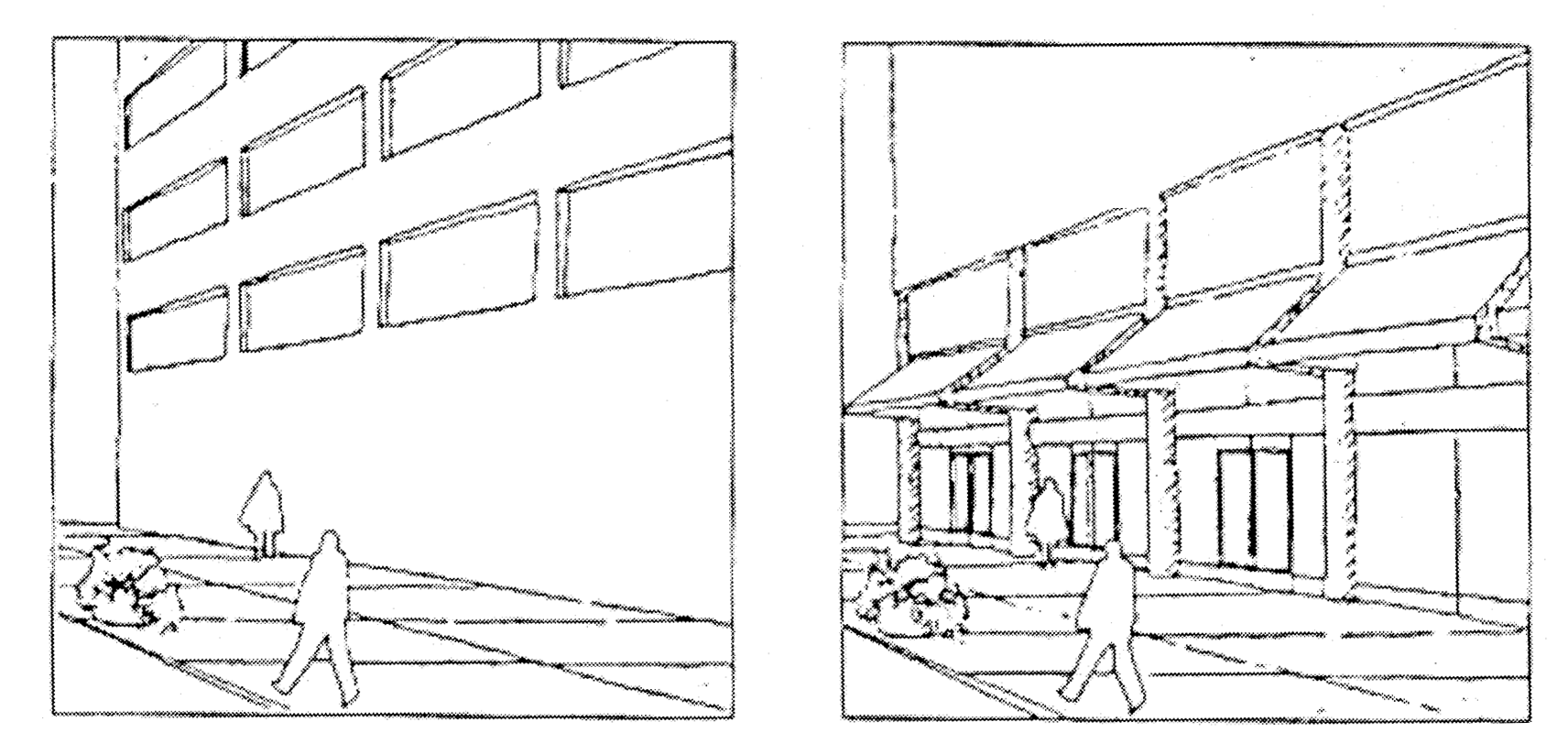
Modulation: Stepping back or projecting forward of sections of the facade of a structure as a means of breaking up the appearance of bulk of the continuous exterior walls. Modulation can be vertical (varying the setbacks of portions of the building's front facade from the sidewalk) or horizonal (varying the setbacks of upper stories on a multi-story building);
Multi-story structure: A building that has more than one (1) story above grade, whether or not each story is habitable or occupiable;
NFIP: The National Flood Insurance Program.
Primary entrance: The primary or principal pedestrian entrance of all buildings (except outbuildings). The primary entrance is the entrance designed for access by pedestrians from the sidewalk, or street if a sidewalk is not present. This is the principal architectural entrance even though day-to-day residential access may be via a secondary entrance associated with a garage, driveway or other vehicular use area. Garages may sometimes be located on either primary or secondary street fronts, however the garage is not considered as a pedestrian entryway;
Primary street front: The street or roadway to which the building is oriented;
Substantial improvement: Shall have the same meaning as defined in article III of chapter 10.5.
Scale: The apparent relationship between two (2) entities, such as the relationship of a building's height to human height, the relationship between different building's heights, or the relationship between the size of an addition and the building to which it is attached;
Secondary street front: On a lot with multiple street fronts the secondary street front is the street or roadway to which the building is not oriented;
Street tree: A tree or group of trees that line the edge of a street or roadway. This would include trees in the right-of-way;
Understory vegetation: Low to the ground vegetation such as shrubs and similar plants. This definition does not include sod, which is considered ground cover.
(d)
General building design standards. The regulations in this subsection shall apply to all residential structures in the conservation overlay district (COD) zoning district and all commercial and mixed-used multi-story structures in the waterfront redevelopment district (WRD) zoning district, and are designed to ensure that new development is compatible with the scale, architectural character, and pedestrian orientation of existing development.
(1)
Facade. All facades shall be constructed as follows:
a.
Finish: All facades shall have a finish treatment such as siding, stucco or similar aesthetic wall treatment. Simply painting an unfinished exterior, like concrete block, is not sufficient to meet this standard. The base material shall have an aesthetic finish.
b.
Minimum features: A facade, whether primary or secondary, shall exhibit at least two (2) of following features:
1.
Articulation;
2.
Awnings or shutters; or
3.
Porches and/or entryway features.
c.
Windows: The facade shall have at least one (1) window every twenty (20) feet per floor. The size of any facade window, including the frame, shall be a minimum of nine (9) square feet.
(2)
Primary entrance orientation. The primary entrance is the entrance designed for access by pedestrians from the sidewalk or street if a sidewalk is not present. This is the principal architectural entrance even though day-to-day residential access may be via a secondary entrance associated with a garage, driveway or other vehicular use area. The entryway is an important feature for maintenance of neighborhood characteristics. The principal entrance of all buildings, except outbuildings such as sheds or garages, shall be oriented directly toward the primary street front.
(3)
Landscaping. Landscaping has a dramatic effect on the appearance of a streetscape and in making new buildings appear more mature and in keeping with the existing community character. The maintenance of existing tree canopies and street trees creates continuity between established development and new infill development. Understory (low to the ground) and foundation plantings mitigate the severity of new construction by melding nature with urbanization. A newly completed building, without landscaping, often leads to the feeling that it does not "fit in" with the surrounding neighborhood. A well thought out landscape plan can make that same building look like it was built years ago.
The following landscaping shall be required:
a.
General: A minimum landscaped area of twenty (20) square feet of landscaping per one thousand (1,000) square feet of lot area shall be required. This is inclusive of any green space or permeable surface regulations set forth in the applicable zoning district, excluding those of subsection (f)(3)c. below.
b.
Street trees: When street trees are present on the block, at least one (1) tree per fifty (50) linear feet shall be planted along the street front, which may be in the right-of-way. The minimum requirement for street trees shall be four (4) inches in diameter, as measured at breast height, with a minimum height of eight (8) feet. If the minimum size is not readily available, then the largest size and height available shall be used at the city's discretion. The species shall be of the same type as other street trees found along the block face. If there is a mature existing street tree canopy on the property meeting the foregoing requirements, no additional street trees shall be required. Alternative species may be used if overhead utility lines make replication of the existing tree canopy impractical, and the spacing requirement shall be adjusted to meet the intent of providing a canopy cover when said trees mature. New residential developments in the conservation overlay district are additionally required to meet the canopy tree provisions of subsection 22-6.13(e)(2)d. below.
c.
Existing trees: Encroachments of new structures into the required side and rear yard setbacks to accommodate existing mature canopy trees are allowed without a variance provided such encroachments do not project by more than twenty-five (25) percent of the required setback.
d.
Foundation plantings: All facades shall include foundation plantings along the periphery of the facade, excluding driveway areas. There shall be a minimum planting area of three (3) feet in width landscaped with understory vegetative materials. Foundation plantings may be counted toward the landscape requirements set forth elsewhere in this section.
(4)
Multi-story structures. The following regulations apply to structures having more than one (1) story, whether or not each story is habitable or occupiable:
a.
Facade variations: Repetitive, monotonous, undifferentiated wall planes shall not be permitted. Buildings shall be articulated with projections, recesses, covered entryways, porches, balconies, covered box or bay windows and/or similar features, dividing large facades into human scaled proportions.
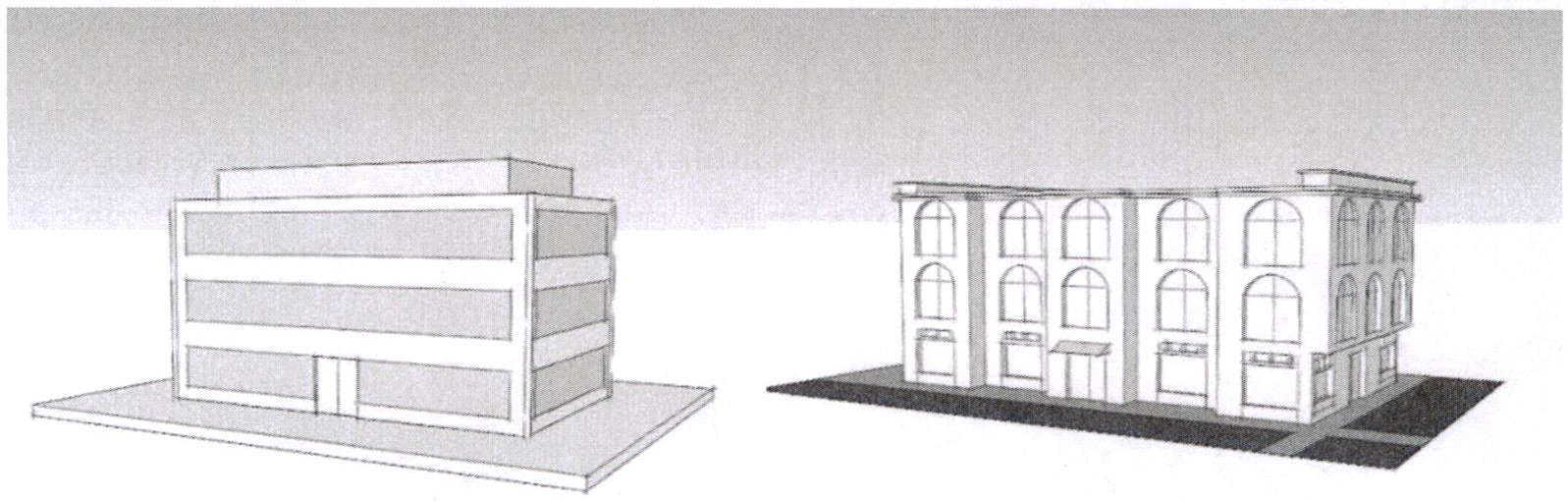
b.
Articulation of the second story: The second living, habitable, or occupiable story shall be articulated in a way that differs from the ground floor, or first living floor in a building required to be elevated to meet FEMA related regulations, through the use of projections, recesses, balconies, covered box or bay windows, awnings and/or similar features.
(5)
Roofs. Roof shape and type can be the most obvious element in defining the appearance of a house and a neighborhood. When designing a new building, it is important to consider the massing of roof forms and neighborhood roof patterns and compatibility. Roofs shall be constructed in accordance with the following:
a.
Pitch: Roofs shall have a minimum pitch of 4:12. Mansard and flat roofs shall only be used on structural exposures that will not be seen from a street front, unless the flat roof or mansard is part of an architectural style that routinely uses this feature, such as Spanish and Mediterranean architectural styles.
b.
Overhang: A minimum overhang of twelve (12) inches shall be provided for roof eaves. A roof overhang may encroach into the required yard setbacks by a maximum of eighteen (18) inches.
(6)
Setback encroachments. Architectural features may extend into the required front and side yard setbacks by no more than twenty-five (25) percent of the required yard setback, without a variance. Allowable encroachments extend only to the architectural feature(s). For purposes of this paragraph an open porch shall be an unenclosed area, which may have a pitched roof tied into the main structure.
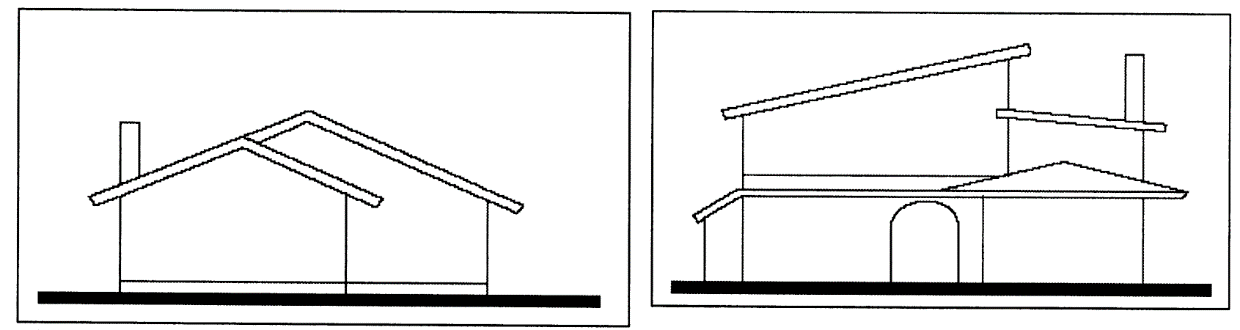
(e)
Residential building design standards. The following standards shall be applied to the design and construction of residential structures within the conservation overlay district (COD) and waterfront redevelopment district (WRD) zoning districts:
(1)
Existing single and multi-family structures. It is the existing single-family structures that for the most part have created the uniqueness and character of this area. For this reason care should be taken to maintain that character when remodeling and redeveloping these homes. The application of these standards ensures that an upgrade to an existing structure does not detract from the overall appearance and scale of the surrounding neighborhood, while still allowing for redevelopment of the older housing stock and reinvestment into these neighborhoods.
All existing single and multi-family structures in the district shall be constructed in accordance with the following regulations:
a.
Facade remodeling. The remodeling of facades on existing structures shall at a minimum match the design elements of the existing facade. These elements include, but are not limited, to window size and spacing, roof pitch and overhang of eaves of the existing structure. For example, in enclosing an existing garage for extra living space, the facade of the new enclosure would have to provide a number of openings, in the form of doors and/or windows of a size and spacing consistent with those of the existing facade. If however, the garage enclosure is part of an entirely new facade, the new facade elements shall be as set forth in subsection (2) of this section.
When an existing single- or multi-family structure erects a second story or a new garage, the elements for new single- and multi-family structures shall be as set forth in subsection (2) of this section as it concerns multi-story structures and garages.
b.
Porches. Existing residential structures lacking open porches are encouraged to add them onto their facades. Where a porch is present, the entrance shall be oriented directly toward the primary street front. An open porch shall be an unenclosed area, which may have a pitched roof tied into the main structure, and may extend into the required front and side yard setbacks by no more than twenty-five (25) percent of the required yard setback, without a variance.
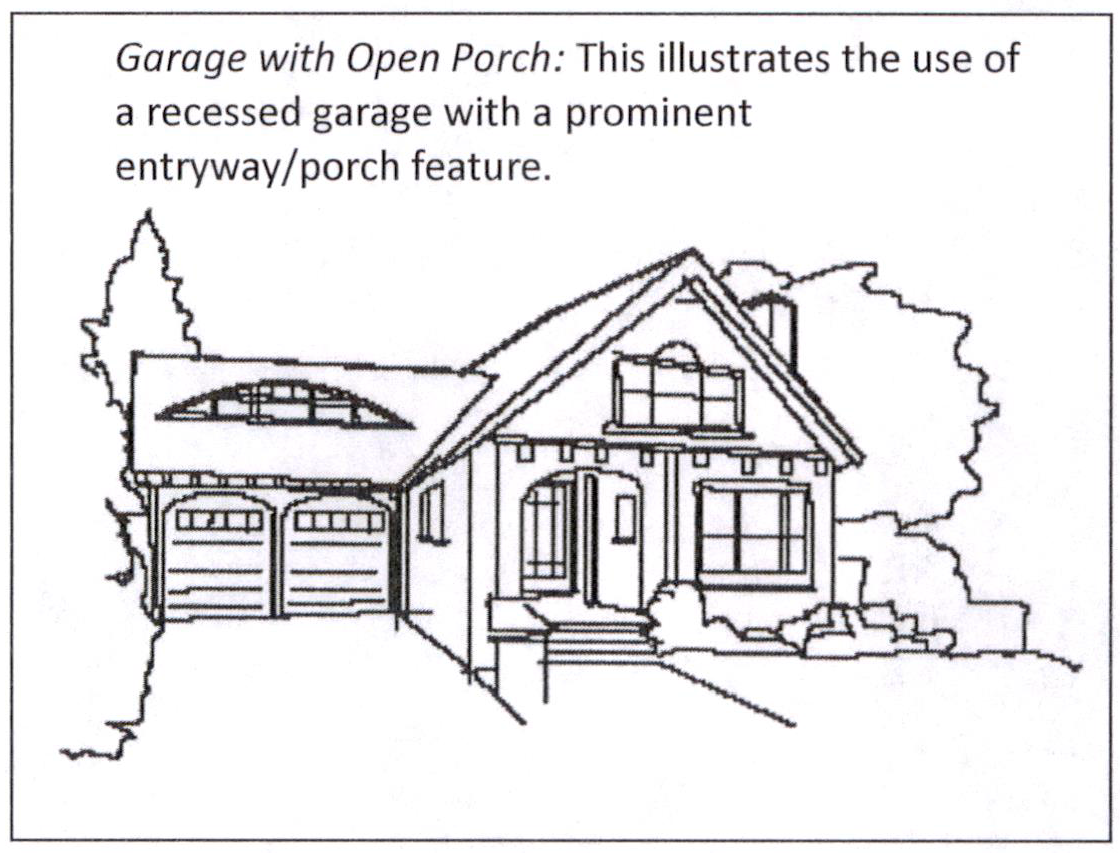
(2)
New single and multi-family structures. All newly constructed single- and multi-family structures in the district shall be constructed in accordance with the following regulations:
a.
Primary entrance orientation. The principal entrance of all buildings, except outbuildings such as sheds or garages, shall be oriented directly toward the primary street front.
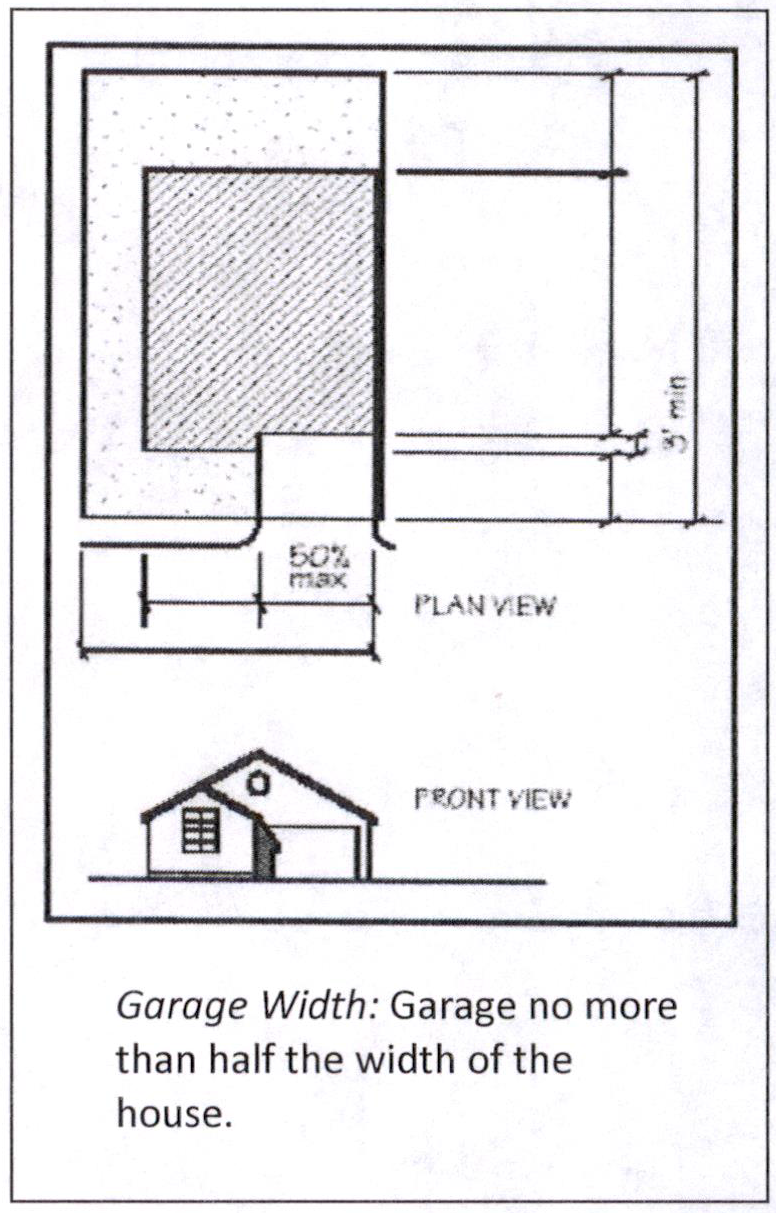
b.
Garages. The location, size, position and appearance of a garage can have a great effect on the appearance of a home and should be designed with care. Garages were not prominent features of the earlier housing stock found within the conservation overlay district and should not dominate new housing or redevelopment of existing housing.
The garage shall not be the prominent feature of the front facade. A garage shall be staggered from adjacent garages and shall not be placed beside an existing garage on an adjacent property, unless both adjoining and adjacent properties have garages located directly adjacent to the subject property. At least two (2) of the following features shall be used in designing new garages, unless the garage is placed facing the secondary street front on corner lots, or the garage is placed toward the rear of the property facing an alleyway:
1.
Articulation of the facade to set the garage back from the rest of the facade;
2.
Use of a side load garage with window openings as per the facade requirements;
3.
No more than one-half (½) of the facade shall be used for a garage; and
4.
A prominent entryway with open porch shall be used that spans one-half (½) of the facade.
c.
Porches. New residential structures are strongly encouraged to incorporate open porches into their facades. Where a porch is present, the entrance shall be oriented directly toward the primary street front. An open porch shall be an unenclosed area, which may have a pitched roof tied into the main structure, and may extend into the required front and side yard setbacks by no more than twenty-five (25) percent of the required yard setback, without a variance.
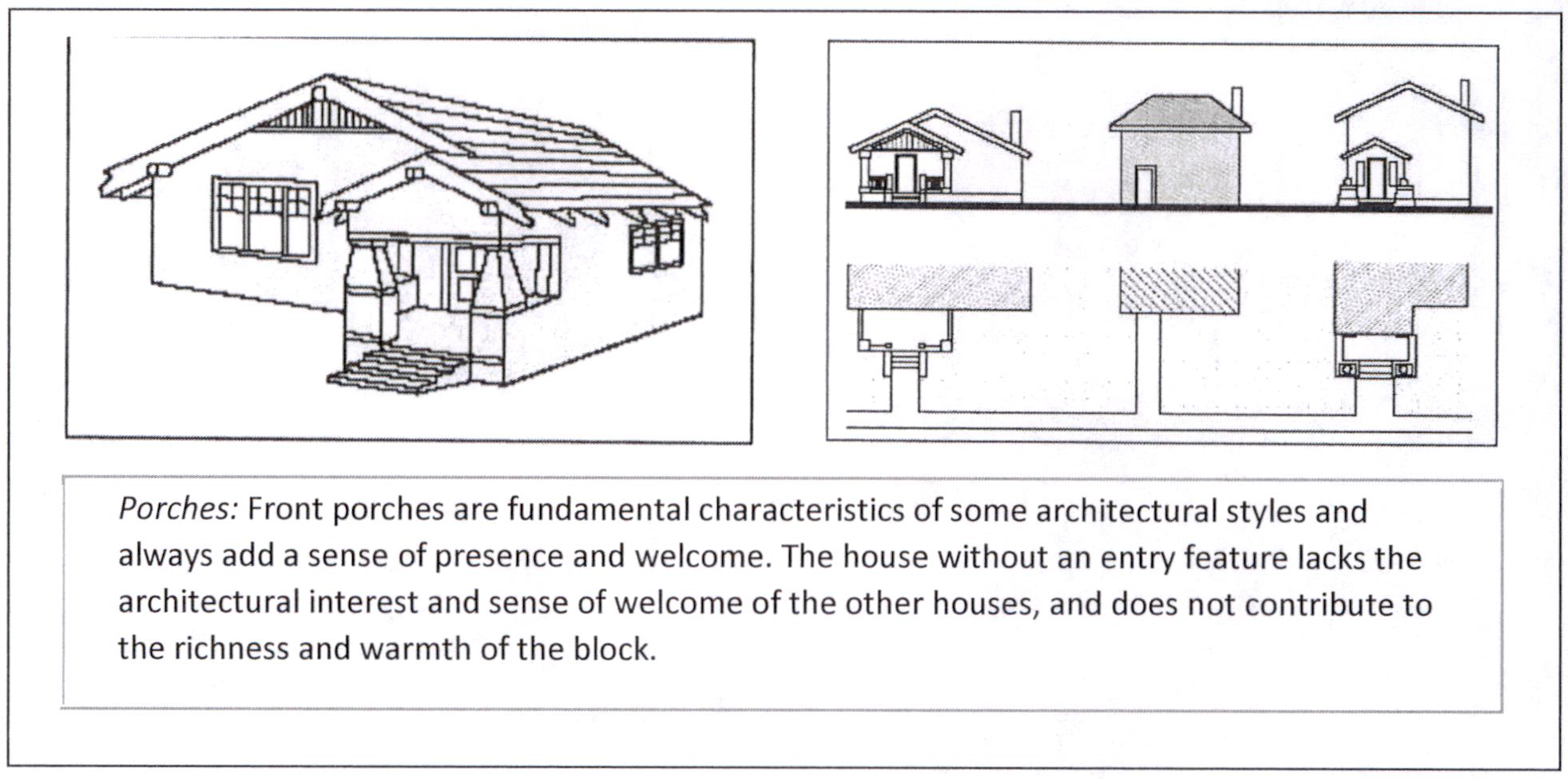
d.
Canopy trees: In addition to the landscaping requirements of subsection 22-6.13(d)(3) above, there shall be a minimum of two (2) canopy trees per site. At least one (1) of these trees shall be placed within the front yard. Existing canopy trees and required street trees (as long as they are canopy trees) may be applied toward this minimum. The minimum size shall be four (4) inches in diameter, as measured at breast height, with a minimum height of eight (8) feet. Adjustments to the required location of canopy trees may be made to accommodate an existing tree canopy.
e.
Multi-story houses. Single-story houses dominate the single-family homes found within the conservation district. With the trend toward larger homes, multi-story development and redevelopment is becoming popular in an effort to maximize the useable area of small lots. Floodplain regulations require elevation of structures above a defined flood elevation. Many people elect to build above the required flood elevation to take advantage of the large space left under the structure for garage and storage areas.
This type of larger scale development can dwarf adjacent single story development and disturb the character of an area simply due to the scale and bulk of the new or remodeled home. Attention to massing and scale can help to offset these disturbances and even be used to create the uniqueness that has led to the creation of the neighborhood character.
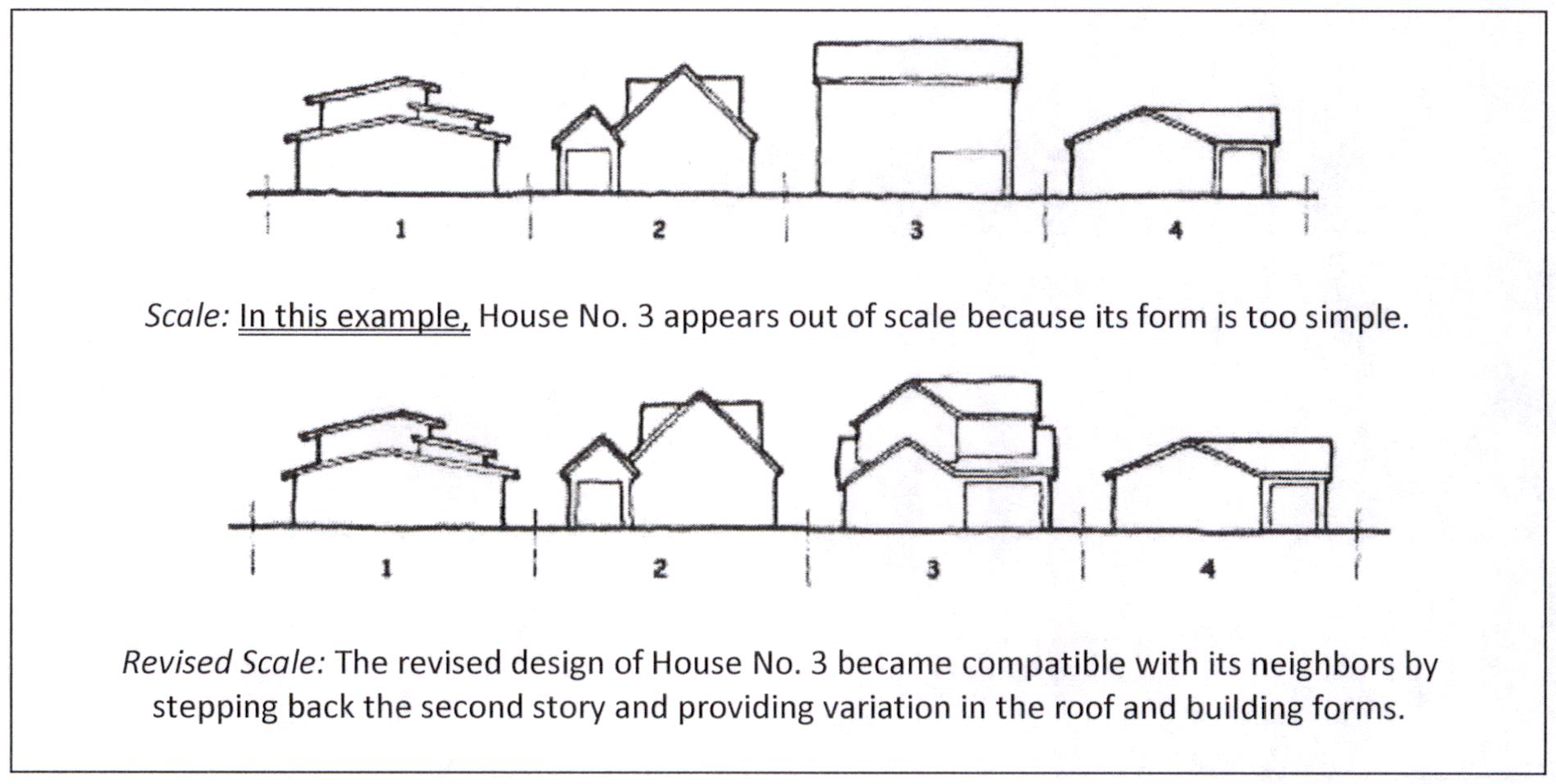
In addition to meeting the standards for second story articulation in subsection 22-6.13(d)(4) above, the second habitable or occupiable story shall be set back from the side and front building lines of the ground floor, or first living floor in a home required to be elevated to meet FEMA related regulations, by no less than two (2) feet, and shall be centered over the ground floor when not prohibited by required engineering practices and/or FEMA related regulations. The foregoing setback shall not be required where the eave line of the roof, at the facade (or facades in the case of a lot with multiple fronts), is brought down to the ground floor eave line (see illustration below). Dormers shall not make up more than two-thirds (⅔) of the second floor facade width. No cantilevering of a structure over the front or side of the ground floor shall be allowed.
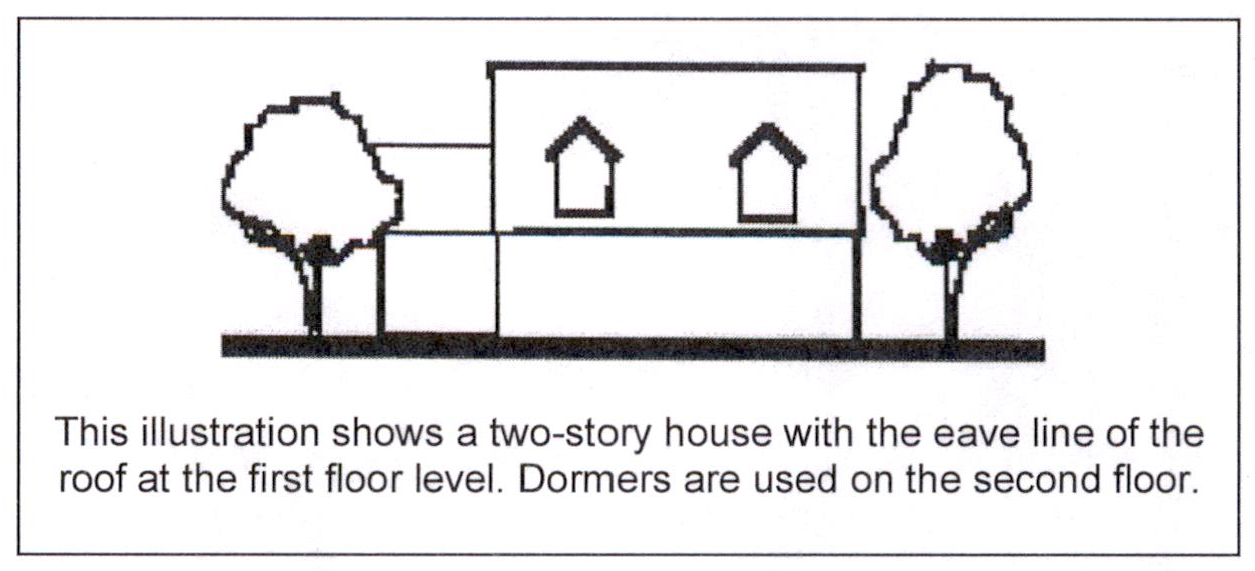
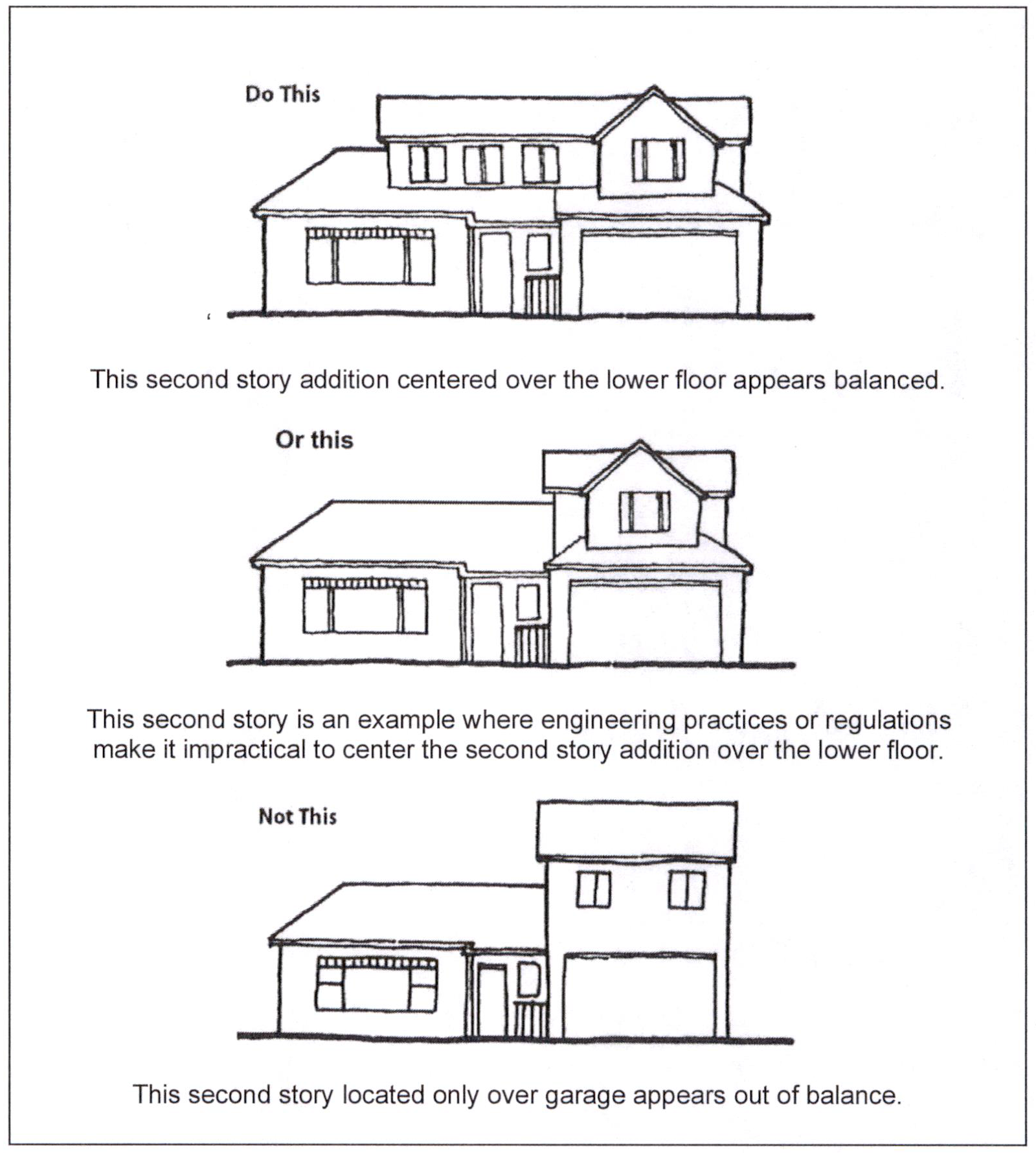
f.
Adjacent homes. When homes built next to one another are similar in appearance with little to no differentiation they take on the appearance of a subdivision or tract home. This is not consistent with the character of the conservation district. While many of the homes may have been the same when they were originally built, time has changed their original appearance through remodeling efforts, maturing of landscaping and individualization of the properties by a multitude of different owners. Different techniques should be employed in new construction and redevelopment that give the appearance of individuality.
Adjacent homes shall be constructed in accordance with the following:
When permits for construction of two (2) or more adjacent homes are issued within two (2) years, each later issued permit shall only be issued if the home to be constructed thereunder has at least two (2) of the following, as it relates to the adjacent homes already permitted:
1.
Difference in architectural style/type;
2.
Difference in roof type (i.e. hip vs. gable);
3.
Difference in facade profile; and
4.
Difference in footprint orientation.
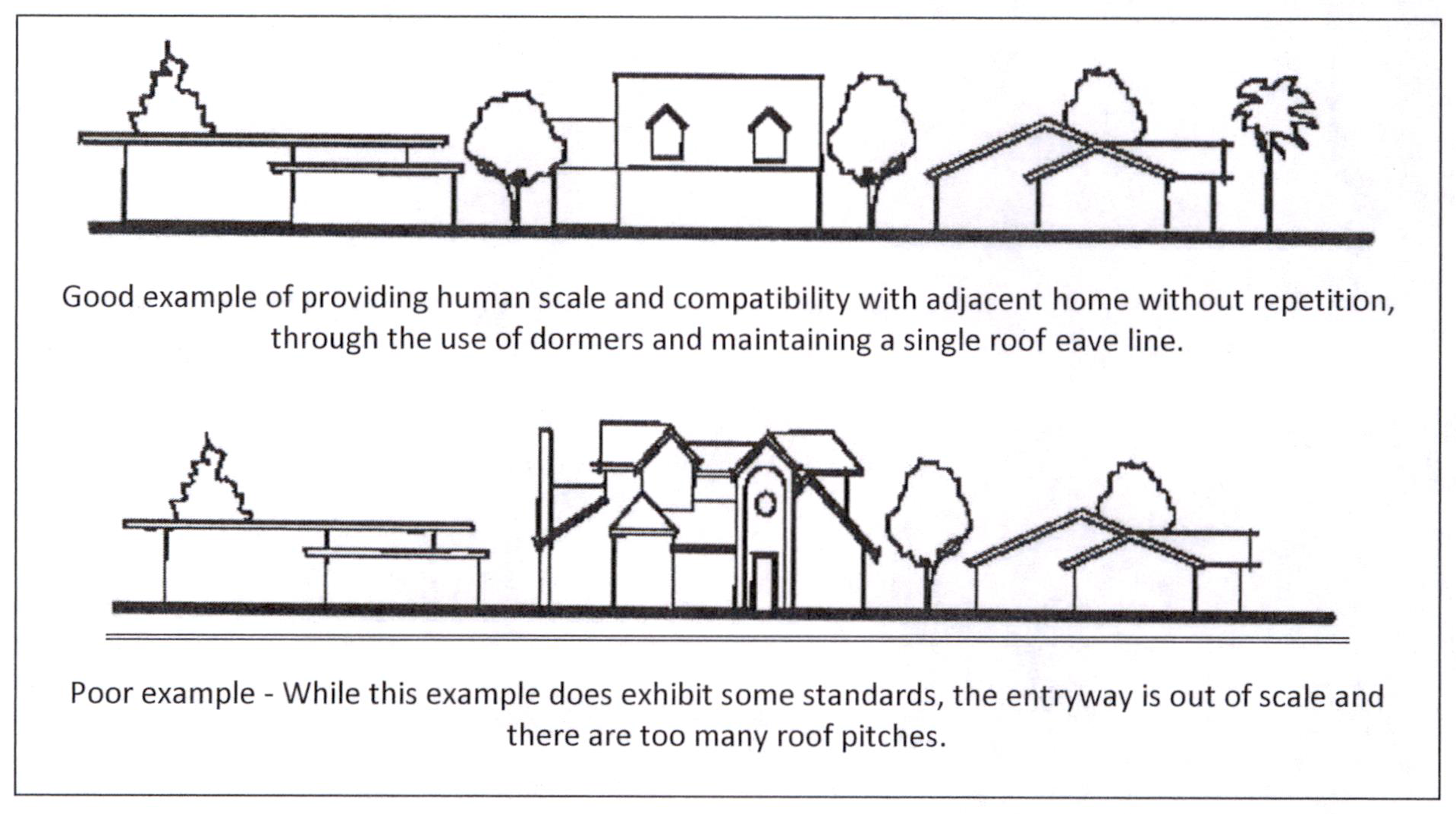
(f)
Multi-story building design standards in the waterfront redevelopment district. In addition to the general standards of subsection 22-6.13(d) above, the following standards shall be applied to the design and construction of multi-story structures within the waterfront redevelopment district (WRD) zoning district:
(1)
Building footprint. In addition to meeting floor area ratio and setback standards applicable to the zoning district, the maximum ground floor building footprint of a multi-story building shall be five thousand (5,000) square feet.
(2)
Active streetscape. To maintain an active pedestrian streetscape, the ground floor of a multi-story building shall incorporate features such as showcase windows, awnings, outdoor seating, display areas, and other elements that add pedestrian interest along the primary street front.
(3)
Compatibility with existing development. To reduce the visual impact of new structures that are taller and wider than the prevailing development pattern, all new multi-story commercial and mixed-use structures shall exhibit at least two (2) of following features:
a.
Vertical modulation. Division of the building facade into multiple sections, with the depths of the sections varied relative to the primary street front. Where sufficient building width exists, the width of individual sections shall be consistent with the width of nearby buildings to give the appearance of multiple smaller storefronts. The minimum section width shall be four (4) feet and difference in depth of adjacent sections shall be no less than two (2) feet. Where a facade is divided into three (3) or more sections, the depth and width of the sections shall be varied to avoid a uniform, boxy appearance.
b.
Horizontal modulation. Variance in the depth of upper stories, or portions thereof, relative to the primary street front, with the uppermost stories stepped back furthest from the street front. Upper stories shall be stepped back by at least five (5) feet relative to the ground floor. For buildings of more than two (2) stories, the step back distances and proportions of the upper stories shall be varied to avoid a uniform "wedding cake" tiered appearance.
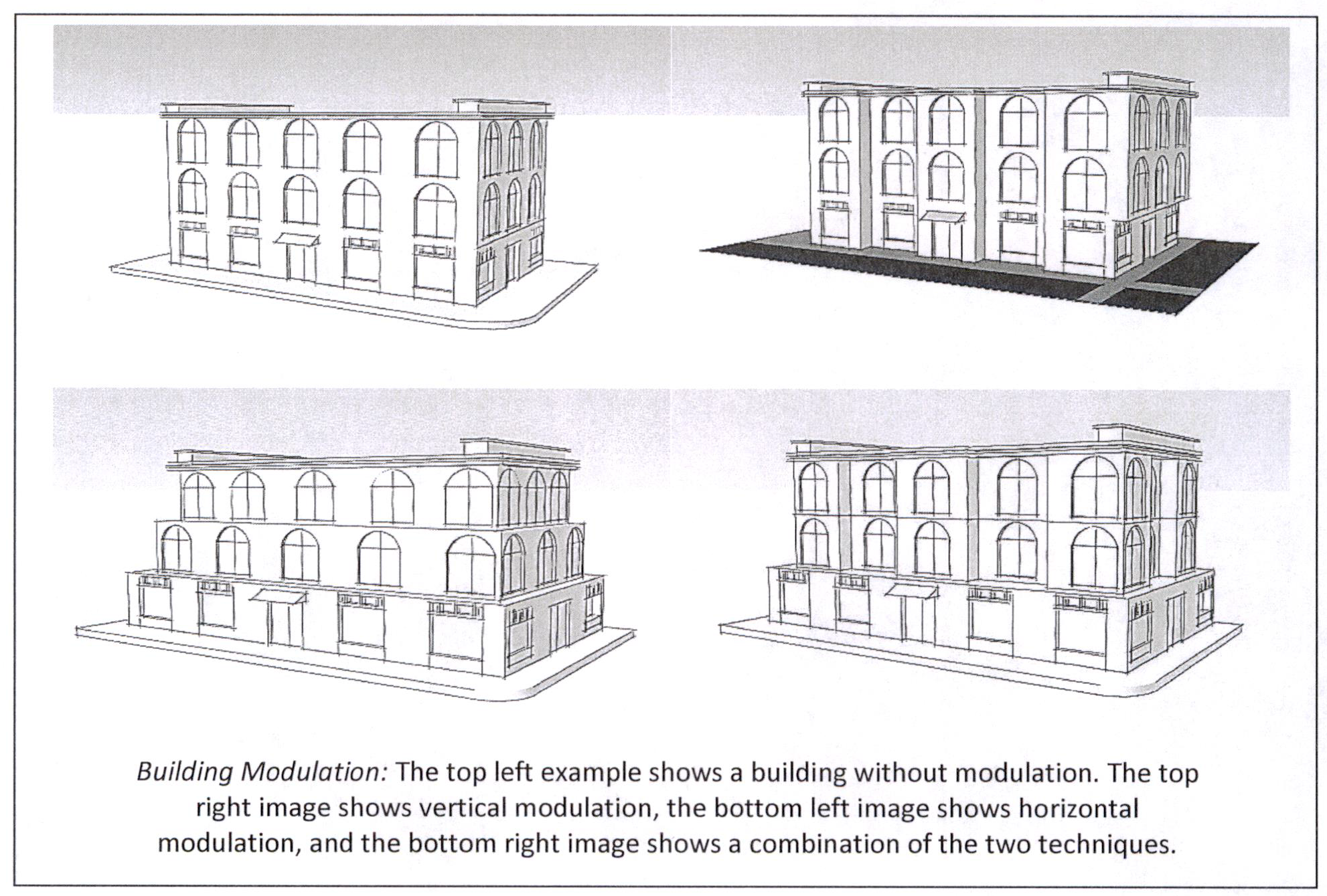
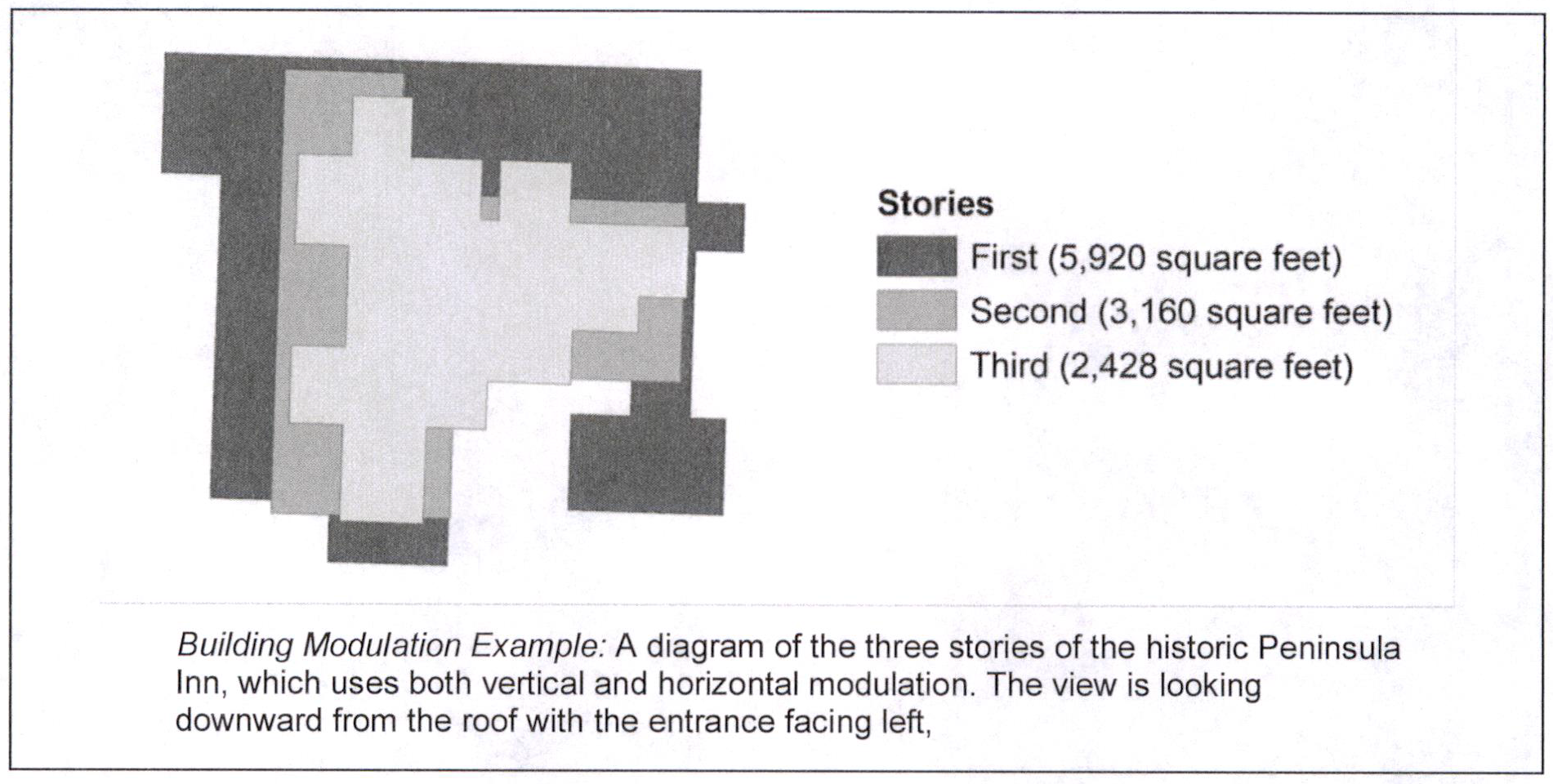
c.
Open space. Provision of an open space area, such as a courtyard or greenspace, facing the primary street front and accessible to pedestrians from the sidewalk. The open space area shall measure at least two hundred twenty-five (225) square feet, in addition to the landscaping requirements of subsection 22-6.13(d)(3) above. The open space area may be separated from the sidewalk by a wall, fence, row of planters, or other landscape barrier measuring no more than eighteen (18) inches in height as long as pedestrian access is maintained. The building entrance may open onto the open space area, but must be oriented toward the primary street front.
(g)
Commercial and mixed-use building design standards in FEMA-delineated flood zones. In addition to the general standards of subsection 22-6.13(d) above and the multi-story building standards of subsection 22-6.13(f) above, the following standards shall be applied to the design and construction of new and substantially improved commercial and mixed-use structures subject to National Flood Insurance Program (NFIP) construction requirements within the waterfront redevelopment district (WRD) zoning district:
(1)
Dry-floodproofing. In locations where NFIP requirements permit dry-floodproofing and it is physically feasible to do so, dry-floodproofing shall be used in lieu of elevating the first habitable or occupiable floor of a structure above base flood elevation. Dry-floodproofing typically includes, but is not limited to, some combination of the following techniques:
a.
Waterproof sealant for exterior walls;
b.
Watertight doors and windows;
c.
Relocation of utilities and mechanical systems above base flood elevation;
d.
Temporary flood barriers; and/or
e.
Where feasible, raising the building site with fill.
(2)
Elevated buildings. Where dry-floodproofing is not permitted by NFIP requirements or is infeasible due to site constraints, in addition to meeting the applicable requirements of FEMA flood building codes and the Florida Building Code, elevated commercial and mixed-use buildings shall meet the following requirements:
a.
The portion of the building below base flood elevation shall be enclosed and meet the facade design standards of subsection 22-6.13(d)(1) above.
b.
The non-habitable or non-occupiable ground floor shall maintain the appearance of an active storefront by incorporating removable elements such as window displays, outdoor displays, and/or outdoor seating oriented toward the sidewalk along the primary street front.
c.
To maintain the connection with the pedestrian streetscape, each building shall provide at least one (1) porch or balcony located on the ground floor or first habitable or occupiable floor, which is oriented toward the sidewalk along the primary street front.
d.
Where feasible, provision of an outdoor staircase from the sidewalk to the first habitable or occupiable floor is encouraged.
e.
To maintain an inviting pedestrian environment, the use of planters, potted trees, or other container plants on balconies and porches is strongly encouraged, and may be used as credit towards fulfilling the landscaping requirements of subsection 22-613(d)(3) above.
(h)
Optional multi-story building design standards. In addition to the applicable standards of subsections 22-6.13(d) through (g) above, new multi-story structures within the waterfront redevelopment district zoning district meeting the following criteria shall be exempt from the off-street parking requirements of article VI of this chapter:
(1)
Height. The maximum building height shall be thirty (30) feet above grade. No building shall have more than two (2) stories whether or not each story is habitable or occupiable; and
(2)
Width. The width of the building facade shall not exceed the average width of building facades on the same block front as the new structure. Alternatively, vertical modulation may be used to create the appearance of two (2) or more facades meeting this standard, as described in subsection 22-6.13(f)(3)a above. Applicants are required to supply documentation of the width of each building on the block front using publicly available information from the Pinellas County Property Appraiser's Office.
(3)
Site plan and conditional review. The building shall be subject to site plan review and approval as set forth in article VII of this chapter.
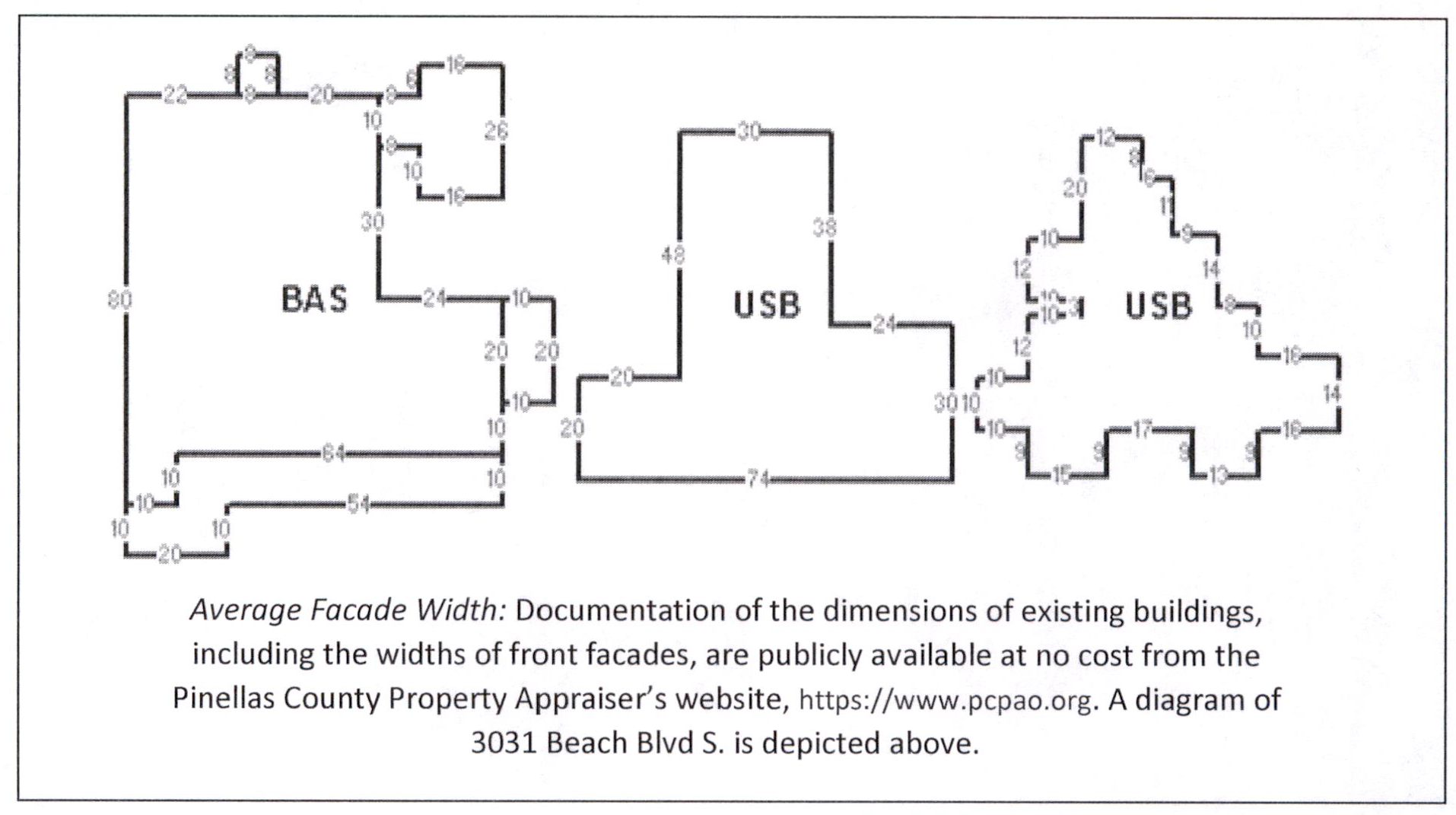
(Ord. No. 2021-16, § 3, 11-2-21)

