
Gwinnett County Unincorporated
City Zoning Code
City Zoning Code
CHAPTER 360
Infrastructure, Streets, Sidewalks, Multi-Use Paths, and Greenways16
Editor's note— Ord. No. UDOA2023-00002(GCID 2023-0604), Exh. A(§ 36), adopted Sept. 26, 2023, repealed the former Ch. 360, §§ 360-10—360-110, and enacted a new Ch. 360 as set out herein. The former Ch. 360 pertained to development design standards and derived from Ord. No. UDOA2015-00001(GCID No. 2015-0360), adopted April 28, 2015; Ord. No. UDOA2019-00005(GCID2019-0295), Exh. A, adopted March 19, 2019.
Section 360-10.- Street Classification and Right-of-Way Requirements.
360-10.1Street Classifications.
A.
Dedication of Street Right-of-Way. Right-of-way for all existing and proposed public streets within a project shall be dedicated in accordance with the street classifications as shown on the officially adopted Gwinnett County Long Range Road Classification Map.
B.
Street Improvements. All streets and project access improvements shall be constructed or improved to the standards as established in the UDO. Roadway improvements shall be made in accordance with the street classifications as shown on the officially adopted Long Range Road Classification Map or the UDO as applicable, or as otherwise required by the Board of Commissioners.
360-10.2Minimum Right-of-Way and Street Improvements.
A.
Right-of-Way and Pavement Widths. Minimum widths of street right-of-way and roadway pavement shall be as shown on Table 360.1 unless a modification is granted by the Director, except as follows:
1.
New Local Residential Streets in OSC, TND and Mixed-Use Districts. New local streets in subdivisions developed in the OSC District and in exclusively residential areas of TND, MU-N, MU-C and MU-R Districts shall be as follows:
a.
Right-of-way width of new interior local streets.
i.
Entrance Streets: at least 50 feet for a depth of 300 feet from the subdivision entrance (measured from exterior road right-of-way) after which street right-of-way width shall be at least 46 feet.
ii.
Other Interior Streets: at least 44 feet.
iii.
Right-of-Way Radii: at least 60 feet for cul-de-sac or "eyebrow" turnarounds.
b.
Pavement width of new interior local streets.
i.
Entrance Streets: at least 27 feet (measured to back of curb) for a depth of 300 feet from the subdivision entrance (measured from exterior road right-of-way) after which pavement width shall be at least 24 feet (measured to back of curb).
ii.
Other Interior Streets: at least 24 feet (measured to back-of-curb).
iii.
Pavement Radii: at least 50 feet for cul-de-sac or "eyebrow" turnarounds (measured to back of curb).
c.
Additional right-of-way shall be provided to accommodate additional travel lanes, sidewalks, multi-use paths, trails and greenways, and underground utilities.
2.
New Local non-residential streets in the MU-N, MU-C and MU-R Districts.
a.
New local non-residential streets developed in the mixed-use areas of TND, MU-N, MU-C and MU-R Districts shall meet the minimum right-of-way and roadway pavement widths for local non-residential street as shown in Table 360.1.
b.
Additional pavement and right-of-way width.
i.
Additional Travel Lanes: at least 11 feet of pavement width.
ii.
On-Street Parallel Parking: at least 9 feet of pavement width.
iii.
On-Street Angled Parking: at least 18 feet of pavement width.
iv.
Right-of-Way: additional right-of-way shall be provided to accommodate additional travel lanes, sidewalks, underground utilities, multi-use paths, trails, and greenways located between lots and street right-of-way.
Table 360.1. Minimum Right-of-Way and Roadway Widths for New Streets and
Project Access Improvements.
1 The greater right-of-way width shall apply under circumstances as described in Section 360-10.2.
2 Roadway width dimensions are back-of-curb to back-of-curb except where noted.
3 Utility easement shall be provided in a location and size as required by the Department of Water Resources.
4 Subdivisions zoned RA-200.
5 May be reduced to 50 feet if curb, gutter, and piped drainage system is provided.
6 Measured to edge of pavement. Curb and gutter is not required in RA-200 subdivision. Roadway width may be reduced to 23 feet if curb and gutter is provided (27 feet total width).
B.
Street Rights-of-Way.
1.
The minimum width of street right-of-way shall be dedicated based upon the street classification as shown on the officially adopted Gwinnett County Long Range Road Classification Map and as contained in the UDO.
2.
Additional street right-of-way width shall be required to be dedicated at intersections or other locations to accommodate required traffic safety improvements (e.g., deceleration lanes, turning lanes, storage lanes, medians, or realignments), future projects identified in official planning documents, or within 500 feet of a major intersection and minimum right-of-way standards would be inadequate to accommodate the improvements.
3.
If a new street or thoroughfare is proposed by the officially adopted Gwinnett County Long Range Road Classification Map or the State of Georgia to adjoin or traverse the property, permits shall not be issued until the Department of Transportation has submitted the project to the Board of Commissioners for review in order to seek a determination if Gwinnett County should acquire the right-of-way or if a study of alternate routes should be undertaken.
(Ord. No. UDOA2023-00002(GCID 2023-0604), Exh. A(§ 36), 9-26-2023)
Section 360-20. - Requirements for New Streets and Roadways.
360-20.1Construction Standards. Streets, whether public or private, shall be constructed or improved at least to the standards contained in this UDO in accordance with the category of said streets or as otherwise required by the Board of Commissioners.
360-20.2General Layout Requirements.
A.
Conformance. The arrangement, character, extent, width, grade, and location of all streets shall conform at a minimum to the officially adopted Gwinnett County Long Range Road Classification Map and this UDO.
B.
Local Streets and Minor Collectors.
1.
Local streets shall be laid out so that their use by through traffic will be discouraged. Minor collectors shall be provided to channel through traffic movements within a development, where appropriate to the design and a major thoroughfare is not proposed by the officially adopted Gwinnett County Long Range Road Classification Map. Minor collectors also may be provided as central routes within large residential subdivisions, where appropriate to the design, based on project traffic demands exceeding 2,000 trips per day (ADT). Traffic calming measures for new local streets are required to encourage and maintain maximum vehicle operating speeds of 25 mph. In order to achieve this objective, the maximum length of roadway section between speed control points shall be 500 feet. Such design and construction should be in substantial conformance with the Gwinnett County Department of Transportation Traffic Calming Design Guide for traffic calming measures and requirements.
C.
Cul-de-sac Streets.
1.
Dead end streets designed to have one end permanently closed shall provide a cul-de-sac or other approved turnaround and may be no more than 600 feet in length. Additional length necessitated by topography or property configuration may be approved by the Director.
2.
The length of a cul-de-sac street shall be measured from the center of the cul-de-sac or other approved turnaround to the center of the intersection with another street, whether a through street or another cul-de-sac or dead-end street.
3.
Eyebrow cul-de-sac (half cul-de-sacs) will be allowed only at "right-angled" intersections having an interior angle between 80 degrees and 100 degrees.
4.
Cul-de-sacs shall conform to the layout and dimensional requirements as shown in the Standard Drawings maintained by the Department.
D.
Substandard Streets. In the event that a development has access to a substandard street (i.e., a dirt or gravel road), the following project access improvements shall be required:
1.
If the abutting substandard street provides access to the development and is dirt or gravel, the street shall be upgraded by the developer to a paved roadway from the project entrance to the nearest standard paved road along the route of access.
2.
Off-site project access improvements required under Subsection 360-20.2.D.1, above, and Chapter 360 shall at a minimum, result in a full-section roadway meeting the requirements of a local residential rural roadway (24 feet edge to edge of pavement, with drainage swale ditches as needed). Responsibilities shall be as follows:
a.
The Developer shall design the road and provide the labor, equipment, and materials required for roadway improvements and necessary drainage improvements.
b.
If the County desires the roadway to be improved to a standard greater than that for a local residential rural roadway, the County shall provide or pay the cost of the additional materials and labor.
c.
All right-of-way required for these off-site improvements shall be acquired by the developer at no expense to the County.
d.
In the event that access to a new development is through an existing local County-maintained Road, the Developer and/or Builder is responsible for any and all damages to the existing road. Developer and/or Builder may be required to document existing conditions of this access road prior to any construction, may be required to post a bond or some form of guarantee and make necessary repairs as deemed appropriate per the Director.
3.
Half Streets. Half-streets (new boundary streets having one-half of the minimum required right-of-way or pavement width) shall not be allowed nor access to same be permitted should it exist.
E.
Improvements along State Highways. For any development which abuts a state highway or other right-of-way controlled by the State of Georgia, improvements to the roadway and the location and design of any street or driveway providing access from the state highway shall comply with the standards and requirements of the Georgia Department of Transportation. A permit for the proposed access or improvements shall be required to have been approved by the Georgia Department of Transportation and incorporated into the construction drawings for the project prior to issuance of a development permit by the Department.
F.
Dead End Streets.
1.
A dead-end street shall be provided to the boundary of a subdivision where necessary to provide access to a land-locked abutting property, for planned continuity of future circulation, for improved access for public safety vehicles, or for the extension of public water or other utilities to neighboring lands. Such dead-end streets shall be designed so as to allow their reasonable extension and shall be located so as to be reasonably incorporated into a street design for the neighboring property. The stub street requirement may be waived by the Director.
2.
Dead end streets on abutting property shall be extended into a proposed subdivision and incorporated into the street design of the development. This requirement may be modified by the Director in cases of serious topographical hardship or dissimilar zoning which would create unacceptable land use conflicts between the two developments. This modification may be conditioned on the provision of easements necessary for the extension of public utilities, the provision of cul-de-sac or other permanent turnaround on the dead-end street, or the removal of the dead-end street back to its nearest intersection.
3.
Where a dead-end street (other than a cul-de-sac) serves more than three lots, the developer shall be required to provide a temporary vehicular turnaround within the right-of-way. This requirement may be waived if extension of the dead-end street is approved and under construction prior to its inclusion in a Final Plat.
4.
Where a street dead ends at the property boundary and the street exceeds 1000 feet in length, a permanent cul-de-sac or other approved turnaround shall be required. In this situation, right-of-way to the property boundary shall be required, but the pavement shall not be extended to the property boundary beyond the edge of the paved cul-de-sac or other approved turnaround. In no case shall a dead-end street exceed 2000 feet in length unless approved by the Department of Transportation due to unusual topographic conditions or property configuration.
5.
Connections for future extension of all public utilities shall be constructed as part of the subdivision. Curb returns shall be constructed as part of the subdivision. Curb returns shall be provided to the future "stub" street roadway location, and curb and gutter shall be installed across the roadway stub at the right-of-way line (extended).
6.
The right-of-way for the "stub" street shall be dedicated as part of the Final Plat. Slope easements or construction easements, if required by the street design, shall be shown on the Final Plat.
G.
Service Roads. Where a development borders on or contains a railroad right-of-way, or limited access highway right-of-way or major thoroughfare, a public street may be required to be constructed and dedicated within the development approximately parallel to and on each side of such right-of-way.
360-20.6Reserve Strips. Land in private ownership adjacent to public rights-of-way which could control or are intended to control access to streets, alleys, or public lands shall not be permitted unless their control is given to the County under ownership, dedication, or easement conditions approved by the County Attorney or acceptable to the Director. No development shall be designed so as to deny access to abutting properties.
360-20.7Street Jogs.
A.
Street jogs shall either directly align or have offsets as shown in Table 360.3, as measured between centerlines of said streets.
B.
All Major Thoroughfares shall provide offsets as required by the Department, where alignment is not desirable or feasible, but in no case be spaced less than 600 feet apart as measured between centerlines of said streets.
(Ord. No. UDOA2023-00002(GCID 2023-0604), Exh. A(§ 36), 9-26-2023)
Section 360-30. - Project Access Improvements.
360-30.1Project access improvements for single-family detached, single-family attached, and duplex residential subdivisions.
A.
When property that abuts upon an existing or proposed County road is to be developed or redeveloped as a single-family detached, attached, or duplex subdivision and the County street will provide access to the property, project access improvements to the County road (deceleration lanes, turn lanes, etc.) shall be provided by the developer as required herein. Two remote entrances shall be required for developments with more than 120 dwelling units unless an administrative modification is granted by the Department and an administrative variance is granted by the Gwinnett County Fire Marshall.
B.
A deceleration lane shall be required to be provided at each project driveway or subdivision street entrance that is provided street access to a Minor Collector Street or Major Thoroughfare. In the event a street has an existing or proposed median, and the developer desires to construct a median break to serve the subdivision, a left turn lane leading to the median break shall be required to be provided by the developer if approved by the Department of Transportation and shall meet the standards contained herein. The preferred spacing for median breaks shall be 2,000 feet between the centerlines of the openings, and the minimum spacing for median breaks shall be 1,000 feet between centerlines of the openings. Other factors will also be considered, such as distance to other median openings, adjacent land use, expected traffic volumes, and the resulting volume of U-turns that are likely to occur without the median opening. Meeting the spacing criteria is not, in itself, an indication that median openings will be allowed.
C.
Deceleration lanes shall have a length of 200 feet, with an additional 50-foot taper length, a pavement width of 12 feet (exclusive of curb and gutter) and shall be provided with curb and gutter. Additional right-of-way to accommodate the deceleration lane and an 11-foot shoulder measured from back of curb shall be dedicated by the developer to Gwinnett County at no cost. Associated stormwater infrastructure as deemed necessary by the construction of the deceleration lane shall also be required.
D.
A left turn lane shall be provided into each project driveway or subdivision street that accesses a Minor Collector or Major Thoroughfare in accordance with the Department of Transportation's "Criteria and Guidelines for Left Turn Lanes".
E.
Other project access improvements may be required by the Department upon the recommendation of the Department of Transportation in order to ensure adequate site access, pedestrian access, convenience and safety to the motoring public.
F.
The developer shall be responsible for the relocation of public or private utilities and stormwater infrastructure, as may be occasioned by the required Project Access Improvements.
360-30.2Project Access Improvements for Multifamily and Non-residential Developments.
A.
When property that abuts upon an existing or proposed County road is to be developed or redeveloped for multifamily or non-residential uses and the County road will provide access to the property, project access improvements to the County road (deceleration lanes, turn lanes, etc.) shall be provided by the developer.
B.
A deceleration lane shall be required to be provided at each project driveway or subdivision street entrance, as applicable, that is provided street access to a Minor Collector Street or Major Thoroughfare. In the event a street has an existing or proposed median, and the developer desires to construct a median break to serve the project, a left turn lane leading to the median break shall be required to be provided by the developer if approved by the Department of Transportation and shall meet the standards contained herein. The preferred spacing for median breaks shall be 2000 feet between the centerlines of the openings, and the minimum spacing for median breaks shall be 1000 feet between centerlines of the openings. Other factors will also be considered, such as distance to other median openings, adjacent land use, expected traffic volumes, and the resulting volume of U-turns that are likely to occur without the median opening. Meeting the spacing criteria is not, in itself, an indication that median opening will be allowed.
C.
Deceleration lanes shall have a length of 200 feet, with an additional 50-foot taper length, pavement width of 12 feet (exclusive of curb and gutter) and shall be provided with curb and gutter. Additional right-of-way to accommodate the deceleration lane and an 11-foot shoulder shall be dedicated by the developer to Gwinnett County at no cost. Associated drainage improvements as deemed necessary by the construction of the deceleration lane shall also be required.
D.
A left turn lane shall be provided into each project driveway or subdivision street that accesses a Minor Collector or Major Thoroughfare in accordance with the Department of Transportation's "Criteria and Guidelines for Left Turn Lanes."
E.
Other project access improvements may be required by the Department upon the recommendation of the Department of Transportation in order to ensure adequate site access, pedestrian access, convenience and safety to the motoring public.
F.
The developer shall be responsible for the relocation of public or private utilities and stormwater infrastructure, as may be occasioned by the required Project Access Improvements.
(Ord. No. UDOA2023-00002(GCID 2023-0604), Exh. A(§ 36), 9-26-2023)
Section 360-40. - Driveway Design Standards.
360-40.1Angle and Improvements. Driveways shall generally intersect streets at right angles. The portion of a driveway located within a public right-of-way shall be paved. Driveways providing access to parking lots which contain five or more spaces shall be paved in accordance with the parking lot requirements in Chapter 240.
360-40.2Driveway Design Standards. Driveways serving single-family detached or duplex residences may be no less than 10 feet wide at the right-of-way line and shall provide a radius to the back of curb or edge of pavement of the roadway of no less than 5 feet. Driveways shall provide a parking area of at least 18 feet deep measured from the edge of the sidewalk or curb if a sidewalk is not present or required. All other driveway curb cuts on public streets shall conform to the standards shown on the driveway details contained in the Standard Drawings in the Appendix of the UDO and by land use type as follows:
A.
Driveway Detail 1 (32-foot Width, 25-foot Radius) for:
1.
Commercial and Retail Uses (over 80,000 Square Feet).
2.
Office/Institutional/Cultural Uses (Over 100,000 Square Feet).
3.
Multifamily Residential Developments (Over 200 Units).
4.
Mobile or Manufactured Home Developments (Over 200 Lots).
5.
Service Stations.
B.
Driveway Detail 2 (28-foot Width, 25-foot Radius) for:
1.
Commercial and Retail Use Sites (80,000 Square Feet or Less).
2.
Office/Institutional/Cultural Use Complexes (100,000 Square Feet or Less).
3.
Multifamily Residential Developments (200 Units or Fewer).
4.
Mobile or Manufactured Home Developments (200 Lots or Fewer).
C.
Driveway Detail 3 (32-foot Width, 40-foot Radius) for:
1.
Industrial Sites.
D.
Driveway Detail 4 (Optional Design with Island) for:
1.
Private Commercial/Office Street Entrances.
2.
Private Entrances to Multifamily Residential Developments (Over 200 Units).
3.
Private Entrances to Mobile or Manufactured Home Developments (Over 200 Lots).
4.
All driveways and driveway curb cuts on State highways shall conform to Georgia Department of Transportation standards.
360-40.3Auxiliary Lanes. Along any Major Thoroughfare, a deceleration lane, acceleration lane, larger turning radius, traffic islands, or other devices or designs may be required to avoid specific traffic hazards which would otherwise be created by the proposed driveway location.
360-40.4Corner Sight Distance. All driveways approaching a Minor Collector or Major Thoroughfare shall provide adequate corner sight distance, and shall meet or exceed the following design standards:
A.
The sight distance criteria are based on the time required for a vehicle to make a left turn from a stop-controlled approach to the Highway (AASHTO Case B1). The time to execute the maneuver is based on recommendations contained in NCHRP Report 383, Intersection Sight Distance. The sight distances, for a two-lane road, are the distances traveled at the arterial speed during 7.5 seconds. The time is increased by 0.5 seconds for each additional lane to be crossed.
B.
The sight distances given in Table 360.2 are for undivided highways and streets. If the highway or street is divided, the effect of the median should be considered in determining the required sight distance. Based on the conditions, it may be feasible for the crossing maneuver to be done in two stages with a stop in the median. However, the intersection should only be treated in this manner if the signing and marking is accordingly provided. Otherwise, the sight distance requirements should be increased to account for the additional width that must be crossed. See AASHTO Green Book, Chapter 9 Intersections, for adjustments due to grades greater than 3 percent and design vehicles other than passenger cars.
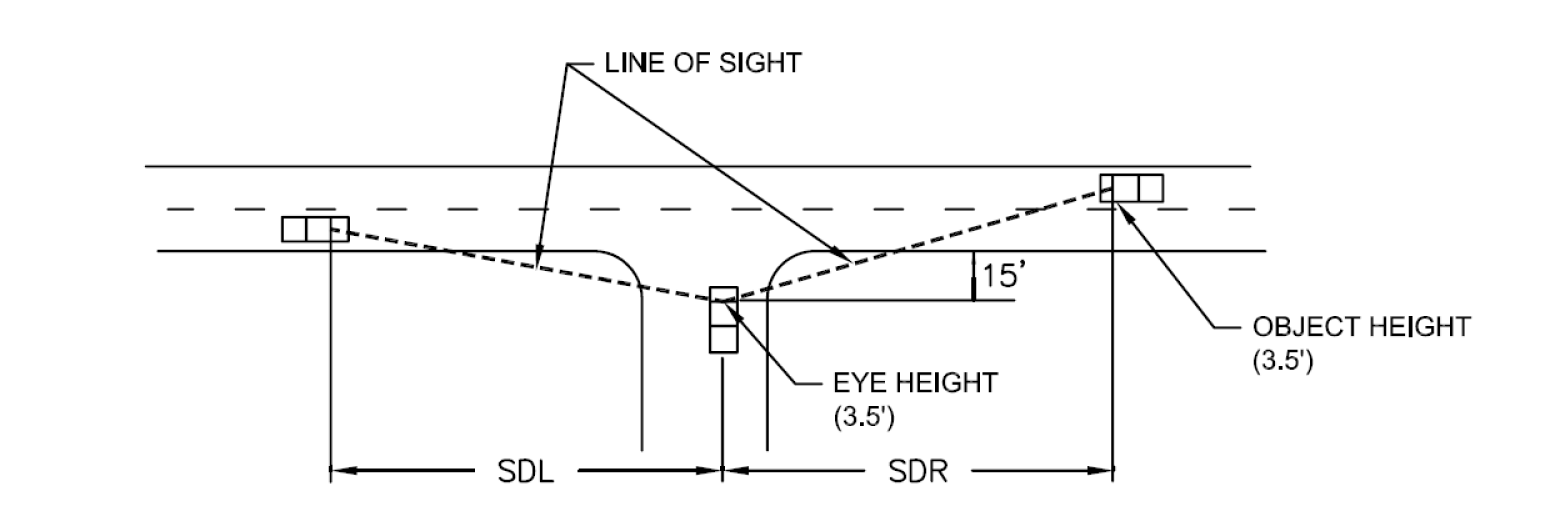
Table 360.2. Sight Distance.
360-40.5Separation and Spacing. All driveways except those serving residential units on individual lots shall meet the following criteria:
A.
Minimum separation for driveways, public roads, and side streets:
Table 360.3. Minimum Separation for Driveways, Public Roads, and Side Streets.
B.
Driveway Spacing. Spacing shall be measured from centerline to centerline of driveways, public roads, or side streets. Where there is an arterial or major collector intersecting with a side street, the measurement may be taken from the edge of pavement or back of curb, as opposed to the centerline of the arterial/major collector. Greater separation may be required for safe operation of intersections and right or left turning lanes. Whenever possible, proposed driveways along one side of a street shall coincide with existing or proposed driveways on the opposite side of such street. If offset driveways cannot be avoided, the same driveway spacing criteria as given in Table 360.3 should be provided. Spacing shall be measured from centerline to centerline. If the Highway involved is a divided facility and the driveways do not align with a median crossover, the driveway spacing would only apply to the adjacent driveway on the same side of the Highway as provided in Table 360.3.
C.
Maximum Number of Driveways. Developments shall be limited to one driveway access on county-maintained roadways. Additional driveways may be permitted subject to the review and approval of the Gwinnett County Department of Transportation.
D.
Interior Driveways. The placement of the first interior drive which intersects the driveway from a county-maintained roadway should be as far as possible from the road for safe, more efficient operation. The distance between the roadway traffic and the first internal movement shall be a minimum of 200 feet as referenced in the Georgia Department of Transportation Regulations for Driveway Encroachment Control Manual, Figure 3-1.2. Lots less than 500 deep should maintain, a minimum distance of 100 feet. The distance required should be maintained or increased so as to avoid interference with the mainline traffic flow for large sites with high volumes, heavy truck traffic, and on high volume roadways. If no other design alternatives exist and interior drives are proposed which do not meet minimum spacing, the left turning movement should be restricted with a raised barrier. Site planning should be done such that Interior Driveways accommodate the right of way at least 100 feet of storage.
(Ord. No. UDOA2023-00002(GCID 2023-0604), Exh. A(§ 36), 9-26-2023)
Section 360-50. - Street Intersections.
360-50.1Angle of Intersection. Intersections shall generally be at right angles and shall not be at an angle of less than 85 degrees, unless approved by the Department, nor less than 80 degrees unless the intersection is signalized, in which case the angle of the intersection may be reduced subject to the review and approval of the Gwinnett County Department of Transportation.
360-50.2Maximum Grade. Street intersections should be designed with a flat grade wherever possible, but in no case should the grade exceed 2 percent in normal situations (or 4 percent in topographical hardship situations on local streets).
360-50.3Intersection Approaches: Horizontal Alignment.
A.
New local streets which approach an intersection with a street in a category higher than itself on a horizontal curve having a centerline radius less than 240 feet shall provide a tangent section of roadway at least 30 feet long. Minor Collectors approaching an intersection with a Major Thoroughfare on a horizontal curve having a centerline radius of less than 550 feet shall also provide the 30-foot tangent section. The tangent length shall be measured along the centerline of the street, from the right-of-way line of the intersecting street, extended, to the point of tangency with the centerline of the curve section.
B.
New Major Thoroughfares shall provide tangent sections at intersections with streets in equal or higher categories as needed to provide adequate stopping distances at their design speeds.
360-50.4Intersection Approaches: Vertical Alignment.
A.
For intersections with local or minor collector streets, a leveling of the street at a grade not exceeding 2 percent shall be provided but no level approach distance is required for streets approaching at less than 7 percent, and a minimum 25-foot level approach distance shall be provided for streets approaching at a grade of 7 percent or more.
B.
As a street approaches an intersection with a major thoroughfare, there shall be a suitable leveling of the street at a grade not exceeding two percent and for a distance not less than the following minimums, as set forth in Table 360.4 below:
Table 360.4. Approach Distances at Major Intersections.
* Distance of the approach is measured from edge of pavement of the intersecting street to the point of curvature in the approaching street.
360-50.5Intersection Radii. Intersection radii for roadways measured at back of curb and for the right-of-way lines shall be as set forth in Table 360.5 below. For intersecting streets of different classifications, the larger radii shall be provided. In all cases, adequate right-of-way shall be provided to maintain minimum of 11 feet from back-of-curb. Larger radii may be required for streets intersecting at angles less than 90 degrees.
Table 360.5. Intersection Radii.
* Intersecting right-of-way lines may be joined by an arc having the minimum radius shown, or by a miter which cuts across the right-of-way lines connecting the points where the required radius would have otherwise been tangent.
360-50.6Islands. Islands in street intersections shall conform to the design requirements of the Standard Drawings in the Appendix of the UDO. In no case shall anything in an island extend more than three feet above the street grade within the right-of-way, except traffic regulatory devices and other infrastructure erected or approved by Gwinnett County. No island shall be approved which contains less than 100 square feet.
360-50.7Intersection Corner Sight Distance.
A.
Intersections shall be designed with adequate corner sight distance for each street which approaches a street in an equal or higher street category (except an intersection of two local streets). Where necessary, backslopes shall be flattened and horizontal or vertical curves lengthened to provide the minimum required sight distance.
B.
The minimum corner sight distance shall meet the standards as shown in Table 360.2 Sight Distance.
C.
The sight distance criteria are based on the time required for a vehicle to make a left turn from a stop-controlled approach to the Highway (AASHTO Case B1). The time to execute the maneuver is based on recommendations contained in NCHRP Report 383, Intersection Sight Distance. The sight distances, for a two-lane road, are the distances traveled at the arterial speed during 7.5 seconds. The time is increased by 0.5 seconds for each additional lane to be crossed. The sight distances given in Table 360.2 are for undivided highways. If the highway is divided, the effect of the median should be considered in determining the required sight distance. Based on the conditions, it may be feasible for the crossing maneuver to be done in two stages with a stop in the median. However, the intersection should only be treated in this manner if the signing and marking is accordingly provided. Otherwise, the sight distance requirements should be increased to account for the additional width that must be crossed. See AASHTO Green Book, Chapter 9 Intersections, for adjustments due to grades greater than 3 percent and design vehicles other than passenger cars.
360-50.8Obstructing Visibility at Intersections. In all zoning districts, no fence, wall, structure, shrubbery, or other obstruction to vision between the heights of 3 feet and 15 feet, except utility poles, light or street sign standards or tree trunks shall be permitted within 20 feet of the intersection of the right-of-way lines of streets, roads, highways, or railroads.
360-50.9Turning Lanes at Intersections. Right turning lanes may be required to meet traffic demands or safety concerns. When provided, turning lanes shall meet the following criteria:
A.
Storage length — A minimum of 150 feet of storage length for turning lanes on any arterial roadway shall be used. A minimum of 100 feet of storage length for turning lanes on all collectors shall be used.
B.
Taper Length — The minimum taper length shall be 50 feet.
C.
Left turning lanes from arterial roads shall be subject to longer storage lengths and tapers and as determined on a case-by-case basis.
(Ord. No. UDOA2023-00002(GCID 2023-0604), Exh. A(§ 36), 9-26-2023)
Section 360-60. - Street Design Standards.
360-60.1Street Grades and Design Speeds.
A.
Minimum grade for all Local and Minor Collector Streets shall be 1.5 percent. Minimum grades for all major collector and arterial streets shall conform to Georgia Department of Transportation standards and regulations.
B.
Minimum grade of less than 1.5 percent on a local street may be approved by the Department, based on adequate engineering designs, where at least 1.5 percent cannot reasonably be achieved due to topographical limitations imposed by the land. In such cases, a Record Drawing, and such computations as necessary shall be provided after construction to establish that the street will drain in accordance with this UDO. Street sections where unacceptable pooling, excessive spread at catch basins, or other hazardous conditions occur shall be reconstructed or otherwise improved to eliminate such conditions.
C.
Minimum vehicle design speeds and maximum grades allowable in Gwinnett County by street classification shall be as shown in Table 360.6.
D.
Maximum grade on any cul-de-sac turnaround shall be 6 percent.
Table 360.6. Minimum Design Speeds and Maximum Grades.
* Grades between 11 percent and 15 percent shall not exceed a length of 150 feet and shall require an "as graded" survey prior to the installation of the curb or utilities. The distance shall be measured as the tangent length between points of curvature.
360-60.2Vertical Street Alignment.
A.
All changes in street profile grades having algebraic difference greater than one percent shall be connected by a parabolic curve having a minimum length (L) equal to the product of the algebraic difference between the grades in percent (A) and the design constant (K) assigned to the street according to its category (i.e., L=KA).
B.
Constant (K) values are shown in the Table 360.7 for both desirable and minimum acceptable ("hardship") conditions. In all cases, the "desirable" value shall be used, unless it cannot be achieved due to topographic conditions beyond the developer's control. In such hardship situations, the Department may approve a lesser value to the extent required by the hardship situation, but in no event less than the value shown in Table 360.7 as "minimum."
Table 360.7. Constant (K) Values for Vertical Curves.
360-60.3Horizontal Street Alignment.
A.
All new streets shall adhere to the standards governing horizontal curvature and superelevation as set forth in Table 360.8 below:
Table 360.8. Horizontal Curves.
* No superelevation will be allowed on Minor Collectors internal to residential subdivisions
B.
Superelevation for horizontal curves shall be calculated utilizing the following formula:
R = minimum radius curve
v = vehicle design speed (MPH)
e = rate of superelevation (decimal of a foot rise per foot roadway)
f = side friction factor
Vehicle Design Speed (v) 30 40 50 60
Side Friction Factor (f) .16 .15 .14 .12
C.
Widening section along existing streets shall be designed reflecting existing curvature and superelevation, if any, unless the existing street has been included in a specific design by the Gwinnett County Department of Transportation or Georgia Department of Transportation which calls for different standards, in which case the project will be coordinated with the overall design.
D.
Superelevation runoff. Roadway edge curves shall be provided for tangent runout (bringing edge from a normal crown to centerline elevation) and superelevation runoff (from the end of tangent runout to the point of design superelevation) in accordance with design standards of the Georgia Department of Transportation or other professional engineering standards.
E.
Tangents and compound curves. Between reverse horizontal curves there shall be not less than the minimum centerline tangents shown in Table 360.9 unless otherwise specified by the Georgia Department of Transportation. Compound radii curves are prohibited. At least the "desirable" length shall be provided unless hardship conditions of topography or property configuration will not allow lengths greater than those shown as "minimum." For compound circular curves, the ratio of the flatter radius to the sharper radius shall not exceed 1.5 to 1.
Table 360.9. Tangents.
Note: Minimum tangents are based on the distance traveled in 1.7 seconds at the design speed for each category of street. Desirable length is based on distance traveled in 2.0 seconds.
360-60.4Horizontal and Vertical Clearances.
A.
Horizontal clearances.
1.
A shoulder of no less than 11 feet from the back of curb or edge of pavement, appropriately graded and having gentle slopes of not more than 0.5 inch per foot and rounded cross-sectional design shall be maintained along all streets. Beyond the shoulder but within the right-of-way, slopes shall not exceed 1 foot of rise for each 2 feet of horizontal distance on a cut slope, and 1 foot of fall for each 3 feet of horizontal distance on a fill slope.
2.
Along all public streets, a clear zone shall be provided per current AASHTO standards wherein nothing may be located above ground level except traffic/street signs, public utility structures, driveways, and mailboxes.
3.
At selected locations, such as the outside of a sharp curve, a wider clear zone with greater horizontal clearances provided to any roadside obstruction may be required.
4.
The Department of Transportation, in accordance with O.C.G.A. § 32-6-51, is authorized to remove or direct the removal of any sign, signal, device, or other structure erected, placed, or maintained on the right-of-way of a public road which because of its nature, construction, or operation constitutes a danger to or interferes with the vision of drivers of motor vehicles.
B.
Vertical clearances. Vertical clearance at underpasses shall be at least 14.5 feet over the entire roadway width.
(Ord. No. UDOA2023-00002(GCID 2023-0604), Exh. A(§ 36), 9-26-2023)
Section 360-70. - Street Construction Standards and Specifications.
360-70.1Specifications. Unless otherwise specifically set forth herein, all of the materials, methods of construction, and workmanship for the work covered in reference to street construction shall conform to the latest specifications of the Georgia Department of Transportation.
360-70.2Subgrade Preparation for All Streets.
A.
Subgrade preparation shall be in accordance with Georgia Department of Transportation specifications.
B.
Removal of unsuitable material. If any sections of the subgrade are composed of topsoil, organic, or other unsuitable or unstable material, such material shall be removed and replaced with suitable material and then thoroughly compacted as specified for fill or stabilized.
C.
Compaction. Fill shall be placed in uniform, horizontal layers not more than 8 inch thick (loose measurement). Moisture content shall be adjusted as necessary to compact material to 95 percent of maximum dry density except for the top 12 inches which shall be compacted to 100 percent of maximum dry density.
D.
Brought to line and grade. After the earthwork has been completed, all storm drainage, water, and sanitary sewer utilities have been installed within the right-of-way as appropriate, and the backfill in all such ditches thoroughly compacted, the subgrade shall be brought to the lines, grades, and typical roadway section shown on the plans.
E.
Utility trenches to be compacted. All utility crossings within the right-of-way must be installed prior to subgrade approval. All manhole covers must be flush with top of intermediate course if there is a delay in applying the final surface course for new roadway pavement. Manhole covers will be required to be adjusted flush when final surface course is installed. Utility trenches cut in the subgrade shall be backfilled as specified herein. Compaction tests at the rate of 1 per 150 feet of trench shall be provided to verify compaction.
F.
Roll testing required. The subgrade must pass roll testing prior to placement of the base material. The roll test of the subgrade and base material shall be observed and approved by a Department Development Inspector prior to paving.
G.
Temporary traffic surface. When the street is to be used for construction traffic before the paving work is completed, a layer of stone (except crusher run) shall be laid as a traffic surface. This material shall not be used as a part of the base material. It may be worked into the subgrade, or it shall be removed before the base course is set up for paving.
H.
Provisions to drain low points. Provisions shall be made to drain low points in the road construction when the final paving is delayed. A break in the berm section is required when the curbing has not been constructed. Drainage under the curb to side slopes after installation is required, using minimum four-inch diameter pipe sections. Vegetated or stabilized swales should be considered for managing road construction runoff. Swales shall be constructed in accordance with the Gwinnett County Stormwater Management Manual.
360-70.3Project Access Improvement Standards.
A.
Sections wider than 4 feet in width. For sections 4 feet or greater in width, the section shall comply with the construction standards for new streets, in accordance with the street's category as shown on the officially adopted Gwinnett County Long Range Road Classification Map. The base course must pass all testing prior to paving. If a delay is expected, then the base must be sealed and retested prior to paving.
B.
Sections less than 4 feet in width. For sections less than 4 feet in width, 6 inches of class "B" concrete shall be poured flush with the adjacent pavement surface and dyed black. A minimum of 8 inches of Graded Aggregate Base shall be provided below the widening section.
360-70.4New Local and Minor Collector Streets.
A.
The following standards shall apply to new local and minor collector streets in residential subdivision and non-residential projects.
1.
The base course shall consist of at least 8 inches of graded aggregate base. After being thoroughly compacted and brought to proper section, an intermediate course of 2 inches of 19 mm Superpave shall be applied.
2.
The final asphaltic surface course of 1.25 inches of 9.5 mm Superpave Type II shall be applied.
3.
If a delay in paving is anticipated, then the base course shall be primed the same day it is compacted and cured in accordance to Georgia DOT standards.
4.
Upon the final acceptance of the final surface course, a maintenance bond for a period not to exceed 18 months following the date of approval of Development Conformance shall be required.
B.
Local residential-rural streets. Where allowed, local residential-rural streets may install streets without curb and gutter. In such cases, the road base shall be extended 1 foot beyond the edge of pavement, and the shoulders shall extend eight feet from the edge of pavement to a standard ditch section on each side (see Standard Drawings in the Appendix of this UDO). Otherwise, the roadway shall comply with the standards for new residential subdivision streets set forth in Section 360-70.4.A.
360-70.5New Major Thoroughfares. Minor collectors or greater shall be constructed in accordance with designs prepared by Gwinnett County or Georgia DOT, or, if no design has been prepared, to the following standards:
A.
Arterials Pavement Section:
1.
10 inches GAB.
2.
4 inches of 25mm Superpave.
3.
2 inches of 19mm Superpave.
4.
1.5 inches of 9.5mm Type II Superpave (volumes less than 10,000 ADT), OR;
5.
1.5 inches of 12.5mm Superpave (volumes greater than 10,000 ADT).
B.
Collectors Pavement Section:
1.
10 inches GAB.
2.
4 inches of 19mm Superpave.
3.
1.5 inches of 9.5mm Type II Superpave (volumes less than 10,000 ADT), OR;
4.
1.5 inches of 12.5mm Superpave (volumes greater than 10,000 ADT).
(Ord. No. UDOA2023-00002(GCID 2023-0604), Exh. A(§ 36), 9-26-2023)
Section 360-80. - Curbs and Gutters.
360-80.1Curb and Gutter Required. All new streets and Project Access Improvements shall be provided with curb and gutter except in subdivisions zoned RA-200, where swale ditches may be provided in lieu of curb and gutter. All gutters shall drain smoothly with no areas of ponding.
360-80.2Residential Curbing. Residential curbing shall meet the following requirements:
A.
Concrete shall be Class "B" (as defined by Georgia Department of Transportation) and have a minimum strength of 3,000 PSI at 28 days.
B.
Typical minimum section shall be 6″ × 24″ × 12″.
C.
Vertical curbing only. Rollback curbing may be specified in townhouse on the garage side the townhouse street,
360-80.3Industrial or Commercial Curbing. Industrial or commercial curbing shall meet the following requirements:
A.
Concrete shall be Class "B" (as defined by Georgia Department of Transportation) and have a minimum strength of 3,000 PSI at 28 days.
B.
Typical minimum section shall be 8″ × 24″ × 14″.
C.
Vertical curbing only.
360-80.4Collector and Arterial Curbing. Collector and Arterial curbing shall meet the following requirements:
A.
Concrete shall be Class "B" (as defined by Georgia Department of Transportation) and have a minimum strength of 3,000 PSI at 28 days.
B.
Typical minimum section shall be 8″ × 30″ × 14″.
C.
Vertical curbing only.
360-80.5Construction Methods.
A.
Curb and gutter shall be set true to line and grade, be field staked, and finished to the section shown on the plans. Along the Project Access Improvements of a road which the Department of Transportation has identified for resurfacing within one year of the new construction, the grade of the new gutter shall be placed 1 inch above the Project Access Improvement pavement grade in areas where drainage will not be adversely affected.
B.
Line and grade shall be field staked for grades less than two percent and grades over 12 percent, and within 100 feet in both directions from all low points.
C.
One-half inch expansion joints or premolded bituminous expansion joint material shall be provided at all structures and radius points and at intervals not to exceed 250 feet in the remainder of the curb and gutter.
D.
Inferior workmanship or unprofessional construction methods resulting in unacceptable curb and gutter will be cause for rejection of the finished work.
E.
Disturbed areas along all curbing shall be backfilled, stabilized, and grassed.
(Ord. No. UDOA2023-00002(GCID 2023-0604), Exh. A(§ 36), 9-26-2023)
Section 360-90. - Sidewalk Requirements.
360-90.1Sidewalks. Sidewalks and curb ramps shall be constructed in all new development or redevelopment along all abutting or internal streets, existing or new, private, or public. Whenever a discrepancy occurs between the design and construction standards of this UDO and any state or federal regulation, then the most restrictive shall apply.
360-90.2Sidewalk and curb ramp installation and timing. Sidewalks and curb ramps shall be installed as follows:
A.
Developers shall connect proposed sidewalks on developed property to the adjacent property's sidewalks.
B.
Residential subdivision projects. Sidewalks and curb ramps, where required, shall be installed on new internal streets (both sides including "eyebrow" turnarounds and cul-de-sacs) and on abutting external streets (abutting side).
C.
Residential subdivision developer's responsibility. Developers shall install sidewalks and curb ramps on abutting external streets, "passive" recreation areas, common area and open space prior to the approval of the Final Plat. Sidewalks on "active" recreation area lots shall be installed prior to issuance of a Certificate of Occupancy.
D.
Homebuilder responsibility. Homebuilders shall install sidewalks, and curb ramps not required to be installed by developers, on residential lots prior to release of the Certificate of Occupancy for a home.
E.
Non-residential and non-subdivision projects. Sidewalks shall be installed on new internal streets (both sides including cul-de-sac and "eyebrow" turnarounds) and on abutting external streets (abutting side) by the lot owner or developer prior to the issuance of a Certificate of Occupancy.
F.
Performance surety. Performance surety for sidewalks and ramps not yet installed must be approved by the Director. The surety shall be in an amount acceptable to the County.
G.
Escrow alternative. The cost of sidewalk installation may be set aside in escrow with the Department of Transportation if proposed road improvements by the County may impact the location of a sidewalk or if the sidewalk cannot be constructed due to topographic or utility constraints. Costs shall be set at a linear rate by Gwinnett DOT and are subject to include construction, acquisition, and engineering costs for sidewalk projects within the County.
360-90.3Sidewalk design and construction standards. Sidewalks shall be constructed in accordance with the requirements of this section. The Director is authorized to grant Modifications upon specific application due to topographic or drainage difficulty as well as alternative design proposals after receiving a recommendation from the Department of Transportation.
A.
Width. Sidewalks shall be at least 4 feet wide on new internal subdivision streets and at least 5 feet wide on abutting external streets with the following exceptions:
1.
Sidewalks shall be at least 5 feet wide on new internal streets or drives within the Senior Oriented Residence District (R-SR) and Office-Residential District (O-R).
2.
Sidewalks shall be at least 5 feet in width on new local non-residential streets and 5 feet in width for new local residential streets in the TND and Mixed-Use Districts (MU-N, MU-C and MU-R) and shall conform with this Section and any additional requirements of Sections 210-190 through 210-225.
B.
Setback. Sidewalks shall be located at least 2 feet from the back of curb. The area between the curb and the sidewalk shall consist of grass or landscaping and shall be consistent with the requirements of this UDO. Where no curb exists, or if road improvements are proposed for installation by the County, sidewalks, including appropriate storm-water infrastructure, shall be constructed in a location acceptable to the Gwinnett County Department of Transportation.
C.
Cross slope. Sidewalks shall be constructed with a cross slope of 0.25 inch per foot. Sidewalks shall maintain this cross slope at driveway crossings or transition the sidewalk to a driveway with ramps and detectable warnings.
D.
Material. Class "B" concrete (as defined by Georgia Department of Transportation) with a minimum strength of 2,200 PSI at 28 days.
E.
Final stabilization. Disturbed areas resulting from sidewalk construction shall be backfilled, stabilized, and grassed or landscaped.
F.
Georgia Department of Transportation controlled roads. Sidewalks located in the right-of-way of roads under the jurisdiction of the Georgia Department of Transportation shall be constructed in accordance with Georgia Department of Transportation design and construction standards.
G.
Sidewalk curb ramp design and construction standards. Intersection radius curb ramps shall be provided at street intersections. Straight ramps may be provided at intersections of curbed driveways and at streets without sidewalks. Curb ramps shall meet the requirements of the Americans with Disabilities Act.
H.
Damage repair. Damage to roads, sidewalks, curbs, and ramps caused by construction or development activity shall be repaired at no cost to the County within 30 days or prior to issuance of a Certificate of Occupancy, whichever is earlier.
(Ord. No. UDOA2023-00002(GCID 2023-0604), Exh. A(§ 36), 9-26-2023)
Section 360-100. - Multi-Use Path Requirements.
360-100.1 Multi-use paths shall be provided along all arterial streets. Also, where a proposed development is shown with roadway frontage along a roadway that is classified as being within the Gwinnett Countywide Trails Master Plan, the developer shall be responsible for the construction of a minimum 12-foot trail along the road frontage. The developer/builder shall coordinate with the Department of Transportation for location and approval. Where provided multi-use paths shall comply with the provisions of this section as well as the provisions contained in Chapter 360 of this UDO and shall meet the following requirements:
360-100.2Width. Multi-use trails and paths shall be a minimum of 12 feet in width.
360-100.3Material and construction details.
A.
A multi-use path that is constructed in a floodplain, adjacent to a stream, or adjacent to undisturbed land shall be asphalt or concrete or approved alternative such as pervious asphalt, or pervious pavement. In all other cases, a multiuse path shall be concrete.
B.
Multi-use paths shall be designed to minimize direct auto-pedestrian and/or auto-conflicts by such means as striping and signs.
C.
Multi-use paths shall be connected to crosswalks at intersections where applicable.
(Ord. No. UDOA2023-00002(GCID 2023-0604), Exh. A(§ 36), 9-26-2023)
Section 360-110. - Greenway Requirements.
360-110.1 Greenways shall be designed and developed in coordination with the Gwinnett Countywide Trails Master Plan Trails Master Plan. Greenways, where provided, shall comply with the provisions of this section as well as the provisions contained in Chapter 360 of this UDO and shall meet the following requirements:
A.
For width, materials, and design standards, refer to the Gwinnett Countywide Trails Master Plan Update.
B.
Construction Obligation. The greenway shall be constructed by the developer prior to issuance of a Certificate of Occupancy, or in the case of residential subdivisions, prior to the approval of the Final Plat.
1.
Residential subdivision developer's responsibility. Where required, developers shall install greenways on open space, common area and abutting external streets, prior to the approval of the Final Plat. Greenways on "active" recreation area lots shall be installed prior to issuance of a Certificate of Occupancy.
2.
Homebuilder responsibility. Homebuilders shall install greenways not required to be installed by developers on building lots prior to release of the Certificate of Occupancy for a home.
3.
Non-residential projects. Greenways, where required, shall be installed prior to the issuance of a Certificate of Occupancy.
4.
Performance surety. Performance surety for greenways not yet installed must be approved by the Director. The surety shall be in an amount and form acceptable to the County.
360-110.2Greenway Maintenance and Liability.
County Maintenance. The County will accept maintenance responsibility similar to its maintenance for County-owned park property, for a greenway if the Director of Community Services or designee finds all of the following:
A.
The applicant requests that the County assume the responsibilities
B.
The greenway lies within an easement or right-of-way granted to the County for trail purposes
C.
The greenway has been constructed to County standards
D.
The greenway is physically continuous for at least 1/4-mile along the designated route. This requirement for a minimum length of route segment or route spur will be waived if the primary network greenway has not been made part of a physically continuous segment of at least 1/4-mile within two years after completion of the segment under consideration.
E.
If the applicant desires to use a private security force to patrol the greenway area, the owner has signed an agreement holding the County harmless from all claims, suits, or actions of any nature, caused, or arising out of the actions of the private security force, its subcontractors, agents, or employees
360-110.3Owner/Applicant maintenance. The owner/applicant retains maintenance responsibilities unless these responsibilities are accepted by the County. Where the applicant retains maintenance responsibilities, the greenway must be maintained at a level at least equal to those design standards as required by the Gwinnett Countywide Trails Master Plan.
(Ord. No. UDOA2023-00002(GCID 2023-0604), Exh. A(§ 36), 9-26-2023)
Section 360-120. - Traffic Control Devices.
360-120.1Traffic Control Signs. Street signs, traffic control signs, and devices such as striping and signalization, shall be provided through payment of fees to the Department of Transportation for the installation thereof.
360-120.2Street Name Signs. Public street name signs shall have a green background with white legends mounted on channelized posts. Private street name signs shall have a blue background with white legends mounted on channelized posts. Alternate post material shall be subject to the review and approval of the Department of Transportation. The posts and signs will be furnished and installed by the County at all street intersections. The developer (or homeowners association in the event an alternate signpost is chosen at a later date) shall pay the County's costs.
360-120.3Traffic Signals and Signs. All traffic signals and signs shall conform to the Manual on Uniform Traffic Control Devices (no decorative traffic control devices will be allowed) or as per Gwinnett County Department of Transportation.
360-120.4Striping Requirements. All newly constructed streets having four or more lanes (including auxiliary lanes) and existing streets being widened with one or more additional lanes shall be striped or the payment of said striping costs shall be required from the Developer by the Department of Transportation prior to the Approval of Development Conformance for the project. Striping shall be accomplished with paint meeting Georgia Department of Transportation standards conforming to the Manual on Uniform Traffic Control Devices.
360-120.5Payment of Fees. Payment for materials and installation of street name and traffic control signs in new developments shall be required by the Department of Transportation prior to the approval of the Final Plat for new subdivision streets and the Approval of the Development Conformance for all other developments.
(Ord. No. UDOA2023-00002(GCID 2023-0604), Exh. A(§ 36), 9-26-2023)
Section 360-130. - Traffic Calming Devices.
360-130.1 Subdivision streets shall be designed in accordance with the Gwinnett County Traffic Calming Guide. The maximum length of roadway section between speed control points, as defined by the Traffic Calming Guide, shall be 500 feet.
360-130.2 The traffic-calming plan is subject to review and approval by the Department of Transportation. The Director of the Department of Transportation may grant modifications.
(Ord. No. UDOA2023-00002(GCID 2023-0604), Exh. A(§ 36), 9-26-2023)
Section 360-140. - Private Streets and Alleys.
360-140.1Private Streets and Alleys Permitted.
A.
Application for approval of private streets shall be considered by the Board of Commissioners. Notwithstanding other provisions of the UDO, the Board of Commissioners may impose conditions on the approval of private streets to ensure the health, safety, and welfare of the general public and to mitigate potential problems with private streets.
B.
Alleys intended to serve as private access route in the rear of buildings shall be permitted, constructed, and maintained as private driveways, and in substantial conformance with the UDO Design Guidelines. Application for approval of such private alleys may be considered by the Director of Department of Planning and Development.
360-140.2General Provisions.
A.
It shall be unlawful for any person, firm, or corporation to construct a new private street or alley, or alter an existing private street or alley, or to cause the same to be done without first obtaining a development permit, for such construction or alteration, from the Department.
1.
All private streets shall be constructed to the roadway construction standards for public streets as required by the UDO and contained herein. All private alleys shall be designed and constructed as private driveways as required by the UDO. No permit for a private street or alley shall be issued unless the proposed roadway improvements are in conformity with the standards and requirements for public streets and the applicable provisions of the UDO.
2.
For setback purposes, front setbacks shall be measured as if the streets were public streets, or as approved by individual variances. Rear setbacks of lots adjacent to alleys shall be a minimum of 5 feet measured from the rear property line of such lot.
3.
The subdivider/developer shall comply with the Department of Fire and Emergency Services general order for security gate access if a gated development is proposed.
4.
All provisions of the UDO regarding roadways, water lines, sewer lines, stormwater facilities and their appurtenances, including the design, submittal of plans, required improvements, etc., shall apply to all developments with private streets or alleys approved pursuant to this section.
5.
The subdivider/developer shall comply with the standards and requirements of the Department of Water Resources for the installation of water and sanitary sewer mains within private developments/subdivisions.
6.
The subdivider/developer shall establish a mandatory property owners association, with bylaws and/or covenants which shall include the following:
a.
Mandatory membership of all purchasers of lots therein and their successors
b.
Responsibility for maintenance, insurance, and taxes
c.
Equitable sharing of the cost of maintenance
d.
Authority to place liens on the real property of members who fail to pay their dues or assessments
7.
No Final Plat or development permit involving any private street shall be approved unless said Final Plat or development permit conforms to the requirements of this section.
360-140.3Street Names and Address Assignments for Private Streets.
A.
Proposed names for private streets shall follow the same rules as for public streets.
1.
The subdivider of land involving a private street shall install street signs with the street name and designation "private," as approved by the Department.
2.
Address assignments will be in accordance with this UDO.
360-140.4Easements for Private Streets or Alleys.
A.
Easements for private streets shall be designated on Final Plats as general purpose public access and utility easements, along with the name of said street. Said easement shall at minimum be of the same width as that required for the right-of-way of a public street as shown on the Long Range Road Classification Map for the type of public street (local, collector, etc.) most closely resembling the proposed private street.
B.
In cases where alleys are intended to serve as private service or access route, either with or without utility easement, for more than two properties, then the alleys shall have a minimum easement width of 20 feet and shall be designated on Final Plats as private access and utility easement, as applicable, and on its own discrete parcel to be dedicated to a private property association.
1.
Easements for private streets and alleys shall not be included in any calculation of minimum lot size as established by this UDO.
2.
In the cases of private streets where roadway improvements are not required (i.e., exemption plat, minor subdivision), the general purpose public access and utility easement for the private street shall be shown in a manner on the plat such that each lot fronting the private street extends to the centerline of the private street. No lot shall be permitted to be divided by the general purpose public access and utility easement required and established for a private street.
3.
In the cases of private streets where roadway improvements are required, the general purpose public access and utility easement for a private street shall be drawn as its own discrete parcel to be dedicated to a private homeowners association (i.e., not shown to be a part of any lot).
360-140.5Maintenance.
A.
Gwinnett County shall not maintain, repair, resurface, rebuild, or otherwise improve streets, signs, drainage improvements, or any other appurtenances within general purpose public access and utility easements established for private streets or alleys.
1.
Gwinnett County assumes full responsibility for the repair and maintenance of the water and/or sanitary sewer mains and appurtenances and any areas disturbed by repair or maintenance efforts will be restored to as near to its original condition as is feasible. Permanent repairs to the streets shall be made by the homeowners associations or other entity having maintenance responsibility for the development. Driveways and sidewalks will be repaved, sodded or landscape areas will be graded, smoothed, reseeded or resodded where appropriate. Maintenance responsibility by Gwinnett County for individual sanitary sewer stubs shall extend to the end of the standard six-inch stub, and to the water meter for individual water lines.
2.
A private maintenance covenant recorded with the Clerk of the Superior Court shall be required for any private street, alley and other improvements within general purpose public access and utility easements established for private streets and alleys. The covenant shall set out the distribution of expenses, remedies for non-compliance with the terms of the agreement, rights to the use of easements, and other pertinent considerations. The covenant shall specifically include the following terms:
a.
The covenant shall establish minimum annual assessments in an amount adequate to defray costs of ordinary maintenance and procedures for approval of additional needed assessments. The covenant shall also specify that the funds from such assessments will be held by a homeowners or property owners association in cases of a subdivision fronting on a private street or containing a private alley.
b.
The covenant shall specify that the property owners association shall be responsible for the maintenance and repair of the stormwater drainage system and all common areas within the development.
c.
The covenant shall include a periodic maintenance schedule.
d.
The covenant for maintenance shall be enforceable by any property owner served by the private street or alley.
e.
The covenant shall establish a formula for assessing maintenance and repair costs equitably to property owners served by the private street or alley.
f.
The covenant shall run with the land.
3.
The Board of Commissioners may, at its discretion, as a condition of approving private streets, require a performance bond and/or maintenance bond be submitted by the subdivider and held by a homeowners or property owners association, or the Board may require that the subdivider pay an amount of money as recommended by the Director into an escrow account or other suitable account for the construction, maintenance and repair of private streets and stormwater management improvements, to be drawn from by the homeowners or property owners association as the need may arise.
360-140.6Specifications for Final Plats Involving Private Streets. No Final Plat involving a private street shall be approved by the Department for recording unless and until it shall contain the following on the face of the plat:
A.
Deed book and page reference to the recorded covenant required in Section 360-120.5 Maintenance, as listed above.
1.
"Gwinnett County has no responsibility to build, improve, maintain, or otherwise service the private streets, drainage improvements, and other appurtenances contained within the general public purpose access and utility easement or easements for private streets shown on this plat."
2.
"Grant of Easement. The general purpose public access and utility easement(s) shown on this plat for private street(s) is hereby granted and said grant of rights shall be liberally construed to provide all necessary authority to the County, and to public or private utility companies serving the subdivision, for the installation and maintenance of utilities, including, but not limited to electric lines, gas lines, telephone lines, water lines, sewer lines, cable television lines, and fiber optic cables, together with the right to trim interfering trees and brush, together with a perpetual right of ingress and egress for installation, maintenance, and replacement of such lines.
Signature of Property Owner Date
3.
"Certificate of Dedication." All water and sewer lines installed within the general purpose public access and utility easement(s) shown on this plat for private street(s) are hereby dedicated to Gwinnett County.
360-140.7Requirement for Purchaser's Acknowledgement of Responsibilities for Private Street and/or Alley.
A.
Prior to the sale or as a condition of the closing of a real estate transaction involving any lot served by a private street or alley in Gwinnett County, the purchaser of said lot shall execute a notarized Purchaser's Acknowledgement of Private Street and/or Alley Construction and Drainage Maintenance Responsibilities set forth below. A copy of the purchaser's acknowledgement shall be retained by the subdivider or seller and shall be required to be submitted as a condition of a Building Permit for a principal building on said lot:
"Purchaser's Acknowledgement of Private Street and/or Alley and Drainage Maintenance Responsibility."
(I) (We) have read the Declaration of Covenant which pertains to the lot that is the subject of this real estate transaction _______(insert address or attach legal description). (I) (We) understand that the Declaration of Covenant applies to the lot that (I am) (we are) purchasing and requires (me) (us) to provide a specified percentage or amount of the financing for the construction and maintenance of any private street (and/or alleys) and drainage facilities serving the lot which (I am) (we are) purchasing, and that owners of other lots in this plat may sue and recover for those costs which this covenant requires (me) (us) to pay, plus their damages resulting from (my) (our) refusal to contribute, plus reasonable attorney's fees. (I) (we) further understand that the County has no obligation to assist with the maintenance and improvement of the private street or alley, drainage facilities, and other appurtenances within the general purpose public access and utility easement for the private road serving the lot in question. (I) (we) understand that a copy of this purchaser's acknowledgement shall be required as a condition of the issuance of a building permit for a principal building on the lot (I am) (we are) purchasing.
(Ord. No. UDOA2023-00002(GCID 2023-0604), Exh. A(§ 36), 9-26-2023)

