
Hampton City Zoning Code
CHAPTER 9
OVERLAY DISTRICTS
ARTICLE II. - O-CBP DISTRICT—CHESAPEAKE BAY PRESERVATION OVERLAY[1]
Editor's note— Ord. No. Z18-03, adopted January 10, 2018 in effect, repealed Art. II, §§ 9-11—9-16 and reenacted a new Art. II, §§ 9-11—9-19. Former Art. II pertained to similar subject matter and derived from the zoning ordinance adopted February 1, 1960; and Ord. No. Z15-15, adopted August 12, 2015.
ARTICLE IV. - O-FZ DISTRICT—FLOOD ZONE OVERLAY[2]
Editor's note— Ord. No. Z16-03, adopted April 13, 2016, repealed former art. IV., §§ 9-31—9-36, and enacted a new art. IV., §§ 9-31—9-37. Former art. IV. pertained to similar subject matter and derived from the original Code and Ord. No. Z15-15, adopted August 12, 2015.
Sec. 9-1. - Airport noise and aircraft accident potential zones and boundaries.
(1)
The intent of city council and the purpose of this section are to:
(a)
Protect the public health, safety and welfare from the adverse impacts associated with excessive noise from flight operations at Langley Air Force Base and the potential for aircraft accidents associated with proximity to airport operations; and
(b)
Ensure that the construction of residential use group buildings or portions thereof, located within those areas of Hampton likely to be affected by aircraft noise associated with flight operations at Langley Air Force Base provide for appropriate sound reduction to minimize the impact of such noise on occupants as set forth and enforced in chapter 22, article III of the city code, and pursuant to the provisions section 15.2-2295 of the Code of Virginia, which require that any airport noise zone contours be established as an amendment to the zoning ordinance and designated on the zoning map.
(2)
The designation of any parcel of land as lying in an airport noise zone or in an aircraft accident potential zone, or both, shall be in addition to, and not in lieu of, the zoning district classification of such parcel, such that any parcel of land situated within an airport noise zone or in an aircraft accident potential zone, or both, shall also lie in one (1) or more of the zoning districts as set forth in the zoning ordinance and shall be subject to all applicable provisions of the zoning ordinance.
(3)
The boundaries of the airport noise zones shall be as shown on the Noise Contour District map as adopted and amended by city council.
(4)
For purposes of administering and enforcing the provisions of this ordinance and the provisions of chapter 22, article III of the city code as applicable to sound attenuation measures, there shall be three (3) airport noise zones and three (3) aircraft accident potential zones. Airport noise zones shall be as follows:
(a)
Noise zone sixty-five (65) to seventy (70) dB DNL,
(b)
Noise zone seventy (70) to seventy-five (75) dB DNL;
(c)
Noise zone greater than seventy-five (75) dB DNL;
(5)
Aircraft accident potential zones shall be as shown on the air installation compatible use zones (AICUZ) map and shall be as follows:
(a)
CZ—Clear zone (an area extending outward from the threshold of an active runway which possesses a high potential for accidents);
(b)
APZ-I—Aircraft accident potential zone I (an area extending outward from a clear zone which possesses a significant potential for accidents); and
(c)
APZ-II—Aircraft accident potential zone II (an area extending outward from aircraft accident potential zone I which possesses a measurable potential for an accident).
(6)
The purpose of the establishment of three (3) airport noise zones and three (3) aircraft accident potential zones is to distinguish between the severities of the level of noise impacts so that appropriate acoustical performance standards can be employed to mitigate the adverse impacts of aircraft noise and to facilitate accurate identification of such zones for land use purposes. Each of the three (3) airport noise zones and three (3) aircraft accident potential zones shall be designated on the maps as adopted and amended by city council and made part of the zoning map.
Sec. 9-2. - Required disclosures in certain real property transactions.
(1)
The provisions of Virginia Residential Property Disclosure Act (sections 55-517 through 55-525 of the Code of Virginia), as applicable to required disclosures regarding real property in localities in which a military air installation is located, are hereby incorporated by reference.
(2)
The provisions of section 55-248.12:1 of the Code of Virginia, pertaining to required disclosures in rentals of residential property in localities in which a military air installation is located, are hereby incorporated by reference.
(3)
Any person who fails to provide the disclosure required by this section shall be subject to the remedies provided in section 55-524 or section 55-248.12:1 of the Code of Virginia, as the case may be.
Sec. 9-3. - Avigation easements.
Any owner of property located wholly or partially in an airport noise zone of sixty-five (65) dB DNL or greater is encouraged to provide the United States Air Force with an avigation easement prior to development of the property, either as a proffer made as part of a conditional zoning application or as part of the subdivision review process. The avigation easement shall be in a form recommended by the director of the department of community development and shall be approved by the city attorney.
Sec. 9-4. - Special regulations in air installations compatible use zones (AICUZ).
(1)
Purpose and intent. The purpose of this section is to regulate, in a manner consistent with the rights of individual property owners and the requirements of military operations at Langley Air Force Base (LAFB), development of uses and structures that are incompatible with military operations; to sustain the economic health of the city and Hampton Roads Region; to protect and preserve the public health, safety and welfare from the adverse impacts associated with high levels of noise from flight operations at LAFB and the potential for aircraft accidents associated with proximity to airport operations; and to maintain the overall quality of life of those who live, work and recreate in the City of Hampton.
(2)
Findings. The city council hereby finds that:
(a)
Langley Air Force Base is among the oldest continuously active air bases in the United States and its history parallels the history of military aviation in the United States, first as an element of the Army and then as a separate military department. In December 1916, the land that became Langley Field was the first property ever purchased by the United States for aviation purposes. In 1916, the National Advisory Council for Aeronautics (NACA), predecessor to the National Aeronautics and Space Administration (NASA), established the need for a joint airfield and proving ground for Army, Navy and NACA aircraft. With the advent of World War I, Langley Field became an air station with coastal defense responsibilities. Langley Air Force Base has historically functioned as a headquarters, first for the Army and later for the Air Force major command, responsible for fighter aircraft. With the arrival of the Tactical Air Command and jet aircraft, in 1948 Langley Field officially became Langley Air Force Base. Over its history, units at LAFB have been tapped to assist in virtually all the nation's military engagements. LAFB is a vital component in the architecture of the Defense Department's joint service method of operational planning and execution and in the newly-emerging inter-agency approach to meeting homeland defense requirements;
(b)
Langley Air Force Base generates a significant economic impact on the economies of Hampton and the surrounding jurisdictions. The installation's economic impact analysis for FY08 indicates that LAFB had a financial impact of nearly $1.3 billion. Just over half of that figure was attributed to annual payroll to military and civilian personnel, while over one-third (⅓) was in local expenditures (construction, services, materials, supplies, and equipment). LAFB estimated that six thousand five hundred seventy-seven (6,577) indirect jobs were created by the installation and its activities, which equated to a value of nearly two hundred three million dollars ($203,000,000.00). For fiscal year (FY) 2008, LAFB supported nearly twenty-six thousand (26,000) personnel. This number includes almost eleven thousand (11,000) active duty military, Air Force Reserve and Air National Guard personnel and nearly thirteen thousand (13,000) active duty military dependents, There were two thousand three hundred thirty-one (2,331) civilians employed at LAFB making LAFB one of the single largest employers in the City of Hampton;
(c)
The closure or realignment of Langley Air Force Base would have serious adverse economic consequences to the city and the region; and
(d)
In 2010, the City of Hampton along with the cities of Poquoson, Newport News and York County, joined with the Air Force and LAFB to undertake the "Hampton-Langley Joint Land Use Study" (JLUS) as a proactive and preventative effort to ensure mutual beneficial growth and development at LAFB and the jurisdictions it encompasses and abuts. In furtherance of the Hampton-Langley JLUS and to avoid conflicts previously experienced between the United States military and local communities in Hampton Roads, the city council hereby adopts general regulations applicable in all airport noise zones greater than seventy (70) dB DNL and aircraft accident potential zones to help prevent any additional encroachment at LAFB.
Sec. 9-5. - Applicability.
(1)
The provisions of sections 9-5 and 9-6 shall apply to discretionary development applications for any property located within an accident potential zone (APZ) or seventy (70) to seventy-five (75) dB DNL or greater than seventy-five (>75) dB DNL noise zones, as shown on the official zoning map, that have not been approved or denied by the city council as of the date of adoption of this chapter. For purposes of this chapter and the zoning ordinance, discretionary development applications shall include applications for:
(a)
Rezonings, including conditional zonings;
(b)
Conditional use permits and conditional privileges for new uses or structures, or for alterations or enlargements of existing conditional uses and uses having an existing conditional privilege where the occupant load would increase;
(c)
Conversions or enlargements of nonconforming uses or structures, except where the application contemplates the construction of a new building or structure or expansion of an existing use or structure where the total occupant load would not increase; and
(d)
Vacation of public streets, alleys or other public rights-of-way where the application contemplates the construction of a new building or structure or the expansion of a use or structure where the total occupant load is increased.
Sec. 9-6. - Discretionary development applications.
(1)
In addition to the provisions of chapter 8, article 1, Langley Flight Approach Districts, it shall be the policy of the city council that no application for discretionary development included within the provisions of this chapter shall be approved unless the uses and structures it contemplates are designated as compatible uses under Table 1 below and, if applicable, Table 2, unless the city council finds that no reasonable use designated as compatible or allowed under the applicable table or tables can be made of the property. In such cases, the city council shall approve the proposed use of the property at the lowest density or intensity of development that is reasonable. In the event of conflict between the provisions of the aforesaid zoning districts and this section, this section shall control.
(2)
Tables. The following tables show the uses designated as compatible (Y) and those designated as not compatible (N) in each listed noise zone (Table 1) or accident potential zone (Table 2). The designation of any use as compatible shall not be construed to allow such use in any zoning district in which it is not permitted as either a principal or conditional use.
(3)
The provisions of this section shall not apply to discretionary development applications for the redevelopment of property where the proposed dwelling unit density is the same as or lower than the actual dwelling unit density existing at the time the application is submitted.
(4)
Nothing sections 9-5 and 9-6 shall be construed to require the city council to approve any application solely because it meets the requirements of sections 9-5 and 9-6, it being the intention that the city council shall be entitled to exercise its authority in such applications to the fullest extent allowed by law.
(5)
The provisions of sections 9-5 and 9-6 shall be severable, it being the intention of the city council that in the event one (1) or more of the provisions of these sections shall be adjudged to be invalid or unenforceable, the validity and enforceability of the remaining provisions of these sections shall be unaffected by such adjudication.
Sec. 9-11. - Purpose and intent.
The health of the Chesapeake Bay is vital to the economy of the City of Hampton and the Commonwealth of Virginia. Degradation of the bay from both point and non-point source pollution must be curtailed if the city and state are to continue to benefit, both socially and economically, from their close association with the bay. The purpose of this article is to implement the Chesapeake Bay Preservation Act at the local level, and to protect the quality of state waters pursuant to 9 VAC 10-20-10 et seq. and as authorized under section 10.1-2100 et seq. of the Code of Virginia, 1950, as amended; specifically:
(1)
To protect existing high quality state waters;
(2)
To restore all other state waters to a condition or quality that will permit all reasonable public uses and will support the propagation and growth of all aquatic life, including game fish, which might reasonably be expected to inhabit them;
(3)
To safeguard the clean waters of the Commonwealth from pollution;
(4)
To prevent any increase in pollution;
(5)
To reduce existing pollution; and
(6)
To promote water resource conservation in order to protect the quality of life of the present and future citizens of Hampton.
It is not the intent of this article to impair the vested rights of property owners in Hampton. To the extent possible, and without violating the intent of the Chesapeake Bay Preservation Act, development within the O-CBP should be permitted at the same density, although not necessarily in the same manner, as was permitted prior to the adoption of the district.
(Ord. No. Z18-03, 1-10-2018)
Sec. 9-12. - Components and boundaries.
(1)
The Chesapeake Bay Preservation Overlay District (O-CBP) shall be composed of three (3) subdistricts: the Resource Protection Area (RPA), the Intensely Developed Area (IDA), and the Resource Management Area (RMA).
(a)
IDA shall consist of lands designated by the city that are within portions of the landward component of the RPA where little of the natural environment remains and at least one (1) of the following conditions existed on or before October 1, 1989:
(i)
Impervious surface exceeding fifty (50) percent of the area;
(ii)
Constructed and functioning public sewer and water systems, or a constructed stormwater drainage system, or both, serving the area; or
(iii)
Housing density equal to or greater than four (4) dwelling units per acre.
(2)
The general boundaries of such subdistricts are shown on the Chesapeake Bay Preservation Overlay District map, which shall act as a supplement to the city's zoning map. Site-specific boundaries shall be confirmed by the submittal of a resource delineation, subject to the confirmation and approval of such resource delineation by the zoning administrator by means including, but not limited to, the following:
(a)
Verification of information by site visit.
(b)
Requests for additional information necessary to verify such boundaries.
(3)
The regulations of this article shall augment those of the underlying zoning districts. In cases where the regulations stated herein conflict with those of the underlying zoning district, the more stringent regulations shall apply.
(Ord. No. Z18-03, 1-10-2018)
Sec. 9-13. - General regulations for development, redevelopment, and land disturbing in all subdistricts.
All development, redevelopment, and land disturbing within all O-CBP subdistricts shall be governed by the following general requirements:
(1)
No more land shall be disturbed than is necessary. Such land disturbance shall be allowed only to provide a building site, necessary parking, necessary access, positive site drainage, stormwater best management practices (BMPs), and the installation of utilities, as approved by the zoning administrator or the director of public works, as appropriate. Any land disturbance exceeding two thousand, five hundred (2,500) square feet:
(a)
Shall comply with the requirements of the land disturbance ordinance as set forth in article III of chapter 33.3 of the city code.
(b)
Shall comply with the requirements of the erosion and sediment control ordinance as set forth in article III of chapter 33.3 of the city code.
(c)
Shall comply with the requirements of the stormwater ordinance as set forth in article II of chapter 33.3 of the city code.
(2)
Indigenous vegetation shall be preserved to the maximum extent practicable.
(3)
Impervious cover shall be minimized to the maximum extent practicable.
(4)
The developer shall provide copies of all wetlands permits that are required by local, state, and federal law prior to the issuance of a zoning, building or land disturbing permit where alteration or filling of wetlands is proposed.
(5)
Onsite sewage treatment systems not requiring a Virginia Pollutant Discharge Elimination System (VPDES) permit shall be in accordance with section 30-69 of the city code. A reserve sewage disposal site with a capacity equal to or greater than that of the primary sewage disposal site shall be provided, in accordance with section 30-69 of the city code. Any lot or parcel recorded prior to October 1, 1989 shall not be required to provide such reserve disposal site if the size of such lot or parcel, as determined by the health department, is not sufficient in capacity to accommodate a reserve sewage disposal site. Construction of any impervious surface shall be prohibited on the area of all sewage disposal sites or over an on-site sewage treatment system which operates under a permit issued by the state water control board, until the property is served by public sewer and the site is no longer needed for this purpose.
(6)
Land upon which agricultural activities are being conducted, including but not limited to crop production, pasture, and dairy and feedlot operations, or lands otherwise defined as agricultural land by the local government, shall have a soil and water quality conservation assessment conducted that evaluates the effectiveness of existing practices pertaining to soil erosion and sediment control, nutrient management, and management of pesticides, and, where necessary, results in a plan that outlines additional practices needed to ensure that water quality protection is being accomplished consistent with the Act and this chapter.
(Ord. No. Z18-03, 1-10-2018; Ord. No. Z24-0023, 12-11-2024)
Sec. 9-14. - Specific regulations for development, redevelopment, and land disturbing in the RPA.
All development, redevelopment, and land disturbing within the RPA shall be governed by the following:
(1)
RPA buffer requirement. The 100-foot wide RPA buffer area shall be the landward component of the RPA as defined in Chapter 2 of the Zoning Ordinance and as identified by a site-specific Resource Delineation. Notwithstanding permitted uses, encroachments, and vegetation clearing, as set forth in this section, the 100-foot wide buffer area is not to be reduced in width. The 100-foot wide buffer area shall be deemed to achieve a seventy-five (75) percent reduction of sediments and a forty (40) percent reduction of nutrients. To minimize the adverse effects of human activities on the other components of the RPA, state waters, and aquatic life, a 100-foot wide buffer area of vegetation that is effective in retarding runoff, preventing erosion, and filtering nonpoint source pollution from runoff shall be retained if present and established where it does not exist. To the greatest extent possible, the 100-foot wide buffer area of vegetation shall be reestablished in the following circumstances in accordance with the Virginia Department of Environmental Quality Riparian Buffers Modification and Mitigation Guidance Manual:
(a)
New subdivisions or changes of use requiring a site plan in accordance with chapter 35.1 of the city code.
(b)
Where agriculture or silviculture within the area of the buffer cease and the lands are proposed to be converted to other uses, the full 100-foot wide buffer shall be reestablished. In reestablishing the buffer, management measures shall be undertaken to provide woody vegetation that assures the buffer functions as set forth in this chapter.
(2)
Permitted encroachments in the RPA. Land development, redevelopment, and land disturbing may be allowed in the RPA only if it is one or more of the following permitted encroachments. If all applicable requirements set forth in this subsection are not satisfied, an exception request in accordance with subsection 9-19(1) shall be required. Such permitted encroachments include:
(a)
A water-dependent facility that satisfies the following:
(i)
It does not conflict with the comprehensive plan;
(ii)
It complies with the general performance criteria set forth in section 9-13;
(iii)
Any non-water-dependent component is located outside the RPA; and
(iv)
Access to the water-dependent facility will be provided with the minimum disturbance necessary. Where practicable, a single point of access will be provided.
(b)
Redevelopment that satisfies the following:
(i)
There is no increase in the amount of impervious cover in the RPA and there is no further encroachment in the RPA; or
(ii)
The proposal is an expansion to a structure that was in existence prior to November 14, 1990 that satisfies the provisions of subsection 9-19(3).
(c)
A new use on a lot recorded prior to October 1, 1989 that satisfies the following:
(i)
Encroachments into the buffer area shall be the minimum necessary to achieve a reasonable buildable area for a principal structure and necessary utilities;
(ii)
Where practicable, a vegetated area that will maximize water quality protection, mitigate the effects of the buffer encroachment, and is equal to the area of encroachment into the buffer area shall be established elsewhere on the lot or parcel; and
(iii)
The encroachment may not extend into the seaward fifty (50) feet of the buffer area.
(d)
A new use on a lot recorded between October 1, 1989 and March 1, 2002 that satisfies the following:
(i)
The requirements of subsections 9-14(2)(c)(i) through 9-14(2)(c)(iii) above;
(ii)
The lot or parcel was created as a result of a legal process conducted in conformity with the local government's subdivision regulations;
(iii)
Conditions or mitigation measures imposed through a previously approved exception shall be met; and
(iv)
If the use of a best management practice (BMP) was previously required, the BMP shall be evaluated to determine if it continues to function effectively and, if necessary, the BMP shall be reestablished or repaired and maintained as required.
(e)
A road or driveway crossing that satisfies the following:
(i)
There are no reasonable alternatives to aligning the road or driveway in or across the RPA;
(ii)
The alignment and design of the road or driveway are optimized, consistent with other applicable requirements, to minimize (i) encroachment in the RPA and (ii) adverse effects on water quality;
(f)
Flood control or stormwater management facilities that drain or treat water from multiple development projects or from a significant portion of a watershed may be allowed in RPAs provided such facilities are allowed and constructed in accordance with the Virginia Stormwater Management Act and its attendant regulations, and that satisfy the following:
(i)
The local government has conclusively established that location of the facility within the RPA is the optimum location;
(ii)
The size of the facility is the minimum necessary to provide necessary flood control or stormwater treatment, or both;
(iii)
The facility must be consistent with a comprehensive stormwater management plan developed and approved in accordance with article II of chapter 33.3 of the city code;
(iv)
All applicable permits for construction in state or federal waters must be obtained from the appropriate state and federal agencies, such as the U.S. Army Corps of Engineers, the department, and the Virginia Marine Resources Commission;
(v)
Approval must be received from the local government prior to construction; and
(vi)
Routine maintenance is allowed to be performed on existing facilities to assure that they continue to function as designed. It is not the intent of this subdivision to allow a BMP that collects and treats runoff from only an individual lot or some portion of the lot to be located within an RPA.
(3)
Required mitigation in the RPA. All permitted development, redevelopment, and land disturbing in the RPA that results in new impervious area or removal of indigenous vegetation shall provide mitigation consistent with the requirements of a minor water quality impact assessment unless a major water quality impact assessment is required by subsection 9-19(1).
(a)
A structure encroachment permit as described in article II of chapter 33.3 of the city code is required for any structure or impervious area in the RPA buffer area.
(4)
Subdivisions, boundary line adjustments, and property line vacations in the RPA. Parcels proposed as part of a new subdivision shall provide for sufficient buildable area outside of the RPA and special green area. Vacant parcels proposed to be altered through a boundary line adjustment or property line vacation shall provide for sufficient buildable area outside of the RPA and special green area or, on existing parcels lacking such sufficient area, the proposed parcels shall maintain the same or greater square footage of existing area outside of the RPA and special green area.
(5)
Removal of vegetation in the RPA.
(a)
In order to maintain the functional value of the buffer area, existing vegetation may be removed, subject to approval by the zoning administrator, only to provide for reasonable sight lines, access paths, general woodlot management, and best management practices, including those that prevent upland erosion and concentrated flows of stormwater, as follows:
(i)
A plan and additional materials as required by the zoning administrator must be submitted for review prior to removal of existing vegetation.
(ii)
Trees may be pruned or removed as necessary to provide for sight lines and vistas, provided that where removed, they shall be replaced with other vegetation that is equally effective in retarding runoff, preventing erosion, and filtering nonpoint source pollution from runoff.
(iii)
Any path shall be constructed and surfaced so as to effectively control erosion.
(iv)
Dead, diseased, or dying trees or shrubbery and noxious weeds (such as Johnson grass, kudzu, and multiflora rose) may be removed and thinning of trees may be allowed pursuant to sound horticultural practice incorporated into locally-adopted standards.
(v)
For shoreline erosion control projects, trees and woody vegetation may be removed, necessary control techniques employed, and appropriate vegetation established to protect or stabilize the shoreline in accordance with the best available technical advice and applicable permit conditions or requirements.
(b)
On agricultural lands the agricultural buffer area shall be managed to prevent concentrated flows of surface water from breaching the buffer area and appropriate measures may be taken to prevent noxious weeds (such as Johnson grass, kudzu, and multiflora rose) from invading the buffer area. Agricultural activities may encroach into the buffer area as follows:
(i)
Agricultural activities may encroach into the landward fifty (50) feet of the 100-foot wide buffer area when at least one agricultural best management practice which, in the opinion of the local soil and water conservation district board, addresses the more predominant water quality issue on the adjacent land—erosion control or nutrient management—is being implemented on the adjacent land, provided that the combination of the undisturbed buffer area and the best management practice achieves water quality protection, pollutant removal, and water resource conservation at least the equivalent of the 100-foot wide buffer area. If nutrient management is identified as the predominant water quality issue, a nutrient management plan, including soil tests, must be developed consistent with the Virginia Nutrient Management Training and Certification Regulations (4VAC5-15) administered by the Virginia Department of Conservation and Recreation.
(ii)
Agricultural activities may encroach within the landward seventy-five (75) feet of the 100-foot wide buffer area when agricultural best management practices which address erosion control, nutrient management, and pest chemical control, are being implemented on the adjacent land. The erosion control practices must prevent erosion from exceeding the soil loss tolerance level, referred to as "T," as defined in the "National Soil Survey Handbook" of November 1996 in the "Field Office Technical Guide" of the U.S. Department of Agriculture Natural Resource Conservation Service. A nutrient management plan, including soil tests, must be developed, consistent with the Virginia Nutrient Management Training and Certification Regulations (4VAC5-15) administered by the Virginia Department of Conservation and Recreation. In conjunction with the remaining buffer area, this collection of best management practices shall be presumed to achieve water quality protection at least the equivalent of that provided by the 100-foot wide buffer area.
(iii)
The buffer area is not required to be designated adjacent to agricultural drainage ditches if at least one best management practice which, in the opinion of the local soil and water conservation district board, addresses the more predominant water quality issue on the adjacent land—either erosion control or nutrient management—is being implemented on the adjacent land.
(iv)
If specific problems are identified pertaining to agricultural activities that are causing pollution of the nearby water body with perennial flow or violate performance standards pertaining to the vegetated buffer area, the local government, in cooperation with soil and water conservation district, shall recommend a compliance schedule to the landowner and require the problems to be corrected consistent with that schedule. This schedule shall expedite environmental protection while taking into account the seasons and other temporal considerations so that the probability for successfully implementing the corrective measures is greatest.
(v)
In cases where the landowner or his agent or operator has refused assistance from the local soil and water conservation district in complying with or documenting compliance with the agricultural requirements of this chapter, the district shall report the noncompliance to the local government. The local government shall require the landowner to correct the problems within a specified period of time not to exceed eighteen (18) months from their initial notification of the deficiencies to the landowner. The local government, in cooperation with the district, shall recommend a compliance schedule to the landowner. This schedule shall expedite environmental protection while taking into account the seasons and other temporal considerations so that the probability for successfully implementing the corrective measures is greatest.
(Ord. No. Z18-03, 1-10-2018; Ord. No. Z24-0023, 12-11-2024)
Sec. 9-15. - Specific regulations for development, redevelopment, and land disturbing in the IDA.
All development, redevelopment, and land disturbing within the IDA shall be governed by the following:
(1)
Vegetation in the IDA that is effective in retarding runoff, preventing erosion, and filtering nonpoint source pollution from runoff shall be retained if present to the maximum extent practicable.
(2)
Development and redevelopment in the IDA. On existing parcels designated as IDA, development and redevelopment shall be sited outside of the IDA to the greatest extent possible. The following guidelines shall be used to review and permit development and redevelopment within the IDA:
(a)
Main buildings and required impervious pavement surface improvements may encroach into the IDA when a reasonable buildable area cannot be provided outside of the IDA and encroachment is the minimum relief necessary to enable a reasonable buildable area. Required green areas shall be located to maximize protection of the IDA and water quality.
(b)
Accessory structures, decks, and discretionary pavement surface improvements may encroach into the IDA provided that:
(i)
The encroachment is the minimum necessary to afford relief while adhering to required yard setbacks; and
(ii)
Preference shall be given to previously disturbed areas, poor quality green areas, or existing impervious area; and
(iii)
The applicant shall demonstrate there is no feasible location outside of the IDA while adhering to required yard setbacks.
(c)
Stormwater BMPs may be located in the landward fifty (50) feet of the IDA provided that existing vegetation that is effective at preventing runoff, preventing erosion, and filtering nonpoint source pollution is not removed from the IDA and that the impact to water quality from the proposed development is demonstrated through a major water quality impact assessment.
(d)
No structure or impervious area, other than those exempt pursuant to subsection 9-19(2) shall be built within ten (10) feet of an RPA feature.
(3)
Required mitigation in the IDA. All permitted development and redevelopment within the IDA that results in new impervious area or removal of indigenous vegetation shall provide mitigation consistent with the requirements of a minor water quality impact assessment unless a major water quality impact assessment is required by subsection 9-19(1).
(a)
A structure encroachment permit as described in article II of chapter 33.3 of the city code is required for any structure or impervious area in the IDA.
(4)
Subdivisions, boundary line adjustments, and property line vacations in the IDA. Parcels proposed as part of a new subdivision shall provide for sufficient buildable area outside of the IDA and special green area. Vacant parcels proposed to be altered through a boundary line adjustment or property line vacation shall provide for sufficient buildable area outside of the IDA and special green area or, on existing parcels lacking such sufficient area, the proposed parcels shall maintain the same or greater square footage of existing area outside of the IDA and special green area.
(5)
Removal of vegetation in the IDA.
(a)
In order to maintain the functional value of the buffer area, existing vegetation may be removed, subject to approval by the Zoning Administrator, only to provide for reasonable sight lines, access paths, general woodlot management, and best management practices, including those that prevent upland erosion and concentrated flows of stormwater, as follows:
(i)
A plan and additional materials as required by the zoning administrator must be submitted for review prior to removal of existing vegetation.
(ii)
Trees may be pruned or removed as necessary to provide for sight lines and vistas, provided that where removed, they shall be replaced with other vegetation that is equally effective in retarding runoff, preventing erosion, and filtering nonpoint source pollution from runoff.
(iii)
Any path shall be constructed and surfaced so as to effectively control erosion.
(iv)
Dead, diseased, or dying trees or shrubbery and noxious weeds (such as Johnson grass, kudzu, and multiflora rose) may be removed and thinning of trees may be allowed pursuant to sound horticultural practice incorporated into locally-adopted standards.
(v)
For shoreline erosion control projects, trees and woody vegetation may be removed, necessary control techniques employed, and appropriate vegetation established to protect or stabilize the shoreline in accordance with the best available technical advice and applicable permit conditions or requirements.
(b)
On agricultural lands the agricultural buffer area shall be managed to prevent concentrated flows of surface water from breaching the buffer area and appropriate measures may be taken to prevent noxious weeds (such as Johnson grass, kudzu, and multiflora rose) from invading the buffer area. Agricultural activities may encroach into the buffer area as follows:
(i)
Agricultural activities may encroach into the landward fifty (50) feet of the 100-foot wide buffer area when at least one agricultural best management practice which, in the opinion of the local soil and water conservation district board, addresses the more predominant water quality issue on the adjacent land—erosion control or nutrient management—is being implemented on the adjacent land, provided that the combination of the undisturbed buffer area and the best management practice achieves water quality protection, pollutant removal, and water resource conservation at least the equivalent of the 100-foot wide buffer area. If nutrient management is identified as the predominant water quality issue, a nutrient management plan, including soil tests, must be developed consistent with the Virginia Nutrient Management Training and Certification Regulations (4VAC5-15) administered by the Virginia Department of Conservation and Recreation.
(ii)
Agricultural activities may encroach within the landward seventy-five (75) feet of the 100-foot wide buffer area when agricultural best management practices which address erosion control, nutrient management, and pest chemical control, are being implemented on the adjacent land. The erosion control practices must prevent erosion from exceeding the soil loss tolerance level, referred to as "T," as defined in the "National Soil Survey Handbook" of November 1996 in the "Field Office Technical Guide" of the U.S. Department of Agriculture Natural Resource Conservation Service. A nutrient management plan, including soil tests, must be developed, consistent with the Virginia Nutrient Management Training and Certification Regulations (4VAC5-15) administered by the Virginia Department of Conservation and Recreation. In conjunction with the remaining buffer area, this collection of best management practices shall be presumed to achieve water quality protection at least the equivalent of that provided by the 100-foot wide buffer area.
(iii)
The buffer area is not required to be designated adjacent to agricultural drainage ditches if at least one best management practice which, in the opinion of the local soil and water conservation district board, addresses the more predominant water quality issue on the adjacent land—either erosion control or nutrient management—is being implemented on the adjacent land.
(iv)
If specific problems are identified pertaining to agricultural activities that are causing pollution of the nearby water body with perennial flow or violate performance standards pertaining to the vegetated buffer area, the local government, in cooperation with soil and water conservation district, shall recommend a compliance schedule to the landowner and require the problems to be corrected consistent with that schedule. This schedule shall expedite environmental protection while taking into account the seasons and other temporal considerations so that the probability for successfully implementing the corrective measures is greatest.
(v)
In cases where the landowner or his agent or operator has refused assistance from the local soil and water conservation district in complying with or documenting compliance with the agricultural requirements of this chapter, the district shall report the noncompliance to the local government. The local government shall require the landowner to correct the problems within a specified period of time not to exceed eighteen (18) months from their initial notification of the deficiencies to the landowner. The local government, in cooperation with the district, shall recommend a compliance schedule to the landowner. This schedule shall expedite environmental protection while taking into account the seasons and other temporal considerations so that the probability for successfully implementing the corrective measures is greatest.
(Ord. No. Z18-03, 1-10-2018; Ord. No. Z24-0023, 12-11-2024)
Sec. 9-16. - Specific regulations for development, redevelopment, and land disturbing in the RMA.
(1)
The general performance criteria set forth in section 9-13 shall apply to all development, redevelopment, and land disturbing in the RMA.
(Ord. No. Z18-03, 1-10-2018)
Sec. 9-17. - Special green area requirements.
(1)
All one- and two-family, duplex, townhouse, and multifamily developments or additions thereto, which are located on lots wholly or partially in the RPA buffer or IDA, shall have the following required Special Green Areas extending outward from the primary structure:
(a)
In the front:
(i)
For all one- and two-family and duplex developments: Thirty (30) feet
(ii)
For all townhouse and multifamily developments: Twenty (20) feet
(b)
In the sides: Five (5) feet
(c)
In the rear: Twenty (20) feet
(2)
Special green area shall not be required where the natural riparian buffer has been cleared in accordance with provisions of this article or was cleared prior to November 14, 1990, per city records.
(3)
Special green area shall not be located in the 100-foot RPA buffer or IDA.
(4)
Accessory structures are permitted in required special green area in accordance with regulations in underlying zoning districts.
(5)
Relief from special green area requirements shall be provided, in the case that a lot, existing or newly created, has less than the standard minimum buildable area provided under the applicable zoning district due to the existence of RPA buffer or IDA, by reducing the required setbacks to:
(a)
Front yard setback: minimum of fifteen (15) feet
(b)
Side yard setback: minimum of five (5) feet
(c)
Rear yard setback: minimum of twenty (20) feet
(Ord. No. Z18-03, 1-10-2018)
Sec. 9-18. - Plan requirements.
(1)
Required submittals for development and redevelopment in all O-CBP subdistricts:
(a)
A plan of development consistent with ch. 1, section 1-7 or section 1-8 of the zoning ordinance, supplemented with a resource delineation. The resource delineation shall be submitted to the city for review, which may include physical verification of such findings on the site.
(b)
Other plans as may be required by ch. 33.3 or other applicable sections of the city code.
(2)
Additional required submittals for development and redevelopment in the RPA.
(a)
A minor water quality impact assessment for permitted encroachments as defined in subsection 9-14(2) unless such development or redevelopment requires a site plan in accordance with ch. 35.1 of the city code, which shall require a major water quality impact assessment.
(b)
A major water quality impact assessment for exceptions as defined in subsection 9-19(1).
(3)
Additional required submittals for development and redevelopment in the IDA.
(a)
A minor water quality impact assessment for development and redevelopment as defined in section 9-15 unless such development or redevelopment requires a site plan in accordance with ch. 35.1 of the city code, which shall require a major water quality impact assessment.
(b)
A major water quality impact assessment for exceptions as defined in subsection 9-19(1).
(Ord. No. Z18-03, 1-10-2018; Ord. No. Z24-0023, 12-11-2024)
Sec. 9-19. - Exceptions, exemptions, and nonconformities.
(1)
Exceptions.
(a)
Exceptions to the requirements of section 9-13, section 9-14, section 9-15, and section 9-16 may be granted, provided that all of the following findings are made:
(i)
The requested exception to the criteria is the minimum necessary to afford relief;
(ii)
Granting the exception will not confer upon the applicant any special privileges that are denied by this part to other property owners who are subject to its provisions and who are similarly situated;
(iii)
The exception is in harmony with the purpose and intent of the district and is not of substantial detriment to water quality;
(iv)
The exception request is not based upon conditions or circumstances that are self-created or self-imposed;
(v)
Reasonable and appropriate conditions are imposed, as warranted, that will prevent the allowed activity from causing a degradation of water quality; and
(vi)
A major water quality impact assessment has been reviewed and approved by city staff.
(b)
Exceptions from the requirements of section 9-13 and section 9-16 shall be reviewed under the criteria of subsection 9-19(1)(a) and may be granted by the zoning administrator.
(c)
Exceptions from the requirements of section 9-14, and section 9-15 shall be reviewed under the criteria of subsection 9-19(1)(a) and shall be heard by the board of zoning appeals in accordance with the procedures for a variance request in ch. 13, section 13-11 of the zoning ordinance.
(d)
Exceptions from the requirements of section 9-17 shall be heard by the board of zoning appeals in accordance with the procedures for a variance request in ch. 13, section 13-11 of the zoning ordinance.
(2)
Exemptions. The following types of development are exempt from the requirements of this chapter:
(a)
Public roads, railroads, and public facilities provided that:
(i)
Construction, installation, operation and maintenance of public roads, railroads, and public facilities and their appurtenant structures are in accordance with the following:
(aa)
Public roads shall be optimally designed and aligned, consistent with all applicable requirements, to prevent or otherwise minimize the encroachment in the resource protection area and to minimize the adverse effects on water quality.
(b)
City of Hampton or regional service authority or public utility including electric, natural gas, fiber-optic, telephone transmission lines, water, sewer, and underground telecommunications and cable television lines provided that:
(i)
To the degree possible, the location of such utilities and facilities are sited outside of resource protection areas;
(ii)
No more land shall be disturbed than is necessary to provide for installation of the proposed utility;
(iii)
All such construction, installation and maintenance of such utilities and facilities shall be in compliance with all applicable local, state and federal permits and designed and conducted in a manner that protects water quality; and,
(iv)
Any land disturbance exceeding an area of two thousand, five hundred (2,500) square feet complies with all erosion and sediment control requirements in accordance with article III of chapter 33.3 of the Hampton City Code.
(c)
Silvicultural activities, provided that such operations adhere to the water quality protection procedures prescribed by the Virginia Department of Forestry in "Virginia's Forestry Best Management Practices for Water Quality."
(d)
Home gardens under two thousand, five hundred (2,500) square feet in areas where the natural riparian buffer has been cleared in accordance with provisions of this article or was cleared prior to November 14, 1990, per city records.
(3)
Nonconformities.
(a)
The lawful use of buildings or structures which existed in the O-CBP district prior to November 14, 1990, or which exists in an O-CBP district at the time of any amendment to this article, and which is on a legal nonconforming lot and not in conformity with the provisions of the district may be continued; however, any alteration, replacement or expansion of a nonconforming building or structure in the RPA shall require a development waiver. This provision shall not be construed to prevent the reconstruction of pre-existing structures within the O-CBP district occurring as a result of casualty loss.
(b)
Such development waiver may be issued by the zoning administrator provided that:
(i)
The pre-existing structure is the main building;
(ii)
A minor water quality impact assessment is submitted;
(iii)
Any development or land disturbance exceeding two thousand, five hundred (2,500) square feet in area shall comply with the provisions of article III of chapter 33.3 of the Hampton City Code;
(iv)
Relief from the requirements of section 9-13 are the minimum necessary to afford relief;
(v)
Granting the waiver does not confer upon the applicant any special privileges that are denied by this article to similarly situated property owners in the district;
(vi)
The approval is consistent with the purpose and intent of the district and is not of substantial detriment to water quality;
(vii)
The request is not based upon conditions or circumstances that are self-created or self-imposed;
(viii)
Reasonable and appropriate conditions are imposed, as warranted, that will prevent the allowed activity from causing degradation of water quality; and,
(ix)
Other findings, as appropriate and required by the zoning administrator, are met.
(c)
Such application for a development waiver shall be made to the zoning administrator and shall include the following:
(i)
Name and address of applicant and property owner;
(ii)
Legal description of the property;
(iii)
Proposed use;
(iv)
Minor water quality impact assessment;
(v)
Sketch of property, including location of buildings and proposed additions, and RPA boundaries; and
(vi)
Location and description of any existing private water supply or sewage system.
(d)
Any development waiver shall become null and void twelve (12) months from the date of issue if no substantial work has commenced.
(Ord. No. Z18-03, 1-10-2018; Ord. No. Z24-0023, 12-11-2024)
Sec. 9-21. - Intent.
The O-CC District is an overlay district that augments the underlying base zoning of properties within the Coliseum Central area. The intent of the district is to raise the overall quality of development in the city's main retail area through creative design and high quality materials. In those instances where there is a conflict between the requirements of the base zoning and this overlay, the overlay requirements shall prevail.
Sec. 9-22. - Boundary and application.
The O-CC District and the standards herein shall be applicable only to properties within the boundaries of the Coliseum Central Business Improvement District (CCBID), as illustrated below:
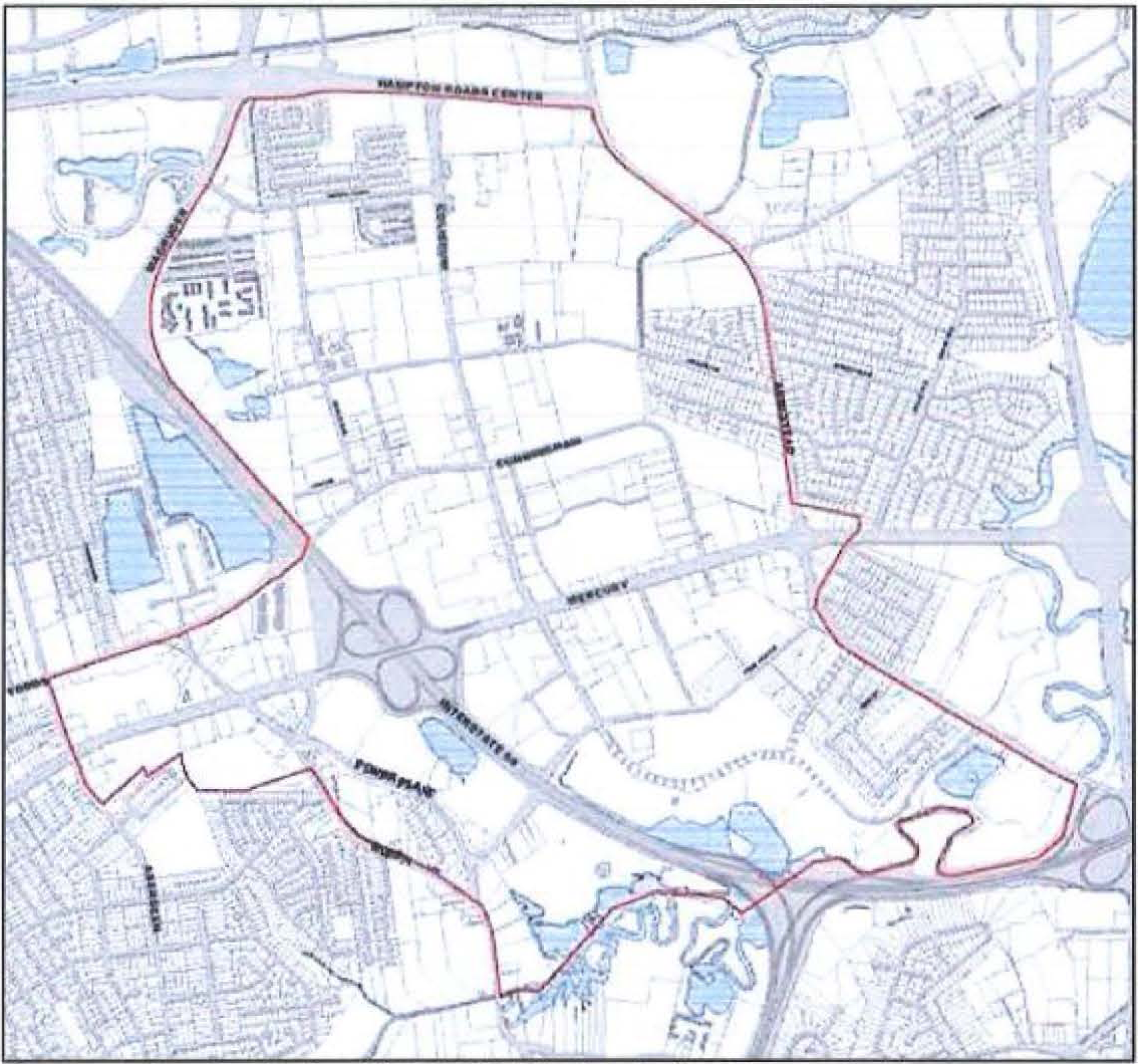
However, the standards of the O-CC District shall not be applied to any residentially zoned or residentially developed properties within the boundaries shown above.
Sec. 9-23. - Modifications to permitted uses.
(1)
Permitted uses shall be defined by the base zoning of the individual properties with the following modifications:
(a)
Prohibited uses:
(i)
Boarding house;
(ii)
Funeral home;
(iii)
Mobile/manufactured home park and subdivision;
(iv)
Pawnshop;
(v)
Rooming house;
(vi)
Sign painting shop;
(vii)
Tattoo parlor;
(viii)
Turkish bath;
(ix)
Detention facility;
(x)
Group home 2;
(xi)
Halfway house;
(xii)
Juvenile residence;
(xiii)
Orphanage;
(xiv)
Shelter;
(xv)
Shooting range, trap or skeet;
(xvi)
Boathouse, pier, dock, ramp; commercial (public or private);
(xvii)
Marina, including boat sales, rental, storage and fuel;
(xviii)
Storage Facility 1, 2, and 3.
(b)
Permitted uses:
(i)
Micro-brewery /distillery/winery
(ii)
Live entertainment 1, in conjunction with a restaurant or micro-brewery/distillery/winery. Live entertainment 1 venues are defined as venues providing live entertainment only within the building, without a dance floor or similar gathering area, and having performance space of 75 square feet or less. Any other live entertainment venue is considered a live entertainment 2 venue.
Live entertainment 1 is subject to a live entertainment zoning administrator permit with the following attached conditions:
(aa)
Live entertainment shall be conducted inside the building only;
(bb)
A floor plan shall be provided and approved showing the arrangement of tables, chairs, and performance area. The layout shall remain in place for live entertainment performances and no dance floor or similar open gathering space shall be permitted;
(cc)
The hours of operation for live entertainment shall not extend past 10:00 p.m. Sunday through Thursday and 11:59 p.m. Friday and Saturday;
(dd)
The live entertainment shall comply with section 22-9 of the City Code, as amended, pertaining to noise.
(ee)
Each ingress/egress point in the building shall be monitored by an attendant during the hours of operation, and additional attendants may be required to monitor vehicle parking areas that serve the building and maintain and control patron behavior upon exit of the building into the parking areas;
(ff)
The restaurant or micro-brewery/distillery/winery shall meet the minimum requirements for parking as established in Chapter 11 herein;
(gg)
The restaurant or micro-brewery/distillery/winery shall maintain compliance with all applicable federal and state laws and requirements of licensing agencies, including but not limited to ABC licensing;
(hh)
The live entertainment permit shall be valid for eighteen (18) months from the date of approval by the zoning administrator. After twelve (12) months of operation, prior to the expiration date, the live entertainment permit will be scheduled for review by the zoning administrator to consider if the continuation of the live entertainment permit would not be detrimental to the public health, safety and welfare and that to continue the activities under the live entertainment permit would not cause public inconvenience, annoyance, disturbance or have an undue impact on the community or be incompatible with other uses of land in the zoning district. The review will be based, in part, upon a physical site review, traffic flow and control, access to and circulation within the property, off-street parking and loading, hours and manner of operation, noise, light, neighborhood complaints, police service calls, and any violations of any federal, state or local law. If, after review, the zoning administrator determines that the live entertainment permit would not be detrimental to the public health, safety and welfare and that to continue the activities under the live entertainment permit would not cause public inconvenience, annoyance, disturbance or have an undue impact on the community or be incompatible with other uses of land in the zoning district, the zoning administrator may administratively extend the live entertainment permit in five-year increments. Each such extension shall be subject to the same administrative review. If the zoning administrator determines that that the live entertainment permit would be detrimental to the public health, safety and welfare and that to continue the activities under the live entertainment permit would cause public inconvenience, annoyance, disturbance or have an undue impact on the community or be incompatible with other uses of land the zoning district, the zoning administrator will notify the permittee of a denial of the extension in writing in the same manner as required under chapter 1 of the zoning ordinance. A permittee aggrieved by the decision of the zoning administrator may appeal the decision of the zoning administrator to the board of zoning appeals in the manner set forth in chapter 13 of the zoning ordinance. Nothing contained herein shall limit the rights of a permittee to seek a new live entertainment permit; and
(ii)
The zoning administrator, or appointed designee, shall have the ability to revoke the live entertainment permit upon violation of any of the above conditions.
(iii)
Mental Health/Substance Abuse Treatment Facility only within the C-2 base zoning district and in conformance with the additional standards for the use referenced within Section 3-3.
(2)
Permitted retail sales, services, and office uses shall be conducted wholly within an enclosed building except for:
(a)
Car wash, self-service or automated;
(b)
Gas station;
(c)
Motorcycle sales;
(d)
Outdoor dining;
(e)
Parking lots;
(f)
Vehicle sales, new;
(g)
Vehicle storage;
(h)
Those uses authorized by a Special Event Permit issued pursuant to the Hampton City Code;
(i)
Seasonal sales authorized by Section 34-7 of the City Code;
(j)
Permanent outdoor sales, displays, and storage, which shall be permitted only within a physically defined area that is shown on the site plan, and all physical improvements defining that area must be constructed of materials comparable to the primary building(s) on the site;
(k)
Food truck host sites;
(l)
Outdoor play areas associated with Day Care 1, Commercial and Day Care 2, Commercial, which shall be permitted only within a physically defined and fenced area that is shown on the site plan; and
(m)
Outdoor recreation areas associated with a physical recreational facility.
(3)
No more than fifty (50) percent of the floor area of any building shall be used for the storage of merchandise.
(4)
Noncommercial and commercial communication towers, satellite dishes and transmission antennas (with exception of building mounted antennas) shall not be located between any buildings and an existing or proposed public right-of-way. All noncommercial communication towers in excess of seventy-five (75) feet in height and all commercial communication towers shall be subject to securing a use permit.
(Ord. No. Z15-11, 6-10-2015; Ord. No. Z-15-14, 8-12-2015; Ord. No. Z15-23, 11-12-15; Ord. No. Z15-25, 12-9-2015; Ord. No. Z18-11, 7-11-2018; Ord. No. Z19-02, 1-9-2019; Ord. No. Z19-17, 9-11-2019; Ord. No. Z22-0011, 12-14-2022; Ord. No. Z23-0007, 5-24-2023; Ord. No. Z24-0004, 2-14-2024; Ord. No. Z24-0013, 5-8-2024)
Sec. 9-24. - Site design.
(1)
The purpose of the following design guidelines is to ensure a consistent, integrated development pattern that will support the efforts of the CCBID to create a distinct sense of place for Coliseum Central, The site design objectives are as follows:
(a)
Establish the image of Coliseum Central as a contemporary, vibrant, retail/mixed use area that is harmoniously integrated into the indigenous water-oriented ecosystem unique to Hampton;
(b)
Promote economic growth in the Coliseum Central District;
(c)
Encourage high quality development, allowing for the diversity of uses while avoiding detrimental uses and poor location of appropriate uses;
(d)
Encourage high quality of the design and materials used in public open spaces, gateways, streetscape parcel development, buildings and signage;
(e)
Create a sense of place through the use of physical improvements that clearly define the geographic district (i.e., edge treatments, landmarks and repetitive design elements) and
(f)
Visually and functionally connect and define the Coliseum Central District,
(2)
As a means of implementing the objectives stated above, the following minimum standards shall be met:
(a)
Green area on the site must meet the following:
(i)
At least ten (10) percent of the total site area, or the percentage required by the parking setbacks and parking lot green area requirements, whichever is greater.
(ii)
At least ten (10) percent of the paved parking surface, including drive aisle and access. Such green space shall be located within the paved parking area and aggregated into areas of not less than five hundred eighty-five (585) square feet; with a minimum dimension of twelve (12) feet. This interior parking green area shall count toward the overall green area requirements for the site, as required above.
(iii)
All green areas shall be landscaped in accordance with the "City of Hampton Landscape Guidelines".
(b)
All buildings, including parking structures, shall be set back:
(i)
At least fifty (50) feet, or twice the building height, whichever is greater, from any property line abutting Interstates 64 or 664; however, this setback shall not be required to exceed one hundred (100) feet;
(ii)
At least twenty-five (25) feet, or twice the building height, whichever is greater, from any property line abutting access ramps to Interstates 64 or 664; however, this setback shall not be required to exceed fifty (50) feet;
(iii)
At least thirty-five (35) feet, or twice the building height, whichever is greater, from any property line abutting Mercury Boulevard, Hampton Roads Center Parkway or Magruder Boulevard; however, this setback shall not be required to exceed eighty (80) feet;
(iv)
At least twenty (20) feet from any property line abutting any other existing or proposed right-of-way; and
(v)
At least fifteen (15) feet from any property line not abutting an existing or proposed public right-of-way.
(c)
All surface parking areas shall be set back:
(i)
At least fifty (50) feet from any property line abutting Interstates 64 or 664, Hampton Roads Center Parkway, or Magruder Boulevard;
(ii)
At least twenty-five (25) feet from any property line abutting an access ramp to Interstates 64 or 664;
(iii)
At least fifteen (15) feet from any property line abutting any other existing or proposed public right-of-way;
(iv)
At least ten (10) feet from any side property line not abutting an existing or proposed public right-of-way;
(v)
At least ten (10) feet from any rear property line not abutting an existing or proposed public right-of-way; and
(vi)
At least fifteen (15) feet from any rear or side property line that abuts property that is either zoned or developed residentially.
(d)
All buildings should be faced on all sides with durable, attractive, high quality materials, comparable to brick masonry unit, architectural concrete masonry unit (e.g., regal stone, split face, precision, ground face), precast concrete panels, stone, or architectural metal panels. In general, the elevations that are visible from existing or proposed public right-of-way should have a combination of primary and accent materials. In no instance shall EIFS, corrugated metal, pre-engineered metal or exposed metal wall systems be used as primary exterior finish. Where parking structures are used, the exterior trades shall be comparable to adjacent structures on the same property with respect to materials, accents, color, etc.
(e)
Architectural elements (e.g. awnings, canopies and arcades) shall be incorporated into the building design to achieve pedestrian shelter, add prominence to building entrances, or enliven the building facade at the pedestrian level. Awnings and canopies are exempted from the building setbacks in (b) above; however, this exemption does not include canopies over gasoline pumps.
(f)
With the exception of flat roofs, all roof materials shall be durable, high quality materials, comparable to standing seam metal, wood shakes or architectural grade asphalt shingles.
(g)
Rooftop equipment shall be positioned and/or screened from public view. Screening shall be accomplished through use of parapets or other opaque walls constructed of materials complementary to the exterior walls.
(h)
Fencing shall be of durable materials that incorporate architectural features from the primary building(s) on the site; however, the use of chain link fencing, electrified fencing, barbed wire or razor wire is expressly prohibited.
(i)
All exterior ground mounted equipment (e.g. HVAC, utility boxes, control boxes) shall be screened from public view with fences, walls, and/or landscaping.
(j)
Stormwater facilities shall be designed for both environmental effectiveness and aesthetic impact on the overall development.
(k)
When lighting is deemed necessary to provide a sense of comfort and security to a site development, lighting shall be designed for environmental effectiveness as well as aesthetic impact on the overall development, including but not limited to walkways, green areas, parking areas, exterior sales and display areas, building facades, canopies, awnings, and signage. The minimum standards for site lighting are as follows:
(i)
Parking areas/streets:
(aa)
All lighting shall be directed downward and inward to the site.
(bb)
All lighting fixtures shall be "cut-off" fixtures as defined by IESNA.
(cc)
The light source of all light fixtures shall be shielded so that direct illumination is focused exclusively on the site to minimize spillover to adjacent properties and road rights-of-way. Recessed light fixtures may be use as an alternative.
(dd)
Lighting poles and fixtures shall be no more than forty (40) feet above grade and provide a minimum light level of one-half (0.5) foot-candles and the uniformity ratio (ratio of average to minimum illuminance) shall be no greater than 4:1.
(ii)
Gasoline pump island canopies:
(aa)
Canopy light fixtures shall be recessed so that the lens cover is recessed or flush with the bottom surface (ceiling) of the canopy and/or shielded by the fixture or the edge of the canopy so the light source is not visible from adjacent properties and road rights-of-way.
(bb)
As an alternative (or supplement) to recessed ceiling lights, indirect lighting may be used where light is beamed upward and then reflected down from the underside of the canopy. In such case, light fixtures must be shielded so that direct illumination is focused exclusively on the underside of the canopy.
(cc)
Lights shall not be mounted on the top or sides of canopies, and the canopy sides shall not be illuminated.
(dd)
Light levels of 1.0 foot-candles shall be permitted, but no more than five (5.0) foot-candles and the uniformity ratio (ratio of average to minimum illuminance) shall be no greater than 4:1.
(iii)
Exterior sales/display areas:
(aa)
All lighting fixtures shall be "cut-off' fixtures as defined by IESNA.
(bb)
Areas designated as parking or passive vehicle storage/vehicle or recreational vehicle sales shall meet the minimum requirements for parking areas.
(cc)
Light fixtures shall be located, mounted, aimed, and shielded so that direct light is not cast onto adjacent properties and road rights-of-way.
(dd)
Fixtures shall be mounted no more than twenty-five (25) feet above grade and light levels of one (1.0) foot-candles shall be permitted but no more than five (5.0) foot-candles and the uniformity ratio (ratio of average to minimum illuminance) shall be no greater than 4:1.
(iv)
Building lighting:
(aa)
Lighting fixtures shall be located, aimed, and shielded so that light is directed only onto the building facade. Lighting fixtures shall not be directed toward adjacent properties or road rights-of-way.
(bb)
Illumination levels on any vertical surface or angular roof shall not exceed five (5.0) foot-candles.
(v)
Landscape lighting: Permanent "twinkle" lights, which emit a non-blinking white light, shall be permitted in trees as an aesthetic enhancement for pedestrian areas. Such lights shall not be attached with nails, staples or other hardware, which would penetrate a tree's bark. Periodic maintenance shall be required to ensure that such lights remain in proper operating condition, including periodic re-stringing of the lights to prevent girdling of tree branches.
(3)
In an effort to allow maximum utilization of the site, alternatives to the requirements of subsection (2) above may be permitted through an administrative design review process wherein the city staff will work with the applicant to obtain city approval of the development proposal. Such approval shall be based on the development proposal's ability to meet the overall intent of subsection (1) above, and may include the following:
(a)
The provision of an alternative building design in place of the typical franchise requirement, including form, style, materials, and colors. However, building materials shall meet the minimum standards as described in subsection (2) above.
(b)
Pitched roof design with a slope between 4:12 and 12:12 (rise:run) along the primary building facade, and a variable roof line which may include raised accent elements such as dormer windows, chimneys, etc.
(c)
The provision of a solid-to-void ratio 1:1 (forty (40) to sixty (60) percent solid walls and sixty (60) to forty (40) percent windows or doors) for the primary facades of commercial storefronts and 3:1 sixty-five (65) to eighty-five (85) percent solid walls and thirty-five (35) to fifteen (15) percent windows or doors) for the primary facade of all other buildings, with the exception of parking structures.
(d)
The provision of water features, fountains, and/or sculptures in keeping with the theme set forth in the coliseum central business improvement district master plan.
(e)
The provision of site furnishings (e.g. benches, trash receptacles, decorative bollards, planters, etc.) and bus shelters. Furnishing placement shall be consistent throughout the subject site in relation to adjacent buildings and pavement edges and will not be required to meet minimum setback requirements.
(f)
The provision of wrought iron, steel, or aluminum picket fence sections between masonry columns for fencing within the front yards of properties which are not intended to screen areas from public view.
(g)
Use of alternative pavement materials and treatments to create a unified appearance, to emphasize special site characteristics, to provide porous parking surface, or to designate various pedestrian/circulation routes. Alternate paving types include but are not necessarily limited to modular pavers (brick, stone, concrete), colored concrete, patterned concrete, porous concrete and geoblock.
(h)
The provision of a uniform lighting design that enhances site aesthetics. Design consideration should include fixture type, light source type, height of mounted fixtures, lighting levels, glare, sky glow, and color (CRI value).
(i)
The provision of pedestrian corridors (i.e. paved pathways and landscaped green areas) through parking areas.
(4)
In an effort to allow maximum utilization of the site, alternatives to the requirements of the R-M, C-1, C-2, and C-3 base districts may be permitted through an administrative design review process wherein the city staff will work with the applicant to obtain city approval of the development proposal. Such approval shall be based on the development proposal's ability to meet the overall intent of subsection (1) above, and include the following:
(a)
Relief from Sections 5-2, 6-3(1), 6-4(2)(a), 6-12(1), 6-13(2)(a), and 6-22 so as to allow a maximum height of one hundred fifty (150) feet;
(b)
Relief from Sections 6-4(5) and 6-13(5) so as to allow the elimination of the density maximum;
(c)
Relief from Sections 6-4(6)(a) and 6-13(6)(a) so as to allow the elimination of the lot coverage maximum; and
(d)
Relief from Sections 5-4, 6-4(4), and 6-13(4) so as to allow the elimination of minimum dwelling area requirements; in no case, however, shall the total number of dwelling units under five hundred (500) square feet exceed fifty (50) percent of the entire development.
(Ord. No. Z24-0007, 5-8-2024)
Sec. 9-31. - General provisions.
(1)
Statutory authorization and purpose. This article is adopted pursuant to the authority granted to localities by section 15.2-2280 of the Code of Virginia. The purpose of these provisions is to prevent: the loss of life and property, the creation of health and safety hazards, the disruption of commerce and governmental services, the extraordinary and unnecessary expenditure of public funds for flood protection and relief, and the impairment of the tax base by:
(a)
Regulating uses, activities, and development which, alone or in combination with other existing or future uses, activities, and development, will cause unacceptable increases in flood heights, velocities, and frequencies;
(b)
Restricting or prohibiting certain uses, activities, and development from locating within districts subject to flooding;
(c)
Requiring all those uses, activities, and developments that do occur in flood-prone districts to be protected and/or flood-proofed against flooding and flood damage; and
(d)
Protecting individuals from buying land and structures which are unsuited for intended purposes because of flood hazards.
(2)
Applicability. These provisions shall apply to all privately and publicly owned lands within the jurisdiction of the City of Hampton (city) and identified as special flood hazard areas (SFHA) or other flood areas or shown on the flood insurance rate map (FIRM) or included in the flood insurance study (FIS) that are provided to the city by FEMA.
(3)
Compliance and liability.
(a)
No land shall hereafter be developed and no structure shall be located, relocated, constructed, reconstructed, enlarged, or structurally altered except in full compliance with the terms and provisions of this article.
(b)
The degree of flood protection sought by the provisions of this article is considered reasonable for regulatory purposes and is based on acceptable engineering methods of study, but does not imply total flood protection. Larger floods may occur on rare occasions. Flood heights may be increased by man-made or natural causes, such as ice jams and bridge openings restricted by debris. This article does not imply that districts outside the floodplain district or land uses permitted within such district will be free from flooding or flood damages.
(c)
This article shall not create liability on the part of the city or any officer or employee thereof for any flood damages that result from reliance on this article or any administrative decision lawfully made thereunder.
(4)
Records. Records of actions associated with administering this ordinance shall be kept on file and maintained by or under the direction of the floodplain administrator in perpetuity.
(5)
Abrogation and greater restrictions. To the extent that the provisions are more restrictive, this article supersedes any article or ordinance currently in effect in flood-prone districts, however, any such existing article or ordinance shall remain in full force and effect to the extent that its provisions are more restrictive than this article or do not conflict.
(6)
Severability. If any section, subsection, paragraph, sentence, clause, or phrase of this ordinance shall be declared invalid for any reason whatever, such decision shall not affect the remaining portions of this article. The remaining portions shall remain in full force and effect; and for this purpose, the provisions of this ordinance are hereby declared to be severable.
(7)
Administration and enforcement. The provisions of this article shall be enforced in accordance with chapter 1 of the zoning ordinance. In addition to the above penalties, all other actions are hereby reserved, including an action in equity for the proper enforcement of this article. The imposition of a fine or penalty for any violation of, or noncompliance with, this article shall not excuse the violation or noncompliance or permit it to continue; and all such persons shall be required to correct or remedy such violations within a reasonable time. Any structure constructed, reconstructed, enlarged, altered or relocated in noncompliance with this article may be declared by the city to be a public nuisance and abatable as such. Flood insurance may be withheld from structures constructed in violation of this article.
(Ord. No. Z16-03, 4-13-2016)
Sec. 9-32. - Administration.
(1)
Designation of the floodplain administrator. The zoning administrator or his designee shall act as floodplain administrator to administer and implement the flood plain regulations. The floodplain administrator may delegate duties and responsibilities to qualified technical personnel, plan examiners, inspectors, and other employees and enter into a written agreements with other communities and private sector entities to administer specific provisions of these regulations.
(2)
Duties and responsibilities of the floodplain administrator. The duties and responsibilities of the floodplain administrator shall include those set forth in the code of federal regulations, including but not limited to:
(a)
Review applications for permits to determine whether proposed activities will be located in the Special Flood Hazard Area (SFHA).
(b)
Interpret floodplain boundaries and provide available base flood elevation and flood hazard information.
(c)
Review applications to determine whether proposed activities will be reasonably safe from flooding and require new construction and substantial improvements to meet the requirements of these regulations.
(d)
Review applications to determine whether all necessary permits have been obtained from the federal, state or local agencies from which prior or concurrent approval is required; in particular, permits from state agencies for any construction, reconstruction, repair, or alteration of a dam, reservoir, or waterway obstruction (including bridges, culverts, structures), any alteration of a watercourse, or any change of the course, current, or cross section of a stream or body of water, including any change to the 100-year frequency floodplain of free-flowing non-tidal waters of the State.
(e)
Require applicants proposing an alteration of a watercourse to provide proof that they have notified adjacent communities, the Department of Conservation and Recreation (Division of Dam Safety and Floodplain Management), and other appropriate agencies (VADEQ, USACE) and have submitted copies of such notifications to FEMA.
(f)
Advise applicants for new construction or substantial improvement of structures regarding whether or not the proposed development is within an area of the Coastal Barrier Resources System established by the Coastal Barrier Resources Act where Federal flood insurance is not available; areas subject to this limitation are shown on Flood Insurance Rate Maps as Coastal Barrier Resource System Areas (CBRS) or Otherwise Protected Areas (OPA).
(g)
Review applications to develop in flood hazard areas for compliance with this article.
(h)
In accordance with chapter 1, administer and enforce the terms of this article, including but not limited to inspections of buildings, structures, and other development subject to this article.
(i)
Review elevation certificates and require incomplete or deficient certificates to be corrected.
(j)
Submit to FEMA, or require applicants to submit to FEMA, data and information necessary to maintain FIRMs, including hydrologic and hydraulic engineering analyses prepared by or for the city, within six months after such data and information becomes available if the analyses indicate changes in base flood elevations.
(k)
Maintain and permanently keep records that are necessary for the administration of these regulations, including:
(i)
Flood insurance studies, flood insurance rate maps (including historic studies and maps and current effective studies and maps) and Letters of Map Change; and
(ii)
Documentation supporting issuance and denial of permits, elevation certificates, documentation of the elevation (in relation to the datum on the FIRM) to which structures have been floodproofed, inspection records, other required design certifications, variances, and records of enforcement actions taken to correct violations of these regulations.
(l)
In accordance with chapter 1, administer and enforce the terms of this article.
(m)
Upon application for a variance from this article, prepare a staff report to the board of zoning appeals containing an analysis of the variance requirements applicable to this article.
(n)
Administer the requirements related to proposed work on existing buildings:
(i)
Make determinations as to whether buildings and structures that are located in flood hazard areas and that are damaged by any cause have been substantially damaged.
(ii)
Make reasonable efforts to notify owners of substantially damaged structures of the need to obtain a permit to repair, rehabilitate, or reconstruct. Prohibit the non-compliant repair of substantially damaged buildings except for temporary emergency protective measures necessary to secure a property or stabilize a building or structure to prevent additional damage.
(o)
Undertake, as determined appropriate by the floodplain administrator due to the circumstances, other actions which may include but are not limited to: issuing press releases, public service announcements, and other public information materials related to permit requests and repair of damaged structures; coordinating with other federal, state, and local agencies to assist with substantial damage determinations; providing owners of damaged structures information related to the proper repair of damaged structures in special flood hazard areas; and assisting property owners with documentation necessary to file claims for increased cost of compliance coverage under NFIP flood insurance policies.
(p)
Notify the Federal Emergency Management Agency when the corporate boundaries of the city have been modified and:
(i)
Provide a map that clearly delineates the new corporate boundaries or the new area for which the authority to regulate pursuant to these regulations has either been assumed or relinquished through annexation; and
(ii)
If the FIRM for any annexed area includes special flood hazard areas that have flood zones that have regulatory requirements that are not set forth in these regulations, prepare amendments to these regulations to adopt the FIRM and appropriate requirements, and submit the amendments to the governing body for adoption; such adoption shall take place at the same time as or prior to the date of annexation and a copy of the amended regulations shall be provided to Department of Conservation and Recreation (Division of Dam Safety and Floodplain Management) and FEMA.
(q)
Upon the request of FEMA, complete and submit a report concerning participation in the NFIP which may request information regarding the number of buildings in the SFHA, number of permits issued for development in the SFHA, and number of variances issued for development in the SFHA.
(3)
Use and interpretation of FIRMs. The floodplain administrator shall make interpretations, where needed, as to the exact location of special flood hazard areas, floodplain boundaries, and floodway boundaries based upon the applicable FIRM. Should a dispute arise concerning the boundaries of any of the districts, the floodplain administrator's interpretation may be appealed to the board of zoning appeals in accordance with the provisions of chapter 13 of the zoning ordinance. The following shall apply to the use and interpretation of FIRMs and data:
(a)
Where field surveyed topography indicates that adjacent ground elevations are:
(i)
Below the base flood elevation, even in areas not delineated as a special flood hazard area on a FIRM, the area shall be considered as special flood hazard area and subject to the requirements of these regulations;
(ii)
Above the base flood elevation, the area shall be regulated as special flood hazard area unless the applicant obtains a letter of map change that removes the area from the SFHA.
(b)
In FEMA-identified special flood hazard areas where base flood elevation and floodway data have not been identified and in areas where FEMA has not identified SFHAs, any other flood hazard data available from a Federal, State, or other source shall be reviewed and reasonably used.
(c)
Base flood elevations and designated floodway boundaries on FIRMs and in FISs shall take precedence over base flood elevations and floodway boundaries by any other sources if such sources show reduced floodway widths and/or lower base flood elevations.
(d)
Other sources of data shall be reasonably used if such sources show increased base flood elevations and/or larger floodway areas than are shown on FIRMs and in FISs.
(e)
If a Preliminary Flood Insurance Rate Map and/or a Preliminary Flood Insurance Study has been provided by FEMA, the City will advise applicants for proposed development in a SFHA of the impact of the preliminary map changes.
(i)
Upon the issuance of a letter of final determination by FEMA, the city will prepare a statement, under FEMA's direction, which will be signed by all parties confirming flood insurance implications regarding any decision to proceed with development based on the current FIRM and FIS. The statement will be used until adoption of the new FIRM and FIS.
(4)
District boundary changes. The delineation of any of the floodplain districts may be revised by the city where natural or man-made changes have occurred and/or where more detailed studies have been conducted or undertaken by the U.S. Army Corps of Engineers or other qualified agency, or an individual documents the need for such change. However, prior to any such change, approval must be obtained from the Federal Emergency Management Agency as evidenced by a completed LOMR.
(5)
Submitting model backed technical data. A community's base flood elevations may increase or decrease resulting from physical changes affecting flooding conditions. As soon as practicable, but not later than six months after the date such information becomes available, a community shall notify the Federal Emergency Management Agency of the changes by submitting technical or scientific data. The community may submit data via a LOMR. Such a submission is necessary so that upon confirmation of those physical changes affecting flooding conditions, risk premium rates and flood plain management requirements will be based upon current data.
(6)
Letters of map revision. When development in the floodplain will cause or causes a change in the base flood elevation, the applicant, including state agencies, must notify FEMA by applying for a Conditional Letter of Map Revision (CLOMR) and then a Letter of Map Revision (LOMR).
Example cases:
(a)
Any development that causes a rise in the base flood elevations within the floodway.
(b)
Any development occurring in Zones A1-30 and AE without a designated floodway, which will cause a rise of more than one foot in the base flood elevation.
(c)
Alteration or relocation of a stream (including but not limited to installing culverts and bridges) 44 Code of Federal Regulations §65.3 and §65.6(a)(12).
(Ord. No. Z16-03, 4-13-2016)
Sec. 9-33. - Establishment of zoning districts.
(1)
Description of special flood hazard districts.
(a)
Basis of districts.
(i)
The various special flood hazard districts shall include the special flood hazard areas and other flood areas. The basis for the delineation of these districts shall be the FIS and the FIRM for the city prepared by the Federal Emergency Management Agency, Federal Insurance Administration, dated May 16, 2016, and any subsequent revisions or amendments thereto.
(ii)
The city may identify and regulate local flood hazard or ponding areas that are not delineated on the FIRM. These areas may be delineated on a "Local Flood Hazard Map" using best available topographic data and locally derived information such as flood of record, historic high water marks or approximate study methodologies.
(iii)
The boundaries of the SFHA Districts are established as shown on the FIRM which is declared to be a part of this ordinance and which shall be kept on file at the office of the floodplain administrator.
(b)
The floodway district is in an AE Zone and is delineated, for purposes of this article, using the criterion that certain areas within the floodplain must be capable of carrying the waters of the one-percent annual chance flood without increasing the water surface elevation of that flood more than one (1) foot at any point. The areas included in this district are specifically defined in Table 5 of the above-referenced FIS and shown on the accompanying FIRM. The following provisions shall apply within the floodway district of an AE zone:
(i)
Within any floodway area, no encroachments, including fill, new construction, substantial improvements, or other development shall be permitted unless it has been demonstrated through hydrologic and hydraulic analysis performed in accordance with standard engineering practice that the proposed encroachment will not result in any increase in flood levels within the community during the occurrence of the base flood discharge. Hydrologic and hydraulic analyses shall be undertaken only by professional engineers or others of demonstrated qualifications, who shall certify that the technical methods used correctly reflect currently-accepted technical concepts. Studies, analyses, computations, etc., shall be submitted in sufficient detail to allow a thorough review by the floodplain administrator.
(aa)
Development activities which increase the water surface elevation of the base flood may be allowed, provided that the applicant first applies—with the city's endorsement—for a Conditional Letter of Map Revision (CLOMR), and receives the approval of the Federal Emergency Management Agency.
(bb)
If Section 9-33(1)(b)(i) is satisfied, all new construction and substantial improvements shall comply with all applicable flood hazard reduction provisions of Section 9-34.
(ii)
The placement of manufactured homes (mobile homes) is prohibited, except when replacing an existing manufactured home in an existing manufactured home park or subdivision. A replacement manufactured home may be placed on a lot in an existing manufactured home park or subdivision provided the anchoring, elevation, and encroachment standards are met.
(c)
The AE, or AH Zones on the FIRM accompanying the FIS shall be those areas for which one-percent annual chance flood elevations have been provided and the floodway has not been delineated. The following provisions shall apply within an AE or AH zone where FEMA has provided base flood elevations.
(i)
Until a regulatory floodway is designated, no new construction, substantial improvements, or other development (including fill) shall be permitted within the areas of special flood hazard, designated as Zones A1-30, AE, or AH on the FIRM, unless it is demonstrated that the cumulative effect of the proposed development, when combined with all other existing and anticipated development, will not increase the water surface elevation of the base flood more than one foot at any point within the city.
(aa)
Development activities in Zones Al-30, AE, or AH on the city's FIRM which increase the water surface elevation of the base flood by more than one foot may be allowed, provided that the applicant first applies—with the city's endorsement—for a Conditional Letter of Map Revision, and receives the approval of the Federal Emergency Management Agency.
(d)
The A Zone on the FIRM accompanying the FIS shall be those areas for which no detailed flood profiles or elevations are provided, but the one-percent annual chance floodplain boundary has been approximated. For these areas, the following provisions shall apply:
(i)
The approximated floodplain district shall be that floodplain area for which no detailed flood profiles or elevations are provided, but where a one-percent annual chance floodplain boundary has been approximated. Such areas are shown as Zone A on the maps accompanying the FIS. For these areas, the base flood elevations and floodway information from federal, state, and other acceptable sources shall be used, when available. Where the specific one-percent annual chance flood elevation cannot be determined for this area using other sources of data, such as the U. S. Army Corps of Engineers Floodplain Information Reports, U. S. Geological Survey Flood—Prone Quadrangles, etc., then the applicant for the proposed use, development and/or activity shall determine this base flood elevation. For development proposed in the approximate floodplain the applicant must use technical methods that correctly reflect currently accepted practices, such as point on boundary, high water marks, or detailed methodologies hydrologic and hydraulic analyses. Studies, analyses, computations, etc., shall be submitted in sufficient detail to allow a thorough review by the floodplain administrator.
(aa)
The floodplain administrator reserves the right to require a hydrologic and hydraulic analysis for any development. When such base flood elevation data is utilized, the lowest floor shall be elevated to or above the base flood level plus eighteen inches.
(bb)
During the permitting process, the floodplain administrator shall obtain:
1.
The elevation of the lowest floor (in relation to the datum specified on the effective FIRM), including the basement, of all new and substantially improved structures; and,
2.
If the structure has been flood-proofed in accordance with the requirements of this article, the elevation (in relation to the datum specified on the effective FIRM) to which the structure has been flood-proofed.
(e)
The AO Zone on the FIRM accompanying the FIS shall be those areas of shallow flooding identified as AO on the FIRM. For these areas, the following provisions shall apply:
(i)
All new construction and substantial improvements of residential structures shall have the lowest floor, including basement, elevated to or above the flood depth specified on the FIRM, above the highest adjacent grade at least as high as the depth number specified in feet on the FIRM. If no flood depth number is specified, the lowest floor, including basement, shall be elevated no less than two feet above the highest adjacent grade.
(ii)
All new construction and substantial improvements of non-residential structures shall:
(aa)
Have the lowest floor, including basement, elevated to or above the flood depth specified on the FIRM, above the highest adjacent grade at least as high as the depth number specified in feet on the FIRM. If no flood depth number is specified, the lowest floor, including basement, shall be elevated at least two feet above the highest adjacent grade; or,
(bb)
Together with attendant utility and sanitary facilities be completely flood-proofed to the specified flood level so that any space below that level is watertight with walls substantially impermeable to the passage of water and with structural components having the capability of resisting hydrostatic and hydrodynamic loads and effects of buoyancy.
(iii)
Adequate drainage paths around structures on slopes shall be provided to guide floodwaters around and away from proposed structures.
(f)
The Coastal A Zone is labeled as AE on the FIRM; it is those areas that are shoreward of the limit of moderate wave action (LiMWA) line. As defined by the VA USBC, these areas are subject to wave heights between one and one-half (1.5) feet and three (3) feet. For these areas, the following provisions shall apply:
(i)
Buildings and structures within this zone shall have the lowest floor elevated to or above design flood elevation, and must comply with the provisions in sections 9-33(1)(g), 9-34(2) and 9-34(3).
(g)
The VE or V Zones on FIRMs accompanying the FIS shall be those areas that are known as Coastal High Hazard areas, extending from offshore to the inland limit of a primary frontal dune along an open coast or other areas subject to high velocity waves. For these areas, the following provisions shall apply:
(i)
All new construction and substantial improvements in Zones V and VE shall be elevated on pilings or columns so that:
(aa)
The bottom of the lowest horizontal structural member of the lowest floor (excluding the pilings or columns) is elevated to or above the design flood elevation.
(bb)
The pile or column foundation and structure attached thereto is anchored to resist flotation, collapse, and lateral movement due to the effects of wind and water loads acting simultaneously on all building components. Wind and water loading values shall each have a one-percent chance of being equaled or exceeded in any given year (one-percent annual chance).
(ii)
A registered professional engineer or architect shall develop or review the structural design, specifications and plans for the construction, and shall certify that the design and methods of construction to be used are in accordance with accepted standards of practice for meeting the provisions of Section 9-33(1)(g)(i).
(iii)
The floodplain administrator shall obtain an elevation certificate, which shall identify the bottom of the lowest horizontal structural member of the lowest floor (excluding pilings and columns) of all new and substantially improved structures in Zones V and VE.
(iv)
All new construction shall be located landward of the reach of mean high tide.
(v)
All new construction and substantial improvements shall have the space below the lowest floor either free of obstruction or constructed with non-supporting breakaway walls, open wood-lattice work, or insect screening intended to collapse under wind and water loads without causing collapse, displacement, or other structural damage to the elevated portion of the building or supporting foundation system. For the purpose of this section, a breakaway wall shall have a design safe loading resistance of not less than 10 and no more than 20 pounds per square foot. Use of breakaway walls which exceed a design safe loading resistance of 20 pounds per square foot (either by design or when so required by local codes) may be permitted only if a registered professional engineer or architect certifies that the designs proposed meet the following conditions:
(aa)
Breakaway wall collapse shall result from water load less than that which would occur during the base flood; and
(bb)
The elevated portion of the building and supporting foundation system shall not be subject to collapse, displacement, or other structural damage due to the effects of wind and water loads acting simultaneously on all building components (structural and nonstructural). Maximum wind and water loading values to be used in this determination shall each have a one-percent chance of being equaled or exceeded in any give year.
(vi)
The enclosed space below the lowest floor shall be used solely for parking of vehicles, building access, or storage. Such space shall not be partitioned into multiple rooms, temperature-controlled, or used for human habitation. The enclosed space shall be no more than 299 square feet.
(vii)
The use of fill for structural support of buildings is prohibited. When non-structural fill is proposed in a coastal high hazard area, appropriate engineering analyses shall be conducted to evaluate the impacts of the fill prior to issuance of a development permit.
(viii)
The man-made alteration of sand dunes, which would increase potential flood damage, is prohibited.
(ix)
New, replacement, or substantially improved manufactured homes are prohibited within Zones V1—V30, V and VE on the city's Flood Insurance Rate Map.
(x)
Recreational vehicles to be placed within Zones V1—V30, V, and VE on the city's Flood Insurance Rate Map on sites must meet the standards of section 9-34(3)(d) and sections 9-33(1)(g)(i) through 9-33(1)(g)(ix).
(h)
Other flood areas shall be those areas identified as X (Shaded) or X500 on the FIRM for which there is a one-fifth percent (0.2%) annual chance of flooding.
(i)
All new construction as of September 10, 2014 shall have the lowest floor, including basement, elevated or flood-proofed to one and one-half (1.5) feet above the highest grade immediately adjacent to the structure except as described below:
(aa)
When fill is placed to raise a structure at least one and one-half (1.5) feet above the highest existing grade immediately adjacent to the structure, as shown on a development plan prepared and stamped by a certified land surveyor or professional engineer.
(2)
Overlay Concept. The floodplain districts described above shall be overlays to the existing underlying districts as shown on the official zoning ordinance map, and as such, the provisions for the floodplain districts shall serve as a supplement to the underlying district provisions. If there is any conflict between the provisions or requirements of the Floodplain Districts and those of any underlying district, the more restrictive provisions and/or those pertaining to the floodplain districts shall apply. In the event any provision concerning a floodplain district is declared inapplicable as a result of any legislative or administrative actions or judicial decision, the basic underlying provisions shall remain applicable.
(Ord. No. Z16-03, 4-13-2016; Ord. No. Z24-0022, 8-14-2024)
Sec. 9-34. - District provisions.
(1)
Permit and application requirements.
(a)
Permit requirement. All uses, activities, and development occurring within any special flood hazard area and other flood areas, including placement of manufactured homes, shall be undertaken only upon the issuance of a zoning permit, land disturbance permit, or building permit when such a permit is required. Such development shall be undertaken only in strict compliance with the provisions of this article, all other applicable codes and ordinances, as amended, such as the Virginia Uniform Statewide Building Code (VA USBC). Prior to the issuance of any such permit, the floodplain administrator shall require all applications to include compliance with all applicable state and federal laws.
(b)
Site plans and building permit applications. All site plan and building permit applications within any special flood hazard area or other flood areas shall incorporate the following information:
(i)
The elevation of the base flood at the site, or the elevation of the highest adjacent grade in other flood areas where no base flood elevation is provided.
(ii)
The elevation of the lowest floor (including basement) or, in V zones, the lowest horizontal structural member.
(iii)
For structures to be flood-proofed (non-residential only), the elevation to which the structure will be flood-proofed.
(iv)
Topographic information showing existing and proposed ground elevations.
(c)
Small projects considered compliant with flood zone requirements.
(i)
Individual permits shall not be required for activities, uses, and development (collectively "Small Projects") which have been reviewed, assessed, and documented by the City of Hampton and approved by FEMA in accordance with federal regulations as having low-to-no impact on the flood plain. A list of Small Projects meeting this criteria entitled, "City Review of Development in Flood Zones - Permit Requirements," is hereby adopted by reference as part of this article as if fully set forth herein, shall be kept on file in the office of the department of community development, and may be administratively amended as deemed necessary by the floodplain administrator in accordance with all federal requirements.
(ii)
Notwithstanding the foregoing section 9-34(c)(i), Small Projects which constitute a substantial improvement as defined in this article shall require submission of a zoning permit or building permit, as applicable, prior to commencement of construction or land disturbance. The floodplain administrator may require submittal of all plans, documents, and information deemed necessary to determine whether the Small Project is a substantial improvement and otherwise complies with this article.
(2)
General standards. In all special flood hazard areas the following provisions shall apply:
(a)
The freeboard shall be three (3) feet. The freeboard, in addition to the base flood elevation, shall constitute the design flood elevation.
(b)
New construction and substantial improvements shall be built according to this ordinance and the VA USBC, and anchored to prevent flotation, collapse or lateral movement of the structure.
(c)
Manufactured homes shall be anchored to prevent flotation, collapse, or lateral movement. Methods of anchoring may include, but are not limited to, use of over-the-top or frame ties to ground anchors. This standard shall be in addition to and consistent with applicable state anchoring requirements for resisting wind forces.
(d)
New construction and substantial improvements shall be constructed with materials and utility equipment resistant to flood damage.
(e)
New construction or substantial improvements shall be constructed by methods and practices that minimize flood damage.
(f)
Electrical, heating, ventilation, plumbing, air conditioning equipment and other service facilities, including duct work, shall be:
(i)
Elevated and installed at or above the design flood elevation; or
(ii)
Designed and/or located so as to prevent water from entering or accumulating within the components during conditions of flooding.
(g)
New and replacement water supply systems shall be designed to minimize or eliminate infiltration of flood waters into the system.
(h)
New and replacement sanitary sewage systems shall be designed to minimize or eliminate infiltration of flood waters into the systems and discharges from the systems into flood waters.
(i)
On-site waste disposal systems shall be located and constructed to avoid impairment to them or contamination from them during flooding.
(j)
Any alteration, repair, reconstruction or improvements to a building that is in compliance with the provisions of this article shall meet the requirements of "new construction" as contained in this article.
(k)
Any alteration, repair, reconstruction or improvements to a building that is not in compliance with the provisions of this article, shall be undertaken only if said non-conformity is not furthered, extended, or replaced.
(l)
Prior to any proposed alteration or relocation of any channels or of any watercourse, stream, etc., within this jurisdiction a permit shall be obtained from the U. S. Corps of Engineers, the Virginia Department of Environmental Quality, and the Virginia Marine Resources Commission (a joint permit application is available from any of these organizations). Furthermore, in riverine areas, notification of the proposal shall be given by the applicant to all affected adjacent jurisdictions, the Department of Conservation and Recreation (Division of Dam Safety and Floodplain Management), other required agencies, and the Federal Emergency Management Agency.
(m)
The flood carrying capacity within an altered or relocated portion of any watercourse shall be maintained.
(n)
For residential construction, the lowest floor shall not be below grade on all sides.
(3)
Elevation and construction standards. In all special flood hazard areas where base flood elevations have been provided in the FIS or generated by a certified professional in accordance with Section 9-33(1)(d), the following provisions shall apply:
(a)
Residential construction.
(i)
New construction or substantial improvement of any residential structure (including manufactured homes) in Zones A1-30, AE, AH and A with detailed base flood elevations shall have the lowest floor, including basement, elevated to or above the design flood elevation. See sections 9-33(1)(f) and 9-33(1)(g) for requirements in the Coastal A and VE zones.
(b)
Non-residential construction.
(i)
New construction or substantial improvement of any commercial, industrial, or non-residential building (or manufactured home) shall have the lowest floor, including basement, elevated to or above the design flood elevation. See sections 9-33(1)(f) and 9-33(1)(g) for requirements in the Coastal A and VE zones.
(ii)
Non-residential buildings located in all A1-30, AE, and AH zones may be flood-proofed in lieu of being elevated provided that all areas of the building components below the design flood elevation are water tight with walls substantially impermeable to the passage of water, and use structural components having the capability of resisting hydrostatic and hydrodynamic loads and the effect of buoyancy. A registered professional engineer or architect shall certify that the standards of this subsection are satisfied. Such certification, including the specific elevation (in relation to the datum specified on the effective FIRM) to which such structures are floodproofed, shall be maintained by the Floodplain Administrator.
(c)
Space below the lowest floor. In zones A, AE, AH, AO, and A1-A30, fully enclosed areas, of new construction or substantially improved structures, which are below the regulatory flood protection elevation shall:
(i)
Not be designed or used for human habitation, but shall be used solely for parking of vehicles, building access, or limited storage of maintenance equipment used in connection with the premises. Access to the enclosed area shall be the minimum necessary to allow for parking of vehicles (garage door) or limited storage of maintenance equipment (standard exterior door), or entry to the living area (stairway or elevator).
(ii)
Be constructed entirely of flood resistant materials below the design flood elevation;
(iii)
Include measures to automatically equalize hydrostatic flood forces on walls by allowing for the entry and exit of floodwaters. To meet this requirement, the openings must either be certified by a professional engineer or architect or meet the following minimum design criteria:
(aa)
Provide a minimum of two (2) openings on different sides of each enclosed area subject to flooding.
(bb)
The total net area of all openings must be at least one (1) square inch for each square foot of enclosed area subject to flooding or the flood openings shall be engineered flood openings that are designed and certified by a licensed professional engineer to automatically allow entry and exit of floodwaters; the certification requirement may be satisfied by an individual certification or issuance of an evaluation report by the ICC Evaluation Service, Inc.
(cc)
If a building has more than one (1) enclosed area, each area must have openings to allow floodwaters to automatically enter and exit.
(dd)
The bottom of all required openings shall be no higher than one (1) foot above the adjacent grade.
(ee)
Openings may be equipped with screens, louvers, or other opening coverings or devices, provided they permit the automatic flow of floodwaters in both directions.
(ff)
Foundation enclosures made of flexible skirting are not considered enclosures for regulatory purposes, and, therefore, do not require openings. Masonry or wood underpinning, regardless of structural status, is considered an enclosure and requires openings as outlined above.
(d)
Standards for manufactured homes and recreational vehicles.
(i)
In zones A, AE, AH, and AO, all manufactured homes placed, or substantially improved, on individual lots or parcels, in expansions to existing manufactured home parks or subdivisions, in a new manufactured home park or subdivision, or in an existing manufactured home park or subdivision on which a manufactured home has incurred substantial damage as the result of a flood, must meet all the requirements for new construction, including the elevation and anchoring requirements in sections 9-34(2) and 9-34(3).
(ii)
All manufactured homes placed or substantially improved in an existing manufactured home park or subdivision in which a manufactured home has not incurred substantial damage as the result of a flood shall be elevated so that:
(aa)
The lowest floor of the manufactured home is elevated no lower than design flood elevation; and
(bb)
The manufactured home must be securely anchored to the adequately anchored foundation system to resist flotation, collapse and lateral movement.
(iii)
All recreational vehicles placed on sites must either:
(aa)
Be on the site for fewer than 180 consecutive days, be fully licensed and ready for highway use (a recreational vehicle is ready for highway use if it is on its wheels or jacking system, is attached to the site only by quick disconnect type utilities and security devices and has no permanently attached additions); or
(bb)
Meet all the requirements for manufactured homes in Section 9-34(3)(d)(i).
(4)
Standards for subdivision proposals.
(a)
All subdivision proposals shall be consistent with the need to minimize flood damage;
(b)
All subdivision proposals shall have public utilities and facilities such as sewer, gas, electrical and water systems located and constructed to minimize flood damage;
(c)
All subdivision proposals shall have adequate drainage provided to reduce exposure to flood hazards, and
(d)
Base flood elevation data shall be obtained from other sources or developed using detailed methodologies, hydraulic and hydrologic analysis, comparable to those contained in a flood insurance study for subdivision proposals and other proposed development proposals (including manufactured home parks and subdivisions) that exceed five lots or five acres, whichever is the lesser.
Sec. 9-35. - Existing structures in floodplain areas.
(1)
Any structure or use of a structure or premises must be brought into conformity with these provisions when it is changed, repaired, or improved unless one of the following exceptions is established before the change is made:
(a)
The floodplain administrator has determined that:
(i)
Change is not a substantial repair or substantial improvement;
(ii)
No new square footage is being built in the floodplain that is not compliant;
(iii)
No new square footage is being built in the floodway; and
(iv)
The change complies with this ordinance.
(b)
The changes are required to comply with a citation for a health or safety violation.
(c)
The structure is a historic structure and the change required would impair the historic nature of the structure.
(Ord. No. Z16-03, 4-13-2016)
Sec. 9-36. - Variances—Factors to be considered.
(1)
Additional factors to be considered. In considering applications for variances to this article, the board of zoning appeals shall satisfy all relevant factors and procedures specified in chapter 13 of the zoning ordinance and consider the following additional factors:
(a)
The showing of good and sufficient cause.
(b)
A determination that failure to grant the variance would result in exceptional hardship to the applicant.
(c)
The danger to life and property due to increased flood heights or velocities caused by encroachments.
(d)
The danger that materials may be swept on to other lands or downstream to the injury of others.
(e)
The proposed water supply and sanitation systems and the ability of these systems to prevent disease, contamination, and unsanitary conditions.
(f)
The susceptibility of the proposed facility and its contents to flood damage and the effect of such damage on the individual owners.
(g)
The importance of the services provided by the proposed facility to the community.
(h)
The requirements of the facility for a waterfront location.
(i)
The availability of alternative locations not subject to flooding for the proposed use.
(j)
The compatibility of the proposed use with existing development and development anticipated in the foreseeable future.
(k)
The relationship of the proposed use to the comprehensive plan and floodplain management program for the area.
(l)
The safety of access by ordinary and emergency vehicles to the property in time of flood.
(m)
The expected heights, velocity, duration, rate of rise, and sediment transport of the floodwaters expected at the site.
(n)
The repair or rehabilitation of historic structures upon a determination that the proposed repair or rehabilitation will not preclude the structure's continued designation as a historic structure and the variance is the minimum necessary to preserve the historic character and design of the structure.
(o)
Such other factors which are relevant to the purposes of this article.
(2)
Technical assistance. The board of zoning appeals may refer any application and accompanying documentation pertaining to any request for a variance to any engineer or other qualified person or agency for technical assistance in evaluating the proposed project in relation to flood heights and velocities, and the adequacy of the plans for flood protection and other related matters.
(3)
Additional criteria to be applied.
(a)
Variances shall be issued only after the board of zoning appeals has determined that the granting of such variance will not result in (1) unacceptable or prohibited increases in flood heights, (2) additional threats to public safety, (3) extraordinary public expense; and will not (4) create nuisances, (5) cause fraud or victimization of the public, or (6) conflict with local laws or ordinances.
(b)
Variances shall be issued only after the board of zoning appeals has determined that the variance will be the minimum required to provide relief from exceptional hardship to the applicant. The variance shall minimize changes to the requirements of this article, and maximize flood protection of the structure. No variance shall be granted by the board of zoning appeals for any proposed use, development, or activity within any floodway district that will cause any increase in the one hundred (100) year flood elevation.
(c)
Prior to the consideration of an application for a variance to the provisions of this article, the board of zoning appeals shall notify the applicant for a variance, in writing, that the grant of a variance to construct a structure below the one hundred (100) year flood elevation (a) increases the risks to life and property and (b) will result in increased premium rates for flood insurance.
(d)
A record shall be maintained of the above notification as well as all variance actions, including justification for the issuance of the variances. Any variances that are issued shall be noted in the annual or biennial report submitted to the federal insurance administrator.
(Ord. No. Z16-03, 4-13-2016)
Sec. 9-37. - Definitions.
To the extent that the following definitions conflict with chapter 2 of the zoning ordinance, they will prevail.
Base flood. The flood having a one-percent chance of being equaled or exceeded in any given year.
Base flood elevation. The water surface elevations of the base flood, that is, the flood level that has a one-percent or greater chance of occurrence in any given year. The water surface elevation of the base flood in relation to the datum specified on the community's flood insurance rate map. For the purposes of this section, the base flood is the one-percent annual chance flood.
Basement. Any area of the building having its floor sub-grade (below ground level) on all sides.
Board of zoning appeals. The board appointed to review appeals made by individuals with regard to decisions of the zoning administrator in the interpretation of this chapter.
Breakaway wall. A wall that is not part of the structural support of the building and is intended through its design and construction to collapse under specific lateral loading forces, without causing damage to the elevated portion of the building or supporting foundation system.
Coastal A Zone. Flood hazard areas that have been delineated as subject to wave heights between one and one-half (1.5) feet and three (3) feet.
Coastal high hazard area. A special flood hazard area extending from offshore to the inland limit of a primary frontal dune along an open coast and any other area subject to high velocity wave action from storms or seismic sources.
Design Flood Elevation. The base flood elevation plus the freeboard required by this chapter.
Development. Any man-made change to improved or unimproved real estate, including, but not limited to, buildings or other structures, mining, dredging, filling, grading, paving, excavation or drilling operations or storage of equipment or materials.
Elevated building. A non-basement building built to have the lowest floor elevated above the ground level by means of solid foundation perimeter walls, pilings, or columns (posts and piers).
Encroachment. The advance or infringement of uses, plant growth, fill, excavation, buildings, permanent structures or development into a floodplain, which may impede or alter the flow capacity of a floodplain.
Existing manufactured home park or subdivision. A manufactured home park or subdivision for which the construction of facilities for servicing the lots on which the manufactured homes are to be affixed (including, at a minimum, the installation of utilities, the construction of streets, and either final site grading or the pouring of concrete pads) is completed before the effective date of the floodplain management regulations adopted by a community.
Expansion of an existing manufactured home park or subdivision. The preparation of additional sites by the construction of facilities for servicing the lots on which the manufacturing homes are to be affixed (including the installation of utilities, the construction of streets, and either final site grading or the pouring of concrete pads).
Existing construction. For the purposes of the insurance program, structures for which the "start of construction" commenced on or before December 31, 1974. "Existing construction" may also be referred to as "existing structures" and "pre-FIRM."
Flood or flooding.
1.
A general or temporary condition of partial or complete inundation of normally dry land areas from
(a)
The overflow of inland or tidal waters; or
(b)
The unusual and rapid accumulation or runoff of surface waters from any source.
(c)
Mudflows which are proximately caused by flooding as defined in paragraph (1)(b) of this definition and are akin to a river of liquid and flowing mud on the surfaces of normally dry land areas, as when earth is carried by a current of water and deposited along the path of the current.
2.
The collapse or subsidence of land along the shore of a lake or other body of water as a result of erosion or undermining caused by waves or currents of water exceeding anticipated cyclical levels or suddenly caused by an unusually high water level in a natural body of water, accompanied by a severe storm, or by an unanticipated force of nature such as flash flood or an abnormal tidal surge, or by some similarly unusual and unforeseeable event which results in flooding as defined in paragraph 1 (a) of this definition.
Flood Insurance Rate Map (FIRM). An official map of a community, on which the Federal Emergency Management Agency has delineated both the special hazard areas and the risk premium zones applicable to the community. A FIRM that has been made available digitally is called a Digital Flood Insurance Rate Map (DFIRM).
Flood Insurance Study (FIS). A report by FEMA that examines, evaluates and determines flood hazards and, if appropriate, corresponding water surface elevations, or an examination, evaluation and determination of mudflow and/or flood-related erosion hazards.
Floodplain or flood-prone area. Any land area susceptible to being inundated by water from any source.
Flood proofing. Any combination of structural and non-structural additions, changes, or adjustments to structures which reduce or eliminate flood damage to real estate or improved real property, water and sanitary facilities, structures and their contents.
Floodway. The channel of a river or other watercourse and the adjacent land areas that must be reserved in order to discharge the base flood without cumulatively increasing the water surface elevation more than one foot at any point within the community.
Freeboard. A factor of safety usually expressed in feet above a flood level for purposes of floodplain management. "Freeboard" tends to compensate for the many unknown factors that could contribute to flood heights greater than the height calculated for a selected size flood and floodway conditions, such as wave action, bridge openings, and the hydrological effect of urbanization in the watershed.
Functionally dependent use. A use which cannot perform its intended purpose unless it is located or carried out in close proximity to water. This term includes only docking facilities, port facilities that are necessary for the loading and unloading of cargo or passengers, and shipbuilding and ship repair facilities, but does not include long-term storage or related manufacturing facilities.
Highest adjacent grade. The highest natural elevation of the ground surface prior to construction next to the proposed walls of a structure.
Historic structure. Any structure that is:
1.
Listed individually in the National Register of Historic Places (a listing maintained by the Department of Interior) or preliminarily determined by the secretary of the Interior as meeting the requirements for individual listing on the National Register;
2.
Certified or preliminarily determined by the Secretary of the Interior as contributing to the historical significance of a registered historic district or a district preliminarily determined by the secretary to qualify as a registered historic district;
3.
Individually listed on a state inventory of historic places in states with historic preservation programs which have been approved by the Secretary of the Interior; or
4.
Individually listed on a local inventory of historic places in communities with historic preservation programs that have been certified either:
(a)
By an approved state program as determined by the Secretary of the Interior; or
(b)
Directly by the Secretary of the Interior in states without approved programs.
Hydrologic and hydraulic engineering analysis. Analyses performed by a licensed professional engineer, in accordance with standard engineering practices that are accepted by the Virginia Department of Conservation and Recreation and FEMA, used to determine the base flood, other frequency floods, flood elevations, floodway information and boundaries, and flood profiles.
Letters of Map Change (LOMC). A Letter of Map Change is an official FEMA determination, by letter, that amends or revises an effective Flood Insurance Rate Map or Flood Insurance Study. Letters of Map Change include:
1.
Letter of Map Amendment (LOMA): An amendment based on technical data showing that a property was incorrectly included in a designated special flood hazard area. A LOMA amends the current effective Flood Insurance Rate Map and establishes that a land as defined by meets and bounds or structure is not located in a special flood hazard area.
2.
Letter of Map Revision (LOMR): A revision based on technical data that may show changes to flood zones, flood elevations, floodplain and floodway delineations, and planimetric features. A Letter of Map Revision Based on Fill (LOMR-F), is a determination that a structure or parcel of land has been elevated by fill above the base flood elevation and is, therefore, no longer exposed to flooding associated with the base flood. In order to qualify for this determination, the fill must have been permitted and placed in accordance with the community's floodplain management regulations.
3.
Conditional Letter of Map Revision (CLOMR): A formal review and comment as to whether a proposed flood protection project or other project complies with the minimum NFIP requirements for such projects with respect to delineation of special flood hazard areas. A CLOMR does not revise the effective Flood Insurance Rate Map or Flood Insurance Study.
Lowest adjacent grade. The lowest natural elevation of the ground surface next to the walls of a structure.
Lowest floor. The lowest floor of the lowest enclosed area (including basement). An unfinished or flood-resistant enclosure, usable solely for parking of vehicles, building access or storage in an area other than a basement area is not considered a building's lowest floor; provided, that such enclosure is not built so as to render the structure in violation of the applicable non-elevation design requirements of Federal Code 44CFR §60.3.
Manufactured home. A structure, transportable in one or more sections, which is built on a permanent chassis and is designed for use with or without a permanent foundation when connected to the required utilities. For floodplain management purposes the term "manufactured home" also includes park trailers, travel trailers, and other similar vehicles placed on a site for greater than 180 consecutive days.
Manufactured home park or subdivision. A parcel (or contiguous parcels) of land divided into two or more manufactured home lots for rent or sale.
Mean sea level. An elevation point that represents the average height of the ocean's surface (such as the halfway point between the mean high tide and the mean low tide) which is used as a standard in reckoning land elevation.
New construction. For the purposes of determining insurance rates, structures for which the "start of construction" commenced on or after January 1, 1975, and includes any subsequent improvements to such structures. For floodplain management purposes, new construction means structures for which the start of construction commenced on or after the effective date of a floodplain management regulation adopted by a community and includes any subsequent improvements to such structures. Such structure is also referred to as "post-FIRM."
New manufactured home park or subdivision. A manufactured home park or subdivision for which the construction of facilities for servicing the lots on which the manufactured homes are to be affixed (including at a minimum, the installation of utilities, the construction of streets, and either final site grading or the pouring of concrete pads) is completed on or after the effective date of floodplain management regulations adopted by the city.
Other flood areas. Those areas identified as X (Shaded) or X500 on the FIRM for which there is a one-fifth percent (0.2%) annual chance of flooding.
Post-FIRM structures. A structure for which construction or substantial improvement occurred on or after January 1, 1975.
Pre-FIRM structures. A structure for which construction or substantial improvement occurred on or before December 31, 1974.
Primary frontal dune. A continuous or nearly continuous mound or ridge of sand with relatively steep seaward and landward slopes immediately landward and adjacent to the beach and subject to erosion and overtopping from high tides and waves during major coastal storms.
Recreational vehicle. A vehicle which is:
1.
Built on a single chassis;
2.
400 square feet or less when measured at the largest horizontal projection;
3.
Designed to be self-propelled or permanently towable by a light duty truck; and
4.
Designed primarily not for use as a permanent dwelling but as temporary living quarters for recreational camping, travel, or seasonal use.
Regulatory flood protection elevation. An elevation equivalent to the design flood elevation.
Repetitive loss structure. A building covered by a contract for flood insurance that has incurred flood-related damages on two occasions in a 10-year period, in which the cost of the repair, on the average, equaled or exceeded twenty-five (25) percent of the market value of the structure at the time of each such flood event; and at the time of the second incidence of flood-related damage, the contract for flood insurance contains increased cost of compliance coverage.
Severe repetitive loss structure. A structure that: (a) Is covered under a contract for flood insurance made available under the NFIP; and (b) Has incurred flood related damage (i) For which 4 or more separate claims payments have been made under flood insurance coverage with the amount of each such claim exceeding $5,000, and with the cumulative amount of such claims payments exceeding $20,000; or (ii) For which at least 2 separate claims payments have been made under such coverage, with the cumulative amount of such claims exceeding the market value of the insured structure.
Shallow flooding area. A special flood hazard area with base flood depths from one to three feet where a clearly defined channel does not exist, where the path of flooding is unpredictable and indeterminate, and where velocity flow may be evident. Such flooding is characterized by ponding or sheet flow.
Special flood hazard area. The land in the floodplain subject to a one-percent or greater chance of being flooded in any given year as determined in section 9-33(1) of this article.
Start of construction. For other than new construction and substantial improvement, under the Coastal Barriers Resource Act (P.L. - 97-348), means the date the building permit was issued, provided the actual start of construction, repair, reconstruction, rehabilitation, addition, placement, substantial improvement or other improvement was within 180 days of the permit date. The actual start means either the first placement of permanent construction of a structure on a site, such as the pouring of slab or footings, the installation of piles, the construction of columns, or any work beyond the stage of excavation; or the placement of a manufactured home on a foundation. Permanent construction does not include land preparation, such as clearing, grading and filling; nor does it include the installation of streets and/or walkways; nor does it include excavation for a basement, footings, piers, or foundations or the erection of temporary forms; nor does it include the installation on the property of accessory buildings, such as garages or sheds not occupied as dwelling units or not part of the main structure. For a substantial improvement, the actual start of the construction means the first alteration of any wall, ceiling, floor, or other structural part of a building, whether or not that alteration affects the external dimensions of the building.
Structure. For floodplain management purposes, a walled and roofed building, including a gas or liquid storage tank, that is principally above ground, as well as a manufactured home.
Substantial damage. Damage of any origin sustained by a structure whereby the cost of restoring the structure to its before damaged condition would equal or exceed fifty (50) percent of the city's assessed value or the market value of the structure before the damage occurred as established by an independent, unbiased, third party appraiser licensed in the Commonwealth of Virginia.
Substantial improvement. Any reconstruction, rehabilitation, addition, or other improvement of a structure, the cost of which equals or exceeds fifty (50) percent of the city's assessed value or the market value of the structure before the start of construction of the improvement as established by an independent, unbiased, third party appraiser licensed in the Commonwealth of Virginia. This term includes structures which have incurred or substantial damage regardless of the actual repair work performed. The term does not, however, include either:
1.
Any project for improvement of a structure to correct existing violations of state or local health, sanitary, or safety code specifications which have been identified by the local code enforcement official and which are the minimum necessary to assure safe living conditions,
2.
Any alteration of a historic structure, provided that the alteration will not preclude the structure's continued designation as a historic structure, or
3.
Historic structures undergoing repair or rehabilitation that would constitute a substantial improvement as defined above, must comply with all ordinance requirements that do not preclude the structure's continued designation as a historic structure. Documentation that a specific ordinance requirement will cause removal of the structure from the National Register of Historic Places or the state inventory of historic places must be obtained from the Secretary of the Interior or the state historic preservation officer. Any exemption from ordinance requirements will be the minimum necessary to preserve the historic character and design of the structure.
Violation. The failure of a structure or other development to be fully compliant with the community's floodplain management regulations. A structure or other development without the elevation certificate, other certifications, or other evidence of compliance required in this ordinance is presumed to be in violation until such time as that documentation is provided.
Watercourse. A lake, river, creek, stream, wash, channel or other topographic feature on or over which waters flow at least periodically. Watercourse includes specifically designated areas in which substantial flood damage may occur.
Sec. 9-41. - Intent.
The purpose of this article is to ensure that new housing construction on legally platted substandard lots is developed in a manner that maintains the scale and visual character of existing single-family homes in the surrounding area. The zoning ordinance requires a minimum dwelling area, lot frontage, and lot area for newly constructed single-family homes based on the underlying zoning district In many of the older neighborhoods in the city, existing lot size and dwelling sizes are well below these minimums. primarily because the lot existed prior to the regulation of the Zoning Ordinance. In this instance, it is vital to protect neighborhoods by ensuring that new development is compatible with existing development patterns of the neighborhood. To address these occurrences, the Infill Housing Overlay District (O-IH) permits a by-right reduction from the underlying zoning district in terms of lot frontage and/or lot area on infill lots provided that the proposed development meet the standards set forth in this ordinance. This method promotes quality development in the City by allowing development provided that specific development criteria are met
Sec. 9-42. - Application and boundaries.
The O-IH district shall apply to all lots located in R-8, R-9, R-11, and R-13 zoning districts that are determined to be substandard lots, as defined by the zoning ordinance. However, recognizing the unique coastal character, development pattern, and limitations on development of individual which are affected by numerous local, state, and federal environmental regulations, the following areas are excluded from this district:
(1)
Those properties located east of North 1st Street between Pilot Avenue on the southern end and the northern terminus of North 1st Street at the northern end.
(2)
Those properties located east of State Park Drive between Beach Road on the southern end and the Grandview Nature Preserve at the northern end.
The district shall act as an overlay district, augmenting rather than replacing the underlying zoning district. All regulations of the underlying zoning district shall apply except as modified by the regulations for the O-IH.
(Ord. No. Z16-12, 7-13-2016; Ord. No. Z20-11, 7-8-2020)
Sec. 9-43. - Development standards.
(1)
Height. No building shall exceed thirty-five (35) feet in height and (2) two stories.
(2)
Dwelling area. A reduction in dwelling size is permitted if the minimum dwelling size required by the base zone district cannot be met with the height restrictions and setback requirements of this chapter. In such a case, the required dwelling area shall be reduced to meet the largest square footage possible on that lot while meeting the minimum setback requirements of the base zone district and not exceeding the building height regulations set forth in this chapter.
(3)
Front yard setback and façade zone. There shall be a front yard setback equal to the average of the front yard setbacks for single family residences on the same block. The front yard setback shall not be required to be more than thirty (30) feet and shall not be less than five (5) feet. A block shall be defined as three hundred (300) feet in both directions on the same side of the street. The façade zone shall be drawn as a polygon starting from the front setback line, back along the side property lines towards the interior of the property, with a fixed depth of ten (10) feet. Buildings shall meet the following provisions:
(a)
A minimum of fifty (50) percent of the width of the proposed structure shall be located within the façade zone.
(b)
The main entry door must be located within the façade zone and shall not be located on the furthest most exterior side walls.
(c)
Any street facing façade within the façade zone shall include a minimum of twenty (20) percent fenestration.
(4)
In the case where the average of the block is more than thirty (30) feet, there shall be no maximum front setback and the minimum front setback shall be thirty (30) feet.
(a)
The main entry door shall not be located on the furthest most exterior side walls.
(b)
Any street facing façade shall include a minimum of twenty (20) percent fenestration.
(5)
Green area. A minimum of fifty (50) percent of the front yard shall be green area.
(6)
Garage. If constructed, an attached garage shall be located a minimum of eighteen (18) inches behind the front door.
(Ord. No. Z19-11, 4-10-2019; Ord. No. Z20-11, 7-8-2020; Ord. No. Z20-19, 9-9-2020)
Sec. 9-51. - Intent.
The Magruder Visual Corridor, which generally encompasses property visible from Magruder Boulevard, has a significant role in the economic well-being of the City of Hampton. As the heart of the high-tech corridor which extends from NASA to Newport News, Magruder Boulevard links Langley/NASA, the industrial/business parks on Magruder Boulevard, and the Coliseum Central Business District.
Strong public policy has emphasized the importance of the visual environment in furthering the economic well-being of the city. This policy, as embodied in the Hampton Roads Center aesthetic controls, supports the establishment of the Magruder Visual Corridor District to guide the visual character of the corridor so that private development will match the standards set by the public sector initiative.
The Magruder Visual Corridor Overlay (O-MVC) District is intended to protect the visual environment along Magruder Boulevard in order to allow planned economic development to occur in a manner which provides a positive visual impact along the major roads in the Magruder Corridor.
Positive visual impact will occur through the control of the number, size, and location of signs, the establishment of a landscaped setback to buffer the visual and environmental impacts of the built environment, and the restriction of certain uses.
Sec. 9-52. - Application of the district.
The O-MVC District is created as a special district to be superimposed by a special symbol for its boundaries on the zoning district map. All regulations of the underlying districts shall apply except as modified by the regulations in the O-MVC District.
Sec. 9-53. - Boundaries.
The Magruder Visual Corridor District will include all areas on the map labeled O-MVC. This area comprises a corridor extending fifteen hundred (1,500) feet to either side of the Magruder Boulevard right-of-way, from Interstate 64 north to the city line east of Magruder Boulevard, and from the northernmost HRC-1 boundary north to the city line west of Magruder Boulevard, and fifteen hundred (1,500) feet to either side of Commander Sheppard Boulevard right-of-way between Magruder Boulevard and Armistead Avenue. For the purpose of this article, the right-of-way boundaries of Magruder Boulevard and Commander Sheppard Boulevard shall constitute major roads.
Sec. 9-54. - Development standards.
(1)
All fences, masonry walls, or other similar facilities shall receive approval as to location, design, and size by the director of planning prior to the issuance of a building permit. The use of chain link fence is prohibited unless screened completely from view by a natural screening treatment such as berms and/or vegetation.
(2)
All storage areas shall be screened completely from any major road by fences, masonry walls, or other similar facilities in combination with vegetation and in accordance with subsection 9-54(1).
(3)
A minimum setback of twenty (20) feet is required from any property line which abuts a major road. No type of construction, except signs, will be permitted in the setback. A landscape plan consistent with the "City of Hampton Landscape Guidelines" for the setback shall be approved by the director of the department of community development prior to the issuance of a building permit for the main structure.
(4)
Within one hundred (100) feet of any major road right-of-way and within one hundred (100) feet of any intersecting street right-of-way for a distance of three hundred (300) feet to either side of Magruder Boulevard right-of-way, the following are prohibited:
(a)
Storage areas.
(b)
Accessory structures.
Sec. 9-61. - Purpose and intent.
The purpose of this article is the preservation of Hampton's cultural and architectural past through the protection of individual sites and areas that reflect this significant heritage. The following regulations are intended to serve this purpose by protecting against the destruction of or encroachment upon such areas, encouraging uses that lead to the area's economic continuance while maintaining the character to be preserved, preventing the creation of adverse environmental influence and protecting property values in the area.
It is intended that the preservation district shall act as an overlay, augmenting rather than replacing the underlying zoning.
Sec. 9-62. - Boundaries.
The district shall apply to all properties designated on the zoning map with the symbol O-HP.
Sec. 9-63. - Creation of preservation review board.
(1)
City council shall appoint a review board for each district consisting of five (5) persons with interest, competence or knowledge of preservation, and the following qualifications: one (1) professionally licensed architect; one (1) member of the planning commission; with the remaining members to be residents or business operators in the district.
(2)
The term of office is three (3) years; provided, however, that of the original members two (2) are appointed for three (3) years; two (2) are appointed for two (2) years; and one (1) is appointed for one (1) year. Members can serve no more than two (2) full consecutive terms. Vacancies shall be filled within sixty (60) days.
(3)
The review board shall elect a chairman and other officers as necessary annually, and shall meet on a regularly scheduled basis, not to be less often than every sixty (60) days. A quorum of three (3) members shall be necessary for any decision of the review board, although a lesser number may conduct public meetings, provided no binding action is taken. Decisions of the review board require a majority vote of those members present. All meetings and records of the review board shall be public.
(4)
The planning department shall provide technical assistance to the review board.
Sec. 9-64. - Duties and powers of the preservation review board.
(1)
The review board shall prepare design guidelines to be applied to both land and buildings in the O-HP.
(a)
Guidelines shall be in written form, available to all property owners in the historic preservation district, and adopted only after a duly advertised public hearing.
(b)
The review board shall review the guidelines annually at a public hearing and may make changes necessary to fulfill the purpose of this article.
(2)
The review board shall have authority over all plans for new construction, alteration, removal, or demolition of improvements to properties in the O-HP.
(a)
Applicants for building, demolition or sign permits, and those property owners undertaking exterior maintenance within a preservation district shall first apply to the review board for a certificate of appropriateness. Applications for certificates of appropriateness shall be accompanied by plans and specifications of those improvements or alterations that are subject to public view. The review board, where it deems it necessary in order to properly review an application, may require the submission of any of the following: architectural plans, site plans, landscaping plans, plans for off-street parking, proposed signs, elevations of those portions of the structure facing public streets, elevation photographs or perspectives that include adjoining properties, or color schemes.
(b)
The review board shall notify all contiguous property owners of the application and the scheduled public hearing. The review board shall hold a public hearing on the application within sixty (60) days of receiving a complete application. If no action is taken by the review board within ninety (90) days of the completed application date and the applicant does not agree to an extension, the application for certificate of appropriateness shall be considered approved. The certificate of appropriateness will be issued eleven (11) days after the review board's approval.
(c)
The applicant or any property owners within the district can appeal the decision of the review board to the city council. Such appeal must be filed with the clerk of council within ten (10) days of the review board's decision. Filing an appeal stays the review board's decision, except for cases where demolition of an improvement has been denied. City council shall have thirty (30) days from the filing of such appeal to take action. No decision within thirty (30) days shall constitute upholding the review board's decision.
(d)
The applicant or any property owners within the district can appeal the decision of the city council to the circuit court. Such appeal must be filed within thirty (30) days of the city council decision. Filing an appeal stays the city council's decision except for cases where demolition of an improvement has been denied.
(e)
The review board has the authority to administratively issue a certificate of appropriateness without public hearing in those cases where the alteration is identified in the district guidelines as an administrative item, such as basic maintenance, and does not, in any manner, deviate from the approved design guidelines.
(3)
The review board shall consider the following in its review of applications for certificates of appropriateness:
(a)
The historical or architectural significance of the property and its relationship to the entire historic preservation district;
(b)
The appropriateness of the existing features to the historic preservation district;
(c)
The appropriateness of the proposed alterations to the historic preservation district; and
(d)
The effect of the alterations on the general design of the existing improvements to the property.
(4)
The review board shall not consider any interior improvements or changes to the building or structure in its review process.
(5)
The review board reserves the right to issue a certificate of appropriateness in those cases where the alteration, demolition, removal, or construction of the improvements is not in accord with the design guidelines, but where the alteration, demolition, removal, or construction will not negatively affect the value or importance of other properties in the preservation district, and denial of the certificate will cause a clearly demonstrable hardship rather than a deprivation of economic privilege or convenience.
(6)
The review board shall have the responsibility of investigating and delineating individual properties and areas having historical interest and value which should be preserved and protected according to the purpose of this article. The review board shall bring these properties to the attention of the city council for possible inclusion in the O-HP.
Sec. 9-65. - Application of certain provisions of zoning ordinance and building code.
(1)
The height and area regulations, off-street parking and loading regulations and provisions relating to the location and number of main buildings, and the number and use of accessory buildings shall not apply to properties in a preservation district when it is demonstrated by competent evidence to the review board that it is necessary to deviate from such regulations and provisions in order to accomplish the purpose set out in this article.
(2)
Any demolition required by the city building official for the health and safety of the community supersedes the review board process and does not require a certificate of appropriateness.
Sec. 9-66. - Demolition of improvements to properties.
Demolition of any improvement to property within a historic preservation district shall be a matter of right for the owner of such property when:
(1)
The owner has applied for permission to demolish from the review board; and
(2)
Such permission is granted; or
(3)
Such permission is denied; and
(4)
The owner has put the property on the market within one (1) year of the final decision to deny demolition, at a price reasonably related to its fair market value, for the required time period as set out below:
(a)
Offering price less than twenty-five thousand dollars ($25,000.00)—Three (3) months;
(b)
Offering price greater than twenty-five thousand dollars ($25,000.00) but less than forty thousand dollars ($40,000.00)—Four (4) months;
(c)
Offering price greater than forty thousand dollars ($40,000.00) but less than fifty-five thousand dollars ($55,000,00)—Five (5) months;
(d)
Offering price greater than fifty-five thousand dollars ($55,000.00) but less than seventy-five thousand dollars ($75,000.00)—Six (6) months;
(e)
Offering price greater than seventy-five thousand dollars ($75,000.00) but less than ninety thousand dollars ($90,000.00)—Seven (7) months;
(f)
Offering price greater than ninety thousand dollars ($90,000.00)—Twelve (12) months; and
(5)
No bona fide contract with any person, firm, corporation, government or agency thereof, or political subdivision or agency thereof, willing to preserve and restore the structure, has been executed within the required time period.
Sec. 9-67. - Application fee.
The sum of twenty-five dollars ($25.00), payable to the City of Hampton, shall accompany applications for certificates of appropriateness, to be applied to the cost of advertising. The fee shall be waived if the certificate is administratively approved.
Sec. 9-71. - Intent.
(1)
The purpose of this article is to ensure the dispersion of short-term rentals throughout the city in a manner that suitably balances the economic development activity and entrepreneurial spirit of the use while maintaining the character of neighborhoods in a manner that creates a harmonious community. In order to achieve this balance, the Short-Term Rental Overlay (O-STR) District establishes the maximum allowed number of short-term rentals as well as separation requirements within designated STR Zones. The boundaries of the STR Zones are derived from master plan area boundaries as well as major corridors and physical separators, such as waterways, drainageways, highways, and significant roads. The maximum density and minimum separation requirements are applied within each STR Zone so as to mitigate the impact of short-term rentals on an appropriate scale.
(2)
This article shall have an effective date of September 1, 2024.
(Ord. No. Z24-0017, 6-12-2024)
Sec. 9-72. - Severability.
(1)
If any section, subsection, sentence, clause, or phrase of this article is for any reason held to be invalid, unconstitutional, or otherwise unlawful, such decision shall not affect the validity of the remaining portions of this article.
(Ord. No. Z24-0017, 6-12-2024)
Sec. 9-73. - Establishment of boundaries.
(1)
The Short-Term Rental Overlay (O-STR) District shall be composed of fifty-one (51) subdistricts, referred to periodically as "STR Zones," each having a unique identifying name.
(2)
The boundaries of such subdistricts are shown on the Short-Term Rental Overlay District map, which shall be incorporated into the City's official zoning map.
(3)
The regulations of this article shall apply in addition to the regulations of the underlying zoning district. In cases where the regulations stated herein conflict with those of the underlying zoning district, this article shall supersede the underlying zoning district.
(Ord. No. Z24-0017, 6-12-2024)
Sec. 9-74. - General standards and application.
(1)
All of the additional standards on use contained within Section 3-3(29) must be met in addition to the requirements contained within this Overlay District in order to operate a short-term rental.
(2)
Grace-period short-term rentals as referenced by Section 3-3(29)(f), shall be exempt from the density and separation standards of Section 9-75 if they receive the required approval prior to December 31, 2024. However, grace-period short-term rentals shall still count towards the density and separation standards of Section 9-75.
(3)
The distance a short-term rental must be from another short-term rental as required within Section 9-75 shall be measured beginning from the property boundaries extending outwards in all directions. Where any portion of a property is within that distance, that property shall be prohibited from operating as a short-term rental except as otherwise noted within Sections 9-74(3)(a), 9-74(2), and 9-74(5).
(a)
Two (2), but no more than two (2), short-term rentals may abut on the side so long as the second short-term rental is complying with the required separation of any non-abutting short-term rental. In such case, separation from the two (2) abutting short-term rentals as required by Section 9-75 shall be measured extending outwards from the combined exterior property boundaries.
(4)
Separation between short-term rentals as required by Section 9-75 shall only apply between short-term rentals located within the same individual STR Zone.
(5)
Short-term rentals which operate within a building which contains multiple dwelling units on a single property shall not be subject to and shall not establish separation requirements as indicated by Section 9-75.
(Ord. No. Z24-0017, 6-12-2024)
Sec. 9-75. - Density and separation standards for short-term rentals.
(1)
The standards contained within Table 9-75.1 shall apply.
(Ord. No. Z24-0017, 6-12-2024; Ord. No. Z24-0021, 8-14-2024)

