
Hampton City Zoning Code
CHAPTER 10
SIGNS
Sec. 10-1. - Intent of sign regulations generally.
The purpose of this article is to create the legal framework for a comprehensive but balanced system of signs, and thereby to facilitate harmonious and effective communication between people and their environment and to alleviate the proliferation of signs that are detrimental to the visual environment and economic vitality of Hampton. Further, the purposes of these sign regulations are also:
(1)
To encourage the use of signs which are compatible with their surroundings;
(2)
To maintain and enhance the aesthetic environment and the city's ability to attract sources of economic growth;
(3)
To minimize adverse impacts of signs on nearby public and private properties;
(4)
To protect property values;
(5)
To protect against inappropriate or hazardous visual encroachment and complement the characters of the city's various neighborhoods and zoning districts.
(6)
To enable the fair and consistent enforcement of sign regulations; and
(7)
To protect the public's health, safety, and welfare.
(Ord. No. Z16-14, 7-13-2016)
Sec. 10-2. - Applicability, administration, and enforcement of sign regulations.
(1)
Applicability of articles. The regulations contained in article I shall apply to all zoning districts in the city, unless expressly superseded by the specific provisions set forth in articles II or III. If there is a conflict between the requirements of the articles herein, the requirement of the more specific article shall apply.
(2)
Administration and enforcement of chapter.
(a)
It shall be unlawful to display, erect, paint, or otherwise maintain a sign except in conformance with this chapter.
(b)
The definitions contained in chapter 2 of the zoning ordinance shall control except where specifically modified by this chapter.
(c)
Characterization of contiguous zoning for purposes of applying the Table of Freestanding Signage Permitted shall be the following: contiguous zoning shall be the zoning classification of the properties which share a common property line with the subject property along a right-of-way, but not across any right-of-way. In cases where contiguous zoning is different, the more restrictive zoning classification shall be considered the contiguous zoning classification. In cases where there is no contiguous zoning, the maximum sign area for the district shall be permitted.
(d)
This chapter, and the various parts, sections and clauses hereof, are hereby declared to be severable. If any part, section or clause is adjudged invalid, the remainder shall remain in full force and effect.
(3)
Permit required. Except where expressly provided, a permit shall be required prior to the erection, display, alteration, repair, or relocation of any sign, including sign face replacement. A permit shall not be required for routine maintenance or a change in changeable copy to a legally existing sign that results in no alteration to the sign structure.
(a)
Permits for permanent signage shall be governed by the Uniform Statewide Building Code as set forth in chapter 9 of the city code of the City of Hampton.
(b)
Permits for temporary signage, and any other signage exempt from the Uniform Statewide Building Code, shall be required to obtain a zoning permit as set forth in section 1-10 of the zoning ordinance.
(c)
A complete permit application shall include the following:
(i)
A fully completed sign permit application in a form set forth by the City of Hampton, which shall include all information necessary to ascertain compliance with the city code and zoning ordinance; and
(ii)
A non-refundable fee as set forth in section 9-42(i) of the city code for permanent signage and section 1-10 of the zoning ordinance for all other signage.
(Ord. No. Z16-14, 7-13-2016)
Sec. 10-3. - Prohibited signs.
The following types of signs are prohibited:
(a)
Signs not expressly permitted in, or which violate any provision of, this chapter.
(b)
Signs located on a public right-of-way or other city-owned property without a permitted encroachment agreement, which are subject to immediate removal without notice.
(c)
Signs displayed on any vehicle unless the vehicle is licensed in accordance with state and local requirements and has a current state inspection.
(d)
Abandoned nonconforming signs, which the city may order removal of provided the city gives the owner of the property on which the sign is located written notice to remove the sign. Such notice may not be given until the expiration of the two-year period necessary for the nonconforming sign to be considered abandoned. If, following such two-year period, the city has made a reasonable attempt to notify the property owner, the city through its own agents or employees may enter the property upon which the sign is located and remove any such sign whenever the owner has refused to do so. The cost of such removal shall be chargeable to the owner of the property. Nothing herein shall prevent the city from applying to a court of competent jurisdiction for an order requiring the removal of such abandoned nonconforming sign by the owner by means of injunction or other appropriate remedy.
(e)
Discontinued signs, which shall require the owner of the property on which the discontinued sign is located to:
(i)
Remove the copy from the sign face,
(ii)
Replace the sign face with a blank face, or
(iii)
Remove the sign structure.
(Ord. No. Z16-14, 7-13-2016)
Sec. 10-4. - Requirements generally applicable to all permitted signs.
(1)
Height. No sign shall project above the building part to which it is attached, except for roof signs where expressly permitted.
(2)
Illumination.
(a)
All signs may be externally or internally lighted unless such lighting is prohibited in this chapter. When externally illuminated, the light source shall be shielded so that it illuminates only the face of the sign and minimizes glare and light trespass on adjacent properties.
(b)
In residential zones, signs may be internally illuminated, but if illuminated from external sources, shall be shielded so as to protect adjoining properties from glare.
(3)
Movement. No part of any sign may be in motion, such as by fluttering or rotating, whether by internal means or when set in motion by movement of the atmosphere. This prohibition shall not apply to flags, feather, or inflatable signs or the changing copy on electronic signs where permitted.
(4)
Emissions. No sign may produce odor, sound, smoke, flame, or other emissions.
(5)
Traffic and pedestrian safety. No sign or flag may obstruct or impair access to a public sidewalk, public or private street or driveway, traffic control sign, bus stop, fire hydrant, or any other type of traffic or safety device.
(6)
Maintenance. All signs and sign structures must be maintained in good and safe structural condition and repair in accordance with the Virginia Uniform Statewide Building Code.
(7)
Location.
(a)
All signs must comply with zoning ordinance section 1-17 regarding vision clearance of corner lots.
(b)
No less than 8 feet of clearance shall be provided between a sidewalk or pedestrian area and the lowest point of a hanging or projecting sign.
(Ord. No. Z16-14, 7-13-2016; Ord. No. Z21-04, 8-11-2021)
Sec. 10-5. - Freestanding and wall signs permitted.
(1)
Freestanding and wall signs shall be permitted in accordance with the "Table of Freestanding Signage Permitted" and "Table of Wall Signage Permitted" as applicable and set forth in article III of this chapter.
(2)
An additional Interstate/Arterial sign shall be permitted in all commercial districts as an optional incentive, provided the following conditions are met:
(a)
The sign is located within a 1,000' radius of the intersection of the centerline of an interstate highway right-of-way and the centerline of an arterial street right-of-way (as listed in the comprehensive plan) with direct access to that interstate.
(b)
The sign complies with the City of Hampton Landscape Guidelines.
(c)
All non-conforming signage otherwise located on the subject property is removed prior to approval of the sign permit.
(d)
The property upon which the sign is to be located has direct access to the applicable arterial street.
(e)
The sign shall not exceed 45' in height.
(3)
Additional signage incidental to certain primary uses. In addition to the other permitted signs set forth in this section, the following signs are permitted in conjunction with certain permitted primary uses.
(a)
In conjunction with an establishment with a drive-thru lane, two (2) freestanding signs per drive-thru lane, provided that the following provisions are met:
(i)
The area of each additional freestanding sign shall not exceed 16 square feet when located in a front yard or a side yard and 24 square feet when located in a rear yard.
(ii)
The maximum height of each freestanding sign shall be six (6) feet.
(iii)
Each sign shall be located immediately adjacent to the applicable drive-thru lane.
(b)
In conjunction with an automobile dealer, one (1) freestanding or flag sign for each franchise provided that the signs are 100 linear feet apart.
(c)
In conjunction with a gasoline supply station, the permitted sign set forth in the Table of Freestanding Signage Permitted may be increased by 24 square feet in sign area. In addition, each gasoline pump shall be permitted one (1) additional sign not to exceed two (2) square feet in sign area located on the pump.
(d)
In conjunction with an educational or medical campus encompassing fifty (50) or more acres that are contiguous or separated by a street:
(i)
Up to two (2) freestanding of flag signs may be permitted at each principal entrance provided that no more than one (1) sign shall be permitted at each side of the road or driveway.
(aa)
Such signs shall not exceed one hundred ten (110) square feet in sign area and twelve (12) feet in height.
(bb)
Walls integrated into the design of a sign at the entrance to a campus shall not exceed fifteen (15) feet in height provided that no more than twenty-five (25) percent of the wall shall be permitted at the maximum height.
(cc)
All signs comply with the City of Hampton Landscape Guidelines.
(ii)
One (1) Interstate/Arterial sign provided the following conditions are met:
(aa)
The sign is located within a one thousand (1,000) feet radius of the intersection of the centerline of an interstate highway right-of-way and the centerline of an arterial street right-of-way (as listed in the comprehensive plan) with direct access to that interstate.
(bb)
The sign complies with the City of Hampton Landscape Guidelines.
(cc)
The property upon which the sign is to be located has direct access to the applicable arterial street.
(dd)
The sign shall not exceed forty-five (45) feet in height and six hundred seventy-two (672) square feet in area.
(ee)
There are no other Interstate/Arterial signs on the campus.
(e)
In conjunction with a home occupation, one wall sign not to exceed one (1) square foot in sign area.
(f)
In conjunction with a public art display, one wall or freestanding sign not to exceed two (2) square feet in sign area.
(g)
In conjunction with outdoor seating areas, one (1) sign located within the designated outdoor seating area, provided that the sign shall not exceed two (2) square feet in area and four (4) feet in height, shall not contain lighting, and shall be movable with flat footing.
(h)
In conjunction with a building containing multiple establishments, one wall sign affixed to each establishment's door or immediately adjacent thereto, not to exceed two (2) square feet in sign area.
(4)
In addition to the other permitted signs as set forth in this section, the following signs are permitted in conjunction with an establishment:
(a)
Freestanding monument signs completely screened from view by someone standing at ground level from any public right-of-way due to a physical obstruction including, but not limited to, a building, screening, landscaping, or opaque fencing. The dimensional requirements of each such sign shall not exceed twelve (12) feet in sign height, four (4) feet in sign width, and sixteen (16) square feet in sign area.
(Ord. No. Z16-14, 7-13-2016; Ord. No. Z20-05, 2-26-2020; Ord. No. Z21-02, 2-10-2021; Ord. No. Z21-04, 8-11-2021)
Sec. 10-5.1. - Flag and flagpole regulations.
(1)
The following criteria shall apply to flags on lots with a one-family, two-family, or a duplex dwelling as the primary use:
(a)
Flags shall be mounted on a flagpole or similar device, which shall be either ground mounted or wall mounted.
(b)
Flagpoles shall be setback from the nearest property line no less than the height of the flagpole. The maximum flagpole shall be thirty (30) feet.
(c)
No more than two (2) flags, not to exceed 24 square feet in area per flag, shall be permitted per parcel.
(d)
No more than three (3) flags, not to exceed two (2) square feet in area per flag, shall be permitted per parcel.
(e)
Flags shall comply with requirements for off-premises advertising signs.
(f)
Ground mounted flagpoles above five (5) feet in height shall require a zoning permit. No sign permit shall be required for flags.
(2)
The following criteria shall apply to flags on lots with a use other than a one-family, two-family, or a duplex dwelling as the primary use:
(a)
Flags shall be mounted on a flagpole or similar device, which shall be either ground mounted, roof mounted, or wall mounted.
(b)
The total flag area shall not exceed an amount equivalent to the permitted monument sign area. The total flag area shall be calculated separately from any monument signs such that the flag area is permitted in addition to the monument sign area.
(c)
Flags must comply with requirements for off-premises advertising signs.
(d)
Ground mounted flagpoles above five (5) feet in height shall require a zoning permit. No sign permit shall be required for flags.
(e)
Flagpoles shall be setback from the nearest property line no less than the height of the flagpole.
(Ord. No. Z21-04, 8-11-2021)
Sec. 10-6. - Temporary signs permitted.
(1)
Intent. Temporary signs permitted in proximity to certain events or in conjunction with certain uses shall not be construed to regulate the message displayed on any sign.
(2)
Temporary signs shall be permitted in accordance with the "Table of Temporary Signage Permitted" set forth in article III of this chapter.
(Ord. No. Z16-14, 7-13-2016)
Sec. 10-7. - Non-commercial signs permitted.
The following non-commercial signs are permitted in every zoning district in conformance with the general requirements of this chapter and do not require a sign permit:
(1)
Traffic control devices and signs related to safety and circulation on public or private property, erected and maintained in accordance with the Manual on Uniform Traffic Control Devices, if applicable, not to exceed two (2) square feet of sign area unless required by law.
(2)
Where a federal, state, or local law requires a property owner to post a sign on the owner's property, not to exceed two (2) square feet of sign area unless required by law.
(3)
Address numerals necessary for public safety officials to readily identify the address from the public street, which shall be proportional to the size of the building and the distance from the street to the building.
(Ord. No. Z16-14, 7-13-2016)
Sec. 10-8. - Off-premises advertising signs.
Off-premises advertising signs shall be permitted provided that the following provisions are met:
(1)
Off-premises advertising signs shall be considered a permitted use upon those properties which contain such use as of September 1, 1988. Each site shall be identified as an "off-premises advertising site" on the official zoning maps of the City of Hampton and shall be available for public inspection in the offices of the zoning administrator and the director of community development. If any permitted off-premises advertising sign is relocated from an "off-premises advertising site" and if the zoning of the property is not M-2 or M-3, off-premises advertising shall not be considered a permitted use upon such property and the designation of the site as an "off-premises advertising site" shall be removed from the official zoning maps.
(2)
Relocation of permitted off-premises advertising signs shall be permitted:
(a)
Within the boundaries of the site upon which the structure was located on September 1, 1988, if zoned M-2 or M-3;
(b)
On a contiguous lot, provided that such contiguous lot was created by subdivision from the lot on which the off-premises advertising sign was located on September 1, 1988, and retains common ownership, and is zoned M-2 or M-3;
(3)
No off-premises advertising sign shall be relocated within a one thousand-foot radius drawn from the center point of any interchange of Interstate 64 or 664.
(4)
Off-premises advertising sign height for signs primarily read from interstate highways shall not exceed thirty-five (35) feet in height above the elevation of the highway to which the sign is principally displayed, as measured at the point of pavement of such highway nearest to the sign; and shall not exceed twenty-six (26) feet in height in all other areas.
(5)
Off-premises sign area shall not exceed six hundred (600) square feet per sign face when oriented primarily toward 1-64 and three hundred (300) square feet per sign face in all other areas.
(6)
All replacements of existing units shall be of a single pole construction and subject to the following criteria: the site is zoned M-2 or M-3, the current size does not increase, the height meets the provisions of this ordinance and construction shall comply with all applicable Virginia building code requirements.
(7)
No additional faces shall be permitted in excess of the number that existed on September 1, 1988.
(8)
All off-premises advertising signs shall comply with the "City of Hampton Landscape Guidelines."
(Ord. No. Z16-14, 7-13-2016)
Sec. 10-9. - Signs exempt from regulation.
(1)
Window signs, provided the total area of the signs shall not exceed 33 percent of the area of the window in which they are displayed.
(2)
Murals.
(3)
Letters less than 19 inches in height and one (1) inch in thickness carved into or constructed of the same material as the building frontage in such a way that they are an architectural detail of the building, provided that they are not illuminated apart from the building, are not made of a reflecting material, and are the same color as the building. For any letters greater than 19 inches in height, only 50 percent of the area shall be counted towards the maximum area for wall signs.
(Ord. No. Z16-14, 7-13-2016)
Sec. 10-10. - Non-conforming signs.
No nonconforming sign may be enlarged, extended, altered or relocated except as set forth in chapter 12 of this ordinance.
Any damaged or destroyed nonconforming sign requiring repairs at a cost of fifty (50) percent or more of the replacement cost of the sign shall be removed or brought into conformity with this ordinance. Replacement cost shall be calculated using a substantially similar sign with the same materials as the original sign and shall only include the cost of the supporting structure, foundation, and sign face(s).
(Ord. No. Z16-14, 7-13-2016)
Sec. 10-11. - Supplemental sign regulations.
The supplemental sign regulations contained in article II shall supersede the general regulations contained in article I to the extent that they are specifically in conflict with article I.
(Ord. No. Z16-14, 7-13-2016)
Sec. 10-12. - O-MVC District sign regulations.
(1)
In addition to the prohibitions set forth in article I of this chapter, the following signs shall be prohibited in the Magruder Visual Corridor Overlay (O-MVC) District:
(a)
Signs painted on a building.
(b)
Portable signs.
(c)
Reader boards.
(d)
Animated signs.
(e)
Off-premises advertising signs.
(2)
Limitations on permitted signs. Freestanding signs shall not exceed a height of five (5) feet above natural grade within 100 feet of any major road right-of-way, and within 100 feet of any intersecting street right-of-way for a distance of 300 feet to either side of the Magruder Boulevard right-of-way, and may increase one (1) foot in height for each additional 20 feet of setback, provided that other related provisions of the ordinance are met.
(Ord. No. Z16-14, 7-13-2016)
Sec. 10-13. - O-CC District sign regulations.
(1)
Optional incentive signage for business parks/shopping centers.
(a)
Intent and applicability. In an effort to address the special signage needs of the Coliseum Central area, additional signage may be permitted for Business park/shopping centers 1 and 2, defined in Chapter 2, as an optional incentive when such business park/shopping centers provide certain features, design elements and amenities as set forth in this section.
(2)
Contents of section. Signage requirements and incentives applicable in the O-CC District are set forth in the following order in this section:
(a)
Signage requirements generally applicable to the O-CC district.
(b)
Optional incentive signage specifically applicable to business park/shopping centers in the O-CC district.
(i)
Additional freestanding optional incentive signage permitted.
(ii)
Additional wall optional incentive signage permitted.
(ii)
Prerequisites to approval of optional incentive signage.
a.
Approval as a business park/shopping center 1 or 2.
b.
Approval of qualifying design improvements.
c.
Identification of nonconforming signage.
(iii)
Application process for approval of optional incentive signage.
(iv)
Effect of approval of optional incentive signage.
(3)
Signage requirements generally applicable to all establishments in the O-CC district.
(a)
The following sign types shall not be permitted anywhere in the O-CC district:
(i)
Signs painted on a building or accessory structure, including fences and walls;
(ii)
Wall signs that are formed plastic, or injection molded plastic;
(iii)
Wall signs that are internally illuminated sign box cabinets;
(iv)
Wall signs that are box-type, back-lit panels;
(v)
Parapet signs;
(vi)
Roof signs.
(b)
Parcels in the O-CC district are required to have at least one hundred (100) feet of frontage on a public right-of-way in order to place a freestanding sign facing that right-of-way.
(c)
No freestanding sign shall be located closer than fifty (50) feet to any other freestanding sign that requires a sign permit, which shall exclude non-commercial signs and signs exempt from regulation as set forth in this chapter.
(d)
All freestanding signs in the O-CC district shall be monument signs.
(4)
Additional freestanding optional incentive signage permitted. Business park/shopping center 2 uses which meet the qualifications for optional incentive signage set forth in this section, as determined by the zoning administrator, shall be permitted the following additional freestanding signage:
(a)
A total of four (4) "Large Shopping Center Signs," which shall comply with the following requirements and the Table of Freestanding Optional Incentive Signage Requirements set forth below:
(i)
The two (2) freestanding signs that are generally permitted by-right outside the optional incentive signage package may be increased in height and area such that they constitute Large Shopping Center Signage.
(ii)
No more than a total of four (4) Large Shopping Center Signs shall be located within the Business park/shopping center 2 site boundaries. If an Interstate/Arterial sign is located within the Business park/shopping center 2 site boundaries, then such Interstate/Arterial sign shall constitute one (1) of the four (4) Large Shopping Center signs.
(b)
One (1) "Combination Sign" which shall be permitted in lieu of two (2) of the four (4) Large Shopping Center Signs and which shall comply with the Table of Freestanding Optional Incentive Signage Requirements set forth below.
(c)
An unlimited number of "Internal Business Park/Shopping Center Signs," which shall comply with the Table of Freestanding Optional Incentive Signage Requirements set forth below.
(d)
An unlimited number of "Existing Freestanding Outparcel Signs," which shall mean all freestanding signs on business park/shopping center outparcels that were legally in existence prior to approval of an optional incentive signage package and which do not meet the requirements as set forth in this section. Such existing freestanding outparcel signs shall be considered legally nonconforming and governed by chapter 12 of the zoning ordinance. Notwithstanding the foregoing, signs made legally nonconforming as a result of approval of an optional incentive signage package shall be brought into compliance with the requirements of this section upon a change in tenant or operator of the establishment on the outparcel.
(e)
The following is an illustrative table of the permitted type and number of additional freestanding optional incentive signs:
(f)
Table of freestanding optional incentive signage requirements:
(5)
Additional wall optional incentive signage permitted. Business parking/shopping center 1 and 2 uses which meet the qualifications for optional incentive signage set forth in this section, as determined by the zoning administrator, shall be permitted the following additional wall signage as set forth in the Table of Wall Optional Incentive Signage Requirements.
(a)
Table of Wall Optional Incentive Signage Requirements:
(6)
Prerequisites to qualify for optional incentive signage.
(a)
Review and approval of the business park/shopping center 1 or 2 boundaries. Upon submittal of complete optional incentive signage application materials and any other information as may reasonably be required by the city, the zoning administrator shall review the proposed boundaries of the business park/shopping center 1 or 2 and determine whether the requirements of chapter 2 are met. Outparcels which meet the definition of "business park/shopping center outparcel, dependent" must be included within the boundaries of the applicable business park/shopping center in order for the business park/shopping center boundaries to be approved. Outparcels which meet the definition of "business park/shopping center outparcel, independent" may voluntarily be included within the boundaries of the applicable business park/shopping center at the discretion of the property owners.
(b)
Review and approval of site design prerequisites. Upon approval of the business park/shopping center boundaries, the zoning administrator shall review the application materials to determine whether the following site design requirements have been met.
(i)
All legally non-conforming signs located within the business park/shopping center boundaries shall be removed prior to approval of any optional incentive signage, except: legally nonconforming signs that were included as part of a sign package approved prior to January 1, 2020 under a former version of this ordinance; and existing freestanding outparcel signs as defined in section 10-13(4)(d).
(ii)
The following shall be applicable and required, as determined by the zoning administrator:
(aa)
For new construction/redevelopment, which shall mean new development and/or removal and replacement of existing buildings, parking areas, or roads: the Business park/shopping center shall adhere to all "Coliseum Central Design Standards" provisions pertaining to building design/materials, signage, and site design/materials. Sign design shall complement the primary building architecture of the business park/shopping center, utilize materials permitted by the "Coliseum Central Design Standards," and comply with the "City of Hampton Landscape Guidelines."
(bb)
For renovations, which shall mean the refurbishment, restoration, or other improvement of an existing site development, including but not limited to, buildings, parking areas, and roads: renovation of seventy-five (75) percent of all building facades within the business park/shopping center and the entire site within the business park/shopping center boundaries. As applicable, the site and/or building(s) shall adhere to the following "Coliseum Central Design Guidelines" provisions pertaining to architectural design elements, materials, and colors, including but not limited to fuel canopies, drive-thru's, sheds, and one-story buildings: (1) Building design, (2) Fenestration, (3) Roof massing, (4) Building massing, and (5) Pedestrian cover. In addition, a minimum of three of the following site elements shall be provided and shall adhere to the "Coliseum Central Design Standards" for site design/materials: (1) Outdoor pedestrian space(s), (2) Pedestrian amenities, (3) Pavement materials, (4) Walls and fences, and (5) Site Lighting. In addition, the entire business park/shopping center and all signage shall comply with the "City of Hampton Landscape Guidelines". Sign design shall adhere to the signage provisions in the "Coliseum Central Design Standards," complementing the primary building architecture of the Business park/shopping center.
(c)
Review and approval of the optional incentive signage. Upon approval by the zoning administrator of the business park/shopping center boundaries and site design prerequisites, the zoning administrator shall review the optional incentive signage which the applicant desires to install to determine compliance with this section.
(d)
Identification of nonconforming signage. Upon approval by the zoning administrator of the business park/shopping center boundaries, site design prerequisites, and the optional incentive signage to be installed within the business park/shopping center, the zoning administrator shall identify, in writing:
(1)
All legal nonconforming signs that must be removed prior to issuance of a sign permit for any optional incentive signage, and
(2)
All legal nonconforming signs that qualify as existing freestanding outparcel signs which may remain in existence as described in section 10-13(4)(d).
(7)
Application process for approval of optional incentive signage.
(a)
Application for optional incentive signage shall be made to the zoning administrator by submittal of an application, which shall be signed by all affected property owners, and all such other plans, information, and documentation that the zoning administrator deems necessary to make a determination of whether the application complies with the applicable standards and regulations, which may include but shall not be limited to, conceptual site plan, building elevations with material call-outs, survey plats, and documentation concerning the business park/shopping center. Prior to approval of an application for optional incentive signage, a copy of the application and associated materials shall be provided by the zoning administrator to the Coliseum Central Design Review Committee.
(8)
Effect of approval of optional incentive signage.
(a)
Upon issuance of a sign permit for any optional incentive signage, the qualifying business park/shopping center shall be perpetually maintained in compliance with the design requirements of section 10-13(6)(b). Subsequent to approval of optional incentive signage, all renovations and new construction within a business park/shopping center shall comply with the design requirements of section 10-13(6)(b).
(b)
Amendment to approved business park/shopping centers and optional incentive sign packages.
(i)
If, subsequent to approval of optional incentive signage, a business park/shopping center desires to add a business park/shopping center outparcel to the existing boundaries, then such business park/shopping center outparcel shall be required to be brought into full compliance with this section prior to becoming eligible for inclusion in the business park/shopping center and optional incentive signage.
(ii)
If, subsequent to approval of optional incentive signage, a business park/shopping center outparcel desires to be removed from the approved boundaries, then it shall immediately remove all optional incentive signage from the outparcel. If removal of the outparcel would result in disqualification of the business park/shopping center from optional incentive signage, then the written consent of all owners of the business park/shopping center shall be required prior to removal of the outparcel from the business park/shopping center boundaries.
(Ord. No. Z16-14, 7-13-2016; Ord. No. Z20-05, 2-26-2020)
Sec. 10-14. - DT-1, DT-2 and DT-3 Districts sign regulations.
(1)
Prohibited signs in the DT Districts. In addition to the prohibitions set forth in article I of this chapter, the following signs shall be prohibited within the DT Districts:
(a)
Signs and parts thereof which move by spinning, rotating, or similar motion, and all forms of flashing or intermittent light, or any similar type devices, located on public or private property.
(b)
Any window sign except those either specifically exempted in section 10-9 or those painted on a window surface.
(2)
Signs in the DT Districts shall only be of the following types:
(a)
Projecting signs.
(b)
Wall signs. Signs may be attached flat against a storefront or building, or painted on glass surfaces.
(c)
Freestanding signs.
(d)
Awning/canopy signs.
(e)
Sandwich boards.
(3)
Lighting.
(a)
All signs, if lighted, shall be indirectly illuminated by white-colored light, directed and/or shielded so that none of the lighted areas of the light source is visible from adjoining properties or rights-of-way, or may be internally illuminated in the case of a reverse-faced sign, in which the sign face is opaque and only the logo and/or letters are illuminated. Neon or similar gaseous discharge light shall be permitted.
(b)
All forms of flashing or otherwise intermittent light are prohibited throughout the district.
(4)
Materials. All exterior signs and sign supports shall be constructed of wood, non-corrosive metal, brick, fabric, neon, or similar gaseous discharge light, and shall be treated so as to be resistant to weathering, except that internally illuminated signs may contain plastic panels over the illuminated face. In all cases, lettering may be plastic.
(5)
Optional incentives.
(a)
It is the intent of this section to encourage outstanding sign design which reinforces the distinctive historic character of the DT Districts.
(b)
A review board shall be established, composed of the community development director or designee, zoning administrator or designee, and three (3) representatives from the DT Districts. These three (3) representatives will act in an advisory capacity to the community development director and zoning administrator in the review of requests for incentive sign area.
(c)
Upon application to and approval by the review board, a proposed sign may be granted additional sign area if it is adjudged to meet design criteria which exceed the minimum standards. The following incentives may be awarded:
(i)
High-rise areas, defined as the four following areas: 1) the area bounded by Settlers Landing Road, South King Street, Rudd Lane, and Bridge Street; 2) the area bounded by Settlers Landing Road, Eaton Street extended, Wine Street extended, and the Hampton River; 3) the area bounded by Settlers Landing Road, Eaton Street, East Queen Street, and the Hampton River; and 4) the area bounded by Lincoln Street, Eaton Street, Syms Street extended, and Wine Street extended: an additional one hundred square feet of sign area per frontage; and
(ii)
Other areas, defined as the areas not comprising the high-rise areas described above nor being part of a parcel having frontage on Queens Way between West Queens Court and Wine Street or on Kings Way between Lincoln Street and Settlers Landing Road: additional sign area of up to sixty-five (65) square feet per frontage.
(d)
In determining the eligibility of a proposed sign for such incentives, the review board shall consider:
(i)
The proposed sign's general design and arrangement and any distinctive stylistic features or examples of skilled craftsmanship.
(ii)
Height, proportion, relation to district entrances, materials, texture, color, lighting, details, scale, and styles of expression, and the extent to which the sign would be harmonious with or incongruous to the DT Districts, the architecture of the subject building, and adjacent buildings.
(Ord. No. Z16-14, 7-13-2016)
Sec. 10-15. - HRC-2 and HRC-3 Districts sign regulations.
(1)
In addition to the prohibitions set forth in article I of this chapter, the following signs shall be prohibited in the HRC-2 and HRC-3 districts:
(a)
Signs painted on a building.
(b)
Off-premises advertising signs.
(c)
Portable signs.
(d)
Internally illuminated signs.
(Ord. No. Z16-14, 7-13-2016)
Sec. 10-16. - BB-3, BB-4 and BB-5 Districts sign regulations.
(1)
Permitted locations and signs in the BB-3, BB-4, and BB-5 districts.
(a)
Signs are permitted only on Mixed Use Lots or Special Lots as described in chapter 8, article 3.
(b)
Types of signs permitted are the following:
(i)
Wall signs.
(ii)
Painted window signs.
(iii)
Canopy signs.
(iv)
Projecting signs.
(v)
Sandwich board signs.
(2)
Standards for signs in the BB-3, BB-4, and BB-5 districts.
(a)
Internally illuminated signs (not including neon) are prohibited. Signs may be illuminated by backlighting or directional lighting done in a manner to minimize glare.
(b)
Not more than 33 percent of the window surface area shall be covered by any combination of signs.
(Ord. No. Z16-14, 7-13-2016)
Sec. 10-17. - FM Districts sign regulations.
(1)
General sign regulations for the FM Districts. Signage shall generally be as permitted in article I of this chapter, however the following shall also apply:
(a)
Permitted sign types include only:
(i)
Wall signs, to include painted wall signs.
(ii)
Window signs.
(iii)
Awning/canopy signs.
(iv)
Projecting signs.
(v)
Sandwich board signs.
(b)
Prohibited sign types include but are not limited to:
(i)
Freestanding signs.
(ii)
Changeable copy signs.
(iii)
Inflatable signs.
(iv)
Changeable electronic message signs.
(c)
Sign illumination. Internal illumination, except for neon or similar gaseous tubing signs, is prohibited.
(d)
Sign area. Total square footage of the sign area shall not exceed a ratio of 0.75 square feet of sign area for each linear foot of the building façade.
(Ord. No. Z16-14, 7-13-2016)
Sec. 10-18. - PH-1, PH-2 and PH-3 Districts sign regulations.
(1)
Signage shall generally be as permitted in article I of this chapter, however the following shall apply:
(a)
Permitted sign types include only:
(i)
Wall signs, to include painted wall signs.
(ii)
Window signs.
(iii)
Awning/canopy signs.
(iv)
Projecting signs.
(v)
Sandwich board signs.
(vi)
Roof signs.
(vii)
Freestanding signs permitted in subsections 10-5(3)(a), (f), and (g).
(b)
Prohibited sign types include but are not limited to:
(i)
Freestanding signs, with the exception of those permitted in subsections 10-5(3)(a), (f), and (g).
(ii)
Changeable copy signs
(iii)
Inflatable signs.
(iv)
Changeable electronic message signs, with the exception of those permitted in subsections 10-5(3)(a), (f), and (g).
(c)
Internal illumination, except for neon or similar gaseous tubing signs and LED or similar screens for signs permitted by subsections 10-5(3)(a), (f), and (g), is prohibited.
(d)
Sign area.
(i)
Signage painted directly on the wall of a building shall be permitted at a ratio not to exceed 1.5 square feet of sign area for each linear foot of the building façade, is permitted on any building façade, and shall not count toward the total number of facades which may hold other-wise permitted signage.
(ii)
Roof signs shall not exceed one hundred eight (180) square feet, shall not project more than ten (10) feet above the highest point of the building, and shall count toward the maximum number of otherwise-permitted wall signs.
(Ord. No. Z16-14, 7-13-2016; Ord. No. Z18-14, 12-12-2018; Ord. No. Z19-09, 1-9-2019)
Sec. 10-19. - One and two family residential district sign regulations.
(1)
Signs in conjunction with a bed and breakfast.
Signage shall generally be as permitted in article I of this chapter, however the following shall also apply:
(a)
No more than two (2) signs that, together, total no more than twenty-eight (28) square feet are permitted per establishment.
(b)
Wall signs shall not exceed five (5) square feet in sign area.
(c)
Only one (1) sign may be freestanding.
(d)
Freestanding signs shall be a maximum of six (6) feet in height.
(e)
Signs shall not be internally illuminated.
(f)
Changeable electronic message signs shall be prohibited.
(Ord. No. Z18-7, 3-14-2018; Ord. No. Z24-0018, 6-12-2024)
Sec. 10-20. - LBP District sign regulations.
(1)
Sign area shall be as permitted in article I of this chapter, however the following shall also apply in the LBP District:
(a)
No sign shall be painted on a building, accessory structure or fence.
(b)
Parcels are required to have at least fifty (50) feet of frontage on a public right-of-way in order to place a freestanding sign facing that right-of-way.
(c)
No freestanding sign shall be located closer than fifty (50) feet to any other freestanding sign.
(d)
All freestanding signs shall be ground-mounted monument signs as defined in this chapter.
(Ord. No. Z20-03, 1-8-2020)
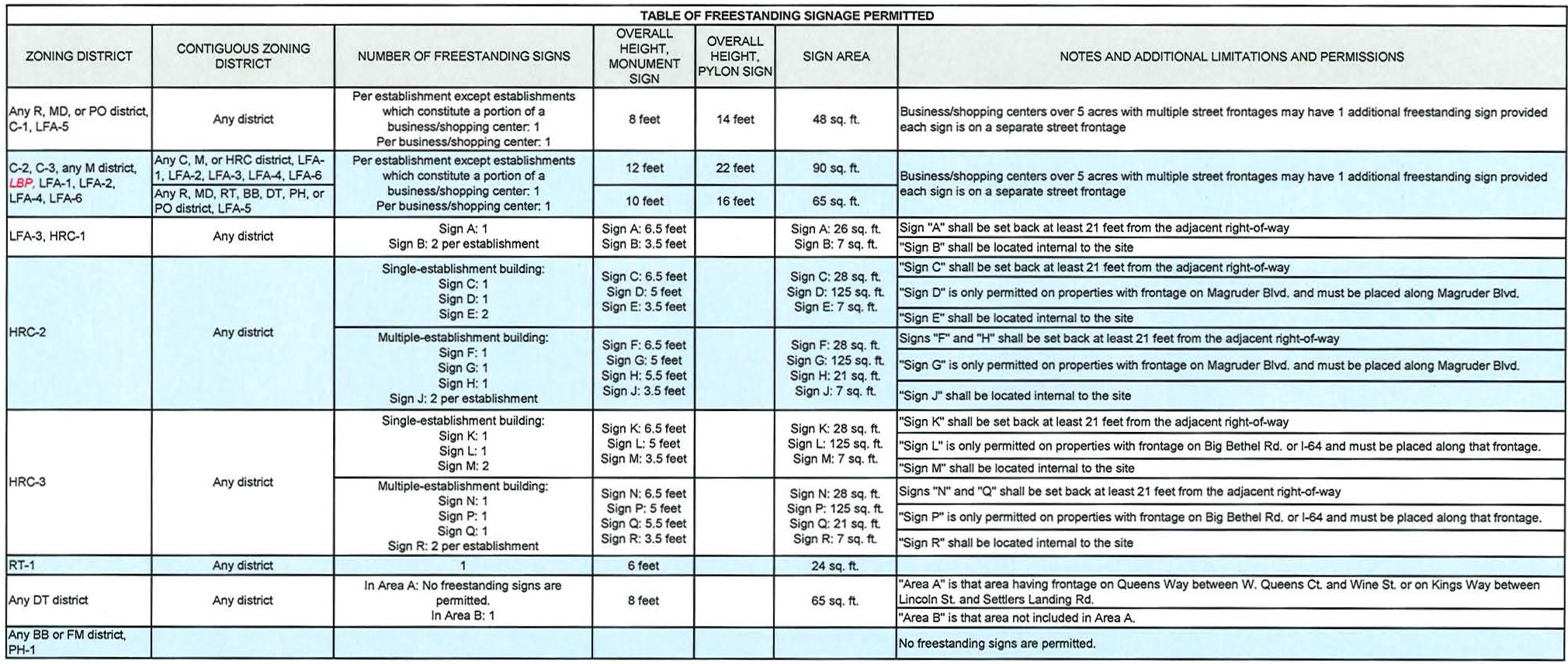
Sec. 10-31. - Table of Freestanding Signage Permitted.
The attached table entitled, "Table of Freestanding Signage Permitted" is hereby declared to be a part of this article as if fully set forth herein. Click here for a PDF version of this table.
(Ord. No. Z16-14, 7-13-2016; Ord. No. Z18-7, 3-14-2018; Ord. No. Z19-09, 1-19-2019; Ord. No. Z20-03, 1-8-2020)
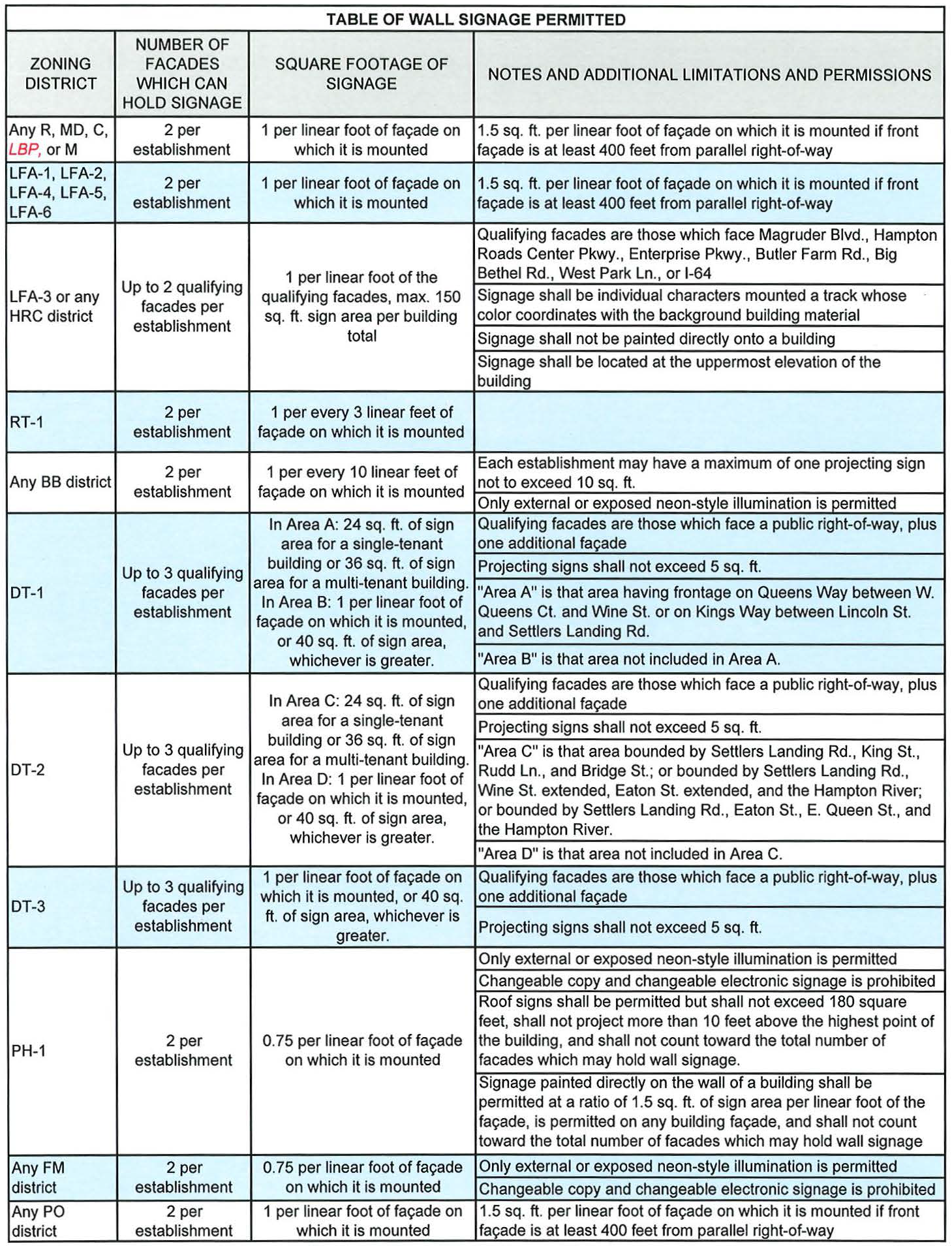
Sec 10-32. - Table of Wall Signage Permitted.
The attached table entitled, "Table of Wall Signage Permitted" is hereby declared to be a part of this article as if fully set forth herein.Click here for a PDF version of this table.
(Ord. No. Z16-14, 7-13-2016; Ord. No. Z18-7, 3-14-2018; Ord. No. Z19-09, 1-19-2019; Ord. No. Z20-03, 1-8-2020)
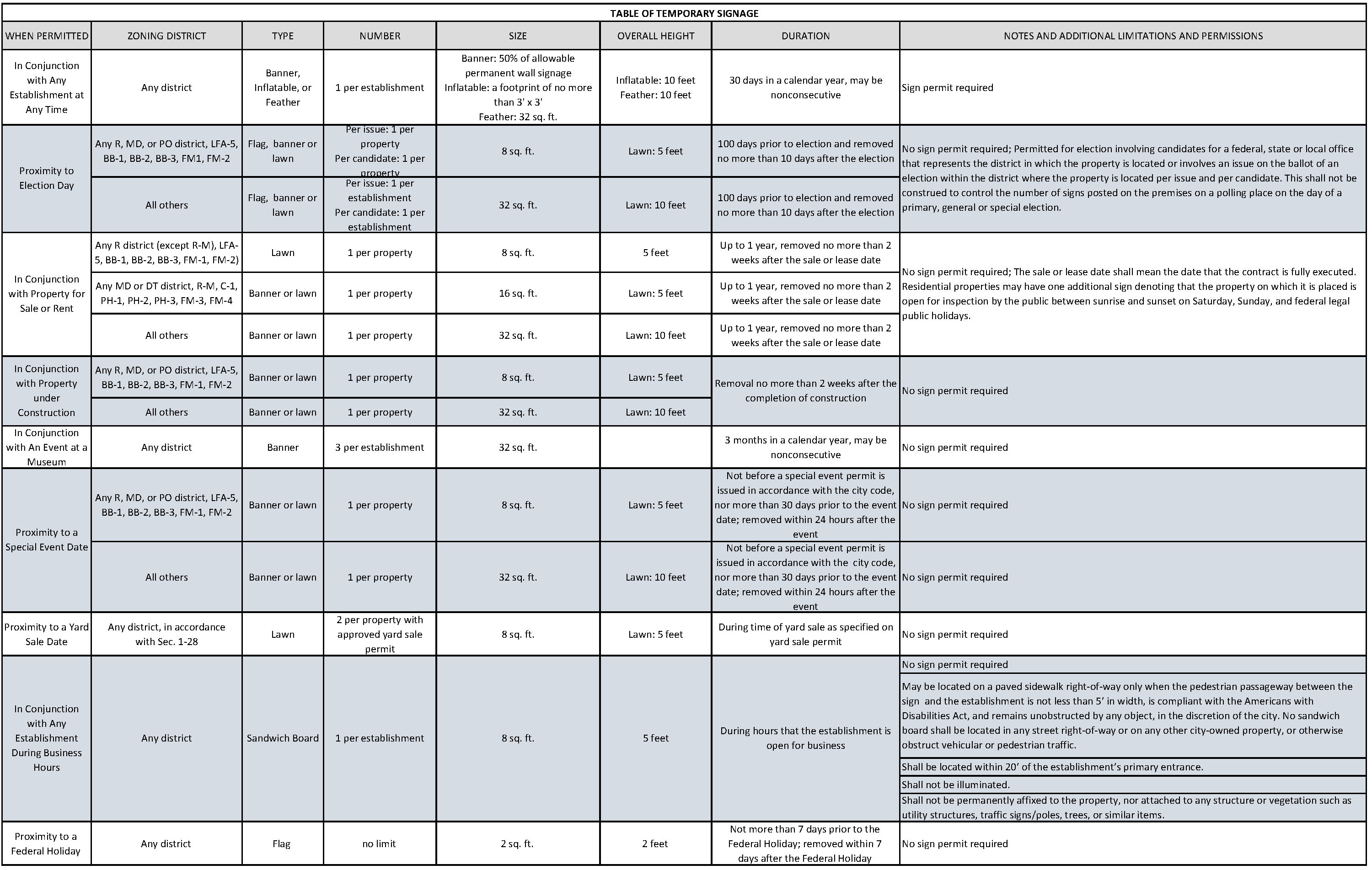
Sec. 10-33. - Table of Temporary Signage Permitted.
The attached table entitled, "Table of Temporary Signage Permitted" is hereby declared to be a part of this article as if fully set forth herein.Click here for a PDF version of this table.
(Ord. No. Z16-14, 7-13-2016; Ord. No. Z19-09, 1-19-2019; Ord. No. Z21-04, 8-11-2021)

