
Harlem City Zoning Code
ARTICLE III
YARD AND HEIGHT REQUIREMENTS
Sec. 108-66.- General provisions.
(a)
General. The following area, yard, height and size restrictions shall apply to these districts enumerated in sections 108-44 through 108-46. If side yards are provided in the B-1, B-2, or I-1 districts, they should not be less than ten feet in width. If closed courts are provided in any building, the minimum width of the court should not be less than 25 percent of the height of the building. The front yard setback and the side yard requirements as applied to the A-1 Agricultural District pertain to any building incidental to agriculture.
TABLE I. AREA, YARD AND HEIGHT REQUIREMENTS
*All permanent structures must be no less than 25 feet from the rear property.
TBD: To be determined through the application process as multiple residential types may be proposed.
(b)
Height limitations; exemptions. No building or structure shall hereafter be erected or altered so as to exceed the height limits established by this article for different types of buildings and structures. The height limitations of this article shall not apply to church spires, belfries, cupolas and domes not intended for human occupancy, flagpoles, or public utility facilities.
(c)
Maximum height limitations. The following maximum heights are established for types of land uses.
TABLE II. MAXIMUM HEIGHT LIMITATIONS
(d)
Variances to maximum height limitations. The city council may authorize a building or structure to exceed the maximum height limitations for good cause shown, upon application by the owner of the property involved, after a public hearing.
(e)
Height performance standard. This section provides for additional setback protection from visual impacts of taller buildings. The heights of buildings on properties abutting a single-family dwelling, including a manufactured home, shall be limited according to the provisions of this section. When a non-residential building or structure is proposed to be erected on property that abuts property containing one or more single-family dwellings or manufactured homes, the height of the nonresidential building or structure abutting one or more single-family dwellings or manufactured homes shall meet the requirements of this section. The height of a non-residential building or structure on property abutting a single-family dwelling shall not exceed 35 feet; provided, however, that said non-residential building or structure may be increased in height beyond the 35-foot maximum by one foot for every five feet the nonresidential building is setback from the minimum required side or rear building setback, or ten feet from the side or rear property line if no required side or rear yard is established, up to a maximum required setback of 100 feet. (See figure 5.0.A.) The following table provides maximum heights at five-foot increments of building height based on this performance standard.
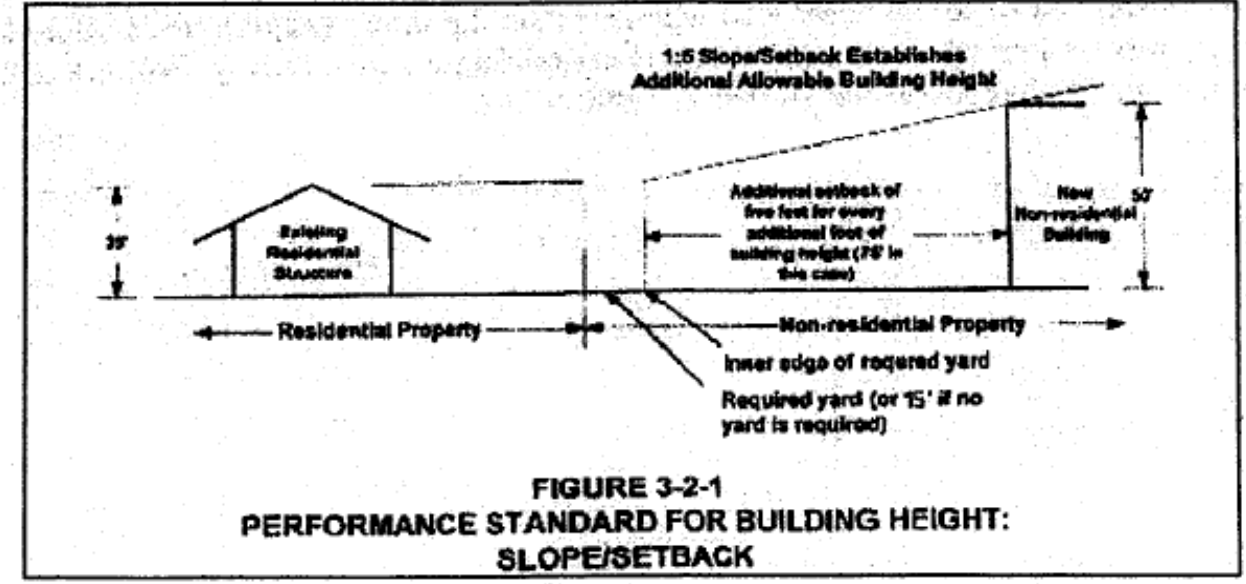
Figure 5.0.A. Building Height
TABLE III. HEIGHT PERFORMANCE STANDARDS
(Code 2004, § 152.055; Ord. No. 381, 4-10-2006; Ord. No. 2207, 4-25-2022; Ord. No. 2227, 11-28-2022; Ord. No. 2232, 12-19-2022; Ord. No. 2233, 2-27-2023)
Sec. 108-67. - Yards.
No building shall hereafter be erected in a manner to have narrower or smaller side yards or rear yards than specified for the use in this article. No part of a required side yard or rear yard shall be included as a part of the yard required for another building. The application of buffer requirements, as established by this article, supersedes these minimum required yards.
(Code 2004, § 152.056; Ord. No. 381, 4-10-2006)
Sec. 108-68. - Landscape strips and buffers.
(a)
Required landscape strips. No lot shall hereafter be developed with less than the minimum required landscape strip for the specific use as shown in table IV, when abutting a public or private street.
TABLE IV. REQUIRED LANDSCAPE STRIPS AND BUFFERS
(b)
Landscape strip design standards. Landscape strips shall be planted with trees, shrubs, grass, or groundcover, except for those areas that are mulched. Landscaping shall be planted throughout and shall not appear as a single row of plantings. Landscape strips shall not contain structures, accessory uses, parking of any kind, stormwater detention facilities, fences of any kind, patios, or displays of commercial stock. Berms and retaining walls as part of an overall landscaping plan, signs as permitted in this article, driveways required to access the property, pedestrian-oriented facilities, and underground utilities are permitted within the landscape strip.
(c)
Waiver of landscape strip requirements. The front landscape strips required by this section may be waived for lots which abut one or more developed properties on the same side of the street and which contain a structure that is setback less than ten feet from the right-of-way.
(d)
Required buffers. No lot shall hereafter be developed with less than the minimum required buffer along a side or rear property line when abutting property containing a single-family dwelling or manufactured home, for the specific use as shown in table IV.
(e)
Buffer specifications. Any buffer required by this section shall be natural vegetation, undisturbed except for approved access and utility crossings, and replanted where sparsely vegetated, with evergreen trees and/or shrubs to form an opaque screen that will provide a visual buffer throughout all seasons. Buffers shall be designed to provide privacy and security and to give adequate protection to adjacent neighbors from lights, sounds, and other potential nuisances. Buffers shall be planted with landscaping throughout and shall not appear as a single row of plantings. The length of any required buffers shall not extend closer than 15 feet to any public right-of-way in order to preserve vision clearance.
(f)
Structural buffer design standards. When commercial construction abuts residential property, a minimum six-foot tall wooden slat fence must be installed. Fences and walls shall present a finished and decorative appearance to the abutting property and shall be located in such a manner to preserve existing vegetation.
(g)
Reduction of buffer. A required buffer may be reduced by as much as 30 percent through the site plan review process for multifamily, institutional residential living facilities, places of worship, schools, daycare centers, and other institutional uses if screening is provided by installing a minimum six-foot high solid wooden fence or masonry wall within the required buffer.
(Code 2004, § 152.057; Ord. No. 381, 4-10-2006; Am. Ord. No. 475, 12-22-2014; Ord. No. 2233, 2-27-2023

