
Harrisville City Zoning Code
11.13 Commercial
And Manufacturing Development Standards
11.13.010 Purpose And Intent
The purpose of development standards in the commercial and manufacturing zoned areas of Harrisville is to provide for the orderly development of land by setting size and area requirements to ensure that development on each lot or parcel provides adequate room for the use of the lot, sets the character of the area and reduces impacts to adjacent residentially zoned neighbors in the placement of buildings and types of uses, and considers the need of the land owner, traffic circulation systems and the impact of such uses to adjacent land owners and the community overall.
HISTORY
Repealed & Reenacted by Ord. 400 on 9/9/2008
Repealed & Reenacted by Ord. 400 on 9/9/2008
11.13.020 Main Building Development Standards
- Lot Area and Frontage Requirements. Each lot or parcel in the respective zone shall comply with the minimum requirements of this regulation as provided below except when such lot or parcel has a noncomplying right.
CP-2 MP-1 Minimum lot area 3,000 square feet 20,000 square feet Minimum lot width None None - Building, Parking Lot and Storage Setbacks. Any structure constructed in a commercial or manufacturing zone, including any accessory structure and any area used to meet the parking requirements of the use or area used for outdoor storage of vehicles, equipment or materials shall maintain a minimum setback distance in feet from the property line according to the following table. Easements or other recorded restrictions are not superseded by setback requirements and must be considered when locating structures:
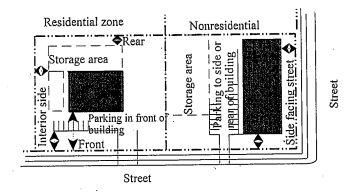
CP-2 Zone front setback interior side setback interior side setback next to residential zone side setback facing a street rear setback rear setback next to residential zone building 20 feet None 20 feet 20 feet 10 feet 20 feet parking lot in front of building 5 feet 0 feet 10 feet 20 feet 0 feet 10 feet parking lot to sideor rear of building 20 feet 0 feet 15 feet 20 feet 0 feet 15 feet outdoor storage 100 feet 0 feet 20 feet 100 feet 0 feet 20 feet MP-1 Zone building 30 feet 10 feet 25 feet 30 feet 10 feet 25 feet parking lot 30 feet 0 feet 10 feet 30 feet 0 feet 10 feet outdoor storage 50 feet 0 feet 20 feet 30 feet 0 feet 20 feet - Main Building height
Minimum- 10 feet
Maximum- 45 feet - Building design
- In order to maintain the traditional character developed in Harrisville certain design elements are required on buildings in commercial zones. Those required elements are:
- Main exterior wall finish materials on walls which face a public street or adjacent to a residential zone shall be limited to the use of brick, stone, atlas brick, or colored split face block with the use of accent materials of not more than 20% of the wall surface of stucco type systems or siding (vinyl, aluminum, or hardiplank) with a maximum 12" width horizontal lines.
- Retail buildings that face the street shall have at a minimum 40% of the front face of the building in non-reflective glass to create a store front appearance. Where the building design has the orientation of the accessible front to an inner parking lot this glass requirement can be spandral glass or if glass is not desired when this street facing building front is not the main access to the building, the setback between the face of the building and the street shall be landscaped with shrubs and evergreen trees that cover the visibility of 50% of that building face.
- Roof drainage shall be collected and directed away from any adjacent property line by means of a roof gutter system when buildings are closer than 10 feet to property line
- Buildings constructed in a manufacturing zone shall meet the following minimum requirements.
- No reflective exterior metal for walls or roof shall be permitted.
- Main exterior wall finish materials facing a public street or when adjacent to a residential zone shall be of brick, stone, atlas brick, or concrete masonry units.
- In order to maintain the traditional character developed in Harrisville certain design elements are required on buildings in commercial zones. Those required elements are:
HISTORY
Repealed & Reenacted by Ord. 400 on 9/9/2008
Amended by Ord. 441 on 9/27/2011
Amended by Ord. 477 on 1/13/2016
Amended by Ord. 512 on 9/8/2020
Repealed & Reenacted by Ord. 400 on 9/9/2008
Amended by Ord. 441 on 9/27/2011
Amended by Ord. 477 on 1/13/2016
Amended by Ord. 512 on 9/8/2020
11.13.030 Required Parking
- Required parking
- In all commercial and manufacturing zones there shall be provided on the property at least the minimum number of parking stalls required by this chapter
Use Minimum Number of Spaces Required INSTITUTIONAL Places of worship, public assembly buildings 1 stall per 40 square feet in main assembly room Public offices without assembly area 1 stall per 300 square feet of floor Public or private educational facility - Grades K-9
- High schools
- School auditoriums
- Public or private college or trade or vocational school.
- 2 stalls per classroom
- 10 stalls per classroom
- 1 stall per 40 square feet in auditorium
- 1 stall per 500 square feet of building
MANUFACTURING Manufacturing processing or assmelby of products 1 stall per 500 square feet of building where workers are working. Does not include storage area, plus one stall per 300 square feet of area used for any retail sales of product Manufacturing where majority of work occurs outdoors 1 stall per employee on highest shift and 4 stalls for visitor use RECREATION AND ENTERTAINMENT Public park or recreation facility Determined on individual basis based on type of activity, programs, and location to residental area Indoor live theater 1 stall per 3 fixed seats in the main seating area Indoor recreation facility 1 stall per 1,000 square feet of building for field type uses, 1 stall per 125 square feet for health club, fitness gyms type uses RESIDENTIAL Dwelling unit above store or nightwatchman dwelling 2 stalls per dwelling unit Nursing home, assisted living facilities 1 space per individual private unit or bed for the first 20, 0.5 spaces for the next 30 private units or beds, and 0.25 spaces per private unit or bed for each unit in excess of 50 in the development SALES General retail sales 1 stall per 300 square feet of floor area minimum with a maximum of 1 stall per 200 square feet of floor area Retail sales with warehousing on site Same as retail sales plus 1 stall per 1,000 square feet for the first 10,000 square feet of warehousing then 1 stall per 10,000 square feet for the remaining area Sales with a main office but product displayed outside 1 stall per 1000 square feet of building RESTAURANTS Serving food and beverages for consumption inside a building 1 space per 100 square feet of building Fast food with drive-through 1 space per 75 square feet of sales and dining area but not less than 5 stalls plus required stacking SERVICES Banks, credit unions, financial institutions (including branch and drive-through) 1 stall per 300 square feet plus required stacking space for drive-through Professional, business, personal services or medical office 1 stall per 400 square feet minimum with a maximum of 1 stall per 250 square feet Contractor business 1 stall per 300 square feet of office building Veterinary clinic 1 stall per 400 square feet of office building Auto repair, service, or body shop 2 stalls per repair bay for the first two bays. Additional bays 1 stall per bay Convenience store 1 stall per 200 square feet of floor area plus stacking for drive-up window Hotels and motels 1 stall per room Daycare or nursery 1 stall per each employee, plus 1 space per 5 children Hospitals 1 stall per 2 bed capacity Warehousing, storage facilities 1 stall per 5000 square feet of building TRANSPORTATION AND UTILITIES Utilities 1 stall per 400 square feet of office area plus 1 stall for each company vehicle Truck or freight terminals 30 stalls minimum - Determination Of Requirements For Uses Not Listed: Off-street parking and loading spaces for all land uses not listed above shall be in accordance with probable estimates of need based on an analysis of parking requirements for similar uses or on anticipated parking demands that shall be determined by the Planning Commission. In determining required parking the Commission shall take into account all relevant factors, including, but not limited to:
- Comparable requirements from other relevant municipalities;
- Requirements of comparable uses listed in this chapter;
- Existing parking patterns in other locations for the same type of use;
- Design provides for adequate loading facilities and for a designed circulation system for distribution and pickup of goods that does not require the use of the public streets;
- Adjacent residential street proximity and the likelihood of the street parking being used to meet the needed parking of the use; and
- Use will not be detrimental to adjacent properties or improvements in the vicinity to the area.
- Shared Parking: Shared parking (the use of one stall for more than 2 uses on the same lot as the parking space) in a commercial or manufacturing zone is allowed if it can be established the uses characteristically result in peak accumulations of parked vehicles at different hours, days or seasons.
- Parking Reduction: Parking reduction of ten percent (10%) of the required parking for more than two (2) uses on the same lot is allowed if it can be shown that there are mixed parking demand uses, (e.g., residential and retail, office and entertainment, residential and office, restaurant and office) or the number of commercial uses exceeds five (5) individual businesses on the lot.
- Handicapped Parking Spaces:
- Designation Of Spaces: The required number of parking spaces designated for the handicapped shall be provided according to this section. The spaces required by this section shall be allocated from the required parking stalls of this chapter.
- Required Spaces: The required number of parking spaces intended for the physically handicapped shall be provided in the parking lot of the commercial or manufacturing use at a rate based on the following:
- 1-25 parking spaces 1 accessible space
- 26-50 parking spaces 2 accessible spaces
- 51-75 parking spaces 3 accessible spaces
- 76-100 parking spaces 4 accessible spaces
- 101-150 5 accessible spaces
- 151-200 6 accessible spaces
- 201 to 300 7 accessible spaces
- For every group of an additional 100 parking spaces up to 500 one additional parking space.
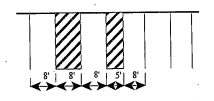
- Size: Required spaces shall be not less than eight feet (8') wide and shall have an adjacent access aisle not less than eight feet (8') wide for the first access aisle then five feet (5') wide for each additional stall aisle. Two (2) adjacent spaces may share a common access aisle. Such aisles shall provide an accessible route of travel to the building or facility entrance. Boundaries of the required parking spaces and aisles shall be marked to identify the use of such spaces.
- Signage: Every parking space required by this section shall be identified by a sign at the head of the required space. The sign shall be mounted at a height between three (3) to five feet (5') above the ground. The sign shall be marked with the international symbol of access. Such signage shall not be less than twelve inches (12") in height. The lettering shall be not less than one inch (1") nor more than two inches (2") in height and shall be on a background of contrasting value.
- Surface: Parking spaces and access aisles shall slope not more than one inch (1") in forty eight inches (48") and shall be firm, stable, smooth and slip resistant.
- Parking, Access, and Storage Surfaces, Locations and Size
- Required parking and any additional parking provided for a commercial or manufacturing use, back up areas for parking and access to the parking or storage areas from a street shall be on a hard surface of either asphalt or concrete. Areas used for outdoor storage of materials or equipment and vehicles under repair may be on gravel or road base surfaces provided that there is no potential of soil contamination from such storage. If the potential exists then the storage area is also required to be hard surfaced with asphalt or concrete. Grading of these surfaces needs to be designed, constructed and maintained so that storm water runoff from these surfaces does not flow to adjacent properties. Drainage systems with catch basins shall be provided for hard surface parking areas to collect and disperse storm water runoff to approved storm drainage systems to avoid ponding of storm water.
- None of the required setback areas of the respective zones shall be used for parking, storage or buildings. Paved access perpendicular to the street which crosses the required front or the side setback facing a street is allowed to access the areas behind the setback used for parking, storage, or building access.
- Driveway widths
- Not on Washington, Wall or Highway 89
- Minimum width twenty-five (25') feet
- Maximum width fifty (50') feet
- On Washington, Wall or Highway 89
- Minimum width thirty-four (34') feet
- Maximum width fifty (50') feet
- The driveway width on state administered highways may be wider as required by the Utah State Department of Transportation.
- Not on Washington, Wall or Highway 89
- Driveway locations
- Commercial and manufacturing uses may have one accessway to a public street per one hundred feet (100') or fraction thereof of street frontage up to a maximum of three driveways for a property. The number of driveways allowed on State controlled highways may be less and number and location shall be determined by a State access permit
- Driveways must be separated by at least fifty (50') from any other driveway whether on the property or an adjacent property. Driveways shall be set back a minimum of eighty feet (80') from the intersection of two (2) arterial streets and fifty feet (50') from any other street classification intersection.
- Lots are encouraged to have a shared access between commercial or manufacturing uses. Such access shall be guaranteed by a recorded reciprocal access easement. If shared access occurs, the driveway width maximum may be increased by ten feet (10') in commercial and manufacturing zones.
- Parking Size: The minimum size for a required parking space is nine (9') feet wide and eighteen (18') feet long and have a 25 foot backup area if the parking is at 90 degrees. Back up areas for 45 degree angled parking shall be a minimum of 12 feet and 60 degree parking is 16 feet
- Off street truck loading design:
- Commercial or manufacturing loading and unloading facilities shall be designed to be to the rear or side of the building and not visible from the public street. In a manufacturing zone, if the lot dimensions together with the building layout will not allow the necessary loading facility to be placed in the rear or side and there are no other means of access to the rear portion of the building, loading facilities may occur along the front or side facing a street, provided that the building is set back a sufficient distance so that all maneuvering of trucks can occur on the property and not the public right of way.
- Loading areas shall be paved with concrete or asphalt.
- Loading areas shall be sized to accept the largest delivery vehicle that will serve the use, and include turnaround areas that are on site and not the public right of way or be designed to allow continued forward movement of the vehicle through the site.
- Access through residential zoned property: Vehicle access through a residential property to a commercial or a manufacturing property is not permitted.
- In all commercial and manufacturing zones there shall be provided on the property at least the minimum number of parking stalls required by this chapter
HISTORY
Repealed & Reenacted by Ord. 400 on 9/9/2008
Repealed & Reenacted by Ord. 400 on 9/9/2008
11.13.040 Landscaping
- Areas required to be landscaped: All required setbacks and areas not used for a building, parking, access or storage are required to be landscaped. When phased development is proposed the future phased areas are allowed to remain in their predevelopment condition and not improved with landscaping provided the area is clear of any debris, junk or storage of items and remains in that condition. Notwithstanding the required landscaping for setbacks, there may be additional landscaping required based on other provisions of this title. Additional requirements include, but are not limited to, installation of landscaping in public right of way, preserving existing trees, setbacks when next to residential zones, and parking lot landscaping.
- General Requirements of landscaping: In those areas required to be landscaped, the landscaping shall follow the following requirements;
- Landscaping of front setbacks, side setbacks facing a street and setbacks adjacent to a residential zone are required to be landscaped with living plant material such as grass, other horticulturally developed ground covers, or shrubs. When shrubs or ground covers other than grass are used for landscaping, the spacing, type and size of plants used shall be such that seventy five percent (75%) of all landscaped areas shall be covered with living material within three (3) years of planting. Plant material shall be species that are regionally appropriate and suitable for the site specific planting conditions, including available moisture, shade, salt tolerance, wind exposure and soil ph. While all landscape designs should be designed to make proper use of water conservation practices, if the landscaped areas described in this section exceed 15% of the site area then up to 25% of the ground surface area may be landscaped using decorative rock between the sizes of 1.5 inches to 4 inches in size without plant material.
- Interior side and rear setbacks not adjacent to residential zones may be landscaped with decorative non living covers such as rocks, gravel or wood mulches that allow water to infiltrate the ground and reduce storm water runoff.
- Parking lot landscaping: Required public parking areas shall install landscaped islands with raised curbs. Islands shall not be placed over asphalt or concrete. A curb shall be provided along all interior roadways to prevent vehicular intrusion into landscape areas. Whenever a landscaped island under this provision is required it shall be a minimum width of nine feet (9') and the length of the parking stalls it abuts.
- Landscaped islands shall be installed at the end of each row of parking if the row exceeds ten (10) parking stalls in length. If the row of parking is thirty (30) or more stalls in length, one island shall be placed between every fifteen (15) stalls in the row in addition to the end of the row. In manufacturing zones, if the parking is located behind the building and is not in public view from the street, no island is required.
- When landscaped islands are required, a minimum of one deciduous tree shall be planted in each island. This tree requirement is in addition to the number of trees required on the remainder of the lot. The surface of the island shall be planted in grass or shrubs. If shrubs are used they shall meet the requirement of seventy five percent (75%) of the landscaped area covered with living plant material within three (3) years. Plantings shall be maintained at a height not to exceed three feet (3').
- Planting bed mulch for shrubs or areas covered with rock or wood mulch shall have a minimum depth coverage of three inches (3").
- No plant material greater than twenty four inches (24") in height shall be located within fifteen feet (15') of a curb cut.
- For all properties, all on-site landscape areas shall include in the planting a minimum of one live tree per two thousand (2,000) square feet of landscaped area.
- Minimum Size Of Landscape Materials At Time Of Planting:
- Deciduous shade trees shall have a minimum caliper size of one and a half inches (1.5") as defined by industry standards.
- Evergreen trees shall be a minimum of four feet (4') tall.
- Shrubs shall be of at least a one gallon container.
- Installation and Maintenance:
- Landscaping shall be installed prior to occupancy of any structure. In the case of inclement weather that prevents the installation of the required improvements, the time completion of the improvements may be extended, in writing, upon the approval of the applicable reviewing body or designee. However, in no case shall the time for completion be extended beyond June 1 immediately following the completion date.
- All landscaping shall be maintained in a good, healthy, weed-free condition by the owner. Diseased or dead plant material shall be removed and replaced by June 1 if due to winter kill or October 1 if the plant material dies during summer months.
- Landscaping materials shall be contained so as not to obstruct any portion of the public sidewalk or street pavement.
- Irrigation System Design:
- Landscaped areas shall be irrigated with an underground irrigation system or drip system. Areas with existing natural vegetation of shrubs (e.g., Wood's rose, Willows, Sagebrush) or trees (e.g., Box Elder, Cottonwood, Siberian Elm ) are not required to be irrigated unless site improvements have altered the historic drainage pattern or soil absorption patterns so the amount of available water is reduced so the planting cannot exist in its natural state.
- Irrigation systems shall be designed to avoid or minimize overspray of water onto paved surfaces or structures.
- Tree Preservation:
- Existing trees that are in a healthy condition and have a minimum caliper of four inches (4") as measured by industry standards shall be considered "significant", and shall be preserved to the extent reasonably feasible. Existing trees and shrubs within areas that can be developed may be used to satisfy the landscaping requirements of this Section. All required landscape plans shall accurately identify the locations, species, size, condition and proposed disposition of all significant trees.
- Existing trees that will remain need to have sufficient nonpaved surfaces around them so their root systems shall receive adequate water to ensure survival, and shall be protected from damage, soil contamination and compaction within the drip line during construction through the use of barricades or fencing.
- Street Trees: When the public street frontage has existing curbs or curbs are required to be installed as part of the development improvements, deciduous street trees shall be required to be installed in the parkway. Trees shall be spaced at forty feet (40') on center but shall not be closer than twenty five feet (25') to any drive approach or forty feet (40') to any street intersection. If the space in the parkway is less than five feet (5') wide the required trees shall be placed outside of the parkway but within twenty five feet (25') of the curb line and may be arranged in a formal or informal manner.
HISTORY
Repealed & Reenacted by Ord. 400 on 9/9/2008
Repealed & Reenacted by Ord. 400 on 9/9/2008
11.13.050 Screening Requirements
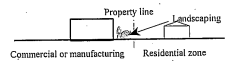
Whenever commercial or manufacturing development abuts property in a residential zone, screening is required to protect residential properties from the potential impacts of lights, noise, increased pedestrian traffic, invasions of privacy and physical intrusions on property. There are three types of screening that are permitted when a commercial or manufacturing use is adjacent to a residential zone and any three or a combination of the three is permitted.
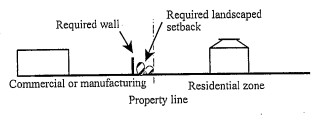
- Construct a solid wood, vinyl or masonry wall a minimum height of six (6) feet. When this is the option used the wall height may be required to be taller than the minimum depending on the use that is occurring on the commercial or manufacturing side. The wall needs to be tall enough so that from the furthest point on the adjacent residential lot any outdoor storage is not visible when viewed standing on the ground. The use of split face block or colored block shall have the best side facing the residential zone. Walls will be required to be placed behind the setback distance for the respective zone and yard location.
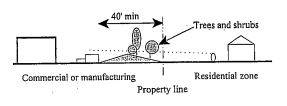
- Installing a continuous landscaped mound. The height of the mound screens any storage or parking on the commercial or manufacturing use from the adjacent residential zone when viewed standing at ground level on the residential lot. The minimum width of the mound is forty feet(40') and the steepest slope of the mound allowed on the residential side is 2 feet vertical to 1 foot horizontal. Plantings of evergreen and deciduous trees and shrubs which reach the minimum height of 10 feet shall be required on the residential side of the mound to soften the visual appearance and trees shall not be spaced any further than thirty feet (30') apart.
- The building may act as the screening option when next to a residential zone provided there are no openings, lights, speakers, storage or parking on the portion of the wall facing the residential zone. The setback area between the building and the residential zone is required to be landscaped and maintained by the commercial or manufacturing use owner.
HISTORY
Repealed & Reenacted by Ord. 400 on 9/9/2008
Repealed & Reenacted by Ord. 400 on 9/9/2008
11.13.060 Access Limitations
Access directly onto a residential subdivision or a street that is primarily residential in nature to or from commercial and/or manufacturing uses is prohibited, with the following exception:
A commercial use may have access directly onto a residential subdivision on the General Plan Land Use Map General Commercial, and the street is identified as an arterial, minor arterial, collector, future collector, or a local road where the connection will be with 150 feet of a state road, on the transportation Master Plan.
HISTORY
Repealed & Reenacted by Ord. 400 on 9/9/2008
Amended by Ord. 540 on 8/8/2023
Repealed & Reenacted by Ord. 400 on 9/9/2008
Amended by Ord. 540 on 8/8/2023

