
Harrisville City Zoning Code
11.09 Residential
Development Standards
11.09.010 Purpose And Intent
The purpose of development standards in the residentially zoned areas of Harrisville is to provide for the orderly development of land by setting size and area requirement for proposed lots and to ensure that development on each lot or parcel provides adequate room for the use of the lot, sets the character of the neighborhood in the placement of buildings and types of uses, and considers the need of the land owner and the impact of such uses to adjacent land owners and the community overall.
HISTORY
Adopted by Ord. 255 on 11/26/1991
Amended by Ord. 390 on 1/22/2008
Adopted by Ord. 255 on 11/26/1991
Amended by Ord. 390 on 1/22/2008
11.09.020 Main Building Development Standards
- Lot Area and Frontage Requirements
Each lot or parcel in the respective zone shall comply with the minimum requirements of this regulation as provided below except when such lot or parcel has a noncomplying right.A-1 R-1-20 RE-15 R-1-10 Minimum lot area 40,000 sq ft 20,000 sq ft 15,000 sq ft 10,000 sq ft Minimum lot frontage 100 ft 100 ft 100 ft 90 ft - Residential Building Setbacks
Any structure intended for use as a residential dwelling, including any accessory structure attached to the dwelling structure such as a garage, shall maintain a minimum distance in feet from the property line to the building according to the following table. Notwithstanding the setback requirement, easements or other recorded restrictions to portions of a property are not superseded by setback requirements and must be considered when locating structures: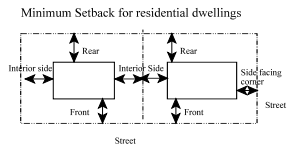
Type of yard Zone A-1 R-1-20 RE-15 R-1-10 Front 30 ft 30 ft 30 ft 25 ft Interior Side 12 ft 10 ft 10 ft 8 ft Side facing corner 20 ft 20 ft 20 ft 20 ft Rear 30 ft 30 ft 30 ft 25 ft - Additions to existing homes
Any single family dwelling structure having been occupied for a minimum of five years may make an expansion of the dwelling that extends into the area of the rear yard setback for the main portion of the home provided the expansion.- Maintains the sideyard setbacks of the respective zone,
- Maintains a minimum setback of 15 feet from the rear property line, and
- Is no wider than half the width of the existing house
- Other Main Building Setback
Nonresidential buildings or structures which are used for the main permitted land use shall maintain a minimum distance in feet from the property line to the building or structure according to the following table: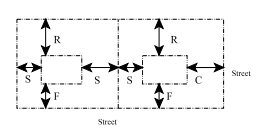 F = Front setback, S = Side setback, C = Corner side setback, R= Rear setback
Zone A-1 and R-1-20 RE-15 R-1-10 Type of
setbackF S C R F S C R F S C R Barn or farm
Animal Boarding Establishment100' 15' 70' 15' Church 30' 30' 25' 30' 30' 30' 25' 30' 25' 30' 20' 20' Golf course
building30' 30' 30' 30' 30' 30' 30' 30' 30' 30' 30' 30' Produce
stand30' 10' 30' 10' 30' 10' 25' 30' 25' 10' 20' 20' Plant nursery
sales office30' 10' 30' 10' 30' 10' 25' 30' Plant
greenhouse60' 10' 30' 10' 60' 10' 30' 10' School 30' 30' 25' 30' 30' 20' 30' 30' 25' 20' 20' 20' Substation 75' 75' 75' 75' 75' 75' 75' 75' 75' 75' 75' 75' T.V., radio,
telecommuni-
cation tower75' 75' 75' 75' - Main Building height Minimum- 10 feet Maximum-
- Residential, other main building- 35 feet
- Fruit or vegetable stand, green house, coop- 15 feet
- Residential Building size and design
- The maximum footprint of a residential dwelling excluding attached accessory uses shall be four thousand (4,000) square feet.
- In order to maintain the traditional residential character developed in Harrisville certain design elements on residential buildings are required. Those required elements are:
- Roofs with a pitch no shallower than a ratio of run to rise 3 to 1
- Main exterior wall finish materials of brick, stone, siding(vinyl, aluminum, wood or hardiplank)with a maximum 12" width horizontal lines , stucco or glass. Structural block, atlas brick and other larger dimensional concrete masonry units are not permitted for residential dwellings but only for accessory structures or other main buildings.
HISTORY
Adopted by Ord. 255 on 11/26/1991
Amended by Ord. 285 on 8/8/1995
Amended by Ord. 390 on 1/22/2008
Amended by Ord. 424 on 7/7/2010
Amended by Ord. 505 on 12/10/2019
Adopted by Ord. 255 on 11/26/1991
Amended by Ord. 285 on 8/8/1995
Amended by Ord. 390 on 1/22/2008
Amended by Ord. 424 on 7/7/2010
Amended by Ord. 505 on 12/10/2019
11.09.030 Accessory Building Development Standards
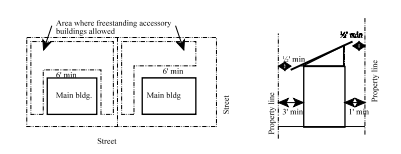
- Free standing residential accessory structure setbacks. Residential accessory structures (e.g. garage, shed, work shop, gazebo, and covered pergola) which are free standing shall only be located to the side or rear of the main building. The accessory building located in the side yard must be set back at least ten (10) feet from the side yard property line. For accessory structures located at least six (6) feet in the rear yard behind the main building, the side yard setback may be one (1) foot from a property line, except buildings with metal roofs shall be three (3) feet from any lot line. No portion of the roof overhang shall be closer than one half foot (1/2') to any property line, and proper grading and drainage shall be installed to prevent additional drainage onto adjoining property. Placement of accessory buildings on utility easements is not allowed, without written permission from all easement holders. In the A-1 Zone, accessory buildings may be located in the front yard so long as such as 30 feet from the road right of way, and at least 10 feet from the main building or dwelling. This section applies to commercial zones with occupied residential homes.
- Freestanding accessory building height
- Maximum
- Barn, garage- 25 feet
- Shed, coop, produce stand, greenhouse- 25 feet
- Maximum
- Accessory building coverage. No single accessory building or group of accessory buildings shall cover more than twenty-five (25%) of the area from the rear of the main building to the rear property line. In addition to the 25% coverage limitation in the RE-15 zone when the lot is less than 16,000 square feet or the R-1-10 zone, no detached accessory structure on a lot with a dwelling shall have a larger square foot footprint than the dwelling on the lot.
HISTORY
Adopted by Ord. 255 on 11/26/1991
Amended by Ord. 390 on 1/22/2008
Amended by Ord. 412 on 9/8/2009
Amended by Ord. 441 on 9/27/2011
Amended by Ord. 480 on 6/14/2016
Adopted by Ord. 255 on 11/26/1991
Amended by Ord. 390 on 1/22/2008
Amended by Ord. 412 on 9/8/2009
Amended by Ord. 441 on 9/27/2011
Amended by Ord. 480 on 6/14/2016
11.09.040 Parking Regulations.
- Required parking
In all residential zones there shall be provided in a detached or attached garage or in an area located where a future garage could be constructed on the same lot as the dwelling two side by side concrete or asphalt surfaced parking spaces per dwelling unit and paved driveway access leading from the street to the required parking. Non dwelling permitted uses shall locate the parking for the use on a hard surface of concrete or asphalt behind the setback required for the main building unless otherwise stated in city ordinances. - Additional Off Street Parking
- Parking or storing of additional operational and licensed vehicles in one required sideyard or the front yard setback of a dwelling may be allowed provided that the following conditions are complied with;
- The dwelling unit has the minimum number of two (2) required off street parking spaces and access to those parking spaces is on a concrete or asphalt driveway.
- Any additional parking space must remain open and unobstructed to the sky.
- The surface treatment for the additional vehicle parking and the access to the additional parking if located in the side yard is either road base, gravel or a hard surface material of concrete or asphalt.
- The additional parking space in the front yard is limited to only the area between the hard surface driveway and the nearest sideyard property line. Parking can not extend into the area between the dwelling and the street nor in the sideyard facing a street on a corner lot.
- All storm water run off must be directed to prevent drainage onto adjacent properties.
- No additional parking space or vehicle shall be located in the sideyard or frontyard setback facing a street on a corner lot.
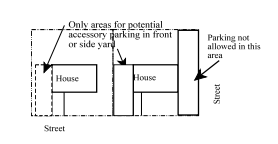
- Uncovered parking for recreational vehicles may be permitted in the area behind the rear of the dwelling and in the rear yard setback provided that;
- The vehicles parked are currently licensed and operational
- The parked vehicles do not occupy more than twenty-five (25%) of the rear area of the property, and
- Parking does not need to be on hard surface.
- Parking or storing of additional operational and licensed vehicles in one required sideyard or the front yard setback of a dwelling may be allowed provided that the following conditions are complied with;
- Parking of Agricultural or Farm Equipment
When a farm or agricultural use occurs on the property, machinery and equipment necessary for the use may be parked or stored on the property without a required hard surface provided that the equipment parking or storing area is setback a minimum of sixty (60) feet from any public street. When the parking or storage area is open to the sky and when a structure exists on the property the parking shall be located in such a manner that the structure serves as a screen between the equipment or vehicles and adjacent property lines or public street. - Parking and Access Surfaces, Locations and Size
- Required parking for a dwelling and access to the required parking if one hundred (100') feet in length or less from the public street property line shall be paved with an asphalt or concrete surface. For distances longer than one hundred (100') feet gravel or road base are approved surface materials for parking areas and access lanes. Driveways and parking areas shall be designed so that storm water runoff from these surfaces does not flow to adjacent properties.
- For all uses permitted in a residential zone, none of the front and side yard setback areas required by the respective zone shall be used for parking with the exception of the sideyard parking according to the provisions of the chapter. Access across the required front yard is allowed to the side yard or rear yards. No more than twenty-five percent (25%) of the area from the rear of the building to the rear property line may be used for parking.
- Driveway widths
- Single family homes
- Minimum width ten (10') feet
- Maximum width thirty-two (32') feet
- Attached dwellings
- Minimum width twenty (20') feet
- Maximum width thirty-four (34') feet
- Apartment
- Minimum width twenty-four (24')
- Maximum width thirty-four (34') feet
- Single family homes
- Parking Size/ The minimum size for a required parking space is nine(9') feet wide and eighteen (18') feet long.
HISTORY
Adopted by Ord. 255 on 11/26/1991
Amended by Ord. 390 on 1/22/2008
Amended by Ord. 428 on 8/28/2010
Adopted by Ord. 255 on 11/26/1991
Amended by Ord. 390 on 1/22/2008
Amended by Ord. 428 on 8/28/2010
11.09.050 Landscaping Requirements
All required setbacks and areas not used for a building, parking or access are required to be landscaped before occupancy of the building is allowed except for single family homes. If occupancy is to occur during the winter months then the landscaping must be installed before the beginning of the upcoming June. For single family homes the front yard area is required to be landscaped within (18) months of occupancy of the dwelling.
HISTORY
Adopted by Ord. 255 on 11/26/1991
Amended by Ord. 390 on 1/22/2008
Adopted by Ord. 255 on 11/26/1991
Amended by Ord. 390 on 1/22/2008

