
Hawaiian Gardens City Zoning Code
CHAPTER 18
100 - ADMINISTRATION7
Editor's note— Ord. No. 2024-620, § 2(Att.), adopted January 8, 2025, repealed the former Ch. 18.100, §§ 18.100.005—18.100.190, and enacted a new Ch. 18.100 as set out herein. The former Ch. 18.100 pertained to similar subject matter and derived from Ord. 505 § 2, adopted 2006; Ord. 537 § 1, adopted 2011; Ord. No. 585, § 2(Exh. B), adopted December 10, 2019.
18.100.005 - Purpose.
The issuance of permits, enforcement of standards, and correction of violations are major components in achieving the goals and purposes of this Zoning Code. This chapter sets forth the procedures for processing development review applications and the criteria and conditions necessary so that an appropriate decision may be made by the City on each application.
(Ord. No. 2024-620, § 2(Att.), 1-8-2025)
18.100.010 - Authority.
A.
Permits. No permit or license shall be issued by the City if the proposed project does not comply with the applicable provisions of this Zoning Code. It is the duty of the property owner to ensure that all required permits are obtained before any work is done.
B.
Filing of fees. The City Council shall, from time to time, by resolution, adopt or modify a schedule of filing fees to be paid by the applicant to the City to defray the reasonable expenses for processing development applications, discretionary permits, hearings, extensions, appeals or other cost incidental to the several procedures contained in this Zoning Code.
C.
Decision-making authority. The following table specifies the decision-making authority for each of the various actions described in this Chapter. The letters/symbols in the columns beneath the decision-making body mean the following:
1.
X = Body provides final approval or decision on the application or permit.
2.
R = Body provides recommendation only.
3.
A = Body considers appeals to decisions.
CDD = Community Development Direction; PC = Planning Commission; CC = City Council
* Director may refer such application to the Planning Commission for consideration.
Note: A recommendation or decision before the Planning Commission or the City Council
requires a public hearing, while a decision by the Community Development Director
does not. See subsection 18.100.020(E) for noticing requirements for public hearings.
D.
Actions by decision-making authority. The decision-making authority shall make one of the following actions on each application:
1.
Approval. After the action's effective date (as defined in subsection 18.100.020(K) effective date) and approval of any required plan revisions, the proposed land use plan or development may be established in compliance with all applicable regulations and the approved project plans and specifications.
2.
Conditional approval. Any application may be approved subject to compliance with specified conditions. Conditions may require dedication of land, installation of improvements, the posting of financial security to guarantee performance, design modifications, or other conditions necessary to achieve the objectives of the general plan and this Zoning Code. After the action's effective date (as defined in subsection 18.100.020(K) effective date) and after approval of any required plan revisions, the proposed land use or development may be established in compliance with all applicable regulations, the approved project plans and specifications, and the requirements of the conditions of approval.
3.
Denial. An application may be denied if the required findings cannot be made. When an application has been denied, an application for the same or a similar use on the same property shall not thereafter be accepted for a period of one year from the date of final determination. Applicant options include filing of an appeal with the same plan or submission of a new application that features substantial changes to the previous proposal.
(Ord. No. 2024-620, § 2(Att.), 1-8-2025)
18.100.020 - Administrative procedures.
A.
Applicable State law. It is intended that the provisions of this chapter shall be consistent and in full compliance with the Permit Streamlining Act (Section 65920 et seq.) and as subsequently amended, as well as other applicable sections of the State Government Code.
B.
Application filing. An application for a permit or other entitlement under this Zoning Code may be submitted only by the property owner of the subject property, by an agent with written authorization from the property owner, or by a public agency.
C.
Application forms. Applications shall be filed with the Community Development Department on forms prescribed by the Director, together with: (1) all maps, plans, documents and other materials required by the Director, and (2) all required filing fees. The Department shall provide the necessary forms and filing instructions specifying all materials and fees required to any requesting person at no charge.
1.
Ownership. Any procedure provided for in this Chapter may be initiated by application of the owner of any real property in the City directly affected by the procedure, or his/her authorized agent. The Community Development Director shall request proof of ownership or authorization prior to acceptance of any application.
2.
Filing fee. A filing fee shall accompany each application as set forth by resolution of the City Council. Until all applicable fees or deposits have been paid, the City shall not begin review of an application. The City is not required to continue processing an application unless its fees are paid in full. Failure to pay fees is grounds for determination that the application is incomplete. No action will be made until the required fee is received by the City.
3.
Application package. Required information for applications includes, but is not limited to:
a.
Name, address and telephone number of applicant.
b.
Name and address of property owners.
c.
Address and Assessors' parcel number of property.
d.
Legal description of property.
e.
Map of property and surrounding area.
f.
Plot plan/site plan drawn to scale* and including:
i.
Topography and proposed grading;
ii.
Existing and proposed structures;
iii.
Yards and setbacks and all spaces between buildings;
iv.
Access driveways and parking areas: number of spaces, circulation flow, curb openings, loading areas;
v.
Location of pads;
vi.
Designated parking areas and dimensions of spaces and aisles;
vii.
Location of permanent buildings and structures;
viii.
Parks, open space and recreation areas;
ix.
Fencing and walls: location, height and materials;
x.
Signs: location, size, height, material and method of illumination;
xi.
Lighting: general nature, location, and hooding devices (not including interior building lighting);
xii.
Trash storage locations;
xiii.
Dimensions;
xiv.
North arrow and scale;
xv.
Name and signature of professional planner, engineer or architect.
g.
Elevation drawings of permanent buildings.
h.
Floor plans and sections.
i.
Proposed landscaping (with irrigation system, type and size of plants, and parking areas).
j.
Phasing of development.
k.
Facility improvements (such as curbs, gutters, sidewalks and street widths).
l.
Proposed utilities and infrastructure.
m.
Water supply system.
n.
Drainage plans.
o.
Sewage connection.
p.
Public utility poles and connections.
q.
Certificate of concurrency from service providers.
r.
Proof of provision of maintenance of common areas.
s.
Engineering plans.
t.
Photographs and exterior drawings.
u.
Materials sample board.
v.
Mailing labels for owners surrounding the property within a 300-foot radius or other radius as determined by the Community Development Director for applications requiring a public hearing.
w.
Affidavit certifying the mailing list was obtained from the most recent roll of the Los Angeles County Tax Assessor and taken no longer than 90 days before the date of application.
* Plans shall be provided on a minimum of 24-inch by 36-inch paper, and drawn with a minimum scale of one foot equals one-quarter inch. Smaller projects may be drawn on smaller sheets of paper and at a lower scale as approved by the Community Development Director.
The Director, in his or her discretion, may waive one or more of the above items or may require other pertinent information from the applicant, as needed. In addition to the hard copy of the above requested information, an electronic file may be required, as determined by the Community Development Director.
4.
Complete application. Within 30 days of submission of the application, the Community Development Department shall notify the applicant if the application is complete or if any other materials or requirements are needed. No application shall be considered complete until all adequate forms are filed, the required fee is paid, and additional information as required by the Community Development Director, is received. The Community Development Director shall determine when an application is complete.
5.
Environmental review.
a.
When it is determined by the Community Development Department that an environmental impact report or initial study/negative declaration is needed for a project, the application for that proposal shall not be deemed complete until the applicant has submitted to the Community Development Department the necessary environmental documents and sufficient funds to pay for the cost of environmental processing. The Community Development Director shall determine the amount of funds to be deposited and shall advise the applicant of that amount within ten days after the application is filed.
b.
On larger projects, the Community Development Director may require the applicant to provide its own environmental documents, as prepared by a professional consultant under the lead and direction of the City.
c.
The Community Development Director shall grant CEQA exemptions on projects that are exempt from the CEQA compliance process in accordance with Section 21080 of the Public Resources Code.
6.
Pre-application. An applicant, developer, property owner or other authorized agent may request a pre-application meeting with the Community Development Department to discuss the application and processing requirements that may be applicable to a specific site or project.
7.
Revised plans. Revised plans shall not be accepted for consideration within ten days prior to a public hearing on the proposed development. Changes in development plans, which affect a condition of approval or significantly change the scope of the project, shall be treated as a new application.
D.
Combined applications. Applications for different types of actions may be processed concurrently with the combined fee deposits for each application, as long as all applicable processing requirements and all required findings are satisfied. In addition:
1.
When an application requiring a public hearing is combined with one not requiring a public hearing, the combined application shall require a public hearing.
2.
The final decision on the combined application shall be made by the highest applicable decision-making authority pursuant to Section 18.100.010, authority, above.
E.
Notifications. Public notice of applications for permits under this Zoning Code shall be made in accordance with the Hawaiian Gardens Municipal Code and as provided in the table below and the following requirements:
1.
A public hearing or public notification is not required for administrative actions and the issuance of permits/approvals by the Director, although the Director may notify residents or property owners near the subject property if the Director determines on a case-by-case basis that the public interest would be served by such notification.
2.
For permits/approval by the Planning Commission and the City Council, upon acceptance of a complete application, the Community Development Director shall distribute public notice of the application and set the matter for public hearing, if required for the application. The notice shall be mailed pursuant to requirements under State law before the hearing date to the following:
a.
The owners of properties within 300 feet of the subject property.
b.
The property owner and the project applicant.
c.
City public officers, departments, and/or public service and utility agencies that, in the determination of the Community Development Director, could be affected by the application or otherwise require noticing.
d.
Anyone filing a written request and paying the cost for notification and to such other persons whose property might, in the Community Development Director's judgment, be affected by the proposed application.
e.
The notice shall be advertised in a newspaper circulated within the City of Hawaiian Gardens at least ten days before the hearing date.
f.
A notice shall be posted at locations prescribed by the Hawaiian Gardens Municipal Code. The Community Development Director may post at additional locations if the Director decides they are best suited to reach the attention of, and properly inform those persons who may be affected.
3.
When a negative declaration or environmental impact report (EIR) is needed pursuant to the California Environmental Quality Act (CEQA), a notice of intent to adopt a negative declaration shall be published no less than 20 days prior to the hearing date, or 30 days prior to the hearing date for applications that require circulation of the negative declaration to the State Clearinghouse. The processing for the EIR will be subject to the provisions for the required review periods for the notice of preparation, notice of completion and availability of responses to comments, prior to certification of the EIR. The necessary environmental review process shall be conducted during the plan review of the project and shall be completed prior to the public hearing at which a decision on the project would be made.
4.
The notice shall include the following:
a.
Time and place at which the application will be heard;
b.
Identity of the hearing body or officer;
c.
Nature of the application (including but not limited to the name of the applicant, the file number assigned to the application, location of the property under consideration and a brief description of the development);
d.
Brief description of the general procedure of the City of Hawaiian Gardens concerning the conduct of hearing and local actions; and
e.
A statement that any interested person may submit in writing or appear in person or by agent and be heard.
F.
Public hearings.
1.
Conduct of hearings. Public hearings before the Planning Commission and City Council shall be conducted in accordance with the rules and procedures established by the City and applicable State law.
2.
Continuance. If, for any reason, testimony on a case cannot be heard or completed at the time set for such hearing, the Planning Commission may continue or extend the hearing to another time. Before adjournment or recess, the chair of the Planning Commission shall publicly announce the time and place at which the hearing will be continued.
G.
Withdrawal of application. An applicant may request withdrawal of the application at any time during the permit process. When an application is withdrawn in writing, such action is effective immediately and is not subject to appeal. Thereafter, such application shall be null and void and the property shall have the same status as if no application had been filed. Refund of fees will be regulated by the fee schedule established by the City Council.
H.
Conditions of approval. As part of an action on an application, the decision-making authority may impose more restrictive site development standards than set forth in this Zoning Code, in order to make the required findings for each type of permit. All conditions of approval shall be binding upon the applicants, their successors and assigns and shall run with the land, unless otherwise specifically stated in the permit.
I.
Action in writing. The decision on each application, including any required findings and any other reasons that serve to explain the determination plus all conditions of approval shall be in writing. A copy of the written determination shall be forwarded to the applicant within ten days of the date of final determination and shall be made available at cost to any other person requesting such a copy.
J.
Council review of Commission actions.
1.
For applications where the Planning Commission has decision-making authority, the Community Development Director shall notify the City Council of the decisions/actions on items on the Planning Commission agenda, within two days of the Planning Commission public hearing.
2.
Any Council member may request that the Planning Commission decision be considered by the City Council within ten days of the Commission decision, by notifying the City Clerk and/or the Community Development Director.
3.
The Planning Commission decision on the application is stayed pending the City Council hearing.
4.
Notification and conduct of the hearing before the City Council to consider the application shall be made in accordance with subsections E. and F. of this section.
5.
The consideration by the City Council will serve as the appeal process for the project, in accordance with Section 18.100.170, appeals. This process shall be completed within 45 days of the Planning Commission decision.
6.
The decision of the City Council shall be final, after which no other appeal will be considered.
K.
Effective date. Approval shall not take effect for any purpose until the applicant has filed an affidavit accepting all of the conditions set forth in the letter of approval, including the list of conditions and at least ten days after the date of decision is made and after all appeals, if any, have been acted on, per Section 18.100.170, appeals.
L.
Permit expiration. Permits issued under this Zoning Code shall lapse and become void after the expiration dates listed below, unless prior to the expiration date, an extension is issued for the use or structure that was the subject of the permit.
1.
Administrative approval - one year if not used.
2.
Site plan approval - one year if not used.
3.
Minor use permit - one year if not used, 180 days after use ceases.
4.
Home occupation permit - one year if not used, 180 days after use ceases.
5.
Temporary use permit - based on permit conditions for the temporary use.
6.
Minor exception - one year if not used.
7.
Conditional use permit - one year if not used, 180 days after use ceases.
8.
Variance - one year if not used.
9.
Zone change - none.
10.
Zoning Code amendment - none.
11.
Specific plan - none.
12.
Development agreement - none.
13.
Master development plan - one year if not used.
14.
General plan amendment - none.
Expiration limits shall not apply to temporary closures for no more than 30 days for purposes of repair, provided the repair does not change the nature of the land use and does not increase the floor area of the business or for closures needed for the restoration of the structure due to an act of God or accident, if the restoration does not increase the floor area of the structure. Expirations of unused permits shall not apply when a valid building permit has been issued and construction has been diligently pursued or a certificate of occupancy has been issued, provided that once a building permit has been issued and construction is completed within one year. Otherwise, the building permit shall expire due to failure to complete. The expiration of permits obtained under this Zoning Code or the expiration of the building permit for the project shall cause any other permits issued under this Zoning Code for the subject property to become void and invalid.
M.
Permit extension. Extension of unused permits may be granted by the decision-making authority without notice or public hearing for up to one additional year, if the decision-making authority determines that findings made and conditions imposed on the original approval still apply. Application for renewal shall be made in writing no less than 30 days or more than 60 days prior to the lapse of the original approval. Fees and charges for processing a permit extension shall be paid at the time of filing the permit extension, in accordance with the City's fee schedule, as set forth by resolution of the City Council.
(Ord. No. 2024-620, § 2(Att.), 1-8-2025)
18.100.030 - Site plan review and approval.
A.
Purpose. The purpose of the site plan review process is to ensure that:
1.
Development in the City is consistent with the general plan, this title, and other regulations, plans and policies of the City;
2.
Development in the City contributes to the long-term attractiveness of the City;
3.
Development in the City contributes to the economic vitality of the community by ensuring compatibility of development throughout the community; and
4.
Development in the City contributes to the public safety, health, and general welfare.
B.
Applicability.
1.
Site plans review required. Except as otherwise provided below, a site plan review is required for all development applications in the City. Development applications that require other permits shall be subject to site plan review and approval as part of the overall permit process.
2.
Overlay zones. Developments in areas with an overlay zone are subject to site plan review and approval. These include:
a.
Card club overlay zone. All site plans for development within the card club overlay zone require site plan review and shall conform to the standards outlined in Section 18.80.010, CC—card club overlay zone, and the approved site plan for the project.
b.
Specific plan. Proposed development within an approved specific plan require site plan review and approval by the Community Development Director and shall conform to the standards of the approved specific plan for the site. Approval of a specific plan or amendment to an approved specific plan requires consideration by the City Council and is subject to the regulations under Section 18.100.110, specific plans, below.
c.
Planned developments. All site plans for planned development projects within the PD (planned development overlay zone) require site plan review and approval and shall comply with the following.
3.
Proposed planned developments or amendments to planned development shall conform to the standards outlined in Section 18.80.020, PD—planned development overlay zone, and any previously adopted master development plan for the site.
4.
Planned development projects or amendments to approved planned developments shall be required to submit application forms, plans, and other documents, as specified under Section 18.100.020, administrative procedures. In addition, the applicant shall submit a master development plan that includes the development concept, proposed uses, designated areas for each use, development standards for each use, development phasing, circulation and infrastructure improvements, disposition of public facilities, availability of public and utility services, and covenants, conditions and restrictions (CC&Rs).
5.
Planned development applications or amendments to approved planned developments shall require a conditional use permit through a public hearing before the Planning Commission. However, proposed development within an approved planned development that conforms to the standards of the approved master development plan for the site, will only require site plan review and approval by the Community Development Director.
6.
The approval of the planned development shall be subject to the site plan standards and review criteria in subsections D. and E. of this section, except for compliance with the minimum development standards (i.e., building height, density, setbacks, lot coverage, etc.) of the underlying zone as provided in Chapter 18.40, residential zones, where the approved master development plan conflicts with these standards.
7.
The approved site plan and development standards for the planned development application shall be considered as the master development plan for the project site.
8.
The master development plan shall regulate future development, major rehabilitation, or alterations of the structures and improvements on site, subject to subsequent site plan review and approval by the Community Development Director.
C.
Approving authority.
1.
Community Development Director. The Community Development Director shall consider all applications for site plan review. The Director has the authority to approve, conditionally approve or deny a site plan application, based upon the findings listed below.
2.
Planning Commission. The Community Development Director shall refer specific types of projects to the Planning Commission in accordance with guidelines established by the Planning Commission. Any site plan review referred to the Planning Commission shall be reviewed using the procedures established for a public hearing.
3.
City Council. The City Council shall have the appeal authority for site plan review and approval by the Planning Commission.
D.
Site plan standards. Site plan review shall ensure the compliance of individual developments with the applicable standards provided in this Zoning Code, including those in Section 18.50.100, residential design guidelines, Section 18.55.010, standards for mixed-use development, and Section 18.70.090, non-residential design guidelines.
E.
Required findings. The approval of site plans shall include the following findings:
1.
The proposed development is compatible with adjacent development and development in the area;
2.
The proposed development is consistent with the general plan, this Zoning Code, and other adopted City plans, policies and standards;
3.
Building design and landscape materials are consistent with the design standards and guidelines in this Zoning Code; and
4.
Building or buildings may be developed across a property line, provided the affected lots are legal parcels of record and are owned by the same property owners and would be merged as one parcel as part of the application and for the determination of development standards.
F.
Approval. A site plan may be approved, conditionally approved, denied or approved subject to conditions relating to improvements both on-site and off-site and the following conditions:
1.
If the proposed site plan would not be compatible with the surrounding area, or would unreasonably interfere with the use or enjoyment of property in the vicinity by the occupants thereof for lawful purposes, or would endanger the public peace, health, safety or general welfare, such plan shall be denied or shall be modified or conditioned before approval so as to remove such objections.
2.
The Community Development Director and Planning Commission may also consider and take into account the exterior architectural design, general exterior appearance, landscaping, texture of surface materials and exterior construction, shape and bulk, and other physical characteristics, including the location and type of public utility facilities; and, if it is found that the proposed site plan, including the considerations enumerated, would interfere with the orderly development of the City, such site plan shall be rejected or shall be so modified or conditioned before approval so as to remove such objections. These changes may include:
a.
A revised site plan;
b.
Reduced building height, bulk or mass;
c.
Increased setbacks;
d.
Changes in building materials;
e.
Changes in roof lines;
f.
Increased useable open space;
g.
Increased screening of garages, trash receptacles, mechanical equipment, etc.;
h.
Increased landscaping;
i.
Change in color; or
j.
Any other changes or additions that the City feels necessary to further the goals of the site plan review process.
3.
Any site plan, after approval, shall be amended through the same procedure as in the initial approval of such site plan; except that minor alterations or modifications to a previously approved site plan may be approved by the Community Development Director; provided that, in the judgment of the Community Development Director, such modifications or alterations do not represent deviations of a substantial nature.
(Ord. No. 2024-620, § 2(Att.), 1-8-2025)
18.100.040 - Administrative review and approval.
A.
Purpose. To ensure that all provisions of this Zoning Code are followed, the Community Development Director shall issue an administrative approval for all new construction, replacement, alteration, renovation, and demolition projects in accordance with the regulations below.
1.
If no specific permits are needed under this Zoning Code, the administrative approval shall be required prior to:
a.
Issuance of a building permit;
b.
Use of a property;
c.
Change in the use of an improved or unimproved property;
d.
Change in the occupancy of a property;
e.
Issuance of a license or permit concerning use of a property.
2.
Administrative approvals are required for demolitions, renovations and alterations that do not result in a change or introduction of a new land use, as well as for some projects that may not lead to an increase in the floor area of the existing structure. These include, but are not limited to:
a.
On-site walls and fences;
b.
Demolition of a structure;
c.
Sculptures, fountains and other similar improvements;
d.
Normal repairs and maintenance of an existing building or structure; and
e.
Interior alterations that do not affect the external dimensions of an existing building or structure, unless the alterations are made to change the use or type of occupancy within part or all of the altered building or structure.
f.
An accessory dwelling unit or junior accessory dwelling unit under Section 18.90.080.
B.
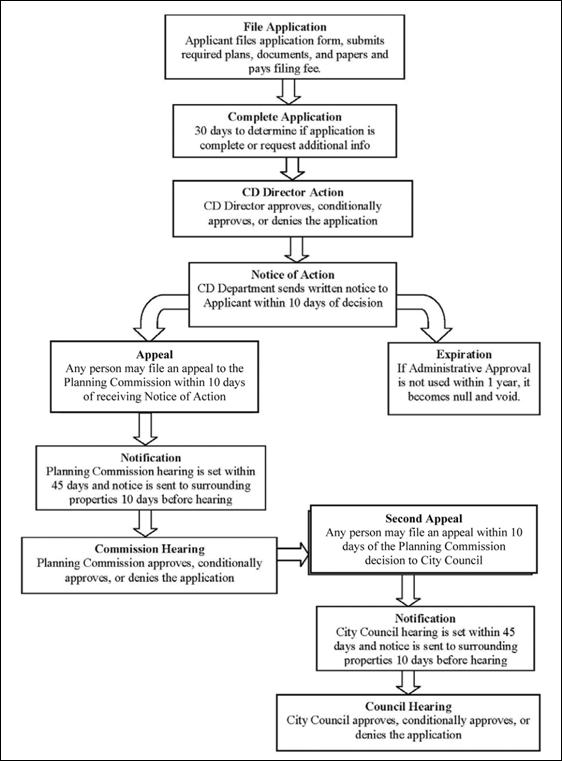
Processing. Permit processing and approval of an administrative approval shall follow the procedures shown in Figure A.
C.
Required findings. An administrative approval may be granted only if all of the following findings can be made regarding the proposal and are supported by the record:
1.
That the granting of the proposed administrative approval will not:
a.
Be detrimental to the public health, safety, and general welfare;
b.
Adversely affect the established character of the surrounding vicinity and planned uses; nor
c.
Be injurious to the uses, property, or improvements adjacent to, and in the vicinity of, the site upon which the proposed use is to be located.
2.
That the granting of the proposed administrative approval is consistent and compatible with the intent of the goals, objectives and policies of the City of Hawaiian Gardens General Plan.
3.
That all conditions necessary to mitigate the impacts of the proposed use are conditions that are measurable and can be monitored and enforced.
4.
That all requirements for a specific use have been addressed by the applicant.
D.
Burden of proof. The applicant has the burden of proving that the proposed use meets all of the criteria set forth in subsection C. required findings for administrative approvals above.
E.
Approval. The Community Development Director may grant an administrative approval, approve with additional requirements, or require modification of the proposal to comply with specified requirements or local conditions.
F.
Denial. The Community Development Director may deny an application for an administrative approval if any of the required findings are not supported by evidence in the record as determined by the Community Development Director.
FIGURE A
ADMINISTRATIVE APPROVAL PROCESS
(Ord. No. 2024-620, § 2(Att.), 1-8-2025)
18.100.050 - Minor use permit.
A.
Purpose. Certain land uses are relatively minor in nature and with relatively little potential for adverse impacts on the surrounding community or the environment. These uses are subject to approval of a minor use permit by the Community Development Director.
B.
Application. Applications for minor use permits shall be submitted for uses allowed as minor uses in the applicable zone, as listed in Section 18.40.070, permitted uses in residential zones, Section 18.55.020, uses permitted in missed-use zones, and Section 18.60.050, permitted uses in non-residential zones.
C.
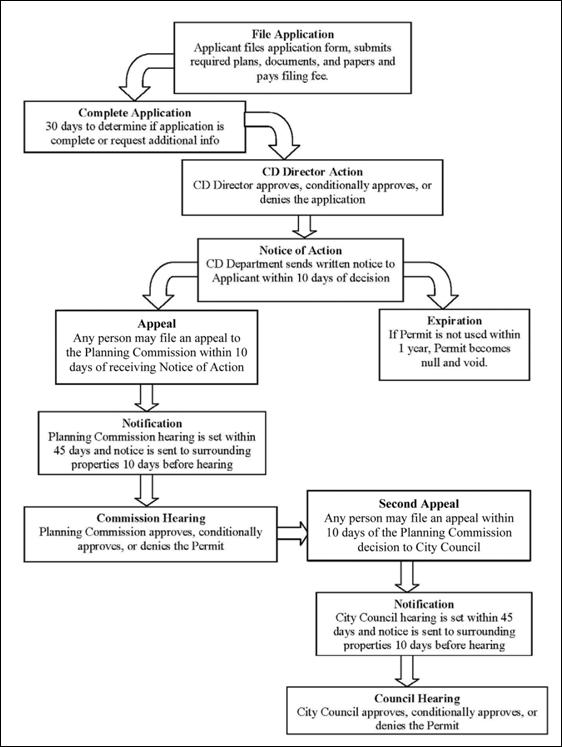
Processing. The Community Development Director may approve a minor use permit, approve with conditions, or deny the permit. Permit processing and approval of a minor use permit shall follow the procedures shown in Figure B.
D.
Recommendation and decision. The Community Development Director shall consider all applications for minor use permits, whose decision is final, unless an appeal is filed to the Planning Commission in accordance with Section 18.100.170, appeals, below.
E.
Required findings. In granting a minor use permit, the Director shall make the following findings:
1.
That the proposed use is consistent with the general plan;
2.
That the proposed use is not contrary to the objectives of this Zoning Code or to the objectives of the applicable regulations;
3.
That the proposed use will be located, operated, and maintained in a manner consistent with the policies of the general plan and the provisions of this Zoning Code;
4.
That the proposed use will not be detrimental to the property or improvements in the surrounding area or the public health, safety, or general welfare.
FIGURE B
>MINOR USE PERMIT PROCESS
(Ord. No. 2024-620, § 2(Att.), 1-8-2025)
18.100.060 - Minor exceptions.
A.
Purpose. Minor exceptions allow for variations in the specific development standards of the applicable zoning regulations or the requirements outlined in this Zoning Code. The Community Development Director shall have the authority to approve minor exceptions to the requirements and provisions of this Zoning Code, subject to the regulations below.
B.
Criteria. A variation from specific development standards of the zoning regulations shall be known as a minor exception if it does not exceed the criteria outlined below.
1.
Criteria. Minor exceptions may be granted and are limited to only one of the following criteria. For applicants proposing exceptions greater than one of the following criteria, the procedures for a variance shall be followed:
a.
Projection of incidental architectural embellishments or structural appurtenances into required setback areas by not more than 20 percent; provided, that such projection does not violate fire, housing, or building codes.
b.
Increase in the allowable height of a building up to a maximum of five additional feet in a "C-4", "MU-1", "MU-2", or "M-1" zone; and up to a maximum of three additional feet in a residential zone for the purpose of permitting cupolas, spires, turrets or other design features consistent with the architectural style of the building.
c.
Off-site parking facilities, where the following conditions are met:
i.
The parcels containing the use and the off-site parking are under common ownership or appropriate agreements with the property owner of the parking parcel are established prior to approval of the off-site parking facility.
ii.
The parcel to be used for parking is not separated or divided from the building or use it is intended to serve by Carson Street, Norwalk Boulevard, other major highway, Coyote Creek or the Artesia-Norwalk Storm Drain Channel.
iii.
For hospitals, large group homes, institutions, rooming and lodging houses, adult retirement homes, congregate care facilities, and community clubs, parking facilities shall be located no farther than 150 feet from the facility.
iv.
For uses other than those specified above, parking facilities shall be located no farther than 500 feet from the facility.
v.
The use of the off-site parcel would not be detrimental to public safety.
d.
A maximum 20 percent reduction in a setback requirement for any residential, mixed-use, or non-residential zone.
e.
A maximum ten percent reduction in the number of total parking spaces required in conjunction with a change of a commercial, mixed-use, or industrial use in an existing building.
f.
A reduction in the total number of parking spaces required solely as a need to upgrade existing parking facilities to comply with Americans with Disabilities Act (ADA), Title III and California Code of Regulations (CCR), California Access Code, Title 24.
g.
A reduction in the total number of parking spaces required for single-family residential uses and duplexes when additional habitable space is proposed and additional parking cannot be provided because of existing conditions on the lot. In this case, the maximum number of parking spaces that can be developed on the lot shall be provided.
h.
A 25 percent increase over the allowed fence height, but not greater than eight feet total, including any retaining wall.
i.
A 20 percent reduction in the required width of a driveway in the R-1 and R-2 zones.
j.
Encroachment into a required residential zone parking space for accommodating structural reinforcement, installation of pipes, vents or other similar improvements for no more than five percent of the required dimension of a parking space where no more than three parking spaces are affected. This subsection shall apply only to retrofitting of existing construction. The encroachment shall not impair the overall usefulness of the parking space or parking area for its intended purpose as a parking space or area.
k.
Conditional use permit (CUP) revisions with substantial conformance to the original CUP, as determined by the Director.
C.
Minor exception process.
1.
Application. Application for a minor exception shall be made part of the primary development application for the proposed development or use.
2.
Processing. The Community Development Director may grant a minor exception, approve with additional requirements, or require modification of the proposal to comply with specified requirements or local conditions, as part of concurrent permit approvals for the proposal.
3.
Required findings. In granting a minor exception, the Director shall make the following findings:
a.
That the exception is consistent with the general plan;
b.
That the exception is not contrary to the objectives of this Zoning Code or to the objectives of the applicable regulations;
c.
The granting of the exception, with any conditions imposed, will not be materially detrimental to the public welfare or injurious to the property or improvements in such zone or neighborhood in which the property is located.
D.
Approving authority.
1.
Approval by Community Development Director. The Community Development Director shall have the authority to consider and act on requests for a minor exception. The Community Development Director may approve, conditionally approve, or deny the request subject to the criteria set forth above. The Community Development Director's actions may be appealed to the Planning Commission, in accordance with Section 18.100.170, appeals, below.
2.
Approval by Planning Commission. The Community Development Director may refer an application for a minor exception to the Planning Commission for consideration. In such cases, the hearing before the Planning Commission shall be held within 45 days after the filing of a complete appeal application.
(Ord. No. 2024-620, § 2(Att.), 1-8-2025)
18.100.070 - Home occupation permit and standards.
A.
Purpose. Home occupations are allowed only in residential and mixed-use zones, subject to approval of a home occupation permit.
B.
Application. Applications for home occupation use permits shall be submitted for those uses which comply with the standards in this section.
C.
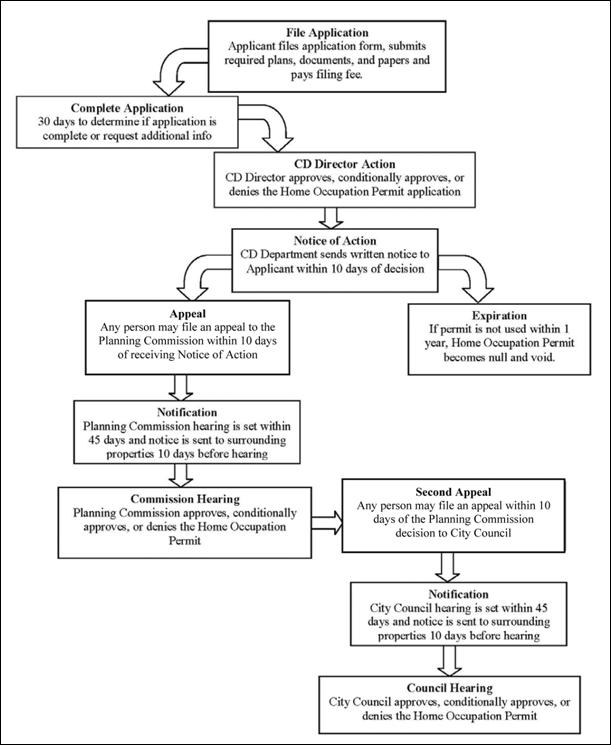
Processing. The Community Development Director may approve a home occupation permit, approve with conditions, or deny the permit. Permit processing and approval of a home occupation permit shall follow the procedures shown in Figure C.
D.
Recommendation and decision. The Community Development Director shall consider all applications for home occupation permits, whose decision is final, unless an appeal is filed to the Planning Commission in accordance with Section 18.100.170, appeals, below.
E.
Transfer. The home occupation permit need not be renewed annually but shall not be transferable by the applicant to another person and shall cease automatically upon change of property ownership.
F.
Revocation of permit. The Community Development Director may suspend or revoke a home occupation permit if the Director determines that the home occupation is being operated in violation of any of the provisions in this section. Such revocation is subject to appeal to the Planning Commission, in accordance with Section 18.100.170, appeals.
G.
Standards. The home occupation permit shall only be granted if the proposed home occupation complies with all of the applicable standards below and a finding can be made that the home occupation will not adversely affect the residential character of the property.
1.
Location. Home occupations may be allowed in any residential or mixed-use zone and on lots with an existing dwelling unit, in accordance with the provisions of this section.
2.
Operating standards. A home occupation shall comply with each of the following regulations:
a.
A home occupation shall be conducted entirely within a building and shall occupy no more than 400 square feet or more than 25 percent of the livable floor area of the dwelling unit, whichever is less.
b.
The existence of a home occupation shall not be visible beyond the boundaries of the site.
c.
A home occupation permit may be granted only to the resident of the dwelling and no one other than a resident of the dwelling shall be employed on-site or report to work at the site in the conduct of a home occupation.
d.
A home occupation shall not create pedestrian, automobile or truck traffic in excess of the normal amount in the zone in which it is located.
e.
No motor vehicle repair, medical office, clinic, laboratory, carpentry, cabinet making, beauty shop nor barber shop shall be permitted, and a home occupation shall not include a sales room or office open to visitors.
f.
There shall be no on-site advertising of the name or address of the home occupation or the sale of merchandise that attracts persons to the premises.
g.
There shall be no more than one home occupation in any dwelling unit.
h.
No storage of merchandise, equipment, displays, or other items or the conduct of the home occupation in required parking, open space, or yard areas shall be permitted.
i.
There shall be no use of mechanical equipment, appliance, or motor that generates noise detectable from outside the building.
j.
Storage of materials and/or supplies, indoors or outdoors, shall not be allowed that will be hazardous to surrounding neighbors or detrimental to the residential character of the neighborhood.
k.
No vehicle larger than a three-fourths-ton pick-up truck used primarily for the business shall be parked outside an enclosed garage.
l.
No garage space shall be used for the home occupation, if the garage space is necessary to satisfy off-street parking requirements for the residence.
m.
A home occupation shall operate no earlier than 8:00 a.m. and no later than 9:00 p.m. on any given day.
n.
A home occupation shall be required to have a valid and current business license from the City.
o.
In order for a home occupation permit to be issued, there shall be no existing violations on that property on which the home occupation would occur.
FIGURE C
HOME OCCUPATION PERMIT PROCESS
(Ord. No. 2024-620, § 2(Att.), 1-8-2025)
18.100.080 - Temporary use permit and standards.
A.
Purpose. Temporary land uses occur within a specified time period and have short-term impacts on the surrounding community or the environment. These uses are subject to approval of a temporary use permit by the Community Development Director.
B.
Application. Applications for temporary use permits shall be submitted for uses allowed as temporary uses in the applicable zone, as listed in Section 18.40.070, permitted uses in residential zones, Section 18.55.020, uses permitted in mixed-use zones, and Section 18.60.050, permitted uses in non-residential zones.
C.
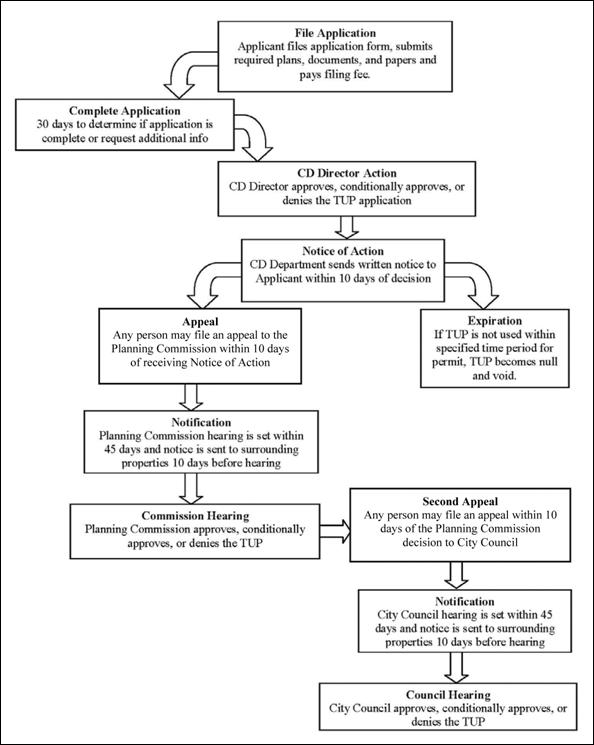
Processing. The Community Development Director may grant or deny a temporary use permit, approve with conditions, or require modification of the proposal to comply with specified requirements or local conditions. Permit processing and approval of a temporary use permit shall follow the procedures shown in Figure D.
D.
Recommendation and decision. The Community Development Director shall consider all applications for temporary use permits, whose decision is final, unless an appeal is filed to the Planning Commission in accordance with Section 18.100.170, appeals, below.
E.
Required findings. A temporary use permit shall not be approved unless the proposed use will be located, operated, and maintained in a manner consistent with the policies of the general plan and the provisions of this Zoning Code; and will not be detrimental to the property or improvements in the surrounding area or the public health, safety, or general welfare.
F.
Time limits. Temporary use permits shall be issued no more than one time per year for a specific use on a specific property.
G.
Standards. Temporary uses shall be subject to the development standards outlined below.
1.
Temporary construction buildings. Temporary structure for the housing of tools and equipment, or containing supervisory offices in connection with major construction projects, may be established and maintained during the progress of such construction on such projects, subject to the following standards:
a.
A building permit for the manufactured office, portable office trailer, or recreational vehicle during construction is issued. Structure is not permanently affixed to the lot.
b.
Potable water and sanitation facilities are available on the site.
c.
This use is allowed for one year.
d.
The structure shall be removed within 30 days after completion of the project or 30 days after any temporary termination of construction work.
2.
Temporary construction signs. Signs identifying persons engaged in construction on a site shall be permitted as long as construction is in progress, but not to exceed a 12-month period. Refer to subsection 18.90.050(J) for temporary sign provisions.
3.
Temporary real estate tract office. One real estate tract office may be located on any new tract or subdivision of six lots or more; provided the activities of the office shall pertain only to the selling of lots within the subdivision upon which the office is located; and provided further, that the real estate tract office shall be removed at the end of a 12-month period measured from the date of the recording of the parcel map upon which the office is located.
4.
Sidewalk or parking lot sales, Christmas tree sales.
a.
Christmas trees sales are regulated by Chapter 5.16 of the Hawaiian Gardens Municipal Code.
b.
Display of merchandise during temporary events shall not reduce off-street parking to a point that customer parking is severely impacted.
c.
Parking lot sales shall not be allowed for more than 15 consecutive days or more than 30 days within each calendar year.
5.
Carnivals, circus, rodeos, street fairs, and parades. These uses are regulated under Chapter 5.14 of the Hawaiian Gardens Municipal Code.
6.
Other temporary uses. Any temporary use not specifically identified above in this section shall be subject to the approval of the Community Development Director and subject to the following conditions:
a.
The temporary use would not affect traffic and pedestrian circulation on the surrounding public rights-of-way and the internal parking areas and driveways on the lot.
b.
The temporary use would not create a public safety or health hazard.
c.
The temporary use would not adversely affect the primary use of the lot or the adjacent land uses.
d.
The temporary use would not result in the demand for public services or utilities which the City or service agencies cannot adequately provide.
e.
The temporary use would be conducted for a limited time period and for one time only during one calendar year on a specific property.
FIGURE D
TEMPORARY USE PERMIT PROCESS
(Ord. No. 2024-620, § 2(Att.), 1-8-2025)
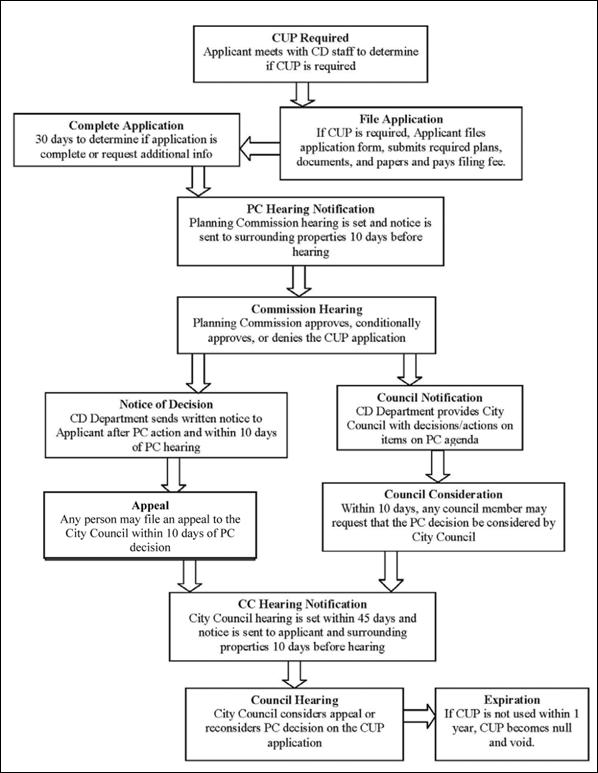
18.100.090 - Conditional use permit.
The City recognizes that certain types of land use, due to the nature of the use, require individual review. Such review shall determine whether the type of use proposed, or the location of that use, is compatible with surrounding uses, or through the imposition of development conditions, can be made compatible with surrounding uses. This section establishes procedures for this review.
A.
Application. Applications for conditional use permits (CUP) shall be submitted for those uses specified as conditional uses in the applicable zone, as listed in Section 18.40.070, permitted uses in residential zones, Section 18.55.020, uses permitted in mixed-use zones, and Section 18.60.050, permitted uses in non-residential zones.
1.
Only one CUP may be granted for each use. Activities, operations, or land uses that would require multiple CUPs shall be processed as a separate CUP.
2.
No general or blanket CUP shall be issued for a development project. Rather, the CUP shall be specific to the use or activity currently proposed on the site, building or portion thereof and will not be applicable to any future use.
3.
A proposal that does not comply with an applicable development standard shall require either a minor exception or a variance and shall be processed concurrently with the CUP.
B.
Recommendation and decision. Permit processing and approval of a conditional use permit shall follow the procedures shown in Figure E. The Community Development Director shall make recommendations on CUP applications, for consideration and approval, conditional approval or denial by Planning Commission. The City Council will serve as the appeal body, in accordance with Section 18.100.170, appeals, below.
C.
Exceptions. Applications for the minor expansion of a structure covered by an existing conditional use permit shall be considered by the Community Development Director. Such minor expansion is limited to 20 percent of the floor area of the existing use or 5,000 square feet, whichever is less. The Community Development Director may approve, approve with additional conditions, or deny the application. Any expansion exceeding this limit shall be considered a new application for a conditional use and shall be subject to review by the Planning Commission, and the required fees and procedures established for a new application. This exception does not apply to the sale of alcoholic beverages.
D.
Required findings. The Planning Commission shall consider applications for a conditional use permit and may, with such conditions as are found necessary, approve the use, provided the use will not jeopardize, adversely affect, endanger, or otherwise constitute a menace to the public health, safety, or general welfare, or be materially detrimental to the property of other persons located in the vicinity of such use. In making such determination, the Planning Commission shall make the following findings:
1.
That the proposed conditional use is consistent with the general plan.
2.
That the nature, condition, and development of adjacent uses, buildings, and structures have been considered, and the proposed conditional use will not adversely affect or be materially detrimental to the adjacent uses, buildings, or structures, and will be compatible with the character of the surrounding area.
3.
That the proposed site is adequate in size and shape to accommodate the yards, walls, fences, parking and loading facilities, landscaping, and other land use development features prescribed in this Zoning Code and required by the Planning Commission or City Council in order to integrate the use with existing and planned uses in the vicinity.
FIGURE E
CONDITIONAL USE PERMIT PROCESS
E.
Conditions. Conditions imposed by the Planning Commission for a conditional use may involve any pertinent factors affecting the establishment, operation, or maintenance of the requested use, including, but not limited to:
1.
Open space and buffer areas.
2.
Fences and walls.
3.
Parking facilities, including vehicular ingress and egress, and the surfacing of parking areas and driveways.
4.
Public facilities, dedications, and improvements.
5.
Landscaping and maintenance.
6.
Regulation of nuisance factors associated with the particular use and situation.
7.
Regulation of operating hours or activities.
8.
Additional regulation of signs or advertisement.
9.
A specified time period within which development or use shall begin and end.
10.
Provisions for surety that the conditional use will be removed on or before a specified date or under specific situations.
11.
Provision of appropriate pedestrian amenities.
12.
Screening and proper orientation of architectural elements.
13.
Aesthetic treatments, including color palettes, as necessary to integrate the use into the surrounding community.
14.
Any other conditions deemed necessary to provide for the orderly and efficient development or operation of the conditional use in accordance with the goals and policies of the general plan.
F.
Posting of conditions. All conditions pertaining to the operation of the conditional use shall be permanently posted, on a form provided by the Community Development Director, at a location clearly visible to the public utilizing the facility. This provision shall apply to all facilities for which a conditional use permit has been issued.
G.
Annual re-inspection. Certain uses, as a condition of approval, may be required to undergo an annual re-inspection to verify compliance with the conditions of approval. The property owner shall be required to pay an annual fee to the City as established by resolution of the City Council to cover the costs of the re-inspection.
H.
Continuing validity. A conditional use permit, granted pursuant to the provisions of this section, shall run with the use of the property and shall continue to be valid upon change of ownership of the land or any lawfully existing building or structure on the land, unless the use is discontinued for the period set in subsection 18.100.020(L), permit expiration or a time limitation for the permit is specified as a condition of approval.
I.
Performance of imposed conditions. Whenever a conditional use permit is granted or modified and is subject to one or more conditions, the Director or Planning Commission may require that the applicant implement or comply with all conditions prior to issuance of the occupancy permit.
(Ord. No. 2024-620, § 2(Att.), 1-8-2025)
18.100.100 - Variances.
A.
Purpose. The City recognizes that certain properties, due to their unique size, shape, location, or other physical condition, cannot be developed in strict accord with the regulations of this Zoning Code. Therefore, this section establishes guidelines and procedures for the granting of relief from certain provisions or the development standards contained in this Zoning Code, in specific situations.
B.
Applicability.
1.
A variance shall be considered when there are specific physical circumstances that distinguish a project site from its surroundings and these unique circumstances create an unnecessary hardship for the applicant if the usual zoning standards are imposed.
2.
A variation from specific development standards of the zoning regulations shall be known as either a minor exception or a variance depending on the degree to which variation from the proposed zoning regulations is proposed.
3.
The variance procedure shall not apply to situations where the use is not permitted in a zone or the proposed residential density exceeds the maximum residential density permitted in a zone for any given lot size.
C.
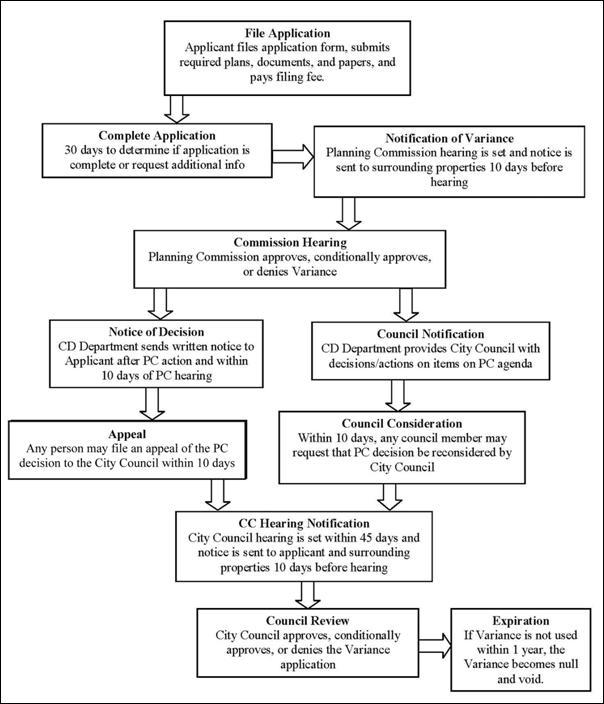
Approval authority. The Community Development Director shall make a recommendation to the Planning Commission and the Planning Commission shall consider a proposed variance and may approve, conditionally approve, or deny the request subject to the findings set forth below. Figure F shows the process for obtaining a variance.
D.
Criteria. A variance shall be required for any application that exceeds or does not meet the criteria for a minor exception, as outlined above in Section 18.100.060, minor exceptions.
E.
Required findings. The Planning Commission may grant a variance, with such conditions as are found necessary to protect the public health, safety, and general welfare and assure compliance with the provisions and standards included in this Zoning Code, provided the following findings can be made:
1.
That the variance is consistent with the Hawaiian Gardens General Plan and other applicable City policies and regulations and that there would be no adverse impacts on the environment; and
2.
That there are exceptional or extraordinary circumstances or conditions applicable to the subject property which do not apply generally to other properties in the same zone in which the project is located; and
3.
That the granting of the variance will not constitute a grant of special privilege inconsistent with the limitations on other properties in the same zone with similar constraints; and
4.
That the variance request is made on the basis of a hardship condition and not as a matter of convenience or cost; and
5.
That the granting of the variance will not be detrimental to the public health, safety, or welfare or materially injurious to properties or improvements in the vicinity.
FIGURE F
VARIANCE PROCESS
F.
Conditions. Conditions of approval that are imposed by the Planning Commission for a variance may involve any pertinent factors affecting the establishment, operation, or maintenance of the requested use, including, but not limited to:
1.
Open spaces and buffer areas.
2.
Fences and walls.
3.
Parking facilities, including vehicular ingress and egress, and the surfacing of parking areas and driveways.
4.
Public facilities, dedications, and improvements.
5.
Landscaping maintenance.
6.
Aesthetic treatments, including color palettes, as necessary to integrate the use into the surrounding community.
(Ord. No. 2024-620, § 2(Att.), 1-8-2025)
18.100.110 - Specific plans.
The purpose of this section is to establish uniform procedures for the adoption and implementation of specific plans, for the coordination of future development within the City, consistent with Section 18.80.030, specific plan zone, of this Zoning Code and pursuant to Government Code Section 65450 et seq.
A.
Permitted uses. Permitted uses in the specific plan zone are outlined within the approved specific plan and are not subject to the permitted uses and conditional use permits set forth in Section 18.40.070, uses permitted in residential zones, Section 18.55.020, uses permitted in mixed-use zones, and Section 18.60.050, uses permitted in non-residential zones.
B.
Development standards. Land use and development of the area within the specific plan zone are guided by the provisions of the adopted specific plan, on file with the Community Development Department.
C.
Application.
1.
Application package. The applicant shall submit completed application forms, fees and required plans and reports, as outlined in Section 18.100.020, administrative procedures.
2.
Specific plan. In addition to those required under Section 18.100.020 of this chapter, a specific plan application shall include a proposed specific plan document that provides text and diagrams that contain all of the provisions outlined in California Government Code Sections 65451 and 65452, in addition to all information and related exhibits required by the Community Development Department.
D.
Public hearing. Upon receipt of the completed application package or direction of the City Council, and following Department review, public hearings shall be set before the Planning Commission and City Council. Notice of hearings shall be given pursuant to the requirements in Section 18.100.020 of this chapter.
E.
Commission and Council actions. The Community Development Director shall make a recommendation to the Planning Commission and the Planning Commission shall make a written recommendation to the City Council on the proposed specific plan, whether to approve, conditionally approve or deny, based upon the required findings below. Upon receipt of the Planning Commission recommendation, the City Council may approve, conditionally approve, or deny the proposed specific plan based upon the required findings below.
F.
Required findings. A specific plan shall only be adopted if all of the following findings are made:
1.
The proposed specific plan is consistent with the general plan;
2.
The proposed plan would not be detrimental to the public interest, health, safety, convenience, or welfare of the City;
3.
The subject property is physically suitable for the requested and anticipated development;
4.
The proposed plan shall ensure development that is compatible with existing and proposed development in the surrounding neighborhood.
G.
Specific plan consistency.
1.
No public works project, tentative map or parcel map, or other land use entitlement may be approved, adopted or amended within an area designated as a specific plan zone, unless found consistent with the approved specific plan.
2.
Proposed development within an approved specific plan requires site plan review and approval by the Community Development Director and such development shall conform to the standards of the approved specific plan for the site.
3.
Proposed amendments to an approved specific plan require consideration by the City Council.
H.
Effective date. Specific plans shall be adopted by ordinance and shall be effective 30 days after the final reading of such ordinance.
(Ord. No. 2024-620, § 2(Att.), 1-8-2025)
18.100.120 - Development agreements.
The purpose of this section is to establish procedures and requirements for the City's consideration of development agreements upon application by, or on behalf of, a property owner or other person having a legal or equitable interest in the property that is to be the subject of a development agreement. In adopting this section, the City Council has considered the general plan of the City and the legislative findings and declarations set forth in Section 65864 of the Government Code.
A.
Application.
1.
A developer wishing to enter into a development agreement with the City shall submit to the Community Development Department a written application on a form provided by the Department.
2.
The Community Development Director may require the developer to submit additional information and supporting data as may be necessary to properly evaluate the proposed development agreement.
3.
The written application required in this section shall be accompanied by a non-refundable processing fee in an amount set by resolution of the City Council.
4.
Each application shall be accompanied by the form of development agreement proposed by the applicant.
B.
Hearing by Planning Commission.
1.
The Community Development Director shall make recommendations and refer all applications for development agreement to the Planning Commission and City Council for public hearings.
2.
Upon receipt of the complete application, the Community Development Director shall set a date for the public hearing.
3.
The Community Development Director shall ensure that the public is given proper notice of said public hearing in accordance with Section 18.100.020, administrative procedures, of this Zoning Code and applicable State planning, zoning and development laws.
C.
Conduct of hearing. The public hearing held pursuant to this section shall be conducted as nearly as may be possible in accordance with the procedural standards adopted under Government Code Section 65804 for the conduct of zoning hearings.
D.
Determination. After the hearing, the Planning Commission shall forward its written recommendation on the application to the City Council. The recommendation shall include the Planning Commission's determination of whether or not the proposed development agreement:
1.
Is consistent with the objectives, policies, general land uses and programs specified in the general plan and any applicable specific plan;
2.
Is compatible with the uses authorized in, and the regulations prescribed for, the land use zone in which the real property is located;
3.
Is in conformity with public convenience, general welfare, and good land use practice;
4.
Will be detrimental to the public health, safety, and general welfare;
5.
Will adversely affect the orderly development of property or the preservation of property values;
6.
Is consistent with Government Code Section 65864 through 65869.5.
E.
Hearing by City Council.
1.
After receiving the written recommendation of the Planning Commission, the Director shall set a date for a City Council public hearing on the matter.
2.
The City Clerk shall ensure that the public is given notice of the public hearing in accordance with Section 18.100.020, administrative procedures, and applicable State planning, zoning, and development laws.
F.
Action by City Council.
1.
At the public hearing, the City Council may approve, modify, or disapprove the recommendation of the Planning Commission. The Council may refer back to the Planning Commission, for report and recommendation, matters not previously considered by the Planning Commission.
2.
Upon receipt of a referral above, the Planning Commission, without further public hearing, shall consider the new matters and report its recommendations in writing to the City Council within 40 days after receipt of said referral. Failure to act within the 40-day limit shall constitute a favorable endorsement on the matters set forth in the referral.
3.
If the City Council approves the development agreement, it shall do so by ordinance.
G.
Effective date. The agreement shall be effective 30 days after the final reading of the ordinance approving it and shall only create obligations on the part of the City from and after the date that the ordinance approving the development agreement takes effect.
H.
Amendment or cancellation. Either party may propose an amendment to or cancellation in whole or in part of a development agreement previously entered into. However, with the exception of modification or revocation, both parties shall agree in writing to an amendment, or cancellation, of a development agreement before it shall be effective.
1.
The procedure for proposing an adoption of an amendment to or cancellation in whole or in part of the development agreement is the same as the procedure for entering into an agreement in the first instance as outlined in this section.
2.
Where the City Council initiates the proposed amendment to or cancellation in whole or in part of the development agreement, the City shall first give notice to the property owner of its intention to initiate such proceedings at least 30 calendar days in advance of the giving of notice of the public hearing regarding the amendment or cancellation.
I.
Recordation agreement.
1.
Within ten days after the effective date of the development agreement, the City Clerk shall have the agreement recorded with the County Recorder.
2.
If the parties to the agreement or their successors in interest amend or cancel the agreement as provided in Government Code Section 65868, or if the City terminates or modifies the agreement as provided in Government Code Section 65865.1 for failure of the applicant to comply in good faith with the terms or conditions of the agreement, the City Clerk shall have notice of such action recorded with the County Recorder.
J.
Periodic review.
1.
Development agreements shall be limited in their term to a period not to exceed five years from the effective date of the adopting ordinance.
2.
Notwithstanding the foregoing, the City Council may review the development agreement at least once every 12 months after the effective date of the adopting ordinance (hereinafter called periodic review). The City Council may, on its own motion or on the advice of the Community Development Director, review the development agreement more often than once every 12 months as it is deemed necessary (hereinafter "special review").
3.
The City Council may delegate or refer the periodic review of the development agreement to the Planning Commission or to the City Administrator or designated representative.
4.
Notice of periodic review.
a.
The Community Development Director shall give the developer 30 calendar days' advance notice of the review by placing such notice to the developer into the U.S. mail, first class, postage prepaid, and addressed to such address as the developer has listed in the development agreement.
b.
The City Clerk shall give the developer notice of a special review in the same manner as provided above for annual review.
c.
Public notice of periodic or special reviews shall be accomplished as set forth in Section 18.100.020, administrative procedures.
K.
Review hearing.
1.
Any periodic review conducted shall be accomplished in the form of a public hearing.
2.
The burden shall be on the developer or his/her successor in interest, to demonstrate good-faith compliance with the terms of the agreement.
3.
At the conclusion of the public hearing, the City Council shall make findings regarding whether or not the developer has, for the period under review, complied in good faith with the terms and conditions of the agreement.
a.
If the City Council finds and determines on the basis of the evidence given that the property owner has complied in good faith with the terms and conditions of the agreement during the period under review, the review for that period shall be concluded.
b.
If the City Council finds and determines on the basis of substantial evidence that the property owner has not complied in good faith with the terms and conditions of the agreement during the period under review, the Council may modify or terminate the agreement.
c.
If the periodic review has been referred by the City Council to the Planning Commission or to the City Administrator or designated representative, the determination resulting from said review may be appealed in writing to the City Council within ten calendar days after the final action. A hearing shall be conducted in accordance with the City Council's rules for consideration of appeals.
d.
If the periodic review is conducted by the City Council, the determination resulting from said review shall be deemed to be final for all purposes.
e.
If the City Council decides to proceed with modification or termination of the agreement, the City Council shall set a hearing date and give notice to the property owner and the public of the hearing.
f.
The notice required for modification or termination of the agreement shall contain:
i.
A statement concerning whether the City proposes to terminate or to modify the development agreement;
ii.
Other information that the City considers necessary to inform the property owner of the nature of the proceedings.
4.
Upon concluding said hearing, the City Council may take whatever action it deems necessary to protect the interest of the City.
5.
The decision of the City Council shall be final.
(Ord. No. 2024-620, § 2(Att.), 1-8-2025)
18.100.130 - Nonconforming uses and structures.
The purpose of this section is to promote the public health, safety and general welfare by regulating land uses, lots and structures that were initially lawfully established but that do not conform to the provisions of this Zoning Code. This chapter is further intended to prevent the expansion of nonconforming uses and structures to the maximum extent feasible, and establish the criteria under which they may be continued, maintained and terminated.
A.
Definitions. For the purposes of this chapter and this Zoning Code, certain words and terms shall be defined as follows:
Intensity means an increase in the level of development or activity associated with a land use, as measured by one or more of the following including but not limited to:
a.
The amount of parking required for the use, as specified in Section 18.50.010 and Section 18.70.010, parking and loading requirements, and Section 18.55.010, standards for mixed-use development.
b.
The operational characteristics of the use such as hours of operation, the inclusion of dancing or live entertainment as part of the use, or similar characteristics.
c.
The floor area occupied by the use.
d.
The percentage of the building site occupied by the use or by the structure containing the use.
Nonconforming lot means a lot or parcel that was lawful and in conformance with the applicable zoning ordinances when established but which, due to subsequent ordinance changes, does not conform to the current development standards applicable to the zoning district in which it is located.
Nonconforming structure means a structure that was lawful and in conformance with the applicable zoning ordinances when constructed but that, due to subsequent ordinance changes, does not conform to all current development standards applicable to the zoning district in which it is located.
Nonconforming use means a land use that was lawful and in conformance with the applicable zoning ordinances when established but that, due to subsequent ordinance changes, is not currently permitted in the zoning district in which it is located. A parcel that exceeds the allowable density in terms of minimum lot area per unit, or not in the proper zone shall also be deemed to be a nonconforming use. An existing use or structure that is subject to a conditional use permit under this Zoning Code shall be considered a nonconforming use until it obtains a conditional use permit under this Zoning Code.
Nonconformity means a land use, lot or structure that was lawful when established or constructed but, due to subsequent ordinance changes, is not in conformance with the new zoning regulations. The term "nonconformity" does not include illegal uses, lots, or structures, which were not lawful when established or constructed.
B.
Nonconforming uses.
1.
Continuation of nonconforming use. A nonconforming use may be continued subject to the restrictions of this section.
2.
Discontinued nonconforming uses. Any discontinuance, closure or vacancy of a nonconforming use in an existing non-residential building or structure for a period of 180 days or more shall be deemed to constitute an abandonment of any nonconforming rights and shall not be allowed to re-establish or continue. Any further use of the conforming building shall be in conformity with the regulations for the zone in which the conforming building is located.
3.
Expansion/intensification of nonconforming uses.
a.
A nonconforming use shall not be expanded or increased in intensity.
b.
A nonconforming use of any structure or site shall not be changed to another nonconforming use.
c.
There shall be no expansion of a nonconforming use onto an additional parcel, adjacent or otherwise.
d.
A nonconforming use of any structure may be continued, provided, such nonconforming use shall not be expanded or extended into any other portion of the structure.
4.
Restoration of nonconforming use. A nonconforming use occupying a structure that is damaged or destroyed by fire, explosion, earthquake or other disaster may be re-established provided that:
a.
When a structure has sustained damage that would require repairs estimated to be less than 50 percent of the replacement value of the structure, the Community Development Director shall approve, conditionally approve, or deny the re-establishment through a minor use permit, provided that such nonconforming structures, improvements, and uses shall not be increased in size or area.
b.
When a structure has sustained damage that would require repairs estimated to be over 50 percent of the replacement value of the structure, the Planning Commission shall approve, conditionally approve, or deny the re-establishment through a conditional use permit process provided that such nonconforming structures, improvements, and uses shall not be increased in size or area.
c.
Restoration of the structure will not create or increase any nonconformity relating to setback, height, or any other development standard.
d.
Application for a building permit is submitted within one year of the damage or destruction and construction is commenced and completed within one year under that permit without any lapses of or extensions to the permit.
e.
Failure to comply with the above provisions shall prohibit the re-establishment of the nonconforming use.
5.
Determination of replacement cost. In determining the replacement cost of a structure, the Director may utilize City building permit records, contractor estimates, assessed valuation, appraisals provided at applicant's cost or any other information deemed by the Director to be reflective of replacement cost.
6.
Change of ownership. Changes in ownership, tenancy, proprietorship or management of a nonconforming use shall not affect its nonconforming status provided that the use or the intensity of use does not change.
C.
Nonconforming lots.
1.
Legally established nonconforming lots prior to April 16, 1964, and filed with the Los Angeles County Recorder's office, may be developed and used in accordance with this Zoning Code provided all development standards other than those relating to the lot's conformity are met.
2.
If the lot area is less than 75 percent of the required area, the existing use of the lot shall not be changed or allowed to increase in intensity.
3.
Residential legal nonconforming 25-foot lots may be developed with three-foot side yard setbacks, provided that all other development standards are complied with and the adjacent parcel is not vacant. If the adjacent parcel is undeveloped, the property owner shall make every effort to combine the two parcels together. This provision shall only apply to a single development. Only a single-family dwelling unit may be built on 25-foot parcels and shall be subject to architectural design review of the site plan review process as approved through the Community Development Director.
D.
Nonconforming structures.
1.
Continuation of nonconforming structure. Nonconforming structures may be continued and maintained subject to the restrictions of this section.
2.
Discontinued nonconforming structures. When the use of a property with a non-residential nonconforming structure has ceased for 180 days or more, the use shall be considered abandoned and the nonconforming structure may be re-used only after it is brought into conformity with development standards pertaining to paving, striping, fence/walls, landscaping, trash enclosure and lighting standards subject to an architectural design review of the site plan review process, as approved by the Community Development Director.
3.
Maintenance and repairs. Ordinary maintenance and repairs may be made to all nonconforming structures, such as painting, patching, window repair, re-roofing, re-siding, re-plastering and replacement of incidental nonstructural elements.
4.
Structural alterations and additions. Interior or exterior structural alterations, including additions may be made to a nonconforming structure provided the alterations do not increase the degree or extent of the structure's nonconformity nor create any new nonconformities.
5.
Alteration, expansion or renovation of any nonconforming structure, that exceeds 50 percent of the existing square footage of the structure, and has more than one nonconforming development standard, shall not be permitted unless the entire structure and property is brought into compliance with all applicable provisions in this Zoning Code and shall be subject to a site plan review process as approved by the Community Development Director. Any property with a zero side yard setback will count as two and automatically require compliance with current standards.
6.
A nonconforming structure may be altered as long as the alteration does not increase the existing nonconforming site conditions.
7.
No nonconforming structure shall be moved, expanded or enlarged unless the new location or enlargement conforms to all current development standards, as prescribed in the regulations for the district.
8.
A nonconforming structure may be altered as long as the alteration does not increase the existing site conditions. The Community Development Director shall make such determination.
9.
An expansion of a nonconforming residential structure that does not meet the current parking requirements of this Zoning Code and proposes to add new habitable space shall bring the dwelling unit into compliance with the current parking standards. Exceptions to this requirement shall be allowing the construction of a laundry room for an existing legal nonconforming dwelling unit without an existing laundry room per subsection 18.50.100(C)(11) accessory structures and additions and allowing an accessory structure not to exceed 35 square feet.
10.
A residential property that is nonconforming due to lack of required parking that proposes to add a new garage shall be required to bring all parking into compliance with the requirements of this section. An exception to this requirement shall be lots where the provision of all of the required parking may not be possible because of the configuration of existing structures on the property. In this case, at least 50 percent of the required parking spaces shall be provided.
E.
Damage or destruction to nonconforming structures.
1.
Whenever a structure that does not comply with the standards for front yards, side yards, rear yards, height of structures or distances between structures, prescribed in the regulations for the district in which the structure is located is destroyed by fire or other calamity, by act of God, or by public enemy, the following regulations shall apply:
a.
When a structure has sustained damage that would require repairs estimated to be less than 50 percent of the replacement value of the structure, the Director of Community Development shall approve, conditionally approve, or deny the restoration project based upon a site plan and architectural design review process as approved through the Community Development Director based upon the development standards in effect at the time of construction, provided that such nonconforming structures, improvements, and uses shall not be increased in size or area.
b.
When a structure has sustained damage that would require repairs estimated to be over 50 percent of the appraised value of the structure, the Planning Commission shall approve, conditionally approve, or deny the restoration project based through the minor exception or variance process, provided that such nonconforming structures, improvements, and uses shall not be increased in size or area.
2.
Determination of replacement cost. In determining the replacement cost of a structure, the Director may utilize City building permit records, contractor estimates, assessed valuation, appraisals provided at applicant's cost or any other information deemed by the Director to be reflective of replacement cost.
3.
Safety of structures. Nothing in this section shall be construed to prevent the strengthening or restoration to a safe condition of any structure declared to be unsafe by an officer of the City charged with protecting the public safety upon order of such officer.
F.
Nonconforming structures and nonconforming uses. When the nonconforming use of a nonconforming structure in a non-residential zone has ceased for a continuous period of 180 days or more, the use shall be considered abandoned and the structure may be reused only after it is brought into conformity with applicable provisions in this Zoning Code.
G.
Nonconforming signs and walls.
1.
Properties with nonconforming signs, fences, or walls may continue to be used subject to the restrictions of this section.
2.
Nonconforming fences and walls may not be enlarged or altered unless they will conform to the regulations of this Zoning Code.
3.
Nonconforming signs shall not be altered, moved or reconstructed unless brought into compliance with applicable provisions in this Zoning Code. Abandoned signs shall be removed within 90 days of termination of use.
H.
Illegal uses and structures. Nothing in this chapter shall be construed so as to allow for the continuation of illegal land uses or structures, i.e., uses or structures, which did not comply with the zoning ordinance(s) in effect when they were established. Such illegal uses or structures shall be subject to the enforcement provisions of the Municipal Code and shall be removed immediately.
I.
Exceptions. The purpose of this section is to preserve residential development rights for properties that were legally developed as residential and have been re-zoned to a non-residential zone.
1.
Non-conforming uses and structures. Properties previously zoned residential with legally established residential uses that have been re-zoned non-residential may continue to be used and developed in compliance with the R-2 development standards including but not limited to, expansion and construction of additional units.
a.
Vacant properties. Vacant properties can be developed in compliance with the R-2 development standards or the non-residential development standards but cannot be developed as both.
b.
Non-residential development. If the property is developed into a non-residential use in conformance with the non-residential zone the property will lose its nonconforming exception status and must from that point forward conform to the existing zone.
c.
Damage or destruction to nonconforming residential structures. Residential structures in non-residential zoned properties that are damaged or destroyed can be re-constructed to the R-2 development standards.
(Ord. No. 2024-620, § 2(Att.), 1-8-2025)
18.100.140 - Zone change and Zoning Code amendments.
A.
Purpose. The purpose of this section is to allow for changes and modifications to the Zoning Code, as well as to the permits and approvals granted under this Zoning Code.
B.
Zone change or Zoning Code amendments. The purpose of this Zoning Code is to provide for the proper location of land uses, and to that end to classify, insofar as it is practicable to do so, types of land use in order to provide one or more zones in which each type of land use shall be permitted. This objective is ongoing and may require a change of zone from that previously established in conformance with the general plan. Changes to the development standards and procedures for implementing the Zoning Code may also occur as determined appropriate by the City. The process for a zone change or Zoning Code amendment is shown in Figure G.
1.
Authority. The boundaries of the zones established by this Zoning Code, the classification of property uses therein, development standards and any change in wording, context, or substance may be changed when adopted by ordinance by the City Council.
2.
Authorization for initiation.
a.
Applications or petitions for a change of zone may only be initiated by either:
i.
The verified application of the recorded owner or owners of the subject property or authorized agent thereof; or
ii.
The Community Development Director, Planning Commission or City Council through its own motion.
b.
Petitions for an amendment to the zoning ordinance text may only be initiated by the Community Development Director, Planning Commission or City Council.
3.
Application filing.
a.
Applications for change of zone or amendment to the Zoning Code text shall be made on forms available in the Community Development Department. Applications shall contain all required information relevant to the proposed action, including but not limited to maps, drawings to scale of land and buildings, dimensions, descriptions and data necessary to demonstrate that the proposed change of zone or amendment is in general conformance with the general plan.
b.
Where a proposed zone change or Zoning Code amendment is not in conformance with the general plan, a concurrent application for a general plan amendment shall also be made. These applications and accompanying materials shall be filed with the Community Development Department. No application shall be accepted unless it complies with such requirements.
4.
Filing fees. Filing fees in an amount specified by resolution of the City Council shall be paid upon the filing of each application for zone change or Zoning Code amendment for the purpose of defraying the expense of postage, posting, advertising and other costs of labor and materials incidental to the proceedings prescribed herein.
5.
Public hearings and notice. Upon acceptance of an application for change of zone or Zoning Code amendment, or where Council has initiated the proceedings for a change of zone or amendment, the Community Development Director shall set the petition for hearing before the Planning Commission; thereafter the Community Development Director shall set the petition for hearing before the City Council by notifying the City Clerk. The notice of public hearings shall be made in accordance with Section 18.100.020, administrative procedures, of this chapter.
6.
Withholding of building permits when change of zone pending. The Community Development Director, upon the filing of a petition asking that a property be placed in a new zone, may direct other City departments to withhold the issuance of a permit for the erection, construction, alteration or change of any building, structure or improvement within such property that would not conform to the requirements for the existing and proposed zone, and any permit issued in violation of this section shall be void. No building permit shall be withheld more than 90 days from the filing of said petition unless an additional extension of no more than 90 days has been approved by the Council; provided, however, that when an environmental impact report is involved, an additional extension of up to one year may be made. In the case of Council initiated zone changes, the City may withhold building permits while the zone changes are pending subject to the same time limitations.
7.
Recommendation of Planning Commission. The Planning Commission shall hold a public hearing and consider all evidence presented for and against the proposal for change of zone or Zoning Code amendment and shall consider all arguments pertinent thereto. The Planning Commission's recommendation shall be submitted to the City Council.
8.
Action by City Council. The City Council shall hold a public hearing on the proposed change of zone or amendment to the Zoning Code, taking into consideration the Planning Commission recommendation. The City Council shall approve, approve with modifications, or disapprove the zone change application or amendment to the Zoning Code. The decision of the City Council shall be final.
9.
General plan amendment. Whenever the Council has taken action to amend the general plan and where such amendment contemplates zoning that is more restrictive than the existing zone, the provisions of this section shall not apply. The Council may, by separate action, withhold the issuance of a building permit pending adoption of a more restrictive zoning affecting specific parcels of property.
FIGURE G
ZONE CHANGE AND ZONING CODE AMENDMENT PROCESS
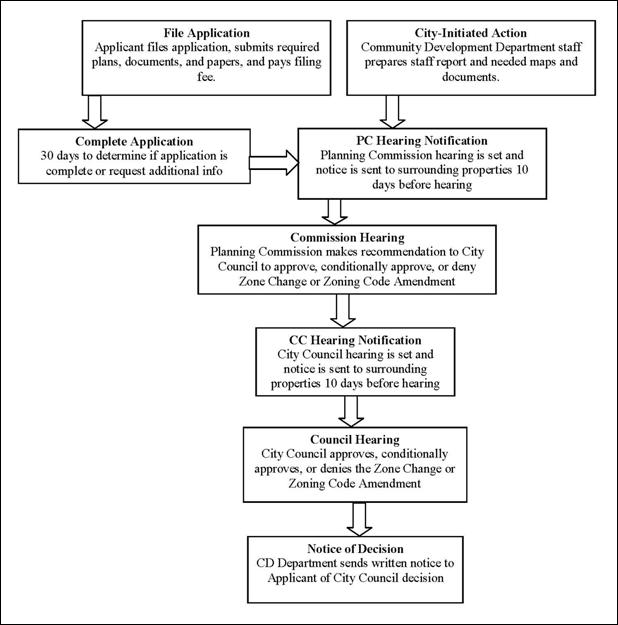
(Ord. No. 2024-620, § 2(Att.), 1-8-2025)
18.100.150 - Permit amendments and modifications.
A.
Purpose. The purpose of this section is to establish decision criteria and procedures for amendments to permits previously issued by the City. Minor modifications to existing discretionary use permits shall be reviewed under this section. An administrative review process, which includes public notice and comment, is required to ensure that the activity, if established, will be in full compliance with applicable regulations and that such uses are compatible with adjacent uses, planned uses, the character of the vicinity, and the general plan.
B.
Minor amendments. A minor amendment is a limited change of a land use, administrative use, or permit that is reviewed and approved by the Director without public notice or public participation. The following procedures shall be required for all minor amendments.
1.
Requests for minor amendments shall be in writing from the property owner or the owner's authorized agent.
2.
Minor amendment applications may be routed to any City department or any agency with jurisdiction. This distribution shall be at the discretion of the Community Development Director.
3.
Minor amendments may be approved or modified with conditions for approval by the Community Development Director provided substantial conformance to the original permit is made and all of the following requirements are met:
a.
For any proposal that results in a change of use, said use shall be permitted as a principal use in the current zone classification.
b.
A change to a condition of approval does not modify the intent of the original condition.
c.
The perimeter boundaries of the original site shall not be extended by more than five percent of the original lot area.
d.
The proposal does not add more than ten percent gross square footage of structures to the site.
e.
The proposal does not increase the overall residential density of a site.
f.
The proposal does not change or modify housing types.
g.
The proposal does not reduce designated open space.
h.
The proposal does not increase the overall impervious surface on the site by more than 25 percent.
i.
Any additions or expansions approved through minor amendments that cumulatively exceed the requirements in this section shall be considered a major amendment and shall follow the same procedure required for the initial application.
4.
Minor amendment decisions shall be in writing and attached to the official file.
5.
A finding that addresses the applicability of any specific conditions of approval for the original permit shall be required.
6.
Copies of the decision shall be mailed to all parties of record.
7.
Examples of minor amendments include, but are not limited to: adjustments to the parking area layout, restriping of parking, or site access location; additions of fences, retaining walls, and mechanical equipment; adjustments to building height; adjustments to the landscaping plans such as changes to plant materials; adjustments to the location of structures provided the adjustment is generally consistent with the original approval; and the elimination of a portion of an approved project.
C.
Major amendments.
1.
Any modification exceeding any of the provisions for minor amendments above shall follow the same procedure required for the original application.
2.
A finding that addresses the applicability of any specific conditions of approval for the original permit shall be required.
3.
Any modification that requires a permit other than the type granted for the original application shall require the new permit application and approval.
(Ord. No. 2024-620, § 2(Att.), 1-8-2025)
18.100.160 - Suspension or revocation of discretionary permits.
A.
Purpose. The Community Development Director, the Planning Commission, or the City Council may recommend the suspension, revocation and/or modification of any previously approved application or granted entitlement, after holding a properly noticed public hearing on the matter, where any of the following findings are made:
1.
That the approved application or entitlement was obtained by fraud; or
2.
If the approved application or entitlement is not being exercised, subject to the time limits set in subsection 18.100.020(L), permit expiration, above, the permit shall be rendered void as a matter of law; or
3.
That the approved application or entitlement has ceased or has been suspended for a period of time, as set in subsection 18.100.020(L), permit expiration, above, and is causing detriment to the public health, safety and welfare or constitutes a public or private nuisance; or
4.
That the use for which the approved application or entitlement was granted or permitted is being or has been operated or used contrary to the terms or conditions of such approval, or in violation of any statute, ordinance, law, or regulation; or
5.
If any provision of an approved application or entitlement is held or declared invalid, the approved application or entitlement shall be void and all privileges granted thereunder shall lapse.
B.
Effective date of revocations and modifications. An order by the City Council suspending, revoking or modifying an entitlement shall become effective immediately.
(Ord. No. 2024-620, § 2(Att.), 1-8-2025)
18.100.170 - Appeals.
A.
Purpose. Any interested person adversely affected by the Director's or Planning Commission's decision on an application under this Zoning Code may appeal to the designated appeal bodies, as shown in Section 18.100.010 above.
B.
Appeal period. Appeals shall be made by submitting written notice to the City Clerk within ten days of the decision. No appeal shall be accepted after the appeal period has expired. The appeal shall specifically state where a determination or interpretation is not in accord with the purpose of this title; where the decision was made inconsistently with this Zoning Code; where the record includes inaccurate information; or where a decision is not supported by the record. All appeals shall be heard within 45 days of the appeal request by the appropriate body, notices will be sent to the applicant and those notified for the original application.
C.
Fees and charges. Fees and charges for processing an appeal shall be paid at the time of filing the appeal, in accordance with the City's fee schedule, as set forth by resolution of the City Council.
D.
Council consideration of Commission decision. In accordance with Section 18.100.020, administrative procedures, a Council member may request that a Community Development Director or Planning Commission decision be considered by the City Council. This consideration by the City Council will serve as the appeal process for the project. The decision of the City Council during the consideration shall be final, after which no other appeal will be considered.
E.
Notice and hearing. Appeals and the required hearings shall be conducted as provided in Section 18.100.020, administrative procedures, and Section 66452.5(a) of the Government Code.
F.
Decision criteria.
1.
The appeal body shall make the same findings and use the same criteria as the decision-making body whose action is appealed.
2.
If new plans are submitted during the appeal process, this shall be considered as a new request and therefore, a new application shall be submitted.
3.
Nothing herein shall prevent the appellate or review body from imposing conditions on a project and granting approval to a project modified by conditions imposed as part of the decision.
4.
The decision of the City Council shall be final.
G.
Notice of decision. The City Clerk or Secretary of the appellate body shall mail notice of the appeal decision within ten working days after the decision to the applicant, the appellant and any other party requesting such notice. This decision shall be considered a final determination on the proposal.
(Ord. No. 2024-620, § 2(Att.), 1-8-2025)
18.100.180 - Enforcement.
A.
Purpose. The purpose of this chapter is to promote compliance with this title and any conditions of approval for the protection of the public health, safety and welfare of the City.
B.
Code enforcement. It is unlawful for any person to violate any provision or to fail to comply with any of the requirements of this Zoning Code or conditions of approval of an entitlement. A violation of any of the provisions or the failure to comply with any of the mandatory requirements of this Zoning Code shall be subject to the regulations outlined in Chapter 1.12, enforcement of codes, and Chapter 1.13, administrative citations, of the Hawaiian Gardens Municipal Code, with applicable penalties.
C.
Permits, certificates, and licenses. All officials, departments, and employees of the City vested with the authority or duty to issue permits, certificates, or licenses shall comply with the provisions of this title and shall issue no permit, certificate, or license that conflicts with the provisions of this title. Any permit, certificate, or license issued in conflict with the provisions of this title shall be void.
D.
Enforcement responsibility. The Community Development Director and/or designee shall be the Code Enforcement Official responsible for the enforcement of this title.
E.
Business license. No business license shall be issued unless the Community Development Director has indicated to the Business License Clerk that the use is in compliance with all applicable zoning standards.
F.
Approvals and issuance. The Community Development Director shall require with any development application that all code violations or expired building permits that exist on any structure or property shall be remedied prior to approving any land use entitlement.
G.
Stop work order. Any construction or use in violation of this Zoning Code or conditions imposed on a permit shall be subject to the issuance of a "stop work order." Any violation of a stop work order may be punishable as outlined in Chapters 1.12 and 1.13 of the Hawaiian Gardens Municipal Code.
H.
Utility connections. The Building Inspector shall not authorize connection of any utilities, such as electrical energy, until all of the provisions of this Zoning Code or conditions of approval have been complied with.
I.
Certificate of occupancy. A certificate of occupancy shall be required for each new occupancy or change in an existing occupancy. Both the Community Development Director and the Building Official shall sign the certificate of occupancy.
J.
Public nuisance. The following acts and conditions when performed or existing upon any building, structure, lot or parcel of land within the City are declared to be unlawful and are defined as and declared to be public nuisances that are injurious or potentially injurious to the public health, safety and welfare, that have a tendency to degrade the appearance and property values of surrounding property or that cause damage to public rights-of-way:
1.
Any building or structure set up, erected, constructed, altered, enlarged, converted, moved or maintained contrary to the provisions of this Zoning Code, and any use of any land, building or premises established, conducted, operated or maintained contrary to the provisions of this Zoning Code shall be, and the same is declared to be unlawful and a public nuisance.
2.
Any building or structure set up, erected, constructed, altered, enlarged, converted, or moved without the necessary permits and approvals from the City shall be considered as an illegal structure and declared to be unlawful and a public nuisance.
3.
Failing to secure required land use or permit approval prior to establishing a permitted use.
4.
Failing to maintain site improvements including but not limited to walls, trash enclosure, lighting, landscaping and parking as required by this Zoning Code.
5.
Violations of property maintenance standards including but not limited to outdoor storage, yard encroachment and performance standards that occur shall be declared to be unlawful and a public nuisance.
6.
Every successive owner of the property who fails or neglects to correct a violation or to abate a continuing nuisance upon or in the use of such property, created by the former owner, is liable criminally and civilly in the same manner as the one who first created it.
K.
Limitation on action. The Community Development Director may choose to undertake any, or a combination of legal actions against a property owner or responsible person to correct and abate any nuisance or violation of the Zoning Code including but not limited to obtaining an inspection warrant from the Superior Court, referral of a case to the City Prosecutor or City Attorney, injunctive relief, public nuisance abatement or other remedy as provided by law.
L.
Recovery costs and damages. The property owner or other responsible party may be charged for all City costs and incidental expenses incurred in correcting or abating violations of this Zoning Code, including, but not limited to: the actual costs of the City in preparing notices, correspondence, specifications, and contracts; staff costs related to inspections of the property; the costs of printings and mailings; costs related to inspection warrants; costs related to office hearings and administrative adjudications; costs related to relocating tenants of uninhabitable property; any attorney's fees expended in the abatement of the nuisance through civil action or otherwise; all costs or expenses for which the City may be liable under State law arising from or related to the nuisance action; and all costs or expenses to which the City may be entitled pursuant to California Health and Safety Code Section 101325 and other statutory entitlements.
M.
Legal actions. Any action or proceeding to challenge, attack, review, set aside, void or annul any discretionary action described in this chapter shall be governed by the applicable provisions of the State Planning and Zoning Law and may only be made within 90 days of the decision by the City Council or other responsible decision-maker.
N.
Notice of violation. Whenever the Community Development Director has knowledge that a public nuisance exists on any property within the City of Hawaiian Gardens and the property owner or responsible person has failed to comply within 60 days of the notice of violation or warning notice, the Community Development Director shall record a notice of violation against the parcel with the Los Angeles County Recorder's office. A release of the notice shall be recorded upon satisfactory compliance with this Zoning Code. The cost to record and remove the notices shall be established by the fee resolution as approved by the City Council.
(Ord. No. 2024-620, § 2(Att.), 1-8-2025)
18.100.190 - Reasonable accommodations.
A.
Purpose. This section provides a procedure to request reasonable accommodation for persons with disabilities seeking equal access to housing under the California Fair Employment and Housing Act, the Federal Fair Housing Act, and the Americans with Disabilities Act (ADA) (also known as the Acts) in the application of zoning laws and other land use regulations, policies, and procedures.
B.
Eligible applicants. A request for reasonable accommodation may be made by any person with a disability, their representative or other entity, when the application of a zoning law or other land use regulation, policy, or practice acts as a barrier to fair housing opportunities. A person with a disability is a person who has a physical or mental impairment that limits or substantially limits one or more major life activities, anyone who is regarded as having this type of impairment, or anyone who has a record of this type of impairment. This section is intended to apply to those persons who are defined as disabled under the Acts.
C.
Eligible requests. A request for reasonable accommodation may include a modification or exception to the rules, standards, and practices for the siting, development, and use of housing or housing-related facilities that would eliminate regulatory barriers and provide a person with a disability equal opportunity to housing of their choice.
D.
Application requirements. An application for a reasonable accommodation shall be filed with the Community Development Department in compliance with Section 18.100.020, administrative procedures. A fee shall not be required for a request for reasonable accommodation unless the project requires another discretionary permit(s), then the prescribed fee in compliance with the City's master fee schedule shall be paid for all other discretionary permits.
E.
Review with other land use application(s). If the project for which the request for reasonable accommodation is being made also requires other discretionary approval(s) (e.g., conditional use permit, etc.), the applicant shall file the information required by this section together with the information required for the other discretionary approval(s).
F.
Review authority.
1.
Community Development Director. A request for reasonable accommodation shall be reviewed and determined by the Community Development Director if no approval is sought other than the request for reasonable accommodation.
2.
Other review authority. A request for reasonable accommodation submitted for concurrent review with another discretionary land use application(s) (e.g., conditional use permit, etc.) shall be reviewed and determined by the authority reviewing the other discretionary land use application(s).
G.
Review procedure.
1.
Community Development Director's action. The Community Development Director shall make a written decision within 45 days and either approve, approve with conditions and/or modifications, or deny a request for reasonable accommodation in compliance with subsection H. findings and decision below.
2.
Other review authority. The written decision on whether to approve or deny the request for reasonable accommodation shall be made by the authority responsible for reviewing the discretionary land use application(s) in compliance with the applicable review procedure. The written decision to approve or deny the request for reasonable accommodation shall be made in compliance with subsection H. findings and decision below.
H.
Findings and decision. The written decision to approve or deny a request for reasonable accommodation shall be consistent with the Acts and shall be based on consideration of all of the following factors:
1.
Whether the housing subject of the request will be used by an individual defined as disabled under the Acts;
2.
Whether the request for reasonable accommodation is necessary to make specific housing available to an individual with a disability under the Acts;
3.
Whether the requested reasonable accommodation would impose an undue financial or administrative burden on the City;
4.
Whether the requested reasonable accommodation would require a fundamental alteration in the nature of a City program or law, including but not limited to land use and zoning;
5.
Physical attributes of the property and structures; and
6.
The availability of alternative reasonable accommodations that may provide an equivalent level of benefit.
(Ord. No. 2024-620, § 2(Att.), 1-8-2025)

