
Hawaiian Gardens City Zoning Code
CHAPTER 18
20 - DEFINITIONS
18.20.010 - General interpretation.
A.
The purpose of these definitions is to promote consistency and precision in the interpretation of this Zoning Code. The meaning and construction of words and phrases as set forth shall apply throughout this Zoning Code except where the context of such words or phrases clearly indicates a different meaning or construction.
B.
Any word or phrase not listed in this Zoning Code that is in question when administering these zoning regulations shall be defined from one of the following sources that are incorporated herein by reference. These sources shall be utilized in the order in which they are listed below.
1.
Any applicable statute or regulation of the State of California;
2.
Any term defined from applicable California State case law;
3.
Other regulations of the City of Hawaiian Gardens Municipal Code;
4.
Any other City of Hawaiian Gardens resolution, ordinance, or policy;
5.
Black's Law Dictionary; and
6.
Webster's Dictionary.
(Ord. 537 § 1, 2011; Ord. 505 § 2, 2006)
18.20.020 - Use of terms.
A.
Rules for construction of language. The following general rules of construction shall apply to the textual provisions of this Zoning Code:
1.
The specific shall supersede the general.
2.
The word "shall" is mandatory. The word "may" is permissive. The word "should" identifies a regulation or design guideline that must be followed in the absence of compelling opposing considerations identified by the City decision-making body.
3.
In the case of any difference of meanings or implication between the text regarding a provision of the Zoning Code and any title, heading, caption or illustration, the text shall control.
4.
Unless the context clearly indicates otherwise, words used in the present tense include the future, words used in the singular include the plural, and words used in the plural include the singular.
5.
Unless the context clearly indicates otherwise, certain conjunctions shall be interpreted as follows:
a.
"And" indicates that all connected items or provisions shall apply.
b.
"Or" indicates that the connected items or provisions may apply individually or in any combination.
c.
"Either...or" indicates that the connected items or provisions shall apply, but not in combination.
6.
Unless otherwise indicated, all public officials, bodies and agencies to which reference is made are those of the City of Hawaiian Gardens.
B.
Time periods. The use of the term "days" to describe a specific time period does not include the day the action was taken but includes all subsequent calendar days, unless the last day falls upon a Saturday, Sunday or a legal City holiday, in which case the next calendar day shall be the last day of the time period.
(Ord. 537 § 1, 2011; Ord. 505 § 2, 2006)
18.20.030 - Definitions.
A
Abandon. To intentionally give up, leave, cease to use, operate, occupy, or relinquish all interest or ownership of property or other items.
Abandoned vehicle. A vehicle that the most recent registered owner has abandoned and/or a vehicle in which the most recent registered owner has ceased to maintain, repair or keep up; and/or any vehicle left unattended on private property without the consent of the owner or lessee of such property or his or her legally authorized agent.
Abut. Having boundaries or lot lines in common.
Access. A passage, way, street or driveway that pedestrians and/or automobiles use for entry and exit to a lot or property.
Accessory structure or building. A structure, detached from the main building located on the same lot and that serves a secondary purpose to the main building but does not include any habitable living space. Portable structures, including canvas covered parking structures are considered accessory structures. A garage shall not be classified as an accessory building.
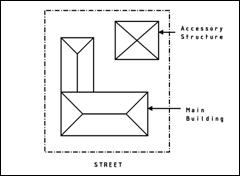
Accessory Structure
Accessory use. A use that is incidental and subordinate to the principal use of the land or building and located on the same lot with the principal use.
Adjacent. Having two or more objects near each other or having two or more lots separated by an alley, street, highway, or easement.
Administrative approval. A written decision by the Community Development Director to authorize the development of a use or the operation of an activity.
Administrative review. A decision-making process involving the judgment of the Community Development Director when applying specific decision criteria and requirements.
Adult business or sexually oriented business. Establishments that are conducted for the patronage of adults, and where minors are excluded by law or by the operators of the business. These uses are predominantly distinguished or characterized by an emphasis on entertainment, goods, devices, or services, that are sexually explicit in nature and may, pursuant to existing laws, be offered only to persons over the age of 18 years. Adult businesses include, but are not limited to, adult arcades, adult bookstores, adult cabarets, adult motel, adult motion picture theaters, adult novelty stores, escort services, gentleman's club, massage parlors, and public bathhouses.
Affordable housing. Housing that falls within guidelines established by the State Department of Housing and Community Development for affordability to very low, low and lower-income households, as determined by the household income level and number of members in the household, in relation to the area median income for the County. Median income limits are established by the State Department of Housing and Community Development, and may be amended from time to time.
Alley. A public or private right-of-way used as secondary access for pedestrians, vehicles, or utility lines to abutting lots.
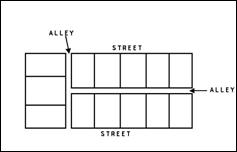
Alley
Alteration. A physical change or variation of the structural or architectural features or visual characteristics of a building or structure, including changes in paint, color or surface texture; site grading or surface paving; moving or removing interior walls and partitions; adding new structures or rooms; cutting or removing trees or other natural features; and placement of objects that affect exterior qualities of a property, such as signs, plaques, light fixtures, street furniture, walls, fences, steps, planting or landscaping.
Ambient noise level. The overall noise level within an area, as a composite of sounds from all sources in and near the area.
Amendment. A change in the wording, text, context, or substance of this Zoning Code; a change in the zoning map; a change to the official controls of the City of Hawaiian Gardens Zoning Code; or any change to a condition of approval or modification of a permit or plans reviewed or approved by the Community Development Director, the Planning Commission, or the City Council.
Animal hospital. See veterinary clinic.
Animal raising and breeding. The keeping of animals on a lot for grazing, breeding, raising, training or other personal use of the residents of the property.
Antenna. A device for transmitting or receiving radio, television, satellite, telephone, microwave, or any other transmitted signal, including equipment attached to a tower or building for the purpose of providing personal wireless services. This includes unlicensed wireless telecommunications services, wireless telecommunications services utilizing frequencies authorized by the Federal Communications Commission for cellular, enhanced specialized mobile radio, personal communications services, facilities for the transmission and reception of radio or microwave signals used for communication, cellular phone, personal communications services, and enhanced specialized mobile radio. See wireless communication facility.
Antenna height. The vertical distance measured from the base of the antenna support structure to the highest point of the antenna. Measurement of telecommunication tower height shall include the antenna, base pad, and other appurtenances and shall be measured from the finished grade at the base of the tower to the highest point of the wireless communication facility including all antenna attached to the structure.
Monopole. A device for transmitting or receiving radio, television, satellite, microwave, or any other transmitted signal that takes the form of a single pole. This includes similar devices with camouflaged or concealed telecommunications design, and disguised as pine trees, palm trees, flagpoles, and other structures.
Apartment. A room or group of rooms, not owner-occupied, that includes kitchen facilities and is rented by one household for living and sleeping purposes.
Apartment house. A structure with three or more dwelling units used by three or more households living independently.
Community apartment. A development in which an undivided interest in land is coupled with the right of exclusive occupancy of any apartment located thereon.
Efficiency apartment. A dwelling unit with a room and bath within a multiple dwelling structure, with or without kitchen facilities.
Arcade. An establishment containing three or more video or electronic amusement devices.
Architectural feature. An architectural element of a building or structure that embodies the style, design, or general arrangement, including exterior surface treatments, colors, texture, building materials, and type and style of windows, doors, lights, signs, and other appurtenant fixtures.
Area. The floor area or land area contained within set boundaries.
Buildable area. The portion of the lot that may be occupied by buildings and excludes all required front, side and rear setback areas, minimum open space and lot coverage requirements, and other areas where structures are prohibited.
Floor area. The total horizontal area within a building, as measured from the exterior surfaces of the outside walls, including all floors above or below the ground level, and excluding vent shafts, courts, and parking areas.
Livable floor area. Also living area. The interior areas of a dwelling unit that may be occupied for living purposes by humans, including basements and attics. It does not include a garage or accessory structure.
Net lot area. Area of the lot excluding existing or proposed highways, streets or alleys and other easements where the property owner does not have the right to use that portion of the lot.
Assembly. A gathering of persons at one location for a common purpose or agenda. Also public assembly.
Attached dwelling. A structure containing two or more dwelling units, generally one or two stories in height. All units have ground floor access and are joined to one another only by party walls or a common roof. Examples are townhouses, triplexes, and fourplexes.
Attached structures. Two or more structures that are physically connected with at least five feet of common wall.
Auditorium. A room for public assembly, lectures, entertainment, dance, or similar uses.
Authorized agent of owner. A person who has written permission to act for, make commitments for, speak for, or make representations for the owner of a property.
Automobile repair. The servicing of automobiles, including mechanical servicing and body work.
Automobile sales area. Also, truck sales area, trailer sales area, or boat sales area. An open area or building used for the display or sales of new or used automobiles, trucks, trailers, or boats.
Automobile service station. Also gas service station or service station. A building or area used primarily for the retail sale of gasoline and other motor fuels and the incidental sale of goods and services for the day-to-day operation of vehicles. This includes facilities with grease racks, tire repairs, battery charging, hand car wash, sale of products and supplies related to vehicle services. It excludes automobile body and fender work, auto painting, engine overhauling, and any other major auto repair activities.
Automobile trailer. A vehicle, other than a motor vehicle, designed to be drawn by a motor vehicle and that is used for carrying goods and property.
Automobile washing. Washing, waxing, and cleaning of automobiles or similar vehicles.
Awning. A roof-like cover that is attached and projects from the exterior wall of a building and located above a window or door, which is provided for decorative purposes or serves as a shield from sun or rain.
B
Bachelor apartment. See apartment, efficiency.
Balcony. A platform projecting from the upper story of a structure and enclosed by a railing or balustrade, with or without direct access to the structure it is attached to.
Basement. A room or group of rooms that has a floor level that is partly or completely below the outside ground level.
Bed and breakfast inn. A house, or portion thereof, where short-term stay lodging rooms and meals are provided, with the operator of the inn living on the premises or adjacent premises.
Bedroom. Any habitable room that may be used for sleeping purposes other than a kitchen, bathroom, hallway, dining room, or living room.
Berm. A mound or embankment of earth.
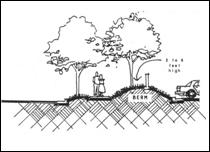
Berm
Billboard. See sign.
Block. A parcel or parcels of land bounded on all sides by streets, rights-of-way (except alleys), waterways, greenbelts, terminus of dead end streets, or City boundaries.
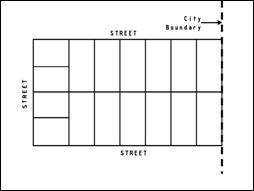
Block
Boarding house. A structure used for residential purposes, other than a hotel, with access provided through a common entrance to guest rooms that have no cooking facilities, in which lodging and meals are provided for compensation.
Branch post office. A government-operated subdivision of a main post office station serving as a base for one or more carrier routes and providing customary customer postal service. A branch post office may be incorporated as a part of another commercial use.
Buffer. An area used to screen the visual, noise, light, and other nuisances of one land use from adjacent properties or roadways.
Building. Any structure having a roof supported by columns, posts, or walls and used for the shelter, housing, or enclosure of any individual, animal, process, equipment, goods, or materials of any kind, excluding vehicles even though immobilized.
Building area. The areas of the exterior horizontal projections of all buildings on a lot, excluding pergolas, steps, chimneys, eaves, buttresses, cornices, unenclosed and unroofed terraces, patios, unenclosed private balconies not used for access and minor ornamental features projecting from the walls of the building and not directly supported by the ground.
Building component. Any subsystem, subassembly, or other system designed for use in, or as part of, a structure, which may include structural, electrical, mechanical, plumbing, and fire protection systems and other systems affecting health and safety. However, "building component" does not include appliances or equipment, such as heaters, stoves, refrigerators, or air conditioners that have been listed and labeled by an approved testing and listing agency.
Building coverage. The percentage of the lot area that is covered by all the buildings on the lot, as seen from a plan view.
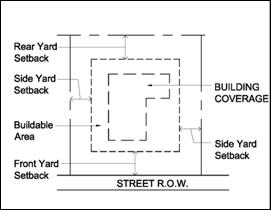
Building Coverage
Building façade. The exterior walls of a building exposed to public view or that wall viewed by persons not within the building.
Building height. The vertical distance measured from the highest point of the structure to the existing grade, excluding chimneys, flagpoles, and masts.
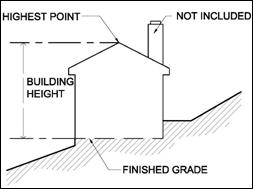
Building Height
Building line. The perimeter of that portion of a building or structure nearest a property line, but excluding open steps, terraces, cornices, decks and other ornamental features projecting from the walls of the building or structure.
Building projection. A marquee, porch, canopy, building eave, or similar projection of a building.
Building system. "Building system" means plans, specifications, and documentation for a system of manufactured building, or for a type or a system of building components, which may include structural, electrical, mechanical, plumbing, and fire protection systems and other systems affecting health and safety, including variations that are submitted as part of the building system.
Building Code. The regulations that govern building and construction standards, including but not limited to the structural, electrical, mechanical, swimming pool, plumbing, grading and fire codes.
Building materials, retail sales. Retailing of building supplies, tools, or equipment where the display, sales, and storage activity occurs indoors. Does not include building contractors' storage yards, vehicle/equipment sales, leasing, and services, or the fabrication and installation of products (e.g., drapery shops, door and window shops, glass shops, cabinet shops, and similar businesses).
Buy-back recycling center. A business without industrial activity and consisting of buildings with a gross floor area less than 5,000 square feet, which collects, receives, or buys recyclable materials from household, commercial, or industrial sources for the purpose of sorting, grading, or packaging recyclable materials for subsequent shipment and marketing. Examples of buy-back recycling centers include small-scale glass or aluminum buy-back centers. Uses such as automotive part rebuilding and/or salvage or reusable camera reloading are not considered buy-back recycling centers.
C
Camper. A structure mounted on wheels or a motor vehicle and providing facilities for camping or temporary living quarters.
Camping. Erecting a tent or shelter or arranging bedding or both, for the purpose of, or in such a way as will permit remaining overnight, or parking a trailer, camper, or other vehicle for the purpose of remaining overnight.
Canopy. A temporary prefabricated accessory structure covered with a collapsible material (e.g. canvas plastic sheeting, etc.) that meets the required fire rating supported by a frame.
Card club or casino. A business or enterprise licensed by the City, where legal gaming is conducted. This includes card rooms and other facilities wherein games are played with cards or other devices for money, checks, credits, or any other thing of value.
Caretaker. A person who lives on the premises for the purpose of managing, operating, maintaining or guarding the principal use or uses permitted on the site.
Carport. A permanently roofed structure with no more than two enclosed sides that is used for vehicle storage and shelter.
Catering services. Preparation and delivery of food and beverages for off-site consumption without provisions for on-site pick-up or consumption.
Cellar. A portion of a building that has a floor level below the finished grade and has a floor area less than one-half of the floor immediately above it.
Cellular communication facility. See wireless communication facility.
CEQA. The California Environmental Quality Act (Public Resources Code 21000 et seq.).
Certificate of concurrency. A written document issued by a service provider indicating availability of service capacity that is sufficient for a specific development project on a specific property. Also a "will-serve" letter.
Certificate of occupancy. A certificate issued by the City prior to occupancy of the structure or establishment of a land use to assure that the structure or parcel is ready for occupancy or use and that all ordinance requirements and project conditions of approval have been fulfilled.
Character. The distinctive features or attributes of buildings, uses, and site design on adjacent properties and in the vicinity as required in the general plan; including, but not limited to, building facade, building length, building modulation, building height, building location, roof form, tree cover, types of flora, location of landscaping, size and location of signs, setbacks, amount of parking, location of parking, fencing type, fencing height, location of fencing, and intensity of uses.
Charitable use. Use by non-profit organizations to administer charity consistent with the existing laws for the benefit of an indefinite number of persons.
Child care center or facility. A facility that provides non-medical care to children under 18 years of age in need of personal services, supervision, or assistance essential for sustaining the activities of daily living or for the protection of the individual on less than a 24-hour basis. Child care facility includes day care centers, employer-sponsored child care centers, and family day care homes. Child care center operations are regulated by Section 1596.70 et seq. of the State Health and Safety Code (California Child Day Care Facilities Act).
Day care center. Any child day care facility other than a family day care home, and includes infant centers, preschools, and extended day care facilities.
Family day care home. A home that is licensed by the State to regularly provide care, protection, and supervision for 14 or fewer children, in the provider's own home, for periods of less than 24 hours per day, while the parents or guardians are away. A large family day care home provides family day care for nine to 14 children, including children under the age of ten years who reside at the home. A small family day care home provides family day care for eight or less children, including children under the age of ten years who reside at the home.
Home based day care. A facility licensed by the State that regularly provides care for a period of less than 24 hours per day and is located in an owner-occupied dwelling unit.
Christmas tree sales. Retail sales of Christmas trees conducted between Thanksgiving and December 26th of each calendar year.
Church. A building or group of buildings that is used for the assembly of persons to conduct regular religious worship, religious services, or other religious activities, and is maintained and controlled by a church, religious body, religious denomination or religious organization, or other group organized to support public worship.
City. The City of Hawaiian Gardens.
City Council or Council. The City Council of the City of Hawaiian Gardens.
Clinic. A place for outpatient medical services, including pharmacies and dental or medical laboratories.
Clubs and lodges. Meeting, recreational, or social facilities of a private or non-profit organization primarily for use by members or guests.
Clustered development. A development or division of land in which buildings or lots are reduced in size and concentrated in specified portions of the original lot, tract or parcel in order to allow for common areas for open space or recreational uses.
Code. The Zoning Code of the City of Hawaiian Gardens.
Commercial recreation and entertainment. Provision of participant or spectator recreation or entertainment, including theaters, cinemas, sports stadiums, and arenas, convention centers, amusement parks, bowling alleys, billiard parlors, ice/roller skating rinks, golf courses, miniature golf courses, swimming pools, public hot tubs, tennis/racquetball courts, and game arcades to electronic game centers having more than three game machines.
Commercial vehicle. Any motorized vehicle, including, but not limited to, a car, truck, truck trailer, tractor, grading machine, bulldozer, scraper, boat, motorized crane, etc., that is used in the operation of a business to store, transfer, or deliver goods or people.
Commission. The Planning Commission of the City of Hawaiian Gardens, unless another commission is specified.
Communications facilities. Broadcasting, recording and other communications services accomplished through electronic or telephonic mechanisms, but excluding major utilities. This includes radio and television facilities, recording studios, telephone switching centers, and telegraph offices.
Community care facility. A licensed facility providing non-medical residential care, day treatment, adult day care, or foster family agency services for children, adults, or both, including, but not limited to, the physically handicapped, mentally impaired, incompetent persons, and abused or neglected children and as defined under the California Community Care Facilities Act.
Adult day care facility. Any facility that provides non-medical care to persons 18 years of age or older in need of personal services, supervision, or assistance essential for sustaining the activities of daily living or for the protection of the individual on less than a 24-hour basis.
Foster family home. A residential facility providing 24-hour care for six or fewer foster children.
Group home. A group care facility that provides for 24-hour non-medical care of persons, under 18 years of age, who are in need of personal services, supervision, or assistance that is essential for sustaining the activities of daily living, or for the protection of the individual on a short-term basis.
Small family home. A licensed facility, in the licensee's family residence, that provides 24-hour care for six or fewer foster children who have mental disorders or developmental or physical disabilities and who require special care and supervision as a result of their disabilities.
Composting facility. Facilities that compost organic material to produce a marketable product useful for reuse. Generally it is a solid waste facility specializing in the composting of one or more organic materials of a known and consistent composition, other than mixed municipal waste, to produce a marketable produce for reuse or as a soil conditioner. Feed stocks may include, but are not limited to, yard waste, biosolids, or food waste.
Conditional use. A use that is permitted subject to the issuance of a conditional use permit.
Conditional use permit. A discretional entitlement granted under the provisions of this Zoning Code, which authorizes a specific use for a specific property, subject to compliance with all terms and conditions imposed on the entitlement.
Condominium. An undivided interest in common areas of a property, together with a separate interest in a space in a residential or commercial building on the property.
Condominium common area. The areas of the condominium project except those units held as separate interest or under right of exclusive occupancy, and except those portions of the condominium project further specifically excluded.
Condominium conversion. The conversion of a single ownership parcel of existing improved real property, such as an apartment project, into a condominium form of ownership involving separate ownership of individual dwelling units, or right of exclusive occupancy of such individual units.
Condominium owners association. An organization of persons who own condominium units or the right of exclusive occupancy in a condominium development that is established by the organizational documents of the condominium project in part for purposes of operating and maintaining the common areas.
Condominium stock cooperative. A corporation that is formed primarily for the purpose of holding title to improved real property. All or substantially all of the shareholders or members of such cooperative receive a right of exclusive occupancy in a portion of the real property, title to which is held by the corporation. The right of occupancy is transferable only concurrently with the transfer of the share or shares of stock or membership certificate in the corporation held by the person having such right of occupancy.
Condominium unit. A unit of a condominium project that is not owned in common with the owners of the condominium project.
Residential condominium. A condominium that is used for residential purposes that includes separate interest in a dwelling unit within the residential complex and undivided interest in common areas of the property.
Congregate care facility. See convalescent facility.
Construction. The assembly, erection, substantial improvement, alteration, or similar action performed on a structure or property. It excludes demolition but includes excavation, fill, or drainage work and similar activities.
Contiguous. Bordering upon, adjacent to, touching upon, or in physical contact with.
Contract station post office. A privately operated, limited-service postal facility operated as adjunct to a principal business or use.
Convalescent facility or congregate care facility. Also, nursing home, convalescent hospital, rest home, or home for the aged. A licensed health facility that provides skilled nursing care and supportive care to patients which primary need is for the availability of skilled nursing care on an extended basis, excluding facilities providing surgical or emergency medical services.
County. The County of Los Angeles.
Court. An unoccupied area that is open from the ground to the sky, bounded on two or more sides by an exterior wall of a building that is not a yard.
Cultural facilities. Institutions designed primarily for displaying or preserving objects of interest in one or more of the arts or sciences, including libraries, museums, and art galleries.
Curb level. The level of the established curb in front of such building measured at the center of such front. Where no curb elevation has been established, the mean elevation of the finished lot grade immediately adjacent to a building shall be considered the curb level.
D
Day care center. See child day care facility.
Demolition. The dismantling, intentional destruction, or removal of structures, utilities, public or private right-of-way surfaces or similar property.
Density. The number of dwelling units per gross acre, unless another area measurement is specified. When calculating the allowable density, fractions shall be rounded down to the nearest whole number.
Density bonus. An increase of up to 25 percent over the maximum allowable development density.
Department. The Community Development Department of the City of Hawaiian Gardens.
Detached building. A building or structure that does not have a wall or roof in common with any other building or structure.
Detached single-family unit. A dwelling unit that is not attached to another dwelling unit by any means.
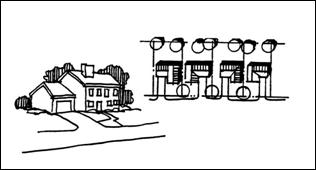
Detached Single-Family Unit
Development. A change to real property that involves the construction, reconstruction, alteration or removal of a building or structure, including mining, dredging, filling, grading, pacing, excavation or drilling operations.
Development standards or property development standards. A set of regulations for the area and dimensions of a lot or property, including setbacks, bulk, size, and location of structures, off-street parking, signs, landscaping, storage areas, and other physical improvements.
Director. The Community Development Director of the City of Hawaiian Gardens or designee.
District. An area within specified boundaries, such as a zoning district.
Domestic animal. An animal that is commonly maintained in residence with persons, as permitted by the Hawaiian Gardens Municipal Code.
Drive-in or drive-through. Designed or operated so as the enable persons to receive a service or purchase or consume goods while remaining within a motor vehicle.
Driveway. The passageway that provides vehicular access from a public or private street to a parking area, garage, carport, or other legal parking space. A driveway begins at the property line and extends into the site. It does not include parking spaces or parking aisles (maneuvering or circulation areas in parking lots) and is not a street. The width of a driveway is the same width as the curb cut, excluding any aprons or extensions of the curb cut.
Duplex. Also, two family dwelling unit. Two dwelling units that are attached to one another and located on a single lot. A duplex is considered a multi-family development.
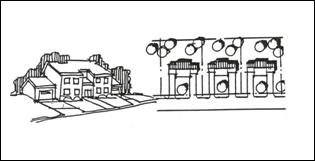
Duplex
Dwelling or dwelling unit. One or more rooms designed for or occupied by a household for living or sleeping purposes and containing kitchen, sleeping, and sanitary facilities. All rooms comprising a dwelling unit shall have access through an interior door to other parts of the dwelling unit. It includes single-family, two-family, and multiple-family dwellings, accessory dwelling units, modular homes, manufactured homes and mobile homes, but not hotels, motel units having no kitchens, boarding houses, lodging houses, or garages.
E
Earth tone. A color scheme that draws from a color palette of browns, tans, greys, greens also including some blues and reds. The colors in an earth tone scheme are muted and flat in an emulation of the natural colors generally found in dirt, moss/trees and rocks.
Easement. A portion of a lot that is reserved or used for utility rights-of-way, access or any public or private use, as indicated on a subdivision map, deed restriction, or other recorded document. A recorded right or interest in the land that entitles the holder to some use, privilege, or benefit in, on, over, or under such land.
Educational institution or facility. A private or public pre-school, elementary or secondary school, college, university, or other training facility qualified to give general academic or skills instruction according to the standards of the State Board of Education or other State agency.
Efficiency unit. A dwelling unit containing only one habitable room.
Elevation. See grade.
Emergency shelter. Housing with minimal supportive services for homeless persons that is limited to occupancy of six months or less by a homeless person. No individual or household may be denied emergency shelter because of an inability to pay.
Emergency work. Work that is necessary to remedy an existing hazard or to restore property to a safe condition, including work needed to restore utility service.
Employee housing. Privately owned housing for six or fewer persons provided by an employer in connection with any work, whether or not rent is involved.
Enclosed. Covered by a roof and contained on all sides by walls, with openings limited to windows, vents, and entrance and exit doors.
Encroachment. An intrusion on the rights or possession of another or advancement beyond the proper or prescribed limits.
Equipment structure. A structure, shelter, cabinet, or vault used to house and protect electronic or mechanical equipment, including those necessary for processing wireless communication signals. Associated equipment may include air conditioning, backup power supplies, and emergency generators.
Expand. To increase in size, floor area, height, or other physical characteristic of a structure or use or in the intensity of development or activity.
F
Factory-built housing. A residential building, dwelling unit, or an individual dwelling room or combination of rooms, or building component, assembly, or system manufactured in such a manner that all concealed parts or processes of manufacture cannot be inspected before installation at the building site without disassembly, damage, or destruction of the part. This includes units designed for use as part of an institution for resident or patient care, which is either wholly manufactured or is in substantial part manufactured at an offsite location to be wholly or partially assembled onsite in accordance with building standards published in the State Building Standards Code and other regulations adopted pursuant to California Health and Safety Code Section 19990. Factory-built housing does not include a mobile home, manufactured housing, mobile accessory building or structure, a recreational vehicle, or a commercial coach.
Factory-built housing installation. The assembly of factory-built housing on site and the process of affixing factory-built housing to land, a foundation, footings, or to an existing building.
Family. An individual or two or more persons living as a family.
Family day care home. See child day care facility.
Fence. A barrier constructed of any material including vegetation or combination of materials erected to enclose, screen or separate areas.
Final development plan. A plan or set of plans that complies with the conditions set forth in a permit or approval of a development project.
Flag. A piece of cloth or other non-rigid material identifying one of the following:
1.
Flag of a nation;
2.
Commemorative flag, such as a POW flag; or
3.
State flag.
Flagpole. A structure (typically a pole) used to display, hang, or secure a flag.
Floor area. See living area.
Fraternity house. A dwelling unit occupied or a building used exclusively by unrelated individuals who are members of the same fraternity.
Frontage. Also, building frontage. The length of the exterior wall of the building that faces a public street, public parking area, or front yard.
G
Gaming facilities. A building or portion of a building designed and used for the conduct of legal gaming activities, including card clubs, casinos, bingo parlors and similar facilities for gambling.
Garage. A building or portion of a building designed and used for the shelter and storage of vehicles that are owned and operated by the occupants of the main building or their tenants and customers. No kitchen, bathroom, or toilet facilities are permitted in garages. No garage may be converted to living space or used for a storage facility. See parking garage.
Enclosed garage is a permanently roofed garage with three enclosed sides and a garage door on the fourth side.
Existing grade. The surface of the ground or pavement at a stated location as it exists prior to disturbance in preparation for a project regulated by this Zoning Code.
Finished grade. The ground elevation after final grading of the site.
Garage conversion. Alteration of a garage through the change, modification, or construction of a bathroom, bedroom, kitchen, living room or other facility or use that precludes its use for the storage of vehicles.
Garage sale or yard sale. The temporary outdoor display and sale of used household items, as allowed under the provisions of this Zoning Code and the Hawaiian Gardens Municipal Code.
Gazebo. A roofed structure characterized by the absence of solid walls and used primarily for outdoor seating.
General plan. The Hawaiian Gardens General Plan.
Government Code. The California Government Code.
Grade. The ground elevation (vertical distance above sea level) at a specific location.
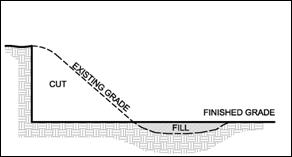
Grade
Grading. The excavation or fill of earth materials to prepare a site for construction or other improvement.
Greenbelt. A linear corridor of open space that often provides passive recreational uses and non-motorized transportation opportunities, serves as a buffer between developments and varying land uses, or creates a sense of visual relief from dense urban landscapes.
Greenhouse. A building or structure built for the propagation and cultivation of plants.
Group home. See community care facility.
Guest house. An attached or detached building with no interior access to the primary dwelling unit that has sleeping, living and sanitary facilities, but no cooking facilities which is used primarily by members of the household occupying the main building, their non-paying guests or domestic employees.
Guest room. An attached or detached building with no interior access to the primary dwelling unit that has sleeping and living facilities only, no sanitary facilities and no cooking facilities which is used primarily by members of the household occupying the main building, their non-paying guests or domestic employees.
H
Habitable room. Any room used for living purposes that includes working, sleeping, eating, cooking, recreation, or a combination thereof. A room designed and used only for storage is not a habitable room.
Hazardous substance or material. Any substance that, because of its quantity, concentration or physical or chemical characteristics, is flammable, corrosive, explosive, toxic, or infectious and poses a significant present or potential hazard to the health and safety of humans, domestic livestock or wildlife.
Health Department. The County of Los Angeles Health Department.
Hedge. Shrubs, trees or other plant materials that are located in a row to act as a visual barrier between adjacent areas.
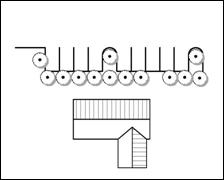
Hedge
Height. See building height.
Heliport. A licensed helicopter landing area used and designed for receiving or discharging passengers and cargo on a regular basis. This includes facilities for cargo storage, helicopter storage, repair or servicing.
Helistop. A licensed helicopter landing area used and designed for receiving or discharging passengers and cargo on an intermittent basis. This does not include facilities for cargo storage, helicopter storage, repair or servicing.
Home. A place of residence.
Home for the aged. A nursing home for the elderly. See convalescent facility.
Home occupation. Any business activity carried on within the dwelling or within a permitted accessory structure, as an incidental use to the residential purposes of the property.
Hospital. A health facility licensed by the State Department of Health Services, which has an organized medical staff and provides 24-hour in-patient care, including medical, nursing, surgical, anesthesia, laboratory, radiology, pharmacy, and dietary services.
Hotel. A building in which there are six or more guest rooms where lodging with or without meals is provided for compensation, and where no provision is made for cooking in any individual room or suite. This includes motels, auto cabins, and similar structures but does not include rooming or boarding houses, jails, hospitals, asylums, sanitariums, orphanages, prisons, detention homes, or other buildings where individuals are housed or detained under legal restraint. This definition shall not apply to structures located within the C-4/casino overlay zone where hotels are allowed to have a kitchen in guests' rooms.
Household. One or more persons occupying one dwelling unit and living as a family unit, including those temporarily absent (such as, members away at school, on a visit, vacation, trip in connection with work, active duty in the armed service, or other absence of a similar nature). This does not include occupants of a fraternity, sorority, boarding house, lodging house, club, or motel.
Household pet. An animal kept in the home for personal purposes and not used for commercial breeding or sale.
I
Impervious surface. A hard surface that either prevents or retards the entry of water into the soil mantle as under natural conditions prior to development, and/or a hard surface area that causes water to run off the surface in greater quantities or at an increased rate of flow than the flow present under natural conditions prior to development. Common impervious surfaces include, but are not limited to, roof tops, walkways, patios, driveways, parking lots or storage areas, concrete or asphalt paving, graveled or packed earthen materials, and oiled, macadam or other surfaces that similarly impede the natural infiltration of stormwater. Open, uncovered retention/detention facilities shall not be considered as impervious surfaces.
Improvement. A building, structure, place, parking facility, fence, gate, wall, work of art, or other object that enhances the physical attributes of real property.
Institution. An establishment maintained and operated by a society, corporation, individual, foundation, or public agency for the purpose of providing religious, charitable, social, educational, or similar services to individuals, groups or the general public.
Intensity. The level of development or activity associated with a land use, as measured by the floor area occupied by the use, the amount of parking required, the operational characteristics (hours, type of uses, etc.) or the percentage of site occupied by the use. Intensity is typically measured by the building coverage or the floor area ratio.
J
Junk yard or salvage yard. An area where scrap, waste, or discarded or salvaged materials are brought, sold, exchanged, baled, packed, disassembled, handled, or stored. This includes auto wrecking yards, house wrecking yards and used lumberyards. It does not include pawnshops, used furniture and household equipment stores, solid waste materials recycling facilities (MRF), used car lots, or areas that store salvaged materials incidental to manufacturing operations.
K
Kennel. A house, enclosure, or other structure in which any combination of four or more dogs or cats that individually exceed seven months of age are housed for breeding, sale, training, boarding, or sporting purposes, or are kept or cared for as pets or for a fee or compensation. This does not include treatment at veterinary clinics or animal hospitals or pet grooming services.
Kitchen. Any room or portion of a room used or intended or designed to be used for cooking or the preparation of food.
L
Laboratory. A building or portion of a building that contains facilities for the photographic, testing or analysis of a product, person, animal, or part thereof.
Land use. See use.
Landfill. An area designed and used for the disposal of solid wastes on land by spreading waste in layers, compacting it and covering it daily with soil or other approved cover materials.
Landscaping. Planting and maintenance of trees, shrubs, vines, ground cover, flowers or lawns, including natural features such as rock and stone, structure features such as fountains, reflecting pools, art works, screens, walls, fences and benches. Required landscaping may be planted in concrete planters, landscape beds, or planter boxes.
Laundromat. An establishment that houses coin-operated laundry machines. This does not include dry cleaners.
Licensed gambling establishment. See gaming facilities. The gambling premises encompassed by a State gambling license.
Licensed group home. Under the provisions of the California Health and Safety Code, licensed group homes for six or fewer persons include:
Intermediate care facilities for individuals who have developmental disabilities (Health and Safety Code Section 1267.8).
Residential facilities for persons with disabilities and for abused children (Health and Safety Code Section 1566.3, and Welfare and Institution Code Section 5116).
Residential care facility for the elderly (Health and Safety Code Section 1569.85).
Alcoholism and drug treatment facilities (Health and Safety Code Section 11834.23).
Residential facilities for persons with chronic life threatening illness (Health and Safety Code Section 1568.0831).
Live entertainment. A performance, act, play, revue, pantomime, scene, fashion show, dance, or song or any combination of the above performed in person by one or more persons, whether or not they are compensated.
Livestock. Cattle, sheep, goats, or animals of the bovinae family; all horses, mules, or animals of the equinae family; all pigs, swine, or animals of the suinae family; and ostriches, rhea, and emu.
Living area. The interior area of a dwelling unit that may be occupied for living purposes by humans. Livable floor area does not include a garage.
Loading area or space. An off-street area or space located on the same lot as the building or group of buildings that it serves and used for the temporary parking of commercial vehicles while loading and unloading cargo.
Lodging house or rooming house. See boarding house.
Lot or parcel. A parcel separately owned or legally divided from a piece of real property according to the requirements of State law and the Hawaiian Gardens Municipal Code, and as shown on the recorded final map, parcel map, record of survey, certificate of compliance, or lot line adjustment. The different lot types include:
Corner lot. A lot situated at the intersection of two or more street rights-of-way that have an interior angle of less than 135 degrees. On a corner lot, all yards abutting street rights-of-way shall be considered front yards.
Flag lot. A lot having access to a street by means of a private driveway, access easement, or parcel of land with a minimum width of 20 feet. The front yard of a flag lot shall be the narrowest width of the lot abutting the access area of the lot, but not including the access area of the lot.
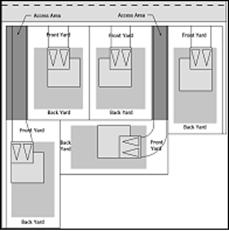
Flag Lot
Interior lot. A lot abutting a street on one side or a lot other than a corner lot.
Key lot. A lot with its side lot line abutting the rear lot line of a reverse corner lot.
Reverse corner lot. A lot located at the intersection of two or more street rights-of-way (corner lot) and has a rear property line abutting the side of another lot.
Through lot. A lot that fronts two parallel street rights-of-way or that fronts two street rights-of-way that do not intersect at the boundaries of the lot.
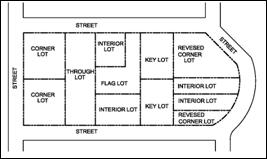
Lot Types
Lot area or lot size. The net land area within the lot lines of a lot, as measured on a horizontal plane and excluding any public or private right-of-way and access easements.
Lot coverage. The total area of the lot that is covered by buildings or structures, often expressed as a percentage of the lot area. This area includes roofs, soffits, or overhangs extending more than two and one-half feet from the building wall and decks more than four feet in height.
Lot depth. The horizontal length of a straight line between the front and rear lot lines of a lot, measured at right angles to the front lot line and extending to the rear lot line that is at least ten feet long. If there is no rear lot line within 45 degrees of being parallel to the front lot line, the lot depth is measured from the front lot line to a ten-foot long line located farthest and parallel to the front lot line.
Lot width. The horizontal length between the side lot lines measured at the midpoint of the side lot lines and at right angles to the line measuring the lot depth.
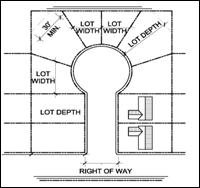
Lot Depth and Width
Lot line. A line of record bordering a lot and dividing one lot from another lot or from a public or private street right-of-way or any other public space.
Front lot line. The portion of a lot line of a parcel or lot that abuts a street right-of-way or future street right-of-way, as identified through an official record. For a corner lot, the shorter lot line abutting the street is considered the front lot line. For a through lot, the lot line abutting the street providing primary access to the lot is the front lot line, except when primary vehicular access is from an alley.
Rear lot line. The lot line opposite and most distant from the front lot line. For establishing the rear yard for an irregularly-shaped lot, the rear lot line is the ten-foot line that is located farthest and parallel to the front lot line.
Side or interior lot line. Any other lot line that is neither a front or rear lot line.
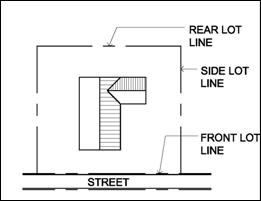
Lot Line
Lower- and very low-income households. See affordable housing.
M
Main building. The building that contains the primary use on the lot or one designed and occupied for a use that is not incidental or secondary to another use on the same lot. A main dwelling is the dwelling unit permitted as the principal use of a parcel or lot, either by itself or with other dwelling units.
Maintain. To preserve in its current condition or to prevent deterioration or adverse change.
Manufactured housing. A structure, transportable in one or more sections that is built on a permanent chassis and designed to be used as a dwelling when connected to the required utilities. A manufactured home does not include a recreational vehicle.
Master development plan. The comprehensive site plan and plans for construction of a planned development that is located within an area with a planned development overlay zone, and as approved by the Planning Commission or City Council under the provisions of this Zoning Code.
Median. A painted, paved or planted area separating a street into opposite-direction travel lanes.
Mini-storage. See self storage facilities.
Minor. A person younger than 18 years, unless another specific meaning is indicated by the context in which the term is used.
Minor exception. A minor deviation in the requirements or the development standards in this Zoning Code, but not in the permitted uses, as granted by the City in accordance with the procedures established in this Zoning Code, when the Community Development Director determines that strict enforcement of the standards will cause undue hardship.
Minor use permit. A permit for a use, activity or structure on a parcel, as approved by the Community Development Director.
Mobile home. A structure that is transportable in one or more sections, which, in the traveling mode, is eight body feet or more in width, or 40 feet or more in length, or, when erected on-site, has 320 or more square feet of lot coverage, and which is built on a permanent chassis and designed to be used as a dwelling when connected to the required utilities, and includes the plumbing, heating, air conditioning, and electrical systems contained therein: except that such term shall include any structure that meets all the requirements of this paragraph except the size requirements and with respect to which the manufacturer voluntarily files a certification and complies with the standards established under this part. Mobile home does not include a recreational vehicle or a commercial coach but includes trailers and other recreational vehicles, other than motor homes, truck campers, and camping trailers, which are used for human habitation if the occupancy meets the following criteria: (1) the trailer or other recreational vehicle occupied a mobile home site in a mobile home park prior to January 1, 1991 and had a rental agreement with a term of one month or longer on November 15, 1992; (2) the trailer or other recreational vehicle occupies a mobile home site in the park for nine or more continuous months. A mobile home does not include a trailer or other recreational vehicle located in a recreational vehicle park.
Mobile home park. An area of land where two or more mobile home sites are rented, or held out for rent, to accommodate mobile homes used for human habitation. A mobile home park shall not include mobile home subdivisions or recreational vehicle parks or where mobile homes are permitted as a principal use and accessory dwelling unit on the same lot.
Modification. An alteration of an existing use or structure. Modification may also refer to changes to an existing standard as contained in this Zoning Code or to a permit granted under this Zoning Code.
Monument sign. See ground sign.
Motel. A group of attached or detached buildings containing individual sleeping units where a majority of such units open individually and directly to the outside, and where a garage is attached, or a parking space is conveniently located to each unit, all for the temporary use by automobile tourists or transients. It includes tourist courts, motor courts, automobile court, automobile camp, and motor lodges. A unit in a motel having kitchen facilities shall constitute a dwelling unit and shall be subject to all of the provisions and requirements of this Zoning Code governing dwelling units for the zone in which the establishment is located.
Motor home. See recreational vehicle.
Motor vehicle. A self-propelled device by which a person or property may be moved or drawn upon a street or highway, except devices moved by human or animal exertion or used exclusively on stationary rails or tracks.
Multi-family or multiple family dwelling unit. A structure containing two or more dwelling units designed for the occupancy of two or more households.
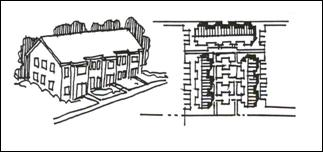
Multi-Family Dwelling Unit
Multi-family residential. More than one dwelling unit located on one parcel, dwelling units can include both attached and detached dwelling units.
Municipal Code. The Municipal Code of the City of Hawaiian Gardens.
N
Nonconforming. Does not conform to the standards and regulations contained in this Zoning Code.
Nonconforming lot. A lot that does not meet the minimum size, dimension or area requirements of the zone in which it is located. A legally nonconforming lot is a lot that was permitted when created as part of an approved subdivision map but was made nonconforming by an acquisition of land in the public interest or subsequent changes in this Zoning Code.
Nonconforming sign. A sign, outdoor advertising structure, or display of any character that was lawfully erected or displayed, but that does not conform with the standards for location, size, or other regulations by reason of adoption or amendment of this Zoning Code.
Nonconforming structure. A building or structure that does not meet any current development standard for the zone in which it is located, as set forth in this Zoning Code, but which was legally established and in compliance with applicable ordinances and laws before this Zoning Code was adopted. This does not include illegal structures that were not lawful when constructed.
Nonconforming use. A use that is not allowed in the current zone classification in which it is located, but was allowed when it was first established. This does not include illegal uses that were not lawful when established.
Nuisance. An act or condition that when performed or existing on a parcel, structure or portion of a structure, is considered dangerous or potentially dangerous to the public health, safety, and welfare, degrades the appearance and value of the surrounding properties, or can cause damage to public rights-of-way.
Nursery school. See child care center or facility.
Nursing home. A health facility that provides skilled nursing care and supportive care to patients whose primary needs are for the availability of skilled nursing care on an extended basis.
O
Occupied. Used, designed, built, altered, converted, rented, leased, based, or intended to be occupied.
Offices or professional offices. A building or portion of a building used as a place of business by persons primarily engaged in rendering professional services. It does not include offices of retail stores, or those incidental to the handling, sale or disposition of commodities.
Open area. The portion of the lot that is not occupied by above ground structures, driveways, walkways, or parking areas.
Open space. A parcel or portion of a parcel that is primarily reserved for the preservation of natural resources, the protection of environmental features, or for providing outdoor recreation or education. Open space areas may include parks, trails, utility corridors, and other vacant rights-of-way. Permanent dedication, designation, or preservation of open space for public or private use may occur in accordance with general plan policies. Open space may serve as a buffer between developments and varying land uses, or create a sense of visual relief from denser development. Open space does not include roads, driveways, required setbacks, parking areas, or surface utility facilities.
Common open space refers to open space within a residential development reserved for the exclusive use of the residents of the development and their guests. Yard setback areas are not included.
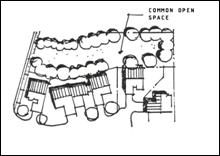
Common Open Space
Private open space refers to usable open space adjoining or directly accessible to a dwelling unit, reserved for the exclusive use of the residents of the dwelling unit and their guests.
Useable open space includes balconies, roof decks, patios, swimming pools, open cabanas, children's playgrounds and recreation rooms and does not include parking areas, driveways, loading zones, storage areas, berms, planters, and areas not accessible to the residents.
Open storage or outdoor storage. An open area located outside a building or structure where merchandise, equipment, or other materials, which are not outdoor displays, are stored.
Outdoor advertising display. Any card, paper, cloth, metal, glass, wooden, or other display or device of any kind or character that is placed for outdoor advertising purposes on the ground or on any tree, wall, rock, structure, or other object.
Outdoor advertising structure. A structure of any kind of character erected or maintained for outdoor advertising purposes upon which any outdoor advertising display is, or can be, placed.
Outdoor dining. A dining area with seats and/or tables located outdoors of a restaurant, coffee shop, or other food service establishment, and that is (a) located entirely outside the walls of the contiguous structure, (b) enclosed on two sides or less by the walls of the structure with or without a solid roof cover, or (c) enclosed on three sides by the walls of the structure without a solid roof cover.
Overnight lodging. Permanent, separately rentable accommodations that may include a kitchen and are available to the general public for short term use. The accommodations are intended for visitors rather than for full-time residents. Overnight lodgings include hotel or motel rooms, and time share units. Individually-owned units other than time-share units may be considered overnight lodgings if they are available for overnight rental use by the general public for at least 45 weeks per calendar year.
Owner occupant. A property owner, as reflected in title records, that makes his or her legal residence at the site, and actually resides at the site more than six months out of any given year.
P
Parcel. See lot.
Park. A public recreation area or facility, including a dedicated private recreation area for use of the residents or employees of a building where the recreation facility is located, unless another specific meaning is indicated by the context in which the term is used.
Community park. A park designed for organized activities and sports, outdoor activities, and other recreation pursuits and designed to serve the entire City. These parks may include sport fields, water bodies, gardens, nature trails, or similar facilities, as well as restroom and parking facilities.
Neighborhood park. A combination playground and park designed primarily for non-supervised, non-organized recreation activities. Neighborhood parks are small in size (about three to ten acres) and serve an area of approximately one-half mile in radius. In general, facilities recommended for a neighborhood park may include a children's playground, picnic facilities, trails, nature areas, tennis courts, an outdoor basketball court, and a multi-use field for soccer, youth league baseball, etc. Most often there are no restroom and parking facilities.
Park trailer. A trailer designed for human habitation for recreational or seasonal use only, that meets all of the following requirements: (1) it contains 400 square feet or less of gross floor area, excluding loft area space; (2) it may not exceed 14 feet in width at the maximum horizontal projection; (3) it is built upon a single chassis; (4) it may only be transported on public highways with a permit issued pursuant to the Vehicle Code.
Parking area or parking facility. An area or facility accessible to vehicles and provided, improved, maintained, and used for the sole purpose of parking a motor vehicle.
Parking aisle. A maneuvering and circulation area for ingress and egress to off-street parking spaces in a parking lot and in which parking is prohibited.
Parking garage or structure. A covered structure or portion of a covered structure that provides parking for motor vehicles, not including private garages accommodating required off-street parking for residential dwellings. "Parking garages" include parking spaces, parking aisles and driveways. Parking garages can be restricted to private use of associated residential or non-residential uses or for the use by the general public.
Parking lot. An open, common area devoted to the standing, maneuvering, and circulation of motor vehicles, not including off-street parking spaces or areas for single-family detached or two-family dwellings with individual driveway access onto a public or private road. Parking lots include parking spaces, parking aisles, driveways and planting beds and islands. Parking lots can be restricted to private use of associated residential or non-residential uses or can be open to use by the general public. See also private parking area and public parking area.
Parking space, off-street. An area on a lot that is improved, maintained and used for the sole purpose of providing standing area for a motor vehicle, excluding driveways, ramps, loading areas, walk areas.
Parking space, on-street. An area along the sides of a street right-of-way where motor vehicles are allowed to park.
Private garage. An accessory building or a portion of the main building, enclosed on not less than three sides and designed or used for the shelter or storage of vehicles owned or operated only by the occupants of the main building.
Private parking area. An area, other than a street, alley, or other public property, limited to the parking of vehicles of the occupants of a dwelling, hotel, motel, apartment hotel, apartment house, or lodging house, or of users of a commercial or industrial building to which these facilities are appurtenant.
Public parking area. An area other than a street, alley, or private parking area as defined herein, whether privately or publicly owned, which area is used for the parking of more than five vehicles.
Parkway. The area of a public street that lines between the curb and the adjacent property line or physical boundary, such as a fence or wall, which is used for landscaping and/or passive open space.
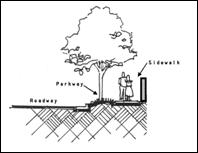
Parkway
Patio cover. An overhang or roof that extends partly or entirely over a courtyard or room that is attached to a building.
Pawn shops. Establishments engaged in the retail sales of new or secondhand merchandise and offering loans secured by personal property.
Penthouse structure. The upper portion of a building not intended for human occupancy, normally used for mechanical equipment, and not covering more than 25 percent of the ground floor area covered by the main building.
Permitted use. A use allowed in a zone, as established in this Zoning Code, and subject to the provisions applicable to the specific use.
Person. An individual, firm, co-partnership, joint venture, association, social club, fraternal organization corporation, company, estate, trust, receiver, syndicate, or any other group acting as an entity, including Federal, State or County government, or special district to the extent permitted by applicable Federal and State laws.
Personal improvement services. Provision of instructional services or facilities including photography, fine arts, crafts, dance and music studios, driving schools, business and trade schools, reducing salons, and health or physical fitness clubs.
Personal services. Provision of recurrently needed services of a personal nature, including barber and beauty shops, seamstresses, tailors, shoe repair shops, nail salons, dry cleaning, laundries, and massage parlors.
Place of religious assembly. An establishment that primarily operates for religious worship, religious services, or any religious activity and where the principal building or other structure contains the sanctuary or principal place of worship, including accessory uses in the main building or in separate buildings or structures, such as religious educational classrooms, assembly rooms, kitchen, library room or reading room, recreation hall, and a one-family dwelling unit, but excluding facilities for residence or for training of religious orders.
Planned development. A development characterized by a structure or number of structures containing one or more land uses based on the comprehensive design of the entire project, including the clustering of buildings to preserve open space or to provide other common facilities.
Planned street width or right-of-way. The proposed final width of a street right-of-way, as shown in the circulation element of the general plan of the City of Hawaiian Gardens or the master plan of streets, or as established by an official action of the City.
Planning Commission. The Planning Commission of the City of Hawaiian Gardens.
Planter. A structure made of wood, concrete, masonry or other materials designed to hold flowers, trees or other plant materials.
Plot plan. A scaled and dimensioned drawing of a lot or parcel of land and its immediate vicinity, showing the location of all existing and proposed building, structure and improvements on-site.
Principal or main building. A building devoted to the principal use of the lot on which it is located.
Principal use. The primary or predominant use of any lot, parcel, structure or building.
Private or public club. A building or premise used by a group of persons organized for the purposes of promoting social, professional, fraternal, cultural, sports, educational, or other common cause. This excludes premises used by groups organized to render services customarily carried on as a business. This is also separate from a church or place of religious assembly.
Processing. A method that changes the nature of a material, its chemical composition or its physical qualities.
Professional services. Businesses whose services are based on professional expertise rather than on discrete products or commodities, including, but not limited to, managerial, creative, administrative and clerical services.
Project. A proposal for new or changed use or for new construction, alteration or enlargement of any structure that is subject to the provisions of this Zoning Code.
Property. A lot or parcel of land.
Property line. A lot line or parcel boundary.
Public facilities. Facilities owned by public agencies or entities that provide public services, including streets, roads, highways, sidewalks, street and road lighting systems, traffic signals, domestic water systems, storm and sanitary sewer systems, solid waste facilities, parks and recreational facilities, and schools.
Public use. A use conducted exclusively by a public agency for public health, safety or general welfare purposes, such as public schools, parks, playgrounds, libraries, fire stations, police stations, government offices, and post offices.
Public utility. A service that provides electricity, natural gas, steam, telephone, telegraph, transportation, water, sewer, storm drainage or other service regulated by the State or local jurisdiction.
Q
Quasi-public use. A use conducted by a private non-profit organization involved in religious, recreational, charitable, or medical activities and having the main purpose of serving the general public. This includes, but is not limited to, churches, private hospitals, cemeteries, private schools and universities, youth centers and similar uses.
R
Recovery or treatment facility (for alcoholism or drug abuse). A facility, premises, place or building that provides 24-hour residential non-medical services to adults who are recovering from problems related to alcohol, drug, or alcohol and drug misuse or abuse and who need alcohol, drug or alcohol and drug recovery treatment or detoxification services.
Recreational vehicle. A motor home, travel trailer, truck camper, or camping trailer, with or without motive power, designed for human habitation for recreational, emergency, or other occupancy. Recreational vehicles shall include, but not necessarily be limited to, campers, motor homes, camping trailer, and travel trailers or any vehicle placed on a trailer, truck camper, camper shells, and fifth wheels.
Recycling center or collection site. A site with collection boxes or other containerized storage where persons can bring materials for recycling.
Recycling facility or transfer station. A large scale buy-back recycling business or other industrial activity that specializes in collecting, storing and processing any waste, other than hazardous waste or municipal garbage, for reuse and which uses heavy mechanical equipment to do the processing. It may be a facility where commingled recyclable materials are sorted, baled, or otherwise processed for transport off site that is referred by as a "clean" materials resource recovery facility (MRF).
Rehabilitation. Alteration of the structural or architectural features or visual characteristics of a building or structure, designed to improve the building in accordance with current codes and requirements, to upgrade existing equipment and appliances, buildings systems, landscaping, or other building components, or to remove public health and safety hazards.
Relocatable building. A building that is not placed on permanent foundations and is designed to be moveable from one location to another without the need for a special permit such as that required for moving a conventional dwelling. Relocatable buildings include mobile homes, construction trailers, and modular buildings.
Residence. A dwelling unit.
Restaurant. Any use providing for the preparation, retail sale, and consumption on-site of food and beverages. Restaurants include cafés, coffee shops, sandwich shops, ice cream parlors, fast-food, take-out, and drive-through restaurants, bars, cocktail lounges, and similar uses. If another use or seating is provided in conjunction with a store where there is preparation and retail sale of food and beverages, that use shall be classified as a restaurant.
Drive-through restaurant. A restaurant that is designed or operated so as to enable persons to receive a service or purchase food or drinks while remaining within a motor vehicle.
Fast-food restaurant. An eating and drinking establishment, in which the manner of preparation, packaging and service of the product results in prompt service to customer. A fast-food restaurant does not serve alcohol of any type.
Full-service restaurant. An eating and drinking establishment in which food and drinks are generally consumed within an enclosed structure at tables and/or at a counter. When alcoholic beverages are served, a full-service restaurant shall comply with the California Business and Professions Code.
Take-out restaurant. An eating and drinking establishment, in which the manner of preparation, packaging and service of the product enables and/or encourages its consumption outside the restaurant.
Tavern. An eating and drinking establishment in which the serving of food is incidental to the serving of beer and/or wine; i.e., the monthly food sales shall amount to less than 60 percent of the tavern's total food-alcoholic beverage sales; there is no kitchen facility or kitchen facilities are limited to that necessary to prepare sandwiches and/or short orders of food for sale to the public; and up to seven and one-half gallons of beer or other malt beverage is offered for sale and off-site consumption. If monthly food sales exceed 60 percent of the total sales, the use shall be considered a restaurant. If more than seven and one-half gallons of beer or other malt beverage is offered for off-site consumption, the use shall be considered a liquor store.
Retail store or establishment. A business completely enclosed within a structure with at least 75 percent of the gross floor area devoted to the display of merchandise, engaged in selling primarily finished goods or merchandise directly to the general public for profit.
Right-of-way. Land or property held in an easement or separate tract that is occupied or dedicated to be occupied by a publicly or privately dedicated street or railroad, together with property used or reserved for utilities, transmission lines and extensions, walkways, sidewalks, bikeways, equestrian trails, and other similar uses.
Roof level. The uppermost edge of a roof, building wall, or parapet, excluding roof structures that cover less than 25 percent of the roof area.
Rooming house. See boarding house.
S
Satellite antenna or satellite dish antenna. An accessory structure capable of receiving transmission signals from a satellite.
Satellite dish farm. A parcel of land that is occupied by several satellite dishes or antennas and used for the transmission or reception of radio, television, satellite, telephone, microwave, or any other transmitted signal.
School. A private or publicly funded educational institution, including elementary and secondary schools, colleges, universities or other special learning centers offering several courses of study, and operated in accordance with the requirements of the State Education Code.
Second dwelling unit or second unit. A detached or attached residential dwelling unit, added at a later date on the same lot as a pre-existing dwelling unit, and providing independent living facilities for one or more persons, with permanent provisions for living, sleeping, eating, cooking, and sanitation. This includes second units allowed on R-2 lots (as regulated under this title), granny flats, and guest houses but does not include accessory dwelling units, as regulated under Section 18.90.080 of this title.
Self-storage facility. A facility designed and used for the purpose of renting or leasing individual storage space to persons who are to have access to the space for the purpose of storing and removing personal property or for storing individual storage containers provided to occupants who have exclusive use of the container for the purpose of storing and removing personal property. Self-service storage facility does not include a garage or other storage area in a private residence. No occupant may use a self-service storage facility for residential purposes. A self-service storage facility is not a warehouse, nor a public utility, as defined in Section 216 of the Public Utilities Code. If an owner issues a warehouse receipt, bill of lading, or other document of title for the personal property stored, the owner and the occupant are subject to the provisions of Division 7 (commencing with Section 7101) of the Uniform Commercial Code.
Senior citizen. A person 55 years of age or older.
Senior citizen housing or senior housing. A housing development consistent with the California Fair Employment and Housing Act (Government Code Section 12900 et seq., including Section 12955.9 in particular), California Civil Code Sections 51.2, 51.3 and 51.4; which has been designed to meet the physical and social needs of senior households and that otherwise qualifies as housing for older persons as that phrase is used in the Federal Fair Housing Amendments Act of 1988 (P.L. 100-430; 42 U.S.C. Section 3607) and implementing regulations, and as that phrase is used in California Civil Code Sections 51.2 and 51.3.
Senior households. Households with at least one member 55 years of age or older.
Service. An act or any result of useful labor that does not in itself produce a tangible commodity.
Service provider. The department, district, or agency responsible for providing the specific public facility or service.
Service station. See automobile service station.
Setback. The minimum required distance between a structure and a specified line such as a lot, public or private right-of-way, easement, future street right-of-way, as identified through an official record or a buffer area that is required to remain free of structures unless otherwise provided herein.
Front setback. The distance between the front lot line and the nearest building wall on the lot.
Rear setback. The distance between the rear lot line and the nearest building wall on the lot.
Side setback. The distance between the side lot line and the nearest building wall on the lot.
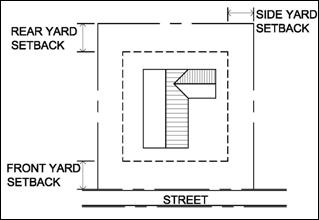
Setback
Sewage conveyance system. Pipelines, culverts, and appurtenances that transport wastewater and sewage from points of origin to wastewater treatment plants, or which convey treated wastewater to points of discharge. Also called wastewater conveyance systems.
Shed. An accessory structure designed to store tools, lawn and garden care or maintenance equipment or materials, and which is not designed to contain any habitable space.
Shelf space. Shelves with products accessible to consumers for consumer purchase, but not shelves used purely for storage.
Shopping center or commercial center. Also shopping mall. A commercial area or group of commercial establishments, planned, developed, managed and maintained as a unit, with common landscaping, amenities, and off-street parking areas.
Sidewalk sale or parking lot sale. The temporary outdoor display and sale of merchandise that is normally displayed indoors at the location of a retail business.
Sign. An object, device, display or structure used for visual communication, promotion, or advertisement of the interests of a person, business, group, or enterprise. The sign typically includes an announcement, declaration, demonstration, display, insignia, symbols, or illustration that are intended to attract attention to, identify, or advertise an establishment, product, service, activity, person, or location, or to provide information.
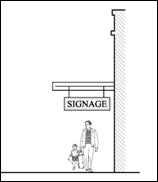
Signs
A-board/sandwich board signs. Small type signs, either single- or double-faced, portable, upon which is generally placed advertising copy denoting products or services being offered upon the premises on which such signs are placed.
Animated sign. A sign or part of a sign that is in action or motion, or that flashes or changes color by means of electrical energy, electronic or manufactured sources of supply. This does not include revolving signs and time/temperature signs.
Area of sign. The surface area of the sign, including all letters, symbols, pictures, or figures forming the display, as calculated from the boundaries formed by eight straight lines around the sign. Supports, columns, uprights, and other objects attached to the sign, which do not convey a message, are excluded in the area of the sign. Each face of the sign is included in calculating the area of the sign.
Awning sign. A sign affixed to the surface of an awning and that does not extend vertically or horizontally beyond the limits of such awning.
Banner sign. A sign made of cloth, fabric, paper, non-rigid plastic, or similar types of material. Banners may contain text, numbers, graphic images, or symbols. Pennants and flags are not considered banners.
Billboard. An outdoor advertising sign designed for the rental or lease of such sign for the use with preprinted or hand-painted changeable advertising copy that directs attention to businesses, commodities, services, or facilities that are not primarily sold, manufactured, or distributed from the property on which the sign is located. The term "billboard" includes both the structural framework that supports a billboard and any billboard faces attached thereto. Billboards are regulated by the Business and Professions Code Sections 5200—5499.
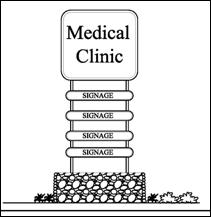
Signs
Building identification sign. A sign identifying the name of the building or property to which the sign is affixed.
Business identification sign. A sign that directs attention to a business or profession conducted, or to a commodity, service, or entertainment sold or offered upon the premises where such sign is located, or to which it is affixed.
Canopy sign. Any sign erected upon, against, or directly above a canopy.
Changeable copy sign (manual). Any sign that is designed so that characters, letters, or illustrations can be changed or rearranged by hand without altering the face or the surface of the sign, such as reader boards with changeable pictorial panels. A billboard is not a changeable copy sign.
Changing message center. An electronically controlled sign, message center, or reader board where copy changes of a public service or commercial nature are shown on the same lamp bank; i.e., time, temperature, date, news, or commercial information of interest to the traveling public.
Construction sign. A temporary sign designating the contractor(s), architect(s), and engineer(s) and other individuals or firms participating in a construction project underway on the site where the sign is located. Also, a temporary sign announcing the future use of the property on which the sign is located.
Directional sign. A permanently erected single- or double-faced sign designed to guide or direct pedestrian or vehicular traffic to an area, place, or convenience. Directional signs shall only contain information on exits, entrances, parking, telephones, restrooms, or similar types of information and the name and/or logo of the business where the directional sign is located.
Electrical sign. A sign or sign structure that uses electrical wiring, connections and/or fixtures as a part of the sign, but not including signs illuminated by exterior light source.
Electronic sign. A sign designed to allow changes in the sign graphics electronically.
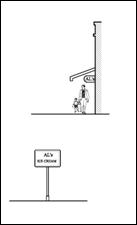
Signs
Flashing sign. A sign on which the light is not constant in apparent intensity and color when in use, uses intermittent electrical impulses; or revolves to create an illusion of flashing, provided that a slowly revolving sign and changing message centers will not be considered flashing signs.
Freestanding sign. A sign supported on the ground by poles, uprights, braces, or standards and is not connected to or supported by any other structure, building or wall. Pole signs and monument signs are examples of freestanding signs.
Gross area of sign. The area within a continuous perimeter formed by eight straight lines around the sign and enclosing the outer limits of the sign face, but not including structural elements that are not a part of the display. The gross area of a two-faced sign equals the area of one side. The "gross area" of a spherical, cubical, or polyhedral sign equals one-half the total surface area.
Identification sign. A sign that is limited to the name, address and number of a building, institution, or person and to the activity carried on in the building or institution, or the type of occupancy of the site, other than a private residence.
Lighted or illuminated sign. A sign designed to give forth an artificial or reflected light, either directly from a source of light incorporated into or connected with such sign, or indirectly from a source intentionally directed upon it, so shielded that no direct illumination from it is visible elsewhere than on the sign and in the immediate proximity thereof.
Marquee sign. A sign attached to and made part of a marquee. A marquee (or canopy) is defined as a permanent roof-like structure attached to and supported by the building and projecting beyond a building, but does not include a projecting roof.
Monument sign or ground sign. A ground-mounted, fixed sign that is located within four feet of the ground and is not supported by posts or poles or attached to or painted on fences, screening walls or similar structures.
Mural. A large sign, design, or picture, painted or drawn on the wall of a building by a professional artist, muralist, painter, or contractor.
Nameplate sign. A sign that indicates no more than the name, address, and home occupation of the resident of the premises.
Off-site sign. A sign that directs attention to a business, commodity, industry or other activity that is sold, offered, or conducted elsewhere than on the premises on which the sign is located.
Pole sign. A sign, electric or otherwise, hung, supported or cantilevered from one or more supports constructed of structural steel, pipe, other materials or a combination thereof.
Political sign. A sign that advertises a candidate for public elective office or any political party or a sign that promotes a position on a public or ballot issue.
Portable sign. A sign that can be moved, including sandwich boards, A-frames, placards, and trailer mounted signs.
Projecting sign. A sign, other than a wall sign, that is attached to and projects more than one foot from a structure or other building face.
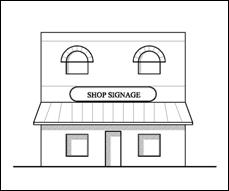
Signs
Reader board. A sign consisting of tracks to hold letters, lights or electronic message board that allows for frequent changes of copy.
Real estate sign. A temporary sign erected by the owner or owner's agent that directs attention to the sale, lease, rental, or other disposition of a particular building, property, or premise upon which it is displayed.
Roof sign. A sign erected upon, against or printed entirely on or above the roof or roof eave, on or above the parapet of a structure or building or an architectural adjunct.
Temporary sign. Any sign constructed of paper, canvas, fabric, cardboard, plastic or similar materials, including but not limited to flags and banners, which are constructed and designed for a temporary display or advertising a temporary event.
Wall sign. A sign that is posted, affixed, suspended, or painted on the exterior wall of a building or structure.
Window sign. A sign or message posted, painted, affixed, or attached to a window surface. Signs painted on windows, even if temporary in nature, are considered as window signs and regulated as such.
Single-family dwelling unit. A detached building containing one dwelling unit designed or occupied for the exclusive use of one household.
Single-family residential. One dwelling unit located on one parcel.
Single room occupancy housing. A housing unit with a room of not less than 275 square feet nor more than 450 square feet of floor area. The unit shall be provided with a separate closet, kitchen sink, cooking appliance and refrigeration facilities, each having a clear working space of not less than 30 inches in front. Light and ventilation shall conform to the California Building Code. The unit shall have a separate bathroom containing a water closet, lavatory and bathtub or shower. An SRO unit shall accommodate a maximum of two persons.
Site. A lot or group of contiguous lots that is not divided by an alley, street, other right-of-way, or City limit, and that is proposed for development under the provisions of this Zoning Code and is in single ownership or has multiple owners, all of whom join in the application for development.
Soil. The surface layer of the earth.
Solar apparatus or solar energy system. A device or equipment that is attached to a building, including the roof, used mainly for the generation of solar energy.
Solid waste. All wastes, including, but not limited to, garbage, rubbish, ashes, industrial wastes, swill, demolition and construction wastes, abandoned vehicles or parts thereof, discarded commodities, dangerous wastes, and problem wastes.
Specific plan. A plan for development as defined under California Government Code Section 65450 and as approved under this Zoning Code.
State. The State of California, unless another specific meaning is indicated by the context in which the term is used.
Storage. A place where goods, materials and other personal property is placed for more than 24 hours.
Stormwater conveyance facilities. The facilities that comprise the City's municipal separate storm sewer system (MS4), including, but not limited to, those facilities by which stormwater may be conveyed to the waters of the United States, such as flood control channels, any roads with drainage systems, municipal streets, alleys, catch basins, curbs, gutters, ditches, manmade channels or storm drains that are not part of a publicly-owned treatment work.
Stormwater multiple use facilities. Stormwater pond facilities that are also developed to allow uses such as parks, recreational, educational and research structures and activities.
Story. A portion of a building that includes the area between the upper surfaces of two consecutive floors or the ceiling above it if there is no upper floor. It includes a basement, cellar, and underfloor space.
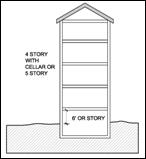
Story
Street. A public or private right-of-way that is dedicated and used for vehicle and pedestrian access to abutting property.
Street centerline. The centerline of a street or right-of-way, as established by official surveys.
Street grade. The top of the curb on a street, or the top of the edge of the pavement or travel lane where no curb exists.
Street fair or festival. Events providing games, eating and drinking facilities, live entertainment, or similar activities conducted within public streets and not requiring the use of roof structures.
Structure. Anything that is constructed in or on the ground or over water, including any edifice, gas or liquid storage tank, and any piece of work artificially built up or composed of parts and joined together. A structure does not include paved areas, fill, fences and freestanding walls less than six feet in height, or any vehicle, although a mobile home, relocatable building, or swimming pool is considered a structure.
Sundeck. An elevated platform on top of a garage or on the roof that is open to the sky. It may be supported from below or cantilevered and enclosed with a railing or balustrade.
Supermarket. A market having 8,000 square feet or more of its floor area used mainly for the sale of food. A market with less than 8,000 square feet shall be considered a grocery store or food market.
Supportive housing. Housing with no limit on length of stay, that is occupied by the target population as defined in Health and Safety Code Section 53260(d), and that is linked to on- or off-site services that assist the supportive housing resident in retaining the housing, improving his or her health status, and maximizing his or her ability to live, and when possible, work in the community.
Swimming pool, spa, or hot tub. An artificial body of water having depth of 18 inches or more and designed, constructed and used for swimming, recreation, dipping, or immersion purposes by humans.
T
Tandem parking. Parking space configuration where two or more parking spaces are lined up behind each other.
Target population. Adults with low-income having one or more disabilities, including mental illness, HIV or AIDS, substance abuse, or other chronic health conditions, or individuals eligible for services provided under the Lanterman Developmental Disabilities Services Act and may, among other populations, include families with children, elderly persons, young adults aging out of the foster care system, individuals exiting from institutional settings, veterans, or homeless people.
Telecommunication tower. See wireless communication facility.
Temporary use. A land use established for a specific period of time that is discontinued at the end of such time.
Temporary events. Activities that are held within a specific time period and that cease after such time. These include fairs, festivals, circus, sale of pumpkins, Christmas trees, etc., and other similar events.
Temporary housing unit. A mobile home or manufactured home that is proposed to be located temporarily on a lot, parcel, or tract of land. The lot, parcel, or tract's principal use shall be a single-family detached dwelling. The temporary housing unit shall be occupied by the parent or parents of the occupants of the dwelling, or not more than one individual who is a close relative of the occupants of the principal dwelling. An occupant of the temporary housing unit because of age, disability, prolonged infirmity, or other similar incapacitation is unable to independently maintain a separate type of residence without human assistance.
Temporary housing unit, construction. A mobile home or recreational vehicle that is placed on a lot or tract of land for the purpose of providing temporary housing for an individual who is in the process of constructing a permanent use or structure on the same lot or tract in accordance with a valid building permit.
Terminal post office. A government operated principal mail handling facility for a postal geographic service area.
Title. Title 18 of the Hawaiian Gardens Municipal Code or the Zoning Code, unless otherwise noted.
Townhouse or townhome. A dwelling unit attached typically to two or more other dwelling units by means of a roof and/or interior wall, with each dwelling unit occupying its own lot.
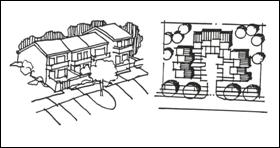
Townhouse
Toxic materials. See hazardous material. Substances and materials that are capable of causing injury to living organisms by chemical means when present in relatively small amounts.
Tract. A parcel of land, lot, building site, or contiguous combination thereof devoted to or intended to be devoted to a principal use and any other uses customarily accessory thereto.
Trailer. See automobile trailer.
Transient. A person who receives lodging accommodations, with or without meals for a period of 30 days or less, such as travelers and tourists.
Transitional housing and transitional housing development. Buildings configured as rental housing developments, but operated under program requirements that call for the termination of assistance and recirculation of the assisted unit to another eligible program recipient at some predetermined future point in time, which shall be no less than six months.
Transmission line. An electric power line bringing energy to a receiving or distribution substation.
Trash facilities or trash collection areas. Areas provided for the collection and collective removal of trash and recycling materials. Also, the area where trash and recycling receptacles are stored.
Tree, mature. Any tree with a trunk diameter of eight inches or more, measured 48 inches above the existing grade.
Tree nursery. A parcel of land used for the cultivation of landscaping materials and trees for commercial sale, but does not include agricultural areas for produce.
Tree protection. Measures taken, such as temporary fencing and the use of tree wells, to protect trees from damage or loss during or after construction.
Trucking terminal. Storage and distribution facilities having more than six heavy trucks (weighing 10,000 pounds or more when empty) on the premises at one time, excluding accessory trucking facilities incidental to the main industrial use.
Two-family unit. See duplex.
U
Unit. See dwelling unit.
Use or land use. The purpose or activity for which land or buildings are arranged, designed, or intended, or for which land or buildings are occupied or maintained and shall include any manner of performance of such activity.
Utility or public maintenance facility. Facilities for open and enclosed storage and maintenance of vehicles, equipment, or related materials used in a utility or public facility.
V
Vacate. To leave the premises permanently or abandon the use of a parcel or lot.
Variance. An adjustment to the development standards of the zone, as it applies to a specific property, that does not apply to the use or required density.
Vehicle/equipment repair. Repair of automobiles, trucks, motorcycles, mobile homes, recreational vehicles, or boats, including the sale, installation and servicing of related equipment and parts. This includes auto repair shops, body and fender shops, wheel and brake shops, tire sales and installation, but excludes vehicle dismantling or salvage yards and tire retreading and recapping facilities.
Vendors. Persons selling goods, services or other merchandise on public rights-of-way, store entries, or other outdoor areas, either stationary or mobile.
Veterinary clinic. Also animal hospital. A licensed establishment where animals are given medical or surgical treatment and care, primarily on an out-patient basis and where the boarding of animals under treatment is incidental to the principal clinic use.
Vision clearance area. The triangular areas located at the corners of public or private property adjacent to intersecting streets, alleys, and private driveways that are kept free of obstructions, such as fences, hedges, trees, shrubs, walls, or other objects that limit visibility for turning vehicles.
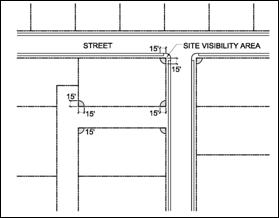
Vision Clearance Area
W
Wall. The vertical exterior surface of a building or structure. Also, the vertical interior surfaces that divide a building into rooms.
Warehouse and storage facility. A facility designed for the provision of storage space for household or commercial goods within an enclosed building. This includes storage facilities, mini storage facilities, but excludes truck terminals. While a warehouse does not provide exclusive use of a contained or uncontained storage space to an individual, a self-storage facility rents or leases storage space to persons for their exclusive storage use of that space. See self-storage facility.
Warehouse club. A business establishment selling primarily bulk merchandise and charging membership dues or otherwise restricting sales to customers paying periodic access fees.
Wastewater. Water carrying waste from domestic, commercial, or industrial facilities, together with other waters that may inadvertently enter the sewer system through infiltration and inflow.
Wholesale, distribution, and storage. Establishments engaged in selling merchandise to retailers; to industrial, commercial, institutional, or professional business users; or to other wholesalers; or acting as agents or brokers in buying merchandise for, or selling merchandise to, such persons or companies, not including retail sales. Also includes the storage and distribution of goods and supplies within an enclosed building. See warehouse and storage building and self-storage facility.
Wireless communication facility. Facilities for the transmission and reception of radio or microwave signals used for communication, cellular phone, personal communications services, enhanced specialized mobile radio, and any other services licensed by the FCC and unlicensed wireless services including but not limited to associated equipment shelter, support tower, and antenna array.
Attached cellular communication facility. A cellular facility that is affixed to an existing structure, such as an existing building, tower, water tank, utility pole, etc.
Camouflaged or concealed telecommunications design. Also stealth design. A personal wireless service facility that is disguised, hidden, or integrated with an existing structure that is not a telecommunication tower; or, a personal wireless service facility that is placed within an existing or proposed structure; or, a new telecommunication tower that is hidden within trees or other feature so as to be significantly screened from view.
Cell on wheels (COW). A mobile telecommunications facility transported by a motor vehicle for temporary on-site use.
Cellular communication support structure. The structure erected to support cellular communication antennas and connecting appurtenances. Support structure types include, but are not limited to, monopoles, lattice towers, wood poles, or guyed towers.
Co-location. The use of a single support structure, including but not limited to, a building, monopole, lattice tower, water tank, or other structure by more than one licensed personal wireless communication service provider.
Communication service provider. A corporation, company, association, joint stock company, firm, partnership, limited liability company, other entity, and individual licensed to provide personal wireless service or personal wireless communication facilities.
Telecommunication tower or transmission tower. A structure that is designed and constructed primarily for the purpose of supporting one or more antennas, including but not limited to self-supporting lattice towers, guy towers, or monopole towers. The term encompasses personal wireless service facilities including radio and television transmission towers, microwave towers, common-carrier towers, cellular telephone towers, or personal communications services towers, and alternative tower structures.
Telecommunications radio relay station. A facility containing structure and equipment for the transmission of telecommunications messages between telephone system facilities, by microwave, radio or similar technologies.
X
Y
Yard. An area defined by the required setbacks on any lot, unoccupied by a structure and unobstructed from the ground to the sky, except as otherwise permitted by this Zoning Code.
Front yard. A yard lying between the nearest line of any structure and the front lot line and extending across the full width of the lot.
Rear yard. A yard lying between the nearest line of any structure and the rear lot line and extending across the full width of the lot.
Side yard. The yard between the side exterior wall of a building and the nearest side lot line, extending from the front yard to the rear yard.
Youth hostel. A supervised lodging facility for young travelers.
Z
Zone. A specific area or district in the City, where uniform development standards and land uses have been established by this Zoning Code, the boundaries of which are defined in this Zoning Code and shown in the zoning map.
Zone change. An official act of amending this Zoning Code by changing the applicable zone designation for a parcel or lot or moving the zone boundaries in the zoning map.
Zoning Code. The Zoning Code of the City of Hawaiian Gardens.
Zoning Code amendment. An official act of amending the text of this Zoning Code, including revisions to the standards and procedures contained in this Zoning Code.
(Ord. 548 §§ 1, 2, 2013; Ord. 537 § 1, 2011; Ord. 505 § 2, 2006)
(Ord. No. 585, § 2(Exh. B), 12-10-2019; Ord. No. 591, § 3, 2-11-2020)
18.20.040 - Code interpretation.
Whenever there is uncertainty over the meaning of the terms in this Zoning Code, official interpretation of the provisions of this Zoning Code shall be made by the Community Development Director. Such interpretations may be referred by the Community Development Director to the Planning Commission and the City Council for review, if the Director determines on a case-by-case basis, that the public interest would be better served by such referral.
(Ord. 537 § 1, 2011; Ord. 505 § 2, 2006)

