
Hawaiian Gardens City Zoning Code
CHAPTER 18
50 - RESIDENTIAL REGULATIONS3
The purpose of this section is to provide development requirements, including parking, landscaping, trash enclosures, fences, walls, outdoor storage, and residential design standards for the development of uses within the City's residential zones identified in Chapter 18.40. Provisions set forth in Chapter 18.90 supplemental regulations, where applicable, shall also apply to this chapter. Where standards conflict between Chapter 18.90 and this section, the standards set forth in this chapter shall take precedence.
Editor's note— Ord. No. 2024-620, § 2(Att.), adopted January 8, 2025, repealed the former Ch. 18.50, §§ 18.50.010—18.50.100, and enacted a new Ch. 18.50 as set out herein. The former Ch. 18.50 pertained to similar subject matter and derived from Ord. 505 § 2, adopted 2006; Ord. 537 § 1, adopted 2011; Ord. 548 § 8, adopted 2013; Ord. No. 585, § 2(Exh. B), adopted December 10, 2019.
18.50.010 - Parking and loading requirements.
The purpose of the parking and loading regulations is to ensure that all land uses provide adequate off-street parking facilities, loading areas, and vehicle movement area associated with development. The intent of these regulations is to ensure that the use of land does not interfere adversely with the circulation on public rights-of-way, that private on-site circulation does not pose a potential safety problem, and that surrounding uses are insulated from the impacts of off-street parking and loading facilities.
A.
Applicability.
1.
Every land use in the City shall provide permanent off-street parking facilities for vehicles and loading spaces in accordance with the provisions of this section.
2.
The minimum standards of this section shall apply to new buildings or uses, proposed additions to or enlargements of existing buildings or uses, and any proposed changes in building occupancy or building use that would require additional parking spaces.
B.
Parking and loading spaces.
1.
Number of parking spaces. Required off-street parking spaces for specific uses are listed below and in Section 18.70.010, non-residential parking and loading requirements. The requirement for a use not specifically mentioned shall be the same as for a specified use which has the most similar traffic and/or parking generation characteristics, as determined by the Community Development Director.
2.
Fractions. If the calculation of required parking spaces results in a fractional number, the fraction shall be rounded up to the next whole number.
3.
On-street parking. On-street parking spaces shall not be used in meeting the required off-street parking spaces.
4.
Loading spaces. No loading spaces are required for residential uses. Loading requirements for non-residential uses are outlined in Section 18.70.010, non-residential parking and loading requirements.
C.
Handicap accessible parking spaces. Handicap accessible parking spaces shall be provided and constructed in accordance with State Building Code (Title 24 of the California Code of Regulations) and the sign requirements of the California Vehicle Code, Sections 22511.7 and 22511.8. In addition, the following standards shall be implemented:
1.
One handicap accessible parking space shall be provided for each dwelling unit designed for people with disabilities.
2.
Handicap accessible parking spaces shall be located on the shortest possible accessible route from adjacent parking to an accessible building entrance. In facilities with multiple accessible building entrances with adjacent parking, handicap accessible parking spaces shall be dispersed and located near the accessible entrances.
3.
Handicap accessible parking spaces shall be provided as follows and shall count towards meeting the total parking spaces required:
D.
Parking layout and dimensions. Parking facilities shall be designed to conform to the following minimum standards:
1.
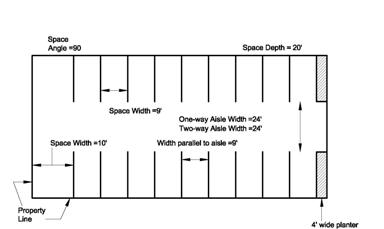
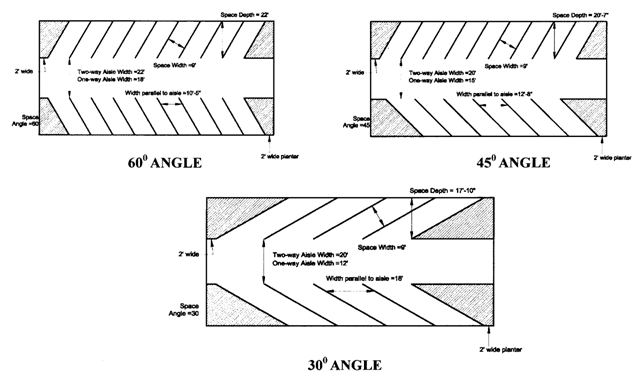
Parking space, drive aisles, driveways, and other parking lot facilities shall have the minimum dimensions indicated below.
1 Space width is measured perpendicularly from center of stripe to center of stripe.
2 Wider aisles may be required for fire access and emergency vehicles.
2.
Parking spaces parallel to the property line shall not be less than ten feet by 22 feet per vehicle.
3.
For angled parking, the minimum distance of the first parking space for angle parking shall be ten feet from the property line.
4.
Tandem parking shall not be considered as meeting the minimum off-street parking requirements for single-family dwellings unless provided as the third and fourth parking space, except that tandem parking may be used for single-family dwellings located on lots less than 30 feet in width through the approval of a minor use permit when it is demonstrated that doing so would result in a more efficient use of the property and the design of the project would be more aesthetically pleasing to the surrounding neighborhood.
5.
No compact spaces are allowed in residential zones.
6.
All parking areas shall be striped to clearly show the layout of the parking stalls. Striping shall be at least four inches in width and shall be maintained in a clear, visible, and orderly manner at all times.
E.
Location of parking facilities. Off-street parking facilities shall be located as hereinafter specified. Where a distance is specified, such distance shall be the walking distance measured from the nearest point of the parking facility to the nearest point of the building that such facility is required to serve.
1.
Parking facilities serving residential uses shall be located on the same property as the use the parking is intended to serve.
2.
Property within the public right-of-way shall not be used to provide the required parking facilities.
3.
Required parking spaces for single-family homes shall be provided within an enclosed garage. Carports are allowed in lieu of garages for multi-family projects. Guest spaces may be provided in an open parking lot and may be provided within the rear yard setback.
a.
The garage shall have inside dimensions of at least 12 feet by 20 feet for one car and 18 feet by 20 feet for two cars. The depth of tandem parking spaces shall be at least 36 feet. The minimum garage door width for a two-car garage shall be 16 feet.
b.
The garage shall be made of permanent construction, using new, conventional materials, such as wood or light gauge metal framing. Temporary prefabricated canopies shall not be used to provide required parking.
c.
A detached garage is prohibited to be built in the required front yard and side yard setbacks. A detached garage may be built along the rear property line. The garage may be built along one interior side yard property line to a distance not more than 24 feet from the rear property line. All roof drainage shall be confined to the subject property and shall not drain to neighboring properties. If a garage is not built on the property line a minimum setback of three feet is required along the adjacent rear and side property lines to allow access around the garage.
d.
Garages or carports that have access from a street shall be located so that there is a minimum of 20 feet of driveway between the front property line and the front of a garage door or carport. Garages or carports that have access from an alley shall be located so that there is a minimum of ten feet of driveway between the rear property line and the front of a garage door or carport.
e.
If laundry facilities, work space, or other uses are provided within the garage, additional floor area shall be provided to ensure that the required parking space and adequate vehicle storage is still available.
f.
Carports may be utilized for parking spaces if permanently anchored to the ground with use of foundations.
g.
Tarps shall not be used to enclose any parking space in any circumstance. Temporary prefabricated canopies may be used to cover parking spaces other than those not required by this section subject to the regulations in subsection M., below.
4.
For hospitals, large group homes, institutions, rooming and lodging houses, adult retirement homes, congregate care facilities, and community clubs, parking facilities shall be located no farther than 150 feet from the facility.
5.
Parking spaces at the end of a parking aisle against a curb or wall shall be widened by one additional foot.
6.
Except for single-family and two-unit multi-family developments, no parking facility shall be designed so vehicles are required to back into a public street to exit the facility. The turning radius for all residential development projects shall be a minimum of 24 feet. All parking stalls for multi-family projects shall have a 90-degree parking angle.
F.
Driveways and access. All dwelling units shall have direct access to a public street or public alley, except for mobile homes within a mobile home park, which shall only have frontage on internal private drives. Each required parking space shall be provided with adequate ingress and egress through a paved driveway. The location of the driveway shall be in the position with the most direct route to parking spaces.
1.
Vehicular access.
a.
All uses which adjoin a major highway shall, whenever possible, take access by way of a secondary road.
b.
For lots developed with single-family residences and abutting an alley, garage access shall be taken from the alley.
c.
Access to driveways shall be located so as not to interfere with the traffic flow on adjacent streets.
d.
Access driveways across sidewalks or pedestrian ways shall be designed in such a manner as to promote pedestrian safety.
e.
Access and driveways shall be located along the most direct route to the garage.
2.
Driveways. Driveways shall have maximum widths of 40 percent of the front lot line or less, and shall comply with the following standards:
a.
Driveways shall be ten feet wide if serving five or less off-street parking spaces for a residential use.
b.
Driveways shall be 16 feet wide if serving more than five off-street parking spaces for a residential use.
c.
Driveways shall be no more than 24 feet wide if serving a multi-family residential use.
d.
All driveways shall maintain a vertical clearance of at least ten feet.
e.
No more than one driveway per residential parcel is permitted, unless serving a secondary residential use in the rear. The driveway shall not be expanded to accommodate additional parking in the front yard setback.
f.
One driveway may serve adjacent uses or abutting properties only if proper easements and agreements are executed and filed with the City and recorded with the County Recorder.
g.
Driveways and parking areas shall be surfaced and improved with Portland concrete cement, or other material approved by the Community Development Director and maintained in good serviceable condition. Thereafter, every three years, all parking areas and drive aisles shall be slurry sealed and properly maintained. Parking lots shall be regularly cleaned and be free of any trash or debris.
h.
Abandoned and unused existing driveway approaches shall be removed and replaced with sidewalk, curb, and gutters in accordance with City standards and at the expense of the property owner.
i.
Commercial trucks and vehicles over one ton shall not be parked in any residential zone or public right-of-way.
j.
Driveways shall at all times be kept and maintained free and clear of any inoperative vehicle, debris, waste, junk, building materials, boxes or any other items which block or limit access to the garage or parking area.
k.
Where required for public safety, appropriate exit, entrance and directional signs shall be posted and maintained at locations approved by the Community Development Director.
l.
Six-inch concrete curbs shall be installed along the borders of all required landscaped areas, where said landscaped areas abut driveways, off-street parking and loading areas, and other similar facilities.
m.
Fire lanes shall be adequately marked and patrolled to prevent parking and other obstructions.
n.
Circular driveways shall be permitted on lots in the R-1 zones that are greater than 75 feet in width. The turning radius of a circular driveway shall be a minimum of 15 feet measured at the inside of the curve.
3.
Parking on driveways.
a.
Where the driveway serves more than five parking spaces, no vehicle shall be parked or left on the driveway except for temporary loading and unloading of passengers or goods.
b.
Parking on driveways serving single-family and duplex units shall be perpendicular to the garage door or car port.
4.
Safe access. Except for single-family homes, internal walkways shall be provided to assure safe access to the building from parking areas, adjacent properties, and public sidewalks.
G.
Shared parking. No shared parking is allowed on properties that are only developed with residential uses.
H.
General requirements.
1.
Off-street parking facilities for a specific building or use shall not be applied towards the minimum parking requirements for other buildings or uses.
2.
All off-street parking areas, driveways, and driving aisles shall be paved, striped, and marked to clearly define access lanes, parking spaces and internal circulation, in accordance with adopted City standards. Such surfacing shall be designed, constructed, and maintained to prevent surface water ponding. Drainage of runoff shall not be allowed across public sidewalks.
3.
Bumpers, wheel stops, stall markings, and other vehicular controls are required for off-street parking facilities serving uses other than single-family residences, as set forth in the City of Hawaiian Gardens' Public Works Standards. Planting aisles may be used in lieu of bumpers or wheel stops at the discretion of the Community Development Director. Curbs shall be installed a minimum of five feet from any wall, fence, building, or other structure. The minimum standard curb radius shall be six feet at all aisle corners.
4.
Lighting in open parking areas shall be cut-off lighting directed toward the parking surface to avoid light and glare impacts to adjacent properties.
5.
An off-street parking facility for an existing use that does not conform to the minimum requirements of this section is subject to Section 18.100.130, nonconforming uses and structures.
6.
Required parking spaces and areas shall be maintained for the duration of the use requiring such areas.
I.
Use of parking areas.
1.
Required parking spaces and areas shall not be used for the sale or display of goods and services, or for the sale, display, or repair of motor vehicles unless approved through a temporary use permit.
2.
Temporary use of parking areas for special events or sales may be permitted subject to the conditions of the temporary use permit for the activity.
3.
All required off street parking spaces shall be designed, located, constructed, and maintained so as to be fully and independently usable and accessible at all times.
4.
No owner or tenant shall lease, rent, or otherwise make unavailable to intended users any off street parking spaces required by this title.
J.
Parking in front yards of residential lots.
1.
All vehicles parked in the front yard of a residential lot shall be parked only on a driveway leading directly to a garage or carport, and shall be parked on a fully paved surface. Driveways shall be no wider than the garage or carport to which the driveway provides direct access.
2.
Parking on unpaved surfaces, concrete tiles or blocks or similar surfaces is prohibited.
3.
Parking of vehicles outside of designated parking spaces is prohibited. This includes parking in loading areas, fire lanes, yards, and other open areas not specifically designed to accommodate a vehicle.
K.
Residential garages.
1.
The capacity of single-family residential garages, whether attached or detached to the main dwelling unit shall not exceed three automobiles, except that garages for up to four automobiles may be permitted on lots wider than 75 feet.
2.
If a three-car garage is provided, the third garage shall be recessed a minimum of two feet from the front of the two-car portion of the garage.
3.
Garages shall not exceed a maximum size of 650 square feet.
L.
Parking structures.
1.
On-grade parking structure walls facing a public right-of-way and any other parking structure walls greater than 25 feet in length shall include design features consisting of textured surfaces, articulation, and/or landscaping (vines to cover large surface area) covering a minimum of 50 percent of the wall surface area. The design of all parking structure walls shall include the same materials, colors, and surfaces as other buildings associated with the development. Articulation includes faux windows, arches, grillwork, building offset, and stone/tile building materials.
2.
Below-grade parking structures shall be screened from the street by landscaping, berming, low walls or fences, or buildings.
3.
Gated, fenced, or underground parking facilities, and gated exterior stairwells shall incorporate access control technology (e.g., access card or key).
M.
Bicycle parking.
1.
Short-term bicycle parking shall be provided in the form of an inverted "U" shape facility, or other design approved by the Community Development Director. Bicycle parking shall not be separated from building entrances by a road, parking area or structure.
2.
If provided, long-term bicycle parking shall be provided on-site in a secure, enclosed structure, or in a secured location within a parking structure.
N.
Parking lots in residential zones. Where parking lots for nonresidential uses are allowed in residential zoning districts they shall be developed in compliance with the following requirements in addition to other applicable standards provided in this section. The construction of a new parking facility or alteration/maintenance of an existing parking facility for an existing church use in the RIH zone shall be subject to the requirements set forth in Section 18.70.010 and is not subject to the requirements of this subsection.
1.
Conditional use permit required. Approval of a conditional use permit shall be required in order to locate a parking facility intended for nonresidential use within a residential zoning district.
2.
Location of parking area. The parking area shall be accessory to, and for use of, one or more contiguous nonresidential uses allowed in a contiguous commercial zoning district. The Commission may grant a waiver for noncontiguous parking areas, but only under all of the following conditions.
a.
The parking area would be designed to be compatible with the adjacent uses.
b.
There are no residential uses between the parking area and the use for which the parking is being provided.
c.
The parking area would not fragment the surrounding residential neighborhood.
d.
The parking area would not be detrimental or injurious to property and improvements in the residential neighborhood.
e.
The parking area would be located within a reasonable walking distance of the use to which it is an accessory.
3.
Access. Access to parking areas shall be from commercial streets or alleys. An exception may be granted by the Planning Commission if no commercial streets are available for access.
4.
Passenger vehicle parking only. Parking areas shall be used solely for the parking of passenger vehicles.
5.
Signs. No signs, other than signs designating entrance, exits, and conditions of use shall be maintained in parking areas. Signs shall not exceed four square feet in area and five feet in height. The number and location shall be approved by the Community Development Director before installation.
6.
Perimeter wall. The parking area shall have a solid masonry wall six feet in height along all interior property lines adjacent to residential zoning districts and 36 inches in height adjacent to streets and the front setback area of an abutting residential use.
7.
Development standards. The parking lot shall be developed in compliance with the development standards of this section.
8.
No overnight parking. Overnight parking shall be prohibited and the parking area shall be secured after business hours to prevent any use of the facility.
O.
Temporary prefabricated canopies. Temporary prefabricated canopies may be used for covered parking and for temporary events in residential zones subject to the following regulations.
1.
Number of canopies. Only one temporary canopy shall be permitted per lot.
2.
Size of canopies. The maximum size of a canopy shall be nine feet by 20 feet and ten feet in height.
3.
Location of canopies.
a.
Canopies shall not be permitted in the front yard area of a residential property. The front yard area includes all areas located in front of the dwelling unit located nearest to the front yard property line, including the front yard setback.
b.
Canopies shall not be located within a required side yard setback unless they are placed behind the front building wall of the primary structure.
c.
Canopies may be placed within the required side or rear yard setback a minimum distance of three feet from the side or rear property lines.
4.
Fire rating required.
a.
Only canopies with documented fire ratings shall be allowed. Proof of fire rating shall be required. A Fire Marshal's tag shall be required on all canopies stating that the canopy has been treated to prevent the spread of fire.
b.
If a canopy is not fire rated, a minimum distance of ten feet shall be maintained between the canopy and any structure on the same property or adjacent properties.
5.
Secured to the ground. All canopies shall be adequately secured to the ground to prevent movement.
6.
Color. Canopies shall be white, light grey, or other light color.
7.
Maintenance. Canopies shall be maintained in good condition at all times. Canopies that are deteriorated, torn, soiled, or are causing a condition that is detrimental to adjacent properties shall be rehabilitated or removed.
8.
Temporary event. Canopies may be used for temporary events held by the resident of the subject property for a maximum of two days. Canopies shall be removed immediately following the event.
9.
Code compliance. Use of a canopy in a manner other than specified above shall be a violation of the Zoning Code and shall be subject to code enforcement action.
(Ord. No. 2024-620, § 2(Att.), 1-8-2025)
18.50.020 - Landscaping an screening.
The purpose of this section is to provide landscaping and buffering standards to improve the aesthetic appearance of the City and to promote compatibility between land uses. In addition, this section encourages the use of water efficient techniques in the design and maintenance of landscaping, promotes the safety of pedestrians and motorists, and enhances the distinctive character of the City. This section shall apply to all new projects and additions and existing properties.
A.
Landscaping standards.
1.
Landscaped area and design. All open areas within a lot including required setback areas, excluding parking areas and driveways, shall be landscaped with sod, shrubs, or trees.
a.
Landscape designs shall consider such factors as the function of the landscape elements, compatibility to the area, consistency with the building and its architectural design.
b.
The plant material selected shall be suitable for the given soil and climate conditions.
c.
The landscape plan shall incorporate measures for the preservation of existing mature trees on site, as feasible. The area under the drip line of existing trees which are to be saved shall be fenced during construction to protect the trees from damage and to prevent soil compaction, along with other tree protection measures as necessary.
d.
Front yards which are not occupied by driveways or walkways shall be landscaped with sod, shrubs and trees. The side yards of single-family dwelling units shall be improved with concrete, decorative stone or covered with sod. All rear yards shall have a minimum of 50 percent landscape area.
e.
For non-single-family development projects, landscape plans shall be submitted for review along with the project submittal and prepared by a professional landscape designer. Plant materials shall be sized and spaced to achieve immediate effect and shall not be less than 24-inch box for evergreen trees, one gallon for mass planting and five gallon for shrubs. The Community Development Director may require larger sizes and quantities to achieve specific effect.
f.
Crushed rock or gravel shall not be used on more than ten percent of the area requiring landscaping.
g.
Where shrubs or low level vegetation is used, vegetative matter at maturity shall cover at least 75 percent of actual planted area and shall incorporate a minimum of two inches of mulch.
h.
All landscape species and quantities are subject to the review and approval by the Community Development Director.
i.
For non-single-family projects, a mixture of 24-inch, 36-inch, and 48-inch box evergreen trees and five-gallon and 15-gallon size shrubs shall be used.
2.
Installation of required landscaping. All required landscaping shall be installed prior to the issuance of a certificate of occupancy from the Building and Safety Division.
3.
Safety. Trees and shrubs shall be planted in a manner that at maturity they do not interfere with utility lines, sight lines for traffic safety or encroach on adjacent property.
4.
Irrigation of landscaping. All landscaped areas shall include an automation irrigation system approved by the City that provides adequate coverage and irrigation. Water runoff into public right-of-way is prohibited. Landscape and irrigation plans subject to the California State Model Water Efficient Landscape Ordinance shall conform to the requirements of such ordinance to achieve water efficient landscaping..
5.
Drip irrigation shall be used wherever possible. No overhead irrigation is allowed within 24 inches of a non-permeable surface.
6.
Storm water retention requirements for each specific project area shall be reviewed with the City's Public Works Department. Additional plant material specifically addressing water retention areas can be gleaned from the Low Impact Development Manual for Southern California prepared by the Southern California Stormwater Monitoring Coalition.
7.
Maintenance guarantee. The owner or responsible person of the residential development is responsible for maintaining or assuring the ongoing maintenance of installed landscaping so that the landscaping continues to thrive. This shall include proper pruning, mowing of lawns, weeding, and removal of litter, fertilizing, replacement of plants when necessary, and application of appropriate quantities of water to all landscaped areas. In addition, landscape maintenance practices which foster long term landscape water conservation shall be employed.
8.
Landscaping maintenance. All existing landscaped planters and landscaped areas shall be maintained with a variety of shrubs, groundcover and trees. These areas shall be kept free of weed and debris and replaced immediately when vegetative matter is dead or damaged.
B.
Street trees. The following requirements apply to non-single-family projects only:
1.
Street trees are required along the project perimeter abutting the public ROW.
2.
Street trees shall be planted within the ROW, approximately three feet behind the curb or sidewalk.
3.
Where a landscaping strip is not feasible, tree wells shall be provided around each street tree.
4.
There shall be a minimum of one street tree for every 25 linear feet of street frontage within or adjacent to the development.
5.
Street trees shall be located at least three feet from any meter box; at least five feet from underground utility such as water, storm drain, gas, elective, and telephone; at least eight feet from sanitary sewer lines and driveways; and least ten feet from fire hydrants, utility poles, overhead utility wires, street light luminaries, and aboveground utility structures such as transformer enclosures.
C.
Perimeter buffering/screening.
1.
Screening requirement. Perimeter buffering for non-single-family developments and non-residential uses in a residential zone, which may include a combination of landscape materials, low level walls and structures, shall be used to screen parking areas, loading areas, and utilities from public view.
2.
Perimeter landscape strip. A landscape strip shall be provided and maintained, except in a required driveway or other access area, that is no less than five feet in depth measured horizontally from the front property line adjacent to the public right-of-way. The perimeter landscape strip shall consist of trees, shrubs, groundcover, and/or turf.
3.
Buffer areas abutting residential use. A landscape buffer shall be provided and maintained on non-residential sites when the side or rear yard of the parcel abuts a residentially zoned parcel. The buffer area shall be planted with a minimum of one tree per every 30 linear feet along the adjacent property line. Tree placement does not have to be linear or equal spacing. Shrubs, groundcover, and/or turf shall be planted to provide 100 percent coverage within two years of planting. Where possible, vines shall be grown onto walls and fences to soften their appearance.
(Ord. No. 2024-620, § 2(Att.), 1-8-2025)
18.50.030 - Enclosures.
The purpose of this section is to ensure that all uses in the City are provided with trash receptacles to promote public health and safety, as well as to screen areas used for the storage of trash receptacles from public view. This section shall apply to all new developments, additions and existing properties.
A.
Trash receptacles.
1.
All waste material, debris, refuse or garbage shall be kept in an enclosed building or properly contained in a closed container designed for such purposes. Each lot shall be provided with facilities for the storage and collection of trash.
2.
All trash, rubbish, recycling, and garbage receptacles shall be regularly cleaned, inspected and maintained in clean, safe and sanitary conditions.
3.
All trash storage shall be located for convenient vehicular access for pick up and disposal.
4.
Trash and recycling receptacles shall not be stored within the front yard setback or the rear or side yard setback which abuts a public street, unless screened from view from public rights-of-way.
B.
Collection areas. Except for single-family residences and duplexes, all residential developments shall provide on-site collection areas for trash, waste, garbage, refuse, and recyclables. These areas shall comply with the following standards:
1.
Trash collection areas shall be located within 200 feet of the building or units they are designed to serve.
2.
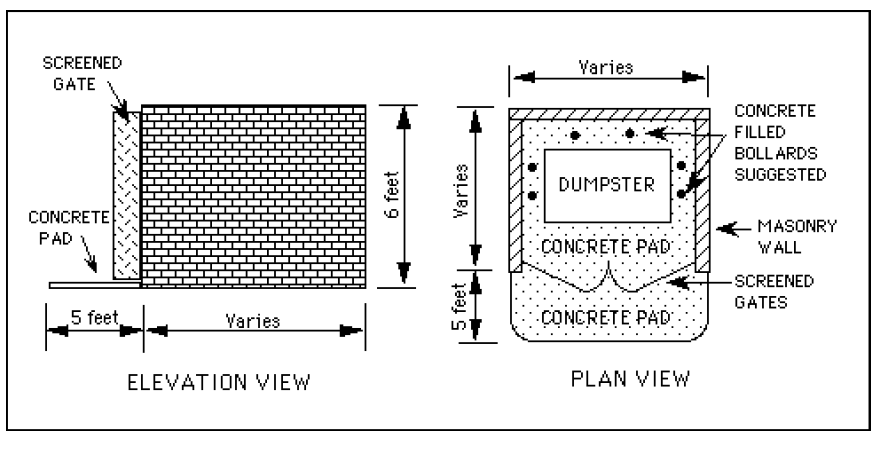
All outside trash and garbage collection areas shall be enclosed by a six-foot enclosure with gates, so that contents are not visible from any public street or adjacent property.
3.
Trash enclosures shall be provided for in accordance with the following:
a.
Trash enclosures shall have a minimum of 35 square feet in area. The size of the enclosure(s) shall be determined by the Community Development Director, based upon the size and nature of the facility.
b.
Enclosures shall be designed with the same primary wall materials and colors as the nearest building within the development.
i.
Enclosures shall be either opaque fencing or walls, and include an opaque gate.
ii.
The trash enclosure shall be provided with a lid or cover if the bins are left open, to prevent windblown trash and debris.
iii.
Corrugated metal, plastic, and chain link fencing with or without wooden/plastic slats, is prohibited.
iv.
Enclosure dimensions shall conform to solid waste provider dimensions.
c.
The floor of the trash enclosure shall be a concrete pad which shall extend five feet beyond the opening of the trash enclosure.
d.
The gate or door shall be of sufficient width to provide reasonable and necessary access to the storage area for deposit and removal of wastes, waste bins, and other contents.
e.
Clear visibility for adjacent drive aisles shall be maintained.
f.
Trash enclosures shall be located so as to minimize disturbance to single-family residential development. Trash enclosures shall be at least 50 feet away from any single-family residential zone, unless the adjacent property is undeveloped and the City determines that the setback will not fulfill its intended purpose at the present time.
g.
In accordance with Section 6.47.090 of the Hawaiian Gardens Municipal Code, trash enclosure areas shall not be designed in the path of drainage nor shall roof drainage downspouts discharge into the trash enclosure.
h.
The disposal of hazardous wastes into trash containers used for municipal trash disposal so as to cause a discharge into the municipal separate storm sewer system (MS4) is prohibited by law.
C.
Mailboxes for multi-family projects.
1.
Common mailbox enclosures shall be designed using the same materials and colors as the surrounding residential buildings.
2.
Mailboxes shall be placed either at an on-site location adjacent to or incorporated into a common area for all residents, or at individual units.
(Ord. No. 2024-620, § 2(Att.), 1-8-2025)
18.50.040 - Fences, walls, gates, and hedges.
This section outlines the regulations for the design, construction, and maintenance of fences, walls, gates, and hedges for the separation of parcels and property, and as a means of promoting privacy, preventing nuisance impacts on adjacent uses, and promoting community character. All residential developments, including single-family dwelling units, shall be improved with a fence or wall in accordance with the provisions below, except for the front yard setback, which is optional. The property owner shall be responsible for the construction of any walls or fences that occur within their property. The Community Development Director may require that the lot be surveyed by a licensed surveyor for verification of lot lines prior to construction.
Although most walls and fences under six feet in height do not require building permits, property owners are required to submit plans to the Community Development Department for administrative review. This section shall apply to all new projects, additions and existing properties.
A.
Maximum heights.
1.
Any fence, wall, gate, or hedge located in the required front yard shall be between a minimum height of 36 inches and a maximum height of 42 inches if made of solid materials or a maximum height of 48 inches if it is a wrought iron fence or combination thereof.
2.
A fence, wall or hedge located in the required rear or side yards shall be a maximum six feet in height.
3.
The height of a fence, hedge, or wall shall be measured from the existing grade at the location where the fence, hedge, or wall is located. Where there is a difference in the grade between two adjacent lots, the height of a fence, hedge, or wall located along the property line shall be determined by using the existing grade of the lowest contiguous lot.
4.
Plant materials provided within side and rear yards, which are used for buffering, may exceed eight feet in height provided that they do not obscure the vision of any driveway approach.
5.
No fence, wall, or hedge located within the rear 20 feet of a through lot shall exceed 42 inches in height.
6.
Under no circumstance shall any wall or fence be allowed to exist anywhere on the property that exceeds the height limitations of the respective setback area as described above between the perimeter property line and the face of the building.
7.
The owner of any vacant lot or unoccupied building shall be responsible for keeping such land free of all rubbish, refuse, weeds and debris and enclosed by a six-foot chain link fence around the entire perimeter of the property. The fence shall be installed with the proper top rails and post at the proper intervals. The fence shall be knuckled at the bottom and top to avoid sharp edges. Access gates shall be adequately provided for vehicle entry.
8.
For non-single-family projects, fences between any private open space, common areas, or public spaces shall be limited to a maximum of three feet in height.
B.
Fencing materials.
1.
For existing developments, wood, masonry, wrought iron fencing materials, or combination thereof shall be used for fences, walls or gates. Eligible properties may also participate in a white picket fence program as established through program guidelines which may be amended from time to time. Chain link fencing is not permitted in the City.
2.
All new residential developments shall be improved with a masonry block wall. The front yard setback may use a combination of wrought iron and masonry as fencing material. Existing block walls may be salvaged at the discretion of the Community Development Director provided the wall is repaired and resurfaced with a stucco coating.
3.
No barbed or razor wire shall be used or maintained as part of any fence, wall, gate, or hedge. No sharp points shall project from the top of any fence or wall, including but not limited to wrought iron elements with sharp points, pointed caps on the top of pilasters, and other sharp elements.
4.
The use of a chain link fence shall be prohibited in all residential developments. An existing chain link fence may only be repaired or maintained in an existing residential development.
5.
No salvaged materials, scrap wood, or recycled materials shall be used for fencing or walls. Fencing and walls shall be constructed with all new materials.
6.
It will be the applicant's responsibility to eliminate double walls at property lines. Developers will make every effort with neighboring parcels to negotiate a new wall and cover all expenses.
7.
Plastic slats may be used as a screening material for existing chain link fences. No other material or fabric may be used for screening or attached on any type of fence in the City.
8.
All non-transparent perimeter walls and/or fences shall be architecturally treated on both sides.
C.
Walls and fences along the street.
1.
All swinging gates shall be prohibited from encroaching into the public right-of-way.
2.
Fences placed adjacent to a street shall be screened with a four-foot wide landscape buffer.
3.
All exterior perimeter walls located along public streets shall have an offset a minimum of five feet deep for every 50 linear feet to 75 linear feet of the wall length.
(Ord. No. 2024-620, § 2(Att.), 1-8-2025)
18.50.050 - Lighting and security.
This section regulates lighting and security standards for multi-family residential developments. However, regulations regarding glare and shielding shall apply to all single-family dwelling units. The intensity and design of all lighting fixtures shall be reviewed and subject to the approval of the Community Development Director.
A.
Security lighting. Ample security and safety lighting shall be provided within all portions of the development, including parking lot lighting, bicycle parking areas, structure entries, step lighting, pedestrian pathways, trash enclosures, landscaped areas, common open space areas, and other illumination necessary to assure safety.
B.
Location. The placement of exterior lights shall not direct light into adjacent structures or lots or into vehicular traffic on off-site adjacent roadways.
C.
Design. Incorporation of lighting on a building shall emphasize architectural details, materials, surface elements, and/or colors, and avoidance of excessively bright or glaring illumination. All fixtures shall be of the same basic or complementary design to assure visual continuity.
1.
No one fixture or luminaire shall exceed 1,600 lumens, however accent lighting shall not exceed 800 lumens.
2.
For outdoor lighting, the maximum correlated color temperature (CCT) for each luminaire shall not exceed 4,000 Kelvin (K). Outdoor lights that exceed 4,000 K, commonly referred to as cool color temperatures, are prohibited.
3.
No outdoor lighting shall be permitted where the light source or fixture, if located on a building, is above the eave line. If the light source or fixture is located on a building with no eaves, the light source or fixture shall not be more than ten feet above existing grade, adjacent to the building or pole.
D.
Glare. Exterior lighting (except for street lighting and warning, emergency or traffic signals) shall be installed in such a manner that the light source will be sufficiently obscured to prevent glare on public streets and walkways or into adjacent residential areas.
1.
The maximum illumination level at the project site property line shall be no more than 0.07 feet as measured at grade. Light trespass that results in glare to neighboring properties or public/private streets is prohibited unless the Director determines that there is no other alternative to provide such security lighting required by the California Building Code, or approves the use of alarm or motion-activated security lighting. For the purposes of this section, "glare" means stray, unshielded lighting striking the eye that results in discomfort, such as bright light causing squinting of the eyes; and/or disabling glare, such as bright light that reduces the ability to drive or see into shadows.
E.
Shields. All light fixtures, including pole-mounted and wall-mounted light fixtures, shall be fully shielded so that the light bulb is invisible from the adjacent neighbors or streets. Light fixtures shall be "cut-off" where lenses, refractors or lamp sources do not extend below the surface of the fixture housing, and no light shall be directed at or above the lowest horizontal plane of the light fixture. Louvered light fixtures shall not qualify as fully shielded fixtures.
(Ord. No. 2024-620, § 2(Att.), 1-8-2025)
18.50.060 - Outdoor storage and display.
This section regulates outdoor storage and the use of yard areas for storage, display, or parking in residential zones.
A.
Front and side yards. No portion of any front yard or side yard on the street side of a corner lot shall be used for parking or storage of the following, but not limited to, motor vehicles, trailers, trucks, RVs, airplanes, campers, boats, or parts of these vehicles, trailers, airplanes, or boats.
B.
Equipment. All materials, machinery and equipment shall be stored within an enclosed building, except for recreational equipment, lawn furniture, passenger vehicles and pick-up trucks.
C.
Recreation vehicles.
1.
Motor homes and recreational vehicles are allowed to be parked on a temporary basis on the front driveway, for a period not to exceed 72 hours when they are legally registered to the owner of the subject property.
2.
Recreation equipment (travel trailers, pick-up campers, or coaches, motor homes, tent trailers, toy haulers, boats and boat trailers, which are less than seven feet in height above the ground) shall be stored behind the front face of the building in the side yard adjacent to the garage or in the rear yard, except when such yard is adjacent to a street.
3.
Exterior storage of such equipment which is more than seven feet in height is prohibited, except when stored in a designated parking space and not encroaching into any required setback area.
4.
Recreational vehicles, when parked or stored on properties, shall be kept neat and clean at all times.
5.
All covers employed to protect a recreational vehicle from the elements shall be secured. Tarps are not permitted if visible from the public right-of-way.
6.
All recreational vehicles shall be parked or stored on an improved surface such as concrete, asphalt, laid brick, or other impervious material.
7.
Recreational vehicles parked in the rear yard may be parked on gravel in lieu of an impervious surface.
8.
Recreational vehicles shall not be occupied for living purposes or be used as a storage container.
9.
Electrical hookups are prohibited except during loading and unloading or for the charging of batteries for no more than 48 consecutive hours per week.
10.
Sewer hookups are prohibited at all times.
11.
No more than one recreation vehicle shall be parked on any lot or parcel less than 6,000 square feet in size.
12.
For parcels 6,000 square feet or larger, a maximum of two recreational vehicles may be parked on the property.
13.
No second driveways or driveway approaches shall be created or used for the purposes of parking or storing a recreational vehicle, except where the lot is at least 50 feet wide or except where the second driveway would be on the side of a corner lot where there is no existing driveway or driveway approach.
14.
Any second driveway shall have the proper driveway approach requiring a public works permit.
D.
Utility and mechanical equipment. All mechanical equipment, including air conditioning compressors and/or similar machinery, located on roof tops or at the ground level shall be completely screened from view by an enclosure constructed of noncombustible materials. All such equipment shall be maintained in a clean and proper condition, to prevent the collection of litter and debris and to avoid emission of unnecessary noise, dust, or fumes.
1.
For non-single-family projects, utility and mechanical equipment shall not be located within any required open space area.
2.
All vents, gutters and downspouts, louvers, and exposed flashing shall be concealed within the wall or roof construction, or, if exposed, shall be metal painted to the match the color of the building exterior or roof surface. Plastic material is prohibited.
3.
All utility lines shall be placed underground, including facilities and wires for power, telephone, cable television, etc. All conduit lines shall be incorporated into the building and not permitted on the exterior of any building.
4.
For non-single-family projects, each dwelling unit shall have a separate hot water heater or may be provided with a centralized circulation water heater system sufficient to serve all dwelling units on the property.
a.
The location of the water heater shall be incorporated into the design of each unit. No exterior water heater enclosures shall be permitted. Water heaters must not be visible.
b.
Water heaters may be substituted with tankless water heaters. Tankless water heaters shall be listed by an approved testing agency (UL, UPC, etc.) and be installed in accordance with the manufacturer's requirements.
E.
Building materials. No portion of the front yard shall be used for storage of building materials, except when required for ongoing construction pursuant to a valid building permit issued by the City.
F.
Auto parts. Junk, salvage or dismantled auto parts or autos stored for dismantling or inoperative vehicles are not allowed in residential zones.
G.
Outdoor display. Outdoor display of for rent or sale vehicles, equipment, garden supply, or building materials are not permitted in residential zones. An exception would be the private sale of a vehicle by the homeowner who owns the vehicle. Signs are permitted on the vehicle for no more than 30 days.
H.
Painting. Painting (except color matching) and sandblasting shall not occur in the open unless properly screened.
I.
Containers. Containers, roll-off bins, and other storage containers are not allowed in residential zones. A temporary use permit shall be obtained from the Community Development Director for construction purposes.
(Ord. No. 2024-620, § 2(Att.), 1-8-2025)
18.50.070 - Height of structures.
A.
Height of buildings. No penthouse or roof structures for the housing of elevators, stairways, tanks, ventilating fans or similar equipment, towers, steeples, or other structures shall exceed the height limit provided in this title.
B.
Height of structures. Flagpoles, HVAC equipment, elevator shafts, chimneys, and smokestacks shall not extend more than ten feet above the height limit specified in this title, provided that the same is safely erected and maintained at such height in view of the surrounding conditions and circumstances.
C.
Stepbacks. For buildings taller than 25 feet and which are located adjacent to a residential zone, the building height must be designed so as to "step back" the building height at least ten feet for every ten feet increase in height above 25 feet.
(Ord. No. 2024-620, § 2(Att.), 1-8-2025)
18.50.080 - Yard encroachments.
A.
Encroachments. Required yard areas in residential zones shall be kept open and unobstructed from the ground up, except for permitted projections and encroachments, as provided in the table below, and provided that maximum lot coverage requirements for the underlying zone are not exceeded:
B.
Structures in yard setbacks. Structures within the required yard setbacks are allowed only when they are located within the limits outlined in the table below, and provided that maximum lot coverage requirements are not exceeded. A structure that is permitted on only a portion of the required yard area shall be located within the specified distance listed in the table below, as measured from the setback line farthest from the property lot line.
* Structures larger than the identified sizes are subject to approval of a minor use permit.
(Ord. No. 2024-620, § 2(Att.), 1-8-2025)
18.50.090 - Property maintenance.
This section outlines the regulations relating to the maintenance of private property in the City, so as to protect the public health, safety and welfare and to create and maintain a livable community.
A.
Property owner responsibility.
1.
Every owner, lessee, occupant or person having charge of property within the City is required to maintain such property in a manner so as not to create any hazard to the health, safety and welfare of the public or to violate the provisions of this section.
2.
No use or activity shall create any amount of heat, humidity, blowing of vented air, gases, or fumes that can be detected in amounts deemed annoying to an average person at the property line.
3.
All uses shall be conducted totally within an enclosed building, except for those uses which are customarily conducted in the open, as determined by the Community Development Director.
4.
The owner, lessee, occupant or person having charge of property remains liable for violations hereof regardless of any contract or agreement with any third party regarding such property. The duty imposed by this section on a property owner shall in no instance relieve those persons herein referred to from the similar duty.
B.
Classification of nuisances. The following acts and conditions when performed or existing upon any lot or parcel of land within the City are declared to be unlawful and are defined as and declared to be public nuisances which are injurious or potentially injurious to the public health, safety and welfare, which have a tendency to degrade the appearance and property values of surrounding property or which cause damage to public rights-of-way:
1.
Structures or buildings, both permanent and temporary, or other lot improvements, which are subject to any of the following conditions:
a.
Faulty weather protection including, but not limited to, crumbling, cracked, missing, broken, or loose exterior plaster or other siding, roofs, windows, doors, or unpainted or deteriorated surfaces causing unsightliness, dry rot, warping or termite infestation, structures covered with temporary tarps.
b.
Buildings or structures which are not completed and left unfinished within six months of the set construction schedule and for which the permit for such construction has expired.
c.
Unoccupied buildings which have been left unlocked or otherwise open or unsecured from intrusion by persons, animals or the elements or which are boarded up by a method or materials not approved by the Community Development Department.
d.
Fences or walls which are in a hazardous condition, or which are in disrepair, or which hinder free access to public sidewalks.
e.
Broken windows constituting hazardous conditions.
f.
Abandoned or unoccupied buildings which have been left to remain stagnant and deteriorating, causing unsightliness.
g.
Structures that have not been repainted in a uniform color throughout as a result of graffiti or maintenance.
h.
Structures that have been repainted to a non-earth tone color.
2.
Dead, decayed, diseased or hazardous trees; weeds and other overgrown vegetation likely to harbor rats, vermin or nuisances or weeds or other vegetation which constitutes a fire hazard.
3.
Inoperative, disabled, dismantled or partially dismantled vehicles, trailers, campers, boats, and other mobile equipment, including non-motorized trailers, stored in areas not intended for storage or as a primary use.
4.
Hazardous pools, ponds, iceboxes, refrigerators, neglected machinery, excavations or stagnant water.
5.
Use of clothes lines visible from the public right-of-way.
6.
Storage or scattering over the property of any of the following:
a.
Debris, rubbish or trash not stored in trash receptacles.
b.
Abandoned, discarded, broken, wrecked, inoperable or discarded household furnishings, appliances, vehicles, machines and tools, or similar objects of equipment.
c.
Discarded building materials or machinery.
d.
Use of sofas, chairs, washers and dryers, or other household furniture left outside.
e.
Use of tarps for areas used for storage or other use visible from the public right-of-way.
7.
Packing boxes and other debris materials or objects stored in yards and visible from public streets.
8.
Trash and recycling receptacles stored in front or side yards and visible from public streets.
9.
Temporary signs that advertise or are related to events which have already taken place.
10.
Unpaved or deteriorated parking lots containing uneven surfaces, drainage problems or that are hazardous to the public.
11.
Outdoor ornaments, decorations and Christmas lighting being displayed between the months of February through October.
12.
All activities conducted that are objectionable by reason of noise, odor, dust, mud, smoke, vibration, or other similar causes.
13.
Maintenance of premises in such condition as to be detrimental to the public health, safety or general welfare or in such manner as to constitute a public nuisance as defined by Section 3480 of the California Civil Code.
14.
Uses not expressly permitted or conditionally permitted by the underlying zoning regulations including garage conversions.
15.
Exceeding the allowable number of pets, as regulated under Section 18.90.040.
C.
Declaration of nuisance. Whenever the Community Development Director finds that a nuisance, as defined above, exists on any premises located within the City, the Director shall serve upon the property owner a notice of violation in accordance with the provisions of Section 18.100.180 enforcement of this title. In addition, the Community Development Director may enforce the Zoning Code through the administrative citation process, as outlined in Chapters 1.12 and 1.13 of the Hawaiian Gardens Municipal Code.
(Ord. No. 2024-620, § 2(Att.), 1-8-2025)
18.50.100 - Residential design standards.
Design standards have been developed to promote high quality development, protect the City from the adverse effects of poor design, encourage originality, creativity, and compatibility within neighborhoods, and to enhance the beauty, livability and prosperity of the community. All residential developments, including additions, within the City shall conform to the design standards outlined below. These standards shall be utilized during the site plan review and approval process for each development. Compliance with the design standards shall be determined by the Community Development Director.
A.
Applicability. New buildings and structures, exterior remodeling and exterior changes of or to an existing building for which compliance with this Zoning Code is required shall be subject to review for compliance with the design standards in this section. However, the following buildings, physical improvements, and site developments are not subject to these standards:
1.
Interior design and interior modifications to buildings or structures.
2.
Remodeling projects that do not involve changes in the architectural style of the building or structure, such as window and door openings, handrails, and stairways.
3.
Seismic retrofit projects.
B.
General provisions.
1.
Development shall be compatible with the character of the neighborhood and surrounding sites and shall not be detrimental to the orderly and harmonious development of the surrounding areas and of the City. The height and bulk of any proposed building and structure on the site should be in scale and in proportion with surrounding structures and not dominate the site or neighborhood. The structural design of all structures shall be of a conventional wood or metal frame construction meeting industry standards. The exterior finish shall not have exposed rough lumber and shall have a minimum of a stucco application, wood siding or similar material.
2.
All required site plans shall meet or exceed the minimum development standards (i.e., setbacks, open space, lighting standards, minimum parking and loading spaces, and landscaping requirements) established in this Zoning Code.
3.
Site plan and layout of buildings, parking areas, pedestrian and vehicular access ways, and other site features shall give proper consideration to on-site circulation.
4.
Site access and circulation shall not negatively impact adjacent roadways or neighborhood traffic.
5.
Electrical and similar mechanical equipment and trash and storage areas shall be screened from public view.
6.
Archaeological and historical resources shall be preserved and protected to the extent feasible.
7.
Building elevations, design characteristics and other architectural and aesthetic features shall not be unsightly, undesirable, or obnoxious in appearance; shall create an orderly and aesthetically pleasing environment; and shall be harmonious and compatible with existing development in the area.
8.
New development or remodeling shall be designed in such a way as to upgrade the appearance and quality of the area.
9.
No use, activity or process shall be conducted which produces electromagnetic interference with radio or television reception in neighboring residential or commercial areas.
10.
New development should incorporate energy and water conservation design to the extent possible.
11.
Address numbers of residential units shall be clearly visible from the frontage street.
12.
All backflow devices shall be screened from public view and integrated into the site plan in a way that does not detract from the appearance of the building.
13.
New development shall incorporate clay or concrete roof tile. In addition, all exterior colors painted on the surface of the building, including stucco, shall be an earth tone color including off whites and cream.
14.
All utility lines shall be placed underground, including facilities and wires for power, telephones, gas, cable television, etc. All conduit lines shall be incorporated into the building and not permitted on the exterior of any building.
15.
Window and door security gates or guards may only be installed on the interior of the structure.
C.
Design standards. The following standards shall be utilized for site plan review, as applicable.
1.
In addition to the height and setback requirements for each zone, changes in material, height, projections in the vertical and horizontal plane or similar façade changes are required on visible exterior building walls.
2.
No continuous building wall is allowed to extend for more than 40 feet without a recess or change in plane.
3.
Rooftop equipment shall be incorporated into the design of the structure so that it is completely enclosed on all sides and concealed from view by at least six-inch high screening, roofing or parapet above the uppermost part of the equipment.
4.
Dwelling unit entries in multi-family developments shall convey a sense of individual identity for each residential unit at the lowest possible habitable level facing a public street or courtyard.
5.
Small lot development. Development of new residential units on lots that are 30 feet or less in width shall comply with the following standards in addition to the other design standards in this section.
a.
The minimum allowable gross floor area for a dwelling unit shall be 1,500 square feet.
b.
In order to provide enhanced visual interest and encourage the modulation of wall planes, there shall be a minimum ten percent difference between the floor areas of the ground floor and the second floor, not including any areas devoted to usable open space (e.g., decks, balconies, landings, patios, and similar areas).
c.
Entries to dwelling units should be clearly visible from the street.
d.
All garage doors shall incorporate windows.
6.
Multi-family residential structures shall incorporate architectural design details and elements which provide visual character and interest, avoiding flat planar walls and "box-like" appearances through the use of courtyards, balconies, offset planes and levels, deeply recessed or projecting windows, sloping roofs, and landscaped yards.
7.
The architectural treatment of building elevations and modulation of mass shall convey the character of separate living units or clusters of living units, avoiding the appearance of a singular building volume.
8.
Outside of mobile home parks, manufactured homes may be located within the other residential zones provided that the manufactured home complies with the development standards for the zone in which it is located and the applicable design standards for single-family residential structures.
9.
Multi-family developments, with the exception of single-room occupancy only developments, in areas designated for medium and higher densities shall incorporate courtyard units that meet the following requirements:
a.
Inclusion of clearly defined courtyard space;
b.
Development of all housing units as "through" units. This means that all units shall have an exposure off the courtyard, as well as an exposure on at least one other side;
c.
Inclusion and detailing of people-friendly elements, such as balconies, bay windows, stoops, recessed windows, porches, and arcades;
d.
Design of the courtyard space with a distinctive character created through special landscape elements such as fountains, landscaping, reflective pools, towers, decorative tile, special entry stairs to second level units;
e.
Exclusion of interior corridors. All units shall be entered directly from the courtyard space, even if two or three units share a common entry stairs from the courtyard; and
f.
Design shall be architecturally sensitive to and treated as an integral part of the street façade.
10.
Recycled materials or materials recovered from demolished structures shall only be used for new construction or reconstruction if they are an integral part of a sustainable building design, as conceived by a licensed architect or design professional.
11.
Accessory structures and additions.
a.
Permanent accessory structures, including but not limited to garages, guesthouses, and all additions shall have the same roof design, finish materials and color as those used on the main structure to which the accessory structure is related. Earth tone and soft colors shall be used for all exterior surfaces. Existing structures should be repainted to enhance the overall appearance of the property.
b.
Guesthouse and dwelling units constructed above a garage are subject to the same yard requirements as the main dwelling unit.
c.
New structures or building additions shall match the existing bulk, color, roof design, architectural treatment, and materials of the main structure on the site.
d.
No kitchen, bathroom, or toilet facilities are permitted in accessory structures or buildings.
e.
Gardening shed, storage shed and similar uses shall be considered an accessory use and be limited to one per parcel. Such uses are prohibited on the front and side yard setbacks and shall have height limitation of a maximum of ten feet.
f.
For multi-family developments, areas for the storage of items and equipment used for maintenance of the property shall be stored in an area that is integrated into the design of the building. The use of freestanding storage sheds shall be avoided.
g.
All accessory buildings or structures shall maintain a minimum distance of ten feet between structures.
h.
Accessory buildings and structures shall not be located between the primary structure and the front property line or between the primary structure and the street side property line in addition to the requirements of Section 18.50.080, yard encroachments. Detached accessory buildings may be built in rear yards as provided for in this title.
i.
Freestanding canopies shall be considered an accessory structure and shall be subject to the provisions of subsection 18.50.010(O), temporary prefabricated canopies.
j.
Accessory structures, excluding garages and carports, shall be limited to two per parcel.
k.
Accessory structures including detached garages shall cover no more than 50 percent of the required rear setback area of a residential property.
l.
Boundary and other walls should be generally of the same decorative masonry or wrought iron and be complementary in color, texture, and material to the development as a whole.
m.
All utility lines shall be placed underground including facilities and wires for power, telephone, gas, cable television, etc. All conduit lines shall be incorporated into the building and not permitted on the exterior of any building.
n.
Mechanical equipment on the ground or on the roof should be screened from view from adjacent properties and the public right-of-way by an enclosure designed as part of the building or by appropriate landscaping.
o.
Water heaters, utility boxes such as electrical boxes, gas meters and landscape irrigation equipment, and other utilities should be painted to match the structure or be appropriately screened from view.
p.
Fences shall be required around swimming pools, per the Uniform Building Code.
q.
Window and door security gates or guards shall only be installed on the interior of the structure.
r.
A laundry room may be added to an existing legal non-conforming dwelling unit without an existing laundry room. The size of the laundry room shall be limited when added to a legal non-conforming dwelling unit; the laundry room shall only be big enough to house a washer and dryer not to exceed five feet by seven feet in size. The laundry room shall comply with all zoning regulations.
12.
Open space. Each multi-family residential project shall include open space areas, provided and maintained for recreational use as follows:
a.
Design common useable open space so that it is easily accessible and of sufficient size to be usable by residents. The minimum area for common useable open space shall be 250 square feet per unit, excluding landscaped setback areas, planter areas, berms, parking areas, loading areas, driveways, storage areas and other areas not accessible to residents.
b.
Common open space areas shall be located and arranged to allow a clear line of sight into the space from pedestrian walkways on the interior of the site,
c.
A minimum of 50 percent of the common open space area shall be landscaped with live plant material.
d.
Common open space areas shall be planted with a minimum of two trees, each of which shall have a minimum container size of a 24-inch box at installation.
e.
A minimum of three of the following features shall be incorporated into the common open space areas:
i.
Open field, not less than 1,200 square feet with a minimum dimension of 30 feet on both sides;
ii.
Fixed or movable seating;
iii.
Picnic style tables;
iv.
Children's play equipment;
v.
Interactive art, such as a life-size chess game;
vi.
Outdoor kitchen equipment, such as a barbeque;
vii.
Active water feature (i.e., pool, spa, splashpad, etc.).
f.
Landscaping shall be integrated into the architectural scheme so as to accent and enhance appearance of the development.
g.
Existing mature trees (over eight inches of trunk diameter) should be considered for preservation in the site planning.
h.
Private useable open space shall have a minimum area of 100 square feet per unit and a minimum dimension of six feet and shall be accessible to the dwelling unit it serves.
13.
Performance standards.
a.
Nuisance. All activities conducted on the premises shall not be objectionable by reason of excessive noise, odor, dust, mud, smoke, vibration, or other similar causes.
b.
Glare or heat. Any operation producing intense glare or heat shall be conducted within an enclosed building or with other effective screening in such a manner as to make such glare or heat completely imperceptible at any point along the property lines.
c.
Vibration. Industrial operations shall cause no inherent and recurring vibration perceptible without instruments at any point along the property lines. Transportation facilities and temporary construction activities are excluded from this restriction.
d.
Smoke. No person shall emit or cause to be emitted into any air contamination source of emission of any air contaminant which is of a shade or density as to obscure a person's vision to a degree in excess of 20 percent opacity. Emissions from fireplaces used for non-commercial, non-industrial or recreational purposes are exempt from this restriction.
e.
Odors. No person shall cause or allow the emission of odorous air contaminants from any source such as to result in detectable odors at the property line. Uses producing air pollution or objectionable odors are subject to the regulations of the South Coast Air Quality Management District (SCAQMD). Evidence of compliance with SCAQMD regulations shall be required as a condition of approval.
f.
Construction activity. Construction activity is limited to 7:00 a.m. to 7:00 p.m. Monday to Friday and 9:00 a.m. to 5:00 p.m. on Saturday. No construction activity is allowed on Sundays and City-observed holidays.
g.
Electromagnetic interference. No use, activity, or process shall be conducted which produces electromagnetic interference with radio, television, or telephone reception in neighboring areas.
h.
Radiation. All operations using or storing radioactive materials shall comply with the applicable regulations of the County Department of Health.
i.
Outdoor maintenance activities. Outdoor vehicle or equipment maintenance activities (such as oil change, vehicle fluid replacement, etc.) shall occur only from 7:00 a.m. to 10:00 p.m. Monday to Saturday. Vehicle and equipment repair and engine work are permitted only within a garage.
(Ord. No. 2024-620, § 2(Att.), 1-8-2025)
18.50.110 - Single room occupancies.
A.
Development Standards.
1.
The development standards set forth in the foregoing sections of this chapter apply to all single-room occupancy development projects in the City's residential zones, with the exception of subsection 18.50.100(C)(9) and private open space requirements established for each residential zone.
2.
All single-room occupancy development projects in the City's residential must comply with Title 24, § 982.605 (housing quality standards).
B.
Application Approval.
1.
Any application for a single-room occupancy development project that meets the applicable development standards contained in this chapter and Chapter 18.40, residential zones, and whereas at least 20 percent of the units are affordable to low-income households shall be approved by the Community Development Director or his/her designee following a ministerial review for compliance, and within 60 days after submission of a complete application.
2.
Single-room occupancy projects that do not include at least 20 percent of the units affordable to low-income households may be referred to Planning Commission and/or City Council at the discretion of the Community Development Director or his/her designee.
C.
Submittal Requirements And Application Processing.
1.
An application for a single-room occupancy development project that meets the requirements established in this chapter, Chapter 18.40 residential zones, and Chapter 18.55 mixed use zones shall be submitted to the Planning and Building Department concurrently with the submittal of an application for a building permit. The Director of Community Development shall prescribe the form of application, documents to be submitted and the type of information to be provided by the applicant.
2.
The Director of Community Development or his/her designee shall issue a building permit if the application conforms to the applicable standards set forth in this Zoning Code.
(Ord. No. 2024-620, § 2(Att.), 1-8-2025)

