
Heidelberg Township Lehigh County
City Zoning Code
City Zoning Code
PART 10
Supplementary Regulations
27-1001 General Regulations
- Placement of Accessory Uses and Structures. The placement of a private garage, accessory parking area or other accessory building or use shall be subject to the following requirements:
- Nothing contained herein shall prevent the construction of a private garage as a structural part of a main dwelling, provided that when so constructed, the exterior garage walls shall be regarded as the walls of the main dwelling in applying the front, rear, and side yard regulations of this Chapter.
- No private garage or other accessory building shall be within a required front yard or side yard in any district (as defined by §§27-505, 27-605, 27-705, and 27-805).
- Any access driveway may be located within a required side yard and required front yard.
- Accessory buildings and uses shall be on the same lot with the main building or buildings or on an immediately adjacent lot in the same ownership.
- Required accessory parking areas and truck loading spaces shall have safe and adequate access to a public street either by a driveway on the same lot or by means of a permanent easement across an adjoining lot.
- No required accessory parking area or off-street truck loading space shall be encroached upon by buildings, open storage, or by other uses.
- Accessory private garages may be constructed within or under any portion of a main building.
- A mobile home may be placed on a lot as a temporary dwelling unit for a period not to exceed 1 year but must comply with the current UCC regulations. The use of the mobile home as a temporary dwelling shall only be used while the existing structure is undergoing major renovations, construction or reconstruction. [Ord. 2010-1]
- Accessory Dwelling Unit.
- Only one accessory dwelling unit shall be permitted in a single-family dwelling unit or its accessory structure.
- Only one accessory dwelling unit shall be permitted in a single-family dwelling unit or its accessory structure.
- When the accessory dwelling unit increases the total number of bedrooms to four (4) or more, the Township Sewage Enforcement Officer shall review a certification provided by the applicant, of the existing system and its components. This review shall determine the adequacy of the existing facilities and be made considering the current D.E.P. regulation and policies.
- Additions to the principal dwelling or its accessory structure for the purpose of creating an accessory dwelling unit shall not increase the square footage of the original structure by more than 25 percent.
- The accessory dwelling unit shall not comprise more than 30 percent of the dwelling unit's total floor area (after any additions or modifications thereto).
- At least one additional off-street parking space shall be provided for the occupants of the accessory dwelling unit.
- Any accessory dwelling unit added to a single-family home must be designed so the property appears as a single-family dwelling from the road. The accessory dwelling unit's entrance must not face the street unless is looks like a secondary or side door. No visible changes should make the home appear to be a two-family or multi-unit dwelling.
- Any accessory dwelling unit added to a single-family home must be designed so the property appears as a single-family dwelling from the road. The accessory dwelling unit's entrance must not face the street unless is looks like a secondary or side door. No visible changes should make the home appear to be a two-family or multi-unit dwelling.
- Only one accessory dwelling unit shall be permitted in a single-family dwelling unit or its accessory structure.
- Only one accessory dwelling unit shall be permitted in a single-family dwelling unit or its accessory structure.
- Small Lots of Record. Notwithstanding the lot area, lot width and lot coverage requirements of any district listed in Parts 5, 6, 7, and 8, a building or structure constituting a permitted, accessory, or special exception use may be erected on any lot with less than the required lot width or lot area if separately owned and not adjacent to any lot in the same ownership at the effective date of this Chapter, provided that the lot is not less than 10,000 square feet, has a minimum width of 60 feet, that the aggregate width of the side yards be not less than 30 percent of the lot width, and that the narrower side yard be not less than 5 feet in width. [Ord. 5-84]
- Height.
- Nothing herein contained shall restrict the height of a church spire, cupola, dome, mast, belfry, clock tower, radio or transmission line, tower, flagpole, chimney, flue, water tank, elevator or stair bulkhead, stage tower, scenery loft, smoke stack, silo, well drilling rig, or similar structure. No structure shall:
- Have a lot coverage at the base in excess of 10 percent of the lot area.
- Be used for residency or tenancy purposes.
- Have any advertising signs or device inscribed upon or attached to such structure.
- No private garage or similar accessory building shall exceed the height of the main building on the lot.
- Nothing herein contained shall restrict the height of a church spire, cupola, dome, mast, belfry, clock tower, radio or transmission line, tower, flagpole, chimney, flue, water tank, elevator or stair bulkhead, stage tower, scenery loft, smoke stack, silo, well drilling rig, or similar structure. No structure shall:
- Yards and Fences.
- Front Yard. The space in a required front yard shall be open and unobstructed except for an unroofed balcony or terrace projecting not more than 8 feet or steps giving access to a porch or first floor entry door.
- All Yards. Every part of a required yard shall be open to the sky unobstructed by structure except for retaining walls and for accessory buildings in a rear yard, and except for the ordinary projections of sills, belt courses, and for ornamental features projecting not to exceed 6 inches.
- Open or lattice enclosed fireproof fire escape or stairways as required by law, which project into a yard not more than 4 feet and the ordinary projections of chimneys and pilasters shall be permitted when placed so as not to obstruct light and ventilation.
- Fences. Fences are exempt from front, side, and rear yard setbacks established for other accessory structures, except in that the standards of §27-1001.F which provide for adequate visibility shall apply.
- Through Lots. Where a lot extends through from street to street, the applicable front yard regulations shall apply on both street frontages.
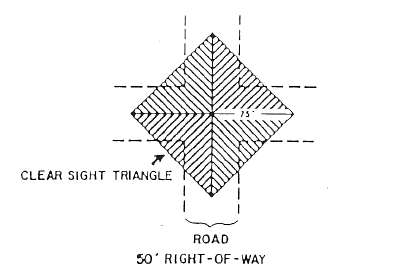
- Corner Clearance. On a corner lot, within the triangular area (shown in the following figure) determined as provided in this Section, no wall or fence or other structure shall be erected to a height in excess of 2 feet; and, no vehicle, object or any other obstruction of a height in excess of 2 feet shall be parked or placed; and no hedge, shrub or other growth, shall be maintained at a height in excess of 2 feet, marking signs and trees whose branches are trimmed away to a height of at least 10 feet above the curb. Such triangular area shall be determined by the intersecting street centerline and a diagonal connecting two points, one at each street centerline, each of which points is 75 feet from the intersection of such street centerlines.
- Special Setbacks from Quarries. No structure shall be erected closer to the near edge of a quarry than 200 feet plus 1 foot for every foot that the maximum depth of the quarry exceeds 100 feet. The depth of the quarry shall be determined by measuring from the absolute highest to absolute lowest point of the quarry.
- Private Garages or Private Parking Area in the Rural District, Agriculture Preservation District, Blue Mountain Preservation District, Environmental Protection Districts and Residential Lots in the Rural Village Districts. [Ord. 2007-1]
- A private garage or private parking area may be utilized only as an accessory to the main use, except that no more than two parking spaces in a private garage accessory to a one family or two family dwelling may be rented to a person who is not a resident of the main building.
- Not more than one commercial vehicle with four or more axles, or two commercial vehicles with less than four axles may be parked on any lot and then only subject to the following requirements:
- There shall be a minimum lot size of 1.00 acre exclusive of any road right-of-way.
- Each commercial vehicle shall be placed in a designated parking area of stone to be located not closer than 25 feet from any lot line or street right-of-way line, or 100 feet from any neighboring residence, whichever is the greater.
- Any application for permit pursuant to this Section shall be accompanied by a site plan detailing the layout and dimensions of the parking area. The application procedure pursuant to this Section shall be as set forth in §27-1203. [Ord. 2010-1]
- Only those commercial vehicles operated by a resident or owner of the lot shall be parked on that lot.
- No major recreational equipment shall be parked or stored within 15 feet of the right-of-way of any road nor within the sight distance triangle as determined by the Township Roadmaster, except in an existing building or car port or structure designed for that purpose. Only one recreational vehicle can be stored in the front yard. For the purposes of this regulation, major recreational equipment is defined as including boats and boat trailers, travel trailers, pick up trailers, or coaches (designed to be mounted on automotive vehicles), motor homes, tent trailers, and the like. No such equipment shall be used for living, sleeping, or house-keeping purposes except for temporary arrangements not to exceed 30 days in a year. [Ord. 2010-1]
- Nothing in this Section shall be construed to regulate or to limit the use, storage or parking of farm related vehicles off the public right-of-way. [Ord. 1-89]
- Private Swimming Pool (Noncommercial). A private swimming pool which is designed to contain a water depth of 24 inches or more shall not be located, constructed or maintained on any lot or land area, except in conformity with the following requirements. A permit shall be required to locate and construct a private swimming pool.
- Such pool shall be located in a rear yard only.
- Pools shall be placed no closer than 10 feet from the side and rear lot lines. In cases where the side and rear lot lines coincide or abut street right-of-way lines, such pools shall not be located than the 30 feet from the street right-of-way lines. No pool shall be constructed within 10 feet of any overhead electrical wires. [Ord. 2010-1]
- Such pool shall not occupy more than 25 percent of the rear yard area, including all private garages or other accessory buildings or structures.
- Every private swimming pool located on a lot of 2 acres or more shall not be located closer than 40 feet from any lot line.
- If the water for such pool is supplied from a private well, there shall be no cross-connection with a central water supply system.
- If the water for such pool is supplied from a central water supply system, the inlet shall be above the overflow level of said pool.
- No permit shall be granted for the installation or construction of such swimming pool unless the plans shall meet the minimum construction requirements of the Township. The drainage of such pool shall be adequate and shall not interfere with the public water supply system, with existing sanitary facilities or with the public streets.
- No loudspeaker or amplifying device shall be permitted which will project sound beyond the bounds of the property or lot where such pool is located.
- No lighting or spot lighting shall be permitted which will shine directly beyond the bounds of the property or lot where such pool is located.
(Ord. 4-81, 12/28/1981, §1010; as amended by Ord. 5-84, 10/5/1984, §§13 and 14; by Ord. 1-86, 4/4/1986, §3; by Ord. 1-89, 7/7/1989, §§3–5; by Ord. 2-90, 9/13/1990; by Ord. 2007-1, 3/8/2007, §§1–4; and by Ord. 2010-1, 4/8/2010)
Adopted by Ord. 2025-2 on 9/25/2025
27-1002 Parking And Truck Loading Space Requirements
- Off-Street Parking. Off-street parking spaces for the storage or parking of motor vehicles shall be provided pursuant to the following provisions:
- Parking areas shall be marked off into parking spaces, each with a minimum width of 10 feet, and a minimum area of 200 square feet, exclusive of driveways and turning areas.
- A minimum number of parking spaces shall be provided for each use as indicated in the following schedule:
Types of Use Minimum Parking Spaces for Each Residential Principal Uses Bed and Breakfast Facilities 1 per bedroom Boarding House/Rooming House 1 per bedroom Conversion Apartment 2 spaces per dwelling unit Dwellings, Duplex 2 spaces per dwelling unit Dwellings, Multi-Family 2 spaces per dwelling unit Dwellings, Single Family Detached 2 spaces per dwelling unit Dwellings, Townhouse 2 spaces per dwelling unit Farmstead 2 spaces per dwelling unit Group Care Facility 1 space per employee (peak shift) and 1 space per resident (if resident group members are allowed to operate motor vehicles) Group Home 2 spaces per dwelling unit Mobile Home Parks 2 spaces per dwelling unit Parks and Playgrounds None Non-Residential Principal Uses Adult Business 1 space per 75 square feet of net floor space Normal Agricultural Operations, Agriculture None Agri-Business 1 space per 200 square feet of floor area for public use plus 1 per employee on 2 largest shifts Agritainment 1 space per 200 square feet but not less than 1 space per 4 seats Airport Runway None Airport Operational Facilities 1 space per private place which can be accommodated at the facility but no less than a total of 20 spaces and 1 space per employee (peak shift) Animal Hospital, Small 1 space per employee and 2 spaces per exam room Animal Husbandry 2 employees on the 2 largest shifts or at least 1 space per 1,000 square feet of gross floor area, whichever is the greatest number Animal Rescue 1 space per employee and 1 space per 1,000 square feet Automobile Repair 1 space per 400 square feet of gross and floor and ground area devoted to repair and service facilities in addition to areas normally devoted to automobile storage and 1 per employee on largest shift Automobile Sales 1 space per 300 square feet of gross sales Bakery Goods and Candy Manufacturer with Retail Outlet 1 space per 4 customer seats and 1 space per 2 full-time employees Banks/Financial Institutions 1 space per 200 square feet of gross floor area; if building is less than 200 square feet, then 1 space per office Barber Shops, Beauty Parlors 1 space per 150 square feet of floor area accessible to customers Beer Distributors 1 space per 300 square feet of net floor area (indoor display) and 1 space per 1,000 square feet of outdoor display Billboard None Brewpub 1 space per 4 seats plus 1 per each employee on largest shift Building Materials/Lumber Yards 1 space per 1 employee on the 2 largest shifts or at least 1 space per each 1,000 square feet of gross floor area, whichever is the greater number Bulk Storage of Gasoline, Fuel Oil, or Other Inflammable or Explosive Liquids (2,000 gal. max) 1 space per 1 employee on the 2 largest shifts or at least 1 space per each 1,000 square feet of gross floor area, whichever is the greatest number Campground per campsite, plus 1 per employee, plus 50% of the spaces normally required for accessory use Car Washing 1 space per 400 square feet of gross and floor and ground area devoted to repair and service facilities in addition to areas normally devoted to automobile storage and 1 per employee on largest shift Casino/Betting Parlor 1 space per 200 square feet of net floor space for customer use Cemeteries 6 parking spaces min. (not including circulation lanes) Child Care Center 1 space per 6 students enrolled Child Care Home, Family 1 space per 6 students enrolled Child Care Home, Group 1 space per 6 students enrolled Clubs, Lodges, or Fraternities 1 space for each 4 members Commercial Communities Antenna None Commercial Communities Tower 2 spaces Commercial School- Vocational 1.5 students enrolled Community Intervention Center, Type 1 1 space per 200 square feet but not less than 1 space per each 4 seats of permissible occupancy Compost Facility 1 space per 2 employees on the 2 largest shifts or at least 1 space per each 1,000 square feet of gross floor area, whichever is the greatest number Normal Agricultural Operations, (Concentrated Animal Operation) 1 space per 1 employee (peak shift) Normal Agricultural Operations, (Concentrated Animal Feeding Operation) 1 space per 1 employee (peak shift) Conservation None Contractor, equipment storage in opaque enclosure 1 space per employee on the 2 largest shifts Convenience Store 1 space per 75 square feet of gross floor area Convenience Store with Energy Recharge 1 space per 75 square feet of gross floor area Craftsman/Artisan Studio 1 space per employee (peak shift) Crematory 1 space per employee (peak shift) Cultural/Community Center 400 square feet of net floor space DAS None Day Care Center, Adult 1 space per employee (peak shift) Day Care, Animal 1 space per employee plus 1 space per 1,000 square feet of gross floor area Distillery 1 space per 4 seats plus 1 per employee on largest shift Driving Range 1 per tee and 1 per employee Dry Cleaning, Pressing, or Tailor Shops using Non-Explosive Solvents 1 space per 200 square feet of gross floor area Educational or Day-Care School 1 space per 6 students enrolled Essential Services/Structures 1 space per 400 square feet of net floor space Farm Market/Sales 1 space per 100 square feet of floor area for public use plus 1 per each employee on 2 largest shifts Forestry None Fueling Station 1 space per 400 square feet of gross floor area Game Farm 1 per 200 square feet of floor area accessible to the public but a minimum of 4 spaces Garden Center 1 space per 200 square feet of gross (except those listed above) floor area of display area or sales area and 1 per each employee on 2 largest shifts Golf Course/Country Club 1 space for each 4 members Grocery Store 1 space per 100 square feet of floor area for public use plus 1 per each employee on 2 largest shifts Heliport 1 space Home Improvement/Building Supply, Medium 1 space per 200 square feet of gross (except those listed above) floor area of display area or sales area and 1 per each employee on 2 largest shifts Home Improvement/Building Supply, Small 1 space per 200 square feet of gross (except those listed above) floor area of display area or sales area and 1 per each employee on 2 largest shifts Hospitals spaces shall be provided for visitors, at the rate of at least 1 space per 1.5 accommodations (beds). Such spaces shall be in addition to those necessary for doctors and other personnel Kennel 1 space per employee and 1 space per 1,000 square feet Laundromat 1 space per 2 washing machines for self-service laundries and 1 space per 400 square feet of GFA for other laundry or dry-cleaning uses Library 1 space per 400 square feet of net floor space Limited Winery 1 space per 4 seats plus 1 per employee on largest shifts Lumber Mill 1 space per 2 employees on the 2 largest shifts or at least 1 space per each 1,000 square feet of gross floor area, whichever is the greatest number Mineral Extraction 1 space per 2 employees on the 2 largest shifts or at least 1 space per 1,000 square feet of gross floor area, whichever is the greatest number Mixed-Use Building As determined by the Township Nursing Home 1 space per 3 accommodations (beds) in addition to those needed for doctors and support staff Office, Medical or Dental 6 spaces per doctor Office, Professional 1 space per 300 square feet of gross floor area Oil and Gas 1 space per 2 employees on the 2 largest shifts or at least 1 space per 1,000 square feet of gross floor area, whichever is the greatest number Personal Services 1 space/400 square feet of gross floor area Place of Assembly/Worship 1 space per 200 square feet but not less than 1 space per 4 seats Plant Nursery 1 space per 200 square feet of gross (except those listed above) floor area of display area or sales area and 1 per employee on 2 largest shifts Preserve 1 per 200 square feet of floor area accessible to the public but a minimum of 4 spaces plus 1 space per employee Public Use, Municipal 1 space per 400 square feet of net floor space Public Utility Facility 1 space Recreation, Private None Recreation, Public 1 space per 400 square feet or gross floor area Restaurant, Café 1 space per 80 square feet of gross floor area and ground area (excluding parking) devoted to patron use of the property or 3 seats whichever requirement is greater Restaurant, Sit-Down 1 space per 4 seats plus 1 per employee on largest shift Restaurants, Tea Rooms 1 space per 4 seats plus 1 per employee on largest shift Retail, Medium 1 space per 200 square feet of gross (except those listed above) floor area of display area or sales area and 1 per employee on 2 largest shifts Retail, Small 1 space per 200 square feet of gross (except those listed above) floor area of display area or sales area and 1 per employee on 2 largest shifts Riding Club 1 space per 2 rental stalls plus 1 per 4 seats of spectator seating School, Pre-Kindergarten 1 space per 6 students enrolled School, Primary and Secondary 1 space per 6 students enrolled Self-Storage (Indoor Storage) 1 space per 10 storage bays and 1 space per employee (peak shift) Service Businesses 1 space/150 square feet of floor area accessible to customers plus 1 space per employee Shooting Range, Indoor 1 per 150 square feet of floor area accessible to customers plus 1 space per employee Social Club 1 space for 4 members Social Hall/Event Center 200 square feet but not less than 1 space per 4 seats Stock Yard, Slaughterhouse, or Meat-Packing Plant 1 space per 2 employees on peak shift Tasting Room 4 seats plus 1 per employee on largest shift Taverns, Cocktail Lounges 4 seats plus 1 per employee on largest shift Theater or Assembly Hall 200 square feet but not less than 1 space per 4 seats Trail None Urban Ag None Veterinary Clinic 1 space per employee and 2 spaces per exam room Wedding Venue/Banquet Facility 1 space per 200 square feet but not less than 1 space per 4 seats Welding Shop 1 space per 2 employees on the 2 largest shifts or at least 1 space per 1,000 square feet of gross floor area, whichever is the greatest number Wind Energy System 1 space Wrecking or Dismantling of Motor Vehicles (storage of the parts and materials from such operations and the storage of other junk) 1 space per 2 employees on the 2 largest shifts or at least 1 space per 1,000 square feet of gross floor area, whichever is the greatest number - For those uses that are permitted but not specifically listed, the requirements for the most similar use listed in paragraph 2 shall be applied.
- Where the uses are mixed, total requirements shall be the sum of the requirements of the component uses computed separately.
- In all districts, when required parking spaces results in the requirement of a fractional space, any fraction shall be construed as requiring a full space.
- An overflow parking lot shall be provided in all residential subdivision and land developments in the R-Rural District and RV-Rural Village Districts. The amount of parking necessary shall be calculated based on the number of existing or proposed dwelling units with a minimum of two spaces per dwelling unit. The parking area shall be within the subdivision or land development boundaries and shall have access to an approved public street. [Ord. 2007-1]
- Required Off-Street Truck Loading Spaces.
- Every building or structure, lot or land hereafter put into use for business or industrial purposes or for a hospital and which has an aggregate net floor area of 5,000 square feet or more in any district where such uses are permitted, shall be provided with off-street truck loading spaces in accordance with the following schedule:
Square Feet of Aggregate Net Floor Area Devoted to Such Use Required Number of Off-street Truck Loading Spaces 5,000 to 25,000 sq. ft. 1 25,001 to 40,000 sq. ft. 2 40,001 to 100,000 sq. ft. 3 Each additional 60,000 sq. ft. 1 additional - An off-street truck loading space shall have a minimum width of 10 feet, a minimum length of 50 feet, and minimum clear height of 14 feet including its access from the street.
- All truck loading spaces shall be designed so that maneuvering of trucks to reach the loading spaces shall not preempt the use of required off-street parking space or intrude into the street right-of-way.
- Every building or structure, lot or land hereafter put into use for business or industrial purposes or for a hospital and which has an aggregate net floor area of 5,000 square feet or more in any district where such uses are permitted, shall be provided with off-street truck loading spaces in accordance with the following schedule:
- Parking Area Design Standards.
- All lighting fixtures used to illuminate parking areas shall be arranged to prevent glare onto adjoining properties.
- The number of off-street parking spaces provided for an existing use may not be reduced below the minimum standards of this Chapter.
- The required off-street parking spaces shall be located on the same lot as the principal use served. Where this requirement cannot be met, the spaces shall be located within 300 feet of the principal use. [Ord. 2-98]
- No parking area shall be designed so as to require vehicles to back out of the area directly onto a public street.
- Vehicular entrances and exits shall be clearly visible from the street and not within 75 feet of the intersection of the street lines at a street intersection.
(Ord. 4-81, 12/28/1981, §1020; as amended by Ord. 2-98, 4/9/1998, §10; by Ord. 99-2A, 11/11/1999, §§7 and 8; by Ord. 2007-1, 3/8/2007, §§3 and 4; and by Ord. 2010-1, 4/8/2010)
Amended by Ord. 2024-5 on 12/30/2024
27-1003 Sign Regulations
- Declaration of Legislative Intent. In expansion of the general intent and community development objectives found in Part 1 of this Chapter, the primary purpose of the sign regulations is as follows:
- Recognize that signs perform an important function in identifying properties, businesses, services, residences, events, and other matters of interest to the public.
- Set standards and provide controls that permit reasonable use of signs while restricting the potential adverse visual effects of signs on the character of the Township.
- Control the size, number, height, location, and illumination of signs to reduce potential hazards caused by glare or obstruction of visibility, and to reduce visual clutter that results from competition among signs.
- Encourage signs that are attractively designed in order to enhance the economic value as well as the visual character of the Township.
- Establish criteria to encourage signs that are compatible with their surroundings, appropriate to the type of activity to which they pertain, complementary to the architecture of the buildings involved, expressive of the identity of individual proprietors or of an integrated development's identity and easily readable in the circumstances in which they are seen.
- Signs must not be permitted if they are in any way a hazard to vehicular or pedestrian traffic either directly or indirectly by virtue of exposing a pedestrian to danger as a result of concealing the presence of a pedestrian to vehicular traffic.
- Signs must be regulated so as to minimize their negative impact on vehicular traffic. They must not cause excessive diversion of a driver's attention to the safe operation of his or her vehicle. They must not cause confusion on the part of the vehicle operator and they must not constitute any type of obstruction or distraction for the motoring public.
- Signs have a direct impact on property values. It is the intent of these regulations to insure that the impact is positive. A negative impact would not be in the best interest of the general welfare of the community.
- Signs convey the character of an area. It is the intent of these regulations to maintain signage that is appropriate to the various districts of the community, including, but not limited to, residential, commercial, industrial and recreational.
- It is the goal of these regulations to enhance the community aesthetics as a means to promote economic development. A positive visual environment will promote the economic health of a community which in turn serves the citizens of the community.
- Definition of Terms. Unless the context of this chapter clearly shows otherwise the following words and phrases shall denote the meanings herein expressed. The singular shall include the plural, the present shall included the future tense.
Advertising Sign–a sign which directs attention to a business, profession, products or services solely conducted or sold elsewhere than upon the property where the sign is displayed. For the purposes of this Chapter, a commercial billboard is an advertising sign.
Announcement or Professional Sign–a sign on a residential building which directs attention to a home professional office, home occupation or professional office in such residential building.
Bulletin Board–a sign for a public, semi-public, charitable or religious institution bearing no commercial advertising matter.
Business Identification Sign–a sign which directs attention to or identifies the business, profession, products or services conducted or sold upon the property where the sign is displayed.
Freestanding sign–a sign supported by or suspended from a freestanding column or other support located in or upon the ground surface.
Sign–a structure, device or display designed to attract attention and impart a message.
Temporary Sign–a sign constructed of cloth, canvas, fabric, wood or other similar material, with or without a structural frame, and intended for a limited period of display. For the purposes of this Chapter, real estate and construction signs are temporary signs.
Wall Sign–a sign which is part of, attached directly to, supported by or painted upon a building wall. - General Requirements. Signs shall be permitted in all districts in compliance with the requirements of this Chapter.
- A permit shall be required for the following types of signs if they exceed six (6) square feet and can be seen from the perimeter boundary of the property or premise upon which they will be located or replaced.
- Business Identification Sign whether a Freestanding Sign or a Wall Sign.
- Advertising Sign.
- Temporary Sign.
- Bulletin Board Sign.
- Announcement or Professional Sign.
- No permit shall be required in the following circumstances.
- Normal maintenance of existing signs.
- Signs that cannot be seen from the perimeter boundary of the property of premises upon which they will be located or replaced.
- Flags or insignias of any government except when displayed in connection with commercial promotion.
- Signs bearing only property numbers, post box numbers, names of the occupants of the premises or other identification of the premises which do not have commercial connotations.
- No trespassing signs and other signs indicating the private nature of a road, driveway or premises.
- Legal notices; identification, informational or directional signs erected or required by governmental bodies; official traffic signs and signals; or other state, county, school district or municipal government signs.
- Temporary signs subject to the following.
- Signs for contractors, consultants, mechanics and artisans performing work or services on the premises shall be removed within ten (10) days after the completion of work.
- Signs for yard/garage sales or other similar sales shall be removed within ten (10) days after the event.
- Real estate signs advertising the sale or rental of the premises upon which it is located shall be removed within ten (10) days after completion of the sale or execution of the lease.
- Signs promoting a civic, philanthropic, educational or religious event shall not be posted earlier than three (3) weeks prior to the event and shall be removed within ten (10) days after the completion of the event.
- No sign shall make use of words such as, but not limited to, "stop," "look," "one-way," or "yield" which would mislead or confuse traffic.
- No freestanding sign shall have less than eight (8) feet of clear space between the sign and the ground, provided that necessary support structures may extend through that designated open space.
- Business identification signs, advertising signs, temporary signs and bulletin boards attached to a building wall or façade shall not project more than eighteen (18) inches from the building wall or façade.
- Announcement or professional signs attached to a building wall or facade shall not project more than eight (8) inches from the building wall or facade.
- Signs may be interior lighted with non-glaring lights or may be illuminated by shielded flood lights, provided that not red or green lights shall be permitted within seventy-five (75) feet of the point of intersection of the street tight-of-way lines at a street corner.
- For shopping centers or a group of stores or other business uses on a lot held in single and separate ownership, the provisions of this Chapter related to the maximum surface areas of signs permitted on a premise shall apply with respect to each building, separated store or similar use, No more than two (2) freestanding signs incubating the name of the center or similar use shall be permitted.
- An industrial or office park serving five (5) or more tenants may have a single entrance sign having a maximum are of one-hundred (100) square feet indicating the name of the park and listing each tenant.
- One sign may be placed to identify a major subdivision, land development or mobile home park provided that such sign is located at a main entrance and has a maximum area of twenty-five (25) square feet.
- Advertising signs when permitted in a zoning district are subject to the following:
- There shall be a minimum distance of three-hundred (300) between advertising signs.
- Advertising signs shall not be permitted within one-hundred (100) feet of the Blue Mountain or Rural Districts, unless the advertising surface of such sign is not visible from the district line, in which instance the sign shall be no closer than fifty (50) feet to that district line.
- Advertising signs shall not be permitted with fifty (50) feet of a residential use, regardless of the zoning district in which it is located.
- Dynamic Message Display (DMD) signs are signs incorporating LCD, LED, plasma or other video-like displays or other means of changing messages and shall be subject to the following:
- All DMD signs must be equipped with automatic day/night dimming capabilities.
- Property owners utilizing a DMD sign shall remove all exterior promotional banners and sandwich board signs and may not use any temporary signage.
- DMD signs shall display simple and static messages for immediate recognition. Messages shall be complete in each display cycle and shall not require viewers to see multiple display cycles to derive its meaning.
- DMD signs shall use instantaneous transitions from one message display cycle to the next with no blank-outs, scrolling, fading, streaming, zooming, flashing or other animated effect.
- DMD sign owners shall use at least twenty (20) percent of the operating time per eight hour cycle for community service, such as time. Temperature, school closing, weather and/or non-profit announcements. All DMD sign owners shall notify Amber Alert and register its location for use as needed.
- Banner signs across state roads require a permit from the Pennsylvania Department of Transportation. Banner signs across township roads are prohibited.
- The size of signs, number of signs and sign setbacks shall be in accordance with the following Schedule of Sign Regulations.
SCHEDULE OF SIGN REGULATIONSZONING DISTRICT
TYPE OF SIGN Wall
Free Standing
Advertising
Temporary
Bulletin Boards
Announcement or Professional
Blue Mountain Preservation
Maximum sign area in square feet
20
20
Not Permitted
6
32
4
Maximum number per property
1 per Street
1 per Front
Not Permitted
1
1
1
Setback from street right-of-way in feet
10
Not Permitted
10
10
10
Agricultural Preservation
Maximum sign area in square feet
32
32
Not Permitted
32
32
4
Maximum number per property
1 per Street
1 per Front
Not Permitted
2
1
1
Setback from street right-of-way in feet
10
Not Permitted
10
10
10
Rural Village
Maximum sign area in square feet
50
50
50
32
32
4
Maximum number per property
1 per Street or §27-1003
1 per Front or §27-1003
1
2
1
2
Setback from street right-of-way in feet
20
20
10
10
10
Rural
Maximum sign area in square feet
4
10
Not Permitted
6
32
2
Maximum number per property
1 per Street
1 per Front
Not Permitted
1
1
1
Setback from street right-of-way in feet
10
Not Permitted
10
10
10
- A permit shall be required for the following types of signs if they exceed six (6) square feet and can be seen from the perimeter boundary of the property or premise upon which they will be located or replaced.
- Nonconforming Signs.
- Only lawful signs existing at the time of passage of this Chapter and which do not conform to the requirements of this Chapter shall be considered nonconforming signs, and once removed shall be replaced only with conforming signs; however lawful, nonconforming signs may be repainted or repaired provided such repainted or repaired sign does not exceed the dimensions of the existing sign. Any sign or billboard destroyed, damaged or dismantled for any reason whatsoever may only be replaced by a sign which is in strict conformity with the regulations of the district in which it is located except as provided in §27-1005 regarding nonconforming uses and/or structures.
- Every lawful sign, billboard and other outdoor advertising media erected in the Township prior to the adoption of this Chapter may continue to be maintained in spite of lack of conformity with all of all the provisions of this Chapter. If abandoned, the owner of every such sign, at his own expense, shall cause the same to be brought into strict conformity with all the requirements of this Chapter. The work of bringing such sign into conformity with such requirements shall constitute either repair, alteration or relocation, and therefore shall require the owner of such sign, to obtain a permit.
- All signs erected prior to the adoption of this Chapter which do not have a zoning permit but do conform to the provisions of this Chapter shall be required to apply for a zoning permit within 60 days after official adoption of this Chapter.
- Area of Signs.
- The size of any sign shall be computed by multiplying its greatest height by its greatest length, exclusive of supporting structures, unless such supporting structure is illuminated or is in the form of a symbol or contains advertising copy. In the case of signs that have no definable edges, such as raised letters attached to a building facade, the sign size shall be that area within a single continuous perimeter enclosing the extreme limits of the actual message or copy area.
- The area of a sign shall be construed to include all lettering, wording, and accompanying designs and symbols, together with the background, whether open or enclosed, on which they are displayed, but not including any supporting framework and bracing which are incidental to the display itself.
- Where the sign consists of individual letters or symbols attached to or painted on a surface, building, wall or window, the area shall be considered to be that of the smallest rectangle or other shape which encompasses all of the letters and symbols.
- In computing square foot area of a double faced sign, only one sign shall be considered provided both faces are identical. If the interior angle formed by the two faces of the doubled faced sign is greater than 45 degrees, then both sides of such sign shall be considered in calculating the sign area, and it shall be considered a parallel sign.
- Signs in Rural District. The following provisions shall apply to all uses in residential districts and to residential uses in nonresidential districts:
- Permitted On-Premises Signs.
- Identification Signs. Two identification signs shall be permitted for the purpose of identifying the occupant of a residence, the name of a property, or the address of a property. Such signs shall not exceed 2 square feet in area.
- Real Estate Signs.
- Individual Properties. Non-illuminated on-premises real estate signs, provided that the sign area does not exceed 6 square feet and provided that not more than one such sign shall be erected on any one street frontage of any property in single and separate ownership.
- Developments. Non-illuminated on-premises sign advertising sale or rental of dwelling units in a development or subdivision, provided that the sign area shall not exceed 32 square feet, and provided that not more than two such signs shall be erected within any such subdivision.
- Directional Signs. On-premises directional signs, provided that the area of any such sign shall not exceed 2 square feet.
- Private Property Signs. Non-illuminated, on-premises “No Trespassing” signs, “No Hunting” signs and other similar signs indicating private ownership of roadways or other property, provided that the sign area shall not exceed 2 square feet.
- Construction Signs. Temporary, non-illuminated, on-premises construction signs, provided that:
- The sign area shall not exceed 4 square feet.
- Not more than one such sign for each contractor performing work on any one property shall be erected on that property.
- All such signs shall be removed upon completion of the work.
- Business Signs.
- Low Impact Home Based Business. Non-illuminated, on-premises signs identifying and advertising bed-and-breakfasts, rooming houses and low impact home based businesses, provided that the sign area shall not exceed 2 square feet, and provided that not more than one such sign shall be erected on any one street frontage of any property in single and separate ownership.
- Businesses. On-premises business signs for commercial, industrial, professional and office uses in this, provided that the sign area shall not exceed 20 square feet and no more than one such sign is erected on any one property in single and separate ownership.
- Signs for Residential Complexes and Institutional Uses.
- On-premises sign for a school, camp, church, health-care facility, health-care service, private club or other institution of a similar nature, displaying the name of the institution and its activities or services, provided that the sign area shall not exceed 24 square feet, and provided that not more than one such sign shall be erected on any street frontage of any property in single and separate ownership. Said sign shall be set back at least 30 feet from the road right-of-way.
- Permanent signs which identify the name of a subdivision or land development shall be permitted in compliance with the following:
- One freestanding sign may be located at each intersection of the development's streets with primary or secondary streets, the area of each sign not to exceed 6 square feet.
- One freestanding sign may be located at one main entrance to the development, not to exceed 20 square feet in area, or two signs not exceeding 12 square feet each.
- Permanent off-premises directional signs for a school, camp, church, health-care service, private club or other institutions of similar nature shall be permitted with a maximum size of 2 square feet.
- Height. The maximum height limit for any sign permitted in the Rural District shall be 6 feet.
- Prohibited Signs. In addition to the signs prohibited in subsection C.3. of this Section, the following signs are not permitted:
- Internally illuminated signs.
- Permitted On-Premises Signs.
- Sign Regulations for Agricultural Preservation and Blue Mountain Districts. The following provisions shall apply to all nonresidential uses in nonresidential district.
- Permitted On-Premises Signs.
- Single-Occupancy Business Signs. Properties in single and separate ownership, with a single business premises, may have a sign or signs in accordance with the following:
- Each single-occupancy business may have a single freestanding sign, per street frontage, with the total maximum sign area shall not exceed 18 square feet.
- In addition, each business may have a parallel wall sign, window sign or awning sign of no more than 18 square feet.
- Multiple-Occupancy Business Signs. Properties in single and separate ownership with multiple businesses, tenants or franchise premises, may have a sign or signs in accordance with the following:
- Each multiple-occupancy property may have a single freestanding sign, per street frontage, which identifies the business, or commercial center as a whole, and/or which is a directory sign for the establishments on the property, with a maximum sign area of 32 square feet.
- In addition, each individual business on the property may have a parallel wall sign, window sign or awning sign of no more than 24 square feet in sign area.
- Directional Signs. On-premises directional signs, provided that the area of any such sign shall not exceed 6 square feet.
- Private Property Signs. Non-illuminated, on-premises “No Trespassing” signs, “No Hunting” signs and other similar signs indicating private ownership of roadways or other property, provided that the sign area shall not exceed 2 square feet.
- Real Estate Signs. Non-illuminated on-premises sign no larger than 6 square feet in sign area. One such sign per road frontage is permitted.
- Construction Signs. Temporary, non-illuminated construction signs shall not exceed 16 square feet in sign area. No more than one sign per prime contractor performing work on a property shall be permitted, and no more than a total of one sign per external road frontage shall be permitted. All such signs shall be removed upon completion of the work.
- Corporate or Company Flags. Flags bearing a corporate or company name and/or insignia may be flown on the property where the company is located, according to the following:
- The flag shall be flown in conjunction with the United States flag, and the size of the corporate flag shall not exceed 75 percent of the size of the United States flag with which it is displayed. The United States flag shall be higher than the corporate flag.
- A corporate or company flag shall not exceed the maximum area of a permitted business sign.
- No other advertising shall be permitted on such flags.
- Portable Signs.
- Portable signs no larger than 6 square feet in area, per side, and no larger than 3 feet wide, advertising the special sales or menu items for restaurants, or advertising a special product or event (for example, holiday specials or “Open Gate” days).
- The information contained on the sign shall be changed on a weekly basis as a minimum.
- The signs shall be professionally made.
- No more than one sign shall be permitted per roadway frontage.
- No sign shall be placed in such a position as to endanger traffic on the street by obscuring a clear view or by confusion with official street signs or signals, and no sign shall be placed in such a position as to endanger pedestrians using a sidewalk or other pedestrian access areas.
- Single-Occupancy Business Signs. Properties in single and separate ownership, with a single business premises, may have a sign or signs in accordance with the following:
- Height. The maximum height of signs in nonresidential districts shall be as follows:
- Ten feet for freestanding signs for individual uses.
- Seventy-five percent of the wall or awning height for all or awning signs, measured on the wall or awning upon which the sign is placed, up to a maximum of 15 feet.
- Permanent off-premises directional signs for a school, camp, church, healthcare service, private club or other institutions of similar nature shall be permitted with a maximum size of 2 square feet.
- Permitted On-Premises Signs.
- Sign Regulations for the Rural Village District.
- Permitted On-Premises Signs.
- Single-Occupancy Business Signs. Properties in single and separate ownership with a single business premises may have one sign, per street frontage, of any permitted type within the following limits on sign area:
- Twenty square feet of sign area is the largest maximum size permitted.
- In order to encourage users to provide the community with an attractive unified outdoor advertising scheme, it is further provided that if the user chooses to mount a parallel wall sign, window sign or awning sign rather than a freestanding or projecting sign, the maximum allowable sign area (as calculated above) may be increased by 20 percent.
- Multiple-Occupancy Business Signs. Properties in single and separate ownership with multiple businesses, tenants or franchise premises may have a sign or signs in accordance with the following:
- Each multiple-occupancy business may have a single freestanding sign, per street frontage, which identifies the business, or commercial center as a whole, and/or which is a directory sign for the establishments on the property, with a maximum sign area of 20 square feet.
- In addition, each individual business on the property may have a parallel wall sign, window sign or awning sign of no more than 10 square feet in sign area.
- Portable Signs.
- Portable signs no larger than 6 square feet in area, per side, and no larger than 3 feet wide, advertising the special sales or menu items for restaurants, or advertising a special product or event (for example, holiday specials or “Open Gate” days).
- The information contained on the sign shall be changed on a weekly basis as a minimum.
- The signs shall be professionally made.
- No more than one sign shall be permitted per roadway frontage.
- Portable signs shall only be displayed along the roadway during daylight hours from sunrise to sunset. After sunset, the signs must be removed from the roadway.
- No sign shall be placed in such a position as to endanger traffic on the street by obscuring a clear view or by confusion with official street signs or signals, and no sign shall be placed in such a position as to endanger pedestrians using a sidewalk or other pedestrian access areas.
- Directional Signs. On-premises directional signs, provided that the area of any such sign shall not exceed 4 square feet.
- Private Property Signs. Non-illuminated, on-premises “No Trespassing” signs, “No Hunting” signs and other similar signs indicating private ownership of roadways or other property, provided that the sign area shall not exceed 2 square feet.
- Real Estate Signs. Non-illuminated on-premises sign no larger than 4 square feet in sign area. One such sign per road frontage is permitted.
- Construction Signs. Temporary, non-illuminated construction signs shall not exceed 4 square feet in sign area, shall be removed upon completion of the work. No more than one sign per contractor performing work on a property shall be permitted.
- Corporate or Company Flags. Flags bearing a corporate or company name and/or insignia may be flown on the property where the company is located, according to the following:
- The flag shall be flown in conjunction with the United States flag, and the size of the corporate flag shall not exceed 75 percent of the size of the United States flag with which it is displayed. The United States flag shall be higher than the corporate flag.
- A corporate or company flag shall not exceed the maximum area of a permitted business sign.
- No other advertising shall be permitted on such flags.
- Single-Occupancy Business Signs. Properties in single and separate ownership with a single business premises may have one sign, per street frontage, of any permitted type within the following limits on sign area:
- Illumination. Internally illuminated signs are prohibited except in accordance with the following:
- The copy placed on the sign shall be of a translucent material and the background area shall be of a more opaque material.
- The sign meets all area and height requirements of this Chapter.
- Height. The maximum height of signs in the Village District shall be as follows:
- Ten feet for freestanding signs for individual uses.
- Seventy-five percent of the wall or awning height for wall or awning signs, measured on the wall or awning upon which the sign is placed, up to a maximum of 15 feet.
- Twelve feet for freestanding shopping center signs and multiple direction signs.
- Additional Sign Regulations for Gasoline Service And/or Filling Stations. In recognition of the unique and particular significance to the driving public, gasoline service and/or filling stations may have the following additional signs:
- A gasoline service and/or filling station may have one sign in addition to a single-occupancy business sign permitted under subsection G.1.a. of this Section, according to the following regulations:
- Such sign shall advertise the current fuel prices only.
- Such sign shall not exceed 16 feet on each side.
- When fuel prices are displayed by means of changeable lettering, such lettering shall be between 8 and 18 inches in height.
- Such sign shall be set back a minimum of 15 feet from the ultimate right-of-way line, and shall not interfere with the safe and convenient access and circulation of the property.
- Canopy Sign. A canopy sign is permitted on the structure covering fuel pumps according to the following regulations:
- Such sign shall not exceed the height of the canopy.
- Such sign shall not exceed 15 square feet.
- The canopy meets all required setbacks of this Chapter.
- A gasoline service and/or filling station may have one sign in addition to a single-occupancy business sign permitted under subsection G.1.a. of this Section, according to the following regulations:
- Permanent off-premises directional signs for a school, camp, church, healthcare service, private club or other institutions of similar nature shall be permitted with a maximum size of 2 square feet.
- Permitted On-Premises Signs.
- Other Signs.
- Signs for Agricultural Products. Non-illuminated signs advertising the sale of agricultural products 50 percent of which shall be grown in the local area, provided that the individual sign area shall not exceed 6 square feet. Such signs are permitted in all zoning districts in the Township.
- Maximum number of 10 signs per farm stand.
- Maximum area of all signs advertising the products can not exceed 50 square feet.
- Signs shall only be posted during days when such products are actively offered for sale up to a maximum of 180 days per year.
- Signs shall be professionally made and shall be permitted to be off-premises.
- Signs shall be removed during the non-growing season.
- Public Uses. A sign for a municipal building, public school, office or other use shall be permitted in all zoning districts and shall not exceed 35 square feet in area.
- Temporary signs for, or relating to, campaigns, drives, or events of civic, philanthropic, educational, or religious organizations provided that they shall be removed within 10 days of the completion of the campaign, drive, or event. This Section shall not apply to political signs. [Ord. 2010-1]
- Signs for Agricultural Products. Non-illuminated signs advertising the sale of agricultural products 50 percent of which shall be grown in the local area, provided that the individual sign area shall not exceed 6 square feet. Such signs are permitted in all zoning districts in the Township.
- The following signs shall not be included in the application of the sign requirements of this Chapter:
- Directional Signs. Incidental signs not exceeding an area of 2 square foot and not including any commercial message or logo, which carry a message to identify restrooms, entrances and exits, telephone locations, an on-site direction, on-site warnings or anything similar.
- Official Signs. Government signs such as official traffic and street name signs and identification, informational or directional signs required by government bodies or their agencies.
- Flags, badges or insignia of any government, government agency, civic organization, charitable organization or religious organization.
- Address Signs. Property identification signs which do not exceed 2 square feet in area and bearing only property numbers, post box numbers, names of occupants or premises or other identification not having commercial connections.
- Integral decoration or architectural features of buildings, except letters, trademarks, moving parts or moving lights.
- Agricultural Products Signs. Signs not exceeding an area of 2 square feet advertising agricultural produce.
- Temporary Signs. Less than 2 square feet.
- Real estate signs to be removed after the sale the property.
- Signs within buildings, which are not visible from any street.
- Garage and yard sale signs to be removed immediately after the event.
- Temporary contractor signs to be removed within 2 weeks after the completion of the work.
- General interest signs to be removed within 60 days.
(Ord. 4-81, 12/28/1981, §1030; as amended by Ord. 2007-1, 3/8/2007, §§3 and 4; by Ord. 2008-2, 10/9/2008, §1; by Ord. 2010-1, 4/8/2010; and by Ord. 2011-1, 5/12/2011)
Amended by Ord. 2014-1 on 6/19/2014
Amended by Ord. 2024-5 on 12/30/2024
27-1004 Low Impact Home-Based Businesses
- A low impact home-based business may be pursued in either the dwelling or in a garage or accessory building. The low impact home-based business shall occupy a space which constitutes less than 25 percent of the floor area of the dwelling or less than 50 percent of the floor area of the garage or accessory building.
- In addition to the owner of the residence, a maximum of five persons not residing at the dwelling may be employed at the low impact home-based business. The owner of the residence operating the low impact home-based business must reside on the premises.
- No low impact home-based business shall require structural alterations of an existing structure. The exterior design shall reflect the principal residential use of the structure.
- Signs associated with the low impact home-based business shall conform to the provisions of §27-1003.
- The parking needs of the low impact home-based business shall be met through the use of off-street parking areas according to the provisions of §27-1002.
- The low impact home-based business shall not create noise, vibration, glare, odors, fumes, or electrical interference beyond the bounds of the property to any event greater or more frequent than ordinarily associated with the dwelling unit. The low impact home-based business shall comply with all Federal and State regulations.
- All storage of materials associated with the low impact home-based business shall be in enclosed buildings and comply with all other Federal and State regulations.
(Ord. 4-81, 12/28/1981, §1040; as amended by Ord. 2009-1, 1/5/2009, §§12–18)
27-1005 Nonconforming Lots, Structures, And Uses
Within the districts established by this Chapter, or amendments that may later be adopted, there exist lots, structures, and uses which were lawful before this Chapter was passed or amended, but which would be prohibited, regulated, or restricted under the terms of the Chapter or future amendment. It is the intent of this Chapter to permit these nonconformities to continue until they are terminated. Any lot, structure, or use which was unlawful at the effective date of this Chapter, however, shall not be deemed a nonconformity under this Chapter. Any existing use which is permitted by special exception in this Chapter shall be deemed to be a conforming use where it has met the standards and criteria of this Chapter for that special exception use.
- Nonconforming Uses. A nonconforming use shall be changed only to a conforming use. A nonconforming use may be enlarged or extended only as a result of the natural expansion of that use up to 50 percent of its existing floor area if all proposed structures are in conformance with provisions of this Chapter, and no conforming use is displaced. If a structure used by a nonconforming use is accidentally and unintentionally damaged, it may be restored or reconstructed and used as before, provided that the floor area of such structure shall not exceed the floor area which existed prior to such damage, and that it be completed within 1 year of such happening.
- Nonconforming Structures. The interior restoration or alteration and normal repair and maintenance of nonconforming structures that is devoted to a conforming use is permitted. The exterior restoration or alteration of a nonconforming structure shall be permitted where such work will bring that structure into conformance, or greater conformance than previously, within this Chapter, or will otherwise be beneficial or more appropriate to the general neighborhood. Achieving conformance with this Chapter shall be of highest priority. If a nonconforming structure is damaged, it may be reconstructed and used as before, provided that the floor area of such structure shall not exceed the floor area that existed prior to the damage and that it be completed within 1 year of the occurrence of the damage. A nonconforming structure shall not be extended or enlarged. [Ord. 2-98]
- Nonconforming Lots. Any change made in the configuration of the nonconforming lot shall be to bring such lot into conformance. A nonconforming lot may be used for the erection of a dwelling only in conformance with the standards of §27-1001.2.
- Termination. A nonconforming use shall be deemed to have been terminated and shall not thereafter be reinstated:
- When it is changed to a conforming use.
- When it has been voluntarily discontinued for a period of 24 consecutive months where such nonconforming use is in a building or structure designed for such use.
- When it has been voluntarily discontinued for a period of 12 consecutive months where such nonconforming use is in a building or structure not designed for such use, or is on a lot or land whereon there is no consequential building or structure devoted to such use.
- Registration of Nonconforming Uses and Structures. The Zoning Officer may identify and register nonconforming uses, structures, and lots in the Township of Heidelberg, as an aid to the enforcement of this Chapter. Upon identifying a nonconformity, the Zoning Officer shall send notice to the owner of record that a nonconformity exists on this property and with which provisions of this Chapter it does not conform. Failure by the Zoning Officer to identify and register a nonconforming use or structure is not to be construed as a recognition that a use, structure, or lot is in conformance with this Chapter. [Ord. 4-90]
(Ord. 4-81, 12/28/1981, §1050; as amended by Ord. 4-90, 10/11/1990, §22; and by Ord. 2-98, 4/9/1998, §11)
27-1006 Special Regulations For Residential Uses And Non-Residential Uses.
- Dwelling Units.
- All dwelling units shall include no less than the number of square feet of interior floor space as is specified in the following table:
No. of Bedrooms Square Feet 1 500 2 625 3 750 4 875 plus 125 for each bedroom in excess of 4 - All fuel supply systems for residences shall be constructed and installed within the foundation wall, unless screened by fencing and/or landscaping.
- All residential buildings shall have a pitched roof with a rise of no less than 3 1/2 inches per foot. The roof shall overhang the exterior walls on at least two sides.
- For all mobile homes used as permanent dwellings, which have been anchored to a mobile home stand, the hitch which is employed for the transportation of the unit shall be removed, and there shall be a decorative skirt installed around the base of the unit.
- All dwelling units shall include no less than the number of square feet of interior floor space as is specified in the following table:
- Dwelling, Multi Family. In the Rural District and subject to the requirements of the zone in which the property is located except as herein modified and provided:
- The maximum building density for a multi-family dwelling shall be four dwelling units per acre if served by an on-lot sanitary sewage disposal system and eight dwelling units per acre if served by a central sanitary sewage disposal system and central water system.
- A 20-foot wide buffer yard with screening shall be provided between any multi-family dwelling building and any abutting existing single family detached dwelling within 100 feet of such multi-family dwelling. The buffer yard shall be a landscaped area free of structures. The planting screen of trees or shrubs shall be of a type of material to form a visual screen having a minimum height when planted of 4 feet. The plants needed to form the visual screen shall be of an evergreen variety and shall be spaced and sized so it can reasonably be expected to grow to a height of at least 6 feet within 4 years of planting. Other types of plants other than the evergreen variety may be utilized if it is determined by the Zoning Hearing Board that the design will be functionally equivalent to the evergreen variety.
- There shall be no more than 12 dwelling units per multi-family dwelling building and the maximum length of any building shall be 200 feet.
- A minimum distance of 40 feet shall be maintained between any multi-family dwelling buildings.
- Vehicular access to a multi-family dwelling building or buildings shall be provided from the existing public road by way of one or more private drive(s) serving the interior of the lot. All parking facilities shall be located within the private parking areas located on the lot. No parking facilities shall be located adjacent to existing public roads.
- All interior driveways and parking areas shall be lined with curbing and sidewalks shall be installed to provide pedestrian walkways along the private driveways leading to the public road, from the parking areas to the buildings, and between the building.
- A legally binding mechanism for assuring the maintenance of any sanitary sewage disposal and/or collection system shall be required, together with compliance with all applicable provisions of the Heidelberg Township Subdivision and Land Development Ordinance [Chapter 22] as are applicable to that system.
- Animal Hospitals, Small.
Subject to the requirements of the underlying zone in which located except as herein modified and provided:- Lot Area. Five acres minimum.
- Setbacks. All buildings, dog runs, fenced enclosures and similar structures shall be located at least 100 feet from all property or street lines.
- All boarding areas shall be completely within an enclosed building.
- All outdoor running areas shall be fenced in a manner that restricts access and provides for a full enclosure.
- The applicant shall furnish credible evidence that any and all other State and/or Federal approvals have been obtained or that none are required prior to the application for any permit authorizing the erection or use of any structure or land for a kennel.
- The applicant shall furnish credible evidence of an effective and recognized acceptable manner for the disposal of animal waste and carcasses.
- The owner/operator shall be responsible to exercise reasonable control over the animals and shall not allow a nuisance condition to be created in terms of excessive noise, dirt or odor. [Ord. 2010-1]
- Lot Area. Five acres minimum.
- Automobile Repair. Within the Rural Village District and subject to the requirements of the underlying zone except as herein modified and provided:
- The subject tract shall front on and gain access from either a major or minor collector street as identified in the Comprehensive Plan.
- The subject property shall have a minimum lot width of 125 feet.
- The subject property shall be at least 300 feet from the property line of any parcel containing a school, day care facility, playground, library or nursing, rest or retirement home.
- Any vehicle not receiving repair work within the preceding 7 days shall be removed.
- Gasoline pump islands shall be at least 30 feet from the street right-of- way line.
- Entrances and exits shall be a minimum of 40 feet in width.
- All ventilation equipment associated with fuel storage tanks shall be at least 300 feet from any adjoining residential property or residentially zoned property.
- All uses involving drive-through service shall provide sufficient onsite stacking lanes to prevent vehicle back-ups on adjoining roads. [Ord. 2010-1]
- Campground.
- A commercial campground is intended to provide space for recreational vehicles, motor homes, and tents on a temporary basis. No permanent dwelling unit or mobile home shall be placed in a commercial campground, except the residence of the proprietor.
- Adequate sanitary facilities and a safe water supply, which comply with applicable regulations of the Pennsylvania Department of Environmental Protection, shall be provided and maintained. [Ord. 2010-1]
- The minimum lot size shall be 5 acres. All campsites and facilities shall be located no closer than 100 feet from any property line.
- Commercial Communication Antenna and Commercial Communications Tower.
- Site Plan. A site plan shall be prepared and submitted for any proposed commercial communications tower and any commercial communications antenna not covered under the provisions of §§27-1007.1 and 27-1007.2.
- Setback. A commercial communications tower attached to the ground should be set back to the most restrictive of the following: a minimum distance equal to one-half its height from the nearest property or lease lot line and existing street right-of-way lines, or the distance measured to the nearest property or lease line equal to the commercial communications tower fall zone.
- Base. The base of a commercial communication tower shall be surrounded by a secure fence with a minimum height of 8 feet.
- Landscaping. The following landscaping shall be required to screen the fence surrounding the tower and any other ground level features such as a building. Any combination of existing vegetation, topography, walls, decorative fences, or other features instead of landscaping may be permitted if they achieve the same degree of screening as the required landscaping. No landscaping is required if the antenna is mounted on an existing structure and all other equipment is housed inside an existing structure.
- An evergreen screen shall be required to surround the site. The screen can be either a hedge (planted 3 feet on center maximum) or a row of evergreen trees (planted 10 feet on center maximum). The evergreen screen shall be a minimum height of 6 feet of planting, and shall grow to a minimum of 15 feet at maturity.
- All existing vegetation or and around the site shall be preserved to the greatest extent possible.
- Parking. A minimum of two off-street parking spaces shall be provided for a commercial communications tower.
- Wind Resistance. For any commercial communications tower or antenna higher than 50 feet, the applicant shall provide certification from a registered professional engineer stating that the commercial communications tower or antenna meets the wind resistance requirements stated in the Uniform Construction Code, 34 PA Code, Chapters 401–405. The registered professional engineer shall also certify to the overall structural integrity of the commercial communications tower or antenna. [Ord. 2010-1]
- Federal Aviation Administration (FAA). Documentation of FAA approval for commercial communication towers or antennas exceeding 200 feet in height, shall be provided. Commercial communications towers or antennas less than 200 feet in height shall meet the requirements of 14 CFR, Part 77.13(a), as amended. No commercial communications tower or antenna shall be artificially lighted except when required and approved by the FAA.
- Airport Coordination. The applicant for a proposed communications tower or antenna, located within a 5-mile radius of any existing airport, shall notify the airport of its intent to place such a structure and provide proof of such notice to the Board and/or Zoning Officer.
- Federal Communications Commission (FCC). The following documentation shall be provided by any applicant for a building permit for a commercial communications tower or antenna.
- Proof that the commercial communications company is licensed by the FCC.
- A copy of FCC approval for the proposed commercial communications tower or antenna.
- Proof of compliance on the part of the proposed commercial communication tower or antenna with all applicable standards established by the FCC regarding human exposure to electromagnetic radiation.
- Technological evidence that the tower and/or antenna must be located as proposed in order to satisfy its technological functioning requirements.
- Documentation of Need. For all new commercial communication tower applications, applicant shall provide written documentation that applicant has made reasonable efforts to site the antenna on an existing structure within close proximity to the chosen site.
- Removal of Commercial Communications Towers and Antennas. If a commercial communications tower and/or antenna remains unused for a period of 12 consecutive months, the owner or operator shall dismantle or remove the tower and/or antenna together with any foundation/footer to a depth of 10 feet within 6 months of notice to do so by the Township. The owner or operator of the tower and/or antenna shall post security in a form acceptable to the Township, in favor of the Township in an amount to cover tower and/or antenna removal and site clean-up. The security shall be utilized by the Township in the event that the owner or operator of the tower and/or antenna fails to remove the tower and/or antenna within 6 months of notification by the Township. [Ord. 99-2A]
- Convenience Store. In the Rural Village District and subject to the requirements of the zone in which the property is located except as herein modified and provided:
- Access shall be via a major or minor collector road as identified in the Township Comprehensive Plan.
- Vehicle fuel dispensing facilities are permitted in conjunction with convenience stores. Such dispensing facilities shall conform to the relevant requirements of this Chapter. [Ord. 2010-1]
- Normal Agricultural Operations, Concentrated Animal Operation (CAO).
Unless otherwise regulated by provisions of the Pennsylvania Right to Farm Act and/or other applicable Commonwealth of Pennsylvania laws, as amended, the following shall apply:- Minimum lot area: 10 acres
- Any building associated with the operation shall be setback 200 feet from any property line.
- All uses shall have sufficient off-street loading (or stacking) space so as to prevent the back-up of vehicles on adjoining roads.
- Access drives shall comply with the following:
- All access drives shall be designed and located so as to permit the following minimum sight distances measured from a point at least ten (10) feet behind the curb line or edge of cartway of an intersecting public street. No sight obstructions shall be permitted which are greater than three (3) feet or less than ten (10) feet above the street surface.
- All access drives serving the site shall have a paved minimum twenty (20) foot wide cartway for a distance of at least fifty (50) feet from the intersecting street right-of-way line. In addition, a fifty (50) foot-long gravel section of access drive should be placed just beyond the preceding fifty (50) foot paved section to help collect any mud that may have attached to a vehicle's wheels.
- In general, access drives shall intersect public streets at ninety degrees (90°) as site conditions permit, however, in no case shall access drives intersect public streets at less than seventy degrees (70°). Said angle shall be measured from the centerline of the street to the centerline of the access drive.
- An overall Circulation Plan as prepared by a professional engineer designating proposed traffic routes within the Township associated with the land use.
- Office, Medical or Dental. Within the Rural Village District and subject to the requirements of the underlying zone except as herein modified and provided:
- Lot Area. One acre minimum.
- Lot Width. One hundred fifty feet minimum.
- Access shall be via a major or minor collector street as designated by the Township Comprehensive Plan.
- Where available, public sewer and public water facilities shall be utilized. On-lot sewage disposal facilities shall be inspected by a registered Sewage Enforcement Officer who shall certify that the system meets current DEP on-lot sewage disposal permitting requirements.
- The use shall be operated in accordance with all applicable State and/or Federal regulations.
- Appearance should be harmonious with adjoining properties. This feature includes, but is not limited to landscaping, height control, sign control, building coverage and architectural controls.
- Parking, buffers and screening shall be provided as required by this Chapter and Township Subdivision and Land Development Ordinance [Chapter 22].
- Accessory services, including laboratories and pharmacies for the use of patients visiting medical partitioners in the clinic, may be permitted as part of the clinic subject to the following specific conditions:
- All entrances to parts of the building in which these accessory services are provided shall be from within the building. Direct exterior access to any accessory services by patients from the street is prohibited.
- The hours during which these services are provided shall be the same as those during which medical practitioners are receiving patients.
- When two or more principal uses occupy the same building on the same lot, all parking, lot area and building area requirements pertaining to each use shall be met in full. [Ord. 2010-1]
- Oil and Gas Well Operations.
- The operation shall comply with the provisions of the Pennsylvania Oil and Gas Act, 58 P.S. 601.101 et seq. Compliance shall be demonstrated by the submission of a permit obtained pursuant to the provisions of the Oil and Gas Act.
- Internal access roads shall comply with the provisions of 22-403.6 of the Heidelberg Township Subdivision and Land Development Ordinance [Chapter 22].
- Setbacks.
- Wells and brine storage areas shall be setback 200 feet from all existing building and water wells.
- Wells and brine storage areas shall be setback 100 feet from all streams, springs, wetlands of greater than 1 acre in size.
- Wells and brine storage areas shall be setback 100 feet from all property lines and from public streets and rights-of-way.
- Other structures accessory to oil and gas operations shall meet the setback requirements specified in 27-505 and 27-605 for "all other uses." Accessory uses shall not occur in the required rear yard.
- The applicant shall indicate the measures to be employed to minimize the noise impacts of the drilling operations to the nearby properties.
- A soil erosion and sedimentation control plan in conformance with the requirements of the Department of Environmental Protection shall be submitted.
- A 6-foot high chain link fence shall enclose all oil and gas operations and individual drilling sites.
- Groundwater Protection.
- The applicant shall submit a list of all owners of water wells within 1,000 feet of the proposed well. The applicant shall have contacted each water well owner by registered mail notifying them of the proposed well and offering to conduct a test of their well water. Copies of the letters and responses shall be provided to the Zoning Hearing Board. These tests shall be conducted without cost to the water well owners by an independent laboratory. The tests shall encompass the Environmental Protection Agency Primary Drinking Water Standards (Document #EPS 570/9-76- 003) and the secondary drinking water standards of the Congressional Federal Register of 7/19/79-CFR, Part 143. Additionally, the testing shall cover specific conductivity, potassium, methane, ethane, oil, and grease. If pollution is detected based on these criteria, testing for volatile organics and base neutral extractables may be required. The results shall be provided to the water well owners, at no cost to the water well owners.
- Until the well has been abandoned and capped in accordance with DEP regulations, each of the water wells shall be tested annually by an independent laboratory. The tests shall encompass the same parameters as cited in subsection .4S(7)(a). The results shall be provided to the water well owners, at no cost to the water well owners.
- In the event that no water wells are located within 1,000 feet of the proposed well, the applicant shall drill a monitoring well within 1,000 feet of the proposed drilling site and shall conduct the same tests as required by subsections .4.M.7.A and.4.M.7.B. The test results provided in accordance with subsections .4.M.7.A and .4.M.7.B shall be forwarded to the Township Zoning Officer.
- All tanks used for the storage or the production of oil shall conform to the specifications of the American Petroleum Institute. Proof of such compliance shall be submitted to the Zoning Hearing Board and to the Zoning Officer, upon request.
- Portable equipment not necessary for the continuing drilling, or other use of the site shall not be stored on the property except in completely enclosed buildings.
- Prior to the annual anniversary of the issuance of the occupancy permit for the well, the well operator shall make application for the renewal of the occupancy permit on forms provided by the Township. The Zoning Officer shall inspect the well site and shall review relevant documentation, in order to determine if the operation complies with the provisions of the zoning ordinance and the order and/or opinion of the Zoning Hearing Board. If the Zoning Officer determines that the operations comply, the occupancy permit shall be renewed. If the Zoning Officer determines that the operations do not comply in part or all, the occupancy permit renewal shall be denied, in which case the operations of the well shall cease until the provisions of this Chapter are met. Appeals from the Zoning Officer’s decisions may be pursued in accordance with the provisions of §27-1103. The annual renewal of the occupancy permit shall continue until the well has been abandoned and plugged in accordance with the rules of the Department of Environmental Protection. [Ord. 2010-1] [Ord. 2-98]
- Bonds, Letters of Credit, Indemnity and Insurance.
- Irrevocable Letter of Credit and Indemnity Bond. Prior to the issuance of a permit for the commencement of operations, drilling, redrilling, deepening, reworking, converting or activating a well, the operator (and driller, if requested by the Township) shall provide the Township with a letter of irrevocable letter of credit or indemnity bond, or certificate of deposit or cash and certificate of insurance as follows:
- An irrevocable letter of credit or indemnity bond in the principal sum of such amount to be determined by the Board of Supervisors of but not less than $50,000. The letter of credit or bond shall be executed by a reliable banking institution or insurance company authorized to do business in the Commonwealth of Pennsylvania, with the operator and/or driller as principal, running to the Township for the benefit of the Township and all persons concerned, conditional that the operator and/or driller will comply with the terms and conditions of this Chapter.
- Such letter of credit or bond shall become effective on or before the date it is filed with the Township and remain in force and effect for at least a period of 3 years subsequent to the expiration of the term of the permit issue; and in addition, the bond will be conditioned that the operator and/or driller will promptly pay all legally imposed fines, penalties and other assessments imposed upon the operator and/or driller by reason of his breach of any of the terms, provisions, and conditions of this Chapter and that the operator and/or driller will promptly clear all premises of all litter, trash, waste and other substances used, allowed or occurring in the operations and will after abandonment, or completion, grade, level, and restore such property to the same surface conditions as nearly as possible as, existed when operations were first commenced and that the operator and/or driller will defend, indemnify, and hold the Township, its officers, agents and employees harmless, from any and all liability growing out of or attributable to the granting of such permit regard- less of whether the liabilities caused in part by the Township, its officers, agents or employees or any of them. If, at any time, the Board of Supervisors shall deem a driller or operator’s bond or letter of credit to be insufficient for any reason, it may require the operator and/or driller to file a new bond or increase the amount of such letter of credit.
- Whenever the Township finds that a default has occurred in the performance of any requirement or condition imposed by this Chapter, a written notice thereof shall be given to the operator. Such notices shall specify the work to be done, the estimated cost thereof and the period of time deemed by the Township to be reasonably necessary for the completion of such work. After receipt of such notice, the operator shall within the time therein specified for the completion of such work. After receipt of such notice, the operator shall, within the time therein specified, either cause the work to be performed, or failing thereupon shall pay over to the Township 125 percent of the estimated cost of doing the work as set forth in the notice. The Township shall be authorized to draw against any irrevocable letter of credit which covers the drilling operation site. Upon receipt of such monies, the Township shall proceed by such mode as deemed convenient to cause the required work to be performed and completed, but no liability shall be incurred therein other than for the expenditure of such sum in hand. In the event that the well has not been properly abandoned under the regulations of this Part, such additional money may be demanded from the operator as is necessary to restore the drill site in conformity with the regulations of this Part. In the event that any letter of credit is drawn upon, the operation shall be required to post a new letter of credit in the amount to be determined by the Board of Supervisors prior to commencement of any further work on the drilling site.
- In the event the operator does not cause the work to be performed and fails or refuses to pay over the Township the estimated cost of the work to be done as set forth in the notice, or the bank refuses to honor any draft by the Township against any applicable bond or irrevocable letter of credit, the Township may proceed to obtain compliance and abate default by way of civil action against the operator, or by criminal action against the operator, or by both such methods. The posting of the letter of credit and/or the drawing upon same by the Township shall in no manner by construed as a liquidated damage amount and the operator shall remain liable to the Township in such amounts as may be necessary to obtain compliance and abate the default hereunder.
- When the well or wells, covered by said irrevocable letter of credit, have been property abandoned in conformity with all regulations of this Chapter, an in conformity with all regulations of this Chapter, and in conformity with the regulation of the Commonwealth of Pennsylvania and notice to that effect has been received by the Township or upon receipt of a satisfactory substitute, irrevocable letter of credit issued in compliance with the regulations shall be terminated and cancelled.
- Insurance. In addition to the letter of credit required pursuant to this Chapter, the operator shall carry a policy or policies of insurance issued by an insurance company or companies authorized to do business in the Commonwealth of Pennsylvania, such policy or policies in the aggregate shall provide for the following minimum coverages:
- Standard comprehensive liability covering the surface property owner, oil and gas owner, oil and gas lessee, operator, and Township including coverage for premises, operations, blowout or explosion, products completed operations, blanket contractual liability, underground property damage, broad form property damage, independent contractors and personal injury. A certificate of insurance shall be given for the Township naming all of the above as insured.
- Bodily injury $500,000 each occurrence, $1,000,000 aggregate.
- Property damage $500,000 each occurrence, $1,000,000 aggregate.
- Standard comprehensive form of automobile liability, including coverage for owned, hired, and non-owned vehicles.
- Bodily injury (each person): $300,000.
- Bodily injury (each accident): $1,000,000.
- Property damage: $250,000 each occurrence.
- Excess liability (umbrella form) $5,000,000, in excess of primary insurance.
- Workers’ compensation in the statutory amount and employer’s liability $100,000 each accident.
- The insurance policies set forth in clause (b), above, shall provide that they shall not be cancelled without prior written notice to the Township Secretary at least 30 days prior to the effective date of such cancellation or such other time period as may be agreed upon by the Township Board of Supervisors.
- In the event such insurance policy or policies are cancelled, the permit granted shall terminate on such date of cancellation and the operator’s right to operate under such permit shall cease until the operator files additional insurance as provided herein.
- Standard comprehensive liability covering the surface property owner, oil and gas owner, oil and gas lessee, operator, and Township including coverage for premises, operations, blowout or explosion, products completed operations, blanket contractual liability, underground property damage, broad form property damage, independent contractors and personal injury. A certificate of insurance shall be given for the Township naming all of the above as insured.
- Certificate of Deposit. The operator may substitute a certificate of deposit in lieu of the irrevocable letter of credit or indemnity bond set forth herein above upon the following conditions:
- Such certificate of deposit shall be in such amount which shall be equal to or greater than the amount of the irrevocable letter of credit or indemnity bond.
- Such certificate of deposit shall be issued by a bank, selected by the operator in Lehigh County, Pennsylvania, and shall be payable to the order of the bank (however accrued interest thereon shall be payable to the operator and the bank shall be so instructed).
- Such certificate of deposit shall be delivered to the bank and evidence of the receipt thereof by the bank shall be submitted to the Township Secretary.
- Such certificate of deposit shall be governed by the same terms and conditions as irrevocable letters of credit as set forth in this Chapter and the bank shall be so instructed. [Ord. 2010-1]
- Irrevocable Letter of Credit and Indemnity Bond. Prior to the issuance of a permit for the commencement of operations, drilling, redrilling, deepening, reworking, converting or activating a well, the operator (and driller, if requested by the Township) shall provide the Township with a letter of irrevocable letter of credit or indemnity bond, or certificate of deposit or cash and certificate of insurance as follows:
- Personal Services (for Laundry/Dry Cleaning Establishment and Self-Service Laundry.) Within the Rural Village District and subject to the requirements of that zone except as herein modified and provided:
- Access shall be via an arterial street or collector street as designated by the Township Comprehensive Plan.
- Public sewer and public water shall be utilized; however, where public water and sewer facilities are not available, private, on-lot wastewater
- During operation or plant cleanup and maintenance, all windows and doors shall be kept closed.
- Any exhaust ventilation equipment shall be directed away from adjoining residentially used or zoned properties.
- Self-service laundries shall provide one off-street parking space for each two washing machines; other laundry or dry-cleaning uses shall provide one off-street parking pace for each 400 square feet of gross floor area.
- Credible evidence must be presented to show that the operation will be conducted in accordance with all applicable State and/or Federal requirements. [Ord. 2010-1]
- Retail Store/Sales. Within the Rural Village District and subject to the requirements of those zones except as herein after provided:
- Lot Area. One acre minimum.
- Lot Width. One hundred fifty feet minimum.
- The applicant shall demonstrate that access to and from the site and the design of the parking facilities shall not cause vehicles to back up onto abutting streets or obstruct internal access drives.
- Off-street parking shall not be permitted within any front yard or within any side or rear setback areas.
- Outdoor storage shall not be permitted within any front yard or parking area, except for the incidental display of seasonal merchandise directly within 6 feet of the front of the building. Outdoor storage shall not be permitted within any side or rear setback area.
[Ord. 2010-1]
Amended by Ord. 2024-5 on 12/30/2024
27-1007 Special Regulations For Commercial Communications Antenna
- Commercial communications antenna shall be permitted by right in all zoning districts except Rural and Rural Village Districts, if at least one of the following conditions exist: [Ord. 2007-1]
- The commercial communications antenna is placed on an existing commercial communications tower.
- The commercial communications antenna is placed on an existing public utility transmission tower.
- The commercial communications antenna is placed on any structure other than a dwelling structure. For the purpose of this Section, a structure shall not include concrete or macadam pavement and/or a concrete slab.
- Notwithstanding any other provision of this Chapter, no site plan is required for a commercial communications antenna which is co-located on an existing commercial communications tower, public utility transmissions tower, or other nondwelling structure.
- Every applicant for a building permit for a commercial communications antenna located higher than 50 feet above grade shall provide certification from a registered professional engineer that the antenna meets the wind resistance requirements set forth in the latest version of the International Building Code and shall also certify to the overall structural integrity of the commercial communications antenna. [Ord. 2010-1]
(Ord. 4-81, 12/28/1981, §1070; as amended by Ord. 99-2A, 11/11/1999, §3; by Ord. 2007-1, 3/8/2007, §§3 and 4; and by Ord. 2010-1, 4/8/2010)
27-1008 Forestry/Logging
- All forestry/logging operations shall be conducted according to current best management practices and all applicable local, State, and Federal regulations.
- A forestry/logging plan shall be prepared and submitted to and reviewed by the Township, for each harvesting operation within the district by a professional forester or a forest technician. Pennsylvania Department of Conservation and Natural Resources (DCNR), Bureau of Forestry, shall be contacted for assistance in preparing a harvesting plan and their input shall be included in the plan. [Ord. 2010-1]
- All applicants are strongly encouraged to seek woodland management assistance through the Pennsylvania “Forest Stewardship Program” administered by the Pennsylvania Bureau of Forestry.
- The plan shall address all applicable erosion and sedimentation control and stream crossing regulations under 25 Pa.Code, Chapter 102, Erosion and Sediment Control Rules and Regulations, issued under the Clean Streams Law, 35 P.S. §691.1 et seq., and 25 Pa.Code, Chapter 105, Dam and Waterway Management Rules and Regulations issued under the Dam Safety and Encroachment Act, 32 P.S. §693.1 et seq., as amended, or subsequent applicable legislation. Any earth disturbance shall require an E & S control plan submitted to and reviewed by the Township. Any earth disturbance over 5,000 square feet shall be submitted to the Lehigh County Conservation District for their review and approval. [Ord. 2010-1]
- Copies of all approved plans and permits shall be available at the site and submitted to the Township. [Ord. 2010-1]
- For all tree-harvesting operations the Township Enforcement Officer shall be notified before the beginning and at the end of the operation. This meeting with the Township Enforcement Officer shall be held prior to any operation. The purpose of this meeting is to determine the appropriate permits and/or plans required for that particular operation.
- Felling or skidding on or across any public road is prohibited without the express written consent of the Township or PennDOT, whichever is responsible for maintenance of said road.
- No tops or slash shall be left within 25 feet of any public road and named recreational trail.
- All tops slash between a distance of 25 feet and 50 feet from a public road and named recreational trails shall be lopped to a maximum height of 4 feet above the surface of the ground.
- All constant flowing streams are an important natural resource, which need special protection, logging of only selected trees as determined by DCNR will be allowed within 75 feet each side of the stream.
- No tops or slash shall be left on or across a property boundary without written consent of the adjoining landowner.
- Litter resulting from any logging operation shall be cleaned up and removed from the site before the operator vacates it.
(Ord. 4-81, 12/28/1981, §1070; as added by Ord. 2004-3, 8/12/2004, Art. I, §8; as amended by Ord. 2007-1, 3/8/2007, §2; and by Ord. 2010-1, 4/8/2010)
27-1009 Boulder Fields
- Boulder fields are a unique natural resource and shall be protected from all type of development and excavation.
- No utility excavation of any type shall be allowed within the boulder field.
(Ord. 4-81, 12/28/1981, §1080; as added by Ord. 2004-3, 8/12/2004, Art. I, §9)
27-1010 No Impact Home-Based Business
- The business activity shall be compatible with the residential use of the property and surrounding residential uses.
- The business shall employ no employees other than family members residing in the dwelling.
- There shall be no display or sale of retail goods and no stockpiling or inventory of a substantial nature.
- There shall be no outside appearance of a business use including, but not limited to, parking, signs or lights.
- The business activity may not use any equipment or process which creates noise, vibration, glare, fumes, odors or electrical or electronic interference, including interference with radio or television reception, which is detectable in the neighborhood.
- The business activity may not generate any solid waste or sewage discharge, in volume or type, which is not normally associated with residential use in the neighborhood.
- The business activity shall be conducted only within the dwelling and may not occupy more than 25 percent of the habitable floor area.
- The business may not involve any illegal activity.
(Ord. 4-81, 12/28/1981; as added by Ord. 2009-1, 1/5/2009, §19)

