
Heidelberg Township Lehigh County
City Zoning Code
City Zoning Code
PART 3
Definitions
27-301 General
Certain words and terms are used in this Chapter for the purposes thereof and are defined as follows:
- Unless the context clearly indicates the contrary: words used in the present tense include the future; the singular number includes the plural; and the plural the singular.
- The word “person” includes a profit or nonprofit corporation, company, institution, partnership, or individual.
- The word “shall” is mandatory, and not directory; and the word “may” is permissive.
- The word “lot” includes the word “plot.”
- The word “structure” includes the word “building.”
- The word “use” and the word “used” refer to any purpose for which a lot or land or part thereof is arranged, intended or designed to be used, occupied, maintained, made available or offered for use; and, to any purpose for which a building or structure or part thereof is arranged, intended or designed to be used, occupied, maintained, made available or offered for use, or erected, reconstructed, altered, enlarged, moved or rebuilt with the intention or design of using the same.
- The word “Township” means Heidelberg Township, Lehigh County, Pennsylvania; the term “Board of Supervisors” means the Board of Supervisors of Heidelberg Township.
(Ord. 4-81, 12/28/1981, §300)
27-302 Definition Of Terms
Accessory building–a building subordinate to the principal building on a lot, used for purposes customarily incidental to those of the principal building, and not to be used for dwelling purposes unless such building was originally designed for dwelling use, as in conjunction with an institution. Any portion of a principal building used or intended to be used for an accessory purpose is not classified as an accessory building. [Ord. 2010-1]
Accessory Dwelling Unit- A separate housekeeping unit, usually with its own kitchen and bathroom, either within or adjacent to an existing one-family house. In some areas, the accessory dwelling unit may be in a structure that is physically separated from the house, like a garage.
Accessory structure–a subordinate structure located on the same lot as a principal use or building and which is clearly incidental and subordinate to the principal building or use. [Ord. 2010-1]
Accessory use–a use located on the same lot and subordinate to the principal use of land or of a building on a lot, and customarily incidental thereto. [Ord. 2010-1]
Adult Business (Adult-related facility)–a business or club which engages in one or more of the following areas of sales, services or entertainment:
- Adult bathhouse–an establishment or business which provides the services of baths of all kinds, including all forms and methods of hydrotherapy during which specified anatomical areas are displayed or specified sexual activity occurs. This definition shall not apply to hydrotherapy treatment practiced by, or under the supervision of, a medical practitioner. A medical practitioner, for the purpose of this Chapter, shall be a medical doctor, physician, chiropractor or similar professional licensed by the Commonwealth of Pennsylvania.
- Adult body painting studio–any establishment or business which provides the service of applying paint or other substance whether transparent or nontransparent to or on the human body when specified anatomical areas are exposed.
- Adult bookstore–any establishment that has a substantial or significant portion of its stock in trade:
- Books, films, magazines or other periodicals or other forms of audio or visual representation which are distinguished or characterized by an emphasis on depiction or description of specified sexual activities or specified anatomical areas.
- Instruments, devices or paraphernalia that are designed for use in connection with specified sexual activities.
- Adult cabaret–a nightclub, theater, bar or other establishment which features live or media representations of performances by topless or bottomless dancers, go-go dancers, exotic dancers, strippers or similar entertainers, where such performances are distinguished or characterized by an emphasis on specified sexual activities or specified anatomical areas.
- Adult massage establishment–any establishment or business which provides the services of massage and body manipulation, including exercises, heat and light treatments of the body and all forms and methods of physiotherapy, unless operated by a medical practitioner, chiropractor or professional physical therapist licensed by the Commonwealth or licensed massage therapist. This definition does not include an athletic club, health club, school, gymnasium, reducing salon, spa or similar establishment where massage or similar manipulation of the human body is offered as an incidental or accessory service such as, but not limited to, beauty salon.
- Adult mini-motion picture theater–an enclosed or unenclosed building with a capacity of more than five, but less than 50, persons used for presenting any form of audio or visual material, and in which a substantial portion of the total presentation time measured on an annual basis is devoted to the showing of material which is distinguished or characterized by an emphasis on depiction or description of specified sexual activities or specified anatomical areas.
- Adult model studio–any place where, for any form of consideration or gratuity, figure models who display specified anatomical areas are provided to be observed, sketched, drawn, painted, sculptured, photographed or similarly depicted by persons paying such consideration or gratuity, except that this provision shall not apply to any “figure studio” or “school of art” or similar establishment which meets the requirements established in the Education Code of the Commonwealth of Pennsylvania for the issuance or conferring of, and is in fact authorized thereunder to issue and confer, a diploma.
- Adult motel–a motel or similar establishment offering public accommodations for any consideration, which provides patrons with material distinguished or characterized by an emphasis on depiction or description of specified sexual activities or specified anatomical areas.
- Adult motion picture arcade–any place to which the public is permitted or invited wherein coin or slug operated or electronically or mechanically controlled still or motion picture machines, projectors or other image producing devices are maintained to show images to five or fewer persons per machine at any one time, and where the images so displayed are distinguished or characterized by an emphasis on depiction or description of specified sexual activities or specified anatomical areas.
- Adult motion picture theater–an enclosed or unenclosed building with a capacity of 50 or more persons used for presenting any form of audio or visual material, and in which a substantial portion of the total presentation time measured on an annual basis is devoted to the showing of material which is distinguished or characterized by an emphasis on depiction or description of specified sexual activities or specified anatomical areas.
- Adult newsrack–any coin-operated machine or device that dispenses material substantially devoted to the depiction of specified sexual activities or specified anatomical areas.
- Adult outcall service activity–any establishment or business which provides an outcall service which consists of individuals leaving the premises upon request or by appointment to visit other premises for a period of time for the purpose of providing any service during which time specified anatomical areas are displayed or specified sexual activity occurs.
- Adult sexual encounter center–any business, agency or person who, for any form of consideration or gratuity, provides a place where two or more persons, not all members of the same family, may congregate, assemble or associate for the purpose of engaging in specified sexual activity or exposing specified anatomical areas, excluding psychosexual workshops, operated by a medical practitioner licensed by the Commonwealth, to engage in sexual therapy.
- Adult theater–a theater, concert hall, auditorium or other similar establishment, either indoor or outdoor in nature, which regularly features live performances which are distinguished or characterized by an emphasis on specified sexual activities or by exposure of specified anatomical areas for observation by patrons. Any other business or establishment excluding medical establishment or health clinics which offers its patrons services or entertainment characterized by an emphasis on matter depicting, describing or relating to “specified sexual activities” or “specified anatomical areas.”
[Ord. 2010-1]
Advertising sign–a sign which directs attention to a business, profession, products or services solely conducted or sold elsewhere than upon the property where the sign is displayed. For the purpose of this Chapter, a commercial billboard is an advertising sign.
Airport Runway – Surface or strip of ground for the arrival and/or departure of airplanes. See also Part 13.
Airport Operational Facilities - Retail stores, professional and business offices, hotels, business services and personal services which provide direct services to the traveling public and are located on the premises of or are directly related to the Airport.
Agribusiness – Unless defined by the Commonwealth of Pennsylvania, a business whose products are sold primarily to farmers. Examples of such products include, but are not limited to, fertilizers, seed, animal and poultry feed, farm machinery, and farm equipment. [Ord. 5-84]
Agritainment–an income-generating farm enterprise operated for the enjoyment and education of the public. Examples include festivals, petting zoos, pick-your-own, hay rides, mazes, pumpkin patches, tours, workshops and seminars, and open houses. [Ord. 2010-1]
Animal hospital, small - A building used for the treatment, housing, or boarding of small domestic animals such as dogs, cats, rabbits, and birds or fowl by a veterinarian.
Animal husbandry - The raising and keeping of livestock and poultry, with the intent of producing capital gain or profit, through the selling of any livestock or poultry products. The keeping of livestock or poultry as farm pets, or for domestic purposes pursuant to the regulations of this Ordinance, shall not be construed as animal husbandry.
Animal Rescue - A facility used to house or contain stray, homeless, abandoned, or unwanted animals and that is owned, operated, or maintained by a public body, established humane society, animal welfare society such as, the Society for the Prevention of Cruelty to Animals, or other nonprofit organization devoted to welfare, protections, and humane treatment of animals.
Announcement or professional sign–a sign on a residential building which directs attention to a home professional office, home occupation or professional office in such residential building.
Apartment–a permanent dwelling unit within a building containing three or more dwellings and being vertically arranged, sharing outside access and having one or more walls as well as a ceiling or floor in common with another dwelling unit. Also known as a "flat" or "garden apartment." [Ord. 2010-1]
Authority–a body politic and corporate created pursuant to the Act of May 2, 1945, P.L. 382, No 164, known as the “Municipalities Authorities Act of 1945 or its successor, the Municipality Authorities Act, Act of June 19, 2001, P.L. 287, No. 22, 53 Pa.C.S.A. §5601 et seq.” [Ord. 2010-1]
Automobile repair-–an establishment engaged in the service and/or repair of any motor vehicle as its principal use, including but not limited to auto body shops, repair garages, truck repair garages and agriculture equipment repair.
Automobile sales- any building or land devoted to the retail sales of passenger vehicles, including accessory service and repair facilities if conducted within a completely enclosed building.
Bakery goods and candy manufacturer with retail outlet- an establishment that produces and sells baked goods in an oven such as but not limited to bread, cakes, doughnuts, pies, cookies, pastries and confectionary products.
Banks/Financial institutions--an establishment for the custody, loan, exchange or issue of money, for the extension of credit and for the facilitating of the transmission of funds. This may include automatic teller machines and drive-in window service.
Barber shops, beauty parlors- an establishment that provides barber and beauty services to the general public and which does not Involve primarily retail or wholesale sales or services to businesses.
Bed and breakfast facilities– an owner-occupied dwelling or accessory structure in which a room or rooms are rented on a nightly basis for periods of not more than 30 days. Meals may or may not be provided. [Ord. 2010-1]
Bed and breakfast unit–a room or group of rooms in bed and breakfast facilities forming a single habitable unit used or intended to be used for living and sleeping but not cooking or eating purposes. [Ord. 2010-1]
Beer distributor- any person, entity, partnership or corporation licensed by the Commonwealth of Pennsylvania to engage in the purchase and the resale of malt or brewed beverages to the general public.
Billboard - a sign which directs attention to a business, profession, products or services solely conducted or sold elsewhere than upon the property where the sign is displayed.
Board–the Zoning Hearing Board of Heidelberg Township unless otherwise stipulated or indicated by reference.
Boarder, roomer or lodger–a person, except family, occupying any room or group of rooms forming a single, habitable unit used or intended to be used for living and sleeping, but not for cooking or eating purposes, and paying compensation for lodging or board and lodging by prearrangement for a week or more at a time to an owner or operator. Any person occupying such room or rooms and paying such compensation without prearrangement for less than a week at a time shall be classified for purposes of this Chapter not as a roomer, boarder or lodger, but as a guest of a commercial lodging establishment (motel, hotel, inn, guest house, tourist home). [Ord. 2010-1]
Boarding House - A private dwelling in which at least two, but not more than six, room are offered for rent, payable in money or other consideration, whether or not table board is furnished to lodgers, and in which no transients are accommodated and no public restaurant is maintained.
Boulder–a prominent, free standing block of stone, greater than 256 mm or 10 inches in diameter, according to the U.S. Geological Survey, National Park Service, Department of the Interior. [Ord. 2004-3]
Boulder field–an area, not individually mapped, consisting mostly of boulders that have little or no vegetation and having a contiguous area greater than 500 square feet. [Ord. 2004-3]
Brewpub - A restaurant-style establishment which holds a license to produce alcoholic beverages as regulated by the Pennsylvania Liquor Control Board and sells twenty-five (25) percent or more of its beverage produced to on-site customers. The onsite manufacture of alcohol beverages shall be limited to no greater than 5,000 barrels of brewed and malt beverages; 100,000 gallons of distilled liquor; or 200,000 gallons of fermented beverages per year, unless otherwise regulated by the Pennsylvania Liquor Control Board.
Buffer area–a strip of required yard space adjacent to the boundary of a property or zoning district, not less in width than is designated in this Chapter, and on which is placed year-round shrubbery, hedges, evergreens, or other suitable plantings of sufficient height and density to constitute an effective screen and give maximum protection and immediate screening to an abutting property or district. A buffer area may include a wall or fence, or a solid wall or fence; provided, that such wall or fence shall be screened or constructed in such a manner that it will not conflict with the character of the abutting district. [Ord. 2010-1]
Buffer zone–land surrounding the immediate perimeter of a logging operation in which no cutting of trees or other vegetation shall occur except for the isolated cutting of individual trees which are dead, damaged, sick, infected, or constitute a danger to neighboring properties or the public generally.
Building–a structure constructed on, erected on, or affixed to the ground, with a roof supported by columns or walls. Structures divided by unpierced masonry division walls or a State-conforming fire wall extending from the ground to the roof shall be deemed to be separate building.
Building materials/lumber yards-An area or facility storing or offering for sale building supplies, metal supplies, lumber, stone, coal, landscaping and yard maintenance equipment, heavy equipment, feed and grain, sand and gravel, and similar goods. This term shall not include the wrecking, salvaging, dismantling, scrapping, or storage of junk vehicles.
Bulk Storage of Gasoline, Fuel Oil, or Other Inflammable or Explosive Liquids (2000 gal. max)-the bulk storage of gasoline, fuel oil or other inflammable or explosive liquids in containers approved for this purpose prior to use, while being used, or prior to further distribution in commerce, limited to a maximum of 2,000 gallons. Oil-filled electrical, operating, or manufacturing equipment is not a bulk storage container.
Bulletin board–a sign for a public, semi-public, charitable or religious institution bearing no commercial advertising matter.
Business identification sign–a sign which directs attention to or identifies the business, profession, products or services conducted or sold upon the property where the sign is displayed.
Cabaret–a club, bar, tavern, theater, hall or similar place which features topless or bottomless dancers, entertainers or employees, strippers, simulated sex acts, live or actual sex acts, or similar entertainers or entertainment.
Campground-premises on which space is rented on a temporary or seasonal basis for recreational vehicles, motor homes, and tents.
Car washing- A principal or accessory use whereby structures equipped with apparatuses for the washing, waxing and/or vacuuming of vehicles are provided.
- Automatic Car Wash: A self-serve car wash in which the vehicle enters a washing bay and is cleaned by solely a mechanized process.
- Full-Service Car Wash: A car wash in which attendants are responsible for some portion of the washing process.
- Self-Service Car Wash: A car wash in which the vehicle enters a washing bay and is cleaned by the vehicle’s occupants using available equipment and cleansers.
Casino-betting parlor-a gaming business establishment licensed as such by the Commonwealth of Pennsylvania. This definition shall specifically exclude sale of Pennsylvania Lottery tickets, Bingo conducted pursuant to the Bingo Law, and Gambling activities conducted pursuant to the Local Option Small Games of Chance Act (including tavern games).
Cellular telephone–a system providing portable telephone service to specific subscribers. A cellular telephone may also be referred to as a wireless telephone. [Ord. 99-2A]
Clear cutting–a logging method that removes all trees from a tract of land or portion thereof.
Cemeteries- A lot, parcel, tract, building or structure used for the burial of deceased humans or animals. "Mausoleum" is a building with vaults or chambers serving as a repository for the dead.
Child care center-any premises in which child day care is provided for a group of seven or more children simultaneously, who are not related to the operator or caregiver, including nursery schools, and which facility is licensed by the Commonwealth of Pennsylvania.
Child care home, family- A single-family dwelling other than the child’s own home, operated for profit or not-for-profit, in which child care is provided at any one time to four, five or six children unrelated to the operator. The home shall be the primary residence of the operator and licensed by the Commonwealth of Pennsylvania.
Child care home, group- A single-family dwelling in which care is provided at one time for more than 6 but fewer than 16 older school-age level children or more than 6 but fewer than 13 children of another age level who are unrelated to the operator. The home shall be the primary residence of the operator and licensed by the Commonwealth of Pennsylvania.
Clubs, lodges, or fraternities-a building, structure, lot or land used by a social, athletic or community service-based group, operated on a membership basis and not conducted as a business.
Cluster development–residential subdivision consisting of single-family detached dwellings, streets, utilities, etc., on a usable site area. [Ord. 2004-3]
Commercial communications antenna–any device used for the transmission or reception of radio, television wireless telephone, pager, commercial mobile radio service, or any other wireless communications signals including, without limitation, omnidirectional or whip antennas and directional or panel antennas, owned or operated by any person or entity licensed by the Federal Communications Commission (FCC) to operate such device. This definition shall not include private residence mounted satellite dishes or television antennas or amateur radio equipment including, without limitation, ham or citizen band ratio antennas. [Ord. 99-2A]
Commercial communications tower–a structure other than a building, such as a monopole, self-supporting or guyed tower, designed and used to support commercial communications antennas. [Ord. 99-2A]
Commercial composting–an operation engaged in a controlled process of degrading organic matter utilizing microorganisms for the purpose of selling the end product. [Ord. 2011-2]
Commercial vehicle–a vehicle or trailer in excess of 12,000 pounds gross vehicle weight as determined by the manufacturer or by the Commonwealth of Pennsylvania for the purpose of licensing, whichever is the greater, and used for commercial or business-type activities. [Ord. 2-98]
Community intervention center, type 1-a non-residential facility where one or more of the following services are provided to clients: situational advising, referrals to local drug and alcohol abuse and mental health services, temporary address and mail privileges, telephone contact, message board, behavioral health groups, crisis intervention, representative payee services and resource coordination.
Compost facility-a facility where organic waste material is processed in a controlled environment to produce a stable product by microbiologically degrading organic matter under aerobic conditions.
Concentrated Animal Operation (CAO)-An agricultural operation with eight or more AEUs where the animal density exceeds two AEUs per acre on an annualized basis. An AEU is one thousand pounds live weight of livestock or poultry animals, on an annualized basis, regardless of the actual number of individual animals comprising the unit (As per DEP’s Chapter 83).
Concentrated Animal Feeding Operation (CAFO)-is an agricultural operation that meets one or more of the following criteria under DEP's Chapter 92A:
- The operation is considered a Concentrated Animal Operation (CAO) with greater than 300 Animal Equivalent Units (AEUs); or
- The operation maintains an animal population of greater than 1,000 AEUs; or
- The operation is defined as a large CAFO under U.S. Environmental Protection Agency (EPA) regulations at 40 CFR 122.23(b)(4)
Commercial school, vocational-A facility that is primarily intended for education of a work-related skill or craft or a hobby and that does not primarily provide State required education to persons under age sixteen (16).
Conditional use–a use permitted in a particular zoning district pursuant to the provisions in Article VI of the Pennsylvania Municipalities Planning Code 53 P.S. §10601 et seq. [Ord. 2-98]
Contractor, equipment storage-the offices of a business that provides landscaping, construction, remodeling, home improvement, land development and related services on a contractual basis and which may include the storage, either outdoor or indoor, of materials, equipment, and vehicles.
Conservation-a passive land use wherein the prime purpose is preservation of public open space, natural wildlife habitats, floodplains, wetlands and other sensitive natural areas, as well as scenic areas. Uses may include but are not limited to recreation, trails, accessory parking and forestry.
Convenience store–any retail establishment offering for sale prepackaged food products, household items and other goods commonly associated with the same, including gasoline and oil products, and having a gross floor area of less than 5,000 square feet. [Ord. 2010-1]
Convenience store with energy recharge-a convenience store as defined with space and equipment for charging of electric, hydrogen-powered or other alternative-fuel motor vehicles.
Conversion apartments–A new dwelling unit created within an existing building which does not change the exterior appearance of an already existing structural shell and does not extend the sides or increase the height of an existing structure.
Craftsman/artisan studio-a place of work for an artist, artisan, or craftsperson, including persons engaged in the application, teaching, or performance of fine arts such as, but not limited to, drawing, vocal or instrumental music, painted, sculpture, and writing.
Crematory-a building or site containing apparatus intended for use in the act of cremation.
Cultural/community center-a building and/or land open to the public which primarily contains exhibits of clearly artistic or cultural Interest, such as a museum, art gallery or indoor nature study area. This shall not include uses that are primarily commercial in nature.
DAS-a network of spatially or geographically separated antenna nodes that are connected to a common source (hub) through a transport or communication medium in order to provide wireless communication service in a specific locality.
Day care–a facility providing for the care of children unrelated to the caregiver without overnight provisions limited to the hours of 6 a.m. to 8 p.m. [Ord. 2010-1]
Day-care center–any premises in which child day care is provided for a group of seven or more children simultaneously, who are not related to the operator or caregiver, including nursery schools, and which facility is licensed by the Commonwealth of Pennsylvania. [Ord. 2010-1]
Day care center, adult-a use providing supervised care and assistance to persons who are not in good physical health or suffering from Alzheimer disease or are developmentally handicapped and/or are physically handicapped and who need such daily assistance because of such condition. This use shall not include persons who need oversight because of behavior that is criminal or violent. This use may involve occasional overnight stays but shall not primarily be a residential use. The use shall involve typical stays of less than a total of 60 hours per week per person.
Day care, animal-a use where household animals can be left on a temporary basis with no overnight stays and with typical stays of less than a total of 60 hours per week per animal.
Decision–a final adjudication of any board or other body granted jurisdiction under any land use ordinance or the Municipalities Planning Code, 53 P.S. §10101 et seq., to do so, either by reason of the grant of exclusive jurisdiction or by reason of appeals from determinations. All decisions shall be appealable to the Court of Common Pleas of Lehigh County. [Ord. 2-98]
Determination–a final action by an officer, body, or agency charged with the administration of any land use ordinance or applications thereunder, except the following:
- The governing body.
- The Zoning Hearing Board.
- The planning agency, only if and to the extent the planning agency is charged with the final decision of preliminary or final plans under the Subdivision and Land Development Ordinance [Chapter 22] or planned residential development provisions.
Determinations shall be appealable only to the boards designated as having jurisdiction for such appeal.
[Ord. 2-98]
Distillery-an establishment which produces alcoholic beverage for on‐ site or off‐site sale and distribution, and which may include a brew pub and tasting room on the premise, or as otherwise defined as “Manufacturer” by Chapter 47, the Pennsylvania Liquor Code, as amended. Beverage production may exceed 100,000 gallons of distilled liquor, unless otherwise Regulated by the Pennsylvania Liquor Control Board.
Driving Range-a facility or area where golfers practice driving golf balls, which can be attached to a golf course or operate as a stand-alone facility. Distances are typically shown with targets at measured distances.
Dry Cleaning, Pressing, or Tailor Shops using Non-Explosive Solvents-a business establishment offering services related to the dry cleaning, repair or alteration of clothing.
Dwelling–a building arranged, intended or designed to be occupied as a residence by one or more families living independently of each other upon the premises.
Dwellings, duplex–one dwelling unit accommodating one family that is attached and completely separated by a vertical unpierced fire wall to only 1 additional dwelling unit. One side yard shall be adjacent to each dwelling unit. This use is commonly known as one-half of a duplex or one-half of a twin home. Each unit may or may not be on a separate lot.
Dwelling, multi-family–three or more dwelling units within a building. The individual dwelling units may be leased or sold for condominium ownership.
Dwelling, Single Family Detached–building on a permanent foundation, on a lot, designed and occupied exclusively as a residence for one family, and which has no part of a wall in common with an adjacent building.
Dwellings, Townhouse-a dwelling unit on a permanent foundation designed and occupied as a residence for one family with direct outside access, which is part of a group of two or more dwellings with one or two vertical walls in common with adjacent dwelling units. These dwelling units are commonly referred to as “townhouses,” “twin homes,” or “row homes.”
Dwelling unit–one or more rooms with provision for cooking, living, sanitary, and sleeping facilities arranged for the use of one family. See also “single-family detached dwelling.”
Educational or Day Care School-a day care facility where educational instruction is offered.
Essential Services/structures-municipal or utility facilities that do not require enclosure in a building which are necessary for the public health and safety and which are routine, customary and appropriate to the character of the area in which proposed, including such facilities as poles, towers, wires, mains, drains, sewers, pipes, conduits, cables, fire alarms, police call boxes, traffic signals, hydrants, and other similar equipment. Building, sewage treatment plants, solid waste disposal facilities, commercial communication towers, utility company offices, storage of trucks or equipment and bulk storage, and any commercial commutations devices and/or facilities not specifically regulated by the Pennsylvania Public Utility Commission shall not be considered essential services or essential services requiring enclose in building.
Fall zone–the area on the ground within a prescribed radius from the base of a commercial communications tower. The fall zone is the area within which there is a potential hazard from falling debris or the collapsing of the commercial communications tower. The fall zone shall be determined by the applicant’s engineer and reviewed by the Township Engineer. [Ord. 99-2A]
Family–one or more persons, related by blood, adoption or marriage, living and cooking together as a single housekeeping unit, or a number of persons living and cooking together as a single housekeeping unit though not related by blood, adoption or marriage. [Ord. 2010-1]
Farm market/sales- A retail sales use that primarily sells Farm Products and Value-added Farm Products directly to consumers. Farmers’ Markets can include indoor and outdoor display and sales.
Farm Products – Items sold at a Farmers’ Market from a Producer. Farm Products shall include but are not limited to agricultural products such as fruits, vegetables, mushrooms, herbs, nuts, eggs, honey or other bee products, flowers, nursery stock, livestock food products (including meat, milk, cheese and other dairy products), and seafood.
Value-added Farm Product – A product processed by a Producer from a Farm Product, including but not limited to baked goods, jams and jellies, canned vegetables, dried fruit, syrups, salsas, salad dressings, flours, coffee and other beverages, smoked or canned meats or fish, sausages, or prepared foods.
Farm-related vehicle–those vehicles used exclusively in the production, harvesting, or transportation of farm products or farm animals produced, grown, or raised within the Commonwealth of Pennsylvania. [Ord. 1-89]
Farmstead– Dwelling or other building customarily provided in conjunction with permitted agricultural and animal husbandry uses.
Forester–a person with a degree in forestry from a college or university accredited by the Society of American Foresters who has experience in wood lot management.
Forestry-the management of forests and timberlands when practiced in accordance with accepted silvicultural principles, through developing, cultivating, harvesting, transporting and selling trees for commercial purposes, which does not involve any land development. “Logging” is the cutting down of trees in or for any type of business or commercial purpose.
Freestanding sign–a sign supported by, or suspended from, a freestanding column or other support located in or upon the ground surface.
Fueling Station - A building or lot or part thereof supplying and selling gasoline or other equivalent fuel or energy for motor vehicles at retail direct form pumps and storage tanks. A fueling station may include accessory facilities for rendering services such as lubrication, washing and minor repairs with hand tools.
Game Farm- A farm where a variety of wild animals are kept or bred, often with facilities for visitors to observe and/or hunt.
Garage–a building or part thereof used for the storage or parking of one or more vehicles.
Garage, private–an accessory garage maintained primarily for the convenience of the occupant or occupants of the main building and in which no business or other use is carried on and no service is rendered to the general public.
Garden center-any lot or parcel of land used to cultivate, propagate, grow and/or sell trees, shrubs, vines and other plants for on-site sale, including the buildings, structures and equipment customarily incidental and accessory to the primary use.
Golf course/country club-a tract of land for playing golf, improved with trees, greens, fairways, hazards, and which may include clubhouses and shag ranges, include clubhouses and shag ranges, but does not include miniature golf course or golf driving ranges.
Grocery Store-a large, self-service retail market where food is the primary item which is sold.
Group care facility, –a facility which provides resident services to seven or more individuals who are being cared for by a residential supervisory staff. These individuals are handicapped, aged, or disabled, and are undergoing rehabilitation, and are provided services to meet their needs. Large group facilities are licensed, supervised, or funded by any Federal, State, or County agency. [Ord. 2-88]
Group care facility, small–a facility which provides resident service in one dwelling unit to six or fewer individuals who are being cared for by a family or residential supervisor staff under license, supervision, or funding by any Federal, State, or County agency. These individuals are handicapped, aged, disabled, or in need of adult supervision and are provided service and supervision in accordance with their individual needs. Foster homes shall not be considered as small group care facilities. [Ord. 2-88]
Group home- a use that meets all of the following criteria:
- involves the care of between 2 and 20 persons who are not related to each other by blood, marriage, adoption or formal foster relationship,
- involves the care of persons who need non-routine support services and oversight in order to reasonably function, because of physical illness or infirmity, old age, physical disability, mental illness, mental retardation or emotional disability, but that is not a "criminal treatment center." These specifically include any individual who is covered under the Federal Fair Housing Act.
- involves persons residing in a family-like residential environment, and
- operates under an applicable license or certification from an appropriate State or County agency.
Hearing–an administrative proceeding conducted by a board pursuant to §909.1 of the Pennsylvania Municipalities Planning Code, 53 P.S. §10909.1 et seq. [Ord. 4-90]
Height of a structure–the vertical distance derived from the average finished grade at the foundation corners of the building or structure to the highest point of the building or structure excluding a chimney or other similar structure listed in §27-1001.C.
Height of tower–the overall height of the tower from the base of the tower to the highest point of the tower including, but not limited to, antennas, transmitters, satellite dishes or any other structures affixed to or otherwise placed on the tower. If the base of the tower is not on ground level, the height of the tower shall include the base of the building or structure to which the tower is attached. [Ord. 99-2A]
Heliport - An area to accommodate all phases of operation of rota-wing aircraft (helicopters) with suitable space to allow development of service facilities.
High water table areas–an area where the water table rises to within 4 feet of the surface of the soil at any time during the year.
Home Improvement/Building Supply, Medium-a building, or part thereof, used for the retail sale of goods or materials used in the building construction industry, including but not limited to concrete, wood, glass, paint, hardware and other products, as well as lawn care and construction equipment sales, rental or repair, with a total building and exterior storage area of 20,000 to 100,000 square feet.
Home Improvement/Building Supply, Small-a building, or part thereof, used for the retail sale of goods or materials used in the building construction industry, including but not limited to concrete, wood, glass, paint, hardware and other products, as well as lawn care and construction equipment sales, rental or repair, with a total building size and / or exterior area of less than 20,000 square feet.
Hospital–a building used for the diagnosis, treatment or other care of human ailments, unless otherwise specified. A hospital shall be deemed to include a sanitarium, clinic, convalescent home, nursing home, rest home, or other building with an equivalent appellation.
Impervious surface–those surfaces which do not absorb water. All buildings, parking areas, driveways, roads, sidewalks, and any areas in concrete, asphalt, and packed stone shall be considered impervious surfaces within this definition. In addition, other areas within the meaning of this definition will also be classed as impervious surfaces. For the purposes of this Chapter, the area of water within a swimming pool shall not be classified as impervious. [Ord. 2010-1]
Industry, nonnuisance–any industry which is not detrimental to the environment in which it is located by reason of the emission of smoke, noise, odor, dust, vibration, or excessive light, beyond the limits of its lot, or by reason of generating excessive traffic with attendant hazards.
Kennel–an establishment equipped with pens, yards, runways, or other appurtenances specifically designed or intended for the breeding or boarding of dogs or similar animals with the intent of producing gain or profit. Any property harboring six or more adult dogs (over 6 months of age) or similar animals.
Laundromat-A self-service establishment with coin operated washers and dryers for public use.
Library- As defined by the PA Code under 22 Pa. Code § 142.1. Definitions.
Limited Winery- an establishment licensed by the Pennsylvania Liquor Control Board to operate a winery that shall not exceed production of two hundred thousand (200,000) gallons per year, or as otherwise defined by Chapter 47, the Pennsylvania Liquor Code, as amended.
Land use ordinance–any ordinance or map adopted pursuant to the authority granted in Articles IV, V, VI, and VII of the Pennsylvania Municipalities Planning Code, 53 P.S. §§10401 et seq., 10501 et seq., 10601 et seq., 10901 et seq. [Ord. 4-90]
Local agricultural industries–the processing, treating, packing, or storing of agricultural products, more than half of which have been grown or raised on the premises.
Logging–the cutting down of trees in or for any type of business or commercial purpose.
Lot–an already existing parcel or a designated parcel of land which is established by a plan of subdivision or land development and occupied, or is to be occupied, by one principal building or other structure or use, together with any accessory buildings or structures or uses customarily incidental to such principal building or other structure or use, and any such open spaces as area arranged or designed to be used in connection with such principal building or other structure or use.
Lot area–the total horizontal area of the lot within the lot lines, provided that no area of land within any street or ultimate right-of-way of a street shall be deemed a portion of any lot area. The area of any lot abutting a street shall be measured to the ultimate right-of-way line only.
- Stormwater management structures excluded. The area located within a detention basin constructed for stormwater management having a depth greater than 1 1/2 feet shall be excluded when determining the minimum lot size required for each zoning district.
- Lot Area (Flag Lot). The area located within the access strip to a flag (or rear) lot up to a point where the minimum required lot width is achieved shall be excluded when determining the minimum lot size required by the zoning district in which located.
Lot, corner–a lot which has an interior angle of less than 135 degrees at the intersection of two ultimate right-of-way lines. A lot abutting upon a curved street or streets shall be considered a corner lot if the tangent to the curve at the points beginning within the lot or at the points of intersection of the side lot lines with the ultimate right-of-way lines intersect at an angle of less than 135 degrees.
Lot depth–the distance from the ultimate right-of-way line of the lot to its opposite rear line, measured in the general direction of the side lines of the lot.
Lot, flag–(also known as “lane lot” or “rear lot.”) a lot which does not have the required minimum lot width at the ultimate right-of-way line but has direct access to a public street through a narrow strip of land which is part of the same lot. The lot lines of the narrow portion of the lot (the lane) are parallel or nearly parallel. The area of the access strip, up to a point where the minimum required lot width is achieved, shall not be included in calculating the minimum lot area required by the zoning district in which located.
Lot frontage–same as “lot width” definition.
Lot, through (double frontage lot)–a lot having frontage on at least two streets which are unconnected along the lot boundaries.
Lot width–the width of a lot measured no closer to a street than the building line, as defined in definition for "building line." If a lot fronts on a parking court, the lot width is measured no closer to the curbline than the required front yard. 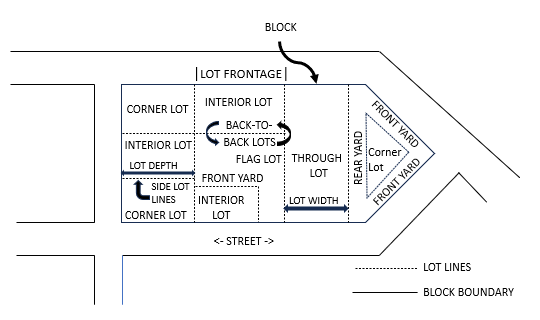 [Ord. 2010-1]
Lot coverage–the percentage of the lot area that is covered by structures, including principal buildings and accessory structures, and by impervious paving materials.
Lot line–a property boundary line of any lot held in single and separate ownership.
- Lot line, front–the lot line for such portion of the lot that abuts the street and shall be deemed to be the same as the ultimate right-of-way line of the street, and shall not be the center line of the street, or any other line within the street line even though such may be the property boundary line.
- Lot line, rear–any lot line which is parallel to or within 45 degrees of being parallel to an ultimate right-of-way line, except for a lot line that is an ultimate right-of-way line. In the case of a corner lot, a rear lot line shall be the farthest lot line parallel to or within 45 degrees of being parallel to an ultimate right-of-way (see definition for “front yard”); all other lot lines, other than ultimate right-of-way lines, shall be considered side lot lines. In the case of a lot having no street frontage or a lot of an odd shape, only the one lot line farthest from the designated front yard shall be considered the rear lot line.
- Lot line, side–any lot line which is not an ultimate right-of-way line or a rear lot line.
- Ultimate right-of-way line–see definition for “ultimate right-of-way” under “right-of-way.”
[Ord. 2010-1]
Low impact home-based business–an accessory use of a dwelling unit for capital gain that is not otherwise a No Impact Home-Based Business. [Ord. 2009-1]. [Ord. 2009-1]
Lumber Mill-a facility where logs or partially processed cants are sawn, split, shaved, stripped, chipped, or otherwise processed to produce wood products, not including the processing of timber for use on the same lot by the owner or resident of that lot.
Main use of building–the principal or most important use of the building on a lot.
Manufactured housing–a dwelling unit fabricated at an off-site manufacturing facility for installation or assembly at the building site, bearing a label certifying that it is built in compliance with the Federal Manufactured Housing Construction and Safety Standards, which has been attached to a permanent foundation. [Ord. 2-98]
Massage establishment–any place or establishment where a massage is available. A massage being construed to mean the performance of manipulative exercises upon the human body of another by rubbing, kneading, stroking, or tapping with the hand or hands or with any mechanical or bathing device with or without supplementary aids, including, but not by way of limitation, a massage school.
Mineral Extraction - The removal from the surface or beneath the surface of the land of bulk mineral resources. This use also includes accessory stockpiling and processing of mineral resources. "Mineral extraction" includes, but is not limited to, the extraction of sand, gravel, topsoil, limestone, sandstone, oil, coal, clay, shale, and iron ore. The routine movement of and replacement of topsoil during construction shall not by itself be considered mineral extraction.
Mixed-Use Building - A structure which contains two or more distinctly separate uses such as a commercial use and a residential use.
Mineral resource–any of various naturally occurring inorganic substances which are intended to be extracted, mined or quarried. Mineral resources shall include natural gas and petroleum. Stones which rest upon the natural surface of the ground shall not be considered mineral resources. [Ord. 5-84]
Mobile home–a transportable, single-family dwelling intended for permanent occupancy, contained in one unit, or in two or more units designed to be joined into one integral unit capable of again being separated for repeated towing, which arrives at a site complete and ready for occupancy except for minor and incidental unpacking and assembly operations, and constructed so that it may be used without a permanent foundation. [Ord. 4-90]
Mobile home lot–a parcel of land in a mobile home park, improved with the necessary utility connections and other appurtenances necessary for the erections thereon of a single mobile home. [Ord. 4-90]
Mobile home park–a parcel or contiguous parcels of land which has been so designated and improved that it contains two or more mobile home lots for the placement thereon of mobile homes. [Ord. 4-90]
No impact home-based business–a business or commercial activity administered or conducted as an accessory use which is clearly secondary to the use of a residential dwelling and which involves no customer, client or patient traffic, whether vehicular or pedestrian, pickup, delivery or removal functions to or from the premises, in excess of those normally associated with residential use. [Ord. 2009-1]
Nonconforming lot–a lot the area or dimension of which was lawful prior to the adoption or amendment of a zoning ordinance, but which fails to conform to the requirements of the zoning district in which it is located by reasons of such adoption or amendment. [Ord. 4-90]
Nonconforming structure–a structure or part of a structure manifestly not designed to comply with the applicable use or extent of use provisions in a zoning ordinance or amendment heretofore or hereafter enacted, where such structure lawfully existed prior to the enactment of such ordinance or amendment or prior to the application of such ordinance or amendment to its location by reason of annexation. Such nonconforming structures include, but are not limited to, nonconforming signs. [Ord. 4-90]
Nonconforming use–a use, whether of land or of structure, which does not comply with the applicable use provisions in a zoning ordinance or amendment heretofore or hereafter enacted, where such use was lawfully in existence prior to the enactment of such ordinance or amendment, or prior to the application of such ordinance or amendment to its location by reason of annexation. [Ord. 4-90]
Normal Agriculture Operations - The activities, practices, equipment and procedures that farmers adopt, use or engage in the production and preparation for market of poultry, livestock and their products and in the production, harvesting and preparation for market or use of agricultural, agronomic, horticultural, viticultural, apicultural, silvicultural and aquacultural crops and commodities and is:
- (1) not less than ten contiguous acres in area; or
- (2) less than ten contiguous acres in area but has an anticipated yearly gross income of at $2,000.
The term includes new activities, practices, equipment and procedures consistent with technological development within the agricultural industry. Use of equipment shall include machinery designed and used for agricultural operations, including, but not limited to, crop dryers, feed grinders, saw mills, hammer mills, refrigeration equipment, bins and related equipment used to store or prepare crops for marketing and those items of agricultural equipment and machinery defined by the act of December 12, 1994 (P.L. 944, No. 134), known as the Farm Safety and Occupational Health Act. Custom work shall be considered a normal farming practice.
Nursing home-a use which provides for the long term care and treatment for two or more convalescents and other persons who are not relatives of the operator who are not acutely ill and do not need hospital care, but who require skilled nursing care and related medical services in such matters as dressing, bathing, diet, financial management, evacuation of a residence in the event of an emergency or medication prescribed for self-administration. Such a facility shall be licensed by the Commonwealth of Pennsylvania for the use.
Office, medical or dental- a building used exclusively by physicians and dentists for treatment and examination of patients, provided that no overnight patients shall be kept on the premises.
Office, professional- a use that involves administrative, clerical, financial, governmental or professional operations and operations of a similar character. This use shall Include neither retail nor Industrial uses, but may Include business offices, medical or dental offices, clinics or laboratories, photographic studios and/or television or radio broadcasting studios.
Oil and gas-the exploration and recovery of oil and natural gas from underground formations, including accessory ponds, roads and associated equipment and structures.
Official map–a map adopted by ordinance pursuant to Article IV of the Pennsylvania Municipalities Planning Code, 53 P.S. §10401 et seq. [Ord. 4-90]
Open space–land set aside as part of a cluster development, which is in addition to resource protected land. [Ord. 2004-3]
Overflow parking–that parking in a residential area which is the result of unforseen events resulting in a demand for excess parking area over and above that which is required by ordinance. [Ord. 99-2A]
Overflow parking lot–a lot in a residential subdivision or land development which shall be provided for overflow parking. Overflow parking areas shall be for the convenience of the residence or land development only. This parking shall be for excess parking due to parties, funerals, etc. This area can also be used for properly licensed property of the residents of that subdivision or property owners such as recreational vehicles, boat, trailers, etc. No trucks or tractor trailers over 10,000 pounds will be allowed. [Ord. 99-2A]
Parking area–a lot or part thereof used for the storage or parking of motor vehicles, with or without the payment of rent or charges in money or other consideration.
Parking space–a stall or berth which is arranged and intended for parking of one motor vehicle in a garage or parking area.
Parks and playgrounds–open areas with or without such amenities as play equipment, pavilions, athletic courts or fields, trails or similar elements, which may or may not be government-owned and -operated.
Personal services -Places primarily providing services which do not involve retail sales or professional advisory services. This shall include those oriented to serving personal needs, such as barber and beauty shops, animal or dog grooming businesses; establishments involved primarily with repairing goods, rather than with the retail sales of goods, such as repair of shoes or household appliances, but shall not be construed to include those relating to motorized vehicles; and dry cleaning and laundry pickups, laundromat and other similar establishments. This use shall also include any place or establishment where a massage is available, with a massage being construed to mean the performance of manipulative exercises upon the human body of another by rubbing, kneading, stroking, or tapping with the hand or hands or with any mechanical or bathing device with or without supplementary aids, including, but not by way of limitation, a massage school but shall not include any activity otherwise defined in or included under any Adult Business-related use.
Place of assembly/worship-a building or group of buildings, including customary accessory buildings thereto, designed, intended or used for public worship. This shall include chapels, cathedrals, temples, mosques, Sunday schools, synagogues and similar designations.
Planned residential development–an area of land, controlled by a landowner, to be developed as a single entity for a number of dwelling units, or combination of residential and nonresidential uses, the development plan for which does not correspond in lot size, bulk, type of dwelling, or use, density, or intensity, lot coverage and required open space to the regulations established in any one district created, from time to time, under the provisions of a municipal zoning ordinance. [Ord. 4-90]
Planning Commission–the Planning Commission of Heidelberg Township, Lehigh County, Pennsylvania.
Plant nursery-a use that may include outdoor storage and display of plants and trees, without any required screening.
Preserve-a noncommercial preservation of land for providing wildlife habitats, forests or scenic natural features that involves no buildings other than a nature education and/or study center and customary maintenance buildings. Also includes wildlife sanctuary, nature center, outdoor education laboratory, woodland preserve, or arboretum.
Professional occupation–an occupation for which specialized knowledge requiring intensive academic preparation is necessary, including medical doctors, lawyers, professional engineers, or accountants.
Public hearing–a formal meeting held pursuant to public notice by the governing body or planning agency, intended to inform and obtain public comment, prior to taking action in accordance with the Municipalities Planning, Code, 53 P.S. §10101 et seq. [Ord. 2010-1]
Public meeting–a forum held pursuant to notice under the Act of October 15, 1998, P.L. 729, No. 93, 65 Pa.C.S.A. §701 et seq., known as the “Sunshine Act.” [Ord. 2010-1]
Public notice–notice published once each week for 2 successive weeks in a newspaper of general circulation in the municipality. Such notice shall state the time and place of the hearing and the particular nature of the matter to be considered at the hearing. The first publication shall not be more than 30 days and the second publication shall not be less than 7 days from the date of the hearing. [Ord. 4-90]
Public use, municipal-the use of land which is owned by the municipality for the purposes of the municipal government and the community.
Public utility facility-buildings, structures, and facilities, including generating and switching stations, poles, lines, pipes, pumping stations, repeaters, antennas, transmitters and receivers, valves, and all buildings and structures relating to the furnishing of utility services, such as electric, gas, telephone, water, sewer, and public transit, to the public.
Public utility transmission tower–a structure, owned and operated by a public utility electric company regulated by the Pennsylvania Public Utility Commission, designed and used to support overhead electricity transmission lines. [Ord. 99-2A]
Recreation, private-a commercially operated park or facility with various devices for entertainment including but not limited to rides, games, electronic games and similar devices, food stands and other associated facilities.
Recreation, public-a government owner- and -operated park or facility with various devices for entertainment including but not limited to rides, games, electronic games and similar devices, food stands and other associated facilities, as well as exterior amenities such as play sets, athletic courts, fields, trails, pavilions or water features.
Report–any letter, review, memorandum, compilation, or similar writing made by any body, board, officer, or consultant, other than a solicitor, to any other body, board, officer, or consultant for the purpose of assisting the recipient of such report in the rendering of any decision or determination. All reports shall be deemed recommendatory and advisory only and shall not be binding upon the recipient, board, officer, body, or agency, nor shall any appeal lie therefrom. Any report used, received, or considered by the body, board, officer, or agency rendering a determination or decision shall be made available for inspection to the applicant and all other parties to any proceeding upon request, and copies thereof shall be provided at cost of reproduction. [Ord. 4-90]
Research and Development, Engineering/Testing Facility or Laboratory - A facility involving the testing, engineering and development of manufactured products.
Resource protected land–the sum of all resource protected land, within the subdivision tract that has been mapped and measured for the purpose of determining the amount of land needed to be protected, because of the unique and natural features of the land. The resource protected area can be included in the lot area. The area is reported to the nearest 0.01 acre. The resource protected land shall include, but not limited to, the following: right-of-way for existing or proposed overhead utilities and existing private streets, wetlands, lakes, ponds, quarries, streams, springs, flood way, 100-year floodplain and flood soils. Also included, but not limited to, are rock outcropping, boulder fields, steep slope of 15 percent or more, wooded area and area cleared by logging or for logging purposes. [Ord. 2004-3]
Restaurant–a business establishment where food and drink are prepared, served and consumed primarily within the principal building. [Ord. 2010-1]
Restaurant, Café–an establishment whose principal business is the sale of food or beverages to the customer in a ready to consume state and whose principal method of operation includes one of the following characteristics. Customers, normally provided with a menu, are served their foods and beverages by a restaurant employee at the same table or counter at which the items are consumed; or, a cafeteria-type operation where foods or beverages are generally consumed within the restaurant building.
Restaurant, sit-down - an establishment whose principal business is the sale of food or beverages to the customer in a ready-to-consume state and whose principal method of operation includes one of the following characteristics. Customers, normally provided with a menu, are served their foods and beverages by a restaurant employee at the same table or counter at which the items are consumed.
Restaurant, tea rooms - an establishment which primarily serves tea and other light refreshments, which may be located inside another use such as a hotel, which often serves as a social center.
Retail store or shop–a building devoted to the sale of commodities in small quantities to the ultimate consumer. The term “retail store” shall not include the term “adult book store.”
Retail, medium- a use in which merchandise of any kind is sold or rented to the general public with an interior and exterior footprint of between 20,000 and 100,000 square feet.
Retail, small- a use in which merchandise Is sold or rented to the general public, but not including the following: sales of motor vehicles or boats, any Adult use, manufacturing, tavern, car wash, auto service station, auto repair garage, convenience store or any restaurant, typically limited in size to no more than 20,000 square feet.
Riding club (riding school or riding stable)–an establishment where horses may be kept, bred, trained and/or exercised and where equestrian instruction and equestrian competition may be offered including, but not limited to, polo clubs, public show rings and rodeos. [Ord. 2010-1]
Rock outcrop– areas where bedrock is exposed to view and not obscured by soil or loose boulders. [Ord. 2004-3]
School, pre-kindergarten- a building designed and operated to provide regular instruction and daytime care for two or more children under primary grades.
School, primary and secondary- a public or private academic institution offering instruction at the elementary, junior, and/or senior high school levels in the branches of learning and study required by the Pennsylvania Department of Education.
Selection method– a method of selectively removing trees from a wooded area either singly or in small groups according to age and size with provision being made for natural or artificial revegetation.
Self-storage (indoor storage)- a building or group of buildings containing separate, individual, and private storage spaces of varying sizes, available for lease or rent for varying periods of time.
Service businesses- See Personal Services.
Shooting range, indoor-any fully enclosed building used for the discharge of any firearm for recreational or training purposes. Any such commercial operation, any such area operated by any private, non-profit entity, any community association, any such area operated by any sportsman's, recreation or fraternal club or association with twenty-five (25) or more members, and any such area which is used or is intended to be used for more than five (5) hours in any one (1) week shall be considered an indoor shooting range for the purposes of this Zoning Ordinance.
Sign–a structure, device, or display designed to attract attention and impart a message. See also “business identification,” “freestanding sign,” “wall sign,” “advertising sign,” “temporary sign,” “bulletin board,” and “announcement or professional sign.”
Social club- a building, structure, lot or land area used as a private club, fraternal or social organization. The social membership club shall serve a purely social, athletic or community service purpose. It shall be operated on a membership basis and not conducted as a business.
Social hall/event center- a building used for social gatherings, meetings or recreational purposes operated by a governmental agency, philanthropic organization or private business. Such uses include but are not limited to a municipal building, library, volunteer fire company, emergency services building, cultural/community center, museum or similar use/facility.
Special exception–a use permitted in a particular zoning district pursuant to the provisions of Articles VI and IX of the Pennsylvania Municipalities Planning Code, 53 P.S. §§10601 et seq., 10901 et seq. [Ord. 4-90]
Special exception use–a use in one or more districts for which the Zoning Hearing Board may grant a permit pursuant to the provisions of §27-1108.
Specified anatomical areas–less than completely and opaquely covered human genitals, pubic region, buttock or female breast below a point immediately above the top of the aureola; human male genitals in a discernibly turgid state, even if completely or opaquely covered.
Specified sexual activities–human genitals in a state of sexual stimulation or arousal. Acts of human masturbation, sexual intercourse or sodomy, fondling or other erotic touching of human genitals, pubic region, buttock or female breast.
Steep slope–land with a gradient in excess of 15 percent.
Stock Yard, Slaughterhouse, or Meat-Packing Plant-a building or structure where livestock is slaughtered and prepared for distribution to butcher shops or retail sales establishments such as grocery stores. A slaughterhouse is designed to accommodate the confinement and slaughtering of live animals and may include packaging, treating, storage or sale of the product on the premises.
Street– includes any street, avenue, boulevard, road, highway, freeway, parkway, land, alley, viaduct and any other ways used or intended to be used by vehicular traffic or pedestrians whether public or private.
Street line– the dividing line between a lot and the outside boundary of the ultimate street right-of-way, or between a lot and a private street which serves two or more separately owned homes or buildings.
Structure– Anything constructed or erected that requires a location on the ground, including a building, swimming pool, or gas/liquid storage tank that is principally above ground but not including access driveways, walkways, or a fence or wall used as a fence if the height does not exceed six (6) feet.
Swimming pool, private– any receptacle or artificially constructed container for water, having a wall depth of 2 feet or more at any point within its perimeter, intended or adapted for the purposes of immersion or partial immersion of human beings therein used or intended to be used in connection with residences, available only to the family of the householder and his private guests, not open to the public or publicly owned, not owned and/or operated by any organization, partnership or corporation, and not otherwise regulated by any statutes or by rules and regulations than those of the Township.
Tasting room- a room or rooms open to the general public, primarily used for the retail marketing of beverage-related products controlled by the PA Liquor Control Board. Merchandise offered for sale within the tasting room may also include souvenirs and clothing bearing the logo of the business, as well as related items and other products that reflect or enhance the character or theme of the product(s). Rooms where wine tasting occurs, where beverage tasting is part of the normal business practice in the wholesale marketing of beverage products and that are not open to the public are not considered tasting rooms.
Taverns, cocktail lounges- a place where alcoholic beverages are served as a primary or substantial portion of the total trade. The sale of food may also occur.
Temporary signs– a sign, constructed of cloth, canvas, fabric, wood, or other similar material, with or without a structural frame, and intended for a limited period of display. For purposes of this Chapter, real estate and construction signs are temporary signs.
Theater or assembly hall- a building or part of a building devoted to showing of motion pictures or theatrical performing arts productions as a principal use, but not including an outdoor drive-in theater or adult theater.
Trail- a way designed for and used by equestrians, pedestrians, and cyclists using non-motorized bicycles, unless electric powered and limited to a speed of less than 20 miles per hour.
Travel unit– a truck-mounted camper; and auto, truck, or bus adapted for vacation living; a folding tent camper, a tent; and other similar devices used for temporary portable housing.
Urban Ag- a garden or orchard where food is grown primarily to be sold for either profitable or charitable purposes. It may be sold directly to consumers, restaurants, or stores.
Use, principal– any activity, occupation, business or operation carried on, or intended to be carried on, in a building or other structure, or on a tract of land. [Ord. 2010-1]
Variance– relief granted pursuant to the provisions of Articles VI and IX of the Pennsylvania Municipalities Planning Code, 53 P.S. §§10601 et seq., 10901 et seq. [Ord. 4-90]
Veterinary clinic- a place where animals are given medical care, but no boarding of animals is permitted.
Wedding venue/banquet facility- a facility that operates largely for the holding of special events, occasions, concerts, weddings, celebrations, or other similar activities in which parties of more than 10 people are invited to the site for the purpose of such event.
Welding shop- establishment engaged primarily in the assembly of metal parts, including the following uses that produce metal duct work, tanks, cabinets and enclosures, metal doors and gates, and similar products: blacksmith, welding shop and sheet metal shop.
Wind energy system- An energy conversion system consisting of a wind turbine, a tower, blades and associated controls and appurtenances that convert wind energy to electricity which is used for commercial purposes, or which is sold on the open market. It could include but is not limited to the following structures and facilities.
Wind Energy Conversion System (WEC) – Any device which converts wind energy to a form of usable energy.
Wind Generator – Equipment that converts energy from the wind into electricity. Includes the rotor, blades, and associated mechanical and electrical conversion components necessary to generate, store, and/or transfer energy.
Wind System, Building and/ or Ground-Mounted – A device accessory to a principal use that converts wind energy to mechanical or electrical energy.
Wrecking or Dismantling of Motor Vehicles (storage of the parts and materials from such operations and the storage of other junk)- an area of land, with or without buildings, used for the storage, outside a completely enclosed building, of used and discarded materials, including but not limited to, waste paper, rags, metal, building materials, house furnishings, machinery, vehicles, or parts thereof, with or without the dismantling, processing, salvage, sale, or other use or disposition of the same. The deposit or storage on a lot of one or more unlicensed, wrecked, or disabled vehicles, or the major part thereof, shall be deemed to constitute a “junkyard.” (A disabled vehicle is a vehicle intended to be self-propelled that shall not be operable under its own power for any reason, or a vehicle that does not have a valid current registration plate or that has a certificate of inspection which is more than sixty (60) days beyond the expiration date.)
Wall sign–a sign which is part of, attached directly to, supported by, or painted upon a building wall.
Yard, front–an open unoccupied space on the same lot with a building, situated between the nearest roofed portion of the building and the front lot line of the lot and extending from side lot line to side lot line.
Yard, rear–a space on the same lot with a building situated between the nearest roofed portion of the building and the rear lot line of the lot and extending from side lot line to side lot line.
Yard, side–an open unoccupied space on the same lot with a building situated between the nearest roofed portion of the building or of any accessory building and the side lot line of the lot, and extending through from the front yard or from the front lot line where no front yard exists, to the rear yard, or to the rear lot line where no rear yard exists.
Zoning Officer–the duly constituted municipal official designated to administer and enforce this Chapter.
(Ord. 4-81, 12/28/1981, §300; as amended by Ord. 5-84, 10/5/1984, §§1 and 2; Ord. 2-88, 8/5/1988, §§2–7; Ord. 1-89, 7/7/1989, §§1 and 2; Ord. 4-90, 10/11/1990, §§1–21; Ord. 2-98, 4/9/1998, §§1–6; Ord. 99-2A, 11/11/1999, §§1, 5 and 7; by Ord. 2002-3, 5/9/2002, §1; by Ord. 2004-3, 8/12/2004, Art. I, §9; by Ord. 2009-1, 1/5/2009, §§1–3; by Ord. 2010-1, 4/8/2010; and by Ord. 2011-2, 11/10/2011)
Amended by Ord. 2024-5 on 12/30/2024
Adopted by Ord. 2025-2 on 9/25/2025

