
Helotes City Zoning Code
ARTICLE III
DISTRICT REGULATIONS
Sec. 98-61.- Pre-development district (PD).
In an area temporarily classified as PD, pre-development district:
(1)
No person shall erect, construct, or add to any building or structure or cause the same to be done in any newly annexed territory without first applying for appropriate zoning.
(2)
No permit for the construction of a building or use of land shall be issued by the building permit official other than a permit which shall allow the construction of a building permitted in the PD, pre-development district, unless and until such territory has been classified in a district by the City Council in the manner in accordance with the provisions as follows.
(3)
An application for a permit for any use shall be made to the building inspector for the city and by him referred to the Planning and Zoning Commission for consideration and recommendation to the City Council. The commission in making its recommendation to the City Council shall take into consideration the appropriate land use for the area and the comprehensive land use plan. The City Council after receiving and reviewing the recommendations of the Planning and Zoning Commission may by majority vote authorize the issuance of a building permit or certificate of occupancy or may disapprove the application.
(4)
In a pre-development district no land shall be used for and no building shall be erected for or converted to any use other than: See Schedule of Uses in the appendix at the end of this chapter and section 98-34.
(Ord. No. 253, § 1(art. III, § 1), 4-8-2004; Ord. No. 387, § 1, 12-8-2008)
Sec. 98-62. - Single-family residential district (R-1).
(a)
Use regulations. A building or premises shall be used only for the following purpose: See Schedule of Uses in the appendix at the end of this chapter and section 98-34.
(b)
Height regulations. No building shall exceed thirty-five (35) feet in height and be greater than two floors. Refer to Sec. 98-4.
(c)
Area regulations.
(1)
Front yard setback. A front yard setback shall be a minimum of 40 feet, except in areas platted where setback minimums are established prior to the effective date of this chapter. Where lots have double frontage, running through from one street to another, the required front yard shall be provided on both streets.
(2)
Side yard setback. There shall be a side yard on each side of the lot, having a width of not less than 25 feet, except a detached garage or other permitted accessory building located 70 feet or more from the front property line shall not be located nearer than five feet to any side property line.
(3)
Rear yard setback. There shall be a rear yard, having a depth of not less than 25 feet, except a detached garage or other permitted accessory building which shall not be located nearer than five feet from the rear property line.
(4)
Area of lot. The minimum area of the lot shall be 32,000 square feet.
(5)
Width of lot. The minimum area of the lot shall be 120 feet.
(6)
Depth of lot. The minimum depth of the lot shall be 120 feet.
(d)
Parking regulations. Off-street parking spaces behind the front setback line of property shall be provided on the lot to accommodate a minimum of two automobiles for each dwelling unit.
(e)
Accessory buildings, associated living quarters and storage buildings. An accessory building, associated living quarters, or storage building shall not extend beyond the front line of the main building, and shall be a minimum of 25 feet from the side property line and five feet from the rear property line. (Exception: An accessory building located 70 feet or more from the front property line shall be a minimum of five feet from the side property line.)
(Ord. No. 253, § 1(art. III, § 2), 4-8-2004; Ord. No. 387, § 1, 12-8-2008; Ord. 419, § 2, 11-12-2009)
Sec. 98-63. - Cluster development.
A cluster development is a residential subdivision in which the lots are allowed to be smaller (in area and width) than otherwise required for the underlying, base R-1 single-family residential zoning district, but in which the overall density cannot exceed two units per acre. Through the cluster development option, a subdivision can contain no more lots than would otherwise be allowed for a conventional subdivision in the same zoning district, but the individual lots within the development could be smaller than required in a conventional subdivision. Smaller lot sizes within a cluster development are required to be offset by a corresponding increase in open space.
(1)
Purpose.
a.
It is the purpose of this section to permit residential cluster development in order to:
1.
Encourage creative and flexible site design that is sensitive to the land's natural features and adapts to the natural topography;
2.
Protect environmentally sensitive areas of a development site and preserve on a permanent basis open space, natural features, and hill country features;
3.
Decrease or minimize nonpoint source pollution impacts by reducing the amount of impervious surfaces in site development;
4.
Promote cost savings in infrastructure installation and maintenance by such techniques as reducing the distance over which utilities, such as water and sewer lines, need to be extended or by reducing the width or length of streets; and
5.
Provide opportunities for social interaction and walking and hiking in open space.
(2)
Conflict with other regulations. If there is a conflict between the cluster development standards of this section and any other requirement of this Code, the standards of this section control. Where no conflict exists, a cluster development is subject to all other applicable requirements of this Code.
(3)
Where allowed. Cluster developments may by allowed in a R-1 single-family residential district provided that specific city council approval is granted for the cluster development pursuant to the terms of article V of this chapter.
(4)
Approval procedure. Cluster developments are subject to the zoning and subdivision procedures set forth herein.
(5)
Categories of cluster developments. An applicant for a cluster development specific use permit must obtain authorization for multifamily cluster development townhouse cluster development or a garden home cluster development. Should city council authorize the issuance a specific use permit for a cluster development said permit shall specify the category of cluster development so authorized. Rules relating to each category are as follows:
a.
Multifamily residential cluster development.
1.
Use regulations. A building or premises shall be used only for the following purposes: multifamily dwelling units.
2.
Heights regulations. No building shall exceed forty (40) feet in height and be greater than two floors. Refer to Sec. 98-4.
3.
Area regulations.
i.
Front yard setback. There shall be a front yard having a minimum depth of 20 feet.
ii.
Side yard setback. There shall be a minimum side yard setback of five feet.
iii.
Rear yard setback. There shall be a rear yard setback having a minimum depth of ten feet.
iv.
Density. A maximum of 30 units may be constructed per acre provided the cluster development open space requirements of this section are met.
4.
Parking regulations. Off-street parking spaces behind the front yard set-back line of property shall be provided on the lot to accommodate a minimum of two automobiles for each dwelling unit.
5.
Buffer zone multifamily cluster development to PD, R-1, R-2, or R-3. A buffer zone of 200 feet from the nearest building in the multifamily cluster development shall be maintained along property lines adjoining properties zoned or used as PD, R-1, R-2, or R-3. The buffer zone shall consist of passive open space and may not contain any impervious cover except that the width of an existing street may be counted towards the buffer zone distance requirement.
6.
Accessory buildings, associated living quarters and storage buildings. Accessory buildings and offices associated with the management and maintenance of the: multifamily development and amenities thereto.
b.
Townhouse single-family residential cluster development.
1.
Use regulations. A building or premises shall be used only for the following purposes: single-family dwelling unit.
2.
Heights regulations. No building shall exceed thirty-five (35) feet in height and be greater than two floors. Refer to Sec. 98-4.
3.
Area regulations.
i.
Front yard setback. There shall be a front yard having a minimum depth of five feet.
ii.
Side yard setback. There shall be no minimum side yard setback provided that each building is located on separate adjoining platted lots, each being separated from the adjoining unit or units by a vertical firewall (to be constructed in accordance with city codes and ordinances) along the dividing lot line. In those instances where buildings do not share a common firewall the side yard setback shallbe a minimum of five feet.
iii.
Rear yard setback. There shall be a rear yard setback having a minimum depth of ten feet.
iv.
Density. A maximum of ten units may be constructed per acre provided the cluster development open space requirements of this section are met.
4.
Parking regulations. Off-street parking spaces behind the front yard set-back line of property shall be provided on the lot to accommodate a minimum of two automobiles for each dwelling unit.
5.
Buffer zone townhouse cluster development to PD, R-1, R-2, or R-3. V A buffer zone of 200 feet from the nearest building in the multifamily cluster development shall be maintained along property lines adjoining properties zoned or used as PD, R-1, R-2, or R-3. The buffer zone shall consist of passive open space and may not contain any impervious cover except that the width of an existing street may be counted towards the buffer zone distance requirement.
6.
Accessory buildings, associated living quarters and storage buildings. Accessory buildings associated living quarters, or storage buildings are not permitted in an "R-TH" zoning district.
c.
Garden home single-family residential cluster development.
1.
Use regulations. A building or premises shall be used only for the following purposes single-family dwelling unit.
2.
Heights regulations. No building shall exceed thirty-five (35) feet in height and be greater than two floors. Refer to Sec. 98-4.
3.
Area regulations.
i.
Front yard setback. On each lot there shall be a front yard having a minimum depth of 20 feet.
ii.
Side yard setback. On each lot there shall be a side yard having a minimum depth of five feet.
iii.
Rear yard setback. There shall be a rear yard setback having a minimum depth of 25 feet.
iv.
Lot size. Each lot shall be a minimum of 6,600 square feet, shall have a minimum lot width of 55 feet and shall have a minimum lot depth of 120 feet provided the cluster development open space requirements of this section are met.
4.
Parking regulations. Off-street parking spaces behind the front yard set-back line of property shall be provided on the lot to accommodate a minimum of two automobiles for each dwelling unit.
5.
Accessory buildings, associated living quarters and storage buildings. There may be only one single-family structure on each lot and no accessory, associated or additional living quarters shall be permitted in a garden home single-family residential cluster development. One accessory building, other than living quarters, or one storage building shall be permitted. Said accessory or storage building shall not extend beyond the front line of the main building, and shall be a minimum of five feet from the side property line and five feet from the rear property line.
(6)
Open space plan.
a.
An open space plan must be submitted with the submittal of the for cluster development specific use permit request.
b.
No specific use permit for cluster development shall be granted unless the open space plan:
1.
First receives a recommendation to the city council by the planning and zoning commission; and
2.
Is thereafter approved by city council prior to or at the time city council considers the specific use permit for the cluster development.
c.
Plan must show the open space contiguous or otherwise approved by city council.
d.
Once an open space plan is approved by city council it shall not be modified without the subsequent approval of city council.
(7)
Cluster development open space requirements.
a.
Minimum requirement. Common open space is required within a cluster development to ensure that the overall density within the development does not exceed the maximum density allowed by the underlying R-1 single-family residential zoning district. Common open space must be provided in an amount at least equal to the difference between:
1.
The actual, average lot area per dwelling unit within the cluster development; and
2.
The required lot area per dwelling unit for conventional development within the underlying R-1 single-family residential district base zoning district.
b.
Use of open space. Common open space must be set aside and designated as an area where no development will occur.
c.
Designation of open space. Open space shall be designated as such on the subdivision plat of the property and by conservation easement or other instrument, approved by the city attorney, and which shall be recorded in the property records of Bexar County Texas.
d.
Homeowners association. Multifamily condominium, townhouse and garden home cluster developments shall have a mandatory homeowners or property owners association who shall maintain, manage and control the open space.
e.
Location of open space. Prior to approval of a special use permit for a cluster development the proposed open space shall be identified by survey, metes and bounds or other description acceptable by the city engineer. Where applicable, city council may require the open space to include "sensitive land" which comprise:
1.
Wetlands;
2.
Woodlands;
3.
Sensitive aquifer recharge features;
4.
All of the floodway and flood fringe within the 100-year floodplain, as shown on the most current official FEMA maps;
5.
All areas within 100 feet of the edge of the 100-year floodplain as delineated on the FEMA maps and any letter of map revision;
6.
All areas within 100 feet of the banks of any stream shown as a blue line on the USGS 1:24,000 (7.5 minute) scale topographic maps for Bexar County;
7.
Steep slopes (i.e., slopes exceeding 25 percent);
8.
Soils subject to slumping, as indicated on the medium-intensity maps contained in the most current county soil survey published by the USDA Natural Resources Conservation Service;
9.
Significant wildlife habitat areas; and
10.
Historic, archaeological or cultural features listed (or eligible to be listed) on national, state, or city registers or inventories.
(Ord. No. 310, § 2 (App. A), 6-22-2006; Ord. No. 387, § 1, 12-8-2008; Ord. 419, § 2, 11-12-2009)
Sec. 98-64. - Two-family residential district (R-2).
(a)
Use regulations. A building or premises shall be used for the following purposes: See Schedule of Uses in the appendix at the end of this chapter and section 98-34.
(b)
Height regulations. No building shall exceed thirty-five (35) feet in height and be greater than two floors. Refer to Sec. 98-4.
(c)
Area regulations.
(1)
Front yard setback. There shall be a front yard having a minimum depth of not less than 40 feet.
(2)
Side yard setback. There shall be a side yard on each side of the lot, having a width of not less than 25 feet, except a detached garage or other permitted accessory building located 70 feet or more from the front property line shall not be located nearer than five feet to any side property line.
(3)
Rear yard setback. There shall be a rear yard having a depth of not less than 25 feet, except a detached garage or other permitted accessory building which shall not be located nearer than five feet from the rear property line.
(4)
Area of lot. Except as hereinafter provided, all dwellings erected, enlarged, relocated, reconstructed, or converted shall be located upon lots containing the following area: A lot on which a two-family dwelling is located shall contain not less than 32,000 square feet.
(5)
Width of lot. The minimum width of the lot shall be 100 feet for the two-family dwelling.
(6)
Depth of lot. The minimum depth of the lot shall be 120 feet.
(d)
Parking regulations. Off-street parking spaces behind the front line of the dwelling shall be provided on the lot to accommodate a minimum of two automobiles for each dwelling unit.
(e)
Accessory buildings, associated living quarters and storage buildings. An accessory building, associated living quarters, or storage building shall not extend beyond the front line of the main building, and shall be a minimum of 25 feet from the side property line and five feet from the rear property line. (Exception: An accessory building located 70 feet or more from the front property line shall be a minimum of five feet from the side property line.)
(Ord. No. 253, § 1(art. III, § 3), 4-8-2004; Ord. No. 387, § 1, 12-8-2008; Ord. No. 419, § 2, 11-12-2009)
Sec. 98-65. - Mobile home district (R-3).
(a)
Use regulations. A building or premises shall be used only for the following purposes: See Schedule of Uses in the appendix at the end of this chapter and section 98-34.
(b)
Height regulations. The average height of the mobile home frame above the ground elevation, measured at 90 degrees to the frame, shall not exceed three feet.
(c)
Area regulations.
(1)
The minimum front yard setback shall be ten feet from the nearest corner of the mobile home to the front line of the mobile home space.
(2)
No mobile home or accessory building shall be closer than 25 feet to any property line nor closer than 40 feet to the property line adjoining a public street.
(3)
The minimum distance between mobile homes at any point shall be 25 feet, provided, however, that mobile homes parked end-to-end may have a clearance of not less than ten feet.
(4)
A mobile home district shall be such that a minimum street of 36 feet is provided on one side or end of each space.
(d)
Parking regulations. Off-street parking shall be provided at the rate of two spaces per mobile home space. All parking spaces shall be minimum 40 feet off city streets and off of mobile home district streets.
(e)
Accessory buildings and storage buildings. An accessory building, associated living quarters, or storage building shall not extend beyond the front line of the main building, and shall be a minimum of 25 feet from the side property line and five feet from the rear property line. (Exception: An accessory building located 70 feet or more from the front property line shall be a minimum of five feet from the side property line.)
(Ord. No. 253, § 1(art. III, § 4), 4-8-2004; Ord. No. 387, § 1, 12-8-2008; Ord. No. 419, § 2, 11-12-2009)
Sec. 98-66. - Office and professional district (B-1).
(a)
Use regulations. A building or premises shall be used only for the following purposes:
(1)
These districts are composed of land and structures occupied by or suitable for such uses as offices, studios, and limited light commercial uses.
(2)
See Schedule of Uses in the appendix at the end of this chapter and section 98-34.
(b)
Height regulations. No building shall exceed forty (40) feet in height. Refer to Sec. 98-4.
(c)
Area regulations. Area uses are governed by the regulations prescribed.
(1)
Front setback. The minimum front setback shall be ten feet.
(2)
Side area setback. No minimum except that a side yard of not less than ten feet in width shall be provided on the side of the lot common to a side street.
(3)
Area of lot. The minimum area of the lot shall be 6,000 square feet.
(4)
Width of lot. The minimum width of the lot shall be 60 feet.
(5)
Depth of lot. The minimum depth of the lot shall be 100 feet.
(6)
Buffer zone B-1, to PD, R-1, R-2, or R-3. A buffer zone of 100 feet, or a street plus 30 feet or 30 feet plus an approved eight-foot privacy fence shall be maintained.
(7)
Fire lane. A minimum fire lane of 16 feet shall be maintained adjacent to one side of the building having doors.
(d)
Parking regulations. See article IV of this chapter.
(e)
Accessory buildings. No accessory buildings as permitted herein shall be more than fifteen (15) feet in height and have more square feet in floor area than 25 percent of the ground floor area of the main building. No accessory building may be closer than five feet to the main building in the rear yard. Accessory buildings, as permitted herein, are allowed in side yards; provided, however, that no accessory building may be closer than five feet to any main building on the same lot, nor closer than five feet to a common B-1, B-2, B-3, or B-4 property line, unless the property line is common to a street in which case the minimum setback shall be 30 feet. If common property line to R-1, R-2, or R-3, the minimum setback shall be 25 feet if a 100-foot buffer exists, 40 feet if a 40-foot plus street buffer exists, or 15 feet if a 30-foot plus eight-foot privacy fence buffer exists. No accessory building shall be allowed in the front yard or allowed to extend beyond the front line of the main building.
(Ord. No. 253, § 1(art. III, § 5), 4-8-2004; Ord. No. 387, § 1, 12-8-2008; Ord. No. 419, § 2, 11-12-2009)
Sec. 98-67. - Neighborhood service district (B-2).
(a)
Use regulations.
(1)
These districts are composed of land and structures occupied by or suitable for furnishing retail goods such as groceries, drugs, clothing and such services to satisfy the household needs of the surrounding residential area.
(2)
A building or premises shall be used only for the following purposes: See Schedule of Uses in the appendix at the end of this chapter and section 98-34.
(b)
Height regulations. No building shall exceed forty (40) feet in height. Refer to Sec. 98-4.
(c)
Area regulations. Area uses which may be permitted within a neighborhood service district are governed by the prescribed regulations.
(1)
Front setback. Ten-foot minimum, except that drive-in gasoline service islands may not be located nearer than 25 feet to the front property line.
(2)
Side area setback. No minimum, except that a side area of not less than ten feet in width shall be provided on the side adjoining a side street.
(3)
Area of lot. The minimum lot area shall be 6,000 square feet.
(4)
Width of lot. The minimum lot width shall be 60 feet.
(5)
Depth of lot. The minimum depth of the lot shall be 100 feet.
(6)
Buffer zone, B-2 to PD, R-1, R-2, or R-3. A buffer zone of 100 feet or a street plus 40 feet or 30 feet plus an approved eight-foot privacy fence shall be maintained.
(7)
Fire lane. A minimum fire lane of 16 feet shall be maintained adjacent to one side of the building having entry doors.
(d)
Parking regulations. See article IV of this chapter.
(e)
Accessory buildings. No commercial accessory building as permitted herein shall be more than fifteen (15) feet in height and have more square feet in floor area than 25 percent of the ground floor area of the main building. No accessory building may be closer than five feet to the main building in the rear yard. Accessory buildings, as permitted herein, are allowed in side yards; provided, however, that no accessory building be closer than five feet to any main building, nor closer than five feet to a common B-1, B-2, B-3 or B-4 district property line, unless the property line is common to a street, in which case the minimum setback shall be 30 feet. If common property line to R-1, R-2 or R-3 districts, the minimum setback shall be 25 feet if a 100-foot buffer exists, 40 feet if a 40-foot plus street buffer exists, or 15 feet if a 30-foot plus eight-foot privacy fence buffer exists. No accessory building shall be allowed in the front yard or allowed to extend beyond the front line of the main building.
(Ord. No. 253, § 1(art. III, § 6), 4-8-2004; Ord. No. 387, § 1, 12-8-2008; Ord. No. 419, § 2, 11-12-2009)
Sec. 98-68. - General business district (B-3).
(a)
Use regulations.
(1)
These districts are composed of land and structures used for area retail and wholesale sales and limited repair/fix-it operations. Typical uses are department stores, restaurants, camera repair, appliance repair and limited warehousing in conjunction with wholesale distribution.
(2)
A building or premises shall be used only for the following purposes: See Schedule of Uses in the appendix at the end of this chapter and section 98-34.
(b)
Height regulations. No building shall exceed forty (40) feet in height. Refer to Sec. 98-4.
(c)
Area regulations. Area uses permitted within a general business district are governed by the regulations prescribed.
(1)
Front setback. The minimum front setback shall be ten feet.
(2)
Side area setback. No minimum except that a side yard of not less than ten feet in width shall be provided on the side of the adjoining side street.
(3)
Area of lot. The minimum area of the lot shall be 6,000 square feet.
(4)
Width of lot. The minimum width of lot shall be 60 feet.
(5)
Depth of lot. The minimum depth of the lot shall be 100 feet.
(6)
Buffer zone B-3 to PD, R-1, R-2, or R-3. A buffer zone of 100 feet, or a street plus 40 feet or 30 feet plus an approved eight-foot privacy fence shall be maintained.
(7)
Fire lane. A minimum fire lane of 16 feet shall be maintained adjacent to one side of the building having doors.
(d)
Parking regulations. See article IV of this chapter.
(e)
Accessory buildings. No commercial accessory building as permitted herein shall be more than fifteen (15) feet in height and have more square feet in floor area than 25 percent of the ground floor area of the main building. No accessory building may be closer than five feet to the main building in the rear yard. Accessory buildings, as permitted herein, are allowed in side yards; provided, however, that no accessory building on the same lot be closer than five feet to any main building, nor closer than five feet to a common B-1, B-2, B-3 or B-4 property line, unless the property line is common to a street, in which case the minimum setback shall be 30 feet. If common property line to R-1, R-2, or R-3, the minimum setback shall be 25 feet if a 100-foot buffer exists, 40 feet if a 40-foot plus street buffer exists, or 15 feet if a 30-foot plus an eight-foot privacy fence buffer exists. No accessory building shall be allowed in the front yard or allowed to extend beyond the front line of the main building.
(Ord. No. 253, § 1(art. III, § 7), 4-8-2004; Ord. No. 387, § 1, 12-8-2008; Ord. No. 419, § 2, 11-12-2009
Sec. 98-69. - Overlay district (B-3 OD).
(a)
Purpose. The purpose of the B-3 Overlay District is:
(1)
To create a more attractive, cohesive, and safe environment; and
(2)
To safeguard the City's heritage by preventing the spoliation of areas that reflect important elements of the City's cultural, natural, historic, and economic fabric; and
(3)
To create favorable impressions of Helotes that provide environmental enrichment for the citizens of the City and visitors thereto; and
(4)
To preserve, protect, and enhance nearby residential areas; and
(5)
To reduce visual chaos and limit distractions along public roadways; and
(6)
To stabilize and strengthen property values within the corridor.
(b)
Zoning process and classification.
(1)
This section authorizes the establishment of B-3 Overlay Districts; however, separate ordinances are required to designate each district.
(2)
The B-3 Overlay Districts are established as overlays to the regular base zoning districts. Any property located within a B-3 Overlay District must comply with the requirements of the base district, as well as the Overlay District. If there is a conflict between the requirements of the base district and the Overlay District, the more restrictive requirement shall prevail.
(3)
The zoning designation for the B-3 Overlay District shall consist of the base zone symbol and the Overlay District symbol (OD) as a suffix.
(c)
Permitted and non-permitted uses.
(1)
The uses that are not permitted in a B-3 Overlay District are as follows:
a.
Automobile (Incl. Motorcycles) Sales and Service (New and Used, When Used Incidental to New Sales) (Service Completely Enclosed in B-3 District).
b.
Automobile Parking Lots or Garages (Commercial).
c.
Bus Passenger Station at Existing Business other than Busing Company.
d.
Manufacturing, Light.
e.
Newspaper Printer (Completely Enclosed in B-3 District).
f.
Pawnshop (Completely Enclosed in B-2 and B-3 Districts).
g.
Recreation Vehicle Park.
h.
Storage Building (Marine, Automobile, Home, Commercial) (Completely Enclosed in B-3 District).
i.
Theater (Outdoor) (Consumption of Alcohol Permitted).
j.
Theater (Outdoor) (Consumption of Alcohol Not Permitted).
k.
Veterinarian Office and Hospital (with Outside Boarding).
(2)
The uses that may be permitted by the City Council, pursuant to the methodology prescribed in Chapter 98, Article V Specific City Council Approved Use Permit are as follows:
a.
Alcoholic Beverage (Retail) Sales (No On-premises Consumption).
b.
Automobile Car Wash (Full-service).
c.
Automobile Car Wash (Self-service).
d.
Automobile Filling Station and/or Service (Service Completely Enclosed in B-2 and B-3 Districts).
e.
Automobile Paint and Auto Body Shop (Completely Enclosed in B-3 District).
f.
Automobile Part Sales (Completely Enclosed) (Retail).
g.
Automobile Rental (Rental Car Parking Area Completely Fenced with Six ft. Opaque Fencing in B-2 and B-3 Districts).
h.
Carpet Service and Cleaning (Completely Enclosed in B-2 and B-3 Districts).
i.
Club or Lodge (Governmental and Non-profit).
j.
Club or Lodge (Non-governmental).
k.
Convenience Store (Completely Enclosed in B-2 and B-3 Districts).
l.
Funeral Home.
m.
Hotel (Other Than Motel or Motor Inn Where Patrons Access Rooms Via Parking Area).
n.
Marine Sales and Service (New and Used, When Used Incidental to New Sales) (Service Completely Enclosed in B-3 District).
o.
Restaurant with Drive Thru (Alcoholic Beverages Incidental to Food Sales).
p.
Stone Cutting and Monument Sales/Service (Completely Enclosed in B-3 District).
q.
Tavern with Outdoor Area for Patrons/No live or recorded music allowed outside.
r.
Tavern (Completely Enclosed in B-2 and B-3 Districts).
s.
Theater (Completely Enclosed) (Consumption of Alcohol Permitted).
t.
Theater (Completely Enclosed) (Consumption of Alcohol Not Permitted).
(3)
Any use permitted by the Schedule of Uses [in Appendix A at the end of this Chapter] in a B-3 General Business District and that is not prohibited by Subsection (c)(1) of this section, nor require a Specific City Council Approved Use Permit by subsection (c)(2) of this Section, is permitted as a matter of right in a B-3 Overlay District.
(Ord. No. 253, § 1(art. III, § 8), 4-8-2004; Ord. No. 387, § 1, 12-8-2008; Ord. No. 409, § 1, 8-13-2009; Ord. No. 18-07, § 2, 5-10-2018)
Sec. 98-70. - Central business district (B-4).
(a)
Use regulations. These districts are composed of land and structures used for a variety of retail, wholesale sales, repair, entertainment and limited manufacturing which does not emit offensive odor, dust, smoke, fumes, or noise beyond the boundary lines of a B-4 district. A building or premises shall be used only for the following purposes: See Schedule of Uses in the appendix at the end of this chapter and section 98-34.
(b)
Height regulations. No building shall exceed forty (40) feet in height. Refer to Sec. 98-4.
(c)
Area regulations. Area uses which may be permitted within a central business district are governed by the prescribed legislation.
(1)
Front setback. There shall be provided a front building setback of no less than ten feet.
(2)
Side area setback. No minimum except that a side yard of not less than ten feet in width shall be provided on the side of an adjoining side street.
(3)
Rear area setback. No rear yard is required, except that a rear yard of not less than 50 feet on depth shall be provided upon that portion of a lot abutting a rear street or B-1, B-2 or B-3 districts. No parking, storage, or similar use shall be allowed in required rear yards in the B-4 district within 25 feet of the rear property line.
(4)
Area of lot. The minimum area of the lot shall be 10,000 square feet.
(5)
Width of lot. The width of the lot shall be 60 feet.
(6)
Depth of lot. The minimum depth of the lot shall be 100 feet.
(d)
Buffer zone, B-4 to PD, R-1, R-2 or R-3. A buffer zone of 200 feet or a street plus 80 feet or 60 feet plus an approved eight-foot privacy fence shall be maintained.
(e)
Fire lane. A minimum fire lane of 16 feet shall be maintained adjacent to one side of the building having an entry door.
(f)
Parking. See article IV of this chapter.
(Ord. No. 253, § 1(art. III, § 9), 4-8-2004; Ord. No. 387, § 1, 12-8-2008; Ord. No. 419. § 3, 11-12-2009)
Sec. 98-71. - Industrial district (I-1).
(a)
Use regulations. Manufacturing, industrial servicing or storage process not prohibited by law are permitted per the Schedule of Uses in the appendix at the end of this chapter, and section 98-34, and upon approval by the City Council in accordance with the specific use permit procedure, article V of this chapter.
(b)
Height regulations. No building shall exceed forty (40) feet in height. Refer to Sec. 98-4.
(c)
Area regulations. Area uses which may be permitted within the industrial districts are governed by the prescribed legislation.
(1)
Front area setback. There shall be a front setback of no less than 50 feet.
(2)
Side area setback. There shall be provided a side building setback no less than 25 feet to I-1 and 50 feet to B-1 through B-4, side yard adjacent to side street minimum 50 feet.
(3)
Rear yard setback. No rear yard is required, except that a rear yard of not less than 50 feet of depth shall be provided upon that portion of a lot abutting a rear street or I-1 district. No parking, storage, or similar use shall be allowed in required rear yards in I-1 districts within 25 feet of the rear property line. A rear yard of not less than 100 feet in depth shall be provided upon that portion of a lot abutting a B-1, B-2 or B-3 district.
(4)
Area of lot. The minimum area of the lot shall be 10,000 square feet.
(5)
Width of lot. The width of the lot shall be 100 feet.
(6)
Depth of lot. The minimum depth of the lot shall be 100 feet.
(d)
Buffer zone I-1 to PD, R-1, R-2 or R-3. A buffer zone of 300 feet or a street plus 200 feet or 100 feet plus an approved eight-foot privacy fence shall be maintained.
(e)
Fire lane. A minimum fire lane of 16 feet shall be maintained on two nonadjacent sides of the building having doors.
(f)
Safety. All I-1 property lines abutting any other district shall have a safety fence of nine gauge chain link fence with a minimum barrier height of six feet or approved equal. Safety fence may be deleted across the front of the property, provided the fence abuts each side of the building at not more than 20 feet behind the front line of said building.
(g)
Parking. See article IV of this chapter.
(Ord. No. 253, § 1(art. III, § 10), 4-8-2004; Ord. No. 387, § 1, 12-8-2008; Ord. No. 419, § 3, 11-12-2009)
Sec. 98-72. - Old Town Helotes Special District.
(a)
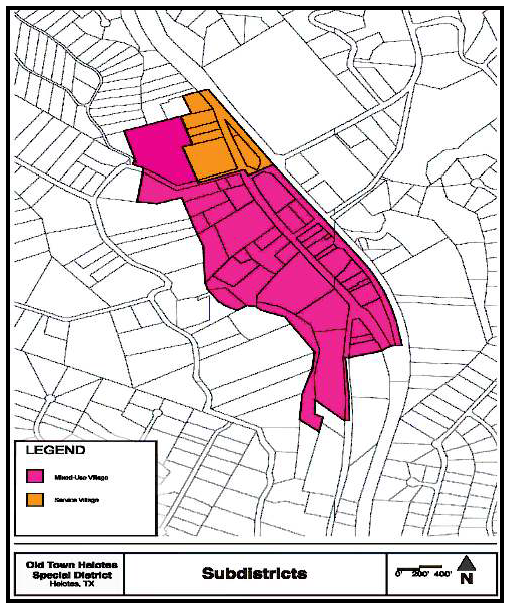
Establishment of Districts. For the purpose of regulating development in and near Old Town Helotes and, more specifically, within the Old Town Helotes Special District, the following subdistricts are hereby established:
(1)
Mixed-Use Village; and
(2)
Service Village.
(b)
Purpose.
(1)
General. The Old Town Helotes districts are established for the purpose of preserving and protecting the character of the Old Town area as the community grows. The Old Town Helotes Plan provides substantial additional detail and should be consulted during consideration of development applications within these subdistricts. The intent for the area west of Highway 16 (Bandera Road) is to create and maintain a pedestrian environment with a rural village character. Informal clusters of buildings are most appropriate. A variety of setbacks are appropriate, including deep setbacks where parking occurs between and among the trees. Parking surfaces between the building and street are allowed, provided that parking surfaces are located, at a minimum, forty (40) feet from the street. Such parking surfaces are encouraged to be pervious. Where three stories are allowed, the third story use must be residential. Two-story and one-story uses should be located in proximity to Old Bandera Road, Riggs Road, and Highway 16 (Bandera Road).
(2)
Mixed Use Village Purpose. The purpose of the Mixed Use Village subdistrict is to maintain and enhance the existing mixed use, walkable pedestrian environment in Old Town. A mix of residential, retail, entertainment, and restaurant uses is appropriate. Civic, cultural, and institutional uses are also appropriate. Upper floors are encouraged to include office or residential uses. Uses are intended to create an active, pedestrian-oriented street edge. Residential uses are intended to take advantage of scenic creek views. The Mixed Use Village encompasses both the mixed use village and the mixed use residential areas described in the Old Town Helotes Plan.
(3)
Service Village Purpose. The purpose of the Service Village subdistrict is to provide for service commercial establishments in a walkable, mixed use setting. Upper floors are encouraged to include office or residential uses. Uses are intended to reflect the orientation to both Old Bandera Road and Highway 16 (Bandera Road). It is anticipated that a balance between users arriving by car and from the Mixed Use Village will occur. The area is intended to serve as a transition between the core of Old Town and surrounding areas.
(c)
Use Regulations.
(1)
The following uses are permitted in the OTH subdistricts. Where a use is not clearly allowed by the table and use definitions below, the Board of Adjustment shall interpret whether or not such a use was intended to be allowed within the subdistrict.
(2)
Nonconforming Uses. Nonconforming uses shall be allowed to continue. Such uses may be operated and sold; however, nonconforming uses shall not be expanded or otherwise altered. No change in use, except to a conforming use, is permitted.
(3)
Drive-Through Facilities. No drive-through facilities shall be allowed in any OTH subdistrict.
(4)
Use Definitions. Many of the uses included in the use table above are defined in Chapter 98-4 of the Helotes City Code. Where a definition is included below, it shall supersede any other definition. Where a use is not clearly allowed by the use definitions below, the Board of Adjustment shall interpret whether or not such a use was intended to be allowed within the subdistrict.
Associated Living Quarters. Associated living quarters means servants' quarters and additional living areas of the main residence. The total area of associated living quarters shall be determined in conformance with the table in the definition of associated living quarters in the zoning ordinance.
Upper Story Residential. A residential use in an upper floor above a commercial use.
Senior Living. Any group housing and services program for two or more unrelated adults age 55 or older that makes available, at a minimum, one meal a day and housekeeping services and provides personal care services directly or through a formal written agreement with one or more licensed home care or hospice agencies.
Day Care. A facility designed to care for children or adults, as licensed by the State of Texas.
Entertainment. Live vocalists, musicians, disc jockeys, comedians, karaoke, performers (paid or not, including contestants), and the like.
Office. Activities conducted in an office setting and generally focusing on business, government, professional, or financial services.
Office, Medical. A facility designed to provide office, clinic, surgical, or lab space for doctors, dentists, and similar professionals.
Overnight Accommodations. A hotel, motel, bed & breakfast, inn, or hostel facility.
Commercial Parking. A facility that charges patrons for parking.
Personal Services. A facility providing services on a personal basis, such as an athletic or health club; barbershop or beauty shop; dance, art, gymnastic, or music studios or classes; nail, tanning, and similar personal care services.
Restaurant. An establishment that prepares and sells food for on- or off-premise consumption.
Retail. A facility selling, leasing, or renting consumer, home, and/or business goods directly to end consumers, including, but not limited to, antiques, art, art supplies, baked goods, bicycles, books, cameras, crafts, clothing, convenience goods, dry goods, electronic equipment, fabric, flowers, gifts or novelties, groceries, household products, jewelry, music, musical instruments, pet supplies, pharmaceuticals, photo finishing, picture frames, plants, postal substation, printed materials, produce, souvenirs, sporting goods, stationery, tobacco, videos, and related products. Also includes art or photo studio or gallery and light manufacturing associated with the creation of individual pieces of art or crafts.
Vehicle Sales or Service. A facility or tract of land for the sale or service of motor vehicles, boats, recreational vehicles, or manufactured or modular homes.
Warehousing or Storage. A facility, whether self-service or full-service, that provides for the storage or movement of goods for themselves or others. This definition shall include office/warehouse facilities where the offices occupy less than 75 percent of the facility; however, it is not intended to include incidental storage for offices as a principal use.
Industrial Use. A facility engaged in the manufacturing, assembly, repair, or servicing of industrial, business, or consumer machinery, equipment, products, or by-products mainly by providing centralized services for separate retail outlets. Includes contractors, building maintenance services, and similar uses that perform services off-site. Few customers, especially the general public, come to the site. Specifically does not include activities associated with the creation of individual pieces of art or crafts.
(d)
Dimensional Standards.
(1)
The following dimensional standards shall apply within the subdistricts of the Old Town Helotes Special District (OTH):
*
Edwards Aquifer Authority standards control where they are more restrictive. The Texas Commission on Environmental Quality standards control where they are more restrictive. Impervious cover includes roofed buildings, paved surfaces, such as sidewalks and driveways, and any other surface that does not permit water to move through to the aquifer. Concrete, clay, and brick pavers shall be considered pervious cover, as long as joints formed from abutting pavers are not filled with impervious materials, such as concrete.
**
Building module is used here to describe designing a larger building so that it appears as multiple smaller buildings through articulation, change in materials, or other similar techniques. Where the building footprint exceeds the maximum allowed module, the building must be designed as though it were made up of two separate buildings that may be connected.
***
Varied front setbacks are encouraged.
(2)
Nonconforming Structures. Nonconforming structures shall be allowed to continue. A nonconforming structure may be expanded provided it does not cause the nonconformity of the structure to increase. An example of a permitted expansion would be the addition of a second story to a structure that was nonconforming due to its footprint exceeding the impervious cover maximum set out in the dimension standards table. However, the expansion of the footprint of such a structure would not be permitted because the expansion would cause an increase in the structure's nonconformity.
(3)
Building Types. The Old Town Helotes Plan provides for a variety of building types that are appropriate in Old Town, including traditional storefront, traditional village, mixed use village, and mixed use commercial cluster types. See the Plan for additional details, including key design features.
(4)
Residential Buffer Zone. A buffer zone of 30 feet (or a street plus 10 feet) shall be maintained where any OTH subdistrict abuts an existing R-1, R-2, or R-3 District.
(5)
Stream Buffer Zone. A stream buffer zone shall be established within the boundary lines of the 100-year floodplain along Helotes Creek, as established by the Federal Emergency Management Agency (FEMA). Activity within this stream buffer zone shall be limited to recreational purposes, such as trails, overlooks, and similar facilities. Where the City Council feels that appropriate measures have been taken to ensure the stability of the stream bank and the vegetative filtering qualities of the buffer, private development may extend into the stream buffer, provided that it does not block public access along the Creek. Private development is encouraged to dedicate a public easement along Helotes Creek to the City for the continuation of trails, overlooks, and similar facilities.
(6)
Plazas, Public Spaces, and Paths. Where appropriate, plazas and public spaces should be located near Helotes Creek and throughout Old Town. Paths through private parcels that connect to the Creek are encouraged.
(7)
Accessory Buildings.
a.
Commercial Accessory Buildings. No commercial accessory building shall exceed forty (40) feet in height or have more than 25 percent of the ground floor area of the main building. The commercial accessory building shall be located in the rear yard, no closer than 10 feet from the main building or any common property line. No commercial accessory building shall be located within 30 feet of a street.
b.
Residential Accessory Buildings. A residential accessory building, associated living quarters, or storage building shall not extend beyond the front line of the main building, and shall be a minimum of 25 feet from the side property line and five feet from the rear property line. (Exception: A residential accessory building located 70 feet or more from the front property line shall be a minimum of five feet from the side property line.) No residential accessory building, associated living quarters, or storage building shall exceed thirty (30) feet in height or have more than 50 percent of the ground floor area of the main building. No residential accessory building, associated living quarters, or storage building shall be located within 30 feet of a street.
(e)
Design Regulations. Review of all development within the OTH subdistricts shall be subject to the concepts and design guidelines of the Old Town Helotes Plan. The Plan content and guidelines replace any existing guidelines used by the Planning and Zoning Commission to consider development in any designated OTH subdistrict.
(f)
Parking Regulations.
(1)
Intent. Parking regulations are intended to minimize the appearance of parked cars within the OTH subdistricts. Shared parking is encouraged. Off-street interconnection between parking areas shall be required, where feasible, as determined by the City Engineer. Landscaping in parking areas should have a natural, rural appearance rather than a formal, urban appearance. Protection of existing trees in parking areas is important and parking between and among trees is highly encouraged.
(2)
Parking Between Buildings and Streets. With the exception of on-street parking, generally no parking shall be allowed between a building and Old Bandera Road, Riggs Road, and/or Hwy. 16 in any OTH subdistrict. Parking surfaces between buildings and streets are allowed, however, provided that parking surfaces are located, at a minimum, forty (40) feet from the street. Such parking surfaces are encouraged to be pervious. Parking between and among trees shall be allowed. Drive aisles and aprons for parking may be concrete or asphalt where determined necessary due to anticipated patterns of use.
(3)
Maximum Parking Pod Size. Parking shall be broken up by landscaped areas, tree islands, and buildings into pods containing no more than the number of parking spaces listed in the table below. Existing, mature trees shall be integrated into parking areas to the maximum extent feasible.
(4)
Parking Ratios. The following parking shall be provided on the project site or in a location within 600 feet of the project site that is contractually reserved for parking purposes for a minimum of 10 years:
(5)
Cooperative Parking Plan. Any individual use or group of uses may prepare a cooperative parking plan, notwithstanding the restrictions of Section 98-104, provided the form of the parking agreement is approved by the City Attorney.
(6)
Reduction for Access to Public Parking. Where public parking is available within 1,000 feet of the project site, the City Council may consider a reduction of up to 100 percent of the required parking.
(7)
Parking Surfaces. Any parking surface that is intended for use by the general public (other than required handicapped spaces) may be surfaced with alternative surfaces that are more pervious than typical asphalt or concrete. Pervious surfaces are preferred; however, other materials such as asphalt, concrete, or another material acceptable to the City Engineer are allowed. All such surfaces shall be stable, firm, and slip-resistant.
(g)
Sign Regulations.
(1)
Intent. The intent of the sign regulations in the OTH subdistricts is to create and maintain the small-town rural feel of the area. Signs should suggest hand craftsmanship in their design and materials. Pole-mounted and freestanding signs for wayfinding and advertising purposes throughout the area are appropriate. All other signs should be focused on the pedestrian and not on vehicular traffic associated with adjacent roadways.
(2)
Existing Regulations Apply. The sign regulations of Chapter 66 shall apply to signs in the OTH subdistricts, except as expressly set forth below.
(3)
Design and Construction. Sign materials and design shall be suggestive of hand craftsmanship, and the use of local materials is encouraged.
(4)
Exempted and Restricted Signs. See sign regulations of Chapter 66. No internally illuminated awnings are permitted.
(5)
Signs and Acts Prohibited. See sign regulations of Chapter 66. Pole-mounted and freestanding signs are acceptable for wayfinding and advertising purposes within the Old Town Helotes Special District.
(6)
Signs Authorized.
a.
Signs Authorized By Reference. See the following sections:
1.
Residential signs (Chapter 66, Article 5, Sec. 66-42;
2.
Residential subdivision entry signs (Chapter 66, Article 5, Sec. 66-43);
3.
Banners, temporary and site development signs (Chapter 66, Article 5, Sec. 66-44);
4.
Traffic control and directional amenity signs (Chapter 66, Article 5, Sec. 66-45);
5.
Freestanding real estate signs that do not meet the requirements of Chapter 66, Article 5, Sec. 66-46;
6.
Political signs (Chapter 66, Article 5, Sec. 66-47);
7.
Public institutions, schools and churches (Chapter 66, Article 5, Sec. 66-48);
8.
Miscellaneous signs (Chapter 66, Article 5, Sec. 66-52);
b.
Signs Authorized Specifically in the Old Town Helotes Subdistricts. The following sign requirements shall replace those of Chapter 66, Article 5, Secs. 66-49 thru 66-51.
1.
Commercial Signs: Single-Business or Multi-Tenant Shopping Center, Business Park, or Office Complex (Monument-Type)
i.
Size. The surface area of the sign shall not exceed 20 square feet, including the sign face, framing, and mounting hardware.
ii.
Height. No part of the sign shall extend above five feet from average grade, including a base which is not less than 18 inches above the average grade.
iii.
Number. One sign for each street frontage on which the building abuts. Not allowed in conjunction with a wall sign on the same frontage.
iv.
Location. On premises of the business or office and adjacent to major traffic way which the building abuts, subject to the required clear vision area.
v.
Design. The monument sign design should contain the address where it is located, but the address may be placed on the sign frame or face. The base of the monument sign shall have a minimum height of 18 inches in a landscaped setting, and any design shall be shown not to create a traffic hazard.
vi.
Lighting. Indirect or internally illuminated.
vii.
Landscaping. Shall be as follows:
1)
A landscaped area shall extend a minimum of two feet from each face around the base of the sign subject to the granting of an exception by the Planning and Zoning Commission if justified by unusual site conditions;
2)
All landscaped areas shall be maintained in a healthy, neat and clean condition;
3)
Any unhealthy or dead landscaping materials shall be replaced with comparable materials; and
4)
A plan showing the landscaping must be submitted to the Planning and Zoning Commission by the applicant.
2.
Commercial Signs - Projecting, Wall, Hanging, or In/On Windows. Businesses may elect to have one of the following signs per street or pedestrian way which the building faces or abuts, with a maximum of two such signs. Such signs must be submitted to the Planning and Zoning Commission for review and approval prior to installation.
i.
Wall Signs. Wall signs by single businesses or an individual business in a multi-tenant shopping center, office complex, or business park shall be regulated as follows:
1)
Area. Wall signs shall have a maximum sign area of 32 square feet, including sign face, framing, and mounting hardware.
2)
Height. The top of the sign shall be below the eave line and at a height no greater than 20 feet above the ground immediately adjacent to the sign.
3)
Number. One sign per street or pedestrian way which the building faces or abuts, with a maximum of two signs.
4)
Location. All wall signs shall be installed flat against the wall of a building and shall not extend from the wall more than 12 inches. Not allowed in conjunction with a monument sign on the same frontage.
5)
Lighting. Indirect, internally illuminated, or neon.
6)
An individual business with a basement entrance with no calculable frontage may have one wall sign with a maximum area of six square feet.
ii.
Projecting and Hanging Signs. Hanging commercial signs may be used by single-businesses or an individual business in a multi-tenant shopping center, office complex, or business park and shall be regulated as follows:
1)
Area. Hanging signs shall have a maximum sign area of 24 square feet, including sign face, framing, and mounting hardware.
2)
Height. No part of the sign shall extend below eight feet from the average grade nor shall it extend above the eave line of the building to which it is attached.
3)
Number. One sign per street or pedestrian way which the building faces or abuts, with a maximum of two signs.
4)
Lighting. Indirect, internally illuminated, or neon.
5)
Special Provisions. Projecting and hanging signs must hang from a structural element of the exterior wall, awning, or overhang.
iii.
Commercial Signs In or On Windows/Doors. Commercial signs in or on windows or doors or window signs may be used by single-businesses or an individual business in a multi-tenant shopping center and shall be regulated as follows:
1)
Size. A maximum area of eight square feet or no more than one-half the area of the window or door, whichever is smaller, including sign face, framing, and mounting hardware. A maximum area of six square feet is allowed if the area of the window or door is less than 12 square feet. Area used for the business address, hours of operation, and open or closed status is excluded from the maximum size limit.
2)
Height. No part of the sign shall extend above eight feet from the average grade, unless a greater height is necessary to center the sign in the window.
3)
Number. One sign per street or pedestrian way which the building faces or abuts.
4)
Location. In or on the window or door and entirely within the perimeter of the window or door.
5)
Lighting. Indirect, internally illuminated, or neon.
3.
Off-Premises Signs.
i.
Off-premise signs located in the right-of-way for wayfinding purposes only are permitted provided the design of such signs is consistent with the concepts set out in the Old Town Helotes Plan.
ii.
Pole-mounted or freestanding signs may be erected off-premises, provided they are used solely for area-wide wayfinding purposes.
iii.
Pole-mounted and freestanding signs shall have a maximum sign area of 20 square feet, regardless of whether they are off-premises or on-premises or used for way finding or advertising purposes.
(7)
Creative Sign Review.
a.
Purpose. This section establishes standards and procedures for the design, review and approval of creative signs in Old Town Helotes. Creative signs that meet the character and intent of the Old Town Helotes Plan may be permitted upon the approval of the City Council. The purposes of this creative sign program are to:
1.
Encourage signs of unique design, and that exhibit a high degree of thoughtfulness, imagination, inventiveness, and spirit; and
2.
Provide a process for the application of sign regulations in ways that will allow creatively-designed signs that make a positive visual contribution to the overall image of Old Town Helotes, while mitigating the impacts of large or unusually designed signs.
b.
Applicability. An applicant may request approval of a sign permit under the creative sign program to authorize on-site signs that employ standards that differ from the other provisions of this paragraph G., but comply with the provisions of this paragraph 7.
c.
Approval Authority. A sign permit application for a creative sign shall be subject to review by the Planning and Zoning Commission and approval by the City Council.
d.
Design Criteria. In approving an application for a creative sign, the Planning and Zoning Commission and City Council shall ensure that a proposed sign meets the following design criteria:
1.
Design quality. The sign shall:
i.
Constitute a substantial aesthetic improvement to the site and shall have a positive visual impact on the surrounding area;
ii.
Be of unique design, and exhibit a high degree of thoughtfulness, imagination, inventiveness, and spirit; and
iii.
Provide strong graphic character through the imaginative use of graphics, color, texture, quality materials, scale, and proportion.
2.
Contextual criteria. The sign shall contain at least one of the following elements:
i.
Classic historic design style;
ii.
Creative image reflecting current or historic character of Old Town Helotes;
iii.
Inventive representation of the use, name or logo of the structure or business.
3.
Architectural criteria. The sign shall:
i.
Utilize and/or enhance the architectural elements of the building; and
ii.
Be placed in a logical location in relation to the overall composition of the building's facade and not cover any key architectural features/details of the facade.
4.
Old Town Helotes Plan consistency. The sign shall be consistent with the character and intent for Old Town Helotes, as described in the Old Town Helotes Plan.
(8)
Review Procedures, Variances. With the exception of Creative Sign Review, the administrative procedures of Chapter 66 shall apply to all signs; however, no variances shall be granted in any OTH subdistrict except through the creative sign review provisions above.
(9)
Sign Design Review Guidelines. The sign design guidelines in the Old Town Helotes Plan shall supplement those of Chapter 66.
(10)
Special Provisions. Signs with Historic Significance - As long as building use does not change, any nonconforming sign in Old Town Helotes is grandfathered in perpetuity.
(h)
Tree Preservation. The tree preservation provisions of Chapter 94, Article I, shall apply. Further, any off-site tree mitigation planting required shall occur within the Old Town Helotes Special District.
(i)
Landscaping. The landscape provisions of Chapter 94, Article II, shall apply, with the exception that only Texas native landscape materials may be planted in any OTH subdistrict for required landscaping purposes. Other accent plantings that are not required may be non-native. All interior planting areas for trees shall have a minimum width of six feet. Where the planting patterns described in the Old Town Helotes Plan, especially with respect to rural or informal planting, differ from the requirements of the landscape ordinance, the City shall consider the contents of the Plan to supersede the landscape ordinance. Where screening is required, plant materials shall be reasonably anticipated to provide an opaque screen within three years of planting, including those near parking areas.
(j)
Walkways. All new development in OTH subdistricts shall be required to provide a detached walkway parallel to the street where such a facility does not already exist. All walkways shall comply with all applicable federal, state, and local accessibility laws, standards, and codes and be a minimum of four feet in width. The area between the walkway and the street shall be planted in native vegetation, especially groundcover or native grasses. Where the site is constrained due to existing buildings, a walkway adjacent to the road edge may be considered by the City Council.
(k)
Walls and Fences. New walls and fences shall reflect traditional walls and fences in Old Town. Native rock and wood rail fences are encouraged. Concrete block, un-faced concrete, plastic, fiberglass, re-bar, iron, plywood, or mesh construction fences are not allowed for permanent use.
(l)
Exterior Lighting. The exterior lighting provisions of Chapter 34, Article III, shall apply. Where the exterior lighting described in the Old Town Helotes Plan, especially with respect to rural character, differs from the requirements of the lighting ordinance, the City shall consider the contents of the Plan to supersede the lighting ordinance. Exterior lighting shall not interfere with the rural character of Old Town. Light impacts on adjacent properties shall be minimized by using fully-shielded fixtures and focused light sources. Washing an entire building façade with light is not allowed. All exterior lighting shall have an informal appearance. Formal spacing or uniform alignment of street lights is not allowed. The height of street lights shall not exceed 16 feet. Paths and walkways shall be illuminated, where appropriate, with low-scale fixtures.
(m)
Mechanical and Service Area Screening. Mechanical areas, air handling equipment, compressors, satellite dishes, rainwater storage tanks, dumpsters, transformers, stand-alone utility boxes, and all other service areas shall be located to the side and rear of buildings to the maximum extent determined feasible by the City. Such areas shall be screened from view using landscaping, a fence, or other enclosure(s). Where landscaping is employed, plant materials shall be reasonably anticipated to provide an opaque screen within three years of planting.
(n)
Overnight Outdoor Storage and Outdoor Display. Overnight outdoor storage and outdoor display shall be limited in the OTH subdistricts.
(1)
Defined.
a.
Outdoor display is the outdoor display of products actively available for sale. Outdoor display shall not include merchandise or material in boxes, in crates, on pallets or other kinds of shipping containers (such merchandise shall be considered outdoor storage).
b.
Outdoor storage is the overnight outdoor storage of vehicles awaiting repair, RV and boat storage at a self-service storage facility, merchandise or material in boxes, in crates, on pallets or other kinds of shipping containers, shopping carts, garden supplies, building supplies, plants, fleet vehicles and other similar merchandise, material or equipment. Outdoor storage shall also include salvage yards, vehicle storage yards, overnight outdoor storage of shipping containers, lumber, pipe, steel, junk and other similar merchandise, material or equipment.
(2)
Allowed.
a.
Outdoor display shall be allowed where all display materials are returned inside the building during hours the business is closed, excluding sculptures or other handcrafted pieces of art.
b.
Overnight outdoor storage is permitted to the side or rear of a main building, provided it is completely screened from view using landscaping, a fence, or other enclosure. Where landscaping is employed, plant materials shall be reasonably anticipated to provide an opaque screen within three years of planting.
(o)
Review of Development.
(1)
Pre-Application Conference. A pre-application conference may be held with the City of Helotes Economic Development Corporation (EDC). The EDC shall provide advice and assistance with regard to the approval of the proposed development and, especially, with regard to the contents of the Old Town Helotes Plan. A joint work session called by the EDC with various other Boards and Commissions is encouraged during the pre-application conference.
(2)
Traffic Impact Analysis. A traffic impact analysis shall not be required for any development in the OTH subdistricts located west of Highway 16 (Bandera Road).
(3)
Review Process.
a.
City staff shall perform the initial review of all development.
b.
The Economic Development Corporation shall be encouraged to comment on all submittals during the pre-application conference referenced above.
c.
The City Arborist shall review, and approve or deny all applications for tree removal, tree replacement, tree mitigation, and/or landscaping within the OTH subdistricts within 45 days of the application submittal.
d.
The Planning & Zoning Commission shall review and make recommendations to the City Council regarding development within the OTH subdistricts within 45 days of the application (design) submittal to the Commission. The Planning and Zoning Commission shall review and approve or deny, barring variance requirements, all sign applications within 45 days of the application submittal to the Commission. The Planning & Zoning Commission shall review and make recommendations to the City Council regarding all plats within the OTH subdistricts within the timeframes established by state law. Any conditions imposed on a plat shall be limited to those required to bring the plat into compliance with state law and the City's requirements.
e.
Once the review has been completed by City staff and the Commission, the City Council shall schedule its review at the next available regularly-scheduled City Council meeting. The City Council shall review and approve, approve with conditions, or deny all development applications within the OTH sub districts.
f.
In making a decision regarding approval of the development, the following criteria shall be considered:
1.
The development is consistent with the content and design guidelines of the Old Town Helotes Plan;
2.
The development meets or exceeds the standards of the City regulations, including specifically, Chapter 98 (Zoning), Chapter 78 (Subdivisions), and any other supporting ordinance and regulations.
(4)
Minor Plat.
a.
A minor plat may be approved in any Old Town Helotes subdistrict in accordance with this section. A minor plat is any plat for four or fewer lots fronting on an existing street and not requiring the creation of any new street (not including drive aisles) or the extension of municipal facilities. Any plat that requires a waiver from subdivision design and improvement standards, any utility dedication, or any dedication of land shall not be processed as a minor plat.
b.
The City Engineer (or designee) shall review the application and approve or approve with conditions the application.
c.
The City Engineer (or designee) shall not deny a minor plat application — a minor plat that does not meet the City's requirements shall be forwarded to the Planning & Zoning Commission for review and City Council for final action.
d.
The minor plat shall not be recorded until it has been endorsed by the City Engineer (or designee).
(Ord. No. 297, § 1, 1-26-2006; Ord. No. 339, § 2, 5-12-2007; Ord. No. 387, § 1, 12-08-2008; Ord. No. 419, § 4, 11-12-2009; Ord. No. 587, §§ 1, 2, 3-10-2016; Ord. No. 588, § 1, 3-10-2016; Ord. No. 590, § 1, 5-12-2016)

