
Henderson City Zoning Code
DEVELOPMENT STANDARDS
Sec. 153-120.- Icon key.
The following district icons represent the described standard zoning districts.
(Ord. passed 5-18-2017)
Sec. 153-121. - AS-01; General accessory structure standards.
This accessory structure standards (AS) section applies to the following zoning districts:
The following standards apply:
(a)
Cross reference. Some accessory structures are regulated independent of the accessory structure standards. The following types of structures are regulated elsewhere in sections 153-120 through 153-195.
(1)
Fences and walls. See fence and wall standards (FW).
(2)
Parking lots. See Parking standards (PK).
(3)
Signs. See sign standards (SI).
(4)
Swimming pools. Swimming pools shall meet the regulations within these accessory structure standards sections and the International Building Code currently adopted by the city, Texas Administrative Code, title 25 and the Health and Safety Code, section 341 and chapter 757.
(5)
Telecommunication facilities. See telecommunication facility standards (TC).
(6)
Temporary uses and structures. See temporary uses and structure standards (TU).
(7)
Trash receptacles. See trash receptacle standards (TR).
(b)
Applicability.
(1)
Minimum front yard setback. The minimum front yard setback for accessory structures shall be as indicated on the applicable two-page layout in sections 153-20 through 153-56.
(2)
Minimum side yard setback. The minimum side yard setback for accessory structures shall be as indicated on the applicable two-page layout in sections 153-20 through 153-56.
(3)
Minimum rear yard setback. The minimum rear yard setback for accessory structures shall be as indicated on the applicable two-page layout in sections 153-20 through 153-56.
(4)
Maximum structure height. The maximum accessory structure height shall be as indicated on the applicable two-page layout in sections 153-20 through 153-56.
(c)
Exemption.
(1)
Essential mechanical equipment. Essential mechanical equipment, such as an air conditioner condensing unit shall be exempt from the accessory structure standards.
(2)
Utility facility. Any power lines, junction boxes, pump stations, mechanical equipment related to a public utility shall be exempt from the accessory structure standards.
(d)
Prohibited accessory structures.
(1)
Non-conventional storage. An automobile, mobile home, manufactured home, recreational vehicle, semi-tractor trailer, boat, motor vehicle, shipping containers, or trailer; in part, in whole, or of the like, shall not be permitted as an accessory structure.
(2)
Portable storage units. Portable storage units typically used for moving or other permitted short-term storage shall not be permitted as a permanent accessory structure.
(e)
Permits.
(1)
Required. An improvement location permit shall be required prior to installation or construction of an accessory structure unless specifically noted otherwise.
(2)
Not required. In circumstances where an accessory structure permit is not required, the accessory structure shall still meet all applicable accessory structure standards.
(3)
Small structure exemption. See section 153-226(b) for exemptions for small structures (e.g., structures 90 square feet or less).
(f)
Maintenance. An accessory structure shall be properly maintained and kept in good condition.
(Ord. passed 5-18-2017)
Sec. 153-122. - AS-02; Parks and recreation and agricultural accessory structure standards.
This accessory structure standards (AS) section applies to the following zoning districts.
The following standards apply:
(a)
Exempt structures.
(1)
Driveways. A driveway leading from an attached or detached garage to a public street shall be permitted in a front yard, side yard, and rear yard under all circumstances if the driveway is not greater than 35 feet in width and maintains a minimum setback of five feet from the side property line.
(2)
Sidewalk to street. A sidewalk leading from the front door to the public right-of-way shall be permitted in a front yard under all circumstances if the sidewalk is not greater than six feet in width.
(3)
Interior sidewalk. A sidewalk in a front yard or side yard shall be permitted under all circumstances if the sidewalk is not greater than five feet in width, provides a means for pedestrian movement on site, and maintains a minimum setback of five feet from the side property line.
(4)
Recreational vehicle parking. A concrete or asphalt pad to park a recreational vehicle in a side yard shall be permitted under all circumstances if the pad meets the minimum side yard setback applicable to accessory structures, and is sized to park two recreational vehicle at a time.
(b)
Types.
(1)
Storage-based. Storage-based accessory structures shall be permitted. Storage-based accessory structures shall include barns, carports, detached garages, greenhouses, mini-barns, pool houses, sheds, and other structures used primarily for storage purposes or otherwise not used for interior living space.
(2)
Recreation-based. Recreation-based accessory structures shall be permitted. Recreation-based accessory structures shall include decks, gazebos, hot tubs, ground-mounted satellite dishes, sport courts, swimming pools, and other structures used primarily for recreational purposes.
(c)
Relationship.
(1)
Use. An accessory structure shall relate to and complement the primary use of the lot or the zoning district's permitted uses.
(2)
Timing. An accessory structure may be installed or built on a lot prior to the construction of a primary structure and may persist without the existence of the primary structure.
(d)
Quantity and size.
(1)
Maximum number. No limit.
(2)
Maximum size. No limit.
(e)
Materials. Not applicable.
(f)
Location. Storage-based and recreation-based accessory structures shall not be located between a single-family dwelling and a public right-of-way; otherwise, there is no limit on the location of storage-based or accessory-based accessory structures.
(g)
Separation. A storage-based accessory structure shall be at least five feet from a primary structure and from another storage-based accessory structure.
(Ord. passed 5-18-2017)
Sec. 153-123. - AS-03; Residential estate accessory structure standards.
This accessory structure standards (AS) section applies to the following zoning district:
The following standards apply:
(a)
Exempt structures.
(1)
Driveways. A driveway leading from an attached or detached garage to a public street shall be permitted in a front yard, side yard, and rear yard under all circumstances if the driveway is not greater than 35 feet in width and maintains a minimum setback of five feet from the side property line.
(2)
Sidewalk to street. A sidewalk leading from the front door to the public right-of-way shall be permitted in a front yard under all circumstances if the sidewalk is not greater than six feet in width.
(3)
Interior sidewalk. A sidewalk in a front yard or side yard shall be permitted under all circumstances if the sidewalk is not greater than five feet in width, provides a means for pedestrian movement on site, and maintains a minimum setback of five feet from the side property line.
(4)
Recreational vehicle parking. A concrete or asphalt pad to park a recreational vehicle in a side yard shall be permitted under all circumstances if the pad meets the minimum side yard setback applicable to accessory structures, and is sized to park one recreational vehicle at a time; or two recreational vehicles if the parcel is over one acre and the parking pad is at least 40 feet from all property lines.
(b)
Types.
(1)
Storage-based. Storage-based accessory structures shall be permitted. Storage-based accessory structures shall include barns, carports, detached garages, greenhouses, pole structures, pool houses, sheds, and other structures used primarily for storage purposes or otherwise not used for interior living space.
(2)
Recreation-based. Recreation-based accessory structures shall be permitted. Recreation-based accessory structures shall include decks, gazebos, hot tubs, ground-mounted satellite dishes, sport courts, swimming pools, pergolas, and other structures used primarily for recreational purposes.
(c)
Relationship.
(1)
Use. An accessory structure shall relate to and complement the primary use of the lot.
(2)
Timing. An accessory structure shall not be installed or built on a lot prior to the construction of the primary structure. However, an accessory structure may be constructed and completed concurrent to the construction of a primary structure.
(d)
Quantity and size.
(1)
Maximum number. No more than three storage-based accessory structures shall be permitted on a lot. There is no limit on recreation-based accessory structures.
(2)
Maximum size. The cumulative square footage of all storage-based accessory structures shall not exceed the footprint of the primary structure; or two times the footprint of the primary structure when the subject lot is two acres or greater in area.
(e)
Materials. The exterior finish and facade of all storage-based accessory structures greater than 160 square feet in area shall match, closely resemble, or significantly complement the materials and colors used on the primary structure.
(f)
Location. Storage-based accessory structures shall only be allowed in rear yards. Recreation-based accessory structures shall only be permitted in side yards or rear yards. The following exceptions apply to storage-based and recreation-based accessory structure locations.
(1)
Basketball goals. A basketball goal along a driveway or mounted on the garage shall not be considered a sport court. However, the minimum setback for a basketball goal shall be one-half the minimum front hard setback applicable to primary structures.
(2)
Detached garage or carport. A detached garage or carport may be placed in a side yard. A detached garage may be placed forward of a primary structure, but only if it is side loading, less than 700 square feet of space, is not taller than the primary structure, and to the side of the primary structure's facade.
(g)
Separation. A storage-based accessory structure shall be at least five feet from a primary structure and from another storage-based accessory structure.
(Ord. passed 5-18-2017)
Sec. 153-124. - AS-04; Single-family and two-family residential accessory structure standards.
This accessory structure standards (AS) section applies to the following zoning districts:
The following standards apply:
(a)
Exempt structures.
(1)
Driveways. A driveway leading from an attached or detached garage to a public street shall be permitted in a front yard, side yard, and rear yard under all circumstances if the driveway is not greater than 35 feet in width and maintains a minimum setback of three feet from the side property line.
(2)
Sidewalk to street. A sidewalk leading from the front door to the public right-of-way shall be permitted in a front yard under all circumstances if the sidewalk is not greater than six feet in width.
(3)
Interior sidewalk. A sidewalk in a front yard or side yard shall be permitted under all circumstances if the sidewalk is not greater than five feet in width, provides a means for pedestrian movement on site, and maintains a minimum setback of five feet from the side property line.
(4)
Recreational vehicle parking. A concrete or asphalt pad to park a recreational vehicle in a side yard shall be permitted under all circumstances if the pad meets the minimum side yard setback applicable to accessory structures, and is sized to park one recreational vehicle at a time.
(b)
Types.
(1)
Storage-based. Storage-based accessory structures shall be permitted. Storage-based accessory structures shall include detached garages, greenhouses, pool houses, sheds, and other structures used primarily for storage purposes or otherwise not used for interior living space.
(2)
Recreation-based. Recreation-based accessory structures shall be permitted. Recreation-based accessory structures shall include decks, gazebos, hot tubs, ground-mounted satellite dishes, sport courts, swimming pools, pergolas, and other structures used primarily for recreational purposes.
(c)
Relationship.
(1)
Use. An accessory structure shall relate to and complement the primary use of the lot.
(2)
Timing. An accessory structure shall not be installed or built on a lot prior to the construction of the primary structure. However, an accessory structure may be constructed and completed concurrent to the construction of a primary structure.
(d)
Quantity and size.
(1)
Maximum number. No more than two storage-based accessory structures shall be permitted on a lot. There is no limit on recreation-based accessory structures.
(2)
Maximum size. The cumulative square footage of all storage-based accessory structures shall not exceed 50 percent of the footprint of the primary structure.
(e)
Materials. The exterior finish and facade of all storage-based accessory structures greater than 160 square feet in area shall match or closely resemble, and significantly complement the materials and colors used on the primary structure.
(f)
Location. Storage-based and recreation-based accessory structures shall only be allowed in rear yards with the following exceptions.
(1)
Basketball goals. A basketball goal along a driveway or mounted on the garage shall not be considered a sport court. However, the minimum setback for a basketball goal shall be one-half the minimum front yard setback applicable to a primary structure.
(2)
Detached garage or carport. A detached garage or carport may be placed in a side yard.
(g)
Separation. A storage-based accessory structure shall be at least five feet from a primary structure and from another storage-based accessory structure.
(Ord. passed 5-18-2017)
Sec. 153-125. - AS-05; Manufactured home district accessory structure standards.
This accessory structure standards (AS) section applies to the following zoning district:
The following standards apply:
(a)
Exempt structures.
(1)
Driveways. A driveway leading from an attached or detached garage to a public street shall be permitted in a front yard, side yard, and rear yard under all circumstances if the driveway is not greater than 20 feet in width and maintains a minimum setback of three feet from the side property line.
(2)
Sidewalk to street. A sidewalk leading from the front door to the public right-of-way shall be permitted in a front yard under all circumstances if the sidewalk is not greater than six feet in width.
(3)
Interior sidewalk. A sidewalk in a front yard or side yard shall be permitted under all circumstances if the sidewalk is not greater than five feet in width, provides a means for pedestrian movement on site, and maintains a minimum setback of three feet from the side property line.
(4)
Recreational vehicle parking. Not permitted outside.
(b)
Types.
(1)
Storage-based. Storage-based accessory structures shall be permitted. Storage-based accessory structures shall include detached garages, carports, greenhouses, pool houses, sheds, and other structures used primarily for storage purposes or otherwise not used for interior living space.
(2)
Recreation-based. Recreation-based accessory structures shall be permitted. Recreation-based accessory structures shall include decks, gazebos, hot tubs, ground-mounted satellite dishes, sport courts, swimming pools, pergolas, and other structures used primarily for recreational purposes.
(c)
Relationship.
(1)
Use. An accessory structure shall relate to and complement the primary use of the lot.
(2)
Timing. An accessory structure shall not be installed or built on a lot prior to the construction or installation of the primary structure.
(d)
Quantity and size.
(1)
Maximum number. No more than one storage-based accessory structures shall be permitted on a lot. There is no limit on recreation-based accessory structures.
(2)
Maximum size. The cumulative square footage of all storage-based accessory structures shall not exceed 50 percent of the footprint of the primary structure.
(e)
Materials. The exterior finish and facade of all storage-based accessory structures greater than 160 square feet in area shall match, closely resemble, or significantly complement the materials and colors used on the primary structure.
(f)
Location. Storage-based and recreation-based accessory structures shall only be allowed in rear yards with the following exceptions.
(1)
Basketball goals. A basketball goal along a driveway or mounted on the garage shall not be considered a sport court. However, the minimum setback for a basketball goal shall be one-half the minimum front yard setback applicable to a primary structure.
(2)
Detached garage or carport. A detached garage or carport may be placed in a side yard.
(g)
Separation. A storage-based accessory structure shall be at least five feet from a primary structure and from another storage-based accessory structure.
(Ord. passed 5-18-2017)
Sec. 153-126. - AS-06; Multiple-family residential accessory structure standards.
This accessory structure standards (AS) section applies to the following zoning districts:
The following standards apply:
(a)
Exempt structures.
(1)
Driveways and drive aisles. A driveway or drive aisle leading from an attached garage, detached garage, or parking area to a public street shall be permitted in a front yard, side yard, and rear yard under all circumstances if the driveway or drive aisle is not greater than 25 feet in width and maintains a minimum setback of five feet from the side property line.
(2)
Sidewalk to street. A sidewalk leading from the front door to the public right-of-way shall be permitted in a front yard under all circumstances if the sidewalk is not greater than six feet in width.
(3)
Interior sidewalk. A sidewalk in a front yard or side yard shall be permitted under all circumstances if the sidewalk is not greater than five feet in width, provides a means for pedestrian movement on site, and maintains a minimum setback of five feet from the side property line.
(4)
Recreational vehicle parking. Not permitted outside.
(b)
Types.
(1)
Support-based. Support-based accessory structures shall be permitted. Support-based accessory structures may include a management office, sales office, maintenance facility, indoor fitness room, indoor or outdoor sport courts, indoor or outdoor swimming pool, pergola, indoor or outdoor play equipment, enclosed vending, laundry, and other structures customarily incidental to the development. All support-based accessory structures shall be subordinate to the residential component of the development; be located, designed, and intended to serve only the needs of the development and its residents; and shall present no visible evidence of its non-residential nature to areas outside the development.
(2)
Storage-based. Except for garages and carports, storage-based accessory structures specific to each dwelling unit shall not be permitted.
(c)
Relationship.
(1)
Use. An accessory structure shall relate to and complement the primary use of the land and be solely used in connection with the primary use.
(2)
Timing.
a.
Support-based. A support-based accessory structure may be installed or built on a lot prior to the construction of a primary structure.
b.
Storage-based. A storage-based accessory structure shall not be installed or built on a lot prior to the construction of a primary structure. However, an accessory structure may be constructed and completed concurrent to the construction of a primary structure.
(d)
Quantity and size.
(1)
Maximum number. No more than four support-based accessory structures shall be permitted for any development. Only one storage-based accessory structure shall be permitted per one primary structure.
(2)
Maximum size. The cumulative square footage of all storage-based accessory structures shall not exceed 260 square feet per dwelling unit.
(e)
Materials. The exterior finish and facade of all accessory structures shall match, closely resemble, or significantly complement the materials and colors used on the primary structure.
(f)
Location. Storage-based and accessory-based accessory structures shall be located where they will not negatively impact a neighboring single-family residence or in a front yard. Otherwise, accessory structures may be located in a side or rear yard.
(g)
Separation. A support-based accessory structure and storage-based accessory structure shall be at least 20 feet from a primary structure and from another support-based, or storage-based accessory structure.
(Ord. passed 5-18-2017)
Sec. 153-127. - AS-07; Institutional accessory structure standards.
This accessory structure standards (AS) section applies to the following zoning district:
The following standards apply:
(a)
Exempt structures.
(1)
Sidewalks. Sidewalks for pedestrian movement on a site shall be permitted in a front, side or rear yard.
(b)
Types.
(1)
Support-based. Support-based accessory structures shall be permitted. A support-based accessory structure shall include a maintenance facility, mechanical structure, freestanding canopy, stand-alone restroom facilities, storage building, enclosed vending, kiosk, or structures used in support of the primary structure.
(2)
Recreation-based. Recreation-based accessory structures shall be permitted. A recreational-based accessory structure shall include a deck, fountains, pavilion, picnic shelter, public art display, sport courts, terrace, playground equipment or other structures that add a recreational element to the primary use of the land.
(c)
Relationship.
(1)
Use. An accessory structure shall relate to and complement the primary use of the land and be solely used in connection with the specific primary use.
(2)
Timing. An accessory structure shall not be installed or built on a lot prior to the construction of the primary structure. However, an accessory structure may be constructed and completed concurrent to the construction of a primary structure.
(d)
Quantity and size.
(1)
Maximum number. Up to four support-based accessory structures shall be permitted on a lot. There is no limit on recreation-based accessory structures.
(2)
Maximum size. No limit.
(e)
Materials. The exterior finish and facade of all accessory structures shall match, closely resemble, or significantly complement the character of the district.
(f)
Location. Support-based accessory structures shall be allowed in front yards, side yards and rear yards. There is no limit on the location of recreation-based accessory structures. However, they shall not be located where they will negatively impact a neighboring single-family residence, or where they create a negative aesthetic from an adjacent public right-of-way.
(g)
Separation. A support-based accessory structure shall be at least 20 feet from a primary structure and from another storage-based accessory structure.
(Ord. passed 5-18-2017)
Sec. 153-128. - AS-08; Local commercial accessory structure standards.
This accessory structure standards (AS) section applies to the following zoning district:
The following standards apply:
(a)
Exempt structures.
(1)
Sidewalks. Sidewalks for pedestrian movement on a site shall be permitted in a front, side or rear yard.
(b)
Types.
(1)
Support-based. Support-based accessory structures shall be permitted. Support-based accessory structures shall include a storage building, refrigeration or freezer unit, freestanding canopy, mechanical structure, or other structure used in support of the primary structure.
(2)
Recreation-based. Recreation-based accessory structures shall be permitted. A recreational-based accessory structure shall include a deck, terrace, play equipment, or other structures that add a recreational element to the primary structure that is consistent with the intent of the district.
(c)
Relationship.
(1)
Use. An accessory structure shall relate to and complement the primary use of the land and be solely used in connection with the specific primary use.
(2)
Timing. An accessory structure shall not be installed or built on a lot prior to the construction of the primary structure. However, an accessory structure may be constructed and completed concurrent to the construction of a primary structure.
(d)
Quantity and size.
(1)
Maximum number. No more than two support-based accessory structure shall be permitted on a lot. There is no limit on recreation-based accessory structures.
(2)
Maximum size. The cumulative square footage of all storage-based accessory structures shall not exceed 800 square feet in area or 10 percent of the area of the footprint of the primary structure, whichever is greater.
(e)
Materials. The exterior finish and facade of all accessory structures shall match, closely resemble, or significantly complement the materials and colors used on the primary structure.
(f)
Location. Support-based and recreation-based accessory structures shall only be allowed in side yards and rear yards.
(g)
Separation. A support-based accessory structure shall be at least five feet from a primary structure and from another storage-based accessory structure.
(Ord. passed 5-18-2017)
Sec. 153-129. - AS-09; Urban commercial accessory structure standards.
This accessory structure standards (AS) section applies to the following zoning district:
The following standards apply:
(a)
Exempt structures.
(1)
Sidewalks. Sidewalks for pedestrian movement on a site shall be permitted in a front, side or rear yard.
(b)
Types.
(1)
Support-based. Support-based accessory structures shall be permitted for non-residential uses. Support-based accessory structures shall include a storage building, refrigeration or freezer unit, mechanical structure, or other structure used in support of the primary structure.
(2)
Recreation-based. Recreation-based accessory structures shall be permitted for non-residential uses. Recreation-based accessory structures shall include a deck, fountain, pavilion, public art display, terrace, or other structures that add a recreational element to the primary structure that is consistent with the intent of the district.
(3)
Prohibited. Accessory structures related to residential uses shall not be permitted.
(c)
Relationship.
(1)
Use. An accessory structure shall relate to and complement the primary use of the land and be solely used in connection with the specific primary use.
(2)
Timing. An accessory structure shall not be installed or built on a lot prior to the construction of the primary structure. However, an accessory structure may be constructed and completed concurrent to the construction of a primary structure.
(d)
Quantity and size.
(1)
Maximum number. One support-based accessory structure shall be permitted on a lot. There is no limit on recreation-based accessory structures.
(2)
Maximum size. A support-based accessory structure shall not exceed 250 square feet in area or 5 percent of the area of the footprint of the primary structure, whichever is larger.
(e)
Materials. The exterior finish and facade of any accessory structure shall match, closely resemble, or significantly complement the materials and color used on the primary structures.
(f)
Location. Support-based and recreation-based accessory structures shall only be allowed in rear yards.
(g)
Separation. A support-based accessory structure shall be at least five feet from a primary structure and from another storage-based accessory structure.
(Ord. passed 5-18-2017)
Sec. 153-130. - AS-10; General commercial accessory structure standards.
This accessory structure standards (AS) section applies to the following zoning districts:
The following standards apply:
(a)
Exempt structures.
(1)
Sidewalks. Sidewalks for pedestrian movement on a site shall be permitted in a front, side or rear yard.
(b)
Types.
(1)
Support-based. Support-based accessory structures shall be permitted. Support-based accessory structures shall include a maintenance facility, mechanical structure, freestanding canopy, storage building, refrigeration or freezer unit, menu boards, or other structures used in support of the primary structure.
(2)
Recreation-based. Recreation-based accessory structures shall be permitted. Recreation-based accessory structures shall include a deck, fountain, pavilion, picnic shelter, public art display, sport court, terrace, play equipment, or other structures that add a recreational element to the primary use of the land.
(c)
Relationship.
(1)
Use. An accessory structure shall relate to and complement the primary use of the land and be solely used in connection with the specific primary use.
(2)
Timing. An accessory structure shall not be permitted prior to the construction of a primary structure. However, an accessory structure may be constructed and completed concurrent to the construction of a primary structure.
(d)
Quantity and size.
(1)
Maximum number. Up to four support-based accessory structure shall be permitted on a lot. There is no limit on recreation-based accessory structures.
(2)
Maximum size. A support-based accessory structure shall not exceed two times the footprint of the primary structure.
(e)
Materials. The exterior finish and facade of all accessory structures shall match, closely resemble, or significantly complement the materials and color used on the primary structures.
(f)
Location. Support-based and recreation-based accessory structures shall only be allowed in side yards and rear yards.
(g)
Separation. A support-based accessory structure shall be at least five feet from a primary structure and from another storage-based accessory structure.
(Ord. passed 5-18-2017)
Sec. 153-131. - AS-11; Industrial accessory structure standards.
This accessory structure standards (AS) section applies to the following zoning districts:
The following standards apply:
(a)
Exempt structures.
(1)
Sidewalks. Sidewalks for pedestrian movement on a site shall be permitted in a front, side or rear yard.
(b)
Types.
(1)
Support-based. Support-based accessory structures shall be permitted. Support-based accessory structures shall include a cooling tower, maintenance facility, mechanical structure, storage building, water tower, or other structures used in support of the primary structure.
(2)
Recreation-based. Recreation-based accessory structures shall be permitted. Recreation-based accessory structures shall include a deck, fountain, pavilion, picnic shelter, public art display, sport court, terrace, play equipment, or other structures that add a recreational element to the primary use of the land.
(c)
Relationship.
(1)
Use. An accessory structure shall relate to and complement the primary use of the land and be solely used in connection with the specific primary use.
(2)
Timing. An accessory structure may be installed or built on a lot prior to the construction of a primary structure and may persist without the existence of the primary structure.
(d)
Quantity and size.
(1)
Maximum number. No limit.
(2)
Maximum size. No limit.
(e)
Materials. The exterior finish and facade of any accessory structures over ten percent of the area of the footprint of the primary structure shall match, closely resemble, or significantly complement the materials used on the primary structures.
(f)
Location. Support-based and recreation-based accessory structures shall only be allowed in side yards and rear yards.
(g)
Separation. A support-based accessory structure shall be at least ten feet from a primary structure and from another storage-based accessory structure.
(Ord. passed 5-18-2017)
Sec. 153-132. - AR-01; Residential architectural standards.
This architectural standards (AR) section applies to the following districts:
The following standards apply:
(a)
Project applicability. Architectural standards shall apply when an improvement location permit for a new primary structure is obtained.
(b)
Large lot exemption. Any primary structure or accessory structure that is located on a two acre or greater parcel and when the subject primary structure or accessory structure is greater than 150 feet from all property lines, shall be exempt from divisions (c)(2), (c)(3) and (d) of this section. Only structures that meet the previously mentioned minimum setback shall be exempt.
(c)
Architectural standards.
(1)
Roof design.
a.
The minimum pitch for primary and accessory structures shall be five vertical units to 12 horizontal units (5.12 pitch) for at least 80 percent of all roofs (e.g., allowing flat roofs over porches or shed dormers).
b.
Single-family and two-family dwellings shall have eaves or overhangs a minimum of nine inches from the facade's siding material on at least 80 percent of the roof line. The eave or overhang shall be measured after the installation of masonry.
(2)
Front door. Front doors on a side facade shall face an adjacent street or be within 45° of parallel to an adjacent public street. Front doors in an alcove in the front facade shall face the adjacent public street or be within 90° of parallel to the adjacent public street.
(3)
Garages.
a.
At minimum, a two-car, attached garage or detached garage shall be required for all single-family dwellings, and a one-car attached garage or detached garage shall be required for each unit in a two-family dwelling.
b.
Front-loading garages shall not be located in front of the main living area of the dwelling by more than eight feet.
(d)
Mechanical equipment. Mechanical equipment, central air conditioner units located on the ground, propane tanks, and the like shall not be located in front of the front facade. On corner lots this standard applies to each facade that faces a right-of-way.
(Ord. passed 5-18-2017)
Sec. 153-133. - Ar-02; Manufactured home district architectural standards.
This architectural standards (AR) section applies to the following district:
The following standards apply:
(a)
Project applicability. Architectural details consistent with the requirements of this zoning ordinance shall be required when an improvement location permit for a new primary structure is obtained.
(b)
Architectural standards.
(1)
Front facade. The front facade of a primary structure shall be between parallel to and 20° of parallel to the street to which the dwelling gains primary access, except as described below.
a.
On corner lots, the front facade may face either street.
b.
A single-family dwellings that is setback 200 feet or more from the street to which the dwelling gains primary access shall orient the front facade between parallel to and 90° of parallel to the street.
(2)
Roof design.
a.
The minimum pitch for primary and accessory structures shall be five vertical units to 12 horizontal units (5.12 pitch) for at least 80 percent of all roofs (e.g., allowing flat roofs over porches or shed dormers).
b.
Single-family and two-family dwellings shall have eaves or overhangs a minimum of nine inches from the facade's siding material on at least 80 percent of the roof line. The eave or overhang shall be measured after the installation of masonry.
(3)
Front door. Front doors shall be on the front facade or a side facade.
(4)
Garages.
a.
A one-car garage, attached or detached, shall be required for all single-family dwellings.
b.
Front-loading garages shall not be located in front of any portion of the main living area.
c.
Mechanical equipment. Mechanical equipment, central air conditioner units located on the ground, propane tanks, and the like shall not be located in front of the front facade. On corner lots this standard applies to each facade that faces a right-of-way.
(Ord. passed 5-18-2017)
Sec. 153-134. - AR-03; Multiple-family residential architectural standards.
This architectural standards (AR) section applies to the following districts:
The following standards apply:
(a)
Project applicability. Architectural details consistent with the requirements of this zoning ordinance shall be required when an improvement location permit for a new primary structure is obtained, or when an improvement to a building is made equal to 40 percent or greater of the pre-improvement building value.
(b)
Architectural standards.
(1)
Materials. The front and side facades shall have a minimum of 30 percent brick, stone or other decorative masonry material.
(2)
Front and side facades. A development with more than five multiple-family buildings shall not be permitted to have identical front and side facades for each building. To distinguish one building from another at least three different facade designs shall be used. Different facade design means that at least three characteristics shall be clearly different from the other multiple-family buildings, including, but not limited to. notably different floor plans, notably different window placement, exterior siding color, exterior materials (e.g., stone accents verses brick accent), notably different roof lines, or different garage placement.
(3)
Roof design. The minimum pitch for primary structures shall be five vertical units to 12 horizontal units (5.12 pitch) for at least 80 percent of all roofs (e.g., allowing flat roofs over porches or shed dormers).
(Ord. passed 5-18-2017)
Sec. 153-135. - AR-04; Commercial architectural standards.
This architectural standards (AR) section applies to the following districts:
The following standards apply:
(a)
Project applicability. Architectural details consistent with the requirements of this zoning ordinance shall be required when an improvement location permit for a new primary structure is obtained, or when an improvement to a building is made equal to 40 percent or greater of the pre-improvement building value.
(b)
Architectural standards.
(1)
Materials. No requirement.
(2)
Front facade.
a.
Any facade that faces a public right-of-way shall be finished to a standard similar to the architectural quality of a front facade, including building materials, architectural detail, windows, and/or faux windows.
b.
Long facades (30 feet or greater) or large areas (420 square feet or greater) of a facade without visual relief shall not be permitted. Visual relief may include a window, faux window, column, a change in materials, or any change in the plane of the facade.
c.
Facades greater than 100 feet shall have a change in plane, a minimum two foot projection or recess, extending at least 20 percent of the overall length of the facade.
(3)
Roof design.
a.
Flat roof buildings shall have a recognizable "top" consisting of a cornice or other architectural band utilizing a change in materials and color.
b.
Sloped roof buildings shall have a minimum pitch of be five vertical units to 12 horizontal units (5.12 pitch) applicable to 80 percent of all roofed areas. Sloped roofs shall also have eaves with a minimum 12 inch overhang.
(4)
Entries. A building greater than 3,000 square feet in area shall have clearly defined, highly visible customer entrances with at least two of the following features:
a.
Awning;
b.
Porch;
c.
Columns;
d.
Raised parapets over the door;
e.
Change of facade material around door opening;
f.
Outdoor patios; or
g.
Landscape planters or wing walls that incorporate landscaped areas and/or places to sit.
(c)
Site planning and layout. A building with multiple storefronts or a strip development with multiple buildings in a row shall incorporate variation in storefront design, by using. variation in building height, building mass, roof design, window quantity, window sizes, facade color, facade materials, and/or changes in wall planes.
(Ord. passed 5-18-2017)
Sec. 153-136. - AR-05; Urban commercial architectural standards.
This architectural standards (AR) section applies to the following districts:
The following standards apply:
(a)
Project applicability. Architectural details consistent with the requirements of this zoning ordinance shall be required when an improvement location permit for a new primary structure is obtained, or when an improvement to a building is made equal to 40 percent or greater of the pre-improvement building value.
(b)
Architectural standards.
(1)
Materials. At least 80 percent of front facades shall utilize brick or another durable and decorative masonry product as the predominant facade material facing any public street.
(2)
Front facade. Any facade that faces a right-of-way shall be finished to a standard similar to the architectural quality of a front facade, including building materials, architectural detail, windows, and/or faux windows.
(3)
Roof design.
a.
Flat roofs or shed roofs are required and shall have a "top" consisting of a cornice or other architectural band utilizing a change in materials and color.
b.
Shed roof buildings shall have a maximum pitch of three vertical units to 12 horizontal units (3.12 pitch) applicable to 80 percent of all roofed areas.
(4)
Entries. Buildings shall have clearly defined, pedestrian-oriented customer entrances with at least two of the following features.
a.
Awning,
b.
Recess,
c.
Bump-out,
d.
Architectural element above the door,
e.
Change in facade material around door opening, or
f.
Landscape planters flanking the doorway.
(Ord. passed 5-18-2017)
Sec. 153-137. - AR-06; Industrial architectural standards.
This architectural standards (AR) section applies to the following districts:
The following standards apply:
(a)
Project applicability. Architectural details consistent with the requirements of this zoning ordinance shall be required when an improvement location permit for a new primary structure is obtained.
(b)
Exemption. Any building used predominantly for utilities, mechanical equipment, long-term storage, or maintenance equipment shall be exempt from the below architectural standards.
(c)
Architectural standards.
(1)
Front facade. At least 20 percent of the front facade of industrial buildings shall be designed to be aesthetic by either having prominent architectural feature (e.g., a corporate office or integrated architectural feature); or shall be constructed predominantly using decorative precast panels, decorative masonry, EIFS, or the like. Buildings with a prominent architectural feature may utilize decorative precast panels, decorative masonry, EIFS, decorative metal siding, wood siding, or the like for the remaining portions of the front facade.
(2)
Compatibility. All primary structures on a site shall generally have complementary color, materials, and architectural features.
(3)
Exterior adjacent to residential. The exterior of all primary and accessory structures adjacent to and within 100 feet of a residentially zoned lot or residentially occupied structures shall predominantly utilize decorative precast panels, decorative masonry, EIFS, or similar materials. Alternatively, the planning and zoning commission may approve a landscape design that provides an effective buffer between the conflicting land uses.
(d)
Roof. No standards apply.
(e)
Mechanical and utility equipment screening. All mechanical equipment, trash compactors, pallets, and the like shall generally be screened from view from public streets or residential areas. Screening can be achieved through the use of landscaping, fences, or walls for ground placed equipment; or parapet walls or other roof features for roof-mounted equipment. Screening enclosures shall be architecturally complementary to the primary structure.
(Ord. passed 5-18-2017)
Sec. 153-138. - DI-01; Density and intensity standards.
This density and intensity standards (DI) section applies to the following districts:
The following standards apply:
(a)
Applicability. If a density or intensity standard does not appear on the two-page layout in sections 153-20 through 153-56 for a zoning district, then a density or intensity standard shall not apply to that particular zoning district.
(1)
Maximum density. The maximum density shall be as indicated on the applicable two-page layout in sections 153-20 through 153-56.
(2)
Maximum lot coverage. The maximum lot coverage shall be as indicated on the applicable two-page layout in sections 153-20 through 153-56.
(Ord. passed 5-18-2017)
Sec. 153-139. - EN-01; Environmental standards.
This environmental standards (EN) section applies to the following zoning districts:
The following standards apply:
(a)
Prohibitive geology. A lot or portions thereof shall be deemed unsuitable for primary structures when it contains any of the characteristics listed below.
(1)
Slope. Pre-development slopes greater than 20 percent.
(2)
Rock. Adverse rock formations.
(3)
Soil. Adverse soils.
(4)
Stability limitations.
a.
Has a low loading rate.
b.
Has a low weight-bearing strength.
c.
Has any other feature which will significantly accelerate the deterioration of a structure or significantly reduce the structure's stability.
(5)
Exemption. A primary structure may be permitted if a design is submitted and stamped by a registered engineer. If steep slopes are present, the building design and site plan shall show and commit to adequate measures for erosion control; minimum site disturbance; soil stability for structural load; storm water management; aesthetic treatment of engineered structures; and final landscaping.
(b)
Air quality.
(1)
Generally. A use shall not discharge ash, dust, smoke, vapors, noxious, toxic or corrosive matter, or other air pollutants in such concentration as to conflict with public air quality standards or be detrimental to humans, animals, vegetation, or property.
(c)
Soil and water quality.
(1)
Fill. All fill materials shall be free of environmentally hazardous materials, and the zoning administrator may request representative samples of the fill for testing purposes.
(2)
Production. No use shall produce pollutants in such a quantity as to pollute soils, water bodies, adjacent properties, or conflict with public water standards.
(3)
Storage. No property owner shall accumulate within the lot or discharge beyond the lot lines any waste, debris, refuse, trash, discarded construction materials, discarded appliances, scrap metals, or rotting wood.
(4)
Disposal. No waste materials, garbage, rubbish, trash, construction material, gasoline, oil, flammables, contaminated soils, tars, chemicals, grease, industrial or agricultural waste, or any other material of such nature, quantity, obnoxiousness, toxicity, or temperature that it may contaminate, pollute, or harm surface water, ground water, or soils shall be deposited, located, stored, or discharged on any lot unless expressly permitted by all applicable law.
(d)
Environmental feature protective setback. Primary structures, storage-based accessory structures, recreation-based accessory structures, and support based-accessory structures shall be at least 25 feet from the delineated boundary of a wetland, the floodway of a stream, or the edge of a lake or pond at its average elevation.
(Ord. passed 5-18-2017)
Sec. 153-140. - FW-01; General fence and wall standards.
This fence and wall standards (FW) section applies to the following zoning districts:
The following standards apply:
(a)
Cross reference.
(1)
Vision clearance. Fences and walls shall meet all vision clearance standards in vision clearance standards (VC).
(2)
Outdoor storage. Fences are mandated for some types of outdoor storage. See the outdoor storage standards (OS) for those regulations.
(3)
Trash receptacles. Trash receptacles enclosures are mandated in some zoning districts. See the trash receptacle standards (TR) for those regulations.
(4)
Covenants. See section 153-1(g)(2)(c).
(b)
Permits.
(1)
Fence. An improvement location permit for a fence shall be required.
(2)
Wall. An improvement location permit for a wall shall be required.
(c)
Positioning.
(1)
Presentation. Fences and walls shall present the non-structural face outward (i.e., toward neighbors).
(2)
Property line. Fences and walls shall be permitted on the property line, but if not on the property line shall be at least three feet from the property line so both sides of the fence can be maintained by the owner of the fence.
(3)
Easement. No fence or wall shall be located within an easement unless written permission from the easement holder has been granted.
(d)
Height exemptions.
(1)
Sport fields. Fences that surround event grounds, sport fields or sport courts shall be exempt from the maximum fence height regulations, but shall not exceed 18 feet in height.
(2)
Large setback. Fences that meet or exceed the side yard setback and rear yard setback for a primary structure, in the subject zoning district, shall be exempt from the maximum fence height regulation, but shall not exceed ten feet in height, and shall not be located forward of the front facade of a primary structure. Under no circumstance shall such a fence be closer than 15 feet to a property line, even if the applicable minimum setback is less than 15 feet.
(e)
Maintenance. All fences and walls shall be properly maintained and kept in good condition.
(Ord. passed 5-18-2017)
Sec. 153-141. - FW-02; Parks and recreation fence and wall standards.
This fence and wall standards (FW) section applies to the following zoning district:
The following standards apply:
(a)
Types.
(1)
Permitted materials. Wood, composite wood, stone, masonry, wrought iron, decorative powder-coated metal, and PVC shall be permitted materials for fences and walls. Vinyl, zinc, or powder-coated chain link and galvanized chain link shall only be permitted materials for fences that surround swimming pools, sport courts, or similar recreational amenities.
(2)
Prohibited materials. Fences and walls shall not incorporate barbed wire, above ground electrified wires, razor wire, glass, sharpened top spikes, or similarly hazardous designs.
(b)
Location.
(1)
Front yards. Only fences that are decorative in nature and do not serve as an enclosure shall be permitted in front yard.
(2)
Side and rear yards. Fences and walls shall be permitted in side and rear yards.
(c)
Height.
(1)
Front yards. Fences and walls shall not exceed three feet in height.
(2)
Side and rear yards. Fences and walls shall not exceed six feet in height.
(Ord. passed 5-18-2017)
Sec. 153-142. - FW-03; Agricultural fence and wall standards.
This fence and wall standards (FW) section applies to the following zoning district:
The following standards apply:
(a)
Types.
(1)
Permitted materials. Wood, composite wood, stone, masonry, wrought iron, decorative powder-coated metal, PVC, vinyl, zinc, or powder-coated chain link, and galvanized chain link shall be permitted materials for fences and walls. Chicken wire, wire mesh, agricultural wire (e.g., typical farm field fence), and fences that incorporate barbed wire or above ground electrified wires shall only be permitted materials for fences that are used for the containment of livestock or to surround fields.
(2)
Prohibited materials. Fences and walls shall not incorporate razor wire, glass, sharpened top spikes, or other similarly hazardous designs.
(b)
Location.
(1)
Front yards. Fences and walls shall be permitted in the front yard if one of the following conditions is met.
a.
The fence or wall is decorative in nature and does not serve as an enclosure.
b.
The fence is for the containment of farm animals.
c.
The fence creates a barrier between a public road and a field (i.e., crops).
(2)
Side and rear yards. Fences and walls shall be permitted in side and rear yards.
(c)
Height.
(1)
Front yards. Fences and walls shall not exceed three feet in height; except containment fences and fences around fields shall not exceed six feet in height within the front yard.
(2)
Side and rear yards. Fences and walls shall not exceed eight feet in height.
(Ord. passed 5-18-2017)
Sec. 153-143. - FW-04; Residential fence and wall standards.
This fence and wall standards (FW) section applies to the following zoning districts:
The following standards apply:
(a)
Types.
(1)
Permitted materials. Wood, composite wood, stone, masonry, wrought iron, decorative powder-coated metal, PVC, vinyl, zinc, or powder-coated chain link, and galvanized chain link shall be permitted materials for fences and walls.
(2)
Prohibited materials. Fences and walls shall not incorporate chicken wire, mesh wire, agricultural wire, metal or plastic slats within chain links, barbed wire, above ground electrified wires, razor wire, glass, sharpened top spikes, or similarly hazardous designs.
(b)
Location.
(1)
Front. Only fences that are decorative in nature and do not serve as an enclosure shall be permitted in the front.
(2)
Rear yards and side yards. Fences and walls shall be permitted in a rear yard and side yards.
(c)
Height.
(1)
Front yards. Fences and walls shall not exceed three feet in height when located in a front yard.
(2)
Side and rear yards. Fences and walls shall not exceed six feet in height when located in a side yard or rear yard.
(Ord. passed 5-18-2017)
Sec. 153-144. - FW-05; Institutional and commercial fence and wall standards.
This fence and wall standards (FW) section applies to the following zoning districts:
The following standards apply:
(a)
Types.
(1)
Permitted materials. Wood, composite wood, stone, masonry, wrought iron, decorative powder-coated metal, PVC, vinyl, zinc, or powder-coated chain link, and galvanized chain link shall be permitted materials for fences and walls.
(2)
Prohibited materials. Fences and walls shall not incorporate chicken wire, mesh wire, agricultural wire, metal or plastic slats within chain links, barbed wire, above ground electrified wires, razor wire, glass, sharpened top spikes, or similarly hazardous designs.
(3)
Administrative discretion. While barbed wire, above ground electrified wires, and razor wire are not permitted by right, the zoning administrator may permit the use of barbed wire or razor wire in special circumstances (e.g., prison, secure computer server farm) when such use can be deemed safe for the general public and an extraordinary need can be demonstrated.
(b)
Location.
(1)
Front yards. Fences and walls shall not be permitted in front yards.
(2)
Side and rear yards. Fences and walls shall be permitted in a side yard and rear yard.
(c)
Height. Fences and walls shall not exceed four feet in height in a side yard and six feet in a rear yard.
(1)
Administrative discretion. The zoning administrator may permit the height of a fence to exceed six feet in special circumstances (e.g., prison) when such a fence can be deemed necessary and an extraordinary need can be demonstrated. zoning administrator discretion shall be limited to ten feet in fence height.
(Ord. passed 5-18-20017)
Sec. 153-145. - FW-06; Industrial and high impact fence and wall standards.
This fence and wall standards (FW) section applies to the following zoning districts:
The following standards apply:
(a)
Types.
(1)
Permitted materials. Wood, composite wood, stone, masonry, wrought iron, decorative powder-coated metal, PVC, vinyl, zinc, or powder-coated chain link, barbed wire, and galvanized chain link shall be permitted materials for fences and walls.
(2)
Prohibited materials. Fences and walls shall not incorporate chicken wire, mesh wire, agricultural wire, metal or plastic slats within chain links, above ground electrified wires, razor wire, glass, sharpened top spikes, or similarly hazardous designs.
(3)
Exception for some prohibited materials. Chicken wire, mesh wire, agricultural wire, metal or plastic slats within chain links, above ground electrified wires, and razor wire shall be permitted in rear yards and side yards when they are installed where they meet the required setback for a primary structure. They may also be permitted in front yards if setback a minimum of 100 feet from the public right-of-way.
(b)
Location.
(1)
Front yards. Fences and walls shall not be permitted in front yards unless setback from a public right-of-way by 100 feet.
(2)
Side and rear yards. Fences and walls shall be permitted in side and rear yards.
(c)
Height. Fences and walls shall not exceed eight feet in height.
(1)
Administrative discretion. The zoning administrator may permit the height of a fence to exceed eight feet in special circumstances (e.g., high security industry) when such a fence can be deemed necessary and an extraordinary need can be demonstrated. Discretion shall be limited to 20 feet in total fence height, and shall be the minimum necessary to meet the demonstrated need.
(Ord. passed 5-18-2017)
Sec. 153-146. - FA-01; Floor area standards.
This floor area standards (FA) section applies to the following zoning districts:
The following standards apply:
(a)
Applicability. If a floor area standard does not appear on the two-page layout for a zoning district, then a standard does not apply to that particular zoning district.
(1)
Minimum main floor area. The minimum main floor area shall be per each two-page layout in sections 153-20 through 153-56.
(2)
Maximum main floor area. The maximum main floor area shall be per each two-page layout in sections 153-20 through 153-56.
(3)
Minimum dwelling unit size. The minimum dwelling unit size shall be per each two-page layout in sections 153-20 through 153-56.
(Ord. passed 5-18-2017)
Sec. 153-147. - HT-01; Height standards.
This height standards (HT) section applies to the following zoning districts:
The following standards apply:
(a)
Cross reference. The following sections have height limitations that are not regulated by the height standards (HT).
(1)
Telecommunication facilities. See telecommunication facility standards (TC).
(2)
Signs. See sign standards (SG).
(3)
Fences and walls. See fence and wall standards (FW).
(b)
Applicability. If a height standard does not appear on the two-page layout for a zoning district, then a standard does not apply to that particular zoning district.
(1)
Primary structure. The maximum height for primary structures shall be per the applicable two-page layout in sections 153-20 through 153-56.
(2)
Accessory structure. The maximum height for accessory structures shall be per the applicable two-page layout in sections 153-20 through 153-56.
(3)
Exceptions. The following types of structures or features shall be exempt or partially exempt from the maximum structure height standards, assuming they are permitted uses or structural features, as stated.
a.
Grain elevators and grain silos used for agricultural purposes may exceed the maximum structure height but shall not exceed 150 feet in height.
b.
Church steeples, bell towers, and religious symbols may exceed the maximum structure height but shall not exceed 200 percent of the height of the primary structure or 150 percent of the maximum allowed height for primary structures, whichever is greater.
c.
Functional chimneys may exceed the maximum structure height but shall not extend more than ten feet above the roof's highest point.
d.
Utility structures and water towers may exceed the maximum structure height, but shall not exceed 150 feet.
e.
Roof-mounted antennas that are not located on the front roof plane may exceed the maximum structure height, but shall not exceed five feet over the maximum primary structure height or ten feet above the primary structure's height, whichever is less.
f.
Pole-mounted antennas located in a rear yard may exceed the maximum structure height but shall not exceed 20 feet over the maximum primary structure height or 30 feet above the primary structure's height, whichever is less.
g.
Roof-mounted mechanical equipment, including elevator bulkheads, may exceed the maximum structure height but shall not extend any more than 15 feet above the roof's highest point; provided that it is architecturally integrated into the building's features or is generally screened from view by an architectural enclosure, parapet, or similar feature. Industrial uses shall be exempt from the integration and screening requirement.
h.
Flagpoles in all circumstances may be 25 feet in height. Taller flagpoles are permitted when the flagpole is at least one foot from the property line for every foot of its height above the ground (e.g., a 100 foot tall flagpole is permitted if it is at least 100 feet from all property lines).
i.
Ham radio towers shall be exempt from the maximum structure height if the ham radio tower is located on a lot owned by a ham radio operator that has a valid and active license from the Federal Communication Commission (FCC).
(Ord. passed 5-18-2017)
Sec. 153-148. - HB-01; Type 1 home business standards.
This home business standards (HB) section applies to the following zoning districts:
The following standards apply:
(a)
Exemption. None.
(b)
Personnel.
(1)
Residency. The primary operator shall reside in the dwelling unit where the home business is located.
(2)
Employees. Only the residents of the dwelling unit in which the home business is located shall be employed and work in the Type 1 Home Business. Employees who work exclusively outside the hosting residence shall not be regulated by the employee standard.
(c)
Operations.
(1)
Prohibited types. The home business shall not include walk-in retail sales.
(2)
Nuisance. The Type 1 Home Business shall not generate offensive noise, vibration, smoke, odors, dust, heat, glare, or electrical disturbances.
(3)
Traffic. The home business shall not generate vehicular traffic in greater volumes than would normally be expected in the neighborhood in which it is located.
(4)
Customers. The home business shall not have patron or customer visits to the home business.
(5)
Hours. The hours of operation of the home business shall not interfere with the use and enjoyment of adjacent properties.
(d)
Design.
(1)
Primary structure.
a.
The home business shall be conducted entirely within the primary structure.
b.
The home business shall not exceed 20 percent of the square footage of the primary structure.
c.
There shall be no visible evidence of the home business, including but not limited to alterations to the exterior of the residence which change the character of the residence, exterior displays, or the outdoor storage of materials or equipment used in the home business.
(2)
Accessory structure. An accessory structure shall not be utilized for any part of the home business.
(3)
Parking and loading.
a.
Off-street parking and loading facilities beyond what is common for a residential structure shall not be permitted.
b.
The home business shall not receive more deliveries per week than the average residential dwelling. Deliveries shall be made primarily between 8:00 a.m. and 8:00 p.m. by a vehicle not larger than a utility truck (e.g., FedEx or UPS delivery vehicles). A home business shall not utilize scheduled pick-up by couriers in excess of one time per week.
(4)
Mechanical equipment. The home business shall not require the installation of mechanical equipment other than that which is common in a residential structure.
(5)
Utility service. The home business shall not require the installation of a sewer, water, or electrical utility service that is beyond what is common in a residential structure. Exceeding typical phone, cable, or internet services for residential property shall be permitted.
(6)
Signs. Signs shall not be permitted.
(Ord. passed 5-18-2017)
Sec. 153-149. - HB-02; Type 2 home business standards.
This home business standards (HB) section applies to the following zoning districts:
The following standards apply:
(a)
Exemption. Home daycares are not regulated by these home business standards.
(b)
Personnel.
(1)
Residency. The primary operator shall reside in the dwelling unit where the home business is located.
(2)
Employees. One employee who does not reside in the dwelling unit where the home business is located may be employed and work at the home business. Employees who work exclusively outside the hosting residence shall not be regulated by the employee standard.
(c)
Operations.
(1)
Prohibited types. The home business shall not include walk-in retail sales.
(2)
Nuisance. The home business shall not generate offensive noise, vibration, smoke, odors, dust, heat, glare, or electrical disturbances.
(3)
Traffic. The home business shall not generate vehicular traffic in greater volumes than would normally be expected in the neighborhood in which it is located.
(4)
Customers. The home business shall be limited to three patron or customer visits to the home business per day on average during any given week.
(5)
Hours. The hours of operation of the home business shall be no earlier than 6:00 a.m. and no later than 9:00 p.m. for the employee that does not reside in the dwelling unit where the home business is located, and the hours of operation of the home business shall not interfere with the use and enjoyment of adjacent residential properties.
(d)
Design.
(1)
Primary structure.
a.
The home business shall be conducted entirely within the primary structure.
b.
The home business shall not exceed 30 percent of the square footage of the primary structure or 500 square feet, whichever is less.
c.
There shall be no visible evidence of the home business, including but not limited to alterations to the exterior of the dwelling unit which change the character of the dwelling unit, exterior displays, or the outdoor storage of materials or equipment used in the home business.
(2)
Accessory structure. One accessory structure may be utilized for storage and other home business purposes; however, an accessory building shall not be utilized as a space for an employee to work or for patrons or customers to visit.
(3)
Parking and loading.
a.
Off-street parking and loading facilities beyond what is common for a residential structure shall not be permitted.
b.
The home business shall not receive more than three deliveries per week. Deliveries shall be made primarily between 8:00 a.m. and 8:00 p.m. by a vehicle not larger than a utility truck (e.g FedEx or UPS delivery vehicles). A home business shall not utilize scheduled pick-up by couriers in excess of two times per week.
(4)
Mechanical equipment. The home business shall not require the installation of mechanical equipment other than that which is common in a residential structure.
(5)
Utility service. The home business shall not require the installation of a sewer, water, or electrical utility service that is beyond what is common in a residential structure. Exceeding typical phone, cable, or internet services for residential property shall be permitted.
(6)
Signs. Signs shall not be permitted.
(Ord. passed 5-18-2017)
Sec. 153-150. - HB-03; Type 3 home business standards.
This home business standards (HB) section applies to the following zoning district:
The following standards apply:
(a)
Exemption. Home daycare and farming operations are not regulated by these home business standards.
(b)
Personnel.
(1)
Residency. The primary operator of the home business shall reside in the primary dwelling on the same lot where the home business is located.
(2)
Employees. Three employees who do not reside in the primary dwelling where the home business is located may be employed by the home business. Employees who work exclusively outside the hosting residence shall not be regulated by the employee standard. However, employees that arrive on site to pick up work trucks or equipment shall be considered on-site employees.
(c)
Operations.
(1)
Prohibited types. The home business shall not include walk-in retail sales.
(2)
Nuisance. The home business shall not generate offensive noise, vibration, smoke, odors, dust, heat, glare, or electrical disturbances.
(3)
Hours. The hours of operation of the home business shall be no earlier than 6:00 a.m. and no later than 9:00 p.m. for anyone who does not reside on the premises and for any activity that involves the accessory structure where the home business is primarily located. There are no limits on the hours of operation of the office component of the home business.
(d)
Design.
(1)
Primary structure.
a.
The office component of the home business may be operated in the primary structure (i.e., the residence).
b.
The home business shall not exceed 15 percent of the square footage of the primary structure.
c.
There shall be no evidence of the home business from alterations to the exterior of the primary structure (i.e., the residence). However, the character of the property may show minimal evidence of its business use, including exterior storage of materials, vehicles, or equipment used in the home business.
(2)
Accessory structure.
a.
The home business shall be predominantly conducted within an accessory structure.
b.
The home business may consume 100 percent of the square footage of the accessory structure.
(3)
Parking and loading.
a.
Off-street parking and loading facilities beyond what is common for a residential structure or agricultural use shall not be permitted.
b.
There shall be no more than six motor vehicles parked on the lot at any time.
c.
The home business shall not receive more than five deliveries per week. Deliveries shall be made primarily between 8:00 a.m. and 8:00 p.m. by a vehicle not larger than a utility truck (e.g., FedEx or UPS delivery vehicles). A home business shall not utilize scheduled pick-up by couriers in excess of five time per week.
(4)
Exterior storage.
a.
Vehicles, trailers, and other equipment used in the home business shall be stored and/or parked in an organized manner that is in an inconspicuous location.
b.
All exterior storage shall be located behind the footprint of the primary structure and behind or beside the accessory structure that is used for the home business.
c.
All exterior storage shall be screened as to not be obvious from neighboring primary structures and from any right-of-way.
(5)
Mechanical equipment. The home business shall not require the installation of industrial-grade mechanical equipment. Commercial-grade mechanical equipment shall be permitted.
(6)
Utility service. The home business shall not require the installation of a sewer or water utility service beyond what is common in a residential structure. Commercial-grade electrical services and exceeding typical phone, cable, or internet services for residential property shall be permitted.
(7)
Sign standards. One wall sign shall be permitted on the front facade of the accessory structure but shall not exceed ten square feet in area, regardless of its distance from the street. The maximum height of the sign shall be nine feet. The sign shall not be lighted.
(Ord. passed 5-18-2017)
Sec. 153-151. - KA-01; Agricultural keeping of animals standards.
This keeping of animals standards (KA) section applies to the following zoning districts:
The following standards apply:
(a)
Exotic animals. None permitted.
(b)
Farm animals. Pastured farm animals are permitted as follows.
(1)
Minimum lot area. The minimum lot area to qualify for raising farm animals shall be five acres.
(2)
Maximum animal units. Twenty animal units per acre. Each type of animal is assigned an animal unit as determined in the table below.
(Ord. passed 5-18-2017)
Sec. 153-152. - KA-02; Residential estate keeping of animals standards.
This keeping of animals standards (KA) section applies to the following zoning district:
The following standards apply:
(a)
Exotic animals. None permitted.
(b)
Farm animals. Pastured farm animals are permitted as follows.
(1)
Minimum lot area. The minimum lot area to qualify for raising chickens shall be one-half acre, and for raising any other farm animal shall be one and one-half acres.
(2)
Limitation on animal types. Only the animal types listed in the table below are permitted.
(3)
Maximum animal units. Five animal units per acre. Each type of animal is assigned an animal unit as determined in the table below.
(Ord. passed 5-18-2017)
Sec. 153-153. - KA-03; Lower density single-family residential keeping of animals standards.
This keeping of animals standards (KA) section applies to the following zoning district:
The following standards apply:
(a)
Exotic animals. None permitted.
(b)
Farm animals. Farm animals are permitted as follows.
(1)
Minimum lot area. The minimum lot area to qualify for raising farm animals shall be one-third acre.
(2)
Limitation on animal types. Only hens and rabbits are permitted.
(3)
Maximum animal units. Up to five chickens shall be permitted per lot under one acre, and up to seven chickens shall be permitted on lots one acre or greater.
(4)
Containment. Best practices shall be used to contain chickens to the subject lot.
(5)
Location. Permitted farm animals shall only be permitted in the rear yard.
(6)
Setback. Chicken coops and rabbit hutches shall be a minimum of 20 feet from the subject lot's property line.
(Ord. passed 5-18-2017)
Sec. 153-154. - KA-04; Higher density single-family residential keeping of animals standards.
This keeping of animals standards (KA) section applies to the following zoning district:
The following standards apply:
(a)
Exotic animals. None permitted.
(b)
Farm animals. Farm animals are permitted as follows.
(1)
Minimum lot area. The minimum lot area to qualify for raising farm animals shall be one-quarter acre.
(2)
Limitation on animal types. Only hens and rabbits are permitted.
(3)
Maximum animal units. Up to three chickens shall be permitted per lot under one-half acre, and up to five chickens shall be permitted on lots three-quarter acre or greater.
(4)
Containment. Best practices shall be used to contain chickens to the subject lot.
(5)
Location. Permitted farm animals shall only be permitted in the rear yard.
(6)
Setback. Chicken coops and rabbit hutches shall be a minimum of 20 feet from the subject lot's property line.
(Ord. passed 5-18-2017)
Sec. 153-155. - LA-01; General landscaping standards.
This landscaping standards (LA) section applies to the following zoning districts:
The following standards apply:
(a)
Cross reference.
(1)
Fence and wall. See fence and wall standards (FW) for other elements related to landscaping.
(2)
Vision clearance standards. See vision clearance triangle standards (VC) for limitations on where landscaping can be planted.
(3)
Trees preservation. Removal of trees or other vegetation within the right-of-way shall not occur without the permission of the city manager or city council.
(b)
Applicability. The landscaping in this and the following sections shall be required when one of the following conditions is met.
(1)
New primary structure. An improvement location permit for a new primary structure is obtained.
(2)
Additional square feet to primary structure. An improvement location permit for an addition to the primary structure that adds 50 percent or more square footage is obtained.
(3)
Additional value to primary structure. An improvement location permit for improvements to the primary structure adds 50 percent or more value to the pre-improvement primary structure's value.
(c)
Placement.
(1)
Easements. Landscape materials shall not be planted in rights-of-way or easements without permission from the city and/or the easement holder. A tree's canopy, however, may project over a right-of-way or any type of easement.
(2)
Infrastructure, street and pedestrian facility interference.
a.
Landscape materials shall be located to avoid future interference with overhead and underground utilities.
b.
Landscape materials shall maintain at least five feet of horizontal clearance from sewer and water lines.
c.
Landscape materials shall not project partially or fully across sidewalks, pedestrian paths, and the like except when it is above a height of six feet.
d.
Landscape materials shall not project partially or fully across street curbs or pavement edges, except when it is above a height of nine feet.
(d)
Enforcement. Required foundation plantings and yard plantings shall only be required to be installed for 60 days after certificate of occupancy. Required foundation plantings and yard plantings that die, are moved, or otherwise altered thereafter are not subject to enforcement. Required parking lot plantings and bufferyard plantings are essential elements of a project. Owners and their successors in title are responsible for the regular maintenance of all parking lot and bufferyard landscaping materials such that they are kept in good and healthy condition. Failure to maintain required parking lot landscaping and bufferyard plantings shall be subject to enforcement.
(e)
Tree preservation credits. Prior to development of a site, the preservation of an existing healthy tree shall constitute an in-kind credit toward meeting the landscape standards in the zoning ordinance. A credit shall be granted per tree that contributes to and similarly satisfies the intent of the landscape standards within the zoning ordinance.
(1)
Tree preservation plan. If tree preservation credits are desired, a tree preservation plan shall be submitted prior to any construction activity. The tree preservation plan shall identify the trees intended to be saved and a strategy for retaining and protecting the trees and their existing root systems during and after development.
(2)
Credits.
a.
For each preserved deciduous tree with the caliper measurement of eight inches or greater, credit for three trees shall be granted.
b.
For each preserved evergreen tree eight feet tall or greater, credit for one tree shall be granted.
(3)
Drip line protection. Any tree intended to be protected shall have a construction fence or similar conspicuous barrier installed around the tree at the drip line. Soil disturbance or compaction shall be prohibited within the drip line. Storage of materials inside that fence shall be prohibited.
(4)
Unplanned damage. Any tree intended to be saved that is removed or damaged shall no longer provide a credit, and then new trees would have to be planted to meet the landscaping regulations.
(Ord. passed 5-18-2017)
Sec. 153-156. - LA-02; Residential lot planting standards.
This landscaping standards (LA) section applies to the following zoning districts:
The following standards apply:
(a)
Exemptions. A front facade on a single-family home that is 300 feet or more from a public street shall be exempt from the foundation planting standards below.
(b)
Quantity. The quantities listed below are in addition to landscape materials that may be required by bufferyard planting specified in other sections of the landscaping standards.
(1)
Foundation plantings.
a.
Primary structures with facades that face a street and that are 80 lineal feet or less in width, shall plant at least five shrubs in front of the facade that faces the street. This provision applies to all facades that face a street.
b.
Facades of primary structure that face a street and are over 80 lineal feet, shall plant one shrub for every ten lineal feet of facade frontage on a street. This provision applies to all facades that face a street.
(2)
Yard plantings.
a.
Lots 10,000 square feet or less shall plant one canopy tree. Each tree shall have a caliper measurement of at least two inches at the time of planting.
b.
Lots over 10,000 square feet, but less than 20,000 square feet, shall plant two canopy trees. Each tree shall have a caliper measurement of at least two inches at the time of planting.
c.
Lots over 21,780 square feet (i.e., one-half acre), but less than 43,560 square feet (i.e., one acre), shall plant three canopy trees. Each tree shall have a caliper measurement of at least two inches at the time of planting.
d.
Lots 43,560 square feet or more shall plant four canopy trees, plus one canopy tree for every additional 15,000 square feet of lot size above 43,560 square feet. Each tree shall have a caliper measurement of at least two inches at the time of planting. Under no circumstances shall more than eight trees be required to meet this provision regardless of lot size.
(c)
Placement.
(1)
Foundation plantings. Foundation plantings shall be planted along the foundation fronting the street and be located within eight feet of the building's front facade.
(2)
Yard plantings. Yard plantings shall be planted in the front yard and/or side yards. Only in circumstances when required yard plantings will clearly not fit or would clearly be unhealthy for the tree shall they be permitted to be placed in the rear yard.
(Ord. passed 5-18-2017)
Sec. 153-157. - LA-03; Non-single-family residential lot planting standards.
This landscaping standards (LA) section applies to the following zoning districts:
The following standards apply:
(a)
Exemption. Land zoned urban commercial shall be exempt from the below landscaping standards, but shall be required to install at least one window box planter or stand alone planter on the subject property, or on the public sidewalk. Under no circumstances shall a window box or stand alone planter create a pinch-point less than five feet in width for pedestrians.
(b)
Quantity. The quantities listed below are in addition to landscape materials that may be required by parking lot planting and bufferyard planting specified in other sections of the landscaping standards.
(1)
Foundation plantings.
a.
Primary structures with facades that face a street and that are 80 lineal feet or less in width, shall plant at least five shrubs in front of the facade that faces the street. This provision applies to all facades that face a street.
b.
Facades of primary structure that face a street and are over 80 lineal feet, shall plant one shrub or ornamental tree for every 16 lineal feet of front facade length. This provision applies to all facades that face a street.
(2)
Yard plantings.
a.
Lots 21,780 square feet (i.e., one-half acre) or less shall plant two canopy trees. Each tree shall have a caliper measurement of at least two inches at the time of planting.
b.
Lots over 21,780 square feet (i.e., one-half acre) shall plant two canopy trees, plus one canopy tree for every additional 21,780 square feet (i.e., one-half acre) of lot size above 21,780 square feet. Each tree shall have a caliper measurement of at least two inches at the time of planting. Under no circumstances shall more than ten trees be required for this provision.
(c)
Placement.
(1)
Foundation plantings. Foundation plantings shall be planted along the foundation fronting the street and be located within ten feet of the building's facade.
(2)
Yard plantings. Yard plantings shall be planted in the front and/or side yards. Only in circumstances when required yard plantings will clearly not fit or would clearly be unhealthy for the tree shall they be permitted to be placed in the rear yard.
(Ord. passed 5-18-2017)
Sec. 153-158. - LA-04; Parking lot planting standards.
This landscaping standards (LA) section applies to the following zoning districts:
The following standards apply:
(a)
Applicability. Any use that utilizes a surface parking lot with 20 or more parking spaces shall be required to meet the following parking lot planting requirements.
(b)
Quantity. The quantities listed below are in addition to landscape materials that may be required by lot planting, and bufferyard planting specified in other sections of the landscaping standards.
(1)
Parking lot perimeter plantings. Parking lots with 20 or more spaces shall have one deciduous tree per 50 feet of parking lot perimeter and one shrub per 25 feet of parking lot perimeter. Each tree shall have a caliper measurement of at least one and one-half inches and each shrub shall be at least a one and one-half gallon container.
(2)
Parking lot perimeter planting exemption. Portions of a parking lot's perimeter that are immediately adjacent to a primary structure on the same lot shall be exempt from the calculation for determining quantity.
(3)
Parking lot interior plantings. Parking lots with 50 or more parking spaces shall have two landscape islands, and one additional island for every additional 40 parking spaces. Each landscape island shall be at least 180 square feet in area. Each landscape island shall contain at least one tree with a caliper measurement of at least one and one-half inches at the time of planting. Parking lot landscape islands shall be maintained with durable plant materials, decorative stone, and/or mulch. Gravel shall not be permitted. If a parking lot only has one aisle then any required landscape islands shall be installed as landscape bumpouts.
(c)
Placement.
(1)
Parking lot perimeter plantings. Parking lot perimeter plantings shall be installed within ten feet of the parking lot edge. Clustering and inconsistent spacing of perimeter plantings is encouraged to imitate natural vegetation. Equal spacing of perimeter planting is discouraged. All plantable sides of a parking lot shall have parking lot perimeter plantings installed in proportion to the lineal feet of parking lot perimeter per side.
(2)
Parking lot interior plantings. Landscape islands (or bumpouts if a single aisle design) shall be distributed logically throughout the parking lot.
(Ord. passed 5-18-2017)
Sec. 153-159. - LA-05; Bufferyard planting standards.
This landscaping standards (LA) section applies to the following zoning districts:
The following standards apply:
(a)
Project applicability.
(1)
Conflicting districts. Bufferyards shall be installed along side and rear property lines where conflicting zoning districts meet, as indicated on Table 5-A. An "R" in Table 5-A indicates a bufferyard shall be required.
(2)
Responsibility. The owner of a property that is more intense shall be responsible for installing the bufferyard at the time the property is developed or improved. However, in the event a property is down-zoned, resulting in a conflict with a pre-existing and more intense use or zoning district, then the bufferyard shall be the responsibility of the owner of the property that down-zoned the property.
(b)
Design.
(1)
Depth. Bufferyards shall be 30 feet in depth along the entire segment of property line which is contiguous to the lesser intense zoning district. A required buffer yard shall not count toward minimum setback requirements.
(2)
Quantities. The following shall be the minimum requirements for landscape materials in the bufferyard.
a.
One evergreen tree per 15 feet of shared boundary with the conflicting zoning district shall be planted, plus
b.
One canopy tree per 30 feet of shared boundary with the conflicting zoning district shall be planted.
(3)
Placement. Required landscape materials shall be installed such to effectively screen visibility between the two properties; with special emphasis of blocking views from the primary structure on the lesser intense zoning district, when applicable.
(Ord. passed 5-18-2017)
Sec. 153-160. - LT-01; Lighting standards.
This lighting standards (LT) section applies to the following zoning districts:
The following standards apply:
(a)
Exemption. Any exterior light (or cumulatively, a fixture with more than one light element) that emits 1,200 lumens or less shall be exempt. All other exterior lights shall comply with the following regulations.
(b)
Rule to prevent circumvention. Any interior light that is clearly intended to provide light outside the building shall be regulated as if it were an exterior light.
(c)
Cross reference.
(1)
Parking lot lighting. See parking standards (PK) for parking lot lighting requirements.
(2)
Illumination of signs. See sign standards (SI) for standards regarding the illumination of signs.
(d)
Consistency. All exterior lighting fixtures and poles within a single development shall be consistent in style, color, and size.
(1)
Permitted.
a.
Lighting fixtures.
1.
Single-family residential. A pole, wall, or ground mounted lighting fixture shall be a cutoff fixture, and shall not exceed 20 feet in height above the ground.
2.
Non-single-family residential. A pole, wall, or ground mounted lighting fixture shall be a full-cutoff fixture to direct light where it is needed and shall not exceed 30 feet in height.
3.
Sport courts or fields. Sport field and sport court lights may be semi-cutoff or cutoff fixtures, shall not exceed 98 feet in height, and shall be turned off by 10:00 p.m. Sunday through Thursday and 11:00 p.m. Friday through Saturday. The time limitations are only applicable to lights above 30 feet in height.
(2)
Prohibited. Non-cutoff fixtures and semi-cutoff fixtures shall not be permitted, except as permitted above.
(3)
Administrative discretion. Special events may be granted permission by the zoning administrator when such events are short term, serve the public good, and an exterior lighting need for the event can be demonstrated.
(e)
Glare. Light fixtures shall be shielded and/or located to prevent direct view of the lighting element causing a safety risk to drivers, cyclists or pedestrians. Any structural part of the light fixture providing shielding shall be permanently affixed.
(f)
Light trespass. The maximum allowable light at a property line shall be five lux, with the following exceptions.
(1)
Commercial or institutional zoning districts. When the subject property is located within a commercial or institutional zoning district and the adjacent property is also located within a commercial zoning district, institutional zoning district, or an industrial zoning district, then the allowable light at the property line shall be 20 lux, but only along the sides of the property that are adjacent to those specified zoning districts. However, no light shall cross an adjacent commercial or industrial property and reach a property line with a residential district with greater than five lux.
(2)
Industrial zoning districts. When the subject property is located within an industrial zoning district and the adjacent property is also located within an industrial zoning district, then the allowable light at the property line shall be 30 lux, but only along the sides of the property that are adjacent to the specified zoning district. However, no light shall cross an adjacent industrial property and reach a property line with a residential district with greater than five lux.
(g)
Measurement rules. Measurements of exterior light readings shall be taken at any point along the property line of the subject property with a light meter facing the center of the property, and at any height between ground level up to 35 feet above the ground.
(Ord. passed 5-18-2017)
Sec. 153-161. - LD-01; Loading standards.
This loading standards (LD) section applies to the following zoning districts:
The following standards apply:
(a)
Project applicability. The following loading standards only apply when a project electively involves one or more loading dock.
(b)
Design.
(1)
Location.
(a)
Loading docks shall be located so that they are not clearly visible from public streets. If such a location is not possible, a loading dock visible from a public street shall be screened by solid structure walls and/or effective landscape buffers.
(b)
Loading docks shall have adequate maneuvering area for trucks to enter and exit a loading dock. Maneuvering areas shall be designed to accommodate semi tractor trailers, even if they are not intended to be used by the current land owner.
(c)
Trucks shall not block rights-of-way, streets, alleys, aisles, or other internal circulation when maneuvering into or while being docked at a loading dock.
(2)
Surface materials. Loading docks shall be paved with asphalt or concrete.
(3)
Drainage. Loading docks shall be constructed to allow proper drainage away from the structure. Such drainage shall not include piped systems that convey water directly into a sanitary sewer, storm sewer or waterway. Filtration strips shall be required at the discharge point.
(Ord. passed 5-18-2017)
Sec. 153-162. - LO-01; Lot standards.
This lot standards (LO) section applies to the following zoning districts:
The following standards apply:
(a)
General. An undeveloped parcel of land, including common area within a subdivision, shall be maintained in perpetuity such that nuisance from the accumulation of trash debris, or junk, or proliferation of nuisance animals does not occur. Further, natural or man made drainageways and drainage retention shall not be obstructed or overgrown, such that its function is impaired.
(b)
Applicability. If a lot standard does not appear on the two-page layout for a zoning district, then the standard does not apply to that particular zoning district.
(1)
Minimum dwelling site area. The minimum dwelling site area shall be per each two-page layout in sections 153-20 through 153-56.
(2)
Minimum dwelling site width. The minimum dwelling site width shall be per each two-page layout in sections 153-20 through 153-56.
(3)
Minimum lot area. The minimum lot area shall be per each two-page layout in sections 153-20 through 153-56.
(4)
Maximum lot area. The maximum lot area shall be per each two-page layout in sections 153-20 through 153-56.
(5)
Minimum lot width. The minimum lot width shall be per each two-page layout in sections 153-20 through 153-56.
(c)
Minimum lot frontage. The minimum lot frontage onto a public street shall be 40 feet or 60 percent of the required minimum lot width, whichever is greater, excluding parcels zoned Urban Commercial (UC). However, lots permitted to gain access from a cul-de-sac shall have a minimum lot frontage requirement of 25 feet.
(Ord. passed 5-18-2017)
Sec. 153-163. - OD-01; Outdoor dining standards.
This outdoor dining standards (OD) section applies to the following district:
The following standards apply:
(a)
Prerequisite. Any establishment that wishes to have outdoor dining partially or fully within the right-of-way shall first get approval from the legislative body of jurisdiction if a local street or the Texas Department of Transportation if the right-of-way is managed by the State of Texas.
(b)
Applicability. Outdoor seating that is fully or partially in the public right-of-way. These regulations do not apply to outdoor dining that is fully on private property associated with a permitted restaurant or eating establishment.
(c)
Permits. An improvement location permit shall be required prior to establishing an outdoor dining area. A new permit shall not be required if it is dismantled or otherwise not used year-round, unless changes to the previously approved layout are made.
(d)
Operations. Generally, outdoor dining is permitted year-round from 6:00 a.m. until 11:00 p.m. Sunday through Thursday and 6:00 a.m. until 12.00 midnight Friday through Saturday.
(e)
Design.
(1)
Circulation and accessibility.
a.
All outdoor dining areas shall maintain a minimum five foot wide pedestrian clear-way on the public sidewalk. The pedestrian clear-way shall be free of all obstacles including but not limited to tree wells, fire hydrants, street light poles, and newspaper boxes. This pedestrian clear-way shall be maintained at all times.
b.
Outdoor dining areas shall not interfere with handicap accessibility, curbs, ramps, or driveways.
c.
Portions of outdoor dining areas fronting a right-of-way may have a pedestrian barrier enclosing the outdoor dining area except for ingress/egress into the establishment. The pedestrian barrier shall be:
1.
Decorative metal,
2.
Sturdy, stable, and have sufficient weight so they cannot be blown over by wind, and
3.
At least 30 inches in height.
d.
Outdoor dining areas that do not front a right-of-way may have a pedestrian barrier. The pedestrian barrier shall be:
1.
Constructed of wood, composite wood, stone, masonry, wrought iron, decorative metal, or a combination of these materials,
2.
Permanently attached to the ground, and
3.
At least 30 inches in height.
e.
No element of the outdoor dining area shall interfere with the primary pedestrian access into any structure.
(2)
General.
a.
A sufficient number of trash containers shall be provided outdoors and be readily accessible to outdoor diners. However, full service establishments with outdoor dining areas shall not be required to provide outdoor trash containers.
b.
There shall be no storage of food trays; carts; receptacles for dirty dishes or trays; carts for utensils; or cooking appliances in any portion of the outdoor dining area.
c.
There shall be no self-serve or server stations in any portion of the outdoor dining area.
(3)
Furniture.
a.
To maintain a high quality environment, quality materials shall be used for outdoor dining areas. Outdoor dining furniture and outdoor trash containers shall be iron, steel, aluminum, weather-resistant wood, composite wood, or resin.
b.
Umbrellas are permitted, but shall be flame retardant, color-fast fabric with anti-flyback features.
(Ord. passed 5-18-2017)
Sec. 153-164. - SS-01; General outdoor storage and sales standards.
This outdoor storage and sales standards (SS) section applies to the following zoning districts:
The following standards apply:
(a)
Prohibited outdoor storage. The outdoor storage of equipment, products, supplies, materials, machinery, building materials, waste or scrap, pallets, and the like shall not be permitted, except during construction projects with valid building permits.
(b)
Parked vehicles. Parked vehicles shall not encroach into a right-of-way or block or impede an access easement, sidewalk, or driving aisle. Parked vehicles shall also be parked on a durable surface, specifically, gravel, concrete or asphalt.
(c)
Parked or stored recreational vehicles.
(1)
Quantity. No more than two different types (e.g., a boat and camper) of recreational vehicle shall be stored or parked outdoors on a lot at any one time. However, this shall not limit recreational vehicles parked inside an enclosed structure.
(2)
Outdoor location.
a.
If being stored, a recreational vehicle shall be located on a solid paved surface in a rear yard or side yard of a lot such that no part of the recreational vehicle projects forward of the building line of the primary structure.
b.
A recreational vehicle shall be prohibited from being stored or parked on a vacant platted lot in a residential subdivision.
c.
A recreational vehicle may be parked on the street or on the driveway if the duration is seven days or less in any 30 day period of time.
d.
A stored recreational vehicle shall also meet all accessory structure setback standards for the subject lot.
(3)
Use. At no time shall a stored recreational vehicle be occupied or used for living, sleeping, or home business purposes.
(d)
Unconventional storage. A mobile home, manufactured home, recreational vehicle, semi-tractor trailer, boat, shipping container, box truck, motor vehicle, or trailer, in part or in whole, or of the like, shall not be located outdoors and used for storage of equipment, products, supplies, materials, machinery, building materials, waste or scrap, collections, or the like.
(Ord. passed 5-18-2017)
Sec. 153-165. - SS-02; Commercial outdoor storage standards.
This outdoor storage and sales standards (SS) section applies to the following zoning district:
The following standards apply:
(a)
Outdoor storage.
(1)
Maximum area. Outdoor storage shall not exceed 10 percent of the gross floor area of the primary structure. Outdoor storage areas larger than 10 percent but less than 30 percent shall be subject to a special exception.
(2)
Minimum front yard setback. Outdoor storage areas may not be forward of the front facade of the primary structure on the lot. If there is no primary structure on the site, outdoor storage shall not be permitted.
(3)
Minimum side and rear yard setback.
a.
Adjacent to residential use. The minimum side and rear yard setback shall be 50 feet when adjacent to any property that is zoned or used as residential.
b.
All other uses. The minimum side and rear yard setback shall be 20 feet for all other uses.
(b)
Outdoor sales.
(1)
Maximum area. Outdoor sales shall not exceed 80 percent of the lot area. Outdoor sales areas larger than 80 percent and up to 100 percent shall be subject to a special exception.
(2)
Minimum front yard setback. Outdoor sales areas shall have a front yard setback of 20 feet.
(3)
Minimum side and rear yard setback.
a.
Adjacent to residential use. The minimum side and rear yard setback shall be 50 feet when adjacent to any property that is zoned or used as residential.
b.
All other uses. The minimum side and rear yard setback shall be 15 feet or the applicable primary setback for the applicable zoning district, whichever is greater, for all other uses.
(Ord. passed 5-18-2017)
Sec. 153-166. - SS-03; Industrial and high impact outdoor storage standards.
This outdoor storage and sales standards (SS) section applies to the following zoning districts:
The following standards apply:
(a)
Outdoor storage. Outdoor storage of vehicles, equipment, products, supplies, materials, machinery, building materials, waste or scrap, pallets, and the like shall be permitted if all of the following conditions are met.
(1)
Location. Outdoor storage areas may be located in the side yard or rear yard.
(2)
Setbacks. Outdoor storage adjacent to a right-of-way shall be set back a minimum of 40 feet. Outdoor storage adjacent to residentially zoned property shall be set back 100 feet from the property line.
(3)
Screening. Outdoor storage shall be substantially screened by an opaque fence when adjacent to any property zoned or used as residential. Said fence may be up to 12 feet in height.
(b)
Outdoor sales.
(1)
Maximum area. Outdoor sales shall not exceed 40 percent of the lot area. Outdoor sales areas larger than 40 percent and up to 60 percent shall be subject to a special exception.
(2)
Minimum front yard setback. Outdoor sales areas shall have a front yard setback of 30 feet.
(3)
Minimum side and rear yard setback.
a.
Adjacent to residential use. The minimum side and rear yard setback shall be 50 feet when adjacent to any property that is zoned or used as residential.
b.
All other uses. The minimum side and rear yard setback shall be 15 feet or the applicable primary setback for the applicable zoning district, whichever is greater, for all other uses.
(Ord. passed 5-18-2017)
Sec. 153-167. - PK-01; General parking standards.
This parking standards (PK) section applies to the following zoning districts:
The following standards apply:
(a)
Project applicability. The parking standards shall apply to any of the following.
(1)
New primary structure. Construction of a new primary structure.
(2)
Major change to primary structure size. Increasing or decreasing the footprint of a primary structure by 10 percent or more of its size.
(3)
Second change to primary structure size. Increasing or decreasing the footprint of a primary structure which has already been expanded or decreased one time per division (a)(2) of this section.
(4)
Major change in parking lot size. Increasing or decreasing an existing parking lot by 10 percent or more of its existing size or number of paring spaces.
(5)
Second change to parking lot size. Increasing or decreasing a parking lot which has already been expanded or decreased one time per division (a)(4) of this section.
(b)
Setbacks. All parking areas and aisles in non-single-family residential zoning districts shall comply with the accessory structure setbacks found in sections 153-20 through 153-56 for the subject lot's zoning district. However, shared parking lots shall be exempt from setbacks from the subject property line.
(c)
Cross reference.
(1)
Temporary sales in parking lots. For standards regarding temporary structures and temporary uses located in existing parking lots or parking areas, see temporary use and structure standards (TU).
(d)
Permits. An improvement location permit shall be required for new parking lots or the expansion of an existing parking lot.
(e)
Design.
(1)
Materials. All off-street parking shall utilize a paved surface of concrete, asphalt, brick pavers, porous concrete, or the like. Gravel, stone, rock, dirt, sand, or grass shall not be permitted as parking surfaces; except as specifically permitted in another parking standard section.
(2)
Size of parking spaces. Each off-street parking space shall be a minimum of nine feet wide and 18 feet in length.
(3)
Right-of-way. Off-street parking spaces shall not be fully or partially in a right-of-way or access easement.
(f)
Prohibited. parking of motor vehicles shall not be permitted on yards, lawns, or similar pervious-surfaced areas on a lot.
(g)
Temporary special event parking. When a special event (e.g., carnival, day camp) is permitted on grounds that do not have adequate parking lots or other improved parking surface, then a parking management proposal from the event coordinator or the property owner shall be submitted to the zoning administrator. The parking management proposal shall include. expected attendance, expected duration of the event, expected peaks in attendance if applicable, description of the intended activities, impact of rain or inclement weather, and a site drawing. The site drawing shall include. access management from the public street, areas to be used for the special event activities, areas to be used for special event parking, areas prone to ponding or flooding, means for cars to get to parking spaces without dead-ends, and any other information requested by the zoning administrator. The minimum number of parking spaces shall be two spaces per five persons expected to attend at the peak time of the event. The zoning administrator has full discretion to request more or allow less parking if evidence constitutes such a decision. If expected parking cannot be properly and safely accommodated on-site, then the permit for the special event may be revoked.
(Ord. passed 5-18-2017)
Sec. 153-168. - PK-02; Single-family residential parking standards.
This parking standards (PK) section applies to the following zoning districts:
The following standards apply:
(a)
Quantity. A minimum of four off-street parking spaces shall be required per dwelling unit.
(b)
Location.
(1)
Same lot. The required parking spaces shall be located on the same lot as the dwelling unit.
(2)
Garages. The required parking spaces may include spaces within garages.
(c)
Material. The driveway shall be a paved surface of concrete, asphalt, brick pavers, porous concrete, or the like. If a garage exists, the required paved surface shall be a "parking apron" contiguous to the garage.
(Ord. passed 5-18-2017)
Sec. 153-169. - PK-03; Manufactured home district parking standards.
This parking standards (PK) section applies to the following zoning district:
The following standards apply:
(a)
Quantity. A minimum of three off-street parking spaces shall be required per dwelling unit.
(b)
Location.
(1)
Same lot. The required parking spaces shall be located on the same lot as the dwelling unit.
(2)
Garages. The required parking spaces may include spaces within garages.
(c)
Material. The driveway shall be a paved surface of concrete, asphalt, brick pavers, porous concrete, or the like. If a garage exists, the required paved surface shall be a "parking apron" contiguous to the garage.
(Ord. passed 5-18-2017)
Sec. 153-170. - PK-04; Multiple-family residential parking standards.
This parking standards (PK) section applies to the following zoning districts:
The following standards apply:
(a)
Quantity.
(1)
Tenants. A minimum of one and one-half parking spaces shall be required per dwelling unit; and
(2)
Visitors. One parking space per every two dwelling units shall be required for visitors.
(b)
Location.
(1)
Tenants. Tenant parking spaces shall be located on the same site as the dwelling unit. Tenant parking spaces may include spaces within garages and/or carports.
(2)
Visitors. Visitor parking spaces shall be located in a common parking area or as angled parking along internal private streets, but shall be proportionately assigned to areas within 200 feet of each multiple-family structure.
(Ord. passed 5-18-2017)
Sec. 153-171. - PK-05; Urban commercial parking standards.
This parking standards (PK) section applies to the following zoning district:
The following standards apply:
(a)
Quantity. One off-street parking space shall be required per residential dwelling unit, when applicable.
(b)
Location. The off-street parking space required shall be a private parking space (i.e., not a public parking space) within 600 feet of the entryway into the building to which the dwelling unit is located and may be within a private, public or municipal-owned parking lot. However, such spaces shall not be on-street parking spaces.
(c)
Restrictions. Off-street parking shall not be between a front facade of a primary structure and a street right-of-way.
(Ord. passed 5-18-2017)
Sec. 153-172. - PK-06; Non-residential parking standards.
This parking standards (PK) section applies to the following zoning districts:
The following standards apply:
(a)
Quantity.
(1)
Minimum number.
a.
Off-street parking shall be required for all uses as shown in Table 5-B: Minimum Number of Parking Spaces Per Use. The land use is listed in the left column. The minimum number of parking spaces for employees or tenants is in the middle column, and the minimum number of parking spaces for visitors, clients, and customers is in the right column. The minimum number of parking spaces shall be the sum of all three columns. The numbers do not guarantee the quantity needed per use, only minimums are expressed.
b.
A development that combines two or more uses or group of adjacent developments may provide a shared parking area if the shared lot provides a minimum of 75 percent of the required spaces for each use and the zoning administrator approves the shared parking area.
c.
If a use is not clearly noted in Table 5-B: Minimum Number of Parking Spaces Per Use, the zoning administrator shall determine a use with similar employment and customer characteristics, therefore determining the minimum number of parking spaces required.
(2)
Maximum number. Developments that wish to have more than 130 percent of the minimum required number of spaces shall be required to increase the required perimeter parking lot landscaping (see § 153-158) by 50 percent, and increase the number or size of the required parking lot landscape islands or peninsulas by 50 percent. Developments that wish to have more than 160 percent of the minimum required number of spaces shall be required to double the required perimeter parking lot landscaping, double the size of the required parking lot landscape islands and peninsulas. To install the additional plant material, the perimeter parking lot landscaping may be planted within 15 feet of the parking lot's perimeter.
(3)
Bicycle parking. Developments are encouraged to provide bicycle parking areas when appropriate. If provided, bicycle parking areas shall be within 60 feet of the main entryway into the primary structure or be located inside the primary structure. A permanently anchored bike rack should be installed to provide the opportunity for secure parking of bicycles.
(4)
Stacking lanes. When present, the following ancillary features shall provide minimum, unobstructed stacking lane space as indicated below to accommodate drop-off and pick-up.
a.
ATM: 3 per ATM lane.
b.
Bank drive-up: 2 per drive-up window lane.
c.
Car wash: 4 per automated car wash, and 2 per self-serve wash bay, not including the wash bays.
d.
Coffee shop drive-up: 6 spaces to the menu board and 2 spaces from the menu board to the payment window.
e.
Gas station pump lanes: 1 space for each side of a pump island, from both directions; 2 in total.
f.
Day care center: 4.
g.
Dry cleaner: 2.
h.
Fast food restaurant drive-up: 6 spaces to the menu board and 2 spaces from the menu board to the payment window.
i.
Hotel check-in: 4.
j.
Place of worship per curb-side drop-off door: 4.
k.
School: 15 spaces for elementary, 10 spaces for middle school, and 5 spaces for high school.
(b)
Design. Parking lots and parking areas shall meet the following criteria.
(1)
Aisle widths. Minimum parking aisle widths shall be as follows.
a.
Sixty-one degree to 90º angle spaces shall have a minimum 20 feet wide parking aisle for one-way traffic or minimum 26 feet wide parking aisle for two-way traffic.
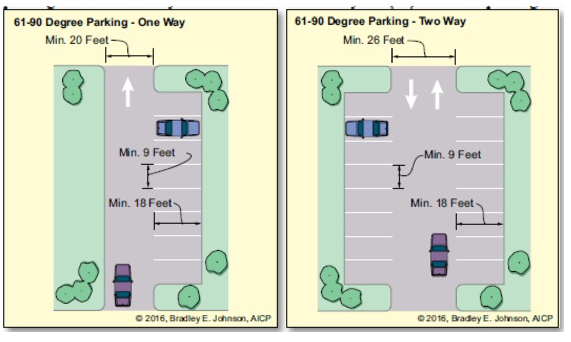
b.
Forty-six degree to 60º angle spaces shall have a minimum of 15 feet wide parking aisle for one-way traffic.
c.
Up to 45º angle spaces shall have a minimum 12 feet wide parking aisle for one-way traffic.
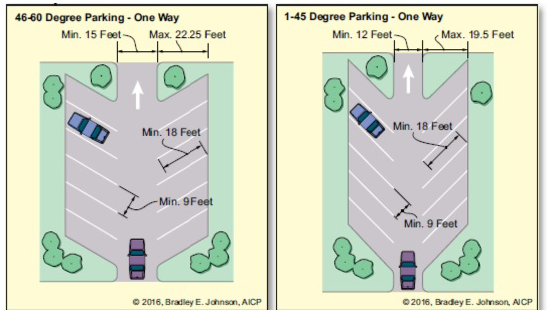
(2)
Aisle exits. All parking aisles shall have an outlet or turn around. Dead-end parking aisles shall not be permitted.
(3)
Driving lanes. Driving lanes in parking lots that provide access to parking aisles shall be defined by striping, curbs, pavement markings, arrows, or parking spaces.
(4)
Maneuvering. parking areas shall be designed to prevent vehicles from maneuvering in a public right-of-way.
(5)
Drainage. parking areas shall be constructed to prevent 95 percent of a parking lots area from ponding.
(6)
Lighting.
a.
All parking lots shall be illuminated during dark hours of the day through the hours that the general public and employees are present on site. The light fixtures and poles shall be consistent in color, size, height, and design.
b.
Parking lot lights shall not exceed 25 feet in height, measured from the bottom of the fixture to the ground.
c.
Parking lot lights shall meet all standards in lighting standards (LT).
(7)
Connectivity.
a.
Connectivity to adjacent commercial, institutional, or industrial parking lots shall be required in at least one location. This may be accomplished through an aisle connector, frontage street, access street, or stub to an adjacent undeveloped lot zoned for commercial, institutional, or industrial use. The zoning administrator may waive this requirement when.
1.
Pre-existing adjacent development will not feasibly allow such a connection,
2.
Topography or geologic feature will not feasibly allow such a connection,
3.
The resulting connection would create a pedestrian or vehicular hazard, or
4.
The neighboring use would substantially conflict with the proposed use on the subject lot.
(8)
Cart corrals. Cart corrals shall be required for all retail businesses with more than 20,000 square feet of retail space; that provide shopping carts, or the like, to customers; and that allow those carts to leave the building. Cart corrals shall be maintained in good condition.
a.
Design. Cart corrals shall be made of permanent materials on three sides creating an enclosure, and shall be anchored to the parking lot surface. Cart corrals shall be constructed using one of the following material options.
1.
Metal railing at least 36 inches in height with curbed landscape area on all three sides. The landscape area shall be a minimum of three feet in width and contain a minimum of one shrub per four feet of landscaping bed; or
2.
Brick masonry walls at least 36 inches in height on all three sides. The materials used in the brick masonry wall shall compliment the architecture of the principal structure. Bricks used in the masonry wall shall not exceed six inches by six inches by 12 inches in size.
b.
Maximum size. Cart containment area shall not exceed ten feet in width and 36 feet in length.
c.
Cumulative containment. All cart corrals in combination shall be able to accommodate at least 50 percent of the fleet of shopping carts available.
(9)
Reduced parking lot area standards. A parking lot may be built with fewer spaces than the required minimum of vehicular spaces identified in Table 5-B: Minimum Number of Parking Spaces Per Use if the following standards are met.
a.
Adequate and appropriate land area shall be land-banked such that the full number of parking spaces required in Table 5-B: Minimum Number of Parking Spaces Per Use can be built on-site at a later date, should the need arise.
b.
The property owner shall record a site plan that clearly denotes the land-banked area, and that identifies the area as a "no-build area." The no-build area shall only allow landscaping material and shall restrict any septic system, structure, foundation, change in topography, or any other permanent or temporary structure or alteration that would make it cost prohibitive or difficult to develop parking on that area in the future.
c.
A design for a parking lot that accommodates all the required parking spaces and that abides by the on-site drainage standards shall be submitted for review. The reduced parking lot shall be a portion of the full parking lot. The full and partial parking lot designs shall be concurrently subject to the same review process necessary to meet the applicable requirements of the zoning ordinance. If both designs are approved, the smaller parking lot design may be constructed and the full parking lot design shall be recorded.
d.
Under no circumstances may the smaller parking lot design establish less than 40 percent of the minimum required parking spaces in Table 5-B: Minimum Number of Parking Spaces Per Use.
e.
If the smaller parking lot is regularly full, or periodically beyond capacity, the additional parking shall be required to be constructed. Evidence of employees or guests parking on the grass or on-street shall constitute a violation.
(c)
Material. A public park's parking lot shall be a paved surface of concrete, asphalt, brick pavers, porous concrete, or the like; striped and posted handicap parking spaces.
(Ord. passed 5-18-2017)
Sec. 153-173. - PF-01; General performance standards.
This performance standards (PF) section applies to the following zoning districts:
The following standards apply:
(a)
Cross reference. See environmental standards (EN) for standards relating to air quality, water quality, and soil quality.
(b)
Nuisance characteristics. No use shall exhibit obnoxious characteristics to the extent that it constitutes a public health risk, public safety risk, public nuisance, or diminishment of public welfare.
(1)
Electrical disturbance. No use shall cause electrical disturbance adversely affecting radio, television or other equipment in the vicinity.
(2)
Noise.
a.
No use shall produce noise that, when measured at any lot line, exceeds 85 dBA from 6:00 a.m. to 9:00 p.m. for a duration of three hours or greater, continuously or cumulatively; or 60 dBA from 9:00 p.m. to 6:00 a.m. for a duration of 30 minutes or greater, continuously or cumulatively.
b.
Public safety sirens, generators, pumps, transformers, and the like used solely for public benefit or public safety shall be exempt from this standard.
(3)
Vibration. No use shall cause vibrations or concussions detectable beyond the lot lines without the aid of instruments ten times or more in a given day, or for a duration of one hour or more in any given day, whichever is the most restrictive.
(4)
Odor. No use shall emit across the lot lines malodorous gas or odor in such quantity as to be detectable at any point along the lot lines for a duration of two hours or greater in any given day.
(5)
Heat and glare. No use shall produce heat or glare in such a manner as to be a nuisance or create a hazard noticeable from any point beyond the lot line.
(Ord. passed 5-18-2017)
Sec. 153-174. - PI-01; General public improvement standards.
This public improvement (PI) standards section applies to the following zoning districts:
The following standards apply:
(a)
Project applicability. Public improvements shall be required when one of the following conditions is met.
(1)
New primary structure. An application for an improvement location permit for a new primary structure is obtained.
(2)
Addition to primary structure. An application for an improvement location permit for an addition to the primary structure that adds 50 percent or more square footage.
(b)
Exceptions.
(1)
Pre-existing subdivisions. A pre-existing residential subdivision that was platted without sidewalks, or that was not required to install sidewalks shall be exempt from division (c)(2) of this section.
(c)
Adequate public facilities. Development is permitted only if public streets, drainage facilities and public utilities are adequate to serve the proposed development without public expenditure.
(1)
Public streets.
a.
The planning and zoning commission may require a traffic and street impact study to determine a proposed development's impact on public streets. If required, the city of Henderson shall conduct or procure services for a traffic and street impact study at the expense of the developer.
b.
Based on the results of the study, the planning and zoning commission shall make a determination as to whether the public street(s) will sufficiently accommodate the increased traffic generated by the development.
1.
If the public street(s) is (are) determined to be insufficient, the planning and zoning commission may deny the development; or
2.
The planning and zoning commission may approve the development with mitigating conditions. The planning and zoning commission may recommend off-site improvements such as acceleration lanes, deceleration lanes, passing blisters, wider shoulders or approaches, frontage streets, shared driveways or other improvements that will provide sufficient facilities for the increased traffic caused by the proposed development.
(2)
Public sidewalks. Public sidewalks shall be required along the edge of the right-of-way, except when the zoning administrator determines the development is agricultural in nature or it is unlikely the public sidewalk will provide connectivity to future trails or sidewalks within the next seven years. New public sidewalks shall be a minimum of five feet in width along major collector streets and arterial streets, and four feet wide along all other streets. Sidewalks shall closely align with existing nearby sidewalks, generally be installed one foot inside the right-of-way, and meet or exceed the city of Henderson's construction standards.
(3)
Drainage facilities.
a.
Cross reference. Storm drainage collection, detention, and retention facilities shall comply with stormwater management regulations.
b.
Storm drainage collection, detention, and retention facilities shall have sufficient capacity to serve the development.
c.
If existing storm drainage facilities are not sufficient to serve the development, the planning and zoning commission may deny the development or approve the development with mitigating conditions. The planning and zoning commission or their advisors, or other official board or body tasked with managing stormwater, may recommend off-site improvements that will provide sufficient facilities for the increased runoff from the proposed development.
d.
Guarantees. When mitigating conditions are required, the developer may be required to post performance and maintenance guarantees for such improvements.
(Ord. passed 5-18-2017)
Sec. 153-175. - SB-01; Setback standards.
This setback standards (SB) section applies to the following zoning districts:
The following standards apply:
(a)
Cross reference.
(1)
Environmental feature setbacks. See environmental standards (EN) for setbacks from environmental features.
(2)
Parking setbacks. See parking standards (PK) for setbacks for parking lots and off-street parking spaces.
(3)
Sign setbacks. See sign standards (SI) for setbacks for free standing signs.
(4)
Telecommunication facility setbacks. See telecommunication facility standards (TC) for setbacks for telecommunication facilities.
(b)
Exemption. A platted subdivision (i.e., secondary plat approval) established prior to January 1, 2017 shall be regulated using the front yard setback, side yard setback, and rear yard setback standards that were in place at the time of platting.
(c)
Applicability. If a setback standard does not appear on the two-page layout for a zoning district, then the standard does not apply to that particular zoning district.
(1)
Minimum front yard setback.
a.
The minimum front yard setback shall be as described in the applicable two-page layout in sections 1153-20 through 153-56.
(2)
Minimum side yard setback.
a.
The minimum side yard setback shall be as described in the applicable two-page layout in sections 1153-20 through 153-56.
(3)
Minimum rear yard setback.
a.
The minimum rear yard setback shall be as described in the applicable two-page layout in sections 153-20 through 153-56.
(4)
Minimum dwelling site front yard setback. The minimum dwelling site front yard setback shall be per each two-page layout in sections 153-20 through 153-56.
(5)
Minimum dwelling site side yard setback. The minimum dwelling site side yard setback shall be per each two-page layout in sections 153-20 through 153-56.
(6)
Minimum dwelling site rear yard setback. The minimum dwelling site rear yard setback shall be per each two-page layout in sections 153-20 through 153-56.
(d)
Measurement. Setbacks shall be measured from the property lines of the subject lot, except for properties which front on a private street or shared driveway. If a property is located along a private street or shared driveway, the front yard setback shall be measured from the edge of pavement of the private street plus ten feet to accommodate drainage and a sidewalk, either now or in the future.
(e)
Administrative discretion. The zoning administrator may allow a front yard setback, side yard setback, and/or rear yard setback, for primary structures or accessory structures, to utilize established setback standards in special circumstances (e.g., a historic narrow lot being used for infill development). Specifically, an established setback may be permitted when the result of applying the applicable setbacks for the subject lot would result in discontinuity with adjacent properties in the same zoning classification; or would substantially constrain development opportunity on the lot in a way inconsistent with adjacent properties within the same zoning classification. The zoning administrator may reject requests to utilize established setbacks if the proposed architecture, massing, or building form is inconsistent with the adjacent architecture.
(f)
Exceptions. The following types of structures or features are exempt or partially exempt from the setback standard as stated.
(1)
Wall signs. Signs mounted on the side of a building shall be exempt from the setbacks in this section, but shall not project more than 12 inches from the facade.
(2)
Architectural features. Cornices, eaves, sills, canopies, or similar features shall be permitted to encroach into a required front, side, and/or rear yard setback not more than three feet. However, these items shall never be closer than three feet to the property line. This provision does not apply to the UC District.
(3)
Awnings. Awnings shall be permitted to encroach into a required front yard, side yard, and/or rear yard setback not more than four feet, but shall not be closer than three feet to the property line. This provision does not apply to the UC District.
(4)
Chimneys. Chimneys that are 100 percent brick masonry shall be permitted to extend into a required setback not more than two feet. However, chimneys shall never be closer than three feet to a property line. This provision does not apply to the UC District.
(5)
Fences and walls. Fences and walls shall be exempt from the setbacks in this section, but shall abide by the fence and wall standards in fence and wall standards (FW).
(6)
Driveways. A driveway from the primary structure or a detached garage to the public right-of-way shall be exempt from the front yard setback standard where it connects to the street. Driveway setbacks from the side yard property line shall be zero feet.
(7)
Sidewalks. A sidewalk from the primary structure to the public right-of-way shall be exempt from setback standards where it connects to the right-of-way. The side yard setback for sidewalks shall be the standard for accessory structures.
(8)
Utility poles, lines, and junction boxes. Utility poles, lines, and junction boxes shall be exempt from the setbacks in this section.
(9)
Trash receptacles. Trash receptacles shall meet the setback standards in trash receptacle standards (TR).
(10)
Stairs or landing. Stairs or an open platform or landing which does not extend above the level of the floor elevation of the first floor of the structure shall be permitted to extend into a required front, side, and/or rear yard setback not more than four feet. However, these items shall never be closer than three feet to the side property line or ten feet to the front or rear property line.
(11)
Parking lots. Parking lots shall meet the setback standards in the parking standards (PK).
(12)
Light poles. Permitted outdoor lighting shall be placed at least ten feet from any property line, regardless of the applicable accessory structure setback.
(13)
Landscaping. Plant material and landscaping features shall be exempt from all setback standards, but trees or shrubs shall not be planted within two feet of a property line without permission from the adjacent property owner.
(Ord. passed 5-18-2017)
Sec. 153-176. - SW-01; Sewer and water standards.
This sewer and water standards (SW) section applies to the following zoning districts:
The following standards apply:
(a)
Applicability. If the below listed sewer and water standard does not appear on the two-page layout for a zoning district, then it does not apply to that particular zoning district.
(b)
Sanitary sewer. Connection to a sanitary sewer utility shall be per each two-page layout in sections 153-20 through 153-56. Details about the terminology on the two-page layouts is as follows.
(1)
Required. The term "required" shall mean a connection to the city of Henderson municipal sanitary sewer system, or other utility providing said service, shall be required.
(2)
Required when available. The term "required when available" with a multiplier shall mean a connection to the city of Henderson municipal sanitary sewer system, or other utility providing said service, shall be required when within cost basis of the multiplier listed. The multiplier rule is described below.
(3)
Multiplier rule. The following describes the multiplier rule for sanitary sewer connections.
(a)
On-site system cost. The applicant shall get an estimate for installing an on-site system (e.g., septic system), or repairing or replacing an existing on-site system, as applicable, per all applicable laws.
(b)
Off-site connection cost. The applicant shall get an estimate to connect to the nearest (or lesser cost option if it is not the nearest) public or private sanitary sewer utility with adequate capacity. The estimate should include materials, labor, equipment, and tap-in fees for the connection to a public or private utility, including, any costs associated with the required abandonment of the existing septic system. A single, legitimate bid from a reputable and qualified contractor shall be sufficient. When a sewer line is a significant distance away or for another technical reason is clearly many times more expensive, a simple letter from a reputable and qualified contractor or civil engineer describing why the cost would be well in excess of the multiplier rule will suffice. Additionally, the zoning administrator may recognize in writing that connecting to a sewer line would be well in excess of the multiplier rule and waive the requirement for the calculations to be conducted or a letter be submitted.
(c)
Determining the requirement. Multiply the cost of installing an on-site system (e.g., septic system) by the assigned multiplier. If the cost of connecting to the public or private utility is less, then the improvement is required to connect to the utility's lines. If the cost of connecting to a public or private utility is more than the on-site system cost times the multiplier, then an on-site system may be installed.
(d)
Multiple dwelling units. For developments with two or more lots, dwelling units, or primary structures, the cumulative cost of installing on-site systems for each lot, dwelling unit, or primary structure shall be used in comparison to connecting the entire project to a private or public sanitary sewer utility.
(4)
Subsidy. The city or the applicable utility company may bridge the financial gap on a project when the property owner is not required to connect to the utility using the multiplier rule. The financial contribution only needs to lower the cost of the connection to the sanitary sewer utility to an amount that makes the total project cost fall within the multiplier rule.
(c)
Water. Connection to a water utility shall be per each two-page layout in sections 153-20 through 153-56. Details about the terminology on the two-page layouts is as follows.
(1)
Required. When water is stated as "required" a connection to the city municipal water system, or other utility providing said service, shall be required.
(2)
Required when available. The term "required when available" with a multiplier shall mean a connection to the city municipal water system, or other utility providing said service, shall be required when within cost basis of the multiplier listed. The multiplier rule is as described above, but shall be based on the cost of a private well and the cost of connecting to the nearest or cheapest way to connect to the water utility.
(Ord. passed 5-18-2017)
Sec. 153-177. - SX-01: Sexually oriented entertainment business standards.
This sexually oriented entertainment business standards (SX) section applies to the following zoning district:
The following standards apply:
(a)
Applicability. Any existing primary structure that changes use to a sexually oriented entertainment business, or any new development where a sexually oriented entertainment business is to be established shall meet the standards in this section.
(b)
Permits. Sexually oriented entertainment businesses shall obtain an improvement location permit prior to establishing the business.
(c)
Measurement rules. Separation distances shall be measured in a straight line from the closest points between property lines, without regard to intervening structures or objects.
(d)
Separation. Sexually oriented entertainment businesses shall have the following separation requirements.
(1)
Similar businesses. Sexually oriented entertainment businesses shall be separated from other sexually oriented entertainment businesses by at least 1,000 feet.
(2)
Residential districts. Sexually oriented entertainment businesses shall be separated from residential zoning districts by at least 1,000 feet.
(3)
Public gathering places. Sexually oriented entertainment businesses shall be separated from public gathering places such as schools, parks, playgrounds, libraries, places of worship, day-care centers, and public structures by at least 750 feet.
(e)
Relief from separation standards. If the separation standards in division (d) of this section result in no C2 District zoned properties, then the zoning administrator shall determine three sites that best meet the intent of the separation requirements, and that are zoned C2 District. If those sites are currently not available for purchase, the owner of the sexually oriented entertainment business may seek a use variance from the board of adjustments for another site that meets the intent of the separation standards.
(f)
Design.
(1)
Parking.
(a)
Parking lots shall not accommodate semi tractor trailers.
(b)
Overnight parking shall not be permitted.
(Ord. passed 5-18-2017)
Sec. 153-178. - SI-01: General sign standards.
This sign standards section (SI) applies to the following zoning districts:
The following standards apply:
(a)
Applicability. The following standards only apply to commercial messages. Text, symbols, colors, shapes, and logos used for communicating information shall not be considered a commercial message unless their intent is to promote, advertise, identify or brand a business, institution, organization, or individual for monetary gain, growth in membership, improvement in mission, or similar gains.
(b)
Cross reference.
(1)
Home businesses. Signs associated with a home business shall be exempt from the sign standards section, but shall comply with the home businesses standards (HB).
(2)
Lighting standards. When illumination of signs is permitted by this sign standards section, all illumination and lighting associated with signs shall meet the glare, light trespass, and any other applicable regulations in the lighting standards (LT) section.
(c)
Freedom of speech. Any permanent sign or standard temporary sign permitted by the sign standards may be used for freedom of speech (i.e., the expression of opinions not including commercial messages) for any length of time.
(d)
Permits.
(1)
Improvement location permit. An improvement location permit shall be required for all signs located, erected, constructed, reconstructed, enlarged, moved, or altered, except as follows:
(a)
Signs undergoing periodic or routine maintenance shall be allowed without a permit; including. painting, repainting, cleaning and changing burnt-out light elements. Maintenance does not include increasing the intensity or brightness of internal or external lighting.
(b)
Changing of the sign's message (i.e., content) shall be allowed without a permit; assuming the sign area, projection from a wall face, dimension, materials (e.g., changing a non-electronic sign to a LED sign), and other "time, place, and manner" standards are not changed.
(c)
Standard temporary signs shall be allowed without a permit, as may be permitted in each zoning district; but shall still comply with all applicable standards.
(d)
Permitted and legally complying temporary signs that are replaced due to storms, mowing, or site maintenance, and when intentionally removed and replaced at a later time (e.g., at the end of business hours and replaced at the beginning of business hours) shall be allowed without a permit.
(e)
Permanent and legally complying signs damaged by accident or mother nature shall be allowed without a permit; when replaced with an predominantly identical sign.
(e)
Interim sign.
(1)
Qualification. Any new businesses may install an interim sign if their permanent sign is not able to be installed on or before the official occupancy date; or any business that has lost a pre-existing, legally established permanent sign due to fire, automobile accident, or act of mother nature may install an interim sign while a permanent sign is being fabricated to replace the lost sign. Under all circumstances, the following conditions shall be met.
(a)
Proposal for interim sign. The property owner shall make a request for an interim sign, including the material, location, anchoring method, proposed installation date, and other information that may be requested by the zoning administrator.
(b)
Approval of permanent signs. A sign permit for one or more permanent signs shall be fully approved prior to any interim signs being installed. If the permanent sign was pre-existing, evidence that the sign was legally established may need to be confirmed before installing the interim sign.
(c)
Proof of purchase. Proof shall be provided to the zoning administrator that the approved permanent sign has been officially commissioned or purchased from a sign manufacturer.
(d)
Size and height. An interim sign shall not be larger in sign area or mounted higher than the corresponding approved permanent sign.
(e)
Location. The interim sign shall generally be in the general location as the approved permanent sign if possible.
(f)
Quantity. No more than one interim sign per approved (or lost) permanent sign shall be installed, with a maximum of two interim signs in total.
(g)
Time limitation. An interim sign may be in place for up to 90 days. If evidence that unforeseen circumstances has prevented the permanent sign from being installed, the zoning administrator can grant up to an additional one-time 45 day extension.
(h)
Building inspector. An inspection of the interim sign is not required. However, if the building official becomes aware of any safety concerns, those concerns shall be addressed to his/her satisfaction within a time-frame consistent with the safety concern.
(i)
Maintenance. The interim sign shall be kept in good repair.
(j)
Removal. The interim sign shall be removed upon delivery and installation of the permanent sign(s).
(f)
Changeable copy. If changeable copy is allowed and used on a site, it shall be an integrated component of the sign and shall only include cyclical or static messages, regardless if the sign is capable of flashing messages.
(g)
Exempt devices. The following devices, as described, are not considered commercial messages and shall therefore be exempt from the sign standards because they are not "signs". However, the below described exemptions shall still meet vision clearance standards (VC) and other non-sign standards in the zoning ordinance when applicable. Devices that do not meet the below description and that are used as part of, or fully as, a commercial message shall be regulated as a commercial sign.
(1)
Flags. A flag or insignia of any nation, state, municipality, or other political unit is exempt. However, when a flag or insignia of any nation, state, municipality, or other political unit is used as an integral component of a commercial message, it shall comply with the sign standards for the applicable zoning district. For example, an American flag integrated into a corporation's brand or logo.
(2)
Political signs. Political campaign signs shall be exempt.
(3)
Public safety message. Posting of a public safety or privacy message by a private property owner shall be exempt, provided that no individual posting exceeds four square feet. Examples include "Beware of Dog," "Private Property," "No Trespassing," "Weight Limit," "Video Surveillance," and "No Turnaround."
(4)
Operational limitations or information. Posting of operational limitations and information shall be exempt, provided the letters are not greater than 12 inches in height. Examples include hours of operation, admittance requirements, "Employees Only," "Men," "Women," "Visitor parking," and "No deliveries."
(5)
Indoor commercial messages. Commercial messages displayed inside a building that cannot be viewed legibly by pedestrians or drivers outside the building shall be exempt. Examples include a commercial message on a scoreboard inside a gymnasium, a wall clock inside a restaurant with a branded logo, or product signs hanging or mounted on the wall of a retail store.
(6)
Minuscule commercial messages. Minuscule commercial messages displayed on or near a primary entrance, on a gas pump, or other incidental location on a site shall be exempt, provided that the area of each minuscule commercial message does not exceed 30 square inches and the cumulative area of all minuscule commercial messages does not exceed two square feet per primary entrance, or one square foot per gas pump. Examples include "Visa," "Master Card," "Diner's Club," "ATM Inside," and corporate logos of products sold inside.
(7)
Price tags. A price tag in conjunction with outdoor merchandise shall not be considered a sign if less than 20 square inches.
(8)
Addresses. Posting of a street address on a mailbox, building, or other prominent location to provide adequate property identification shall be exempt. However, when a street address is more than four times the minimum required address size required by the International Fire Code as amended and as recognized by the city, or integrates graphics that convey a commercial message, then it shall be regulated as a commercial sign. For example, an address posted on a sign illustrated with bottles of wine for a wine shop would not be exempt.
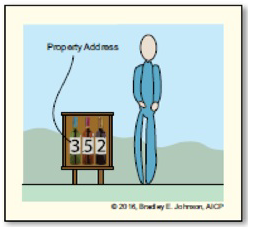
(9)
Residential nameplate. Posting of the occupant's name in a single-family residential district when the text is not greater than 12 inches in height is exempt (e.g., "Smith Family" or "Jones Place").
(10)
Property name. A name given to a property and posted by the owners, and that does not exceed six square feet in sign area is exempt. For example "Dream Cottage" or "Wild Wind Farm." However, if the sign is related to the property's use for identification for a commercial operation (e.g., a home business, bed and breakfast, vacation rental, or has agricultural tourism) the property name sign shall not be exempt.
(11)
Required postings. Messages required by a state agency, state law, federal agency, or federal law shall be exempt, provided the area of the message and height of posting are consistent with the requirement by the agency or by law.
(12)
Historical identification. Words and numbers used to describe a historic building, structure, site, landmark or event as part of a designation by a federal, state or local governments shall be exempt.
(13)
Integral signs. Name of building, date of erection, monumental citations, commemorative tablets and the like when carved into stone, concrete or similar material or made of bronze, aluminum, or other permanent type construction and made an integral part of the structure.
(14)
Religious symbols. Religious symbols (e.g., Cross, Star of David, or Star and Crescent) incorporated into a building's architecture, places of worship site, or location occupied by a religious organizations shall be exempt. Logos, brands, or slogans used by religious organizations shall not be considered religious symbols.
(15)
Murals. A mural shall be exempt, provided it conveys no commercial message. Murals with a commercial message shall be regulated as a wall sign.
(16)
Commercial messages on a permanent display board. A commercial message attached to and contained within the sign area of a legally established permanent display board sign shall be exempt.
(17)
Limited audience. Any advertising or sponsor signs mounted on an outdoor scoreboard, dugout, press box, fence, bleachers, concession stand, restroom, or similar structures used in conjunction with a legally-established arena, amphitheater, sport field, sport court, or similar shall be exempt if designed to be predominantly seen by the audience. However, if the advertising is visible from a public street and contains a commercial message intended for the non-attending public, it shall comply with the sign standards for the applicable zoning district.
(18)
Directional devices. Directional devices used to mark the entrance or exit of an establishment for vehicle safety and information purposes that does not exceed the following limitations shall be exempt:
(a)
Applicable zoning districts. The commercial, M2, M3, institutional, parks and recreation, or industrial zoning districts may utilize directional devices.
(b)
Device area. Directional devices shall not exceed four square feet in area per face.
(c)
Device height. Directional devices shall not exceed three feet in height.
(d)
Quantity. Two directional devices may be installed per street frontage in which the property has legally established curb cuts; with an absolute maximum of four.
(e)
Location. Directional devices shall be subject to division (j) of this section.
(f)
Message. Directional devices shall either contain the words "In," "Enter," "Entrance," "Out," "Exit," "Do Not Enter," or similar; and/or have directional arrows indicating desired traffic movement. Further, directional devices may include corporate colors or a corporate logo as long as the corporate logo does not exceed 50 percent of the device area.
(19)
Wayfinding system signs. Wayfinding systems may be permitted for large developments that encompass multiple lots or multiple buildings, provided the following conditions are met:
(a)
Wayfinding systems shall be used to direct vehicular and pedestrian traffic to specific neighborhood, amenity, or other major destinations.
(b)
Wayfinding systems shall be required to have signs of consistent size, scale, and appearance.
(c)
Wayfinding signs shall not exceed six feet in height and two square feet in sign area.
(d)
Proposals for wayfinding systems shall be reviewed and approved at the discretion of the zoning administrator. The zoning administrator may take into account the need for the wayfinding system, the size and complexity of the development, quantity and location of signs, number of entrances and exits, and the appearance of signs.
(h)
Prohibited signs. The following type of signs shall be prohibited unless clearly permitted by a section in this zoning ordinance or by variance.
(1)
Animated. Signs that gain attention through animation shall not be permitted, including any of the following.
(a)
Signs that utilize any motion picture or animation from an LED display, LED projector, film projector, video projector, or the like.
(b)
Signs that emit audible sound, odor, or visible matter.
(c)
Signs that have blinking, flashing, scrolling, or fluttering lights; or changing light intensity, brightness, or color; or that give such illusion.
(2)
Message-casting signs. Signs that "shoot" laser light, "cast" intense or visible light beams, or cast laser or projector-created light images onto the ground, sidewalk, wall or other visible surface.
(3)
Vehicle signs. Vehicles with signs greater than eight square feet in cumulative area shall not be permitted to be parked for the primary purpose of displaying the sign. Prohibited vehicle signs shall not be construed to include vehicles with signs on them that:
(a)
Are lawfully parked overnight or during non-business hours in a discreet location.
(b)
Are making deliveries, sales calls, transporting persons or property, or conducting customary practices relating to operating the business.
(c)
Are used in conjunction with customary construction operations on a construction site.
(4)
Sky-casting lights. Strobe lights, search lights, beacons, or any light that rapidly flashes, projects light in visible beams skyward, or projects light horizontally shall not be permitted regardless if the light is part of or independent of a sign.
(5)
Signs with moving or movable parts. Signs or devices with visibly moving parts shall not be permitted.
(6)
Driver hazard. Signs that emulate emergency service vehicles or common traffic signs or signals shall not be permitted. For example, a sign that uses "Stop," "Slow," "Caution," "Danger," "Warning," or similar words mounted on a sign using similar shape, scale, color, and location resulting in driver confusion or otherwise creating an unsafe condition.
(7)
Non-permitted. Any sign type not specifically permitted or that isn't clearly meeting the intent of the sign standards shall be prohibited.
(i)
Prohibited content. The following content shall not be displayed on a sign.
(1)
Fighting words. Signs that contain "fighting words" as defined by the "fighting words doctrine" established by the U.S. Supreme Court in Chaplinsky v. New Hampshire (1942) shall not be permitted on any sign;
(2)
Obscene, indecent or profane content. Obscene, indecent or profane content not permitted on broadcast television or radio during 6:00 a.m. to 10:00 p.m., according to the Obscene, Indecent and Profane Broadcasts Guide published by the FCC, or similar guidelines upheld by federal court, shall not be permitted on any sign;
(3)
Obscene or profane words or violent images. Content that would result in an NC-17 rating by the Motion Picture Association of America shall not be permitted on any sign; and
(4)
Pornographic images. Content determined to be "internet pornography" or otherwise considered to be adult material by the Children's Internet Protection Act (CIPA) of 2000, as upheld by the U.S. Supreme Court, shall not be permitted on any sign.
(j)
Prohibited locations. Signs regardless of type, shall not be permitted in any of the following locations, except as may be expressly permitted elsewhere in this zoning ordinance:
(1)
Vision clearance. Signs shall not be permitted in areas prohibited by vision clearance standards (VC).
(2)
Right-of-way. Signs shall not be permitted in any right-of-way unless authorized by the city council, except as previously authorized by city council and allowed in § 153-183.
(3)
Poles. Signs shall not be permitted on any traffic control device, street sign, construction sign, or utility pole.
(4)
Fences. Signs shall not be permitted on any fence, except as exempted on sport facility fences in division (g)(17) of this section.
(5)
Trees. Signs shall not be permitted to be attached to any tree, shrub, or other natural object.
(6)
Benches. Signs shall not be permitted to be attached to or integrated into any bench in the public right-of-way or private sidewalk.
(7)
Towers. Signs shall not be permitted to be attached to or integrated into any telecommunication antennae, telecommunication tower, television antennae, or similar towers.
(8)
Roofs. Signs shall not be permitted to be placed on, set upon, attached to, or be perceived to be attached to the roof of a structure. This provision includes signs integrated into the roofing material.
(9)
Fire safety devices. Signs shall not be permitted on a fire escape or in a manner that substantially blocks view from the right-of-way to a fire door.
(10)
Obstructs circulation. Signs that obstruct or interfere with safe internal or external movement of vehicular, bicycle or pedestrian traffic shall not be permitted.
(11)
Artificial elevation. Signs shall not be permitted to be installed on a berm, mound, or otherwise raised portion of the site unless the sign height is measured from the elevation at the base of the berm, mound, or raised portion of the site.
(12)
Wall signs over windows. No permanent wall sign shall be installed such that it covers windows in the building.
(k)
Maintenance. All signs and sign components shall be kept in good repair, in safe condition, and working condition. If landscaping is required around the base of a sign, it shall be maintained in living condition, consistent in character with the approval, and not allowed to get overgrown. Landscaping shall be designed and maintained to be in compliance with the visibility restrictions for signs.
(Ord. passed 5-18-2017)
Sec. 153-179. - SI-02: Agricultural sign standards.
This sign standards (SI) section applies to the following zoning district:
The following standards apply:
(Ord. passed 5-18-2017)
Sec. 153-180. - SI-03: Single-family and two-family residential sign standards.
This sign standards (SI) section applies to the following zoning districts:
The following standards apply:
(a)
Cross reference.
(1)
Wall sign. Wall signs may be permitted in applicable home business standards (HB).
(2)
Ground signs. Ground signs may be permitted in applicable home business standards (HB).
(Ord. passed 5-18-2017)
Sec. 153-181. - SI-04: Multiple family residential sign standards.
This sign standards (SI) section applies to the following zoning districts:
The following standards apply:
(Ord. passed 5-18-2017)
Sec. 153-182. - SI-05: Institutional sign standards.
This sign standards (SI) section applies to the following zoning district:
The following standards apply:
(Ord. passed 5-18-2017)
Sec. 153-183. - SI-06: Urban commercial sign standards.
This Sign Standards (SI) section applies to the following zoning district:
The following standards apply:
(Ord. passed 5-18-2017; Am. Ord. 18-08-33, passed 10-9-2018)
Sec. 153-184. - SI-07: Moderate intensity commercial sign standards.
This sign standards (SI) section applies to the following zoning districts:
The following standards apply:
(Ord. passed 5-18-2017; Ord. 2021-06-03, passed 7-12-2021)
Sec. 153-185. - SI-08: Office commercial sign standards.
This sign standards (SI) section applies to the following zoning district:
The following standards apply:
(Ord. passed 5-18-2017)
Sec. 153-186. - SI-09: Industrial sign standards.
This sign standards (SI) section applies to the following zoning districts:
The following standards apply:
(Ord. passed 5-18-2017)
Sec. 153-187. - SE-01: Special exception standards.
This special exception standards (SE) section applies to the following zoning districts:
The following standards apply:
(a)
Cross reference. The approval process and criteria for special exceptions is in sections 153-225 through 153-237.
(b)
Applicable development standards. The development standards assigned to each zoning district are considered appropriate for the permitted uses within that zoning district. However, the development standards may not be appropriate for all special exception uses within a zoning district. For instance, some institutional uses are allowed in residential zoning districts as special exceptions. In this case, residential development standards would not necessarily be applicable.
(1)
Determining appropriate development standards.
(a)
The zoning administrator shall determine which development standards sections within sections 153-120 through 153-195 shall apply to each special exception application. The development standards determined to apply shall be documented in the application and approval.
(b)
Generally, if the special exception use is a permitted use in another zoning district, the development standards for that zoning district shall generally be used. In situations where the special exception use is not a permitted use in any other zoning district, the board of Zoning Adjustments shall determine which development standard sections shall be assigned to the special exception use.
(Ord. passed 5-18-2017)
Sec. 153-188. - ST-01: Structure standards.
This structure standards (ST) section applies to the following zoning districts:
The following standards apply:
(a)
Applicability. The maximum allowable number of primary structures shall be one unless indicated otherwise on the applicable two-page layout in sections 153-20 through 153-56.
(Ord. passed 5-18-2017)
Sec. 153-189. - TC-01: Telecommunication facility standards.
This telecommunication facility standards (TC) section applies to the following zoning districts:
The following standards apply:
(a)
Permits.
(1)
In the PR and AG District, an improvement location permit shall be required prior to the construction, erection, placement, modification, or alteration of a telecommunication facility.
(2)
In the I1 and I2 District an improvement location permit shall be required prior to the modification, or alteration of a telecommunication facility.
(3)
In the I1 and I2 District a development plan review and approval shall be required prior to the construction, erection, or placement of a telecommunication facility.
(b)
Precondition. A new tower shall only be permitted if no other tower exists on which telecommunication equipment can be collocated. A list of all towers within one mile of the desired location of a new tower shall be submitted with a detailed description of why said tower(s) is(are) not an option for collocation.
(c)
Location.
(1)
Accessory utility structures. Any accessory utility structure associated with a telecommunication facility shall meet the minimum front yard setback, minimum side yard setback, and minimum rear yard setback requirements in the applicable two-page layouts in sections 153-20 through 153-56.
(2)
Towers.
(a)
Front yard setback. Telecommunication towers shall be set back from any right-of-way a minimum distance equal to the tower's height, including all antennas and attachments.
(b)
Side yard and rear yard setback. Telecommunication towers shall be set back from the side and rear property lines a minimum distance equal to 75 percent of the tower's height, including all antennas and attachments.
(c)
Separation from an on-site primary structure. Telecommunication towers shall be set back from any on-site primary structure a minimum distance equal to 75 percent of the tower's height.
(d)
Separation from residential districts. Telecommunication towers shall not be located within the boundaries of any residential zoning district, and shall be set back from the boundaries of any residential zoning district a minimum distance equal to 110 percent of the tower's height.
(d)
Design.
(1)
Project applicability. Proposed or modified telecommunication towers and antennas shall meet the following design requirements.
(2)
Height.
(a)
Telecommunication towers shall not exceed 199 feet in height above ground level.
(b)
All other utility structures shall meet the height standards in the appropriate two-page layouts in sections 153-20 through 153-56 and in height standards (HT).
(3)
Appearance. Towers and antennas shall be designed to blend into the surrounding environment through the use of color, except in an instance where the color is dictated by state or federal authorities such as the Federal Aviation Administration (FAA).
(4)
Monopole design. Towers shall be of a monopole design, unless the board of adjustments determines an alternative design would better blend in with the surrounding environment.
(5)
Collocation. Any proposed telecommunication tower shall be designed structurally, electrically, and in all other respects to accommodate both the applicant's antennas and comparable antennas for the following.
(a)
A minimum of one additional user if the telecommunications tower is between 60 and 100 feet in height.
(b)
A minimum of three additional users if the telecommunications tower is 100 feet or more in height.
(c)
Said required collocation opportunities shall be offered in the marketplace at competitive and a comparable rate, specifically no greater than 2 percent greater than the average rate for comparable locations.
(6)
Accessory utility structures. All utility structures needed to support a telecommunications tower shall be architecturally designed to blend in with the surrounding development or environment.
(7)
Fence enclosure. Telecommunication facilities and all accessory utility structures may be protected by a security fence that shall be at least eight feet tall. Such a security fence shall be at least 20 feet from all property lines. Razor wire or similar products shall not be utilized.
(8)
Lighting. Telecommunication facilities shall not be illuminated by artificial means and shall not display strobe lights, except as may be dictated by state or federal authorities such as the Federal Aviation Administration (FAA).
(9)
Signs. The use of any portion of a telecommunication facility for the posting of any commercial signs or advertisements of any kind shall not be permitted.
(e)
Construction standards. All telecommunication facilities shall be subject to inspection by the building official and zoning administrator during the construction process.
(1)
Easements. If an easement is required for location of a telecommunication facility on the property, the easement shall be staked by a licensed and registered land surveyor so as to provide proof the facility has been constructed within the easement.
(2)
Footers. Footing inspections shall be required by the building official for all telecommunication facilities having footings.
(3)
Electrical standards. All telecommunication facilities containing electrical wiring shall be subject to the provisions of the Electric Code, as amended.
(f)
Inspection of towers. The following shall apply to the inspection of telecommunications facilities.
(1)
Frequency. Towers may be inspected at least once every five years by the zoning administrator, building official, and/or a registered, professional engineer to determine compliance with the original construction standards.
(2)
Investigation. The zoning administrator and the building official may enter onto the property to conduct their investigation and may order the appropriate action to bring the facility into compliance.
(g)
Abandoned towers. Any tower unused or left abandoned for six months shall be removed by the property owner at their expense. Should the property owner fail to remove the tower after 30 days from the date a violation notice is issued, the city may remove the tower and assess the property owner for the costs of removal and cleanup of the site.
(Ord. passed 5-18-2017)
Sec. 153-190. - TU-01: General temporary use and structure standards.
This temporary use and structure standards (TU) section applies to the following zoning districts:
The following standards apply:
(a)
Cross reference. See sign standards (SI) for temporary sign standards.
(b)
Permits. A temporary improvement location permit shall be obtained prior to establishing the temporary use or erecting a temporary structure unless indicated otherwise in the temporary use and structure standards.
(c)
Permitted types.
(1)
Fund-raising events. Fund-raising events such as barbecues, fish fries, and car washes shall be permitted and shall be exempt from obtaining a temporary improvement location permit if the frequency is less than three times per calendar year, the duration of each event is three days or less, and there is a minimum of 14 days between any two events. Signs for fund-raising events shall comply with the applicable temporary sign standards for the subject lot.
(2)
Portable storage. Portable storage units (e.g., containers used for moving belongings) shall be permitted and shall be exempt from obtaining a temporary improvement location permit, but shall not be located outdoors for more than 14 consecutive days, three times per calendar year.
(3)
Construction trailer. A construction trailer may be installed on a site that has been issued a building permit for a project that will have a construction duration of two months or more. The location of the construction trailer shall meet all accessory structure setback standards if in a side or rear yard, or be at least five feet from the all property lines if located in the front yard. For large institutional, commercial or industrial construction projects, the zoning administrator may grant up to three construction trailers if evidence supports the need for more than one.
(4)
Party or event tents. Any lot with adequate space for a party or event tent in its front yard, side yard, or rear yard shall be permitted and shall be exempt from obtaining a temporary improvement location permit if the party or event is capped at 100 guests. The temporary structure and use shall be limited to ten consecutive days, two times per calendar year. If the event exceeds 100 guests, a temporary event plan shall be submitted to the city manager who will consult with the police department, Fire Department and Street Department to determine if and how the event can be safely and sensitively held. Reasonable limitations may be placed on such large events by the city manager, Police Chief, Fire Chief, and Street Department.
(d)
Termination. Temporary uses shall be terminated and temporary structures removed at the end of the permitted event period.
(e)
General provisions. All temporary uses and temporary structures shall maintain clear visibility at intersections and driveway cuts per the vision clearance standards (VC) standards.
(Ord. passed 5-18-2017)
Sec. 153-191. - TU-02: Agricultural temporary use and structure standards.
This temporary use and structure standards (TU) section applies to the following zoning districts:
The following standards apply:
(a)
Roadside sales of produce. The roadside sale of farm produce shall be permitted if the following conditions are met.
(1)
Grown on-site. Fifty percent of the produce offered for sale shall be grown on the same or adjacent lot where the roadside sale is located.
(2)
Duration. The roadside sale of produce shall not exceed four months per calendar year.
(3)
Sales stand. The sales stand shall be portable or seasonally constructed. It shall be fully removed from its temporary location at the end of each growing season.
(4)
Parking. Customer parking shall be required. There is no minimum standard, but the property owner shall be in violation if customers park on-street or unintended locations, or if parking areas become mud lots. The roadside sale of produce shall be arranged so that parking does not block any right-of-way or pedestrian facilities.
(b)
Garage and yard sales. Garage and yard sales shall be permitted but shall obtain a temporary improvement location permit. Garage and yard sales shall not occur more than two times per calendar year, for three days or less per event, and a minimum of 14 days between any two events. Signs for garage or yard sales shall comply with the applicable temporary sign standards for the subject lot.
(Ord. passed 5-18-2017)
Sec. 153-192. - TU-03: Residential temporary use and structure standards.
This temporary use and structure standards (TU) section applies to the following zoning districts:
The following standards apply:
(a)
Model homes. Model homes, apartments, and condominiums that contain a show room and/or sales office shall be permitted with the following requirements.
(1)
Duration. The duration of a temporary improvement location permit for a model home, apartment, or condominium shall be three years and may be renewed annually after the initial three-year period.
(2)
Location. Model homes, apartments, and condominiums shall be on the site of the development for which the sales are taking place.
(3)
Parking. The model home, apartment, or condominium shall provide a minimum of six paved off-street parking spaces.
(4)
Lighting. All exterior lighting shall be turned off between the hours of 11:00 p.m. and 6:00 a.m. every day. This regulation does not apply to a standard and customary front porch light, carriage light(s), or back porch light.
(5)
Neighborhood information. A maximum of one neighborhood information kiosk/sign shall be permitted. Such a device shall not exceed eight feet in height, 32 square feet in area and shall not be illuminated.
(6)
Model home sign. A maximum of one "model home" sign shall be permitted. Such a device shall not exceed six feet in height, eight square feet in area and shall not be illuminated.
(b)
Garage and yard sales. Garage and yard sales shall be permitted but shall obtain a temporary improvement location permit. Garage and yard sales shall not occur more than two times per calendar year, for three days or less per event, and a minimum of 14 days between any two events. Signs for garage or yard sales shall comply with the applicable temporary sign standards for the subject lot.
(Ord. passed 5-18-2017)
Sec. 153-193. - TU-04: Nonresidential temporary use and structure standards.
This temporary use and structure standards (TU) section applies to the following zoning districts:
The following standards apply:
(a)
Sale of seasonal items. The sale of seasonal items such as Independence Day fireworks, Christmas trees, and Halloween pumpkins shall be permitted if the following standards are met.
(1)
Duration. The duration of a temporary improvement location permit for the sale of seasonal items shall be no more than 45 days per calendar year cumulatively. All unsold merchandise shall be removed within five days after the expiration of the temporary improvement location permit.
(2)
Location.
(a)
The sale of seasonal items shall be on a lot that fronts a collector or arterial street.
(b)
The sale of seasonal items shall be conducted at least 100 feet from residential zoning districts, including parking areas.
(3)
Additional requirements. The sale of seasonal items shall comply with all requirements of applicable state laws.
(b)
Roadside sales of produce. The roadside sale of farm produce shall be permitted if the following conditions are met.
(1)
Duration. The roadside sale of produce shall not exceed 120 days per calendar year.
(2)
Sales stand. The sales stand shall be portable or seasonal constructed, and shall be removed entirely from the site when not in use.
(3)
Parking. The roadside sale of produce shall be available in locations that do not block any right-of-way.
(Ord. passed 5-18-2017)
Sec. 153-194. - TR-01: Trash receptacle standards.
This trash receptacle standards (TR) section applies to the following zoning districts:
The following standards apply:
(a)
Project applicability. Any new outdoor trash receptacle, dumpster, compactor, or similar container placed after the effective date of this zoning ordinance shall be permitted, if all of the following standards are met.
(b)
Exemptions.
(1)
Construction. Outdoor trash receptacles, dumpsters, compactors, recycling containers, or similar containers temporarily placed (i.e., construction projects) shall be exempt from the standards in this section.
(2)
Residential. Any trash receptacle less than 150 gallons in size used for a single-family dwelling unit in any zoning district shall be exempt from the trash receptacle standards.
(c)
Design.
(1)
Screening.
(a)
Outdoor trash receptacles, dumpsters, compactors, or similar containers shall be screened on all sides by a fence or wall that is durably constructed with wood, brick, or stone, and that substantially complements the primary structure's architecture.
(b)
Outdoor trash receptacles, dumpsters, compactors, or similar containers shall be accessible by a gate.
(2)
Surface materials. Outdoor trash receptacles, dumpsters, compactors, or similar containers shall be placed on a concrete pad, curbed on three sides.
(d)
Setbacks.
(1)
Front yard. Trash receptacles shall not be located in a front yard and shall be required to meet the front yard setback standard for a primary structure.
(2)
Side yard. Trash receptacles shall be required to meet the side yard setback standard for a primary structure.
(3)
Rear yard. Trash receptacles shall be required to meet the rear yard setback standard for a primary structure.
(e)
Maintenance. All trash receptacles and screening associated with trash receptacles shall be properly maintained and gates kept in good working condition.
(Ord. passed 5-18-2017)
Sec. 153-195. - VC-01: Vision clearance standards.
This vision clearance standards (VC) section applies to the following zoning districts:
The following standards apply:
(a)
Vision clearance triangle. A vision clearance triangle or sight visibility triangle shall be maintained at every intersection of two or more streets, intersection of a street and an alley, and intersection of a street and a driveway.
(1)
Horizontal area.
(a)
Streets. The vision clearance triangle leg lengths shall be measured from the intersection of right-of-way lines (see "A" in the illustration below). If the right-of-way lines curve, then each right-of-way line shall be extended to form a corner point to measure from. The distances for each leg of the vision clearance triangle shall be as follows.
1.
Speed limit 30 mph or less. A triangle leg that parallels a street with a speed limit of 30 mph or less shall be 25 feet.
2.
Speed limit 35 mph to 40 mph. A triangle leg that parallels a street with a speed limit of 35 mph to 40 mph shall be 35 feet.
3.
Speed limit 45 mph or greater. A triangle leg that parallels a street with a speed limit of 45 mph or greater shall be 45 feet.
(b)
Alleys and drive ways. The vision clearance triangle leg lengths shall be ten feet as measured from the right-of-way line and the intersection of a driveway or alley (see "B" in the illustration below). The edge of pavement shall be used to measure along a driveway or alley.
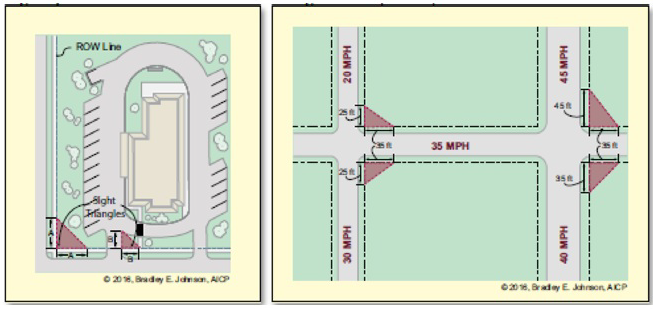
(2)
Vertical area. No primary structure or accessory structure, landscaping, fence, walls or sign shall be permitted to be placed or to project into the vision clearance triangle between the heights of two feet and nine feet above the elevation of the adjacent street.
(b)
Exemptions. Public street signs, essential utility switch boxes, and utility poles shall be exempt from the vision clearance standards.
(Ord. passed 5-18-2017)

