
Henderson City Zoning Code
DEFINITIONS
Sec. 153-280 - General.
The definitions contained in § 153-281 shall be observed and applied in the interpretation of all sections in the zoning ordinance, except where the context clearly indicates otherwise. Words used in the present tense shall include the future; words used in the singular number shall include the plural and the plural the singular; words used in the masculine gender shall include the feminine.
(Ord. passed 5-18-2017)
Sec. 153-281. - Defined words.
The terms listed below shall have the meanings as written and illustrated.
Abandonment. The relinquishment of property or a cessation of the use of the property for a continuous period of one year by the owner with the intention neither of transferring rights to the property to another owner nor of resuming the use of the property.
Accessory building. See "accessory structure."
Accessory structure. A structure which generally meets.
(1)
Is subordinate to a primary structure in area, intent, and/or purpose,
(2)
Is installed in the ground (e.g., sport court), is affixed to the ground (e.g., fence), is on a permanent foundation (e.g., detached garage), or placed on the ground (e.g., a shed on skids),
(3)
Contributes to the comfort, convenience, or necessity of occupants of the primary structure or primary use,
(4)
Does not alter or change the interpretation of the primary use,
(5)
Is located on the same property as the primary structure or use,
(6)
Conforms to the setback, height, bulk, lot coverage, and other requirements of the zoning ordinance unless otherwise provided for, and
(7)
Is not designed for human occupancy as a dwelling or commercial use.
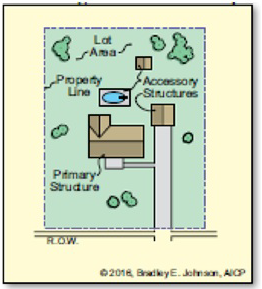
Accessory structure, recreation-based. A det ached accessory structure placed on a lot and used for recreation, entertainment, relaxing, and lounging. Examples of recreation-based accessory structures may include decks, docks, gazebos, hot tubs, ground-mounted satellite dishes, piers, sport courts, and swimming pools. District-specific regulation are described in sections 153-120 through 153-195. Recreation-based accessory structures do not include any enclosed structures (e.g., a pool house or garage use for a hobby).
Accessory structure, storage-based. An accessory structure placed on a lot and used to store, keep, shelter or contain material items. Examples of storage-based accessory structures include barns, carports, detached garages, greenhouses, mini-barns, pole structures, swimming pool houses, and sheds. Generally, storage-based accessory structures are enclosed or mostly enclosed buildings used in support of or in conjunction with a primary use or primary structure.
Accessory structure, support-based. A detached accessory structure placed on a lot and used to provide essential services to a primary structure, primary land use, or another accessory structure. Examples of support-based accessory structures include maintenance facility, mechanical structure, freestanding canopy, stand-alone restroom facilities, storage building, enclosed vending, kiosk, or structures used in support of the primary structure.
ADA. The Americans with Disabilities Act.
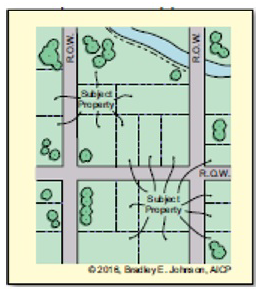
Adjacent property. Any property adjacent to or directly diagonal to the subject property. Properties across a public right-of-way (R.O.W.) are also considered adjacent. The illustration below notes the properties that would be considered adjacent to two different subject properties.
Administrator. See ZONING ADMINISTRATOR.
Advisory planning and zoning commission. See PL ANNING AND ZONING COMMISSION.
Agricultural district. Refers to the AG District.
Agriculture. The art or science of cultivating the ground, and raising and harvesting crops, often including feeding, breeding, and management of livestock; tillage; husbandry; farming; in a broader sense, the science and art of the production of plants and animals useful to man, including to a variable extent the preparation of these products for human use and their disposal by marketing or otherwise. In this broad use, it includes farming, horticulture, forestry, dairying, sugar making, etc. Agriculture includes feeding of farm animals for pleasure, raising animals for food, fur, pharmaceutical, or other commodity purpose where the maximum number of animals does not meet the definition for confined feeding.
Airport. Any area which is used or intended to be used for the taking off and landing of aircraft, including helicopters, and any appurtenant areas which are used or intended to be used for airport structures or facilities, including open spaces, taxiways, and tie-down areas.
Alley. A public right-of-way, other than a street, crosswalk, or easement, that provides secondary access for the special accommodation of abutting property. Lots adjacent to an alley shall not be deemed to have a second front yard, or to be determined to be a corner lot or through lot. Also, the facade that faces an alley shall not be determined to be a front facade.
Alteration. Any act or process which changes one or more of the "exterior architectural features" of a structure designated for preservation, or any structure in a district designated for preservation.
Amphitheater. A venue for performances and entertainment where the performance and spectator areas are both open-air. An amphitheater typically is used to host live performances, and cultural and entertainment activities. Structures customarily incidental and subordinate to an amphitheater including but are not limited to. temporary or permanent hospitality facilities, temporary generators, ticket booths, first aid stations, fencing for crowd control, and concession stands.
Animal, exotic. Animals raised and bred healthy and humanely for unique pets or entertainment, or animals rescued from the wild, or from zoos. Exotic animals are primarily securely caged animals. Exotic animals do not include outdoor pets, household pets, or farm animals. Examples of exotic animals include. lions, tigers, wolfs, coyotes, and elephants.
Animal, farm. Animals raised and bred healthy and humanely for meat, milk, or similar food products, or for wool, fur, or similar textiles, or for estrogen, chemical compounds or pharmaceutical products. Farm animals are primarily pastured. Farm animals do not include outdoor pets, household pets, or exotic animals. Examples of farm animals include. cows, horses, sheep, pigs, chickens, turkeys, and goats.
Animal unit. The number of animals, not including offspring that have not yet been weaned.
Animated message. The changing of any pixel, light element, sign copy, character, graphic, color, or light intensity between every one thousandths (.001) of a second and up to, but not including, once every five seconds. Specifically, if any portion of an image changes in less than five seconds then it is an animated message.
Antenna. Any system of wires, poles, rods, reflecting discs, or similar devices used for the transmission or reception of electromagnetic or radio waves.
Applicant. The owner or legal representative of real estate who makes application to the zoning administrator, planning and zoning commission and/or board of adjustments for action by the zoning administrator, planning and zoning commission and/or board of adjustments affecting the property owned or represented by the applicant.
Arbor. A structure used to create a decorative element, or to display or support climbing vines, flowers or other plants.
Arterial, major. See STREET, ARTERIAL.
Arterial, minor. See STREET, ARTERIAL.
Assisted living facility. A residential facility where assistance with daily activities, such as taking medicine, dressing, grooming, and bathing are provided for the aged or infirm, or any other reasonably independent person in need of nursing care; and which does not contain equipment for surgical care or for treatment of disease or injury, and is not primarily designed for patients being treated for mental illness or alcohol or drug addiction. Assisted living facilities have private rooms that are not shared by non-related persons.
ATM. See AUTOMATED TELLER MACHINE.
Attached structure. A structure that is structurally connected to another structure by a foundation, wall, bridge, or roof line, or appears to be connected. Porch roofs, awnings, decks, entrance stairs, concrete porches, and the like are considered attached structures and shall abide by all regulations pertaining to primary structures. Carports and garages are sometimes attached by breezways, or partially supported by the primary structure. In these cases, the carport or garage would be considered an attached structure.
Automated teller machine (ATM). An electronically operated device used to conduct financial transactions on-site, by means of direct computerized access.
Automobile oriented business (type 1). A low intensity service business that provides services rendered directly on, to, or for motor vehicles. Vehicle service businesses that meet the characteristics listed below in Table 9-A. Limits of Automobile Oriented Businesses. Under no circumstances is an auto salvage business, junk yard, or gas station considered an automobile oriented business.
Automobile oriented business (type 2). A moderate intensity service business that provides services rendered directly on, to, or for motor vehicles. Vehicle service businesses that meet the characteristics listed below in Table 9-A. Limits of Automobile Oriented Businesses. Under no circumstances is an auto salvage business, junk yard, or gas station be considered an automobile oriented business.
Automobile oriented business (type 3). A high intensity service business that provides services rendered directly on, to, or for motor vehicles. Vehicle service businesses that meet the characteristics listed below in Table 9-A. Limits of Automobile Oriented Businesses. Under no circumstances is an auto salvage business, junk yard, or gas station considered an automobile oriented business.
Automobile recovery lot. A business using an outdoor storage area for motor vehicles that have been towed awaiting recovery by the rightful owner. An automobile recovery lot is regulated as an automobile oriented business.
Average setback. See SETBACK, ESTABLISHED.
Bar (or tavern). An establishment used principally for the sale and consumption of alcoholic beverages on site and that derives 60 percent or more of its annual gross revenue from the sale of alcoholic beverages. The service of food tends to be incidental. Other names for a bar include tavern, cocktail lounge, pub, or saloon.
Base zoning district: The existing zoning district of the subject lot.
• Prior to the approval of a planned development, or
• Prior to the effects of an overlay district.
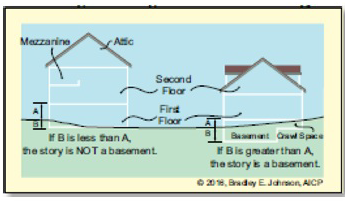
Basement. An area within a building predominantly below the finished grade. Specifically, a basement shall have no more than 10 percent of its perimeter greater than three feet above grade; and no point along its perimeter shall be greater than five feet above grade (measured vertically from the bottom of the floor joists of the floor above to the average finished grade around the building). Basements are not considered a story.
Bar (or tavern). An establishment principally for the sal e and consumption of alcoholic beverages on site and that de rives 50 percent or more of its annual gross revenue from the sale of alcoholic beverages. The service of food tends to be inc idental. Other names for a bar include tavern, cocktail lounge, pub, or saloon. A bar shall include ancillary uses commonly related to such a use, but shall not include video games of chance where the user can earn credits, tokens, tickets or other form of earnings.
Bed and breakfast. An owner occupied or employee of the owner occupied residence containing no more than six guest rooms for hire, for lodging by prearrangement for periods not to exceed three consecutive weeks and providing for occasional meals daily (usually breakfast) and not a hotel/motel.
Berm. A man-made, formed, earth mound of definite height and width used for landscaping and screening purposes, the intent of which is to provide a transition between uses of differing intensity or to screen uses from sight.
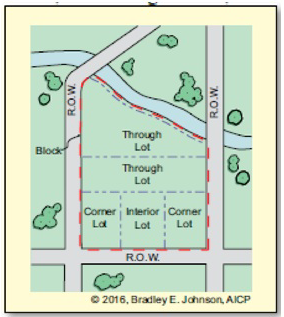
Block. Property abutting on one side of a street and lying between the two nearest intersecting or intercepting streets, intersecting railroad, intersecting waterway or the end of a dead end street.
Board. See "zoning board of adjustments."
Board of adjustments. See "zoning board of adjustments."
Bond. Any form of security including a cash deposit, surety bond, collateral, property or instrument of credit in an amount and form satisfactory to the planning and zoning commission. All bonds shall be approved by the planning and zoning commission wherever a bond is required by the zoning ordinance.
Brew pub. An establishment principally for the sale and consumption of alcoholic beverages, featuring beer brewed on site or by the owner of the brew pub off site. Generally, a brew pub derives 40 percent or more of its annual gross revenue from the sale of beer. The service of food and other drinks shall constitute 40 percent or more of the annual gross revenue. A brew pub shall include ancillary uses commonly related to such a use, but shall not include video games of chance where the user can earn credits, tokens, tickets or other form of earnings.
Broadcast facility. A place where audio or video programing is prepared, recorded, edited, or broadcast, or where programming is received for editing or re-broadcasting; with on-site telecommunication tower, on-site antennae, and/or on-site commercial satellite dishes.
Broadcast studio. A place where audio or video programing is prepared, recorded, edited, or broadcast, or where programming is received for editing or re-broadcasting; without on-site telecommunication towers, on-site antennae, or on-site commercial satellite dishes greater than five feet in diameter. See BROADCAST FACILITY for broadcast studios with on-site towers, antennae, and/or commercial satellite dishes.
Buffer yard. An area adjacent to front, side, and rear property lines, measured perpendicularly from adjacent property lines and/or right-of-way lines, intended to provide attractive spaces, to reduce the impacts of proposed uses on adjacent property or natural features, and to screen incompatible uses from each other and from the right-of-way. Buffers also help to maintain existing trees or natural vegetation, to block or reduce noise, glare or other emissions, and to maintain privacy. Buffer yards are in addition to (separate from) front, rear or side yard setbacks.
Buildable lot. See LOT, BUILDABLE.
Building. An enclosed or predominantly enclosed structure having a roof, supported by columns or walls, for the shelter, support, or enclosure of persons, property, or animals; often with interior spaces separated by walls from the ground up. Car ports, although not predominantly enclosed shall be considered a building for the purposes of this zoning ordinance.
Building area. See "floor area, main."
Building code. The applicable Building Code which establishes and controls the standards for constructing all forms of permanent structures and related matters.
Building official. Shall mean the inspector of buildings for the city.
Building, detached. See DETACHED STRUCTURE.
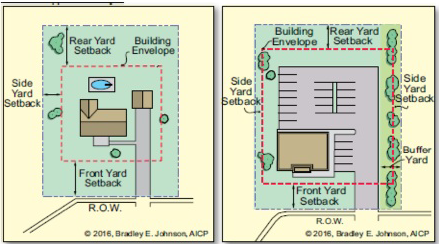
Building envelope. The setback lines that establish an area on a lot in which building can occur.
Building height. See STRUCTURE HEIGHT.
Building permit. An authorization to begin construction of or modification to a structure after submitting mandatory information and complying with construction standards contained within the applicable Building Code, and any applicable local amendments to the Building Code.
Business. The engaging in the purchase, sale, barter or exchange of goods, wares, merchandise, services, or the maintenance or operation of offices, recreational or amusement enterprises.
Business districts. See COMMERCIAL DISTRICT.
Campground. Any site, lot, field or tract of land designed with facilities for short-term occupancy by recreational vehicles and other camping equipment, but not including mobile homes.
Canopy tree. Deciduous trees that grow to at least 40 feet in height and have a canopy that is round or oval in shape. Conical, pear, or tubular shaped trees are not canopy trees.
Car wash. A structure, or portion of a structure, containing facilities for washing one or more automobiles at any one time, using production line methods such as a chain conveyor, blower, steam cleaning device or other mechanical devices; or providing space, water, equipment or soap for the complete or partial cleaning of such automobiles, whether by operator or by custom. Car washes are regulated as automobile oriented businesses.
Caretakers residence. A single-family detached dwelling or a dwelling unit integrated into a non-residential primary structure, located on public park land which is occupied by a person who is employed by the park.
Cellular communication equipment. Antennas and other transmitting and/or receiving device or other associated devices used in the provision of telecommunications service.
Cemetery. Property used for interring of the dead, including a memory garden and/or mausoleum.
Certificate of appropriateness. A certificate from the historic landmark preservation committee authorizing plans for alteration, reconstruction, removal, or demolition of a landmark or an improvement on a historic site.
Certificate of occupancy. A certificate stating that the location, occupancy, and use of a building or structure complies with all applicable zoning ordinance provisions.
Changeable copy (ratio). The portion of a permitted sign that is used for cyclical messages or flashing messages.
Child care center. Any institution operated for the care of children, licensed pursuant to all applicable laws.
Child care home. An establishment providing non-overnight care, supervision, and protection of children in private residences which is ancillary to the primary use as a residence. A residential structure in which at least six children (not including the children for whom the provider is parent, stepparent, guardian, custodian, or other relative) at any time receive child care from a provider. (a) while unattended by a parent, legal guardian or custodian; (b) for regular compensation; and (c) for more than four hours but less than 24 hours in each of ten consecutive days in a calendar year, excluding intervening Saturdays, Sundays, and holidays.
Child care institution.
(1)
A residential facility that provides child care on a 24 hour basis for more than ten children; or
(2)
A residential facility with a capacity of not more than ten children that exceeds the definition of a group home. A child care institution does not include a juvenile detention facility.
Children's home. See CHILD CARE INSTITUTION.
Church. See PLACE OF WORSHIP.
City. The city.
City official. A city council member, a planning and zoning commission member, a board of adjustments member, or an employee of the city.
Clinic. See OFFICE, MEDICAL.
Club or lodge. A building used by an organized group of people for a common purpose that is social, philanthropic, cultural, or educational in nature. A club or lodge shall include ancillary uses commonly related to such a use, but shall not include video games of chance where the user can earn credits, tokens, tickets or other form of earnings.
Clubhouse. A structure used in association with a golf course, in which may be locker rooms, golf course administration offices, golf cart storage and maintenance, rest rooms, lounges, meeting space, snack bar, banquet facilities and retail sales of golf related products. Retail sales shall constitute no more than 15 percent of the interior space accessible to public of the clubhouse.
Collector, major. See STREET, COLLECTOR.
Collector, minor. See STREET, COLLECTOR.
College. See UNIVERSITY.
Collocation. A space on an existing or proposed telecommunication tower that can be used for the installation and/or mounting of antennas or radio or cellular communication equipment that operates on a different frequency from the initial user.
Commercial district. Refers to the C1, C2, UC, and OC Districts.
Commercial wireless communications service. A licensed commercial wireless telecommunications service, including cellular, personal communication services (PCS), specialized mobile radio (SMR), enhanced specialized mobile radio (ESMR), paging, and similar devices that are marketed to the general public.
Commission. See PLANNING AND ZONING COMMISSION.
Community center. A structure available to the public for community activities, meetings, banquets, projects, gatherings, and the like. A community center may be able to be reserved by the public for private parties and events.
Condition of approval. Stipulations or provisions set forth by the board of adjustments or planning and zoning commission required as a prerequisite for approval of an application.
Condominium. Buildings which are precisely divided by legal description (e.g., typically by floor and/or common wall), and where each division is a legally transferable property. Condominiums typically are located on land owned jointly with all other condominium owners, or on land owned by a company that maintains the land and/or building envelope of the buildings.
Confined feeding. The raising of animals for food, fur, or recreation in lots, pens, ponds, sheds, or buildings, where they are confined, fed, and maintained for at least 45 days during any year, and where there is no ground cover or vegetation present over at least one-half of the animals' confinement area.
Confined feeding facility. All elements of a facility used for confined feeding, including. animal barns/sheds/structures, lagoons, waste management and storage facilities, animal mortalities storage facilities, animal composting facilities, incinerators, feed storage, mechanical equipment, truck maneuvering areas, loading docks, parking lots, medical facilities, air handling systems, accessory facilities, and other essential equipment, structures, and operational devices.
Continuous mound. A landscape feature used for screening in which a continuous raised section of earth is used to block or partially block visibility from one side to the other. In particular, continuous mounds are linear with a top elevation (crest) relatively consistent from one end to the other.
Corner lot. See LOT, CORNER.
County. Rusk County, Texas.
Covenants. Private and legal restrictions of various kinds on the usage of lots, typically within a subdivision and applied by the subdivider. In the case of public health, safety and welfare, covenants may be applied by the planning and zoning commission, that are recorded with the plat and deed. Covenants can also be placed on commercial and industrial developments. Unless specifically agreed to, covenants are not enforceable by the planning and zoning commission or its designees. However, they are enforceable in civil court by interested or affected parties.
Cul-de-sac. A street having one end open to traffic and being permanently terminated by a vehicular turnaround at the other end.
Cutoff fixture. See FIXTURE, CUTOFF.
Cyclical message. The changing of any pixel, light element, sign copy, character, graphic, color, or light intensity between once every five seconds and once every one hour. Specifically, no changes to the sign shall take place for at least five seconds and the sign shall change at least once within one hour.
Day care center. See CHILD CARE CENTER.
Deciduous tree. Any tree which sheds its leaves annually followed by regeneration of its foliage in the spring.
Deck. An accessory structure which is on the ground or is elevated from ground level and is open to the sky.
Decorative wall. A brick, stone or landscape block masonry wall with top cap or similar design and ornamentation. A cinder block and split-face block masonry wall, and the like, shall not be considered a decorative wall.
Dedication. The setting apart of land or interests in land for use by the municipality or public by ordinance, resolution or entry in the official minutes as by the recording of a plat.
Demolition. The complete removal or destruction of any structure excluding its foundation.
Designed fail area. The area surrounding a tower in which the tower could fall should it fail as structurally designed. The designed fail area is quantified in terms of linear distance from the tower to the perimeter of the designed fail area. The designed fail area shall be certified by a structural engineer.
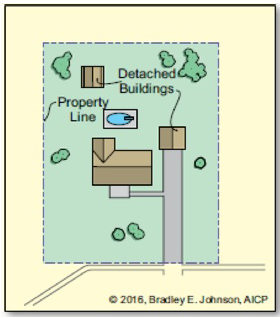
Detached building. See "detached structure."
Detached structure. A structure that has no structural connection with the primary structure.
Detention pond. An engineered facility used to temporarily collect storm water and outlet it over a designated period of time or at a specific rate of release.
Developed lot. See LOT, DEVELOPED.
Developer. The owner or legal representative of land proposed to be developed residentially, commercially, or industrially utilized.
Development standards. Height, bulk, density, environmental performance standards and other standards for development as set forth in the zoning ordinance, including landscaping, parking and other required improvements, excluding those provisions which specifically regulate the use, per se, of property.
Development standards variance. See VARIANCE, DEVELOPMENT STANDARDS.
District. See ZONING DISTRICT.
Domestic pets. Animals commonly used as household pets, personal protection, companionship, and for assistance to disabled persons. Domestic pets shall include animals that are cared for and treated humanely. Domestic pets shall include, but not be limited to, dogs, cats, parakeets, parrots, finches, lizards, spiders, guinea pigs, hamsters, gerbils, rats, mice, rabbits, aquarium fish, ferrets, and snakes if cared for and used in the manner described above. A domestic pet shall not be considered a farm animal or vice-versa.
Drive, private. See STREET, PRIVATE.
Drive-through establishment. A place of business being operated for the sale and purchase at retail of food and other goods, services, or entertainment, which is laid out and equipped so as to allow its patrons to be served or accommodated while remaining in their automobiles.
Driveway. An access facility used primarily to convey motor vehicles from a public street or private street to a garage, primary structure, parking court, parking lot, or the like. The following facilities or legal descriptions shall not be considered a driveway:
(1)
Public or private streets. An access facility intended to provide access to three or more lots, three or more condominium units, or five or more dwelling units in a single multiple-family residential building shall not be considered a driveway. These access facilities shall be established as a public or private street.
(2)
Public right-of-way. An access to one or more primary buildings or one or more lots that is established as a right-of-way shall be considered a public street and regulated as such.
(3)
Access to undeveloped land. Access to accessory buildings used exclusively for agricultural purposes, land used exclusively for agricultural purposes, natural areas, and undeveloped forested areas shall not be considered a driveway.
(4)
Construction access. An access used temporarily for construction vehicles during a permitted and compliant construction project shall not be considered a driveway.
(5)
Parking lot or aisle. Any parking lot or aisle within a parking lot shall not be considered a driveway.
(6)
Loading dock. Any loading dock or maneuvering area used for trucks to load and unload shall not be considered a driveway.
Dumpster. A trash receptacle larger than 100 gallons in volume used primarily by commercial, institutional, and industrial uses, and construction projects for collection of trash. Dumpsters are generally constructed of durable metal in box shaped vessels and designed to be easily transported off-site or emptied.
Duplex. See DWELLING, SINGLE-FAMILY ATTACHED.
Dwelling. A building or structure or portion thereof, conforming to all requirements applicable to the district in which it is located, all Building Codes, and that is used exclusively for residential occupancy, including single-family attached dwelling units, single-family detached dwelling units, and multiple-family dwelling units, but excluding hotels/motels.
Dwelling, duplex. See DWELLING, SINGLE-FAMILY ATTACHED.
Dwelling, manufactured home. A transportable dwelling unit which is a minimum of eight feet in width and which is built on a permanent foundation or tied down with perimeter skirting when connected to the required utilities, and includes the plumbing, heating, air conditioning, and electrical system contained therein, and which was manufactured either:
(1)
Bears a seal, certifying that it was built in compliance with the Federal Mobile Home Construction and Safety Standards.
Dwelling, mobile home. See MANUFACTURED HOME.
Dwelling, multiple-family. A residential structure designed to be occupied by four or more families, with the number of families in residence not exceeding the number of dwelling units provided. Each unit in a multiple-family dwelling development are typically owned by the same company or owner.
Dwelling, single-family. See DWELLING, SINGLE-FAMILY ATTACHED or DWELLING, SINGLE-FAMILY DETACHED.
Dwelling, single-family attached. An attached residential dwelling unit designed to be occupied by one family; that is attached to other similar units; and with the number of families in residence not exceeding the number of dwelling units provided. Each unit in a single-family attached dwelling development are typically owned independently.
Dwelling, single-family detached. A permanent residence designed and constructed to be occupied by one family and not physically connected to another dwelling unit, and either.
(1)
Recognized by the applicable Building Code as a grandfathered single-family dwelling; or
(2)
Constructed on-site in compliance with the applicable Building Code for single-family dwellings, and which also complies with the following specifications:
(a)
The minimum width shall be 23 feet for at least 60 percent of its depth,
(b)
The minimum depth shall be 23 feet for at least 60 percent of its width; or
(3)
Constructed in a factory and bearing a seal certifying that it was built in compliance with the federal Manufactured Housing Construction and Safety Standards Law (1974 USC 5401 et seq.), and which also complies with the following specifications:
(a)
Was constructed after January 1, 1981, and exceeds 950 square feet of occupiable space,
(b)
Is attached to a permanent full-perimeter foundation of concrete or masonry construction constructed in accordance with applicable Building Code for single family dwellings,
(c)
Has the wheels, axles, and towing chassis used to transport the unit to the site removed,
(d)
Has a pitched roof with a minimum of four vertical units to 12 horizontal units (i.e., 4.12 pitch),
(e)
The minimum width shall be 23 feet for at least 60 percent of its depth, and
(f)
The minimum depth shall be 23 feet for at least 60 percent of its width.
Dwelling site. A site within a manufactured home park with required improvements and utilities that is leased for the long-term placement of a manufactured home.
Dwelling unit. A single unit for owner occupancy or for rent/lease, physically separated from any other dwelling units which may be in the same structure, and providing complete and independent living facilities for one or more persons, including permanent provisions for living, sleeping, cooking, and sanitation. Examples of a dwelling unit include a single-family dwelling, multiple-family dwelling, manufactured home dwelling and farmstead.
Dwelling unit size. The overall square feet of a dwelling unit. The dwelling size does not include a garage, carport, deck, unfinished storage, patio, or open porch.
Easement. A grant by a property owner ("grantor") to specific persons, the general public, corporations, utilities, and/or others ("grantee" or "easement holder"), for the purpose of providing services or access to the property.
Enforcement official. The zoning administrator and his/her authorized representative, the planning and zoning commission, the board of adjustments, code officers, legal counsel for the planning and zoning commission, legal counsel for the board of adjustments or any other person charged with a full or partial role in the enforcement of the Henderson zoning ordinance by board of adjustments Rules and Procedures or official vote, planning and zoning commission Rules and Procedures or official vote, by the city manager or by the Henderson zoning ordinance.
EPA. United States Environmental Protection Agency.
Erosion. The wearing away of the land surface by water, wind, ice, gravity or other geological agents.
Established setback. See SETBACK, ESTABLISHED.
Exterior architectural feature. The architectural style, design, general arrangement, and components of all the outside surfaces or an "improvement" as distinguished from the interior surfaces enclosed by said exterior surfaces, including but not limited to the texture of the building material and the type and style of all windows, doors, lights, signs, and other fixtures appurtenant to such "improvement."
FAA. Federal Aviation Administration.
Fair housing facility (large). To prevent the discrimination of mentally or physically disabled persons, these facilities have been identified as types of housing that are permitted in certain districts, but still must meet "nondiscriminatory" health, fire, safety and building regulations. These facilities include:
(1)
Group homes for children in need of service or children who have committed a delinquent act; and specifically a facility that houses more than ten children;
(2)
Residential facility for the developmentally disabled which provides residential services for more than eight developmentally disabled individuals.
Fair housing facility (small). To prevent the discrimination of mentally or physically disabled persons, these facilities have been identified as types of housing that are permitted in any single-family or multiple-family residential zoning districts, but still must meet "nondiscriminatory" health, fire, safety, and building regulations. These facilities include:
(1)
Group homes for children in need of service or children who have committed a delinquent act; and specifically a facility that houses not more than ten children.
(2)
Residential facility for the developmentally disabled which provides residential services for eight developmentally disabled individuals or less.
(3)
Residential facility for the mentally ill which provides residential services for mentally ill individuals.
(4)
No two residential facilities for the mentally ill shall be within 3,000 feet of one another in the zoning jurisdiction.
Family. An individual, or two or more persons related by blood, marriage, or adoption, or a group of not more than three persons, not related by blood, marriage or adoption, living together as a single housekeeping unit in a dwelling unit. Persons being fostered by official placement into the home shall be permitted in all circumstances.
Farm animal. See ANIMAL, FARM.
Farmstead. A single-family dwelling unit that is located on and used in connection with a farm.
FBFM. Flood boundary and floodway map.
FCC. United States Federal Communications Commission.
FEMA. United States Federal Emergency Management Agency.
FHBM. Flood hazard boundary map.
FIRM. Flood insurance rate map.
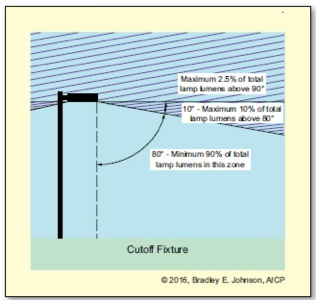
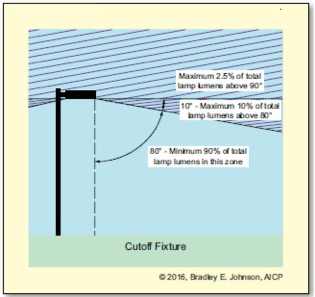
Fixture, cutoff. A luminaire that.
(1)
Projects at least 90 percent of the total lamp lumens below 80° from vertical;
(2)
Does not allow more than 10 percent of the total lamp lumens above 80° from vertical; and
(3)
Does not allow more than 2½ percent of the total lamp lumens above 90° from vertical.
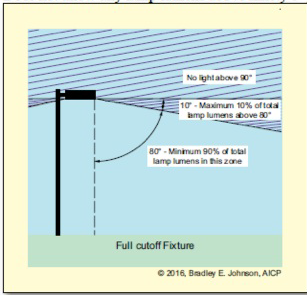
Fixture, full-cutoff. A luminaire that.
(1)
Projects at least 90 percent of the total lamp lumens below 80° from vertical;
(2)
Does not allow more than 10 percent of the total lamp lumens above 80° from vertical; and
(3)
Does not allow any lamp lumens above 90° from vertical.
Fixture, non-cutoff. A luminaire with no control of the horizontal distribution of luminance.
Fixture, semi-cutoff. A luminaire that.
(1)
Projects at least 80 percent of the total lamp lumens below 80° fro m vertical;
(2)
Does not allow more than 20 percent of the total lamp lumens ab ove 80° from vertical; and
(3)
Does not allow more than 5 percent of the total lamp lumens above 90° from vertical.
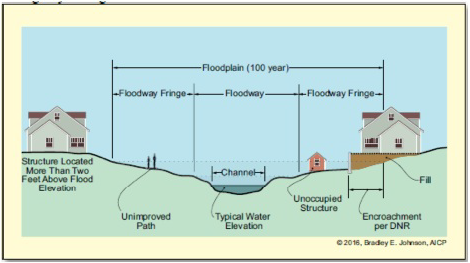
Flood protection grade (FPG). The elevation of the regulatory flood plus two feet at any given location in the SFHA.
Flood, regulatory. A flood having a peak discharge which can be equaled or exceeded on the average of once in a 100-year peri od, as calculated by a method and procedure which is acceptable to and approved by the State of Texas. Further, this flood is equivalent to a flood having a one percent probability of occurrence in any given year.
Floodplain. The relatively flat area or low lan d adjoining the channel of a river or stream wh ich has been or may be covered by flood water. The floodplain includes the channel, floodway, and floodway fringe. Floodplain boundaries are to be determined by using the Floodway-Flood Boundary Maps of the Federal Insurance Administration/Federal Emergency Management Administration.
Floodplain overlay district. Refers to the FPO District.
Floodway, regulatory. The channel of a river or stream and those portions of the floodplains adjoining the channel which are reasonably required to efficiently carry and discharge peak flow of the regulatory flood of any river or stream and, is that area covered by floodwaters in significant downstream motion or covered by significant volumes of stored water during the occurrence of the regulatory flood.
Floor area. The sum of all horizontal surface areas of all floors of all roofed portions of a building enclosed by and within the surrounding exterior walls or roofs, or to the center line(s) of party walls separating such buildings or portions thereof. The floor area of a building shall exclude exterior open balconies, screen porches and open porches.
Floor area, main. That portion of floor area constructed, completed, and usable for living purposes with normal living facilities which includes sleeping, dining, cooking, working, entertainment, common space linking rooms, areas for personal hygiene, or combination of those areas located on the first (or nearest ground level) floor of the structure. The main floor area of a primary structure does not include a garage, carport, deck, unfinished storage, patio, screen porch or open porch.
Foundation. The supporting member of a wall, building or structure sufficient to solidly anchor it to the land on which it sits, distribute its weight to the earth, and/or to prevent movement in the horizontal or vertical plane.
Front building line. With respect to a building, the foundation line that is nearest the front lot line; including any enclosed portion of a primary structure.
Front lot line. See LOT LINE, FRONT.
Front yard. See YARD, FRONT.
Frontage. See LOT FRONTAGE.
Full cutoff fixture. See FIXTURE, FULL CUTOFF.
Garage. An attached or detached structure whose primary purpose is to park motor vehicles, house a trash receptacle or store personal property for the on-site primary use, or as otherwise permitted by the Henderson zoning ordinance.
Garage sale. (Also known as a yard sale, tag sale, moving sale, and by many other names) is an informal event for the sale of used goods by private individuals, in which sellers are not required to obtain business licenses or collect sales tax. Such sale will require a permit restricted to institutional and residential zones only; with no fee required.
Gas station. Any building or lot used to sell fuel to the general public to propel motor vehicles. Fuels for dispensing are inclusive of liquid fuels (e.g., gasoline), gas fuels (e.g., natural gas or hydrogen), and electricity. Gas stations may include dispensing of fuel for heating and other appliances when it is subordinate to dispensing fuel for motor vehicles. Gas stations do not include car washes, convenience stores, fast food restaurants and other primary uses which are often paired with a gas station. For permitted pairing, all desired uses shall also be permitted uses in the subject zoning district. A gas station shall include ancillary uses commonly related to such a use, but shall not include video games of chance where the user can earn credits, tokens, tickets or other form of earnings.
General services office. See OFFICE, GENERAL SERVICES.
Geographic information system (GIS). A computer system that stores and links non-graphic attributes or geographically referenced data with graphic map features to allow a wide range of information processing and display operations, as well as map production, analysis and modeling.
Gfa. See GROSS FLOOR AREA.
Gift shop. A retail store offering a variety of small gift items, as opposed to stores offering primarily specific lines of merchandise such as toys, clothing, or sporting goods.
GIS. See GEOGRAPHIC INFORMATION SYSTEM (GIS).
Golf course. An area of terrain on which the game of golf is played during daylight hours. A golf course includes greens, fairways, natural areas, clubhouse, and practice greens. A golf course may also include ancillary features, such as. a driving range when integrated with the golf course operations and hours, irrigation system, maintenance facility, indoor storage of golf carts, event facility, on-course restrooms, vending shelter, storm shelter, a caretaker residence, scoreboard, bridges and ponds.
Government operations facility. Any government use of land or land and structures in combination, which is not a government office; typically facilities used for maintenance of vehicles, storage of equipment and machinery, treatment of water or waste, or storage of commodities (e.g., salt storage) used to provide government services, and the like.
FPO district. Refers to the Flood Protection Overlay District.
Grade, finished. The average elevation of the finished surface of the ground within ten feet of the structure after final grading.
Grantee. A person to whom an interest in property is granted.
Gross floor area. The sum of all horizontal floor area of all floors within a structure.
Ground floor area. See FLOOR AREA, MAIN.
Group home. A facility that houses not more than ten children that are either:
(1)
In need of care, physical support, emotional support, or public service; or
(2)
Have committed a delinquent act.
Group homes are not subject to covenants, deeds, or other instruments pertaining to the transfer, sale, lease, or use of property that would permit the residential use of property but prohibit the use of that property as a group home as a matter of public policy. Group homes cannot be prohibited on the grounds that they are a business, the persons living in a group home are not related, or any other reason.
Habitable space. Any space in a structure or building that is suitable for living, sleeping, eating or cooking purposes, excluding such enclosed places as closets, pantries, bath or toilet rooms, hallways, laundries, storage spaces, utility rooms, and similar spaces.
Hardship. A practical difficulty with regard to one's ability to improve land stemming from the application of the development standards of the zoning ordinance, which may or may not be subject to relief by means of variance. In and of themselves, self-imposed situations and claims based on a perceived reduction of or restriction on economic gain shall not be considered hardships. Self-imposed situations include. the purchase of land with actual or constructive knowledge that, for reasons other than physical characteristics of the property, the development standards herein will inhibit the desired improvement; any improvement initiated in violation of the standards of the zoning ordinance; any result of land division requiring variance from development standards of the zoning ordinance in order to render that site buildable.
Height. See STRUCTURE HEIGHT.
High impact district. Refers to the HI District.
Historic landmark. Any buildings, land, areas or districts of historical, architectural, archaeological or cultural importance or value, which the city council determines shall be protected, enhanced and preserved in the interest of the culture, prosperity, education and welfare of the people.
Historic landmark preservation committee. A committee composed of seven members appointed by the city council. All members shall have knowledge and experience in the field of history, art, architecture or real estate planning and development, and shall be appointed from a list of nominees.
Historic site. A parcel or part thereof, on which is situated a "landmark" and any abutting parcel or part thereof used and constituting part of the premises on which the "landmark" is situated, and which has been designated as a "historic pursuant to the provisions of this chapter.
Hobby farming. The use of land for purposes, including. dairying, pasturage, apiculture, agriculture, horticulture, floriculture, viticulture, and animal and poultry husbandry. Processing and storage of harvested produce or other end products shall not be allowed on-site. The hobby farming use(s) shall not exceed 40 percent of the land area of the lot and shall abide by all setback regulations. Hobby farming cannot be the primary income source for the owner, operator, or household on-site. Hobby farming shall not include feed lots, stock yards, or the commercial feeding of garbage or offal to swine or other animals.
Home business (type 1). A business activity conducted completely within a dwelling unit, operated by a lawful resident of the property, and which is predominantly incidental and secondary to the residential use. Home business (Type 1) is further regulated by § 153-148.
Home business (type 2). A business activity conducted completely within a dwelling unit, operated by a lawful resident of the property, and which is significantly incidental and secondary to the residential use. Home business (Type 2) is further regulated by § 153-149.
Home business (type 3). A business activity conducted primarily within an accessory building, operated by a lawful resident of the property, and which is incidental and secondary to the residential use. Home business (Type 3) is further regulated by § 153-150.
Hospital. An institution providing primary health services and medical or surgical care to persons, primarily inpatients, suffering from illness, disease, injury, and other abnormal physical or mental conditions and including, as an integral part of the institution, related facilities, such as laboratories, outpatient facilities, training facilities, medical offices, and staff residences.
Hotel. A structure in which temporary lodging or board and lodging are provided and offered to the public for compensation and in which ingress and egress to and from all rooms is made through an inside lobby or office supervised by a person in charge at all hours. As such, it is open to the public. Compensation is usually assessed on a day-to-day basis.
Household pets. See PETS, HOUSEHOLD.
Illuminance. The total amount of visible light illuminating (incident upon) a point on a surface from all directions above the surface (i.e., how brightly a surface is illuminated). Illuminance is measured in lux.
Impervious surface. The horizontal area of property covered with materials that include, but are not limited to, concrete, rooftop, and asphalt, such that the infiltration of storm water is prevented or impeded. The total amount of impervious surface area located on a property without regard to topographic features of the property is included. Driveways, streets, parking lots and other areas used for vehicular traffic are considered impervious surface areas. Undisturbed land, tilled agricultural land, ponds, lawns and fields are not considered impervious surface area.
Improved lot. See LOT, BUILDABLE.
Improvement. Any building, structure, place, parking facility, fence, gate, wall, work of art or other object constituting a physical betterment of real property, or any part of betterment.
Improvement (only applicable to the historic district overlay). Any building, structure, place, parking facility, fence, gate, wall, work of art, or other object constituting a physical betterment of real property, or any part of such betterment.
Improvement location permit. A permit issued under the zoning ordinance permitting a property owner to erect, construct, enlarge, alter, move, occupy, use, change use, improve, remove, convert or demolish any building or structure within its jurisdiction, or permitting a person to change the condition of the land, as may be required by the Henderson zoning ordinance.
Incidental. A minor occurrence or condition which is customarily associated with a permitted use and is likely to ensue from normal operations.
Incompatible districts. Any zoning district that is not recognized as an "appropriate adjacent district" in the subject lot's zoning district, as found in sections 153-20 through 153-56.
Industrial district. Refers to the I1 and I2 Districts.
Industry, heavy. See MANUFACTURING, HEAVY.
Industry, light. See MANUFACTURING, LIGHT.
Infill lot. See LOT, INFILL.
Initial user. The applicant, person, organization, or corporation that originally applies to the city for approval for the installation of an antenna or other radio or cellular communication equipment or for approval for the construction of a telecommunication tower or facility.
Institutional district. Refers to the IS District.
Interior lot. See LOT, INTERIOR.
Junk. An automobile, truck, other motor vehicle, watercraft, large appliances, furniture, or like materials which have been damaged to such an extent that they cannot be operated under their own power or used and/or will require major repairs before being made usable. This also includes such a vehicle which does not comply with state or county vehicle licensing or other laws or ordinances.
Junk yard. A place, usually outdoors, where waste or discarded used property, including but not limited to automobiles, farm implements and trucks, is accumulated and is or may be salvaged for reuse or resale. This does not include industrial scrap metal or accumulation of organic matter.
Jurisdiction. See ZONING JURISDICTION.
Juvenile detention facility. A facility that holds children or minors (typically under 18 years of age) for punishment and/or counseling as a result of sentencing by a court of jurisdiction for criminal or antisocial behavior.
Kennel, commercial. A commercial establishment involving boarding, breeding, buying, keeping, training, selling, or similar services offered to owners of dogs, cats, or other domestic animals. This definition is not inclusive of a veterinarian clinic or home enterprise kennel. Commercial kennels are not inclusive of a residential dwelling unit.
Landmark. Any "improvement" which has a special character and/or special historical interest or value as part of the development, heritage, or cultural characteristics of the city, state or nation, and which has been designated as a landmark pursuant to the provisions of this chapter.
Landscape areas. Places on a lot or abutting right-of-way that are identified for application of landscaping regulations. Landscape areas include. street tree planting areas, parking lot planting areas, foundation planting areas, buffer yard areas, and perimeter planting areas. The below image conceptually demonstrates the general location of each landscape area.
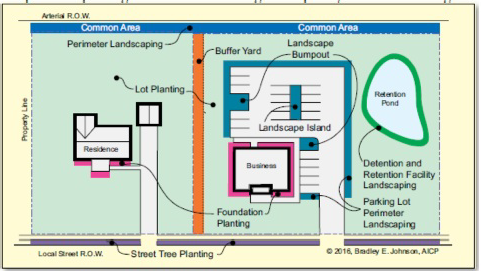
Landscape buffer. A continuous landscaped area designed, maintained, and used for screening and separation of uses, lots or structures.
Landscape material. Trees, shrubs, pla nts, decorative fences, retaining walls, walls, earthen mounds, irrigation systems, flower beds, decorative rocks, edging, mulch, stakes and the like. Artificial trees, shrubs, ground cover, and flowers are not considered landscape material.
Landscape structure. Decorative fences, walls, retaining walls, substantive edging, trellis, arbor and the like.
Landscaping. The improvements of a lot with grass, shrubs, trees, and other vegetation and/or ornamental objects. Landscaping may include pedestrian walks, flower beds, berms, fountains and other similar natural and man-made objects designed and arranged to produce an aesthetically pleasing effect.
Legal nonconforming lot of record. Any legally established and recorded lot in existence prior to the effective date of the zoning ordinance, or its subsequent amendments, that no longer meet the lot-specific development standards.
Legal nonconforming sign. Any sign lawfully existing on the effective date of the zoning ordinance, or amendment thereto, that does not conform to all the standards and regulations of the zoning ordinance.
Legal nonconforming structure. Any continuously occupied, lawfully established structure in existence prior to the effective date of the zoning ordinance, or its subsequent amendments, that no longer meets the development standards.
Legal nonconforming use. Any continuous, lawful use of structures, land, or structures and land in combination established prior to the effective date of the zoning ordinance or its subsequent amendments that is no longer a permitted use in the district where it is located.
Loading dock. An off-street space for temporary parking of delivery and pickup vehicles.
Local street. See STREET, LOCAL.
LOMA. FEMA Letter of Map Amendment.
Lot. A single tract of land intended to be used, developed or built up on. There are three types of lots identified in the zoning ordinance. interior lots, corner lots, and through lots.
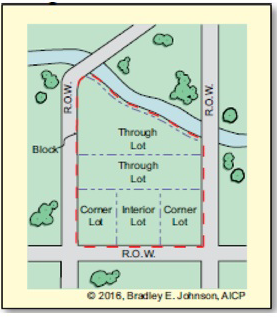
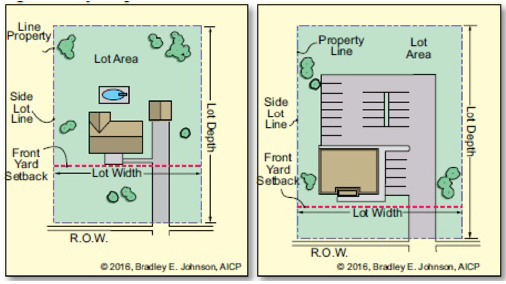
Lot area. The area of a horizontal plane bo unded by the front, side, and rear lot lines, excepting any easement or right-of-way for public streets.
Lot, buildable. A lot upon which a structure may be constructed and occupied as a result of the fact that it has frontage on and access to an improved street, meets minimum setback requirements, and has all necessary utilities available to the lot such as septic, sewer, water, well, electricity, etc.
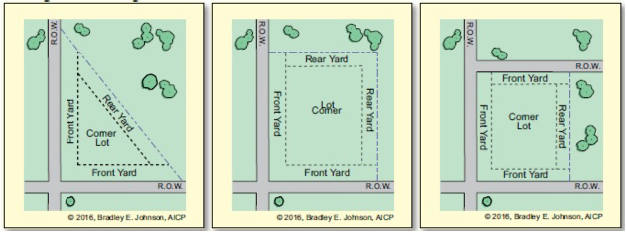
Lot, corner. A lot situated at the intersection of two streets or which fronts a street on two or more sides forming an interior angle of less than 135°.
Lot coverage. The area of a lot occupied by the primary structure, any accessory structures, and impervious surfaces.
Lot depth. The horizontal distance between the front and rear lot lines (See graphics for LOT AREA).
Lot, developed. A lot with structures situated thereon.
Lot frontage. The length of the front lot line bordering upon a public right-of-way. The lot frontage is determined by measuring the total distance in which the front lot line touches a public right-of-way.
Lot, infill. A vacant, buildable lot surrounded on at least three sides by preceding structures. Generally, development on an infill lot is intended to resemble the use, design, architectural features, roof style, massing, and character of buildings on neighboring lots.
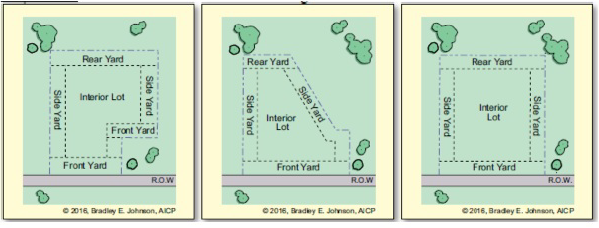
Lot, interior. A lot other than a corner lot or a through lot.
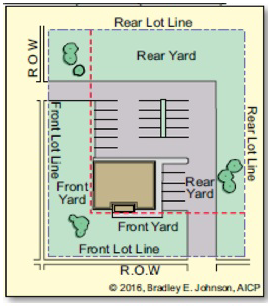
Lot line, front (corner lot). The line marking the boundary between the lot and each of the abutting streets.
Lot line, front (interior or through lot). The line marking the boundary between the lot and the abutting street, right-of-way or a lake or watercourse.
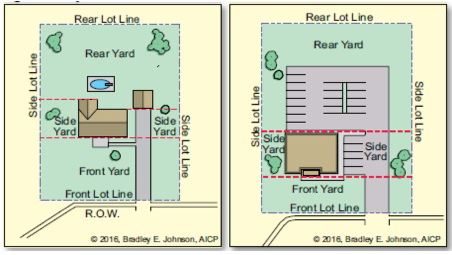
Lot line, rear. The lot line that is opposite th e front lot line and farthest from it, except that for a triangular or other irregularly-shaped lot, the line ten feet long, parallel to the front lot line, and wholly within the lot, that is farthest from the lot line (See graphic for LOT LINE, FRONT).
Lot line, side. A lot boundary line other than a front or rear lot line (See graphic for LOT LINE, FRONT).
Lot of record. A lot which is a part of a subdivision recorded in the office of the Rusk County Recorder, or a parcel or lot described by metes and bounds, a description of which has been so recorded.
Lot, subject. The property to which an action has been applied for, the property being discussed, or the property otherwise being considered for action.
Lot, through. A lot fronting on two parallel or approximately parallel streets, or abutting two streets which do not intersect at the boundaries of the lot. Also includes lots fronting on both a street and a watercourse or lake. Accessory structures are allowed in front yards facing watercourses or lakes. An alley shall not be used to determine if a lot is a through lot.
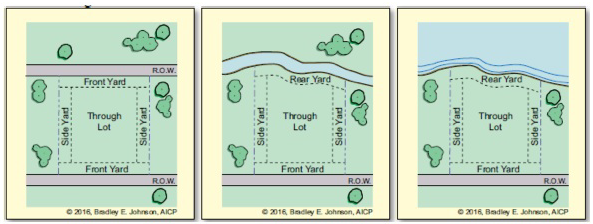
Lot width. The distance between the side lot lines as measured on the front yard setback line . Cul-de-sac and irregular shaped lots shall measure their front lot widths along the front yard setback line from one side lot line to the other (See graphic for LOT AREA).
Lowest floor. The lowest elevation described among the following:
(1)
The lowest floor of a structure.
(2)
The basement floor.
(3)
The garage floor, if the garage is connected to the structure.
(4)
The first floor of a structure elevated on pilings or constructed on a crawl space.
Lumens. A unit of luminous flux in the International System of Units (SI) equal to one candela per steradian. Used to measure the amount of light emitted by lamps.
Lux. Unit of illuminance in the International System of Units (SI) equal to one lumen per square meter.
Main floor area. See FLOOR AREA, MAIN.
Maneuvering space. An open space in a parking area which:
(1)
Is immediately adjacent to a parking space,
(2)
Is used for and/or is necessary for turning, backing or driving forward a motor vehicle into such parking space, but
(3)
Is not used for the parking of or storage of motor vehicles.
Manufactured home. See DWELLING, MANUFACTURED HOME.
Manufacturing, heavy. The assembly, fabrication or processing of goods and materials using processes that ordinarily have greater than minimal impacts on the environment, or that otherwise do not constitute light manufacturing, and which may include open uses and outdoor storage. Heavy manufacturing generally includes processing and fabrication of products made from extracted or raw materials. Heavy manufacturing shall not include any use that is otherwise listed specifically in any zoning district as a permitted use or special exception use.
Manufacturing, light. The assembly, fabrication, or processing of goods and materials using processes that ordinarily do not create noise, smoke, fume, odors, glare, or health or safety hazards outside of the structure or lot where such assembly, fabrication, or processing of goods are housed entirely within an enclosed building. Light manufacturing generally includes processing and fabrication of finished products predominantly from previously prepared materials. Light manufacturing shall not include any use that is otherwise listed specifically in any zoning district as a permitted use or special exception use.
Marker (survey). A stake, pipe, rod, nail, or any other object which is not intended to be a permanent point for record purposes.
Massage therapist. A person licensed and certified by the National Certification board for Therapeutic Massage and Bodywork, or the American Massage Therapy Association, or under the direct supervision of a licensed physician.
Maximum lot coverage. The highest amount of impervious surface coverage permitted by the zoning ordinance.
Meat processing. Any edible portion of animal tissues that is packaged, cooked, mixed, combined, ground, crushed, de-boned, modified or similar for wholesale distribution or further processing by another facility. Meat processing does not include rendering plants or slaughter houses.
Media rental. An establishment that predominantly rents movies, video games, and similar media. Media rental includes to renting and selling ancillary and complementary products.
Medical office. See OFFICE, MEDICAL.
Meteorological tower. A tower that hosts weather instrumentation to evaluate meteorological conditions.
Mini warehouse. See SELF-STORAGE FACILITY.
Mobile home. See DWELLING, MOBILE HOME.
Mobile home park. A parcel of land containing two or more dwelling sites, with required improvements and utilities, that are leased for the long term placement of mobile home dwellings, and shall include any street used or intended for use as part of the facilities of such mobile home park. A mobile home park does not involve the sales of mobile home dwellings in which unoccupied units are parked for inspection or sale.
Monument (survey). A permanent physical structure which marks the location of a corner or other survey point.
Motel. An establishment consisting of a group of attached or detached living or sleeping accommodations with bathroom and closet space, located on a single zoning lot, and designed for use by transient automobile travelers. A motel furnishes customary services such as maid service and laundering of linen, telephone, secretarial, or desk service, and the use and upkeep of furniture.
Motor home. See RECREATIONAL VEHICLE.
Motor vehicle. Any passenger vehicle, truck, tractor, tractor-trailer, truck-trailer, trailer, boat, recreational vehicle, semitrailer, or any other vehicle propelled or drawn by mechanical power.
Mound. A landscape feature used for screening in which earth is piled up in irregular, round or oblong shapes. Particularly, mounds do not have consistent crest elevations, but are irregular in form and overlapping such to emulate a more natural landscape feature. Mounds in combination with other landscape material are used to block or partially block visibility from one side to the other.
Multiple-family district. Refers to the M1, M2, and M3 Districts.
Mural. See SIGN, MURAL.
NFIP. The National Flood Insurance Program.
Night club. An establishment for entertainment with table seating, stage, or area for musical performances and a floor area designated for dancing. A night club shall include ancillary uses commonly related to such a use, but shall not include video games of chance where the user can earn credits, tokens, tickets or other form of earnings.
NIT. A photometric unit of illuminative brightness equal to cd/m2 (candelas per square meter).
Noise sensitive land use. The use of a structure for a purpose that would be adversely impacted by noise from aircraft, industries, or other use. Noise sensitive land uses include but are not limited to residences, schools, churches, child care facilities, medical facilities, retirement homes, and nursing homes.
Nonconforming building. See NONCONFORMING STRUCTURE.
Nonconforming lot of record. A lot which was created such that it does not conform to the regulations of the district in which it is located.
Nonconforming sign. A sign or portion thereof, which was designed, erected, or structurally altered such that it does not conform to the regulations of the district in which it is located.
Nonconforming structure. A building, structure, or portion thereof, which was designed, erected, or structurally altered such that it does not conform to the regulations of the district in which it is located.
Nonconforming use. A use which does not conform with the use regulations of the district in which it is located.
Non-residential structure. A primary structure not used for a residential purpose (e.g., home or apartment building).
Nursing home. A private home for the care of the aged or infirm, or any other person in need of nursing care, and which does not contain equipment for surgical care or for treatment of disease or injury, and is not primarily designed for patients being treated for mental illness or alcohol or drug addiction.
Office. A place in which business, professional and/or clerical activities are conducted. Offices shall include medical offices, government offices and office functions which serve other off-site land uses.
Office, construction trade. Electrical contractor, general contractor, heating and cooling contractor, landscaping contractor, plumbing contractor office and the like.
Office, general. An employment service, insurance office, law office, membership association, publishing corporate office, reading clinic, real estate office, secretarial service, service organization, temporary service agency, title company, trade office, travel agency, and the like.
Office, medical. A medical clinic, dental clinic, optical clinic, rehabilitation clinic, veterinarian clinic, and the like.
Official zoning map. A map of the city, Texas, that legally denotes the boundaries of zoning districts as they apply to the properties within the zoning jurisdiction. There is only one official zoning map, and it is kept up to date by the planning and zoning commission and the zoning administrator.
Official zoning map copies. A map of the city, Texas, that legally denotes the boundaries of zoning districts as they apply to the properties within the zoning jurisdiction. These maps may be out of date.
Open space. An area of land not covered by buildings, structures, parking structures, or accessory uses except for recreational structures. Open space may include nature areas, streams, floodplains, meadows or open fields containing baseball fields, football fields, soccer fields, golf courses, swimming pools, or bicycle paths. Open space does not include street rights-of-way, platted lot area, private yard, patio areas, or land scheduled for future development.
Ornamental tree. A deciduous tree that does not grow to over 30 feet in height at maturity. Ornamental trees typically are flowering trees.
OSHA. Occupational Safety and Health Administration.
Outdoor pets. See PETS, OUTDOOR.
Outdoor storage. See STORAGE, OUTDOOR.
Owner. Any person, group of persons, firm or firms, corporation or corporations, or any other legal entity having legal title to or sufficient proprietary interest in the land sought to be developed under these regulations, or their legal representative.
Parcel. See LOT.
Parent tract. A lot of record as recorded on the effective date of the zoning ordinance. Multiple pieces (lots) owned by one person, persons in partnership, or a company and that are contiguous shall together be considered one parent tract. Streets, rivers, easements, and other built or natural features shall not constitute a separation of two or more pieces of land owned by one person, persons in partnership, or a business.
Park, public. A lot available to the general public for passive (e.g., trails, open fields, and nature areas) and/or active recreation (e.g., playground, swimming pool, and sports fields), and that is owned and maintained by a not-for-profit corporation, city, county, state or the federal government. Parks are inclusive of common and ordinary uses and structures found in parks.
Parking area, public or private. A group of parking spaces in an open area not including any part of a street or alley, designed or used for temporary parking of motor vehicles.
Parking, required. The minimum number of off-street parking spaces specified for a particular use or uses by the zoning ordinance.
Parking space. A horizontal surface within a public or private parking lot primarily for the temporary storage of one motor vehicle. A parking space may vary in size based on the most common size and type of vehicle intended to use the facility.
Paved. A durable surface for parking, driving, riding or similar activities that utilizes asphalt, concrete, brick, paving blocks or similar material. Crushed gravel, stone, rock, or dirt, sand, or grass are not permitted as a paved surface.
;b0;Performance bond. An amount of money or other negotiable security paid by the developer or property owner or his/her surety to the city which guarantees that the developer will perform all actions required by the city regarding an approved development or in other situations as stated forth in the zoning ordinance and/or as deemed by the zoning administrator that provides that if the developer or property owner defaults and fails to comply with the provisions of their approval, the developer or property owner or his/her surety will pay damages up to the limit of the bond, or the surety will itself complete the requirements of the approval.
Pergola. A structure typically used to provide shade and create an outdoor living space, usually utilizing columns to support an open roof comprised of beams and joists; and that roof structure is at least 50 percent open for the passage of light and air.
Permanent foundation. A foundation (as defined) that is made from concrete or similar material, installed on or in the ground, and that connects to a building or structure, intended to be held in place for many years.
Permitted use. See USE, PERMITTED.
Person. A corporation, firm, partnership, association, organization, unit of government, or any other group that acts as a unit, as well as a natural person.
Personal service. An establishment, other than an office, in which services other than health care are rendered to consumers on an individual basis, such as barber shops and beauty parlors.
Pervious surface. Any surface that allows the absorption of stormwater into the ground such as a lawn, woodlot, rain garden, and the like.
Pets, household. Domestic pets maintained healthy and humanely within the confines of the dwelling unit. Household pets includes hobby breeding of domestic animals as long as the frequency of breeding is limited to one litter per year per household. Household pets do not include outdoor pets, farm animals, pigmy goats, potbelly pigs, or rabbits. Examples of household pets include. dogs, cats, mice, snakes, hamsters, ferrets, and birds.
Pets, outdoor. Domestic pets maintained healthy and humanely within the confines of the lot. Outdoor pets includes hobby breeding of domestic animals as long as the frequency of breeding is limited to one litter per year per household. Outdoor pets do not include farm animals, rabbits, mice, snakes, hamsters, ferrets, or birds. Examples of outdoor pets include. dogs and cats.
Place of worship. A building, outdoor structure, and/or outdoor space used for public worship (e.g., church, temple, or mosque).
Plan commission. See PLANNING AND ZONING COMMISSION.
Planned development. A large-scale unified development meeting the requirements for zoning approval under the provisions of sections 153-100 through 153-105. Generally a planned development consists of a parcel or parcels of land, controlled by a single landowner, to be developed as a single entity which does not correspond in size of lots, bulk or type of buildings, density, lot coverage, and required open space to the regulations established in any district of the zoning ordinance. This may result in more attractive and affordable development than conventional developments would allow. Clustered housing (dwellings built in innovative lot arrangements around common open space) and zero lot line housing (dwellings built immediately adjacent to lot lines) are possible as part of planned developments. A planned development requires approval through a zoning map amendment.
Planning and zoning commission. The Henderson planning and zoning commission. The Henderson planning and zoning commission is an Advisory planning and zoning commission.
Planning administrator. See ZONING ADMINISTRATOR.
Planning director. See ZONING ADMINISTRATOR.
Ponding. A state of temporary flooding in depressed areas or in areas where drainage is being impeded.
Pool, swimming. See SWIMMING POOL.
Porch. A roofed-over structure projecting out from the wall or walls of a primary structure and predominantly open to the weather.
Practical difficulty. A difficulty with regard to one's ability to improve land stemming from regulations of the zoning ordinance. A practical difficulty is not a "hardship," rather it is a situation where the owner could comply with the regulations within the zoning ordinance, but would like a variance from development standards to improve his site in a practical manner. For instance, a person may request a variance from a side yard setback due to a large tree which is blocking the only location that would meet the development standards for a new garage location.
Primary arterial. See "street, arterial."
Primary structure. The structure in which the primary use of the lot is located or conducted. With respect to residential uses, the primary structure shall be the main dwelling.
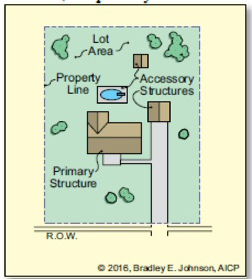
Primary structure footprint. The area defined by the outside edge of the primary structure's foundation including an attached garage, screen porch, but not including a deck, patio, open porch and other appurtenances.
Primary use. See USE, PRIMARY.
Principal use. See USE, PRIMARY.
Private street. See STREET, PRIVATE.
Prohibited use. A use that is not a permitted use or special exception in this zoning ordinance.
Public improvements. Any storm drainage facility, street, highway, parkway, sidewalk, pedestrian-way, tree, lawn, off-street parking area, lot improvement, utility, or other facility for which the local government may ultimately assume the responsibility for maintenance and operation, or which may affect an improvement for which local government responsibility is established.
Private parking area. See PARKING AREA, PUBLIC OR PRIVATE.
Public parking area. See PARKING AREA, PUBLIC OR PRIVATE.
Public place. Any area on public or private property that is easily accessible and clearly visible to the general public. If located on private property, the area must be open to the general public and clearly visible from adjacent public property such as a street or other public thoroughfare or sidewalk.
Public street. See STREET, PUBLIC.
Public utility. See UTILITY, PUBLIC.
Public way. Highways, streets, avenues, boulevards, lanes, or alleys.
Radio/tv station. See BROADCAST FACILITY and BROADCAST STUDIO.
Raising of farm animals. Any livestock operation that falls below the thresholds of a confined feeding operation.
Rear lot line. See LOT LINE, REAR.
Rear yard. See YARD, REAR.
Recreation center/play center. An enclosed structure containing recreational facilities, such as a tennis court, swimming pool, and/or gymnasium. This shall not include outdoor recreation facilities.
Recreational vehicle. A portable, durable living or sleeping space that can be towed, hauled, or driven and primarily designed for recreational, camping, and travel use. Recreational vehicles include travel trailers, truck campers, camping trailers, boats, and self-propelled motor homes.
Recreational vehicle park. Any commercially zoned site, lot, field, or tract of land under single ownership, or ownership of two or more people, designed with facilities for short term occupancy for recreational vehicles only.
Registered/licensed land surveyor. A land surveyor properly licensed and registered, or through reciprocity permitted to practice in the State of Texas.
Registered professional engineer. An engineer properly licensed and registered, or through reciprocity permitted to practice in the State of Texas.
Regulatory flood. See FLOOD, REGULATORY.
Research. Any use that includes the study or experimenting that results in knowledge, intellectual property, product development, or similar. Research includes forensic, scientific, engineering, medical, and the like.
Residential district. Refers to the RE, R1, R2, R3, R4, M1, M2, and M3 Districts.
Residential facility for the developmentally disabled (large). A residential facility which provides residential services for more than eight developmentally disabled individuals.
Residential facility for the developmentally disabled (small). A residential facility which provides residential services for eight or less developmentally disabled individuals.
Residential facility for the mentally ill. A residential facility which provides residential services for mentally ill individuals. No two residential facilities for the mentally ill shall be within 3,000 feet of one another in the zoning jurisdiction.
Responsible party. For purposes of issuing notice of violation, the following persons shall be considered responsible parties, with liability for fines, and responsibility for remedy of the violation. the property owner(s); persons with any possessory interest in the property, and/or any persons and/or their agents who have caused the violation. Any owner, tenant, builder, developer, possessor of interest, architect, designer, property manager, equipment operator known or suspected to be responsible in part or in whole for a violation of the zoning ordinance.
Restaurant. An establishment whose use is the selling of food in a ready-to-consume state, in individual servings, in which the customer consumes these foods while seated at tables or counters located in or immediately adjacent to the building in which the use is located, and which may include carry-out service. RESTAURANT shall include that portion of any establishment which sells prepared food, such as a bakery or a delicatessen, and which is used for seating for the consumption of food on the premises (See also DRIVE-THROUGH ESTABLISHMENT).
Retail, agriculture related. Retail uses that primarily provide products to farmers and agricultural uses, including, but not limited to farm equipment sales, seed sales, fertilizer sales, part sales for farm equipment, farm building materials and repair products, and tack shop.
Retail (type 1) very low intensity. A very low intensity retail business that provides products to all or portions of the general public and that meets the applicable characteristics listed in Table 9-B. Limits of Retail Uses below. A very low intensity retail business also includes ancillary uses, customarily associated with the primary retail business. A very low intensity retail business shall not include business-to-business wholesale operations. Retail Type 1 does not include "smoke shops".
Retail (type 2) low intensity. A low intensity retail business that provides products to all or portions of the general public and that meets the applicable characteristics listed in Table 9-B. Limits of Retail Uses below. A low intensity retail business also includes ancillary uses, customarily associated with the primary retail business. A low intensity retail business shall not include business-to-business wholesale operations. Retail Type 2 does not include "smoke shops".
Retail (type 3) medium intensity. A medium intensity retail business that provides products to all or portions of the general public and that meets the applicable characteristics listed in Table 9-B. Limits of Retail Uses below. A medium intensity retail business also includes ancillary uses, customarily associated with the primary retail business. A medium intensity retail business shall not include business-to-business wholesale operations. Retail Type 3 does not include "smoke shops".
Retail (type 4) high intensity. A high intensity retail business that provides products to all or portions of the general public and that meets the applicable characteristics listed in Table 9-B. Limits of Retail Uses below. A high intensity retail business also includes ancillary uses, customarily associated with the primary retail business. A high intensity retail business shall not include business-to-business wholesale operations.
Retail (type 5) very high intensity. A very high intensity retail business that provides products to all or portions of the general public and that meets the applicable characteristics listed in Table 9-B. Limits of Retail Uses below. A very high intensity retail business also includes ancillary uses, customarily associated with the primary retail business. A very high intensity retail business shall not include business-to-business wholesale operations.
Retention pond. A facility use to indefinitely hold water, like a natural pond, and concurrently used to temporarily collect storm water and outlet it over a designated period of time or at a specific rate of release.
Retirement community. An age-restricted development, which may include detached and attached dwelling units and apartments.
Right-of-way. A strip of land occupied or intended to be occupied by transportation facilities, public utilities, or other special public uses.
Road. See "street."
Row. See "right-of-way."
Sales, walk-in. See "walk-in sales."
Satellite dish/antenna. An apparatus capable of receiving communications from a transmitter relay located in a planetary orbit, or broadcast signals from transmitting towers.
School. A public or private institution which offers instruction in any of the branches of learning and study comparable to that taught in the public schools, including preschool, pre-kindergarten, kindergarten, elementary school, and junior and senior high schools, but excluding trade, business, or commercial schools.
School, trade or business. An educational facility which offers instruction specific to a trade, business or commercial practice.
Scrap metal yard. A general industrial use established independent of or ancillary to and connected with another general industrial use, which is concerned exclusively in new and salvaged metal pipes, wire, beams, angles, rods, machinery, parts, filings, clippings, and/or all other metal items of every type, and which acquires such items incidental to its connection with the other general industrial use or by purchase, consignment or bailment which stores, grades, processes, melts, cuts, dismantles, compresses, cleans, or in any way prepares said items for reuse by the connected other general industrial use or for storage, sale or shipment and/or use in other industries or businesses including open hearth, electric furnaces and foundry operations. Such an establishment shall not include junk yards, dumps, or automobile or other vehicle graveyards.
Self-storage facility. Generally, a structure or group of structures containing two or more individual storage units for rent to the general public with separate access to each unit for the storage and warehousing of personal property. Self-storage facilities do not include commercial activities run from inside the unit (e.g., wholesaling, retailing, or providing services).
Setback. The minimum horizontal distance between the building line and a lot line. Or in a case where the property runs to the centerline of the street, the minimum horizontal distance between the building line and the right-of-way as proposed in the Henderson Thoroughfare Plan.
Setback, established. An average of the front yard setbacks of all primary structures on either side of the subject property. If the subject property is a corner lot, the average of the front yard setback of structures adjacent to the subject property and directly across the street of the subject property shall be used. Established setbacks may apply to side yard setbacks and rear yard set backs.
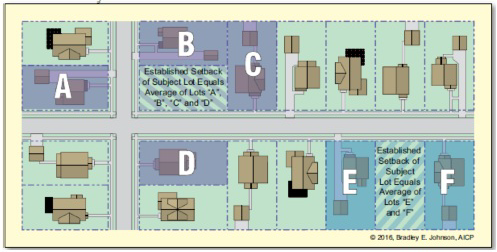
Sewer utility. A community-serving sewer system including collection and treatment facilities.
Sexually oriented entertainment business. An establishment which regularly offers live entertainment, lingerie or nude modeling, presentation of motion pictures, or publications by any photographic, electronic, digital, magnetic or other media which are distinguished or characterized by their emphasis on matter depicting, describing or relating "specified sexual activities" or "specific anatomical areas"; or, offers massage therapy or body work (not including when performed by a licensed massage therapist); or, advertises or holds itself in any forum as "XXX", "adult", or "sex". This also includes businesses, clubs, organizations, or associations that organize or plan sex engagements or adult oriented entertainment with two or more persons (e.g., swingers clubs or fetish clubs).
SFHA. Special flood hazard area.
Shooting range. An outdoor area or indoor space designed and used for discharging firearms safely; primarily for sport, maintaining proficiency, and training.
Shooting range (indoor). A shooting range fully contained within a building.
Shooting range (outdoor). A shooting range which is not fully contained within a building.
Side lot line. See "LOT LINE, SIDE."
Side yard. See "YARD, SIDE."
Sign. Any device or means used to convey a name, logo, slogan, brand, identification, description, display, or illustration, or used to attract attention toward an object, product, structure, building, location, activity, institution, organization, or business; except as exempted by the Henderson zoning ordinance.
Sign, abandoned. A sign that no longer correctly identifies or advertises an existing business, product, or activity conducted.
Sign, animated. A sign with an animated message, video, motion picture, audible sound, odor, visible matter, flashing light, scrolling message, blinking light, fluttering light or color, or that projects laser light or light beams.
Sign area. The entire area within a single continuous perimeter enclosing the extreme limits of a sign, including all words, logos, illustrations, and characters. However, such perimeter shall not include any structural elements lying outside the limits of the sign which are not part of the information, visual attraction or symbolism of the sign. Channelized signs are measured similarly by multiplying the overall width and height of all channel characters and graphic elements in combination.
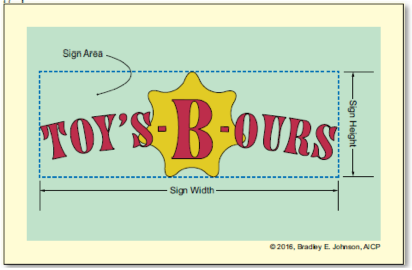
Sign, a-frame. A type of temporary sign or device that is self-supporting with two faces connected at or near the top with each face angled outward making a triangular shape. This type of sign is generally designed to be setup on a sidewalk or other flat surface to attract pedestrians.
Sign, awning. A sign attached to or integrated into the material of an awning mounted on a building.
Sign, banner. A sign composed of lightweight fabric, plastic, vinyl, or similar material that is mounted to a building. Banner signs are typically related to a special event or promotion.
Sign, changeable copy. A type of sign or device that allows a message to be changed by mechanical, electronic, or manual means. Changeable copy signs may be capable of animated messages, cyclical messages, or static messages. However, the zoning regulations limit the frequency of messages changing even if a changeable copy sign is capable of features not permitted.
Sign, commercial. Any sign that, directly or indirectly, names, advertises, or calls attention to a business, product, service, or other commercial activity.
Sign copy. The wording or graphic illustration used on a sign surface either in permanent or removable form.
Sign, directional. A sign used to direct the safe flow of vehicular and pedestrian traffic which typically includes words like "enter," and "exit," or uses arrows to communicate information. Also called a directional device.
Sign, drive-up menu. Any sign containing a menu or special offerings for restaurant, coffee shop, or other food establishment designed to be visible from and intended for persons in vehicles in drive-through lanes to read and order from.
Sign face. The surface intended for the display of information on the sign.
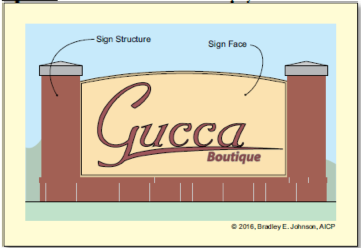
Sign, flashing. See SIGN, ANIMATED.
Sign, gateway. A common sign, typically located near a major entrance, indicating the presence of multiple-tenants on a property being owned or managed as a single development. Such developments include, but are not limited to. shopping centers, office parks, and industrial parks.
Sign, ground. A sign in which at least 80 percent of the bottom edge of the sign panel is permanently affixed to the ground. A monument sign is another name for a ground sign (See graphic for SIGNS, TYPES OF).
Sign, illuminated. A sign which has characters, letters, figures, designs, or outline illuminated by electric lights or luminous tubes as a part of the sign proper, or which is illuminated by reflectors.
Sign, monument. See SIGN, GROUND.
Sign, mural. A sign painted onto the side of a building, wall, ground, or structure. A mural sign is regulated as a wall sign in the zoning ordinance (See graphic for SIGNS, TYPES OF).
Sign, non-commercial. Any sign that, directly or indirectly, does not name, advertise, or call attention to a business, product, service, or other commercial activity.
Sign, permanent. A sign that is designed or intended to be used indefinitely, or used indefinitely without change in the same state or place. Permanent signs primarily include. wall signs, ground signs, pole signs, gateway signs, entry feature signs, projecting signs, awning signs, display board signs, and drive-up menu signs.
Sign, pole. A sign in which less than 80 percent of the bottom edge of the sign panel is permanently affixed to the ground, generally supported by one or more poles, posts, or braces mounted to the ground (See graphic for SIGNS, TYPES OF).
Sign, portable. See SIGN, TEMPORARY.
Sign, projecting. A sign which is mounted perpendicular to and extending away from a structure (e.g., facade; See graphic for SIGNS, TYPES OF).
Sign, scrolling. See SIGN, ANIMATED.
Sign, self-standing. A type of temporary sign or device that is self-supporting without being affixed to the ground or without legs that project into the ground. This type of sign is generally designed to be setup on a sidewalk or other flat surface to attract pedestrians.
Sign, structure. Any structure which supports, has supported, or is capable of supporting a sign, including decorative cover, poles, piers, masonry, stone, foundation, metal frames or cabinets, and/or other structural components.
Sign, temporary. A sign not fixed to a permanent foundation or substantially affixed to a wall or vehicle, generally meant to convey a message for a short period of time. Typical temporary signs include yard signs, self-standing signs, banner signs, or A-frame signs. Temporary signs do not include changeable copy. Not all types of temporary signs are permitted in each zoning district.
Sign, tenant listing. A sign affixed to an exterior wall near a public entrance, or interior wall in a common area of a development used to identify businesses within the building and to direct the public to those businesses within.
Sign, vehicle. A vehicle displaying a sign, applied to or attached to the vehicle, which is purposefully parked or placed to be visible from a public street.
Sign, wall. A sign attached to and/or integral with the exterior wall of a building or canopy, the face of which is generally parallel to the wall surface (See graphic for SIGNS, TYPES OF).
Sign, window. A sign installed on or inside a window for purposes of being viewed from outside of the building. This term does not include merchandise in the window.
Signs, types of. The graphic below depicts the primary types of signs used in this zoning ordinance, excluding gateway and entry feature signs. Regulations for each type of permitted sign will vary by zoning district. Not all sign types are represented in the illustration.
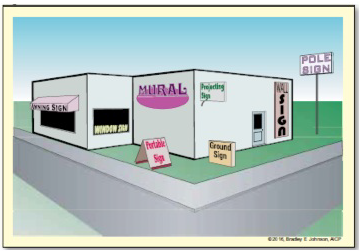
Sign, yard. A type of temporary sign or device with one or two faces affixed to one or two legs that are pressed into the ground.
Single-family residential district. Refers to the RE, R1, R2, R3, and R4 Districts.
Site plan. A map of a site, drawn accurately to scale, showing existing and proposed features of the site including but not limited to buildings, and other structures, circulation, grading, trees, and landscaping, sufficient for review.
Smoke shop. A retail business, primarily established to sell tobacco and products associated with smoking.
Spandrel panel. The space on a facade between either:
(1)
The top of the first floor windows and the bottom of second floor windows; or
(2)
The top of first floor windows and the top of the parapet or eave line (i.e., roof line); or
(3)
The top of any second or higher floor's windows and the bottom of the windows on the next floor higher; or
(4)
The top of the highest floor's windows and the top of the parapet or eave line (i.e., roof line).
Special exception use. The authorization of a use that is designated as such by this zoning ordinance as being permitted in the district concerned if it meets special conditions, is found to be appropriate and upon application, is specifically authorized by the board of adjustments.
Stable, private. An agricultural operation utilizing one or more buildings for the shelter and feeding of riding or working horses for personal use. Public offering to board a horse, offering to provide riding lessons, offering to lead trail rides, and the like shall not be considered a private stable.
Stable, public. An agricultural operation utilizing one or more buildings for the shelter and feeding of riding or working horses as a commercial enterprise. Public offering to board a horse, offering to provide riding lessons, offering to lead trail rides, and the like shall be considered a public stable.
Stadium. A venue for sporting events and/or concerts where the performance area is completely or partially surrounded by a structure to seat the spectators. A stadium includes activities related to major cultural and sports activities; uses customarily incidental and subordinate to a stadium including but not limited to live performances, temporary hospitality facilities, vehicle/product entertainment/trade shows; and temporary camping facilities for staff, participants, and/or patrons of events.
State. The State of Texas.
Static message. Not changing any sign copy, character, graphic, color, or pixel, light element, or light intensity (e.g., changing copy on a changeable copy sign) on a sign more frequently than once every one hour.
Storage, outdoor. The outdoor accumulation of goods, junk, motor vehicles, equipment, products or materials for permanent or temporary holding.
Storage tank. A structural device used to contain a liquid, gas, or solid commodity.
Storm event. An estimate of the expected amount of precipitation within a given period of time. For example, a storm event with a one year frequency over a 24 hour period duration is a storm that has a one percent probability of occurring in any one year.
Stormwater. The portion of precipitation that does not naturally infiltrate into the ground or evaporate, but flows via overland flow, interflow, channels, or pipes into a defined surface water channel.
Story. The portion of a building included between the surface of any floor and the surface of the floor next above it, or if there is no floor above it, then the space between the floor and the ceiling above it. Any portion of a story exceeding 14 feet in height shall be considered as an additional story for each 14 feet or fraction thereof. Maximum stories is generally what is used to regulate a structure's height.
Street. Any vehicular facility that is.
(1)
Established in a right-of-way, or that predates use of right-of-ways and established over property lines.
(2)
Shown upon a plat approved pursuant to law, that is not a driveway.
(3)
An access facility intended to provide access to three or more lots, three or more condominium units, or five or more dwelling units in a multiple-family residential building shall not be considered a driveway.
Street, arterial. A street with access control, no parking outside urban areas, and that conveys traffic across the city. State and federal highways are generally considered arterials.
Street, collector. A street designed to facilitate the collection of traffic from other collectors. A collector can provide circulation within commercial areas and convenient access from neighborhoods to arterials.
Street, local. A street designed primarily to provide access to residential or farm properties.
Street, private. A street on private property, an easement, or common area owned and maintained by the property owner, easement holder, or an owner's association.
Street, public. A street within a public right-of-way and maintained by a municipal, county, state or federal government.
Street, unpaved. A local street with an unpaved surface designed to provide access to minimally developed areas.
Structural alteration. Any change in the supporting members of a building or structure such as bearing walls, partitions, columns, beams or girders, or any change in the footprint or increase in the size of living space. Also, substantial roofing and siding work when repairs are made to the structure beneath.
Structure. Anything constructed or erected which requires location on the ground or attachment to something having a location on the ground, including but not limited to buildings, fences, swimming pools, sport courts, sheds, detached garages, manufactured homes, above-ground storage tanks, towers, and signs.
Structure height. The vertical distance measured from the ground level (i.e., average elevation surrounding the structure, not including any artificial mounds or berms) to the highest point of the roof, or top most portion of the structure. Maximum structure height generally allows a structure to have the maximum number of stories plus enough to allow a pitched roof and other architectural features.
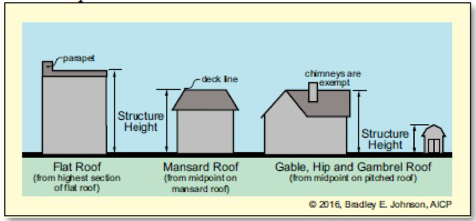
Studio arts. Karate studio, dance studio, art studio and the like.
Subject lot. See "LOT, SUBJECT."
Swimming pool. A self-contained body of water at least 18 inches deep and eight feet in diameter or width and used for recreational purposes. It may be above or below ground level, and shall be considered an accessory structure.
TDOT. Texas Department of Transportation.
Telecommunication facility. A land based facility, consisting of towers, antennae, accessory structures or other structures intended for use in connection with the commercial transmission or receipt of radio or television signals, or any other spectrum-based transmissions/receptions.
Telecommunication tower. Any structure that is designed and constructed primarily for the purpose of supporting one or more antennas. The term includes. radio and television transmission towers, microwave towers, cellular telephone and wireless communication towers, alternative tower structures and the like.
Temporary use/structure. See "USE, TEMPORARY."
Testing. Any use that includes evaluating a product for quality, function, longevity, or quality control purposes. Testing can also include medical testing.
Theater. A facility for audio and visual productions and performing arts, excluding adult motion picture theaters and adult entertainment businesses.
Thoroughfare. A public way or public place that is included in the thoroughfare plan. The term includes the entire right-of-way for public use of the thoroughfare and all surface and subsurface improvements on it such as sidewalks, curbs, shoulders, and utility lines and mains.
Thoroughfare plan. The official plan, now and hereafter adopted, which includes a street plan, sets forth the location, alignment, dimensions, identification, and classification of existing and proposed streets, and other thoroughfares.
Through lot. See "LOT, THROUGH."
Tower. See "TELECOMMUNICATION TOWER."
Tower accessory structure. Any structure located at or near the base of a tower for housing receiving or transmitting equipment.
Trash receptacles. Any container used to store trash and that is less than 120 gallons in volume.
Two-page layout. Two facing pages dedicated to each of the zoning districts established in the Henderson zoning ordinance and located in sections 153-20 through 153-56. Each two-page layout includes the district intent, permitted uses, special exception uses, and basic development standards applicable to that zoning district.
Underlying district. See "BASE ZONING DISTRICT."
Use. The purposes for which land, building, or structure thereon is designed, arranged, or intended, or for which it is occupied, maintained, let, or leased.
Use, permitted. A use which may be lawfully established in a particular district or districts provided it conforms with all applicable requirements, regulations and standards.
Use, primary. The main use of land or buildings as distinguished from an accessory use. A primary use may be either a permitted use or a special exception use.
Use, temporary. A land use or structure established for a limited and fixed period of no more than four months with the intent to discontinue such use or structure upon the expiration of the time period.
Use variance. See "VARIANCE, USE."
Utility, public. Any entity duly authorized to furnish under public regulation to the public, electricity, gas, steam, telephone, fiber optics, potable water, storm sewers, or sanitary sewer systems. The term does not include a municipality that may acquire, own, or operate any of the foregoing facilities.
Variance, development standards. A specific approval granted by the board of adjustments in the manner prescribed by the zoning ordinance, to deviate from the development standards (such as height, bulk, area) that the zoning ordinance otherwise prescribes.
Variance, use. A specific approval granted by the board of adjustments in the manner prescribed by the zoning ordinance, to deviate from the permitted uses and special exception uses in the applicable zoning district.
Variety store. A retail establishment that sells a multitude of consumer goods.
Vehicle. See "MOTOR VEHICLE."
Veterinary clinic or hospital. A place where animals are given medical care and the boarding of animals is limited to short-term care incidental to the hospital use. A kennel is not considered part of a veterinarian clinic or hospital.
Vineyard. The area primarily used for the agricultural practice of growing grapes. Vineyards are not inclusive of a winery.
Walk-in sales. An enterprise where the doors to retail sales area are open to the public during posted hours.
Water utility. A community-serving water supply system including existing and new wells and/or surface water sources and intakes, treatment facilities, and distribution lines and includes such of the above facilities established by the developer to serve a new subdivision, or commercial or industrial development.
Winery. A business or operation that makes wine for human consumption. A winery may include ancillary uses that are clearly subordinate, for example. a small cafe, retail sales of products produced on site, retail sales of complementary items such as corkscrews, wine glasses, art, and boutique cheese.
Yard. A space on the same lot with a primary building that is open and unobstructed except as otherwise authorized by the zoning ordinance. All required yards shall be kept free of all material including but not limited to, buildings, structures, material for sale, storage, advertising or display to attract attention and parking lots.
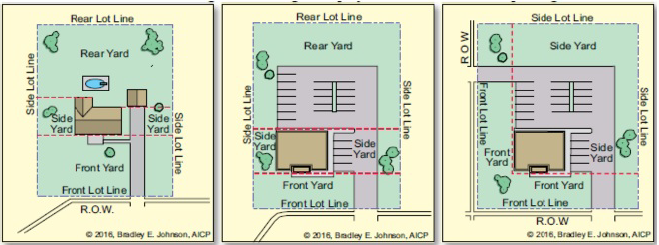
Yard, front. On a lot without a primary structure, the front yard shall be the area between the front lot line and front yard setback line, between side lot lines. On a lot with a primary structure, the horizontal area from the front facade of a primary structure to the applicable front yard setback, extending to the applicable side yard setbacks. This definition also applies to the largest storage-based or support-based accessory structure with a permanent foundation on a lot without a primary structure.
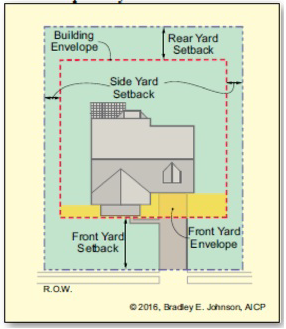
Yard, rear. On a lot without a primary structure, the rear yard shall be the area between the rear lot line and rear yard setback line, between side lot lines. On a lot with a primary structure, the horizontal area from the rear facade of a primary structure to the applicable rear yard setback, ext ending to the applicable side yard setbacks. This definition also applies to the largest storage-based or support-based accessory structure with a permanent foundation on a lot without a primary structure.
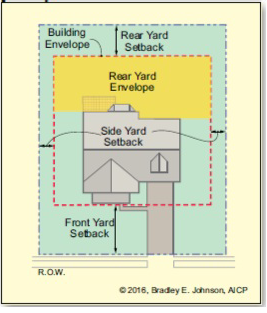
Yard, required. A combination of one or more side yards, rear yar ds, and/or front yards as established by the regulations in the Henderson zoning ordinance.
Yard, side. Area on a lot which is not defined as a front yard or a rear yard, roughly described as the area between the side foundation and the side lot line between the front yard and rear yard. This definition also applies to the largest storage-based or support-based accessory structure with a permanent foundation on a lot without a primary structure.
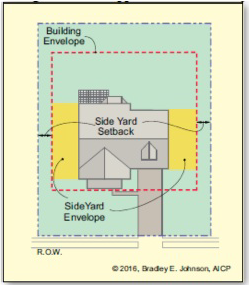
ZBA. See "ZONING BOARD OF ADJUSTMENTS."
Zoning administrator. The person appointed by and/or delegated the responsibility for the administration of the city zoning ordinance by the Henderson planning and zoning commission. The term "zoning administrator" includes his/her authorized representatives.
Zoning district. A purposefully created and uniquely named classification used to prescribe a set regulation to geographic areas within the zoning jurisdiction of the city. Zoning districts are drawn on the official zoning map.
Zoning jurisdiction. The area within the corporate limits of the city, Texas over which the city has legal planning and zoning authority.
Zoning board of adjustments. The Henderson Zoning board of adjustments or any division thereof.
Zoning map. See "OFFICIAL ZONING MAP."
(Ord. passed 5-18-2017; Ord. 2021-05-02, passed 7-20-2021)

