
High Springs City Zoning Code
ARTICLE VII
- DESIGN STANDARDS AND IMPROVEMENT REQUIREMENTS
Sec. 7.01.00.- Purpose and applicability.
(1)
The purpose of this section is to insure that development and redevelopment comply with certain minimum criteria that are required to implement the Comprehensive Plan.
(2)
The development standards contained in this section are provided to also protect the public health, safety, and welfare, to insure the benefits of growth and protect the public from any potential adverse impacts related to growth.
(3)
The development standards contained in this section shall apply to all requests for development, building permit or site and development plan approval and shall be considered as the minimum acceptable design criteria.
(4)
No building permit or site and development plan shall be approved unless assurance is provided that the required improvements will be installed. No permit will be issued unless an appropriate surety agreement has been issued.
(5)
All design and development standard requirements shall be installed at the expense of the developer. The developer shall be responsible for all plan review costs in excess of the minimum permit fee.
(6)
The development standards contained in this article do not invalidate deed restrictions or restrictive covenants, nor does the city enforce such private contractual agreements.
(7)
All existing developments shall continue to comply with the development standards in effect at the time the development received approval from the city. Any expansions or modifications shall conform to requirements of this LDC.
(8)
This section shall not replace or excuse compliance with technical codes relating to building, fire protection, or any other related activity.
(9)
Due to its proximity to the Santa Fe River, there are areas of special flood hazard concern located within the city. The administrator, through the plan review process, will ascertain if proposed projects are located in these flood hazard areas. Any project located in the area of special flood hazard concern shall meet all of the applicable requirements of the City of High Springs Ordinance 2001-10 and the requirements of F.S. § 114.31.
Sec. 7.02.01.- Density, area, height and bulk standards.
The dimensional standards governing density, area, height and bulk within conventional zoning districts are set forth in Table 7.02.01.
(Ord. No. 2015-02, § 1, 3-26-2015)
Sec. 7.02.02. - Dimensional standards for form-based districts.
The dimensional standards governing form-based zoning districts are set forth in Table 7.02.02.
Sec. 7.03.01.01. - Type 1 subdivisions.
(1)
Type 1 subdivisions shall meet all of the design and development requirements of this article and shall:
(a)
Provide sidewalks.
(b)
Provide streetlights.
(c)
Set aside land for parks and recreation.
(d)
City water, sewer, and fire hydrants shall only be required if reasonably available. Reasonably available shall be considered to be existing service is available within 660 feet of the nearest point of the subdivision. The 660 feet shall be measured along the normal route for utility services and may not be the shortest distance between the existing service and the proposed subdivision. If city water and fire hydrants are supplied, they must be installed in accordance with the requirements of the Manual of Development and Design Standards (MDDS).
(2)
Agricultural uses, excluding farm animals, are permitted in Type 1 subdivisions with a zoning permit.
(3)
The developer shall install sleeves of sufficient size under all roads or dry pipes for water and sewer service, as required this LDC, to accommodate the future installation of centralized water and sewer services.
Sec. 7.03.01.02. - Type 2 subdivisions.
(1)
Type 2 subdivisions shall meet all of the design and development requirements of this article, except that subdivisions in residential districts will comply with the following:
(a)
Set aside land for parks or recreation areas.
(b)
Provide illumination (streetlights) only at street intersections.
(c)
Sidewalks or bike paths shall not be required.
(d)
City water, sewer, and fire hydrants shall only be required if reasonably available. Reasonably available shall be considered to be existing service is available within 660 feet of the nearest point of the subdivision. The 660 feet shall be measured along the normal route for utility services and may not be the shortest distance between the existing service and the proposed subdivision. If city water and fire hydrants are supplied, they must be installed in accordance with the requirements of Manual of Development and Design Standards (MDDS).
(2)
Agricultural uses are permitted in Type 2 subdivisions with a zoning permit.
(3)
The developer shall install sleeves of sufficient size under all roads or dry pipes for water and sewer service, as required by this LDC, to accommodate the future installation of centralized water and sewer services.
Sec. 7.03.01.03. - Type 3 subdivisions.
(1)
Type 3 subdivisions shall meet all of the design and development standards of this article except that subdivisions in residential districts will comply with the following:
(a)
City water and fire hydrants shall only be required if reasonably available. Reasonably available shall be considered to be existing service is available within 660 feet of the nearest point of the subdivision. The 660 feet shall be measured along the normal route for utility services and may not be the shortest distance between the existing service and the proposed subdivision. If city water and fire hydrants are supplied, they must be installed in accordance with the requirements of the Manual of Development and Design Standards (MDDS).
(b)
Illumination (street lights) shall be required only at street intersections or the intersection of an easement with a street.
(c)
Sidewalks or bike paths shall not be required.
(d)
Provision for parks or recreation lands shall not be required.
(e)
Section 7.03.03, the criteria for block size, shall not apply.
(f)
If the smallest parcel in the subdivision is greater than 20 acres, section 7.03.08 shall apply.
(2)
Agricultural uses are permitted in Type 3 subdivisions with a zoning permit.
Sec. 7.03.02. - Lots.
(1)
All lots shall be designed to meet the minimum zoning dimensional regulations applicable to the property as designated by this LDC. Those dimensional requirements shall include, but not be limited to, lot width, lot depth, lot area, and density.
(2)
The depth and width of property subdivided for non-residential use shall be of adequate size to permit off-street parking and other improvements required by this code and required by the type of use and development anticipated.
(3)
Side lot lines shall be as close as practical to right angles at street lines or radial to curving street lines.
(4)
Eighty percent of the average width of each lot in a Type 1 or Type 2 subdivision shall front on a public street except in the case of lots on the turning circle of a cul-de-sac, where the average width shall be less than 60 percent. Each lot in a Type 3 subdivision shall have access to a public or private street.
(5)
No lot shall have an average length to width ratio greater than 5:1.
Sec. 7.03.03. - Blocks.
(1)
Block width, depth, shape, and orientation shall consider the need for access, circulation, traffic control, and the safety of vehicular and pedestrian movement.
(2)
Block width shall be sufficient to provide for two tiers of lots with the minimum depth required by zoning district regulations applied to the property. Exceptions to the two tiered block width shall be permitted along thoroughfare streets, railroad rights-of-way, waterways, or exterior property lines of the development.
(3)
Block length shall not exceed 1,350 feet, or be less than 300 feet in length, except where necessary to intersect an existing street.
Sec. 7.03.04. - Streets.
(1)
All streets shall be properly integrated with the existing and proposed system of streets in the city.
(2)
Subdivision streets shall be arranged in a manner that discourages through traffic. This does not apply to streets that will serve as through streets or collectors.
(3)
Subdivision street rights-of-way shall be extended to the property limit of the subdivision to allow for logical future extension of streets into adjoining undeveloped land; however, the street surface itself may be terminated by a cul-de-sac before intersecting with the property limits of the subdivision. Any street so designated as a future extension of a street shall have that fact recorded in the covenants and restrictions for any property adjacent to that proposed extension and, additionally, any property falling within 300 feet of the centerline of said extension.
(4)
Streets shall be designed to intersect at right angles (up to a 17 degree skew may be permitted from a right angle). The approach to an intersection shall be at right angles for a distance of 50 feet on residential streets and 150 feet on collector and arterial streets.
(5)
New intersections along one side of an existing street shall coincide with existing intersections on the opposite side of the street. Intersection jogs on residential streets shall not be less than 150 feet apart measured from centerline to centerline of the jogging street. Intersection jogs on collector or arterial streets shall not be less than 400 feet apart measured from centerline to centerline of the jogging streets.
(6)
Curved radii on all subdivision streets shall be adequate for the design speed of the street.
(7)
The minimum curb return radius for intersections shall be as follows:
(8)
All subdivision streets shall be integrated with the adjoining topography to provide adequate sight distance.
Sec. 7.03.05. - Rights-of-way.
(1)
The minimum street right-of-way for local streets shall be 50 feet when constructed with curb and gutter and 60 feet when constructed with swale drainage. This will include the right-of-way for existing streets within or abutting the proposed subdivision.
(2)
The creation of reserve strips that deny access from adjoining property to a public street shall be prohibited.
(3)
Subdivision streets shall be dedicated along with the required right-of-way. This will include the right-of-way for existing streets in the proposed subdivision; streets that will be maintained solely by the developer or an incorporated owners association need not be dedicated.
(4)
Right-of-way access easement width for private streets shall be the same as the requirements of this LDC for public streets.
Sec. 7.03.06. - Dead end streets.
(1)
A temporary dead end street shall be allowed when such street is to ultimately provide for the continuation of streets between adjoining properties. A temporary turn-a-round shall be constructed to the requirements of the city engineer when a temporary dead end street exceeds 300 feet in length.
(2)
Where a road is not intended to extend beyond the limits of the subdivision a cul-de-sac shall be provided. Dead end cul-de-sac streets shall not exceed 800 feet in length.
(3)
The cul-de-sac design shall be a minimum radius of 40 feet of pavement and 50 feet of right-of-way width.
(4)
The city will allow, but discourages, the use of culs-de-sac and dead end streets. The city encourages developers to consider the use of through streets, looping streets, and cross streets in the design of new or expanded subdivisions.
Sec. 7.03.07. - Utility easements.
(1)
Easements, a minimum of five feet in width, for the purpose of accommodating surface and underground utilities and drainage shall be required along all side and rear lot lines.
(2)
An easement along the perimeter of the subdivision shall be a minimum of ten feet in width.
(3)
Where required, there will be adequate easements granted across private property for required utility access.
Sec. 7.03.08. - Common private improvements.
The continued maintenance of common private improvements shall be established and provided for in a manner acceptable to the City Commission.
Sec. 7.04.01.- Handicapped accessibility.
All handicap accessibility shall meet the standards set forth in the most current addition of the Florida Building Code.
Sec. 7.04.02. - Access control.
(1)
A curb break is a driveway or other point of access or opening for vehicles onto a public street.
(2)
In order to provide ease and convenience in the ingress and egress to private property, but more importantly to provide the maximum safety with the least interference to the traffic flow on public streets, the number and location of curb breaks should be regulated relative to the intensity or size of the property served and the amount of frontage which the property has on a given street.
(3)
Curb breaks shall be regulated as follows:
(a)
One curb break shall be permitted for ingress and egress purposes to a single property or development.
(b)
Two curb breaks entering on a particular street from a single property or development may be permitted if all other requirements of this section are met, and if the minimum distance between the two curb breaks equals or exceeds 100 feet; in residential areas, where determined to be safe and not a hindrance to traffic flow, a single-family structure may have a circular drive with a distance of no less than 30 feet between each curb cut.
(c)
Three curb breaks entering on a particular street from a single property or development may be permitted if all other requirements of this section are met, and if the minimum distance between adjacent curb breaks equals or exceeds 200 feet.
(d)
More than three curb breaks may be permitted provided all other requirements of this section are met, and the minimum distance between adjacent curb breaks equals or exceeds 300 feet.
(4)
The width of a curb break (measured at the street right-of-way) shall be a minimum of 12 feet and a maximum of 60 feet, as more particularly defined below:
(5)
No curb breaks shall be constructed:
(a)
In the radius return (curved arc between intersecting street pavements) of an intersection;
(b)
Nearer than 25 feet from the intersection of street right-of-way lines;
(c)
Nearer than five feet from an interior property line;
(d)
To prevent vehicle overhang on private property in the vicinity of curb breaks, off-street parking areas, and off-street loading areas, a six-inch raised curb and/or parking stops shall be constructed a minimum distance of three feet inside the street right-of-way line or property line;
(e)
To include any public facility such as traffic signal standards, catch basins, fire hydrants, utility poles, fire alarm supports, or other similar type structures.
(6)
No curb break shall be permitted without first being applied for as part of a zoning permit, conditional use permit, or site and development plan.
Sec. 7.04.03. - Visibility at intersections and curb breaks.
(1)
Visibility at intersections. On a corner lot in all zoning districts, no fence, wall, hedge, landscaping or structure shall be erected, placed, planted, or allowed to grow in such a manner as to obstruct vision between a height of two and one-half feet and six feet above the centerline grades of the intersecting streets in the area bounded by the street lines of such corner lots and a line adjoining points along said street lines 30 feet from the point of intersection.
(2)
Visibility at curb breaks. In all zoning districts where a curb break intersects a right-of-way, no fence, wall, hedge, landscaping or structure shall be erected, placed, planted, or allowed to grow in such a manner as to obstruct cross visibility between a height of two and one-half feet and six feet within the areas of property on both sides of the curb break formed by an intersection of each side of the curb break and public right-of-way lines with two sides of each triangle being ten feet in length from the point of intersection and the third being a line connecting the end of the two other sides.
(3)
Retaining walls. This section shall not be deemed to prohibit any necessary retaining wall.
(4)
Trees. Trees shall be permitted in the clear space if foliage is cut away within the prescribed heights.
Sec. 7.04.04. - Access to residential district.
No land in a residential district shall be used for driveway, walkway, or access purposes to any land which is in a commercial district or industrial district, or used for any purpose not permitted in a residential district, except for ingress and egress, to an existing use which does not abut on a street.
Sec. 7.04.05. - Off-street parking and loading.
It is the intent of this LDC that public interest, welfare and safety requires the buildings and uses, erected and begun after the effective date of this LDC, shall be provided with adequate off-street parking facilities, (including in certain specified cases, off-street parking facilities for the handicapped) for the use of occupants, employees, visitors, customers or patrons. It is also the intent of this LDC that public interest, welfare and safety require that certain uses provide adequate off-street parking facilities. Such off-street parking and off-street loading facilities shall be maintained and continued so long as the main use continues.
(1)
Off-street parking and loading facilities: General standards.
a.
Off-street parking and loading facilities shall be provided as set out in this LDC. Conforming buildings and uses existing as of the effective date of this LDC may be modernized, altered or repaired without providing additional off-street parking or off-street loading facilities, provided there is no increase in floor area or capacity;
b.
Where conforming building or use existed as of the effective date of this LDC, and such building or use is enlarged in floor area, volume, capacity or space occupied, off-street parking and loading facilities as specified in this LDC shall be provided for the additional floor area, volume, capacity or space so created or used;
c.
Change in use of a building or use existing as of the effective date of this LDC shall require additional off-street parking and loading facilities to the extent that the use shall provide additional parking spaces amounting to the difference between the required number of parking spaces for the new use and the required number of parking spaces for the previous use;
d.
Required off-street parking areas shall not be used for sales or display, dead storage, repair, dismantling, or servicing of any type or kind, nor shall areas devoted to such activities count as meeting off-street parking requirements;
e.
Unless otherwise specified and subject to meeting landscape buffer requirements, all required setbacks may be used for off-street parking.
(2)
Off-street parking and off-street loading facilities: Identification, surfacing, drainage, lighting, access. The required off-street parking and off-street loading facilities shall be:
a.
Identified as to purpose and location when not evident;
b.
Surfaced with a material such as asphalt, concrete, or of an equivalent durable material that permits percolation of surface runoff. The surface shall be maintained in a smooth, well graded condition, except those parking spaces for churches or other uses that can demonstrate the likelihood of use twice or fewer times per week, may be surfaced with grass or mulch (driveways and access isles must be paved). All other options for paving see table below:
c.
Drained on site;
d.
Lighted as to prevent glare or excessive light on adjacent property;
e.
Arranged for convenient access and safety for pedestrians and vehicles;
f.
Designed to conform to curb break requirements;
g.
Arranged so that no vehicle shall be required to back from such facilities directly into public streets;
h.
Designed to provide curbs or motor vehicle stops or similar devices to prevent vehicles from overhanging on or into public rights-of-way or adjacent property.
(3)
Off-street parking: Location. The required off-street parking facility shall be located on the same lot or parcel of land it is intended to serve provided, however, that the administrator may allow the establishment of such off-street parking facility within 300 feet of the premises it is intended to serve when:
a.
Practical difficulties prevent the placing of the facility on the same lot as the premises it is designed to serve;
b.
The owner of said parking area shall enter into a written agreement with the city with enforcement running to the city providing that the land comprising the parking area shall never be disposed of except in conjunction with the sale of the building which the parking area serves so long as the facility is required; and
c.
The owner agrees to bear the expense of recording the agreement in the Public Records of Alachua County, and agrees that the agreement shall be voided by the city if other off-street parking facilities are provided in accordance with the requirements of this section.
(4)
Off-street parking: Dimensional standards. Each off-street parking space, with the exception of handicapped parking spaces, shall be a minimum of ten feet by twenty feet in size. Minimum aisle width shall be as follows:
For purposes of rough computation, an off-street parking space and necessary access and maneuvering room may be estimated at 300 square feet, but off-street parking requirements will be considered to be met only where actual spaces meeting the requirements above are provided, maintained and improved in the manner required by this LDC and in accordance with all ordinances and regulations of the city.
(5)
Off-street parking: Handicapped parking spaces. Required off-street parking areas shall have a number of level parking spaces, as set forth in the following table identified by above grade signs as being reserved for physically handicapped persons. Each parking space so reserved shall be not less than 12 feet in width and 20 feet in length.
PARKING SPACES FOR HANDICAPPED
Parking spaces for the physically handicapped shall be located as close as possible to elevators, ramps, walkways, and entrances. These parking spaces shall be located so that physically handicapped persons are not compelled to travel behind parked cars to reach entrances, ramps, walkways and elevators (section 7.04.05).
(6)
Plans required. A plan shall be submitted with each application for a building permit for any building or use that is required to provide off-street parking. The plan shall accurately designate the required parking spaces, access aisles, and driveways, and the relation of the off-street parking facilities to the uses or structures such facilities are designed to serve.
(7)
Landscaping requirements. Wherever off-street parking facilities are provided, such off-street parking facilities shall conform to the minimum landscaping requirements as hereafter set forth, except Table of Permitted Uses 1.1, 1.2, and 1.3 in section 2, shall be exempted from such requirements. The landscaping requirements shall be as follows:
a.
Except as otherwise noted herein, a minimum of ten percent of any off-street parking area shall be landscaped with grass, plants, shrubs, and/or trees. Required landscaping may, in part, be located along the periphery of the off-street parking area; however, where possible, a portion of the required landscaping shall also be located within the interior of the off-street parking area and shall be located in such a manner as to divide and break up the expanse of paving and guide traffic flow and direction.
b.
Each separate landscaped area shall contain a minimum of 200 square feet and shall have a minimum dimension of at least ten feet, and shall include at least one canopy tree, with the remaining area adequately landscaped with shrubs, ground cover, or other landscaping material.
c.
The total number of trees shall not be less than one for each 200 square feet or fraction thereof of required landscaping. Trees shall be a minimum of one inch in diameter as measured six inches above the ground, and eight feet in height immediately after planting. Trees shall not be planted closer than two feet to public roads or other public works.
d.
Required landscaped areas shall be properly maintained (to include an irrigation system, replanting of dead or damaged vegetation, and pruning of healthy vegetation) and continued so long as the main use continues. Failure to maintain the landscaped area as required herein shall be a violation of this LDC.
(8)
Off-street Loading: Specifications, Amounts. Off-street loading facilities are required by this LDC so that vehicles engaged in unloading will not encroach on or interfere with public use of streets and alleys, so that adequate space is available for loading and unloading of goods, materials or things for delivery and shipping. Off-street parking facilities may not be used or counted as meeting off-street loading requirements. Each off-street loading space shall be directly accessible from a street or alley without crossing or entering any other off-street loading space. Such loading space shall be arranged for convenient ingress and egress by motor truck and/or trailer combination.
(9)
Off-street loading: Dimensional Standards. Each off-street loading space shall have a clear horizontal dimension of 12 feet by 30 feet, exclusive of platforms and piers, and a clear vertical dimension of 14 feet.
(10)
Off-street loading: Plans required. A plan shall be submitted with every application for a building permit for any use or structure required to provide off-street loading facilities. The plan shall accurately designate the required off-street loading spaces, access thereto, dimensions, and clearance.
(11)
Off-street loading: Collective use. Collective, joint or combined provisions for off-street loading facilities for two or more buildings or uses may be made, provided that such off-street loading facilities are equal in size and capacity to the combined requirements of all buildings or uses, and are designed, located and arranged to be usable thereby. Any arrangement for combination off-street loading shall be subject to the filing of a legal instrument satisfactory to the zoning administrator insuring that such off-street loading will be maintained in the future so long as a use or uses require such off-street loading.
(12)
Off-street loading: Requirements. Off-street loading spaces shall be provided and maintained as follows:
Applicant may request a waiver to reduce or eliminate the loading space requirement upon a showing of inapplicability.
Sec. 7.04.05.01. - Table of parking requirements.
The following is a table of the minimum parking requirements:
Table 7.04.05.01 Table of Parking Requirements
For any permitted use where parking requirements have not been established herein, the parking requirements shall be set by the administrator requiring a number of parking spaces equal to the reasonably anticipated number of vehicles parked at the site at any one time. The administrator shall take into consideration the number of employees at the site, the anticipated number of members of the public to visit the site, and the nature of business conducted at the site.
Sec. 7.04.05.02. - Historic preservation exemption.
The preservation of any property that has been placed on the local register of historic places or that is located in the historic district and contributes to the historic character of the district, shall be grounds for a grant of a reduction in, or complete exemption from, the parking requirements in this section. The reduction or exemption needed to allow a viable use of the historic structure shall be granted unless a severe parking shortage or severe traffic congestion will result.
Sec. 7.04.05.03. - Tree protection exemption.
The required parking may be reduced by not greater than ten percent or two spaces (whichever is greater) where necessary to protect existing trees.
Sec. 7.04.05.04. - Downtown exemption.
The parking requirements set forth in article VII shall not apply to Blocks 12, 13, 15 and 16 of G. E. Foster Addition to High Springs as per Plat Book A, Page 6 of the Public Records of Alachua County.
Sec. 7.04.06. - Standards for drive-up windows.
(1)
All facilities providing drive-up windows or drive-through services shall provide on-site stacking lanes in accordance with the following standards:
(a)
The facilities and stacking lanes shall be located and designed to accommodate all vehicles on-site without obstructing any aisles, parking spaces, public rights-of way, or pedestrian areas such as sidewalks;
(b)
A bypass lane shall be provided;
(c)
Stacking lane distance shall be measured from the service window to the property line bordering the farthest street providing access to the facility and shall be a minimum distance of 120 feet.
Sec. 7.04.07. - Street classification system.
(1)
Reasons and basis of classification. Streets in the city shall be classified for the reasons and on the basis of the criteria hereafter set forth:
(a)
Streets are classified and mapped according to functions served in order to allow for regulation of access, road right-of-way width, circulation patterns, design speed, and construction standards.
(b)
Private streets and streets that are to be dedicated to the city are classified in a street hierarchy system with design tailored to function. The street hierarchy system will be defined by road function and average daily traffic (ADT), calculated by trip generation rates prepared by the Institute of Transportation Engineers. Trip generation rates from other sources may be used upon demonstration that the alternative source better reflects local conditions. The city has adopted its own standards for residential streets.
(c)
When a street continues an existing street that previously terminated outside the subdivision, or is a street that will be continued beyond the subdivision or development at some future time, the classification of the street shall be based on the street in its entirety, both within and outside of any subdivision or development.
(d)
The following street hierarchy is established: Residential, collector, and arterial. All development proposals containing new streets or taking access from existing streets shall conform to the standards and criteria herein set forth.
(2)
Residential streets. Residential streets are primarily suited to providing direct access to residential development. All residential streets should be designed to minimize unnecessary and/or speeding traffic. Each paved residential street shall have a maximum ADT of 5,000. Cul-de-sacs shall have a maximum ADT of 500. Unpaved graded roads shall have an ADT of 2,000. Residential streets shall have a design speed of 25 mph.
(3)
Collector streets. Collector streets provide access to non-residential uses and connect lower order residential streets to arterial streets. Collector streets may serve commercial and industrial uses as well as some through traffic. Collector streets may take access from other collector streets, and may give access to residential streets. Collector streets shall have a maximum ADT of 6,100.
(4)
Arterial streets. Arterial streets provide links between communities or to limited access expressways. Arterial streets shall meet the design standards and ADT of the FDOT.
Sec. 7.04.08. - Minimum street construction standards.
All street improvements, whether public or private, shall be designed and constructed to conform to the requirements of the Florida Department of Transportation Standard Specifications for Road and Bridge Construction, latest edition and amendments, the State of Florida Manual of Uniform Standards for Design, Construction, and Maintenance of Streets and Highways, and as set forth in the City of High Springs Manual of Development and Design Standards. Alternatives for paving materials are accepted in accordance with the following table:
Sec. 7.04.09. - Minimum lane and right-of-way width.
The specifications contained in this subsection are intended as minimum specifications. Actual lane and right-of-way widths will be determined by traffic volume, access control, type of drainage system, parking, and sidewalk requirement. Minimum lane widths for two-lane traffic shall be established by the following average daily traffic (ADT) volume:
Sec. 7.04.10. - Fire safety lanes and access.
All fire safety lanes shall be diagonally striped or appropriately labeled on the pavement and posted with no parking-fire safety lane signs no less than seven feet above grade at the bottom of the sign and a minimum of 50 feet apart. Any bowling alley, theater, retail store, shopping center grouping of connected retail stores, other commercial use or place of public assembly that has a combined gross floor area greater than 20,000 square feet shall provide a fire safety lane consisting of an area ten feet either side of the curb and perpendicular to any entrance or exit for a width of ten feet either side of the center line of said entrance or exit.
Sec. 7.05.01.- Protected trees.
Unless specifically exempted in section 7.05.02 below, all trees listed as endangered and all trees greater than ten inches in diameter at four feet above the natural ground are protected.
Sec. 7.05.02. - Exemptions.
(1)
All commercial nurseries, botanical gardens, tree farms and grove operations shall be exempt from the provisions of this section, but only as to those trees which were planted for silvicultural or agricultural purposes or for the sale or intended sale in the ordinary course of business.
(2)
In already developed residential districts, all trees 30 inches or less in diameter (7.85 ft. circumference) at four feet above the ground shall be exempt from the provisions of this section.
(3)
In all zoning districts, all pine trees 12 inches in diameter or less (3.14 ft. circumference) at four feet above the ground shall be exempt from the provisions of this section.
Sec. 7.05.03. - Emergency conditions.
During emergencies, the city commission may suspend these tree protection regulations by resolution.
Sec. 7.05.04. - Historic trees.
A historic tree is one that has been designated by the city commission as historic. Designation of a historic tree shall be the same as designation of a historic site in accordance with article III of this LDC.
Sec. 7.05.05. - Tree preservation committee.
(1)
There is hereby established a tree preservation committee, as necessary, consisting of three residents of the city, who shall be recommended by the mayor and approved by the city commission.
(2)
Authorization for removal of a tree shall be by permit depending upon the other requirements of this LDC.
(3)
Notice of application for authorization to remove a tree shall be provided to the members of the tree preservation committee, and at least one member of the tree preservation committee shall be provided a reasonable opportunity to comment to the permitting authority prior to the issuance of a permit that would authorize the removal of trees.
Sec. 7.05.06. - Removal of trees.
(1)
No authorization shall be granted to remove a tree if the developer has failed to take reasonable measures to design and locate the proposed improvements so that the number of protected trees to be removed is minimized. In particular, design must attempt to preserve historic and champion trees.
(2)
No authorization for removal of a protected tree shall be granted unless the developer demonstrates one or more of the following conditions:
(a)
A permissible use of the site cannot reasonably be undertaken unless specific trees are removed or relocated.
(b)
The tree is located in such proximity to an existing or proposed structure that the safety, utility or structural integrity of the structure is materially impaired.
(c)
The tree materially interferes with the location, servicing or functioning of utility lines or services.
(d)
The tree creates a substantial hazard to motor vehicle, bicycle or pedestrian traffic by virtue of its physical proximity to traffic or impairment of vision.
(e)
The tree is diseased or weakened by age, abuse, storm or fire and is likely to cause injury or damage to people, buildings or other improvements.
(f)
Any law or regulation requires the removal.
(g)
Pursuant to a bona fide landscape plan meeting the requirements of this LDC.
(h)
Replanting.
1.
Any tree that has been removed for reasons unrelated to safety must be replaced with a native tree of at least five gallons in size.
Sec. 7.05.07. - Protection of trees during development.
The following minimum protective measures shall be taken where appropriate to the development activity:
(1)
Avoiding mechanical injuries.
a.
Prior to any land preparation or other development activities, a protective barrier, easily visible to equipment operators, shall be placed around all protected trees at the greater of the full drip line or a six-foot radius. Barriers are to be maintained at all times during construction.
b.
No attachment, wires, signs or permits may be fastened to any protected tree.
c.
No equipment, construction materials or debris of any kind shall be placed within the protective barrier.
d.
Landscape activities within the bounds of the protective barrier shall be accomplished with light machinery or manual labor. No grubbing or similar activities are permitted.
e.
In lieu of constructing the barriers required above, the developer may physically designate large areas containing protective trees where no land preparation or other development activities of any kind will occur. The area shall be designated by placing stakes a maximum of 25 feet apart and tying ribbon, plastic tape, rope, etc., from stake to stake along the outside perimeter of the area. This perimeter line shall be beyond the drip line of any protected trees growing within the area.
f.
Required protective barriers and perimeter lines shall remain in place until all construction activity, except landscaping within the protective area, is terminated.
(2)
Avoiding injuries due to chemical poisoning.
a.
No fuel, paint, solvent, oil, thinner, asphalt, cement, grout or any other construction chemical or other material or tools of any kind shall be stored or allowed in any manner to enter, within a required protective barrier or perimeter line.
b.
No equipment shall be cleaned within a required protective barrier or perimeter line.
(3)
Avoiding injuries due to grade changes. No grade change within the drip line of a protected tree shall be permitted without submission of plans prepared by a qualified landscape architect or forester showing the specific grade change to be implemented together with detailed drawings for action to be taken to prevent damage or destruction of the protected trees.
(4)
Avoiding injuries due to excavations. Water, sewer, and other utility lines shall be routed around the drip lines of protected trees if feasible. If a line cannot reasonably be routed around the drip line, trenching may occur beneath the drip line. In the latter instance, tree roots that measure two inches in diameter or greater shall not be severed, such roots shall be protected and tunneled beneath. Utility lines shall be offset to one side of the trunk of a protected tree in order to protect the taproot. New water meters and tees shall be located so that service and branch lines can be located in areas of least tree impact.
(5)
Avoiding injury by paving within the drip line. Pervious paving may be placed within the drip line of a protected tree, so long as no damage is inflicted to the tree by grade change, compacting of the soil or any other cause.
Sec. 7.05.08. - Variances to preserve protected trees.
The preservation of any protected tree may be considered as a factor in rendering a decision upon an application for a variance from the literal application of the requirements of this LDC.
Sec. 7.05.09. - Required landscaping/parking areas.
Landscaping requirements for off-street parking facilities are outlined above.
Sec. 7.05.10. - Required landscape buffer.
A buffer shall be a strip of land running along the entire front, side or rear of a lot (except for driveways) for the purpose of obstructing vision, muffling sound, separating incompatible uses and providing green space. The following types of landscape buffer are hereby established:
(1)
Partially opaque buffer: This buffer shall be partially opaque from two and one-half feet above ground level to ten feet above ground level, and partial visual obstruction from ten feet above ground level to 25 feet above ground level. The following shall be minimum requirements, and shall not excuse compliance with the requirements of partial opacity:
a.
Minimum plant only requirements:
1.
Minimum buffer area of 20 feet in width;
2.
Minimum of five canopy trees for each 100 feet in length;
3.
Minimum of three understory trees for each 100 feet in length; and
4.
Minimum of 20 shrubs for each 100 feet in length.
b.
Minimum plant/fence requirements:
1.
Minimum of 7.5 feet in width;
2.
Minimum of two canopy trees for each 100 feet in length;
3.
Minimum of one understory tree for each 100 feet in length;
4.
Minimum of eight shrubs for each 100 feet in length;
5.
Minimum of six foot high wooden fence or alternative as approved by the permitting agency (constructed of materials with a minimum life expectancy of ten years) not more than 30 percent open face along the entire length of the required buffer; and
6.
All of the shrubs enumerated above shall be planted on the public or property line side of the fence.
c.
Minimum plant/berm requirements:
1.
Minimum buffer area of 20 feet in width;
2.
Minimum of one canopy tree for each 100 feet in length;
3.
Minimum of six shrubs for each 100 feet in length;
4.
Slope of the berm shall be of a gradual design or buttressed in such a way as to prevent erosion, and the berm shall be covered with grass, ground cover, and/or shrubs to prevent erosion; and
5.
Berm shall extend to a height of six feet above the centerline of any adjacent road or the average adjacent elevation.
(2)
Broken buffer: Shall be generally open but provide plantings from two and one half to 25 feet as a broken screen. The minimum requirements shall be as follows:
a.
Minimum buffer area of ten feet in width;
b.
Minimum of one canopy tree for each 100 feet in length;
c.
Minimum of one understory tree for each 100 feet in length; and
d.
Minimum of eight shrubs for each 100 feet in length.
(3)
Fully opaque buffer: A fully opaque buffer shall be a buffer that provides complete separation from one adjacent use to another. At a minimum they shall be 30 feet in width with the following planting requirements:
a.
Minimum of one canopy tree for each 30 feet in length.
b.
Minimum of one understory tree for each ten feet in length.
c.
Minimum of 20 shrubs for each 25 feet in length.
d
All planning must be of a sufficient size to screen adjacent uses from the time of construction.
Sec. 7.05.11. - Approved plants.
Approved plants are prescribed by the City of High Springs Land Development Code (LDC).
Sec. 7.05.12. - Required landscape buffer at transitional zones.
The foregoing standards shall be applied to require the following landscape buffer in transitional zones. Designations shall be defined as follows:
O - Opaque buffer required
PO - Partially opaque buffer required
B - Broken buffer required
N/A - Not applicable, no screen or buffering required
Table 7.05.12.01 Required Landscape Buffer at Transitional Zones
Where a silvicultural use abuts a public right-of-way or adjoining nonagricultural use, any cutting of trees shall leave a partially opaque buffer along the public right-of-way and adjoining nonagricultural uses.
Sec. 7.05.13. - Landscape design principles.
All landscaped areas required by this LDC shall conform to the following general design principles:
(1)
Landscaping shall integrate the proposed development into existing site features through consideration of existing topography, hydrology, soils and vegetation.
(2)
The functional elements of the development plan, particularly the drainage systems and internal circulation systems for vehicles and pedestrians should be integrated into the landscaping plan.
(3)
Landscaping should be used to minimize potential erosion using ground covers or any other type of landscape material that aids in soil stabilization.
(4)
Existing native vegetation should generally be preserved and used to meet landscaping requirements.
(5)
Landscaping should enhance the visual environment using materials that achieve variety with respect to seasonal changes, species of living material selected, textures, colors and size at maturity.
(6)
Landscaping design should consider the aesthetic and functional aspects of vegetation, both when initially installed and when the vegetation has reached maturity. Newly installed plants should be placed at intervals appropriate to the size of the plant at maturity, and the design should use short- and long-term elements to satisfy the general design principals of this section over time. Landscaping should enhance public safety and minimize nuisances and shall meet all setbacks and lines-of-sight at street intersections, curb cuts, and driveways required by this LDC.
(7)
Landscaping should maximize the shading of streets and vehicle use areas.
Sec. 7.05.14. - Installation of plants.
All plants required under this LDC shall be installed in accordance with the provisions of the City of High Springs Manual of Development and Design Standards.
Sec. 7.05.15. - Maintenance and replacement.
All plants required under this LDC shall be maintained in accordance with the provisions of the City of High Springs Manual of Development and Design Standards.
Sec. 7.05.16. - Restoration remedies.
If a permit for tree removal is denied or one was not obtained, the following provisions shall be required to restore the illegally removed tree.
In addition to the general penalty provision for violation of this LDC, violations of this section may be specifically enforceable by the city by requiring one who has significantly altered or removed a tree unlawfully to replace that tree with a tree ranked Florida No. 1 or better of a maximum of the same size or fifteen feet in height, whichever is smaller.
Sec. 7.07.01.- General requirements.
The following basic utilities are required for all developments:
(1)
Electricity. Every principal use and every lot within a subdivision shall have available to it a source of electric power adequate to accommodate reasonable needs.
(2)
Telephone. Every principal use and every lot within a subdivision shall have available to it a telephone service cable adequate to accommodate reasonable needs.
(3)
Water and sewer. All areas within the city will be eligible for service. However, service will not be mandatory until such time that the administrator deems such service can be provided on an economical basis and the current system has sufficient capacity to serve the development. Developers in such areas shall be responsible for the installation of water and sewer lines, services, and connection to existing facilities in accordance with the written policies of the city. The developer must pay the full cost of the extension to service the development even if the line passes property that may, in the future, be a user of the service.
a.
In those developments that have been constructed using privately operated centralized water and/or sewer service, these systems must connect to the city's central system when such service becomes available. The costs for this connection shall be the responsibility of the private utility operator.
b.
New developments, or those implementing additional phases of current developments, shall install appropriately sized water and sewer lines during development. This requirement will apply to developments that have a reasonable expectation of being served by the city's centralized water and sewer system within ten years of beginning development. Type 3 developments may be exempted from this requirement upon request to the city commission.
(4)
Illumination. All streets, driveways, sidewalks, bikeways, parking lots, and other common areas and facilities in developments shall provide such reasonable illumination as shall be required to use the facility after dark.
Sec. 7.07.02. - Extension of service.
Any service to areas outside the city limits shall be at a rate set by the city commission. At no time will this rate be less than the rate charged to city residents, businesses, or industries.
Sec. 7.07.03.01. - Exemptions.
(1)
The following development activities shall not require submission and approval of a stormwater management plan:
(a)
The construction of single-family and duplex residences and accessory structures on a lot of record.
(b)
Any development within a subdivision provided the following conditions have been met:
(1)
Stormwater management plans for the subdivision were previously approved as a part of an overall master plan approving the subdivision and related out parcels, remain in effect and have not been altered, and have been completed during construction of the overall infrastructure improvement, and
(2)
The development and related out parcels are constructed in accordance with the site plan approval authorizing the subdivision at the time of approval of the overall master plan.
(c)
Any maintenance activity that does not change or affect the quality, rate, volume, or location of storm flows on the site or of stormwater runoff from the site.
Sec. 7.07.03.02. - Driveways.
Any area using swales for drainage will require a permit for the installation of a driveway and associated culvert. The culvert must be installed in accordance with the design standards of Alachua County for comparable installations.
Sec. 7.07.03.03. - Stormwater retrofit.
If the additional development, re-development, or alteration of a site involves an excess of 30 percent of the existing gross floor area of a previously developed site or more than one-half acre, regardless of the gross floor area percentage, or involves the subdivision of an existing developed site to increase the number of development parcels, the entire pre-existing site conditions shall be made to conform with the stormwater management requirements of this LDC.
Sec. 7.07.03.04. - Stormwater design criteria.
(1)
The stormwater management plan shall be designed for the 25-year frequency storm, 24-hour duration. When possible, stormwater ponds and drainage areas should utilize the planting of trees appropriate to the environment created by the pond in conjunction with approval by the water management district.
(2)
Discharge rate for the post developed or redeveloped site shall not exceed in terms of peak flow and total volume, that which would occur from the pre-developed site under existing conditions for the required design storm. Runoff rates and volume resulting from the project in excess of the existing amounts shall be accommodated on site.
(3)
The volume of detention/retention provided shall be equivalent to one inch of depth over the entire project area.
(4)
Discharges of stormwater shall comply with the ambient water quality standards of the Suwannee River Water Management District and FDEP. Best Management Practices shall be utilized to achieve such discharge standards.
(5)
Positive drainage outfall shall be provided. Where retention areas are designed with no positive drainage outfall, the city engineer may require an analysis of, and design for, the 100-year frequency storm. Sheet flow shall not constitute positive outfall.
(6)
Runoff from adjacent lands which passes through the site shall be included in the stormwater management plan design.
(7)
Where possible, natural vegetation shall be used as a component of the stormwater management plan.
(8)
The water table shall not be manipulated to endanger natural vegetation beneficial to water quality.
(9)
Six inches of free board shall be provided for all detention/retention areas.
(10)
Detention areas shall be designed, where possible, to completely dry within three days.
(11)
Detention and retention areas shall be at least five feet from the property line and shall have grass sodded slopes which are graded at a slope no greater than 4 to 1.
(12)
Roof drains and/or interceptor swales are required when the potential exists for sheet flow to occur from the roofs of other impervious areas into adjoining properties.
(13)
The proposed stormwater management system shall be designed to function properly for a minimum 20-year life.
(14)
Off-site stormwater management facilities may be permitted for use by the city engineer only when the design criteria for stormwater management can be met and adequate ownership and maintenance methods can be shown to provide for their continued function.
(15)
All stormwater management facilities shall meet the construction standards of the city engineer.
16)
There shall be no direct runoff to any sinkhole or solution feature.
Sec. 7.07.03.05. - Stormwater management plan.
(1)
The stormwater management plan shall be prepared under the direction of a Florida registered professional engineer and all drawings shall be so certified.
(2)
The stormwater management plan shall contain the following minimum information:
(a)
Identification of the predevelopment rate of discharge from the site by field review and computation.
(b)
The location and nature of all existing water courses, water bodies, and wetlands on or adjacent to the site.
(c)
Grading plans and final site topography at one-foot contours. The existing site predevelopment at one-foot intervals shall also be provided.
(d)
The location, elevations, slope, design including cross sections, and capacity of all proposed storm water retention or detention facilities, control structures, culverts, lakes, canals, ditches, swales, vegetative buffers, and any other necessary facilities.
(e)
A soils map or survey of the site. The city engineer may require the submission of test soil sample borings and a report for the site.
(f)
Seasonal high water table evaluations.
(g)
Percolation tests representative of design conditions shall be performed if the stormwater management systems shall use swales, percolation (retention), or exfiltration (detention with filtration) design.
(h)
An erosion and sedimentation control plan that describes the type and location of control measures, the stage of development at which they will be put into place or used, and maintenance provisions.
(i)
Drainage basin or watershed boundaries.
(j)
Flow paths, volumes and rates, including those for potential failures of retention/detention facilities shall be indicated throughout the proposed system, together with storage volumes, surface areas, depths, and duration and identification of final outfall locations and rates.
(k)
Computations, hydrographs, and hydraulic analyses including total project size in acres, acreage by general type of land use, tabulations of the area and percent of impermeable surface by projected type of land use and identification of the frequency and duration of the design storm. Runoff computations shall be based on the most critical situation and conform to acceptable engineering practices.
(l)
Areas of the site to be used or reserved for percolation, including an assessment of the impact of ground water quality where the proposed development is near water wells.
(m)
A description of the ownership and maintenance measures to be utilized.
(n)
Any other information required by the city engineer to demonstrate compliance with the requirements of the stormwater management component of this LDC.
Sec. 7.07.03.06. - Stormwater facility construction.
(1)
A copy of approved permits from the Suwannee River Water Management District shall be submitted prior to approval of site and development plans.
(2)
One finalized and approved set of stormwater management plan and design calculations sealed by the engineer of record shall be submitted to the city engineer prior to the issuance of development orders.
(3)
The development shall include sedimentation facilities and other control measures to protect against sediment discharges during clearing and construction and to protect against erosion and sedimentation of drainage facilities during the life of the development. No grading, clearing, except brush removal for surveying, or filling, shall be commenced until erosion and sedimentation measures have been applied between the disturbed area and any water bodies, water courses, or wetlands.
(4)
Before the issuance of a certificate of occupancy, the engineer of record shall certify that the stormwater management facilities were constructed in substantial compliance with the approved plan.
Sec. 7.07.03.07. - Stormwater facility maintenance.
(1)
Stormwater management systems in developments with private facilities or common areas shall be installed and maintained in accordance with the requirement of the stormwater element of this LDC.
(2)
Swales and other drainage facilities not in common areas shall be maintained in private ownership, with appropriate drainage or flow easements provided as necessary.
(3)
Stormwater facilities shall be continuously maintained to assure performance to design standards.
Sec. 7.07.04. - Fire hydrants.
Fire hydrants shall be installed in accordance with the City of High Springs Manual for Development and Design Standards.
Sec. 7.07.05.01. - Standards.
(1)
Central solid waste storage facilities shall be provided by a containerized unit for commercial, industrial, and multifamily development (including mobile home parks) in excess of six units.
(2)
All central storage facilities shall be located on the site the facilities are intended to serve.
(3)
All central storage facilities and their enclosures shall be set back a minimum of five feet from any property line.
(4)
No central storage facility shall be located within any right-of-way, easement, or required visibility triangle.
(5)
Central storage facilities shall be located so that they do not cause excessive nuisance or offense to adjoining properties and are not unsightly.
(6)
Central storage facilities shall be located to allow ease of access and pickup by collection vehicles.
(7)
No parking, stacking lanes, or other obstruction shall be permitted to inhibit the access area for disposal pickup.
(8)
A vertical clearance of fourteen feet shall be provided.
(9)
All food service establishments shall comply with Chapter 100-13, Florida Administrative Code.
(10)
It shall be the responsibility of the property owner to repair and maintain central storage facilities in accordance with the requirements set forth herein.
(11)
In the case of multiple tenants or users, central storage facilities shall be conveniently located, and shall be of sufficient number and capacity based upon the number of users and the frequency of collection. Additional containers requested after the initial construction shall be provided in accordance with the requirements herein.
Sec. 7.07.05.02. - Construction.
Construction of central solid waste storage facilities shall be in accordance with City of High Springs Manual of Development and Design Standards.
Sec. 7.07.05.03. - Non-containerized solid waste storage.
(1)
The administrator may allow the use of a non-containerized unit for the storage of solid waste under the following conditions:
(a)
Lack of space for the placement of a containerized unit for a redevelopment project;
(b)
Lack of accessibility to the containerized unit for a re-development project; or
(c)
The project generates less than 108 cubic feet (four cubic yards) of loose garbage a week.
(2)
The following assumptions shall be made:
(a)
Offices generate one cubic foot of solid waste per day per 700 square feet of gross floor area.
(b)
Retail uses generate one cubic foot of solid waste per day per 100 square feet of gross floor area.
(c)
The amount of solid waste generated by unspecified uses shall be determined by the zoning administrator.
(3)
Non-containerized central storage facilities shall be shown on the site plan in an accessible location, on a concrete pad with a screened enclosure of three and one-half feet in height, and shall be sized to accommodate a minimum of four cans.
Sec. 7.09.01.- Accessory uses and structures.
The following general standards apply to all accessory uses and structures:
(1)
Accessory uses and structures shall be constructed with or after the principal use.
(2)
Accessory uses and structures shall be compatible in design and materials with the principal structure.
(3)
Commercial accessory uses and structures must be approved via the site plan review process.
(4)
If an accessory structure is to be connected to electric, it shall use the same meter as the principal structure.
(5)
Residential accessory uses such as garages, greenhouses, workshops, or sheds shall not be rented or inhabited. This does not apply to accessory dwelling units meeting the criteria outlined in section 7.09.01.01 below.
(6)
Lots that are one acre or less may have up to two accessory structures.
(7)
Lots that are greater than one acre may have up to three accessory structures.
Minimum size and location requirements for accessory uses and structures.
(1)
Accessory uses and structures shall be located on the same parcel as the principal structure.
(2)
Accessory uses and structures shall be located to the side or rear of a principal structure.
(3)
Accessory uses and structures shall not be located within any required setbacks or easements.
(4)
Accessory uses and structures shall not be greater in size or height than the principal structure. Structures built to store a personal RV or boat may follow the height limitation of their zoning district.
(5)
The minimum distance between an accessory structure and the principal structure shall be five feet. This does not include decks, patios or similar installations intended to be attached to a primary structure.
(6)
Accessory uses and structures within side yards (with the exception of garages and accessory dwelling units) shall be screened with fencing or landscaping if located within 50 feet of a public roadway.
(Ord. No. 2022-05, § 1, 5-26-2022)
Sec. 7.09.01.01. - Accessory dwelling units.
An accessory dwelling unit is a secondary living unit that has a separate kitchen, bathroom and sleeping area. Accessory dwelling units can be attached to or detached from the principal dwelling. The following general standards shall apply to all accessory dwelling units:
(1)
Accessory dwelling units are permitted as an accessory use to single-family dwelling units in the zoning districts outlined in Table 2.02.01. Accessory dwelling units may not be located on sites containing a duplex.
(2)
In no case shall an accessory dwelling unit be constructed without a principal structure on the site.
(3)
No more than one accessory dwelling unit shall be permitted per lot.
(4)
The subject lot shall not be subdivided to provide a separate lot for the accessory dwelling unit.
(5)
Accessory dwelling units shall not be sheds, garages, greenhouses, workshops, recreational vehicles, mobile/manufactured homes, wheeled or portable structures.
(6)
Accessory dwelling units may connect to the utilities of the principal dwelling unit. When an accessory dwelling unit connects to the well and septic system of the principal dwelling unit, they shall comply with all applicable State and local requirements.
(7)
Accessory dwelling units are exempt from density calculations.
(8)
The owner of record must reside in either the principal dwelling unit or the accessory dwelling unit.
Minimum size and location requirements for accessory dwelling units. The following size and location requirements shall apply to all accessory dwelling units:
(1)
An accessory dwelling unit shall not exceed 50 percent of the square footage of the principal dwelling unit, or 1,000 square feet, whichever is less.
(Ord. No. 2022-05, § 2, 5-26-2022)
Sec 7.09.02. - Adult entertainment businesses; motion picture arcade booths prohibited.
(1)
Nothing in this section shall be construed to permit the operation of any business or the performance of any activity prohibited under any other section of this Code.
(2)
No adult bookstore, adult theater, or special cabaret may be established upon any property annexed into the municipal limits of the city until the city has established valid land use and zoning regulations for the annexed property. After the proper land use and zoning designations have been determined for the property, the provisions of this Land Development Code shall govern the establishment of adult bookstores, adult theaters, special cabarets, and other adult entertainment businesses.
(3)
Motion picture arcade booths are a prohibited use in all zoning districts in High Springs.
(a)
After April 20, 2008, no new motion picture arcade booths may be established in any zoning district. This section shall have no effect on the showing of motion pictures in motion picture theaters in permitted districts or in public areas of retail stores. For purposes of this section, any space smaller than 500 square feet in area used for the showing of motion pictures for a fee charged to the viewer(s) shall be considered a motion picture arcade booth.
(b)
Motion picture arcade booths existing on April 20, 2008. Motion picture arcade booths which were legally installed or constructed prior to April 20, 2008, and which were in existence on that date, may continue at the same location, subject to the following requirements:
i.
Management shall post on each booth and enforce a requirement that only one person is allowed in each booth at a time; and
ii.
Management shall ensure that there are no openings in walls between booths and shall immediately patch with permanent opaque material any opening that is found; and
iii.
Floors, walls, seats and any other surfaces in arcade rooms shall be non-porous; and
iv.
Lighting in the hallways leading to the booths and in other parts of the establishment open to the public shall at all times be maintained at a no less than ten foot candles at floor level.
v.
From and after April 20, 2008, there shall be no doors, curtains, shutters or other visual obstructions in the door or entrance to each booth.
vi
From and after April 20, 2008, motion picture arcade booths shall be arranged or configured so that the interior of each booth is at all times clearly visible from a space of at least 500 square feet that is open to customers generally and from the cash register or other station in the establishment normally occupied by the manager or clerk on duty.
(4)
Retail establishments with limited quantities of sexually oriented media. A retail establishment which devotes more than ten percent of its floor area or ten percent of the number of items in inventory to sexually explicit material, but which devotes less than thirty percent of its floor area and less than thirty percent of the number of items in inventory to sexually explicit material shall be treated for zoning purposes as a book or media shop and not as a sexually oriented media shop, provided that it meets the following conditions:
a.
All sexually explicit media shall be maintained in a room that is separated from other material by an opaque wall that extends to the ceiling or eight feet above the floor, whichever is less; and
b.
Access to the room containing the sexually-explicit media shall be through an opaque, solid door; and
c.
The room containing sexually explicit media shall be posted with a notice indicating that only persons 18 years of age or older are allowed in the room; and
d.
Access to the room shall be physically limited to adults through control of access by an employee of the store, through use of an access release located at least 66 inches off the floor, or through constant monitoring of the room by an employee on duty through electronic means or through a window or mirror providing visibility into the room from the manager's or cashier's work station.
(5)
Sexually oriented businesses. The purpose of regulating sexually oriented businesses is three-fold:
a.
To ensure that sexually oriented businesses are located so that they are separated from residential neighborhoods, where children and others are likely to be walking and should not be forced to encounter such a business in their daily activities;
b.
To ensure that sexually oriented businesses are sufficiently separated from libraries, parks, schools, and houses of worship so that persons visiting such places and institutions will not be forced to encounter a sexually oriented business in close proximity to these places and institutions; and
c.
To ensure that sexually oriented businesses are sufficiently separated from one another that the city does not inadvertently create a "combat zone" or other area that is perceived to be dominated by such businesses or that causes the concentration of the secondary effects of such businesses in one area.
(6)
Measurement. Measurements for purposes of this section shall be made from the nearest property line of the use which is not a sexually oriented business to the nearest property line of the sexually oriented business. If the sexually oriented business is located in a multi-tenant building, then the distance shall be measured from the nearest property line of the use which is not a sexually oriented business to the nearest line of the leasehold or other space actually controlled or occupied by the sexually oriented business.
(7)
Separation requirements. Sexually oriented businesses shall be allowed only in the zoning districts in which a sexually oriented business is listed as a permitted use under article II of the High Springs Land Development Code. Any sexually oriented business established or expanded after April 20, 2008, in such a district shall be separated from other specified uses by the distances specified in the following table:
(8)
Limitations relating to separation requirements.
a.
School. The separation requirement from a "school" will apply only if one or more of the following applies: (i) the school is a public school; or (ii) the school has been in operation at the same location for one year or more; or (iii) the location at which the school is now operating is owned by the organization operating the school.
b.
House of worship. The separation requirement from a "house of worship" will apply only if one or more of the following applies: (i) the house of worship has been in operation at the same location for one year or more; or (ii) the location at which the house of worship is now operating is owned by the organization operating the house of worship.
(9)
Residentially zoned land. For purposes of this section only, "residentially zoned land" shall mean land carrying any High Springs zoning district designation beginning with an "R" and codified as part of article II of the High Springs Land Development Code, or an exclusively residential planned development.
(10)
Sexually oriented cabarets. Any building used for the operation of a sexually oriented cabaret in the City of High Springs shall meet the following design standards at all times that such cabaret is operated in such building:
a.
Stage required. The building shall include one or more stages, on which all performances shall take place. Each such stage shall be in a room open to all customers of the establishment and containing at least 600 square feet of floor area. The stage shall be raised at least 18 inches above the level of the floor on which customers stand or are seated and shall be further separated from customers by a rail or other barrier at least 30 inches off the floor; if the stage is at least 30 inches height, the additional barrier shall not be required.
b.
Performance areas. All performances and all interactions between performers and customers shall occur so that the performers (and any customer directly involved) are visible from a room open to all customers of the establishment and containing at least 600 square feet of floor area. No doors, curtains, screens, shades, dividers or other devices shall be used to obscure any part of the room or any booth. Any private performance booth in existence on April 20, 2008, may continue in use regardless of whether it is fully visible from the larger room, provided that it must be visible from a hallway meeting the lighting standards required by this section, that hallway must be open to all customers of the establishment and other persons lawfully entering onto the premises, and the entrance to the booth shall not be obscured from the hallway by any door, curtain, or other device.
c.
Lighting. The lighting level in the primary area occupied by customers shall be at least 2.5 foot candles at a height of three feet off the floor. This lighting standard shall not apply to the stage or to performance booths but shall apply in any hallway or other access area to the booths and in the area around the stage.
(11)
Sexually oriented motion picture theaters. Any building used for the operation of a sexually oriented motion picture theater in the city shall meet the following design standards at all times that such theater is operated in such building:
a.
Presentation area. All screenings and presentations of motion pictures, videos or other media shall occur in a room open to all customers of the establishment and containing at least 600 square feet of floor area. No curtains, screens, shades or other devices shall be used to obscure any part of the room.
b.
Lighting. The lighting level in the area occupied by customers shall be at least two footcandles at floor level.
c.
Seating. Seating shall consist of individual, theater-style chairs, with solid arms separating the chairs. No couches, benches, individual chairs, beds, loose cushions or mattresses, or other forms of seating may be provided. Separate spaces for wheelchairs shall be provided in accordance with the applicable provisions of the Southern Building Code and the Americans with Disabilities Act.
(12)
Nonconforming sexually oriented businesses. If, on the date of adoption of new standards for the location of sexually oriented businesses, there are one or more sexually oriented businesses that already exist but that fail to conform to the location requirements imposed in the new standards that may involve proximity to residential neighborhoods or other sensitive uses, to balance the interests of these established businesses with the interests of the affected neighborhoods and other sensitive uses, the High Springs City Commission has determined that such uses should be allowed to continue to operate but should be subject to additional standards to mitigate the impacts of their proximity to these sensitive uses.
(13)
Additional standards. Any sexually oriented business that is a lawful nonconforming use because it is located in a zoning district which does not permit such use or because it does not conform to the separation requirements of subsection (7) above shall be subject to the following additional standards:
a.
Operating hours. Each such business that offers on-premises entertainment (including live entertainment, motion pictures, videos, arcade booths, modeling or any other form of on-premises entertainment) shall be closed from 11:00 p.m. to 9:00 a.m. each day. This restriction on operating hours shall not apply to a nonconforming business that only offers retail goods for sale or rent.
b.
Restrictions on signage. Any sign on such a business, including both those that have on-premises entertainment and those that do not, shall be oriented so that it is not legible from any lot occupied by a single-family residence, a school or a house of worship. If it is impractical to reorient the sign to preclude its legibility from such locations, the affected sexually oriented business may either install a landscaped or other screening device to accomplish the same purpose or remove the sign.
Sec. 7.09.03. - Alcoholic beverage sales.
(a)
See Administrative Code of the City of High Springs.
Sec. 7.09.04. - Auto service stations, repair garages and car washes.
(a)
Only one gas station, or gas station in combination with other uses, is allowed at any road intersection. In addition, no gas station, or a gas station in combination with any other uses, may be closer than 300 feet to any other gas station. Any new gas station, or gas station in combination with other uses, or currently operating gas station that goes through substantial external renovations, will be regulated by the city's architectural controls.
(b)
No structure, principal or accessory, may be located closer than 30 feet to a residential district.
(c)
No street entrance or exit for vehicles of such service station shall be located:
(1)
Within 200 feet of a street entrance or exit of any school, park, or playground;
(2)
Within 100 feet of any hospital, church, or library entrance;
(3)
Within 75 feet of a residential lot.
(d)
Site plan approval required.
Sec. 7.09.05. - Camps, zoos and related facilities.
All new camps, zoos, and related facilities located in an R-1 Category and approved by the city commission shall meet the following minimum criteria:
(a)
Facilities will have a minimum of ten acres of land.
(b)
Facilities will have a partially opaque buffer on property lines that adjoin residentially zoned property.
(c)
Facilities will locate all permanent structures that house animals a minimum of 50 feet from the properly line.
(d)
Facilities will be located no closer that 1,500 feet from any municipal drinking water well head.
Sec. 7.09.06. - Congregate care and group homes.
(a)
It is the purpose of this section to provide for the provision of special living facilities for other than the traditional nuclear family.
(b)
Group home and congregate living facilities for seven or more persons shall be permitted only in the C1, C2, C-3 and BC zoning districts. Categories of group or congregate care facilities which fall within this section include youth shelter, youth crisis, youth attention, spouse abuse, displaced youth and adult, mental health, substance and alcohol abuse, offender halfway, or facilities serving persons adjudged delinquent or criminal.
(c)
Any group or congregate care facility required to be licensed by the Florida State Department of Health and Rehabilitative Services may be authorized by the city with respect to any development permit subject to obtaining such state license as may be required and to the continuing validation of the same.
(d)
Group and congregate facilities shall meet all applicable building, fire, safety and health code requirements of the State of Florida, Alachua County, and the City of High Springs. All permits or licensures issued by the city will be subject to initial and continuing compliance with all applicable requirements.
(e)
No group or congregate care facilities shall be located within a radius of 500 feet of another congregate or group care facility, as measured from property line to property line at the closest point.
(f)
A group home facility which treats less than seven persons shall be treated as a one-family dwelling for the purposes of determining lot area, lot width, building setback, building height, parking, sign, fence and other miscellaneous requirements of the respective zoning district in which such facility is located; however, the owner of the facility must operate and reside there on a full-time basis. In addition, no such facility shall be designed to house more individuals per, or within, one bedroom than permitted by the state licensing authority.
(g)
Expansion of the capacity of a given group or congregate facility by more than ten percent from the originally approved capacity shall require reapplication and all attendant procedures.
(h)
The building for a group or congregate living facility must provide a minimum of 1,200 square feet of living floor area for the first four residents and 120 additional square feet of living area for each additional resident. Twenty percent of the site must be landscaped and not covered with an impervious surface.
(i)
The maximum number of residents at any group/congregate care facility is limited to three times the dwelling unit density per acre as established within this Code. The maximum resident capacity of a facility to be used for density calculations will be the maximum number approved by the Florida Department of Health and Rehabilitative Services or other regulatory agency.
(j)
Kitchen facilities, for purposes of this section defined as a cooking area (oven and/or stove burners), shall not be permitted within bedrooms or a group or congregate living facility. Individual dwelling units may contain bar sinks, refrigerators and cooking facilities within an area specifically designed as a kitchen area.
Sec. 7.09.07. - Convenience stores.
Only one convenience store will be allowed at any road intersection. In addition, no convenience store may be closer than 300 feet to any other convenience store. Any new convenience store, or currently established convenience stores that go through substantial external renovations, will be regulated by the city's architectural controls. This section includes any convenience store located with, or as part of, a gas station as described in section 7.09.04 above.
Sec. 7.09.08. - Dance studios.
(a)
No alcoholic beverages of any type may be served.
(b)
Shall not be located within 300 feet of any residential district unless such building is so constructed as to prevent discernible sound or vibration at any property line of dance studio or dance hall.
Sec. 7.09.09. - Day care facilities/child care facilities.
(a)
All day care facilities must be permitted by the Florida Department of Health and Rehabilitative Services.
(b)
In any district the minimum open play space shall be no less than that required by the Florida Department of Health and Rehabilitative Services Regulations in effect at the time of the application. Said play area shall be completely enclosed by a fence six feet in height.
(c)
The ratio per child of usable floor space excluding kitchen, storage, and toilet facilities shall conform to Florida Department of Health and Rehabilitative Services Regulations at the time of application.
(d)
A fence or wall six feet in height shall be constructed along any rear or side property line adjoining any residential district.
(e)
No building shall cover more than 50 percent of the lot area.
(f)
Site plan approval required.
Sec. 7.09.10. - Earth station antennas.
All satellite dish antenna installations beginning with the enactment of this Code shall meet the following requirements and includes parabolic or spherical antennas which receive television or other signals from orbiting satellites or other devices. Satellite dish antennas shall be considered as an accessory structure unless part of a public utility.
Sec. 7.09.10.01. - Regulations for all zoning districts.
(a)
No owner, occupant or tenant of any property located within any zoning classification shall erect, construct or install any earth station antenna or satellite dish antenna without first obtaining all necessary permits from the administrator.
(b)
All materials that make up this installation of such antennas and supporting structures shall be of a non-corrosive material or coated with a corrosive resistant material to prevent metal fatigue from maintenance neglect.
(c)
All earth station antennas shall be non-reflective in color.
(d)
All earth station antennas shall meet all manufacturer specifications.
(e)
All electrical installations for the purpose of erection of antennas shall be in accordance with the National Electrical Code and all applicable city ordinances.
(f)
All parts of the earth station antenna shall have vertical and horizontal clearance from any electric lines.
Sec. 7.09.10.02. - Additional standards for residential zoning districts.
(a)
No earth station antenna shall be mounted onto the top or side of any single-family building, duplex, or triplex in RE, R1, R1A, R2, R3, RM and C1 zoning designations.
(b)
Earth station antennas are permitted on the roof of a common facility, provided said earth station antenna shall be erected at the minimum height which allows satellite reception not to exceed seven feet, including base above the highest roof elevation. Said measurement shall be calculated from the highest roof elevation to the dish center.
(c)
The maximum outside diameter allowed for a dish receiver shall be ten feet.
(d)
Earth station antennas shall be allowed only in the rear or side yard in all residential zoning districts. Placement shall not be allowed in the front yard of any lot or parcel in any residential zoning district. Compliance with side and rear setback is required.
(e)
Ground mounted earth station antennas shall be erected at a minimum height which allows satellite reception, not to exceed ten feet. Said measurement shall be calculated from the established grade to the dish center.
(f)
Only one antenna shall be allowed on any lot or parcel of land.
(g)
No advertising or signage of any type is permitted on a satellite antenna.
Sec. 7.09.10.03. - Additional standards for nonresidential zoning districts.
The following restrictions apply to earth station antenna installation in nonresidential districts.
(a)
Satellite dish antennas are subject to all district setback requirements.
(b)
Satellite antennas are permitted on the roof, but shall be erected at the minimum height which allows satellite reception, not to exceed seven feet above the highest roof elevation measured to the dish center.
(c)
There shall be no more than one earth station antenna per licensed business or occupation within any structure.
(d)
The maximum outside diameter allowed for a dish receiver shall be ten feet.
Sec 7.09.10.04. - Regulatory exceptions for residential homes.
The regulations shall not apply to earth station antennas for normal residential purposes (standard television uses) and a wind load which does not constitute a danger to a structure upon which it is to be attached.
Sec. 7.09.11. - Fast-food restaurants.
Only one fast-food type restaurant will be allowed at any road intersection. In addition, no fast-food restaurant may be closer than 300 feet to any other fast-food restaurant. Any new fast-food restaurants, or currently established fast-food restaurants that go through substantial external renovations, will be regulated by the city's architectural controls. A fast-food restaurant is defined, for purposes of this plan, as any restaurant that provides drive-up/drive-through service.
Sec. 7.09.12. - Flea markets and outdoor amusements.
(a)
No buildings used for open sales or amusement purposes shall be located nearer than 150 feet from any residential district.
(b)
All vehicles, trailers, structures, mobile homes, vehicles, tents, mechanical devices or animal enclosures associated with such use shall be set back not less than 50 feet from any property line.
(c)
Sounds emanating from the use shall not adversely affect surrounding residential property.
(d)
Residential accommodations shall be limited to temporary quarters.
(e)
Sufficient lighting is required to illuminate the use and parking areas.
(f)
Outdoor sales are permitted.
Sec. 7.09.13. - Funeral homes and mortuaries.
(a)
All such uses shall be located on and have access to an arterial or collector road.
(b)
Twenty percent of subject parcel shall be landscaped.
(c)
Site plan approval required.
Sec. 7.09.14. - Garage sales.
The following regulations shall include all general sales open to the public from or on residential premises or any residentially zoned site for the purpose of disposing of personal property, including, but not limited to: all sales entitled garage, lawn, attic, yard, porch, room, backyard, patio, or rummage sales. For purposes of this section, personal property shall mean property which is owned, utilized and maintained by an individual or members of his or her household and acquired in the normal course of living in or maintaining a residence. It does not include merchandise which was purchased for resale or obtained on consignment.
Garage sales or sales open to the public of any kind at a residence shall not exceed two days in duration and shall not occur more than four times in any calendar year.
The provisions of this section shall not apply to or affect the following:
(a)
Persons selling goods pursuant to an order or process of a court of competent jurisdiction.
(b)
Persons acting in accordance with their powers and duties as public officials.
(c)
Any sale conducted by any merchant or mercantile or other business establishment from or at a place of business wherein such sale would be permitted under the protection of the nonconforming use section thereof, or any other sale conducted by a manufacturer, dealer, or vendor which sale would be conducted from properly zoned premises and not otherwise prohibited in other ordinances.
(d)
Any bona fide charitable, educational, cultural, or governmental institution or organization, when the proceeds from the sale are used directly for charitable purposes of the institution or organization, and the goods or articles are not sold on a consignment basis.
Sec. 7.09.15. - Home-based businesses.
(1)
It is the purpose of this section to provide for the orderly conduct of a limited commercial activity on property otherwise zoned for residential purposes.
(2)
Unless otherwise expressly permitted by applicable statutes or residential zoning regulations, including, but not limited to, mixed-used development plans and agreements for planned unit development, only commercial activity meeting the definition of a home-based businesses, as defined in F.S. § 559.955, is permitted on property zoned for residential use.
(3)
A home-based business located on property zoned for residential purposes must operate subject to the following conditions and restrictions:
(a)
The employees of the business who work at the residential dwelling must also reside in the residential dwelling, except that up to a total of two employees or independent contractors who do not reside at the residential dwelling may work at the business. The business may have additional remote employees that do not work at the residential dwelling.
(b)
The activities of the home-based business are secondary to the property's use as a residential dwelling.
(c)
As viewed from the street, the use of the residential property is consistent with the uses of the residential areas that surround the property. External modifications made to a residential dwelling to accommodate a home-based business must conform to the residential character and architectural aesthetics of the neighborhood. The home-based business may not conduct retail transactions at a structure other than the residential dwelling; however, incidental business uses and activities may be conducted at the residential property.
(d)
Parking related to the business activities of the home-based business must comply with the zoning requirements applicable to other residential properties within the same zoning classification, and the need for parking generated by the business may not be greater in volume than would normally be expected at a similar residence where no business is conducted. Home-based businesses must comply with any regulations pertaining to the operation or parking of vehicles and trailers to residences where no home business is conducted. Any vehicles or trailers used in connection with the home-based business must be parked in legal parking spaces that are not located within the right-of-way, on or over a sidewalk, or on any unimproved surfaces of the residence.
(e)
No heavy equipment, defined herein as commercial, industrial, or agricultural vehicles, equipment, or machinery, may be parked or stored such that it is visible from the street or a neighboring residential property.
(f)
The business activities conducted at the residence must comply with any relevant local or state regulations with respect to signage and equipment or processes that create noise, vibration, heat, smoke, dust, glare, fumes, or noxious odors as such regulations apply to other residences where no business is conducted.
(g)
All business activities conducted at the residence must comply with any relevant local, state, and federal regulations with respect to the use, storage, or disposal of any corrosive, combustible, or other hazardous or flammable materials or liquids as such regulations would apply to a residence where no business is conducted.
(h)
A home occupation shall be subject to all applicable city occupational licensing requirements, fees, and other business taxes.
(4)
Violations/enforcement. Anyone or any entity operating a home-based business in a manner inconsistent with this section is in violation of this code, and the city may enforce these provisions by any legal means available or as otherwise directed by general law, including, but not limited to, code enforcement proceedings or an action to enjoin any violations of this section. Nothing herein may be deemed to excuse or exempt the owner or operator of a home-based business from paying any taxes, including business tax receipts, that may be due and owing in connection with the operation or establishment of any such business or complying with any federal or state occupational or licensure requirements.
(5)
Intent. It is the intent of this Code provision to be interpreted in harmony with general law pertaining to home-based businesses, and in the event of any conflict with such general law, general law will govern and control the interpretation and application of this section.
(Ord. No. 2022-01, § 2, 2-10-2022)
Sec. 7.09.16. - Major recreational equipment.
Major recreational equipment is hereby defined to include boats, boat trailers, travel trailers, pickup campers or coaches (designed to be mounted on automotive vehicles), motorized dwellings, tent trailers, houseboats, and the like, and cases or boxes used to transport recreational equipment, whether occupied by such equipment or not.
No major recreational equipment shall be used for living, sleeping, or housekeeping purposes when parked or stored on a lot in a residential or commercial district. Major recreational equipment may be parked or stored in a rear or side setback, but not in a required front yard (the area between the front of the principal structure and the front lot line). Notwithstanding the foregoing, a travel trailer or motor home may be utilized by a bona fide houseguest for a period not to exceed 21 days in any calendar year.
Sec. 7.09.17. - Minimum living area.
The minimum living area of a dwelling unit shall not include the area of any porch, attached garage or similar space not suited or intended for occupancy as living quarters.
(1)
No principal one-family dwelling unit shall be erected with less than 1,000 square feet.
(2)
No multi-family dwelling unit shall be erected with less than 600 square feet.
(3)
No accessory dwelling unit shall be erected with less than 600 square feet.
(Ord. No. 2022-05, § 3, 5-26-2022)
Sec. 7.09.18. - Mini-warehousing and storage units.
(a)
Mini-warehouses are defined as a building or group of buildings in a controlled access and/or fenced compound that contain individual, compartmentalized or controlled access stalls or lockers for the dead storage of goods or wares belonging to individual lessees of the stalls and accessible to the lessees at all times through individual doors. Dead storage is defined as the storage of goods, wares, and physical objects only with no sales, conferences, repairs or other activity other than placement, removal and sorting of goods.
(b)
One office space for a manager shall be permitted.
(c)
The applicant shall provide a site plan with information on property lines, street lines, curb cuts, landscaping, location of structures including signs, parking spaces and travel lanes, and location of walls or fences.
(d)
All lights shall be shielded to direct light onto the uses established and away from adjacent property or streets.
(e)
All equipment and materials of any type shall be stored within a building.
(f)
No business activity other than rental of storage units shall be conducted on the premises and the units shall be used for dead storage only.
(g)
All equipment and materials of any type shall be stored within a building.
(h)
Storage of explosive or highly flammable material shall be prohibited.
(i)
Fencing shall be required to shield adjoining properties, as well as the protection of the lessees. Said fence shall be of new material and a minimum if eight feet in height. Fencing which shall adjoin residential districts or residential uses, shall be a solid masonry, chainlink with slats or wood with a life of at least ten years. The finished side of fences shall face adjoining properties. Maintenance of said fence shall be the responsibility of the owner.
(j)
Access and parking shall be as follows:
(1)
All one-way drives shall provide for one parking lane 12 feet in width and one travel lane 12 feet in width. All two-way driveways shall provide for one parking lane 12 feet in width and two travel lanes each 12 feet in width. Traffic direction and parking areas shall be designated by signs or painted lines. Parking lanes may be eliminated from driveways not serving any storage areas.
(2)
Vehicular ingress-egress shall be limited to 150 feet apart, centerline to centerline.
(3)
A minimum of two parking spaces for the manager and office personnel shall be located near the manager's office.
Sec. 7.09.19.01. - Design standards.
In addition to the design and improvement standards as set forth in this article, the following additional design standards shall apply:
(1)
The minimum land area for a mobile home park shall be five acres.
(2)
The maximum density for a mobile home park shall be eight mobile home spaces per gross acre. The minimum lot size shall be 4,000 square feet.
(3)
Individual spaces shall take access to internal streets and shall not take direct access to adjoining public rights-of-way.
(4)
Access to the mobile home park shall be from a collector or arterial street.
(5)
Internal streets shall provide safe and convenient access to spaces and appropriate park facilities. Streets serving less than 50 spaces may be used as part of the pedestrian circulation system. Elsewhere, if the relation of space locations to the facilities within the park calls for establishment of pedestrian ways, they shall be provided, preferably as a part of a common space system away from streets, but otherwise sidewalks. No common access to the pedestrian ways, or to facilities within the park, shall be through a mobile home lot.
(6)
Not less than ten percent of the area of the mobile home park shall be devoted to recreation. The recreation may include space for common walkways and related landscaping in block interiors, if the common space is at least 20 feet in width as passive recreation space. At least half of the total required recreation areas shall be comprised of facilities for active recreation, such as swimming pools, ball fields, shuffle board courts, or play lots for small children. These facilities shall be so located as to be readily available from all spaces, and free from traffic hazards.
(7)
Spaces shall be so related to pedestrian ways and principal destinations within the park as to provide for convenient pedestrian access to such destinations by the pedestrian systems.
(8)
A minimum outdoor area of not less than 400 square feet with a minimum dimension of 20 feet, and a paved or hard surface area included in the outdoor living area of not less than 100 square feet with a minimum dimension of ten feet shall be provided for each mobile home.
Sec. 7.09.19.02. - Water and sewer system.
An accessible, adequate, safe, and potable water supply shall be provided to each mobile home space within the mobile home park in accordance with the following standards:
(1)
The mobile home park shall be connected to the High Springs water and sewer systems.
(2)
A master meter shall be installed at the point of connection to the High Springs water system, and the mobile home park owner and/or operator shall be responsible for the payment for all water consumed within the mobile home park.
(3)
Sufficient water mains shall be installed (and maintained) to supply water for the present and future anticipated needs of the mobile home park and developers' engineers shall certify that those mains are of adequate size, design, and construction to meet the current ISO Fire Flow requirements and any applicable building codes of the city.
(4)
Fire hydrants shall be installed and maintained by the developer in accordance with the requirements of the city's MDDS.
Sec. 7.09.20. - Nursing homes.
(a)
The maximum number of persons for which beds or other overnight accommodations are provided shall not exceed two and one-half times the maximum number of dwelling units per gross acre permitted by the zoning district.
(b)
The minimum lot area and minimum width shall not be less than one acre/150 feet in width.
(c)
The maximum lot coverage by all buildings shall not exceed 40 percent of the lot area.
(d)
Not less than 30 percent of the lot shall be landscaped and retained as usable open space for occupants with adequate accommodations for wheelchair use.
Sec. 7.09.21. - Parking or storing of trucks and trailers.
(1)
The following regulations apply in all residential districts to the parking of trucks, trailers, and vehicles other than recreational type vehicles and vehicles for personal transportation.
(a)
Parking of any truck, trailer, or other vehicle is permitted inside any enclosed structure that complies with the requirements of this LDC.
(b)
Parking shall not be allowed outside of an enclosed structure for any truck, trailer, or other vehicle in excess of 10,000 pounds gross vehicle weight.
(2)
There shall be no overnight parking of any commercially operated vehicle and/or trailer in excess of 25,000 pounds gross vehicle weight in any residential, mixed use, C-1, or C-2 district.
Sec. 7.09.22.01. - General requirements.
A recreational vehicle park shall meet the following general requirements:
(a)
It shall be primarily for recreational use by persons with transportable recreational housing, with appropriate accessory uses and structures.
(b)
The land on which it is developed shall be under unified control and shall be planned and developed as a whole in a single development operation or programmed series of development operations for recreational vehicles and related uses and facilities. Subsequent subdivision of lots or conveyance of sites to individual owners by any means is prohibited.
(c)
The principal and accessory uses and structures shall be substantially related to the character of the development in the context of the district of which it is a part.
(d)
The park shall be developed according to comprehensive and detailed plans that include not only streets, utilities, lots, and building sites, but also site plans, floor plans, and elevations for all buildings as intended to be located, constructed, used, and related to each other, and detailed plans for other uses and improvements on the land as related to the building.
(e)
The park shall have a program for provision, maintenance, and operation of all areas, improvements, and facilities for the common use of all or some of the occupants of the park, but will not be provided, operated, or maintained at general public expense.
Sec. 7.09.22.02. - Allowable uses.
The allowable uses in a recreational vehicle park shall include the following:
(1)
Recreational vehicles;
(2)
Park trailers as defined by Florida law, provided they are placed in an area designed exclusively for that use on an approved final site plan. Park trailers are not to be set up for more than 180 consecutive days or for more than 45 consecutive days in area of special flood hazard unless elevated and anchored to comply with floodplain protection standards.
(3)
Convenience establishments for the sale or rental of supplies or for provision of services, for the satisfaction of daily or frequent needs of campers within the park may be permitted. These establishments may provide groceries, ice, sundries, bait, fishing equipment, self-service laundry equipment, bottled gas, and other similar items needed by users of the park. These establishments shall be designed to serve only the needs of the campers within the park and shall not, including their parking areas, occupy more than five percent of the area of the park, and shall not be so located as to attract patronage from outside the grounds nor have adverse effects on surrounding land uses.
Sec. 7.09.22.03. - Site design requirements.
The following site design requirements shall be met:
(1)
The minimum land area for a recreational vehicle park shall be five acres.
(2)
The maximum density for a recreational vehicle park shall be 18 spaces per gross acre. Storage spaces shall be included in the density calculation.
(3)
Individual spaces shall take access to internal streets and shall not take direct access to adjoining public rights-of-way.
(4)
Access to the recreational vehicle park shall be from a collector or arterial street.
(5)
Internal streets shall provide safe and convenient access to spaces and appropriate park facilities. Alignment and gradient shall be properly adapted to topography. Construction and maintenance shall provide a well drained and dust free surface that is of adequate width to accommodate anticipated traffic and in any case, shall meet the following minimum requirements:
(6)
Streets serving less than 50 spaces may be used as part of the pedestrian circulation system. If facilities must be accessed through streets serving more than 50 spaces, pedestrian ways shall be provided, preferably as a part of a common open space system away from streets, but otherwise as sidewalks. No common access to pedestrian ways, or to facilities within the park, shall be through a campground space.
(7)
Not less than ten percent of the area of the park shall be devoted to recreation area. The recreation area may include space for common walkways and related landscaping in block interiors, if the common open space is at least 20 feet in width as passive recreation space. At least half of the total required recreation area shall be comprised of facilities for active recreation, such as swimming pools, ball fields, shuffle board courts, or play lots for small children. These facilities shall be so located as to be readily available from all spaces, and free from traffic hazards.
(8)
Camping spaces shall be so located in relation to internal streets as to provide for convenient vehicular ingress and egress if the space is intended for wheeled units. Where back in or back out spaces are used, appropriate maneuvering room shall be provided in the adjacent internal street and within the space.
(9)
Where spaces are to be used exclusively for erection of tents on the ground, provision for vehicular access into such spaces shall not be required, but parking areas shall be located within 100 feet except in circumstances in which providing such vehicular accessibility would result in excessive destruction of trees or other vegetation, or where it would be impractical to provide such parking areas within such distances for particularly desirable camp sites.
(10)
Spaces shall be so related to pedestrian ways and principal destinations within the park as to provide for convenient pedestrian access to such destinations by the pedestrian systems.
(11)
No minimum dimensions are specified for spaces, but each shall provide a stand and the clearances and open spaces specified herein, and the boundaries of each stand and space shall be clearly indicated.
(12)
Spaces for dependent units shall be located within 200 feet by normal pedestrian routes of toilet, washroom, and bath facilities.
(13)
Spaces for self-contained units, operating as such, may not be located more than 400 feet by normal pedestrian routes from toilet, washroom, and bath facilities.
(14)
Spaces shall be of such size, location, and design to provide for the type of units that will use them. Thus, where use by wheeled units is intended, vehicular access to the stand itself is essential. If use is to be restricted to tents to be erected on the grounds, vehicular access to the stand itself is not essential, but the dimensions required may be different and it will be of primary importance that the stand have a level surface suitable for erection of a tent, composed of materials suitable for driving and holding tent pegs, free of rocks, roots, or other impediments to the driving of pegs to a depth of at least eight inches, and graded and drained to prevent flow of surface water into or under tents erected on it.
(15)
Spaces shall be so located that when used, clearance from units, including attached awnings and the like shall be as follows:
a.
From units on adjoining stands: 10 feet;
b.
From internal streets of common parking area: 10 feet;
c.
From portions of building not containing uses likely to disturb stand occupants, or constructed or oriented so that noise and lights will not be disturbing to occupants of space: 25 feet;
d.
From any other use or fueling facility: 50 feet.
(16)
With any space, there shall be an area suitably located and improved for outdoor use by occupants of units and not to be occupied by units or towing vehicles except during maneuvering incidental to location or removal. This space shall be at least eight feet in minimum dimensions and 160 square feet in area, and shall be so located as to be easily accessible from the entry side of units as normally parked and oriented on stands.
(17)
Where fireplaces, cooking shelters, or similar facilities for open fires or outdoor cooking are provided within spaces or elsewhere, they shall be so located, constructed, maintained, and used as to minimize fire hazards and smoke nuisance within the park and in adjoining areas.
Sec. 7.09.23. - Recycling centers.
(a)
All recycling operations must comply with applicable federal and Florida statutes.
(b)
All recycling operations must be totally within an enclosed structure or shall have a fence at least eight feet high from ground level constructed of new materials which may be concrete block, galvanized metal, aluminum or wood. Wood fencing shall, as a minimum, be constructed of wood one inch in thickness. Required fence shall have a minimum life of ten years, with the finished side of said fence facing adjoining properties. Maintenance of said fence is the responsibility of the owner. All fencing shall be of solid type with only such openings as will permit ingress and egress for normal business purposes.
(c)
All recycling centers shall be arranged and storage contained so as to permit access by firefighting equipment and to prevent the accumulation of water.
(d)
All recycling centers shall be maintained in such a manner as to cause no public or private nuisance, nor to cause any offensive or noxious sounds, or odors, nor to cause the harboring of snakes, rates, flies, or other disease vectors.
(e)
Minimum acreage of two acres is required.
Sec. 7.09.24. - Swimming pools, hot tubs, and similar installations.
This section sets forth standards necessary to protect the safety of the general public. Swimming pools may be considered an attractive nuisance; therefore, standards for location are necessary.
Swimming pools (private) shall not encroach into any required building setback.
The following regulations shall apply to swimming pools owned and operated by an individual and used exclusively by the owner, family and guests, or a pool owned an operated by an association, club or other nonprofit agency, and used exclusively by members and guests.
(a)
Accessory use—A private swimming pool is an accessory use, is intended, and is to be used solely for the enjoyment of the occupants of the principal use of the property on which it is located.
(b)
Setbacks required—No private swimming pool shall be constructed, within any building setback area as established for that district. Where double frontage lots exist, the required front yard shall be on both streets.
(c)
Fence required—The swimming pool area shall be so walled or fenced as to prevent uncontrolled access by children from the street or from adjacent properties. Said barrier shall not be less the four feet in height and maintained in good conditions.
(d)
Screen enclosures—Pools surrounded by screen enclosures shall not require fencing. No screen enclosure is permitted within any building setback area as established for that district.
(e)
Excavations for pools to be installed for existing dwellings shall not exceed a 2:1 slope from the foundation of the house, unless a trench wall is provided.
(f)
All swimming pools and hot tubs shall meet the requirements of the State of Florida Building Code in effect at the time of construction.
Sec. 7.09.26. - Temporary uses.
The following temporary uses are allowable within the city:
(a)
Residential zoning districts.
(1)
Garage sales as prescribed in section 7.09.14.
(2)
Temporary parking of recreational vehicles as prescribed in section 7.09.16.
(3)
Temporary buildings for construction purposes as prescribed in section 7.09.27.
(b)
Non-residential zoning districts.
(1)
Temporary buildings for construction purposes as prescribed in section 7.09.27.
(2)
Mobile food dispensing vehicles and food truck parks as prescribed in section 7.09.30.
(Ord. No. 2019-12, § 2, 1-23-2020; Ord. No. 2021-04, § 2, 6-24-2021)
Sec. 7.09.27. - Temporary structures.
The use of a temporary structure for any purpose other than during city approved events or during a period of declared emergency is prohibited. A temporary structure is any structure that does not meet the city's building codes. Any mobile conveyance, trailer, truck, van, etc., not covered by a permit issued under this LDC, that is parked in a fixed location for the purpose of doing business is considered to be a temporary structure. This restriction does not apply to delivery vehicles.
Sec. 7.09.28. - Tents (commercial only).
This section applies to nonresidential types of tents; for purposes of this Code defined as tents used for public assembly or commercial purposes, but not camping or sleeping, and which must meet minimum standards as set forth in the Florida Building Code.
Commercial tent use is expressly prohibited in residential areas without the express approval of the administrator. The administrator shall also determine the placement of the structure, and length of time it will be permitted.
Sec. 7.09.29. - Veterinarian/animal hospital.
(a)
All activities shall be conducted wholly within a completely enclosed building except for fenced kennel areas.
(b)
No such use shall be located within a radius of 500 feet of an existing residential use or a residential zone.
Sec. 7.09.30. - Mobile food vendors.
(a)
Purpose and intent. The purpose and intent of this section is to establish land use and zoning regulations for real property upon which a mobile food dispensing vehicle and food truck parks are authorized to operate within the jurisdictional limits of the city. Mobile food dispensing vehicles and food truck parks, except for those operating on real property authorized in this section, are prohibited and unlawful on other real property not so authorized. This section is neither intended to prohibit mobile food dispensing vehicles or food truck parks from operating within the entirety of the city nor regulate the licensing, registration, permitting and fees of mobile food dispensing vehicles preempted by the state under section.
(b)
Definitions. As used in this section, the following words and phrases shall have the following meanings, unless the context clearly indicates that a different meaning is intended:
Accessory shall mean clearly incidental or subordinate to and customary in connection with the principal building or use on a developed site and which is located on the same lot or parcel with such principal building or use.
City manager shall mean the city manager or designee thereof.
Developed site shall mean real property upon which a building and other permanent improvement have been legally constructed and which is currently in compliance with all land development regulations and the City Code.
Food shall mean all substances commonly used for human consumption as food, beverage, confectionery or condiments, whether simple, mixed or compound, and all substances or ingredients used in preparation thereof.
Food truck pad means an area designated within a food truck park that is designed for food truck use with provision for applicable utilities, including water, sewer, electricity, gas, grease interceptors, and solid waste.
Food truck park means a parcel(s) of land containing three or more food truck pads where food trucks serve as the principal use of the parcel(s). This definition does not include any parcel(s) where food trucks or vending carts serve as a secondary or accessory use.
Mobile food dispensing vehicle shall have the same meaning as that term is defined in F.S. § 509.102(1), and upon the effective date of this section means any vehicle that is a public food service establishment and that is self-propelled or otherwise moveable from place to place and includes self-contained utilities, including, but not limited to, gas, water, electricity, or liquid waste disposal.
Mobile food vendor means a person who prepares, dispenses, or otherwise vends food or beverages from a food truck.
Public road shall mean any public right-of-way for cars and trucks in the city.
Special event shall mean any organized, temporary public or private celebration or gathering of people which requires a city special event permit including by way of example events relating to athletic contests, carnivals, fairs, cook-offs, entertainment, dancing, music concert, dramatic productions, art exhibitions, parades, fundraisers (such as religious, charitable, patriotic or philanthropic events), or the sale of merchandise, food or alcohol, or any combination of the foregoing.
(c)
Food truck parks.
(1)
Location. Food truck parks may be located on property within zoning districts that allow food truck parks by conditional use permit and within planned development (PD) zoning districts that allow either restaurants or alcoholic beverage establishments. Food trucks located within a food truck park are not subject to the requirements provided in subsection 7.09.30(d) below.
(2)
In accordance with Table 2.02.01 and Article XI, Part 11.08.00 of the Land Development Code, food truck parks must be approved via conditional use permit and are subject to level three review. Conditional uses may be authorized by the city commission only after a complete showing of compliance with the standards specified both in Article XI, Part 11.09.00 and all other applicable sections of the Land Development Code.
(3)
As part of the conditional use application, the applicant must submit a site plan for approval by the city commission.
(4)
The conditional use permit, if granted, shall detail hours of operation and any other special conditions.
(5)
Construction standards. Food truck pads and associated facilities may be constructed with alternatives to asphalt and cement as approved by staff if the applicant demonstrates that the site will meet acceptable stormwater management practices and will not accumulate mud or debris on public right-of-way.
(6)
Utilities.
a.
Food truck parks must provide connections to electric utility services.
b.
Food truck parks must provide restroom facilities that are connected to water and sewer utility services, and have plumbing facilities in the minimum number as required by the Florida Building Code for classification of "restaurants, banquet halls, and food courts" if they are in operation for more than four days a week. They must provide permitted restroom facilities if they are in operation for four days or less a week.
c.
Food truck parks must provide a handwashing system, meeting applicable state standards, per two food trucks or food truck pads.
d.
Food trucks operating within a food truck park must not operate a generator at the site, except when necessary in the case of an emergency.
e.
Food truck parks must provide central solid waste disposal and recycling facilities, in accordance with applicable standards.
f.
Food truck parks are required to have grease interceptors in accordance with applicable regulations. There shall be a method for the collection of grey water after 24 hours. There shall be no discharge of grey water into any storm or sanitary sewer system. Grey water shall be disposed of through a licensed contractor or a licensed designated sanitary sewer disposal site. All food truck operators shall maintain a disposal documentation log. The disposal log shall be kept in the food truck at all times and shall include date, time, address, location and the amount of all grey water, grease or used cooking oil disposed.
Utilities department and/or upon inspection.
(7)
Parking and pedestrian infrastructure. Except as provided in this section, parking must meet the requirements of the applicable zoning district.
a.
Food truck parks shall have two parking spaces per food truck pad, unless staff determines that sidewalk facilities are needed for safety reasons.
(8)
Alcoholic beverages. Food truck parks may include the sale or consumption of alcoholic beverages on premises if it is located in a zoning district that allows the sale and consumption of alcoholic beverages, subject to applicable regulations.
(9)
Accessory activity areas. Development plans must clearly designate all areas that will be used as accessory activity areas. The operation of such areas must comply with all applicable regulations, such as noise regulations.
(10)
Designated agent. Each food truck park must have, and register with the city, a designated agent or team with management responsibility and authority to address and resolve issues of permitting, code compliance, operations, and site maintenance.
(d)
Mobile food dispensing vehicles.
(1)
The intent of this section is to allow and provide regulations for food trucks as a temporary use on property. This section does not apply to food trucks that are located within a food truck park.
(2)
Authorized locations. Subject to the terms and conditions set forth in subsection (d)(3), mobile food dispensing vehicles shall be allowed to operate within the jurisdictional limits of the city in the following authorized areas:
a.
As a temporary accessory use on property which is designated C-1, C-2, C-3 or IND on the city's official zoning map.
b.
Within a clearly delineated area on city property or a public road which has been specifically and temporarily set aside for a mobile food dispensing vehicle to operate during a special event which is open to the general public, provided the event has been lawfully permitted by the city and any mobile food dispensing vehicle has been contractually arranged by the event organizer to be part of the event.
c.
Within a clearly delineated area on public or private school property which has been specifically and temporarily set aside for a mobile food dispensing vehicle to operate during a school sponsored event held entirely on school property which is open to the faculty and student body, provided the event has been lawfully permitted by the city and any mobile food dispensing vehicle has been contractually arranged by the school to be part of the event.
d.
Within a clearly delineated area on private property which has been specifically and temporarily set aside for a mobile food dispensing vehicle to operate during a special event held entirely on private property which is private or open to the general public, provided the event has been lawfully permitted by the city and any mobile food dispensing vehicle has been contractually arranged by the event organizer to be part of the event.
(3)
Conditions of land use and operational standards. The following land use and operational standards shall apply to all mobile food dispensing vehicles operating within the city:
a.
When the mobile food dispensing vehicle will be operating on private property, a notarized affidavit signed by the property owner indicating that the vehicle has permission to operate and vend on the property. The affidavit must also indicate that the property owner acknowledges the following requirements:
i.
The property owner shall comply with all ordinances regarding solid waste disposal and must provide the vehicle access to solid waste collection on the subject property;
ii.
The property owner shall require that the vehicle meet all applicable federal, state and local statutes, regulations, laws, ordinances, rules and codes including, but not limited to, applicable land use and zoning requirements regarding the subject property including site plan requirements;
iii.
The property owner shall acknowledge that the property owner understands the regulations governing mobile food dispensing vehicles and will be held responsible, along with the vehicle owner, for any code violations; and
iv.
The property owner shall ensure that the property will be continuously maintained in a neat, clean, and orderly manner, and that the mobile food dispensing vehicle shall be limited to operating as a temporary accessory use on the subject property.
b.
The subject property must be a developed site. The subject property must not be vacant or unimproved.
c.
No more than one mobile food dispensing vehicle shall be parked or in operation on a single property at any given time, except multiple mobile food dispensing vehicles may be allowed with express written permission of the city manager during an authorized special event.
d.
A mobile food dispensing vehicle may operate at a single location up to a maximum of four days per week but no more than three consecutive days, or if operation is allowed as part of a special event permit, said vehicles may operate in accordance with the duration of the special event permit.
e.
Except with the express written permission of the city manager during an authorized special event, hours of operation shall be limited between 7:00 a.m. and 10:00 p.m. The person in charge of the mobile food dispensing vehicle when in operation on the developed site must be present at all times during hours of operation.
f.
When the mobile food dispensing vehicle will be operating on private property, the vehicle must be parked when in operation within an area on the property specifically authorized for accessory temporary outdoor sales on the property owner's master site plan previously approved by the city commission. The city manager or his or her designee may waive this requirement at his or her discretion. If the property owner does not have specific site plan approval for accessory temporary outdoor sales on the master site plan, the property owner shall be required to obtain supplemental site plan approval by the city manager before the mobile food dispensing vehicle may operate as an accessory use on the subject property. For purposes of obtaining supplemental site plan approval, the property owner shall submit a site plan or detailed sketch depicting the proposed location of temporary mobile food dispensing vehicle operations; all parking spaces, entrances and exits to and from the site; and distances from any buildings or structures, sidewalks, rights-of-way, fire hydrants, fire lanes and landscaped areas, and such other information or documentation deemed by the city manager to be reasonably necessary to authorize outdoor accessory temporary sales on the subject property in a manner that is compatible with the existing uses on the subject property and the surrounding area and protects the public health, safety and welfare of the citizens of the city. The approved area must not adversely affect existing uses on the subject property or the flow of pedestrian and vehicular traffic on the developed site. There must be an adequate number of parking spaces available for the general public visiting the developed site. Supplemental site plan approval granted by the city manager under this subsection is subject to being suspended or revoked pursuant to subsection (d)(4), penalties or at such time the master site plan is revoked or modified by the city commission.
g.
Outdoor dining areas are prohibited including, but not limited to, tables, chairs, booths, bar stools, benches, and standup counters, except if dining areas are allowed with express written permission of the city during an authorized special event.
h.
Mobile food dispensing vehicles selling or dispensing of food to customers in a moving vehicle or otherwise engaging in drive-up sales is prohibited.
i.
A mobile food dispensing vehicle shall not be located on private property upon which uncorrected code violations exist, or which is under citation for code violations.
j.
Mobile food dispensing vehicles and all materials associated with such vehicles must physically be moved at least daily and cannot remain on the subject property outside the approved hours of operation unless otherwise allowed by the city for special events. Overnight parking of mobile food dispensing vehicles is prohibited unless located within an enclosed garage or on property zoned for an authorized open storage use.
k.
Mobile food dispensing vehicles shall not sell alcohol unless specifically approved as part of a special event or other permit approved by the city. The alcohol-related restrictions of chapter 10 of the City Code are applicable unless otherwise authorized by the City Code, or, expressly waived by the city.
l.
The operation of a mobile food dispensing vehicles must not obstruct or interfere with vehicular or pedestrian traffic, building access, fire lanes, crosswalks, driveways, fire hydrants, loading areas, stormwater drainage systems, or landscape buffers associated with the principal use.
m.
Mobile food dispensing vehicles must not enter or park upon playgrounds, playing fields and courts, sidewalks, footpaths or bicycle paths or other city-owned property without the written permission of the city manager.
n.
Mobile food dispensing vehicles must not enter or park upon any "no parking" area, loading zone, driveway, handicapped parking space, or designated public safety lane (e.g., fire lanes) or within 20 feet of a crosswalk or within 15 feet of a fire hydrant or storm drainage structure.
o.
No additional signage shall be permitted on the developed site related to the mobile food dispensing vehicle except as to signage permanently affixed and displayed on the vehicle.
p.
Amplified music or other sounds from any mobile food dispensing vehicle or from audio equipment installed on the developed site by the property owner or person in charge of the vehicle for purposes of vending, attracting or encouraging the congregation of customers shall not create a nuisance.
q.
Mobile food dispensing vehicles shall maintain the correct number and size of operable fire extinguishers. The fire chief or their designee shall inspect the fire extinguishers, propane tanks, permits and any other necessary items to ensure public health, safety and general welfare.
r.
The operation of a mobile food dispensing vehicles shall not create or cause nuisance conditions to include, but not be limited to, displaying flags or unauthorized signage, loud noises, visual glare, flashing or animated lights, shouting or amplified music or sound, excessive fumes or smoke, environmental hazards, and any vehicular or pedestrian hazard.
s.
The grounds around the mobile food dispensing vehicle and within the vending space shall be kept free of litter, trash, paper and waste at all times. Waste containers shall be provided and all trash shall be taken with the vehicle when the vendor leaves or with the permission of the property owner, placed inside a commercial dumpster in use and located on the developed site.
t.
Mobile food dispensing vehicles must not discharge waste, fat, oil, grease, grey water or such other similar substances from the vehicle. All such substances related to or generated from the vehicle shall be taken with the vehicle when vehicle leaves the subject property.
u.
Mobile food dispensing vehicles must comply, as applicable, with the standards specified by Chapter 5K-4.002, Florida Administrative Code, and the U.S. Food and Drug Administrative 2001 Food Code, as such codes may be amended from time to time. It is also prohibited and unlawful for a mobile food dispensing vehicle to fail to comply with all state and city traffic and parking, and stopping and standing laws, codes, ordinances, rules and regulations.
v.
A copy of the appropriate license(s) issued from the Florida Department of Business and Professional Regulation (Division of Hotels and Restaurants) shall be maintained on the mobile food dispensing vehicle at all times when the vehicle is in operation on real property located within the city, and shall be made available for inspection upon request by the city's law or code enforcement officers.
(4)
Penalties.
a.
Owners and operators of mobile food dispensing vehicles, and property owners on which such vehicles operate, shall be joint and severally liable for any violations of this section and subject to code enforcement citation procedures, as outlined in chapter II, article V, division 3 of the Code of Ordinances.
b.
In addition to the penalties authorized by subsection (1), the city manager may also suspend or revoke the property owner's approval for accessory temporary outdoor sales and/or special event permit, as may be applicable, upon a finding that a mobile food dispensing vehicle was operating on the subject property in violation of this section. Prior to suspending or revoking the applicable approval and/or special event permit, the city manager shall:
i.
Afford the property owner notice of the violation(s) and a reasonable, informal opportunity to be heard regarding the violation(s);
ii.
Consider the property owner's past record of compliance with this section and related laws; and
iii.
Consider the degree of risk to public health, safety, and welfare arising from the alleged violation(s) in evidence.
c.
The city manager's decision under subsection (4)b. shall be rendered in writing and shall be deemed final.
d.
Any site plan approval or special event permit suspended or revoked pursuant to this subsection shall immediately be void and of no further use and effect to any person. If revoked, the property owner shall be prohibited from seeking subsequent approval for accessory temporary outdoor sales or a special event permit for the subject property for a period of one year from the date of the revocation.
e.
The operation of a mobile food dispensing vehicle without approval for accessory temporary outdoor sales or special event permit (including if operated during a period of license suspensions or revocation) shall subject the owner of the property and the owner of the vehicle and operator thereof to code enforcement action, civil action, or action as otherwise allowed by state law or the City Code.
(Ord. No. 2019-12, § 3, 1-23-2020; Ord. No. 2021-04, § 3, 6-24-2021)
Sec. 7.10.01.- General design guidelines.
(1)
All new building within the designated Historic District of the City of High Springs shall conform with regulations outlined in Part 3.03.00 of this Code. A certificate of appropriateness must be obtained prior to the issuance of a building permit for any new building or modification of an existing building within the historic district.
(2)
All new buildings, renovations or add-on construction shall be designed to have an exterior appearance of conventionally built structures on walls facing public roads and alleys. Other exterior walls shall have a minimum of 50 percent of the conventional treatment. Exterior surfaces must include either stucco, plaster, glass, stone, brick, wood, or decorative masonry to be considered as conventional treatment. Exterior walls abutting rear alleys are not required to have conventional treatment. (No more than 60 percent of unfinished metal surface.)
(3)
The use of trim bands, wing walls, parapets, fascias, entry recess design elements, pop-outs, reveals, copings, covered entries, and window walls are examples of design features that are encouraged to enhance the appearance of new construction or renovated buildings.
(4)
Any exposed walls along portions of any building that will be used for vehicular uses such as loading/unloading, or drive-through or walk-up windows, shall be treated with design features appropriate to the overall design of the building.
(5)
Large wall or roof areas exposed to view from the street or right-of-way shall be designed with architectural relief through the use of various materials, varying setbacks, accent colors, and landscaping.
(6)
All new construction, renovations or add-on construction shall comply with existing landscaping regulations.
Sec. 7.10.02.01. - Purpose.
These standards are intended to provide developers of large retail building development with guidelines for creating safer, efficient, pedestrian-friendly projects with human-scale orientation, while discouraging large, nondescript buildings and "unfriendly" pedestrian design, limited landscaping, and vast non-shaded parking lots. As a basis for developing such guidelines, the citizens of the City of High Springs and visitors alike will benefit from enhanced large retail project design, which accomplishes the following activities:
(1)
To encourage large, single building construction with definition that has the appearance of multiple buildings rather than enormous warehouses with unbroken, blank walls. Good design encourages clearly defined entryways, articulated roof lines to prevent monotony, pedestrian amenity areas, and concealment of unsightly mechanical structures from public view.
(2)
To encourage efficient, pedestrian-oriented design which effectively resolves the incompatibility between pedestrians and motorists, while providing interconnectivity between buildings, parking areas and other internal/external components.
(3)
To encourage parking lot design that meets vehicular needs, while providing a safer, efficient comfortable pedestrian flow.
(4)
To encourage adequate landscaping that allows large buildings and their components to blend with their surroundings, while providing screening and shade for the public benefit.
(5)
To encourage enhanced lighting and signage design, to avoid forms of nuisance and intrusiveness into adjacent areas, while enhancing public safety.
Sec. 7.10.02.02. - Definition.
This section shall apply to any new commercial retail building or complex, whose total gross leasable area equals or exceeds 25,000 square feet, specifically, mercantile uses, and/or shopping center uses.
Sec. 7.10.02.03. - Additional development standards.
The following additional standards shall be required for all large retail projects:
(1)
Facades/Detail features. No uninterrupted and/or unadorned length of any portion of the facade shall exceed 100 linear feet (this measurement shall not apply to the backs of buildings that are not visible to the public). Interruptions of such continuous lengths of the facade shall include wall plane projections and/or recesses of not less than five feet in off-set, and a minimum of 20 feet in length, and one or more of the following: Architectural features such as pilasters; columns; canopies/porticos; arcades, colonnades, and/or parapets (See Figure 7.10.02.a). All facades shall include repeating patterns at intervals of no more than 30 feet, horizontally or vertically. Such repeating patterns shall include windows, color changes, texture changes, material module changes, and/or surface modeling changes such as offsets, reveals, or ribs of no less than 12 inches in width (See Figure 7.10.02b).
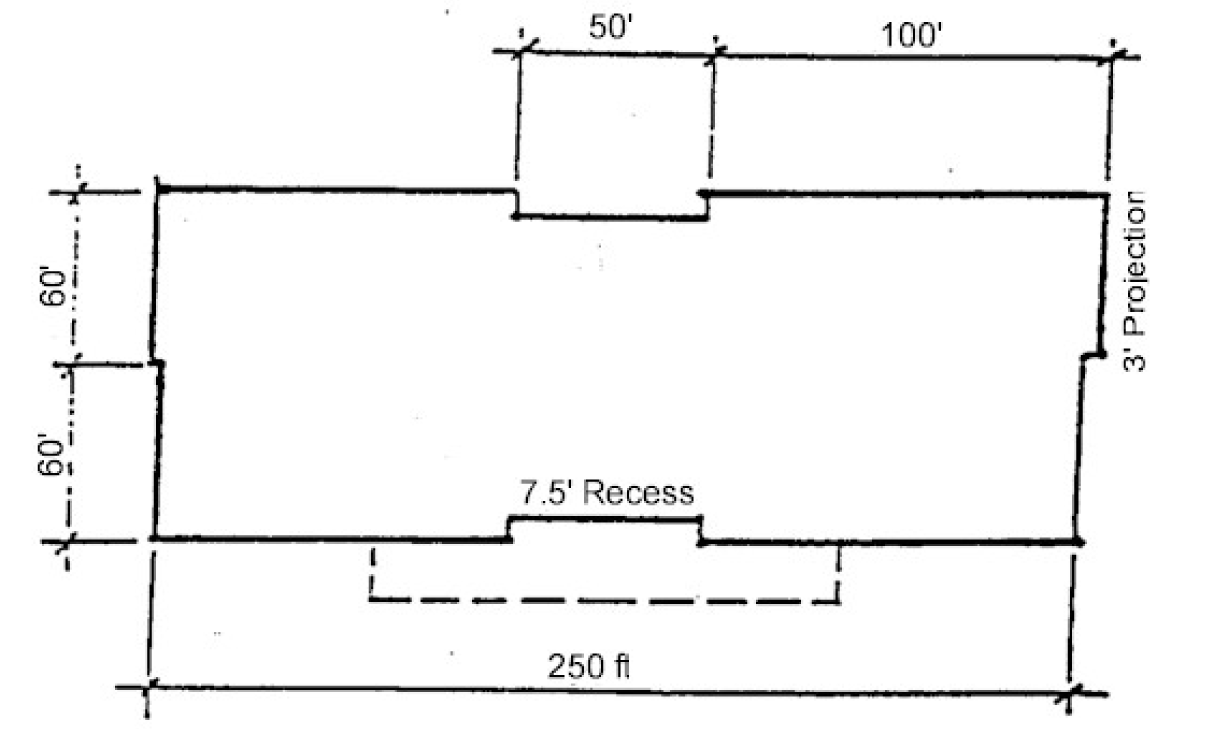
Figure 7.10.02 a.
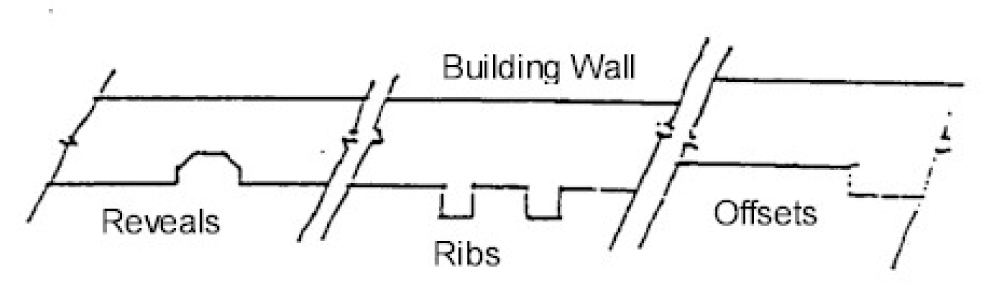
Figure 7.10.02 b.
a.
Multiple stores within a single building. Where a large retail project contains individual stores that are less than 25,000 square feet of gross floor area each, with separate, exterior customer entrances, the street level facade of each store shall provide the design and/or placement such as windows between the height of three feet and eight feet above the walkway grade, for no less than 60 percent of the horizontal length of the building facade of each store.
(2)
Materials. Unfinished tilt-up concrete panels, prefabricated steel panels, or similar non-glass, smooth faced panels shall not be exposed.
(3)
Entryways. Each business facade without an entrance shall include at least one customer entrance, or be screened from public view with no less than 20-foot wide buffer. (This criteria is intended to improve aesthetics of buildings whose entrance may not be along the front facade and to improve appearance of an otherwise blank wall.) Customer entrances shall be clearly defined and include at least two of the following features: canopies/porticos, overhangs, recesses/projections, arcades, raised above-the-doorway cornice parapets, peaked roof forms, arches, outdoor patios, display windows, integrated architectural details such as tile work, moldings, planters or wing walls, and/or landscaped sitting areas. The non-customer/loading areas shall be screened from public view with a landscaped buffer to be installed and approved by the Site Plan Review Committee.
(4)
Roofs. Flat unarticulated roof lengths, longer than 100 feet in length shall be concealed or addressed by utilizing at least two of the following options (See Figure 7.10.02(c)):
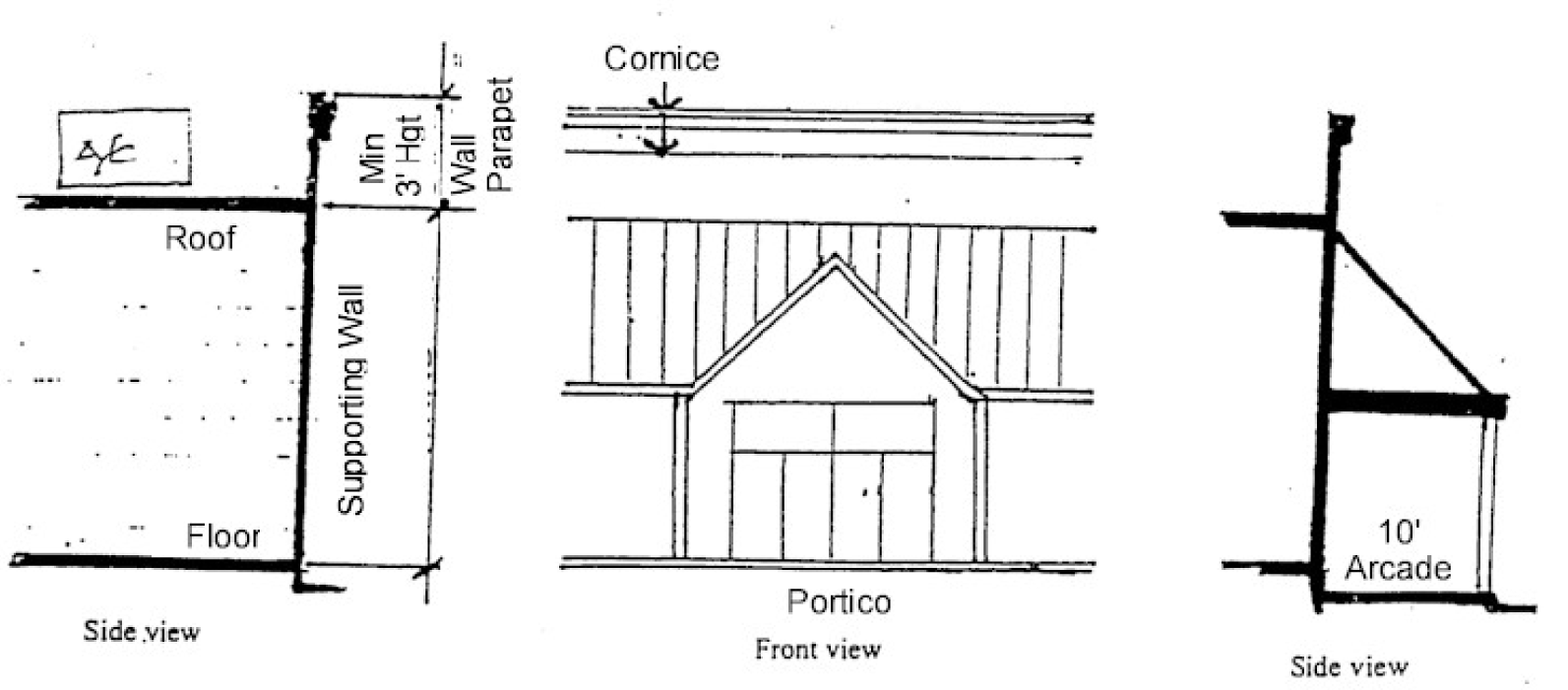
Figure 7.10.02 c.
a.
Effective concealment of flat roof lines, rooftop equipment, and heating, ventilating, and air conditioning (HVAC) units from any facade view by adjacent land uses of lesser intensity, and public right-of-way. The parapet design shall be a minimum of three feet in height and shall incorporate a three dimensional cornice treatment. Alternative designs such as varying the parapet height for a minimum linear distance of 100 feet, and a minimum vertical height of two feet shall be subject to approval by the site plan review committee.
b.
Overhanging eaves that extend no less than three feet past the supporting walls.
c.
Two or more sloping roof planes.
(5)
Pedestrian circulation. Large retail projects shall be pedestrian oriented through design features that enhance pedestrian safety, efficiency and connectivity with a clear definition between vehicular areas and pedestrian walkways.
a.
Sidewalks. Pedestrian connectivity between the project building entrances and parking areas, public sidewalks, out parcel buildings, and transit stops shall be clearly indicated through the use of landscaped areas and sidewalks which are made of materials such as scored concrete, pavers, or bricks. All projects building sides with customer entrances shall include such a sidewalk along the full length of each facade.
b.
Pedestrian amenity area. Large retail projects shall include design features such as pedestrian amenity areas, which include well landscaped sitting areas with design components such as seating elements and/or other amenities in shaded areas. A minimum of four benches, or other similar amenity, shall be provided at each customer entrance/pedestrian amenity area.
(6)
Parking areas. Parking lots and access aisle ways shall be designed utilizing the following standards:
a.
Parking lot design. Vast, unbroken parking lots are prohibited. Parking areas shall be designed so that no more than 100 spaces of the total required spaces are part of a clearly defined grouping of spaces. Such groups shall be broken into individual lots and/or clearly separated by well landscaped or weather-protected pedestrian walkways, significant landscape or geographic features, and/or by design components of the proposed building(s). Separations shall be no less than eight feet in width at any point. No required parking space shall be located further than 500 feet from the nearest customer entrance. At least 20 percent of the required parking spaces shall be placed in the rear or side areas of the proposed development, if feasible, as determined by the site plan review committee. Alternative designs that incorporate existing natural resources are encouraged, subject to approval by the site plan review committee.
b.
Parking spaces. The number of parking spaces shall be determined in accordance with the Land Development Code standards. Each parking space in excess of the minimum shall require an additional landscaped area of ten square feet to be placed within the internal parking area, frontage road, and/or right-of-way buffer. The use of pervious parking areas, including turf block may be considered for no more than 20 percent of the total constructed required parking spaces, subject to approval by the site plan review committee.
(7)
Landscaping. The following landscaping standards shall be incorporated into the design of all large retail projects:
a.
Foundation. Foundation landscaping shall be required for at least 50 percent of each facade length located along a public right-of-way, parking area, or which includes a customer entrance (See Figure 7.10.02.d). Such landscaping shall be incorporated into a minimum of a five-foot wide landscaped bedding area located between, and in addition to the required building sidewalk and the first vertical wall of the building facade. Large commercial planters or alternative designs may be used to meet these criteria (See Figure 7.10.02.e).
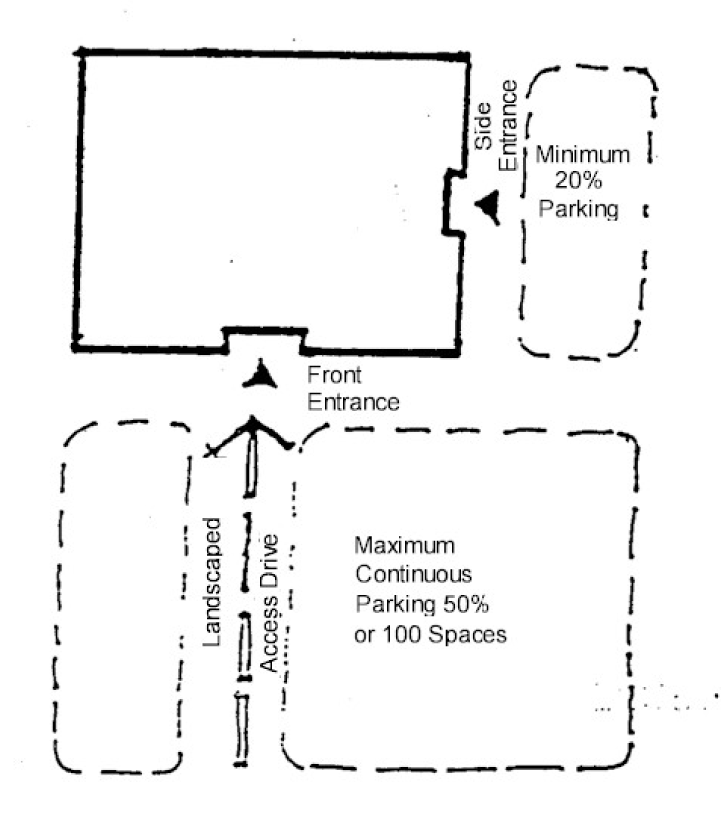
Figure 7.10.02 d.
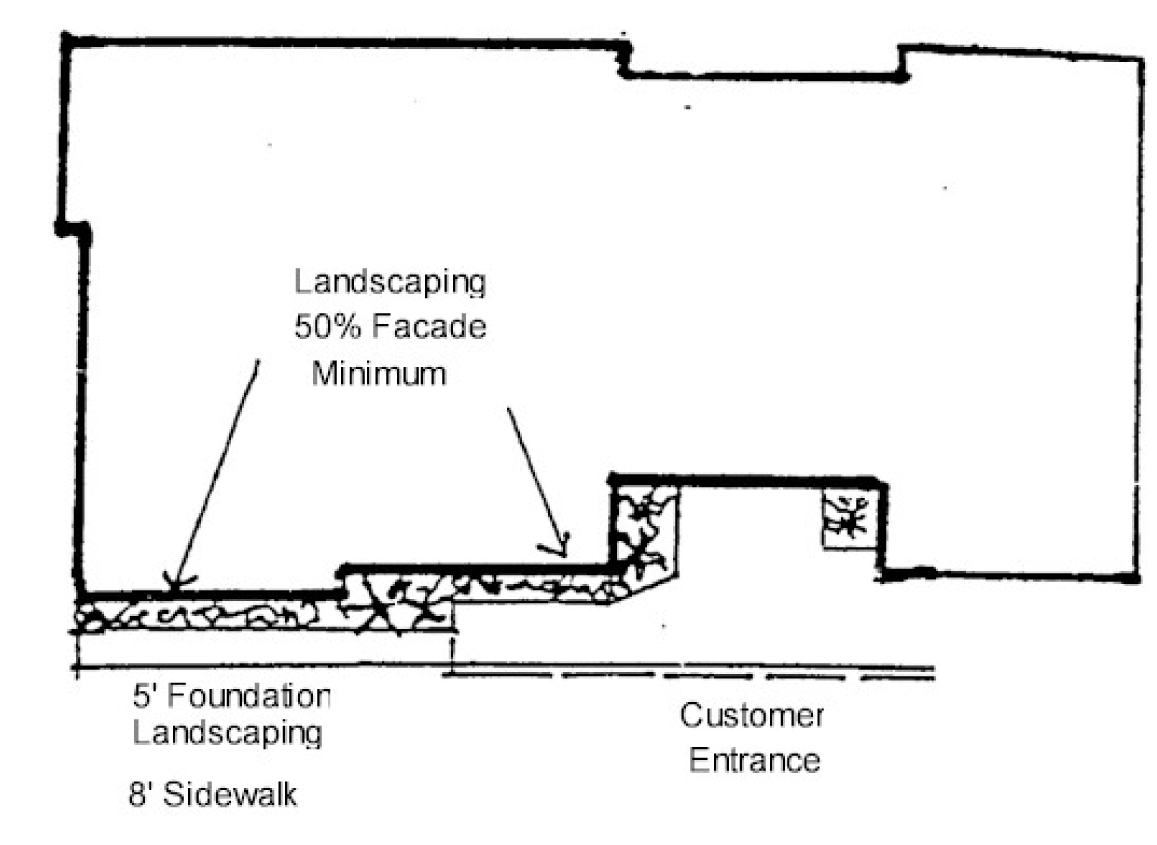
Figure 7.10.02 e.
b.
Bufferyards. Bufferyards, rather than setbacks, shall be required along all collector and arterial roadways, which include an unbroken (except for required driveways, sidewalks, and other public safety elements), landscaping area no less than 30 feet in width and planted according to buffer standards. If existing vegetation is to be preserved, a varying buffer design may be utilized where the average width is 20 feet. Alternative designs are subject to approval by the site plan review committee.
c.
Parking areas. Every ten spaces shall be designed with 400 square feet of landscaping to be placed in medians or islands, and shall include at least one over-story tree, one under-story tree and six shrubs. No median shall be less than five feet in width, and no more than ten spaces shall be continuous without landscaping (See Figure 7.10.02.f). Grouping of landscaped islands is encouraged to promote the healthy growth of larger trees. Alternative designs are subject to approval by the site plan review committee, but in no case shall the total required landscaping area be decreased.
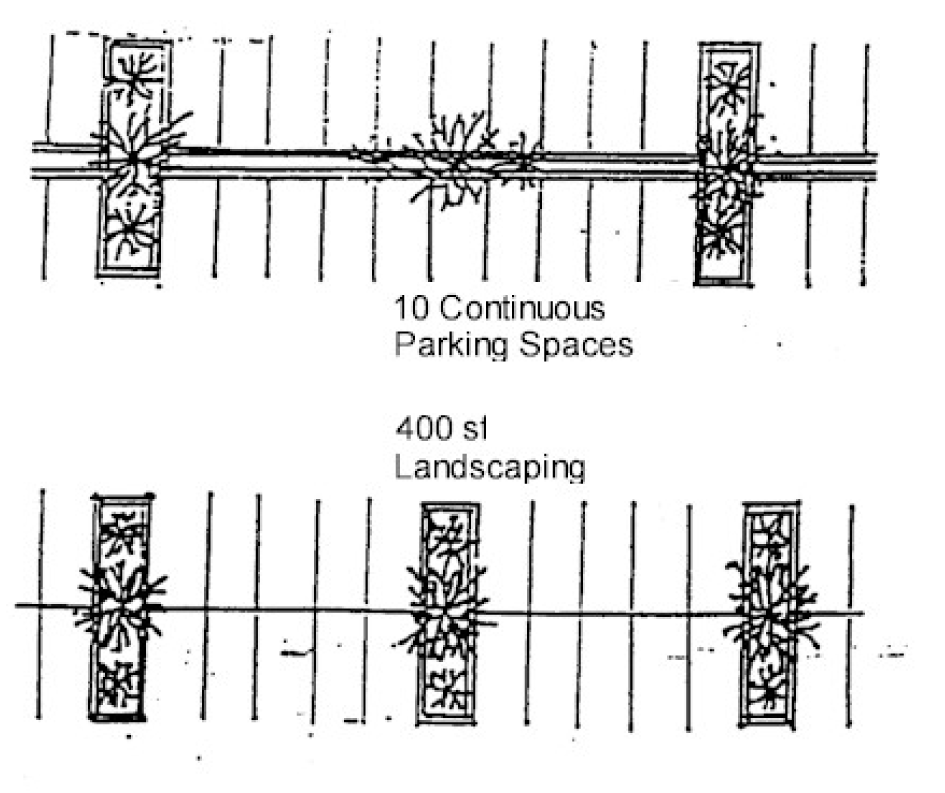
Figure 7.10.02 f.
d.
Access driveway. Main access driveways from the public right-of-way into the proposed development shall be completely separated from any parking area and/or pedestrian walkway by a landscaped island, not including intersection and walkways. At least one, four-inch (dbh), over-story tree shall be planted or preserved at 40 feet on-center spacing.
e.
Frontage roads. Frontage roads need not be landscaped; however, when parking area landscaping cannot be met, the site plan review committee may approve no more than 20 percent of the required parking area landscaping for placement along frontage roads.
f.
Drainage retention areas (DRA). In addition to all land development requirements, a landscaped buffer shall be planted adjacent to public right-of-way and/or access drives, in coordination with an approved DRA. Alternative DRA design is encouraged, subject to approval by the site plan review committee.
g.
Tree preservation. All large retail projects shall comply with tree preservation standards, and such requirements shall be in addition to subsections (7)a., (7)b., and (7)c., as referenced above.
(8)
Exterior lighting. Exterior lighting design shall enhance security of pedestrians and motorists alike. All pedestrian walkways and parking spaces shall be adequately lighted through the use of individual or combination lighting features such as standard luminaire, street lamp, and/or bollard types of fixtures. Alternative designs are subject to approval by the site plan review committee (See Figure 7.10.02.g). Lighting shall be designed according to the following standards:
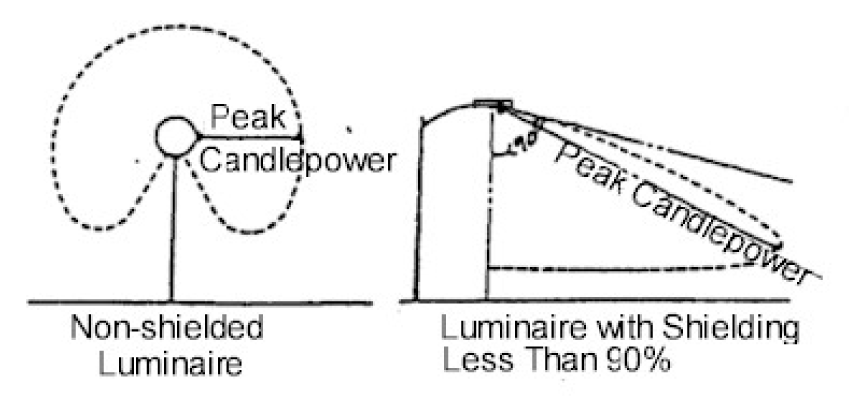
Figure 7.10.02 g.
a.
Maximum height. Exterior light sources such as luminaries or lampposts shall not exceed 20 feet in height. Shielded light sources may not exceed 35 feet in height.
b.
Illumination. All lighting shall be designed to minimize the spillage onto adjacent noncompatible land uses. Non-shielded fixtures are permitted and maximum illumination factor of five foot candles. Shielded fixtures are permitted a maximum illumination factor of 12 foot candles.
c.
Location design. Lighting sources (interior or exterior) shall be shielded from vehicular travel lanes so that glare to motorists is minimized. Areas located on waterways, such as docks and nature trails, and other regulated areas shall utilize shielded light fixtures so that the light source is adequately shielded from view on the waterway or regulated area. Lighting and other improvements, such as cart returns, shall be incorporated into the landscape design.
d.
Exterior illumination. Exterior illumination shall be engineered for public safety and not impact adjacent properties to an extent greater than is necessary to address the safety issue. Lighting plans may be required by the site plan review committee or staff, and extensive lighting systems justified by appropriate study at the applicant's expense.
(9)
Signage. Signage shall be designed as part of a complete system, and may be approved as part of the overall site plan, without acquiring a separate permit.
(10)
Outdoor storage and sales. Outdoor storage (including seasonal storage trailers) and sales shall be permitted in designated areas only, as approved during development site plan review, and shall be screened from view from residential land districts and uses through landscaping and/or other design features.
(11)
Compliance. In addition to the application requirements of the LDC, a colored facade rendering shall be submitted to the director of development at time of application submission to ensure that the development standards required herein are adhered to.
(12)
Conflict. In the case of any conflicts between the High Springs Land Development Code and/or Florida Building Code, the more stringent code shall prevail.
Sec. 7.11.01.- General provisions.
Traditional development, as presented in the Comprehensive Plan revision, encompasses the following types of land uses. These are illustrated conceptually in Figure 7.11.01.
Sec. 7.11.01.01. - Purpose and intent.
The purpose and intent of the traditional development districts is to implement the Traditional Town Development (TTD), the Traditional Marketplace Development (TMD), and the Traditional Neighborhood Development (TND) provisions of the Comprehensive Plan and to:
(1)
Encourage mixed-use, compact development that is pedestrian in scale and sensitive to environmental characteristics of the land, and facilitates the efficient use of services within the County.
(2)
Have residences, shopping, employment, and recreational uses located within close proximity with each other and efficiently organized to provide for the daily needs of the residents.
(3)
Provide for a range of housing types within pedestrian-oriented, human-scale neighborhoods.
(4)
Provide efficient circulation systems for pedestrians, non-motorized vehicles, and motorists that serve to functionally and physically integrate the various land use activities.
(5)
Allow for a strong neighborhood identity and focus.
Sec. 7.11.01.02. - Organization of traditional development standards.
These regulations reflect a "building block" approach to traditional development, with Traditional Neighborhoods (TNDs) and Traditional Marketplaces (TMDs) as the base districts. The Traditional Town (TTD) functions as an umbrella district, composed of TNDs, TMDs, and additional land uses needed to support a larger population, such as a Traditional Employment Center (TEC). A portion of a TTD also may be used for planned development district.
Separate regulations are provided for TNDs and TMDs, in order to allow these districts to be developed independently of a TTD.
Provisions for civic and open space/recreation areas are included in the TND provisions. A "neighborhood center" commercial area in a TND is also included to allow for small-scale commercial uses intended to serve local residents.
To avoid duplication, standards that apply to all traditional development districts, including provisions for street and sidewalk design, landscaping, parking, and signage, have been grouped together as "general standards for all traditional development districts".
The overall organization has been structured to follow logically, with general provisions and standards for all traditional development districts (e.g. uses allowed, street, alley and sidewalk standards by, parking, lighting, landscaping, fencing and walls, and signage) listed first, followed by specific provisions for TNDs and TMDs - the building blocks of traditional development - and then the provisions for TECs and for the development of larger TTDs.
Development standards for traditional development building types, setbacks, frontage requirements, location of parking, and building design are presented within individual district regulations.
Sec. 7.11.01.03. - Review and approval process.
All development within traditional development districts are subject to the review and approval procedures that apply to planned developments; see Article XI, Part 11.11.00, Planned Development.
Sec. 7.11.01.04. - Types of traditional development districts.
Traditional development districts include the following:
(1)
Traditional Neighborhoods (TND) are intended to accommodate a mix of housing types, civic and neighborhood-oriented commercial uses, integrated with a recreation and pedestrian-oriented open space system and a system of streets, alleys and sidewalks. A neighborhood center with an adjacent neighborhood square is a community focal point within easy walking distance of residents.
(2)
Traditional Marketplaces (TMD) have a concentrated area for shopping, entertainment, business services, cultural and housing opportunities in a pedestrian-oriented environment. Large-format retail stores ("big boxes") are not allowed. Floors above shops and offices may be used for housing, offices, or live/work units.
(3)
Traditional Towns (TTD) provide an opportunity for community planning at a large scale, integrating traditional neighborhoods and traditional marketplaces with an inter-connected system of streets, alleys, sidewalks, squares, parks and open space. A compact development pattern is promoted by not requiring buffers between uses within the town.
(4)
Traditional Employment Centers (TEC) provide for professional office and supporting commercial services within a TTD or integrated with a TMD.
Figure 7.11.01 Traditional Development Prototypes
Marketplace, Neighborhoods and Street Network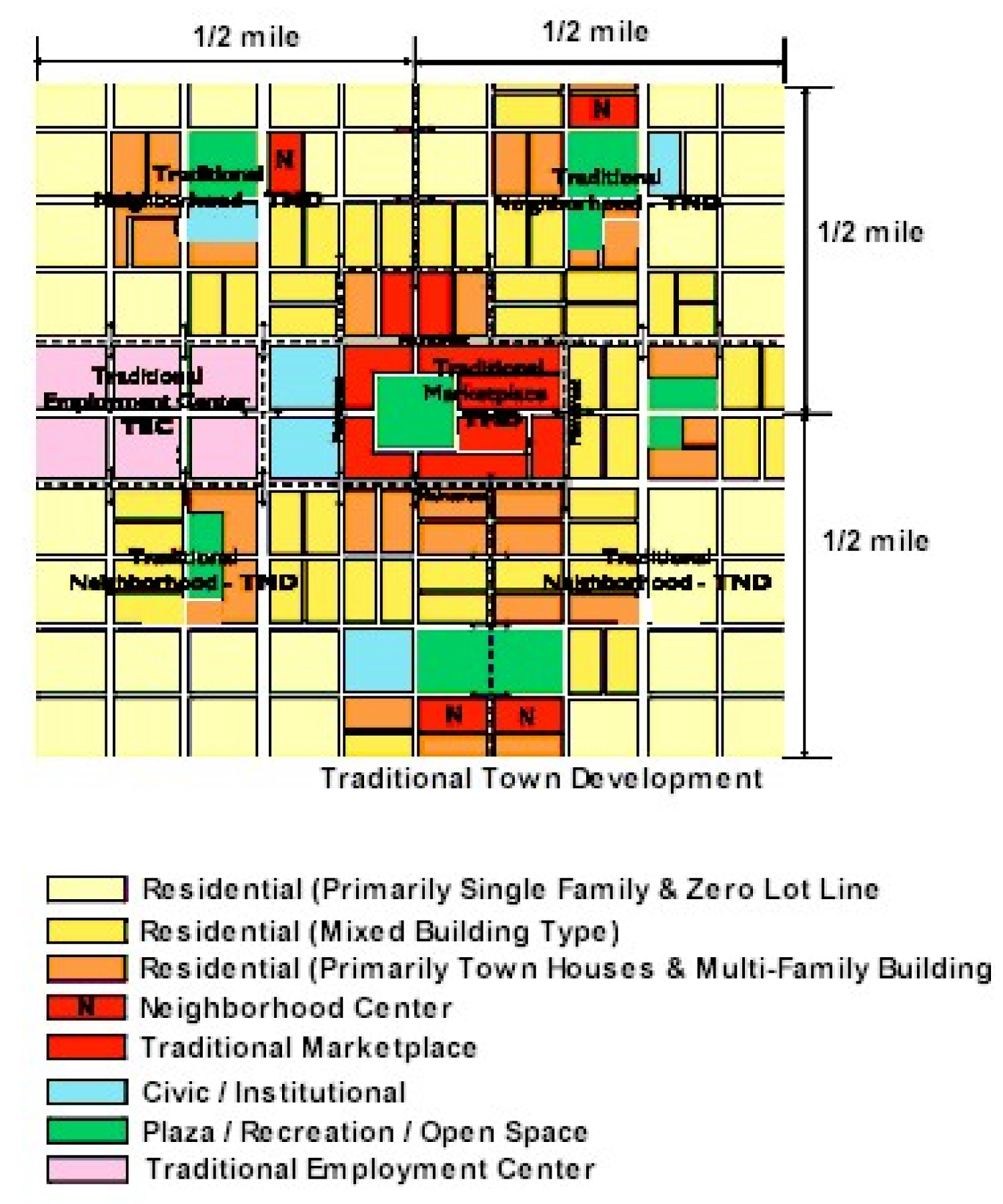
Sec. 7.11.01.05. - Residential density and Comprehensive Plan land uses categories.
The minimum density, the maximum density, and the Comprehensive Plan land use categories which correspond to the various traditional development districts shall be determined by Table 7.11.01: Traditional Development District Intensities and Corresponding Land Use Categories.
1.
TND density bonus. TNDs may qualify for a density bonus of up to two (2) additional units per acre above the maximum density allowed for the underlying zoning district as prescribed in Table 7.01.01, provided that the TND is consistent with the standards and requirements of this article.
Table 7.11.01 Traditional Development District Densities and Corresponding Land Use Categories
Sec. 7.11.01.06. - Uses allowed.
Land uses allowed within a TND, TMD, TTD or TEC are governed by Table 7.11.02, Traditional Development Permitted Use Schedule.
The permitted use schedule in Table 7.11.02 includes four designations: "P" Permitted Use, "SPRC" Site Plan Review Committee, "C" Conditional Use and "Blank" Prohibited.
Table 7.11.02 TRADITIONAL DEVELOPMENT PERMITTED USE SCHEDULE
[A copy can be found in the city offices.]
Sec. 7.11.01.07. - Design objectives.
Traditional development districts must be planned to comply with the following design guidelines.
(1)
Neighborhoods.
a.
A mix of residential uses to provide housing opportunities for residents of different incomes, ages, family sizes, and lifestyles, including:
Single-family dwellings;
Zero Lot line dwellings;
Town Houses;
Multifamily dwellings;
Accessory dwellings; and
Congregate living facilities.
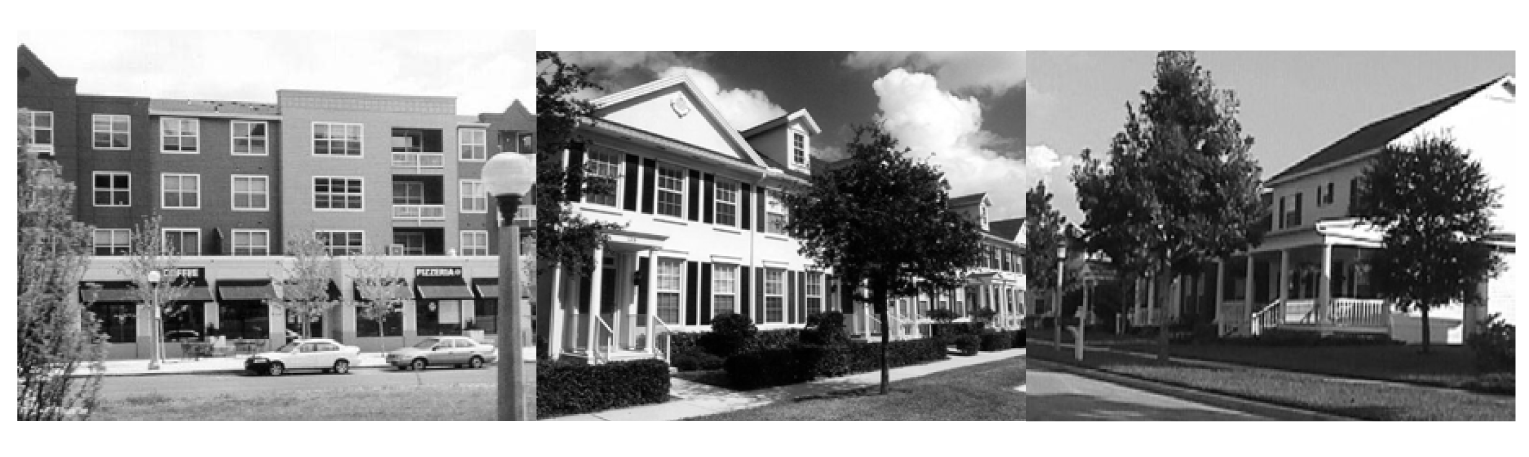
b.
Centrally-located community focal points for the formal and informal interaction of neighborhood residents, such as a neighborhood square, community meeting hall, and a neighborhood commercial center. These uses are within walking distance (approximately one-fourth-mile or a five-minute walk) of all residents.
c.
A variety of open spaces and recreation areas to allow for both passive and active recreation. Small neighborhood parks and playgrounds should be located throughout the neighborhood, so all residents are closely located to a neighborhood park. Large outdoor recreation areas should be located at the periphery of neighborhoods rather than in central locations.
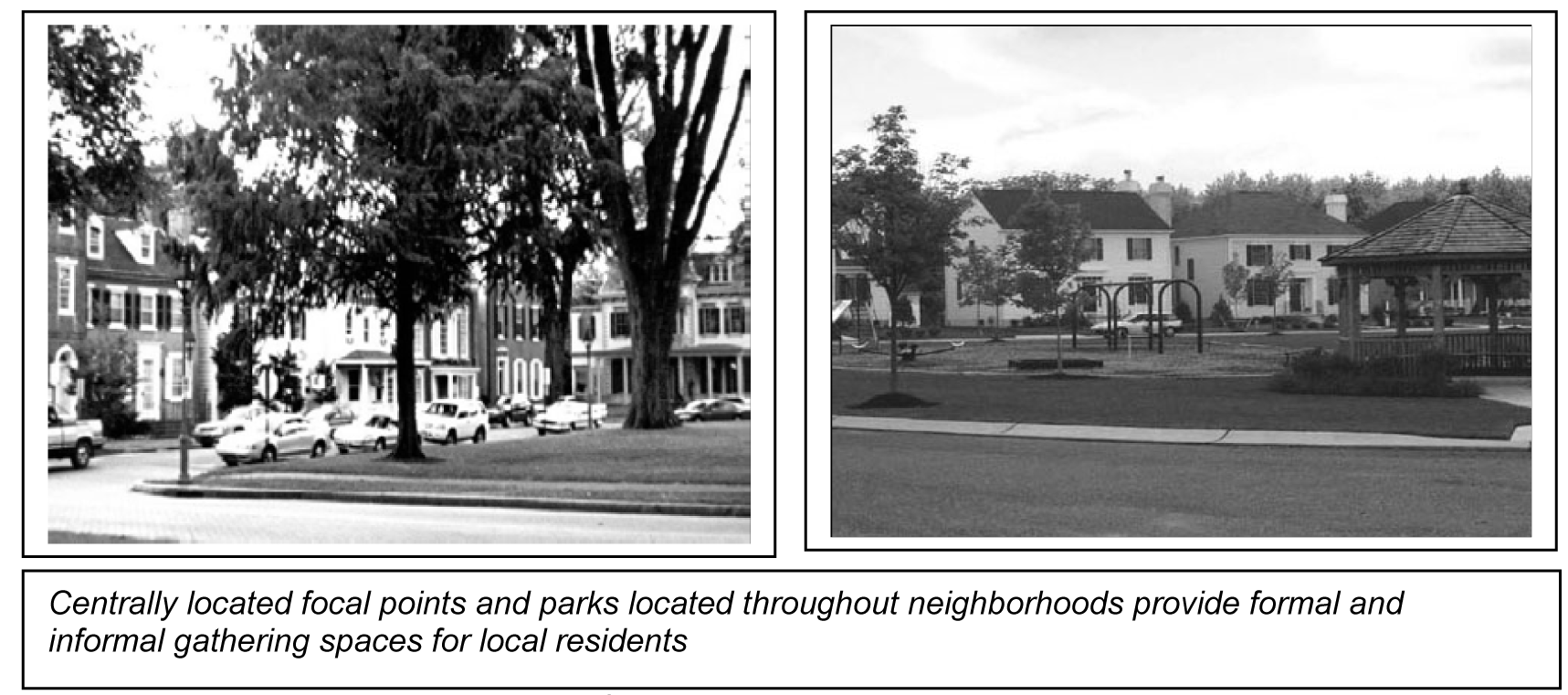
d.
An interconnected network of streets, bike lanes, and sidewalks throughout the neighborhood, providing multiple routes for vehicle, bicycle, and pedestrian travel, diffusing traffic and shortening walking distances. Streets are designed for slower speeds to encourage pedestrian safety. Alleys and lanes provide vehicular access to garages and open spaces in the rear of buildings.
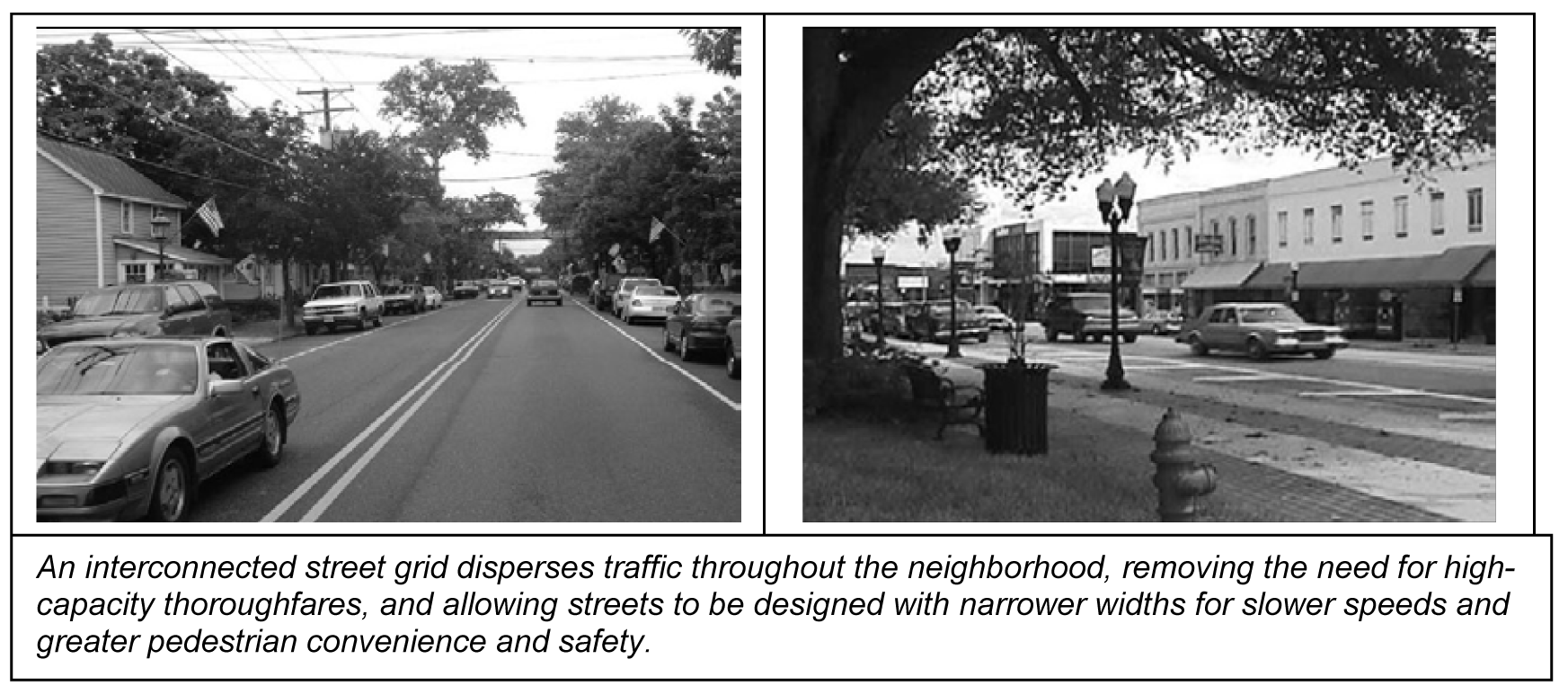
e.
A safe and attractive pedestrian environment enhanced by the design of buildings which provide windows and entrances to reduce the amount of blank walls and street-level uses. Sidewalks include pedestrian amenities such as shade trees and street furniture.
(2)
Commercial districts (Traditional Marketplaces).
a.
Public spaces, such as plazas and squares, integrated within commercial development providing places for people to gather or rest. Walkways provide pedestrian connections throughout TMDs. Lighting and landscaping accent public spaces and provide for security and shading.
b.
Parking is provided on-street, behind buildings, and in shared parking lots. Parking lots are not allowed in front of buildings, creating barriers between pedestrians and storefronts.
c.
Buildings are human-scaled in design with a variety of architectural features which create an attractive and textured streetscape. Building frontages are set near the sidewalk and building sizes are consistent, providing a sense of enclosure for the street. Architectural detailing and applied decoration enliven facades and break down building sizes to human proportions. Building entrances and windows are located along street frontages to break up blank walls and improve the pedestrian experience.
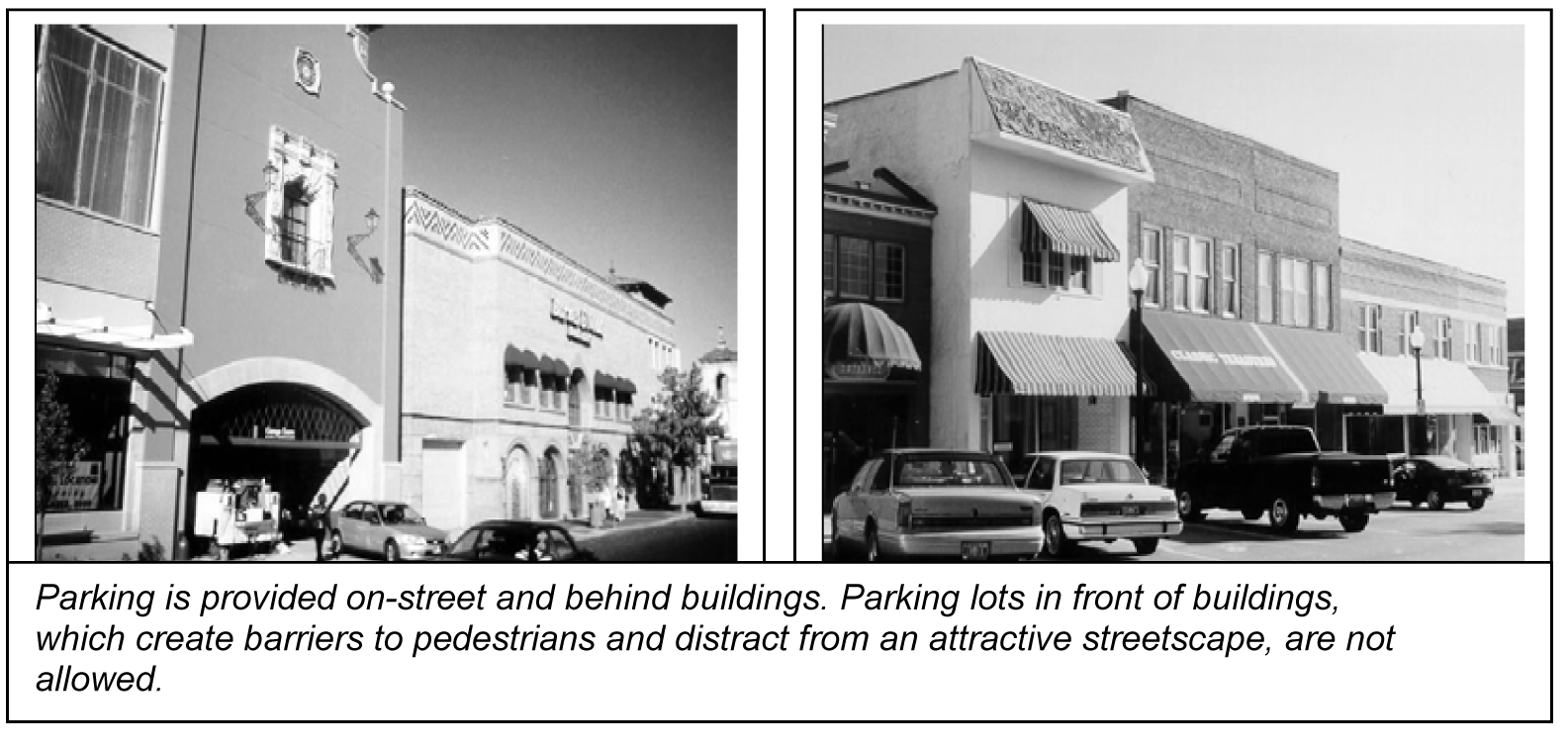
Sec. 7.11.01.08 - Development standards
All TNDs, TMDs, TEC's and TTDs are subject to the standards and requirements of section 7.11.03, Traditional Neighborhood Development, section 7.11.04, Traditional Marketplace Development, section 7.11.04, section 7.11.05, Traditional Employment Center Development and section 7.11.06, Traditional Town Development, respectively, in addition to the applicable standards of section 7.11.02, Standards applicable to all traditional development districts. All Traditional development districts are further subject to the standards and requirements prescribed in article VII of this Code and all other applicable standards.
Sec. 7.11.02.01. - Applicability.
The following standards apply to all traditional development districts.
Sec. 7.11.02.02. - Streets, sidewalks, and alleys.
The circulation system within a traditional development shall allow for different modes of travel within and between individual traditional development districts, based upon a hierarchy of transportation methods. The street and sidewalk network shall provide visual and functional links within and between residential, commercial, office, civic, and open space areas, and shall be connected to existing and proposed external development.
(1)
Definition. For the purposes of the section, streets shall include private accessways and driveways.
(2)
Block structure. To ensure compact, contiguous development and to facilitate connectivity and pedestrian accessibility, the layout of streets and alleys shall conform to the following standards:
a.
Minimum length of a block: 160 feet.
b.
Maximum length of a block:
Residential: 500 feet.
Single-family residential: 660 feet. Up to 750 feet is allowed if a mid-block alley or pedestrian pathway is provided.
Non-Residential: 500 feet.
c.
Maximum ratio of block length to width for neighborhood centers and TMDs: 2:1.
d.
Maximum number of alley curb cuts: Four per block and one per side.
e.
Minimum spacing between alley curb cuts: 80 feet.
Figure 7.11.02 Block Structure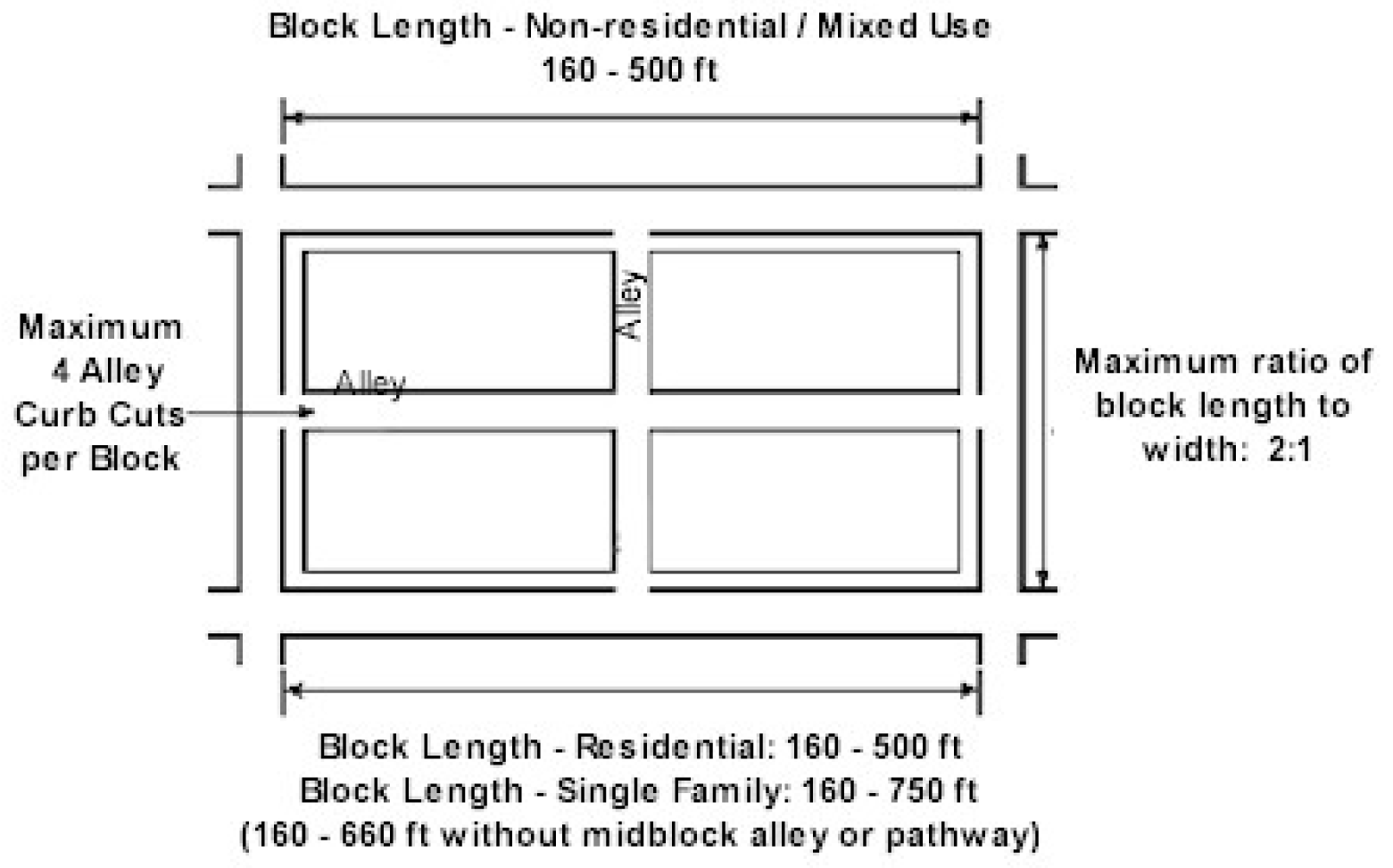
3.
Streets.
a.
Street design. Public streets shall conform to the standards in Table 7.11.03, Street Design Standards.
TABLE 7.11.03 TRADITIONAL DEVELOPMENT STREET DESIGN STANDARDS
Figure 7.11.03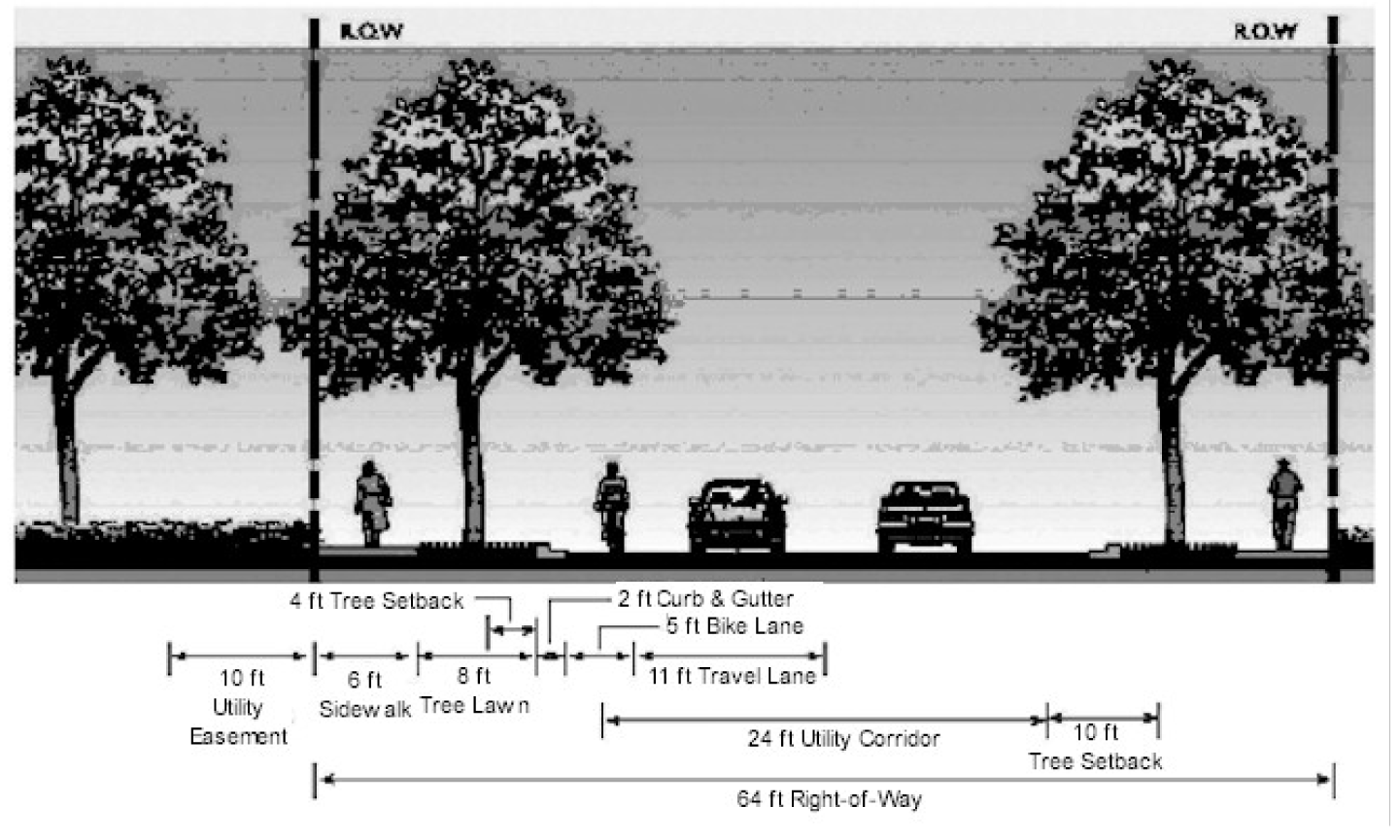
Figure 7.11.04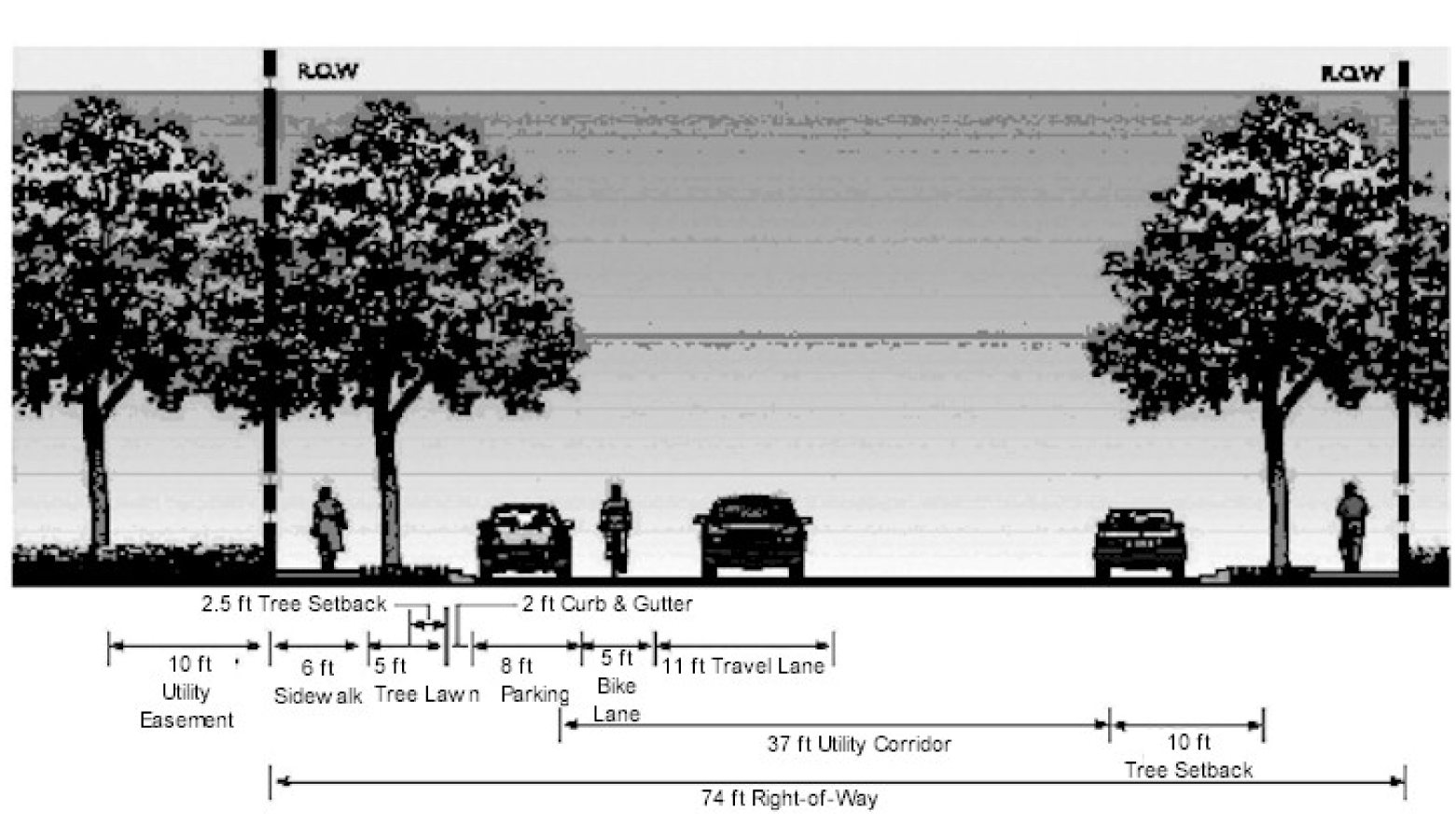
Figure 7.11.05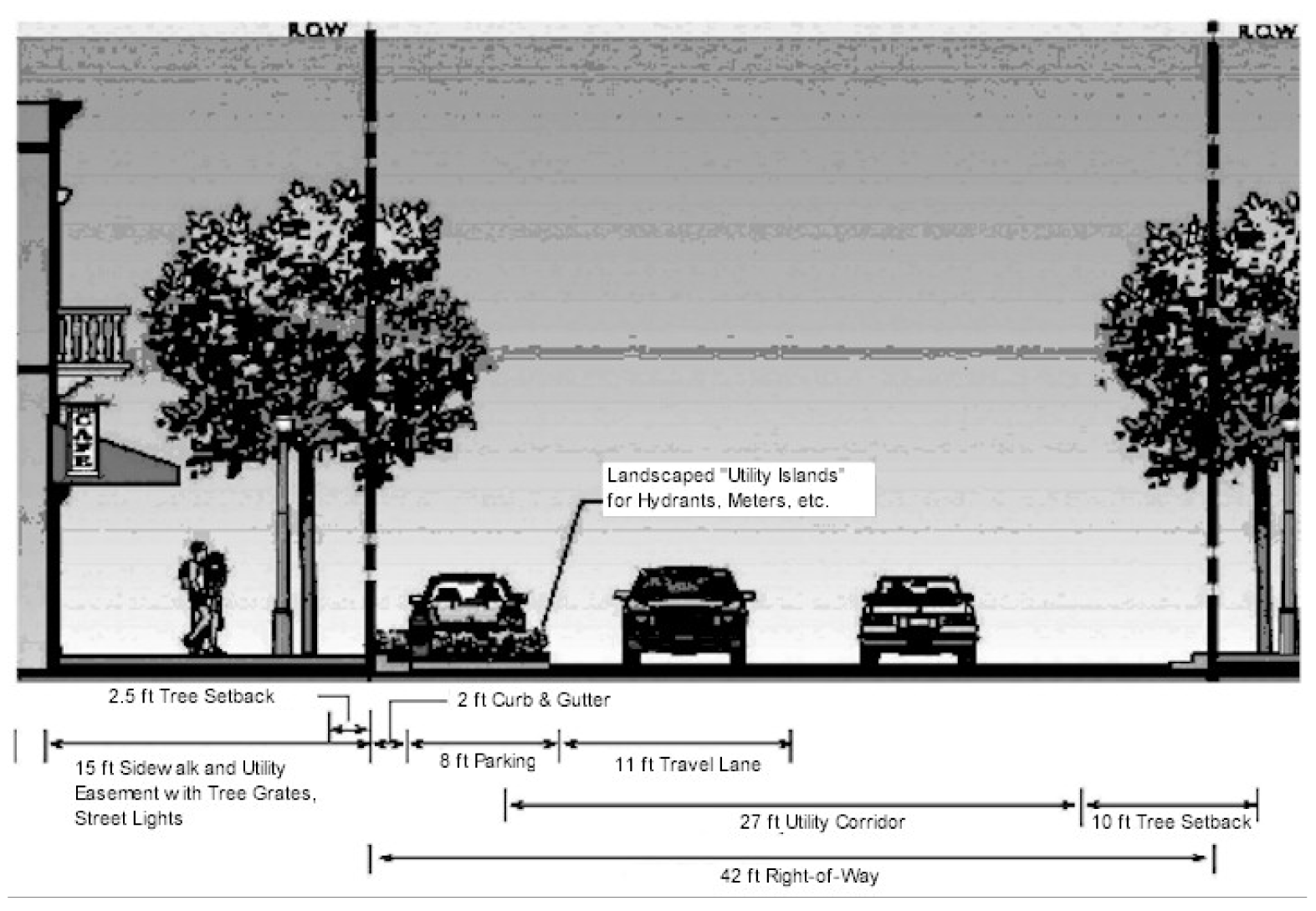
Figure 7.11.06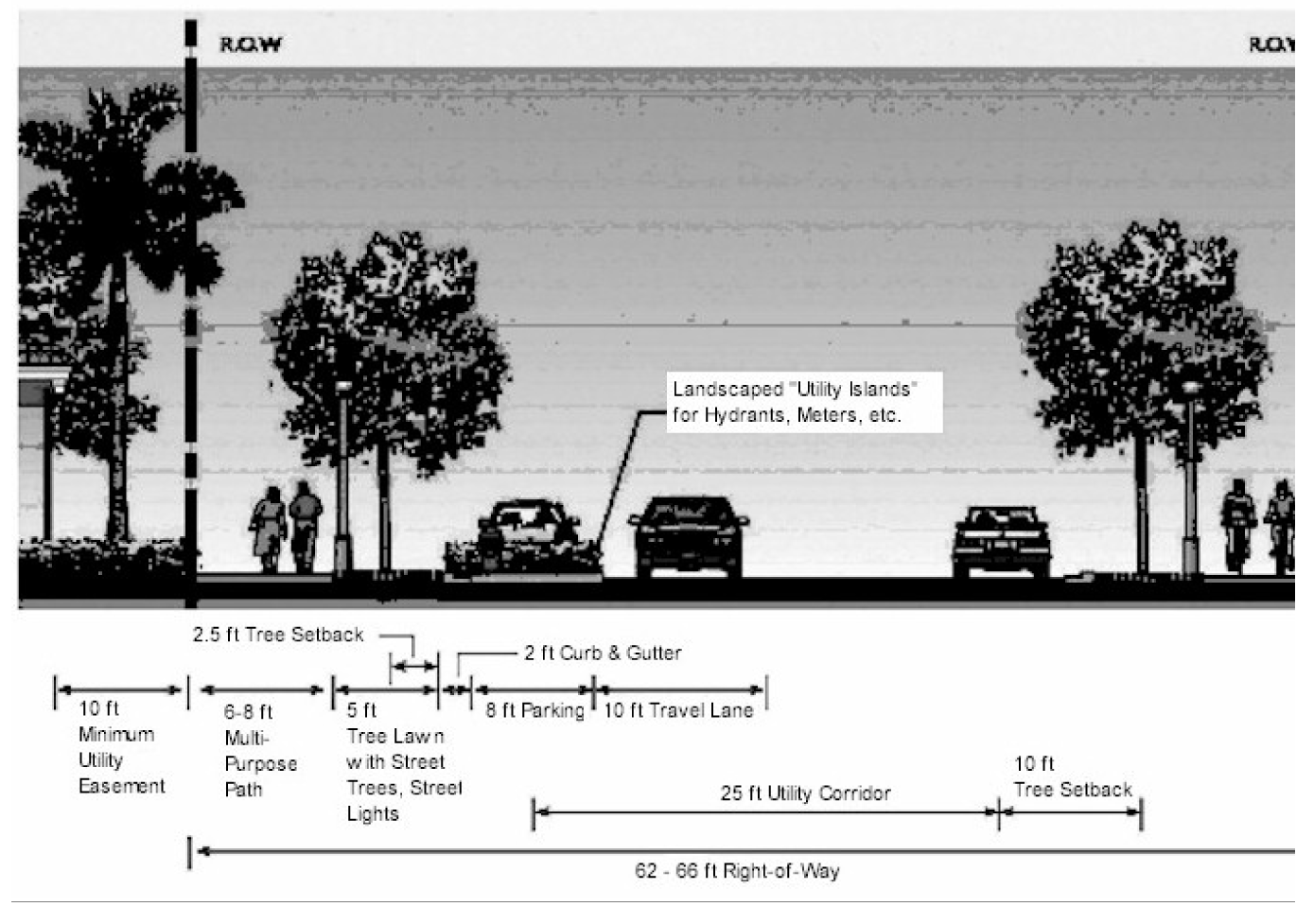
b.
Connectivity. All street and alleys shall connect to other streets and alleys to form a continuous vehicular and pedestrian network within the district and to adjacent development. The use of gates or other preventative barriers shall not be permitted on collector streets.
1.
Dead-end streets. No more than ten percent of all streets may be dead-end streets, such as cul-de-sacs, T-turnarounds, and closes. The maximum length for dead-end streets shall be 500 feet.
Figure 7.11.07 Dead-End Streets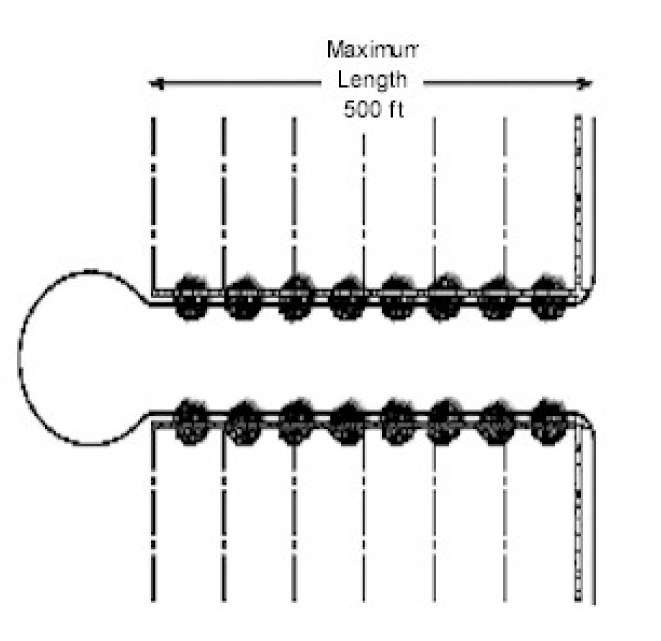
(4)
Sidewalks and pathways. Sidewalks and/or pedestrian pathways shall connect to one another to form a continuous pedestrian network within and between all traditional development districts. Unless otherwise indicated, sidewalks shall be provided along both sides of the street and shall conform to the standards in Table 7.11.0, Sidewalk Design Standards.
a.
Master pedestrian circulation plan. A master pedestrian circulation plan shall be submitted with the regulating plan.
b.
Accessibility. Sidewalks at street intersections or pedestrian crossings shall be sloped, with the use of curb cuts and/or ramps.
TABLE 7.11.04 SIDEWALK/PATHWAY DESIGN STANDARDS
Figure 7.11.08 Sidewalk/Pathway Design Standards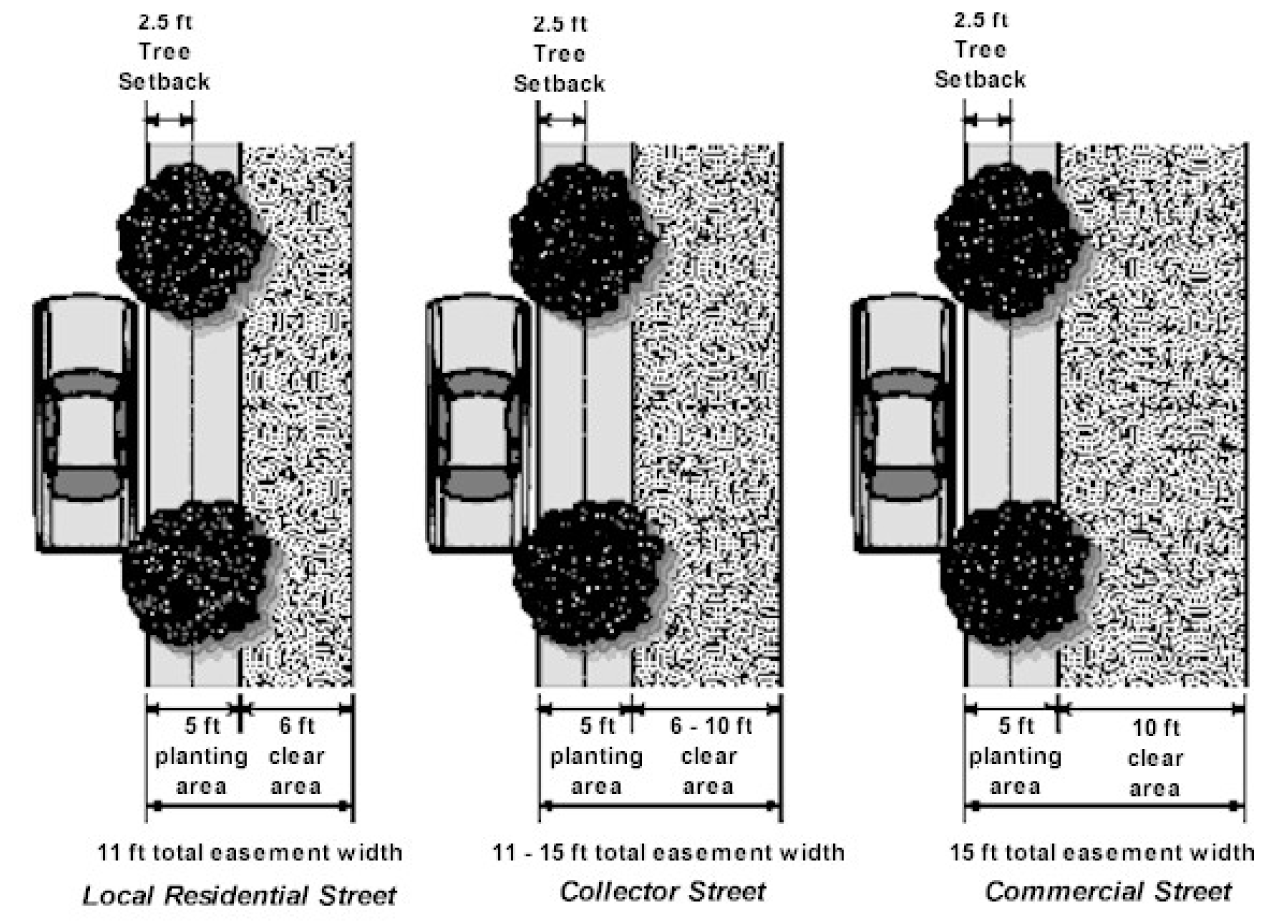
(5)
Alleys. Alleys shall conform to the design standards in Table 7.11.05. Alleys providing access to residential buildings shall be built to residential alley standards. Alleys providing access to commercial or office buildings shall be built to commercial alley standards. Where an alley provides access to a block with both residential and commercial uses, the alley shall be built to the commercial alley standards.
TABLE 7.11.05 ALLEY DESIGN STANDARDS
Figure 7.11.09 Alley Design Standards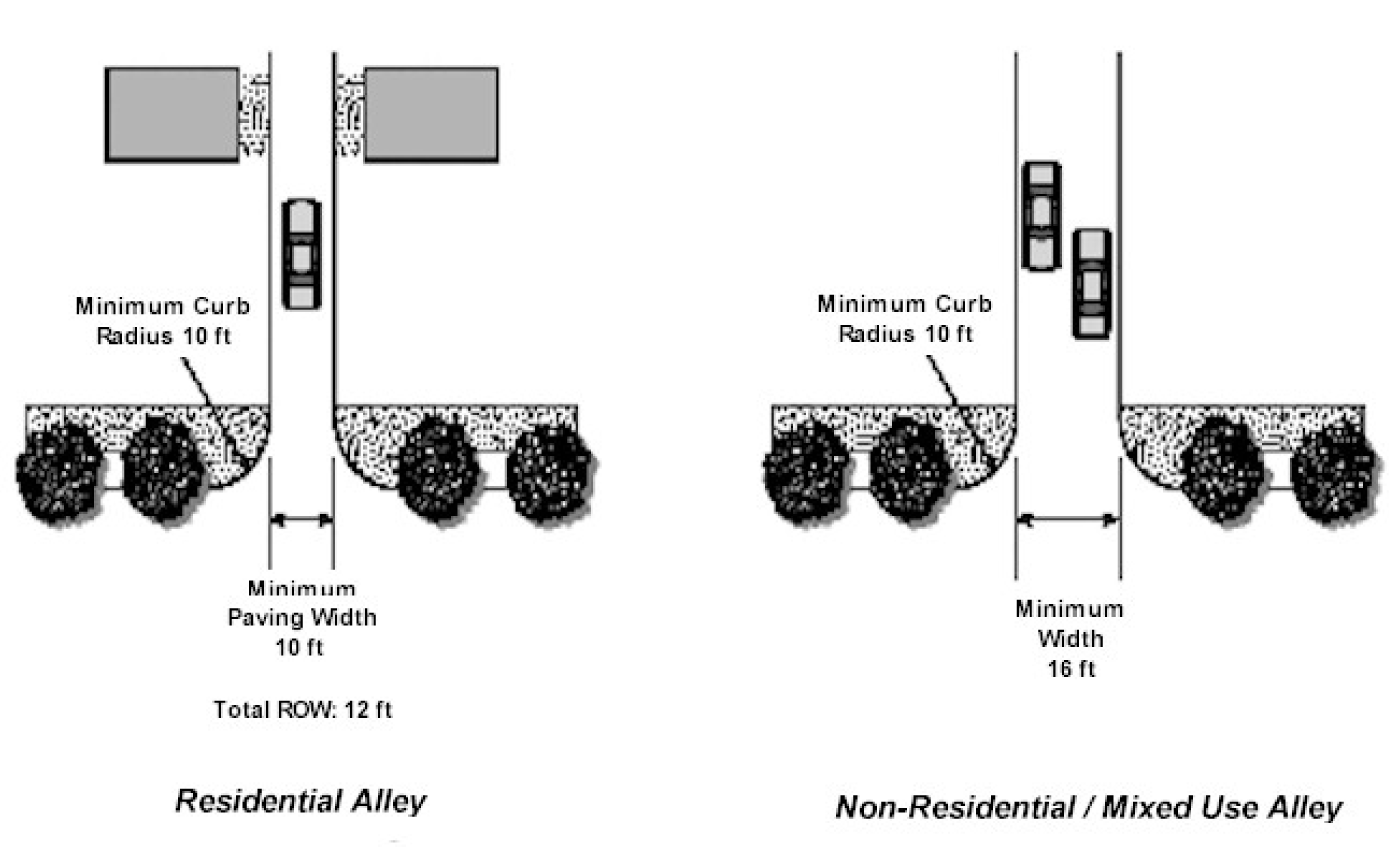
(6)
Utilities and lighting.
a.
Utilities. Public utilities and lighting shall be installed in accordance with the standards established by this Code and other applicable standards.
1.
Street lighting. Street lighting shall be provided along all streets and alleys, subject to the standards prescribed in Table 7.11.06, Street Lighting Standards. Light fixtures shall be located at every crosswalk.
TABLE 7.11.06 STREET LIGHTING STANDARDS
Figure 7.11.10 Street Lighting Standards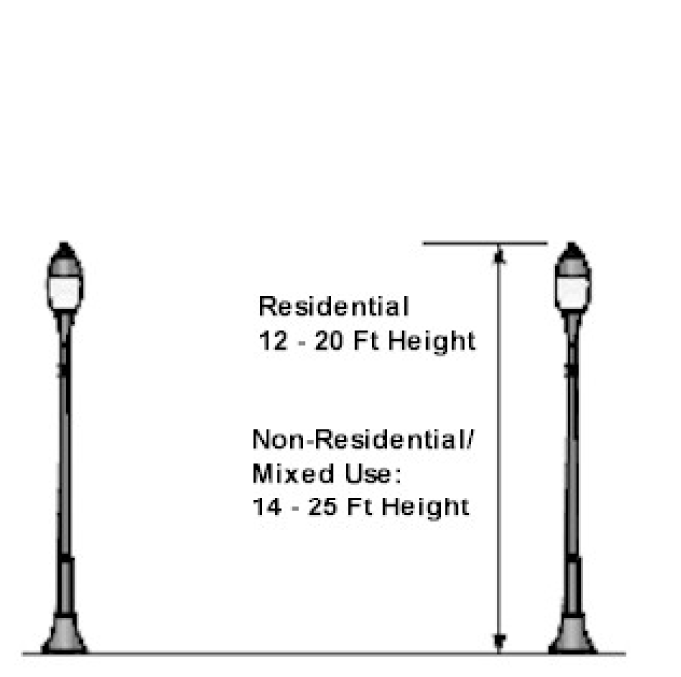
2.
Parking lot lighting. Lighting shall be provided for all parking lots, subject the following standards. All parking lot lighting shall be fully shielded, and all lighting fixtures shall be a maximum of 25 feet in height.
Sec. 7.11.02.03. - Parking requirements and access.
Parking requirements are intended to balance compact, pedestrian-oriented development and necessary car storage.
(1)
Number of parking spaces. Parking spaces shall be provided, as follows: On-street spaces may be used to meet these parking requirements.
a.
Residential. Parking shall be provided in accordance with the standards in section 7.03.04, off-street parking and loading.
b.
Non-residential.
1.
Minimum number of parking spaces: One parking space per 400 square feet of gross floor area.
2.
Maximum number of parking spaces: One space per 250 square feet of gross non-residential floor area.
(2)
Reduction in parking requirement. The number of required spaces may be reduced by either of the following methods:
a.
The shared parking requirements of section 7.03.04; or
b.
A parking demand study prepared by a traffic engineer licensed by the State of Florida demonstrating that the parking demand for the project will be less than the requirements of this section.
(3)
Location of parking. Off-street parking is prohibited in required front or corner side setbacks. The maximum walking distance to a pedestrian entrance to an off-street parking facility, including shared parking facilities, shall be 1,000 lineal feet from the principal building entrance served by the parking.
(4)
Parking structures. Structured parking is required for any spaces in excess of one space per 250 gross square feet of non-residential floor area.
(5)
Minimum pervious surface. 20 percent of the project site.
(6)
Bicycle parking. One parking space shall be provided for every five units in multifamily housing and for every 20 vehicle parking spaces serving non-residential uses. Bicycle parking spaces shall be indicated on the site plan in visible, well-illuminated areas. For each bicycle parking space required, a stationary object shall be provided to which a user can secure the frame of the bicycle with a six-foot cable and lock. The stationary object may either be a freestanding bicycle rack or an approved alternative.
Sec. 7.11.02.04. - Landscaping and buffering.
In addition to the requirements in Part 7.06.00, Landscaping, the following standards shall apply:
(1)
Buffer around districts. No buffers are required where one traditional development district abuts another traditional development district.
(2)
Compatibility and incompatibility buffers. Buffers are not required within traditional development districts except that a solid six-foot high wall or five-foot wide landscape planting area that provides a visual screen at least six feet in height is required along an interior property line where a non-residential use abuts a residential use. The height of the wall or landscape screen shall not exceed three feet within required front setback areas.
(3)
Off-street parking areas.
a.
Trees. One canopy tree shall be planted for every six parking spaces. In a neighborhood center, one canopy tree shall be planted for every eight parking spaces. Trees shall not be spaced more than 80 feet apart.
b.
Terminal islands. Terminal landscape islands, subject to the requirements of section 7.03.04, terminal and interior landscape islands, shall be provided on both sides of all vehicular access points.
Figure 7.11.11 Off-Street Parking Landscaping Standards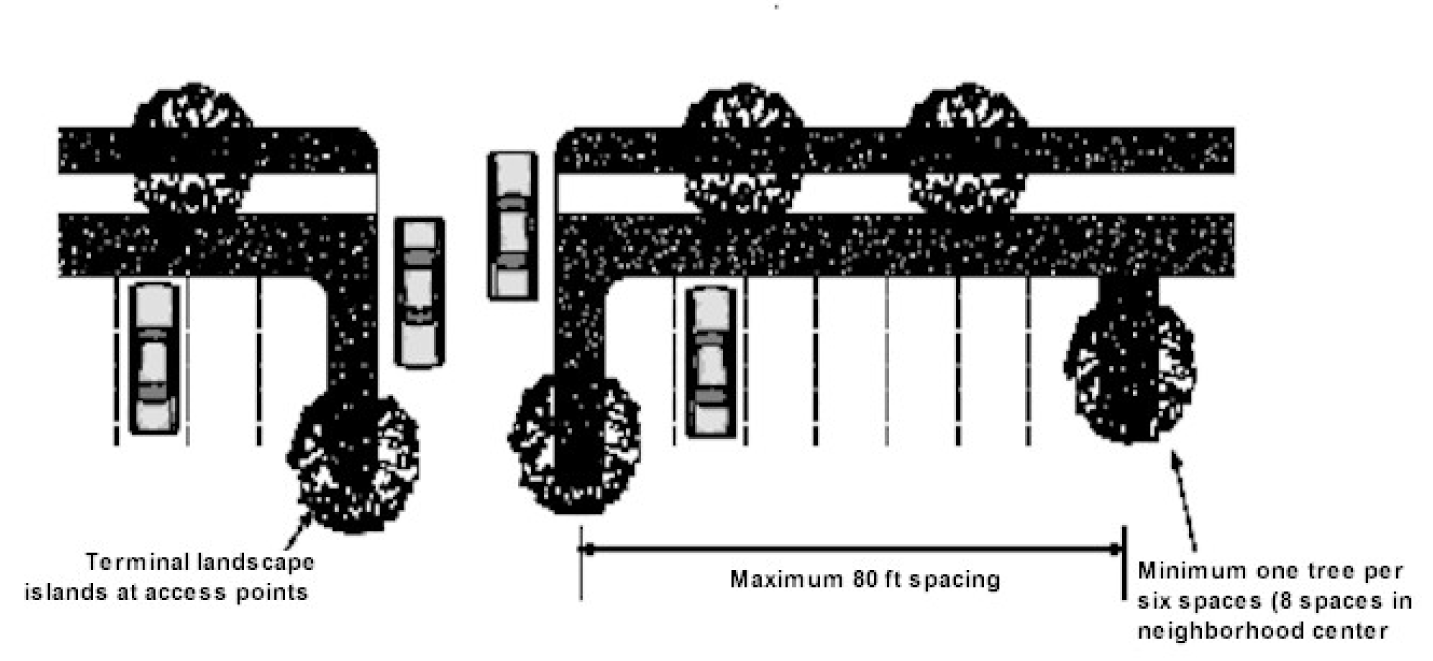
(4)
Street trees. Street trees shall be provided along all sidewalks, subject to the following standards:
a.
Number. One canopy tree shall be planted for every 30 lineal feet of street frontage. Palm trees may be substituted for a canopy tree on a 1:1 basis along a frontage with a covered walkway.
b.
Minimum height. 14 feet.
c.
Minimum diameter. 2.5 inches, measured 4.5 feet above grade.
d.
Spacing. Trees shall be spaced between 25 to 35 feet on center.
Figure 7.11.12 Street Tree Standards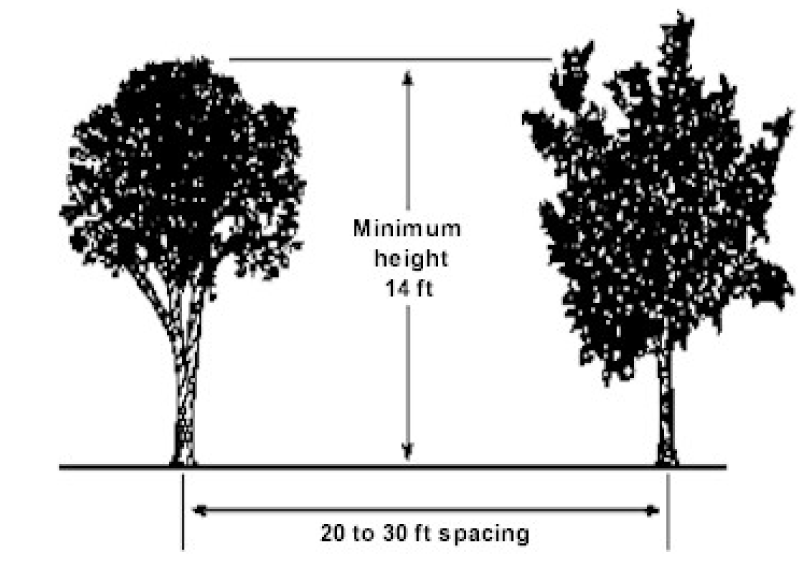
Sec. 7.11.02.05. - Fencing and walls.
Fences and walls shall be subject to the standards of PART 7.07.00: Fences, Walls and Hedges.
Sec. 7.11.02.05. - Signage.
In addition to the regulations set forth in article VIII, the following sign regulations apply:
(1)
Building-mounted signs. Building-mounted signs, including wall signs, awning and canopy signs, and projecting signs are allowed, subject to the standards of article VIII and the following additional requirements.
a.
Maximum size. 0.75 square foot for every linear foot of tenant frontage is permitted, up to a maximum of 64 square feet.
b.
Maximum height. 15 feet high. Signs on an exterior frontage an arterial or collector street are not subject to the height limit.
c.
Maximum projection. 30 inches from any building face.
(2)
Freestanding signs. Unless otherwise provided herein, all freestanding signs shall be prohibited.
a.
Exceptions. Temporary freestanding A-type frame signs are allowed in arcades and covered walkways.
3.
Entrance wall signs. Entrance signs are permitted for traditional developments for the purpose of identifying the development, subject to the standards in article VIII, signs. Entrance wall signs shall be permitted on an entrance wall to the development only. Sign copy and graphics shall identify only the name of the development and the address, and must be attached to the face of the wall.
(4)
Sign plan. In multi-occupancy projects, a sign plan must be submitted as detailed in article VIII.
Sec. 7.11.03.01. - Specific purpose.
The specific purpose of the Traditional Neighborhood District is to:
(1)
Establish a specific neighborhood identity and focus with a pedestrian-oriented design consistent with the tier where the development is located;
(2)
Provide a range of residential, commercial, civic, and open space land uses in close proximity to one another within the neighborhood;
(3)
Lessen existing imbalances in land uses within a specified planning area;
(4)
Encourage walking and bicycling to reduce the use of the automobile for local trips;
(5)
Offer a range of housing opportunities;
(6)
Preserve natural features and scenic areas;
(7)
Provide a safe and efficient circulation system for pedestrians, non-motorized vehicles, and automobiles, and emphasize connectivity within and to adjacent uses; and
(8)
Utilize perimeter landscape and edge areas to connect the various land uses and land use zones within neighborhoods and the surrounding communities.
Sec. 7.11.03.02. - Minimum size.
A TND must contain a minimum of 40 contiguous acres. Within the urban service area, the minimum size may be reduced to 16 acres or smaller if approved for infill projects that are adjacent to existing residential, civic, or commercial development on at least two sides.
Sec. 7.11.03.03. - Uses.
Uses allowed in a TND district are listed in Table 7.11.02.
Sec. 7.11.03.04. - Neighborhoods.
The basic component of a TND is the neighborhood, organized around a neighborhood center. Each neighborhood within a TND shall not exceed 40 acres, and no TND shall include more than four neighborhoods unless the TND is included within a TTD.
Sec. 7.11.03.05. - Land use mix.
TNDs shall provide residential, recreational, civic, and neighborhood commercial land uses, as provided in Table 7.11.07, TND Land Use Allocations. A TND developed as part of a TTD is subject to the minimum land use allocations provided in Table 7.11.10, TTD Land Use Allocations.
Table 7.11.07 TND LAND USE ALLOCATIONS
Sec. 7.11.03.06. - Connections.
All uses in a TND shall be connected by sidewalks or pedestrian paths, bicycle paths or bicycle lanes, and local streets. A minimum of 90 percent of all streets shall connect to other streets at an intersection. All paths or trails, including bicycle paths or lanes, shall interconnect to form a continuous network throughout the TND and to paths or trails in adjacent neighborhoods. Vehicular gates are prohibited on all roads and alleys.
Sec. 7.11.03.07. - Neighborhood center.
The neighborhood center designation is intended to accommodate neighborhood-oriented retail and commercial services. It may include professional offices, community facilities, daycare centers and compatible civic uses, to serve the population of the TND.
Sec. 7.11.03.07.01. - General standards.
(1)
Location. The neighborhood center shall be located within a five-minute walking distance of at least 80 percent of the housing units within the neighborhood and shall be adjacent to a minimum of one side of a neighborhood square.
(2)
Maximum and minimum size. The neighborhood center shall be a minimum of one acre and a maximum of three acres in size.
(3)
Parking. Parking shall be provided in accordance with section 7.03.04, parking lots shall not abut plazas, squares, or parks.
Sec. 7.11.03.07.02. - Building standards.
(1)
Maximum floor area ratio: 0.35.
(2)
Maximum floor area: 40,000 square feet of gross floor area.
(3)
Maximum floor area per establishment: 5,000 square feet.
(4)
Exception: 10,000 square feet is allowed for a food store.
Figure 7.11.13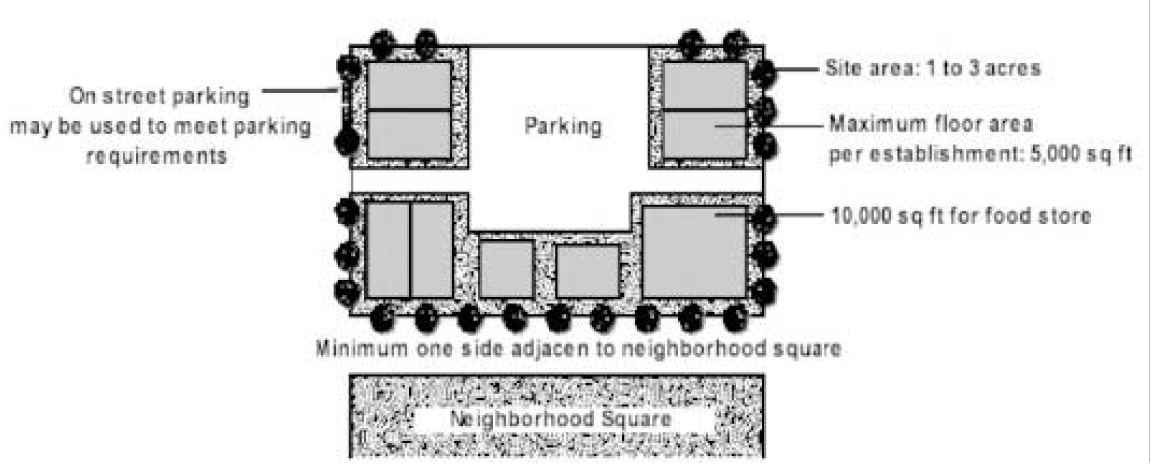
Sec. 7.11.03.08. - Civic/institutional.
The civic designation is intended to accommodate publicly and privately-owned institutional land uses intended to serve the neighborhood.
Sec. 7.11.03.08.01. - Location.
Civic lots used for community buildings shall be located adjacent to a neighborhood square or park, or on a lot terminating a street vista.
Sec. 7.11.03.08.02. - Public land dedication.
Based on the proportional impacts of development on the demand for public services and facilities, a portion of a TND may be required to be conveyed or voluntarily committed in simple fee title to the city commission for civic purposes. These conveyances shall be in a form approved by the city attorney or by a development agreement.
Sec. 7.11.03.09. - Open space/recreation.
Areas designated for open space/recreation include parks, neighborhood squares, and active or passive recreation areas.
Sec. 7.11.03.09.01. - Neighborhood parks.
(1)
Minimum area. A minimum of five percent of the open space/recreation area must be common open space dedicated to the public for parkland. Each neighborhood park shall have a minimum area of 20,000 square feet.
(2)
Location. Neighborhood parks shall be distributed within the TND so that 95 percent of all dwelling units are located within 1,320 feet from a park or other recreation area.
(3)
Minimum pervious area. The minimum required area of a park that must be pervious surface is 50 percent.
(4)
Sidewalk access. A minimum of 50 percent of a park's perimeter shall abut a sidewalk.
Sec. 7.11.03.09.02. - Neighborhood square.
Each TND shall include a neighborhood square. The square and abutting neighborhood commercial uses and community facilities will serve as a focal point for the surrounding residential neighborhoods.
(1)
Required amenities. Neighborhood squares shall include street furniture and other amenities such as gazebos, fountains, kiosks, and benches.
(2)
Size. The square shall have a minimum lot size of 25,000 square feet and a maximum size of 140,000 square feet.
(3)
Street access. A minimum of 50 percent of a square's perimeter shall abut a street right-of-way.
(4)
Sidewalk access. A minimum of 50 percent of a square's perimeter shall abut a sidewalk.
(5)
Minimum pervious area. 40 percent of the square's lot area.
Figure 7.11.14 Neighborhood Park and Square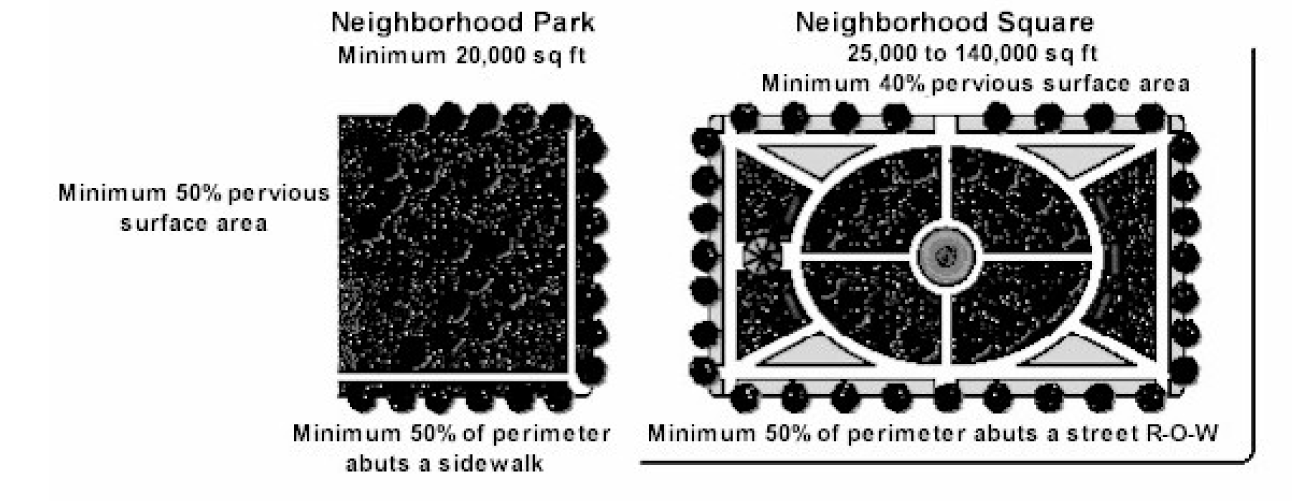
Sec. 7.11.03.09.03. - Active recreation areas.
Recreation uses, including playing fields and swimming pools that tend to generate impacts such as noise and bright lights, shall be buffered by a perimeter landscape area that complies with the compatibility buffers described in section 7.06.03, required buffers. Neighborhood squares with active recreation areas are exempt from this buffering requirement.
Sec. 7.11.03.10. - Development standards.
The following development standards apply to a TND. These standards control the form, placement, scale and massing of blocks and buildings within a TND.
Sec. 7.11.03.10.01. - Residential land uses.
(1)
Block structure. To ensure compact, contiguous development and to facilitate pedestrian accessibility and connections with adjacent land uses, the layout of streets and alleys in a TND shall conform to the following requirements:
(a)
Maximum length of a block.
i.
Single-family residential: 660 feet. (Exception: Up to 750 feet is allowed if a mid-block alley or pedestrian pathway is provided.)
ii.
All other residential types: 500 feet.
(b)
Minimum length of a block: 160 feet.
(c)
Maximum number of alley curb cuts: 4 per block.
Figure 7.11.15 Block Structure - Residential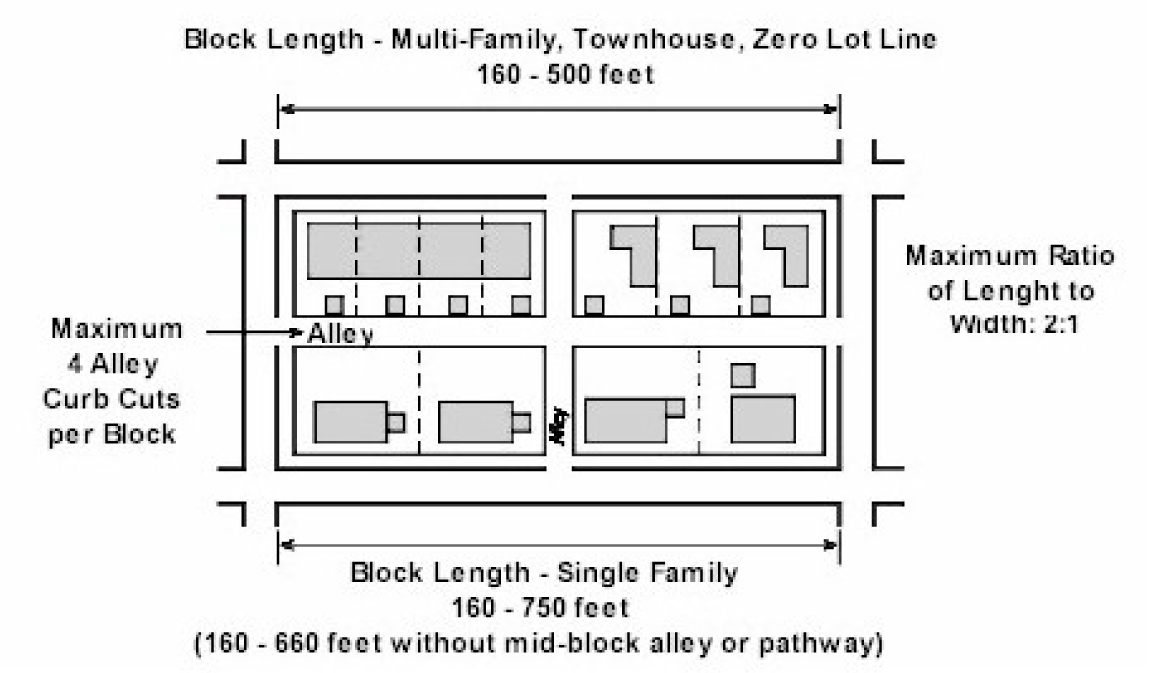
(2)
Lot size and setbacks. Minimum and maximum lot sizes and building setbacks shall conform to the standards in Table 7.11.03, Residential Lot Size and Setback Regulations.
TABLE 7.11.08 RESIDENTIAL LOT SIZE AND SETBACK REGULATIONS
(3)
Maximum building height. 35 feet. (Exception. One foot of additional height may be allowed for multifamily residential buildings for each additional foot of front and side setback provided beyond the minimum setback required, up to a maximum of an additional 10 feet and a total building height of 45 feet.)
(4)
Building orientation. Residential buildings shall front a street, neighborhood square, or small park and be directly accessible from a street.
(5)
Building types. The TND is intended to accommodate a range of housing types that would be interspersed throughout the TND; separate zones with assigned densities are not required. Figure 7.11.05 illustrates residential building types appropriate within a TND.
(6)
Accessory buildings. Accessory buildings shall not exceed 25 feet in height. These buildings may be used as a garage or accessory dwelling.
(a)
Calculation of density. Accessory dwellings are not considered "dwelling units" for the purposes of calculating the maximum allowable density in a TND if the principal building is occupied year-round.
(b)
Maximum number. Up to one accessory dwelling unit per principal dwelling unit is permitted.
(c)
Required parking. One additional parking space per accessory dwelling.
(7)
Garages. Garages are permitted if they are located in the rear half of the lot. Garages accessible from an alley shall be setback a minimum of five feet from the rear property lot line.
(a)
Single-family houses. Garages may be attached to a single-family house if recessed a minimum of 20 feet from the front facade of the house. Attached garages shall occupy a maximum of 30 percent of the total frontage of the house, as defined by the total length between the two main exterior walls nearest to the interior property lines, including the garage but excluding any attached structures, such as a porch, deck or patio.
Figure 7.11.16: Residential Building Types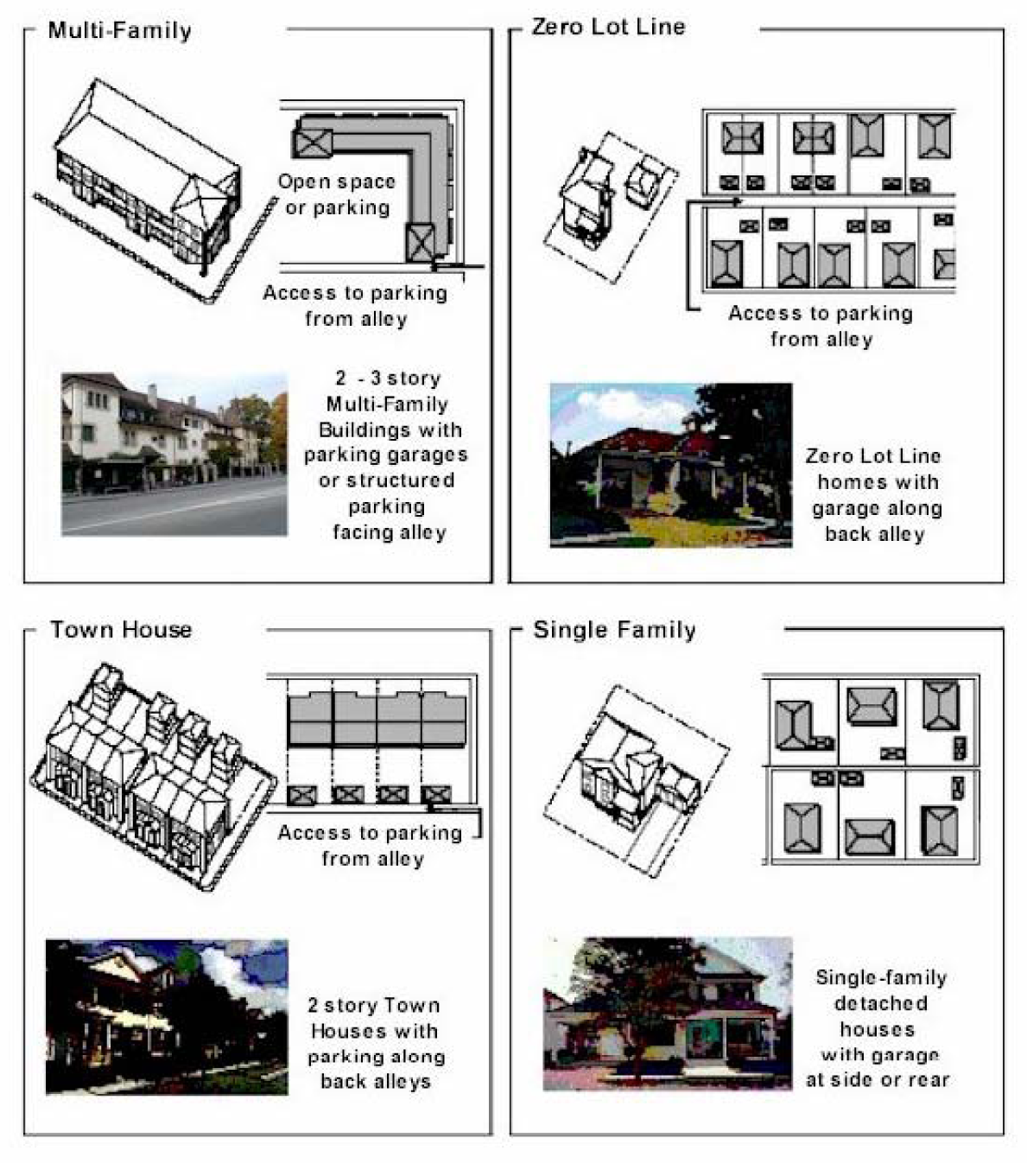
Figure 7.11.17 Garages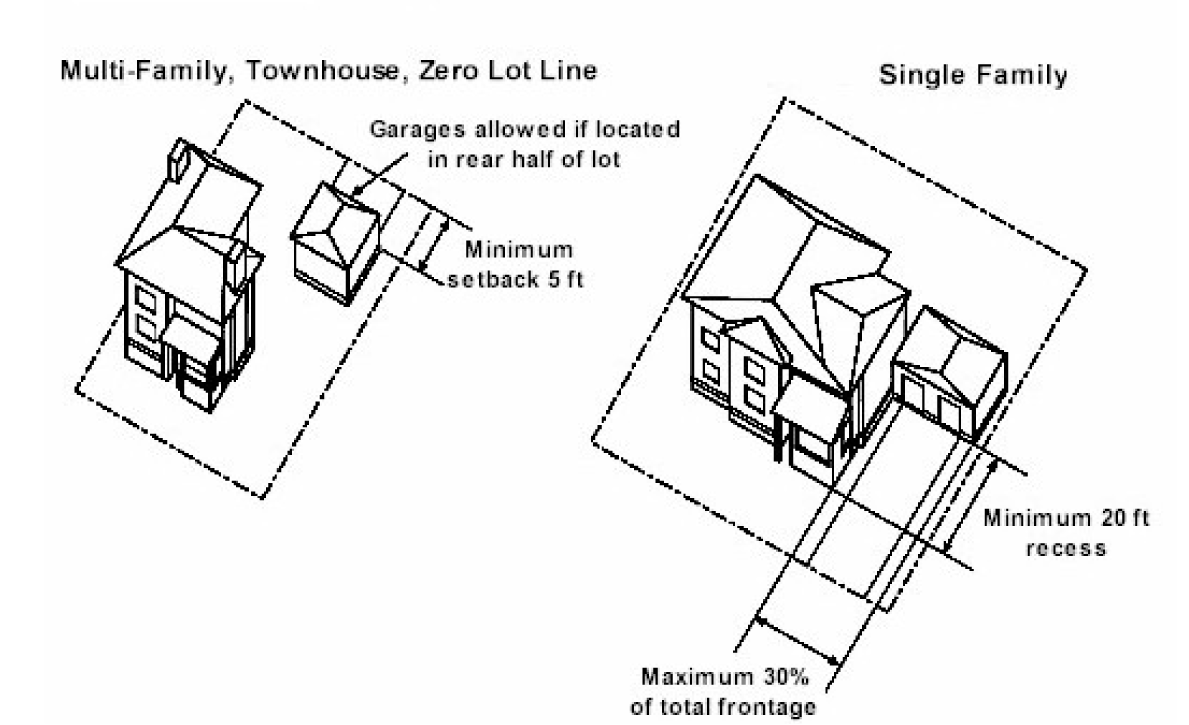
(8)
Main entrances. All principal buildings shall have their main entrance fronting a street. Corner entries at street intersections are preferred for multifamily structures.
(9)
Porches. All single-family dwellings shall have a front porch, raised a minimum of two feet from the finished grade.
(a)
Size. Porches shall have a minimum depth of six feet and a minimum width of 12 feet.
(b)
Enclosure. Porches may be covered or open; however, the front and open sides of a porch shall not be enclosed between three feet and seven feet from the finished floor of the porch.
(c)
Setback encroachment. A balcony may encroach a maximum of six feet into a front or street side setback.
(10)
Balconies and patios. A minimum of 20 percent of the total number of dwelling units on each floor in a multifamily structure shall have individual balconies and/or patios.
(a)
Setback encroachment. A balcony may encroach a maximum of six feet into a front or street side setback.
Sec. 7.11.03.10.02. - Non-residential land uses.
(1)
Block structure.
(a)
Maximum length of a block: 500 feet.
(b)
Minimum length of a block: 160 feet.
Figure 7.11.18 Block Structure - Non-Residential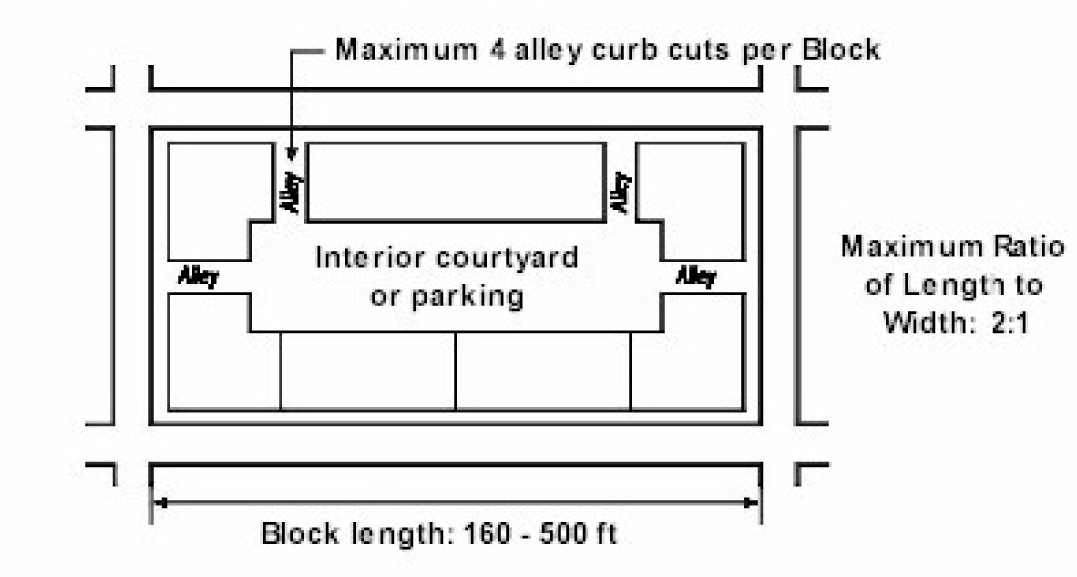
(2)
Setbacks. Minimum and maximum building setbacks shall conform to the standards in Table 7.11.09, Non-Residential Lot Size and Setback Regulations.
TABLE 7.11.09 NON-RESIDENTIAL LOT SIZE & SETBACK REGULATIONS
(3)
Maximum building height: 35 feet. An additional height of five feet is allowed where the roof pitch is greater than 5:12.
(4)
Building orientation. Buildings shall front a street rather than a parking area or alley. All principal buildings shall have their main pedestrian entrance facing the street.
(5)
Build-to lines. A minimum of 40 percent of commercial buildings shall abut the front property line.
(6)
Covered walkways. A minimum of 60 percent of all first floor building frontages shall be constructed as storefronts with covered walkways, with features such as awnings, colonnades, or arcades. Colonnades and arcades shall be at least eight feet in width, including any support column intrusions, and all covered walkways shall have a minimum interior height clearance of nine feet from finished grade.
Sec. 7.11.04.01. - Specific purpose.
The specific purpose of the TMD district is to:
(1)
Provide a concentrated area for shopping, entertainment, business, services and cultural opportunities by allowing a mix of commercial and institutional uses and establishing physical development and design standards that create pedestrian-oriented development;
(2)
Provide housing opportunities through vertically integrated residential uses;
(3)
Promote a mix of uses in a manner that creates a stronger pedestrian orientation through design, placement and organization of buildings, plazas, common public space, and dispersed parking;
(4)
Make traditional marketplaces compatible with the overall design objectives of the Comprehensive Plan; and
(5)
Respect and contribute to the character of the surrounding area.
Sec. 7.11.04.02. - Uses allowed.
Uses allowed in a TMD are listed in Table 7.11.02.
Sec. 7.11.04.03.01. - General standards.
The following standards apply to all TMD's regardless of location:
(1)
Minimum site area. 10 acres.
(2)
Permitted locations. A TMD must have at least 200 feet of frontage along an arterial or collector street.
(3)
Minimum total floor area. 150,000 square feet is required, with a minimum of 50,000 square feet in the first phase.
(4)
Minimum floor area ratio. 0.3.
(5)
Maximum floor area per establishment. No single tenant may occupy more than 50,000 square feet unless approved as a requested use. Single tenants occupying more than 100,000 square feet are prohibited.
a.
Maximum ground floor area per establishment. No single tenant may occupy more than 40 percent of the total ground floor of a commercial or a mixed use building.
b.
Exceptions for civic/institutional uses. Civic and institutional uses are not subject to these floor area limitations.
c.
Maximum frontage per establishment. No single tenant may occupy more than 120 linear feet of frontage to a depth of 40 feet, measured from the store front.
Figure 7.11.19 Maximum Floor Area and Frontage Per Establishment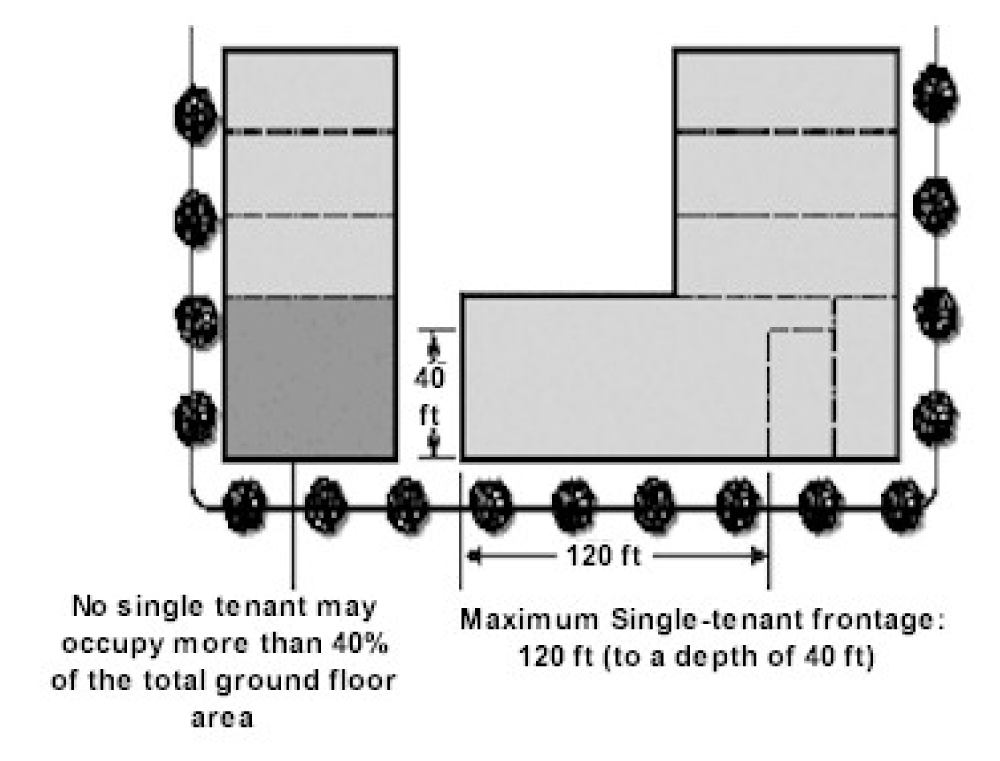
(6)
Residential density/intensity. Residential density is established by the underlying land use and the amount of horizontal or vertical integration allowed in a mixed-use center. Residential uses may be allowed to utilize up to 100 percent of the combination of a site's residential density and its commercial intensity equivalent.
Sec. 7.11.04.03.02. - Street designations and configurations.
(1)
Main Streets. At least one two-way north-south street and one two-way east-west street shall be designated as a Main Street. Main Streets shall cross through the entire length and width of the TMD.
(2)
Sidewalks. Sidewalks are required on both sides of all streets, except alleys and the side of a street abutting a preserve area of a TMD. All sidewalks shall conform to the requirements of section 7.11.02.02(4).
(3)
Alley access. Alley access is not allowed from a Main Street.
(4)
Prohibition of vehicular gates. Vehicular gates are not allowed.
Sec. 7.11.04.03.03. - Building form.
(1)
Maximum building height. 35 feet and 2 stories.
(2)
Maximum number of stories. 2 stories. If residential uses are on upper floors, then the maximum number of stories is three and the maximum height is 45 feet.
Figure 7.11.20 Building Form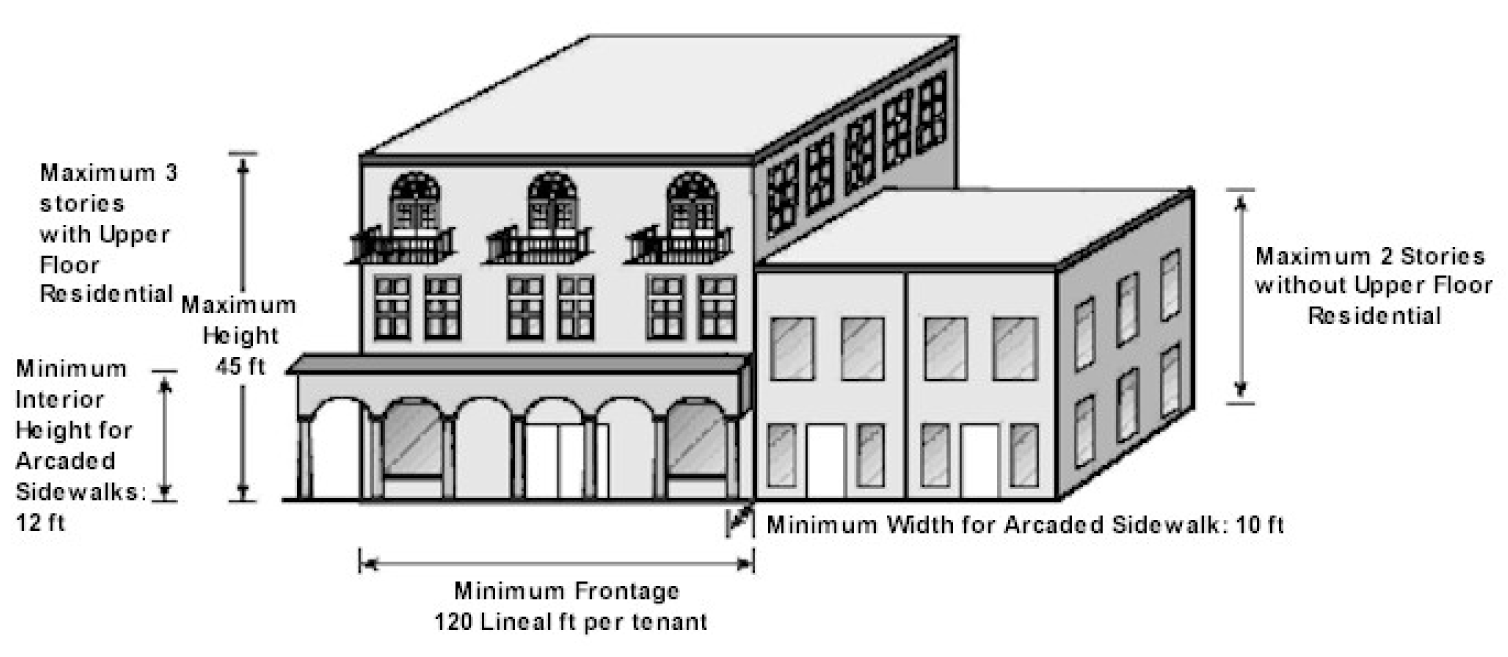
(3)
Frontages. Individual block frontages shall be designated on the master plan as either primary or secondary frontages and shall conform to the following requirements:
(a)
Standards for primary frontages.
i.
A minimum of 60 percent of the length of a Main Street shall be designated as a primary frontage.
ii.
Continuity. Primary frontages shall be continuous, except as follows:
1.
A central plaza or square may be located at the end of a block.
2.
One separation between buildings is allowed for each 120 linear feet of frontage, provided it is located a minimum of 120 feet from the end of a block. The width of this separation shall not exceed:
a.
Twenty feet for pedestrian access to internal parking areas, for off-street loading or refuse collection.
b.
Sixty feet for a mid-block plaza, other than the central plaza.
iii.
Arcaded sidewalks. At least 50 percent of contiguous primary frontages shall have arcaded sidewalks. Arcades shall be at least ten feet in width, including any support column intrusions, and have a minimum height clearance of 12 feet from ground to ceiling. Building floor area is allowed above an arcade. An encroachment permit is required if the arcade extends into a public ROW.
iv.
Build-to lines. All building/structures along a primary frontage shall abut the required utility and pedestrian easements.
Figure 7.11.21 Frontage Designations and Standards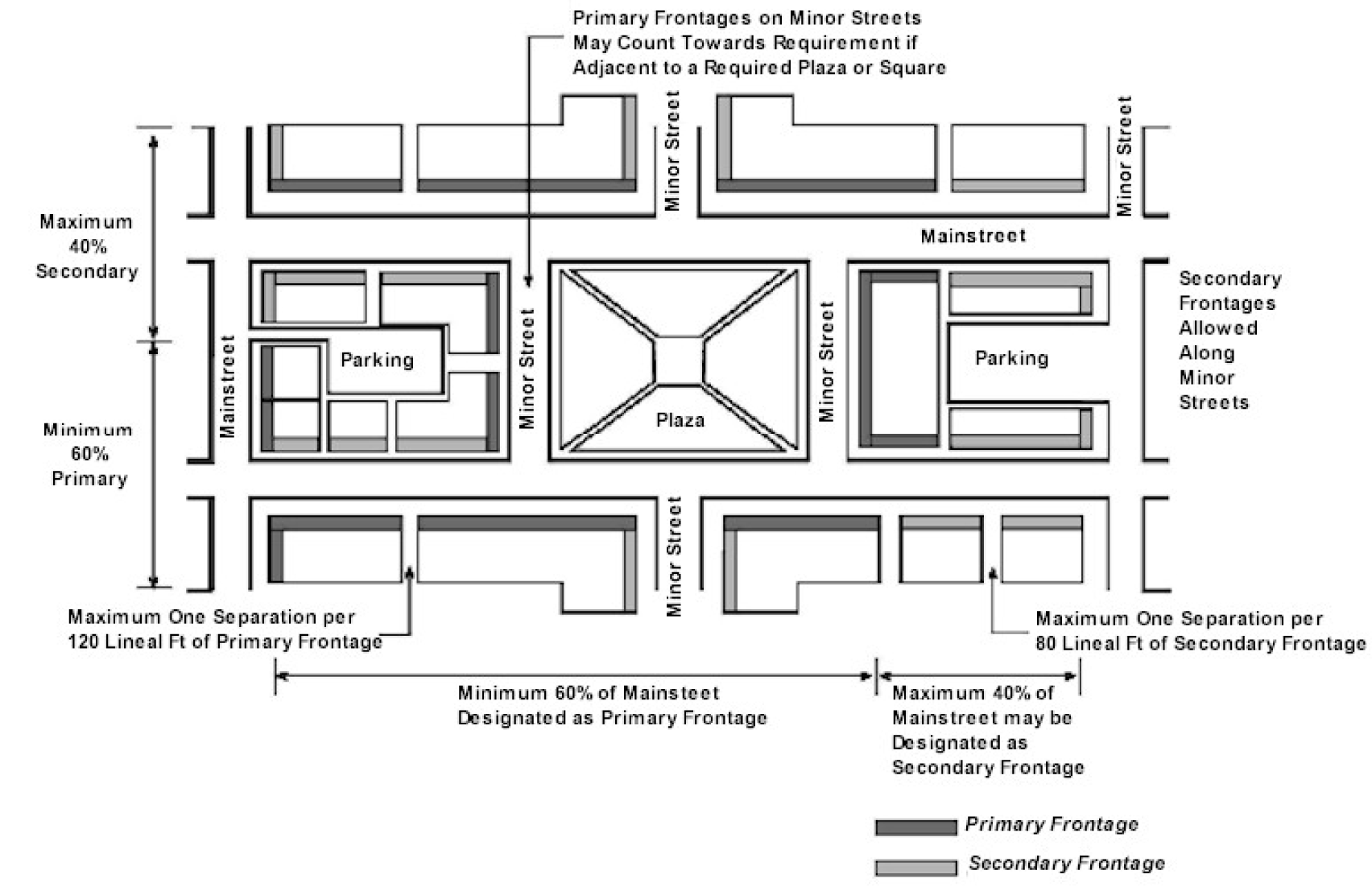
Figure 7.11.22 Traditional Marketplace Development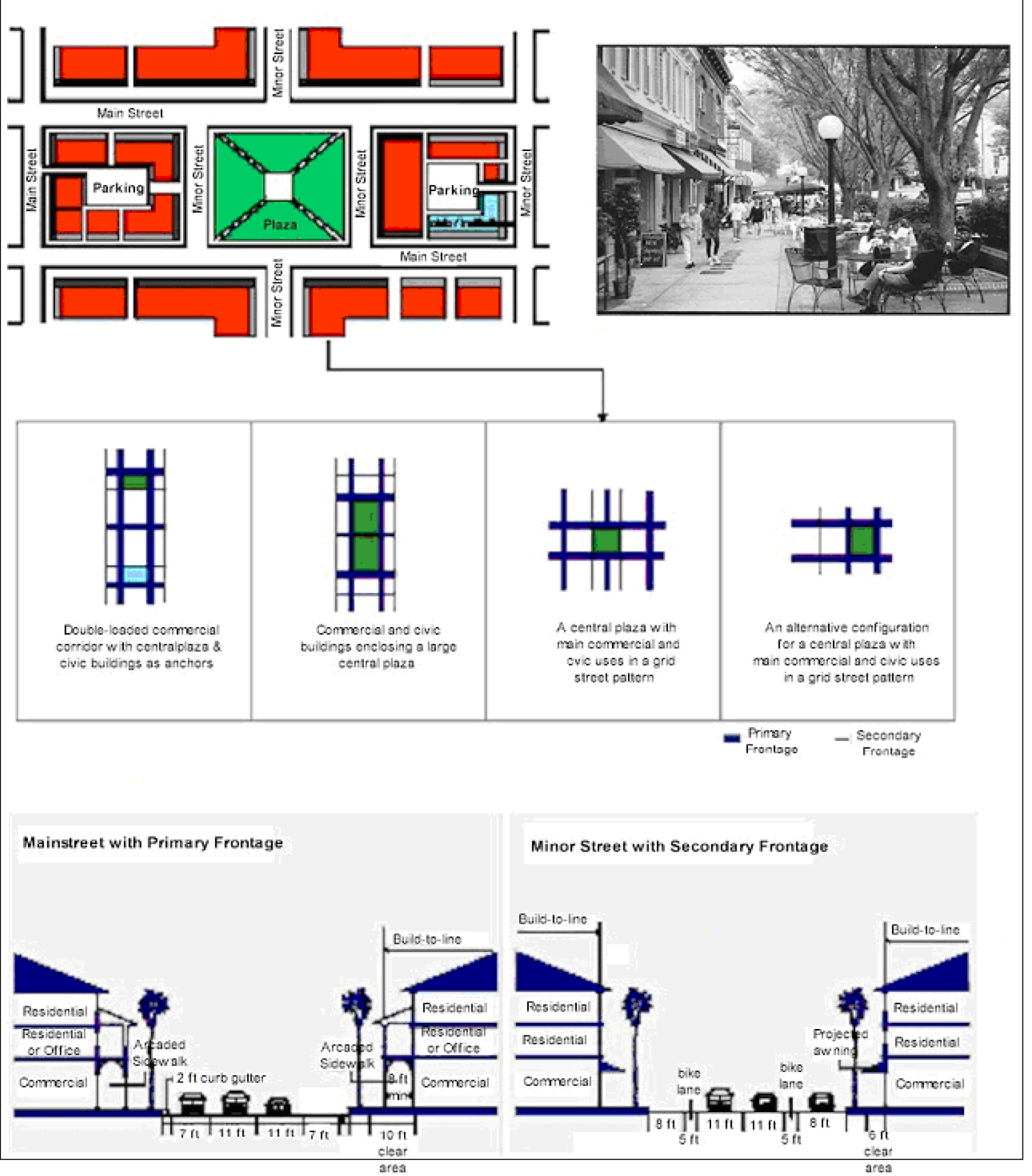
Figure 7.11.23 Primary Frontage Standards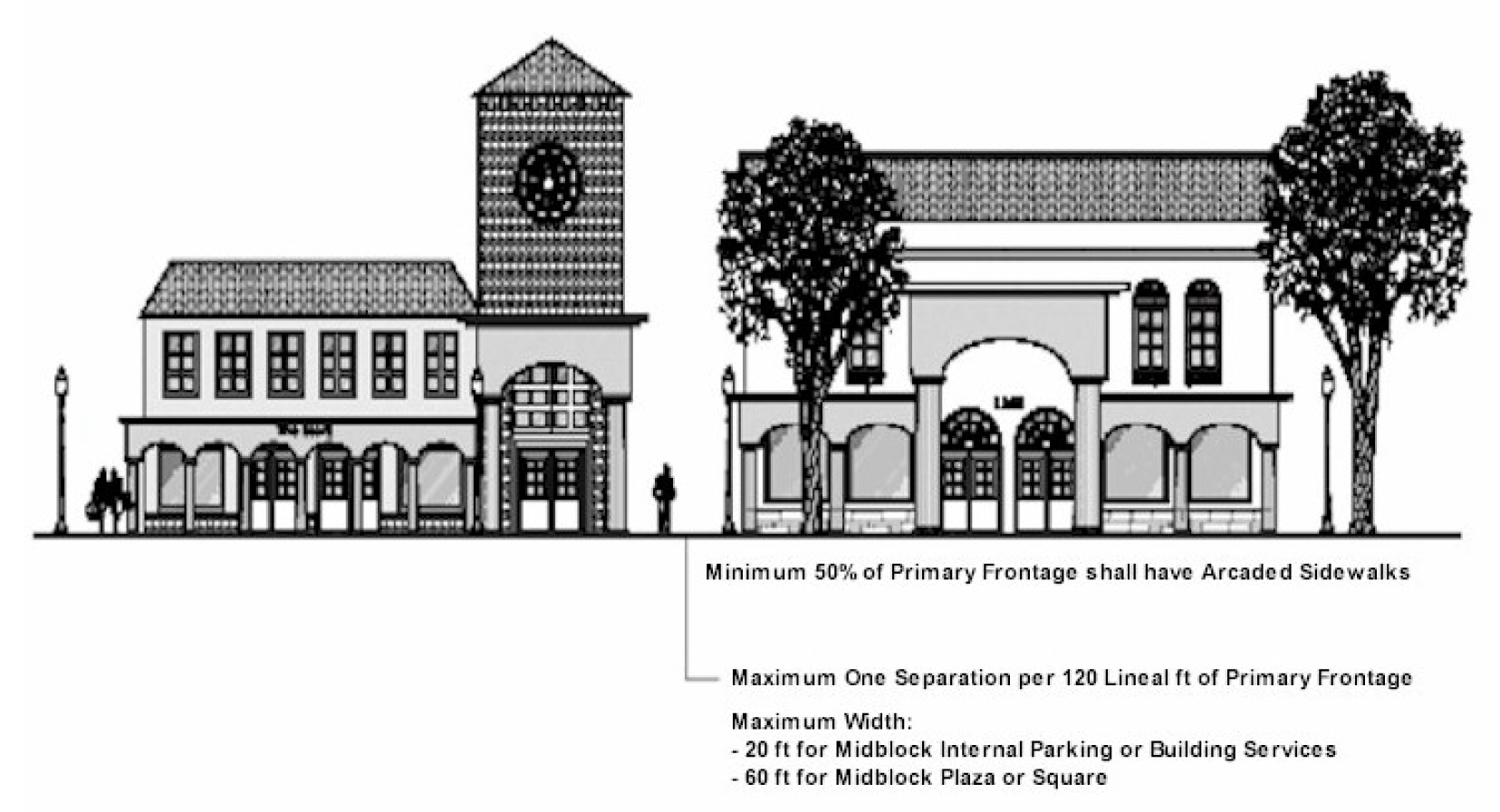
(b)
Standards for secondary frontages.
i.
A maximum of 40 percent of the length of a Main Street may be designated as secondary frontage.
ii.
Separations. Secondary frontages may include physical separations between buildings, as follows:
1.
One separation between buildings for each 80 linear feet of frontage, provided it is located a minimum of 80 feet from the end of a block or from the edge of a plaza.
2.
The width of this physical separation shall not exceed:
a.
Twenty feet for pedestrian access to internal parking areas.
b.
Thirty feet for an alley or vehicular access to internal parking (not allowed along Main Streets).
c.
Sixty feet for a midblock plaza
Figure 7.11.24 Secondary Frontage Standards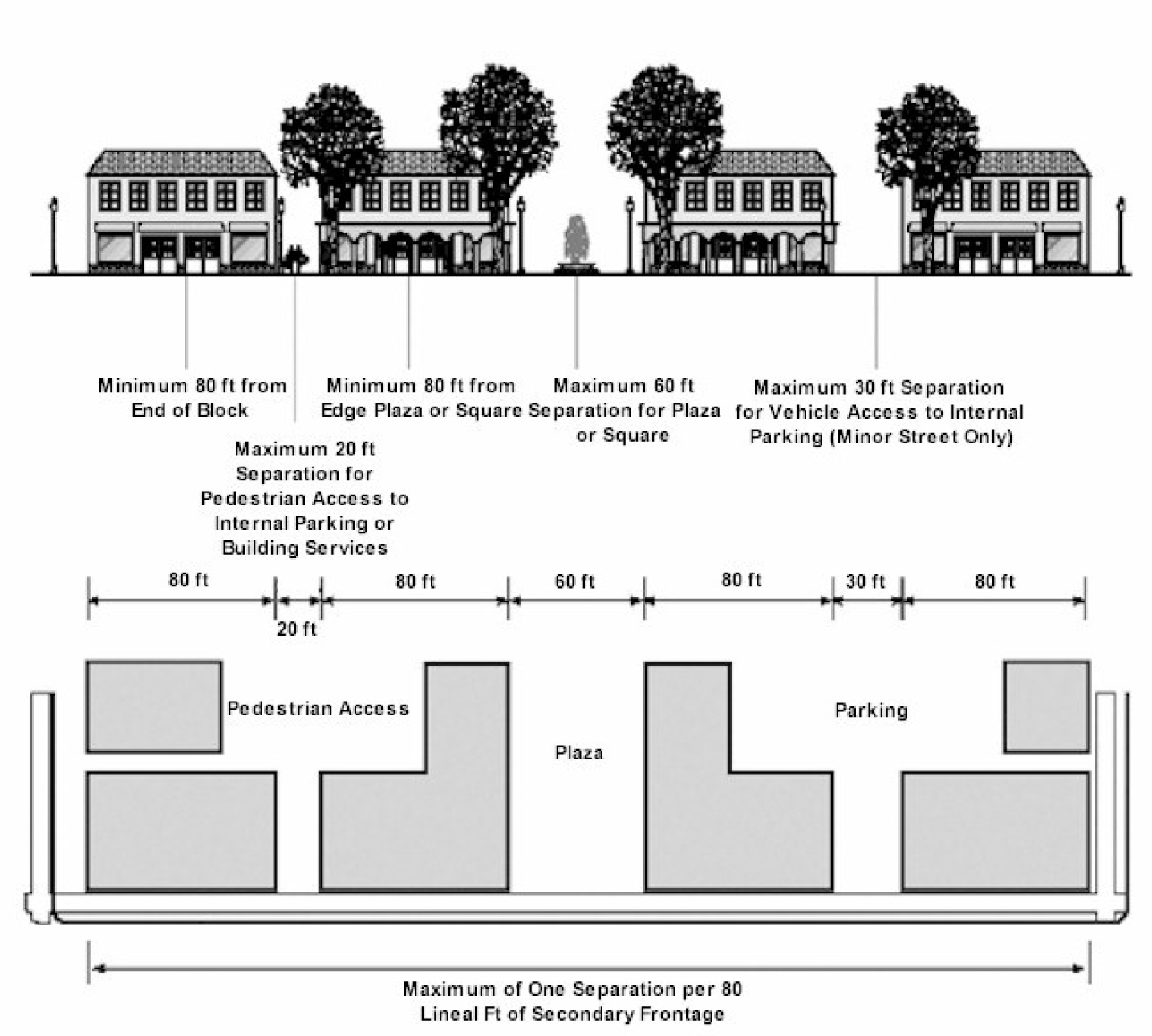
iii.
Build-to lines. All of the building frontage along a designated as Secondary Frontage shall be located within ten feet of the required utility and pedestrian easements.
Figure 7.11.25 Build To Lines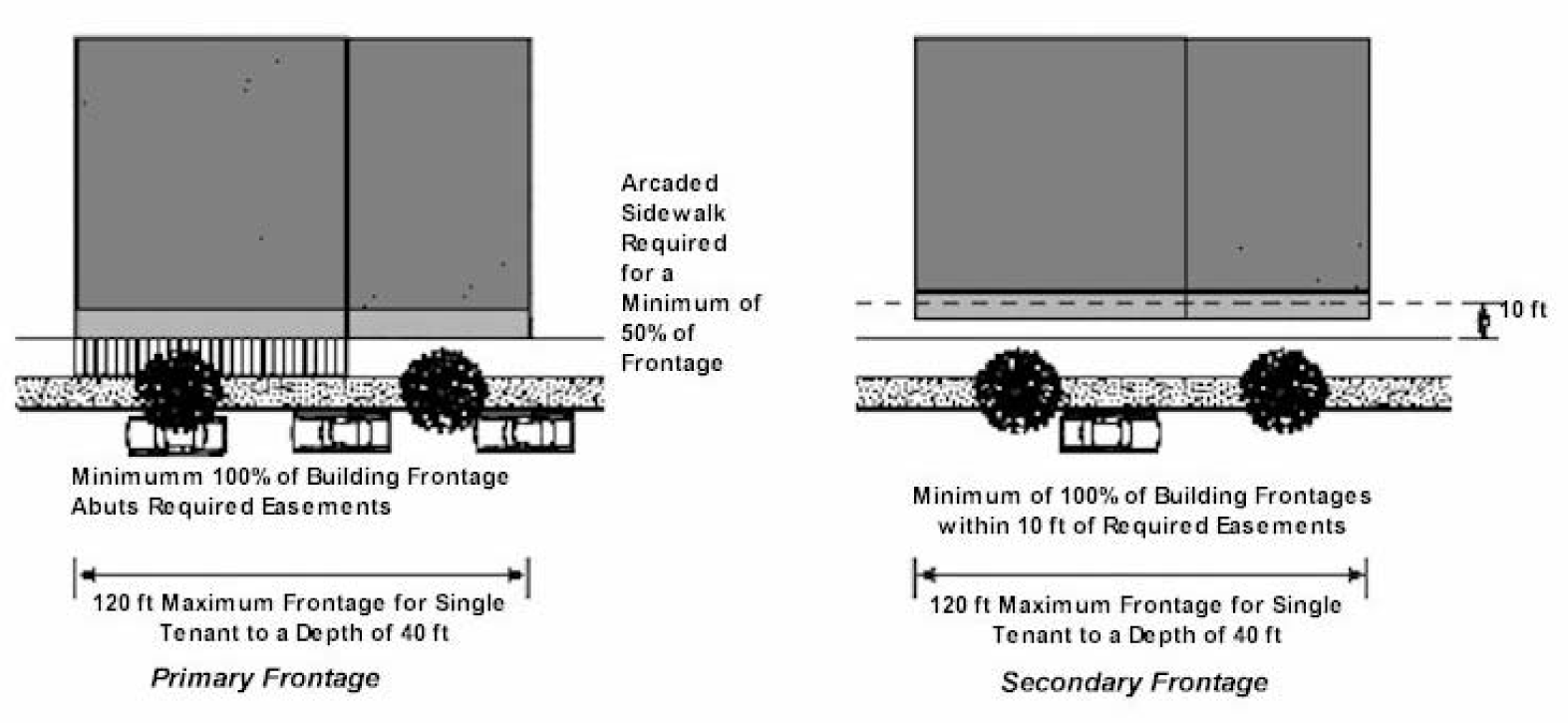
(c)
Standards for perimeter frontages. Exterior frontages on the perimeter of a TMD shall be designed to provide physical orientation for residents and visitors to the TMD and identification for businesses. Views of building entrances, display windows, plazas and squares shall be provided from adjacent arterial and collector streets.
(4)
Pedestrian circulation. In addition to the sidewalk requirements of section 7.11.02.02(4) of this Code, all internal sidewalks shall provide a minimum clear width of six feet.
(5)
Foundation planting. No foundation planting is required where buildings are located along sidewalks.
(6)
Parking. On-street parking is required on both sides of two-way streets and on at least one-side of one-way streets, except within 25 feet of a street intersection or an alley or ten feet of a fire hydrant, or along arterials and planned collectors.
(7)
Plazas and squares. Plazas or squares are required in TMDs to provide a focal point for pedestrians, subject to the following standards:
(a)
Minimum total area. 20,000 square feet or five percent of the gross land area within a TMD, whichever is greater, shall be used for public plazas or squares.
(b)
Minimum size.
i.
Central plaza or square. 20,000 square feet.
ii.
Other plazas or squares. 10,000 square feet.
Figure 7.11.26 Plazas and Squares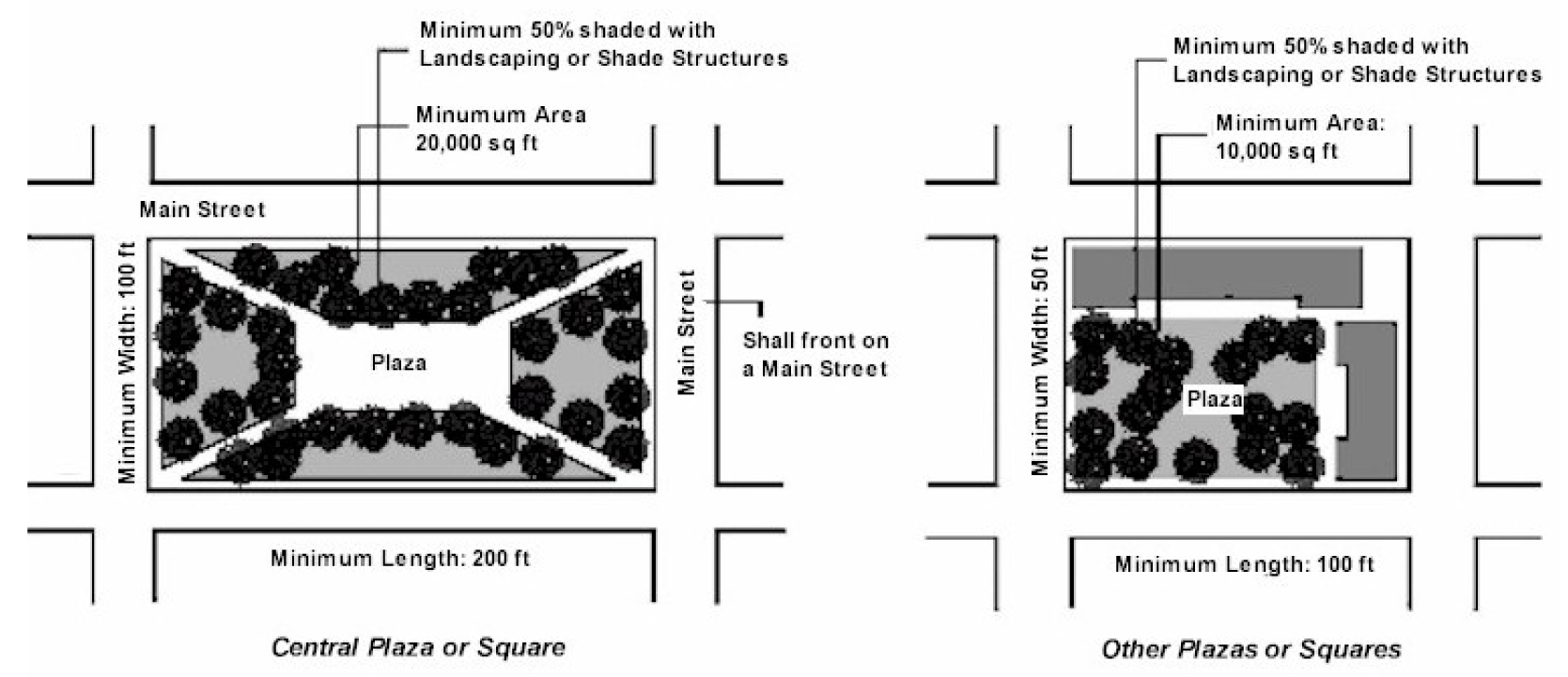
(c)
Required location. All central plazas and squares must be bounded by streets on at least three sides and shall front on a Main Street; other plazas or squares shall be bounded by a street on at least one side.
(d)
Required dimensions.
i.
Minimum length.
1.
Central plaza. 200 feet.
2.
Other plazas or squares. 100 feet.
3.
Central plaza. 100 feet.
4.
Other plazas or squares. 50 feet.
ii.
Minimum depth.
(e)
Required landscaping and pedestrian amenities. At least 50 percent of the plaza or square area shall be shaded by landscaping or shade structures.
(f)
Corner and mid-block plazas and squares abutting buildings. Wherever a plaza or square is bounded by buildings, the building frontages shall conform to the standards for a Primary Frontage, including requirements for arcaded walkways and building.
(8)
Building design.
(a)
Transparency. A minimum of 75 percent of all commercial ground floor façades on primary frontages, 50 percent of commercial ground floor façades on secondary frontages, and 25 percent of the façade on commercial buildings on perimeter frontages, shall be transparent glass, providing views into a commercial use or window display. Windows shall be designed with details such as frames, sills, shutters, planters, relief trim or lintels. Exceptions may be made for uses where alternative fenestration or details are provided, such as architectural treatments, murals, artwork, or stained glass, subject to SPRC approval.
Figure 7.11.27 Building Design Standards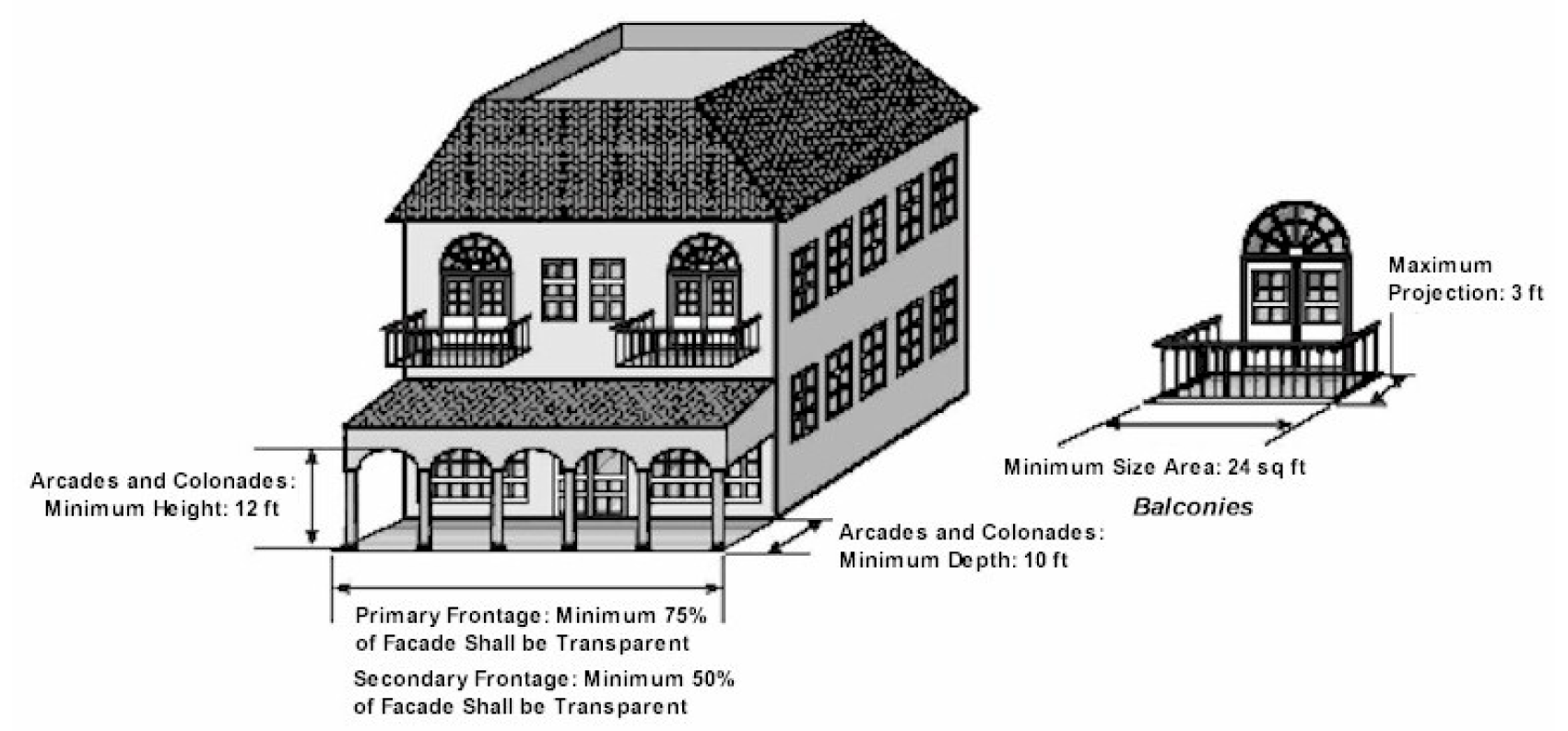
(b)
Balconies. Balconies may project beyond the build-to line, subject to the following standards:
i.
Maximum projection. 3 feet.
ii.
Minimum size. 24 square feet.
(9)
Residential uses. Residential uses may be allowed in a TMD, up to a maximum of 25 units. Residential units, except second-floor units, shall be located a minimum of 500 feet from a commercial use.
Section 7.11.05.01. - Specific purpose.
A TEC is intended to provide for professional office and supporting commercial services within the TTD:
(1)
Provide employment opportunities within close proximity to local residents and within buildings that are pedestrian-oriented and well-integrated into the overall traditional town design;
(2)
Encourage office development that is interconnected with other traditional development districts through a continuous street and pedestrian circulation network; and
(3)
Allow for larger office uses compatible the larger populations of a traditional town development district.
Sec. 7.11.05.02. - Uses allowed.
Uses allowed in the TEC district are listed in Table 7.11.02. A minimum of ten percent of the total TEC land area shall be designated for recreation and open space uses.
Sec. 7.11.05.03. - Development standards.
(1)
Block structure.
(a)
Maximum block length: 500 feet.
(b)
Minimum block length: 160 feet (including alleys).
(c)
Maximum ratio of block length to width: 2:1.
(d)
Maximum number of alley curb cuts: 4 per block.
(2)
Maximum floor area ratio: 0.5.
(3)
Maximum floor area per story: 20,000 square feet.
(4)
Building land use allocation requirements: A maximum of ten percent of the total ground floor area of all buildings on a block may be designated for supporting commercial services (such as a convenience store or a specialty restaurant).
(5)
Minimum building height: 2 stories.
(6)
Maximum building height: 40 feet.
(7)
Building setbacks. Buildings may be setback a maximum of 15 feet from the required utility and pedestrian easements.
(8)
Build-to-lines. A minimum of 50 percent of building frontages shall abut the required utility and pedestrian easements
(9)
Transparency. A minimum of 50 percent of the ground floor building frontages must be transparent glass. Windows shall be designed with details such as frames, sills, shutters, planters, relief trim, or lintels.
(10)
Parking. Off-street parking shall be located behind buildings or on one side of the block. Off-street parking may be located adjacent to street intersections or common use area such as plazas, squares or parks.
Sec. 7.11.06.01. - Specific purpose.
The specific purpose of the Traditional Town Development district is to:
(1)
Provide a framework for the coordinated development of compact, walkable neighborhoods with a well-developed traditional marketplace center and a mixture of office, open space and recreation, and civic uses serving local residents;
(2)
Ensure an interconnected street and pedestrian circulation network that serves the needs of pedestrian, vehicles, and other non-motorized forms of transportation and that functionally and physically integrates the various land use activities;
(3)
Provide for larger-scale community development that retains a strong neighborhood identity through a compatible scale of development, an identifiable center and edge, and well-defined public spaces for recreation and civic activities;
(4)
Accommodate optional development districts to provide additional employment opportunities and housing choices interconnected with traditional neighborhoods and within close proximity to the commercial, civic, and recreation and open space amenities of the traditional town; and
(5)
Make traditional towns compatible with the overall design objectives of the Comprehensive Plan.
Sec. 7.11.06.02. - Organization and applicability.
The requirements of this section, section 7.11.01, general provisions for Traditional Development Districts, and section 7.11.02, standards applicable to all Traditional Development Districts, shall apply to all TTDs. In addition, the components of a TTD shall be subject to the following requirements:
(1)
Traditional neighborhood. The requirements of section 7.11.03, Traditional Neighborhood Development, shall apply to residential land use zones of a TTD.
(2)
Traditional marketplace. The requirements of section 7.11.04, Traditional Marketplace Development, shall apply to the traditional marketplace land use zone in a TTD.
Sec. 7.11.06.03. - Uses allowed.
The uses allowed in the TTD are listed in Table 7.11.02.
Sec 7.11.06.04. - General requirements.
(1)
Minimum site area. 200 acres.
(2)
Minimum development threshold. Any TND or group of TNDs with more than 320 acres shall be developed as a TTD.
(3)
Land use mix. TTDs shall consist of a balanced mix of land uses, including TNDs and TMDs, subject to the minimum land use allocations in Table 7.11.10.
(4)
Connectivity. A interconnected network of streets, and sidewalks or pathways shall be provided that connects all districts within the TTD, and to any adjacent thoroughfare roads. All neighborhood centers and the central plaza of a TMD shall be directly connected by a non-gated street network.
TABLE 7.11.10 TRADITONAL TOWN CENTER LAND USE ALLOCATIONS
1 Regional-serving civic and institutional uses may be located outside a TND but may not be used to fulfill the civic/institutional requirements of a TND as established by Table 7.11.0.
Sec. 7.11.07. - Minimum street construction standards.
All street improvements, whether public or private, shall be designed and constructed to conform to the requirements of the Florida Department of Transportation Standard Specifications for Road and Bridge Construction, latest edition and amendments, the State of Florida Manual of Uniform Standards for Design, Construction, and Maintenance of Streets and Highways, and as set forth in the City of High Springs Manual of Development and Design Standards.
(1)
General requirements.
a.
All streets, whether public or private, shall be designed and constructed in accordance with the requirements set forth herein. Typical street section drawings may be obtained from the city engineer.
b.
Roadway base shall be constructed of Ocala limerock and compacted to 98 percent of maximum density in accordance with AASHTO Method T-180.
c.
Roadway sub-grade shall have a minimum thickness of 12 inches and be compacted to 95 percent of maximum density in accordance with AASHTO Method T-180.
d.
Where soils classified as AASHTO Soil Groups A-6, A-7, or A-8, are encountered in the sub-grade, such materials shall be removed to a minimum depth of 18 inches below base for residential streets and 24 inches below base for collector and arterial streets. The removed material shall be replaced with AASHTO Soil Groups A-1, A-2, or A-3.
e.
The developer shall retain a reputable, recognized commercial testing laboratory which shall certify to the city engineer that all materials and density requirements are in accordance with these regulations:
1.
Sub-grade shall be tested for LBR and field density in accordance with the inspection standards set by the city engineer. Field density shall not be less than 98 percent of maximum density.
2.
Lime rock based course shall be tested for LBR and field density in accordance with the Inspection Standards established by the city engineer. Field density shall not be less than 98 percent of maximum density.
3.
Asphaltic concrete surface course plant mix shall meet Florida Department of Transportation (FDOT) specifications. Extraction and/or stability tests and width and thickness tests may be required by the city engineer.
4.
Roadway embankment shall be tested for field density in accordance with specifications set forth by the city engineer.
f.
Other types of construction and/or materials may be utilized for the base and surface the roadway if equal or greater strength requirements are met, and if approved by the city engineer (for example: colored concrete or brick pavers).
g.
Street name and regulatory signs shall be provided by the developer and shall be of comparable size, design, and quality to street signs used by the city.
h.
Where a residential driveway intersects a paved roadway, the driveway must be paved for a minimum distance of ten feet with concrete or asphalt meeting the standards for residential driveways. As an alternative, a reinforced concrete edging eight inches wide by 12 inches deep extending the full width of the driveway, plus two feet on either side of the driveway, may be installed of
(2)
Drainage systems.
a.
All street classifications may be constructed with a closed (curb and gutter) drainage design. Where closed drainage system is used, standard curb and gutter (FDOT type F) shall be constructed on all collector and arterial streets. Drop-type (Miami) curb and gutter may be constructed on residential streets.
b.
Open (roadside swales) drainage systems may be permitted if the following requirements are met; provided, however, that the City Engineer shall have final approval authority for roadside swales.
1.
Based on the ten-year storm the flow velocity must not exceed three feet per second without paved inverts and the swale flow shall not encroach on the pavement. Roadside swales shall typically have no front slopes steeper than 4:1. Any back slopes greater than 3:1 shall be sodded.
2.
Additional right-of-way may be required to meet design standards for swale section streets.
3.
Non-paved right-of-way of the swale section of streets shall be provided with suitable vegetative cover.
4.
The developer shall provide supporting hydrologic, soils, topographic, and erosion control data deemed necessary by the city engineer in order to determine whether roadside swales are permissible.
5.
Roadside swales shall not be permitted where ground water is within three feet of the proposed final profile of the roadway. Particular caution should be used in areas where the soils encountered are predominantly of Soil Conservation Service Types 7B, 7C, 10, 11, 12, 13, 14, 15, 16, 17, 18, 19, 21, 22, 23, 25, 26, 31B, 31C, 32B, 32C, 32D, 34, 44B, 48, 51, 52, 53, 54, 56, 57B, 60, and 61.
c.
Underdrains shall be constructed parallel to and along one or both sides of the paved surface wherever required to prevent the free ground water table from rising within 12 inches of the bottom of the base material, where determined by the City Engineer after consultation with the developers engineer.
(3)
Roadway surfaces. Roadway surfaces shall be standard FDOT asphaltic concrete mixes. Type S-3 shall be used on residential streets and Type S shall be used on collector and arterial streets.
(4)
Minimum pavement thickness.
a.
Residential streets shall have the minimum pavement thickness of one and one-fourth inches, a minimum base thickness of six inches, and a minimum sub-grade limerock bearing ratio (LBR) of 30.
b.
Collector streets shall have a minimum pavement thickness of one and one-half inches, minimum base thickness of eight inches, and a minimum sub-grade LBR of 40.
c.
Arterial streets shall have a minimum pavement thickness of two inches, minimum base thickness of eight inches, and a minimum sub-grade LBR of 45.
(5)
Drainage requirements.
a.
All drainage pipes shall have adequate capacity to carry the runoff resulting from a rainfall intensity that has a return period of once in three years with a minimum time of concentration of ten minutes. The Florida Department of Transportation rainfall intensity curve for Alachua County shall be used.
b.
Where storm sewers are used, the maximum length of gutter flow shall be governed by the street grade and inlet capacity. Minimum grade for curb and gutter shall be 0.3 percent, except in extreme cases where 0.2 percent may be used; however, 0.5 percent shall be held insofar as practical.
c.
All drainage pipes, including those under driveways, shall be reinforced concrete pipe, except that asphalt coated, galvanized, or aluminum corrugated metal pipe may be installed in areas not under a paved road. Minimum pipe size shall be 15 inches in diameter in a closed drainage system and 18 inches in diameter in an open drainage system. Minimum culvert standards shall be in accordance with those of Alachua County for comparable installations.
d.
All plans shall show, in addition to contours, the outlines, and sizes in acres of drainage areas at the various points of concentration.
e.
All inlet grates shall be cast iron or steel with minimum size of two square feet net open area.
10 Modifications to build-to-line may be approved to be consistent with existing structures on adjoining properties.
11 The provisions of specified in this table may be modified at the discretion of the SPRC for historic properties and landmarks to ensure consistency of appropriateness issued by the Historic Preservation Board.
12 If residential uses are on upper floors, the maximum number of stories is 3 and the maximum height is 45 feet.
13 Up to 100,000 sq. ft. per establishment may be approved as conditional use. Single tenants occupying more than 100,000 sq. ft. are prohibited.
14 No single tenant may occupy more than 120 linear feet of frontage to a depth of 40 ft.
15 An encroachment is required if the arcade extends into a public ROW.
16 Off-street parking credits may be assigned by the SPRC at the Site Plan Review stage.
17 The SPRC may establish a build-to-line for a specific block determined by the following criteria: (a) the build-to-line shall match the dominant building line of the "contributing" (historic) structures within the block where the property is located or (b) if no "contributing" structure exists within the block, the build-to-line shall match the dominant building line of the existing structures within the block where the property is located.
Sec. 7.12.01.- Intent.
It is the intent of these regulations to:
(1)
Create a process permitting the owners of commercial, industrial, public or private buildings within certain zoning districts to engage artists to display their mural art on their buildings.
(2)
Permit and encourage murals that:
a.
Are sufficiently durable and will be properly maintained;
b.
Are located on appropriate places on buildings and constitute a particular scale of the building façade;
c.
Do not include any unsafe features or would not pose any unsafe conditions to vehicular or pedestrian traffic;
d.
Provide avenues for artistic expression; and
e.
Are assets to the community.
(3)
The regulations and permit requirements set forth in this chapter are also intended to promote public safety and welfare by establishing the following:
a.
That the design, construction, installation, repair, and maintenance of the displays will not unnecessarily interfere with traffic safety or otherwise endanger public safety.
b.
That this regulation will provide reasonable protection by controlling the size and locations of such displays.
c.
That the public will enjoy the aesthetic benefits of viewing such displays in numbers and sizes that are reasonably and objectively regulated.
d.
That the city will not consider the content of the mural in the permitting process.
(Ord. No. 2022-13, § 2, 12-8-2022)
Sec. 7.12.02. - Definitions.
For the purpose of this chapter, the following definitions apply:
Applicant is any person or entity who is applying for a mural permit pursuant to this chapter.
Maintenance with respect to artwork means the required repairs or cleaning to keep a work of art in its intended condition, including preventative maintenance at scheduled intervals to curtail future deterioration, and ordinary repairs or maintenance, including but not limited to, painting, repair or replacement.
Mural means a painting or other work of art temporarily or permanently affixed to a privately owned building. A "mural" is not a "sign" under the city's sign code. Any part of a "mural" that contains a commercial message shall not be included within the definition of "mural" and shall therefore comply with any applicable provisions of the city sign code.
Mural permit means the permit allowed by this chapter once all criteria described herein has been met
Mural permit fee means the permit application fee paid for a mural permit. The commission shall establish a mural permit fee by resolution, as amended from time to time.
Primary façade typically is the façade of the building which is most nearly parallel to the widest street to which the building faces. It is usually the exterior side of a structure which contains a principal pedestrian entrance and is oriented toward a street. It is usually the side of a building facing a public street. For corner lots, the street facing side with the primary customer entrance is the primary façade.
(Ord. No. 2022-13, § 2, 12-8-2022)
Sec. 7.12.03. - Mural permit application.
(1)
No person, firm, corporation or other entity may authorize, erect, construct, maintain, move, alter, change, place, suspend, or attach any mural within the city prior to obtaining a permit as set forth herein. Such permit shall be known as a mural permit.
(2)
An application for a mural permit shall be filed by a building owner with the planning department by way of a form prepared by the planning department and shall include the following:
(a)
Name of the artist and the owner. Street address and location of the proposed mural.
(b)
Description of the materials to comprise the proposed mural and manner of application
(c)
Statement regarding durability of the materials considering the location and positioning of the proposed mural.
(d)
Plans and specifications for the proposed mural including a concept picture, graphic and other description. The application should include clear and legible drawings with description showing the location of the mural. Drawings should show the dimensions and materials. Color photos of the building must accompany the mural sketch, showing the wall to be painted in relation to adjacent streets and buildings.
(e)
Statement that no compensation will be given or received for the right to display the mural or the right to place the mural on the property. The artist may be compensated for the completion of the mural, however.
(f)
The applicant shall pay all costs associated with public hearing notifications.
(g)
Artist must acknowledge the mural is not subject to 17 U.S.C. §§ 106A and 113(d) (Visual Artist Rights Act).
(h)
Applicant's agreement to allow the city or the building owner to remove the mural with 90 days' notice to the applicant if the mural is not maintained (as described above), or if it becomes a safety hazard.
(i)
Signed acknowledgement by the applicant to abide by all mural requirements and execute all necessary documents.
(j)
Proof of payment of the mural permit fee.
(Ord. No. 2022-13, § 2, 12-8-2022)
Sec. 7.12.04. - Mural permit application review.
(1)
The mural permit application shall be submitted to the planning department for review, and then to the city commission for final decision. The planning department review shall be completed within 20 days; provided, however, that the planning department is authorized to utilize additional time for good cause, with notice to the applicant stating the basis for the delay. Thereafter, the city commission must complete its review in 30 days.
(2)
Planning department review criteria: The planning department shall review the mural application for the following criteria:
a.
Completeness. The planning department shall first determine that the mural application provides all the requisite information outlined in section 7.12.03. The planning department will reject any incomplete application. The 20-day review process shall not commence until a complete mural application has been submitted to the planning department.
b.
Zoning compliance. Murals are only permitted in non-residential zoning districts.
c.
Historic districts. In addition to the criteria outlined in section 7.12.03, any mural application for a mural in a historic district is also required to comply with the provisions set for in section 7.12.05 below.
d.
Mural location on building. A mural must be located on only one façade of a building. A mural may not be placed on the primary façade of the structure. Exceptions from this paragraph can be applied for, reviewed by the planning department, and approved by city commission, when the nature of the business is creative, artistic or some other special circumstance is presented.
e.
Mural materials.
i.
The mural must be durable, permanent and protected from vandalism and weathering; consideration shall be given to the structural and surface integrity and stability of the building façade.
ii.
The mural surface must be prepared with an outdoor primer to ensure good adhesion for the artwork.
iii.
Clear, anti-graffiti coating must be applied over the completed artwork.
f.
Mural size. 100 percent of a blank wall can be painted if the mural is up to 15 feet high or less. Fifty percent of a blank wall can be painted if the mural is up to 20 feet high or less. The maximum height for any mural shall be limited to 20 feet from ground level.
g.
Mural text. Commercial text is not permitted and is subject to the sign code.
h.
Any licensed, copyrighted, or trademarked characters or likenesses used on murals must have permission from the holder or owner of the license, copyright or trademark.
i.
No approval shall be issued for mural installation if there are outstanding code enforcement violations charged by the city on the property where the mural is to be located. Outstanding debts to the city must be paid in full prior to issuance of the mural permit.
(3)
The city commission will review the recommendation of the planning department and make the final decision based on the criteria in paragraph (2) of this section.
(4)
Persons aggrieved by the decision of the city commission may appeal that decision to a court of competent jurisdiction.
(Ord. No. 2022-13, § 2, 12-8-2022)
Sec. 7.12.05. - Murals in historic district.
(1)
As a matter of public policy, the historical, cultural, archaeological, aesthetic, and architectural heritage of High Springs are among the most valued and important assets and the preservation of this heritage is essential to the promotion of the health, prosperity, education, understanding and appreciation of historical properties as well as the general welfare of the people. (See Article III, Part 3.02 of the Land Development Code.) Accordingly, in order to preserve the historic nature of historic buildings and historic districts within the city, it is necessary to impose additional requirements for a mural that will be located on a local historic property or in a local historic district (as classified by Article III, Part 3.02 of the Land Development Code). The historic preservation board review shall be completed within 20 days of an application deemed complete containing all of the information required pursuant to section 7.12.03 and this section; provided, however, that the historic preservation board is authorized to utilize additional time for good cause, with notice to the applicant stating the basis for the delay. Thereafter, the city commission must complete its review in 30 days.
(2)
In the event that a mural application requests a permit for a mural on a local historic property or in a local historic district, the application shall proceed first to the historic preservation board for a certificate of appropriateness. In addition to the review guidelines outlined in section 3.02.08 of the Land Development Code, the following criteria shall be considered when determining whether to grant, grant with conditions or deny a certificate of appropriateness for a mural on a local historic property or in a local historic district:
a.
Materials. The placement of the mural shall be reviewed to ensure that it doesn't compromise or damage the historic fabric of a building. Murals shall not be painted on historically original or unpainted brick and stone surfaces, in order to preserve the historic fabric that brick and/or stone represents. Installation may not permanently damage the building and may need to be reversible in order to protect a historic resource.
b.
Location. Review on the placement of the mural is required in order to ensure the location of the mural would not detract from the overall character and distinctive architectural features.
(3)
It shall not be necessary for an applicant to submit a mural application to the planning and zoning board when it is necessary for the applicant to submit the same application to the historic preservation board.
(Ord. No. 2022-13, § 2, 12-8-2022)
Sec. 7.12.06. - Mural notification.
(1)
The planning department or designee shall keep an updated map and permit records/photos depicting the locations of all approved mural permits.
(2)
The city shall create a section on the city website that includes the permit records/photos depicting the locations of all approved mural permits.
(Ord. No. 2022-13, § 2, 12-8-2022)
Sec. 7.12.07. - Prohibited murals.
The following murals are prohibited in the city:
a.
A mural that covers more than one single facade of a building, unless as provided for in section 7.12.04(2)(e).
b.
A mural that violates federal, state or local law.
(Ord. No. 2022-13, § 2, 12-8-2022)
Sec. 7.12.08. - Permit expiration and extension.
(1)
Except as provided in subsection (2) below, if installation of the permitted mural has not taken place within 12 months of the date of issuance of the mural permit, the permit is void and no further work on the mural may be done at the site until a new permit has been approved and new fee paid.
(2)
An approved mural permit may be extended by the planning department for an additional period of no more than 12 months upon the planning department finding that the applicant was unable to begin or continue the installation of the approved mural for reasons beyond his or her control. A request for permit extension must be in writing and must be received by the planning department before the original permit expiration date.
(Ord. No. 2022-13, § 2, 12-8-2022)
Sec. 7.12.09. - Mural maintenance.
(1)
The applicant is responsible for ensuring that a permitted mural is maintained in good condition and fully repaired in the case of vandalism or accidental destruction.
(2)
Failure to maintain the mural is declared to be a public nuisance. The city may pursue remedies to obtain compliance with this section as appropriate, including removal of the mural.
(3)
In addition to other remedies provided by law, in the event the property owner fails to maintain the mural, the city may perform all necessary repairs or removal of the mural, and all costs incurred by the city shall become a lien against the property.
(Ord. No. 2022-13, § 2, 12-8-2022)
Sec. 7.12.10. - Mural alterations.
In order to make alterations to a mural, the applicant must obtain a new mural permit.
(Ord. No. 2022-13, § 2, 12-8-2022)
Sec. 7.12.11. - Removal or replacement of murals; violations; enforcement.
(1)
Murals installed in accordance with this section shall remain on site in the approved location and cannot be altered, replaced or removed except as provided in this section, or when deemed to be unsafe by the city building official, or when the city determines replacement is necessary due to damage from natural disasters.
(2)
Removal of murals; violations, enforcement. This section may be enforced in accordance with the code enforcement procedures in chapter 2, article V of the Code of Ordinances. Should an approved mural become deteriorated, or otherwise no longer satisfy the terms of the permit, enforcement shall include the city's right to enter upon the property and abate by such reasonable action as necessary to remove or restore the mural, in the city's discretion.
(a)
Costs of abatement by the city. Upon the city's abatement of the mural, the costs, including the administrative costs incurred by the city, shall be assessed by the special magistrate against the real property from which the mural was removed, together with any fine imposed by the special magistrate, all of which shall become a lien against the real property in accordance with section 2-162 of the Code of Ordinances.
(b)
Alternative remedies. Nothing in this section shall in any way limit the city to the remedy listed above. This remedy shall be in addition to any other remedy which the city can legally pursue, including, but not limited to, code enforcement measures under chapter 2, article V of the Code of Ordinances.
(Ord. No. 2022-13, § 2, 12-8-2022)

