High Springs City Zoning Code
ARTICLE VIII
SIGNS
Sec. 8.01.01.- Permit required.
Unless specifically exempt in accordance with section 8.01.04 of this LDC, all signs must have a permit prior to construction or installation. Most signs will also require a building permit.
(1)
When a sign permit and building permits are both required, the building permit will serves as both.
(2)
All sign permit applications will be free of charge, unless they are also building permits, in which case standard building permit fees will apply.
Sec. 8.01.02. - Definitions.
Advertising balloon. An advertising balloon is any balloon, inflatable structure, or object of any size, containing a display or advertising, or used to direct attention to a place of business. See Figure 23.1.
Bedpost sign. A sign constructed so that the main body of the sign is suspended between two posts, with a gap not more then 24 inches between the bottom of the sign face and the ground. The sign may be single or double faced, with no separation between the two faces. See Figure 23.2.
Ground mounted sign. A sign that is constructed so that there no more than a 24-inch gap between the sign face and the ground. See Figure 23.3.
Ground mounted hanging sign. A sign that is suspended from a single projecting arm, with no more than 24 inches between the bottom of the sign face and the ground. See Figure 23.4.
Monument sign. A sign constructed so that the base of the sign is at a minimum ten percent larger then the Face of the sign, and has no gap between the sign face and the base, or between the base and the ground. See Figure 23.5.
Pole sign. A pole sign is a sign that is constructed so that the sign face is attached to a pole or poles, suspended above the ground. See Figure 23.6.
Sandwich sign. A sign composed of two halves, attached at the top, which form an "A" shape, and are self-supporting, or free standing, and are not attached to the ground or any other building or device. See Figure 23.7.
Snipe sign. A temporary sign, placed along a road or in front of a building, which is not specifically exempted in this code. These signs are typically constructed of lightweight, non-durable material, and affixed to the ground via wire frames implanted in the soil. These signs do not meet wind loading, and are not permanently affixed. See Figure 23.8.
Sec. 8.01.03. - Measurement determinations.
(1)
Distance between signs shall be measured along street rights-of-way from the closest parts of any two signs.
(2)
Facade area shall be measured by determining the area within a two dimensional geometric figure coinciding with the edges of the walls, windows, doors, parapets, marquees, and roof slopes of greater than 45 degrees that form a side of a building or unit.
(a)
The area of a sign shall be the area within the smallest geometric figure, the sides of which touch the extreme points or edges of the sign face.
(b)
Where a sign is composed of letters or pictures attached directly to the facade, window, door or marquee, and the letters or pictures are not enclosed by a border or trimming, the sign area shall be the area within the smallest geometric figure, the sides of which touch the extreme points of the letters or pictures.
(c)
Where two sign faces of identical size and shape are placed back to back on a single sign structure, and the faces are at no point more than three feet apart, the area of the sign shall be counted as the area of one of the faces and shall be counted as one sign.
(d)
Where a sign has four faces arranged in a square, rectangle or diamond, the area of the sign shall be the area of the two largest faces and shall be counted as two signs.
(e)
Where a sign is in the form of a three dimensional object, the area shall be determined by drawing a geometric figure, the sides of which touch the extreme points or edges of the projected image of the sign, and multiplying that area by two. The projected image is that image created by tracing the largest possible two-dimensional outline of the sign.
(3)
Sign height shall be the vertical distance from the finished grade at the base of the supporting structure to the top of the sign, or its frame or supporting structure, whichever is higher.
Sec. 8.01.04. - Exempt signs.
The following signs are exempt from the operation of this LDC provided they are not placed or constructed to cause a hazard of any kind:
(1)
One sandwich or snipe signs of six square feet or less, and signs that include no letters, symbols, logos or designs in excess of three inches in vertical or horizontal dimension, provided that such sign does not constitute a prohibited sign under section 8.01.05 of this LDC. In addition to other lawful display, exempt signs defined in this subsection may be displayed from open of business to close of business, in a portable fashion on a public sidewalk or in front of the main entrance, or lawn of the business establishment advertised on the sign. The size of all such sidewalk signs shall be further governed by section 8.01.03(1)c. above.
(2)
Signs erected on public property with the approval of the appropriate public agency owning or administering the property.
(3)
Signs not visible from the street or adjoining property.
(4)
Legal notices and official instruments.
(5)
Signs for governmental purposes.
(6)
Flags or insignias of governmental, religious, charitable, fraternal or other nonprofit organizations provided that the flag shall be in relation to the height of the flagpole and the maximum width of any flag shall be twenty percent of the total height of the flagpole. Flags erected or authorized by the municipality attached to governmental light fixtures, secured with appropriate devices. All governmental or International flags must follow U.S. Government Flag Regulations, or the appropriate International Flag regulations with regards to raising, lowering, and care.
(7)
Holiday lights and decorations that do not constitute advertising.
(8)
Merchandise displays behind storefront windows, provided no part of the display contains flashing lights.
(9)
Memorial signs or tablets, names of buildings, and dates of erection when cut into any masonry surface or when constructed of bronze or other incombustible materials and attached to the surface of the building.
(10)
Signs incorporated into machinery or equipment by a manufacturer or distributor, which identify or advertise only the product or services dispensed by the machine or equipment, such as would be customarily affixed to vending machines, newspaper racks, telephone booths and gasoline pumps.
(11)
Advertising and identifying signs attached or adhered to taxi cabs, buses, trailers, trucks or vehicle bumpers, excluding parked vehicles whose primary purpose is advertising.
(12)
Public warning signs to indicate the dangers of trespassing, swimming, animals or similar hazards.
(13)
Works of art that do not constitute advertising.
(14)
Signs carried by a person so long as the sign's message does not constitute advertising.
(15)
Temporary campaign signs.
(16)
Vehicle tow-away signs pursuant to F.S. § 715.07.
(17)
"Open" signs, so long as they are four square feet or less, and are of a steady illumination and do not flash, blink, move, or appear to be animated and so long as they are clearly designed to show the establishment is open, and constitute no other form of advertising. These signs may be illuminated from the open of business, to the close of business.
(18)
Open flags, so long as these flags are attached to an appropriately weighted base, and are displayed from the open of business, to the close of business, in a portable fashion on a public sidewalk in front of the main entrance, or in front of the main entrance, or lawn of the business establishment, are clearly designed to show the establishment is open, constitute no other form of advertising, and do not interfere with the use of the sidewalk or impede pedestrian or any form of vehicular traffic.
Sec. 8.01.05. - Prohibited signs.
(1)
It shall be unlawful to erect or maintain any sign not expressly authorized by or exempted from this LDC.
(2)
The following signs are expressly prohibited unless exempted by section 8.01.04 of this LDC or expressly authorized in sections 8.01.06 and 8.01.07 of this LDC:
(a)
Off site signs except as specifically permitted herein;
(b)
Signs that move, revolve, are animated or appear to move, revolve or be animated, without limiting the foregoing: streamers, animated display boards, pennants, propellers spinners, and advertising balloons;
(c)
Electronic display or projection signs that change their message more than one time every 30 minutes.
(d)
Signs using light other than illuminated signs specifically permitted in this LDC (section 8.01.09);
(e)
Signs that emit noise, odor, smoke or steam;
(f)
Portable signs;
(g)
Snipe signs unless otherwise permitted in this LDC;
(h)
Signs displaying copy harmful to minors;
(i)
Signs which obstruct or impair vision of motorists, cyclists, or pedestrians, or which interfere with entrances, exits or safety equipment;
(j)
Signs that project beyond the parapet of a roof line, or above the horizontal line of a flat roof;
(k)
Banners except as permitted in section 8.01.06.
Sec. 8.01.06. - Permitted temporary signs.
(1)
Temporary signs shall be generally permitted in all of those locations where permanent signs are permitted, but no temporary signs shall be permitted for a period of more than 60 days unless otherwise stated herein.
(2)
Temporary signs may be used for the following types of advertisement:
(a)
To indicate that an owner, either personally or through an agent, is actively attempting to sell, rent or lease the property on which the sign is located. There shall be no time limit for the temporary sign as long as the owner is actively attempting to sell, rent or lease the property.
(b)
To indicate the grand opening of a business. The temporary sign may be erected for a period not exceeding 30 days in total, both before and after grand opening, within the first 60 days of issuance of the business license.
(c)
To identify construction in progress. The signs shall not be erected earlier than 60 days before commencement of construction, and shall be removed no later than 60 days after construction is completed or discontinued.
(d)
To announce or advertise temporary uses such as fairs, carnivals, circuses, revivals, sporting events, etc. Such temporary signs shall be placed not more than ten days before such event and shall be removed within five days after the event.
(e)
One snipe sign may be displayed by each commercial business to announce a sale, new items, specials, or similar such events from open of business to close of business. These signs must be displayed on site, and may not be placed in any city or state right-of-way.
(3)
Banner signs shall require a banner permit, shall be no larger then 32 square feet, shall be constructed of a flexible sturdy material and attached to a building or other permanent structure with one-quarter inch or more in diameter cord or rope, and shall be used to advertise the following activities only:
(a)
To indicate the grand opening of a business. The banner sign may be erected for a period not exceeding 30 days in total, both before and after grand opening, within the first 60 days of issuance of the business license.
(b)
For special events held by a religious or not for profit entity not to exceed 30 days before the even begins, and five days after the event has passed. Each not-for profit organization or entity shall be limited to a total of 70 days of banner sign display per calendar year.
(c)
For the advertisement of businesses that sponsor sporting events as long as those banners face into the field of play. These signs would be exempt from the time limitations stated in section 8.01.06(1) of this LDC, and would be permitted for a period not to exceed six months.
(4)
Garage sale signs, of six square feet or less, not attached in anyway to any streetlamp, street sign, telephone pole, fire hydrant, shade tree, railway, bridge, pavement, sidewalk, crosswalk, public building or property. Signs may not be posted more than 24 hours before the event, and must be removed 24 hours after the event. Signs must contain the address of the property hosting the garage sale. These signs would be exempt from section 8.01.01, and would not require a permit.
Sec. 8.10.07. - Permitted permanent signs.
Ground signs and building signs. The area, spacing and height of accessory signs for each occupant shall be determined according to the following:
(1)
Free standing signs:
I.
Downtown sign district.
a.
Signs are limited to 48 square feet and a maximum height of six feet.
b.
Signs are limited to the following types:
i.
Monument signs.
ii.
Bedpost signs.
iii.
Ground mounted sign.
iv.
Ground mounted hanging sign.
II.
Neighborhood commercial areas.
a.
Signs are limited to 48 square feet and a maximum height of 6 feet.
b.
Signs are limited to the following types:
i.
Monument signs.
ii.
Bedpost signs.
iii.
Ground mounted signs.
iv.
Ground mounted hanging signs.
III.
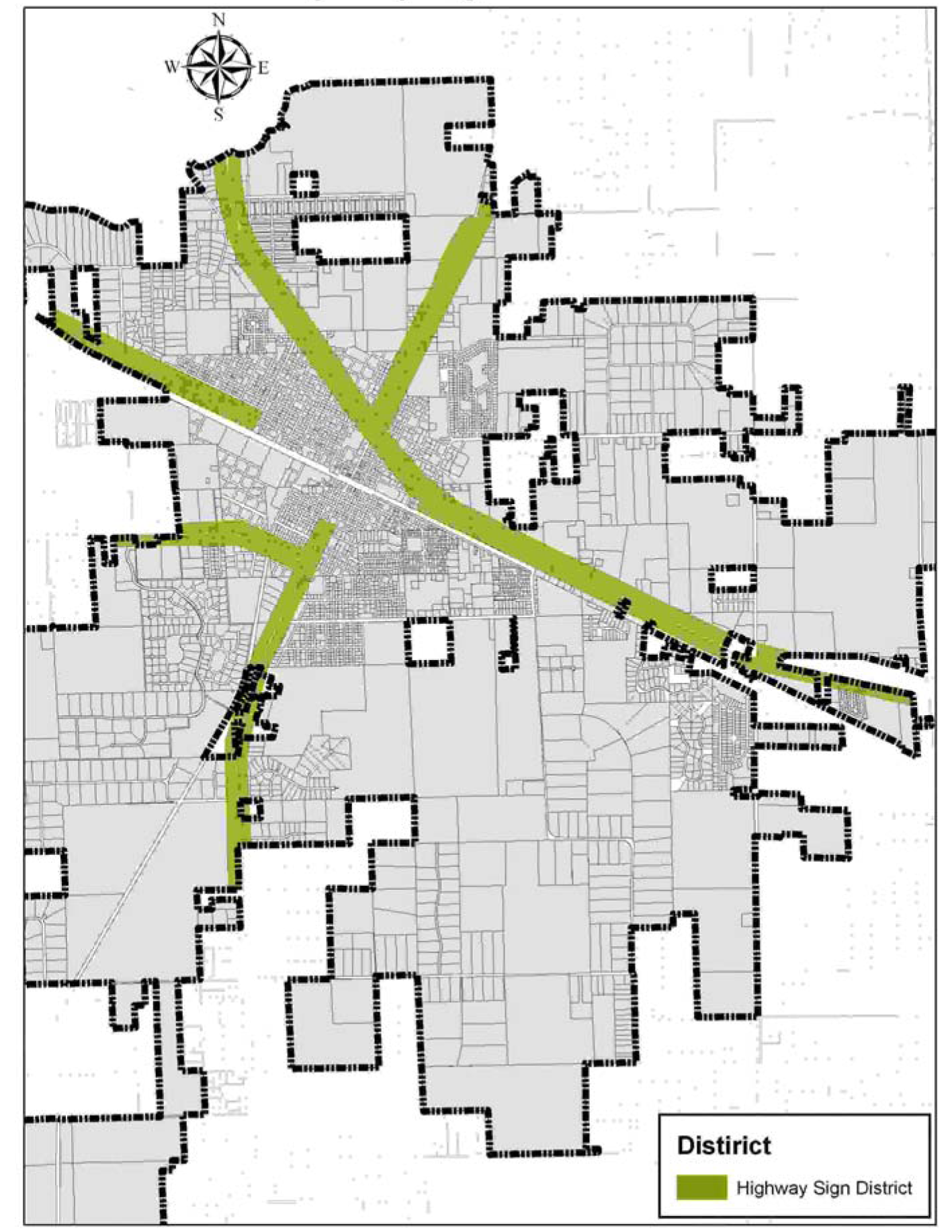
Highway sign district/designated industrial parks.
a.
Signs are limited to 80 square feet and a maximum height of ten feet for ground signs and 18 feet for pole type signs (measured from the top of the sign).
b.
Signs are limited to the following types:
i.
Monument signs.
ii.
Bedpost signs.
iii.
Ground mounted signs.
iv.
Ground mounted hanging signs.
v.
Pole signs.
IV.
Number of free standing signs.
a.
Each property with 300 feet of road frontage or more along a single street may have an additional free standing sign, which will be limited to the standards listed above.
b.
Properties with more than one road frontage may not combine the frontages to achieve the 300 feet length required for two signs on the same road frontage.
c.
Properties with multiple road frontages may have one sign per frontage.
Building signs: If a building has frontage on two or more streets, each frontage shall separately be considered for the purpose of determining compliance with the provisions of these regulations, and the permitted sign area for one frontage may not be combined with that permitted for another frontage to increase the permitted sign area on one frontage.
(2)
Building signs.
a.
Subject to the design criteria of this LDC, no building sign shall project beyond the parapet of a roof line, or above the horizontal line of a flat roof. A building sign may be attached flat to a sloped roof, as long as such sign has met the State of Florida Building Code requirements.
b.
Each multiple occupancy complex may display one permanent building sign on each side of the principal building or buildings on which the complex is located, not to exceed a sign area of up to ten percent of the facade area of each building side, or 100 square feet, whichever is smaller.
c.
Each occupant of a multiple occupancy complex may display two permanent building signs on any exterior portion of a complex that is part of the occupant's unit, not to exceed a combined sign area of 15 percent of the facade area of such exterior portion or 100 square feet, whichever is smaller.
d.
Building signs for multiple occupancy complexes constructed or remodeled after the effective date of this LDC shall conform to an approved sign format. The sign format shall be included as a submittal for authorization to erect such a sign and shall be maintained on file with the zoning administrator. The format shall be presented in a plan or sketch, together with written specifications in sufficient detail to enable the authorization of signs based on the specifications. At a minimum, the sign format shall specify the types of signs and dimensions that will be permitted for each occupant within the complex. The sign format shall also be of common design elements such as placement, color, shape or style of lettering, which lend unified appearance to the signs of the occupants within the complex. The sign format may only be modified with the approval of the zoning administrator upon submission of a revised plan and specifications detailing the revised format. The sign submittal must also include all necessary documentation as required for a building permit.
e.
Each occupant not located in a multiple occupancy complex may display two permanent building signs on each side of the principal building on which the occupancy is located, not to exceed a total combined sign area for each building side of ten percent of the facade area of the building side or 100 square feet, whichever is smaller.
f.
For signs in the Downtown Sign District, internally illuminated signs shall be limited to 48 square feet for each stand alone building or each occupant in a multiple occupancy complex not required to have an approved sign format pursuant to paragraph d. above.
(3)
Time, temperature, date signs are permitted as permanent signs on commercially developed parcels notwithstanding the general prohibition on changing signs. These signs may only display numerical information in an easy comprehensible way and shall be kept accurate. They may be ground or building signs, are subject to the regulations applicable to such signs, and shall be counted as part of the establishment's allowable sign area.
(4)
Directional signs limited in area to four square feet giving directions to motorists regarding the location of parking areas and access drives shall be permitted as permanent accessory signs on all parcels and shall not be counted as part of an establishment's allowable area.
(5)
Signs at entrances to residential developments, farms, and ranches:
a.
One sign is permitted at each entrance to the development, farm or ranch from each abutting street. The sign may be a single sign with two faces of equal size or may be two single-faced signs of equal size located on each side of the entrance. No face of the sign shall exceed 32 square feet in size and, if illuminated, shall be by a steady light only.
b.
Such signs shall be maintained perpetually by the developer, the owner of the sign, or a permanent homeowners association legally accountable under a maintenance arrangement approved by the zoning administrator. If no person or entity accepts, and continues responsibility to maintain the signs, and no other provision has been made for the maintenance of such signs, the signs shall be removed by the city.
c.
Public utility signs which identify the location of underground utility lines and facilities, high voltage lines and facilities, and other utility facilities and appurtenances are permitted as long as the sign and sign structure meet the following limitations:
1.
The maximum height shall be three feet;
2.
The sign face shall not exceed one-half square foot;
3.
Signs identifying the same facility shall be spaced at least 200 feet apart;
4.
The sign face shall not exceed the width of the sign structure;
5.
Signs shall not be clustered at street corners unless required because of directional change to underground utility lines.
Sec. 8.01.08. - Compliance with building and electrical codes required, minimum maintenance required.
(1)
All permanent signs and the illumination thereof, shall be designed, constructed and maintained in conformity with applicable provisions of the building and electrical codes adopted by the city.
(2)
All nonconforming signs, for businesses that are closed for a period of more than six months, must be removed by the property owner.
(3)
All signs are required to be maintained in a safe and presentable manner, and are the responsibility of the property owner to maintain signs so that they are not detraction from the commercial district. Signs that are neglected to the point where safety may be a concern, the city shall have the ability to remove signs that are deemed unsafe.
(4)
Enforcement of this section shall be by codes enforcement process.
Sec. 8.01.09. - Illumination standards.
(1)
Sign lighting may not be designed or located to cause confusion with traffic lights, or to shine directly onto an adjoining property or into the eyes of motorists or pedestrians using or entering public streets. Illuminated signs must have a steady illumination and may not flash, blink, mover, or appear to be animated.
Sec. 8.01.10. - Placement and size standards.
(1)
No sign may be located within the vision triangle as specified in the High Springs Manual of Design and Development Standards, except those for official or governmental purposes.
(2)
No signs or sign structures shall be placed in or upon a public right-of-way or public easement, except under the terms of the lease between the owner of the easement and the owner of the sign.
(3)
For pole signs, the following design conditions must be met:
(a)
The bottom of the sign must be at least eight feet above the highest crown of any adjacent street.
(b)
The sign must be supported by not more than two structures that do not exceed eight inches each in diameter.
Sec. 8.01.11. - Clearance standards.
(1)
All signs over pedestrian ways shall provide a minimum of seven feet six inches of clearance.
(2)
All signs over vehicular ways shall provide a minimum of 13 feet six inches of clearance.
Sec. 8.01.12. - Relationship to building features.
A building sign shall not extend beyond any edge of the surface to which it is attached, nor disrupt a major architectural feature of the building.
Sec. 8.01.13. - Maximum window coverage.
The combined area of permanent and temporary signs placed on or behind windows shall not exceed 25 percent of the total window area at the same floor level on the side of the building or unit upon which the sign is displayed.
Sec. 8.01.15. - Sign permits.
Sign permitting shall be governed by the requirements of section 8.01.04(16) of this LDC.
Sec. 8.01.16. - Nonconforming signs.
For nonconforming signs, see section 12.01.04(1)(d) of this LDC.
Sec. 8.01.17. - Signs with historic significance.
For signs with historic significance, see Part 3.03.00 of this LDC.

Figure 23.1
Advertising Balloon

Figure 23.2
Bedpost Sign

Figure 23.3
Ground Sign

Figure 23.4
Ground Mounted Hanging Sign
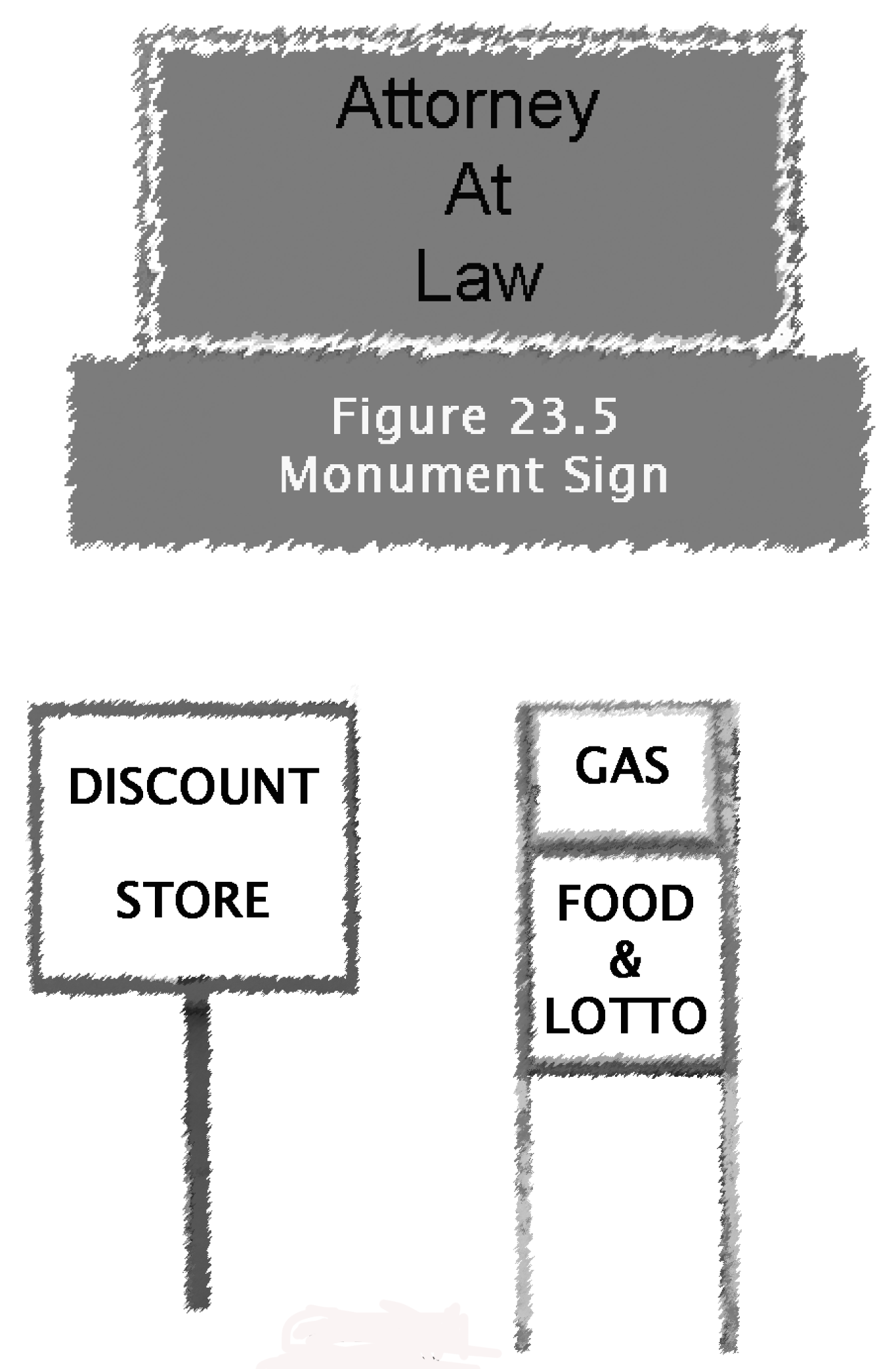
Figure 23.6
Pole Signs

Figure 23.7
Sandwich Sign

Figure 23.8
Snipe Sign
Downtown Sign District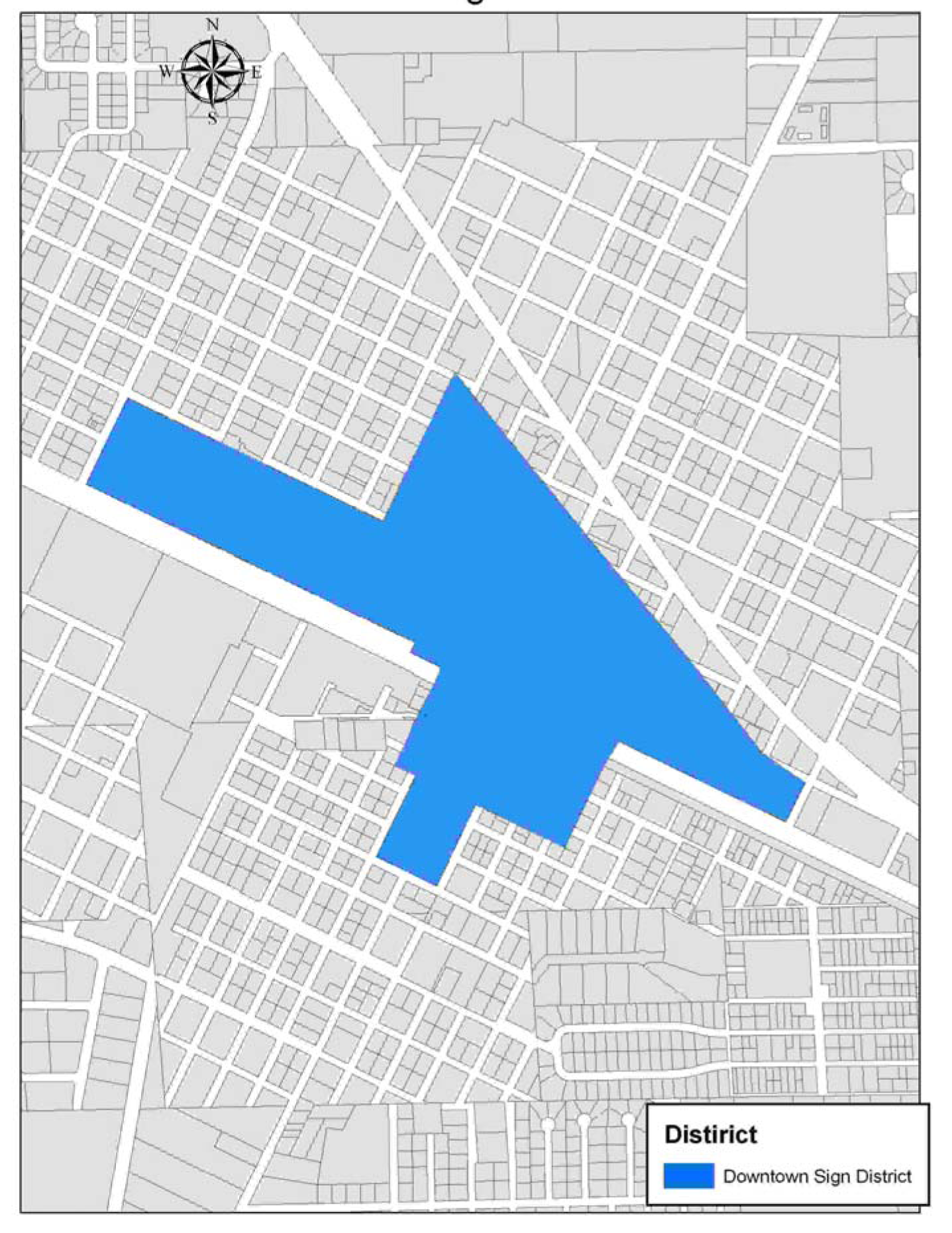
Highway Sign District